WO2010013635A1 - トナー - Google Patents
トナー Download PDFInfo
- Publication number
- WO2010013635A1 WO2010013635A1 PCT/JP2009/063182 JP2009063182W WO2010013635A1 WO 2010013635 A1 WO2010013635 A1 WO 2010013635A1 JP 2009063182 W JP2009063182 W JP 2009063182W WO 2010013635 A1 WO2010013635 A1 WO 2010013635A1
- Authority
- WO
- WIPO (PCT)
- Prior art keywords
- toner
- general formula
- acid
- mass
- parts
- Prior art date
- Legal status (The legal status is an assumption and is not a legal conclusion. Google has not performed a legal analysis and makes no representation as to the accuracy of the status listed.)
- Ceased
Links
Images

Classifications
-
- G—PHYSICS
- G03—PHOTOGRAPHY; CINEMATOGRAPHY; ANALOGOUS TECHNIQUES USING WAVES OTHER THAN OPTICAL WAVES; ELECTROGRAPHY; HOLOGRAPHY
- G03G—ELECTROGRAPHY; ELECTROPHOTOGRAPHY; MAGNETOGRAPHY
- G03G9/00—Developers
- G03G9/08—Developers with toner particles
- G03G9/09—Colouring agents for toner particles
- G03G9/0906—Organic dyes
- G03G9/092—Quinacridones
-
- G—PHYSICS
- G03—PHOTOGRAPHY; CINEMATOGRAPHY; ANALOGOUS TECHNIQUES USING WAVES OTHER THAN OPTICAL WAVES; ELECTROGRAPHY; HOLOGRAPHY
- G03G—ELECTROGRAPHY; ELECTROPHOTOGRAPHY; MAGNETOGRAPHY
- G03G9/00—Developers
- G03G9/08—Developers with toner particles
- G03G9/09—Colouring agents for toner particles
- G03G9/0906—Organic dyes
- G03G9/0914—Acridine; Azine; Oxazine; Thiazine-;(Xanthene-) dyes
-
- G—PHYSICS
- G03—PHOTOGRAPHY; CINEMATOGRAPHY; ANALOGOUS TECHNIQUES USING WAVES OTHER THAN OPTICAL WAVES; ELECTROGRAPHY; HOLOGRAPHY
- G03G—ELECTROGRAPHY; ELECTROPHOTOGRAPHY; MAGNETOGRAPHY
- G03G9/00—Developers
- G03G9/08—Developers with toner particles
- G03G9/09—Colouring agents for toner particles
- G03G9/0906—Organic dyes
- G03G9/0924—Dyes characterised by specific substituents
Definitions
- the present invention relates to a toner.
- Electrophotographic image forming apparatuses have been developed mainly as copiers and printers used mainly in offices and the like.
- a high-speed, high-quality color image forming apparatus is also called a digital printer, and is useful for printing variable information such as direct mail and quotations.
- offset printing machines which have been the mainstream of commercial printing because no printing plate is required, it has begun to spread especially for small lot printing.
- the turnover rate of consumables such as toner is high, and each company has a unique technology and is entering the market one after another.
- the toner is made of a thermoplastic resin having a certain elastic modulus when heated and melted, it is difficult to control the thickness of the toner layer in the image portion to be equal to or less than the ink. For this reason, it is particularly difficult to ensure the lightness of the image with magenta toner, and further improvement has been a technical problem with respect to the reproduction of the tint that changes the impression due to fluctuations in lightness such as skin color.
- An object of the present invention is to increase the color gamut, improve the color tone reproducibility, and improve the density stability.
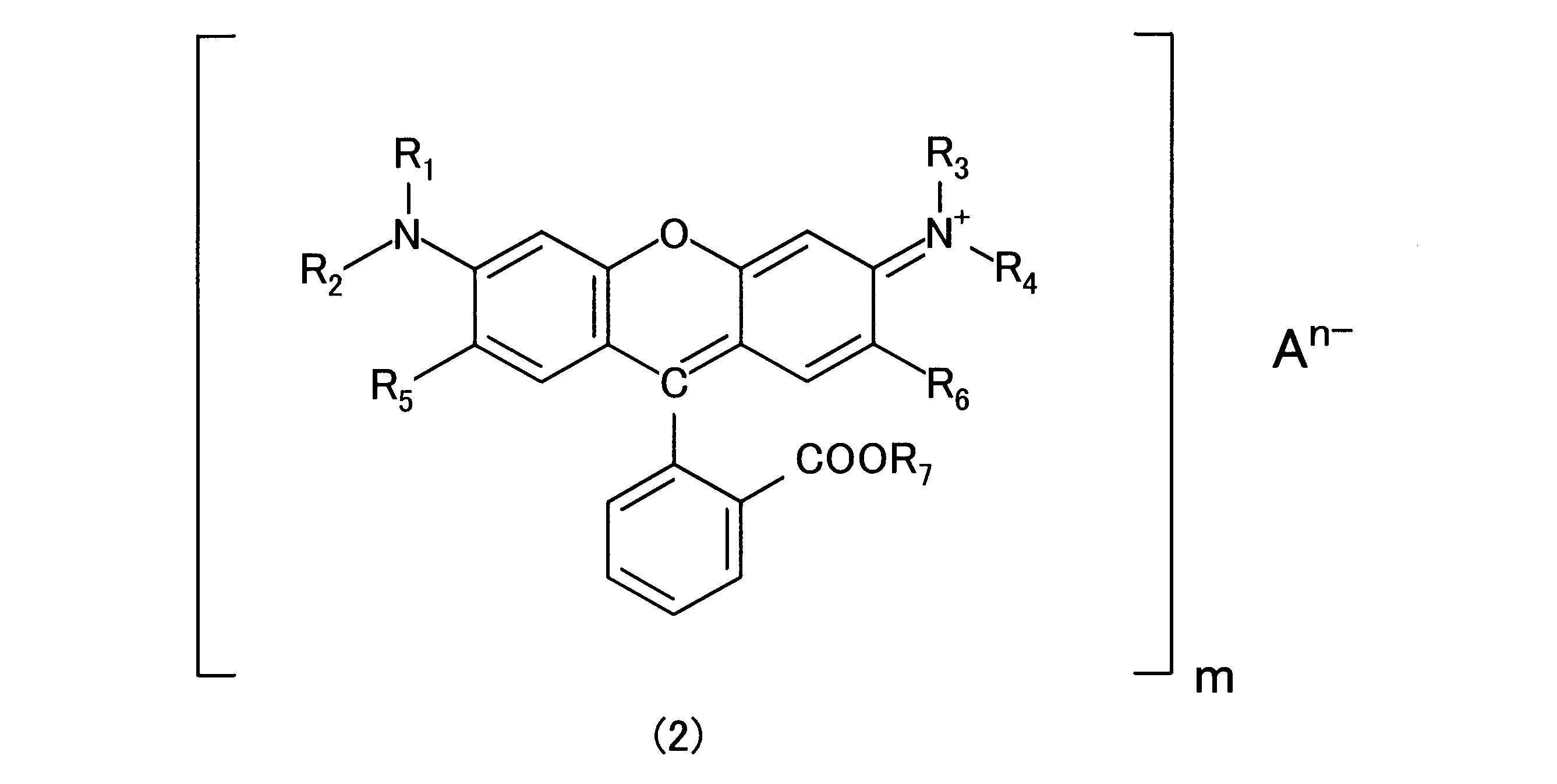
- a toner in which the colorant contains a compound represented by the following general formula (1) and a compound represented by the following general formula (2).
- R 1 to R 8 represent any one of a hydrogen atom, a halogen atom, an alkyl group, or an alkyl group containing a fluorine atom, and at least one of R 1 to R 8 is a chlorine atom. It is.
- R 1 to R 4 represent a hydrogen atom or an alkyl group having 1 to 4 carbon atoms.
- R 5 and R 6 each represent a hydrogen atom or an alkyl group having 1 to 2 carbon atoms.
- R 7 represents a hydrogen atom or an alkyl group having 1 to 4 carbon atoms.
- m represents 1 or 2
- n represents 1 or 2.
- the compound represented by the general formula (1) is contained in a ratio of 1 to 5 parts by mass with respect to 5 parts by mass of the compound represented by the general formula (2).
- the described toner is provided.
- blue has a wide color gamut, and the color reproducibility of the blue tone can be greatly improved.
- the brightness of the magenta toner image is also improved, and the skin color reproducibility can be improved.
- the color gamut it is possible to faithfully reproduce the color displayed on the RGB display even in a printed matter.
- the density change is small even when used for continuous printing, and the stability of density can be improved.
- FIG. 1 is a diagram illustrating an example of an image forming apparatus.
- the toner according to the present invention is composed of toner particles containing at least a resin and a colorant.
- a mold release agent, a charge control agent, and an external additive can be added as necessary.
- resin is not specifically limited,
- polymerizing the polymerizable monomer called the following vinylic monomer is mentioned as an example.
- This polymer comprises a polymer obtained by polymerizing at least one polymerizable monomer as a constituent component, and is a polymer prepared by combining these vinyl monomers alone or in combination.
- Styrene or styrene derivatives For example, styrene, o-methylstyrene, m-methylstyrene, p-methylstyrene, ⁇ -methylstyrene, p-phenylstyrene, p-ethylstyrene, 2,4-dimethylstyrene, p- Examples thereof include tert-butyl styrene, pn-hexyl styrene, pn-octyl styrene, pn-nonyl styrene, pn-decyl styrene, and pn-dodecyl styrene.
- Methacrylic acid ester derivatives For example, methyl methacrylate, ethyl methacrylate, n-butyl methacrylate, isopropyl methacrylate, isobutyl methacrylate, t-butyl methacrylate, n-octyl methacrylate, 2-ethylhexyl methacrylate, methacryl
- examples include stearyl acid, lauryl methacrylate, phenyl methacrylate, diethylaminoethyl methacrylate, dimethylaminoethyl methacrylate, and the like.
- Acrylic acid ester derivatives For example, methyl acrylate, ethyl acrylate, isopropyl acrylate, n-butyl acrylate, t-butyl acrylate, isobutyl acrylate, n-octyl acrylate, 2-ethylhexyl acrylate, acrylic Examples include stearyl acid, lauryl acrylate, and phenyl acrylate.
- Olefin examples include ethylene, propylene, isobutylene and the like.
- Vinyl esters For example, vinyl propionate, vinyl acetate, vinyl benzoate and the like.
- Vinyl ethers Examples include vinyl methyl ether and vinyl ethyl ether.
- Vinyl ketones examples include vinyl methyl ketone, vinyl ethyl ketone, and vinyl hexyl ketone.
- N-vinyl compounds Examples include N-vinyl carbazole, N-vinyl indole, N-vinyl pyrrolidone and the like.
- vinyl compounds such as vinyl naphthalene and vinyl pyridine, acrylic acid such as acrylonitrile, methacrylonitrile, and acrylamide, and methacrylic acid derivatives.
- vinyl polymerizable monomer constituting the resin that can be used in the toner according to the present invention those having an ionic dissociation group shown below can be used.
- functional groups such as a carboxyl group, a sulfonic acid group, and a phosphoric acid group, in the side chain of a monomer is mentioned.
- those having a carboxyl group include acrylic acid, methacrylic acid, maleic acid, itaconic acid, cinnamic acid, fumaric acid, maleic acid monoalkyl ester, itaconic acid monoalkyl ester, and the like.
- examples of those having a sulfonic group include styrene sulfonic acid, allyl sulfosuccinic acid, 2-acrylamido-2-methylpropane sulfonic acid, and the like.
- the phosphoric acid group include acid phosphooxyethyl methacrylate.
- polyfunctional vinyls include divinylbenzene, ethylene glycol dimethacrylate, ethylene glycol diacrylate, diethylene glycol dimethacrylate, diethylene glycol diacrylate, triethylene glycol dimethacrylate, triethylene glycol diacrylate, neopentyl glycol dimethacrylate, neo Examples thereof include pentyl glycol diacrylate.
- polyester resins examples include polyester resins and polyester polyol resins.
- polyester resin monomer alcohol and carboxylic acid or carboxylic anhydride, carboxylic acid ester, or the like can be used.
- trivalent or higher alcohol component examples include sorbitol, 1,2,3,6-hexanetetrol, 1,4-sorbitan, pentaerythritol, dipentaerythritol, tripentaerythritol, 1,2,4-butanetriol, 1,2,5-pentanetriol, glycerol, 2-methylpropanetriol, 2-methyl-1,2,4-butanetriol, trimethylolethane, trimethylolpropane, 1,3,5-trihydroxymethylbenzene, etc. Can be mentioned.
- the carboxylic acid component includes aromatic dicarboxylic acids such as phthalic acid, isophthalic acid and terephthalic acid or anhydrides thereof; alkyl dicarboxylic acids such as succinic acid, adipic acid, sebacic acid and azelaic acid or anhydrides thereof; Examples thereof include succinic acid substituted with 6 to 12 alkyl groups or anhydrides thereof; unsaturated dicarboxylic acids such as fumaric acid, maleic acid and citraconic acid or anhydrides thereof.
- a carboxylic acid component for example, fumaric acid
- a polyester resin obtained by condensation polymerization of these components is preferable because it imparts good electric resistance to the toner.
- R 11 represents an ethylene group or a propylene group
- x and y are each an integer of 1 or more
- the average value of x + y is 2 to 10.
- Examples of the trivalent or higher polyvalent carboxylic acid component for forming a polyester resin having a crosslinking site include 1,2,4-benzenetricarboxylic acid, 1,2,5-benzenetricarboxylic acid, Examples include 4-naphthalene tricarboxylic acid, 2,5,7-naphthalene tricarboxylic acid, 1,2,4,5-benzenetetracarboxylic acid, and anhydrides and ester compounds thereof.
- the polyester polyol resin includes bisphenols (b1) represented by the following general formula (4), bisphenol type epoxy resins (b2) represented by the following general formula (5), and polyhydric alcohols (b3). And at least one selected from the reaction product (b4) of the polyhydric alcohol and acid anhydride, a compound (b5) containing at least one active hydrogen group that reacts with an epoxy group in the molecule, and further necessary Depending on the case, the crosslinking agent (b6) is used as a main raw material, and these main raw materials are reacted with each other.
- R 11 and R 12 are a hydrogen atom, a methyl group, an ethyl group, or a phenyl group, and R 11 and R 12 may be the same or different.
- R 13 and R 14 are a hydrogen atom, a methyl group, an ethyl group or a phenyl group, and n is an integer of 0 or more. R 13 and R 14 may be the same or different.
- bisphenols (b1) represented by the general formula (4) include 2,2-bis (4-hydroxyphenyl) propane (commonly known as bisphenol A) and bis (4-hydroxyphenyl) methane (commonly known as bisphenol F). ), 1,1-bis (4-hydroxyphenyl) ethane (commonly known as bisphenol AD), 1-phenyl-1,1-bis (4-hydroxyphenyl) methane, 1-phenyl-1,1-bis (4-hydroxy) Phenyl) ethane and the like. These bisphenols may be used individually by 1 type, and may be used in combination of 2 or more type.
- the bisphenol type epoxy resin (b2) represented by the general formula (5) for example, a so-called one-step epoxy resin produced from bisphenols (b1) represented by the general formula (4) and epichlorohydrin, for example.
- a two-stage epoxy resin which is a polyaddition reaction product of a one-stage epoxy resin and a bisphenol (b1) (“New Epoxy Resin” written by Hiroshi Kakiuchi, Shosendo, 1985, p30).
- Examples of the polyhydric alcohols (b3) that are one of the main raw materials include dihydric alcohols such as aromatic diols, aliphatic diols, and alicyclic diols, and trivalent or tetravalent alcohols.
- Examples of the aromatic diol include compounds represented by the following general formula (6).
- R 15 and R 16 are an ethylene group or a propylene group, p and q are integers of 1 or more, and p + q is 2 to 10.
- R 15 and R 16 may be the same or different.
- aromatic diols include polyoxyethylene- (2.0) -2,2-bis (4-hydroxyphenyl) propane and polyoxypropylene- (2.0) -2,2-bis. (4-hydroxyphenyl) propane, polyoxypropylene (1.2) -2,2-bis (4-hydroxyphenyl) propane, polyoxypropylene- (1.1) -2,2-bis (4-hydroxyphenyl) Propane, polyoxypropylene- (2.2) -polyoxyethylene- (2.0) -2,2-bis (4-hydroxyphenyl) propane, polyoxypropylene- (6) -2,2-bis ( 4-hydroxyphenyl) propane, polyoxypropylene- (3.3) -2,2-bis (4-hydroxyphenyl) propane and the like.
- p-xylylene glycol and m-xylylene glycol can also be used as the aromatic diol.
- Examples of the aliphatic diol include ethylene glycol, diethylene glycol, propylene glycol, triethylene glycol, tetramethylene glycol, pentamethylene glycol, neopentyl glycol and the like.
- Examples of the alicyclic diol include dihydroxymethylcyclohexane and hydrogenated bisphenol A.
- trivalent or tetravalent alcohol examples include 1,2,3,6-hexanetetrol, 1,4-sorbitan, pentaerythritol, tripentaerythritol, 1,2,4-butane taking all, trimethylolethane, Examples include trimethylolpropane and 1,3,5-trihydroxymethylbenzene.
- examples of the acid anhydride used for the reaction with polyhydric alcohol include phthalic anhydride, trimellitic anhydride, Pyromellitic anhydride, ethylene glycol bis trimellitate, glycerol trislimitate, maleic anhydride, tetrahydrophthalic anhydride, methyltentrahydrophthalic anhydride, endomethylenetetrahydrophthalic anhydride, methylendomethylenetetrahydrophthalic anhydride, methyl Butenyltetrahydrophthalic anhydride, dodecenyl succinic anhydride, hexahydrophthalic anhydride, methylhexahydrophthalic anhydride, succinic anhydride, methylcyclohexene dicarboxylic acid anhydride, alkylstyrene-maleic anhydride copolymer, chlorendic anhydride, Poly It can
- the reaction between the polyhydric alcohol and the acid anhydride can be usually carried out at 80 ° C. to 150 ° C. for 1 to 8 hours in the presence of a catalyst.
- the reaction between the polyhydric alcohol and the acid anhydride may be performed simultaneously with the polyaddition reaction in the production of the resin preferably used in the present invention described later, or may be performed before the polyaddition reaction. Since the acid anhydride acts as a crosslinking agent and in some cases gelation may occur, it is preferably performed before the polyaddition reaction.
- Examples of the catalyst used in this reaction include alkali metal hydroxides such as sodium hydroxide, potassium hydroxide and lithium hydroxide, alkali metal alcoholates such as sodium methylate, N, N-dimethylbenzylamine, triethylamine, pyridine and the like.
- Tertiary amines such as tetramethylammonium chloride and benzyltriethylammonium chloride, organophosphorus compounds such as triphenylphosphine and triethylphosphine, alkali metal salts such as lithium chloride and lithium bromide, trifluoride
- organophosphorus compounds such as triphenylphosphine and triethylphosphine
- alkali metal salts such as lithium chloride and lithium bromide
- trifluoride examples include Lewis acids such as boron, aluminum chloride, tin tetrachloride, tin octylate, and zinc benzoate.
- the amount used is usually 1 to 1000 ppm, preferably 5 to 500 ppm, based on the amount of product.
- a solvent may or may not be used. When a solvent is used, aromatic hydrocarbons such as toluene, xylene and ethylbenzene, and ketones such
- the compound (b5) having at least one active hydrogen group that reacts with an epoxy group, which is one of the main raw materials, in the molecule is a monovalent phenol, a secondary amine, or a monovalent carboxylic acid.
- the monovalent phenols include phenol, cresol, isopropylphenol, octylphenol, nonylphenol, dodecylphenol, xylenol, P-cumylphenol, ⁇ -naphthol, ⁇ -naphthol and the like.
- secondary amines examples include aliphatic secondary amines such as diethylamine, dipropylamine, dibutylamine, dipentylamine, didodecylamine, distearylamine, diethanolamine, diallylamine, N-methylaniline, N-methyltoluidine, N -Aromatic ring-containing secondary amines such as methylnitroaniline, diphenylamine, ditolylamine, benzyldimethylamine and the like.
- aliphatic secondary amines such as diethylamine, dipropylamine, dibutylamine, dipentylamine, didodecylamine, distearylamine, diethanolamine, diallylamine, N-methylaniline, N-methyltoluidine, N -Aromatic ring-containing secondary amines such as methylnitroaniline, diphenylamine, ditolylamine, benzyldimethylamine and the like.
- monovalent carboxylic acids examples include aliphatic carboxylic acids such as propionic acid, butyric acid, caproic acid, caprylic acid, pelargonic acid, stearic acid, benzoic acid, toluic acid, ⁇ -naphthoic acid, ⁇ -naphthoic acid, and phenylacetic acid. And aromatic ring-containing monovalent carboxylic acids.
- polyamines such as an aromatic polyamine and an aliphatic polyamine, an acid anhydride, a trivalent or more phenolic compound, a trivalent or more epoxy resin, etc. are used, for example.
- polyamines include diethylenetriamine, triethylenetriamine, iminobispropylamine, bis (hexamethylene) triamine, trimethylhexamethylenediamine, diethylaminopropylamine, metaxylylenediamine, metaphenylenediamine, diaminodiphenylmethane, and diaminodiphenylsulfone. Can be mentioned.
- the colorant contains a compound represented by the following general formula (1) and a compound represented by the following general formula (2).
- This colorant can be used as a magenta colorant.
- R 1 to R 8 represent any one of a hydrogen atom, a halogen atom, an alkyl group, or an alkyl group containing a fluorine atom, and at least one of R 1 to R 8 is a chlorine atom. It is. ]
- R 1 to R 4 represent a hydrogen atom or an alkyl group having 1 to 4 carbon atoms.
- R 5 and R 6 each represent a hydrogen atom or an alkyl group having 1 to 2 carbon atoms.
- R 7 represents a hydrogen atom or an alkyl group having 1 to 4 carbon atoms.
- m represents 1 or 2
- n represents 1 or 2.
- the content ratio (mass ratio) of the compound represented by the general formula (1) and the compound represented by the general formula (2) is 5 parts by mass of the compound represented by the general formula (2).
- the compound represented by (1) is preferably 1 to 5 parts by mass. That is, the content ratio of the compound represented by the general formula (1) to the compound represented by the general formula (2) is preferably 1 to 5: 5.
- R 1 to R 4 is a chlorine atom and at least one of R 5 to R 8 is a chlorine atom.
- the compound represented by the general formula (2) may be a compound raked by a rake species.
- the rake species refers to an oxide used for rake formation, and examples thereof include inorganic molybdate compounds such as phosphomolybdic acid, silicomolybdic acid, and phosphotungstomolybdic acid. Light resistance can be improved by rake formation.
- the compound represented by the general formula (2) of the present invention is positioned as a main magenta colorant for enriching blue coloring.
- the compound represented by the general formula (1) is supplementarily added to the compound represented by the general formula (2), so that a synergistic effect is generated and a red color called Scarlet is clarified.
- a synergistic effect is generated and a red color called Scarlet is clarified.
- red and magenta colors with high brightness and transparency when it is desired to emphasize the advertising effect.
- color reproducibility in the red color range that surpasses the aforementioned printing standard color JAPAN COLOR.
- the yellow toner used in combination with the magenta toner according to the present invention contains the same binder resin as the magenta toner.
- preferable yellow colorants include C.I. I. Pigment 74, 3, 35, 65, 95, 98, 111, 139, C.I. I. Solvent Yellow 94 and 162. Of these, C.I. is particularly preferable. I. Pigment Yellow 74.
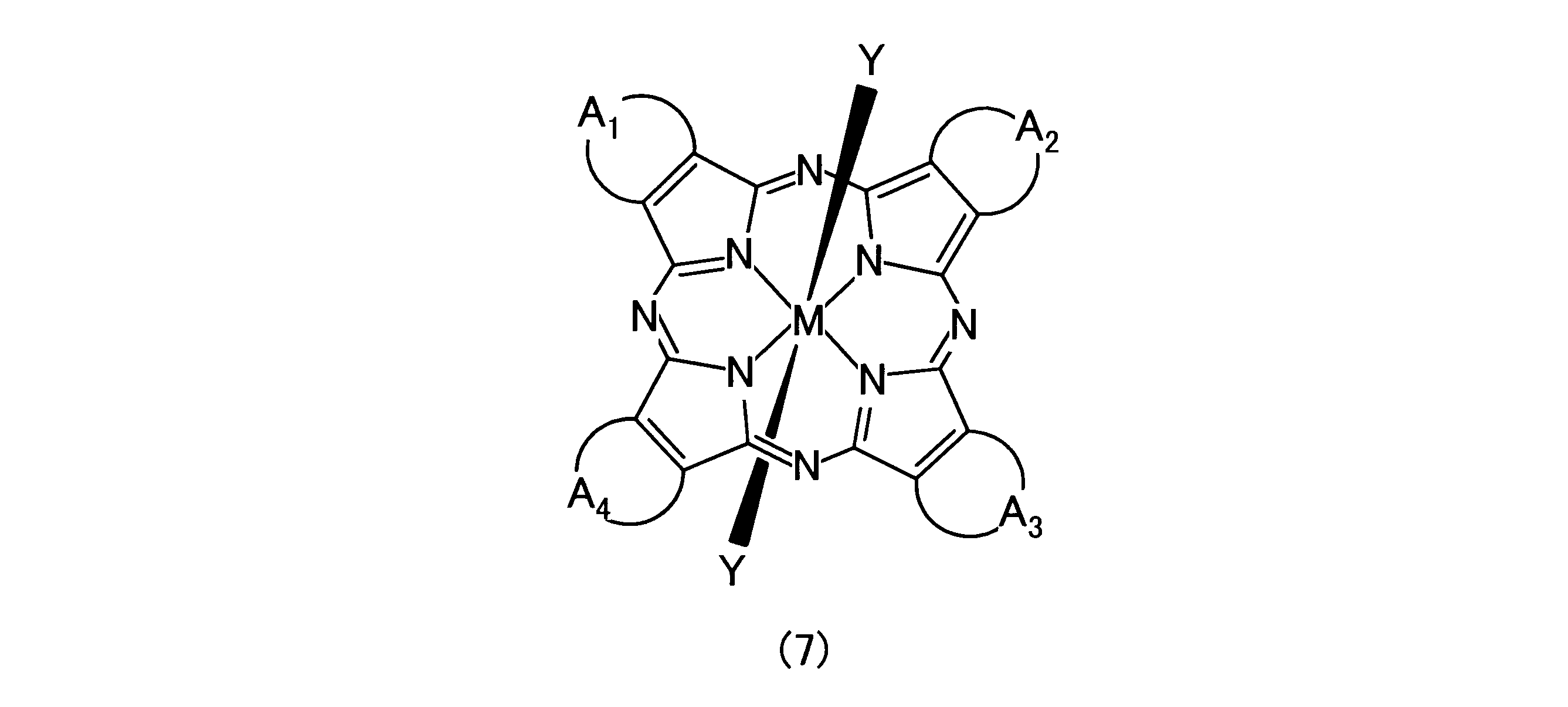
- the cyan colorant preferably used in the present invention is silicon phthalocyanine represented by the following general formula (7).
- M represents a silicon atom (Si).
- A is an atomic group constituting a benzene ring. However, A may be substituted with a chlorine atom, a nitro group, a cyano group or a perfluoro group.
- Y independently represents any of a hydroxy group, chlorine, an alkoxy group having 1 to 22 carbon atoms, or a compound represented by the following general formula (8).
- R 1 , R 2 and R 3 represent an alkyl group having 1 to 6 carbon atoms.
- Illustrative compounds of silicon phthalocyanine represented by the general formula (7) include compounds represented by the following formulas (9) to (14).
- n represents normal (no branching), and i represents iso (with branching).
- release agent examples include known waxes as shown below.
- Polyolefin wax Examples include polyethylene wax and polypropylene wax.
- Long-chain hydrocarbon wax Examples include paraffin wax and sazol wax.
- Dialkyl ketone wax For example, distearyl ketone.
- Amide wax Examples include ethylenediamine dibehenyl amide and trimellitic acid tristearyl amide.
- the melting point of the wax is usually 40 to 125 ° C, preferably 50 to 120 ° C, more preferably 60 to 90 ° C. By setting the melting point within the above range, the heat-resistant storage stability of the toner is ensured, and a stable toner image can be formed without causing a cold offset or the like even when fixing at a low temperature. Further, the wax content in the toner is preferably 1% by mass to 30% by mass, and more preferably 5% by mass to 20% by mass.
- External additive By adding the external additive, the fluidity and chargeability of the toner are improved, and the cleaning property is improved.
- the type of external additive is not particularly limited, and examples thereof include inorganic fine particles, organic fine particles, and lubricants.
- inorganic fine particles known fine particles having an average primary particle diameter of about 4 to 800 nm can be used.
- silica, titania, alumina, strontium titanate fine particles and the like are preferable.
- hydrophobized these inorganic fine particles as needed can also be used.
- silica fine particles include commercially available products R-805, R-976, R-974, R-972, R-812, R-809 manufactured by Nippon Aerosil Co., Ltd., HVK-2150, H- 200, commercially available products TS-720, TS-530, TS-610, H-5, MS-5 manufactured by Cabot.
- titania fine particles for example, commercially available products T-805 and T-604 manufactured by Nippon Aerosil Co., Ltd., commercially available products MT-100S, MT-100B, MT-500BS, MT-600, MT-600SS, JA-1 manufactured by Teica Commercial products TA-300SI, TA-500, TAF-130, TAF-510, TAF-510T manufactured by Fuji Titanium Co., Ltd. Commercial products IT-S, IT-OA, IT-OB, IT-OC manufactured by Idemitsu Kosan Co., Ltd. Etc.
- the alumina fine particles include commercial products RFY-C and C-604 manufactured by Nippon Aerosil Co., Ltd. and commercial products TTO-55 manufactured by Ishihara Sangyo Co., Ltd.
- organic fine particles spherical particles having a number average primary particle diameter of about 10 to 2000 nm can be used. Specifically, homopolymers such as styrene and methyl methacrylate and copolymers thereof can be used.
- a lubricant can be used.
- the lubricant include metal salts of higher fatty acids, such as zinc stearate, aluminum, copper, magnesium, calcium and other salts, zinc oleate, manganese, iron, copper, magnesium and other salts, zinc palmitate, Examples thereof include salts such as copper, magnesium and calcium, zinc linoleic acid, salts such as calcium, and salts such as zinc ricinoleic acid and calcium.
- the amount of these external additives added is preferably 0.1 to 10.0% by mass with respect to the whole toner.
- Examples of the method for adding the external additive include a method using various known mixing apparatuses such as a Turbuler mixer, a Henschel mixer, a Nauter mixer, and a V-type mixer.
- the toner according to the present invention can be produced by a conventional toner production method.
- Conventional toner manufacturing methods include kneading, pulverization, and classification steps, as well as polymerizing polymerizable monomers and simultaneously forming toner particles while controlling the shape and size.
- the polymer toner can be produced by applying a production method (for example, an emulsion association method, a suspension polymerization method, a polyester stretching method, etc.).
- a core / shell method in which toner is composed of a core and a shell and the toner is encapsulated may be employed.
- the following steps are included.
- the toner according to the present invention is produced by a pulverization method
- the emulsion association method and suspension polymerization method After the colorant of the present invention is dissolved or dispersed in the polymerizable monomer, the polymerizable monomer in an aqueous medium is used.
- the dissolution suspension method and the polyester elongation method it is preferable to provide a step of polymerizing the body.
- the colorant of the present invention is added to the toner particles. Can be introduced.
- the toner according to the present invention can be used as a non-magnetic one-component developer composed only of toner, or can be used as a two-component developer composed of carrier and toner.
- the toner When used as a non-magnetic one-component developer, the toner is charged by sliding and pressing the charging member and the developing roller surface during image formation. Image formation by the non-magnetic one-component development method can simplify the structure of the developing device, and thus has an advantage that the entire image forming device can be made compact. Therefore, when the toner according to the present invention is used as a non-magnetic one-component developer, it is possible to perform full color printing which is compact and excellent in color reproducibility even in a working environment where space is limited.
- a well-known carrier can be used as a carrier which is a magnetic particle used when used as a two-component developer. Examples thereof include metals such as iron, ferrite, and magnetite, and alloys of these metals with metals such as aluminum and lead. Among these, ferrite particles are preferable.
- the volume average particle diameter of the carrier is preferably 15 to 100 ⁇ m, more preferably 25 to 80 ⁇ m.
- FIG. 1 shows an example of an image forming apparatus 11 that forms an image using the toner according to the present invention.
- the image forming apparatus 11 is called a tandem type color image forming apparatus.
- an image reading device 21 is provided on the upper part of the main body of the image forming apparatus 11.
- the image forming apparatus 11 includes units uY, uM, uC, and uK that perform exposure and development for each color of Y, M, C, and K toners.
- the units uY, uM, uC, and uK include an exposure device u1, a developing device u2, a photoconductor u3, a charging unit u4, a cleaning unit u5, and a primary transfer roller u6, respectively.
- the primary transfer roller u6 is in pressure contact with the photoreceptor u3.
- the image forming apparatus 11 includes an intermediate transfer unit 22, a secondary transfer roller 23, a fixing device 24, and a paper feeding unit 25.
- the intermediate transfer unit 22 includes an intermediate belt 2a wound by a plurality of rolls and rotatably supported, and a cleaning unit 2b.
- the secondary transfer roller 23 is pressed against the intermediate belt 2a.
- the exposure, development, and transfer processes are sequentially repeated by the units uY, uM, uC, and uK for each color in accordance with the rotation of the intermediate belt 2a, thereby superimposing the toner images of the respective colors on the intermediate belt 2a. An image is formed.
- the secondary transfer roller 23 acts to collect color images from the intermediate belt 2a onto the paper. Transcribed. Thereafter, when the sheet is conveyed to the fixing device 24 and the color image is fixed and fixed on the sheet by pressurization and heating, the sheet is finally discharged to a tray provided outside. In this way, when the image formation is completed, the toner remaining on the photoconductor u3 and the intermediate belt 2a is removed by the cleaning units u5 and 22.
- the particle diameters measured in Examples and Comparative Examples described below are volume-based median diameters. This median diameter was measured under the following measurement conditions using “MICROTRAC UPA 150” (manufactured by HONEWELL). ⁇ Measurement condition ⁇ Sample refractive index: 1.59 Sample specific gravity (converted into spherical particles): 1.05 Solvent refractive index: 1.33 Solvent viscosity: 0.797 (30 ° C), 1.002 (20 ° C) Zero point adjustment: Ion exchange water was put in the measurement cell.
- Compound A11 is a compound represented by the general formula (1), and R 1 to R 8 in the general formula (1) of the compound A11 are represented by Table 1 below.
- the compound B33 is a compound represented by the general formula (2), R 1 ⁇ R 7 in the general formula of the compound B33 (2), m, A n-is indicated by Table 2 below.
- DBS represents dodecylbenzenesulfonate ion
- DNS represents dodecylnaphthalenedisulfonate ion.
- a dispersion MB1 of magenta colorant particles having a volume-based median diameter of 142 nm is obtained by performing a dispersion treatment using a stirrer “Clearmix W Motion CLM-0.8” (manufactured by M Technique Co., Ltd.). Prepared.
- magenta colorant dispersions MB2 to MB19 were prepared according to the procedure described above.
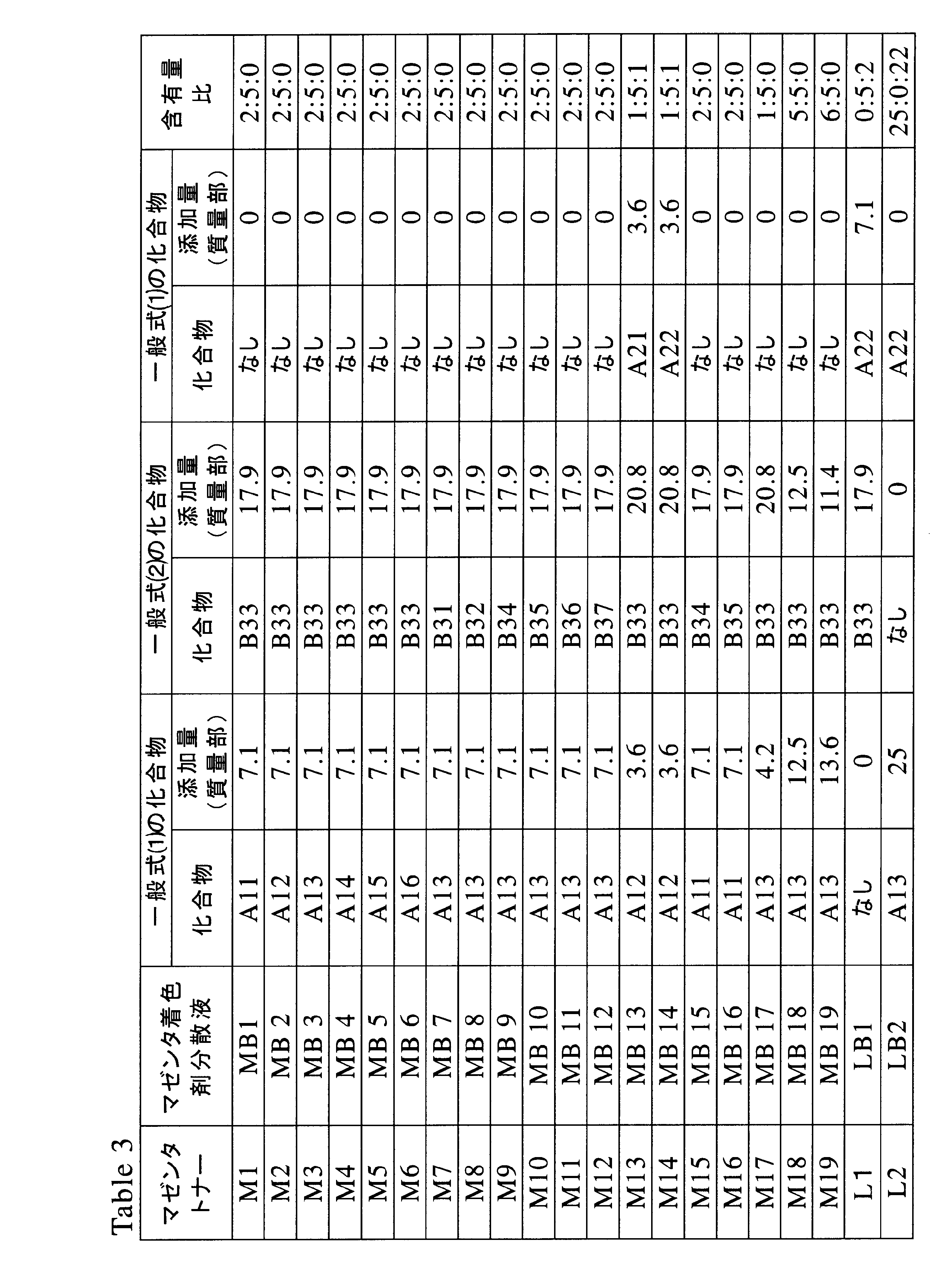
- the compounds A11 to A16, A21, and A22 shown in Table 3 are compounds represented by the general formula (1), and R 1 to R 8 in the general formula (1) of the compounds A11 to A16, A21, and A22 are the above-described compounds. As shown in Table 1.
- each of the compounds B31 ⁇ B37, shown in Table 3 is a compound represented by the general formula (2), R 1 ⁇ R 7 in the general formula (2) of each compound B31 ⁇ B37, m, A n- is the It is as shown in Table 2.
- the magenta colorant dispersions MB1 to MB19 contain at least one of the compounds A11 to A16 and one of the compounds B31 to B37. Further, the magenta colorant dispersions MB13 and MB14 contain one of the compounds A21 and A22. Table 3 shows the content ratios (mass ratios) of the compounds A11 to A16, the compounds B31 to B37, and the compounds A21 and A22 in the magenta colorant dispersions MB1 to MB19.
- an initiator solution in which 10 parts by mass of a polymerization initiator (potassium persulfate: KPS) is dissolved in 400 parts by mass of ion-exchanged water is added to a temperature of 75 ° C.
- the monomer mixture was added dropwise over 1 hour.
- the system was heated at 75 ° C. for 2 hours.
- polymerization was carried out with stirring (this is referred to as first-stage polymerization) to prepare resin particles j1.
- the monomer solution in which the release agent is dissolved is mixed and dispersed for 8 hours by a mechanical disperser “CLEARMIX” (manufactured by M Technique Co., Ltd.) having a circulation path, and emulsified with a dispersed particle size of 340 nm. A dispersion containing the particles was prepared.
- polymerization (third stage polymerization) was performed by heating and stirring for 2 hours, and then cooled to 28 ° C. to prepare core-forming resin particles J.
- the glass transition temperature Tg of the core-forming resin particles J prepared by the third stage polymerization was 28.1 ° C.
- the glass transition temperature can be measured using a DSC-7 differential scanning calorimeter (manufactured by PerkinElmer) and a TAC7 / DX thermal analyzer controller (manufactured by PerkinElmer). As a measurement procedure, a sample of 4.5 to 5.0 mg is accurately weighed to two decimal places, enclosed in an aluminum pan (KITNO.0219-0041), and set in a DSC-7 sample holder.
- the reference used an empty aluminum pan.
- the measurement was performed at a temperature of 0 to 200 ° C., a temperature increase rate of 10 ° C./min, and a temperature decrease rate of 10 ° C./min, with heat-cool-heat control, and the analysis was performed based on the data at 2nd.Heat.
- the glass transition temperature is obtained by drawing an extension line of the baseline before the rise of the first endothermic peak and a tangent line indicating the maximum slope between the rise portion of the first peak and the peak vertex, and using the intersection as the glass transition temperature.
- the fusion was continued by heating and stirring at a liquid temperature of 70 ° C. for 1 hour to form core particles.
- the circularity of the obtained core particles was measured by “FPIA2100” (manufactured by Sysmex Corporation), the average circularity was 0.912.
- Shell resin particles J Preparation of Shell Resin Particles
- the monomer mixture used in the first stage polymerization was changed to the following compound and the addition amount except that the monomer mixture was used.
- Shell resin particles were prepared by performing a polymerization reaction and a post-reaction treatment in the same procedure.
- Styrene 624 parts by mass 2-ethylhexyl acrylate: 120 parts by mass Methacrylic acid: 56 parts by mass n-octyl mercaptan: 16.4 parts by mass
- the glass transition temperature (Tg) of the shell resin particles was 62.6 ° C.
- magenta colorant dispersions MB1 used in the preparation of the magenta toner M1 were prepared for the magenta toners M2 to M19.
- Magenta toners M2 to M19 were prepared by the same procedure except that the above was changed.
- magenta toner M20 (suspension polymerization method) Into 709 parts by mass of ion-exchanged water, 451 parts by mass of a 0.1 M Na 3 PO 4 aqueous solution was added, heated to 60 ° C., and then stirred at 12000 rpm using a TK homomixer (manufactured by Tokushu Kika Kogyo). . To this, 67.7 parts by mass of 1.0M-CaCl 2 aqueous solution was gradually added to obtain a dispersion medium containing Ca 3 (PO 4 ) 2 .
- TK homomixer manufactured by Tokushu Kika Kogyo
- the monomer composition was charged into the dispersion medium prepared above.
- the monomer composition was granulated by stirring at 10000 rpm for 20 minutes using a TK homomixer (manufactured by Tokushu Kika Kogyo Co., Ltd.) at 60 ° C. in a nitrogen atmosphere. Thereafter, the mixture was reacted at 60 ° C. for 3 hours while stirring with a paddle stirrer, and then polymerized at 80 ° C. for 10 hours. After completion of the polymerization reaction, the reaction product was cooled, 5N hydrochloric acid was added to dissolve Ca 3 (PO 4 ) 2 , filtered, washed with water and dried. Thereafter, an external addition process was performed in the same manner as the magenta toner M1, and a magenta toner M20 was obtained.
- alumina particles (1.25 wt% dimethyl silicone and 2.5 wt% C 8 F 17 SO 2 NC 2 H 5 (CH 2 ) 3 Si (CH 3 O) 3 are added to the toner particles.
- the magenta toner M21 was produced by stirring for 1 minute at a rotation speed of 3000 rpm with a Henschel mixer having a capacity of 10 liters to adhere alumina particles to the surface of the toner particles.
- Comparative Magenta Toners L1 and L2 In the preparation of the magenta colorant particle dispersion MB1 described above, the procedure was the same except that the types and addition amounts of the compounds that are magenta colorant components were changed as shown in Table 3. Comparative magenta colorant dispersions LB1 and LB2 were prepared. Further, in the preparation of the magenta toner M1, the comparative magenta toners L1 and L2 are prepared in the same procedure except that the comparative magenta colorant dispersions LB1 and LB2 are used instead of the magenta colorant particle dispersion MB1. did.
- magenta toners M1 to M21 is combined with yellow toner Y and cyan toner C to give Examples 1 to 21, and the comparative magenta toners L1 and L2 are combined with yellow toner Y and cyan toner C to give Comparative Examples 1 and 2.
- the following evaluation items (1) to (4) were evaluated.
- magenta toners M1 to M21, L1, L2, yellow toner Y, and cyan toner C are mixed with a ferrite carrier having a volume average particle diameter of 60 ⁇ m coated with a silicone resin, and the toner concentration is 6%.
- the developer was prepared and used.
- the evaluation criteria are as follows. ⁇ : More than 8 out of 10 people responded that “color is good and image quality is high” ⁇ : More than 7 out of 10 people answered that “slightly good quality and image quality” ⁇ : More than 6 out of 10 people responded “similar to both color and image quality” ⁇ : More than 7 out of 10 people answered “slightly inferior in color and image quality”
- Computer iMAC (Apple Computer Co., Ltd.) Display: 24-inch wide screen LCD screen Display resolution: 1920 x 1200 pixels 2.16GHz Intel Core 2 Duo processor I 4MB shared L2 cache SO-SIMM, 1GB (512MB x 2) Serial ATA hard drive 2, 250GB 8 ⁇ Double-layer SuperDrive (DVD + R, DL, DVD ⁇ RW, CD-RW) NVIDIA GeForce 7300 GT 128MB GDDR3 Memory AirPort Extreme and Bluetooth 2.0 Built-in Apple Remote
- the seven blue-violet color codes used for the evaluation are # 7f00ff, # 7700ef, # 7000e0, # 6800d1, # 6000c1, # 5900b2, and # 5100a3.
- the evaluation criteria are as follows. A: 7 colors could be identified (excellent) ⁇ : 5 or more and less than 7 colors could be identified (good) X: Only less than 4 colors could be identified (defect) ⁇ and ⁇ were accepted.
- the evaluation criteria are as follows. a: Good ( ⁇ ⁇ 0.08) b: Normal (0.08 ⁇ ⁇ ⁇ 0.15) c: Slightly bad (0.15 ⁇ ⁇ ⁇ 0.20) d: Bad (0.20 ⁇ ⁇ )
- the evaluation criteria are as follows. a: Good ( ⁇ ⁇ 0.03) b: Normal (0.03 ⁇ ⁇ ⁇ 0.05) c: Slightly bad (0.05 ⁇ ⁇ ⁇ 0.08) d: Bad (0.08 ⁇ ⁇ )
- Examples 1 to 21 using the magenta toner according to the present invention have good skin color reproducibility.
- for blue there are many color codes that match the display display by RGB, and it can be seen that the color gamut is expanded as compared with Comparative Examples 1 and 2, and color reproduction faithful to the display is possible.
- Comparative Examples 1 and 2 the durability of 50,000 sheets was poor and density fluctuations occurred, whereas in Examples 1 to 21, density fluctuations were small and stabilized in both solid images and halftone images.
Landscapes
- Physics & Mathematics (AREA)
- General Physics & Mathematics (AREA)
- Developing Agents For Electrophotography (AREA)
Abstract
Description
高速、高画質のカラー画像形成装置は、デジタル印刷機とも呼ばれ、ダイレクトメールや見積書等の可変情報を印刷するのに有用である。刷版が不要なため商業印刷の主流だったオフセット印刷機の代替として、とりわけ小ロットの印刷用に普及し始めている。通常のオフィス用途のカラープリンタに比較して、トナー等の消耗品の回転率が高く、各社は独自の技術を搭載し参入が相次いでいる。
しかし、シアン(C)、マゼンタ(M)、イエロー(Y)、黒(K)のプロセス4色(CMYK)を用いたカラー画像形成方法では、減色混合による色相となるため、RGBのデータを、より狭い色再現領域のCMYKに色分解することはもちろんのこと、色を重ねる毎に色相に濁りが生じ、必然的に色再現領域がRGBのそれよりも狭いものとなる。そのため、データと印刷物との間の色再現性の差異が問題となっていた。
少なくとも樹脂と着色剤を含有するトナーにおいて、
前記着色剤が下記一般式(1)で示される化合物と、下記一般式(2)で示される化合物とを含有するトナーが提供される。

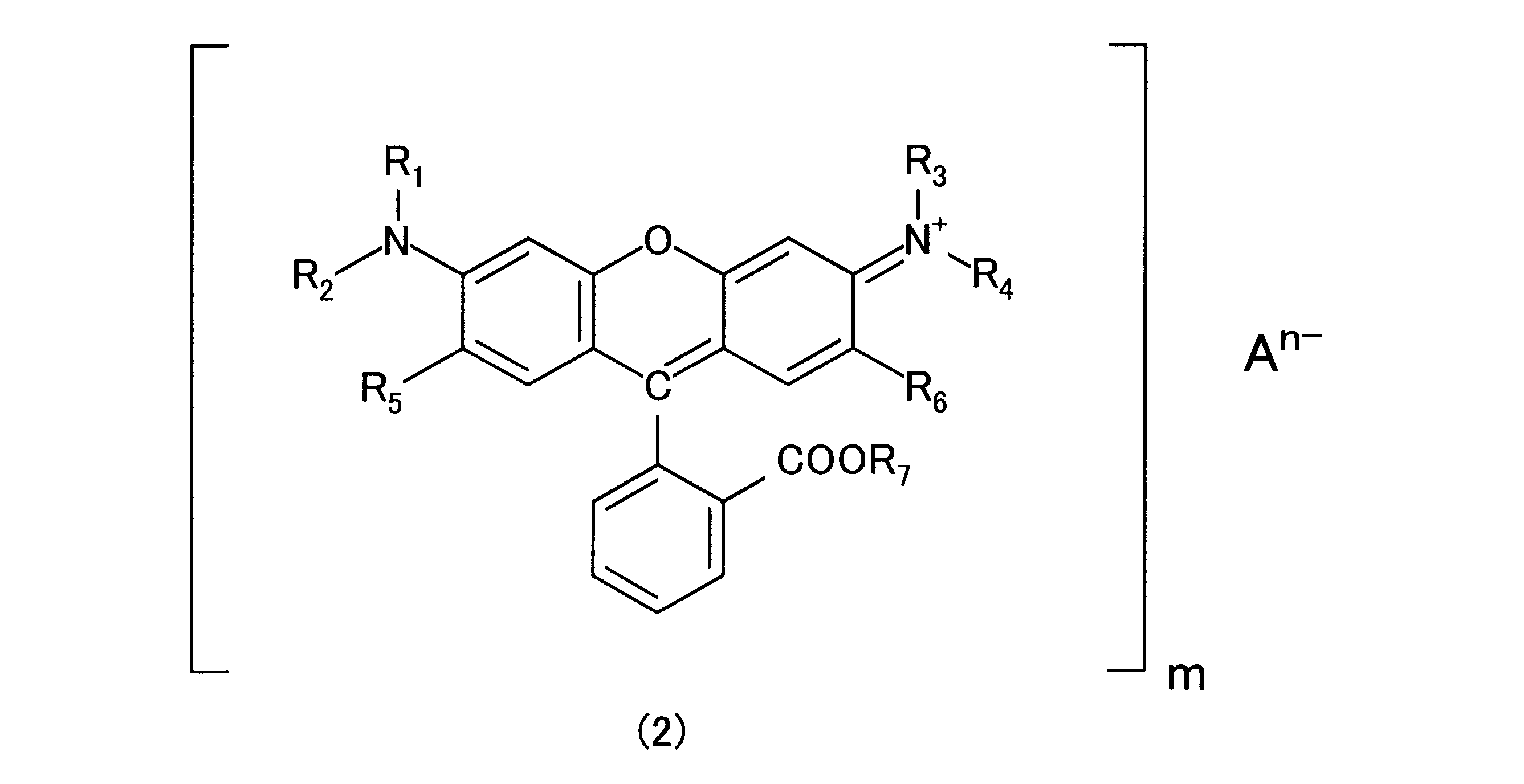
前記一般式(1)で示される化合物において、R1~R4の少なくとも1つが塩素原子であり、かつR5~R8の少なくとも1つが塩素原子である請求項1に記載のトナーが提供される。
前記一般式(2)で示される化合物が、レーキ種によってレーキ化された化合物である請求項1又は2に記載のトナーが提供される。
前記一般式(1)で示される化合物は、前記一般式(2)で示される化合物の5質量部に対し、1~5質量部の割合で含まれる請求項1~3の何れか一項に記載のトナーが提供される。
本発明に係るトナーは、少なくとも樹脂と着色剤を含有してなるトナー粒子により構成されるものである。必要に応じて離型剤、荷電制御剤、外添剤を添加することができる。
樹脂は、特に限定されるものではないが、下記のビニル系単量体と呼ばれる重合性単量体を重合して形成される重合体が一例として挙げられる。この重合体は少なくとも1種の重合性単量体を重合して得られる重合体を構成成分とするものであり、これらビニル系単量体を単独或いは複数種類組合せ作製した重合体である。
(1)スチレン或いはスチレン誘導体
例えば、スチレン、o-メチルスチレン、m-メチルスチレン、p-メチルスチレン、α-メチルスチレン、p-フェニルスチレン、p-エチルスチレン、2,4-ジメチルスチレン、p-tert-ブチルスチレン、p-n-ヘキシルスチレン、p-n-オクチルスチレン、p-n-ノニルスチレン、p-n-デシルスチレン、p-n-ドデシルスチレン等が挙げられる。
例えば、メタクリル酸メチル、メタクリル酸エチル、メタクリル酸n-ブチル、メタクリル酸イソプロピル、メタクリル酸イソブチル、メタクリル酸t-ブチル、メタクリル酸n-オクチル、メタクリル酸2-エチルヘキシル、メタクリル酸ステアリル、メタクリル酸ラウリル、メタクリル酸フェニル、メタクリル酸ジエチルアミノエチル、メタクリル酸ジメチルアミノエチル等が挙げられる。
例えば、アクリル酸メチル、アクリル酸エチル、アクリル酸イソプロピル、アクリル酸n-ブチル、アクリル酸t-ブチル、アクリル酸イソブチル、アクリル酸n-オクチル、アクリル酸2-エチルヘキシル、アクリル酸ステアリル、アクリル酸ラウリル、アクリル酸フェニル等が挙げられる。
例えば、エチレン、プロピレン、イソブチレン等が挙げられる。
(5)ビニルエステル類
例えば、プロピオン酸ビニル、酢酸ビニル、ベンゾエ酸ビニル等が挙げられる。
(6)ビニルエーテル類
例えば、ビニルメチルエーテル、ビニルエチルエーテル等が挙げられる。
例えば、ビニルメチルケトン、ビニルエチルケトン、ビニルヘキシルケトン等が挙げられる。
(8)N-ビニル化合物類
例えば、N-ビニルカルバゾール、N-ビニルインドール、N-ビニルピロリドン等が挙げられる。
その他、ビニルナフタレン、ビニルピリジン等のビニル化合物類、アクリロニトリル、メタクリロニトリル、アクリルアミド等のアクリル酸、或いはメタクリル酸誘導体等が挙げられる。
また、本発明に係るトナーに使用可能な樹脂を構成するビニル系の重合性単量体には、以下に示すイオン性解離基を有するものも用いることができる。例えば、カルボキシル基、スルフォン酸基、リン酸基等の官能基を単量体の側鎖に有するものが挙げられる。具体的には、カルボキシル基を有するものとしては、アクリル酸、メタクリル酸、マレイン酸、イタコン酸、ケイ皮酸、フマル酸、マレイン酸モノアルキルエステル、イタコン酸モノアルキルエステル等が挙げられる。また、スルフォン基を有するものとしては、スチレンスルフォン酸、アリルスルフォコハク酸、2-アクリルアミド-2-メチルプロパンスルフォン酸等が挙げられる。リン酸基を有するものとしてはアシドホスホオキシエチルメタクリレート等が挙げられる。
ポリエステル樹脂の単量体としては、アルコールとカルボン酸若しくはカルボン酸無水物、カルボン酸エステル等を使用できる。
具体的には、例えば2価アルコール成分としては、ポリオキシプロピレン(2.2)-2,2-ビス(4-ヒドロキシフェニル)プロパン、ポリオキシプロピレン(3.3)-2,2-ビス(4-ヒドロキシフェニル)プロパン、ポリオキシエチレン(2.0)-2,2-ビス(4-ヒドロキシフェニル)プロパン、ポリオキシプロピレンレン(2.0)-ポリオキシエチレン(2.0)-2,2-ビス(4-ヒドロキシフェニル)プロパン、ポリオキシプロピレン(6)-2,2-ビス(4-ヒドロキシフェニル)プロパン等のビスフェノールAのアルキレンオキシド付加物、エチレングリコール、ジエチレングリコール、トリエチレングリコール、1,2-プロピレングリコール、1,3-プロピレングリコール、1,4-ブタンジオール、ネオペンチルグリコール、1,4-ブテンジオール、1,5-ペンタンジオール、1,6-ヘキサンジオール、1,4-シクロヘキサンジメタノール、ジプロピレングリコール、ポリエチレングリコール、ポリプロピレングリコール、ポリテトラメチレングリコール、ビスフェノールA、水素添加ビスフェノールA等が挙げられる。



これらのビスフェノール類は1種単独で使用してもよいし、2種以上を組合せて用いてもよい。
芳香族ジオールとしては、下記一般式(6)により表される化合物が挙げられる。

脂環族ジオールとしては、例えばジヒドロキシメチルシクロヘキサン、水添ビスフェノールA等が挙げられる。
1価のフェノール類としては、例えばフェノール、クレゾール、イソプロピルフェノール、オクチルフェノール、ノニルフェノール、ドデシルフェノール、キシレノール、P-クミルフェノール、α-ナフトール、β-ナフトール等が挙げられる。
本発明に係るトナーにおいて、着色剤は下記一般式(1)で示される化合物と、下記一般式(2)で示される化合物とを含有する。この着色剤はマゼンタの着色剤として用いることができる。


本発明に係るマゼンタトナーと併用するイエロートナーは、マゼンタトナーと同様の結着樹脂を含有する。赤とグリーンの発色及びトナー帯電の安定性の観点から、好ましいイエロー着色剤としては、C.I.ピグメント74、同3、同35、同65、同95、同98、同111、同139、C.I.ソルベントイエロー94、同162である。このうち、特に好ましいのはC.I.ピグメントイエロー74である。
本発明で好ましく用いられるシアン着色剤は、下記一般式(7)で示される珪素フタロシアニンである。


本発明に係るトナーに使用可能な離型剤としては、以下に示すような公知のワックスが挙げられる。
(1)ポリオレフィン系ワックス
例えば、ポリエチレンワックス、ポリプロピレンワックス等が挙げられる。
例えば、パラフィンワックス、サゾールワックス等が挙げられる。
(3)ジアルキルケトン系ワックス
例えば、ジステアリルケトン等が挙げられる。
(4)アミド系ワックス
例えば、エチレンジアミンジベヘニルアミド、トリメリット酸トリステアリルアミド等が挙げられる。
カルナウバワックス、モンタンワックス、トリメチロールプロパントリベヘネート、ペンタエリスリトールテトラミリステート、ペンタエリスリトールテトラステアレート、ペンタエリスリトールテトラベヘネート、ペンタエリスリトールジアセテートジベヘネート、グリセリントリベヘネート、1,18-オクタデカンジオールジステアレート、トリメリット酸トリステアリル、ジステアリルマレエート等が挙げられる。
外添剤は、その添加によりトナーの流動性や帯電性が改良され、またクリーニング性の向上等が実現される。外添剤の種類は特に限定されるものではなく、例えば無機微粒子や有機微粒子、滑剤等が挙げられる。
チタニア微粒子としては、例えば日本アエロジル社製の市販品T-805、T-604、テイカ社製の市販品MT-100S、MT-100B、MT-500BS、MT-600、MT-600SS、JA-1、富士チタン社製の市販品TA-300SI、TA-500、TAF-130、TAF-510、TAF-510T、出光興産社製の市販品IT-S、IT-OA、IT-OB、IT-OC等が挙げられる。
アルミナ微粒子としては、例えば日本アエロジル社製の市販品RFY-C、C-604、石原産業社製の市販品TTO-55等が挙げられる。
本発明に係るトナーは従来のトナーの製造方法により作製することができる。従来のトナーの製造方法としては、混練、粉砕、分級の工程を経て作製する粉砕法の他、重合性の単量体を重合させ、同時に形状や大きさを制御しながらトナーの粒子形成を行う重合トナーの製造方法(例えば、乳化会合法、懸濁重合法、ポリエステル伸張法等)を適用することにより作製可能である。また、トナーをコアとシェルから構成し、トナーのカプセル化を行うコア・シェル法を採用してもよい。
(1)着色剤分散液の調製
(2)トナーを構成する材料(樹脂、着色剤分散液、離型剤、外添剤等)の混練・破砕
なお、粉砕法により本発明に係るトナーを製造する場合、混練物の温度を吐出部すなわち混練物の冷却前の時点で、樹脂の軟化点以上130℃以下に維持した状態で作成することが、着色剤の分散性を高める観点から好ましい。
(1)着色剤分散液の調製
(2)樹脂粒子の重合
(3)樹脂粒子と着色剤粒子の塩析/融着
(4)濾過・洗浄
(5)外添処理
(1)着色剤分散液の調製
(2)コア粒子の形成
(3)シェル層の形成
(4)濾過・洗浄
(5)外添処理
二成分現像剤として使用する際に用いられる磁性粒子であるキャリアは、公知のものを用いることができる。例えば鉄、フェライト、マグネタイト等の金属、それらの金属とアルミニウム、鉛等の金属との合金等であるが、これらの中ではフェライト粒子が好ましい。キャリアの体積平均粒径は15~100μmのものが好ましく、25~80μmのものがより好ましい。
本発明に係るトナーを用いた画像形成方法及び画像形成装置について説明する。
ここでは、図1を参照して本発明に係るトナーを二成分現像剤として用いた場合の画像形成方法及び画像形成装置を説明する。図1に示すのは、本発明に係るトナーを用いて画像形成を行う画像形成装置11の一例である。この画像形成装置11はタンデム型のカラー画像形成装置と称せられるものある。
また、画像形成装置11はY、M、C、Kのトナーの色毎に、露光及び現像を行うユニットuY、uM、uC、uKを備えている。ユニットuY、uM、uC、uKは、それぞれ露光装置u1、現像装置u2、感光体u3、帯電部u4、クリーニング部u5、1次転写ローラu6を含んでいる。1次転写ローラu6は感光体u3に圧接されている。
以下説明する実施例、比較例において測定している粒子径は体積基準のメディアン径である。このメディアン径は「MICROTRAC UPA 150」(HONEWELL社製)を用いて、下記の測定条件下で測定したものである。
〔測定条件〕
サンプル屈折率:1.59
サンプル比重(球状粒子に換算):1.05
溶媒屈折率:1.33
溶媒粘度:0.797(30℃)、1.002(20℃)
ゼロ点調整:測定セル内にイオン交換水を入れて行った。
1.マゼンタ着色剤分散液の調製
(1)マゼンタ着色剤分散液MB1の調製
n-ドデシル硫酸ナトリウム11.5質量部をイオン交換水160質量部に添加し、攪拌、溶解させた溶液を調製した。当該溶液の攪拌を続けながら、当該溶液中にマゼンタの着色剤成分である下記化合物を徐々に添加した。
化合物A11:7.1質量部
化合物B33:17.9質量部


前記マゼンタ着色剤分散液MB1の調製において、マゼンタ着色剤成分である化合物の種類と添加量を下記表3に示すように変更した他は、同様の手順でマゼンタ着色剤分散液MB2~MB19を調製した。表3に示した各化合物A11~A16、A21、A22は一般式(1)で示される化合物であり、各化合物A11~A16、A21、A22の一般式(1)におけるR1~R8は上記表1に示した通りである。また、表3に示した各化合物B31~B37は一般式(2)で示される化合物であり、各化合物B31~B37の一般式(2)におけるR1~R7、m、An-は上記表2に示した通りである。
(1)マゼンタトナーM1の作製(コア・シェル法)
i)コア形成用樹脂粒子の調製
i-1)第1段重合
攪拌装置、温度センサ、冷却管、窒素導入装置を取り付けた反応容器に構造式C10H21(OCH2CH2)2SO3Naで示されるアニオン系界面活性剤4質量部をイオン交換水3040質量部に溶解させた界面活性剤溶液を仕込み、窒素気流下230rpmの攪拌速度で攪拌しながら、内温を80℃に昇温させた。
スチレン:532質量部
n-ブチルアクリレート:200質量部
メタクリル酸:68質量部
n-オクチルメルカプタン:16.4質量部
前記単量体混合液を滴下後、この系を75℃にて2時間にわたり加熱、攪拌して重合(これを第1段重合という)を行い、樹脂粒子j1を調製した。
攪拌装置を取り付けたフラスコ内に下記化合物を添加して単量体混合液を調製した。
スチレン:101.1質量部
n-ブチルアクリレート:62.2質量部
メタクリル酸:12.3質量部
n-オクチルメルカプタン:1.75質量部
パラフィンワックス「HNP-57」(日本精蝋社製):93.8質量部
上記のようにして得られた樹脂粒子j2の分散液中に、過硫酸カリウム5.45質量部をイオン交換水220質量部に溶解させた開始剤溶液を添加し、80℃の温度条件下で、下記化合物よりなる単量体混合液を1時間かけて滴下した。
スチレン:293.8質量部
n-ブチルアクリレート:154.1質量部
n-オクチルメルカプタン:7.08質量部
第3段重合により調製したコア形成用樹脂粒子Jのガラス転移温度Tgは28.1℃であった。
ガラス転移温度の測定は、DSC-7示差走査カロリメーター(パーキンエルマー製)、TAC7/DX熱分析装置コントローラ(パーキンエルマー製)を用いて行うことができる。測定手順としては、試料4.5~5.0mgを小数点以下2桁まで精秤し、アルミニウム製パン(KITNO.0219-0041)に封入し、DSC-7サンプルホルダーにセットする。リファレンスは空のアルミニウム製パンを使用した。測定温度0~200℃、昇温速度10℃/分、降温速度10℃/分で、Heat-cool-Heatの温度制御で測定を行い、その2nd.Heatにおけるデータを元に解析を行った。ガラス転移温度は、第1の吸熱ピークの立ち上がり前のベースラインの延長線と、第1のピークの立ち上がり部分からピーク頂点までの間で最大傾斜を示す接線を引き、その交点をガラス転移温度として求める。
温度センサ、冷却管、窒素導入装置、攪拌装置を取り付けた反応容器内に、下記材料を投入して攪拌した。
コア形成用樹脂粒子Jの分散液(固形換算分):420.7質量部
イオン交換水:900質量部
マゼンタ着色剤分散液MB1:200質量部
容器内の温度を30℃に調製した後、この溶液に5モル/リットルの水酸化ナトリウム水溶液を加えてpHを8~11に調製した。
前記コア形成用樹脂粒子Jの作製において、第1段重合に用いた単量体混合液を、下記化合物と添加量に変更した単量体混合用液を用いた以外は、同様の手順で重合反応及び反応後の処理を行うことにより、シェル樹脂粒子を調製した。
スチレン:624質量部
2-エチルヘキシルアクリレート:120質量部
メタクリル酸:56質量部
n-オクチルメルカプタン:16.4質量部
このシェル樹脂粒子のガラス転移温度(Tg)は62.6℃であった。
次いで、65℃において上記調製したシェル樹脂粒子の分散液96質量部(固形分換算)を添加し、さらに塩化マグネシウム・6水和物2質量部をイオン交換水1000質量部に溶解させた水溶液を10分間かけて添加した。添加後、70℃(シェル化温度)まで昇温させ、1時間にわたり攪拌を継続してコア粒子の表面にシェル樹脂粒子を融着させる。その後、75℃で20分間熟成処理を行い、コア粒子にシェル層を形成させた。
作製したトナー粒子に、アルミナ粒子(ジメチルシリコーン1.25重量%で表面処理されたもので、CO2ガス吸着個数が3.3個/nm2、BET法により比表面積が87m2/gのもの)を0.4質量部添加し、ヘンシェルミキサーによって回転数3000rpmで1分間攪拌して、トナー粒子の表面にアルミナ粒子を付着させ、マゼンタトナーM1を作製した。
マゼンタトナーM1の作製において用いたマゼンタ着色剤分散液MB1を、各マゼンタトナーM2~M19について調製した、上記表3に記載のマゼンタ着色剤分散液MB2~MB19に変更したことの他は同様の手順によりマゼンタトナーM2~M19を作製した。
イオン交換水709質量部に0.1M-Na3PO4水溶液451質量部を投入し、60℃に加温した後、TK式ホモミキサー(特殊機化工業製)を用いて12000rpmにて攪拌した。これに1.0M-CaCl2水溶液67.7質量部を徐々に添加し、Ca3(PO4)2を含む分散媒体を得た。
2-エチルヘキシルアクリレート:30質量部
パラフィンワックス:60質量部
化合物A13:2質量部
化合物B35:5質量部
スチレン-メタクリル酸-メタクリル酸メチル共重合体(酸価70、Mw50000、Mw/Mn=2.0):10質量部
ジ-tert-ブチルサリチル酸金属化合物:3質量部
上記化合物のうち、スチレン170質量部のうちの140質量部を、エバラマイルダー(荏原製作所製)を用いて予備混合した。この予備混合物に、上記化合物の残り全てを混合して60℃に加温し、溶解、分散させて単量体混合物とした。さらに、60℃に保持しながら開始剤ジメチル-2,2′-アゾビスイソブチレート5質量部を加えて溶解し、単量体組成物を調製した。
その後、マゼンタトナーM1と同様に外添処理し、マゼンタトナーM20を得た。
ポリエステル樹脂「NCP-001V」(日本カーバイド工業社製):100質量部
パラフィンワックス:6質量部
化合物A13:2質量部
化合物B35:5質量部
上記材料をヘンシェルミキサーで混合後、2軸エクストルーダーで溶融混練し、冷却固化後、ジェットミル、風力分級機にて粉砕分級して体積基準のメディアン径が6.5μmのトナー粒子を作製した。
上述したマゼンタ着色剤粒子分散液MB1の調製において、マゼンタの着色剤成分である化合物の種類と添加量を表3に示すように変更した他は、同様の手順で比較用マゼンタ着色剤分散液LB1、LB2を調製した。
また、上述のマゼンタトナーM1の調製において、マゼンタ着色剤粒子分散液MB1に代えて比較用マゼンタ着色剤分散液LB1、LB2を用いた他は、同様の手順で比較用マゼンタトナーL1、L2を調製した。
上述したマゼンタ着色剤分散液MB1の調製において、マゼンタ着色剤成分である化合物A11、化合物B33を、下記イエローの着色剤成分に変更した他は、同様の手順でイエロートナーYを作製した。
C.I.Pigment イエロー74:25質量部
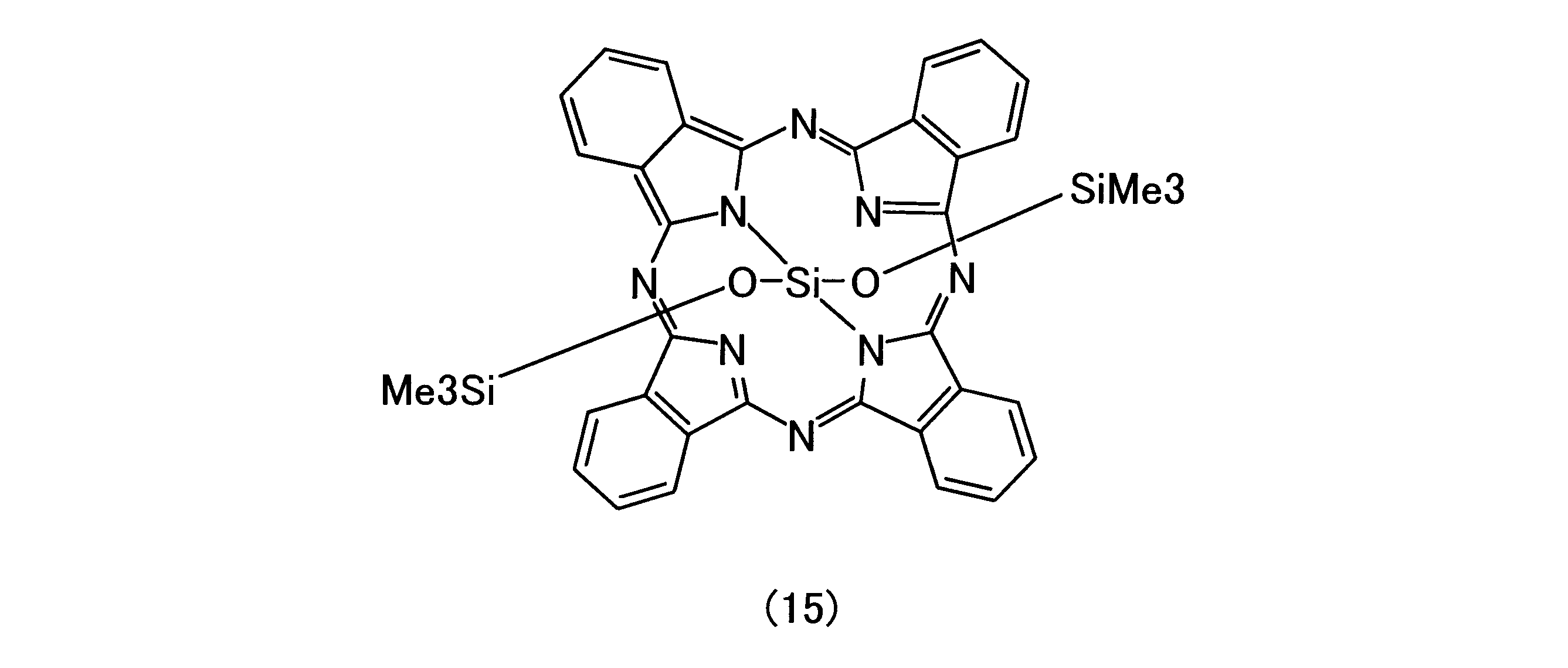
上述したマゼンタ着色剤分散液MB1の調製において、マゼンタの着色剤成分である化合物A11、化合物B33を、下記式(15)で示される化合物に変更した他は、同様の手順でシアントナーCを作製した。下記式(15)で示される化合物はシアンの着色剤成分である。
各マゼンタトナーM1~M21を、イエロートナーY、シアントナーCと組み合わせて実施例1~21とし、比較用マゼンタトナーL1、L2をイエロートナーY、シアントナーCと組み合わせて比較例1、2として、次の(1)~(4)の各評価項目について評価した。
なお、印刷するにあたっては、マゼンタトナーM1~M21、L1、L2、イエロートナーY、シアントナーCのそれぞれに、シリコーン樹脂を被覆した体積平均粒径60μmのフェライトキャリアを混合し、トナー濃度が6%の現像剤を調製して用いた。
「乳児を抱いた女性」をデジタルカメラで撮影した写真画像を、実施例1~21、比較例1、2に係る各トナー(マゼンタトナー、イエロートナー、シアントナー)を用いてカラー印刷した。写真を正面からみたときの印象を10人のパネラーに評価してもらった。比較対照として、同じ写真画像をDocuCentre-III C4400(富士ゼロックス社製)を用いて、DcuCentre-III C4400トナーによって印刷した基準画像を用意し、この基準画像に対して比較評価した。
◎:「色味が良く、画質が高品位である」と回答した人が10人中8人以上
○:「色味、画質品位ともに僅かに良い」と回答した人が10人中7人以上
△:「色味、画質品位ともに同程度」と回答した人が10人中6人以上
×:「色味、画質とも若干劣る」と回答した人が10人中7人以上
コンピュータディスプレイ上に7色の青紫色系カラーコードのパッチ画像を表示出力した。一方、実施例1~21、比較例1、2に係る各トナー(マゼンタトナー、イエロートナー、シアントナー)を用いてカラー印刷を行い、パッチ画像に対応した印刷物を作成した。作成した印刷物のパッチ画像の色調が、ディスプレイに表示された各カラーコードの色に識別できるかを判定した。表示に用いたコンピュータの条件は以下の通りである。
コンピュータ:iMAC(アップルコンピュータ株式会社製)
ディスプレイ:24インチワイドスクリーン液晶表示画面
ディスプレイの解像度:1920×1200ピクセル
2.16GHz Intel Core 2 Duo プロセッサI
4MB共有L2キャッシュ
SO-SIMM、1GB(512MB×2)
シリアルATAハードドライブ2、250GB
8×二層式SuperDrive(DVD+R、DL、DVD±RW、CD-RW)
NVIDIA GeForce 7300 GT 128MB GDDR3 メモリ
AirMac Extreme及びBluetooth2.0内蔵
Apple Remote
評価基準は以下の通りである。
◎:7色とも識別できた(優良)
○:5色以上7色未満識別できた(良好)
×:4色未満しか識別できなかった(不良)
◎と○を合格とした。
実施例1~21、比較例1、2に係る各トナー(マゼンタトナー、イエロートナー、シアントナー)を用いて、ベタ画像(高濃度で塗りつぶされている画像)のカラー印刷を行う。カラー印刷は5万枚の連続印刷を行い、初期印刷時と5万枚の印刷後の濃度変化量を測定した。測定は、カラー反射濃度計(例えば、X-RITE404A:X-Rite Co.製)を用いて、ベタ画像の濃度を5回測定し、その平均値を濃度値として採用した。初期印刷時の測定濃度値は1.40である。この初期印刷時の濃度と5万枚印刷後の濃度値の差Δ(%)を求めた。
a:良好(Δ<0.08)
b:普通(0.08≦Δ<0.15)
c:少し悪い(0.15≦Δ<0.20)
d:悪い(0.20≦Δ)
実施例1~21、比較例1、2に係る各トナー(マゼンタトナー、イエロートナー、シアントナー)を用いて、ハーフトーン画像(中間調の濃度で塗りつぶされている画像)のカラー印刷を行う。カラー印刷は5万枚の連続印刷を行い、初期印刷時と5万枚の印刷後の濃度変化量を測定した。測定は、カラー反射濃度計(例えば、X-RITE404A:X-Rite Co.製)を用いてハーフトーン画像の濃度を5回測定し、その平均値を濃度値として採用した。初期印刷時の測定濃度値は1.40である。この初期印刷時の濃度と5万枚印刷後の濃度値の差Δ(%)を求めた。
a:良好(Δ<0.03)
b:普通(0.03≦Δ<0.05)
c:少し悪い(0.05≦Δ<0.08)
d:悪い(0.08≦Δ)

また、比較例1、2では5万枚の耐久性に乏しく、濃度変動が生じているのに対し、実施例1~21ではベタ画像においてもハーフトーン画像においても、濃度の変動は小さく安定化していることが分かる。
Claims (4)
- 少なくとも樹脂と着色剤を含有するトナーにおいて、
前記着色剤が下記一般式(1)で示される化合物と、下記一般式(2)で示される化合物とを含有するトナー。

- 前記一般式(1)で示される化合物において、R1~R4の少なくとも1つが塩素原子であり、かつR5~R8の少なくとも1つが塩素原子である請求項1に記載のトナー。
- 前記一般式(2)で示される化合物が、レーキ種によってレーキ化された化合物である請求項1又は2に記載のトナー。
- 前記一般式(1)で示される化合物は、前記一般式(2)で示される化合物の100質量部に対し、20~100質量部の割合で含まれる請求項1~3の何れか一項に記載のトナー。
Priority Applications (2)
| Application Number | Priority Date | Filing Date | Title |
|---|---|---|---|
| JP2010522687A JPWO2010013635A1 (ja) | 2008-07-28 | 2009-07-23 | トナー |
| US12/743,386 US8206882B2 (en) | 2008-07-28 | 2009-07-23 | Toner |
Applications Claiming Priority (2)
| Application Number | Priority Date | Filing Date | Title |
|---|---|---|---|
| JP2008193289 | 2008-07-28 | ||
| JP2008-193289 | 2008-07-28 |
Publications (1)
| Publication Number | Publication Date |
|---|---|
| WO2010013635A1 true WO2010013635A1 (ja) | 2010-02-04 |
Family
ID=41610334
Family Applications (1)
| Application Number | Title | Priority Date | Filing Date |
|---|---|---|---|
| PCT/JP2009/063182 Ceased WO2010013635A1 (ja) | 2008-07-28 | 2009-07-23 | トナー |
Country Status (3)
| Country | Link |
|---|---|
| US (1) | US8206882B2 (ja) |
| JP (1) | JPWO2010013635A1 (ja) |
| WO (1) | WO2010013635A1 (ja) |
Families Citing this family (1)
| Publication number | Priority date | Publication date | Assignee | Title |
|---|---|---|---|---|
| US8663886B2 (en) * | 2010-12-21 | 2014-03-04 | Xerox Corporation | Toner compositions and processes |
Citations (5)
| Publication number | Priority date | Publication date | Assignee | Title |
|---|---|---|---|---|
| JPH02213854A (ja) * | 1989-02-15 | 1990-08-24 | Canon Inc | マゼンタトナー |
| JPH02293861A (ja) * | 1989-05-09 | 1990-12-05 | Canon Inc | フルカラー電子写真用マゼンタ現像剤 |
| JPH02311874A (ja) * | 1989-05-29 | 1990-12-27 | Canon Inc | 現像剤濃度検出方法 |
| JPH0511504A (ja) * | 1991-07-08 | 1993-01-22 | Mitsubishi Kasei Corp | 電子写真用マゼンタトナー |
| WO2006131960A1 (ja) * | 2005-06-06 | 2006-12-14 | Nippon Carbide Kogyo Kabushiki Kaisha | 静電荷像現像用トナー用結着樹脂の製造方法及びそれを用いたトナーの製造方法 |
Family Cites Families (3)
| Publication number | Priority date | Publication date | Assignee | Title |
|---|---|---|---|---|
| US6656342B2 (en) * | 2001-04-04 | 2003-12-02 | Chevron U.S.A. Inc. | Graded catalyst bed for split-feed hydrocracking/hydrotreating |
| US6589415B2 (en) * | 2001-04-04 | 2003-07-08 | Chevron U.S.A., Inc. | Liquid or two-phase quenching fluid for multi-bed hydroprocessing reactor |
| JP4277701B2 (ja) | 2004-01-29 | 2009-06-10 | コニカミノルタビジネステクノロジーズ株式会社 | トナー及び画像形成方法 |
-
2009
- 2009-07-23 US US12/743,386 patent/US8206882B2/en not_active Expired - Fee Related
- 2009-07-23 JP JP2010522687A patent/JPWO2010013635A1/ja active Pending
- 2009-07-23 WO PCT/JP2009/063182 patent/WO2010013635A1/ja not_active Ceased
Patent Citations (5)
| Publication number | Priority date | Publication date | Assignee | Title |
|---|---|---|---|---|
| JPH02213854A (ja) * | 1989-02-15 | 1990-08-24 | Canon Inc | マゼンタトナー |
| JPH02293861A (ja) * | 1989-05-09 | 1990-12-05 | Canon Inc | フルカラー電子写真用マゼンタ現像剤 |
| JPH02311874A (ja) * | 1989-05-29 | 1990-12-27 | Canon Inc | 現像剤濃度検出方法 |
| JPH0511504A (ja) * | 1991-07-08 | 1993-01-22 | Mitsubishi Kasei Corp | 電子写真用マゼンタトナー |
| WO2006131960A1 (ja) * | 2005-06-06 | 2006-12-14 | Nippon Carbide Kogyo Kabushiki Kaisha | 静電荷像現像用トナー用結着樹脂の製造方法及びそれを用いたトナーの製造方法 |
Also Published As
| Publication number | Publication date |
|---|---|
| US20100255415A1 (en) | 2010-10-07 |
| US8206882B2 (en) | 2012-06-26 |
| JPWO2010013635A1 (ja) | 2012-01-12 |
Similar Documents
| Publication | Publication Date | Title |
|---|---|---|
| JP4549259B2 (ja) | カラートナー | |
| US8053153B2 (en) | Toner for developing electrostatic latent image | |
| JP2009229989A (ja) | フルカラートナーキット、画像形成方法 | |
| US20090214974A1 (en) | Toner for developing electrostatic image, full color toner kit, and image formation method | |
| JP5041067B2 (ja) | フルカラー画像形成方法 | |
| JP4378210B2 (ja) | 磁性微粒子分散型樹脂キャリア及び二成分系現像剤 | |
| JP2010019970A (ja) | 電子写真用トナー、電子写真用現像剤及び画像形成方法 | |
| JP2007156449A (ja) | トナー及び画像形成方法 | |
| JP2009276416A (ja) | トナー | |
| WO2010013635A1 (ja) | トナー | |
| JP2012118309A (ja) | フルカラー画像形成方法およびフルカラー画像形成装置 | |
| JP2011197652A (ja) | フルカラー画像形成方法およびフルカラー画像形成装置 | |
| JP3637378B2 (ja) | 電子写真用カラートナー | |
| JP2010101987A (ja) | 静電荷像現像用トナー | |
| US8062818B2 (en) | Toner for electrostatic image development, full-color toner kit and image forming method | |
| JP2003223018A (ja) | 静電荷像現像用カラートナー | |
| JP5293274B2 (ja) | フルカラー画像形成方法 | |
| JP2010019891A (ja) | トナー | |
| JP2012008439A (ja) | フルカラー画像形成方法およびフルカラー画像形成装置 | |
| JP2009258688A (ja) | 静電荷像現像用トナー、フルカラートナーキット、画像形成方法 | |
| JP2012068437A (ja) | 静電荷像現像用シアントナー及びその製造方法 | |
| JP4957253B2 (ja) | 静電荷像現像用トナー | |
| JP2010160172A (ja) | 静電荷像現像用トナーおよび画像形成方法 | |
| JP2010160173A (ja) | 静電荷像現像用トナーおよび画像形成方法 | |
| JP2009276415A (ja) | トナー |
Legal Events
| Date | Code | Title | Description |
|---|---|---|---|
| ENP | Entry into the national phase |
Ref document number: 2010522687 Country of ref document: JP Kind code of ref document: A |
|
| 121 | Ep: the epo has been informed by wipo that ep was designated in this application |
Ref document number: 09802878 Country of ref document: EP Kind code of ref document: A1 |
|
| WWE | Wipo information: entry into national phase |
Ref document number: 12743386 Country of ref document: US |
|
| NENP | Non-entry into the national phase |
Ref country code: DE |
|
| 122 | Ep: pct application non-entry in european phase |
Ref document number: 09802878 Country of ref document: EP Kind code of ref document: A1 |