WO2010013583A1 - 乾燥物品の製造方法及び装置 - Google Patents
乾燥物品の製造方法及び装置 Download PDFInfo
- Publication number
- WO2010013583A1 WO2010013583A1 PCT/JP2009/062269 JP2009062269W WO2010013583A1 WO 2010013583 A1 WO2010013583 A1 WO 2010013583A1 JP 2009062269 W JP2009062269 W JP 2009062269W WO 2010013583 A1 WO2010013583 A1 WO 2010013583A1
- Authority
- WO
- WIPO (PCT)
- Prior art keywords
- dried
- drying
- chamber
- gas
- storage container
- Prior art date
- Legal status (The legal status is an assumption and is not a legal conclusion. Google has not performed a legal analysis and makes no representation as to the accuracy of the status listed.)
- Ceased
Links
Images

Classifications
-
- A—HUMAN NECESSITIES
- A23—FOODS OR FOODSTUFFS; TREATMENT THEREOF, NOT COVERED BY OTHER CLASSES
- A23B—PRESERVATION OF FOODS, FOODSTUFFS OR NON-ALCOHOLIC BEVERAGES; CHEMICAL RIPENING OF FRUIT OR VEGETABLES
- A23B2/00—Preservation of foods or foodstuffs, in general
- A23B2/90—Preservation of foods or foodstuffs, in general by drying or kilning; Subsequent reconstitution
-
- A—HUMAN NECESSITIES
- A23—FOODS OR FOODSTUFFS; TREATMENT THEREOF, NOT COVERED BY OTHER CLASSES
- A23B—PRESERVATION OF FOODS, FOODSTUFFS OR NON-ALCOHOLIC BEVERAGES; CHEMICAL RIPENING OF FRUIT OR VEGETABLES
- A23B2/00—Preservation of foods or foodstuffs, in general
- A23B2/05—Preservation of foods or foodstuffs, in general by heating using irradiation or electric treatment
- A23B2/08—Preservation of foods or foodstuffs, in general by heating using irradiation or electric treatment using microwaves or dielectric heating
-
- A—HUMAN NECESSITIES
- A23—FOODS OR FOODSTUFFS; TREATMENT THEREOF, NOT COVERED BY OTHER CLASSES
- A23B—PRESERVATION OF FOODS, FOODSTUFFS OR NON-ALCOHOLIC BEVERAGES; CHEMICAL RIPENING OF FRUIT OR VEGETABLES
- A23B2/00—Preservation of foods or foodstuffs, in general
- A23B2/10—Preservation of foods or foodstuffs, in general by treatment with pressure variation, shock, acceleration or shear stress
- A23B2/103—Preservation of foods or foodstuffs, in general by treatment with pressure variation, shock, acceleration or shear stress using sub- or super-atmospheric pressures, or pressure variations transmitted by a liquid or gas
-
- A—HUMAN NECESSITIES
- A23—FOODS OR FOODSTUFFS; TREATMENT THEREOF, NOT COVERED BY OTHER CLASSES
- A23B—PRESERVATION OF FOODS, FOODSTUFFS OR NON-ALCOHOLIC BEVERAGES; CHEMICAL RIPENING OF FRUIT OR VEGETABLES
- A23B2/00—Preservation of foods or foodstuffs, in general
- A23B2/30—Preservation of foods or foodstuffs, in general by heating materials in packages which are not progressively transported through the apparatus
-
- A—HUMAN NECESSITIES
- A23—FOODS OR FOODSTUFFS; TREATMENT THEREOF, NOT COVERED BY OTHER CLASSES
- A23B—PRESERVATION OF FOODS, FOODSTUFFS OR NON-ALCOHOLIC BEVERAGES; CHEMICAL RIPENING OF FRUIT OR VEGETABLES
- A23B2/00—Preservation of foods or foodstuffs, in general
- A23B2/40—Preservation of foods or foodstuffs, in general by heating loose unpacked materials
-
- A—HUMAN NECESSITIES
- A23—FOODS OR FOODSTUFFS; TREATMENT THEREOF, NOT COVERED BY OTHER CLASSES
- A23B—PRESERVATION OF FOODS, FOODSTUFFS OR NON-ALCOHOLIC BEVERAGES; CHEMICAL RIPENING OF FRUIT OR VEGETABLES
- A23B2/00—Preservation of foods or foodstuffs, in general
- A23B2/90—Preservation of foods or foodstuffs, in general by drying or kilning; Subsequent reconstitution
- A23B2/97—Preservation of foods or foodstuffs, in general by drying or kilning; Subsequent reconstitution using irradiation or electric treatment, e.g. ultrasonic waves
-
- F—MECHANICAL ENGINEERING; LIGHTING; HEATING; WEAPONS; BLASTING
- F26—DRYING
- F26B—DRYING SOLID MATERIALS OR OBJECTS BY REMOVING LIQUID THEREFROM
- F26B5/00—Drying solid materials or objects by processes not involving the application of heat
- F26B5/04—Drying solid materials or objects by processes not involving the application of heat by evaporation or sublimation of moisture under reduced pressure, e.g. in a vacuum
- F26B5/048—Drying solid materials or objects by processes not involving the application of heat by evaporation or sublimation of moisture under reduced pressure, e.g. in a vacuum in combination with heat developed by electro-magnetic means, e.g. microwave energy
Definitions
- the present invention relates to an efficient method for producing a dry article, in particular a dry food, and an apparatus suitable therefor.
- Microwave vacuum drying is a vacuum drying method in which an object to be dried is placed in a chamber connected to a vacuum pump, and the object is irradiated with microwaves in a vacuum state.
- simply irradiating the object to be dried with microwaves may cause a partial overheated part on the object to be dried, which may cause scorching, etc. It is difficult to obtain a high quality product with excellent flavor and texture.
- the production efficiency is low in the conventional apparatus, and a device on the apparatus is also desired.
- the object to be dried is a food
- a production method by freeze drying is employed.
- the food to be dried is frozen at around minus 30 ° C. and dried by sublimating the frozen water, but in the process of freezing, ice crystals are formed and grow, so that cells and tissues are damaged. It is inevitable that you will receive it, and the flavor and texture will be impaired. In addition, it takes a considerable amount of time to sublimate water from ice, and it takes 4 to 5 days to dry, resulting in poor productivity, and a large amount of energy is required to sublimate rapidly frozen or frozen water. .
- Patent Document 3 a method proposed by the present inventors (see Patent Document 3), that is, a technique of irradiating a target object with microwaves under a reduced pressure condition to dry the target object has been proposed.
- an object to be dried is stored in a decompression chamber in which the boiling point of water reaches room temperature, and water is heated by intermittently irradiating the object to be dried with microwaves. It is a method of vaporizing at room temperature and drying. According to this method, it can be dried without impairing the flavor and texture. However, since it dries at room temperature, bacteria such as Escherichia coli are not killed and survive on the surface of the dried food.
- the present inventors store an object to be dried in a vacuum chamber and irradiate the object to be dried with microwaves to dry the object at room temperature. Proposed (see Patent Document 3). Specifically, this apparatus introduces a small amount of gas into the chamber to accelerate drying, applies an air flow around the object to be dried, and passes the vapor generated from the object to be dried along with the air flow through a vacuum pump. It is discharged to the outside.
- the object to be dried may be placed on a plate and a small amount of gas may be applied around the object to be dried, but the object to be dried is stored in a container in order to dry a large amount. In such a case, there is a problem that it is difficult for the container to get in the way and to apply airflow to the object to be dried.
- An object of the present invention is to provide a method for efficiently producing a dried article, particularly a safe dried food under reduced pressure conditions using microwaves, and a vacuum drying apparatus suitable for that purpose, which can perform drying and sterilization in one apparatus. Is to provide.
- the invention described in claim 1 of the present invention is a method for producing a dry article comprising irradiating an object to be dried with microwaves under reduced pressure conditions and drying the object under controlled microwave irradiation. Maintaining the temperature of the object to be dried at 50 ° C. or lower, preferably 45 ° C. or lower, drying the object to be dried, and generating superheated steam under controlled microwave irradiation and drying with the superheated steam It is a manufacturing method of a dry article characterized by combining and implementing process B which sterilizes a subject.
- the microwave in the present invention means an electromagnetic wave having a wavelength of 100 ⁇ m to 1 m.
- Superheated steam is saturated steam heated to the boiling point or higher, and is widely used for heat treatment including sterilization drying of food.
- the invention described in claim 2 is the method for producing a dried article according to claim 1, wherein the steam for generating the superheated steam is generated from the object to be dried.
- the weight of water contained in the object to be dried is 2 to 20 times the weight of the object to be dried completely, preferably The method for producing a dry article according to any one of claims 1 to 3, wherein the method is carried out for 1 to 10 minutes, preferably 2 to 6 minutes, within a range of 3 to 8 times.
- the invention described in claim 5 relates to a vacuum drying apparatus particularly suitable for the method for producing the dried article, and includes a chamber for storing a drying object having a gas supply port and an exhaust port, and the exhaust port.
- a vacuum pump for exhausting the gas in the chamber to the outside and reducing the pressure in the chamber, a microwave irradiation device for irradiating the object to be dried in the chamber with microwaves, and the temperature and weight of the object to be dried Based on the temperature sensor and weight sensor to detect the pressure, the pressure sensor to detect the pressure in the chamber, and the data obtained from each sensor, the gas supply amount and the exhaust amount and the microwave to be irradiated are controlled.
- a dry article manufacturing apparatus (vacuum drying apparatus), characterized by comprising:
- the invention described in claim 6 is a bottomed cylindrical storage container in which a dry object storage container is installed in the chamber, and the storage container is open at the top or has an opening / closing mechanism.
- the bottom plate of the storage container is disposed slightly above the bottom of the cylinder, and the bottom plate is provided with a plurality of fine holes through which a dry object cannot pass.
- a base plate for placing the drying object storage container is provided at the bottom of the chamber, and the base plate is hollow and placed.
- a plurality of gas holes that open upward in portions corresponding to the respective storage containers, and one gas hole that communicates with the gas supply port is provided, and the gas introduced from the gas supply port is It is introduced into the storage container through a plurality of holes provided in the bottom plate of the storage container through a plurality of gas holes opening upward through a gap at the bottom of the storage container (a space between the bottom of the cylinder and the bottom plate).
- the reduced pressure (vacuum) drying method using microwaves of the present invention the reduced pressure (vacuum) during drying under microwave irradiation )
- the object to be dried can be sterilized in a short time by stopping the pulling and rapidly raising the temperature with superheated steam generated by the object to be dried.
- one vacuum drying device can be used from drying to sterilization, the device is simple, and it is possible to save the trouble of transporting the object to be dried from the drying process to the sterilization process. It is done.
- the temperature of the object to be dried is 50 ° C. or less, preferably 45 ° C. or less, more preferably less than room temperature, under controlled microwave irradiation. Maintaining and drying the object to be dried is combined with Step B for generating superheated steam under controlled microwave irradiation and sterilizing the object to be dried with the superheated steam. It is a manufacturing method of a dry article. Specifically, the process A is a process of reducing the microwave irradiation energy from the initial state toward the end of drying and maintaining the temperature of the object to be dried at 50 ° C. or lower to dry the object to be dried.
- the process B is a sterilization process in which the temperature of the object to be dried is heated to a sterilization temperature higher than the temperature of the process A for a predetermined time. Specifically, in step B, the vacuum (vacuum) pulling is stopped during drying under microwave irradiation, the microwave irradiation energy is increased to increase the temperature rapidly, and preferably the drying object itself emits. By generating superheated steam with steam, the object to be dried is sterilized in a short time.
- the steam for generating the superheated steam it is convenient to use the steam generated from the object to be dried, but if necessary, the gas supply port of the apparatus (reduced pressure drying apparatus) used in the present invention to be described later From this, water vapor may be supplied. Moreover, in this invention, following the process A which dries a drying target object, the process B which sterilizes a drying target object with superheated steam is implemented, and the process A which dries a drying target object is implemented after that. May be.
- the weight of water contained in the object to be dried is 2 to 20 times, preferably 3 to 8 times the weight of the object to be dried completely. For 1 to 10 minutes, preferably 2 to 6 minutes.
- the weight of moisture contained in the object to be dried and the weight in the middle of drying are detected by the weight sensor provided in the apparatus used in the present invention, and are controlled together with the temperature detected by the temperature sensor and the pressure detected by the pressure sensor.
- the required microwave energy is transmitted to the apparatus, and an appropriate microwave is applied to the object to be dried at an appropriate time.
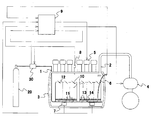
- FIG. 1 An example of a vacuum drying apparatus preferably used in the method for producing a dry article of the present invention is shown in FIG. 1 (schematic diagram showing a cross-sectional state).
- the apparatus shown in FIG. 1 has a chamber 3 for storing an object to be dried having a gas supply port 1 and an exhaust port 2, and discharges the gas in the chamber to the outside through the exhaust port 2 to reduce the pressure in the chamber.
- the pressure sensor 8 for detecting the pressure in the chamber Based on the weight sensor 7 for detecting the pressure in the chamber, the pressure sensor 8 for detecting the pressure in the chamber, the drying conditions and the data obtained from each sensor, the supply amount of the gas, the exhaust amount and the microwave to be irradiated are controlled. And a control device 9 for this purpose.
- 20 is a gas cylinder such as nitrogen
- 30 is a flow meter and a flow control valve.
- the control device controls the gas flow to be supplied based on the desired drying conditions (setting values) and the gas flow rate obtained by the flow meter, and controls the rotation speed of the vacuum pump based on the pressure (degree of vacuum) obtained by the pressure sensor.
- the output (irradiation amount) of the microwave is controlled based on the data obtained by the temperature sensor and the weight sensor.
- the above-described reduced-pressure drying apparatus can basically achieve the object of the present invention. However, in the case where a large amount of objects to be dried are processed at once, the following device is provided in the chamber. It is preferable to install a dry object storage container which has been made.
- a plurality of drying object storage containers 10 are installed in the chamber, and the storage container 10 is a bottomed cylindrical storage container having an upper portion 12 opened or having an opening / closing mechanism,
- the bottom plate 11 of the storage container is disposed slightly above the bottom portion 14 of the cylinder, and the bottom plate 11 is provided with a plurality of fine holes 13 through which a drying object cannot pass (see FIG. 1).
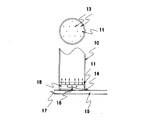
- FIG. 2 shows an example of a preferable dry object storage container (a diagram for explaining an installation state).
- a base plate 15 for mounting the drying object storage container is provided at the bottom of the chamber, and the base plate 15 is hollow and is mounted on each base plate 15. It is preferable to have a plurality of gas holes 16 opening upward in a portion corresponding to the storage container 10 and one gas hole 17 communicating with the gas supply port 1.
- the gas (air, nitrogen, water vapor, etc.) introduced from the gas supply port 1 passes through a plurality of gas holes 16 opened above the base plate to the gaps between the bottom of the storage container (the bottom of the cylinder and the bottom plate). Through a plurality of holes 13 provided in the bottom plate 11 of the storage container, and uniformly introduced into the storage container 10.
- the gas is uniformly supplied or introduced, and the gas is discharged from the upper part of the storage container together with the vapor generated from the object to be dried, and is discharged from the exhaust port to the outside of the chamber through a vacuum pump.
- the inside of the chamber can be kept under reduced pressure.
- a fan (not shown) for stirring the gas inside may be provided in the chamber.
- the microwave irradiation energy is rapidly increased, and the saturated water vapor in the chamber is rapidly heated, What is necessary is just superheated steam.
- the external discharge of the vapor from the exhaust port is stopped for a predetermined time, and the water vapor remaining in the chamber is heated by microwave irradiation to sterilize the object to be dried.
- gas is introduced into the container through a plurality of holes opened at the bottom of the container that contains a large amount of the object to be dried. Since the gas hits and is discharged from the upper part of the container together with the vapor generated from the object to be dried, a large amount of dry articles can be produced at one time.
- the temperature of the object to be dried is set to a predetermined temperature by irradiating the microwave while supplying a gas such as air or nitrogen into the chamber of the vacuum drying apparatus. Maintain or adjust. Microwave irradiation may be performed continuously or alternatively, it is turned on and off at a predetermined cycle to suppress rapid increase in temperature of the object to be dried to a predetermined temperature or less and rapidly heat it as needed. You may go.
- the present invention will be described in detail by way of examples. *
- Tade Yanagi-Tade
- Tadeceae is an annual plant of the family Tadeceae and has a unique aroma and pungent taste. It has long been insects, and is used for medicinal purposes such as per meal, heat, fever, and spices and sashimi. It is used for Notsuma and Tade vinegar. In particular, freshly sprouted sprout is often used for sashimi.
- the extract exhibits an erythrocyte deformability improving effect, a thrombus prevention effect, a strong antioxidant activity, and the like.
- the experiment was performed using a reduced pressure drying apparatus having an internal volume of 1 m 3 as shown in FIG.
- 22 kg of water water content 6.1 kg / kg-dry
- the seeds were evenly placed in 24 drying object storage containers in the chamber.
- the pressure in the chamber is stabilized at 1.5 kPa
- the microwave output is adjusted based on the moisture content of the seed, and the amount of nitrogen introduced from the gas supply port is 2.4 L / min. Drying was carried out while feeding.
- the temperature during this period was 18 ° C. or lower.
- the moisture content of the seed was obtained from the measurement value with a mass sensor.
- Pa is a vacuum pressure unit Pascal
- 101.325 kPa corresponds to atmospheric pressure.
- the pressure in the chamber was increased to 60 kPa and irradiated with 32 kW of microwave 60 minutes after the start of drying. Thereby, the temperature of the seed was raised to about 100 ° C. and maintained for about 4 minutes.
- the pressure in a chamber was reduced to 1.5 kPa and the drying process A was implemented again.
- the horizontal axis represents the microwave irradiation time (unit: minutes, min)
- the left vertical axis represents the water content of the seed (kg / kg-dry)
- the right vertical axis represents the temperature of the seed.
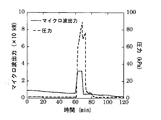
- the horizontal axis of FIG. 4 is the microwave irradiation time (unit: minutes, min)
- the left vertical axis indicates the microwave irradiation energy ( ⁇ 10 kW)
- the right vertical axis indicates the pressure in the chamber (kPa). Yes.
- the microwave output is adjusted to 2 kW to 9 kW to stabilize the temperature of the seed at about 18 ° C.
- the mass could be reduced to near 0% moisture content.
- the second drying step A (decreasing drying period) was started, and the temperature of the seed rose to about 38 ° C.
- the sterilization step B it can be seen that the temperature of the seed is raised to about 100 ° C. by irradiating 32 kW of microwave 60 minutes after the start of drying.
- the amount of superheated steam generated in the 24 storage containers during sterilization was about 0.4 kg / min.
- the drying process and the sterilization process of food processing can be performed simultaneously with one apparatus of the present invention.
- the apparatus and method of the present invention in the drying step A, since only the latent heat of evaporation is supplied by microwaves in a reduced pressure state of about 1.5 kPa, the temperature rise due to heating of the object to be dried is small. Drying can be performed at somewhat higher temperatures. It was also found that introduction of a gas such as nitrogen can further promote drying and suppress food damage.
- the sterilization step B by rapidly increasing the microwave irradiation output, the temperature of the object to be dried is increased from about 25 ° C. to about 100 ° C. at a stretch, and sterilization is performed by generating superheated steam. I understood that I could do it.
- the number of bacteria of the raw sprout was 17 ⁇ 10 6 cells / g, 2 ⁇ 10 3 cells / g, and 5 ⁇ 10 6 cells / g, respectively.
- the dry state of the sprout was good and the drying nonuniformity was not recognized.
- the DPPH radical scavenging ability which is one of the indexes of antioxidant ability, was measured for the obtained sprout powder, it retained about 90% of the ability of ordinary lyophilized products and was sensitive to heat. Despite being a material, it was found that the antioxidant ability was sufficiently maintained.
- the method and apparatus of the present invention can be applied to sprouts that could not be sterilized while maintaining a reddish purple color. According to the method and apparatus of the present invention, it has been confirmed that high temperature steam can be generated with moisture contained in food during microwave drying in a nitrogen atmosphere, and sterilization and drying can be performed simultaneously. It was also found that the same amount of active ingredient and antioxidant capacity can be maintained more quickly and with less energy than freeze drying.
- shiitake mushroom was used as a material, and dried food was produced in substantially the same manner as in Example 2.
- general bacteria and spore bacteria (Bacillus) were detected only by microwave room temperature drying (40 ° C.), but according to the production method of the present invention, all of the general bacteria, spore bacteria, and coliforms were negative. .
Landscapes
- Engineering & Computer Science (AREA)
- Life Sciences & Earth Sciences (AREA)
- Polymers & Plastics (AREA)
- Zoology (AREA)
- Chemical & Material Sciences (AREA)
- Food Science & Technology (AREA)
- Wood Science & Technology (AREA)
- Health & Medical Sciences (AREA)
- Molecular Biology (AREA)
- Mechanical Engineering (AREA)
- General Engineering & Computer Science (AREA)
- Drying Of Solid Materials (AREA)
- Freezing, Cooling And Drying Of Foods (AREA)
Abstract
乾燥対象物に減圧条件下でマイクロ波を照射して乾燥させることからなる乾燥物品の製造方法であって、制御されたマイクロ波の照射下に乾燥対象物の温度を50℃以下、好ましくは45℃以下に維持して、乾燥対象物を乾燥する工程Aと、制御されたマイクロ波の照射下に過熱水蒸気を生成させ、該過熱水蒸気で乾燥対象物を殺菌する工程Bを組合わせて実施することを特徴とする乾燥物品の製造方法、及びそのために適した減圧乾燥装置。乾燥物品、特に安全な乾燥食品を、乾燥と殺菌とを一つの装置で行って効率的に製造することができる。
Description
本発明は、乾燥物品、特に乾燥食品の効率的な製造方法、及び、そのために適した装置に関する。
従来、乾燥物品を製造するためには、天日干しや自然乾燥が行われているが、この場合には、長時間を要するし、食品等の場合には、カビ等の発生という衛生上の問題もある。また、健康食品やインスタント食品に使用される乾燥野菜は、生の野菜を粉砕し、そのまま若しくは水と混合して、100~200℃で乾燥して製造される場合が多いが、野菜等を高温で乾燥するとビタミンや色素等が分解するという問題がある。
減圧等の条件下にマイクロ波を乾燥対象物に照射して乾燥物品を製造する方法や、そのために工夫された装置も提案されている(例えば、特許文献1~3参照)。マイクロ波減圧乾燥とは、減圧ポンプが接続されたチャンバー内に乾燥対象物を入れ、このチャンバー内を減圧状態で、対象物にマイクロ波を照射して行う減圧乾燥方法である。しかし、乾燥対象物に単にマイクロ波を照射するだけでは、乾燥物対象物に部分的な過熱部分が生じて焦げ等が発生する恐れがあるし、また、特に後述の乾燥食品の場合には、風味や食感に優れた高品位のものを得ることが困難である。更に、乾燥対象物を大量に処理する場合には、従来の装置では生産効率が悪いという問題があり、装置上の工夫も望まれている。
乾燥対象物が食品の場合、例えば、イチゴの乾燥食品を高品位に製造する場合、フリーズドライによる製造方法が採用される。この場合、乾燥対象食品をマイナス30℃前後に凍結させ、凍結した水分を昇華することにより乾燥させるのであるが、凍結させる過程において、氷結晶が生成しそして成長するため、細胞や組織が損傷を受けることになることは避けられず、風味、食感が損なわれる。また、氷からの水分の昇華にはかなりの時間を要することになり、乾燥時間が4~5日かかり生産性が悪く、さらに急速冷凍や氷結した水分を昇華させるには大きなエネルギーを必要とする。勿論、イチゴなどの乾燥対象食品を温風などで乾燥することも考えられるが、低温乾燥としなければ品位が損なわれることから、内部まで乾燥させることは極めて困難で、絶乾状態まで乾燥するまで長時間要し、乾燥の際に風味が損なわれたり、変色したりしてしまう。
これを解決する方法として、本発明者らによる方法(特許文献3参照)、即ち、減圧条件下で対象物にマイクロ波を照射し対象物を乾燥させる技術が提案されている。この技術は、具体的には、水の沸点が常温になるような減圧チャンバー内に乾燥対象物を収納し、この乾燥対象物にマイクロ波を間欠的に照射することで、水を加熱して常温で気化させて乾燥する方法である。この方法によると、風味、食感が損なわれないで乾燥することができる。しかしながら、常温で乾燥するので、乾燥食品の表面には大腸菌等の細菌が死滅せず生き残ってしまう。 従って、乾燥前、あるいは乾燥後に対象物を取り出し、加熱殺菌する工程が必要となり、非効率的であるという問題点があった。このことは、一般の食品乾燥においても同様で、食品の乾燥を行う場合には殺菌工程が必要不可決であるが、多くの場合、殺菌操作は乾燥操作の前に別の装置にて行われるので、殺菌工程と乾燥工程との2段階の設備が必要となり、工程の合理化、効率化が望まれていた。
また、風味を損なわず食品等を乾燥する装置として、本発明者らは、減圧チャンバー内に乾燥対象物を収納し、乾燥対象物にマイクロ波を照射して常温で対象物を乾燥させる装置を提案した(特許文献3参照)。この装置は、具体的には、乾燥を促進するために微量な気体をチャンバー内に導入し、乾燥対象物周囲に気流を当てて、乾燥対象物から発生した蒸気を気流と一緒に真空ポンプを通して外部へ排出するものである。この場合、乾燥対象物が少量の場合は、乾燥対象物をプレート上に載せて乾燥対象物周囲に微量な気体を当てれば良いが、大量に乾燥するために、乾燥対象物を容器に収納した場合に、容器が邪魔になって乾燥対象物に気流を当てるのが困難であるという問題があった。
本発明の課題は、マイクロ波を用いて減圧条件下で乾燥物品、特に安全な乾燥食品を効率的に製造する方法、及びそのために適した、乾燥と殺菌とを一つの装置でできる減圧乾燥装置を提供することにある。
本発明の上記課題は、請求の範囲の請求項1~7に記載された本発明の各態様によって達成される。
本発明の請求項1に記載された発明は、乾燥対象物に減圧条件下でマイクロ波を照射して乾燥させることからなる乾燥物品の製造方法であって、制御されたマイクロ波の照射下に乾燥対象物の温度を50℃以下、好ましくは45℃以下に維持して、乾燥対象物を乾燥する工程Aと、制御されたマイクロ波の照射下に過熱水蒸気を生成させ、該過熱水蒸気で乾燥対象物を殺菌する工程Bを組合わせて実施することを特徴とする乾燥物品の製造方法である。なお、本発明におけるマイクロ波とは、波長が100μm~1mの電磁波を意味する。また過熱水蒸気とは、沸点以上に加熱された飽和水蒸気であり、食品の殺菌乾燥を含めた熱処理等に利用されることは広く知られている。
請求項2に記載された発明は、過熱水蒸気を生成するための水蒸気が、乾燥対象物自身から発生されるものであることを特徴とする請求項1記載の乾燥物品の製造方法である。
請求項3に記載された発明は、乾燥対象物を乾燥する工程Aに引き続いて、過熱水蒸気で乾燥対象物を殺菌する工程Bを実施し、その後、更に乾燥対象物を乾燥する工程Aを実施することを特徴とする請求項1又は2記載の乾燥物品の製造方法である。
請求項4に記載された発明は、過熱水蒸気で乾燥対象物を殺菌する工程Bが、乾燥対象物の含有する水分重量が、乾燥対象物の完全乾燥状態の重量の2~20倍、好ましくは3~8倍の範囲にある間に、1~10分、好ましくは2~6分間実施されることを特徴とする請求項1~3のいずれか1項記載の乾燥物品の製造方法である。
請求項5に記載された発明は、上記乾燥物品の製造方法に特に適した減圧乾燥装置に関するものであり、気体供給口と排気口を有する乾燥対象物を収納するためのチャンバーと、前記排気口を通してチャンバー内の気体を外部に排出しチャンバー内を減圧にするための真空ポンプと、前記チャンバー内の乾燥対象物にマイクロ波を照射するためのマイクロ波照射装置と、乾燥対象物の温度と重量を検出するための温度センサー及び重量センサーと、チャンバー内の圧力を検出するための圧力センサーと、各センサーから得られたデータに基づき、気体の供給量と排気量と照射されるマイクロ波を制御するための制御装置とからなることを特徴とする乾燥物品の製造装置(減圧乾燥装置)である。
請求項6に記載された発明は、前記チャンバー内に、乾燥対象物収納容器が設置されており、該収納容器は、上部が開口した、又は、開閉機構を有する有底筒状の収納容器であって、該収納容器の底板は筒の底部よりもやや上側に配置されており、かつ、該底板には乾燥対象物が通過不能の複数個の微細な孔部が設けられたものであることを特徴とする請求項5記載の乾燥物品の製造装置である。
そして、請求項7に記載された発明は、前記チャンバー内の底部に、前記乾燥対象物収納容器を載置するためのベースプレートが設けられており、該ベースプレートは中空であって、載置されたそれぞれの収納容器に対応する部分において上方に開口する複数の気体穴を有すると共に、前記気体供給口に連絡する一つの気体穴が設けられており、前記気体供給口から導入された気体が、前記上方に開口する複数の気体穴から前記収納容器の底部の間隙(筒の底部と底板の間の空間)を経て、前記収納容器の底板に設けられた複数の孔部から収納容器内に導入されるようになっていることを特徴とする請求項5又は6記載の乾燥物品の製造装置である。
従来、食品の乾燥と同時に殺菌を行う効率的な方法の開発が課題であったが、本発明のマイクロ波を用いる減圧(真空)乾燥方法によると、マイクロ波照射下の乾燥途中で減圧(真空)引きを止めて、乾燥対象物自身が発する過熱水蒸気で、急激に温度を上げることにより短時間で乾燥対象物を殺菌することができる。また、一つの減圧乾燥装置で、乾燥から殺菌まで出来るので装置が簡単になること、乾燥工程から殺菌工程に乾燥対象物を運ぶ手間が省けることと同時に、作業汚染が無くなること等の利点が得られる。更に、急激な温度上昇、湿式殺菌により、殺菌効果が高く、短時間で処理できること、減圧による急速な温度低下や窒素ガス等の導入による食品の酸化抑制のため、食品へのダメージが少ないという利点も得られる。また、減圧乾燥装置のチャンバー内に配置された乾燥対象物収納容器に工夫が施されているので、乾燥対象物を容器に収納して大量にまとめて効率よく乾燥することもできる。更に、本発明の方法と装置では、エネルギーの消費が少ないために、大幅な乾燥コストの低下が期待できる。
本発明は、乾燥対象物に減圧条件下でマイクロ波を照射するに際し、制御されたマイクロ波の照射下に乾燥対象物の温度を50℃以下、好ましくは45℃以下、更に好ましくは常温以下に維持して、乾燥対象物を乾燥する工程Aと、制御されたマイクロ波の照射下に過熱水蒸気を生成させ、該過熱水蒸気で乾燥対象物を殺菌する工程Bを組合わせて実施することからなる乾燥物品の製造方法である。具体的には、工程Aは、マイクロ波の照射エネルギーを初期状態から乾燥末期に向けて低減させて、乾燥対象物の温度を50℃以下に維持して乾燥対象物を乾燥する工程である。
工程Bは、乾燥対象物の温度を所定時間、前記工程Aの温度より高温の殺菌温度に加温する殺菌工程である。具体的には、工程Bにおいては、マイクロ波照射下の乾燥途中で減圧(真空)引きを止めて、マイクロ波の照射エネルギーを増大させ急激に温度を上げ、好ましくは、乾燥対象物自身が発する水蒸気で、過熱水蒸気を生成させることにより、短時間で乾燥対象物の殺菌が行われる。
過熱水蒸気を生成するための水蒸気としては、乾燥対象物自身から発生されるものを利用するのが便利であるが、必要なら、後述する本発明で用いられる装置(減圧乾燥装置)の気体供給口から、水蒸気を供給しても良い。また、本発明においては、乾燥対象物を乾燥する工程Aに引き続いて、過熱水蒸気で乾燥対象物を殺菌する工程Bを実施し、その後、更に乾燥対象物を乾燥する工程Aを実施するようにしてもよい。
過熱水蒸気で乾燥対象物を殺菌する工程Bとしては、乾燥対象物の含有する水分重量が、乾燥対象物の完全乾燥状態の重量の2~20倍、好ましくは3~8倍の範囲にある間に、1~10分、好ましくは2~6分間実施する。乾燥対象物の含有する水分重量や乾燥途中での重量は、本発明で用いられる装置に備えられた重量センサーによって検出され、温度センサーによって検出された温度や、圧力センサーによって検出された圧力と共に制御装置に伝達され、必要なマイクロ波のエネルギーが算出され、適当な時期に適当なマイクロ波が乾燥対象物に照射される。
本発明の乾燥物品の製造方法において好ましく用いられる減圧乾燥装置の例を、図1(断面の状態を示す概略図)に示した。図1の装置は、気体供給口1と排気口2を有する乾燥対象物を収納するためのチャンバー3と、前記排気口2を通してチャンバー内の気体を外部に排出しチャンバー内を減圧にするための真空ポンプ4と、前記チャンバー内の乾燥対象物にマイクロ波を照射するためのマイクロ波照射装置5と、乾燥対象物の温度を検出するための温度センサー6と、乾燥対象物の重量を検出するための重量センサー7と、チャンバー内の圧力を検出するための圧力センサー8と、乾燥条件と各センサーから得られたデータに基づき、気体の供給量と排気量と照射されるマイクロ波を制御するための制御装置9とからなるものである。図1において、20は窒素等のガスボンベを、30は流量計と流量制御バルブを示す。
制御装置は、目的とする乾燥条件(設定値)と流量計で得られるガス流量に基づき供給されるガス流量を制御し、圧力センサーで得られる圧力(真空度)に基づき真空ポンプの回転数を制御し、温度センサーと重量センサーで得られたデータに基づきマイクロ波の出力(照射量)を制御するようになっている。
以上のような減圧乾燥装置であれば、基本的に本発明の目的を達成することができるが、乾燥対象物を大量に一度に処理する場合には、前記チャンバー内に、下記のような工夫がなされた乾燥対象物収納容器を設置するのが好ましい。
即ち、チャンバー内には複数の乾燥対象物収納容器10が設置されており、該収納容器10は、上部12が開口した、又は、開閉機構を有する有底筒状の収納容器であって、該収納容器の底板11は、筒の底部14よりもやや上側に配置されており、かつ、該底板11には乾燥対象物が通過不能の複数個の微細な孔部13が設けられている(図1参照)。
図2には、好ましい乾燥対象物収納容器の例(設置状態を説明するための図)示した。図2に示したように、前記チャンバー内の底部には、前記乾燥対象物収納容器を載置するためのベースプレート15が設けられており、該ベースプレート15は中空であって、載置されたそれぞれの収納容器10に対応する部分において上方に開口する複数の気体穴16を有すると共に、前記気体供給口1に連絡する一つの気体穴17が設けられているものが好ましい。かかるベースプレートを用いると、前記気体供給口1から導入された気体(空気、窒素、水蒸気等)が、ベースプレートの上方に開口する複数の気体穴16から収納容器の底部の間隙(筒の底部と底板の間の空間)18を経て、収納容器の底板11に設けられた複数の孔部13から収納容器10内に均一に導入される。
このように均一に気体を供給又は導入し、乾燥対象物から生じた蒸気と共に気体を収納容器の上部より排出し、前記排気口より真空ポンプを介してチャンバー外部に排出する。気体供給口よりチャンバー内に供給された気体の量を調節することによって、チャンバー内は減圧条件下に保つことができる。このような手段を採用することにより、乾燥対象物の周囲に気流を発生させて、乾燥対象物の乾燥を促進することができる。更に、前記チャンバー内には内部の気体を撹拌するファン(図示せず)を設けるようにしてもよい。
なお、工程Bを実施する場合には、例えば、真空ポンプを止め気体供給口と排気口を閉じ
た上で、マイクロ波の照射エネルギーを急激に増大させ、チャンバー内の飽和水蒸気を急速加熱し、過熱水蒸気とすればよい。このように、排気口からの蒸気の外部排出を所定時間停止し、チャンバー内に残存する水蒸気をマイクロ波照射で加熱し乾燥対象物を殺菌するのである。
た上で、マイクロ波の照射エネルギーを急激に増大させ、チャンバー内の飽和水蒸気を急速加熱し、過熱水蒸気とすればよい。このように、排気口からの蒸気の外部排出を所定時間停止し、チャンバー内に残存する水蒸気をマイクロ波照射で加熱し乾燥対象物を殺菌するのである。
本発明の装置によると、大量の乾燥対象物を収納した容器の底部に開けた複数個の孔部より容器内に気体が導入され、容器内にほぼ均一に気流が生じてムラ無く乾燥対象物に気体が当り、乾燥対象物から発生した蒸気と一緒に容器上部から排出されるので、一度に大量に乾燥物品を製造することができる。
本発明のマイクロ波を用いる減圧乾燥方法においては、好ましくは、減圧乾燥装置のチャンバー内に空気や窒素等の気体を供給しつつ、マイクロ波を照射して乾燥対象物の温度を所定の温度に維持又は調整する。マイクロ波の照射は、連続照射してもよく、あるいは、予め決められた周期でオンオフさせて、乾燥対象物の上昇温度を所定温度以下に抑制しながら、必要なときにパルス的に急速加熱を行ってもよい。以下、実施例により本発明を詳述する。
本発明の減圧乾燥装置を用いて、本発明のマイクロ波を用いる方法で、タデの乾燥と殺菌を行った。なお、タデ(ヤナギタデ)は、タデ科の1年草であり、特有の香りと辛味を持ち、古くから虫さされ、食あたり、暑気あたり、発熱などの際の薬用に、また香辛料として薬味や刺身のつま、タデ酢等に用いられている。特に、発芽したばかりの芽タデは、刺身のつまによく用いられている。また、最近の研究では、その抽出物が赤血球変形能の改善作用や血栓防止効果、強い抗酸化活性等を示すことが確認されている。
実験は、図1(断面概略図)に示すような内容積1m3で、マイクロ波発生器を16台(図では一部省略)備えた減圧乾燥装置を用いて行った。本実験では、被乾燥物としてタデ22kg(含水率6.1kg/kg-dry)を用いた。タデは、チャンバー内の乾燥対象物収納容器24個に均等に入れた。そして、タデを乾燥する工程Aでは、チャンバー内の圧力を1.5kPaに安定させて、タデの含水率を基にマイクロ波出力を調整し、気体供給口から窒素を導入量2.4L/minで供給しながら乾燥を行った。この間の温度は18℃以下であった。タデの含水率は、質量センサーでの測定値から求めた。なお、Paは真空の圧力単位パスカルであって、101.325kPaが大気圧に相当する。
次いで、過熱水蒸気でタデを殺菌する工程Bでは、乾燥開始60分後に、チャンバー内の圧力を60kPaまで上昇させてマイクロ波を32kW照射した。これによりタデの温度を約100℃まで上昇させ、約4分間維持した。前記工程Bを実施した後は、チャンバー内の圧力を1.5kPaまで低下させて再度乾燥工程Aを実施した。
以上の実験の結果を図3と図4に示した。図3の横軸はマイクロ波の照射時間(単位は分、min)であり、左縦軸はタデの含水率(kg/kg-dry)を、右縦軸はタデの温度を示している。図4の横軸はマイクロ波の照射時間(単位は分、min)であり、左縦軸はマイクロ波の照射エネルギー(×10kW)を、右縦軸はチャンバー内の圧力(kPa)を示している。図3と図4に示したように、実験では、乾燥工程Aでは、マイクロ波の出力を2kW~9kWで調整することで、タデの温度を約18℃に安定させながら約2時間でタデの質量を含水率0%近くまで低下させることができた。但し、乾燥工程Aの開始100分後からは、2番目の乾燥工程A(減率乾燥期)に入り、タデの温度は約38℃まで上昇した。殺菌工程Bでは、乾燥開始60分後にマイクロ波を32kW照射することにより、タデの温度が約100℃まで上昇していることが分かる。なお、殺菌時に、24個の収納容器内で発生した過熱蒸気量は、約0.4kg/minであった。
以上の実験の結果、食品加工の乾燥工程と殺菌工程を、本発明の装置1台で同時に行えることが確認された。本発明の装置と方法によると、乾燥工程Aでは約1.5kPaの減圧状態で、蒸発潜熱分のみをマイクロ波により熱供給するため、乾燥対象物の加熱による温度上昇は少なく、常温又はそれより幾分高い程度の温度で乾燥を行うことができる。また、窒素等のガスを導入により、さらなる乾燥促進と食品のダメージを抑えることができることも分かった。殺菌工程Bでは、マイクロ波の照射出力を急速にアップすることにより、乾燥対象物の温度約約25℃程度から約100℃程度まで一気に上昇させ、過熱蒸気を発生させることで殺菌を行うことができることが分かった。
本実施例では、極めて不安定なアントシアニン色素を含む芽タデを、健康食品として利用するため、本発明のマイクロ波減圧乾燥装置と方法を用いて、乾燥食品の製造を行った例を示す。
実施例1で用いたものと実質的に同じで、容積150Lのマイクロ波殺菌乾燥装置を用いた。150L容量のチャンバー内に設置した2個の、各12Lの収納容器内に芽タデを入れ、約3kPaで減圧運転しながら、少量の窒素ガス(0.3L/min)を流し、45℃以下で乾燥中に、最大4kW出力のマイクロ波で加熱殺菌した。事前に水洗・遠心脱水したかいわれ大根を用い、殺菌温度、殺菌時間、殺菌のタイミング、窒素流量等の条件を検討した。殺菌の目標値は、一般細菌1000個/g以下、芽胞菌(Bacillus)1000個/g以下、大腸菌群陰性とした。得られた芽タデの乾燥物を粉末化し、色彩は反射スペクトルとHPLCによる色素含量測定で、抗酸化能はDPPHラジカル消去能を測定して評価した。
本実験では、芽タデ4kgを用いた。水洗した芽タデは真空下、45℃以下で乾燥し、運転開始後60分のタイミングで、真空度を70kPaまで上昇させ急速加熱して、95℃以上(最高110℃)の温度を4分間維持することにより、顕著な殺菌効果を認めた。芽タデ殺菌乾燥物の細菌数は、一般細菌数が陰性(<20)、芽胞菌(Bacillus)が 陰性(<20)、大腸菌群が陰性(<20)であった。なお、生芽タデの細菌数は、それぞれ17×106個/g、2×103個/g、5×106個/gであった。また、芽タデの乾燥状態は良好で、乾燥ムラも認められなかった。更に、得られた芽タデ粉末について、抗酸化能の指標の一つであるDPPHラジカル消去能を測定したところ、通常の凍結乾燥物の約9割の能力を保持しており、熱に敏感な材料であるにもかかわらず、抗酸化能が十分に維持されていることが分かった。
また、前記150L機の実験結果を、1m3の大型機に適用したところ、殆ど同様な乾燥殺菌効果を得ることができた。芽タデの殺菌乾燥物の有効成分の減少率は、許容できるレベルであり、色彩、抗酸化能とも維持されていることが確認できた。得られた乾燥殺菌粉末からは、錠剤やカプセルを製造することができた。
以上の実験により、本発明の方法と装置は、従来、赤紫色を保ったまま殺菌することができなかった芽タデにも適用可能であることが分かった。本発明の方法と装置によれば、窒素雰囲気下、マイクロ波乾燥中に食品に含まれる水分で高温蒸気を発生させ、殺菌と乾燥を同時に行うことが可能であることが確認できた。また、凍結乾燥法よりも迅速かつ省エネルギーで、同程度の有効成分量と抗酸化能を維持することができることも分かった。
本実施例では、材料として椎茸を用い、実施例2の場合とほぼ同様にして乾燥食品の製造を行った。その結果、マイクロ波常温乾燥(40℃)のみでは一般細菌と芽胞菌(Bacillus)が検出されたものの、本発明の製造方法によると、一般細菌、芽胞菌、大腸菌群の全てにおいて陰性であった。
Claims (7)
- 乾燥対象物に減圧条件下でマイクロ波を照射して乾燥させることからなる乾燥物品の製造方法であって、制御されたマイクロ波の照射下に乾燥対象物の温度を50℃以下に維持して、乾燥対象物を乾燥する工程Aと、制御されたマイクロ波の照射下に過熱水蒸気を生成させ、該過熱水蒸気で乾燥対象物を殺菌する工程Bを組合わせて実施することを特徴とする乾燥物品の製造方法。
- 過熱水蒸気を生成するための水蒸気が、乾燥対象物自身から発生されるものであることを特徴とする請求項1記載の乾燥物品の製造方法。
- 乾燥対象物を乾燥する工程Aに引き続いて、過熱水蒸気で乾燥対象物を殺菌する工程Bを実施し、その後、更に乾燥対象物を乾燥する工程Aを実施することを特徴とする請求項1又は2記載の乾燥物品の製造方法。
- 過熱水蒸気で乾燥対象物を殺菌する工程Bが、乾燥対象物の含有する水分重量が、乾燥対象物の完全乾燥状態の重量の2~20倍の範囲にある間に、1~10分間実施されることを特徴とする請求項1~3のいずれか1項記載の乾燥物品の製造方法。
- 気体供給口と排気口を有する乾燥対象物を収納するためのチャンバーと、前記排気口を通してチャンバー内の気体を外部に排出しチャンバー内を減圧にするための真空ポンプと、前記チャンバー内の乾燥対象物にマイクロ波を照射するためのマイクロ波照射装置と、乾燥対象物の温度と重量を検出するための温度センサー及び重量センサーと、チャンバー内の圧力を検出するための圧力センサーと、各センサーから得られたデータに基づき、気体の供給量と排気量と照射されるマイクロ波を制御するための制御装置とからなることを特徴とする乾燥物品の製造装置。
- 前記チャンバー内には、乾燥対象物収納容器が設置されており、該収納容器は、上部が開口した、又は、開閉機構を有する有底筒状の収納容器であって、該収納容器の底板は筒の底部よりもやや上側に配置されており、かつ、該底板には乾燥対象物が通過不能の複数個の微細な孔部が設けられたものであることを特徴とする請求項5記載の乾燥物品の製造装置。
- 前記チャンバー内の底部には、前記乾燥対象物収納容器を載置するためのベースプレートが設けられており、該ベースプレートは中空であって、載置されたそれぞれの収納容器に対応する部分において上方に開口する複数の気体穴を有すると共に、前記気体供給口に連絡する一つの気体穴が設けられており、前記気体供給口から導入された気体が、前記上方に開口する複数の気体穴から前記収納容器の底部の間隙(筒の底部と底板の間の空間)を経て、前記収納容器の底板に設けられた複数の孔部から収納容器内に導入されるようになっていることを特徴とする請求項5又は6記載の乾燥物品の製造装置。
Applications Claiming Priority (2)
| Application Number | Priority Date | Filing Date | Title |
|---|---|---|---|
| JP2008-196233 | 2008-07-30 | ||
| JP2008196233 | 2008-07-30 |
Publications (1)
| Publication Number | Publication Date |
|---|---|
| WO2010013583A1 true WO2010013583A1 (ja) | 2010-02-04 |
Family
ID=41610282
Family Applications (1)
| Application Number | Title | Priority Date | Filing Date |
|---|---|---|---|
| PCT/JP2009/062269 Ceased WO2010013583A1 (ja) | 2008-07-30 | 2009-07-06 | 乾燥物品の製造方法及び装置 |
Country Status (1)
| Country | Link |
|---|---|
| WO (1) | WO2010013583A1 (ja) |
Cited By (11)
| Publication number | Priority date | Publication date | Assignee | Title |
|---|---|---|---|---|
| JP2013194966A (ja) * | 2012-03-17 | 2013-09-30 | Seiko Engineering Kk | 蒸気・マイクロ波併用減圧乾燥機及び乾燥食品等の製造方法 |
| CN104019642A (zh) * | 2014-06-10 | 2014-09-03 | 张家港市杨舍丝印工艺厂 | 一种蒸汽加热型干燥装置 |
| CN104019637A (zh) * | 2014-06-10 | 2014-09-03 | 张家港市杨舍丝印工艺厂 | 一种蒸汽加热型干燥装置及其干燥工艺 |
| CN104019638A (zh) * | 2014-06-10 | 2014-09-03 | 张家港市杨舍丝印工艺厂 | 一种蒸汽加热型干燥装置及其干燥工艺 |
| US9052138B2 (en) | 2010-08-04 | 2015-06-09 | Ima Life North America Inc. | Bulk freeze drying using spray freezing and stirred drying |
| US9945611B2 (en) | 2010-08-04 | 2018-04-17 | Ima Life North America Inc. | Bulk freeze drying using spray freezing and agitated drying |
| WO2020004394A1 (ja) * | 2018-06-29 | 2020-01-02 | 国立大学法人 九州工業大学 | 生体由来の水溶性高分子乾燥品の製造方法及びその製造装置 |
| JP2020507440A (ja) * | 2017-02-08 | 2020-03-12 | ティルレイ インコーポレイテッド | 大麻を低圧放射エネルギーで処理する方法及びその装置 |
| CN113080396A (zh) * | 2021-04-22 | 2021-07-09 | 广西北部湾海岳农业科技有限公司 | 自热肉蟹煲 |
| US11229095B2 (en) | 2014-12-17 | 2022-01-18 | Campbell Soup Company | Electromagnetic wave food processing system and methods |
| US11278635B2 (en) | 2017-08-30 | 2022-03-22 | Enwave Corporation | Method and apparatus for pasteurizing and dehydrating cannabis |
Citations (3)
| Publication number | Priority date | Publication date | Assignee | Title |
|---|---|---|---|---|
| JPH01281047A (ja) * | 1988-05-09 | 1989-11-13 | Minoru Toyoguchi | 食用粉体および蕎麦粉の殺菌方法 |
| JPH07289173A (ja) * | 1994-04-28 | 1995-11-07 | Dai Ichi High Frequency Co Ltd | 食品の濃縮調理及び殺菌方法 |
| WO2005100891A1 (ja) * | 2004-04-12 | 2005-10-27 | Kitakyushu Foundation For The Advancement Of Industry, Science And Technology | マイクロ波を用いた減圧乾燥方法及びその装置 |
-
2009
- 2009-07-06 WO PCT/JP2009/062269 patent/WO2010013583A1/ja not_active Ceased
Patent Citations (3)
| Publication number | Priority date | Publication date | Assignee | Title |
|---|---|---|---|---|
| JPH01281047A (ja) * | 1988-05-09 | 1989-11-13 | Minoru Toyoguchi | 食用粉体および蕎麦粉の殺菌方法 |
| JPH07289173A (ja) * | 1994-04-28 | 1995-11-07 | Dai Ichi High Frequency Co Ltd | 食品の濃縮調理及び殺菌方法 |
| WO2005100891A1 (ja) * | 2004-04-12 | 2005-10-27 | Kitakyushu Foundation For The Advancement Of Industry, Science And Technology | マイクロ波を用いた減圧乾燥方法及びその装置 |
Non-Patent Citations (8)
| Title |
|---|
| CHOKICHIRO SHIBATA: "Denjiha Kanetsu Jitsuyoka Shishin", DENNETSU, no. 54, 1990, pages 31 - 37 * |
| CHOKICHIRO SHIBATA: "Micro-ha Kanetsu·Yuden Kanetsu Gijutsu no Doko to Tekiyorei -Micro-ha Kanetsu Gijutsu no Tekiyorei (Shokuhin Kako eno Tekiyorei)", OHM, vol. 71, no. 8, 1984, pages 22 - 26 * |
| CHOKICHIRO SHIBATA: "Micro-ha ni yoru Iyakuhin no Kanso Gijutsu", SEIYAKU KOJO, vol. 6, no. 1, 1986, pages 62 - 67 * |
| KIYOSHI NODA ET AL.: "Micro-ha Shinku Kanso Gijutsu no Sakkin eno Oyo", NIPPON SHOKUHIN KOGAKUKAI NENJI TAIKAI KOEN YOSHISHU, vol. 9, 17 July 2008 (2008-07-17), pages 56 * |
| KOREHISA HAYASHI ET AL.: "Micro-ha Joon Kanso Sakkin Sochi no Kaihatsu", NIPPON SHOKUHIN KOGAKUKAI NENJI TAIKAI KOEN YOSHISHU, vol. 9, 17 July 2008 (2008-07-17), pages 55 * |
| SEIGO SATO: "Jisedai no Shokuhin Seizo·Kako Gijutsu -Micro-ha ni yoru Shokuhin no Seizo·Kako Gijutsu", KAGAKU SOCHI, vol. 39, no. 3, 1997, pages 42 - 47 * |
| TAKAHARU TSURUTA: "Micro-ha Joon Kanso ni yoru Kohin'i.Sho-energy Kanso Gijutsu no Kaihatsu", ELECTRO-HEAT, no. 161, 15 September 2008 (2008-09-15), pages 11 - 16 * |
| YASUYUKI YAMADA: "Micro-ha o Riyo shita Kanso Yasai to Kajitsu no Seizo Hoho no Kaihatsu", TECHNICAL REPORT OF JAPAN FOOD INDUSTRY CENTER, no. 29, 2002, pages 478 - 485 * |
Cited By (14)
| Publication number | Priority date | Publication date | Assignee | Title |
|---|---|---|---|---|
| US9052138B2 (en) | 2010-08-04 | 2015-06-09 | Ima Life North America Inc. | Bulk freeze drying using spray freezing and stirred drying |
| US9945611B2 (en) | 2010-08-04 | 2018-04-17 | Ima Life North America Inc. | Bulk freeze drying using spray freezing and agitated drying |
| JP2013194966A (ja) * | 2012-03-17 | 2013-09-30 | Seiko Engineering Kk | 蒸気・マイクロ波併用減圧乾燥機及び乾燥食品等の製造方法 |
| CN104019642A (zh) * | 2014-06-10 | 2014-09-03 | 张家港市杨舍丝印工艺厂 | 一种蒸汽加热型干燥装置 |
| CN104019637A (zh) * | 2014-06-10 | 2014-09-03 | 张家港市杨舍丝印工艺厂 | 一种蒸汽加热型干燥装置及其干燥工艺 |
| CN104019638A (zh) * | 2014-06-10 | 2014-09-03 | 张家港市杨舍丝印工艺厂 | 一种蒸汽加热型干燥装置及其干燥工艺 |
| US11229095B2 (en) | 2014-12-17 | 2022-01-18 | Campbell Soup Company | Electromagnetic wave food processing system and methods |
| JP7184812B2 (ja) | 2017-02-08 | 2022-12-06 | ティルレイ インコーポレイテッド | 大麻を低圧放射エネルギーで処理する方法及びその装置 |
| JP2020507440A (ja) * | 2017-02-08 | 2020-03-12 | ティルレイ インコーポレイテッド | 大麻を低圧放射エネルギーで処理する方法及びその装置 |
| US11278635B2 (en) | 2017-08-30 | 2022-03-22 | Enwave Corporation | Method and apparatus for pasteurizing and dehydrating cannabis |
| WO2020004394A1 (ja) * | 2018-06-29 | 2020-01-02 | 国立大学法人 九州工業大学 | 生体由来の水溶性高分子乾燥品の製造方法及びその製造装置 |
| JP7138336B2 (ja) | 2018-06-29 | 2022-09-16 | 国立大学法人九州工業大学 | 生体由来の水溶性高分子乾燥品の製造方法及びその製造装置 |
| JP2020003165A (ja) * | 2018-06-29 | 2020-01-09 | 国立大学法人九州工業大学 | 生体由来の水溶性高分子乾燥品の製造方法及びその製造装置 |
| CN113080396A (zh) * | 2021-04-22 | 2021-07-09 | 广西北部湾海岳农业科技有限公司 | 自热肉蟹煲 |
Similar Documents
| Publication | Publication Date | Title |
|---|---|---|
| WO2010013583A1 (ja) | 乾燥物品の製造方法及び装置 | |
| Mir et al. | Understanding the role of plasma technology in food industry | |
| CN101808540B (zh) | 用于食品块的表面巴氏杀菌和消毒的方法 | |
| ES2687809T3 (es) | Método y sistema para la pasteurización superficial o la esterilización de alimentos en forma de partículas de bajo contenido de humedad | |
| AU2017430185B2 (en) | Method and apparatus for pasteurizing and dehydrating marijuana | |
| US20180168203A1 (en) | Device and method of dehydration of biological products | |
| JP4997566B2 (ja) | 保存安定性向上方法とその製品の製造方法および装置 | |
| Wardhani et al. | Microwave vacuum drying on fruit: a review | |
| KR101768494B1 (ko) | 식품 살균장치 | |
| JP4304314B2 (ja) | モヤシ、芽出し野菜の原料の加熱殺菌方法 | |
| De Silva et al. | Effect of low-pressure cold plasma treatment on microbiological and physicochemical properties of black peppercorns | |
| CA3080235C (en) | A method for steam pasteurization of freeze-dried food | |
| JP6473873B2 (ja) | 穀類の滅菌・処理方法 | |
| Sehrawat et al. | Trends in drying of fruits and vegetables | |
| CN100403913C (zh) | 一种用蒸汽预处理提高果蔬粉微波杀菌效果的方法 | |
| RU2294124C2 (ru) | Способ стерилизации сушеных пищевых продуктов | |
| RU2558443C1 (ru) | Способ сушки грибов | |
| Balan et al. | Microwave drying of edible mushroom | |
| RU2322067C1 (ru) | Способ сушки плодово-ягодного сырья, преимущественно замороженного | |
| Lagarda-Clark et al. | Cold Plasma Technology for Fruit and Vegetable Quality Preservation during Postharvest Storage | |
| JP6931938B2 (ja) | 食品の常温乾燥装置 | |
| Annapure et al. | Cold plasma for food preservation | |
| CN114304251B (zh) | 一种冻干果蔬常温贮存褪色控制的方法 | |
| Mishra et al. | Cold Plasma Treatment of Cereals | |
| US20170238584A1 (en) | Ozone-acid bed fluidizing disinfection methods, devices, and systems |
Legal Events
| Date | Code | Title | Description |
|---|---|---|---|
| 121 | Ep: the epo has been informed by wipo that ep was designated in this application |
Ref document number: 09802826 Country of ref document: EP Kind code of ref document: A1 |
|
| DPE1 | Request for preliminary examination filed after expiration of 19th month from priority date (pct application filed from 20040101) | ||
| NENP | Non-entry into the national phase |
Ref country code: DE |
|
| NENP | Non-entry into the national phase |
Ref country code: JP |
|
| 122 | Ep: pct application non-entry in european phase |
Ref document number: 09802826 Country of ref document: EP Kind code of ref document: A1 |