WO2010013397A1 - 受信装置及び方法 - Google Patents
受信装置及び方法 Download PDFInfo
- Publication number
- WO2010013397A1 WO2010013397A1 PCT/JP2009/003199 JP2009003199W WO2010013397A1 WO 2010013397 A1 WO2010013397 A1 WO 2010013397A1 JP 2009003199 W JP2009003199 W JP 2009003199W WO 2010013397 A1 WO2010013397 A1 WO 2010013397A1
- Authority
- WO
- WIPO (PCT)
- Prior art keywords
- reading
- message
- messages
- priority
- receiving
- Prior art date
- Legal status (The legal status is an assumption and is not a legal conclusion. Google has not performed a legal analysis and makes no representation as to the accuracy of the status listed.)
- Ceased
Links
Images
Classifications
-
- H—ELECTRICITY
- H04—ELECTRIC COMMUNICATION TECHNIQUE
- H04L—TRANSMISSION OF DIGITAL INFORMATION, e.g. TELEGRAPHIC COMMUNICATION
- H04L47/00—Traffic control in data switching networks
- H04L47/10—Flow control; Congestion control
- H04L47/19—Flow control; Congestion control at layers above the network layer
-
- H—ELECTRICITY
- H04—ELECTRIC COMMUNICATION TECHNIQUE
- H04L—TRANSMISSION OF DIGITAL INFORMATION, e.g. TELEGRAPHIC COMMUNICATION
- H04L47/00—Traffic control in data switching networks
- H04L47/10—Flow control; Congestion control
- H04L47/24—Traffic characterised by specific attributes, e.g. priority or QoS
-
- H—ELECTRICITY
- H04—ELECTRIC COMMUNICATION TECHNIQUE
- H04L—TRANSMISSION OF DIGITAL INFORMATION, e.g. TELEGRAPHIC COMMUNICATION
- H04L51/00—User-to-user messaging in packet-switching networks, transmitted according to store-and-forward or real-time protocols, e.g. e-mail
- H04L51/21—Monitoring or handling of messages
- H04L51/226—Delivery according to priorities
-
- H—ELECTRICITY
- H04—ELECTRIC COMMUNICATION TECHNIQUE
- H04L—TRANSMISSION OF DIGITAL INFORMATION, e.g. TELEGRAPHIC COMMUNICATION
- H04L69/00—Network arrangements, protocols or services independent of the application payload and not provided for in the other groups of this subclass
- H04L69/22—Parsing or analysis of headers
-
- G—PHYSICS
- G11—INFORMATION STORAGE
- G11B—INFORMATION STORAGE BASED ON RELATIVE MOVEMENT BETWEEN RECORD CARRIER AND TRANSDUCER
- G11B20/00—Signal processing not specific to the method of recording or reproducing; Circuits therefor
- G11B20/10—Digital recording or reproducing
- G11B20/10527—Audio or video recording; Data buffering arrangements
- G11B2020/10537—Audio or video recording
- G11B2020/10592—Audio or video recording specifically adapted for recording or reproducing multichannel signals
- G11B2020/10611—3D video data
-
- H—ELECTRICITY
- H04—ELECTRIC COMMUNICATION TECHNIQUE
- H04N—PICTORIAL COMMUNICATION, e.g. TELEVISION
- H04N13/00—Stereoscopic video systems; Multi-view video systems; Details thereof
- H04N13/10—Processing, recording or transmission of stereoscopic or multi-view image signals
- H04N13/106—Processing image signals
- H04N13/172—Processing image signals image signals comprising non-image signal components, e.g. headers or format information
- H04N13/178—Metadata, e.g. disparity information
Definitions
- the present invention relates to a receiving apparatus and method.
- the web service is a mechanism for dynamically exchanging data between computers through human hands using various communication protocols represented by HTTP.
- HTTP HyperText Transfer Protocol
- a SOAP message flows on a communication protocol between a client and a server, so that various computer devices and embedded devices can receive information.
- the above priority control technology requires a unique device that converts the priority set by the application to the priority of the IP packet, and a unique relay device that controls the priority of the IP packet between the client and the server. .
- Web services must be used in combination with devices that control IP packets when the above priority control technology is used, regardless of the specifications independent of the network layer and transport layer. Therefore, it becomes difficult to move a device that performs SOAP message level processing on a general-purpose servlet container that can receive a SOAP message from the network and process it as a stream, and the versatility of the device itself decreases.
- SOAP has been described as an example, but the same applies to messaging technologies other than SOAP, such as XML-RPC (Remote Procedure Call).
- the present invention aims to complete the reception of a plurality of messages with priorities in a short time according to the priorities.
- the present invention is a receiving device comprising: Receiving means for receiving the first and second messages; Detecting means for detecting the priority set in the headers of the first and second messages; Reading means for reading the first and second messages received by the receiving means; If the header of the second message is received during reading of the first message, the reading means determines the first and second messages according to the priority of the first and second messages. Control means for controlling the reading speed of reading; It is characterized by having.
- reception of a plurality of messages with priorities set can be completed in a short time according to the priorities.
- a client server system will be described as an example of a communication system that transmits and receives messages between a transmission side and a reception side.
- a case will be described in which a server provides a service corresponding to a message of a stream transmitted by a client application.
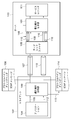
- FIG. 1 is a diagram showing a configuration of a client server system in the present embodiment.
- reference numerals 100 and 101 denote priority order control units, which control reception of SOAP messages according to the priority set in the SOAP message.
- Reference numeral 102 denotes a client side device (client), and reference numeral 103 denotes a server side device (server).
- the SOAP message is described here as an example, the message transmitted / received may be a message other than SOAP, such as an XML-RPC (Remote Procedure Call) message.
- XML-RPC Remote Procedure Call
- a message having an HTTP header as a request header and an XML document as a request body is transmitted and received.
- the priority control units 100 and 101 have a function as a client and a function as a server, and may have the same function.
- the device in which the priority control units 100 and 101 are installed may be a multifunction device having a plurality of functions such as copying, scanning, and printing, or may be a personal computer.
- an application 104 that accesses the Web service on the server side using the priority control unit 100 is installed. Then, according to the instruction 105 from the application 104, the priority control unit 100 generates a SOAP message 106 including a corresponding protocol binding header and transmits it to the server 103 side.
- the transmitted SOAP message 106 flows as a stream 107 on the network, and the servlet container 108 installed in the server 103 starts receiving from the top data of the SOAP message.
- the protocol binding header is a header including information processed by a protocol (for example, HTTP) for transmitting a SOAP message.
- the priority control unit 101 of the server 103 acquires the protocol binding header information 109 from the servlet container 108 and acquires a SOAP message as the stream 110.
- the server 103 can determine from the protocol binding header information 109 that the received message is a SOAP message at the HTTP level of the application layer.
- the acquired SOAP message is bound to the service logic 111.
- the service logic 111 that has received the SOAP message executes processing of a service instructed by the application 104.
- the application 104 of the client 102 instructs the priority control unit 100 to preferentially transmit the highly urgent SOAP message 114 to the server 103 while transmitting the SOAP message 106 (112).
- the priority control unit 100 allows the priority to be set as an extension header in the protocol binding header of the SOAP message 114, and sets a high priority value to indicate high urgency (113).
- An example of the protocol binding header is an HTTP header. In the HTTP header, an arbitrary header can be defined and transmitted.
- the user In the HTTP specification, the user is allowed to set an arbitrary header and its value. Therefore, on the side that analyzes the received HTTP header, any header that cannot be analyzed is ignored. Therefore, even if a message including an original header such as a priority is sent to the header, if the other party cannot interpret the message, the other party may perform normal message processing and can continue processing. On the other hand, if priority is placed not in the protocol binding header but in, for example, a SOAP document corresponding to the body part of the message, there is a possibility that a failure may occur in the analysis of the SOAP document on the other party receiving it.
- the header part has a smaller amount of information, so there is no load on the analysis processing on the receiving side, and more control processing and priority processing of the reception speed of the SOAP document in the body part are performed. You can start early. Therefore, a highly urgent message can be received quickly.
- the SOAP message 114 flows as a stream 115 on the network and is received by the servlet container 108 of the server 103.
- the priority order control unit 101 obtains the protocol binding header information 116 of the SOAP message from the servlet container 108. Then, the priority control unit 101 compares the priority value of the acquired protocol binding header with the priority value of the SOAP message 106 being received first, and determines that the priority of the SOAP message 114 is high.
- the priority control unit 101 reduces the speed of reading the SOAP message 106 being received first (118). Then, the SOAP message 114 is acquired as the stream 119, and binding to the service logic 111 is performed when all acquisition of the SOAP message 114 is completed. As described above, the SOAP message 114 with high urgency can be transmitted to the server 103 first without canceling the transmission of the SOAP message 106.
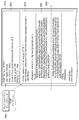
- FIG. 2 is a diagram illustrating an example of a SOAP message including a protocol binding header.
- Reference numeral 201 denotes an entire SOAP message including a protocol binding header, which is composed of a protocol binding header portion 202 and a message body portion 203.
- HTTP will be described as an example of the protocol.
- the protocol binding header section 202 has a header section 202 including information processed by a protocol (for example, HTTP) for transmitting a SOAP message.
- a protocol for example, HTTP
- the protocol binding header section 202 describes header information based on HTTP specifications such as Content-Type and Content-Length.
- a priority header 204 indicating a priority necessary for the above-described priority control is added as an extension header. Since the HTTP header can be transmitted by defining an arbitrary header, such a description can be made.
- the priority order control unit 101 of the server 103 determines the priority from the value of this extension header.
- the priority is indicated by a numerical value as “Priority: 1”, but is not limited to this description. That is, other specifications that are not numerical values agreed between the client side and the server side can be handled.
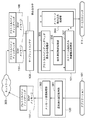
- FIG. 3 is a diagram illustrating an example of the configuration of the priority order control unit in the present embodiment. 3, the same components as those in FIG. 1 are denoted by the same reference numerals, and the description thereof is omitted.
- the application 104 notifies the priority of the SOAP message to be transmitted to the priority setting processing unit 301 of the priority control unit 100.
- the priority setting processing unit 301 sets the notified priority as the value of the extension header of the protocol binding header.
- a SOAP message 114 including a protocol binding header in which a priority is set as an extension header is generated and sent from the message transmission processing unit 302 to the network 303.
- the message reading processing unit 304 is reading the SOAP message 106 previously transmitted from the client side from the servlet container 108.
- the message transmission processing unit 302 is transmitting the SOAP message 106.
- the SOAP message 114 is received by the servlet container 108, and the protocol binding header reading processing unit 305 reads the information of the protocol binding header of the SOAP message 114.
- the priority order analysis processing unit 306 acquires the priority information set in the extension header from the protocol binding header information, and compares it with the priority information of the SOAP message 106. As a result of the comparison, it is determined that reading of the received SOAP message 114 is prioritized over the SOAP message 106 that is already being read. Also, the stream reading control calculation processing unit 307 acquires information related to the SOAP message 114 from the read header information.
- the information regarding the SOAP message 114 is, for example, the entire size of the SOAP message 114.
- the stream reading control calculation processing unit 307 receives the comparison result from the priority order analysis processing unit 306 and acquires information on the SOAP message 106 that is already being read from the message reading processing unit 304.
- the information related to the SOAP message 106 is information indicating, for example, how much of the SOAP message 106 remains to be read. Then, the stream reading control calculation processing unit 307 analyzes how much the reading speed of the SOAP message 106 should be reduced in order to read the SOAP message 114 with priority, and calculates control information.
- the message reading processing unit 304 reads the SOAP message 114 from the servlet container 108 first by reducing the reading speed of the SOAP message 106 according to the control information calculated from the stream reading control calculation processing unit 307. Thereafter, when the reading of the SOAP message 114 is completed, the message reading processing unit 304 binds the information of the SOAP message 114 to the service logic 111. When the reading of the SOAP message 106 with reduced reading speed is completed, the binding to the service logic 111 is performed in the same manner as the SOAP message 114.
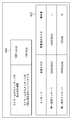
- FIG. 4 is a diagram showing specific numerical values at the time of starting priority control in the present embodiment.
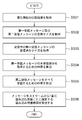
- FIG. 5 is a flowchart showing the processing of the stream reading control calculation processing unit.
- 401 is an example of a numerical value indicating the processing capability of the server 103.
- 1000 [byte / s] is stored as the speed for reading messages from the stream
- 1000 [byte] is stored as the buffer size for reading messages from the stream at one time.
- Reference numeral 402 denotes information of each message, and the total size of the message, the received size, and the numerical value of the priority are stored.
- the message reading speed from the stream is the speed at which the SOAP messages 106 and 114 are read.
- the first received message is the SOAP message 106
- the second received message is the SOAP message 114.
- step S501 shown in FIG. 5 the stream reading control calculation processing unit 307 acquires the result analyzed by the priority order analysis processing unit 306. From the information 402 of each message, the numerical value of the priority is “1” for the first received message, “10” for the second received message, and the second received message has a higher priority.
- step S502 the entire sizes (data amounts) of the first and second received messages are acquired from the information of the protocol binding header read by the protocol binding header reading processing unit 305. From the information 402 of each message, the total size is 20000 [byte] for the first received message and 40000 [byte] for the second received message.
- step S503 a received size (data amount) indicating how much the first received message being received has been received is acquired. From the information 402 of each message, the received size of the first received message is 10000 [bytes].
- step S504 it is calculated how long it takes to receive the remaining portion of the first received message that has not been received.
- the speed for reading a message from the stream is set to 1000 [byte / s]
- step S506 a read waiting time set for each interval at which a message is read from the stream at a time is calculated from the priority comparison result and the calculation result. For example, from the obtained priority order comparison result, it is first determined that the second received message should be received with priority over the first received message. Then, in order to finish receiving the second received message before the first received message, it is analyzed how slow the reading speed of the first received message should be.
- the time for reading the unreceived portion of the first received message is 10 seconds
- the number of times the process is looped for reading is 10 times
- the time for receiving the second received message is 40 seconds.
- the read waiting time (waittime) which is the final calculated value, is calculated as 3 seconds by the following formula. 10 [s] + waittime x 10 [times]> 40 [s] waittime> 3 [s]
- the reading of the second received message can be completed before the unreceived portion of the first received message. .
- the method of reducing the reading speed of the first message by increasing the reading interval of the first message from the stream by the reading waiting time has been described, but the present invention is limited to this method. It is not a thing.
- the reading speed of the first message may be reduced by reducing the reading amount (number of bytes) for reading the first message from the stream.
- the second message can be preferentially received in the same manner as described above.
- the versatility of the device itself can be improved without depending on the network layer or the transport layer.
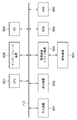
- FIG. 6 is a diagram illustrating an example of a configuration of an information processing apparatus that functions as a client or a server.
- 2 illustrates an example of a hardware configuration of an information processing apparatus that executes software that implements the functions of the above-described embodiments.
- the information processing apparatus includes an input device 601, a display device 602, a storage medium drive device 603, a ROM 605, a RAM 606, a CPU or MPU 607, an interface device 608, and an HD (hard disk) 609 as hardware configurations.
- the input device 601 includes a keyboard and a mouse operated by an operator (operator) of the information processing apparatus, and is used to input various operation information and the like to the information processing apparatus.
- the display device 602 includes a display that is used by an operator of the information processing device, and is used to display various types of information (or screens).
- the interface device 608 is an interface for connecting the information processing device to a network or the like.
- a program related to the above-described processing is provided to the information processing apparatus by a storage medium 604 such as a CD-ROM, or downloaded through a network or the like.
- the storage medium 604 is set in the storage medium drive device 603, and the program is installed in the HD 609 from the storage medium 604 via the storage medium drive device 603.
- ROM 605 stores a program that is read first when the information processing apparatus is powered on.
- a RAM 606 is a main memory of the information processing apparatus.
- the CPU 607 reads the program from the HD 609, stores it in the RAM 606, and executes the program, thereby realizing the processing contents described above.
- the HD 609 stores, for example, a WEB service flow description document, a WEB service interface description document, and the like.
- the present invention can also be realized by executing the following processing. That is, software (program) that realizes the functions of the above-described embodiments is supplied to a system or apparatus via a network or various storage media, and a computer (or CPU, MPU, or the like) of the system or apparatus reads the program. It is a process to be executed.
Landscapes
- Engineering & Computer Science (AREA)
- Computer Networks & Wireless Communication (AREA)
- Signal Processing (AREA)
- Computer Security & Cryptography (AREA)
- Data Exchanges In Wide-Area Networks (AREA)
- Communication Control (AREA)
- Telephonic Communication Services (AREA)
Priority Applications (1)
| Application Number | Priority Date | Filing Date | Title |
|---|---|---|---|
| US12/797,403 US9032040B2 (en) | 2008-07-31 | 2010-06-09 | Receiving device and method |
Applications Claiming Priority (2)
| Application Number | Priority Date | Filing Date | Title |
|---|---|---|---|
| JP2008-198624 | 2008-07-31 | ||
| JP2008198624A JP5224964B2 (ja) | 2008-07-31 | 2008-07-31 | 受信装置の受信方法及び受信装置並びにプログラム |
Related Child Applications (1)
| Application Number | Title | Priority Date | Filing Date |
|---|---|---|---|
| US12/797,403 Continuation US9032040B2 (en) | 2008-07-31 | 2010-06-09 | Receiving device and method |
Publications (1)
| Publication Number | Publication Date |
|---|---|
| WO2010013397A1 true WO2010013397A1 (ja) | 2010-02-04 |
Family
ID=41610113
Family Applications (1)
| Application Number | Title | Priority Date | Filing Date |
|---|---|---|---|
| PCT/JP2009/003199 Ceased WO2010013397A1 (ja) | 2008-07-31 | 2009-07-09 | 受信装置及び方法 |
Country Status (3)
| Country | Link |
|---|---|
| US (1) | US9032040B2 (enExample) |
| JP (1) | JP5224964B2 (enExample) |
| WO (1) | WO2010013397A1 (enExample) |
Cited By (1)
| Publication number | Priority date | Publication date | Assignee | Title |
|---|---|---|---|---|
| WO2014013701A1 (en) * | 2012-07-18 | 2014-01-23 | Canon Kabushiki Kaisha | Information processing system, control method, server, information processing device, and storage medium |
Families Citing this family (2)
| Publication number | Priority date | Publication date | Assignee | Title |
|---|---|---|---|---|
| CN102404237A (zh) * | 2011-12-31 | 2012-04-04 | 网宿科技股份有限公司 | 基于流量调整物理带宽的方法和系统 |
| DE102016204195A1 (de) * | 2016-03-15 | 2017-09-21 | Siemens Aktiengesellschaft | Verfahren und Vorrichtung zum Datenaustausch |
Citations (2)
| Publication number | Priority date | Publication date | Assignee | Title |
|---|---|---|---|---|
| JPH04270535A (ja) * | 1991-02-25 | 1992-09-25 | Nippon Telegr & Teleph Corp <Ntt> | 通信制御方法 |
| JPH11341057A (ja) * | 1998-05-25 | 1999-12-10 | Nec Corp | データ伝送装置およびデータ伝送方法 |
Family Cites Families (14)
| Publication number | Priority date | Publication date | Assignee | Title |
|---|---|---|---|---|
| US5140584A (en) * | 1989-03-01 | 1992-08-18 | Kabushiki Kaisha Toshiba | Packet communication system and method of controlling same |
| JPH0877025A (ja) * | 1994-09-01 | 1996-03-22 | Kokusai Electric Co Ltd | タスクの優先度制御方法、タスクの優先度制御装置 |
| JP3797510B2 (ja) * | 1997-07-16 | 2006-07-19 | ソニー株式会社 | 通信方法、送信装置、受信装置及びセルラー無線通信システム |
| JP3707218B2 (ja) * | 1997-12-11 | 2005-10-19 | セイコーエプソン株式会社 | 印刷システム、印刷方法及びプリンタ |
| JP2000278347A (ja) * | 1999-03-25 | 2000-10-06 | Matsushita Electric Ind Co Ltd | 通信装置 |
| US6738371B1 (en) * | 1999-09-28 | 2004-05-18 | Ericsson Inc. | Ingress data queue management in a packet data router |
| JP4009809B2 (ja) * | 2000-03-30 | 2007-11-21 | オムロン株式会社 | 情報処理装置および方法 |
| JP3975703B2 (ja) * | 2001-08-16 | 2007-09-12 | 日本電気株式会社 | 情報処理システムにおける優先実行制御方法及びその装置並びにプログラム |
| JP2003209573A (ja) * | 2002-01-10 | 2003-07-25 | Fujitsu Ltd | 通信装置及び中継装置 |
| US7752629B2 (en) * | 2004-05-21 | 2010-07-06 | Bea Systems Inc. | System and method for application server with overload protection |
| JP4958481B2 (ja) * | 2006-06-01 | 2012-06-20 | キヤノン株式会社 | Webサービス実行方法及び情報処理装置 |
| JP4672081B2 (ja) * | 2007-06-29 | 2011-04-20 | 富士通株式会社 | パケット中継方法及び装置 |
| US20090237422A1 (en) * | 2008-03-18 | 2009-09-24 | Tte Indianapolis | Method and apparatus for adjusting the scroll rate of textual media dispayed on a screen |
| JP2009301538A (ja) * | 2008-05-12 | 2009-12-24 | Canon Inc | サービスフロー処理装置及び方法 |
-
2008
- 2008-07-31 JP JP2008198624A patent/JP5224964B2/ja not_active Expired - Fee Related
-
2009
- 2009-07-09 WO PCT/JP2009/003199 patent/WO2010013397A1/ja not_active Ceased
-
2010
- 2010-06-09 US US12/797,403 patent/US9032040B2/en not_active Expired - Fee Related
Patent Citations (2)
| Publication number | Priority date | Publication date | Assignee | Title |
|---|---|---|---|---|
| JPH04270535A (ja) * | 1991-02-25 | 1992-09-25 | Nippon Telegr & Teleph Corp <Ntt> | 通信制御方法 |
| JPH11341057A (ja) * | 1998-05-25 | 1999-12-10 | Nec Corp | データ伝送装置およびデータ伝送方法 |
Cited By (4)
| Publication number | Priority date | Publication date | Assignee | Title |
|---|---|---|---|---|
| WO2014013701A1 (en) * | 2012-07-18 | 2014-01-23 | Canon Kabushiki Kaisha | Information processing system, control method, server, information processing device, and storage medium |
| RU2620720C2 (ru) * | 2012-07-18 | 2017-05-29 | Кэнон Кабусики Кайся | Система обработки информации, способ управления, сервер, устройство обработки информации и носитель данных |
| US10601958B2 (en) | 2012-07-18 | 2020-03-24 | Canon Kabushiki Kaisha | Information processing system and method for prioritized information transfer |
| US11258882B2 (en) | 2012-07-18 | 2022-02-22 | Canon Kabushiki Kaisha | Information processing device, method, and storage medium for prioritized content acquisition |
Also Published As
| Publication number | Publication date |
|---|---|
| JP5224964B2 (ja) | 2013-07-03 |
| US20100250696A1 (en) | 2010-09-30 |
| US9032040B2 (en) | 2015-05-12 |
| JP2010041117A (ja) | 2010-02-18 |
Similar Documents
| Publication | Publication Date | Title |
|---|---|---|
| US8718078B2 (en) | Multi-homed communication apparatus, and control method and storage medium therefor | |
| JP6289092B2 (ja) | 情報処理装置、その制御方法およびコンピュータプログラム | |
| US10057326B2 (en) | Client-adjustable window size for connectionless transfer protocols | |
| US8238243B2 (en) | System and method for network optimization by managing low priority data transfers | |
| US8730501B2 (en) | Communication apparatus, communication continuation method, and communication continuation program | |
| JP5224964B2 (ja) | 受信装置の受信方法及び受信装置並びにプログラム | |
| US20080316529A1 (en) | Service Supplied by Multifunction Peripheral (MFP) | |
| US20120113467A1 (en) | Image processing apparatus, information processing system, information processing method and storage medium | |
| JP4508210B2 (ja) | 受信装置及び受信システム | |
| JP2007208712A (ja) | インターネットファクシミリ装置及び通信処理プログラム | |
| JP5630339B2 (ja) | 通信装置及び画像処理装置 | |
| JP2015114765A (ja) | 情報処理装置、プログラム及び制御方法 | |
| JP2015106796A (ja) | 通信装置、通信制御方法及びプログラム | |
| JP5024024B2 (ja) | スプールサーバ及びデータ通信制御方法 | |
| JP2005222284A (ja) | 連携処理システム、連携情報生成装置、連携処理方法、及びプログラム | |
| JP5537970B2 (ja) | Webサービス稼動監視システムおよびWebサービス稼動監視方法 | |
| JP5365410B2 (ja) | 通信制御装置、通信装置及びプログラム | |
| JP4783744B2 (ja) | ネットワーク管理プログラム、該プログラムを記録した記録媒体、ノードおよびマスタノード | |
| JP2004015505A (ja) | パケット優先制御装置、パケット優先制御方法およびパケット優先制御プログラム | |
| JP2009053841A (ja) | 画像形成システム及び画像形成装置 | |
| JP2012080504A (ja) | 画像形成装置、画像形成装置の制御方法、及びプログラム | |
| JP2011018114A (ja) | 受信装置、送信装置、受信方法、送信方法、及び、プログラム | |
| JP2004364203A (ja) | 通信装置 | |
| JP2005266930A (ja) | サービス処理装置 | |
| JP2010258692A (ja) | 通信装置 |
Legal Events
| Date | Code | Title | Description |
|---|---|---|---|
| 121 | Ep: the epo has been informed by wipo that ep was designated in this application |
Ref document number: 09802647 Country of ref document: EP Kind code of ref document: A1 |
|
| NENP | Non-entry into the national phase |
Ref country code: DE |
|
| 122 | Ep: pct application non-entry in european phase |
Ref document number: 09802647 Country of ref document: EP Kind code of ref document: A1 |