WO2009101966A1 - パラジウム系金属錯体 - Google Patents
パラジウム系金属錯体 Download PDFInfo
- Publication number
- WO2009101966A1 WO2009101966A1 PCT/JP2009/052288 JP2009052288W WO2009101966A1 WO 2009101966 A1 WO2009101966 A1 WO 2009101966A1 JP 2009052288 W JP2009052288 W JP 2009052288W WO 2009101966 A1 WO2009101966 A1 WO 2009101966A1
- Authority
- WO
- WIPO (PCT)
- Prior art keywords
- group
- metal complex
- optionally substituted
- formula
- light
- Prior art date
- Legal status (The legal status is an assumption and is not a legal conclusion. Google has not performed a legal analysis and makes no representation as to the accuracy of the status listed.)
- Ceased
Links
- 0 Cc1n[n]c(*)c1* Chemical compound Cc1n[n]c(*)c1* 0.000 description 1
Images

Classifications
-
- C—CHEMISTRY; METALLURGY
- C07—ORGANIC CHEMISTRY
- C07F—ACYCLIC, CARBOCYCLIC OR HETEROCYCLIC COMPOUNDS CONTAINING ELEMENTS OTHER THAN CARBON, HYDROGEN, HALOGEN, OXYGEN, NITROGEN, SULFUR, SELENIUM OR TELLURIUM
- C07F15/00—Compounds containing elements of Groups 8, 9, 10 or 18 of the Periodic Table
- C07F15/0006—Compounds containing elements of Groups 8, 9, 10 or 18 of the Periodic Table compounds of the platinum group
- C07F15/006—Palladium compounds
- C07F15/0066—Palladium compounds without a metal-carbon linkage
-
- C—CHEMISTRY; METALLURGY
- C07—ORGANIC CHEMISTRY
- C07D—HETEROCYCLIC COMPOUNDS
- C07D231/00—Heterocyclic compounds containing 1,2-diazole or hydrogenated 1,2-diazole rings
- C07D231/02—Heterocyclic compounds containing 1,2-diazole or hydrogenated 1,2-diazole rings not condensed with other rings
- C07D231/10—Heterocyclic compounds containing 1,2-diazole or hydrogenated 1,2-diazole rings not condensed with other rings having two or three double bonds between ring members or between ring members and non-ring members
- C07D231/12—Heterocyclic compounds containing 1,2-diazole or hydrogenated 1,2-diazole rings not condensed with other rings having two or three double bonds between ring members or between ring members and non-ring members with only hydrogen atoms, hydrocarbon or substituted hydrocarbon radicals, directly attached to ring carbon atoms
-
- C—CHEMISTRY; METALLURGY
- C07—ORGANIC CHEMISTRY
- C07F—ACYCLIC, CARBOCYCLIC OR HETEROCYCLIC COMPOUNDS CONTAINING ELEMENTS OTHER THAN CARBON, HYDROGEN, HALOGEN, OXYGEN, NITROGEN, SULFUR, SELENIUM OR TELLURIUM
- C07F1/00—Compounds containing elements of Groups 1 or 11 of the Periodic Table
- C07F1/12—Gold compounds
-
- C—CHEMISTRY; METALLURGY
- C09—DYES; PAINTS; POLISHES; NATURAL RESINS; ADHESIVES; COMPOSITIONS NOT OTHERWISE PROVIDED FOR; APPLICATIONS OF MATERIALS NOT OTHERWISE PROVIDED FOR
- C09K—MATERIALS FOR MISCELLANEOUS APPLICATIONS, NOT PROVIDED FOR ELSEWHERE
- C09K11/00—Luminescent materials, e.g. electroluminescent or chemiluminescent
- C09K11/06—Luminescent materials, e.g. electroluminescent or chemiluminescent containing organic luminescent materials
-
- H—ELECTRICITY
- H05—ELECTRIC TECHNIQUES NOT OTHERWISE PROVIDED FOR
- H05B—ELECTRIC HEATING; ELECTRIC LIGHT SOURCES NOT OTHERWISE PROVIDED FOR; CIRCUIT ARRANGEMENTS FOR ELECTRIC LIGHT SOURCES, IN GENERAL
- H05B33/00—Electroluminescent light sources
- H05B33/12—Light sources with substantially two-dimensional [2D] radiating surfaces
- H05B33/14—Light sources with substantially two-dimensional [2D] radiating surfaces characterised by the chemical or physical composition or the arrangement of the electroluminescent material, or by the simultaneous addition of the electroluminescent material in or onto the light source
-
- H—ELECTRICITY
- H10—SEMICONDUCTOR DEVICES; ELECTRIC SOLID-STATE DEVICES NOT OTHERWISE PROVIDED FOR
- H10K—ORGANIC ELECTRIC SOLID-STATE DEVICES
- H10K50/00—Organic light-emitting devices
-
- H—ELECTRICITY
- H10—SEMICONDUCTOR DEVICES; ELECTRIC SOLID-STATE DEVICES NOT OTHERWISE PROVIDED FOR
- H10K—ORGANIC ELECTRIC SOLID-STATE DEVICES
- H10K50/00—Organic light-emitting devices
- H10K50/10—OLEDs or polymer light-emitting diodes [PLED]
- H10K50/11—OLEDs or polymer light-emitting diodes [PLED] characterised by the electroluminescent [EL] layers
-
- H—ELECTRICITY
- H10—SEMICONDUCTOR DEVICES; ELECTRIC SOLID-STATE DEVICES NOT OTHERWISE PROVIDED FOR
- H10K—ORGANIC ELECTRIC SOLID-STATE DEVICES
- H10K85/00—Organic materials used in the body or electrodes of devices covered by this subclass
- H10K85/30—Coordination compounds
- H10K85/361—Polynuclear complexes, i.e. complexes comprising two or more metal centers
-
- C—CHEMISTRY; METALLURGY
- C09—DYES; PAINTS; POLISHES; NATURAL RESINS; ADHESIVES; COMPOSITIONS NOT OTHERWISE PROVIDED FOR; APPLICATIONS OF MATERIALS NOT OTHERWISE PROVIDED FOR
- C09K—MATERIALS FOR MISCELLANEOUS APPLICATIONS, NOT PROVIDED FOR ELSEWHERE
- C09K2211/00—Chemical nature of organic luminescent or tenebrescent compounds
- C09K2211/10—Non-macromolecular compounds
- C09K2211/1003—Carbocyclic compounds
- C09K2211/1007—Non-condensed systems
-
- C—CHEMISTRY; METALLURGY
- C09—DYES; PAINTS; POLISHES; NATURAL RESINS; ADHESIVES; COMPOSITIONS NOT OTHERWISE PROVIDED FOR; APPLICATIONS OF MATERIALS NOT OTHERWISE PROVIDED FOR
- C09K—MATERIALS FOR MISCELLANEOUS APPLICATIONS, NOT PROVIDED FOR ELSEWHERE
- C09K2211/00—Chemical nature of organic luminescent or tenebrescent compounds
- C09K2211/10—Non-macromolecular compounds
- C09K2211/1018—Heterocyclic compounds
- C09K2211/1025—Heterocyclic compounds characterised by ligands
- C09K2211/1044—Heterocyclic compounds characterised by ligands containing two nitrogen atoms as heteroatoms
-
- C—CHEMISTRY; METALLURGY
- C09—DYES; PAINTS; POLISHES; NATURAL RESINS; ADHESIVES; COMPOSITIONS NOT OTHERWISE PROVIDED FOR; APPLICATIONS OF MATERIALS NOT OTHERWISE PROVIDED FOR
- C09K—MATERIALS FOR MISCELLANEOUS APPLICATIONS, NOT PROVIDED FOR ELSEWHERE
- C09K2211/00—Chemical nature of organic luminescent or tenebrescent compounds
- C09K2211/18—Metal complexes
- C09K2211/185—Metal complexes of the platinum group, i.e. Os, Ir, Pt, Ru, Rh or Pd
-
- C—CHEMISTRY; METALLURGY
- C09—DYES; PAINTS; POLISHES; NATURAL RESINS; ADHESIVES; COMPOSITIONS NOT OTHERWISE PROVIDED FOR; APPLICATIONS OF MATERIALS NOT OTHERWISE PROVIDED FOR
- C09K—MATERIALS FOR MISCELLANEOUS APPLICATIONS, NOT PROVIDED FOR ELSEWHERE
- C09K2211/00—Chemical nature of organic luminescent or tenebrescent compounds
- C09K2211/18—Metal complexes
- C09K2211/188—Metal complexes of other metals not provided for in one of the previous groups
-
- H—ELECTRICITY
- H10—SEMICONDUCTOR DEVICES; ELECTRIC SOLID-STATE DEVICES NOT OTHERWISE PROVIDED FOR
- H10K—ORGANIC ELECTRIC SOLID-STATE DEVICES
- H10K2101/00—Properties of the organic materials covered by group H10K85/00
- H10K2101/10—Triplet emission
-
- H—ELECTRICITY
- H10—SEMICONDUCTOR DEVICES; ELECTRIC SOLID-STATE DEVICES NOT OTHERWISE PROVIDED FOR
- H10K—ORGANIC ELECTRIC SOLID-STATE DEVICES
- H10K85/00—Organic materials used in the body or electrodes of devices covered by this subclass
- H10K85/30—Coordination compounds
- H10K85/341—Transition metal complexes, e.g. Ru(II)polypyridine complexes
-
- H—ELECTRICITY
- H10—SEMICONDUCTOR DEVICES; ELECTRIC SOLID-STATE DEVICES NOT OTHERWISE PROVIDED FOR
- H10K—ORGANIC ELECTRIC SOLID-STATE DEVICES
- H10K85/00—Organic materials used in the body or electrodes of devices covered by this subclass
- H10K85/30—Coordination compounds
- H10K85/371—Metal complexes comprising a group IB metal element, e.g. comprising copper, gold or silver
Definitions
- the present invention relates to a palladium-based metal complex.
- Palladium-based metal complexes have been actively developed because they are useful as materials for organic electroluminescence light-emitting elements and the like.
- Two palladium-based metal complexes are 3,5-dimethylpyrazolato (hereinafter referred to as “dmpz”), which is a monovalent anion in which one proton is dissociated from 3,5-dimethylpyrazole (dmpzH).
- dmpz 3,5-dimethylpyrazolato
- dmpzH 3,5-dimethylpyrazole
- a multinuclear complex [Pd 2 Ag 4 ( ⁇ -dmpz) 8 ] in which Pd II ions and four Ag I ions are cross-linked has been proposed (Non-patent Document 1).
- an object of the present invention is to provide a novel palladium-based metal complex that can be used as a light-emitting material such as an organic electroluminescence element and exhibits excellent light-emitting characteristics.
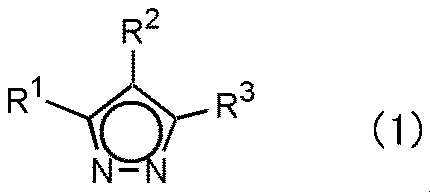
- the present invention first provides a metal complex comprising a composition represented by the following formula (a). [(Pd II) 2 (M I) 2 (X) 2 (L) 4 (L ') 2] (a) (In the formula, M I represents Ag I , Au I , or Cu I , X represents Cl, Br, or I. L is represented by the following formula (1), and L ′ is represented by the following formula ( The two M I present may be the same or different, and the four L present may be the same or different.
- R 1 , R 2 and R 3 are each independently a hydrogen atom, a halogen atom, a hydroxyl group, an optionally substituted alkyl group, an optionally substituted aryl group, Or, it represents a monovalent heterocyclic group which may be substituted.
- the present invention provides a light emitting device having a light emitting layer containing the metal complex.
- the present invention provides a display device including the light emitting element.
- the metal complex of the present invention is a novel metal complex that exhibits excellent light emission characteristics.
- the metal complex of the present invention is particularly useful for a light-emitting element, a light-emitting device, and the like, and a light-emitting element and a light-emitting device using the metal complex also have excellent light emission characteristics.
- FIG. 2 is an ORTEP diagram showing a molecular structure of metal complex A.
- the metal complex of the present invention is a metal complex including the composition represented by the formula (a).
- M I represents Ag I , Au I , or Cu I , preferably Au I.
- X represents Cl, Br, or I, preferably Cl.
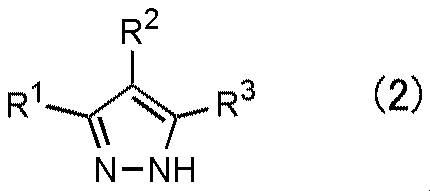
- L is represented by the formula (1), and L ′ is represented by the formula (2).
- R 1, R 2 and R 3 are each independently a hydrogen atom, a halogen atom, a hydroxyl group, an optionally substituted alkyl group, an aryl group which may be substituted Or a monovalent heterocyclic group which may be substituted, wherein at least one of R 1 , R 2 and R 3 is a halogen atom, a hydroxyl group, an optionally substituted alkyl group or a substituted one.
- an aryl group which may be substituted, or a monovalent heterocyclic group which may be substituted that is, at least one of R 1 , R 2 and R 3 is not a hydrogen atom
- halogen atom examples include a fluorine atom, a chlorine atom, a bromine atom, and an iodine atom, and a chlorine atom is preferable.
- the optionally substituted alkyl group usually has about 1 to 6 carbon atoms, preferably 1 to 4 carbon atoms.
- Examples of the optionally substituted alkyl group include unsubstituted groups such as methyl group, ethyl group, propyl group, isopropyl group, butyl group, isobutyl group, t-butyl group, pentyl group, hexyl group, and cyclohexyl group.
- Alkyl groups substituted alkyl groups such as trifluoromethyl group, pentafluoroethyl group, perfluorobutyl group, perfluorohexyl group and perfluorooctyl group (particularly, alkyl groups substituted with halogen atoms such as fluorine atoms) And a methyl group, an ethyl group, a t-butyl group, and a trifluoromethyl group are preferable.
- the optionally substituted aryl group is an atomic group obtained by removing one hydrogen atom from an optionally substituted aromatic hydrocarbon.
- the aromatic hydrocarbon includes those having a condensed ring and those having two or more independent benzene rings or condensed rings bonded directly or via a group such as vinylene.
- the aryl group which may be substituted usually has about 6 to 20 carbon atoms, preferably 6 to 10 carbon atoms.
- Examples of the optionally substituted aryl group include a phenyl group and a C 1 -C 4 alkoxyphenyl group (“C 1 -C 4 alkoxy” indicates that the alkoxy moiety has 1 to 4 carbon atoms.
- C 1 -C 4 alkylphenyl group (“C 1 -C 4 alkyl” indicates that the alkyl moiety has 1 to 4 carbon atoms.
- C 1 -C 4 alkyl indicates that the alkyl moiety has 1 to 4 carbon atoms.
- aryl groups such as 1-naphthyl group and 2-naphthyl group; substituted aryl groups such as pentafluorophenyl group (particularly, aryl groups substituted with halogen atoms such as fluorine atom).
- Methylphenyl group and t-butylphenyl group are preferable.
- the monovalent heterocyclic group which may be substituted includes a heterocyclic compound in which the elements constituting the ring include not only carbon atoms but also nitrogen atoms, oxygen atoms, sulfur atoms and the like as heteroatoms in the ring. It means a group formed by removing one atom or group.
- the monovalent heterocyclic group which may be substituted is preferably a monovalent aromatic heterocyclic group which may be substituted.
- Examples of the formula (1) representing the L include pyrazolate (a monovalent anion in which a hydrogen ion is dissociated from a pyrazole compound), and the like. Specific examples include the following. (Wherein R 2 has the same meaning as described above, Me represents a methyl group, Et represents an ethyl group, n-Pr represents an n-propyl group, and n-Bu represents an n-butyl group. .)
- L ′ represented by the formula (2) examples include the following. (Wherein R 2 has the same meaning as described above, Me represents a methyl group, Et represents an ethyl group, n-Pr represents an n-propyl group, and n-Bu represents an n-butyl group. .)
- R 1 , R 2 and R 3 in the formulas (1) and (2) may be the same or different in each L and L ′.
- the L ′ may be synthesized by any method. For example, J. et al. Am. Chem. Soc. , 72, 1352-1356 (1950), a diketone compound (A) as an intermediate was obtained, and Bull. Soc. Chim. 45, 877-884 (1929), Chem. Abstr. 24, 7541 (1930), Tetrahedron, 42, 15, 4253-4257 (1986), Heterocycles, 53, 1285 (2000). Can be synthesized to synthesize a pyrazole compound (B) (Scheme 1 below).
- the diketone compound (A) may be synthesized, for example, by an oxidation reaction of ⁇ -unsaturated ketone or a reaction of ketocarboxylic acid with an alkyl bromide Grignard reagent.
- the above L ′ is the same as J.I. Heterocyclic Chem. , 35, 1377 (1998). [Scheme 1]
- the metal complex of the present invention is preferably a metal complex containing a composition represented by the following formula (b) as a composition represented by the formula (a).
- [ ⁇ (Pd II ) (M I ) (X) (L) 2 (L ′) ⁇ 2 ] (b) (In the formula, M I , X, L and L ′ represent the same meaning as described above.)
- the metal complex containing the composition represented by the formula (b) may be regarded as a dimerization of two ⁇ (Pd II ) (M I ) (X) (L) 2 (L ′) ⁇ units.
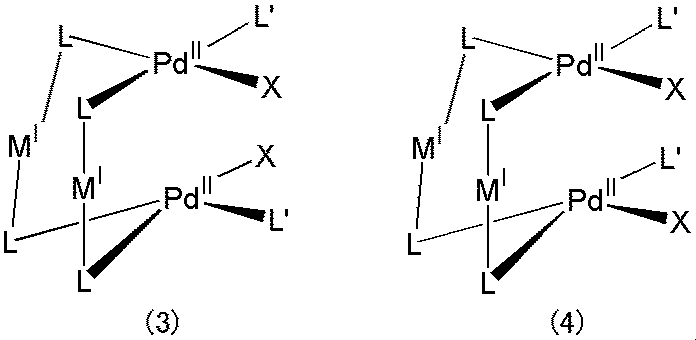
- a metal complex in which L is bridged between Pd II and M I and an interaction between metal atoms in the ground state or the excited state is exerted For example, a structure represented by the following formula (3) or (4) Have (Wherein, M I, X, L and L 'are as defined above.)
- the metal complex of the present invention has a two-fold rotation axis in the molecule that passes through the midpoint of the line connecting two Pd II and the midpoint of the line connecting two M I (in this case) , R 1 and R 3 in L are the same) and in the absence (in this case, R 1 and R 3 in L are different). From the viewpoint of ease of synthesis and purification, the case where it exists is preferable. In the absence of the two-fold rotation axis, various geometric isomers having different L and L ′ may exist, and the geometric isomers have different emission energies. For example, the structure represented by the formula (3) can have the two-fold rotation axis, and the structure represented by the formula (4) has no two-fold rotation axis.
- the metal complex of the present invention may be synthesized by any method, and includes, for example, a composition represented by the formula: [Pd 2 Au 2 Cl 2 ( ⁇ -dmpz) 4 (dmpzH) 2 ] If it is a metal complex, it can be synthesized by reacting [PdCl 2 (CH 3 CN) 2 ], dmpzH and AuCl (SC 4 H 8 ) in the presence of triethylamine.
- [Pd 2 Au 2 Cl 2 ( ⁇ -dmpz) 4 (dmpzH) 2 ] is a metal complex in which some dmpzH ligands are coordinated in an uncharged state without being deprotonated. .
- [Pd 2 Au 2 Br 2 ( ⁇ -dmpz) 4 (dmpzH) 2 ] and [Pd 2 Au 2 I 2 ( ⁇ -dmpz) 4 (dmpzH) 2 ] can be synthesized in the same manner.
- “DmpzH” represents 3,5-dimethylpyrazole
- “dmpz” represents 3,5-dimethylpyrazolato (a monovalent anion in which a hydrogen ion is dissociated from 3,5-dimethylpyrazole).
- the metal complex of the present invention is particularly useful as a light-emitting material contained in a light-emitting layer of a light-emitting element such as an organic electroluminescence element, but is a sensor such as an organic molecule or a gas molecule, an anticancer agent, and usually is colorless and transparent, but is ultraviolet. It is also useful for paints that emit light only when irradiated.
- a light-emitting element such as an organic electroluminescence element
- a sensor such as an organic molecule or a gas molecule, an anticancer agent, and usually is colorless and transparent, but is ultraviolet. It is also useful for paints that emit light only when irradiated.
- the light emitting device of the present invention is not particularly limited as long as it has a light emitting layer containing the metal complex.
- an anode, a hole injection layer, a hole transport layer, a light emitting layer, An electron transport layer, an electron injection layer, and a cathode are light emitting elements formed in this order.
- the light-emitting element of the present invention is not limited to this five-layer light-emitting element, a four-layer light-emitting element in which the electron transport layer is omitted from the five-layer light-emitting element, and a hole from the five-layer light-emitting element.
- Three-layer type light-emitting device in which the injection layer and the electron injection layer are omitted a two-layer type light-emitting device that combines the light-emitting layer and the electron transport layer of the three-layer type light-emitting device into one layer, and between the anode and the cathode
- a single-layer light emitting element in which only the light emitting layer is formed may be used.
- this metal complex can be used for both a single-layer light-emitting element and a stacked light-emitting element. However, when the metal complex is used for a single-layer light-emitting element, more excellent light emission characteristics tend to be obtained.
- a light-emitting element to which the metal complex can be advantageously applied is a light-emitting element including the metal complex in a light-emitting layer, and is usually an anode to which a positive voltage is applied, a cathode to which a negative voltage is applied, and a positive electrode from the anode.
- the metal complex is useful as a host light-emitting material in a light-emitting element.
- the metal complex can also be used as a material for a hole injection layer, a hole transport layer, an electron injection layer, an electron transport layer, and the like.
- other host light-emitting materials such as tris (8-hydroxyquinolinato) aluminum and other metal complexes having 8-quinolinols as ligands can be used for light emission efficiency and light emission spectrum by doping in small amounts. It also functions as a guest light-emitting material for improving the above. Therefore, the metal complex of the present invention is not only used alone, but also other light emitting materials such as dicyanomethylene (DCM), coumarins, perylenes, rubrenes, hole injection layer, hole transport layer, etc. In combination with materials such as an electron injection layer and an electron transport layer, the composition can also be used.
- DCM dicyanomethylene
- coumarins coumarins
- perylenes rubrenes
- hole injection layer hole transport layer
- the composition can also be used.
- the light emitting element of the present invention can be used for a display device. That is, the display device of the present invention is a display device including the light emitting element.
- This metal complex A was identified as [Pd 2 Au 2 Cl 2 ( ⁇ -dmpz) 4 (dmpzH) 2 ] when identified by IR spectrum, elemental analysis, 1 H NMR and FAB-MS.
- the metal complex A When the solubility of the metal complex A in an organic solvent was observed, the metal complex A was soluble in chloroform and methylene chloride, slightly soluble in toluene and benzene, ethanol, acetone, diethyl ether, methanol, It was hardly soluble in acetonitrile and hexane.
- FIG. 1 shows an ORTEP diagram showing a molecular structure of the metal complex A ([Pd 2 Au 2 Cl 2 ( ⁇ -dmpz) 4 (dmpzH) 2 ]).
- the element symbols H, C, N, Cl, Pd, Au and the subsequent numbers are attached to represent atoms constituting the metal complex A.
- the metal complex A is a tetranuclear complex composed of two Pd II ions, two Au I ions, two chloride ions, four dmpz ligands, and two dmpzH ligands.
- the Pd—Cl distance is 2.306 (1) ⁇ and 2.313 (1) ⁇
- the Pd—N distance is 1.959 (4) to 2.027 (4) ⁇
- the Au—N distance is 2.001 (4) to 2.009 (4 ) The range of ⁇ .
- the metal complex A emitted orange light in a solid state upon irradiation with ultraviolet light at 254 nm or 365 nm.
Landscapes
- Chemical & Material Sciences (AREA)
- Organic Chemistry (AREA)
- Physics & Mathematics (AREA)
- Engineering & Computer Science (AREA)
- Materials Engineering (AREA)
- Optics & Photonics (AREA)
- High Energy & Nuclear Physics (AREA)
- Inorganic Chemistry (AREA)
- Electroluminescent Light Sources (AREA)
Abstract
Description
パラジウム系金属錯体としては、3,5-ジメチルピラゾール(dmpzH)からプロトンが1個解離した1価の陰イオンである3,5-ジメチルピラゾラト(以下、「dmpz」と言う)が2個のPdIIイオンと4個のAgIイオンとを架橋した多核錯体[Pd2Ag4(μ-dmpz)8]が提案されている(非特許文献1)。
そこで、本発明は、有機エレクトロルミネッセンス素子等の発光材料として用いることができ、優れた発光特性を示す、新規のパラジウム系金属錯体を提供することを目的とする。
[(PdII)2(MI)2(X)2(L)4(L’)2] (a)
(式中、MIは、AgI、AuI、又はCuIを表し、Xは、Cl、Br又はIを表す。Lは、下記式(1)で表され、L’は、下記式(2)で表される。2個存在するMIは、同一であっても異なっていてもよい。4個存在するLは、同一であっても異なっていてもよい。2個存在するL’は、同一であっても異なっていてもよい。)

本発明は第二に、前記金属錯体を含む発光層を有する発光素子を提供する。
本発明は第三に、前記発光素子を備えた表示装置を提供する。
本発明の金属錯体は、前記式(a)で表される組成を含む金属錯体である。
前記式(a)中、MIは、AgI、AuI、又はCuIを表し、好ましくはAuIである。
前記式(a)中、Xは、Cl、Br、又はIを表し、好ましくはClである。
前記式(a)中、Lは、前記式(1)で表され、L’は、前記式(2)で表される。
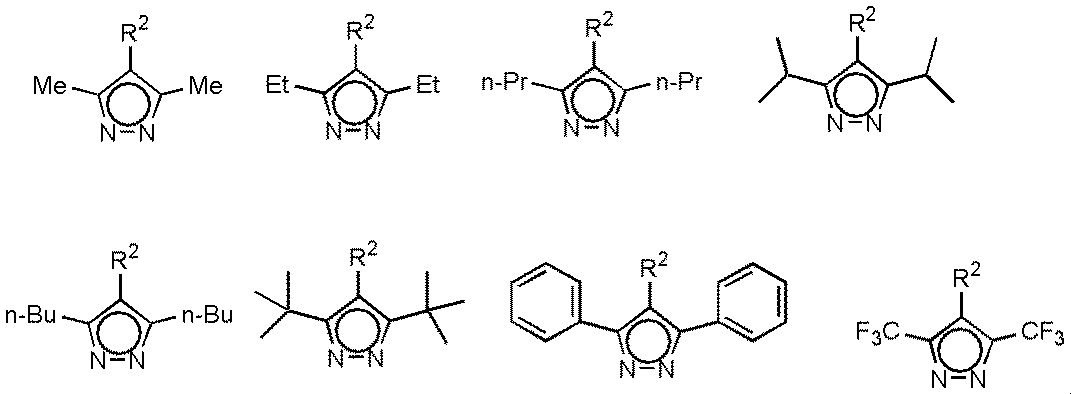
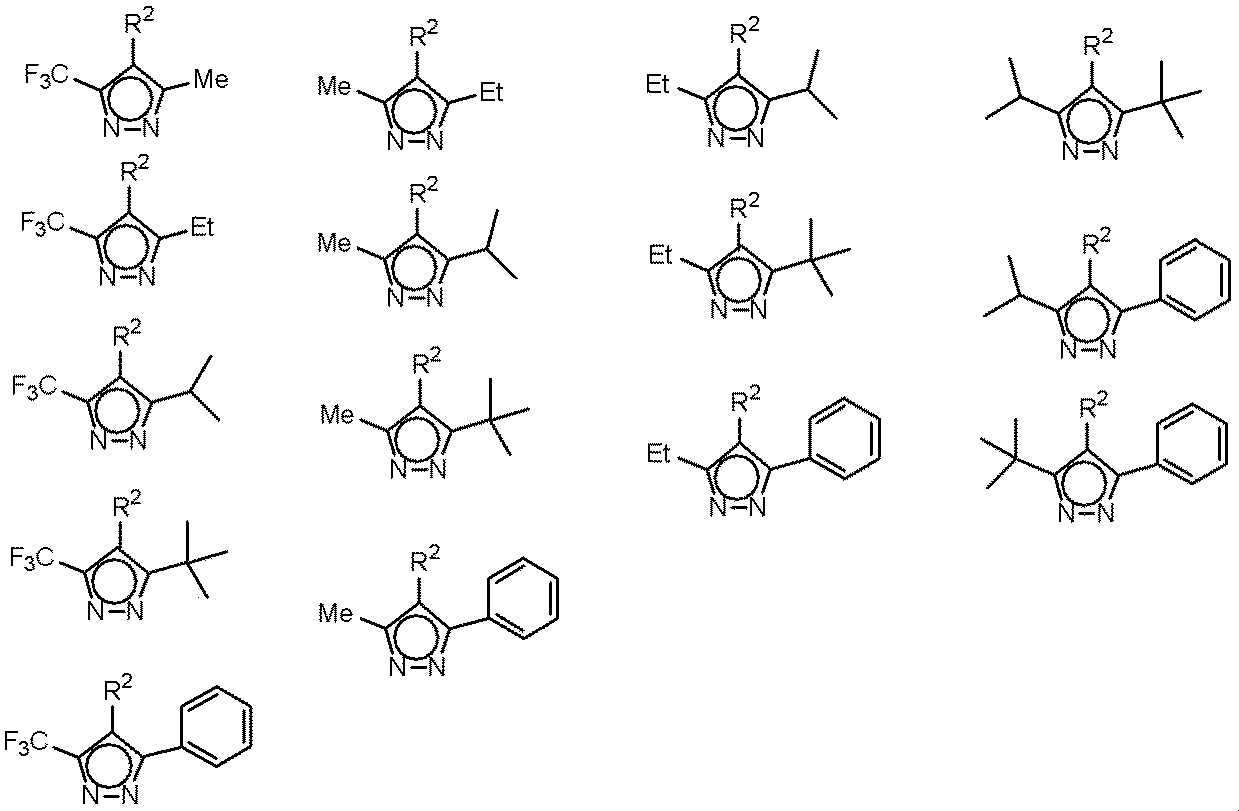
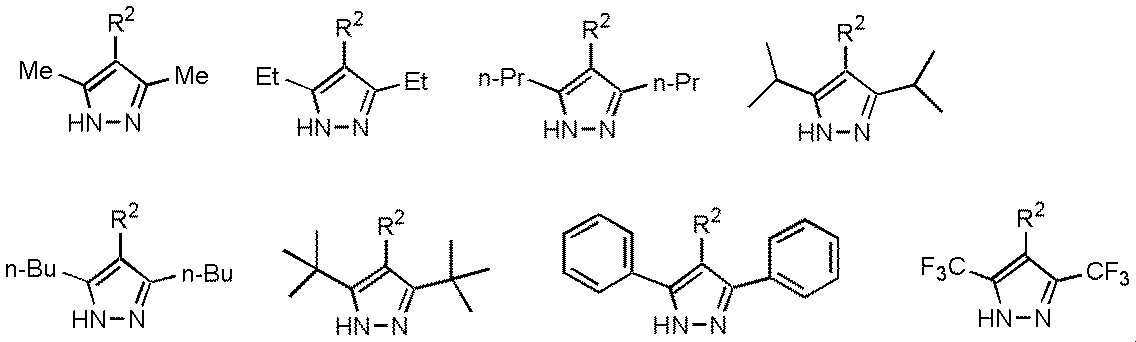

[スキーム1]

[{(PdII)(MI)(X)(L)2(L’)}2] (b)
(式中、MI、X、L及びL’は、前記と同じ意味を表す。)
前記式(b)で表される組成を含む金属錯体は、2個の{(PdII)(MI)(X)(L)2(L’)}ユニットが二量化したものとみなすことができ、PdIIとMIをLが橋かけし、基底状態又は励起状態で金属原子間に相互作用が及ぶ金属錯体を含んでおり、例えば、下記式(3)又は(4)で示される構造を有する。
本発明の発光素子は、前記金属錯体を含む発光層を有していれば、特に限定されないが、例えば、透明な基板の上に、陽極、正孔注入層、正孔輸送層、発光層、電子輸送層、電子注入層、及び陰極が、この順番で形成された発光素子である。また、本発明の発光素子は、この5層型の発光素子に限定されず、5層型の発光素子から電子輸送層を省略した4層型の発光素子、5層型の発光素子から正孔注入層と電子注入層を省略した3層型の発光素子、3層型の発光素子の発光層と電子輸送層を兼用して1つの層とする2層型の発光素子、陽極と陰極の間に発光層のみが形成される単層型の発光素子であってもよい。なお、この金属錯体は、単層型発光素子及び積層型発光素子のいずれにも用いることができるが、単層型発光素子に用いる方が、より優れた発光特性を得やすい傾向にある。

IR (KBr):3224 (br)、3145 (w)、3047 (w)、2975 (m)、2921 (s)、2361 (w)、2341 (w)、2251 (w)、1577 (s)、1534 (s)、1480 (m)、1416 (s)、1378 (m)、1353 (s)、1279 (m)、1174 (m)、1055 (m)、980 (w)、815 (m)、787 (s)、764 (s)、679 (m)、653 (m)、594 (m)、479 (w)、470 (w)、446 (w)
元素分析:C32H47Au2Cl2N13Pd2 (結晶溶媒としてアセトニトリルを1分子含む形、即ち、[Pd2Au2Cl2(μ-dmpz)4(dmpzH)2]・CH3CNで計算した。)に対する計算値:C 29.76; H 3.67; N 14.10%。実測値:C 29.93; H 3.59; N 14.37%。
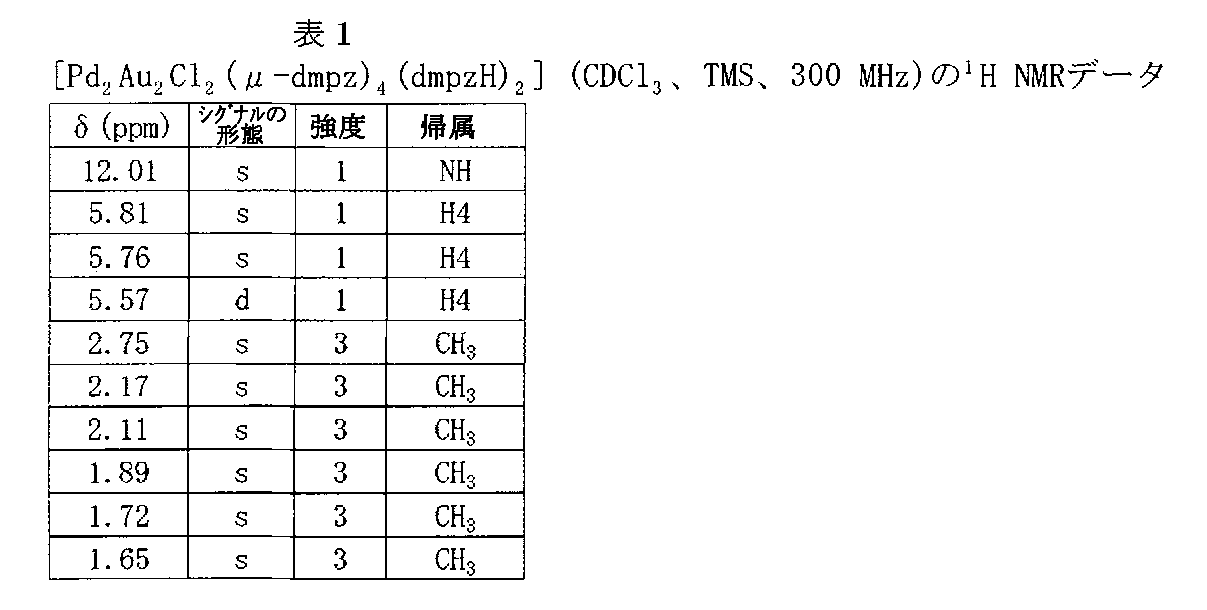
FAB-MS : m/z : 1251.1 [M+H]+ (但し、Mは錯体分子[Pd2Au2Cl2(μ-dmpz)4(dmpzH)2]を表す。)
[Pd2Au2Cl2(μ-dmpz)4(dmpzH)2]は、アセトニトリルを1分子含んだ形で結晶化した。
単結晶X線構造解析により分子構造を決定した。その結晶学的データを表2に示す。

Claims (7)
- 下記式(a)で表される組成を含む金属錯体。
[(PdII)2(MI)2(X)2(L)4(L’)2] (a)
(式中、MIは、AgI、AuI、又はCuIを表し、Xは、Cl、Br又はIを表す。Lは、下記式(1)で表され、L’は、下記式(2)で表される。2個存在するMIは、同一であっても異なっていてもよい。4個存在するLは、同一であっても異なっていてもよい。2個存在するL’は、同一であっても異なっていてもよい。

- 下記式(b)で表される組成を含む請求項1に記載の金属錯体。
[{(PdII)(MI)(X)(L)2(L’)}2] (b)
(式中、MI、X、L及びL’は、前記と同じ意味を表す。) - 前記R1、R2及びR3の少なくとも1個は、ハロゲン原子、水酸基、置換されていてもよいアルキル基、置換されていてもよいアリール基、又は置換されていてもよい1価の複素環基である請求項1又は2に記載の金属錯体。
- 前記R1、R2及びR3の少なくとも1個は、置換されていてもよいアルキル基又は置換されていてもよいアリール基である請求項3に記載の金属錯体。
- 分子中に2回回転軸が存在する請求項1~4のいずれか一項に記載の金属錯体。
- 請求項1~5のいずれか一項に記載の金属錯体を含む発光層を有する発光素子。
- 請求項6に記載の発光素子を備えた表示装置。
Priority Applications (2)
| Application Number | Priority Date | Filing Date | Title |
|---|---|---|---|
| CN200980104920.5A CN101945854B (zh) | 2008-02-15 | 2009-02-12 | 钯系金属络合物 |
| US12/867,188 US8124784B2 (en) | 2008-02-15 | 2009-02-12 | Palladium metal complex |
Applications Claiming Priority (2)
| Application Number | Priority Date | Filing Date | Title |
|---|---|---|---|
| JP2008034306A JP5188829B2 (ja) | 2008-02-15 | 2008-02-15 | パラジウム系金属錯体 |
| JP2008-034306 | 2008-02-15 |
Publications (1)
| Publication Number | Publication Date |
|---|---|
| WO2009101966A1 true WO2009101966A1 (ja) | 2009-08-20 |
Family
ID=40956996
Family Applications (1)
| Application Number | Title | Priority Date | Filing Date |
|---|---|---|---|
| PCT/JP2009/052288 Ceased WO2009101966A1 (ja) | 2008-02-15 | 2009-02-12 | パラジウム系金属錯体 |
Country Status (5)
| Country | Link |
|---|---|
| US (1) | US8124784B2 (ja) |
| JP (1) | JP5188829B2 (ja) |
| KR (1) | KR20100136447A (ja) |
| CN (1) | CN101945854B (ja) |
| WO (1) | WO2009101966A1 (ja) |
Cited By (1)
| Publication number | Priority date | Publication date | Assignee | Title |
|---|---|---|---|---|
| WO2012039347A1 (ja) * | 2010-09-21 | 2012-03-29 | 国立大学法人 長崎大学 | 金属錯体、発光素子、表示装置 |
Families Citing this family (2)
| Publication number | Priority date | Publication date | Assignee | Title |
|---|---|---|---|---|
| JP5765764B2 (ja) * | 2011-03-08 | 2015-08-19 | 国立大学法人 長崎大学 | 金属錯体、発光素子、表示装置 |
| WO2023070473A1 (zh) * | 2021-10-28 | 2023-05-04 | 京东方科技集团股份有限公司 | 量子点发光器件及其制备方法、显示基板和显示装置 |
Family Cites Families (3)
| Publication number | Priority date | Publication date | Assignee | Title |
|---|---|---|---|---|
| JP2006028101A (ja) | 2004-07-16 | 2006-02-02 | Saitama Univ | 有機金属錯体及び有機電界発光素子 |
| JP5200226B2 (ja) * | 2005-03-25 | 2013-06-05 | 国立大学法人 長崎大学 | 金属錯体、発光素子、表示装置 |
| JP4789556B2 (ja) * | 2005-09-21 | 2011-10-12 | 富士フイルム株式会社 | 有機電界発光素子 |
-
2008
- 2008-02-15 JP JP2008034306A patent/JP5188829B2/ja not_active Expired - Fee Related
-
2009
- 2009-02-12 US US12/867,188 patent/US8124784B2/en not_active Expired - Fee Related
- 2009-02-12 KR KR1020107017801A patent/KR20100136447A/ko not_active Withdrawn
- 2009-02-12 WO PCT/JP2009/052288 patent/WO2009101966A1/ja not_active Ceased
- 2009-02-12 CN CN200980104920.5A patent/CN101945854B/zh not_active Expired - Fee Related
Non-Patent Citations (4)
| Title |
|---|
| ARDIZZOI G. ET AL.: "Polynuclear pyrazolato complexes. Synthesis, chemical reactivity and crystal structures of [{Pd(dmpz)2(Hdmpz)2}2] and [{PdAg2(dmpz)4}2] (Hdmpz=3,5- dimethylpyrazole) Journal of the Chemical Society", DALTON TRANSACTIONS, 1996, pages 1351 - 1357 * |
| FORNIES JUAN ET AL.: "Polynuclear palladium complexes with 3,5-dimethylpyrazolate exhibiting three different coordination modes", CHEMISTRY A EUROPEAN JOURNAL, vol. 9, no. 14, 2003, pages 3427 - 3435 * |
| UMAKOSHI KEISUKE ET AL.: "Heteropolynuclear palladium complexes with pyrazolate and its 3-tert-butyl derivatives: the effect of heterometal ions on the rate of isomerization", CHEMISTRY A EUROPEAN JOURNAL, vol. 12, no. 19, 2006, pages 5094 - 5104 * |
| UMAKOSHI KEISUKE ET AL.: "Pyrazolato-bridged polynuclear palladium and platinum complexes. Synthesis, structure, and reactivity.", INORGANIC CHEMISTRY, vol. 42, no. 12, 2003, pages 3907 - 3916 * |
Cited By (3)
| Publication number | Priority date | Publication date | Assignee | Title |
|---|---|---|---|---|
| WO2012039347A1 (ja) * | 2010-09-21 | 2012-03-29 | 国立大学法人 長崎大学 | 金属錯体、発光素子、表示装置 |
| US8765952B2 (en) | 2010-09-21 | 2014-07-01 | Nagasaki University | Metal complex, light emitting element, and display device |
| JP5924691B2 (ja) * | 2010-09-21 | 2016-05-25 | 国立大学法人 長崎大学 | 金属錯体、発光素子、表示装置 |
Also Published As
| Publication number | Publication date |
|---|---|
| JP5188829B2 (ja) | 2013-04-24 |
| CN101945854A (zh) | 2011-01-12 |
| KR20100136447A (ko) | 2010-12-28 |
| JP2009191027A (ja) | 2009-08-27 |
| US20100311982A1 (en) | 2010-12-09 |
| CN101945854B (zh) | 2013-04-03 |
| US8124784B2 (en) | 2012-02-28 |
Similar Documents
| Publication | Publication Date | Title |
|---|---|---|
| Vezzu et al. | Highly luminescent tetradentate bis-cyclometalated platinum complexes: design, synthesis, structure, photophysics, and electroluminescence application | |
| JP5530695B2 (ja) | 有機金属錯体、発光素子、及び電子機器 | |
| TWI485228B (zh) | Organic electroluminescent elements | |
| US20100145044A1 (en) | Organometallic Complex and Light-Emitting Element, Light-Emitting Device, and Electronic Device Using the Same | |
| JP2005310733A5 (ja) | ||
| JP2013539455A (ja) | 光電子デバイスのための可溶性銅(i)錯体による一重項捕獲 | |
| Leopold et al. | Changing the Emission Properties of Phosphorescent C^ C*‐Cyclometalated Thiazol‐2‐ylidene Platinum (II) Complexes by Variation of the β‐Diketonate Ligands | |
| JPWO2008108407A1 (ja) | 金属錯体、発光素子、表示装置 | |
| JP5200226B2 (ja) | 金属錯体、発光素子、表示装置 | |
| JP5188829B2 (ja) | パラジウム系金属錯体 | |
| US12245498B2 (en) | Organoiridium complex for organic electroluminescent elements | |
| JP5189495B2 (ja) | 金属錯体、発光素子、表示装置 | |
| Leung et al. | Synthesis and photophysical properties of ruthenium (II) isocyanide complexes containing 8-quinolinolate ligands | |
| JP2008288254A (ja) | 有機el素子 | |
| EP3266788B1 (en) | Metal complex and manufacturing method and usage, display device thereof | |
| JP5142118B2 (ja) | 金属錯体、発光素子、表示装置 | |
| JP2011190180A (ja) | 金属錯体、発光素子、表示装置 | |
| JP2009215277A (ja) | 金属錯体、発光素子、表示装置 | |
| WO2014203540A1 (ja) | 金属錯体組成物、及び金属錯体の製造方法 | |
| JP4506071B2 (ja) | 機能素子及び有機金属錯体化合物 | |
| JP5924691B2 (ja) | 金属錯体、発光素子、表示装置 | |
| JP5979647B2 (ja) | 金属錯体、発光素子、表示装置 | |
| JP2015096492A (ja) | 分子性混合金属錯体およびこれを利用した有機電界発光素子 | |
| JP2009235056A (ja) | 金属錯体、発光素子、表示装置 | |
| JP2000030865A (ja) | 電界発光素子 |
Legal Events
| Date | Code | Title | Description |
|---|---|---|---|
| WWE | Wipo information: entry into national phase |
Ref document number: 200980104920.5 Country of ref document: CN |
|
| 121 | Ep: the epo has been informed by wipo that ep was designated in this application |
Ref document number: 09710595 Country of ref document: EP Kind code of ref document: A1 |
|
| ENP | Entry into the national phase |
Ref document number: 20107017801 Country of ref document: KR Kind code of ref document: A |
|
| WWE | Wipo information: entry into national phase |
Ref document number: 12867188 Country of ref document: US |
|
| NENP | Non-entry into the national phase |
Ref country code: DE |
|
| 122 | Ep: pct application non-entry in european phase |
Ref document number: 09710595 Country of ref document: EP Kind code of ref document: A1 |