US9796157B2 - Aluminium composite material with AlMgSi core layer - Google Patents
Aluminium composite material with AlMgSi core layer Download PDFInfo
- Publication number
- US9796157B2 US9796157B2 US14/206,153 US201414206153A US9796157B2 US 9796157 B2 US9796157 B2 US 9796157B2 US 201414206153 A US201414206153 A US 201414206153A US 9796157 B2 US9796157 B2 US 9796157B2
- Authority
- US
- United States
- Prior art keywords
- strip
- aluminium alloy
- alloy
- state
- strip according
- Prior art date
- Legal status (The legal status is an assumption and is not a legal conclusion. Google has not performed a legal analysis and makes no representation as to the accuracy of the status listed.)
- Active
Links
Images



Classifications
-
- B—PERFORMING OPERATIONS; TRANSPORTING
- B32—LAYERED PRODUCTS
- B32B—LAYERED PRODUCTS, i.e. PRODUCTS BUILT-UP OF STRATA OF FLAT OR NON-FLAT, e.g. CELLULAR OR HONEYCOMB, FORM
- B32B15/00—Layered products comprising a layer of metal
- B32B15/01—Layered products comprising a layer of metal all layers being exclusively metallic
- B32B15/016—Layered products comprising a layer of metal all layers being exclusively metallic all layers being formed of aluminium or aluminium alloys
-
- B—PERFORMING OPERATIONS; TRANSPORTING
- B23—MACHINE TOOLS; METAL-WORKING NOT OTHERWISE PROVIDED FOR
- B23K—SOLDERING OR UNSOLDERING; WELDING; CLADDING OR PLATING BY SOLDERING OR WELDING; CUTTING BY APPLYING HEAT LOCALLY, e.g. FLAME CUTTING; WORKING BY LASER BEAM
- B23K20/00—Non-electric welding by applying impact or other pressure, with or without the application of heat, e.g. cladding or plating
- B23K20/04—Non-electric welding by applying impact or other pressure, with or without the application of heat, e.g. cladding or plating by means of a rolling mill
-
- B—PERFORMING OPERATIONS; TRANSPORTING
- B23—MACHINE TOOLS; METAL-WORKING NOT OTHERWISE PROVIDED FOR
- B23K—SOLDERING OR UNSOLDERING; WELDING; CLADDING OR PLATING BY SOLDERING OR WELDING; CUTTING BY APPLYING HEAT LOCALLY, e.g. FLAME CUTTING; WORKING BY LASER BEAM
- B23K20/00—Non-electric welding by applying impact or other pressure, with or without the application of heat, e.g. cladding or plating
- B23K20/22—Non-electric welding by applying impact or other pressure, with or without the application of heat, e.g. cladding or plating taking account of the properties of the materials to be welded
- B23K20/233—Non-electric welding by applying impact or other pressure, with or without the application of heat, e.g. cladding or plating taking account of the properties of the materials to be welded without ferrous layer
- B23K20/2336—Non-electric welding by applying impact or other pressure, with or without the application of heat, e.g. cladding or plating taking account of the properties of the materials to be welded without ferrous layer both layers being aluminium
-
- C—CHEMISTRY; METALLURGY
- C22—METALLURGY; FERROUS OR NON-FERROUS ALLOYS; TREATMENT OF ALLOYS OR NON-FERROUS METALS
- C22C—ALLOYS
- C22C1/00—Making non-ferrous alloys
- C22C1/04—Making non-ferrous alloys by powder metallurgy
- C22C1/05—Mixtures of metal powder with non-metallic powder
-
- C—CHEMISTRY; METALLURGY
- C22—METALLURGY; FERROUS OR NON-FERROUS ALLOYS; TREATMENT OF ALLOYS OR NON-FERROUS METALS
- C22C—ALLOYS
- C22C21/00—Alloys based on aluminium
-
- C—CHEMISTRY; METALLURGY
- C22—METALLURGY; FERROUS OR NON-FERROUS ALLOYS; TREATMENT OF ALLOYS OR NON-FERROUS METALS
- C22C—ALLOYS
- C22C21/00—Alloys based on aluminium
- C22C21/06—Alloys based on aluminium with magnesium as the next major constituent
- C22C21/08—Alloys based on aluminium with magnesium as the next major constituent with silicon
-
- C—CHEMISTRY; METALLURGY
- C22—METALLURGY; FERROUS OR NON-FERROUS ALLOYS; TREATMENT OF ALLOYS OR NON-FERROUS METALS
- C22F—CHANGING THE PHYSICAL STRUCTURE OF NON-FERROUS METALS AND NON-FERROUS ALLOYS
- C22F1/00—Changing the physical structure of non-ferrous metals or alloys by heat treatment or by hot or cold working
- C22F1/04—Changing the physical structure of non-ferrous metals or alloys by heat treatment or by hot or cold working of aluminium or alloys based thereon
-
- C—CHEMISTRY; METALLURGY
- C22—METALLURGY; FERROUS OR NON-FERROUS ALLOYS; TREATMENT OF ALLOYS OR NON-FERROUS METALS
- C22F—CHANGING THE PHYSICAL STRUCTURE OF NON-FERROUS METALS AND NON-FERROUS ALLOYS
- C22F1/00—Changing the physical structure of non-ferrous metals or alloys by heat treatment or by hot or cold working
- C22F1/04—Changing the physical structure of non-ferrous metals or alloys by heat treatment or by hot or cold working of aluminium or alloys based thereon
- C22F1/05—Changing the physical structure of non-ferrous metals or alloys by heat treatment or by hot or cold working of aluminium or alloys based thereon of alloys of the Al-Si-Mg type, i.e. containing silicon and magnesium in approximately equal proportions
-
- Y—GENERAL TAGGING OF NEW TECHNOLOGICAL DEVELOPMENTS; GENERAL TAGGING OF CROSS-SECTIONAL TECHNOLOGIES SPANNING OVER SEVERAL SECTIONS OF THE IPC; TECHNICAL SUBJECTS COVERED BY FORMER USPC CROSS-REFERENCE ART COLLECTIONS [XRACs] AND DIGESTS
- Y10—TECHNICAL SUBJECTS COVERED BY FORMER USPC
- Y10T—TECHNICAL SUBJECTS COVERED BY FORMER US CLASSIFICATION
- Y10T428/00—Stock material or miscellaneous articles
- Y10T428/12—All metal or with adjacent metals
- Y10T428/12493—Composite; i.e., plural, adjacent, spatially distinct metal components [e.g., layers, joint, etc.]
- Y10T428/12736—Al-base component
- Y10T428/12764—Next to Al-base component
Definitions
- the invention concerns a strip consisting of an aluminium material for production of components with high forming requirements, a method for production of the strip and the use of sheets produced from the strip according to the invention.
- metal sheets of aluminium alloy are required which are not only distinguished by particularly high strength values, but at the same time have a very good formability, and which enable high degrees of deforming.
- typical application fields are the bodywork and chassis components.
- visible painted components for example metal bodywork sheets which are visible from the outside
- the forming of the materials has to be carried out in such a manner that after painting, the surface appearance is not impaired by defects such as flow figures or roping.
- This is for example particularly important for the use of aluminium alloy sheets for production of bonnets and other bodywork components of an automotive vehicle.
- the choice of materials is restricted with regard to the aluminium alloy.
- AlMgSi alloys the main alloy constituents of which are magnesium and silicon, have relatively high strengths in state T6 with, at the same time, good formability in state T4, and excellent corrosion resistance.
- AlMgSi alloys are alloy types AA6XXX, for example alloy type AA6016, AA6014, AA6181, AA6060 and AA6111.
- aluminium strips are produced from an AlMgSi alloy by casting of a rolling ingot, homogenising of the rolling ingot, hot rolling of the rolling ingot and optional cold rolling of the hot strip. The homogenisation of the rolling ingot is carried out at a temperature of 380 to 580° C. for more than one hour.
- the strips can be delivered in state T4.
- State T6 is set after quenching, by means of artificial ageing at temperatures between 100° C. and 220° C.
- Hot strips of an AlMgSi alloy are usually produced in thicknesses of 3 to 12 mm and supplied to cold rolling with high forming strains. Since the temperature range in which the AlMgSi phases are formed is passed very slowly in conventional hot rolling, namely after coiling of the hot strip, these phases form very coarsely.
- the temperature range for forming the above phases is alloy-dependent. However, it lies between 550 and 230° C., i.e. in the range of the hot-rolling temperatures. It could be proven experimentally that these coarse phases in the hot strip have a negative influence on the elongation of the end product. This means that the formability of aluminium strips made of AlMgSi alloys could previously not be fully exploited.
- the AlMgSi alloy strip has a temperature of maximum 130° C. directly after exiting from the last hot-rolling pass and is coiled with this or a lower temperature.
- the hot strip By quenching the hot strip in this method, aluminium strips can be produced in state T4, which in state T4 have an elongation at break A 80 of over 30% or a uniform elongation A g of more than 25%.
- state T6 very high values for the uniform elongation A g and elongation at break A 80 were achieved. In the said application fields, however, in addition the problem arises that frequently tight bends and flanging are required.
- a typical application comprising bending and flanging and high requirements for formability is for example an inner door panel of a motor vehicle. Although good results were achieved in bending tests with former AlMgSi alloy strips, but a further improvement of the bending behaviour, in particular taking into account the said application, would be desirable.
- the present invention faces the object of producing a strip consisting of an aluminium material for production of components with high forming requirements, which strip has an improved bending behaviour.
- the object outlined above is achieved in that the strip comprises a core alloy of an AlMgSi alloy and at least one external aluminium alloy layer arranged on one or both sides and made of a non-hardenable aluminium alloy, wherein the at least one external aluminium alloy layer has a lower tensile strength than the core layer of the AlMgSi alloy in state T4, wherein the strip in state T4 has a uniform elongation A g of more than 23% transverse to the rolling direction, and with a thickness of 1.5 to 1.6 mm, a bend angle of less than 40° in the bending test transverse to the rolling direction.
- a strip of aluminium alloy composite material with a core layer of an AlMgSi alloy and at least one external aluminium alloy layer arranged on one or both sides and consisting of a non-hardenable aluminium alloy which has a lower tensile strength in state T4 than the AlMgSi alloy leads to a significantly improved bending behaviour in state T4 than the uncoated AlMgSi alloy strip.
- the elongation at break A 80 of the external aluminium alloy layers in the recrystallised state, i.e. also in state T4 is greater than that of the core alloy layer of an AlMgSi alloy in state T4.
- AA8011, AA8006, AA8079 etc. but also other low-alloyed aluminium alloys of type AA1XXX, such as for example AA1200 or an aluminium alloy of type AA5005 or AA5005A, which in state 0, i.e. for example after solution annealing and quenching, have tensile strengths in the recrystallised state of less than 180 MPa.
- the bend angle of less than 40° achieved in bending tests transverse to the rolling direction allows a better flanging and bending behaviour of the produced strip during use, for example in motor vehicle construction.
- the force with which the bending punch bends the specimen is measured and the bending process ended after exceeding a maximum and falling by 30 N from this maximum. Then the opening angle of the bent specimen is measured.
- the bending behaviour of the specimen is usually measured transverse to the rolling direction in order to obtain a reliable conclusion on the bending behaviour in the production of components with high forming requirements.
- the specimens produced from the strip according to the invention allowed significantly smaller bend angles than the specimens produced from conventional uncoated AlMgSi alloy strip, and to this extent could be processed better into components, for example a door inner panel.
- a further improved bending behaviour and hence a wider area of application can be achieved in that the strip in state T4 has a uniform elongation of A g of more than 25%.
- the strip in state T4 has a yield point Rp0.2 of 70 to 140 MPa, and a tensile strength Rm of 170 to 220 MPa. Said strength values firstly guarantee adequate stiffness in the production of different components by forming, for example by deep drawing or bending. In addition the forming forces required are moderate because of the yield point Rp0.2 of 70 to 140 MPa.
- the strip has an elongation at break A 80 transverse to the rolling direction of at least 27%, preferably at least 29%.
- the thickness of the external aluminium alloy layers arranged on one or both sides is in each case 5 to 15% of the final thickness of the strip.
- the external aluminium alloy layers have a mean grain size of less than 50 ⁇ m, preferably less than 25 ⁇ m. It could be found that the finer the grain of the external aluminium alloy layer, the smaller the achievable bend angle.
- the at least one external aluminium alloy layer consists of an aluminium alloy of type AA8079, for example a particularly fine-grained aluminium alloy layer can be produced which influences the bending behaviour optimally.
- the aluminium alloy AA8079 has the following alloy constituents in w.%:
- AA8079 is a typical film alloy, as are aluminium alloys AA8011 and AA8006.
- the at least one external aluminium alloy layer consists of an aluminium alloy of type AA5005A which has the following constituents in w.%:
- This aluminium alloy also designated AlMgl, firstly achieves a slightly improved strength of the aluminium composite material and in addition is compatible with other aluminium materials which are used in particular in motor vehicle construction.
- the core layer consists of an aluminium alloy type AA6XXX, preferably AA6014, AA6016, AA6060, AA6111 or AA6181.
- AA6XXX aluminium alloy type
- the common feature of all alloy types AA6XXX is that they are characterised by a particularly high forming behaviour due to the high elongation values in state T4, and high strengths or yield points in usage state T6, in particular after artificial ageing at 205° C./30 min.
- An aluminium alloy type AA6016 has the following alloy constituents in weight percent:
- the strength of the aluminium strip provided for structural applications is too low, and on the other hand the formability deteriorates with magnesium contents above 0.6 w.%.
- Silicon in conjunction with magnesium is substantially responsible for the hardenability of the aluminium alloy and hence also for the high strengths which can be achieved in applications, for example after paint baking.
- Si contents of less than 1.0 w.% the hardenability of the aluminium strip is reduced so that in applications, only reduced strengths can be achieved.
- Si contents of more than 1.5 w.% lead to no improvement in the hardening behaviour.
- the Fe proportion should be limited to maximum 0.5 w.% in order to prevent coarse precipitations.
- a restriction of the copper content to maximum 0.2 w.% leads above all to an improved corrosion resistance of the aluminium alloy in the specific application.
- the manganese content of less than 0.2 w.% reduces the tendency to form coarser manganese precipitations.
- chromium ensures a fine microstructure, it must be limited to 0.1 w.% in order to again avoid coarse precipitations.
- the presence of manganese however improves the weldability by reducing the crack tendency or quenching sensitivity of the aluminium strip according to the invention.
- a reduction in the zinc content to maximum 0.1 w.% in particular improves the corrosion resistance of the aluminium alloy or finished sheet in the application concerned.
- titanium ensures a finer granulation during casting but should be restricted to maximum 0.1 w.% to guarantee a good castability of the aluminium alloy.
- An aluminium alloy of type AA6060 has the following alloy constituents in weight percent:
- the lower upper limits of the alloy constituents Cu, Mn and Cr reinforce the effect of the method according to the invention. With regard to the effects of the upper limits of Zn and Ti, reference is made to the statements on the first embodiment of the aluminium alloy.
- An aluminium alloy type AA6014 has the following alloy constituents in weight percent:
- An aluminium alloy type AA6181 has the following alloy constituents in weight percent:
- An aluminium alloy type AA6111 has the following alloy constituents in weight percent:
- the alloy AA6111 in principle has higher strength values in usage state T6 because of the increased copper content, but should be regarded as more susceptible to corrosion.
- aluminium alloys listed are specifically adapted in their alloy constituents to different applications. As already stated, strips of these aluminium alloys, which were produced using the method according to the invention, have particularly high uniform elongation values in state T4 paired with a particularly pronounced increase in the yield point, for example after artificial ageing at 205° C./30 min. This also applies to aluminium strips subjected to heat treatment after solution annealing in state T4.
- the object outlined above for a method for production of a strip from an aluminium composite material is achieved in that a rolling ingot is cast from an AlMgSi alloy, the rolling ingot undergoes homogenisation, a cladding layer applied at least on one or both sides of the rolling ingot, and the rolling ingot together with the applied cladding layers brought to hot rolling temperature, hot rolled, then optionally cold rolled to final thickness, and the finished rolled strip solution annealed and quenched, wherein the at least one cladding layer consists of a non-age-hardenable aluminium alloy which has a lower tensile strength in state T4 than the core layer of an AlMgSi alloy, the hot strip immediately after being discharged from the last hot-roll pass has a temperature of maximum 250° C., preferably a temperature of maximum 230° C., in particular preferably a temperature of 230 to 200° C., and the hot strip is coiled with this or a lower temperature.
- a process-reliable cooling is achieved in that the hot strip is quenched to coiling temperature using at least one plate cooler and the hot-roll pass itself, loaded with emulsion.
- a plate cooler consists of an arrangement of cooling or lubricating nozzles which spray a rolling emulsion onto the aluminium alloy strip.
- the plate cooler can be present in a hot rolling mill in order to cool the rolled hot strips to rolling temperature before hot rolling, and to be able to achieve a higher production speed.
- the hot-rolling temperature of the hot strip before the cooling process during hot rolling is at least 230° C., preferably above 400° C., particularly small MgSi precipitations can be produced in the quenched hot strip since at these temperatures, the majority of the alloy constituents magnesium and silicon are present in the dissolved state in the aluminium matrix.
- This advantageous state of the hot strip is achieved in particular at temperatures of 470° C. to 490° C. before the start of the cooling process, which preferably takes place within the last two roll passes, and is quasi-set by quenching.
- the hot-rolling temperature of the hot strip after the penultimate roll pass is 290 to 310° C. It has been found that these temperatures firstly allow adequate setting of the precipitates and secondly, at the same time, the last roll pass can be carried out without problems.
- the hot strip has a temperature of 230 to 200° C., so that a maximum process speed can be achieved on hot rolling without deterioration of the properties in state T4 of the finished strip made of aluminium composite material.
- the finished rolled aluminium strip is subjected to heat treatment, wherein the aluminium strip is heated to more than 100° C. after solution annealing and quenching, and then coiled and aged at a temperature of more than 55° C., preferably more than 85° C.
- This embodiment of the method after natural ageing with a shorter warming phase at lower temperatures, allows state T6 to be set in the strip or sheet, in which state the strips or sheets formed into components are used in the application.
- This rapidly hardening aluminium strip is for this merely brought to temperatures of around 180° C. for only 20 minutes in order to achieve the higher yield point values in state T6.
- the thickness of the finished hot strip is 3 to 12 mm, preferably 5 to 8 mm, so conventional cold-rolling mills can be used for cold rolling.
- the core layer of the strip according to the invention consists of an aluminium alloy of type AA6XXX, preferably AA6014, AA6016, AA6060, AA6111 or AA6181, and the external aluminium alloy layers consist of an alloy type AA8XXX, AA8079, AA1XXX, AA1200, AA5005 or AA5005A.
- the external aluminium alloy layers consist of an alloy type AA8XXX, AA8079, AA1XXX, AA1200, AA5005 or AA5005A.
- the object outlined above is achieved by the use of a sheet made from a strip according to the invention as a component, chassis or structural part or panel in automotive, aircraft or railway vehicle construction, in particular as component, chassis part, external or internal panel in automotive engineering, preferably as a bodywork element.
- the strip according to the invention of aluminium material is distinguished not only by its extraordinary forming properties, in particular a very high uniform elongation A g transverse to the rolling direction, but in addition with the strip according to the invention, extreme bend angles can be achieved which occur in said applications, in particular in flanged folds. Furthermore small radii in the component can be realised in a better way.
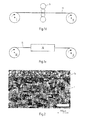
- FIGS. 1 a )- e diagrammatically, the sequence of the embodiment example of the method according to the invention
- FIG. 2 a longitudinal ground section of a strip according to the invention, anodised, according to Barker with polarised light;
- FIG. 3 in a perspective view, the experiment arrangement for performance of the bending test
- FIG. 4 in a perspective diagrammatic depiction, the arrangement of the bending punch in relation to the rolling direction on performance of the bending test.
- FIG. 5 diagrammatically, measurement of the bend angle on a bent specimen according to a further embodiment example.
- FIGS. 1 a ) to e ) show first a diagrammatic flow diagram of an embodiment example of the method according to the invention for production of a strip according to the present invention, with steps a ) production and homogenising of the rolling ingot, b ) application of the cladding layers to the rolling ingot, c ) hot rolling or roll cladding of the rolling ingot, d ) cold rolling, and e ) solution annealing with quenching.
- First a rolling ingot 1 is cast from an aluminium alloy with the following alloy constituents in w.%:
- FIG. 1 b now shows that aluminium alloy layers 1 a and 1 b are applied on the rolling ingot 1 so that these can be welded to the rolling ingot by hot rolling.
- the aluminium alloy layers 1 a and 1 b for example consist of aluminium alloys type AA8079 or AA5005A, which in material state 0 (corresponding to state T4) after solution annealing have a lower tensile strength Rm than that of the AlMgSi alloy layer, i.e. for example less than 180 MPa.
- other aluminium alloys are conceivable for the external aluminium alloy layers, for example other low-alloyed aluminium alloys such as alloy types AA1XXX, for example AA1200.
- the rolling ingot 1 with the applied aluminium alloy layers or cladding layers is hot rolled, in the embodiment example according to the invention shown in FIG. 1 c ), by reversing through a hot-roll mill 3 , wherein the rolling ingot 1 has a temperature of 400 to 550° C. during hot rolling.
- the hot strip 4 preferably has a temperature of at least 400° C., preferably 470 to 490° C.
- the hot strip 4 is quenched using a plate cooler 5 and the working rolls of the working roll mill 3 .
- the hot strip is here cooled to a temperature of 290 to 310° C.
- the plate cooler 5 sprays cooling rolling emulsion onto the hot strip and ensures an accelerated cooling of the hot strip to the said temperatures.
- the working rolls of the hot-roll mill are also loaded with emulsion and cool the hot strip 4 further in the last hot-roll pass.
- the hot strip 4 has a temperature of 230 to 200° C. at the exit from the plate cooler 5 ′ in the present embodiment example and is then coiled via the recoiler 6 at this temperature.
- the hot strip 4 immediately at the exit from the last hot-roll pass has a temperature of over 135° C. to 250° C., preferably 200 to 330° C., or optionally is brought to said temperatures in the last two hot-roll passes using the plate cooler and working rolls of the hot-roll mill 3
- the hot strip 4 has a crystalline microstructural state which leads to very good uniform elongation values A g in state T4 of more than 23%, preferably more than 25%.
- the hot strip can be processed and coiled with relatively high speed at said temperatures.
- the hot strip is coiled via the recoiler 6 with a thickness of 3 to 12 mm, preferably 3 to 5 mm.
- the core alloy layer Since no coarse Mg 2 Si precipitations can form at the relatively low coiling temperatures, the core alloy layer has a particularly advantageous crystalline state and can therefore be cold rolled very well, for example using a cold-rolling mill 9 , and recoiled onto the recoiler 8 , FIG. 1 d ).
- the resulting cold-rolled strip 11 is coiled. Then it undergoes solution annealing at a temperature of typically 500 to 570° C. and quenching 10 , FIG. 1 e ). For this it is again decoiled from the coil 12 , solution-treated and quenched in a furnace 10 , and recoiled into a coil 13 . After natural ageing at room temperature, the aluminium strip can then be delivered in state T4 with maximum formability.
- the strip according to the invention shows a further rise in yield point value so that particularly high strengths are achieved.
- the artificial ageing can take place for example at 205° C. for 30 minutes.
- the strips produced according to the embodiment shown here, from an aluminium alloy composite material, after cold rolling for example have a thickness of 0.5 to 4.5 mm. Strip thicknesses of 0.5 to 2 mm are normally used for bodywork applications and strip thicknesses of 2.0 mm to 4.5 mm for chassis components in motor vehicle construction.
- the external aluminium alloy layers have grain sizes of less than 50 ⁇ m, preferably less than 25 ⁇ m.
- a longitudinal ground section according to Barker through an embodiment example of a strip 1 produced according to the invention is shown in FIG. 2 in greatly magnified view. It is clear that the external aluminium alloy layer 1 a , which is here formed by an aluminium alloy type AA8079, has a much smaller grain size than the core alloy layer. In this embodiment example average grain sizes of around 20 ⁇ m were measured.
- FIG. 3 shows in a perspective view the test arrangement for performance of bending tests to determine the maximum bend angle.
- the tests are based on the specification 238-100 of the Association of the German Automotive Industry (VDA).
- the test arrangement consists of a bending punch 14 , which in the present case has a punch radius of 0.4 mm.
- the specimen 15 was previously cut to size 270 mm ⁇ 60 mm transverse to the rolling direction.
- the specimen 15 was then expanded with pre-elongation of 10% transverse to the rolling direction, with a pre-elongation speed of 25 mm/min and a free clamping length of 150 mm. Then from this the specimen 15 was cut to a size 60 ⁇ 60 mm and placed in the bending jig.
- the bending punch 14 which, as shown in FIG. 4 , runs parallel to the rolling direction so that the bending line 18 also runs parallel to the rolling direction, now presses the specimen with force F b between two rollers 16 , 17 with roll diameter of 30 mm which are arranged spaced apart by twice the specimen thickness (table 2) or twice specimen thickness plus 0.5 mm (table 3).
- the bending force F b is measured while the bending punch 14 bends the specimen 15 .
- the maximum achievable bend angle is reached.
- Specimen 15 is then taken from the bending jig and the bend angle measured as shown in FIG. 5 .
- the alloy Core1 was used as a core alloy layer, the alloy constituents of which are shown in table 1.
- two different external aluminium alloy layers Clad1, Clad2 were used, the composition of which is also shown in table 1.
- Table 3 shows the measurement results of embodiments according to the invention which were produced totally industrially, i.e. here too, the solution annealing step to achieve state T4 in tests Inv5 to Inv8 was carried out in a continuous strip furnace. All measurements given in table 3 were taken on strips with thickness 1.50 mm and hence on slightly thinner strips in comparison with the measurements in table 2. Strips Inv5 to Inv8 were also aged for 19 days at room temperature. For comparison, table 3 shows an aluminium alloy AA5182 typically used for automotive engineering. In the bending tests, in contrast to table 2, a modified roll spacing was selected which corresponded to twice the thickness of the specimen to be measured plus 0.5 mm. This test arrangement, conventional in the automotive industry, gives very reproducible measurement results for the minimum bend angle.
Landscapes
- Chemical & Material Sciences (AREA)
- Engineering & Computer Science (AREA)
- Mechanical Engineering (AREA)
- Materials Engineering (AREA)
- Metallurgy (AREA)
- Organic Chemistry (AREA)
- Physics & Mathematics (AREA)
- Thermal Sciences (AREA)
- Crystallography & Structural Chemistry (AREA)
- Metal Rolling (AREA)
- Laminated Bodies (AREA)
Priority Applications (1)
| Application Number | Priority Date | Filing Date | Title |
|---|---|---|---|
| US15/604,476 US10471684B2 (en) | 2011-09-15 | 2017-05-24 | Aluminium composite material with AlMgSi core layer |
Applications Claiming Priority (4)
| Application Number | Priority Date | Filing Date | Title |
|---|---|---|---|
| EP11181524.7 | 2011-09-15 | ||
| EP11181524 | 2011-09-15 | ||
| EP11181524.7A EP2570257B1 (de) | 2011-09-15 | 2011-09-15 | Aluminiumverbundwerkstoff mit AlMgSi-Kernlegierungsschicht |
| PCT/EP2012/068004 WO2013037918A1 (de) | 2011-09-15 | 2012-09-13 | ALUMINIUMVERBUNDWERKSTOFF MIT AlMgSi-KERNLEGIERUNGSSCHICHT |
Related Parent Applications (1)
| Application Number | Title | Priority Date | Filing Date |
|---|---|---|---|
| PCT/EP2012/068004 Continuation WO2013037918A1 (de) | 2011-09-15 | 2012-09-13 | ALUMINIUMVERBUNDWERKSTOFF MIT AlMgSi-KERNLEGIERUNGSSCHICHT |
Related Child Applications (1)
| Application Number | Title | Priority Date | Filing Date |
|---|---|---|---|
| US15/604,476 Continuation US10471684B2 (en) | 2011-09-15 | 2017-05-24 | Aluminium composite material with AlMgSi core layer |
Publications (2)
| Publication Number | Publication Date |
|---|---|
| US20140193666A1 US20140193666A1 (en) | 2014-07-10 |
| US9796157B2 true US9796157B2 (en) | 2017-10-24 |
Family
ID=46851492
Family Applications (2)
| Application Number | Title | Priority Date | Filing Date |
|---|---|---|---|
| US14/206,153 Active US9796157B2 (en) | 2011-09-15 | 2014-03-12 | Aluminium composite material with AlMgSi core layer |
| US15/604,476 Active US10471684B2 (en) | 2011-09-15 | 2017-05-24 | Aluminium composite material with AlMgSi core layer |
Family Applications After (1)
| Application Number | Title | Priority Date | Filing Date |
|---|---|---|---|
| US15/604,476 Active US10471684B2 (en) | 2011-09-15 | 2017-05-24 | Aluminium composite material with AlMgSi core layer |
Country Status (8)
| Country | Link |
|---|---|
| US (2) | US9796157B2 (de) |
| EP (1) | EP2570257B1 (de) |
| JP (1) | JP5642322B2 (de) |
| KR (1) | KR101456684B1 (de) |
| CN (1) | CN103857521B (de) |
| CA (1) | CA2848618C (de) |
| RU (1) | RU2569519C2 (de) |
| WO (1) | WO2013037918A1 (de) |
Families Citing this family (19)
| Publication number | Priority date | Publication date | Assignee | Title |
|---|---|---|---|---|
| JP5839242B2 (ja) * | 2012-10-18 | 2016-01-06 | 株式会社 旭 | 複合金属材の製造方法、金型の製造方法及び金属製品の製造方法 |
| CA2889954C (en) | 2012-10-30 | 2017-02-14 | Hydro Aluminium Rolled Products Gmbh | Aluminium composite material and forming method |
| ITTO20130855A1 (it) * | 2013-10-21 | 2015-04-22 | Itt Italia Srl | Metodo per l'ottenimento di pastiglie freno e pastiglia freno associata |
| EP2952282A1 (de) * | 2014-06-02 | 2015-12-09 | Amag Rolling GmbH | Folienvorwalzband |
| JP6154794B2 (ja) * | 2014-10-15 | 2017-06-28 | 株式会社神戸製鋼所 | 金属板の耐割れ性評価方法 |
| AU2015369961B2 (en) * | 2014-12-22 | 2018-09-20 | Novelis Inc. | Clad sheets for heat exchangers |
| MX356992B (es) * | 2015-07-20 | 2018-06-22 | Novelis Inc | Hoja de aleacion de aluminio aa6xxx con alta calidad anodizada y un metodo para fabricar la misma. |
| EP3147643B1 (de) * | 2015-09-28 | 2019-01-16 | SSAB Technology AB | Verfahren und computerprogrammprodukt |
| CA3000886C (en) * | 2015-10-05 | 2019-03-26 | Hydro Aluminium Rolled Products Gmbh | Aluminum composite material for use in thermal flux-free joining methods and method for producing same |
| WO2017066086A1 (en) * | 2015-10-15 | 2017-04-20 | Novelis Inc. | High-forming multi-layer aluminum alloy package |
| CN110340330B (zh) * | 2018-04-08 | 2022-01-14 | 南京理工大学 | 一种多尺度析出异质层状结构铝合金的制备方法 |
| EP3827108B1 (de) | 2018-07-23 | 2023-01-25 | Novelis, Inc. | Hochformbare recycelte aluminiumlegierungen und verfahren zur herstellung davon |
| EP3870336B1 (de) * | 2018-10-25 | 2022-12-28 | Volvo Construction Equipment AB | Motorluftfiltereinheit für ein fahrzeug |
| CN111169113A (zh) * | 2018-11-09 | 2020-05-19 | 佛山市南海煌钢金属制品有限公司 | 金属复合板 |
| KR102715164B1 (ko) * | 2019-01-17 | 2024-10-10 | 현대자동차주식회사 | 더블레이어 타입 변속기 유성 기어 캐리어의 제조방법 및 이로부터 제조된 유성 기어 캐리어 |
| KR102689028B1 (ko) * | 2020-04-08 | 2024-07-29 | 스페이라 게엠베하 | 고강도 솔더-플레이팅된 Al-Mg-Si 알루미늄 재료 |
| KR20230135078A (ko) * | 2020-12-28 | 2023-09-22 | 알로이 엔터프라이지스, 인크. | 경합금 금속 부품을 위한 이종 포일 균질화 |
| JP7631077B2 (ja) * | 2021-04-06 | 2025-02-18 | 株式会社Uacj | スペースデブリ防護用のアルミニウムクラッド板材及びその製造方法 |
| CN119840248B (zh) * | 2025-01-20 | 2025-12-05 | 东莞市华研新材料科技有限公司 | 一种应用于无人机的复合金属材料及其制备方法 |
Citations (14)
| Publication number | Priority date | Publication date | Assignee | Title |
|---|---|---|---|---|
| US3093459A (en) | 1958-08-02 | 1963-06-11 | Aluminium Ind Ag | Method for manufacturing highly polishable sheets of aluminum |
| US5525169A (en) * | 1994-05-11 | 1996-06-11 | Aluminum Company Of America | Corrosion resistant aluminum alloy rolled sheet |
| US6280543B1 (en) * | 1998-01-21 | 2001-08-28 | Alcoa Inc. | Process and products for the continuous casting of flat rolled sheet |
| CN1526031A (zh) | 2001-07-09 | 2004-09-01 | �Ʒ� | 可焊高强度Al-Mg-Si合金 |
| US6994760B2 (en) * | 2002-06-24 | 2006-02-07 | Corus Aluminium Walzprodukte Gmbh | Method of producing a high strength balanced Al-Mg-Si alloy and a weldable product of that alloy |
| EP1852250A1 (de) | 2006-05-02 | 2007-11-07 | Aleris Aluminum Duffel BVBA | Plattiertes Blechprodukt |
| CN101432133A (zh) | 2006-05-02 | 2009-05-13 | 阿莱利斯铝业迪弗尔私人有限公司 | 铝复合薄板材料 |
| US20090214891A1 (en) * | 2004-11-16 | 2009-08-27 | Lahaye Christiaan Theodorus Wilhelmus | Aluminium composite sheet material |
| CN100554486C (zh) * | 2007-11-16 | 2009-10-28 | 苏州有色金属研究院有限公司 | 改善低Cu含量铝合金汽车板材烘烤硬化性能的方法 |
| EP2156945A1 (de) | 2008-08-13 | 2010-02-24 | Novelis Inc. | Plattiertes Kraftfahrzeug-Blechprodukt |
| US20100279143A1 (en) | 2009-04-30 | 2010-11-04 | Kamat Rajeev G | Multi-alloy composite sheet for automotive panels |
| EP2270249A1 (de) | 2009-06-30 | 2011-01-05 | Hydro Aluminium Deutschland GmbH | AlMgSi-Band für Anwendungen mit hohen Umformungsanforderungen |
| WO2011020556A2 (de) * | 2009-08-19 | 2011-02-24 | Engineered Products Switzerland Ltd. | Form- und/oder strukturteil aus aluminium oder einer aluminiumlegierung und verfahren zu deren oberflächenschutz |
| CN102031431A (zh) * | 2010-11-16 | 2011-04-27 | 徐州财发铝热传输有限公司 | 汽车覆盖件用6000系高性能铝合金板及其制造方法 |
Family Cites Families (5)
| Publication number | Priority date | Publication date | Assignee | Title |
|---|---|---|---|---|
| JPS62207642A (ja) * | 1986-03-10 | 1987-09-12 | 株式会社神戸製鋼所 | 成形加工性、焼付硬化性および耐糸錆性の優れたアルミニウム合金合せ板 |
| RU2135364C1 (ru) * | 1998-05-13 | 1999-08-27 | Ситников Игорь Викторович | Способ изготовления слоистых металлических материалов |
| US6329075B1 (en) | 2000-02-03 | 2001-12-11 | Reycan, L.P. | Electrical conductivity and high strength aluminum alloy composite material and methods of manufacturing and use |
| AT414128B (de) * | 2004-08-03 | 2006-09-15 | Miba Gleitlager Gmbh | Aluminiumlegierung für tribologisch beanspruchte flächen |
| CN105063522B (zh) * | 2010-09-08 | 2018-09-28 | 奥科宁克公司 | 改进的6xxx铝合金及其生产方法 |
-
2011
- 2011-09-15 EP EP11181524.7A patent/EP2570257B1/de active Active
-
2012
- 2012-09-13 JP JP2014530229A patent/JP5642322B2/ja active Active
- 2012-09-13 CA CA2848618A patent/CA2848618C/en active Active
- 2012-09-13 CN CN201280044927.4A patent/CN103857521B/zh active Active
- 2012-09-13 KR KR1020147009880A patent/KR101456684B1/ko active Active
- 2012-09-13 WO PCT/EP2012/068004 patent/WO2013037918A1/de not_active Ceased
- 2012-09-13 RU RU2014114797/05A patent/RU2569519C2/ru active
-
2014
- 2014-03-12 US US14/206,153 patent/US9796157B2/en active Active
-
2017
- 2017-05-24 US US15/604,476 patent/US10471684B2/en active Active
Patent Citations (21)
| Publication number | Priority date | Publication date | Assignee | Title |
|---|---|---|---|---|
| US3093459A (en) | 1958-08-02 | 1963-06-11 | Aluminium Ind Ag | Method for manufacturing highly polishable sheets of aluminum |
| US5525169A (en) * | 1994-05-11 | 1996-06-11 | Aluminum Company Of America | Corrosion resistant aluminum alloy rolled sheet |
| US6280543B1 (en) * | 1998-01-21 | 2001-08-28 | Alcoa Inc. | Process and products for the continuous casting of flat rolled sheet |
| CN1526031A (zh) | 2001-07-09 | 2004-09-01 | �Ʒ� | 可焊高强度Al-Mg-Si合金 |
| US6994760B2 (en) * | 2002-06-24 | 2006-02-07 | Corus Aluminium Walzprodukte Gmbh | Method of producing a high strength balanced Al-Mg-Si alloy and a weldable product of that alloy |
| US20090214891A1 (en) * | 2004-11-16 | 2009-08-27 | Lahaye Christiaan Theodorus Wilhelmus | Aluminium composite sheet material |
| US7901789B2 (en) * | 2006-05-02 | 2011-03-08 | Aleris Aluminum Duffel Bvba | Aluminium composite sheet material |
| US20090202860A1 (en) | 2006-05-02 | 2009-08-13 | Aleris Aluminum Duffel Bvba | Clad sheet product |
| CN101432133A (zh) | 2006-05-02 | 2009-05-13 | 阿莱利斯铝业迪弗尔私人有限公司 | 铝复合薄板材料 |
| CN101437677A (zh) | 2006-05-02 | 2009-05-20 | 阿莱利斯铝业迪弗尔私人有限公司 | 包覆薄板产品 |
| US8968882B2 (en) * | 2006-05-02 | 2015-03-03 | Aleris Aluminum Duffel Bvba | Clad sheet product |
| EP1852250A1 (de) | 2006-05-02 | 2007-11-07 | Aleris Aluminum Duffel BVBA | Plattiertes Blechprodukt |
| CN100554486C (zh) * | 2007-11-16 | 2009-10-28 | 苏州有色金属研究院有限公司 | 改善低Cu含量铝合金汽车板材烘烤硬化性能的方法 |
| CN102119078A (zh) | 2008-08-13 | 2011-07-06 | 诺夫利斯公司 | 包覆汽车板产品 |
| EP2156945A1 (de) | 2008-08-13 | 2010-02-24 | Novelis Inc. | Plattiertes Kraftfahrzeug-Blechprodukt |
| US8940406B2 (en) * | 2008-08-13 | 2015-01-27 | Novelis Inc. | Automobile body part |
| US20100279143A1 (en) | 2009-04-30 | 2010-11-04 | Kamat Rajeev G | Multi-alloy composite sheet for automotive panels |
| EP2270249A1 (de) | 2009-06-30 | 2011-01-05 | Hydro Aluminium Deutschland GmbH | AlMgSi-Band für Anwendungen mit hohen Umformungsanforderungen |
| US20120222783A1 (en) * | 2009-06-30 | 2012-09-06 | Hydro Aluminium Deutschland Gmbh | Almgsi strip for applications having high formability requirements |
| WO2011020556A2 (de) * | 2009-08-19 | 2011-02-24 | Engineered Products Switzerland Ltd. | Form- und/oder strukturteil aus aluminium oder einer aluminiumlegierung und verfahren zu deren oberflächenschutz |
| CN102031431A (zh) * | 2010-11-16 | 2011-04-27 | 徐州财发铝热传输有限公司 | 汽车覆盖件用6000系高性能铝合金板及其制造方法 |
Also Published As
| Publication number | Publication date |
|---|---|
| KR101456684B1 (ko) | 2014-10-31 |
| WO2013037918A1 (de) | 2013-03-21 |
| JP2014528031A (ja) | 2014-10-23 |
| EP2570257B1 (de) | 2021-05-12 |
| CN103857521B (zh) | 2015-12-23 |
| CA2848618A1 (en) | 2013-03-21 |
| US20140193666A1 (en) | 2014-07-10 |
| US20170259529A1 (en) | 2017-09-14 |
| CA2848618C (en) | 2016-06-21 |
| JP5642322B2 (ja) | 2014-12-17 |
| US10471684B2 (en) | 2019-11-12 |
| RU2014114797A (ru) | 2015-10-20 |
| EP2570257A1 (de) | 2013-03-20 |
| RU2569519C2 (ru) | 2015-11-27 |
| CN103857521A (zh) | 2014-06-11 |
| KR20140063818A (ko) | 2014-05-27 |
Similar Documents
| Publication | Publication Date | Title |
|---|---|---|
| US10471684B2 (en) | Aluminium composite material with AlMgSi core layer | |
| US10612115B2 (en) | AlMgSi strip for applications having high formability requirements | |
| CA2848457C (en) | Method for manufacturing almgsi aluminium strip | |
| KR102498463B1 (ko) | 6xxx 알루미늄 시트의 제조 방법 | |
| JP6785772B2 (ja) | 表面ローピングが低減されたまたは全くない高度に成形可能な自動車用アルミニウムシート及びその製造方法 | |
| JP6771456B2 (ja) | アルミニウム合金製品及び調製方法 | |
| JP2020519772A (ja) | 高強度耐食性6xxxシリーズアルミニウム合金およびその作製方法 | |
| US20130068351A1 (en) | Multi-alloy composite sheet for automotive panels | |
| CN108136730A (zh) | 具有优异的机械强度和碰撞行为的折衷的机动车车身结构组件 | |
| JP7244407B2 (ja) | 自動車構造部材用アルミニウム合金板、自動車構造部材および自動車構造部材用アルミニウム合金板の製造方法 | |
| JP2004010982A (ja) | 曲げ加工性とプレス成形性に優れたアルミニウム合金板 | |
| JP3749627B2 (ja) | プレス成形性に優れたAl合金板 | |
| JP3766334B2 (ja) | 曲げ加工性に優れたアルミニウム合金板 | |
| CN102844453A (zh) | 耐冲击构件 | |
| JPH03277759A (ja) | 耐バリ性およびめっき密着性の優れた溶融亜鉛及び合金化溶融亜鉛めっき複合鋼板およびその製造方法 |
Legal Events
| Date | Code | Title | Description |
|---|---|---|---|
| AS | Assignment |
Owner name: HYDRO ALUMINIUM ROLLED PRODUCTS GMBH, GERMANY Free format text: ASSIGNMENT OF ASSIGNORS INTEREST;ASSIGNORS:BRINKMAN, HENK-JAN;SCHROEDER, DIETMAR;WIRTZ, THOMAS;AND OTHERS;SIGNING DATES FROM 20140627 TO 20140825;REEL/FRAME:033751/0618 |
|
| STCF | Information on status: patent grant |
Free format text: PATENTED CASE |
|
| MAFP | Maintenance fee payment |
Free format text: PAYMENT OF MAINTENANCE FEE, 4TH YEAR, LARGE ENTITY (ORIGINAL EVENT CODE: M1551); ENTITY STATUS OF PATENT OWNER: LARGE ENTITY Year of fee payment: 4 |
|
| MAFP | Maintenance fee payment |
Free format text: PAYMENT OF MAINTENANCE FEE, 8TH YEAR, LARGE ENTITY (ORIGINAL EVENT CODE: M1552); ENTITY STATUS OF PATENT OWNER: LARGE ENTITY Year of fee payment: 8 |