US9341931B2 - Projector and illumination device - Google Patents
Projector and illumination device Download PDFInfo
- Publication number
- US9341931B2 US9341931B2 US14/224,875 US201414224875A US9341931B2 US 9341931 B2 US9341931 B2 US 9341931B2 US 201414224875 A US201414224875 A US 201414224875A US 9341931 B2 US9341931 B2 US 9341931B2
- Authority
- US
- United States
- Prior art keywords
- light
- blocking
- blocking member
- integrator lens
- emitted
- Prior art date
- Legal status (The legal status is an assumption and is not a legal conclusion. Google has not performed a legal analysis and makes no representation as to the accuracy of the status listed.)
- Expired - Fee Related, expires
Links
- 238000005286 illumination Methods 0.000 title claims description 30
- 230000003287 optical effect Effects 0.000 claims abstract description 56
- 230000008033 biological extinction Effects 0.000 claims abstract description 17
- 230000007246 mechanism Effects 0.000 claims description 15
- 230000004907 flux Effects 0.000 description 58
- 238000010586 diagram Methods 0.000 description 43
- 239000004973 liquid crystal related substance Substances 0.000 description 35
- 230000000903 blocking effect Effects 0.000 description 18
- 238000001514 detection method Methods 0.000 description 10
- 230000010287 polarization Effects 0.000 description 10
- 239000011159 matrix material Substances 0.000 description 8
- 238000006243 chemical reaction Methods 0.000 description 5
- 239000003086 colorant Substances 0.000 description 5
- 230000009471 action Effects 0.000 description 4
- 239000002131 composite material Substances 0.000 description 3
- 238000000926 separation method Methods 0.000 description 3
- RTZKZFJDLAIYFH-UHFFFAOYSA-N Diethyl ether Chemical compound CCOCC RTZKZFJDLAIYFH-UHFFFAOYSA-N 0.000 description 2
- 230000008901 benefit Effects 0.000 description 1
- 239000000470 constituent Substances 0.000 description 1
- 230000001678 irradiating effect Effects 0.000 description 1
- QSHDDOUJBYECFT-UHFFFAOYSA-N mercury Chemical compound [Hg] QSHDDOUJBYECFT-UHFFFAOYSA-N 0.000 description 1
- 229910052753 mercury Inorganic materials 0.000 description 1
- 229910001507 metal halide Inorganic materials 0.000 description 1
- 150000005309 metal halides Chemical class 0.000 description 1
- 238000000034 method Methods 0.000 description 1
- 230000008569 process Effects 0.000 description 1
- 230000007704 transition Effects 0.000 description 1
- 229910052724 xenon Inorganic materials 0.000 description 1
- FHNFHKCVQCLJFQ-UHFFFAOYSA-N xenon atom Chemical compound [Xe] FHNFHKCVQCLJFQ-UHFFFAOYSA-N 0.000 description 1
Images




Classifications
-
- G—PHYSICS
- G03—PHOTOGRAPHY; CINEMATOGRAPHY; ANALOGOUS TECHNIQUES USING WAVES OTHER THAN OPTICAL WAVES; ELECTROGRAPHY; HOLOGRAPHY
- G03B—APPARATUS OR ARRANGEMENTS FOR TAKING PHOTOGRAPHS OR FOR PROJECTING OR VIEWING THEM; APPARATUS OR ARRANGEMENTS EMPLOYING ANALOGOUS TECHNIQUES USING WAVES OTHER THAN OPTICAL WAVES; ACCESSORIES THEREFOR
- G03B21/00—Projectors or projection-type viewers; Accessories therefor
- G03B21/14—Details
- G03B21/20—Lamp housings
- G03B21/2006—Lamp housings characterised by the light source
- G03B21/2013—Plural light sources
-
- G—PHYSICS
- G03—PHOTOGRAPHY; CINEMATOGRAPHY; ANALOGOUS TECHNIQUES USING WAVES OTHER THAN OPTICAL WAVES; ELECTROGRAPHY; HOLOGRAPHY
- G03B—APPARATUS OR ARRANGEMENTS FOR TAKING PHOTOGRAPHS OR FOR PROJECTING OR VIEWING THEM; APPARATUS OR ARRANGEMENTS EMPLOYING ANALOGOUS TECHNIQUES USING WAVES OTHER THAN OPTICAL WAVES; ACCESSORIES THEREFOR
- G03B21/00—Projectors or projection-type viewers; Accessories therefor
- G03B21/14—Details
- G03B21/20—Lamp housings
- G03B21/2053—Intensity control of illuminating light
-
- G—PHYSICS
- G03—PHOTOGRAPHY; CINEMATOGRAPHY; ANALOGOUS TECHNIQUES USING WAVES OTHER THAN OPTICAL WAVES; ELECTROGRAPHY; HOLOGRAPHY
- G03B—APPARATUS OR ARRANGEMENTS FOR TAKING PHOTOGRAPHS OR FOR PROJECTING OR VIEWING THEM; APPARATUS OR ARRANGEMENTS EMPLOYING ANALOGOUS TECHNIQUES USING WAVES OTHER THAN OPTICAL WAVES; ACCESSORIES THEREFOR
- G03B21/00—Projectors or projection-type viewers; Accessories therefor
- G03B21/14—Details
- G03B21/20—Lamp housings
- G03B21/208—Homogenising, shaping of the illumination light
-
- H—ELECTRICITY
- H04—ELECTRIC COMMUNICATION TECHNIQUE
- H04N—PICTORIAL COMMUNICATION, e.g. TELEVISION
- H04N9/00—Details of colour television systems
- H04N9/12—Picture reproducers
- H04N9/31—Projection devices for colour picture display, e.g. using electronic spatial light modulators [ESLM]
- H04N9/3141—Constructional details thereof
- H04N9/315—Modulator illumination systems
- H04N9/3152—Modulator illumination systems for shaping the light beam
-
- H—ELECTRICITY
- H04—ELECTRIC COMMUNICATION TECHNIQUE
- H04N—PICTORIAL COMMUNICATION, e.g. TELEVISION
- H04N9/00—Details of colour television systems
- H04N9/12—Picture reproducers
- H04N9/31—Projection devices for colour picture display, e.g. using electronic spatial light modulators [ESLM]
- H04N9/3141—Constructional details thereof
- H04N9/315—Modulator illumination systems
- H04N9/3155—Modulator illumination systems for controlling the light source
-
- H—ELECTRICITY
- H04—ELECTRIC COMMUNICATION TECHNIQUE
- H04N—PICTORIAL COMMUNICATION, e.g. TELEVISION
- H04N9/00—Details of colour television systems
- H04N9/12—Picture reproducers
- H04N9/31—Projection devices for colour picture display, e.g. using electronic spatial light modulators [ESLM]
- H04N9/3141—Constructional details thereof
- H04N9/315—Modulator illumination systems
- H04N9/3164—Modulator illumination systems using multiple light sources
Definitions
- the present invention relates to a projector and an illumination device.
- a light source device for a projector there is known a light source device, which has light respectively emitted from a plurality of light sources and arranged in a plane in an illumination area, and makes the light overlap each other to be equalized using an integrator optical system.
- a pair of retractable louvers is installed in a light path including light of a plurality of light source.
- a color ununiformity and an illuminance ununiformity occur in some cases when partially blocking the light in the light path with the louvers.
- An advantage of some aspects of the invention is to provide a projector and an illumination device each provided with a multi-lamp light source and a light control device, and having the color ununiformity and the illuminance ununiformity reduced in the dimming condition.
- a projector includes a plurality of light sources, an integrator optical system including an integrator lens, and an overlapping lens adapted to overlap light emitted from the integrator lens, a light guide optical system adapted to guide light emitted from the respective light sources to partial areas of the integrator lens to thereby irradiate an entire area of the integrator lens, a light control device disposed on a light path of the light emitted from the light sources between the light sources and the overlapping lens, a light modulation device adapted to modulate the light emitted from the integrator optical system, and a projection optical system adapted to project the light modulated by the light modulation device, the light control device includes a pair of light-blocking members opposed to each other across the light path in one direction in which the plurality of partial areas is arranged on the integrator lens, and a control device adapted to move the light-blocking members into and out of the light path, and the control device moves the pair of light-blocking members into and out of the light path so
- the light as the light-blocking object input to the overlapping lens has a shape with a symmetric property in accordance with the lighting and extinction states of the plurality of light sources.
- the projector according to the aspect of the invention may be configured such that the control device moves the pair of light-blocking members into and out of the light path so that the pair of light-blocking members evenly block the light emitted from the light sources.
- the light as the light-blocking object emitted from the light sources can evenly be blocked by the pair of light-blocking members in accordance with the lighting and extinction states of the plurality of light sources.
- the illumination system for equalizing the light of the plurality of light sources using the integrator lens even in the case in which some of the light sources are in the extinction state, since the light are evenly blocked by the two light-blocking members, the deviation of the light-blocking area can be reduced, and the illuminance ununiformity and the color ununiformity of the projection image can be inhibited from occurring.
- the projector according to the aspect of the invention may be configured such that each of the light-blocking members block at least a part of the light emitted from the partial area located at the furthest position from the light-blocking member itself in the one direction.
- the plurality of light-blocking members it is possible for the plurality of light-blocking members to block the light not only in the partial area of the integrator lens on the near side to the light-blocking member itself, but also in a part of the partial area on the far side.
- the illumination system for equalizing the light of the plurality of light sources using the integrator lens even in the case in which some of the light sources are in the extinction state, it is possible to block the light emitted from the integrator lens in a horizontally symmetric manner or a vertically symmetric manner by the pair of light-blocking members. Therefore, the deviation of the light-blocking area can be reduced, and the illuminance ununiformity and the color ununiformity of the projection image can be inhibited from occurring.
- the projector according to the aspect of the invention may be configured such that the light-blocking members each block a part of an outer edge portion of the light emitted from the light source.
- the configuration described above in the case of using the whole of the integrator lens, it is possible to make the light emitted from the integrator lens have a shape with a symmetric property.
- the projector according to the aspect of the invention may be configured such that a number of the light sources is one of equal to and larger than four, a number of the partial areas arranged on the integrator lens in a row direction is one of equal to and larger than two, a number of the partial areas arranged on the integrator lens in a column direction is one of equal to and larger than two, and the light control device has a pair of the light-blocking members corresponding to the plurality of partial areas arranged in the row direction for each of the rows.
- the projector according to the aspect of the invention may be configured such that the control device includes a slide mechanism adapted to make a slide movement of the light-blocking member.
- the projector according to the aspect of the invention may be configured such that the light-blocking member has a first light-blocking plate connected to the slide mechanism, and a second light-blocking plate connected to the first light-blocking plate via one of a rotation mechanism and a slide mechanism.
- the second light-blocking plate can be disposed in the vicinity of the light as the light-blocking object by the movement of the first light-blocking plate, and further, by making the slide movement of the second light-blocking plate or rotating the second light-blocking plate at that position, the blocking level of the light can be controlled.
- An illumination device includes a plurality of light sources, an integrator optical system including an integrator lens, and an overlapping lens adapted to overlap light emitted from the integrator lens, a light guide optical system adapted to guide light emitted from the respective light sources to partial areas of the integrator lens to thereby irradiate an entire area of the integrator lens, and a light control device disposed on a light path of the light emitted from the light sources between the light sources and the overlapping lens, the light control device includes a pair of light-blocking members opposed to each other across the light path in one direction in which the plurality of partial areas is arranged on the integrator lens, and a control device adapted to move the light-blocking members into and out of the light path, and the control device moves the pair of light-blocking members into and out of the light path so that the light entering the overlapping lens has a shape with a symmetric property in accordance with lighting and extinction states of the plurality of light sources.
- the light as the light-blocking object input to the overlapping lens has a shape with a symmetric property in accordance with the lighting and extinction states of the plurality of light sources.
- the illumination device may be configured such that the control device moves the pair of light-blocking members into and out of the light path so that the pair of light-blocking members evenly block the light emitted from the light sources.
- the light as the light-blocking object emitted from the light sources can evenly be blocked by the pair of light-blocking members in accordance with the lighting and extinction states of the plurality of light sources.
- the illumination system for equalizing the light of the plurality of light sources using the integrator lens even in the case in which some of the light sources are in the extinction state, since the light are evenly blocked by the two light-blocking members, the deviation of the light-blocking area can be reduced, and the illuminance ununiformity of the illumination light can be suppressed.
- the illumination device may be configured such that each of the light-blocking members block at least a part of the light emitted from the partial area located at the furthest position from the light-blocking member itself in the one direction.
- the plurality of light-blocking members it is possible for the plurality of light-blocking members to block the light not only in the partial area of the integrator lens on the near side to the light-blocking member itself, but also in a part of the partial area on the far side.
- the illumination system for equalizing the light of the plurality of light sources using the integrator lens even in the case in which some of the light sources are in the extinction state, it is possible to block the light emitted from the integrator lens in a horizontally symmetric manner or a vertically symmetric manner by the pair of light-blocking members. Therefore, the deviation of the light-blocking area can be reduced, and the illuminance ununiformity of the illumination light can be suppressed.
- the illumination device may be configured such that the light-blocking members each block a part of an outer edge portion of the light emitted from the light source.
- the configuration described above in the case of using the whole of the integrator lens, it is possible to make the light emitted from the integrator lens have a shape with a symmetric property.
- FIG. 1 is a schematic configuration diagram showing a projector according to a first embodiment of the invention.
- FIGS. 2A and 2B are explanatory diagrams of a configuration and an action of a light guide optical system.
- FIGS. 3A and 3B are explanatory diagrams of an operation of a dimming device.
- FIG. 4 is a diagram showing the dimming operation when lighting four lamps.
- FIGS. 5A and 5B are diagrams showing the dimming operation when lighting one lamp.
- FIGS. 6A through 6C are explanatory diagrams of an operation of a dimming device according to the related art.
- FIGS. 7A and 7B are diagrams showing an essential part of a projector according to a second embodiment of the invention.
- FIGS. 8A and 8B are diagrams showing a first modified example of a dimming device.
- FIGS. 9A and 9B are diagrams showing a second modified example of a dimming device.
- FIGS. 10A and 10B are diagrams showing an essential part of a projector according to a third embodiment of the invention.
- FIG. 11 is a diagram showing the state of lighting four lamps in the case of using the whole of a first integrator lens.
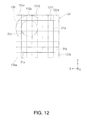
- FIG. 12 is a diagram showing the state of lighting one lamp in the case of using the whole of the first integrator lens.
- FIG. 13 is a diagram showing a dimming operation when lighting two lamps in the third embodiment.
- FIGS. 14A and 14B are diagrams showing an essential part of a projector according to a fourth embodiment of the invention.
- FIG. 15 is a diagram showing a dimming operation when lighting three lamps in the fourth embodiment.
- FIG. 16 is a diagram showing a dimming operation when lighting one lamp in the fourth embodiment.
- FIG. 1 is a schematic configuration diagram showing a projector according to a first embodiment of the invention.
- the projector 100 according to the present embodiment is a three-panel liquid crystal projector provided with transmissive liquid crystal light valves for respective colors different from each other, namely R (red), G (green), and B (blue).
- the projector 100 includes four light sources 10 a , 10 b , 10 c , and 10 d , a light guide optical system 20 , an integrator optical system 30 , a dimming device 40 (a light control device 40 ), a color separation optical system 50 , liquid crystal light valves (light modulation devices) 61 , 62 , and 63 , a cross dichroic prism (a color combining optical system) 64 , and a projection optical system 70 .
- the light sources 10 a through 10 d , the light guide optical system 20 , the integrator optical system 30 , and the dimming device 40 constitute an illumination device 10 .
- the light sources 10 a through 10 d each have a lamp such as a super-high pressure mercury lamp, a metal halide lamp, or a xenon lamp, and a reflector for reflecting the light of the lamp.
- a light source control device 110 for driving and controlling these light sources.
- the light guide optical system 20 includes four mirrors 21 a through 21 d .
- the integrator optical system 30 is an optical system for evenly irradiating the liquid crystal light valves 61 through 63 with each of the light from the respective light sources 10 a through 10 d , and includes a first integrator lens (an integrator lens) 31 , a second integrator lens 32 , a polarization conversion element 33 , and an overlapping lens 34 sequentially arranged from the light guide optical system 20 side.
- FIG. 2A is a diagram of the light guide optical system 20 viewed from the first integrator lens 31 side (in a ⁇ Y direction).
- FIG. 2B is an explanatory diagram of an action of the light guide optical system 20 , and is a diagram of the first integrator lens 31 viewed from the second integrator lens 32 side (in the ⁇ Y direction).
- the light source 10 a and the light source 10 b are arranged so as to be opposed to each other in a light emitting direction (an X-axis direction in the drawing).
- a mirror 21 a is disposed in front of the light source 10 a
- a mirror 21 b is disposed in front of the light source 10 b .
- the mirrors 21 a , 21 b are disposed at an angle of 45° with the light emitting direction (the X-axis direction) described above so as to bend the light of the light sources 10 a , 10 b toward the first integrator lens 31 .
- the light source 10 c and the light source 10 d are also arranged to be opposed to each other in the light emitting direction.
- a mirror 21 c is disposed in front of the light source 10 c
- a mirror 21 d is disposed in front of the light source 10 d .
- the mirror 21 c and the mirror 21 d are disposed at an angle of 45° with the light emitting direction (the X-axis direction) described above so as to bend the light of the light sources 10 c , 10 d toward the first integrator lens 31 .
- the light sources 10 a through 10 d are arranged in two stages shifted vertically (in a Z-axis direction) from each other.
- the upper stage a +Z side
- the lower stage a ⁇ Z side
- the light sources 10 a , 10 b and the mirrors 21 a , 21 b arranged in the lower stage are disposed at positions nearer to the first integrator lens 31 than the light sources 10 c , 10 d and mirrors 21 c , 21 d arranged in the upper stage.
- light flux 11 a , 11 b , 11 c and 11 d emitted from the light sources 10 a through 10 d are respectively reflected by the corresponding mirrors 21 a through 21 d to be bent toward the first integrator lens 31 .
- the light flux 11 a through 11 d respectively bent by the mirrors 21 a through 21 d enter respective partial areas of the first integrator lens 31 different from each other.
- the light flux 11 a through 11 d respectively enter four partial areas 31 a through 31 d obtained by bisecting the first integrator lens 31 in vertical and horizontal directions (the Z-axis direction and the X-axis direction). In the present embodiment, these four light flux 11 a through 11 d illuminate the entire area of the first integrator lens 31 .
- the first integrator lens 31 shown in FIG. 2B is a fly-eye lens having small lenses (lens elements) arranged in a 6 ⁇ 6 matrix in row and column directions.
- the partial areas 31 a through 31 d are each formed of a small lens group with small lenses arranged in a 3 ⁇ 3 matrix.
- the explanation is presented showing the first integrator lens 31 as a 6 ⁇ 6 small lens group in the drawings, in reality, the small lenses more than a 6 ⁇ 6 matrix are arranged.
- the size of the first integrator lens 31 namely the number of small lenses arranged, is determined in accordance with the size of the light flux 11 a through 11 d respectively emitted from the light sources 10 a through 10 d.
- the light flux respectively emitted from the lens elements of the first integrator lens 31 are overlapped with each other on the liquid crystal light valves 61 through 63 by the second integrator lens 32 and the overlapping lens 34 .
- the second integrator lens 32 functions as the overlapping lens, and in such a case, the overlapping lens 34 can be eliminated. Further, in this case, the second integrator lens 32 corresponds to the overlapping lens in the appended claims.
- the polarization conversion element 33 disposed between the second integrator lens 32 and the overlapping lens 34 is formed of, for example, a polarization beam splitter array (PBS array).
- the polarization conversion element 33 aligns the polarization directions of the light emitted from the second integrator lens 32 , and then emits the light as a single linearly-polarized light.
- the polarization conversion element 33 has a structure of periodically arranging roughly rod-like prism elements in the width direction (the X-axis direction), each of which has a polarization split film, a reflecting film, and a wave plate.
- the dimming device 40 is disposed on the light path between the light sources 10 a through 10 d and the overlapping lens 34 .
- the dimming device 40 is disposed between the first integrator lens 31 and the second integrator lens 32 .
- the dimming device 40 is provided with a first light-blocking member 41 and a second light-blocking member 42 .
- the first light-blocking member 41 includes a first light-blocking plate 41 a , and a second light-blocking plate 41 b connected to the first light-blocking plate 41 a via a rotation mechanism described later.
- the second light-blocking member 42 includes a first light-blocking plate 42 a , and a second light-blocking plate 42 b connected to the first light-blocking plate 42 a via a rotation mechanism.
- a dimming control device (a control device) 140 is connected to each of the first light-blocking member 41 and the second light-blocking member 42 .
- the dimming device 40 is a device for performing a dimming operation based on both of the lighting state of the light sources 10 a through 10 d , and image data of a display image.
- the first light-blocking plates 41 a , 42 a are disposed so as to have the respective plate surfaces along a radial direction (the X-axis direction) of the light emitted from the first integrator lens 31 .
- the second light-blocking plates 41 b , 42 b are rotatably connected to the inner (on an optical axis L side) tips of the first light-blocking plates 41 a , 42 a , respectively.
- the optical axis L is the optical axis of the light with which the light guide optical system 20 irradiates the integrator optical system 30 .
- the optical axis L is the optical axis of the light obtained by combining the light emitted from the respective light sources 10 a through 10 d and then reflected by the respective mirrors 21 a through 21 d toward the first integrator lens 31 .
- the dimming control device 140 is provided with a slide mechanism for moving the first light-blocking plate 41 a of the first light-blocking member 41 and the first light-blocking plate 42 a of the second light-blocking member 42 in a radial direction (the X-axis direction) of the light emitted from the first integrator lens 31 . Further, the dimming control device 140 is provided with a rotation mechanism for rotating the second light-blocking plate 41 b of the first light-blocking member 41 and the second light-blocking plate 42 b of the second light-blocking member 42 around the axis (the Z axis) parallel to one of the sides of the first integrator lens 31 .
- the first light-blocking member 41 and the second light-blocking member 42 can be driven independently of each other.
- the first light-blocking plate 41 a and the second light-blocking plate 41 b can be driven independently of each other.
- the first light-blocking plate 42 a and the second light-blocking plate 42 b can be driven independently of each other.
- FIGS. 3A and 3B are diagrams of the dimming device 40 and the first integrator lens 31 viewed from the second integrator lens 32 side (in the ⁇ Y direction).
- FIG. 3A is a diagram showing a state (a fully open state) in which the second light-blocking plates 41 b , 42 b are opened
- FIG. 3B is a diagram showing a state (a fully closed state) in which the second light-blocking plates 41 b , 42 b are closed.
- the first light-blocking member 41 and the second light-blocking member 42 are respectively disposed on both sides of the first integrator lens 31 across the optical axis L. Heights H 1 , H 2 of the first light-blocking plates 41 a , 42 a are higher than a height H of the first integrator lens 31 . Further, a width W 1 of the first light-blocking plate 41 a and a width W 2 of the first light-blocking plate 42 a are larger than a half (W/2) of the width W of the first integrator lens 31 .
- the first light-blocking member 41 and the second light-blocking member 42 can move back and forth from the outside toward the inside of the first integrator lens 31 along the width direction (the X-axis direction) of the first integrator lens 31 .
- the first light-blocking plate 41 a At the position of the first light-blocking member 41 shifted innermost, it is possible for the first light-blocking plate 41 a to block the light in the two partial areas 31 a , 31 c of the first integrator lens 31 .
- the first light-blocking plate 42 a At the position of the second light-blocking member 42 shifted innermost, it is possible for the first light-blocking plate 42 a to block the light in the two partial areas 31 b , 31 d.
- the second light-blocking plates 41 b , 42 b can be moved to the positions, at which the second light-blocking plates 41 b , 42 b are opposed to the first integrator lens 31 , by rotating the second light-blocking plates 41 b , 42 b around respective axes parallel to the side along the height direction (the Z-axis direction) of the first integrator lens 31 . Heights h 1 , h 2 of the second light-blocking plates 41 b , 42 b are higher than the height H of the first integrator lens 31 . Further, a width w 1 of the second light-blocking plate 41 b and a width w 2 of the second light-blocking plate 42 b are larger than a half (W/2) of the width W of the first integrator lens 31 .
- the second light-blocking plate 41 b In the fully closed state shown in FIG. 3B , it is possible for the second light-blocking plate 41 b to block the light in the two partial areas 31 a , 31 c of the first integrator lens 31 . Further, it is possible for the second light-blocking plate 42 b to block the light in the two partial areas 31 b , 31 d.
- first light-blocking member 41 and the second light-blocking member 42 of the present embodiment to block the light in a part or the whole of the first integrator lens 31 by making a slide movement of the first light-blocking plates 41 a , 42 a , and further, to block the light in a part or the whole of the first integrator lens 31 also by rotating the second light-blocking plates 41 b , 42 b.
- the color separation optical system 50 is provided with a first dichroic mirror 51 , a second dichroic mirror 52 , a reflecting mirror 53 , and a relay optical system 54 .
- the relay optical system 54 includes a relay lens 55 , a reflecting mirror 56 , a relay lens 57 , and a reflecting mirror 58 .
- the color separation optical system 50 separates the illumination light emitted from the integrator optical system 30 into colored light of three colors of red (R), green (G), and blue (B), and at the same time guides the colored light to the liquid crystal light valves 61 , 62 , and 63 , respectively, in the posterior stage.
- the first dichroic mirror 51 transmits the R light and reflects the G light and the B light out of the light of the three colors of R, G, and B. Further, the second dichroic mirror 52 reflects the G light out of the G light and the B light, and transmits the B light.
- the R light having been transmitted through the first dichroic mirror 51 enters the liquid crystal light valve 61 through the reflecting mirror 53 .
- the G light having been reflected by the first dichroic mirror 51 and then having been reflected by the second dichroic mirror 52 enters the liquid crystal light valve 62 .
- the B light having passed through the second dichroic mirror 52 enters the liquid crystal light valve 63 through the relay lens 55 , the reflecting mirror 56 , the relay lens 57 , and the reflecting mirror 58 .
- the liquid crystal light valves 61 , 62 , and 63 modulate the spatial intensity distribution of the incident illumination light as a light modulation device.
- the polarization states of the three colored light having entered the liquid crystal panels of the liquid crystal light valves 61 through 63 are controlled pixel by pixel, respectively.
- the liquid crystal light valves 61 through 63 form modulated light, namely image light, of the corresponding colors, respectively.
- liquid crystal light valves 61 through 63 are each provided with the liquid crystal panel and a pair of polarization plates holding the both sides of the liquid crystal panel. Further, it is also possible to dispose a field lens on the light entrance side of each of the liquid crystal panels.
- the cross dichroic prism 64 combines the image light of the respective colors emitted from the liquid crystal light valves 61 , 62 , and 63 .
- the cross dichroic prism 64 is configured by bonding four rectangular prisms to each other. On the interfaces on which the rectangular prisms are bonded to each other, there are formed a first dielectric multilayer film and a second dielectric multilayer film intersecting with each other forming an X shape.
- the cross dichroic prism 64 reflects the R light from the liquid crystal, light valve 61 with the first dielectric multilayer film to thereby emit the R light toward the projection optical system 70 , and reflects the B light from the liquid crystal light valve 63 with the second dielectric multilayer film to thereby emit the B light toward the projection optical system 70 .
- the cross dichroic prism 64 transmits the G light from the liquid crystal light valve 62 to make the G light go straight and be emitted. In such a manner as described above, the cross dichroic prism 64 combines the R light, the G light, and the B light with each other to form the composite light as the image light corresponding to the color image.
- the projection optical system 70 magnifies the image light formed of the composite light formed through the cross dichroic prism 64 at a desired magnification, and projects the color image on a screen (not shown).
- FIGS. 4, 5A, 5B, and 6A through 6C are explanatory diagrams of the operation of the dimming device.
- FIG. 4 is a diagram showing the dimming operation when lighting four lamps.
- FIG. 5A is a diagram showing the dimming operation when lighting one lamp
- FIG. 5B is a diagram showing an illuminance distribution in an image forming area of the liquid crystal light valve in the dimming state shown in FIG. 5A .
- FIGS. 6A and 6B are diagrams showing a dimming operation when lighting one lamp in a dimming device in the related art
- FIG. 6C is a diagram showing an illuminance distribution in an image forming area of a liquid crystal light valve in the dimming state shown in FIG. 6A .
- FIG. 4 schematically shows a state of light emission from the first integrator lens 31 in the four-lamp lighting state in which all of the light sources 10 a through 10 d are lighted.
- Emitted light flux 12 a through 12 d correspond respectively to the light flux 11 a through 11 d having entered the first integrator lens 31 and then transmitted through the first integrator lens 31 .
- the emitted light flux 12 a through 12 d shown in FIG. 4 are each expressed by a circular shape similarly to the light flux 11 a through 11 d
- the actual emitted light flux 12 a through 12 d are each formed of a plurality of light separated into by the lens elements of the first integrator lens 31 as the fly-eye lens. The same applies to the emitted light flux 12 d shown in FIGS. 5A, 5B , and 6 A through 6 C.
- the dimming control device 140 obtains the lighting states of the light sources 10 a through 10 d via the light source control device 110 . Then, the dimming control device 140 controls the operation of the dimming device 40 based on information of the lighting states thus obtained. In the case of performing the dimming operation in the four-lamp lighting state shown in FIG. 4 , the dimming control device 140 performs the following dimming operation based on detection information of the four-lamp lighting state.
- the dimming control device 140 disposes the first light-blocking plate 41 a of the first light-blocking member 41 and the first light-blocking plate 42 a of the second light-blocking member 42 outside the first integrator lens 31 . Specifically, the dimming control device 140 disposes the first light-blocking plates 41 a , 42 a outside the light path of the emitted light flux 12 a through 12 d proceeding from the first integrator lens 31 toward the second integrator lens 32 .
- the dimming control device 140 rotates the second light-blocking plate 41 b of the first light-blocking member 41 and the second light-blocking plate 42 b of the second light-blocking member 42 based on the image data of the display image to partially block the emitted light flux 12 a through 12 d to thereby control the illumination light intensity.
- the dimming control device 140 makes the second light-blocking plates 41 b , 42 b act symmetrically to each other so as to have the rotational angles roughly equivalent to each other to thereby equally block the emitted light flux 12 a through 12 d .
- the dimming control device 140 makes the second light-blocking plates 41 b , 42 b act symmetrically to each other so as to have the rotational angles roughly equivalent to each other to thereby equally block the light emitted from the light sources 10 a through 10 d .
- the rotational angles of the second light-blocking plates 41 b , 42 b are controlled so that the area where the light is blocked by the second light-blocking plate 41 b and the area where the light is blocked by the second light-blocking plate 42 b are located at positions line-symmetrical to each other about the center of the first integrator lens 31 , and become equivalent in size to each other.
- the asymmetric property of the emitted light flux 12 a , 12 c blocked only in the outer portions by the second light-blocking plate 41 b and the asymmetric property of the emitted light flux 12 b , 12 d blocked only in the outer portions on the opposite side to those of the emitted light flux 12 a , 12 c are canceled out with each other.
- the asymmetric property of the light emitted from the six lens elements located on the first light-blocking member 41 side of the partial areas 31 a , 31 c is canceled out with the asymmetric property of the light emitted from the six lens elements located on the second light-blocking member 42 side of the partial areas 31 b , 31 d.
- the cross-sectional shape of the light emitted from the first integrator lens 31 becomes a symmetric shape
- the cross-sectional shape of the light flux entering the overlapping lens 34 via the second integrator lens 32 and the polarization conversion element 33 becomes a symmetric shape.
- symmetry denotes line-symmetry with respect to the Z-axis direction and the X-axis direction
- asymmetry denotes asymmetry with respect to either one or both of the Z-axis direction and the X-axis direction.
- the shape with which the light entering the overlapping lens has a symmetric property denotes the shape with which the light intensity distribution becomes symmetric with respect to the line passing through the center of the emitted light flux and parallel to the vertical direction (the Z-axis direction) in the drawing, and the line passing through the center of the emitted light flux and parallel to the horizontal direction (the X-axis direction) in the drawing in the case in which the emitted light flux respectively emitted from the partial areas are overlapped with each other so that the centers of the respective emitted light flux coincide with each other.
- FIG. 5A schematically shows a state of light emission from the first integrator lens 31 in the one-lamp lighting state in which the light source 10 d are lighted alone out of the four light sources 10 a through 10 d .
- the one-lamp lighting state is the lighting state in the case in which, for example, the three light sources 10 a , 10 b , and 10 c other than the light source 10 d are in the extinction state due to the dead light sources, or the light sources ether than the light source 10 d are put off for a power saving operation.
- the dimming control device 140 obtains the lighting states of the light sources 10 a through 10 d via the light source control device 110 . Then, the dimming control device 140 controls the operation of the dimming device 40 based on the information of the lighting states thus obtained. In the case of performing the dimming operation in the one-lamp lighting state shown in FIG. 5A , the dimming control device 140 performs the following dimming operation based on detection information of the one-lamp lighting state.
- the dimming control device 140 firstly moves the first light-blocking plate 41 a of the first light-blocking member 41 to the inside (toward the ⁇ X direction). In the case of the present embodiment, the dimming control device 140 moves the first light-blocking plate 41 a to the position (if the light are emitted from the partial areas 31 a , 31 c , the position where almost all of the emitted light flux are blocked) where the partial area 31 a and the partial area 31 c of the first integrator lens 31 are covered. Meanwhile, the dimming control device 140 disposes the first light-blocking plate 42 a of the second light-blocking member 42 outside the first integrator lens 31 similarly to the case of the four-lamp lighting state shown in FIG. 4 .
- the dimming control device 140 rotates the second light-blocking plate 41 b of the first light-blocking member 41 and the second light-blocking plate 42 b of the second light-blocking member 42 based on the image data of the display image to partially block the emitted light flux 12 d to thereby control the illumination light intensity.
- the dimming control device 140 makes the second light-blocking plates 41 b , 42 b act symmetrically to each other so as to have the rotational angles roughly equivalent to each other to thereby equally block the emitted light flux 12 d .
- the rotational angles of the second light-blocking plates 41 b , 42 b are controlled so that the area where the light is blocked by the second light-blocking plate 41 b and the area where the light is blocked by the second light-blocking plate 42 b are located at positions line-symmetrical to each other about the center of the partial area 31 d , and become equivalent in size to each other in the emitted light flux 12 d.
- the asymmetric property of the light emitted from the three lens elements partially blocked by the second light-blocking plate 41 b and the asymmetric property of the light emitted from the three lens elements partially blocked by the second light-blocking plate 42 b are canceled out with each other in the partial area 31 d .
- FIG. 5B an even illuminance distribution can be obtained in an image forming area 60 of each of the liquid crystal light valves.
- the illuminance ununiformity can be suppressed due to substantially the same dimming operation also in the case of the one-lamp lighting state with other light sources 10 a , 10 b , and 10 c . Further, the illuminance ununiformity can be suppressed due to substantially the same dimming operation not only in the one-lamp lighting state, but also in a two-lamp lighting state with the light sources 10 b , 10 d , or a two-lamp lighting state with the light sources 10 a , 10 c.
- FIG. 6A is a diagram obtained by replacing the first light-blocking member 41 and the second light-blocking member 42 shown in FIG. 5A with a first light-blocking member 1041 and a second light-blocking member 1042 of a rotary type known to the public.
- the first light-blocking member 1041 and the second light-blocking member 1042 are each a plate-like light-blocking member rotatable around an axis parallel to one side of the first integrator lens 31 .
- the first light-blocking member 1041 and the second light-blocking member 1042 rotate in sync with each other using a rotation mechanism such as an electric motor not shown.
- the first light-blocking member 1041 and the second light-blocking member 1042 can move into and out of an area between the first integrator lens 31 and the second integrator lens 32 due to the rotational action described above, and are capable of blocking the light emitted from the first integrator lens 31 .
- the rotational axes of the first light-blocking member 1041 and the second light-blocking member 1042 are fixed. Therefore, in the case in which the one-lamp lighting state occurs due to the blown light bulbs or the like, it results that the light intensity is controlled by blocking the emitted light 12 d only with the second light-blocking member 1042 as shown in FIGS. 6A and 6B . Then, in the case shown in FIG. 6A , there occurs the state in which the light emitted from the three lens elements located on the second light-blocking member 1042 side are only partially blocked in the partial area 31 d .
- a partial area 61 x of the image forming area 60 becomes dark to cause the illuminance ununiformity as shown in FIG. 6C .
- the relay optical system 54 shown in FIG. 1 is an inverting optical system, since the illuminance ununiformity of the B light appears in the inverted position with respect to the R light and the G light, a color ununiformity is caused in the composite image.
- the dimming device 40 in contrast to the dimming device of the related art described above, it is possible to make the slide movement of the first light-blocking plate 41 a to thereby dispose the second light-blocking plate 41 b in the vicinity of the emitted light flux 12 d as the light-blocking object.
- FIG. 7A is a diagram showing an essential part of a projector according to a second embodiment of the invention.
- the projector according to the second embodiment is provided with a dimming device 40 A shown in FIG. 7A instead of the dimming device 40 shown in FIG. 1 .
- the dimming device 40 A is a device for controlling the illumination light intensity by partially or wholly blocking the light emitted from the first integrator lens 31 .
- the light control device 40 A is a device for performing a light control operation based on both of the lighting state of the light sources 10 a through 10 d , and image data of a display image.
- the dimming device 40 A is provided with a first light-blocking member 141 , a second light-blocking member 142 , a third light-blocking member 143 , and a fourth light-blocking member 144 .
- the first light-blocking member 141 includes a first light-blocking plate 141 a and a second light-blocking plate 141 b .
- the second light-blocking member 142 includes a first light-blocking plate 142 a and a second light-blocking plate 142 b .
- the third light-blocking member 143 includes a first light-blocking plate 143 a and a second light-blocking plate 143 b .
- the fourth light-blocking member 144 includes a first light-blocking plate 144 a and a second light-blocking plate 144 b .
- the first light-blocking member 141 , the second light-blocking member 142 , the third light-blocking member 143 , and the fourth light-blocking member 144 are connected to the dimming control device 140 not shown, and perform the dimming operation under the control of the dimming control device 140 .
- the first light-blocking member 141 is disposed in the vicinity of the partial area 31 a of the first integrator lens 31 .
- the second light-blocking member 142 is disposed in the vicinity of the partial area 31 b .
- the first light-blocking member 141 and the second light-blocking member 142 are paired light-blocking members, and are disposed at positions opposed to each other across the first integrator lens 31 .
- the third light-blocking member 143 is disposed above (on the +Z side of) the first light-blocking member 141 , and in the vicinity of the partial area 31 c of the first integrator lens 31 .
- the fourth light-blocking member 144 is disposed in the vicinity of the partial area 31 d .
- the third light-blocking member 143 and the fourth light-blocking member 144 are paired light-blocking members, and are disposed at positions opposed to each other across the first integrator lens 31 .
- the first light-blocking plates 141 a , 142 a , 143 a , and 144 a can make a slide movement in a radial direction (the X-axis direction) of the light emitted from the first integrator lens 31 similarly to the first light-blocking plates 41 a , 42 a according to the first embodiment.
- the first light-blocking plate 141 a can block the light emitted from the partial area 31 a of the first integrator lens 31 by making the slide movement.
- the first light-blocking plate 142 a can block the light emitted from the partial area 31 b by making the slide movement.
- the first light-blocking plate 143 a can block the light emitted from the partial area 31 c by making the slide movement.
- the first light-blocking plate 144 a can block the light emitted from the partial area 31 d by making the slide movement.
- the second light-blocking plates 141 b , 142 b , 143 b , and 144 b are connected to inner tips (on the central side of the first integrator lens 31 ) of the corresponding first light-blocking plates 141 a , 142 a , 143 a , and 144 a via rotation mechanisms, respectively.
- the second light-blocking plates 41 b , 42 b according to the first embodiment, can rotate around rotary shafts provided to the connecting sections with the first light-blocking plates 141 a , 142 a , 143 a , and 144 a , respectively.
- the second light-blocking plate 141 b can block the light emitted from the partial area 31 a or the partial area 31 b in accordance with the position of the first light-blocking plate 141 a by rotating.
- the second light-blocking plate 142 b can block the light emitted from the partial area 31 b or the partial area 31 a in accordance with the position of the first light-blocking plate 142 a .
- the second light-blocking plate 143 b can block the light emitted from the partial area 31 c or the partial area 31 d in accordance with the position of the first light-blocking plate 143 a .
- the second light-blocking plate 144 b can block the light emitted from the partial area 31 d or the partial area 31 c in accordance with the position of the first light-blocking plate 144 a.
- the dimming device 40 A related to the present embodiment provided with the configuration described above, it is possible to perform the dimming operation while suppressing the illuminance ununiformity even in the case in which the light sources 10 a through 10 d are in the three-lamp lighting state shown in FIG. 7A .
- the dimming control device 140 performs the following dimming operation based on the detection information of the three-lamp lighting state.
- the dimming control device 140 makes the slide movement of the first light-blocking plate 143 a of the third light-blocking member 143 corresponding to the partial area 31 c (the area where the light of the light source 10 c enters) toward the inside to thereby dispose the first light-blocking plate 143 a in a position opposed to the partial area 31 c .
- the first light-blocking member 141 , the second light-blocking member 142 , and the fourth light-blocking member 144 other than the third light-blocking member 143 are disposed so that the first light-blocking plates 141 a , 142 a , and 144 a thereof are located outside the first integrator lens 31 .
- the dimming control device 140 rotates the second light-blocking plates 141 b , 142 b , 143 b , and 144 b to partially or wholly block the emitted light flux 12 a , 12 b , and 12 d .
- the dimming control device 140 makes the second light-blocking plates 141 b , 142 b act symmetrically to each other so as to have the rotational angles roughly equivalent to each other so that the paired second light-blocking plates 141 b , 142 b equally block the emitted light flux 12 a , 12 b .
- the dimming control device 140 makes the second light-blocking plates 143 b , 144 b act symmetrically to each other so as to have the rotational angles roughly equivalent to each other so that the paired second light-blocking plates 143 b , 144 b equally block the emitted light flux 12 d .
- the asymmetric properties of the light emitted from the lens elements partially blocked by the second light-blocking plates 143 b , 144 b are canceled out with each other, and thus the illuminance ununiformity is further inhibited from occurring.
- the first light-blocking member 1041 and the second light-blocking member 1042 only partially block each of the emitted light flux 12 a , 12 b , and 12 d.
- the dimming process can effectively be performed in, for example, the two-lamp lighting state in which only the light source 10 a and the light source 10 d are lighted and the two-lamp lighting state in which only the light source 10 b and the light source 10 c are lighted (each of these states are hereinafter referred to also as a diagonal two-lamp lighting state).
- the dimming device 40 A according to the present embodiment can symmetrically block the light as the light-blocking object in each of the stages, namely the partial areas 31 a , 31 b in the lower stage of the first integrator lens 31 , and the partial areas 31 c , 31 d in the upper stage.
- FIGS. 8A and 8B are diagrams showing a first modified example of the dimming device.
- FIG. 8A is a diagram of the dimming device according to the first modified example viewed from the second integrator lens 32 side
- FIG. 8B is a diagram thereof viewed downward (the ⁇ Z direction) from above.
- the dimming device is provided with a first light-blocking member 241 and a second light-blocking member 242 .
- the first light-blocking member 241 includes a first light-blocking plate 241 a , and a second light-blocking plate 241 b slidably connected to the first light-blocking plate 241 a .
- the second light-blocking member 242 includes a first light-blocking plate 242 a , and a second light-blocking plate 242 b slidably connected to the first light-blocking plate 242 a .
- the first light-blocking member 241 and the second light-blocking member 242 are connected to the dimming control device 140 not shown, and perform the dimming operation under the control of the dimming control device 140 .
- the first light-blocking plates 241 a , 242 a can make a slide movement in a radial direction (the X-axis direction) of the light emitted from the first integrator lens 31 similarly to the first light-blocking plates 41 a , 42 a according to the first embodiment.
- the first light-blocking plate 241 a can block the light emitted from the partial areas 31 a , 31 c of the first integrator lens 31 by making the slide movement.
- the first light-blocking plate 242 a can block the light emitted from the partial areas 31 b , 31 d by making the slide movement.
- the second light-blocking plates 241 b , 242 b each can make a slide movement from the inside (on the central side of the first integrator lens 31 ) of corresponding one of the first light-blocking plates 241 a , 242 a toward the tip thereof.
- the second light-blocking plate 241 b can block the light emitted from the partial area 31 a ( 31 c ) or the partial area 31 b ( 31 d ) in accordance with the position of the first light-blocking plate 241 a by making the slide action with respect to the first light-blocking plate 241 a .
- the second light-blocking plate 242 b can block the light emitted from the partial area 31 b ( 31 d ) or the partial area 31 a ( 31 c ) in accordance with the position of the first light-blocking plate 242 a.
- the dimming device related to the first modified example provided with the configuration described above substantially the same operation as the operation of the first embodiment can be achieved, and it is possible to perform the dimming operation while suppressing the illuminance ununiformity in the one-lamp lighting state or the two-lamp lighting state.
- FIGS. 9A and 9B are diagrams showing a second modified example of the dimming device.
- FIG. 9A is a diagram of the dimming device according to the second modified example viewed from the second integrator lens 32 side
- FIG. 9B is a diagram thereof viewed downward (the ⁇ Z direction) from above.
- the dimming device according to the second modified example includes a first light-blocking member 341 and a second light-blocking member 342 .
- the first light-blocking member 341 and the second light-blocking member 342 are each formed of a single light-blocking plate.
- the first light-blocking member 341 and the second light-blocking member 342 can make a slide movement in a radial direction (the X-axis direction) of the light emitted from the first integrator lens 31 similarly to the first light-blocking plates 41 a , 42 a according to the first embodiment.
- a width W 3 of the first light-blocking member 341 and a width W 4 of the second light-blocking member 342 each have a length equal to or larger than 3 ⁇ 4 of the width W (the length in the X-axis direction) of the first integrator lens 31 .
- the first light-blocking member 341 can partially or wholly block the light emitted from the partial areas 31 a , 31 c of the first integrator lens 31 by making the slide movement, and can block a half of each of the light emitted from the partial areas 31 b , 31 d in addition thereto.
- the second light-blocking member 342 can partially or wholly block the light emitted from the partial areas 31 b , 31 d by making the slide movement, and can block a half of each of the light emitted from the partial areas 31 a , 31 c in addition thereto.
- the dimming device related to the second modified example provided with the configuration described above substantially the same operation as the operation of the first embodiment can be achieved, and it is possible to perform the dimming operation while suppressing the illuminance ununiformity in the one-lamp lighting state or the two-lamp lighting state.
- first light-blocking member 241 and the second light-blocking member 242 according to the first modified example and the first light-blocking member 341 and the second light-blocking member 342 according to the second modified example described above can also be applied to the second embodiment explained above.
- the light control operation can be performed while suppressing the illuminance ununiformity also in the three-lamp lighting state and the diagonal two-lamp lighting state.
- FIGS. 10A and 10B are diagrams showing an essential part of a projector according to a third embodiment of the invention.
- the projector according to the third embodiment is provided with a dimming device 440 shown in FIGS. 10A and 10B instead of the dimming device 40 shown in FIG. 1 .
- the dimming device 440 is a device for partially or wholly blocking the light emitted from a first integrator lens 131 .
- the dimming device 440 is a device for performing a dimming operation based only on the lighting state of the light sources 10 a through 10 d.
- the present embodiment there is explained the case in which the light are emitted from the first integrator lens 131 including the small lenses (the lens elements) arranged outside (in the outer edge portion of) the first integrator lens 31 of the embodiments described above.
- FIG. 11 is a diagram of the first integrator lens 131 in the state in which the light-blocking is not provided to the outside, viewed from the second integrator lens 32 side (in the ⁇ Y direction).
- FIG. 11 shows the four-lamp lighting state.
- the first integrator lens 131 is a fly-eye lens having the small lenses arranged in an 8 ⁇ 8 matrix.
- the first integrator lens 131 is divided in the row direction and the column direction into partial areas 131 a through 131 d each formed of a 4 ⁇ 4 lens array.
- the first integrator lens 131 has a configuration in which an outer edge portion 1312 having 28 small lenses arranged to form a rectangular ring-like shape is disposed in the outer periphery of a lens central portion 1311 formed of a 6 ⁇ 6 matrix. Therefore, the lens central portion 1311 is an area corresponding to the first integrator lens 31 in the embodiments described above.
- the partial areas 131 a through 131 d of the first integrator lens 131 are each formed of corresponding one of the partial areas 31 a through 31 d of the lens central portion 1311 (the first integrator lens 31 of the embodiments described above) and a part of the outer edge portion 1312 .
- the partial area 131 a is formed of the partial area 31 a and an L-shaped portion (a small lens group) located in the outer periphery of the partial area 31 a out of the outer edge portion 1312 .
- the partial area 131 b is formed of the partial area 31 b and an L-shaped portion (a small lens group) located in the outer periphery of the partial area 31 b out of the outer edge portion 1312 .
- the partial area 131 c is formed of the partial area 31 c and an L-shaped portion (a small lens group) located in the outer periphery of the partial area 31 c out of the outer edge portion 1312 .
- the partial area 131 d is formed of the partial area 31 d and an L-shaped portion (a small lens group) located in the outer periphery of the partial area 31 d out of the outer edge portion 1312 .
- the light dispersed outside the emitted light flux 12 a through 12 d emitted from the first integrator lens 31 of the embodiments described above can also be used as the light flux.
- the emitted light flux emitted from the first integrator lens 131 become emitted light flux 112 a through 112 d each including the light dispersed outside, and the first integrator lens 131 emits an emitted light flux 113 as a whole.
- the cross-sectional shape of the emitted light flux 113 is a cloverleaf shape having four circles combined with each other so as to be partially overlapped with each other.
- the efficiency of the light can be enhanced, and at the same time, the luminance of the projection image to be projected on a screen (not shown) can be enhanced.
- the dimming device 440 is for performing a dimming operation so that the light emitted from the whole of the first integrator lens 131 formed of the 8 ⁇ 8 matrix enters the second integrator lens 32 in the fully open state, and only the light emitted from the lens central portion 1311 formed of the 6 ⁇ 6 matrix enters the second integrator lens 32 in the fully closed state.
- the dimming device 440 performs a dimming operation of the light emitted from the outer edge portion 1312 of the first integrator lens 131 .
- the dimming device 440 is provided with a first light-blocking member 441 , a second light-blocking member 442 , a third light-blocking member 443 , a fourth light-blocking member 444 , a fifth light-blocking member 445 , a sixth light-blocking member 446 , a seventh light-blocking member 447 , and an eighth light-blocking member 448 .
- the first light-blocking member 441 through the eighth light-blocking member 448 are connected to the dimming control device 140 not shown, and performs a dimming operation of the light emitted from the first integrator lens 131 under the control of the control device 140 .
- the first light-blocking member 441 through the eighth light-blocking member 448 are each a rectangular plate-like member, and are disposed along the respective external sides of the first integrator lens 131 so that the longitudinal direction is parallel to the corresponding external side.
- the width of each of the first light-blocking member 441 through the eighth light-blocking member 448 is larger than the external dimension of the small lens included in the outer edge portion 1312 of the first integrator lens 131 .
- the first light-blocking member 441 is disposed in the vicinity of the partial area 131 a of the first integrator lens 131 on the side (the +X side) opposite to the side where the partial area 131 b is disposed.
- the second light-blocking member 442 is disposed in the vicinity of the partial area 131 b on the side (the ⁇ X side) opposite to the side where the partial area 131 a is disposed.
- the first light-blocking member 441 and the second light-blocking member 442 are disposed at positions opposed to each other across the first integrator lens 131 in the lateral direction (the X-axis direction) in the drawing.
- the third light-blocking member 443 is disposed above (on the +Z side of) the first light-blocking member 441 , and in the vicinity of the partial area 131 c of the first integrator lens 131 on the side (the +X side) opposite to the side where the partial area 131 d is disposed.
- the fourth light-blocking member 444 is disposed above (on the +Z side of) the second light-blocking member 442 , and in the vicinity of the partial area 131 d on the side (the ⁇ X side) opposite to the side where the partial area 131 c is disposed.
- the third light-blocking member 443 and the fourth light-blocking member 444 are disposed at positions opposed to each other across the first integrator lens 131 in the lateral direction (the X-axis direction) in the drawing.
- the fifth light-blocking member 445 is disposed in the vicinity of the partial area 131 a of the first integrator lens 131 on the side (the ⁇ Z side) opposite to the side where the partial area 131 c is disposed.
- the sixth light-blocking member 446 is disposed in the vicinity of the partial area 131 c on the side (the +Z side) opposite to the side where the partial area 131 a is disposed.
- the fifth light-blocking member 445 and the sixth light-blocking member 446 are disposed at positions opposed to each other across the first integrator lens 1311 in the vertical direction (the Z-axis direction) in the drawing.
- the seventh light-blocking member 447 is disposed on the right side (the ⁇ X side) of the fifth light-blocking member 445 , and in the vicinity of the partial area 131 b of the first integrator lens 131 on the side (the ⁇ Z side) opposite to the side where the partial area 131 d is disposed.
- the eighth light-blocking member 448 is disposed on the right side (the ⁇ X side) of the sixth light-blocking member 446 , and in the vicinity of the partial area 131 d on the side (the +Z side) opposite to the side where the partial area 113 b is disposed.
- the seventh light-blocking member 447 and the eighth light-blocking member 448 are disposed at positions opposed to each other across the first integrator lens 131 in the vertical direction (the Z-axis direction) in the drawing.
- the first light-blocking member 441 and the fifth light-blocking member 445 are paired light-blocking members, and are both the members for blocking the light emitted from the partial area 131 a.
- the second light-blocking member 442 and the seventh light-blocking member 447 are paired light-blocking members, and are both the members for blocking the light emitted from the partial area 131 b.
- the third light-blocking member 443 and the sixth light-blocking member 446 are paired light-blocking members, and are both the members for blocking the light emitted from the partial area 131 c.
- the fourth light-blocking member 444 and the eighth light-blocking member 448 are paired light-blocking members, and are both the members for blocking the light emitted from the partial area 131 d.
- the first light-blocking member 441 through the fourth light-blocking member 444 can make a slide movement in a radial direction (the X-axis direction) of the light emitted from the first integrator lens 131 .
- the first light-blocking member 441 can block a part of the outer edge portion on the left side (the +X side) of the light emitted from the partial area 131 a of the first integrator lens 131 by making the slide movement.
- the first light-blocking member 441 can block the light emitted from the four small lenses in the outer edge portion 1312 arranged in the left side (the +X side) end portion of the partial area 131 a.
- the second light-blocking member 442 can block the outer edge portion on the right side (the ⁇ X side) of the light emitted from the partial area 131 b of the first integrator lens 131 by making the slide movement.
- the second light-blocking member 442 can block the light emitted from the four small lenses in the outer edge portion 1312 arranged in the right side (the ⁇ X side) end portion of the partial area 131 b.
- the third light-blocking member 443 can block the outer edge portion on the left side (the +X side) of the light emitted from the partial area 131 c of the first integrator lens 131 by making the slide movement.
- the third light-blocking member 443 can block the light emitted from the four small lenses in the outer edge portion 1312 arranged in the left side (the +X side) end portion of the partial area 131 c.
- the fourth light-blocking member 444 can block the outer edge portion on the right side (the ⁇ X side) of the light emitted from the partial area 131 d of the first integrator lens 131 by making the slide movement.
- the fourth light-blocking member 444 can block the light emitted from the four small lenses in the outer edge portion 1312 arranged in the right side (the ⁇ X side) end portion of the partial area 131 d.
- the fifth light-blocking member 445 through the eighth light-blocking member 448 can make a slide movement in a radial direction of the light emitted from the first integrator lens 131 , and in the direction (the Z-axis direction) perpendicular to the direction in which the first light-blocking member 441 through the fourth light-blocking member 444 can make the slide movement.
- the fifth light-blocking member 445 can block a part of the outer edge portion on the lower side (the ⁇ Z side) of the light emitted from the partial area 131 a of the first integrator lens 131 by making the slide movement.
- the fifth light-blocking member 445 can block the light emitted from the four small lenses in the outer edge portion 1312 arranged in the lower side (the ⁇ Z side) end portion of the partial area 131 a.
- the sixth light-blocking member 446 can block the outer edge portion on the upper side (the +Z side) of the light emitted from the partial area 131 c of the first integrator lens 131 by making the slide movement.
- the sixth light-blocking member 446 can block the light emitted from the four small lenses in the outer edge portion 1312 arranged in the upper side (the +Z side) end portion of the partial area 131 c.
- the seventh light-blocking member 447 can block the outer edge portion on the lower side (the ⁇ Z side) of the light emitted from the partial area 131 b of the first integrator lens 131 by making the slide movement.
- the seventh light-blocking member 447 can block the light emitted from the four small lenses in the outer edge portion 1312 arranged in the lower side (the ⁇ Z side) end portion of the partial area 131 b.
- the eighth light-blocking member 448 can block the outer edge portion on the upper side (the +Z side) of the light emitted from the partial area 131 d of the first integrator lens 131 by making the slide movement.
- the eighth light-blocking member 448 can block the light emitted from the four small lenses in the outer edge portion 1312 arranged in the upper side (the +Z side) end portion of the partial area 131 d.
- the third light-blocking member 443 and the sixth light-blocking member 446 blocking the light emitted from a part of the outer edge portion 1312 included in the partial area 131 c , it results that only the light emitted from the partial area 31 c in the partial area 131 c passes through the dimming device 440 and then enters the second integrator lens 32 .
- the first light-blocking member 441 and the fifth light-blocking member 445 blocking the light emitted from a part of the outer edge portion 1312 included in the partial area 131 a .
- the second light-blocking member 442 and the seventh light-blocking member 447 blocking the light emitted from a part of the outer edge portion 1312 included in the partial area 131 b .
- the fourth light-blocking member 444 and the eighth light-blocking member 448 blocking the light emitted from a part of the cuter edge portion 1312 included in the partial area 131 d , it results that only the light emitted from the partial area 31 d in the partial area 131 d enters the second integrator lens 32 .
- the dimming device 440 related to the present embodiment provided with the configuration described above, it is possible to further suppress the illuminance ununiformity even in the case in which, for example, the light sources 10 a through 10 d are in the one-lamp lighting state as shown in FIG. 10A .
- the light sources 10 a through 10 d are in the one-lamp lighting state as shown in FIG. 10A .
- FIG. 10A a detailed explanation will be presented.
- FIG. 12 is a diagram showing the first integrator lens 131 in the one-lamp lighting state. In FIG. 12 , there is shown the state in which the light source 10 c is lighted alone.
- FIG. 10A shows the case in which the light source 10 c is lighted alone, and the light sources 10 a , 10 b , and 10 d are not lighted.
- the dimming control device 140 not shown performs the following dimming operation based on the detection information of the one-lamp lighting state.
- the dimming control device 140 makes the third light-blocking member 443 and the sixth light-blocking member 446 corresponding to the partial area 131 c (the area where the light emitted from the light source 10 c enters) make the slide movement toward the inside to dispose the third light-blocking member 443 at a position opposed to the four small lenses in the outer edge portion 1312 arranged in the left side (the +X side) end portion of the partial area 131 c , and dispose the sixth light-blocking member 446 at a position opposed to the four small lenses in the outer edge portion 1312 arranged in the upper side (the +Z side) end portion of the partial area 131 c.
- the partial area 131 c the area where the light emitted from the light source 10 c enters
- the rest of the light-blocking members can be arranged to be located outside the first integrator lens 131 , or arranged at positions with the slide movement toward the inside in a similar manner to the case of the third light-blocking member 443 and the sixth light-blocking member 446 .
- the rest of the light-blocking members are arranged to be located outside the first integrator lens 131 .
- the cross-sectional shape of the light emitted from the partial area 131 c becomes symmetric, and the light entering the overlapping lens 34 becomes to have a symmetric shape. Therefore, according to the present embodiment, the illuminance ununiformity can be inhibited from occurring.
- each of the emitted light flux 112 a through 112 d since the light entering a part of the outer edge portion of each of the emitted light flux 112 a through 112 d is not guided to the outer edge portion by the light guide optical system 20 also in such a four-lamp lighting state as shown in FIG. 11 , the cross-sectional shape of each of the emitted light flux 112 a through 112 d becomes asymmetric. However, in the four-lamp lighting state, since the asymmetric properties of the respective emitted light flux+ 112 a through 112 d are canceled out with each other, the illuminance ununiformity does not occur.
- the asymmetric property of the light to be emitted can be resolved also in such a two-lamp lighting state as shown in FIG. 13 .
- FIG. 13 shows the case in which the light sources 10 b , 10 d are lighted, and the light sources 10 a , 10 c are not lighted.
- the shape of the light flux is asymmetric with respect to the vertical direction (the Z-axis direction) in the drawing, and the shape of the light emitted from the first integrator lens 131 does not have a symmetric property.
- the dimming control device 140 not shown performs the following dimming operation based on the detection information of the two-lamp lighting state.
- the dimming control device 140 makes the second light-blocking member 442 corresponding to the partial area 131 b (the area where the light emitted from the light source 10 b enters) make the slide movement toward the inside to dispose the second light-blocking member 442 in front of the four small lenses in the outer edge portion 1312 arranged in the right side (the ⁇ X side) end portion of the partial area 131 b .
- the dimming control device 140 makes the fourth light-blocking member 444 corresponding to the partial area 131 d (the area where the light emitted from the light source 10 d enters) make the slide movement toward the inside to dispose the fourth light-blocking member 444 in front of the four small lenses in the outer edge portion 1312 arranged in the right side (the ⁇ X side) end portion of the partial area 131 d.
- the rest of the light-blocking members can be arranged to be located outside the first integrator lens 131 , or can be arranged at positions with the slide movement toward the inside.
- the rest of the light-blocking members are arranged to be located outside the first integrator lens 131 .
- each of the emitted light flux 112 b , 112 d emitted from the partial areas 131 b , 131 d becomes line-symmetric with respect to the vertical direction (the Z-axis direction) in the drawing, and as a result, the shape of the light emitted from the first integrator lens 131 becomes to have a symmetric property. Therefore, by arranging the light-blocking members in such a manner as described above, the illuminance ununiformity can be inhibited from occurring.
- the shape of the light flux is line-symmetric with respect to the lateral direction (the X-axis direction) in the drawing regardless of whether or not the dimming operation is performed. Therefore, it is not necessary to block the light emitted from the outer edge portion corresponding to the lower side (the ⁇ Z side) of the emitted light flux 112 b and the outer edge portion corresponding to the upper side (the +Z side) of the emitted light flux 112 d .
- the luminance of the projection image projected from the projector can be improved compared to the case in which the light is blocked in the entire outer edge portion of the first integrator lens 31 in the first embodiment and the second embodiment.
- the dimming operation can be performed also in, for example, the three-lamp lighting state so that the light entering the overlapping lens 34 becomes to have a shape having a symmetric property.
- FIGS. 14A and 14B are diagrams showing an essential part of a projector according to a fourth embodiment of the invention.
- the projector according to the fourth embodiment is provided with a dimming device 540 shown in FIGS. 14A and 14B in addition to the configuration of the second embodiment.
- the dimming device 540 according to the present embodiment is obtained by eliminating the first light-blocking member 441 through the fourth light-blocking member 444 from the dimming device 440 according to the third embodiment.
- the dimming device 540 is a device for performing the dimming operation based only on the lighting state of the light sources 10 a through 10 d.
- the dimming device 540 is provided with a fifth light-blocking member 545 , a sixth light-blocking member 546 , a seventh light-blocking member 547 , and an eighth light-blocking member 548 .
- the fifth light-blocking member 545 through the eighth light-blocking member 548 are connected to the dimming control device 140 not shown, and perform the dimming operation under the control of the dimming control device 140 .
- the fifth light-blocking member 545 is substantially the same as the fifth light-blocking member 445 in the third embodiment.
- the sixth light-blocking member 546 is substantially the same as the sixth light-blocking member 446 in the third embodiment.
- the seventh light-blocking member 547 is substantially the same as the seventh light-blocking member 447 in the third embodiment.
- the eighth light-blocking member 548 is substantially the same as the eighth light-blocking member 448 in the third embodiment.
- the sixth light-blocking member 546 and the eighth light-blocking member 548 are disposed on the second integrator lens 32 side (the +Y side) of the dimming device 40 A. The same applies to the fifth light-blocking member 545 and the seventh light-blocking member 547 .
- the first light-blocking plates 141 a through 144 a in the dimming device 40 A also function as light-blocking members for blocking the light in the outer edge portion 1312 of the first integrator lens 131 .
- the first light-blocking plates 141 a through 144 a of the dimming device 40 A are also provided with dimming functions substantially the same as those of the first light-blocking member 441 through the fourth light-blocking member 444 in the third embodiment.
- the dimming operation of blocking the light emitted from the outer edge portion 1312 of the first integrator lens 131 based only on the lighting state of the light sources explained in the description of the third embodiment, and the dimming operation based on the lighting state of the light sources and the image data of the display image explained in the description of the first embodiment and the second embodiment.
- the light emitted from the outer edge portion 1312 is blocked so that the light entering the overlapping lens 34 becomes to have a shape with a symmetric property using the first light-blocking plates in the dimming device 40 A and the dimming device 540 similarly to the third embodiment.
- the dimming operation based on the lighting state of the light sources and the image data of the display image the light emitted from the outer edge portion 1312 of the first integrator lens 131 is blocked first, and then the dimming operation is performed by rotating the second light-blocking plates of the dimming device 40 A similarly to the first embodiment and the second embodiment. This is because the light emitted from the first integrator lens 131 cannot completely be blocked only by rotating the second light-blocking plates in the state in which the light is emitted from the outer edge portion 1312 .
- the dimming operation based on the lighting state of the light sources and the image data of the display image will be explained in detail.
- the dimming control device 140 in the case of performing the dimming operation in the four-lamp lighting state shown in FIG. 14A , the dimming control device 140 not shown performs the following dimming operation based on detection information of the four-lamp lighting state and the image data of the display image.
- the dimming control device 140 makes the first light-blocking plates 141 a through 144 a of the first light-blocking member 141 through the fourth light-blocking member 144 and the fifth light-blocking member 545 through the eighth light-blocking member 548 make the slide movement toward the inside so as to be disposed at positions opposed to the corresponding small lenses in the outer edge portion 1312 .
- the light emitted from the outer edge portion 1312 are blocked, and the light emitted from the first integrator lens 131 gets into the state in which the light is emitted only from the lens central portion 1311 formed of the small lenses arranged in the 6 ⁇ 6 matrix.
- the dimming control device 140 rotates the second light-blocking plates 141 b , 142 b , 143 b , and 144 b to partially or wholly block the emitted light flux 12 a , 12 b , 12 c , and 12 d .
- the dimming control device 140 makes the second light-blocking plates 141 b , 142 b act symmetrically to each other so as to have the rotational angles roughly equivalent to each other, namely, so that the paired second light-blocking plates 141 b , 142 b equally block the emitted light flux 12 a , 12 b .
- the dimming control device 140 makes the second light-blocking plates 143 b , 144 b act symmetrically to each other so as to have the rotational angles roughly equivalent to each other, namely, so that the paired second light-blocking plates 143 b , 144 b equally block the emitted light flux 12 c , 12 d .
- the asymmetric properties of the light emitted from the lens elements partially blocked by the second light-blocking plates 143 b , 144 b are canceled out with each other, and thus the illuminance ununiformity is inhibited from occurring.
- FIG. 15 is a diagram showing the first integrator lens 131 in the three-lamp lighting state.
- FIG. 15 shows the case in which the light sources 10 a , 10 b , and 10 d are lighted, and the light source 10 c is not lighted.
- the dimming control device 140 performs the following dimming operation based on the detection information of the three-lamp lighting state and the image data of the display image.
- the dimming control device 140 makes the first light-blocking plates 141 a through 144 a of the first light-blocking member 141 through the fourth light-blocking member 144 and the fifth light-blocking member 545 through the eighth light-blocking member 548 make the slide movement toward the inside so as to be disposed at positions opposed to the corresponding small lenses in the outer edge portion 1312 similarly to the operation in the four-lamp lighting state described above.
- the dimming control device 140 makes the first light-blocking plate 143 a of the third light-blocking member 143 make a further slide movement toward the inside to be disposed at the position opposed to the partial area 131 c corresponding to the light source 10 c , which is not lighted, based on the detection information of the three-lamp lighting state.
- the dimming control device 140 controls the second light-blocking plates 141 b through 144 b of the dimming device 40 A in a similar manner to the case shown in FIG. 7A to perform the dimming operation.
- the light entering the overlapping lens 34 becomes to have a shape with a symmetric property, and the illuminance ununiformity is inhibited from occurring.
- FIG. 16 is a diagram showing the first integrator lens 131 in the one-lamp lighting state.
- FIG. 16 shows the case in which the light source 10 c is lighted, and the light sources 10 a , 10 b , and 10 d are not lighted.
- the dimming control device 140 not shown performs the following dimming operation based on the detection information of the one-lamp lighting state and the image data of the display image.
- the dimming control device 140 makes the first light-blocking plates 141 a through 144 a of the first light-blocking member 141 through the fourth light-blocking member 144 and the fifth light-blocking member 545 through the eighth light-blocking member 548 make the slide movement toward the inside so as to be disposed at positions opposed to the corresponding small lenses in the outer edge portion 1312 similarly to the operation in the four-lamp lighting state and the three-lamp lighting state described above.
- the dimming control device 140 makes the first light-blocking plate 144 a of the fourth light-blocking member 144 make a further slide movement toward the inside to be disposed at the position opposed to the partial area 131 d corresponding to the light source 10 d , which is not lighted, based on the detection information of the one-lamp lighting state.
- the dimming control device 140 rotates the second light-blocking plates 143 b , 144 b to partially or wholly block the emitted light flux 12 c .
- the dimming control device 140 makes the second light-blocking plates 143 b , 144 b act symmetrically to each other so as to have the rotational angles roughly equivalent to each other, namely, so that the paired second light-blocking plates 143 b , 144 b equally block the emitted light flux 12 c .
- the dimming operation of the light emitted from the first integrator lens 131 by rotating the second light-blocking plates 141 b through 144 b of the first light-blocking member 141 through the fourth light-blocking member 144 in the state in which, for example, the first light-blocking plates of the first light-blocking member 141 through the fourth light-blocking member 144 , and the fifth light-blocking member 545 through the eighth light-blocking member 548 are located outside the first integrator lens 131 .
- the invention is not limited to this configuration.
- the position where the dimming device is disposed is not particularly limited providing the position is in a range between the light sources 10 a through 10 d and the overlapping lens 34 on the light path, and the position can also be in a range, for example, between the light guide optical system 20 and the first integrator lens 31 , 131 on the light path, or between the second integrator lens 32 and the overlapping lens 34 on the light path.
- the dimming device is disposed between the light guide optical system 20 and the first integrator lens 31 , 131 on the light path, the light on which has been controlled by the dimming device enters the first integrator lens 31 , 131 when performing the dimming operation.
- the pair of light-blocking members (the first light-blocking member 41 and the second light-blocking member 42 , the first light-blocking member 141 and the second light-blocking member 142 , the third light-blocking member 143 and the fourth light-blocking member 144 ) block the light in a line-symmetric manner with respect to the lateral direction (the X-axis direction) in the drawing
- the invention is not limited to this configuration. It is also possible to adopt a configuration of, for example, disposing a pair of light-blocking members above and below the first integrator lens 31 , 131 in the drawing to block the light symmetrically with respect to the vertical direction of the drawing.
- transmissive denotes that the liquid crystal light valve including the liquid crystal panel and so on is a type of transmitting the light.
- reflective denotes that the liquid crystal light valve is a type of reflecting the light.
- the light modulation device is not limited to the liquid crystal panel or the like, but can be a light modulation device using, for example, micro-mirrors.
- the invention can be applied to a projector using a single liquid crystal panel alone, or a projector using four or more liquid crystal panels.
- the invention can be applied to a front projection projector for performing projection from the side of observing the projection image, and also to a rear projection projector for performing projection from the side opposite to the side of observing the projection image.
- the invention is not limited thereto.
- the light source device according to the invention can also be applied to other optical equipment (e.g., a headlight of a vehicle, and an illumination device).
Landscapes
- Engineering & Computer Science (AREA)
- Multimedia (AREA)
- Signal Processing (AREA)
- Physics & Mathematics (AREA)
- General Physics & Mathematics (AREA)
- Projection Apparatus (AREA)
- Optics & Photonics (AREA)
- Non-Portable Lighting Devices Or Systems Thereof (AREA)
- Video Image Reproduction Devices For Color Tv Systems (AREA)
Applications Claiming Priority (4)
| Application Number | Priority Date | Filing Date | Title |
|---|---|---|---|
| JP2013071589 | 2013-03-29 | ||
| JP2013-071589 | 2013-03-29 | ||
| JP2014015225A JP2014209185A (ja) | 2013-03-29 | 2014-01-30 | プロジェクター、照明装置 |
| JP2014-015225 | 2014-01-30 |
Publications (2)
| Publication Number | Publication Date |
|---|---|
| US20140293233A1 US20140293233A1 (en) | 2014-10-02 |
| US9341931B2 true US9341931B2 (en) | 2016-05-17 |
Family
ID=51597946
Family Applications (1)
| Application Number | Title | Priority Date | Filing Date |
|---|---|---|---|
| US14/224,875 Expired - Fee Related US9341931B2 (en) | 2013-03-29 | 2014-03-25 | Projector and illumination device |
Country Status (3)
| Country | Link |
|---|---|
| US (1) | US9341931B2 (enExample) |
| JP (1) | JP2014209185A (enExample) |
| CN (1) | CN104076587B (enExample) |
Families Citing this family (4)
| Publication number | Priority date | Publication date | Assignee | Title |
|---|---|---|---|---|
| DE102015105107B4 (de) * | 2015-04-02 | 2020-11-12 | Sypro Optics Gmbh | Projektor mit einer einen Polarisationsstrahlteiler aufweisenden Strahlteilervorrichtung |
| JP6512435B2 (ja) | 2015-04-10 | 2019-05-15 | パナソニックIpマネジメント株式会社 | プロジェクタ |
| CN114200748A (zh) * | 2021-12-10 | 2022-03-18 | 广景视睿科技(深圳)有限公司 | 一种微型投影光机 |
| CN114217497A (zh) * | 2021-12-10 | 2022-03-22 | 广景视睿科技(深圳)有限公司 | 一种微型投影光机 |
Citations (12)
| Publication number | Priority date | Publication date | Assignee | Title |
|---|---|---|---|---|
| US20020033904A1 (en) | 2000-09-19 | 2002-03-21 | Sanyo Electric Co., Ltd. | Projection type video display device |
| JP2002090877A (ja) | 2000-09-19 | 2002-03-27 | Sanyo Electric Co Ltd | 投写型映像表示装置 |
| JP2002101423A (ja) | 2000-09-25 | 2002-04-05 | Sanyo Electric Co Ltd | 投写型映像表示装置 |
| JP2004069966A (ja) | 2002-08-06 | 2004-03-04 | Seiko Epson Corp | 照明光学装置および照明光学装置を備えたプロジェクタ |
| JP2007293274A (ja) | 2006-03-28 | 2007-11-08 | Seiko Epson Corp | プロジェクタ |
| US20080259284A1 (en) | 2007-04-19 | 2008-10-23 | Sanyo Electric Co., Ltd. | Illumination device and projection video display device |
| JP2008287209A (ja) | 2007-04-19 | 2008-11-27 | Sanyo Electric Co Ltd | 照明装置および投写型映像表示装置 |
| US20090323034A1 (en) * | 2008-06-27 | 2009-12-31 | Hitachi , Ltd. | Optical Unit and Projection Type Display Apparatus for Displaying an Image |
| JP2010091772A (ja) | 2008-10-08 | 2010-04-22 | Panasonic Corp | 投写型表示装置 |
| JP2010107864A (ja) | 2008-10-31 | 2010-05-13 | Seiko Epson Corp | プロジェクタ |
| US20110037954A1 (en) * | 2008-03-17 | 2011-02-17 | Sanyo Electric Co., Ltd. | Projector |
| JP2011095292A (ja) | 2009-10-27 | 2011-05-12 | Seiko Epson Corp | プロジェクター、およびプロジェクターの制御方法 |
Family Cites Families (8)
| Publication number | Priority date | Publication date | Assignee | Title |
|---|---|---|---|---|
| US122009A (en) * | 1871-12-19 | Improvement in combined friction and ratchet clutches | ||
| KR20080015064A (ko) * | 2005-06-21 | 2008-02-18 | 소니 가부시끼 가이샤 | 투사형 표시장치 |
| JP2007286391A (ja) * | 2006-04-18 | 2007-11-01 | Matsushita Electric Ind Co Ltd | 照明装置、照明方法及び照明装置を用いた投射型表示装置 |
| JP2009180962A (ja) * | 2008-01-31 | 2009-08-13 | Seiko Epson Corp | プロジェクタ |
| JP2009237365A (ja) * | 2008-03-27 | 2009-10-15 | Sanyo Electric Co Ltd | 投写型映像表示装置 |
| JP5407664B2 (ja) * | 2009-08-27 | 2014-02-05 | セイコーエプソン株式会社 | プロジェクター |
| CN102262342B (zh) * | 2010-05-24 | 2013-02-06 | 台达电子工业股份有限公司 | 光源系统以及使用该光源系统的投影装置 |
| JP5672861B2 (ja) * | 2010-08-27 | 2015-02-18 | セイコーエプソン株式会社 | プロジェクター |
-
2014
- 2014-01-30 JP JP2014015225A patent/JP2014209185A/ja not_active Withdrawn
- 2014-03-25 US US14/224,875 patent/US9341931B2/en not_active Expired - Fee Related
- 2014-03-28 CN CN201410122485.1A patent/CN104076587B/zh not_active Expired - Fee Related
Patent Citations (12)
| Publication number | Priority date | Publication date | Assignee | Title |
|---|---|---|---|---|
| US20020033904A1 (en) | 2000-09-19 | 2002-03-21 | Sanyo Electric Co., Ltd. | Projection type video display device |
| JP2002090877A (ja) | 2000-09-19 | 2002-03-27 | Sanyo Electric Co Ltd | 投写型映像表示装置 |
| JP2002101423A (ja) | 2000-09-25 | 2002-04-05 | Sanyo Electric Co Ltd | 投写型映像表示装置 |
| JP2004069966A (ja) | 2002-08-06 | 2004-03-04 | Seiko Epson Corp | 照明光学装置および照明光学装置を備えたプロジェクタ |
| JP2007293274A (ja) | 2006-03-28 | 2007-11-08 | Seiko Epson Corp | プロジェクタ |
| US20080259284A1 (en) | 2007-04-19 | 2008-10-23 | Sanyo Electric Co., Ltd. | Illumination device and projection video display device |
| JP2008287209A (ja) | 2007-04-19 | 2008-11-27 | Sanyo Electric Co Ltd | 照明装置および投写型映像表示装置 |
| US20110037954A1 (en) * | 2008-03-17 | 2011-02-17 | Sanyo Electric Co., Ltd. | Projector |
| US20090323034A1 (en) * | 2008-06-27 | 2009-12-31 | Hitachi , Ltd. | Optical Unit and Projection Type Display Apparatus for Displaying an Image |
| JP2010091772A (ja) | 2008-10-08 | 2010-04-22 | Panasonic Corp | 投写型表示装置 |
| JP2010107864A (ja) | 2008-10-31 | 2010-05-13 | Seiko Epson Corp | プロジェクタ |
| JP2011095292A (ja) | 2009-10-27 | 2011-05-12 | Seiko Epson Corp | プロジェクター、およびプロジェクターの制御方法 |
Also Published As
| Publication number | Publication date |
|---|---|
| CN104076587A (zh) | 2014-10-01 |
| CN104076587B (zh) | 2017-01-18 |
| JP2014209185A (ja) | 2014-11-06 |
| US20140293233A1 (en) | 2014-10-02 |
Similar Documents
| Publication | Publication Date | Title |
|---|---|---|
| JP5156338B2 (ja) | 照明装置及びそれを用いた投写型映像表示装置 | |
| CN103210347B (zh) | 投影型影像显示装置 | |
| CN100445802C (zh) | 投影显示器 | |
| JP2002023106A (ja) | 照明光学系およびこれを備えたプロジェクタ | |
| CN104122741A (zh) | 光学单元和投影型显示装置 | |
| US9341931B2 (en) | Projector and illumination device | |
| JP5938335B2 (ja) | 投写型映像表示装置 | |
| US20110175934A1 (en) | Front projector | |
| JP4550344B2 (ja) | ビデオプロジェクタ用光投射システム | |
| US9584780B2 (en) | Projector and controlling method of the same | |
| US20090180081A1 (en) | Projector | |
| JP2011043703A (ja) | 照明装置及びこの照明装置を用いた投射型映像表示装置 | |
| JP2005234551A (ja) | 投影システムおよび複数光源の投影システムを用いる方法 | |
| JP5212161B2 (ja) | プロジェクター | |
| CN210835555U (zh) | 光源装置以及投影型显示装置 | |
| US10620519B2 (en) | Image projection apparatus | |
| US20150281631A1 (en) | Projection-type video display apparatus | |
| JP5245878B2 (ja) | 照明装置及びこれを備えるプロジェクター | |
| JP4902441B2 (ja) | 照明装置および投写型映像表示装置 | |
| CN108139657B (zh) | 投影型影像显示装置 | |
| KR20050085649A (ko) | 프로젝션 타입 비디오 이미지 디스플레이 디바이스에 관한컬러 조정 디바이스 및 방법 | |
| JP5695151B2 (ja) | 投射型映像表示装置 | |
| JP4934436B2 (ja) | 投写型映像表示装置 | |
| WO2014199487A1 (ja) | プロジェクタ | |
| JP2008134276A (ja) | プロジェクタ |
Legal Events
| Date | Code | Title | Description |
|---|---|---|---|
| AS | Assignment |
Owner name: SEIKO EPSON CORPORATION, JAPAN Free format text: ASSIGNMENT OF ASSIGNORS INTEREST;ASSIGNOR:SHISHIDO, YOICHI;REEL/FRAME:032521/0698 Effective date: 20140310 |
|
| STCF | Information on status: patent grant |
Free format text: PATENTED CASE |
|
| FEPP | Fee payment procedure |
Free format text: MAINTENANCE FEE REMINDER MAILED (ORIGINAL EVENT CODE: REM.); ENTITY STATUS OF PATENT OWNER: LARGE ENTITY |
|
| LAPS | Lapse for failure to pay maintenance fees |
Free format text: PATENT EXPIRED FOR FAILURE TO PAY MAINTENANCE FEES (ORIGINAL EVENT CODE: EXP.); ENTITY STATUS OF PATENT OWNER: LARGE ENTITY |
|
| STCH | Information on status: patent discontinuation |
Free format text: PATENT EXPIRED DUE TO NONPAYMENT OF MAINTENANCE FEES UNDER 37 CFR 1.362 |
|
| FP | Expired due to failure to pay maintenance fee |
Effective date: 20200517 |