US8083866B2 - Method for hardening the surfaces of work pieces made of stainless steel, and a molten salt bath for realizing the method - Google Patents
Method for hardening the surfaces of work pieces made of stainless steel, and a molten salt bath for realizing the method Download PDFInfo
- Publication number
- US8083866B2 US8083866B2 US12/262,960 US26296008A US8083866B2 US 8083866 B2 US8083866 B2 US 8083866B2 US 26296008 A US26296008 A US 26296008A US 8083866 B2 US8083866 B2 US 8083866B2
- Authority
- US
- United States
- Prior art keywords
- molten salt
- salt bath
- stainless steel
- work pieces
- weight
- Prior art date
- Legal status (The legal status is an assumption and is not a legal conclusion. Google has not performed a legal analysis and makes no representation as to the accuracy of the status listed.)
- Active, expires
Links
- 150000003839 salts Chemical class 0.000 title claims abstract description 48
- 229910001220 stainless steel Inorganic materials 0.000 title claims abstract description 36
- 238000000034 method Methods 0.000 title claims abstract description 33
- 239000010935 stainless steel Substances 0.000 title claims abstract description 32
- SCVFZCLFOSHCOH-UHFFFAOYSA-M potassium acetate Chemical compound [K+].CC([O-])=O SCVFZCLFOSHCOH-UHFFFAOYSA-M 0.000 claims abstract description 12
- 229910052751 metal Inorganic materials 0.000 claims abstract description 10
- 239000002184 metal Substances 0.000 claims abstract description 10
- 239000000203 mixture Substances 0.000 claims abstract description 9
- 235000011056 potassium acetate Nutrition 0.000 claims abstract description 6
- VMHLLURERBWHNL-UHFFFAOYSA-M Sodium acetate Chemical compound [Na+].CC([O-])=O VMHLLURERBWHNL-UHFFFAOYSA-M 0.000 claims abstract description 4
- 239000001632 sodium acetate Substances 0.000 claims abstract description 4
- 235000017281 sodium acetate Nutrition 0.000 claims abstract description 4
- 229910052799 carbon Inorganic materials 0.000 claims description 17
- OKTJSMMVPCPJKN-UHFFFAOYSA-N Carbon Chemical compound [C] OKTJSMMVPCPJKN-UHFFFAOYSA-N 0.000 claims description 16
- 230000001681 protective effect Effects 0.000 claims description 9
- 239000012298 atmosphere Substances 0.000 claims description 7
- 239000012080 ambient air Substances 0.000 claims description 4
- 150000001450 anions Chemical class 0.000 claims description 2
- 229910052786 argon Inorganic materials 0.000 claims description 2
- 229910002091 carbon monoxide Inorganic materials 0.000 claims description 2
- 150000001768 cations Chemical class 0.000 claims description 2
- 239000008187 granular material Substances 0.000 claims 1
- 239000000843 powder Substances 0.000 claims 1
- 239000011651 chromium Substances 0.000 description 18
- 229910000831 Steel Inorganic materials 0.000 description 16
- 229910052804 chromium Inorganic materials 0.000 description 16
- 239000010959 steel Substances 0.000 description 16
- 230000008569 process Effects 0.000 description 14
- 238000005260 corrosion Methods 0.000 description 13
- 230000007797 corrosion Effects 0.000 description 13
- 239000000463 material Substances 0.000 description 11
- VYZAMTAEIAYCRO-UHFFFAOYSA-N Chromium Chemical compound [Cr] VYZAMTAEIAYCRO-UHFFFAOYSA-N 0.000 description 8
- 239000007789 gas Substances 0.000 description 8
- IJGRMHOSHXDMSA-UHFFFAOYSA-N Atomic nitrogen Chemical compound N#N IJGRMHOSHXDMSA-UHFFFAOYSA-N 0.000 description 7
- XEEYBQQBJWHFJM-UHFFFAOYSA-N Iron Chemical compound [Fe] XEEYBQQBJWHFJM-UHFFFAOYSA-N 0.000 description 7
- QTBSBXVTEAMEQO-UHFFFAOYSA-M Acetate Chemical compound CC([O-])=O QTBSBXVTEAMEQO-UHFFFAOYSA-M 0.000 description 5
- GVEHJMMRQRRJPM-UHFFFAOYSA-N chromium(2+);methanidylidynechromium Chemical compound [Cr+2].[Cr]#[C-].[Cr]#[C-] GVEHJMMRQRRJPM-UHFFFAOYSA-N 0.000 description 5
- 229910052742 iron Inorganic materials 0.000 description 5
- QGZKDVFQNNGYKY-UHFFFAOYSA-N Ammonia Chemical compound N QGZKDVFQNNGYKY-UHFFFAOYSA-N 0.000 description 4
- PXHVJJICTQNCMI-UHFFFAOYSA-N Nickel Chemical compound [Ni] PXHVJJICTQNCMI-UHFFFAOYSA-N 0.000 description 4
- -1 chromium nitrides Chemical class 0.000 description 4
- 238000009792 diffusion process Methods 0.000 description 4
- 239000011159 matrix material Substances 0.000 description 4
- 229910052757 nitrogen Inorganic materials 0.000 description 4
- CURLTUGMZLYLDI-UHFFFAOYSA-N Carbon dioxide Chemical compound O=C=O CURLTUGMZLYLDI-UHFFFAOYSA-N 0.000 description 3
- 238000000354 decomposition reaction Methods 0.000 description 3
- 230000000694 effects Effects 0.000 description 3
- 229910001337 iron nitride Inorganic materials 0.000 description 3
- 230000000802 nitrating effect Effects 0.000 description 3
- 239000000126 substance Substances 0.000 description 3
- 229910021586 Nickel(II) chloride Inorganic materials 0.000 description 2
- 239000000853 adhesive Substances 0.000 description 2
- 230000001070 adhesive effect Effects 0.000 description 2
- 229910021529 ammonia Inorganic materials 0.000 description 2
- 229910001566 austenite Inorganic materials 0.000 description 2
- 229910000963 austenitic stainless steel Inorganic materials 0.000 description 2
- 229910002092 carbon dioxide Inorganic materials 0.000 description 2
- 238000010276 construction Methods 0.000 description 2
- 230000001419 dependent effect Effects 0.000 description 2
- 238000000151 deposition Methods 0.000 description 2
- 238000005516 engineering process Methods 0.000 description 2
- 150000001247 metal acetylides Chemical class 0.000 description 2
- VNWKTOKETHGBQD-UHFFFAOYSA-N methane Chemical compound C VNWKTOKETHGBQD-UHFFFAOYSA-N 0.000 description 2
- 238000012986 modification Methods 0.000 description 2
- 230000004048 modification Effects 0.000 description 2
- QMMRZOWCJAIUJA-UHFFFAOYSA-L nickel dichloride Chemical compound Cl[Ni]Cl QMMRZOWCJAIUJA-UHFFFAOYSA-L 0.000 description 2
- 238000005121 nitriding Methods 0.000 description 2
- 230000003647 oxidation Effects 0.000 description 2
- 238000007254 oxidation reaction Methods 0.000 description 2
- 238000005240 physical vapour deposition Methods 0.000 description 2
- 230000004044 response Effects 0.000 description 2
- 230000000717 retained effect Effects 0.000 description 2
- 239000012047 saturated solution Substances 0.000 description 2
- 239000010936 titanium Substances 0.000 description 2
- 229910003470 tongbaite Inorganic materials 0.000 description 2
- XLYOFNOQVPJJNP-UHFFFAOYSA-N water Substances O XLYOFNOQVPJJNP-UHFFFAOYSA-N 0.000 description 2
- 229910000851 Alloy steel Inorganic materials 0.000 description 1
- 229910000640 Fe alloy Inorganic materials 0.000 description 1
- ZOKXTWBITQBERF-UHFFFAOYSA-N Molybdenum Chemical compound [Mo] ZOKXTWBITQBERF-UHFFFAOYSA-N 0.000 description 1
- 230000018199 S phase Effects 0.000 description 1
- RTAQQCXQSZGOHL-UHFFFAOYSA-N Titanium Chemical compound [Ti] RTAQQCXQSZGOHL-UHFFFAOYSA-N 0.000 description 1
- 150000001242 acetic acid derivatives Chemical class 0.000 description 1
- 239000012190 activator Substances 0.000 description 1
- 239000003570 air Substances 0.000 description 1
- 229910045601 alloy Inorganic materials 0.000 description 1
- 239000000956 alloy Substances 0.000 description 1
- 238000005275 alloying Methods 0.000 description 1
- 238000004458 analytical method Methods 0.000 description 1
- 238000000137 annealing Methods 0.000 description 1
- 239000012300 argon atmosphere Substances 0.000 description 1
- SJKRCWUQJZIWQB-UHFFFAOYSA-N azane;chromium Chemical compound N.[Cr] SJKRCWUQJZIWQB-UHFFFAOYSA-N 0.000 description 1
- CXOWYMLTGOFURZ-UHFFFAOYSA-N azanylidynechromium Chemical compound [Cr]#N CXOWYMLTGOFURZ-UHFFFAOYSA-N 0.000 description 1
- 239000001569 carbon dioxide Substances 0.000 description 1
- 229910021386 carbon form Inorganic materials 0.000 description 1
- 238000005255 carburizing Methods 0.000 description 1
- 238000003421 catalytic decomposition reaction Methods 0.000 description 1
- 230000008859 change Effects 0.000 description 1
- 239000011248 coating agent Substances 0.000 description 1
- 238000000576 coating method Methods 0.000 description 1
- 150000001875 compounds Chemical class 0.000 description 1
- 150000001913 cyanates Chemical class 0.000 description 1
- 239000000428 dust Substances 0.000 description 1
- 239000011551 heat transfer agent Substances 0.000 description 1
- 238000010438 heat treatment Methods 0.000 description 1
- 238000004519 manufacturing process Methods 0.000 description 1
- 229910000734 martensite Inorganic materials 0.000 description 1
- 150000002739 metals Chemical class 0.000 description 1
- 229910052750 molybdenum Inorganic materials 0.000 description 1
- 239000011733 molybdenum Substances 0.000 description 1
- 229910052759 nickel Inorganic materials 0.000 description 1
- 239000012299 nitrogen atmosphere Substances 0.000 description 1
- 229910052755 nonmetal Inorganic materials 0.000 description 1
- 230000003287 optical effect Effects 0.000 description 1
- 239000002245 particle Substances 0.000 description 1
- IPBVNPXQWQGGJP-UHFFFAOYSA-N phenyl acetate Chemical group CC(=O)OC1=CC=CC=C1 IPBVNPXQWQGGJP-UHFFFAOYSA-N 0.000 description 1
- 238000007747 plating Methods 0.000 description 1
- 239000011833 salt mixture Substances 0.000 description 1
- 239000004576 sand Substances 0.000 description 1
- 229920006395 saturated elastomer Polymers 0.000 description 1
- 239000007787 solid Substances 0.000 description 1
- 239000006104 solid solution Substances 0.000 description 1
- 238000003756 stirring Methods 0.000 description 1
- 238000007669 thermal treatment Methods 0.000 description 1
- 229910052719 titanium Inorganic materials 0.000 description 1
- 238000009827 uniform distribution Methods 0.000 description 1
- 238000003466 welding Methods 0.000 description 1
Images

Classifications
-
- C—CHEMISTRY; METALLURGY
- C23—COATING METALLIC MATERIAL; COATING MATERIAL WITH METALLIC MATERIAL; CHEMICAL SURFACE TREATMENT; DIFFUSION TREATMENT OF METALLIC MATERIAL; COATING BY VACUUM EVAPORATION, BY SPUTTERING, BY ION IMPLANTATION OR BY CHEMICAL VAPOUR DEPOSITION, IN GENERAL; INHIBITING CORROSION OF METALLIC MATERIAL OR INCRUSTATION IN GENERAL
- C23C—COATING METALLIC MATERIAL; COATING MATERIAL WITH METALLIC MATERIAL; SURFACE TREATMENT OF METALLIC MATERIAL BY DIFFUSION INTO THE SURFACE, BY CHEMICAL CONVERSION OR SUBSTITUTION; COATING BY VACUUM EVAPORATION, BY SPUTTERING, BY ION IMPLANTATION OR BY CHEMICAL VAPOUR DEPOSITION, IN GENERAL
- C23C8/00—Solid state diffusion of only non-metal elements into metallic material surfaces; Chemical surface treatment of metallic material by reaction of the surface with a reactive gas, leaving reaction products of surface material in the coating, e.g. conversion coatings, passivation of metals
- C23C8/40—Solid state diffusion of only non-metal elements into metallic material surfaces; Chemical surface treatment of metallic material by reaction of the surface with a reactive gas, leaving reaction products of surface material in the coating, e.g. conversion coatings, passivation of metals using liquids, e.g. salt baths, liquid suspensions
- C23C8/42—Solid state diffusion of only non-metal elements into metallic material surfaces; Chemical surface treatment of metallic material by reaction of the surface with a reactive gas, leaving reaction products of surface material in the coating, e.g. conversion coatings, passivation of metals using liquids, e.g. salt baths, liquid suspensions only one element being applied
- C23C8/44—Carburising
- C23C8/46—Carburising of ferrous surfaces
-
- C—CHEMISTRY; METALLURGY
- C21—METALLURGY OF IRON
- C21D—MODIFYING THE PHYSICAL STRUCTURE OF FERROUS METALS; GENERAL DEVICES FOR HEAT TREATMENT OF FERROUS OR NON-FERROUS METALS OR ALLOYS; MAKING METAL MALLEABLE, e.g. BY DECARBURISATION OR TEMPERING
- C21D1/00—General methods or devices for heat treatment, e.g. annealing, hardening, quenching or tempering
- C21D1/34—Methods of heating
- C21D1/44—Methods of heating in heat-treatment baths
- C21D1/46—Salt baths
-
- C—CHEMISTRY; METALLURGY
- C23—COATING METALLIC MATERIAL; COATING MATERIAL WITH METALLIC MATERIAL; CHEMICAL SURFACE TREATMENT; DIFFUSION TREATMENT OF METALLIC MATERIAL; COATING BY VACUUM EVAPORATION, BY SPUTTERING, BY ION IMPLANTATION OR BY CHEMICAL VAPOUR DEPOSITION, IN GENERAL; INHIBITING CORROSION OF METALLIC MATERIAL OR INCRUSTATION IN GENERAL
- C23C—COATING METALLIC MATERIAL; COATING MATERIAL WITH METALLIC MATERIAL; SURFACE TREATMENT OF METALLIC MATERIAL BY DIFFUSION INTO THE SURFACE, BY CHEMICAL CONVERSION OR SUBSTITUTION; COATING BY VACUUM EVAPORATION, BY SPUTTERING, BY ION IMPLANTATION OR BY CHEMICAL VAPOUR DEPOSITION, IN GENERAL
- C23C10/00—Solid state diffusion of only metal elements or silicon into metallic material surfaces
- C23C10/18—Solid state diffusion of only metal elements or silicon into metallic material surfaces using liquids, e.g. salt baths, liquid suspensions
- C23C10/20—Solid state diffusion of only metal elements or silicon into metallic material surfaces using liquids, e.g. salt baths, liquid suspensions only one element being diffused
- C23C10/24—Salt bath containing the element to be diffused
-
- C—CHEMISTRY; METALLURGY
- C21—METALLURGY OF IRON
- C21D—MODIFYING THE PHYSICAL STRUCTURE OF FERROUS METALS; GENERAL DEVICES FOR HEAT TREATMENT OF FERROUS OR NON-FERROUS METALS OR ALLOYS; MAKING METAL MALLEABLE, e.g. BY DECARBURISATION OR TEMPERING
- C21D2211/00—Microstructure comprising significant phases
- C21D2211/001—Austenite
Definitions
- the present invention relates to a method for hardening the surfaces of work pieces made of stainless steel, as well as to a molten salt bath for realizing this method.
- stainless steel is used for chemical apparatuses, in food technology, in the petro-chemical industry, in offshore areas, for the construction of ships and airplanes, in the field of architecture, for home construction and equipment manufacturing, as well as in many other areas of industry.
- Stainless steel is considered to be corrosion-resistant if at least 13 weight % of chromium is added by alloying to an iron material.
- the iron alloy also contains nickel, titanium and molybdenum, for example as described in Stahl Merkblatt 821 “Edelstahl Rostke—Eigenschaften Informationsstelle 2000,” PF 102205, 40013 Düsseldorf www.edelstahl-rostuza.de [ Steel Leaflet 821, “Corrosion-Resistant Stainless Steel—Information Source for the Properties of Stainless Steel,” PF . . . ] and in P. ümpel et al. Rostfill Stumblele [Rust - Resistant Steels ], Expert Publishing House, Volume 349, Renningen Malmsheim 1998.
- Typical austenitic stainless steels are the steel alloys 1.4301 or 1.4571 with the following compositions:
- the steel is generally not sufficiently corrosion-resistant to be considered “stainless steel.”
- the metallic chromium content of the steel is thus an important criterion for the corrosion-resistance, as mentioned in particular in the aforementioned publication by P. Gümpel.
- the free chromium that is absolutely necessary for the corrosion resistance is removed from the stainless steel matrix up to a depth of approximately 50 ⁇ m below the surface and is converted to chromium nitride or chromium carbide.
- the component surface becomes hard because of the forming of iron nitride or chromium nitride, but is also subject to corrosion. During the use of the work piece, these types of layers become quickly worn down and/or are eroded because of corrosion.
- the surface hardness of stainless steel can be improved through depositing galvanic layers, e.g. through nickel-plating, or by depositing physical layers, e.g. with the aid of PVD coating (physical vapor deposition).
- galvanic layers e.g. through nickel-plating
- physical layers e.g. with the aid of PVD coating (physical vapor deposition).
- PVD coating physical vapor deposition
- a hard and simultaneously corrosion-resistant layer can be generated thermo-chemically with the aid of the so-called kolsterizing on stainless steel.
- This process is mentioned, for example in “Kolster is—korrosionsfestes surgicalnhärten von austeniticianm rostbuildm Stahl”—Informationsblatt der Bodycote Hardiff bv [“Kolsterizing—Corrosion-Resistant Surface Hardening of Austenitic Rust-Resistant Steel”—Information Leaflet by the company Bodycote Hardiff bv], Parimariboweg 45, NL-7333 Apeldoorn; at info@hardiff.de.
- the requirements for carrying out this process are not described in the patent literature or in the generally accessible scientific literature.
- Components treated with this process have a hard, wear-resistant layer with a thickness ranging from 10 to 35 ⁇ m while the corrosion-resistance of the basic material is retained. Kolsterized components cannot be heated above 400° C. since they otherwise lose their corrosion resistance.
- a method for hardening the surfaces of work pieces made of stainless steel comprising: submerging the work pieces into a molten salt bath having the composition: potassium acetate 60-100 weight %, sodium acetate 0-100 weight %, metal salts 0-2 weight %; and subjecting the work pieces to the molten salt bath for a period of 24 hours to 240 hours while maintaining the temperature of the molten salt bath less than 400° C.
- the above method avoids the forming of carbides in the steel matrix, which is the lattice structure of the stainless steel, since the treatment temperature for the work pieces, meaning the temperature of the molten salt bath used with the method according to the invention, is lower than the temperature at which chromium carbide forms and which is in the range of 420° C. to 440° C.
- the free chromium that is absolutely necessary for the corrosion-resistance of the stainless steel work pieces is not removed from the surface region of the work pieces.
- the work pieces have hard, wear-resistant, easy to slide surfaces and simultaneously also high corrosion-resistance.
- This molten salt bath contains components from which diffusible carbon can be released, as well as suitable activators that cause the release of the diffusible carbon at low temperatures.
- the concentration of active, carbon-releasing materials is very high in the molten salt bath according to the invention, as compared to the concentration of corresponding materials (ammonia, methane, carbon dioxide) in gaseous atmospheres or in plasma.
- the relatively long treatment periods for the work pieces in the molten salt bath are based on the fact that the diffusion speed of carbon is a function of the temperature and drops significantly at temperatures below 450° C. Long diffusion times ranging from 24 to 240 h must therefore be used for the low temperatures required to avoid the forming of chromium carbide.
- the resulting long treatment periods are not critical since stainless steels, in particular austenitic, rust-free steels or the so-called compound steels (ferritic—austenitic steels) are very insensitive to such long thermal treatment periods. That is to say, they barely change their other mechanical characteristics or the structure.
- Stainless steel is mostly present in the form of austenitic steel, meaning the iron matrix has the structure of austenite, a cubical and face-centered lattice such as is described in Stahl Merkblatt 821 “Edelstahl Rostke—Eigenschaften Informationsstelle 2000,” PF 102204, 40013 Düsseldorf, www.edelstahl-rosthari.de” [ Steel Leaflet 821 “Stainless Steel Rust-Free—Information Site for the Properties of Stainless Steel,” PF . . . ] and in P. Gümpel et al., Rostfill Stähle , Expert Verlag, Band 349, Renningen Malmsheim 1998” [P. Gümpel et al., Stainless Steels , Expert Publishing House, Volume 349, Renningen Malmsheim 1998].
- a nonmetal element such as carbon can be present in a solid solution. If carbon is successfully introduced into the surface of an austenitic stainless steel and is present therein as a solid, saturated or even over-saturated solution, then the following two effects will occur:
- the present invention makes use of these considerations by utilizing a molten salt bath as reactive medium and heat transfer agent.
- the basic melt is a salt mixture containing potassium acetate, sodium acetate and a metal salt.
- the acetate decomposes and forms free carbon as a result of the holding period at a fixed temperature, which in all cases is below 400° C. and thus below the temperature where chromium carbide forms and is preferably in the range between 320° C. and 380° C.
- the added metal salt can also cause a catalytic decomposition of the acetate to form a metal carbide which, in turn, decomposes at the existing temperature and releases “atomic” carbon to the stainless steel.
- the present invention avoids the high apparatus and energy expenditure and utilizes an easy-to-use process, which can be realized even with less qualified personnel.
- the tendency of stainless steel to corrosion seize meaning the tendency to cold-welding and thus also the adhesive wear, are reduced considerably.
- the hardness of the stainless steel surface is increased from 200 to 300 Vickers to values of up to 1000 Vickers on the scale, thus resulting in a high scratch-resistance.
- the metal salt is advantageously contained in the molten salt bath according to the invention with the cations and anions disclosed in claims 3 and 4 .
- the molten salt bath is operated in an atmosphere of ambient air.
- this has the disadvantage that oxidation processes cause an accelerated decomposition of the acetates in the molten salt bath because of the contact with the air, thereby reducing the degree of effectiveness for the treatment of the work pieces in the molten salt bath.
- Creating a protective gas atmosphere requires a considerable structural expenditure since the molten salt bath must be stored inside a retort into which the protective gas must be introduced. The introduction of the protective gas must furthermore be repeated each time the retort is opened.
- the acetate decomposition can also be reduced with less structural expenditure by introducing or feeding the protective gases into the molten salt bath, thereby simultaneously resulting in a recirculation of the molten salt bath, which leads to a uniform distribution of the salts in the molten salt bath.
- a recirculation is achieved by feeding ambient air into the molten salt bath.
- the molten salt bath can also be moved mechanically, for example by stirring or circulating.
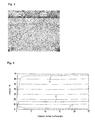
- FIG. 1 A transverse cross section of a work piece treated with a first molten salt bath
- FIG. 2 Location-dependent course of the carbon concentration in the surface area of the work piece according to FIG. 1 ;
- FIG. 3 A transverse cross section of a work piece treated in a second molten salt bath
- FIG. 4 Location-dependent course of the concentrations of Fe, Cr, C in the surface area of the work piece according to FIG. 3 .
- FIG. 2 shows a clear increase in carbon (up to 16%) in this layer ( FIG. 2 shows the carbon content in % by weight in dependence on the distance from the surface of the work piece).
- FIG. 1 shows a transverse cross section of the work piece (bolt) in the region of this layer.
- FIG. 4 shows the concentration of Fe, C, Cr in the work piece in % of weight, in dependence on the distance from the surface of the work piece.
- FIG. 4 again shows a clear increase in carbon in the layer while the share of Cr, Fe in the layer is reduced.
- FIG. 3 contains a transverse cross section of a work piece (bolt) in the region of this layer.
Landscapes
- Chemical & Material Sciences (AREA)
- Engineering & Computer Science (AREA)
- Materials Engineering (AREA)
- Mechanical Engineering (AREA)
- Metallurgy (AREA)
- Organic Chemistry (AREA)
- Chemical Kinetics & Catalysis (AREA)
- Physics & Mathematics (AREA)
- Thermal Sciences (AREA)
- Crystallography & Structural Chemistry (AREA)
- Heat Treatment Of Articles (AREA)
Applications Claiming Priority (3)
| Application Number | Priority Date | Filing Date | Title |
|---|---|---|---|
| DE102007051949A DE102007051949B3 (de) | 2007-10-31 | 2007-10-31 | Verfahren zum Härten von Oberflächen von Werkstücken aus Edelstahl und Verwendung einer Salzschmelze zur Durchführung des Verfahrens |
| DE102007051949 | 2007-10-31 | ||
| DE102007051949.6 | 2008-10-31 |
Publications (2)
| Publication Number | Publication Date |
|---|---|
| US20100108198A1 US20100108198A1 (en) | 2010-05-06 |
| US8083866B2 true US8083866B2 (en) | 2011-12-27 |
Family
ID=40340316
Family Applications (1)
| Application Number | Title | Priority Date | Filing Date |
|---|---|---|---|
| US12/262,960 Active 2030-03-18 US8083866B2 (en) | 2007-10-31 | 2008-10-31 | Method for hardening the surfaces of work pieces made of stainless steel, and a molten salt bath for realizing the method |
Country Status (6)
| Country | Link |
|---|---|
| US (1) | US8083866B2 (da) |
| EP (1) | EP2055801B1 (da) |
| JP (1) | JP5371376B2 (da) |
| CA (1) | CA2642322A1 (da) |
| DE (1) | DE102007051949B3 (da) |
| DK (1) | DK2055801T3 (da) |
Cited By (1)
| Publication number | Priority date | Publication date | Assignee | Title |
|---|---|---|---|---|
| US20170058997A1 (en) * | 2015-08-28 | 2017-03-02 | Tsubakimoto Chain Co. | Chain component and chain |
Families Citing this family (2)
| Publication number | Priority date | Publication date | Assignee | Title |
|---|---|---|---|---|
| EP2757423B1 (fr) * | 2013-01-17 | 2018-07-11 | Omega SA | Pièce pour mouvement d'horlogerie |
| CN103233215B (zh) * | 2013-05-10 | 2015-08-12 | 江苏永昊高强度螺栓有限公司 | 螺栓表面发黑工艺 |
Citations (6)
| Publication number | Priority date | Publication date | Assignee | Title |
|---|---|---|---|---|
| US2249581A (en) | 1938-11-30 | 1941-07-15 | Holden Artemas F | Nonpoisonous carburizing liquid bath |
| US2537830A (en) * | 1944-09-14 | 1951-01-09 | Artemas F Holden | Self-agitating metallurgical salt bath |
| US3840450A (en) | 1963-10-21 | 1974-10-08 | K Inoue | Method of diffusing substances into surface zones of conductive bodies |
| EP0054962A1 (de) | 1980-12-23 | 1982-06-30 | Degussa Aktiengesellschaft | Umweltfreundliches Verfahren zum Aufkohlen von Stahl im Salzbad |
| US4461655A (en) | 1982-02-23 | 1984-07-24 | National Research Development Corporation | Fused salt bath composition |
| DE102006026883B3 (de) | 2006-06-09 | 2007-08-16 | Durferrit Gmbh | Verfahren zum Härten von Edelstahl und Salzschmelze zur Durchführung des Verfahrens |
Family Cites Families (2)
| Publication number | Priority date | Publication date | Assignee | Title |
|---|---|---|---|---|
| US2948644A (en) * | 1948-05-29 | 1960-08-09 | Gerhard W Ahrens | Pack carburizing with furane derivatives |
| EP0072789A1 (en) * | 1981-02-18 | 1983-03-02 | National Research Development Corporation | Fused salt bath composition |
-
2007
- 2007-10-31 DE DE102007051949A patent/DE102007051949B3/de active Active
-
2008
- 2008-10-23 EP EP08018519A patent/EP2055801B1/de active Active
- 2008-10-23 DK DK08018519.2T patent/DK2055801T3/da active
- 2008-10-29 CA CA002642322A patent/CA2642322A1/en not_active Abandoned
- 2008-10-30 JP JP2008279150A patent/JP5371376B2/ja active Active
- 2008-10-31 US US12/262,960 patent/US8083866B2/en active Active
Patent Citations (6)
| Publication number | Priority date | Publication date | Assignee | Title |
|---|---|---|---|---|
| US2249581A (en) | 1938-11-30 | 1941-07-15 | Holden Artemas F | Nonpoisonous carburizing liquid bath |
| US2537830A (en) * | 1944-09-14 | 1951-01-09 | Artemas F Holden | Self-agitating metallurgical salt bath |
| US3840450A (en) | 1963-10-21 | 1974-10-08 | K Inoue | Method of diffusing substances into surface zones of conductive bodies |
| EP0054962A1 (de) | 1980-12-23 | 1982-06-30 | Degussa Aktiengesellschaft | Umweltfreundliches Verfahren zum Aufkohlen von Stahl im Salzbad |
| US4461655A (en) | 1982-02-23 | 1984-07-24 | National Research Development Corporation | Fused salt bath composition |
| DE102006026883B3 (de) | 2006-06-09 | 2007-08-16 | Durferrit Gmbh | Verfahren zum Härten von Edelstahl und Salzschmelze zur Durchführung des Verfahrens |
Non-Patent Citations (10)
| Title |
|---|
| "Kolsterisieren®, Korrosionefestes Oberflächenhärten von austenitischem, rostfreiem Stahl". Informationsblatt der Bodycote Hardiff bv, Parimariboweg 45, NL-7333 Apeldoorn. info@hardiff.de. [Klosterizing® Corrosion-Resistant Surface Hardening of Austentic, Non-Rusting Steel]. |
| "Stahl Merkblatt 821; Edelstrahl Rostfrei-Eigenschaften", Informationsstelle Edelstahl Rostfrei PF 102205, 40013 Dusseldorf, www.edelstahl-rostfrei.de. [Steel Leaflet 821; Non-Rusting Characteristics of Stainless Steel]. |
| Alwart et al., "Low-temperature nitrocarburizing", Advanced Materials & Processes, American Society for Metals Metals Park, Ohio, vol. 154, No. 3., pp. 41-43, 1998. |
| Baudis et al., "English and Translated title" [Analyses for understanding the chemical reactions during the nitrocarburizing in molten salt], HTM Haerterei, Technical Information, Publishing vol. 58, No. 5, pp. 251-256, 2003. |
| European Office Action issued in EP Application No. 08 01 8519 dated Dec. 16, 2010. |
| European Search Report issued in EP Application No. 08 018 519.2-2122 dated Dec. 16, 2010. |
| Guenther, F. et al., "Surface hardening of austenitic steels under maintenance (preservation) of the corrosion resistance by low pressure and plasma caburizing", Haerterei-Techn. Mitt., 2000, pp. 74-84, 56. |
| Spies, H.-J. et al., "Structure and properties of stainless steels after plasma immersion ion implantation and plasma nitriding", Mat.-wiss. u. Werkstofftech,1999, pp. 457-464, 30, Wiley-VCH Verlag GmbH. |
| Sun, Y., Bell, T. (1999). The Response of Austenitic Stainless Steels to Low-Temperature Plasma Nitriding. Heat Treatment of Metals, pp. 9-16 (1999). |
| Van Der Jagt, R.H., "Kolsterising-Surface Hardening of Austenitic and Duplex Stainless Steels without Loss of Corrosion Resistance", Heat Treatment of Metals, 2000, pp. 62-65, 3. |
Cited By (2)
| Publication number | Priority date | Publication date | Assignee | Title |
|---|---|---|---|---|
| US20170058997A1 (en) * | 2015-08-28 | 2017-03-02 | Tsubakimoto Chain Co. | Chain component and chain |
| US9903441B2 (en) * | 2015-08-28 | 2018-02-27 | Tsubakimoto Chain Co. | Chain component and chain |
Also Published As
| Publication number | Publication date |
|---|---|
| JP5371376B2 (ja) | 2013-12-18 |
| CA2642322A1 (en) | 2009-04-30 |
| DE102007051949B3 (de) | 2009-03-12 |
| JP2009108411A (ja) | 2009-05-21 |
| DK2055801T3 (da) | 2013-01-28 |
| US20100108198A1 (en) | 2010-05-06 |
| EP2055801A1 (de) | 2009-05-06 |
| EP2055801B1 (de) | 2012-12-05 |
Similar Documents
| Publication | Publication Date | Title |
|---|---|---|
| US7909943B2 (en) | Method for hardening stainless steel and molten salt bath for realizing said process | |
| US9260775B2 (en) | Low alloy steel carburization and surface microalloying process | |
| Zimmerman | Boriding (boronizing) of Metals | |
| US3022204A (en) | Process for nitriding metals | |
| US8425691B2 (en) | Stainless steel carburization process | |
| US8083866B2 (en) | Method for hardening the surfaces of work pieces made of stainless steel, and a molten salt bath for realizing the method | |
| EP0903424B1 (en) | Corrosion resistance of high temperature alloys | |
| Christiansen et al. | Hard surface layers by pack boriding and gaseous thermo-reactive deposition and diffusion treatments | |
| US4469532A (en) | Chromium-base coating for wear-resistant steel and method of preparing same | |
| CN102125862A (zh) | 一种低温碳氮共渗催化剂及其共渗工艺方法 | |
| Taczała-Warga et al. | Low-pressure ferritic nitrocarburizing: a review | |
| Grabke et al. | Formation of chromium rich oxide scales for protection against metal dusting | |
| KR100862217B1 (ko) | 2단계 가스 질화 또는 가스 질화침탄에 의한 고내식 및고내마모 강재의 제조방법 | |
| PL166281B1 (pl) | Sposób nanoszenia powlok azotku na czesci z tytanu i stopów tytanu PL | |
| Triwiyanto et al. | Low temperature thermochemical treatments of austenitic stainless steel without impairing its corrosion resistance | |
| POSLEDICE | Supersaturation of iron with nitrogen, hydrogen or carbon and the consequences | |
| de Oliveira et al. | Production of Niobium Carbide Layers on High‐Strength Bainitic Steels by Thermochemical Treatment of Thermoreactive Diffusion Followed by Austempering | |
| GB2055404A (en) | Gas nitriding steel | |
| US3926688A (en) | Method of manufacturing a flat steel product having an oxidation-resistant coating | |
| Dong et al. | Influence of hydrogen, carbon dioxide, and alloy content on pore formation in the white layer of alloyed steels | |
| JP2018204085A (ja) | 鋼製部品の浸炭方法、及び鋼製部品、並びに浸炭剤 | |
| Cajner et al. | Improvement of wear resistance of maraging steel by applying thermochemical processes | |
| GB999850A (en) | Improvements relating to coating ferrous metal articles | |
| Chaturvedi et al. | Surface Hardening of Various Steels | |
| JPS57158382A (en) | Manufacture of parts of control rod driving mechanism for high temperature gas furnace or their material |
Legal Events
| Date | Code | Title | Description |
|---|---|---|---|
| AS | Assignment |
Owner name: DURFERRIT GMBH,GERMANY Free format text: ASSIGNMENT OF ASSIGNORS INTEREST;ASSIGNORS:BAUDIS, ULRICH;MERZ, MICHAEL;SIGNING DATES FROM 20081027 TO 20081031;REEL/FRAME:021800/0196 Owner name: DURFERRIT GMBH, GERMANY Free format text: ASSIGNMENT OF ASSIGNORS INTEREST;ASSIGNORS:BAUDIS, ULRICH;MERZ, MICHAEL;SIGNING DATES FROM 20081027 TO 20081031;REEL/FRAME:021800/0196 |
|
| FEPP | Fee payment procedure |
Free format text: PAYOR NUMBER ASSIGNED (ORIGINAL EVENT CODE: ASPN); ENTITY STATUS OF PATENT OWNER: SMALL ENTITY |
|
| STCF | Information on status: patent grant |
Free format text: PATENTED CASE |
|
| FPAY | Fee payment |
Year of fee payment: 4 |
|
| MAFP | Maintenance fee payment |
Free format text: PAYMENT OF MAINTENANCE FEE, 8TH YR, SMALL ENTITY (ORIGINAL EVENT CODE: M2552); ENTITY STATUS OF PATENT OWNER: SMALL ENTITY Year of fee payment: 8 |
|
| MAFP | Maintenance fee payment |
Free format text: PAYMENT OF MAINTENANCE FEE, 12TH YR, SMALL ENTITY (ORIGINAL EVENT CODE: M2553); ENTITY STATUS OF PATENT OWNER: SMALL ENTITY Year of fee payment: 12 |