US8072658B2 - Image processing apparatus and its method - Google Patents
Image processing apparatus and its method Download PDFInfo
- Publication number
- US8072658B2 US8072658B2 US11/175,217 US17521705A US8072658B2 US 8072658 B2 US8072658 B2 US 8072658B2 US 17521705 A US17521705 A US 17521705A US 8072658 B2 US8072658 B2 US 8072658B2
- Authority
- US
- United States
- Prior art keywords
- color space
- values
- grid
- profile
- data
- Prior art date
- Legal status (The legal status is an assumption and is not a legal conclusion. Google has not performed a legal analysis and makes no representation as to the accuracy of the status listed.)
- Expired - Fee Related, expires
Links
Images




Classifications
-
- G—PHYSICS
- G06—COMPUTING OR CALCULATING; COUNTING
- G06T—IMAGE DATA PROCESSING OR GENERATION, IN GENERAL
- G06T11/00—Two-dimensional [2D] image generation
- G06T11/10—Texturing; Colouring; Generation of textures or colours
-
- H—ELECTRICITY
- H04—ELECTRIC COMMUNICATION TECHNIQUE
- H04N—PICTORIAL COMMUNICATION, e.g. TELEVISION
- H04N1/00—Scanning, transmission or reproduction of documents or the like, e.g. facsimile transmission; Details thereof
- H04N1/46—Colour picture communication systems
- H04N1/56—Processing of colour picture signals
- H04N1/60—Colour correction or control
- H04N1/603—Colour correction or control controlled by characteristics of the picture signal generator or the picture reproducer
- H04N1/6033—Colour correction or control controlled by characteristics of the picture signal generator or the picture reproducer using test pattern analysis
Definitions
- the present invention relates to an image processing apparatus and its method and, more specifically, to color management.
- CMS color management system
- FIG. 1 is a chart showing the flow of the processes of the CMS executed when an image input by an input device is to be output by an output device.
- An input color space 201 which depends on an input device such as a digital camera, scanner, or the like is converted into an absolute color space 203 by a source profile 202 .
- the absolute color space 203 is converted into an output color space 205 , which depends on an output device, by a destination profile 204 .
- the source profile 202 is used to convert the input color space into the absolute color space
- the destination profile 204 is used to convert the absolute color space into the output color space.
- ICC profiles as the format specified by International Color Consortium (ICC) are popularly used nowadays.
- FIGS. 2A and 2B show an example of the data expression formats of ICC profiles. Profiles used in a printer often expresses color space conversions using lookup tables (to be referred to as “LUTs” hereinafter), as shown in FIGS. 2A and 2B .
- FIG. 2A shows an LUT used to convert device-dependent CMYK data into device-independent Lab data
- FIG. 2B shows an LUT used to convert device-independent Lab data into device-dependent CMYK data.
- the ICC profiles are normally distributed upon delivery of products of devices, or are installed in devices. However, every devices inevitably suffer characteristic variations due to aging, and default ICC profiles are not always optimal to devices whose characteristics have varied. Also, even when identical profiles are used in identical devices, images with the same tint are not always obtained depending on individual differences of the devices. A state wherein a plurality of devices have different tints especially poses a problem in a cluster printer environment in which identical images are distributed to and output by a plurality of printers. This is because when identical images are output using printers of the same type, images with the same tint are expected to be obtained.
- an image processing to generate a profile used to convert image data of an input color space into image data of an output color space via an absolute color space, which generates patch data including multi-order colors, obtains colorimetric values corresponding to the patch data, calculates reference values of the absolute color space corresponding to the patch data using first conversion data from the output color space to the absolute color space, which is included in the profile, and updates second conversion data from the absolute color space to the output color space, which is included in the profile, using the calorimetric values and the reference values, wherein the generation converts color values included in a color gamut of a predetermined device of the generated color values.
- an image processing which generates patch data including multi-order colors, obtains colorimetric data corresponding to the patch data, calculates a reference value of an absolute color space corresponding to the patch data, updates conversion data from the absolute color space to an output color space using the calorimetric data and the reference value, wherein the generation generates the patch data in accordance with color values uniformly distributed in the absolute color space.
- profiles can be easily adjusted. Also, profiles can be adjusted using a relatively small number of patches.
- FIG. 1 is a chart showing the flow of the processes of a CMS executed when an image input by an input device is to be output by an output device;
- FIGS. 2A and 2B show an example of the data expression formats of ICC profiles
- FIG. 3 is a block diagram showing the arrangement of an image processing system according to the first embodiment
- FIG. 4 is a block diagram showing the arrangement of an MFP
- FIG. 5 is a chart showing the color conversion process of a PDL processor
- FIG. 6 is a block diagram for explaining the processes to be executed by a management PC
- FIG. 7 is a flowchart showing an overview of a profile update process
- FIG. 8 is a flowchart for explaining details of an interpolation operation
- FIG. 9 is a flowchart for explaining details of an Lab to CMYK LUT update process
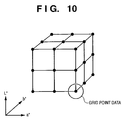
- FIG. 10 is a view showing grid point data in the Lab color space
- FIG. 11 is a view showing the relationship among Lab grid point data, Lab reference values and colorimetric values
- FIG. 12 is a view for explaining the calculation results of differences D between the Lab reference values and colorimetric values with respect to Lab grid points;
- FIG. 13 is a view for explaining possibility of the presence of a direction vector having an excessive direction and size depending on an Lab reference value explored with respect to an Lab grid point;
- FIG. 14 is a flowchart showing a patch data generation process
- FIG. 15 two-dimensionally shows Lab grid points for patch data generation, Lab to CMYK LUT Lab grid points, and the color gamut of a source profile in the patch data generation process;
- FIG. 16 is a flowchart for explaining details of an Lab to CMYK LUT update process according to the second embodiment.
- FIG. 17 is a view for explaining the relationship among Lab grid points, a condition range, Lab reference values, and calorimetric values.
- FIG. 3 is a block diagram showing the arrangement of an image processing system according to the first embodiment.
- Multi-functional peripheral equipments (MFPs) 101 and 102 , management PC 104 , client PCs 105 and 106 , and the like are connected to a network 108 in an office 10 .
- the users of the client PCs 105 and 106 issue print instructions as needed using various applications.
- a printer driver installed in each of these PCs generates page description language (PDL) data described in a PDL on the basis of data supplied from the application, and transmits the PDL data to the MFP designated by the user.
- PDL page description language
- Each of the MFPs 101 and 102 converts the PDL data sent via the network 108 into a format that can be processed by its printer engine, and supplies the converted data to the printer engine.
- the management PC 104 executes a process of calorimetric values obtained by a calorimeter 103 connected via a serial bus 111 such as Universal Serial Bus (USB), IEEE1394, or the like, a profile update process, and uploading/downloading of profiles to the MFPs.
- a serial bus 111 such as Universal Serial Bus (USB), IEEE1394, or the like
- each of the management PC 104 and client PCs 105 and 106 has a memory for storing images and image processing software, a monitor, input devices such as a keyboard, mouse, and the like, a serial bus interface, and the like (not shown).
- Each of these PCs can input an image from an image input device such as a digital camera or the like or a server which can be connected via the network 108 , can apply image processing to the input image, and can output the image that has undergone the image processing to the MFP 101 or 102 or the server.
- These processes are executed by a CPU of the management PC or client PC using a RAM as a work memory.
- the management PC 104 may be included in the MFP as a device for the profile update process (to be described later).
- FIG. 4 is a block diagram showing the arrangement of the MFP.
- An image scanner 301 irradiates a document fed by an auto document feeder with light coming from a light source, forms a reflected image of the document on a solid-state image sensing element via a lens, and acquires image data of, e.g., a resolution of 600 dpi by an image scan signal, which is output in the raster order from the solid-state image sensing element.
- a data processor 305 converts image data into a print signal by an image processor 305 b , outputs the converted signal to a print unit 303 , and forms a copy image on a print sheet.
- the data processor 305 When a plurality of pages of copy images are to be formed, the data processor 305 temporarily stores a print signal for one page in a memory 302 , and supplies the print signal read out from the memory 302 in synchronism with the operation of the print unit 303 , thus forming a plurality of pages of copy images.
- the data processor 305 spools PDL data received by a network interface (I/F) 306 via the network 108 in the memory 302 .
- the data processor 305 then applies a rendering process and color conversion process using ICC profiles to the PDL data read out from the memory 302 by a PDL processor 305 a .
- the data processor 305 applies image processes such as UCR, a masking process, gamma correction, and the like to the PDL data to convert it into a print signal, and outputs the print signal to the print unit 303 , thereby forming a copy image on a print sheet.
- An operation unit 304 accepts instruction inputs of the operator via a keyboard, switches, or a user interface displayed on an LCD panel or the like, and displays status messages such as the states of instruction inputs, the operations (the progress of the image process or image formation) of the MFP, errors (jam, out of paper, the presence/absence of toner), and the like.
- FIG. 5 is a chart showing the color conversion process of the PDL processor 305 a.
- the PDL processor 305 a converts cmyk data 401 , which are converted from an RGB color space into a CMYK color space by a printer driver or rendering process, into Lab data 403 in an L*a*b* color space using a source profile 402 .
- the PDL processor 305 a then converts the Lab data 403 into CMYK data 405 using a destination profile 404 .
- CMYK color values of a printer are converted into color values in an absolute color space (L*a*b* color space in this example), and the CMYK data in the CMYK color space of the print unit 303 are obtained by the destination profile 404 as a profile of the print unit 303 .
- cmyk data 401 and CMYK data 405 have different values since they have the same dimensions of data but are defined in the color spaces of different devices.
- the PDL processor 305 a may directly output the cmyk data 401 as the CMYK data 405 without any color conversion process.
- the source profile 402 and destination profile 404 are held in the memory 302 , and the data processor 305 reads out the profiles as needed to execute the processes.
- the data processor 305 can transmit the profiles read out from the memory 302 and can store profiles received from the management PC 104 in the memory 302 in response to profile upload and download requests from the management PC 104 .
- the PDL processor 305 a can process data which are not converted from the RGB color space into the CMYK color space.
- an RGB profile such as an sRGB monitor profile for, e.g., an sRGB color space or the like can be used as the source profile 402 to convert RGB data into the Lab data 403 .
- FIG. 6 is a block diagram for explaining processes to be executed by the management PC 104 .
- the CPU of the management PC 104 executes a program which is read out from a nonvolatile memory such as a hard disk drive (HDD) or the like equipped in the management PC 104 , and is loaded onto the RAM of the management PC 104 , thus implementing all the processes.
- a nonvolatile memory such as a hard disk drive (HDD) or the like equipped in the management PC 104
- HDD hard disk drive
- the calorimeter 103 outputs measurement values obtained by converting spectral sensitivities, which are acquired by irradiating a sample with light and reading the reflected light using a sensor, into Lab values.
- a colorimeter I/F 1001 is a module which interfaces with the calorimeter 103 via the serial bus 111 , and includes a serial bus interface module and calorimeter handling module. The colorimeter I/F 1001 controls the colorimeter 103 and receives Lab values output from it.
- a profile update processor 1002 is a module which executes a process for updating the LUT of a profile received from the MFP into the one optimal to that MFP on the basis of colorimetric values (Lab values) output from the MFP. This process will be described in detail later.
- a profile transmission/reception unit 1003 is a module which exchanges a profile to be updated of the MFP via a network I/F 1005 . When a profile is to be received from the MFP, the profile transmission/reception unit 1003 transmits a destination profile transmission request command to the MFP, and receives a profile transmitted from the MFP in response to this command. Upon transmitting the updated profile to the MFP, the unit 1003 appends the profile to a profile transmission command, and then transmits that command to the MFP.
- a patch output unit 1004 is a module which generates CMYK patch data required to obtain Lab values, which correspond to CMYK values used in the profile update processor 1002 , or reads out CMYK patch data from the HDD or the like of the management PC 104 , and transmits a patch print command to the MFP while appending the CMYK patch data to the command.
- a graphical user interface (GUI) 1006 receives a user's instruction to a user interface displayed on the monitor via the input device such as a keyboard, mouse, or the like, and supplies it to a controller 1007 .
- the GUI 1006 accepts user's instructions for specifying the MFP and profile upon exchanging a profile, accepts a user's instruction for specifying the MFP upon patch output, or displays the colorimetry state and accepts a user's instruction indicating the start of colorimetry upon colorimetry. That is, the operations of the aforementioned units are controlled by the controller 1007 in accordance with user's instructions input to the GUI 1006 .
- FIG. 7 is a flowchart showing an overview of the profile update process, which is executed by the controller 1007 in accordance with a user's profile update instruction.
- the controller 1007 controls the profile transmission/reception unit 1003 to receive a destination profile (ICC profile) used as a standard profile of the MFP (in this case, the MFP 101 ) from the MFP 101 designated by the user (S 501 ).
- a destination profile ICC profile
- the MFP 101 the MFP 101 designated by the user (S 501 ).
- the controller 1007 then controls the patch output unit 1004 to generate patch data to be output using the received destination profile (S 502 ).
- This patch data includes about hundred multi-order colors, i.e., CMYK numerical value data and their image data. Details of the method of generating the patch data will be described later.
- a tertiary color is, e.g., (130, 120, 110, 0)
- combinations of these numerical values and color components are examples.
- the controller 1007 controls the patch output unit 1004 to transmit the patch data to the MFP 101 and to control the MFP 101 to print patches (S 503 ). Note that the controller 1007 instructs the MFP 101 to print patch data (cmyk data 401 ) as the CMYK data 405 intact without the intervention of the source profile 402 and destination profile 404 shown in FIG. 5 .
- the controller 1007 controls the colorimeter I/F 1001 to make colorimetry (S 504 ), and to acquire calorimetric values (Lab values) (S 505 ).
- the controller 1007 controls the profile update processor 1002 to execute processes in steps S 506 to S 511 . That is, the profile update processor 1002 extracts an LUT used to convert CMYK values into Lab values (to be referred to as a “CMYK to Lab LUT” hereinafter) included in the destination profile (S 506 ), makes an interpolation operation using the numerical value data of the patches generated in step S 502 and the CMYK to Lab LUT (S 507 ), and calculates Lab reference values (S 508 ). Also, the profile update processor 1002 extracts an LUT used to convert Lab values into CMYK values (to be referred to as an “Lab to CMYK LUT” hereinafter) from the destination profile (S 509 ).
- CMYK to Lab LUT Lab values
- the profile update processor 1002 updates the Lab to CMYK LUT using these values (S 510 ), and also updates the destination profile by the updated Lab to CMYK LUT (S 511 ).
- the controller 1007 controls the profile transmission/reception unit 1003 to transmit a profile transmission command to the MFP 101 while appending the updated destination profile to the command, and to store the destination profile in the MFP 101 (S 512 ).
- an image with an appropriate tint can be obtained independently of the state of the device (MFP in this case).
- the interpolation operation is a process for calculating Lab values corresponding to CMYK values. That is, since the CMYK to Lab LUT describes Lab values corresponding to given CMYK values, Lab values corresponding to CMYK values of the patch data can be calculated by making the interpolation operation using this LUT.
- FIG. 8 is a flowchart for explaining details of the interpolation operation (S 507 ).
- Data of the CMYK to Lab LUT are grouped with reference to a K value (S 702 ).
- the input color values of the LUT indicate color values and also serve as input grid points to the LUT, and the number of color values increases incrementally. Therefore, assuming each of CMYK components has 17 levels, if data are grouped with reference to the K value, 17 ⁇ 17 ⁇ 17 ⁇ 17 grid points are classified into 17 groups of 17 ⁇ 17 ⁇ 17 grid points.
- CMYK value of one patch is extracted (S 703 ), and the K value of the extracted CMYK value is selected as a K value of interest (S 704 ).
- K 1 be the K value of interest.
- one-dimensional linear interpolation for the K value is made to obtain an Lab value (Lab reference value) corresponding to the CMYK value (S 708 ).
- steps S 703 to S 708 are repeated until it is determined in step S 709 that calculations of Lab reference values for all the patch data (CMYK values) are complete.
- the destination profile takes charge of a part for converting data in the absolute color space into the color space of the output device in an actual print process. Therefore, when the Lab to CMYK LUT of the destination profile is appropriately adjusted and updated, output result differences due to variations of the device characteristics and individual differences of the output devices can be absorbed.
- FIG. 9 is a flowchart for explaining details of the Lab to CMYK LUT update process. Note that memories 812 and 813 shown in FIG. 9 are assigned to predetermined areas on the RAM or HDD of the management PC 104 .
- a color value of one Lab grid point (Lab grid point data) is extracted (S 801 ).
- the Lab grid point data are data whose increments are fixed.
- FIG. 10 shows grid point data in the Lab color space. For example, when the Lab to CMYK LUT includes 33 levels of Lab components, one of 33 ⁇ 33 ⁇ 33 grid points is extracted in step S 801 .
- FIG. 11 shows the relationship among the Lab grid point data, Lab reference values, and calorimetric values.
- reference values 1 and 2 exist, but since reference value 1 is closer to the Lab grid point data of interest, it is selected as a search result.
- a difference D between the found Lab reference value and the corresponding colorimetric value (the difference between Lab reference value 1 and calorimetric value 1 in the example of FIG. 11 ) is calculated (S 803 ).
- the Lab grid point data is updated.
- an Lab reference value farther from the Lab grid point data is often selected as a search result. Since it is not desirable that the update process is influenced by the Lab reference value farther from the Lab grid point data, a distance between the Lab reference value and Lab grid point data is calculated, and weighting is made according to the distance (S 804 ).
- Steps S 801 to S 804 are repeated until it is determined in step S 805 that the processes for all the Lab grid points of the LUT are complete.
- FIG. 12 is a view for explaining the calculation results of differences D between the Lab reference values and colorimetric values with respect to Lab grid points.
- each arrow represents a direction vector which is headed from a colorimetric value to an Lab reference value.
- the Lab value of a grid point is shifted by this direction vector.
- a direction vector with an excessive direction and size may be present depending on the Lab reference value explored with respect to the Lab grid point.
- FIG. 13 a direction vector of a grid point surrounded by an ellipse is illustrated to have an excessive size compared to surrounding direction vectors. If such direction vector is present, the Lab value of the grid point is excessively updated, and a pseudo contour may be generated.
- the calculated differences D ⁇ W undergo a smoothing process (S 806 ) to prevent the Lab values of the grid points from being excessively updated.
- a smoothing method a method of calculating a total of the differences D ⁇ W corresponding to grid points within a 5 ⁇ 5 ⁇ 5 range to have the grid point of interest as the center, and calculating its average, a method of calculating a severalfold value of the difference D ⁇ W corresponding to the grid point of interest, calculating a total of that value and the differences D ⁇ W corresponding to other grid points, and then calculating the average, and the like may be used.
- Differences D′ that have undergone the smoothing process are added to the Lab grid point data to update the grid points (S 807 ), and one Lab grid point data is extracted from the updated grid points (S 808 ).
- CMYK values corresponding to the updated grid points are known, the Lab to CMYK LUT of the destination profile can be updated.
- the Lab to CMYK LUT before update which is stored in the memory 813 , is an LUT that describes conversion from Lab to CMYK
- a three-dimensional linear interpolation operation is applied to the Lab value of the updated grid point to calculate a CMYK value (S 809 ).
- Steps S 808 and S 809 are repeated until it is determined in step S 810 that the processes for all the Lab grid points of the LUT are complete. If the CMYK values of all the Lab grid points are calculated, the Lab to CMYK LUT is updated by the results (S 811 ).
- tint differences due to variations of the device characteristics and individual differences can be greatly reduced. Therefore, in a cluster printing system which supplies identical data to a plurality of devices, even a printing method which suffers a considerable change in tint due to variations of the device characteristics like in an electrophotographic printer can obtain printouts with uniform tints.
- a common CMYK to Lab LUT i.e., a reference state
- the Lab to CMYK LUTs of the profiles of the respective devices are updated to match the reference state.
- FIG. 13 shows the color conversion process of the PDL processor 305 a in an actual print process.
- CMYK data 905 can be generated using an updated destination profile 904 .
- the source profile 902 converts RGB data into Lab data
- the image data 901 may be RGB data.
- the source profile is not particularly limited as long as it converts the input color space into the absolute color space (Lab in the example) to be processed by the updated destination profile.
- the aforementioned Lab to CMYK update process calculates differences D between the Lab reference values and calorimetric values in the Lab color space as the grid point space, weights the differences D, and feeds back the weighted differences to the Lab values of the grid points.
- patches are preferably formed so that difference vectors between colorimetric values and Lab reference values are uniformly distributed in the Lab space.
- CMYK values corresponding to the Lab values are calculated using the Lab to CMYK LUT of the profile itself to be updated, thus forming patches that can obtain nearly uniformly distributed colorimetric values in the Lab color space.
- FIG. 14 is a flowchart showing the patch data generation process.
- N ⁇ N ⁇ N grid points which are uniformly distributed in the Lab color space are generated (S 1601 ).
- the Lab grid points generated in this way cover the whole Lab color space.
- Lab values of grid points to be used are extracted (S 1602 ).
- the grid points to be used Upon selecting the grid points to be used, those which are located within the color gamut of the source profile assumed in an actual output process may be extracted. For example, if the sRGB color space is assumed as the source profile, its color gamut is broader than that of a general electrophotographic printer, but it does not occupy the whole Lab color space. Therefore, in the actual output process, Lab values of grid points which fall outside the sRGB color space are never output by the source profile side. In other words, such Lab values never become inputs of the Lab to CMYK LUT of the destination profile.
- the Lab to CMYK LUT is extracted from the received destination profile (S 1603 ), and CMYK values (patch data) are generated from the Lab values of the extracted grid points by an interpolation operation using the Lab to CMYK LUT (S 1604 ).
- FIG. 15 two-dimensionally shows Lab grid points for patch data generation (x), Lab grid points (•) of the Lab to CMYK LUT, and the color gamut (solid line) defined by the source profile in the patch data generation process.
- the color gamut indicates a color reproduction range of an image input device such as a digital camera, a scanner, a monitor or the like.
- grid points for patch data generation fewer than the grid points of the Lab to CMYK LUT, and those which fall within the color gamut of the source profile are further extracted.
- the whole LUT has 35,837 grid points.
- patches corresponding to Lab values of the 35,837 grid points are formed, colorimetric values corresponding to the Lab color space can be evenly obtained.
- such number of patches are impractical.
- the number of grid points for patch data generation is set to be 9 ⁇ 9 ⁇ 9, the number of patches is reduced to 729.
- the number of patches is reduced.
- the number of grid points may be increased to improve the color reproduction precision. However, in such case, a longer time is required for colorimetry.
- the SRGB color space is assumed as the color space of the source profile, but other RGB color spaces may be used.
- the color gamut of a print standard profile such as DIC, SWOP, or the like may be adopted. In this case, since the CMYK color space is often narrower than the RGB color space, the number of patch data can be further reduced.
- the profile can be easily corrected with high precision on the basis of the profile that is installed in a device such as the MFP or the like or is distributed, and describes the color reproduction characteristics. Therefore, optimal color matching can always be attained. If the method of this embodiment is applied to a plurality of devices, the color reproduction characteristics of these devices can be adjusted to each other.
- the image processing is described based on the Lab color space in the first embodiment.
- the color space is not limited to the Lab color space, and an absolute color space such as a profile connection space (PCS) can be used for the above image processing.
- PCS profile connection space
- FIG. 16 is a flowchart for explaining details of the Lab to CMYK LUT update process of the second embodiment.
- a color value of one Lab grid point (Lab grid point data) of the Lab to CMYK LUT is extracted (S 1401 ), a neighboring range of the extracted Lab grid point data (e.g., a 5 ⁇ 5 ⁇ 5 range having the Lab grid point data as the center; to be referred to as a “condition range” hereinafter) is set (S 1402 ), and it is checked if Lab reference values of patch data stored in the memory 812 fall within the condition range (S 1403 ).
- FIG. 17 is a view for explaining the relationship among the Lab grid point data, condition range, Lab reference values, and colorimetric values.
- a closest Lab reference value is searched for, and a difference D between that Lab reference value and calorimetric value is calculated (S 1404 ). Then, weighting is made according to the distance by the same method as in the first embodiment (S 1405 ). Since a grid point which has no Lab reference value within the condition range often falls outside the color gamut, the weight may use a uniform value (e.g., 1 ⁇ 4 or the like).
- Steps S 1401 to S 1407 are repeated until it is determined in step S 1408 that average values Da of the differences or weighted differences D-W are calculated for all the Lab grid points of the LUT.
- the average values Da of the differences or weighted differences D ⁇ W are applied to Lab grid point data to update the grid points (S 1409 ), and one Lab grid point data is extracted from the updated grid points (S 1410 ).
- CMYK values corresponding to the updated grid points are known, the Lab to CMYK LUT of the destination profile can be updated.
- the Lab to CMYK LUT before update which is stored in the memory 813 , is an LUT that describes conversion from Lab to CMYK
- a three-dimensional linear interpolation operation is applied to the Lab value of the updated grid point to calculate a CMYK value (S 1411 ).
- Steps S 1410 and S 1411 are repeated until it is determined in step S 1412 that the processes for all the Lab grid points of the LUT are complete. If the CMYK values of all the Lab grid points are calculated, the Lab to CMYK LUT is updated by the results (S 1413 ).
- the present invention can be applied to a system constituted by a plurality of devices (e.g., host computer, interface, reader, printer) or to an apparatus comprising a single device (e.g., copying machine, facsimile machine).
- devices e.g., host computer, interface, reader, printer
- apparatus comprising a single device (e.g., copying machine, facsimile machine).
- the object of the present invention can also be achieved by providing a storage medium storing program codes for performing the aforesaid processes to a computer system or apparatus (e.g., a personal computer), reading the program codes, by a CPU or MPU of the computer system or apparatus, from the storage medium, then executing the program.
- a computer system or apparatus e.g., a personal computer
- the program codes read from the storage medium realize the functions according to the embodiments, and the storage medium storing the program codes constitutes the invention.
- the storage medium such as a flexible disk, a hard disk, an optical disk, a magneto-optical disk, CD-ROM, CD-R, a magnetic tape, a non-volatile type memory card, and ROM can be used for providing the program codes.
- the present invention includes a case where an OS (operating system) or the like working on the computer performs a part or entire processes in accordance with designations of the program codes and realizes functions according to the above embodiments.
- the present invention also includes a case where, after the program codes read from the storage medium are written in a function expansion card which is inserted into the computer or in a memory provided in a function expansion unit which is connected to the computer, CPU or the like contained in the function expansion card or unit performs a part or entire process in accordance with designations of the program codes and realizes functions of the above embodiments.
- the storage medium stores program codes corresponding to the flowcharts described in the embodiments.
Landscapes
- Engineering & Computer Science (AREA)
- Physics & Mathematics (AREA)
- General Physics & Mathematics (AREA)
- Theoretical Computer Science (AREA)
- Multimedia (AREA)
- Signal Processing (AREA)
- Color Image Communication Systems (AREA)
- Facsimile Image Signal Circuits (AREA)
- Image Processing (AREA)
Applications Claiming Priority (2)
| Application Number | Priority Date | Filing Date | Title |
|---|---|---|---|
| JP2004200800A JP4393294B2 (ja) | 2004-07-07 | 2004-07-07 | 画像処理装置およびその方法 |
| JP2004-200800 | 2004-07-07 |
Publications (2)
| Publication Number | Publication Date |
|---|---|
| US20060007457A1 US20060007457A1 (en) | 2006-01-12 |
| US8072658B2 true US8072658B2 (en) | 2011-12-06 |
Family
ID=35540999
Family Applications (1)
| Application Number | Title | Priority Date | Filing Date |
|---|---|---|---|
| US11/175,217 Expired - Fee Related US8072658B2 (en) | 2004-07-07 | 2005-07-07 | Image processing apparatus and its method |
Country Status (2)
| Country | Link |
|---|---|
| US (1) | US8072658B2 (enExample) |
| JP (1) | JP4393294B2 (enExample) |
Cited By (6)
| Publication number | Priority date | Publication date | Assignee | Title |
|---|---|---|---|---|
| US20100110457A1 (en) * | 2008-10-30 | 2010-05-06 | Canon Kabushiki Kaisha | Color processing apparatus and method thereof |
| US20110058196A1 (en) * | 2009-09-10 | 2011-03-10 | Fujifilm Corporation | Image processing apparatus, image processing method, and recording medium storing a program thereof |
| US8724171B2 (en) | 2011-05-19 | 2014-05-13 | Canon Kabushiki Kaisha | Method of compressing color reproduction range and profile creation device using same |
| US20150356388A1 (en) * | 2014-06-06 | 2015-12-10 | Konica Minolta, Inc. | Profile creation method and computer readable recording medium stored with profile creation program |
| US9930219B2 (en) * | 2014-06-06 | 2018-03-27 | Konica Minolta, Inc. | Profile creation method and computer readable recording medium stored with profile creation program |
| US10917542B2 (en) * | 2019-04-01 | 2021-02-09 | Seiko Epson Corporation | Color conversion information generation method, non-transitory computer-readable storage medium storing color conversion information generation program, and color conversion information generation apparatus |
Families Citing this family (12)
| Publication number | Priority date | Publication date | Assignee | Title |
|---|---|---|---|---|
| WO2007101472A1 (en) * | 2006-03-07 | 2007-09-13 | Hewlett-Packard Development Company, L.P. | Color selection |
| JP4985087B2 (ja) * | 2007-05-11 | 2012-07-25 | 富士ゼロックス株式会社 | 画像処理装置、画像出力装置、画像処理システム、画像処理プログラム、及び画像出力プログラム |
| JP5149690B2 (ja) | 2008-05-02 | 2013-02-20 | キヤノン株式会社 | 画像処理装置、画像処理方法、及び、画像処理プログラム |
| JP5180670B2 (ja) * | 2008-05-07 | 2013-04-10 | キヤノン株式会社 | 画像処理装置及び画像処理方法 |
| JP5127568B2 (ja) * | 2008-05-28 | 2013-01-23 | 富士フイルム株式会社 | 色再現共通化方法及び該方法を実施するコンピュータ読取可能なプログラム |
| JP5649337B2 (ja) | 2010-06-02 | 2015-01-07 | キヤノン株式会社 | プロファイル処理装置、プロファイル処理方法並びにプログラム |
| US9736337B2 (en) | 2011-06-30 | 2017-08-15 | Hewlett-Packard Development Company, L.P. | Color profile adjustment |
| JP5816030B2 (ja) * | 2011-09-01 | 2015-11-17 | キヤノン株式会社 | 画像処理装置、画像処理方法、およびプログラム |
| US20160300130A1 (en) * | 2013-10-15 | 2016-10-13 | Hewlett-Packard Development Company, L.P. | Color transformation |
| JP5854034B2 (ja) * | 2013-12-19 | 2016-02-09 | 富士ゼロックス株式会社 | 色処理装置、画像形成装置およびプログラム |
| JP6156401B2 (ja) * | 2015-02-09 | 2017-07-05 | コニカミノルタ株式会社 | 色変換方法、プログラム、及び画像処理装置 |
| JP6888507B2 (ja) * | 2017-09-29 | 2021-06-16 | セイコーエプソン株式会社 | プロファイル調整方法、プロファイル調整プログラム、プロファイル調整装置、及び、プロファイル調整システム |
Citations (23)
| Publication number | Priority date | Publication date | Assignee | Title |
|---|---|---|---|---|
| US5432893A (en) * | 1992-02-11 | 1995-07-11 | Purdue Research Foundation | Sequential scalar quantization of digital color image using mean squared error-minimizing quantizer density function |
| JPH10250153A (ja) | 1997-03-17 | 1998-09-22 | Konica Corp | カラー画像出力装置 |
| US5835624A (en) * | 1995-10-20 | 1998-11-10 | Brother Kogyo Kabushiki Kaisha | Color conversion device |
| US6027201A (en) * | 1995-05-01 | 2000-02-22 | Minnesota Mining And Manufacturing Company | Recalibrating a multi-color imaging system |
| US6075888A (en) * | 1996-01-11 | 2000-06-13 | Eastman Kodak Company | System for creating a device specific color profile |
| US20010030777A1 (en) * | 2000-01-13 | 2001-10-18 | Kiyomi Tamagawa | Profile producing method and profile producing apparatus |
| US20020031258A1 (en) | 2000-09-12 | 2002-03-14 | Takeshi Namikata | Image processing method, image processing apparatus, and storage medium |
| US20020039106A1 (en) * | 2000-07-19 | 2002-04-04 | Takuya Shimada | Image processing apparatus and control method therefor |
| US20020060797A1 (en) | 2000-09-12 | 2002-05-23 | Takeshi Namikata | Image processing method, image processing apparatus, and storage medium |
| US20020145744A1 (en) * | 2000-09-12 | 2002-10-10 | Shuichi Kumada | Image processing apparatus and method, profile regeneration timing estimation method, color difference variation display method, and profile management method |
| US20030133138A1 (en) | 2001-07-02 | 2003-07-17 | Takeshi Namikata | Image processing method and apparatus |
| US20030193688A1 (en) | 2002-04-11 | 2003-10-16 | Canon Kabushiki Kaisha | Image processing system and method of controlling same |
| JP2003298862A (ja) | 2002-03-29 | 2003-10-17 | Mitsubishi Paper Mills Ltd | カラーマッチング方法およびその装置 |
| US20040126009A1 (en) * | 2002-09-19 | 2004-07-01 | Hirokazu Takenaka | Image processing apparatus, image processing method, and image processing program |
| US20040130739A1 (en) * | 2000-01-05 | 2004-07-08 | Adam George E. | Scanner and printer profiling system |
| US20040223173A1 (en) * | 2002-10-17 | 2004-11-11 | Seiko Epson Corporation | Generating method for color conversion table, method and apparatus for creating correspondence definition data |
| US20040263876A1 (en) * | 2003-06-25 | 2004-12-30 | Sharp Laboratories Of America, Inc. | Adaptive generation of perceptually uniform samples for printer characterization |
| US20050018226A1 (en) * | 2003-07-25 | 2005-01-27 | Pentax Corporation | Color-space transformation-matrix calculating system and calculating method |
| US20050128495A1 (en) * | 2002-01-09 | 2005-06-16 | Yoshifumi Arai | Method of producing color conversion table, image processing device, image processing method, program and recording medium |
| US20050128498A1 (en) | 2003-12-10 | 2005-06-16 | Canon Kabushiki Kaisha | Image processing apparatus and method |
| US20050179915A1 (en) * | 2002-05-23 | 2005-08-18 | Masato Tsukada | Color conversion method and color conversion device |
| US20050195415A1 (en) * | 2004-03-02 | 2005-09-08 | Agfa Corporation | System and method for gamut mapping control |
| US20050195212A1 (en) * | 2004-02-19 | 2005-09-08 | Seiko Epson Corporation | Color matching profile generating device, color matching system, color matching method, color matching program, and electronic apparatus |
-
2004
- 2004-07-07 JP JP2004200800A patent/JP4393294B2/ja not_active Expired - Fee Related
-
2005
- 2005-07-07 US US11/175,217 patent/US8072658B2/en not_active Expired - Fee Related
Patent Citations (23)
| Publication number | Priority date | Publication date | Assignee | Title |
|---|---|---|---|---|
| US5432893A (en) * | 1992-02-11 | 1995-07-11 | Purdue Research Foundation | Sequential scalar quantization of digital color image using mean squared error-minimizing quantizer density function |
| US6027201A (en) * | 1995-05-01 | 2000-02-22 | Minnesota Mining And Manufacturing Company | Recalibrating a multi-color imaging system |
| US5835624A (en) * | 1995-10-20 | 1998-11-10 | Brother Kogyo Kabushiki Kaisha | Color conversion device |
| US6075888A (en) * | 1996-01-11 | 2000-06-13 | Eastman Kodak Company | System for creating a device specific color profile |
| JPH10250153A (ja) | 1997-03-17 | 1998-09-22 | Konica Corp | カラー画像出力装置 |
| US20040130739A1 (en) * | 2000-01-05 | 2004-07-08 | Adam George E. | Scanner and printer profiling system |
| US20010030777A1 (en) * | 2000-01-13 | 2001-10-18 | Kiyomi Tamagawa | Profile producing method and profile producing apparatus |
| US20020039106A1 (en) * | 2000-07-19 | 2002-04-04 | Takuya Shimada | Image processing apparatus and control method therefor |
| US20020031258A1 (en) | 2000-09-12 | 2002-03-14 | Takeshi Namikata | Image processing method, image processing apparatus, and storage medium |
| US20020060797A1 (en) | 2000-09-12 | 2002-05-23 | Takeshi Namikata | Image processing method, image processing apparatus, and storage medium |
| US20020145744A1 (en) * | 2000-09-12 | 2002-10-10 | Shuichi Kumada | Image processing apparatus and method, profile regeneration timing estimation method, color difference variation display method, and profile management method |
| US20030133138A1 (en) | 2001-07-02 | 2003-07-17 | Takeshi Namikata | Image processing method and apparatus |
| US20050128495A1 (en) * | 2002-01-09 | 2005-06-16 | Yoshifumi Arai | Method of producing color conversion table, image processing device, image processing method, program and recording medium |
| JP2003298862A (ja) | 2002-03-29 | 2003-10-17 | Mitsubishi Paper Mills Ltd | カラーマッチング方法およびその装置 |
| US20030193688A1 (en) | 2002-04-11 | 2003-10-16 | Canon Kabushiki Kaisha | Image processing system and method of controlling same |
| US20050179915A1 (en) * | 2002-05-23 | 2005-08-18 | Masato Tsukada | Color conversion method and color conversion device |
| US20040126009A1 (en) * | 2002-09-19 | 2004-07-01 | Hirokazu Takenaka | Image processing apparatus, image processing method, and image processing program |
| US20040223173A1 (en) * | 2002-10-17 | 2004-11-11 | Seiko Epson Corporation | Generating method for color conversion table, method and apparatus for creating correspondence definition data |
| US20040263876A1 (en) * | 2003-06-25 | 2004-12-30 | Sharp Laboratories Of America, Inc. | Adaptive generation of perceptually uniform samples for printer characterization |
| US20050018226A1 (en) * | 2003-07-25 | 2005-01-27 | Pentax Corporation | Color-space transformation-matrix calculating system and calculating method |
| US20050128498A1 (en) | 2003-12-10 | 2005-06-16 | Canon Kabushiki Kaisha | Image processing apparatus and method |
| US20050195212A1 (en) * | 2004-02-19 | 2005-09-08 | Seiko Epson Corporation | Color matching profile generating device, color matching system, color matching method, color matching program, and electronic apparatus |
| US20050195415A1 (en) * | 2004-03-02 | 2005-09-08 | Agfa Corporation | System and method for gamut mapping control |
Non-Patent Citations (1)
| Title |
|---|
| Office Action, dated Feb. 6, 2009, in JP 2004-200800. |
Cited By (11)
| Publication number | Priority date | Publication date | Assignee | Title |
|---|---|---|---|---|
| US20100110457A1 (en) * | 2008-10-30 | 2010-05-06 | Canon Kabushiki Kaisha | Color processing apparatus and method thereof |
| US8339666B2 (en) * | 2008-10-30 | 2012-12-25 | Canon Kabushiki Kaisha | Color processing apparatus and method thereof |
| US20110058196A1 (en) * | 2009-09-10 | 2011-03-10 | Fujifilm Corporation | Image processing apparatus, image processing method, and recording medium storing a program thereof |
| US8749841B2 (en) * | 2009-09-10 | 2014-06-10 | Fujifilm Corporation | Image processing apparatus, image processing method, and recording medium storing a program thereof |
| US8724171B2 (en) | 2011-05-19 | 2014-05-13 | Canon Kabushiki Kaisha | Method of compressing color reproduction range and profile creation device using same |
| US20150356388A1 (en) * | 2014-06-06 | 2015-12-10 | Konica Minolta, Inc. | Profile creation method and computer readable recording medium stored with profile creation program |
| CN105320477A (zh) * | 2014-06-06 | 2016-02-10 | 柯尼卡美能达株式会社 | 简档生成方法 |
| US9602698B2 (en) * | 2014-06-06 | 2017-03-21 | Konica Minolta, Inc. | Method for creating a color conversion profile for a printer and computer readable recording medium stored with program for creating same |
| US9930219B2 (en) * | 2014-06-06 | 2018-03-27 | Konica Minolta, Inc. | Profile creation method and computer readable recording medium stored with profile creation program |
| CN105320477B (zh) * | 2014-06-06 | 2018-10-12 | 柯尼卡美能达株式会社 | 简档生成方法 |
| US10917542B2 (en) * | 2019-04-01 | 2021-02-09 | Seiko Epson Corporation | Color conversion information generation method, non-transitory computer-readable storage medium storing color conversion information generation program, and color conversion information generation apparatus |
Also Published As
| Publication number | Publication date |
|---|---|
| US20060007457A1 (en) | 2006-01-12 |
| JP2006025128A (ja) | 2006-01-26 |
| JP4393294B2 (ja) | 2010-01-06 |
Similar Documents
| Publication | Publication Date | Title |
|---|---|---|
| US20060007457A1 (en) | Image processing apparatus and its method | |
| US9659242B2 (en) | Apparatus that performs calibration for maintaining image quality | |
| JP7524681B2 (ja) | 画像処理装置、画像処理方法およびプログラム | |
| US11818320B2 (en) | Convert a dot area ratio of a target process color using a fluorescent color for higher brightness and saturation | |
| US8780408B2 (en) | Image processing apparatus, image processing method and recording medium | |
| US8896892B2 (en) | System and method for color calibration of a color printing system with recording media brightness compensation | |
| US20030133138A1 (en) | Image processing method and apparatus | |
| US9070076B1 (en) | Spot color preflight for extended gamut printing | |
| US9019561B1 (en) | Profiling data spacing for different halftone states using a single tone reproduction curve | |
| US8451498B2 (en) | Image processing device, image processing method, tone-correction-parameter generation sheet, and storage medium | |
| US9013754B1 (en) | Color processing device, image forming apparatus, and recording medium | |
| US9332158B2 (en) | Color processing apparatus, image forming apparatus, and non-transitory computer readable recording medium performing color conversion, adjustment and matching process between input color data and reproducible color data of image output device | |
| US7872785B2 (en) | Systems and methods for parameterized spot color rendering | |
| US9870524B2 (en) | Image forming apparatus and computer program product for performing color adjustment based on color shift and tendency for color shift over time | |
| JP2001292331A (ja) | 画像処理方法及び装置、画像処理システム及び記録媒体 | |
| JP5893338B2 (ja) | 画像処理装置及び画像処理方法並びにプログラム | |
| JP2020203454A (ja) | 画像処理装置、画像形成装置 | |
| US11956405B2 (en) | Information processing apparatus, image forming system, method of controlling total-amount restriction, and non-transitory recording medium | |
| US20040239966A1 (en) | Color imaging devices, color imaging methods, and color separation methods | |
| JP6572568B2 (ja) | 画像形成システム | |
| US8368979B2 (en) | Image forming apparatus and computer readable medium for forming image | |
| JP4999625B2 (ja) | 色処理装置およびその方法 | |
| US20240214495A1 (en) | Image forming apparatus | |
| US7557955B2 (en) | System and method for matching colorimetric attributes of a production print to a proof | |
| JP7614854B2 (ja) | 画像処理装置、画像処理方法及びプログラム |
Legal Events
| Date | Code | Title | Description |
|---|---|---|---|
| AS | Assignment |
Owner name: CANON KABUSHIKI KAISHA, JAPAN Free format text: ASSIGNMENT OF ASSIGNORS INTEREST;ASSIGNOR:NAMIKATA, TAKESHI;REEL/FRAME:016771/0619 Effective date: 20050628 |
|
| STCF | Information on status: patent grant |
Free format text: PATENTED CASE |
|
| FPAY | Fee payment |
Year of fee payment: 4 |
|
| FEPP | Fee payment procedure |
Free format text: MAINTENANCE FEE REMINDER MAILED (ORIGINAL EVENT CODE: REM.); ENTITY STATUS OF PATENT OWNER: LARGE ENTITY |
|
| LAPS | Lapse for failure to pay maintenance fees |
Free format text: PATENT EXPIRED FOR FAILURE TO PAY MAINTENANCE FEES (ORIGINAL EVENT CODE: EXP.); ENTITY STATUS OF PATENT OWNER: LARGE ENTITY |
|
| STCH | Information on status: patent discontinuation |
Free format text: PATENT EXPIRED DUE TO NONPAYMENT OF MAINTENANCE FEES UNDER 37 CFR 1.362 |
|
| FP | Lapsed due to failure to pay maintenance fee |
Effective date: 20191206 |