US8043976B2 - Adhesion to copper and copper electromigration resistance - Google Patents
Adhesion to copper and copper electromigration resistance Download PDFInfo
- Publication number
- US8043976B2 US8043976B2 US12/406,467 US40646709A US8043976B2 US 8043976 B2 US8043976 B2 US 8043976B2 US 40646709 A US40646709 A US 40646709A US 8043976 B2 US8043976 B2 US 8043976B2
- Authority
- US
- United States
- Prior art keywords
- plasma
- layer
- group
- mixtures
- copper
- Prior art date
- Legal status (The legal status is an assumption and is not a legal conclusion. Google has not performed a legal analysis and makes no representation as to the accuracy of the status listed.)
- Active, expires
Links
Images




Classifications
-
- H10P14/60—
-
- H10W20/037—
-
- C—CHEMISTRY; METALLURGY
- C23—COATING METALLIC MATERIAL; COATING MATERIAL WITH METALLIC MATERIAL; CHEMICAL SURFACE TREATMENT; DIFFUSION TREATMENT OF METALLIC MATERIAL; COATING BY VACUUM EVAPORATION, BY SPUTTERING, BY ION IMPLANTATION OR BY CHEMICAL VAPOUR DEPOSITION, IN GENERAL; INHIBITING CORROSION OF METALLIC MATERIAL OR INCRUSTATION IN GENERAL
- C23C—COATING METALLIC MATERIAL; COATING MATERIAL WITH METALLIC MATERIAL; SURFACE TREATMENT OF METALLIC MATERIAL BY DIFFUSION INTO THE SURFACE, BY CHEMICAL CONVERSION OR SUBSTITUTION; COATING BY VACUUM EVAPORATION, BY SPUTTERING, BY ION IMPLANTATION OR BY CHEMICAL VAPOUR DEPOSITION, IN GENERAL
- C23C16/00—Chemical coating by decomposition of gaseous compounds, without leaving reaction products of surface material in the coating, i.e. chemical vapour deposition [CVD] processes
- C23C16/02—Pretreatment of the material to be coated
-
- C—CHEMISTRY; METALLURGY
- C23—COATING METALLIC MATERIAL; COATING MATERIAL WITH METALLIC MATERIAL; CHEMICAL SURFACE TREATMENT; DIFFUSION TREATMENT OF METALLIC MATERIAL; COATING BY VACUUM EVAPORATION, BY SPUTTERING, BY ION IMPLANTATION OR BY CHEMICAL VAPOUR DEPOSITION, IN GENERAL; INHIBITING CORROSION OF METALLIC MATERIAL OR INCRUSTATION IN GENERAL
- C23C—COATING METALLIC MATERIAL; COATING MATERIAL WITH METALLIC MATERIAL; SURFACE TREATMENT OF METALLIC MATERIAL BY DIFFUSION INTO THE SURFACE, BY CHEMICAL CONVERSION OR SUBSTITUTION; COATING BY VACUUM EVAPORATION, BY SPUTTERING, BY ION IMPLANTATION OR BY CHEMICAL VAPOUR DEPOSITION, IN GENERAL
- C23C16/00—Chemical coating by decomposition of gaseous compounds, without leaving reaction products of surface material in the coating, i.e. chemical vapour deposition [CVD] processes
- C23C16/56—After-treatment
-
- H10P14/43—
-
- H10W20/056—
-
- H10W20/077—
-
- Y—GENERAL TAGGING OF NEW TECHNOLOGICAL DEVELOPMENTS; GENERAL TAGGING OF CROSS-SECTIONAL TECHNOLOGIES SPANNING OVER SEVERAL SECTIONS OF THE IPC; TECHNICAL SUBJECTS COVERED BY FORMER USPC CROSS-REFERENCE ART COLLECTIONS [XRACs] AND DIGESTS
- Y10—TECHNICAL SUBJECTS COVERED BY FORMER USPC
- Y10T—TECHNICAL SUBJECTS COVERED BY FORMER US CLASSIFICATION
- Y10T428/00—Stock material or miscellaneous articles
- Y10T428/13—Hollow or container type article [e.g., tube, vase, etc.]
Definitions
- the copper material may be subjected to an oxidation reaction through exposure between processing chambers or processing tools.
- the exposure to an oxidizing environment results in the formation of surface oxides on the copper material.
- the oxides inhibit the adhesion of subsequent layers, for example, the dielectric layer, that are deposited thereover. Copper adhesion and electromigration resistance are extremely important properties affecting device yield and device lifetimes.
- Patents and patent applications in this technological field include U.S. Pat. Nos. 7,229,911 B2, 7,193,325 B2, 7,153,774 B2 and WO 01/08213 A1.
- a method comprises the steps of:
- the at least one patterned conductive metal layer can be a copper, copper alloy layer, or mixtures thereof.
- the organometallic precursor is selected from the group consisting of Tetramethyltin (Me 4 Sn), dibutyldimethyltin, tributyltin hydride, Tetraalkyltin, trialkyltin hydride, dialkyltin dihydride, Alkylalkoxytin, Tetraalkoxytin, tetrakis(dialkylamino)tin, tin hydride (SnH 4 ), tin deuteride (SnD 4 ), cyclopentadienyl cobalt dicarbonyl (CpCo(CO) 2 ), nitrosyl cobalt pentacarbonyl, cyclopentadienyl manganese tricarbonyl (CpMn(CO) 3 ), bis(ethylcyclopentadienyl)nickel ((EtCp) 2 Ni), Diethylzinc (Et 2 Zn), Diethylzinc-Trimethylamine adduct
- the organotin precursor is selected from the group consisting of tetramethyltin (Me 4 Sn), dibutyldimethyltin, tributyltin hydride, tetraalkyltin, trialkyltin hydride, dialkyltin dihydride, Ilkylalkoxytin, tetraalkoxytin, tetrakis(dialkylamino)tin, tin hydride (SnH 4 ), tin deuteride (SnD 4 ), and mixtures thereof.
- tetramethyltin Me 4 Sn
- dibutyldimethyltin dibutyldimethyltin
- tributyltin hydride tetraalkyltin
- trialkyltin hydride dialkyltin dihydride
- Ilkylalkoxytin tetraalkoxytin
- tetrakis(dialkylamino)tin tin
- the dielectric barrier layer is selected from the group consisting of: silicon nitride, silicon oxide, silicon carbide, silicon oxycarbide, silicon oxynitride, silicon carbonitride, silicon oxycarbonitride and mixtures thereof.
- the barrier layer has a dielectric constant of less than 7.
- the pre-treatment and the post-treatment are selected from the group consisting of H 2 plasma, NH 3 plasma, H 2 /He plasma, and H 2 /N 2 plasma.
- the organometallic precursor contains a material selected from the group consisting of zinc, silver, chromium, tin, manganese, nickel, aluminum, and cobalt.
- FIG. 1 Dynamic SIMS (secondary ion mass spectroscopy) Spectra for copper films pretreated with a hydrogen (H 2 ) plasma then exposed to (a) no seconds of 5% SiH 4 in nitrogen, (b) 10 seconds of 5% SiH 4 in nitrogen, and (c) 20 seconds of 5% SiH 4 in nitrogen, samples (b) and (c) were also post treated with an NH 3 plasma.
- H 2 hydrogen
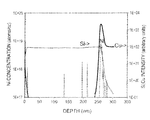
- FIG. 2 Dynamic SIMS (secondary ion mass spectroscopy) data for a copper film pretreated with a hydrogen (H 2 ) plasma, then exposed to 20 seconds of 9% Me 4 Sn in helium, post treated with a H 2 plasma then capped with 400 nm of PECVD (Plasma Enhanced Chemical Vapor Deposition) Si 3 N 4
- PECVD Pullasma Enhanced Chemical Vapor Deposition
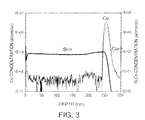
- FIG. 3 Dynamic SIMS (secondary ion mass spectroscopy) data for a copper film pretreated with a hydrogen (H 2 ) plasma, then exposed to 20 seconds of CpCo(CO) 2 , post treated with hydrogen (H 2 ) plasma then capped with 400 nm of PECVD Si 3 N 4 .
- FIG. 4 Dynamic SIMS (secondary ion mass spectroscopy) data for a copper film pretreated with a hydrogen (H 2 ) plasma, then exposed to 20 seconds of CpMn(CO) 3 , post treated with a hydrogen (H 2 ) plasma then capped with 400 nm of PECVD Si 3 N 4 .
- FIG. 5 Dynamic SIMS (secondary ion mass spectroscopy) data for a copper film pretreated with a hydrogen (H 2 ) plasma, then exposed to 20 seconds of EtCp 2 Ni, post treated with a hydrogen (H 2 ) plasma then capped with 400 nm of PECVD Si 3 N 4 .
- H 2 hydrogen
- FIG. 5 Dynamic SIMS (secondary ion mass spectroscopy) data for a copper film pretreated with a hydrogen (H 2 ) plasma, then exposed to 20 seconds of EtCp 2 Ni, post treated with a hydrogen (H 2 ) plasma then capped with 400 nm of PECVD Si 3 N 4 .
- FIG. 6 X-ray photoelectron spectroscopy (XPS) data for the amount of tin at the copper surface presented as a ratio of Sn/Cu (%).
- XPS X-ray photoelectron spectroscopy
- dielectric barrier materials reported in the literature are generally silicon nitride or organosilicon carbonitride based materials, however, there is a desire in the microeletronics industry to use silicon oxide, organosilicon oxycarbide, organosilicon oxynitride, organosilicon carbonitride or organosilicon oxycarbonitride based films as barrier dielectrics because of their reduced dielectric constants.
- the method described in the present invention that is, the use of certain volatile metallic materials as the adhesion promoter may allow for the deposition of oxygen-containing barrier films onto copper layers while retaining excellent adhesion properties.
- Metals under consideration are zinc, silver, chromium, tin, manganese, nickel, aluminum, and cobalt.
- the organometallic precursor is selected from the group consisting of Tetramethyltin (Me 4 Sn), dibutyldimethyltin, tributyltin hydride, tin hydride (SnH4) and tin deuteride (SnD4), Tetraalkyltin, trialkyltin hydride, dialkyltin dihydride, Alkylalkoxytin, Tetraalkoxytin, tetrakis(dialkylamino)tin, cyclopentadienyl cobalt dicarbonyl (CpCo(CO) 2 ), nitrosyl cobalt pentacarbonyl, cyclopentadienyl manganese tricarbonyl (CpMn(CO) 3 ), bis(ethylcyclopentadienyl)nickel ((EtCp) 2 Ni), Diethylzinc (Et 2 Zn), Diethylzinc-Trimethylamine adduct, Di
- a delivery apparatus for the organometallic precursors in the present invention includes any container designed for safety delivery.
- a typical container comprises an interior volume bounded by interior wall, an inlet, and an outlet.
- the organometallic precursor can be contained and delivered at sub-atmospheric pressure in a pressurized container, which includes
- the deposition process used in the present invention can be any known process such as, Atomic Layer Deposition (ALD), Atomic Layer Treatment (ALT), Plasma Enhanced Atomic Layer Deposition (PEALD), Chemical Vapor Deposition(CVD), and Plasma Enhanced Chemical Vapor Deposition(PECVD), Low Pressure Chemical Vapor Deposition(LPCVD), Sub Atmospheric Chemical Vapor Deposition(SACVD), UV-assisted Chemical Vapor Deposition, Filament-assisted Chemical Vapor Deposition (FACVD), and Atmospheric Pressure Chemical Vapor Deposition (APCVD).
- ALD Atomic Layer Deposition
- ALT Atomic Layer Treatment
- PEALD Plasma Enhanced Atomic Layer Deposition
- CVD Chemical Vapor Deposition
- PECVD Plasma Enhanced Chemical Vapor Deposition
- LPCVD Low Pressure Chemical Vapor Deposition
- SACVD Sub Atmospheric Chemical Vapor Deposition
- UV-assisted Chemical Vapor Deposition UV-assisted Chemical Va
- a direct liquid injection (DLI) delivery method can be employed.
- the precursor can be delivered by DLI of either a pure liquid precursor or by DLI of a mixture of the precursor with a solvent in a vessel or a container that is designed for the deposition delivery.
- a typical container comprises an interior volume bounded by interior wall, an inlet, and an outlet.
- Organometallic precursors are vaporized either in the pure form or as mixtures, and the resulting precursor vapor, typically mixed with a carrier gas (such as argon, helium or nitrogen) is transported to a reactor, for example, a chemical vapor deposition (CVD) reactor.
- a carrier gas such as argon, helium or nitrogen
- the organometallic precursor can comprise a solvent which solubilizes the organometallic precursor without decomposing it.
- the weight % of the solvent can be ranging from 5% to 99%; preferably 50% to 90%.
- Suitable solvents can be the simple hydrocarbons of the basic formula C n H (2n+2 ⁇ x) ; where n is 3-10 and x is equal to the number of cyclic structures or the degrees of unsaturation; for example, hexane, hexadiene, pentane, heptane, cyclohexane, cyclooctane or an aromatic hydrocarbon of the general structure C 6 H (6 ⁇ b )R b where R can be 0-6 and can be the same or different, for example toluene, mesytelene, xylene, para-cymene and combinations thereof.
- organometallic precursors may also be soluble in oxygen containing solvents such as ethers, for example diethyl ether, methyl isobutyl ether, or tetrahydrofuran, alcohols, for example methanol, ethanol, or isopropanol, ketones for example acetone, aldehydes, or esters.
- solvents such as ethers, for example diethyl ether, methyl isobutyl ether, or tetrahydrofuran, alcohols, for example methanol, ethanol, or isopropanol, ketones for example acetone, aldehydes, or esters.
- dielectric barrier materials reported in the literature are generally silicon nitride or organosilicon carbonitride based materials, however, there is a desire in the microeletronics industry to use silicon oxide, organosilicon oxycarbide, organosilicon oxynitride, organosilicon carbonitride or organosilicon oxycarbonitride based films as barrier dielectrics because of their reduced dielectric constants.
- the method described in the present invention that is, the use of certain metallic materials, such as tin or zinc, as the adhesion promoter may allow for the deposition of oxygen-containing barrier films onto copper layers while retaining excellent adhesion properties.
- the dielectric barrier layer materials such as silicon nitride, silicon oxide, silicon carbide, silicon oxycarbide, silicon oxynitride, silicon carbonitride, silicon oxycarbonitride and mixtures are considered, where the “silicon” includes “organosilicon”.
- the list of materials includes organosilicon oxycarbide, organosilicon oxynitride, organosilicon carbonitride, organosilicon oxycarbonitride and mixtures.
- the barrier layer has a dielectric constant of less than 7.
- An example of dielectric barrier layer material is a Si 3 N 4 .
- dielectric materials include silicon dioxide, fluorosilicate glass (FSG), organosilicate glass (OSG), aka carbon doped oxide (CDO), or porous low-k dielectric materials.
- FSG fluorosilicate glass
- OSG organosilicate glass
- CDO carbon doped oxide
- low k dielectric materials used in the integration scheme include porous OSG (organosilicate glass) materials such as those deposited from PDEMSTM interlayer dielectric (ILD) deposition process.
- the low k dielectric materials usually have a dielectric constant of less than 3.0.
- the dielectric material has a dielectric constant of less than 3.2.
- the structure comprises:
- the structure can further have a metal barrier layer formed between the patterned dielectric layer and the embedded conductive metal features.
- the metal barrier layer comprises materials such as tantalum, tantalum nitride, titanium, titanium nitride, cobalt, rhuthenium, and other advanced barrier materials which prevent diffusion of the copper into the dielectric material.
- film treatments were carried out on an Applied Materials Precision-5000 system equipped to process 200 mm silicon wafers.
- Thermal treatments were carried out in a D ⁇ L vacuum chamber, organometallic precursors were delivered to the chamber either by vapor draw or entrained with helium as a carrier gas.
- Plasma treatments and deposition of silicon nitride films were carried out in a D ⁇ L vacuum chamber that was fitted with an Advance Energy 200 rf generator. Adhesive energies were measured via 4-point bend using a DTS Company Delaminator instrument. Bulk film resistivity was measured on 100 nm thick copper films using a 4-point probe.
- Silicon nitride cap layers were deposited using a standard Si 3 N 4 deposition recipe: 100 sccm NH 3 , 75 sccm SiH 4 , 2000 sccm N 2 , 3.5 torr chamber pressure, 400 mili-inch susceptor to wafer spacing, 300° C. wafer temperature, and 300 W power.
- Organometallic precursors evaluated were tretramethyltin (Me 4 Sn), cyclopentadienyl cobalt dicarbonyl (CpCo(CO) 2 ), cyclopentadienyl manganese tricarbonyl (CpMn(CO) 3 ), and bis(ethyl-cyclopentadienyl) nickel ((EtCp) 2 Ni).
- Adhesion measurements are widely viewed as an acceptable surrogate measurement to predict performance in promoting electromigration resistance. Adhesion values were measured for copper films treated with various processes and capped with 400 nm of PEVCD Si 3 N 4 . 4-Point bend measurements were made by gluing a piece of silicon wafer on top of the Si 3 N 4 film with epoxy, notching the top silicon wafer and using standard 4-point bend techniques. For examples 1 and 7 a 15 nm thick layer of chromium followed by a 150 nm thick layer of aluminum were deposited by sputtering onto both the silicon wafer and the Si3N4 in order to improve the adhesion strength of the epoxy.
- a series of films were exposed to 30 second hydrogen plasma to examine a baseline process for copper film pretreatment.
- a copper film was treated with a 30 second H 2 plasma followed by deposition of 400 nm of PECVD Si 3 N 4 .
- a porous OSG PDEMS films were deposited by flowing a blend of diethoxymethylsilane (DEMS) and alpha terpinene into a vacuum chamber, striking a plasma to co-deposit an organosilicate glass (OSG) and a sacrificial organic porogen. This film is then annealed in using ultraviolet light to remove the sacrificial porogen to yield a porous OSG.
- DEMS diethoxymethylsilane
- OSG organosilicate glass
- sacrificial organic porogen This film is then annealed in using ultraviolet light to remove the sacrificial porogen to yield a porous OSG.
- porous OSG PDEMS films were then exposed to a 30 second H 2 plasma, this resulted in a increase in the dielectric constant from 2.2 to 2.4, a increase in leakage current from 8 pico-amperes to 168 pico-amperes, and a minor change in breakdown voltage from ⁇ 4 to 3.75 MV/m.
- a series of films were exposed to a 30 second hydrogen plasma pre-treatment, followed by exposure to a mixture of 5% SiH 4 in nitrogen at 4.5 torr for a variable amount of time, and finally to a NH 3 plasma for 30 seconds post-treatment as shown below, in order to examine a baseline process for copper treatment.
- the porous OSG deposited as described in Example 2 was exposed to an organometallic precursor: 9% mixture of Me 4 Sn in helium at 3000° C. for 20 seconds, this resulted in a increase in the dielectric constant from 2.2 to 2.3, a minor change in leakage current from ⁇ 8 pico-amperes to 7 pico-amperes, and a minor change in breakdown voltage from ⁇ 4 to 4.18 MV/m.
- a set of wafers were obtained on which patterned Black DiamondTM organosilicate glass films were filled with copper metal, these patterned features included Kelvin structures of varying line widths (0.14-0.18 microns) to measure copper line resistance and comb-serpintene structures (0.16 ⁇ 0.18 microns) to evaluate leakage current and electrical shorting. These wafers were first treated with a hydrogen plasma at 350 C for 20 seconds to reduce the surface copper oxide, these were then exposed to tetramethyl tin for 30 seconds at 350 C followed by a second hydrogen plasma to remove residual carbon from the surface. These wafers were then electrically probed to test for leakage current and electrical shorts as well as measuring copper line resistance.
- testing of the Kelvin structures revealed that the copper line resistance was not increased by treatment with tetramethyl tin which indicates that the treatment with tetramethyl tin results in only a surface treatment, if the tin had diffused into the copper an increase in copper resistance would have been observed.
- Testing of the Comb-Serpentine structures revealed that the treatment with tetramethyl tin does not increase the line to line leakage current and no electrical shorts were observed indicating that the tetramethyl tin treatment does not deposit a conductive layer of tin on the Organosilicate Glass supporting the fact of selective treatment of the copper surface with tetramethyl tin. Additionally there was no increase in capacitance between metals lines which indicates that the tetramethyl tin treatment does not damage the organosilicate glass.
- Table I shows the effect of various processes on the adhesion between the copper layer and the capping PECVD deposited Si 3 N 4 . These measurements were carried out by the industry standard 4-point bend technique. Unless otherwise noted all films were pretreated with a hydrogen plasma.
- the untreated copper film shows a low adhesion value of 4+/0.5 J/m 2 with delamination at the Si 3 N 4 to copper interface due to the poor adhesion to the native oxide found on copper films.
- Treatment with hydrogen plasma will reduce the copper oxide back to copper metal and an adhesion value of 12.5 J/m 2 is measured with failure observed between the Si 3 N 4 and the copper interface.
- Table II shows the effect of various copper treatments on the bulk resistivity of a 100 nm thick copper film as measured by 4-point probe before and after treatment. All treatments were carried out at 300° C. Exposure of the copper films to just hydrogen or ammonia plasmas lower the bulk resistivity by 8 to 17% presumably due to reduction of the native copper oxide layer found on top of the untreated films. Exposure of the copper to either 5 or 10 seconds of SiH 4 in the “standard silane process” results in significant bulk resistivity increases of 89 and 122% respectively, presumably due to formation of CuSiN and diffusion of Si into the bulk of the copper. Exposure of the copper layer to Me 4 Sn for either 10 or 20 seconds with pre and post hydrogen plasma treatments results in decrease the bulk resistivity by 16 and 13% respectively. These changes are similar to those measured for just hydrogen plasma only treatments, which indicates that the layer which is deposited from the Me 4 Sn exposure does not significantly impact the copper resistivity as is seen with silane exposure.
- Table III shows the effect of Me 4 Sn on the electrical performance of porous organosilicate films such as those produced by PDEMSTM ILD deposition process with a dielectric constant of ⁇ 2.2. This experiment was performed to determine if the Me 4 Sn would diffuse into the pores of a porous OSG potentially degrading the electrical performance of the porous OSG. A PDEMSTM film with a measured dielectric constant of ⁇ 2.2 was exposed to Me 4 Sn for 10 seconds at 300° C. The dielectric constant, leakage current and breakdown voltages are either unaffected or only minimally effected by exposure to the Me 4 Sn.
- This example repeated the same measurement as set in Example 7, but with various exposure times and temperatures.
- Samples of copper films were first in-situ plasma treated with a H 2 plasma to reduce the surface copper oxide (pre-treatment), after which the samples were exposed to tetremethyltin (Me 4 Sn) as a 9% mixture in helium for various exposure times and temperatures. The samples were once again exposed to a H 2 plasma to remove surface carbon (post-treatment). Samples were then submitted for surface X-ray photoelectron spectroscopy (XPS) analysis to measure the Tin on the copper films. The percent tin was measured as a ratio relative to copper.
- XPS surface X-ray photoelectron spectroscopy
- Table IV shows that for all exposures only a small amount of tin was deposited, if it is assumed that a monolayer of tin would be result in a XPS signal of 5 atomic % these samples have slightly less than a monolayer of tin on the surface.
- Table IV shows that for all exposures only a small amount of tin was deposited, if it is assumed that a monolayer of tin would be result in a XPS signal of 5 atomic % these samples have slightly less than a monolayer of tin on the surface.
- the observation that a film exposed for 20 seconds and a film exposed for 80 seconds had essentially the same level of tin indicates that this is a surface limited reaction and not a continual deposition reaction. This is further indicated by the samples which was exposed at 350 C which also showed essentially the same level of tin indicating that the deposition is not thermally driven.
- the amount of tin increased from 1.4%, to 2.0% and finally 3.4% for one, five and ten process cycles, respectively.
- the whole process can be repeated until a desired thickness of the tin on the copper surface is achieved. This indicates that the ALD process can also be used to deposit tin onto the copper surface.
- a mixture of 5 mL tetramethyl tin along with 95 mL anhydrous hexane was prepared in a drybox. This mixture was then delivered to the CVD chamber by means of direct liquid injection of the mixture with a vaporization temperature of 50° C.
- Copper films were first treated with a H 2 plasma to reduce the copper oxide followed by exposure of the film to vapors of the tetramethyl tin/hexane mixture at 350° C. for 30 seconds after which time the films were post-treated with a NH 3 plasma and finally coated with a Silicon carbon nitride film.
Landscapes
- Chemical & Material Sciences (AREA)
- General Chemical & Material Sciences (AREA)
- Chemical Kinetics & Catalysis (AREA)
- Engineering & Computer Science (AREA)
- Materials Engineering (AREA)
- Mechanical Engineering (AREA)
- Metallurgy (AREA)
- Organic Chemistry (AREA)
- Internal Circuitry In Semiconductor Integrated Circuit Devices (AREA)
- Chemical Vapour Deposition (AREA)
- Electrodes Of Semiconductors (AREA)
- Formation Of Insulating Films (AREA)
Priority Applications (7)
| Application Number | Priority Date | Filing Date | Title |
|---|---|---|---|
| US12/406,467 US8043976B2 (en) | 2008-03-24 | 2009-03-18 | Adhesion to copper and copper electromigration resistance |
| TW098109291A TWI479567B (zh) | 2008-03-24 | 2009-03-20 | 改良的對銅的黏著力及銅電遷移阻力 |
| EP09155899.9A EP2105960B8 (de) | 2008-03-24 | 2009-03-23 | Verbesserte Haftung an Kupfer für verbesserten Kupfer-Elektromigrationswiderstand |
| CN200910138735.XA CN101609810B (zh) | 2008-03-24 | 2009-03-24 | 改进半导体器件的粘附力的方法和用于处理半导体器件的方法 |
| JP2009072147A JP5266116B2 (ja) | 2008-03-24 | 2009-03-24 | 銅への改善された接着性および銅エレクトロマイグレーション耐性 |
| KR1020090025008A KR101169501B1 (ko) | 2008-03-24 | 2009-03-24 | 구리에 대한 접착력 및 구리 전자이동 저항을 개선시키는 방법 |
| KR1020110004600A KR20110019398A (ko) | 2008-03-24 | 2011-01-17 | 구리에 대한 접착력 및 구리 전자이동 저항을 개선시키는 방법 |
Applications Claiming Priority (3)
| Application Number | Priority Date | Filing Date | Title |
|---|---|---|---|
| US3887408P | 2008-03-24 | 2008-03-24 | |
| US7484308P | 2008-06-23 | 2008-06-23 | |
| US12/406,467 US8043976B2 (en) | 2008-03-24 | 2009-03-18 | Adhesion to copper and copper electromigration resistance |
Publications (2)
| Publication Number | Publication Date |
|---|---|
| US20090236745A1 US20090236745A1 (en) | 2009-09-24 |
| US8043976B2 true US8043976B2 (en) | 2011-10-25 |
Family
ID=40793197
Family Applications (1)
| Application Number | Title | Priority Date | Filing Date |
|---|---|---|---|
| US12/406,467 Active 2029-09-24 US8043976B2 (en) | 2008-03-24 | 2009-03-18 | Adhesion to copper and copper electromigration resistance |
Country Status (6)
| Country | Link |
|---|---|
| US (1) | US8043976B2 (de) |
| EP (1) | EP2105960B8 (de) |
| JP (1) | JP5266116B2 (de) |
| KR (2) | KR101169501B1 (de) |
| CN (1) | CN101609810B (de) |
| TW (1) | TWI479567B (de) |
Cited By (3)
| Publication number | Priority date | Publication date | Assignee | Title |
|---|---|---|---|---|
| US8709537B2 (en) | 2010-10-22 | 2014-04-29 | Applied Materials, Inc. | Methods for enhancing tantalum filament life in hot wire chemical vapor deposition processes |
| US9673042B2 (en) | 2015-09-01 | 2017-06-06 | Applied Materials, Inc. | Methods and apparatus for in-situ cleaning of copper surfaces and deposition and removal of self-assembled monolayers |
| US11571876B2 (en) | 2017-03-17 | 2023-02-07 | Intel Corporation | Dielectric film with pressure sensitive microcapsules of adhesion promoter |
Families Citing this family (12)
| Publication number | Priority date | Publication date | Assignee | Title |
|---|---|---|---|---|
| JP5530118B2 (ja) * | 2009-04-08 | 2014-06-25 | 東京エレクトロン株式会社 | 酸化マンガン膜の形成方法、半導体装置の製造方法および半導体装置 |
| JP2013213269A (ja) * | 2012-04-04 | 2013-10-17 | Tokyo Electron Ltd | 成膜方法及び記憶媒体 |
| KR101715964B1 (ko) | 2012-06-04 | 2017-03-13 | 삼성에스디아이 주식회사 | 이차 전지 |
| US11761086B2 (en) * | 2014-02-23 | 2023-09-19 | Entegris, Inc. | Cobalt precursors |
| KR102019468B1 (ko) * | 2016-11-29 | 2019-09-06 | 주식회사 엘지화학 | 반도체용 접착 필름 및 반도체 장치 |
| CA2975104A1 (en) | 2017-08-02 | 2019-02-02 | Seastar Chemicals Inc. | Organometallic compounds and methods for the deposition of high purity tin oxide |
| US10580645B2 (en) * | 2018-04-30 | 2020-03-03 | Asm Ip Holding B.V. | Plasma enhanced atomic layer deposition (PEALD) of SiN using silicon-hydrohalide precursors |
| JP7213642B2 (ja) * | 2018-09-05 | 2023-01-27 | 東京エレクトロン株式会社 | レジスト膜の製造方法 |
| US11769692B2 (en) | 2018-10-31 | 2023-09-26 | Taiwan Semiconductor Manufacturing Co., Ltd. | High breakdown voltage inter-metal dielectric layer |
| JP2022161040A (ja) * | 2019-09-17 | 2022-10-21 | 株式会社Adeka | 原子層堆積法のための薄膜形成原料及びそれを用いた亜鉛含有薄膜の製造方法 |
| JP7345787B2 (ja) * | 2020-04-30 | 2023-09-19 | 東京エレクトロン株式会社 | 選択成膜方法 |
| US12014956B2 (en) | 2021-09-28 | 2024-06-18 | Applied Materials, Inc. | Tungsten gapfill using molybdenum co-flow |
Citations (22)
| Publication number | Priority date | Publication date | Assignee | Title |
|---|---|---|---|---|
| US5494742A (en) | 1993-01-14 | 1996-02-27 | Matsushita Electric Industrial Co., Ltd. | Magnetic recording medium having improved running time and corrosion resistance |
| US6147000A (en) | 1998-08-11 | 2000-11-14 | Advanced Micro Devices, Inc. | Method for forming low dielectric passivation of copper interconnects |
| WO2001008213A1 (en) | 1999-07-27 | 2001-02-01 | International Business Machines Corporation | REDUCED ELECTROMIGRATION AND STRESS INDUCED MIGRATION OF Cu WIRES BY SURFACE COATING |
| US6444264B2 (en) | 1995-03-31 | 2002-09-03 | Advanced Technology Materials, Inc. | Method for liquid delivery CVD utilizing alkane and polyamine solvent compositions |
| US6479389B1 (en) | 1999-10-04 | 2002-11-12 | Taiwan Semiconductor Manufacturing Company | Method of doping copper metallization |
| US20030207564A1 (en) * | 2001-01-08 | 2003-11-06 | Ahn Kie Y. | Copper dual damascene interconnect technology |
| KR100443796B1 (ko) | 2002-06-29 | 2004-08-11 | 주식회사 하이닉스반도체 | 구리 금속 배선 형성방법 |
| US6846515B2 (en) | 2002-04-17 | 2005-01-25 | Air Products And Chemicals, Inc. | Methods for using porogens and/or porogenated precursors to provide porous organosilica glass films with low dielectric constants |
| US6979625B1 (en) | 2003-11-12 | 2005-12-27 | Advanced Micro Devices, Inc. | Copper interconnects with metal capping layer and selective copper alloys |
| JP2006063386A (ja) | 2004-08-26 | 2006-03-09 | Tokyo Electron Ltd | 半導体装置の製造方法 |
| US7013916B1 (en) | 1997-11-14 | 2006-03-21 | Air Products And Chemicals, Inc. | Sub-atmospheric gas delivery method and apparatus |
| US7087524B2 (en) | 2003-07-09 | 2006-08-08 | Hynix Semiconductor Inc. | Method of forming copper wiring in semiconductor device |
| US7153774B2 (en) | 2002-06-06 | 2006-12-26 | Intel Corporation | Method of making a semiconductor device that has copper damascene interconnects with enhanced electromigration reliability |
| US7193325B2 (en) | 2004-04-30 | 2007-03-20 | Taiwan Semiconductor Manufacturing Company, Ltd. | Reliability improvement of SiOC etch with trimethylsilane gas passivation in Cu damascene interconnects |
| CN1946875A (zh) | 2004-03-24 | 2007-04-11 | 埃其玛公司 | 选择性涂覆复合材料表面的方法、使用该方法的微电子互连制造和集成电路 |
| US20070125884A1 (en) | 2004-04-08 | 2007-06-07 | Richard Bloc | Airless Dispenser For Dispensing Low Doses Of Liquid Products, In Particular Cosmetic Or Pharmaceutical Products |
| US7229911B2 (en) | 2004-04-19 | 2007-06-12 | Applied Materials, Inc. | Adhesion improvement for low k dielectrics to conductive materials |
| US7247946B2 (en) | 2005-01-18 | 2007-07-24 | International Business Machines Corporation | On-chip Cu interconnection using 1 to 5 nm thick metal cap |
| US20070299239A1 (en) | 2006-06-27 | 2007-12-27 | Air Products And Chemicals, Inc. | Curing Dielectric Films Under A Reducing Atmosphere |
| US7332445B2 (en) | 2004-09-28 | 2008-02-19 | Air Products And Chemicals, Inc. | Porous low dielectric constant compositions and methods for making and using same |
| US7351449B2 (en) | 2000-09-22 | 2008-04-01 | N Gimat Co. | Chemical vapor deposition methods for making powders and coatings, and coatings made using these methods |
| US7374701B2 (en) | 2003-06-30 | 2008-05-20 | Samsung Electronics Co., Ltd. | Organometallic precursor composition and method of forming metal film or pattern using the same |
Family Cites Families (12)
| Publication number | Priority date | Publication date | Assignee | Title |
|---|---|---|---|---|
| GB9724168D0 (en) * | 1997-11-14 | 1998-01-14 | Air Prod & Chem | Gas control device and method of supplying gas |
| US6355571B1 (en) * | 1998-11-17 | 2002-03-12 | Applied Materials, Inc. | Method and apparatus for reducing copper oxidation and contamination in a semiconductor device |
| US6984591B1 (en) * | 2000-04-20 | 2006-01-10 | International Business Machines Corporation | Precursor source mixtures |
| US6645550B1 (en) * | 2000-06-22 | 2003-11-11 | Applied Materials, Inc. | Method of treating a substrate |
| US20020048926A1 (en) * | 2000-09-14 | 2002-04-25 | Konecni Anthony J. | Method for forming a self-aligned copper capping diffusion barrier |
| US6518167B1 (en) * | 2002-04-16 | 2003-02-11 | Advanced Micro Devices, Inc. | Method of forming a metal or metal nitride interface layer between silicon nitride and copper |
| JP3992588B2 (ja) * | 2002-10-23 | 2007-10-17 | 東京エレクトロン株式会社 | 成膜方法 |
| CN100345999C (zh) * | 2003-01-02 | 2007-10-31 | 上海华虹(集团)有限公司 | 采用含钛有机金属材料的化学气相淀积含硅氮化钛的工艺 |
| US7476618B2 (en) * | 2004-10-26 | 2009-01-13 | Asm Japan K.K. | Selective formation of metal layers in an integrated circuit |
| JP5116251B2 (ja) * | 2005-05-20 | 2013-01-09 | 株式会社半導体エネルギー研究所 | 半導体装置の作製方法 |
| JP2007035734A (ja) * | 2005-07-25 | 2007-02-08 | Nec Electronics Corp | 半導体装置およびその製造方法 |
| TW200802703A (en) * | 2005-11-28 | 2008-01-01 | Nxp Bv | Method of forming a self aligned copper capping layer |
-
2009
- 2009-03-18 US US12/406,467 patent/US8043976B2/en active Active
- 2009-03-20 TW TW098109291A patent/TWI479567B/zh active
- 2009-03-23 EP EP09155899.9A patent/EP2105960B8/de active Active
- 2009-03-24 KR KR1020090025008A patent/KR101169501B1/ko active Active
- 2009-03-24 CN CN200910138735.XA patent/CN101609810B/zh active Active
- 2009-03-24 JP JP2009072147A patent/JP5266116B2/ja not_active Expired - Fee Related
-
2011
- 2011-01-17 KR KR1020110004600A patent/KR20110019398A/ko not_active Ceased
Patent Citations (27)
| Publication number | Priority date | Publication date | Assignee | Title |
|---|---|---|---|---|
| US5494742A (en) | 1993-01-14 | 1996-02-27 | Matsushita Electric Industrial Co., Ltd. | Magnetic recording medium having improved running time and corrosion resistance |
| US6444264B2 (en) | 1995-03-31 | 2002-09-03 | Advanced Technology Materials, Inc. | Method for liquid delivery CVD utilizing alkane and polyamine solvent compositions |
| US7013916B1 (en) | 1997-11-14 | 2006-03-21 | Air Products And Chemicals, Inc. | Sub-atmospheric gas delivery method and apparatus |
| US6147000A (en) | 1998-08-11 | 2000-11-14 | Advanced Micro Devices, Inc. | Method for forming low dielectric passivation of copper interconnects |
| US20050266673A1 (en) | 1999-07-27 | 2005-12-01 | International Business Machines Corporation | Reduced electromigration and stressed induced migration of copper wires by surface coating |
| WO2001008213A1 (en) | 1999-07-27 | 2001-02-01 | International Business Machines Corporation | REDUCED ELECTROMIGRATION AND STRESS INDUCED MIGRATION OF Cu WIRES BY SURFACE COATING |
| US6342733B1 (en) | 1999-07-27 | 2002-01-29 | International Business Machines Corporation | Reduced electromigration and stressed induced migration of Cu wires by surface coating |
| US20020098681A1 (en) | 1999-07-27 | 2002-07-25 | Chao-Kun Hu | Reduced electromigration and stressed induced migration of Cu wires by surface coating |
| US6479389B1 (en) | 1999-10-04 | 2002-11-12 | Taiwan Semiconductor Manufacturing Company | Method of doping copper metallization |
| US7351449B2 (en) | 2000-09-22 | 2008-04-01 | N Gimat Co. | Chemical vapor deposition methods for making powders and coatings, and coatings made using these methods |
| US20030207564A1 (en) * | 2001-01-08 | 2003-11-06 | Ahn Kie Y. | Copper dual damascene interconnect technology |
| US6846515B2 (en) | 2002-04-17 | 2005-01-25 | Air Products And Chemicals, Inc. | Methods for using porogens and/or porogenated precursors to provide porous organosilica glass films with low dielectric constants |
| US7153774B2 (en) | 2002-06-06 | 2006-12-26 | Intel Corporation | Method of making a semiconductor device that has copper damascene interconnects with enhanced electromigration reliability |
| KR100443796B1 (ko) | 2002-06-29 | 2004-08-11 | 주식회사 하이닉스반도체 | 구리 금속 배선 형성방법 |
| KR100974778B1 (ko) | 2003-06-30 | 2010-08-06 | 삼성전자주식회사 | 유기금속 전구체 조성물 및 이를 이용한 금속 필름 또는패턴 형성방법 |
| US7374701B2 (en) | 2003-06-30 | 2008-05-20 | Samsung Electronics Co., Ltd. | Organometallic precursor composition and method of forming metal film or pattern using the same |
| US7087524B2 (en) | 2003-07-09 | 2006-08-08 | Hynix Semiconductor Inc. | Method of forming copper wiring in semiconductor device |
| US6979625B1 (en) | 2003-11-12 | 2005-12-27 | Advanced Micro Devices, Inc. | Copper interconnects with metal capping layer and selective copper alloys |
| CN1946875A (zh) | 2004-03-24 | 2007-04-11 | 埃其玛公司 | 选择性涂覆复合材料表面的方法、使用该方法的微电子互连制造和集成电路 |
| US20070125884A1 (en) | 2004-04-08 | 2007-06-07 | Richard Bloc | Airless Dispenser For Dispensing Low Doses Of Liquid Products, In Particular Cosmetic Or Pharmaceutical Products |
| US7229911B2 (en) | 2004-04-19 | 2007-06-12 | Applied Materials, Inc. | Adhesion improvement for low k dielectrics to conductive materials |
| US7193325B2 (en) | 2004-04-30 | 2007-03-20 | Taiwan Semiconductor Manufacturing Company, Ltd. | Reliability improvement of SiOC etch with trimethylsilane gas passivation in Cu damascene interconnects |
| JP2006063386A (ja) | 2004-08-26 | 2006-03-09 | Tokyo Electron Ltd | 半導体装置の製造方法 |
| US7332445B2 (en) | 2004-09-28 | 2008-02-19 | Air Products And Chemicals, Inc. | Porous low dielectric constant compositions and methods for making and using same |
| US7247946B2 (en) | 2005-01-18 | 2007-07-24 | International Business Machines Corporation | On-chip Cu interconnection using 1 to 5 nm thick metal cap |
| US20070299239A1 (en) | 2006-06-27 | 2007-12-27 | Air Products And Chemicals, Inc. | Curing Dielectric Films Under A Reducing Atmosphere |
| KR100907387B1 (ko) | 2006-06-27 | 2009-07-10 | 에어 프로덕츠 앤드 케미칼스, 인코오포레이티드 | 환원 분위기 하에서 유전 필름을 경화시키는 방법 |
Non-Patent Citations (7)
| Title |
|---|
| E. Todd Ryan, et al, Line Resistance and Electromigration Variations Induced by Hydrogen-Based Plasma Modifications to the Silicon Carbonitride/Copper Interface, Journal of the Electrochemical Society, 2007, H604-H610, 154. |
| H. Kim, et al, Process design of Cu(Sn) alloy deposition for highly reliable ultra large-scale integration interconnects, Thin Solid Films, 2005, 221-227, 491. |
| James R. Lloyd, et al, Electromigration and Adhesion, IEEE Transactions on Device and Materials Reliability, Mar. 2005, 113-118, 5. |
| M.Y. Yan, et al, Effect of Cu3Sn coatings on electromigration lifetime improvement of Cu dual-damascene interfonnects, Applied Physics Letters, 2005, 211103-1-3, 87. |
| Munehiro Tada, et al, Improving Reliability of Copper Dual-Damascene Interconnects by Impurity Doping and Interface Strengthening, IEEE Transactions on Electron Devices, Aug. 2007, 1867-1877, 54. |
| Peter Singer, The Advantages of Capping Copper With Cobalt, Semiconductor International, Oct. 2005, 44-48. |
| S. Chhun, et al, Cu surface treatment influence on Si adsorption properties of CuSiN self-aligned barriers for sub-65 nm technology node, Microelectronic Engineering, 2006, 2094-2100, 83. |
Cited By (3)
| Publication number | Priority date | Publication date | Assignee | Title |
|---|---|---|---|---|
| US8709537B2 (en) | 2010-10-22 | 2014-04-29 | Applied Materials, Inc. | Methods for enhancing tantalum filament life in hot wire chemical vapor deposition processes |
| US9673042B2 (en) | 2015-09-01 | 2017-06-06 | Applied Materials, Inc. | Methods and apparatus for in-situ cleaning of copper surfaces and deposition and removal of self-assembled monolayers |
| US11571876B2 (en) | 2017-03-17 | 2023-02-07 | Intel Corporation | Dielectric film with pressure sensitive microcapsules of adhesion promoter |
Also Published As
| Publication number | Publication date |
|---|---|
| EP2105960A3 (de) | 2012-04-04 |
| CN101609810A (zh) | 2009-12-23 |
| KR20090101859A (ko) | 2009-09-29 |
| KR101169501B1 (ko) | 2012-07-27 |
| KR20110019398A (ko) | 2011-02-25 |
| EP2105960B1 (de) | 2017-08-02 |
| JP5266116B2 (ja) | 2013-08-21 |
| TW200945440A (en) | 2009-11-01 |
| US20090236745A1 (en) | 2009-09-24 |
| CN101609810B (zh) | 2014-06-04 |
| JP2009239283A (ja) | 2009-10-15 |
| EP2105960B8 (de) | 2017-10-11 |
| EP2105960A2 (de) | 2009-09-30 |
| TWI479567B (zh) | 2015-04-01 |
Similar Documents
| Publication | Publication Date | Title |
|---|---|---|
| US8043976B2 (en) | Adhesion to copper and copper electromigration resistance | |
| Au et al. | Selective chemical vapor deposition of manganese self-aligned capping layer for Cu interconnections in microelectronics | |
| US6380080B2 (en) | Methods for preparing ruthenium metal films | |
| US7435484B2 (en) | Ruthenium thin film-formed structure | |
| Vos et al. | Atomic layer deposition of cobalt using H2-, N2-, and NH3-based plasmas: on the role of the co-reactant | |
| US7799671B1 (en) | Interfacial layers for electromigration resistance improvement in damascene interconnects | |
| US7755192B2 (en) | Copper interconnection structure, barrier layer including carbon and hydrogen | |
| EP2251899B1 (de) | Abscheidung einer dielektrischen Sperre mittels stickstoffhaltigem Vorläufer | |
| Hong et al. | Atomic layer deposition of Ru thin films using a Ru (0) metallorganic precursor and O2 | |
| TW201404918A (zh) | 不含氧的矽基膜及其形成方法 | |
| WO2000017278A1 (en) | Method for the chemical vapor deposition of copper-based films and copper source precursors for the same | |
| Kim et al. | Some Insights into Atomic Layer Deposition of MoN x Using Mo (CO) 6 and NH3 and Its Diffusion Barrier Application | |
| Lu et al. | A new process for depositing tungsten nitride thin films | |
| Patelli et al. | SiOx‐based multilayer barrier coatings produced by a single PECVD process | |
| Lee et al. | Development and characterization of a PECVD silicon nitride for damascene applications | |
| Mao et al. | Scaling of copper seed layer thickness using plasma-enhanced ALD and optimized precursors | |
| Hinz et al. | Analysis of NbN thin film deposition by plasma-enhanced ALD for gate electrode application | |
| JP2015106572A (ja) | シリコン窒化膜の形成方法及びシリコン窒化膜 | |
| US20120328798A1 (en) | Inter-low-permittivity layer insulating film, and method for forming inter-low-permittivity layer insulating film | |
| Meškinis et al. | Dielectric properties of the ion beam deposited SiOx doped DLC films | |
| Shim et al. | Effects of annealing on the properties of Cu/low k polymer/Si structures prepared by plasma polymerization of decahydronaphthalene and tetraethylorthosilicate and Cu sputtering | |
| Wojcik et al. | A comparative study of thermal and plasma enhanced ALD Ta-NC films on SiO 2, SiCOH and Cu substrates | |
| Kim et al. | Chemical interaction and adhesion characteristics at the interface of metals (Cu, Ta) and low-k cyclohexane-based plasma polymer (CHexPP) films | |
| Kim et al. | Properties of chemically vapor deposited blanket tungsten films on tin glue layers prepared by chemical vapor deposition | |
| Martini | Metallization and modification of low-k dielectric materials |
Legal Events
| Date | Code | Title | Description |
|---|---|---|---|
| AS | Assignment |
Owner name: AIR PRODUCTS AND CHEMICALS, INC., PENNSYLVANIA Free format text: ASSIGNMENT OF ASSIGNORS INTEREST;ASSIGNORS:VRTIS, RAYMOND NICHOLAS;MATZ, LAURA M.;O'NEILL, MARK LEONARD;REEL/FRAME:022679/0177;SIGNING DATES FROM 20090320 TO 20090325 Owner name: AIR PRODUCTS AND CHEMICALS, INC., PENNSYLVANIA Free format text: ASSIGNMENT OF ASSIGNORS INTEREST;ASSIGNORS:VRTIS, RAYMOND NICHOLAS;MATZ, LAURA M.;O'NEILL, MARK LEONARD;SIGNING DATES FROM 20090320 TO 20090325;REEL/FRAME:022679/0177 |
|
| STCF | Information on status: patent grant |
Free format text: PATENTED CASE |
|
| CC | Certificate of correction | ||
| CC | Certificate of correction | ||
| FPAY | Fee payment |
Year of fee payment: 4 |
|
| AS | Assignment |
Owner name: CITIBANK, N.A., AS COLLATERAL AGENT, DELAWARE Free format text: PATENT SECURITY AGREEMENT;ASSIGNOR:VERSUM MATERIALS US, LLC;REEL/FRAME:040503/0442 Effective date: 20160930 |
|
| AS | Assignment |
Owner name: VERSUM MATERIALS US, LLC, ARIZONA Free format text: ASSIGNMENT OF ASSIGNORS INTEREST;ASSIGNOR:AIR PRODUCTS AND CHEMICALS, INC.;REEL/FRAME:041772/0733 Effective date: 20170214 |
|
| MAFP | Maintenance fee payment |
Free format text: PAYMENT OF MAINTENANCE FEE, 8TH YEAR, LARGE ENTITY (ORIGINAL EVENT CODE: M1552); ENTITY STATUS OF PATENT OWNER: LARGE ENTITY Year of fee payment: 8 |
|
| AS | Assignment |
Owner name: VERSUM MATERIALS US, LLC, ARIZONA Free format text: RELEASE BY SECURED PARTY;ASSIGNOR:CITIBANK, N.A., AS AGENT;REEL/FRAME:050647/0001 Effective date: 20191007 |
|
| MAFP | Maintenance fee payment |
Free format text: PAYMENT OF MAINTENANCE FEE, 12TH YEAR, LARGE ENTITY (ORIGINAL EVENT CODE: M1553); ENTITY STATUS OF PATENT OWNER: LARGE ENTITY Year of fee payment: 12 |