US7902946B2 - MEMS relay with a flux path that is decoupled from an electrical path through the switch and a suspension structure that is independent of the core structure and a method of forming the same - Google Patents
MEMS relay with a flux path that is decoupled from an electrical path through the switch and a suspension structure that is independent of the core structure and a method of forming the same Download PDFInfo
- Publication number
- US7902946B2 US7902946B2 US12/218,368 US21836808A US7902946B2 US 7902946 B2 US7902946 B2 US 7902946B2 US 21836808 A US21836808 A US 21836808A US 7902946 B2 US7902946 B2 US 7902946B2
- Authority
- US
- United States
- Prior art keywords
- conductive
- magnetic member
- forming
- coil
- layer
- Prior art date
- Legal status (The legal status is an assumption and is not a legal conclusion. Google has not performed a legal analysis and makes no representation as to the accuracy of the status listed.)
- Active, expires
Links
- 238000000034 method Methods 0.000 title claims description 42
- 239000000725 suspension Substances 0.000 title abstract description 42
- 230000004907 flux Effects 0.000 title abstract description 17
- 239000000463 material Substances 0.000 claims description 9
- 230000004044 response Effects 0.000 claims description 7
- 239000004065 semiconductor Substances 0.000 claims description 7
- 239000000696 magnetic material Substances 0.000 claims description 2
- 239000004020 conductor Substances 0.000 claims 9
- 238000005530 etching Methods 0.000 claims 3
- 230000015556 catabolic process Effects 0.000 abstract description 2
- 238000006731 degradation reaction Methods 0.000 abstract description 2
- 229910052751 metal Inorganic materials 0.000 description 26
- 239000002184 metal Substances 0.000 description 26
- RYGMFSIKBFXOCR-UHFFFAOYSA-N Copper Chemical compound [Cu] RYGMFSIKBFXOCR-UHFFFAOYSA-N 0.000 description 21
- 238000007747 plating Methods 0.000 description 18
- 229910052802 copper Inorganic materials 0.000 description 16
- 239000010949 copper Substances 0.000 description 16
- RTAQQCXQSZGOHL-UHFFFAOYSA-N Titanium Chemical compound [Ti] RTAQQCXQSZGOHL-UHFFFAOYSA-N 0.000 description 13
- 239000010936 titanium Substances 0.000 description 13
- 229910052719 titanium Inorganic materials 0.000 description 13
- 230000015572 biosynthetic process Effects 0.000 description 10
- 230000037361 pathway Effects 0.000 description 7
- PXHVJJICTQNCMI-UHFFFAOYSA-N Nickel Chemical compound [Ni] PXHVJJICTQNCMI-UHFFFAOYSA-N 0.000 description 6
- 238000009713 electroplating Methods 0.000 description 6
- -1 100 Å thick) Chemical compound 0.000 description 5
- VYZAMTAEIAYCRO-UHFFFAOYSA-N Chromium Chemical compound [Cr] VYZAMTAEIAYCRO-UHFFFAOYSA-N 0.000 description 4
- 238000000151 deposition Methods 0.000 description 4
- PCHJSUWPFVWCPO-UHFFFAOYSA-N gold Chemical compound [Au] PCHJSUWPFVWCPO-UHFFFAOYSA-N 0.000 description 4
- 229910052737 gold Inorganic materials 0.000 description 4
- 239000010931 gold Substances 0.000 description 4
- 238000000059 patterning Methods 0.000 description 4
- 229910021421 monocrystalline silicon Inorganic materials 0.000 description 3
- 229910052759 nickel Inorganic materials 0.000 description 3
- XEEYBQQBJWHFJM-UHFFFAOYSA-N Iron Chemical compound [Fe] XEEYBQQBJWHFJM-UHFFFAOYSA-N 0.000 description 2
- NRTOMJZYCJJWKI-UHFFFAOYSA-N Titanium nitride Chemical compound [Ti]#N NRTOMJZYCJJWKI-UHFFFAOYSA-N 0.000 description 2
- 230000008569 process Effects 0.000 description 2
- 229910000640 Fe alloy Inorganic materials 0.000 description 1
- 229910000990 Ni alloy Inorganic materials 0.000 description 1
- 229910052782 aluminium Inorganic materials 0.000 description 1
- XAGFODPZIPBFFR-UHFFFAOYSA-N aluminium Chemical compound [Al] XAGFODPZIPBFFR-UHFFFAOYSA-N 0.000 description 1
- WPPDFTBPZNZZRP-UHFFFAOYSA-N aluminum copper Chemical compound [Al].[Cu] WPPDFTBPZNZZRP-UHFFFAOYSA-N 0.000 description 1
- 229910021417 amorphous silicon Inorganic materials 0.000 description 1
- 230000005672 electromagnetic field Effects 0.000 description 1
- 238000005516 engineering process Methods 0.000 description 1
- 238000001704 evaporation Methods 0.000 description 1
- 238000004519 manufacturing process Methods 0.000 description 1
- 229910000889 permalloy Inorganic materials 0.000 description 1
- 229920002120 photoresistant polymer Polymers 0.000 description 1
- 238000005498 polishing Methods 0.000 description 1
- WFKWXMTUELFFGS-UHFFFAOYSA-N tungsten Chemical compound [W] WFKWXMTUELFFGS-UHFFFAOYSA-N 0.000 description 1
- 229910052721 tungsten Inorganic materials 0.000 description 1
- 239000010937 tungsten Substances 0.000 description 1
- 229910052727 yttrium Inorganic materials 0.000 description 1
Images




Classifications
-
- H—ELECTRICITY
- H01—ELECTRIC ELEMENTS
- H01H—ELECTRIC SWITCHES; RELAYS; SELECTORS; EMERGENCY PROTECTIVE DEVICES
- H01H50/00—Details of electromagnetic relays
- H01H50/005—Details of electromagnetic relays using micromechanics
-
- H—ELECTRICITY
- H01—ELECTRIC ELEMENTS
- H01H—ELECTRIC SWITCHES; RELAYS; SELECTORS; EMERGENCY PROTECTIVE DEVICES
- H01H59/00—Electrostatic relays; Electro-adhesion relays
-
- B—PERFORMING OPERATIONS; TRANSPORTING
- B81—MICROSTRUCTURAL TECHNOLOGY
- B81B—MICROSTRUCTURAL DEVICES OR SYSTEMS, e.g. MICROMECHANICAL DEVICES
- B81B3/00—Devices comprising flexible or deformable elements, e.g. comprising elastic tongues or membranes
-
- H—ELECTRICITY
- H01—ELECTRIC ELEMENTS
- H01H—ELECTRIC SWITCHES; RELAYS; SELECTORS; EMERGENCY PROTECTIVE DEVICES
- H01H3/00—Mechanisms for operating contacts
- H01H3/22—Power arrangements internal to the switch for operating the driving mechanism
- H01H3/28—Power arrangements internal to the switch for operating the driving mechanism using electromagnet
-
- H—ELECTRICITY
- H01—ELECTRIC ELEMENTS
- H01H—ELECTRIC SWITCHES; RELAYS; SELECTORS; EMERGENCY PROTECTIVE DEVICES
- H01H49/00—Apparatus or processes specially adapted to the manufacture of relays or parts thereof
-
- H—ELECTRICITY
- H01—ELECTRIC ELEMENTS
- H01H—ELECTRIC SWITCHES; RELAYS; SELECTORS; EMERGENCY PROTECTIVE DEVICES
- H01H51/00—Electromagnetic relays
- H01H51/02—Non-polarised relays
- H01H51/04—Non-polarised relays with single armature; with single set of ganged armatures
- H01H51/06—Armature is movable between two limit positions of rest and is moved in one direction due to energisation of an electromagnet and after the electromagnet is de-energised is returned by energy stored during the movement in the first direction, e.g. by using a spring, by using a permanent magnet, by gravity
-
- Y—GENERAL TAGGING OF NEW TECHNOLOGICAL DEVELOPMENTS; GENERAL TAGGING OF CROSS-SECTIONAL TECHNOLOGIES SPANNING OVER SEVERAL SECTIONS OF THE IPC; TECHNICAL SUBJECTS COVERED BY FORMER USPC CROSS-REFERENCE ART COLLECTIONS [XRACs] AND DIGESTS
- Y10—TECHNICAL SUBJECTS COVERED BY FORMER USPC
- Y10T—TECHNICAL SUBJECTS COVERED BY FORMER US CLASSIFICATION
- Y10T29/00—Metal working
- Y10T29/49—Method of mechanical manufacture
- Y10T29/49002—Electrical device making
- Y10T29/49105—Switch making
Definitions
- the present invention relates to relays and, more particularly, to a MEMS relay that has a flux path from magnetic actuation that is decoupled from an electrical path through the switch, and a suspension structure that is independent of the core structure, and a method of forming the same.
- a switch is a well-known device that connects, disconnects, or changes connections between devices.
- An electrical switch is a switch that provides a low-impedance electrical pathway when the switch is “closed,” and a high-impedance electrical pathway when the switch is “opened.”
- a mechanical-electrical switch is a type of switch where the low-impedance electrical pathway is formed by physically bringing two electrical contacts together, and the high-impedance electrical pathway is formed by physically separating the two electrical contacts from each other.
- An actuator is a well-known mechanical device that moves or controls a mechanical member to move or control another device.
- Actuators are commonly used with mechanical-electrical switches to move or control a mechanical member that closes and opens the switch, thereby providing the low-impedance and high-impedance electrical pathways, respectively, in response to the actuator.
- a relay is a combination of a switch and an actuator where the mechanical member in the actuator moves in response to electromagnetic changes in the conditions of an electrical circuit. For example, electromagnetic changes due to the presence or absence of a current in a coil can cause the mechanical member in the actuator to close and open the switch.
- MEMS micro-electromechanical system
- MEMS relays are passing signals with very small amplitudes through the switch, fluctuations in the current around the core and, thereby the flux, can lead to an unacceptable degradation of the signal passing through the switch.
- a MEMS relay that has a flux path that is decoupled from the electrical path through the switch.
- the suspension structure is typically formed as part of the core structure.
- the suspension and core structures commonly have conflicting requirements.
- the ideal geometry of the core structure is a short flux path with a large cross-sectional area.
- the ideal geometry of the suspension structure is a long path with a small cross-sectional area because this reduces the spring stiffness of the beam, and thus the force required to close the switch.
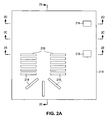
- FIGS. 2A-15A , 2 B- 15 B, 2 C- 15 C, 2 D- 15 D, and 2 E- 15 E are a series of views that illustrate an example of method 100 in accordance with the present invention.
- FIGS. 2A-15A are plan views.
- FIGS. 2B-15B are cross-sectional views taken along lines 2 B- 2 B of FIGS. 2 A through 15 B- 15 B of FIG. 15A , respectively.
- FIGS. 2C-15C are cross-sectional views taken along lines 2 C- 2 C of FIGS. 2 A through 15 C- 15 C of FIG. 15A , respectively.
- FIGS. 2D-15D are cross-sectional views taken along lines 2 D- 2 D of FIGS. 2 A through 15 D- 15 D of FIG. 15A , respectively.
- FIGS. 2E-15E are cross-sectional views taken along lines 2 E- 2 E of FIGS. 2 A through 15 E- 15 E of FIG. 15A , respectively.
- FIGS. 16A-18A , 16 B- 18 B, 16 C- 18 C, 16 D- 18 D, and 16 E- 18 E are a series of views illustrating a first example of an alternate way of implementing element 110 of method 100 in accordance with the present invention.
- FIGS. 16A-18A are plan views.
- FIGS. 16B-18B are cross-sectional views taken along lines 16 B- 16 B of FIG. 16 A through 18 B- 18 B of FIG. 18A , respectively.
- FIGS. 16C-18C are cross-sectional views taken along lines 16 C- 16 C of FIG. 16 A through 18 C- 18 C of FIG. 18A , respectively.
- FIGS. 16D-18D are cross-sectional views taken along lines 16 D- 16 D of FIG. 16 A through 18 D- 18 D of FIG. 18A , respectively.
- FIGS. 16E-18E are cross-sectional views taken along lines 16 E- 16 E of FIG. 16 A through 18 E- 18 E of FIG. 18A , respectively.
- FIGS. 19A-21A , 19 B- 21 B, 19 C- 21 C, 19 D- 21 D, and 19 E- 21 E are a series of views illustrating a second example of an alternate way of implementing element 110 of method 100 in accordance with the present invention.
- FIGS. 19A-21A are plan views.
- FIGS. 19B-21B are cross-sectional views taken along lines 19 B- 19 B of FIG. 19 A through 21 B- 21 B of FIG. 21A , respectively.
- FIGS. 19C-21C are cross-sectional views taken along lines 19 C- 19 C of FIG. 19 A through 21 C- 21 C of FIG. 21A , respectively.
- FIGS. 19D-21D are cross-sectional views taken along lines 19 D- 19 D of FIG. 19 A through 21 D- 21 D of FIG. 21A , respectively.
- FIGS. 19E-21E are cross-sectional views taken along lines 19 E- 19 E of FIG. 19 A through 21 E- 21 E of FIG. 21A , respectively.
- FIGS. 22A-26A , 22 B- 26 B, 22 C- 26 C, 22 D- 26 D, and 22 E- 26 E are a series of views illustrating an example of an alternate way of implementing element 118 of method 100 in accordance with the present invention.
- FIGS. 22A-26A are plan views.
- FIGS. 22B-26B are cross-sectional views taken along lines 22 B- 22 B of FIG. 22 A through 26 B- 26 B of FIG. 26A , respectively.
- FIGS. 22C-26C are cross-sectional views taken along lines 22 C- 22 C of FIG. 22 A through 26 C- 26 C of FIG. 26A , respectively.
- FIGS. 22D-26D are cross-sectional views taken along lines 22 D- 22 D of FIG. 22 A through 26 D- 26 D of FIG. 26A , respectively.
- FIGS. 22E-26E are cross-sectional views taken along lines 22 E- 22 E of FIG. 22 A through 26 E- 26 E of FIG. 26A , respectively
- FIGS. 28A-28E are a series of views illustrating an example of sacrificial structure 230 , core 236 , intermediate member 246 , and spring member 254 with a different shape in accordance with the present invention.
- the present invention is a MEMS relay, and a method of forming the relay, that has a flux path from magnetic actuation which is decoupled from the electrical path through the switch.
- the MEMS relay has a suspension structure that is independent of the core structure.
- FIG. 1 shows an example of a method 100 of forming the MEMS relay in accordance with the present invention.
- method 100 begins in 110 by forming a number of spaced-apart lower coil members that form the lower horizontal sections of a to-be-formed coil.
- a pair of lower input/output members can optionally be formed at the same time that the lower coil members are formed.
- FIGS. 2A-15A , 2 B- 15 B, 2 C- 15 C, 2 D- 15 D, and 2 E- 15 E show a series of views that illustrate an example of method 100 in accordance with the present invention.
- FIGS. 2A-3A , 2 B- 3 B, 2 C- 3 C, 2 D- 3 D, and 2 E- 3 E show a series of views that illustrate an example of method 100 forming a number of spaced-apart lower coil members in accordance with the present invention.
- method 100 utilizes a conventionally formed single-crystal silicon semiconductor wafer 210 that has an overlying base dielectric layer 212 .
- Base dielectric layer 212 can represent a dielectric layer that includes no metal structures, or a dielectric layer that includes metal structures, such as the dielectric layer of a metal interconnect structure.
- base dielectric layer 212 When formed as the dielectric layer of a metal interconnect structure, base dielectric layer 212 includes levels of metal traces, which are typically aluminum, a large number of contacts that connect the bottom metal trace to electrically conductive regions on wafer 210 , and a large number of inter-metal vias that connect the metal traces in adjacent layers together. Further, selected regions on the top surfaces of the metal traces in the top metal layer function as pads which provide external connection points.
- base dielectric layer 212 represents the dielectric layer of a metal interconnect structure that also includes pads P 1 -P 4 .
- Pads P 1 and P 2 are selected regions on the top surfaces of two of the metal traces in the top layer of metal traces that provide electrical connections for a to-be-formed coil, while pads P 3 and P 4 are selected regions on the top surfaces of the metal traces that provide electrical input/output connections for a to-be-formed switch. (Only pads P 1 -P 4 , and not the entire metal interconnect structure, are shown in cross-section for clarity.)
- method 100 begins by forming a metal layer 214 on the top surface of base dielectric layer 212 .
- metal layer 214 is also formed on the top surfaces of the pads P 1 -P 4 .
- Metal layer 214 can include, for example, a layer of titanium (e.g., 100 ⁇ thick), a layer of titanium nitride (e.g., 200 ⁇ thick), a layer of aluminum copper (e.g., 1.2 ⁇ m thick), a layer of titanium (e.g., 44 ⁇ thick), and a layer of titanium nitride (e.g., 250 ⁇ thick).
- a lower mask 216 is formed and patterned on the top surface of metal layer 214 .
- metal layer 214 is etched to remove the exposed regions of metal layer 214 and form a number of spaced-apart lower coil members 220 .
- the lower coil members 220 which have a horseshoe shape, form the lower sides of the to-be-formed coil. Since base dielectric layer 212 represents the dielectric layer of a metal interconnect structure in the present example, the ends of the lower coil members 220 that correspond with the opposite ends of the to-be-formed coil are physically and electrically connected to pads P 1 and P 2 .
- the etch can optionally form a pair of lower input/output members 222 that are physically and electrically connected to the input/output pads P 3 and P 4 .
- mask 216 is removed.
- method 100 moves to 112 to form a lower dielectric layer that touches the lower coil members and the pair of input/output members.
- FIGS. 4A , 4 B, 4 C, 4 D, and 4 E show a series of views that illustrate an example of method 100 forming a lower dielectric layer in accordance with the present invention.
- a lower dielectric layer 224 such as an oxide layer, is formed on base dielectric layer 212 , the lower coil members 220 , and the pair of lower input/output members 222 .
- lower dielectric layer can be formed by depositing an oxide, and then chemically-mechanically polishing the oxide to have, for example, a target thickness of, for example, 2000 ⁇ , over base dielectric layer 212 .
- method 100 moves to 114 to form a sacrificial structure that touches the lower dielectric layer.
- FIGS. 5A-6A , 5 B- 6 B, 5 C- 6 C, 5 D- 6 D, and 5 E- 6 E show a series of views that illustrate an example of method 100 forming a sacrificial structure in accordance with the present invention.
- a sacrificial layer 226 is formed on the top surface of lower dielectric layer 224 .
- a layer of amorphous silicon that has a thickness of, for example, 2000 ⁇ , can be formed on the top surface of lower dielectric layer 224 .
- a mask 228 is formed and patterned on the top surface of sacrificial layer 226 .
- sacrificial layer 226 is etched to remove the exposed regions of sacrificial layer 226 and form a sacrificial structure 230 .
- mask 228 is removed.
- method 100 moves to 116 to form a core, a switch member, and a suspension member that touch the lower dielectric layer. No portion of the switch member touches the core.
- FIGS. 7A-9A , 7 B- 9 B, 7 C- 9 C, 7 D- 9 D, and 7 E- 9 E show a series of views that illustrate an example of method 100 forming a core, a switch member, and a suspension member in accordance with the present invention.
- a seed layer 232 is formed on the top surface of lower dielectric layer 224 and sacrificial structure 230 .
- seed layer can be formed by depositing 300 ⁇ of titanium, 3000 ⁇ of copper, and 300 ⁇ of titanium.
- a plating mold 234 (shown cross-hatched) is formed and patterned on the top surface of seed layer 232 .
- the top titanium layer is stripped and a magnetic material, such as an alloy of nickel and iron like permalloy, is deposited by electroplating to a thickness of, for example, 10 ⁇ m, to form a core 236 , a switch member 238 , and a suspension member 240 .
- a magnetic material such as an alloy of nickel and iron like permalloy
- plating mold 234 is removed, followed by the removal of the underlying regions of seed layer 232 .
- core 236 which mirrors the shape of the to-be-formed coil, also has a horseshoe shape that lies over the lower coil members 220 , while switch member 238 has a contact sidewall 244 .
- suspension member 240 has an intermediate member 246 .
- Intermediate member 246 lies between core 236 and switch member 238 , and lies adjacent to the contact sidewall 244 of switch member 238 .
- intermediate member 246 is separated from core 236 by an actuation gap 250
- intermediate member 246 is separated from the contact sidewall 244 of switch member 238 by a contact gap 252 .
- Actuation gap 250 can be made to be slightly larger than contact gap 252 , thereby ensuring that an electrical connection will always be made when the relay is activated.
- the sizes of actuation gap 250 and contact gap 252 are defined by the pattern in plating mold 234 .
- intermediate member 246 is also formed to have a half-circle shape, and is oriented towards core 236 to form a racetrack shape.
- Suspension member 240 also includes a spring member 254 . In the present example, as shown in FIGS.
- spring member 254 is implemented with a base section 256 , which provides the only point where suspension member 240 touches lower dielectric layer 224 , and an extension section 260 that, along with intermediate member 246 , are spaced apart from dielectric layer 224 .
- method 100 moves to 118 to form tops and sides that touch the lower coil members to form a coil, a conductive first switch trace that sits over the switch member, and a conductive second switch trace that sits over and rides on the suspension member. No portion of the coil is wrapped around the suspension member.
- FIGS. 10A-14A , 10 B- 14 B, 10 C- 14 C, 10 D- 14 D, and 10 E- 14 E show a series of views that illustrate an example of method 100 forming tops and sides that touch the lower coil members to form a coil, a conductive first switch trace that sits over the switch member, and a conductive second switch trace that sits over and rides on the suspension member in accordance with the present invention.
- an upper dielectric layer 262 such as an oxide layer, is formed on lower dielectric layer 224 , core 236 , switch member 238 , and suspension member 240 .
- upper dielectric layer 262 can be formed by conformally depositing an oxide to a thickness of, for example, 1 ⁇ m, over lower dielectric layer 224 .
- a mask 264 such as a layer of photoresist, is then formed and patterned on the top surface of upper dielectric layer 262 .
- the exposed regions of the upper dielectric layer 262 and underlying lower dielectric layer 224 are etched to form a number of vertical openings 266 .
- the vertical openings 266 include via-type openings that expose the top surfaces of the ends of the lower coil members 220 that form the lower sides of the to-be-formed coil.
- the vertical openings 266 also expose the pair of lower input/output members 222 .
- the vertical openings 266 also form a trench that extends from base section 256 around suspension member 240 and back again to base section 256 .
- the exposed regions of sacrificial structure 230 are not to be removed during this etch.
- vertical openings 266 are formed with an etchant that is highly selective to the material used to form sacrificial structure 230 .
- sacrificial structure 230 which was formed to have the same thickness as lower dielectric layer 224 , can also be formed to be thicker than lower dielectric layer 224 to ensure that a significant portion of the exposed regions of sacrificial structure 230 remain after the etch. Following the etch, mask 264 is then removed.
- a seed layer 270 is formed on the exposed ends of the lower coil members 220 , the exposed input/output members 222 , lower dielectric layer 224 , sacrificial structure 230 , and the top surface of upper dielectric layer 262 .
- seed layer can be formed by depositing 300 ⁇ of titanium, 3000 ⁇ of copper, and 300 ⁇ of titanium.
- a plating mold 272 (shown cross-hatched) is formed and patterned on the top surface of seed layer 270 . The pattern in plating mold 272 is shown hatched in FIG. 12A .
- the top titanium layer is stripped and copper is deposited by electroplating to form a number of copper side sections 274 of the coil, and a number of copper upper sections 276 of the coil.
- the electroplating also forms a first switch trace 280 with a sidewall contact 282 , and a second switch trace 284 with a sidewall contact 286 .
- the first and second switch traces 280 and 284 also touch the input/output members 222 to make an electrical connection.
- lower coil member 220 - 1 , side section 274 - 1 , and upper section 276 - 1 form three sides of one coil loop. Following this, as shown in FIGS. 14A-14E , plating mold 272 and the underlying regions of seed layer 270 are removed.
- method 100 moves to 120 to remove the sacrificial structure so that the suspension member moves in response to changes in a current flowing through the coil.
- the conductive second switch trace makes and breaks electrical contact with the first conductive switch trace as the suspension member moves in response to changes in a current flowing through the coil.
- a magnetic flux passes through a portion of the suspension member and substantially no magnetic flux passes through the first and the second conductive switch traces when a current flows through the coil.
- FIGS. 15A-15E show a series of views that illustrate an example of method 100 removing sacrificial structure 230 in accordance with the present invention.
- sacrificial structure 230 is removed.
- the removal of sacrificial structure 230 leaves intermediate member 246 and extension section 260 of spring member 254 floating.
- intermediate member 246 and extension section 260 each float, connected to lower dielectric layer 224 only via base section 256 .
- Floating extension section 260 was vertically spaced apart from lower dielectric layer 224 by underlying sacrificial structure 230 , and thereby floats after underlying sacrificial structure 230 has been removed. As a result, the thickness of sacrificial structure 230 determines an offset gap 290 , which is the vertical spacing that lies between lower dielectric layer 224 and floating extension section 260 .
- the method of the present invention forms a MEMS relay 1500 that includes core 236 and a coil 1510 that is wrapped around core 236 .
- Coil 1510 can be implemented with the lower coil members 220 , the copper side sections 274 , and the copper upper sections 276 .
- both core 236 and coil 1510 touch lower dielectric layer 224 .
- MEMS relay 1500 also includes a switch structure 1512 and a suspension structure 1514 .
- Switch structure 1512 can be implemented with switch member 238 , which touches lower dielectric layer 224 , and upper dielectric layer 262 .
- Suspension structure 1514 can be implemented with suspension member 240 , which touches lower dielectric layer 224 , and upper dielectric layer 262 . Further, no portion of coil 1510 is wrapped around suspension structure 1514 .
- MEMS relay 1500 includes first switch trace 280 that touches and extends along switch structure 1512 , and second switch trace 284 that touches and extends along suspension structure 1514 . Further, first switch trace 280 has a first sidewall contact 282 , and second switch trace 284 has a second sidewall contact 286 .
- suspension structure 1514 In operation, when no current is present in coil 1510 , suspension structure 1514 lies in a rest position as shown in FIG. 15A .
- suspension structure 1514 and core 236 are spaced apart by a minimum distance X when no current is present in coil 1510
- first sidewall contact 282 and second sidewall contact 286 are spaced apart by a minimum distance Y when no current is present in coil 1510 that is equal to or less than the minimum distance X.
- the minimum distance Y provides a high-impedance electrical pathway.
- suspension structure 1514 is independent of core 236 (i.e., no portion of suspension structure 1514 touches core 236 when no current flows through coil 1510 ).
- the suspension structure 1514 can be optimized to reduce the stiffness of the spring while core 236 can be optimized for a short flux path.
- suspension structure 1514 moves towards core 236 so that the first and second sidewall contacts 282 and 286 touch, thereby providing a low-impedance electrical pathway.
- the second sidewall contact 286 of second switch trace 284 moves towards and touches the first sidewall contact 282 of first switch trace 280 when a current flows through coil 1510 , and moves away from the first sidewall contact 282 of first switch trace 280 when no current flows through coil 1510 .
- no portion of suspension structure 1514 touches core 236 when no current flows through coil 1510 .
- a magnetic flux 1516 passes through a portion of suspension member 240 when a current flows through coil 1510 , while and substantially no magnetic flux passes through the first and the second switch traces 280 and 284 when a current flows through coil 1510 .
- MEMS relay 1500 is insensitive to fluctuations in the current around the core and, thereby the flux. As a result, signals with very small amplitudes can pass through relay 1500 with no flux-based distortion.
- FIG. 1 can be implemented in a number of different ways.
- the spaced-apart lower coil members that form the lower horizontal sections of the coil described in element 110 of FIG. 1 can be alternately formed.
- FIGS. 16A-18A , 16 B- 18 B, 16 C- 18 C, 16 D- 18 D, and 16 E- 18 E show a series of views that illustrate a first example of an alternate way of implementing element 110 of method 100 , which forms a number of spaced-apart lower coil members of the to-be-formed coil, in accordance with the present invention.
- FIGS. 16A-18E also utilizes single-crystal silicon semiconductor wafer 210 with overlying base dielectric layer 212 .
- the FIGS. 16A-18E example begins by forming a seed layer 1610 on base dielectric layer 212 and the pads P 1 -P 4 which are exposed via openings in base dielectric layer 212 .
- a plating mold 1612 is formed on the top surface of seed layer 1610 . As shown in FIGS. 17A-17E , following the formation of plating mold 1612 , copper is deposited by electroplating to form the number of spaced-apart lower coil members 220 and the pair of lower input/output members 222 .
- plating mold 1612 is removed, followed by the removal of the underlying regions of seed layer 1610 .
- the structure illustrated in FIGS. 18A-18E is similar to the structure shown in FIGS. 3A-3E .
- FIGS. 19A-21A , 19 B- 21 B, 19 C- 21 C, 19 D- 21 D, and 19 E- 21 E show a series of views that illustrate a second example of an alternate way of implementing element 110 of method 100 , which forms a number of spaced-apart lower coil members of the to-be-formed coil, in accordance with the present invention.
- FIGS. 19A-21E also utilizes single-crystal silicon semiconductor wafer 210 with overlying base dielectric layer 212 .
- the FIGS. 19A-21E example begins by forming a mask 1910 on the top surface of base dielectric layer 212 . Following this, the exposed regions of base dielectric layer 212 are etched to form a number of spaced-apart trenches 1912 , which will define the spaced-apart lower coil members of the to-be-formed coil, in the top surface of base dielectric layer 212 .
- One of the trenches 1912 exposes pad P 1
- another of the trenches 1912 exposes pad P 2 .
- the etch also forms a pair of openings 1914 in base dielectric layer 212 that expose the pair of pads P 3 and P 4 .
- Copper structure 1916 is formed in the trenches 1912 and the openings 1914 on the exposed regions of base dielectric layer 212 , pads P 1 -P 4 , and mask 1910 .
- Copper structure 1916 can be formed by, for example, evaporating, in sequence, 300 ⁇ of titanium, 1 ⁇ m copper, and 300 ⁇ of titanium.
- FIGS. 21A-21E after copper structure 1916 has been formed, mask 1910 is stripped which, in turn, lifts off the overlying layer of copper structure 1916 .
- the removal of mask 1910 leaves the copper structure 1916 only on base dielectric layer 212 , thereby forming the number of spaced-apart lower coil members 220 and the pair of lower input/output members 222 .
- the structure illustrated in FIGS. 21A-21E is similar to the structure shown in FIGS. 3A-3E .
- FIGS. 22A-26A , 22 B- 26 B, 22 C- 26 C, 22 D- 26 D, and 22 E- 26 E show a series of views that illustrate an example of an alternate way of implementing element 118 of method 100 , which forms the tops and the sides of the to-be-formed coil and the traces for the switch, in accordance with the present invention.
- FIGS. 22A-26E example is the same as the FIGS. 2A-15E example up through the formation of seed layer 270 , and differs by forming a plating mold 2210 on the top surface of seed layer 270 in lieu of plating mold 272 .
- Plating mold 2210 differs from plating mold 272 in that plating mold 2210 prevents the first and second sidewall contacts 282 and 286 from being formed from the to-be-formed copper.
- the pattern in mold 2210 is shown hatched in FIG. 22A .
- mold 2210 copper is deposited by electroplating to form the number of copper side sections 274 of the coil, and the number of copper upper sections 276 of the coil.
- the electroplating also forms a first switch trace 2212 , which is the same as switch trace 280 except that there is no sidewall contact 282 , and a second switch trace 2214 , which is the same as switch trace 284 except that there is no sidewall contact 286 .
- mold 2210 and the underlying regions of seed layer 270 are removed.
- a mask 2216 is formed and patterned on upper dielectric layer 262 , the copper upper sections 276 , first switch trace 2212 , and second switch trace 2214 .
- a conductive layer 2220 such as a layer of titanium, nickel, or chrome, and an overlying layer of gold, is deposited on the exposed regions of upper dielectric layer 262 that surround switch member 238 , the exposed regions of upper dielectric layer 262 that surround suspension member 240 , the exposed regions of sacrificial structure 230 , and mask 2216 .
- titanium, nickel, chrome, and gold provide good coverage on the high-aspect ratio (vertical) sidewalls of the switch member 238 and suspension member 240 that face each other. Titanium, nickel, and chrome, in turn, improve the adhesion of gold.
- mask 2216 is stripped which, in turn, lifts off the overlying layer of conductive layer 2220 .
- the removal of mask 2216 leaves the conductive layer 2220 on the sidewalls of upper dielectric layer 262 over switch member 238 and first switch trace 2212 , and the sidewalls of upper dielectric layer 262 over suspension member 240 and second switch trace 2214 , thereby forming a sidewall contact 2222 of first switch trace 2212 and a sidewall contact of 2224 of second switch trace 2214 that faces sidewall contact 2222 .
- sacrificial structure 230 is removed.
- the removal of sacrificial structure 230 leaves intermediate member 246 and extension section 260 of spring member 254 floating as before, but with gold contacts.
- the structures can be formed to have different shapes.
- mask 228 can be formed to have different shapes so that sacrificial structure 230 has different shapes.
- plating mold 234 can be formed to have different shapes that correspond with the shapes of sacrificial structure 230 so that core 236 , switch member 238 , and suspension member 240 have different shapes.
- FIGS. 27A-27E show a series of views that illustrate an example of sacrificial structure 230 and spring member 254 with a different shape in accordance with the present invention.
- spring member 254 is formed with a pair of facing structures that each include a base section 256 and a C-shaped extension section 260 .
- FIGS. 28A-28E show a series of views that illustrate an example of sacrificial structure 230 , core 236 , intermediate member 246 , and spring member 254 with a different shape in accordance with the present invention.
- core 236 is formed as a nearly complete doughnut shape
- intermediate member 246 is formed with a wedge or pie shape that fits into the opening in the nearly complete doughnut shape.
- spring member 254 is also formed with a pair of facing structures that each include base section 256 and a C-shaped section 260 .
- dielectric layer 212 can represent a dielectric layer that is free of metal structures.
- the electrical connections to coil 1510 can be made, for example, by wire bonding to points on the copper upper sections 276 that represent opposite ends of coil 1510 .
- connections to the first and second switch traces 280 and 284 can be made, for example, by wire bonding.
- Another of the advantages of the present invention is that the present invention requires relatively low processing temperatures. As a result, the present invention is compatible with conventional backend CMOS processes.
- the various seed layers can be implemented as copper seed layers, or as tungsten, chrome, or combination seed layers as need to provide the correct ohmic and mechanical (peel) characteristics.
- a double throw switch can be easily fabricated by using two MEMS relays 1500 which are positioned as mirror images of each other.
Landscapes
- Physics & Mathematics (AREA)
- Electromagnetism (AREA)
- Engineering & Computer Science (AREA)
- Manufacturing & Machinery (AREA)
- Computer Hardware Design (AREA)
- Microelectronics & Electronic Packaging (AREA)
- Micromachines (AREA)
- Relay Circuits (AREA)
Priority Applications (6)
| Application Number | Priority Date | Filing Date | Title |
|---|---|---|---|
| US12/218,368 US7902946B2 (en) | 2008-07-11 | 2008-07-11 | MEMS relay with a flux path that is decoupled from an electrical path through the switch and a suspension structure that is independent of the core structure and a method of forming the same |
| TW098122170A TWI492259B (zh) | 2008-07-11 | 2009-07-01 | 具有一透過開關自電路徑所去耦之通量路徑和一不依賴核心結構之懸浮結構的微機電系統繼電器以及形成其之方法 |
| PCT/US2009/049675 WO2010005888A2 (en) | 2008-07-11 | 2009-07-06 | Mems relay |
| JP2011517499A JP5456777B2 (ja) | 2008-07-11 | 2009-07-06 | Memsリレー |
| KR1020107023829A KR101724717B1 (ko) | 2008-07-11 | 2009-07-06 | Mems 릴레이 |
| DE112009001086T DE112009001086T5 (de) | 2008-07-11 | 2009-07-06 | Mikrosystem-Relais |
Applications Claiming Priority (1)
| Application Number | Priority Date | Filing Date | Title |
|---|---|---|---|
| US12/218,368 US7902946B2 (en) | 2008-07-11 | 2008-07-11 | MEMS relay with a flux path that is decoupled from an electrical path through the switch and a suspension structure that is independent of the core structure and a method of forming the same |
Publications (2)
| Publication Number | Publication Date |
|---|---|
| US20100007448A1 US20100007448A1 (en) | 2010-01-14 |
| US7902946B2 true US7902946B2 (en) | 2011-03-08 |
Family
ID=41504642
Family Applications (1)
| Application Number | Title | Priority Date | Filing Date |
|---|---|---|---|
| US12/218,368 Active 2028-09-29 US7902946B2 (en) | 2008-07-11 | 2008-07-11 | MEMS relay with a flux path that is decoupled from an electrical path through the switch and a suspension structure that is independent of the core structure and a method of forming the same |
Country Status (6)
| Country | Link |
|---|---|
| US (1) | US7902946B2 (https=) |
| JP (1) | JP5456777B2 (https=) |
| KR (1) | KR101724717B1 (https=) |
| DE (1) | DE112009001086T5 (https=) |
| TW (1) | TWI492259B (https=) |
| WO (1) | WO2010005888A2 (https=) |
Cited By (5)
| Publication number | Priority date | Publication date | Assignee | Title |
|---|---|---|---|---|
| US20100171577A1 (en) * | 2008-03-20 | 2010-07-08 | Todd Richard Christenson | Integrated Microminiature Relay |
| US20110140814A1 (en) * | 2005-03-04 | 2011-06-16 | Ht Microanalytical, Inc. | Miniaturized Switch Device |
| US8378766B2 (en) | 2011-02-03 | 2013-02-19 | National Semiconductor Corporation | MEMS relay and method of forming the MEMS relay |
| US20140008559A1 (en) * | 2011-02-03 | 2014-01-09 | UT-Battelle. LLC | Mesofluidic digital valve |
| US9284183B2 (en) | 2005-03-04 | 2016-03-15 | Ht Microanalytical, Inc. | Method for forming normally closed micromechanical device comprising a laterally movable element |
Families Citing this family (3)
| Publication number | Priority date | Publication date | Assignee | Title |
|---|---|---|---|---|
| JP2013068757A (ja) * | 2011-09-22 | 2013-04-18 | Japan Display East Co Ltd | 表示装置 |
| CN107748826B (zh) * | 2017-11-08 | 2018-09-25 | 哈尔滨工业大学 | 一种继电器耐力学性能贮存退化分析方法 |
| JP6950613B2 (ja) | 2018-04-11 | 2021-10-13 | Tdk株式会社 | 磁気作動型memsスイッチ |
Citations (23)
| Publication number | Priority date | Publication date | Assignee | Title |
|---|---|---|---|---|
| US5578976A (en) | 1995-06-22 | 1996-11-26 | Rockwell International Corporation | Micro electromechanical RF switch |
| US5880921A (en) | 1997-04-28 | 1999-03-09 | Rockwell Science Center, Llc | Monolithically integrated switched capacitor bank using micro electro mechanical system (MEMS) technology |
| US6016092A (en) | 1997-08-22 | 2000-01-18 | Qiu; Cindy Xing | Miniature electromagnetic microwave switches and switch arrays |
| US6094116A (en) | 1996-08-01 | 2000-07-25 | California Institute Of Technology | Micro-electromechanical relays |
| US6169826B1 (en) | 1998-05-12 | 2001-01-02 | Hitachi Metals, Ltd. | Optical switch |
| US6310526B1 (en) * | 1999-09-21 | 2001-10-30 | Lap-Sum Yip | Double-throw miniature electromagnetic microwave (MEM) switches |
| US6360036B1 (en) | 2000-01-14 | 2002-03-19 | Corning Incorporated | MEMS optical switch and method of manufacture |
| US6469602B2 (en) | 1999-09-23 | 2002-10-22 | Arizona State University | Electronically switching latching micro-magnetic relay and method of operating same |
| US20030030998A1 (en) | 2001-07-02 | 2003-02-13 | Memscap | Microelectromechanical component |
| US6573822B2 (en) | 2001-06-18 | 2003-06-03 | Intel Corporation | Tunable inductor using microelectromechanical switches |
| US20030137374A1 (en) * | 2002-01-18 | 2003-07-24 | Meichun Ruan | Micro-Magnetic Latching switches with a three-dimensional solenoid coil |
| US20040001667A1 (en) | 2002-06-28 | 2004-01-01 | Childers Winthrop D. | Switching apparatus |
| US20040012469A1 (en) * | 2001-12-10 | 2004-01-22 | Hei, Inc. | Low voltage MEM switch |
| US20040022484A1 (en) | 2000-01-07 | 2004-02-05 | Susanne Sigloch | Fiber-optic switching element |
| US6803843B2 (en) * | 2001-02-22 | 2004-10-12 | Canon Kabushiki Kaisha | Movable-body apparatus, optical deflector, and method of fabricating the same |
| US6842558B2 (en) | 2001-11-15 | 2005-01-11 | Seiko Instruments Inc. | Optical switch manufacturing method thereof |
| JP2006210065A (ja) | 2005-01-26 | 2006-08-10 | Matsushita Electric Works Ltd | マイクロリレー |
| US7095919B2 (en) | 2002-07-12 | 2006-08-22 | Omron Corporation | Optical switch |
| US7202763B2 (en) | 2002-09-25 | 2007-04-10 | Nxp B.V. | Micro-electromechanical switching device |
| US7382218B2 (en) * | 2002-12-10 | 2008-06-03 | Commissariat A L'energie Atomique | Micromechanical switch and production process thereof |
| US7381663B2 (en) | 2003-02-17 | 2008-06-03 | Nippon Telegraph And Telephone Corporation | Method of fabricating a surface shape recognition sensor |
| US7444042B1 (en) | 2007-05-25 | 2008-10-28 | National Semiconductor Corporation | Optical switch |
| US7464459B1 (en) | 2007-05-25 | 2008-12-16 | National Semiconductor Corporation | Method of forming a MEMS actuator and relay with vertical actuation |
Family Cites Families (3)
| Publication number | Priority date | Publication date | Assignee | Title |
|---|---|---|---|---|
| JP3750574B2 (ja) * | 2001-08-16 | 2006-03-01 | 株式会社デンソー | 薄膜電磁石およびこれを用いたスイッチング素子 |
| JP4305293B2 (ja) * | 2003-10-14 | 2009-07-29 | 横河電機株式会社 | リレー |
| US7101724B2 (en) * | 2004-02-20 | 2006-09-05 | Wireless Mems, Inc. | Method of fabricating semiconductor devices employing at least one modulation doped quantum well structure and one or more etch stop layers for accurate contact formation |
-
2008
- 2008-07-11 US US12/218,368 patent/US7902946B2/en active Active
-
2009
- 2009-07-01 TW TW098122170A patent/TWI492259B/zh active
- 2009-07-06 DE DE112009001086T patent/DE112009001086T5/de not_active Ceased
- 2009-07-06 KR KR1020107023829A patent/KR101724717B1/ko active Active
- 2009-07-06 WO PCT/US2009/049675 patent/WO2010005888A2/en not_active Ceased
- 2009-07-06 JP JP2011517499A patent/JP5456777B2/ja active Active
Patent Citations (25)
| Publication number | Priority date | Publication date | Assignee | Title |
|---|---|---|---|---|
| US5578976A (en) | 1995-06-22 | 1996-11-26 | Rockwell International Corporation | Micro electromechanical RF switch |
| US6094116A (en) | 1996-08-01 | 2000-07-25 | California Institute Of Technology | Micro-electromechanical relays |
| US5880921A (en) | 1997-04-28 | 1999-03-09 | Rockwell Science Center, Llc | Monolithically integrated switched capacitor bank using micro electro mechanical system (MEMS) technology |
| US6016092A (en) | 1997-08-22 | 2000-01-18 | Qiu; Cindy Xing | Miniature electromagnetic microwave switches and switch arrays |
| US6169826B1 (en) | 1998-05-12 | 2001-01-02 | Hitachi Metals, Ltd. | Optical switch |
| US6310526B1 (en) * | 1999-09-21 | 2001-10-30 | Lap-Sum Yip | Double-throw miniature electromagnetic microwave (MEM) switches |
| US6469602B2 (en) | 1999-09-23 | 2002-10-22 | Arizona State University | Electronically switching latching micro-magnetic relay and method of operating same |
| US20040022484A1 (en) | 2000-01-07 | 2004-02-05 | Susanne Sigloch | Fiber-optic switching element |
| US6360036B1 (en) | 2000-01-14 | 2002-03-19 | Corning Incorporated | MEMS optical switch and method of manufacture |
| US6803843B2 (en) * | 2001-02-22 | 2004-10-12 | Canon Kabushiki Kaisha | Movable-body apparatus, optical deflector, and method of fabricating the same |
| US6573822B2 (en) | 2001-06-18 | 2003-06-03 | Intel Corporation | Tunable inductor using microelectromechanical switches |
| US20030030998A1 (en) | 2001-07-02 | 2003-02-13 | Memscap | Microelectromechanical component |
| US6842558B2 (en) | 2001-11-15 | 2005-01-11 | Seiko Instruments Inc. | Optical switch manufacturing method thereof |
| US20040012469A1 (en) * | 2001-12-10 | 2004-01-22 | Hei, Inc. | Low voltage MEM switch |
| US20030137374A1 (en) * | 2002-01-18 | 2003-07-24 | Meichun Ruan | Micro-Magnetic Latching switches with a three-dimensional solenoid coil |
| US20060049900A1 (en) | 2002-01-18 | 2006-03-09 | Magfusion, Inc. | Micro-magnetic latching switches with a three-dimensional solenoid coil |
| US7327211B2 (en) | 2002-01-18 | 2008-02-05 | Schneider Electric Industries Sas | Micro-magnetic latching switches with a three-dimensional solenoid coil |
| US20040001667A1 (en) | 2002-06-28 | 2004-01-01 | Childers Winthrop D. | Switching apparatus |
| US7095919B2 (en) | 2002-07-12 | 2006-08-22 | Omron Corporation | Optical switch |
| US7202763B2 (en) | 2002-09-25 | 2007-04-10 | Nxp B.V. | Micro-electromechanical switching device |
| US7382218B2 (en) * | 2002-12-10 | 2008-06-03 | Commissariat A L'energie Atomique | Micromechanical switch and production process thereof |
| US7381663B2 (en) | 2003-02-17 | 2008-06-03 | Nippon Telegraph And Telephone Corporation | Method of fabricating a surface shape recognition sensor |
| JP2006210065A (ja) | 2005-01-26 | 2006-08-10 | Matsushita Electric Works Ltd | マイクロリレー |
| US7444042B1 (en) | 2007-05-25 | 2008-10-28 | National Semiconductor Corporation | Optical switch |
| US7464459B1 (en) | 2007-05-25 | 2008-12-16 | National Semiconductor Corporation | Method of forming a MEMS actuator and relay with vertical actuation |
Non-Patent Citations (22)
| Title |
|---|
| Ernst Thielicke and Ernst Obermeier, "A Fast Switching Surface Micromachined Electrostatic Relay", The 12th International Conference on Solid State Sensors, Actuators and Microsystems, Boston, Jun. 8-12, 2003, pp. 899-902. |
| Gary D. Gray Jr. and Paul A. Kohl, "Magnetically Bistable Actuator Part 1. Ultra-Low Switching Energy And Modeling", Sensors and Actuators A: Physical, vol. 119, Issue 2, Apr. 13, 2005, pp. 489-501. |
| Gary D. Gray Jr., et al. "Magnetically Bistable Actuator Part 2. Fabrication and Performance", Sensors and Actuators A: Physical, vol. 119, Issue 2, Apr. 13, 2005, pp. 502-511. |
| Han S. Lee, et al., "Micro-Electro-Mechanical Relays-Design Concepts and Process Demonstrations", Joint 22nd International Conference on Electrical Contacts and 50th IEEE HOLM Conference on Electrical Contacts, Sep. 20-23, 2004, pp. 242-247. |
| International Search Report for PCT/US2009/049675 filed on Jul. 6, 2009. |
| J.H. Fabian, et al., "Matrix Cominbination of MEMS Relays", 17th IEEE International Conference on Micro Electro Mechanical Systems, 2004, pp. 861-864. |
| John A. Wright, et al., "Magnetostatic MEMS Relays For The Miniaturization Of Brushless DC Motor Controllers", 12th IEEE International Conference on Micro Electro Mechanical Systems, Jan. 17-21, 1999, pp. 594-599. |
| John A. Wright, et al., "Micro-Miniature Electromagnetic Switches Fabricated Using MEMS Technology", Proceedings: 46th Annual International Relay Conference: NARM '98, Oak Brook, Illinois, Apr. 1998, pp. 13-1 to 13-4. |
| John A. Wright, et al., "Micro-Miniature Electromagnetic Switches Fabricated Using MEMS Technology," Proceedings: 46th Annual International Relay Conference:NARM '98, Oak Brook, Illinois, Apr. 1998, pp. 13-1 to 13-4. |
| Ren Wanbin, et al., "Finite Element Analysis of Magnetic Structures for Micro-Electro-Mechanical Relays", Proceedings of the 51st IEEE HOLM Conference on Electrical Contacts, Sep. 26-28, 2005, pp. 265-269. |
| U.S. Appl. No. 11/805,933, filed May 25, 2007 to Niblock et al. |
| U.S. Appl. No. 11/805,933, filed May 25, 2007, Niblock et al. |
| U.S. Appl. No. 11/805,934, filed May 25, 2007 to Niblock et al. |
| U.S. Appl. No. 11/805,934, filed May 25, 2007, Niblock et al. |
| U.S. Appl. No. 11/805,955, filed May 25, 2007 to Niblock et al. |
| U.S. Appl. No. 11/805,955, filed May 25, 2007, Niblock et al. |
| U.S. Appl. No. 11/807,161, filed May 25, 2007 to Niblock et al. |
| U.S. Appl. No. 11/807,161, filed May 25, 2007, Niblock et al. |
| U.S. Appl. No. 11/807,162, filed May 25, 2007 to Niblock et al. |
| U.S. Appl. No. 11/807,162, filed May 25, 2007, Niblock et al. |
| U.S. Appl. No. 12/283,969, filed Sep. 17, 2008 to Niblock et al. |
| Written Opinion of the International Searching Authority for PCT/US2009/049675 filed on Jul. 6, 2009. |
Cited By (8)
| Publication number | Priority date | Publication date | Assignee | Title |
|---|---|---|---|---|
| US20110140814A1 (en) * | 2005-03-04 | 2011-06-16 | Ht Microanalytical, Inc. | Miniaturized Switch Device |
| US8258900B2 (en) * | 2005-03-04 | 2012-09-04 | Ht Microanalytical, Inc. | Miniaturized switch device |
| US9284183B2 (en) | 2005-03-04 | 2016-03-15 | Ht Microanalytical, Inc. | Method for forming normally closed micromechanical device comprising a laterally movable element |
| US20100171577A1 (en) * | 2008-03-20 | 2010-07-08 | Todd Richard Christenson | Integrated Microminiature Relay |
| US8665041B2 (en) | 2008-03-20 | 2014-03-04 | Ht Microanalytical, Inc. | Integrated microminiature relay |
| US8378766B2 (en) | 2011-02-03 | 2013-02-19 | National Semiconductor Corporation | MEMS relay and method of forming the MEMS relay |
| US8446237B1 (en) | 2011-02-03 | 2013-05-21 | National Semiconductor Corporation | MEMS relay and method of forming the MEMS relay |
| US20140008559A1 (en) * | 2011-02-03 | 2014-01-09 | UT-Battelle. LLC | Mesofluidic digital valve |
Also Published As
| Publication number | Publication date |
|---|---|
| KR101724717B1 (ko) | 2017-04-07 |
| JP2011527821A (ja) | 2011-11-04 |
| WO2010005888A2 (en) | 2010-01-14 |
| KR20110027649A (ko) | 2011-03-16 |
| TWI492259B (zh) | 2015-07-11 |
| WO2010005888A3 (en) | 2010-04-15 |
| DE112009001086T5 (de) | 2012-01-12 |
| TW201007802A (en) | 2010-02-16 |
| US20100007448A1 (en) | 2010-01-14 |
| JP5456777B2 (ja) | 2014-04-02 |
Similar Documents
| Publication | Publication Date | Title |
|---|---|---|
| US7902946B2 (en) | MEMS relay with a flux path that is decoupled from an electrical path through the switch and a suspension structure that is independent of the core structure and a method of forming the same | |
| US7464459B1 (en) | Method of forming a MEMS actuator and relay with vertical actuation | |
| US8446237B1 (en) | MEMS relay and method of forming the MEMS relay | |
| US7064637B2 (en) | Recessed electrode for electrostatically actuated structures | |
| US6667245B2 (en) | CMOS-compatible MEM switches and method of making | |
| US7545234B2 (en) | Microelectromechanical device having a common ground plane layer and a set of contact teeth and method for making aspects thereof | |
| JP2004530253A (ja) | モノリシックスイッチ | |
| KR100619488B1 (ko) | 마이크로 스위칭 소자 및 마이크로 스위칭 소자 제조 방법 | |
| US6962832B2 (en) | Fabrication method for making a planar cantilever, low surface leakage, reproducible and reliable metal dimple contact micro-relay MEMS switch | |
| JP2004001186A (ja) | Mems素子及びその製作方法 | |
| JP5131298B2 (ja) | スイッチ及びその製造方法並びに静電リレー | |
| JP2008511105A (ja) | 接触構造と支持腕の相対配置を有するプレート・ベース微小電気機械スイッチ | |
| JP2007535797A (ja) | マイクロマシン技術(mems)スイッチ用のビーム | |
| US7644490B1 (en) | Method of forming a microelectromechanical (MEMS) device | |
| US20110209970A1 (en) | Switch and method for manufacturing the same, and relay | |
| EP1556877B1 (en) | A micromachined relay with inorganic insulation | |
| EP2365498A1 (en) | Switch and method for manufacturing the same, and relay | |
| EP2365499A1 (en) | Switch and method for manufacturing the same, and relay | |
| US7602267B1 (en) | MEMS actuator and relay with horizontal actuation | |
| US7598829B1 (en) | MEMS actuator and relay with vertical actuation | |
| US20060109069A1 (en) | Planarized structure for a reliable metal-to-metal contact micro-relay mems switch | |
| CN105712285A (zh) | 具有多层隔膜的微机电系统结构 | |
| JP2016177991A (ja) | 磁気リードスイッチの製造方法 | |
| JP2016207262A (ja) | 磁気リードスイッチ | |
| CN105712292A (zh) | 具有可移动厚隔膜的微机电系统结构 |
Legal Events
| Date | Code | Title | Description |
|---|---|---|---|
| AS | Assignment |
Owner name: NATIONAL SEMICONDUCTOR CORPORATION, CALIFORNIA Free format text: ASSIGNMENT OF ASSIGNORS INTEREST;ASSIGNOR:NIBLOCK, TREVOR;REEL/FRAME:021293/0240 Effective date: 20080711 |
|
| STCF | Information on status: patent grant |
Free format text: PATENTED CASE |
|
| FPAY | Fee payment |
Year of fee payment: 4 |
|
| MAFP | Maintenance fee payment |
Free format text: PAYMENT OF MAINTENANCE FEE, 8TH YEAR, LARGE ENTITY (ORIGINAL EVENT CODE: M1552); ENTITY STATUS OF PATENT OWNER: LARGE ENTITY Year of fee payment: 8 |
|
| MAFP | Maintenance fee payment |
Free format text: PAYMENT OF MAINTENANCE FEE, 12TH YEAR, LARGE ENTITY (ORIGINAL EVENT CODE: M1553); ENTITY STATUS OF PATENT OWNER: LARGE ENTITY Year of fee payment: 12 |