US7807473B2 - Material compositions for sensors for determination of chemical species at trace concentrations and method of using sensors - Google Patents
Material compositions for sensors for determination of chemical species at trace concentrations and method of using sensors Download PDFInfo
- Publication number
- US7807473B2 US7807473B2 US11/259,506 US25950605A US7807473B2 US 7807473 B2 US7807473 B2 US 7807473B2 US 25950605 A US25950605 A US 25950605A US 7807473 B2 US7807473 B2 US 7807473B2
- Authority
- US
- United States
- Prior art keywords
- film
- quaternary
- indicator
- sample solution
- concentration
- Prior art date
- Legal status (The legal status is an assumption and is not a legal conclusion. Google has not performed a legal analysis and makes no representation as to the accuracy of the status listed.)
- Active, expires
Links
Images



Classifications
-
- G—PHYSICS
- G01—MEASURING; TESTING
- G01N—INVESTIGATING OR ANALYSING MATERIALS BY DETERMINING THEIR CHEMICAL OR PHYSICAL PROPERTIES
- G01N31/00—Investigating or analysing non-biological materials by the use of the chemical methods specified in the subgroup; Apparatus specially adapted for such methods
- G01N31/22—Investigating or analysing non-biological materials by the use of the chemical methods specified in the subgroup; Apparatus specially adapted for such methods using chemical indicators
-
- G—PHYSICS
- G01—MEASURING; TESTING
- G01N—INVESTIGATING OR ANALYSING MATERIALS BY DETERMINING THEIR CHEMICAL OR PHYSICAL PROPERTIES
- G01N21/00—Investigating or analysing materials by the use of optical means, i.e. using sub-millimetre waves, infrared, visible or ultraviolet light
- G01N21/75—Systems in which material is subjected to a chemical reaction, the progress or the result of the reaction being investigated
- G01N21/77—Systems in which material is subjected to a chemical reaction, the progress or the result of the reaction being investigated by observing the effect on a chemical indicator
- G01N21/78—Systems in which material is subjected to a chemical reaction, the progress or the result of the reaction being investigated by observing the effect on a chemical indicator producing a change of colour
-
- Y—GENERAL TAGGING OF NEW TECHNOLOGICAL DEVELOPMENTS; GENERAL TAGGING OF CROSS-SECTIONAL TECHNOLOGIES SPANNING OVER SEVERAL SECTIONS OF THE IPC; TECHNICAL SUBJECTS COVERED BY FORMER USPC CROSS-REFERENCE ART COLLECTIONS [XRACs] AND DIGESTS
- Y10—TECHNICAL SUBJECTS COVERED BY FORMER USPC
- Y10S—TECHNICAL SUBJECTS COVERED BY FORMER USPC CROSS-REFERENCE ART COLLECTIONS [XRACs] AND DIGESTS
- Y10S436/00—Chemistry: analytical and immunological testing
- Y10S436/80—Fluorescent dyes, e.g. rhodamine
-
- Y—GENERAL TAGGING OF NEW TECHNOLOGICAL DEVELOPMENTS; GENERAL TAGGING OF CROSS-SECTIONAL TECHNOLOGIES SPANNING OVER SEVERAL SECTIONS OF THE IPC; TECHNICAL SUBJECTS COVERED BY FORMER USPC CROSS-REFERENCE ART COLLECTIONS [XRACs] AND DIGESTS
- Y10—TECHNICAL SUBJECTS COVERED BY FORMER USPC
- Y10S—TECHNICAL SUBJECTS COVERED BY FORMER USPC CROSS-REFERENCE ART COLLECTIONS [XRACs] AND DIGESTS
- Y10S436/00—Chemistry: analytical and immunological testing
- Y10S436/805—Optical property
Definitions
- the present invention relates generally to sensors used in optical analysis of samples, and in particular relates to the material composition of sensors and methods for measuring trace concentrations of chemical species using the sensors.
- Sensor methods and sensor films for quantification of volatile and nonvolatile compounds in fluids are known in the art. Typically, quantification of these parameters is performed using dedicated sensor systems that are specifically designed for this purpose. These sensor systems operate using a variety of principles including electrochemical, optical, acoustic, and magnetic. For example, sensor systems are used to conduct optical inspection of biological, chemical, and biochemical samples. A variety of spectroscopic sensors operating with calorimetric liquid and solid reagents have been developed. In fact, spectophotometric indicators in analytical chemistry have become the reagents of choice in many commercially available optical sensors and probes.
- optical sensors possess a number of advantages over other sensor types, the most important being their wide range of transduction principles: optical sensors can respond to analytes for which other sensors are not available. Also, with optical sensors it is possible to perform not only “direct” analyte detection, in which the spectroscopic features of the analyte are measured, but also “indirect” analyte determination, in which a sensing reagent is employed. Upon interaction with the analyte species, such a reagent undergoes a change in its optical property, e.g. elastic or inelastic scattering, absorption, luminescence intensity, luminescence lifetime or polarization state. Significantly, this sort of indirect detection combines chemical selectivity with that offered by the spectroscopic measurement and can often overcome otherwise troublesome interference effects.
- spectophotometric indicators were originally developed for aqueous applications, their immobilization into a solid support is a key issue for their application in optical sensing.
- Polymeric materials for reagent-based optical sensors are often complex multicomponent formulations.
- the key formulation ingredients include a chemically-sensitive reagent (indicator), a polymer matrix, auxiliary minor additives, and a common solvent or solvent mixture.
- the invention is directed to a method of quantitatively measuring the concentration of a chemical species in a sample solution with a sensor film.
- the method includes preparing a hydrogel sensor film having a chemical composition comprising an indicator that changes its optical property in the ultra-violet, visible, near-infrared spectral range upon being exposed to the chemical species in the sample solution.
- the method further includes exposing the film to a fixed amount of the sample solution.
- the method further includes measuring the absorbance of the film at a wavelength near the maximum absorbance peak ( ⁇ max) of the indicator using optical scanning equipment.
- the method also includes quantifying the concentration of the chemical species in the sample solution using the average absorbance measured from the sensor film.
- Another aspect of the invention is a method of quantitatively measuring the concentration of a chemical species in a sample solution with a plurality of sensor films.
- the method includes preparing a plurality of hydrogel sensor films that change their optical property in the ultra-violet, visible, or near-infrared spectral range upon being exposed to the chemical species in the sample solution, wherein the chemical composition added in the hydrogel films comprises a pH indicator, a surfactant, and an acid.
- the method also includes varying the acid concentration in each of the plurality of films by a predetermined pattern.
- the method also includes exposing the films to a fixed amount of the sample solution.
- the method further includes measuring the absorbance of the films at a wavelength near the maximum absorbance peak ( ⁇ max) of the indicator using optical scanning equipment and quantifying the concentration of the chemical species in the sample solution using the average absorbance measured from the sensor films.
- the invention is directed to sensor used in determining the concentration of chemical species in a sample at trace concentrations.
- the sensor includes a hydrogel sensor film comprising a quaternary ammonium salt, quaternary phosphonium salt or a quaternary imidazolium salt, and an indicator.
- the indicator changes its optical property in the ultra-violet, visible, or near-infrared spectral range upon being exposed to the chemical species in the sample solution.
- the indicator is immobilized in the hydrogel film by forming an ion pair with the quaternary ammonium ion, wherein the concentration of quaternary ammonium salt is substantially higher that the stoichiometric amount required to ion pair.
- the invention is directed to sensor used in determining the concentration of chemical species in a sample at trace concentrations.
- the sensor includes a hydrogel sensor film comprising an indicator and an additive that increases the sensor sensitivity of response to chemical species where the additive is a polymer and where the sensor film is prepared by dissolving hydrogel, indicator, and second polymer in a common solvent mixture.
- the indicator changes its optical property in the UV, ultra violet, visible near-infrared spectral range upon being exposed to the chemical species in the sample solution.
- FIG. 2 illustrates a response curve for the sensor film of FIG. 1 ;
- FIG. 3 illustrates absorption spectra of a magnesium sensor according to another embodiment of the invention at different magnesium concentrations
- FIG. 4 illustrates a response curve for the sensor film of FIG. 3 ;
- FIG. 5 illustrates absorption spectra of a hardness sensor according to another embodiment of the invention at different concentrations of magnesium
- FIG. 6 illustrates a response curve for the sensor film of FIG. 5 ;
- FIG. 7 illustrates absorption spectra of a calcium sensor according to another embodiment of the invention at different calcium concentrations
- FIG. 8 illustrates a response curves for the sensor film of FIG. 7 ;
- FIG. 9 illustrates absorption spectra of a sulfite sensor according to another embodiment of the invention at different sulfite concentrations
- FIG. 12 shows a typical response curve for the sensor film of FIG. 11 ;
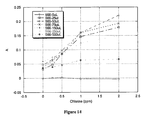
- FIG. 14 illustrates the improvement of sensitivity of response upon addition of increasing concentration of Nafion polymer in the pHEMA sensor film.
- FIG. 15 illustrates the improvement of FIG. 14 plotted as the sensor signal upon exposure to 2 ppm of chlorine demonstrating an existence of a critical non-intuitive region of concentration of Nafion in PHEMA where a maximum sensor response is obtained.
- the sensor materials change their optical property in the ultraviolet (UV), visible, or near-infrared (IR) spectral range upon exposure to trace concentrations of the chemical species.
- the film is a polymer-based composition generally including a chemically sensitive analyte-specific reagent (for example, a fluorescent or calorimetric indicator), a polymer matrix or combination of polymer matrices, and auxiliary minor additives, wherein the film is produced from a solution of the components in a common solvent or solvent mixture.
- the analyte-specific reagent is immobilized within the polymer matrix to form the sensor film.
- additives are surfactants and internal buffers. Other additives can be also included.
- the polymers utilized in the sensor film are permeable to selected analytes where an analyte is a certain chemical species or class of chemical species detected by the sensor.
- the analyte-specific reagent undergoes changes in its optical properties (e.g., absorbance, fluorescence) as a function of analyte concentration.
- the analyte-specific reagent undergoes the changes in its optical property outside the film where the change in response is not affected by the presence of interfering species as provided by the sensor formulation. Measurements are performed using ultraviolet-visible-near-IR detection systems known to those skilled in the art.
- the desired response is achieved by tailoring the composition of the sensor film where the composition includes additional components in the film.
- the desired sensor response is achieved by tailoring the oxidation potential of the immobilized analyte-specific reagent with selection of the polymer matrix components where the polymer matrix components are additional polymers. It is desired that the sensor film be self-contained so it does not have a need for auxiliary reagents outside the film.
- the polymer matrix of the sensor film is preferably a plastic film, i.e., a resin film.
- the resin utilized to form the polymer support depends on the sensor applications.
- the resin is dissolved in the solvent so that the analyte-specific reagent becomes dispersed in the liquid medium.
- the analyte-specific reagent may be applied directly to an already formed plastic film.
- a polymer film is made and a solvent is removed from the film by any known means such as evaporation, followed by the exposure of the dry film to a cocktail containing at least one reagent. In this way, a reagent is incorporated into the film.
- the sensor film is prepared by coating a clear plastic surface with a thin layer of the chemical mixture and allowed to dry over a period of several hours in air the dark.
- the final film thickness is desirably between about 0.1 and about 200 microns, more preferably 0.5-100 microns and more preferably 1-50 microns.
- the film is exposed to aqueous samples of analyte.
- the amount of the aqueous sample of the analyte ranges between about 30 ⁇ L and about 50 ⁇ L of sample, however other amounts are contemplated without departing from the scope of the invention.
- Exposure time is desirably between about 0.5-1000 seconds, more preferably 1-500 seconds, and more preferably 5-300 seconds.
- the water sample is then removed before measurement of the sensor film. Alternately, the water sample can be present during the measurement.
- the measurement is done continuously before water exposure, during water exposure, and after water exposure. In a further embodiment, the measurement is done continuously before water exposure and during water exposure.
- a “six-around-one” bifurcated fiber-optic reflection probe such as Model R400-7-UV/VIS available from Ocean Optics, Inc. of Dunedin, Fla.
- the common arm of the probe illuminates the sensor material.
- the second arm of the probe is coupled to the spectrometer.
- For fluorescence measurements light from a source is prefiltered to select an excitation wavelength of interest. Fluorescence emission is collected with the same setup but including an emission long-pass filter. Other known methods of measuring the response may also be used.
- suitable materials for the sensor film are selected from polymeric materials capable of providing the desired response time, a desired permeability, desired solubility, degree of transparency and hardness, and other similar characteristics relevant to the material of interest.
- Suitable polymers which may be used as polymer supports in accordance with the present disclosure are hydrogels.
- a hydrogel is a three dimensional network of hydrophilic polymers which have been tied together to form water-swellable but water insoluble structures. The term hydrogel is to be applied to hydrophilic polymers in a dry state (xerogel) as well as in a wet state as described in U.S. Pat. No. 5,744,794.
- hydrogels A number of different methods may be used to tie these hydrogels together.
- tying of hydrogels via radiation or free radical cross-linking of hydrophilic polymers may be utilized, examples being poly(hydroxyethylmethacrylates), poly(acrylic acids), poly(methacrylic acids), poly(glyceryl methacrylate), poly(vinyl alcohols), poly(ethylene oxides), poly(acrylamides), poly(N-acrylamides), poly(N,N-dimethylaminopropyl-N′-acrylamide), poly(ethylene imines), sodium/potassium poly(acrylates), polysaccharides, e.g.
- xanthates alginates, guar gum, agarose etc.
- poly(vinyl pyrrolidone) and cellulose based derivatives Second, tying via chemical cross-linking of hydrophilic polymers and monomers with appropriate polyfunctional monomers may be utilized, examples including poly(hydroxyethylmethacrylate) cross-linked with suitable agents such as N,N′-methylenebisacrylamide, polyethylene glycol diacrylate, triethylene glycol diacrylate, tetraethylene glycol dimethacrylate, tripropylene glycol diacrylate, pentaerythritol tetraacrylate, di-trimethylolpropane tetraacrylate, dipentaerythritol pentaacrylate, trimethylolpropane triacrylate, pentaerythritol triacrylate, propoxylated glyceryl triacrylate, ethoxylated pentaerythritol tetraacrylate, ethoxyl
- hydrophilic polymers and other polymers examples being poly(ethylene oxides) hydrogel complexes with poly(acrylic acids) and poly(methacrylic acids).
- copolymers or co-polycondensates of monomeric constituents of the above-mentioned polymers, and blends of the foregoing polymers may also be utilized.
- Examples of applications of these materials are in Michie, et al., “Distributed pH and water detection using fiber-optic sensors and hydrogels,” J. Lightwave Technol. 1995, 13, 1415-1420; Bownass, et al., “Serially multiplexed point sensor for the detection of high humidity in passive optical networks,” Opt. Lett. 1997, 22, 346-348; and U.S. Pat. No. 5,744,794.
- the hydrogel making up the polymer matrix is dissolved in a suitable solvent including, but not limited to di(ethylene glycol) methyl ether and ethylene glycol phenyl ether, 1-methoxy-2-propanol, ethanol, acetone, chloroform, toluene, xylene, benzene, isopropyl alcohol, 2-ethoxyethanol, 2-butoxyethanol, methylene chloride, tetrahydrofuran, ethylene glycol diacetate, and perfluoro(2-butyl tetrahydrofuran).
- concentration of the solvent in the solution containing the resin is about 70 weight percent or greater, with about 75 weight percent to about 90 weight percent being desirable and about 80 weight percent being preferred.
- One preferred hydrogel that will be used for exemplary purposes below is poly(2-hydroxyethylmethacrylate) (pHEMA) dissolved in a solvent including of 1-methoxy-2-propanol.
- the polymer matrix of the sensor film is preferably permeable to selected analytes.
- the sensor film may be selectively permeable to analytes on the basis of size (i.e., molecular weight); hydrophobic/hydrophilic properties; phase (i.e., whether the analyte is a liquid, gas or solid); solubility; ion charge; the ability to inhibit diffusion of colloidal or particulate material; or the composition of the water sample besides the analyte itself (for example, pH of the sample during measurements of calcium).
- analyte-specific reagents are incorporated into or applied to the polymer matrix to produce the sensor film.
- Materials utilized as analyte-specific reagents incorporate dyes and reagents known in the art as indicators.
- analyte-specific reagents are indicators that exhibit colorimetric, photorefractive, photochromic, thermochromic, fluorescent, elastic scattering, inelastic scattering, polarization, or any other optical property useful for detecting physical, chemical and biological species.
- Analyte-specific reagents include organic and inorganic dyes and pigments, nanocrystals, nanoparticles, quantum dots, organic fluorophores, inorganic fluorophores and similar materials.
- Examples of compounds which can be used as analyte-specific reagents include organic dyes, organic fluorophores, fluorescent dyes, IR absorbing dyes, UV absorbing dyes, photochromic dyes, thermochromic dyes, sulphonephthalein dyes, and other known dyes that may be used for this purpose.
- dyes include bromopyrogallol red, xylidyl blue I, chlorophosphonazo III, brilliant green, xanthene dyes such as rhodamine B, rhodamine 6G, eosine, phloxine B and the like, acridine dyes such as acridine orange, acridine red and the like, azo dyes such as ethyl red, methyl red and the like, porphyrin dyes, phthalocyanine dyes, cyanine dyes such as 3,3′-diethylthiacarbocyanine iodide, 3,3′-diethyloxadicarbocyanine iodide and the like, merocyanine dyes, styryl dyes, oxonol dyes, triarylmethane dyes, methylene blue, phenol blue and the like.
- xanthene dyes such as rhodamine B, r
- Fluorescent materials which may be used as analyte-specific reagents bond to specific predetermined locations on the sensor film and fluoresce when excited by a specific optical wavelength. Appropriate wavelengths range from about 200 nm to about 1100 nm, more preferably from about 300 nm to about 1000 nm, with a range of from about 350 nm to about 950 nm being most preferred. In other embodiments, non-fluorescing analyte-specific reagents that bond to specific predetermined locations may be used. Such reagents include light absorbing materials such as near infrared (NIR) absorbing materials.
- NIR near infrared
- NIR absorbing materials include carbon black and Poly(styrenesulfonate)/poly(2,3-dihydrothieno(3,4-b)-1,4-dioxin).
- the analyte-specific reagent is a light absorbing reagent absorbing light at about 620-670 nm.
- the analyte-specific reagent is a light absorbing reagent absorbing light at about 750-820 nm.
- the analyte-specific reagent is a light absorbing reagent absorbing light at about 380-420 nm.
- These dyes may be used singly or in combination depending on the desired application. The choice of organic compound and amount utilized for a given application depends on the properties of the organic compound and the purpose for which it will be used. For instance, fluorescent dyes may be added to a resin binder at part-per-million concentrations as is known in the art.
- the analyte-specific reagent is immobilized in the hydrogel matrix by forming an ion pair between the analyte-specific reagent and a lipophilic counter ion, such as a quaternary ammonium ion.
- a lipophilic counter ion such as a quaternary ammonium ion.
- concentrations substantially higher than the stoichiometric amount required to ion pair means the quaternary ammonium ions are added in a concentration of between about 5-1000 times greater than stoichiometric amounts relative to the indicator.
- concentrations substantially higher than the stoichiometric amount required to ion pair means the quaternary ammonium ions are added in a concentration of between about 5-1000 times greater than stoichiometric amounts relative to the indicator.
- ion pair to be used below for exemplary purposes and not by way of limitation is Bromopyrogallol Red (BR) and benzyldimethyltetradecylammonium chloride (Zephiramine) for the BP Red-MoO4 indicator system.
- BR Bromopyrogallol Red
- Zephiramine benzyldimethyltetradecylammonium chloride
- the presence of quaternary ammonium salts has been shown to induce a significant bathochromic shift of the BP Red-Mo chelate absorption maximum, as well as intensification of the chelate absorption band.
- the quaternary ammonium salt used in this film was chosen with respect to structure and mass to achieve a shift in a position of peak absorption ( ⁇ max ) to longer wavelengths.
- Table 1 lists the ⁇ max produced by selected quaternary ammonium salts on pHEMA film when wetted.
- multiple transparent hydrogel films are prepared that contain a chemical composition that changes color after being exposed to the sample solution to obtain a quantitative measurement of the sample solution.
- multiple films are prepared to be used to determine the alkalinity of the sample solution, and desirably contain a chemical composition that changes color after being exposed to alkaline species in the sample solution. Desirably, between about 2 and 12 transparent films, and more preferably between 2 and 8 transparent films are prepared and are exposed to the sample solution.
- the chemical composition added in the hydrogel films comprises a pH indicator, a surfactant, and an acid.
- Suitable surfactants include quaternary ammonium salt such as cetyltrimethylammonium bromide, tridodecylmethylammonium chloride, tetrabutylammonium bromide, and many others. Desirably, the surfactant reduces or substantially eliminates the amount of indicator leaching in the film. Without the surfactant, indicator leaching will introduce undesirable errors in absorbance measurement.
- Suitable pH indicator dyes include bromoscresol green and bromophenol blue. It is desirable that the pH indicator dye have a pKa value near 4.3.
- the multiple hydrogel films in this embodiment each contain a different amount of acid.
- Some suitable acids are carboxylic acids and aryl- and alkylsulfonic acids such as p-toluenesulfonic acid, however any acid that can be dissolved in the hydrogel media may be used.
- the acid concentration in each film is different and varies from film to film by a predetermined pattern.
- the acid concentrations desirably vary between about 0.2 and 50 weight % relative to dry pHEMA (hydrogel).
- the film having the lowest concentration has a concentration between about 0.2 and 20 weight %, and more desirably between about 0.8 and 10 weight %.
- the film having the highest concentration has a concentration between about 20 and 50 weight %, and more desirably between about 25 and 35 weight %.
- the number of films that are needed to cover a given alkalinity range if a weak acid such as a carboxylic acid is used is fewer than that if a strong acid is used. This is because the weak acid exhibits a flatter titration curve than the strong acid.
- weak acids usually form complexes with ions such as calcium ions that commonly exist in water samples.
- Nafion® is a trade name for sulfonated tetrafluoroethylene copolymer from E.I. du Pont de Nemours and Company (Wilmington, Del.).
- the sensor film was prepared by coating a clear plastic surface with a thin layer of the chemical mixture and allowed to dry over a period of several hours in the dark.
- the final film thickness was between 10 and 20 microns.
- the sensor film was exposed to about 30 ⁇ L of aqueous samples of molybdate at various concentrations. Exposure time was in general 120 seconds. The water sample was then removed and the film dried under a constant airflow. The sensor film was then measured for molybdate response.
- the sensor film was places in a dark room on a flat surface.
- the sensor film response was measured using an OceanOptics spectrophotometer equipped with a fiber-optic probe.
- the probe was oriented at a 90° with respect to the sensor film
- ethylene glycol-bis(aminoethylether)-N,N,N′,N′-tetraacetic acid, tetrasodium salt (EGTA-Na4) was added and the mixture stirred at room temperature until all solids were dissolved (minimum of 12 hour).
- FIG. 3 shows a typical set of spectra at different magnesium concentrations for the described sensor film.
- FIG. 4 shows a typical response curve for the described sensor film.
- FIG. 5 shows a typical set of spectra at different hardness concentrations for the described sensor film.
- FIG. 6 shows a typical response curve for the described sensor film.
- FIG. 9 shows a typical set of spectra at different sulfite concentrations for the described sensor film.
- FIG. 10 shows a typical response curve for the described sensor film.
- the following example serves to illustrate how it is possible to buffer a chemical film (sulfite) by overcoating a first film with a second buffering film.
- the two-layer film provides a method to allow measurement of a desired analyte (sulfite) in an extreme water environment (very high pH (pH 12) and very high alkalinity (1000 mg/L M-alkalinity)). Without the overcoating of the first film with the second buffering film, the sensor film tends to respond to the high pH of the water sample and not to the desired analyte (sulfite).
- FIG. 11 shows a typical set of spectra at different sulfite concentrations for the described device. Sulfite concentrations were prepared in a highly alkaline (1000 mg/L M-alkalinity) and high pH (ph 12) water matrix.
- FIG. 12 shows a typical response curve for the described device.
- Polymer solution compositions are listed in Table 2. Films were prepared by depositing an 8 ⁇ l polymer solution into wells on a glass slide. The wells (5.4 mm diameter and 0.32 mm deep) were created with a die-cut, adhesive-backed polymer mask layer. The mask layer was not removed during the test. Average absorbance at 650 nm is used to quantify the sample total alkalinity. A calibration curve is shown in FIG. 13 .
- Nafion® was added to the sensor formulation.
- Nafion® is a trade name for sulfonated tetrafluoroethylene copolymer from E.I. du Pont de Nemours and Company (Wilmington, Del.).
- One suitable indicator is 2-[2-[3-[(1,3-Dihydro-3,3-dimethyl-1-propyl-2H-indol-2-ylidene)ethylidene]-2-phenoxy-1-cyclohexen-1-yl]ethenyl]-3,3-dimethyl-1-propylindolium perchlorate known as IR 768 perchlorate.
- FIG. 14 shows an improvement of sensitivity of response when measured at 566 nm upon addition of increasing amounts of Nafion solution to 2000 ⁇ L of dye formulation. This improvement can be plotted as the sensor signal upon exposure to 2 ppm of chlorine as shown in FIG. 15 . This figure demonstrates an existence of a critical non-intuitive region of concentration of Nafion in PHEMA where a maximum sensor response is obtained.
Landscapes
- Life Sciences & Earth Sciences (AREA)
- Health & Medical Sciences (AREA)
- Chemical & Material Sciences (AREA)
- Physics & Mathematics (AREA)
- Pathology (AREA)
- Analytical Chemistry (AREA)
- Biochemistry (AREA)
- General Health & Medical Sciences (AREA)
- General Physics & Mathematics (AREA)
- Immunology (AREA)
- Plasma & Fusion (AREA)
- Chemical Kinetics & Catalysis (AREA)
- Engineering & Computer Science (AREA)
- Biophysics (AREA)
- Molecular Biology (AREA)
- Investigating Or Analysing Materials By The Use Of Chemical Reactions (AREA)
- Investigating Or Analyzing Non-Biological Materials By The Use Of Chemical Means (AREA)
Priority Applications (16)
| Application Number | Priority Date | Filing Date | Title |
|---|---|---|---|
| US11/259,506 US7807473B2 (en) | 2005-10-26 | 2005-10-26 | Material compositions for sensors for determination of chemical species at trace concentrations and method of using sensors |
| PCT/US2006/041104 WO2007050463A1 (en) | 2005-10-26 | 2006-10-20 | Material compositions for sensors for determination of chemical species at trace concentrations and method of using sensors |
| AU2006306398A AU2006306398B2 (en) | 2005-10-26 | 2006-10-20 | Material compositions for sensors for determination of chemical species at trace concentrations and method of using sensors |
| JP2008537814A JP5091147B2 (ja) | 2005-10-26 | 2006-10-20 | 微小濃度の化学種を測定するセンサ用材料組成物及びセンサの使用方法 |
| EP06836436.3A EP1949092B1 (en) | 2005-10-26 | 2006-10-20 | Material compositions for sensors for determination of chemical species at trace concentrations and method of using sensors |
| KR1020087009765A KR101329895B1 (ko) | 2005-10-26 | 2006-10-20 | 미량 농도의 화학 종을 측정하기 위한 센서용 물질 조성물및 센서의 사용 방법 |
| BRPI0619337-4A BRPI0619337A2 (pt) | 2005-10-26 | 2006-10-20 | composições de materiais para sensores para a determinação de espécies quìmicas com traços de concentração e método de uso dos sensores |
| HK09103574.9A HK1125455B (en) | 2005-10-26 | 2006-10-20 | Material compositions for sensors for determination of chemical species at trace concentrations and method of using sensors |
| CA2625626A CA2625626C (en) | 2005-10-26 | 2006-10-20 | Material compositions for sensors for determination of chemical species at trace concentrations and method of using sensors |
| CA2851934A CA2851934C (en) | 2005-10-26 | 2006-10-20 | Material compositions for sensors for determination of chemical species at trace concentrations and method of using sensors |
| MYPI20081019A MY146554A (en) | 2005-10-26 | 2006-10-20 | Material compositions for sensors for determination of chemical species at trace concentrations and method of using sensors |
| CN2006800402535A CN101297197B (zh) | 2005-10-26 | 2006-10-20 | 测量痕量浓度化学物种的传感器的材料成分和使用传感器的方法 |
| RU2008120676/15A RU2427834C2 (ru) | 2005-10-26 | 2006-10-20 | Композиция материалов сенсоров для определения химических соединений при следовых концентрациях и способ использования сенсоров |
| NZ567588A NZ567588A (en) | 2005-10-26 | 2006-10-20 | Material compositions for sensors for determination of chemical species at trace concentrations and method of using sensors |
| TW095139564A TW200732662A (en) | 2005-10-26 | 2006-10-26 | Material compositions for sensors for determination of chemical species at trace concentrations and method of using sensors |
| US12/880,830 US8647883B2 (en) | 2005-10-26 | 2010-09-13 | Material compositions for sensors for determination of chemical species at trace concentrations |
Applications Claiming Priority (1)
| Application Number | Priority Date | Filing Date | Title |
|---|---|---|---|
| US11/259,506 US7807473B2 (en) | 2005-10-26 | 2005-10-26 | Material compositions for sensors for determination of chemical species at trace concentrations and method of using sensors |
Related Child Applications (1)
| Application Number | Title | Priority Date | Filing Date |
|---|---|---|---|
| US12/880,830 Division US8647883B2 (en) | 2005-10-26 | 2010-09-13 | Material compositions for sensors for determination of chemical species at trace concentrations |
Publications (2)
| Publication Number | Publication Date |
|---|---|
| US20070092973A1 US20070092973A1 (en) | 2007-04-26 |
| US7807473B2 true US7807473B2 (en) | 2010-10-05 |
Family
ID=37806672
Family Applications (2)
| Application Number | Title | Priority Date | Filing Date |
|---|---|---|---|
| US11/259,506 Active 2028-09-26 US7807473B2 (en) | 2005-10-26 | 2005-10-26 | Material compositions for sensors for determination of chemical species at trace concentrations and method of using sensors |
| US12/880,830 Expired - Lifetime US8647883B2 (en) | 2005-10-26 | 2010-09-13 | Material compositions for sensors for determination of chemical species at trace concentrations |
Family Applications After (1)
| Application Number | Title | Priority Date | Filing Date |
|---|---|---|---|
| US12/880,830 Expired - Lifetime US8647883B2 (en) | 2005-10-26 | 2010-09-13 | Material compositions for sensors for determination of chemical species at trace concentrations |
Country Status (13)
| Country | Link |
|---|---|
| US (2) | US7807473B2 (https=) |
| EP (1) | EP1949092B1 (https=) |
| JP (1) | JP5091147B2 (https=) |
| KR (1) | KR101329895B1 (https=) |
| CN (1) | CN101297197B (https=) |
| AU (1) | AU2006306398B2 (https=) |
| BR (1) | BRPI0619337A2 (https=) |
| CA (2) | CA2851934C (https=) |
| MY (1) | MY146554A (https=) |
| NZ (1) | NZ567588A (https=) |
| RU (1) | RU2427834C2 (https=) |
| TW (1) | TW200732662A (https=) |
| WO (1) | WO2007050463A1 (https=) |
Cited By (8)
| Publication number | Priority date | Publication date | Assignee | Title |
|---|---|---|---|---|
| US20100147481A1 (en) * | 2008-12-15 | 2010-06-17 | General Electric Company | Methods of manufacturing casted articles, and systems |
| US20110091985A1 (en) * | 2007-05-07 | 2011-04-21 | General Electric Company | METHOD AND APPARATUS FOR MEASURING pH OF LOW ALKALINITY SOLUTIONS |
| US20120135532A1 (en) * | 2010-11-30 | 2012-05-31 | Chung-Ang University Industry-Academiy Cooperation Foundation | Sensor Comprising Resrufin Levulinate Having Sulfite Ion Selectivity and Method for Monitoring Sulfite Ion Using the Same |
| WO2012087451A1 (en) | 2010-12-23 | 2012-06-28 | General Electric Company | Dual heat stabiled polymer sensor films |
| EP2562540A1 (en) | 2011-08-26 | 2013-02-27 | General Electric Company | Methods and devices for detecting isothiazolones |
| WO2015017457A1 (en) * | 2013-07-30 | 2015-02-05 | Isi Life Sciences, Inc. | Devices and methods for detecting the presence of phosphonyl fluorides and bis-haloalkylene sulfides |
| US20160216221A1 (en) * | 2015-01-27 | 2016-07-28 | University Of Utah Research Foundation | Osmolarity-responsive hydrogel sensors and method of use |
| US11610467B2 (en) | 2020-10-08 | 2023-03-21 | Ecolab Usa Inc. | System and technique for detecting cleaning chemical usage to control cleaning efficacy |
Families Citing this family (37)
| Publication number | Priority date | Publication date | Assignee | Title |
|---|---|---|---|---|
| US20080295581A1 (en) * | 2007-05-31 | 2008-12-04 | General Electric Company | Method for the determination of aqueous polymer concentration in water systems |
| US20090004747A1 (en) * | 2007-06-29 | 2009-01-01 | Agree Alan M | Film sensors for detecting free chlorine |
| WO2009005884A1 (en) * | 2007-06-29 | 2009-01-08 | 3M Innovative Properties Company | Physical entrapment of a color-changing indicator to a substrate |
| EP2443101B1 (en) * | 2009-06-19 | 2019-03-27 | Lance Liotta | Bait chemistries in hydrogel particles for serum biomarker analysis |
| WO2011065912A1 (en) | 2009-11-30 | 2011-06-03 | Ge Healthcare Bio-Sciences Ab | Method and system for interaction analysis |
| EP2546632B1 (en) * | 2010-03-12 | 2016-11-16 | Konica Minolta Opto, Inc. | Reflectometric interference spectroscopy method and device for detecting intermolecular interaction |
| WO2012016350A1 (en) * | 2010-08-03 | 2012-02-09 | General Electric Company | Simultaneous determination of multiple analytes in industrial water system |
| FR2969295B1 (fr) | 2010-12-16 | 2012-12-14 | Commissariat Energie Atomique | Detecteur multifonctionnel de composes gazeux et ses applications |
| US8343771B2 (en) * | 2011-01-12 | 2013-01-01 | General Electric Company | Methods of using cyanine dyes for the detection of analytes |
| FR2975691B1 (fr) | 2011-05-26 | 2014-02-07 | Electricite De France | Materiau super-isolant a pression atmospherique a base d'aerogel |
| CN102391854B (zh) * | 2011-08-03 | 2013-09-04 | 浙江大学 | 一种检测[h+]的荧光化学传感器及其制备和使用方法 |
| CN102393378B (zh) * | 2011-11-01 | 2013-03-06 | 湖南省湘维有限公司 | 一种用近红外光谱技术快速检测聚乙烯醇生产中醇解度和聚合度的方法 |
| WO2013073983A1 (ru) * | 2011-11-16 | 2013-05-23 | Vengerov Yury Yuzefovitch | Устройство для чтения результатов анализов, выполненных с помощью тест-полосок |
| CN102676158B (zh) * | 2012-05-16 | 2014-07-09 | 陕西师范大学 | 含芘双咪唑型荧光探针及其合成方法和应用 |
| CN102914539A (zh) * | 2012-11-15 | 2013-02-06 | 北京大学 | 一种钼锑抗光度法检测水中正磷酸盐含量的方法及试剂盒 |
| GB201317746D0 (en) * | 2013-10-08 | 2013-11-20 | Smith & Nephew | PH indicator |
| US20190212311A1 (en) | 2013-01-11 | 2019-07-11 | Smith & Nephew Plc | Ph and moisture indicator devices and formulations |
| RU2534729C1 (ru) * | 2013-05-31 | 2014-12-10 | Общество с ограниченной ответственностью "Люмисенсорные системы" | Способ одновременного измерения концентрации паров бензола, толуола, ксилолов в газовой смеси с помощью материалов на основе дбмбф2 |
| JP6337235B2 (ja) * | 2014-02-27 | 2018-06-06 | 学校法人東海大学 | 医療用インジケータ、および医療用滅菌容器 |
| KR102238946B1 (ko) | 2014-06-27 | 2021-04-12 | 삼성전자주식회사 | 가스 센서, 이를 포함하는 냉장고 및 그 제어 방법 |
| EP3215829B1 (en) * | 2014-11-07 | 2020-05-20 | Water Lens LLC | Assay kit and method for determining alkalinity of an analyte solution |
| CN105987902A (zh) * | 2015-02-16 | 2016-10-05 | 艺康美国股份有限公司 | 用于测定工业用水中的阴离子聚合物浓度的试剂、检测方法和该试剂的用途 |
| WO2016161247A1 (en) * | 2015-04-02 | 2016-10-06 | Ecolab Usa Inc. | Method for measuring polymer concentration in water systems |
| RU2656132C2 (ru) * | 2016-11-22 | 2018-05-31 | Общество С Ограниченной Ответственностью "Газпром Трансгаз Краснодар" | Способ определения концентрации диэтиленгликоля в стабильных жидких углеводородных фракциях |
| RU2649038C1 (ru) * | 2016-12-14 | 2018-03-29 | ООО "Люмисенсорные системы" | Способ определения концентрации паров нафталина в газовой смеси с использованием флуоресцентного материала |
| US10241022B2 (en) * | 2017-03-30 | 2019-03-26 | Intel Corporation | Characterizing a fluid sample based on response of a non-planar structure |
| KR101976511B1 (ko) * | 2017-05-31 | 2019-05-10 | 주식회사 인터로조 | 하이드로젤 고분자로부터 당의 검출방법 |
| GB201814015D0 (en) | 2018-08-29 | 2018-10-10 | Univ Loughborough | Hydrogel |
| CN110003272B (zh) * | 2019-03-11 | 2021-05-07 | 南京理工大学 | 功能化季鏻盐自组装材料及其生物传感器 |
| CN109827915A (zh) * | 2019-03-12 | 2019-05-31 | 闫宏涛 | 一种测定磷含量的双组分检测剂 |
| US12226543B2 (en) | 2019-05-10 | 2025-02-18 | Ecolab Usa Inc. | pH sensitive color indicator for sanitizing applications |
| RU2760679C2 (ru) * | 2019-12-25 | 2021-11-29 | Федеральное государственное бюджетное образовательное учреждение высшего образования "Российский химико-технологический университет имени Д.И. Менделеева" (РХТУ им. Д.И. Менделеева) | Чувствительный слой оптического люминесцентного сенсора на квантовых точках и способ его изготовления |
| KR102311174B1 (ko) * | 2019-12-26 | 2021-10-13 | 안동대학교 산학협력단 | 토양 내 유효 인산, 유효 규산 또는 양이온 교환 침출을 위한 용액 조성물 |
| KR102394893B1 (ko) | 2020-06-08 | 2022-05-09 | 전주대학교 산학협력단 | 비색 분석 시약, 비색 분석 시약 제조방법 및 비색 분석 용지 제조방법 |
| KR102583395B1 (ko) * | 2020-08-07 | 2023-09-27 | 국민대학교산학협력단 | 화학 센서용 하이드로겔 코팅 조성물 및 이를 이용하여 제조된 화학 센서 |
| CN114460052B (zh) * | 2022-01-11 | 2023-06-20 | 武汉理工大学 | 一种基于荧光碳量子点直接检测丙酮酸钠浓度的方法 |
| CN117783103B (zh) * | 2023-12-28 | 2024-06-21 | 无锡嘉润诊断技术有限公司 | 一种高灵敏度钙定性检测试纸条及其制作方法 |
Citations (19)
| Publication number | Priority date | Publication date | Assignee | Title |
|---|---|---|---|---|
| US3998878A (en) * | 1975-11-05 | 1976-12-21 | Boise Cascade Corporation | Selectively separating oxalic, tartaric, glyoxylic and erythronic acids from aqueous solutions containing the same |
| US4503156A (en) * | 1981-09-28 | 1985-03-05 | Wako Pure Chemical Industries, Ltd. | Reagent mixture for measuring magnesium |
| US5005572A (en) | 1988-02-26 | 1991-04-09 | Brigham & Women's Hospital | CO2 indicator and the use thereof to evaluate placement of tracheal tubes |
| US5116759A (en) * | 1990-06-27 | 1992-05-26 | Fiberchem Inc. | Reservoir chemical sensors |
| US5482866A (en) * | 1989-12-15 | 1996-01-09 | Hoffmann-La Roche Inc. | Method for quantitation of calcium and magnesium and the novel reagent compositions |
| US5744794A (en) * | 1993-02-13 | 1998-04-28 | University Of Strathclyde | Apparatus for detecting aqueous environments |
| US5790627A (en) * | 1995-09-20 | 1998-08-04 | Research Development Corp. | Method and apparatus for observing a specimen using an X-ray microscope |
| WO1999009406A1 (en) | 1997-08-18 | 1999-02-25 | Novartis Ag | Optical carbon dioxide sensors |
| EP0952451A1 (en) | 1998-04-24 | 1999-10-27 | Ortho-Clinical Diagnostics, Inc. | Dry analytical elements for the determination of protein |
| US6011882A (en) * | 1997-10-16 | 2000-01-04 | World Precision Instruments, Inc. | Chemical sensing techniques employing liquid-core optical fibers |
| WO2000002845A1 (en) | 1998-07-11 | 2000-01-20 | Sensormetrix International Limited | Quaternary ammonium salts, polymeric film containing them and colorimetric device |
| US20030022094A1 (en) * | 2001-01-15 | 2003-01-30 | Ippei Nakamura | Negative image-recording material and cyanine dye |
| US20030035917A1 (en) * | 1999-06-11 | 2003-02-20 | Sydney Hyman | Image making medium |
| US6627177B2 (en) * | 2000-12-05 | 2003-09-30 | The Regents Of The University Of California | Polyhydroxyl-substituted organic molecule sensing optical in vivo method utilizing a boronic acid adduct and the device thereof |
| US20030217808A1 (en) * | 2000-05-18 | 2003-11-27 | John Woods | Adhesive compositions for bonding passive substrates |
| US20050113546A1 (en) * | 2003-11-25 | 2005-05-26 | Ting Tao | Process for the preparation of cyanine dyes with polysulfonate anions |
| WO2005066275A2 (en) | 2003-12-23 | 2005-07-21 | General Electric Company | Sensor devices containing co-polymer substrates for analysis of chemical and biological species in water and air |
| US20060009805A1 (en) * | 2004-04-26 | 2006-01-12 | Ralph Jensen | Neural stimulation device employing renewable chemical stimulation |
| US20060234384A1 (en) * | 2005-04-19 | 2006-10-19 | Kaufman Richard A | Use of phosphonazo III for the measurement of calcium, magnesium and sodium in analytical samples |
Family Cites Families (11)
| Publication number | Priority date | Publication date | Assignee | Title |
|---|---|---|---|---|
| JPS6211167A (ja) * | 1985-07-09 | 1987-01-20 | Fuji Photo Film Co Ltd | コレステロ−ル分析用多層分析要素 |
| RU2067297C1 (ru) * | 1994-04-25 | 1996-09-27 | Институт геохимии и аналитической химии им.В.И.Вернадского РАН | Индикаторный чувствительный материал для экспресс-тестирования следов веществ |
| NZ299104A (en) * | 1995-08-03 | 1998-04-27 | Lifescan Inc | Reagent test strip |
| CA2236350C (en) * | 1997-05-06 | 2007-05-15 | Thomas Arter | Dry analytical elements for the determination of protein |
| US5858797A (en) * | 1997-06-05 | 1999-01-12 | Environmental Test Systems, Inc. | Test composition, device and method for the colorimetric determination of phosphorus |
| EP0989191B1 (en) * | 1998-09-22 | 2002-11-27 | Fuji Photo Film Co., Ltd. | Dry analytical element for quantitative analysis of creatine kinase or its MB isozyme |
| JP2002040010A (ja) * | 2000-07-24 | 2002-02-06 | Sanyo Electric Co Ltd | 燐酸反応試薬を担持した発色フィルム、および燐酸反応試薬を担持した発色フィルムを用いた燐酸濃度測定装置 |
| CN1349094A (zh) * | 2000-10-13 | 2002-05-15 | 杜廷发 | 残留有机磷、氨基甲酸酯农药速测方法及速测器 |
| JP2002174597A (ja) * | 2000-12-06 | 2002-06-21 | Fuji Xerox Co Ltd | センサ材料、センサ、生体物質の検出方法および透過光検出方法 |
| RU2224781C2 (ru) * | 2002-04-18 | 2004-02-27 | ООО "Биоаналитические технологии" | Полифункциональный жидкокристаллический композит на основе двухцепочечной нуклеиновой кислоты и способ его получения |
| JP4358680B2 (ja) * | 2003-05-20 | 2009-11-04 | 株式会社サクラクレパス | インジケーター組成物 |
-
2005
- 2005-10-26 US US11/259,506 patent/US7807473B2/en active Active
-
2006
- 2006-10-20 JP JP2008537814A patent/JP5091147B2/ja not_active Expired - Fee Related
- 2006-10-20 KR KR1020087009765A patent/KR101329895B1/ko not_active Expired - Fee Related
- 2006-10-20 WO PCT/US2006/041104 patent/WO2007050463A1/en not_active Ceased
- 2006-10-20 NZ NZ567588A patent/NZ567588A/en not_active IP Right Cessation
- 2006-10-20 RU RU2008120676/15A patent/RU2427834C2/ru not_active IP Right Cessation
- 2006-10-20 BR BRPI0619337-4A patent/BRPI0619337A2/pt not_active Application Discontinuation
- 2006-10-20 EP EP06836436.3A patent/EP1949092B1/en active Active
- 2006-10-20 CA CA2851934A patent/CA2851934C/en active Active
- 2006-10-20 MY MYPI20081019A patent/MY146554A/en unknown
- 2006-10-20 CN CN2006800402535A patent/CN101297197B/zh active Active
- 2006-10-20 AU AU2006306398A patent/AU2006306398B2/en not_active Ceased
- 2006-10-20 CA CA2625626A patent/CA2625626C/en active Active
- 2006-10-26 TW TW095139564A patent/TW200732662A/zh unknown
-
2010
- 2010-09-13 US US12/880,830 patent/US8647883B2/en not_active Expired - Lifetime
Patent Citations (20)
| Publication number | Priority date | Publication date | Assignee | Title |
|---|---|---|---|---|
| US3998878A (en) * | 1975-11-05 | 1976-12-21 | Boise Cascade Corporation | Selectively separating oxalic, tartaric, glyoxylic and erythronic acids from aqueous solutions containing the same |
| US4503156A (en) * | 1981-09-28 | 1985-03-05 | Wako Pure Chemical Industries, Ltd. | Reagent mixture for measuring magnesium |
| US5005572A (en) | 1988-02-26 | 1991-04-09 | Brigham & Women's Hospital | CO2 indicator and the use thereof to evaluate placement of tracheal tubes |
| US5482866A (en) * | 1989-12-15 | 1996-01-09 | Hoffmann-La Roche Inc. | Method for quantitation of calcium and magnesium and the novel reagent compositions |
| US5116759A (en) * | 1990-06-27 | 1992-05-26 | Fiberchem Inc. | Reservoir chemical sensors |
| US5744794A (en) * | 1993-02-13 | 1998-04-28 | University Of Strathclyde | Apparatus for detecting aqueous environments |
| US5790627A (en) * | 1995-09-20 | 1998-08-04 | Research Development Corp. | Method and apparatus for observing a specimen using an X-ray microscope |
| US6046052A (en) * | 1997-05-06 | 2000-04-04 | Ortho Clinical Diagnostics, Inc. | Dry analytical elements for the determination of protein |
| WO1999009406A1 (en) | 1997-08-18 | 1999-02-25 | Novartis Ag | Optical carbon dioxide sensors |
| US6011882A (en) * | 1997-10-16 | 2000-01-04 | World Precision Instruments, Inc. | Chemical sensing techniques employing liquid-core optical fibers |
| EP0952451A1 (en) | 1998-04-24 | 1999-10-27 | Ortho-Clinical Diagnostics, Inc. | Dry analytical elements for the determination of protein |
| WO2000002845A1 (en) | 1998-07-11 | 2000-01-20 | Sensormetrix International Limited | Quaternary ammonium salts, polymeric film containing them and colorimetric device |
| US20030035917A1 (en) * | 1999-06-11 | 2003-02-20 | Sydney Hyman | Image making medium |
| US20030217808A1 (en) * | 2000-05-18 | 2003-11-27 | John Woods | Adhesive compositions for bonding passive substrates |
| US6627177B2 (en) * | 2000-12-05 | 2003-09-30 | The Regents Of The University Of California | Polyhydroxyl-substituted organic molecule sensing optical in vivo method utilizing a boronic acid adduct and the device thereof |
| US20030022094A1 (en) * | 2001-01-15 | 2003-01-30 | Ippei Nakamura | Negative image-recording material and cyanine dye |
| US20050113546A1 (en) * | 2003-11-25 | 2005-05-26 | Ting Tao | Process for the preparation of cyanine dyes with polysulfonate anions |
| WO2005066275A2 (en) | 2003-12-23 | 2005-07-21 | General Electric Company | Sensor devices containing co-polymer substrates for analysis of chemical and biological species in water and air |
| US20060009805A1 (en) * | 2004-04-26 | 2006-01-12 | Ralph Jensen | Neural stimulation device employing renewable chemical stimulation |
| US20060234384A1 (en) * | 2005-04-19 | 2006-10-19 | Kaufman Richard A | Use of phosphonazo III for the measurement of calcium, magnesium and sodium in analytical samples |
Non-Patent Citations (6)
| Title |
|---|
| Koichi Yamamoto; Interaction Between Sulphonephthalein Dyes and Quaternary Ammonium Ions in Aqueous Solution, Analytical Sciences, Jun. 1992, vol. 8, Japan. |
| Koronczi et al.; Submicron Sensors for Ion Detection Based on Measurement of Luminescence Decay Time; Sensors and Actuators B 74 (2001) 47-53, Germany. |
| Kosch et al.; Strategies to Design pH Optodes With Luminescence Decay Times in the Microsecond Time Regime, 1998, 70, 3892-3897; Insitute of Analytical Chemistry, Germany. |
| Miniaturized Biosensors Employing Electropolymerized Permselective Films and Their Use for Creatinine Assays in Human Serum, Marcel B. Madaras and Richard P. Buck, Anal. Chem. 1996, 68, 3832-3839. * |
| Munoz, M.A. et al., "Direct Determination of Inorganic Phosphorus in Serum with a Single Reagent", Clinical Chemistry, vol. 29, No. 2, (1983) pp. 372-374. |
| Polymers in sensor applications, Basudam Adhikari, Sarmishtha Majumdar, Prog. Polym. Sci. 29 (2004) 699-766. * |
Cited By (14)
| Publication number | Priority date | Publication date | Assignee | Title |
|---|---|---|---|---|
| US20110091985A1 (en) * | 2007-05-07 | 2011-04-21 | General Electric Company | METHOD AND APPARATUS FOR MEASURING pH OF LOW ALKALINITY SOLUTIONS |
| US20110217213A1 (en) * | 2007-05-07 | 2011-09-08 | General Electric Company | METHOD AND APPARATUS FOR MEASURING pH OF LOW ALKALINITY SOLUTIONS |
| US8076153B2 (en) | 2007-05-07 | 2011-12-13 | General Electric Company | Method and apparatus for measuring pH of low alkalinity solutions |
| US8148166B2 (en) | 2007-05-07 | 2012-04-03 | General Electric Company | Method and apparatus for measuring pH of low alkalinity solutions |
| US20100147481A1 (en) * | 2008-12-15 | 2010-06-17 | General Electric Company | Methods of manufacturing casted articles, and systems |
| US20120135532A1 (en) * | 2010-11-30 | 2012-05-31 | Chung-Ang University Industry-Academiy Cooperation Foundation | Sensor Comprising Resrufin Levulinate Having Sulfite Ion Selectivity and Method for Monitoring Sulfite Ion Using the Same |
| WO2012087451A1 (en) | 2010-12-23 | 2012-06-28 | General Electric Company | Dual heat stabiled polymer sensor films |
| EP2562540A1 (en) | 2011-08-26 | 2013-02-27 | General Electric Company | Methods and devices for detecting isothiazolones |
| US8912003B2 (en) * | 2011-08-26 | 2014-12-16 | General Electric Company | Methods and devices for detecting isothiazolones |
| WO2015017457A1 (en) * | 2013-07-30 | 2015-02-05 | Isi Life Sciences, Inc. | Devices and methods for detecting the presence of phosphonyl fluorides and bis-haloalkylene sulfides |
| US20160216221A1 (en) * | 2015-01-27 | 2016-07-28 | University Of Utah Research Foundation | Osmolarity-responsive hydrogel sensors and method of use |
| US9976974B2 (en) * | 2015-01-27 | 2018-05-22 | University Of Utah Research Foundation | Osmolarity-responsive hydrogel sensors and method of use |
| US11610467B2 (en) | 2020-10-08 | 2023-03-21 | Ecolab Usa Inc. | System and technique for detecting cleaning chemical usage to control cleaning efficacy |
| US12100285B2 (en) | 2020-10-08 | 2024-09-24 | Ecolab Usa Inc. | System and technique for detecting cleaning chemical usage to control cleaning efficacy |
Also Published As
| Publication number | Publication date |
|---|---|
| KR101329895B1 (ko) | 2013-11-15 |
| MY146554A (en) | 2012-08-30 |
| HK1125455A1 (en) | 2009-08-07 |
| KR20080066688A (ko) | 2008-07-16 |
| CN101297197B (zh) | 2012-10-10 |
| CA2625626C (en) | 2015-12-29 |
| CA2851934A1 (en) | 2007-05-03 |
| US20110014087A1 (en) | 2011-01-20 |
| JP2009513977A (ja) | 2009-04-02 |
| AU2006306398B2 (en) | 2012-08-30 |
| US8647883B2 (en) | 2014-02-11 |
| CA2625626A1 (en) | 2007-05-03 |
| CA2851934C (en) | 2017-08-08 |
| JP5091147B2 (ja) | 2012-12-05 |
| EP1949092B1 (en) | 2017-08-02 |
| WO2007050463A1 (en) | 2007-05-03 |
| BRPI0619337A2 (pt) | 2011-09-27 |
| RU2008120676A (ru) | 2009-12-10 |
| AU2006306398A1 (en) | 2007-05-03 |
| EP1949092A1 (en) | 2008-07-30 |
| TW200732662A (en) | 2007-09-01 |
| CN101297197A (zh) | 2008-10-29 |
| US20070092973A1 (en) | 2007-04-26 |
| RU2427834C2 (ru) | 2011-08-27 |
| NZ567588A (en) | 2010-12-24 |
Similar Documents
| Publication | Publication Date | Title |
|---|---|---|
| US7807473B2 (en) | Material compositions for sensors for determination of chemical species at trace concentrations and method of using sensors | |
| JP2009513977A5 (https=) | ||
| Weidgans et al. | Fluorescent pH sensors with negligible sensitivity to ionic strength | |
| JP2866201B2 (ja) | 第四オニウム化合物による低誘電媒質中のポリ陰イオン蛍光染料の活性化方法 | |
| JPH06294790A (ja) | 試験試料のイオン強度または比重を測定するための方法、組成物および試験具 | |
| US6521185B1 (en) | Fluorescent probes based on the affinity of a polymer matrix for an analyte of interest | |
| US20070092972A1 (en) | Self-contained phosphate sensors and method for using same | |
| DE102008040513B4 (de) | Verwendung einer langwellig emittierenden Cyaninverbindung als NIR-Fluoreszenzstandard und Kit zur Kalibrierung von Photolumineszenzmesssystemen | |
| JPH02297045A (ja) | 試料の化学的パラメータの定量測定法 | |
| EP3850337B1 (en) | Calibration standard for evanescence microscopy | |
| WO2003036293A1 (de) | Methode zur gleichzeitigen optischen bestimmung von ph-wert und gelöstsauerstoff | |
| CA2298459A1 (en) | Detection of chemical agent materials using a sorbent polymer and fluorescent probe | |
| Geddes et al. | Optical thin-film sensors for the determination of aqueous halide ions | |
| HK1125455B (en) | Material compositions for sensors for determination of chemical species at trace concentrations and method of using sensors | |
| Healey et al. | Development of the indicator-photopolymer chemistries for multianalyte sensor arrays | |
| WO2020130789A1 (en) | An optical chemical sensor for measuring dissolved ammonia concentration |
Legal Events
| Date | Code | Title | Description |
|---|---|---|---|
| AS | Assignment |
Owner name: GENERAL ELECTRIC COMPANY, NEW YORK Free format text: ASSIGNMENT OF ASSIGNORS INTEREST;ASSIGNORS:POTYRAILO, RADISLAV A.;SIVAVEC, TIMOTHY M.;XIAO, CAIBIN;AND OTHERS;SIGNING DATES FROM 20051108 TO 20051122;REEL/FRAME:016880/0176 Owner name: GENERAL ELECTRIC COMPANY, NEW YORK Free format text: ASSIGNMENT OF ASSIGNORS INTEREST;ASSIGNORS:POTYRAILO, RADISLAV A.;SIVAVEC, TIMOTHY M.;XIAO, CAIBIN;AND OTHERS;REEL/FRAME:016880/0176;SIGNING DATES FROM 20051108 TO 20051122 |
|
| STCF | Information on status: patent grant |
Free format text: PATENTED CASE |
|
| FPAY | Fee payment |
Year of fee payment: 4 |
|
| MAFP | Maintenance fee payment |
Free format text: PAYMENT OF MAINTENANCE FEE, 8TH YEAR, LARGE ENTITY (ORIGINAL EVENT CODE: M1552) Year of fee payment: 8 |
|
| AS | Assignment |
Owner name: BL TECHNOLOGIES, INC., MINNESOTA Free format text: ASSIGNMENT OF ASSIGNORS INTEREST;ASSIGNOR:GENERAL ELECTRIC COMPANY;REEL/FRAME:047502/0065 Effective date: 20170929 |
|
| MAFP | Maintenance fee payment |
Free format text: PAYMENT OF MAINTENANCE FEE, 12TH YEAR, LARGE ENTITY (ORIGINAL EVENT CODE: M1553); ENTITY STATUS OF PATENT OWNER: LARGE ENTITY Year of fee payment: 12 |