US7464397B2 - Streaming content receiving apparatus and playback apparatus with stopping of reception of second streaming data during period in which first streaming program is selected - Google Patents
Streaming content receiving apparatus and playback apparatus with stopping of reception of second streaming data during period in which first streaming program is selected Download PDFInfo
- Publication number
- US7464397B2 US7464397B2 US10/770,553 US77055304A US7464397B2 US 7464397 B2 US7464397 B2 US 7464397B2 US 77055304 A US77055304 A US 77055304A US 7464397 B2 US7464397 B2 US 7464397B2
- Authority
- US
- United States
- Prior art keywords
- program
- streaming
- data
- buffer
- receiving apparatus
- Prior art date
- Legal status (The legal status is an assumption and is not a legal conclusion. Google has not performed a legal analysis and makes no representation as to the accuracy of the status listed.)
- Expired - Fee Related, expires
Links
Images




Classifications
-
- H—ELECTRICITY
- H04—ELECTRIC COMMUNICATION TECHNIQUE
- H04N—PICTORIAL COMMUNICATION, e.g. TELEVISION
- H04N21/00—Selective content distribution, e.g. interactive television or video on demand [VOD]
- H04N21/40—Client devices specifically adapted for the reception of or interaction with content, e.g. set-top-box [STB]; Operations thereof
- H04N21/43—Processing of content or additional data, e.g. demultiplexing additional data from a digital video stream; Elementary client operations, e.g. monitoring of home network or synchronising decoder's clock; Client middleware
- H04N21/443—OS processes, e.g. booting an STB, implementing a Java virtual machine in an STB or power management in an STB
-
- H—ELECTRICITY
- H04—ELECTRIC COMMUNICATION TECHNIQUE
- H04N—PICTORIAL COMMUNICATION, e.g. TELEVISION
- H04N21/00—Selective content distribution, e.g. interactive television or video on demand [VOD]
- H04N21/40—Client devices specifically adapted for the reception of or interaction with content, e.g. set-top-box [STB]; Operations thereof
- H04N21/41—Structure of client; Structure of client peripherals
- H04N21/426—Internal components of the client ; Characteristics thereof
-
- H—ELECTRICITY
- H04—ELECTRIC COMMUNICATION TECHNIQUE
- H04N—PICTORIAL COMMUNICATION, e.g. TELEVISION
- H04N21/00—Selective content distribution, e.g. interactive television or video on demand [VOD]
- H04N21/40—Client devices specifically adapted for the reception of or interaction with content, e.g. set-top-box [STB]; Operations thereof
- H04N21/43—Processing of content or additional data, e.g. demultiplexing additional data from a digital video stream; Elementary client operations, e.g. monitoring of home network or synchronising decoder's clock; Client middleware
- H04N21/433—Content storage operation, e.g. storage operation in response to a pause request, caching operations
- H04N21/4334—Recording operations
-
- H—ELECTRICITY
- H04—ELECTRIC COMMUNICATION TECHNIQUE
- H04N—PICTORIAL COMMUNICATION, e.g. TELEVISION
- H04N21/00—Selective content distribution, e.g. interactive television or video on demand [VOD]
- H04N21/40—Client devices specifically adapted for the reception of or interaction with content, e.g. set-top-box [STB]; Operations thereof
- H04N21/43—Processing of content or additional data, e.g. demultiplexing additional data from a digital video stream; Elementary client operations, e.g. monitoring of home network or synchronising decoder's clock; Client middleware
- H04N21/434—Disassembling of a multiplex stream, e.g. demultiplexing audio and video streams, extraction of additional data from a video stream; Remultiplexing of multiplex streams; Extraction or processing of SI; Disassembling of packetised elementary stream
- H04N21/4345—Extraction or processing of SI, e.g. extracting service information from an MPEG stream
-
- H—ELECTRICITY
- H04—ELECTRIC COMMUNICATION TECHNIQUE
- H04N—PICTORIAL COMMUNICATION, e.g. TELEVISION
- H04N21/00—Selective content distribution, e.g. interactive television or video on demand [VOD]
- H04N21/40—Client devices specifically adapted for the reception of or interaction with content, e.g. set-top-box [STB]; Operations thereof
- H04N21/45—Management operations performed by the client for facilitating the reception of or the interaction with the content or administrating data related to the end-user or to the client device itself, e.g. learning user preferences for recommending movies, resolving scheduling conflicts
- H04N21/462—Content or additional data management e.g. creating a master electronic programme guide from data received from the Internet and a Head-end or controlling the complexity of a video stream by scaling the resolution or bit-rate based on the client capabilities
- H04N21/4622—Retrieving content or additional data from different sources, e.g. from a broadcast channel and the Internet
-
- H—ELECTRICITY
- H04—ELECTRIC COMMUNICATION TECHNIQUE
- H04N—PICTORIAL COMMUNICATION, e.g. TELEVISION
- H04N21/00—Selective content distribution, e.g. interactive television or video on demand [VOD]
- H04N21/40—Client devices specifically adapted for the reception of or interaction with content, e.g. set-top-box [STB]; Operations thereof
- H04N21/47—End-user applications
- H04N21/482—End-user interface for programme selection
-
- H—ELECTRICITY
- H04—ELECTRIC COMMUNICATION TECHNIQUE
- H04N—PICTORIAL COMMUNICATION, e.g. TELEVISION
- H04N21/00—Selective content distribution, e.g. interactive television or video on demand [VOD]
- H04N21/60—Network structure or processes for video distribution between server and client or between remote clients; Control signalling between clients, server and network components; Transmission of management data between server and client, e.g. sending from server to client commands for recording incoming content stream; Communication details between server and client
- H04N21/61—Network physical structure; Signal processing
- H04N21/6106—Network physical structure; Signal processing specially adapted to the downstream path of the transmission network
- H04N21/6112—Network physical structure; Signal processing specially adapted to the downstream path of the transmission network involving terrestrial transmission, e.g. DVB-T
-
- H—ELECTRICITY
- H04—ELECTRIC COMMUNICATION TECHNIQUE
- H04N—PICTORIAL COMMUNICATION, e.g. TELEVISION
- H04N21/00—Selective content distribution, e.g. interactive television or video on demand [VOD]
- H04N21/60—Network structure or processes for video distribution between server and client or between remote clients; Control signalling between clients, server and network components; Transmission of management data between server and client, e.g. sending from server to client commands for recording incoming content stream; Communication details between server and client
- H04N21/61—Network physical structure; Signal processing
- H04N21/6106—Network physical structure; Signal processing specially adapted to the downstream path of the transmission network
- H04N21/6125—Network physical structure; Signal processing specially adapted to the downstream path of the transmission network involving transmission via Internet
-
- H—ELECTRICITY
- H04—ELECTRIC COMMUNICATION TECHNIQUE
- H04N—PICTORIAL COMMUNICATION, e.g. TELEVISION
- H04N21/00—Selective content distribution, e.g. interactive television or video on demand [VOD]
- H04N21/80—Generation or processing of content or additional data by content creator independently of the distribution process; Content per se
- H04N21/85—Assembly of content; Generation of multimedia applications
- H04N21/858—Linking data to content, e.g. by linking an URL to a video object, by creating a hotspot
- H04N21/8586—Linking data to content, e.g. by linking an URL to a video object, by creating a hotspot by using a URL
-
- H—ELECTRICITY
- H04—ELECTRIC COMMUNICATION TECHNIQUE
- H04N—PICTORIAL COMMUNICATION, e.g. TELEVISION
- H04N5/00—Details of television systems
- H04N5/76—Television signal recording
-
- H—ELECTRICITY
- H04—ELECTRIC COMMUNICATION TECHNIQUE
- H04N—PICTORIAL COMMUNICATION, e.g. TELEVISION
- H04N7/00—Television systems
- H04N7/16—Analogue secrecy systems; Analogue subscription systems
- H04N7/173—Analogue secrecy systems; Analogue subscription systems with two-way working, e.g. subscriber sending a programme selection signal
- H04N7/17309—Transmission or handling of upstream communications
-
- H—ELECTRICITY
- H04—ELECTRIC COMMUNICATION TECHNIQUE
- H04N—PICTORIAL COMMUNICATION, e.g. TELEVISION
- H04N21/00—Selective content distribution, e.g. interactive television or video on demand [VOD]
- H04N21/40—Client devices specifically adapted for the reception of or interaction with content, e.g. set-top-box [STB]; Operations thereof
- H04N21/47—End-user applications
-
- H—ELECTRICITY
- H04—ELECTRIC COMMUNICATION TECHNIQUE
- H04N—PICTORIAL COMMUNICATION, e.g. TELEVISION
- H04N5/00—Details of television systems
- H04N5/44—Receiver circuitry for the reception of television signals according to analogue transmission standards
- H04N5/46—Receiver circuitry for the reception of television signals according to analogue transmission standards for receiving on more than one standard at will
Definitions
- the present invention relates to a receiving apparatus for processing signals for playing back programs and a playback apparatus using the receiving apparatus.
- Program playback apparatuses are conventionally known as program playback apparatuses.
- Arrangements for transmitting and receiving programs across networks are also known.
- programs can be played back by a computer having a function of transmitting and receiving data across a network.
- Streaming is one technique which distributes video and audio programs across networks. That is, streaming is a technology by which one side transmits data such as video and audio data and at the same time the other side receives and plays back the transmitted data across the Internet or an intranet.
- Japanese Patent Laid-Open No. 2001-309258 has as its object to quickly output images in response to television channel switching instructions, and discloses a technique which selects data corresponding to television channels adjacent to a television channel to be received, and decompresses video and audio signals in parallel.
- the present inventor made extensive studies on an arrangement by which when video and/or audio programs to be watched and/or listened to are switched, the newly selected program can be immediately played back. As a consequence, the present inventor found that while a predetermined program is being selected, if the reception of signals for playing back programs different from the selected program is started, any of these programs can be immediately played back. In particular, the present inventor found that in order to realize this arrangement, storage control for storing signals for playing back programs different from the selected program is important. It is an object of the present invention to realize favorable program change by performing novel control.
- a receiving apparatus comprising: a receiver that receives a signal for playing back a program; a storage device that stores the signal received by said receiver; and a controller that, during a period in which a first program is selected, starts control for starting reception of a signal for playing back a second program different from the first program, and, when a predetermined portion of signals for playing back the second program is stored in said storage device during the period in which the first program is selected, stops reception of another portion of the signals for playing back the second program.
- a receiving apparatus comprising: a receiver that receives a signal for playing back a program; a storage device that stores the signal received by said receiver; and a controller that, during a period in which a first program is selected, performs control for receiving signals for playing back second and third programs different from the first program, wherein storage capacities allocated to store the signals for playing back the second and third programs during the period in which the first program is selected are different.
- a program playback apparatus comprising: the above receiving apparatus; and a perceiving apparatus for playing back a program on the basis of a signal received by said receiving apparatus.
- FIG. 1 is a block diagram showing the configuration of a system including a broadcasting receiving apparatus according to a first embodiment of the present invention
- FIG. 2 is a view showing transactions among servers and the broadcasting receiving apparatus during streaming playback;
- FIG. 3 is a flow chart showing the operation of the broadcasting receiving apparatus according to the first embodiment of the present invention.
- FIG. 4 is a flow chart showing a data storage process according to the first embodiment of the present invention.
- FIG. 5 is a view showing an example of a program table according to the first embodiment of the present invention.
- FIGS. 6A and 6B are views for explaining the distance on the program table according to the first embodiment of the present invention.
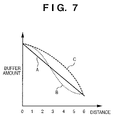
- FIG. 7 is a graph showing the allocation of buffer amounts according to the first embodiment of the present invention.
- FIG. 8 is a graph showing the allocation of buffer amounts according to the first embodiment of the present invention.
- FIGS. 9A and 9B are views for explaining the distance on a program table according to a second embodiment of the present invention.
- FIGS. 10A and 10B are views showing the allocation of buffer amounts according to the second embodiment of the present invention.
- FIG. 11 is a view showing an example of a program table according to a third embodiment of the present invention.
- FIGS. 12A and 12B are views for explaining the distance on the program table according to the third embodiment of the present invention.
- FIG. 13 is a view showing an example of a program table according to a fourth embodiment of the present invention.
- FIGS. 14A and 14B are views for explaining the distance on the program table according to the fourth embodiment of the present invention.
- FIG. 15 is a block diagram showing the configuration of a system including a broadcasting receiving apparatus according to a fifth embodiment of the present invention.
- FIGS. 16A to 16C are views showing the allocation of buffer amounts according to the fifth embodiment of the present invention.
- FIGS. 17A to 17C are views showing the allocation of buffer amounts according to the fifth embodiment of the present invention.
- FIG. 18 is a block diagram showing the configuration of a system including a broadcasting receiving apparatus according to a sixth embodiment of the present invention.
- FIG. 19 is a flow chart showing a data storage process according to the sixth embodiment of the present invention.
- FIGS. 20A to 20E are views showing the allocation of buffer amounts according to the sixth embodiment of the present invention.
- FIG. 21 is a block diagram showing the configuration of a system including a broadcasting receiving apparatus according to a seventh embodiment of the present invention.
- FIG. 22 is a flow chart showing a data storage process according to the seventh embodiment of the present invention.
- FIG. 23 is a graph for explaining the condition of the start of data storage according to the seventh embodiment of the present invention.
- FIG. 24 is a view showing an example of a program table according to the seventh embodiment of the present invention.
- FIGS. 25A to 25E are views showing the distance and area on the program table according to the seventh embodiment of the present invention.
- FIG. 26 is a view showing the allocation of buffer amounts according to the seventh embodiment of the present invention.
- FIG. 27 is a schematic view showing the moving directions of a cursor according to the seventh embodiment of the present invention.
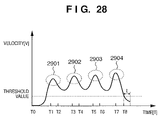
- FIG. 28 is a graph showing the moving velocity of the cursor according to the seventh embodiment of the present invention.
- a receiving apparatus is constructed as follows. That is, the receiving apparatus comprises a receiver that receives a signal for playing back a program, a storage device that stores the signal received by the receiver, and a controller that starts control for starting reception of a signal for playing back a second program different from a first program during a period in which the first program is selected, and, when a predetermined portion of signals for playing back the second program is stored in the storage device during the period in which the first program is selected, stops reception of another portion of the signals for playing back the second program.
- a transmission source includes a transmitter such as a server for actually transmitting signals, and a transmission manager such as a management server for allowing the transmitter to transmit signals.
- the playback of the program is started when a predetermined amount of signals are stored in a buffer.
- control is so performed as to stop the reception of another portion of the signals. This makes it possible to avoid starting playback of the second program during the period in which the first program is selected.
- the other portion of the signals for playing back the second program is not necessarily the whole portion other than the predetermined portion.
- a program is a set of pieces of information to be perceived in order at predetermined timings with the lapse of time by a perceiving apparatus, for example, a display such as a CRT or flat panel display or a sound wave generator such as a loudspeaker.
- a perceiving apparatus for example, a display such as a CRT or flat panel display or a sound wave generator such as a loudspeaker.
- an arrangement which transmits information for performing the stoppage to a transmission source of the second program may be preferably used.
- This control for stopping the reception of the other portion of the signals for playing back the second program may also be simple stoppage of the reception.
- the control which transmits information for performing the stoppage to the transmission source of the second program is more desirable. More specifically, information for requesting the stoppage of transmission is transmitted. For example, when a certain program is to be played back, if the receiving apparatus simply stops the reception, the transmission source may keep transmitting a portion other than signals for playing back the program.
- a load is applied on the transmission source.
- charging may occur although the other portion described above is not played back.
- the transmission source is performing control for inhibiting repetitive transmission to a specific receiving party, the other portion may not be received when the other portion is to be continuously played back after the portion of the signals for playing back the program.
- control for starting the reception of the signals for playing back the second program includes at least control for requesting a transmission source of the second program to transmit at least a portion of the signals for playing back the second program.
- the predetermined portion is an amount with which automatic playback of the second program is not started.
- control circuit preferably starts control for starting reception of signals for playing back a third program different from the first and second programs during the period in which the first program is selected, and, when a predetermined portion of the signals for playing back the third program is stored in the storage device during the period in which the first program is selected, performs control for stopping reception of another portion of the signals for playing back the third program.
- the control circuit when a second predetermined amount as a portion of the signals for playing back the second program is stored in the storage device during the period in which the first program is selected, the control circuit preferably performs control for stopping reception of another portion of the signals for playing back the second program, and, when a third predetermined amount as a portion of the signals for playing back the third program is stored in the storage device during the period in which the first program is selected, the control circuit performs control for stopping reception of another portion of the signals for playing back the third program, the second and third predetermined amounts being different signal amounts.
- the second and third programs preferably satisfy a relationship in which an operation amount when a state in which the first program is selected is switched to a state in which the third program is selected is larger than an operation amount when the state in which the first program is selected is switched to a state in which the second program is selected, the second predetermined amount being larger than the third predetermined amount.
- the operation amount is the number of times an operation key is pressed to select a program, or the distance a pointer is moved to select a program.
- the third program is a program selected before the first program is selected, the first program is selected by operating a predetermined operation key from a state in which the third program is selected, the second program is a program selected by performing the same operation on the operation key from a state in which the first program is selected, and the second predetermined amount is larger than the third predetermined amount.
- the receiving apparatus also includes the following arrangement. That is, the receiving apparatus is characterized by comprising a receiver that receives a signal for playing back a program, a storage device that stores the signal received by the receiver, and a controller that performs control for receiving signals for playing back second and third programs different from a first program during a period in which the first program is selected, wherein storage capacities allocated to store the signals for playing back the second and third programs during the period in which the first program is selected are different.
- the embodiments includes a program playback apparatus comprising any of the receiving apparatuses described above, and a perceiving apparatus for playing back a program on the basis of a signal received by the receiving apparatus.
- FIG. 1 is a block diagram showing the configuration of a system including a broadcasting receiving apparatus to which a streaming receiving/playback method according to the first embodiment of the present invention is applied.
- a broadcasting receiving apparatus 100 receives broadcast information from a broadcasting station.
- program information management servers 101 receives program information from a broadcasting station.
- program providing servers 102 are communicably connected across a network 103 .
- the program information management server 101 has a function of distributing, onto the network 103 , at least the URL of the program providing server 102 pertaining to streaming contents and information concerning the program name and distribution date, as information (to be referred to as a “content list” hereinafter) required to form a scheduled broadcasting program table (to be described later).
- the program providing server 102 is a server which provides streaming content data.
- the program providing server 102 has a function of holding streaming data containing motion image data, sound data, and the like, and distributing the streaming data onto the network 103 .
- the broadcasting receiving apparatus 100 includes a communication controller 104 , control unit 105 , program table formation unit 108 , program information storage manager 109 , position information detector 110 , image controller 111 , sound controller 112 , and operation controller 113 , all of which are connected by a bus 116 .
- the apparatus 100 also includes a buffer 107 which is controlled by a buffer controller 106 in the control unit 105 .
- a display device 114 and loudspeaker 115 are connected to the broadcasting receiving apparatus 100 via the image controller 111 and sound controller 112 , respectively.
- the communication controller 104 has a receiver for receiving streaming data, and controls transmission and reception between the broadcasting receiving apparatus 100 and network 103 in accordance with a predetermined communication protocol.
- a protocol suited for streaming distribution is used.
- Such protocol includes, inter alia, TCP/IP (Transport Control Protocol/Internet Protocol), UDP (User Datagram Protocol), or RTP (Realtime Transport Protocol).
- TCP/IP Transmission Control Protocol/Internet Protocol
- UDP User Datagram Protocol
- RTP Realtime Transport Protocol
- the form of connection can be either a continuous connection or a temporal dial-up connection.
- the control unit 105 has a CPU (Central Processing Unit) as its main component, and includes the buffer controller 106 as the most characteristic feature of the first embodiment.
- the control unit 105 also has functions of controlling and managing the communication controller 104 , program table formation unit 108 , program information storage manager 109 , position information detector 110 , image controller 111 , sound controller 112 , and operation controller 113 via the bus 116 , and performing buffering during streaming.
- the control unit 105 includes a controller for controlling the reception of streaming data, and has a function of requesting, via the communication controller 104 , the program providing server 102 to transmit/stop streaming data.
- the buffer controller 106 performs area control for the buffer 107 as a storage device for received streaming data. Also, as the characteristic feature of the first embodiment, the buffer controller 106 has a function of optimally allocating the buffer 107 not only to a program currently being viewed but also to a plurality of other programs managed by the program information storage manager 109 .
- the buffer control method will be described in detail later.
- the program table formation unit 108 has a function of forming a program table on the basis of the content list stored in the program information storage manager 109 .
- the program table formed by the program table formation unit 108 is displayed on the display device 114 to a user by using a GUI (Graphical User Interface). The form of the displayed program table will be explained in detail later.
- the program information storage manager 109 has functions of storing the content lists obtained from the program information management server 101 across the network 103 , and providing a necessary content list to the program table formation unit 108 as needed.
- the position information detector 110 detects the position of a selection candidate indication (to be referred to as a “Focus” hereinafter) and the positions of candidate programs other than the focused content on a program table formed by the program table formation unit 108 , and calculates the distance on the program table.
- a selection candidate indication to be referred to as a “Focus” hereinafter
- the method of calculating the distance on the program table will be described later.
- the image controller 111 has functions of displaying, on the display device 114 , image data buffered by the control unit 105 , and displaying, on the display device 114 , a program table formed by the program table formation unit 108 .
- the sound controller 112 has a function of outputting sound data buffered by the control unit 105 to the loudspeaker 115 .
- the operation controller 113 has a function of transmitting operation information from a user to the control unit 105 .
- FIG. 2 shows transactions among the servers for performing streaming distribution and the broadcasting receiving apparatus for performing streaming playback, when streaming playback is to be performed between the apparatuses having the above arrangements.
- the broadcasting receiving apparatus 100 requests the program information management server 101 to distribute a content list of streaming contents currently being broadcast ( 201 ).
- the program information management server 101 distributes the content list to the broadcasting receiving apparatus 100 ( 202 ).
- the broadcasting receiving apparatus 100 forms a scheduled broadcasting program table on the basis of the received content list, and presents this table as the content list to the user ( 203 ).
- the content list describes information for specifying each program, and may include the titles of programs, texts for introducing performers, and graphical data.
- the user selects a content on the presented content list ( 204 ).
- the broadcasting receiving apparatus 100 requests the program information management server 101 to transmit connection information linked to the content selected by the user ( 205 ).
- the connection information describes, e.g., the URL (Uniform Resource Locator) of the program providing server, the type of decoder to be used for the content, a protocol for accessing the content, and information pertaining to the connection destination.
- the number of the connection information is not necessarily one for one content; a plurality of pieces of connection information sometimes exist depending on streaming media such as images and sounds.
- connection information When this connection information is transmitted from the program information management server 101 to the broadcasting receiving apparatus 100 ( 206 ), the broadcasting receiving apparatus 100 activates a player for streaming playback, and transfers the connection information to the player. On the basis of the transferred connection information, the player opens a two-way connection by, for example, TCP/IP (Transmission Control Protocol/Internet Protocol) to the program providing server 102 . This enables control by RTSP (Real Time Streaming Protocol).
- TCP/IP Transmission Control Protocol/Internet Protocol
- RTSP Real Time Streaming Protocol
- the broadcasting receiving apparatus 100 which has opened the connection to the program providing server 102 notifies media information ( 207 ).
- the media information describes a connection protocol for streaming media distribution, a receivable port number of the broadcasting receiving apparatus 100 , and the like. Further, when receiving the media information from the program providing server 102 ( 208 ), the broadcasting receiving apparatus 100 sends a stream start request to the program providing server 102 ( 209 ).
- the program providing server 102 which has received this stream start request opens a one-way UDPC (User Datagram Protocol) connection to the player in accordance with RTSP instructions ( 210 ), and starts transmitting the content ( 211 to 216 ).
- the broadcasting receiving apparatus 100 starts buffering ( 213 ) when receiving the content, and starts playback by the player ( 217 ) when completing buffering of an amount of the content necessary for the playback.
- the broadcasting receiving apparatus 100 is initialized (step S 300 ). In this initialization, the hardware and software of the broadcasting receiving apparatus 100 are reset. If program information stored in the program information storage manager 109 is not the latest one or no program information is stored (YES in step S 301 ), the control unit 105 sends a program information request to the program information management server 101 via the communication controller 104 and the network 103 .
- the program information management server 101 distributes, onto the network 103 , information of at least program names and offering dates pertaining to streaming contents, as information necessary to form a content list, and the communication controller 104 acquires a content list.
- the acquired content list is stored in the program information storage manager 109 (step S 302 ).
- step S 303 If a program table display instruction is confirmed and a program table presentation request from the user is received by the operation controller 113 (YES in step S 303 ), the flow advances to step S 304 , and the control unit 105 transfers the content list stored in the program information storage manager 109 to the program table formation unit 108 .
- the program table formation unit 108 forms a program table (to be described later) on the basis of the received content list.
- the thus formed program table is processed into a form corresponding to the display device 114 by the image controller 111 and presented to the user.
- the user operates various switches or a remote controller of the broadcasting receiving apparatus 100 to vertically move the Focus in the presented program table, and selects a desired program by operating an enter key or the like.
- the control unit 105 requests the acquisition of the connection information (e.g., the URL) of the program providing server 102 which provides the selected streaming content.
- the program information management server 101 which has received this request distributes the connection information onto the network 103 , and the communication controller 104 acquires the connection information.
- the control unit 105 notifies the program providing server 102 of media information such as the connection protocol for streaming media distribution, and the receivable port number of the broadcasting receiving apparatus 100 .
- the program providing server 102 opens a one-way UDP connection to the player in accordance with RTSP instructions, and starts transmitting the content.
- the broadcasting receiving apparatus 100 receives the content and starts buffering (step S 306 ).
- the control unit 105 determines whether the data of the thus selected program is stored in the buffer 107 as will be described later (step S 307 ).
- a predetermined amount of data of a program currently being selected and other programs in a program table is stored in the buffer 107 .
- no data may exist in the buffer 107 .
- the processing in this step is executed to determine a situation like this.
- the buffer controller 106 reads out this data of the selected program from the buffer 107 , and starts outputting the data to the image controller 111 (step S 308 ).
- the control unit 105 determines whether a period corresponding to a data amount allocated to the program has elapsed (step S 310 ). If the predetermined period has elapsed and the remaining amount of data stored in the buffer 107 becomes small, the control unit 105 outputs, to the image controller 111 , the data received by the communication controller 104 and stored in the buffer 107 when the connection is started in step S 306 , instead of the data stored beforehand in the buffer 107 (step S 311 ). The control unit 105 stops the display of the program table, and displays the image of the selected program on the display device 114 .
- the switching timing is set by determining the read start position of the data output from the communication controller 104 and stored in the buffer 107 , such that the data naturally continues to the last portion of the data stored beforehand in the buffer 107 .
- the control unit 105 determines whether the playback of the program content is complete (step S 312 ). If YES in step S 312 , the control unit 105 determines whether the power is turned off (step S 313 ).
- step S 307 If the data of the selected program is not stored in the buffer 107 in step S 307 , outputting of the data is started after data whose amount is sufficient to play back the content is stored in the buffer 107 (step S 309 ).
- step S 304 when the program table is displayed in step S 304 , processing shown in FIG. 4 is performed in parallel with the processing after step S 304 .
- the position information detector 110 detects the position of the focused streaming content (program to be viewed) and the positions of a plurality of other candidate programs on the program table, and calculates the distance to each candidate program from the focused program on the program table (step S 314 ).
- a selection candidate program and the distance on the program table will be explained in detail later.
- the buffer controller 106 performs area control (buffer amount control) for the buffer 107 for streaming playback of candidate programs (step S 315 ). Details of the method of controlling the buffer 107 will be described later.
- step S 316 Determination in step S 316 corresponds to the determination in step S 305 of FIG. 3 . If the Focus moves without selecting any program, the flow returns to step S 314 to repeat the area control process for the buffer 107 in accordance with the position of the Focus.
- step S 316 the control unit 105 requests the connection information described above, notifies media information, and connects to the program providing server 102 in accordance with the connection protocol for a candidate program, other than the selected program, and starts buffering the streaming content of the candidate program (step S 317 ). Details of the operation in step S 317 will be described later.
- step S 317 When buffering of a buffer amount allocated by the buffer controller 106 is complete, the processing in step S 317 is repeated for the next candidate program (step S 318 ).
- the number of candidate programs can be set by the broadcasting receiving apparatus 100 and may be variable.
- FIG. 5 shows an example of a program table formed on the basis of the content list by the program table formation unit 108 .
- reference numeral 401 denotes the display window of the display device 114 ; and 402 , a program table formed by the program table formation unit 108 .
- the program table 402 shows a program name 403 , program contents 404 , and the like as information by which the user selects a program.
- site information may also be displayed as the location of the program providing server 102 . That is, information as a material for judgment by which the user selects a program may also be presented in the program table 402 .
- the user uses an input means such as a remote controller 406 to determine a content to be selected by vertically moving a Focus 405 in the program table 402 .
- an input means such as a remote controller 406 to determine a content to be selected by vertically moving a Focus 405 in the program table 402 .
- a view window 407 the contents of the program selected by the Focus are simply displayed.
- the distance on a program table is the distance between a program (program on view) currently being selected and a candidate program (selection candidate program) to be selected next on a program table. This distance is equivalent to an operation amount required to select a candidate program from the state in which a given program is selected. In a presented program table, the distance is the minimum number of operations required to move the Focus 405 from a program on view to a selection candidate program.
- FIGS. 6A and 6B illustrate only the program table.
- the user vertically moves the Focus 405 and determines a desired program. Assume that, as shown in FIG. 6A , the user moves the Focus 405 and selects the uppermost program.
- the number of operations of moving the Focus 405 to the next selection candidate program is the distance on the program table. Therefore, assuming that the distance to a content in contact with the program on view is 1, the distances to contents below this content are 2, 3, 4 et sequentia.
- the numbers in () indicate the distances to the individual contents in FIGS. 6A and 6B , these numbers are not actually displayed. For example, since seven contents are displayed in the form of a list in FIG. 6A , the distance to a lowermost program 503 is 6 when the uppermost program is selected by the Focus 405 .
- the distances to upper and lower contents adjacent to the program on view from are 1. Therefore, the distance to the lowermost program can be regarded as 4.
- Buffer amount control is performed for a plurality of selection candidate programs in accordance with the distances on the program table.
- FIG. 7 schematically shows the allocation of buffer amounts to the distances on the program table. For example, assume that the user moves the Focus 405 and selects the uppermost program as shown in FIG. 6A . In this case, the buffer amount is controlled as shown in FIG. 7 on the basis of the distance indicated in () of the program name column 403 . Three types of control will be explained below.
- a line A indicates an allocation method by which the buffer amount reduces in proportion to the distance on the program table. This control is preferably applied when the transmission speeds of communication paths between the broadcasting receiving apparatus 100 and the program providing servers 102 of the respective contents are nearly equivalent to each other (e.g., let one of a plurality of programs subjected to buffering be a reference program, all of the quotients obtained by dividing differences between receiving speeds of the reference program and other programs by the receiving speed of the reference program are within about 1%).
- a curve B indicates an allocation method by which the shorter the distance to the program on view on the program table, the larger the buffer amount.
- this method is based on a Gaussian distribution around the program on view as a central axis. This method is applied when the user looks the contents displayed on the program table in order from the top. This method is also applied when the memory amount available for buffering is small. That is, the method is preferably applied when the memory utilization need be increased compared to the method represented by the line A and a method represented by a curve C described below.
- the curve C indicates an allocation method by which large buffer amounts are allocated to the individual contents around the program on view. This method is preferably applied when the usable memory amount is large compared to a case of the line A and curve B in a receiving apparatus such as a personal computer.
- the buffer amount is controlled as described above. In addition, the following control is performed in step S 317 of FIG. 4 to store signals for playing back unselected programs into the buffer 107 .
- the broadcasting receiving apparatus 100 requests transmission of unselected contents, in parallel with the transmission of the content selected by the user (the processing from step S 306 in FIG. 3 ).
- the procedure of this transmission request is the same as that from transaction 205 in FIG. 2 .
- the transmission request is performed in order from a content having the shortest distance on the program table, and buffering is started.
- reception stop control is performed.
- the predetermined portion is data whose amount is smaller than minimum necessary data with which the content is automatically played back. That is, when a predetermined amount of content data is stored in the buffer 107 allocated by the buffer controller 106 , playback of the content is automatically started. In this case, however, stop control is performed before an amount of data necessary to automatically start the playback is received.
- the broadcasting receiving apparatus 100 can simply and forcedly disconnect the communication by closing the port. It is desirable, however, to transmit information for performing the stoppage to the transmission source of the unselected content. More specifically, information for requesting transmission stoppage may be transmitted.
- the procedure of this stoppage control is as follows.
- the broadcasting receiving apparatus 100 transmits a disconnection request to the program providing server 102 .
- the program providing server 102 returns an acknowledgement to the broadcasting receiving apparatus 100 , and subsequently transmits a disconnection request.
- the broadcasting receiving apparatus 100 which has received this disconnection request returns an acknowledgement, the mutual connection is disconnected.
- images and sounds can be quickly output in response to channel switching.
- the buffer amount of each content is controlled in accordance with the memory or the like of the broadcasting receiving apparatus. This increases the utilization of system resources.
- the receiving apparatus comprises a receiver which receives an information data stream across a network, a data processor which processes the information data stream received by the receiver to make the information data stream displayable, a selector for selecting an arbitrary information data stream from a plurality of information data streams, and a storage device which stores a predetermined amount of a plurality of received information data streams, wherein a selected information data stream is received by the receiver and processed by the data processor, a predetermined number of information data streams other than the selected information data stream are stored in the storage device, and, if the selected information data stream is changed by the selector, the corresponding information data stream is read out from the storage means and processed by the data processor.
- the second embodiment relates to a buffer amount control method when buffering is performed for contents not displayed on the display window during the buffer amount control explained in the first embodiment.
- the apparatus and system configuration, the transactions performed in the system, the operation of the broadcasting receiving apparatus, and the program table presenting method are the same as explained with reference to FIGS. 1 to 5 in the first embodiment, so a detailed description thereof will be omitted.
- contents not presented on the screen are also considered as selection candidate programs in addition to those presented to a user.
- a program table 801 is displayed and the user selects the uppermost program by using a Focus 802 . If the minimum number of operations required to move the Focus to the next selection candidate program is defined as the distance on the program table, the distance to a content in contact with the program on view can be regarded as 1, and the distances to contents below this content can be regarded as 2, 3, 4 et sequentia, in the program table 801 .
- a program table 804 shown in FIG. 9B illustrates this concept.
- the distance from the program on view to each selection candidate program is indicated by the number in () of a program name column 805 .
- FIGS. 10A and 10B schematically illustrate the program table and the allocation of buffer amounts in the program table, respectively.
- FIG. 10A assume that the user moves the Focus 802 and selects the uppermost program in the program table 801 shown in FIG. 9A .
- distances above and below the program on view on the program table 805 are regarded as minus distances and plus distances, respectively.
- the buffer amount is controlled as shown in FIG. 10B .
- the distance from the program on view is also possible to regard the distance from the program on view as a plus distance regardless of the direction (upward or downward), and control the buffer amount by applying the graph shown in FIG. 7 .
- the same effects as in the first embodiment can be obtained even when contents not displayed on the window due to the size of the window are present. That is, in the second embodiment, if representative information explained in the first embodiment cannot be fully displayed on the display device, the display positional relationship to the representative information not displayed is obtained on the basis of a virtual display position.
- the apparatus and system configuration, the transactions performed in the system, and the operation of the broadcasting receiving apparatus are the same as explained with reference to FIGS. 1 to 4 in the first embodiment, so a detailed description thereof will be omitted.
- the program table presenting method, the distance on the program table, and the buffer amount control according to the third embodiment will be described in detail below.
- FIG. 11 shows an example of a program table formed on the basis of a content list by a program table formation unit 108 .
- reference numeral 1001 denotes the display window of a display device 114 and 1002 , a program table formed by the program table formation unit 108 .
- the program table 1002 shows program names 1004 and the like as information by which the user selects a program.
- the user determines a content to be selected by vertically, horizontally, and/or obliquely moving a Focus 1005 in the program table 1002 by using an input mean such as a remote controller 1003 .
- an input mean such as a remote controller 1003 .
- a view window 1006 the contents of the program selected by the Focus 1005 are simply displayed.
- the distance on a program table is the distance between a program on view and a candidate program to be selected next (selection candidate program) on the program table. More specifically, in the third embodiment, the distance is the minimum number of operations necessary to move the Focus 1005 vertically, horizontally, and/or obliquely from a program on view to a selection candidate program in a presented program table.
- FIGS. 12A and 12B illustrate only the program table 1002 .
- the user determines a content to be selected by vertically, horizontally, and/or obliquely moving the Focus 1005 .
- the user moves the Focus 1005 and selects a program in the upper left corner.
- the minimum number of operations of moving the Focus 1005 to the next selection candidate program is the distance on the program table. Therefore, assuming that the distances to contents in contact with the program on view from right, from below, and obliquely from lower right are 1 in the program table 1002 , the distance from the program in the upper left corner to a content in the lower right corner is 3 in a case where 16 contents are displayed in a matrix manner as in FIG. 12A .
- the numbers in () indicate the distances to the individual contents in FIGS. 12A and 12B , these numbers are not actually displayed.
- the distances to contents adjacent in all directions to this program on view are 1. Therefore, the distance to the program in the lower right corner is 2.
- the buffer amounts are allocated as explained with reference to FIG. 7 in the first embodiment in accordance with the distances on the program table as shown in FIGS. 12A and 12B .
- This buffer amount allocation control is already described in detail in the first embodiment, so a detailed explanation thereof will be omitted.
- the same effects as in the first embodiment can be obtained regardless of the arrangement of contents. That is, in the third embodiment, the display positional relationship is the minimum number of operations required by the designating means to designate representative information from another representative information already designated by the designating means.
- the apparatus and system configuration, the transactions performed in the system, and the operation of the broadcasting receiving apparatus are the same as explained with reference to FIGS. 1 to 4 in the first embodiment, so a detailed description thereof will be omitted.
- the distance on a program table is the distance between a program on view and a candidate program (selection candidate program) to be selected next on the program table. More specifically, in the fourth embodiment, the distance is the minimum number of operations required to move the Focus vertically and/or horizontally from a program on view to a selection candidate program in a presented program table. In the fourth embodiment, as shown in FIG. 13 , a Focus 1405 can be moved only vertically and horizontally in a program table 1402 .
- the user determines a content to be selected by vertically and/or horizontally moving the Focus 1405 , Assuming that, as shown in FIG. 14A , the user moves the Focus 1405 and selects a program in the upper left corner.
- the minimum number of operations of moving the Focus 1405 to the next selection candidate program is the distance on the program table. Therefore, the distances to contents adjacent to the program on view from right and below are regarded as 1.
- the distance to a content below the upper-left-corner program off to the right is regarded as 2
- the distance to a program in the lower right corner is regarded as 6.
- the Focus 1405 can be moved from the upper left corner to the lower right corner by moving the Focus 1405 to the right three times and to the left three times, that is, a total of six times.
- the Focus 1405 selects a content in one middle row in the program table as in FIG. 14B .
- the distances to contents adjacent to this program on view from above, below, left, and right are 1, and the distances to contents in contact with the program on view obliquely from left and right are 2. Therefore, the distance to the program in the lower right corner is 4.
- the buffer amounts are allocated as explained with reference to FIG. 7 in the first embodiment in accordance with the distances on the program table as shown in FIGS. 14A and 14B .
- This buffer amount allocation control is already described in detail in the first embodiment, so a detailed explanation thereof will be omitted.
- the buffer amount is controlled on the basis a user's operation (the position and moving direction of the Focus) until a program is selected.
- FIG. 15 is a block diagram showing the configuration of a system including a broadcasting receiving apparatus to which a streaming receiving/playback method according to the fifth embodiment is applied.
- a broadcasting receiving apparatus 100 ′ shown in FIG. 15 has a moving direction detector 120 , instead of the position information detector 110 shown in FIG. 1 .
- the moving direction detector 120 has a function of detecting the direction in which the Focus is moved by an operation controller 113 .
- the transactions performed in the system, the operation of the broadcasting receiving apparatus, and the program table presenting method are basically the same as explained with reference to FIGS. 2 to 5 in the first embodiment, so a detailed description thereof will be omitted.
- the position and moving direction of the Focus are used to determine position information in step S 314 of FIG. 4 , and the buffer amount is controlled on the basis of the thus obtained position information in step S 315 .
- FIGS. 16A to 16C illustrate only a program table 402 .
- the numbers shown in () in the program name column indicate the individual program IDs in the fifth embodiment.
- FIG. 16A shows an image immediately after the user requests the program table.
- FIG. 17A shows an example of weighting of buffer amounts allocated to the individual contents in this case.
- FIG. 17A indicates that immediately after activation, equal buffer amounts are allocated not only to a program designated by a Focus 405 but also to other selection candidate programs.
- the user moves the Focus 405 by operating various switches or a remote controller of the broadcasting receiving apparatus 100 ′.
- the moving direction detector 120 detects the moving direction of the Focus 405 . This moving direction can be detected by hardware from direction keys of the remote controller or by software from calculations on the display window.
- the Focus 405 must be moved down step by step. This movement of the Focus 405 indicates that the target content is present in the lower portion of the display window, so it is determined that the user is less interested in contents which the Focus 405 has passed by. That is, it is predicted that a program to be selected next is present in the moving direction of the Focus 405 .
- FIG. 17B shows an example of weighting of buffer amounts allocated to the individual contents in this case.
- FIG. 17B demonstrates that large buffer amounts are allocated to programs in the lower portion of the screen in the moving direction of the Focus 405 .
- the Focus 405 In contrast, if the Focus 405 is currently present at the program 5 and the user wants to select a program 2 as shown in FIG. 16C , the Focus 405 must be moved up step by step. This movement of the Focus 405 indicates that the target content is present in the upper portion of the display window. Therefore, the buffer amounts are weighted with respect to the individual contents as shown in FIG. 17C .
- the buffer amount weights are held in the form of a table in the broadcasting receiving apparatus 100 ′ for each moving direction of the Focus 405 and for each number of steps the Focus moves after the program table 402 is displayed and before a content is selected.
- the buffer amount weight can also be calculated by a nonlinear function by using the moving direction of the Focus and the number of steps of the movement.
- the buffer amount weights are given as shown in FIG. 17A .
- the buffer amount in the storage means is allocated on the basis of the moving direction of the designating means on the display means.
- the sixth embodiment is characterized in that the vertical and horizontal moving directions of the Focus are reflected on the buffer amount weight, and, if the Focus stops for a predetermined time or longer, buffering is started without waiting for a user's program selecting operation.
- FIG. 18 is a block diagram showing the configuration of a system including a broadcasting receiving apparatus to which a streaming receiving/playback method according to the sixth embodiment is applied.
- a broadcasting receiving apparatus 100 ′′ shown in FIG. 18 is obtained by adding a timer 130 to the broadcasting receiving apparatus 100 ′ shown in FIG. 15 .
- the timer 130 starts measuring the suspension time since a moving direction detector 120 detects the stoppage of movement of the Focus, and notifies the moving direction detector 120 of time lapse information if an arbitrary time is exceeded.
- the moving direction detector 120 requests a control unit 105 to start buffering.
- the transactions performed in the system and the operation of the broadcasting receiving apparatus are basically the same as explained with reference to FIGS. 2 and 3 in the first embodiment, so a detailed description thereof will be omitted.
- the operation of the broadcasting receiving apparatus 100 ′′ is different in processing shown in FIG. 4 from the broadcasting receiving apparatus 100 . Therefore, this operation will be explained below with reference a flow chart shown in FIG. 19 .
- step S 304 of FIG. 3 when a program table is displayed in step S 304 of FIG. 3 , the processing shown in FIG. 19 is executed in parallel with the processing after step S 304 .
- the timer 130 is reset in step S 1901 . If the Focus is moved by the user, the flow advances to step S 1902 , and the moving direction detector 120 detects position information including the direction in which the Focus is moved by an operation controller 113 .
- a buffer controller 106 performs area control (buffer amount control) for a buffer 107 for playing back streaming of candidate programs (step S 1903 ).
- area control buffer amount control
- the method of controlling the buffer 107 will be described in detail later.
- step S 1904 whether a program at which the Focus is currently positioned is selected by the operation of an enter key or the like is determined. This determination in step S 1904 corresponds to the determination in step S 305 of FIG. 3 . If YES in step S 1904 , the flow advances to step S 1908 . If NO in step S 1904 , the flow advances to step S 1905 , and the timer 130 determines whether a predetermined time has elapsed. If NO in step S 1905 , the flow advances to step S 1906 to determine whether the Focus has moved. If YES in step S 1906 , the flow returns to step S 1901 . If NO in step S 1906 , the flow returns to step S 1904 .
- step S 1907 the control is so performed that a buffer amount with which playback is possible is not allocated to the program at which the Focus stops. Details of this control will be explained later.
- step S 1908 with respect to the candidate program, the control unit 105 requests the connection information described above, notifies media information, and connects to a program providing server 102 in accordance with the connection protocol, following the same procedures as in step S 317 of FIG. 4 , and starts buffering of the streaming content of the candidate program.
- step S 1908 When buffering of the buffer amount allocated by the buffer controller 106 is complete, the processing in step S 1908 is repeated for the next candidate program (step S 1909 ).
- the number of candidate programs can be set by the broadcasting receiving apparatus 100 ′′ and may be variable.
- FIGS. 20A to 20E illustrate only a program table 1402 .
- the user determines a content to be selected by vertically and/or horizontally moving a Focus 1405 . Assume that the Focus 1405 is initially positioned at the second program from the left in the uppermost row, and a program in the third row and third column is to be selected.
- FIG. 20A shows an image immediately after the user requests the program table.
- FIG. 20A shows an example of weighting of buffer amounts allocated to the individual contents in this case.
- equal buffer amounts are allocated not only to a program at which the Focus 1405 is present but also to other contents in the vertical and horizontal directions to which the Focus 1405 may move.
- the Focus 1405 To move the Focus 1405 to the position of the program in the third row and second column from this state, the Focus 1405 must be moved down step by step. This indicates that the target content is present in the lower portion of the display window.
- a moving direction detector 120 detects the moving direction of the Focus 1405 , it is determined that the user is less interested in contents which the Focus 1405 has passed by. Accordingly, the buffer amount weights are changed as shown in FIG. 20B . In this manner, when the user designates the movement of the Focus 1405 , large buffer amounts are allocated to programs in the lower portion of the screen in the moving direction of the Focus 1405 . This buffer amount allocation corresponds to the processing performed in step S 1903 of FIG. 19 .
- the buffer amount weights change from FIG. 20B to FIG. 20C .
- the characteristic feature of the sixth embodiment is that if the Focus stops in the same position for a predetermined time or longer, it is determined that a program at which the Focus stops is highly likely to be selected, so buffering is started. Also, in the example shown in FIG. 20C , the Focus 1405 can move to the left and right at the same probability, so the buffer amount weights are equal. Furthermore, the weight of the program at which the Focus 1405 stops also changes from FIG. 20B to FIG. 20C . This means that in the sixth embodiment, buffering is started when the Focus stops for a given time period, an amount with which playback is possible is not buffered. This buffer amount allocation corresponds to the processing performed in step S 1907 of FIG. 19 .
- the buffer amount weights of the individual contents change to FIG. 20D . That is, it is determined that the target content is present on the right side of the display window, so large buffer amounts are allocated to contents on the right side of the screen (S 1204 ).
- the buffer amounts change to FIG. 20E to reset the buffer amount of the selected content to an amount with which playback is possible, and buffering is started or restarted.
- the buffer amounts are controlled on the basis of the position, moving direction, and moving velocity of the cursor, and buffering is automatically started on the basis of the moving velocity.
- FIG. 21 is a block diagram showing the configuration of a system including a broadcasting receiving apparatus to which a streaming receiving/playback method according to the seventh embodiment is applied.
- a broadcasting receiving apparatus 100 ′′′ shown in FIG. 21 is obtained by replacing the position information detector 110 of the broadcasting receiving apparatus 100 shown in FIG. 1 with a movement information detector 140 .
- the movement information detector 140 has a function of detecting the position, moving direction, and moving velocity of the cursor controlled on the basis of inputs from an operation controller 113 .
- the transactions performed in the system and the operation of the broadcasting receiving apparatus are basically the same as explained with reference to FIGS. 2 and 3 in the first embodiment, so a detailed description thereof will be omitted.
- the operation of the broadcasting receiving apparatus 100 ′′′ differs in processing shown in FIG. 4 from that of the broadcasting receiving apparatus 100 . Therefore, this operation will be described below with reference to a flow chart shown in FIG. 22 .
- step S 304 of FIG. 3 when a program table is displayed in step S 304 of FIG. 3 , the processing shown in FIG. 22 is executed in parallel with the processing after step S 304 .
- step S 2301 the movement information detector 140 detects the cursor position controlled by the operation controller 113 , and analyzes the moving direction on the basis of the detected cursor position.
- a buffer controller 106 performs area control (buffer amount control) for a buffer 107 for playing back streaming of a candidate program (step S 2302 ).
- area control buffer amount control
- the method of controlling the buffer 107 will be explained in detail later.
- step S 2303 whether a program is selected by the operation of an enter key or the like is determined. This determination in step S 2303 corresponds to the determination in step S 305 of FIG. 3 . If YES in step S 2303 , the flow advances to step S 2307 . If NO in step S 2303 , the flow advances to step S 2304 , and the movement information detector 140 detects a moving velocity Vm of the cursor on the basis of internal time information of the system and the change amount of the cursor position. If the moving velocity Vm is higher than an arbitrary velocity Vth, it is determined that the cursor is moving, and the flow returns to step S 2301 . If the moving velocity Vm is increasing although it is lower than the arbitrary velocity Vth, the cursor presumably starts moving, so the flow returns to step S 2301 .
- step S 2305 If the moving velocity Vm is lower than the arbitrary velocity Vth and decreases (if YES in step S 2305 ), the flow advances to step S 2306 , and whether a predetermined time has elapsed since the moving velocity Vm becomes lower than the arbitrary velocity Vth is determined. If NO in step S 2306 , the flow returns to step S 2305 . If YES in step S 2306 , the flow advances to step S 2307 .
- FIG. 23 shows the state which meets the above conditions in a very short time t between time T 4 and time T 5 .
- the moving velocity of the cursor is lower than a threshold value between time T 0 and time T 1 .
- V 0 at time T 0 is compared with velocity V 1 at time T 1 , V 0 ⁇ V 1 holds. Therefore, the above conditions are not met.
- the moving velocity of the cursor is calculated from the distance the cursor moves for a given time, and the distance of the cursor is calculated from a geometric distance (to be described later) on the basis of coordinates in the screen coordinate system at time T. For example, when the cursor moving time is 0.2 sec and the cursor moving distance is 1,500 pixels, the cursor moving velocity is 7,500 pixels/sec.
- step S 2303 If a program is selected or the above-mentioned conditions are met in step S 2303 , the flow advances to step S 2307 , and, with respect to the candidate program, the control unit 105 requests the connection information described earlier, notifies media information, and connects to a program providing server 102 in accordance with the connection protocol, following the same procedures as in step S 317 of FIG. 4 , and starts buffering of the streaming content of the candidate program.
- step S 2307 When buffering of the buffer amount allocated by the buffer controller 106 is complete, the processing in step S 2307 is repeated for the next candidate program (step S 2308 ).
- the number of candidate programs can be set by the broadcasting receiving apparatus 100 ′′′ and may be variable.
- FIG. 24 shows an example of a program table formed on the basis of a content list by a program table formation unit 108 .
- reference numeral 2401 denotes the display window of a display device 114 ; and 2402 , a program table formed by the program table formation unit 108 .
- the program table 2402 shows a program name 2403 and the like as information by which the user selects a program.
- the user determines a content to be selected by freely moving a cursor 2404 in the program table 2402 by using input means such as a mouse 2405 .
- input means such as a mouse 2405 .
- a view window 2406 the contents of the program selected by the cursor 2404 are simply displayed.
- the moving direction of the cursor 2404 is reflected on the weights of buffer amounts allocated to selection candidate programs.
- a program to be selected is predicted on the basis of the moving velocity of the cursor 2404 , and buffering is started in advance of actual selection of a program.
- FIGS. 25A to 25E illustrate only the program table 2402 shown in FIG. 24 .
- the user determines a content to be selected by freely moving the cursor 2404 .
- the cursor 2404 initially points at the leftmost program in the uppermost row, and a program 2510 is to be selected by moving the cursor 2404 at the shortest distance ( FIG. 25A ).
- FIG. 25B is a view for explaining the positional relationship between the cursor moving direction and selection candidate programs in the program table 2402 .
- a straight line 2502 indicates the shortest route from a start point 2501 of the cursor to the content 2510 .
- Dotted lines 2503 and 2504 make arbitrary angles ⁇ and ⁇ , respectively, with the straight line 2502 from a point 2501 as an apex.
- selection candidate programs are present in a portion where a region surrounded by the straight line 2502 and dotted lines 2503 and 2504 overlaps a program region on the program table 2402 .
- selection candidate programs are present in a hatched region 2507 surrounded by the broken lines.
- FIG. 25C is a view for explaining the way the weights of buffer amounts are allocated on the basis of the moving direction of the cursor.
- a triangle 2511 indicates that area of a program 2512 , which is contained in the fan-shaped area determined by the straight line 2502 and dotted lines 2503 and 2504 .
- the shortest distance to the triangle 2511 on the program table is regarded as the distance on the program table.
- the shortest distance on the program table is calculated by the geometric distance from the start point 2501 of the cursor 2404 to an icon on the program table.
- FIG. 25D shows an example of this geometric distance.
- the geometric distance is a distance L calculated by the Pythagorean theorem by letting (x0, y0) be the coordinates of the start point 2501 and (x1, y1) be the coordinates of a point 2513 at the shortest distance from the start point 2501 to the triangle 2511 in the screen coordinate system.
- a distance h to the barycenter of an icon on the program table may also be used.
- the distance h is calculated by the Pythagorean theorem by letting (x0, y0) be the coordinates of the start point 2501 and (x2, y2) be the coordinates of a barycenter 2514 of an icon in the screen coordinate system.
- FIG. 26 shows examples of buffer amount weights allocated to selection candidate programs as explained above with reference to FIGS. 25A to 25E .
- the buffer amount weight is 4 from the above equation.
- the value of w 1 is inversely proportional to the angles ⁇ and ⁇ which the dotted lines 2503 and 2504 make with the straight line 2502 , respectively. This is so because when the angles ⁇ and ⁇ increase, the directivity of the cursor weakens accordingly, so the influence of the overlapping area on the program table must be reduced.
- FIG. 27 shows a locus when the cursor is moved from a start point 2801 to an end point 2802 .
- FIG. 28 schematically shows the moving velocity of the cursor in FIG. 27 .
- each arrow indicates a direction vector at the point, and portions of the locus surrounded by dotted lines 2803 , 2804 , 2805 , and 2806 correspond to portions of a graph surrounded by dotted lines 2901 , 2902 , 2903 , and 2904 , respectively, in FIG. 28 .
- the direction vector is calculated by a straight line connecting the start and end points of the cursor which has moved within a very short time ⁇ t. If the moving direction of the cursor largely changes, that is, if the change amount of the direction vector is large (portion of locus surrounded by the dotted lines 2803 , 2804 , 2805 , and 2806 in FIG. 27 ), the moving direction of the cursor can be monitored more accurately by finely dividing the sampling time. That is, in the seventh embodiment, the buffer amount in the storage means is allocated on the basis of the moving velocity of the designating means on the display means.
- control means stores, in the storage means, an information data stream corresponding to representative information designated at that point and other information data streams.
- the present invention can be applied to an apparatus comprising a single device or to system constituted by a plurality of devices.
- the invention can be implemented by supplying a software program, which implements the functions of the foregoing embodiments, directly or indirectly to a system or apparatus, reading the supplied program code with a computer of the system or apparatus, and then executing the program code.
- a software program which implements the functions of the foregoing embodiments
- reading the supplied program code with a computer of the system or apparatus, and then executing the program code.
- the mode of implementation need not rely upon a program.
- the program code installed in the computer also implements the present invention.
- the claims of the present invention also cover a computer program for the purpose of implementing the functions of the present invention.
- the program may be executed in any form, such as an object code, a program executed by an interpreter, or scrip data supplied to an operating system.
- Example of storage media that can be used for supplying the program are a floppy disk, a hard disk, an optical disk, a magneto-optical disk, a CD-ROM, a CD-R, a CD-RW, a magnetic tape, a non-volatile type memory card, a ROM, and a DVD (DVD-ROM and a DVD-R).
- a client computer can be connected to a website on the Internet using a browser of the client computer, and the computer program of the present invention or an automatically-installable compressed file of the program can be downloaded to a recording medium such as a hard disk.
- the program of the present invention can be supplied by dividing the program code constituting the program into a plurality of files and downloading the files from different websites.
- a WWW World Wide Web
- a storage medium such as a CD-ROM
- an operating system or the like running on the computer may perform all or a part of the actual processing so that the functions of the foregoing embodiments can be implemented by this processing.
- a CPU or the like mounted on the function expansion board or function expansion unit performs all or a part of the actual processing so that the functions of the foregoing embodiments can be implemented by this processing.
Landscapes
- Engineering & Computer Science (AREA)
- Multimedia (AREA)
- Signal Processing (AREA)
- Databases & Information Systems (AREA)
- Human Computer Interaction (AREA)
- Software Systems (AREA)
- Two-Way Televisions, Distribution Of Moving Picture Or The Like (AREA)
- Circuits Of Receivers In General (AREA)
Applications Claiming Priority (6)
| Application Number | Priority Date | Filing Date | Title |
|---|---|---|---|
| JP2003-028667 | 2003-02-05 | ||
| JP2003-028667(PAT.) | 2003-02-05 | ||
| JP2003028667 | 2003-02-05 | ||
| JP2004-025348(PAT.) | 2004-02-02 | ||
| JP2004025348A JP4497944B2 (ja) | 2003-02-05 | 2004-02-02 | 受信装置及び受信装置の制御方法 |
| JP2004-025348 | 2004-02-02 |
Publications (3)
| Publication Number | Publication Date |
|---|---|
| US20040179811A1 US20040179811A1 (en) | 2004-09-16 |
| US20080181572A2 US20080181572A2 (en) | 2008-07-31 |
| US7464397B2 true US7464397B2 (en) | 2008-12-09 |
Family
ID=32964853
Family Applications (1)
| Application Number | Title | Priority Date | Filing Date |
|---|---|---|---|
| US10/770,553 Expired - Fee Related US7464397B2 (en) | 2003-02-05 | 2004-02-04 | Streaming content receiving apparatus and playback apparatus with stopping of reception of second streaming data during period in which first streaming program is selected |
Country Status (2)
| Country | Link |
|---|---|
| US (1) | US7464397B2 (ja) |
| JP (1) | JP4497944B2 (ja) |
Cited By (1)
| Publication number | Priority date | Publication date | Assignee | Title |
|---|---|---|---|---|
| US20110066759A1 (en) * | 2008-05-27 | 2011-03-17 | Canon Kabushiki Kaisha | Device control apparatus and device control method in video image display system including a plurality of connected devices |
Families Citing this family (30)
| Publication number | Priority date | Publication date | Assignee | Title |
|---|---|---|---|---|
| JP2005175715A (ja) * | 2003-12-09 | 2005-06-30 | Canon Inc | テレビ受信装置、ネットワーク端末及びネットワーク制御システム |
| US7716696B2 (en) | 2003-12-15 | 2010-05-11 | Canon Kabushiki Kaisha | Television receiver, information processing method and program |
| JP4227509B2 (ja) * | 2003-12-15 | 2009-02-18 | キヤノン株式会社 | 通信端末装置及びその制御方法 |
| JP4254718B2 (ja) * | 2005-01-31 | 2009-04-15 | ブラザー工業株式会社 | コンテンツ提供システム,クライアントデバイス,サーバおよびプログラム |
| JPWO2006109477A1 (ja) * | 2005-04-08 | 2008-10-23 | 松下電器産業株式会社 | デジタル放送受信装置 |
| US7756993B2 (en) | 2005-06-22 | 2010-07-13 | Sony Corporation | Reproducing apparatus, reproducing method, and reproducing program |
| JP4600759B2 (ja) * | 2005-06-22 | 2010-12-15 | ソニー株式会社 | 再生装置、再生方法及び再生プログラム |
| JP4725780B2 (ja) * | 2005-06-22 | 2011-07-13 | ソニー株式会社 | 再生装置、再生方法及び再生プログラム |
| JP4586663B2 (ja) * | 2005-07-26 | 2010-11-24 | 船井電機株式会社 | 放送信号受信装置 |
| JP2007134963A (ja) * | 2005-11-10 | 2007-05-31 | Funai Electric Co Ltd | 再生システム及びサーバ |
| US7889976B2 (en) * | 2006-03-10 | 2011-02-15 | Newport Media, Inc. | System and method for television programming data management |
| US7778184B2 (en) * | 2006-06-06 | 2010-08-17 | Murata Kikai Kabushiki Kaisha | Communication system and remote diagnosis system |
| KR100834062B1 (ko) | 2006-09-18 | 2008-06-02 | 삼성전자주식회사 | 디지털 방송 수신기의 채널공유 방법 및 장치 |
| US8943410B2 (en) | 2006-12-22 | 2015-01-27 | Apple Inc. | Modified media presentation during scrubbing |
| US8020100B2 (en) | 2006-12-22 | 2011-09-13 | Apple Inc. | Fast creation of video segments |
| US7992097B2 (en) | 2006-12-22 | 2011-08-02 | Apple Inc. | Select drag and drop operations on video thumbnails across clip boundaries |
| US8631440B2 (en) | 2007-04-30 | 2014-01-14 | Google Inc. | Program guide user interface |
| US8484192B1 (en) | 2007-04-30 | 2013-07-09 | Google Inc. | Media search broadening |
| US20080310454A1 (en) * | 2007-06-12 | 2008-12-18 | Bellwood Thomas A | Provisioning Bandwidth For A Digital Media Stream |
| US7756157B2 (en) * | 2007-06-12 | 2010-07-13 | International Business Machines Corporation | Provisioning bandwidth for a digital media stream |
| US20080310446A1 (en) * | 2007-06-12 | 2008-12-18 | Bellwood Thomas A | Provisioning Bandwidth For A Digital Media Stream |
| US20090094374A1 (en) * | 2007-10-04 | 2009-04-09 | Hong Kong Applied Science And Technology Research Institute Co., Ltd. | Systems and methods providing lists of available streaming content |
| US8539092B2 (en) * | 2008-07-09 | 2013-09-17 | Apple Inc. | Video streaming using multiple channels |
| US20100107090A1 (en) * | 2008-10-27 | 2010-04-29 | Camille Hearst | Remote linking to media asset groups |
| JP5412576B2 (ja) | 2010-04-19 | 2014-02-12 | パナソニック株式会社 | コンテンツ受信端末、およびエキスポート再生方法 |
| JP6056453B2 (ja) * | 2012-12-20 | 2017-01-11 | 富士通株式会社 | プログラム、データ管理方法および情報処理装置 |
| CN103826158B (zh) * | 2014-02-27 | 2017-09-26 | 北京六间房科技有限公司 | 一种网络直播装置和方法 |
| KR102282704B1 (ko) * | 2015-02-16 | 2021-07-29 | 삼성전자주식회사 | 영상 데이터를 재생하는 전자 장치 및 방법 |
| CN105611335A (zh) * | 2015-11-02 | 2016-05-25 | 林晓东 | 一种应用于对等网络的电视直播的方法 |
| US10356200B2 (en) * | 2016-12-28 | 2019-07-16 | Google Llc | Optimizing user interface data caching for future actions |
Citations (9)
| Publication number | Priority date | Publication date | Assignee | Title |
|---|---|---|---|---|
| US4488179A (en) * | 1980-09-27 | 1984-12-11 | Robert Bosch Gmbh | Television viewing center system |
| US6058242A (en) * | 1996-07-30 | 2000-05-02 | Samsung Electronics Co., Ltd. | Apparatus for performing programmed recording using broadcast program data and method therefor in a two-tuner system |
| JP2001309258A (ja) | 2000-04-26 | 2001-11-02 | Kenwood Corp | ディジタル放送受信機及びディジタル放送受信方法 |
| US20020138829A1 (en) | 2001-03-06 | 2002-09-26 | Canon Kabushiki Kaisha | Receiving apparatus and method thereof, and storage medium therefor |
| US20020157094A1 (en) | 2001-04-03 | 2002-10-24 | Canon Kabushiki Kaisha | Display control apparatus and method, receiving apparatus and recording medium |
| US20030142236A1 (en) | 2002-01-28 | 2003-07-31 | Canon Kabushiki Kaisha | Apparatus for receiving broadcast data, method for displaying broadcast program, and computer program |
| US20030208778A1 (en) | 2002-03-19 | 2003-11-06 | Canon Kabushiki Kaisha | Television broadcast receiving apparatus |
| US6651089B1 (en) * | 1999-06-05 | 2003-11-18 | At&T Corp | Surfing friendly multicasting arrangement |
| US6842724B1 (en) * | 1999-04-08 | 2005-01-11 | Lucent Technologies Inc. | Method and apparatus for reducing start-up delay in data packet-based network streaming applications |
Family Cites Families (10)
| Publication number | Priority date | Publication date | Assignee | Title |
|---|---|---|---|---|
| JPH0591510A (ja) * | 1991-09-26 | 1993-04-09 | Matsushita Electric Ind Co Ltd | 映像受信方法 |
| JP3393907B2 (ja) * | 1993-12-21 | 2003-04-07 | 株式会社東芝 | 動画像復号装置 |
| JPH09224097A (ja) * | 1996-02-16 | 1997-08-26 | Canon Inc | データ通信装置 |
| JP3469705B2 (ja) * | 1996-03-12 | 2003-11-25 | 三洋電機株式会社 | 多重映像信号の復号回路 |
| JP3879231B2 (ja) * | 1997-02-24 | 2007-02-07 | ヤマハ株式会社 | ディジタルチューナおよびそのチャンネル切換方法 |
| JP2002176609A (ja) * | 2000-08-25 | 2002-06-21 | Matsushita Electric Ind Co Ltd | データ受信再生方法及びデータ受信再生装置 |
| EP1187481B1 (en) * | 2000-09-11 | 2008-04-02 | Handmark Europe AB | A method for dynamic caching |
| JP2002091863A (ja) * | 2000-09-12 | 2002-03-29 | Sony Corp | 情報提供方法 |
| JP4008734B2 (ja) * | 2001-03-29 | 2007-11-14 | 松下電器産業株式会社 | データ再生装置及び携帯電話機 |
| JP2002369132A (ja) * | 2001-06-11 | 2002-12-20 | Sharp Corp | Av信号受信システム |
-
2004
- 2004-02-02 JP JP2004025348A patent/JP4497944B2/ja not_active Expired - Fee Related
- 2004-02-04 US US10/770,553 patent/US7464397B2/en not_active Expired - Fee Related
Patent Citations (9)
| Publication number | Priority date | Publication date | Assignee | Title |
|---|---|---|---|---|
| US4488179A (en) * | 1980-09-27 | 1984-12-11 | Robert Bosch Gmbh | Television viewing center system |
| US6058242A (en) * | 1996-07-30 | 2000-05-02 | Samsung Electronics Co., Ltd. | Apparatus for performing programmed recording using broadcast program data and method therefor in a two-tuner system |
| US6842724B1 (en) * | 1999-04-08 | 2005-01-11 | Lucent Technologies Inc. | Method and apparatus for reducing start-up delay in data packet-based network streaming applications |
| US6651089B1 (en) * | 1999-06-05 | 2003-11-18 | At&T Corp | Surfing friendly multicasting arrangement |
| JP2001309258A (ja) | 2000-04-26 | 2001-11-02 | Kenwood Corp | ディジタル放送受信機及びディジタル放送受信方法 |
| US20020138829A1 (en) | 2001-03-06 | 2002-09-26 | Canon Kabushiki Kaisha | Receiving apparatus and method thereof, and storage medium therefor |
| US20020157094A1 (en) | 2001-04-03 | 2002-10-24 | Canon Kabushiki Kaisha | Display control apparatus and method, receiving apparatus and recording medium |
| US20030142236A1 (en) | 2002-01-28 | 2003-07-31 | Canon Kabushiki Kaisha | Apparatus for receiving broadcast data, method for displaying broadcast program, and computer program |
| US20030208778A1 (en) | 2002-03-19 | 2003-11-06 | Canon Kabushiki Kaisha | Television broadcast receiving apparatus |
Cited By (2)
| Publication number | Priority date | Publication date | Assignee | Title |
|---|---|---|---|---|
| US20110066759A1 (en) * | 2008-05-27 | 2011-03-17 | Canon Kabushiki Kaisha | Device control apparatus and device control method in video image display system including a plurality of connected devices |
| US8255579B2 (en) | 2008-05-27 | 2012-08-28 | Canon Kabushiki Kaisha | Device control apparatus and device control method in video image display system including a plurality of connected devices |
Also Published As
| Publication number | Publication date |
|---|---|
| JP2004260812A (ja) | 2004-09-16 |
| US20040179811A1 (en) | 2004-09-16 |
| US20080181572A2 (en) | 2008-07-31 |
| JP4497944B2 (ja) | 2010-07-07 |
Similar Documents
| Publication | Publication Date | Title |
|---|---|---|
| US7464397B2 (en) | Streaming content receiving apparatus and playback apparatus with stopping of reception of second streaming data during period in which first streaming program is selected | |
| US11887626B2 (en) | Method and system for performing non-standard mode operations | |
| JP4184659B2 (ja) | 放送テレビ休止とウェブ・ブラウザの統合 | |
| KR102013088B1 (ko) | 개선된 트릭 플레이 기능을 위한 시스템 및 방법 | |
| US8918737B2 (en) | Zoom display navigation | |
| US9510024B2 (en) | System and method for early media buffering using prediction of user behavior | |
| TWI444992B (zh) | 一種預緩衝一媒體檔案的方法、電腦可讀取儲存媒體、媒體播放器、多媒體呈現系統 | |
| CN101635828B (zh) | 实现iptv频道录制和播放的机顶盒装置、系统和方法 | |
| KR100372092B1 (ko) | 바탕화면 동영상 매체재생기 및 이를 이용한 바탕화면의동영상 처리방법과 상기 매체재생기 또는 방법을실행시키기 위한 프로그램을 기록한 컴퓨터로 읽을 수있는 기록매체 | |
| KR101364824B1 (ko) | 스트리밍 미디어 콘텐츠에 대응하는 광고 콘텐츠를 관리하는 시스템 및 방법 | |
| EP3133503A1 (en) | Techniques to consume content and metadata | |
| JP2005341563A (ja) | 番組の表示を一時停止し、再開するための方法 | |
| GB2500746A (en) | Obtaining video playlist based on address in received broadcast video data, the playlist in turn containing location information for stored transport stream | |
| JP7335536B2 (ja) | コンピュータプログラム、情報処理装置及び情報処理方法 | |
| CN101836495A (zh) | 使用具有运动传感器的用户设备播放媒体的方法、系统和服务器 | |
| JP2009540758A (ja) | データストリームに関連する参照を提供する参照提供方法および参照提供装置 | |
| US20090150558A1 (en) | Method and system for distributed streaming service of portable devices | |
| KR20220030736A (ko) | 실시간 라이브 스트리밍에서 지연을 최소화하기 위한 방법, 시스템, 및 컴퓨터 판독가능한 기록 매체 | |
| KR101258858B1 (ko) | 방송 컨텐츠 제공 시스템 및 방법 | |
| WO2020054456A1 (ja) | 表示制御装置および表示制御方法、並びにプログラム | |
| JP2013012885A (ja) | サーバ装置、システム、プログラム及び処理方法 | |
| JP3966343B2 (ja) | 配信管理方法、配信管理装置、及び配信管理システム | |
| US20260122304A1 (en) | Systems and methods for controlling display playback via an extended reality device | |
| JP2026052477A (ja) | システム、表示制御装置、情報処理装置、プログラムおよび方法 | |
| HK40083099B (zh) | 视频播放方法、装置、电子设备及存储介质 |
Legal Events
| Date | Code | Title | Description |
|---|---|---|---|
| AS | Assignment |
Owner name: CANON KABUSHIKI KAISHA, JAPAN Free format text: ASSIGNMENT OF ASSIGNORS INTEREST;ASSIGNORS:KIKKAWA, TERUKI;YAMAMOTO, TAKASHI;MIZUTOME, ATSUSHI;REEL/FRAME:015362/0954 Effective date: 20040309 |
|
| STCF | Information on status: patent grant |
Free format text: PATENTED CASE |
|
| FPAY | Fee payment |
Year of fee payment: 4 |
|
| FPAY | Fee payment |
Year of fee payment: 8 |
|
| FEPP | Fee payment procedure |
Free format text: MAINTENANCE FEE REMINDER MAILED (ORIGINAL EVENT CODE: REM.); ENTITY STATUS OF PATENT OWNER: LARGE ENTITY |
|
| LAPS | Lapse for failure to pay maintenance fees |
Free format text: PATENT EXPIRED FOR FAILURE TO PAY MAINTENANCE FEES (ORIGINAL EVENT CODE: EXP.); ENTITY STATUS OF PATENT OWNER: LARGE ENTITY |
|
| STCH | Information on status: patent discontinuation |
Free format text: PATENT EXPIRED DUE TO NONPAYMENT OF MAINTENANCE FEES UNDER 37 CFR 1.362 |
|
| FP | Lapsed due to failure to pay maintenance fee |
Effective date: 20201209 |