US7323651B2 - Method for isotope separation of thallium - Google Patents
Method for isotope separation of thallium Download PDFInfo
- Publication number
- US7323651B2 US7323651B2 US10/522,461 US52246105A US7323651B2 US 7323651 B2 US7323651 B2 US 7323651B2 US 52246105 A US52246105 A US 52246105A US 7323651 B2 US7323651 B2 US 7323651B2
- Authority
- US
- United States
- Prior art keywords
- frequency
- photons
- thallium
- state
- isotope
- Prior art date
- Legal status (The legal status is an assumption and is not a legal conclusion. Google has not performed a legal analysis and makes no representation as to the accuracy of the status listed.)
- Expired - Fee Related
Links
Images


Classifications
-
- B—PERFORMING OPERATIONS; TRANSPORTING
- B01—PHYSICAL OR CHEMICAL PROCESSES OR APPARATUS IN GENERAL
- B01D—SEPARATION
- B01D59/00—Separation of different isotopes of the same chemical element
- B01D59/34—Separation by photochemical methods
Definitions
- the present invention relates in general to a method for isotope separation of thallium, and more particularly to laser isotope separation of thallium using a laser beam.
- thallium contains two isotopes, including 203 Tl (29.5%) and 205 Tl (70.5%).
- 203 Tl is used as a source material to produce 201 Tl radioisotope.
- 201 Tl is produced in a cyclotron by irradiating the enriched 203 Tl target with a 19-31 MeV proton beam according to the 203 Tl(p, 3n) 201 Tl reaction.
- 201 TlCl is a radiopharmaceutical for SPECT (single photon emission computerized tomography) to diagnose heart diseases and tumors.
- the unique commercialized method used to separate thallium isotopes is referred to as the electromagnetic method.
- the technique is simple. When passing between the poles of a magnet, a monoenergetic beam of ions of naturally occurring thallium splits into two streams according to their momentum, one per isotope, each characterized by a particular radius of curvature. Collecting cups at the ends of the semicircular trajectories catch the homogenous streams. It is generally agreed that electromagnetic separation represents the most versatile technology with the greatest experience base of any separation technology, but unfortunately it has low throughput and high operating cost.
- Laser isotope separation (LIS) technique employing isotope-selective photoionization process of atoms has been said to be an alternative to overcome the demerits of electromagnetic method. The technique has been demonstrated on a number of elements, including mercury, gadolinium, and other elements.
- U.S. Pat. No. 4,793,307 (1988), U.S. Pat. No. 5,202,005 (1993), U.S. Pat. No. 5,376,246 (1994), and U.S. Pat. No. 5,443,702 (1995) are related to laser isotope separation of mercury(Hg), gadolinium(Gd), zirconium (Zr), and erbium(Er) atoms, respectively.
- Japanese patent publication No. 1999-99320A suggests a new photoionization pathway different from that of U.S. Pat. No. 4,793,307 (1988).
- LIS determination whether LIS of a certain element is technically feasible or not requires detailed consideration of a variety of issues including the photoionization pathway, the associated lasers, and the atomic vapor.
- a definitive evaluation of the applicability of LIS requires knowledge of the isotope shifts, hyperfine structures, level energies, angular momentum of each level, level lifetimes, etc.
- an economic evaluation can be performed in the consideration of the cost competitiveness of this technique against other techniques, which requires knowledge of physical and chemical properties of the element, required laser power, isotope selectivity and ionization efficiency of the photoionization process, etc.
- Thallium has no available autoionization levels and isotope shifts of thallium energy levels are relatively small compared with other elements. Accordingly, photoionization of thallium atoms through an autoionization level is not possible and also isotope selectivity might be very small for the conventional stepwise photoionization process, which was applied in the U.S. Pat. No. 4,793,307 (1988) and U.S. Pat. No. 5,443,702 (1995). Furthermore, it may not be possible to separate the thallium isotopes using the angular momentum selection rule applied in the U.S. Pat. No. 5,202,005 (1993) since the nuclear magnetic moments of 203 Tl and 205 Tl are all the same.
- Japanese patent publication No. 2000-262866A adapts the isotope-selective excitation and field ionization method for thallium isotope separation, which was disclosed in U.S. Pat. No. 5,945,649 for 210 Pb removal from lead isotopes.
- thallium atoms in the ground state are isotope-selectively excited to a Rydberg state at the energy of about 49,000 cm ⁇ 1 by two lasers of 377.6 nm and 443.7 nm wavelengths and they are field-ionized by an external electric field.
- detuning of about 1 GHz is given between laser frequencies and the intermediate level at the energy of 26,477 cm ⁇ 1 .
- a method for separating an isotope of thallium in an atomic vapor containing a plurality of isotopes of thallium including said isotope comprising the steps of:
- FIG. 1 illustrates the conceptual diagram for thallium laser isotope separation method according to the present invention wherein FIG. 1( a ) is a front schematic view and FIG. 1( b ) is side schematic view of an apparatus for carrying out the method;
- FIG. 2 shows a partial energy level diagram of thallium atoms
- FIG. 3 shows isotope shifts and hyperfine structures of thallium isotopes
- FIG. 4 shows the experimentally measured optical pumping spectrum of thallium isotopes by using a CW laser which has Gaussian intensity distribution (full width at half maximum: 10 mm) and output power of 20 mW;
- FIG. 5 shows is the calculated optical pumping spectrum of thallium isotopes by using a CW laser which has Gaussian intensity distribution (full width at half maximum: 10 mm) and output power of 200 mW;
- FIG. 6 shows the measured photoionization cross-section of 7 2 D 5/2 level of thallium atoms at the wavelength of 1064 nm of a Nd:YAG laser
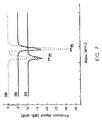
- FIG. 7 shows the observed mass spectra of isotope-selective photoionization of thallium atoms wherein:
- plot (a) shows the mass spectra of non-selectively photoionized thallium atoms
- plot (b) shows the mass spectra when the frequency of optical pumping laser is resonant with 205 Tl isotopes
- plot (c) shows the mass spectra when the frequency of optical pumping laser is resonant with 203 Tl isotopes.
- an isotope-selective photoionization process and apparatus for thallium isotope separation from natural thallium that involves isotope-selective optical pumping followed by photoionization of thallium atoms and then electrostatic extraction of ions.
- This scheme takes advantage of the large optical pumping cross-section as well as the large photoionization cross-section, and consequently only modest laser fluences are required.
- 203 Tl laser isotope separation based on this invention is economically more efficient than the conventional electromagnetic separation. Also, this invention can overcome the limited scope of the Japanese patent publication No. 2000-262866A. In conclusion, the present invention makes the 203 Tl isotope separation possible for the mass production even with a relatively small-scale facility and the commercially available lasers.
- FIG. 1 illustrates the conceptual diagram for the thallium laser isotope separation method.
- Thallium atomic beam 2 is generated by heating thallium at a temperature between 800-1000° C. using thermal heater 1 and collimated by an atomic beam collimator 3 , and then is optically and isotope-selectively pumped into a metastable state by a CW laser 4 .
- the optically pumped thallium isotopes are photoionized by a pulsed UV laser 5 and a pulsed IR laser 6 .
- the photoionized thallium ions 8 and electrons 9 generated during the photoionization are separated from the atomic beam by an extractor 7 biased by an external electric field.
- FIG. 2 shows a partial energy level diagram of thallium atoms when thallium ions are separated according to the present invention.
- 1> are optically and isotope-selectively excited to the level
- 2> may be either de-excited to the ground level
- the lifetime of the metastable state is long enough (about 250 ⁇ sec)
- most of the target isotopes can be pumped into the metastable state
- non-target isotopes are not excited and stay in the ground state.
- high optical pumping efficiency as well as high target isotope selectivity can be achieved.
- 3> will be photoionized to the continuum state
- Thallium atoms have such a simple electronic structure that only three energy states exist below energy of 30,000 cm ⁇ 1 , such as the ground state (6 2 P 1/2 : 0 cm ⁇ 1 ), metastable state (6 2 P 3/2 : 7,793 cm ⁇ 1 ), and the excited state (7 2 S 1/2 : 26,447.6 cm ⁇ 1 ). And thallium atoms have several advantages for efficient optical pumping. These are:
- FIG. 3 shows isotope shifts and hyperfine structures of thallium isotopes related to the optical pumping transitions.
- Doppler width of an atomic beam is less than a few hundred MHz (for example, approximately 100 MHz) and a single frequency CW laser is used as an optical pumping laser.
- FIG. 5 shows the calculated optical pumping spectrum of the same transition, assuming that a CW laser has Gaussian intensity distribution (full width at half maximum: 10 mm) and output power of 200 mW. It is clearly shown that the isotope selectivity is very high in this optical pumping process.
- FIG. 6 shows the measured photoionization cross-section of 7 2 D 5/2 level of thallium atoms at the wavelength of 1064 nm of a Nd:YAG laser.
- the photoionization cross-section of 2.7 ⁇ 10 ⁇ 17 cm 2 is big enough so that more than 80% of the thallium atoms in the excited state 7 2 D 5/2 can be ionized by a Nd:YAG laser with the pulse energy density of 40 mJ/pulse/cm 2 . Since the ionization potential (IP) of thallium atoms is about 49266.7 cm ⁇ 1 , efficient photoionization is expected if an ionizing IR laser with modest power has the wavelength in the range of 700 ⁇ 1400 ⁇ m, which corresponds to energy range of 49266.7 cm ⁇ 1 ⁇ 55000 cm ⁇ 1 .
- IP ionization potential
- FIG. 7 shows the observed Time-of-Flight (TOF) mass spectra of isotope-selective photoionization of thallium atoms according to this invention.
- TOF Time-of-Flight
- the required laser powers are estimated to be 500 mW, 4 W, and 500 W for a CW optical pumping laser, a pulsed UV laser, and a pulsed IR laser, respectively.
- a CW optical pumping laser For the production of 203 Tl isotope with the capability of 1 kg/year, the required laser powers are estimated to be 500 mW, 4 W, and 500 W for a CW optical pumping laser, a pulsed UV laser, and a pulsed IR laser, respectively.
- pulsed lasers repetition rate of 5 kHz or more and pulse-width of a few tens of ns are also required.
- Such a laser system can be constructed by using commercially available lasers.
Landscapes
- Life Sciences & Earth Sciences (AREA)
- Biophysics (AREA)
- Chemical & Material Sciences (AREA)
- Chemical Kinetics & Catalysis (AREA)
- Lasers (AREA)
- Extraction Or Liquid Replacement (AREA)
- Organic Low-Molecular-Weight Compounds And Preparation Thereof (AREA)
Applications Claiming Priority (3)
| Application Number | Priority Date | Filing Date | Title |
|---|---|---|---|
| KR2002/44828 | 2002-07-30 | ||
| KR10-2002-0044828A KR100478533B1 (ko) | 2002-07-30 | 2002-07-30 | 레이저를 이용한 탈륨 동위원소 분리방법 |
| PCT/KR2002/001749 WO2004011129A1 (en) | 2002-07-30 | 2002-09-18 | Method for isotope separation of thallium |
Publications (2)
| Publication Number | Publication Date |
|---|---|
| US20050269198A1 US20050269198A1 (en) | 2005-12-08 |
| US7323651B2 true US7323651B2 (en) | 2008-01-29 |
Family
ID=31185752
Family Applications (1)
| Application Number | Title | Priority Date | Filing Date |
|---|---|---|---|
| US10/522,461 Expired - Fee Related US7323651B2 (en) | 2002-07-30 | 2002-09-18 | Method for isotope separation of thallium |
Country Status (10)
| Country | Link |
|---|---|
| US (1) | US7323651B2 (de) |
| EP (1) | EP1534408B1 (de) |
| JP (1) | JP4150722B2 (de) |
| KR (1) | KR100478533B1 (de) |
| CN (1) | CN1301148C (de) |
| AT (1) | ATE453446T1 (de) |
| AU (1) | AU2002348672A1 (de) |
| DE (1) | DE60234960D1 (de) |
| RU (1) | RU2292940C2 (de) |
| WO (1) | WO2004011129A1 (de) |
Cited By (2)
| Publication number | Priority date | Publication date | Assignee | Title |
|---|---|---|---|---|
| US8672138B2 (en) | 2009-11-08 | 2014-03-18 | Board Of Regents The University Of Texas System | Isotope separation by magnetic activation and separation |
| WO2025207493A1 (en) * | 2024-03-25 | 2025-10-02 | Board Of Regents, The University Of Texas System | Separation of isotopes or atomic species using selective ionization |
Families Citing this family (4)
| Publication number | Priority date | Publication date | Assignee | Title |
|---|---|---|---|---|
| RU2317847C2 (ru) * | 2005-11-01 | 2008-02-27 | Институт физики полупроводников Сибирского отделения Российской академии наук | Способ выделения изотопов таллия |
| KR101072798B1 (ko) * | 2008-10-24 | 2011-10-14 | 한국수력원자력 주식회사 | 칼슘 동위원소 분리 방법 |
| CN103293494B (zh) * | 2013-05-24 | 2015-06-10 | 江汉大学 | 原子跃迁数因子测量装置和方法 |
| CN106406215B (zh) * | 2016-10-18 | 2017-09-12 | 中国原子能科学研究院 | 一种用于同位素电磁分离器接收器的控制系统 |
Citations (8)
| Publication number | Priority date | Publication date | Assignee | Title |
|---|---|---|---|---|
| US4793307A (en) | 1987-06-11 | 1988-12-27 | The Jacobs Manufacturing Company | Rocker arm decoupler for two-cycle engine retarder |
| US5202005A (en) | 1991-08-14 | 1993-04-13 | The United States Of America As Represented By The United States Department Of Energy | Gadolinium photoionization process |
| US5221446A (en) * | 1972-06-14 | 1993-06-22 | Cameco Corporation | Isotope separation process |
| US5376246A (en) | 1992-12-02 | 1994-12-27 | The United States Of America As Represented By The United States Department Of Energy | Efficient mass-selective three-photon ionization of zirconium atoms |
| US5443702A (en) | 1993-06-22 | 1995-08-22 | Haynam; Christopher A. | Laser isotope separation of erbium and other isotopes |
| EP0884095A1 (de) | 1997-06-11 | 1998-12-16 | Urenco Nederland B.V. | Verfahren und Vorrichtung zur isotopenselektiven Photoionisation von Quecksilber |
| US5945649A (en) | 1997-05-27 | 1999-08-31 | United States Enrichment Corp. | Atomic vapor laser isotope separation of lead-210 isotope |
| FR2790974A1 (fr) | 1999-03-18 | 2000-09-22 | Us Enrichment Corp | Separation isotopique par laser a vapeur atomique des isotopes thallium 203 et plomb 210 |
Family Cites Families (6)
| Publication number | Priority date | Publication date | Assignee | Title |
|---|---|---|---|---|
| US4526664A (en) * | 1974-04-01 | 1985-07-02 | The United Sates Of America As Represented By The United States Department Of Energy | Isotope separation apparatus and method |
| US5083026A (en) * | 1990-02-12 | 1992-01-21 | Danev Elbaum | Method, apparatus and applications of the quantitation of multiple gamma-photon producing isotopes with increased sensitivity |
| EP0596929B1 (de) * | 1991-07-29 | 1995-07-26 | GRUPPO LEPETIT S.p.A. | Amidderivate vom Antibiotikum A 40926 |
| JP3487900B2 (ja) * | 1994-05-24 | 2004-01-19 | 株式会社東芝 | ガドリニウムの同位体分離方法および装置 |
| JP3324052B2 (ja) * | 1995-04-12 | 2002-09-17 | 株式会社日立製作所 | 同位体分離方法および装置 |
| JPH09117640A (ja) * | 1995-10-27 | 1997-05-06 | Mitsubishi Heavy Ind Ltd | 原子蒸気生成方法及びこの方法を用いた同位体濃縮方法 |
-
2002
- 2002-07-30 KR KR10-2002-0044828A patent/KR100478533B1/ko not_active Expired - Fee Related
- 2002-09-18 AT AT02781885T patent/ATE453446T1/de not_active IP Right Cessation
- 2002-09-18 DE DE60234960T patent/DE60234960D1/de not_active Expired - Lifetime
- 2002-09-18 RU RU2005105299/15A patent/RU2292940C2/ru not_active IP Right Cessation
- 2002-09-18 CN CNB028293886A patent/CN1301148C/zh not_active Expired - Fee Related
- 2002-09-18 AU AU2002348672A patent/AU2002348672A1/en not_active Abandoned
- 2002-09-18 WO PCT/KR2002/001749 patent/WO2004011129A1/en not_active Ceased
- 2002-09-18 US US10/522,461 patent/US7323651B2/en not_active Expired - Fee Related
- 2002-09-18 EP EP02781885A patent/EP1534408B1/de not_active Expired - Lifetime
- 2002-09-18 JP JP2004524333A patent/JP4150722B2/ja not_active Expired - Fee Related
Patent Citations (10)
| Publication number | Priority date | Publication date | Assignee | Title |
|---|---|---|---|---|
| US5221446A (en) * | 1972-06-14 | 1993-06-22 | Cameco Corporation | Isotope separation process |
| US4793307A (en) | 1987-06-11 | 1988-12-27 | The Jacobs Manufacturing Company | Rocker arm decoupler for two-cycle engine retarder |
| US5202005A (en) | 1991-08-14 | 1993-04-13 | The United States Of America As Represented By The United States Department Of Energy | Gadolinium photoionization process |
| US5376246A (en) | 1992-12-02 | 1994-12-27 | The United States Of America As Represented By The United States Department Of Energy | Efficient mass-selective three-photon ionization of zirconium atoms |
| US5443702A (en) | 1993-06-22 | 1995-08-22 | Haynam; Christopher A. | Laser isotope separation of erbium and other isotopes |
| US5945649A (en) | 1997-05-27 | 1999-08-31 | United States Enrichment Corp. | Atomic vapor laser isotope separation of lead-210 isotope |
| EP0884095A1 (de) | 1997-06-11 | 1998-12-16 | Urenco Nederland B.V. | Verfahren und Vorrichtung zur isotopenselektiven Photoionisation von Quecksilber |
| JPH1199320A (ja) | 1997-06-11 | 1999-04-13 | Urenco Nederland Bv | 水銀の同位体を選択的に光イオン化するための方法および装置 |
| FR2790974A1 (fr) | 1999-03-18 | 2000-09-22 | Us Enrichment Corp | Separation isotopique par laser a vapeur atomique des isotopes thallium 203 et plomb 210 |
| JP2000262866A (ja) | 1999-03-18 | 2000-09-26 | United States Enrichment Corp | 203Tlおよび210Pb同位体についてのアトミックベイパーレーザー同位体分離 |
Cited By (2)
| Publication number | Priority date | Publication date | Assignee | Title |
|---|---|---|---|---|
| US8672138B2 (en) | 2009-11-08 | 2014-03-18 | Board Of Regents The University Of Texas System | Isotope separation by magnetic activation and separation |
| WO2025207493A1 (en) * | 2024-03-25 | 2025-10-02 | Board Of Regents, The University Of Texas System | Separation of isotopes or atomic species using selective ionization |
Also Published As
| Publication number | Publication date |
|---|---|
| ATE453446T1 (de) | 2010-01-15 |
| JP2005534472A (ja) | 2005-11-17 |
| RU2005105299A (ru) | 2005-08-10 |
| US20050269198A1 (en) | 2005-12-08 |
| RU2292940C2 (ru) | 2007-02-10 |
| CN1638849A (zh) | 2005-07-13 |
| CN1301148C (zh) | 2007-02-21 |
| AU2002348672A1 (en) | 2004-02-16 |
| KR20040011732A (ko) | 2004-02-11 |
| DE60234960D1 (de) | 2010-02-11 |
| AU2002348672A8 (en) | 2004-02-16 |
| EP1534408B1 (de) | 2009-12-30 |
| JP4150722B2 (ja) | 2008-09-17 |
| WO2004011129A1 (en) | 2004-02-05 |
| EP1534408A1 (de) | 2005-06-01 |
| KR100478533B1 (ko) | 2005-03-28 |
Similar Documents
| Publication | Publication Date | Title |
|---|---|---|
| Kapteyn et al. | Observation of a short-wavelength laser pumped by Auger decay | |
| Guo et al. | Charge asymmetric dissociation induced by sequential and nonsequential strong field ionization | |
| US4786478A (en) | Method and apparatus for isotope separation | |
| US4218628A (en) | Vacuum ultraviolet and x-ray light source and method and short wavelength laser pumped by said light source | |
| US7323651B2 (en) | Method for isotope separation of thallium | |
| Backe et al. | Laser spectroscopic investigation of the element fermium (Z= 100) | |
| RU2531178C2 (ru) | Способ лазерного разделения изотопов водорода | |
| JPH0716584B2 (ja) | レーザー同位体分離装置 | |
| RU2390375C2 (ru) | Способ выделения изотопа иттербия | |
| JPH025131B2 (de) | ||
| KR101072798B1 (ko) | 칼슘 동위원소 분리 방법 | |
| JPS6325812B2 (de) | ||
| JP2000262866A (ja) | 203Tlおよび210Pb同位体についてのアトミックベイパーレーザー同位体分離 | |
| US4419582A (en) | Use of autoionization transition absorption peaks in isotopically selective photoexcitation | |
| Wendt et al. | Laser based techniques for ultra trace isotope production, spectroscopy and detection | |
| Jeong et al. | Development of the Separation System of 203Tl Stable Isotope | |
| Lichtin et al. | Potential analytical aspects of laser multiphoton ionization mass spectrometry | |
| JP3575869B2 (ja) | ガドリニウムまたはジルコニウム同位体の分離方法 | |
| JP3085716B2 (ja) | レーザ同位体分離方法 | |
| JP3324052B2 (ja) | 同位体分離方法および装置 | |
| RU2651338C2 (ru) | Способ лазерного разделения изотопов йода | |
| Jones et al. | Isotope‐specific Resonance Ionization Mass Spectrometry Using Continuous‐wave Diode and Pulsed Dye Lasers for Trace Detection and Enrichment of Elements of Environmental and Medical Importance, Exemplified for Strontium (Sr)—Part I: Theoretical Modelling | |
| Baldwin | Physics Division | |
| Letokhov | Laser Photoionization Selective Detection of Atoms, Molecules and Molecular Bonds | |
| Baldwin | Multistep Pumping Schemes for Short-Wave Lasers |
Legal Events
| Date | Code | Title | Description |
|---|---|---|---|
| AS | Assignment |
Owner name: KOREA ATOMIC ENERGY RESEARCH INSTITUTE, KOREA, REP Free format text: ASSIGNMENT OF ASSIGNORS INTEREST;ASSIGNORS:JEONG, DO-YOUNG;KO, KWANT-HOON;LIM, GWON;AND OTHERS;REEL/FRAME:016892/0426 Effective date: 20050121 Owner name: KOREA HYDRO & NUCLEAR POWER CO., LTD., KOREA, REPU Free format text: ASSIGNMENT OF ASSIGNORS INTEREST;ASSIGNORS:JEONG, DO-YOUNG;KO, KWANT-HOON;LIM, GWON;AND OTHERS;REEL/FRAME:016892/0426 Effective date: 20050121 |
|
| AS | Assignment |
Owner name: KOREA ATOMIC ENERGY RESEARCH INSTITUTE, KOREA, REP Free format text: CORRECTIVE ASSIGNMENT TO CORRECT THE SECOND INVENTOR'S NAME PREVIOUSLY RECORDED ON REEL 016892 FRAME 0426;ASSIGNORS:JEONG, DO-YOUNG;KO, KWANG-HOON;LIM, GWON;AND OTHERS;REEL/FRAME:017024/0803 Effective date: 20050121 Owner name: KOREA HYDRO & NUCLEAR POWER CO., LTD., KOREA, REPU Free format text: CORRECTIVE ASSIGNMENT TO CORRECT THE SECOND INVENTOR'S NAME PREVIOUSLY RECORDED ON REEL 016892 FRAME 0426;ASSIGNORS:JEONG, DO-YOUNG;KO, KWANG-HOON;LIM, GWON;AND OTHERS;REEL/FRAME:017024/0803 Effective date: 20050121 |
|
| FEPP | Fee payment procedure |
Free format text: PAYOR NUMBER ASSIGNED (ORIGINAL EVENT CODE: ASPN); ENTITY STATUS OF PATENT OWNER: LARGE ENTITY |
|
| CC | Certificate of correction | ||
| FEPP | Fee payment procedure |
Free format text: PAYER NUMBER DE-ASSIGNED (ORIGINAL EVENT CODE: RMPN); ENTITY STATUS OF PATENT OWNER: LARGE ENTITY Free format text: PAYOR NUMBER ASSIGNED (ORIGINAL EVENT CODE: ASPN); ENTITY STATUS OF PATENT OWNER: LARGE ENTITY |
|
| FPAY | Fee payment |
Year of fee payment: 4 |
|
| REMI | Maintenance fee reminder mailed | ||
| LAPS | Lapse for failure to pay maintenance fees | ||
| STCH | Information on status: patent discontinuation |
Free format text: PATENT EXPIRED DUE TO NONPAYMENT OF MAINTENANCE FEES UNDER 37 CFR 1.362 |
|
| STCH | Information on status: patent discontinuation |
Free format text: PATENT EXPIRED DUE TO NONPAYMENT OF MAINTENANCE FEES UNDER 37 CFR 1.362 |
|
| FP | Lapsed due to failure to pay maintenance fee |
Effective date: 20160129 |