US7148564B2 - Dual-sided substrate integrated circuit package including a leadframe having leads with increased thickness - Google Patents
Dual-sided substrate integrated circuit package including a leadframe having leads with increased thickness Download PDFInfo
- Publication number
- US7148564B2 US7148564B2 US10/780,163 US78016304A US7148564B2 US 7148564 B2 US7148564 B2 US 7148564B2 US 78016304 A US78016304 A US 78016304A US 7148564 B2 US7148564 B2 US 7148564B2
- Authority
- US
- United States
- Prior art keywords
- leadframe
- thickness
- distal end
- leads
- members
- Prior art date
- Legal status (The legal status is an assumption and is not a legal conclusion. Google has not performed a legal analysis and makes no representation as to the accuracy of the status listed.)
- Expired - Lifetime, expires
Links
Images





Classifications
-
- H10W90/401—
-
- H10W70/479—
-
- Y—GENERAL TAGGING OF NEW TECHNOLOGICAL DEVELOPMENTS; GENERAL TAGGING OF CROSS-SECTIONAL TECHNOLOGIES SPANNING OVER SEVERAL SECTIONS OF THE IPC; TECHNICAL SUBJECTS COVERED BY FORMER USPC CROSS-REFERENCE ART COLLECTIONS [XRACs] AND DIGESTS
- Y10—TECHNICAL SUBJECTS COVERED BY FORMER USPC
- Y10T—TECHNICAL SUBJECTS COVERED BY FORMER US CLASSIFICATION
- Y10T29/00—Metal working
- Y10T29/49—Method of mechanical manufacture
- Y10T29/49002—Electrical device making
- Y10T29/49117—Conductor or circuit manufacturing
- Y10T29/49121—Beam lead frame or beam lead device
-
- Y—GENERAL TAGGING OF NEW TECHNOLOGICAL DEVELOPMENTS; GENERAL TAGGING OF CROSS-SECTIONAL TECHNOLOGIES SPANNING OVER SEVERAL SECTIONS OF THE IPC; TECHNICAL SUBJECTS COVERED BY FORMER USPC CROSS-REFERENCE ART COLLECTIONS [XRACs] AND DIGESTS
- Y10—TECHNICAL SUBJECTS COVERED BY FORMER USPC
- Y10T—TECHNICAL SUBJECTS COVERED BY FORMER US CLASSIFICATION
- Y10T29/00—Metal working
- Y10T29/49—Method of mechanical manufacture
- Y10T29/49002—Electrical device making
- Y10T29/49117—Conductor or circuit manufacturing
- Y10T29/49204—Contact or terminal manufacturing
- Y10T29/49208—Contact or terminal manufacturing by assembling plural parts
- Y10T29/49222—Contact or terminal manufacturing by assembling plural parts forming array of contacts or terminals
Definitions
- This invention relates generally to a dual-sided substrate integrated circuit package, and, more particularly, to a leadframe included in a dual-sided substrate integrated circuit package.
- Miniaturized electronic components such as chip transistors, processors, etc., must often be assembled in conjunction with circuits, assemblies or components of comparatively larger dimensions. This can create design and manufacturing challenges when it becomes necessary to place such miniature components in communication with these larger circuits, assemblies or components.
- a leadframe is a thin layer of metal that connects the wiring from tiny electrical terminals on the semiconductor surface to the large-scale circuitry on electrical devices and circuit boards.
- Leadframes provide an electrical conduit from the multiple small terminals commonly found on electrical components to larger connector pads wherein additional circuitry may be connected to the component.
- the leadframes thereby allow practical and cost effective manufacturing techniques to be utilized to “wire in” these miniature components to the remainder of the electronic assembly.
- the leadframes do so by providing a thin multi-pathway bridge from the plurality of terminals on the miniature components to a plurality of connector pads sized and placed for convenient attachment to neighboring circuits. Leadframes are used in almost all semiconductor packages.
- leadframes In order to function as a conduit between neighboring electronic components, it is desirable for leadframes to have certain characteristics. Their complex and crowded pathway patterns are often created via manufacturing techniques such as laser or chemical etching. Flexible pathways reduce stresses imparted to the electronic components and can loosen design tolerances necessary to mate with surrounding systems. Shapes and configurations must often balance the needs for flexibility, strength, and size.
- dual gauge leadframes can enable the bridging of contacts between multi-level and sandwich style circuit boards, i.e., “substrates”, in cases in which the thickness of a die between the circuit boards limits how close the circuit boards can get to one another.
- the die and the leadframe are both disposed between the circuit boards. Since the thickness of the die is generally greater than that of the leadframe, the leadframe may not be able to bridge the gap between contacts on the circuit boards without some modification to the leadframe. More particularly, the leadframe may need to be provided with an effective thickness that is approximately equal to the thickness of the die.
- the leadframe can be provided with a laminate structure to increase its thickness, but a laminate structure requires costly, complex, and time consuming manufacturing processes. In addition, a laminate structure can negatively impact the flexibility of the leadframe and therefore may not be suitable for some assemblies.
- Another known technique for increasing the effective height of the leadframe is to fold the distal tip, i.e., “lead”, of a leadframe member onto itself, i.e., double over the distal tip of the leadframe member, in order to double the effective thickness of the tip of the leadframe member.
- the doubled over leadframe member tip can then be flattened, i.e., coined, such that the effective thickness of the leadframe member tip is slightly greater than or approximately equal to the thickness of the silicon die.
- Each side of the flattened leadframe member tip is attached inside the integrated circuit package in order to maintain the proper vertical spacing between the lower and upper substrates to obtain consistent joint thicknesses for the silicon die attached between the lower and upper substrates.
- a problem with the technique of doubling over the leadframe member tip is that it requires either a large progressive die with multiple stages to flatten the leadframe member tip, or an additional secondary die or bending fixture.
- the press must exert an excessive amount of force to compress, i.e., coin, the doubled over lead tip to less than twice the thickness of the remainder of the leadframe. This tight form on the leads work hardens the base copper and plating material, and can create stress cracks across the hem where the leadframe member tip is doubled over.
- What is needed in the art is a leadframe having a member tip with an increased effective thickness, wherein the leadframe is not subject to manufacturing defects and can be inexpensively manufactured without an additional die.
- the present invention provides a leadframe including members having undulated distal tips with increased effective thicknesses.
- the leadframe is not prone to structural defects, and can be inexpensively manufactured without the need for an additional die.
- an integrated circuit package includes a first non-conductive substrate having a first inner surface and a second non-conductive substrate having a second inner surface.
- a die having a first thickness is disposed between the first and second inner surfaces.
- a leadframe includes a member having a proximal end and a distal end. The proximal end has a second thickness less than the first thickness. The distal end is disposed between the first and second inner surfaces. The distal end is undulated such that the distal end has an effective thickness greater than the second thickness.
- a lead frame includes a body portion and a plurality of members extending from the body portion. Each member has a proximal end and a distal end. The proximal end has a first thickness. The distal end is undulated such that the distal end has an effective thickness greater than the first thickness.
- a method of manufacturing a lead frame includes forming a body portion and a plurality of members extending from the body portion. Each of the members has a proximal end and a distal end. An undulation is formed in each of the distal ends.
- An advantage of the present invention is that the leadframes are less prone to defects, less expensive, and easier to manufacture than leadframes having doubled over lead tips or laminate structures.
- the undulated leadframes of the present invention have substantially less stress on the base copper and plating material than do doubled over leadframes, so there is considerably less risk of stress fractures across the formed edges.
- the offset formed or corrugated formed leads of the present invention provide more stress relief inside the integrated circuit package than do flat or doubled over leads.
- the present invention provides a reduction of scrap copper material blanked from the progressive die
- the progressive die can be smaller, more inexpensive to build, and less complicated by virtue of having fewer components and because all of the leads can be formed in one stage.
- the smaller progressive die can be run in a smaller press with less tonnage, which is more economical to operate.
- a further advantage is that there is no need for a secondary die or bending fixture. Less force is required to undulate the leadframe member because the thickness of the leadframe material is not substantially compressed.
- a still further advantage is that the effective thickness of the leadframe member tips can be controlled by the form punches in the progressive die for the leadframe. This allows the thickness of the copper leadframe material to be less than the thickness of the integrated circuit silicon die. Therefore, a standard thickness of copper material can be selected for the leadframe to be used with a variety of silicon die of different thicknesses. This eliminates the need to special order a custom thickness leadframe to match a specific integrated circuit die thickness per each electronic package application using flat leadframes without doubled over member tips.
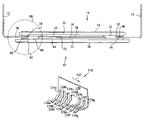
- FIG. 1A is a side view of one embodiment of an integrated circuit package of the present invention.
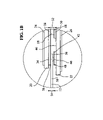
- FIG. 1B is an enlarged side view of area B of FIG. 1A .
- FIG. 2 is a plan view of one embodiment of a progressive die that can be used in forming the leadframe of the integrated circuit package of FIG. 1A .
- FIG. 3A is a perspective view of one embodiment of the leadframe of FIG. 1A .
- FIG. 3B is a front view of the leadframe of FIG. 3A .
- FIG. 3C is a top view of the leadframe of FIG. 3A .
- FIG. 3D is a side view of the leadframe of FIG. 3A .
- FIG. 4A is a perspective view of another embodiment of the leadframe of FIG. 1A .
- FIG. 4B is a front view of the leadframe of FIG. 4A .
- FIG. 4C is a top view of the leadframe of FIG. 4A .
- FIG. 4D is a side view of the leadframe of FIG. 4A .
- FIG. 5A is a perspective view of yet another embodiment of the leadframe of FIG. 1A .
- FIG. 5B is a front view of the leadframe of FIG. 5A .
- FIG. 5C is a top view of the leadframe of FIG. 5A .
- FIG. 5D is a side view of the leadframe of FIG. 5A .
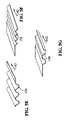
- FIG. 5E is a perspective view of another embodiment of the distal end of one of the lead frame members of FIG. 5A .
- FIG. 5F is a perspective view of yet another embodiment of the distal end of one of the lead frame members of FIG. 5A .
- FIG. 5G is a perspective view of a further embodiment of the distal end of one of the lead frame members of FIG. 5A .
- FIG. 6A is a perspective view of a further embodiment of the leadframe of FIG. 1A .
- FIG. 6B is a front view of the leadframe of FIG. 6A .
- FIG. 6C is a top view of the leadframe of FIG. 6A .
- FIG. 6D is a side view of the leadframe of FIG. 6A .
- FIG. 6E is a cross-sectional view of one embodiment of the distal end of one of the lead frame members of FIG. 6C along line 6 EF.
- FIG. 6F is a cross-sectional view of another embodiment of the distal end of one of the lead frame members of FIG. 6C along line 6 EF.
- FIG. 7A is a perspective view of still another embodiment of the leadframe of FIG. 1A .
- FIG. 7B is a front view of the leadframe of FIG. 7A .
- FIG. 7C is a top view of the leadframe of FIG. 7A .
- FIG. 7D is a side view of the leadframe of FIG. 7A .
- FIG. 7E is a cross-sectional view of another embodiment of the distal end of one of the lead frame members of FIG. 7C along line 7 E.
- FIG. 8A is a perspective view of a still further embodiment of the leadframe of FIG. 1A .
- FIG. 8B is a front view of the leadframe of FIG. 8A .
- FIG. 8C is a top view of the leadframe of FIG. 8A .
- FIG. 8D is a side view of the leadframe of FIG. 8A .
- FIG. 8E is a cross-sectional view of another embodiment of the distal end of one of the lead frame members of FIG. 8C along line 8 E.
- FIG. 9 is a flow chart of one embodiment of a method of manufacturing a lead frame of the present invention.
- Integrated circuit 16 includes an integrated circuit die 18 formed of a semiconductor material. Die 18 is sandwiched between non-conductive substrates 20 , 22 , which can be formed of a ceramic material.
- Each of substrates 20 , 22 can include a respective layer of solderable material 24 , 26 on the outer surfaces thereof. Pressure attached applications may not require solderable material 24 , 26 on the outer surface. Elimination of solderable material 24 and 26 reduces the thermal resistance and device temperature.
- Electrode 28 , 30 are attached to an inner surface 32 of substrate 20 .
- element 28 is in the form of a substrate, while element 30 may better be described as an electrical contact pad.
- Each of elements 28 , 30 are electrically connected to other circuit elements within package 10 , although elements 28 , 30 can be electrically isolated from each other.
- Element 28 is in electrical communication with each of a distal end 34 of leadframe 12 and die 18 .
- Element 30 is in electrical communication with a distal end 36 of leadframe 14 .
- FIG. 1B there may be a layer 38 of electrically conductive attachment material disposed between element 28 and distal end 34 of leadframe 12 . There may also be a layer 40 of electrically conductive attachment material disposed between element 30 and distal end 36 of leadframe 14 , as shown in FIG. 1A .
- Electrode 44 is attached to an inner surface 46 of substrate 22 .
- element 44 is in the form of a substrate, while element 42 may better be described as an electrical contact pad.
- Each of elements 42 , 44 are electrically connected to other circuit elements within package 10 , although elements 42 , 44 can be electrically isolated from each other.
- Element 44 is in electrical communication with each of a distal end 36 of leadframe 14 and die 18 .
- Element 42 is in electrical communication with a distal end 34 of leadframe 12 .
- a layer 48 of electrically conductive attachment material disposed between element 42 and distal end 34 of leadframe 12 .
- the die attachment material of layers 38 , 40 , 48 , 50 may be a type of solder paste, solder preform, ultra-thick thick film (UTTF), or electrically conductive adhesive, for example.
- die 18 has a thickness 52 as measured in a vertical direction.
- the thickness of die 18 limits how close together elements 28 , 42 can be placed. More particularly, a distance between layers of attachment material 38 , 48 is no less than thickness 52 .
- a thickness 54 of a base portion 56 of a leadframe member 58 is not sufficiently large to perform any necessary bridging of the gap between layers of attachment material 38 , 48 . That is, it may be necessary for leadframe 12 to be in electrical communication with each of elements 28 , 42 .
- distal end 34 of leadframe member 58 is provided with an undulation 60 that, together with base portion 56 , provides distal end 34 with a thickness greater than that of base portion 56 alone.
- undulation 60 together with base portion 56 provides distal end 34 with a thickness approximately equal to or slightly greater than thickness 52 of die 18 .
- distal end 34 can simultaneously contact conductive attachment layers 38 , 48 as well as enable desired thicknesses of layers 38 , 48 to be maintained.
- An undulation such as undulation 60 may be provided below base portion 56 , as is the case with leadframe 12 .
- an undulation may be provided above base portion 56 , as is the case with leadframe 14 as shown in FIG. 1A .
- Machine 62 that can be used in forming undulations such as undulation 60 is shown in FIG. 2 .
- Machine 62 includes a piston 64 that can drive a punch 66 in direction 68 to extrude or otherwise create an undulation 70 in an otherwise planar sheet 72 of copper stock from which a leadframe can be formed.
- the surface area of a “crest” 74 of undulation 70 as well as the effective thickness between crest 74 and an opposite base portion surface 76 can be controlled by the size and type of punch 66 and by the level of force with which punch 66 is driven.
- a solid die section (not shown) could be used to further control the size, shape, and thickness of undulation 70 .
- Progressive die machine 62 or a similar progressive die machine, can be used to form or punch out the entire leadframe from a sheet of copper stock.
- FIGS. 3–8 Various embodiments of a leadframe of the present invention including a member having an undulated distal end will now be described with reference to FIGS. 3–8 .
- Each of the leadframe embodiments is suitable for use in conjunction with integrated circuit 16 . It should be understood that although all of the leadframes of FIGS. 3–8 are shown with upwardly extending undulations, they can be easily modified within the scope of the invention to extend in a downward direction, i.e., in a direction away from the leadframe body.
- FIGS. 3A–D illustrate one embodiment of a leadframe 78 of the present invention including a body 80 and a plurality of members 82 a–g having proximal ends 84 a–g and distal ends or “leads” 86 a–g .
- Each of leads 86 a–g is offset formed such that the leads ramp up from the level of base portions 88 a–g to a slightly higher vertical level, thereby providing leads 86 a–g with undulations 90 a–g .
- Undulations 90 a–g and base portions 88 a–g provide distal ends 86 a–g with effective thicknesses greater than the thicknesses of base portions 88 a–g alone.
- Each of leads 86 a–g has a width in direction 92 that is greater than the width of the respective one of proximal ends 84 a–g .
- each of members 82 a–g is bent at an angle of 90° such that distal ends 86 a–g of members 82 a–g extend in a direction perpendicular to body 80 .
- members 82 a–g define an imaginary plane 94 .
- each of members 82 a–g follows a bending path, i.e., is nonlinear, in a direction within plane 94 .
- FIGS. 4A–D illustrate another embodiment of a leadframe 98 of the present invention including a body 100 and a plurality of members 102 a–g having proximal ends 104 a–g and distal ends or “leads” 106 a–g .
- Each of leads 106 a–g is offset formed such that the leads ramp up from the level of base portions 108 a–g to a slightly higher vertical level, thereby providing leads 106 a–g with undulations 110 a–g .
- Undulations 110 a–g and base portions 108 a–g provide distal ends 106 a–g with effective thicknesses greater than the thicknesses of base portions 108 a–g alone.
- Each of leads 106 a–g ramps up in a direction 112 that is parallel to a direction in which members 102 a–g generally extend.
- the machining of slits 113 a–g and the punching of undulations 110 a–g is facilitated, i.e., made easier.
- each of members 102 a–g is bent at an angle of 90° such that distal ends 106 a–g of members 102 a–g extend in a direction perpendicular to body 100 .
- members 102 a–g define an imaginary plane 114 .
- each of members 102 a–g follows a bending path, i.e., is nonlinear, in a direction within plane 114 .
- FIGS. 5A–D illustrate yet another embodiment of a leadframe 118 of the present invention including a body 120 and a plurality of members 122 a–g having proximal ends 124 a–g and distal ends or “leads” 126 a–g .
- Each of leads 126 a–g is corrugated formed such that the leads ramp up from the level of base portions 128 a–g to a slightly higher vertical level, and then ramp back down to the level of base portions 128 a–g , thereby providing leads 126 a–g with undulations 130 a–g .
- Undulations 130 a–g and base portions 128 a–g provide distal ends 126 a–g with effective thicknesses greater than the thicknesses of base portions 128 a–g alone.
- Each of leads 126 a–g ramps up and down in a direction 132 that is parallel to a direction in which members 122 a–g generally extend.
- the punching of undulations 130 a–g is facilitated, i.e., made easier.
- each of members 122 a–g is bent at an angle of 90° such that distal ends 126 a–g of members 122 a–g extend in a direction perpendicular to body 120 .
- members 122 a–g define an imaginary plane 134 .
- each of members 122 a–g follows a bending path, i.e., is nonlinear, in a direction within plane 134 .
- Distal ends of leadframe members may have a single undulation, as is the case with the single undulation 130 on each of members 122 a–g in FIGS. 5A–D .
- distal ends of leadframe member may have multiple undulations, as is the case with each of corrugated formed distal ends 136 , 138 and 140 .
- the undulations may be in the form of a sinusoidal wave, as with distal end 136 ; a triangle wave, as with distal end 138 ; or a substantially square wave, as with distal end 140 , for example.
- a characteristic of corrugated undulations is that the undulation can extend completely across the width of the distal end in direction 142 .
- FIGS. 6A–D illustrate a further embodiment of a leadframe 148 of the present invention including a body 150 and a plurality of members 152 a–g having proximal ends 154 a–g and distal ends or “leads” 156 a–g .
- Each of leads 156 a–g is squirt formed such that the leads have dome-like bumps, thereby providing leads 156 a–g with undulations 160 a–g .
- Undulations 160 a–g and base portions 158 a–g provide distal ends 156 a–g with effective thicknesses greater than the thicknesses of base portions 158 a–g alone.
- each of members 152 a–g is bent at an angle of 90° such that distal ends 156 a–g of members 152 a–g extend in a direction perpendicular to body 150 .
- members 152 a–g define an imaginary plane 164 .
- each of members 152 a–g follows a bending path, i.e., is nonlinear, in a direction within plane 164 .
- the punch of the progressive die may form a squirt formed undulation having a concave, rounded cavity 166 or a trapezoidal cavity 168 .
- a characteristic of squirt formed leads is that the depth of the cavity may be less than the thickness of the base portion.
- the depths of cavities 166 , 168 in direction 170 is less than a thickness 172 of respective base portions 174 , 176 .
- FIGS. 7A–D illustrate still another embodiment of a leadframe 178 of the present invention including a body 180 and a plurality of members 182 a–g having proximal ends 184 a–g and distal ends or “leads” 186 a–g .
- Each of leads 186 a–g is embossed formed Such that the leads have bumps that are dome-like with the exception that they can have flat tops 187 a–g , thereby providing leads 186 a–g with undulations 190 a–g .
- Undulations 190 a–g and base portions 188 a–g provide distal ends 186 a–g with effective thicknesses greater than the thicknesses of base portions 188 a–g alone.
- each of members 182 a–g is bent at an angle of 90° such that distal ends 186 a–g of members 182 a–g extend in a direction perpendicular to body 180 .
- members 182 a–g define an imaginary plane 194 .
- each of members 182 a–g follows a bending path, i.e., is nonlinear, in a direction within plane 194 .
- an embossed formed undulation can have an effective height 196 that is greater than twice a thickness 198 of a base portion 200 .
- a characteristic of embossed formed leads is that the depth of the cavity may be greater than the thickness of the base portion. For example, the depths of cavity 202 in direction 204 is greater than a thickness 198 of base portion 200 .
- FIGS. 8A–D illustrate still another embodiment of a leadframe 208 of the present invention including a body 210 and a plurality of members 212 a–g having proximal ends 214 a–g and distal ends or “leads” 216 a–g .
- Each of leads 216 a–g is embossed formed such that the leads have oblong bumps that can have flat tops 217 a–g and open ends 219 a–g , thereby providing leads 216 a–g with undulations 220 a–g .
- Undulations 220 a–g and base portions 218 a–g provide distal ends 216 a–g with effective thicknesses greater than the thicknesses of base portions 218 a–g alone.
- each of members 212 a–g is bent at an angle of 90° such that distal ends 216 a–g of members 212 a–g extend in a direction perpendicular to body 210 .
- members 212 a–g define an imaginary plane 224 .
- each of members 212 a–g follows a bending path, i.e., is nonlinear, in a direction within plane 224 .
- an embossed formed, open-ended undulation can have an effective height 226 that is greater than twice a thickness 228 of a base portion 230 .
- a characteristic of embossed formed leads is that the depth of the cavity may be greater than the thickness of the base portion. For example, the depths of cavity 232 in direction 234 is greater than a thickness 228 of base portion 230 .
- a body portion is formed with a plurality of members extending from the body, with each of the members having a proximal end and a distal end.
- a progressive die machine such as machine 62 ( FIG. 2 ) can form a body 80 ( FIG. 3A ), for example, with members 82 a–g extending from body 80 .
- a punch (not shown) that is designed for the particular application can be used in machine 62 to form body 80 and members 82 a–g from a sheet of copper stock.
- Members 82 a–g have proximal ends 84 a–g and distal ends 86 a–g .
- an undulation is formed in each of the distal ends.
- undulations 90 a–g can be formed in distal ends 86 a–g by inserting in machine 62 a punch (not shown) that is designed to form undulations 90 a–g.
- the leadframe members can be bent at an angle of approximately 90° such that the distal ends of the members extend in a direction substantially perpendicular to the body of the leadframe.
Landscapes
- Lead Frames For Integrated Circuits (AREA)
Priority Applications (6)
| Application Number | Priority Date | Filing Date | Title |
|---|---|---|---|
| US10/780,163 US7148564B2 (en) | 2004-02-17 | 2004-02-17 | Dual-sided substrate integrated circuit package including a leadframe having leads with increased thickness |
| AT05075241T ATE541313T1 (de) | 2004-02-17 | 2005-01-31 | Verpackung für eine integrierte schaltung mit je einem substrat auf beiden seiten und mit einem leiterrahmen der leiter mit erhöhter dicke aufweist |
| EP05075241A EP1564811B1 (de) | 2004-02-17 | 2005-01-31 | Verpackung für eine integrierte Schaltung mit je einem Substrat auf beiden Seiten und mit einem Leiterrahmen der Leiter mit erhöhter Dicke aufweist |
| US11/543,605 US20070069348A1 (en) | 2004-02-17 | 2006-10-05 | Dual-sided substrate integrated circuit package including a leadframe having leads with increased thickness |
| US12/150,070 US7697303B2 (en) | 2004-02-17 | 2008-04-24 | Dual-sided substrate integrated circuit package including a leadframe having leads with increased thickness |
| US12/698,644 US20100133672A1 (en) | 2004-02-17 | 2010-02-02 | Dual-sided substate integrated circuit package including a leadframe having leads with increased thickness |
Applications Claiming Priority (1)
| Application Number | Priority Date | Filing Date | Title |
|---|---|---|---|
| US10/780,163 US7148564B2 (en) | 2004-02-17 | 2004-02-17 | Dual-sided substrate integrated circuit package including a leadframe having leads with increased thickness |
Related Child Applications (1)
| Application Number | Title | Priority Date | Filing Date |
|---|---|---|---|
| US11/543,605 Continuation US20070069348A1 (en) | 2004-02-17 | 2006-10-05 | Dual-sided substrate integrated circuit package including a leadframe having leads with increased thickness |
Publications (2)
| Publication Number | Publication Date |
|---|---|
| US20050179123A1 US20050179123A1 (en) | 2005-08-18 |
| US7148564B2 true US7148564B2 (en) | 2006-12-12 |
Family
ID=34701440
Family Applications (4)
| Application Number | Title | Priority Date | Filing Date |
|---|---|---|---|
| US10/780,163 Expired - Lifetime US7148564B2 (en) | 2004-02-17 | 2004-02-17 | Dual-sided substrate integrated circuit package including a leadframe having leads with increased thickness |
| US11/543,605 Abandoned US20070069348A1 (en) | 2004-02-17 | 2006-10-05 | Dual-sided substrate integrated circuit package including a leadframe having leads with increased thickness |
| US12/150,070 Expired - Lifetime US7697303B2 (en) | 2004-02-17 | 2008-04-24 | Dual-sided substrate integrated circuit package including a leadframe having leads with increased thickness |
| US12/698,644 Abandoned US20100133672A1 (en) | 2004-02-17 | 2010-02-02 | Dual-sided substate integrated circuit package including a leadframe having leads with increased thickness |
Family Applications After (3)
| Application Number | Title | Priority Date | Filing Date |
|---|---|---|---|
| US11/543,605 Abandoned US20070069348A1 (en) | 2004-02-17 | 2006-10-05 | Dual-sided substrate integrated circuit package including a leadframe having leads with increased thickness |
| US12/150,070 Expired - Lifetime US7697303B2 (en) | 2004-02-17 | 2008-04-24 | Dual-sided substrate integrated circuit package including a leadframe having leads with increased thickness |
| US12/698,644 Abandoned US20100133672A1 (en) | 2004-02-17 | 2010-02-02 | Dual-sided substate integrated circuit package including a leadframe having leads with increased thickness |
Country Status (3)
| Country | Link |
|---|---|
| US (4) | US7148564B2 (de) |
| EP (1) | EP1564811B1 (de) |
| AT (1) | ATE541313T1 (de) |
Cited By (2)
| Publication number | Priority date | Publication date | Assignee | Title |
|---|---|---|---|---|
| US20060027900A1 (en) * | 2004-08-06 | 2006-02-09 | Denso Corporation | Semiconductor device |
| US20070069348A1 (en) * | 2004-02-17 | 2007-03-29 | Delphi Technologies, Inc. | Dual-sided substrate integrated circuit package including a leadframe having leads with increased thickness |
Families Citing this family (4)
| Publication number | Priority date | Publication date | Assignee | Title |
|---|---|---|---|---|
| US20080054496A1 (en) | 2006-08-30 | 2008-03-06 | Neill Thornton | High temperature operating package and circuit design |
| US20090001546A1 (en) * | 2007-06-28 | 2009-01-01 | Flederbach Lynda G | Ultra-thick thick film on ceramic substrate |
| CA2978795A1 (en) | 2015-03-16 | 2016-09-22 | Dana Canada Corporation | Heat exchangers with plates having surface patterns for enhancing flatness and methods for manufacturing same |
| KR102733494B1 (ko) * | 2020-02-13 | 2024-11-25 | 엘지마그나 이파워트레인 주식회사 | 전력 모듈 |
Citations (9)
| Publication number | Priority date | Publication date | Assignee | Title |
|---|---|---|---|---|
| US5166098A (en) * | 1988-03-05 | 1992-11-24 | Deutsche Itt Industries Gmbh | Method of manufacturing an encapsulated semiconductor device with a can type housing |
| JPH0547980A (ja) * | 1991-08-08 | 1993-02-26 | Sumitomo Metal Mining Co Ltd | 半導体装置用icリ−ドフレ−ム |
| JPH06252334A (ja) * | 1993-02-26 | 1994-09-09 | Hitachi Constr Mach Co Ltd | 半導体装置 |
| US5767570A (en) * | 1993-03-18 | 1998-06-16 | Lsi Logic Corporation | Semiconductor packages for high I/O semiconductor dies |
| US6084291A (en) * | 1997-05-26 | 2000-07-04 | Seiko Epson Corporation | Tape carrier for TAB, integrated circuit device, a method of making the same, and an electronic device |
| US6232148B1 (en) * | 1996-06-17 | 2001-05-15 | Micron Technology, Inc. | Method and apparatus leads-between-chips |
| US6307755B1 (en) * | 1999-05-27 | 2001-10-23 | Richard K. Williams | Surface mount semiconductor package, die-leadframe combination and leadframe therefor and method of mounting leadframes to surfaces of semiconductor die |
| JP2001298142A (ja) * | 2000-04-14 | 2001-10-26 | Nippon Inter Electronics Corp | 樹脂封止型半導体装置 |
| US6459148B1 (en) * | 2000-11-13 | 2002-10-01 | Walsin Advanced Electronics Ltd | QFN semiconductor package |
Family Cites Families (12)
| Publication number | Priority date | Publication date | Assignee | Title |
|---|---|---|---|---|
| US3945808A (en) * | 1974-04-15 | 1976-03-23 | Amp Incorporated | Lead frame adapted for electrical switch package |
| JPS62254457A (ja) * | 1986-04-28 | 1987-11-06 | Nec Corp | Ic用リ−ドフレ−ム |
| KR100386061B1 (ko) * | 1995-10-24 | 2003-08-21 | 오끼 덴끼 고오교 가부시끼가이샤 | 크랙을방지하기위한개량된구조를가지는반도체장치및리이드프레임 |
| KR100186309B1 (ko) * | 1996-05-17 | 1999-03-20 | 문정환 | 적층형 버텀 리드 패키지 |
| US6072228A (en) * | 1996-10-25 | 2000-06-06 | Micron Technology, Inc. | Multi-part lead frame with dissimilar materials and method of manufacturing |
| JPH11288751A (ja) * | 1998-04-03 | 1999-10-19 | Alps Electric Co Ltd | プリント配線基板への端子の取付構造 |
| US6122822A (en) * | 1998-06-23 | 2000-09-26 | Vanguard International Semiconductor Corporation | Method for balancing mold flow in encapsulating devices |
| US6781225B2 (en) * | 2000-09-15 | 2004-08-24 | Chipmos Technologies Inc. | Glueless integrated circuit system in a packaging module |
| US6812553B2 (en) * | 2002-01-16 | 2004-11-02 | Delphi Technologies, Inc. | Electrically isolated and thermally conductive double-sided pre-packaged component |
| TW540123B (en) * | 2002-06-14 | 2003-07-01 | Siliconware Precision Industries Co Ltd | Flip-chip semiconductor package with lead frame as chip carrier |
| US7148564B2 (en) * | 2004-02-17 | 2006-12-12 | Delphi Technologies, Inc. | Dual-sided substrate integrated circuit package including a leadframe having leads with increased thickness |
| US7202105B2 (en) * | 2004-06-28 | 2007-04-10 | Semiconductor Components Industries, L.L.C. | Multi-chip semiconductor connector assembly method |
-
2004
- 2004-02-17 US US10/780,163 patent/US7148564B2/en not_active Expired - Lifetime
-
2005
- 2005-01-31 EP EP05075241A patent/EP1564811B1/de not_active Expired - Lifetime
- 2005-01-31 AT AT05075241T patent/ATE541313T1/de active
-
2006
- 2006-10-05 US US11/543,605 patent/US20070069348A1/en not_active Abandoned
-
2008
- 2008-04-24 US US12/150,070 patent/US7697303B2/en not_active Expired - Lifetime
-
2010
- 2010-02-02 US US12/698,644 patent/US20100133672A1/en not_active Abandoned
Patent Citations (9)
| Publication number | Priority date | Publication date | Assignee | Title |
|---|---|---|---|---|
| US5166098A (en) * | 1988-03-05 | 1992-11-24 | Deutsche Itt Industries Gmbh | Method of manufacturing an encapsulated semiconductor device with a can type housing |
| JPH0547980A (ja) * | 1991-08-08 | 1993-02-26 | Sumitomo Metal Mining Co Ltd | 半導体装置用icリ−ドフレ−ム |
| JPH06252334A (ja) * | 1993-02-26 | 1994-09-09 | Hitachi Constr Mach Co Ltd | 半導体装置 |
| US5767570A (en) * | 1993-03-18 | 1998-06-16 | Lsi Logic Corporation | Semiconductor packages for high I/O semiconductor dies |
| US6232148B1 (en) * | 1996-06-17 | 2001-05-15 | Micron Technology, Inc. | Method and apparatus leads-between-chips |
| US6084291A (en) * | 1997-05-26 | 2000-07-04 | Seiko Epson Corporation | Tape carrier for TAB, integrated circuit device, a method of making the same, and an electronic device |
| US6307755B1 (en) * | 1999-05-27 | 2001-10-23 | Richard K. Williams | Surface mount semiconductor package, die-leadframe combination and leadframe therefor and method of mounting leadframes to surfaces of semiconductor die |
| JP2001298142A (ja) * | 2000-04-14 | 2001-10-26 | Nippon Inter Electronics Corp | 樹脂封止型半導体装置 |
| US6459148B1 (en) * | 2000-11-13 | 2002-10-01 | Walsin Advanced Electronics Ltd | QFN semiconductor package |
Cited By (6)
| Publication number | Priority date | Publication date | Assignee | Title |
|---|---|---|---|---|
| US20070069348A1 (en) * | 2004-02-17 | 2007-03-29 | Delphi Technologies, Inc. | Dual-sided substrate integrated circuit package including a leadframe having leads with increased thickness |
| US20080198568A1 (en) * | 2004-02-17 | 2008-08-21 | Delphi Technologies, Inc. | Dual-sided substrate integrated circuit package including a leadframe having leads with increased thickness |
| US7697303B2 (en) * | 2004-02-17 | 2010-04-13 | Delphi Technologies, Inc. | Dual-sided substrate integrated circuit package including a leadframe having leads with increased thickness |
| US20100133672A1 (en) * | 2004-02-17 | 2010-06-03 | Delphi Technologies, Inc. | Dual-sided substate integrated circuit package including a leadframe having leads with increased thickness |
| US20060027900A1 (en) * | 2004-08-06 | 2006-02-09 | Denso Corporation | Semiconductor device |
| US7294912B2 (en) * | 2004-08-06 | 2007-11-13 | Denso Corporation | Semiconductor device |
Also Published As
| Publication number | Publication date |
|---|---|
| US20050179123A1 (en) | 2005-08-18 |
| US20080198568A1 (en) | 2008-08-21 |
| EP1564811A3 (de) | 2007-08-08 |
| ATE541313T1 (de) | 2012-01-15 |
| EP1564811B1 (de) | 2012-01-11 |
| US7697303B2 (en) | 2010-04-13 |
| EP1564811A2 (de) | 2005-08-17 |
| US20100133672A1 (en) | 2010-06-03 |
| US20070069348A1 (en) | 2007-03-29 |
Similar Documents
| Publication | Publication Date | Title |
|---|---|---|
| KR100206049B1 (ko) | 가소 성형 집적 회로 패키지 | |
| US7025601B2 (en) | Interposer and method for making same | |
| US7697303B2 (en) | Dual-sided substrate integrated circuit package including a leadframe having leads with increased thickness | |
| CN1110772C (zh) | 芯片模块 | |
| TWI311836B (en) | Electrical connecting member capable of achieving stable connection with a simple structure and connector using the same | |
| CN100461353C (zh) | 混合集成电路装置的制造方法 | |
| EP1304740A3 (de) | Leiterplatte, ihre Herstellungsmethode und Modul hoher Ausgangsleistung | |
| EP1827067A2 (de) | Flexibles Schaltungssubstrat für Flip-Chip-on-Flex-Anwendungen | |
| KR20050011714A (ko) | 휨저항성 기부판을 갖는 전력 반도체 모듈 | |
| KR100457029B1 (ko) | 랜드 그리드 어레이형 반도체장치 및 그의 실장방법 | |
| EP1610381A3 (de) | Elektonikgehäuse mit segmentierten Verbindungen und Lotverbindung | |
| CN116830260A (zh) | 电路基板以及制造方法 | |
| JP2005285909A (ja) | 混成集積回路装置の製造方法 | |
| US20080176421A1 (en) | Connecting parts and multilayer wiring board | |
| KR20020034923A (ko) | 금속 지지 프레임의 제조 방법, 상기 금속 지지 프레임 및이의 이용 | |
| US7560809B2 (en) | Semiconductor device | |
| US20080290481A1 (en) | Semiconductor Device Package Leadframe | |
| JPH09214093A (ja) | 実装回路装置およびその製造方法 | |
| CN1295780C (zh) | 于支持基片上安装芯片形成的半导体器件以及此支持基片 | |
| US12068236B2 (en) | Electronic module | |
| JP2954559B2 (ja) | 配線基板の電極構造 | |
| JP6923687B2 (ja) | 発光装置 | |
| US20250287506A1 (en) | Electronic device and electronic apparatus | |
| JP2000236033A (ja) | 半導体装置並びにその製造方法 | |
| US20050189625A1 (en) | Lead-frame for electonic devices with extruded pads |
Legal Events
| Date | Code | Title | Description |
|---|---|---|---|
| STCF | Information on status: patent grant |
Free format text: PATENTED CASE |
|
| AS | Assignment |
Owner name: DELPHI TECHNOLOGIES, INC., MICHIGAN Free format text: ASSIGNMENT OF ASSIGNORS INTEREST;ASSIGNORS:MOCK, ROGER A.;GERBSCH, ERICH W.;REEL/FRAME:022283/0763 Effective date: 20031212 |
|
| FPAY | Fee payment |
Year of fee payment: 4 |
|
| FPAY | Fee payment |
Year of fee payment: 8 |
|
| AS | Assignment |
Owner name: DELPHI TECHNOLOGIES IP LIMITED, BARBADOS Free format text: ASSIGNMENT OF ASSIGNORS INTEREST;ASSIGNOR:DELPHI TECHNOLOGIES, INC.;REEL/FRAME:045115/0001 Effective date: 20171129 |
|
| MAFP | Maintenance fee payment |
Free format text: PAYMENT OF MAINTENANCE FEE, 12TH YEAR, LARGE ENTITY (ORIGINAL EVENT CODE: M1553) Year of fee payment: 12 |