US6950471B2 - Coding device, coding method and storage medium - Google Patents
Coding device, coding method and storage medium Download PDFInfo
- Publication number
- US6950471B2 US6950471B2 US09/851,559 US85155901A US6950471B2 US 6950471 B2 US6950471 B2 US 6950471B2 US 85155901 A US85155901 A US 85155901A US 6950471 B2 US6950471 B2 US 6950471B2
- Authority
- US
- United States
- Prior art keywords
- coded data
- sub
- band
- data
- image
- Prior art date
- Legal status (The legal status is an assumption and is not a legal conclusion. Google has not performed a legal analysis and makes no representation as to the accuracy of the status listed.)
- Expired - Lifetime, expires
Links
Images




Classifications
-
- H—ELECTRICITY
- H04—ELECTRIC COMMUNICATION TECHNIQUE
- H04N—PICTORIAL COMMUNICATION, e.g. TELEVISION
- H04N11/00—Colour television systems
- H04N11/04—Colour television systems using pulse code modulation
- H04N11/042—Codec means
-
- H—ELECTRICITY
- H04—ELECTRIC COMMUNICATION TECHNIQUE
- H04N—PICTORIAL COMMUNICATION, e.g. TELEVISION
- H04N19/00—Methods or arrangements for coding, decoding, compressing or decompressing digital video signals
-
- H—ELECTRICITY
- H04—ELECTRIC COMMUNICATION TECHNIQUE
- H04N—PICTORIAL COMMUNICATION, e.g. TELEVISION
- H04N19/00—Methods or arrangements for coding, decoding, compressing or decompressing digital video signals
- H04N19/60—Methods or arrangements for coding, decoding, compressing or decompressing digital video signals using transform coding
- H04N19/63—Methods or arrangements for coding, decoding, compressing or decompressing digital video signals using transform coding using sub-band based transform, e.g. wavelets
-
- H—ELECTRICITY
- H04—ELECTRIC COMMUNICATION TECHNIQUE
- H04N—PICTORIAL COMMUNICATION, e.g. TELEVISION
- H04N19/00—Methods or arrangements for coding, decoding, compressing or decompressing digital video signals
- H04N19/60—Methods or arrangements for coding, decoding, compressing or decompressing digital video signals using transform coding
- H04N19/63—Methods or arrangements for coding, decoding, compressing or decompressing digital video signals using transform coding using sub-band based transform, e.g. wavelets
- H04N19/64—Methods or arrangements for coding, decoding, compressing or decompressing digital video signals using transform coding using sub-band based transform, e.g. wavelets characterised by ordering of coefficients or of bits for transmission
- H04N19/645—Methods or arrangements for coding, decoding, compressing or decompressing digital video signals using transform coding using sub-band based transform, e.g. wavelets characterised by ordering of coefficients or of bits for transmission by grouping of coefficients into blocks after the transform
-
- H—ELECTRICITY
- H04—ELECTRIC COMMUNICATION TECHNIQUE
- H04N—PICTORIAL COMMUNICATION, e.g. TELEVISION
- H04N21/00—Selective content distribution, e.g. interactive television or video on demand [VOD]
- H04N21/20—Servers specifically adapted for the distribution of content, e.g. VOD servers; Operations thereof
- H04N21/23—Processing of content or additional data; Elementary server operations; Server middleware
- H04N21/234—Processing of video elementary streams, e.g. splicing of video streams or manipulating encoded video stream scene graphs
- H04N21/2343—Processing of video elementary streams, e.g. splicing of video streams or manipulating encoded video stream scene graphs involving reformatting operations of video signals for distribution or compliance with end-user requests or end-user device requirements
- H04N21/234327—Processing of video elementary streams, e.g. splicing of video streams or manipulating encoded video stream scene graphs involving reformatting operations of video signals for distribution or compliance with end-user requests or end-user device requirements by decomposing into layers, e.g. base layer and one or more enhancement layers
-
- H—ELECTRICITY
- H04—ELECTRIC COMMUNICATION TECHNIQUE
- H04N—PICTORIAL COMMUNICATION, e.g. TELEVISION
- H04N21/00—Selective content distribution, e.g. interactive television or video on demand [VOD]
- H04N21/20—Servers specifically adapted for the distribution of content, e.g. VOD servers; Operations thereof
- H04N21/23—Processing of content or additional data; Elementary server operations; Server middleware
- H04N21/234—Processing of video elementary streams, e.g. splicing of video streams or manipulating encoded video stream scene graphs
- H04N21/2343—Processing of video elementary streams, e.g. splicing of video streams or manipulating encoded video stream scene graphs involving reformatting operations of video signals for distribution or compliance with end-user requests or end-user device requirements
- H04N21/234345—Processing of video elementary streams, e.g. splicing of video streams or manipulating encoded video stream scene graphs involving reformatting operations of video signals for distribution or compliance with end-user requests or end-user device requirements the reformatting operation being performed only on part of the stream, e.g. a region of the image or a time segment
-
- H—ELECTRICITY
- H04—ELECTRIC COMMUNICATION TECHNIQUE
- H04N—PICTORIAL COMMUNICATION, e.g. TELEVISION
- H04N21/00—Selective content distribution, e.g. interactive television or video on demand [VOD]
- H04N21/20—Servers specifically adapted for the distribution of content, e.g. VOD servers; Operations thereof
- H04N21/23—Processing of content or additional data; Elementary server operations; Server middleware
- H04N21/234—Processing of video elementary streams, e.g. splicing of video streams or manipulating encoded video stream scene graphs
- H04N21/2343—Processing of video elementary streams, e.g. splicing of video streams or manipulating encoded video stream scene graphs involving reformatting operations of video signals for distribution or compliance with end-user requests or end-user device requirements
- H04N21/234354—Processing of video elementary streams, e.g. splicing of video streams or manipulating encoded video stream scene graphs involving reformatting operations of video signals for distribution or compliance with end-user requests or end-user device requirements by altering signal-to-noise ratio parameters, e.g. requantization
-
- H—ELECTRICITY
- H04—ELECTRIC COMMUNICATION TECHNIQUE
- H04N—PICTORIAL COMMUNICATION, e.g. TELEVISION
- H04N19/00—Methods or arrangements for coding, decoding, compressing or decompressing digital video signals
- H04N19/10—Methods or arrangements for coding, decoding, compressing or decompressing digital video signals using adaptive coding
- H04N19/102—Methods or arrangements for coding, decoding, compressing or decompressing digital video signals using adaptive coding characterised by the element, parameter or selection affected or controlled by the adaptive coding
- H04N19/115—Selection of the code volume for a coding unit prior to coding
-
- H—ELECTRICITY
- H04—ELECTRIC COMMUNICATION TECHNIQUE
- H04N—PICTORIAL COMMUNICATION, e.g. TELEVISION
- H04N19/00—Methods or arrangements for coding, decoding, compressing or decompressing digital video signals
- H04N19/10—Methods or arrangements for coding, decoding, compressing or decompressing digital video signals using adaptive coding
- H04N19/134—Methods or arrangements for coding, decoding, compressing or decompressing digital video signals using adaptive coding characterised by the element, parameter or criterion affecting or controlling the adaptive coding
- H04N19/146—Data rate or code amount at the encoder output
-
- H—ELECTRICITY
- H04—ELECTRIC COMMUNICATION TECHNIQUE
- H04N—PICTORIAL COMMUNICATION, e.g. TELEVISION
- H04N19/00—Methods or arrangements for coding, decoding, compressing or decompressing digital video signals
- H04N19/70—Methods or arrangements for coding, decoding, compressing or decompressing digital video signals characterised by syntax aspects related to video coding, e.g. related to compression standards
-
- H—ELECTRICITY
- H04—ELECTRIC COMMUNICATION TECHNIQUE
- H04N—PICTORIAL COMMUNICATION, e.g. TELEVISION
- H04N21/00—Selective content distribution, e.g. interactive television or video on demand [VOD]
- H04N21/40—Client devices specifically adapted for the reception of or interaction with content, e.g. set-top-box [STB]; Operations thereof
- H04N21/41—Structure of client; Structure of client peripherals
- H04N21/426—Internal components of the client ; Characteristics thereof
-
- H—ELECTRICITY
- H04—ELECTRIC COMMUNICATION TECHNIQUE
- H04N—PICTORIAL COMMUNICATION, e.g. TELEVISION
- H04N21/00—Selective content distribution, e.g. interactive television or video on demand [VOD]
- H04N21/40—Client devices specifically adapted for the reception of or interaction with content, e.g. set-top-box [STB]; Operations thereof
- H04N21/45—Management operations performed by the client for facilitating the reception of or the interaction with the content or administrating data related to the end-user or to the client device itself, e.g. learning user preferences for recommending movies, resolving scheduling conflicts
- H04N21/462—Content or additional data management e.g. creating a master electronic programme guide from data received from the Internet and a Head-end or controlling the complexity of a video stream by scaling the resolution or bit-rate based on the client capabilities
- H04N21/4621—Controlling the complexity of the content stream or additional data, e.g. lowering the resolution or bit-rate of the video stream for a mobile client with a small screen
Definitions
- the present invention relates to a coding device and coding method for encoding image data, and a storage medium thereof.
- the present invention has been made in the light of the above described problems, and is to provide a coding device and coding method for fixing the code length of image coded data in accordance with the code length conforming to required criteria, and a storage medium thereof.
- the object of the present invention is to provide a technology for generating coded data, which can cope with various kinds of decoding/playback speeds/times, or a technology for decoding coded data in accordance with various kinds of decoding/playback speeds/times, in a state in which hierarchical coding can be performed.
- a coding device of the present invention has a configuration described below, for example. That is,
- a coding device for encoding image data comprising:
- transforming means for performing discrete wavelet transformation on inputted image data, thereby generating transformation factors of a plurality of frequency sub-bands
- generating means for monitoring the amount of coded data of a predetermined sub-band in the above described sub-bands, and if the predetermined sub-band exceeds a predetermined code length, removing coded data included in an area where the sub-band exceeds the predetermined code length, and if the predetermined sub-band does not reach the above described predetermined code length, adding dummy data to the coded data of the above described sub-band, thereby generating fixed length coded data of the above described predetermined code length.
- Another coding device has a configuration described below. That is,
- a coding device for encoding image data of each frame constituting an motion image, comprising:
- transforming means for performing discrete wavelet transformation on inputted image data, thereby generating transformation factors of a plurality of frequency sub-bands
- generating means for monitoring the amount of coded data of a predetermined sub-band in the above described sub-bands, and if the predetermined sub-band exceeds a predetermined code length, removing coded data included in an area where the sub-band exceeds the predetermined code length, and if the predetermined sub-band does not reach the above described predetermined code length, adding dummy data to the coded data of the above described sub-band, thereby generating fixed length coded data of the above described code length.
- FIG. 1A is a block diagram showing a configuration of a coding device in a first embodiment of the present invention
- FIG. 1B is a block diagram showing a configuration of a frame data coding unit 101 ;
- FIG. 1C is a block diagram showing a configuration of an image data coding unit 106 in FIG. 1B ;
- FIG. 1D is a block diagram showing a configuration of a voice data coding unit 105 in FIG. 1B ;
- FIG. 2 illustrates a configuration of frame data
- FIG. 3 illustrates separation of frame data
- FIG. 4 shows a configuration of frame coded data
- FIG. 5 illustrates discrete wavelet transformation
- FIGS. 6A-6C illustrate sub-band division by discrete wavelet transformation
- FIG. 7 shows correspondence of each frequency component to a quantizing step
- FIG. 8 shows a configuration of quasi image coded data
- FIG. 9 illustrates length fixation of quasi image coded data
- FIG. 10 illustrates length fixation of quasi image coded data
- FIG. 11 illustrates length fixation of quasi image coded data
- FIG. 12 is a block diagram showing a configuration of a coding device of a second embodiment of the present invention.
- FIG. 13 is a block diagram showing a configuration of a coding device of a third embodiment of the present invention.
- FIG. 14 is a flowchart of processing of generation of frame coded data in the frame data coding unit 101 ;
- FIG. 15 is a flowchart of processing of coding of image data in the image data coding unit 106 in Step S 1403 ;
- FIG. 16 is a flowchart of processing of coding of voice data in the voice data coding unit 105 in Step S 1404 ;
- FIG. 17 is a block diagram showing a configuration of a coding device of a fourth embodiment of the present invention.
- FIG. 18 is a flowchart of generation of image coded data in the fourth embodiment of the present invention.
- FIGS. 19A and 19B illustrate sub-band division by discrete wavelet transformation in fifth to seventh, ninth and tenth embodiments
- FIG. 20 shows correspondence of each frequency component to a quantizing step in the fifth to seventh, ninth and tenth embodiments of the present invention
- FIG. 21 shows code block division of each sub-band in the fifth to tenth embodiments
- FIG. 22 shows division of each code block into bit planes in the fifth to tenth embodiments of the present invention.
- FIG. 23 shows division of each code block into bit planes in the fifth to tenth embodiments of the present invention.
- FIG. 24 is a block diagram showing a configuration of a frame decoding device in the fifth to tenth embodiments of the present invention.
- FIG. 25 is a flowchart of processing of generating decoded image data and displaying the decoded image in the fifth embodiment of the present invention.
- FIG. 26 is a block diagram showing a configuration of a normal decoding unit 2402 in the fifth embodiment of the present invention.
- FIG. 27 shows length fixation of unit data in the sixth embodiment of the present invention.
- FIG. 28A shows use of LL and HL 1 sub-bands for quick decoding in the sixth embodiment of the present invention
- FIG. 28B shows use of LL, HL 1 , LH 1 , HH 1 and HL 2 sub-bands for quick decoding in the sixth embodiment of the present invention
- FIG. 29 shows length fixation of unit data in the seventh embodiment of the present invention.
- FIG. 30 shows use of a group of sub-bands of level 0 and level 1 for quick decoding in the seventh embodiment of the present invention
- FIG. 31 illustrates a layer arrangement in image coded data of the tenth embodiment of the present invention
- FIG. 32 shows length fixation of unit data in the eighth embodiment of the present invention.
- FIG. 33 illustrates layers in the ninth and tenth embodiments of the present invention.
- FIG. 34 illustrates a layer arrangement in image coded data of the ninth embodiment of the present invention.
- FIG. 35 illustrates hierarchical display in which image quality is gradually improved while an image size is unchanged
- FIG. 36A is a block diagram showing a configuration of a frame data coding unit A 3607 in the fifth embodiment
- FIG. 36B is a block diagram showing a configuration of an image data coding unit A 3601 in the fifth embodiment
- FIG. 36C is a block diagram showing a configuration of a frame coding device in the fifth embodiment.
- FIG. 37 is a block diagram showing a configuration of an image data coding unit B 4202 in the sixth embodiment.
- FIG. 38 is a block diagram showing a configuration of an image data coding unit C 4302 in the seventh embodiment
- FIG. 39 is a block diagram showing a configuration of an image data coding unit D 4402 in the eighth embodiment.
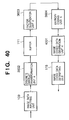
- FIG. 40 is a block diagram showing a configuration of an image data coding unit E 4502 in the ninth embodiment.
- FIG. 41 is a block diagram showing a configuration of an image data coding unit F 4602 in the ninth embodiment
- FIG. 42A is a block diagram showing a configuration of a frame coding device in the sixth embodiment.
- FIG. 42B is a block diagram showing a configuration of a frame data coding unit B 4201 in the sixth embodiment
- FIG. 43A is a block diagram showing a configuration of a frame coding device in the seventh embodiment.
- FIG. 43B is a block diagram showing a configuration of a frame data coding unit C 4301 in the seventh embodiment
- FIG. 44A is a block diagram showing a configuration of a frame coding device in the eighth embodiment.
- FIG. 44B is a block diagram showing a configuration of a frame data coding unit D 4401 in the eighth embodiment
- FIG. 45A is a block diagram showing a configuration of a frame coding device in the ninth embodiment.
- FIG. 45B is a block diagram showing a configuration of a frame data coding unit E 4501 in the ninth embodiment
- FIG. 46A is a block diagram showing a configuration of a frame coding device in the tenth embodiment
- FIG. 46B is a block diagram showing a configuration of a frame data coding unit F 4601 in the sixth embodiment
- FIG. 47 illustrates a coding pass selected in the layer arrangement in the ninth embodiment
- FIG. 48 is a flowchart showing processing of the layer arrangement in the ninth embodiment.
- FIG. 49 is a block diagram showing a configuration of a frame decoding device in the sixth embodiment.
- FIG. 50 is a block diagram showing a configuration of a frame decoding device in the seventh embodiment.
- FIG. 51 is a block diagram showing a configuration of a frame decoding device in the eighth embodiment.
- FIG. 52 is a block diagram showing a configuration of a frame decoding device in the ninth embodiment.
- FIG. 53 is a block diagram showing a configuration of a frame decoding device in the tenth embodiment.
- an motion image to be encoded has a plurality of frames.
- the frame refers to one static image in the motion image and a voice rolled forth for a time period over which the static image is projected (display time).
- data of the frame is comprised of data of one static image (image data) and data of voice (voice data).
- the encoding of frame data to generate frame coded data means the encoding of each of image data and voice data to generate image coded data and voice coded data. Furthermore, reduction of sound quality is generally more noticeable than reduction of image quality.
- a reversible coding system to prevent any information loss due to coding is used.
- the frame coded data is separated into image coded data and voice coded data.
- the coding device retrieves the start of voice coded data in each frame and recognizes the code length of the image coded data before performing separation. This requires much time. Thus, quicker separation of image coded data and voice coded data is desired. This is achieved by fixation of the code length of image coded data (length fixation of image coded data) in all frame data.
- image coded data to be decoded is made to constitute a part of the inputted image coded data, and decoding of the part of image coded data (partial decoding) is performed.
- full decoding full decoding
- full decoded image the outline of the image obtained by decoding of the entire image coded data (full decoding) (full decoded image) needs to be displayed. This is achieved by performing recurrently discrete wavelet transformation on the low frequency sub-band of image data to generate image coded data during coding, performing partial decoding of the image coded data in succession in the order of from the lowest frequency sub-band to the highest frequency sub-band during decoding, and displaying the same.
- a coding device and coding method for generating image coded data satisfying the above described conditions, and generating frame coded data from the image coded data and voice coded data will be presented below,
- FIG. 1A is a block diagram showing a configuration of a coding device in this embodiment.
- reference numeral 101 denotes a frame data coding unit
- reference numeral 102 denotes a designated image coded data code length inputting unit.
- the frame data coding unit 101 encodes frame data inputted in the coding device in this embodiment. Also, the code length of image coded data to be subjected to length fixation is inputted in the designated image coded data code length inputting unit 102 . Furthermore this code length that is inputted shall be a code length such that the outline of the image (predetermined by the user) included in frame coded data can be displayed within a time period over which the decoding device plays back each frame data even for partial decoding.
- FIG. 1B A configuration of the frame data coding unit 101 is shown in FIG. 1B
- a configuration of an image data coding unit 106 in FIG. 1B is shown in FIG. 1C
- a configuration of a voice data coding unit 105 in FIG. 1B is shown in FIG. 1 D.
- FIG. 14 a flowchart of processing of generation of frame coded data frame data coding unit 101 described later is shown in FIG. 14 , and explanation thereof will be given using this figure.
- frame data comprised of image data and voice data is inputted from a frame data inputting unit 103 , and is outputted to a frame data separation unit 104 (Step S 1401 ).
- a frame data inputting unit 103 for example, image pickup equipment such as a digital video camera and a digital still camera, an image pickup device such as a CCD, an interface of the network line or the like is used.
- the frame data inputting unit 103 may be a recording medium such as a RAM, a ROM, a hard disk, a CD-ROM or the like.
- a plurality of frame data in an motion image that is to be encoded shall be inputted each by each in the frame data inputting unit 103 . Also, processing after the frame data inputting unit 103 shall be performed independently for each frame data.
- Frame data inputted in the frame data separation unit 104 is separated into voice data and image data, as shown in FIG. 3 (Step S 1402 ). And, the voice data and the image data are inputted in the voice data coding unit 105 and the image data coding unit 106 , respectively.
- the image data inputted in the image data coding unit 106 is encoded by processing described later to become image coded data (Step S 1403 ). And, the image coded data is inputted in a frame coded data generation unit 107 .
- the voice data inputted in the voice data coding unit 105 is encoded by a reversible coding system in each unit described later to become voice coded data (Step S 1404 ). And, the voice coded data is inputted in the frame coded data generation unit 107 .
- a header is generated (Step S 1405 ). Furthermore, the size of image data inputted in an image inputting unit 109 , information on types and the like showing whether the image data is a binary image or a multi-valued image, the length of the image coded data, the length of the voice coded data, a character string showing a coding device sending the data, a send date and so on are written in the header. If the image coded data includes an adjustment bit, the code length of the adjustment bit is also written. And, as shown in FIG. 4 , frame coded data is generated from the header, the voice coded data and the image coded data (Step S 1406 ).
- a frame coded data sending unit 108 the inputted frame coded data is sent to the outside (Step S 1407 ).
- an interface such as a public line, a wireless line, a LAN or the like may be used.
- FIG. 15 A flowchart of processing of coding of image data in the image data coding unit 106 in Step S 1403 is shown in FIG. 15 , and the explanation thereof will be given below, using this figure.
- Image data to be encoded in a frame in this embodiment shall be 8-bit monochrome image data.
- the data can also be applied when it is a monochrome image in which each pixel is expressed by the number of bits other than 8 bits like 4 bits, 10 bits and 12 bits, or multi-valued image data of color in which each color component (RGB/Lab/YCrCb) in each pixel is expressed by 8 bits.
- the data can be applied when it is multi-valued information showing a state and the like of each pixel constituting the image, for example a multi-valued index value showing the color of each pixel.
- each kind of multi-valued information may be defined as monochrome image data described later.
- image data constituting image data to be encoded is inputted in raster scan order from the image data inputting unit 109 , and is outputted to a discrete wavelet transformation unit 110 .
- image data inputting unit 109 for example, image pickup equipment such as a scanner and a digital camera, an image pickup device such as a CCD, an interface of a network line or the like is used.
- the image data inputting unit 109 may be a recording medium such as a RAM, a ROM, a hard disk, a CD-ROM or the like.
- the discrete wavelet transformation unit 110 performs discrete wavelet transformation using data (reference pixel data) of plurality of pixels (reference pixels) in image data x(n) of one static image inputted from the image data inputting unit 109 (Step S 1501 ).
- r(n) and d(n) are discrete wavelet transformation factor sequences, and r(n) and d(n) refer to low and high frequency sub-bands, respectively.
- floor ⁇ X ⁇ represents a maximum value that does not exceed X.
- this transformation equation is for one-dimensional data, this transformation is applied in lateral direction and then in vertical direction to perform two-dimensional transformation, thereby enabling division into four sub-bands of LL, HL, LH and HH as shown in FIG. 6 A.
- L represents a low frequency sub-band
- H represents a high frequency sub-band.
- the LL sub-band is divided into four sub-bands (FIG. 6 B), and the LL sub-band of them is further divided into four sub-bands (FIG. 6 C).
- ten sub-bands are prepared.
- the ten sub-bands are referred to as HH 1 , HL 1 , . . . , respectively, as shown in FIG. 6 C.
- each sub-band refers to a level of each sub-band. That is, sub-bands of level 1 are HL 1 , HH 1 and LH 1 , and sub-bands of level 2 are HL 2 , HH 2 and LH 2 .
- the LL sub-band is a sub-band of level 0. No subscript is assigned to the LL sub-band because there is only one LL sub-band.
- the decoded image obtained by decoding sub-bands of level 0 to level n is called a decoded image of level n. For the decoded image, the higher its level, the higher its resolution. That is, for image data subjected to discrete wavelet transformation, the outline of the original image can be displayed by partial decoding.
- the transformation factors of ten sub-bands are stored in a buffer 111 on a temporary basis, and are outputted to a factor quantization unit 112 in the order of LL, HL 1 , LH 1 , HH 1 , HL 2 , LH 2 , HH 2 , HL 3 , LH 3 and HH 3 , namely in the order of from the lowest level sub-band to the highest level sub-band.
- the factor quantization unit 112 quantizes the transformation factor of each sub-band outputted from the buffer 111 by a quantizing step determined for each frequency component, and outputs a value after quantization (factor quantization value) to an entropy coding unit 113 (Step S 1502 ).
- the factor value is X
- the value of the quantizing step for the frequency component to which this factor belongs is q
- the factor value after quantization Q(X) is determined by the following equation.
- Q ( X ) floor ⁇ ( X/q )+0.5 ⁇
- each frequency component to a quantizing step in this embodiment is shown in FIG. 7 .
- a larger quantizing step is given to a sub-band of higher level.
- the quantizing step for each sub-band is previously stored in a memory such as a RAM and ROM (not shown). And, all the transformation factors in one sub-band are quantized, followed by outputting those factor quantization values to the entropy coding unit 113 .
- the entropy coding unit 113 entropy-encodes the inputted factor quantization value by arithmetic coding to generate an entropy coded value (Step S 1503 ).
- the entropy coded value is outputted to an image coded data generation unit A 114 .
- the entropy coded value inputted in the image coded data generation unit A 114 is arranged in the unit of sub-bands as shown in FIG. 8 , and quasi image coded data is generated (Step S 1504 ).
- the generated quasi image coded data is subjected to length fixation to form image coded data as described below.
- Step S 1505 If the code length of quasi image coded data is larger than the code length designated by the designated image coded data code length inputting unit 102 (Step S 1505 ), in order for the data to have a designated code length, entropy coded values are deleted in the unit of sub-bands in the order of resolution level with the highest level the first, or in the same level in the order of HH, LH and HL, namely from the rearmost in the quasi image coded data as shown in FIG. 9 (Step S 1506 ). In this deletion of the entropy coded value in the unit of sub-bands, bit planes comprised of respective digits of the code in the sub-band as shown in FIG. 10 are defined, and bit planes are deleted in ascending order with the lowest bit plane being deleted first.
- Step S 1505 if the code length of quasi image coded data is smaller than the designated code length (Step S 1505 ), the adjustment bit comprised of bits “0” is added to the rear of the HH 3 sub-band as shown in FIG. 11 . (Step S 1507 ).
- the quasi image coded data is decoded, the no adjustment bit is decoded.
- the code length of this adjustment bit is written in the header, as described above (Step S 1508 ).
- the image coded data generated as described above is outputted from an image coded data outputting unit 115 to the frame coded data generation unit 107 (Step S 1509 ).
- Step S 1404 a flowchart of processing of encoding voice data in the voice data coding unit 105 in Step S 1404 is shown in FIG. 16 , and explanation thereof will be given using this figure.
- Voice data to be encoded in the frame in this embodiment is inputted from the voice data inputting unit 116 , and is outputted to a discrete wavelet transformation unit B 117 .
- the discrete wavelet transformation unit B 117 performs discrete wavelet transformation on voice data inputted from the voice data inputting unit 116 to generate voice coded data (Step S 1601 ).
- the voice coded data generated by the discrete wavelet transformation unit B 117 is outputted to a voice coded data outputting unit 118 , and is outputted from the voice coded data outputting unit 118 to the frame coded data generation unit 107 (Step S 1602 ).
- the program code complying with the above described flowchart is stored in a memory such as a RAM and ROM, and is read out and executed by the CPU.
- the decoding and display should be performed more quickly than at least the decoding and display of image data in the first embodiment, for only the outline of the image of each frame.
- the LL sub-band of each image coded data may be decoded and displayed.
- the LL sub-band of each image coded data should be fetched in a predetermined buffer at one time without excess and deficiency. That will be achieved if the LL sub-band in each image coded data is length-fixed to a predetermined code length.
- a coding device and coding method for encoding each image data so that the component of the LL sub-band of each image coded data is length-fixed will be presented.
- FIG. 12 A block diagram showing a configuration of the coding device in this embodiment is shown in FIG. 12 .
- the coding device in this embodiment has replaced with an image coded data generation unit B 1201 the image coded data generation unit A 114 constituting the image data coding unit 106 shown in FIG. 1C in the first embodiment. All the units of the coding device and operations thereof other than the image coded data generation unit in this embodiment are same as those of the coding device in the first embodiment.
- the entropy coded value generated by the entropy coding unit 113 based on the factor quantized value inputted from the factor quantization unit 112 is inputted in the image coded data generation unit B 1201 as in the case of the first embodiment, and quasi image coded data as shown in FIG. 8 is generated as in the case of the first embodiment.
- the code length of the LL sub-band in quasi image coded data is larger than the code length designated by the designated image coded data code length inputting unit 102 , bits are deleted in ascending order, with the bit in the lowest bit plane of bit planes constituting the LL sub-band being deleted first.
- the adjustment bit described in the first embodiment is added to the rear of the LL sub-band.
- the code length of LL sub-bands included in all image coded data is all equalized (to the code length designated by the designated image coded data code length inputting unit 102 ), resulting in length fixation.
- image coded data is generated, and is inputted in the image coded data outputting unit 115 . And, processing thereafter is same as that of the first embodiment.
- the LL sub-band designated by the designated image coded data code length inputting unit 102 shall be a code length such that decoding and displaying of the data can be performed more quickly than at least the decoding and displaying of image data in the first embodiment for only the outline of the image of each frame.
- the processing in Step S 1505 is considered as processing of comparing the designated code length to the code length of the LL sub-band. And, if the code length of the LL sub-band is larger than the designated code length, the processing in Step S 1506 is considered as processing of deleting bits in ascending order, with the bit in the lowest bit plane of bit planes constituting the LL sub-band being deleted first.
- Step S 1507 processing of adding the adjustment bit to the LL sub-band.
- program code complying with the above described flowchart is stored in a memory such as a RAM and ROM, and is read and executed by the CPU.
- the present invention is not limited thereto.
- four sub-bands of LL, LH 1 , HL 1 and HH 1 are considered as the low frequency sub-band and the total length of these four sub-bands is made to be a fixed length by the above described method, whereby the object of this embodiment is also achieved.
- the coding device and coding method in the second embodiment performs length fixation of only the LL sub-band in each image coded data, thereby making it possible to perform the decoding and display for only the outline of the image of each frame (image corresponding to the low frequency component) more quickly than the decoding and displaying of image data in the first embodiment.
- the server transmits data that the client demands.
- the amount of data that each client demands from the server is varied. Therefore, a part or all of the data that the server accumulates in accordance with the amount of data that the client demands is fetched.
- the data must be fetched in the unit of data (unit data) such that significant data is generated after decoding. For example, image coded data subjected to discrete wavelet transformation may be fetched in the unit of sub-band.
- each sub-band is length-fixed to a predetermined code length (namely, if sub-bands with same types/same frequencies belonging to each frame are coded data of same length), image coded data subjected to discrete wavelet transformation can be fetched more quickly than the case where no length fixation is made.
- a coding device and coding method will be shown in which image data in frame data is divided into a plurality of sub-bands through discrete wavelet transformation and each sub-band is length-fixed (namely, at least sub-bands with same types/same frequencies belonging to each frame are length-fixed) so that the server can fetch image data in the sub-band unit at high speed.
- FIG. 13 A configuration of the coding device in this embodiment is shown in FIG. 13 .
- the coding device in this embodiment has replaced with an image coded data generation unit C 1301 the image coded data generation unit A 114 constituting the image data coding unit 106 shown in FIG. 1C in the first embodiment. All the units of the coding device and operations thereof other than the image coded data generation unit in this embodiment are same as those of the coding device in the first embodiment.
- the entropy coded value generated by the entropy coding unit 113 based on the factor quantized value inputted from the factor quantization unit 112 is inputted in an image coded data generation unit C 1201 as in the case of the first embodiment, and quasi image coded data as shown in FIG. 8 is generated as in the case of the first embodiment.
- each sub-band in quasi image coded data is larger than the code length designated for that kind of sub-bands, it is limited to the code length predetermined for that kind of sub-bands by deleting bits in ascending order, with the bit in the lowest bit plane of bit planes constituting each sub-band being deleted first.
- the code length is predetermined for each of LL, HL 1 , LH 1 , HH 1 , . . . , LH 3 , HH 3 , for example.
- a limitation is imposed in such a manner that LLs, LH 1 s, . . . of certain two frames (or more) are expressed by coded data of same code lengths, respectively.
- the processing in Step S 1505 is considered as processing of comparing the designated code length to the code length of each sub-band in quasi image coded data. And, if the code length of each sub-band in quasi image coded data is larger than the designated code length, the processing in Step S 1506 is considered as processing of deleting bits in ascending order, with the bit in the lowest bit plane of bit planes constituting each sub-band being deleted first.
- Step S 1507 processing of adding the adjustment bit to each sub-band.
- program code complying with the above described flowchart is stored in a memory such as a RAM and ROM, and is read and executed by the CPU.
- the code length of each sub-band of image coded data included in frame coded data is all equalized and length-fixed at least in the same kind of sub-bands, whereby, for example, the server can fetch data in the unit of sub-bands more speedily than the case where no length fixation is made.
- coded data such that their code lengths are equalized may be used for expression.
- the object of the present invention since being able to understand where data of each sub-band exists for each of coded data of a plurality of frames is enough, the object of the present invention is achieved as long as at least the “boundary” of coded data of each sub-band can be recognized.
- each image coded data should be fetched in the unit of level in a work buffer at one time without excess and deficiency. That will be achieved if image coded data expressing the image of each frame is length-fixed in the unit of level.
- a coding device and coding method for encoding each image data so that each image coded data is length-fixed in the unit of level will be presented.
- FIG. 17 A block diagram showing the configuration of the coding device in this embodiment is shown in FIG. 17 .
- the coding device in this embodiment has replaced with an image coded data generation unit D 1701 the image coded data generation unit A 114 constituting the image data coding unit 106 in the first embodiment shown in FIG. 1 C. All the units of the coding device and operations thereof other than the image coded data generation unit in this embodiment are same as those of the coding device in the first embodiment.
- the entropy coded value generated by the entropy coding unit 113 based on the factor quantized value inputted from the factor quantization unit 112 is inputted in the image coded data generation unit D 1701 as in the case of the first embodiment, and quasi image coded data as shown in FIG. 8 is generated as in the case of the first embodiment.
- coded data is deleted/reduced in the order of HHn, LHn and HLn sub-bands. Furthermore, in deletion/reduction of coded data of these sub-bands, bit planes are deleted in ascending order with the lowest bit plane being deleted first (in the case of level 1 or higher).
- bit planes are deleted in ascending order with the lowest bit plane being deleted first.
- the adjustment bit described in the first embodiment is added to the rear of the HH sub-band of each level, for level 1. Furthermore, for level 0, the adjustment bit is added to the rear of the LL sub-band as a matter of course. Consequently, the code length of each level unit included in image coded data of all frames is all equalized (to the code length designated for each level by the designated image coded data code length inputting unit 102 ), resulting in length fixation.
- image coded data is generated, and is inputted in the image coded data outputting unit 115 . And, each processing thereafter is same as that of the first embodiment.
- the processing in Step S 1505 is considered as processing of comparing the designated code length to the code length of each level. And, if the code length of each sub-band is larger than the designated code length, the processing in Step S 1506 is considered as processing of deleting/reducing bits in the order of HH, LH and HL (only LL in the case of level 0) in each level, and in the sub-band, deleting/reducing bits in the lowest bit plane first.
- Step S 1507 is considered as processing of adding the adjustment bit to the rear of the HH sub-band (to the rear of the LL sub-band in the case of level 0).
- Steps S 1505 , S 1506 , S 1507 and S 1508 repetition processing of the level number of times is performed.
- program code complying with the above described flowchart is stored in a memory such as a ROM and RAM, and is read and executed by the CPU.
- the code length is length-fixed in the unit of each level in image coded data expressing each frame, there by making it possible to display each frame with designated resolution at high speed.
- the leading address of each frame data may be written in the header for performing the partial decoding of each frame data at high speed.
- the leading address of each frame coded data may be written in the header after the partial decoding of each image coded data, for decoding voice coded data more quickly.
- a frame decoding device performs playback at the speed any several times as high as a normal playback speed (arbitrary multiple speed playback). At this time, if coded data required for playback is length-fixed among a plurality of frames, the arbitrary multiple speed playback can be performed efficiently. This is because the frame decoding device needs to obtain the leading address and code length of the coded data from the header for taking out the coded data in a work area, if the coded data is not length-fixed. If the coded data is length-fixed, however, the coded data can be fetched in the work area if only the leading address of the coded data is obtained.
- a frame coding device performing the length fixation of coded data required for efficiently carrying out arbitrary multiple speed playback is provided, and a frame decoding device for efficiently carrying out arbitrary multiple speed playback of the frame coded data generated by the frame coding device is provided.
- data that is length-fixed among frames (referred to as unit data) is considered as the LL sub-band. Furthermore, the concept of the fixed length is similar to that of the second embodiment.
- FIG. 36 C A block diagram showing the configuration of the frame coding device in this embodiment is shown in FIG. 36 C.
- the frame coding device in this embodiment has replaced with a frame data coding unit A 3607 the frame data coding unit 101 in the coding device of the first embodiment shown in FIG. 1 A.
- the reason why this replacement is applied is that unit data is the whole image coded data in the first embodiment, but unit data in this embodiment is the LL sub-band. Operations in the designated image coded data code length inputting unit 102 are identical to those of the same processing unit in the first embodiment.
- the code length of the above described unit data is called a target code length.
- FIG. 36A is a graphic view of a configuration of a frame data coding unit A in a frame coding device in this embodiment.
- reference numerals 103 , 104 , 105 , 3601 , 3606 and 108 denote a frame data inputting unit, a frame data division unit, a voice data coding unit, an image data coding unit A, a frame coded data generation unit A and a frame coded data outputting unit, respectively.
- Contents of processing in the frame data coding unit A in this embodiment are similar to those in the frame data coding unit 101 in the first embodiment, except for the image data coding unit 3601 and the frame coded data generation unit A 3606 .
- a difference in processing between the frame coded data generation unit A 3606 in this embodiment and the frame coded data generation unit 107 in the first embodiment lies in different information written in the header by these generation units. That is, the frame coded data generation unit A 3606 in this embodiment writes not only information written in the header by the frame coded data generation unit 107 but also information showing unit data and the target code length in the header in the first embodiment.
- FIG. 36B shows in diagrammatic form the specific configuration of the image data coding unit A 3601 in FIG. 36 A.
- reference numerals 109 , 3602 , 111 , 3603 , 3604 , 3605 and 115 denote an image data inputting unit, a discrete wavelet transformation unit A, a buffer, a factor quantization unit A, an entropy coding unit A, an image coded data generation unit D and an image coded data outputting unit, respectively.
- the image data coding unit A 3601 in this embodiment has the discrete wavelet transformation unit 110 , the factor quantization unit 112 , the entropy coding unit 113 and the image coded data generation unit A 114 in the above described FIG.
- the discrete wavelet transformation unit A 3602 repeats division by wavelet transformation in the lateral and vertical direction to generate seven sub-bands. These seven sub-bands are outputted to the buffer 111 , and are further outputted to the factor quantization unit A 3603 .
- the factor belonging to each sub-band inputted is quantized to become a factor quantized value, as shown in FIG. 20 .
- This factor quantized value is outputted to the entropy coding unit A 3604 .
- each sub-band which is a group of inputted factor quantized values, is divided into rectangular forms (referred to as a code blocks), as shown in FIG. 21 .
- the size of this code block is defined as 2m ⁇ 2n (m and n are integers equal to or greater than 1) or the like.
- this code block is divided into bit planes as shown in FIG. 22 .
- bits in a certain bit plane are grouped into three types based on a classification rule, and three kinds of coding passes gathering a same type of bits are thus generated.
- the inputted factor quantized value is subjected to binary arithmetic coding, which is entropy coding, with the coding pass obtained here as a unit, to generate an entropy coded value.
- coding is performed in the order of from the highest plane bit to the lowest plane bit if watching a single coding block, and three kinds of passes shown in FIG. 23 are coded in descending order if watching a bit plane in the single coding block.
- the entropy coded values are outputted to the image coded data generation unit D 3605 .
- the entropy coded values inputted in the image coded data generation unit D 3605 are arranged in the unit of sub-bands to form quasi image coded data as shown in FIG. 8 . If a desired bit rate (compression rate to the amount of original image data) is not achieved yet, data is deleted with the least important data being deleted first, with a coding pass as a unit.
- the LL sub-band is further subjected to length fixation before image coded data is formed, as will be described below.
- deletion in ascending order with the bit plane in the code block included in the LL sub-band as a unit can be considered.
- deletion in ascending order with the coding pass in the code block included in the LL sub-band as a unit can also be considered.
- the LL sub-band in the code length of quasi image coded data is smaller than the target code length designated by the designation image coded data code length inputting portion 102 , a marker indicating embedment of a message that should be given to a decoding end (comment marker) and some message data (comments) are inserted in header information at the head of coded data of the frame to be encoded.
- dummy data to the LL sub-band is added. This dummy data is pseudo data required for rendering the encoded image data the code amount n byte (n: integer) of length fixation.
- this dummy data is considered as auxiliary data for correcting an error of coded data of the LL sub-band, for using this dummy data effectively.
- Image coded data generated as described above is outputted from the image coded data outputting unit 115 to the frame coded data generation unit 108 .
- the frame decoding device in this embodiment not only can decode the entire data of the frame coded data generated as described above (normal decoding) and play back the decoded image generated at normal speed (normal playback), but also fetch only a part of data to decode the same (quick decoding) and play back the decoded image generated at high speed (quick playback).
- the LL sub-band is an object to be decoded in the case of quick playback as the above described part of data because the LL sub-band is length-fixed.
- the amount of coded data of the LL sub-band is usually larger than 1/16 of the amount of entire coded data because the coding efficiency of the LL sub-band is not high compared with other sub-bands.
- FIG. 24 is a block diagram of the frame decoding device in this embodiment.
- reference numerals 2401 , 2402 , 2403 , 2404 and 2405 denote a frame coded data accumulation unit, a normal decoding unit, a fixed length fetching unit, a quick decoding unit and a played image display unit, respectively.
- Frame coded data inputted in the frame decoding device in this embodiment is accumulated in the frame coded data accumulation unit 2401 .
- the frame coded data to be decoded is fetched in the normal decoding unit 2402 (S 2501 ), and decoding of the frame coded data is performed (S 2502 ).
- the quick decoding is carried out, only the LL sub-band in the frame coded data to be decoded is fetched in the quick decoding unit 2404 by the fixed length fetching unit 2403 (S 2503 ), and decoding of the LL sub-band is performed (S 2504 ).
- the decoded image obtained by normal decoding or quick decoding is displayed on the played image display unit 2405 (S 2505 ).
- FIG. 26 is a block diagram of the normal decoding unit 2402 in this embodiment.
- reference numerals 2601 , 2602 , 2603 , 2604 , 2605 and 2606 denote a frame coded data inputting unit, an entropy decoding unit, an inverse quantization unit, a buffer A, an inverse discrete wavelet transformation unit A and a decoded frame data outputting unit 2606 .
- the frame coded data When a code string sent from the frame coded data accumulation unit 2401 is inputted in the frame coded data inputting unit 2601 , the frame coded data is divided into header information, image coded data and voice coded data, and the image coded data is outputted to the entropy decoding unit 2602 . Furthermore, the voice coded data is decoded by a decoding unit (not shown), but such decoding processing is not described here because decoding of voice coded data is not concerned with the substance of the present invention.
- the entropy decoding unit 2602 subjects the fetched image coded data to decoding processing to restore the quantized value. Then, the restored quantized value is outputted to the inverse quantization unit 2603 .
- the discrete wavelet transformation factor stored in the buffer A 2604 is inputted in the inverse discrete wavelet transformation unit A 2605 by each level.
- inverse discrete wavelet transformation is performed based on the equations described below.
- x (2 n ) r ( n )+floor ⁇ p ( n )/2 ⁇
- x (2 n+ 1) r ( n ) ⁇ floor ⁇ p ( n )/2 ⁇
- p ( n ) d ( n ⁇ 1) ⁇ floor ⁇ ( ⁇ r ( n )+ r ( n+ 2)+2)/4 ⁇
- x (n) represents decoded data.
- This equation of transformation is for one-dimensional data, but two-dimensional transformation is performed by applying this transformation in order of lateral direction and vertical direction.
- decoded image data is generated, and is outputted to the decoded frame data outputting unit 2606 .
- This decoded frame data outputting unit 2606 combines voice data decoded (decoded voice data) and decoded image data to generate frame decoded data. This frame decoded data is outputted to the played image display unit 2405 .
- the quick decoding unit 2404 will now be described.
- the quick decoding unit 2404 in this embodiment decodes only the LL sub-band fetched by the fixed length data fetching unit 2403 .
- Decoding processing itself in this case is usually performed substantially as in the case of the normal decoding unit 2402 , and therefore detailed description thereof is not particularly presented.
- coded data corresponding to the frequency component of a part of the image is length-fixed, whereby both image playback at normal speed and image playback at high speed can efficiently be performed.
- This embodiment is also characterized by performing image processing for improving image quality of the decoded image as far as practical, depending on the speed of quick playback.
- processing for increasing resolution (data interpolation) and processing for improving image quality (smoothing and the like) are performed in the interval between decoding and playback if only the LL sub-band is decoded/played back at modest playback speed such as double-speed and quadruple-speed, even provided that only the LL sub-band of fixed length must be decoded/played back because there is no time for performing normal decoding. By so doing, the image of highest possible quality can be played back even in quick playback.
- the portion corresponding to the low frequency LL sub-band is further length-fixed among frames, thereby making it possible to perform quick playback smoothly.
- length fixation of coded data is carried out for each sub-band, thereby performing each quick playback of the motion image in multi-level image quality in accordance with the playback speed.
- FIG. 42 A A block diagram showing a configuration of a frame coding device in this embodiment is shown in FIG. 42 A.
- the frame coding device in this embodiment has replaced with a frame data coding unit B 4201 the frame data coding unit A 3607 in the coding device shown in FIG. 36C in the fifth embodiment.
- the reason why this unit is replaced is that unit data is the LL sub-band in the fifth embodiment, but unit data in this embodiment is each sub-band. Operations in the designated image coded data code length inputting unit 102 are same as those in the unit in the fifth embodiment, and therefore detailed description thereof is not presented.
- FIG. 42B shows in diagrammatic form the configuration of the frame data coding unit in the frame coding device in this embodiment.
- reference numerals 103 , 104 , 105 , 4202 , 3606 and 108 denote a frame data inputting unit, a frame data division unit, a voice data coding unit, an image data coding unit B, a frame coded data generation unit A and a frame coded data outputting unit.
- contents of processing in the frame data coding unit in this embodiment are similar to those in the frame data coding unit in the fifth embodiment except for the image data coding unit.
- FIG. 37 A block diagram showing the configuration of the image coding device in this embodiment is shown in FIG. 37 .
- the image data coding unit B 4202 in this embodiment has replaced with an image coded data generation unit E 3701 the image coded data generation unit D 3605 constituting the image data coding unit A 3601 shown in FIG. 36B in the fifth embodiment. Except for that point, the image coding device and operations thereof in this embodiment are same as the image coding device and operations thereof in the fifth embodiment, and therefore detailed description thereof is not presented.
- length fixation for each sub-band is carried out as shown in FIG. 27 .
- the concept of this length fixation is similar to that in the fifth embodiment.
- coded data accounting for substantially 1 ⁇ 2 of the amount of the entire coded data is decoded as shown in FIG. 28B , thereby making it possible to perform playback of high image quality suited to the playback speed.
- the sub-band HH 2 is not used in the case of quick playback, and therefore this part does not need to be length-fixed.
- this embodiment is characterized in that two or more kinds of sub-bands that could be an object to be decoded in the case of quick (special) playback are length-fixed.
- the decoding device in this embodiment is shown in FIG. 49 .
- This has the fixed length data fetching unit 2403 and the quick decoding unit 2404 in the fifth embodiment with a fixed length fetching unit 4901 and a quick decoding unit 4902 .
- the reason why these units are replaced is that while data treated with quick decoding is only the LL sub-band in the fifth embodiment, data treated with quick decoding in this embodiment is the length-fixed sub-band including the LL sub-band.
- processing performed by the frame decoding device in this embodiment is substantially similar to processing performed by the frame decoding device in the fifth embodiment, and therefore detailed description of the frame decoding device in this embodiment is not presented.
- a same kind of sub-bands in mutual frames are made to take on the fixed length, whereby two or more kinds of sub-bands equivalent to the amount of coded data that sufficiently keeps with the playback speed are decoded, thus making it possible to perform image playback of high image quality suited to the playback speed.
- FIG. 43 A A block diagram showing the configuration of the frame coding device in this embodiment is shown in FIG. 43 A.
- the frame coding device in this embodiment has replaced with a frame data coding unit C 4301 the frame data coding unit A 3607 in the coding device shown in FIG. 36C in the fifth embodiment.
- the reason why this replacement is applied is that unit data is the LL sub-band in the fifth embodiment, but unit data in this embodiment is the level of resolution. Operations in the designated image coded data code length inputting unit 102 are same as those in this processing unit in the fifth embodiment, and therefore description thereof is not presented.
- FIG. 43B shows in diagrammatic form the configuration of the frame data coding unit in the frame coding device in this embodiment.
- reference numerals 103 , 104 , 105 , 4302 , 3606 and 108 denote a frame data inputting unit, a frame data division unit, a voice data coding unit, an image data coding unit C, a frame coded data generation unit A and a frame coded data outputting unit, respectively.
- Contents of processing in the frame data coding unit in this embodiment are similar to those in the frame data coding unit in the fifth embodiment except for the image data coding unit, and therefore detailed description thereof is not presented.
- FIG. 38 A block diagram showing the configuration of the image coding device in this embodiment is shown in FIG. 38 .
- the coding device in this embodiment has replaced with an image coded data generation unit F 3801 the image coded data generation unit D 3605 constituting the image data coding unit A 3601 shown in FIG. 36B in the fifth embodiment. Except for that point, the image coding device and operations thereof are same as the image coding device and operations thereof in the fifth embodiment.
- coded data is length-fixed for each group of sub-bands belonging to a same kind of resolution levels. That is, for each frame, coded data representing LL are length-fixed so that they are rendered the code length CO, a group of coded data representing three sub-bands of HL 1 , LH 1 and HH 1 are length-fixed so that they are rendered the code length C 1 , and a group of coded data representing three sub-bands of HL 2 , LH 2 and HH 2 are length-fixed so that they are rendered the code length C 2 .
- the frame decoding device of this embodiment can perform decoding/playback of only the resolution level suited to the playback speed.
- only coded data of the length-fixed LL sub-band namely, level 0
- only coded data representing three sub-bands of HL 1 , LH 1 and HH 1 (level 1) together with the LL sub-band can be decoded/played back in the case of (double-speed to) quadruple-speed playback.
- the object can be attained as long as at least coded data of resolution level (sub-band group) for which partial playback could be applied when quick playback is carried out.
- the decoding device in this embodiment is shown in FIG. 50 .
- This device has the fixed length data fetching unit 2403 and the quick decoding unit 2404 in the fifth embodiment replaced with a fixed length data fetching unit 5001 and a quick decoding unit 5002 .
- the reason why these units are replaced is that while data treated with quick decoding in only the LL sub-band in the fifth embodiment, data treated with quick decoding in this embodiment is coded data of resolution level.
- processing performed by the frame decoding device in this embodiment is substantially similar to processing performed by the frame decoding device in the fifth embodiment, and therefore detailed description of processing of the frame decoding device in this embodiment is not presented.
- image coded data are length fixed for each coded data of the group of sub-bands belonging to each resolution level, a image of highest possible quality suited to the playback speed can be played back when these coded data are played back at high speed.
- only the LL sub-band that is the lowest frequency component is length-fixed.
- the present invention is not limited thereto.
- the object of the present invention is attained even if four sub-bands of LL, LH 1 , HL 1 and HH 1 are considered as low frequency sub-bands, and the sum of these four sub-bands is made to be length-fixed. In this embodiment, this case will be described.
- the level number of discrete wavelet transformation described for the first embodiment is 3, and therefore if length fixation of the LL sub-band in the image coded data is performed, this represents a form of optimum coded data for performing sixty four-fold-speed decoding/playback, which is less practical.
- coded data of the sub-band group including the LL sub-band and other low frequency sub-bands are length-fixed.
- FIG. 44 A A block diagram showing the configuration of the frame coding device in this embodiment is shown in FIG. 44 A.
- the frame coding device in this embodiment has replaced with a frame data coding unit D 4401 the frame data coding unit A 3607 in the coding device in the fifth embodiment shown in FIG. 36 C.
- the reason why this replacement is applied is that unit data in the fifth embodiment is the LL sub-band, but unit data in this embodiment is the LL sub-band+ ⁇ (LH 1 , LH 1 , HH 1 . . . ).
- Operations in the designated image coded data code length inputting unit 102 are similar to those in the same processing unit in the fifth embodiment.
- FIG. 43B shows in diagrammatic form the configuration of the frame data coding unit in the frame coding device in this embodiment.
- reference numerals 103 , 104 , 105 , 4402 , 3606 and 108 denote a frame data inputting unit, a frame data division unit, a voice data coding unit, an image data coding unit D, a frame coded data generation unit A and a frame coded data outputting unit, respectively.
- Contents of processing in the frame data coding unit in this embodiment are similar to those in the frame data coding unit in the fifth embodiment except for the image data coding unit, and therefore detailed description thereof is not presented.
- FIG. 39 a block diagram showing the configuration of the image coding device in this embodiment is shown in FIG. 39 .
- the discrete wavelet transformation unit 110 and the factor quantization unit 112 used in the first embodiment are applied for a discrete wavelet A 3802 and a factor quantization unit A 3803 .
- the image coded data generation unit D 3605 constituting the image data coding unit A 3601 shown in FIG. 36B in the fifth embodiment is replaced with an image coded data generation unit G 3901 described later.
- the entropy coding unit A 3604 is replaced with an entropy coding unit B 3902 in FIG. 39 described above.
- basic processing remains unchanged, and therefore detailed description thereof is not presented.
- the image coded data generation unit G 3901 in this embodiment length-fixes the coded data corresponding to the sub-band group of the LL sub-band + ⁇ (LH 1 , HL 1 , HH 1 , LH 2 , HL 2 , HH 2 ). This point represents a significant difference between this embodiment and the fifth embodiment.
- a configuration as shown in FIG. 32 makes it possible to play back easily a simple image most suitable for performing quadruple-speed decoding/playback, which is a very practical setting.
- the decoding device in this embodiment is shown in FIG. 51 .
- This device has the fixed length data fetching unit 2403 and the quick decoding unit 2404 in the fifth embodiment replaced with a fixed length data fetching unit 5101 and a quick decoding unit 5102 .
- the reason why these units are replaced is that while data treated with quick decoding is only the LL sub-band in the fifth embodiment, data treated with quick decoding in this embodiment is the LL sub-band+ ⁇ (LH 1 , HL 1 , HH 1 , LH 2 , HL 2 , HH 2 ).
- processing performed by the frame decoding device in this embodiment is substantially similar to processing performed by the frame decoding device in the fifth embodiment, and therefore detailed description of processing of the frame decoding device in this embodiment is not presented.
- coded data corresponding to the group of the LL sub-band+ ⁇ (low frequency sub-bands subsequent thereto) is length-fixed, whereby coded data enabling practical multiple-speed decoding/playback (playback of the motion image at frame rates of 1 to n-fold speeds) to be performed easily can be provided.
- image coded data has a data structure as shown in FIG. 8 .
- partially decoded data generated by partial decoding is of very low resolution (1 ⁇ 4 or 1/16 or 1/64).
- a plurality of layers as shown in FIG. 33 is defined, and coded data based on this data structure as shown in FIG. 34 is generated, thereby enabling hierarchical display according to a method in which the image size remains unchanged while image quality is gradually improved, as shown in FIG. 35 .
- this embodiment is characterized in that a various kinds of layers (layer 0, . . . ,N) in coded data having the above described layer structure are length-fixed so that they are equalized among respective frames.
- FIG. 45 A A block diagram showing the configuration of the frame coding device in this embodiment is shown in FIG. 45 A.
- the frame coding device in this embodiment has replaced with a frame data coding unit E 4501 the frame data coding unit A 3607 in the coding device of the fifth embodiment shown in FIG. 36 C.
- the reason why this replacement is applied is that while unit data in the fifth embodiment is the LL sub-band, unit data in this embodiment is corresponded to each layer. Operations in the designated image coded data code length inputting unit 102 are same as those in the fifth embodiment, and therefore detailed description thereof is not presented.
- FIG. 43B shows in diagrammatic form the configuration of frame data coding unit in the frame coding device in this embodiment.
- reference numerals 103 , 104 , 105 , 4502 , 3606 and 108 denote a frame data inputting unit, a frame data division unit 104 , a voice data coding unit, an image data coding unit E, a frame coded data generation unit A and a frame coded data outputting unit, respectively.
- contents of processing in the frame data coding unit in this embodiment are similar to those in the frame data coding unit in the fifth embodiment except for the image data coding unit.
- FIG. 40 A block diagram showing the configuration of the image coding device in this embodiment is shown in FIG. 40 .
- the coding device in this embodiment has replaced with a an image coded data generation unit H 4001 the image coded data generation unit D 3605 constituting the image data coding unit A 3601 in the fifth embodiment shown in FIG. 36 B. Except for this point, the image coding device and operations thereof in this embodiment are same as the image coding device and operations thereof in the fifth embodiment, and therefore detailed description thereof is not presented.
- the image coded data generation unit H 4001 forms image coded data into a layer structure to perform length fixation of layers. Description about the layer structure will be presented below.
- the image coded data generation unit H 4001 collects entropy coded coding passes from a plurality of coding passes in a plurality of sub-bands before construct the layer. Furthermore, a shown in FIG. 47 , when a coding pass is obtained from a certain coding block, the coding pass existing in the uppermost position of the coding passes is always selected.
- layers are generated in such a manner that they are length-fixed with the uppermost layer being generated first. That is, in FIG. 33 , the layer 0 is first generated in such a manner that it is length-fixed, after which layers 1, 2, . . . are generated.
- FIG. 48 shows a flowchart.
- a coding pass to be added to a layer to which attention is paid is selected (S 4701 ), and the size of the code length (code length A) obtained as a result of adding the code length of the selected coding pass to the code length of the attentional layer is compared with the size of the target code length (S 4702 ). If the code length A is smaller than the target code length, the selected coding pass is added to the attentional layer (S 4703 ), and processing is returned back to S 4701 . If the code length A is not smaller than the target length, whether or not the two code lengths equal each other is examined (S 4704 ).
- the selected coding pass is added to the attentional layer (S 4705 ) to end processing for constructing the attentional layer. If the code length A does not equal the target length and the code length A is larger than the target code length, the existence of other selectable coding passes is examined without selecting the selected coding pass (S 4706 ). If there exists a selectable coding pass, processing is returned back to S 4701 . On the other hand, if there exists no selectable coding pass, dummy data is added to the attentional layer (S 4707 ) to end processing.
- control is made so that at least coded data of the uppermost layer (layer 0) is length-fixed just as in the case of the second and fifth embodiments in which only the LL sub-band enabling the image of lowest image quality to be played back is length-fixed.
- the present invention is limited thereto.
- length fixation may be performed in a similar way.
- the optimum layer for which length fixation is performed is easily assigned to the multi-level quick playback speed, thus making it possible to play back an image of highest possible image quality during quick playback.
- the decoding device in this embodiment is shown in FIG. 52 .
- This device has the code length data fetching unit 2403 and the quick decoding unit 2404 in the fifth embodiment replaced with a code length data fetching unit 5210 and a quick decoding unit 5292 .
- the reason why these units are replaced is that while data treated with quick decoding is the LL sub-band in the fifth embodiment, data treated with quick decoding in this embodiment is the length-fixed layer.
- processing performed by the frame decoding device in this embodiment is substantially similar to processing performed by the frame decoding device in the fifth embodiment, and therefore detailed description of processing in terms of the frame decoding device in this embodiment is not presented.
- image coded data is formed into a layer structure, and the coded data of the uppermost layer of these layers and further several layers subsequent thereto are length-fixed, thereby enabling image playback in high resolution and also image playback of highest possible image quality with playback speed taken into account even when quick decoding/playback (playback of the motion image at frame rates of 1 to n-fold speeds) is performed.
- the image coding device in this embodiment further forms coded data of each sub-band or each group of coded data comprised of a plurality of sub-bands into a structure of a plurality of layers as in the case of the ninth embodiment and performs length fixation of coded data of each layer. That is, adaptation to stages of playback speeds of (the number of sub-bands or the number of sub-band groups) ⁇ (the number of layers) is possible. That is, image playback of highest possible image quality suited to each playback speed can be performed.
- image coded data is length-fixed for each sub-band, as described in the sixth embodiment.
- coded data among respective sub-bands have layer structures independent of one another.
- coded data representing these respective layers are length-fixed.
- the layer structure of several stages as shown in FIG. 33 is created.
- this embodiment is different from the ninth embodiment in that the layer structure of several stages is created independently for each sub-band/each sub-band group.
- FIG. 45 A A block diagram showing the configuration of the frame coding device in this embodiment is shown in FIG. 45 A.
- the frame coding device in this embodiment has replaced with a frame data coding unit F 4601 the frame data coding unit A 3607 in the coding device in the fifth embodiment shown in FIG. 36 C.
- the reason why this replacement is applied is that while unit data is the LL sub-band in the fifth embodiment, unit data in this embodiment is changed to the layer in the sub-band.
- Operations in the designated image coded data code length inputting unit 102 are same as operations in the same processing unit in the fifth embodiment.
- FIG. 43B shows in diagrammatic form the configuration of the frame data coding unit in the frame coding device in this embodiment.
- reference numerals 103 , 104 , 105 , 4602 , 3606 and 108 denote a frame data inputting unit, a frame data division unit, a voice data coding unit, an image data coding unit F, a frame coded data generation unit A and a frame coded data outputting unit, respectively.
- Contents of processing in the frame data coding unit in this embodiment are similar to those in the frame data coding unit in the fifth embodiment except for the image data coding unit.
- FIG. 41 A block diagram showing the configuration of the image coding device in this embodiment is shown in FIG. 41 .
- the image coded data generation unit D 3605 constituting the image data coding unit A 3601 of the fifth embodiment shown in FIG. 36B is replaced with an image coded data generation unit I 4101 .
- the image coding device and operations thereof in this embodiment are same as the image coding device and operations thereof in the fifth embodiment.
- each sub-band is comprised of two layers, and coded data for each layer is length-fixed.
- the number of layers of each sub-band is considered as 2 in FIG. 31 to avoid complicated explanation, but the present invention is not limited thereto. As a matter of course, if the number of layers is increased to 3 or more, coded data of structure with very numerous hierarchies can be created.
- the decoding device in this embodiment is shown in FIG. 53 .
- This device has the fixed length data fetching unit 2403 and the quick decoding unit 2404 in the fifth embodiment replaced with a fixed length data fetching unit 5301 and a quick decoding unit 5302 .
- the reason why these units are replaced is that while data treated with quick decoding is the LL sub-band in the fifth embodiment, data treated with quick decoding in this embodiment is the layer length-fixed in each sub-band.
- processing performed by the frame decoding device in this embodiment is substantially similar to processing performed by the frame decoding device in the fifth embodiment, and therefore detailed description of processing in terms of the frame decoding device in this embodiment is not presented.
- length fixation is performed also in the sub-band, and coded data of each layer constituting the each sub-band is also length-fixed, whereby image coded data adaptable to quick playback of multi-level speeds (playback of the motion image at multi-level frame rates) can be provided. Also, this image coded data can be decoded/played back efficiently.
- the method of creating coded data of the present invention may be used for aspects other than quick playback, such a form is also included in the scope of the present invention.
- decoding processing and error correction may be performed for the coded data of each sub-band and each layer as long as technically possible, which is included in the scope of the present invention.
- the present invention may be applied either as a part of a system comprised of a plurality of apparatuses (for example, a host computer, an interface apparatus, a reader, a printer, etc.) or as a part of equipment comprised of a single apparatus (for example, a digital video camera, digital steel camera).
- the present invention should not be limited to devices and methods for achieving the above described embodiments, but cases where the program code of software to achieve the above described embodiments is supplied to the computer in the above described system or equipment (CPU or MPU), the computer of the above described system or equipment operates the above described various kinds of devices in accordance with this program code, thereby achieving the above described embodiments are also included in the scope of the present invention.
- the program code related to the above described software itself achieves the features of the above described embodiments, and the program code itself and means for supplying the program code to the computer, specifically a storage medium storing therein the above described program code are included in the scope of the present invention.
- a storage medium storing therein the program code for example, a floppy disk, a hard disk, an optical memory disk, a magneto-optical disk, a CD-ROM, a magnetic tape, a nonvolatile memory card, a ROM or the like may be used.
- the program code corresponding to the previously described flowcharts (shown in FIGS. 14 , 15 and 16 ), or the flowchart in the second embodiment, or the flowchart in the third embodiment, or the flowchart shown in FIG. 18 in the fourth embodiment is stored in the storage medium.
Landscapes
- Engineering & Computer Science (AREA)
- Multimedia (AREA)
- Signal Processing (AREA)
- Compression Or Coding Systems Of Tv Signals (AREA)
- Compression Of Band Width Or Redundancy In Fax (AREA)
- Compression, Expansion, Code Conversion, And Decoders (AREA)
Applications Claiming Priority (4)
| Application Number | Priority Date | Filing Date | Title |
|---|---|---|---|
| JP138927/2000 | 2000-05-11 | ||
| JP2000138927 | 2000-05-11 | ||
| JP109003/2001 | 2001-04-06 | ||
| JP2001109003A JP4545980B2 (ja) | 2000-05-11 | 2001-04-06 | 符号化装置及び符号化方法並びに記憶媒体 |
Publications (2)
| Publication Number | Publication Date |
|---|---|
| US20020031182A1 US20020031182A1 (en) | 2002-03-14 |
| US6950471B2 true US6950471B2 (en) | 2005-09-27 |
Family
ID=26591708
Family Applications (1)
| Application Number | Title | Priority Date | Filing Date |
|---|---|---|---|
| US09/851,559 Expired - Lifetime US6950471B2 (en) | 2000-05-11 | 2001-05-10 | Coding device, coding method and storage medium |
Country Status (2)
| Country | Link |
|---|---|
| US (1) | US6950471B2 (enExample) |
| JP (1) | JP4545980B2 (enExample) |
Cited By (13)
| Publication number | Priority date | Publication date | Assignee | Title |
|---|---|---|---|---|
| US20050100226A1 (en) * | 2003-07-23 | 2005-05-12 | Canon Kabushiki Kaisha | Image coding method and apparatus |
| US20050207659A1 (en) * | 2004-03-19 | 2005-09-22 | Taku Kodama | Image-processing apparatus, program, and recording medium |
| US20070127826A1 (en) * | 2005-12-07 | 2007-06-07 | Canon Kabushiki Kaisha | Image processing apparatus and control method therefor |
| US20070217698A1 (en) * | 2006-03-15 | 2007-09-20 | Sho Son | Image compressing apparatus, image compressing method and program |
| US20070286478A1 (en) * | 2006-06-12 | 2007-12-13 | Canon Kabushiki Kaisha | Image processing apparatus and image processing method |
| US20080089413A1 (en) * | 2004-06-28 | 2008-04-17 | Canon Kabushiki Kaisha | Moving Image Encoding Apparatus And Moving Image Encoding Method |
| US20090252427A1 (en) * | 2008-04-02 | 2009-10-08 | Canon Kabushiki Kaisha | Image encoding apparatus and control method thereof |
| US20090252232A1 (en) * | 2008-04-02 | 2009-10-08 | Canon Kabushiki Kaisha | Image encoding apparatus and control method thereof |
| US20100067810A1 (en) * | 2008-09-17 | 2010-03-18 | Canon Kabushiki Kaisha | Image encoding apparatus, image decoding apparatus, and methods of controlling the same |
| US20100316303A1 (en) * | 2009-06-16 | 2010-12-16 | Canon Kabushiki Kaisha | Image decoding apparatus and control method for the same |
| US20100316304A1 (en) * | 2009-06-16 | 2010-12-16 | Canon Kabushiki Kaisha | Image decoding apparatus and control method for the same |
| US20110194767A1 (en) * | 2010-02-08 | 2011-08-11 | Canon Kabushiki Kaisha | Image encoding apparatus and control method therefor |
| US10979723B2 (en) * | 2019-05-13 | 2021-04-13 | GlenFlyTechnology Co., Ltd. | Image processing method and image processing device |
Families Citing this family (13)
| Publication number | Priority date | Publication date | Assignee | Title |
|---|---|---|---|---|
| JP2004153751A (ja) | 2002-11-01 | 2004-05-27 | Ricoh Co Ltd | 画像処理装置及び画像処理方法 |
| US7386176B2 (en) | 2002-11-15 | 2008-06-10 | Ricoh Company, Ltd. | Image sending apparatus and image receiving apparatus for sending and receiving code sequence data |
| FR2852179A1 (fr) | 2003-03-06 | 2004-09-10 | Thomson Licensing Sa | Procede de codage d'une image video |
| JP4045544B2 (ja) | 2003-04-14 | 2008-02-13 | ソニー株式会社 | 符号化装置及び符号化方法 |
| JP4733939B2 (ja) * | 2004-01-08 | 2011-07-27 | パナソニック株式会社 | 信号復号化装置及び信号復号化方法 |
| JP4702928B2 (ja) | 2004-03-12 | 2011-06-15 | キヤノン株式会社 | 動画像符号化装置及び復号装置及びその制御方法、並びにコンピュータプログラム及びコンピュータ可読記憶媒体 |
| JP2005295505A (ja) * | 2004-03-12 | 2005-10-20 | Canon Inc | 動画像符号化装置及び動画像復号装置及びそれらの制御方法、並びに、コンピュータプログラム及びコンピュータ可読記憶媒体 |
| JP4618676B2 (ja) | 2005-04-28 | 2011-01-26 | 株式会社リコー | 構造化文書符号の転送方法、画像処理システム、サーバ装置、プログラム及び情報記録媒体 |
| US7668380B2 (en) * | 2005-05-18 | 2010-02-23 | Dts, Inc. | Rate control of scalably coded images |
| KR100723505B1 (ko) | 2005-10-06 | 2007-05-30 | 삼성전자주식회사 | 하이브리드 방식의 영상 데이터 처리 시스템 및 영상데이터 처리 방법 |
| US8254707B2 (en) * | 2005-12-07 | 2012-08-28 | Sony Corporation | Encoding device, encoding method, encoding program, decoding device, decoding method, and decoding program in interlace scanning |
| JPWO2007066709A1 (ja) * | 2005-12-07 | 2009-05-21 | ソニー株式会社 | 符号化装置、符号化方法および符号化プログラム、ならびに、復号装置、復号方法および復号プログラム |
| JP4594425B2 (ja) * | 2009-01-19 | 2010-12-08 | 株式会社リコー | 画像処理装置 |
Citations (2)
| Publication number | Priority date | Publication date | Assignee | Title |
|---|---|---|---|---|
| US5867602A (en) * | 1994-09-21 | 1999-02-02 | Ricoh Corporation | Reversible wavelet transform and embedded codestream manipulation |
| US6549666B1 (en) * | 1994-09-21 | 2003-04-15 | Ricoh Company, Ltd | Reversible embedded wavelet system implementation |
Family Cites Families (5)
| Publication number | Priority date | Publication date | Assignee | Title |
|---|---|---|---|---|
| JPH0362789A (ja) * | 1989-07-31 | 1991-03-18 | Matsushita Electric Ind Co Ltd | 画像符号化装置 |
| JPH0378380A (ja) * | 1989-08-22 | 1991-04-03 | Sony Corp | 画像信号の記録装置 |
| JPH05137114A (ja) * | 1991-11-14 | 1993-06-01 | Mitsubishi Electric Corp | デイジタルビデオテープレコーダ |
| US6021224A (en) * | 1997-03-28 | 2000-02-01 | International Business Machines Corporation | Multiresolution lossless/lossy compression and storage of data for efficient processing thereof |
| JPH11144052A (ja) * | 1997-11-06 | 1999-05-28 | Ricoh Co Ltd | 画像処理装置および画像処理システム |
-
2001
- 2001-04-06 JP JP2001109003A patent/JP4545980B2/ja not_active Expired - Fee Related
- 2001-05-10 US US09/851,559 patent/US6950471B2/en not_active Expired - Lifetime
Patent Citations (2)
| Publication number | Priority date | Publication date | Assignee | Title |
|---|---|---|---|---|
| US5867602A (en) * | 1994-09-21 | 1999-02-02 | Ricoh Corporation | Reversible wavelet transform and embedded codestream manipulation |
| US6549666B1 (en) * | 1994-09-21 | 2003-04-15 | Ricoh Company, Ltd | Reversible embedded wavelet system implementation |
Cited By (23)
| Publication number | Priority date | Publication date | Assignee | Title |
|---|---|---|---|---|
| US20050100226A1 (en) * | 2003-07-23 | 2005-05-12 | Canon Kabushiki Kaisha | Image coding method and apparatus |
| US7574063B2 (en) | 2003-07-23 | 2009-08-11 | Canon Kabushiki Kaisha | Image coding method and apparatus |
| US20050207659A1 (en) * | 2004-03-19 | 2005-09-22 | Taku Kodama | Image-processing apparatus, program, and recording medium |
| US20080089413A1 (en) * | 2004-06-28 | 2008-04-17 | Canon Kabushiki Kaisha | Moving Image Encoding Apparatus And Moving Image Encoding Method |
| US7715637B2 (en) | 2005-12-07 | 2010-05-11 | Canon Kabushiki Kaisha | Image processing apparatus and control method therefor |
| US20070127826A1 (en) * | 2005-12-07 | 2007-06-07 | Canon Kabushiki Kaisha | Image processing apparatus and control method therefor |
| US20070217698A1 (en) * | 2006-03-15 | 2007-09-20 | Sho Son | Image compressing apparatus, image compressing method and program |
| US8320684B2 (en) * | 2006-03-15 | 2012-11-27 | Ricoh Company, Ltd. | Image compressing apparatus, image compressing method and program |
| US7929757B2 (en) | 2006-06-12 | 2011-04-19 | Canon Kabushiki Kaisha | Image processing apparatus and image processing method for gathering vector data from an image |
| US20070286478A1 (en) * | 2006-06-12 | 2007-12-13 | Canon Kabushiki Kaisha | Image processing apparatus and image processing method |
| US8094726B2 (en) | 2008-04-02 | 2012-01-10 | Canon Kabushiki Kaisha | Image encoding apparatus and control method thereof |
| US20090252232A1 (en) * | 2008-04-02 | 2009-10-08 | Canon Kabushiki Kaisha | Image encoding apparatus and control method thereof |
| US20090252427A1 (en) * | 2008-04-02 | 2009-10-08 | Canon Kabushiki Kaisha | Image encoding apparatus and control method thereof |
| US8218648B2 (en) | 2008-04-02 | 2012-07-10 | Canon Kabushiki Kaisha | Image encoding apparatus and control method thereof |
| US8340441B2 (en) | 2008-09-17 | 2012-12-25 | Canon Kabushiki Kaisha | Image encoding apparatus, image decoding apparatus, and methods of controlling the same |
| US20100067810A1 (en) * | 2008-09-17 | 2010-03-18 | Canon Kabushiki Kaisha | Image encoding apparatus, image decoding apparatus, and methods of controlling the same |
| US20100316304A1 (en) * | 2009-06-16 | 2010-12-16 | Canon Kabushiki Kaisha | Image decoding apparatus and control method for the same |
| US20100316303A1 (en) * | 2009-06-16 | 2010-12-16 | Canon Kabushiki Kaisha | Image decoding apparatus and control method for the same |
| US8457420B2 (en) | 2009-06-16 | 2013-06-04 | Canon Kabushiki Kaisha | Image decoding apparatus for decoding image data encoded by a method designating whether to perform distortion suppression processing and control method for the same |
| US8509548B2 (en) | 2009-06-16 | 2013-08-13 | Canon Kabushiki Kaisha | Image decoding apparatus and control method for speeding up decoding processing |
| US20110194767A1 (en) * | 2010-02-08 | 2011-08-11 | Canon Kabushiki Kaisha | Image encoding apparatus and control method therefor |
| US8463057B2 (en) | 2010-02-08 | 2013-06-11 | Canon Kabushiki Kaisha | Image encoding apparatus and control method therefor |
| US10979723B2 (en) * | 2019-05-13 | 2021-04-13 | GlenFlyTechnology Co., Ltd. | Image processing method and image processing device |
Also Published As
| Publication number | Publication date |
|---|---|
| JP4545980B2 (ja) | 2010-09-15 |
| US20020031182A1 (en) | 2002-03-14 |
| JP2002034043A (ja) | 2002-01-31 |
Similar Documents
| Publication | Publication Date | Title |
|---|---|---|
| US20020031182A1 (en) | Coding device, coding method and storage medium | |
| US8604947B2 (en) | Variable length coding method and variable length decoding method | |
| US20080089413A1 (en) | Moving Image Encoding Apparatus And Moving Image Encoding Method | |
| JP3434088B2 (ja) | 画像データ変換装置およびその逆変換装置 | |
| JP2000151973A (ja) | 情報処理装置およびその方法、並びに、記憶媒体 | |
| US20040141653A1 (en) | Image processing apparatus and method | |
| JP4137458B2 (ja) | 固定長画像符号化装置 | |
| JP3345475B2 (ja) | 画像データの符号化方法及び復元方法並びに装置 | |
| JP2002209219A (ja) | 動画像情報の圧縮方法およびそのシステム | |
| JP3793357B2 (ja) | 画像符号化装置及び方法 | |
| JP2000232650A (ja) | 画像処理方法、画像処理装置および記録媒体 | |
| JP2002051339A (ja) | 画像復号装置及びその方法並びに記憶媒体 | |
| JP2001169118A (ja) | 画像処理装置及びその方法、コンピュータ可読メモリ | |
| JPH0435361A (ja) | 画像符号化装置および画像符号化・複合化装置 | |
| JP2005102125A (ja) | 画像復号方法、画像復号装置 |
Legal Events
| Date | Code | Title | Description |
|---|---|---|---|
| AS | Assignment |
Owner name: CANON KABUSHIKI KAISHA, JAPAN Free format text: ASSIGNMENT OF ASSIGNORS INTEREST;ASSIGNOR:KISHI, HIROKI;REEL/FRAME:012208/0789 Effective date: 20010904 |
|
| STCF | Information on status: patent grant |
Free format text: PATENTED CASE |
|
| CC | Certificate of correction | ||
| FPAY | Fee payment |
Year of fee payment: 4 |
|
| FPAY | Fee payment |
Year of fee payment: 8 |
|
| FPAY | Fee payment |
Year of fee payment: 12 |