US6504801B2 - Optical disk system for reading and writing data in a plurality of units of sectors - Google Patents
Optical disk system for reading and writing data in a plurality of units of sectors Download PDFInfo
- Publication number
- US6504801B2 US6504801B2 US09/216,908 US21690898A US6504801B2 US 6504801 B2 US6504801 B2 US 6504801B2 US 21690898 A US21690898 A US 21690898A US 6504801 B2 US6504801 B2 US 6504801B2
- Authority
- US
- United States
- Prior art keywords
- data
- point
- recording
- track
- optical disk
- Prior art date
- Legal status (The legal status is an assumption and is not a legal conclusion. Google has not performed a legal analysis and makes no representation as to the accuracy of the status listed.)
- Expired - Fee Related
Links
Images


Classifications
-
- G—PHYSICS
- G11—INFORMATION STORAGE
- G11B—INFORMATION STORAGE BASED ON RELATIVE MOVEMENT BETWEEN RECORD CARRIER AND TRANSDUCER
- G11B20/00—Signal processing not specific to the method of recording or reproducing; Circuits therefor
- G11B20/10—Digital recording or reproducing
- G11B20/12—Formatting, e.g. arrangement of data block or words on the record carriers
- G11B20/1217—Formatting, e.g. arrangement of data block or words on the record carriers on discs
-
- G—PHYSICS
- G11—INFORMATION STORAGE
- G11B—INFORMATION STORAGE BASED ON RELATIVE MOVEMENT BETWEEN RECORD CARRIER AND TRANSDUCER
- G11B20/00—Signal processing not specific to the method of recording or reproducing; Circuits therefor
- G11B20/10—Digital recording or reproducing
- G11B20/10009—Improvement or modification of read or write signals
-
- G—PHYSICS
- G11—INFORMATION STORAGE
- G11B—INFORMATION STORAGE BASED ON RELATIVE MOVEMENT BETWEEN RECORD CARRIER AND TRANSDUCER
- G11B27/00—Editing; Indexing; Addressing; Timing or synchronising; Monitoring; Measuring tape travel
- G11B27/10—Indexing; Addressing; Timing or synchronising; Measuring tape travel
- G11B27/19—Indexing; Addressing; Timing or synchronising; Measuring tape travel by using information detectable on the record carrier
- G11B27/28—Indexing; Addressing; Timing or synchronising; Measuring tape travel by using information detectable on the record carrier by using information signals recorded by the same method as the main recording
- G11B27/30—Indexing; Addressing; Timing or synchronising; Measuring tape travel by using information detectable on the record carrier by using information signals recorded by the same method as the main recording on the same track as the main recording
- G11B27/3027—Indexing; Addressing; Timing or synchronising; Measuring tape travel by using information detectable on the record carrier by using information signals recorded by the same method as the main recording on the same track as the main recording used signal is digitally coded
-
- G—PHYSICS
- G11—INFORMATION STORAGE
- G11B—INFORMATION STORAGE BASED ON RELATIVE MOVEMENT BETWEEN RECORD CARRIER AND TRANSDUCER
- G11B7/00—Recording or reproducing by optical means, e.g. recording using a thermal beam of optical radiation by modifying optical properties or the physical structure, reproducing using an optical beam at lower power by sensing optical properties; Record carriers therefor
- G11B7/08—Disposition or mounting of heads or light sources relatively to record carriers
- G11B7/085—Disposition or mounting of heads or light sources relatively to record carriers with provision for moving the light beam into, or out of, its operative position or across tracks, otherwise than during the transducing operation, e.g. for adjustment or preliminary positioning or track change or selection
- G11B7/08505—Methods for track change, selection or preliminary positioning by moving the head
-
- G—PHYSICS
- G11—INFORMATION STORAGE
- G11B—INFORMATION STORAGE BASED ON RELATIVE MOVEMENT BETWEEN RECORD CARRIER AND TRANSDUCER
- G11B2220/00—Record carriers by type
- G11B2220/20—Disc-shaped record carriers
Definitions
- the present invention relates to an optical disk apparatus for recording data on an optical disk as an information recording medium and reproducing data recorded on the optical disk.
- the optical disk has tracks for recording data.
- the optical disk apparatus records data on the optical disk or reproduces data recorded on the optical disk by irradiating the optical disk with a light beam while rotating the optical disk at a predetermined speed. More specifically, the optical disk apparatus can record data along the track or reproduce data recorded along the track by tracing, along the track, the beam spot of the light beam irradiating the optical disk.
- the optical disk apparatus can move the beam spot of the light beam along the radius of the optical disk. This movement can jump the beam spot of the light beam to a target track.
- the beam spot may land at a position on the disk upon jump that deviates from a position on the straight line connecting the position before the jump and the center of the optical disk. This may decrease the data recording/reproduction efficiency.
- an optical disk apparatus for recording data on a track formed on an optical disk and reproducing data recorded on the track, comprising rotation means for rotating the optical disk at a predetermined speed, irradiation means for irradiating the optical disk with a light beam for data recording and data reproduction, recording means for irradiating the optical disk rotated by the rotation means at the predetermined speed with the light beam provided from the irradiation means to record data from a first point to a second point along the track in units of sectors, and reproduction means for irradiating the optical disk rotated by the rotation means at the predetermined speed with the light beam provided from the irradiation means to reproduce data from the first point to the second point along the track in units of sectors.
- an optical disk apparatus for recording data on a track formed on an optical disk and reproducing data recorded on the track, comprising rotation means for rotating the optical disk at a predetermined speed, irradiation means for irradiating the optical disk with a light beam for data recording and data reproduction, generation means for adding an error correction code to data made up of a set of a plurality of sector data to generate an ECC block, recording means for irradiating the optical disk rotated by the rotation means at the predetermined speed with the light beam provided from the irradiation means to record data from a first point to a second point along the track in units of ECC blocks; and reproduction means for irradiating the optical disk rotated by the rotation means at the predetermined speed with the light beam provided from the irradiation means to reproduce data from the first point to the second point along the track in units of ECC blocks.
- FIG. 1 is a view for explaining a zone in an optical disk according to the first, second, and third embodiments of the present invention
- FIG. 2 is a view for explaining the data structure of the optical disk according to the first, second, and third embodiments of the present invention
- FIG. 3 is a view schematically showing the frame structure of a sector
- FIG. 4 is a view schematically showing the data structures of a header and the sector
- FIG. 5 is a view showing the schematic arrangement of an optical disk apparatus according to the first, second, and third embodiments of the present invention.
- FIG. 6 is a view for explaining the recording start and end positions of data according to the first embodiment of the present invention.
- FIG. 7 is a timing chart for explaining the timings of data recording, data reproduction, and confirmation of recorded contents according to the first embodiment of the present invention.
- FIG. 8 is a view for explaining the recording start and end positions of data according to the second embodiment of the present invention.
- FIG. 9 is a timing chart for explaining the timings of data recording, data reproduction, and confirmation of recorded contents according to the second embodiment of the present invention.
- FIG. 10 is a view for explaining the recording start and end positions of data according to the third embodiment of the present invention.
- FIG. 11 is a timing chart for explaining the timings of data recording, data reproduction, and confirmation of recorded contents according to the third embodiment of the present invention.
- FIG. 12 is a view for explaining the zone in the optical disk according to the fourth, fifth, and sixth embodiments of the present invention.
- FIG. 13 is a view for explaining the data structure of the optical disk according to the fourth, fifth, and sixth embodiments of the present invention.
- FIG. 14 is a view schematically showing the data structure of an ECC block
- FIG. 15 is a view schematically showing the data structure of the ECC block converted into recording data
- FIG. 16 is a view showing the schematic arrangement of the optical disk apparatus according to the fourth, fifth, and sixth embodiments of the present invention.
- FIG. 17 is a view for explaining the recording start and end positions of data according to the fourth embodiment of the present invention.
- FIG. 18 is a timing chart for explaining the timings of data recording, data reproduction, and confirmation of recorded contents according to the fourth embodiment of the present invention.
- FIG. 19 is a view for explaining the recording start and end positions of data according to the fifth embodiment of the present invention.
- FIG. 20 is a timing chart for explaining the timings of data recording, data reproduction, and confirmation of recorded contents according to the fifth embodiment of the present invention.
- FIG. 21 is a view for explaining the recording start and end positions of data according to the sixth embodiment of the present invention.
- FIG. 22 is a timing chart for explaining the timings of data recording, data reproduction, and confirmation of recorded contents according to the sixth embodiment of the present invention.
- the first, second, and third embodiments of the present invention will be described with reference to FIGS. 1 to 11 .
- the second and third embodiments are modifications of the first embodiment.
- the first, second, and third embodiments of the present invention assume that data is processed in a data unit called a sector.
- a lead-in area 2 On an optical disk 1 , a lead-in area 2 , a data area 3 , and a lead-out area 4 are sequentially formed from the inner peripheral side.
- Each area includes a plurality of zones.
- Each zone includes a plurality of tracks.
- Each track includes a plurality of sectors.
- the lead-in area 2 includes an embossed data zone 5 made up of a plurality of (e.g., 1,896) tracks, and part of a rewritable data zone 6 made up of a plurality of (e.g., 1,896) tracks.
- the embossed data zone 5 includes a blank zone, a reference signal zone, a blank zone, a control data zone, and a blank zone in this order.
- a reference signal is preformatted in the reference signal zone.
- Control data is preformatted in the control data zone.
- the rewritable data zone 6 includes a guard track zone, a disk test zone, a drive test zone, a disk identification data zone, and an defect management zone.
- the data area 3 includes a plurality of zones (e.g., zones 3 a , . . . , 3 x ). Each zone includes a plurality of (e.g., 1,888) tracks. Note that only the zone 3 a has 1,888 tracks including part of the rewritable data zone 6 .
- the lead-out area 4 includes a rewritable data zone.
- this rewritable data zone the same data as the recorded contents of the data zone 6 is to be recorded.
- the number of turns (rotation speed) of the optical disk 1 must change for each zone. Therefore, the rotation speed decreases in units of zones from the inner peripheral side of the optical disk 1 to the outer peripheral side. Data about the rotation speed for each zone is stored in a rotation control program for controlling rotation of the optical disk 1 .
- Sector data of one sector is made up of 26, 0th to 25th frames.
- a synchronous code (frame synchronous signal) added to each frame includes a specific code (1 byte: 16 channel bits) for specifying the frame number, and a common code (1 byte: 16 channel bits) common to the respective frames.
- a synchronous code SY 0 is added to the 0th frame; a synchronous code SY 1 , to the second, 10th, and 18th frames; a synchronous code SY 2 , to the fourth, 12th, and 20th frames; a synchronous code SY 3 , to the sixth, 14th, and 22nd frames; a synchronous code SY 4 , to the eighth, 16th, and 24th frames; a synchronous code SY 5 , to the first, third, fifth, seventh, and ninth frames; a synchronous code SY 6 , to the 11th, 13th, 15th, and 17th frames; and a synchronous code SY 7 , to the ninth, 21st, 23rd, and 25th frames.
- the header will be described.
- the zones 3 a , . . . , 3 x of the data area 3 have header fields 7 for each sector.
- the header fields 7 are formed at the same time as formation of grooves in the optical disk.
- address information and the like are recorded by pits.
- the data structure of the sector will be explained with reference to FIG. 4 .
- one sector is constituted by about 2,697 bytes.
- 8-to-16-modulated data is recorded.
- an 8-bit input code sequence is modulated to a 16-bit output code sequence.
- the input code sequence is called an input bit
- the output code sequence is called a channel bit. Note that one byte equals to 16 channel bits.
- One sector is constituted by a 128-byte header field, a 2-byte mirror field, and a 2,567-byte recording field.
- header field 7 predetermined data is preformatted (recorded) in a land/groove shape during the manufacture of an optical disk.
- header data is written four times in order to increase the header data detection precision. That is, the header field 7 includes a header 1 field, a header 2 field, a header 3 field, and a header 4 field.
- Each of the header 1 and 3 fields is made up of 46 bytes.
- Each of the header 2 and 4 fields is made up of 18 bytes.
- the header 1 field includes a 36-byte VFO (Variable Frequency Oscillator) 1 field, a 3-byte AM (Address Mark) field, a 4-byte PID (Physical ID) 1 field, a 2-byte IED (ID Error Detection code) 1 field, and a 1-byte PA (Post Ambles) 1 field.
- VFO Very Frequency Oscillator
- AM Address Mark
- PID Physical ID
- IED ID Error Detection code
- PA Post Ambles
- the header 2 field includes an 8-byte VFO 2 field, a 3-byte AM field, a 4-byte PID 2 field, a 2-byte IED 2 field, and a 1-byte PA 2 field.
- the header 3 field includes a 36-byte VFO 1 field, a 3-byte AM field, a 4-byte PID 3 field, a 2-byte IED 3 field, and a 1-byte PA 1 field.
- the header 4 field includes an 8-byte VFO 2 field, a 3-byte AM field, a 4-byte PID 4 field, a 2-byte IED 4 field, and a 1-byte PA 2 field.
- address information indicating the absolute position is recorded. More specifically, 1-byte sector information (including the PID number) and a 3-byte sector number are recorded in the PID field.
- address information is recorded. For example, the track number and the sector number are recorded.
- a special code pattern (run length limitation violation pattern) for indicating the code data read start position is recorded.
- This special code pattern indicates the address information position.
- the mirror field is a mirror surface field which is used to adjust the gain of a photodetector or the like.
- the recording field is mainly used to record user data.
- the recording field is made up of a (10+J/16)-byte gap field, a (20+K)-byte guard 1 field, a 35-byte VFO 3 field, a 3-byte PS (Pre-Synchronous code) field, a 2,418-byte data field (user data field), a 1-byte PA 3 field, a (55-K)-byte guard 2 field, and a (25 ⁇ J/16)-byte buffer field.
- J is a random integer of 0 to 15
- K is a random integer of 0 to 7.
- the guard 1 field absorbs deterioration of the start end caused by repetitive overwrite unique to a phase change recording film.
- a data ID In the data field, a data ID, an IED (data ID Error Detection code) of the data ID, a synchronous code, an ECC (Error Collection Code), an EDC (Error Detection Code), 2,048-byte user data, and the like are recorded.
- the data ID the logical sector address number is recorded.
- the PA 3 field includes state information necessary for demodulation, and indicates the terminal end of the last byte of a preceding data field.
- the guard 2 field is formed to guard the data field from deterioration of the terminal end caused by repetitive recording unique to the phase change recording medium.
- the buffer field absorbs variations in rotation of the motor for rotating the optical disk 1 in order to prevent the data field from being formed in the subsequent header field.
- an optical disk apparatus 100 comprises a CPU 102 , a recording data generator 104 , a memory 106 , an optical pickup 108 , a recorded content confirmation unit 110 , a servo circuit 112 , and a disk driver 114 .
- the CPU 102 functions as a control means, a setting means, and a determination means.
- the memory 106 functions as a memory means.
- the optical pickup 108 functions as a recording means, a reproduction means, and a moving means.
- the recorded content confirmation unit 110 functions as a confirmation means.
- the servo circuit 112 functions as a setting means and a control means.
- the disk driver 114 functions as a rotation means.
- the CPU 102 controls the whole optical disk apparatus 100 . That is, the CPU 102 outputs control signals for controlling the recording data generator 104 , the memory 106 , the optical pickup 108 , the recorded content confirmation unit 110 , the servo circuit 112 , and the disk driver 114 .
- the CPU 102 comprises a clock generator 102 a functioning as a transfer means.
- a clock generated by the clock generator 102 a is supplied to the recording data generator 104 , the memory 106 , the optical pickup 108 , the recorded content confirmation unit 110 , the servo circuit 112 , and the disk driver 114 .
- the clock generated by the clock generator 102 a determines the operation timings of the respective parts. More specifically, the clock generated by the clock generator 102 a determines the data transfer rates between the respective parts.
- the recording data generator 104 receives raw data such as image data and audio data transmitted externally, and generates recording data from the raw data.
- the recording data means sector data having a frame structure like the one shown in FIG. 3 .
- the transfer rate of image data transmitted externally is a transfer rate a.
- Recording data generated by the recording data generator 104 is transferred from the recording data generator 104 to the memory 106 at the transfer rate a.
- the recording data output from the recording data generator 104 is stored.
- the recording data stored in the memory 106 is transferred from the memory 106 to the optical pickup 108 at a predetermined timing and a transfer rate b.
- the transfer rate b is twice or more the transfer rate a.
- the optical pickup 108 comprises a semiconductor laser 108 a as an irradiation means.
- the semiconductor laser 108 a irradiates the optical disk with a recording light beam and a reproduction light beam.
- the semiconductor laser 108 a irradiates the optical disk with the recording light beam.
- the recording light beam reflects recording data transferred from the memory 106 . That is, the optical disk is irradiated with this recording light beam to record the recording data on the optical disk.
- the semiconductor laser 108 a irradiates the optical disk with the reproduction light beam.
- the optical disk is irradiated with the reproduction light beam, and a reflected beam of the reproduction light beam by the optical disk is received by the optical pickup 108 .
- This reflected beam reflects the data recorded on the optical disk. That is, the data reflected in the reflected beam is reproduced to reproduce the data recorded on the optical disk.
- the data reproduced from the optical disk by the optical pickup 108 is transferred from the optical pickup 108 to the recorded content confirmation unit 110 at a transfer rate c.
- the transfer rate c is twice or more the transfer rate a.
- the recorded content confirmation unit 110 comprises a comparator 110 a .
- the comparator 110 a compares the reproduced data transferred from the optical pickup 108 with recording data corresponding to this reproduced data.
- the recording data corresponding to the reproduced data is transferred from the memory 106 at a transfer rate d.
- the transfer rate d is twice or more the transfer rate a.
- the recorded content confirmation unit 110 confirms the recorded contents from the comparison results of the reproduced data and the recording data corresponding to the reproduced data.
- the recorded content confirmation unit 110 confirms normal recording of the recording data.
- the recorded content confirmation unit 110 confirms a failure (recording error) in normal recording of the recording data.
- the recorded content confirmation unit 110 informs the CPU 102 of the recording error.
- the CPU 102 which is informed of the recording error, sends a rerecording command to the memory 106 , the optical pickup 108 , and the servo circuit 112 .
- the memory 106 having received the rerecording command transfers the recording data which cannot be normally recorded to the optical pickup 108 .
- the optical pickup 108 and the servo circuit 112 that receive the rerecording command record again the recording data which could not be normally recorded, at a position where this recording data is recorded.
- the servo circuit 112 outputs a servo control signal to the optical pickup 108 and the disk driver 114 .
- the servo circuit 112 servo-controls the optical pickup 108 and the disk driver 114 .
- the servocontrol of the servo circuit 112 executes focusing control and tracking control for the light beam irradiating the optical disk from the optical pickup 108 .
- the tracking control makes the beam spot of the light beam irradiating the optical disk from the semiconductor laser 108 a scan the optical disk from an inner track to an outer track. That is, recording/reproduction of data is executed from an inner track to an outer track.
- the tracking control makes the beam spot of the light beam trace the optical disk from a recording start position to a recording end position (to be described later). Consequently, data can be recorded in a section from the recording start position to the recording end position, or data recorded in this section can be reproduced.
- the servo circuit 112 controls the disk driver 114 in accordance with a rotation control program.
- the tracking control is further elaborated.
- the tracking control is to move the beam spot of the light beam along the radius of the optical disk. This tracking control allows the beam spot of the light beam to jump from a given track to another track.
- the disk driver 114 rotates the optical disk at a predetermined speed in accordance with a servo control signal output from the servo circuit 112 .
- data can be quickly reproduced from the recording start position by track-jumping the light beam from the recording end position (second point) on the optical disk to the recording start position (first point) at the end of data recording.
- data is recorded and reproduced in units of n tracks (predetermined number of sectors).
- One track means a track corresponding to one turn of the disk, and n tracks mean tracks corresponding to n turns of the disk.
- the memory 106 has a memory capacity corresponding to (n ⁇ 2) tracks.
- raw data such as image data and audio data to be recorded is externally transferred at the transfer rate a 1 .
- the raw data transferred externally is input to the recording data generator 104 .
- the recording data generator 104 generates recording data (unit data m, m+1, m+2, . . . ) from the raw data.
- the recording data (unit data m, m+1, m+2, . . . ) generated by the recording data generator 104 is transferred from the recording data generator 104 to the memory 106 at the transfer rate a 1 .
- the recording data (unit data m) of n tracks is stored in the memory 106 (t 10 to t 11 )
- the recording data (unit data m) of n tracks is transferred from the memory 106 to the optical pickup 108 at the transfer rate b 1 .
- the recording data (unit data m) is recorded on the optical disk by the optical pickup 108 (t 11 to t 12 ).
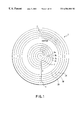
- the recording data (unit data m) is recorded between a recording start position and a recording end position shown in FIG. 6 .
- the distance from the recording start position to the recording end position corresponds to n tracks, i.e., a track length corresponding to n turns of the disk.
- the recording data (unit data m) Upon completion of recording of the recording data (unit data m), the recording data (unit data m) is reproduced. At this time, the light beam track-jumps from the recording end position to the recording start position shown in FIG. 6 to reproduce the data between the recording start position and the recording end position (t 12 to t 13 ). Reproduced data obtained by reproducing the recording data (unit data m) is transferred from the optical pickup 108 to the recorded content confirmation unit 110 at the transfer rate c 1 in parallel to reproduction of the recording data (unit data m).
- the recorded content confirmation unit 110 compares the reproduced data transferred from the optical pickup 108 at the transfer rate c 1 with the recording data (unit data m) transferred from the memory 106 at the transfer rate d 1 to confirm the recorded contents (t 12 to t 13 ). Confirmation of the recorded contents of the recording data (unit data m) is executed in almost parallel to reproduction of the recording data (unit data m). This parallel processing is realized under the control of the CPU 102 .
- recording data (unit data m+1) of n tracks is stored in the memory 106 (t 11 to t 13 ). That is, while recording and reproducing the recording data (unit data m) and confirming its recorded contents, the recording data (unit data m+1) is stored in the memory 106 .
- the recording data (unit data m+1) of n tracks is stored in the memory 106 (t 11 to t 13 )
- recording and reproduction of the recording data (unit data m+1) of n tracks and confirmation of its recorded contents are executed.
- the data recording speed can be increased.
- This parallel processing can be realized because the transfer rates b 1 , c 1 , and d 1 are controlled to be twice or more the transfer rate a 1 , and that recording data corresponds to n tracks.
- the first embodiment assumes “read after write”, but can also be applied to “read before write”.
- the “read before write” is executed in overwrite-recording of data. Overwrite-recording of data is desirably executed after the user confirms that data to be overwritten can be overwritten. In other words, overwrite-recording of data is executed after the user reproduces recorded data and confirms that the recorded data can be overwritten. This is “read before write”. Processing of “read before write” is almost the same as that of “read after write” except that the order of reproduction and recording is reversed.
- the light beam track-jumps while the optical disk is rotated.
- the positional relationship between the beam irradiation points before and after the track jump shifts by a predetermined amount along the radius of the optical disk. This shift amount depends on the distance of the track jump and the rotation speed of the optical disk.
- the light beam immediately after the track jump is unstable, and the unstable light beam cannot reproduce (record) data.
- data is reproduced and recorded in units of (n tracks ⁇ m sectors).
- Data is recorded in units of (n tracks ⁇ m sectors) as follows. First, recording of data in units of (n tracks ⁇ m sectors) is realized by limiting the memory capacity of the memory 106 . Second, recording of data in units of (n tracks ⁇ m sectors) is realized by limiting the data amount transferred from the memory 106 to the optical pickup 108 .
- first and second memory areas are set in the memory 106 .
- Each of the first and second memory areas has a memory capacity corresponding to (n tracks ⁇ m sectors).
- the first and second memory areas are alternately used. More specifically, recording data is stored in the first memory area. When the memory capacity of the first memory area becomes full, recording data is stored in the second memory area. When the memory capacity of the second memory area becomes full, recording data is stored in the first memory area. The recording data stored in the first memory area is recorded on the optical disk, and then the recording data stored in the second memory area is recorded on the optical disk. After that, the recording data stored in the first memory area is recorded on the optical disk.
- the CPU 102 controls the data amount transferred from the memory 106 to the optical pickup 108 .
- the CPU 102 transfers the recording data corresponding to (n tracks ⁇ m sectors) from the memory 106 to the optical pickup 108 .
- the recording start position (first point) and the recording end position (second point) on the optical disk have the-positional relationship shown in FIG. 8 .
- This positional relationship can avoid the influence of the track jump on the light beam. That is, this positional relationship realizes reproduction of data recorded on the optical disk without any shift of the irradiation point and any unstableness of the light beam due to the track jump of the light beam.
- raw data such as image data and audio data to be recorded is externally transferred at the transfer rate a 2 .
- the raw data transferred externally is input to the recording data generator 104 .
- the recording data generator 104 generates recording data (unit data m, m+1, m+2, . . . ) from the raw data.
- the recording data (unit data m, m+1, m+2, . . . ) generated by the recording data generator 104 is transferred from the recording data generator 104 to the memory 106 at the transfer rate a 2 .
- the recording data (unit data m) corresponding to (n tracks ⁇ m sectors) is stored in the memory 106 (t 20 to t 21 )
- the recording data (unit data m) corresponding to (n tracks ⁇ m sectors) is transferred from the memory 106 to the optical pickup 108 at the transfer rate b 2 .
- the recording data (unit data m) is recorded on the optical disk by the optical pickup 108 (t 21 to t 22 ).
- the recording data (unit data m) is recorded between a recording start position and a recording end position shown in FIG. 8 .
- the recording data (unit data m) Upon completion of recording of the recording data (unit data m), the recording data (unit data m) is reproduced. At this time, after the light beam track-jumps from the recording end position (or a position pass through the recording end position) to a predetermined position shown in FIG. 8, and the light beam is stabilized (t 22 to t 23 ), the data between the recording start position and the recording end position is reproduced (t 23 to t 24 ).
- the predetermined position is on the track on which the recording start position exists, and backward from the recording start position by a predetermined distance in the beam scanning direction. Reproduced data obtained by reproducing the recording data (unit data m) is transferred from the optical pickup 108 to the recorded content confirmation unit 110 at the transfer rate c 2 in parallel to reproduction of the recording data (unit data m).
- the recorded content confirmation unit 110 compares the reproduced data transferred from the optical pickup 108 at the transfer rate c 2 with the recording data (unit data m) transferred from the memory 106 at the transfer rate d 2 to confirm the recorded contents (t 23 to t 24 ).
- recording data (unit data m+1) corresponding to (n tracks ⁇ m sectors) is stored in the memory 106 (t 21 to t 24 ). That is, while recording and reproducing the recording data (unit data m) and confirming its recorded contents, the recording data (unit data m+1) is stored in the memory 106 .
- the recording data (unit data m+1) corresponding to (n tracks ⁇ m sectors) is stored in the memory 106 (t 21 to t 24 )
- recording and reproduction of the recording data (unit data m+1) corresponding to (n tracks ⁇ m sectors) and confirmation of its recorded contents are executed.
- the data recording speed can be increased.
- This parallel processing can be realized because the transfer rates b 2 , c 2 , and d 2 are controlled to be (two times+ ⁇ ) or more the transfer rate a 2 , and that recording data corresponds to (n tracks ⁇ m sectors). Note that the reproduction preparation time can be prolonged by ⁇ .
- the value m (the number of sectors) will be explained.
- the value m is determined on the basis of the disk rotation speed by the disk driver 114 , the moving distance by the track jump, and the time required for the light beam to be suitable for data reproduction (recording) after the track jump.
- a means for determining the value m is the CPU 102 .
- the CPU 102 holds data about the disk rotation speed by the disk driver 114 , the moving distance by the track jump, and the time required for the light beam to be suitable for data reproduction after the track jump.
- the CPU 102 determines the value m on the basis of these data.
- the value m determined in this manner determines the positional relationship between the recording start position and the recording end position.
- the determined positional relationship between the recording start position and the recording end position allows to efficiently, satisfactorily reproduce (record) data from the recording start position to the recording end position after the track jump.
- the value m is set to such a value as to efficiently, satisfactorily reproduce (record) data after the track jump.
- the second embodiment assumes “read after write”, but can also be applied to “read before write”.
- the light beam track-jumps while the optical disk is rotated.
- the positional relationship between the beam irradiation points before and after the track jump shifts by a predetermined amount along the radius of the optical disk. This shift amount depends on the distance of the track jump and the rotation speed of the optical disk.
- the light beam immediately after the track jump is unstable, and the unstable light beam cannot reproduce data.
- data is reproduced and recorded in units of n tracks.
- the following track jump control is performed to reproduce data recorded on the optical disk without any shift of the irradiation point and any unstableness of the light beam due to the track jump of the light beam.
- recording data is recorded from a recording start position (first point) to a recording end position (second point) shown in FIG. 10 .
- the data recorded from the recording start position to the recording end position is reproduced under the following track jump control.
- This track jump control is realized by the servo circuit 112 .
- raw data such as image data and audio data to be recorded is externally transferred at the transfer rate a 3 .
- the raw data transferred externally is input to the recording data generator 104 .
- the recording data generator 104 generates recording data (unit data m, m+1, m+2, . . . ) from the raw data.
- the recording data (unit data m, m+1, m+2, . . . ) generated by the recording data generator 104 is transferred from the recording data generator 104 to the memory 106 at the transfer rate a 3 .
- the recording data (unit data m) of n tracks is stored in the memory 106 (t 30 to t 31 )
- the recording data (unit data m) of n tracks is transferred from the memory 106 to the optical pickup 108 at the transfer rate b 3 .
- the recording data (unit data m) is recorded on the optical disk by the optical pickup 108 (t 31 to t 32 ).
- the recording data (unit data m) is recorded between a recording start position and a recording end position shown in FIG. 10 .
- the recording data (unit data m) Upon completion of recording of the recording data (unit data m), the recording data (unit data m) is reproduced. At this time, after the light beam track-jumps from the recording end position to an inner track adjacent to the track on which the recording start position exists, as shown in FIG. 10, and the light beam lands on the recording start position (t 32 to t 33 ), the data recorded from the recording start position to the recording end position is reproduced (t 33 to t 34 ). Reproduced data obtained by reproducing the recording data (unit data m) is transferred from the optical pickup 108 to the recorded content confirmation unit 110 at the transfer rate c 3 in parallel to reproduction of the recording data (unit data m).
- the recorded content confirmation unit 110 compares the reproduced data transferred from the optical pickup 108 at the transfer rate c 3 with the recording data (unit data m) transferred from the memory 106 at the transfer rate d 3 to confirm the recorded contents (t 33 to t 34 ).
- recording data (unit data m+1) of n tracks is stored in the memory 106 (t 31 to t 35 ). That is, while recording and reproducing the recording data (unit data m) and confirming its recorded contents, the recording data (unit data m+1) is stored in the memory 106 .
- the recording data (unit data m+1) of n tracks is stored in the memory 106 (t 31 to t 35 )
- recording and reproduction of the recording data (unit data m+1) of n tracks and confirmation of its recorded contents are executed.
- the data recording speed can be increased.
- This parallel processing can be realized because the transfer rates b 3 , c 3 , and d 3 are controlled to be (two times+ ⁇ ) or more the transfer rate a 3 .
- the reproduction preparation time can be prolonged by ⁇ .
- the third embodiment assumes “read after write”, but can also be applied to “read before write”.
- the fourth, fifth, and sixth embodiments of the present invention will be described with reference to FIGS. 12 to 22 .
- the fifth and sixth embodiments are modifications of the fourth embodiment.
- the fourth, fifth, and sixth embodiments of the present invention assume that data is processed in a data unit called an ECC block.
- the ECC block will be explained in detail below.
- a lead-in area 12 On an optical disk 11 , a lead-in area 12 , a data area 13 , and a lead-out area 14 are sequentially formed from the inner peripheral side.
- Each area includes a plurality of zones.
- Each zone includes a plurality of tracks.
- Each track includes a plurality of sectors.
- the lead-in area 12 includes an embossed data zone 15 made up of a plurality of (e.g., 1,896) tracks, and part of a rewritable data zone 16 made up of a plurality of (e.g., 1,896) tracks.
- the embossed data zone 15 includes a blank zone, a reference signal zone, a blank zone, a control data zone, and a blank zone in this order.
- a reference signal is preformatted in the reference signal zone.
- Control data is preformatted in the control data zone.
- the rewritable data zone 16 includes a guard track zone, a disk test zone, a drive test zone, a disk identification data zone, and an defect management zone.
- the data area 13 includes a plurality of zones (e.g., zones 13 a , . . . , 13 x ). Each zone includes a plurality of (e.g., 1,888) tracks. Note that only the zone 13 a has 1,888 tracks including part of the rewritable data zone 16 .
- the lead-out area 14 includes a rewritable data zone.
- this rewritable data zone the same data as the recorded contents of the data zone 16 is to be recorded.
- the number of sectors included in one track track corresponding to one turn changes depending on the zone to which the track belongs. For example, the number of sectors included in one track belonging to the zone 13 a is smaller than the number of sectors included in one track belonging to the zone 13 b . The number of sectors included in one track belonging to the zone 13 b is smaller than the number of sectors included in one track belonging to the zone 13 c . In this manner, the number of sectors included in one track belonging to an inner zone is smaller than the number of sectors included in one track belonging to an outer zone.
- the number of turns (rotation speed) of the optical disk 11 must change for each zone. Therefore, the rotation speed decreases in units of zones from the inner peripheral side of the optical disk 11 to the outer peripheral side. Data about the rotation speed for each zone is stored in a rotation control program for controlling rotation of the optical disk 11 .
- ECC Error Correction Code
- the data structure of the ECC block will be explained with reference to FIG. 14 .
- ECC block includes user data of 16 sectors that is recorded on 16 sectors, ECC 1 and ECC 2 .
- User data of one sector that is recorded on one sector is made up of 172 bytes ⁇ 12 lines. That is, user data of 16 sectors is made up of 172 bytes ⁇ 12 lines ⁇ 16.
- ECC 1 and ECC 2 are error correction codes added to user data of 16 sectors. More specifically, ECC 1 is used to correct an error in the lateral direction of user data of 16 sectors.
- ECC 2 is used to correct an error in the longitudinal direction of user data of 16 sectors.
- ECC 1 is made up of 10 bytes ⁇ 12 lines (the number of lines of user data of one sector) ⁇ 16 (the number of sectors).
- ECC 2 is made up of 182 bytes ⁇ 16 lines (the number of sectors).
- the ECC block shown in FIG. 14 is converted into recording data shown in FIG. 15 and then recorded on the optical disk 11 . That is, the ECC block is converted into sector data of 16 sectors and then recorded on the respective sectors of the optical disk 11 .
- Sector data of one sector is made up of 186 bytes ⁇ 13 lines. That is, sector data of 16 sectors is made up of 186 bytes ⁇ 13 lines ⁇ 16 (the number of sectors).
- Sector data of one sector includes user data of one sector, part ( ⁇ fraction (1/16) ⁇ ) of ECC 1 , part ( ⁇ fraction (1/16) ⁇ ) of ECC 2 , and a synchronous code.
- the synchronous code is 2-byte data and inserted every 91 bytes.
- the frame structure of the sector is the same as the frame structure shown in FIG. 3, and a description thereof will be omitted.
- the data structure of the sector is the same as the data structure shown in FIG. 4, and a description thereof will also be omitted.
- the header will be described.
- the zones 13 a , . . . , 13 x of the data area 13 have header fields 17 for each sector.
- the header fields 17 are formed at the same time as formation of grooves in the optical disk.
- address information and the like are recorded by pits.
- an optical disk apparatus 200 comprises a CPU 202 , a recording data generator 204 , a memory 206 , an optical pickup 208 , a recorded content confirmation unit 210 , a servo circuit 212 , and a disk driver 214 .
- the CPU 202 functions as a control means, a setting means, and a determination means.
- the memory 206 functions as a memory means.
- the optical pickup 208 functions as a recording means, a reproduction means, and a moving means.
- the recorded content confirmation unit 210 functions as a confirmation means.
- the servo circuit 212 functions as a setting means and a control means.
- the disk driver 214 functions as a rotation means.
- the CPU 202 controls the whole optical disk apparatus 200 . That is, the CPU 202 outputs control signals for controlling the recording data generator 204 , the memory 206 , the optical pickup 208 , the recorded content confirmation unit 210 , the servo circuit 212 , and the disk driver 214 .
- the CPU 202 comprises a clock generator 202 a functioning as a transfer means.
- a clock generated by the clock generator 202 a is supplied to the recording data generator 204 , the memory 206 , the optical pickup 208 , the recorded content confirmation unit 210 , the servo circuit 212 , and the disk driver 214 .
- the clock generated by the clock generator 202 a determines the operation timings of the respective parts. More specifically, the clock generated by the clock generator 202 a determines the data transfer rates between the respective parts.
- the recording data generator 204 comprises an error correction encoder 204 a .
- the error correction encoder 204 a generates ECC block data shown in FIG. 14 from raw data such as image data and audio data transmitted externally. Recording data is generated from the ECC block data. That is, the recording data generator 204 receives raw data such as image data and audio data transmitted externally, and generates recording data from the raw data.
- the recording data means ECC data having a frame structure like the one shown in FIG. 15 . At this time, the transfer rate of image data transmitted externally is a transfer rate a. Recording data generated by the recording data generator 204 is transferred from the recording data generator 204 to the memory 206 at the transfer rate a.
- the recording data output from the recording data generator 204 is stored.
- the recording data stored in the memory 206 is transferred from the memory 206 to the optical pickup 208 at a predetermined timing and a transfer rate b.
- the transfer rate b is twice or more the transfer rate a.
- the optical pickup 208 comprises a semiconductor laser 208 a as an irradiation means.
- the semiconductor laser 208 a irradiates the optical disk with a recording light beam and a reproduction light beam.
- the semiconductor laser 208 a irradiates the optical disk with the recording light beam.
- the recording light beam reflects recording data transferred from the memory 206 . That is, the optical disk is irradiated with this recording light beam to record the recording data on the optical disk.
- the semiconductor laser 208 a irradiates the optical disk with the reproduction light beam.
- the optical disk is irradiated with the reproduction light beam, and a reflected beam of the reproduction light beam by the optical disk is received by the optical pickup 208 .
- This reflected beam reflects the data recorded on the optical disk. That is, the data reflected in the reflected beam is reproduced to reproduce the data recorded on the optical disk.
- the data reproduced from the optical disk by the optical pickup 208 is transferred from the optical pickup 208 to the recorded content confirmation unit 210 at a transfer rate c.
- the transfer rate c is twice or more the transfer rate a.
- the recorded content confirmation unit 210 comprises an error correction circuit 210 a .
- the error correction circuit 210 a performs error correction for user data included in the reproduced data transferred from the optical pickup 208 using ECC 1 and ECC 2 also included in the reproduced data.
- the recorded content confirmation unit 210 confirms the recorded contents on the basis of the results of error correction. When the results of error correction reveal that the user data does not include any error, the recorded content confirmation unit 210 confirms normal recording of the recording data. When the results of error correction reveal that the user data includes an error, the recorded content confirmation unit 210 confirms a failure (recording error) in normal recording of the recording data.
- the recorded content confirmation unit 210 informs the CPU 202 of the recording error.
- the CPU 202 which is informed of the recording error, sends a rerecording command to the memory 206 , the optical pickup 208 , and the servo circuit 212 .
- the memory 206 having received the rerecording command transfers the recording data which cannot be normally recorded to the optical pickup 208 .
- the optical pickup 208 and the servo circuit 212 that receive the rerecording command record again the recording data which could not be normally recorded, at a position where this recording data is recorded.
- the servo circuit 212 outputs a servo control signal to the optical pickup 208 and the disk driver 214 .
- the servo circuit 212 servo-controls the optical pickup 208 and the disk driver 214 .
- the servocontrol of the servo circuit 212 executes focusing control and tracking control for the light beam irradiating the optical disk from the optical pickup 208 .
- the tracking control makes the light beam irradiating the optical disk from the semiconductor laser 208 a scan the optical disk from an inner track to an outer track. That is, recording/reproduction of data is executed from an inner track to an outer track.
- the tracking control makes the beam spot of the light beam trace the optical disk from a recording start position to a recording end position (to be described later).
- the servo circuit 212 controls the disk driver 214 in accordance with a rotation control program.
- the tracking control is further elaborated.
- the tracking control is to move the beam spot of the light beam along the radius of the optical disk. This tracking control allows the beam spot of the light beam to jump from a given track to another track.
- the disk driver 214 rotates the optical disk at a predetermined speed in accordance with a servo control signal output from the servo circuit 212 .
- data can be quickly reproduced from the recording start position by track-jumping the light beam from the recording end position (second point) on the optical disk to the recording start position (first point) at the end of data recording.
- data is recorded and reproduced in units of n tracks (predetermined number of ECC blocks).
- One track means a track corresponding to one turn of the disk, and n tracks mean tracks corresponding to n turns of the disk.
- One track includes a predetermined number of ECC blocks.
- the memory 206 has a memory capacity corresponding to (n ⁇ 2) tracks.
- raw data such as image data and audio data to be recorded is externally transferred at the transfer rate a 4 .
- the raw data transferred externally is input to the recording data generator 204 .
- the recording data generator 204 generates recording data (unit data m, m+1, m+2, . . . ) from the raw data.
- the recording data (unit data m, m+1, m+2, . . . ) generated by the recording data generator 204 is transferred from the recording data generator 204 to the memory 206 at the transfer rate a 4 .
- the recording data (unit data m) of n tracks is stored in the memory 206 (t 40 to t 41 )
- the recording data (unit data m) of n tracks is transferred from the memory 206 to the optical pickup 208 at the transfer rate b 4 .
- the recording data (unit data m) is recorded on the optical disk by the optical pickup 208 (t 41 to t 42 ).
- the recording data (unit data m) is recorded between a recording start position and a recording end position shown in FIG. 17 .
- the recording data (unit data m) Upon completion of recording of the recording data (unit data m), the recording data (unit data m) is reproduced. At this time, the light beam track-jumps from the recording end position shown in FIG. 17 to the recording start position to reproduce the data between the recording start position and the recording end position (t 42 to t 43 ). Reproduced data obtained by reproducing the recording data (unit data m) is transferred from the optical pickup 208 to the recorded content confirmation unit 210 at the transfer rate c 4 in parallel to reproduction of the recording data (unit data m).
- the recorded content confirmation unit 210 performs error correction for user data included in the reproduced data transferred from the optical pickup 208 using ECC 1 and ECC 2 also included in the reproduced data to confirm the recorded contents (t 42 to t 43 ). Confirmation of the recorded contents of the recording data (unit data m) is executed in almost parallel to reproduction of the recording data (unit data m). This parallel processing is realized under the control of the CPU 202 .
- recording data (unit data m+1) of n tracks is stored in the memory 206 (t 41 to t 43 ). That is, while recording and reproducing the recording data (unit data m) and confirming its recorded contents, the recording data (unit data m+1) is stored in the memory 206 .
- the recording data (unit data m+1) of n tracks is stored in the memory 206 (t 41 to t 43 )
- recording and reproduction of the recording data (unit data m+1) of n tracks and confirmation of its recorded contents are executed.
- the data recording speed can be increased.
- This parallel processing can be realized because the transfer rates b 4 and c 4 are controlled to be twice or more the transfer rate a 4 , and that recording data corresponds to n tracks (units of ECC blocks).
- the fourth embodiment assumes “read after write”, but can also be applied to “read before write”.
- the light beam track-jumps while the optical disk is rotated.
- the positional relationship between the beam irradiation points before and after the track jump shifts by a predetermined amount along the radius of the optical disk. This shift amount depends on the distance of the track jump and the rotation speed of the optical disk.
- the light beam immediately after the track jump is unstable, and the unstable light beam cannot reproduce (record) data.
- data is reproduced and recorded in units of (n tracks ⁇ m ECC blocks).
- data is recorded in units of (n tracks ⁇ m ECC blocks) as follows. First, recording of data in units of (n tracks ⁇ m ECC blocks) is realized by limiting the memory capacity of the memory 206 . Second, recording of data in units of (n tracks ⁇ m ECC blocks) is realized by limiting the data amount transferred from the memory 206 to the optical pickup 208 .
- first and second memory areas are set in the memory 206 .
- Each of the first and second memory areas has a memory capacity corresponding to (n tracks ⁇ m ECC blocks).
- the first and second memory areas are alternately used. More specifically, recording data is stored in the first memory area. When the memory capacity of the first memory area becomes full, recording data is stored in the second memory area. When the memory capacity of the second memory area becomes full, recording data is stored in the first memory area. The recording data stored in the first memory area is recorded on the optical disk, and then the recording data stored in the second memory area is recorded on the optical disk. After that, the recording data stored in the first memory area is recorded on the optical disk.
- the CPU 202 controls the data amount transferred from the memory 206 to the optical pickup 208 .
- the CPU 202 transfers the recording data corresponding to (n tracks ⁇ m ECC blocks) from the memory 206 to the optical pickup 208 .
- the recording start position (first point) and the recording end position (second point) on the optical disk have the positional relationship shown in FIG. 19 .
- This positional relationship can avoid the influence of the track jump on the light beam. That is, this positional relationship realizes reproduction of data recorded on the optical disk without any shift of the irradiation point and any unstableness of the light beam due to the track jump of the light beam.
- raw data such as image data and audio data to be recorded is externally transferred at the transfer rate a 5 .
- the raw data transferred externally is input to the recording data generator 204 .
- the recording data generator 204 generates recording data (unit data m, m+1, m+2, . . . ) from the raw data.
- the recording data (unit data m, m+1, m+2, . . . ) generated by the recording data generator 204 is transferred from the recording data generator 204 to the memory 206 at the transfer rate a 5 .
- the recording data (unit data m) corresponding to (n tracks ⁇ m ECC blocks) is stored in the memory 206 (t 50 to t 51 )
- the recording data (unit data m) corresponding to (n tracks ⁇ m ECC blocks) is transferred from the memory 206 to the optical pickup 208 at the transfer rate b 5 .
- the recording data (unit data m) is recorded on the optical disk by the optical pickup 208 (t 51 to t 52 ).
- the recording data (unit data m) is recorded between a recording start position and a recording end position shown in FIG. 19 .
- the recording data (unit data m) Upon completion of recording of the recording data (unit data m), the recording data (unit data m) is reproduced. At this time, after the light beam track-jumps from the recording end position (or a position beyond the recording end position) to a predetermined position shown in FIG. 19, and the light beam is stabilized (t 52 to t 53 ), the data between the recording start position and the recording end position is reproduced (t 53 to t 54 ).
- the predetermined position is on the track on which the recording start position exists, and backward from the recording start position by a predetermined distance in the beam scanning direction. Reproduced data obtained by reproducing the recording data (unit data m) is transferred from the optical pickup 208 to the recorded content confirmation unit 210 at the transfer rate c 5 in parallel to reproduction of the recording data (unit data m).
- the recorded content confirmation unit 210 performs error correction for user data included in the reproduced data transferred from the optical pickup 208 using ECC 1 and ECC 2 also included in the reproduced data to confirm the recorded contents (t 53 to t 54 ).
- recording data (unit data m+1) corresponding to (n tracks ⁇ m ECC blocks) is stored in the memory 206 (t 51 to t 54 ). That is, while recording and reproducing the recording data (unit data m) and confirming its recorded contents, the recording data (unit data m+1) is stored in the memory 206 .
- the recording data (unit data m+1) corresponding to (n tracks ⁇ m ECC blocks) is stored in the memory 206 (t 51 to t 54 )
- recording and reproduction of the recording data (unit data m+1) corresponding to (n tracks ⁇ m ECC blocks) and confirmation of its recorded contents are executed.
- the data recording speed can be increased.
- This parallel processing can be realized because the transfer rates b 5 and c 5 are controlled to be (two times+ ⁇ ) or more, the transfer rate a 5 .
- the reproduction preparation time can be prolonged by ⁇ .
- the value m (the number of ECC blocks) will be explained.
- the value m is determined on the basis of the disk rotation speed by the disk driver 214 , the moving distance by the track jump, and the time required for the light beam to be suitable for data reproduction (recording) after the track jump.
- a means for determining the value m is the CPU 202 .
- the CPU 202 holds data about the disk rotation speed by the disk driver 214 , the moving distance by the track jump, and the time required for the light beam to be suitable for data reproduction after the track jump.
- the CPU 202 determines the value m on the basis of these data.
- the value m determined in this manner determines the positional relationship between the recording start position and the recording end position.
- the determined positional relationship between the recording start position and the recording end position allows to efficiently, satisfactorily reproduce (record) data from the recording start position to the recording end position after the track jump.
- the value m is set to such a value as to efficiently, satisfactorily reproduce (record) data after the track jump.
- the fifth embodiment assumes “read after write”, but can also be applied to “read before write”.
- the light beam track-jumps while the optical disk is rotated.
- the positional relationship between the beam irradiation points before and after the track jump shifts by a predetermined amount along the radius of the optical disk. This shift amount depends on the distance of the track jump and the rotation speed of the optical disk.
- the light beam immediately after the track jump is unstable, and the unstable light beam cannot reproduce (record) data.
- data is reproduced and recorded in units of n tracks (predetermined number of ECC blocks).
- One track means a track corresponding to one turn of the disk, and n tracks mean tracks corresponding to n turns of the disk.
- One track includes a predetermined number of ECC blocks.
- the following track jump control (tracking control) is performed to reproduce data recorded on the optical disk without any shift of the irradiation point and any unstableness of the light beam due to the track jump of the light beam.
- recording data is recorded from a recording start position shown in FIG. 21 to a recording end position.
- the data recorded from the recording start position to the recording end position is reproduced under the following track jump control.
- This track jump control is realized by the servo circuit 212 .
- raw data such as image data and audio data to be recorded is externally transferred at the transfer rate a 6 .
- the raw data transferred externally is input to the recording data generator 204 .
- the recording data generator 204 generates recording data (unit data m, m+1, m+2, . . . ) from the raw data.
- the recording data (unit data m, m+1, m+2, . . . ) generated by the recording data generator 204 is transferred from the recording data generator 204 to the memory 206 at the transfer rate a 6 .
- the recording data (unit data m) of n tracks is stored in the memory 206 (t 60 to t 61 )
- the recording data (unit data m) of n tracks is transferred from the memory 206 to the optical pickup 208 at the transfer rate b 6 .
- the recording data (unit data m) is recorded on the optical disk by the optical pickup 208 (t 61 to t 62 ).
- the recording data (unit data m) is recorded between a recording start position and a recording end position shown in FIG. 21 .
- the recording data (unit data m) Upon completion of recording of the recording data (unit data m), the recording data (unit data m) is reproduced. At this time, after the light beam track-jumps from the recording end position to an inner track adjacent to the track on which the recording start position exists, as shown in FIG. 21, and the light beam lands on the recording start position (t 62 to t 63 ), the data recorded from the recording start position to the recording end position is reproduced (t 63 to t 64 ). Reproduced data obtained by reproducing the recording data (unit data m) is transferred from the optical pickup 208 to the recorded content confirmation unit 210 at the transfer rate c 6 in parallel to reproduction of the recording data (unit data m).
- the recorded content confirmation unit 210 performs error correction for user data included in the reproduced data transferred from the optical pickup 208 using ECC 1 and ECC 2 also included in the reproduced data to confirm the recorded contents (t 63 to t 64 ).
- recording data (unit data m+1) of n tracks is stored in the memory 206 (t 61 to t 65 ). That is, while recording and reproducing the recording data (unit data m) and confirming of its recorded contents, the recording data (unit data m+1) is stored in the memory 206 .
- the recording data (unit data m+1) of n tracks is stored in the memory 206 (t 61 to t 65 )
- recording and reproduction of the recording data (unit data m+1) of n tracks and confirmation of its recorded contents are executed.
- the data recording speed can be increased.
- This parallel processing can be realized because the transfer rates b 6 and c 6 are controlled to be (two times+ ⁇ ) or more the transfer rate a 6 .
- the reproduction preparation time can be prolonged by ⁇ .
- the sixth embodiment assumes “read after write”, but can also be applied to “read before write”.
- an optical disk apparatus capable of preventing a decrease in data recording/reproduction efficiency can be provided.
Landscapes
- Engineering & Computer Science (AREA)
- Signal Processing (AREA)
- Optical Recording Or Reproduction (AREA)
- Signal Processing For Digital Recording And Reproducing (AREA)
Applications Claiming Priority (2)
| Application Number | Priority Date | Filing Date | Title |
|---|---|---|---|
| JP9-366795 | 1997-12-26 | ||
| JP9366795A JPH11195270A (ja) | 1997-12-26 | 1997-12-26 | 光ディスク装置 |
Publications (2)
| Publication Number | Publication Date |
|---|---|
| US20020024891A1 US20020024891A1 (en) | 2002-02-28 |
| US6504801B2 true US6504801B2 (en) | 2003-01-07 |
Family
ID=18487700
Family Applications (1)
| Application Number | Title | Priority Date | Filing Date |
|---|---|---|---|
| US09/216,908 Expired - Fee Related US6504801B2 (en) | 1997-12-26 | 1998-12-21 | Optical disk system for reading and writing data in a plurality of units of sectors |
Country Status (2)
| Country | Link |
|---|---|
| US (1) | US6504801B2 (enExample) |
| JP (1) | JPH11195270A (enExample) |
Cited By (5)
| Publication number | Priority date | Publication date | Assignee | Title |
|---|---|---|---|---|
| US20020048365A1 (en) * | 2000-10-20 | 2002-04-25 | Pioneer Corporation | Information recording apparatus, information recording method, information reproducing apparatus, information reproducing method, and information recording medium |
| US20030002410A1 (en) * | 2000-09-21 | 2003-01-02 | Sony Corporation | Disk-like recording medium, disk recording apparatus and disk recording method, and disk playback apparatus and disk playback method |
| US20040040269A1 (en) * | 1997-06-27 | 2004-03-04 | Donaldson Company, Inc. | Aerosol separator; and method |
| US20040246838A1 (en) * | 2003-05-23 | 2004-12-09 | Samsung Electronics Co., Ltd. | Apparatus and method for recording and/or reproducing data on an information storage medium using padding information, and the information storage medium |
| US6842411B2 (en) * | 1999-12-22 | 2005-01-11 | Lg Electronics, Inc. | Optical disc driver and data recording method therefor |
Families Citing this family (1)
| Publication number | Priority date | Publication date | Assignee | Title |
|---|---|---|---|---|
| US9286159B2 (en) * | 2013-11-06 | 2016-03-15 | HGST Netherlands B.V. | Track-band squeezed-sector error correction in magnetic data storage devices |
Citations (9)
| Publication number | Priority date | Publication date | Assignee | Title |
|---|---|---|---|---|
| US4536864A (en) | 1983-03-09 | 1985-08-20 | U.S. Philips Corporation | Apparatus for reading an optically coded disc-shaped record carrier |
| US4807206A (en) * | 1986-01-14 | 1989-02-21 | Matsushita Electric Industrial Co., Ltd. | Track jump detection system |
| US4918676A (en) * | 1987-07-31 | 1990-04-17 | Kabushiki Kaisha Toshiba | Track accessing apparatus for optical disk |
| US5285440A (en) * | 1988-03-18 | 1994-02-08 | Matsushita Electric Industrial Co., Ltd. | Magneto-optic disk |
| US5315571A (en) * | 1990-11-09 | 1994-05-24 | Sharp Kabushiki Kaisha | Information recording and reproducing device providing faster access time to a recording medium |
| US5491592A (en) * | 1993-01-06 | 1996-02-13 | Sony Corporation | Method of and apparatus for reproducing a recording medium |
| US5724338A (en) * | 1992-09-10 | 1998-03-03 | Matsushita Electric Industrial Co., Ltd. | Rewritable disk-shaped optical recording medium |
| US5848438A (en) * | 1994-03-03 | 1998-12-08 | Cirrus Logic, Inc. | Memory mapping defect management technique for automatic track processing without ID field |
| US6298033B1 (en) * | 1997-06-30 | 2001-10-02 | Kabushiki Kaisha Toshiba | Recording/reproducing optical disk with constant product of rotation number and number of sector areas and recording/reproducing apparatus using same |
-
1997
- 1997-12-26 JP JP9366795A patent/JPH11195270A/ja active Pending
-
1998
- 1998-12-21 US US09/216,908 patent/US6504801B2/en not_active Expired - Fee Related
Patent Citations (9)
| Publication number | Priority date | Publication date | Assignee | Title |
|---|---|---|---|---|
| US4536864A (en) | 1983-03-09 | 1985-08-20 | U.S. Philips Corporation | Apparatus for reading an optically coded disc-shaped record carrier |
| US4807206A (en) * | 1986-01-14 | 1989-02-21 | Matsushita Electric Industrial Co., Ltd. | Track jump detection system |
| US4918676A (en) * | 1987-07-31 | 1990-04-17 | Kabushiki Kaisha Toshiba | Track accessing apparatus for optical disk |
| US5285440A (en) * | 1988-03-18 | 1994-02-08 | Matsushita Electric Industrial Co., Ltd. | Magneto-optic disk |
| US5315571A (en) * | 1990-11-09 | 1994-05-24 | Sharp Kabushiki Kaisha | Information recording and reproducing device providing faster access time to a recording medium |
| US5724338A (en) * | 1992-09-10 | 1998-03-03 | Matsushita Electric Industrial Co., Ltd. | Rewritable disk-shaped optical recording medium |
| US5491592A (en) * | 1993-01-06 | 1996-02-13 | Sony Corporation | Method of and apparatus for reproducing a recording medium |
| US5848438A (en) * | 1994-03-03 | 1998-12-08 | Cirrus Logic, Inc. | Memory mapping defect management technique for automatic track processing without ID field |
| US6298033B1 (en) * | 1997-06-30 | 2001-10-02 | Kabushiki Kaisha Toshiba | Recording/reproducing optical disk with constant product of rotation number and number of sector areas and recording/reproducing apparatus using same |
Cited By (19)
| Publication number | Priority date | Publication date | Assignee | Title |
|---|---|---|---|---|
| US20040040269A1 (en) * | 1997-06-27 | 2004-03-04 | Donaldson Company, Inc. | Aerosol separator; and method |
| US6842411B2 (en) * | 1999-12-22 | 2005-01-11 | Lg Electronics, Inc. | Optical disc driver and data recording method therefor |
| US7298684B2 (en) | 2000-09-21 | 2007-11-20 | Sony Corporation | Disk-like recording medium, disk recording apparatus and disk recording method, and disk playback apparatus and disk playback method |
| US20030002410A1 (en) * | 2000-09-21 | 2003-01-02 | Sony Corporation | Disk-like recording medium, disk recording apparatus and disk recording method, and disk playback apparatus and disk playback method |
| US20060092808A1 (en) * | 2000-09-21 | 2006-05-04 | Sony Corporation | Disk-like recording medium, disk recording apparatus and disk recording method, and disk playback apparatus and disk playback method |
| US7149163B2 (en) * | 2000-09-21 | 2006-12-12 | Sony Corporation | Recording technique with particular sunchronization data |
| US20020048365A1 (en) * | 2000-10-20 | 2002-04-25 | Pioneer Corporation | Information recording apparatus, information recording method, information reproducing apparatus, information reproducing method, and information recording medium |
| US20080181074A1 (en) * | 2003-05-23 | 2008-07-31 | Samsung Electronics Co., Ltd. | Apparatus and method for recording and/or reproducing data on an information storage medium using padding information, and the information storage medium |
| US20040246838A1 (en) * | 2003-05-23 | 2004-12-09 | Samsung Electronics Co., Ltd. | Apparatus and method for recording and/or reproducing data on an information storage medium using padding information, and the information storage medium |
| US20080184092A1 (en) * | 2003-05-23 | 2008-07-31 | Samsung Electronics Co., Ltd | Apparatus and method for recording and/or reproducing data on an information storage medium using padding information, and the information storage medium |
| US20080181067A1 (en) * | 2003-05-23 | 2008-07-31 | Samsung Electronics Co., Ltd. | Apparatus and method for recording and/or reproducing data on an information storage medium using padding information, and the information storage medium |
| US20080181073A1 (en) * | 2003-05-23 | 2008-07-31 | Samsung Electronics Co., Ltd. | Apparatus and method for recording and/or reproducing data on an information storage medium using padding information, and the information storage medium |
| US20080181071A1 (en) * | 2003-05-23 | 2008-07-31 | Samsung Electronics Co., Ltd. | Apparatus and method for recording and/or reproducing data on an information storage medium using padding information, and the information storage medium |
| US7533319B2 (en) * | 2003-05-23 | 2009-05-12 | Samsung Electronics Co., Ltd. | Apparatus and method for recording and/or reproducing data on an information storage medium using padding information, and the information storage medium |
| US8132066B2 (en) | 2003-05-23 | 2012-03-06 | Samsung Electronics Co., Ltd. | Apparatus and method for recording and/or reproducing data on an information storage medium using padding information, and the information storage medium |
| US8181088B2 (en) | 2003-05-23 | 2012-05-15 | Samsung Electronics Co., Ltd. | Apparatus and method for recording and/or reproducing data on an information storage medium using padding information, and the information storage medium |
| US8181087B2 (en) | 2003-05-23 | 2012-05-15 | Samsung Electronics Co., Ltd. | Apparatus and method for recording and/or reproducing data on an information storage medium using padding information, and the information storage medium |
| US8190955B2 (en) | 2003-05-23 | 2012-05-29 | Samsung Electronics Co., Ltd. | Apparatus and method for recording and/or reproducing data on an information storage medium using padding information, and the information storage medium |
| US8385185B2 (en) | 2003-05-23 | 2013-02-26 | Samsung Electronics Co., Ltd. | Apparatus and method for recording and/or reproducing data on an information storage medium using padding information, and the information storage medium |
Also Published As
| Publication number | Publication date |
|---|---|
| US20020024891A1 (en) | 2002-02-28 |
| JPH11195270A (ja) | 1999-07-21 |
Similar Documents
| Publication | Publication Date | Title |
|---|---|---|
| EP0628952B1 (en) | Optical disk, and information recording/reproduction apparatus | |
| US6385744B1 (en) | Data recording medium, data recording method and data reproducing method | |
| US5377178A (en) | Data recording/reproducing method and apparatus using a recording medium having clock marks recorded in a wobbled track for read/write synchronization | |
| JP4226079B2 (ja) | 書込装置及び書込方法 | |
| US6373816B1 (en) | Optical disk fabricating method, optical disk, and optical disk apparatus | |
| US5805564A (en) | Optical disk capable of detecting errors in address area and correcting errors in data area and recording method and apparatus therefor | |
| JP2002535801A (ja) | 記録担体及び記録担体を走査するための装置 | |
| KR100280688B1 (ko) | 광디스크 드라이브, 타이밍 신호 발생기 및 정보를 기록하고재생하는 방법 | |
| US6487144B2 (en) | Disk recording medium including data pre-formatted-data-recorded header having first and second identical address numbers radially displaced from each other on opposite sides of groove or land track center line, and disk drive unit for use with the recording medium | |
| JPH11328681A (ja) | 消去・書換え可能光ディスク | |
| US6504801B2 (en) | Optical disk system for reading and writing data in a plurality of units of sectors | |
| KR100243457B1 (ko) | 광디스크장치와 그 트랙킹 제어회로와 트랙킹 위치의 변경방법 | |
| JPH11149644A (ja) | 光ディスク、光ディスク記録装置及び方法並びに光ディスク記録再生装置及び方法 | |
| JP4576744B2 (ja) | 記録媒体、及びその製造方法 | |
| JP3875399B2 (ja) | 光ディスク装置のトラッキング方法とdvd−ramドライブ装置のトラッキング方法 | |
| JPH05258469A (ja) | 光ディスク記録媒体及び記録再生装置の動作制御方法 | |
| JPH06338091A (ja) | 光学式ディスク装置およびその光学式回転記録媒体 | |
| JPH09270129A (ja) | 光ディスク媒体および光ディスク装置 | |
| JPS6358669A (ja) | 情報処理装置 | |
| KR100233665B1 (ko) | 광디스크의 정보 기록용 섹터내 동기화 정보 검출 방법 및장치 | |
| JPH0954661A (ja) | 光ディスクと光ディスクの作成装置 | |
| JPH05266595A (ja) | 記録再生方法およびそれを用いた光ディスク装置 | |
| JPH10247325A (ja) | データ記録装置と光ディスク装置のトラッキング方法と光ディスク装置の信号処理方法 | |
| JP4348873B2 (ja) | 光ディスク | |
| JPH1186462A (ja) | 光ディスク装置及びデータ再生方法 |
Legal Events
| Date | Code | Title | Description |
|---|---|---|---|
| AS | Assignment |
Owner name: KABUSHIKI KAISHA TOSHIBA, JAPAN Free format text: ASSIGNMENT OF ASSIGNORS INTEREST;ASSIGNORS:YAMAZAKI, MITSUO;KOJIMA, TADASHI;REEL/FRAME:009684/0503 Effective date: 19981201 |
|
| FPAY | Fee payment |
Year of fee payment: 4 |
|
| FPAY | Fee payment |
Year of fee payment: 8 |
|
| REMI | Maintenance fee reminder mailed | ||
| LAPS | Lapse for failure to pay maintenance fees | ||
| STCH | Information on status: patent discontinuation |
Free format text: PATENT EXPIRED DUE TO NONPAYMENT OF MAINTENANCE FEES UNDER 37 CFR 1.362 |
|
| FP | Lapsed due to failure to pay maintenance fee |
Effective date: 20150107 |