US6190463B1 - Process for producing Fe-Co based magnetic alloy having excellent mechanical properties - Google Patents
Process for producing Fe-Co based magnetic alloy having excellent mechanical properties Download PDFInfo
- Publication number
- US6190463B1 US6190463B1 US09/203,496 US20349698A US6190463B1 US 6190463 B1 US6190463 B1 US 6190463B1 US 20349698 A US20349698 A US 20349698A US 6190463 B1 US6190463 B1 US 6190463B1
- Authority
- US
- United States
- Prior art keywords
- range
- phase
- process according
- cooling
- magnetic alloy
- Prior art date
- Legal status (The legal status is an assumption and is not a legal conclusion. Google has not performed a legal analysis and makes no representation as to the accuracy of the status listed.)
- Expired - Fee Related
Links
- 229910017061 Fe Co Inorganic materials 0.000 title claims abstract description 34
- 229910001004 magnetic alloy Inorganic materials 0.000 title claims abstract description 31
- 238000000034 method Methods 0.000 title claims abstract description 18
- 230000008569 process Effects 0.000 title claims abstract description 18
- 238000001816 cooling Methods 0.000 claims abstract description 33
- 239000000463 material Substances 0.000 claims abstract description 24
- 239000000956 alloy Substances 0.000 claims abstract description 18
- 238000010438 heat treatment Methods 0.000 claims abstract description 12
- 229910045601 alloy Inorganic materials 0.000 description 12
- 230000014759 maintenance of location Effects 0.000 description 11
- 230000007704 transition Effects 0.000 description 7
- 230000004907 flux Effects 0.000 description 6
- 230000009466 transformation Effects 0.000 description 5
- 230000002708 enhancing effect Effects 0.000 description 4
- 238000004519 manufacturing process Methods 0.000 description 4
- 239000000203 mixture Substances 0.000 description 4
- 238000005520 cutting process Methods 0.000 description 2
- 238000010586 diagram Methods 0.000 description 2
- 230000015556 catabolic process Effects 0.000 description 1
- 230000000052 comparative effect Effects 0.000 description 1
- 239000013078 crystal Substances 0.000 description 1
- 230000003247 decreasing effect Effects 0.000 description 1
- 238000006731 degradation reaction Methods 0.000 description 1
- 239000007789 gas Substances 0.000 description 1
- 239000012535 impurity Substances 0.000 description 1
- 239000011261 inert gas Substances 0.000 description 1
- 238000003754 machining Methods 0.000 description 1
- 229910000734 martensite Inorganic materials 0.000 description 1
- 230000009467 reduction Effects 0.000 description 1
- 238000007669 thermal treatment Methods 0.000 description 1
- 229910000859 α-Fe Inorganic materials 0.000 description 1
Images



Classifications
-
- H—ELECTRICITY
- H01—ELECTRIC ELEMENTS
- H01F—MAGNETS; INDUCTANCES; TRANSFORMERS; SELECTION OF MATERIALS FOR THEIR MAGNETIC PROPERTIES
- H01F1/00—Magnets or magnetic bodies characterised by the magnetic materials therefor; Selection of materials for their magnetic properties
- H01F1/01—Magnets or magnetic bodies characterised by the magnetic materials therefor; Selection of materials for their magnetic properties of inorganic materials
- H01F1/03—Magnets or magnetic bodies characterised by the magnetic materials therefor; Selection of materials for their magnetic properties of inorganic materials characterised by their coercivity
- H01F1/12—Magnets or magnetic bodies characterised by the magnetic materials therefor; Selection of materials for their magnetic properties of inorganic materials characterised by their coercivity of soft-magnetic materials
- H01F1/14—Magnets or magnetic bodies characterised by the magnetic materials therefor; Selection of materials for their magnetic properties of inorganic materials characterised by their coercivity of soft-magnetic materials metals or alloys
- H01F1/147—Alloys characterised by their composition
-
- C—CHEMISTRY; METALLURGY
- C21—METALLURGY OF IRON
- C21D—MODIFYING THE PHYSICAL STRUCTURE OF FERROUS METALS; GENERAL DEVICES FOR HEAT TREATMENT OF FERROUS OR NON-FERROUS METALS OR ALLOYS; MAKING METAL MALLEABLE, e.g. BY DECARBURISATION OR TEMPERING
- C21D6/00—Heat treatment of ferrous alloys
- C21D6/007—Heat treatment of ferrous alloys containing Co
Definitions
- the present invention relates to a process for producing Fe—Co based magnetic alloys having excellent mechanical characteristics, and particularly, to a process for producing an Fe—Co based magnetic alloy having a Co content which is in a range of 30% by weight ⁇ Co ⁇ 65% by weight.
- an Fe—Co based magnetic alloy having a composition as described above it is conventional practice to subject the material to a magnetic softening treatment for the purpose of improving magnetic properties after processing of the alloy.
- the material is maintained, for example, at 1,123° K for 3 hours, whereby the metallographic structure is converted into a ferrite structure (which will be referred to as ⁇ structure hereinafter).
- the resulting material is gradually cooled at a cooling rate of 100 to 200 K°/hr, and at such a cooling rate, an order-disorder transition is produced to provide an ⁇ structure of CuZn-type (L2 0 type) ordered lattice.
- the Fe—Co based magnetic alloy has good magnetic properties because it has the ⁇ ′ structure, it suffers from a problem that it has poor mechanical characteristics, particularly, a decreased toughness, resulting in a narrower available range.
- a process for producing an Fe—Co based magnetic alloy comprising a first step of heating an Fe—Co based magnetic alloy material having a Co content which is in a range of 30% by weight ⁇ Co ⁇ 65% by weight to convert the metallographic structure into a ⁇ single-phase structure, a second step of gradually cooling the material to an a single-phase range at a cooling rate C 1 set in a range of 20 K°/hr ⁇ C, ⁇ 0.5 K°/sec (i.e., 20 K°/hr ⁇ C 1 ⁇ 1,800 K°/hr), and a third step of subjecting the material to a magnetic softening treatment, wherein the first to third steps are carried out in the mentioned order.
- a mixed structure comprising an a phase and an intermediate phase can be produced.
- An integrated heat energy in the magnetic softening treatment in the third step participates in the growing of grains. A portion of the integrated heat energy is consumed as the energy required for the subsequent order-disorder transition, whereby the a phase is converted into the ⁇ ′ phase.
- the intermediate phase cannot receive sufficient order-disorder transition, because the heat energy of the intermediate phase is consumed in the transformation to the a phase and growing of the grains in the magnetic softening treatment, and thus, a portion of the intermediate phase is left as the a phase.
- a mixed structure comprising the ⁇ phase and the ⁇ ′ phase is produced.
- the Fe—Co based magnetic alloy has the ⁇ structure in addition to the ⁇ ′ phase required for enhancing magnetic properties.
- This ⁇ structure contributes to the enhancement in the mechanical properties and particularly, the toughness of the magnetic alloy.
- the mixed ⁇ - ⁇ ′ structure is a structure having a uniform grain size and is obtained by the transformation from the homogeneous ⁇ phase and the growing of grains. This is also effective for enhancing the mechanical characteristics of the Fe—Co based magnetic alloy.
- the present invention it is possible to produce the Fe—Co based magnetic alloy having not only good magnetic properties but also excellent mechanical characteristics and hence, it is possible to provide an increase in performance of and a reduction in size of an actuator or the like.
- the production process can be continuously carried out from the first step to the third step, whereby the treatment time can be shortened.
- the material has a high elongation and a high Charpy impact value and hence, at this stage, a process utilizing the high mechanical property can be carried out.
- the cooling rate C 1 in the second step is set in a range of C 1 >0.5 K°/sec, a martensite transformation is produced and for this reason, the desired mixed ⁇ - ⁇ ′ structure cannot be obtained.
- C 1 ⁇ 20 K°/hr the a single-phase structure is provided before completion of the second step and for this reason, the desired mixed ⁇ - ⁇ ′ structure cannot be obtained even by the subsequent thermal treatment.
- FIG. 1 is a diagram of an Fe—Co binary state
- FIG. 2 shows one example of a heat cycle
- FIG. 3 shows another example of a heat cycle
- FIG. 4 is a graph showing the relationship between the heating temperature and the magnetic flux densities B 5 , B 25 of alloys according to examples of the invention.
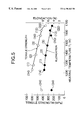
- FIG. 5 is a graph showing the relationship between the heating temperature and the tensile strength as well as the elongation of alloys according to the examples of the invention.
- FIG. 6 is a graph showing the relationship between the heating temperature and the Charpy impact value of alloys according to the examples of the invention.
- FIG. 1 is a diagram of the Fe—Co binary state.
- the present invention is directed to an Fe—Co based magnetic alloy having a Co content which is in a range of 30% by weight ⁇ Co ⁇ 65% by weight.
- first, second and third steps are carried out sequentially using an Fe—Co based magnetic alloy material having the above-described composition and according to one example of a heat cycle in FIG. 2 .
- the heating temperature T 1 is set in a range of 1,273° K ⁇ T 1 ⁇ 1, 623° K, and the retention time t 1 at such temperature is set in a range of 0.5 hr ⁇ t 1 ⁇ 10 hr.
- the heating temperature T 1 is lower than 1,273° K, the entire material cannot be formed into the ⁇ single-phase structure. This is an obstacle to the enhancement of the magnetic properties. This disadvantage also occurs when the retention time t 1 is shorter than 0.5 hr.
- the heating temperature T 1 is higher than 1,623° K, the crystal grains are coalesced, resulting in degraded mechanical characteristics. The same occurs when the retention time t 1 is longer than 10 hr.
- the material is cooled gradually, for example, furnace-cooled to an a single-phase range at a cooling rate C 1 set in a range of 20 K°/hr ⁇ C 1 ⁇ 0.5 K°/sec.
- the cooling-end temperature included in the a single-phase range is set, for example, at a retention temperature in the magnetic softening treatment of the subsequent step. If the ⁇ single-phase structure produced in the first step in the above-described manner is gradually cooled to the a single-phase range at the above-described cooling rate C 1 in the second step, a mixed structure comprising an a phase and an intermediate phase can be formed.
- the material is subjected to the magnetic softening treatment.
- the retention temperature T 2 in this treatment is set in a range of 1,073° K ⁇ T 2 ⁇ 1,143° K, and the retention time t 2 at such temperature is set in a range of 0.5 hr ⁇ t 2 ⁇ 10 hr.
- the cooling course is further divided into a gradual stage and a quick cooling stage.
- the cooling rate in this case is set in the range of C 2 ⁇ 0.06 K°/sec.
- the quick cooling stage is carried out from the quick-cooling starting temperature T 3 to room temperature T 4 , wherein gas-cooling is employed. It is preferable to use an inert gas such as N 2 or Ar gas or the like which does not oxidize the material.
- the material passes through an order-disorder transition temperature shown by a line a in FIG. 1 in the gradual cooling stage.
- the integrated heat energy participates in the growing of grains, but a portion of the integrated heat energy is consumed as the energy required for the subsequent order-disorder transition, whereby the ⁇ phase is converted into the ⁇ ′ phase.
- Sufficient order-disorder transition of the intermediate phase cannot occur in the third step, because the heat energy of the intermediate phase is consumed for the transformation to the a phase and the growing of grains in the magnetic softening process, and thus, a portion of the intermediate phase is left as the ⁇ phase.
- the mixed-phase structure comprising the a phase and the ⁇ ′ phase is produced.
- the Fe—Co based magnetic alloy has the ⁇ structure in addition to the ⁇ ′ structure required for enhancing the magnetic property of the Fe—Co based magnetic alloy.
- This ⁇ structure contributes to the enhancement of the mechanical characteristics and particularly, the toughness of the magnetic alloy.
- the mixed ⁇ - ⁇ ′ structure is a structure having a uniform grain size and is produced by the transformation from the homogeneous ⁇ phase and the growing of grains. This is also effective for enhancing the mechanical characteristics of the Fe—Co based magnetic alloy.
- the retention temperature T 2 is lower than 1, 073° K, the integrated heat energy is insufficient, and for this reason, the order-disorder transition does not sufficiently occur in the gradual cooling stage, whereby the magnetic properties cannot be improved.
- the retention time t 2 is shorter than 0.5 hr. If the cooling rate C 2 is higher than 0.06 K°/sec and if the quick-cooling starting temperature T 3 is higher than 973° K, the lattice is newly distorted in the cooling program, thereby bringing about a degradation of the magnetic properties. On the other hand, if the retention temperature T 2 is higher than 1,143° K, the magnetic properties in a lower magnetic field are degraded. The same occurs when the retention time t 2 is longer than 10 hr.
- the processing of the material e.g., cutting or machining of the material, is carried out before starting the first step, i.e., before raising the temperature. This is because if the Fe—Co based magnetic alloy produced after the third step is subjected to the cutting or the like, the magnetic properties of the alloy are degraded.
- FIG. 3 shows another example of the heat cycle.
- the material is gradually cooled to room temperature T 4 at the cooling rate C 1 in the second step. This provides an enhancement in mechanical characteristics of the material. Therefore, utilizing this, the material is subjected to a mechanical processing, a plastic processing or the like and then, the third step is carried out.
- test pieces each comprising 49% by weight of Co, 2% by weight of V and the balance of Fe, including inevitable impurities, were prepared as Fe—Co based magnetic alloy materials.
- each of the materials was subjected to the first, second and third steps under conditions given in Table 1, thereby producing Examples 1 to 13 of Fe—Co based magnetic alloys.
- each of the materials was subjected to the first, second and third steps under conditions given in Table 2, thereby producing Examples 14, 15, 17, 18 and 20 to 23 of Fe—Co based magnetic alloys.
- Each of Examples 16 and 19 of such an alloy was produced excluding the third step, and Example 24 of the alloy is produced excluding the first and second steps.
- Examples 1 to 13 were examined for magnetic properties and mechanical characteristics to provide results given in Table 3.
- the magnetic properties were measured with respect to the magnetic flux densities B 5 and B 25 .
- Examples 14 to 24 were likewise examined for magnetic properties and mechanical characteristics to provide results given in Table 4.
- the magnetic properties were likewise measured with respect to the magnetic flux densities B 5 and B 25 .
- Example 24 given in Table 4 was produced by subjecting the material to only the third step, namely to only the magnetic softening treatment and hence, is the same as a product made by the prior art process. If Example 24 is compared with Examples 1 to 13, it is obvious that each of Examples 1 to 13 has good magnetic properties, substantially similar to that of Example 24, and also has good mechanical characteristics, remarkably better than that of Example 24. It is also obvious from Table 4 that the coexistence of the desirable magnetic properties and mechanical characteristics, as in Examples 1 to 13, does not exist in Examples 14 to 24. This is due to the difference between the production conditions.
- FIGS. 4, 5 and 6 are graphs showing the heating temperature T 1 in the first step versus magnetic flux densities B 5 and B 25 , tensile strength and elongation as well as Charpy impact value, taken based on Tables 1 to 4 for Examples 1 to 3, 10, 12, 14, 22 and 24.
- points (1) to (3), (10), (12), (14), (22) and (24) correspond to Examples 1 to 3, 10, 12, 14, 22 and 24, respectively. It can be also seen from FIGS. 4 to 6 that the magnetic properties and the mechanical characteristics are reconciled in Examples 1 to 3, 10 and 12.
- the alloy according to the present invention is not limited to the composition containing 49% by weight of Co, 2% by weight of V, and the balance of Fe, and may be a composition which is capable of forming an Fe—Co based ordered alloy. Any of Cr, W, Ti, Ni, Si, Al, B and the like may be used as an alloy element.
Landscapes
- Chemical & Material Sciences (AREA)
- Engineering & Computer Science (AREA)
- Physics & Mathematics (AREA)
- Thermal Sciences (AREA)
- Dispersion Chemistry (AREA)
- Power Engineering (AREA)
- Electromagnetism (AREA)
- Crystallography & Structural Chemistry (AREA)
- Mechanical Engineering (AREA)
- Materials Engineering (AREA)
- Metallurgy (AREA)
- Organic Chemistry (AREA)
- Hard Magnetic Materials (AREA)
- Soft Magnetic Materials (AREA)
Applications Claiming Priority (2)
| Application Number | Priority Date | Filing Date | Title |
|---|---|---|---|
| JP9331824A JPH11158541A (ja) | 1997-12-02 | 1997-12-02 | 優れた機械的性質を有するFe−Co系磁性合金の製造方法 |
| JP9-331824 | 1997-12-02 |
Publications (1)
| Publication Number | Publication Date |
|---|---|
| US6190463B1 true US6190463B1 (en) | 2001-02-20 |
Family
ID=18248059
Family Applications (1)
| Application Number | Title | Priority Date | Filing Date |
|---|---|---|---|
| US09/203,496 Expired - Fee Related US6190463B1 (en) | 1997-12-02 | 1998-12-01 | Process for producing Fe-Co based magnetic alloy having excellent mechanical properties |
Country Status (2)
| Country | Link |
|---|---|
| US (1) | US6190463B1 (enExample) |
| JP (1) | JPH11158541A (enExample) |
Families Citing this family (3)
| Publication number | Priority date | Publication date | Assignee | Title |
|---|---|---|---|---|
| JP2013177664A (ja) * | 2012-02-28 | 2013-09-09 | Yasubumi Furuya | 磁歪振動発電用合金 |
| CN110268075A (zh) * | 2016-10-21 | 2019-09-20 | Crs 控股公司 | 降低软磁fe-co合金中的有序生长 |
| GB202310904D0 (en) * | 2023-07-17 | 2023-08-30 | Rolls Royce Plc | A method and furnace for treating an iron-cobalt component |
Citations (4)
| Publication number | Priority date | Publication date | Assignee | Title |
|---|---|---|---|---|
| US3891475A (en) * | 1972-04-26 | 1975-06-24 | Hitachi Ltd | Pole piece for producing a uniform magnetic field |
| US4008105A (en) * | 1975-04-22 | 1977-02-15 | Warabi Special Steel Co., Ltd. | Magnetic materials |
| US4075437A (en) * | 1976-07-16 | 1978-02-21 | Bell Telephone Laboratories, Incorporated | Composition, processing and devices including magnetic alloy |
| US4366007A (en) * | 1976-02-14 | 1982-12-28 | Inoue-Japax Research Incorporated | Permanent magnet and process for making same |
-
1997
- 1997-12-02 JP JP9331824A patent/JPH11158541A/ja active Pending
-
1998
- 1998-12-01 US US09/203,496 patent/US6190463B1/en not_active Expired - Fee Related
Patent Citations (4)
| Publication number | Priority date | Publication date | Assignee | Title |
|---|---|---|---|---|
| US3891475A (en) * | 1972-04-26 | 1975-06-24 | Hitachi Ltd | Pole piece for producing a uniform magnetic field |
| US4008105A (en) * | 1975-04-22 | 1977-02-15 | Warabi Special Steel Co., Ltd. | Magnetic materials |
| US4366007A (en) * | 1976-02-14 | 1982-12-28 | Inoue-Japax Research Incorporated | Permanent magnet and process for making same |
| US4075437A (en) * | 1976-07-16 | 1978-02-21 | Bell Telephone Laboratories, Incorporated | Composition, processing and devices including magnetic alloy |
Also Published As
| Publication number | Publication date |
|---|---|
| JPH11158541A (ja) | 1999-06-15 |
Similar Documents
| Publication | Publication Date | Title |
|---|---|---|
| EP3208355B1 (en) | Ni-based superalloy for hot forging | |
| US20230257859A1 (en) | Soft magnetic member and intermediate therefor, methods respectively for producing said member and said intermediate, and alloy for soft magnetic member | |
| JPS5842741A (ja) | 磁気記録再生ヘツド用耐摩耗性高透磁率合金およびその製造法ならびに磁気記録再生ヘツド | |
| JPH0625395B2 (ja) | 高強度リードフレーム材料およびその製造方法 | |
| CN120905606A (zh) | 一种可以多级性、时序性诱发变形机制的异质结构的高性能亚稳β钛合金的制备方法 | |
| JPH0320408A (ja) | 低温靭性に優れた高張力鋼材の製造法 | |
| JPS59205451A (ja) | 高強度非磁性鋼の製造方法 | |
| JPS6058299B2 (ja) | 成形性の優れたAl−Zn−Mg−Cu系合金材の製造法 | |
| US5688471A (en) | High strength low thermal expansion alloy | |
| JPH11158541A (ja) | 優れた機械的性質を有するFe−Co系磁性合金の製造方法 | |
| JP2564994B2 (ja) | 直流磁化特性と耐食性に優れた軟磁性鋼材およびその製造方法 | |
| US4481045A (en) | High-coercive-force permanent magnet with a large maximum energy product and a method of producing the same | |
| JPH0788532B2 (ja) | Fe―Co系軟磁性材料の製造方法 | |
| JPS5924177B2 (ja) | 角形ヒステリシス磁性合金 | |
| JPS5819439A (ja) | 低温靭性のすぐれた高強度鋼管の製造方法 | |
| JPS58185751A (ja) | 粉末治金法により製造される高速度鋼 | |
| JP2000008139A (ja) | 線状または棒状鋼、および機械部品 | |
| JPH08269547A (ja) | 超電導材生成熱処理後の極低温特性の優れたステンレス鋼板の製造方法 | |
| JPH05279784A (ja) | 高い強度および大きな伸びを有するFe−Co系磁性材料およびその製造方法 | |
| JPH03249126A (ja) | 強靭鋼製造における均熱化処理方法 | |
| JPH09268348A (ja) | 電子部品用Fe−Ni系合金薄板およびその製造方法 | |
| EP0023398B1 (en) | Manganese steels and a process of making these steels | |
| JPH1143720A (ja) | Fe−Ni系合金薄板の製造方法 | |
| JPH0741858A (ja) | 無方向性電磁鋼板の製造方法 | |
| JPH07216509A (ja) | 高強度リードフレーム材料およびその製造方法 |
Legal Events
| Date | Code | Title | Description |
|---|---|---|---|
| AS | Assignment |
Owner name: HONDA GIKEN KOGYO KABUSHIKI KAISHA, JAPAN Free format text: ASSIGNMENT OF ASSIGNORS INTEREST;ASSIGNORS:ITAMI, HITOSHI;MUKAIBO, NAGATSUGU;KONDO, TETSUYA;REEL/FRAME:009840/0551;SIGNING DATES FROM 19990202 TO 19990215 |
|
| FPAY | Fee payment |
Year of fee payment: 4 |
|
| FPAY | Fee payment |
Year of fee payment: 8 |
|
| REMI | Maintenance fee reminder mailed | ||
| LAPS | Lapse for failure to pay maintenance fees | ||
| STCH | Information on status: patent discontinuation |
Free format text: PATENT EXPIRED DUE TO NONPAYMENT OF MAINTENANCE FEES UNDER 37 CFR 1.362 |
|
| FP | Lapsed due to failure to pay maintenance fee |
Effective date: 20130220 |