US4989184A - Semiconductor memory device having current type sense amplifier improved for high speed operation and operating method therefor - Google Patents
Semiconductor memory device having current type sense amplifier improved for high speed operation and operating method therefor Download PDFInfo
- Publication number
- US4989184A US4989184A US07/406,672 US40667289A US4989184A US 4989184 A US4989184 A US 4989184A US 40667289 A US40667289 A US 40667289A US 4989184 A US4989184 A US 4989184A
- Authority
- US
- United States
- Prior art keywords
- potential
- output
- node
- inverter
- sense amplifier
- Prior art date
- Legal status (The legal status is an assumption and is not a legal conclusion. Google has not performed a legal analysis and makes no representation as to the accuracy of the status listed.)
- Expired - Fee Related
Links
Images



Classifications
-
- G—PHYSICS
- G11—INFORMATION STORAGE
- G11C—STATIC STORES
- G11C11/00—Digital stores characterised by the use of particular electric or magnetic storage elements; Storage elements therefor
- G11C11/21—Digital stores characterised by the use of particular electric or magnetic storage elements; Storage elements therefor using electric elements
- G11C11/34—Digital stores characterised by the use of particular electric or magnetic storage elements; Storage elements therefor using electric elements using semiconductor devices
-
- G—PHYSICS
- G11—INFORMATION STORAGE
- G11C—STATIC STORES
- G11C17/00—Read-only memories programmable only once; Semi-permanent stores, e.g. manually-replaceable information cards
- G11C17/08—Read-only memories programmable only once; Semi-permanent stores, e.g. manually-replaceable information cards using semiconductor devices, e.g. bipolar elements
- G11C17/10—Read-only memories programmable only once; Semi-permanent stores, e.g. manually-replaceable information cards using semiconductor devices, e.g. bipolar elements in which contents are determined during manufacturing by a predetermined arrangement of coupling elements, e.g. mask-programmable ROM
- G11C17/12—Read-only memories programmable only once; Semi-permanent stores, e.g. manually-replaceable information cards using semiconductor devices, e.g. bipolar elements in which contents are determined during manufacturing by a predetermined arrangement of coupling elements, e.g. mask-programmable ROM using field-effect devices
-
- G—PHYSICS
- G11—INFORMATION STORAGE
- G11C—STATIC STORES
- G11C7/00—Arrangements for writing information into, or reading information out from, a digital store
- G11C7/06—Sense amplifiers; Associated circuits, e.g. timing or triggering circuits
- G11C7/067—Single-ended amplifiers
Definitions
- This invention relates in general to a semiconductor memory device and, more particularly, to a semiconductor memory device having a sense amplifier improved for a high speed operation.
- FIG. 3 is a circuit diagram showing a conventional mask ROM.
- this mask ROM includes an array of memory cell 11 having 16 memory cells 15, a row decoder 22 connected for receiving row address signals A0 and A1, a column decoder 24 connected for receiving column address signals A2 and A3, and a current type sense amplifier 1 for amplifying signals read out from the memory cell 15.
- Word line drivers 20 for driving word lines 13 are connected between the outputs of the row decoder 22 and the array of memory cells 11.
- a column selector 38 is connected between the array of memory cells 11 and a sense amplifier 1.
- the column selector 38 includes four NMOS transistors connected between each bit line 14 and the input of the sense amplifier 1. These four transistors are turned on selectively responsive to output signals from the column decoder 24.
- the row decoder 22 is responsive to the address signals A0 and A1 to set one of the word lines 13 to a high level.
- the column decoder 24 is responsive to the address signals A2 and A3 to turn on one transistor in the Y gate 38.
- data signals stored in one of the 16 memory cells are applied via Y gate 38 to the input of the sense amplifier 1.
- the sense amplifier 1 amplifies this signal to output the amplified signal.
- FIG. 4 is a circuit diagram showing an example of the conventional current type sense amplifier. This sense amplifier may be seen for example in pages 70 and 71 of the Digest of Technical Papers of the IEEE International Solid State Circuits Conference held in 1987.
- the sense amplifier 1 includes an inverter 2 connected to an input node N1, a charge supply circuit 4 responsive to the output voltage of the inverter 2 to charge the node N1 to a predetermined potential, and an output circuit 3 responsive to the output voltage of the inverter 2 to output the amplified signal.
- the inverter 2 includes a PMOS transistor Q4 and an NMOS transistor Q5 connected in series between a source potential Vcc and a ground potential. Each of the transistors Q4 and Q5 has its gate connected together to the input node N1.
- the charge supply circuit 4 includes an NMOS transistor Q8 connected between the source potential Vcc and the node N1.
- the transistor Q8 has its gate connected to an output node of the inverter 2, referred to hereinafter as node N2.
- the output circuit 3 includes a PMOS transistor Q6 and an NMOS transistor Q7 connected in series between the source potential Vcc and the node N1.
- the transistor Q6 has its gate connected to the ground potential.
- the transistor Q7 has its gate connected to the node N2.
- the output signal of this sense amplifier 1 is outputted via a common connection node of the transistors Q6 and Q7.
- FIG. 4 for illustrating the operation of the sense amplifier 1, four of the memory cells Q1, Q2, Q11 and Q12 of the array of memory cells 11 are shown.
- the bit line BL1 connected to the transistors Q1 and Q2 is connected to the input node N1 of the sense amplifier 1 via NMOS transistor Q3 constituting the Y gate circuit.
- the bit line BL11, connected to the transistors Q11 and Q12, is connected to the node N1 via the NMOS transistor Q13.
- a mask ROM data signals to be stored in the ROM are written during in the manufacture process.
- the writing methods includes for example contact writing method in which data are written depending on whether or not a window for connection to the drain of the field effect transistor constituting the memory cell and an ion implantation writing method in which data are written by selectively forming a depletion type transistor or on enhancement type transistor by ion implantation. No matter which of the methods is applied, the data signals written in the memory cells are read out by sensing whether the transistor constituting the selected memory cell is turned on or not. In the following description, it is assumed that, when a memory cell is selected, the data "0" is stored in the memory cell when the transistor therein is turned on and the data "1" is stored in the memory cell when the transistor is turned off.
- the operation in the sense amplifier 1 before the start of the readout operation that, is, before the when the transistor Q3 and Q13 are turned off, is first explained.
- transistor Q4 When the node N1 is at a low level potential, transistor Q4 is turned on, while transistor Q5 is turned off.
- the inverter 2 outputs a high level voltage to set the node N2 to a high level.
- Transistors Q7 and Q8 are turned on responsive to the voltage at the node N2.
- the transistor Q8 is turned on, the potential at the node N1 starts to be increased.
- the transistors Q4 and Q5 are turned off and on, respectively, responsive to the increased potential at the node N1.
- the transistor Q8 is turned off.
- the potential at the node N2 ceases to be increased and, responsive thereto, the potential at the node N2 also ceases to be lowered.
- the potential at the node N1 at this time is expressed as V01, while that of the node N2 is expressed as V02.
- the inverter 2 affords a potential lower than V02 to the node N2. Since the transistors Q7 and Q8 are turned off responsive to the voltage lower than V02, the potential at the node N1 is not changed.
- the node N1 is set to the potential not lower than V01, and the node N2 is brought to the potential not higher than V02.
- bit line in general is previously brought to the low level potential.
- a high level voltage is applied from the row decoder to the word line WL2.
- the transistor Q12 is turned on or off on the basis of the stored data signal.
- the transistor Q2 is also turned on, since the signal "0" is stored in the memory cell including the transistor Q2.
- the bit line BL1 is connected to the ground potential via transistor Q2.
- the array of memory cells 11 includes at least some memory cells in which data signals "0" are stored, the majority of the bit lines are usually brought in advance to the low level potential.
- FIG. 5 is a timing chart for illustrating the read out operation by the sense amplifier shown in FIG. 4. Referring to FIGS. 4 and 5, the read out operation may be explained for the case in which the data signals stored in the memory cell including the transistor Q1 and the memory cell including the transistor Q2 are read out sequentially from these memory cells.
- the word line WL1 is brought to the high level by the row decoder, while the column decoder outputs a high level signal Y1.
- the transistor Q3 is turned on responsive to the signal Y1.
- the transistor Q1 is not capable of being turned on since the data "1" is stored therein. Since the bit line BL1 is brought previously to the low level potential, the bit line BL1 is charged rapidly by the sense amplifier 1 after the transistor Q3 is turned on. Thus, the potential at the node N1 is lowered temporarily. Since the potential at the node N2 is responsive to the changes in the potential of the node N1 to be increased temporarily by the inverter 2, transistor Q8 is responsive thereto to be turned on.
- the transistor Q8 With the transistor Q8 turned on, the node N1 and the bit line BL1 are charged rapidly. As the potential at the node N1 is increased by this charging, the potential at the node N2, increased temporarily as described above, starts rapidly to be lowered under the operation of the inverter 2. Since the inverter 2 outputs the inverted voltage with a delay, the potential at the node N2 is not lowered to V02 when the potential at the node N1 reaches V01. Hence, the transistor Q8 remains ON, so that the node N1 is charged further and brought to a potential higher than V01. When the potential at the node N2 is lowered by the inverter 2 to V02, transistor Q8 is turned off. At this time, the node N1 is already brought to a potential exceeding V01.
- the channel resistance of the transistor Q4 is high and the channel resistance of the transistor Q5 is low, as compared to the case in which the potential at the node N1 is V01.
- the charges at the node N2 are discharged via transistor Q5 and the potential at the node N2 is lowered to the vicinity of the ground level.
- the output circuit 3 is responsive to the voltage at the node N2 to output a high level output signal So.
- the word line WL2 is brought to the high level by the row decoder, while the column decoder outputs a high level signal Y1.
- the transistor Q3 is turned on responsive to the signal Y1. Since the transistor Q2 is also turned on responsive to the voltage applied to the word line WL2, there is formed a current path connecting the node N1 to the ground potential by way of transistor Q3, bit line BL1 and transistor Q2. Thus the potential at the node N1 and the bit line BL1 is lowered.
- the inverter 2 is responsive to the potential at the node N1 to raise the potential at the node N2. As a result, transistors Q8 and Q7 are turned on and the output circuit 3 outputs a low level output signals So.
- the node N2 was brought to close to the ground potential by previously accessing the transistor Q1, so that, when transistor Q2 is accessed, it takes some time until the potential at the node N2 is raised by the inverter 2.
- the transistor Q7 in the output circuit 3 is turned on with a delay, that is, as shown in FIG. 5, a longer time is elapsed since the rising of the voltage at the word line W2 or the output signal Y1 of the column decoder until the falling of the output signal So. This means that the readout speed is low.
- a sense amplifier is disclosed.
- This sense amplifier includes a circuit for previously maintaining an input node of the sense amplifier connected to the bit line, that is, the node corresponding to the node N1 shown in FIG. 4, at a predetermined potential.
- the semiconductor memory device includes a plurality of memory cells each connected between a bit line and a predetermined first potential and responsive to an address signal to afford the data signal stored therein to the bit line, a sense amplifier for amplifying the voltage on the bit line, and a first switching element connected between the bit line and the sense amplifier and operated responsive to the address signal.
- the sense amplifier has its input connected via the first switching element to the bit line at the first node.
- the sense amplifier include an inverter responsive to the voltage at the first node for output an inverted voltage with a delay, a second switching element connected between a predetermined second potential and the first node and operated responsive to the potential of the inverter output, a potential holding circuitry for holding the inverter output at a potential not substantially lower than a predetermined third potential, and an amplification circuitry responsive to the inverter output potential for outputting an amplified signal.
- the third potential is a potential intermediate between the first and the second potentials.
- the bit line may be occasionally brought to a potential close to the first potential before turning on of the first switching element.
- the first node is brought under this effect to a potential closer to the second potential after turning on of the switching element.
- the potential of the inverter output tends to be changed towards the first potential under the inverter operation.
- the potential holding circuitry is connected to the inverter output, the inverter output is maintained at a potential not substantially lower than the third potential.
- the extent of the changes in the voltage outputted from the inverter during the readout operation is decreased.
- the amplification circuit operated responsive to the inverter output voltage outputs the amplified signals more quickly.
- the sense amplifier of the present invention amplifies the input signals supplied to the input node.
- the input node may be brought occasionally to the predetermined first potential before the input signal is supplied thereto.
- This sense amplifier includes an inverter responsive to the voltage at the first node to output an inverted voltage with a delay, a switching element connected between the predetermined second potential and the first node and operated responsive to the potential of the inverter output, a potential holding circuitry for holding the inverter output at a potential not substantially lower than the predetermined third potential, and an amplification circuitry responsive to the inverter output potential for outputting an amplified signal.
- the third potential is a potential intermediate between the first and the second potentials.
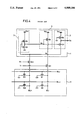
- FIG. 1 is a circuit diagram of a sense amplifier showing an embodiment of the present invention.
- FIG. 2 is a timing chart for illustrating the readout operation by the sense amplifier shown in FIG. 1.
- FIG. 3 is a circuit diagram showing a conventional mask ROM.
- FIG. 4 is a circuit diagram showing an example of a conventional sense amplifier.
- FIG. 5 is a timing chart for illustrating the readout operation by the sense amplifier shown in FIG. 4.
- FIG. 1 is a circuit diagram showing a current type sense amplifier according to an embodiment of the present invention.
- the circuit shown therein differs from a conventional circuit shown in FIG. 4 in that an additional charge supply circuit 5 is provided in this sense amplifier 1. That is, the charge supply circuit 5 is connected to the output node N2 of the inverter 2.
- the charge supply circuit includes two NMOS transistor Q9 and Q10 connected in series between the source potential Vcc and the node N2. Each of the transistors Q9 and Q10 has its gate connected to its drain. Each of the transistors Q9 and Q10 is turned on when the voltage across its sources and gate exceeds a threshold voltage Vth to prevent the occurrence of the situation in which the voltage across the source and the drain is increased to higher than the threshold voltage.
- the charge supply circuit 5 prevents the occurrence of the situation in which the potential at the node N2 is lowered to a potential lower than a potential equal to the source potential Vcc less the sum of the threshold voltages of the two transistors Q9 and Q10, or 2 Vth, referred to hereinafter as the potential VR.
- the transistors Q3 and Q13 are turned off, while the sense amplifier 1 is not connected to the bit line BL1 or BL11.
- the node N1 is brought to the low level
- the node N2 is brought to the high level by the inverter 2.
- the transistors Q7 and Q8 are turned on responsive to the potential at the node N2.
- the potential at the node N1 is raised responsive to the turning on of the transistor Q8.
- the potential at the node N2 is lowered by the operation of the inverter 2.
- transistor Q8 When the potential at the node N2 is lowered to a value lower than the sum of the potential at the node N1 and the threshold voltage Vth of the transistor Q8, transistor Q8 is turned off.
- the voltage VR which is preset for a particular charge supply circuit 5
- the potential at the node N1 ceases to be increased, while the potential at the node N2 ceases to be lowered.
- the potential at the node N1 at this time is expressed as V01, and that at the node N2 is expressed as V02.
- the node N1 when the node N1 is brought to the high level, the node N2 tends to be brought to the low level by the inverter 2.
- transistors Q9 and Q10 in the current supply circuit 5 are turned on.
- the current flows from the source potential Vcc to the ground via transistors Q9, Q10 and Q5.
- the potential at the node N2 is determined, by the ratio of the sum of on-resistance of the transistors Q9 and Q10 to the on-resistance of the transistor Q5.
- FIG. 2 is a timing chart for illustrating the readout operation by the sense amplifier shown in FIG. 1. Then, referring to FIGS. 1 and 2, the operation of the circuit when the memory cell including the transistor Q1 and the memory cell including the transistor Q2 are accessed sequentially.
- the signal "1" is stored in the memory cell including the transistor Q1 and the signal "0" is stored in the memory cell including the transistor Q2. That is, it is assumed that, when the transistor Q1 is accessed, transistor Q1 is turned off and, when the transistor Q2 is accessed, transistor Q2 is turned on.
- transistor Q1 When transistor Q1 is accessed, the word line WL1 is brought to the high level by the row decoder, and a high level signal Y1 is outputted from the column decoder. Transistor Q3 is turned on responsive to the signal Y1, while transistor Q1 is not turned on. As described hereinabove, the bit line BL1 is previously set to the ground potential. After the transistor Q3 is turned on, the bit line BL1 is charged rapidly by the sense amplifier 1. Thus, the potential at the node N1 is lowered temporarily, while the potential at the node N2 is increased rapidly temporarily. Since the transistor Q8 is turned on responsive to changes in the potential at the node N2, the node N1 and the bit line BL1 are charged rapidly via transistor Q8.
- transistor Q2 is accessed.
- the word line WL2 is brought to the high level, and a high level signal Y1 is supplied to turn on the transistors Q3 and Q2.
- the charges at the node N1 are discharged via transistor Q3, bit line BL1 and transistor Q2.
- the potential at the node N1 and bit line BL1 is lowered, while the potential at the node N2 is increased by the operation of the inverter 2. Since the potential at the node N2 rises from the potential close to VR under the operation of the inverter 2, the time that elapses until the transistor Q7 is turned on responsive to the potential at the node N2 is shortened.
- the output circuit 3 outputs a low level signal So by the timing on of the transistor Q1.
- the time T1 that elapses since the rising of the voltage at the word line WL2 or the rising of the output signal Y1 of the column decoder until the falling of the output signal So is shorter than the time T2 shown in FIG. 5. It is because the potential at the node N2 is maintained at a value about equal to VR by the charge supply circuit 5. That is, since the potential at the node N2 is changed rapidly from VR by the inverter 2, transistor Q7 is turned on quickly. As a result, the low level output signal S5 is outputted more quickly than in the conventional circuit.
- the charge supply circuit 5 is formed by two NMOS transistors Q9 and Q10 in the above embodiment, these transistors may be replaced by diodes, in which case the diodes are connected so that the forward current flows from the source potential Vcc towards the node N2.
- the sense amplifier is constituted by a CMOS circuit in the above embodiment, it may be constituted by an NMOS circuit in which there may be provided various transistors for saving the power consumption. And there may be provided a current leak path from the node N1 to the ground potential, for instance a small NMOS transistor is connected between the node N1 and the ground potential. The transistor has its gate connected to the node N2.
- the node N1 is brought to an additionally high potential level by the turning on of the transistor Q8.
- the node N2 tends to be changed towards a ground potential.
- the charge supply circuit 5 holds the node N2 at a potential about equal to VR, the potential at the node N2 is increased in a short time at the time of second accessing.
- transistor Q1 may be turned on quickly. That is, the amplification speed of this current type sense amplifier 1 or the operating speed of the sense amplifier in the semiconductor memory device may be made higher than in the conventional circuit.
Landscapes
- Engineering & Computer Science (AREA)
- Computer Hardware Design (AREA)
- Read Only Memory (AREA)
Applications Claiming Priority (2)
| Application Number | Priority Date | Filing Date | Title |
|---|---|---|---|
| JP63309241A JPH02154394A (ja) | 1988-12-06 | 1988-12-06 | 半導体メモリ装置 |
| JP63-309241 | 1988-12-06 |
Publications (1)
| Publication Number | Publication Date |
|---|---|
| US4989184A true US4989184A (en) | 1991-01-29 |
Family
ID=17990627
Family Applications (1)
| Application Number | Title | Priority Date | Filing Date |
|---|---|---|---|
| US07/406,672 Expired - Fee Related US4989184A (en) | 1988-12-06 | 1989-09-13 | Semiconductor memory device having current type sense amplifier improved for high speed operation and operating method therefor |
Country Status (4)
| Country | Link |
|---|---|
| US (1) | US4989184A (enExample) |
| JP (1) | JPH02154394A (enExample) |
| KR (1) | KR930009463B1 (enExample) |
| DE (1) | DE3938638A1 (enExample) |
Cited By (4)
| Publication number | Priority date | Publication date | Assignee | Title |
|---|---|---|---|---|
| US5473562A (en) * | 1994-08-05 | 1995-12-05 | Vlsi Technology, Inc. | Method and apparatus for minimizing power-up crowbar current in a retargetable SRAM memory system |
| US5594697A (en) * | 1994-06-28 | 1997-01-14 | Matsushita Electric Industrial Co., Ltd. | Semiconductor device |
| KR100596763B1 (ko) * | 1999-02-03 | 2006-07-04 | 주식회사 하이닉스반도체 | 롬의 고속동작을 위한 센스앰프 |
| WO2009022304A2 (en) | 2007-08-15 | 2009-02-19 | Nxp B.V. | Secure storage of a codeword within an integrated circuit |
Families Citing this family (1)
| Publication number | Priority date | Publication date | Assignee | Title |
|---|---|---|---|---|
| US5245584A (en) * | 1990-12-20 | 1993-09-14 | Vlsi Technology, Inc. | Method and apparatus for compensating for bit line delays in semiconductor memories |
Citations (1)
| Publication number | Priority date | Publication date | Assignee | Title |
|---|---|---|---|---|
| JPS58130492A (ja) * | 1982-01-25 | 1983-08-03 | モトロ−ラ・インコ−ポレ−テツド | センス増幅器 |
Family Cites Families (2)
| Publication number | Priority date | Publication date | Assignee | Title |
|---|---|---|---|---|
| DD242888A1 (de) * | 1985-11-21 | 1987-02-11 | Ilmenau Tech Hochschule | Schaltungsanordnung zum sicheren bewerten eines stromflusses |
| JPS62222498A (ja) * | 1986-03-10 | 1987-09-30 | Fujitsu Ltd | 消去及び書き込み可能な読み出し専用メモリ |
-
1988
- 1988-12-06 JP JP63309241A patent/JPH02154394A/ja active Pending
-
1989
- 1989-09-13 US US07/406,672 patent/US4989184A/en not_active Expired - Fee Related
- 1989-11-21 DE DE3938638A patent/DE3938638A1/de active Granted
- 1989-12-05 KR KR1019890017968A patent/KR930009463B1/ko not_active Expired - Fee Related
Patent Citations (1)
| Publication number | Priority date | Publication date | Assignee | Title |
|---|---|---|---|---|
| JPS58130492A (ja) * | 1982-01-25 | 1983-08-03 | モトロ−ラ・インコ−ポレ−テツド | センス増幅器 |
Non-Patent Citations (2)
| Title |
|---|
| M. Yoshida et al, "An 80ns Address-Data Multiplex 1Mb EMOS EPROM", Digest of Technical Papers, Feb. 1987, pp. 70-71. |
| M. Yoshida et al, An 80ns Address Data Multiplex 1Mb EMOS EPROM , Digest of Technical Papers, Feb. 1987, pp. 70 71. * |
Cited By (8)
| Publication number | Priority date | Publication date | Assignee | Title |
|---|---|---|---|---|
| US5594697A (en) * | 1994-06-28 | 1997-01-14 | Matsushita Electric Industrial Co., Ltd. | Semiconductor device |
| US5841698A (en) * | 1994-06-28 | 1998-11-24 | Matsushita Electric Inudustrial Co., Ltd. | Semiconductor device |
| US5473562A (en) * | 1994-08-05 | 1995-12-05 | Vlsi Technology, Inc. | Method and apparatus for minimizing power-up crowbar current in a retargetable SRAM memory system |
| KR100596763B1 (ko) * | 1999-02-03 | 2006-07-04 | 주식회사 하이닉스반도체 | 롬의 고속동작을 위한 센스앰프 |
| WO2009022304A2 (en) | 2007-08-15 | 2009-02-19 | Nxp B.V. | Secure storage of a codeword within an integrated circuit |
| WO2009022304A3 (en) * | 2007-08-15 | 2009-04-09 | Nxp Bv | Secure storage of a codeword within an integrated circuit |
| CN101779251B (zh) * | 2007-08-15 | 2013-04-17 | Nxp股份有限公司 | 集成电路内码字的安全存储 |
| US8690065B2 (en) | 2007-08-15 | 2014-04-08 | Nxp B.V. | Secure storage of a codeword within an integrated circuit |
Also Published As
| Publication number | Publication date |
|---|---|
| JPH02154394A (ja) | 1990-06-13 |
| KR900010778A (ko) | 1990-07-09 |
| KR930009463B1 (ko) | 1993-10-04 |
| DE3938638A1 (de) | 1990-06-07 |
| DE3938638C2 (enExample) | 1993-09-16 |
Similar Documents
| Publication | Publication Date | Title |
|---|---|---|
| EP0643393B1 (en) | Semiconductor memory device having voltage booster circuit | |
| US5164621A (en) | Delay device including generator compensating for power supply fluctuations | |
| US4804871A (en) | Bit-line isolated, CMOS sense amplifier | |
| US4780850A (en) | CMOS dynamic random access memory | |
| US4654831A (en) | High speed CMOS current sense amplifier | |
| US5243573A (en) | Sense amplifier for nonvolatile semiconductor storage devices | |
| EP0905904B1 (en) | Semiconductor integrated circuit having tri-state logic gate circuit | |
| US5574687A (en) | Semiconductor memory | |
| KR950009234B1 (ko) | 반도체 메모리장치의 비트라인 분리클럭 발생장치 | |
| US5337270A (en) | Semiconductor dynamic memory | |
| US5323345A (en) | Semiconductor memory device having read/write circuitry | |
| US5680071A (en) | Tristate voltage boosted integrated circuit | |
| US4451907A (en) | Pull-up circuit for a memory | |
| KR930008575B1 (ko) | 저소비 전력 구성의 반도체 집적회로 장치 | |
| US6992941B2 (en) | Semiconductor memory device | |
| US6829189B2 (en) | Semiconductor memory device and bit line sensing method thereof | |
| US5777934A (en) | Semiconductor memory device with variable plate voltage generator | |
| US5539701A (en) | Sense circuit for semiconductor memory devices | |
| US5278788A (en) | Semiconductor memory device having improved controlling function for data buses | |
| KR930009463B1 (ko) | 반도체 메모리장치와 감지 증폭기 | |
| US6657909B2 (en) | Memory sense amplifier | |
| US7057944B2 (en) | Semiconductor readout circuit | |
| JP2874469B2 (ja) | 半導体ダイナミックram装置 | |
| US4821237A (en) | Semiconductor memory device | |
| US6806550B2 (en) | Evaluation configuration for semiconductor memories |
Legal Events
| Date | Code | Title | Description |
|---|---|---|---|
| AS | Assignment |
Owner name: MITSUBISHI DENKI KABUSHIKI KAISHA, JAPAN Free format text: ASSIGNMENT OF ASSIGNORS INTEREST.;ASSIGNORS:KISHIDA, SATORU;MATSUMOTO, HISASHI;REEL/FRAME:005221/0675 Effective date: 19890725 |
|
| FEPP | Fee payment procedure |
Free format text: PAYOR NUMBER ASSIGNED (ORIGINAL EVENT CODE: ASPN); ENTITY STATUS OF PATENT OWNER: LARGE ENTITY |
|
| FPAY | Fee payment |
Year of fee payment: 4 |
|
| FPAY | Fee payment |
Year of fee payment: 8 |
|
| REMI | Maintenance fee reminder mailed | ||
| LAPS | Lapse for failure to pay maintenance fees | ||
| STCH | Information on status: patent discontinuation |
Free format text: PATENT EXPIRED DUE TO NONPAYMENT OF MAINTENANCE FEES UNDER 37 CFR 1.362 |
|
| FP | Lapsed due to failure to pay maintenance fee |
Effective date: 20030129 |