US4802013A - Method of transferring information from the front to the back of a document, and apparatus for performing the method - Google Patents
Method of transferring information from the front to the back of a document, and apparatus for performing the method Download PDFInfo
- Publication number
- US4802013A US4802013A US06/830,646 US83064686A US4802013A US 4802013 A US4802013 A US 4802013A US 83064686 A US83064686 A US 83064686A US 4802013 A US4802013 A US 4802013A
- Authority
- US
- United States
- Prior art keywords
- document
- information
- strip
- reader
- printer
- Prior art date
- Legal status (The legal status is an assumption and is not a legal conclusion. Google has not performed a legal analysis and makes no representation as to the accuracy of the status listed.)
- Expired - Fee Related
Links
Images


Classifications
-
- B—PERFORMING OPERATIONS; TRANSPORTING
- B42—BOOKBINDING; ALBUMS; FILES; SPECIAL PRINTED MATTER
- B42D—BOOKS; BOOK COVERS; LOOSE LEAVES; PRINTED MATTER CHARACTERISED BY IDENTIFICATION OR SECURITY FEATURES; PRINTED MATTER OF SPECIAL FORMAT OR STYLE NOT OTHERWISE PROVIDED FOR; DEVICES FOR USE THEREWITH AND NOT OTHERWISE PROVIDED FOR; MOVABLE-STRIP WRITING OR READING APPARATUS
- B42D25/00—Information-bearing cards or sheet-like structures characterised by identification or security features; Manufacture thereof
-
- B—PERFORMING OPERATIONS; TRANSPORTING
- B42—BOOKBINDING; ALBUMS; FILES; SPECIAL PRINTED MATTER
- B42D—BOOKS; BOOK COVERS; LOOSE LEAVES; PRINTED MATTER CHARACTERISED BY IDENTIFICATION OR SECURITY FEATURES; PRINTED MATTER OF SPECIAL FORMAT OR STYLE NOT OTHERWISE PROVIDED FOR; DEVICES FOR USE THEREWITH AND NOT OTHERWISE PROVIDED FOR; MOVABLE-STRIP WRITING OR READING APPARATUS
- B42D25/00—Information-bearing cards or sheet-like structures characterised by identification or security features; Manufacture thereof
- B42D25/20—Information-bearing cards or sheet-like structures characterised by identification or security features; Manufacture thereof characterised by a particular use or purpose
- B42D25/23—Identity cards
-
- G—PHYSICS
- G06—COMPUTING OR CALCULATING; COUNTING
- G06K—GRAPHICAL DATA READING; PRESENTATION OF DATA; RECORD CARRIERS; HANDLING RECORD CARRIERS
- G06K1/00—Methods or arrangements for marking the record carrier in digital fashion
- G06K1/14—Methods or arrangements for marking the record carrier in digital fashion by transferring data from a similar or dissimilar record carrier
-
- G—PHYSICS
- G06—COMPUTING OR CALCULATING; COUNTING
- G06K—GRAPHICAL DATA READING; PRESENTATION OF DATA; RECORD CARRIERS; HANDLING RECORD CARRIERS
- G06K19/00—Record carriers for use with machines and with at least a part designed to carry digital markings
- G06K19/06—Record carriers for use with machines and with at least a part designed to carry digital markings characterised by the kind of the digital marking, e.g. shape, nature, code
- G06K19/06009—Record carriers for use with machines and with at least a part designed to carry digital markings characterised by the kind of the digital marking, e.g. shape, nature, code with optically detectable marking
- G06K19/06046—Constructional details
-
- B—PERFORMING OPERATIONS; TRANSPORTING
- B42—BOOKBINDING; ALBUMS; FILES; SPECIAL PRINTED MATTER
- B42D—BOOKS; BOOK COVERS; LOOSE LEAVES; PRINTED MATTER CHARACTERISED BY IDENTIFICATION OR SECURITY FEATURES; PRINTED MATTER OF SPECIAL FORMAT OR STYLE NOT OTHERWISE PROVIDED FOR; DEVICES FOR USE THEREWITH AND NOT OTHERWISE PROVIDED FOR; MOVABLE-STRIP WRITING OR READING APPARATUS
- B42D25/00—Information-bearing cards or sheet-like structures characterised by identification or security features; Manufacture thereof
- B42D25/40—Manufacture
- B42D25/48—Controlling the manufacturing process
- B42D25/485—Controlling the manufacturing process by electronic processing means
Definitions
- the present invention relates to a method of transferring information from the front to the back of a document, and particularly, but not exclusively intended for use with security documents such as identity cards, credit cards, cards for providing identification or access, etc.
- security documents such as identity cards, credit cards, cards for providing identification or access, etc.
- the invention also relates to apparatus for performing the method. This problem frequently arises for this type of document where at least some information, such as the name of the holder and the expiry date, for example, is to appear on both sides of the document.
- Modern identity cards are presently manufactured as follows: an application for a document is made on a form, generally a card form, hereinafter referred to as the "Application Form", and the form includes a photograph together with information such as date of birth, address, occupation, issue and expiry dates, applicant's signature, family information, serial number, the location of an establishment, the signature of the responsible authority, etc., and this "word” information is advantageously prepared and printed on the application form by computerized machinery; once the application form has been completed, the filled-in portion (including the photograph) intended to appear on the final identity card is photographed as a whole. This zone of information to appear on the front of the final card is referred to hereafter as the "useful zone".
- the negative obtained in this way is used to transfer said information onto a positive security medium, i.e. a medium which is previously prepared in such a way as to make it difficult to reproduce, e.g. by means of special weft insertions, a special chemical composition, moire type patterning, etc.
- a positive security medium i.e. a medium which is previously prepared in such a way as to make it difficult to reproduce, e.g. by means of special weft insertions, a special chemical composition, moire type patterning, etc.
- the final document is then fabricated by a purely physico-chemical process without there being any risk of error, since both the negative and the positive medium are perforated to enable them to be tractor driven through the machinery.
- This method does not enable information on the front of the document to be transferred to the back.
- complex document management is necessary, including storing the information to be printed on the back, turning over the document and then reproducing said information by means of a printer which is required to reproduce said information some suitable length of time after the operations on the front of the document.
- This gives rise to manufacturing difficulties which are particularly acute when the machinery is started, or whenever the machinery is interrupted in the middle of operation due to some technical incident or a power cut.
- turning the document over introduces a discontinuity in the continuous manufacturing process and this is unacceptable when large numbers of documents are to be manufactured.
- the information to be transferred to the back of the document can only be transferred after the photographic development operations on the front of the document have been completed.
- Such photographic operations require the document to be passed through various baths, and there is no guarantee that prior-printed information will survive passing through such photographic baths without being damaged.
- Preferred implementations of the present invention remedy these drawbacks and provide a method and apparatus in which information is printed on the basis of reading the front of the document and synchronously with said reading, thereby avoiding any risk of error due to mismanaging the information, which is, of course, particularly advantageous when producing security documents.
- the present invention seeks to transfer or copy characters or signs to the back of a document by substantially identically reproducing characters or signs appearing on the front of the document.
- the method of transferring information from the front to the back of a document consists in modifying a chain in which documents are manufactured by moving flat through the chain, by incorporating in said chain a device for reading the front of a document and connected to a servo control circuit which controls a printer whose print head is disposed to print on the back of the document.
- the reader device is advantageously linear in structure.
- the printer has a corresponding linear structure, i.e. it may be constituted by a matrix printer having a column of print elements such as needles or ink jets, with said column being disposed perpendicularly to the direction of document travel, and parallel to the sensitive area of the reader which is advantageously constituted by a strip of photodiodes.
- the number of print elements e.g. needles
- a print head may include only nine needles, for example, per line of print.
- the reader definition is much greater than nine points per line of printing so that n points from the reader are associated with a single write point, and a logic stage is used to calculate the average value of the n read points corresponding to a single write point.
- the information to be reproduced on the back of the card is duplicated on the front of the application form (e.g. a request for an identity card) in an auxiliary zone thereof to one side of the useful zone, the combination of useful zone plus auxiliary zone is then photographed. This combination therefore appears in the negative and subsequently on the positive.
- the auxiliary zone is read by a line reader and information detected thereby is reproduced on the back of the final document by the back printer.
- this embodiment leads to a loss of paper both in the negative and in the positive, and further requires additional cutting steps to separate the auxiliary zone from the useful zone.
- the front of the document is made in the conventional manner, i.e. no auxiliary zone is provided.
- the information for printing on the back of the document is read directly from the application form.
- the information for the back is stored and is reconstituted by the back printer onto the back of the corresponding final document after the document has moved along a path having a length of N cards +N intercard spaces.
- the reader is disposed above the application form while the back printer is disposed further downstream in the manufacturing machine.
- the information to be copied to the back of the document is read directly from the front of the final document after the application form has been photographically reproduced thereon, and in this case the printer may naturally be disposed directly beneath the reader.
- the reader only reads a predetermined zone of the card which contains information solely in the form of alphanumeric symbols capable of being read, even though there is a loss of definition between the printing on the front and the back.
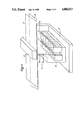
- FIG. 1 is a diagrammatic perspective view of apparatus in accordance with the invention.
- FIG. 2 is a diagram of a reader
- FIG. 3 is a block diagram of a printer servo control circuit
- FIG. 4 is a diagrammatic perspective view of a back printer for performing the invention.
- Documents 1 being manufactured are in the form of a strip 2 which is driven in known manner, by perforations 3 on the sides of the strip which cooperate with conventional tractor wheels (not shown).
- the information to be copied onto the back of the documents may, for example, constitute the name of the bearer, the expiry date, and a document serial number.
- this information is to be found in an auxiliary zone of the application form and after photography and development it appears in a zone 4 on the top face of the strip 2 adjacent to the image of the front of the document.
- the strip 2 runs through a reader stage 5 which is associated with a printer 6, and the printer 6 is disposed immediately below the reader 5 and on the opposite side of the strip 2.
- the reader stage 5 is shown diagrammatically in FIG. 2. It comprises a commercially-available line sensor 7 whose sensitive area may be constituted by a strip of 128 photodiodes, for example. Naturally, the number of photodiodes is a function of the height of the zone to be scanned and thus of the number of lines to be copied.
- the direction of strip movement is arbitrarily considered as being from the right of the figure towards the left.
- the image of the strip 4 is projected onto the sensitive area 7 by optics 8 symbolized by a converging lens.
- the sensor is intended to scan the characters to be reproduced in columns at the speed of movement of the strip 2, 4.
- the region to be read may need to be illiminated, for example by means of two lamps 9 disposed on either side of the optics 8.
- the focal length of the optics 8 is chosen as a function of the physical ratio between the length of the strip 7 and the height of the characters to be reproduced or the combined height of the lines of characters to be reproduced when a plurality of lines are to be reproduced.
- FIG. 3 is a block diagram of a servo control circuit for controlling the printer on the basis of the information sent by the reader.
- the sensitive area 7 of the reader is connected to a threshold amplifier 10 suitable for distinguishing between black and white, where black may correspond to a value "1" and white to a value "0".
- the result is stored in a register 11 which serves as a read memory and which is driven by a clock 13.
- the register stage 11 includes means for determining the average value of n read points in order to generate a single write point.
- the clock 13 is connected both to the register 11 and also to control the movement of the paper by a link not shown.
- the clock imposes a regular speed of advance on the paper 2 and also serves to take account of the inertia of the print heads.
- the output signal from the register 11 is amplified by a current amplifier 12 (e.g. a Darlington type amplifier) and is applied to the electromagnets 14 for driving print needles 15.
- a current amplifier 12 e.g. a Darlington type amplifier
- a single clock circuit 13 is common to all said circuits.
- the printer 6 is disposed directly beneath the reader 5.
- the description of the first embodiment is applicable to the third embodiment except that the third embodiment does not have an auxiliary zone 4 and the reader is disposed above the final document rather than the auxiliary zone 4.
- the reader 5 is disposed above the application form, i.e. upstream from the machine which photographically produces the final documents, whereas the printer is disposed beneath the strip 2 inside the machine but downstream from the photographic processes.
- a memory stage 16 delays the transmission of information to the printer 6 by a period which is predetermined to correspond to the time taken for the final document to engage the back printer.
- the main purposes of the present invention is to copy some of the information from the front of a document to the back. No change of scale is necessary. However, it is possible by purely optical means to magnify or to reduce the characters or symbols which are to be copied to the back of the document. A magnifying or reducing operation could also be performed electronically in the stage 16 shown in dashed lines in FIG. 3.
- the stage 16 could also include an encoding stage, so as to encode the characters read on the front of the document into conventional magnetically readable characters such as CMC characters or into optically readable characters such as OCRB characters.
- FIG. 4 shows a print head 6 having needles 15.
- Such print heads are known. However, they are usually designed to write line by line with each head being capable of printing seven points one above the other. A drawback with known heads is that it is practically impossible to reproduce more than one line on a small document.
- the transfer apparatus includes a special printer, referred to as a "back printer” which uses the printing technique of needles striking an ink ribbon.
- a set of electromagnets 14 are disposed on a support 17, with each electromagnet being connected to a corresponding register 11 (FIG. 3) in such a manner as to establish a direct relationship between a group of read points and a single write point (assuming there is no intervening processing).
- Each electromagnet 14 drives a needle 15 which slides in a bearing 20 (preferably a ruby) in order to strike an ink ribbon 21 against an anvil 22.
- the strip 2 on which the document 1 appears passes between the ink ribbon 21 and the anvil 22.
- the electromagnets 14 are disposed side by side on either side of the strike plane of the needles 15. Naturally the needle points remain in a fixed position relative to the other needle points and to the structure of the machine. Return members (e.g. springs) are provided but not shown in FIG. 4. It is thus possible to build up a multiline printer capable, for example, of printing four lines, of sufficiently small size to be compatible with the desired result. Such a printer is capable of simultaneously reproducing one to four lines of characters.
- a matrix printer using needles is not an essential feature of the invention, and other matrix printers may be used, operating on various other systems, e.g. an ink jet printer.
Landscapes
- Engineering & Computer Science (AREA)
- Physics & Mathematics (AREA)
- General Physics & Mathematics (AREA)
- Theoretical Computer Science (AREA)
- Manufacturing & Machinery (AREA)
- Printers Characterized By Their Purpose (AREA)
- Conveying Record Carriers (AREA)
- Financial Or Insurance-Related Operations Such As Payment And Settlement (AREA)
Applications Claiming Priority (2)
| Application Number | Priority Date | Filing Date | Title |
|---|---|---|---|
| FR8409834A FR2566325A1 (fr) | 1984-06-22 | 1984-06-22 | Procede de transfert d'informations du recto au verso d'un document et dispositif de mise en oeuvre du procede |
| FR8409834 | 1984-06-22 |
Publications (1)
| Publication Number | Publication Date |
|---|---|
| US4802013A true US4802013A (en) | 1989-01-31 |
Family
ID=9305321
Family Applications (1)
| Application Number | Title | Priority Date | Filing Date |
|---|---|---|---|
| US06/830,646 Expired - Fee Related US4802013A (en) | 1984-06-22 | 1986-02-18 | Method of transferring information from the front to the back of a document, and apparatus for performing the method |
Country Status (6)
| Country | Link |
|---|---|
| US (1) | US4802013A (de) |
| EP (1) | EP0187156B1 (de) |
| AT (1) | ATE71464T1 (de) |
| DE (1) | DE3585153D1 (de) |
| FR (1) | FR2566325A1 (de) |
| WO (1) | WO1986000448A1 (de) |
Families Citing this family (2)
| Publication number | Priority date | Publication date | Assignee | Title |
|---|---|---|---|---|
| JPH0196781A (ja) * | 1987-10-09 | 1989-04-14 | Toshiba Corp | 携帯可能記憶媒体処理装置 |
| IT217567Z2 (it) * | 1988-12-22 | 1991-12-19 | Tesi Elettronica E Sistemi Inf | Tesserino di identificazione per utenti di strutture sanitarie |
Citations (2)
| Publication number | Priority date | Publication date | Assignee | Title |
|---|---|---|---|---|
| US4027142A (en) * | 1974-03-06 | 1977-05-31 | Recognition Equipment Incorporated | Automated processing of financial documents |
| US4158909A (en) * | 1977-08-17 | 1979-06-26 | International Telephone And Telegraph Corporation | Method of making a head for a mosaic printer |
Family Cites Families (3)
| Publication number | Priority date | Publication date | Assignee | Title |
|---|---|---|---|---|
| FR2305806A1 (fr) * | 1975-03-25 | 1976-10-22 | Milovanovich Andre | Procede et machinerie automatique transfert a commande par bande magnetique et applications |
| FR2442480A1 (fr) * | 1978-11-21 | 1980-06-20 | Ruwa Bell Sarl | Procede de realisation de cartes personnalisees, dispositif pour la mise en oeuvre de ce procede, et carte ainsi obtenue |
| US4268179A (en) * | 1979-10-29 | 1981-05-19 | E. I. Du Pont De Nemours And Company | Method and system for reproducing identification characters |
-
1984
- 1984-06-22 FR FR8409834A patent/FR2566325A1/fr active Pending
-
1985
- 1985-06-24 WO PCT/FR1985/000166 patent/WO1986000448A1/fr not_active Ceased
- 1985-06-24 DE DE8585903009T patent/DE3585153D1/de not_active Expired - Lifetime
- 1985-06-24 AT AT85903009T patent/ATE71464T1/de not_active IP Right Cessation
- 1985-06-24 EP EP85903009A patent/EP0187156B1/de not_active Expired - Lifetime
-
1986
- 1986-02-18 US US06/830,646 patent/US4802013A/en not_active Expired - Fee Related
Patent Citations (2)
| Publication number | Priority date | Publication date | Assignee | Title |
|---|---|---|---|---|
| US4027142A (en) * | 1974-03-06 | 1977-05-31 | Recognition Equipment Incorporated | Automated processing of financial documents |
| US4158909A (en) * | 1977-08-17 | 1979-06-26 | International Telephone And Telegraph Corporation | Method of making a head for a mosaic printer |
Also Published As
| Publication number | Publication date |
|---|---|
| EP0187156A1 (de) | 1986-07-16 |
| DE3585153D1 (de) | 1992-02-20 |
| EP0187156B1 (de) | 1992-01-08 |
| WO1986000448A1 (fr) | 1986-01-16 |
| FR2566325A1 (fr) | 1985-12-27 |
| ATE71464T1 (de) | 1992-01-15 |
Similar Documents
| Publication | Publication Date | Title |
|---|---|---|
| EP0293887B2 (de) | Vorrichtung und Verfahren zum photographischen Abdrucken | |
| US3676856A (en) | Automatic editing system and method | |
| US2993805A (en) | Method of printing on vesicular material | |
| IT993091B (it) | Stampatrice a laser | |
| AU8154687A (en) | Transmissively read quad density optical data system | |
| MX9304708A (es) | Aparato formador de imagenes. | |
| JPH0634262B2 (ja) | 光学読取コード及び情報伝達方法 | |
| US3905463A (en) | Control element for electrical reading or recording device | |
| JP2002342702A (ja) | カラーコード記録方式 | |
| US4921279A (en) | MICR printing technique and apparatus to minimize rejects with correction stickers | |
| US3810423A (en) | Color bar printer | |
| EP0187156B1 (de) | Verfahren zur informationsübertragung von der vor- nach der rückseite eines dokuments und vorrichtung zur durchführen des verfahrens | |
| JP2713393B2 (ja) | 光学読取り単片帳票 | |
| JP2789873B2 (ja) | 光学文字読取装置 | |
| JPH0458013B2 (de) | ||
| JP2706091B2 (ja) | 画像処理方法及び画像処理システム | |
| JP2629673B2 (ja) | エンボス読取装置 | |
| JPS61221986A (ja) | 記録装置 | |
| JP3170688B2 (ja) | マスク形成装置 | |
| US5060407A (en) | Aperture card and printer therefor | |
| JP3332269B2 (ja) | 多数回記録装置 | |
| JPS5947685A (ja) | 証書類およびその記録発行装置 | |
| EP0514181A1 (de) | System zum Drucken von gemeinsamen und individuellen Daten auf einem Aufzeichnungsmaterial | |
| JPH01178483A (ja) | 印刷濃度管理方式 | |
| JPS63299949A (ja) | プリント倍率補正方式 |
Legal Events
| Date | Code | Title | Description |
|---|---|---|---|
| AS | Assignment |
Owner name: THOMSON CSF, 10, AVENUE DE 1'EUROPE, B.P. 44, 7814 Free format text: ASSIGNMENT OF ASSIGNORS INTEREST.;ASSIGNOR:BARTOLI, BERNARD M.;REEL/FRAME:004984/0264 Effective date: 19881018 Owner name: THOMSON CSF, A CORP. OF FRANCE, FRANCE Free format text: ASSIGNMENT OF ASSIGNORS INTEREST;ASSIGNOR:BARTOLI, BERNARD M.;REEL/FRAME:004984/0264 Effective date: 19881018 |
|
| CC | Certificate of correction | ||
| REMI | Maintenance fee reminder mailed | ||
| LAPS | Lapse for failure to pay maintenance fees | ||
| FP | Lapsed due to failure to pay maintenance fee |
Effective date: 19930131 |
|
| STCH | Information on status: patent discontinuation |
Free format text: PATENT EXPIRED DUE TO NONPAYMENT OF MAINTENANCE FEES UNDER 37 CFR 1.362 |