US4697125A - Method and apparatus for determining shaft position and for providing commutation signals - Google Patents
Method and apparatus for determining shaft position and for providing commutation signals Download PDFInfo
- Publication number
- US4697125A US4697125A US06/843,218 US84321886A US4697125A US 4697125 A US4697125 A US 4697125A US 84321886 A US84321886 A US 84321886A US 4697125 A US4697125 A US 4697125A
- Authority
- US
- United States
- Prior art keywords
- shaft
- pulses
- stream
- memory means
- digital
- Prior art date
- Legal status (The legal status is an assumption and is not a legal conclusion. Google has not performed a legal analysis and makes no representation as to the accuracy of the status listed.)
- Expired - Lifetime
Links
- 238000000034 method Methods 0.000 title claims abstract description 22
- 238000006073 displacement reaction Methods 0.000 claims abstract description 34
- 230000003213 activating effect Effects 0.000 claims description 17
- 230000033001 locomotion Effects 0.000 claims description 14
- 238000012544 monitoring process Methods 0.000 claims description 14
- 230000004913 activation Effects 0.000 claims description 12
- 230000005355 Hall effect Effects 0.000 claims description 3
- 230000004044 response Effects 0.000 claims 5
- 230000015572 biosynthetic process Effects 0.000 claims 2
- 230000000737 periodic effect Effects 0.000 claims 1
- 230000000979 retarding effect Effects 0.000 claims 1
- 230000006870 function Effects 0.000 description 8
- 238000004804 winding Methods 0.000 description 7
- 238000004364 calculation method Methods 0.000 description 5
- 238000010586 diagram Methods 0.000 description 4
- 238000005259 measurement Methods 0.000 description 4
- 230000007704 transition Effects 0.000 description 4
- 230000003287 optical effect Effects 0.000 description 3
- 230000001960 triggered effect Effects 0.000 description 3
- 230000008901 benefit Effects 0.000 description 2
- 230000008859 change Effects 0.000 description 2
- 230000003750 conditioning effect Effects 0.000 description 2
- 238000012937 correction Methods 0.000 description 2
- 230000000694 effects Effects 0.000 description 2
- 230000014509 gene expression Effects 0.000 description 2
- 230000010363 phase shift Effects 0.000 description 2
- 238000012545 processing Methods 0.000 description 2
- 230000001174 ascending effect Effects 0.000 description 1
- 238000010276 construction Methods 0.000 description 1
- 230000007423 decrease Effects 0.000 description 1
- 230000003111 delayed effect Effects 0.000 description 1
- 239000000428 dust Substances 0.000 description 1
- 239000012634 fragment Substances 0.000 description 1
- 238000007689 inspection Methods 0.000 description 1
- 230000007257 malfunction Effects 0.000 description 1
- 238000012986 modification Methods 0.000 description 1
- 230000004048 modification Effects 0.000 description 1
- 238000012806 monitoring device Methods 0.000 description 1
- 230000009022 nonlinear effect Effects 0.000 description 1
- 238000013139 quantization Methods 0.000 description 1
- 230000009467 reduction Effects 0.000 description 1
- 238000012552 review Methods 0.000 description 1
Images




Classifications
-
- H—ELECTRICITY
- H02—GENERATION; CONVERSION OR DISTRIBUTION OF ELECTRIC POWER
- H02P—CONTROL OR REGULATION OF ELECTRIC MOTORS, ELECTRIC GENERATORS OR DYNAMO-ELECTRIC CONVERTERS; CONTROLLING TRANSFORMERS, REACTORS OR CHOKE COILS
- H02P6/00—Arrangements for controlling synchronous motors or other dynamo-electric motors using electronic commutation dependent on the rotor position; Electronic commutators therefor
- H02P6/14—Electronic commutators
- H02P6/16—Circuit arrangements for detecting position
-
- G—PHYSICS
- G01—MEASURING; TESTING
- G01D—MEASURING NOT SPECIALLY ADAPTED FOR A SPECIFIC VARIABLE; ARRANGEMENTS FOR MEASURING TWO OR MORE VARIABLES NOT COVERED IN A SINGLE OTHER SUBCLASS; TARIFF METERING APPARATUS; MEASURING OR TESTING NOT OTHERWISE PROVIDED FOR
- G01D5/00—Mechanical means for transferring the output of a sensing member; Means for converting the output of a sensing member to another variable where the form or nature of the sensing member does not constrain the means for converting; Transducers not specially adapted for a specific variable
- G01D5/12—Mechanical means for transferring the output of a sensing member; Means for converting the output of a sensing member to another variable where the form or nature of the sensing member does not constrain the means for converting; Transducers not specially adapted for a specific variable using electric or magnetic means
- G01D5/244—Mechanical means for transferring the output of a sensing member; Means for converting the output of a sensing member to another variable where the form or nature of the sensing member does not constrain the means for converting; Transducers not specially adapted for a specific variable using electric or magnetic means influencing characteristics of pulses or pulse trains; generating pulses or pulse trains
- G01D5/247—Mechanical means for transferring the output of a sensing member; Means for converting the output of a sensing member to another variable where the form or nature of the sensing member does not constrain the means for converting; Transducers not specially adapted for a specific variable using electric or magnetic means influencing characteristics of pulses or pulse trains; generating pulses or pulse trains using time shifts of pulses
-
- H—ELECTRICITY
- H02—GENERATION; CONVERSION OR DISTRIBUTION OF ELECTRIC POWER
- H02P—CONTROL OR REGULATION OF ELECTRIC MOTORS, ELECTRIC GENERATORS OR DYNAMO-ELECTRIC CONVERTERS; CONTROLLING TRANSFORMERS, REACTORS OR CHOKE COILS
- H02P6/00—Arrangements for controlling synchronous motors or other dynamo-electric motors using electronic commutation dependent on the rotor position; Electronic commutators therefor
- H02P6/14—Electronic commutators
- H02P6/15—Controlling commutation time
Definitions
- the present invention relates to the field of incremental encoders, i.e. devices which monitor the angular displacement of a rotating shaft.
- the invention also provides a means of generating commutation signals necessary for controlling the operation of brushless motors.
- U.S. Pat. No. 3,745,544 discloses an apparatus for digitally measuring the angle of rotation of a shaft.
- the device uses a set of rotating disks attached to the shaft, the disks having slotted portions which are used to produce information on angular position.
- the outputs of a plurality of magnetic sensors are passed through digital logic circuitry to produce the desired information.
- a frequently used method of determining the angular position of a shaft is directing a light beam at a slotted disk, thereby causing a series of pulses to be generated.
- U.S. Pat. No. 4,328,463 shows an example of an arrangement of this type.
- Another system for measuring the angular position of a shaft is described in U.S. Pat. No. 4,443,787, which also uses a light-driven device to derive its basic measurement of a reference position of the shaft.
- the measurement of angular displacement of a shaft is typically based on two phase-shifted signals representing the motion of the shaft. When these signals are 90° out of phase, the signals are called “quadrature" signals.
- the quadrature signals taken together, encode both the angular displacement and the direction of motion of the shaft.
- Methods for determining displacement and direction of motion, from a train of quadrature pulses, are well known in the art, as exemplified by U.S. Pat. Nos. 4,157,507 and 4,442,532.
- U.S. Pat. No. 4,220,924 discloses another circuit for processing a pairS of quadrature-phased digital signals.
- Encoders of the prior art which typically use optical disks for generating a pulse train, have certain disadvantages.
- the rotating disks are mechanical devices which are prone to malfunction.
- the light beams used to generate signals must be precisely aligned, and can be easily disturbed by unwanted vibrations or other movements.
- An optical system is not reliable in a dusty enviroment, because the dust clouds the light sensors.
- the brightness of the light emitting diodes, commonly used in optical systems, is likely to decay over time.
- the present invention provides a system which has no moving parts, other than the shaft and armature magnets themselves. This construction adds considerably to the ruggedness and reliability of the system.
- the present invention also provides commutation signals necessary for the control of a brushless motor.
- Brushless motor windings are usually commutated according to a fixed timing scheme. That is, over a 360° cycle, the various armature windings are energized and deenergized with a fixed timing sequence. With this scheme, however, the torque of the motor decreases at higher rotational speeds. This reduction in torque is believed to be due to the phase delay caused by the nonzero inductance and resistance of the motor windings. As the motor speed increases, the frequency of the commutation signals increases, and the inductance of the windings becomes more significant. The commutation signal is, in effect, delayed relative to its proper timing.
- the present invention provides means for generating commutation pulses, for various amounts of advance or retard.
- the present invention therefore has the additional advantage that it provides both quadrature pulses and commutation pulses in the same apparatus.
- the invention can therefore be used both to monitor the angular displacement and direction of rotation of a shaft, and to control effectively the brushless motor which drives that shaft.
- the present invention comprises an apparatus and method for generating a train of quadrature pulses, which can be used to determine the angular displacement and direction of rotation of a shaft.
- the same apparatus and method also generates commutation signals, having varying amounts of advance or retard, these signals being usable in the automatic control of a brushless motor over a range of rotational speeds.
- a pair of analog sensors disposed near the rotating shaft, produce signals indicative of the instantaneous angular position of the shaft. In the preferred embodiment, these signals are 90° out of phase with each other. The analog complements of both signals are also formed.
- each 360° (magnetic) cycle of rotation is envisioned as being divided into several equal regions. In the embodiment described below, each region is 45°, but other divisions are possible.
- the system determines in what region the shaft is instantaneously located, and produces a digital code which indicates that region. The system then produces a pair of analog signals, the signals being selected from the original pair of analog signals and their complements. The particular signals selected for this pair depends on the region in which the shaft is located. The signals are selected such that their quotient is nonnegative and les than or equal to unity.
- An analog to digital converter produces a digital signal which is proportional to the quotient of these analog signals. This digital signal represents a relative address in a memory device, such as an EPROM. When combined with the digital code indicating the region, the digital signal becomes an absolute address in the EPROM.
- the memory device is pre-programmed with a large number of binary digits in its various addresses.
- the binary digits are arranged such that as the various addresses are activated in the correct order, the output of the memory device will be a train of pulses, or, in the preferred embodiment, a set of parallel trains of pulses, having specific characteristics.
- the address in the memory device which is activated at any given instant is determined by the value of the above-described digital signal and by the digital code indicating the region in which the shaft is currently located.
- Each address of the memory device preferably contains at least five binary digits (bits). Two of these bits are used to form part of the two quadrature pulse trains needed to determine angular position and direction of rotation. The other three bits form part of the three commutation signals which are used on conventional three-phase brushless motors. For each value of the digital signal, and for each region, and for each desired level of commutation advance or retard, a different segment of the memory device is activated. As the shaft turns, the successive addresses of the memory device are activated, producing the desired trains of pulses.
- the arrangement of bits in the memory device is designed to compensate for the nonlinearity of the initial analog signals. If the initial analog signals are sinusodial, and if the initial analog signals are 90° out of phase, then the bits must be arranged according to an arctangent function, to insure that the output pulses will properly reflect the rotational motion of a point on the shaft. The result is that, for constant angular velocity, the quadrature pulses produced will have uniform width and constant frequency. The absolute angular position of the shaft can be determined by summing the pulses in either member of the quadrature pair.
- FIG. 1 is a schematic representation of a brushless motor shaft having five pole pairs, and indicating the approximate locations of a pair of analog sensors.
- FIG. 2 is a graph showing the waveforms of the signals generated by the analog sensors of FIG. 1, and the complements of these signals, and also including a table showing the digital code which is assigned to each region of the waveform.
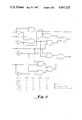
- FIG. 3 shows a truth table and its associated logic circuit, for generating the digital code indicated in FIG. 2.
- FIG. 4 includes a table and a graph, illustrating the selection of the pair of analog signals which will be used to form a quotient, in computing the next address in memory to be triggered.
- FIG. 5. is a block diagram of the components of the present invention, in the preferred embodiment.
- FIG. 6 is a diagram showing the waveforms of a set of commutation pulses for a brushless motor.
- One object of the present invention is to provide quadrature pulse trains which facilitate the measurement of angular displacement of a shaft and its direction of rotation. Another object is to generate pulse trains which act as commutation signals for the motor which drives the shaft.
- the invention generates these quadrature and commutation pulses by sequentially triggering various addresses of a digital memory device, such as an erasable programmable read-only memory (EPROM). If the bits in each address of the EPROM are properly programmed, activation of sequences of addresses of the EPROM will generate the desired pulse trains.
- a digital memory device such as an erasable programmable read-only memory (EPROM).
- a and B Two analog signals, designated as A and B, and their analog complements A' and B', representing the position of the shaft, are provided as inputs to the system. These signals can come from analog sensors disposed near the rotating shaft. The sensors are placed such that their signals are out of phase. The phase relationships will be discussed more fully, below.
- the signals A and B, and their complements, are processed by signal conditioning circuit 10, which compensates for the effects of different types of sensors. For example, circuit 10 may compensate for the gain or offset voltage of the particular sensor used.
- the signals are then fed to region detector circuit 12.
- Circuit 12 determines, by comparing the values of A and B and their complements, the angular region within which the shaft is instantaneously located. Circuit 12 generates a digital code indicative of that region.
- the digital code is transmitted to analog multiplexor 14.
- the multiplexor produces a pair of analog output signals, designated as "NUM” and "DEN". These signals are selected from the group consisting of A, B, A', and B', according to the particular region in which the shaft is momentarily located.
- Analog to digital (A/D) converter 16 then forms a digital signal proportional to the quotient of the NUM and DEN signals. This digital signal is then fed to an address generator and activation circuit 26, which is connected to activate addresses in memory device 28.
- Memory device 28 can be an EPROM or other suitable device.
- the output of A/D converter 16 comprises a relative address in the EPROM.
- the address generator 26 also receives an input from the region detector 12.
- the digital code representing the region, together with the output of A/D converter 16 changes sequentially, various sequential addresses in the EPROM are activated.
- the EPROM is preprogrammed with bit patterns which form the desired quadrature and commutation pulse trains.
- FIG. 5 also shows a feedback loop which enables the system to provide automatic commutation control for a brushless motor. An explanation of this feedback loop is given in the detailed description that follows.
- FIG. 1 A means of generating the initial analog signals A and B is shown in FIG. 1.
- the figure shows two analog sensors disposed near rotating shaft 1 to produce analog signals corresponding to the rotation of the shaft.
- Shaft 1 is assumed to have a set of five permanent magnets mounted thereon, and rotates under the influence of fixed electromagnets (not shown) located around the shaft. Because there are five pole pairs in the example given, a 360° rotation, in the magnetic sense, corresponds to only a 72° rotation in the physical sense. For the sake of clarity, the angles described in this specification are magnetic.
- Analog sensors 3 and 5 are disposed around the shaft 1, and are displaced 90° (magnetic) from each other.
- Sensors 3 and 5 can be linear Hall effect sensors. However, other types of sensors can be used.
- the number of analog sensors can be greater than two, and the number of pole pairs can be greater or less than five.
- Analog sensor 3 is also labeled as “A”, and sensor 5 is labeled as “B”.
- the signals generated by these sensors are the A and B signals discussed above, with respect to FIG. 5, and will be designated throughout this specification as A and B.
- FIG. 2 includes a graph showing the waveforms of signals A and B, through 360° (magnetic) of rotation. Also shown are the analog complements of these signals, designated as A' and B'.
- the 360° interval of the graph in FIG. 2 is divided into eight regions, each representing 45° of magnetic rotation.
- the present invention identifies the region in which the shaft is located, and designates this region by a unique digital code.
- One possible form for this digital code is indicated in the table in FIG. 2, below the graph.
- the digital code comprises three binary digits (bits), and the bits are labeled as "S", "T", and "O". It is seen that the values of S, T, and O, for each region, comprise the binary representations of the numbers from 0 to 7. However, other coding schemes can be used, as long as each region is uniquely specified.
- FIG. 3 A means of determining the components S, T, and O of the digital code is illustrated in FIG. 3.
- the logical conditions describing each region are summarized in the four columns labeled A>B, A>A', B>B', and A>B'.
- These inequalities are represented respectively by logical variables a, b, c, d, which take the value of 1 if the inequality is true and 0 if the inequality is false.
- the entries in the table are 0,1,1, and 1.
- FIG. 4 is a table and graph showing the function of the multiplexor.
- the two analog signals are designated "NUM” and "DEN” (meaning “numerator” and “denominator”).
- NUM and DEN are selected from the group consisting of A, B, A', and B', according to the value of STO, as given in the table.
- the resulting NUM and DEN signals are shown by the heavy lines in the graph in FIG. 4. It is seen that DEN is always greater than or equal to NUM, so that NUM/DEN will not exceed unity.
- A/D converter 16 includes comparator 18, multiplier 20, AND gate 22, and digital counter 24.
- Comparator 18 produces digital outputs, labeled as x and y. If one input to comparator 18 is greater than the other input, then one output will be 1 and the other will be 0, and vice versa. It is preferred that comparator 18 be a "window" comparator. That is, comparator 18 should not indicate that one input is greater than the other until the inputs differ by a predetermined minimum amount. When the inputs are within this amount of each other, both x and y are zero.
- Multiplier 20 is a device which accepts a digital input and an analog input, and produces an analog output proportional to the product of the inputs. As shown in FIG. 5, the analog input to the multiplier is the DEN signal, and the digital input is the output N of counter 24. The output of multiplier 20 is an analog signal equal to (N/256)*DEN, where "*" denotes multiplication.
- the factor of 256 is a scaling factor built into the multiplier circuit, but can be changed as desired.
- Counter 24 is a standard digital up/down counter, made to "saturate" in a digital sense. That is, when it reaches its highest possible value, while counting upward, it holds that value, and when it reaches zero, while counting downward, it remains at zero.
- Comparator 18, multiplier 20, and counter 24 are all commercially available components.
- a multiplier circuit which has been used successfully is known by the designation DAC08, and can be obtained from Precision Monolithics, Inc., or from other sources.
- the comparator can be constructed from a variety of commercially available operational amplifiers, and up/down counters are similarly available.
- A/D converter 16 produces an output N which equals (NUM/DEN) times 256, within 8 bits of quantization.
- NUM/DEN the number of bits
- the size of the counter can be changed. If the counter in n bits wide, the number 256 would be replaced by 2 n . That the A/D conveter 16 produces the desired product is evident from the fact that the converter reaches equilibrium only when the inputs to comparator 18 are approximately equal. If NUM>(N/256)*DEN, then x becomes 1, activating the U/D (up/down) control of counter 24, causing the counter to count upward. If NUM ⁇ (N/256)*DEN, then x becomes 0, causing counter 24 to count downward.
- NUM is approximately equal to (N/256)*DEN, within the window of the comparator, then x and y will be zero, and, by virtue of AND gate 22, the HOLD control of counter 24 will be enabled, causing the counter to stop.
- Address generator 26 produces an address in memory device 28, based on the value of N and on the region, i.e. the value of the digital code STO.
- the memory device is preferably an EPROM, as mentioned above, but it is understood that other types of digital memory devices can be used. In this specification, the term "EPROM" will be used for convenience.
- the addresses activated in the EPROM will be determined not only by the value of N and the region, but also on the level of commutation advance or retard desired.
- the ERPOM is preprogrammed to produce the same quadrature pulses, with different commutation pulses.
- the EPROM is divided into several segments, each corresponding to a different level of commutation advance or retard. Each segment is divided into eight pieces, corresponding to the eight regions represented by the digital code STO. In each piece of the EPROM there are stored, in sequential form, the bits which together define the quadrature and commutation pulses.
- N As the shaft rotates at constant speed within a region, the value of N will move sequentially from 0 to 256 (for an eight-bit counter), or from 256 to 0. However, because of the sinusoidal nature of the A and B signals, this movement will not be linear. Instead the movement will be proportional to a tangent or cotangent function. This fact can be best understood from inspection of FIG. 4.
- N is proportional to the quotient of NUM and DEN, and that NUM and DEN are 90° phase-shifted sinusoids, it is clear that N is proportional to (sin x)/(cos x) or (cos x)/(sin x), where x is the angular displacement of the shaft.
- the quotient must vary according to a tangent or cotangent function.
- the waveforms must be stored in the EPROM according to an arctangent rule. The net result is that as a region is traversed with constant angular velocity, the quadrature pulses coming out of the EPROM will be approximately evenly spaced.
- FIG. 5 includes a feedback loop which shows how the monitoring of the quadrature pulse train can be used to control the commutation of the motor.
- the output of memory device 28 is fed to frequency multiplier 30, which converts the train of pulses into one of higher frequency. By increasing the frequency of the pulses, it is possible e to achieve higher resolution in monitoring the exact angular position of the shaft.
- the output of frequency multiplier 30 is connected to velocity monitoring device 32.
- Device 32 can be a differentiator, or a tachometer, or other means, and provides an output proportional to the rotational velocity of the shaft. Information on this rotational velocity is then fed to one of the inputs to address generator 26. Depending on the magnitude of the angular velocity, a different level of commutation advance or retard will be chosen.
- Address generator 26 activates a segment of memory device 28 which contains commutation signals corresponding to that level of advance or retard.
- Frequency multiplier 30 can be any conventional circuit for frequency multiplication.
- the output of the system is taken from multiplier circuit 30, as indicated by arrow 34. If the frequency multiplier 30 is omitted, then the output would come from memory device 28.
- the signal at arrow 34 will include, in general, both the guadrature and commutation pulses.
- the signal following the path of the arrow leading to block 32 can be either the guadrature or the commutation pulses, or both (in which case some of the pulse trains would be discarded).
- Either the guadrature or the commutation signals can be used to monitor the rotational velocity.
- the frequency of the commutation signals is, in general, much less than that of the guadrature signals, the commutation signals can be used by velocity monitor 32 to provide a general estimate of rotational velocity.
- the relative lack of precision of the commutation signals is not an impediment.
- Example 1 explains the calculation for the guadrature pulses
- Example 2 gives a discussion of computation of the commutation pulses.
- N ranges only from 1 to 20 (instead of 0 to 256, as in the discussion above). Also, the example deals with only one 45° region of rotation.
- Table I contains an entry for each address of the EPROM.
- the first column designates the EPROM address.
- the second column gives a fraction of the EPROM segment, and ranges from 0 to 1, in increments of 1/20.
- the third column is the arctangent of the second column, divided by 45°, and multiplied by the "target resolution", which is 9 in this example.
- the fourth column is the third column rounded to the nearest integer. Rounding is necessary because the a pulse can change only over one EPROM address.
- the last column is used to lay out one line of the EPROM.
- One begins by inserting a 0 or a 1, arbitrarily, in the selected bit of the starting address.
- Table II illustrates the structure of an EPROM segment having quadrature pulses programmed according to the rules given above.
- the line designated as "Quad A” has been derived from Table I as described. Note that it is assumed that each address of the EPROM contains eight bits, and that three of these bits (designated by x's) are unused.
- Table II includes three lines of commutation pulses, designated as Comm 1, Comm 2, and Comm 3.
- the commutation pulses shown in Table II are hypothetical, and are shown only to depict the EPROM section in proper context. The calculation of the commutation pulses will be described in Example 2, below.
- the line designated "Quad B" is the other member of the quadrature pulse line, and is formed by shifting the phase of Quad A by the number of addresses which corresponds to one-quarter of a period (i.e. 90° ) of the pulse waveform. This number of addresses depends on the target resolution. In the example given, Quad A needs to be shifted by one address to produce Quad B. The 90° phase shift between the two signals accounts for the origin of the term "quadrature".
- Quad A and Quad B generate pulses which are phase-shifted relative to each other.
- the frequency of the commutation pulses will, in general, be much lower than that of the quadrature pulses.
- the present example concerns just one 45° region of rotation, i.e. one-eighth of the cycle.
- the remaining portions of the EPROM can be calculated by duplicating the quadrature entries shown in Table II, with proper regard for end points and phase relationships. There would thus be 160 addresses (8 times 20) needed to cover the entire 360° region. These 160 addresses would then be repeated for each level of commutation advance or retard.
- N ranges from 1 to 20, and then from 20 to 1, and then from 1 to 20, and so on.
- the EPROM addresses that are triggered would be 1 to 20, then 40 to 21, then 41 to 60, then 80 to 61, and so on. That is the EPROM is traversed in a zig-zag fashion.
- the absolute address in EPROM is calculated from a knowledge of N and of the region in which the shaft is instantaneously located.
- the output pulses will be approximately uniformly spaced for a constant velocity of rotation.
- Example 1 shows how to program the EPROM to produce the desired quadrature pulses.
- Example 1 does not show the calculation of the communtation pulses, but only shows a hypothetical arrangement of such pulses.
- the next example explains how to program the commutation pulses into the EPROM.
- FIG. 6 is a graph showing three lines of pulses, designated as X, Y, and Z, for one 360° cycle. The pattern shown is assumed to repeat itself many times. These lines are used to determine which of the windings located around the motor shaft are energized. This example is developed for a three-phase motor, but, of course, different numbers of windings can be used.
- each control line is a logical "1" for one-half of the cycle, and the periods of operation for each winding are staggered as shown.
- This sequence is used in common practice; other sequences are also possible.
- the present invention must program information, of the type shown in FIG. 6, into the EPROM.
- the EPROM is traversed in a zig-zag fashion, as described in Example 1, above, and this order of activation of EPROM addresses must be taken into account to produce the desired pulses.
- the fact that, for constant rotational velocity, the addresses in EPROM are traversed nonlinearly over time must be taken into account, as was required in the case of the calculation of the quadrature pulses in Example 1.
- Table III shows an example of a segment of the EPROM which has been programmed for commutation pulses, but without taking into account the nonlinear and zig-zag motions discussed above.
- the first three rows of Table III represent the bits which generate commutation signals similar to those of FIG. 6.
- the last two rows represent quadrature pulses, which could have been calculated by a method similar to that discussed above.
- the 360° region is represented by 72 addresses in EPROM. Each address in the EPROM is assumed to contain 5 bits.
- the asterisks denote the endpoints of the regions, and the region numbers (1-8) are also given. The numbers below the asterisks indicate the addresses.
- the frequency of the commutation pulses is normally much less than that of the quadrature pulses.
- one 360° cycle is represented by 72 addresses in EPROM
- the EPROM is traversed in the following manner. First addresses 1 to 9 are activated, followed by addresses 18 to 10. Then addresses 19 to 27 are activated, followed by addresses 36 to 28, and so on.
- the addresses indicated by this zig-zag motion are represented by the following expressions. If x is the angle of rotation, then for the regions where 0° ⁇ x ⁇ 45°, 90 ⁇ x ⁇ 135°, 180° ⁇ x ⁇ 225°, and 270° ⁇ x ⁇ 315°, the address in the EPROM is given by
- Table III is the rewritten version of Table III. As the addresses of the EPROM illustrated in Table IV are activated in the zig-zag manner described above, the commutation pulses of FIG. 6 are recreated.
- Table V shows a fragment of Table IV, indicating the correction.
- the other commutation lines in region 3 do not need correction because there are no transitions in this region for these lines.
- the one bit that is corrected is underlined.
- the commutation signals depicted in Tables III, IV, and V are for zero commutation advance.
- the resulting table would be as shown in Table VI:
- the first three lines represent pulse trains having a 30° commutation advance.
- the EPROM entries can be adjusted in the manner described earlier.
- the examples given above show only one possible way of implementing the invention. It is possible to reconfigure the EPROM to reduce the amount of redundant information contained therein.
- the EPROM could be programmed such that the quadrature pulses would be entered only once, and not for every level of commutation advance. It is also possible to program the EPROM, for quadrature, over only one region. With the proper control over the activation of addresses in the EPROM, one can cycle back and forth over, say, a 45° region, without the need to consider other regions. This is true because of the inherent symmetry of the problem; each 45° region yields pulses of similar configuration, except for changes in phase.
- the present invention can be adapted to provide automatic control of a brushless motor.
- a circuit can be provided which determines the speed of the shaft by analyzing of one of the quadrature pulse trains.
- the rotational speed can be derived by differentiating the angular position, or by other means.
- the angular position is obtained simply by summing one of the quadrature pulse trains.
- the circuit can then select an appropriate level of commutation advance or retard, based on the measured speed of rotation.
- the operation of the motor is therefore improved for each speed, and the motor can be effectively used at various speeds without diminution in output torque.
- the present invention therefore not only measures the position of a motor shaft, but also helps to control the motor that drives the shaft.
- the invention is not limited to the particular analog sensors used to generate the A and B signals. While linear Hall effect sensors have been suggested, any other sensor which produces an analog signal corresponding to the rotation of the shaft can be employed.
- the invention is also not limited to the number of sensors. More than two sensors can be used, and their phase differences could be other than 90°. In the latter case, a new scheme of forming quotients must be used, and the quotient signals chosen will not, in general, vary according to a tangent or cotangent rule.
- the number of regions into which the 360° rotation is divided may also be changed. It is possible to use almost any number of sensors and any number of regions. However, to a certain extent, the number of regions and the number of sensors are related, insofar as it is convenient to use certain numbers of regions based on the number of sensors, and vice versa. For example, the A and B signals, shown graphically in FIG. 2, most readily suggest the use of eight regions.
- the EPROM could be linearized to accomodate this nonlinear motion, in a manner similar to that described above, except that the values of the trigonometric functions could not be quickly obtained from standard tangent or arctangent tables, but would need to be specially calculated.
- the multiplexor 14 selects analog signals having a nonegative quotient. But it is also possible to choose one positive and one negative signal, and to include circuitry for inverting the sign of the quotient. It should be appreciated that there are many ways to select the signals which can be used to generate addresses in the digital memory 28, and that all of these are within the scope of the invention.
- the memory device used in the present invention has been labeled an EPROM for convenience. Other memory devices can also be used. Any device which stores binary digits, and whose contents can be read upon command, can be used, within the scope of this invention. Also, the size and width (i.e. the number of bits per address) of the memory device can be varied. The greater the memory size, the greater the maximum resolution that will be achievable. The greater the memory width, the greater the number of pulse trains which can be simultaneously produced. It is preferred that the memory be wide enough to provide commutation control as well as quadrature pulses. However, the invention can be used to determine the angular displacement alone, or it can be used to provide commutation control and nothing else. It is understood that the modifications discussed above, and other similar variations, are to be considered within the spirit and scope of the following claims.
Landscapes
- Engineering & Computer Science (AREA)
- Power Engineering (AREA)
- Physics & Mathematics (AREA)
- General Physics & Mathematics (AREA)
- Control Of Motors That Do Not Use Commutators (AREA)
- Control Of Ac Motors In General (AREA)
- Transmission And Conversion Of Sensor Element Output (AREA)
- Length Measuring Devices With Unspecified Measuring Means (AREA)
Priority Applications (5)
| Application Number | Priority Date | Filing Date | Title |
|---|---|---|---|
| US06/843,218 US4697125A (en) | 1986-03-24 | 1986-03-24 | Method and apparatus for determining shaft position and for providing commutation signals |
| AT87104119T ATE89408T1 (de) | 1986-03-24 | 1987-03-20 | Verfahren und vorrichtung zur bestimmung der drehwellenposition und zur lieferung von kommutationssignalen. |
| DE8787104119T DE3785783D1 (de) | 1986-03-24 | 1987-03-20 | Verfahren und vorrichtung zur bestimmung der drehwellenposition und zur lieferung von kommutationssignalen. |
| EP87104119A EP0239026B1 (de) | 1986-03-24 | 1987-03-20 | Verfahren und Vorrichtung zur Bestimmung der Drehwellenposition und zur Lieferung von Kommutationssignalen |
| JP62070112A JPS62249008A (ja) | 1986-03-24 | 1987-03-23 | 軸の角度位置を求めるとともに整流信号を供給するための方法および装置 |
Applications Claiming Priority (1)
| Application Number | Priority Date | Filing Date | Title |
|---|---|---|---|
| US06/843,218 US4697125A (en) | 1986-03-24 | 1986-03-24 | Method and apparatus for determining shaft position and for providing commutation signals |
Publications (1)
| Publication Number | Publication Date |
|---|---|
| US4697125A true US4697125A (en) | 1987-09-29 |
Family
ID=25289360
Family Applications (1)
| Application Number | Title | Priority Date | Filing Date |
|---|---|---|---|
| US06/843,218 Expired - Lifetime US4697125A (en) | 1986-03-24 | 1986-03-24 | Method and apparatus for determining shaft position and for providing commutation signals |
Country Status (5)
| Country | Link |
|---|---|
| US (1) | US4697125A (de) |
| EP (1) | EP0239026B1 (de) |
| JP (1) | JPS62249008A (de) |
| AT (1) | ATE89408T1 (de) |
| DE (1) | DE3785783D1 (de) |
Cited By (34)
| Publication number | Priority date | Publication date | Assignee | Title |
|---|---|---|---|---|
| US4831315A (en) * | 1986-04-04 | 1989-05-16 | Data Recording Instrument Company Limited | Transducer positioning apparatus with multiple modes of motion |
| US4874997A (en) * | 1986-11-20 | 1989-10-17 | Unimation, Inc. | Digital robot control providing pulse width modulation for a brushless DC drive |
| WO1989011688A1 (en) * | 1988-05-16 | 1989-11-30 | Advanced Micro Devices, Inc. | Multi-way polling branching and waiting op code |
| US4891764A (en) * | 1985-12-06 | 1990-01-02 | Tensor Development Inc. | Program controlled force measurement and control system |
| US4990840A (en) * | 1988-02-19 | 1991-02-05 | The Cross Company | Method and system for controlling a machine tool such as a turning machine |
| US5070727A (en) * | 1990-11-16 | 1991-12-10 | General Motors Corporation | Crankshaft angular position detecting apparatus |
| US5216626A (en) * | 1989-07-21 | 1993-06-01 | Dr. Johannes Heidenhain Gmbh | Position measuring apparatus and method having reduced memory requirements |
| US5434491A (en) * | 1992-06-17 | 1995-07-18 | Askoll S.P.A. | Electronic device for starting a synchronous motor with permanent-magnet rotor |
| US5539293A (en) * | 1993-06-07 | 1996-07-23 | Switched Reluctance Drives Limited | Rotor position encoder having features in decodable angular positions |
| US5663624A (en) * | 1992-03-05 | 1997-09-02 | Hewlett-Packard Company | Closed-loop method and apparatus for controlling acceleration and velocity of a stepper motor |
| US5942863A (en) * | 1994-06-07 | 1999-08-24 | Matsushita Electric Industrial Co., Ltd. | Three-phase brushless servo motor |
| DE19812966A1 (de) * | 1998-03-24 | 1999-09-30 | Peter Koller | Bürstenloser Gleichstrommotor und Verfahren zu seiner Herstellung |
| US5995710A (en) * | 1998-07-24 | 1999-11-30 | Advanced Motion Controls, Inc. | Speed control for brushless DC motors |
| US6034499A (en) * | 1997-04-01 | 2000-03-07 | Tranovich; Stephen J. | Method of controlling rotary position of a torque motor |
| US6252366B1 (en) * | 1997-07-04 | 2001-06-26 | Lucent Technologies Inc. | Device for digitally slaving the position of a moving part |
| EP1093210A3 (de) * | 1999-10-15 | 2001-12-19 | Yamaha Hatsudoki Kabushiki Kaisha | Elektrische Antriebseinrichtung |
| KR100319138B1 (ko) * | 2000-01-06 | 2002-01-04 | 구자홍 | 3상 브러시리스 직류 모터의 오동작 보정 회로 |
| WO2002004895A3 (en) * | 2000-07-07 | 2002-04-11 | Fluidsense Corp | Optical position sensor and position determination method |
| US6396052B1 (en) | 2000-04-07 | 2002-05-28 | Lexmark International, Inc. | High precision analog encoder system |
| US20020101208A1 (en) * | 1999-07-21 | 2002-08-01 | Donald A. Yost | Brushless direct current motor having supervised rotor position feedback |
| US6434516B1 (en) | 1999-11-12 | 2002-08-13 | Balluff, Inc. | Method and apparatus for synthesizing an incremental signal |
| US6460567B1 (en) * | 1999-11-24 | 2002-10-08 | Hansen Technologies Corpporation | Sealed motor driven valve |
| US6487033B1 (en) | 1998-09-25 | 2002-11-26 | Seagate Technology Llc | Motor speed observer for data protection in a disc drive |
| US6535830B2 (en) * | 2000-07-28 | 2003-03-18 | Liquid Controls, Inc. | Scaled quadrature pulse signal generator |
| WO2004038907A1 (de) * | 2002-10-24 | 2004-05-06 | Iropa Ag | Sensorsystem und verfahren zur vektorsteuerung |
| US6757635B2 (en) | 2001-12-12 | 2004-06-29 | Balluff, Inc. | Programmed method and apparatus for quadrature output sensors |
| US20050077860A1 (en) * | 2002-06-14 | 2005-04-14 | Hagen Mark D. | Resonant scanning mirror driver circuit |
| US20070183070A1 (en) * | 2006-01-19 | 2007-08-09 | Pascal Desbiolles | Coding method and device for determining absolute angular position |
| EP0986162B1 (de) * | 1998-08-24 | 2007-12-05 | Levitronix LLC | Sensoranordnung in einem elektromagnetischen Drehantrieb |
| US20100250184A1 (en) * | 2008-03-18 | 2010-09-30 | Satoshi Kawamura | Rotation angle detection apparatus |
| US20120211323A1 (en) * | 2009-11-09 | 2012-08-23 | Schaeffler Technologies AG & Co. KG | Method for the slip regulation of a friction clutch and clutch actuator therefor |
| US20180234040A1 (en) * | 2015-06-23 | 2018-08-16 | Nidec Sankyo Corporation | Motor |
| CN113790742A (zh) * | 2016-07-20 | 2021-12-14 | 德克萨斯仪器股份有限公司 | 确定正交脉冲的旋转方向和有效转变的方法 |
| US20240337326A1 (en) * | 2023-04-04 | 2024-10-10 | Illinois Tool Works Inc. | Valve actuator and method of reducing current consumption |
Families Citing this family (14)
| Publication number | Priority date | Publication date | Assignee | Title |
|---|---|---|---|---|
| US5202614A (en) * | 1989-09-25 | 1993-04-13 | Silicon Systems, Inc. | Self-commutating, back-emf sensing, brushless dc motor controller |
| DE69610270T2 (de) * | 1995-07-25 | 2001-02-22 | Switched Reluctance Drives Ltd., Harrogate | Regelung einer geschalteten Reluktanzmaschine |
| EP1191677A1 (de) * | 2000-08-24 | 2002-03-27 | Mts Systems Corporation | Bürstenloser Gleichstrommotor mit überwachter Rotorpositionsrückführung |
| JP2002156205A (ja) * | 2000-11-20 | 2002-05-31 | Mitsuba Corp | 回転角度検出装置 |
| US8118024B2 (en) | 2003-08-04 | 2012-02-21 | Carefusion 203, Inc. | Mechanical ventilation system utilizing bias valve |
| JP2007501074A (ja) | 2003-08-04 | 2007-01-25 | パルモネティック システムズ インコーポレイテッド | 携帯型人工呼吸器システム |
| US7527053B2 (en) | 2003-08-04 | 2009-05-05 | Cardinal Health 203, Inc. | Method and apparatus for attenuating compressor noise |
| BRPI0413261A (pt) * | 2003-08-04 | 2006-10-10 | Pulmonetic Systems Inc | método para controlar um ventilador portátil, aparelho de ventilador portátil, métodos para controlar um motor elétrico, e para calibrar uma servovelocidade |
| US7607437B2 (en) | 2003-08-04 | 2009-10-27 | Cardinal Health 203, Inc. | Compressor control system and method for a portable ventilator |
| US8156937B2 (en) | 2003-08-04 | 2012-04-17 | Carefusion 203, Inc. | Portable ventilator system |
| JPWO2006070826A1 (ja) * | 2004-12-28 | 2008-08-07 | 旭化成エレクトロニクス株式会社 | 磁気方式回転角センサ、および、角度情報処理装置 |
| KR100905937B1 (ko) * | 2007-05-03 | 2009-07-06 | 국방과학연구소 | 선형 홀 센서를 이용한 브러시리스 dc 모터 및 이 모터속도 신호 구현 방법 |
| US7997885B2 (en) | 2007-12-03 | 2011-08-16 | Carefusion 303, Inc. | Roots-type blower reduced acoustic signature method and apparatus |
| US8888711B2 (en) | 2008-04-08 | 2014-11-18 | Carefusion 203, Inc. | Flow sensor |
Citations (25)
| Publication number | Priority date | Publication date | Assignee | Title |
|---|---|---|---|---|
| US3745544A (en) * | 1970-11-05 | 1973-07-10 | Ono Sokki Co Ltd | Apparatus for measuring angles |
| US3813592A (en) * | 1971-08-12 | 1974-05-28 | Honeywell Inf Systems | Stepping motor acceleration and deceleration control |
| US3831170A (en) * | 1972-10-13 | 1974-08-20 | Readx Inc | Position indicating apparatus and digital circuitry for it |
| US4031478A (en) * | 1976-06-29 | 1977-06-21 | International Telephone And Telegraph Corporation | Digital phase/frequency comparator |
| US4072893A (en) * | 1975-10-10 | 1978-02-07 | Fabbrica Italiana Magneti Marelli S.P.A. | Apparatus for determining the angular position of a rotating member using reference and position elements that generate opposite polarity bipolar signals |
| US4157507A (en) * | 1977-05-09 | 1979-06-05 | Pertec Corporation | Electronic system for detecting direction of motion |
| US4183014A (en) * | 1977-01-21 | 1980-01-08 | Tri-N Associates, Inc. | Absolute encoding apparatus |
| JPS55106095A (en) * | 1979-02-08 | 1980-08-14 | Sony Corp | Brushless dc motor |
| US4220924A (en) * | 1978-03-16 | 1980-09-02 | Osann Robert Jr | Digital phase decoding technique for quadrature phased signals |
| JPS55142000A (en) * | 1979-04-24 | 1980-11-06 | Toshiba Corp | Pulse motor driving circuit |
| JPS5674094A (en) * | 1979-11-22 | 1981-06-19 | Sony Corp | Brushless dc motor |
| JPS5768697A (en) * | 1980-10-16 | 1982-04-27 | Janome Sewing Mach Co Ltd | Driving device for pulse motor |
| US4328463A (en) * | 1980-03-27 | 1982-05-04 | Rca Corporation | Encoder for recording incremental changes |
| JPS57162994A (en) * | 1981-03-31 | 1982-10-06 | Ricoh Co Ltd | Controlling method for scanning drive pulse motor |
| JPS5892005A (ja) * | 1981-11-26 | 1983-06-01 | Omron Tateisi Electronics Co | プログラマブル・コントロ−ラ |
| JPS5896305A (ja) * | 1981-12-02 | 1983-06-08 | Yokogawa Hokushin Electric Corp | デイジタルプロセス制御方式 |
| JPS58163298A (ja) * | 1982-03-19 | 1983-09-28 | Fujitsu General Ltd | パルスモータ駆動パルスの周波数制御装置 |
| US4412206A (en) * | 1979-09-21 | 1983-10-25 | Johannes Heidenhain Gmbh | Digital electrical length or angle measuring device |
| US4442532A (en) * | 1981-05-19 | 1984-04-10 | Matsushita Electric Industrial Co., Ltd. | Encoder output pulse detection using two stage shift register and clock oscillator |
| US4443787A (en) * | 1980-01-30 | 1984-04-17 | Hans List | Apparatus for measuring the angular position of a shaft |
| US4479078A (en) * | 1980-06-20 | 1984-10-23 | Kollmorgen Technologies Corporation | Brushless motor controller |
| US4485452A (en) * | 1982-03-22 | 1984-11-27 | The Bendix Corporation | Speed measurement system |
| US4496936A (en) * | 1982-06-04 | 1985-01-29 | Atari, Inc. | Digital-analog conversion for shaft encoders |
| US4532461A (en) * | 1983-11-01 | 1985-07-30 | Kollmorgen Technologies Corporation | Rotor position sensor error detection |
| US4572999A (en) * | 1983-06-14 | 1986-02-25 | Kollmorgen Technologies Corporation | Brushless tachometer |
Family Cites Families (1)
| Publication number | Priority date | Publication date | Assignee | Title |
|---|---|---|---|---|
| IT1160621B (it) * | 1978-08-31 | 1987-03-11 | Olivetti Controllo Numerico | Apparecchiatura per la misura numerica di posizioni |
-
1986
- 1986-03-24 US US06/843,218 patent/US4697125A/en not_active Expired - Lifetime
-
1987
- 1987-03-20 AT AT87104119T patent/ATE89408T1/de not_active IP Right Cessation
- 1987-03-20 EP EP87104119A patent/EP0239026B1/de not_active Expired - Lifetime
- 1987-03-20 DE DE8787104119T patent/DE3785783D1/de not_active Expired - Lifetime
- 1987-03-23 JP JP62070112A patent/JPS62249008A/ja active Pending
Patent Citations (26)
| Publication number | Priority date | Publication date | Assignee | Title |
|---|---|---|---|---|
| US3745544A (en) * | 1970-11-05 | 1973-07-10 | Ono Sokki Co Ltd | Apparatus for measuring angles |
| US3813592A (en) * | 1971-08-12 | 1974-05-28 | Honeywell Inf Systems | Stepping motor acceleration and deceleration control |
| US3831170A (en) * | 1972-10-13 | 1974-08-20 | Readx Inc | Position indicating apparatus and digital circuitry for it |
| US4072893A (en) * | 1975-10-10 | 1978-02-07 | Fabbrica Italiana Magneti Marelli S.P.A. | Apparatus for determining the angular position of a rotating member using reference and position elements that generate opposite polarity bipolar signals |
| US4031478A (en) * | 1976-06-29 | 1977-06-21 | International Telephone And Telegraph Corporation | Digital phase/frequency comparator |
| US4183014A (en) * | 1977-01-21 | 1980-01-08 | Tri-N Associates, Inc. | Absolute encoding apparatus |
| US4157507A (en) * | 1977-05-09 | 1979-06-05 | Pertec Corporation | Electronic system for detecting direction of motion |
| US4220924A (en) * | 1978-03-16 | 1980-09-02 | Osann Robert Jr | Digital phase decoding technique for quadrature phased signals |
| JPS55106095A (en) * | 1979-02-08 | 1980-08-14 | Sony Corp | Brushless dc motor |
| JPS55142000A (en) * | 1979-04-24 | 1980-11-06 | Toshiba Corp | Pulse motor driving circuit |
| US4412206A (en) * | 1979-09-21 | 1983-10-25 | Johannes Heidenhain Gmbh | Digital electrical length or angle measuring device |
| JPS5674094A (en) * | 1979-11-22 | 1981-06-19 | Sony Corp | Brushless dc motor |
| US4443787A (en) * | 1980-01-30 | 1984-04-17 | Hans List | Apparatus for measuring the angular position of a shaft |
| US4328463A (en) * | 1980-03-27 | 1982-05-04 | Rca Corporation | Encoder for recording incremental changes |
| US4479078A (en) * | 1980-06-20 | 1984-10-23 | Kollmorgen Technologies Corporation | Brushless motor controller |
| US4417188A (en) * | 1980-10-16 | 1983-11-22 | Janome Sewing Machine Co. Ltd. | Pulse motor driving system |
| JPS5768697A (en) * | 1980-10-16 | 1982-04-27 | Janome Sewing Mach Co Ltd | Driving device for pulse motor |
| JPS57162994A (en) * | 1981-03-31 | 1982-10-06 | Ricoh Co Ltd | Controlling method for scanning drive pulse motor |
| US4442532A (en) * | 1981-05-19 | 1984-04-10 | Matsushita Electric Industrial Co., Ltd. | Encoder output pulse detection using two stage shift register and clock oscillator |
| JPS5892005A (ja) * | 1981-11-26 | 1983-06-01 | Omron Tateisi Electronics Co | プログラマブル・コントロ−ラ |
| JPS5896305A (ja) * | 1981-12-02 | 1983-06-08 | Yokogawa Hokushin Electric Corp | デイジタルプロセス制御方式 |
| JPS58163298A (ja) * | 1982-03-19 | 1983-09-28 | Fujitsu General Ltd | パルスモータ駆動パルスの周波数制御装置 |
| US4485452A (en) * | 1982-03-22 | 1984-11-27 | The Bendix Corporation | Speed measurement system |
| US4496936A (en) * | 1982-06-04 | 1985-01-29 | Atari, Inc. | Digital-analog conversion for shaft encoders |
| US4572999A (en) * | 1983-06-14 | 1986-02-25 | Kollmorgen Technologies Corporation | Brushless tachometer |
| US4532461A (en) * | 1983-11-01 | 1985-07-30 | Kollmorgen Technologies Corporation | Rotor position sensor error detection |
Cited By (44)
| Publication number | Priority date | Publication date | Assignee | Title |
|---|---|---|---|---|
| US4891764A (en) * | 1985-12-06 | 1990-01-02 | Tensor Development Inc. | Program controlled force measurement and control system |
| WO1990007741A1 (en) * | 1985-12-06 | 1990-07-12 | Tensor Development, Inc. | Program controlled force measurement and control system |
| US4831315A (en) * | 1986-04-04 | 1989-05-16 | Data Recording Instrument Company Limited | Transducer positioning apparatus with multiple modes of motion |
| US4874997A (en) * | 1986-11-20 | 1989-10-17 | Unimation, Inc. | Digital robot control providing pulse width modulation for a brushless DC drive |
| US4990840A (en) * | 1988-02-19 | 1991-02-05 | The Cross Company | Method and system for controlling a machine tool such as a turning machine |
| WO1989011688A1 (en) * | 1988-05-16 | 1989-11-30 | Advanced Micro Devices, Inc. | Multi-way polling branching and waiting op code |
| US5216626A (en) * | 1989-07-21 | 1993-06-01 | Dr. Johannes Heidenhain Gmbh | Position measuring apparatus and method having reduced memory requirements |
| US5070727A (en) * | 1990-11-16 | 1991-12-10 | General Motors Corporation | Crankshaft angular position detecting apparatus |
| EP0486088A3 (en) * | 1990-11-16 | 1993-05-12 | General Motors Corporation | Apparatus for detecting crankshaft position |
| US5663624A (en) * | 1992-03-05 | 1997-09-02 | Hewlett-Packard Company | Closed-loop method and apparatus for controlling acceleration and velocity of a stepper motor |
| US5434491A (en) * | 1992-06-17 | 1995-07-18 | Askoll S.P.A. | Electronic device for starting a synchronous motor with permanent-magnet rotor |
| US5539293A (en) * | 1993-06-07 | 1996-07-23 | Switched Reluctance Drives Limited | Rotor position encoder having features in decodable angular positions |
| US5637972A (en) * | 1993-06-07 | 1997-06-10 | Switched Reluctance Drives, Ltd. | Rotor position encoder having features in decodeable angular positions |
| US5942863A (en) * | 1994-06-07 | 1999-08-24 | Matsushita Electric Industrial Co., Ltd. | Three-phase brushless servo motor |
| US6034499A (en) * | 1997-04-01 | 2000-03-07 | Tranovich; Stephen J. | Method of controlling rotary position of a torque motor |
| US6252366B1 (en) * | 1997-07-04 | 2001-06-26 | Lucent Technologies Inc. | Device for digitally slaving the position of a moving part |
| DE19812966A1 (de) * | 1998-03-24 | 1999-09-30 | Peter Koller | Bürstenloser Gleichstrommotor und Verfahren zu seiner Herstellung |
| US5995710A (en) * | 1998-07-24 | 1999-11-30 | Advanced Motion Controls, Inc. | Speed control for brushless DC motors |
| EP0986162B1 (de) * | 1998-08-24 | 2007-12-05 | Levitronix LLC | Sensoranordnung in einem elektromagnetischen Drehantrieb |
| US6487033B1 (en) | 1998-09-25 | 2002-11-26 | Seagate Technology Llc | Motor speed observer for data protection in a disc drive |
| US20020101208A1 (en) * | 1999-07-21 | 2002-08-01 | Donald A. Yost | Brushless direct current motor having supervised rotor position feedback |
| EP1093210A3 (de) * | 1999-10-15 | 2001-12-19 | Yamaha Hatsudoki Kabushiki Kaisha | Elektrische Antriebseinrichtung |
| US6434516B1 (en) | 1999-11-12 | 2002-08-13 | Balluff, Inc. | Method and apparatus for synthesizing an incremental signal |
| US6460567B1 (en) * | 1999-11-24 | 2002-10-08 | Hansen Technologies Corpporation | Sealed motor driven valve |
| KR100319138B1 (ko) * | 2000-01-06 | 2002-01-04 | 구자홍 | 3상 브러시리스 직류 모터의 오동작 보정 회로 |
| US6396052B1 (en) | 2000-04-07 | 2002-05-28 | Lexmark International, Inc. | High precision analog encoder system |
| WO2002004895A3 (en) * | 2000-07-07 | 2002-04-11 | Fluidsense Corp | Optical position sensor and position determination method |
| US6535830B2 (en) * | 2000-07-28 | 2003-03-18 | Liquid Controls, Inc. | Scaled quadrature pulse signal generator |
| US7310587B2 (en) | 2001-12-12 | 2007-12-18 | Balluff, Inc. | Programmed method and apparatus for quadrature output sensors |
| US6757635B2 (en) | 2001-12-12 | 2004-06-29 | Balluff, Inc. | Programmed method and apparatus for quadrature output sensors |
| US20040208473A1 (en) * | 2001-12-12 | 2004-10-21 | Topmiller David Allen | Programmed method and apparatus for quadrature output sensors |
| US6956350B2 (en) * | 2002-06-14 | 2005-10-18 | Texas Instruments Incorporated | Resonant scanning mirror driver circuit |
| US20050077860A1 (en) * | 2002-06-14 | 2005-04-14 | Hagen Mark D. | Resonant scanning mirror driver circuit |
| CN1316733C (zh) * | 2002-10-24 | 2007-05-16 | 艾罗帕股份有限公司 | 用于矢量控制的传感器系统及方法 |
| WO2004038907A1 (de) * | 2002-10-24 | 2004-05-06 | Iropa Ag | Sensorsystem und verfahren zur vektorsteuerung |
| US20070183070A1 (en) * | 2006-01-19 | 2007-08-09 | Pascal Desbiolles | Coding method and device for determining absolute angular position |
| US7388528B2 (en) * | 2006-01-19 | 2008-06-17 | Snr Roulements | Coding method and device for determining absolute angular position |
| US20100250184A1 (en) * | 2008-03-18 | 2010-09-30 | Satoshi Kawamura | Rotation angle detection apparatus |
| DE112009000121B4 (de) * | 2008-03-18 | 2013-09-26 | Mitsubishi Electric Corp. | Rotationswinkel-Erfassungsvorrichtung |
| US20120211323A1 (en) * | 2009-11-09 | 2012-08-23 | Schaeffler Technologies AG & Co. KG | Method for the slip regulation of a friction clutch and clutch actuator therefor |
| US9014935B2 (en) * | 2009-11-09 | 2015-04-21 | Schaeffler Technologies AG & Co. KG | Method for the slip regulation of a friction clutch and clutch actuator therefor |
| US20180234040A1 (en) * | 2015-06-23 | 2018-08-16 | Nidec Sankyo Corporation | Motor |
| CN113790742A (zh) * | 2016-07-20 | 2021-12-14 | 德克萨斯仪器股份有限公司 | 确定正交脉冲的旋转方向和有效转变的方法 |
| US20240337326A1 (en) * | 2023-04-04 | 2024-10-10 | Illinois Tool Works Inc. | Valve actuator and method of reducing current consumption |
Also Published As
| Publication number | Publication date |
|---|---|
| EP0239026B1 (de) | 1993-05-12 |
| EP0239026A2 (de) | 1987-09-30 |
| EP0239026A3 (en) | 1989-10-11 |
| DE3785783D1 (de) | 1993-06-17 |
| JPS62249008A (ja) | 1987-10-30 |
| ATE89408T1 (de) | 1993-05-15 |
Similar Documents
| Publication | Publication Date | Title |
|---|---|---|
| US4697125A (en) | Method and apparatus for determining shaft position and for providing commutation signals | |
| US4450403A (en) | Method and apparatus for determining rotational speed | |
| US4604575A (en) | Multiple output rotational position detection device | |
| US4947166A (en) | Single track absolute encoder | |
| US4906992A (en) | Single track absolute encoder | |
| US5202842A (en) | Rotational position detecting device which compensates for eccentricity of rotating object | |
| US4506312A (en) | Apparatus for controlling the speed of a rotating body | |
| EP0213904A2 (de) | Interpolationsverfahren und Kodierer | |
| US4362980A (en) | Position error recovery and motor control system | |
| US4183014A (en) | Absolute encoding apparatus | |
| KR100787256B1 (ko) | 고해상도 위치센서장치 및 방법 | |
| US4215300A (en) | Error correcting serial input positioning system | |
| US4710770A (en) | Phase modulation type digital position detector | |
| US4823000A (en) | Apparatus for indicating the value of a variable | |
| US4095157A (en) | Digital servomechanism control system | |
| US6310458B1 (en) | Blended velocity estimation | |
| EP0612979A1 (de) | Sensor zur Anzeige der Lage eines Code-Organs relativ zu einem Detektor | |
| SU1043700A1 (ru) | Преобразователь скорости перемещени в код | |
| SU447738A1 (ru) | Электромагнитный преобразователь угол-код | |
| SU710057A1 (ru) | Преобразователь угол-дискретное приращение фазы | |
| JPH0650254B2 (ja) | 計測装置、及び該計測装置を用いたサーボ制御装置 | |
| SU760151A1 (ru) | Компенсационный преобразователь угла поворота вала в код 1 | |
| SU1080173A2 (ru) | Преобразователь перемещени в код | |
| SU752425A1 (ru) | Преобразователь угла поворота вала в код | |
| SU960882A1 (ru) | Преобразователь перемещени в код |
Legal Events
| Date | Code | Title | Description |
|---|---|---|---|
| AS | Assignment |
Owner name: PERFORMANCE CONTROLS, INC., 333 BYBERRY RD., HATBO Free format text: ASSIGNMENT OF ASSIGNORS INTEREST.;ASSIGNORS:GOFF, JERRY K.;CHIZEVER, GARY E.;REEL/FRAME:004542/0690 Effective date: 19860318 |
|
| STCF | Information on status: patent grant |
Free format text: PATENTED CASE |
|
| FPAY | Fee payment |
Year of fee payment: 4 |
|
| FPAY | Fee payment |
Year of fee payment: 8 |
|
| FPAY | Fee payment |
Year of fee payment: 12 |