US11795202B2 - Fusion polypeptide comprising a foreign antigen and self antigen - Google Patents
Fusion polypeptide comprising a foreign antigen and self antigen Download PDFInfo
- Publication number
- US11795202B2 US11795202B2 US16/322,786 US201716322786A US11795202B2 US 11795202 B2 US11795202 B2 US 11795202B2 US 201716322786 A US201716322786 A US 201716322786A US 11795202 B2 US11795202 B2 US 11795202B2
- Authority
- US
- United States
- Prior art keywords
- protein
- antigen
- tumor
- polypeptide
- mgi
- Prior art date
- Legal status (The legal status is an assumption and is not a legal conclusion. Google has not performed a legal analysis and makes no representation as to the accuracy of the status listed.)
- Active, expires
Links
Images


Classifications
-
- C—CHEMISTRY; METALLURGY
- C07—ORGANIC CHEMISTRY
- C07K—PEPTIDES
- C07K14/00—Peptides having more than 20 amino acids; Gastrins; Somatostatins; Melanotropins; Derivatives thereof
- C07K14/435—Peptides having more than 20 amino acids; Gastrins; Somatostatins; Melanotropins; Derivatives thereof from animals; from humans
- C07K14/46—Peptides having more than 20 amino acids; Gastrins; Somatostatins; Melanotropins; Derivatives thereof from animals; from humans from vertebrates
- C07K14/47—Peptides having more than 20 amino acids; Gastrins; Somatostatins; Melanotropins; Derivatives thereof from animals; from humans from vertebrates from mammals
- C07K14/4701—Peptides having more than 20 amino acids; Gastrins; Somatostatins; Melanotropins; Derivatives thereof from animals; from humans from vertebrates from mammals not used
- C07K14/4748—Tumour specific antigens; Tumour rejection antigen precursors [TRAP], e.g. MAGE
-
- A—HUMAN NECESSITIES
- A61—MEDICAL OR VETERINARY SCIENCE; HYGIENE
- A61K—PREPARATIONS FOR MEDICAL, DENTAL OR TOILETRY PURPOSES
- A61K39/00—Medicinal preparations containing antigens or antibodies
- A61K39/0005—Vertebrate antigens
- A61K39/0011—Cancer antigens
-
- A—HUMAN NECESSITIES
- A61—MEDICAL OR VETERINARY SCIENCE; HYGIENE
- A61P—SPECIFIC THERAPEUTIC ACTIVITY OF CHEMICAL COMPOUNDS OR MEDICINAL PREPARATIONS
- A61P35/00—Antineoplastic agents
-
- C—CHEMISTRY; METALLURGY
- C07—ORGANIC CHEMISTRY
- C07K—PEPTIDES
- C07K14/00—Peptides having more than 20 amino acids; Gastrins; Somatostatins; Melanotropins; Derivatives thereof
- C07K14/195—Peptides having more than 20 amino acids; Gastrins; Somatostatins; Melanotropins; Derivatives thereof from bacteria
- C07K14/24—Peptides having more than 20 amino acids; Gastrins; Somatostatins; Melanotropins; Derivatives thereof from bacteria from Enterobacteriaceae (F), e.g. Citrobacter, Serratia, Proteus, Providencia, Morganella, Yersinia
- C07K14/245—Escherichia (G)
-
- C—CHEMISTRY; METALLURGY
- C07—ORGANIC CHEMISTRY
- C07K—PEPTIDES
- C07K14/00—Peptides having more than 20 amino acids; Gastrins; Somatostatins; Melanotropins; Derivatives thereof
- C07K14/435—Peptides having more than 20 amino acids; Gastrins; Somatostatins; Melanotropins; Derivatives thereof from animals; from humans
- C07K14/78—Connective tissue peptides, e.g. collagen, elastin, laminin, fibronectin, vitronectin or cold insoluble globulin [CIG]
-
- C—CHEMISTRY; METALLURGY
- C07—ORGANIC CHEMISTRY
- C07K—PEPTIDES
- C07K16/00—Immunoglobulins [IG], e.g. monoclonal or polyclonal antibodies
- C07K16/18—Immunoglobulins [IG], e.g. monoclonal or polyclonal antibodies against material from animals or humans
-
- C—CHEMISTRY; METALLURGY
- C12—BIOCHEMISTRY; BEER; SPIRITS; WINE; VINEGAR; MICROBIOLOGY; ENZYMOLOGY; MUTATION OR GENETIC ENGINEERING
- C12N—MICROORGANISMS OR ENZYMES; COMPOSITIONS THEREOF; PROPAGATING, PRESERVING, OR MAINTAINING MICROORGANISMS; MUTATION OR GENETIC ENGINEERING; CULTURE MEDIA
- C12N15/00—Mutation or genetic engineering; DNA or RNA concerning genetic engineering, vectors, e.g. plasmids, or their isolation, preparation or purification; Use of hosts therefor
- C12N15/09—Recombinant DNA-technology
- C12N15/11—DNA or RNA fragments; Modified forms thereof; Non-coding nucleic acids having a biological activity
- C12N15/62—DNA sequences coding for fusion proteins
-
- C—CHEMISTRY; METALLURGY
- C12—BIOCHEMISTRY; BEER; SPIRITS; WINE; VINEGAR; MICROBIOLOGY; ENZYMOLOGY; MUTATION OR GENETIC ENGINEERING
- C12Q—MEASURING OR TESTING PROCESSES INVOLVING ENZYMES, NUCLEIC ACIDS OR MICROORGANISMS; COMPOSITIONS OR TEST PAPERS THEREFOR; PROCESSES OF PREPARING SUCH COMPOSITIONS; CONDITION-RESPONSIVE CONTROL IN MICROBIOLOGICAL OR ENZYMOLOGICAL PROCESSES
- C12Q1/00—Measuring or testing processes involving enzymes, nucleic acids or microorganisms; Compositions therefor; Processes of preparing such compositions
- C12Q1/68—Measuring or testing processes involving enzymes, nucleic acids or microorganisms; Compositions therefor; Processes of preparing such compositions involving nucleic acids
- C12Q1/6876—Nucleic acid products used in the analysis of nucleic acids, e.g. primers or probes
- C12Q1/6883—Nucleic acid products used in the analysis of nucleic acids, e.g. primers or probes for diseases caused by alterations of genetic material
- C12Q1/6886—Nucleic acid products used in the analysis of nucleic acids, e.g. primers or probes for diseases caused by alterations of genetic material for cancer
-
- A—HUMAN NECESSITIES
- A61—MEDICAL OR VETERINARY SCIENCE; HYGIENE
- A61K—PREPARATIONS FOR MEDICAL, DENTAL OR TOILETRY PURPOSES
- A61K39/00—Medicinal preparations containing antigens or antibodies
- A61K2039/555—Medicinal preparations containing antigens or antibodies characterised by a specific combination antigen/adjuvant
- A61K2039/55511—Organic adjuvants
- A61K2039/55566—Emulsions, e.g. Freund's adjuvant, MF59
-
- A—HUMAN NECESSITIES
- A61—MEDICAL OR VETERINARY SCIENCE; HYGIENE
- A61K—PREPARATIONS FOR MEDICAL, DENTAL OR TOILETRY PURPOSES
- A61K39/00—Medicinal preparations containing antigens or antibodies
- A61K2039/58—Medicinal preparations containing antigens or antibodies raising an immune response against a target which is not the antigen used for immunisation
- A61K2039/585—Medicinal preparations containing antigens or antibodies raising an immune response against a target which is not the antigen used for immunisation wherein the target is cancer
-
- A—HUMAN NECESSITIES
- A61—MEDICAL OR VETERINARY SCIENCE; HYGIENE
- A61K—PREPARATIONS FOR MEDICAL, DENTAL OR TOILETRY PURPOSES
- A61K39/00—Medicinal preparations containing antigens or antibodies
- A61K2039/60—Medicinal preparations containing antigens or antibodies characteristics by the carrier linked to the antigen
- A61K2039/6031—Proteins
- A61K2039/6068—Other bacterial proteins, e.g. OMP
-
- C—CHEMISTRY; METALLURGY
- C07—ORGANIC CHEMISTRY
- C07K—PEPTIDES
- C07K2319/00—Fusion polypeptide
- C07K2319/20—Fusion polypeptide containing a tag with affinity for a non-protein ligand
- C07K2319/21—Fusion polypeptide containing a tag with affinity for a non-protein ligand containing a His-tag
-
- C—CHEMISTRY; METALLURGY
- C07—ORGANIC CHEMISTRY
- C07K—PEPTIDES
- C07K2319/00—Fusion polypeptide
- C07K2319/35—Fusion polypeptide containing a fusion for enhanced stability/folding during expression, e.g. fusions with chaperones or thioredoxin
-
- C—CHEMISTRY; METALLURGY
- C12—BIOCHEMISTRY; BEER; SPIRITS; WINE; VINEGAR; MICROBIOLOGY; ENZYMOLOGY; MUTATION OR GENETIC ENGINEERING
- C12Q—MEASURING OR TESTING PROCESSES INVOLVING ENZYMES, NUCLEIC ACIDS OR MICROORGANISMS; COMPOSITIONS OR TEST PAPERS THEREFOR; PROCESSES OF PREPARING SUCH COMPOSITIONS; CONDITION-RESPONSIVE CONTROL IN MICROBIOLOGICAL OR ENZYMOLOGICAL PROCESSES
- C12Q2600/00—Oligonucleotides characterized by their use
- C12Q2600/106—Pharmacogenomics, i.e. genetic variability in individual responses to drugs and drug metabolism
-
- C—CHEMISTRY; METALLURGY
- C12—BIOCHEMISTRY; BEER; SPIRITS; WINE; VINEGAR; MICROBIOLOGY; ENZYMOLOGY; MUTATION OR GENETIC ENGINEERING
- C12Q—MEASURING OR TESTING PROCESSES INVOLVING ENZYMES, NUCLEIC ACIDS OR MICROORGANISMS; COMPOSITIONS OR TEST PAPERS THEREFOR; PROCESSES OF PREPARING SUCH COMPOSITIONS; CONDITION-RESPONSIVE CONTROL IN MICROBIOLOGICAL OR ENZYMOLOGICAL PROCESSES
- C12Q2600/00—Oligonucleotides characterized by their use
- C12Q2600/112—Disease subtyping, staging or classification
Definitions
- the invention is in the field of medicine. More specifically, it is in the field of medical treatment and diagnostics relating to immunotherapy based on anti-self antibodies, as produced by a subjects immune system to foreign-self protein fusions.
- the invention relates to foreign-self protein fusions, to compositions comprising such fusions as immunogens, and vaccines based thereon.
- the invention further relates to methods of producing antiself antibodies.
- the invention also relates to methods of detecting protein expression using antiself antibodies, in particular for diagnostic purpose, such as for determining tumor angiogenesis status in the diagnosis of cancer.
- the invention relates to foreign-self protein fusions as therapeutic antigens, to antiself antibodies for use in therapy and diagnostics, and to compositions comprising such fusions or antibodies.
- Human antiself antibodies are of particular value for in vivo therapeutic and diagnostic purposes, since they avoid the problems arising from the antigenicity of foreign, e.g. mouse antibodies.
- the most useful human antibodies for therapy are those directed against cell surface molecules, such as receptors, adhesins and integrins, and those directed against circulating biological effector molecules, such as hormones, growth factors and cytokines. It has been extremely difficult to obtain human antibodies against such self antigens (anti-self antibodies) and to generate human mAbs directed against human antigens, for example to treat or prevent atherosclerosis or asthma, to treat cancer, or to block septic shock. This difficulty results from immunological tolerance mechanisms that prevent the antigen-driven expansion of B-cell clones with self specificities. This invention provides a powerful way of obtaining such antibodies.
- VEGF vascular endothelial growth factor
- VEGF neutralizing antibodies such as bevacizumab (Avastin®) or tyrosine kinase inhibitors of the growth factor receptors (e.g. sunitinib, Sutent®).
- bevacizumab prolongs survival in colorectal cancer patients on average by only 3-4 months. Part of this limited therapeutic effect is due to induction of drug resistance that develops upon inhibition of tumor-derived growth. Besides their limited activity, current angiogenesis inhibitors show severe side-effects in patients.
- anti-angiogenic cancer drugs with higher specificity are needed. It is noted herein that especially the development of therapeutic anti-angiogenic cancer vaccine compositions, comprising tumor vascular antigens “self” to the human body that are involved in angiogenesis, is an arduous task. The immune response to self-antigens is tightly regulated to avoid recognition of self-molecules and thereby destruction of “self” tissues. At the onset of cancer, T-cells are occasionally able to recognize self-antigens on cancer cells and to evoke an immune response against the cancer. However, when the cancer progresses, immune surveillance of the disease is impaired due to the fact that the cancer employs several mechanisms to impair the immune response. These mechanisms include, amongst others, downregulation of MHC-I, secretion of TGF beta, which suppresses the immune system and the induction of T regulatory cells. For these reasons, vaccination against cancer is a challenge.
- the art describes inter alia anti-angiogenic cancer vaccine compositions that comprise a fusion protein consisting of a foreign part (e.g. bacterial thioredoxin, TRX), linked to a “self” antigen (e.g. extra domain-B (EDB) of fibronectin).
- a problem related to the use of such fusion proteins is that, although the foreign immunogen is a requirement for inducing the immune response against self, an overt antigenicity of the foreign part of the fusion protein can suppress the humoral immune response against the self antigen.
- fusion polypeptides in vaccine compositions that allow for the induction of a suitable amount of immunogenicity against the self part. This is due to the strong antibody titer response against the foreign immunogen.
- there are no fusion polypeptides described that provide for a reduced humoral immune response against a foreign, non-self antigen, thereby maximizing the response to the self antigen.
- non-self or foreign polypeptide part it was found that by carefully designing the non-self or foreign polypeptide part to contain either a truncation as compared to an immunogenic parent polypeptide and/or a specific percentage of hydrophilic, bulky amino acid residues, it was possible to provide a fusion polypeptide that is capable of inducing an immune response against the self polypeptide by redirecting the immune response to reduce the antibody response to the foreign antigen.
- an immunogenic composition is provided that is improved in that it exhibits a reduced humoral immune response against a foreign, non-self antigen, while having an increased humoral immune response against an antigen of interest, such as a self-antigen, as compared to inter alia a non-truncated parent molecule from which the non-self antigen is derived. It was further found that such a tumor vaccine, when administered to a subject, elicits a relevant immune response against an antigen such as a self-antigen.
- the inventors solved the aforementioned problem by providing a fusion polypeptide comprising a foreign antigen and a self antigen, wherein said foreign antigen consists of a polypeptide comprising an amino acid sequence of at least 12-15 amino acid residues, 12-24% of which residues are hydrophilic, bulky amino acid residues selected from the group consisting of histidine, glutamate, arginine, glutamine, aspartic acid and/or lysine.
- said foreign antigen comprises an immunogenic region of the truncated protein of SEQ ID NO:1 or of a truncated protein having at least 90% sequence identity (over the length of the protein) to the protein of SEQ ID NO:1; or an immunogenic region of the truncated protein of SEQ ID NO:2 or of a truncated protein having at least 90% sequence identity (over the length of the protein) to the protein of SEQ ID NO:2; or an immunogenic region of the optionally truncated protein of SEQ ID NO:3 or of a protein having at least 90% sequence identity to the optionally truncated protein of SEQ ID NO:3.
- said truncation in said truncated protein comprises a removal of from between 1 and 100 amino acids, preferably between 10 and 50 amino acids, from the C-terminal side, the N-terminal side, or both the C- and N-terminal side of said protein.
- said foreign antigen comprises an immunogenic region of 45-70 consecutive amino acid residues of the protein of SEQ ID NO:1 or of a protein having at least 90% sequence identity to the protein of SEQ ID NO:1; or an immunogenic region of 110-150 consecutive amino acid residues of the protein of SEQ ID NO:2 or of a protein having at least 90% sequence identity to the protein of SEQ ID NO:2; or an immunogenic region of 45-61 consecutive amino acid residues of the protein of SEQ ID NO:3 or of a protein having at least 90% sequence identity to the protein of SEQ ID NO:3.
- said fusion polypeptide elicits a serum level of immunoglobulins against said self antigen of at least 0.5%, preferably at least 1%, of the total serum immunoglobulin level in a mammalian subject to which said fusion polypeptide is administered.
- said foreign antigen comprises the amino acid sequence of SEQ ID NOs: 3, 4, 6 or 7.
- said self antigen is a mammalian, preferably human, polypeptide, the expression of which is associated with tumor angiogenesis, preferably said polypeptide is selected from the group consisting of tissue inhibitor of metalloproteinase 1 (Timp1), apelin (Apln), serum amyloid A3 (Saa3), CD93 antigen (Cd93), heart development protein with EGF-like domains 1 (Heg1), Notch 4, apelin receptor (Aplnr), nestin (Nes), tenascin C (Tnc), pentraxin related gene (Ptx3), vimentin (Vim), human EGF receptor-2 (erbb2, HER2), erbb3 (HER3), tumor necrosis factor alpha induced protein 6 (Tnfaip6), carboxypeptidase Z (Cpz), snail family zinc finger 1 (Snai1), premelanosome protein (Pmel),
- tissue inhibitor of metalloproteinase 1 Timp1
- said immunogenic region of the protein of SEQ ID NO:1 is in the region of Ala-30 to Ala-109, preferably the region of Gln-52 to Ala-109, of the protein of SEQ ID NO:1; and/or wherein said 110-150 immunogenic amino acid residue region of the protein of SEQ ID NO:2 is the region of Ala-24 to Ile-154 of the protein of SEQ ID NO:2.
- said foreign antigen consists of the amino acid sequence of SEQ ID NOs: 3, 4, 6 or 7.
- said fusion protein comprises a linker peptide linking said foreign and self antigen, preferably a GS linker peptide.
- the present invention provides the fusion polypeptide according to the invention as described above for use as a medicament, preferably for use as a vaccine antigen for eliciting an immune response against said self antigen, more preferably for use in treating or preventing arthritis, atherosclerosis, restenosis, transplant arteriopathy, warts, scar keloids, synovitis, osteomyelitis, asthma, nasal polyps, polypoidal choroidal vasculopathy, age-related macular degeneration, retinopathy of prematurity, diabetic retinopathy, AIDS, IBD, Crohn's disease, endometriosis, uterine bleeding, psoriasis, myoma's, cancer, or combinations thereof.
- the present invention provides the fusion polypeptide according to the invention for use in inhibiting, counteracting or blocking tumor angiogenesis and/or removing tumor vasculature in a subject.
- the present invention provides a nucleic acid encoding a fusion polypeptide according to the invention, optionally comprised in an expression vector.
- the present invention provides a host cell comprising the nucleic acid according to the invention.
- the present invention provides an immunogenic composition
- an immunogenic composition comprising the fusion polypeptide according to the invention or the nucleic acid according to the invention, said composition further comprising a pharmaceutically acceptable carrier, preferably an aqueous liquid, and optionally an adjuvant.
- the composition is a vaccine composition, preferably for use in treating or preventing arthritis, atherosclerosis, restenosis, transplant arteriopathy, warts, scar keloids, synovitis, osteomyelitis, asthma, nasal polyps, polypoidal choroidal vasculopathy, age-related macular degeneration, retinopathy of prematurity, diabetic retinopathy, AIDS, IBD, Crohn's disease, endometriosis, uterine bleeding, psoriasis, myoma's, cancer, or combinations thereof.
- said composition comprises an adjuvant in a weight percent ratio range of fusion polypeptide:adjuvant of 3:1 to 1:3, preferably about 1:1.
- the present invention provides an isolated antiself antibody that specifically binds to the self antigen of the fusion polypeptide according to the invention.
- said antibody is a monoclonal antibody, preferably of the IgG isotype, preferably said monoclonal antibody is isolated from a B-cell from a mammal having received the fusion protein and for which said self antigen is self.
- said antibody is labeled with a detectable label.
- the present invention provides an immortalized B-cell line producing a monoclonal antibody that specifically binds to the self antigen of the fusion polypeptide according to the invention.
- the present invention provides a method for eliciting an immune response against a self antigen comprising administering to a subject in need of treatment a therapeutically effective dose of the fusion polypeptide according to the invention or the composition according to the invention.
- the present invention provides a method for treating or preventing arthritis, atherosclerosis, restenosis, transplant arteriopathy, warts, scar keloids, synovitis, osteomyelitis, asthma, nasal polyps, polypoidal choroidal vasculopathy, age-related macular degeneration, retinopathy of prematurity, diabetic retinopathy, AIDS, IBD, Crohn's disease, endometriosis, uterine bleeding, psoriasis, myoma's, cancer, or combinations thereof, comprising administering to a subject in need of treatment a therapeutically effective dose of the fusion polypeptide according to the invention or the composition according to the invention.
- a method of typing a subject comprising contacting said subject or a body sample of said subject with the isolated antiself antibody according to the invention, allowing said antibody to specifically bind to its antigen, and evaluating the level of specific binding between said antibody and said antigen, preferably by measuring the amount of specifically bound antibody wherein said antibody is an antibody labeled with a detectable label, preferably wherein said method of typing is a method of stratifying patients.
- the present invention provides a method of typing a subject for a tumor angiogenesis status, comprising the steps of a) measuring a gene expression level of at least one gene expression product in a sample of a subject comprising, or suspected to comprise, tumor cells, preferably tumor endothelial cells, wherein said at least one gene expression product is selected from the group formed by tissue inhibitor of metalloproteinase 1 (Timp1), apelin (Apln), serum amyloid A3 (Saa3), CD93 antigen (Cd93), heart development protein with EGF-like domains 1 (Heg1), Notch 4, apelin receptor (Aplnr), nestin (Nes), tenascin C (Tnc), pentraxin related gene (Ptx3), vimentin (Vim), tumor necrosis factor alpha induced protein 6 (Tnfaip6), carboxypeptidase Z (Cpz), snail family zinc finger 1 (Snai1), premelanosome protein (Timp
- said typing is the typing of said sample of said subject.
- said gene expression control value is obtained by measuring the gene expression level of said at least one gene expression product in a control sample comprising non-tumor endothelial cells of a subject.
- said subject is typed positive for tumor angiogenesis status if the gene expression level of said at least one gene expression product is at least 5 times, preferably at least 20 times, higher than said gene expression control value, or wherein said subject is typed negative for tumor angiogenesis status if the gene expression level of said at least one gene expression product is not at least 5 times higher, preferably not at least 20 times higher, than said gene expression control value.
- the present invention provides a diagnostic method comprising using the antibody according to the invention, wherein said diagnostic method comprises evaluating cytostatic efficacy of a cytostatic or prediction of drug activity.
- the various therapeutic methods of the invention may also be used for anti-angiogenic therapies, including, but not limited to disorders relating to angiogenesis.
- FIG. 1 shows different fusion protein constructs and the vaccination mechanism.
- Panel A displays the different fusion protein constructs that were developed.
- TRX protein (13.2 kDa) and TRXtr protein (7.6 kDa) were used for vaccination of control mice.
- Panel B shows the appearance of the proteins used on SDS-PAGE or western blot after purification. TRXtr appears at ⁇ 15 kDa, which is about twice its expected size, probably due to dimerization.
- antigen-presenting cells take up the fusion protein and present foreign (non-self) peptides and self-peptides (EDB) on MHC class II. Only the foreign peptides will be recognized by the T-cell receptor (TCR) on T-helper cells (T-helper) and cause T-cell activation. Self-peptides are not seen, since auto-reactive T cells are deleted in the thymus during development. On the other hand auto-reactive B cells are present in the circulation. Those will recognize the self-part (EDB) of the fusion protein via their B-cell receptor (BCR).
- BCR B-cell receptor
- FIG. 1 D shows a Venn-diagram, indicating genes upregulated in E11, E18 and TEC compared to adult mouse (as explained in Example 1).
- FIG. 2 shows anti-EDB antibody levels in wild type C57BL/6 mice vaccinated with the indicated fusion proteins. From FIG. 2 , it follows that the fusion proteins of the invention elicit increased antibody titer levels against the self-antigen EDB as compared to the TRX-EDB fusion protein known from the art.
- FIG. 3 shows anti-EDB antibody titers per individual mouse for each treatment group in two individual studies. Serum was diluted 1:100-1:24300 and optical density measured at 655 nm. FIG. 3 again underlines the fact that the fusion proteins of the invention elicit increased anti-EDB antibody titers as compared to the TRX-EDB fusion protein.
- FIG. 4 panels A and B, shows that anti-EDB antibody levels are increased upon truncation of TRX, whereas panel B shows that antibodies to TRX are reduced when TRX is truncated.
- Panel C shows antibody titers against TRX in C57BL/6 mice vaccinated with TRX, TRX-EDB or TRXtr-EDB (study II).
- FIG. 5 shows in panels A)-D) anti-vimentin antibody levels in mice vaccinated with TRX, TRXtr, TRX-vimentin and TRXtr-vimentin.
- Panels A)-B) relate to a study wherein mice were vaccinated with the indicated fusion proteins and one week after the last booster antibody levels were measured in the sera. Afterwards mice were implanted with a B16-F10 melanoma cells.
- Panels C)-D) relate to a study wherein mice were vaccinated with the indicated fusion proteins and one week after the last booster antibody levels were measured in the sera. Afterwards mice were implanted with a CT26 carcinoma cells.
- FIG. 6 shows in panels A)-D) anti-vimentin antibody titers per individual C57BL/6 mouse. Serum was diluted 1:100-1:24300 and optical density measured at 655 nm.
- FIG. 7 Tumor volumes of mice vaccinated with TRXtr-Vim, TRX-Vim, TRXtr or TRX.
- CT26 colon carcinoma cells In the B16-F10 model the TRXtr-Vim fusion protein performed better than TRX-Vim.
- FIG. 8 Target validation by reverse transcription quantitative PCR (RT-qPCR). Expression levels (2 . ⁇ Ct ) of target genes in different tissues and cell lines.
- FIG. 9 lists a preferred embodiment for the self antigen, wherein said self antigen has an antitumor effect.
- FIG. 10 lists a preferred embodiment for the self antigen, wherein said self antigen is high in Mets.
- FIG. 11 lists a number of preferred embodiments for the self antigens, wherein said self antigens are membrane antigens.
- FIG. 12 lists a number of preferred embodiments for the self antigens, wherein said self antigens are secreted antigens.
- FIG. 13 lists a number of preferred embodiments for the self antigens, wherein said self antigens are cytoplasmatic targets.
- FIG. 14 lists a number of preferred embodiments for the self antigens, wherein said self antigens are extracellular targets.
- FIG. 15 lists a number of preferred embodiments for the self antigens, wherein said self antigens are involved in various disease related processes.
- FIG. 16 lists a number of preferred embodiments for the self antigens, wherein said self antigens are involved in tumor development.
- FIG. 17 lists a number of preferred embodiments for the self antigens, wherein said self antigens are involved in metastasis.
- FIG. 18 shows in panel A) the amino acid sequence of thioredoxin-S 2 from E. coli and its secondary structure elements. Amino acid residues 51-108 were used to generate a truncated immunogenic region of 45-70 consecutive amino acid residues of the protein of SEQ ID NO:1 or of a protein having at least 90% sequence identity to the protein of SEQ ID NO:1 (TRX-trunc) (box). In this illustration, the starting amino acid methionine (M) is lacking.
- Panel B) shows a schematic drawing of the three-dimensional structure of E. coli thioredoxin-S 2 . The line (close to the arrowed ⁇ 1 subunit) indicates the cleavage site to generate TRX-trunc as indicated in SEQ ID NO: 4.
- FIG. 19 shows expression of self antigen target PSMA in tumour endothelium compared to normal endothelium.
- FIG. 20 shows expression of the self antigen targets LAMA4, EMILIN2 and FBN2 in tumour endothelium compared to normal endothelium.
- Left panels Comparison of target gene expression on endothelium of different tumour types compared to normal endothelium. Data obtained from the Human Protein Atlas and scored as follows: 0, no staining detected; 1, weak; 2, moderate; 3 high.
- RRCC Renal cell carcinoma
- CRCC Colorectal cancer
- FIG. 21 shows the expression of the self antigen target CD99 in tumour endothelium of Ewing sarcoma (EWS).
- EWS Ewing sarcoma
- Human Ewing sarcoma tissues were stained with an anti-CD99 antibody (ab27271, Abcam, Cambridge, UK).
- Arrows in the third picture from the left indicate vascular expression of CD99. Magnification 200 ⁇ .
- FIG. 22 shows the expression of the self antigen target VCAN in the tumor endothelium of renal cell carcinoma.
- Human renal cell carcinoma tissues and normal kidney were stained with an anti-Versican antibody.
- Arrows indicate vascular expression of VCAN.
- Arrow heads in the far right panel show that no vascular staining is present in the glomeruli of normal kidney tissue. Magnification 200 ⁇ .
- FIG. 23 shows the expression of the self antigen target CD93 in the tumor endothelium.
- FIG. 24 shows mRNA expression (through RT-qPCR) of the self-antigen target genes Sfrp2, Aplnr, Fbn2, Vcan, Lama4, Igsf10, Emilin2, Nid2 and Sulf2 in embryo E11, embryo E18 and adult mouse.
- Sfrp2 mRNA is heavily upregulated in tumor endothelium (TEC). Also in the mouse endothelial cell line Bend5 Sfrp2 is expressed, whereas B16-F10 melanoma cells do not express Sfrp2.
- FIG. 25 shows that the induction of a humoral immune response against CD99 with a fusion polypeptide of the invention inhibits Ewing Sarcoma (EWS) tumor growth.
- EWS Ewing Sarcoma
- FIG. 26 shows that the induction of a humoral immune response against CD99 with a fusion polypeptide of the invention inhibits CT26 colon tumor growth.
- FIG. 27 shows that self antigen target insulin receptor (INSR) is overexpressed in tumor endothelial cells.
- INSR self antigen target insulin receptor
- A Overexpression of INSR in colorectal cancer (qPCR; (8)) and renal cell cancer (proteomics; (49)) associated endothelial cells.
- B Immunohistochemical staining for INSR on sections of different paraffin embedded human solid tumors (colon, kidney, stomach, breast, skin) and the INSR normal tissue counterparts. A clear induction of vascular staining (brown) is seen in tumors (T) as compared to normal tissues (insets; N). Scale bars represent 50 ⁇ m.
- C Immunohistochemical staining for INSR of human head and neck squamous carcinoma tissue with adjacent normal tissue.
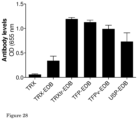
- FIG. 28 shows on the y-axis anti-self antigen antibody levels (antibodies against EDB) induced with different fusion polypeptide constructs of the invention (TRX-EDB, TRXtr-EDB, TFP-EDB, TFPv-EDB and USP-EDB. All foreign antigens are superior to full-length TRX in inducing antibodies against the self-antigen EDB.
- immunogenic refers to the ability of a compound, for example formulated in a vaccine, to elicit an immune response, either humoral or cell-mediated, or both. If an antigen elicits such an immune response it is also referred to as an immunogen.
- the immune response is a humoral immune response mediated primarily by B cells and helper T-cells.
- T-cell response can be determined with ELISPOT or ELISA, and that a humoral immune response can be determined with ELISA.
- An immunogenic composition as referred to herein is a pharmaceutical composition, preferably in the form of a suspension, emulsion or solution.
- the immunogenic compositions disclosed herein may or may not be immunoprotective or therapeutic.
- the term immunogenic composition is not intended to be limited to vaccines.
- the immunogenic composition is a vaccine such as a tumor vaccine, also referred to as a tumor antigen vaccine.
- An immunogenic composition is in general made under conditions allowing for administration to a subject, e.g., it is made under GMP conditions.
- An immunogenic composition of the invention may comprise pharmaceutically acceptable excipients, e.g., without limitation, emulsifiers (surfactants) stabilizers, bulking agents, buffers, carriers, diluents, vehicles, solubilizers, and binders.
- An immunogenic composition of the invention comprising foreign-self protein fusions is preferably adapted for administration by vaccination such as intramuscular or intradermal.
- An immunogenic composition of the invention comprising foreign-self protein fusions is preferably not for intravenous or other forms of parenteral administration.
- a composition of the invention comprising antiself antibodies (such as monoclonal antibodies) is preferably adapted for parenteral administration, such as intravenous administration and/or is preferably not for parenteral administration.
- An immunogenic composition or vaccine comprising foreign-self protein fusions may optionally comprise an adjuvant.
- the adjuvant is provided in a separate formulation and is administered before, after or essentially at the same time as administration of a foreign-self protein fusion of the invention.
- Administration of the adjuvant may occur via the same route of administration as foreign-self protein fusion, or via a different route of administration.
- the term “antigen” generally refers to a biological molecule, usually a protein, peptide, polysaccharide, lipid or conjugate which contains at least one epitope to which a cognate antibody can selectively bind; or in some instances to an immunogenic substance, i.e. immunogen, that stimulates the production of antibodies or T-cell responses, or both, in a subject.
- the immune response may be generated against the whole molecule, or to one or more various portions of the molecule (e.g., an epitope or hapten).
- the term preferably refers to a polypeptide moiety.
- An antigen is recognized by antibodies, T-cell receptors or other elements of specific humoral and/or cellular immunity.
- antigenic epitopes include reference to at least one, or all, antigenic epitopes of polypeptide moieties or proteins described herein.
- antigenic parts i.e. a part of a polypeptide moiety against which an antigenic response is elicitable.
- antigenic parts of the proteins or polypeptides moieties described herein are envisaged in a fusion polypeptide of the invention.
- Such antigenic parts preferably have a folded conformation corresponding to the antigenic part of the native, folded conformation of the full-length polypeptide moiety.
- Epitopes of a given antigen can be identified using any number of epitope mapping techniques, well known in the art. See, e.g., Epitope Mapping Protocols in Methods in Molecular Biology, Vol. 66 (Glenn E. Morris, Ed., 1996) Humana Press, Totowa, N.J.
- linear epitopes may be determined by e.g., concurrently synthesizing large numbers of peptides on solid supports, the peptides corresponding to portions of the protein molecule, and reacting the peptides with antibodies while the peptides are still attached to the supports.
- Such techniques are known in the art and described in, e.g., U.S. Pat. No.
- conformational epitopes may be identified by determining spatial conformation of amino acids such as by, e.g., x-ray crystallography and 2-dimensional nuclear magnetic resonance. See, e.g., Epitope Mapping Protocols, supra.
- an “antigen” may also be used to refer to a polypeptide moiety that includes modifications, such as deletions, additions and substitutions (generally conservative in nature, but they may be non-conservative), to the native sequence, as long as the polypeptide moiety maintains the ability to elicit an immunological response in a subject. These modifications may be deliberate, as through site-directed mutagenesis, or through particular synthetic procedures, or through a genetic engineering approach, or may be accidental, such as through mutations of hosts, which produce the antigens. Synthetic antigens are also included, for example, polyepitopes, flanking epitopes, and other recombinant or synthetically derived antigens (Bergmann et al.
- the antigen denoted as the self antigen is preferably of mammalian, more preferably of mouse, dog or human, more preferably of human, origin.
- a human antigen if administration to a human individual as envisaged, is also referred to as a self-antigen.
- the self antigen in the context of the invention, may be a self-antigen of any mammal, such as of a horse, dog, monkey, mouse, cat, rat, preferably a human.
- a self-antigen is in general not immunogenic when administered to a subject that is “self” in relation to the antigen.
- a preferred antigen is an antigen specific for angiogenesis, such as tumor-angiogenesis.
- immunogen refers to a compound such as a polypeptide capable of eliciting an immune response.
- an immunogen is also an antigen.
- an antigen is not necessarily an immunogen.
- An immunogen is preferably of non-mammalian—such as bacterial—, origin and/or synthetic.
- fusion polypeptide refers to a polypeptide composed of at least two different polypeptide moieties, which are typically in their native, folded conformation and are generally joined by their respective amino and carboxyl termini through a peptide linker.
- polypeptide “protein” and “peptide” are used interchangeably herein. These terms encompasses (poly)peptide analogs, which may have, for example, modifications rendering the peptides more stable while in a body or more capable of penetrating into cells.
- Such modifications include, but are not limited to, N-terminus modification, C-terminus modification, peptide bond modification, including, but not limited to, CH 2 —NH, CH 2 —S, CH 2 —S ⁇ O, O ⁇ C—NH, CH 2 —O, CH 2 —CH 2 , S ⁇ C—NH, CH ⁇ CH or CF ⁇ CH and backbone modifications.
- Methods for preparing peptidomimetic compounds are well known in the art and are specified, for example, in Quantitative Drug Design, C. A. Ramsden Gd., Chapter 17.2, F. Choplin, Pergamon Press (1992).
- hydrophilic, bulky amino acid residues refers to a group of amino acid residues consisting of histidine, glutamic acid, arginine, glutamine, aspartic acid and lysine.
- the immunogenic properties of an immunogen could be modulated by varying the percentage of hydrophilic and bulky amino acid residues in the immunogen denoted as the foreign antigen.
- a percentage of hydrophilic, bulky amino acid residues it is meant that the sum of the number of hydrophilic, bulky amino acid residues in said immunogenic region of said foreign antigen is divided by the total number of amino acid residues in said immunogenic region, thus calculated over the full length of the immunogenic region.
- the percentage of hydrophilic, bulky amino acid residues is preferably 20-24%.
- the percentage of hydrophilic, bulky amino acid residues is preferably 14-22%.
- the percentage of hydrophilic, bulky amino acid residues is preferably 13-17%.
- clinical relevant immune response preferably refers to a serum level of immunoglobulins against a self antigen as referred to herein of at least 0.5%, preferably at least 1%, of the total serum immunoglobulin G (IgG) level in a subject.
- IgG total serum immunoglobulin G
- sequence identity refers to sequence identity between two amino acid (or nucleic acid) sequences, expressed as a percentage of amino acid (or nucleotide) residues that are identical upon comparison of two amino acid (or nucleic acid) sequences. Said comparison preferably is performed over the total length of the two amino acid (or nucleic acid) sequences.
- sequence identity is expressed as percentage of sequence similarity (i.e. identity) over the length of the entire protein.
- subject refers to an animal, preferably a mammal such as a horse, dog, monkey, mouse, cat, rat, pig, Guinee pig, hamster, more preferably a human.
- the subject is preferably in need of administration of a foreign-self protein fusion, antibody, or composition of the invention, for therapy or diagnosis.
- the subject is preferably in need of administration of a foreign-self protein fusion, antibody, or composition of the invention, for therapy.
- foreign antigen refers to an antigen foreign to the immune system of a mammal, such as a bacterial antigen.
- the antigen may be part of a fusion protein.
- self antigen refers to an antigen that is “self” to the immune system of a mammal, such as a normal human protein.
- the self antigen may be part of a fusion protein.
- self antigen includes reference to mammalian polypeptides the expression of which is associated with tumor angiogenesis.
- truncation or “truncated”, as used in the context of fusion polypeptides of the invention, refers to an amino acid sequence that is not identical to its reference sequence, for the reason that, in comparison to that reference sequence, at least one amino acid residue is missing from the N-terminal and/or C-terminal end.
- serum refers to blood serum.
- linker peptide refers to amino acid sequences that connect or link at least two polypeptide moieties.
- Cancers treatable using the fusion proteins, compositions and vaccines of the invention include carcinomas, sarcomas, leukaemias, lymphomas, and other types of cancer.
- tumor refers to a cellular mass exhibiting abnormal growth in tissue, which occurs when cellular proliferation is more rapid than proliferation of normal tissue and continues to grow after the stimuli that normally initiate growth cease.
- tumor includes cancer cells, necrosis, as well as stroma. Tumors generally exhibit partial or complete lack of structural organization and functional coordination with normal, healthy tissue, and usually form a distinct mass of tissue which may be benign or malignant.
- the tumor treated or vaccinated against is a malignant tumor requiring tumor angiogenesis in order to continue growing and eventually metastasizing.
- said tumor is a leukemia or a solid tumor or solid cancer, preferably selected from the group formed by sarcomas, carcinomas, and lymphomas.
- solid tumors include but are not limited to sarcomas and carcinomas such as fibrosarcoma, myxosarcoma, liposarcoma, chondrosarcoma, osteogenic sarcoma, chordoma, angiosarcoma, endotheliosarcoma, lymphangiosarcoma, lymphangioendotheliosarcoma, synovioma, mesothelioma, Ewing's tumor, leiomyosarcoma, rhabdomyosarcoma, colon carcinoma, pancreatic cancer, breast cancer, ovarian cancer, prostate cancer, squamous cell carcinoma, basal cell carcinoma, adenocarcinoma, sweat gland carcinoma, sebaceous gland carcinoma, papillary carcinoma, papillary adenocarcinomas
- leukaemia refers broadly to progressive, malignant diseases of the blood-forming organs and is generally characterized by a distorted proliferation and development of leukocytes and their precursors in the blood and bone marrow. Leukaemia is generally clinically classified on the basis of (1) the duration and character of the disease-acute or chronic; (2) the type of cell involved; myeloid (myelogenous), lymphoid (lymphogenous), or monocytic; and (3) the increase or non-increase in the number abnormal cells in the blood-leukaemic or aleukaemic (subleukaemic).
- the present invention includes a method of treating leukaemia, and, preferably, a method of treating acute nonlymphocytic leukaemia, chronic lymphocytic leukaemia, acute granulocytic leukaemia, chronic granulocytic leukaemia, acute promyelocytic leukaemia, adult T-cell leukaemia, aleukaemic leukaemia, a leukocythemic leukaemia, basophylic leukaemia, blast cell leukaemia, bovine leukaemia, chronic myelocytic leukaemia, leukaemia cutis, embryonal leukaemia, eosinophilic leukaemia, Gross' leukaemia, hairy-cell leukaemia, hemoblastic leukaemia, hemocytoblastic leukaemia, histiocytic leukaemia, stein cell leukaemia, acute monocytic leukaemia, leukopenic leukaemia, lymphatic leuka
- angiogenesis generally refers to the physiological process of blood vessel formation, preferably blood vessel formation from pre-existing blood vessels.
- tumor angiogenesis refers to tumor-induced angiogenesis, i.e. the physiological process of tumor-induced blood vessel formation, preferably from pre-existing blood vessels, so as to secure blood supply to the tumor.
- antigenic polypeptide moiety refers to an antigenic polypeptide moiety.
- such a polypeptide moiety is specific to tumor angiogenesis and not specific to non-tumor related angiogenesis, such as wound healing.
- the present inventors have provided a comprehensive list of such polypeptide moieties, based on a highly specific and novel screening method as described in Example 1. These moieties can be conjugated to an immunogen, as described herein, by their full length or a part thereof so as to present or display at least one epitope or antigenic determinant.
- the self antigen may be a structural component of a blood vessel formed during tumor angiogenesis, preferably a structural component specific to a blood vessel formed in tumor angiogenesis and not specific to a blood vessel formed in non-tumor related angiogenesis, such as a polypeptide moiety, or a part thereof, selected from the group formed by, or consisting of, tissue inhibitor of metalloproteinase 1 (Timp1), apelin (Apln), serum amyloid A3 (Saa3), CD93 antigen (CD93), heart development protein with EGF-like domains 1 (Heg1), Notch 4, apelin receptor (Aplnr), nestin (Nes), tenascin C (Tnc), pentraxin related gene (Ptx3), vimentin (Vim), prostate specific membrane antigen (PSMA), human EGF receptor-2 (HER2), HER3, tumor necrosis factor alpha induced protein 6 (Tnfaip6), carboxypeptidase Z (Cpz), snail
- the polypeptide moieties are specific to (i) embryonic tissue and (ii) blood vessels formed in tumor angiogenesis, or (iii) tumor cells.
- the self antigen is selected from the group formed by or consisting of vimentin (Vim), CD93, CD99, HER2, HER3, prostate specific membrane antigen (PSMA). Based on the screening method as described herein, the skilled person is able to identify further self antigens that fulfill the aforementioned criteria.
- blood vessel may refer to part of the vascular system comprised of endothelial cells, extracellular matrix, a basal membrane.
- tumor vasculature refers to a system of blood vessels, recruited during tumor angiogenesis, securing a blood supply to the tumor.
- tumor vasculature can identify tumor vasculature on the basis of blood vessel structure parameters such as extracellular matrix composition and/or vascular permeability by using (electron)microscopy.
- adjuvant refers to a compound that enhances the immune response of a subject to an antigen, e.g. a polypeptide of the invention when administered with that polypeptide.
- the adjuvant is preferably a pharmaceutically acceptable adjuvant, such as Montanide ISA 720 (Seppic SA, France), granulocyte-monocyte colony stimulating factor (GM-CSF), Freund's complete adjuvant (F5881, Sigma-Aldrich), preferably for primer vaccinations, Freund's incomplete adjuvant (F5506, Sigma-Aldrich), preferably for booster vaccinations.
- adjuvants may be co-formulated in an immunogenic composition of the invention, or may be provided in a further, alternative formulation.
- the term “typing”, as used herein, refers to differentiating or stratifying between subjects according to a tumor angiogenesis status or tumor vasculature status.
- the typing is preferably based on a comparison of (i) a gene expression level of at least one gene expression product in a sample of a subject and (ii) a gene expression control value.
- the typing differentiates subjects suffering, or suspected to suffer from, a tumor, preferably of malignant tumor, in a group having an increased risk of tumor metastasis and a group not having such an increased risk.
- sample refers to a biological sample encompassing a variety of sample types obtained from an organism and can be used in a diagnostic or monitoring assay.
- the term encompasses blood and other liquid samples of biological origin, solid tissue samples, such as a biopsy specimen or tissue cultures or cells derived therefrom and the progeny thereof.
- the term encompasses samples that have been manipulated in any way after their procurement, such as by treatment with reagents, solubilization, or enrichment for certain components.
- the term encompasses a clinical sample, and also includes cells in cell culture, cell supernatants, cell lysates, serum, plasma, biological fluids, and tissue samples.
- tumor angiogenesis status refers to a stratification in (i) a group that is found to be positive for tumor angiogenesis status—presence of tumor angiogenesis—based on the gene expression level of at least one gene expression product in said sample of said subject as compared to said gene expression control value, or (ii) a group that is found to be negative for tumor angiogenesis status—absence of tumor angiogenesis—based on the gene expression level of said at least one gene expression product in said sample of said subject as compared to said gene expression control value.
- gene expression product includes inter alia RNA products and protein products, including (poly)peptides.
- the skilled person is aware of quantitative methods for measuring gene expression product levels, such as micro-array analysis, northern blotting, western blotting for proteins, ELISA, quantitative RT-PCR and next-generation sequencing.
- the gene expression level is measured by RNA sequencing and/or quantitative (RT-)PCR.
- control value is a cut-off value providing a demarcation between a positive and a negative tumor angiogenesis status or tumor vasculature status.
- Said control value is preferably a pre-determined similarity threshold value set at a value at which an acceptable number of subjects with a status that is positive would score as false negatives, and an acceptable number of patients with a status that is negative would score as false positives.
- a similarity threshold value is preferably displayed or outputted to a user interface device, a computer readable storage medium, or a local or remote computer system. The person skilled in the art is well aware of statistical methods to develop such a similarity threshold value.
- said gene expression control value can be obtained by measuring the gene expression level of said at least one gene expression product in a sample comprising non-tumor cells, preferably non-tumor endothelial cells, more preferably non-tumor vascular endothelial cells of a human subject, preferably the same human subject as is being typed.
- said control sample is preferably obtained from the same tissue or organ as where the tumor is located.
- the present invention relates inter alia to an immunogenic composition
- an immunogenic composition comprising a fusion polypeptide comprising an antigen as a self antigen, and an immunogen as a foreign antigen,
- said foreign antigen comprises a truncated immunogenic region of 45-70 consecutive amino acid residues of the protein of SEQ ID NO:1 or of a protein having at least 90% sequence identity to the protein of SEQ ID NO:1; or
- said foreign antigen comprises a truncated immunogenic region of 110-150 consecutive amino acid residues of the protein of SEQ ID NO:2 or of a protein having at least 90% sequence identity to the protein of SEQ ID NO:2; or
- said foreign antigen comprises an immunogenic region of 45-61 consecutive amino acid residues of the protein of SEQ ID NO:3 or of a protein having at least 90% sequence identity to a protein of SEQ ID NO:3, and wherein said immunogenic region comprises 12-24% of hydrophilic, bulky amino acid residues selected from the group consisting of histidine, glutamate, arginine, glutamine, aspartic acid and/or lysine.
- said immunogenic composition elicits in a subject a clinically relevant immune response in the sense that a serum level of immunoglobulins against said self antigen of at least ELISA-detectable levels of immunoglobulins directed against the self antigen is achieved.
- ELISA-detectable levels refer to statistically significant detection above background or above a control or threshold value in an ELISA protocol.
- said relevant immune response involves a serum level of immunoglobulins against said self antigen of at least 5 times the signal measured in control serum of non-vaccinated individuals, detected by ELISA, preferably identical with at least 0.1% of the total serum immunoglobulin G (IgG) level.
- said immunogenic region comprises 12-24% of hydrophilic, bulky amino acid residues selected from the group consisting of histidine, glutamate, arginine, glutamine, aspartic acid and/or lysine.
- immunogenic amino acid residue regions of a protein having the amino acid sequence of SEQ ID NO:1 and SEQ ID NO:2 or proteins showing at least 90% sequence identity to SEQ ID NO:1 or SEQ ID NO:2, are advantageously used as fusion partners with antigenic polypeptide moieties, as described herein, in that they, when fused to such a polypeptide moiety and administered as an immunogenic composition, facilitate the elicitation of a relevant (or effective) immune response against said antigenic polypeptide moieties ( FIGS. 2 - 6 ). It was thus established that elicitation of self-antibody levels depends on the characteristics of the fusion partner.
- an artificial polypeptide having the amino acid sequence of SEQ ID NO:3 was designed and produced in bacteria. The same effect was found for this polypeptide.
- TRX thioredoxin-1
- TFP type-1 fimbrial protein, A chain
- said protein having at least 90% sequence identity to the protein of SEQ ID NO:1 is a peptide having at least 90% sequence identity to an amino acid residue region of 45-70, such as 46, 47, 48, 49, 50, 51, 52, 53, 54, 55, 56, 57, 58, 59, 60, 61, 62, 63, 64, 65, 66, 67, 68 or 69, consecutive amino acid residues of the protein of SEQ ID NO:1; and wherein said protein having at least 90% sequence identity to the protein of SEQ ID NO:2 is a polypeptide having at least 90% sequence identity to an amino acid residue region of 110-150, such as 111, 112, 113, 114, 115, 116, 117, 118, 119, 120, 121, 122, 123, 124, 125, 126, 127, 128, 129, 130, 131, 132, 133, 134, 135, 136, 137, 138, 139, 140,
- said truncated immunogenic region of 45-70 consecutive amino acid residues is in the region of Ala-30 to Ala-109, preferably the region of Gln-52 to Ala-109, of the protein of SEQ ID NO:1; and wherein said truncated immunogenic region of 110-150 consecutive amino acid residues is the region of Ala-24 to Ile-154 of the protein of SEQ ID NO:2.
- the truncated immunogenic region of 45-70 consecutive amino acid residues is preferably a region of 45-65, more preferably 50-61, and most preferably 58, amino acid residues, preferably of SEQ ID NO:1.
- the truncated immunogenic region of 45-70 consecutive amino acid residues has a length of 46, 47, 48, 49, 50, 51, 52, 53, 54, 55, 56, 57, 58, 59, 60, 61, 62, 63, 64, 65, 66, 67, 68 or 69 amino acid residues.
- the antigen foreign to the immune system of a mammal does not comprise or consist of a truncated protein of SEQ ID NO:1 consisting of amino acid residues 1-75 of SEQ ID NO:1, amino acid residues 1-74 of SEQ ID NO:1, or amino acid residues 1-80 of SEQ ID NO:1.
- a truncated immunogenic region of the protein of SEQ ID NO:1 or of a protein having at least 90% sequence identity to the protein of SEQ ID NO:1 is generated by cleaving the molecule between amino acid 51 (Gln, Q) and 52 (Gly, G) and thereby removing the N-terminal part.
- TRXtr in preferred embodiments of the invention, preferably comprises or contains the C-terminal 58 amino acids of the TRX molecule of SEQ ID NO: 1.
- the cleavage site is preferably chosen so that the molecule is split in between the two globular domains of TRX.
- the C-terminal domain is then preferably selected as a truncated TRX (TRXtr) molecule.
- TRXtr truncated TRX
- the TRXtr molecule in aspects of this invention comprises (i) 3 remaining beta-sheet domains of the original TRX molecule, in combination with (ii) the terminal C terminal part of the molecule comprising an alpha-helix.
- the number of B-cell epitopes in TRXtr is reduced, while antigenicity is maintained by inclusion of both the beta-sheet domains and a free terminal alpha-helix domain, which likely to contain B-cell epitopes.
- TRXtr protein by cleaving the protein at positions 53-60 is considered to (i) induce too much reduction of antigenicity (loss of beta-sheet 3 domain) and (ii) prevent the proper folding of the molecule, which is considered to give rise to loss of antigenicity.
- a longer TRXtr by cleaving at amino acid 40-49 is considered not likely to meet the goal of reduced antigenicity, because thereby an extra (N-terminal) alpha-helix domain is maintained.
- molecules with a large percentage of bulky and charged amino acids are preferably selected. This may render the conjugate protein of the invention both immunogenic and soluble, respectively.
- all alternative constructs result in high antibody titers against the self-antigen EDB.
- the relevance of these bulky and charged amino acids is demonstrated by the fact that the USP construct, displaying a lower percentage of these amino acids (see table A, below), induces lower antibody titers against the self-antigen.
- Bulky and charged amino acids as referred to herein are preferably selected from glutamine (Q), arginine (R), histidine (H), Lysine (K), Aspartic acid (D), and glutamic acid (E).
- the truncated immunogenic region of 110-150 consecutive amino acid residues is preferably a region of 110-140, more preferably 125-135, and most preferably 131, amino acid residues, preferably of SEQ ID NO:2.
- the truncated immunogenic region of 110-150 consecutive amino acid residue has a length of 111, 112, 113, 114, 115, 116, 117, 118, 119, 120, 121, 122, 123, 124, 125, 126, 127, 128, 129, 130, 131, 132, 133, 134, 135, 136, 137, 138, 139, 140, 141, 142, 143, 144, 145, 146, 147, 148 or 149 amino acid residues, preferably of SEQ ID NO:2.
- the truncated immunogenic region of 110-150 consecutive amino acid residues is preferably the amino acid sequence of SEQ ID NO:6 or 7.
- the foreign antigen consists of the amino acid sequence of SEQ ID NOs:3, 4, 6 or 7.
- a foreign antigen of the fusion polypeptide of the invention preferably further comprises a N-terminal methionine residue.
- the foreign antigen as described herein is linked at its N-terminus of the self antigen. It is thus, for instance, envisaged herein that SEQ ID NOs: 4, 6 or 7 are linked to the self antigen through an N-terminal methionine residue.
- the foreign antigen as described herein is linked at its C-terminus of the self antigen. It is thus, for instance, envisaged herein that SEQ ID NOs: 4, 6 or 7 are linked to an N-terminal methionine residue.
- a polypeptide of the invention may further comprise one or more additional amino acid sequences, in addition to the self and foreign antigens, such as for example an amino acid sequence that constitutes a tag, for example a FLAG tag as described in EP0150126, and/or one or more other identification peptides such as a His-tag.
- a fusion polypeptide of the invention may comprise a further antigen as an “additional” and/or “further” self antigen as described herein, and/or an “additional” and/or “further” foreign antigen as described herein.
- a fusion polypeptide of the invention preferably further comprises a linker peptide such as a glycine-serine (GS), preferably repetitive, linker peptide.
- GS glycine-serine
- the self antigen is a specific disease antigen or is expressed specifically during disease, including the angiogenesis of disease, such as in cancer, atherosclerosis, psoriasis, arthritis, endometriosis or adiposity, or is expressed in tumor cells, rheuma), preferably selected from the group formed by, or consisting of, tissue inhibitor of metalloproteinase 1 (Timp1), apelin (Apln), serum amyloid A3 (Saa3), CD93 antigen (Cd93), heart development protein with EGF-like domains 1 (Heg1), Notch 4, apelin receptor (Aplnr), nestin (Nes), tenascin C (Tnc), pentraxin related gene (Ptx3), vimentin (Vim), tumor necrosis factor alpha induced protein 6 (Tnfaip6), carboxypeptidase Z (Cpz), snail family zinc finger 1 (Snai1), premelanosome protein (Timp
- the self antigen is a specific disease antigen selected from Vim and CD99. These self antigens have an anti-tumor effect.
- the self antigen is CD93 antigen.
- This self antigen is high in METs and especially beneficial in aspects of this invention.
- the self antigen is a specific disease antigen selected from the group consisting of Mmp14, Cercam, Sulf1, Gpr133, Scara3, Insr, Folh1, CD99, Acvrl1, Itga8, Muc15.
- These self antigens are membrane antigens.
- the self antigen is a specific disease antigen selected from the group consisting of Timp1, Apln, Saa3, Ptx3, Tnfaip6, Cpz, Pmel, Arsi, Adamts4, Thbs2, Mmp14, Igfbp3, Thbs1, Fbn1, Postn, Loxl3, Mfap5, Efemp2, Nov, Vcan, Eln, Cyr61, Sulf1, Nid2, Lama4, Slit3, Mrc2, Serpinb2, Ccl2, CD99, Tnfsf10, Lalba.
- These self antigens are secreted antigens.
- the self antigen is a specific disease antigen selected from the group consisting of Apln, Saa3, Vim, Pmel, Arsi, Wisp1, Fkbp10. These self antigens are cytoplasmatic targets.
- the self antigen is a specific disease antigen selected from the group consisting of Timp1, Apln, Saa3, Ptx3, Vim, Tnfaip6, Cpz, Arsi, Esm1, Itga5, Adamts2, Thbs2, Mmp14, Thbs1, Fbn1, Postn, Fbn2, Cercam, Loxl3, Mfap5, Efemp2, Nov, Vcan, Eln, Cyr61, Sulf1, Nid2, Lama4, Slit3, Mrc2, Gpr133, Scara3, Insr, Folh1, CD99, Acvrl1, Eln, Itga8, Tnfsf10, Lalba, Muc15.
- These self antigens are extracellular targets.
- the self antigen is a specific disease antigen selected from the group consisting of Cd93, Heg1, Notch4, Aplnr, Nes, Tnc, Snai1, Gpx7, Lrrc17, Sfrp4, C1qtnf6, Igsf10, Sfrp2, Gfpt2, Cpxm1, Cd248, Loxl2, Fstl1, Svep1, Ckap4, Emilin2, Csn3, Calcrl, Csf3r, Clca2, Clec14a, Tmem100, Cyyr1, Acer2, Trps1, Arap3, Sema3g, Tmem2, Hopx, Prex2, Rtkn2, Sox4, Tspan18, Gpr126, Clec1a, Hey1.
- These self antigens are involved in various disease related processes.
- the self antigen is a specific disease antigen selected from the group consisting of Timp1, Apln, Saa3, Cd93, Heg1, Notch4, Aplnr, Nes, Tnc, Ptx3, Vim, Tnfaip6, Cpz, Snai1, Pmel, Arsi, Wisp1, Gpx7, Adamts4, Esm1, Itga5, Adamts2, Thbs2, Mmp14, Igfbp3, Thbs1, Fbn1, Postn, Lrrc17, Fbn2, Cercam, Sfrp4, C1qtnf6, Loxl3, Igsf10, Sfrp2, Fkbp10, Gfpt2, Cpxm1, Mfap5, Efemp2, Nov, Vcan, Eln, Cyr61, Sulf1, Nid2, Cd248, Loxl2, Fstl1, Svep1, Lama4, Slit3, Mrc2, Ckap
- the self antigen is a specific disease antigen selected from the group consisting of Csn3, Calcrl, Acvrl1, Csf3r, Clca2, Clec14a, Tmem100, Cyyr1, Eln, Acer2, Trps1, Arap3, Itga8, Sema3g, Tmem2, Tnfsf10, Hopx, Lalba, Prex2, Muc15, Rtkn2, Sox4, Tspan18, Gpr126, Clec1a, Hey1.
- These self antigens are involved in metastasis.
- Preferred embodiments of this and other aspects of this invention include embodiments wherein the self antigen is at least 1, 2, 3, 4, 5, 6, 7, 8, 9, 10, or more self antigens selected from the self antigen groupings indicated in FIGS. 9 - 17 .
- the self antigen is extra domain-B of fibronectin or vimentin. More preferably, the self antigen is human extra domain-B of fibronectin or human vimentin.
- Human extra-domain B of fibronectin is a 91 amino acid residue domain inserted into fibronectin by alternative splicing and is expressed during vasculogenesis in the embryo, but essentially undetectable under normal conditions in the human body. However, the extra-domain B is highly expressed during tumor angiogenesis.
- the human fibronectin 1 gene is provided in Genbank under Genbank Accession number NG_012196.1.
- a self antigen as described herein is preferably the N-terminal or C-terminal part of the fusion polypopeptide, more preferably the C-terminal part, in a fusion polypeptide of the invention.
- Said self antigen is preferably conjugated to a foreign antigen by linking the N-terminal part of said self antigen to the C-terminal part of the foreign antigen.
- the fusion polypeptide can for instance be produced in the E. coli strain Rosetta gami DE3 (Novagen), which is optimized for eukaryotic protein expression, meaning that is equipped with eukaryotic tRNA and able to form disulfide bridges for proper folding of the protein (Novagen competent cells, user protocol TB009 Rev. F 0104).
- the polypeptide can be produced in insect cells, yeast or mammalian cells. Expression in an eukaryotic system, e.g. insect cells, is of advantage since the polypeptide will be glycosylated.
- the preferred expression is in mammalian cells, such as rat, mouse, hamster or human cells.
- An immunogenic composition of the invention preferably further comprises an adjuvant.
- the weight percent ratio of fusion polypeptide:adjuvant is preferably in the range of fusion polypeptide: adjuvant of 3:1-1:3, preferably about 1:1.
- a composition or polypeptide according to the invention is formulated in an effective amount, i.e. an amount sufficient to induce an immune response against said fusion polypeptide, preferably the induction of an immune response against said immunogen and a humoral immune response against said self antigen.
- An immunogenic composition or polypeptide of the invention is preferably administered via administration by vaccination, such as (i) administration by injection, preferably in the form of a liquid such as water or an emulsion, and preferably administered intramuscular or subcutaneous, (ii) transdermal administration, preferably via topical administration, for instance in the form of a cream, jelly, powder, or patch, preferably in combination with an adjuvant; (iii) inhalation, for example in the form of inhalation powders, sprays, suspensions, and the like.
- An adjuvant can be either co-formulated with the fusion polypeptide or composition of the invention or is in a separate formulation.
- Administration of the adjuvant may occur via the same or a different route of administration, also depending on the type of adjuvant used. For instance, if GM-CSF is employed as adjuvant, it is preferably administered intravenously or subcutaneously. In general, an adjuvant as described herein is preferably administered through enteral administration or parenteral administration.
- a composition or polypeptide of the invention is preferably administered intramuscular, subcutaneous or transdermal, e.g. in an aqueous liquid such as a suspension, emulsion or solution in water.
- a composition or (fusion) polypeptide according to the invention is in a pharmaceutically acceptable form adapted for intramuscular, subcutaneous administration.
- the invention also relates to a kit of parts comprising (i) a first container for holding a composition or polypeptide of the invention, said container comprising a composition or fusion polypeptide of the invention and (ii) a second container for holding an adjuvant, said second container comprising an adjuvant.
- kit of parts is for use in medicine, more preferably for use in eliciting an immune response in a subject against said self antigen or for use in inhibiting or blocking tumor angiogenesis or tumor growth and/or removing tumor vasculature in a subject.
- Said kit of parts optionally comprises instructions regarding the administration parameters of said fusion polypeptide, composition and/or adjuvant.
- the components in the first and second container of the kit of parts are preferably for simultaneous or sequential administration. It is possible to admix the fusion protein and adjuvant, e.g. to obtain an emulsion, prior to intramuscular injection.
- GM-CSF can be given i.v. prior to intramuscular injection with the fusion protein, or admixed with the fusion protein and then the solution can be injected intramusculary.
- a composition or polypeptide according to the invention is preferably for use as a medicament, more preferably for use in eliciting an immune response in a subject against said self antigen, or for use in inhibiting or blocking tumor angiogenesis and/or removing tumor vasculature in a subject.
- the subject is preferable a dog or human, more preferably a human.
- the fusion polypeptide is for use in inhibiting, counteracting, blocking, preventing or treating a tumor or cancer in a subject in need of treatment, wherein said tumor or cancer is selected from the group consisting of breast cancer; cervical cancer; colon cancer, more preferably colorectal cancer; endometrial cancer; brain cancer; oral cancer; liver cancer; lung cancer; skin cancer; ovary cancer; pancreatic cancer; renal cancer; stomach cancer; testicular cancer; thyroid cancer and urothelial cancer, more preferably said tumor or cancer is renal cell carcinoma.
- PSMA prostate specific membrane antigen
- the fusion polypeptide is for use in inhibiting, counteracting, blocking, preventing or treating a tumor or cancer in a subject in need of treatment, wherein said tumor or cancer is selected from the group consisting of renal cancer, more preferably renal cell carcinoma; colon cancer, more preferably colorectal cancer; liver cancer; lung cancer and breast cancer.
- the fusion polypeptide is for use in inhibiting, counteracting, blocking, preventing or treating a tumor or cancer in a subject in need of treatment, wherein said tumor or cancer is colon cancer, more preferably colorectal cancer.
- the fusion polypeptide is for use in inhibiting, counteracting, blocking, preventing or treating a tumor or cancer in a subject in need of treatment, wherein said tumor or cancer is Ewing Sarcoma.
- the fusion polypeptide is for use in inhibiting, counteracting, blocking, preventing or treating a tumor or cancer in a subject in need of treatment, wherein said tumor or cancer is renal cancer, more preferably renal cell carcinoma.
- the fusion polypeptide is for use in inhibiting, counteracting, blocking, preventing or treating a tumor or cancer in a subject in need of treatment, wherein said tumor or cancer is renal cancer, more preferably renal cell carcinoma, pancreatic cancer, more preferably pancreatic adenocarcinoma (PDAC), and colon cancer, more preferably colorectal cancer.
- CD93 antigen CD93
- the fusion polypeptide is for use in inhibiting, counteracting, blocking, preventing or treating a tumor or cancer in a subject in need of treatment, wherein said tumor or cancer is renal cancer, more preferably renal cell carcinoma, pancreatic cancer, more preferably pancreatic adenocarcinoma (PDAC), and colon cancer, more preferably colorectal cancer.
- the fusion polypeptide is for use in inhibiting, counteracting, blocking, preventing or treating a tumor or cancer in a subject in need of treatment, wherein said tumor or cancer is preferably a solid tumor, more preferably a cancer preferably selected from colon cancer, colorectal cancer, renal cancer, renal cell carcinoma, stomach cancer, breast cancer, skin cancer and head and neck squamous carcinoma, more preferably renal cell carcinoma, stomach cancer, breast cancer, skin cancer and head and neck squamous carcinoma.
- the invention further relates to a method of vaccinating or treating a subject, preferably a subject suffering, or suspected to suffer from, a tumor, comprising the step of administration of a composition or fusion polypeptide of the invention to said subject.
- the vaccination or treatment elicits an immune response in a subject against said self antigen, and/or provides for the inhibition of, or blocking of, tumor growth, tumor angiogenesis and/or provides for the removal of tumor vasculature in a subject.
- composition or polypeptide of the invention is assigned as therapy, or administered, when said subject is diseased with e.g. cancer, atherosclerosis, psoriasis, endometriosis or adiposity.
- the invention further relates to a use of a composition or fusion polypeptide of the invention for the manufacture of a medicament for eliciting an immune response in a subject against a self antigen, or for inhibiting or blocking tumor growth, tumor angiogenesis and/or for removing tumor vasculature in said human subject.
- a composition or fusion polypeptide of the invention is for treating and/or preventing diseases subject of therapeutic methods of this invention, including cancer.
- the invention further relates to fusion polypeptides.
- fusion polypeptides For the purpose of clarity and a concise description, features are described herein and hereinabove as part of the same or separate embodiments, however, it will be appreciated that the scope of the invention may include embodiments having combinations of all or some of the features described. More specifically, the fusion polypeptides as described in the context of immunogenic compositions are as such, i.e. as fusion polypeptides, described herein including any of the limitations as described in this or another section.
- the invention further relates to an immunogenic polypeptide comprising a polypeptide moiety comprising a truncated immunogenic region of 45-70 consecutive amino acid residues of the protein of SEQ ID NO:1 or of a protein having at least 90% sequence identity to the protein of SEQ ID NO:1; or
- immunogenic region comprising an immunogenic region of 45-61 consecutive amino acid residues of the protein of SEQ ID NO:3 or of a protein having at least 90% sequence identity to a protein of SEQ ID NO:3, wherein said immunogenic region comprises 12-24% of hydrophilic, bulky amino acid residues selected from the group consisting of histidine, glutamate, arginine, glutamine, aspartic acid and/or lysine.
- an immunogenic polypeptide of the invention may comprise a linker peptide as described herein and/or that the polypeptide moiety has the amino acid sequence of any of SEQ ID NOs: 3, 4, 6 or 7. It is also envisaged herein that the immunogenic polypeptide of the invention has the amino acid sequence of any one of SEQ ID NOs: 3-7.
- the self antigens described in aspects of this invention may, in additional aspects, alone, or in combination, also be used as a self antigen in fusion polypeptides as envisaged in aspects and embodiment of this invention wherein the foreign antigen or immunogen is TRX (SEQ ID NO:1) or a protein having at least 90% sequence identity to the protein of SEQ ID NO:1.
- TRX SEQ ID NO:1
- % sequence identity refers to the percentage of sequence identity over the entire length of the amino acid or nucleotide sequence of the gene, protein or polypeptide.
- protein and polypeptide are, unless expressly indicated otherwise in the context of this description, interchangeable herein.
- tumor markers or tumor associated antigens as identified herein are suitable targets for therapy, including cancer therapy and therapy of tumor vasculature.
- therapy includes cancer immunotherapy, as well as antisense therapy, including the use of antisense oligonucleotides, siRNAs, or miRNAs against genes indicated in Tables 1 and 2.
- the invention further provides a nucleic acid comprising a nucleotide sequence, preferably a DNA sequence that encodes a fusion polypeptide or immunogenic polypeptide of the invention.
- a nucleic acid comprising a nucleotide sequence, preferably a DNA sequence that encodes a fusion polypeptide or immunogenic polypeptide of the invention.
- the person skilled in the art will understand how to generate a DNA sequence that encodes an amino acid sequence of a polypeptide of the invention and how to manufacture and isolate a nucleic acid molecule with said DNA sequence using generally known recombinant DNA techniques.
- the sequence of the nucleic acid molecule is preferably codon-optimized for protein expression in a host cell of the invention. In this way codons are used that are favored for high-level protein expression in a specific host cell.
- the present invention also provides an expression vector comprising a nucleic acid of the invention.
- Nucleic acid molecules are preferably inserted in an expression vector using recombinant DNA techniques known by the person skilled in the art.
- Expression vectors in the context of the invention direct the expression of a polypeptide of the invention in a host cell. These expression vectors are preferably replicable in a host cell, either as a plasmid or as part of the chromosomal DNA.
- the expression vector preferably comprises (i) a strong promoter/enhancer, such as the CMV, SV40 or T7 promoter, (ii) an optimal translation initiation sequence, such as a ribosomal binding site and start codon, preferably a KOZAK consensus sequence and (iii) a transcription termination sequence, including a poly(A) signal when the protein is expressed in eukaryotic cells.
- a strong promoter/enhancer such as the CMV, SV40 or T7 promoter
- an optimal translation initiation sequence such as a ribosomal binding site and start codon, preferably a KOZAK consensus sequence
- a transcription termination sequence including a poly(A) signal when the protein is expressed in eukaryotic cells.
- Suitable expression vectors include plasmids and viral vectors such as adenoviruses, adeno-associated viruses and retroviruses. The person skilled in the art will understand that the expression vector to be used is dependent on the host cell that is
- An expression vector of the invention is preferably suited for insertion of a nucleic acid molecule of the invention into a prokaryotic cell including a bacterial cell, or, more preferred, into a eukaryotic host cell, such as a yeast cell and a mammalian cell. Particularly preferred is the expression vector pET-21a or pCMV4. Further expression vectors compatible with the present invention are TOPO, CMV or pcDNA 3.1.
- a nucleic acid molecule of the invention may be inserted into the genome of a host cell. Said insertion preferably is at a locus or within a region that ensures transcription and translation of a nucleic acid molecule of the invention in the host cell.
- the invention further provides a host cell comprising a nucleic acid molecule or expression vector according to the invention.
- the invention preferably provides a host cell carrying a nucleic acid molecule of the invention thereby producing a polypeptide of the invention. Said polypeptide is either produced within the host cell or, preferably secreted from the host cell.
- Suitable host cells for use in the present invention include prokaryotic and eukaryotic cells, such as bacterial cells, yeast cells, insect cells, animal cells, mammalian cells; including murine cells, rat cells, sheep cells, simian cells and human cells.
- suitable eukaryotic host cells include, but are not limited to HEK 293 cells, the hamster cell line CHO and BHK-21; the murine host cells NIH3T3, NSO and C127; the simian host cells COS and Vero; and the human host cells HeLa, PER.C6, U-937 and Hep G2. Suitable cells are available from public sources such as ATCC and Life Technologies.
- the invention further relates to a method of typing a subject for a tumor angiogenesis status, comprising the steps of a) measuring a gene expression level of at least one gene expression product in a sample of a subject comprising, or suspected to comprise, tumor cells, preferably tumor endothelial cells; wherein said at least one gene expression product is selected from the group formed by tissue inhibitor of metalloproteinase 1 (Timp1), apelin (Apln), serum amyloid A3 (Saa3), CD93 antigen (Cd93), heart development protein with EGF-like domains 1 (Heg1), Notch 4, apelin receptor (Aplnr), nestin (Nes), tenascin C (Tnc), pentraxin related gene (Ptx3), vimentin (Vim), tumor necrosis factor alpha induced protein 6 (Tnfaip6), carboxypeptidase Z (Cpz), snail family zinc finger 1 (Snai1), premelanosome protein (P
- a method of typing of the invention allows identification of (i) subjects in which tumor angiogenesis occurs, or has occurred, or (ii) subjects wherein tumor vasculature is present.
- the skilled person will appreciate that, with a method of typing of the invention, it is also possible to identify subjects suffering, or suspected to suffer, from a tumor.
- the gene expression level of at least 1, 2, 3, 4, 5, 6, 7 or 8, 9, 10, 11, 12, 13, 14, 15, 16, 17, 18, 19, 20, or all, gene expression products as referred to in Tables 1 and 2 are measured.
- the gene expression level of at least one of the gene expression products listed in Tables 1 and 2 can be determined by any method known in the art. For instance, methods to determine RNA levels of genes are known to a skilled person and include, but are not limited to, northern blotting, quantitative PCR, and microarray analysis.
- Northern blotting comprises the quantification of the gene expression product of a specific gene by hybridizing a labeled probe that specifically interacts with said gene expression products, after separation of gene expression product by gel electrophoreses. Quantification of the labeled probe that has interacted with said gene expression product serves as a measure for determining the level of expression.
- the determined level of expression can be normalized for differences in the total amounts of gene expression products between two separate samples by comparing the level of expression of a gene that is known not to differ in expression level between samples.
- qPCR Quantitative Polymerase Chain Reaction
- rtPCR real-time PCR
- end-point measurements in which the amount of a final product is determined.
- rtPCR can be performed by either the use of a nucleic acid staining agents, such as for example ethidium bromide or SYBR® Green I dye, which interacts with all generated double stranded products resulting in an increase in fluorescence during amplification, or by the use of labeled probes that react specifically with the generated double stranded product of the gene of interest.
- qPCR methods such as reverse transcriptase-multiplex ligation-dependent amplification (rtMLPA), which accurately quantifies up to 45 transcripts of interest in a one-tube assay (Eldering et al., Nucleic Acids Res 2003; 31: e153) can be employed.
- rtMLPA reverse transcriptase-multiplex ligation-dependent amplification
- a microarray usually comprises nucleic acid molecules, termed probes, which are able to hybridize to gene expression products.
- the probes are exposed to labeled sample nucleic acid, hybridized, and the abundance of gene expression products in the sample complementary to a probe are determined.
- the probes on a microarray may comprise DNA sequences, RNA sequences, or copolymer sequences of DNA and RNA.
- the probes may also comprise DNA and/or RNA analogues such as, for example, nucleotide analogues or peptide nucleic acid molecules (PNA), or combinations thereof.
- the sequences of the probes may be full or partial fragments of genomic DNA.
- the sequences may also be in vitro synthesized nucleotide sequences, such as synthetic oligonucleotide sequences.
- said gene expression levels of multiple gene expression products are determined simultaneously. Simultaneous analyses can be performed, for example, by multiplex qPCR, RNA sequencing procedures, and microarray analysis. Microarray analyses allow the simultaneous determination of the gene expression levels of a large number of genes, such as more than 50 genes, more than 100 genes, more than 1000 genes, or even more than 10.000 genes, allowing the use of a large number of gene expression data for normalization of the genes comprising the set of gene expression product as indicated in Tables 1 and 2.
- said gene expression level is determined by microarray analysis.
- a probe is specific for a gene expression product or gene as indicated in Tables 1 and 2.
- a probe is specific when it comprises a continuous stretch of nucleotides that are completely complementary to a nucleotide sequence of a RNA product of said gene, or a cDNA product thereof.
- a probe can also be specific when it comprises a continuous stretch of nucleotides that are partially complementary to a nucleotide sequence of a RNA product of said gene, or a cDNA product thereof. Partially means that a maximum of 5% from the nucleotides in a continuous stretch of at least 20 nucleotides differs from the corresponding nucleotide sequence of a RNA product of said gene.
- the term complementary is known in the art and refers to a sequence that is related by base-pairing rules to the sequence that is to be detected. It is preferred that the sequence of the probe is carefully designed to minimize nonspecific hybridization to said probe. It is preferred that the probe is, or mimics, a single stranded nucleic acid molecule.
- the length of said complementary continuous stretch of nucleotides can vary between 15 bases and several kilo-bases, and is preferably between 20 bases and 1 kilo-bases, more preferred between 40 and 100 bases, and most preferred about 60 nucleotides.
- a most preferred probe comprises a continuous stretch of 60 nucleotides that are identical to a nucleotide sequence of a RNA product of a gene, or a cDNA product thereof.
- the RNA sample is preferably labeled, either directly or indirectly, and contacted with probes on the array under conditions that favor duplex formation between a probe and a complementary molecule in the labeled RNA sample.
- the amount of label that remains associated with a probe after washing of the microarray can be determined and is used as a measure for the level of RNA of a nucleic acid molecule that is complementary to said probe.
- the typing in a method of typing of the invention is the typing of said sample of said subject.
- the gene expression control value is obtained by measuring the gene expression level of said at least one gene expression product in a control sample comprising non-tumor endothelial cells of a subject.
- said subject is typed positive for tumor angiogenesis status if the gene expression level of said at least one gene expression product is at least 5 times, preferably at least 20 times, higher than said gene expression control value, or wherein said subject is typed negative for tumor angiogenesis status if the gene expression level of said at least one gene expression product is not at least 5 times higher, preferably not at least 20 times higher, than said gene expression control value.
- SEQUENCE LISTING (Thioredoxin-1, E. coli K12, UniProtKB Acc. No.: P0AA25, last modified: Jan. 23, 2007-v2) SEQ ID NO: 1 msdkiihltd dsfdtdvlka dgailvdfwa ewcgpckmia pildeiadey qgkltvakln idqnpgtapk ygirgiptll lfkngevaat kvgalskgql kefldanla (Type-1 fimbrial protein, A chain, E. coli K12, UniProtKB Acc.
- UKCCCR United Kingdom Coordinating Committee on Cancer Research
- Endothelial cells were isolated according to previously described protocol (Van Beijnum, Blood 109:7 (2006)). Briefly, tissue was minced with surgical blades and digested for approximately 20 min (B16-F10) and 1 h 50 min (normal healthy organs) with 2 mg/ml collagenase type I (Sigma, C0130), 0.125 U dispase (Life Technologies, Bethesda, Md.), 2% fetal calf/bovine serum (FCS/FBS) (Biowest, Nuaille, France, cat. no.
- Frozen single cell suspensions were thawed and resuspended in 2% FCS/DMEM.
- Cell suspensions were washed in 2% FCS/DMEM followed by a wash in cold 0.1% bovine serum albumin (BSA) (Roche Diagnostics, Mannheim, Germany) in PBS (Braun Melsungen AG, Melsungen, Germany) and resuspension in 0.1% BSA/PBS.
- BSA bovine serum albumin
- Endothelial cells (ECs) were stained with anti-mouse CD31 antibody PE-labeled (553373, BD Pharmingen, dilution 1:50) and anti-mouse CD34 antibody PE labeled (551387, BD Pharmingen, dilution 1:30).
- the single cell suspension was also stained with the pan-leukocyte marker CD 45 (anti-mouse CD45 antibody APC labeled, 559864, BD Pharmingen, dilution 1:50) to be able to separate the EC population from CD31/CD45 positive macrophages. Subsequently, CD31 + /CD34 + cells were separated by fluorescent activated cell sorting (BD FACSAria). Sorted ECs were immediately resuspended in Trizol (15596-026, Life Technologies) and stored at ⁇ 70° C. until use/further processing.
- CD 45 anti-mouse CD45 antibody APC labeled, 559864, BD Pharmingen, dilution 1:50
- CD31 + /CD34 + cells were separated by fluorescent activated cell sorting (BD FACSAria). Sorted ECs were immediately resuspended in Trizol (15596-026, Life Technologies) and stored at ⁇ 70° C. until use/further processing.
- RNA samples were homogenized (homogenizer, handled rotor-stator homogenizer, TissueRuptor (Qiagen)) to optimize RNA isolation. All RNA was isolated according to the Trizol reagent protocol provided by Life Technologies. Small amounts of RNA were co-precipitated with glycogen (361505, Calbiochem) to increase RNA yield. The RNA quality was determined with a Bioanalyzer (Agilent Technologies).
- a polyA selection was performed to select for stable mRNA and get rid of small microRNAs, tRNA and bacterial or other prokaryotic RNA.
- a sequencing library was prepared with 50 base paired end reads (Illumina TruSeq Sample Prep protocol) to enable detection of alternative splicing. Samples were sequenced on an Illumina HiSeq 2000 (Illumina, San Diego, Calif.) with HCS 2.2.68 software suite (Illumina). RNA sequencing experiments and analysis of the data was performed by the genomics core facility at the Netherlands Cancer Institute. The obtained reads (50 million 50 bp paired end reads per sample) were mapped to the mouse reference genome (GRCm38).
- Genome mapping and differential expression analysis was performed with Cufflinks software (C Trapnell, Nat Biotechnol 2010; A Roberts, Genome Biology 2011; A Roberts, Bioinformatics 2011; C Trapnell, Nat Biotechnol 2012).
- Cufflinks software C Trapnell, Nat Biotechnol 2010; A Roberts, Genome Biology 2011; A Roberts, Bioinformatics 2011; C Trapnell, Nat Biotechnol 2012.
- the reads were mapped to the whole mouse genome, including exon and intron DNA. 30 reads per gene were chosen as cut off value to be able to be certain of true expression. Differential gene expression was assumed if there was at least a log 2 fold change in expression level between the embryos and tumor endothelial cells compared to the adult mouse/NEC.
- genes 100 ⁇ upregulated (log 7 fold) in tumor endothelial were chosen. This was also done to correct for that endothelial cells comprise only about 1% of the body's total cell population.
- RNA-sample cDNA was synthesized with the iScript cDNA kit (Bio-Rad). The amount of cDNA present in the sample was determined by SYBR green assays. Approximately 10 ng cDNA template was used per reaction, 1 ⁇ SYBR Green Master Mix (BioRad Laboratories) and 5 ⁇ M of each primer (Eurogentec, Seraing, Belgium) (Table 1). Primers were validated to be able to have a range of Ct values within which the expression can be considered reliable. We also used melting curves of the primers to be able to distinguish between primer dimer formation and amplicon/amplification signal.
- the purity of the tumor endothelial cells isolated by FACS sorting was about 90% (TEC1 89.8%; TEC2 86.7%) Isolated TEC RNA was of sufficient good quality (RIN TEC1 8.20; RIN TEC2 6.80) for RNA sequencing. Since digestion of normal tissue was difficult, digested samples of healthy organs were pooled for NEC isolation. We could obtain an amount of RNA for RNA sequencing of good quality.
- the RNA Integrity Number (RIN) was above 8 for all eight embryos and the two healthy adult samples (Table 2).
- RNA samples were sequenced with Illumina HiSeq 2000 equipment and a total number of 25077 genes were found to be log FC ⁇ 2 (p ⁇ 0.05) downregulated in the adult mouse.
- the Venn-diagram displays the number of genes found in each category (E11, E18 and TEC compared to the adult mouse) ( FIG. 1 d ). 288 genes are solely expressed in the embryo and TEC overlapping population. Only about 1% of the total cell population in the body is endothelial cells and we have enriched for (tumor) endothelial cells by FACS, so therefore we choose a 100-fold overexpression (p ⁇ 0.05) in TEC versus adult/NEC as cut-off. This generated a list of 29 potential target genes.
- the expression vector pET21a TRX-EDB was constructed as follows.
- GenBank EDV64981.1 GenBank EDV64981.1; all referenced Genbank accessions referred to herein refer to Genbank as of 31 May 2016
- Genbank accessions referred to herein refer to Genbank as of 31 May 2016
- the EDB insert was ligated in frame into the pET-21a vector, downstream the bacterial TRX sequence.
- the pET21-TRX vector was a kind gift of Dr. Anna-Karin Olsson (Uppsala University, Uppsala, Sweden).
- TRX sequence in the pET2 1a TRX-EDB vector was replaced with a PCR-amplified TRXtr sequence (192 bp).
- TRXtr sequence 192 bp.
- TRX and TRXtr contain an C-terminal GS-linker sequence.
- the TRX-EDB sequence was restricted from the plasmid by Nde1 and Xho1 restriction enzyme (Thermo Scientific) cleavage and replaced by the TXRtr sequence.
- TFP-EDB TFPv-EDB and USP-EDB
- the DNA sequences encoding the truncated Type-1 fimbrial protein, A chain (TFPtr; 393 bp), TFPvariant (TFPv; 393 bp) or unspecified protein (USP; 183 bp) were ordered from Genscript (Piscataway, N.J., USA) and inserted in frame upstream the ED-B domain, in the pET21a expression vector.
- the pET21a-TRX-Vimentin plasmid was constructed by restricting the pET21a-TRX-EDB with restriction enzymes BamH1 and Xho1, to remove the EDB sequence. The EDB sequence was then replaced with the mouse vimentin sequence (NCBI Gene ID 22352). For construction of the pET21-TRXtr-Vimentin vector the TRX was removed and replaced by TRXtr. To obtain the pET21a-Vimentin plasmid the mouse vimentin sequence was cut from a pUC57-Vimentin vector (Genscript, Piscataway, N.J., USA) and inserted into a pET2 1a expression vector.
- Rosetta gami (DE3) is an E. coli strain optimized for eukaryotic protein expression. Overnight cultures were diluted 1:2 or 1:3 and grown until OD 600 (optical density) 0.5. Protein expression was induced with 1 mM isopropyl ⁇ -D-1-thiogalactopyranoside (IPTG) (Invitrogen, Life Technologies, CA, USA) for 4 hours at 37° C.
- IPTG isopropyl ⁇ -D-1-thiogalactopyranoside
- TRXtr, TRXtr-EDB, TFP-EDB and TFPv-EDB bacterial pellets were dissolved in 8M urea/PBS (Acros Organic-Thermo Fisher Scientific, Geel, Belgium). The bacterial pellet of the USP-EDB protein was dissolved in PBS. Proteins were released from the bacterial pellets by sonication on ice for 12 cycles (30 s on and 30 s off) (Soniprep 150 MSE, amplitude 18-26 microns). Bacterial debris was pelleted by centrifugation at 4500 rpm (3584 g) (Hettich Rotina 420R, Geldermalsen, The Netherlands) and the supernatant collected.
- Ni-NTA agarose slurry (Qiagen, Hilden, Germany) and incubated “end-over-end” for 3 h at 4° C.
- the Ni-NTA agarose was pelleted by centrifugation at 4500 rpm, 10 min at 4° C. and washed 5 times with PBS pH 7.0/1M NaCl/0.1% Tween-20.
- TRX-EDB For the production of TRX-EDB, TRX-Vimentin, TRXtr-Vimentin protein and Vimentin, protein expression was induced at 22° C. for 16 h. The lower induction temperature was used to increase the soluble protein fraction.
- To release the TRX-Vimentin protein or vimentin protein form the bacterial pellet 1 L pelleted culture was dissolved in 8M urea/PBS and sonicated 15 ⁇ 20 s on and 30 s off on ice (amplitude 22-26 microns). The bacterial debris was pelleted at 4500 rpm, 10 min, 4° C.
- the supernatant was stepwise dialyzed to 0.5M urea/PBS in Visking dialysis tubing 27/32 (Mw cutoff 12-14000 Da).
- 0.5M urea/PBS Visking dialysis tubing 27/32 (Mw cutoff 12-14000 Da).
- For the purification of TRX-EDB thirty milliliters of bacterial supernatant (originating from 1 L bacterial culture) was mixed with 1 ml Ni-NTA agarose slurry. After an incubation step and several washing steps the TRX-EDB protein was eluted with 100 mM imidazole in four 500 ⁇ l fractions.
- Protein containing fractions of TRX-EDB, TRXtr-EDB, TFP-EDB and TFPv-EDB were pooled and dialyzed against PBS (pH 7.0) in Slide-A-Lyzer dialysis cassette 7 kDa Mw cutoff (Fisher Scientific, Landsmeer, The Netherlands).
- Slide-A-Lyzer dialysis cassette 7 kDa Mw cutoff (Fisher Scientific, Landsmeer, The Netherlands).
- a snakeskin pleated dialysis tubing with 3.5 kDa Mw cutoff cat no. 68035, Thermo Scientific
- TRX-Gal1, containing mouse galectin1 TRX-Gal1, containing mouse galectin1
- TRXtr-Vimentin and Vimentin protein a SDS-PAGE gradient gel (Mini-Protean TGX gel, Bio-Rad Laboratories, Veenendaal, The Netherlands) was run for 1 h at 100V. Proteins were wet blotted onto Immobilon® PVDF (polyvinylidene) membrane (Merck Millipore, Darmstadt, Germany) for 2.5 h at 100V. The membrane was then blocked with Rockland buffer (Rockland Immunochemicals Inc., Limerick, Pa., USA) for 1 h at room temperature.
- Immobilon® PVDF polyvinylidene
- Vimentin was visualized by incubation of the membrane with anti-vimentin RV202 antibody (sc-32322, Santa-Cruz Biotechnology, Heidelberg, Germany) overnight at 4° C. After several washing steps in PBS/0.1% Tween-20 (P1379, Sigma-Aldrich) the membrane was incubated with donkey anti-mouse IR dye 680 RD (LI-COR Biosciences, Lincoln, Nebr., USA) diluted 1:10 000 for 1 h at room temperature. Then the membrane was washed again and imaged with an Odyssey (LI-COR Biosciences).
- the fusion proteins were mixed 50:50 with either Freund's complete adjuvant (F5881, Sigma-Aldrich), for primer vaccinations, or with Freund's incomplete adjuvant (F5506, Sigma-Aldrich), for booster vaccinations.
- the amount of protein administered/injected was determined by the size/Mw of the protein (Tables 3 and 4).
- T241 fibrosarcoma cells and B16-F10 melanoma cells were cultured in Dulbecco's modified eagle medium (DMEM) (cat. no. BE12-604F, Lonza Benelux B.V., Breda, The Netherlands)+2 mM L-glutamine (cat no. 17-605C, Lonza Benelux B.V.)+100 U/ml penicillin/streptomycin (cat. no. DE17-602E Lonza Benelux B.V.) supplemented with 10% Fetal calf serum (FCS) (cat. no. S1810-500, Biowest, Nuaille, France).
- FCS Fetal calf serum
- CT26 colon carcinoma cells were cultured in Roswell Park Memorial Institute (RPMI) 1640 supplemented with 10% FCS.
- mice were inoculated in their right flank with 0.2 ⁇ 10 6 CT26 colon carcinoma cells. Tumor volume was measured with a caliper and calculated according to the formula width 2 ⁇ length ⁇ /6. Mice were sacrificed about 2-3 weeks after tumor cell inoculation. Two independent studies were performed with 5 mice per group. Half the tumor was cryopreserved and the other half was paraffin embedded. Normal organs were cryopreserved. Tissue was stored at ⁇ 80° C. until further use.
- Antibodies against EDB were measured in the sera of vaccinated mice by coating the ELISA plate (Nunc, Maxisorp, cat. no. 44-2404-21, Thermo Fisher Scientific, Waltham, Mass., USA) with 8 ⁇ g/ml recombinant EDB protein for 1 h at 37° C.
- ELISA plate Nunc, Maxisorp, cat. no. 44-2404-21, Thermo Fisher Scientific, Waltham, Mass., USA
- For detection of anti-vimentin antibodies plates were coated with 4 ⁇ g/ml recombinant vimentin diluted in 0.5M urea (Acros Organics, Geel, Belgium). Consecutively, plates were blocked with 100% horse serum in PBS (H1138, Sigma-Aldrich, Zwijndrecht, The Netherlands) for 1 h at 37° C.
- Mouse serum was diluted 10% horse serum/PBS before further dilution in 10% Rosetta Gami protein extract/PBS, to prevent unspecific binding, to a final dilution of 1:150.
- serial dilution the following dilutions were made 1:100, 1:300, 1:900, 1:2700, 1:8100 and 1:24300.
- the serum was incubated for 45 min at 37° C. and plates were washed 4 times with PBS for 1 min, 5 min, 1 min and 5 min to remove the excess of antibody.
- For detection plates were incubated with a biotinylated goat anti-mouse antibody (cat. no.
- TRX-Gal1 protein (a kind gift from Dr. AK Olsson, Uppsala University, Sweden) was used for this ELISA. Plates were coated with 8 ⁇ g/ml TRX-Gal1 and either assayed at serum dilution of 1:1000 or a dilution series (1:1000, 1:3000, 1:9000, 1:27000, 1:81000) was made. Mouse sera were diluted 1:10 in horse serum and further diluted in 10% Rosetta gami extract/PBS.
- TRXtrunc SEQ ID NO:4
- TRXtr a truncated form of the bacterial protein thioredoxin
- the TRXtr protein consists of only half the TRX sequence (TRX 51-108 ), a GS linker and a C-terminal His-tag.
- TRX 51-108 TRX 51-108
- GS linker TRX 51-108
- C-terminal His-tag TRX 51-108
- TFP bacterial protein type-1 fimbrial protein
- SEQ ID NO:7 a variant of said TFP (SEQ ID NO:7).
- the protein TRX-Gal1 was used for detection of TRX antibodies and the EDB-protein for detection of antibodies towards the self-antigen EDB in ELISA. SDS-PAGE protein gels show that all the proteins could be produced reasonably pure ( FIG. 1 b ).
- TRX-Vim TRX-Vimentin
- the Antibody Response to the Self-Antigen can be Enhanced by Reducing the Size of the Foreign/Non-Self Part TRX
- the Novel Fusion Partner TRXtr is Superior to TRX in the Production of Anti-Self Antibodies and the Inhibition of Tumor Growth
- TRXtr-Vim vaccinated group Since we observed high anti-vimentin antibody titers in the TRXtr-Vim vaccinated group, but less antibodies against TRX we wanted to address if this would result in a better anti-tumor response.
- TRXtr-Vimentin the anti-vimentin antibodies generated with the novel fusion protein construct TRXtr-Vimentin were functional and would be able to recognize vimentin in vivo and thereby inhibit tumor growth. Therefore we inoculated all mice subcutaneously with B16-F10 melanoma (study I) or CT26 colon carcinoma (study II) tumor cells, two weeks after the last booster. In both studies the construct TRXtr-Vimentin performed equal to the TRX-Vimentin construct ( FIG.
- TRXtr-Vim TRXtr-Vimentin
Landscapes
- Health & Medical Sciences (AREA)
- Chemical & Material Sciences (AREA)
- Life Sciences & Earth Sciences (AREA)
- Organic Chemistry (AREA)
- Genetics & Genomics (AREA)
- General Health & Medical Sciences (AREA)
- Molecular Biology (AREA)
- Engineering & Computer Science (AREA)
- Medicinal Chemistry (AREA)
- Proteomics, Peptides & Aminoacids (AREA)
- Biochemistry (AREA)
- Zoology (AREA)
- Biophysics (AREA)
- Immunology (AREA)
- Wood Science & Technology (AREA)
- Biomedical Technology (AREA)
- Microbiology (AREA)
- Bioinformatics & Cheminformatics (AREA)
- Biotechnology (AREA)
- General Engineering & Computer Science (AREA)
- Gastroenterology & Hepatology (AREA)
- Animal Behavior & Ethology (AREA)
- Veterinary Medicine (AREA)
- Public Health (AREA)
- Pharmacology & Pharmacy (AREA)
- Oncology (AREA)
- Physics & Mathematics (AREA)
- Toxicology (AREA)
- Analytical Chemistry (AREA)
- Pathology (AREA)
- Plant Pathology (AREA)
- Nuclear Medicine, Radiotherapy & Molecular Imaging (AREA)
- General Chemical & Material Sciences (AREA)
- Chemical Kinetics & Catalysis (AREA)
- Mycology (AREA)
- Epidemiology (AREA)
- Hospice & Palliative Care (AREA)
- Medicines That Contain Protein Lipid Enzymes And Other Medicines (AREA)
- Peptides Or Proteins (AREA)
Applications Claiming Priority (4)
| Application Number | Priority Date | Filing Date | Title |
|---|---|---|---|
| EP16182827 | 2016-08-04 | ||
| EP16182827 | 2016-08-04 | ||
| EP16182827.2 | 2016-08-04 | ||
| PCT/NL2017/050526 WO2018026283A1 (en) | 2016-08-04 | 2017-08-04 | Embryonic angiogenesis markers and diagnostic and therapeutic strategies based thereon |
Related Parent Applications (1)
| Application Number | Title | Priority Date | Filing Date |
|---|---|---|---|
| PCT/NL2017/050526 A-371-Of-International WO2018026283A1 (en) | 2016-08-04 | 2017-08-04 | Embryonic angiogenesis markers and diagnostic and therapeutic strategies based thereon |
Related Child Applications (1)
| Application Number | Title | Priority Date | Filing Date |
|---|---|---|---|
| US18/186,724 Continuation US12049484B2 (en) | 2016-08-04 | 2023-03-20 | Fusion polypeptide comprising a foreign antigen and self antigen |
Publications (2)
| Publication Number | Publication Date |
|---|---|
| US20200017564A1 US20200017564A1 (en) | 2020-01-16 |
| US11795202B2 true US11795202B2 (en) | 2023-10-24 |
Family
ID=56609713
Family Applications (3)
| Application Number | Title | Priority Date | Filing Date |
|---|---|---|---|
| US16/322,786 Active 2039-11-22 US11795202B2 (en) | 2016-08-04 | 2017-08-04 | Fusion polypeptide comprising a foreign antigen and self antigen |
| US18/186,724 Active US12049484B2 (en) | 2016-08-04 | 2023-03-20 | Fusion polypeptide comprising a foreign antigen and self antigen |
| US18/749,044 Active US12559532B2 (en) | 2016-08-04 | 2024-06-20 | Embryonic angiogenesis markers and diagnostic and therapeutic strategies based thereon |
Family Applications After (2)
| Application Number | Title | Priority Date | Filing Date |
|---|---|---|---|
| US18/186,724 Active US12049484B2 (en) | 2016-08-04 | 2023-03-20 | Fusion polypeptide comprising a foreign antigen and self antigen |
| US18/749,044 Active US12559532B2 (en) | 2016-08-04 | 2024-06-20 | Embryonic angiogenesis markers and diagnostic and therapeutic strategies based thereon |
Country Status (4)
| Country | Link |
|---|---|
| US (3) | US11795202B2 (de) |
| EP (1) | EP3494128B1 (de) |
| ES (1) | ES2966699T3 (de) |
| WO (1) | WO2018026283A1 (de) |
Cited By (1)
| Publication number | Priority date | Publication date | Assignee | Title |
|---|---|---|---|---|
| US20230340045A1 (en) * | 2016-08-04 | 2023-10-26 | Stichting Vumc | Fusion polypeptide comprising a foreign antigen and self antigen |
Families Citing this family (6)
| Publication number | Priority date | Publication date | Assignee | Title |
|---|---|---|---|---|
| EP3711772A1 (de) | 2019-03-20 | 2020-09-23 | Oslo Universitetssykehus HF | Rekombinante proteine und fusionsproteine |
| CN111773381A (zh) * | 2020-07-06 | 2020-10-16 | 贵阳市第二人民医院 | 一种靶向tem-1基因疫苗及其构建与应用 |
| CN112480267A (zh) * | 2020-12-04 | 2021-03-12 | 复旦大学附属华山医院 | 一种可特异性识别增殖状态内皮细胞的启动分子及工程细胞 |
| CN112924679A (zh) * | 2021-01-29 | 2021-06-08 | 沈阳金域医学检验所有限公司 | Ptx-3在医学检测中的新应用 |
| NL2031731B1 (en) * | 2022-04-28 | 2023-11-13 | Stichting Vumc | Novel Peptide Conjugate Vaccines |
| KR20260007440A (ko) * | 2024-07-05 | 2026-01-14 | 주식회사 대웅 | IgG Fc 도메인이 융합된, Slit3 단백질의 LRRD2를 포함하는 융합 단백질 및 이의 근기능 개선, 근력 강화, 또는 근육 질환 예방 또는 치료 용도 |
Citations (4)
| Publication number | Priority date | Publication date | Assignee | Title |
|---|---|---|---|---|
| CN1189539A (zh) * | 1997-01-31 | 1998-08-05 | 中国人民解放军军事医学科学院生物工程研究所 | 新型硫氧还蛋白可溶性表达载体及其融合蛋白 |
| US20020115827A1 (en) * | 2000-10-27 | 2002-08-22 | Korea Institute Of Science And Technology | Method of protein stabilization |
| US20110293621A1 (en) * | 2008-12-19 | 2011-12-01 | Dkfz Deutsches Krebsforschungszentrum | Immunogenic polypeptides comprising a scaffold polypeptide and a l2 polypeptide or a fragment thereof |
| WO2011151721A1 (en) | 2010-06-04 | 2011-12-08 | Lupin Limited | Process for production of fusion proteins using truncated e. coli thioredoxin |
Family Cites Families (4)
| Publication number | Priority date | Publication date | Assignee | Title |
|---|---|---|---|---|
| CA1247080A (en) | 1983-03-08 | 1988-12-20 | Commonwealth Serum Laboratories Commission | Antigenically active amino acid sequences |
| US4703004A (en) | 1984-01-24 | 1987-10-27 | Immunex Corporation | Synthesis of protein with an identification peptide |
| US5091513A (en) * | 1987-05-21 | 1992-02-25 | Creative Biomolecules, Inc. | Biosynthetic antibody binding sites |
| EP3494128B1 (de) * | 2016-08-04 | 2023-11-29 | Stichting VUmc | Embryonale angiogenesemarker und darauf basierende diagnostische und therapeutische strategien |
-
2017
- 2017-08-04 EP EP17754837.7A patent/EP3494128B1/de active Active
- 2017-08-04 ES ES17754837T patent/ES2966699T3/es active Active
- 2017-08-04 US US16/322,786 patent/US11795202B2/en active Active
- 2017-08-04 WO PCT/NL2017/050526 patent/WO2018026283A1/en not_active Ceased
-
2023
- 2023-03-20 US US18/186,724 patent/US12049484B2/en active Active
-
2024
- 2024-06-20 US US18/749,044 patent/US12559532B2/en active Active
Patent Citations (4)
| Publication number | Priority date | Publication date | Assignee | Title |
|---|---|---|---|---|
| CN1189539A (zh) * | 1997-01-31 | 1998-08-05 | 中国人民解放军军事医学科学院生物工程研究所 | 新型硫氧还蛋白可溶性表达载体及其融合蛋白 |
| US20020115827A1 (en) * | 2000-10-27 | 2002-08-22 | Korea Institute Of Science And Technology | Method of protein stabilization |
| US20110293621A1 (en) * | 2008-12-19 | 2011-12-01 | Dkfz Deutsches Krebsforschungszentrum | Immunogenic polypeptides comprising a scaffold polypeptide and a l2 polypeptide or a fragment thereof |
| WO2011151721A1 (en) | 2010-06-04 | 2011-12-08 | Lupin Limited | Process for production of fusion proteins using truncated e. coli thioredoxin |
Non-Patent Citations (17)
| Title |
|---|
| Bergmann-Leitner, Elke S. and Leitner, Wolfgang W.; "Adjuvants in the driver's seat: how magnitude, type, fine specificity and longevity of immune responses are driven by distinct classes of immune potentiators." Vaccines (2014) 2 p. 252-296. * |
| Brentville, Victoria A. et al; "Cirtullinated vimentin presented on MHC-II in tumor cells is a target for cd4+ t cell mediated antitumor immunity." Cancer Res. (2016) 76(3) p. 548-561. * |
| European Office Action regarding European App. No. 17754837.7, dated Dec. 10, 2019. |
| European Office Action regarding European App. No. 17754837.7, dated Jul. 26, 2021. |
| European Office Action regarding European App. No. 17754837.7, dated Jun. 12, 2020. |
| European Office Action regarding European App. No. 17754837.7, dated Nov. 2, 2020. |
| European Search Report and Written Opinion regarding European App. No. 16182827, dated Jan. 12, 2017. |
| Griffioen, Arjan J., "Genomic screening of the Embryo for Novel targets in the tumor Endothelium", Marie Curie Intra-European Fellowships (IEF), Final Project Report under Grant Agreement No. 328695, May 1, 2013 to Apr. 30, 2015, www.mcgene.eu. |
| Henderson, Emily; "Reserchers identify new targets to control angiogenesis." News Medical and Life Sciences (2021). * |
| Huijbers, et. al., "Vaccination against the extra domain-B of fibronectin as a novel tumor therapy", The FASEB Journal, vol. 24, Nov. 2010, pp. 4535-4544. |
| International Preliminary Report on Patentability regarding International App. No. PCT/NL2017/050526, dated Feb. 5, 2019. |
| International Search Report and Written Opinion regarding International App. No. PCT/NL2017/050526, dated Nov. 24, 2017. |
| Machine translation of CN-1189539A. * |
| Nicosia, Roberto F. et al; "Fibronectin promotes the elongation of microvesssels during angiogenesis in vivo." J. Cell. Physiol. (1993) 154 p. 654-661. * |
| Saupe, et. al., "Vaccines targeting self-antigens; mechanisms and efficacy-determining parameters", The FASEB Journal, vol. 29, No. 8, Jan. 2017, pp. 3253-3262. |
| Singh, Bhagirath et al; "Minimum peptide sequences necessary for priming and triggering of humoral and cell mediated immune responses in mice: use of synthetic peptide antigens of defined structure." J. Immunol. (1980) 124(3) p. 1336-1343. * |
| Yampolsky, Lev Y. and Stoltzfus, Arlin; "The exchangeability of amino acids in proteins." Genetics (2005) 170 p. 1459-1472. * |
Cited By (4)
| Publication number | Priority date | Publication date | Assignee | Title |
|---|---|---|---|---|
| US20230340045A1 (en) * | 2016-08-04 | 2023-10-26 | Stichting Vumc | Fusion polypeptide comprising a foreign antigen and self antigen |
| US12049484B2 (en) * | 2016-08-04 | 2024-07-30 | Stichting Amsterdam UMC | Fusion polypeptide comprising a foreign antigen and self antigen |
| US20240409595A1 (en) * | 2016-08-04 | 2024-12-12 | Stichting Amsterdam UMC | Embryonic angiogenesis markers and diagnostic and therapeutic strategies based thereon |
| US12559532B2 (en) * | 2016-08-04 | 2026-02-24 | Stichting Amsterdam UMC | Embryonic angiogenesis markers and diagnostic and therapeutic strategies based thereon |
Also Published As
| Publication number | Publication date |
|---|---|
| EP3494128B1 (de) | 2023-11-29 |
| US20240409595A1 (en) | 2024-12-12 |
| US20200017564A1 (en) | 2020-01-16 |
| EP3494128C0 (de) | 2023-11-29 |
| EP3494128A1 (de) | 2019-06-12 |
| US12559532B2 (en) | 2026-02-24 |
| ES2966699T3 (es) | 2024-04-23 |
| US20230340045A1 (en) | 2023-10-26 |
| US12049484B2 (en) | 2024-07-30 |
| WO2018026283A1 (en) | 2018-02-08 |
Similar Documents
| Publication | Publication Date | Title |
|---|---|---|
| US12559532B2 (en) | Embryonic angiogenesis markers and diagnostic and therapeutic strategies based thereon | |
| ES2222728T3 (es) | Procedimiento de vacunacion terapeutica. | |
| JP6153526B2 (ja) | ポリペプチドワクチン | |
| CN103649127B (zh) | 用于代谢病症和疾病治疗的组合物、应用和方法 | |
| JP2021529750A (ja) | 個別化がんワクチンエピトープの選択 | |
| US7332568B2 (en) | Q3 SPARC deletion mutant and uses thereof | |
| TWI746420B (zh) | 抗nme抗體 | |
| EA022743B1 (ru) | Композиция опухолеассоциированных пептидов и относящаяся к ним противораковая вакцина для лечения рака желудка и других видов рака | |
| ES2373055T3 (es) | Péptido antígeno de rechazo de cáncer derivado de glipican-3 (gpc3) para uso en pacientes positivos a la hla-a2 y producto farmacéutico que comprende el antígeno. | |
| CN105085684B (zh) | Pcsk9靶向重组疫苗设计及其应用 | |
| JP2014527801A (ja) | ハイスループットペプチドミメティックを調製するための方法、経口バイオアベイラブルな薬物およびそれを含有する組成物 | |
| WO2010079833A1 (ja) | 新規癌抗原eEF2 | |
| CN101437399A (zh) | 调节免疫应答的方法和试剂 | |
| CN102428102A (zh) | 诱导XAGE-1b特异性免疫反应的肽及其利用 | |
| JP2022501046A (ja) | アルギナーゼ1ポリペプチド | |
| CN107936109B (zh) | 衍生自sage1的肿瘤抗原短肽 | |
| US20250295758A1 (en) | Novel peptide conjugate vaccines | |
| TW201200151A (en) | Methods and compositions related to reduced MET phosphorylation by leukocyte cell-derived chemotaxin 2 in tumor cells | |
| US12084511B2 (en) | Peptide-based compounds for use in the prevention, treatment and/or detection of cancer | |
| JP4549666B2 (ja) | 抗体の製造方法 | |
| US20090028847A1 (en) | Multiple myeloma and al amyloid immunotherapy targeting immunoglobulin light chains and uses thereof | |
| US20220177548A1 (en) | Methods and Compositions for Treating Melanoma | |
| US20240368259A1 (en) | Antibodies against lefty proteins | |
| CN121668290A (zh) | 一种基于肿瘤-视网膜抗原的mRNA疫苗及其应用 | |
| CN121674370A (zh) | 一种肿瘤-视网膜抗原及其应用 |
Legal Events
| Date | Code | Title | Description |
|---|---|---|---|
| FEPP | Fee payment procedure |
Free format text: ENTITY STATUS SET TO UNDISCOUNTED (ORIGINAL EVENT CODE: BIG.); ENTITY STATUS OF PATENT OWNER: SMALL ENTITY |
|
| FEPP | Fee payment procedure |
Free format text: ENTITY STATUS SET TO SMALL (ORIGINAL EVENT CODE: SMAL); ENTITY STATUS OF PATENT OWNER: SMALL ENTITY |
|
| AS | Assignment |
Owner name: STICHTING VUMC, NETHERLANDS Free format text: ASSIGNMENT OF ASSIGNORS INTEREST;ASSIGNORS:GRIFFIOEN, ARJAN WILLEM;HUIJBERS, ELISABETH JOHANNA MARIA;NOWAK-SLIWINSKA, PATRYCJA;SIGNING DATES FROM 20190305 TO 20190313;REEL/FRAME:048736/0110 |
|
| FEPP | Fee payment procedure |
Free format text: PETITION RELATED TO MAINTENANCE FEES GRANTED (ORIGINAL EVENT CODE: PTGR); ENTITY STATUS OF PATENT OWNER: SMALL ENTITY |
|
| STPP | Information on status: patent application and granting procedure in general |
Free format text: DOCKETED NEW CASE - READY FOR EXAMINATION |
|
| STPP | Information on status: patent application and granting procedure in general |
Free format text: NON FINAL ACTION MAILED |
|
| STPP | Information on status: patent application and granting procedure in general |
Free format text: RESPONSE TO NON-FINAL OFFICE ACTION ENTERED AND FORWARDED TO EXAMINER |
|
| STPP | Information on status: patent application and granting procedure in general |
Free format text: NON FINAL ACTION MAILED |
|
| STPP | Information on status: patent application and granting procedure in general |
Free format text: RESPONSE TO NON-FINAL OFFICE ACTION ENTERED AND FORWARDED TO EXAMINER |
|
| STPP | Information on status: patent application and granting procedure in general |
Free format text: FINAL REJECTION MAILED |
|
| STPP | Information on status: patent application and granting procedure in general |
Free format text: ADVISORY ACTION MAILED |
|
| STPP | Information on status: patent application and granting procedure in general |
Free format text: DOCKETED NEW CASE - READY FOR EXAMINATION |
|
| STPP | Information on status: patent application and granting procedure in general |
Free format text: PUBLICATIONS -- ISSUE FEE PAYMENT VERIFIED |
|
| STCF | Information on status: patent grant |
Free format text: PATENTED CASE |
|
| CC | Certificate of correction | ||
| AS | Assignment |
Owner name: STICHTING AMSTERDAM UMC, NETHERLANDS Free format text: MERGER AND CHANGE OF NAME;ASSIGNORS:ACADEMISCH MEDISCH CENTRUM;STICHTING VUMC;REEL/FRAME:067172/0001 Effective date: 20240111 |