US10312456B2 - Organic molecules for OLEDs and other optoelectronic devices - Google Patents
Organic molecules for OLEDs and other optoelectronic devices Download PDFInfo
- Publication number
- US10312456B2 US10312456B2 US14/367,666 US201214367666A US10312456B2 US 10312456 B2 US10312456 B2 US 10312456B2 US 201214367666 A US201214367666 A US 201214367666A US 10312456 B2 US10312456 B2 US 10312456B2
- Authority
- US
- United States
- Prior art keywords
- molecule
- alkyl
- matrix
- organic
- group
- Prior art date
- Legal status (The legal status is an assumption and is not a legal conclusion. Google has not performed a legal analysis and makes no representation as to the accuracy of the status listed.)
- Active, expires
Links
- BHIKTTVPMVNYSY-UHFFFAOYSA-N CC1=C(C)C2=C(C(C)=C1C)C1(C3=C2C(C)=C(C)C(C)=C3C)C2=C(C(C)=C(C)C(C)=C2C)C2=C1C(C)=C(C)C(C)=C2C Chemical compound CC1=C(C)C2=C(C(C)=C1C)C1(C3=C2C(C)=C(C)C(C)=C3C)C2=C(C(C)=C(C)C(C)=C2C)C2=C1C(C)=C(C)C(C)=C2C BHIKTTVPMVNYSY-UHFFFAOYSA-N 0.000 description 2
- JNWIWASGHKCJKK-AXFPHJBVSA-N *.*.B.B.B.[2HH].[2HH] Chemical compound *.*.B.B.B.[2HH].[2HH] JNWIWASGHKCJKK-AXFPHJBVSA-N 0.000 description 1
- PAZMOWPSUICFAK-UHFFFAOYSA-N N#Cc(cc1)cc(C2(c3c4)c5cc(-[n]6c7ccccc7c7c6cccc7)ccc5-c3ccc4-[n]3c(cccc4)c4c4c3cccc4)c1-c(cc1)c2cc1C#N Chemical compound N#Cc(cc1)cc(C2(c3c4)c5cc(-[n]6c7ccccc7c7c6cccc7)ccc5-c3ccc4-[n]3c(cccc4)c4c4c3cccc4)c1-c(cc1)c2cc1C#N PAZMOWPSUICFAK-UHFFFAOYSA-N 0.000 description 1
- FHXASDVHEANVHE-UHFFFAOYSA-N N#Cc(cc1C(c2c3)(c4c5)c6cc(N7c(cccc8)c8Sc8c7cccc8)ccc6-c4ccc5N4c(cccc5)c5Sc5c4cccc5)ccc1-c2ccc3C#N Chemical compound N#Cc(cc1C(c2c3)(c4c5)c6cc(N7c(cccc8)c8Sc8c7cccc8)ccc6-c4ccc5N4c(cccc5)c5Sc5c4cccc5)ccc1-c2ccc3C#N FHXASDVHEANVHE-UHFFFAOYSA-N 0.000 description 1
- 0 [1*]C1=C2C(=C([4*])C([3*])=C1[2*])C([5*])=C1C([6*])=C([7*])C([8*])=C([9*])C1=N2C Chemical compound [1*]C1=C2C(=C([4*])C([3*])=C1[2*])C([5*])=C1C([6*])=C([7*])C([8*])=C([9*])C1=N2C 0.000 description 1
Images




Classifications
-
- H01L51/0072—
-
- H—ELECTRICITY
- H10—SEMICONDUCTOR DEVICES; ELECTRIC SOLID-STATE DEVICES NOT OTHERWISE PROVIDED FOR
- H10K—ORGANIC ELECTRIC SOLID-STATE DEVICES
- H10K85/00—Organic materials used in the body or electrodes of devices covered by this subclass
- H10K85/60—Organic compounds having low molecular weight
- H10K85/615—Polycyclic condensed aromatic hydrocarbons, e.g. anthracene
-
- C—CHEMISTRY; METALLURGY
- C07—ORGANIC CHEMISTRY
- C07D—HETEROCYCLIC COMPOUNDS
- C07D307/00—Heterocyclic compounds containing five-membered rings having one oxygen atom as the only ring hetero atom
- C07D307/77—Heterocyclic compounds containing five-membered rings having one oxygen atom as the only ring hetero atom ortho- or peri-condensed with carbocyclic rings or ring systems
- C07D307/78—Benzo [b] furans; Hydrogenated benzo [b] furans
-
- C—CHEMISTRY; METALLURGY
- C07—ORGANIC CHEMISTRY
- C07D—HETEROCYCLIC COMPOUNDS
- C07D471/00—Heterocyclic compounds containing nitrogen atoms as the only ring hetero atoms in the condensed system, at least one ring being a six-membered ring with one nitrogen atom, not provided for by groups C07D451/00 - C07D463/00
- C07D471/02—Heterocyclic compounds containing nitrogen atoms as the only ring hetero atoms in the condensed system, at least one ring being a six-membered ring with one nitrogen atom, not provided for by groups C07D451/00 - C07D463/00 in which the condensed system contains two hetero rings
- C07D471/04—Ortho-condensed systems
-
- C—CHEMISTRY; METALLURGY
- C07—ORGANIC CHEMISTRY
- C07F—ACYCLIC, CARBOCYCLIC OR HETEROCYCLIC COMPOUNDS CONTAINING ELEMENTS OTHER THAN CARBON, HYDROGEN, HALOGEN, OXYGEN, NITROGEN, SULFUR, SELENIUM OR TELLURIUM
- C07F13/00—Compounds containing elements of Groups 7 or 17 of the Periodic Table
-
- C—CHEMISTRY; METALLURGY
- C09—DYES; PAINTS; POLISHES; NATURAL RESINS; ADHESIVES; COMPOSITIONS NOT OTHERWISE PROVIDED FOR; APPLICATIONS OF MATERIALS NOT OTHERWISE PROVIDED FOR
- C09K—MATERIALS FOR MISCELLANEOUS APPLICATIONS, NOT PROVIDED FOR ELSEWHERE
- C09K11/00—Luminescent materials, e.g. electroluminescent or chemiluminescent
- C09K11/06—Luminescent materials, e.g. electroluminescent or chemiluminescent containing organic luminescent materials
-
- H01L51/0058—
-
- H01L51/0071—
-
- H01L51/5024—
-
- H—ELECTRICITY
- H05—ELECTRIC TECHNIQUES NOT OTHERWISE PROVIDED FOR
- H05B—ELECTRIC HEATING; ELECTRIC LIGHT SOURCES NOT OTHERWISE PROVIDED FOR; CIRCUIT ARRANGEMENTS FOR ELECTRIC LIGHT SOURCES, IN GENERAL
- H05B33/00—Electroluminescent light sources
- H05B33/12—Light sources with substantially two-dimensional [2D] radiating surfaces
- H05B33/14—Light sources with substantially two-dimensional [2D] radiating surfaces characterised by the chemical or physical composition or the arrangement of the electroluminescent material, or by the simultaneous addition of the electroluminescent material in or onto the light source
-
- H—ELECTRICITY
- H10—SEMICONDUCTOR DEVICES; ELECTRIC SOLID-STATE DEVICES NOT OTHERWISE PROVIDED FOR
- H10K—ORGANIC ELECTRIC SOLID-STATE DEVICES
- H10K50/00—Organic light-emitting devices
- H10K50/10—OLEDs or polymer light-emitting diodes [PLED]
- H10K50/11—OLEDs or polymer light-emitting diodes [PLED] characterised by the electroluminescent [EL] layers
- H10K50/12—OLEDs or polymer light-emitting diodes [PLED] characterised by the electroluminescent [EL] layers comprising dopants
-
- H—ELECTRICITY
- H10—SEMICONDUCTOR DEVICES; ELECTRIC SOLID-STATE DEVICES NOT OTHERWISE PROVIDED FOR
- H10K—ORGANIC ELECTRIC SOLID-STATE DEVICES
- H10K50/00—Organic light-emitting devices
- H10K50/80—Constructional details
-
- H—ELECTRICITY
- H10—SEMICONDUCTOR DEVICES; ELECTRIC SOLID-STATE DEVICES NOT OTHERWISE PROVIDED FOR
- H10K—ORGANIC ELECTRIC SOLID-STATE DEVICES
- H10K85/00—Organic materials used in the body or electrodes of devices covered by this subclass
- H10K85/60—Organic compounds having low molecular weight
- H10K85/615—Polycyclic condensed aromatic hydrocarbons, e.g. anthracene
- H10K85/626—Polycyclic condensed aromatic hydrocarbons, e.g. anthracene containing more than one polycyclic condensed aromatic rings, e.g. bis-anthracene
-
- H—ELECTRICITY
- H10—SEMICONDUCTOR DEVICES; ELECTRIC SOLID-STATE DEVICES NOT OTHERWISE PROVIDED FOR
- H10K—ORGANIC ELECTRIC SOLID-STATE DEVICES
- H10K85/00—Organic materials used in the body or electrodes of devices covered by this subclass
- H10K85/60—Organic compounds having low molecular weight
- H10K85/649—Aromatic compounds comprising a hetero atom
- H10K85/657—Polycyclic condensed heteroaromatic hydrocarbons
- H10K85/6572—Polycyclic condensed heteroaromatic hydrocarbons comprising only nitrogen in the heteroaromatic polycondensed ring system, e.g. phenanthroline or carbazole
-
- C—CHEMISTRY; METALLURGY
- C09—DYES; PAINTS; POLISHES; NATURAL RESINS; ADHESIVES; COMPOSITIONS NOT OTHERWISE PROVIDED FOR; APPLICATIONS OF MATERIALS NOT OTHERWISE PROVIDED FOR
- C09K—MATERIALS FOR MISCELLANEOUS APPLICATIONS, NOT PROVIDED FOR ELSEWHERE
- C09K2211/00—Chemical nature of organic luminescent or tenebrescent compounds
- C09K2211/10—Non-macromolecular compounds
- C09K2211/1003—Carbocyclic compounds
- C09K2211/1011—Condensed systems
-
- C—CHEMISTRY; METALLURGY
- C09—DYES; PAINTS; POLISHES; NATURAL RESINS; ADHESIVES; COMPOSITIONS NOT OTHERWISE PROVIDED FOR; APPLICATIONS OF MATERIALS NOT OTHERWISE PROVIDED FOR
- C09K—MATERIALS FOR MISCELLANEOUS APPLICATIONS, NOT PROVIDED FOR ELSEWHERE
- C09K2211/00—Chemical nature of organic luminescent or tenebrescent compounds
- C09K2211/10—Non-macromolecular compounds
- C09K2211/1018—Heterocyclic compounds
- C09K2211/1025—Heterocyclic compounds characterised by ligands
- C09K2211/1029—Heterocyclic compounds characterised by ligands containing one nitrogen atom as the heteroatom
- C09K2211/1033—Heterocyclic compounds characterised by ligands containing one nitrogen atom as the heteroatom with oxygen
-
- C—CHEMISTRY; METALLURGY
- C09—DYES; PAINTS; POLISHES; NATURAL RESINS; ADHESIVES; COMPOSITIONS NOT OTHERWISE PROVIDED FOR; APPLICATIONS OF MATERIALS NOT OTHERWISE PROVIDED FOR
- C09K—MATERIALS FOR MISCELLANEOUS APPLICATIONS, NOT PROVIDED FOR ELSEWHERE
- C09K2211/00—Chemical nature of organic luminescent or tenebrescent compounds
- C09K2211/10—Non-macromolecular compounds
- C09K2211/1018—Heterocyclic compounds
- C09K2211/1025—Heterocyclic compounds characterised by ligands
- C09K2211/1096—Heterocyclic compounds characterised by ligands containing other heteroatoms
-
- H01L51/006—
-
- H01L51/5016—
-
- H01L51/5028—
-
- H—ELECTRICITY
- H10—SEMICONDUCTOR DEVICES; ELECTRIC SOLID-STATE DEVICES NOT OTHERWISE PROVIDED FOR
- H10K—ORGANIC ELECTRIC SOLID-STATE DEVICES
- H10K2101/00—Properties of the organic materials covered by group H10K85/00
- H10K2101/10—Triplet emission
-
- H—ELECTRICITY
- H10—SEMICONDUCTOR DEVICES; ELECTRIC SOLID-STATE DEVICES NOT OTHERWISE PROVIDED FOR
- H10K—ORGANIC ELECTRIC SOLID-STATE DEVICES
- H10K50/00—Organic light-emitting devices
- H10K50/10—OLEDs or polymer light-emitting diodes [PLED]
- H10K50/11—OLEDs or polymer light-emitting diodes [PLED] characterised by the electroluminescent [EL] layers
- H10K50/12—OLEDs or polymer light-emitting diodes [PLED] characterised by the electroluminescent [EL] layers comprising dopants
- H10K50/121—OLEDs or polymer light-emitting diodes [PLED] characterised by the electroluminescent [EL] layers comprising dopants for assisting energy transfer, e.g. sensitization
-
- H—ELECTRICITY
- H10—SEMICONDUCTOR DEVICES; ELECTRIC SOLID-STATE DEVICES NOT OTHERWISE PROVIDED FOR
- H10K—ORGANIC ELECTRIC SOLID-STATE DEVICES
- H10K85/00—Organic materials used in the body or electrodes of devices covered by this subclass
- H10K85/60—Organic compounds having low molecular weight
- H10K85/631—Amine compounds having at least two aryl rest on at least one amine-nitrogen atom, e.g. triphenylamine
- H10K85/633—Amine compounds having at least two aryl rest on at least one amine-nitrogen atom, e.g. triphenylamine comprising polycyclic condensed aromatic hydrocarbons as substituents on the nitrogen atom
-
- Y—GENERAL TAGGING OF NEW TECHNOLOGICAL DEVELOPMENTS; GENERAL TAGGING OF CROSS-SECTIONAL TECHNOLOGIES SPANNING OVER SEVERAL SECTIONS OF THE IPC; TECHNICAL SUBJECTS COVERED BY FORMER USPC CROSS-REFERENCE ART COLLECTIONS [XRACs] AND DIGESTS
- Y02—TECHNOLOGIES OR APPLICATIONS FOR MITIGATION OR ADAPTATION AGAINST CLIMATE CHANGE
- Y02E—REDUCTION OF GREENHOUSE GAS [GHG] EMISSIONS, RELATED TO ENERGY GENERATION, TRANSMISSION OR DISTRIBUTION
- Y02E10/00—Energy generation through renewable energy sources
- Y02E10/50—Photovoltaic [PV] energy
- Y02E10/549—Organic PV cells
-
- Y—GENERAL TAGGING OF NEW TECHNOLOGICAL DEVELOPMENTS; GENERAL TAGGING OF CROSS-SECTIONAL TECHNOLOGIES SPANNING OVER SEVERAL SECTIONS OF THE IPC; TECHNICAL SUBJECTS COVERED BY FORMER USPC CROSS-REFERENCE ART COLLECTIONS [XRACs] AND DIGESTS
- Y02—TECHNOLOGIES OR APPLICATIONS FOR MITIGATION OR ADAPTATION AGAINST CLIMATE CHANGE
- Y02P—CLIMATE CHANGE MITIGATION TECHNOLOGIES IN THE PRODUCTION OR PROCESSING OF GOODS
- Y02P70/00—Climate change mitigation technologies in the production process for final industrial or consumer products
- Y02P70/50—Manufacturing or production processes characterised by the final manufactured product
-
- Y02P70/521—
Definitions
- the present invention relates to the use of specific organic dyes without metal centers as emitters in OLEDs (organic light-emitting diodes) and in other optoelectronic devices.
- OLED assemblies are already now of economic significance, since mass production is expected shortly.
- Such OLEDs consist predominantly of organic layers which can also be manufactured flexibly and inexpensively.
- OLED components can be configured with large areas as illumination bodies, but also in small form as pixels for displays.
- OLEDs Compared to conventional technologies, for instance liquid-crystal displays (LCDs), plasma displays or cathode ray tubes (CRTs), OLEDs have numerous advantages, such as a low operating voltage of a few volts, a thin structure of only a few hundred nm, high-efficiency self-illuminating pixels, high contrast and good resolution, and the possibility of representing all colors. In addition, in an OLED, light is produced directly on application of electrical voltage, rather than merely being modulated.
- LCDs liquid-crystal displays
- CRTs cathode ray tubes
- FIG. 1 shows a basic structure of an OLED.
- ITO indium tin oxide
- the anode injects positive holes, and the cathode negative electrons.
- These differently charged charge carriers pass through intermediate layers, which may also consist of hole or electron blocking layers not shown here, into the emission layer.
- the oppositely charged charge carriers meet therein at or close to doped emitter molecules, and recombine.
- the emitter molecules are generally incorporated into matrices consisting of small molecules or polymer matrices (in, for example, 2 to 10% by weight), the matrix materials being selected so as also to enable hole and electron transport.
- the electronic excited state which can also be formed by energy transfer from a suitable precursor exciton, is either a singlet or triplet state. Since the two states are generally occupied in a ratio of 1:3 on the basis of spin statistics, the result is that the emission from the singlet state, which is referred to as fluorescence, according to the present state of the art, leads to maximum emission of only 25% of the excitons produced.
- triplet emission which is referred to as phosphorescence, exploits and converts all excitons and emits them as light (triplet harvesting), such that the internal quantum yield in this case can reach the value of 100%, provided that the additionally excited singlet state which is above the triplet state in terms of energy relaxes fully to the triplet state (intersystem crossing, ISC), and radiationless competing processes remain insignificant.
- triplet emitters according to the current state of the art, are more efficient electro-luminophores and have better suitability than purely organic singlet emitters for ensuring a high light yield in an organic light-emitting diode.
- transition metal complexes are generally used in which the metal is selected from the third period of the transition metals. This predominantly involves very expensive noble metals such as iridium, platinum or else gold. (See also H. Yersin, Top. Curr. Chem. 2004, 241, 1 and M. A. Baldo, D. F. O'Brien, M. E. Thompson, S. R. Forrest, Phys. Rev. B 1999, 60, 14422).
- FIG. 1 shows the basic structure of an organic light emitting diode (OLED). The figure is not drawn to scale.
- FIG. 2 a shows an illustration of the electroluminescence characteristics for typical organic molecules according to the prior art.
- FIG. 2 b shows an illustration of the electroluminescence characteristics for molecules selected according to embodiments of the present invention.
- FIG. 3 shows a chemical structure of acridine yellow as an example of a purely organic emitter molecule according to an embodiment of the present invention.
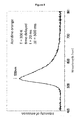
- FIG. 4 shows a time integrated emission spectrum of acridine yellow (without additive) dissolved in a glucose-trehalose matrix measured at 300 K and excited at 378 nm according to an embodiment of the present invention.
- FIG. 5 shows a time-delayed emission spectrum of acridine yellow (without additive) dissolved in a glucose-trehalose matrix measured at 300 K and excited at 378 nm according to an embodiment of the present invention.
- FIG. 6 shows a time-delayed emission spectrum of acridine yellow (without additive) dissolved in a glucose-trehalose matrix measured at 77 K and excited at 378 nm according to an embodiment of the present invention.
- FIG. 7 shows a chemical structure of acridine orange as an example of a purely organic emitter molecule according to an embodiment of the present invention.
- FIG. 8 shows a time-delayed emission spectrum of acridine orange (without additive) dissolved in a glucose-trehalose matrix measured at 300 K and excited at 378 nm according to an embodiment of the present invention.
- FIG. 9 shows a time-delayed emission spectrum of acridine orange (without additive) dissolved in a glucose-trehalose matrix measured at 77 K and excited at 378 nm according to an embodiment of the present invention.
- FIG. 10 shows chemical structures of further acridine derivatives as examples of purely organic emitter molecules according to an embodiment of the present invention.
- FIG. 11 shows a chemical structure of a spiro compound as an example of formula V as well as highest occupied molecular orbital (HOMO) and lowest unoccupied molecular orbital (LUMO) contour depictions according to an embodiment of the present invention.
- HOMO highest occupied molecular orbital
- LUMO lowest unoccupied molecular orbital
- FIG. 13 shows chemical structures of spiro compounds according to embodiments of the present invention.
- FIG. 2 a shows a (simplified) energy level scheme for a typical, purely organic molecule having a ⁇ E(S 1 ⁇ T 1 ) value between the lowermost excited singlet state (S 1 ) and the triplet state (T 1 ) below it of clearly greater than 3000 cm ⁇ 1 .
- the photophysical electroluminescence properties of these molecules can be illustrated.
- Hole-electron recombination leads, on statistical average, to 25% occupation of the singlet state and to 75% occupation of the three sub-states of the triplet state. Since the emission transition from the triplet state T 1 to the singlet state S 0 is strongly spin-forbidden in organic molecules due to the low level of spin-orbit coupling, the excitation energy which arrives at the triplet state is generally converted radiationlessly to heat and is thus been lost for the light production by electroluminescence. The occupied singlet state can, however, exhibit effective emission (fluorescence) because this is a spin-allowed singlet-singlet transition.
- ISC intersystem crossing
- the invention in one aspect, provides a composition, especially for utilization in an optoelectronic device, which comprises
- spin-orbit coupling constant and “intersystem crossing time constant” and “up-intersystem crossing time constant” are specialist terms which are commonly used in the photophysical literature and are therefore known to those skilled in the art.
- FIG. 2 b shows an energy level diagram for an organic molecule having a small energy difference ⁇ E(S 1 ⁇ T 1 ) ⁇ 3000 cm ⁇ 1 .
- This energy difference is small enough to enable thermal repopulation of the S 1 state from the T 1 state according to a Boltzmann distribution, or according to the thermal energy k B T, and hence thermally activated light emission from the S 1 state.
- Int(S 1 ⁇ S 0 )/Int(T 1 ⁇ S 0 ) is the intensity ratio of the emissions from the S 1 state and the T 1 state.
- k B is the Boltzmann constant and T the absolute temperature.
- k(S 1 )/k(T 1 ) is the rate ratio of the conversion processes from the singlet S 1 and from the triplet T 1 to the electronic ground state S 0 .
- this ratio is generally between 10 6 and 10 10 .
- ⁇ E represents the energy difference ⁇ E 2 (S 1 ⁇ T 1 ) according to FIG. 2 b.
- Equation (1) requires according to the invention the use of additives which increase spin-orbit coupling (for detailed arguments see, for example, below).
- additives i.e. optically inert atoms or molecules of the composition, interact with the organic emitter molecules such that the mean (thermalized) emission lifetime of the two states S 1 and T 1 of the organic molecule is strongly reduced.
- the time of the thermally activated reoccupation from the T 1 state is shorter (e.g. by factor 5) than the phosphorescence decay time ⁇ (T 1 ) without thermal reoccupation.
- This decay time ⁇ (T 1 ) can be easily detected at low temperatures, e.g. at 77 K, with commercial measurement instruments.
- the inventive composition is particularly suitable for optoelectronic components.
- Organic molecules having the above-described properties i.e. having a small singlet-triplet energy difference ⁇ E(S 1 ⁇ T 1 ), are preferably organic molecules having the following general formulae I to III:
- D is a chemical group or a substituent with an electron-donating effect (D, donor effect).
- D electron-donating effect
- Substituents of this kind may be present once, twice or several times. They may be the same or different.
- A is a chemical group or a substituent with an electron-withdrawing property (A, acceptor effect). Substituents of this kind may be present once, twice or several times. They may be the same or different.
- the base structure B is composed of conjugated organic groups which consist for example of aromatic, heteroaromatic and/or conjugated double bonds.
- the base structure can also represent a non-conjugated group. It is essential that the molecule orbitals of A and B or of D and B cover the same area.
- the base structure B itself can also have an electron withdrawing effect, then (e.g. in formula I) the substitution can have D character on both sides.
- the base structure B itself can have an electron donating effect, then (e.g. in formula I) the substitution can have A character on both sides.
- the formulas I to III represent also that the electronic wave functions of the molecules overlap in the areas D/B or B/A. This characteristic can be determined by calculations as described further below.
- the term electronic wave function is known to the person skilled in the art.
- -halogen —(CO)H, —(CO)-alkyl group, —(CO)O-alkyl group, —(CO)OH, —(CO)Cl, —CF 3 , —BF 2 , —CN, —S(O) 2 OH, —S(O) 2 O-alkyl, —NH 3 + , —N(alkyl group) 3 + , —NO 2 , halogenated alkyl, —B(R′)(R′′) with (R′, R′′ ⁇ H, alkyl, aryl, halogenated alkyl, halogenated aryl).
- molecular base structures B are composed of conjugated organic groups which consist of aromatic, heteroaromatic and/or conjugated double bonds.
- molecular base structures B have aromatic or heteroaromatic rings smaller than 15, more preferably smaller than 10, most preferably smaller than seven.
- the aromatic or heteroaromatic rings are chemically joined directly or chemically bound via alkenyl groups having conjugated double bonds smaller than 10, more preferably smaller than six and most preferably smaller than 3.
- the base structure can also represent a non-conjugated group. It is essential that the molecule orbitals of A and B or of D and B cover the same area.
- the organic molecules described by formulas I to III have ⁇ E(S 1 ⁇ T 1 ) values between the lowermost excited singlet state and the triplet state below it of less than 3000 cm ⁇ 1 , preferably less than 2500 cm ⁇ 1 or 1500 cm ⁇ 1 and more preferably less than 1000 cm ⁇ 1 . Processes for measurement or calculation of the ⁇ E(S 1 ⁇ T 1 ) values are discussed below.
- the invention relates, in a further aspect, to a process for selecting organic molecules for which the ⁇ E(S 1 ⁇ T 1 ) value between the lowermost excited singlet state (S 1 ) and the triplet state (T 1 ) below it is less than 3000 cm ⁇ 1 , preferably less than 2500 cm ⁇ 1 or 1500 cm ⁇ 1 , particularly preferably less than 1000 cm ⁇ 1 .
- the determination of the ⁇ E(S 1 ⁇ T 1 ) value can either be performed by quantum-mechanical calculations using known computer programs (for example executing TDDFT calculations, for example using commercially available Gaussian 09 or ADF-Amsterdam Density Functional Software programs) or determined experimentally, as explained below.
- Information for a first orientation can already be gained from comparatively easily to conduct DFT calculations (e.g. with commercially available Gaussian 09 or ADF-Amsterdam Density Functional Software Program).
- the frontier orbitals HOMO ⁇ 2, HOMO ⁇ 1, HOMO, LUMO, LUMO+1 and LUMO+2 show tendencies of the charge transfer properties to expect with regard to the lowest excited energy states of the molecules. In the following paragraph these properties are described.
- the energy difference ⁇ E(S 1 ⁇ T 1 ), more particularly of the organic molecules described by formulas I to III, can be described as an approximation by quantum-mechanical means via the exchange integral multiplied by the factor 2.
- the value of the latter depends directly on the overlap of the molecular orbitals in the area on the D side of B with the molecular orbitals in the area on the A side of B (formula I). Accordingly, the value of the exchange integral is determined by the overlap of the wave functions in the D-B area (formula II) or the A-D area (formula III) with those in the B area.
- ⁇ E(S 1 ⁇ T 1 ) can be varied via the strengths of the electron-donating and -withdrawing substituents/groups of the organic molecule. Due to these photophysical (quantum-mechanical) properties, it is possible to achieve the inventive energy differences with ⁇ E(S 1 ⁇ T 1 ) of less than 3000 cm ⁇ 1 or less than 2500 cm ⁇ 1 or less than 1500 cm ⁇ 1 or less than 1000 cm ⁇ 1 .
- the ⁇ E(S 1 ⁇ T 1 ) value can be determined experimentally as follows:
- the intensities are determined from the (corrected) spectra, Int(S 1 ⁇ S 0 ) and Int(T 1 ⁇ S 0 ) representing, respectively, the integrated fluorescence and phosphorescence band intensities, which can be determined by means of the programs provided with the spectrophotometer.
- the respective transitions (band intensities) can be identified easily since the triplet band is at lower energy than the singlet band and gains intensity with falling temperature.
- the measurements are conducted in oxygen-free dilute solutions (approx. 10 ⁇ 2 mol L ⁇ 1 ) or on thin films of the corresponding molecule or on films doped with the corresponding molecules.
- sample used is a solution
- a solvent or solvent mixture which forms glasses at low temperatures
- 2-methyl-THF, THF (tetrahydrofuran) or aliphatic hydrocarbons such as 2-methyl-THF, THF (tetrahydrofuran) or aliphatic hydrocarbons.
- the sample used is a film
- PMMA polymethyl methacrylate
- the slope of the straight line is ⁇ E/k B .
- a simple, approximate estimation of the ⁇ E(S 1 ⁇ T 1 ) value can also be made by recording the fluorescence and phosphorescence spectra at low temperature (e.g. 77 K or 4.2 K using a cryostat).
- the ⁇ E(S 1 ⁇ T 1 ) value then corresponds approximately to the energy difference between the high-energy slope flanks of the fluorescence band and the phosphorescence band, respectively.
- Preferred organic molecules consist exclusively of light atoms such as C, H, N, O, F, S, K, Na.
- the electronic singlet and triplet states of which result essentially from transitions between ⁇ and ⁇ * molecular orbitals, the effective spin-orbit coupling (SOC), as already mentioned, is so small that the relaxation transitions from the S 1 to the energetically lower T 1 state (down-intersystem crossing) and in the reverse direction from the T 1 state to the S 1 state (up-intersystem crossing) are strongly forbidden or barely occur.
- the organic molecules may be doped, for example, into optoelectronic devices, or into matrix materials, for example in an OLED emission layer.
- optically inert atoms or molecules are mixed into this matrix to reduce the intersystem crossing time constant of the organic molecule.
- additives are notable for high spin-orbit coupling (SOC) (SOC constant of the atoms or molecular units greater than 1000 cm ⁇ 1 ; see the explanations given further below).
- additives are introduced, for example, in a concentration corresponding approximately to or higher than that of the emitter molecules. These additives can, for example, also be used in a concentration twice to ten times as high as that of the organic emitter molecules.
- the numeric ratio between organic emitter molecules and optically inert atoms or molecules is 1:0.1 to 1:5 or 1:10, preferably 1:0.2 to 1:5, more preferably 1:1. This gives rise to such a distribution probability that at least one additive particle/additive molecule having high SOC is present in the immediate environment of an emitter molecule. This induces external SOC, which strongly accelerates the process of intersystem crossing, i.e. the time constant of the intersystem crossing is shortened accordingly. This brings about very rapid relaxation from the S 1 to the T 1 state and likewise a very rapid thermal repopulation according to equation (1). This enables the singlet harvesting effect for organic molecules.
- the matrix polymers can comprise chemically bound Br or I atoms, and thus, the matrix adopts the function of the additive.
- the emitter molecules can comprise e.g. chemically bound Br or I atoms or other substituents increasing the SOC.
- the amount of the additive can be highly reduced or the addition of an additive can be completely dispensed with under favorable conditions.
- the present invention relates in one embodiment to a composition
- a composition comprising an organic molecule for the emission of light, which has a ⁇ E(S 1 ⁇ T 1 ) value between the lowest excited singlet (S 1 ) and the triplet state (T 1 ) below it of smaller than 3000 cm ⁇ 1 (preferably smaller than 2500 cm ⁇ 1 ), and an optical inert atom or an optical inert molecule for reducing the up-intersystem crossing time constant of the organic molecule to less than 300 ms, wherein the optical inert atom or an optical inert molecule is chemically bound to a matrix, in particular to a polymeric matrix.
- composition described here is used in an emitter layer in an optoelectronic (organic electronic) device, especially an OLED.
- the OLED devices can be produced by processes known in the art (cf. H. Yersin, “Highly Efficient OLEDs with Phosphorescent Materials”, Wiley-VCH, Weinheim, Germany 2008).
- the proportion of the composition (organic emitter and additive) in the emitter layer is between 2% by weight and 100% by weight, preferably between 6% by weight and 30% by weight.
- Another aspect of the invention refers to the use of the inventive composition composed of an organic molecule and an optically inert atom or optically inert molecule in light-emitting electrochemical cells (LEECs), OLED sensors (e.g. OLED oxygen sensors), especially in a gas and vapor sensor not hermetically sealed from the outside, optical temperature sensors, organic solar cells (OSCs; organic photovoltaics, OPVs), organic field-effect transistors, organic diodes, organic photodiodes and “down conversion” systems.
- LECs light-emitting electrochemical cells
- the proportion of the composition in an emitter layer of an optoelectronic device may be 2 to 100% by weight, preferably 6 to 30% by weight, based on the total weight of the emitter layer.
- the invention relates to a process for reducing the (radiative) emission lifetime and to a process for increasing the electroluminescence quantum yield of an organic molecule as an emitter in an optoelectronic device.
- an organic molecule which has a ⁇ E(S 1 ⁇ T 1 ) value between the lowermost excited singlet state (S 1 ) and the triplet state (T 1 ) below it of less than 3000 cm ⁇ 1 (preferably less than 2500 cm ⁇ 1 ) is introduced into the vicinity of an optically inert atom or molecule (optionally via a chemical bond), such that the organic molecule can interact with the optically inert atom or molecule.
- the invention further relates to a process for converting the triplet excitation energy of an organic molecule generated in the course of electroluminescence to fluorescence energy.
- This aspect involves the interaction of an organic molecule having a ⁇ E(S 1 ⁇ T 1 ) value between the lowermost excited singlet state (S 1 ) and the triplet state (T 1 ) below it of less than 3000 cm ⁇ 1 (preferably less than 2500 cm ⁇ 1 ) with an optically inert atom or molecule such that triplet excitation energy of the organic molecule is converted via a singlet state of the organic molecule to fluorescence energy by thermal activation at a temperature higher than a temperature at which for example OLEDs are used, i.e. for example above ⁇ 30° C.
- the invention also relates to a process for selecting organic molecules for which the ⁇ E(S 1 ⁇ T 1 ) value between the lowermost excited singlet state (S 1 ) and the triplet state (T 1 ) below it is less than 3000 cm ⁇ 1 , preferably less than 2500 cm ⁇ 1 or 1500 cm ⁇ 1 , particularly preferably less than 1000 cm ⁇ 1 .
- the process comprises at least two steps, namely: firstly the determination of the ⁇ E(S 1 ⁇ T 1 ) value of organic molecules by means of a) a quantum-mechanical molecular calculation, b) measurement of the temperature dependence of the fluorescence and phosphorescence intensities, or c) measurement of the temperature dependence of the emission decay time, and secondly the finding of organic molecules for which the ⁇ E(S1 ⁇ T1) value less than 3000 cm ⁇ 1 , preferably less than 2500 cm ⁇ 1 or 1500 cm ⁇ 1 , particularly preferably less than 1000 cm ⁇ 1 .
- the organic molecules thus found have a ⁇ E(S 1 ⁇ T 1 ) value between the lowermost excited singlet state (S 1 ) and the triplet state (T 1 ) below it of less than 3000 cm ⁇ 1 , preferably less than 2500 cm ⁇ 1 or 1500 cm ⁇ 1 , particularly preferably less than 1000 cm ⁇ 1 .
- R 1 to R 9 are ⁇ H, Br, I and/or groups, which are summarized in the examples for the donators D and/or acceptors A mentioned above.
- Adjacent R i , R j and R k from R 1 to R 9 can be conjugated aromatic or heteroaromatic rings.
- Br and/or I also cause an increase of the spin orbit coupling.
- R′ is either not present or H, Alkyl, O, S.
- a further example for an organic molecule according to the invention is defined by formula V.
- D1 to D8 are independently from each other H, Br, I and/or donator groups such as defined above by D.
- the donator groups can be same or different. Thereby at least one donator group must be present.
- A1 to A8 are independently from each other H, Br, I and/or acceptor groups such as defined above by A. Thereby at least one acceptor group must be present.
- the acceptor groups can be same or different.
- the composition according to the invention thus relates to only one molecule.
- the additive covalently bound to the organic molecule in this case is then responsible for the increase of the spin-orbit coupling.
- such additives are iodine and/or bromine.
- the invention relates to the use of a mixture (composition) comprising or consisting of glucose and/or trehalose as matrix with a composition according to the type described herein in an optoelectronic device.
- a mixture comprising or consisting of glucose and/or trehalose as matrix with a composition according to the type described herein in an optoelectronic device.
- the ratio of glucose to trehalose can be from 5:1 to 1:5. Preferred is a ratio of 1:1.
- FIGS. 3 to 13 concrete execution examples as well as time-integrated and time-resolved spectra and decay curves are shown as well as the calculated HOMO and LUMO contour curves for one example.
- the molecules have been modified in their immediate environment by additives in order to enable the “singlet harvesting process for organic molecules”.
- the acridine yellow which, using the combination of emitter molecule and additive, is suitable for the utilization of the singlet harvesting process.
- the acridine yellow is dissolved in a glucose-trehalose matrix in a concentration of 1.67 ⁇ mol per 1 g of the mixture of glucose-trehalose.
- the emission with the maximum at 508 nm represents to a large extent an overlap of the spontaneous and the delayed fluorescence from the S1 state.
- a 1:1 glucose/trehalose mixture was used.
- Trehalose is a disaccharide with the elemental formula C12H22O11.
- the emis-sion quantum yield of the overall emission consisting of the spontaneous and the de-layed fluorescence as well as the phosphorescence is (95 ⁇ 5) %. The emission quantum yield was determined with a commercial measurement instrument.
- the acridine yellow is dissolved in a glucose-trehalose matrix in a concentration of 1.67 ⁇ mol per 1 g of the mixture of glucose-trehalose.
- the long-lived phosphorescence band which results from the T1 state and lies at 570 nm, is clearly em-phasized.
- the (time-delayed) main emission band at 508 nm represents the delayed fluorescence from the S1 state.
- the acridine yellow is dissolved in a glucose-trehalose matrix in a concentration of 1.67 ⁇ mol per 1 g of the mixture of glucose-trehalose.
- the thermal reoccupation of the singlet state S1 is not existing.
- the registration of the short-lived (a few ns) spontaneous fluorescence is prevented by the selected time delay.
- this is a matter of a phosphorescence with the maximum at 570 nm, which results from the T1 state. Consequently the observed shoulder at the wavelength 570 nm in the spectrum shown in FIG. 5 also represents phosphorescence.
- the recording of time-delayed emission spectra of acridine yellow with additive Pb(CH 3 COO) 2 shows at 300 K no detectable phosphorescence band form the T 1 state, but only a delayed fluorescence band from the S 1 state.
- a glucose-trehalose mixture was used as matrix. This matrix contained 2.50 ⁇ mol (acridine yellow) and as additive 25.3 ⁇ mol (Pb(CH 3 COO) 2 ) per 1 g of the mixture glucose-trehalose.
- the acridine orange which, using the combination of emitter molecule and additive, is suitable for the utilization of the singlet harvesting process.
- the acridine orange is dissolved in a glucose-trehalose matrix in a concentration of 1.86 ⁇ mol per 1 g of the mixture of glu-cose-trehalose.
- the emission with the maximum at 530 nm represents solely a delayed fluorescence from the S1 state since the short-lived (a few ns) spontaneous fluorescence has already decayed after the time de-lay.
- a 1:1 glucose-trehalose mixture was used.
- the acridine orange is dissolved in a glucose-trehalose matrix in a concentration of 1.86 ⁇ mol per 1 g of the mixture of glu-cose-trehalose measured at 77 K and excited at 378 nm.
- the thermal reoccupation of the singlet state S1 is not existing, i.e. the observed emission with the maximum at 603 nm does not represent a delayed fluorescence.
- the registration of the short-lived (a few ns) spontaneous fluorescence is prevented by the selected time delay. As a result the observed spectrum represents a phosphorescence T1 state.
- the acridine derivatives which, using the combinations of emitter molecules and additives, are suitable for the utilization of the singlet harvesting process.
- the organic molecule is covalently bound to the atom increasing the spin-orbit coupling or to the molecule increasing the spin-orbit coupling, as exemplified by the first compound in the third row.
- further organic molecules are preferably suitable, namely organic emitter molecules, which comprise aldehyde groups in the position R 2 , R 3 , R 7 and/or R 8 according to formula IV.
- Organic emitter molecules can also be charged organic molecules and counter ions can be present. These emitter molecules can then be preferably applied in light-emitting electrochemical cells (LEECs or LECs), whose principle structure is known to the person skilled in the art. When using these charged organic molecules in OLEDs, it is, where applicable, advisable to replace the small counter ions by greater, comparably charged counter ions such as (PF 6 ) ⁇ , (BF 4 ) ⁇ , [CF 3 SO 2 ] ⁇ , singly negatively charged hexaphenylphosphate, singly negatively charged tetraphenyborate etc.
- LECs light-emitting electrochemical cells
- the counter ions for positively charged organic emitter molecules can—in a preferred embodiment—perform the function of an additive. Examples are Br ⁇ , J ⁇ , (AsF 6 ) ⁇ , (SbF 6 ) ⁇ , singly negatively charged hexa-phenylarsenate, singly negatively charged hexa-phenylantimonate.
- the counter ions for negatively charged organic emitter molecules can be e.g. Rb + , Cs + and/or Ba + .
- the HOMO and LUMO contour depictions are determined by DFT calculations. The later show that a distinct charge transfer takes place at a electronic HOMO-LUMO transition and a small ⁇ E(S1 ⁇ T1) value is to be expected as a result.
- the excitation of the emission was carried out with a laser pulse with a pulse width of 70 ps at 378 nm.
- the samples were degassed, to remove the atmospheric oxygen.
- the ⁇ E(S1 ⁇ T1) value can be esti-mated to about 800 cm-1.
- emission decay behavior of the spiro compound solved in a polystyrene matrix ( poly(l-phenylethane-1,2-diyl)) or in a poly(4-iodostyrene)-matrix (more exactly: poly(l-(4-iodophenyl)ethane-1,2-diyl) with a concentration of c ⁇ 1% by weight.
- the decay time of the thermally activated fluorescence is longer for these matrices than in (a) because the emitter is in a fixed matrix environment.
- the decay of the emission is expressed only for a relatively long millisecond period here, i.e. for a period, in which the thermally activated fluorescence occurs but no spontaneous fluorescence.
- the iodination of the matrix leads to a distinct increase of the intersystem crossing rate and thereby to a significant reduction of the emission lifetime of the thermally activated component.
- this organic emitter substance spiro compound
- the upper compound shows at room temperature and doped in PMMA with c ⁇ 1% by weight a spontaneous and a thermally activated fluorescence with an emission maximum at ⁇ 530 nm.
- the emission quantum yield of both components is (50 ⁇ 10) %.
- the compounds with the structural formulas shown below it also show thermally activated fluorescence.
Landscapes
- Chemical & Material Sciences (AREA)
- Organic Chemistry (AREA)
- Physics & Mathematics (AREA)
- Engineering & Computer Science (AREA)
- Materials Engineering (AREA)
- Spectroscopy & Molecular Physics (AREA)
- Optics & Photonics (AREA)
- Electroluminescent Light Sources (AREA)
- Thin Film Transistor (AREA)
- Photovoltaic Devices (AREA)
Applications Claiming Priority (4)
| Application Number | Priority Date | Filing Date | Title |
|---|---|---|---|
| DE102011089687A DE102011089687A1 (de) | 2011-12-22 | 2011-12-22 | Singulett-Harvesting mit speziellen organischen Molekülen ohne Metallzentren für opto-elektronische Vorrichtungen |
| DE102011089687.2 | 2011-12-22 | ||
| DE102011089687 | 2011-12-22 | ||
| PCT/EP2012/075112 WO2013092313A1 (de) | 2011-12-22 | 2012-12-11 | Organische moleküle für oleds und andere opto-elektronische vorrichtungen |
Publications (2)
| Publication Number | Publication Date |
|---|---|
| US20150155500A1 US20150155500A1 (en) | 2015-06-04 |
| US10312456B2 true US10312456B2 (en) | 2019-06-04 |
Family
ID=47522498
Family Applications (1)
| Application Number | Title | Priority Date | Filing Date |
|---|---|---|---|
| US14/367,666 Active 2036-02-08 US10312456B2 (en) | 2011-12-22 | 2012-12-11 | Organic molecules for OLEDs and other optoelectronic devices |
Country Status (8)
| Country | Link |
|---|---|
| US (1) | US10312456B2 (enExample) |
| EP (1) | EP2795691B1 (enExample) |
| JP (1) | JP6341861B2 (enExample) |
| KR (1) | KR20140116134A (enExample) |
| CN (1) | CN104011894A (enExample) |
| CA (1) | CA2858785C (enExample) |
| DE (1) | DE102011089687A1 (enExample) |
| WO (1) | WO2013092313A1 (enExample) |
Families Citing this family (13)
| Publication number | Priority date | Publication date | Assignee | Title |
|---|---|---|---|---|
| WO2016108046A1 (en) | 2014-12-29 | 2016-07-07 | University Court Of The University Of St Andrews | Light emitting electrochemical cells and compounds |
| KR101519317B1 (ko) * | 2015-03-27 | 2015-05-18 | 한양대학교 산학협력단 | 온도센서 및 그 제조방법 |
| DE102015106941B4 (de) * | 2015-05-05 | 2025-07-31 | Pictiva Displays International Limited | Organische Emitterschicht, organische Leuchtdiode und Verwendung von Schweratomen in einer organischen Emitterschicht einer organischen Leuchtdiode |
| CN105418486A (zh) | 2015-12-25 | 2016-03-23 | 上海天马有机发光显示技术有限公司 | 有机电致发光化合物及其有机光电装置 |
| CN105399696B (zh) | 2015-12-25 | 2019-12-24 | 上海天马有机发光显示技术有限公司 | 有机电致发光化合物及其有机光电装置 |
| CN105541824B (zh) | 2015-12-25 | 2019-07-05 | 上海天马有机发光显示技术有限公司 | 有机电致发光化合物及其有机光电装置 |
| CN108250130B (zh) * | 2016-12-28 | 2021-01-22 | 昆山国显光电有限公司 | 有机发光层主体材料及有机发光层及有机发光器件 |
| CN106831745B (zh) | 2016-12-30 | 2020-01-14 | 上海天马有机发光显示技术有限公司 | 一种有机电致发光材料以及有机光电装置 |
| CN106831633B (zh) * | 2016-12-30 | 2019-05-28 | 上海天马有机发光显示技术有限公司 | 一种有机电致发光材料以及有机光电装置 |
| KR102250191B1 (ko) * | 2017-03-06 | 2021-05-10 | 삼성전자주식회사 | 발광 장치 |
| KR102497284B1 (ko) * | 2017-12-18 | 2023-02-08 | 삼성디스플레이 주식회사 | 유기 발광 소자 |
| CN111269344B (zh) * | 2020-02-25 | 2023-07-04 | 中国科学院长春应用化学研究所 | 一种基于空间电荷转移效应的白光荧光高分子化合物及其制备方法和应用 |
| CN120883764A (zh) * | 2023-04-07 | 2025-10-31 | 夏普显示科技株式会社 | 发光元件及显示装置 |
Citations (23)
| Publication number | Priority date | Publication date | Assignee | Title |
|---|---|---|---|---|
| US4281294A (en) * | 1979-04-16 | 1981-07-28 | Volkin Howard C | Direct solar pumped laser |
| US4344855A (en) * | 1975-11-21 | 1982-08-17 | Bayer Aktiengesellschaft | Process for the production of polyisocyanates which contain carbodiimide groups and which are stable in storage |
| CN1280394A (zh) | 1999-07-08 | 2001-01-17 | 国际商业机器公司 | 含染料的有机-无机杂化物材料作为发射层的电致发光器件 |
| US20020008233A1 (en) | 1999-07-21 | 2002-01-24 | Forrest Stephen R. | Intersystem crossing agents for efficient utilization of excitions in organic light emitting devices |
| CN1423512A (zh) | 2001-11-28 | 2003-06-11 | 三星Sdi株式会社 | 具有有机可溶性衍生物层的有机电致发光显示装置 |
| CN1469692A (zh) | 2002-06-28 | 2004-01-21 | ����Sdi��ʽ���� | 使用高和低分子发光物质的混合物作为发光物质的有机电致发光装置 |
| JP2004199875A (ja) | 2002-12-16 | 2004-07-15 | Canon Inc | 有機発光素子 |
| JP2005170708A (ja) | 2003-12-09 | 2005-06-30 | Nippon Hoso Kyokai <Nhk> | ゾルゲル導電性ガラス、及びそれを用いた光機能素子 |
| US20050153165A1 (en) | 2001-07-05 | 2005-07-14 | Vladimir Grushin | Photoactive lanthanide complexes with phosphine oxides, phosphine oxides-sulfides, pyridine N-oxides, and phosphine oxide-pyridine N-oxides, and devices made with such complexes |
| US20050214576A1 (en) | 2000-08-11 | 2005-09-29 | Sergey Lamansky | Organometallic compounds and emission-shifting organic electrophosphorescence |
| US20060058494A1 (en) * | 2002-10-25 | 2006-03-16 | Convion Organic Semiconductors Gmbh Intellectual Property Group | Conjugated polymers containing arylamine units, the representation thereof and the use of the same |
| US7416791B1 (en) | 2002-06-11 | 2008-08-26 | University Of Washington | Osmium complexes and related organic light-emitting devices |
| DE102007031261A1 (de) | 2007-07-05 | 2009-01-08 | Universtität Regensburg | Lumineszierende Metallkomplexe mit sperrigen Hilfsliganden |
| DE102008033563A1 (de) | 2008-07-17 | 2010-01-21 | Merck Patent Gmbh | Komplexe mit kleinen Singulett-Triplett-Energie-Abständen zur Verwendung in opto-elektronischen Bauteilen (Singulett-Harvesting-Effekt) |
| JP2010506411A (ja) | 2006-10-11 | 2010-02-25 | メルク パテント ゲーエムベーハー | Oled用途のためのランタノイドエミッター |
| WO2011089163A1 (de) | 2010-01-20 | 2011-07-28 | Cynora Gmbh | Blau-licht-emitter mit singulett-harvesting-effekt zur verwendung in oleds und anderen organisch-elektronischen vorrichtungen |
| WO2011147522A1 (en) | 2010-05-27 | 2011-12-01 | Merck Patent Gmbh | Compositions comprising quantum dots |
| WO2012010650A1 (de) * | 2010-07-20 | 2012-01-26 | Cynora Gmbh | Kupfer(i)-komplexe für opto-elektronische vorrichtungen |
| US20120248968A1 (en) | 2011-03-25 | 2012-10-04 | Idemitsu Kosan Co., Ltd. | Organic electroluminescence device |
| WO2013007707A1 (de) * | 2011-07-08 | 2013-01-17 | Cynora Gmbh | Kupfer (i) komplexe für opto-elektronische vorrichtungen |
| JP2013253121A (ja) | 2011-07-15 | 2013-12-19 | Kyushu Univ | 遅延蛍光材料、それを用いた有機エレクトロルミネッセンス素子および化合物 |
| JPWO2013011955A1 (ja) | 2011-07-15 | 2015-02-23 | 国立大学法人九州大学 | 遅延蛍光材料およびそれを用いた有機エレクトロルミネッセンス素子 |
| US9537117B2 (en) * | 2011-08-02 | 2017-01-03 | Cynora Gmbh | Singlet harvesting with dual-core copper (I) complexes for optoelectronic devices |
Family Cites Families (6)
| Publication number | Priority date | Publication date | Assignee | Title |
|---|---|---|---|---|
| JP5255296B2 (ja) * | 2008-02-27 | 2013-08-07 | 東洋インキScホールディングス株式会社 | 有機エレクトロルミネッセンス素子用材料および化合物 |
| DE102009032922B4 (de) * | 2009-07-14 | 2024-04-25 | Merck Patent Gmbh | Materialien für organische Elektrolumineszenzvorrichtungen, Verfahren zu deren Herstellung, deren Verwendung sowie elektronische Vorrichtung |
| EP4039774B1 (en) * | 2009-12-07 | 2023-09-20 | NIPPON STEEL Chemical & Material Co., Ltd. | Organic light-emitting material and organic light-emitting element |
| TW201200975A (en) * | 2010-06-17 | 2012-01-01 | Du Pont | Process and materials for making contained layers and devices made with same |
| DE102010025547B4 (de) * | 2010-06-29 | 2023-05-11 | Samsung Display Co., Ltd. | Verwendung einer Zusammensetzung in einer Emitterschicht in einer optoelektronischen Vorrichtung zum Singulett-Harvesting mit organischen Molekülen, optoelektronische Vorrichtungen und Verfahren zu deren Herstellung |
| JP5590573B2 (ja) * | 2011-07-15 | 2014-09-17 | 国立大学法人九州大学 | 酸素センサー |
-
2011
- 2011-12-22 DE DE102011089687A patent/DE102011089687A1/de not_active Withdrawn
-
2012
- 2012-12-11 JP JP2014547845A patent/JP6341861B2/ja active Active
- 2012-12-11 CN CN201280063936.8A patent/CN104011894A/zh not_active Withdrawn
- 2012-12-11 CA CA2858785A patent/CA2858785C/en active Active
- 2012-12-11 EP EP12812903.8A patent/EP2795691B1/de active Active
- 2012-12-11 US US14/367,666 patent/US10312456B2/en active Active
- 2012-12-11 WO PCT/EP2012/075112 patent/WO2013092313A1/de not_active Ceased
- 2012-12-11 KR KR1020147020433A patent/KR20140116134A/ko not_active Ceased
Patent Citations (28)
| Publication number | Priority date | Publication date | Assignee | Title |
|---|---|---|---|---|
| US4344855A (en) * | 1975-11-21 | 1982-08-17 | Bayer Aktiengesellschaft | Process for the production of polyisocyanates which contain carbodiimide groups and which are stable in storage |
| US4281294A (en) * | 1979-04-16 | 1981-07-28 | Volkin Howard C | Direct solar pumped laser |
| CN1280394A (zh) | 1999-07-08 | 2001-01-17 | 国际商业机器公司 | 含染料的有机-无机杂化物材料作为发射层的电致发光器件 |
| US6420056B1 (en) | 1999-07-08 | 2002-07-16 | International Business Machines Corporation | Electroluminescent device with dye-containing organic-inorganic hybrid materials as an emitting layer |
| US20020008233A1 (en) | 1999-07-21 | 2002-01-24 | Forrest Stephen R. | Intersystem crossing agents for efficient utilization of excitions in organic light emitting devices |
| US20050214576A1 (en) | 2000-08-11 | 2005-09-29 | Sergey Lamansky | Organometallic compounds and emission-shifting organic electrophosphorescence |
| US20050153165A1 (en) | 2001-07-05 | 2005-07-14 | Vladimir Grushin | Photoactive lanthanide complexes with phosphine oxides, phosphine oxides-sulfides, pyridine N-oxides, and phosphine oxide-pyridine N-oxides, and devices made with such complexes |
| CN1423512A (zh) | 2001-11-28 | 2003-06-11 | 三星Sdi株式会社 | 具有有机可溶性衍生物层的有机电致发光显示装置 |
| US7416791B1 (en) | 2002-06-11 | 2008-08-26 | University Of Washington | Osmium complexes and related organic light-emitting devices |
| US20050142380A1 (en) | 2002-06-28 | 2005-06-30 | Chin Byung D. | Organic electroluminescent device using a mixture of high and low molecular light-emitting substances as a light-emitting substance |
| CN1469692A (zh) | 2002-06-28 | 2004-01-21 | ����Sdi��ʽ���� | 使用高和低分子发光物质的混合物作为发光物质的有机电致发光装置 |
| US20060058494A1 (en) * | 2002-10-25 | 2006-03-16 | Convion Organic Semiconductors Gmbh Intellectual Property Group | Conjugated polymers containing arylamine units, the representation thereof and the use of the same |
| JP2004199875A (ja) | 2002-12-16 | 2004-07-15 | Canon Inc | 有機発光素子 |
| JP2005170708A (ja) | 2003-12-09 | 2005-06-30 | Nippon Hoso Kyokai <Nhk> | ゾルゲル導電性ガラス、及びそれを用いた光機能素子 |
| JP2010506411A (ja) | 2006-10-11 | 2010-02-25 | メルク パテント ゲーエムベーハー | Oled用途のためのランタノイドエミッター |
| US20100117521A1 (en) | 2006-10-11 | 2010-05-13 | Merck Patent Gmbh Patents & Scientific Information | Lanthanoid emitter for oled applications |
| DE102007031261A1 (de) | 2007-07-05 | 2009-01-08 | Universtität Regensburg | Lumineszierende Metallkomplexe mit sperrigen Hilfsliganden |
| DE102008033563A1 (de) | 2008-07-17 | 2010-01-21 | Merck Patent Gmbh | Komplexe mit kleinen Singulett-Triplett-Energie-Abständen zur Verwendung in opto-elektronischen Bauteilen (Singulett-Harvesting-Effekt) |
| WO2011089163A1 (de) | 2010-01-20 | 2011-07-28 | Cynora Gmbh | Blau-licht-emitter mit singulett-harvesting-effekt zur verwendung in oleds und anderen organisch-elektronischen vorrichtungen |
| WO2011147522A1 (en) | 2010-05-27 | 2011-12-01 | Merck Patent Gmbh | Compositions comprising quantum dots |
| WO2012010650A1 (de) * | 2010-07-20 | 2012-01-26 | Cynora Gmbh | Kupfer(i)-komplexe für opto-elektronische vorrichtungen |
| US9024026B2 (en) * | 2010-07-20 | 2015-05-05 | Cynora Gmbh | Copper (I) complexes for optoelectronic devices |
| US20120248968A1 (en) | 2011-03-25 | 2012-10-04 | Idemitsu Kosan Co., Ltd. | Organic electroluminescence device |
| WO2013007707A1 (de) * | 2011-07-08 | 2013-01-17 | Cynora Gmbh | Kupfer (i) komplexe für opto-elektronische vorrichtungen |
| US9266906B2 (en) * | 2011-07-08 | 2016-02-23 | Cynora Gmbh | Copper(I) complexes for optoelectronic devices |
| JP2013253121A (ja) | 2011-07-15 | 2013-12-19 | Kyushu Univ | 遅延蛍光材料、それを用いた有機エレクトロルミネッセンス素子および化合物 |
| JPWO2013011955A1 (ja) | 2011-07-15 | 2015-02-23 | 国立大学法人九州大学 | 遅延蛍光材料およびそれを用いた有機エレクトロルミネッセンス素子 |
| US9537117B2 (en) * | 2011-08-02 | 2017-01-03 | Cynora Gmbh | Singlet harvesting with dual-core copper (I) complexes for optoelectronic devices |
Non-Patent Citations (29)
Also Published As
| Publication number | Publication date |
|---|---|
| HK1203693A1 (en) | 2015-10-30 |
| JP2015508568A (ja) | 2015-03-19 |
| DE102011089687A1 (de) | 2013-06-27 |
| JP6341861B2 (ja) | 2018-06-13 |
| US20150155500A1 (en) | 2015-06-04 |
| EP2795691B1 (de) | 2019-02-20 |
| CN104011894A (zh) | 2014-08-27 |
| CA2858785C (en) | 2019-10-15 |
| KR20140116134A (ko) | 2014-10-01 |
| CA2858785A1 (en) | 2013-06-27 |
| EP2795691A1 (de) | 2014-10-29 |
| WO2013092313A1 (de) | 2013-06-27 |
Similar Documents
| Publication | Publication Date | Title |
|---|---|---|
| US20150155500A1 (en) | Organic molecules for oleds and other optoelectronic devices | |
| US20130264518A1 (en) | Singlet harvesting with organic molecules for optoelectronic devices | |
| US9537117B2 (en) | Singlet harvesting with dual-core copper (I) complexes for optoelectronic devices | |
| Nothaft et al. | Electrically driven photon antibunching from a single molecule at room temperature | |
| Peng et al. | Organic light‐emitting diodes using a neutral π radical as emitter: the emission from a doublet | |
| JP5571075B2 (ja) | 光電子部材における使用のための錯体 | |
| Haneder et al. | Controlling the radiative rate of deep‐blue electrophosphorescent organometallic complexes by singlet‐triplet gap engineering | |
| Monkman | Singlet Generation from Triplet Excitons in Fluorescent Organic Light‐Emitting Diodes | |
| US9024026B2 (en) | Copper (I) complexes for optoelectronic devices | |
| Cho et al. | Near‐Infrared Light‐Emitting Diodes from Organic Radicals with Charge Control | |
| CN101960634B (zh) | 包含中性过渡金属络合物的光电子元件 | |
| WO2021116234A1 (en) | An organic light emitting device | |
| Gu et al. | Fast transfer of triplet to doublet excitons from organometallic host to organic radical semiconductors | |
| Duarte et al. | The balance between charge mobility and efficiency in all-solution-processed organic light-emitting diodes of Zn (II) coordination compounds/PFO composites | |
| Chen et al. | Efficient near-infrared organic light-emitting diodes based on multimetallic assemblies of lanthanides and iridium complexes | |
| Kalinowski | Optical materials for organic light-emitting devices | |
| US20060042685A1 (en) | Electronic devices having a charge transport layer that has defined triplet energy level | |
| Baek et al. | Comparison of the carrier mobility, unipolar conduction, and light emitting characteristics of phosphorescent host–dopant system | |
| Müller et al. | Photon‐Correlation Studies on Multichromophore Macrocycles of Perylene Dyes | |
| Vashchenko et al. | Photo-and electroluminescent properties of zinc (II) complexes with tetradentate Schiff bases, derivatives of salicylic aldehyde | |
| Evans et al. | Singlet and triplet to doublet energy transfer: improving organic light-emitting diodes with radicals | |
| Lee et al. | Thioxanthen-based blue thermally activated delayed fluorescence emitters for organic light-emitting diodes | |
| Tanaka et al. | Energy-transfer processes between phosphorescent guest and fluorescent host molecules in phosphorescent OLEDs | |
| HK1203693B (en) | Organic molecules for oleds and other optoelectronic devices | |
| Ghasemi | Investigation of isomeric derivatives of triphenylamine and dibenzothiophen-2-yl (phenyl) methanone with different emission behaviors for electronic devices and optical sensors of oxygen |
Legal Events
| Date | Code | Title | Description |
|---|---|---|---|
| AS | Assignment |
Owner name: CYNORA GMBH, GERMANY Free format text: ASSIGNMENT OF ASSIGNORS INTEREST;ASSIGNORS:YERSIN, HARTMUT;HUPFER, ALEXANDER;SIGNING DATES FROM 20140604 TO 20140612;REEL/FRAME:033150/0294 |
|
| STPP | Information on status: patent application and granting procedure in general |
Free format text: PUBLICATIONS -- ISSUE FEE PAYMENT VERIFIED |
|
| STCF | Information on status: patent grant |
Free format text: PATENTED CASE |
|
| AS | Assignment |
Owner name: SAMSUNG DISPLAY CO., LTD., KOREA, REPUBLIC OF Free format text: ASSIGNMENT OF ASSIGNORS INTEREST;ASSIGNOR:CYNORA GMBH;REEL/FRAME:060329/0712 Effective date: 20220527 |
|
| FEPP | Fee payment procedure |
Free format text: ENTITY STATUS SET TO UNDISCOUNTED (ORIGINAL EVENT CODE: BIG.); ENTITY STATUS OF PATENT OWNER: LARGE ENTITY |
|
| MAFP | Maintenance fee payment |
Free format text: PAYMENT OF MAINTENANCE FEE, 4TH YEAR, LARGE ENTITY (ORIGINAL EVENT CODE: M1551); ENTITY STATUS OF PATENT OWNER: LARGE ENTITY Year of fee payment: 4 |