US10290817B2 - Luminescent diaza-monoaza-and benzimidazole metal carbene complexes for use in electronic devices such as OLEDs - Google Patents
Luminescent diaza-monoaza-and benzimidazole metal carbene complexes for use in electronic devices such as OLEDs Download PDFInfo
- Publication number
- US10290817B2 US10290817B2 US14/908,740 US201414908740A US10290817B2 US 10290817 B2 US10290817 B2 US 10290817B2 US 201414908740 A US201414908740 A US 201414908740A US 10290817 B2 US10290817 B2 US 10290817B2
- Authority
- US
- United States
- Prior art keywords
- substituted
- carbon atoms
- iso
- butyl
- group
- Prior art date
- Legal status (The legal status is an assumption and is not a legal conclusion. Google has not performed a legal analysis and makes no representation as to the accuracy of the status listed.)
- Active, expires
Links
- UAEPNZWRGJTJPN-UHFFFAOYSA-N CC1CCCCC1 Chemical compound CC1CCCCC1 UAEPNZWRGJTJPN-UHFFFAOYSA-N 0.000 description 65
- GDOPTJXRTPNYNR-UHFFFAOYSA-N CC1CCCC1 Chemical compound CC1CCCC1 GDOPTJXRTPNYNR-UHFFFAOYSA-N 0.000 description 61
- MWWNHUVCHNJZPF-UHFFFAOYSA-N CC1=C(C(C)C)C=CC=C1C(C)C Chemical compound CC1=C(C(C)C)C=CC=C1C(C)C MWWNHUVCHNJZPF-UHFFFAOYSA-N 0.000 description 43
- HQWCCDCLQMMMNG-UHFFFAOYSA-N CC1=C(C(C)C)C2=C(C=C1C(C)C)C1=C(C=CC=C1)O2 Chemical compound CC1=C(C(C)C)C2=C(C=C1C(C)C)C1=C(C=CC=C1)O2 HQWCCDCLQMMMNG-UHFFFAOYSA-N 0.000 description 42
- RARKESBDZCVXPG-UHFFFAOYSA-N CC1=C(C(C)C)C2=C(C=C1C(C)C)OC1=C2C=CC=C1 Chemical compound CC1=C(C(C)C)C2=C(C=C1C(C)C)OC1=C2C=CC=C1 RARKESBDZCVXPG-UHFFFAOYSA-N 0.000 description 40
- ZXASXCJIBCZKRI-UHFFFAOYSA-N CC1=C(C(C)C)C=C(C(C)C)C2=C1OC1=C2C=CC=C1 Chemical compound CC1=C(C(C)C)C=C(C(C)C)C2=C1OC1=C2C=CC=C1 ZXASXCJIBCZKRI-UHFFFAOYSA-N 0.000 description 40
- CHVOYGXBBWPDEU-UHFFFAOYSA-N CC1=C(C(C)C)C=C(C(C)C)C=C1C(C)C Chemical compound CC1=C(C(C)C)C=C(C(C)C)C=C1C(C)C CHVOYGXBBWPDEU-UHFFFAOYSA-N 0.000 description 40
- FYGHSUNMUKGBRK-UHFFFAOYSA-N CC1=CC=CC(C)=C1C Chemical compound CC1=CC=CC(C)=C1C FYGHSUNMUKGBRK-UHFFFAOYSA-N 0.000 description 40
- 0 *1c(ccc(-c(cc2)cc(c3ccccc33)c2[n]3-c2ccccc2)c2)c2-c2cc(-c(cc3c4ccccc44)ccc3[n]4-c3ccccc3)ccc12 Chemical compound *1c(ccc(-c(cc2)cc(c3ccccc33)c2[n]3-c2ccccc2)c2)c2-c2cc(-c(cc3c4ccccc44)ccc3[n]4-c3ccccc3)ccc12 0.000 description 27
- YXFVVABEGXRONW-UHFFFAOYSA-N CC1=CC=CC=C1 Chemical compound CC1=CC=CC=C1 YXFVVABEGXRONW-UHFFFAOYSA-N 0.000 description 5
- FKNQCJSGGFJEIZ-UHFFFAOYSA-N CC1=CC=NC=C1 Chemical compound CC1=CC=NC=C1 FKNQCJSGGFJEIZ-UHFFFAOYSA-N 0.000 description 4
- DTFKRVXLBCAIOZ-UHFFFAOYSA-N COC1=C(C)C=CC=C1 Chemical compound COC1=C(C)C=CC=C1 DTFKRVXLBCAIOZ-UHFFFAOYSA-N 0.000 description 4
- HAUPRNHZQLEYRP-UHFFFAOYSA-N C.CB1OC2=C(C=CC=C2)O1.CB1OCO1.CC.CC Chemical compound C.CB1OC2=C(C=CC=C2)O1.CB1OCO1.CC.CC HAUPRNHZQLEYRP-UHFFFAOYSA-N 0.000 description 2
- IIBIMTHLGUGVJF-UHFFFAOYSA-N C1=CC=C(N2C3=C(C=CC=C3)N3C4=CC=CC=C4[Ir]C23)C=C1 Chemical compound C1=CC=C(N2C3=C(C=CC=C3)N3C4=CC=CC=C4[Ir]C23)C=C1 IIBIMTHLGUGVJF-UHFFFAOYSA-N 0.000 description 2
- ZBEKJKXQAFPMBT-UHFFFAOYSA-N C1=CC=C(N2C3=CC=CN=C3N3C4=CC=CC=C4[Ir]C23)C=C1 Chemical compound C1=CC=C(N2C3=CC=CN=C3N3C4=CC=CC=C4[Ir]C23)C=C1 ZBEKJKXQAFPMBT-UHFFFAOYSA-N 0.000 description 2
- WFQLYROFDUXGPF-UHFFFAOYSA-N CC1=CC(C)=CC(N2C3=CC(OC(F)(F)F)=CC=C3N3C4=C(C=CC=C4)[Ir]C23)=C1.CC1=CC(C)=CC(N2C3=CC=C(C4=CC=CC5=C4OC4=C5C=CC=C4)C=C3N3C4=C(C=CC=C4)[Ir]C23)=C1.CC1=CC(C)=CC(N2C3=CC=CC=C3N3C4=C(C=CC=C4)[Ir]C23)=C1.CC1=CC(N2C3=NC=CN=C3N3C4=C(C=CC=C4)[Ir]C23)=CC(C)=C1C1=CC=NC=C1 Chemical compound CC1=CC(C)=CC(N2C3=CC(OC(F)(F)F)=CC=C3N3C4=C(C=CC=C4)[Ir]C23)=C1.CC1=CC(C)=CC(N2C3=CC=C(C4=CC=CC5=C4OC4=C5C=CC=C4)C=C3N3C4=C(C=CC=C4)[Ir]C23)=C1.CC1=CC(C)=CC(N2C3=CC=CC=C3N3C4=C(C=CC=C4)[Ir]C23)=C1.CC1=CC(N2C3=NC=CN=C3N3C4=C(C=CC=C4)[Ir]C23)=CC(C)=C1C1=CC=NC=C1 WFQLYROFDUXGPF-UHFFFAOYSA-N 0.000 description 2
- ZXLTWQAXBZGIPD-UHFFFAOYSA-N CC1=CC(C)=CC(N2C3=NC=C(C4=C(C)C=CC=C4C)N=C3N3C4=C(C=CC=C4)[Ir]C23)=C1.CC1=CC(C)=CC(N2C3=NC=CN=C3N3C4=C(C=CC(C5=C(C)C=CC=C5C)=C4)[Ir]4(C5=C(C=CC=C5)N5C6=NC=CN=C6N(C6=CC=CC=C6)C54)C23)=C1.CC1=CC(C)=CC(N2C3=NC=CN=C3N3C4=C(C=CC(C5=C(C)C=CC=C5C)=C4)[Ir]C23)=C1.CC1=CC(C)=CC(N2C3=NC=CN=C3N3C4=C(C=CC=C4)[Ir]C23)=C1 Chemical compound CC1=CC(C)=CC(N2C3=NC=C(C4=C(C)C=CC=C4C)N=C3N3C4=C(C=CC=C4)[Ir]C23)=C1.CC1=CC(C)=CC(N2C3=NC=CN=C3N3C4=C(C=CC(C5=C(C)C=CC=C5C)=C4)[Ir]4(C5=C(C=CC=C5)N5C6=NC=CN=C6N(C6=CC=CC=C6)C54)C23)=C1.CC1=CC(C)=CC(N2C3=NC=CN=C3N3C4=C(C=CC(C5=C(C)C=CC=C5C)=C4)[Ir]C23)=C1.CC1=CC(C)=CC(N2C3=NC=CN=C3N3C4=C(C=CC=C4)[Ir]C23)=C1 ZXLTWQAXBZGIPD-UHFFFAOYSA-N 0.000 description 2
- OKGIPOVPKSRUHJ-UHFFFAOYSA-N CC1=CC(C)=CC(N2C3=NC=CN=C3N3C4=C(C=C(C5=C(C)C=CC=C5C)C=C4)[Ir]C23)=C1.CC1=CC(C)=CC(N2C3=NC=CN=C3N3C4=C(C=CC(C5=C(C(C)C)C=CC=C5C(C)C)=C4)[Ir]4(C5=C(C=CC=C5)N5C6=NC=CN=C6N(C6=CC=CC=C6)C54)C23)=C1.CC1=CC(C)=CC(N2C3=NC=CN=C3N3C4=C(C=CC(C5=C(C(C)C)C=CC=C5C(C)C)=C4)[Ir]C23)=C1.CC1=CC(N2C3=NC=CN=C3N3C4=C(C=CC=C4)[Ir]C23)=CC(C)=C1C1=CC=CC=C1 Chemical compound CC1=CC(C)=CC(N2C3=NC=CN=C3N3C4=C(C=C(C5=C(C)C=CC=C5C)C=C4)[Ir]C23)=C1.CC1=CC(C)=CC(N2C3=NC=CN=C3N3C4=C(C=CC(C5=C(C(C)C)C=CC=C5C(C)C)=C4)[Ir]4(C5=C(C=CC=C5)N5C6=NC=CN=C6N(C6=CC=CC=C6)C54)C23)=C1.CC1=CC(C)=CC(N2C3=NC=CN=C3N3C4=C(C=CC(C5=C(C(C)C)C=CC=C5C(C)C)=C4)[Ir]C23)=C1.CC1=CC(N2C3=NC=CN=C3N3C4=C(C=CC=C4)[Ir]C23)=CC(C)=C1C1=CC=CC=C1 OKGIPOVPKSRUHJ-UHFFFAOYSA-N 0.000 description 2
- AAPQKSMOCMKLJK-UHFFFAOYSA-N CC1=CC(N2C3=NC=CN=C3N3C4=C(C=CC=C4)[Ir]4(C5=C(C=CC=C5)N5C6=NC=CN=C6N(C6=CC=CC=C6)C54)C23)=CC(C)=C1C1=CC=CC=C1 Chemical compound CC1=CC(N2C3=NC=CN=C3N3C4=C(C=CC=C4)[Ir]4(C5=C(C=CC=C5)N5C6=NC=CN=C6N(C6=CC=CC=C6)C54)C23)=CC(C)=C1C1=CC=CC=C1 AAPQKSMOCMKLJK-UHFFFAOYSA-N 0.000 description 2
- FQHFBFXXYOQXMN-UHFFFAOYSA-M [Li]1OC2=CC=CC3=CC=CN1=C32 Chemical compound [Li]1OC2=CC=CC3=CC=CN1=C32 FQHFBFXXYOQXMN-UHFFFAOYSA-M 0.000 description 2
- XBGDFTIUSPKLOU-UHFFFAOYSA-N BC1=C(C)C=CC=C1C.CC1=CC=CC(C)=C1C1=CC=C([N+](=O)[O-])C=C1.O.O.O=[N+]([O-])C1=CC=C(Br)C=C1 Chemical compound BC1=C(C)C=CC=C1C.CC1=CC=CC(C)=C1C1=CC=C([N+](=O)[O-])C=C1.O.O.O=[N+]([O-])C1=CC=C(Br)C=C1 XBGDFTIUSPKLOU-UHFFFAOYSA-N 0.000 description 1
- KQGMXLLIMHRRRC-UHFFFAOYSA-N BrC1=CC=CC=C1.NC1=C([N+](=O)[O-])C=C(OC(F)(F)F)C=C1.O=[N+]([O-])C1=C(NC2=CC=CC=C2)C=CC(OC(F)(F)F)=C1 Chemical compound BrC1=CC=CC=C1.NC1=C([N+](=O)[O-])C=C(OC(F)(F)F)C=C1.O=[N+]([O-])C1=C(NC2=CC=CC=C2)C=CC(OC(F)(F)F)=C1 KQGMXLLIMHRRRC-UHFFFAOYSA-N 0.000 description 1
- IGLUUYOOETWXOO-UHFFFAOYSA-N C(C1C23)C1c1ccccc1N2c(cccc1)c1N3c1ccccc1 Chemical compound C(C1C23)C1c1ccccc1N2c(cccc1)c1N3c1ccccc1 IGLUUYOOETWXOO-UHFFFAOYSA-N 0.000 description 1
- PUSBCCPIZHGXFZ-UHFFFAOYSA-N C.C.CC1=CC(C)=CC(N2C3=C(N=CC=N3)N3C4=C(C=C(C5=C(C)C=CC=C5C)C=C4)[Ir]C23)=C1.CCOC1N(C2=CC=C(C3=C(C)C=CC=C3C)C=C2)C2=NC=CN=C2N1C1=CC(C)=CC(C)=C1 Chemical compound C.C.CC1=CC(C)=CC(N2C3=C(N=CC=N3)N3C4=C(C=C(C5=C(C)C=CC=C5C)C=C4)[Ir]C23)=C1.CCOC1N(C2=CC=C(C3=C(C)C=CC=C3C)C=C2)C2=NC=CN=C2N1C1=CC(C)=CC(C)=C1 PUSBCCPIZHGXFZ-UHFFFAOYSA-N 0.000 description 1
- AYIUIAXJWISUNM-UHFFFAOYSA-N C.C.CC1=CC(C)=CC(N2C3=CC(OC(F)(F)F)=CC=C3N3C4=C(C=CC=C4)[Ir]C23)=C1.CCOC1N(C2=CC=CC=C2)C2=CC=C(OC(F)(F)F)C=C2N1C1=CC(C)=CC(C)=C1 Chemical compound C.C.CC1=CC(C)=CC(N2C3=CC(OC(F)(F)F)=CC=C3N3C4=C(C=CC=C4)[Ir]C23)=C1.CCOC1N(C2=CC=CC=C2)C2=CC=C(OC(F)(F)F)C=C2N1C1=CC(C)=CC(C)=C1 AYIUIAXJWISUNM-UHFFFAOYSA-N 0.000 description 1
- DYBODYXCBQSFRK-UHFFFAOYSA-O C.CC1=CC(C)=CC(NC2=NC=C(C3=C(C)C=CC=C3C)N=C2[NH2+]C2=CC=CC=C2)=C1.CCOC1N(C2=CC(C)=CC(C)=C2)C2=C(N=C(C3=C(C)C=CC=C3C)C=N2)N1C1=CC=CC=C1.[Cl-] Chemical compound C.CC1=CC(C)=CC(NC2=NC=C(C3=C(C)C=CC=C3C)N=C2[NH2+]C2=CC=CC=C2)=C1.CCOC1N(C2=CC(C)=CC(C)=C2)C2=C(N=C(C3=C(C)C=CC=C3C)C=N2)N1C1=CC=CC=C1.[Cl-] DYBODYXCBQSFRK-UHFFFAOYSA-O 0.000 description 1
- AMRKQMMZWHVBSV-UHFFFAOYSA-N C1=CC(C2=CC3=C(C=C2)OC2=C3/C=C(N3C4=C(C=CC=C4)C4=C3C=CC=C4)\C=C/2)=CC(N2C3=C(C=CC=C3)C3=C2C=CC=C3)=C1.C1=CC(C2=CC=C3OC4=C(C=C(N5C6=C(C=CC=C6)C6=C5C=CC=C6)C=C4)C3=C2)=CC(C2=CC3=C(C=C2)OC2=C3C=C(N3C4=C(C=CC=C4)C4=C3C=CC=C4)C=C2)=C1.C1=CC(N2C3=C(C=C(N4C5=C(C=CC=C5)C5=C4C=CC=C5)C=C3)C3=C2/C=C\C=C/3)=CC(/C2=C/C=C\C3=C2SC2=C3C=CC=C2)=C1.C1=CC2=C(C=C1)C(/C1=C/C=C\C3=C1OC1=C3C=C(N3C4=C(C=CC=C4)C4=C3C=CC=C4)C=C1)C1=C2C=CC=C1.C1=CC2=C(C=C1)C1=C(O2)C(N2C3=C(C=C(N4C5=C(C=CC=C5)C5=C4C=CC=C5)C=C3)C3=C2/C=C\C=C/3)=CC=C1.C1=CC2=C(C=C1)C1=C(S2)C(N2C3=C(C=C(N4C5=C(C=CC=C5)C5=C4C=CC=C5)C=C3)C3=C2/C=C\C=C/3)=CC=C1.C1=CC2=C(C=C1)N(C1=CC3=C(C=C1)OC1=C3/C=C(N3C4=C(C=CC=C4)C4=C3C=CC=C4)\C=C/1)C1=C2C=CC=C1 Chemical compound C1=CC(C2=CC3=C(C=C2)OC2=C3/C=C(N3C4=C(C=CC=C4)C4=C3C=CC=C4)\C=C/2)=CC(N2C3=C(C=CC=C3)C3=C2C=CC=C3)=C1.C1=CC(C2=CC=C3OC4=C(C=C(N5C6=C(C=CC=C6)C6=C5C=CC=C6)C=C4)C3=C2)=CC(C2=CC3=C(C=C2)OC2=C3C=C(N3C4=C(C=CC=C4)C4=C3C=CC=C4)C=C2)=C1.C1=CC(N2C3=C(C=C(N4C5=C(C=CC=C5)C5=C4C=CC=C5)C=C3)C3=C2/C=C\C=C/3)=CC(/C2=C/C=C\C3=C2SC2=C3C=CC=C2)=C1.C1=CC2=C(C=C1)C(/C1=C/C=C\C3=C1OC1=C3C=C(N3C4=C(C=CC=C4)C4=C3C=CC=C4)C=C1)C1=C2C=CC=C1.C1=CC2=C(C=C1)C1=C(O2)C(N2C3=C(C=C(N4C5=C(C=CC=C5)C5=C4C=CC=C5)C=C3)C3=C2/C=C\C=C/3)=CC=C1.C1=CC2=C(C=C1)C1=C(S2)C(N2C3=C(C=C(N4C5=C(C=CC=C5)C5=C4C=CC=C5)C=C3)C3=C2/C=C\C=C/3)=CC=C1.C1=CC2=C(C=C1)N(C1=CC3=C(C=C1)OC1=C3/C=C(N3C4=C(C=CC=C4)C4=C3C=CC=C4)\C=C/1)C1=C2C=CC=C1 AMRKQMMZWHVBSV-UHFFFAOYSA-N 0.000 description 1
- RODWYWLWHJVVGR-UHFFFAOYSA-N C1=CC(C2=CC3=C(C=C2)OC2=C3/C=C(N3C4=C(C=CC=C4)C4=C3C=CC=C4)\C=C/2)=CC(N2C3=C(C=CC=C3)C3=C2C=CC=C3)=C1.C1=CC2=C(C=C1)N(C1=CC3=C(C=C1)OC1=C3/C=C\C=C/1N1C3=C(C=CC=C3)C3=C1C=CC=C3)C1=C2C=CC=C1.C1=CC=C(N2C3=NC4=C(C=CC=C4)N3C3=C2/C=C\C(N2C4=C(C=CC=C4)C4=C2C=CC=C4)=C/3)C=C1.C1=CC=C([Si](C2=CC=CC=C2)(C2=CC=CC=C2)C2=CC3=C(C=C2)O/C2=C/C=C(N4C5=C(C=CC=C5)C5=C4C=CC=C5)\C=C\32)C=C1.C1=CC=C([Si](C2=CC=CC=C2)(C2=CC=CC=C2)C2=CC3=C(C=C2)OC2=C3/C=C([Si](C3=CC=CC=C3)(C3=CC=CC=C3)C3=CC=CC=C3)\C=C/2)C=C1 Chemical compound C1=CC(C2=CC3=C(C=C2)OC2=C3/C=C(N3C4=C(C=CC=C4)C4=C3C=CC=C4)\C=C/2)=CC(N2C3=C(C=CC=C3)C3=C2C=CC=C3)=C1.C1=CC2=C(C=C1)N(C1=CC3=C(C=C1)OC1=C3/C=C\C=C/1N1C3=C(C=CC=C3)C3=C1C=CC=C3)C1=C2C=CC=C1.C1=CC=C(N2C3=NC4=C(C=CC=C4)N3C3=C2/C=C\C(N2C4=C(C=CC=C4)C4=C2C=CC=C4)=C/3)C=C1.C1=CC=C([Si](C2=CC=CC=C2)(C2=CC=CC=C2)C2=CC3=C(C=C2)O/C2=C/C=C(N4C5=C(C=CC=C5)C5=C4C=CC=C5)\C=C\32)C=C1.C1=CC=C([Si](C2=CC=CC=C2)(C2=CC=CC=C2)C2=CC3=C(C=C2)OC2=C3/C=C([Si](C3=CC=CC=C3)(C3=CC=CC=C3)C3=CC=CC=C3)\C=C/2)C=C1 RODWYWLWHJVVGR-UHFFFAOYSA-N 0.000 description 1
- XJWJOBJEOUUNJM-UHFFFAOYSA-N C1=CC(C2=CC3=C(C=C2)OC2=C3C=C(N3C4=NC5=C(C=CC=C5)N4C4=C3C=CC=C4)C=C2)=CC(C2=CC3=C(C=C2)OC2=C3C=C(N3C4=NC5=C(C=CC=C5)N4C4=C3C=CC=C4)C=C2)=C1.C1=CC(N2C3=NC4=C(C=CC=C4)N3C3=C2C=CC=C3)=CC(C2=CC3=C(C=C2)OC2=C3/C=C(N3C4=NC5=C(C=CC=C5)N4C4=C3C=CC=C4)\C=C/2)=C1.C1=CC2=C(C=C1)N(C1=CC3=C(OC4=C3/C=C\C=C/4)C(N3C4=C(C=CC=C4)C4=C3C=CC=C4)=C1)C1=C2C=CC=C1.C1=CC2=C(C=C1)N1C(=N2)N(C2=C/C3=C(\C=C/2)OC2=C3C=C(C3=CC=C4OC5=C(C=C(N6C7=C(C=CC=C7)C7=C6C=CC=C7)C=C5)C4=C3)C=C2)C2=C1C=CC=C2.C1=CC2=C(C=C1)N1C(=N2)N(C2=CC=C3OC4=C(C=C(N5C6=NC7=C(C=CC=C7)N6C6=C5C=CC=C6)C=C4)C3=C2)C2=C1C=CC=C2.C1=CC=C(C2=CC=CC=C2C2=CC3=C(C=C2)N(C2=CC(N4C5=C(C=CC=C5)C5=C4C=CC(C4=C(C6=NC=CC=C6)C=CC=C4)=C5)=CC=C2)C2=C3C=CC=C2)N=C1.C1=CC=C(N2C3=NC4=C(C=CC=C4)N3C3=C2/C=C\C(N2C4=C(C=CC=C4)C4=C2C=CC=C4)=C/3)C=C1.C1=CC=C([Si](C2=CC=CC=C2)(C2=CC=CC=C2)C2=CC3=C(C=C2)OC2=C3/C=C([Si](C3=CC=CC=C3)(C3=CC=CC=C3)C3=CC=CC=C3)\C=C/2)C=C1 Chemical compound C1=CC(C2=CC3=C(C=C2)OC2=C3C=C(N3C4=NC5=C(C=CC=C5)N4C4=C3C=CC=C4)C=C2)=CC(C2=CC3=C(C=C2)OC2=C3C=C(N3C4=NC5=C(C=CC=C5)N4C4=C3C=CC=C4)C=C2)=C1.C1=CC(N2C3=NC4=C(C=CC=C4)N3C3=C2C=CC=C3)=CC(C2=CC3=C(C=C2)OC2=C3/C=C(N3C4=NC5=C(C=CC=C5)N4C4=C3C=CC=C4)\C=C/2)=C1.C1=CC2=C(C=C1)N(C1=CC3=C(OC4=C3/C=C\C=C/4)C(N3C4=C(C=CC=C4)C4=C3C=CC=C4)=C1)C1=C2C=CC=C1.C1=CC2=C(C=C1)N1C(=N2)N(C2=C/C3=C(\C=C/2)OC2=C3C=C(C3=CC=C4OC5=C(C=C(N6C7=C(C=CC=C7)C7=C6C=CC=C7)C=C5)C4=C3)C=C2)C2=C1C=CC=C2.C1=CC2=C(C=C1)N1C(=N2)N(C2=CC=C3OC4=C(C=C(N5C6=NC7=C(C=CC=C7)N6C6=C5C=CC=C6)C=C4)C3=C2)C2=C1C=CC=C2.C1=CC=C(C2=CC=CC=C2C2=CC3=C(C=C2)N(C2=CC(N4C5=C(C=CC=C5)C5=C4C=CC(C4=C(C6=NC=CC=C6)C=CC=C4)=C5)=CC=C2)C2=C3C=CC=C2)N=C1.C1=CC=C(N2C3=NC4=C(C=CC=C4)N3C3=C2/C=C\C(N2C4=C(C=CC=C4)C4=C2C=CC=C4)=C/3)C=C1.C1=CC=C([Si](C2=CC=CC=C2)(C2=CC=CC=C2)C2=CC3=C(C=C2)OC2=C3/C=C([Si](C3=CC=CC=C3)(C3=CC=CC=C3)C3=CC=CC=C3)\C=C/2)C=C1 XJWJOBJEOUUNJM-UHFFFAOYSA-N 0.000 description 1
- QOEUCWLKQMAQSX-HXHYLXEKSA-N C1=CC(C2=CC=CC(N3C4=C(C=CC=C4)C4=C3C=CC=C4)=C2)=CC(N2C3=C(C=CC=C3)C3=C2C=CC=C3)=C1.[3H]1C2=C(C=C(C3=C/C=C4C(=C/3)\C3=C(C=CC=C3)N\4C3=CC=CC=C3)C=C2)C2=C1/C=C\C(C1=C\C3=C(/C=C\1)N(C1=CC=CC=C1)C1=C3C=CC=C1)=C/2.[3H]1C2=C(C=C([Si](C3=CC=CC=C3)(C3=CC=CC=C3)C3=CC=CC=C3)C=C2)C2=C1/C=C\C([Si](C1=CC=CC=C1)(C1=CC=CC=C1)C1=CC=CC=C1)=C/2.[3H]1C2=C(C=CC=C2)C2=C1/C=C\C(C1=C\C3=C([3H]C4=C3C=C(C3=C/C=C5/[3H]C6=C(C=CC=C6)/C5=C\3)C=C4)\C=C/1)=C/2.[3H]1C2=CC=C(N3C4=C(C=C(C5=CC=CC=C5C5=NC=CC=C5)C=C4)C4=C3C=CC(C3=C(C5=CC=CC=N5)C=CC=C3)=C4)C=C2C2=C1/C=C\C(N1C3=C(C=C(C4=C(C5=CC=CC=N5)C=CC=C4)C=C3)C3=C1C=CC(C1=C(C4=CC=CC=N4)C=CC=C1)=C3)=C/2.[3H]1C2=CC=C(N3C4=C(C=CC=C4)C4=C3C=CC(C3=CC=CC=C3C3=NC=CC=C3)=C4)C=C2C2=C1/C=C\C(N1C3=C(C=CC=C3)C3=C1C=CC(C1=C(C4=CC=CC=N4)C=CC=C1)=C3)=C/2 Chemical compound C1=CC(C2=CC=CC(N3C4=C(C=CC=C4)C4=C3C=CC=C4)=C2)=CC(N2C3=C(C=CC=C3)C3=C2C=CC=C3)=C1.[3H]1C2=C(C=C(C3=C/C=C4C(=C/3)\C3=C(C=CC=C3)N\4C3=CC=CC=C3)C=C2)C2=C1/C=C\C(C1=C\C3=C(/C=C\1)N(C1=CC=CC=C1)C1=C3C=CC=C1)=C/2.[3H]1C2=C(C=C([Si](C3=CC=CC=C3)(C3=CC=CC=C3)C3=CC=CC=C3)C=C2)C2=C1/C=C\C([Si](C1=CC=CC=C1)(C1=CC=CC=C1)C1=CC=CC=C1)=C/2.[3H]1C2=C(C=CC=C2)C2=C1/C=C\C(C1=C\C3=C([3H]C4=C3C=C(C3=C/C=C5/[3H]C6=C(C=CC=C6)/C5=C\3)C=C4)\C=C/1)=C/2.[3H]1C2=CC=C(N3C4=C(C=C(C5=CC=CC=C5C5=NC=CC=C5)C=C4)C4=C3C=CC(C3=C(C5=CC=CC=N5)C=CC=C3)=C4)C=C2C2=C1/C=C\C(N1C3=C(C=C(C4=C(C5=CC=CC=N5)C=CC=C4)C=C3)C3=C1C=CC(C1=C(C4=CC=CC=N4)C=CC=C1)=C3)=C/2.[3H]1C2=CC=C(N3C4=C(C=CC=C4)C4=C3C=CC(C3=CC=CC=C3C3=NC=CC=C3)=C4)C=C2C2=C1/C=C\C(N1C3=C(C=CC=C3)C3=C1C=CC(C1=C(C4=CC=CC=N4)C=CC=C1)=C3)=C/2 QOEUCWLKQMAQSX-HXHYLXEKSA-N 0.000 description 1
- ATFJOMVBMVADGR-UHFFFAOYSA-N C1=CC(N2C3=C(C=CC=C3)C3=C2C=CC=C3)=CC(C2=C3OC4=C(C=C(N5C6=NC7=C(C=CC=C7)N6C6=C5C=CC=C6)C=C4)C3=CC=C2)=C1.C1=CC(N2C3=NC4=C(C=CC=C4)N3C3=C2C=CC=C3)=CC(C2=CC3=C(C=C2)OC2=C3/C=C(N3C4=C(C=CC=C4)C4=C3C=CC=C4)\C=C/2)=C1.C1=CC2=C(C=C1)N1C(=N2)N(C2=CC3=C(C=C2)O/C2=C\C=C(C4=CC5=C(C=C4)OC4=C5/C=C(N5C6=NC7=C(C=CC=C7)N6C6=C5C=CC=C6)\C=C/4)/C=C\32)C2=C1C=CC=C2.C1=CC2=C(C=C1)N1C(=N2)N(C2=CC3=C(C=C2)OC2=C3/C=C(N3C4=NC5=C(C=CC=C5)N4C4=C3C=CC=C4)\C=C/2)C2=C1C=CC=C2 Chemical compound C1=CC(N2C3=C(C=CC=C3)C3=C2C=CC=C3)=CC(C2=C3OC4=C(C=C(N5C6=NC7=C(C=CC=C7)N6C6=C5C=CC=C6)C=C4)C3=CC=C2)=C1.C1=CC(N2C3=NC4=C(C=CC=C4)N3C3=C2C=CC=C3)=CC(C2=CC3=C(C=C2)OC2=C3/C=C(N3C4=C(C=CC=C4)C4=C3C=CC=C4)\C=C/2)=C1.C1=CC2=C(C=C1)N1C(=N2)N(C2=CC3=C(C=C2)O/C2=C\C=C(C4=CC5=C(C=C4)OC4=C5/C=C(N5C6=NC7=C(C=CC=C7)N6C6=C5C=CC=C6)\C=C/4)/C=C\32)C2=C1C=CC=C2.C1=CC2=C(C=C1)N1C(=N2)N(C2=CC3=C(C=C2)OC2=C3/C=C(N3C4=NC5=C(C=CC=C5)N4C4=C3C=CC=C4)\C=C/2)C2=C1C=CC=C2 ATFJOMVBMVADGR-UHFFFAOYSA-N 0.000 description 1
- ICIOPOGTKMIYQP-UHFFFAOYSA-N C1=CC(N2C3=C(C=CC=C3)C3=C2C=CC=C3)=CC(C2=CC=C3OC4=C(C=C(N5C6=C(C=CC=C6)C6=C5C=CC=C6)C=C4)C3=C2)=C1.C1=CC2=C(C=C1)N(C1=CC3=C(C=C1)OC1=C3/C=C(N3C4=C(C=CC=C4)C4=C3C=CC=C4)\C=C/1)C1=C2C=CC=C1.C1=CC2=CC=C3C(C4=C/C5=C(\C=C/4)OC4=C5C=C(C5=C6/C=C\C7=CC=CC8=CC=C(C=C5)C6=C87)C=C4)=CC=C4/C=C\C(=C1)C2=C43.CC1=CC(C)=CC(N2C3=C(C=CC(OC(F)(F)F)=C3)N3C4=C(C=CC=C4)[Ir]C23)=C1 Chemical compound C1=CC(N2C3=C(C=CC=C3)C3=C2C=CC=C3)=CC(C2=CC=C3OC4=C(C=C(N5C6=C(C=CC=C6)C6=C5C=CC=C6)C=C4)C3=C2)=C1.C1=CC2=C(C=C1)N(C1=CC3=C(C=C1)OC1=C3/C=C(N3C4=C(C=CC=C4)C4=C3C=CC=C4)\C=C/1)C1=C2C=CC=C1.C1=CC2=CC=C3C(C4=C/C5=C(\C=C/4)OC4=C5C=C(C5=C6/C=C\C7=CC=CC8=CC=C(C=C5)C6=C87)C=C4)=CC=C4/C=C\C(=C1)C2=C43.CC1=CC(C)=CC(N2C3=C(C=CC(OC(F)(F)F)=C3)N3C4=C(C=CC=C4)[Ir]C23)=C1 ICIOPOGTKMIYQP-UHFFFAOYSA-N 0.000 description 1
- WWVIGQGXVKJXPW-UHFFFAOYSA-N C1=CC(N2C3=C(C=CC=C3)C3=C2C=CC=C3)=CC(C2=CC=C3OC4=C(C=C(N5C6=C(C=CC=C6)C6=C5C=CC=C6)C=C4)C3=C2)=C1.C1=CC2=C(C=C1)N(C1=CC3=C(C=C1)OC1=C3/C=C(N3C4=C(C=CC=C4)C4=C3C=CC=C4)\C=C/1)C1=C2C=CC=C1.C1=CC2=CC=C3C(C4=C/C5=C(\C=C/4)OC4=C5C=C(C5=C6/C=C\C7=CC=CC8=CC=C(C=C5)C6=C87)C=C4)=CC=C4/C=C\C(=C1)C2=C43.CC1=CC(C)=CC(N2C3=C(N=CC=N3)N3C4=C(C=CC=C4)[Ir]C23)=C1 Chemical compound C1=CC(N2C3=C(C=CC=C3)C3=C2C=CC=C3)=CC(C2=CC=C3OC4=C(C=C(N5C6=C(C=CC=C6)C6=C5C=CC=C6)C=C4)C3=C2)=C1.C1=CC2=C(C=C1)N(C1=CC3=C(C=C1)OC1=C3/C=C(N3C4=C(C=CC=C4)C4=C3C=CC=C4)\C=C/1)C1=C2C=CC=C1.C1=CC2=CC=C3C(C4=C/C5=C(\C=C/4)OC4=C5C=C(C5=C6/C=C\C7=CC=CC8=CC=C(C=C5)C6=C87)C=C4)=CC=C4/C=C\C(=C1)C2=C43.CC1=CC(C)=CC(N2C3=C(N=CC=N3)N3C4=C(C=CC=C4)[Ir]C23)=C1 WWVIGQGXVKJXPW-UHFFFAOYSA-N 0.000 description 1
- GCRWLGMXHDQQQT-UHFFFAOYSA-N C1=CC2=C(C=C1)N1C(=N2)N(C2=CC=C3OC4=C(C=C(N5C6=NC7=C(C=CC=C7)N6C6=C5C=CC=C6)C=C4)C3=C2)C2=C1C=CC=C2.C1=CC=C([Si](C2=CC=CC=C2)(C2=CC=CC=C2)/C2=C/C=C\C3=C2OC2=C3C=C(N3C4=C(C=CC=C4)C4=C3C=CC=C4)C=C2)C=C1 Chemical compound C1=CC2=C(C=C1)N1C(=N2)N(C2=CC=C3OC4=C(C=C(N5C6=NC7=C(C=CC=C7)N6C6=C5C=CC=C6)C=C4)C3=C2)C2=C1C=CC=C2.C1=CC=C([Si](C2=CC=CC=C2)(C2=CC=CC=C2)/C2=C/C=C\C3=C2OC2=C3C=C(N3C4=C(C=CC=C4)C4=C3C=CC=C4)C=C2)C=C1 GCRWLGMXHDQQQT-UHFFFAOYSA-N 0.000 description 1
- LTEREIPNJSCEHH-UHFFFAOYSA-N C1=CC2=CC=C3C(C4=C/C5=C(\C=C/4)OC4=C5C=C(C5=C6/C=C\C7=CC=CC8=CC=C(C=C5)C6=C87)C=C4)=CC=C4/C=C\C(=C1)C2=C43 Chemical compound C1=CC2=CC=C3C(C4=C/C5=C(\C=C/4)OC4=C5C=C(C5=C6/C=C\C7=CC=CC8=CC=C(C=C5)C6=C87)C=C4)=CC=C4/C=C\C(=C1)C2=C43 LTEREIPNJSCEHH-UHFFFAOYSA-N 0.000 description 1
- VFXWKMLKPLEFPX-UHFFFAOYSA-N C1=CC2=CC=CN3=C2C(=C1)OC3.CC.CC Chemical compound C1=CC2=CC=CN3=C2C(=C1)OC3.CC.CC VFXWKMLKPLEFPX-UHFFFAOYSA-N 0.000 description 1
- RPDOPXVRIRGCPO-UHFFFAOYSA-N C1=CC=C(C2=CC=C(C3=CC=C(N(C4=CC=CC=C4)C4=CC=C(C5=CC=C(N(C6=CC=C(C7=CC=CC=C7)C=C6)C6=CC=C(C7=CC=CC=C7)C=C6)C=C5)C=C4)C=C3)C=C2)C=C1.C1=CC=C(C2=CC=C(N(C3=CC=C(C4=CC=CC=C4)C=C3)C3=CC=C(C4=CC5=C(C=C4)N(C4=CC=CC=C4)C4=C5C=CC=C4)C=C3)C=C2)C=C1.C1=CC=C(C2=CC=C(N(C3=CC=C(C4=CC=CC=C4)C=C3)C3=CC=C(C4=CC=C(N(C5=CC=C(C6=CC=CC=C6)C=C5)C5=CC=C(C6=CC=CC=C6)C=C5)C=C4)C=C3)C=C2)C=C1 Chemical compound C1=CC=C(C2=CC=C(C3=CC=C(N(C4=CC=CC=C4)C4=CC=C(C5=CC=C(N(C6=CC=C(C7=CC=CC=C7)C=C6)C6=CC=C(C7=CC=CC=C7)C=C6)C=C5)C=C4)C=C3)C=C2)C=C1.C1=CC=C(C2=CC=C(N(C3=CC=C(C4=CC=CC=C4)C=C3)C3=CC=C(C4=CC5=C(C=C4)N(C4=CC=CC=C4)C4=C5C=CC=C4)C=C3)C=C2)C=C1.C1=CC=C(C2=CC=C(N(C3=CC=C(C4=CC=CC=C4)C=C3)C3=CC=C(C4=CC=C(N(C5=CC=C(C6=CC=CC=C6)C=C5)C5=CC=C(C6=CC=CC=C6)C=C5)C=C4)C=C3)C=C2)C=C1 RPDOPXVRIRGCPO-UHFFFAOYSA-N 0.000 description 1
- XSXWNBGBWOURGP-UHFFFAOYSA-N C1=CC=C(C2=CC=CC=C2C2=CC3=C(C=C2)N(C2=C/C4=C(\C=C/2)OC2=C4C=C(N4C5=C(C=C(C6=C(C7=NC=CC=C7)C=CC=C6)C=C5)C5=C4C=CC(C4=C(C6=NC=CC=C6)C=CC=C4)=C5)C=C2)C2=C3C=C(C3=CC=CC=C3C3=CC=CC=N3)C=C2)N=C1 Chemical compound C1=CC=C(C2=CC=CC=C2C2=CC3=C(C=C2)N(C2=C/C4=C(\C=C/2)OC2=C4C=C(N4C5=C(C=C(C6=C(C7=NC=CC=C7)C=CC=C6)C=C5)C5=C4C=CC(C4=C(C6=NC=CC=C6)C=CC=C4)=C5)C=C2)C2=C3C=C(C3=CC=CC=C3C3=CC=CC=N3)C=C2)N=C1 XSXWNBGBWOURGP-UHFFFAOYSA-N 0.000 description 1
- CGOXWUVGKYRIHU-CQGBAATRSA-N C1=CC=C(N2C3=C(C=C(N4C5=C(C=CC=C5)C5=C4C=CC=C5)C=C3)[Si](C3=CC=CC=C3)(C3=CC=CC=C3)C3=C2C=CC(N2C4=C(C=CC=C4)C4=C2C=CC=C4)=C3)C=C1.CC1=CC=C(N2C3=C(C=C(N4C5=C(C=CC=C5)C5=C4C=CC=C5)C=C3)[Si](C3=CC=CC=C3)(C3=CC=CC=C3)C3=C2C=CC(N2C4=C(C=CC=C4)C4=C2C=CC=C4)=C3)C=C1.CN1C2=C(C=C(N3C4=C(C=CC=C4)C4=C3C=CC=C4)C=C2)[Si](C2=CC=CC=C2)(C2=CC=CC=C2)C2=C1C=CC(N1C3=C(C=CC=C3)C3=C1C=CC=C3)=C2.[3H]1C2=C(C=C(N3C4=C(C=CC=C4)C4=C3C=CC=C4)C=C2)C2=C1/C=C\C([Si]1(C3=CC=CC=C3)C3=CC=CC=C3OC3=C1C=CC=C3)=C/2.[3H]1C2=C(C=CC=C2)C2=C1C(N1C3=C(C=CC=C3)C3=C1C=CC=C3)=CC(N1C3=C(C=CC=C3)C3=C1C=CC=C3)=C2 Chemical compound C1=CC=C(N2C3=C(C=C(N4C5=C(C=CC=C5)C5=C4C=CC=C5)C=C3)[Si](C3=CC=CC=C3)(C3=CC=CC=C3)C3=C2C=CC(N2C4=C(C=CC=C4)C4=C2C=CC=C4)=C3)C=C1.CC1=CC=C(N2C3=C(C=C(N4C5=C(C=CC=C5)C5=C4C=CC=C5)C=C3)[Si](C3=CC=CC=C3)(C3=CC=CC=C3)C3=C2C=CC(N2C4=C(C=CC=C4)C4=C2C=CC=C4)=C3)C=C1.CN1C2=C(C=C(N3C4=C(C=CC=C4)C4=C3C=CC=C4)C=C2)[Si](C2=CC=CC=C2)(C2=CC=CC=C2)C2=C1C=CC(N1C3=C(C=CC=C3)C3=C1C=CC=C3)=C2.[3H]1C2=C(C=C(N3C4=C(C=CC=C4)C4=C3C=CC=C4)C=C2)C2=C1/C=C\C([Si]1(C3=CC=CC=C3)C3=CC=CC=C3OC3=C1C=CC=C3)=C/2.[3H]1C2=C(C=CC=C2)C2=C1C(N1C3=C(C=CC=C3)C3=C1C=CC=C3)=CC(N1C3=C(C=CC=C3)C3=C1C=CC=C3)=C2 CGOXWUVGKYRIHU-CQGBAATRSA-N 0.000 description 1
- LRRZSIOEGMSHMR-UHFFFAOYSA-N C1=CC=C(N2C3=C(C=CC=C3)N(C3=CC=CC=C3)[Si]23N(C2=CC=CC=C2)C2C=CC=CC2N3C2=CC=CC=C2)C=C1.CC1=CC=C(N(C2=CC=C(C)C=C2)C2=CC3=C(C=C2)C2=C(C=C(N(C4=CC=C(C)C=C4)C4=CC=C(C)C=C4)C=C2)C32C3=C(C=CC(N(C4=CC=C(C)C=C4)C4=CC=C(C)C=C4)=C3)C3=C2/C=C(N(C2=CC=C(C)C=C2)C2=CC=C(C)C=C2)\C=C/3)C=C1 Chemical compound C1=CC=C(N2C3=C(C=CC=C3)N(C3=CC=CC=C3)[Si]23N(C2=CC=CC=C2)C2C=CC=CC2N3C2=CC=CC=C2)C=C1.CC1=CC=C(N(C2=CC=C(C)C=C2)C2=CC3=C(C=C2)C2=C(C=C(N(C4=CC=C(C)C=C4)C4=CC=C(C)C=C4)C=C2)C32C3=C(C=CC(N(C4=CC=C(C)C=C4)C4=CC=C(C)C=C4)=C3)C3=C2/C=C(N(C2=CC=C(C)C=C2)C2=CC=C(C)C=C2)\C=C/3)C=C1 LRRZSIOEGMSHMR-UHFFFAOYSA-N 0.000 description 1
- NLFLHRRDMNQYKR-UHFFFAOYSA-N C1=CC=C(N2C3=C(N=CC=C3)C3=C2/C=C\C(C2=C\C4=C(/C=C\2)OC2=C4C=C(N4C5=C(C=C(C6=C(C7=NC=CC=C7)C=CC=C6)C=C5)C5=C4C=CC=N5)C=C2)=C/3)C=C1 Chemical compound C1=CC=C(N2C3=C(N=CC=C3)C3=C2/C=C\C(C2=C\C4=C(/C=C\2)OC2=C4C=C(N4C5=C(C=C(C6=C(C7=NC=CC=C7)C=CC=C6)C=C5)C5=C4C=CC=N5)C=C2)=C/3)C=C1 NLFLHRRDMNQYKR-UHFFFAOYSA-N 0.000 description 1
- GDYMLWFKEFBMHG-UHFFFAOYSA-N C1=CC=C(N2C3=C(N=CC=N3)N3C4=C(C=CC=C4)[Ir]C23)C=C1 Chemical compound C1=CC=C(N2C3=C(N=CC=N3)N3C4=C(C=CC=C4)[Ir]C23)C=C1 GDYMLWFKEFBMHG-UHFFFAOYSA-N 0.000 description 1
- ARVWDMCJABFZIJ-QSBRMXFGSA-N C1=CC=C(N2C3=CC=C(C4=CC=CC(N5C6=C(C=CC=C6)C6=C5C=CC=C6)=C4)C=C3C3=C2C=CC=C3)C=C1.[3H]1C2=C(C=C(C3=CC4=C(C=C3)N(C3=CC=CC=C3)C3=C4C=CC=C3)C=C2)C2=C1/C=C\C(N1C3=C(C=CC=C3)C3=C1C=CC=C3)=C/2.[3H]1C2=C(C=C(C3=CC=CC(C4=CC5=C([3H]C6=C5C=C(N5C7=C(C=CC=C7)C7=C5C=CC=C7)C=C6)C=C4)=C3)C=C2)C2=C1C=CC(N1C3=C(C=CC=C3)C3=C1C=CC=C3)=C2.[3H]1C2=CC=C(C3=CC(N4C5=C(C=CC=C5)C5=C4C=CC=C5)=CC(N4C5=C(C=CC=C5)C5=C4C=CC=C5)=C3)C=C2C2=C1C=CC=C2.[3H]1C2=CC=C(C3=CC4=C(C=C3)N(C3=CC=CC(N5C6=C(C=CC=C6)C6=C5C=CC(C5=CC7=C([3H]C8=C7C=CC=C8)C=C5)=C6)=C3)C3=C4C=CC=C3)C=C2C2=C1C=CC=C2.[3H]1C2=CC=C(C3=CC4=C([3H]C5=C4/C=C(C4=CC(N6C7=C(C=CC=C7)C7=C6C=CC=C7)=CC=C4)\C=C/5)C=C3)C=C2C2=C1C=CC(C1=CC(N3C4=C(C=CC=C4)C4=C3C=CC=C4)=CC=C1)=C2.[3H]1C2=CC=C(N3C4=C(C=CC=C4)C4=C3C=CC=C4)C=C2C2=C1/C=C\C(N1C3=C(C=CC=C3)C3=C1C=CC=C3)=C/2 Chemical compound C1=CC=C(N2C3=CC=C(C4=CC=CC(N5C6=C(C=CC=C6)C6=C5C=CC=C6)=C4)C=C3C3=C2C=CC=C3)C=C1.[3H]1C2=C(C=C(C3=CC4=C(C=C3)N(C3=CC=CC=C3)C3=C4C=CC=C3)C=C2)C2=C1/C=C\C(N1C3=C(C=CC=C3)C3=C1C=CC=C3)=C/2.[3H]1C2=C(C=C(C3=CC=CC(C4=CC5=C([3H]C6=C5C=C(N5C7=C(C=CC=C7)C7=C5C=CC=C7)C=C6)C=C4)=C3)C=C2)C2=C1C=CC(N1C3=C(C=CC=C3)C3=C1C=CC=C3)=C2.[3H]1C2=CC=C(C3=CC(N4C5=C(C=CC=C5)C5=C4C=CC=C5)=CC(N4C5=C(C=CC=C5)C5=C4C=CC=C5)=C3)C=C2C2=C1C=CC=C2.[3H]1C2=CC=C(C3=CC4=C(C=C3)N(C3=CC=CC(N5C6=C(C=CC=C6)C6=C5C=CC(C5=CC7=C([3H]C8=C7C=CC=C8)C=C5)=C6)=C3)C3=C4C=CC=C3)C=C2C2=C1C=CC=C2.[3H]1C2=CC=C(C3=CC4=C([3H]C5=C4/C=C(C4=CC(N6C7=C(C=CC=C7)C7=C6C=CC=C7)=CC=C4)\C=C/5)C=C3)C=C2C2=C1C=CC(C1=CC(N3C4=C(C=CC=C4)C4=C3C=CC=C4)=CC=C1)=C2.[3H]1C2=CC=C(N3C4=C(C=CC=C4)C4=C3C=CC=C4)C=C2C2=C1/C=C\C(N1C3=C(C=CC=C3)C3=C1C=CC=C3)=C/2 ARVWDMCJABFZIJ-QSBRMXFGSA-N 0.000 description 1
- USCSWXFRJPMLMH-UHFFFAOYSA-N C1=CC=C(N2C3=CC=CN=C3N3C4=C(C=CC=C4)CC23)C=C1 Chemical compound C1=CC=C(N2C3=CC=CN=C3N3C4=C(C=CC=C4)CC23)C=C1 USCSWXFRJPMLMH-UHFFFAOYSA-N 0.000 description 1
- AFSVGONTHWBDIT-UHFFFAOYSA-N C1=CC=C([Si](C2=CC=CC=C2)(C2=CC=CC=C2)/C2=C/C=C\C3=C2OC2=C3C=C(N3C4=C(C=CC=C4)C4=C3C=CC=C4)C=C2)C=C1.C1=CC=C([Si](C2=CC=CC=C2)(C2=CC=CC=C2)C2=CC3=C(C=C2)O/C2=C/C=C(N4C5=C(C=CC=C5)C5=C4C=CC=C5)\C=C\32)C=C1.C[Si](C)(C1=CC2=C(C=C1)OC1=CC=C(N3C4=C(C=CC=C4)C4=C3C=CC=C4)C=C12)C1=CC2=C(C=C1)O/C1=C/C=C(N3C4=C(C=CC=C4)C4=C3C=CC=C4)\C=C\21 Chemical compound C1=CC=C([Si](C2=CC=CC=C2)(C2=CC=CC=C2)/C2=C/C=C\C3=C2OC2=C3C=C(N3C4=C(C=CC=C4)C4=C3C=CC=C4)C=C2)C=C1.C1=CC=C([Si](C2=CC=CC=C2)(C2=CC=CC=C2)C2=CC3=C(C=C2)O/C2=C/C=C(N4C5=C(C=CC=C5)C5=C4C=CC=C5)\C=C\32)C=C1.C[Si](C)(C1=CC2=C(C=C1)OC1=CC=C(N3C4=C(C=CC=C4)C4=C3C=CC=C4)C=C12)C1=CC2=C(C=C1)O/C1=C/C=C(N3C4=C(C=CC=C4)C4=C3C=CC=C4)\C=C\21 AFSVGONTHWBDIT-UHFFFAOYSA-N 0.000 description 1
- IVQIXFWOPRGVQT-GVCMKGTESA-N C1=CC=C([Si](C2=CC=CC=C2)(C2=CC=CC=C2)/C2=C/C=C\C3=C2OC2=C3C=C(N3C4=C(C=CC=C4)C4=C3C=CC=C4)C=C2)C=C1.C[Si](C)(C1=C2[3H]C3=C(C=CC=C3)C2=CC(N2C3=C(C=CC=C3)C3=C2C=CC=C3)=C1)/C1=C/C(N2C3=C(C=CC=C3)C3=C2C=CC=C3)=C\C2=C1[3H]C1=C2C=CC=C1.[3H]1C2=C(C=CC=C2)C2=C1/C([Si](C1=CC=CC=C1)(C1=CC=CC=C1)C1=CC=CC=C1)=C\C(N1C3=C(C=CC=C3)C3=C1C=CC=C3)=C/2.[3H]1C2=C(C=CC=C2)C2=CC(N3C4=C(C=CC=C4)C4=C3C=CC=C4)=CC([Si](C3=CC=CC=C3)(C3=CC=CC=C3)/C3=C/C(N4C5=C(C=CC=C5)C5=C4C=CC=C5)=C\C4=C3[3H]C3=C4C=CC=C3)=C12.[3H]1C2=CC=C(C3=CC(C4=CC5=C([3H]C6=C5C=C(N5C7=C(C=CC=C7)C7=C5C=CC=C7)C=C6)C=C4)=CC(N4C5=C(C=CC=C5)C5=C4C=CC=C5)=C3)C=C2C2=C1C=CC(N1C3=C(C=CC=C3)C3=C1C=CC=C3)=C2.[3H]1C2=CC=C(C3=CC(C4=CC5=C([3H]C6=C5C=CC=C6)C=C4)=CC(N4C5=C(C=CC=C5)C5=C4C=CC=C5)=C3)C=C2C2=C1C=CC(N1C3=C(C=CC=C3)C3=C1C=CC=C3)=C2 Chemical compound C1=CC=C([Si](C2=CC=CC=C2)(C2=CC=CC=C2)/C2=C/C=C\C3=C2OC2=C3C=C(N3C4=C(C=CC=C4)C4=C3C=CC=C4)C=C2)C=C1.C[Si](C)(C1=C2[3H]C3=C(C=CC=C3)C2=CC(N2C3=C(C=CC=C3)C3=C2C=CC=C3)=C1)/C1=C/C(N2C3=C(C=CC=C3)C3=C2C=CC=C3)=C\C2=C1[3H]C1=C2C=CC=C1.[3H]1C2=C(C=CC=C2)C2=C1/C([Si](C1=CC=CC=C1)(C1=CC=CC=C1)C1=CC=CC=C1)=C\C(N1C3=C(C=CC=C3)C3=C1C=CC=C3)=C/2.[3H]1C2=C(C=CC=C2)C2=CC(N3C4=C(C=CC=C4)C4=C3C=CC=C4)=CC([Si](C3=CC=CC=C3)(C3=CC=CC=C3)/C3=C/C(N4C5=C(C=CC=C5)C5=C4C=CC=C5)=C\C4=C3[3H]C3=C4C=CC=C3)=C12.[3H]1C2=CC=C(C3=CC(C4=CC5=C([3H]C6=C5C=C(N5C7=C(C=CC=C7)C7=C5C=CC=C7)C=C6)C=C4)=CC(N4C5=C(C=CC=C5)C5=C4C=CC=C5)=C3)C=C2C2=C1C=CC(N1C3=C(C=CC=C3)C3=C1C=CC=C3)=C2.[3H]1C2=CC=C(C3=CC(C4=CC5=C([3H]C6=C5C=CC=C6)C=C4)=CC(N4C5=C(C=CC=C5)C5=C4C=CC=C5)=C3)C=C2C2=C1C=CC(N1C3=C(C=CC=C3)C3=C1C=CC=C3)=C2 IVQIXFWOPRGVQT-GVCMKGTESA-N 0.000 description 1
- YZHWGDPAWRRXHB-UHFFFAOYSA-N C1=CC=NC=C1.C1=CC=NC=C1.C1=CC=NC=C1.C1=CC=NC=C1.CC1=CC(C)=CC(CC2=CC(C)=CC(C)=C2)=C1 Chemical compound C1=CC=NC=C1.C1=CC=NC=C1.C1=CC=NC=C1.C1=CC=NC=C1.CC1=CC(C)=CC(CC2=CC(C)=CC(C)=C2)=C1 YZHWGDPAWRRXHB-UHFFFAOYSA-N 0.000 description 1
- WCXKTQVEKDHQIY-UHFFFAOYSA-N C1=CN=CC(C2=CC(C3=CC=CC(C4=CC(C5=CN=CC=C5)=CC(C5=CC=CN=C5)=C4)=C3)=CC(C3=CN=CC=C3)=C2)=C1 Chemical compound C1=CN=CC(C2=CC(C3=CC=CC(C4=CC(C5=CN=CC=C5)=CC(C5=CC=CN=C5)=C4)=C3)=CC(C3=CN=CC=C3)=C2)=C1 WCXKTQVEKDHQIY-UHFFFAOYSA-N 0.000 description 1
- KXYXHDBZXUKNCG-WWGVORNSSA-O C1=C\CC/C=C\CC/1.CC1=CC(N2C3=C(N=CC=N3)N3C4=CC=CC=C4[Ir]4(C5=C(C=CC=C5)N5C6=C(N=CC=N6)N(C6=CC=CC=C6)C54)C23)=CC(C)=C1C1=CC=CC=C1.CC1=CC([NH2+]C2=C([NH2+]C3=CC=CC=C3)N=CC=N2)=CC(C)=C1C1=CC=CC=C1.COC(OC)OC.C[Ir](C)(Cl)C1N(C2=CC=CC=C2)C2=NC=CN=C2N1C1=CC=CC=C1.[Cl-].[Cl-] Chemical compound C1=C\CC/C=C\CC/1.CC1=CC(N2C3=C(N=CC=N3)N3C4=CC=CC=C4[Ir]4(C5=C(C=CC=C5)N5C6=C(N=CC=N6)N(C6=CC=CC=C6)C54)C23)=CC(C)=C1C1=CC=CC=C1.CC1=CC([NH2+]C2=C([NH2+]C3=CC=CC=C3)N=CC=N2)=CC(C)=C1C1=CC=CC=C1.COC(OC)OC.C[Ir](C)(Cl)C1N(C2=CC=CC=C2)C2=NC=CN=C2N1C1=CC=CC=C1.[Cl-].[Cl-] KXYXHDBZXUKNCG-WWGVORNSSA-O 0.000 description 1
- FLIPDKDQWYACGC-UHFFFAOYSA-N CB1OC2=C(C=CC=C2)O1.CB1OCO1.CC.CC Chemical compound CB1OC2=C(C=CC=C2)O1.CB1OCO1.CC.CC FLIPDKDQWYACGC-UHFFFAOYSA-N 0.000 description 1
- BMJOEMJGMNESEZ-UHFFFAOYSA-N CC(C)(C)O.CC1=CC(C)=CC(Br)=C1.CC1=CC(C)=CC(NC2=C(NC3=CC=CC=C3)C=C(C3=CC=CC4=C3OC3=C4C=CC=C3)C=C2)=C1.NC1=C(NC2=CC=CC=C2)C=C(C2=CC=CC3=C2OC2=C3C=CC=C2)C=C1 Chemical compound CC(C)(C)O.CC1=CC(C)=CC(Br)=C1.CC1=CC(C)=CC(NC2=C(NC3=CC=CC=C3)C=C(C3=CC=CC4=C3OC3=C4C=CC=C3)C=C2)=C1.NC1=C(NC2=CC=CC=C2)C=C(C2=CC=CC3=C2OC2=C3C=CC=C2)C=C1 BMJOEMJGMNESEZ-UHFFFAOYSA-N 0.000 description 1
- XRIQKMOWVRGWKO-UHFFFAOYSA-N CC(C)OC1=CC=CC(OC(C)C)=C1C1=CC=CC=C1P(C1CCCCC1)C1CCCCC1.COC1=CC=CC(OC)=C1C1=CC=CC=C1P(C(C)(C)C)C(C)(C)C.COC1=CC=CC(OC)=C1C1=CC=CC=C1P(C1CCCCC1)C1CCCCC1 Chemical compound CC(C)OC1=CC=CC(OC(C)C)=C1C1=CC=CC=C1P(C1CCCCC1)C1CCCCC1.COC1=CC=CC(OC)=C1C1=CC=CC=C1P(C(C)(C)C)C(C)(C)C.COC1=CC=CC(OC)=C1C1=CC=CC=C1P(C1CCCCC1)C1CCCCC1 XRIQKMOWVRGWKO-UHFFFAOYSA-N 0.000 description 1
- YBPGQKIJIKKYAA-UHFFFAOYSA-N CC(CC1=C)(C(C)(C23)C(C4N5c6ccccc6)C1c(cccc1)c1N4c1c5nccn1)c(cccc1)c1N2c1nccnc1N3c(cc1C)cc(C)c1-c1ccccc1 Chemical compound CC(CC1=C)(C(C)(C23)C(C4N5c6ccccc6)C1c(cccc1)c1N4c1c5nccn1)c(cccc1)c1N2c1nccnc1N3c(cc1C)cc(C)c1-c1ccccc1 YBPGQKIJIKKYAA-UHFFFAOYSA-N 0.000 description 1
- ADWKDLCLXKMXGV-UHFFFAOYSA-N CC1=C(C(C)C)C=CC=C1C(C)C.CC1=CC(C(C)(C)C)=CC(C(C)(C)C)=C1.CC1=CC(C)=C(C)C(C)=C1.CC1=CC(C)=CC(C)=C1 Chemical compound CC1=C(C(C)C)C=CC=C1C(C)C.CC1=CC(C(C)(C)C)=CC(C(C)(C)C)=C1.CC1=CC(C)=C(C)C(C)=C1.CC1=CC(C)=CC(C)=C1 ADWKDLCLXKMXGV-UHFFFAOYSA-N 0.000 description 1
- JJTJCHXMVYKAPL-UHFFFAOYSA-N CC1=C(N2C3=CC=CC=C3N(C3=CC=CC=C3)C2C)C=CC=C1.CC1=C(N2C3=CC=CN=C3N(C3=CC=CC=C3)C2C)C=CC=C1.CC1=C(N2C3=NC=CC=C3N(C3=CC=CC=C3)C2C)C=CC=C1.CC1=C(N2C3=NC=CN=C3N(C3=CC=CC=C3)C2C)C=CC=C1 Chemical compound CC1=C(N2C3=CC=CC=C3N(C3=CC=CC=C3)C2C)C=CC=C1.CC1=C(N2C3=CC=CN=C3N(C3=CC=CC=C3)C2C)C=CC=C1.CC1=C(N2C3=NC=CC=C3N(C3=CC=CC=C3)C2C)C=CC=C1.CC1=C(N2C3=NC=CN=C3N(C3=CC=CC=C3)C2C)C=CC=C1 JJTJCHXMVYKAPL-UHFFFAOYSA-N 0.000 description 1
- QPEIVHFNQBDFSI-UHFFFAOYSA-N CC1=C(N2C3=NC=CN=C3N(C3=CC=CC=C3)C2C)C=CC=C1 Chemical compound CC1=C(N2C3=NC=CN=C3N(C3=CC=CC=C3)C2C)C=CC=C1 QPEIVHFNQBDFSI-UHFFFAOYSA-N 0.000 description 1
- SLYJOVQEVLCPDV-UHFFFAOYSA-N CC1=CC(C)=CC(Br)=C1.CC1=CC(C)=CC(NC2=C(NC3=CC=CC=C3)C=CC(OC(F)(F)F)=C2)=C1.NC1=C(NC2=CC=CC=C2)C=CC(OC(F)(F)F)=C1 Chemical compound CC1=CC(C)=CC(Br)=C1.CC1=CC(C)=CC(NC2=C(NC3=CC=CC=C3)C=CC(OC(F)(F)F)=C2)=C1.NC1=C(NC2=CC=CC=C2)C=CC(OC(F)(F)F)=C1 SLYJOVQEVLCPDV-UHFFFAOYSA-N 0.000 description 1
- ZDAOGIRPYXTPEH-UHFFFAOYSA-N CC1=CC(C)=CC(N)=C1.CC1=CC(C)=CC(NC2=C(NC3=CC=CC=C3)N=CC=N2)=C1.ClC1=C(NC2=CC=CC=C2)N=CC=N1 Chemical compound CC1=CC(C)=CC(N)=C1.CC1=CC(C)=CC(NC2=C(NC3=CC=CC=C3)N=CC=N2)=C1.ClC1=C(NC2=CC=CC=C2)N=CC=N1 ZDAOGIRPYXTPEH-UHFFFAOYSA-N 0.000 description 1
- VXGDQJZLDCXZMH-UHFFFAOYSA-N CC1=CC(C)=CC(N)=C1.CC1=CC(C)=CC(NC2=NC=C(C3=C(C)C=CC=C3C)N=C2NC2=CC=CC=C2)=C1.CC1=CC=CC(C)=C1C1=CN=C(N)C(NC2=CC=CC=C2)=N1 Chemical compound CC1=CC(C)=CC(N)=C1.CC1=CC(C)=CC(NC2=NC=C(C3=C(C)C=CC=C3C)N=C2NC2=CC=CC=C2)=C1.CC1=CC=CC(C)=C1C1=CN=C(N)C(NC2=CC=CC=C2)=N1 VXGDQJZLDCXZMH-UHFFFAOYSA-N 0.000 description 1
- QHIYCYMBQGEDPT-UHFFFAOYSA-N CC1=CC(C)=CC(N)=C1.CC1=CC(C)=CC(NC2=NC=CN=C2NC2=CC=C(C3=C(C)C=CC=C3C)C=C2)=C1.CC1=CC=CC(C)=C1C1=CC=C(NC2=NC=CN=C2Cl)C=C1 Chemical compound CC1=CC(C)=CC(N)=C1.CC1=CC(C)=CC(NC2=NC=CN=C2NC2=CC=C(C3=C(C)C=CC=C3C)C=C2)=C1.CC1=CC=CC(C)=C1C1=CC=C(NC2=NC=CN=C2Cl)C=C1 QHIYCYMBQGEDPT-UHFFFAOYSA-N 0.000 description 1
- HFOIBJHDRLGOSF-UHFFFAOYSA-N CC1=CC(C)=CC(N2C3=C(C=C(C4=CC=CC5=C4OC4=C5C=CC=C4)C=C3)N3C4=CC=CC=C4[Ir]4(C5=C(C=C(C)C=C5C)N5C6=C(C=C(C7=CC=CC8=C7OC7=C8C=CC=C7)C=C6)N(C6=CC=CC=C6)C54)C23)=C1.CC1=CC(C)=CC(N2C3=C(C=C(C4=CC=CC5=C4OC4=C5C=CC=C4)C=C3)N3C4=CC=CC=C4[Ir]C23)=C1.COC1=N(C2=CC=CC=C2)C2=C(C=CC(C3=CC=CC4=C3OC3=C4C=CC=C3)=C2)N1C1=CC(C)=CC(C)=C1 Chemical compound CC1=CC(C)=CC(N2C3=C(C=C(C4=CC=CC5=C4OC4=C5C=CC=C4)C=C3)N3C4=CC=CC=C4[Ir]4(C5=C(C=C(C)C=C5C)N5C6=C(C=C(C7=CC=CC8=C7OC7=C8C=CC=C7)C=C6)N(C6=CC=CC=C6)C54)C23)=C1.CC1=CC(C)=CC(N2C3=C(C=C(C4=CC=CC5=C4OC4=C5C=CC=C4)C=C3)N3C4=CC=CC=C4[Ir]C23)=C1.COC1=N(C2=CC=CC=C2)C2=C(C=CC(C3=CC=CC4=C3OC3=C4C=CC=C3)=C2)N1C1=CC(C)=CC(C)=C1 HFOIBJHDRLGOSF-UHFFFAOYSA-N 0.000 description 1
- PRKXQJSUFMMQNY-UHFFFAOYSA-N CC1=CC(C)=CC(N2C3=C(C=C(C4=CC=CC5=C4OC4=C5C=CC=C4)C=C3)N3C4=CC=CC=C4[Ir]4(C5=C(C=C(C)C=C5C)N5C6=C(C=C(C7=CC=CC8=C7OC7=C8C=CC=C7)C=C6)N(C6=CC=CC=C6)C54)C23)=C1.CC1=CC(C)=CC(N2C3=C(C=C(C4=CC=CC5=C4OC4=C5C=CC=C4)C=C3)N3C4=CC=CC=C4[Ir]C23)=C1.Cl Chemical compound CC1=CC(C)=CC(N2C3=C(C=C(C4=CC=CC5=C4OC4=C5C=CC=C4)C=C3)N3C4=CC=CC=C4[Ir]4(C5=C(C=C(C)C=C5C)N5C6=C(C=C(C7=CC=CC8=C7OC7=C8C=CC=C7)C=C6)N(C6=CC=CC=C6)C54)C23)=C1.CC1=CC(C)=CC(N2C3=C(C=C(C4=CC=CC5=C4OC4=C5C=CC=C4)C=C3)N3C4=CC=CC=C4[Ir]C23)=C1.Cl PRKXQJSUFMMQNY-UHFFFAOYSA-N 0.000 description 1
- IPWIXCZQJUGSEK-UHFFFAOYSA-N CC1=CC(C)=CC(N2C3=C(C=C(C4=CC=CC5=C4OC4=C5C=CC=C4)C=C3)N3C4=CC=CC=C4[Ir]C23)=C1 Chemical compound CC1=CC(C)=CC(N2C3=C(C=C(C4=CC=CC5=C4OC4=C5C=CC=C4)C=C3)N3C4=CC=CC=C4[Ir]C23)=C1 IPWIXCZQJUGSEK-UHFFFAOYSA-N 0.000 description 1
- INPIXEVKHTXOLU-UHFFFAOYSA-N CC1=CC(C)=CC(N2C3=C(N=CC=N3)N3C4=C(C=C(C5=C(C)C=CC=C5C)C=C4)[Ir]C23)=C1 Chemical compound CC1=CC(C)=CC(N2C3=C(N=CC=N3)N3C4=C(C=C(C5=C(C)C=CC=C5C)C=C4)[Ir]C23)=C1 INPIXEVKHTXOLU-UHFFFAOYSA-N 0.000 description 1
- NIKMWAXYBMBERK-UHFFFAOYSA-N CC1=CC(C)=CC(N2C3=CC(OC(F)(F)F)=CC=C3N(C3=C(C)C=CC=C3)C2C)=C1.CC1=CC(C)=CC(N2C3=CC=C(C4=CC=CC5=C4OC4=C5C=CC=C4)C=C3N(C3=C(C)C=CC=C3)C2C)=C1.CC1=CC(C)=CC(N2C3=CC=CC=C3N(C3=C(C)C=CC=C3)C2C)=C1.CC1=CC(N2C3=NC=CN=C3N(C3=C(C)C=CC=C3)C2C)=CC(C)=C1C1=CC=NC=C1 Chemical compound CC1=CC(C)=CC(N2C3=CC(OC(F)(F)F)=CC=C3N(C3=C(C)C=CC=C3)C2C)=C1.CC1=CC(C)=CC(N2C3=CC=C(C4=CC=CC5=C4OC4=C5C=CC=C4)C=C3N(C3=C(C)C=CC=C3)C2C)=C1.CC1=CC(C)=CC(N2C3=CC=CC=C3N(C3=C(C)C=CC=C3)C2C)=C1.CC1=CC(N2C3=NC=CN=C3N(C3=C(C)C=CC=C3)C2C)=CC(C)=C1C1=CC=NC=C1 NIKMWAXYBMBERK-UHFFFAOYSA-N 0.000 description 1
- SVUIIIVQFSXTAO-UHFFFAOYSA-N CC1=CC(C)=CC(N2C3=CC(OC(F)(F)F)=CC=C3N3C4=C(C=CC=C4)[Ir]C23)=C1 Chemical compound CC1=CC(C)=CC(N2C3=CC(OC(F)(F)F)=CC=C3N3C4=C(C=CC=C4)[Ir]C23)=C1 SVUIIIVQFSXTAO-UHFFFAOYSA-N 0.000 description 1
- KFQHGHJQPDVDHM-UHFFFAOYSA-N CC1=CC(C)=CC(N2C3=NC=C(C4=C(C)C=CC=C4C)N=C3N(C3=C(C)C=CC=C3)C2C)=C1.CC1=CC(C)=CC(N2C3=NC=CN=C3N(C3=C(C)C=C(C4=C(C)C=CC=C4C)C=C3)C2C)=C1.CC1=CC(C)=CC(N2C3=NC=CN=C3N(C3=C(C)C=CC(C4=C(C(C)C)C=CC=C4C(C)C)=C3)C2C)=C1.CC1=CC(C)=CC(N2C3=NC=CN=C3N(C3=C(C)C=CC(C4=C(C)C=CC=C4C)=C3)C2C)=C1.CC1=CC(C)=CC(N2C3=NC=CN=C3N(C3=C(C)C=CC=C3)C2C)=C1.CC1=CC(N2C3=NC=CN=C3N(C3=C(C)C=CC=C3)C2C)=CC(C)=C1C1=CC=CC=C1 Chemical compound CC1=CC(C)=CC(N2C3=NC=C(C4=C(C)C=CC=C4C)N=C3N(C3=C(C)C=CC=C3)C2C)=C1.CC1=CC(C)=CC(N2C3=NC=CN=C3N(C3=C(C)C=C(C4=C(C)C=CC=C4C)C=C3)C2C)=C1.CC1=CC(C)=CC(N2C3=NC=CN=C3N(C3=C(C)C=CC(C4=C(C(C)C)C=CC=C4C(C)C)=C3)C2C)=C1.CC1=CC(C)=CC(N2C3=NC=CN=C3N(C3=C(C)C=CC(C4=C(C)C=CC=C4C)=C3)C2C)=C1.CC1=CC(C)=CC(N2C3=NC=CN=C3N(C3=C(C)C=CC=C3)C2C)=C1.CC1=CC(N2C3=NC=CN=C3N(C3=C(C)C=CC=C3)C2C)=CC(C)=C1C1=CC=CC=C1 KFQHGHJQPDVDHM-UHFFFAOYSA-N 0.000 description 1
- QCISFGUJEZOACW-UHFFFAOYSA-N CC1=CC(C)=CC(N2C3=NC=C(C4=C(C)C=CC=C4C)N=C3N(C3=CC=CC=C3)C2[Ir]2C3=C(C=CC=C3)N3C4=NC(C5=C(C)C=CC=C5C)=CN=C4N(C4=CC(C)=CC(C)=C4)C32)=C1.CC1=CC(C)=CC(N2C3=NC=C(C4=C(C)C=CC=C4C)N=C3N3C4=C(C=CC=C4)[Ir]C23)=C1.CCOC1N(C2=CC(C)=CC(C)=C2)C2=NC=C(C3=C(C)C=CC=C3C)N=C2N1C1=CC=CC=C1 Chemical compound CC1=CC(C)=CC(N2C3=NC=C(C4=C(C)C=CC=C4C)N=C3N(C3=CC=CC=C3)C2[Ir]2C3=C(C=CC=C3)N3C4=NC(C5=C(C)C=CC=C5C)=CN=C4N(C4=CC(C)=CC(C)=C4)C32)=C1.CC1=CC(C)=CC(N2C3=NC=C(C4=C(C)C=CC=C4C)N=C3N3C4=C(C=CC=C4)[Ir]C23)=C1.CCOC1N(C2=CC(C)=CC(C)=C2)C2=NC=C(C3=C(C)C=CC=C3C)N=C2N1C1=CC=CC=C1 QCISFGUJEZOACW-UHFFFAOYSA-N 0.000 description 1
- PTLVNIFUNLQFFI-UHFFFAOYSA-N CC1=CC(C)=CC(N2C3=NC=C(C4=C(C)C=CC=C4C)N=C3N(C3=CC=CC=C3)C2[Ir]2C3=C(C=CC=C3)N3C4=NC(C5=C(C)C=CC=C5C)=CN=C4N(C4=CC(C)=CC(C)=C4)C32)=C1.CC1=CC(C)=CC(N2C3=NC=C(C4=C(C)C=CC=C4C)N=C3N3C4=C(C=CC=C4)[Ir]C23)=C1.Cl Chemical compound CC1=CC(C)=CC(N2C3=NC=C(C4=C(C)C=CC=C4C)N=C3N(C3=CC=CC=C3)C2[Ir]2C3=C(C=CC=C3)N3C4=NC(C5=C(C)C=CC=C5C)=CN=C4N(C4=CC(C)=CC(C)=C4)C32)=C1.CC1=CC(C)=CC(N2C3=NC=C(C4=C(C)C=CC=C4C)N=C3N3C4=C(C=CC=C4)[Ir]C23)=C1.Cl PTLVNIFUNLQFFI-UHFFFAOYSA-N 0.000 description 1
- GBGMOBUDZHXTCK-UHFFFAOYSA-N CC1=CC(C)=CC(N2C3=NC=C(C4=C(C)C=CC=C4C)N=C3N3C4=C(C=CC=C4)[Ir]C23)=C1 Chemical compound CC1=CC(C)=CC(N2C3=NC=C(C4=C(C)C=CC=C4C)N=C3N3C4=C(C=CC=C4)[Ir]C23)=C1 GBGMOBUDZHXTCK-UHFFFAOYSA-N 0.000 description 1
- AFZZCDWCQHYTOS-UHFFFAOYSA-N CC1=CC(C)=CC(N2C3=NC=CN=C3N3C4=C(C=CC=C4)[Ir]4(C5=C(C=C(C)C=C5C)N5C6=C(N=CC=N6)N(C6=CC=CC=C6)C54)C23)=C1.CC1=CC(C)=CC(N2C3=NC=CN=C3N3C4=C(C=CC=C4)[Ir]C23)=C1.CCOC1N(C2=CC=CC=C2)C2=NC=CN=C2N1C1=CC(C)=CC(C)=C1 Chemical compound CC1=CC(C)=CC(N2C3=NC=CN=C3N3C4=C(C=CC=C4)[Ir]4(C5=C(C=C(C)C=C5C)N5C6=C(N=CC=N6)N(C6=CC=CC=C6)C54)C23)=C1.CC1=CC(C)=CC(N2C3=NC=CN=C3N3C4=C(C=CC=C4)[Ir]C23)=C1.CCOC1N(C2=CC=CC=C2)C2=NC=CN=C2N1C1=CC(C)=CC(C)=C1 AFZZCDWCQHYTOS-UHFFFAOYSA-N 0.000 description 1
- ZVMBJGWKTWXBDG-UHFFFAOYSA-N CC1=CC(C)=CC(N2C3=NC=CN=C3N3C4=C(C=CC=C4)[Ir]4(C5=C(C=C(C)C=C5C)N5C6=C(N=CC=N6)N(C6=CC=CC=C6)C54)C23)=C1.CC1=CC(C)=CC(N2C3=NC=CN=C3N3C4=C(C=CC=C4)[Ir]C23)=C1.Cl Chemical compound CC1=CC(C)=CC(N2C3=NC=CN=C3N3C4=C(C=CC=C4)[Ir]4(C5=C(C=C(C)C=C5C)N5C6=C(N=CC=N6)N(C6=CC=CC=C6)C54)C23)=C1.CC1=CC(C)=CC(N2C3=NC=CN=C3N3C4=C(C=CC=C4)[Ir]C23)=C1.Cl ZVMBJGWKTWXBDG-UHFFFAOYSA-N 0.000 description 1
- WJPLXTSGBIJJLS-UHFFFAOYSA-N CC1=CC(C)=CC(N2C3=NC=CN=C3N3C4=C(C=CC=C4)[Ir]C23)=C1 Chemical compound CC1=CC(C)=CC(N2C3=NC=CN=C3N3C4=C(C=CC=C4)[Ir]C23)=C1 WJPLXTSGBIJJLS-UHFFFAOYSA-N 0.000 description 1
- RJYIQYSBOAGQPW-UHFFFAOYSA-N CC1=CC(C)=CC(N2C=[N+](C3=CC=CC=C3)C3=C2C=CC(C2=CC=CC4=C2OC2=C4C=CC=C2)=C3)=C1.CC1=CC(C)=CC(NC2=C(NC3=CC=CC=C3)C=C(C3=CC=CC4=C3OC3=C4C=CC=C3)C=C2)=C1.C[N+](C)=CCl.[Cl-].[Cl-] Chemical compound CC1=CC(C)=CC(N2C=[N+](C3=CC=CC=C3)C3=C2C=CC(C2=CC=CC4=C2OC2=C4C=CC=C2)=C3)=C1.CC1=CC(C)=CC(NC2=C(NC3=CC=CC=C3)C=C(C3=CC=CC4=C3OC3=C4C=CC=C3)C=C2)=C1.C[N+](C)=CCl.[Cl-].[Cl-] RJYIQYSBOAGQPW-UHFFFAOYSA-N 0.000 description 1
- CIWCSXZHUYCRCM-UHFFFAOYSA-N CC1=CC(C)=CC(N2C=[N+](C3=CC=CC=C3)C3=C2C=CC(C2=CC=CC4=C2OC2=C4C=CC=C2)=C3)=C1.COC1N(C2=CC(C)=CC(C)=C2)C2=C(C=C(C3=CC=CC4=C3OC3=C4C=CC=C3)C=C2)N1C1=CC=CC=C1.[Cl-] Chemical compound CC1=CC(C)=CC(N2C=[N+](C3=CC=CC=C3)C3=C2C=CC(C2=CC=CC4=C2OC2=C4C=CC=C2)=C3)=C1.COC1N(C2=CC(C)=CC(C)=C2)C2=C(C=C(C3=CC=CC4=C3OC3=C4C=CC=C3)C=C2)N1C1=CC=CC=C1.[Cl-] CIWCSXZHUYCRCM-UHFFFAOYSA-N 0.000 description 1
- WHDVCACQTHXHOG-UHFFFAOYSA-O CC1=CC(C)=CC(NC2=C(NC3=CC=CC=C3)C=CC(OC(F)(F)F)=C2)=C1.CC1=CC(C)=CC([NH2+]C2=CC(OC(F)(F)F)=CC=C2NC2=CC=CC=C2)=C1.[Cl-] Chemical compound CC1=CC(C)=CC(NC2=C(NC3=CC=CC=C3)C=CC(OC(F)(F)F)=C2)=C1.CC1=CC(C)=CC([NH2+]C2=CC(OC(F)(F)F)=CC=C2NC2=CC=CC=C2)=C1.[Cl-] WHDVCACQTHXHOG-UHFFFAOYSA-O 0.000 description 1
- FAENQMZXRCGPDB-UHFFFAOYSA-O CC1=CC(C)=CC(NC2=NC=C(C3=C(C)C=CC=C3C)N=C2NC2=CC=CC=C2)=C1.CC1=CC(C)=CC(NC2=NC=C(C3=C(C)C=CC=C3C)N=C2[NH2+]C2=CC=CC=C2)=C1.Cl.[Cl-] Chemical compound CC1=CC(C)=CC(NC2=NC=C(C3=C(C)C=CC=C3C)N=C2NC2=CC=CC=C2)=C1.CC1=CC(C)=CC(NC2=NC=C(C3=C(C)C=CC=C3C)N=C2[NH2+]C2=CC=CC=C2)=C1.Cl.[Cl-] FAENQMZXRCGPDB-UHFFFAOYSA-O 0.000 description 1
- OICQEYGOHAURRL-UHFFFAOYSA-O CC1=CC(C)=CC(NC2=NC=CN=C2NC2=CC=C(C3=C(C)C=CC=C3C)C=C2)=C1.CC1=CC(C)=CC(NC2=NC=CN=C2[NH2+]C2=CC=C(C3=C(C)C=CC=C3C)C=C2)=C1.[Cl-] Chemical compound CC1=CC(C)=CC(NC2=NC=CN=C2NC2=CC=C(C3=C(C)C=CC=C3C)C=C2)=C1.CC1=CC(C)=CC(NC2=NC=CN=C2[NH2+]C2=CC=C(C3=C(C)C=CC=C3C)C=C2)=C1.[Cl-] OICQEYGOHAURRL-UHFFFAOYSA-O 0.000 description 1
- ADBNBUWQKNLVIS-UHFFFAOYSA-O CC1=CC(C)=CC(NC2=NC=CN=C2NC2=CC=CC=C2)=C1.CC1=CC(C)=CC(NC2=NC=CN=C2[NH2+]C2=CC=CC=C2)=C1.Cl.[Cl-] Chemical compound CC1=CC(C)=CC(NC2=NC=CN=C2NC2=CC=CC=C2)=C1.CC1=CC(C)=CC(NC2=NC=CN=C2[NH2+]C2=CC=CC=C2)=C1.Cl.[Cl-] ADBNBUWQKNLVIS-UHFFFAOYSA-O 0.000 description 1
- VDGKPFVPRUIDOW-UHFFFAOYSA-O CC1=CC(C)=CC(NC2=NC=CN=C2[NH2+]C2=CC=C(C3=C(C)C=CC=C3C)C=C2)=C1.CCOC(OCC)OCC.CCOC1N(C2=CC=C(C3=C(C)C=CC=C3C)C=C2)C2=NC=CN=C2N1C1=CC(C)=CC(C)=C1.[Cl-] Chemical compound CC1=CC(C)=CC(NC2=NC=CN=C2[NH2+]C2=CC=C(C3=C(C)C=CC=C3C)C=C2)=C1.CCOC(OCC)OCC.CCOC1N(C2=CC=C(C3=C(C)C=CC=C3C)C=C2)C2=NC=CN=C2N1C1=CC(C)=CC(C)=C1.[Cl-] VDGKPFVPRUIDOW-UHFFFAOYSA-O 0.000 description 1
- RTQGLPXAXVKAFL-UHFFFAOYSA-O CC1=CC(C)=CC(NC2=NC=CN=C2[NH2+]C2=CC=CC=C2)=C1.CCOC1N(C2=CC=CC=C2)C2=C(N=CC=N2)N1C1=CC(C)=CC(C)=C1.[Cl-] Chemical compound CC1=CC(C)=CC(NC2=NC=CN=C2[NH2+]C2=CC=CC=C2)=C1.CCOC1N(C2=CC=CC=C2)C2=C(N=CC=N2)N1C1=CC(C)=CC(C)=C1.[Cl-] RTQGLPXAXVKAFL-UHFFFAOYSA-O 0.000 description 1
- RUZASVZWDPQZJZ-UHFFFAOYSA-O CC1=CC(C)=CC([N+]2=CN(C3=CC=CC=C3)C3=CC=C(OC(F)(F)F)C=C32)=C1.CC1=CC(C)=CC([NH2+]C2=CC(OC(F)(F)F)=CC=C2NC2=CC=CC=C2)=C1.CCOC(OCC)OCC.[Cl-].[Cl-] Chemical compound CC1=CC(C)=CC([N+]2=CN(C3=CC=CC=C3)C3=CC=C(OC(F)(F)F)C=C32)=C1.CC1=CC(C)=CC([NH2+]C2=CC(OC(F)(F)F)=CC=C2NC2=CC=CC=C2)=C1.CCOC(OCC)OCC.[Cl-].[Cl-] RUZASVZWDPQZJZ-UHFFFAOYSA-O 0.000 description 1
- VLQTVWWHRKJZQJ-UHFFFAOYSA-N CC1=CC(C)=CC([N+]2=CN(C3=CC=CC=C3)C3=CC=C(OC(F)(F)F)C=C32)=C1.CCO.CCOC1N(C2=CC=CC=C2)C2=CC=C(OC(F)(F)F)C=C2N1C1=CC(C)=CC(C)=C1.CCO[Na].[Cl-] Chemical compound CC1=CC(C)=CC([N+]2=CN(C3=CC=CC=C3)C3=CC=C(OC(F)(F)F)C=C32)=C1.CCO.CCOC1N(C2=CC=CC=C2)C2=CC=C(OC(F)(F)F)C=C2N1C1=CC(C)=CC(C)=C1.CCO[Na].[Cl-] VLQTVWWHRKJZQJ-UHFFFAOYSA-N 0.000 description 1
- MVVJCXVVHJDGER-UHFFFAOYSA-N CC1=CC(N)=CC(C)=C1C1=CC=CC=C1.CC1=CC(N)=CC(C)=C1I.OB(O)C1=CC=CC=C1 Chemical compound CC1=CC(N)=CC(C)=C1C1=CC=CC=C1.CC1=CC(N)=CC(C)=C1I.OB(O)C1=CC=CC=C1 MVVJCXVVHJDGER-UHFFFAOYSA-N 0.000 description 1
- HFFPTEPDBBQDJE-UHFFFAOYSA-N CC1=CC(N)=CC(C)=C1C1=CC=CC=C1.CC1=CC(NC2=C(NC3=CC=CC=C3)N=CC=N2)=CC(C)=C1C1=CC=CC=C1.ClC1=C(NC2=CC=CC=C2)N=CC=N1 Chemical compound CC1=CC(N)=CC(C)=C1C1=CC=CC=C1.CC1=CC(NC2=C(NC3=CC=CC=C3)N=CC=N2)=CC(C)=C1C1=CC=CC=C1.ClC1=C(NC2=CC=CC=C2)N=CC=N1 HFFPTEPDBBQDJE-UHFFFAOYSA-N 0.000 description 1
- DDPQISUPXYGEMI-UHFFFAOYSA-N CC1=CC(N)=CC(C)=C1C1=CC=NC=C1.CC1=CC(N)=CC(C)=C1I.OB(O)C1=CC=NC=C1 Chemical compound CC1=CC(N)=CC(C)=C1C1=CC=NC=C1.CC1=CC(N)=CC(C)=C1I.OB(O)C1=CC=NC=C1 DDPQISUPXYGEMI-UHFFFAOYSA-N 0.000 description 1
- FAAMNHDZUBBMTB-UHFFFAOYSA-N CC1=CC(N)=CC(C)=C1C1=CC=NC=C1.CC1=CC(NC2=C(NC3=CC=CC=C3)N=CC=N2)=CC(C)=C1C1=CC=NC=C1.ClC1=C(NC2=CC=CC=C2)N=CC=N1 Chemical compound CC1=CC(N)=CC(C)=C1C1=CC=NC=C1.CC1=CC(NC2=C(NC3=CC=CC=C3)N=CC=N2)=CC(C)=C1C1=CC=NC=C1.ClC1=C(NC2=CC=CC=C2)N=CC=N1 FAAMNHDZUBBMTB-UHFFFAOYSA-N 0.000 description 1
- ZJFGJECCLIWZIL-UHFFFAOYSA-N CC1=CC(N2C3=C(N=CC=N3)N3C4=CC=CC=C4[Ir]C23)=CC(C)=C1C1=CC=CC=C1 Chemical compound CC1=CC(N2C3=C(N=CC=N3)N3C4=CC=CC=C4[Ir]C23)=CC(C)=C1C1=CC=CC=C1 ZJFGJECCLIWZIL-UHFFFAOYSA-N 0.000 description 1
- PXXFFBCAYKOUQI-DJMCXGMJSA-N CC1=CC(N2C3=C(N=CC=N3)N3C4=CC=CC=C4[Ir]C23)=CC(C)=C1C1=CC=CC=C1.CC1=CC([NH2+]C2=C([NH2+]C3=CC=CC=C3)N=CC=N2)=CC(C)=C1C1=CC=CC=C1.CCOC(OCC)OCC.CCOC1N(C2=CC=CC=C2)C2=C(N=CC=N2)N1C1=CC(C)=C(C2=CC=CC=C2)C(C)=C1.O.[2HH].[2H]C(=O)[Ir].[2H]C(=O)[Ir].[2H]C(=O)[Ir]ClCCl.[Cl-].[Cl-].[Ir] Chemical compound CC1=CC(N2C3=C(N=CC=N3)N3C4=CC=CC=C4[Ir]C23)=CC(C)=C1C1=CC=CC=C1.CC1=CC([NH2+]C2=C([NH2+]C3=CC=CC=C3)N=CC=N2)=CC(C)=C1C1=CC=CC=C1.CCOC(OCC)OCC.CCOC1N(C2=CC=CC=C2)C2=C(N=CC=N2)N1C1=CC(C)=C(C2=CC=CC=C2)C(C)=C1.O.[2HH].[2H]C(=O)[Ir].[2H]C(=O)[Ir].[2H]C(=O)[Ir]ClCCl.[Cl-].[Cl-].[Ir] PXXFFBCAYKOUQI-DJMCXGMJSA-N 0.000 description 1
- UZZGLCALSGHMLT-UHFFFAOYSA-N CC1=CC(N2C3=C(N=CC=N3)N3C4=CC=CC=C4[Ir]C23)=CC(C)=C1C1=CC=NC=C1 Chemical compound CC1=CC(N2C3=C(N=CC=N3)N3C4=CC=CC=C4[Ir]C23)=CC(C)=C1C1=CC=NC=C1 UZZGLCALSGHMLT-UHFFFAOYSA-N 0.000 description 1
- SHKKPYQKNADDHH-LIKVXIPZSA-N CC1=CC(N2C3=C(N=CC=N3)N3C4=CC=CC=C4[Ir]C23)=CC(C)=C1C1=CC=NC=C1.CCOC1N(C2=CC=CC=C2)C2=C(N=CC=N2)N1C1=CC(C)=C(C2=CC=NC=C2)C(C)=C1.O.[2HH].[2H]C(=O)[Ir].[2H]C(=O)[Ir].[2H]C(=O)[Ir]ClCCl.[Ir] Chemical compound CC1=CC(N2C3=C(N=CC=N3)N3C4=CC=CC=C4[Ir]C23)=CC(C)=C1C1=CC=NC=C1.CCOC1N(C2=CC=CC=C2)C2=C(N=CC=N2)N1C1=CC(C)=C(C2=CC=NC=C2)C(C)=C1.O.[2HH].[2H]C(=O)[Ir].[2H]C(=O)[Ir].[2H]C(=O)[Ir]ClCCl.[Ir] SHKKPYQKNADDHH-LIKVXIPZSA-N 0.000 description 1
- ODRKOHQTOQCZDU-UHFFFAOYSA-P CC1=CC(NC2=C(NC3=CC=CC=C3)N=CC=N2)=CC(C)=C1C1=CC=NC=C1.CC1=CC([NH2+]C2=C([NH2+]C3=CC=CC=C3)N=CC=N2)=CC(C)=C1C1=CC=NC=C1.[Cl-].[Cl-] Chemical compound CC1=CC(NC2=C(NC3=CC=CC=C3)N=CC=N2)=CC(C)=C1C1=CC=NC=C1.CC1=CC([NH2+]C2=C([NH2+]C3=CC=CC=C3)N=CC=N2)=CC(C)=C1C1=CC=NC=C1.[Cl-].[Cl-] ODRKOHQTOQCZDU-UHFFFAOYSA-P 0.000 description 1
- XLZUSLOWVSQKJN-UHFFFAOYSA-P CC1=CC([NH2+]C2=C([NH2+]C3=CC=CC=C3)N=CC=N2)=CC(C)=C1C1=CC=NC=C1.CCOC(OCC)OCC.CCOC1N(C2=CC=CC=C2)C2=C(N=CC=N2)N1C1=CC(C)=C(C2=CC=NC=C2)C(C)=C1.[Cl-].[Cl-] Chemical compound CC1=CC([NH2+]C2=C([NH2+]C3=CC=CC=C3)N=CC=N2)=CC(C)=C1C1=CC=NC=C1.CCOC(OCC)OCC.CCOC1N(C2=CC=CC=C2)C2=C(N=CC=N2)N1C1=CC(C)=C(C2=CC=NC=C2)C(C)=C1.[Cl-].[Cl-] XLZUSLOWVSQKJN-UHFFFAOYSA-P 0.000 description 1
- PQOMLWHLQOWVDS-UHFFFAOYSA-N CC1=CC=CC(C)=C1B(O)O.CC1=CC=CC(C)=C1C1=NC=C(N)N=C1.NC1=CN=C(Br)C=N1 Chemical compound CC1=CC=CC(C)=C1B(O)O.CC1=CC=CC(C)=C1C1=NC=C(N)N=C1.NC1=CN=C(Br)C=N1 PQOMLWHLQOWVDS-UHFFFAOYSA-N 0.000 description 1
- UONUFPXCWKTBLR-UHFFFAOYSA-N CC1=CC=CC(C)=C1C1=CC=C(N)C=C1.CC1=CC=CC(C)=C1C1=CC=C(NC2=NC=CN=C2Cl)C=C1.ClC1=NC=CN=C1Cl Chemical compound CC1=CC=CC(C)=C1C1=CC=C(N)C=C1.CC1=CC=CC(C)=C1C1=CC=C(NC2=NC=CN=C2Cl)C=C1.ClC1=NC=CN=C1Cl UONUFPXCWKTBLR-UHFFFAOYSA-N 0.000 description 1
- XUUNIDFSDOVHGT-UHFFFAOYSA-N CC1=CC=CC(C)=C1C1=CC=C(N)C=C1.CC1=CC=CC(C)=C1C1=CC=C([N+](=O)[O-])C=C1.CCO Chemical compound CC1=CC=CC(C)=C1C1=CC=C(N)C=C1.CC1=CC=CC(C)=C1C1=CC=C([N+](=O)[O-])C=C1.CCO XUUNIDFSDOVHGT-UHFFFAOYSA-N 0.000 description 1
- OYZFFWRVJQBKFK-UHFFFAOYSA-N CC1=CC=CC(C)=C1C1=CN=C(N)C(Br)=N1.CC1=CC=CC(C)=C1C1=CN=C(N)C=N1.ClC(Cl)Cl Chemical compound CC1=CC=CC(C)=C1C1=CN=C(N)C(Br)=N1.CC1=CC=CC(C)=C1C1=CN=C(N)C=N1.ClC(Cl)Cl OYZFFWRVJQBKFK-UHFFFAOYSA-N 0.000 description 1
- JSHCRHFEPBXXMK-UHFFFAOYSA-M CC1=CC=CC(C)=C1C1=NC(Br)=C(N)N=C1.CC1=CC=CC(C)=C1C1=NC(NC2=CC=CC=C2)=C(N)N=C1.NC1=CC=CC=C1.O=COO[Na].[NaH] Chemical compound CC1=CC=CC(C)=C1C1=NC(Br)=C(N)N=C1.CC1=CC=CC(C)=C1C1=NC(NC2=CC=CC=C2)=C(N)N=C1.NC1=CC=CC=C1.O=COO[Na].[NaH] JSHCRHFEPBXXMK-UHFFFAOYSA-M 0.000 description 1
- AFZKEAVBKSJTFL-UHFFFAOYSA-N CC1=CC=CC=C1.CC1=CC=NC=C1.CC1=CN=CC=C1 Chemical compound CC1=CC=CC=C1.CC1=CC=NC=C1.CC1=CN=CC=C1 AFZKEAVBKSJTFL-UHFFFAOYSA-N 0.000 description 1
- IXQYKAZOGXJKDF-UHFFFAOYSA-N CN1c(ccc(-[n]2c3ccccc3c3c2cccc3)c2)c2[Si](c2ccccc2)(c2ccccc2)c2c1ccc(-[n]1c(cccc3)c3c3c1cccc3)c2 Chemical compound CN1c(ccc(-[n]2c3ccccc3c3c2cccc3)c2)c2[Si](c2ccccc2)(c2ccccc2)c2c1ccc(-[n]1c(cccc3)c3c3c1cccc3)c2 IXQYKAZOGXJKDF-UHFFFAOYSA-N 0.000 description 1
- CQMWKMQSIQKKBF-UHFFFAOYSA-N CN=P.NC1=CC=CC=C1.O=[N+]([O-])C1=CC=C(Br)C=C1CC1=CC=CC=C1.O=[N+]([O-])C1=CC=C(Br)C=C1F Chemical compound CN=P.NC1=CC=CC=C1.O=[N+]([O-])C1=CC=C(Br)C=C1CC1=CC=CC=C1.O=[N+]([O-])C1=CC=C(Br)C=C1F CQMWKMQSIQKKBF-UHFFFAOYSA-N 0.000 description 1
- ZNFSIDQDGYEFEZ-UHFFFAOYSA-N CO.NC1=C(NC2=CC=CC=C2)C=C(C2=CC=CC3=C2OC2=C3C=CC=C2)C=C1.O=[N+]([O-])C1=C(NC2=CC=CC=C2)C=C(C2=CC=CC3=C2OC2=C3C=CC=C2)C=C1 Chemical compound CO.NC1=C(NC2=CC=CC=C2)C=C(C2=CC=CC3=C2OC2=C3C=CC=C2)C=C1.O=[N+]([O-])C1=C(NC2=CC=CC=C2)C=C(C2=CC=CC3=C2OC2=C3C=CC=C2)C=C1 ZNFSIDQDGYEFEZ-UHFFFAOYSA-N 0.000 description 1
- YLOZYZPAMMDGKS-LWWKWTBISA-N C[Si](C)(C1=CC2=C([3H]C3=C2C=C(N2C4=C(C=CC=C4)C4=C2C=CC=C4)C=C3)C=C1)C1=C/C=C2/[3H]C3=C(C=C(N4C5=C(C=CC=C5)C5=C4C=CC=C5)C=C3)/C2=C\1.C[Si](C)(O[Si](C)(C)C1=CC2=C([3H]C3=C2C=C(N2C4=C(C=CC=C4)C4=C2C=CC=C4)C=C3)C=C1)C1=CC2=C([3H]C3=C2C=C(N2C4=C(C=CC=C4)C4=C2C=CC=C4)C=C3)C=C1.[3H]1C2=C(C=C(N3C4=C(C=CC=C4)C4=C3C=CC=C4)C=C2)C2=C1/C(N1C3=C(C=CC=C3)C3=C1C=CC=C3)=C\C=C/2.[3H]1C2=C(C=C(N3C4=C(C=CC=C4)C4=C3C=CC=C4)C=C2)C2=C1/C=C\C([Si](C1=CC=CC=C1)(C1=CC=CC=C1)C1=CC=CC=C1)=C/2.[3H]1C2=C(C=C(N3C4=C(C=CC=C4)C4=C3C=CC=C4)C=C2)C2=C1C=CC([Si](C1=CC=CC=C1)(C1=CC=CC=C1)C1=CC3=C([3H]C4=C3C=C(N3C5=C(C=CC=C5)C5=C3C=CC=C5)C=C4)C=C1)=C2 Chemical compound C[Si](C)(C1=CC2=C([3H]C3=C2C=C(N2C4=C(C=CC=C4)C4=C2C=CC=C4)C=C3)C=C1)C1=C/C=C2/[3H]C3=C(C=C(N4C5=C(C=CC=C5)C5=C4C=CC=C5)C=C3)/C2=C\1.C[Si](C)(O[Si](C)(C)C1=CC2=C([3H]C3=C2C=C(N2C4=C(C=CC=C4)C4=C2C=CC=C4)C=C3)C=C1)C1=CC2=C([3H]C3=C2C=C(N2C4=C(C=CC=C4)C4=C2C=CC=C4)C=C3)C=C1.[3H]1C2=C(C=C(N3C4=C(C=CC=C4)C4=C3C=CC=C4)C=C2)C2=C1/C(N1C3=C(C=CC=C3)C3=C1C=CC=C3)=C\C=C/2.[3H]1C2=C(C=C(N3C4=C(C=CC=C4)C4=C3C=CC=C4)C=C2)C2=C1/C=C\C([Si](C1=CC=CC=C1)(C1=CC=CC=C1)C1=CC=CC=C1)=C/2.[3H]1C2=C(C=C(N3C4=C(C=CC=C4)C4=C3C=CC=C4)C=C2)C2=C1C=CC([Si](C1=CC=CC=C1)(C1=CC=CC=C1)C1=CC3=C([3H]C4=C3C=C(N3C5=C(C=CC=C5)C5=C3C=CC=C5)C=C4)C=C1)=C2 YLOZYZPAMMDGKS-LWWKWTBISA-N 0.000 description 1
- WUBRCODCGWQHFX-UHFFFAOYSA-N NC1=C(NC2=CC=CC=C2)C=CC(OC(F)(F)F)=C1.O=[N+]([O-])C1=C(NC2=CC=CC=C2)C=CC(OC(F)(F)F)=C1.[HH] Chemical compound NC1=C(NC2=CC=CC=C2)C=CC(OC(F)(F)F)=C1.O=[N+]([O-])C1=C(NC2=CC=CC=C2)C=CC(OC(F)(F)F)=C1.[HH] WUBRCODCGWQHFX-UHFFFAOYSA-N 0.000 description 1
- WVTPXUSXGURJQR-UHFFFAOYSA-N O=[N+]([O-])C1=C(NC2=CC=CC=C2)C=C(C2=CC=CC3=C2OC2=C3C=CC=C2)C=C1.O=[N+]([O-])C1=CC=C(Br)C=C1NC1=CC=CC=C1.OB(O)C1=CC=CC2=C1OC1=C2C=CC=C1 Chemical compound O=[N+]([O-])C1=C(NC2=CC=CC=C2)C=C(C2=CC=CC3=C2OC2=C3C=CC=C2)C=C1.O=[N+]([O-])C1=CC=C(Br)C=C1NC1=CC=CC=C1.OB(O)C1=CC=CC2=C1OC1=C2C=CC=C1 WVTPXUSXGURJQR-UHFFFAOYSA-N 0.000 description 1
- MMONJYQBKAFRRT-MLTNMLJOSA-N [3H]1C2=C(C=C(C3=C/C=C4\[3H]C5=C(C=C(N6C7=C(C=CC=C7)C7=C6C=CC=C7)C=C5)\C4=C\3)C=C2)C2=C1/C=C\C(C1=C\C3=C([3H]C4=C3C=C(N3C5=C(C=CC=C5)C5=C3C=CC=C5)C=C4)\C=C/1)=C/2.[3H]1C2=C(C=C(C3C4=C(C=CC=C4)C4=C3C=CC=C4)C=C2)C2=C1/C=C\C(C1=C\C3=C([3H]C4=C3C=C(N3C5=C(C=CC=C5)C5=C3C=CC=C5)C=C4)\C=C/1)=C/2.[3H]1C2=CC=C(C3=CC(C4=CC5=C([3H]C6=C5C=CC=C6)C=C4)=CC=C3)C=C2C2=C1C=CC(N1C3=C(C=CC=C3)C3=C1C=CC=C3)=C2.[3H]1C2=CC=C(C3=CC(N4C5=C(C=CC=C5)C5=C4C=CC=C5)=CC(N4C5=C(C=CC=C5)C5=C4C=CC=C5)=C3)C=C2C2=C1/C=C\C(N1C3=C(C=CC=C3)C3=C1C=CC=C3)=C/2.[3H]1C2=CC=C(C3=CC=CC(C4=CC(N5C6=C(C=CC=C6)C6=C5C=CC=C6)=CC=C4)=C3)C=C2C2=C1/C=C\C(N1C3=C(C=CC=C3)C3=C1C=CC=C3)=C/2.[3H]1C2=CC=C(C3=CC=CC(N4C5=C(C=CC=C5)C5=C4C=CC=C5)=C3)C=C2C2=C1/C=C\C(N1C3=C(C=CC=C3)C3=C1C=CC=C3)=C/2 Chemical compound [3H]1C2=C(C=C(C3=C/C=C4\[3H]C5=C(C=C(N6C7=C(C=CC=C7)C7=C6C=CC=C7)C=C5)\C4=C\3)C=C2)C2=C1/C=C\C(C1=C\C3=C([3H]C4=C3C=C(N3C5=C(C=CC=C5)C5=C3C=CC=C5)C=C4)\C=C/1)=C/2.[3H]1C2=C(C=C(C3C4=C(C=CC=C4)C4=C3C=CC=C4)C=C2)C2=C1/C=C\C(C1=C\C3=C([3H]C4=C3C=C(N3C5=C(C=CC=C5)C5=C3C=CC=C5)C=C4)\C=C/1)=C/2.[3H]1C2=CC=C(C3=CC(C4=CC5=C([3H]C6=C5C=CC=C6)C=C4)=CC=C3)C=C2C2=C1C=CC(N1C3=C(C=CC=C3)C3=C1C=CC=C3)=C2.[3H]1C2=CC=C(C3=CC(N4C5=C(C=CC=C5)C5=C4C=CC=C5)=CC(N4C5=C(C=CC=C5)C5=C4C=CC=C5)=C3)C=C2C2=C1/C=C\C(N1C3=C(C=CC=C3)C3=C1C=CC=C3)=C/2.[3H]1C2=CC=C(C3=CC=CC(C4=CC(N5C6=C(C=CC=C6)C6=C5C=CC=C6)=CC=C4)=C3)C=C2C2=C1/C=C\C(N1C3=C(C=CC=C3)C3=C1C=CC=C3)=C/2.[3H]1C2=CC=C(C3=CC=CC(N4C5=C(C=CC=C5)C5=C4C=CC=C5)=C3)C=C2C2=C1/C=C\C(N1C3=C(C=CC=C3)C3=C1C=CC=C3)=C/2 MMONJYQBKAFRRT-MLTNMLJOSA-N 0.000 description 1
- PZHDHFBIKIFQKJ-UHFFFAOYSA-M [H][Ir]12(Cl)(N#CC)C3=C(/C=C\C=C/3N3C4=CC=CC=C4N([Ar])C31)N1C3=C(C=CC=C3)N([Ar])C12 Chemical compound [H][Ir]12(Cl)(N#CC)C3=C(/C=C\C=C/3N3C4=CC=CC=C4N([Ar])C31)N1C3=C(C=CC=C3)N([Ar])C12 PZHDHFBIKIFQKJ-UHFFFAOYSA-M 0.000 description 1
- NSXJEEMTGWMJPY-UHFFFAOYSA-N c(cc1)cc(c2c3cccc2)c1[n]3-c1cccc(-c2cc(-[n]3c4ccccc4c4c3cccc4)ccc2)c1 Chemical compound c(cc1)cc(c2c3cccc2)c1[n]3-c1cccc(-c2cc(-[n]3c4ccccc4c4c3cccc4)ccc2)c1 NSXJEEMTGWMJPY-UHFFFAOYSA-N 0.000 description 1
- NKTRAWMZLSXVBE-UHFFFAOYSA-N c(cc1)ccc1N1c(ccc(-[n]2c3ccccc3c3c2cccc3)c2)c2[Si](c2ccccc2)(c2ccccc2)c2c1ccc(-[n]1c3ccccc3c3c1cccc3)c2 Chemical compound c(cc1)ccc1N1c(ccc(-[n]2c3ccccc3c3c2cccc3)c2)c2[Si](c2ccccc2)(c2ccccc2)c2c1ccc(-[n]1c3ccccc3c3c1cccc3)c2 NKTRAWMZLSXVBE-UHFFFAOYSA-N 0.000 description 1
Classifications
-
- H01L51/0085—
-
- C—CHEMISTRY; METALLURGY
- C07—ORGANIC CHEMISTRY
- C07F—ACYCLIC, CARBOCYCLIC OR HETEROCYCLIC COMPOUNDS CONTAINING ELEMENTS OTHER THAN CARBON, HYDROGEN, HALOGEN, OXYGEN, NITROGEN, SULFUR, SELENIUM OR TELLURIUM
- C07F15/00—Compounds containing elements of Groups 8, 9, 10 or 18 of the Periodic Table
- C07F15/0006—Compounds containing elements of Groups 8, 9, 10 or 18 of the Periodic Table compounds of the platinum group
- C07F15/0033—Iridium compounds
-
- C—CHEMISTRY; METALLURGY
- C07—ORGANIC CHEMISTRY
- C07F—ACYCLIC, CARBOCYCLIC OR HETEROCYCLIC COMPOUNDS CONTAINING ELEMENTS OTHER THAN CARBON, HYDROGEN, HALOGEN, OXYGEN, NITROGEN, SULFUR, SELENIUM OR TELLURIUM
- C07F15/00—Compounds containing elements of Groups 8, 9, 10 or 18 of the Periodic Table
- C07F15/0006—Compounds containing elements of Groups 8, 9, 10 or 18 of the Periodic Table compounds of the platinum group
- C07F15/0086—Platinum compounds
-
- C—CHEMISTRY; METALLURGY
- C07—ORGANIC CHEMISTRY
- C07F—ACYCLIC, CARBOCYCLIC OR HETEROCYCLIC COMPOUNDS CONTAINING ELEMENTS OTHER THAN CARBON, HYDROGEN, HALOGEN, OXYGEN, NITROGEN, SULFUR, SELENIUM OR TELLURIUM
- C07F5/00—Compounds containing elements of Groups 3 or 13 of the Periodic Table
- C07F5/02—Boron compounds
- C07F5/025—Boronic and borinic acid compounds
-
- C—CHEMISTRY; METALLURGY
- C09—DYES; PAINTS; POLISHES; NATURAL RESINS; ADHESIVES; COMPOSITIONS NOT OTHERWISE PROVIDED FOR; APPLICATIONS OF MATERIALS NOT OTHERWISE PROVIDED FOR
- C09K—MATERIALS FOR MISCELLANEOUS APPLICATIONS, NOT PROVIDED FOR ELSEWHERE
- C09K11/00—Luminescent materials, e.g. electroluminescent or chemiluminescent
- C09K11/02—Use of particular materials as binders, particle coatings or suspension media therefor
- C09K11/025—Use of particular materials as binders, particle coatings or suspension media therefor non-luminescent particle coatings or suspension media
-
- C—CHEMISTRY; METALLURGY
- C09—DYES; PAINTS; POLISHES; NATURAL RESINS; ADHESIVES; COMPOSITIONS NOT OTHERWISE PROVIDED FOR; APPLICATIONS OF MATERIALS NOT OTHERWISE PROVIDED FOR
- C09K—MATERIALS FOR MISCELLANEOUS APPLICATIONS, NOT PROVIDED FOR ELSEWHERE
- C09K11/00—Luminescent materials, e.g. electroluminescent or chemiluminescent
- C09K11/06—Luminescent materials, e.g. electroluminescent or chemiluminescent containing organic luminescent materials
-
- H—ELECTRICITY
- H05—ELECTRIC TECHNIQUES NOT OTHERWISE PROVIDED FOR
- H05B—ELECTRIC HEATING; ELECTRIC LIGHT SOURCES NOT OTHERWISE PROVIDED FOR; CIRCUIT ARRANGEMENTS FOR ELECTRIC LIGHT SOURCES, IN GENERAL
- H05B33/00—Electroluminescent light sources
- H05B33/12—Light sources with substantially two-dimensional [2D] radiating surfaces
- H05B33/14—Light sources with substantially two-dimensional [2D] radiating surfaces characterised by the chemical or physical composition or the arrangement of the electroluminescent material, or by the simultaneous addition of the electroluminescent material in or onto the light source
-
- H—ELECTRICITY
- H10—SEMICONDUCTOR DEVICES; ELECTRIC SOLID-STATE DEVICES NOT OTHERWISE PROVIDED FOR
- H10K—ORGANIC ELECTRIC SOLID-STATE DEVICES
- H10K85/00—Organic materials used in the body or electrodes of devices covered by this subclass
- H10K85/30—Coordination compounds
- H10K85/341—Transition metal complexes, e.g. Ru(II)polypyridine complexes
- H10K85/342—Transition metal complexes, e.g. Ru(II)polypyridine complexes comprising iridium
-
- C—CHEMISTRY; METALLURGY
- C09—DYES; PAINTS; POLISHES; NATURAL RESINS; ADHESIVES; COMPOSITIONS NOT OTHERWISE PROVIDED FOR; APPLICATIONS OF MATERIALS NOT OTHERWISE PROVIDED FOR
- C09K—MATERIALS FOR MISCELLANEOUS APPLICATIONS, NOT PROVIDED FOR ELSEWHERE
- C09K2211/00—Chemical nature of organic luminescent or tenebrescent compounds
- C09K2211/10—Non-macromolecular compounds
- C09K2211/1003—Carbocyclic compounds
- C09K2211/1007—Non-condensed systems
-
- C—CHEMISTRY; METALLURGY
- C09—DYES; PAINTS; POLISHES; NATURAL RESINS; ADHESIVES; COMPOSITIONS NOT OTHERWISE PROVIDED FOR; APPLICATIONS OF MATERIALS NOT OTHERWISE PROVIDED FOR
- C09K—MATERIALS FOR MISCELLANEOUS APPLICATIONS, NOT PROVIDED FOR ELSEWHERE
- C09K2211/00—Chemical nature of organic luminescent or tenebrescent compounds
- C09K2211/10—Non-macromolecular compounds
- C09K2211/1018—Heterocyclic compounds
- C09K2211/1025—Heterocyclic compounds characterised by ligands
- C09K2211/1044—Heterocyclic compounds characterised by ligands containing two nitrogen atoms as heteroatoms
-
- C—CHEMISTRY; METALLURGY
- C09—DYES; PAINTS; POLISHES; NATURAL RESINS; ADHESIVES; COMPOSITIONS NOT OTHERWISE PROVIDED FOR; APPLICATIONS OF MATERIALS NOT OTHERWISE PROVIDED FOR
- C09K—MATERIALS FOR MISCELLANEOUS APPLICATIONS, NOT PROVIDED FOR ELSEWHERE
- C09K2211/00—Chemical nature of organic luminescent or tenebrescent compounds
- C09K2211/10—Non-macromolecular compounds
- C09K2211/1018—Heterocyclic compounds
- C09K2211/1025—Heterocyclic compounds characterised by ligands
- C09K2211/1059—Heterocyclic compounds characterised by ligands containing three nitrogen atoms as heteroatoms
-
- C—CHEMISTRY; METALLURGY
- C09—DYES; PAINTS; POLISHES; NATURAL RESINS; ADHESIVES; COMPOSITIONS NOT OTHERWISE PROVIDED FOR; APPLICATIONS OF MATERIALS NOT OTHERWISE PROVIDED FOR
- C09K—MATERIALS FOR MISCELLANEOUS APPLICATIONS, NOT PROVIDED FOR ELSEWHERE
- C09K2211/00—Chemical nature of organic luminescent or tenebrescent compounds
- C09K2211/10—Non-macromolecular compounds
- C09K2211/1018—Heterocyclic compounds
- C09K2211/1025—Heterocyclic compounds characterised by ligands
- C09K2211/1088—Heterocyclic compounds characterised by ligands containing oxygen as the only heteroatom
-
- C—CHEMISTRY; METALLURGY
- C09—DYES; PAINTS; POLISHES; NATURAL RESINS; ADHESIVES; COMPOSITIONS NOT OTHERWISE PROVIDED FOR; APPLICATIONS OF MATERIALS NOT OTHERWISE PROVIDED FOR
- C09K—MATERIALS FOR MISCELLANEOUS APPLICATIONS, NOT PROVIDED FOR ELSEWHERE
- C09K2211/00—Chemical nature of organic luminescent or tenebrescent compounds
- C09K2211/10—Non-macromolecular compounds
- C09K2211/1018—Heterocyclic compounds
- C09K2211/1025—Heterocyclic compounds characterised by ligands
- C09K2211/1092—Heterocyclic compounds characterised by ligands containing sulfur as the only heteroatom
-
- C—CHEMISTRY; METALLURGY
- C09—DYES; PAINTS; POLISHES; NATURAL RESINS; ADHESIVES; COMPOSITIONS NOT OTHERWISE PROVIDED FOR; APPLICATIONS OF MATERIALS NOT OTHERWISE PROVIDED FOR
- C09K—MATERIALS FOR MISCELLANEOUS APPLICATIONS, NOT PROVIDED FOR ELSEWHERE
- C09K2211/00—Chemical nature of organic luminescent or tenebrescent compounds
- C09K2211/18—Metal complexes
- C09K2211/185—Metal complexes of the platinum group, i.e. Os, Ir, Pt, Ru, Rh or Pd
-
- H01L51/0072—
-
- H01L51/0073—
-
- H01L51/5012—
-
- H01L51/5016—
-
- H01L51/5056—
-
- H01L51/5096—
-
- H—ELECTRICITY
- H10—SEMICONDUCTOR DEVICES; ELECTRIC SOLID-STATE DEVICES NOT OTHERWISE PROVIDED FOR
- H10K—ORGANIC ELECTRIC SOLID-STATE DEVICES
- H10K2101/00—Properties of the organic materials covered by group H10K85/00
- H10K2101/10—Triplet emission
-
- H—ELECTRICITY
- H10—SEMICONDUCTOR DEVICES; ELECTRIC SOLID-STATE DEVICES NOT OTHERWISE PROVIDED FOR
- H10K—ORGANIC ELECTRIC SOLID-STATE DEVICES
- H10K50/00—Organic light-emitting devices
- H10K50/10—OLEDs or polymer light-emitting diodes [PLED]
- H10K50/11—OLEDs or polymer light-emitting diodes [PLED] characterised by the electroluminescent [EL] layers
-
- H—ELECTRICITY
- H10—SEMICONDUCTOR DEVICES; ELECTRIC SOLID-STATE DEVICES NOT OTHERWISE PROVIDED FOR
- H10K—ORGANIC ELECTRIC SOLID-STATE DEVICES
- H10K50/00—Organic light-emitting devices
- H10K50/10—OLEDs or polymer light-emitting diodes [PLED]
- H10K50/14—Carrier transporting layers
- H10K50/15—Hole transporting layers
-
- H—ELECTRICITY
- H10—SEMICONDUCTOR DEVICES; ELECTRIC SOLID-STATE DEVICES NOT OTHERWISE PROVIDED FOR
- H10K—ORGANIC ELECTRIC SOLID-STATE DEVICES
- H10K50/00—Organic light-emitting devices
- H10K50/10—OLEDs or polymer light-emitting diodes [PLED]
- H10K50/18—Carrier blocking layers
-
- H—ELECTRICITY
- H10—SEMICONDUCTOR DEVICES; ELECTRIC SOLID-STATE DEVICES NOT OTHERWISE PROVIDED FOR
- H10K—ORGANIC ELECTRIC SOLID-STATE DEVICES
- H10K50/00—Organic light-emitting devices
- H10K50/10—OLEDs or polymer light-emitting diodes [PLED]
- H10K50/18—Carrier blocking layers
- H10K50/181—Electron blocking layers
-
- H—ELECTRICITY
- H10—SEMICONDUCTOR DEVICES; ELECTRIC SOLID-STATE DEVICES NOT OTHERWISE PROVIDED FOR
- H10K—ORGANIC ELECTRIC SOLID-STATE DEVICES
- H10K85/00—Organic materials used in the body or electrodes of devices covered by this subclass
- H10K85/60—Organic compounds having low molecular weight
- H10K85/649—Aromatic compounds comprising a hetero atom
- H10K85/657—Polycyclic condensed heteroaromatic hydrocarbons
- H10K85/6572—Polycyclic condensed heteroaromatic hydrocarbons comprising only nitrogen in the heteroaromatic polycondensed ring system, e.g. phenanthroline or carbazole
-
- H—ELECTRICITY
- H10—SEMICONDUCTOR DEVICES; ELECTRIC SOLID-STATE DEVICES NOT OTHERWISE PROVIDED FOR
- H10K—ORGANIC ELECTRIC SOLID-STATE DEVICES
- H10K85/00—Organic materials used in the body or electrodes of devices covered by this subclass
- H10K85/60—Organic compounds having low molecular weight
- H10K85/649—Aromatic compounds comprising a hetero atom
- H10K85/657—Polycyclic condensed heteroaromatic hydrocarbons
- H10K85/6574—Polycyclic condensed heteroaromatic hydrocarbons comprising only oxygen in the heteroaromatic polycondensed ring system, e.g. cumarine dyes
-
- Y—GENERAL TAGGING OF NEW TECHNOLOGICAL DEVELOPMENTS; GENERAL TAGGING OF CROSS-SECTIONAL TECHNOLOGIES SPANNING OVER SEVERAL SECTIONS OF THE IPC; TECHNICAL SUBJECTS COVERED BY FORMER USPC CROSS-REFERENCE ART COLLECTIONS [XRACs] AND DIGESTS
- Y02—TECHNOLOGIES OR APPLICATIONS FOR MITIGATION OR ADAPTATION AGAINST CLIMATE CHANGE
- Y02E—REDUCTION OF GREENHOUSE GAS [GHG] EMISSIONS, RELATED TO ENERGY GENERATION, TRANSMISSION OR DISTRIBUTION
- Y02E10/00—Energy generation through renewable energy sources
- Y02E10/50—Photovoltaic [PV] energy
- Y02E10/549—Organic PV cells
-
- Y—GENERAL TAGGING OF NEW TECHNOLOGICAL DEVELOPMENTS; GENERAL TAGGING OF CROSS-SECTIONAL TECHNOLOGIES SPANNING OVER SEVERAL SECTIONS OF THE IPC; TECHNICAL SUBJECTS COVERED BY FORMER USPC CROSS-REFERENCE ART COLLECTIONS [XRACs] AND DIGESTS
- Y02—TECHNOLOGIES OR APPLICATIONS FOR MITIGATION OR ADAPTATION AGAINST CLIMATE CHANGE
- Y02P—CLIMATE CHANGE MITIGATION TECHNOLOGIES IN THE PRODUCTION OR PROCESSING OF GOODS
- Y02P70/00—Climate change mitigation technologies in the production process for final industrial or consumer products
- Y02P70/50—Manufacturing or production processes characterised by the final manufactured product
-
- Y02P70/521—
Definitions
- the present invention relates to a cyclometallated Ir complex comprising one, two or three N,N diaryl substituted carbene ligands, bearing substituents in the 3 and 5 position of the non-cyclometallated aryl ring; an organic electronic device, preferably an organic light-emitting diode (OLED), comprising at least one cyclometallated Ir complex as described above, to a light-emitting layer comprising said cyclometallated Ir complex preferably as emitter material, preferably in combination with at least one host material, to the use of said cyclometallated Ir complex in an OLED and to an apparatus selected from the group consisting of stationary visual display units, mobile visual display units, illumination units, units in items of clothing, units in handbags, units in accessories, units in furniture and units in wallpaper comprising said organic electronic device, preferably said OLED, or said light-emitting layer.
- the present invention further relates to a process for the preparation of said cyclometallated Ir complex.
- Organic electronics i.e. organic electronic devices
- OLED organic light-emitting diodes
- LEEC light-emitting electrochemical cells
- OOV organic photovoltaic cells
- OFET organic field-effect transistors
- OLED organic light-emitting diodes
- OLEDs exploit the propensity of materials to emit light when they are excited by electrical current.
- OLEDs are of particular interest as an alternative to cathode ray tubes and liquid-crystal displays for production of flat visual display units.
- devices comprising OLEDs are suitable especially for mobile applications, for example for applications in cellphones, smartphones, digital cameras, mp3 players, tablet computers, laptops, etc.
- white OLEDs give great advantage over the illumination technologies known to date, especially a particularly high efficiency.
- the light-emitting materials (emitters) used may, as well as fluorescent materials (fluorescent emitters), be phosphorescent materials (phosphorescent emitters).
- the phosphorescent emitters are typically organometallic complexes which, in contrast to the fluorescence emitters which exhibit singlet emission, exhibit triplet emission (M. A. Baldow et al., Appl. Phys. Lett. 1999, 75, 4 to 6).
- the phosphorescent emitters are used, up to four times the quantum efficiency, energy efficiency and power efficiency is possible.
- organic light-emitting diodes with a good color purity, low operational voltage, high efficiency, high efficacy, high resistance to thermal stress and long operational lifetime.
- suitable emitter materials In order to implement the aforementioned properties in practice, it is necessary to provide suitable emitter materials.
- the selection of suitable emitter materials has a significant influence on parameters including the color purity, efficiency, lifetime and operating voltages of the OLEDs.
- cyclometallated transition metal carbene complexes are described for example in WO 2006/056418 A2, WO 2005/113704, WO 2007/115970, WO 2007/115981, WO 2008/000727, WO2009/050281, WO2009/050290, WO2011/051404, US2011/057559 WO2011/073149, WO2012/121936A2, US2012/0305894A1, WO2012/170571, WO2012/170461, WO 2012/170463, WO2006/121811, WO2007/095118, WO2008/156879, WO2008/156879, WO2010/068876, US2011/0057559, WO2011/106344, US2011/0233528, WO2012/048266 and WO2012/172482.
- transition metal complexes bearing carbene ligands are usually prepared according to one of the following three routes:
- US 2012/0305894 A1 relates to a blue phosphorescent compound with high color purity and a high efficiency and an organic electroluminescent device using the same.
- the blue phosphorescent compound mentioned in the example according to US 2012/0305894 A1 is characterized by the following formula:
- WO 2012/121936 A2 discloses organometallic compounds comprising an imidazole carbene ligand having an N-containing ring fused to the imidazole ring.
- the N-containing ring fused to the imidazole ring may contain one nitrogen atom or more than one nitrogen atom.
- WO 2011/073149 A1 relates to metal-carbene complexes comprising a central atom selected from iridium and platinum, and diazabenzimidazol carbene-ligands, to organic light-emitting diodes comprising said complexes, to light-emitting layers comprising at least one such metal-carbene complex, to a device selected from the group comprising lighting elements, to stationary screens and mobile screens comprising such an OLED, and to the use of such a metal-carbene complex in OLEDs, for example as an emitter, matrix material, charge transport material, and/or charge or excitonic blocker.
- WO 2012/172482 A1 relates to metal-carbene complexes comprising a central atom selected from iridium and platinum, and specific azabenzimidazolocarbene ligands, to OLEDs (Organic Light Emitting Diode, OLED) which comprise such complexes, to a device selected from the group consisting of illuminating elements, stationary visual display units and mobile visual display units comprising such an OLED, to the use of such a metal-carbene complex in OLEDs, for example as emitter, matrix material, charge transport material and/or charge or exciton blocker.
- OLED Organic Light Emitting Diode
- WO 2011/073149 A1 discloses a number of carbene complexes comprising N-alkyl, N-aryl substituted carbene ligands In such carbene complexes only one cyclometallation isomer is present.
- US 2014/0027733 A1 concerns compounds having a metal M 1 which may be Ir complexed to a ligand L 3 containing a substituted imidazole carbene group as light emitting material for OLEDs.
- a metal M 1 which may be Ir complexed to a ligand L 3 containing a substituted imidazole carbene group as light emitting material for OLEDs.
- all exemplified compounds mentioned in US 2014/0027733 A1 concern carbene complexes comprising N-alkyl, N-aryl substituted carbene ligands In such carbene complexes only one cyclometallation isomer is present.
- Said metal-carbene complexes having diaryl substituted carbene ligands are suitable for use in organic light-emitting diodes with a good color purity, low operational voltage, high efficiency, high efficacy, high resistance to thermal stress and reasonable operational lifetime. Since only one or mainly one cyclometallation isomer is present, the separation of the isomers which is usually accompanied by a loss of material associated with low yields is not necessary.
- R 1 , R 2 , R 3 , R 4 and R 6 are each independently hydrogen; deuterium; a linear or branched, substituted or unsubstituted alkyl radical having 1 to 20 carbon atoms, optionally interrupted by at least one heteroatom, selected from O, S and N; a substituted or unsubstituted cycloalkyl radical having a total of from 3 to 30 carbon atom; a substituted or unsubstituted heterocycle alkyl radical, interrupted by at least one heteroatom selected from O, S and N and having a total of from 3 to 30 carbon atoms and/or heteroatoms; a substituted or unsubstituted aryl radical, having a total of from 6 to 30 carbon atoms; a substituted or unsubstituted heteroaryl radical, having a total of from 5 to 30 carbon atoms and/or heteroatoms, selected from O, S and N; or a group with donor or acceptor action; preferably, R 1 , R 2 ,
- the key of the present invention is the provision of Ir carbene complexes having asymmetric diaryl substituted carbene ligands bearing substituents at the 3 and 5 position of one of the aryl residues bond to one of the carbene nitrogen atoms.
- substitution of the 3 and 5 position of the aryl residue cyclometallation of said aryl residue with Ir is avoided respectively substantially reduced. Therefore, the specific cyclometallated Ir complexes comprising one, two or three ligands of formula (I) or (I′) according to the present invention are present in form of only one or mainly one cyclometallation isomer.
- the emission lifetime/emission decay time) of said complexes is short, the color purity is very good and the quantum yields are high to very high.
- Devices comprising the complexes according to the present invention show high efficiency and luminous efficacy as well as low voltage.
- the complexes are particularly suitable as emitter materials for OLEDs showing electroluminescence in the blue region (CIEy ⁇ 0.40), more particularly in the deeper blue region (CIEy ⁇ 0.30, preferably CIEy ⁇ 0.25), of the electromagnetic spectrum, which enables, for example, the production of full-color displays and white OLEDs.
- cyclometallated Ir complex means that the aryl residue substituted to one of the carbene nitrogen atoms (i.e. nitrogen atoms of the of the carbene unit) undergoes intramolecular metallation with formation of an Ir-carbon a bond, as shown in the following for a cyclometallated Ir complex of formula (II):
- cyclometallation isomer means that—in the case of an Ir complex of formula (II)—two cyclometallation isomers (isomer A and isomer B) per each of the n carbene ligands are possible in principle:
- the Ir carbene complex according to the present invention comprises at least one carbene ligand bearing substituents at the 3 and 5 position of one of the aryl residues bound to one of the carbene nitrogen atoms (R 5 and R 7 ), the formation of the cyclometallation isomer B is avoided respectively substantially reduced.
- aryl radical, unit or group, heteroaryl radical, unit or group, alkyl radical, unit or group, cycloalkyl radical, unit or group, cycloheteroalkyl radical, unit or group, and groups with donor or acceptor action are each defined as follows—unless stated otherwise:
- one or more hydrogen atoms may be substituted by deuterium atoms.
- Aryl radicals or substituted or unsubstituted aryl radicals having 6 to 30, preferably 6 to 18 carbon atoms refer in the present invention to radicals which are derived from monocyclic, bicyclic or tricyclic aromatics which do not comprise any ring heteroatoms.
- the term “aryl” for the second ring also includes the saturated form (perhydro form) or the partly unsaturated form (for example the dihydro form or tetrahydro form), provided that the particular forms are known and stable.
- aryl in the present invention encompasses, for example, also bicyclic or tricyclic radicals in which either both or all three radicals are aromatic, and bicyclic or tricyclic radicals in which only one ring is aromatic, and also tricyclic radicals in which two rings are aromatic.
- aryl are: phenyl, naphthyl, indanyl, 1,2-dihydronaphthenyl, 1,4-dihydronaphthenyl, indenyl, anthracenyl, phenanthrenyl or 1,2,3,4-tetrahydronaphthyl.
- aryl radicals having a base structure of 6 to 13 carbon atoms for example phenyl, naphthyl or fluorenyl, very particular preference is given to aryl radicals having a base structure of 6 carbon atoms.
- the aryl radicals or C 6 -C 30 -aryl radicals may be unsubstituted or substituted by one or more further radicals.
- Suitable further radicals are selected from the group consisting of C 1 -C 20 -alkyl, C 6 -C 24 -aryl and substituents with donor or acceptor action, suitable substituents with donor or acceptor action are specified below.
- Preferred are unsubstituted aryl radicals, having from 6 to 18 carbon atoms, a monosubstituted aryl radicals having from 6 to 18 carbon atoms or disubstituted aryl radicals having from 6 to 21 carbon atoms.
- Preferred substituents are C 1 -C 20 -alkyl groups, C 1 -C 20 -alkoxy groups, CN, CF 3 , halogen radicals, SiR 10 R 11 R 12 , wherein R 10 , R 11 and R 12 are specified below or amino groups (NR 32 R 33 where suitable R 32 and R 33 radicals are specified below), more preferred substituents are methyl, ethyl, n-propyl, iso-propyl, n-butyl, tert-butyl, sec-butyl, iso-butyl, cyclopentyl, cyclohexyl, methoxy, phenyl or CF 3 ; a group with donor or acceptor action, selected from OPh, halogen radicals, preferably F or Cl, more preferably F; CF 3 ; or SiR 10 R 11 R 12 , preferably SiMe 3 , SiPh 3 , SiEt 3 or SiPh 2 tBu.
- Heteroaryl radicals or substituted or unsubstituted heteroaryl radicals having a total of 5 to 30, preferably 5 to 21 carbon atoms and/or heteroatoms are understood to mean monocyclic, bicyclic or tricyclic heteroaromatics, some of which can be derived from the aforementioned aryl, in which at least one carbon atom in the aryl base structure has been replaced by a heteroatom.
- Preferred heteroatoms are N, O and S.
- the base structure of the heteroaryl radicals is especially preferably selected from systems such as pyridine, pyrimidine and pyrazine and five-membered heteroaromatics such as thiophene, pyrrole, imidazole, thiazole, oxazole or furan. These base structures may optionally be fused to one or two six-membered aromatic radicals. Suitable fused heteroaromatics are carbazolyl, benzimidazolyl, benzofuranyl, benzothiazolyl, benzoxazolyl, dibenzofuranyl, dibenzothiophenyl, indolyl or benzimidazo[1,2-a]benzimidazolyl.
- Particularly preferred base structures are pyridyl, pyrimidyl, pyrazinyl, carbazolyl, dibenzofuranyl, dibenzothiophenyl, indolyl, benzofuranyl and benzothiophenyl.
- the base structure may be substituted at one, more than one or all substitutable positions, suitable substituents being the same as those already specified under the definition of C 6 -C 30 -aryl.
- suitable substituents being the same as those already specified under the definition of C 6 -C 30 -aryl.
- Preferred are unsubstituted heteroaryl radicals, having a total of from 5 to 18 carbon atoms and/or heteroatoms, monosubstituted heteroaryl radicals, having a total of from 5 to 18 carbon atoms and/or heteroatoms and disubstituted heteroaryl radicals, having a total of from 5 to 21 carbon atoms and/or heteroatoms.
- alkyl radical in the context of the present application is a linear or branched alkyl radical, optionally interrupted by at least one heteroatom, and having 1 to 20 carbon atoms. Preference is given to C 1 - to C 10 -alkyl radicals, particular preference to C 1 - to C 6 -alkyl radicals.
- the alkyl radicals may be unsubstituted or substituted by one or more substituents. Preferred substituents are selected from the group consisting of groups with donor or acceptor action, preferably C 1 -C 20 -alkoxy, halogen, more preferably F, C 1 -C 20 -haloalkyl, e.g.
- CF 3 deuterium; a substituted or unsubstituted cycloalkyl radical having a total of from 3 to 30 carbon atoms; a substituted or unsubstituted heterocycle alkyl radical, interrupted by at least one heteroatom, selected from O, S and N, and having a total of from 3 to 30 carbon atoms and/or heteroatoms; a substituted or unsubstituted aryl radical, having a total of from 6 to 30 carbon atoms; or a substituted or an unsubstituted heteroaryl radical, having a total of from 5 to 30 carbon atoms and/or heteroatoms, selected from O, S and N.
- Suitable aryl substituents are specified above and suitable alkoxy and halogen substituents are specified below.
- suitable alkyl groups are methyl, ethyl, propyl, butyl, pentyl, hexyl, heptyl and octyl, and also C 1 -C 20 -haloalkyl-, C 6 -C 30 -aryl-, C 1 -C 20 -alkoxy- and/or halogen-substituted, especially F-substituted, derivatives of the alkyl groups mentioned, for example CF 3 or CF 2 CF 3 .
- This comprises both the n-isomers of the radicals mentioned and branched isomers such as isopropyl, isobutyl, isopentyl, sec-butyl, tert-butyl, iso-butyl, neopentyl, 3,3-dimethylbutyl, 3-ethylhexyl, etc.
- Preferred alkyl groups are methyl, ethyl, n-propyl, isopropyl, n-butyl, sec-butyl, iso-butyl, tert-butyl, CF 3 and CF 2 CF 3 .
- alkyl radicals are CF 3 , methyl, ethyl, n-propyl, iso-propyl, n-butyl, tert-butyl, sec-butyl and iso-butyl.
- a cycloalkyl radical is understood in the context of the present invention to mean a substituted or unsubstituted cycloalkyl radical having 3 to 30 carbon atoms. Preferred are cycloalkyl radicals having 3 to 18, more preferably 3 to 12 and most preferably 3 to 7 carbon atoms in the base structure (ring) to understand. Suitable substituents are the substituents mentioned for the alkyl groups. Examples of suitable cycloalkyl groups, which may be unsubstituted or substituted by the radicals mentioned above for the alkyl groups, are cyclopentyl, cyclohexyl, cycloheptyl, cyclooctyl, cyclononyl and cyclodecyl. They may also be polycyclic ring systems such as decalinyl, norbornyl, bornanyl or adamantyl.
- a heterocycle alkyl radical or a substituted or unsubstituted heterocycle alkyl radical having 3 to 30 carbon atoms and/or heteroatoms is understood to mean heterocycle alkyl radicals having 3 to 18, preferably 5 to 10 and more preferably 5 to 8 ring atoms, where at least one carbon atom in the heterocycle alkyl base structure has been replaced by a heteroatom.
- Preferred heteroatoms are N, O and S.
- Suitable substituents are the substituents mentioned for the alkyl groups.
- heterocycle alkyl groups which may be unsubstituted or substituted by the radicals mentioned above for the alkyl groups, are radicals derived from the following heterocycles: pyrrolidine, thiolane, tetrahydrofuran, 1,2-oxathiolane, oxazolidine, piperidine, thiane, oxane, dioxane, 1,3-dithiane, morpholine, piperazine. They may also be polycyclic ring systems.
- Suitable alkoxy radicals and alkylthio radicals derive correspondingly from the aforementioned alkyl radicals. Examples here include OCH 3 , OC 2 H 5 , OC 3 H 7 , OC 4 H 9 and OC 8 H 17 , and also SCH 3 , SC 2 H 5 , SC 3 H 7 , SC 4 H 9 and SC 8 H 17 .
- C 3 H 7 , C 4 H 9 and C 8 H 7 comprise both the n-isomers and branched isomers such as isopropyl, isobutyl, sec-butyl, tert-butyl and 2-ethylhexyl.
- Particularly preferred alkoxy or alkylthio groups are methoxy, ethoxy, n-octyloxy, 2-ethylhexyloxy and SCH 3 .
- Suitable halogen radicals or halogen substituents in the context of the present application are fluorine, chlorine, bromine and iodine, preferably fluorine, chlorine and bromine, more preferably fluorine and chlorine, most preferably fluorine.
- Preferred substituents with donor or acceptor action are selected from the group consisting of: C 1 - to C 20 -alkoxy, preferably C 1 -C 6 -alkoxy, more preferably ethoxy or methoxy; C 6 -C 30 -aryloxy, preferably C 6 -C 10 -aryloxy, more preferably phenyloxy; SiR 10 R 11 R 12 ; halogen radicals, preferably F, Cl, Br, more preferably F or Cl, most preferably F, halogenated C 1 -C 20 -alkyl radicals, preferably halogenated C 1 -C 6 -alkyl radicals, most preferably fluorinated C 1 -C 6 -alkyl radicals, e.g.
- CF 3 CH 2 F, CHF 2 or C 2 F 5 ; amino, preferably dimethylamino, diethylamino or diphenylamino; OH, pseudohalogen radicals, preferably CN, SCN or OCN, more preferably CN, —O(O)OC 1 -C 4 -alkyl, preferably —C(O)OMe, P(O)R 2 , preferably P(O)Ph 2 , and SO 2 R 2 , preferably SO 2 Ph.
- Very particularly preferred substituents with donor or acceptor action are selected from the group consisting of methoxy, phenyloxy, halogenated C 1 -C 4 -alkyl, preferably CF 3 , CH 2 F, CHF 2 , C 2 F 5 , halogen, preferably F, CN, SiR 10 R 11 R 12 , where suitable R 10 , R 11 and R 12 radicals are specified below, diphenylamino, or —C(O)OC 1 -C 4 -alkyl.
- OPh halogen radicals, preferably F or Cl, more preferably F; CF 3 , CN; or SiR 10 R 11 R 12 , preferably SiMe 3 , SiPh 3 , SiEt 3 or SiPh 2 tBu.
- the aforementioned groups with donor or acceptor action are not intended to rule out the possibility that further radicals and groups among those specified above may also have donor or acceptor action.
- the aforementioned heteroaryl radicals are likewise groups with donor or acceptor action
- the C 1 -C 20 -alkyl radicals are groups with donor action.
- R 32 , R 33 and R 34 radicals are C 1 -C 6 -alkyl, e.g. methyl, ethyl, i-propyl or tert-butyl, or phenyl or pyridyl, most preferably methyl or phenyl.
- R 10 , R 11 and R 12 radicals mentioned are each independently:
- a linear or branched alkyl radical having from 1 to 6 carbon atoms, preferably methyl, ethyl, n-propyl, iso-propyl, n-butyl, tert-butyl, sec-butyl or iso-butyl; a substituted or unsubstituted aryl radical, having from 6 to 18 carbon atoms, preferably phenyl or tolyl; a substituted or unsubstituted heteroaryl radical, having a total of from 5 to 18 carbon atoms and/or heteroatoms; a substituted or unsubstituted cycloalkyl radical having a total of from 3 to 18 carbon atoms, preferably cyclopentyl or cyclohexyl.
- Cyclometallated Ir Complex Comprising One, Two or Three Ligands of Formula (I) or (I′)
- the metal in the cyclometallated Ir complex comprising one, two or three ligands of formula (I) or (I′) is preferably Ir(III).
- radicals, groups and symbols in the bidentate ligands of formula (I) and/or (I′) of the cyclometallated Ir complex preferably have—independently of each other—the following meanings:
- R 1 , R 2 , R 3 , R 4 and R 6 are each independently hydrogen, deuterium, R 1 , R 2 , R 3 , R 4 and R 6 are each independently hydrogen, deuterium,
- R 10 , R 11 , R 12 are each independently a linear or branched alkyl radical, having from 1 to 6 carbon atoms, preferably methyl, ethyl, n-propyl, iso-propyl, n-butyl, tert-butyl, sec-butyl or iso-butyl; a substituted or unsubstituted aryl radical, having from 6 to 18 carbon atoms, preferably phenyl or tolyl; a substituted or unsubstituted heteroaryl radical, having a total of from 5 to 18 carbon atoms and/or heteroatoms; a substituted or unsubstituted cycloalkyl radical having a total of from 3 to 18 carbon atoms, preferably cyclopentyl or cyclohexyl.
- R 5 and R 7 are each independently a linear or branched, substituted or unsubstituted alkyl radical having 1 to 20 carbon atoms, optionally interrupted by at least one heteroatom, selected from O, S and N; a substituted or unsubstituted aryl radical, having a total of from 6 to 30 carbon atoms; or a substituted or an unsubstituted heteroaryl radical, having a total of from 5 to 30 carbon atoms and/or heteroatoms, selected from O, S and N; a cycloalkyl radical having a total of from 3 to 30 carbon atoms, optionally substituted by a linear or branched, substituted or unsubstituted alkyl radical, optionally interrupted by at least one heteroatom, selected from O, S and N, and/or at least one of the groups mentioned above concerning the linear or branched alkyl radical; or a heterocycle alkyl radical, interrupted by at least one heteroatom, selected from O, S and N, and having a total
- X is CR 8 or N, preferably CH or N; Y is CR 9 or N, preferably CH or N.
- R 8 and R 9 are each independently hydrogen; deuterium; a linear or branched, substituted or unsubstituted alkyl radical having 1 to 20 carbon atoms, optionally interrupted by at least one heteroatom, selected from O, S and N; a substituted or unsubstituted cycloalkyl radical having a total of from 3 to 30 carbon atom; a substituted or unsubstituted heterocycle alkyl radical, interrupted by at least one heteroatom selected from O, S and N and having a total of from 3 to 30 carbon atoms and/or heteroatoms; a substituted or unsubstituted aryl radical, having a total of from 6 to 30 carbon atoms; a substituted or unsubstituted heteroaryl radical, having a total of from 5 to 30 carbon atoms and/or heteroatoms, selected from O, S and N; or
- the cyclometallated Ir complex comprising one, two or three ligands of formula (I) or (I′) has one of the following formulae (II), (II′) or (II′′):
- R 1 , R 2 , R 3 , R 4 and R 6 are each independently hydrogen; deuterium; a linear or branched, substituted or unsubstituted alkyl radical having 1 to 20 carbon atoms, optionally interrupted by at least one heteroatom, selected from O, S and N; a substituted or unsubstituted cycloalkyl radical having a total of from 3 to 30 carbon atom; a substituted or unsubstituted heterocycle alkyl radical, interrupted by at least one heteroatom selected from O, S and N and having a total of from 3 to 30 carbon atoms and/or heteroatoms; a substituted or unsubstituted aryl radical, having a total of from 6 to 30 carbon atoms; a substituted or unsubstituted heteroaryl radical, having a total of from 5 to 30 carbon atoms and/or heteroatoms, selected from O, S and N; or a group with donor or acceptor action; preferably, R 1 , R 2 ,
- the carbene ligands in the cyclometallated Ir complexes of formulae (II), (II′) and (II′′) are monoanionic bidentate ligands.
- the carbene ligands in the cyclometallated Ir complexes of formulae (II), (II′) and (II′′) correspond to the carbene ligands of formulae (I) and (I′) mentioned above.
- a bidentate ligand is understood to mean a ligand coordinated at two sites to the transition metal atom M.
- Suitable monoanionic bidentate ligands L are preferably selected from the group of ligands (A), (B) and (C).
- Ligands (A), (B) and (C) are mentioned below:
- R 51 is in each case independently a linear or branched alkyl radical having 1 to 6 carbons atoms, preferably methyl, ethyl, isopropyl or tert-butyl; a substituted or unsubstituted aryl radical having 6 to 18 carbon atoms, preferably an unsubstituted phenyl or 2,6-dialkylphenyl; a substituted or unsubstituted heteroaryl radical having a total of 5 to 18 carbon atoms and/or heteroatoms, R 52 is hydrogen; a linear or branched alkyl radical having 1 to 6 carbon atoms; a substituted or unsubstituted aryl radical having 6 to 18 carbon atoms; preferably hydrogen or 2,6-dimethylphenyl; where the ligand of the formula (A) is preferably acetylacetonato.
- a 9′ is CR 12′ or N;
- a 10′ is CR 13′ or N;
- R 11′ is a linear or branched, substituted or unsubstituted alkyl radical having 1 to 20 carbon atoms, optionally interrupted by at least one heteroatom, selected from O, S and N; a substituted or unsubstituted cycloalkyl radical having 3 to 18 carbon atoms; a substituted or unsubstituted heterocycloalkyl radical interrupted by at least one heteroatom, selected from O, S and N, and having 3 to 18 carbon atoms and/or heteroatoms; a substituted or unsubstituted aryl radical having 6 to 30 carbon atoms, a substituted or unsubstituted heteroaryl radical interrupted by at least one heteroatom, selected from O, S and N and having a total of 5 to 30 carbon atoms and/or heteroatoms;
- R 12′ , R 13′ are each independently hydrogen; deuterium; a linear or branche
- More preferred ligands of formula (B) are:
- a most preferred ligand of formula (B) is:
- Preferred ligands L in the Ir complexes of formulae (II), (II′) and (II′′) are ligands (B). Therefore, in a preferred embodiment, the cyclometallated Ir complexes of formulae (II), (II′) and (II′′), exclusively have carbene ligands.
- o in the metal-carbene complexes of the formulae (II) and (II′) is 0 and o′ in the metal-carbene complexes of the formula (II′′) is 0.
- n in formulae (II) and (II′) is preferably 3 and n′ and n′′ in formula (II′′) are 1 or 2, wherein the sum of n′ and n′′ is 3.
- n carbene ligands may each be the same or different in the cyclometallated Ir complexes of the general formulae (II), (II′) and (II′′). They are preferably the same.
- Preferred cyclometallated Ir complexes of formulae (II), (II′) and (II′′) are:
- Particularly preferred inventive cyclometallated Ir complexes comprising three bidentate ligands of formula (I) and/or (I′) are the following complexes:
- the present invention also relates to a process for preparing the inventive cyclometallated Ir complexes comprising one, two or three, preferably three, bidentate ligands of formula (I) and/or (I′) by contacting suitable compounds comprising Ir with the appropriate ligands or ligand precursors.
- a suitable compound comprising iridium and appropriate carbene ligands, preferably in deprotonated form as the free carbene or in the form of a protected carbene, for example as the silver-carbene complex, are contacted.
- the present invention therefore relates—in one embodiment—to a process according to the invention wherein the ligand precursor used is a corresponding Ag-carbene complex.
- the ligand precursors used are organic compounds which are reacted with suitable Ir comprising compounds.
- the carbene can be released from precursors of the carbene ligands by removing volatile substances, for example lower alcohols such as methanol or ethanol, for example at elevated temperature and/or under reduced pressure and/or using molecular sieves which bind the alcohol molecules eliminated.
- volatile substances for example lower alcohols such as methanol or ethanol, for example at elevated temperature and/or under reduced pressure and/or using molecular sieves which bind the alcohol molecules eliminated.
- the present invention also relates to the process according to the invention wherein the ligand precursor used is a compound of the general formula (IV)
- R 13 is independently SiR 14 R 15 R 16 , aryl, heteroaryl, alkyl, cycloalkyl or heterocyclealkyl
- R 14 , R 15 , R 16 are each independently aryl, heteroaryl, alkyl, cycloalkyl or heterocyclealkyl.
- R 13 is alkyl, especially C 1 -C 20 -alkyl, preferably C 1 -C 10 alkyl, more preferably C 1 -C 8 -alkyl, for example methyl, ethyl, propyl such as n-propyl, isopropyl, butyl such as n-butyl, isobutyl, tert-butyl, pentyl, hexyl, heptyl or octyl.
- R 13 in the compound of the general formula (IV) is most preferably methyl or ethyl.
- X ⁇ is Cl ⁇ or BF 4 ⁇
- compounds of the general formula (VI) HC(OR 13 ) 3 (VI) or by reacting compounds of the general formula (V) in a first step with Vilsmeier reagent ((chloromethylene)dimethylammonium chloride) and a sodium salt selected from NaBF 4 , NaCl, NaBr or NaI to obtain a compound of formula (Vc)
- X ⁇ is BF 4 ⁇ , Cl ⁇ , Br or I ⁇ and in a second step with R 13 OH or M′′OR 13 , wherein M′′ is an alkali metal salt, preferably Na, and where R 1 , R 2 , R 3 , R 4 , R 6 , R 5 , R 7 , X, Y and R 13 are each as already defined above for the compounds of the general formula (IV) or for the cyclometallated Ir complexes comprising one, two or three bidentate ligands of formula (I) and/or (I′).
- This preparation of the compounds of the general formula (IV) can be effected in the presence or in the absence of a solvent. Suitable solvents are specified below.
- the compounds of the general formula (IV) are prepared in substance, or the compound of the general formula (VI) is added in an excess, such that it functions as a solvent.
- the compounds of the general formula (IV) are prepared generally at a temperature of 10 to 150° C., preferably 40 to 120° C., more preferably 60 to 110° C.
- the reaction time is generally 2 to 48 hours, preferably 6 to 24 hours, more preferably 8 to 16 hours.
- the desired product can be isolated and purified by customary processes known to those skilled in the art, for example filtration, recrystallization, column chromatography, etc.
- iridium preferably complexes iridium
- Particularly suitable compounds comprising iridium comprise, for example, ligands such as halides, preferably chloride, 1,5-cyclooctadiene (COD), cyclooctene (COE), phosphines, cyanides, alkoxides, pseudohalides and/or alkyl.
- ligands such as halides, preferably chloride, 1,5-cyclooctadiene (COD), cyclooctene (COE), phosphines, cyanides, alkoxides, pseudohalides and/or alkyl.
- the carbene ligand precursors are deprotonated, preferably before the reaction, for example, by basic compounds known to those skilled in the art, for example basic metalates, basic metal acetates, acetylacetonates or alkoxides, or bases such as KO t Bu, NaO t Bu, LiO t Bu, NaH, silylamides, Ag 2 O and phosphazene bases. Particular preference is given to deprotonating with Ag 2 O to obtain the corresponding Ag-carbene, which is reacted with the compound comprising M to give the inventive complexes.
- basic compounds known to those skilled in the art for example basic metalates, basic metal acetates, acetylacetonates or alkoxides, or bases such as KO t Bu, NaO t Bu, LiO t Bu, NaH, silylamides, Ag 2 O and phosphazene bases.
- bases such as KO t Bu, NaO t Bu, LiO t Bu,
- the carbene can be released from precursors of the carbene ligands by removing volatile substances, for example lower alcohols.
- the process according to the invention for preparing the cyclometallated Ir complexes comprising one, two or three bidentate ligands of formula (I) and/or (I′) according to the present invention using the compounds of the general formula (IV) has the advantage that the compounds of the general formula (IV) are stable intermediates which can be handled readily and can be isolated under standard laboratory conditions.
- the compounds of the general formula (IV) are soluble in customary organic solvents, such that the preparation of the inventive cyclometallated Ir complexes comprising one, two or three bidentate ligands of formula (I) and/or (I′) in homogeneous solution is possible, such that a workup of the desired product, i.e. of the cyclometallated Ir complexes comprising one, two or three bidentate ligands of formula (I) and/or (I′) is more readily possible, for example for isolation and/or purification.
- the contacting is preferably effected in a solvent.
- Suitable solvents are known per se to those skilled in the art and are preferably selected from the group consisting of aromatic or aliphatic solvents, for example benzene, toluene, xylene or mesitylene, cyclic or acyclic ethers, for example dioxane or THF, alcohols, esters, amides, ketones, nitriles, halogenated compounds and mixtures thereof.
- Particularly preferred solvents are toluene, xylenes, mesitylene and dioxane.
- the molar ratio of metal-noncarbene complex used to carbene ligand precursor used is generally 1:10 to 10:1, preferably 1:1 to 1:6, more preferably 1:2 to 1:5.
- the contacting is generally effected at a temperature of 20 to 200° C., preferably 50 to 150° C., more preferably 60 to 150° C.
- the reaction time depends on the desired carbene complex and is generally 0.02 to 50 hours, preferably 0.1 to 24 hours, more preferably 1 to 24 hours.
- the cyclometallated Ir complexes comprising one, two or three bidentate ligands of formula (I) and/or (I′) obtained after the reaction can optionally be purified by processes known to those skilled in the art, for example washing, crystallization or chromatography, and optionally isomerized (sine fac and mer isomers may be obtained) under conditions likewise known to those skilled in the art, for example with acid mediation, thermally or photochemically.
- Suitable processes for preparing the cyclometallated Ir complexes comprising one, two or three, preferably three, bidentate ligands of formula (I) and/or (I′), especially suitable processes for preparing the inventive complexes of formulae (II), (II′) and (II′′), wherein at least one ligand L is present (o or o′ are 1 or 2), are for example mentioned in WO 2011/073149 A1.
- the particular advantage of the process according to the present invention is the formation of only one or mainly one cyclometallation isomer of the cyclometallated Ir complexes according to the present invention.
- This is due to the fact that asymmetric diaryl substituted carbene ligands bearing substituents at the 3 and 5 position of one of the aryl residues bond to one of the carbene nitrogen atoms are present in the cyclometallated Ir complexes and the corresponding compounds of formulae (IV), (Va), (Vb) or (Vc) are used in the preparation of the cyclometallated Ir complexes.
- substitution of the 3 and 5 position of the aryl residue cyclometallation of said aryl residue with Ir is avoided respectively substantially reduced. Therefore, the specific cyclometallated Ir complexes comprising one, two or three ligands of formula (I) or (I′) according to the present invention are present in form of only one or mainly one cyclometallation isomer.
- the weight ratio of cyclometallation isomer (II) (cyclometallation occurring exclusively on the aryl residue bearing R 1 and R 2 ) to cyclometallation isomer (II′) (cyclometallation occurring exclusively on the aryl residue bearing R 5 , R 6 and R 7 ) is in general 100% to 60% by weight of isomer (II) to 0% to 40% by weight of isomer (II′), preferably 100% to 70% by weight of isomer (II) to 0% to 30% by weight of isomer (II′). Additionally, isomer (II′′) may be present as a third isomer.
- residues R 1 , R 2 , R 3 , R 4 and R 6 are substituted or unsubstituted aryl may comprise reacting a compound of formula (II), (II′) or (II′′), wherein the respective residue R 1 , R 2 , R 3 , R 4 and/or R 6 in formula (II), (II′) or (II′′) is replaced by X 1 , with a substituted or unsubstituted aromatic compound corresponding to the respective substituted or unsubstituted aryl residue: (substituted or unsubstituted)aryl-Y, wherein X 1 is Cl, Br, or I, especially Br; Y is —B(OH) 2 , —B(OY 1 ) 2 ,
- Y 1 is a C 1 -C 10 alkyl group and Y 2 is independently in each occurrence a C 2 -C 10 alkylene group, such as —CY 3 Y 4 —CY 5 Y 6 —, or —CY 7 Y 8 —CY 9 Y 10 —CY 11 Y 12 —, wherein Y 3 , Y 4 , Y 5 , Y 6 , Y 7 , Y 8 , Y 9 , Y 9 , Y 10 , Y 11 and Y 12 are independently of each other hydrogen, or a C 1 -C 10 alkyl group, especially —C(CH 3 ) 2 C(CH 3 ) 2 —, —CH 2 C(CH 3 ) 2 CH 2 —, or —C(CH 3 ) 2 CH 2 C(CH 3 ) 2 —, and Y 13 and Y 14 are independently of each other hydrogen, or a C 1 -C 10 alkyl group; —SnR 307 R
- Preferred reactions for the introduction of (substituted or unsubstituted)aryl substituents are in general metal catalyzed reactions and more specifically Suzuki, Ullmann, Negishi, Heck, Stille and Kumada coupling reactions (J. Hassan et al., Chemical Reviews 102 (2002) 5; L. Ackermann: “Modern Arylation Methods” (Ed.: L. Ackermann), Wiley-VCH, Weinheim, 2009).
- the metal-carbene complexes of formula (II), (II′) and (II′′), wherein one ore more of the residues R 1 , R 2 , R 5 , R 6 and R 7 are substituted or unsubstituted aryl can be synthesized by one of the following coupling reactions:
- Y is ZnR 310 R 311
- R 310 is halogen and R 311 is a C 1 -C 10 alkyl group, a C 6 -C 12 aryl group, or C 1 -C 10 alkenyl group.
- Hiyama coupling reaction using a compound of formula: (substituted or unsubstituted)aryl-Y, wherein Y is SiR 312 R 313 R 314 , wherein R 312 , R 313 and R 314 are identical or different and are halogen, or C 1 -C 6 alkyl.
- Y is SiR 312 R 313 R 314 , wherein R 312 , R 313 and R 314 are identical or different and are halogen, or C 1 -C 6 alkyl.
- Y 1 is a C 1 -C 10 alkyl group and Y 2 is independently in each occurrence a C 2 -C 10 alkylene group, such as —CY 3 Y 4 —CY 5 Y 6 —, or —CY 7 Y 8 —CY 9 Y 10 —CY 11 Y 12 —, wherein Y 3 , Y 4 , Y 5 , Y 6 , Y 7 , Y 8 , Y 9 , Y 10 , Y 11 and Y 12 are independently of each other hydrogen, or a C 1 -C 10 alkyl group, especially —C(CH 3 ) 2 C(CH 3 ) 2 —, —CH 2 C(CH 3 ) 2 CH 2 —, or —C(CH 3 ) 2 CH 2 C(CH 3 ) 2 —, and Y 13 and Y 14 are independently of each other hydrogen, or a C 1 -C 10 alkyl group.
- a catalyst/ligand system comprising a palladium catalyst and an organic phosphine or phosphonium compound
- the organic solvent is usually an aromatic hydrocarbon, a linear, branched, or cyclic ether, or a usual polar organic solvent, such as benzene, toluene, xylene, tetrahydrofurane, or dioxane, or mixtures thereof.
- a polar organic solvent such as benzene, toluene, xylene, tetrahydrofurane, or dioxane, or mixtures thereof.
- water can be added to the organic reaction medium, in which case, depending on the organic solvent used, the reaction can be carried out in a single phase or in a two-phase mixture.
- the amount of the solvent is chosen in the range of from 1 to 10 l per mol of boronic acid derivative.
- reaction is carried out under an inert atmosphere such as nitrogen, or argon.
- an aqueous base such as an alkali metal hydroxide, metal phosphate, or carbonate such as NaOH, KOH, K 3 PO 4 , Na 2 CO 3 , K 2 CO 3 , or Cs 2 CO 3 .
- Organic bases such as, for example, tetraalkylammonium hydroxide, and phase transfer catalysts, such as, for example TBAB, can promote the activity of the boron (see, for example, Leadbeater & Marco; Angew. Chem. Int. Ed. Eng. 42 (2003) 1407 and references cited therein).
- the molar ratio of the base to boronic acid or boronic ester derivative is chosen in the range of from 0.5:1 to 50:1, very especially in the range of 1:1 to 5:1.
- reaction temperature is chosen in the range of from 40 to 180° C., preferably under reflux conditions.
- reaction time is chosen in the range of from 0.5 to 80 hours, preferably from 2 hours to 60 hours.
- a usual catalyst for coupling reactions or for polycondensation reactions is used, preferably Pd-based, which is described in WO2007/101820.
- the palladium compound is added in a ratio of from 1:10000 to 1:50, preferably from 1:5000 to 1:200, based on the number of bonds to be closed. Preference is given, for example, to the use of palladium(II) salts such as PdOAc 2 or Pd 2 dba 3 and to the addition of ligands selected from the group consisting of
- the ligand is added in a ratio of from 1:1 to 1:10, based on Pd.
- the catalyst is added as in solution or suspension.
- an appropriate organic solvent such as the ones described above, preferably benzene, toluene, xylene, THF, dioxane, more preferably toluene, or mixtures thereof, is used.
- the amount of solvent usually is chosen in the range of from 1 to 10 l per mol of boronic acid derivative.
- aryl boronic acid tris(dibenzylideneacetone) dipalladium(0), SPhos (Dicyclohexylphosphino-2′,6′-dimethoxybiphenyl), tripotassium phosphate (solvent toluene/water mixture);
- aryl boronic acid bis(tri-t-butylphosphin)palladium(0) (Pd[P(tBu) 3 ] 2 ), sodium hydroxide (solvent toluene/dioxane/water mixture); and
- aryl boronic acid palladium acetate (Pd(OAc) 2 ), SPhos (Dicyclohexylphosphino-2′,6′-dimethoxybiphenyl), tripotassium phosphate (o-xylene mixture).
- the present invention relates to an organic electronic device comprising at least one cyclometallated Ir complex according to the present invention.
- organic electronic devices are known to those skilled in the art.
- Preferred organic electronic devices are selected from organic light-emitting diodes (OLED), light-emitting electrochemical cells (LEEC), organic photovoltaic cells (OPV) and organic field-effect transistors (OFET). More preferred organic electronic devices are OLEDs.
- the organic light-emitting diode is usually a light-emitting diode (LED) in which the emissive electroluminescent layer is a film of organic compound which emits light in response to an electric current.
- This layer of organic semiconductor is usually situated between two electrodes. Generally, at least one of these electrodes is transparent.
- the cyclometallated Ir complex comprising one, two or three, preferably three, bidentate ligands of formula (I) and/or (I′) may be present in any desired layer, preferably in the emissive electroluminescent layer (light-emitting layer), of the OLED as emitter material.
- the light-emitting electrochemical cell is usually a solid-state device that generates light from an electric current (electroluminescence).
- LEEC's are usually composed of two metal electrodes connected by (e.g. sandwiching) an organic semiconductor containing mobile ions. Aside from the mobile ions, their structure is very similar to that of an organic light-emitting diode (OLED).
- OLED organic light-emitting diode
- the cyclometallated Ir complex comprising one, two or three, preferably three, bidentate ligands of formula (I) and/or (I′) may be present in any desired layer as emitter material.
- the organic field-effect transistor generally includes a semiconductor layer formed from an organic layer with hole transport capacity and/or electron transport capacity; a gate electrode formed from a conductive layer; and an insulation layer introduced between the semiconductor layer and the conductive layer.
- a source electrode and a drain electrode are mounted on this arrangement in order thus to produce the transistor element.
- further layers known to those skilled in the art may be present in the organic transistor.
- the cyclometallated Ir complex comprising one, two or three, preferably three, bidentate ligands of formula (I) and/or (I′) may be present in any desired layer.
- the organic photovoltaic cell (photoelectric conversion element) generally comprises an organic layer present between two plate-type electrodes arranged in parallel.
- the organic layer may be configured on a comb-type electrode.
- at least one electrode is preferably formed from a transparent electrode, for example an ITO electrode or a fluorine-doped tin oxide electrode.
- the organic layer is usually formed from two sublayers, i.e. a layer with p-type semiconductor character or hole transport capacity, and a layer formed with n-type semiconductor character or electron transport capacity.
- the cyclometallated Ir complex comprising one, two or three, preferably three, bidentate ligands of formula (I) and/or (I′) may be present in any desired layer, of the OPV, preferably as absorption dye.
- the organic electronic device is most preferably an OLED or OPV, wherein the cyclometallated Ir complex comprising one, two or three bidentate ligands of formula (I) and/or (I′) is employed as emitter material in OLEDs or LEECs, preferably OLEDs, or absorption dye in OPVs.
- the organic electronic device is most preferably an OLED, wherein the metal-carbene complex comprising one, two or three bidentate ligands of formula (I) and/or (I′) is employed as emitter material.
- the present invention therefore preferably relates to an organic electronic device which is an OLED, wherein the OLED comprises
- cyclometallated Ir complex comprising one, two or three bidentate ligands of formula (I) and/or (I′) is present in the light-emitting layer and/or—if present—in the hole transport layer of the OLED.
- the cyclometallated Ir complex comprising one, two or three, preferably three, bidentate ligands of formula (I) and/or (I′) are employed in an organic electronic device, preferably in an OLED. More preferably, the cyclometallated Ir complex comprising one, two or three, preferably three, bidentate ligands of formula (I) and/or (I′) are employed as emitter material, preferably as emitter material in the light-emitting layer of an OLED.
- Suitable OLEDs are known in the art and the preferred structures of suitable OLEDs are described above and—in more detail—below.
- the cyclometallated Ir complex comprising one, two or three, preferably three, bidentate ligands of formula (I) and/or (I′) have an emission maximum ( ⁇ max ) of from 400 to 500 nm.
- the emitter has an emission maximum ( ⁇ ), which of from 425 nm to 490 nm, more preferably of from 440 nm to 475 nm, preferably with a FWHM (full width at half maximum) of from 1 nm to 140 nm, more preferably of from 30 nm to 120 nm, most preferably of from 40 nm to 80 nm.
- the cyclometallated Ir complex comprising one, two or three, preferably three, bidentate ligands of formula (I) and/or (I′) are characterized by a high color purity, especially in the blue region of the electromagnetic spectrum.
- the preferred CIE-y values of said metal-carbene complexes according to the present invention are ⁇ 035, more preferably ⁇ 0.30, most preferably ⁇ 0.25.
- CIE 1931 XYZ color space, created by the International Commission on Illumination (CIE) The CIE x and y values (coordinates) are extracted from the spectra according to CIE 1931 as known by a person skilled in the art.
- the cyclometallated Ir complex comprising one, two or three, preferably three, bidentate ligands of formula (I) and/or (I′) are preferably phosphorescence emitter showing emission of light by phosphorescence. However, this does not exclude that the phosphorescence emitter additionally shows emission of light by fluorescence.
- the phosphorescence emitter show phosphorescence emission from triplet excited states, preferably at the operating temperatures of the OLED. Phosphorescence may be preceded by a transition from a triplet excited state to an intermediate non-triplet state from which the emissive decay occurs.
- the cyclometallated Ir complex comprising one, two or three, preferably three, bidentate ligands of formula (I) and/or (I′) may be employed alone as the only emitter material or in a mixture with one or more cyclometallated Ir complex comprising one, two or three, preferably three, bidentate ligands of formula (I) and/or (I′) and/or one or more further emitter materials, preferably in the light-emitting layer of an OLED. Suitable further emitter materials are known by a person skilled in the art.
- Suitable further emitter materials are for example:
- Phosphorescence emitter compounds based on metal complexes and especially the complexes of the metals Ru, Rh, Ir, Pd and Pt, in particular the complexes of Ir
- Suitable metal complexes for use in the inventive organic electronic device, preferably in the OLEDs are described, for example, in documents WO 02/60910 A1, US 2001/0015432 A1, US 2001/0019782 A1, US 2002/0055014 A1, US 2002/0024293 A1, US 2002/0048689 A1, EP 1 191 612 A2, EP 1 191 613 A2, EP 1 211 257 A2, US 2002/0094453 A1, WO 02/02714 A2, WO 00/70655 A2, WO 01/41512 A1, WO 02/15645 A1, WO 2005/019373 A2, WO 2005/113704 A2, WO 2006/115301 A1, WO 2006/067074 A1, WO 2006/056418, WO 2006121811 A1, WO 2007095118 A2, WO 2007/115970, WO 2007/115981, WO 2008/000727, WO 2010/086089, WO 2012/121936 A2, US 2011/0057559, WO 2011
- metal complexes are the commercially available metal complexes tris(2-phenylpyridine)iridium(III), iridium(III) tris(2-(4-tolyl)pyridinato-N,C 2′ ), bis(2-phenylpyridine)(acetylacetonato)iridium(III), iridium(III) tris(1-phenylisoquinoline), iridium(III) bis(2,2′-benzothienyl)(pyridinato-N,C 3′ )(acetylacetonate), tris(2-phenylquinoline)iridium(III), iridium(III) bis(2-(4,6-difluorophenyl)pyridinato-N,C 2 )picolinate, iridium(III) bis(1-phenylisoquinoline)(acetylacetonate), bis(2-phenylquinoline)(acetylacetonato)iridium
- Preferred further phosphosphorescence emitters are carbene complexes.
- Carbene complexes which are suitable phosphorescent blue emitters are specified in the following publications: WO 2006/056418 A2, WO 2005/113704, WO 2007/115970, WO 2007/115981, WO 2008/000727, WO2009050281, WO2009050290, WO2011051404, US2011/057559 WO2011/073149, WO2012/121936A2, US2012/0305894A1, WO2012170571, WO2012170461, WO 2012170463, WO2006121811, WO2007095118, WO2008156879, WO2008156879, WO2010068876, US20110057559, WO2011106344, US20110233528, WO2012048266 and WO2012172482.
- the cyclometallated Ir complex comprising one, two or three, preferably three, bidentate ligands of formula (I) and/or (I′) is employed alone—as the only emitter material, preferably in the light-emitting layer of an OLED.
- each emitter material for example in a white OLED, 0.01 to 20% by weight, preferably 0.1 to 10% by weight, more preferably 0.1 to 2% by weight of a red emitter are employed, 5 to 40% by weight, preferably 10 to 30% by weight, more preferably 15 to 25% by weight of the cyclometallated Ir complex according to the present invention as blue emitter are employed and 0.05 to 5% by weight, preferably 0.05 to 3% by weight, more preferably 0.1 to 1% by weight of a green emitter are employed.
- the residual amount to 100% in each emitter system is at least one host compound. Suitable host compounds for each emitter material are known to a person skilled in the art.
- the cyclometallated Ir complex comprising one, two or three, preferably three, bidentate ligands of formula (I) and/or (I′) or the mixture of emitter materials mentioned above may be employed, preferably in the light-emitting layer of an OLED, without further additional components or with one or more further components in addition to the emitter material.
- a fluorescent dye may be present in the light-emitting layer of an OLED in order to alter the emission color of the emitter material.
- one or more host (matrix) material can be used.
- This host material may be a polymer, for example poly(N-vinylcarbazole) or polysilane.
- Suitable as host material are carbazole derivatives, for example 4,4′-bis(carbazol-9-yl)-2,2′-dimethylbiphenyl (CDBP), 4,4′-bis(carbazol-9-yl)biphenyl (CBP), 1,3-bis(N-carbazolyl)benzene (mCP), and the host materials specified in the following applications: WO2008/034758, WO2009/003919.
- CDBP 4,4′-bis(carbazol-9-yl)-2,2′-dimethylbiphenyl
- CBP 4,4′-bis(carbazol-9-yl)biphenyl
- mCP 1,3-bis(N-carbazolyl)benzene
- WO2007108459 H-1 to H-37
- H-20 to H-22 and H-32 to H-37 most preferably H-20, H-32, H-36, H-37
- WO2008035571 A1 Host 1 to Host 6
- JP2010135467 compounds 1 to 46 and Host-1 to Host-39 and Host-43
- WO2009008100 compounds No. 1 to No. 67 preferably No. 3, No. 4, No. 7 to No. 12, No. 55, No. 59, No. 63 to No. 67, more preferably No. 4, No. 8 to No. 12, No.
- one or more compounds of the general formula (IX) specified hereinafter are used as host material
- X′ is NR, S, O or PR;
- R is aryl, heteroaryl, alkyl, cycloalkyl, or heterocyclealkyl;
- a 200 is —NR 206 R 207 , —P(O)R 208 R 209 , —PR 210 R 211 , —S(O) 2 R 212 , —S(O)R 213 , —SR 214 , or —OR 215 ;
- R 221 , R 222 and R 223 are independently of each other aryl, heteroaryl, alkyl, cycloalkyl, or heterocyclealkyl, wherein at least on of the groups R 221 , R 222 , or R 223 is aryl, or heteroaryl;
- R 204 and R 205 are independently of each other alkyl, cycloalkyl, heterocyclealkyl, aryl, heteroaryl, a group A 200 , or a group having donor, or acceptor characteristics
- Additional host materials on basis of dibenzofurane are, for example, described in US 2009066226, EP1 885 818 B1, EP 1 970 976, EP 1 998 388 and EP 2 034 538. Examples of particularly preferred host materials are shown below:
- T is O, or S, preferably O. If T occurs more than one time in a molecule, all groups T have the same meaning.
- the present invention therefore also concerns the organic electronic device, preferably the OLED, according to the present invention, wherein the at least one cyclometallated Ir complex comprising one, two or three, preferably three bidentate ligands of formula (I) and/or (I′) is employed in combination with at least one host material.
- the at least one host material comprises at least one dibenzofuranyl unit and/or at least one benzimidazo[1,2-a]benzimidazolyl unit and/or at least one carbazolyl and/or at least one dibenzothiofuranyl unit.
- Suitable host materials and preferred host materials comprising at least one dibenzofuranyl unit and/or at least one benzimidazo[1,2-a]benzimidazolyl unit and/or at least one carbazolyl and/or at least one dibenzothiofuranyl unit are mentioned above.
- the at least one cyclometallated Ir complex comprising one, two or three, preferably three, bidentate ligands of formula (I) and/or (I′) which is employed in combination with at least one host material is preferably employed in the light-emitting layer of an OLED.
- the light-emitting layer comprises at least one emitter material, which is a cyclometallated Ir complex comprising one, two or three, preferably three, bidentate ligands of formula (I) and/or (I′) according to the present invention, and at least one host material.
- emitter material which is a cyclometallated Ir complex comprising one, two or three, preferably three, bidentate ligands of formula (I) and/or (I′) according to the present invention
- host material Suitable and preferred emitter materials as well as suitable and preferred host materials are mentioned above.
- the organic electronic device preferably the OLED, comprises a light-emitting layer comprising at least one cyclometallated Ir complex comprising one, two or three, preferably three, bidentate ligands of formula (I) and/or (I′) as emitter material in an amount of 5 to 40% by weight, preferably 5 to 30% by weight, more preferably 5 to 20 by weight, and at least one host material, preferably at least one host material comprising at least one dibenzofuranyl unit and/or at least one benzimidazo[1,2-a]benzimidazolyl unit and/or at least one carbazolyl and/or at least one dibenzothiofuranyl unit, more preferably at least one host material selected from the preferred and most preferred host materials comprising at least one dibenzofuranyl unit and/or at least one benzimidazo[1,2-a]benzimidazolyl unit and/or at least one carbazolyl and/or at least one dibenzothiofuranyl unit mentioned above, in
- the light-emitting layer may comprise a second host compound.
- the second host compound can be one compound or it can be a mixture of two or more compounds.
- the carbene complexes Ir(DPBIC) 3 or Ir(DPABIC) 3 which are described below may be added as co-host.
- Mixed matrix materials with two hosts selected from those hosts mentioned above, or one host from those hosts mentioned above and one Ir complex as described below, comprise preferably 5% by weight to 15% by weight of an Ir complex and 60% by weight to 90% by weight of a further host selected from the hosts as mentioned above.
- the layer thickness of the light-emitting layer in the inventive OLED is preferably from 1 to 100 nm, more preferably 5 to 60 nm. Preferred OLED structures are mentioned above and—in more detail—below.
- organic electronic devices are known to those skilled in the art.
- Preferred organic electronic devices are selected from organic light-emitting diodes (OLED), light-emitting electrochemical cells (LEEC), organic photovoltaic cells (OPV) and organic field-effect transistors (OFET). More preferred organic electronic devices are OLEDs.
- the present invention preferably relates to an organic electronic device which is an OLED, wherein the OLED comprises
- cyclometallated Ir complex comprising one, two or three, preferably three, bidentate ligands of formula (I) and/or (I′) is present in the light-emitting layer and/or—if present—in the hole transport layer of the OLED.
- Preferred cyclometallated Ir complex comprising one, two or three, preferably three, bidentate ligands of formula (I) and/or (I′) are mentioned before.
- the layer sequence in the inventive OLED is preferably as follows:
- Layer sequences different from the aforementioned construction are also possible, and are known to those skilled in the art.
- the OLED does not have all of the layers mentioned; for example, an OLED with the layers (a) (anode), (c) (light-emitting layer) and (b) (cathode) and layer (d) (hole-transport layer) or layer (e) (electron/exciton blocking layer) are likewise suitable.
- the OLEDs may additionally have a blocking layer for holes/excitons (f) adjacent to the cathode side of the light-emitting layer (c) and/or an electron transport layer (g) adjacent to the cathode side of the blocking layer for holes/excitons (f), if present, respectively adjacent to the cathode side of the light-emitting layer (c), if the blocking layer for holes/excitons (f) is not present.
- a blocking layer for holes/excitons (f) adjacent to the cathode side of the light-emitting layer (c) and/or an electron transport layer (g) adjacent to the cathode side of the blocking layer for holes/excitons (f), if present, respectively adjacent to the cathode side of the light-emitting layer (c), if the blocking layer for holes/excitons (f) is not present.
- the present invention therefore more preferably relates to an inventive OLED having the following layer sequence:
- the inventive OLED in addition to layers (a), (b), (c), (d), (e), (f) and (g), comprises at least one of the further layers mentioned below:
- the individual layers of the OLED among those specified above may in turn be formed from two or more layers.
- the hole transport layer may be formed from a layer into which holes are injected from the electrode, and a layer which transports the holes away from the hole-injecting layer into the light-emitting layer.
- the electron transport layer may likewise consist of a plurality of layers, for example a layer in which electrons are injected by the electrode, and a layer which receives electrons from the electron injection layer and transports them into the light-emitting layer.
- These layers mentioned are each selected according to factors such as energy level, thermal resistance and charge carrier mobility, and also energy difference of the layers specified with the organic layers or the metal electrodes.
- the person skilled in the art is capable of selecting the structure of the OLEDs such that it is matched optimally to the organic compounds used as emitter substances in accordance with the invention.
- the HOMO (highest occupied molecular orbital) of the hole-transport layer should be matched to the work function of the anode
- the LUMO (lowest unoccupied molecular orbital) of the electron conductor layer should be matched to the work function of the cathode, provided that the aforementioned layers are present in the inventive OLEDs.
- the hole-transport material and/or the electron/exciton blocker material in the OLED of the present invention may be an Ir metal-carbene complex comprising one, two or three, preferably three, bidentate ligands of formula (III) and/or (III′)
- R 1′′ , R 2′′ and R 3′′ are each independently hydrogen, deuterium, a linear or branched alkyl radical, optionally interrupted by at least one heteroatom, optionally bearing at least one functional group and having a total of from 1 to 20 carbon atoms and/or heteroatoms, a substituted or unsubstituted cycloalkyl radical, optionally bearing at least one functional group and having from 3 to 20 carbon atoms, a substituted or unsubstituted heterocycle alkyl radical, interrupted by at least one heteroatom, optionally bearing at least one functional group and having a total of from 3 to 20 carbon atoms and/or heteroatoms, a substituted or unsubstituted aryl radical, optionally bearing at least one functional group and having 6 to 30 carbon atoms, a substituted or unsubstituted heteroaryl radical, interrupted by at least one heteroatom, optionally bearing at least one functional group and having a total of from 5 to 18 carbon atoms and/or heteroatoms,
- Ir metal-carbene complexes suitable as hole-transport materials and/or the electron/exciton blocker materials in the OLED of the present invention are described in detail in the EP application No. 13162776.2.
- the OLED comprises a material different from the materials mentioned before in the hole-transport layer or in the electron/exciton blocking layer, suitable materials are mentioned below.
- hole-transport materials for layer (d) of the inventive OLED are disclosed, for example, in Kirk-Othmer Encyclopedia of Chemical Technology, 4th Edition, Vol. 18, pages 837 to 860, 1996.
- Either hole-transporting molecules or polymers may be used as the hole-transport material.
- Customarily used hole-transporting molecules are selected from the group consisting of
- polymeric hole-injection materials can be used such as poly(N-vinylcarbazole) (PVK), polythiophenes, polypyrrole, polyaniline, self-doping polymers, such as, for example, sulfonated poly(thiophene-3-[2[(2-methoxyethoxy)ethoxy]-2,5-diyl) (Plexcore® OC Conducting Inks commercially available from Plextronics), and copolymers such as poly(3,4-ethylenedioxythiophene)/poly(4-styrenesulfonate) also called PEDOT/PSS.
- PVK poly(N-vinylcarbazole)
- polythiophenes polypyrrole
- polyaniline polyaniline
- self-doping polymers such as, for example, sulfonated poly(thiophene-3-[2[(2-methoxyethoxy)ethoxy]-2,5-diy
- hole-transport materials mentioned above are commercially available and/or prepared by processes known by a person skilled in the art.
- Suitable carbene complexes are, for example, carbene complexes as described in WO2005/019373A2, WO2006/056418 A2, WO2005/113704, WO2007/115970, WO2007/115981 and WO2008/000727.
- a suitable carbene complex is Ir(DPBIC) 3 with the formula:
- Ir(DPBIC) 3 The preparation of Ir(DPBIC) 3 is for example mentioned in WO 2005/019373 A2. Another example of a suitable carbene complex is Ir(DPABIC) 3
- Ir(DPABIC) 3 is for example mentioned in WO2012/172182 (as complex fac-Em1; synthesis: example 1)).
- the hole-transporting layer may also be electronically doped in order to improve the transport properties of the materials used, in order firstly to make the layer thicknesses more generous (avoidance of pinholes/short circuits) and in order secondly to minimize the operating voltage of the device.
- Electronic doping is known to those skilled in the art and is disclosed, for example, in W. Gao, A. Kahn, J. Appl. Phys., Vol. 94, No. 1, 1 Jul. 2003 (p-doped organic layers); A. G. Werner, F. Li, K. Harada, M. Pfeiffer, T. Fritz, K. Leo, Appl. Phys. Lett., Vol. 82, No. 25, 23 Jun.
- mixtures may, for example, be the following mixtures: mixtures of the abovementioned hole transport materials with at least one metal oxide as doping material, for example MoO 2 , MoO 3 , WON, ReO 3 and/or V 2 O 5 , preferably MoO 3 and/or ReO 3 , more preferably MoO 3 or mixtures comprising the aforementioned hole transport materials and one or more compounds selected from 7,7,8,8-tetracyanoquinodimethane (TCNQ), 2,3,5,6-tetrafluoro-7,7,8,8-tetracyanoquinodimethane (F 4 -TCNQ), 2,5-bis(2-hydroxyethoxy)-7,7,8,8-tetracyanoquinodimethane, bis(tetra-n-butylammonium)tetracyanodiphenoquinodimethane, 2,5-dimethyl-7,7,8,8-tetracyanoquinodimethane, tetracyanoethylene, 11,11,12,
- the hole-transport layer comprises 50 to 90% by weight, of the hole-transport material and 10 to 50% by weight of the doping material, wherein the sum of the amount of the hole-transport material and the doping material is 100% by weight.
- Blocking layers may also be used to block excitons from diffusing out of the emissive layer.
- suitable metal complexes for use as electron/exciton blocker material are, for example, carbene complexes as described in WO 2005/019373 A2, WO 2006/056418 A2, WO 2005/113704, WO 2007/115970, WO 2007/115981 and WO 2008/000727.
- Explicit reference is made here to the disclosure of the WO applications cited, and these disclosures shall be considered to be incorporated into the content of the present application.
- One example of a suitable carbene complex is Ir(DPBIC) 3 with the formula:
- the anode is an electrode which provides positive charge carriers. It may be composed, for example, of materials which comprise a metal, a mixture of different metals, a metal alloy, a metal oxide or a mixture of different metal oxides. Alternatively, the anode may be a conductive polymer. Suitable metals comprise the metals of groups 11, 4, 5 and 6 of the Periodic Table of the Elements, and also the transition metals of groups 8 to 10. When the anode is to be transparent, mixed metal oxides of groups 12, 13 and 14 of the Periodic Table of the Elements are generally used, for example indium tin oxide (ITO). It is likewise possible that the anode (a) comprises an organic material, for example polyaniline, as described, for example, in Nature, Vol.
- Preferred anode materials include conductive metal oxides, such as indium tin oxide (ITO) and indium zinc oxide (IZO), aluminum zinc oxide (AlZnO), and metals.
- Anode (and substrate) may be sufficiently transparent to create a bottom-emitting device.
- a preferred transparent substrate and anode combination is commercially available ITO (anode) deposited on glass or plastic (substrate).
- a reflective anode may be preferred for some top-emitting devices, to increase the amount of light emitted from the top of the device. At least either the anode or the cathode should be at least partly transparent in order to be able to emit the light formed. Other anode materials and structures may be used.
- anode materials mentioned above are commercially available and/or prepared by processes known by a person skilled in the art.
- the cathode (b) is an electrode which serves to introduce electrons or negative charge carriers.
- the cathode may be any metal or nonmetal which has a lower work function than the anode. Suitable materials for the cathode are selected from the group consisting of alkali metals of group 1, for example Li, Cs, alkaline earth metals of group 2, metals of group 12 of the Periodic Table of the Elements, comprising the rare earth metals and the lanthanides and actinides. In addition, metals such as aluminum, indium, calcium, barium, samarium and magnesium, and combinations thereof, may be used.
- cathode materials mentioned above are commercially available and/or prepared by processes known by a person skilled in the art.
- electron transport materials some may fulfil several functions.
- some of the electron transport materials are simultaneously hole-blocking materials when they have a low-lying HOMO or exciton-blocking materials when they have a sufficiently high triplet energy. These can be used, for example, in the blocking layer for holes/excitons (f).
- the function as a hole/exciton blocker is also adopted by the layer (g), such that the layer (f) can be dispensed with.
- Electron transport layer may include a material capable of transporting electrons. Electron transport layer may be intrinsic (undoped), or doped. Doping may be used to enhance conductivity.
- the electron-transport materials mentioned above are commercially available and/or prepared by processes known by a person skilled in the art.
- At least one material is electron-conducting.
- at least one phenanthroline compound is used, preferably BCP, or at least one pyridine compound according to the formula (VIII) below, preferably a compound of the formula (VIIIa) below.
- alkaline earth metal or alkali metal hydroxyquinolate complexes for example Liq (8-hydroxyquinolatolithium) are used. Suitable alkaline earth metal or alkali metal hydroxyquinolate complexes are specified below (formula VII). Reference is made to WO2011/157779.
- the electron transport layer may also be electronically doped in order to improve the transport properties of the materials used, in order firstly to make the layer thicknesses more generous (avoidance of pinholes/short circuits) and in order secondly to minimize the operating voltage of the device.
- Electronic doping is known to those skilled in the art and is disclosed, for example, in W. Gao, A. Kahn, J. Appl. Phys., Vol. 94, No. 1, 1 Jul. 2003 (p-doped organic layers); A. G. Werner, F. Li, K. Harada, M. Pfeiffer, T. Fritz, K. Leo, Appl. Phys. Lett., Vol. 82, No. 25, 23 Jun.
- n-Doping is achieved by the addition of reducing materials.
- mixtures may, for example, be mixtures of the abovementioned electron transport materials with alkali/alkaline earth metals or alkali/alkaline earth metal salts, for example Li, Cs, Ca, Sr, Cs 2 CO 3 , with alkali metal complexes, for example 8-hydroxyquinolatolithium (Liq), and with Y, Ce, Sm, Gd, Tb, Er, Tm, Yb, Li 3 N, Rb 2 CO 3 , dipotassium phthalate, W(hpp) 4 from EP 1786050, or with compounds as described in EP1 837 926 B1.
- alkali/alkaline earth metals or alkali/alkaline earth metal salts for example Li, Cs, Ca, Sr, Cs 2 CO 3
- alkali metal complexes for example 8-hydroxyquinolatolithium (Liq)
- the electron transport layer comprises at least one compound of the general formula (VII)
- R 32′ and R 33′ are each independently F, C 1 -C 8 -alkyl, or C 6 -C 14 -aryl, which is optionally substituted by one or more C 1 -C 8 -alkyl groups, or two R 32′ and/or R 33′ substituents together form a fused benzene ring which is optionally substituted by one or more C 1 -C 8 -alkyl groups;
- a and b are each independently 0, 1, 2 or 3
- M 1 is an alkaline metal atom or alkaline earth metal atom
- p is 1 when M 1 is an alkali metal atom
- p is 2 when M 1 is an alkali metal atom.
- Liq Li g Q g in which g is an integer, for example Li 6 Q 6 .
- Q is an 8-hydroxyquinolate ligand or an 8-hydroxyquinolate derivative.
- the electron-transporting layer comprises at least one compound of the formula (VIII),
- R 34′ , R 35′ , R 36′ , R 37′ , R 34′′ , R 35′′ , R 36′′ and R 37′′ are each independently hydrogen, C 1 -C 18 -alkyl, C 1 -C 18 -alkyl which is substituted by E and/or interrupted by D, C 6 -C 24 -aryl, C 6 -C 24 -aryl which is substituted by G, C 2 -C 20 -heteroaryl or C 2 -C 20 -heteroaryl which is substituted by G, Q is an arylene or heteroarylene group, each of which is optionally substituted by G; D is —CO—; —COO—; —S—; —SO—; —SO 2 —; —O—; —NR 40′ —; —SiR 45′ R 46′ —; —POR 47′ —; —CR 38′ ⁇ CR 39′ —; or —C ⁇ C—; E is —
- Preferred compounds of the formula (VIII) are compounds of the formula (VIIIa)
- R 48′ is H or C 1 -C 18 -alkyl and R 48′′ is H, C 1 -C 18 -alkyl or
- the electron transport layer comprises a compound of the formula
- the electron transport layer comprises the compound of the formula (VII) in an amount of 99 to 1% by weight, preferably 75 to 25% by weight, more preferably about 50% by weight, where the amount of the compounds of the formulae (VII) and the amount of the compounds of the formulae (VIII) adds up to a total of 100% by weight.
- the electron transport layer comprises Liq in an amount of 99 to 1% by weight, preferably 75 to 25% by weight, more preferably about 50% by weight, where the amount of Liq and the amount of the dibenzofuran compound(s), especially ETM-2, adds up to a total of 100% by weight.
- the electron transport layer comprises at least one phenanthroline derivative and/or pyridine derivative.
- the electron transport layer comprises at least one phenanthroline derivative and/or pyridine derivative and at least one alkali metal hydroxyquinolate complex.
- the electron transport layer comprises at least one of the dibenzofuran compounds A-1 to A-36 and B-1 to B-22 described in WO2011/157790, especially ETM-2.
- the electron transport layer comprises a compound described in WO 2012/111462, WO 2012/147397 and US 2012/0261654, such as, for example, a compound of formula
- WO 2012/115034 such as for example, such as, for example, a compound of formula
- injection layers are comprised of a material that may improve the injection of charge carriers from one layer, such as an electrode or a charge generating layer, into an adjacent organic layer. Injection layers may also perform a charge transport function.
- the hole injection layer may be any layer that improves the injection of holes from anode into an adjacent organic layer.
- a hole injection layer may comprise a solution deposited material, such as a spin-coated polymer, or it may be a vapor deposited small molecule material, such as, for example, CuPc or MTDATA.
- Polymeric hole-injection materials can be used such as poly(N-vinylcarbazole) (PVK), polythiophenes, polypyrrole, polyaniline, self-doping polymers, such as, for example, sulfonated poly(thiophene-3-[2[(2-methoxyethoxy)ethoxy]-2,5-diyl) (Plexcore® OC Conducting Inks commercially available from Plextronics, e.g. Plxecore AJ20-1000), and copolymers such as poly(3,4-ethylenedioxythiophene)/poly(4-styrenesulfonate) also called PEDOT/PSS.
- PVK poly(N-vinylcarbazole)
- polythiophenes polypyrrole
- polyaniline polyaniline
- self-doping polymers such as, for example, sulfonated poly(thiophene-3-[2[(2-methoxy
- hole injection materials mentioned above are commercially available and/or prepared by processes known by a person skilled in the art.
- the electron injection layer may be any layer that improves the injection of electrons into an adjacent organic layer.
- Lithium-comprising organometallic compounds such as 8-hydroxyquinolatolithium (Liq), CsF, NaF, KF, Cs 2 CO 3 or LiF may be applied between the electron transport layer (g) and the cathode (b) as an electron injection layer (i) in order to reduce the operating voltage.
- the different layers in the inventive OLED if present, have the following thicknesses:
- hole-transport layer (d) 5 to 100 nm, preferably 10 to 80 nm,
- Suitable materials for the individual layers are known to those skilled in the art and are disclosed, for example, in WO 00/70655.
- the layers used in the inventive OLED have been surface-treated in order to increase the efficiency of charge carrier transport.
- the selection of the materials for each of the layers mentioned is preferably determined by obtaining an OLED with a high efficiency and lifetime.
- the inventive organic electronic device preferably OLED
- OLED can be produced by methods known to those skilled in the art.
- the inventive OLED is produced by successive vapor deposition of the individual layers onto a suitable substrate.
- Suitable substrates are, for example, glass, inorganic semiconductors or polymer films.
- vapor deposition it is possible to use customary techniques, such as thermal evaporation, chemical vapor deposition (CVD), physical vapor deposition (PVD) and others.
- the organic layers of the organic electronic device, preferably OLED can be applied from solutions or dispersions in suitable solvents, employing coating techniques known to those skilled in the art.
- the relative position of the recombination zone of holes and electrons in the inventive OLED in relation to the cathode and hence the emission spectrum of the OLED can be influenced, among other factors, by the relative thickness of each layer.
- the ratio of the layer thicknesses of the individual layers in the OLED depends on the materials used. The layer thicknesses of any additional layers used are known to those skilled in the art. It is possible that the electron-conducting layer and/or the hole-conducting layer has/have greater thicknesses than the layer thicknesses specified when they are electrically doped.
- the present invention relates to the use of a cyclometallated Ir complex comprising one, two or three bidentate ligands of formula (I) and/or (I′) according to the present invention in an OLED, preferably as emitter material.
- a cyclometallated Ir complex comprising one, two or three bidentate ligands of formula (I) and/or (I′) according to the present invention in an OLED, preferably as emitter material.
- Suitable and preferred cyclometallated Ir complex comprising one, two or three bidentate ligands of formula (I) and/or (I′) and suitable and preferred OLEDs are mentioned above.
- the emitter material is present in the light-emitting layer of the OLED.
- the organic electronic devices can be used in all apparatus in which electroluminescence is useful.
- Suitable devices are preferably selected from the group consisting of stationary visual display units, such as visual display units of computers, televisions, visual display units in printers, kitchen appliances, advertising panels, information panels and illuminations; mobile visual display units such as visual display units in smartphones, cellphones, tablet computers, laptops, digital cameras, MP3-players, vehicles, keyboards and destination displays on buses and trains; illumination units; units in items of clothing; units in handbags, units in accessories, units in furniture and units in wallpaper.
- the present invention therefore further relates to apparatus selected from the group consisting of stationary visual display units, such as visual display units of computers, televisions, visual display units in printers, kitchen appliances, advertising panels, information panels and illuminations; mobile visual display units such as visual display units in smartphones, cellphones, tablet computers, laptops, digital cameras, MP3-players, vehicles, keyboards and destination displays on buses and trains; illumination units; units in items of clothing; units in handbags, units in accessories, units in furniture and units in wallpaper, comprising at least one organic electronic device, preferably at least one OLED, according to the present invention or comprising at least one hole transport layer or at least one electron/exciton blocking layer according to the present invention or comprising at least one cyclometallated Ir complex comprising one, two or three, preferably three, bidentate ligands of formula (I) and/or (I′) according to the present invention.
- stationary visual display units such as visual display units of computers, televisions, visual display units in printers, kitchen appliances, advertising panels, information panels and illuminations
- the cyclometallated Ir complex comprising one, two or three, preferably three, bidentate ligands of formula (I) and/or (I′) can be used in white OLEDs.
- the OLEDs may further comprise at least one second light-emitting layer.
- the overall emission of the OLEDs may be composed of the emission of the at least two light-emitting layers and may also comprise white light, as described for example in EP13160198.1.
- the cyclometallated Ir complex comprising one, two or three, preferably three, bidentate ligands of formula (I) and/or (I′) can be used in OLEDs with inverse structure.
- the structure of inverse OLEDs and the materials typically used therein are known to those skilled in the art.
- stacked device concept It is also possible to stack two OLEDs or to stack three or more OLEDs (“stacked device concept”). These devices usually use a transparent charge generating interlayer such as indium tin oxide (ITO), V 2 O 5 , or an organic p-n junction.
- ITO indium tin oxide
- V 2 O 5 V 2 O 5
- organic p-n junction organic p-n junction
- the stacked OLED usually includes at least two individual sub-elements.
- Each sub-element comprises at least three layers: an electron transport layer, an emitter layer and a hole-transport layer. Additional layers may be added to a sub-element.
- Each SOLED sub-element may include for example a hole injection layer, a hole transport layer, an electron/exciton blocking layer, an emitter layer, a hole/exciton blocking layer, an electron transport layer, an electron injection layer.
- Each SOLED sub-element may have the same layer structure or different layer structure from the other sub-elements.
- Suitable SOLED structures are known by a person skilled in the art.
- organic electronic devices are a subject of the present invention but also all cyclometallated Ir complexes comprising one, two or three bidentate ligands of formula (I) and/or (I′) as described in the present application.
- the present invention relates to a cyclometallated Ir complex comprising one, two or three bidentate ligands of formula (I) and/or (I′) as described in the present application, and to a process for preparing the inventive metal-carbene complex, by contacting suitable compounds comprising Ir with appropriate ligands or ligand precursors. A suitable process is described above.
- the present invention further relates to the use of the inventive cyclometallated Ir complex comprising one, two or three bidentate ligands of formula (I) and/or (I′) as described in the present application in organic electronic devices, preferably in OLEDs, more preferably as emitter materials in OLEDs. Suitable organic electronic devices and suitable OLEDs are described above.
- N3-(3,5-dimethylphenyl)-N2-phenyl-pyrazine-2,3-diamine (0.58 g, 2.00 mmol) is dissolved in 45 mL of HCl (32%). After stirring the solution at room temperature overnight, 750 mL of water are added and the precipitate is filtered, washed with water and petroleum ether and then dried in vacuum, to give the desired product (0.380 g).
- 2-amino-5-bromopyrazine (6.96 g, 40.0 mmol) is dissolved in 1 L of dry toluene.
- 2,6-dimethylphenyl boronic acid (11.1 g, 72.0 mmol) and potassium phosphate (44.2 g, 208 mmol) are then added under argon atmosphere.
- tris(dibenzylidenacetone)dipalladium(0) (0.95 g, 1.04 mmol
- tricyclohexylphosphine 1.2 g, 4.4 mmol
- the material After evaporation of the solvent, the material is dissolved with 1 L of dichloromethane. After addition of 200 mL of water, the volume is reduced by evaporation and the phases separated. The organic fraction is then extracted with water and dried over anhydrous sodium sulfate, before removing the solvent. The desired product is finally obtained after column chromatography (silica, cyclohexane/ethyl acetate) as a brown oil in 90% yields (7.16 g).
- the resulting red oil is further purified by chromatography over silica gel using heptane as eluent first, followed by a mixture of cycylohexane/toluene 1:1, giving the title product as off-white solid (yield: 18.0 g (74%)).
- the crude product of the former reaction step and 200 ml of triethyl orthoformate are heated up under argon at 100° C. during 18 hours under continuous separation of the formed ethanol.
- the resulting red-brown suspension is filtered and washed with 40 ml of triethyl orthoformate and 200 ml of heptane and the solid dried under vacuum, giving a first fraction of the title product.
- the filtrate is further diluted with heptane under strong stirring until precipitation of the title product occurred.
- the remaining solution is concentrated by removal of a big part of heptane until a viscous oil separated.
- the light brown residue is stirred together with 120 ml ethanol and 150 ml of cyclohexane until a clear brown solution resulted. 180 ml of tert-butanol are added and the solution concentrated under vacuum until most of cyclohexane and ethanol are removed and until precipitation of a solid started. The suspension is stirred during 16 hours followed by filtration and rinsing the resulting solid with tert-butanol until a clear washing is observed. The solid is dried under vacuum giving 3.08 g of crude product.
- APCI-LC-MS measurement of the isolated solid showed three signals [M+1] + with m/z 1337.3, corresponding to three cyclometallation isomers of the title iridium complex, with a ratio of the three isomers of ca. 7:3:1, based on area percent values determined in the HPLC measurement.
- the isolated solid is stirred in 85 ml cyclohexane and heated under reflux during one hour.
- the resulting light suspension is cooled down to 70° C. and filtered.
- the remaining solid is dried under vacuum and mixed with 150 ml of cyclohexane and 7.5 ml of tert-butanol followed by heating under reflux during 45 minutes.
- the supernatant solution is separated and the viscous oil dissolved in dichloromethane and filtered over a layer of silica gel, then dried over sodium sulfate and concentrated under vacuum.
- the crude product is further purified two times by chromatography (toluene/ethyl acetate 95:5).
- the resulting orange oil is diluted with 4 ml of dichloromethane and 50 ml of heptane and partly concentrated under vacuum. Further cooling and stirring of the solution leads to precipitation of a solid which is filtered off, giving the title product as a slightly orange solid (yield: 5.76 g (28%)).
- the orange suspension is three times evacuated and backfilled with argon, followed by heating under reflux for 19 hours.
- the reaction mixture is cooled down to room temperature and 100 ml of hexane are added followed by filtration.
- the solid residue is further washed with hexane and taken up in 100 ml of water followed by filtration and washing with plenty of water.
- the solid is taken up in 300 ml of 5%-ammonia solution, stirred during 30 minutes, followed by filtration and washing with 100 ml of water.
- the brown solid is dissolved in 150 ml ethyl acetate and filtered through a 4 cm layer of silica gel followed by rinsing the silica gel layer with ethyl acetate.
- the solid (230 mg) is further dissolved in dichloromethane and precipitation done by the addition of methanol. Stirring is continued for 30 minutes and the resulting solid filtered off and washed with methanol.
- Step 1 Synthesis of 3-(3,5-dimethyl-4-phenyl-phenyl)-2-ethoxy-1-phenyl-2H-imidazo[4,5-b]pyrazine
- HIL Plexcore AJ20-1000 10 nm Ir(DPBIC) 3 :MoO 3 (50:50)—10 nm Ir(DPBIC) 3 —40 nm complex (1)/SH-2/Ir(DPBIC) 3 (10:80:10)—5 nm SH-2—25 nm ETM-2:Liq (50:50)—4 nm KF—100 nm Al
Landscapes
- Chemical & Material Sciences (AREA)
- Organic Chemistry (AREA)
- Engineering & Computer Science (AREA)
- Materials Engineering (AREA)
- Crystallography & Structural Chemistry (AREA)
- Inorganic Chemistry (AREA)
- Electroluminescent Light Sources (AREA)
- Photovoltaic Devices (AREA)
- Plural Heterocyclic Compounds (AREA)
Abstract

Description


wherein
R1, R2, R3, R4 and R6
are each independently hydrogen; deuterium; a linear or branched, substituted or unsubstituted alkyl radical having 1 to 20 carbon atoms, optionally interrupted by at least one heteroatom, selected from O, S and N; a substituted or unsubstituted cycloalkyl radical having a total of from 3 to 30 carbon atom; a substituted or unsubstituted heterocycle alkyl radical, interrupted by at least one heteroatom selected from O, S and N and having a total of from 3 to 30 carbon atoms and/or heteroatoms; a substituted or unsubstituted aryl radical, having a total of from 6 to 30 carbon atoms; a substituted or unsubstituted heteroaryl radical, having a total of from 5 to 30 carbon atoms and/or heteroatoms, selected from O, S and N; or a group with donor or acceptor action;
preferably, R1, R2, R3, R4 and R6 are each independently hydrogen, deuterium, a linear or branched, substituted or unsubstituted alkyl radical, having 1 to 6 carbon atoms; an unsubstituted aryl radical, having from 6 to 18 carbon atoms, a monosubstituted aryl radical having from 6 to 18 carbon atoms, a disubstituted aryl radical having from 6 to 21 carbon atoms; an unsubstituted heteroaryl radical, having a total of from 5 to 18 carbon atoms and/or heteroatoms, a monosubstituted heteroaryl radical, having a total of from 5 to 18 carbon atoms and/or heteroatoms, a disubstituted heteroaryl radical, having a total of from 5 to 21 carbon atoms and/or heteroatoms; more preferably, the aryl radical or heteroaryl radical are selected from the group consisting of phenyl, pyridyl, pyrimidyl, pyrazinyl, carbazolyl, dibenzofuranyl, dibenzthiophenyl, fluorenyl, indolyl, benzofuranyl and benzothiophenyl wherein the aforementioned radicals may be unsubstituted or substituted by methyl, ethyl, n-propyl, iso-propyl, n-butyl, tert-butyl, sec-butyl, iso-butyl, methoxy, phenyl or CF3; a group with donor or acceptor action, selected from OPh; halogen radicals, preferably F or Cl, more preferably F; CF3, CN; or SiR10R11R12, preferably SiMe3, SiPh3, SiEt3 or SiPh2tBu;
R10, R11, R12
are each independently a linear or branched alkyl radical, having from 1 to 6 carbon atoms, preferably methyl, ethyl, n-propyl, iso-propyl, n-butyl, tert-butyl, sec-butyl or iso-butyl; a substituted or unsubstituted aryl radical, having from 6 to 18 carbon atoms, preferably phenyl or tolyl; a substituted or unsubstituted heteroaryl radical, having a total of from 5 to 18 carbon atoms and/or heteroatoms; a substituted or unsubstituted cycloalkyl radical having a total of from 3 to 18 carbon atoms, preferably cyclopentyl or cyclohexyl;
or
R1 and R2 or R3 and R4 may form, independently of each other, together with the carbon atoms to which they are bonded, a saturated or unsaturated or aromatic, optionally substituted ring, which is optionally interrupted by at least one heteroatom, selected from O, S and N, has a total of from 5 to 21 carbon atoms and/or heteroatoms, and may optionally be fused to at least one further optionally substituted saturated or unsaturated or aromatic ring, optionally interrupted by at least one heteroatom, selected from O, S and N, and having a total of from 5 to 21 carbon atoms and/or heteroatoms;
R5 and R7
are each independently a linear or branched, substituted or unsubstituted alkyl radical having 1 to 20 carbon atoms, optionally interrupted by at least one heteroatom, selected from O, S and N; a substituted or unsubstituted aryl radical, having a total of from 6 to 30 carbon atoms; or a substituted or an unsubstituted heteroaryl radical, having a total of from 5 to 30 carbon atoms and/or heteroatoms, selected from O, S and N;
a cycloalkyl radical having a total of from 3 to 30 carbon atoms, optionally substituted by a linear or branched, substituted or unsubstituted alkyl radical, optionally interrupted by at least one heteroatom, selected from O, S and N, and/or at least one of the groups mentioned above concerning the linear or branched alkyl radical; or
a heterocycle alkyl radical, interrupted by at least one heteroatom, selected from O, S and N, and having a total of from 3 to 30 carbon atoms and/or heteroatoms, optionally substituted by a linear or branched, substituted or unsubstituted alkyl radical, optionally interrupted by at least one heteroatom, selected from O, S and N, and/or at least one of the groups mentioned above concerning the linear or branched alkyl radical;
preferably, R5 and R7 are each independently a linear or branched, substituted or unsubstituted alkyl radical, having 1 to 6 carbon atoms; a substituted or unsubstituted cycloalkyl radical having a total of from 3 to 12 carbon atoms; an unsubstituted aryl radical, having from 6 to 18 carbon atoms, a monosubstituted aryl radical having from 6 to 18 carbon atoms, a disubstituted aryl radical having from 6 to 21 carbon atoms; an unsubstituted heteroaryl radical, having a total of from 5 to 18 carbon atoms and/or heteroatoms, a monosubstituted heteroaryl radical, having a total of from 5 to 18 carbon atoms and/or heteroatoms, a disubstituted heteroaryl radical, having a total of from 5 to 21 carbon atoms and/or heteroatoms; more preferably, the aryl radical or heteroaryl radical are selected from the group consisting of phenyl, pyridyl, pyrimidyl, pyrazinyl, carbazolyl, dibenzofuranyl, dibenztthiophenyl, fluorenyl, indolyl, benzofuranyl and benzothiophenyl wherein the aforementioned radicals may be unsubstituted or substituted by methyl, ethyl, n-propyl, iso-propyl, n-butyl, tert-butyl, sec-butyl, iso-butyl, methoxy, phenyl or CF3; a group with donor or acceptor action, selected from OPh; halogen radicals, preferably F or Cl, more preferably F; CF3, CN; or SiR10R11R12, preferably SiMe3, SiPh3, SiEt3 or SiPh2tBu;
or
R5 and R6 or R6 and R7 may form, independently of each other, together with the carbon atoms to which they are bonded, a saturated or unsaturated or aromatic, optionally substituted ring, which is optionally interrupted by at least one heteroatom, selected from O, S and N, has a total of from 5 to 21 carbon atoms and/or heteroatoms, and may optionally be fused to at least one further optionally substituted saturated or unsaturated or aromatic ring, optionally interrupted by at least one heteroatom, selected from O, S and N, and having a total of from 5 to 21 carbon atoms and/or heteroatoms;
X is CR8 or N;
Y is CR9 or N;
R8 and R9
are each independently hydrogen; deuterium; a linear or branched, substituted or unsubstituted alkyl radical having 1 to 20 carbon atoms, optionally interrupted by at least one heteroatom, selected from O, S and N; a substituted or unsubstituted cycloalkyl radical having a total of from 3 to 30 carbon atom; a substituted or unsubstituted heterocycle alkyl radical, interrupted by at least one heteroatom selected from O, S and N and having a total of from 3 to 30 carbon atoms and/or heteroatoms; a substituted or unsubstituted aryl radical, having a total of from 6 to 30 carbon atoms; a substituted or unsubstituted heteroaryl radical, having a total of from 5 to 30 carbon atoms and/or heteroatoms, selected from O, S and N; or a group with donor or acceptor action;
preferably, R8 and R9 are each independently hydrogen, deuterium, a linear or branched, substituted or unsubstituted alkyl radical, having 1 to 6 carbon atoms; an unsubstituted aryl radical, having from 6 to 21 carbon atoms, a monosubstituted aryl radical having from 6 to 21 carbon atoms, a disubstituted aryl radical having from 6 to 21 carbon atoms; an unsubstituted heteroaryl radical, having a total of from 5 to 21 carbon atoms and/or heteroatoms, a monosubstituted heteroaryl radical, having a total of from 5 to 21 carbon atoms and/or heteroatoms, a disubstituted heteroaryl radical, having a total of from 5 to 21 carbon atoms and/or heteroatoms; more preferably, the aryl radical or heteroaryl radical are selected from the group consisting of phenyl, pyridyl, pyrimidyl, pyrazinyl, carbazolyl, dibenzofuranyl, dibenztthiophenyl, fluorenyl, indolyl, benzofuranyl and benzothiophenyl wherein the aforementioned radicals may be unsubstituted or substituted by methyl, ethyl, n-propyl, iso-propyl, n-butyl, tert-butyl, sec-butyl, iso-butyl, methoxy, phenyl, CF3 or CN; a group with donor or acceptor action, selected from halogen radicals, preferably F or Cl, more preferably F; CF3, CN; or SiR10R11R12, preferably SiMe3, SiPh3, SiEt3 or SiPh2tBu;
˜ is the bonding site to the metal.

wherein Ar is

i.e. Ar may be substituted in the 3 and 5 position. However, the carbene ligands are clearly different from the carbene ligands of the specific cyclometallated Ir complexes comprising one, two or three ligands of formula (I) or (I′) according to the present invention. The complexes according to Chianese et al. are used as catalysts for the CH borylation of arenes with B2pin2 and in the dehydrogenation of cyclooctane.


Cyclometallated Ir Complex Comprising One, Two or Three Ligands of Formula (I) or (I′)
preferably, R1, R2, R3, R4 and R6 are each independently hydrogen, deuterium, a linear or branched, substituted or unsubstituted alkyl radical, having 1 to 6 carbon atoms; an unsubstituted aryl radical, having from 6 to 18 carbon atoms, a monosubstituted aryl radical having from 6 to 18 carbon atoms, a disubstituted aryl radical having from 6 to 21 carbon atoms; an unsubstituted heteroaryl radical, having a total of from 5 to 18 carbon atoms and/or heteroatoms, a monosubstituted heteroaryl radical, having a total of from 5 to 18 carbon atoms and/or heteroatoms, a disubstituted heteroaryl radical, having a total of from 5 to 21 carbon atoms and/or heteroatoms; more preferably, the aryl radical or heteroaryl radical are selected from the group consisting of phenyl, pyridyl, pyrimidyl, pyrazinyl, carbazolyl, dibenzofuranyl, dibenzothiophenyl, fluorenyl, indolyl, benzofuranyl and benzothiophenyl wherein the aforementioned radicals may be unsubstituted or substituted by methyl, ethyl, n-propyl, iso-propyl, n-butyl, tert-butyl, sec-butyl, iso-butyl, methoxy, phenyl or CF3; a group with donor or acceptor action, selected from OPh; halogen radicals, preferably F or Cl, more preferably F; CF3, CN; or SiR10R11R12, preferably SiMe3, SiPh3, SiEt3 or SiPh2tBu;
more preferably, R1, R2, R3, R4 and R6 are each independently hydrogen; deuterium; methyl, ethyl, n-propyl, iso-propyl, n-butyl, tert-butyl, sec-butyl, iso-butyl, OCH3, Otertbutyl, OCF3, OPh, OTolyl, OXylyl, CF3, —CN, phenyl, tolyl, xylyl, diisopropylphenyl, triisopropylphenyl, tertbutylphenyl, dimethoxyphenyl, dicyanophenyl, trifluoromethylphenyl, ditrifluoromethylphenyl, pyridyl, methylpyridyl, dimethylpyridyl, diisopropylpyridyl, tertbutylpyridyl, pyrimidyl, pyrazinyl, carbazolyl, dibenzofuranyl, diisopropyldibenzofuranyl, dibenzothiophenyl, diisopropyldibenzothiophenyl, fluorenyl, dimethylfluorenyl, indolyl, methylindolyl, benzofuranyl and benzothiophenyl;
or
R1 and R2 or R3 and R4 may form, independently of each other, together with the carbon atoms to which they are bonded, a saturated or unsaturated or aromatic, optionally substituted ring, which is optionally interrupted by at least one heteroatom, selected from O, S and N, has a total of from 5 to 18 carbon atoms and/or heteroatoms, and may optionally be fused to at least one further optionally substituted saturated or unsaturated or aromatic ring, optionally interrupted by at least one heteroatom, selected from O, S and N, and having a total of from 5 to 18 carbon atoms and/or heteroatoms.
R10, R11, R12
are each independently a linear or branched alkyl radical, having from 1 to 6 carbon atoms, preferably methyl, ethyl, n-propyl, iso-propyl, n-butyl, tert-butyl, sec-butyl or iso-butyl; a substituted or unsubstituted aryl radical, having from 6 to 18 carbon atoms, preferably phenyl or tolyl; a substituted or unsubstituted heteroaryl radical, having a total of from 5 to 18 carbon atoms and/or heteroatoms; a substituted or unsubstituted cycloalkyl radical having a total of from 3 to 18 carbon atoms, preferably cyclopentyl or cyclohexyl.
R5 and R7
are each independently a linear or branched, substituted or unsubstituted alkyl radical having 1 to 20 carbon atoms, optionally interrupted by at least one heteroatom, selected from O, S and N; a substituted or unsubstituted aryl radical, having a total of from 6 to 30 carbon atoms; or a substituted or an unsubstituted heteroaryl radical, having a total of from 5 to 30 carbon atoms and/or heteroatoms, selected from O, S and N;
a cycloalkyl radical having a total of from 3 to 30 carbon atoms, optionally substituted by a linear or branched, substituted or unsubstituted alkyl radical, optionally interrupted by at least one heteroatom, selected from O, S and N, and/or at least one of the groups mentioned above concerning the linear or branched alkyl radical; or
a heterocycle alkyl radical, interrupted by at least one heteroatom, selected from O, S and N, and having a total of from 3 to 30 carbon atoms and/or heteroatoms, optionally substituted by a linear or branched, substituted or unsubstituted alkyl radical, optionally interrupted by at least one heteroatom, selected from O, S and N, and/or at least one of the groups mentioned above concerning the linear or branched alkyl radical;
preferably, R5 and R7 are each independently a linear or branched, substituted or unsubstituted alkyl radical, having 1 to 6 carbon atoms; a substituted or unsubstituted cycloalkyl radical having a total of from 3 to 12 carbon atoms; an unsubstituted aryl radical, having from 6 to 18 carbon atoms, a monosubstituted aryl radical having from 6 to 18 carbon atoms, a disubstituted aryl radical having from 6 to 21 carbon atoms; an unsubstituted heteroaryl radical, having a total of from 5 to 18 carbon atoms and/or heteroatoms, a monosubstituted heteroaryl radical, having a total of from 5 to 18 carbon atoms and/or heteroatoms, a disubstituted heteroaryl radical, having a total of from 5 to 21 carbon atoms and/or heteroatoms; more preferably, the aryl radical or heteroaryl radical are selected from the group consisting of phenyl, pyridyl, pyrimidyl, pyrazinyl, carbazolyl, dibenzofuranyl, dibenzothiophenyl, fluorenyl, indolyl, benzofuranyl and benzothiophenyl wherein the aforementioned radicals may be unsubstituted or substituted by methyl, ethyl, n-propyl, iso-propyl, n-butyl, tert-butyl, sec-butyl, iso-butyl, methoxy, phenyl or CF3; a group with donor or acceptor action, selected from OPh; halogen radicals, preferably F or Cl, more preferably F; CF3, CN; or SiR10R11R12, preferably SiMe3, SiPh3, SiEt3 or SiPh2tBu;
more preferably, R5 and R7 are each independently a linear or branched, substituted or unsubstituted alkyl radical having 1 to 6 carbon atoms, preferably methyl, ethyl, n-propyl, iso-propyl, n-butyl, tert-butyl, sec-butyl, iso-butyl, OCH3, OCF3, CF3, CN; an unsubstituted aryl radical, having from 6 to 18 carbon atoms, a monosubstituted aryl radical having from 6 to 18 carbon atoms, a disubstituted aryl radical having from 6 to 21 carbon atoms; an unsubstituted heteroaryl radical, having a total of from 5 to 18 carbon atoms and/or heteroatoms, a monosubstituted heteroaryl radical, having a total of from 5 to 18 carbon atoms and/or heteroatoms, a disubstituted heteroaryl radical, having a total of from 5 to 21 carbon atoms and/or heteroatoms; more preferably, the aryl radical or heteroaryl radical are selected from the group consisting of phenyl, tolyl, xylyl, diisopropylphenyl, pyridyl, methylpyridyl, carbazolyl, dibenzofuranyl, dibenzothiophenyl, fluorenyl, dimethylfluorenyl, indolyl, methylindolyl, benzofuranyl and benzothiophenyl;
or
R5 and R6 or R6 and R7 may form, independently of each other, together with the carbon atoms to which they are bonded, a saturated or unsaturated or aromatic, optionally substituted ring, which is optionally interrupted by at least one heteroatom, selected from O, S and N, has a total of from 5 to 21 carbon atoms and/or heteroatoms, and may optionally be fused to at least one further optionally substituted saturated or unsaturated or aromatic ring, optionally interrupted by at least one heteroatom, selected from O, S and N, and having a total of from 5 to 21 carbon atoms and/or heteroatoms;
preferably, R5 and R6 or R6 and R7 may form, independently of each other, together with the carbon atoms to which they are bonded, a saturated or unsaturated or aromatic, optionally substituted ring, which is optionally interrupted by at least one heteroatom, selected from O, S and N, has a total of from 5 to 13 carbon atoms and/or heteroatoms, and may optionally be fused to at least one further optionally substituted saturated or unsaturated or aromatic ring, optionally interrupted by at least one heteroatom, selected from O, S and N, and having a total of from 5 to 13 carbon atoms and/or heteroatoms.
X is CR8 or N, preferably CH or N;
Y is CR9 or N, preferably CH or N.
R8 and R9
are each independently hydrogen; deuterium; a linear or branched, substituted or unsubstituted alkyl radical having 1 to 20 carbon atoms, optionally interrupted by at least one heteroatom, selected from O, S and N; a substituted or unsubstituted cycloalkyl radical having a total of from 3 to 30 carbon atom; a substituted or unsubstituted heterocycle alkyl radical, interrupted by at least one heteroatom selected from O, S and N and having a total of from 3 to 30 carbon atoms and/or heteroatoms; a substituted or unsubstituted aryl radical, having a total of from 6 to 30 carbon atoms; a substituted or unsubstituted heteroaryl radical, having a total of from 5 to 30 carbon atoms and/or heteroatoms, selected from O, S and N; or a group with donor or acceptor action;
preferably, R8 and R9 are each independently hydrogen, deuterium, a linear or branched, substituted or unsubstituted alkyl radical, having 1 to 6 carbon atoms; an unsubstituted aryl radical, having from 6 to 21 carbon atoms, a monosubstituted aryl radical having from 6 to 21 carbon atoms, a disubstituted aryl radical having from 6 to 21 carbon atoms; an unsubstituted heteroaryl radical, having a total of from 5 to 21 carbon atoms and/or heteroatoms, a monosubstituted heteroaryl radical, having a total of from 5 to 21 carbon atoms and/or heteroatoms, a disubstituted heteroaryl radical, having a total of from 5 to 21 carbon atoms and/or heteroatoms; more preferably, the aryl radical or heteroaryl radical are selected from the group consisting of phenyl, pyridyl, pyrimidyl, pyrazinyl, carbazolyl, dibenzofuranyl, dibenztthiophenyl, fluorenyl, indolyl, benzofuranyl and benzothiophenyl wherein the aforementioned radicals may be unsubstituted or substituted by methyl, ethyl, n-propyl, iso-propyl, n-butyl, tert-butyl, sec-butyl, iso-butyl, methoxy, phenyl, CF3 or CN; a group with donor or acceptor action, selected from halogen radicals, preferably F or Cl, more preferably F; CF3, CN; or SiR10R11R12, preferably SiMe3, SiPh3, SiEt3 or SiPh2tBu.
˜ is the bonding site to the metal.

in the cyclometallated Ir complex are monoanionic bidentate ligands.


wherein
R1, R2, R3, R4 and R6
are each independently hydrogen; deuterium; a linear or branched, substituted or unsubstituted alkyl radical having 1 to 20 carbon atoms, optionally interrupted by at least one heteroatom, selected from O, S and N; a substituted or unsubstituted cycloalkyl radical having a total of from 3 to 30 carbon atom; a substituted or unsubstituted heterocycle alkyl radical, interrupted by at least one heteroatom selected from O, S and N and having a total of from 3 to 30 carbon atoms and/or heteroatoms; a substituted or unsubstituted aryl radical, having a total of from 6 to 30 carbon atoms; a substituted or unsubstituted heteroaryl radical, having a total of from 5 to 30 carbon atoms and/or heteroatoms, selected from O, S and N; or a group with donor or acceptor action;
preferably, R1, R2, R3, R4 and R6 are each independently hydrogen, deuterium, a linear or branched, substituted or unsubstituted alkyl radical, having 1 to 6 carbon atoms; an unsubstituted aryl radical, having from 6 to 21 carbon atoms, a monosubstituted aryl radical having from 6 to 21 carbon atoms, a disubstituted aryl radical having from 6 to 21 carbon atoms; an unsubstituted heteroaryl radical, having a total of from 5 to 21 carbon atoms and/or heteroatoms, a monosubstituted heteroaryl radical, having a total of from 5 to 21 carbon atoms and/or heteroatoms, a disubstituted heteroaryl radical, having a total of from 5 to 21 carbon atoms and/or heteroatoms; more preferably, the aryl radical or heteroaryl radical are selected from the group consisting of phenyl, pyridyl, pyrimidyl, pyrazinyl, carbazolyl, dibenzofuranyl, dibenzothiophenyl, fluorenyl, indolyl, benzofuranyl and benzothiophenyl wherein the aforementioned radicals may be unsubstituted or substituted by methyl, ethyl, n-propyl, iso-propyl, n-butyl, tert-butyl, sec-butyl, iso-butyl, methoxy, phenyl or CF3; a group with donor or acceptor action, selected from OPh; halogen radicals, preferably F or Cl, more preferably F; CF3, CN; or SiR10R11R12, preferably SiMe3, SiPh3, SiEt3 or SiPh2tBu;
R10, R11, R12
are each independently a linear or branched alkyl radical, having from 1 to 6 carbon atoms, preferably methyl, ethyl, n-propyl, iso-propyl, n-butyl, tert-butyl, sec-butyl or iso-butyl; a substituted or unsubstituted aryl radical, having from 6 to 18 carbon atoms, preferably phenyl or tolyl; a substituted or unsubstituted heteroaryl radical, having a total of from 5 to 18 carbon atoms and/or heteroatoms; a substituted or unsubstituted cycloalkyl radical having a total of from 3 to 18 carbon atoms, preferably cyclopentyl or cyclohexyl;
or
R1 and R2 or R3 and R4 may form, independently of each other, together with the carbon atoms to which they are bonded, a saturated or unsaturated or aromatic, optionally substituted ring, which is optionally interrupted by at least one heteroatom, selected from O, S and N, has a total of from 5 to 21 carbon atoms and/or heteroatoms, and may optionally be fused to at least one further optionally substituted saturated or unsaturated or aromatic ring, optionally interrupted by at least one heteroatom, selected from O, S and N, and having a total of from 5 to 21 carbon atoms and/or heteroatoms
R5 and R7
are each independently a linear or branched, substituted or unsubstituted alkyl radical having 1 to 20 carbon atoms, optionally interrupted by at least one heteroatom, selected from O, S and N; a substituted or unsubstituted aryl radical, having a total of from 6 to 30 carbon atoms; or a substituted or an unsubstituted heteroaryl radical, having a total of from 5 to 30 carbon atoms and/or heteroatoms, selected from O, S and N;
a cycloalkyl radical having a total of from 3 to 30 carbon atoms, optionally substituted by a linear or branched, substituted or unsubstituted alkyl radical, optionally interrupted by at least one heteroatom, selected from O, S and N, and/or at least one of the groups mentioned above concerning the linear or branched alkyl radical; or
a heterocycle alkyl radical, interrupted by at least one heteroatom, selected from O, S and N, and having a total of from 3 to 30 carbon atoms and/or heteroatoms, optionally substituted by a linear or branched, substituted or unsubstituted alkyl radical, optionally interrupted by at least one heteroatom, selected from O, S and N, and/or at least one of the groups mentioned above concerning the linear or branched alkyl radical;
preferably, R5 and R7 are each independently a linear or branched, substituted or unsubstituted alkyl radical, having 1 to 6 carbon atoms; a substituted or unsubstituted cycloalkyl radical having a total of from 3 to 12 carbon atoms; an unsubstituted aryl radical, having from 6 to 18 carbon atoms, a monosubstituted aryl radical having from 6 to 18 carbon atoms, a disubstituted aryl radical having from 6 to 21 carbon atoms; an unsubstituted heteroaryl radical, having a total of from 5 to 18 carbon atoms and/or heteroatoms, a monosubstituted heteroaryl radical, having a total of from 5 to 18 carbon atoms and/or heteroatoms, a disubstituted heteroaryl radical, having a total of from 5 to 21 carbon atoms and/or heteroatoms; more preferably, the aryl radical or heteroaryl radical are selected from the group consisting of phenyl, pyridyl, pyrimidyl, pyrazinyl, carbazolyl, dibenzofuranyl, dibenztthiophenyl, fluorenyl, indolyl, benzofuranyl and benzothiophenyl wherein the aforementioned radicals may be unsubstituted or substituted by methyl, ethyl, n-propyl, iso-propyl, n-butyl, tert-butyl, sec-butyl, iso-butyl, methoxy, phenyl or CF3; a group with donor or acceptor action, selected from OPh; halogen radicals, preferably F or Cl, more preferably F; CF3, CN; or SiR10R11R12, preferably SiMe3, SiPh3, SiEt3 or SiPh2tBu;
or
R5 and R6 or R6 and R7 may form, independently of each other, together with the carbon atoms to which they are bonded, a saturated or unsaturated or aromatic, optionally substituted ring, which is optionally interrupted by at least one heteroatom, selected from O, S and N, has a total of from 5 to 18 carbon atoms and/or heteroatoms, and may optionally be fused to at least one further optionally substituted saturated or unsaturated or aromatic ring, optionally interrupted by at least one heteroatom, selected from O, S and N, and having a total of from 5 to 18 carbon atoms and/or heteroatoms;
X is CR8 or N;
Y is CR9 or N;
R8 and R9
are each independently hydrogen; deuterium; a linear or branched, substituted or unsubstituted alkyl radical having 1 to 20 carbon atoms, optionally interrupted by at least one heteroatom, selected from O, S and N; a substituted or unsubstituted cycloalkyl radical having a total of from 3 to 30 carbon atom; a substituted or unsubstituted heterocycle alkyl radical, interrupted by at least one heteroatom selected from O, S and N and having a total of from 3 to 30 carbon atoms and/or heteroatoms; a substituted or unsubstituted aryl radical, having a total of from 6 to 30 carbon atoms; a substituted or unsubstituted heteroaryl radical, having a total of from 5 to 30 carbon atoms and/or heteroatoms, selected from O, S and N; or a group with donor or acceptor action;
preferably, R8 and R9 are each independently hydrogen, deuterium, a linear or branched, substituted or unsubstituted alkyl radical, having 1 to 6 carbon atoms; an unsubstituted aryl radical, having from 6 to 21 carbon atoms, a monosubstituted aryl radical having from 6 to 21 carbon atoms, a disubstituted aryl radical having from 6 to 21 carbon atoms; an unsubstituted heteroaryl radical, having a total of from 5 to 21 carbon atoms and/or heteroatoms, a monosubstituted heteroaryl radical, having a total of from 5 to 21 carbon atoms and/or heteroatoms, a disubstituted heteroaryl radical, having a total of from 5 to 21 carbon atoms and/or heteroatoms; more preferably, the aryl radical or heteroaryl radical are selected from the group consisting of phenyl, pyridyl, pyrimidyl, pyrazinyl, carbazolyl, dibenzofuranyl, dibenzothiophenyl, fluorenyl, indolyl, benzofuranyl and benzothiophenyl wherein the aforementioned radicals may be unsubstituted or substituted by methyl, ethyl, n-propyl, iso-propyl, n-butyl, tert-butyl, sec-butyl, iso-butyl, methoxy, phenyl, CF3 or CN; a group with donor or acceptor action, selected from halogen radicals, preferably F or Cl, more preferably F; CF3, CN; or SiR10R11R12, preferably SiMe3, SiPh3, SiEt3 or SiPh2tBu;
n is 1, 2 or 3, preferably 3;
L is a monoanionic bidentate ligand,
o is 0, 1 or 2, where, when o=2, the L ligands may be the same or different, preferably 0;
n′ is 1 or 2;
n″ is 1 or 2;
wherein the sum of n′+n″ is 2 or 3, preferably 3;
o′ is 0 or 1, preferably 0;
wherein the sum of n+o in formulae (II) and (II′) and the sum of n′+n″+o′ in formula (II″) is 3, with the proviso that n in formula (II) and (II′) is at least 1 and n′, as well as n″ in formula (II″) are at least 1.

in which
R51 is in each case independently a linear or branched alkyl radical having 1 to 6 carbons atoms, preferably methyl, ethyl, isopropyl or tert-butyl; a substituted or unsubstituted aryl radical having 6 to 18 carbon atoms, preferably an unsubstituted phenyl or 2,6-dialkylphenyl; a substituted or unsubstituted heteroaryl radical having a total of 5 to 18 carbon atoms and/or heteroatoms,
R52 is hydrogen; a linear or branched alkyl radical having 1 to 6 carbon atoms; a substituted or unsubstituted aryl radical having 6 to 18 carbon atoms; preferably hydrogen or 2,6-dimethylphenyl;
where the ligand of the formula (A) is preferably acetylacetonato.

where
A9′ is CR12′ or N;
A10′ is CR13′ or N;
R11′ is a linear or branched, substituted or unsubstituted alkyl radical having 1 to 20 carbon atoms, optionally interrupted by at least one heteroatom, selected from O, S and N; a substituted or unsubstituted cycloalkyl radical having 3 to 18 carbon atoms; a substituted or unsubstituted heterocycloalkyl radical interrupted by at least one heteroatom, selected from O, S and N, and having 3 to 18 carbon atoms and/or heteroatoms; a substituted or unsubstituted aryl radical having 6 to 30 carbon atoms, a substituted or unsubstituted heteroaryl radical interrupted by at least one heteroatom, selected from O, S and N and having a total of 5 to 30 carbon atoms and/or heteroatoms;
R12′, R13′ are each independently hydrogen; deuterium; a linear or branched, substituted or unsubstituted alkyl radical having 1 to 20 carbon atoms, optionally interrupted by at least one heteroatom, selected from O, S and N; a substituted or unsubstituted cycloalkyl radical having 3 to 18 carbon atoms; a substituted or unsubstituted heterocyclealkyl radical interrupted by at least one heteroatom, selected from O, S and N, and having 3 to 18 carbon atoms and/or heteroatoms; a substituted or unsubstituted aryl radical having 6 to 30 carbon atoms; a substituted or unsubstituted heteroaryl radical interrupted by at least one heteroatom, selected from O, S and N and having a total of 5 to 30 carbon atoms and/or heteroatoms; or a group with donor or acceptor action;
if A9′ is CR12′ and A10′ is CR13′, CR12′ and CR13′ together may form, a saturated or unsaturated or aromatic, optionally substituted ring, which is optionally interrupted by at least one heteroatom, selected from O, S and N, has a total of from 5 to 18 carbon atoms and/or heteroatoms, and may optionally be fused to at least one further optionally substituted saturated or unsaturated or aromatic ring, optionally interrupted by at least one heteroatom, selected from O, S and N, and having a total of from 5 to 18 carbon atoms and/or heteroatoms;
A5′ is CR14′ or N; preferably CR14′;
A6′ is CR15′ or N; preferably CR15′;
A7′ is CR16′ or N; preferably CR16′;
A8′ is CR17′ or N; preferably CR17′;
R14′, R15′,
R16′, R17′ are each independently hydrogen; deuterium; a linear or branched, substituted or unsubstituted alkyl radical having 1 to 20 carbon atoms, optionally interrupted by at least one heteroatom, selected from O, S and N; a substituted or unsubstituted cycloalkyl radical having 3 to 18 carbon atoms; a substituted or unsubstituted heterocyclealkyl radical interrupted by at least one heteroatom, selected from O, S and N, and having 3 to 18 carbon atoms and/or heteroatoms; a substituted or unsubstituted aryl radical having 6 to 30 carbon atoms; a substituted or unsubstituted heteroaryl radical interrupted by at least one heteroatom, selected from O, S and N and having a total of 5 to 30 carbon atoms and/or heteroatoms; or a group with donor or acceptor action;
or
R14′ and R15′, R15′ and R16′ or R16′ and R17′ may form, together with the carbon atoms to which they are bonded, a saturated or unsaturated or aromatic, optionally substituted ring, which is optionally interrupted by at least one heteroatom, selected from O, S and N, has a total of from 5 to 18 carbon atoms and/or heteroatoms, and may optionally be fused to at least one further optionally substituted saturated or unsaturated or aromatic ring, optionally interrupted by at least one heteroatom, selected from O, S and N, and having a total of from 5 to 18 carbon atoms and/or heteroatoms;
or
if A9′ is CR12′, R12′ and R17′ together may form a saturated or unsaturated, linear or branched bridge optionally comprising heteroatoms, selected from O, S and N, to which is optionally fused a substituted or unsubstituted, five- to eight-membered ring comprising carbon atoms and/or heteroatoms, and which are optionally substituted with aromatic units, heteroaromatic units or groups with donor or acceptor action;
q′ is 0 or 1.


Ligands of Formula (C):

in which the symbols are each defined as follows:
D are each independently CR34′″ or N;
W is C or N;
E are each independently CR35′″, N, NR36′″ or O;
I is 1 or 2;
R34′″, R35′″, R36′″
-
- are each independently hydrogen; alkyl; aryl or heteroaryl;
- or
- in each case two R34′″, R35′″ or R36′″ radicals together form a fused ring which may optionally comprise at least one heteroatom;
- or
- R34′″, R35′″, R36′″ or R37′″ is a radical having donor or acceptor action;
- where the dotted line means an optional bridge between one of the D groups and one of the E groups; where the bridge may be defined as follows:
- alkylene, arylene, heteroarylene, alkynylene, alkenylene, NR38′″, O, S, SiR41′″R42′″, CO, CO—O, O—CO and (CR43′″R44′″)v, where one or more nonadjacent (CR43′″R44′″) groups may be replaced by NR38′″, O, S, SiR41′″R42′″, CO, CO—O or O—CO, where
v is from 2 to 10;
and
R38′″, R41′″, R42′″, R43′″, R44′″ - are each H, alkyl, aryl or heteroaryl.

wherein the radicals and groups R1, R2, R3, R4, R6, R5, R7, X and Y have the following meanings:
| Cpd. | X | Y | R7 | R6 | R5 | R4 | R3 | R2 | R1 |
| A-1 | N | N | —CH3 | H | —CH3 | H | H | H | H |
| A-2 | N | N | —CH2CH3 | H | —CH2CH3 | H | H | H | H |
| A-3 | N | N | iso-propyl | H | iso-propyl | H | H | H | H |
| A-4 | N | N | iso-butyl | H | iso-butyl | H | H | H | H |
| A-5 | N | N | neopentyl | H | neopentyl | H | H | H | H |
| A-6 | N | N |
 |
H |
 |
H | H | H | H |
| A-7 | N | N |
 |
H |
 |
H | H | H | H |
| A-8 | N | N | tert-butyl | H | tert-butyl | H | H | H | H |
| A-9 | N | N | —CH3 |
 |
H | H | H | H |
| A-10 | N | N | —CH3 |
 |
—CH3 | H | H | H | H |
| A-11 | N | N | —CH3 |
 |
—CH3 | H | H | H | H |
| A-12 | N | N | —CH3 | H | —CH3 |
 |
H | H | H |
| A-13 | N | N | —CH3 | H | —CH3 | H |
 |
H | H |
| A-14 | N | N | —CH3 | H | —CH3 |
 |
H | H | H |
| A-15 | N | N | —CH3 | H | —CH3 | H |
 |
H | H |
| A-16 | N | N | —CH3 | H | —CH3 |
 |
H | H | H |
| A-17 | N | N | —CH3 | H | —CH3 | H |
 |
H | H |
| A-18 | N | N | —CH3 | H | —CH3 |
 |
H | H | H |
| A-19 | N | N | —CH3 | H | —CH3 | H |
 |
H | H |
| A-20 | N | N | —CH3 | H | —CH3 |
 |
H | H | H |
| A-21 | N | N | —CH3 | H | —CH3 | H |
 |
H | H |
| A-22 | N | N | —CH3 | H | —CH3 |
 |
H | H | H |
| A-23 | N | N | —CH3 | H | —CH3 | H |
 |
H | H |
| A-24 | N | N | —CH2CH3 | H | —CH2CH3 |
 |
H | H | H |
| A-25 | N | N | —CH2CH3 | H | —CH2CH3 | H |
 |
H | H |
| A-26 | N | N | —CH2CH3 | H | —CH2CH3 |
 |
H | H | H |
| A-27 | N | N | —CH2CH3 | H | —CH2CH3 | H |
 |
H | H |
| A-28 | N | N | —CH2CH3 | H | —CH2CH3 |
 |
H | H | H |
| A-29 | N | N | —CH2CH3 | H | —CH2CH3 | H |
 |
H | H |
| A-30 | N | N | —CH2CH3 | H | —CH2CH3 |
 |
H | H | H |
| A-31 | N | N | —CH2CH3 | H | —CH2CH3 | H |
 |
H | H |
| A-32 | N | N | —CH2CH3 | H | —CH2CH3 |
 |
H | H | H |
| A-33 | N | N | —CH2CH3 | H | —CH2CH3 | H |
 |
H | H |
| A-34 | N | N | —CH2CH3 | H | —CH2CH3 |
 |
H | H | H |
| A-35 | N | N | —CH2CH3 | H | —CH2CH3 | H |
 |
H | H |
| A-36 | N | N | iso-propyl | H | iso-propyl |
 |
H | H | H |
| A-37 | N | N | iso-propyl | H | iso-propyl | H |
 |
H | H |
| A-38 | N | N | iso-propyl | H | iso-propyl |
 |
H | H | H |
| A-39 | N | N | iso-propyl | H | iso-propyl | H |
 |
H | H |
| A-40 | N | N | iso-propyl | H | iso-propyl |
 |
H | H | H |
| A-41 | N | N | iso-propyl | H | iso-propyl | H |
 |
H | H |
| A-42 | N | N | iso-propyl | H | iso-propyl |
 |
H | H | H |
| A-43 | N | N | iso-propyl | H | iso-propyl | H |
 |
H | H |
| A-44 | N | N | iso-propyl | H | iso-propyl |
 |
H | H | H |
| A-45 | N | N | iso-propyl | H | iso-propyl | H |
 |
H | H |
| A-46 | N | N | iso-propyl | H | iso-propyl |
 |
H | H | H |
| A-47 | N | N | iso-propyl | H | iso-propyl | H |
 |
H | H |
| A-48 | N | N | tert-butyl | H | tert-butyl |
 |
H | H | H |
| A-49 | N | N | tert-butyl | H | tert-butyl | H |
 |
H | H |
| A-50 | N | N | tert-butyl | H | tert-butyl |
 |
H | H | H |
| A-51 | N | N | tert-butyl | H | tert-butyl | H |
 |
H | H |
| A-52 | N | N | tert-butyl | H | tert-butyl |
 |
H | H | H |
| A-53 | N | N | tert-butyl | H | tert-butyl | H |
 |
H | H |
| A-54 | N | N | tert-butyl | H | tert-butyl |
 |
H | H | H |
| A-55 | N | N | tert-butyl | H | tert-butyl | H |
 |
H | H |
| A-56 | N | N | tert-butyl | H | tert-butyl |
 |
H | H | H |
| A-57 | N | N | tert-butyl | H | tert-butyl | H |
 |
H | H |
| A-58 | N | N | tert-butyl | H | tert-butyl |
 |
H | H | H |
| A-59 | N | N | tert-butyl | H | tert-butyl | H |
 |
H | H |
| A-60 | N | N | —CH3 | H | —CH3 |
 |
H | H | H |
| A-61 | N | N | —CH3 | H | —CH3 | H |
 |
H | H |
| A-62 | N | N | —CH3 | H | —CH3 |
 |
H | H | H |
| A-63 | N | N | —CH3 | H | —CH3 | H |
 |
H | H |
| A-64 | N | N | —CH3 | H | —CH3 |
 |
H | H | H |
| A-65 | N | N | —CH3 | H | —CH3 | H |
 |
H | H |
| A-66 | N | N | —CH3 | H | —CH3 |
 |
H | H | H |
| A-67 | N | N | —CH3 | H | —CH3 | H |
 |
H | H |
| A-68 | N | N | —CH3 | H | —CH3 |
 |
H | H | H |
| A-69 | N | N | —CH3 | H | —CH3 | H |
 |
H | H |
| A-70 | N | N | —CH3 | H | —CH3 |
 |
H | H | H |
| A-71 | N | N | —CH3 | H | —CH3 | H |
 |
H | H |
| A-72 | N | CH | —CH3 | H | —CH3 | H | H | H | H |
| A-73 | N | CH | —CH2CH3 | H | —CH2CH3 | H | H | H | H |
| A-74 | N | CH | iso-propyl | H | iso-propyl | H | H | H | H |
| A-75 | N | CH | iso-butyl | H | iso-butyl | H | H | H | H |
| A-76 | N | CH | neopentyl | H | neopentyl | H | H | H | H |
| A-77 | N | CH |
 |
H |
 |
H | H | H | H |
| A-78 | N | CH |
 |
H |
 |
H | H | H | H |
| A-79 | N | CH | tert-butyl | H | tert-butyl | H | H | H | H |
| A-80 | N | CH | —CH3 |
 |
H | H | H | H | |
| A-81 | N | CH | —CH3 |
 |
—CH3 | H | H | H | H |
| A-82 | N | CH | —CH3 |
 |
—CH3 | H | H | H | H |
| A-83 | N | CH | —CH3 | H | —CH3 |
 |
H | H | H |
| A-84 | N | CH | —CH3 | H | —CH3 | H |
 |
H | H |
| A-85 | N | CH | —CH3 | H | —CH3 |
 |
H | H | H |
| A-86 | N | CH | —CH3 | H | —CH3 | H |
 |
H | H |
| A-87 | N | CH | —CH3 | H | —CH3 |
 |
H | H | H |
| A-88 | N | CH | —CH3 | H | —CH3 | H |
 |
H | H |
| A-89 | N | CH | —CH3 | H | —CH3 |
 |
H | H | H |
| A-90 | N | CH | —CH3 | H | —CH3 | H |
 |
H | H |
| A-91 | N | CH | —CH3 | H | —CH3 |
 |
H | H | H |
| A-92 | N | CH | —CH3 | H | —CH3 | H |
 |
H | H |
| A-93 | N | CH | —CH3 | H | —CH3 |
 |
H | H | H |
| A-94 | N | CH | —CH3 | H | —CH3 | H |
 |
H | H |
| A-95 | N | CH | —CH2CH3 | H | —CH2CH3 |
 |
H | H | H |
| A-96 | N | CH | —CH2CH3 | H | —CH2CH3 | H |
 |
H | H |
| A-97 | N | CH | —CH2CH3 | H | —CH2CH3 |
 |
H | H | H |
| A-98 | N | CH | —CH2CH3 | H | —CH2CH3 | H |
 |
H | H |
| A-99 | N | CH | —CH2CH3 | H | —CH2CH3 |
 |
H | H | H |
| A-272 | N | CH | —CH2CH3 | H | —CH2CH3 | H |
 |
H | H |
| A-100 | N | CH | —CH2CH3 | H | —CH2CH3 |
 |
H | H | H |
| A-101 | N | CH | —CH2CH3 | H | —CH2CH3 | H |
 |
H | H |
| A-102 | N | CH | —CH2CH3 | H | —CH2CH3 |
 |
H | H | H |
| A-103 | N | CH | —CH2CH3 | H | —CH2CH3 | H |
 |
H | H |
| A-104 | N | CH | —CH2CH3 | H | —CH2CH3 |
 |
H | H | H |
| A-105 | N | CH | —CH2CH3 | H | —CH2CH3 | H |
 |
H | H |
| A-106 | N | CH | iso-propyl | H | iso-propyl |
 |
H | H | H |
| A-107 | N | CH | iso-propyl | H | iso-propyl | H |
 |
H | H |
| A-108 | N | CH | iso-propyl | H | iso-propyl |
 |
H | H | H |
| A-109 | N | CH | iso-propyl | H | iso-propyl | H |
 |
4 | H H |
| A-110 | N | CH | iso-propyl | H | iso-propyl |
 |
H | H | H |
| A-111 | N | CH | iso-propyl | H | iso-propyl | H |
 |
H | H |
| A-112 | N | CH | iso-propyl | H | iso-propyl |
 |
H | H | H |
| A-113 | N | CH | iso-propyl | H | iso-propyl | H |
 |
H | H |
| A-114 | N | CH | iso-propyl | H | iso-propyl |
 |
H | H | H |
| A-115 | N | CH | iso-propyl | H | iso-propyl | H |
 |
H | H |
| A-116 | N | CH | iso-propyl | H | iso-propyl |
 |
H | H | H |
| A-117 | N | CH | iso-propyl | H | iso-propyl | H |
 |
H | H |
| A-118 | N | CH | tert-butyl | H | tert-butyl |
 |
H | H | H |
| A-119 | N | CH | tert-butyl | H | tert-butyl | H |
 |
H | H |
| A-120 | N | CH | tert-butyl | H | tert-butyl |
 |
H | H | H |
| A-121 | N | CH | tert-butyl | H | tert-butyl | H |
 |
H | H |
| A-122 | N | CH | tert-butyl | H | tert-butyl |
 |
H | H | H |
| A-123 | N | CH | tert-butyl | H | tert-butyl | H |
 |
H | H |
| A-124 | N | CH | tert-butyl | H | tert-butyl |
 |
H | H | H |
| A-125 | N | CH | tert-butyl | H | tert-butyl | H |
 |
H | H |
| A-126 | N | CH | tert-butyl | H | tert-butyl |
 |
H | H | H |
| A-127 | N | CH | tert-butyl | H | tert-butyl | H |
 |
H | H |
| A-128 | N | CH | tert-butyl | H | tert-butyl |
 |
H | H | H |
| A-129 | N | CH | tert-butyl | H | tert-butyl | H |
 |
H | H |
| A-130 | CH | N | —CH3 | H | —CH3 | H | H | H | H |
| A-131 | CH | N | —CH2CH3 | H | —CH2CH3 | H | H | H | H |
| A-132 | CH | N | iso-propyl | H | iso-propyl | H | H | H | H |
| A-133 | CH | N | iso-butyl | H | iso-butyl | H | H | H | H |
| A-134 | CH | N | neopentyl | H | neopentyl | H | H | H | H |
| A-135 | CH | N |
 |
H |
 |
H | H | H | H |
| A-136 | CH | N |
 |
H |
 |
H | H | H | H |
| A-137 | CH | N | tert-butyl | H | tert-butyl | H | H | H | H |
| A-138 | CH | N | —CH3 |
 |
H | H | H | H | |
| A-139 | CH | N | —CH3 |
 |
—CH3 | H | H | H | H |
| A-140 | CH | N | —CH3 |
 |
—CH3 | H | H | H | H |
| A-141 | CH | N | —CH3 | H | —CH3 |
 |
H | H | H |
| A-142 | CH | N | —CH3 | H | —CH3 | H |
 |
H | H |
| A-143 | CH | N | —CH3 | H | —CH3 |
 |
H | H | H |
| A-144 | CH | N | —CH3 | H | —CH3 | H |
 |
H | H |
| A-145 | CH | N | —CH3 | H | —CH3 |
 |
H | H | H |
| A-146 | CH | N | —CH3 | H | —CH3 | H |
 |
H | H |
| A-147 | CH | N | —CH3 | H | —CH3 |
 |
H | H | H |
| A-148 | CH | N | —CH3 | H | —CH3 | H |
 |
H | H |
| A-149 | CH | N | —CH3 | H | —CH3 |
 |
H | H | H |
| A-150 | CH | N | —CH3 | H | —CH3 | H |
 |
H | H |
| A-151 | CH | N | —CH3 | H | —CH3 |
 |
H | H | H |
| A-152 | CH | N | —CH3 | H | —CH3 | H |
 |
H | H |
| A-153 | CH | N | —CH3 | H | —CH3 |
 |
H | H | H |
| A-154 | CH | N | —CH3 | H | —CH3 | H |
 |
H | H |
| A-155 | CH | N | —CH3 | H | —CH3 |
 |
H | H | H |
| A-156 | CH | N | —CH3 | H | —CH3 | H |
 |
H | H |
| A-157 | CH | N | —CH3 | H | —CH3 |
 |
H | H | H |
| A-158 | CH | N | —CH3 | H | —CH3 | H |
 |
H | H |
| A-159 | CH | N | —CH3 | H | —CH3 |
 |
H | H | H |
| A-160 | CH | N | —CH3 | H | —CH3 | H |
 |
H | H |
| A-161 | CH | N | —CH3 | H | —CH3 |
 |
H | H | H |
| A-162 | CH | N | —CH3 | H | —CH3 | H |
 |
H | H |
| A-163 | CH | N | —CH3 | H | —CH3 |
 |
H | H | H |
| A-164 | CH | N | —CH3 | H | —CH3 | H |
 |
H | H |
| A-165 | CH | N | —CH2CH3 | H | —CH2CH3 |
 |
H | H | H |
| A-166 | CH | N | —CH2CH3 | H | —CH2CH3 | H |
 |
H | H |
| A-167 | CH | N | —CH2CH3 | H | —CH2CH3 |
 |
H | H | H |
| A-168 | CH | N | —CH2CH3 | H | —CH2CH3 | H |
 |
H | H |
| A-169 | CH | N | —CH2CH3 | H | —CH2CH3 |
 |
H | H | H |
| A-170 | CH | N | —CH2CH3 | H | —CH2CH3 | H |
 |
H | H |
| A-171 | CH | N | —CH2CH3 | H | —CH2CH3 |
 |
H | H | H |
| A-172 | CH | N | —CH2CH3 | H | —CH2CH3 | H |
 |
H | H |
| A-173 | CH | N | —CH2CH3 | H | —CH2CH3 |
 |
H | H | H |
| A-174 | CH | N | —CH2CH3 | H | —CH2CH3 | H |
 |
H | H |
| A-175 | CH | N | —CH2CH3 | H | —CH2CH3 |
 |
H | H | H |
| A-176 | CH | N | —CH2CH3 | H | —CH2CH3 | H |
 |
H | H |
| A-177 | CH | N | iso-propyl | H | iso-propyl |
 |
H | H | H |
| A-178 | CH | N | iso-propyl | H | iso-propyl | H |
 |
H | H |
| A-179 | CH | N | iso-propyl | H | iso-propyl |
 |
H | H | H |
| A-180 | CH | N | iso-propyl | H | iso-propyl | H |
 |
H | H |
| A-181 | CH | N | iso-propyl | H | iso-propyl |
 |
H | H | H |
| A-182 | CH | N | iso-propyl | H | iso-propyl | H |
 |
H | H |
| A-183 | CH | N | iso-propyl | H | iso-propyl |
 |
H | H | H |
| A-184 | CH | N | iso-propyl | H | iso-propyl | H |
 |
H | H |
| A-185 | CH | N | iso-propyl | H | iso-propyl |
 |
H | H | H |
| A-186 | CH | N | iso-propyl | H | iso-propyl | H |
 |
H | H |
| A-187 | CH | N | iso-propyl | H | iso-propyl |
 |
H | H | H |
| A-188 | CH | N | iso-propyl | H | iso-propyl | H |
 |
H | H |
| A-189 | CH | N | tert-butyl | H | tert-butyl |
 |
H | H | H |
| A-190 | CH | N | tert-butyl | H | tert-butyl | H |
 |
H | H |
| A-191 | CH | N | tert-butyl | H | tert-butyl |
 |
H | H | H |
| A-192 | CH | N | tert-butyl | H | tert-butyl | H |
 |
H | H |
| A-193 | CH | N | tert-butyl | H | tert-butyl |
 |
H | H | H |
| A-194 | CH | N | tert-butyl | H | tert-butyl | H |
 |
H | H |
| A-195 | CH | N | tert-butyl | H | tert-butyl |
 |
H | H | H |
| A-196 | CH | N | tert-butyl | H | tert-butyl | H |
 |
H | H |
| A-197 | CH | N | tert-butyl | H | tert-butyl |
 |
H | H | H |
| A-198 | CH | N | tert-butyl | H | tert-butyl | H |
 |
H | H |
| A-199 | CH | N | tert-butyl | H | tert-butyl |
 |
H | H | H |
| A-200 | CH | N | tert-butyl | H | tert-butyl | H |
 |
H | H |
| A-201 | CH | CH | —CH3 | H | —CH3 | H | H | H | H |
| A-202 | CH | CH | —CH2CH3 | H | —CH2CH3 | H | H | H | H |
| A-203 | CH | CH | iso-propyl | H | iso-propyl | H | H | H | H |
| A-204 | CH | CH | iso-butyl | H | iso-butyl | H | H | H | H |
| A-205 | CH | CH | neopentyl | H | neopentyl | H | H | H | H |
| A-206 | CH | CH |
 |
H |
 |
H | H | H | H |
| A-207 | CH | CH |
 |
H |
 |
H | H | H | H |
| A-208 | CH | CH | tert-butyl | H | tert-butyl | H | H | H | H |
| A-209 | CH | CH | —CH3 |
 |
H | H | H | H | |
| A-210 | CH | CH | —CH3 |
 |
—CH3 | H | H | H | H |
| A-211 | CH | CH | —CH3 |
 |
—CH3 | H | H | H | H |
| A-212 | CH | CH | —CH3 | H | —CH3 |
 |
H | H | H |
| A-213 | CH | CH | —CH3 | H | —CH3 | H |
 |
H | H |
| A-214 | CH | CH | —CH3 | H | —CH3 |
 |
H | H | H |
| A-215 | CH | CH | —CH3 | H | —CH3 | H |
 |
H | H |
| A-216 | CH | CH | —CH3 | H | —CH3 |
 |
H | H | H |
| A-217 | CH | CH | —CH3 | H | —CH3 | H |
 |
H | H |
| A-218 | CH | CH | —CH3 | H | —CH3 |
 |
H | H | H |
| A-219 | CH | CH | —CH3 | H | —CH3 | H |
 |
H | H |
| A-220 | CH | CH | —CH3 | H | —CH3 |
 |
H | H | H |
| A-221 | CH | CH | —CH3 | H | —CH3 | H |
 |
H | H |
| A-222 | CH | CH | —CH3 | H | —CH3 |
 |
H | H | H |
| A-223 | CH | CH | —CH3 | H | —CH3 | H |
 |
H | H |
| A-224 | CH | CH | —CH3 | H | —CH3 |
 |
H | H | H |
| A-225 | CH | CH | —CH3 | H | —CH3 | H |
 |
H | H |
| A-226 | CH | CH | —CH3 | H | —CH3 |
 |
H | H | H |
| A-227 | CH | CH | —CH3 | H | —CH3 | H |
 |
H | H |
| A-228 | CH | CH | —CH3 | H | —CH3 |
 |
H | H | H |
| A-229 | CH | CH | —CH3 | H | —CH3 | H |
 |
H | H |
| A-230 | CH | CH | —CH3 | H | —CH3 |
 |
H | H | H |
| A-231 | CH | CH | —CH3 | H | —CH3 | H |
 |
H | H |
| A-232 | CH | CH | —CH3 | H | —CH3 |
 |
H | H | H |
| A-233 | CH | CH | —CH3 | H | —CH3 | H |
 |
H | H |
| A-234 | CH | CH | —CH3 | H | —CH3 |
 |
H | H | H |
| A-235 | CH | CH | —CH3 | H | —CH3 | H |
 |
H | H |
| A-236 | CH | CH | —CH2CH3 | H | —CH2CH3 |
 |
H | H | H |
| A-237 | CH | CH | —CH2CH3 | H | —CH2CH3 | H |
 |
H | H |
| A-238 | CH | CH | —CH2CH3 | H | —CH2CH3 |
 |
H | H | H |
| A-239 | CH | CH | —CH2CH3 | H | —CH2CH3 | H |
 |
H | H |
| A-240 | CH | CH | —CH2CH3 | H | —CH2CH3 |
 |
H | H | H |
| A-241 | CH | CH | —CH2CH3 | H | —CH2CH3 | H |
 |
H | H |
| A-242 | CH | CH | —CH2CH3 | H | —CH2CH3 |
 |
H | H | H |
| A-243 | CH | CH | —CH2CH3 | H | —CH2CH3 | H |
 |
H | H |
| A-244 | CH | CH | —CH2CH3 | H | —CH2CH3 |
 |
H | H | H |
| A-245 | CH | CH | —CH2CH3 | H | —CH2CH3 | H |
 |
H | H |
| A-246 | CH | CH | —CH2CH3 | H | —CH2CH3 |
 |
H | H | H |
| A-247 | CH | CH | —CH2CH3 | H | —CH2CH3 | H |
 |
H | H |
| A-248 | CH | CH | iso-propyl | H | iso-propyl |
 |
H | H | H |
| A-249 | CH | CH | iso-propyl | H | iso-propyl | H |
 |
H | H |
| A-250 | CH | CH | iso-propyl | H | iso-propyl |
 |
H | H | H |
| A-251 | CH | CH | iso-propyl | H | iso-propyl | H |
 |
H | H |
| A-252 | CH | CH | iso-propyl | H | iso-propyl |
 |
H | H | H |
| A-253 | CH | CH | iso-propyl | H | iso-propyl | H |
 |
H | H |
| A-254 | CH | CH | iso-propyl | H | iso-propyl |
 |
H | H | H |
| A-255 | CH | CH | iso-propyl | H | iso-propyl | H |
 |
H | H |
| A-256 | CH | CH | iso-propyl | H | iso-propyl |
 |
H | H | H |
| A-257 | CH | CH | iso-propyl | H | iso-propyl | H |
 |
H | H |
| A-258 | CH | CH | iso-propyl | H | iso-propyl |
 |
H | H | H |
| A-259 | CH | CH | iso-propyl | H | iso-propyl | H |
 |
H | H |
| A-260 | CH | CH | tert-butyl | H | tert-butyl |
 |
H | H | H |
| A-261 | CH | CH | tert-butyl | H | tert-butyl | H |
 |
H | H |
| A-262 | CH | CH | tert-butyl | H | tert-butyl |
 |
H | H | H |
| A-263 | CH | CH | tert-butyl | H | tert-butyl | H |
 |
H | H |
| A-264 | CH | CH | tert-butyl | H | tert-butyl |
 |
H | H | H |
| A-265 | CH | CH | tert-butyl | H | tert-butyl | H |
 |
H | H |
| A-266 | CH | CH | tert-butyl | H | tert-butyl |
 |
H | H | H |
| A-267 | CH | CH | tert-butyl | H | tert-butyl | H |
 |
H | H |
| A-268 | CH | CH | tert-butyl | H | tert-butyl |
 |
H | H | H |
| A-269 | CH | CH | tert-butyl | H | tert-butyl | H |
 |
H | H |
| A-270 | CH | CH | tert-butyl | H | tert-butyl |
 |
H | H | H |
| A-271 | CH | CH | tert-butyl | H | tert-butyl | H |
 |
H | H |

wherein the radicals and groups Ra, Rb, Rc, R5, R7, X and Y have the following meanings:
| Cpd. | X | Y | Ra | Rb | Rc | R5 = R7 |
| E-1 | N | N | —CH3 | H | —CH3 | —CH2CH3 |
| E-2 | N | N | —CH2CH3 | H | —CH2CH3 | —CH2CH3 |
| E-3 | N | N | iso-propyl | H | iso-propyl | —CH2CH3 |
| E-4 | N | N | iso-butyl | H | iso-butyl | —CH2CH3 |
| E-5 | N | N |
 |
H |
 |
—CH2CH3 |
| E-6 | N | N |
 |
H |
 |
—CH2CH3 |
| E-7 | N | N | —CH2CH3 | H | —CH3 | —CH2CH3 |
| E-8 | N | N | —CH3 | H | —CH2CH3 | —CH2CH3 |
| E-9 | N | N | —CH3 | —CH3 | H | —CH2CH3 |
| E-10 | N | N | —CH2CH3 | —CH2CH3 | H | —CH2CH3 |
| E-11 | N | N | iso-butyl | iso-butyl | H | —CH2CH3 |
| E-12 | N | N | —CH2CH3 | —CH3 | H | —CH2CH3 |
| E-13 | N | N | —CH3 | —CH2CH3 | H | —CH2CH3 |
| E-14 | N | N | —CH3 | H | —CH3 | iso-propyl |
| E-15 | N | N | —CH2CH3 | H | —CH2CH3 | iso-propyl |
| E-16 | N | N | iso-propyl | H | iso-propyl | iso-propyl |
| E-17 | N | N | iso-butyl | H | iso-butyl | iso-propyl |
| E-18 | N | N |
 |
H |
 |
iso-propyl |
| E-19 | N | N |
 |
H |
 |
iso-propyl |
| E-20 | N | N | —CH2CH3 | H | —CH3 | iso-propyl |
| E-21 | N | N | —CH3 | H | —CH2CH3 | iso-propyl |
| E-22 | N | N | —CH3 | —CH3 | H | iso-propyl |
| E-23 | N | N | —CH2CH3 | —CH2CH3 | H | iso-propyl |
| E-24 | N | N | iso-butyl | iso-butyl | H | iso-propyl |
| E-25 | N | N | —CH2CH3 | —CH3 | H | iso-propyl |
| E-26 | N | N | —CH3 | —CH2CH3 | H | iso-propyl |
| E-27 | N | N | —CH3 | H | —CH3 | iso-butyl |
| E-28 | N | N | —CH2CH3 | H | —CH2CH3 | iso-butyl |
| E-29 | N | N | iso-propyl | H | iso-propyl | iso-butyl |
| E-30 | N | N | iso-butyl | H | iso-butyl | iso-butyl |
| E-31 | N | N |
 |
H |
 |
iso-butyl |
| E-32 | N | N |
 |
H |
 |
iso-butyl |
| E-33 | N | N | —CH2CH3 | H | —CH3 | iso-butyl |
| E-34 | N | N | —CH3 | H | —CH2CH3 | iso-butyl |
| E-35 | N | N | —CH3 | —CH3 | H | iso-butyl |
| E-36 | N | N | —CH2CH3 | —CH2CH3 | H | iso-butyl |
| E-37 | N | N | iso-butyl | iso-butyl | H | iso-butyl |
| E-38 | N | N | —CH2CH3 | —CH3 | H | iso-butyl |
| E-39 | N | N | —CH3 | —CH2CH3 | H | iso-butyl |
| E-40 | N | CH | —CH3 | H | —CH3 | —CH2CH3 |
| E-41 | N | CH | —CH2CH3 | H | —CH2CH3 | —CH2CH3 |
| E-42 | N | CH | iso-propyl | H | iso-propyl | —CH2CH3 |
| E-43 | N | CH | iso-butyl | H | iso-butyl | —CH2CH3 |
| E-44 | N | CH |
 |
H |
 |
—CH2CH3 |
| E-45 | N | CH |
 |
H |
 |
—CH2CH3 |
| E-46 | N | CH | —CH2CH3 | H | —CH3 | —CH2CH3 |
| E-47 | N | CH | —CH3 | H | —CH2CH3 | —CH2CH3 |
| E-48 | N | CH | —CH3 | —CH3 | H | —CH2CH3 |
| E-49 | N | CH | —CH2CH3 | —CH2CH3 | H | —CH2CH3 |
| E-50 | N | CH | iso-butyl | iso-butyl | H | —CH2CH3 |
| E-51 | N | CH | —CH2CH3 | —CH3 | H | —CH2CH3 |
| E-52 | N | CH | —CH3 | —CH2CH3 | H | —CH2CH3 |
| E-53 | N | CH | —CH3 | H | —CH3 | iso-propyl |
| E-54 | N | CH | —CH2CH3 | H | —CH2CH3 | iso-propyl |
| E-55 | N | CH | iso-propyl | H | iso-propyl | iso-propyl |
| E-56 | N | CH | iso-butyl | H | iso-butyl | iso-propyl |
| E-57 | N | CH |
 |
H |
 |
iso-propyl |
| E-58 | N | CH |
 |
H |
 |
iso-propyl |
| E-59 | N | CH | —CH2CH3 | H | —CH3 | iso-propyl |
| E-60 | N | CH | —CH3 | H | —CH2CH3 | iso-propyl |
| E-61 | N | CH | —CH3 | —CH3 | H | iso-propyl |
| E-62 | N | CH | —CH2CH3 | —CH2CH3 | H | iso-propyl |
| E-63 | N | CH | iso-butyl | iso-butyl | H | iso-propyl |
| E-64 | N | CH | —CH2CH3 | —CH3 | H | iso-propyl |
| E-65 | N | CH | —CH3 | —CH2CH3 | H | iso-propyl |
| E-66 | N | CH | —CH3 | H | —CH3 | iso-butyl |
| E-67 | N | CH | —CH2CH3 | H | —CH2CH3 | iso-butyl |
| E-68 | N | CH | iso-propyl | H | iso-propyl | iso-butyl |
| E-69 | N | CH | iso-butyl | H | iso-butyl | iso-butyl |
| E-70 | N | CH |
 |
H |
 |
iso-butyl |
| E-71 | N | CH |
 |
H |
 |
iso-butyl |
| E-72 | N | CH | —CH2CH3 | H | —CH3 | iso-butyl |
| E-73 | N | CH | —CH3 | H | —CH2CH3 | iso-butyl |
| E-74 | N | CH | —CH3 | —CH3 | H | iso-butyl |
| E-75 | N | CH | —CH2CH3 | —CH2CH3 | H | iso-butyl |
| E-76 | N | CH | iso-butyl | iso-butyl | H | iso-butyl |
| E-77 | N | CH | —CH2CH3 | —CH3 | H | iso-butyl |
| E-78 | N | CH | —CH3 | —CH2CH3 | H | iso-butyl |
| E-79 | CH | N | —CH3 | H | —CH3 | —CH2CH3 |
| E-80 | CH | N | —CH2CH3 | H | —CH2CH3 | —CH2CH3 |
| E-81 | CH | N | iso-propyl | H | iso-propyl | —CH2CH3 |
| E-82 | CH | N | iso-butyl | H | iso-butyl | —CH2CH3 |
| E-83 | CH | N |
 |
H |
 |
—CH2CH3 |
| E-84 | CH | N |
 |
H |
 |
—CH2CH3 |
| E-85 | CH | N | —CH2CH3 | H | —CH3 | —CH2CH3 |
| E-86 | CH | N | —CH3 | H | —CH2CH3 | —CH2CH3 |
| E-87 | CH | N | —CH3 | —CH3 | H | —CH2CH3 |
| E-88 | CH | N | —CH2CH3 | —CH2CH3 | H | —CH2CH3 |
| E-89 | CH | N | iso-butyl | iso-butyl | H | —CH2CH3 |
| E-90 | CH | N | —CH2CH3 | —CH3 | H | —CH2CH3 |
| E-91 | CH | N | —CH3 | —CH2CH3 | H | —CH2CH3 |
| E-92 | CH | N | —CH3 | H | —CH3 | iso-propyl |
| E-93 | CH | N | —CH2CH3 | H | —CH2CH3 | iso-propyl |
| E-94 | CH | N | iso-propyl | H | iso-propyl | iso-propyl |
| E-95 | CH | N | iso-butyl | H | iso-butyl | iso-propyl |
| E-96 | CH | N |
 |
H |
 |
iso-propyl |
| E-97 | CH | N |
 |
H |
 |
iso-propyl |
| E-98 | CH | N | —CH2CH3 | H | —CH3 | iso-propyl |
| E-99 | CH | N | —CH3 | H | —CH2CH3 | iso-propyl |
| E-100 | CH | N | —CH3 | —CH3 | H | iso-propyl |
| E-101 | CH | N | —CH2CH3 | —CH2CH3 | H | iso-propyl |
| E-102 | CH | N | iso-butyl | iso-butyl | H | iso-propyl |
| E-103 | CH | N | —CH2CH3 | —CH3 | H | iso-propyl |
| E-104 | CH | N | —CH3 | —CH2CH3 | H | iso-propyl |
| E-105 | CH | N | —CH3 | H | —CH3 | iso-butyl |
| E-106 | CH | N | —CH2CH3 | H | —CH2CH3 | iso-butyl |
| E-107 | CH | N | iso-propyl | H | iso-propyl | iso-butyl |
| E-108 | CH | N | iso-butyl | H | iso-butyl | iso-butyl |
| E-109 | CH | N |
 |
H |
 |
iso-butyl |
| E-110 | CH | N |
 |
H |
 |
iso-butyl |
| E-111 | CH | N | —CH2CH3 | H | —CH3 | iso-butyl |
| E-112 | CH | N | —CH3 | H | —CH2CH3 | iso-butyl |
| E-113 | CH | N | —CH3 | —CH3 | H | iso-butyl |
| E-114 | CH | N | —CH2CH3 | —CH2CH3 | H | iso-butyl |
| E-115 | CH | N | iso-butyl | iso-butyl | H | iso-butyl |
| E-116 | CH | N | —CH2CH3 | —CH3 | H | iso-butyl |
| E-117 | CH | N | —CH3 | —CH2CH3 | H | iso-butyl |
| E-118 | CH | CH | —CH3 | H | —CH3 | —CH2CH3 |
| E-119 | CH | CH | —CH2CH3 | H | —CH2CH3 | —CH2CH3 |
| E-120 | CH | CH | iso-propyl | H | iso-propyl | —CH2CH3 |
| E-121 | CH | CH | iso-butyl | H | iso-butyl | —CH2CH3 |
| E-122 | CH | CH |
 |
H |
 |
—CH2CH3 |
| E-123 | CH | CH |
 |
H |
 |
—CH2CH3 |
| E-124 | CH | CH | —CH2CH3 | H | —CH3 | —CH2CH3 |
| E-125 | CH | CH | —CH3 | H | —CH2CH3 | —CH2CH3 |
| E-126 | CH | CH | —CH3 | —CH3 | H | —CH2CH3 |
| E-127 | CH | CH | —CH2CH3 | —CH2CH3 | H | —CH2CH3 |
| E-128 | CH | CH | iso-butyl | iso-butyl | H | —CH2CH3 |
| E-129 | CH | CH | —CH2CH3 | —CH3 | H | —CH2CH3 |
| E-130 | CH | CH | —CH3 | —CH2CH3 | H | —CH2CH3 |
| E-131 | CH | CH | —CH3 | H | —CH3 | iso-propyl |
| E-132 | CH | CH | —CH2CH3 | H | —CH2CH3 | iso-propyl |
| E-133 | CH | CH | iso-propyl | H | iso-propyl | iso-propyl |
| E-134 | CH | CH | iso-butyl | H | iso-butyl | iso-propyl |
| E-135 | CH | CH |
 |
H |
 |
iso-propyl |
| E-136 | CH | CH |
 |
H |
 |
iso-propyl |
| E-137 | CH | CH | —CH2CH3 | H | —CH3 | iso-propyl |
| E-138 | CH | CH | —CH3 | H | —CH2CH3 | iso-propyl |
| E-139 | CH | CH | —CH3 | —CH3 | H | iso-propyl |
| E-140 | CH | CH | —CH2CH3 | —CH2CH3 | H | iso-propyl |
| E-141 | CH | CH | iso-butyl | iso-butyl | H | iso-propyl |
| E-142 | CH | CH | —CH2CH3 | —CH3 | H | iso-propyl |
| E-143 | CH | CH | —CH3 | —CH2CH3 | H | iso-propyl |
| E-144 | CH | CH | —CH3 | H | —CH3 | iso-butyl |
| E-145 | CH | CH | —CH2CH3 | H | —CH2CH3 | iso-butyl |
| E-146 | CH | CH | iso-propyl | H | iso-propyl | iso-butyl |
| E-147 | CH | CH | iso-butyl | H | iso-butyl | iso-butyl |
| E-148 | CH | CH |
 |
H |
 |
iso-butyl |
| E-149 | CH | CH |
 |
H |
 |
iso-butyl |
| E-150 | CH | CH | —CH2CH3 | H | —CH3 | iso-butyl |
| E-151 | CH | CH | —CH3 | H | —CH2CH3 | iso-butyl |
| E-152 | CH | CH | —CH3 | —CH3 | H | iso-butyl |
| E-153 | CH | CH | —CH2CH3 | —CH2CH3 | H | iso-butyl |
| E-154 | CH | CH | iso-butyl | iso-butyl | H | iso-butyl |
| E-155 | CH | CH | —CH2CH3 | —CH3 | H | iso-butyl |
| E-156 | CH | CH | —CH3 | —CH2CH3 | H | iso-butyl |

| Cpd. | X | Y | Ra | Rb | Rc | R5 = R7 |
| F-1 | N | N | —CH3 | H | —CH3 | —CH2CH3 |
| F-2 | N | N | —CH2CH3 | H | —CH2CH3 | —CH2CH3 |
| F-3 | N | N | iso-propyl | H | iso-propyl | —CH2CH3 |
| F-4 | N | N | iso-butyl | H | iso-butyl | —CH2CH3 |
| F-5 | N | N |
 |
H |
 |
—CH2CH3 |
| F-6 | N | N |
 |
H |
 |
—CH2CH3 |
| F-7 | N | N | —CH2CH3 | H | —CH3 | —CH2CH3 |
| F-8 | N | N | —CH3 | H | —CH2CH3 | —CH2CH3 |
| F-9 | N | N | —CH3 | —CH3 | H | —CH2CH3 |
| F-10 | N | N | —CH2CH3 | —CH2CH3 | H | —CH2CH3 |
| F-11 | N | N | iso-butyl | iso-butyl | H | —CH2CH3 |
| F-12 | N | N | —CH2CH3 | —CH3 | H | —CH2CH3 |
| F-13 | N | N | —CH3 | —CH2CH3 | H | —CH2CH3 |
| F-14 | N | N | —CH3 | H | —CH3 | iso-propyl |
| F-15 | N | N | —CH2CH3 | H | —CH2CH3 | iso-propyl |
| F-16 | N | N | iso-propyl | H | iso-propyl | iso-propyl |
| F-17 | N | N | iso-butyl | H | iso-butyl | iso-propyl |
| F-18 | N | N |
 |
H |
 |
iso-propyl |
| F-19 | N | N |
 |
H |
 |
iso-propyl |
| F-20 | N | N | —CH2CH3 | H | —CH3 | iso-propyl |
| F-21 | N | N | —CH3 | H | —CH2CH3 | iso-propyl |
| F-22 | N | N | —CH3 | —CH3 | H | iso-propyl |
| F-23 | N | N | —CH2CH3 | —CH2CH3 | H | iso-propyl |
| F-24 | N | N | iso-butyl | iso-butyl | H | iso-propyl |
| F-25 | N | N | —CH2CH3 | —CH3 | H | iso-propyl |
| F-26 | N | N | —CH3 | —CH2CH3 | H | iso-propyl |
| F-27 | N | N | —CH3 | H | —CH3 | iso-butyl |
| F-28 | N | N | —CH2CH3 | H | —CH2CH3 | iso-butyl |
| F-29 | N | N | iso-propyl | H | iso-propyl | iso-butyl |
| F-30 | N | N | iso-butyl | H | iso-butyl | iso-butyl |
| F-31 | N | N |
 |
H |
 |
iso-butyl |
| F-32 | N | N |
 |
H |
 |
iso-butyl |
| F-33 | N | N | —CH2CH3 | H | —CH3 | iso-butyl |
| F-34 | N | N | —CH3 | H | —CH2CH3 | iso-butyl |
| F-35 | N | N | —CH3 | —CH3 | H | iso-butyl |
| F-36 | N | N | —CH2CH3 | —CH2CH3 | H | iso-butyl |
| F-37 | N | N | iso-butyl | iso-butyl | H | iso-butyl |
| F-38 | N | N | —CH2CH3 | —CH3 | H | iso-butyl |
| F-39 | N | N | —CH3 | —CH2CH3 | H | iso-butyl |
| F-40 | N | CH | —CH3 | H | —CH3 | —CH2CH3 |
| F-41 | N | CH | —CH2CH3 | H | —CH2CH3 | —CH2CH3 |
| F-42 | N | CH | iso-propyl | H | iso-propyl | —CH2CH3 |
| F-43 | N | CH | iso-butyl | H | iso-butyl | —CH2CH3 |
| F-44 | N | CH |
 |
H |
 |
—CH2CH3 |
| F-45 | N | CH |
 |
H |
 |
—CH2CH3 |
| F-46 | N | CH | —CH2CH3 | H | —CH3 | —CH2CH3 |
| F-47 | N | CH | —CH3 | H | —CH2CH3 | —CH2CH3 |
| F-48 | N | CH | —CH3 | —CH3 | H | —CH2CH3 |
| F-49 | N | CH | —CH2CH3 | —CH2CH3 | H | —CH2CH3 |
| F-50 | N | CH | iso-butyl | iso-butyl | H | —CH2CH3 |
| F-51 | N | CH | —CH2CH3 | —CH3 | H | —CH2CH3 |
| F-52 | N | CH | —CH3 | —CH2CH3 | H | —CH2CH3 |
| F-53 | N | CH | —CH3 | H | —CH3 | iso-propyl |
| F-54 | N | CH | —CH2CH3 | H | —CH2CH3 | iso-propyl |
| F-55 | N | CH | iso-propyl | H | iso-propyl | iso-propyl |
| F-56 | N | CH | iso-butyl | H | iso-butyl | iso-propyl |
| F-57 | N | CH |
 |
H |
 |
iso-propyl |
| F-58 | N | CH |
 |
H |
 |
iso-propyl |
| F-59 | N | CH | —CH2CH3 | H | —CH3 | iso-propyl |
| F-60 | N | CH | —CH3 | H | —CH2CH3 | iso-propyl |
| F-61 | N | CH | —CH3 | —CH3 | H | iso-propyl |
| F-62 | N | CH | —CH2CH3 | —CH2CH3 | H | iso-propyl |
| F-63 | N | CH | iso-butyl | iso-butyl | H | iso-propyl |
| F-64 | N | CH | —CH2CH3 | —CH3 | H | iso-propyl |
| F-65 | N | CH | —CH3 | —CH2CH3 | H | iso-propyl |
| F-66 | N | CH | —CH3 | H | —CH3 | iso-butyl |
| F-67 | N | CH | —CH2CH3 | H | —CH2CH3 | iso-butyl |
| F-68 | N | CH | iso-propyl | H | iso-propyl | iso-butyl |
| F-69 | N | CH | iso-butyl | H | iso-butyl | iso-butyl |
| F-70 | N | CH |
 |
H |
 |
iso-butyl |
| F-71 | N | CH |
 |
H |
 |
iso-butyl |
| F-72 | N | CH | —CH2CH3 | H | —CH3 | iso-butyl |
| F-73 | N | CH | —CH3 | H | —CH2CH3 | iso-butyl |
| F-74 | N | CH | —CH3 | —CH3 | H | iso-butyl |
| F-75 | N | CH | —CH2CH3 | —CH2CH3 | H | iso-butyl |
| F-76 | N | CH | iso-butyl | iso-butyl | H | iso-butyl |
| F-77 | N | CH | —CH2CH3 | —CH3 | H | iso-butyl |
| F-78 | N | CH | —CH3 | —CH2CH3 | H | iso-butyl |
| F-79 | CH | N | —CH3 | H | —CH3 | —CH2CH3 |
| F-80 | CH | N | —CH2CH3 | H | —CH2CH3 | —CH2CH3 |
| F-81 | CH | N | iso-propyl | H | iso-propyl | —CH2CH3 |
| F-82 | CH | N | iso-butyl | H | iso-butyl | —CH2CH3 |
| F-83 | CH | N |
 |
H |
 |
—CH2CH3 |
| F-84 | CH | N |
 |
H |
 |
—CH2CH3 |
| F-85 | CH | N | —CH2CH3 | H | —CH3 | —CH2CH3 |
| F-86 | CH | N | —CH3 | H | —CH2CH3 | —CH2CH3 |
| F-87 | CH | N | —CH3 | —CH3 | H | —CH2CH3 |
| F-88 | CH | N | —CH2CH3 | —CH2CH3 | H | —CH2CH3 |
| F-89 | CH | N | iso-butyl | iso-butyl | H | —CH2CH3 |
| F-90 | CH | N | —CH2CH3 | —CH3 | H | —CH2CH3 |
| F-91 | CH | N | —CH3 | —CH2CH3 | H | —CH2CH3 |
| F-92 | CH | N | —CH3 | H | —CH3 | iso-propyl |
| F-93 | CH | N | —CH2CH3 | H | —CH2CH3 | iso-propyl |
| F-94 | CH | N | iso-propyl | H | iso-propyl | iso-propyl |
| F-95 | CH | N | iso-butyl | H | iso-butyl | iso-propyl |
| F-96 | CH | N |
 |
H |
 |
iso-propyl |
| F-97 | CH | N |
 |
H |
 |
iso-propyl |
| F-98 | CH | N | —CH2CH3 | H | —CH3 | iso-propyl |
| F-99 | CH | N | —CH3 | H | —CH2CH3 | iso-propyl |
| F-100 | CH | N | —CH3 | —CH3 | H | iso-propyl |
| F-101 | CH | N | —CH2CH3 | —CH2CH3 | H | iso-propyl |
| F-102 | CH | N | iso-butyl | iso-butyl | H | iso-propyl |
| F-103 | CH | N | —CH2CH3 | —CH3 | H | iso-propyl |
| F-104 | CH | N | —CH3 | —CH2CH3 | H | iso-propyl |
| F-105 | CH | N | —CH3 | H | —CH3 | iso-butyl |
| F-106 | CH | N | —CH2CH3 | H | —CH2CH3 | iso-butyl |
| F-107 | CH | N | iso-propyl | H | iso-propyl | iso-butyl |
| F-108 | CH | N | iso-butyl | H | iso-butyl | iso-butyl |
| F-109 | CH | N |
 |
H |
 |
iso-butyl |
| F-110 | CH | N |
 |
H |
 |
iso-butyl |
| F-111 | CH | N | —CH2CH3 | H | —CH3 | iso-butyl |
| F-112 | CH | N | —CH3 | H | —CH2CH3 | iso-butyl |
| F-113 | CH | N | —CH3 | —CH3 | H | iso-butyl |
| F-114 | CH | N | —CH2CH3 | —CH2CH3 | H | iso-butyl |
| F-115 | CH | N | iso-butyl | iso-butyl | H | iso-butyl |
| F-116 | CH | N | —CH2CH3 | —CH3 | H | iso-butyl |
| F-117 | CH | N | —CH3 | —CH2CH3 | H | iso-butyl |
| F-118 | CH | CH | —CH3 | H | —CH3 | —CH2CH3 |
| F-119 | CH | CH | —CH2CH3 | H | —CH2CH3 | —CH2CH3 |
| F-120 | CH | CH | iso-propyl | H | iso-propyl | —CH2CH3 |
| F-121 | CH | CH | iso-butyl | H | iso-butyl | —CH2CH3 |
| F-122 | CH | CH |
 |
H |
 |
—CH2CH3 |
| F-123 | CH | CH |
 |
H |
 |
—CH2CH3 |
| F-124 | CH | CH | —CH2CH3 | H | —CH3 | —CH2CH3 |
| F-125 | CH | CH | —CH3 | H | —CH2CH3 | —CH2CH3 |
| F-126 | CH | CH | —CH3 | —CH3 | H | —CH2CH3 |
| F-127 | CH | CH | —CH2CH3 | —CH2CH3 | H | —CH2CH3 |
| F-128 | CH | CH | iso-butyl | iso-butyl H | —CH2CH3 | |
| F-129 | CH | CH | —CH2CH3 | —CH3 | H | —CH2CH3 |
| F-130 | CH | CH | —CH3 | —CH2CH3 | H | —CH2CH3 |
| F-131 | CH | CH | —CH3 | H | —CH3 | iso-propyl |
| F-132 | CH | CH | —CH2CH3 | H | —CH2CH3 | iso-propyl |
| F-133 | CH | CH | iso-propyl | H | iso-propyl | iso-propyl |
| F-134 | CH | CH | iso-butyl | H | iso-butyl | iso-propyl |
| F-135 | CH | CH |
 |
H |
 |
iso-propyl |
| F-136 | CH | CH |
 |
H |
 |
iso-propyl |
| F-137 | CH | CH | —CH2CH3 | H | —CH3 | iso-propyl |
| F-138 | CH | CH | —CH3 | H | —CH2CH3 | iso-propyl |
| F-139 | CH | CH | —CH3 | —CH3 | H | iso-propyl |
| F-140 | CH | CH | —CH2CH3 | —CH2CH3 | H | iso-propyl |
| F-141 | CH | CH | iso-butyl | iso-butyl | H | iso-propyl |
| F-142 | CH | CH | —CH2CH3 | —CH3 | H | iso-propyl |
| F-143 | CH | CH | —CH3 | —CH2CH3 | H | iso-propyl |
| F-144 | CH | CH | —CH3 | H | —CH3 | iso-butyl |
| F-145 | CH | CH | —CH2CH3 | H | —CH2CH3 | iso-butyl |
| F-146 | CH | CH | iso-propyl | H | iso-propyl | iso-butyl |
| F-147 | CH | CH | iso-butyl | H | iso-butyl | iso-butyl |
| F-148 | CH | CH |
 |
H |
 |
iso-butyl |
| F-149 | CH | CH |
 |
H |
 |
iso-butyl |
| F-150 | CH | CH | —CH2CH3 | H | —CH3 | iso-butyl |
| F-151 | CH | CH | —CH3 | H | —CH2CH3 | iso-butyl |
| F-152 | CH | CH | —CH3 | —CH3 | H | iso-butyl |
| F-153 | CH | CH | —CH2CH3 | —CH2CH3 | H | iso-butyl |
| F-154 | CH | CH | iso-butyl | iso-butyl | H | iso-butyl |
| F-155 | CH | CH | —CH2CH3 | —CH3 | H | iso-butyl |
| F-156 | CH | CH | —CH3 | —CH2CH3 | H | iso-butyl |


wherein R1, R2, R3, R4, R6, R5, R7, X and Y are each as already defined above for the compounds of the general formula (I), and R13 is defined as follows:
R13 is independently SiR14R15R16, aryl, heteroaryl, alkyl, cycloalkyl or heterocyclealkyl, R14, R15,
R16 are each independently aryl, heteroaryl, alkyl, cycloalkyl or heterocyclealkyl.

or the corresponding CI or BF4 salt of formula (Vb)

wherein X− is Cl− or BF4 −,
with compounds of the general formula (VI)
HC(OR13)3 (VI),
or
by reacting compounds of the general formula (V) in a first step with Vilsmeier reagent ((chloromethylene)dimethylammonium chloride) and a sodium salt selected from NaBF4, NaCl, NaBr or NaI to obtain a compound of formula (Vc)

wherein X− is BF4 −, Cl−, Br or I− and
in a second step with R13OH or M″OR13, wherein M″ is an alkali metal salt, preferably Na,
and
where R1, R2, R3, R4, R6, R5, R7, X, Y and R13 are each as already defined above for the compounds of the general formula (IV) or for the cyclometallated Ir complexes comprising one, two or three bidentate ligands of formula (I) and/or (I′).

wherein one ore more of the residues R1, R2, R3, R4 and R6 are substituted or unsubstituted aryl may comprise reacting a compound of formula (II), (II′) or (II″), wherein the respective residue R1, R2, R3, R4 and/or R6 in formula (II), (II′) or (II″) is replaced by X1, with a substituted or unsubstituted aromatic compound corresponding to the respective substituted or unsubstituted aryl residue: (substituted or unsubstituted)aryl-Y, wherein
X1 is Cl, Br, or I, especially Br;
Y is —B(OH)2, —B(OY1)2,

wherein Y1 is a C1-C10alkyl group and Y2 is independently in each occurrence a C2-C10alkylene group, such as —CY3Y4—CY5Y6—, or —CY7Y8—CY9Y10—CY11Y12—, wherein Y3, Y4, Y5, Y6, Y7, Y8, Y9, Y9, Y10, Y11 and Y12 are independently of each other hydrogen, or a C1-C10alkyl group, especially —C(CH3)2C(CH3)2—, —CH2C(CH3)2CH2—, or —C(CH3)2CH2C(CH3)2—, and Y13 and Y14 are independently of each other hydrogen, or a C1-C10alkyl group;
—SnR307R308R309, wherein R307, R308 and R309 are identical or different and are H or C1-C6alkyl, wherein two radicals optionally form a common ring and these radicals are optionally branched or unbranched;
ZnR310R311, wherein R310 is halogen and R311 is a C1-C10alkyl group, a C6-C12aryl group, or C1-C10alkenyl group; or
SiR312R313R314, wherein R312, R313 and R314 are identical or different and are halogen, or C1-C6alkyl; and
R′, R1, R2, R3, R3′, R3″, R4, R4′, R5, R6 and R7 are as defined above.
ii) Stille coupling reaction using a compound of formula: (substituted or unsubstituted)aryl-Y, wherein Y is —SnR307R308R309, wherein R307, R308 and R309 are identical or different and are H or C1-C6alkyl, wherein two radicals optionally form a common ring and these radicals are optionally branched or unbranched. Reference is, for example, made to J. K. Stille, Angew. Chem. 98 (1986) 504-519; P. Espinet et al., Angew. Chem. Int. Ed., 43 (2004) 4704-4734.
iii) Hiyama coupling reaction using a compound of formula: (substituted or unsubstituted)aryl-Y, wherein Y is SiR312R313R314, wherein R312, R313 and R314 are identical or different and are halogen, or C1-C6alkyl. Reference is, for example, made to T. Hiyama et al., Pure Appl. Chem. 66 (1994) 1471-1478 and T. Hiyama et al., Synlett (1991) 845-853; and
iv) Suzuki coupling reaction using a compound of formula: (substituted or unsubstituted)aryl-Y, wherein Y is —B(OH)2, —B(OY1)2,

wherein Y1 is a C1-C10alkyl group and Y2 is independently in each occurrence a C2-C10alkylene group, such as —CY3Y4—CY5Y6—, or —CY7Y8—CY9Y10—CY11Y12—, wherein Y3, Y4, Y5, Y6, Y7, Y8, Y9, Y10, Y11 and Y12 are independently of each other hydrogen, or a C1-C10alkyl group, especially —C(CH3)2C(CH3)2—, —CH2C(CH3)2CH2—, or —C(CH3)2CH2C(CH3)2—, and Y13 and Y14 are independently of each other hydrogen, or a C1-C10alkyl group. Reference is, for example, made to A. Suzuki et al., Chemical Reviews 95 (1995) 2457-2483, “Suzuki in Modern Arene Chemistry” (Ed.: D. Astruc), Wiley-VCH, Weinheim, 2002, pp. 53-106. More preferably Suzuki and Negishi coupling reactions are used. Suzuki type reactions are most preferred.

wherein
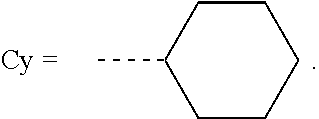

wherein
X′ is NR, S, O or PR;
R is aryl, heteroaryl, alkyl, cycloalkyl, or heterocyclealkyl;
A200 is —NR206R207, —P(O)R208R209, —PR210R211, —S(O)2R212, —S(O)R213, —SR214, or —OR215; R221, R222 and R223 are independently of each other aryl, heteroaryl, alkyl, cycloalkyl, or heterocyclealkyl, wherein at least on of the groups R221, R222, or R223 is aryl, or heteroaryl; R204 and R205 are independently of each other alkyl, cycloalkyl, heterocyclealkyl, aryl, heteroaryl, a group A200, or a group having donor, or acceptor characteristics;
n2 and m1 are independently of each other 0, 1, 2, or 3;
R206, R207 form together with the nitrogen atom a cyclic residue having 3 to 10 ring atoms, which can be unsubstituted, or which can be substituted with one, or more substituents selected from alkyl, cycloalkyl, heterocyclealkyl, aryl, heteroaryl and a group having donor, or acceptor characteristics; and/or which can be annulated with one, or more further cyclic residues having 3 to 10 ring atoms, wherein the annulated residues can be unsubstituted, or can be substituted with one, or more substituents selected from alkyl, cycloalkyl, heterocyclealkyl, aryl, heteroaryl and a group having donor, or acceptor characteristics; and
R208, R209, R210, R211, R212, R213, R214 and R215 are independently of each other aryl, heteroaryl, alkyl, cycloalkyl, or heterocyclealkyl.

are described in WO 2010/079051 A1 (in particular pages on 19 to 26 and in tables on pages 27 to 34, pages 35 to 37 and pages 42 to 43).


as well as the host materials published in WO2012048266, WO2012145173, WO2012162325, and EP2551932.


-
- A hole injection layer (h) between the anode (a) and the hole-transport layer (d);
- an electron injection layer (i) between the electron-transport layer (g) and the cathode (b).

wherein
R1″, R2″ and R3″
are each independently hydrogen, deuterium, a linear or branched alkyl radical, optionally interrupted by at least one heteroatom, optionally bearing at least one functional group and having a total of from 1 to 20 carbon atoms and/or heteroatoms, a substituted or unsubstituted cycloalkyl radical, optionally bearing at least one functional group and having from 3 to 20 carbon atoms, a substituted or unsubstituted heterocycle alkyl radical, interrupted by at least one heteroatom, optionally bearing at least one functional group and having a total of from 3 to 20 carbon atoms and/or heteroatoms, a substituted or unsubstituted aryl radical, optionally bearing at least one functional group and having 6 to 30 carbon atoms, a substituted or unsubstituted heteroaryl radical, interrupted by at least one heteroatom, optionally bearing at least one functional group and having a total of from 5 to 18 carbon atoms and/or heteroatoms, a group with donor or acceptor action, preferably, R1″, R2″ and R3″ are each independently hydrogen, a linear or branched alkyl radical, having from 1 to 6 carbon atoms, a substituted or unsubstituted aryl radical, having from 6 to 30 carbon atoms, a substituted or unsubstituted heteroaryl radical, having a total of from 5 to 18 carbon atoms and/or heteroatoms, a group with donor or acceptor action, selected from the group consisting of halogen radicals, preferably F or Cl, more preferably F; CF3, SiPh3 and SiMe3;
or
R1″ and R2″ or R2″ and R3″ form, independently of each other, together with a carbon atom to which they are bonded an optionally substituted saturated or unsaturated or aromatic ring, optionally interrupted by at least one heteroatom and having a total of from 5 to 18 carbon atoms and/or heteroatoms, and may optionally be fused to at least one further optionally substituted saturated or unsaturated or aromatic ring, optionally interrupted by at least one heteroatom and having a total of from 5 to 18 carbon atoms and/or heteroatoms;
A1″ is CR4″ or N, preferably CR4″;
A2″ is CR5″ or N, preferably CR5″;
A3″ is CR6″ or N, preferably CR6″;
A4″ is CR7″ or N, preferably CR7″;
A1′″ is CR4′″ or N, preferably CR4′″;
A2′″ is CR5′″ or N, preferably CR5′″;
A3′″ is CR6′″ or N, preferably CR6′″;
A4′″ is CR7′″ or N, preferably CR7′″;
R4″, R5″, R6″, R7″, R4′″, R5′″, R6′″ and R7′″
are each independently hydrogen, deuterium, a linear or branched alkyl radical, optionally interrupted by at least one heteroatom, optionally bearing at least one functional group and having a total of from 1 to 20 carbon atoms and/or heteroatoms, a substituted or unsubstituted cycloalkyl radical, optionally bearing at least one functional group and having from 3 to 20 carbon atoms, a substituted or unsubstituted heterocycle alkyl radical, interrupted by at least one heteroatom, optionally bearing at least one functional group and having a total of from 3 to 20 carbon atoms and/or heteroatoms, a substituted or unsubstituted aryl radical, optionally bearing at least one functional group and having from 6 to 30 carbon atoms, a substituted or unsubstituted heteroaryl radical, interrupted by at least one heteroatom, optionally bearing at least one functional group and having a total of from 5 to 18 carbon atoms and/or heteroatoms, a group with donor or acceptor action, preferably, R4″, R5″, R6″, R7″, R4′″, R5′″, R6′″ and R7′″ are each independently hydrogen, a linear or branched alkyl radical, optionally bearing at least one functional group, optionally interrupted by at least one heteroatom and having a total of from 1 to 20 carbon and/or heteroatoms, a substituted or unsubstituted aryl radical, having from 6 to 30 carbon atoms, a substituted or unsubstituted heteroaryl radical, having a total of from 5 to 18 carbon atoms and/or heteroatoms, a group with donor or acceptor action, selected from halogen radicals, preferably F or Cl, more preferably F; CF3, CN, SiPh3 and SiMe3;
or
R4″ and R5″, R5″ and R6″ or R6″ and R7″ or R4′″ and R5′″, R5′″ and R6′″ or R6′″ and R7′″ form, independently of each other, together with the carbon atoms to which they are bonded, a saturated or unsaturated or aromatic, optionally substituted ring, which is optionally interrupted by at least one heteroatom, has a total of from 5 to 18 carbon atoms and/or heteroatoms, and may optionally be fused to at least one further optionally substituted saturated or unsaturated or aromatic ring, optionally interrupted by at least one heteroatom and having a total of from 5 to 18 carbon atoms and/or heteroatoms.


4,4′-bis[N-(1-naphthyl)-N-phenylamino]biphenyl (α-NPD), N,N′-diphenyl-N,N′-bis(3-methylphenyl)-[1,1′-biphenyl]-4,4′-diamine (TPD), 1,1-bis[(di-4-tolylamino)phenyl]cyclohexane (TAPC), N,N′-bis(4-methylphenyl)-N,N′-bis(4-ethylphenyl)[1,1′-(3,3′-dimethyl)biphenyl]-4,4′-diamine (ETPD), tetrakis(3-methylphenyl)-N,N,N′,N′-2,5-phenylenediamine (PDA), α-phenyl-4-N,N-diphenylaminostyrene (TPS), p-(diethylamino)benzaldehyde diphenylhydrazone (DEH), triphenylamine (TPA), bis[4-(N,N-diethylamino)2-methylphenyl](4-methylphenyl)methane (MPMP), 1-phenyl-3-[p-(diethylamino)styryl]5-[p-(diethylamino)phenyl]pyrazoline (PPR or DEASP), 1,2-trans-bis(9H-carbazol9-yl)-cyclobutane (DCZB), N,N,N′,N′-tetrakis(4-methylphenyl)-(1,1′-biphenyl)-4,4′-diamine (TTB), fluorine compounds such as 2,2′,7,7′-tetra(N,N-di-tolyl)amino9,9-spirobifluorene (spiro-TTB), N,N′-bis(naphthalen-1-yl)-N,N′-bis(phenyl)9,9-spirobifluorene (spiro-NPB) and 9,9-bis(4-(N,N-bis-biphenyl-4-yl-amino)phenyl-9Hfluorene, benzidine compounds such as N,N′-bis(naphthalen-1-yl)-N,N′-bis(phenyl)benzidine and porphyrin compounds such as copper phthalocyanines. In addition, polymeric hole-injection materials can be used such as poly(N-vinylcarbazole) (PVK), polythiophenes, polypyrrole, polyaniline, self-doping polymers, such as, for example, sulfonated poly(thiophene-3-[2[(2-methoxyethoxy)ethoxy]-2,5-diyl) (Plexcore® OC Conducting Inks commercially available from Plextronics), and copolymers such as poly(3,4-ethylenedioxythiophene)/poly(4-styrenesulfonate) also called PEDOT/PSS.

The preparation of Ir(DPBIC)3 is for example mentioned in WO 2005/019373 A2. Another example of a suitable carbene complex is Ir(DPABIC)3

The preparation of Ir(DPABIC)3 is for example mentioned in WO2012/172182 (as complex fac-Em1; synthesis: example 1)).

Another example of a suitable carbene complex is Ir(DPABIC)3

Anode (a)

in which
R32′ and R33′ are each independently F, C1-C8-alkyl, or C6-C14-aryl, which is optionally substituted by one or more C1-C8-alkyl groups, or
two R32′ and/or R33′ substituents together form a fused benzene ring which is optionally substituted by one or more C1-C8-alkyl groups;
a and b are each independently 0, 1, 2 or 3,
M1 is an alkaline metal atom or alkaline earth metal atom,
p is 1 when M1 is an alkali metal atom, p is 2 when M1 is an alkali metal atom.

(Liq), which may be present as a single species, or in other forms such as LigQg in which g is an integer, for example Li6Q6. Q is an 8-hydroxyquinolate ligand or an 8-hydroxyquinolate derivative.

in which
R34′, R35′, R36′, R37′, R34″, R35″, R36″ and R37″ are each independently hydrogen, C1-C18-alkyl, C1-C18-alkyl which is substituted by E and/or interrupted by D, C6-C24-aryl, C6-C24-aryl which is substituted by G, C2-C20-heteroaryl or C2-C20-heteroaryl which is substituted by G,
Q is an arylene or heteroarylene group, each of which is optionally substituted by G;
D is —CO—; —COO—; —S—; —SO—; —SO2—; —O—; —NR40′—; —SiR45′R46′—; —POR47′—; —CR38′═CR39′—; or —C≡C—;
E is —OR44′; —SR44′; —NR40′R41; —COOR43′; —COOR42′; —CONR40′R41′; —CN; or F;
G is E, C1-C18-alkyl, C1-C18-alkyl which is interrupted by D, C1-C18-perfluoroalkyl, C1-C18-alkoxy, or C1-C18-alkoxy which is substituted by E and/or interrupted by D,
in which
R38′ and R39′ are each independently H, C6-C18-aryl; C6-C18-aryl which is substituted by C1-C18-alkyl or C1-C18-alkoxy; C1-C18-alkyl; or C1-C18-alkyl which is interrupted by —O—;
R40′ and R41′ are each independently C6-C18-aryl; C6-C18-aryl which is substituted by C1-C18-alkyl or C1-C18-alkoxy; C1-C18-alkyl; or C1-C18-alkyl which is interrupted by —O—; or
R40′ and R41′ together form a 6-membered ring;
R42′ and R43′ are each independently C6-C18-aryl; C6-C18-aryl which is substituted by C1-C18-alkyl or C1-C18-alkoxy; C1-C18-alkyl; or C1-C18-alkyl which is interrupted by —O—,
R44′ is C6-C18-aryl; C6-C18-aryl which is substituted by C1-C18-alkyl or C1-C18-alkoxy; C1-C18-alkyl; or C1-C18-alkyl which is interrupted by —O—,
R45′ and R46′ are each independently C1-C18-alkyl, C6-C18-aryl or C6-C18-aryl which is substituted by C1-C18-alkyl,
R47′ is C1-C18-alkyl, C6-C18-aryl or C6-C18-aryl which is substituted by C1-C18-alkyl.

in which Q is:

R48′ is H or C1-C18-alkyl and R48″ is H, C1-C18-alkyl or


(Liq) and a compound ETM-1.

(A-10; =ETM-2 is most preferred.

WO 2012/115034, such as for example, such as, for example, a compound of formula

Hole Injection Layer (h)


| Voltage | currEff | LumEff | EQE | |||
| Example | Emitter | [V] | [cd/A] | [lm/W] | [%] | CIEx,y |
| Complex | 4.3 | 23.8 | 17.4 | 11.9 | 0.17; 0.30 | ||
| (1) | |||||||
Device 2:
| Voltage | currEff | LumEff | EQE | |||
| Example | Emitter | [V] | [cd/A] | [lm/W] | [%] | CIEx,y |
| Complex | 5.4 | 24.8 | 14.4 | 12.4 | 0.17; 0.31 | ||
| (1) | |||||||

B Devices with Complex (4) as Blocker and Co-Host
| Voltage | currEff | LumEff | EQE | |||
| Example | Blocker | [V] | [cd/A] | [lm/W] | [%] | CIE x, y |
| Complex | 5.5 | 20.9 | 12.7 | 11.8 | 0.17; 0.28 | ||
| (4) | |||||||


Claims (18)


(substituted or unsubstituted)aryl-Y,

Applications Claiming Priority (7)
| Application Number | Priority Date | Filing Date | Title |
|---|---|---|---|
| EP13178675 | 2013-07-31 | ||
| EP13178675.8 | 2013-07-31 | ||
| EP13178675 | 2013-07-31 | ||
| EP14175848 | 2014-07-04 | ||
| EP14175848.2 | 2014-07-04 | ||
| EP14175848 | 2014-07-04 | ||
| PCT/EP2014/066510 WO2015014944A1 (en) | 2013-07-31 | 2014-07-31 | Luminescent diaza- monoaza- and benzimidazole metal carbene complexes for use in electronic devices such as oleds |
Publications (2)
| Publication Number | Publication Date |
|---|---|
| US20160172606A1 US20160172606A1 (en) | 2016-06-16 |
| US10290817B2 true US10290817B2 (en) | 2019-05-14 |
Family
ID=51228454
Family Applications (3)
| Application Number | Title | Priority Date | Filing Date |
|---|---|---|---|
| US14/908,606 Active US9673408B2 (en) | 2013-07-31 | 2014-07-29 | Luminescent diazabenzimidazole carbene metal complexes |
| US14/908,740 Active 2035-10-20 US10290817B2 (en) | 2013-07-31 | 2014-07-31 | Luminescent diaza-monoaza-and benzimidazole metal carbene complexes for use in electronic devices such as OLEDs |
| US15/610,783 Abandoned US20170331054A1 (en) | 2013-07-31 | 2017-06-01 | Luminescent diazabenzimidazole carbene metal complexes |
Family Applications Before (1)
| Application Number | Title | Priority Date | Filing Date |
|---|---|---|---|
| US14/908,606 Active US9673408B2 (en) | 2013-07-31 | 2014-07-29 | Luminescent diazabenzimidazole carbene metal complexes |
Family Applications After (1)
| Application Number | Title | Priority Date | Filing Date |
|---|---|---|---|
| US15/610,783 Abandoned US20170331054A1 (en) | 2013-07-31 | 2017-06-01 | Luminescent diazabenzimidazole carbene metal complexes |
Country Status (7)
| Country | Link |
|---|---|
| US (3) | US9673408B2 (en) |
| EP (3) | EP3239161A1 (en) |
| JP (3) | JP6486353B2 (en) |
| KR (2) | KR102226202B1 (en) |
| CN (4) | CN105431442B (en) |
| TW (1) | TWI625327B (en) |
| WO (2) | WO2015014835A1 (en) |
Cited By (14)
| Publication number | Priority date | Publication date | Assignee | Title |
|---|---|---|---|---|
| US10775505B2 (en) | 2015-01-30 | 2020-09-15 | Trinamix Gmbh | Detector for an optical detection of at least one object |
| US10823818B2 (en) | 2013-06-13 | 2020-11-03 | Basf Se | Detector for optically detecting at least one object |
| US10890491B2 (en) | 2016-10-25 | 2021-01-12 | Trinamix Gmbh | Optical detector for an optical detection |
| US10948567B2 (en) | 2016-11-17 | 2021-03-16 | Trinamix Gmbh | Detector for optically detecting at least one object |
| US10955936B2 (en) | 2015-07-17 | 2021-03-23 | Trinamix Gmbh | Detector for optically detecting at least one object |
| US11041718B2 (en) | 2014-07-08 | 2021-06-22 | Basf Se | Detector for determining a position of at least one object |
| US11125880B2 (en) | 2014-12-09 | 2021-09-21 | Basf Se | Optical detector |
| US11211513B2 (en) | 2016-07-29 | 2021-12-28 | Trinamix Gmbh | Optical sensor and detector for an optical detection |
| US11428787B2 (en) | 2016-10-25 | 2022-08-30 | Trinamix Gmbh | Detector for an optical detection of at least one object |
| US11448762B2 (en) | 2017-08-28 | 2022-09-20 | Trinamix Gmbh | Range finder for determining at least one geometric information |
| US11605790B2 (en) | 2013-07-02 | 2023-03-14 | Udc Ireland Limited | Monosubstituted diazabenzimidazole carbene metal complexes for use in organic light emitting diodes |
| US11668828B2 (en) | 2017-08-28 | 2023-06-06 | Trinamix Gmbh | Detector for determining a position of at least one object |
| US11719818B2 (en) | 2017-03-16 | 2023-08-08 | Trinamix Gmbh | Detector for optically detecting at least one object |
| US11860292B2 (en) | 2016-11-17 | 2024-01-02 | Trinamix Gmbh | Detector and methods for authenticating at least one object |
Families Citing this family (22)
| Publication number | Priority date | Publication date | Assignee | Title |
|---|---|---|---|---|
| EP3239161A1 (en) | 2013-07-31 | 2017-11-01 | UDC Ireland Limited | Luminescent diazabenzimidazole carbene metal complexes |
| CN106661068A (en) | 2014-03-31 | 2017-05-10 | Udc 爱尔兰有限责任公司 | Metal complexes comprising carbene ligands with o-substituted acyclometallated aryl groups and their use in organic light-emitting diodes |
| GB2533285A (en) * | 2014-12-12 | 2016-06-22 | Cambridge Display Tech Ltd | Light-emitting material and organic light-emitting device |
| JP6779214B2 (en) | 2015-01-09 | 2020-11-04 | ブリストル−マイヤーズ スクイブ カンパニーBristol−Myers Squibb Company | Cyclic urea as a ROCK inhibitor |
| US10418569B2 (en) | 2015-01-25 | 2019-09-17 | Universal Display Corporation | Organic electroluminescent materials and devices |
| GB2536212A (en) * | 2015-03-04 | 2016-09-14 | Cambridge Display Tech Ltd | Light-emitting material and organic light-emitting device |
| KR102661925B1 (en) * | 2015-06-03 | 2024-05-02 | 유디씨 아일랜드 리미티드 | Highly efficient oled devices with very short decay times |
| KR102456073B1 (en) | 2017-07-28 | 2022-10-19 | 삼성디스플레이 주식회사 | Organometallic compound and organic light emitting device comprising the same |
| TWI826522B (en) | 2018-09-12 | 2023-12-21 | 德商麥克專利有限公司 | Electroluminescent devices |
| US20220048836A1 (en) | 2018-09-12 | 2022-02-17 | Merck Patent Gmbh | Materials for organic electroluminescent devices |
| TW202030902A (en) | 2018-09-12 | 2020-08-16 | 德商麥克專利有限公司 | Electroluminescent devices |
| EP3935129B1 (en) | 2019-03-04 | 2023-11-29 | Merck Patent GmbH | Ligands for nano-sized materials |
| JP2022525186A (en) | 2019-03-15 | 2022-05-11 | ザ ジェネラル ホスピタル コーポレイション | TEAD Transcription Factor New Small Molecule Inhibitor |
| JP7598873B2 (en) | 2019-04-11 | 2024-12-12 | メルク パテント ゲゼルシャフト ミット ベシュレンクテル ハフツング | Materials for organic electroluminescent devices |
| KR102937291B1 (en) | 2019-11-04 | 2026-03-11 | 유디씨 아일랜드 리미티드 | Materials for organic electroluminescent devices |
| TW202134252A (en) | 2019-11-12 | 2021-09-16 | 德商麥克專利有限公司 | Materials for organic electroluminescent devices |
| TW202136181A (en) | 2019-12-04 | 2021-10-01 | 德商麥克專利有限公司 | Materials for organic electroluminescent devices |
| CN115052865A (en) | 2020-01-29 | 2022-09-13 | 默克专利有限公司 | Benzimidazole Derivatives |
| US20230337537A1 (en) | 2020-03-23 | 2023-10-19 | Merck Patent Gmbh | Materials for organic electroluminescent devices |
| CN116529244A (en) * | 2020-11-26 | 2023-08-01 | Sfc株式会社 | Novel organic compound and organic light-emitting element comprising same |
| US12610730B2 (en) | 2021-05-18 | 2026-04-21 | City University Of Hong Kong | Metal complex and light emitting device |
| EP4619484A1 (en) | 2022-11-17 | 2025-09-24 | Merck Patent GmbH | Materials for organic electroluminescent devices |
Citations (27)
| Publication number | Priority date | Publication date | Assignee | Title |
|---|---|---|---|---|
| WO2005113704A2 (en) | 2004-05-18 | 2005-12-01 | The University Of Southern California | Luminescent compounds with carbene ligands |
| WO2006056418A2 (en) | 2004-11-25 | 2006-06-01 | Basf Aktiengesellschaft | Use of transition metal carbene complexes in organic light-emitting diodes (oleds) |
| US20060127696A1 (en) | 2002-08-24 | 2006-06-15 | Covion Organic Semiconductors Gmbh | Rhodium and iridium complexes |
| US20060258043A1 (en) * | 2003-08-19 | 2006-11-16 | Basf Aktiengesellschaft | Transition metal complexes comprising carbene ligands serving as emitters for organic light-emitting diodes (oled's) |
| WO2006121811A1 (en) | 2005-05-06 | 2006-11-16 | Universal Display Corporation | Stability oled materials and devices with improved stability |
| WO2007095118A2 (en) | 2006-02-10 | 2007-08-23 | Universal Display Corporation | METAL COMPLEXES OF CYCLOMETALLATED IMIDAZO[1,2-f]PHENANTHRIDINE AND DIIMIDAZO[1,2-A:1',2'-C]QUINAZOLINE LIGANDS AND ISOELECTRONIC AND BENZANNULATED ANALOGS THEREOF |
| WO2007115981A1 (en) | 2006-04-04 | 2007-10-18 | Basf Se | Transition metal complexes comprising one noncarbene ligand and one or two carbene ligands and their use in oleds |
| WO2007115970A1 (en) | 2006-04-05 | 2007-10-18 | Basf Se | Heteroleptic transition metal-carbene complexes and their use in organic light-emitting diodes (oleds) |
| WO2008156879A1 (en) | 2007-06-20 | 2008-12-24 | Universal Display Corporation | Blue phosphorescent imidazophenanthridine materials |
| JP2009057505A (en) | 2007-09-03 | 2009-03-19 | Konica Minolta Holdings Inc | ORGANIC ELECTROLUMINESCENT ELEMENT MATERIAL, ORGANIC ELECTROLUMINESCENT ELEMENT, DISPLAY DEVICE AND LIGHTING DEVICE |
| WO2009050290A1 (en) | 2007-10-17 | 2009-04-23 | Basf Se | Transition metal complexes having bridged carbene ligands and the use thereof in oleds |
| WO2009050281A1 (en) | 2007-10-17 | 2009-04-23 | Basf Se | Transition metal complexes with bridged carbene ligands and use thereof in oleds |
| WO2010068876A1 (en) | 2008-12-12 | 2010-06-17 | Universal Display Corporation | BLUE EMITTER WITH HIGH EFFICIENCY BASED ON IMIDAZO [1,2-f] PHENANTHRIDINE IRIDIUM COMPLEXES |
| US20110057559A1 (en) | 2007-12-28 | 2011-03-10 | Universal Display Corporation | Phosphorescent emitters and host materials with improved stability |
| WO2011051404A1 (en) | 2009-10-28 | 2011-05-05 | Basf Se | Heteroleptic carbene complexes and use thereof in organic electronics |
| WO2011073149A1 (en) | 2009-12-14 | 2011-06-23 | Basf Se | Metal complexes comprising diazabenzimidazol carbene-ligands and the use thereof in oleds |
| WO2011106344A1 (en) | 2010-02-25 | 2011-09-01 | Universal Display Corporation | Phosphorescent emitters |
| US20110233528A1 (en) | 2010-03-24 | 2011-09-29 | Universal Display Corporation | Novel oled display architecture |
| WO2012048266A1 (en) | 2010-10-08 | 2012-04-12 | Universal Display Corporation | Novel 3, 9-linked oligocarbazole-based hosts, containing dbt and dbr fragments, separated by aromatic spacers |
| JP2012167028A (en) | 2011-02-10 | 2012-09-06 | Chemiprokasei Kaisha Ltd | Substituted phenylpyridine iridium complex, luminescent material including the same, and organic el element employing the complex |
| WO2012121936A2 (en) | 2011-03-08 | 2012-09-13 | Universal Display Corporation | Pyridyl carbene phosphorescent emitters |
| US20120305894A1 (en) | 2011-06-01 | 2012-12-06 | Do-Han Kim | Blue phosphorescent compound and organic electroluminescent device using the same |
| WO2012170461A1 (en) | 2011-06-08 | 2012-12-13 | Universal Display Corporation | Heteroleptic iridium carbene complexes and light emitting device using them |
| WO2012172482A1 (en) | 2011-06-14 | 2012-12-20 | Basf Se | Metal complexes comprising azabenzimidazole carbene ligands and the use thereof in oleds |
| US20140027733A1 (en) | 2012-07-19 | 2014-01-30 | Universal Display Corporation | Transition metal complexes containing substituted imidazole carbene as ligands and their application in oleds |
| WO2015014835A1 (en) | 2013-07-31 | 2015-02-05 | Basf Se | Luminescent diazabenzimidazole carbene metal complexes |
| JP2016530494A (en) | 2013-06-28 | 2016-09-29 | コーニンクレッカ フィリップス エヌ ヴェKoninklijke Philips N.V. | Semiconductor scintillation detector |
Family Cites Families (99)
| Publication number | Priority date | Publication date | Assignee | Title |
|---|---|---|---|---|
| DE60031729T2 (en) | 1999-05-13 | 2007-09-06 | The Trustees Of Princeton University | LIGHT-EMITTING, ORGANIC, ELECTROPHOSPHORESCENCE-BASED ARRANGEMENT WITH VERY HIGH QUANTITY LOSSES |
| JP3924648B2 (en) | 1999-11-02 | 2007-06-06 | ソニー株式会社 | Organic electroluminescence device |
| DE10109027A1 (en) * | 2001-02-24 | 2002-09-05 | Covion Organic Semiconductors | Rhodium and iridium complexes |
| GB0311234D0 (en) * | 2003-05-16 | 2003-06-18 | Isis Innovation | Organic phosphorescent material and organic optoelectronic device |
| US7534505B2 (en) * | 2004-05-18 | 2009-05-19 | The University Of Southern California | Organometallic compounds for use in electroluminescent devices |
| ATE430789T1 (en) * | 2004-12-23 | 2009-05-15 | Ciba Holding Inc | ELECTROLUMINESCENT METAL COMPLEXES WITH NUCLEOPHILIC CARBENE LIGANDS |
| WO2006114966A1 (en) | 2005-04-18 | 2006-11-02 | Konica Minolta Holdings, Inc. | Organic electroluminescent device, display and illuminating device |
| JP5107237B2 (en) | 2005-05-30 | 2012-12-26 | チバ ホールディング インコーポレーテッド | Electroluminescent device |
| JP4935024B2 (en) * | 2005-08-25 | 2012-05-23 | コニカミノルタホールディングス株式会社 | ORGANIC ELECTROLUMINESCENT ELEMENT, DISPLAY DEVICE AND LIGHTING DEVICE USING THE SAME |
| EP1786050B1 (en) | 2005-11-10 | 2010-06-23 | Novaled AG | Doped organic semiconductor material |
| KR101395615B1 (en) * | 2005-11-30 | 2014-05-16 | 미쓰비시 가가꾸 가부시키가이샤 | Organic compound, charge-transporting material, composition for charge-transporting material and organic electroluminescent device |
| EP2463930B1 (en) | 2006-01-05 | 2017-04-12 | Konica Minolta Holdings, Inc. | Organic electroluminescent device, display and illuminating device |
| US8410280B2 (en) | 2006-01-31 | 2013-04-02 | Basf Se | Process for preparing transition metal-carbene complexes |
| WO2007101820A1 (en) | 2006-03-08 | 2007-09-13 | Ciba Holding Inc. | Palladium catalyzed polymerization reaction |
| EP1998387B1 (en) | 2006-03-17 | 2015-04-22 | Konica Minolta Holdings, Inc. | Organic electroluminescent device, display and illuminating device |
| DE502006000749D1 (en) | 2006-03-21 | 2008-06-19 | Novaled Ag | Heterocyclic radical or diradical, their dimers, oligomers, polymers, dispiro compounds and polycycles, their use, organic semiconducting material and electronic component |
| US8920942B2 (en) | 2006-03-23 | 2014-12-30 | Konica Minolta Holdings, Inc. | Organic electroluminescent element, display device and illuminating device |
| US20070224446A1 (en) | 2006-03-24 | 2007-09-27 | Idemitsu Kosan Co., Ltd. | Material for organic electroluminescence device and organic electroluminescence device using the same |
| EP3093898B1 (en) | 2006-03-30 | 2017-12-13 | Konica Minolta Holdings, Inc. | Organic electroluminescence device and lighting device |
| JP5055818B2 (en) | 2006-04-19 | 2012-10-24 | コニカミノルタホールディングス株式会社 | ORGANIC ELECTROLUMINESCENT ELEMENT MATERIAL, ORGANIC ELECTROLUMINESCENT ELEMENT, DISPLAY DEVICE AND LIGHTING DEVICE |
| WO2007142083A1 (en) | 2006-06-02 | 2007-12-13 | Idemitsu Kosan Co., Ltd. | Material for organic electroluminescence element, and organic electroluminescence element using the material |
| EP2035526B1 (en) | 2006-06-26 | 2021-11-17 | UDC Ireland Limited | Use in oleds of transition metal carbene complexes that contain no cyclometallation via non-carbenes |
| JP2008021687A (en) | 2006-07-10 | 2008-01-31 | Mitsubishi Chemicals Corp | Organic electroluminescent element material, organic electroluminescent element composition, and organic electroluminescent element |
| US8852757B2 (en) | 2006-09-08 | 2014-10-07 | Konica Minolta Holdings, Inc. | Organic electroluminescence element, lighting device and display device |
| JP2008066569A (en) | 2006-09-08 | 2008-03-21 | Konica Minolta Holdings Inc | Organic electroluminescence element, lighting device and display device |
| JP5444715B2 (en) | 2006-09-08 | 2014-03-19 | コニカミノルタ株式会社 | Organic electroluminescence element, lighting device and display device |
| JP5556014B2 (en) | 2006-09-20 | 2014-07-23 | コニカミノルタ株式会社 | Organic electroluminescence device |
| WO2008034758A2 (en) | 2006-09-21 | 2008-03-27 | Basf Se | Oled display with extended lifetime |
| JP5589251B2 (en) | 2006-09-21 | 2014-09-17 | コニカミノルタ株式会社 | Organic electroluminescence element material |
| JP5011908B2 (en) | 2006-09-26 | 2012-08-29 | コニカミノルタホールディングス株式会社 | Organic electroluminescence element, display device and lighting device |
| JP5063992B2 (en) | 2006-11-20 | 2012-10-31 | ケミプロ化成株式会社 | Novel di (pyridylphenyl) derivative, electron transport material comprising the same, and organic electroluminescence device including the same |
| US8541112B2 (en) | 2006-12-13 | 2013-09-24 | Konica Minolta Holdings, Inc. | Organic electroluminescent element, display device and lighting device |
| WO2008090912A1 (en) | 2007-01-23 | 2008-07-31 | Konica Minolta Holdings, Inc. | Method for manufacturing organic electroluminescent device, organic electroluminescent device manufactured by the method, display device and illuminating device |
| JP2008207520A (en) | 2007-02-28 | 2008-09-11 | Konica Minolta Holdings Inc | Organic thin film, organic thin film manufacturing method, electronic device, organic electroluminescence element, display device and lighting device |
| DE102007012794B3 (en) | 2007-03-16 | 2008-06-19 | Novaled Ag | Pyrido [3,2-h] quinazolines and / or their 5,6-dihydro derivatives, their method of preparation and doped organic semiconductor material containing them |
| EP3076451B1 (en) | 2007-04-30 | 2019-03-06 | Novaled GmbH | Oxocarbon, pseudo oxocarbon and radial compounds and their use |
| JP5564942B2 (en) | 2007-05-16 | 2014-08-06 | コニカミノルタ株式会社 | Organic electroluminescence element, display device and lighting device |
| WO2008146838A1 (en) | 2007-05-30 | 2008-12-04 | Konica Minolta Holdings, Inc. | Organic electroluminescent device, display device and illuminating device |
| JP5540701B2 (en) | 2007-06-21 | 2014-07-02 | コニカミノルタ株式会社 | Organic electroluminescence element material |
| CN101688114B (en) | 2007-07-05 | 2014-07-16 | 巴斯夫欧洲公司 | Containing at least one selected from the group consisting of disilylcarbazole, disilyldibenzofuran, disilyldibenzothiophene, disilyldibenzophosphorole, disilyldibenzofuran Organic light-emitting diodes of disilyl compounds of benzothiophene S-oxide and disilyldibenzothiophene S,S-dioxide |
| EP2165377B1 (en) | 2007-07-05 | 2021-04-28 | UDC Ireland Limited | Organic light-emitting diodes containing carbene transition metal complex emitters and at least one compound selected from disilylcarbazoles, disilyldibenzofurans, disilyldibenzothiophenes, disilyldibenzophospholes, disilyldibenzothiophene s-oxides and disilyldibenzothiophene s,s-dioxides |
| JP5619418B2 (en) | 2007-07-10 | 2014-11-05 | 出光興産株式会社 | Material for organic electroluminescence device and organic electroluminescence device using the same |
| JP5194596B2 (en) | 2007-07-11 | 2013-05-08 | コニカミノルタホールディングス株式会社 | Organic electroluminescence element, display device and lighting device |
| JP5186843B2 (en) | 2007-08-30 | 2013-04-24 | コニカミノルタホールディングス株式会社 | Organic electroluminescence element, lighting device and display device |
| JP2009114369A (en) | 2007-11-08 | 2009-05-28 | Konica Minolta Holdings Inc | ORGANIC ELECTROLUMINESCENT MATERIAL, ORGANIC ELECTROLUMINESCENT ELEMENT, DISPLAY DEVICE AND LIGHTING DEVICE |
| WO2009060742A1 (en) | 2007-11-08 | 2009-05-14 | Konica Minolta Holdings, Inc. | Organic electroluminescent device, display device, and illuminating device |
| WO2009060780A1 (en) | 2007-11-08 | 2009-05-14 | Konica Minolta Holdings, Inc. | Organic electroluminescence element, display device, and lighting system |
| WO2009060757A1 (en) | 2007-11-08 | 2009-05-14 | Konica Minolta Holdings, Inc. | Organic electroluminescent device, display device and illuminating device |
| WO2009060779A1 (en) | 2007-11-08 | 2009-05-14 | Konica Minolta Holdings, Inc. | Organic electroluminescent device material, organic electroluminescent device, display device and illuminating device |
| JP2009114370A (en) | 2007-11-08 | 2009-05-28 | Konica Minolta Holdings Inc | ORGANIC ELECTROLUMINESCENT ELEMENT MATERIAL, ORGANIC ELECTROLUMINESCENT ELEMENT AND DISPLAY DEVICE, LIGHTING DEVICE |
| JPWO2009063757A1 (en) | 2007-11-14 | 2011-03-31 | コニカミノルタホールディングス株式会社 | ORGANIC ELECTROLUMINESCENT ELEMENT MATERIAL, ORGANIC ELECTROLUMINESCENT ELEMENT, METHOD FOR PRODUCING ORGANIC ELECTROLUMINESCENT ELEMENT, DISPLAY DEVICE AND LIGHTING DEVICE |
| JP2009135183A (en) | 2007-11-29 | 2009-06-18 | Konica Minolta Holdings Inc | Organic electroluminescence element, display device and lighting device |
| US20090153034A1 (en) | 2007-12-13 | 2009-06-18 | Universal Display Corporation | Carbazole-containing materials in phosphorescent light emittinig diodes |
| US8221905B2 (en) | 2007-12-28 | 2012-07-17 | Universal Display Corporation | Carbazole-containing materials in phosphorescent light emitting diodes |
| WO2009084413A1 (en) | 2007-12-28 | 2009-07-09 | Konica Minolta Holdings, Inc. | Organic electroluminescent device and method for manufacturing organic electroluminescent device |
| JP5549053B2 (en) | 2008-01-18 | 2014-07-16 | コニカミノルタ株式会社 | ORGANIC ELECTROLUMINESCENT ELEMENT MATERIAL, ORGANIC ELECTROLUMINESCENT ELEMENT, METHOD FOR PRODUCING ORGANIC ELECTROLUMINESCENT ELEMENT, DISPLAY DEVICE AND LIGHTING DEVICE |
| JP2009182298A (en) | 2008-02-01 | 2009-08-13 | Konica Minolta Holdings Inc | Organic electroluminescence element, lighting device and display device |
| WO2009104488A1 (en) | 2008-02-20 | 2009-08-27 | コニカミノルタホールディングス株式会社 | White light-emitting organic electroluminescent device |
| JP2009267255A (en) | 2008-04-28 | 2009-11-12 | Idemitsu Kosan Co Ltd | Material for organic electroluminescent element and organic electroluminescent element using the material |
| EP2479234B1 (en) | 2008-05-13 | 2017-06-21 | Konica Minolta Holdings, Inc. | Organic electroluminescent element, display device and lighting device |
| JP5533652B2 (en) | 2008-07-01 | 2014-06-25 | コニカミノルタ株式会社 | White light-emitting organic electroluminescence element, lighting device and display device |
| JP2010021336A (en) | 2008-07-10 | 2010-01-28 | Konica Minolta Holdings Inc | Organic electroluminescence device, illuminator, and display device |
| JP5609641B2 (en) | 2008-07-10 | 2014-10-22 | コニカミノルタ株式会社 | Organic electroluminescence element, display device and lighting device |
| JP5338184B2 (en) | 2008-08-06 | 2013-11-13 | コニカミノルタ株式会社 | Organic electroluminescence element, display device, lighting device |
| CN102246328B (en) | 2008-10-07 | 2016-05-04 | 欧司朗光电半导体有限公司 | The thiophene that condensed ring system replaces is coughed up and purposes in organic electronic device |
| WO2010044342A1 (en) | 2008-10-15 | 2010-04-22 | コニカミノルタホールディングス株式会社 | Organic el element, organic el element manufacturing method, white organic el element, display device, and illumination device |
| EP2180029B1 (en) | 2008-10-23 | 2011-07-27 | Novaled AG | Radialene compounds and their use |
| JP5493333B2 (en) | 2008-11-05 | 2014-05-14 | コニカミノルタ株式会社 | ORGANIC ELECTROLUMINESCENT ELEMENT, WHITE ORGANIC ELECTROLUMINESCENT ELEMENT, DISPLAY DEVICE AND LIGHTING DEVICE |
| JP5707665B2 (en) | 2008-12-03 | 2015-04-30 | コニカミノルタ株式会社 | ORGANIC ELECTROLUMINESCENCE ELEMENT, LIGHTING DEVICE AND DISPLAY DEVICE HAVING THE ELEMENT |
| JP5402942B2 (en) | 2008-12-08 | 2014-01-29 | コニカミノルタ株式会社 | Organic electroluminescence element, display device, and lighting device |
| KR101693903B1 (en) | 2009-01-07 | 2017-01-06 | 바스프 에스이 | Silyl- and heteroatom-substituted compounds selected from carbazoles, dibenzofurans, dibenzothiophenes and dibenzophospholes, and use thereof in organic electronics |
| JP5810529B2 (en) | 2009-01-09 | 2015-11-11 | コニカミノルタ株式会社 | Organic electroluminescence element, display device and lighting device |
| EP2383815B1 (en) | 2009-01-28 | 2014-07-30 | Konica Minolta Holdings, Inc. | Organic electroluminescent element, display device, and illumination device |
| DE102009007038A1 (en) | 2009-02-02 | 2010-08-05 | Merck Patent Gmbh | metal complexes |
| WO2010090077A1 (en) | 2009-02-06 | 2010-08-12 | コニカミノルタホールディングス株式会社 | Organic electroluminescent element, and illumination device and display device each comprising the element |
| WO2010095564A1 (en) | 2009-02-18 | 2010-08-26 | コニカミノルタホールディングス株式会社 | Organic electroluminescent element, and illuminating device and display device each comprising the element |
| EP2401254B1 (en) | 2009-02-26 | 2013-06-19 | Novaled AG | Quinone compounds as dopants in organic electronics |
| WO2011004639A1 (en) | 2009-07-07 | 2011-01-13 | コニカミノルタホールディングス株式会社 | Organic electroluminescent element, novel compound, lighting device and display device |
| CN102762583A (en) * | 2009-11-24 | 2012-10-31 | 南非医学研究院 | Method for synthesizing aspartin and its analogues |
| EP2558476B1 (en) | 2010-04-16 | 2015-02-25 | Basf Se | Bridged benzimidazole-carbene complexes and use thereof in oleds |
| US9273080B2 (en) | 2010-06-15 | 2016-03-01 | Merek Patent Gmbh | Metal complexes |
| EP2582769B1 (en) | 2010-06-18 | 2014-11-19 | Basf Se | Organic electronic devices comprising a layer of a dibenzofurane compound and a 8-hydroxyquinolinolato earth alkaline metal, or alkali metal complex |
| WO2011157779A1 (en) | 2010-06-18 | 2011-12-22 | Basf Se | Organic electronic devices comprising a layer of a pyridine compound and a 8-hydroxyquinolinolato earth alkaline metal, or alkali metal complex |
| WO2012014621A1 (en) | 2010-07-29 | 2012-02-02 | コニカミノルタホールディングス株式会社 | Transparent conductive film and organic electroluminescent element |
| JP5900351B2 (en) | 2011-02-02 | 2016-04-06 | コニカミノルタ株式会社 | Method for manufacturing organic electroluminescence element |
| US9368735B2 (en) | 2011-02-15 | 2016-06-14 | Konica Minolta, Inc. | Organic electroluminescence element and illumination device |
| JP5839027B2 (en) | 2011-02-22 | 2016-01-06 | コニカミノルタ株式会社 | ORGANIC ELECTROLUMINESCENCE ELEMENT, ITS MANUFACTURING METHOD, LIGHTING DEVICE, AND DISPLAY DEVICE |
| WO2012130709A1 (en) | 2011-03-25 | 2012-10-04 | Basf Se | 4h-imidazo[1,2-a]imidazoles for electronic applications |
| US8580399B2 (en) | 2011-04-08 | 2013-11-12 | Universal Display Corporation | Substituted oligoazacarbazoles for light emitting diodes |
| JP5821951B2 (en) | 2011-04-26 | 2015-11-24 | コニカミノルタ株式会社 | ORGANIC ELECTROLUMINESCENT ELEMENT AND LIGHTING DEVICE |
| US8748012B2 (en) | 2011-05-25 | 2014-06-10 | Universal Display Corporation | Host materials for OLED |
| KR20120135837A (en) | 2011-06-07 | 2012-12-17 | 엘지디스플레이 주식회사 | Blue phosphorescent compounds and organic light emitting devices using the same |
| FI122890B (en) | 2011-06-16 | 2012-08-31 | Sako Ltd | FIRE GUN SAFETY AND METHOD OF USING THE SAFETY DEVICE |
| US8409729B2 (en) | 2011-07-28 | 2013-04-02 | Universal Display Corporation | Host materials for phosphorescent OLEDs |
| KR101916867B1 (en) | 2011-10-20 | 2018-11-09 | 엘지디스플레이 주식회사 | Blue phosphorescent compound and Organic electroluminescent device using the same |
| KR102464739B1 (en) * | 2013-07-02 | 2022-11-09 | 유디씨 아일랜드 리미티드 | Monosubstituted diazabenzimidazole carbene metal complexes for use in organic light emitting diodes |
| TW201606304A (en) * | 2013-09-09 | 2016-02-16 | 亞克柏拉有限公司 | Methods of determining response to therapy |
| WO2015171809A1 (en) * | 2014-05-06 | 2015-11-12 | Evapco, Inc. | Sensor for coil defrost in a refrigeration system evaporator |
| GB2536212A (en) * | 2015-03-04 | 2016-09-14 | Cambridge Display Tech Ltd | Light-emitting material and organic light-emitting device |
-
2014
- 2014-07-29 EP EP17175235.5A patent/EP3239161A1/en not_active Withdrawn
- 2014-07-29 JP JP2016530494A patent/JP6486353B2/en active Active
- 2014-07-29 EP EP14744361.8A patent/EP3027629B1/en active Active
- 2014-07-29 CN CN201480043364.6A patent/CN105431442B/en active Active
- 2014-07-29 CN CN201810764727.5A patent/CN109021022B/en active Active
- 2014-07-29 KR KR1020167002342A patent/KR102226202B1/en active Active
- 2014-07-29 WO PCT/EP2014/066272 patent/WO2015014835A1/en not_active Ceased
- 2014-07-29 US US14/908,606 patent/US9673408B2/en active Active
- 2014-07-31 US US14/908,740 patent/US10290817B2/en active Active
- 2014-07-31 CN CN202011410330.XA patent/CN112480177A/en active Pending
- 2014-07-31 JP JP2016530536A patent/JP6486355B2/en active Active
- 2014-07-31 KR KR1020167004845A patent/KR102253615B1/en active Active
- 2014-07-31 WO PCT/EP2014/066510 patent/WO2015014944A1/en not_active Ceased
- 2014-07-31 EP EP14745141.3A patent/EP3027630B1/en active Active
- 2014-07-31 CN CN201480053947.7A patent/CN105764911A/en active Pending
- 2014-07-31 TW TW103126281A patent/TWI625327B/en active
-
2017
- 2017-06-01 US US15/610,783 patent/US20170331054A1/en not_active Abandoned
-
2019
- 2019-02-14 JP JP2019024372A patent/JP6770118B2/en active Active
Patent Citations (37)
| Publication number | Priority date | Publication date | Assignee | Title |
|---|---|---|---|---|
| US20060127696A1 (en) | 2002-08-24 | 2006-06-15 | Covion Organic Semiconductors Gmbh | Rhodium and iridium complexes |
| US20060258043A1 (en) * | 2003-08-19 | 2006-11-16 | Basf Aktiengesellschaft | Transition metal complexes comprising carbene ligands serving as emitters for organic light-emitting diodes (oled's) |
| WO2005113704A2 (en) | 2004-05-18 | 2005-12-01 | The University Of Southern California | Luminescent compounds with carbene ligands |
| WO2006056418A2 (en) | 2004-11-25 | 2006-06-01 | Basf Aktiengesellschaft | Use of transition metal carbene complexes in organic light-emitting diodes (oleds) |
| US20140309428A1 (en) | 2004-11-25 | 2014-10-16 | Basf Se | Use of transition metal carbene complexes in organic light-emitting diodes (oleds) |
| WO2006121811A1 (en) | 2005-05-06 | 2006-11-16 | Universal Display Corporation | Stability oled materials and devices with improved stability |
| WO2007095118A2 (en) | 2006-02-10 | 2007-08-23 | Universal Display Corporation | METAL COMPLEXES OF CYCLOMETALLATED IMIDAZO[1,2-f]PHENANTHRIDINE AND DIIMIDAZO[1,2-A:1',2'-C]QUINAZOLINE LIGANDS AND ISOELECTRONIC AND BENZANNULATED ANALOGS THEREOF |
| WO2007115981A1 (en) | 2006-04-04 | 2007-10-18 | Basf Se | Transition metal complexes comprising one noncarbene ligand and one or two carbene ligands and their use in oleds |
| US8383828B2 (en) | 2006-04-04 | 2013-02-26 | Basf Aktiengesellschaft | Transition metal complexes comprising one noncarbene ligand and one or two carbene ligands and their use in OLEDs |
| US20090096367A1 (en) | 2006-04-05 | 2009-04-16 | Basf Se | Heteroleptic transition metal-carbene complexes and their use in organic light-emitting diodes (oleds) |
| WO2007115970A1 (en) | 2006-04-05 | 2007-10-18 | Basf Se | Heteroleptic transition metal-carbene complexes and their use in organic light-emitting diodes (oleds) |
| WO2008156879A1 (en) | 2007-06-20 | 2008-12-24 | Universal Display Corporation | Blue phosphorescent imidazophenanthridine materials |
| JP2009057505A (en) | 2007-09-03 | 2009-03-19 | Konica Minolta Holdings Inc | ORGANIC ELECTROLUMINESCENT ELEMENT MATERIAL, ORGANIC ELECTROLUMINESCENT ELEMENT, DISPLAY DEVICE AND LIGHTING DEVICE |
| WO2009050290A1 (en) | 2007-10-17 | 2009-04-23 | Basf Se | Transition metal complexes having bridged carbene ligands and the use thereof in oleds |
| WO2009050281A1 (en) | 2007-10-17 | 2009-04-23 | Basf Se | Transition metal complexes with bridged carbene ligands and use thereof in oleds |
| US8728632B2 (en) | 2007-10-17 | 2014-05-20 | Basf Se | Metal complexes comprising bridged carbene ligands and use thereof in OLEDs |
| US8258297B2 (en) | 2007-10-17 | 2012-09-04 | Basf Se | Transition metal complexes with bridged carbene ligands and use thereof in OLEDs |
| US20110057559A1 (en) | 2007-12-28 | 2011-03-10 | Universal Display Corporation | Phosphorescent emitters and host materials with improved stability |
| WO2010068876A1 (en) | 2008-12-12 | 2010-06-17 | Universal Display Corporation | BLUE EMITTER WITH HIGH EFFICIENCY BASED ON IMIDAZO [1,2-f] PHENANTHRIDINE IRIDIUM COMPLEXES |
| US20120205645A1 (en) | 2009-10-28 | 2012-08-16 | Basf Se | Heteroleptic carbene complexes and the use thereof in organic electronics |
| WO2011051404A1 (en) | 2009-10-28 | 2011-05-05 | Basf Se | Heteroleptic carbene complexes and use thereof in organic electronics |
| US20130032766A1 (en) | 2009-12-14 | 2013-02-07 | Basf Se | Metal complexes comprising diazabenzimidazolocarbene ligands and the use thereof in oleds |
| WO2011073149A1 (en) | 2009-12-14 | 2011-06-23 | Basf Se | Metal complexes comprising diazabenzimidazol carbene-ligands and the use thereof in oleds |
| WO2011106344A1 (en) | 2010-02-25 | 2011-09-01 | Universal Display Corporation | Phosphorescent emitters |
| US20110233528A1 (en) | 2010-03-24 | 2011-09-29 | Universal Display Corporation | Novel oled display architecture |
| WO2012048266A1 (en) | 2010-10-08 | 2012-04-12 | Universal Display Corporation | Novel 3, 9-linked oligocarbazole-based hosts, containing dbt and dbr fragments, separated by aromatic spacers |
| JP2012167028A (en) | 2011-02-10 | 2012-09-06 | Chemiprokasei Kaisha Ltd | Substituted phenylpyridine iridium complex, luminescent material including the same, and organic el element employing the complex |
| WO2012121936A2 (en) | 2011-03-08 | 2012-09-13 | Universal Display Corporation | Pyridyl carbene phosphorescent emitters |
| US20120305894A1 (en) | 2011-06-01 | 2012-12-06 | Do-Han Kim | Blue phosphorescent compound and organic electroluminescent device using the same |
| WO2012170461A1 (en) | 2011-06-08 | 2012-12-13 | Universal Display Corporation | Heteroleptic iridium carbene complexes and light emitting device using them |
| WO2012170571A1 (en) | 2011-06-08 | 2012-12-13 | Universal Display Corporation | Heteroleptic iridium carbene complexes and light emitting device using them |
| WO2012170463A1 (en) | 2011-06-08 | 2012-12-13 | Universal Display Corporation | Heteroleptic iridium carbene complexes and light emitting device using them |
| WO2012172482A1 (en) | 2011-06-14 | 2012-12-20 | Basf Se | Metal complexes comprising azabenzimidazole carbene ligands and the use thereof in oleds |
| US20140027733A1 (en) | 2012-07-19 | 2014-01-30 | Universal Display Corporation | Transition metal complexes containing substituted imidazole carbene as ligands and their application in oleds |
| JP2016530494A (en) | 2013-06-28 | 2016-09-29 | コーニンクレッカ フィリップス エヌ ヴェKoninklijke Philips N.V. | Semiconductor scintillation detector |
| WO2015014835A1 (en) | 2013-07-31 | 2015-02-05 | Basf Se | Luminescent diazabenzimidazole carbene metal complexes |
| US20160181549A1 (en) * | 2013-07-31 | 2016-06-23 | Basf Se | Luminescent diazabenzimidazole carbene metal complexes |
Non-Patent Citations (3)
| Title |
|---|
| Baldo, M., et al., "Very high-efficiency green organic light-emitting devices based on electrophosphorescence", Applied Physics Letters, vol. 75, No. 1, pp. 4-6. |
| Chianese, A., et al., "Flexible, Bowl-Shaped N-Heterocyclic Carbene Ligands: Substrate Specificity in Iridium-Catalyzed Ketone Hydrosilyation", Organometallics, vol. 28, No. 2, (2009), pp. 465-472. |
| International Search Report for PCT/EP2014/66510 dated Oct. 10, 2014. |
Cited By (18)
| Publication number | Priority date | Publication date | Assignee | Title |
|---|---|---|---|---|
| US10823818B2 (en) | 2013-06-13 | 2020-11-03 | Basf Se | Detector for optically detecting at least one object |
| US10845459B2 (en) | 2013-06-13 | 2020-11-24 | Basf Se | Detector for optically detecting at least one object |
| US11605790B2 (en) | 2013-07-02 | 2023-03-14 | Udc Ireland Limited | Monosubstituted diazabenzimidazole carbene metal complexes for use in organic light emitting diodes |
| US11041718B2 (en) | 2014-07-08 | 2021-06-22 | Basf Se | Detector for determining a position of at least one object |
| US11125880B2 (en) | 2014-12-09 | 2021-09-21 | Basf Se | Optical detector |
| US10775505B2 (en) | 2015-01-30 | 2020-09-15 | Trinamix Gmbh | Detector for an optical detection of at least one object |
| US10955936B2 (en) | 2015-07-17 | 2021-03-23 | Trinamix Gmbh | Detector for optically detecting at least one object |
| US11211513B2 (en) | 2016-07-29 | 2021-12-28 | Trinamix Gmbh | Optical sensor and detector for an optical detection |
| US11428787B2 (en) | 2016-10-25 | 2022-08-30 | Trinamix Gmbh | Detector for an optical detection of at least one object |
| US10890491B2 (en) | 2016-10-25 | 2021-01-12 | Trinamix Gmbh | Optical detector for an optical detection |
| US10948567B2 (en) | 2016-11-17 | 2021-03-16 | Trinamix Gmbh | Detector for optically detecting at least one object |
| US11415661B2 (en) | 2016-11-17 | 2022-08-16 | Trinamix Gmbh | Detector for optically detecting at least one object |
| US11635486B2 (en) | 2016-11-17 | 2023-04-25 | Trinamix Gmbh | Detector for optically detecting at least one object |
| US11698435B2 (en) | 2016-11-17 | 2023-07-11 | Trinamix Gmbh | Detector for optically detecting at least one object |
| US11860292B2 (en) | 2016-11-17 | 2024-01-02 | Trinamix Gmbh | Detector and methods for authenticating at least one object |
| US11719818B2 (en) | 2017-03-16 | 2023-08-08 | Trinamix Gmbh | Detector for optically detecting at least one object |
| US11448762B2 (en) | 2017-08-28 | 2022-09-20 | Trinamix Gmbh | Range finder for determining at least one geometric information |
| US11668828B2 (en) | 2017-08-28 | 2023-06-06 | Trinamix Gmbh | Detector for determining a position of at least one object |
Also Published As
| Publication number | Publication date |
|---|---|
| WO2015014835A1 (en) | 2015-02-05 |
| JP2016531118A (en) | 2016-10-06 |
| KR20160034921A (en) | 2016-03-30 |
| EP3027629A1 (en) | 2016-06-08 |
| EP3027629B1 (en) | 2017-06-14 |
| EP3027630B1 (en) | 2019-03-06 |
| CN109021022A (en) | 2018-12-18 |
| CN112480177A (en) | 2021-03-12 |
| CN105764911A (en) | 2016-07-13 |
| KR102253615B1 (en) | 2021-05-20 |
| KR20160035043A (en) | 2016-03-30 |
| JP2019094346A (en) | 2019-06-20 |
| JP6486355B2 (en) | 2019-03-20 |
| TW201509922A (en) | 2015-03-16 |
| KR102226202B1 (en) | 2021-03-12 |
| US9673408B2 (en) | 2017-06-06 |
| EP3239161A1 (en) | 2017-11-01 |
| CN105431442A (en) | 2016-03-23 |
| US20160181549A1 (en) | 2016-06-23 |
| JP6770118B2 (en) | 2020-10-14 |
| EP3027630A1 (en) | 2016-06-08 |
| CN109021022B (en) | 2021-04-16 |
| CN105431442B (en) | 2018-08-07 |
| WO2015014944A1 (en) | 2015-02-05 |
| US20170331054A1 (en) | 2017-11-16 |
| JP2016534097A (en) | 2016-11-04 |
| TWI625327B (en) | 2018-06-01 |
| US20160172606A1 (en) | 2016-06-16 |
| JP6486353B2 (en) | 2019-03-20 |
Similar Documents
| Publication | Publication Date | Title |
|---|---|---|
| EP3027630B1 (en) | Luminescent diaza- monoaza- and benzimidazole metal carbene complexes for use in electronic devices such as oleds | |
| KR102870199B1 (en) | Organic electroluminescence device and polycyclic compound for organic electroluminescence device | |
| KR102453930B1 (en) | An electroluminescent compound and an electroluminescent device comprising the same | |
| CN102884156B (en) | Light emitting element material and luminous element | |
| KR102079834B1 (en) | 4-aminocarbazole compound and use of same | |
| KR20210149047A (en) | Organic electroluminescent device comprising polycyclic compound and polycyclic compound or composition | |
| CN103261171B (en) | Bipyrimidines for Electronic Applications | |
| CN104396042B (en) | Material for organic electroluminescence device and organic electroluminescent device | |
| CN103430344B (en) | Light emitting element material and light-emitting component | |
| CN107814821A (en) | Metal complex with dibenzo [F, H] quinoxaline | |
| KR20130121841A (en) | Phenanthro[9,10-b]furans for electornic applications | |
| CN106565689A (en) | Organic light-emitting device, and flat panel display device including the same | |
| CN112038504A (en) | Organic Electroluminescent Devices | |
| KR20190070300A (en) | Organic molecules for use in optoelectronic devices | |
| CN113336771A (en) | Condensed ring carbazole derivative and organic electroluminescent device thereof | |
| CN116891477A (en) | An indolocarbazole compound and its organic electroluminescent device | |
| WO2015174640A1 (en) | Compound, organic optoelectronic element comprising same and display device thereof | |
| Chou et al. | Manipulation of connecting topology in carbazole/benzimidazole universal bipolar host materials for RGB and White PhOLEDs | |
| TWI797429B (en) | Pyrromethene metal complex, light-emitting device material and light-emitting device | |
| CN112117385A (en) | Organic electroluminescent device and compound for organic electroluminescent device | |
| CN113272313A (en) | Iridium complex compound | |
| KR102135223B1 (en) | Organic luminescent compound and organic electroluminescent device including the same | |
| JP2023081468A (en) | Triazine compound | |
| JP2022132743A (en) | Compound, and light-emitting element material and light-emitting element using the same | |
| KR20230071062A (en) | Compound, Organic EL Device and Display Device |
Legal Events
| Date | Code | Title | Description |
|---|---|---|---|
| AS | Assignment |
Owner name: BASF SE, GERMANY Free format text: ASSIGNMENT OF ASSIGNORS INTEREST;ASSIGNORS:BATTAGLIARIN, GLAUCO;BENEDITO, FLAVIO LUIZ;METZ, STEFAN;AND OTHERS;SIGNING DATES FROM 20140816 TO 20141126;REEL/FRAME:037619/0958 |
|
| AS | Assignment |
Owner name: UDC IRELAND LIMITED, IRELAND Free format text: ASSIGNMENT OF ASSIGNORS INTEREST;ASSIGNOR:BASF SE;REEL/FRAME:039460/0615 Effective date: 20160628 |
|
| AS | Assignment |
Owner name: UDC IRELAND LIMITED, IRELAND Free format text: CORRECTIVE ASSIGNMENT TO CORRECT THE INCORRECT APPL. NO. 14/901,736 PREVIOUSLY RECORDED AT REEL: 039460 FRAME: 0615. ASSIGNOR(S) HEREBY CONFIRMS THE ASSIGNMENT;ASSIGNOR:BASF SE;REEL/FRAME:042740/0222 Effective date: 20160628 |
|
| STPP | Information on status: patent application and granting procedure in general |
Free format text: PUBLICATIONS -- ISSUE FEE PAYMENT VERIFIED |
|
| STCF | Information on status: patent grant |
Free format text: PATENTED CASE |
|
| MAFP | Maintenance fee payment |
Free format text: PAYMENT OF MAINTENANCE FEE, 4TH YEAR, LARGE ENTITY (ORIGINAL EVENT CODE: M1551); ENTITY STATUS OF PATENT OWNER: LARGE ENTITY Year of fee payment: 4 |