US10125267B2 - Curable composition including siloxane oligomer and inorganic fine particles - Google Patents
Curable composition including siloxane oligomer and inorganic fine particles Download PDFInfo
- Publication number
- US10125267B2 US10125267B2 US14/785,436 US201414785436A US10125267B2 US 10125267 B2 US10125267 B2 US 10125267B2 US 201414785436 A US201414785436 A US 201414785436A US 10125267 B2 US10125267 B2 US 10125267B2
- Authority
- US
- United States
- Prior art keywords
- group
- curable composition
- mass
- parts
- alkoxysilane
- Prior art date
- Legal status (The legal status is an assumption and is not a legal conclusion. Google has not performed a legal analysis and makes no representation as to the accuracy of the status listed.)
- Active
Links
- 0 [2*]O[Si](COC(=O)C([5*])=C)(O[2*])O[2*] Chemical compound [2*]O[Si](COC(=O)C([5*])=C)(O[2*])O[2*] 0.000 description 8
Classifications
-
- C—CHEMISTRY; METALLURGY
- C09—DYES; PAINTS; POLISHES; NATURAL RESINS; ADHESIVES; COMPOSITIONS NOT OTHERWISE PROVIDED FOR; APPLICATIONS OF MATERIALS NOT OTHERWISE PROVIDED FOR
- C09D—COATING COMPOSITIONS, e.g. PAINTS, VARNISHES OR LACQUERS; FILLING PASTES; CHEMICAL PAINT OR INK REMOVERS; INKS; CORRECTING FLUIDS; WOODSTAINS; PASTES OR SOLIDS FOR COLOURING OR PRINTING; USE OF MATERIALS THEREFOR
- C09D5/00—Coating compositions, e.g. paints, varnishes or lacquers, characterised by their physical nature or the effects produced; Filling pastes
- C09D5/006—Anti-reflective coatings
-
- B—PERFORMING OPERATIONS; TRANSPORTING
- B32—LAYERED PRODUCTS
- B32B—LAYERED PRODUCTS, i.e. PRODUCTS BUILT-UP OF STRATA OF FLAT OR NON-FLAT, e.g. CELLULAR OR HONEYCOMB, FORM
- B32B27/00—Layered products comprising a layer of synthetic resin
- B32B27/06—Layered products comprising a layer of synthetic resin as the main or only constituent of a layer, which is next to another layer of the same or of a different material
- B32B27/08—Layered products comprising a layer of synthetic resin as the main or only constituent of a layer, which is next to another layer of the same or of a different material of synthetic resin
-
- B—PERFORMING OPERATIONS; TRANSPORTING
- B32—LAYERED PRODUCTS
- B32B—LAYERED PRODUCTS, i.e. PRODUCTS BUILT-UP OF STRATA OF FLAT OR NON-FLAT, e.g. CELLULAR OR HONEYCOMB, FORM
- B32B27/00—Layered products comprising a layer of synthetic resin
- B32B27/16—Layered products comprising a layer of synthetic resin specially treated, e.g. irradiated
-
- B—PERFORMING OPERATIONS; TRANSPORTING
- B32—LAYERED PRODUCTS
- B32B—LAYERED PRODUCTS, i.e. PRODUCTS BUILT-UP OF STRATA OF FLAT OR NON-FLAT, e.g. CELLULAR OR HONEYCOMB, FORM
- B32B27/00—Layered products comprising a layer of synthetic resin
- B32B27/18—Layered products comprising a layer of synthetic resin characterised by the use of special additives
- B32B27/20—Layered products comprising a layer of synthetic resin characterised by the use of special additives using fillers, pigments, thixotroping agents
-
- C—CHEMISTRY; METALLURGY
- C08—ORGANIC MACROMOLECULAR COMPOUNDS; THEIR PREPARATION OR CHEMICAL WORKING-UP; COMPOSITIONS BASED THEREON
- C08F—MACROMOLECULAR COMPOUNDS OBTAINED BY REACTIONS ONLY INVOLVING CARBON-TO-CARBON UNSATURATED BONDS
- C08F299/00—Macromolecular compounds obtained by interreacting polymers involving only carbon-to-carbon unsaturated bond reactions, in the absence of non-macromolecular monomers
- C08F299/02—Macromolecular compounds obtained by interreacting polymers involving only carbon-to-carbon unsaturated bond reactions, in the absence of non-macromolecular monomers from unsaturated polycondensates
- C08F299/08—Macromolecular compounds obtained by interreacting polymers involving only carbon-to-carbon unsaturated bond reactions, in the absence of non-macromolecular monomers from unsaturated polycondensates from polysiloxanes
-
- C—CHEMISTRY; METALLURGY
- C08—ORGANIC MACROMOLECULAR COMPOUNDS; THEIR PREPARATION OR CHEMICAL WORKING-UP; COMPOSITIONS BASED THEREON
- C08K—Use of inorganic or non-macromolecular organic substances as compounding ingredients
- C08K3/00—Use of inorganic substances as compounding ingredients
- C08K3/34—Silicon-containing compounds
- C08K3/36—Silica
-
- C—CHEMISTRY; METALLURGY
- C08—ORGANIC MACROMOLECULAR COMPOUNDS; THEIR PREPARATION OR CHEMICAL WORKING-UP; COMPOSITIONS BASED THEREON
- C08L—COMPOSITIONS OF MACROMOLECULAR COMPOUNDS
- C08L83/00—Compositions of macromolecular compounds obtained by reactions forming in the main chain of the macromolecule a linkage containing silicon with or without sulfur, nitrogen, oxygen or carbon only; Compositions of derivatives of such polymers
- C08L83/04—Polysiloxanes
- C08L83/06—Polysiloxanes containing silicon bound to oxygen-containing groups
-
- C—CHEMISTRY; METALLURGY
- C09—DYES; PAINTS; POLISHES; NATURAL RESINS; ADHESIVES; COMPOSITIONS NOT OTHERWISE PROVIDED FOR; APPLICATIONS OF MATERIALS NOT OTHERWISE PROVIDED FOR
- C09D—COATING COMPOSITIONS, e.g. PAINTS, VARNISHES OR LACQUERS; FILLING PASTES; CHEMICAL PAINT OR INK REMOVERS; INKS; CORRECTING FLUIDS; WOODSTAINS; PASTES OR SOLIDS FOR COLOURING OR PRINTING; USE OF MATERIALS THEREFOR
- C09D183/00—Coating compositions based on macromolecular compounds obtained by reactions forming in the main chain of the macromolecule a linkage containing silicon, with or without sulfur, nitrogen, oxygen, or carbon only; Coating compositions based on derivatives of such polymers
- C09D183/04—Polysiloxanes
- C09D183/06—Polysiloxanes containing silicon bound to oxygen-containing groups
-
- C—CHEMISTRY; METALLURGY
- C09—DYES; PAINTS; POLISHES; NATURAL RESINS; ADHESIVES; COMPOSITIONS NOT OTHERWISE PROVIDED FOR; APPLICATIONS OF MATERIALS NOT OTHERWISE PROVIDED FOR
- C09D—COATING COMPOSITIONS, e.g. PAINTS, VARNISHES OR LACQUERS; FILLING PASTES; CHEMICAL PAINT OR INK REMOVERS; INKS; CORRECTING FLUIDS; WOODSTAINS; PASTES OR SOLIDS FOR COLOURING OR PRINTING; USE OF MATERIALS THEREFOR
- C09D183/00—Coating compositions based on macromolecular compounds obtained by reactions forming in the main chain of the macromolecule a linkage containing silicon, with or without sulfur, nitrogen, oxygen, or carbon only; Coating compositions based on derivatives of such polymers
- C09D183/04—Polysiloxanes
- C09D183/08—Polysiloxanes containing silicon bound to organic groups containing atoms other than carbon, hydrogen, and oxygen
-
- C—CHEMISTRY; METALLURGY
- C09—DYES; PAINTS; POLISHES; NATURAL RESINS; ADHESIVES; COMPOSITIONS NOT OTHERWISE PROVIDED FOR; APPLICATIONS OF MATERIALS NOT OTHERWISE PROVIDED FOR
- C09D—COATING COMPOSITIONS, e.g. PAINTS, VARNISHES OR LACQUERS; FILLING PASTES; CHEMICAL PAINT OR INK REMOVERS; INKS; CORRECTING FLUIDS; WOODSTAINS; PASTES OR SOLIDS FOR COLOURING OR PRINTING; USE OF MATERIALS THEREFOR
- C09D7/00—Features of coating compositions, not provided for in group C09D5/00; Processes for incorporating ingredients in coating compositions
- C09D7/40—Additives
- C09D7/60—Additives non-macromolecular
- C09D7/61—Additives non-macromolecular inorganic
-
- G—PHYSICS
- G02—OPTICS
- G02B—OPTICAL ELEMENTS, SYSTEMS OR APPARATUS
- G02B1/00—Optical elements characterised by the material of which they are made; Optical coatings for optical elements
- G02B1/10—Optical coatings produced by application to, or surface treatment of, optical elements
- G02B1/11—Anti-reflection coatings
- G02B1/113—Anti-reflection coatings using inorganic layer materials only
-
- B—PERFORMING OPERATIONS; TRANSPORTING
- B32—LAYERED PRODUCTS
- B32B—LAYERED PRODUCTS, i.e. PRODUCTS BUILT-UP OF STRATA OF FLAT OR NON-FLAT, e.g. CELLULAR OR HONEYCOMB, FORM
- B32B2264/00—Composition or properties of particles which form a particulate layer or are present as additives
- B32B2264/10—Inorganic particles
- B32B2264/102—Oxide or hydroxide
-
- B—PERFORMING OPERATIONS; TRANSPORTING
- B32—LAYERED PRODUCTS
- B32B—LAYERED PRODUCTS, i.e. PRODUCTS BUILT-UP OF STRATA OF FLAT OR NON-FLAT, e.g. CELLULAR OR HONEYCOMB, FORM
- B32B2457/00—Electrical equipment
- B32B2457/20—Displays, e.g. liquid crystal displays, plasma displays
-
- C—CHEMISTRY; METALLURGY
- C08—ORGANIC MACROMOLECULAR COMPOUNDS; THEIR PREPARATION OR CHEMICAL WORKING-UP; COMPOSITIONS BASED THEREON
- C08G—MACROMOLECULAR COMPOUNDS OBTAINED OTHERWISE THAN BY REACTIONS ONLY INVOLVING UNSATURATED CARBON-TO-CARBON BONDS
- C08G77/00—Macromolecular compounds obtained by reactions forming a linkage containing silicon with or without sulfur, nitrogen, oxygen or carbon in the main chain of the macromolecule
- C08G77/04—Polysiloxanes
- C08G77/20—Polysiloxanes containing silicon bound to unsaturated aliphatic groups
-
- C—CHEMISTRY; METALLURGY
- C08—ORGANIC MACROMOLECULAR COMPOUNDS; THEIR PREPARATION OR CHEMICAL WORKING-UP; COMPOSITIONS BASED THEREON
- C08K—Use of inorganic or non-macromolecular organic substances as compounding ingredients
- C08K2201/00—Specific properties of additives
- C08K2201/002—Physical properties
- C08K2201/005—Additives being defined by their particle size in general
-
- C—CHEMISTRY; METALLURGY
- C08—ORGANIC MACROMOLECULAR COMPOUNDS; THEIR PREPARATION OR CHEMICAL WORKING-UP; COMPOSITIONS BASED THEREON
- C08K—Use of inorganic or non-macromolecular organic substances as compounding ingredients
- C08K2201/00—Specific properties of additives
- C08K2201/011—Nanostructured additives
-
- C—CHEMISTRY; METALLURGY
- C08—ORGANIC MACROMOLECULAR COMPOUNDS; THEIR PREPARATION OR CHEMICAL WORKING-UP; COMPOSITIONS BASED THEREON
- C08K—Use of inorganic or non-macromolecular organic substances as compounding ingredients
- C08K2201/00—Specific properties of additives
- C08K2201/016—Additives defined by their aspect ratio
-
- C—CHEMISTRY; METALLURGY
- C08—ORGANIC MACROMOLECULAR COMPOUNDS; THEIR PREPARATION OR CHEMICAL WORKING-UP; COMPOSITIONS BASED THEREON
- C08L—COMPOSITIONS OF MACROMOLECULAR COMPOUNDS
- C08L2312/00—Crosslinking
- C08L2312/06—Crosslinking by radiation
Definitions
- a reflectance is reduced by applying a coating film having a lower refractive index than that of a base material on the base material.
- the coating film having a low refractive index is used as an anti-reflective coating in displays such as liquid crystal displays (LCDs), plasma displays (PDPs), and electroluminescence displays (ELs), optical lenses, and screens.
- Patent Document 1 a material made by adding the silica fine particles to a photocurable binder
- Patent Document 2 a material made by adding the silica fine particles to an alkoxysilane
- Patent Document 1 Japanese Patent Application Publication No. 2003-107206 (JP 2003-107206 A)
- Patent Document 2 Japanese Patent Application Publication No. 2007-025078 (JP 2007-025078 A)
- silica fine particles are used in a curable composition including fluorine compound and/or a silicon compound modified with (meth)acrylic groups and a multifunctional (meth)acrylate compound as a binder component, it is extremely difficult to maintain film strength and to exhibit a sufficiently satisfied low refractive index, and thus further improvement for a lower refractive index has been desired.
- a polymerization initiator (c) generating a radical upon active energy ray irradiation in an amount of 0.1 parts by mass to 25 parts by mass
- R 3 b Si(OR 4 ) 4-b [2] (where R 1 is a monovalent organic group containing a radically polymerizable double bond; R 3 is a C 1-10 alkyl group (the alkyl group is optionally substituted with a fluorine atom, an amino group substituted with at least a C 1-6 alkyl group, an amino group substituted with at least a phenyl group, or a ureido group) or a phenyl group; R 2 and R 4 each are independently a methyl group or an ethyl group; a is 1 or 2; and b is an integer of 0 to 2).
- the present invention relates to, as a third aspect, the curable composition according to the first aspect or the second aspect, in which the inorganic fine particles (b) are silica fine particles.
- the present invention relates to, as a ninth aspect, the curable composition according to any one of the first aspect to the eighth aspect, further comprising: a surface modifier (d) containing a perfluoropolyether compound in an amount of 0.01 parts by mass to 50 parts by mass.
- the present invention relates to, as a fourteenth aspect, a laminate comprising a low refractive index layer, in which the low refractive index layer is obtained by a step of forming a layer made from the curable composition according to any one of the first aspect to the twelfth aspect and a step of irradiating the layer with an active energy ray for curing.
- the present invention relates to, as an fifteenth aspect, a laminate comprising a low refractive index layer on at least one side of a base material layer, in which the low refractive index layer is obtained by a step of forming a layer made from the curable composition according to any one of the first aspect to the twelfth aspect on at least one side of the base material layer and a step of irradiating the layer with an active energy ray for curing.
- the curable composition of the present invention includes a siloxane oligomer (a) containing a radically polymerizable double bond, inorganic fine particles (b), and polymerization initiator (c) generating a radical upon active energy ray irradiation, and further includes, if desired, a surface modifier (d) containing a perfluoropolyether compound, an active energy ray-curable multifunctional monomer (e), an acid or an acid generator (f), and a base generator (g).
- R 3 is a C 1-10 alkyl group (the alkyl group is optionally substituted with a fluorine atom, an amino group substituted with at least a C 1-6 alkyl group, an amino group substituted with at least a phenyl group, or a ureido group) or a phenyl group and preferably R 3 is a C 1-6 alkyl group optionally substituted with a fluorine atom, or a phenyl group; R 4 is a methyl group or an ethyl group; and b is an integer of 0 to 2.
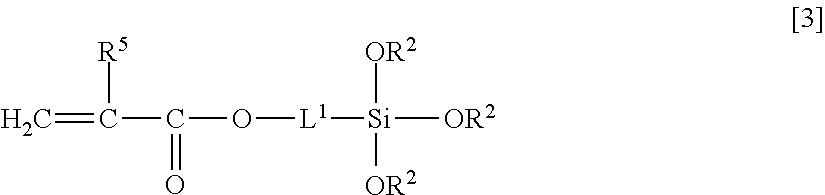
- Examples of the C 1-10 alkylene group as L 1 include methylene group, ethylene group, trimethylene group, methylethylene group, tetramethylene group, 1-methyltrimethylene group, pentamethylene group, 2,2-dimethyltrimethylene group, hexamethylene group, octamethylene group, and decamethylene group.
- trimethylene group is preferable.
- alkoxysilane A examples include vinyltrimethoxysilane, vinyltriethoxysilane, 3-(meth)acryloyloxypropyltrimethoxysilane, 3-(meth)acryloyloxypropyltriethoxysilane, 8-(meth)acryloyloxyoctyltrimethoxysilane, 8-(meth)acryloyloxyoctyltriethoxysilane, 3-(meth)acryloyloxypropyl(methyl)(dimethoxy)silane, 3-(meth)acryloyloxypropyl(methyl)(diethoxy)silane, 4-vinylphenyltrimethoxysilane, and 4-vinylphenyltriethoxysilane.
- tetramethoxysilane, tetraethoxysilane, 3-(phenylamino)propyltrimethoxysilane and 3-(phenylamino)propyltriethoxysilane are preferable.
- the siloxane oligomer (a) is preferably a siloxane oligomer containing the alkoxysilane A unit in an amount of 10 mol % to 99 mol % of all the alkoxysilane units.
- the siloxane oligomer (a) is particularly preferably a siloxane oligomer containing a structural unit of Formula [4] in an amount of at least 10 mol % to 99 mol % of all the structural units:
- R 2 , R 5 , and L 1 is defined the same as in Formula [3].
- the method for obtaining the siloxane oligomer (a) is not particularly limited.
- the siloxane oligomer (a) is obtained, for example, through condensation of an alkoxysilane including the alkoxysilane A and the alkoxysilane B, in an organic solvent.
- Examples of the method of polycondensation of the alkoxysilane include a method that employs hydrolysis and condensation of the alkoxysilane in a solvent such as an alcohol and a glycol.
- the hydrolysis-condensation reaction may be either partial hydrolysis or complete hydrolysis.
- the molar amount of water to be added may be theoretically 0.5 times the total molar amount of alkoxy groups in the alkoxysilane, and usually the molar amount of water to be added is preferably greater than 0.5 times the total molar amount of alkoxy groups in the alkoxysilane.
- the molar amount of water to use in the reaction can be determined as desired, and usually the molar amount of water to be used in the reaction is preferably 0.5 to 2.5 times the total molar amount of alkoxy groups in the alkoxysilane.
- a catalyst is usually used, such as organic acids, for example, formic acid, acetic acid, propionic acid, butanoic acid, pentanoic acid, hexanoic acid, 2-ethylhexanoic acid, heptanoic acid, octanoic acid, nonanoic acid, decanoic acid, stearic acid, oleic acid, linoleic acid, linolenic acid, arachidonic acid, oxalic acid, malonic acid, methylmalonic acid, succinic acid, tartaric acid, maleic acid, fumaric acid, adipic acid, sebacic acid, citric acid, monochloroacetic acid, dichloroacetic acid, trichloroacetic acid, trifluoroacetic acid, benzoic acid, p-aminobenzoic acid, salicylic acid, gallic acid, phthalic
- the hydrolysis-condensation reaction is further promoted by heating the alkoxysilane in a form of solution thereof.
- the heating temperature and the heating time can be selected as desired. For example, heating at 50° C. for 24 hours with stirring or heating for 1 hour with stirring under reflux is adopted.
- the weight average molecular weight (Mw) of the siloxane oligomer (a) contained in the curable composition of the present invention is 100 to 10,000 and preferably 500 to 5,000 in terms of polystyrene determined by gel permeation chromatography.
- siloxane oligomer in the film forming material allows partial hydrolysis-condensation reaction of the oligomers each other to be progressed at the time of cured film formation and volatilization of the alcohol generated at this time allows a structure in which a cured film has pore space to be formed. This may consequently contribute to decrease in the refractive index of whole cured film.
- the inorganic fine particles (b) are preferably a silica fine particles and elongated-shaped silica fine particles is particularly preferable.
- the elongated-shaped silica fine particles mean fine particles that have a chain-like structure of continuously bonded silica particles formed by a chemical bond such as a siloxane bond.
- the elongated-shaped fine particles may have a linearly-elongated shape, or two-dimensionally or three-dimensionally curved shape.
- Such elongated-shaped silica fine particles in the film forming material provides a structure having minute pore spaces among the silica fine particles in the obtained cured film and thus the refractive index of the whole cured film can be reduced.
- the average particle diameter of the elongated-shaped silica fine particles is preferably 1 nm or more, whereas from the viewpoint of decrease in an arithmetic average roughness (Ra) of the film surface, reduction in haze, and securing of transparency, the average particle diameter is preferably 25 nm or less.
- the average length of the elongated-shaped silica fine particles is preferably 30 nm or more, whereas from the viewpoint of decrease in an arithmetic average roughness (Ra) of the film surface, reduction in haze, and securing of transparency, the average particle length is preferably 500 nm or less.
- Silica fine particles in a form of a colloidal solution can be used as the silica fine particles, and the colloidal solution may be a dispersion of silica fine particles in a dispersion medium (silica sol) or may be a commercially available colloidal silica.
- the dispersion medium of the silica fine particles may be water or an organic solvent.
- the organic solvent include alcohols such as methanol, isopropanol, and butanol; glycols such as ethylene glycol, propyl cellosolve, propylene glycol monomethyl ether (PGME), and propylene glycol monomethyl ether acetate (PGMEA); ketones such as methyl ethyl ketone (MEK) and methyl isobutyl ketone (MIBK); aromatic hydrocarbons such as toluene and xylene; amides such as N,N-dimethylformamide (DMF), N,N-dimethylacetamide, and N-methyl-2-pyrrolidone (NMP); esters such as ethyl acetate, butyl acetate, and ⁇ -butyrolactone; and ethers such as tetrahydrofuran and 1,4-dioxane.
- alcohols such as m
- the silica sol containing the elongated-shaped silica fine particles can be produced by the production method, for example, described in International Publication No. WO 2008/093422.
- the inorganic fine particles (b) is used in an amount of 10 parts by mass to 1,000 parts by mass, preferably 10 parts by mass to 500 parts by mass, and particularly preferably 50 parts by mass to 250 parts by mass relative to 100 parts by mass of the siloxane oligomer (a).
- the polymerization initiator generating a radical upon active energy ray irradiation (c) is, for example, an alkylphenone, a benzophenone, a ketal, an anthraquinone, a thioxanthone, an azo compound, a peroxide, a 2,3-dialkyldione compound, a disulfide compound, a thiuram compound, or a fluoroamine compound is used.
- an alkylphenone is preferably used and ⁇ -hydroxyalkylphenone is particularly preferably used.
- the polymerization initiator (c) is used in an amount of 0.1 parts by mass to 25 parts by mass, preferably 0.1 parts by mass to 20 parts by mass, and particularly preferably 1 part by mass to 20 parts by mass relative to 100 parts by mass of the siloxane oligomer (a).
- the curable composition of the present invention may further include a surface modifier (d) containing a perfluoropolyether compound.
- the compounds having both ends modified with (meth)acrylic groups and the compounds having one end modified with a (meth)acrylic group are preferable and FLUOROLINK (registered trademark) MD500, FLUOROLINK (registered trademark) MD700, FLUOROLINK (registered trademark) 5101X, FLUOROLINK (registered trademark) AD 1700, and KY-1203 are particularly preferable.
- the curable composition of the present invention may further include an active energy ray-curable multifunctional monomer (e).
- the monomer is preferably at least one monomer selected from the group consisting of multifunctional (meth)acrylate compounds and multifunctional urethane (meth)acrylate compounds.
- active energy ray-curable multifunctional monomer examples include 1,6-hexanediol di(meth)acrylate, neopentyl glycol di(meth)acrylate, triethylene glycol di(meth)acrylate, polyethylene glycol di(meth)acrylate, polypropylene glycol di(meth)acrylate, pentaerythritol di(meth)acrylate monostearate, bisphenol A ethylene glycol adduct di(meth)acrylate, bisphenol F ethylene glycol adduct di(meth)acrylate, tricyclo[5.2.1.0 2,6 ]decanedimethanol di(meth)acrylate, tris(hydroxyethyl) isocyanurate di(meth)acrylate, trimethylolpropane tri(meth)acrylate, trimethylolpropane ethylene glycol adduct tri(meth)acrylate, trimethylolpropane propylene glycol adduct tri(meth)acrylate
- the curable composition of the present invention may further include an acid or an acid generator (f) as a hydrolysis catalyst.
- the acid generator when used as the component (f), can be, for example, a thermal acid generator containing an onium salt such as an aromatic sulfonium salt, an aromatic iodonium salt, an aromatic diazonium salt, an aromatic ammonium salt, an ⁇ 5-cyclopentadienyl- ⁇ 6-cumenyl-Fe salt, or an aromatic phosphonium salt (examples of a counter anion of the onium salt include BR 4 ⁇ , PF 6 ⁇ , AsF 6 ⁇ , and SbF 6 ⁇ ), an onium salt-containing photoacid generator such as bis(4-tert-butylphenyl)iodonium trifluoromethanesulfonate and triphenylsulfonium trifluoromethanesulfonate; a photoacid generator that contains a halogen-containing compound, such as phenyl-bis(trichloromethyl)-s-triazine; or a sul
- the curable composition of the present invention may further include a base generator (g) as a hydrolysis catalyst. Both a thermal base generator and a photobase generator can be used as the base generator.
- thermal base generator may also include U-CAT (registered trademark) series SA810, SA831, SA841, and SA851 [manufactured by San-Apro Ltd.] being salts of 1,8-diazabicyclo[5.4.0]undec-7-ene (DBU).
- U-CAT registered trademark
- the photobase generators are commercially available and, for example, the photobase generator WPBG series manufactured by Wako Pure Chemical Industries, Ltd. or the like can be preferably used.
- the base generator (g) is used in an amount of 0.001 mol % to 20 mol %, preferably 0.01 mol % to 10 mol %, and particularly preferably 0.1 mol % to 5 mol % relative to 1 mol of alkoxysilyl groups in the siloxane oligomer (a).
- the curable composition of the present invention may further contain a solvent to be formed as varnish.
- the solvent used herein may be any solvent that dissolves or disperses the components (a) to (c) and if desired the components (d) to (g).
- the solvent include aromatic hydrocarbons such as toluene and xylene; esters or ester ethers such as ethyl acetate, butyl acetate, isobutyl acetate, ⁇ -butyrolactone, methyl pyruvate, ethyl pyruvate, ethyl hydroxyacetate, ethyl lactate, butyl lactate, ethyl 2-hydroxy-2-methylpropionate, methyl 2-hydroxy-3-methylbutanoate, ethyl ethoxyacetate, methyl 3-methoxypropionate, ethyl 3-methoxypropionate, methyl 3-ethoxypropionate, ethyl 3-ethoxypropionate, methyl cellosolve acetate, ethylcellosolve acetate
- a solid content concentration in the curable composition of the present invention is, for example, 0.01% by mass to 70% by mass, 0.1% by mass to 50% by mass, or 1% by mass to 30% by mass.
- the solid content is a part remaining after removing a solvent component from all the components of the curable composition.
- the curable composition of the present invention may appropriately contain additives that are generally added as necessary so long as they do not impair the effects of the present invention.
- additives include photosensitizers, polymerization inhibitors, polymerization initiators, leveling agents, surfactants, adhesion imparting agents, plasticizers, ultraviolet absorbers, antioxidants, storage stabilizers, antistatic agents, inorganic fillers, pigments, and dyes.
- the curable composition of the present invention can be applied to a base material and then be subjected to photopolymerization (curing) to form a product such as a cured film and a laminate.
- a cured film thus obtained is also an object of the present invention and useful as a low refractive index film.
- the base material examples include plastics (polycarbonates, polymethacrylates, polystyrenes, polyesters, poly(ethylene terephthalate) (PET), polyolefins, epoxy resins, melamine resins, triacetylcellulose, acrylonitrile-butadiene-styrene copolymers (ABS), acrylonitrile-styrene copolymers (AS), and norbornene resins, for example), metals, wood, paper, glass, silicon dioxide, and slate.
- the base material may be in a plate form, in a film form, or a three-dimensional molded article.
- the coating method of the curable composition of the present invention can be appropriately selected, from cast coating, spin coating, blade coating, dip coating, roll coating, bar coating, die coating, spray coating, curtain coating, ink-jet printing, and printing methods (such as letterpress printing, intaglio printing, planographic printing, and screen printing).
- spin coating is preferably employed because of its advantages that application can be completed quickly enough to allow the use of a highly volatile solution and that uniform application can be easily achieved.
- roll coating, die coating, and spray coating are preferably employed because of their capability of allowing easy application and forming a uniform smooth coating on the surface of a large area.
- the curable composition in a form of varnish as described above can be suitably used as the curable composition used herein. It is preferable that the curable composition be previously filtrated, for example, with a filter having a pore size of about 2 ⁇ m, and then be subjected to coating.
- the composition is subsequently, preferably pre-dried with an apparatus such as a hot plate and an oven, and then is photo-cured by irradiation with an active energy ray such as ultraviolet light.
- an active energy ray such as ultraviolet light.
- the active energy ray include ultraviolet light, an electron beam, and an X-ray.
- a light source for the ultraviolet irradiation sunlight, a chemical lamp, a low-pressure mercury lamp, a high-pressure mercury lamp, a metal halide lamp, a xenon lamp, a UV-LED, or the like can be used.
- post-baking specifically heating on a hot plate, in an oven, or the like, can be performed to complete polymerization and polycondensation.
- the thickness of the resulting coated film after dried and cured is usually 1 nm to 50 ⁇ m and is preferably 1 nm to 20 ⁇ m.
- a laminate including a low refractive index layer that is a laminate obtained by a step of forming the low refractive index layer from the curable composition and a step of irradiating the layer with an active energy ray such as ultraviolet light for curing is also an object of the present invention.
- the laminate may be in the form of having a base material, that is, may be a laminate including the low refractive index layer described above on at least one side of the base material layer.
- the base material, the coating method, and the irradiation of an energy ray such as ultraviolet light employed here are the same as the base material, the coating method, and the ultraviolet irradiation, respectively, in the paragraph ⁇ Cured Film> described above.
- the ultraviolet irradiation is preferably followed by additional baking (post-baking).
- the baking is performed under conditions appropriately selected and is usually performed at 50° C. to 300° C. for 5 minutes to 72 hours.
- the base material in the laminate is preferably glass or PET.
- the thickness of the low refractive index layer of the laminate is preferably 1 nm to 50 ⁇ m and is more preferably 1 nm to 20 ⁇ m.
- HLC-8220GPC manufactured by Tosoh Corporation
- Apparatus MS-A100 manufactured by MIKASA CO., LTD.
- Apparatus 4 kW ⁇ 1 lamp nitrogen-purged ultraviolet irradiation conveyor apparatus manufactured by EYE GRAPHICS CO., LTD.
- VASE variable angle spectroscopic ellipsometer
- Apparatus haze meter NDH5000 manufactured by Nippon Denshoku Industries Co., Ltd.
- the Si-OLG-1 had a weight average molecular weight Mw in terms of polystyrene determined by GPC of 1,200 and a degree of distribution Mw (weight average molecular weight)/Mn (number average molecular weight) of 1.1.
- the Si-OLG-2 had a weight average molecular weight Mw in terms of polystyrene determined by GPC of 1,400 and a degree of distribution Mw/Mn of 1.1.
- the Si-OLG-3 had a weight average molecular weight Mw in terms of polystyrene determined by GPC of 1,400 and a degree of distribution Mw/Mn of 1.3.
- the Si-OLG-4 had a weight average molecular weight Mw in terms of polystyrene determined by GPC of 1,000 and a degree of distribution Mw/Mn of 1.1.
- Binder Si-OLG-1 produced in Synthesis Example 1, Si-OLG-2 produced in Synthesis Example 2, Si-OLG-3 produced in Synthesis Example 3, Si-OLG-4 produced in Synthesis Example 4, DMS1M, DMSUA, OTEOS, TEOS, MPTES, and DPHA as specified in Table 1 in an amount specified in Table 1 (in terms of solid content).
- Silica fine particles ST in an amount specified in Table 1 in terms of SiO 2 .
- Photopolymerization initiator I2959 in an amount specified in Table 1.
- Surface modifier a mixture of PFPE-1/PFPE-2 (mass ratio: 8/2) in an amount specified in Table 1.
- Hydrolysis catalyst W266 in an amount specified in Table 1.
- the resulting curable composition was stirred at room temperature (about 25° C.) for 30 minutes and was then applied to a glass substrate of 50 ⁇ 50 mm in size (1.1 mm thick) that had been subjected to ultrasonic cleaning in ethanol, via spin coating (slope: 5 seconds, rotation speed described in Table 1 ⁇ 30 seconds, slope: 5 seconds) to obtain a coating.
- the resulting coating was dried on a hot plate at 120° C. for 1 minute.
- the coating was then irradiated with UV light at 800 mJ/cm 2 in an atmosphere for photocuring to produce a cured film (low refractive index film).
- the resulting cured film was evaluated for a film thickness, film formability, a refractive index at a wavelength of 550 nm, a total light transmittance, and transparency.
- the film formability and the transparency were evaluated in the following manners. All the results are shown in Table 2.
- Film formability Film surfaces were visually observed for evaluation according to the following criteria.
- Transparency the haze value of a low refractive index film together with a glass substrate was measured for evaluation according to the following criteria.
- the cured film obtained from the curable composition in Example 1 to Example 8 had excellent film formability and transparency and exhibited a refractive index of lower than 1.35, which revealed that the cured film was useful as a low refractive index film.
- Addition of the surface modifier (Example 2 and Example 3) tended to lead to a lower refractive index.
- Addition of the hydrolysis catalyst (Example 6) also resulted in exhibiting a lower refractive index.
- the cured film of Comparative Example 1 had higher refractive index than those of the cured films of Example 1 to Example 3 and exhibited poorer film formability and transparency.
- Comparative Example 2 Although the cured film of Comparative Example 2 had similar film formability and transparency to Examples, the cured film had a high refractive index of more than 1.35.
- the cured film of Comparative Example 5 had high refractive index and also exhibited poorer transparency.
- the curable composition having solid matter (all the components in the curable composition except for solvent components) of 3% by mass was prepared in the same composition and procedure as Example 2 shown in Table 1.
- the resulting curable composition was spin-coated on a glass substrate to obtain a coating and the coating then was photocured with the same procedure as described above to prepare a cured film.
- Solvent resistance and acid resistance of the obtained cured film were evaluated by immersing each cured film into EtOH or IPA for 5 minutes (at room temperature (about 25° C.)), diluted aqua regia (a mixture of 3 parts by mass of concentrated nitric acid, 19 parts by mass of concentrated hydrochloric acid, and 78 parts by mass of water) for 2 minutes (at 40° C.), and 18% by mass of HCl aqueous solution for 5 minutes (at room temperature (about 25° C.)), and calculating a residual film ratio (%) from the measured film thicknesses before and after the immersion.
- a cured film (a low refractive index film) was prepared in the same operation as Example 5 except that the base material was changed to a silicon wafer and the atmosphere at the time of exposure was changed to a nitrogen atmosphere.
- Each of the obtained cured films was immersed into the diluted aqua regia described above for 2 minutes (40° C.), 2.38% by mass of TMAH aqueous solution for 3 minutes (at room temperature), and a residual film ratio (%) was calculated from the measured film thicknesses before and after the immersion to evaluate acid resistance and alkali resistance.
Landscapes
- Chemical & Material Sciences (AREA)
- Organic Chemistry (AREA)
- Chemical Kinetics & Catalysis (AREA)
- Polymers & Plastics (AREA)
- Health & Medical Sciences (AREA)
- Medicinal Chemistry (AREA)
- Wood Science & Technology (AREA)
- Materials Engineering (AREA)
- Engineering & Computer Science (AREA)
- Life Sciences & Earth Sciences (AREA)
- Physics & Mathematics (AREA)
- Inorganic Chemistry (AREA)
- General Physics & Mathematics (AREA)
- Optics & Photonics (AREA)
- Macromonomer-Based Addition Polymer (AREA)
- Silicon Polymers (AREA)
- Paints Or Removers (AREA)
- Addition Polymer Or Copolymer, Post-Treatments, Or Chemical Modifications (AREA)
- Compositions Of Macromolecular Compounds (AREA)
- Polymerisation Methods In General (AREA)
Abstract
R1 aSi(OR2)4-a [1]
R3 bSi(OR4)4-b [2]
a cured film produced from the composition, and a laminate including a low refractive index layer produced from the composition.
Description
R1 aSi(OR2)4-a [1]
R3 bSi(OR4)4-b [2]
(where R1 is a monovalent organic group containing a radically polymerizable double bond; R3 is a C1-10 alkyl group (the alkyl group is optionally substituted with a fluorine atom, an amino group substituted with at least a C1-6 alkyl group, an amino group substituted with at least a phenyl group, or a ureido group) or a phenyl group; R2 and R4 each are independently a methyl group or an ethyl group; a is 1 or 2; and b is an integer of 0 to 2).
R1 aSi(OR2)4-a [1]
R3 bSi(OR4)4-b [2]
(where R1 is a monovalent organic group containing a radically polymerizable double bond; R3 is a C1-6 alkyl group that is optionally substituted with a fluorine atom or a phenyl group; R2 and R4 each are independently a methyl group or an ethyl group; a is 1 or 2; and b is an integer of 0 to 2).

(where R2 is defined the same as in Formula [1], R5 is a hydrogen atom or a methyl group, and L1 is a C1-10 alkylene group).

(where R2 is defined the same as in Formula [1], R5 is a hydrogen atom or a methyl group, and L1 is a C1-6 alkylene group).
R1 aSi(OR2)4-a [1]
R3 bSi(OR4)4-b [2]

where R2 is defined the same as in Formula [1]; R5 is a hydrogen atom or a methyl group; L1 is a C1-10 alkylene group, preferably a C1-8 alkylene group, and more preferably a C1-6 alkylene group.

where each of R2, R5, and L1 is defined the same as in Formula [3].
-
- Compounds having both ends modified with alcohol: FOMBLIN (registered trademark) series ZDOL 2000, ZDOL 2500, ZDOL 4000, TX, and ZTETRAOL 2000GT, and FLUOROLINK (registered trademark) series D10H and E10H [all of these are manufactured by Solvay Specialty Polymers];
- Compounds having both ends modified with piperonyl groups: FOMBLIN (registered trademark) series AM2001 and AM3001 [both manufactured by Solvay Specialty Polymers];
- Compounds having both ends modified with carboxylic acid: FLUOROLINK (registered trademark) C10 [manufactured by Solvay Specialty Polymers];
- Compounds having both ends modified with esters: FLUOROLINK (registered trademark) L10H [manufactured by Solvay Specialty Polymers];
- Compounds having both ends modified with (meth)acrylic groups: FLUOROLINK (registered trademark) series MD500, MD700, 5101X, and AD1700 [all of these are manufactured by Solvay Specialty Polymers], and CN4000 [manufactured by Sartomer]; and
- Compounds having one end modified with a (meth)acrylic group: KY-1203 [manufactured by Shin-Etsu Chemical Co., Ltd.] and OPTOOL DAC-HP [manufactured by Daikin Industries, Ltd.].
- MOTMS: 8-methacryloyloxyoctyltrimethoxysilane [Shin-Etsu Silicone (registered trademark) KBM-5803 manufactured by Shin-Etsu Chemical Co., Ltd.]
- MPTES: 3-methacryloyloxypropyltriethoxysilane [Shin-Etsu Silicone (registered trademark) KBE-503 manufactured by Shin-Etsu Chemical Co., Ltd.]
- PAPTMS: 3-(phenylamino)propyltrimethoxysilane [Shin-Etsu Silicone (registered trademark) KBM-573 manufactured by Shin-Etsu Chemical Co., Ltd.]
- TEOS: tetraethoxysilane [TSL8124 manufactured by Momentive Performance Materials Japan LLC.]
- DMS1M: monomethacrylic modified dimethylsilicone [Silaplane (registered trademark) FM-0711 manufactured by JNC CORPORATION]
- DMSUA: reactive polysiloxane [SHIKOH (registered trademark) UT-4314 manufactured by The Nippon Synthetic Chemical Industry Co., Ltd.]
- DPHA: dipentaerythritol penta- and hexa-acrylate [Aronix (registered trademark) M-403 manufactured by Toagosei Co., Ltd.]
- OTEOS: hydrolysis-condensation product of tetraethoxysilane (weight average molecular weight Mw: 1,700, degree of distribution: 1.4) [Ethyl Silicate 48 manufactured by Colcoat Co., Ltd.]
- ST: propylene glycol monomethyl ether dispersed elongated-shaped silica sol [PGM-ST-UP manufactured by Nissan Chemical Industries, Ltd., SiO2: 15% by mass, average particle diameter: 12 nm, and average length: 60 nm]
- PFPE-1: perfluoropolyether having both ends modified with acrylic groups
- [FLUOROLINK (registered trademark) AD1700 manufactured by Solvay Specialty Polymers]
- PFPE-2: perfluoropolyether having both ends modified with acrylic groups [FLUOROLINK (registered trademark) 5101X manufactured by Solvay Specialty Polymers]
- W266: 1,2-diisopropyl-3-(bis(dimethylamino)methylene)guanidinium
- 2-(3-benzoylphenyl) propionate [WPBG-266 manufactured by Wako Pure Chemical Industries, Ltd.]
- I2959: 1-[4-(2-hydroxyethoxy)phenyl]-2-hydroxy-2-methyl-1-propan-1-one [Irgacure (registered trademark) 2959 manufactured by BASF Japan Ltd.]
- EtOH: ethanol
- IPA: isopropanol
- PGME: propylene glycol monomethyl ether
- TMAH: tetramethylammonium hydroxide
(2) Silica fine particles: ST in an amount specified in Table 1 in terms of SiO2.
(3) Photopolymerization initiator: I2959 in an amount specified in Table 1.
(4) Surface modifier: a mixture of PFPE-1/PFPE-2 (mass ratio: 8/2) in an amount specified in Table 1.
(5) Hydrolysis catalyst: W266 in an amount specified in Table 1.
| TABLE 1 | |||||||
| Addition | Addition | Rotation | |||||
| amount | amount | speed of | |||||
| Binder | of silica | Addition | of | Addition | spin | ||
| Addition | fine | amount | surface | amount | coating | |||
| Type | amount | particles | of I2959 | modifier | of W266 | [rpm] | ||
| Example 1 | Si-OLG-1 | 50 | 50 | 5 | None | None | 1,500 |
| Example 2 | Si-OLG-1 | 50 | 50 | 5 | 1 | None | 1,500 |
| Example 3 | Si-OLG-1 | 30 | 70 | 3 | 1 | None | 1,000 |
| Example 4 | Si-OLG-2 | 40 | 60 | 5 | 1 | None | 1,500 |
| Example 5 | Si-OLG-3 | 40 | 60 | 5 | 1 | None | 1,500 |
| Example 6 | Si-OLG-3 | 40 | 60 | 5 | 1 | 3 | 1,500 |
| Example 7 | Si-OLG-4 | 30 | 70 | 5 | 1 | None | 1,500 |
| Example 8 | Si-OLG-1 | 30 | 60 | 5 | 1 | None | 1,500 |
| DPHA | 10 | ||||||
| Comparative | DMS1M | 50 | 50 | 5 | None | None | 1,500 |
| Example 1 | |||||||
| Comparative | DMSUA | 50 | 50 | 5 | None | None | 1,500 |
| Example 2 | |||||||
| Comparative | OTEOS | 50 | 50 | 5 | 1 | None | 3,000 |
| Example 3 | |||||||
| Comparative | TEOS | 26 | 50 | 5 | 1 | None | 3,000 |
| Example 4 | MPTES | 24 | |||||
| Comparative | DPHA | 30 | 70 | 3 | None | None | 500 |
| Example 5 | |||||||
| TABLE 2 | ||||||
| Film | Refractive | Trans- | ||||
| thickness | Film | index | mittance | Trans- | ||
| [nm] | formability | (550 nm) | [%] | parency | ||
| Example 1 | 80 | A | 1.327 | 94.28 | A |
| Example 2 | 78 | A | 1.286 | 93.68 | A |
| Example 3 | 142 | A | 1.246 | 94.37 | A |
| Example 4 | 162 | A | 1.329 | 92.80 | A |
| Example 5 | 89 | A | 1.333 | 94.95 | A |
| Example 6 | 83 | A | 1.300 | 94.98 | A |
| Example 7 | 104 | A | 1.330 | 94.96 | A |
| Example 8 | 160 | A | 1.293 | 93.52 | A |
| Comparative | 56 | C | 1.421 | 92.68 | C |
| Example 1 | |||||
| Comparative | 56 | A | 1.374 | 93.27 | A |
| Example 2 | |||||
| Comparative | 85 | C | 1.248 | 94.35 | A |
| Example 3 | |||||
| Comparative | 72 | C | 1.245 | 92.53 | A |
| Example 4 | |||||
| Comparative | 164 | A | 1.381 | 91.43 | B |
| Example 5 | |||||
| TABLE 3 | ||||||
| EtOH | IPA | Diluted | 18% by | |||
| Room | Room | aqua | mass of | |||
| Before | temper- | temper- | regia | HCl Room | ||
| immer- | ature, | ature, | 40° C., | temperature, | ||
| sion | 5 minutes | 5 minutes | 2 minutes | 5 minutes | ||
| Film | 87 | 85 | 86 | 87 | 85 |
| thickness | |||||
| [nm] | |||||
| Residual | — | 97.7 | 98.9 | 100 | 97.7 |
| film | |||||
| ratio [%] | |||||
| TABLE 4 | ||||
| 2.38% by mass | ||||
| Diluted aqua | of TMAH Room | |||
| Before | regia 40° C., | temperature, | ||
| immersion | 2 minutes | 3 minutes | ||
| Film thickness | 125 | 125 | 125 |
| [nm] | |||
| Residual film | — | 100 | 100 |
| ratio [%] | |||
Claims (29)
R1 aSi(OR2)4-a [1]
R3 bSi(OR4)4-b [2]
Average particle diameter=2720/Specific surface area in m2.
R1 aSi(OR2)4-a [1]
R3 bSi(OR4)4-b [2]


R1 aSi(OR2)4-a [1]
R3 bSi(OR4)4-b [2]

Average particle diameter=2720/Specific surface area in m2
Applications Claiming Priority (3)
| Application Number | Priority Date | Filing Date | Title |
|---|---|---|---|
| JP2013086978 | 2013-04-17 | ||
| JP2013-086978 | 2013-04-17 | ||
| PCT/JP2014/060825 WO2014171485A1 (en) | 2013-04-17 | 2014-04-16 | Curable composition comprising siloxane oligomer and inorganic microparticles |
Publications (2)
| Publication Number | Publication Date |
|---|---|
| US20160108250A1 US20160108250A1 (en) | 2016-04-21 |
| US10125267B2 true US10125267B2 (en) | 2018-11-13 |
Family
ID=51731422
Family Applications (1)
| Application Number | Title | Priority Date | Filing Date |
|---|---|---|---|
| US14/785,436 Active US10125267B2 (en) | 2013-04-17 | 2014-04-16 | Curable composition including siloxane oligomer and inorganic fine particles |
Country Status (7)
| Country | Link |
|---|---|
| US (1) | US10125267B2 (en) |
| EP (1) | EP2987809B1 (en) |
| JP (1) | JP6421941B2 (en) |
| KR (1) | KR102165717B1 (en) |
| CN (1) | CN105263967B (en) |
| TW (1) | TWI640568B (en) |
| WO (1) | WO2014171485A1 (en) |
Cited By (1)
| Publication number | Priority date | Publication date | Assignee | Title |
|---|---|---|---|---|
| US12090510B2 (en) | 2017-12-22 | 2024-09-17 | Lg Chem, Ltd. | Preparation method of silica layer |
Families Citing this family (27)
| Publication number | Priority date | Publication date | Assignee | Title |
|---|---|---|---|---|
| JP6371502B2 (en) * | 2013-07-30 | 2018-08-08 | 大日本印刷株式会社 | Manufacturing method of optical film |
| JP2016124927A (en) * | 2014-12-26 | 2016-07-11 | 株式会社リコー | Active ray curable composition including photobase generating agent and active ray curable type inkjet ink |
| JP2016216589A (en) * | 2015-05-19 | 2016-12-22 | Dic株式会社 | Polysiloxane, resin composition, paint and laminate |
| KR20170049383A (en) * | 2015-10-27 | 2017-05-10 | 삼성전자주식회사 | Polymer film, and optical member, polarization member and display device employing the polymer film |
| CN108884573A (en) * | 2016-03-22 | 2018-11-23 | 奥野制药工业株式会社 | Film-forming composition and method of treating metal material |
| JP6685513B2 (en) | 2016-07-15 | 2020-04-28 | 日産自動車株式会社 | Antifouling structure precursor, antifouling structure and surface modification method |
| US9670376B1 (en) * | 2016-07-18 | 2017-06-06 | Advenira Enterprises, Inc. | Hybrid sol-gel coating materials and coatings and methods of forming and using thereof |
| WO2018056281A1 (en) * | 2016-09-21 | 2018-03-29 | 日産化学工業株式会社 | Cured film-forming composition |
| CN109791225B (en) * | 2016-10-12 | 2021-02-19 | 日产化学株式会社 | Anti-glare hard-coated laminate |
| EP3326980A1 (en) * | 2016-11-29 | 2018-05-30 | Evonik Degussa GmbH | Heat ray shielding particle containing composition and heat ray shielding film |
| JP7099328B2 (en) * | 2017-02-14 | 2022-07-12 | 日産化学株式会社 | Wiring formation method |
| TWI651327B (en) * | 2017-08-15 | 2019-02-21 | 國立暨南國際大學 | Triazine precursor, method for preparing triazine precursor and application of triazine precursor |
| KR102699278B1 (en) * | 2017-10-06 | 2024-08-26 | 가부시끼가이샤 쓰리본드 | Surface Modifier Composition and Adhesive Method |
| JP6969514B2 (en) * | 2018-07-20 | 2021-11-24 | 信越化学工業株式会社 | Silica dispersion, its production method, photocurable composition using it, and its cured product |
| WO2020066993A1 (en) * | 2018-09-25 | 2020-04-02 | Dic株式会社 | Composition, cured object, laminate, and light resistant coating material |
| KR102316019B1 (en) * | 2018-11-23 | 2021-10-22 | 주식회사 엘지화학 | Glass-like Film |
| KR102411605B1 (en) * | 2018-11-23 | 2022-06-21 | 주식회사 엘지화학 | Silica Sol Composition |
| KR102316018B1 (en) * | 2018-11-23 | 2021-10-22 | 주식회사 엘지화학 | Optical Laminate |
| KR102584191B1 (en) * | 2019-02-06 | 2023-10-04 | 닛산 가가쿠 가부시키가이샤 | Curable composition for anti-glare flexible hard coat |
| US12006439B2 (en) * | 2019-03-27 | 2024-06-11 | Canon Kabushiki Kaisha | Optical member, optical device and coating liquid |
| WO2020196851A1 (en) * | 2019-03-28 | 2020-10-01 | 株式会社ニコン | Porous film, optical element, optical system, interchangeable lens, optical device and manufacturing method of porous film |
| KR102636059B1 (en) * | 2019-09-04 | 2024-02-13 | 삼성에스디아이 주식회사 | Curable resin composition, cured film prepared therefrom, and electronic device incorporating cured film |
| JP7285343B2 (en) * | 2019-09-04 | 2023-06-01 | サムスン エスディアイ カンパニー,リミテッド | Curable resin composition, cured film formed therefrom, and electronic device having said cured film |
| CN114502662A (en) | 2019-10-03 | 2022-05-13 | 3M创新有限公司 | Silicone elastomers with free radical mediated cure |
| CN110687620B (en) * | 2019-10-14 | 2021-08-17 | 宁波盈瑞聚合科技有限公司 | Anti-scratch optical film and method for producing the same |
| JP7407587B2 (en) * | 2019-12-19 | 2024-01-04 | 東京応化工業株式会社 | Resist composition and resist pattern forming method |
| CA3212952A1 (en) * | 2021-03-10 | 2022-09-15 | Elkem Silicones France Sas | Type i photoinitiator for crosslinking silicone compositions |
Citations (9)
| Publication number | Priority date | Publication date | Assignee | Title |
|---|---|---|---|---|
| JP2001316604A (en) | 2000-04-28 | 2001-11-16 | Toppan Printing Co Ltd | Low reflection hard coat resin composition |
| JP2003107206A (en) | 2001-09-28 | 2003-04-09 | Dainippon Printing Co Ltd | Resin composition for optical functional film, optical functional film and antireflection film |
| JP2006047504A (en) | 2004-08-02 | 2006-02-16 | Dainippon Printing Co Ltd | Anti-reflection laminate |
| JP2007025078A (en) | 2005-07-13 | 2007-02-01 | Asahi Kasei Corp | Anti-reflection laminate |
| US20070065638A1 (en) | 2005-09-20 | 2007-03-22 | Eastman Kodak Company | Nano-structured thin film with reduced light reflection |
| JP2008298880A (en) | 2007-05-29 | 2008-12-11 | Nagase Chemtex Corp | Photosensitive composition |
| US20120206674A1 (en) | 2009-10-24 | 2012-08-16 | Weber Michael F | Immersed asymmetric reflector with reduced color |
| US20130163087A1 (en) | 2010-09-01 | 2013-06-27 | Agc Glass Europe | Glass substrate coated with an anti-reflective layer |
| WO2014069634A1 (en) | 2012-11-05 | 2014-05-08 | 日産化学工業株式会社 | Curable composition containing fluorine-containing hyperbranched polymer and siloxane oligomer |
Family Cites Families (1)
| Publication number | Priority date | Publication date | Assignee | Title |
|---|---|---|---|---|
| CN101626979B (en) | 2007-02-01 | 2012-01-25 | 日产化学工业株式会社 | Process for producing silica sol of long and thin shape |
-
2014
- 2014-04-16 US US14/785,436 patent/US10125267B2/en active Active
- 2014-04-16 CN CN201480031848.9A patent/CN105263967B/en active Active
- 2014-04-16 EP EP14785357.6A patent/EP2987809B1/en not_active Not-in-force
- 2014-04-16 KR KR1020157031708A patent/KR102165717B1/en active Active
- 2014-04-16 WO PCT/JP2014/060825 patent/WO2014171485A1/en not_active Ceased
- 2014-04-16 JP JP2015512505A patent/JP6421941B2/en active Active
- 2014-04-17 TW TW103114021A patent/TWI640568B/en active
Patent Citations (12)
| Publication number | Priority date | Publication date | Assignee | Title |
|---|---|---|---|---|
| JP2001316604A (en) | 2000-04-28 | 2001-11-16 | Toppan Printing Co Ltd | Low reflection hard coat resin composition |
| JP2003107206A (en) | 2001-09-28 | 2003-04-09 | Dainippon Printing Co Ltd | Resin composition for optical functional film, optical functional film and antireflection film |
| JP2006047504A (en) | 2004-08-02 | 2006-02-16 | Dainippon Printing Co Ltd | Anti-reflection laminate |
| JP2007025078A (en) | 2005-07-13 | 2007-02-01 | Asahi Kasei Corp | Anti-reflection laminate |
| US20070065638A1 (en) | 2005-09-20 | 2007-03-22 | Eastman Kodak Company | Nano-structured thin film with reduced light reflection |
| JP2009509207A (en) | 2005-09-20 | 2009-03-05 | イーストマン コダック カンパニー | Nanostructured thin films with reduced light reflection |
| JP2008298880A (en) | 2007-05-29 | 2008-12-11 | Nagase Chemtex Corp | Photosensitive composition |
| US20120206674A1 (en) | 2009-10-24 | 2012-08-16 | Weber Michael F | Immersed asymmetric reflector with reduced color |
| JP2013508779A (en) | 2009-10-24 | 2013-03-07 | スリーエム イノベイティブ プロパティズ カンパニー | Soaked asymmetric reflector with reduced color |
| US20130163087A1 (en) | 2010-09-01 | 2013-06-27 | Agc Glass Europe | Glass substrate coated with an anti-reflective layer |
| JP2013537873A (en) | 2010-09-01 | 2013-10-07 | エージーシー グラス ユーロップ | Glass substrate coated with antireflection layer |
| WO2014069634A1 (en) | 2012-11-05 | 2014-05-08 | 日産化学工業株式会社 | Curable composition containing fluorine-containing hyperbranched polymer and siloxane oligomer |
Non-Patent Citations (4)
| Title |
|---|
| Jul. 1, 2014 International Search Report issued in International Patent Application No. PCT/JP2014/060825. |
| Jul. 1, 2014 Written Opinion of the International Searching Authority issued in International Patent Application No. PCT/JP2014/060825. |
| Nov. 9, 2016 Extended Search Report issued in European Patent Application No. 14785357.6. |
| Snowtex IPA-SET-UP, technical datasheet suppied by Nissan Chemical. [online]. [retrieved on Jul. 24, 2017]. Retrieved from: <http://coatings.specialchem.com/product/a-nissan-chemical-snowtex-ipa-st-up>. * |
Cited By (1)
| Publication number | Priority date | Publication date | Assignee | Title |
|---|---|---|---|---|
| US12090510B2 (en) | 2017-12-22 | 2024-09-17 | Lg Chem, Ltd. | Preparation method of silica layer |
Also Published As
| Publication number | Publication date |
|---|---|
| EP2987809A4 (en) | 2016-12-07 |
| TWI640568B (en) | 2018-11-11 |
| EP2987809B1 (en) | 2019-03-13 |
| CN105263967B (en) | 2017-08-04 |
| US20160108250A1 (en) | 2016-04-21 |
| JP6421941B2 (en) | 2018-11-14 |
| JPWO2014171485A1 (en) | 2017-02-23 |
| KR20150143573A (en) | 2015-12-23 |
| KR102165717B1 (en) | 2020-10-14 |
| TW201510050A (en) | 2015-03-16 |
| WO2014171485A1 (en) | 2014-10-23 |
| CN105263967A (en) | 2016-01-20 |
| EP2987809A1 (en) | 2016-02-24 |
Similar Documents
| Publication | Publication Date | Title |
|---|---|---|
| EP2987809B1 (en) | Curable composition comprising siloxane oligomer and inorganic microparticles | |
| US8492450B2 (en) | Siloxane resin composition and protective film for touch panel using the same | |
| US9562170B2 (en) | Curable composition including fluorine-containing highly branched polymer and siloxane oligomer | |
| KR102118904B1 (en) | Anti-relrection composition and optical film using thereof | |
| JP5867083B2 (en) | Negative photosensitive resin composition and protective film using the same | |
| JP5407210B2 (en) | Siloxane resin composition and cured film using the same | |
| JP5671936B2 (en) | Negative photosensitive resin composition and cured film using the same | |
| TWI735678B (en) | Anti-glare hard coat laminate | |
| JP7002895B2 (en) | Hard coating composition and hard coating film using it | |
| JP2008197320A (en) | Antiglare coating composition, antiglare film and method for producing the same | |
| JP6702022B2 (en) | Touch panel, multilayer film, and method for manufacturing multilayer film | |
| JP2012082393A (en) | Polysiloxane composition, cured film thereof and method of forming the same | |
| JP2018047691A (en) | Hard coating film and image display device having the same | |
| US20180066152A1 (en) | Hard coating film and image display device having the same | |
| KR20170075343A (en) | Hard Coating Composition and Hard Coating Film Using the Same | |
| KR20200082886A (en) | Hard-coating composition, hard-coating film and method for preparating the hard-coating film | |
| WO2019159909A1 (en) | Method for producing substrate having hard coat layer containing functional fine particles | |
| KR102721482B1 (en) | Hard-coating composition and preparation method thereof | |
| JP2016216589A (en) | Polysiloxane, resin composition, paint and laminate | |
| JP2007161762A (en) | Coating composition, hard coat film, substrate having hard coat film and method for producing hard coat film |
Legal Events
| Date | Code | Title | Description |
|---|---|---|---|
| AS | Assignment |
Owner name: NISSAN CHEMICAL INDUSTRIES, LTD., JAPAN Free format text: ASSIGNMENT OF ASSIGNORS INTEREST;ASSIGNORS:TAMURA, HIROYASU;HARAGUCHI, MASAYUKI;REEL/FRAME:046295/0760 Effective date: 20151026 |
|
| STCF | Information on status: patent grant |
Free format text: PATENTED CASE |
|
| MAFP | Maintenance fee payment |
Free format text: PAYMENT OF MAINTENANCE FEE, 4TH YEAR, LARGE ENTITY (ORIGINAL EVENT CODE: M1551); ENTITY STATUS OF PATENT OWNER: LARGE ENTITY Year of fee payment: 4 |
|
| MAFP | Maintenance fee payment |
Free format text: PAYMENT OF MAINTENANCE FEE, 8TH YEAR, LARGE ENTITY (ORIGINAL EVENT CODE: M1552); ENTITY STATUS OF PATENT OWNER: LARGE ENTITY Year of fee payment: 8 |