US10081552B2 - Small crystal ZSM-5, its synthesis and use - Google Patents
Small crystal ZSM-5, its synthesis and use Download PDFInfo
- Publication number
- US10081552B2 US10081552B2 US14/648,800 US201314648800A US10081552B2 US 10081552 B2 US10081552 B2 US 10081552B2 US 201314648800 A US201314648800 A US 201314648800A US 10081552 B2 US10081552 B2 US 10081552B2
- Authority
- US
- United States
- Prior art keywords
- molecular sieve
- zsm
- peak
- theta
- product
- Prior art date
- Legal status (The legal status is an assumption and is not a legal conclusion. Google has not performed a legal analysis and makes no representation as to the accuracy of the status listed.)
- Active, expires
Links
Images




Classifications
-
- C—CHEMISTRY; METALLURGY
- C01—INORGANIC CHEMISTRY
- C01B—NON-METALLIC ELEMENTS; COMPOUNDS THEREOF; METALLOIDS OR COMPOUNDS THEREOF NOT COVERED BY SUBCLASS C01C
- C01B39/00—Compounds having molecular sieve and base-exchange properties, e.g. crystalline zeolites; Their preparation; After-treatment, e.g. ion-exchange or dealumination
- C01B39/02—Crystalline aluminosilicate zeolites; Isomorphous compounds thereof; Direct preparation thereof; Preparation thereof starting from a reaction mixture containing a crystalline zeolite of another type, or from preformed reactants; After-treatment thereof
- C01B39/36—Pentasil type, e.g. types ZSM-5, ZSM-8 or ZSM-11
- C01B39/38—Type ZSM-5
-
- B—PERFORMING OPERATIONS; TRANSPORTING
- B01—PHYSICAL OR CHEMICAL PROCESSES OR APPARATUS IN GENERAL
- B01J—CHEMICAL OR PHYSICAL PROCESSES, e.g. CATALYSIS OR COLLOID CHEMISTRY; THEIR RELEVANT APPARATUS
- B01J20/00—Solid sorbent compositions or filter aid compositions; Sorbents for chromatography; Processes for preparing, regenerating or reactivating thereof
- B01J20/02—Solid sorbent compositions or filter aid compositions; Sorbents for chromatography; Processes for preparing, regenerating or reactivating thereof comprising inorganic material
- B01J20/10—Solid sorbent compositions or filter aid compositions; Sorbents for chromatography; Processes for preparing, regenerating or reactivating thereof comprising inorganic material comprising silica or silicate
- B01J20/16—Alumino-silicates
- B01J20/18—Synthetic zeolitic molecular sieves
-
- B—PERFORMING OPERATIONS; TRANSPORTING
- B01—PHYSICAL OR CHEMICAL PROCESSES OR APPARATUS IN GENERAL
- B01J—CHEMICAL OR PHYSICAL PROCESSES, e.g. CATALYSIS OR COLLOID CHEMISTRY; THEIR RELEVANT APPARATUS
- B01J29/00—Catalysts comprising molecular sieves
- B01J29/04—Catalysts comprising molecular sieves having base-exchange properties, e.g. crystalline zeolites
- B01J29/06—Crystalline aluminosilicate zeolites; Isomorphous compounds thereof
- B01J29/40—Crystalline aluminosilicate zeolites; Isomorphous compounds thereof of the pentasil type, e.g. types ZSM-5, ZSM-8 or ZSM-11, as exemplified by patent documents US3702886, GB1334243 and US3709979, respectively
-
- B—PERFORMING OPERATIONS; TRANSPORTING
- B01—PHYSICAL OR CHEMICAL PROCESSES OR APPARATUS IN GENERAL
- B01J—CHEMICAL OR PHYSICAL PROCESSES, e.g. CATALYSIS OR COLLOID CHEMISTRY; THEIR RELEVANT APPARATUS
- B01J35/00—Catalysts, in general, characterised by their form or physical properties
- B01J35/60—Catalysts, in general, characterised by their form or physical properties characterised by their surface properties or porosity
- B01J35/61—Surface area
- B01J35/615—100-500 m2/g
-
- B—PERFORMING OPERATIONS; TRANSPORTING
- B01—PHYSICAL OR CHEMICAL PROCESSES OR APPARATUS IN GENERAL
- B01J—CHEMICAL OR PHYSICAL PROCESSES, e.g. CATALYSIS OR COLLOID CHEMISTRY; THEIR RELEVANT APPARATUS
- B01J35/00—Catalysts, in general, characterised by their form or physical properties
- B01J35/60—Catalysts, in general, characterised by their form or physical properties characterised by their surface properties or porosity
- B01J35/61—Surface area
- B01J35/617—500-1000 m2/g
-
- C—CHEMISTRY; METALLURGY
- C01—INORGANIC CHEMISTRY
- C01B—NON-METALLIC ELEMENTS; COMPOUNDS THEREOF; METALLOIDS OR COMPOUNDS THEREOF NOT COVERED BY SUBCLASS C01C
- C01B37/00—Compounds having molecular sieve properties but not having base-exchange properties
- C01B37/007—Borosilicates
-
- C—CHEMISTRY; METALLURGY
- C01—INORGANIC CHEMISTRY
- C01B—NON-METALLIC ELEMENTS; COMPOUNDS THEREOF; METALLOIDS OR COMPOUNDS THEREOF NOT COVERED BY SUBCLASS C01C
- C01B37/00—Compounds having molecular sieve properties but not having base-exchange properties
- C01B37/02—Crystalline silica-polymorphs, e.g. silicalites dealuminated aluminosilicate zeolites
-
- C—CHEMISTRY; METALLURGY
- C01—INORGANIC CHEMISTRY
- C01B—NON-METALLIC ELEMENTS; COMPOUNDS THEREOF; METALLOIDS OR COMPOUNDS THEREOF NOT COVERED BY SUBCLASS C01C
- C01B39/00—Compounds having molecular sieve and base-exchange properties, e.g. crystalline zeolites; Their preparation; After-treatment, e.g. ion-exchange or dealumination
- C01B39/02—Crystalline aluminosilicate zeolites; Isomorphous compounds thereof; Direct preparation thereof; Preparation thereof starting from a reaction mixture containing a crystalline zeolite of another type, or from preformed reactants; After-treatment thereof
- C01B39/06—Preparation of isomorphous zeolites characterised by measures to replace the aluminium or silicon atoms in the lattice framework by atoms of other elements, i.e. by direct or secondary synthesis
- C01B39/065—Galloaluminosilicates; Group IVB- metalloaluminosilicates; Ferroaluminosilicates
-
- C—CHEMISTRY; METALLURGY
- C01—INORGANIC CHEMISTRY
- C01B—NON-METALLIC ELEMENTS; COMPOUNDS THEREOF; METALLOIDS OR COMPOUNDS THEREOF NOT COVERED BY SUBCLASS C01C
- C01B39/00—Compounds having molecular sieve and base-exchange properties, e.g. crystalline zeolites; Their preparation; After-treatment, e.g. ion-exchange or dealumination
- C01B39/02—Crystalline aluminosilicate zeolites; Isomorphous compounds thereof; Direct preparation thereof; Preparation thereof starting from a reaction mixture containing a crystalline zeolite of another type, or from preformed reactants; After-treatment thereof
- C01B39/06—Preparation of isomorphous zeolites characterised by measures to replace the aluminium or silicon atoms in the lattice framework by atoms of other elements, i.e. by direct or secondary synthesis
- C01B39/12—Preparation of isomorphous zeolites characterised by measures to replace the aluminium or silicon atoms in the lattice framework by atoms of other elements, i.e. by direct or secondary synthesis the replacing atoms being at least boron atoms
-
- C—CHEMISTRY; METALLURGY
- C01—INORGANIC CHEMISTRY
- C01B—NON-METALLIC ELEMENTS; COMPOUNDS THEREOF; METALLOIDS OR COMPOUNDS THEREOF NOT COVERED BY SUBCLASS C01C
- C01B39/00—Compounds having molecular sieve and base-exchange properties, e.g. crystalline zeolites; Their preparation; After-treatment, e.g. ion-exchange or dealumination
- C01B39/02—Crystalline aluminosilicate zeolites; Isomorphous compounds thereof; Direct preparation thereof; Preparation thereof starting from a reaction mixture containing a crystalline zeolite of another type, or from preformed reactants; After-treatment thereof
- C01B39/36—Pentasil type, e.g. types ZSM-5, ZSM-8 or ZSM-11
- C01B39/38—Type ZSM-5
- C01B39/40—Type ZSM-5 using at least one organic template directing agent
-
- C—CHEMISTRY; METALLURGY
- C07—ORGANIC CHEMISTRY
- C07C—ACYCLIC OR CARBOCYCLIC COMPOUNDS
- C07C5/00—Preparation of hydrocarbons from hydrocarbons containing the same number of carbon atoms
- C07C5/42—Preparation of hydrocarbons from hydrocarbons containing the same number of carbon atoms by dehydrogenation with a hydrogen acceptor
- C07C5/50—Preparation of hydrocarbons from hydrocarbons containing the same number of carbon atoms by dehydrogenation with a hydrogen acceptor with an organic compound as an acceptor
- C07C5/52—Preparation of hydrocarbons from hydrocarbons containing the same number of carbon atoms by dehydrogenation with a hydrogen acceptor with an organic compound as an acceptor with a hydrocarbon as an acceptor, e.g. hydrocarbon disproportionation, i.e. 2CnHp -> CnHp+q + CnHp-q
-
- B—PERFORMING OPERATIONS; TRANSPORTING
- B01—PHYSICAL OR CHEMICAL PROCESSES OR APPARATUS IN GENERAL
- B01J—CHEMICAL OR PHYSICAL PROCESSES, e.g. CATALYSIS OR COLLOID CHEMISTRY; THEIR RELEVANT APPARATUS
- B01J29/00—Catalysts comprising molecular sieves
- B01J29/04—Catalysts comprising molecular sieves having base-exchange properties, e.g. crystalline zeolites
- B01J29/06—Crystalline aluminosilicate zeolites; Isomorphous compounds thereof
- B01J29/40—Crystalline aluminosilicate zeolites; Isomorphous compounds thereof of the pentasil type, e.g. types ZSM-5, ZSM-8 or ZSM-11, as exemplified by patent documents US3702886, GB1334243 and US3709979, respectively
- B01J29/42—Crystalline aluminosilicate zeolites; Isomorphous compounds thereof of the pentasil type, e.g. types ZSM-5, ZSM-8 or ZSM-11, as exemplified by patent documents US3702886, GB1334243 and US3709979, respectively containing iron group metals, noble metals or copper
- B01J29/44—Noble metals
-
- B—PERFORMING OPERATIONS; TRANSPORTING
- B01—PHYSICAL OR CHEMICAL PROCESSES OR APPARATUS IN GENERAL
- B01J—CHEMICAL OR PHYSICAL PROCESSES, e.g. CATALYSIS OR COLLOID CHEMISTRY; THEIR RELEVANT APPARATUS
- B01J29/00—Catalysts comprising molecular sieves
- B01J29/04—Catalysts comprising molecular sieves having base-exchange properties, e.g. crystalline zeolites
- B01J29/06—Crystalline aluminosilicate zeolites; Isomorphous compounds thereof
- B01J29/40—Crystalline aluminosilicate zeolites; Isomorphous compounds thereof of the pentasil type, e.g. types ZSM-5, ZSM-8 or ZSM-11, as exemplified by patent documents US3702886, GB1334243 and US3709979, respectively
- B01J29/42—Crystalline aluminosilicate zeolites; Isomorphous compounds thereof of the pentasil type, e.g. types ZSM-5, ZSM-8 or ZSM-11, as exemplified by patent documents US3702886, GB1334243 and US3709979, respectively containing iron group metals, noble metals or copper
- B01J29/46—Iron group metals or copper
-
- B—PERFORMING OPERATIONS; TRANSPORTING
- B01—PHYSICAL OR CHEMICAL PROCESSES OR APPARATUS IN GENERAL
- B01J—CHEMICAL OR PHYSICAL PROCESSES, e.g. CATALYSIS OR COLLOID CHEMISTRY; THEIR RELEVANT APPARATUS
- B01J29/00—Catalysts comprising molecular sieves
- B01J29/04—Catalysts comprising molecular sieves having base-exchange properties, e.g. crystalline zeolites
- B01J29/06—Crystalline aluminosilicate zeolites; Isomorphous compounds thereof
- B01J29/40—Crystalline aluminosilicate zeolites; Isomorphous compounds thereof of the pentasil type, e.g. types ZSM-5, ZSM-8 or ZSM-11, as exemplified by patent documents US3702886, GB1334243 and US3709979, respectively
- B01J29/48—Crystalline aluminosilicate zeolites; Isomorphous compounds thereof of the pentasil type, e.g. types ZSM-5, ZSM-8 or ZSM-11, as exemplified by patent documents US3702886, GB1334243 and US3709979, respectively containing arsenic, antimony, bismuth, vanadium, niobium tantalum, polonium, chromium, molybdenum, tungsten, manganese, technetium or rhenium
-
- C—CHEMISTRY; METALLURGY
- C01—INORGANIC CHEMISTRY
- C01P—INDEXING SCHEME RELATING TO STRUCTURAL AND PHYSICAL ASPECTS OF SOLID INORGANIC COMPOUNDS
- C01P2002/00—Crystal-structural characteristics
- C01P2002/70—Crystal-structural characteristics defined by measured X-ray, neutron or electron diffraction data
- C01P2002/72—Crystal-structural characteristics defined by measured X-ray, neutron or electron diffraction data by d-values or two theta-values, e.g. as X-ray diagram
-
- C—CHEMISTRY; METALLURGY
- C01—INORGANIC CHEMISTRY
- C01P—INDEXING SCHEME RELATING TO STRUCTURAL AND PHYSICAL ASPECTS OF SOLID INORGANIC COMPOUNDS
- C01P2002/00—Crystal-structural characteristics
- C01P2002/70—Crystal-structural characteristics defined by measured X-ray, neutron or electron diffraction data
- C01P2002/74—Crystal-structural characteristics defined by measured X-ray, neutron or electron diffraction data by peak-intensities or a ratio thereof only
-
- C—CHEMISTRY; METALLURGY
- C01—INORGANIC CHEMISTRY
- C01P—INDEXING SCHEME RELATING TO STRUCTURAL AND PHYSICAL ASPECTS OF SOLID INORGANIC COMPOUNDS
- C01P2002/00—Crystal-structural characteristics
- C01P2002/80—Crystal-structural characteristics defined by measured data other than those specified in group C01P2002/70
- C01P2002/86—Crystal-structural characteristics defined by measured data other than those specified in group C01P2002/70 by NMR- or ESR-data
-
- C—CHEMISTRY; METALLURGY
- C01—INORGANIC CHEMISTRY
- C01P—INDEXING SCHEME RELATING TO STRUCTURAL AND PHYSICAL ASPECTS OF SOLID INORGANIC COMPOUNDS
- C01P2004/00—Particle morphology
- C01P2004/01—Particle morphology depicted by an image
- C01P2004/03—Particle morphology depicted by an image obtained by SEM
-
- C—CHEMISTRY; METALLURGY
- C01—INORGANIC CHEMISTRY
- C01P—INDEXING SCHEME RELATING TO STRUCTURAL AND PHYSICAL ASPECTS OF SOLID INORGANIC COMPOUNDS
- C01P2004/00—Particle morphology
- C01P2004/01—Particle morphology depicted by an image
- C01P2004/04—Particle morphology depicted by an image obtained by TEM, STEM, STM or AFM
-
- C—CHEMISTRY; METALLURGY
- C01—INORGANIC CHEMISTRY
- C01P—INDEXING SCHEME RELATING TO STRUCTURAL AND PHYSICAL ASPECTS OF SOLID INORGANIC COMPOUNDS
- C01P2006/00—Physical properties of inorganic compounds
- C01P2006/12—Surface area
-
- C—CHEMISTRY; METALLURGY
- C07—ORGANIC CHEMISTRY
- C07C—ACYCLIC OR CARBOCYCLIC COMPOUNDS
- C07C2529/00—Catalysts comprising molecular sieves
- C07C2529/04—Catalysts comprising molecular sieves having base-exchange properties, e.g. crystalline zeolites, pillared clays
- C07C2529/06—Crystalline aluminosilicate zeolites; Isomorphous compounds thereof
- C07C2529/40—Crystalline aluminosilicate zeolites; Isomorphous compounds thereof of the pentasil type, e.g. types ZSM-5, ZSM-8 or ZSM-11
- C07C2529/42—Crystalline aluminosilicate zeolites; Isomorphous compounds thereof of the pentasil type, e.g. types ZSM-5, ZSM-8 or ZSM-11 containing iron group metals, noble metals or copper
- C07C2529/44—Noble metals
-
- C—CHEMISTRY; METALLURGY
- C07—ORGANIC CHEMISTRY
- C07C—ACYCLIC OR CARBOCYCLIC COMPOUNDS
- C07C2529/00—Catalysts comprising molecular sieves
- C07C2529/04—Catalysts comprising molecular sieves having base-exchange properties, e.g. crystalline zeolites, pillared clays
- C07C2529/06—Crystalline aluminosilicate zeolites; Isomorphous compounds thereof
- C07C2529/40—Crystalline aluminosilicate zeolites; Isomorphous compounds thereof of the pentasil type, e.g. types ZSM-5, ZSM-8 or ZSM-11
- C07C2529/42—Crystalline aluminosilicate zeolites; Isomorphous compounds thereof of the pentasil type, e.g. types ZSM-5, ZSM-8 or ZSM-11 containing iron group metals, noble metals or copper
- C07C2529/46—Iron group metals or copper
-
- C—CHEMISTRY; METALLURGY
- C07—ORGANIC CHEMISTRY
- C07C—ACYCLIC OR CARBOCYCLIC COMPOUNDS
- C07C2529/00—Catalysts comprising molecular sieves
- C07C2529/04—Catalysts comprising molecular sieves having base-exchange properties, e.g. crystalline zeolites, pillared clays
- C07C2529/06—Crystalline aluminosilicate zeolites; Isomorphous compounds thereof
- C07C2529/40—Crystalline aluminosilicate zeolites; Isomorphous compounds thereof of the pentasil type, e.g. types ZSM-5, ZSM-8 or ZSM-11
- C07C2529/48—Crystalline aluminosilicate zeolites; Isomorphous compounds thereof of the pentasil type, e.g. types ZSM-5, ZSM-8 or ZSM-11 containing arsenic, antimony, bismuth, vanadium, niobium, tantalum, polonium, chromium, molybdenum, tungsten, manganese, technetium or rhenium
Definitions
- This invention relates to small crystal size ZSM-5, its synthesis and its use as an adsorbent and a catalyst for organic conversion reactions.
- Crystalline ZSM-5 and its conventional preparation using tetrapropylammonium cations as a structure directing agent, are taught by U.S. Pat. No. 3,702,886 and U.S. Pat. No. Re. 29,948, the entire disclosures of which are incorporated herein by reference.
- Conventional ZSM-5 has a distinctive X-ray diffraction pattern which distinguishes it from other known crystalline materials and is a highly versatile catalyst useful in a variety of organic conversion reactions.
- zeolites For some acid-catalyzed reactions over zeolites, it is beneficial to reduce diffusion lengths of the reagent and/or product molecules by employing a zeolite with a reduced crystal size and hence an increased external surface area. This may have the effect of reducing the shape selective effects of the zeolite, but for reactions that require only strong activity this may not be important.
- ZSM-5 small crystal ZSM-5
- U.S. Pat. No. 5,240,892 in which the ZSM-5 is in the form of platelets having first and second major dimensions of at least about 0.05 micron, preferably at least about 0.1 micron, and a minor third dimension of less than about 0.02 micron, preferably less than about 0.01 micron.
- the ZSM-5 has a mesitylene sorption capacity of at least 3.0 weight %, and is produced using precipitated silica as the silica source either in the absence of an organic directing agent or using n-propylamine as the directing agent.
- FIG. 1 of Serrano et al. shows a schematic representation of the crystallized products
- FIG. 2 shows TEM images of the product. Although these TEM images show very small particles, the peaks in the powder XRD of the product from this work are not as broad as would be anticipated for 5 to 10 nm crystals.
- FIG. 3 of Ryoo et al. shows a schematic of the unilamellar and multilamellar version of the ZSM-5 crystals that are a single unit cell in thickness.
- EMM-20 ultra-small crystal forms of ZSM-5
- These ultra-small crystal forms of ZSM-5 have unique powder XRD patterns and are also referred to herein as EMM-20.
- EMM-20 can be made across a wide range of Si/Al ratios (infinity to 10) and is generally produced in highly aggregated form allowing its collection by standard filtration techniques.
- EMM-20 may be useful as a catalyst in reactions where high acid activity and large surface area are important.
- the invention resides in a molecular sieve having an X-ray diffraction pattern having at least the following features:
- the third peak has an intensity above background of Imax B , and intersects a fourth peak with a maximum at 23.2 ( ⁇ 0.20) degrees two-theta, such that the intersection of the third and the fourth peaks exhibits an inflection point or forms a local minimum which has an intensity above background of Imin B , such that the Imin B /Imax B ratio is >0.90.
- the invention resides in a molecular sieve having the framework structure of ZSM-5 and comprising crystals having an external surface area in excess of 100 m 2 /g as determined by the t-plot method for nitrogen physisorption, and an X-ray diffraction pattern having a composite peak with a maximum at 24.0 ( ⁇ 0.30) degrees two-theta, which has an intensity above background of Imax B , and which intersects a composite peak with a maximum at 23.2 ( ⁇ 0.20) degrees two-theta to form a local minimum, which has an intensity above background of Imin B , such that the Imin B /Imax B ratio is >0.90.
- the invention resides in a molecular sieve having the framework structure of ZSM-5 and comprising crystals having an external surface area in excess of 200 m 2 /g as determined by the t-plot method for nitrogen physisorption and an X-ray diffraction pattern with a single diffuse composite feature in the two-theta range from 21.5 to 26° two-theta.
- the crystals have an external surface area in excess of 250 m 2 /g and a total surface area in excess of 525 m 2 /g. In some cases, the crystals have an external surface area greater than their internal surface area.
- the molecular sieve has a composition comprising the molar relationship: X 2 O 3 :( n )YO 2 , wherein n is at least about 20, X is a trivalent element, such as aluminum, and Y is a tetravalent element, such as silicon and/or germanium.
- the invention resides in a process for converting a feedstock comprising an organic compound to a conversion product, the process comprising contacting said feedstock at organic compound conversion conditions with a catalyst comprising an active form of the molecular sieve material described herein.
- FIGS. 1 ( a ) and ( b ) show the portions of the X-ray pattern of a conventional ZSM-5 product made according to U.S. Pat. No. 5,240,892 in the regions 19 to 26 degree two-theta and 5 to 12 degrees two-theta respectively.
- FIG. 2 compares the X-ray diffraction patterns of the as-synthesized product of Example 2 after crystallization for 3 days (top pattern), 3 days and 22 hours (middle pattern), and 4 days (bottom pattern).
- FIG. 3 compares the X-ray diffraction patterns of the product of Example 2 after crystallization for 4 days before calcination (top pattern) and after calcination (bottom pattern).
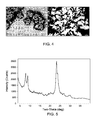
- FIG. 4 provides scanning electron microscope (SEM) images of the as-synthesized product of Example 2.
- FIG. 5 shows the X-ray diffraction pattern of the as-synthesized product of Example 3.
- FIG. 6 compares the X-ray diffraction patterns of the as-synthesized product of Example 4 after crystallization for 24 hours (bottom pattern) and 30 hours (top pattern).
- FIG. 7 compares the X-ray diffraction patterns of the as-synthesized product of Example 5 after crystallization for 1 day (top pattern), 2 days (middle pattern) and 6 days (bottom pattern).
- FIG. 8 compares the X-ray diffraction patterns of the as-synthesized products of Example 6.
- FIG. 9 shows the 27 Al MAS NMR of the product of the fourth experiment of Example 6 prepared with pre-dissolved fumed alumina
- FIG. 10 provides SEM images of the product of the fourth experiment of Example 6.
- FIG. 11 shows transmission electron micrograph (TEM) images of a microtomed specimen of a sample of the fourth experiment product of Example 6.
- FIG. 12 is a bar graph showing the distribution of crystal dimensions for each of the crystallographic edges of a sample of the fourth experiment product of Example 6.
- FIGS. 13 ( a ) to ( e ) show the X-ray diffraction patterns of the as-synthesized products of Examples 7 to 11, respectively.
- FIGS. 14 ( a ) to ( f ) show the X-ray diffraction patterns of the as-synthesized products of Examples 12 to 17, respectively.
- FIGS. 15 ( a ) to ( e ) show the X-ray diffraction patterns of the as-synthesized products of Examples 19 to 23, respectively.
- FIG. 16 provides scanning electron microscope (SEM) images of the as-synthesized product of Example 22.
- FIG. 17 shows the 27 Al MAS NMR of the product of Example 22.
- FIG. 18 shows SEM images of the product of Example 23.
- FIG. 19 shows the 27 Al MAS NMR of the product of Example 23.
- FIG. 20 ( a ) to ( c ) show the X-ray diffraction pattern of the as-synthesized product of Examples 24 to 26, and FIGS. 20 ( d ) and ( e ) show the X-ray diffraction pattern of the as-synthesized and as-calcined products of Example 27.
- FIG. 21 shows SEM images of the product of Example 24.
- FIGS. 22 ( a ) to ( c ) show the X-ray diffraction patterns of the as-synthesized products of Examples 28, 29 and 31, respectively.
- Described herein is a new ultra-small crystal form of ZSM-5 which exhibits a unique X-ray diffraction pattern, such that it has been given the designation EMM-20.
- the X-ray diffraction data reported herein were collected with a Panalytical X'Pert Pro diffraction system with an Xcelerator multichannel detector, equipped with a germanium solid state detector, using copper K-alpha radiation.
- the diffraction data were recorded by step-scanning at 0.02 degrees two-theta, where theta is the Bragg angle, and using an effective counting time of 2 seconds for each step.
- the interplanar spacings, d-spacings were calculated in Angstrom units, and the relative intensities of the lines, I/I o is the ratio of the peak intensity to that of the intensity of the strongest line, above background.
- the intensities are uncorrected for Lorentz and polarization effects.
- the maximum of the composite peak near 24.0 ⁇ 0.30 degrees two-theta and the maximum of the composite peak near 24.4 ⁇ 0.30 degrees two-theta either appear as shoulders or form part of a large diffuse composite peak with a maximum near 23.2 ( ⁇ 0.20) degrees two-theta.
- the composite peak with a maximum near 23.2 degrees two-theta and the composite peak near 24.0 degrees two-theta will intersect to form a clearly visible local minimum [See FIG. 1( a ) ].
- the ratio of the relative background-subtracted intensity of this local minimum (Imin) to the relative background-subtracted intensity of the composite peak near 24.0 degrees two-theta (Imax) will be less than 0.40 in both the as-made and calcined forms of the zeolite.
- the local minimum may still be clearly discerned from the composite peak near 24.0 degrees two-theta [e.g., FIG. 3 for Example 2], but in this example the Imin/Imax ratio is >0.90.
- the crystals become so small and the peaks are so severely broadened that the peak maximum near 24.0 degrees either appears as an inflection point of the large diffuse composite peak with a maximum near 23.2 ( ⁇ 0.20) degrees two-theta [e.g., bottom pattern in FIG. 7 ] or no local maximum or inflection point is discerned for the composite peak near 24.0 ( ⁇ 0.30) degrees two-theta [top pattern in FIG. 8 ]. In these extreme cases the Imin/Imax ratio approaches 1.0.
- the composite peak with a maximum near 7.96 ( ⁇ 0.30) degrees two-theta and the composite peak with a maximum near 8.90 ( ⁇ 0.30) degrees two-theta intersect to form a clearly visible local minimum [see FIG. 1( b ) ], in which the ratio of the relative background-subtracted intensity of this local minimum (Imin) to the relative background-subtracted intensity of the composite peak near 8.90 degrees two-theta (Imax) will be less than 0.20 in both the as-made and calcined forms of the zeolite.
- the Imin/Imax ratio is >0.33.
- the Imin/Imax ratio will be at least 0.40. It should be borne in mind that in cases where preferred orientation effects may be present, care should be taken to minimize their effects on X-ray patterns.
- the ZSM-5 crystals typically have an external surface area in excess of 200 m 2 /g, in some cases in excess of 250 m 2 /g, even in excess of 300 m 2 /g and a total surface area in excess of 500 m 2 /g, in some cases in excess of 600 m 2 /g, even in excess of 650 m 2 /g.
- the ZSM-5 crystals have an external surface area greater than their internal surface area. All surface area values given herein are determined from nitrogen physisorption data using the t-plot method. Details of this method can be found in Lippens, B. C. and deBoer, J. H., “Studies on pore systems in catalysts: V. The t method”, J. Catal., 4, 319 (1965), the entire contents of which are incorporated herein by reference.
- the ZSM-5 crystals described herein have a composition comprising the molar relationship: X 2 O 3 :( n )YO 2 , wherein n is at least about 20, X is a trivalent element in which X is desirably aluminum, and Y is a tetravalent element in which Y is desirably silicon and/or germanium.
- the ZSM-5 crystals described herein can be produced from a synthesis mixture comprising sources of water, an alkali or alkaline earth metal (M), hydroxide ions, an oxide of a tetravalent element Y, optionally a trivalent element X, and a structure directing agent (Q) selected from one or more of 1,4-bis(N-pentylpyrrolidinium)butane dications, 1,5-bis(N-pentylpyrrolidinium)pentane dications, or 1,6-bis(N-pentylpyrrolidinium)hexane dications, the synthesis mixture having a composition, in terms of mole ratios of oxides, within the following ranges:
- Suitable sources of the tetravalent element Y depend on the element Y selected but in the preferred embodiments, in which Y is silicon and/or germanium, include colloidal suspensions of silica, fumed silicas, precipitated silicas, alkali metal silicates, tetraalkyl orthosilicates and germanium oxide.
- the trivalent element X is normally aluminum, and suitable sources of aluminum include hydrated alumina and water-soluble aluminum salts, such as aluminum nitrate.
- Combined sources of aluminum and silicon may include clays or treated clays, such as metakaolin.
- Other combined sources of X and Y, including aluminosilicate zeolites such as zeolite Y, may also be used.
- Suitable sources of Q are the hydroxides and/or salts of the relevant diquaternary ammonium compounds. Although the compounds themselves are believed to be novel, they can readily be synthesized by reaction of N-pentylpyrrolidine with 1,4-dibromobutane, 1,5-dibromopentane or 1,6-dibromohexane.
- the synthesis mixture may also use seeds of a molecular sieve material, such as ZSM-5 from a previous synthesis, desirably in an amount from 0.01 ppm by weight to 10,000 ppm by weight, such as from 100 ppm by weight to 5,000 ppm by weight of the synthesis mixture.
- a molecular sieve material such as ZSM-5 from a previous synthesis
- Crystallization of ZSM-5 from the above synthesis mixture can be carried out at either static or stirred conditions in a suitable reactor vessel, such as for example, polypropylene jars or teflon lined or stainless steel autoclaves, at a temperature of about 80° C. to about 200° C. for a time sufficient for crystallization to occur at the temperature used, e.g., from about 1 to about 21 days. Thereafter, the crystals are separated from the liquid and recovered.
- a suitable reactor vessel such as for example, polypropylene jars or teflon lined or stainless steel autoclaves
- any alkali or alkaline earth metal cations in the as-synthesized ZSM-5 can be replaced in accordance with techniques well known in the art by ion exchange with other cations.
- Preferred replacing cations include metal ions, hydrogen ions, hydrogen precursor, e.g., ammonium ions and mixtures thereof.
- Particularly preferred cations are those which tailor the catalytic activity for certain hydrocarbon conversion reactions. These include hydrogen, rare earth metals and metals of Groups 2 to 15 of the Periodic Table of the Elements. As used herein, the numbering scheme for the Periodic Table Groups is as disclosed in Chemical and Engineering News, 63(5), 27 (1985).
- the as-synthesized ZSM-5 may also be subjected to treatment to remove part or all of the organic directing agent Q used in its synthesis.
- This is conveniently effected by thermal treatment in which the as-synthesized material is heated at a temperature of at least about 370° C. for at least 1 minute and generally not longer than 20 hours. While subatmospheric pressure can be employed for the thermal treatment, atmospheric pressure is desired for reasons of convenience.
- the thermal treatment can be performed at a temperature up to about 925° C.
- the organic directing agent Q can be removed by treatment with ozone (see, e.g., Parikh et al., Microporous and Mesoporous Materials 76 (2004) 17-22).
- the organic-free product, especially in its metal, hydrogen and ammonium forms, is particularly useful in the catalysis of certain organic, e.g., hydrocarbon, conversion reactions.
- the present molecular sieve may be intimately combined with a hydrogenating component, such as molybdenum, rhenium, nickel, cobalt, chromium, manganese, or a noble metal, such as platinum or palladium where a hydrogenation-dehydrogenation function is to be performed.
- a hydrogenating component such as molybdenum, rhenium, nickel, cobalt, chromium, manganese, or a noble metal, such as platinum or palladium where a hydrogenation-dehydrogenation function is to be performed.
- a hydrogenating component such as molybdenum, rhenium, nickel, cobalt, chromium, manganese, or a noble metal, such as platinum or palladium where a hydrogenation-dehydrogenation function is to be performed.
- Such component can be in the composition by way of (1) cocrystallization, (2) exchanged into the composition to the extent a Group IIIA element, e.g., aluminum, is in the structure, (3) imp
- Such component can be impregnated in, or on to it, such as, for example, by, in the case of platinum, treating the silicate with a solution containing a platinum metal-containing ion.
- suitable platinum compounds for this purpose include chloroplatinic acid, platinous chloride and various compounds containing the platinum amine complex.
- the present molecular sieve when employed either as an adsorbent, or as a catalyst, should be dehydrated, at least partially. This can be done by heating to a temperature in the range of 200° C. to about 370° C. in an atmosphere such as air, nitrogen, etc., and at atmospheric, subatmospheric or superatmospheric pressures for between 30 minutes and 48 hours. Dehydration can also be performed at room temperature merely by placing the ZSM-5 in a vacuum, but a longer time is required to obtain a sufficient amount of dehydration.
- the ZSM-5 described herein can be used as an adsorbent or, particularly in its aluminosilicate form, as a catalyst to catalyze a wide variety of organic compound conversion processes including many of present commercial/industrial importance.
- Examples of chemical conversion processes which are effectively catalyzed by the present ZSM-5 are those where high acid activity and large surface area are important.
- the present ZSM-5 may be desirable to incorporate with another material resistant to the temperatures and other conditions employed in organic conversion processes.
- materials include active and inactive materials, and synthetic or naturally occurring zeolites, as well as, inorganic materials such as clays, silica and/or metal oxides such as alumina.
- the latter may be either naturally occurring or in the form of gelatinous precipitates or gels including mixtures of silica and metal oxides.
- Use of a material in conjunction with the present ZSM-5, i.e., combined therewith or present during synthesis of the new crystal, which is active, tends to change the conversion and/or selectivity of the catalyst in certain organic conversion processes.
- Inactive materials suitably serve as diluents to control the amount of conversion in a given process so that products can be obtained in an economic and orderly manner without employing other means for controlling the rate of reaction.
- These materials may be incorporated into naturally occurring clays, e.g., bentonite and kaolin, to improve the crush strength of the catalyst under commercial operating conditions.
- Said materials, i.e., clays, oxides, etc. function as binders for the catalyst. It is desirable to provide a catalyst having good crush strength because in commercial use it is desirable to prevent the catalyst from breaking down into powder-like materials.
- These clay and/or oxide binders have been employed normally only for the purpose of improving the crush strength of the catalyst.
- Naturally occurring clays which can be composited with the present ZSM-5 include the montmorillonite and kaolin family, which families include the subbentonites, and the kaolins commonly known as Dixie, McNamee, Georgia and Florida clays or others in which the main mineral constituent is halloysite, kaolinite, dickite, nacrite, or anauxite. Such clays can be used in the raw state as originally mined, or initially subjected to calcination, acid treatment or chemical modification. Binders useful for compositing with ZSM-5 also include inorganic oxides, such as silica, zirconia, titania, magnesia, beryllia, alumina, and mixtures thereof.
- the present ZSM-5 can be composited with a porous matrix material such as silica-alumina, silica-magnesia, silica-zirconia, silica-thoria, silica-beryllia, silica-titania, as well as, ternary compositions such as silica-alumina-thoria, silica-alumina-zirconia silica-alumina-magnesia and silica-magnesia-zirconia.
- a porous matrix material such as silica-alumina, silica-magnesia, silica-zirconia, silica-thoria, silica-beryllia, silica-titania, as well as, ternary compositions such as silica-alumina-thoria, silica-alumina-zirconia silica-alumina-magnesia and silica-magnesia-zirconia.
- the relative proportions of ZSM-5 and inorganic oxide matrix may vary widely, with the ZSM-5 content ranging from about 1 to about 90 percent by weight and more usually, particularly when the composite is prepared in the form of beads, in the range of about 2 to about 80 weight percent of the composite.
- N-pentylpyrrolidine is initially prepared by the reductive amination of pentanal with pyrrolidine according to the following procedure.
- tetrahydrofuran 500 mL tetrahydrofuran (THF) was placed in a 1-L suction flask equipped with a nitrogen gas flow. 31.9 g pentanal (0.37 mol) and then 24.9 g pyrrolidine (0.35 mol) were mixed into the THF. With the nitrogen flow turned off, 100 g of sodium triacetoxyborohydride powder was then added in 5-10 g increments to the solution. During the addition, vigorous stirring was used to ensure that the powder did not clump at the bottom of the flask and to ensure the efficient mixing of the suspension. After each addition of the sodium triacetoxyborohydride powder, adequate time was provided to form a uniform slurry before the next addition of the powder.
- THF tetrahydrofuran
- the nitrogen flow was then turned on. After two days the product was worked up by quenching the suspension with the slow addition of 275 g of a 24% potassium hydroxide (KOH) solution. The product was then extracted from the resultant solution with pentane. The organic fraction was then collected with a separatory funnel and dried with anhydrous magnesium sulfate. The amine product was then isolated by rotary evaporation of the THF and pentane solvents under reduced pressure.
- KOH potassium hydroxide
- the C4 diquat was formed by the reaction between N-pentylpyrrolidine and 1,4-dibromobutane.
- 20.0 g N-pentylpyrrolidine (0.14 mol) was added to 65 mL acetonitrile inside a 125-mL Teflon liner.
- 13.93 g 1,4-dibromobutane (0.064 mol) was added to the mixture.
- the liner was then capped, sealed inside a Parr steel autoclave, and then heated at 80° C. for 4 days.
- the solid precipitates were then collected by filtration and washed with acetone. After the acetone wash, additional product precipitated within the filtrate.
- the combined solids were then washed with ether and allowed to dry.
- the total yield of clean product was 18.8 g. 1 H and 13 C NMR showed the product to be pure.
- the dibromide salt was then ion-exchanged into the hydroxide form by dissolving it in water and passing it through a column of Dowex LC NG hydroxide exchange resin. The concentration of the aqueous solution was determined by titration with a standard solution of 0.1 N hydrochloric acid (HCl).
- the C5 and C6 diquat salts of N-pentylpyrrolidine were prepared in similar fashion by using 1,5-dibromopentane and 1,6-dibromohexane, respectively, in place of the 1,4-dibromobutane.
- the overhead stirrer was set at 150 rpm.
- the gel was heated to 160° C. over a 4-hr period.
- XRD powder X-ray diffraction
- the product was predominantly a layered phase with an intense peak around 4.5 degrees two-theta with a trace amount of the ultra-small ZSM-5. At this point the temperature was decreased to 150° C.
- the product was ultra-small ZSM-5 with a small amount of the layered impurity. After a further 2 hours, the product was pure ZSM-5.
- FIG. 2 compares the powder XRD patterns of the sequence of sampling points taken at 3 days, at 2 hours before completion, and at completion after 4 days.
- the product of the 4 day synthesis was then recovered by filtration, washed with at least 500 mL deionized water, washed with acetone, and dried in a vacuum oven at 60° C. overnight.
- the zeolite was then calcined in a muffle furnace by heating in a nitrogen stream from ambient temperature to 400° C. over a 2-hr period, maintaining this temperature for 15 minutes, switching the gas stream to air, increasing the temperature from 400° C. to 600° C. over a 2-hr period, maintaining the temperature at 600° C. for 2 hours, and then allowing the furnace to cool to ambient conditions.
- FIG. 3 compares the powder XRD patterns of the as-made and calcined products.
- Scanning electron microscope (SEM) images of the as-made product of the 4 day synthesis are shown in FIG. 4 and demonstrate the bulk material to be crystalline.
- Transmission electron microscopy (TEM) shows the crystals are in the form of ultra-small primary crystallites with plate-like morphologies about 20-60 nm on their edges. Microtomy of these crystals shows that the particles are less than 100 ⁇ in thickness. The crystallites are aggregated into larger secondary particles having an average size of about 1 micron.
- the calcined product of the 4 day synthesis was ion-exchanged into the ammonium form by adding 7.0 g zeolite to a solution containing an equal mass of ammonium nitrate (7.0 g) and a 10-fold mass of deionized water (70 g).
- the slurry was placed in a polypropylene bottle and heated within a steambox overnight at 98° C.
- the zeolite was then filtered and washed with at least 300 mL deionized water.
- the zeolite was converted to the acidic form by calcining the zeolite from ambient conditions to 500° C. over a 2-hour period, maintaining that temperature for 4 hours, and then allowing the furnace to cool to near-ambient conditions.
- Analysis of nitrogen physisorption data by the t-plot method showed that the preparation had 124 m 2 /g external surface area and 0.13 cc/g micropore volume (318 m 2 /g internal surface area).
- the gel was heated to 160° C. over a 4-hr period. After 24 hours, a sample was removed (online) from the autoclave and worked up for powder XRD analysis.
- the product was pure (by XRD) ultra-small ZSM-5.
- FIG. 5 shows the powder XRD of the product.
- Example 3 was repeated, except the synthesis temperature was maintained at 130° C. After 24 hours, the reaction was sampled and the product was amorphous by XRD. After 2 days, the product was still mostly amorphous, but some ZSM-5 appeared. The reaction was then sampled again after 6 total days of heating. The XRD of the product showed it to be pure ultra-small ZSM-5.
- FIG. 7 shows the powder XRD for the samples taken after 1, 2 and 6 days of heating.
- Example 3 Four further repeat experiments of the process of Example 3 were conducted. In the first experiment crystallization was carried out at 160° C. for 66 hours, whereas in the second and third experiments crystallization was carried out at 150° C. for 30 hours and 130° C. for 5 days, respectively. In the fourth experiment, fumed alumina was pre-dissolved in the KOH/diquat solution by heating the mixture at 160° C. for about 45 minutes before adding the silica. Crystallization was then conducted by heating at 130° C. for 7 days followed by heating at 150° C. for 6 days. The results are shown in FIG. 8 and demonstrate that reducing the temperature resulted in products having significantly decreased crystal size as inferred from the peak broadening in the powder XRD patterns.
- the product of the fourth experiment was calcined as in Example 1 and was subjected to nitrogen physisorption measurements. Analysis of the data by the t-plot method showed the product to possess 247 m 2 /g internal surface area (0.107 cc/g micropore volume) and 370 m 2 /g external surface area.
- 27 Al MAS NMR spectrum of the product of the fourth experiment is given in FIG. 9 and shows that the calcined product has >95% tetrahedral aluminum.
- the product obtained from the synthesis without pre-dissolution of the fumed alumina contains only about 10% tetrahedral aluminum.
- FIG. 10 SEM images of the product of the fourth experiment are shown in FIG. 10 .
- the TEM images in FIGS. 11( a ) and ( b ) demonstrate that many of the crystals are elongated with lengths that are generally less than 30 nm and widths that are less than 10 nm.
- Other TEM images FIG. 11( c ) ) show more isotropically shaped crystals with shorter lengths (10-20 nm) than those in FIGS. 11( a ) and ( b ) .
- the mean and median crystal lengths were 15 and 14 nm, respectively and the mean and median widths were 8.2 and 8.0 nm, respectively.
- FIG. 11( d ) shows a TEM image of a microtomed specimen of a sample of fourth experiment product.
- the images of the microtomed crystals reveal the thickness of the crystals; the crystal dimensions here are mostly 5-7 nm.
- the mean and median thicknesses were 6.4 and 6.0 nm, respectively.
- the bar graphs in FIG. 12 show the distribution of crystal dimensions for each of the crystallographic edges.
- FIG. 13( a ) shows the powder XRD of the product.
- Example 7 The process of Example 7 was repeated except that 0.04 g of seeds from that preparation were added and the gel was heated for a total of 6 days instead of 8.
- the powder XRD shown in FIG. 13( b ) is consistent with the product being ultra-small ZSM-5 with a trace level of MCM-68.
- FIG. 13( c ) shows the powder XRD of the product.
- the zeolite was heated inside a muffle furnace from ambient temperature to 400° C. at 4° C./min under a nitrogen atmosphere, then heated to 600° C. at 4° C./min in air, and maintained at 600° C. in air for 2 hours. After the sample cooled to ambient temperature, it was ammonium-exchanged by adding the zeolite to a 10-fold mass of water and adding an equivalent mass of ammonium nitrate. The ammonium-exchange was carried out overnight in a steam box at a temperature of 98-99° C. The zeolite was then filtered and washed exhaustively with deionized water to remove excess salt. The zeolite was then calcined to 500° C.
- a solution was prepared by mixing 3.51 g of a hydroxide solution of the C6 diquat of N-pentylpyrrolidine ([OH] 0.86 mmol/g) with 0.15 g 50% KOH inside a Teflon liner for a 23-mL steel Parr autoclave. 0.063 g SpectrAl fumed alumina (Cabot) was mixed into the solution to create a uniform suspension. The liner was then capped, sealed inside the 23-mL autoclave, and heated at 160° C. under tumbling conditions ( ⁇ 50 rpm) inside a convection oven for about 45 minutes in order to dissolve most of the alumina.
- the reactor was then cooled and 2.25 g Ludox AS-40 was then mixed into the suspension. 0.04 g seeds from Example 7 were added.
- the liner was then capped, sealed inside the 23-mL autoclave, and heated at 125° C. under tumbling conditions ( ⁇ 50 rpm) inside a convection oven for 14 days and then at 140° C. for an additional 4 days.
- the solids were then isolated by filtering through a Buchner funnel, washing with deionized water, and drying in an oven at 100° C.
- the powder XRD of the product is shown in FIG. 13( d ) .
- the liner was then capped, sealed inside the 23-mL autoclave, and heated at 140° C. under tumbling conditions ( ⁇ 50 rpm) inside a convection oven for 7 days.
- the solids were then isolated by filtering through a Buchner funnel, washing with deionized water, and drying in an oven at 100° C.
- the powder XRD of the product is shown in FIG. 13( e ) .
- a solution was prepared by mixing 3.51 g of a hydroxide solution of the C6 diquat of N-pentylpyrrolidine ([OH] 0.86 mmol/g) with 2.63 g of 1N KOH inside a Teflon liner for a 23-mL steel Parr autoclave. 0.046 g boric acid was then dissolved in the hydroxide solution. 2.25 g Ludox AS-40 was then added and mixed to create a uniform suspension. The liner was then capped, sealed inside the 23-mL autoclave, and heated at 100° C. under static conditions inside a convection oven for 9 days. The solids were then recovered by filtering through a Buchner funnel, washing with deionized water, and drying in an oven at 100° C. The powder XRD of the product is shown in FIG. 14( a ) .
- Example 12 The process of Example 12 was repeated at 125° C. under tumbling conditions (50 rpm) for 6 days.
- FIG. 14( b ) shows the powder XRD of the product.
- Example 16 The process of Example 16 was repeated but the reaction mixture was heated at 140° C. for 11 days.
- FIG. 14( f ) shows the powder XRD pattern of the product.
- the reactor was then cooled and 2.25 g Ludox AS-40 was then mixed into the suspension. 0.04 g seeds from Example 7 were then added.
- the liner was then capped, sealed inside the 23-mL autoclave, and heated at 175° C. under tumbling conditions ( ⁇ 50 rpm) inside a convection oven for 3 days.
- the solids were then isolated by filtering through a Buchner funnel, washing with deionized water, and drying in an oven at 100° C. Powder XRD showed the product to be a mixture of ZSM-5 and MCM-68.
- Example 18 The process of Example 18 was repeated except only 0.032 g fumed alumina was added and the reaction mixture was heated at 160° C. under tumbling conditions ( ⁇ 50 rpm) inside a convection oven for 9 days.
- FIG. 15( a ) shows the powder XRD of the product.
- the reactor was then cooled and 2.12 g Ludox AS-40 was then mixed into the suspension.
- the liner was then capped, sealed inside the 23-mL autoclave, and heated at 110° C. under tumbling conditions ( ⁇ 50 rpm) inside a convection oven for 11 days.
- the solids were then isolated by filtering through a Buchner funnel, washing with deionized water, and drying in an oven at 100° C.
- the powder XRD pattern in FIG. 15( b ) is consistent with the product being pure ultra-small ZSM-5.
- the reactor was then cooled and 20.45 g Ludox AS-40 was then mixed into the suspension.
- the liner was then capped, sealed inside the 125-mL autoclave, and heated at 150° C. under tumbling conditions ( ⁇ 50 rpm) inside a convection oven for 7 days.
- the solids were then isolated by filtering through a Buchner funnel, washing exhaustively with deionized water (about 1 liter), and drying in an oven at 100° C.
- the powder XRD pattern in FIG. 15( c ) is consistent with the product being ultra-small ZSM-5.
- the solids were then isolated by filtering through a Buchner funnel, washing with deionized water, and drying in an oven at 100° C.
- the powder XRD pattern in FIG. 15( d ) is consistent with the product being ZSM-5 with a trace level of anatase impurity from the metakaolin reactant (peak at ⁇ 25.2 degrees two-theta).
- SEM images of the product are shown in FIG. 16 .
- the product is composed of spheroidal polycrystalline aggregates that are less than 1 micron in size. The size of the individual crystallites cannot be resolved within the resolution of the SEM images. In the lowest magnification image, a few flakes can be observed that are due to some unreacted metakaolin.
- the presence of unreacted metakaolin is verified by 27 Al MAS NMR ( FIG. 17 ), which shows about 27% of the aluminum of the as-made product is non-tetrahedral.
- Example 22 The process of Example 22 was repeated except that only 0.065 g metakaolin was used and the reaction was carried out at 130° C. for 3 days.
- the powder XRD of the product in FIG. 15( e ) is somewhat sharper than that of the product from Example 22.
- FIG. 18 shows SEM images of the product.
- 27 Al MAS NMR of the product shows that 76% of the aluminum from the metakaolin reactant is incorporated into the product as tetrahedral aluminum.
- Example 22 The process of Example 22 was again repeated except that only 0.033 g metakaolin was used and the reaction was carried out at 130° C. for 3 days.
- the peaks of the powder XRD of the product [ FIG. 20( a ) ] are somewhat sharper than those of the product from Example 22.
- SEM images of the product are shown in FIG. 21 .
- Example 22 The process of Example 22 was again repeated except that the reaction was carried out at 130° C. for 4 days.
- the powder XRD of the product is shown in FIG. 20( b ) .
- Example 23 The process of Example 23 was repeated except the reaction was carried out at 120° C. for 3 days.
- the powder XRD of the product [ FIG. 20( c ) ] is broader than the one for the product of Example 23.
- Example 24 The process of Example 24 was repeated except the reaction was carried out at 120° C. for 3 days.
- the powder XRD of the product [ FIG. 20( d ) ] is broader than the one for the product of Example 24.
- the product was calcined as described in Example 9.
- FIG. 20( e ) shows the powder XRD pattern of the calcined material.
- Example 23 The process of Example 23 was repeated except the reaction was carried out at 110° C. for 6 days.
- FIG. 22( a ) shows the powder XRD pattern of the product.
- Example 24 The process of Example 24 was repeated except the reaction was carried out at 110° C. for 6 days.
- FIG. 22( b ) shows the powder XRD of the product.
- the reactor was then cooled and 2.05 g Ludox AS-40 and 0.092 g metakaolin was then mixed into the solution.
- the liner was then capped, sealed inside the 23-mL autoclave, and heated at 130° C. under tumbling conditions ( ⁇ 50 rpm) inside a convection oven for 22 days.
- the solids were then isolated by filtering through a Buchner funnel, washing with deionized water, and drying in an oven at 100° C. Powder XRD showed the product to be ultra small crystal ZSM-5.
- Example 30 The process of Example 30 was repeated except that only 0.015 g fumed alumina and 0.097 g metakaolin were used and the reaction was carried out for 15 days.
- FIG. 22( c ) shows the powder XRD pattern. The broad hump from 10 to 15 degrees two-theta is due to the plastic sample holder used for the powder XRD measurement.
Landscapes
- Chemical & Material Sciences (AREA)
- Organic Chemistry (AREA)
- General Life Sciences & Earth Sciences (AREA)
- Geology (AREA)
- Life Sciences & Earth Sciences (AREA)
- Inorganic Chemistry (AREA)
- Chemical Kinetics & Catalysis (AREA)
- Engineering & Computer Science (AREA)
- Materials Engineering (AREA)
- Crystallography & Structural Chemistry (AREA)
- Analytical Chemistry (AREA)
- Silicates, Zeolites, And Molecular Sieves (AREA)
- Catalysts (AREA)
Priority Applications (1)
| Application Number | Priority Date | Filing Date | Title |
|---|---|---|---|
| US14/648,800 US10081552B2 (en) | 2012-12-21 | 2013-11-22 | Small crystal ZSM-5, its synthesis and use |
Applications Claiming Priority (6)
| Application Number | Priority Date | Filing Date | Title |
|---|---|---|---|
| US201261740908P | 2012-12-21 | 2012-12-21 | |
| EP13155722.5 | 2013-02-19 | ||
| EP13155722 | 2013-02-19 | ||
| EP13155722 | 2013-02-19 | ||
| PCT/US2013/071456 WO2014099262A1 (en) | 2012-12-21 | 2013-11-22 | Small crystal zsm-5, its synthesis and use |
| US14/648,800 US10081552B2 (en) | 2012-12-21 | 2013-11-22 | Small crystal ZSM-5, its synthesis and use |
Related Parent Applications (1)
| Application Number | Title | Priority Date | Filing Date |
|---|---|---|---|
| PCT/US2013/071456 A-371-Of-International WO2014099262A1 (en) | 2012-12-21 | 2013-11-22 | Small crystal zsm-5, its synthesis and use |
Related Child Applications (1)
| Application Number | Title | Priority Date | Filing Date |
|---|---|---|---|
| US16/108,216 Division US10662068B2 (en) | 2012-12-21 | 2018-08-22 | Small crystal ZSM-5, its synthesis and use |
Publications (2)
| Publication Number | Publication Date |
|---|---|
| US20150298981A1 US20150298981A1 (en) | 2015-10-22 |
| US10081552B2 true US10081552B2 (en) | 2018-09-25 |
Family
ID=47739133
Family Applications (2)
| Application Number | Title | Priority Date | Filing Date |
|---|---|---|---|
| US14/648,800 Active 2034-12-05 US10081552B2 (en) | 2012-12-21 | 2013-11-22 | Small crystal ZSM-5, its synthesis and use |
| US16/108,216 Active 2034-02-22 US10662068B2 (en) | 2012-12-21 | 2018-08-22 | Small crystal ZSM-5, its synthesis and use |
Family Applications After (1)
| Application Number | Title | Priority Date | Filing Date |
|---|---|---|---|
| US16/108,216 Active 2034-02-22 US10662068B2 (en) | 2012-12-21 | 2018-08-22 | Small crystal ZSM-5, its synthesis and use |
Country Status (10)
| Country | Link |
|---|---|
| US (2) | US10081552B2 (enExample) |
| EP (3) | EP3056470B1 (enExample) |
| JP (1) | JP6238377B2 (enExample) |
| KR (1) | KR102166191B1 (enExample) |
| CN (2) | CN107697928B (enExample) |
| CA (1) | CA2895232C (enExample) |
| RU (1) | RU2640759C2 (enExample) |
| SG (2) | SG10201705927UA (enExample) |
| WO (1) | WO2014099262A1 (enExample) |
| ZA (1) | ZA201503617B (enExample) |
Cited By (2)
| Publication number | Priority date | Publication date | Assignee | Title |
|---|---|---|---|---|
| US10662068B2 (en) * | 2012-12-21 | 2020-05-26 | Exxonmobil Research & Engineering Company | Small crystal ZSM-5, its synthesis and use |
| EP4406646A1 (en) | 2023-01-27 | 2024-07-31 | Hindustan Petroleum Corporation Limited | Nano size crystal zsm-5 and its preparation and applications thereof |
Families Citing this family (11)
| Publication number | Priority date | Publication date | Assignee | Title |
|---|---|---|---|---|
| US10118165B2 (en) | 2015-02-04 | 2018-11-06 | Exxonmobil Chemical Patents Inc. | Catalyst compositions and use in heavy aromatics conversion processes |
| US10053403B2 (en) | 2015-02-04 | 2018-08-21 | Exxonmobil Chemical Patents Inc. | Catalyst compositions and their use in transalkylation of heavy aromatics to xylenes |
| WO2016129659A1 (ja) * | 2015-02-13 | 2016-08-18 | 東ソー株式会社 | ペンタシル型ゼオライト及びその製造方法 |
| US9851313B2 (en) * | 2015-03-03 | 2017-12-26 | Panalytical B.V. | Quantitative X-ray analysis—ratio correction |
| CN108602683A (zh) | 2016-02-19 | 2018-09-28 | 埃克森美孚研究工程公司 | 小晶体、高比表面积的emm-30沸石、其合成及用途 |
| WO2018132228A1 (en) * | 2017-01-11 | 2018-07-19 | Chevron U.S.A. Inc. | Synthesis of mfi framework type molecular sieves |
| JP7341247B2 (ja) * | 2019-02-27 | 2023-09-08 | シェブロン ユー.エス.エー. インコーポレイテッド | モレキュラーシーブssz-115、その合成及び使用 |
| WO2021034426A1 (en) | 2019-08-20 | 2021-02-25 | Exxonmobil Research And Engineering Company | Metal-organic framework catalysts and their use in catalytic cracking |
| US10737946B1 (en) * | 2019-08-29 | 2020-08-11 | Chevron U.S.A. Inc. | Synthesis of aluminum-containing molecular sieves of SEW framework type |
| JP2022163831A (ja) * | 2021-04-15 | 2022-10-27 | 東ソー株式会社 | Mfi型ゼオライト |
| EP4777562A1 (en) | 2023-09-12 | 2026-07-22 | ExxonMobil Technology and Engineering Company | Zeolitic materials in polyolefin decomposition via pyrolysis |
Citations (17)
| Publication number | Priority date | Publication date | Assignee | Title |
|---|---|---|---|---|
| US3702886A (en) | 1969-10-10 | 1972-11-14 | Mobil Oil Corp | Crystalline zeolite zsm-5 and method of preparing the same |
| USRE29948E (en) | 1973-11-02 | 1979-03-27 | Mobil Oil Corporation | Crystalline silicates and catalytic conversion of organic compounds therewith |
| JPS59184723A (ja) | 1983-04-06 | 1984-10-20 | Res Assoc Petroleum Alternat Dev<Rapad> | 結晶性メタロシリケ−トの製造法 |
| EP0514715A1 (en) | 1991-05-17 | 1992-11-25 | Asahi Kasei Kogyo Kabushiki Kaisha | Method for producing a particulate zeolite and a particulate zeolite produced thereby |
| US5240892A (en) | 1987-09-02 | 1993-08-31 | Mobil Oil Corporation | Small crystal ZSM-5, as a catalyst |
| US6013239A (en) | 1995-06-06 | 2000-01-11 | Mobil Oil Corporation | Large crystal ZSM-5, its synthesis and use |
| WO2001049607A1 (en) | 2000-01-05 | 2001-07-12 | Exxon Chemical Patents Inc. | Porous inorganic macrostructure materials and process for their preparation |
| US7244409B2 (en) | 1999-10-27 | 2007-07-17 | Sud-Chemie Ag | Process for producing synthetic zeolites with MFI structure |
| RU2312063C1 (ru) | 2006-04-12 | 2007-12-10 | Общество с ограниченной ответственностью "Томскнефтехим" (ООО "Томскнефтехим") | Синтетический пористый кристаллический материал и способ его получения |
| RU2313486C1 (ru) | 2006-04-12 | 2007-12-27 | Общество с ограниченной ответственностью "Томскнефтехим" (ООО "Томскнефтехим") | Синтетический цеолит и способ его получения |
| RU2313488C1 (ru) | 2006-04-24 | 2007-12-27 | Общество с ограниченной ответственностью "Томскнефтехим" (ООО "Томскнефтехим") | Синтетический цеолит и способ его получения |
| US7361328B2 (en) | 2002-12-30 | 2008-04-22 | Sk Corporation | Method of preparing ZSM-5 using variable temperature without organic template |
| WO2010087633A2 (ko) | 2009-02-02 | 2010-08-05 | 한국과학기술원 | 싸이클릭다이암모늄을 이용한 메조기공 및 마크로기공을 추가적으로 포함하는 bea, mtw, mfi 구조의 제올라이트의 제조과정 |
| US20120027673A1 (en) * | 2010-07-30 | 2012-02-02 | University Of Iowa Research Foundation | Synthesis of hierarchical nanocrystalline zeolites with controlled particle size and mesoporosity |
| CN102502696A (zh) | 2011-11-16 | 2012-06-20 | 大连理工大学 | 一种zsm-5沸石的合成方法 |
| WO2013019462A1 (en) | 2011-08-04 | 2013-02-07 | Exxonmobil Chemical Patents Inc. | Emm-23 molecular sieve material, its synthesis and use |
| US9757716B2 (en) * | 2012-12-21 | 2017-09-12 | Exxonmobil Chemical Patents Inc. | Synthesis of ZSM-5 |
Family Cites Families (9)
| Publication number | Priority date | Publication date | Assignee | Title |
|---|---|---|---|---|
| GB9122498D0 (en) * | 1991-10-23 | 1991-12-04 | Exxon Chemical Patents Inc | Process for preparing uniform mfitype zeolite crystals |
| ZA933879B (en) * | 1992-06-05 | 1993-12-27 | Exxon Chemical Patents Inc | ZSM-5-zeolite |
| CN1100005C (zh) * | 2000-06-28 | 2003-01-29 | 中国科学院山西煤炭化学研究所 | 导向剂法快速合成zsm-5分子筛的方法 |
| CN1281494C (zh) * | 2004-06-29 | 2006-10-25 | 中国石油化工股份有限公司 | 一种小晶粒zsm-5沸石的制备方法 |
| ITMI20042136A1 (it) * | 2004-11-08 | 2005-02-08 | Sasol Italy S P A | Procedimento perfezionato per la preparazione di zeoliti zsm-5 |
| CN100455511C (zh) * | 2006-11-10 | 2009-01-28 | 南京工业大学 | 一种合成小晶粒zsm-5沸石分子筛的方法 |
| CN101733143B (zh) * | 2008-11-21 | 2012-08-01 | 中国石油化工股份有限公司 | 小晶粒zsm-5分子筛及其用途 |
| CN102372284B (zh) * | 2010-08-23 | 2013-01-09 | 中国石油化工股份有限公司 | 小晶粒zsm-5沸石的制备方法 |
| CN107697928B (zh) * | 2012-12-21 | 2020-09-01 | 埃克森美孚化学专利公司 | 小晶体zsm-5,其合成和用途 |
-
2013
- 2013-11-22 CN CN201710862536.8A patent/CN107697928B/zh active Active
- 2013-11-22 EP EP16163846.5A patent/EP3056470B1/en active Active
- 2013-11-22 RU RU2015129627A patent/RU2640759C2/ru active
- 2013-11-22 SG SG10201705927UA patent/SG10201705927UA/en unknown
- 2013-11-22 SG SG11201503973UA patent/SG11201503973UA/en unknown
- 2013-11-22 EP EP17186970.4A patent/EP3266747A1/en not_active Withdrawn
- 2013-11-22 US US14/648,800 patent/US10081552B2/en active Active
- 2013-11-22 EP EP13808320.9A patent/EP2935102B1/en active Active
- 2013-11-22 CA CA2895232A patent/CA2895232C/en active Active
- 2013-11-22 WO PCT/US2013/071456 patent/WO2014099262A1/en not_active Ceased
- 2013-11-22 KR KR1020157016273A patent/KR102166191B1/ko active Active
- 2013-11-22 CN CN201380066799.8A patent/CN104870367B/zh active Active
- 2013-11-22 JP JP2015549410A patent/JP6238377B2/ja active Active
-
2015
- 2015-05-21 ZA ZA2015/03617A patent/ZA201503617B/en unknown
-
2018
- 2018-08-22 US US16/108,216 patent/US10662068B2/en active Active
Patent Citations (17)
| Publication number | Priority date | Publication date | Assignee | Title |
|---|---|---|---|---|
| US3702886A (en) | 1969-10-10 | 1972-11-14 | Mobil Oil Corp | Crystalline zeolite zsm-5 and method of preparing the same |
| USRE29948E (en) | 1973-11-02 | 1979-03-27 | Mobil Oil Corporation | Crystalline silicates and catalytic conversion of organic compounds therewith |
| JPS59184723A (ja) | 1983-04-06 | 1984-10-20 | Res Assoc Petroleum Alternat Dev<Rapad> | 結晶性メタロシリケ−トの製造法 |
| US5240892A (en) | 1987-09-02 | 1993-08-31 | Mobil Oil Corporation | Small crystal ZSM-5, as a catalyst |
| EP0514715A1 (en) | 1991-05-17 | 1992-11-25 | Asahi Kasei Kogyo Kabushiki Kaisha | Method for producing a particulate zeolite and a particulate zeolite produced thereby |
| US6013239A (en) | 1995-06-06 | 2000-01-11 | Mobil Oil Corporation | Large crystal ZSM-5, its synthesis and use |
| US7244409B2 (en) | 1999-10-27 | 2007-07-17 | Sud-Chemie Ag | Process for producing synthetic zeolites with MFI structure |
| WO2001049607A1 (en) | 2000-01-05 | 2001-07-12 | Exxon Chemical Patents Inc. | Porous inorganic macrostructure materials and process for their preparation |
| US7361328B2 (en) | 2002-12-30 | 2008-04-22 | Sk Corporation | Method of preparing ZSM-5 using variable temperature without organic template |
| RU2312063C1 (ru) | 2006-04-12 | 2007-12-10 | Общество с ограниченной ответственностью "Томскнефтехим" (ООО "Томскнефтехим") | Синтетический пористый кристаллический материал и способ его получения |
| RU2313486C1 (ru) | 2006-04-12 | 2007-12-27 | Общество с ограниченной ответственностью "Томскнефтехим" (ООО "Томскнефтехим") | Синтетический цеолит и способ его получения |
| RU2313488C1 (ru) | 2006-04-24 | 2007-12-27 | Общество с ограниченной ответственностью "Томскнефтехим" (ООО "Томскнефтехим") | Синтетический цеолит и способ его получения |
| WO2010087633A2 (ko) | 2009-02-02 | 2010-08-05 | 한국과학기술원 | 싸이클릭다이암모늄을 이용한 메조기공 및 마크로기공을 추가적으로 포함하는 bea, mtw, mfi 구조의 제올라이트의 제조과정 |
| US20120027673A1 (en) * | 2010-07-30 | 2012-02-02 | University Of Iowa Research Foundation | Synthesis of hierarchical nanocrystalline zeolites with controlled particle size and mesoporosity |
| WO2013019462A1 (en) | 2011-08-04 | 2013-02-07 | Exxonmobil Chemical Patents Inc. | Emm-23 molecular sieve material, its synthesis and use |
| CN102502696A (zh) | 2011-11-16 | 2012-06-20 | 大连理工大学 | 一种zsm-5沸石的合成方法 |
| US9757716B2 (en) * | 2012-12-21 | 2017-09-12 | Exxonmobil Chemical Patents Inc. | Synthesis of ZSM-5 |
Non-Patent Citations (5)
| Title |
|---|
| Choi et al., "Stable single-unit-cell nanosheets of zeolite MFI as active and long-lived catalysts," Nature, MacMillan Publishers, vol. 461 (2009) pp. 246-249. |
| Lippens et al., "Studies on Pore Systems in Catalysts V. The t Method", Journal of Catalysis, vol. 4, (1965) pp. 319-323. |
| Parikh et al., "Non-thermal calcination by ultraviolet irradiation in the synthesis of microporous materials," Microporous and Mesoporous Materials, Elsevier Publishers, 76 (2004) pp. 17-22. |
| Periodic Table of the Elements, Chemical & Engineering News vol. 63, No. 5 (1985) p. 27. |
| Serrano et al., "Molecular and Meso- and Macroscopic Properties of Hierarchical Nanocrystalline ZSM-5 Zeolite Prepared by Seed Silanization," Chem. Mater. 21 (2009) pp. 641-654. |
Cited By (3)
| Publication number | Priority date | Publication date | Assignee | Title |
|---|---|---|---|---|
| US10662068B2 (en) * | 2012-12-21 | 2020-05-26 | Exxonmobil Research & Engineering Company | Small crystal ZSM-5, its synthesis and use |
| EP4406646A1 (en) | 2023-01-27 | 2024-07-31 | Hindustan Petroleum Corporation Limited | Nano size crystal zsm-5 and its preparation and applications thereof |
| US12220688B2 (en) | 2023-01-27 | 2025-02-11 | Hindustan Petroleum Corporation Limited | Nano size crystal ZSM-5 and its preparation and applications thereof |
Also Published As
| Publication number | Publication date |
|---|---|
| CN104870367B (zh) | 2017-09-22 |
| JP2016505498A (ja) | 2016-02-25 |
| CN107697928B (zh) | 2020-09-01 |
| US10662068B2 (en) | 2020-05-26 |
| KR20150100677A (ko) | 2015-09-02 |
| KR102166191B1 (ko) | 2020-10-15 |
| SG11201503973UA (en) | 2015-06-29 |
| CN107697928A (zh) | 2018-02-16 |
| EP2935102A1 (en) | 2015-10-28 |
| US20150298981A1 (en) | 2015-10-22 |
| CA2895232A1 (en) | 2014-06-26 |
| ZA201503617B (en) | 2016-02-24 |
| CN104870367A (zh) | 2015-08-26 |
| US20190062171A1 (en) | 2019-02-28 |
| RU2015129627A (ru) | 2017-02-02 |
| EP3266747A1 (en) | 2018-01-10 |
| EP3056470A1 (en) | 2016-08-17 |
| SG10201705927UA (en) | 2017-08-30 |
| WO2014099262A1 (en) | 2014-06-26 |
| RU2640759C2 (ru) | 2018-01-11 |
| JP6238377B2 (ja) | 2017-11-29 |
| CA2895232C (en) | 2020-07-28 |
| EP2935102B1 (en) | 2017-01-25 |
| EP3056470B1 (en) | 2017-10-18 |
Similar Documents
| Publication | Publication Date | Title |
|---|---|---|
| US10662068B2 (en) | Small crystal ZSM-5, its synthesis and use | |
| US10293334B2 (en) | Synthesis of ZSM-5 | |
| US9415381B2 (en) | EMM-22 molecular sieve, its synthesis and use | |
| US10427147B2 (en) | Small crystal, high surface area EMM-30 zeolites, their synthesis and use | |
| US20180339910A1 (en) | Molecular Sieve, COK-5, Its Synthesis and Use | |
| US6787124B2 (en) | Synthetic porous crystalline material, EMM-1, its synthesis and use |
Legal Events
| Date | Code | Title | Description |
|---|---|---|---|
| AS | Assignment |
Owner name: EXXONMOBIL CHEMICAL PATENTS INC., TEXAS Free format text: ASSIGNMENT OF ASSIGNORS INTEREST;ASSIGNORS:BURTON, ALLEN W.;KLIEWER, CHRISTINE E.;AFEWORKI, MOBAE;SIGNING DATES FROM 20150603 TO 20150609;REEL/FRAME:036057/0973 |
|
| AS | Assignment |
Owner name: EXXONMOBIL RESEARCH AND ENGINEERING COMPANY, NEW J Free format text: ASSIGNMENT OF ASSIGNORS INTEREST;ASSIGNOR:EXXONMOBIL CHEMICAL PATENTS INC.;REEL/FRAME:043211/0594 Effective date: 20170621 |
|
| STCF | Information on status: patent grant |
Free format text: PATENTED CASE |
|
| MAFP | Maintenance fee payment |
Free format text: PAYMENT OF MAINTENANCE FEE, 4TH YEAR, LARGE ENTITY (ORIGINAL EVENT CODE: M1551); ENTITY STATUS OF PATENT OWNER: LARGE ENTITY Year of fee payment: 4 |
|
| MAFP | Maintenance fee payment |
Free format text: PAYMENT OF MAINTENANCE FEE, 8TH YEAR, LARGE ENTITY (ORIGINAL EVENT CODE: M1552); ENTITY STATUS OF PATENT OWNER: LARGE ENTITY Year of fee payment: 8 |