US10076261B2 - Imaging apparatus and method - Google Patents
Imaging apparatus and method Download PDFInfo
- Publication number
- US10076261B2 US10076261B2 US10/220,717 US22071702A US10076261B2 US 10076261 B2 US10076261 B2 US 10076261B2 US 22071702 A US22071702 A US 22071702A US 10076261 B2 US10076261 B2 US 10076261B2
- Authority
- US
- United States
- Prior art keywords
- sample
- interface
- thz
- radiation
- pulse
- Prior art date
- Legal status (The legal status is an assumption and is not a legal conclusion. Google has not performed a legal analysis and makes no representation as to the accuracy of the status listed.)
- Expired - Fee Related, expires
Links
- 238000000034 method Methods 0.000 title claims abstract description 41
- 238000003384 imaging method Methods 0.000 title claims description 27
- 230000005855 radiation Effects 0.000 claims description 75
- 230000005670 electromagnetic radiation Effects 0.000 claims description 8
- 230000001678 irradiating effect Effects 0.000 claims description 8
- 230000003595 spectral effect Effects 0.000 abstract description 3
- 230000002708 enhancing effect Effects 0.000 abstract 1
- 239000000523 sample Substances 0.000 description 97
- 210000003491 skin Anatomy 0.000 description 25
- 238000010521 absorption reaction Methods 0.000 description 23
- 238000001514 detection method Methods 0.000 description 20
- 230000005684 electric field Effects 0.000 description 19
- 239000013078 crystal Substances 0.000 description 18
- 210000000434 stratum corneum Anatomy 0.000 description 15
- XLYOFNOQVPJJNP-UHFFFAOYSA-N water Substances O XLYOFNOQVPJJNP-UHFFFAOYSA-N 0.000 description 13
- 208000002925 dental caries Diseases 0.000 description 11
- 210000003298 dental enamel Anatomy 0.000 description 11
- 210000000245 forearm Anatomy 0.000 description 11
- 238000005259 measurement Methods 0.000 description 11
- PEDCQBHIVMGVHV-UHFFFAOYSA-N Glycerine Chemical compound OCC(O)CO PEDCQBHIVMGVHV-UHFFFAOYSA-N 0.000 description 10
- 238000004458 analytical method Methods 0.000 description 9
- 210000004268 dentin Anatomy 0.000 description 9
- 238000006243 chemical reaction Methods 0.000 description 8
- 206010028980 Neoplasm Diseases 0.000 description 7
- 239000004065 semiconductor Substances 0.000 description 7
- 229910001218 Gallium arsenide Inorganic materials 0.000 description 6
- 230000008859 change Effects 0.000 description 6
- 230000036571 hydration Effects 0.000 description 6
- 238000006703 hydration reaction Methods 0.000 description 6
- 230000003287 optical effect Effects 0.000 description 6
- 210000002615 epidermis Anatomy 0.000 description 5
- 235000011187 glycerol Nutrition 0.000 description 5
- 239000000463 material Substances 0.000 description 5
- 229910052594 sapphire Inorganic materials 0.000 description 5
- 239000010980 sapphire Substances 0.000 description 5
- BQCADISMDOOEFD-UHFFFAOYSA-N Silver Chemical compound [Ag] BQCADISMDOOEFD-UHFFFAOYSA-N 0.000 description 4
- 229910052709 silver Inorganic materials 0.000 description 4
- 239000004332 silver Substances 0.000 description 4
- 238000001228 spectrum Methods 0.000 description 4
- 239000012472 biological sample Substances 0.000 description 3
- 230000008878 coupling Effects 0.000 description 3
- 238000010168 coupling process Methods 0.000 description 3
- 238000005859 coupling reaction Methods 0.000 description 3
- 230000000694 effects Effects 0.000 description 3
- 239000010453 quartz Substances 0.000 description 3
- VYPSYNLAJGMNEJ-UHFFFAOYSA-N silicon dioxide Inorganic materials O=[Si]=O VYPSYNLAJGMNEJ-UHFFFAOYSA-N 0.000 description 3
- 230000009466 transformation Effects 0.000 description 3
- 230000001052 transient effect Effects 0.000 description 3
- 210000000707 wrist Anatomy 0.000 description 3
- JAPMJSVZDUYFKL-UHFFFAOYSA-N C1C2C1CCC2 Chemical compound C1C2C1CCC2 JAPMJSVZDUYFKL-UHFFFAOYSA-N 0.000 description 2
- 0 CC(C)C1**CC*1 Chemical compound CC(C)C1**CC*1 0.000 description 2
- 230000005697 Pockels effect Effects 0.000 description 2
- 229910007709 ZnTe Inorganic materials 0.000 description 2
- 230000005540 biological transmission Effects 0.000 description 2
- 230000000052 comparative effect Effects 0.000 description 2
- 230000018044 dehydration Effects 0.000 description 2
- 238000006297 dehydration reaction Methods 0.000 description 2
- 230000001419 dependent effect Effects 0.000 description 2
- 210000004207 dermis Anatomy 0.000 description 2
- 238000013461 design Methods 0.000 description 2
- 230000010355 oscillation Effects 0.000 description 2
- 238000012545 processing Methods 0.000 description 2
- 238000002310 reflectometry Methods 0.000 description 2
- 201000000849 skin cancer Diseases 0.000 description 2
- 201000008261 skin carcinoma Diseases 0.000 description 2
- 230000002123 temporal effect Effects 0.000 description 2
- 238000013519 translation Methods 0.000 description 2
- 206010029098 Neoplasm skin Diseases 0.000 description 1
- 230000005856 abnormality Effects 0.000 description 1
- NIXOWILDQLNWCW-UHFFFAOYSA-N acrylic acid group Chemical group C(C=C)(=O)O NIXOWILDQLNWCW-UHFFFAOYSA-N 0.000 description 1
- 238000010009 beating Methods 0.000 description 1
- 230000015572 biosynthetic process Effects 0.000 description 1
- 230000015556 catabolic process Effects 0.000 description 1
- 239000011248 coating agent Substances 0.000 description 1
- 238000000576 coating method Methods 0.000 description 1
- 230000001427 coherent effect Effects 0.000 description 1
- 239000000470 constituent Substances 0.000 description 1
- 230000007423 decrease Effects 0.000 description 1
- 230000003111 delayed effect Effects 0.000 description 1
- 238000009795 derivation Methods 0.000 description 1
- 238000002059 diagnostic imaging Methods 0.000 description 1
- 239000006185 dispersion Substances 0.000 description 1
- 238000001035 drying Methods 0.000 description 1
- 230000002500 effect on skin Effects 0.000 description 1
- 238000005516 engineering process Methods 0.000 description 1
- 238000011156 evaluation Methods 0.000 description 1
- 238000002474 experimental method Methods 0.000 description 1
- 231100001261 hazardous Toxicity 0.000 description 1
- 230000000887 hydrating effect Effects 0.000 description 1
- 238000011835 investigation Methods 0.000 description 1
- 230000009021 linear effect Effects 0.000 description 1
- 230000014759 maintenance of location Effects 0.000 description 1
- 239000000203 mixture Substances 0.000 description 1
- 230000009022 nonlinear effect Effects 0.000 description 1
- 230000008569 process Effects 0.000 description 1
- 230000004044 response Effects 0.000 description 1
- 230000006335 response to radiation Effects 0.000 description 1
- 229920006395 saturated elastomer Polymers 0.000 description 1
- 230000035945 sensitivity Effects 0.000 description 1
- 239000007779 soft material Substances 0.000 description 1
- 230000003068 static effect Effects 0.000 description 1
- 239000000758 substrate Substances 0.000 description 1
- 230000001629 suppression Effects 0.000 description 1
- 210000001519 tissue Anatomy 0.000 description 1
- 238000012546 transfer Methods 0.000 description 1
- 230000001131 transforming effect Effects 0.000 description 1
- 238000009736 wetting Methods 0.000 description 1
- 230000037303 wrinkles Effects 0.000 description 1
Images




Classifications
-
- A—HUMAN NECESSITIES
- A61—MEDICAL OR VETERINARY SCIENCE; HYGIENE
- A61B—DIAGNOSIS; SURGERY; IDENTIFICATION
- A61B5/00—Measuring for diagnostic purposes; Identification of persons
- A61B5/05—Detecting, measuring or recording for diagnosis by means of electric currents or magnetic fields; Measuring using microwaves or radio waves
-
- A—HUMAN NECESSITIES
- A61—MEDICAL OR VETERINARY SCIENCE; HYGIENE
- A61B—DIAGNOSIS; SURGERY; IDENTIFICATION
- A61B5/00—Measuring for diagnostic purposes; Identification of persons
- A61B5/05—Detecting, measuring or recording for diagnosis by means of electric currents or magnetic fields; Measuring using microwaves or radio waves
- A61B5/0507—Detecting, measuring or recording for diagnosis by means of electric currents or magnetic fields; Measuring using microwaves or radio waves using microwaves or terahertz waves
-
- A—HUMAN NECESSITIES
- A61—MEDICAL OR VETERINARY SCIENCE; HYGIENE
- A61B—DIAGNOSIS; SURGERY; IDENTIFICATION
- A61B5/00—Measuring for diagnostic purposes; Identification of persons
- A61B5/45—For evaluating or diagnosing the musculoskeletal system or teeth
- A61B5/4538—Evaluating a particular part of the muscoloskeletal system or a particular medical condition
- A61B5/4542—Evaluating the mouth, e.g. the jaw
- A61B5/4547—Evaluating teeth
-
- G—PHYSICS
- G01—MEASURING; TESTING
- G01N—INVESTIGATING OR ANALYSING MATERIALS BY DETERMINING THEIR CHEMICAL OR PHYSICAL PROPERTIES
- G01N21/00—Investigating or analysing materials by the use of optical means, i.e. using sub-millimetre waves, infrared, visible or ultraviolet light
- G01N21/17—Systems in which incident light is modified in accordance with the properties of the material investigated
- G01N21/25—Colour; Spectral properties, i.e. comparison of effect of material on the light at two or more different wavelengths or wavelength bands
- G01N21/31—Investigating relative effect of material at wavelengths characteristic of specific elements or molecules, e.g. atomic absorption spectrometry
- G01N21/35—Investigating relative effect of material at wavelengths characteristic of specific elements or molecules, e.g. atomic absorption spectrometry using infrared light
- G01N21/3581—Investigating relative effect of material at wavelengths characteristic of specific elements or molecules, e.g. atomic absorption spectrometry using infrared light using far infrared light; using Terahertz radiation
-
- G—PHYSICS
- G01—MEASURING; TESTING
- G01N—INVESTIGATING OR ANALYSING MATERIALS BY DETERMINING THEIR CHEMICAL OR PHYSICAL PROPERTIES
- G01N21/00—Investigating or analysing materials by the use of optical means, i.e. using sub-millimetre waves, infrared, visible or ultraviolet light
- G01N21/17—Systems in which incident light is modified in accordance with the properties of the material investigated
- G01N21/47—Scattering, i.e. diffuse reflection
- G01N21/4795—Scattering, i.e. diffuse reflection spatially resolved investigating of object in scattering medium
-
- G—PHYSICS
- G01—MEASURING; TESTING
- G01N—INVESTIGATING OR ANALYSING MATERIALS BY DETERMINING THEIR CHEMICAL OR PHYSICAL PROPERTIES
- G01N21/00—Investigating or analysing materials by the use of optical means, i.e. using sub-millimetre waves, infrared, visible or ultraviolet light
- G01N21/17—Systems in which incident light is modified in accordance with the properties of the material investigated
- G01N21/41—Refractivity; Phase-affecting properties, e.g. optical path length
- G01N21/43—Refractivity; Phase-affecting properties, e.g. optical path length by measuring critical angle
Definitions
- the present invention is concerned with the field of investigating and imaging samples primarily using radiation in the frequency range from 25 GHz to 100 THz.
- This frequency range extends from the mid infrared range up to, and including the lower end of the microwave range.
- This range of frequencies encompasses the Terahertz (THz) range and is generally referred to as THz radiation.
- THz Terahertz
- Such radiation is non-ionising and, as a result, it is particularly of use in medical applications.
- radiation is generally reflected from or transmitted through the patient. Radiation in the above frequency range is generally quite heavily absorbed in structures having a high water content. Therefore, reflection measurements are believed to be of particular use in such investigations.
- the present invention seeks to address the above problems, and in a first aspect, provides a method of imaging a sample, the method comprising the steps of:
- the above method is ideally intended for use with biological samples. Also, the above method derives information as a continuous function of the depth from the surface of the sample. Preferably either the refractive index or the absorption coefficient is derived as a function of depth from the surface of the sample.
- the structural information can be derived as a continuous analytical function of the measured reflected radiation.
- the method further comprises the step of obtaining a reference signal.
- the said reference signal is preferably a signal taken without the presence of the sample and is preferably obtained by reflecting the radiation off a mirror which has substantially perfectly reflecting.
- the above method uses reflections from the sample in order to obtain information about the continuously changing absorption coefficient, refractive index and other structural parameters of the sample.
- the technique does not rely on the present of sharp discontinuities within the sample to derive information about specific regions of the sample, because the method provides an analytical technique for deriving a continuously changing parameter as a function of depth.
- the wavevector of each frequency component of the THz pulse is dominated by the absorption coefficient as opposed to the refractive index (which is the case for lossless media).
- the frequency range from 50 GHz to 80 THz is used, more preferably from 100 GHz to 50 THz.
- the present invention provides an apparatus for investigating a sample, the apparatus comprising:
- This reflection data can be used to determine the position of interfaces within the same. However, it can also be used to obtain data concerning the absorption of the sample between the two interfaces. Comparing the signals from different interfaces in different parts of the sample, is particularly of use in studying samples where there is some variation in the absorption of the latter between the two interfaces.
- the present invention provides a method for studying a sample, the method comprising the steps of:
- the step of comparing the signal from the first interface with that of the second could comprise the step of dividing the peak height of the signal from the second interface with that from the first or subtracting the signals.
- the method could comprise the step of comparing the two signals from the two different parts of the sample with respect to the peak height.
- Comparing the peak heights of the signal from the first and second interfaces allows any variations in detected radiation due to differences in the sample position and differences in the sample which are not between the first and second interfaces to be taken into account.
- the above method is particularly of use when looking for an abnormality in a sample.
- looking for a skin tumour there will be a reflection from an interface above the tumour such as the external surface of the skin, there will also be a reflection from an interface below the skin, for example, the skin/fat interface.
- a tumour has been shown to absorb THz quite strongly. Therefore, the signal from the second interface will be weaker in a tumourous region than in a non tumourous region.
- one of the parts of the sample is preferably a healthy part which is used as a reference.
- the above method is not only limited to looking for tumours. It has been shown that areas of teeth which have been subjected to dental caries are also more strongly absorbing than healthy areas of the teeth. Therefore, there will be a marked change in the signal from the second interface from the healthy region of the teeth to the carious region of the teeth.
- the above method may comprise the step of looking at many different parts of the sample, and generating a plot of the corrected second peak against the position on the sample.
- An image of the sample could also be built up by plotting the corrected second peak against the position on the sample.
- an area of the sample is subdivided into pixels and the reflected radiation form each of the pixels is detected.
- the radiation used can be pulsed radiation which comprises a plurality of frequencies or even continuous wave radiation which has substantially a single frequency.
- the present invention provides an apparatus for generating an image of a sample, the apparatus comprising:
- the present invention provides a method of imaging a sample, the method comprising the steps of:
- the area of the sample which is to be imaged will be subdivided into a two-dimensional array of pixels and the radiation will be detected from each of the pixels.
- the sample may be moved relative to the beam of radiation or the beam may be moved relative to the sample, or both.
- the whole area of the sample could be irradiated and the radiation transmitted through or detected form the area of the sample could be detected by a CCD camera or the like.
- the Terahertz pulse which is used to irradiate the sample will spread out due to its passage through the sample. As a result, different parts of the pulse will be detected at different times.
- the method of the fifth aspect of the present invention generates an image using a specific ‘t’.
- the radiation can be detected at a specific time ‘t’, this is advantageous as it does not require detecting radiation for every ‘t’ and hence the acquisition time of the image is substantially improved.
- This method could be used for either or both of transmitted data or reflected data.
- the present invention provides an apparatus for imaging a sample comprising:
- the apparatus preferably further comprising means for displaying a plurality of images generated from different time points. More preferably, the apparatus comprises optimising means for optimising the image using the variable parameter of the delay time.
- FIG. 1 shows a schematic imaging system in accordance with an embodiment of the present invention
- FIG. 2 shows an example of a generation section for use with the imaging system of FIG. 1 ;
- FIG. 3 shows an example of a detection section for use with the imaging system of FIG. 1 ;
- FIG. 4 shows a further example of a generator for use with the imaging system of FIG. 1 ;
- FIG. 5 shows a further example of a detector for use with the imaging system of FIG. 1 ;
- FIG. 6 shows a schematic trace of a pulse detected by the imaging system of FIG. 1 ;
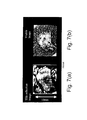
- FIG. 7 shows an image of a skin carcinoma produced in accordance with an embodiment of the present invention.
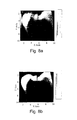
- FIGS. 8 a and 8 b shows two images of a tooth produced using a method in accordance with an embodiment of the present invention
- FIG. 9 a shows a visible image of a slice through a tooth
- FIG. 9 b shows a typical THz time domain trace for a tooth
- FIGS. 9 c, d and e show time slice images for the tooth at delayed times ⁇ 0.08 ps, 0.1 ps and 3.34 ps;
- FIG. 10 a to 10 d show four images of time slices through the tooth shown in FIG. 9 a;
- FIG. 11 a shows a visible image of a tooth
- FIG. 11 b shows an absorption image of the tooth of FIG. 11 a
- FIG. 11 c shows a time of flight image of the tooth of FIG. 11 a
- FIGS. 11 d to 11 f show time slices of the tooth of FIG. 11 a for times ⁇ 0.1 ps, 2.4 ps and 3.1 ps respectively;
- FIG. 12 a shows a visible image of a tooth
- FIG. 12 b shows the absorption image of that tooth
- FIG. 12 c shows a time slice through that tooth
- FIG. 12 d shows an image of the tooth plotting the time of the maximum peak of the electric field
- FIG. 13 shows a visible image of a tooth and a THz signal from the tooth
- FIG. 14 shows a visible image of a tooth and two THz traces of diseased and healthy parts of the tooth
- FIG. 15 is a schematic of skin and shows a schematic signal from the skin.
- FIG. 16 shows a schematic layer structure of a sample which can be investigated using a method in accordance with an embodiment of the present invention
- FIG. 17 shows a schematic of a variation of the imaging system of FIG. 1 ;
- FIG. 18 a shows a typical signal measured by the apparatus of FIG. 17 and FIG. 18 b shows the corresponding THz power spectrum;
- FIG. 19 shows a schematic of the layers of skin and an input and reflected pulses
- FIG. 20 is a visible image of a human arm and hand indicating points on the arm and hand which are measured to produce the results in the following figures;
- FIG. 21 a is a plot of a time domain THz waveform measured from the forearm and compared with that from air and water;
- FIG. 21 b is a THz waveform comparing the reflected pulse from the forearm, wrist and palm;
- FIG. 22 a is a 1 cm by 1 cm image of the side of the hand of FIG. 20 ;
- FIG. 22 b is a time slice image of the hand;
- FIG. 23 a is an image of the palm of the hand of FIG. 20
- FIG. 23 b shows the corresponding data from the edge of the subject's palm
- FIG. 24 a is a comparative plot of a THz measurement of the forearm of FIG. 20 under different wetting conditions; and FIG. 24 b shows plots of measurements of the palm and forearm before and after application of glycerine solution; and
- FIG. 25 a is a comparative plot of the changing characteristics of a forearm over a 15 minute period
- FIG. 25 b is a plot of the maximas of the traces of FIG. 25 a against time.
- FIG. 1 shows a basic THz imaging system.
- the system can be simplified into three main sections, a generator 31 , an imaging section 33 and a detection section 35 .
- THz radiation is generated in the generating section 31 by using a THz emitter which is supplied by a visible pulsed laser 37 .
- a THz beam 39 is emitted from generation section 31 and is directed onto sample 41 of the imaging section 33 .
- the THz beam 39 is then reflected from sample 41 and directed via further optics 45 into the detection section 35 .
- the THz beam which is reflected from the sample 41 is beam 39 .
- the detection section reads the information carried in the detected THz signal via a visible light signal and AC Pockels effect.
- the visible light can be obtained from laser 37 via beam splitter 47 .
- Laser 37 is a Ti:Sapphire laser which typically produces wavelengths in the range of 900 nm to 350 nm, with a pulse width of 50 fs and a repetition rate of 82 MHz.
- Beam splitter 47 splits the beam into a reference beam 55 and a beam for THz generation.
- a time delay is added to the reference beam 55 via time delay line 34 . Varying the time delay via the time delay line allows the phase of the reference beam to be varied with respect to that of the THz beam 39 . This is used in detecting the THz beam in detection system 35 .
- the system e.g. the control of the sample 41 movement, the time delay 34 and the detected signal processing
- computer 36 controls computer 36 . Details of the AC Pockels effect will be described with reference to FIG. 3 .
- FIG. 2 shows a generator which can be used with the imaging system of FIG. 1
- details of the detection part of the system will be omitted. These will be described with reference to FIG. 3 .
- FIG. 2 shows a THz generator using a frequency conversion member which may be a crystal which non-linear properties of the like such as ZnTe.
- the radiation used to generate the THz radiation via frequency conversion member 315 .
- Radiation is supplied to frequency conversion member 315 from Ti:Sapphire crystal 317 .
- Ti:Sapphire crystal 317 emits a pump beam, which comprises pulses of radiation, in response to radiation with laser driving beam 319 .
- the driving beam 319 is directed onto crystal 317 using mirrors M 1 and M 2 .
- the driving beam 319 can pass through mirror M 3 and onto lasing crystal 317 .
- the driving beam 319 which is not absorbed by crystal 317 is emitted through mirror M 4 .
- Mirror M 4 serves to reflect any radiation back onto the lasing crystal 317 .
- This radiation is then reflected via mirror M 3 onto mirror M 5 and onto output coupler 321 .
- Output coupler 321 serves to reflect the pump beam 307 onto the frequency conversion member 315 to produce Terahertz radiation.
- the pump beam is focused onto frequency conversion member 315 via lens L 1 . Any radiation which is transmitted through the frequency conversion member 315 is reflected back through the frequency conversion member 315 by mirror M 6 . This radiation then impinges on output coupler 321 .
- Output coupler 321 transmits terahertz radiation, but it reflects most of the pump beam back onto mirror M 5 , which in turn reflects the radiation back onto the lasing crystal 317 via mirror M 3 .
- the lasing crystal 317 and the frequency conversion member 315 are all located within the same lasing cavity defined by mirror M 6 , the output coupler and mirrors M 5 , M 3 and M 4 .
- the pump beam 307 is continuously reflected within this cavity to efficiently generate the pump beam and the THz beam.
- the THz beam 53 which is emitted from output coupler 321 is directed into the imaging section 33 and onto sample 41 via THz imaging optics (not shown).
- the sample 41 is located on a motorised X-Y translation stage (not shown) so that the whole sample 41 can be imaged. (The x-y plane is orthogonal to the beam axis).
- the THz radiation carrying the imaging information from the sample is reflected into the THz detection system 35 via THz imaging optics 45 .
- Output coupler 321 transmits some visible radiation 55 as well as THz radiation as a reference beam 55 . Imaging and electro-optic detection can be performed inside a single nitrogen-purged unit.
- the sample 41 is mounted on a X-Y motorised translation stage (not shown) which is controlled by a PC computer (not shown). Each section (pixel) of the object may then be imaged.
- a PC computer not shown
- Each section (pixel) of the object may then be imaged.
- off-axis parabolic mirrors, condenser cones, and lenses may be used to focus the beam to a diffraction limit spot.
- the diffraction limit By mounting the sample in the near field of a condenser cone, the diffraction limit may be overcome and spatial resolution of about 50 ⁇ m may be achieved.
- the imaging system can function with or without such objects depending on the nature of the object to be imaged and the nature of the detection circuit.
- FIG. 3 shows the detection system in detail.
- the THz beam 39 carrying the imaging information and a visible light beam 55 are inputted into the THz detection system.
- the visible light beam 55 acts as a reference beam which is incident on the detection crystal 73 .
- the reference beam 55 is linearly polarised and the polarisation is orientated such that it has components along both the ordinary and extraordinary axis of the detection crystal 73 .
- Each of the axes has distinct refractive indices n o and n e along the ordinary and extraordinary axis of the crystal 73 respectively.
- the linearly polarised reference beam 55 passes through the detection crystal 73 with negligible change in its polarisation.
- variable retardation waveplate e.g. a quarter waveplate 81 .
- the emitted beam 77 is converted into a circularly polarised beam 83 using quarter wave plate 81 .
- This is then split into two linearly polarised beams by a Wollaston Prism 79 (or equivalent device for separating orthogonal polarisation components) which directs the two orthogonal components of the polarised beam onto a balanced photodiode 85 .
- the balanced photodiode signal is adjusted using wave plate 81 such that the difference in outputs between the two diodes is zero.
- the detector 73 also detects a secondary beam 69 (in this case a beam with a frequency in the THz range) as well as a reference beam, the angle ⁇ through which the polarisation is rotated by is not negligible. This is because the THz electric field modifies the refractive index of the visible (fundamental) radiation along one of the axes n e , n o . This results in the visible field after the detector 73 being elliptical and hence the polarisation components separated by the prism 79 are not equal. The difference in the voltage between the output diodes gives a detection voltage.
- the reference beam 55 and the THz beam 39 should stay in phase as they pass through the crystal 73 . Otherwise the polarisation rotation ⁇ is obscured. Therefore, the detection crystal 73 has phase matching means to produce a clear signal.
- FIG. 4 illustrates a so-called photoconductive emitter.
- the emitter comprises a member 91 comprising a semiconductor such as low temperature GaAs, GaAs, Si on Sapphire etc.
- the semiconductor member has a pair of electrodes 93 a and 93 b located on its surface.
- the electrodes 93 a and 93 b are connected to a power supply such that a field can be generated between the two electrodes 93 a and 93 b.
- the electrodes may be triangular and arranged in a bow-tie shape, a so-called bow-tie antenna or they may be interdigitated electrodes at the centre of a bow tie or spiral antenna. Alternatively, such designs may be incorporated into transmission lines on the chip.
- the semiconductor member is irradiated by a pump beam which is a pulse of radiation (about 70 fs) of the type which can be emitted by laser 37 .
- the pulse comprises at least two frequencies ⁇ 1 and ⁇ 2 , the difference of which gives a frequency in the THz regime.
- the pump beam impinges on the semiconductor member 91 on the part of its surface between the electrodes 93 a and 93 b , i.e. where the field is applied.
- the beating of the two visible or near-infrared frequencies in the non-linear region of the semiconductor member between the two electrodes 93 a and 93 b results in the emission of THz radiation from the semiconductor member 91 .
- the semiconductor member 23 is provided with a lens 95 , which may be of a hemispherical or other design, on its surface which is opposite to that of the surface with the electrodes, to allow the emission of a beam of THz radiation.
- FIG. 5 shows a further example of a detector which may be used with the imaging system of FIG. 1 .
- This type of detector is known as a photoconductive detector and comprises a detection member which may be, for example, GaAs, Si on Sapphire etc.
- the THz radiation is incident on the back surface of the detection member 96 .
- the radiation is collected by lens 98 which may be hemispherical or have another shape.
- On the opposing side of the detection member 96 is located a pair of electrodes 97 a and 97 b .
- the region between these two electrodes 97 a and 97 b is illuminated by radiation of the visible or near infrared range.
- the near-infrared/visible radiation illuminates the surface of the detector between the electrodes 97 a and 97 b .
- the Terahertz radiation which is collected by lens 98 induces a photocurrent through the region between the electrodes 97 a and 97 b which is being illuminated by the visible/infrared radiation.
- the current which can be detected by the electrodes is proportional to the strength of the THz field.
- the electrode 97 a , 97 b may be of a simple diode formation embedded in a transmission line. Alternatively, they may be triangular and arranged in the shape of a bow-tie to from a so-called bow-tie antenna. They may also be interdigitated electrodes at the centre of a bow-tie or spiral antenna.
- FIG. 6 shows a schematic trace of a THz pulse which has been reflected from the sample using the type of apparatus which is shown for the example in FIG. 1 .
- An oscillating electric field is plotted on the y axis against time along the x-axis.
- methods of extracting information from the trace have used either the position in time of the maxima of the electric field (T 1 ) or the position in time of the minima of the electric field (T 2 ).
- the magnitude of the measured electric field changes considerably with time. There is only a small time difference between T 1 and T 2 .
- a trace like the one shown in FIG. 6 will be obtained for each point of the sample. The trace will change from point to point or pixel to pixel dependent on the composition of the sample.
- FIG. 7 shows a reflection image of a skin carcinoma.
- FIG. 7 a shows the THz image and
- FIG. 7 b shows the image using visible radiation.
- the delay time may be the maxima of the electric field in some parts of the sample or the minima of the electric field in other parts of the sample. It can be seen that this image shows good contrast. As it is only necessary to measure the THz signal at a particular delay time, there is no need to continually sample the whole of the THz pulse. Therefore, the image can be produced using a much shorter acquisition time. Also, the image requires less processing.
- FIGS. 8 a and 8 b show two images generated using THz radiation of a tooth.
- FIGS. 8 a and 8 b were produced in a similar manner to that of FIG. 7 . In other words, the image was taken for a single time delay. The time delay chosen was 0 picoseconds for FIG. 8 a.
- FIG. 8 b shows the same tooth of FIG. 8 a , however, here the time delay is 6.99 picoseconds. It can be seen that the image in FIG. 8 b is far sharper than that of FIG. 8 a . The optimum image can be obtained by choosing the correct time delay.
- FIG. 9 a shows a visible image of a tooth.
- the tooth is actually a slice through a tooth, the various regions such as the enamel-dentine region 201 and the pulp cavity region 203 can be distinguished.
- the enamel dentine region 201 has decayed due to caries in regions 205 and 207 .
- FIG. 9 b shows four THz traces plotted as amplitude of detected THz signal against time delay for three regions of the tooth and a reference signal. It can be seen that the reflected detected THz is quite different for the various regions. For example at peak 209 , the signal taken in the enamel region (E) of the tooth is seen to dominate. Similarly, at peak 211 , the dentine signal (D) is seen to dominate. At peak 213 the signal due to caries (C) dominates the trace. The reference signal (R) is generally seen to be the lowest peak.
- FIGS. 9 c , 9 d and 9 e show images of the tooth taken at times ⁇ 0.08 ps, 0.1 ps and 3.34 ps. These times correspond to the x axis of the FIG. 9 b .
- the trace as seen in FIG. 9 b will have to gathered for every part of the tooth of FIG. 10 a , but only for a single point on the x-axis, looking at a particular delay time is referred to as taking a time slice through the spectra.
- the decayed regions 205 and 207 can be seen in all of FIGS. 9 c , 9 d and 9 e.
- FIGS. 10 a to 10 d show further time slices of the tooth of FIG. 9 a , which have not been optimised to illustrate carious regions 205 and 207 . Comparing the time slices of FIGS. 10 a to 10 d with those of FIGS. 9 c to 9 e , it can be seen that the contrast especially in the caries region 205 and 207 is far more marked in FIGS. 9 c to 9 e as opposed to FIGS. 10 a to 10 b.
- FIG. 11 shows a range of different images for a tooth.
- the tooth used to generate the images of FIG. 11 is different to the tooth used to generate the images of FIG. 9 .
- a visible image of a slice through the tooth is shown in FIG. 11 a .
- FIG. 11 b shows a THz absorption image of the tooth of FIG. 11 a . This is just simply obtained by measuring the electric field for each point on the tooth at the detector.
- the absorption image here is generated from all of the frequencies of the incident pulse of THz radiation, i.e. it is a panchromatic image.
- FIG. 11 c is a so-called time of flight image.
- FIG. 9 c which shows the THz trace, it can be seen that there is a maxima of the electric field.
- the time of flight image looks at this maxima and plots the change in temporal position of the this maxima for each point in the area of the sample being imaged.
- the pulp cavity 203 and the enamel dentine region 201 can be easily distinguished.
- FIGS. 11 d , 11 e and 11 f show time slices (similar to those described for FIGS. 9 c to 9 Ee) for delay times ⁇ 0.1 ps, 2.4 ps and 3.1 ps respectively. It can be seen that the contrast of the enamel dentine region 201 with the pulp cavity 203 changes dramatically between the three figures. Also, there is no indication of caries in any of the enamel regions in all of the time slices.
- FIG. 12 shows a further tooth.
- FIG. 12 a shows a visible image of the tooth, again the enamel dentine region 201 and the root/pulp cavity 203 can be easily determined.
- the tooth has a caries region 205 which can not be easily seen on the visible image 203 .
- FIG. 12 b shows the absorption image which is obtained in the same way as FIG. 11B .
- FIG. 12 c shows a time slice.
- the caries region 205 can be easily seen.
- FIG. 12 d shows an image which is plotted by plotting the maxima of the electric field for each point of the sample which is irradiated.
- the enamel dentine region 201 can be seen.
- the caries region 205 is very weak and much weaker for that than the time slice shown in FIG. 12 c .
- the acquisition time for the time slice can be very fast because it is only necessary to detect the reflected THz for a single point in time.
- FIG. 13 shows a further image of a tooth.
- FIG. 13 a shows a visible image whereas FIG. 13 b shows a single plot of the THz reflected electric field against time.
- the THz image is taken along path 101 of the tooth.
- the first peak 103 is due to reflection of the THz from the enamel/air surface.
- the second peak 105 is due to reflection of the THz from the enamel/dentine interface e-d in the tooth.
- the third and weakest reflection is due to the dentine/pulp cavity interface d-p of the tooth.
- FIG. 14 a shows a visible image of a slice of a tooth.
- the tooth has a healthy region 109 and a decayed region 111 .
- FIG. 14 b shows a THz pulse in the time domain measured in the healthy region 109 .
- FIG. 14 c shows a THz pulse measured in the time domain for the unhealthy region which is decayed due to caries 111 .
- the first is the enamel/air interface 113
- the second is the enamel/dentine interface 115 .
- the healthy region two peaks 117 and 119 can be easily distinguished.
- the upper peak 117 is believed to be due to the reflection of the THz at interface 113
- the second peak 119 is due to the reflection of THz at interface 115 .
- the peak due to the reflection from interface 113 is seen to be of almost the same height as the corresponding peak in FIG. 14 b.
- the second peak which is due to the reflection from interface 115 is seen to be much smaller. This is because a region of the tooth which is decayed due to caries absorbs THz far more strongly than a region which has not decayed. Hence, less of the THz penetrates as far as interface 115 and THz which is reflected from this interface is also more strongly absorbed than in the case of healthy teeth. Hence, peak 119 is considerably reduced in the trace of the unhealthy region.
- the height of the peak from interface 113 should be identical in both traces b and c. However, due to their different positions on the tooth, possibly dirt on the surface of the tooth, they will almost always be different, therefore, in order to detect the presence of caries, the ratio of peak heights 117 and 119 between a healthy region and an unhealthy region should be compared.
- FIG. 15 shows a schematic of a healthy area of skin and an unhealthy area of skin.
- FIG. 15 b shows the THz pulse which has been reflected from a healthy region of the skin
- FIG. 15 c shows a THz pulse in the time domain which has been reflected from an unhealthy portion of the skin.
- FIG. 15 a a skin/air interface 121 is shown and a skin/fat interface 123 .
- a healthy area 125 and an unhealthy area 127 which contains tumour 129 .
- FIG. 15 b shows a THz time domain pulse for the healthy area 125 .
- the first peak 131 is due to reflection from interface 121 .
- the second peak 133 is due to reflection from skin/fat interface 123 .
- FIG. 15 c shows a similar trace except here, it is taken in unhealthy region 127 .
- the size of peak 131 remains virtually the same. However, the size of peak 133 is substantially reduced due to the absorption by the tumour 129 .
- the lateral extent of the tumour can be determined as shown in FIG. 15 d.
- FIG. 16 shows a THz pulse incident on a sample.
- the THz pulse propagates in the x-direction and is scattered (reflected) into a counter-propagating, or reflected, pulse by the object.
- the following analysis will only consider one spatial dimension (x) (i.e. for the case of a collimated THz beam path). It will also be assumed the object is uniform in the y-z plane over the dimensions of the THz beam. Given the 1-D analysis described here to provide information on the structure of the object in the x-direction, the variation of the object in the y-z directions may be obtained by scanning the object through the THz beam in the y-z plane (or, alternatively, scanning the THz beam over the object).
- the analysis can be used to determine both how the absorption and the refractive index spatially varies within the sample.
- both the absorption coefficient and the refractive index vary also with frequency.
- the following analysis assumes that the frequency response of the refractive index is known and also that the absorption coefficient does not vary with frequency.
- THz pulses are characterised by electric fields T(x,t) and R(x,t) respectively.
- the quantities in brackets indicate that T and R are both functions of position, x, and time, t. It will be assumed that all electric fields are polarised along a similar axis perpendicular to the x-direction and hence they can be written as scalar quantities (i.e. ignore directional dependence):
- i is the imaginary unit ⁇ square root over ( ⁇ 1) ⁇ .
- the ⁇ -subscripts indicate that a quantity is a function of ⁇ , k is the wavevector of each frequency component of the wave and is defined by
- n ⁇ and ⁇ ⁇ are the refractive index and absorption coefficients of the object at angular frequency ⁇ .
- n ⁇ and ⁇ ⁇ may be functions of position and frequency.
- the left-hand-sides of the above equations describe the propagation of the two counter-propagating waves.
- the right-hand-sides provide the ‘coupling’ terms which transfer energy from one beam to the other in the presence of a scattering potential.
- the scattering potential is provided by a spatially varying wave-vector, k. I.e.
- Equation 2 may be solved (by the method of Laplace transformation, for example), to obtain R ⁇ :
- the spatial dependence of the parameter ⁇ (x) contains the structural information about the object which we are trying to deduce. This is obtained by rearranging Equation 4 and integrating over the position, x.
- the THz reference pulse may be obtained by measuring the THz pulse reflected off a sample of known reflectivity such as a silver mirror, for example.
- W ⁇ W( ⁇ ) to be a square-pulse function:
- dn ⁇ d ⁇ ⁇ ⁇ may be calculated directly from the previously determined functional form of n ⁇ .
- Equation 6 constitutes the main result.
- ⁇ (x) is obtained by numerical evaluation of Equation 6, once all the constituent factors have been determined. Since ⁇ is complex either the real or the imaginary part of the function may be plotted to form an image, or some combination. A obtained in this way is considered only an approximation to the exact structural form of the sample, in view of the approximations described above.
- FIG. 17 shows an imaging system which is similar to FIG. 1 .
- a Ti:Sapphire laser system 37 (coherent Reg A9000) operating at a 250 kHz repetition rate is used to provide the input radiation.
- the radiation is split using beam splitter 47 to produce a probe beam 55 and a pump beam 39 .
- the pump beam is first directed through a 1 ns delay line 401 . This is a static delay line and is used to make fine adjustments to the path length.
- the pump beam is then directed into a 150 ps scanning delay line 403 having a scanning frequency of 20 Hz.
- the scanning delay line has a linear-position output so that it is possible to know the position of the delay line when each measurement is taken.
- the pump beam is then fed through a 64 kHz modulator 405 which chops the beam at this frequency in order to provide a frequency for detection using lock-in techniques.
- the pump beam 39 is then directed onto GaAs antenna 407 .
- the antenna is biased to 1.1 kV and average powers of over 1 nW are generator.
- the pump beam 39 power delivered to the antenna is 1 to 2 ⁇ J.
- Such antennas are described in detail in J. T. Darrow and B. B. Hu and X.-C. Zhang and D. H. Auston 1990, Optics Lett., 15(6), pages 323-5, Z. G. Lu and P. Campbell and X.-C. Zhang, 1997 Appl. Phys. Lett., 71(5), pages 593-5, and G. Mouret and W. Chen and D. Boucher and R. Bocquet and P Mounaix and D. Theron and D. Lippens, 1998, Microwave and optical technol.
- the reflected THz beam is directed onto 1 mm thick ZnTe crystal colinearly with the probe beam 55 .
- a quartz window is used in order to flatten the skin to improve the image.
- FIG. 18 a shows a typical plot of THz signal (arbitrary units) against delay time of the optical pulse (measured by the 150 ps scanning delay line) which can be obtained using the apparatus of FIG. 17 .
- the smaller oscillations after the main pulse are due to atmospheric water-vapour absorption and dispersion in the THz beam path.
- a small signal can be seen at 10 ps after the main pulse due to back-reflections from the GaAs antenna substrate.
- the signal-to-noise ratio for a typical THz waveform is greater than 6000 to 1 for a single delay line scan. This typically has an acquisition time of 50 ms.
- FIG. 18 b The bandwidth envelope which is obtained from Fourier transforming the time domain waveform of FIG. 18 a is shown in FIG. 18 b .
- FIG. 18 b actually shows the THz power spectrum.
- the spectrum peaks at 300 GHz with useful power to over 3 THz.
- the large THz throughput of the system allows the acquisition time for 3D data sets to be reduced to just a few minutes.
- FIG. 19 is a schematic of the outermost layers of human skin.
- the stratum corneum 421 being the outermost layer
- the middle layer is the epidermis 423
- the innermost layer of interest in these experiments is the dermis layer 425 .
- a single THz pulse 427 is reflected from the skin, multiple reflections due to the stratum corneum/air interface 429 , stratum corneum/epidermis interface 431 and the epidermis/dermis interface 433 .
- the signal from each of these interfaces can be seen in the output pulse 435 .
- FIGS. 20 to 25 The data shown in FIGS. 20 to 25 is taken from the human arm shown in FIG. 20 .
- Point a indicates the centre inside forum
- point b indicates the inside wrist
- point c indicates the palm of the hand
- point d indicates the side of the hand
- point e indicates the second fingertip.
- THz radiation is non-ionising and low average powers are used (typically 1 mW). Therefore, brief exposure to it is not thought to be hazardous.
- FIG. 21 a shows a time domain THz waveform obtained from point a on FIG. 20 .
- the time domain waveform has been processed in order to remove some unwanted artefacts.
- the oscillations following the main pulse due to atmospheric water removed by deconvolving the data set with the reference pulse waveform obtained in the absence of the sample.
- the data set is also spectrally filtered to remove out of band noise by applying a band pass filter with pass band adjusted to match that of the reference pulse.
- FIG. 21 a the data for point a is shown as a solid line. This is compared with a dashed line which shows data for air (measured in absence of sample) and a dotted line which shows the waveform obtained from a pure water sample.
- the THz waveform in the absence of the sample shows a gaussian pulse corresponding to reflection from the top surface of the window (window-air interface).
- the width of this gaussian indicates the temporal resolution obtainable with the technology as determined by the band width of the THz pulse.
- the waveform obtained from water is opposite in polarity to the no-sample case as expected for a reflection from a higher refractive-index dielectric. After the initial transient, water displays a damped decay back to zero over a period of 1 to 2 ps.
- the THz waveform of the forearm from point a displays a positive peak at zero optical delay corresponding to the presence of the relatively dehydrated stratum corneum layer. For delay values greater than this, the THz waveform appears to be substantially similar to that for water. This indicates that there is a high water content in the upper dermal layer.
- the bandwidth of the system is efficient to a depth resolution of about 40 ⁇ m into the skin.
- the stratum corneum of the forearm is typically 10 to 20 ⁇ m.
- the positive peak can be taken as a measure of the dehydration volume of the stratum corneum. The stratum corneum thickness cannot be distinguished from the dehydration level in this case.
- FIG. 21 b shows a process waveform for skin at point a (solid line), point b (dashed line) and point c (dotted line).
- point a solid line
- point b dashed line
- point c dotted line
- FIGS. 22 a and b show images obtained by raster scanning a 1 cm by 1 cm area of the side of the subject's hand (point d) in FIG. 20 .
- FIG. 22 a is generated by plotting the peak value of the processed THz waveform corresponding to the outside surface of the stratum corneum along the z axis (i.e. out of the palm) across the whole 1 cm by 1 cm area). Typical features of the skin surface (lines, wrinkles etc) are evident.
- FIG. 22 b shows essentially a time slice image where the THz waveform values at a time delay corresponding to the stratum corneum-epidermis interface are plotted. This allows variations in the stratum corneum thickness over the scanned area to be seen. (Low x values are towards the palm side of the hand while the higher values are towards the back-side).
- FIGS. 23 a and 23 b show slices through a 3D data set.
- the grey scale indicates the THz amplitude and is plotted against optical delay (vertical access) and x position across the horizontal axis.
- the figures indicate the stratum corneum/epidermis interface and also the stratum corneum surface.
- FIG. 23 a is taken at point c whereas FIG. 23 b is taken at point d.
- the sensitivity of THz towards absorption is shown in FIG. 24 a .
- the reflective parts from the forearm of FIG. 20 were measured before and at intervals after hydrating the stratum corneum by application of water-soaked gauze.
- Trace “a” shows a THz signal prior to removal of the gauze
- trace “b” shows the signal immediately after removal of the gauze.
- the THz waveform is strongly suppressed at zero optical delay indicating near-saturated hydration of the stratum corneum
- traces “c” to “e” show the same measurement five minutes, ten minutes and fifteen minutes respectively after removal of the gauze.
- the soaked region of skin is exposed to an ambient atmosphere (23° C.).
- the zero-delay peak covers over a characteristic time of 15 minutes. It is interesting to note that although the positive peak covers after initial hydration, the following minimum is first reduced in depth by hydration and subsequently increases to become more negative than before hydration.
- FIG. 24 b shows the change in the hydration level of the stratum corium produced by application of 60 milligrams of 10% glycerine solution.
- the dotted line indicates the waveform before the glycerine is applied.
- the solid line shows the waveform 8 minutes after application of the solution.
- the forearm for glycerine results display the same suppression of the zero-delay peak as those achieved using pure water. Actually, the zero-delay peak appears more strongly suppressed than in the pure water case after five minutes drying time. Indicating the improved retention of water in the presence of glycerine. Little change is seen in the hydration level of the palm. However, small changes in the features of a later time delay can be seen.
- FIG. 25 a illustrates the effect of occlusion of the stratum corneum interface by the quartz window.
- THz measurements were made at 45 second intervals over a 15 minute period with the skin in continuous contact with quartz.
- the scans are offset from one another along the x axis with the later most times to the right.
- the size of the zero-delay peak decreases with an exponential decay form.
- the peak-to-peak values for each waveform is plotted as a function of time in FIG. 25 b .
- An exponential decay is fitted to the data. It was found that the time-constant for the decay is 3.1 minutes.
Landscapes
- Health & Medical Sciences (AREA)
- Life Sciences & Earth Sciences (AREA)
- Physics & Mathematics (AREA)
- Pathology (AREA)
- General Health & Medical Sciences (AREA)
- Veterinary Medicine (AREA)
- Biophysics (AREA)
- Public Health (AREA)
- Engineering & Computer Science (AREA)
- Biomedical Technology (AREA)
- Heart & Thoracic Surgery (AREA)
- Medical Informatics (AREA)
- Molecular Biology (AREA)
- Surgery (AREA)
- Animal Behavior & Ethology (AREA)
- General Physics & Mathematics (AREA)
- Spectroscopy & Molecular Physics (AREA)
- Immunology (AREA)
- Nuclear Medicine, Radiotherapy & Molecular Imaging (AREA)
- Biochemistry (AREA)
- Analytical Chemistry (AREA)
- Radiology & Medical Imaging (AREA)
- Chemical & Material Sciences (AREA)
- Rheumatology (AREA)
- Toxicology (AREA)
- Orthopedic Medicine & Surgery (AREA)
- Oral & Maxillofacial Surgery (AREA)
- Dentistry (AREA)
- Physical Education & Sports Medicine (AREA)
- Optics & Photonics (AREA)
- Investigating Or Analysing Materials By Optical Means (AREA)
- Analysing Materials By The Use Of Radiation (AREA)
- Air Bags (AREA)
- Traffic Control Systems (AREA)
- Vehicle Body Suspensions (AREA)
- Ultra Sonic Daignosis Equipment (AREA)
- Length Measuring Devices By Optical Means (AREA)
Applications Claiming Priority (3)
| Application Number | Priority Date | Filing Date | Title |
|---|---|---|---|
| GB0005225.8 | 2000-03-03 | ||
| GB0005225A GB2360186B (en) | 2000-03-03 | 2000-03-03 | Apparatus and method for investigating a sample |
| PCT/GB2001/000956 WO2001065240A1 (en) | 2000-03-03 | 2001-03-05 | Imaging apparatus and method |
Publications (2)
| Publication Number | Publication Date |
|---|---|
| US20030149346A1 US20030149346A1 (en) | 2003-08-07 |
| US10076261B2 true US10076261B2 (en) | 2018-09-18 |
Family
ID=9886960
Family Applications (1)
| Application Number | Title | Priority Date | Filing Date |
|---|---|---|---|
| US10/220,717 Expired - Fee Related US10076261B2 (en) | 2000-03-03 | 2001-03-05 | Imaging apparatus and method |
Country Status (8)
| Country | Link |
|---|---|
| US (1) | US10076261B2 (de) |
| EP (1) | EP1259795B1 (de) |
| JP (1) | JP2003525447A (de) |
| AT (1) | ATE346286T1 (de) |
| AU (1) | AU2001237568A1 (de) |
| DE (1) | DE60124676T2 (de) |
| GB (3) | GB2372930B (de) |
| WO (1) | WO2001065240A1 (de) |
Cited By (3)
| Publication number | Priority date | Publication date | Assignee | Title |
|---|---|---|---|---|
| US11085755B2 (en) * | 2017-01-27 | 2021-08-10 | Teraview Limited | Method and system for measuring coating thickness |
| US11346659B2 (en) * | 2018-08-27 | 2022-05-31 | Industry-University Cooperation Foundation Hanyang University | Device for measuring thickness of specimen and method for measuring thickness of specimen |
| WO2023187415A1 (en) | 2022-03-31 | 2023-10-05 | Teraview Limited | Method, system and sensor for analysing a sample, and process for manufacturing an electrode |
Families Citing this family (118)
| Publication number | Priority date | Publication date | Assignee | Title |
|---|---|---|---|---|
| GB0122052D0 (en) * | 2001-09-12 | 2001-10-31 | Teraview Ltd | Imaging apparatus and method |
| JP2005504959A (ja) * | 2001-09-12 | 2005-02-17 | テラビュー リミテッド | 画像処理装置及び方法 |
| US7505811B2 (en) | 2001-11-19 | 2009-03-17 | Dune Medical Devices Ltd. | Method and apparatus for examining tissue for predefined target cells, particularly cancerous cells, and a probe useful in such method and apparatus |
| US6813515B2 (en) * | 2002-01-04 | 2004-11-02 | Dune Medical Devices Ltd. | Method and system for examining tissue according to the dielectric properties thereof |
| US8116845B2 (en) | 2005-08-04 | 2012-02-14 | Dune Medical Devices Ltd. | Tissue-characterization probe with effective sensor-to-tissue contact |
| GB2385415B (en) | 2002-02-15 | 2005-09-14 | Teraview Ltd | An analysis apparatus and method |
| GB2397207B (en) | 2003-01-10 | 2005-04-13 | Teraview Ltd | Imaging techniques and associated apparatus |
| US6909094B2 (en) | 2003-02-12 | 2005-06-21 | Philip Norris Usa Inc. | System and method for terahertz imaging using a single terahertz detector |
| WO2004075782A2 (en) * | 2003-02-26 | 2004-09-10 | Alfred, E. Mann Institute For Biomedical Engineering At The University Of Southern California | An implantable device with sensors for differential monitoring of internal condition |
| DE10309845A1 (de) * | 2003-03-06 | 2004-09-16 | Albert-Ludwigs-Universität Freiburg | Verfahren und Vorrichtung zum berührungsfreien Identifizieren von chemischen Substanzen |
| JP2004286716A (ja) * | 2003-03-25 | 2004-10-14 | Institute Of Physical & Chemical Research | テラヘルツ波分光計測によるターゲット判別方法及び装置 |
| GB2402471B (en) | 2003-06-02 | 2006-01-18 | Teraview Ltd | An analysis method and apparatus |
| GB2405466B (en) | 2003-08-27 | 2006-01-25 | Teraview Ltd | Method and apparatus for investigating a non-planner sample |
| JP4209765B2 (ja) * | 2003-12-26 | 2009-01-14 | 潤一 西澤 | テラヘルツ波画像装置 |
| US20100160774A1 (en) * | 2004-03-17 | 2010-06-24 | Ali Dabiri | Method and apparatus for non-invasive cancerous tissue diagnosis and tomography using terahertz imaging |
| US7643869B1 (en) * | 2004-03-17 | 2010-01-05 | Dabiri Ali E | Apparatus for non-invasive cancerous tissue diagnosis and tomography using terahertz imaging |
| US7904145B2 (en) | 2004-03-23 | 2011-03-08 | Dune Medical Devices Ltd. | Clean margin assessment tool |
| US9750425B2 (en) | 2004-03-23 | 2017-09-05 | Dune Medical Devices Ltd. | Graphical user interfaces (GUI), methods and apparatus for data presentation |
| JP4620959B2 (ja) * | 2004-03-26 | 2011-01-26 | キヤノン株式会社 | 生体情報モニタ装置 |
| GB2414294B (en) * | 2004-05-20 | 2006-08-02 | Teraview Ltd | Apparatus and method for investigating a sample |
| EP1749201A1 (de) | 2004-05-26 | 2007-02-07 | Picometrix, LLC | Tetrahertz-abbildung in reflexions- und transmissionsmodus zur inspektion von gepäck und personen |
| CN101076295A (zh) * | 2004-08-13 | 2007-11-21 | 生物激光科技公司 | 使用激励脉冲和返回脉冲之间的时间差的龋齿检测 |
| GB2418337B (en) * | 2004-09-17 | 2008-07-16 | Tera View Ltd | An imaging apparatus and method |
| US7991242B2 (en) | 2005-05-11 | 2011-08-02 | Optosecurity Inc. | Apparatus, method and system for screening receptacles and persons, having image distortion correction functionality |
| US20090174554A1 (en) | 2005-05-11 | 2009-07-09 | Eric Bergeron | Method and system for screening luggage items, cargo containers or persons |
| KR20070034169A (ko) * | 2005-09-23 | 2007-03-28 | 삼성전자주식회사 | 테라헤르츠파를 이용한 혈중 성분 농도 측정 장치 및 방법 |
| US20070184402A1 (en) * | 2006-01-03 | 2007-08-09 | Dmitri Boutoussov | Caries detection using real-time imaging and multiple excitation frequencies |
| GB0718706D0 (en) | 2007-09-25 | 2007-11-07 | Creative Physics Ltd | Method and apparatus for reducing laser speckle |
| US7899232B2 (en) | 2006-05-11 | 2011-03-01 | Optosecurity Inc. | Method and apparatus for providing threat image projection (TIP) in a luggage screening system, and luggage screening system implementing same |
| US8494210B2 (en) | 2007-03-30 | 2013-07-23 | Optosecurity Inc. | User interface for use in security screening providing image enhancement capabilities and apparatus for implementing same |
| DE102006042642B4 (de) * | 2006-09-12 | 2010-06-24 | Batop Gmbh | Terahertz Time-Domain Spektrometer |
| EP1935337A1 (de) * | 2006-12-21 | 2008-06-25 | Nederlandse Organisatie voor toegepast- natuurwetenschappelijk onderzoek TNO | Ein elektromagnetisches bilderzeugendes System, ein Verfahren und ein Computerprogrammprodukt |
| GB2465896B (en) | 2007-01-29 | 2011-12-07 | Teraview Ltd | A pharmaceutical analysis method and apparatus |
| JP2008197080A (ja) * | 2007-02-15 | 2008-08-28 | Tohoku Univ | 虫歯の検出方法および装置 |
| US8147423B2 (en) | 2007-03-01 | 2012-04-03 | Dune Medical Devices, Ltd. | Tissue-characterization system and method |
| US7897924B2 (en) * | 2007-04-12 | 2011-03-01 | Imra America, Inc. | Beam scanning imaging method and apparatus |
| US7641343B1 (en) * | 2007-07-26 | 2010-01-05 | Motamedi Manouchehr E | Method and apparatus for early diagnosis of Alzheimer's using non-invasive eye tomography by terahertz |
| GB0818775D0 (en) | 2008-10-13 | 2008-11-19 | Isis Innovation | Investigation of physical properties of an object |
| JP6053284B2 (ja) * | 2009-02-04 | 2016-12-27 | ザ ジェネラル ホスピタル コーポレイション | ハイスピード光学波長チューニング源の利用のための装置及び方法 |
| US11726332B2 (en) | 2009-04-27 | 2023-08-15 | Digilens Inc. | Diffractive projection apparatus |
| US9335604B2 (en) | 2013-12-11 | 2016-05-10 | Milan Momcilo Popovich | Holographic waveguide display |
| US11300795B1 (en) | 2009-09-30 | 2022-04-12 | Digilens Inc. | Systems for and methods of using fold gratings coordinated with output couplers for dual axis expansion |
| US11320571B2 (en) | 2012-11-16 | 2022-05-03 | Rockwell Collins, Inc. | Transparent waveguide display providing upper and lower fields of view with uniform light extraction |
| US10795160B1 (en) | 2014-09-25 | 2020-10-06 | Rockwell Collins, Inc. | Systems for and methods of using fold gratings for dual axis expansion |
| US8233204B1 (en) | 2009-09-30 | 2012-07-31 | Rockwell Collins, Inc. | Optical displays |
| US8659826B1 (en) | 2010-02-04 | 2014-02-25 | Rockwell Collins, Inc. | Worn display system and method without requiring real time tracking for boresight precision |
| DE102010010285B4 (de) * | 2010-03-04 | 2012-03-22 | Technische Universität Carolo-Wilhelmina Zu Braunschweig | Probenuntersuchung mittels Terahertz-Spektroskopie |
| DE102010032382A1 (de) | 2010-07-27 | 2012-02-02 | Batop Gmbh | Fasergekoppeltes Terahertz Time-Domain Spektrometer |
| US9274349B2 (en) | 2011-04-07 | 2016-03-01 | Digilens Inc. | Laser despeckler based on angular diversity |
| JP5710355B2 (ja) * | 2011-04-18 | 2015-04-30 | 株式会社東芝 | テラヘルツ波を用いた検査装置及び検査方法 |
| JP5300915B2 (ja) * | 2011-05-12 | 2013-09-25 | 株式会社アドバンテスト | 電磁波測定装置、測定方法、プログラム、記録媒体 |
| EP2995986B1 (de) | 2011-08-24 | 2017-04-12 | Rockwell Collins, Inc. | Datenanzeige |
| WO2016020630A2 (en) | 2014-08-08 | 2016-02-11 | Milan Momcilo Popovich | Waveguide laser illuminator incorporating a despeckler |
| US10670876B2 (en) | 2011-08-24 | 2020-06-02 | Digilens Inc. | Waveguide laser illuminator incorporating a despeckler |
| ES2675308T3 (es) | 2011-09-07 | 2018-07-10 | Rapiscan Systems, Inc. | Sistema de inspección de rayos X que integra datos de manifiesto con procesamiento de obtención de imágenes/detección |
| GB201116518D0 (en) | 2011-09-23 | 2011-11-09 | Isis Innovation | Investigation of physical properties of an object |
| US9715067B1 (en) | 2011-09-30 | 2017-07-25 | Rockwell Collins, Inc. | Ultra-compact HUD utilizing waveguide pupil expander with surface relief gratings in high refractive index materials |
| US8634139B1 (en) | 2011-09-30 | 2014-01-21 | Rockwell Collins, Inc. | System for and method of catadioptric collimation in a compact head up display (HUD) |
| US9599813B1 (en) | 2011-09-30 | 2017-03-21 | Rockwell Collins, Inc. | Waveguide combiner system and method with less susceptibility to glare |
| US9366864B1 (en) | 2011-09-30 | 2016-06-14 | Rockwell Collins, Inc. | System for and method of displaying information without need for a combiner alignment detector |
| JP5749628B2 (ja) * | 2011-10-27 | 2015-07-15 | 株式会社東芝 | テラヘルツ波を用いた検査装置、及び検査方法 |
| WO2013102759A2 (en) | 2012-01-06 | 2013-07-11 | Milan Momcilo Popovich | Contact image sensor using switchable bragg gratings |
| JP2013174548A (ja) * | 2012-02-27 | 2013-09-05 | Otsuka Denshi Co Ltd | 測定装置および測定方法 |
| US9228878B2 (en) * | 2012-03-19 | 2016-01-05 | Advanced Energy Industries, Inc. | Dual beam non-contact displacement sensor |
| JP2013195176A (ja) | 2012-03-19 | 2013-09-30 | Canon Inc | 電磁波パルス測定装置及び方法、及びそれを用いた応用装置 |
| US9523852B1 (en) | 2012-03-28 | 2016-12-20 | Rockwell Collins, Inc. | Micro collimator system and method for a head up display (HUD) |
| WO2013163347A1 (en) | 2012-04-25 | 2013-10-31 | Rockwell Collins, Inc. | Holographic wide angle display |
| US9933684B2 (en) | 2012-11-16 | 2018-04-03 | Rockwell Collins, Inc. | Transparent waveguide display providing upper and lower fields of view having a specific light output aperture configuration |
| DE102012023947B4 (de) | 2012-12-03 | 2016-11-24 | Leibniz-Institut für Photonische Technologien e. V. | Verfahren und Anordnung zur nichtinvasiven, zerstörungsfreien Identifikation von Vogelembryogeschlechtern durch die Vogeleischale hindurch |
| US20140198195A1 (en) * | 2013-01-17 | 2014-07-17 | Electronics And Telecommunications Research Institute | Terahertz health checker |
| CN103169450B (zh) * | 2013-03-08 | 2014-12-10 | 深圳先进技术研究院 | THz针移动一体机 |
| US9674413B1 (en) | 2013-04-17 | 2017-06-06 | Rockwell Collins, Inc. | Vision system and method having improved performance and solar mitigation |
| US9727772B2 (en) | 2013-07-31 | 2017-08-08 | Digilens, Inc. | Method and apparatus for contact image sensing |
| JP6245600B2 (ja) * | 2013-08-30 | 2017-12-13 | 国立研究開発法人物質・材料研究機構 | 偏光感受性テラヘルツ波検出器 |
| US9244281B1 (en) | 2013-09-26 | 2016-01-26 | Rockwell Collins, Inc. | Display system and method using a detached combiner |
| US10732407B1 (en) | 2014-01-10 | 2020-08-04 | Rockwell Collins, Inc. | Near eye head up display system and method with fixed combiner |
| US9519089B1 (en) | 2014-01-30 | 2016-12-13 | Rockwell Collins, Inc. | High performance volume phase gratings |
| US9244280B1 (en) | 2014-03-25 | 2016-01-26 | Rockwell Collins, Inc. | Near eye display system and method for display enhancement or redundancy |
| US10359736B2 (en) | 2014-08-08 | 2019-07-23 | Digilens Inc. | Method for holographic mastering and replication |
| US10241330B2 (en) | 2014-09-19 | 2019-03-26 | Digilens, Inc. | Method and apparatus for generating input images for holographic waveguide displays |
| US10088675B1 (en) | 2015-05-18 | 2018-10-02 | Rockwell Collins, Inc. | Turning light pipe for a pupil expansion system and method |
| US9715110B1 (en) | 2014-09-25 | 2017-07-25 | Rockwell Collins, Inc. | Automotive head up display (HUD) |
| EP3245444B1 (de) | 2015-01-12 | 2021-09-08 | DigiLens Inc. | Umweltisolierte wellenleiteranzeige |
| US9632226B2 (en) | 2015-02-12 | 2017-04-25 | Digilens Inc. | Waveguide grating device |
| US11366316B2 (en) | 2015-05-18 | 2022-06-21 | Rockwell Collins, Inc. | Head up display (HUD) using a light pipe |
| US10126552B2 (en) | 2015-05-18 | 2018-11-13 | Rockwell Collins, Inc. | Micro collimator system and method for a head up display (HUD) |
| US10247943B1 (en) | 2015-05-18 | 2019-04-02 | Rockwell Collins, Inc. | Head up display (HUD) using a light pipe |
| US10108010B2 (en) | 2015-06-29 | 2018-10-23 | Rockwell Collins, Inc. | System for and method of integrating head up displays and head down displays |
| CN113759555B (zh) | 2015-10-05 | 2024-09-20 | 迪吉伦斯公司 | 波导显示器 |
| US10598932B1 (en) | 2016-01-06 | 2020-03-24 | Rockwell Collins, Inc. | Head up display for integrating views of conformally mapped symbols and a fixed image source |
| EP3772702A3 (de) | 2016-02-22 | 2021-05-19 | Rapiscan Systems, Inc. | Verfahren zur verarbeitung radiographischer bilder |
| WO2017162999A1 (en) | 2016-03-24 | 2017-09-28 | Popovich Milan Momcilo | Method and apparatus for providing a polarization selective holographic waveguide device |
| US10890707B2 (en) | 2016-04-11 | 2021-01-12 | Digilens Inc. | Holographic waveguide apparatus for structured light projection |
| DE102016105599A1 (de) * | 2016-04-14 | 2017-10-19 | Inoex Gmbh | Terahertz-Messvorrichtung zur Vermessung von Prüfobjekten sowie ein Terahertz-Messverfahren |
| EP3548939A4 (de) | 2016-12-02 | 2020-11-25 | DigiLens Inc. | Wellenleitervorrichtung mit gleichmässiger ausgabebeleuchtung |
| WO2018129398A1 (en) | 2017-01-05 | 2018-07-12 | Digilens, Inc. | Wearable heads up displays |
| US10295824B2 (en) | 2017-01-26 | 2019-05-21 | Rockwell Collins, Inc. | Head up display with an angled light pipe |
| US10942430B2 (en) | 2017-10-16 | 2021-03-09 | Digilens Inc. | Systems and methods for multiplying the image resolution of a pixelated display |
| KR20250004154A (ko) | 2018-01-08 | 2025-01-07 | 디지렌즈 인코포레이티드. | 광 도파관의 제조 방법 |
| US20190212588A1 (en) | 2018-01-08 | 2019-07-11 | Digilens, Inc. | Systems and Methods for Manufacturing Waveguide Cells |
| US10914950B2 (en) | 2018-01-08 | 2021-02-09 | Digilens Inc. | Waveguide architectures and related methods of manufacturing |
| US10732569B2 (en) | 2018-01-08 | 2020-08-04 | Digilens Inc. | Systems and methods for high-throughput recording of holographic gratings in waveguide cells |
| WO2020023779A1 (en) | 2018-07-25 | 2020-01-30 | Digilens Inc. | Systems and methods for fabricating a multilayer optical structure |
| WO2020149956A1 (en) | 2019-01-14 | 2020-07-23 | Digilens Inc. | Holographic waveguide display with light control layer |
| US20200247017A1 (en) | 2019-02-05 | 2020-08-06 | Digilens Inc. | Methods for Compensating for Optical Surface Nonuniformity |
| CN113692544B (zh) | 2019-02-15 | 2025-04-22 | 迪吉伦斯公司 | 使用集成光栅提供全息波导显示的方法和装置 |
| US20220283377A1 (en) | 2019-02-15 | 2022-09-08 | Digilens Inc. | Wide Angle Waveguide Display |
| US20200292745A1 (en) | 2019-03-12 | 2020-09-17 | Digilens Inc. | Holographic Waveguide Backlight and Related Methods of Manufacturing |
| CN114207492A (zh) | 2019-06-07 | 2022-03-18 | 迪吉伦斯公司 | 带透射光栅和反射光栅的波导及其生产方法 |
| US11681143B2 (en) | 2019-07-29 | 2023-06-20 | Digilens Inc. | Methods and apparatus for multiplying the image resolution and field-of-view of a pixelated display |
| KR102775783B1 (ko) | 2019-08-29 | 2025-02-28 | 디지렌즈 인코포레이티드. | 진공 격자 및 이의 제조 방법 |
| CN112212984B (zh) * | 2020-09-30 | 2022-11-01 | 上海理工大学 | 一种提高太赫兹被动成像单元灵敏度的调制解调方法 |
| US11692883B2 (en) | 2020-10-28 | 2023-07-04 | Advanced Energy Industries, Inc. | Fiber optic temperature probe |
| WO2022150841A1 (en) | 2021-01-07 | 2022-07-14 | Digilens Inc. | Grating structures for color waveguides |
| EP4288831A4 (de) | 2021-03-05 | 2025-01-15 | Digilens Inc. | Evakuierte periodische strukturen und herstellungsverfahren |
| US20230172475A1 (en) * | 2021-12-06 | 2023-06-08 | Ian Petro | System and method for the detection of dental anomalies using millimeter wave antenna |
| EP4475750A4 (de) * | 2022-03-10 | 2025-08-06 | Univ Nat Tsing Hua | Abtastbasierte thz-nahfeldbildgebungsvorrichtung |
| CN114587586B (zh) * | 2022-03-21 | 2022-11-11 | 黄伟 | 一种牙体、牙髓损伤无创分层显示设备及系统 |
Citations (11)
| Publication number | Priority date | Publication date | Assignee | Title |
|---|---|---|---|---|
| US4891581A (en) * | 1987-07-14 | 1990-01-02 | Hamamatsu Photonics Kabushiki Kaisha | Apparatus for sampling, analyzing and displaying an electrical signal |
| US5413098A (en) * | 1991-12-24 | 1995-05-09 | Sextant Medical Corporation | Path constrained spectrophotometer and method for determination of spatial distribution of light or other radiation scattering and absorbing substances in a radiation scattering medium |
| US5623145A (en) * | 1995-02-15 | 1997-04-22 | Lucent Technologies Inc. | Method and apparatus for terahertz imaging |
| US5710430A (en) | 1995-02-15 | 1998-01-20 | Lucent Technologies Inc. | Method and apparatus for terahertz imaging |
| EP0828143A2 (de) | 1996-09-09 | 1998-03-11 | Lucent Technologies Inc. | Optisches System für Terrahertz-Strahlung |
| EP0864857A1 (de) | 1997-03-14 | 1998-09-16 | Lucent Technologies Inc. | Verfahren und Vorrichtung zur tomographischen Abbildung im Terahertzbereich |
| US5939721A (en) * | 1996-11-06 | 1999-08-17 | Lucent Technologies Inc. | Systems and methods for processing and analyzing terahertz waveforms |
| WO2000075641A1 (en) | 1999-06-04 | 2000-12-14 | Teraview Limited | Three dimensional imaging |
| US6208886B1 (en) * | 1997-04-04 | 2001-03-27 | The Research Foundation Of City College Of New York | Non-linear optical tomography of turbid media |
| US6356349B1 (en) * | 1998-07-10 | 2002-03-12 | Massachusetts Institute Of Technology | Polariton wave imaging |
| US6849852B2 (en) * | 1999-12-28 | 2005-02-01 | Picometrix, Inc. | System and method for monitoring changes in state of matter with terahertz radiation |
-
2000
- 2000-03-03 GB GB0207462A patent/GB2372930B/en not_active Expired - Fee Related
- 2000-03-03 GB GB0005225A patent/GB2360186B/en not_active Expired - Fee Related
- 2000-03-03 GB GB0207459A patent/GB2372929B/en not_active Expired - Fee Related
-
2001
- 2001-03-05 AU AU2001237568A patent/AU2001237568A1/en not_active Abandoned
- 2001-03-05 EP EP01909982A patent/EP1259795B1/de not_active Expired - Lifetime
- 2001-03-05 WO PCT/GB2001/000956 patent/WO2001065240A1/en not_active Ceased
- 2001-03-05 JP JP2001563889A patent/JP2003525447A/ja active Pending
- 2001-03-05 AT AT01909982T patent/ATE346286T1/de not_active IP Right Cessation
- 2001-03-05 US US10/220,717 patent/US10076261B2/en not_active Expired - Fee Related
- 2001-03-05 DE DE60124676T patent/DE60124676T2/de not_active Expired - Fee Related
Patent Citations (14)
| Publication number | Priority date | Publication date | Assignee | Title |
|---|---|---|---|---|
| US4891581A (en) * | 1987-07-14 | 1990-01-02 | Hamamatsu Photonics Kabushiki Kaisha | Apparatus for sampling, analyzing and displaying an electrical signal |
| US5413098A (en) * | 1991-12-24 | 1995-05-09 | Sextant Medical Corporation | Path constrained spectrophotometer and method for determination of spatial distribution of light or other radiation scattering and absorbing substances in a radiation scattering medium |
| US5623145A (en) * | 1995-02-15 | 1997-04-22 | Lucent Technologies Inc. | Method and apparatus for terahertz imaging |
| US5710430A (en) | 1995-02-15 | 1998-01-20 | Lucent Technologies Inc. | Method and apparatus for terahertz imaging |
| US5789750A (en) * | 1996-09-09 | 1998-08-04 | Lucent Technologies Inc. | Optical system employing terahertz radiation |
| EP0828143A2 (de) | 1996-09-09 | 1998-03-11 | Lucent Technologies Inc. | Optisches System für Terrahertz-Strahlung |
| EP0828162A2 (de) | 1996-09-10 | 1998-03-11 | Lucent Technologies Inc. | Verfahren und Vorrichtung zur Abbildung im Terahertzbereich |
| US5939721A (en) * | 1996-11-06 | 1999-08-17 | Lucent Technologies Inc. | Systems and methods for processing and analyzing terahertz waveforms |
| EP0864857A1 (de) | 1997-03-14 | 1998-09-16 | Lucent Technologies Inc. | Verfahren und Vorrichtung zur tomographischen Abbildung im Terahertzbereich |
| US6078047A (en) * | 1997-03-14 | 2000-06-20 | Lucent Technologies Inc. | Method and apparatus for terahertz tomographic imaging |
| US6208886B1 (en) * | 1997-04-04 | 2001-03-27 | The Research Foundation Of City College Of New York | Non-linear optical tomography of turbid media |
| US6356349B1 (en) * | 1998-07-10 | 2002-03-12 | Massachusetts Institute Of Technology | Polariton wave imaging |
| WO2000075641A1 (en) | 1999-06-04 | 2000-12-14 | Teraview Limited | Three dimensional imaging |
| US6849852B2 (en) * | 1999-12-28 | 2005-02-01 | Picometrix, Inc. | System and method for monitoring changes in state of matter with terahertz radiation |
Non-Patent Citations (2)
| Title |
|---|
| C.M. Ciesla et al., "Biomedical Applications of Terahertz Pulse Imaging", Proc. Spie; Conference; Commercial and Biomedical Application of Ultrafast Lasers II; San Jose; 24.-25.01.200, vol. 3934, 2000, pp. 73-81. |
| D.M. Mittleman, et al., "T-Ray Imaging", IEEE Journal of Selected Topics in Quantum Electronics, U.S., IEEE Service Center, vol. 2, No. 3, Sep. 1, 1996, pp. 679-692, ISSN: 11077-260X. |
Cited By (5)
| Publication number | Priority date | Publication date | Assignee | Title |
|---|---|---|---|---|
| US11085755B2 (en) * | 2017-01-27 | 2021-08-10 | Teraview Limited | Method and system for measuring coating thickness |
| US11885610B2 (en) | 2017-01-27 | 2024-01-30 | Teraview Limited | Method and system for measuring coating thickness |
| US12298118B2 (en) | 2017-01-27 | 2025-05-13 | Teraview Limited | Method and system for measuring coating thickness |
| US11346659B2 (en) * | 2018-08-27 | 2022-05-31 | Industry-University Cooperation Foundation Hanyang University | Device for measuring thickness of specimen and method for measuring thickness of specimen |
| WO2023187415A1 (en) | 2022-03-31 | 2023-10-05 | Teraview Limited | Method, system and sensor for analysing a sample, and process for manufacturing an electrode |
Also Published As
| Publication number | Publication date |
|---|---|
| DE60124676D1 (de) | 2007-01-04 |
| GB2360186A (en) | 2001-09-12 |
| GB2372930B (en) | 2003-03-19 |
| GB2360186B (en) | 2003-05-14 |
| WO2001065240A1 (en) | 2001-09-07 |
| DE60124676T2 (de) | 2007-09-13 |
| GB0005225D0 (en) | 2000-04-26 |
| JP2003525447A (ja) | 2003-08-26 |
| GB2372929B (en) | 2003-03-12 |
| ATE346286T1 (de) | 2006-12-15 |
| GB0207462D0 (en) | 2002-05-08 |
| GB2372929A (en) | 2002-09-04 |
| US20030149346A1 (en) | 2003-08-07 |
| AU2001237568A1 (en) | 2001-09-12 |
| GB2372930A (en) | 2002-09-04 |
| EP1259795B1 (de) | 2006-11-22 |
| EP1259795A1 (de) | 2002-11-27 |
| GB0207459D0 (en) | 2002-05-08 |
Similar Documents
| Publication | Publication Date | Title |
|---|---|---|
| EP1259795B1 (de) | Abbildungsvorrichtung und -verfahren | |
| US7335883B2 (en) | Imaging apparatus and method | |
| Cole et al. | Terahertz imaging and spectroscopy of human skin in vivo | |
| US6605808B2 (en) | Diagnostic apparatus using terahertz radiation | |
| US7214940B2 (en) | Apparatus and method for investigating a sample | |
| US7693571B2 (en) | Method and apparatus for terahertz imaging | |
| Woodward et al. | Terahertz pulse imaging in reflection geometry of human skin cancer and skin tissue | |
| Woodward et al. | Terahertz pulse imaging in reflection geometry of skin tissue using time-domain analysis techniques | |
| US7612341B2 (en) | Image of sample using terahertz time domain spectroscopy in reflection mode to identify in a first material like normal breast tissue a second material like cancerous tissue by evaluating the phase change at the interface between the sample and a window like a quartz window, against which the sample is pressed | |
| EP1190234A1 (de) | Dreidimensionale bilddarstellung | |
| CN107462546A (zh) | 基于飞秒激光的多功能太赫兹时域光谱成像装置 | |
| WO2003042670A1 (en) | Method and system for performing three-dimensional teraherz imaging on an object | |
| JP2013181929A (ja) | 測定装置及び方法、トモグラフィ装置及び方法 | |
| JP2009192524A (ja) | テラヘルツ波を測定するための装置及び方法 | |
| Beard et al. | Progress towards two-dimensional biomedical imaging with THz spectroscopy | |
| Sasaki et al. | Reflection-type CW-millimeter-wave imaging with a high-sensitivity waveguide-mounted electro-optic sensor | |
| GB2347835A (en) | Terahertz radiation imaging | |
| GB2380920A (en) | Terahertz radiation imaging | |
| Shon et al. | High speed terahertz pulse imaging in the reflection geometry and image quality enhancement by digital image processing | |
| Karagoz et al. | Terahertz pulsed imaging for the monitoring of dental caries: a comparison with x-ray imaging | |
| Zhang | T-ray computed tomography | |
| Burcu et al. | Terahertz Propagation in Tissues and Its Thickness Limitation | |
| Davoudi | Comparative study and analysis of THz pulse and continuous-wave imaging towards medical application | |
| Lehtelä | Measuring human tissue at millimetre wavelengths | |
| AU2002362239A1 (en) | Imaging apparatus and method |
Legal Events
| Date | Code | Title | Description |
|---|---|---|---|
| AS | Assignment |
Owner name: TERAVIEW LIMITED, UNITED KINGDOM Free format text: ASSIGNMENT OF ASSIGNORS INTEREST;ASSIGNORS:ARNONE, DONALD DOMINIC;COLE, BRYAN EDWARD;CIESLA, CRAIG MICHAEL;REEL/FRAME:013968/0021;SIGNING DATES FROM 20021015 TO 20021021 Owner name: TERAVIEW LIMITED, UNITED KINGDOM Free format text: ASSIGNMENT OF ASSIGNORS INTEREST;ASSIGNORS:ARNONE, DONALD DOMINIC;COLE, BRYAN EDWARD;CIESLA, CRAIG MICHAEL;SIGNING DATES FROM 20021015 TO 20021021;REEL/FRAME:013968/0021 |
|
| AS | Assignment |
Owner name: ETV CAPITAL S.A., LUXEMBOURG Free format text: SECURITY AGREEMENT;ASSIGNOR:TERAVIEW LIMITED;REEL/FRAME:020339/0443 Effective date: 20071025 Owner name: ETV CAPITAL S.A.,LUXEMBOURG Free format text: SECURITY AGREEMENT;ASSIGNOR:TERAVIEW LIMITED;REEL/FRAME:020339/0443 Effective date: 20071025 |
|
| STCF | Information on status: patent grant |
Free format text: PATENTED CASE |
|
| FEPP | Fee payment procedure |
Free format text: MAINTENANCE FEE REMINDER MAILED (ORIGINAL EVENT CODE: REM.); ENTITY STATUS OF PATENT OWNER: SMALL ENTITY |
|
| LAPS | Lapse for failure to pay maintenance fees |
Free format text: PATENT EXPIRED FOR FAILURE TO PAY MAINTENANCE FEES (ORIGINAL EVENT CODE: EXP.); ENTITY STATUS OF PATENT OWNER: SMALL ENTITY |
|
| STCH | Information on status: patent discontinuation |
Free format text: PATENT EXPIRED DUE TO NONPAYMENT OF MAINTENANCE FEES UNDER 37 CFR 1.362 |
|
| FP | Lapsed due to failure to pay maintenance fee |
Effective date: 20220918 |