RU2217373C1 - Substance with emission in short-wave ir-spectrum and method for its preparing - Google Patents
Substance with emission in short-wave ir-spectrum and method for its preparing Download PDFInfo
- Publication number
- RU2217373C1 RU2217373C1 RU2002111332/12A RU2002111332A RU2217373C1 RU 2217373 C1 RU2217373 C1 RU 2217373C1 RU 2002111332/12 A RU2002111332/12 A RU 2002111332/12A RU 2002111332 A RU2002111332 A RU 2002111332A RU 2217373 C1 RU2217373 C1 RU 2217373C1
- Authority
- RU
- Russia
- Prior art keywords
- substance
- short
- spectrum
- weight
- amount
- Prior art date
Links
- 239000000126 substance Substances 0.000 title claims abstract description 51
- 238000000034 method Methods 0.000 title claims abstract description 8
- 238000001228 spectrum Methods 0.000 title claims description 38
- 230000005855 radiation Effects 0.000 claims abstract description 41
- VYPSYNLAJGMNEJ-UHFFFAOYSA-N Silicium dioxide Chemical compound O=[Si]=O VYPSYNLAJGMNEJ-UHFFFAOYSA-N 0.000 claims abstract description 30
- 239000000463 material Substances 0.000 claims abstract description 27
- 238000002844 melting Methods 0.000 claims abstract description 17
- 230000008018 melting Effects 0.000 claims abstract description 17
- CHWRSCGUEQEHOH-UHFFFAOYSA-N potassium oxide Chemical compound [O-2].[K+].[K+] CHWRSCGUEQEHOH-UHFFFAOYSA-N 0.000 claims abstract description 16
- 229910001950 potassium oxide Inorganic materials 0.000 claims abstract description 16
- BRPQOXSCLDDYGP-UHFFFAOYSA-N calcium oxide Chemical compound [O-2].[Ca+2] BRPQOXSCLDDYGP-UHFFFAOYSA-N 0.000 claims abstract description 13
- 239000000292 calcium oxide Substances 0.000 claims abstract description 13
- ODINCKMPIJJUCX-UHFFFAOYSA-N calcium oxide Inorganic materials [Ca]=O ODINCKMPIJJUCX-UHFFFAOYSA-N 0.000 claims abstract description 13
- 229910021538 borax Inorganic materials 0.000 claims abstract description 12
- 239000004328 sodium tetraborate Substances 0.000 claims abstract description 12
- 235000010339 sodium tetraborate Nutrition 0.000 claims abstract description 12
- 239000002367 phosphate rock Substances 0.000 claims abstract description 11
- KKCBUQHMOMHUOY-UHFFFAOYSA-N sodium oxide Chemical compound [O-2].[Na+].[Na+] KKCBUQHMOMHUOY-UHFFFAOYSA-N 0.000 claims abstract description 10
- 229910001948 sodium oxide Inorganic materials 0.000 claims abstract description 10
- 239000000203 mixture Substances 0.000 claims abstract description 8
- PNEYBMLMFCGWSK-UHFFFAOYSA-N aluminium oxide Inorganic materials [O-2].[O-2].[O-2].[Al+3].[Al+3] PNEYBMLMFCGWSK-UHFFFAOYSA-N 0.000 claims description 13
- 239000000377 silicon dioxide Substances 0.000 claims description 10
- 238000004519 manufacturing process Methods 0.000 claims description 8
- 150000001450 anions Chemical class 0.000 abstract description 24
- 229910052814 silicon oxide Inorganic materials 0.000 abstract description 10
- 230000000694 effects Effects 0.000 abstract description 9
- -1 10-20 Chemical compound 0.000 abstract description 5
- 238000002156 mixing Methods 0.000 abstract description 2
- TWNQGVIAIRXVLR-UHFFFAOYSA-N oxo(oxoalumanyloxy)alumane Chemical compound O=[Al]O[Al]=O TWNQGVIAIRXVLR-UHFFFAOYSA-N 0.000 abstract description 2
- 238000002329 infrared spectrum Methods 0.000 abstract 3
- 230000009982 effect on human Effects 0.000 abstract 1
- 239000000843 powder Substances 0.000 description 12
- 238000001354 calcination Methods 0.000 description 7
- XLYOFNOQVPJJNP-UHFFFAOYSA-N water Substances O XLYOFNOQVPJJNP-UHFFFAOYSA-N 0.000 description 6
- 238000000227 grinding Methods 0.000 description 4
- 238000010521 absorption reaction Methods 0.000 description 3
- 238000007792 addition Methods 0.000 description 3
- 125000004429 atom Chemical group 0.000 description 3
- 238000006243 chemical reaction Methods 0.000 description 3
- 239000004927 clay Substances 0.000 description 3
- 239000013078 crystal Substances 0.000 description 3
- 230000036541 health Effects 0.000 description 3
- 239000001257 hydrogen Substances 0.000 description 3
- 229910052739 hydrogen Inorganic materials 0.000 description 3
- 239000012768 molten material Substances 0.000 description 3
- 238000006467 substitution reaction Methods 0.000 description 3
- ZLMJMSJWJFRBEC-UHFFFAOYSA-N Potassium Chemical compound [K] ZLMJMSJWJFRBEC-UHFFFAOYSA-N 0.000 description 2
- 230000003213 activating effect Effects 0.000 description 2
- 230000004913 activation Effects 0.000 description 2
- 238000001816 cooling Methods 0.000 description 2
- 230000007797 corrosion Effects 0.000 description 2
- 238000005260 corrosion Methods 0.000 description 2
- 239000012535 impurity Substances 0.000 description 2
- 230000000149 penetrating effect Effects 0.000 description 2
- 239000011591 potassium Substances 0.000 description 2
- 229910001414 potassium ion Inorganic materials 0.000 description 2
- 229910001415 sodium ion Inorganic materials 0.000 description 2
- 230000002087 whitening effect Effects 0.000 description 2
- BHPQYMZQTOCNFJ-UHFFFAOYSA-N Calcium cation Chemical compound [Ca+2] BHPQYMZQTOCNFJ-UHFFFAOYSA-N 0.000 description 1
- 238000005033 Fourier transform infrared spectroscopy Methods 0.000 description 1
- AFCARXCZXQIEQB-UHFFFAOYSA-N N-[3-oxo-3-(2,4,6,7-tetrahydrotriazolo[4,5-c]pyridin-5-yl)propyl]-2-[[3-(trifluoromethoxy)phenyl]methylamino]pyrimidine-5-carboxamide Chemical compound O=C(CCNC(=O)C=1C=NC(=NC=1)NCC1=CC(=CC=C1)OC(F)(F)F)N1CC2=C(CC1)NN=N2 AFCARXCZXQIEQB-UHFFFAOYSA-N 0.000 description 1
- 238000003723 Smelting Methods 0.000 description 1
- GWEVSGVZZGPLCZ-UHFFFAOYSA-N Titan oxide Chemical compound O=[Ti]=O GWEVSGVZZGPLCZ-UHFFFAOYSA-N 0.000 description 1
- 230000009471 action Effects 0.000 description 1
- 239000000654 additive Substances 0.000 description 1
- 230000003113 alkalizing effect Effects 0.000 description 1
- 230000000845 anti-microbial effect Effects 0.000 description 1
- 210000003403 autonomic nervous system Anatomy 0.000 description 1
- 239000008280 blood Substances 0.000 description 1
- 210000004369 blood Anatomy 0.000 description 1
- 229910001424 calcium ion Inorganic materials 0.000 description 1
- 150000001768 cations Chemical class 0.000 description 1
- 230000008859 change Effects 0.000 description 1
- 239000003795 chemical substances by application Substances 0.000 description 1
- 238000002485 combustion reaction Methods 0.000 description 1
- 230000000052 comparative effect Effects 0.000 description 1
- 150000001875 compounds Chemical class 0.000 description 1
- 238000004090 dissolution Methods 0.000 description 1
- 230000005684 electric field Effects 0.000 description 1
- 230000005611 electricity Effects 0.000 description 1
- 230000003203 everyday effect Effects 0.000 description 1
- 230000005284 excitation Effects 0.000 description 1
- 239000007789 gas Substances 0.000 description 1
- 230000035876 healing Effects 0.000 description 1
- 150000002431 hydrogen Chemical class 0.000 description 1
- 230000036737 immune function Effects 0.000 description 1
- 150000002500 ions Chemical class 0.000 description 1
- UQSXHKLRYXJYBZ-UHFFFAOYSA-N iron oxide Inorganic materials [Fe]=O UQSXHKLRYXJYBZ-UHFFFAOYSA-N 0.000 description 1
- 239000000395 magnesium oxide Substances 0.000 description 1
- CPLXHLVBOLITMK-UHFFFAOYSA-N magnesium oxide Inorganic materials [Mg]=O CPLXHLVBOLITMK-UHFFFAOYSA-N 0.000 description 1
- AXZKOIWUVFPNLO-UHFFFAOYSA-N magnesium;oxygen(2-) Chemical compound [O-2].[Mg+2] AXZKOIWUVFPNLO-UHFFFAOYSA-N 0.000 description 1
- 230000004060 metabolic process Effects 0.000 description 1
- 230000004048 modification Effects 0.000 description 1
- 238000012986 modification Methods 0.000 description 1
- NDLPOXTZKUMGOV-UHFFFAOYSA-N oxo(oxoferriooxy)iron hydrate Chemical compound O.O=[Fe]O[Fe]=O NDLPOXTZKUMGOV-UHFFFAOYSA-N 0.000 description 1
- 230000035515 penetration Effects 0.000 description 1
- 230000003863 physical function Effects 0.000 description 1
- 230000010287 polarization Effects 0.000 description 1
- 238000012805 post-processing Methods 0.000 description 1
- 230000008569 process Effects 0.000 description 1
- 238000012545 processing Methods 0.000 description 1
- 238000010791 quenching Methods 0.000 description 1
- 230000000171 quenching effect Effects 0.000 description 1
- 230000035945 sensitivity Effects 0.000 description 1
- 230000001954 sterilising effect Effects 0.000 description 1
- 238000004659 sterilization and disinfection Methods 0.000 description 1
- 230000004936 stimulating effect Effects 0.000 description 1
- 210000002820 sympathetic nervous system Anatomy 0.000 description 1
- OGIDPMRJRNCKJF-UHFFFAOYSA-N titanium oxide Inorganic materials [Ti]=O OGIDPMRJRNCKJF-UHFFFAOYSA-N 0.000 description 1
- 239000002699 waste material Substances 0.000 description 1
- 230000003313 weakening effect Effects 0.000 description 1
Images
Classifications
-
- C—CHEMISTRY; METALLURGY
- C03—GLASS; MINERAL OR SLAG WOOL
- C03C—CHEMICAL COMPOSITION OF GLASSES, GLAZES OR VITREOUS ENAMELS; SURFACE TREATMENT OF GLASS; SURFACE TREATMENT OF FIBRES OR FILAMENTS MADE FROM GLASS, MINERALS OR SLAGS; JOINING GLASS TO GLASS OR OTHER MATERIALS
- C03C3/00—Glass compositions
- C03C3/04—Glass compositions containing silica
- C03C3/076—Glass compositions containing silica with 40% to 90% silica, by weight
- C03C3/097—Glass compositions containing silica with 40% to 90% silica, by weight containing phosphorus, niobium or tantalum
-
- C—CHEMISTRY; METALLURGY
- C03—GLASS; MINERAL OR SLAG WOOL
- C03C—CHEMICAL COMPOSITION OF GLASSES, GLAZES OR VITREOUS ENAMELS; SURFACE TREATMENT OF GLASS; SURFACE TREATMENT OF FIBRES OR FILAMENTS MADE FROM GLASS, MINERALS OR SLAGS; JOINING GLASS TO GLASS OR OTHER MATERIALS
- C03C4/00—Compositions for glass with special properties
-
- C—CHEMISTRY; METALLURGY
- C03—GLASS; MINERAL OR SLAG WOOL
- C03C—CHEMICAL COMPOSITION OF GLASSES, GLAZES OR VITREOUS ENAMELS; SURFACE TREATMENT OF GLASS; SURFACE TREATMENT OF FIBRES OR FILAMENTS MADE FROM GLASS, MINERALS OR SLAGS; JOINING GLASS TO GLASS OR OTHER MATERIALS
- C03C8/00—Enamels; Glazes; Fusion seal compositions being frit compositions having non-frit additions
- C03C8/02—Frit compositions, i.e. in a powdered or comminuted form
-
- A—HUMAN NECESSITIES
- A61—MEDICAL OR VETERINARY SCIENCE; HYGIENE
- A61N—ELECTROTHERAPY; MAGNETOTHERAPY; RADIATION THERAPY; ULTRASOUND THERAPY
- A61N5/00—Radiation therapy
- A61N5/06—Radiation therapy using light
- A61N2005/065—Light sources therefor
-
- A—HUMAN NECESSITIES
- A61—MEDICAL OR VETERINARY SCIENCE; HYGIENE
- A61N—ELECTROTHERAPY; MAGNETOTHERAPY; RADIATION THERAPY; ULTRASOUND THERAPY
- A61N5/00—Radiation therapy
- A61N5/06—Radiation therapy using light
- A61N2005/0658—Radiation therapy using light characterised by the wavelength of light used
- A61N2005/0659—Radiation therapy using light characterised by the wavelength of light used infrared
Landscapes
- Chemical & Material Sciences (AREA)
- Life Sciences & Earth Sciences (AREA)
- Engineering & Computer Science (AREA)
- Chemical Kinetics & Catalysis (AREA)
- General Chemical & Material Sciences (AREA)
- Geochemistry & Mineralogy (AREA)
- Materials Engineering (AREA)
- Organic Chemistry (AREA)
- Ceramic Engineering (AREA)
- Radiation-Therapy Devices (AREA)
- Resistance Heating (AREA)
- Electrotherapy Devices (AREA)
Abstract
Description
Область изобретения
Настоящее изобретение относится к веществу, испускающему излучение в коротковолновой ИК-области спектра и анионы, а также к способу изготовления данного вещества. Если говорить более конкретно, настоящее изобретение относится к веществу, имеющему высокую излучательную способность в коротковолновой ИК-области спектра и одновременно способному испускать большое количество анионов для оздоровления человеческого тела, а также к способу изготовления данного вещества.Field of Invention
The present invention relates to a substance that emits radiation in the short-wave infrared region of the spectrum and anions, as well as to a method for manufacturing this substance. More specifically, the present invention relates to a substance having a high emissivity in the short-wave infrared region of the spectrum and simultaneously capable of emitting a large number of anions to improve the human body, as well as to a method for manufacturing this substance.
Описание области техники
Вообще говоря, "излучение в коротковолновой ИК-области спектра" является общим термином для инфракрасного излучения с длиной волны в диапазоне от 3 до 1000 мкм. Длина волны излучения в коротковолновой ИК-области спектра больше длины волны видимого света, но в то же время меньше длины микроволн. Излучение в коротковолновой ИК-области спектра имеет характеристики резонансного поглощения, радиации и высокой проникающей способности.Description of the technical field
Generally speaking, “short-wave infrared radiation” is a general term for infrared radiation with a wavelength in the range of 3 to 1000 microns. The radiation wavelength in the short-wave infrared region of the spectrum is greater than the wavelength of visible light, but at the same time less than the length of microwaves. Radiation in the short-wave infrared region has the characteristics of resonant absorption, radiation, and high penetrating power.
Резонансное поглощение - это такой процесс, когда при облучении вещества лучом коротковолновой ИК-области спектра, имеющим ту же частоту, что и у молекул данного вещества, эти молекулы поглощают лучистую энергию, в результате чего интенсивность молекулярных колебаний в веществе возрастает. Часть кинетической энергии при резонансном поглощении преобразуется в энергию активации, и энергия активации усиливает молекулярное движение. Термин "радиация" относится к преобразованию испускаемого веществом излучения в коротковолновой ИК-области спектра в теплоту. Высокая проникающая способность рассчитывается пропорционально квадратному корню частоты испускаемой лучистой энергии. Соответственно, излучение в коротковолновой ИК-области спектра с небольшими длинами волн имеет более низкую проникающую способность по сравнению с излучением в коротковолновой ИК-области спектра с большими длинами волн. Resonant absorption is such a process when, when a substance is irradiated with a beam of the short-wave infrared region of the spectrum, which has the same frequency as the molecules of a given substance, these molecules absorb radiant energy, as a result of which the intensity of molecular vibrations in the substance increases. Part of the kinetic energy during resonance absorption is converted into activation energy, and the activation energy enhances molecular motion. The term "radiation" refers to the conversion of radiation emitted by a substance in the short-wave infrared region of the spectrum into heat. High penetration is calculated in proportion to the square root of the frequency of the emitted radiant energy. Accordingly, radiation in the short-wave infrared region of the spectrum with small wavelengths has a lower penetrating power compared to radiation in the short-wave infrared region of the spectrum with long wavelengths.
Благодаря приведенным выше характеристикам, излучение в коротковолновой ИК-области спектра глубоко проникает в человеческое тело для активации его молекул или атомов. Соответственно, оно уничтожает различные отходы жизнедеятельности организма и стимулирует обмен веществ, активизируя биоритм (например, обновление клеток, снятие усталости и т.п.). Due to the above characteristics, radiation in the short-wave infrared region of the spectrum penetrates deep into the human body to activate its molecules or atoms. Accordingly, it destroys various waste products of the body and stimulates the metabolism, activating the biorhythm (for example, cell renewal, fatigue relief, etc.).
Вместе с тем материалы, испускающие анионы, представляют собой кристаллы с электрической поляризацией. Так как в элементарной ячейке такого кристалла центры катионов и анионов смещаются со своих обычных положений, то на противоположных сторонах кристалла образуются, соответственно, анод и катод, и генерируемые на катоде электроны перемещаются по направлению к аноду. At the same time, materials emitting anions are crystals with electric polarization. Since the centers of cations and anions are displaced from their usual positions in the unit cell of such a crystal, respectively, anode and cathode are formed on opposite sides of the crystal, and the electrons generated at the cathode move toward the anode.
Генерируемые на катоде электроны соединяются с другими атомами с образованием анионов. Образованные анионы перемещаются вдоль линий электрического поля и в этом случае порождают постоянные токи. Эти токи представляют собой микротоки величиной приблизительно 0,06 мА и являются наиболее подходящими для активизации физических функций. Electrons generated at the cathode combine with other atoms to form anions. The formed anions move along the lines of the electric field and in this case generate direct currents. These currents are microcurrents of approximately 0.06 mA and are most suitable for activating physical functions.
Когда испускающий анионы материал приводится в контакт с водой, он мгновенно разряжается, в результате чего молекулы воды под действием электричества расщепляются на ионы водорода (H+) и гидроксил-ионы (ОН-). В то же время ионы водорода (Н+) восстанавливаются под действием испускаемых катодом электронов в газ водород (Н2), который затем улетучивается. Соответственно, вода подщелачивается. Кроме того, гидроксил-ионы (ОН-) используются для восстановления окисленного тела, усиления иммунной функции (эффект стерилизации и антимикробное действие) при помощи легкого подщелачивания воды, очищения крови и снятия возбуждения с симпатической нервной системы путем стимулирования вегетативной нервной системы.When the material emitting anions is brought into contact with water, it is instantly discharged, as a result of which the water molecules are split into hydrogen ions (H + ) and hydroxyl ions (OH - ) under the influence of electricity. At the same time, hydrogen ions (H + ) are reduced by the action of electrons emitted by the cathode into hydrogen (H 2 ) gas, which then evaporates. Accordingly, the water is alkalized. In addition, hydroxyl ions (OH - ) are used to restore the oxidized body, enhance the immune function (sterilization effect and antimicrobial effect) by lightly alkalizing water, purifying the blood and removing excitation from the sympathetic nervous system by stimulating the autonomic nervous system.
В связи с описанными выше полезными свойствами материалов, излучающих в коротковолновой ИК-области спектра, и материалов, испускающих анионы, в последнее время проведено множество исследований, касающихся применения этих материалов в используемых в повседневной жизни товарах для здоровья. Однако существует проблема, заключающаяся в том, что обычно используемые вещества с излучением в коротковолновой ИК-области спектра применяются без какой-либо обработки в своей естественной форме, такой как глина или сырая руда, поэтому они обладают низкой излучательной способностью, а также испускают небольшие количества анионов. In connection with the useful properties described above of materials emitting in the short-wave infrared region of the spectrum, and materials emitting anions, a lot of studies have been conducted recently regarding the use of these materials in health products used in everyday life. However, there is a problem in that the commonly used substances with radiation in the short-wave infrared region of the spectrum are used without any processing in their natural form, such as clay or raw ore, therefore they have low emissivity and also emit small amounts anions.
Таким образом, настоящее изобретение основано на результатах изучения излучающих веществ, имеющих высокие излучательные способности в коротковолновой ИК-области спектра и одновременно способных испускать большое количество анионов, предназначенных для воздействия на тело человека. Thus, the present invention is based on the results of a study of emitting substances having high emissivity in the short-wave infrared region of the spectrum and at the same time capable of emitting a large number of anions intended to affect the human body.
Краткое описание изобретения
Таким образом, настоящее изобретение создано с учетом описанных выше проблем, и его задачей является предложить вещество с излучением в коротковолновой ИК-области спектра, имеющее высокую излучательную способность в этой области спектра и одновременно способное испускать большое количество анионов, предназначенных для воздействия на тело человека, а также предложить способ изготовления данного вещества.SUMMARY OF THE INVENTION
Thus, the present invention was made in view of the problems described above, and its object is to provide a substance with radiation in the short-wave infrared region of the spectrum, having high emissivity in this region of the spectrum and at the same time capable of emitting a large number of anions intended to affect the human body, and also suggest a method of manufacturing this substance.
В соответствии с настоящим изобретением, как приведенные выше, так и другие задачи могут быть выполнены путем предоставления способа изготовления вещества с излучением в коротковолновой ИК-области спектра. Этот способ содержит этапы:
- введения в емкость оксида кремния в количестве от 50 до 55 частей по весу, оксида калия в количестве от 2 до 4 частей по весу, оксида алюминия в количестве от 3 до 7 частей по весу, буры в количестве от 15 до 25 частей по весу, оксида натрия в количестве от 10 до 20 частей по весу и оксида кальция в количестве от 3 до 7 частей по весу и смешивания их в течение от 30 до 60 минут;
- размещения смеси в плавильной печи, температура в которой составляет от 1200 до 1400oС, и прокаливания смеси в течение от 1 до 3 часов;
- резкого охлаждения прокаленного материала и измельчения резкого охлажденного материала и
- добавления к резко охлажденному материалу фосфатной породы в количестве от 1 до 5 частей по весу и измельчения полученного в результате материала.In accordance with the present invention, both the above and other tasks can be accomplished by providing a method of manufacturing a substance with radiation in the short-wave infrared region of the spectrum. This method comprises the steps of:
- introducing into the container silicon oxide in an amount of 50 to 55 parts by weight, potassium oxide in an amount of 2 to 4 parts by weight, aluminum oxide in an amount of 3 to 7 parts by weight, borax in an amount of 15 to 25 parts by weight sodium oxide in an amount of 10 to 20 parts by weight and calcium oxide in an amount of 3 to 7 parts by weight and mixing them for 30 to 60 minutes;
- placing the mixture in a melting furnace, the temperature in which is from 1200 to 1400 o C, and calcining the mixture for 1 to 3 hours;
- quenching the calcined material and grinding quenched chilled material; and
- adding to the sharply chilled material phosphate rock in an amount of from 1 to 5 parts by weight and grinding the resulting material.
Описание предпочтительных вариантов реализации изобретения
Далее настоящее изобретение будет описано более подробно.Description of preferred embodiments of the invention
The present invention will now be described in more detail.
В соответствии с настоящим изобретением для изготовления вещества с излучением в коротковолновой ИК-области спектра в емкость вводятся оксид кремния в количестве от 50 до 55 частей по весу, оксид калия в количестве от 2 до 4 частей по весу, оксид натрия в количестве от 10 до 20 частей по весу и оксид кальция в количестве от 3 до 7 частей по весу, которые затем смешиваются в течение от 30 до 60 минут. In accordance with the present invention, for the manufacture of a substance with radiation in the short-wave infrared region of the spectrum, silica in an amount of 50 to 55 parts by weight, potassium oxide in an amount of 2 to 4 parts by weight, sodium oxide in an amount of 10 to 20 parts by weight and calcium oxide in an amount of 3 to 7 parts by weight, which are then mixed for 30 to 60 minutes.
Так как оксид кремния обладает превосходной излучательной способностью, он в основном и используется при изготовлении излучающих веществ. В настоящем изобретении оксид кремния использован в количестве от 50 до 55 частей по весу, что находится в пределах диапазона его обычного применения. Since silicon oxide has excellent emissivity, it is mainly used in the manufacture of emitting substances. In the present invention, silica is used in an amount of from 50 to 55 parts by weight, which is within the range of its usual use.
Для изготовления вещества с излучением в коротковолновой ИК-области спектра, имеющего высокую излучательную способность, необходимо прокалить оксид кремния при высокой температуре. Однако, если оксид кремния подвергается прокаливанию при чрезмерно высокой температуре, это наносит ущерб оборудованию, который обусловлен корродированием плавильной печи, при этом в оксид кремния могут попасть посторонние примеси, в результате чего уменьшается излучательная способность в коротковолновой ИК-области спектра, что является недостатком. To produce a substance with radiation in the short-wave infrared region of the spectrum having a high emissivity, it is necessary to calcine silicon oxide at high temperature. However, if the silica is calcined at an excessively high temperature, this will damage the equipment due to the corrosion of the melting furnace, and impurities can enter the silica, resulting in reduced emissivity in the short-wave infrared region of the spectrum, which is a drawback.
Чтобы решить данную проблему, температуру плавления необходимо понижать. В настоящем изобретении часть оксида кремния заменена бурой и оксидом алюминия для снижения температуры плавления. To solve this problem, the melting temperature must be lowered. In the present invention, a portion of the silica is replaced by brown and alumina to lower the melting point.
Добавляемые количества буры и оксида алюминия определяются, соответственно, исходя из степени их растворения в оксиде кремния. В настоящем изобретении использовано количество оксида алюминия от 3 до 7 частей по весу и количество буры от 15 до 20 частей по весу. The added amounts of borax and alumina are determined, respectively, based on the degree of their dissolution in silicon oxide. In the present invention, an amount of alumina from 3 to 7 parts by weight and an amount of borax from 15 to 20 parts by weight are used.
При этом оксид алюминия "ослабляет" структуру оксида кремния в результате реагирования с ним в процессе реакции замещения при высокой температуре, что приводит к снижению температуры плавления. Если добавленное количество оксида алюминия меньше 3 частей по весу, то трудно в достаточной степени достичь эффекта снижения температуры плавления. В то же время, если добавленное количество оксида алюминия больше 7 частей по весу, то превышается предел замещения оксидом алюминия оксида кремния, что приводит к повышению температуры плавления. Соответственно, предпочтительно чтобы оксид алюминия добавлялся в количестве от 3 до 7 частей по весу. In this case, alumina “weakens” the structure of silicon oxide as a result of reaction with it during the substitution reaction at high temperature, which leads to a decrease in the melting temperature. If the added amount of alumina is less than 3 parts by weight, it is difficult to sufficiently achieve the effect of lowering the melting temperature. At the same time, if the added amount of alumina is more than 7 parts by weight, then the limit of substitution of alumina for silica is exceeded, which leads to an increase in the melting temperature. Accordingly, it is preferred that alumina is added in an amount of from 3 to 7 parts by weight.
Бура также "ослабляет" структуру оксида кремния в результате реагирования с ним в процессе реакции замещения при высокой температуре, что приводит к снижению температуры плавления. Если добавленное количество буры меньше 15 частей по весу, то трудно в достаточной степени достичь эффекта снижения температуры плавления. В то же время, если добавленное количество буры больше 25 частей по весу, то структура оксида кремния сильно "ослабляется", что приводит к получению вещества с низким уровнем излучения. Соответственно, предпочтительно, чтобы бура добавлялась в количестве от 15 до 25 частей по весу. Borax also “weakens” the structure of silicon oxide as a result of reaction with it during the substitution reaction at high temperature, which leads to a decrease in the melting temperature. If the added amount of borax is less than 15 parts by weight, it is difficult to sufficiently achieve the effect of lowering the melting temperature. At the same time, if the added amount of borax is more than 25 parts by weight, then the structure of silicon oxide is greatly "weakened", which leads to a substance with a low level of radiation. Accordingly, it is preferred that the borax is added in an amount of 15 to 25 parts by weight.
В соответствии с настоящим изобретением также добавляют оксид калия и оксид кальция для повышения излучательной способности в коротковолновой ИК-области спектра с одновременным понижением температуры прокаливания. Добавленные оксид калия и оксид кальция разрушают связи между атомами в оксиде кремния. Соответственно, может быть снижена температура прокаливания, и одновременно атомная структура изготовленного вещества с излучением в коротковолновой ИК-области спектра становится неупорядоченной, что приводит к ослаблению атомных связей в целом. Благодаря такому изменению данное вещество имеет высокий уровень излучения в области коротких длин волн ИК-области спектра, что полезно для человеческого тела. In accordance with the present invention, potassium oxide and calcium oxide are also added to increase emissivity in the short-wave infrared region while lowering the calcination temperature. The added potassium oxide and calcium oxide break bonds between atoms in silicon oxide. Accordingly, the calcination temperature can be reduced, and at the same time, the atomic structure of the manufactured substance with radiation in the short-wave infrared region of the spectrum becomes disordered, which leads to a weakening of atomic bonds as a whole. Due to this change, this substance has a high level of radiation in the region of short wavelengths of the infrared region of the spectrum, which is useful for the human body.
Если добавленное количество оксида калия меньше 2 частей по весу, то трудно в достаточной степени достичь эффекта снижения температуры плавления. В то же время, если добавленное количество оксида калия больше 4 частей по весу, то оксид калия выделяется в виде отдельной фазы, что приводит к феномену побеления. Соответственно, предпочтительно, чтобы оксид калия добавлялся в количестве от 2 до 4 частей по весу. If the added amount of potassium oxide is less than 2 parts by weight, it is difficult to sufficiently achieve the effect of lowering the melting temperature. At the same time, if the added amount of potassium oxide is more than 4 parts by weight, then potassium oxide is released as a separate phase, which leads to a whitening phenomenon. Accordingly, it is preferred that potassium oxide is added in an amount of 2 to 4 parts by weight.
Если добавленное количество оксида натрия меньше 10 частей по весу, то трудно в достаточной степени достичь эффекта снижения температуры плавления. В то же время, если добавленное количество оксида натрия больше 20 частей по весу, возникает проблема выделения оксида калия. Соответственно, предпочтительно, чтобы оксид натрия добавлялся в количестве от 10 до 20 частей по весу. If the added amount of sodium oxide is less than 10 parts by weight, it is difficult to sufficiently achieve the effect of lowering the melting point. At the same time, if the added amount of sodium oxide is more than 20 parts by weight, there is a problem of the allocation of potassium oxide. Accordingly, it is preferred that sodium oxide is added in an amount of 10 to 20 parts by weight.
Как сказано выше, в случае добавления оксида калия и оксида кальция при контактировании с водой некоторая часть материала ионизируется и затем выделяется, что приводит к феномену побеления. Соответственно, в настоящем изобретении для решения этой проблемы оксид кальция добавлялся в количестве от 3 до 7 частей по весу. As mentioned above, in the case of the addition of potassium oxide and calcium oxide when in contact with water, some of the material is ionized and then released, which leads to a whitening phenomenon. Accordingly, in the present invention, to solve this problem, calcium oxide was added in an amount of from 3 to 7 parts by weight.
При добавлении оксида кальция ионы кальция смешиваются со щелочными ионами, такими как ионы калия и натрия. Это предотвращает выделение ионов калия и натрия и в то же время повышает прочность материала. When calcium oxide is added, calcium ions are mixed with alkaline ions such as potassium and sodium ions. This prevents the release of potassium and sodium ions and at the same time increases the strength of the material.
Оксид кремния, оксид калия, оксид алюминия, бура, оксид натрия и оксид кальция, количество которых находится в пределах указанных выше диапазонов, вводят в емкость и смешивают в течение от 30 до 60 минут. Затем смесь помещают в плавильную печь и подвергают прокаливанию. Расплавленный материал резко охлаждают и затем измельчают. Silica, potassium oxide, alumina, borax, sodium oxide and calcium oxide, the amount of which is within the above ranges, are introduced into the container and mixed for 30 to 60 minutes. The mixture is then placed in a smelting furnace and calcined. The molten material is quenched and then ground.
При этом, если температура прокаливания меньше 1200oС, возникает проблема, заключающаяся в том, что добавки в достаточной степени не расплавляются, в результате чего становится трудно получить вещество с однородной характеристикой излучения. Если температура прокаливания больше 1400oС, это приводит к введению посторонних примесей, вызванному корродированием плавильной печи, в результате чего возникает проблема, заключающаяся в снижении излучательной способности в коротковолновой ИК-области спектра. Соответственно, предпочтительно, чтобы температура прокаливания находилась в указанном выше диапазоне.Moreover, if the calcination temperature is less than 1200 ° C. , a problem arises in that the additives are not sufficiently melted, which makes it difficult to obtain a substance with a uniform radiation characteristic. If the calcination temperature is more than 1400 o With, this leads to the introduction of impurities caused by the corrosion of the melting furnace, resulting in the problem of reducing the emissivity in the short-wave infrared region of the spectrum. Accordingly, it is preferable that the calcination temperature is in the above range.
После прокаливания, если расплавленный материал охлаждается медленно, он кристаллизуется, что приводит к уменьшению эффективности радиации. По этой причине в настоящем изобретении расплавленный материал подвергался резкому охлаждению. При этом резкое охлаждение проводилось с использованием воды, имеющей комнатную температуру. After calcination, if the molten material cools slowly, it crystallizes, which leads to a decrease in radiation efficiency. For this reason, in the present invention, the molten material was subjected to rapid cooling. In this case, a sharp cooling was carried out using water having room temperature.
Резко охлажденный материал измельчается до получения подходящего размера зерна, соответствующего области применения изготавливаемого вещества. The sharply cooled material is crushed to obtain a suitable grain size corresponding to the field of application of the manufactured substance.
Излучающее вещество изготавливается путем добавления фосфатной породы в приготовленный таким образом измельченный материал в количестве от 1 до 5 частей по весу. При этом фосфатная порода добавляется, чтобы достичь эффекта испускания анионов. Если добавленное количество фосфатной породы меньше одной части по весу, то трудно в достаточной степени достичь эффекта испускания анионов. Если добавленное количество больше 5 частей по весу, то возникает проблема, заключающаяся в снижении уровня радиации вещества с излучением в коротковолновой ИК-области спектра. Соответственно, предпочтительно, чтобы фосфатная порода добавлялась в пределах указанного выше диапазона. A radiating agent is made by adding phosphate rock to the ground material thus prepared in an amount of 1 to 5 parts by weight. In this case, phosphate rock is added in order to achieve the effect of emission of anions. If the added amount of phosphate rock is less than one part by weight, it is difficult to sufficiently achieve the effect of emission of anions. If the added amount is more than 5 parts by weight, then the problem arises of reducing the level of radiation of a substance with radiation in the short-wave infrared region of the spectrum. Accordingly, it is preferred that the phosphate rock is added within the above range.
Перед ее добавлением в измельченный материал фосфатная порода может измельчаться до того же размера зерна, что и у самого материала. В ином случае фосфатная порода может измельчаться после ее добавления, что определяется областью применения излучающего вещества. Before adding it to the crushed material, the phosphate rock can be crushed to the same grain size as the material itself. Otherwise, the phosphate rock may be crushed after its addition, which is determined by the scope of the emitting substance.
Изготовленное таким образом вещество с излучением в коротковолновой ИК-области спектра согласно настоящему изобретению характеризуется максимальной длиной волны в диапазоне от 5 до 20 мкм. Кроме того, так как данное вещество имеет очень высокую излучательную способность в коротковолновой ИК-области спектра, составляющую приблизительно 0,94, создаваемый им эффект радиации в коротковолновой ИК-области спектра повышается до максимума. В дополнение к этому вещество испускает большое количество анионов. Следовательно, соответствующее настоящему изобретению вещество может с пользой применяться для оздоровления человеческого тела. The material thus produced with radiation in the short-wave infrared region of the spectrum according to the present invention is characterized by a maximum wavelength in the range of 5 to 20 μm. In addition, since this substance has a very high emissivity in the short-wave infrared region of approximately 0.94, the effect of radiation created by it in the short-wave infrared region is increased to a maximum. In addition to this, the substance emits a large number of anions. Therefore, the substance according to the present invention can be advantageously used to improve the human body.
В частности, так как соответствующее настоящему изобретению вещество с излучением в коротковолновой ИК-области спектра имеет высокую излучательную способность в данной области спектра и одновременно испускает большое количество анионов, оно может применяться во множестве приборов для оздоровления. Изготовленное таким образом вещество с излучением в коротковолновой ИК-области спектра может должным образом подвергаться различной последующей обработке, соответствующей вариантам его применения. In particular, since the substance according to the present invention with radiation in the short-wave infrared region of the spectrum has a high emissivity in this region of the spectrum and at the same time emits a large number of anions, it can be used in a variety of healing devices. A substance thus produced with radiation in the short-wave infrared region of the spectrum can be properly subjected to various post-processing, corresponding to its use cases.
Далее более подробно описаны примеры реализации настоящего изобретения. Приведенные ниже примеры даны для лучшего понимания настоящего изобретения и не подразумевают его ограничения. The following describes in more detail examples of the implementation of the present invention. The following examples are provided for a better understanding of the present invention and are not intended to be limiting.
Пример 1
В емкость были введены 1040 г оксида кремния, 60 г оксида калия, 100 г оксида алюминия, 400 г буры, 300 г оксида натрия и 100 г оксида кальция, которые смешивались в течение 30 минут. Смесь была помещена в плавильную печь, температура в которой составляла 1300oС, и затем прокаливалась в течение 2 часов. Прокаленный материал резко охлаждался и затем измельчался в порошок размером 200 меш. В измельченный материал добавлялось 100 г фосфатной породы, после чего производилось измельчение в порошок размером 200 меш. В этом случае вещество с излучением в коротковолновой ИК-области спектра было получено в форме порошка.Example 1
1040 g of silica, 60 g of potassium oxide, 100 g of alumina, 400 g of borax, 300 g of sodium oxide and 100 g of calcium oxide, which were mixed for 30 minutes, were introduced into the container. The mixture was placed in a melting furnace, the temperature of which was 1300 o C, and then calcined for 2 hours. The calcined material was sharply cooled and then ground into a 200 mesh powder. 100 g of phosphate rock was added to the crushed material, after which grinding into a powder of 200 mesh size was carried out. In this case, a substance with radiation in the short-wave infrared region of the spectrum was obtained in the form of a powder.
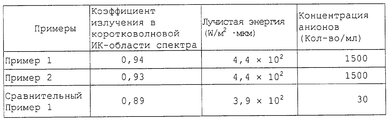
Порошок вещества с излучением в коротковолновой ИК-области спектра нагревался при 30oС. После этого измеряли излучательную способность и лучистую энергию при помощи установки FT-IR (US MIDAC Co.; модель М 2400-С), используя нагретый порошок вещества. Кроме того, используя нагретый порошок вещества, при помощи измерителя микротоков со сверхвысокой чувствительностью (Japan Shinho Electronics Co.; модель KST900) измерялась концентрация анионов. Значения излучательной способности и лучистой энергии, а также концентрация анионов даны в таблице.The powder of the substance with radiation in the short-wave infrared region of the spectrum was heated at 30 ° C. After that, the emissivity and radiant energy were measured using an FT-IR setup (US MIDAC Co .; Model M 2400-C) using a heated substance powder. In addition, using an heated powder of the substance, anion concentration was measured using an ultra-high sensitivity microcurrent meter (Japan Shinho Electronics Co .; Model KST900). The values of emissivity and radiant energy, as well as the concentration of anions are given in the table.
Пример 2
В емкость были введены 1100 г оксида кремния, 60 г оксида калия, 80 г оксида алюминия, 360 г буры, 300 г оксида натрия и 100 г оксида кальция, которые смешивались в течение 30 минут. Смесь была помещена в плавильную печь, температура в которой составляла 1300oС, и затем прокаливалась в течение 2 часов. Прокаленный материал резко охлаждался и затем измельчался в порошок размером 200 меш. В измельченный материал добавлялось 100 г фосфатной породы, после чего производилось измельчение в порошок размером 200 меш. В этом случае вещество с излучением в коротковолновой ИК-области спектра было получено в форме порошка.Example 2
1100 g of silica, 60 g of potassium oxide, 80 g of alumina, 360 g of borax, 300 g of sodium oxide and 100 g of calcium oxide, which were mixed for 30 minutes, were introduced into the container. The mixture was placed in a melting furnace, the temperature of which was 1300 o C, and then calcined for 2 hours. The calcined material was sharply cooled and then ground into a 200 mesh powder. 100 g of phosphate rock was added to the crushed material, after which grinding into a powder of 200 mesh size was carried out. In this case, a substance with radiation in the short-wave infrared region of the spectrum was obtained in the form of a powder.
Излучательная способность и лучистая энергия, а также концентрация анионов измерялись таким же образом, что и в примере 1, используя порошок вещества с излучением в коротковолновой ИК-области спектра. Результаты даны в таблице. Emissivity and radiant energy, as well as the concentration of anions, were measured in the same manner as in Example 1, using a powder of a substance with radiation in the short-wave infrared region of the spectrum. The results are given in the table.
Сравнительный Пример 1
2 кг глины, состоящей из 53,56% оксида кремния, 30,67% оксида алюминия, 1,16% оксида трехвалентного железа, 0,20% оксида кальция, 0,22% оксида магния, 0,95% оксида титана, 1,07% оксида калия и 12,17% других соединений, составляющих потери при сгорании, были помещены в плавильную печь, температура в которой составляла 1400oС, и прокалены в течение 2 часов. Прокаленная глина резко охлаждалась и затем измельчалась в порошок размером 200 меш. Таким образом получали вещество с излучением в коротковолновой ИК-области спектра.Comparative Example 1
2 kg of clay, consisting of 53.56% silicon oxide, 30.67% alumina, 1.16% ferric oxide, 0.20% calcium oxide, 0.22% magnesium oxide, 0.95% titanium oxide, 1 , 07% potassium oxide and 12.17% of other compounds that constitute combustion losses were placed in a melting furnace, the temperature of which was 1400 ° C. , and calcined for 2 hours. The calcined clay was cooled rapidly and then ground into a 200 mesh powder. Thus, a substance was obtained with radiation in the short-wave infrared region of the spectrum.
Излучательная способность и лучистая энергия, а также концентрация анионов измерялись таким же образом, что и в Примере 1, используя порошок вещества с излучением в коротковолновой ИК-области спектра. Результаты даны в таблице. Emissivity and radiant energy, as well as the concentration of anions, were measured in the same manner as in Example 1, using a powder of a substance with radiation in the short-wave infrared region of the spectrum. The results are given in the table.
Как показано в таблице, было обнаружено, что соответствующие настоящему изобретению вещества с излучением в коротковолновой ИК-области спектра согласно Примерам 1 и 2 имеют очень высокие излучательные способности в коротковолновой ИК-области спектра и испускают большое количество анионов по сравнению с обычным веществом с излучением в коротковолновой ИК-области спектра. As shown in the table, it was found that the substances according to the present invention with radiation in the short-wave infrared region of the spectrum according to Examples 1 and 2 have very high emissivity in the short-wave infrared region of the spectrum and emit a large number of anions compared to a conventional substance with radiation in short-wave infrared.
Таким образом, соответствующее настоящему изобретению вещество с излучением в коротковолновой ИК-области спектра обладает как преимуществами радиации в коротковолновой ИК-области спектра, так и преимуществами генерирования анионов, в результате чего оно может с пользой применяться для оздоровления человеческого тела. Thus, the substance according to the present invention with radiation in the short-wave infrared region has both the advantages of radiation in the short-wave infrared region and the advantages of generating anions, as a result of which it can be used to improve the health of the human body.
Как видно из приведенного выше описания, настоящее изобретение предлагает вещество с излучением в коротковолновой ИК-области спектра, которое может испускать лучи в коротковолновой ИК-области спектра с высокой излучательной способностью и одновременно испускать большое количество анионов, в результате чего оно может с пользой применяться для оздоровления человеческого тела, а также настоящее изобретение предлагает способ изготовления данного вещества. As can be seen from the above description, the present invention provides a substance with radiation in the short-wave infrared region of the spectrum, which can emit rays in the short-wave infrared region of the spectrum with high emissivity and at the same time emit a large number of anions, as a result of which it can be useful for the health of the human body, as well as the present invention provides a method of manufacturing this substance.
Хотя предпочтительные варианты реализации настоящего изобретения описаны с целью иллюстрации, специалистам в данной области техники понятно, что возможны различные модификации, дополнения и замены, не выходящие за пределы объема и сущности данного изобретения, определенные в приложенной формуле изобретения. Although preferred embodiments of the present invention have been described for purposes of illustration, it will be understood by those skilled in the art that various modifications, additions, and replacements are possible without departing from the scope and spirit of the invention as defined in the appended claims.
Claims (2)
Applications Claiming Priority (3)
| Application Number | Priority Date | Filing Date | Title |
|---|---|---|---|
| KR2002-3402 | 2002-01-21 | ||
| KR1020020003402A KR100344944B1 (en) | 2002-01-21 | 2002-01-21 | Far infrared ray radiator and preparation method thereof |
| CA002382364A CA2382364C (en) | 2002-01-21 | 2002-04-18 | Far-infrared ray radiator and method for manufacturing the same |
Publications (2)
| Publication Number | Publication Date |
|---|---|
| RU2002111332A RU2002111332A (en) | 2003-10-27 |
| RU2217373C1 true RU2217373C1 (en) | 2003-11-27 |
Family
ID=32963032
Family Applications (1)
| Application Number | Title | Priority Date | Filing Date |
|---|---|---|---|
| RU2002111332/12A RU2217373C1 (en) | 2002-01-21 | 2002-04-26 | Substance with emission in short-wave ir-spectrum and method for its preparing |
Country Status (6)
| Country | Link |
|---|---|
| US (1) | US20030138243A1 (en) |
| EP (1) | EP1329431A1 (en) |
| JP (1) | JP2003210593A (en) |
| CN (1) | CN1229473C (en) |
| CA (1) | CA2382364C (en) |
| RU (1) | RU2217373C1 (en) |
Cited By (1)
| Publication number | Priority date | Publication date | Assignee | Title |
|---|---|---|---|---|
| RU2295978C2 (en) * | 2004-08-23 | 2007-03-27 | Дмитрий Исаакович Кофман | Method for carrying out thermal sterilization of infected waste materials |
Families Citing this family (8)
| Publication number | Priority date | Publication date | Assignee | Title |
|---|---|---|---|---|
| US8372508B2 (en) | 2006-12-29 | 2013-02-12 | 3M Innovative Properties Company | Window film frame assemblies and methods |
| US20080155911A1 (en) * | 2006-12-29 | 2008-07-03 | 3M Innovative Properties Company | Apparatus for mounting film structures and methods |
| US7815997B2 (en) * | 2006-12-29 | 2010-10-19 | 3M Innovative Properties Company | Window film assembly and method of installing |
| KR101845874B1 (en) * | 2017-03-16 | 2018-04-05 | 손상호 | Silicon bracelet for sending out far-infrared radiation and anion |
| CN107600004A (en) * | 2017-08-15 | 2018-01-19 | 上海霖昶实业有限公司 | A kind of green energy conservation rod |
| CN108611483A (en) * | 2018-04-24 | 2018-10-02 | 广州才是科技有限公司 | A kind of far-infrared ray power source device and the method for making antibacterial bacteriostatic stainless steel material |
| CN111346307B (en) * | 2019-09-20 | 2022-03-04 | 大连明盛生物科技开发有限公司 | Preparation method of modified jade powder |
| CN118324145A (en) * | 2023-01-10 | 2024-07-12 | 中国科学院上海硅酸盐研究所 | A kind of high far infrared emission boron doped silicon dioxide nanoparticles and preparation method thereof |
Citations (6)
| Publication number | Priority date | Publication date | Assignee | Title |
|---|---|---|---|---|
| US4886972A (en) * | 1988-08-03 | 1989-12-12 | O.K. Trading Co., Ltd. | Far infrared ray emitting body of a core material coated with an ultrafine powder |
| US5098700A (en) * | 1989-07-19 | 1992-03-24 | O.K. Trading Co., Ltd. | Far infrared ray emitting, odor-absorbing material |
| US5356742A (en) * | 1991-03-01 | 1994-10-18 | Ricoh Company, Ltd. | Dipyrenylamine derivatives and electrophotographic photoconductor comprising the same |
| US5643489A (en) * | 1995-02-14 | 1997-07-01 | Jong; Sung-Jun | Manufacturing method of far infrared ray emitting material and far infrared ray emitting product using the same |
| US6004588A (en) * | 1995-12-25 | 1999-12-21 | Torii; Kazuyuki | Far-infrared radiation material |
| US6051202A (en) * | 1997-01-22 | 2000-04-18 | You; Kyu Jae | Method for preparing far-infrared radiating material |
Family Cites Families (13)
| Publication number | Priority date | Publication date | Assignee | Title |
|---|---|---|---|---|
| MY110574A (en) * | 1991-11-20 | 1998-08-29 | Samsung Electron Devices Co Ltd | Far-infrared emitting cathode ray tube |
| KR940005085B1 (en) * | 1991-11-29 | 1994-06-10 | 정승준 | Far Infrared Emitter |
| US5217600A (en) * | 1992-05-01 | 1993-06-08 | Mcdonnell Douglas Corporation | Process for producing a high emittance coating and resulting article |
| US5296285A (en) * | 1992-05-26 | 1994-03-22 | Mcdonnell Douglas Corporation | High emittance low absorptance coatings |
| JPH07115914B2 (en) * | 1992-08-31 | 1995-12-13 | 株式会社福谷 | Far infrared radiation material |
| KR960009890B1 (en) * | 1992-10-13 | 1996-07-24 | 김영신 | Portable therapeutic device having a far infrared ray generating composition |
| JP2795626B2 (en) * | 1995-08-21 | 1998-09-10 | 北川工業株式会社 | Electronic components with heat dissipation function |
| US6001494A (en) * | 1997-02-18 | 1999-12-14 | Technology Partners Inc. | Metal-ceramic composite coatings, materials, methods and products |
| AU1679899A (en) * | 1998-01-20 | 1999-08-02 | Rustam Rakhimov | Ceramic material |
| US6293963B1 (en) * | 2000-01-19 | 2001-09-25 | Albert C. Wey | Water energizing device for shower bath |
| KR100359430B1 (en) * | 2000-04-11 | 2003-01-24 | 신인환 | A body being capable of emission far-infrared wavelegth and a method for preparation thereof |
| US6585951B1 (en) * | 2000-10-30 | 2003-07-01 | Idaho Research Foundation, Inc. | Methods for manufacturing dielectric powders |
| US6615463B1 (en) * | 2000-12-05 | 2003-09-09 | Hamid Hojaji | Methods to solidify cremation ash |
-
2002
- 2002-04-18 CN CNB021180083A patent/CN1229473C/en not_active Expired - Fee Related
- 2002-04-18 CA CA002382364A patent/CA2382364C/en not_active Expired - Fee Related
- 2002-04-19 US US10/126,846 patent/US20030138243A1/en not_active Abandoned
- 2002-04-24 EP EP02291038A patent/EP1329431A1/en not_active Withdrawn
- 2002-04-26 JP JP2002127349A patent/JP2003210593A/en active Pending
- 2002-04-26 RU RU2002111332/12A patent/RU2217373C1/en not_active IP Right Cessation
Patent Citations (6)
| Publication number | Priority date | Publication date | Assignee | Title |
|---|---|---|---|---|
| US4886972A (en) * | 1988-08-03 | 1989-12-12 | O.K. Trading Co., Ltd. | Far infrared ray emitting body of a core material coated with an ultrafine powder |
| US5098700A (en) * | 1989-07-19 | 1992-03-24 | O.K. Trading Co., Ltd. | Far infrared ray emitting, odor-absorbing material |
| US5356742A (en) * | 1991-03-01 | 1994-10-18 | Ricoh Company, Ltd. | Dipyrenylamine derivatives and electrophotographic photoconductor comprising the same |
| US5643489A (en) * | 1995-02-14 | 1997-07-01 | Jong; Sung-Jun | Manufacturing method of far infrared ray emitting material and far infrared ray emitting product using the same |
| US6004588A (en) * | 1995-12-25 | 1999-12-21 | Torii; Kazuyuki | Far-infrared radiation material |
| US6051202A (en) * | 1997-01-22 | 2000-04-18 | You; Kyu Jae | Method for preparing far-infrared radiating material |
Cited By (1)
| Publication number | Priority date | Publication date | Assignee | Title |
|---|---|---|---|---|
| RU2295978C2 (en) * | 2004-08-23 | 2007-03-27 | Дмитрий Исаакович Кофман | Method for carrying out thermal sterilization of infected waste materials |
Also Published As
| Publication number | Publication date |
|---|---|
| CN1229473C (en) | 2005-11-30 |
| JP2003210593A (en) | 2003-07-29 |
| US20030138243A1 (en) | 2003-07-24 |
| CN1434096A (en) | 2003-08-06 |
| EP1329431A1 (en) | 2003-07-23 |
| CA2382364C (en) | 2004-12-07 |
| CA2382364A1 (en) | 2003-10-18 |
Similar Documents
| Publication | Publication Date | Title |
|---|---|---|
| Li et al. | β-NaYF4 and β-NaYF4: Eu3+ microstructures: morphology control and tunable luminescence properties | |
| Som et al. | Synthesis of strong red emitting Y 2 O 3: Eu 3+ phosphor by potential chemical routes: comparative investigations on the structural evolutions, photometric properties and Judd–Ofelt analysis | |
| Yadav et al. | Enhanced white light emission from a Tm 3+/Yb 3+/Ho 3+ co-doped Na 4 ZnW 3 O 12 nano-crystalline phosphor via Li+ doping | |
| Onodera et al. | Upconversion properties of Y2O3: Er, Yb nanoparticles prepared by laser ablation in water | |
| CA2382364C (en) | Far-infrared ray radiator and method for manufacturing the same | |
| Zhang et al. | Reduction of Ce (IV) to Ce (III) induced by structural characteristics and performance characterization of pyrophosphate MgIn2P4O14-based phosphors | |
| Huerta et al. | Role of Li+ ion in improved crystallization and the luminescence enhancement of up and down conversion process in Er3+/Yb3+ doped in Y4O (OH) 9NO3 and Y2O3 nanoparticles | |
| KR20140110380A (en) | Far infrared ray materials and method of the same | |
| CN113462385A (en) | Composite material capable of realizing photo-thermal blending and preparation method and application thereof | |
| KR101878897B1 (en) | High efficiency far infrared ray and anion radiator and producing method thereof | |
| CN111892927A (en) | Preparation method and application of upconversion nanorods | |
| JP5294525B2 (en) | Discoloration of diamond at high temperature / high pressure | |
| WO2003056359A1 (en) | Thermoluminescent detector of lif containing mg, cu, na and si as dopants and its preparation | |
| Wang et al. | β-Na (Y1. 5Na0. 5) F6: Tm3+—A blue upconversion phosphor | |
| Izerrouken et al. | Thermal annealing study of F center clusters in LiF single crystals | |
| KR20040022837A (en) | Far infrared ray and minus ion radiator and manufacturing method of the radiator | |
| KR20040022836A (en) | Far infrared ray radiator and manufacturing method of the radiator | |
| Tamboli et al. | Versatile applications of rare-earth activated phosphate phosphors: a review | |
| KR20040022838A (en) | Minus ions radiator and manufacturing method of the radiator | |
| Yin et al. | Photoluminescence character of Xe ion irradiated sapphire | |
| CN104357052A (en) | Photothermic fluorescent powder of rare earth doped materials and preparation method thereof | |
| Klocke et al. | CO2 laser‐induced zonation in dental enamel: A Raman and IR microspectroscopic study | |
| Ponnusamy et al. | Synthesis and role of co-dopants (alkaline earth divalents and halides) on the photoluminescence of Eu2+ doped BaAl2O4 phosphor | |
| KR20080048270A (en) | Thermoplastics of Far-Infrared Radiator and Manufacturing Method Thereof | |
| KR102679005B1 (en) | Thermal massage stones for body shape management and manufacturing method thereof |
Legal Events
| Date | Code | Title | Description |
|---|---|---|---|
| MM4A | The patent is invalid due to non-payment of fees |
Effective date: 20080427 |