RU2024925C1 - Device for convolution by arbitrary modulus - Google Patents
Device for convolution by arbitrary modulus Download PDFInfo
- Publication number
- RU2024925C1 RU2024925C1 SU4923422A RU2024925C1 RU 2024925 C1 RU2024925 C1 RU 2024925C1 SU 4923422 A SU4923422 A SU 4923422A RU 2024925 C1 RU2024925 C1 RU 2024925C1
- Authority
- RU
- Russia
- Prior art keywords
- input
- group
- output
- register
- information
- Prior art date
Links
Images
Landscapes
- Error Detection And Correction (AREA)
Abstract
Description
Изобретение относится к вычислительной технике и может быть использовано в цифровых вычислительных устройствах. The invention relates to computer technology and can be used in digital computing devices.
Целью изобретения является сокращение времени свертки. The aim of the invention is to reduce the time of convolution.
Сущность изобретения заключается в том, что число элементов, входящих в состав устройства, определяется выражением n=

const1 = P; const2 = 2P; const3 = 4P;...; const i = (i-1) ˙2P;...; const n = n1 2P (1)
Вычитатели формирует остатки чисел Ak - const1; Ak - const 2... Ak- constn. Если величина любого остатка равна нулю, то число Ak делится на модуль Р нацело и остаток равен нулю. Если величина остатка не равна нулю, то из всех остатков Ak - const i выбирают меньший, значение которого лежит в пределах 1≅ ak ≅ 2P-1,
и уже от него формируют новые остатки (Ak - consti) - const1; (Ak - consti) - const2;...; (Ak - consti - constn, из которых выбирают значение ak, которое лежит в пределах 1 ≅ ≅ ak ≅ P-1.The essence of the invention lies in the fact that the number of elements that make up the device is determined by the expression n =
const1 = P; const2 = 2P; const3 = 4P; ...; const i = (i-1) ˙2P; ...; const n = n 1 2P (1)
Subtractors form the remainder of the numbers A k - const1; A k -
and already new residues are formed from it (A k - consti) - const1; (A k - consti) - const2; ...; (A k - consti - constn, from which a k, which lies in the
Сущность изобретения реализуется за счет введения новой совокупности конструктивных признаков, определяющих его соответствие критерию "Новизна". The invention is realized through the introduction of a new set of design features that determine its compliance with the criterion of "Novelty."
Введение элемента ИЛИ-НЕ обеспечивает определение моментов, при которых первый регистр обнулен, и выдачу управляющих сигналов для запирания элемента "запрет". The introduction of the OR-NOT element provides the determination of the moments at which the first register is reset to zero, and the issuance of control signals to lock the "prohibition" element.
Введение элемента "запрет" обеспечивает исключение подачи сигнала об окончании процесса формирования остатка в том случае, если в первом регистре информация отсутствует. The introduction of the element "prohibition" ensures the exclusion of a signal on the end of the process of forming the remainder in the event that there is no information in the first register.
Введение дополнительного блока сравнения обеспечивает нахождение значения ak, 0 ≅ ak ≅ P-1 и запись его в выходной регистр.The introduction of an additional comparison block ensures that a k , 0 ≅ a k ≅ P-1 is found and written to the output register.
Существенными отличительными признаками предлагаемого изобретения является введенные элемент ИЛИ-НЕ, элемент "запрет" и дополнительный блок сравнения, обеспечивающие сокращение времени свертки и расширение функциональных возможностей устройства. Salient features of the present invention is the introduced element OR-NOT, the element "prohibition" and an additional comparison unit, providing a reduction in convolution time and expanding the functionality of the device.
Указанные признаки являются существенными, так как, во-первых, перечисленные элементы и соответствующие им связи отсутствуют в прототипе, и, во-вторых, это придает устройству следующее новое техническое свойство - новый принцип свертки, обеспечивающий сокращение времени формирования остатка и расширение функциональных возможностей устройства. These signs are significant, because, firstly, the listed elements and the corresponding connections are absent in the prototype, and, secondly, this gives the device the following new technical property - a new convolution principle, which reduces the time of forming a residue and expands the functionality of the device .
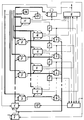
На чертеже представлена функциональная схема устройства для свертки по произвольному модулю. The drawing shows a functional diagram of a device for convolution by an arbitrary module.
Устройство содержит первый 1 и второй 2 регистры, группу вычитателей 3, группу блоков сравнения 4, группу элементов И5, группу коммутаторов 6, дополнительный коммутатор 7, первый 8 и второй 9 элементы ИЛИ, элемент задержки 10, дополнительный блок сравнения 11, элемент ИЛИ-НЕ 12 и элемент запрета 13. The device contains the first 1 and second 2 registers, a group of
Устройство работает следующим образом. The device operates as follows.
В исходном состоянии на входы задания констант устройства в соответствии с (1) поданы значения констант, которые поступают на первые входы группы вычитателей 3. Значение const1=Pi подается также на вторые входы группы блоков сравнения 4 и на вторые входы дополнительного блока сравнения 11. Регистры 1 и 2 обнулены, поэтому на объединенных входах группы вычитателей 3, информационных входах регистра 2, входах элемента ИЛИ-НЕ 12 и первых входах дополнительного блока сравнения 11 информация отсутствует, на выходах вычитателей 3 присутствуют в инверсном коде значения констант (O - consti = - consti), следовательно на выходах блоков сравнения 4 присутствуют сигналы (-consti < P), которые на выход ни одного из элементов И группы не проходят, следовательно, коммутаторы 6 группы разомкнуты, с выхода "меньше" дополнительного блока сравнения 11 сигнал на выход устройства не поступает, так как элемент "запрет" 13 закрыт сигналом, поступающим с выхода элемента ИЛИ-НЕ 12, так как регистр 1 обнулен.In the initial state to the inputs of task constants device in accordance with (1) takes the values of constants, which are applied to first inputs of
Двоичный код числа Ak, от которого необходимо сформировать остаток по заданному модулю Pi, подается на информационный вход устройства. Одновременно на выход запуска устройства поступает управляющий сигнал, который открывает дополнительный коммутатор 7 и через элементы ИЛИ 8 и задержки 10 воздействует на вход записи первого регистра 1, на информационные входы которого с выхода дополнительного коммутатора 7 поступает код числа Ak, в результате чего код последнего записывается в регистр 1. Код числа с выхода регистра 1 поступает на входы вторых операндов группы вычитателей 3, на первые входы блока 11 сравнения, входы элемента ИЛИ-НЕ 12, и на информационные входы второго регистра 2, в результате чего на выходах вычитателей образуются разностные коды Ak - const1, Ak - const2,... Ak - constn, а на выходе элемента ИЛИ-НЕ 12 появляется сигнал логического нуля, открывающий элемент "запрет" 13. Там, где разностные коды меньше значений констант, на выходе "меньше" блоков сравнения 4 появляются управляющие сигналы, а где эти разностные коды больше значений констант, управляющие сигналы появляются на выходах "больше". Так как значения констант рассчитаны по формулам (1), то код разности может быть либо равен нулю, либо же попасть в промежуток между рядом расположенными константами. Если код разности равен нулю, то сигнал с выхода соответствующего блока сравнения 4 группы через элементы "запрет" 13 и ИЛИ 9 поступает на выход устройства, сигнализируя о том, что на его информационном выходе сформирован остаток r = AkmodPi = 0, а также устанавливает регистр 1 в нулевое состояние. При этом элемент "запрет" 13 запирается сигналом, поступающим с выхода элемента ИЛИ-НЕ 12.The binary code of the number A k , from which it is necessary to form a remainder for a given module P i , is fed to the information input of the device. At the same time, a control signal is received at the device startup output, which opens the
Если код разности не равен нулю, то в промежутке между рядом расположенными константами блок сравнения 4j+1 выдаст сигнал "больше", а блок сравнения 4j+1 выдаст сигнал "меньше", следовательно, сработает элемент И 5j+1, сигнал с выхода которого включит коммутатор 6j+1, а через элемент ИЛИ 8 и задержки 10 обеспечит запись кода Ak - constj в регистр 1. Так как записанное значение разности лежит в пределах от 1 до 2Pi-1, то если результат больше значения модуля, сигналы появляются на выходе "больше" блока сравнения 11 и на выходе "меньше" первого блока сравнения 4, откроется элемент И 5 и снова произойдет запись кода Ak - constj - const1 = ak в регистр 1. Поэтому сигнал появится на выходе "меньше" блока сравнения 11. Этот сигнал через элемент "запрет" 13 поступит на вход записи регистра 2, обеспечивая запись кода остатка с выхода регистра 1 в регистр 2, а, поступая на управляющий выход устройства через элемент ИЛИ 9, сигнализирует об окончании процесса формирования остатка, а также обнулит содержимое регистра 1, обеспечивая тем самым запирание элемента "запрет" 13. Если Ak - constj = ak < Pi, то запись остатка в регистр 2 произойдет после первого цикла вычитания. Код остатка остается на информационных выходах устройства до тех пор, пока на информационные входы не поступит следующее число Ak+1, от которого необходимо сформировать остаток, а на управляющий вход - сигнал запуска. При этом работа устройства осуществляется аналогично описанному выше.If the difference code is not equal to zero, then in the interval between adjacent constants the
Claims (1)
1 ≅ i ≅ n ,
где n =


Aмакс - наибольшее контролируемое число;
P - значение модуля свертки;

выход которого соединен с управляющим входом i-го коммутатора группы и с i-м входом первого элемента ИЛИ, выход которого через элемент задержки соединен с входом записи первого регистра, выход "Больше" каждого i-го блока сравнения группы, за исключением последнего, соединен с вторым входом (i+1)-го элемента И группы, выходы "Равно" блоков сравнения группы соединены с входами второго элемента ИЛИ, выход которого соединен с входом обнуления первого элемента ИЛИ, выход которого соединен с входом обнуления первого регистра и является выходом окончания работы устройства, вход начала вычисления устройства соединен с управляющим входом дополнительного коммутатора, (n+1)-м входом первого элемента ИЛИ и входом обнуления второго регистра, выход которого является выходом результата свертки устройства, отличающееся тем, что, с целью сокращения времени свертки, в устройство введены элемент ИЛИ - НЕ, элемент ЗАПРЕТ и дополнительный блок сравнения, первый информационный вход которого соединен с информационным входом второго регистра и с информационным выходом первого регистра, второй информационный вход дополнительного блока сравнения объединен с вторыми информационными входами блоков сравнения группы и подключен к входу задания константы устройства, выходы "Равно" и "Больше" дополнительного блока сравнения соединены соответственно с (n+1)-м входом второго элемента ИЛИ и вторым входом первого элемента И группы, выход "Меньше" дополнительного блока сравнения соединен с первым входом элемента ЗАПРЕТ, выход которого соединен с входом записи второго регистра и (n+2)-м входом второго элемента ИЛИ, второй вход элемента ЗАПРЕТ соединен с выходом элемента ИЛИ - НЕ, вход которого соединен с выходом первого регистра.Arbitrary convolution device containing a group of subtractors, a group of comparison blocks, a group of AND elements, a group of switches, first and second registers, the first and second OR elements, an additional switch and a delay element, the inputs of the first operand of the group subtractors being connected to the corresponding inputs of the job device subtraction constants, the information input of the device through an additional switch is connected to the information input of the first register, the information output of which is connected to the inputs of of the next operand of the group subtracters, the outputs of the result of the group subtractors are connected to the first information inputs of the corresponding group comparison units and to the information inputs of the corresponding group switches, the information outputs of which are combined according to the INSTALL OR circuit and connected to the information input of the first register, the output is “Less” of each i-th group comparison unit is connected to the first input of the i-th element of the group
1 ≅ i ≅ n,
where n =
A max is the largest controlled number;
P is the value of the convolution modulus;
the output of which is connected to the control input of the i-th switch of the group and to the i-th input of the first OR element, the output of which through the delay element is connected to the write input of the first register, the output "More" of each i-th block of the group comparison, except for the last, is connected with the second input of the (i + 1) th AND element of the group, the outputs of the “Equally” group comparing units are connected to the inputs of the second OR element, the output of which is connected to the zero input of the first OR element, the output of which is connected to the zero input of the first register and is the end output For the operation of the device, the input of the beginning of the calculation of the device is connected to the control input of the additional switch, the (n + 1) -th input of the first OR element and the input of resetting the second register, the output of which is the output of the convolution of the device, characterized in that, in order to reduce the convolution time , an OR element is entered into the device - NOT, a PROHIBIT element and an additional comparison unit, the first information input of which is connected to the information input of the second register and with the information output of the first register, the second inform The input input of the additional comparison unit is combined with the second information inputs of the group comparison units and connected to the input of the device constant setting, the outputs “Equal” and “More” of the additional comparison unit are connected respectively to the (n + 1) -th input of the second OR element and the second input of the first element AND groups, the output “Less” of the additional comparison unit is connected to the first input of the FORBID element, the output of which is connected to the input of the second register and the (n + 2) -th input of the second OR element, the second input of the FORBID element ene yield element or - whose input is connected to the output of the first register.
Priority Applications (1)
| Application Number | Priority Date | Filing Date | Title |
|---|---|---|---|
| SU4923422 RU2024925C1 (en) | 1991-04-01 | 1991-04-01 | Device for convolution by arbitrary modulus |
Applications Claiming Priority (1)
| Application Number | Priority Date | Filing Date | Title |
|---|---|---|---|
| SU4923422 RU2024925C1 (en) | 1991-04-01 | 1991-04-01 | Device for convolution by arbitrary modulus |
Publications (1)
| Publication Number | Publication Date |
|---|---|
| RU2024925C1 true RU2024925C1 (en) | 1994-12-15 |
Family
ID=21567479
Family Applications (1)
| Application Number | Title | Priority Date | Filing Date |
|---|---|---|---|
| SU4923422 RU2024925C1 (en) | 1991-04-01 | 1991-04-01 | Device for convolution by arbitrary modulus |
Country Status (1)
| Country | Link |
|---|---|
| RU (1) | RU2024925C1 (en) |
-
1991
- 1991-04-01 RU SU4923422 patent/RU2024925C1/en active
Non-Patent Citations (2)
| Title |
|---|
| Авторское свидетельство СССР N 1105895, кл. G 06F 11/08, 1983. * |
| Авторское свидетельство СССР N 1594541, кл. G 06F 11/00, 1988. * |
Similar Documents
| Publication | Publication Date | Title |
|---|---|---|
| GB2079998A (en) | Frequency-dividing circuit | |
| EP0238300B1 (en) | Serial digital signal processing circuitry | |
| US4970676A (en) | Digital word-serial multiplier circuitry | |
| KR940001556B1 (en) | Digital signal processing apparatus | |
| RU2012047C1 (en) | Device for orthogonal converting digital signals | |
| US5097428A (en) | Data occurrence frequency analyzer | |
| RU2075777C1 (en) | Device for identification of operator | |
| SU840887A1 (en) | Extremum number determining device | |
| RU2007036C1 (en) | Device which produces members of multiplicative groups of galois fields gf(p) | |
| RU2007034C1 (en) | Device for generation of indexes of members of multiplicative groups from galois fields gf(p) | |
| SU943693A1 (en) | Data input device | |
| RU2022353C1 (en) | Device for determining complement of a set | |
| RU2015555C1 (en) | Statistic analyzer | |
| SU1513435A1 (en) | Device for synchronizing signal transmission | |
| SU1053100A1 (en) | Device for determining average value of odd set of of number | |
| SU1633496A1 (en) | Device for reducing fibonacci codes to minimal form | |
| SU1277387A2 (en) | Pulse repetition frequency divider | |
| SU1594541A1 (en) | Device for convolution by arbitrary modulus | |
| SU980089A1 (en) | Number comparing device | |
| SU1615697A2 (en) | Data input device | |
| SU1755284A1 (en) | Device for checking information | |
| SU1167608A1 (en) | Device for multiplying frequency by code | |
| SU1049910A2 (en) | Device for determining high significant bit | |
| SU1005031A1 (en) | Device for comparing numbers | |
| SU1198507A2 (en) | Device for comparing number of ones in binary codes |