JP7694635B2 - Boron nitride agglomerated particles, method for producing the boron nitride agglomerated particles, resin composition containing the boron nitride agglomerated particles, and molded body - Google Patents
Boron nitride agglomerated particles, method for producing the boron nitride agglomerated particles, resin composition containing the boron nitride agglomerated particles, and molded body Download PDFInfo
- Publication number
- JP7694635B2 JP7694635B2 JP2023196054A JP2023196054A JP7694635B2 JP 7694635 B2 JP7694635 B2 JP 7694635B2 JP 2023196054 A JP2023196054 A JP 2023196054A JP 2023196054 A JP2023196054 A JP 2023196054A JP 7694635 B2 JP7694635 B2 JP 7694635B2
- Authority
- JP
- Japan
- Prior art keywords
- particles
- agglomerated particles
- agglomerated
- resin
- less
- Prior art date
- Legal status (The legal status is an assumption and is not a legal conclusion. Google has not performed a legal analysis and makes no representation as to the accuracy of the status listed.)
- Active
Links
Images
Classifications
-
- C—CHEMISTRY; METALLURGY
- C01—INORGANIC CHEMISTRY
- C01B—NON-METALLIC ELEMENTS; COMPOUNDS THEREOF; METALLOIDS OR COMPOUNDS THEREOF NOT COVERED BY SUBCLASS C01C
- C01B21/00—Nitrogen; Compounds thereof
- C01B21/06—Binary compounds of nitrogen with metals, with silicon, or with boron, or with carbon, i.e. nitrides; Compounds of nitrogen with more than one metal, silicon or boron
- C01B21/064—Binary compounds of nitrogen with metals, with silicon, or with boron, or with carbon, i.e. nitrides; Compounds of nitrogen with more than one metal, silicon or boron with boron
- C01B21/0648—After-treatment, e.g. grinding, purification
-
- C—CHEMISTRY; METALLURGY
- C08—ORGANIC MACROMOLECULAR COMPOUNDS; THEIR PREPARATION OR CHEMICAL WORKING-UP; COMPOSITIONS BASED THEREON
- C08K—Use of inorganic or non-macromolecular organic substances as compounding ingredients
- C08K3/00—Use of inorganic substances as compounding ingredients
- C08K3/38—Boron-containing compounds
-
- C—CHEMISTRY; METALLURGY
- C08—ORGANIC MACROMOLECULAR COMPOUNDS; THEIR PREPARATION OR CHEMICAL WORKING-UP; COMPOSITIONS BASED THEREON
- C08L—COMPOSITIONS OF MACROMOLECULAR COMPOUNDS
- C08L101/00—Compositions of unspecified macromolecular compounds
-
- C—CHEMISTRY; METALLURGY
- C09—DYES; PAINTS; POLISHES; NATURAL RESINS; ADHESIVES; COMPOSITIONS NOT OTHERWISE PROVIDED FOR; APPLICATIONS OF MATERIALS NOT OTHERWISE PROVIDED FOR
- C09K—MATERIALS FOR MISCELLANEOUS APPLICATIONS, NOT PROVIDED FOR ELSEWHERE
- C09K5/00—Heat-transfer, heat-exchange or heat-storage materials, e.g. refrigerants; Materials for the production of heat or cold by chemical reactions other than by combustion
- C09K5/08—Materials not undergoing a change of physical state when used
- C09K5/14—Solid materials, e.g. powdery or granular
-
- H—ELECTRICITY
- H05—ELECTRIC TECHNIQUES NOT OTHERWISE PROVIDED FOR
- H05K—PRINTED CIRCUITS; CASINGS OR CONSTRUCTIONAL DETAILS OF ELECTRIC APPARATUS; MANUFACTURE OF ASSEMBLAGES OF ELECTRICAL COMPONENTS
- H05K1/00—Printed circuits
- H05K1/02—Details
- H05K1/03—Use of materials for the substrate
- H05K1/0313—Organic insulating material
- H05K1/0353—Organic insulating material consisting of two or more materials, e.g. two or more polymers, polymer + filler, + reinforcement
- H05K1/0373—Organic insulating material consisting of two or more materials, e.g. two or more polymers, polymer + filler, + reinforcement containing additives, e.g. fillers
-
- C—CHEMISTRY; METALLURGY
- C01—INORGANIC CHEMISTRY
- C01P—INDEXING SCHEME RELATING TO STRUCTURAL AND PHYSICAL ASPECTS OF SOLID INORGANIC COMPOUNDS
- C01P2002/00—Crystal-structural characteristics
- C01P2002/60—Compounds characterised by their crystallite size
-
- C—CHEMISTRY; METALLURGY
- C01—INORGANIC CHEMISTRY
- C01P—INDEXING SCHEME RELATING TO STRUCTURAL AND PHYSICAL ASPECTS OF SOLID INORGANIC COMPOUNDS
- C01P2002/00—Crystal-structural characteristics
- C01P2002/70—Crystal-structural characteristics defined by measured X-ray, neutron or electron diffraction data
-
- C—CHEMISTRY; METALLURGY
- C01—INORGANIC CHEMISTRY
- C01P—INDEXING SCHEME RELATING TO STRUCTURAL AND PHYSICAL ASPECTS OF SOLID INORGANIC COMPOUNDS
- C01P2002/00—Crystal-structural characteristics
- C01P2002/70—Crystal-structural characteristics defined by measured X-ray, neutron or electron diffraction data
- C01P2002/72—Crystal-structural characteristics defined by measured X-ray, neutron or electron diffraction data by d-values or two theta-values, e.g. as X-ray diagram
-
- C—CHEMISTRY; METALLURGY
- C01—INORGANIC CHEMISTRY
- C01P—INDEXING SCHEME RELATING TO STRUCTURAL AND PHYSICAL ASPECTS OF SOLID INORGANIC COMPOUNDS
- C01P2002/00—Crystal-structural characteristics
- C01P2002/70—Crystal-structural characteristics defined by measured X-ray, neutron or electron diffraction data
- C01P2002/74—Crystal-structural characteristics defined by measured X-ray, neutron or electron diffraction data by peak-intensities or a ratio thereof only
-
- C—CHEMISTRY; METALLURGY
- C01—INORGANIC CHEMISTRY
- C01P—INDEXING SCHEME RELATING TO STRUCTURAL AND PHYSICAL ASPECTS OF SOLID INORGANIC COMPOUNDS
- C01P2004/00—Particle morphology
- C01P2004/01—Particle morphology depicted by an image
- C01P2004/04—Particle morphology depicted by an image obtained by TEM, STEM, STM or AFM
-
- C—CHEMISTRY; METALLURGY
- C01—INORGANIC CHEMISTRY
- C01P—INDEXING SCHEME RELATING TO STRUCTURAL AND PHYSICAL ASPECTS OF SOLID INORGANIC COMPOUNDS
- C01P2004/00—Particle morphology
- C01P2004/30—Particle morphology extending in three dimensions
- C01P2004/32—Spheres
-
- C—CHEMISTRY; METALLURGY
- C01—INORGANIC CHEMISTRY
- C01P—INDEXING SCHEME RELATING TO STRUCTURAL AND PHYSICAL ASPECTS OF SOLID INORGANIC COMPOUNDS
- C01P2004/00—Particle morphology
- C01P2004/60—Particles characterised by their size
- C01P2004/61—Micrometer sized, i.e. from 1-100 micrometer
-
- C—CHEMISTRY; METALLURGY
- C01—INORGANIC CHEMISTRY
- C01P—INDEXING SCHEME RELATING TO STRUCTURAL AND PHYSICAL ASPECTS OF SOLID INORGANIC COMPOUNDS
- C01P2006/00—Physical properties of inorganic compounds
- C01P2006/12—Surface area
-
- C—CHEMISTRY; METALLURGY
- C01—INORGANIC CHEMISTRY
- C01P—INDEXING SCHEME RELATING TO STRUCTURAL AND PHYSICAL ASPECTS OF SOLID INORGANIC COMPOUNDS
- C01P2006/00—Physical properties of inorganic compounds
- C01P2006/32—Thermal properties
-
- C—CHEMISTRY; METALLURGY
- C08—ORGANIC MACROMOLECULAR COMPOUNDS; THEIR PREPARATION OR CHEMICAL WORKING-UP; COMPOSITIONS BASED THEREON
- C08K—Use of inorganic or non-macromolecular organic substances as compounding ingredients
- C08K3/00—Use of inorganic substances as compounding ingredients
- C08K3/38—Boron-containing compounds
- C08K2003/382—Boron-containing compounds and nitrogen
-
- C—CHEMISTRY; METALLURGY
- C08—ORGANIC MACROMOLECULAR COMPOUNDS; THEIR PREPARATION OR CHEMICAL WORKING-UP; COMPOSITIONS BASED THEREON
- C08K—Use of inorganic or non-macromolecular organic substances as compounding ingredients
- C08K3/00—Use of inorganic substances as compounding ingredients
- C08K3/38—Boron-containing compounds
- C08K2003/382—Boron-containing compounds and nitrogen
- C08K2003/385—Binary compounds of nitrogen with boron
-
- H—ELECTRICITY
- H05—ELECTRIC TECHNIQUES NOT OTHERWISE PROVIDED FOR
- H05K—PRINTED CIRCUITS; CASINGS OR CONSTRUCTIONAL DETAILS OF ELECTRIC APPARATUS; MANUFACTURE OF ASSEMBLAGES OF ELECTRICAL COMPONENTS
- H05K1/00—Printed circuits
- H05K1/02—Details
- H05K1/03—Use of materials for the substrate
- H05K1/05—Insulated conductive substrates, e.g. insulated metal substrate
- H05K1/056—Insulated conductive substrates, e.g. insulated metal substrate the metal substrate being covered by an organic insulating layer
-
- H—ELECTRICITY
- H05—ELECTRIC TECHNIQUES NOT OTHERWISE PROVIDED FOR
- H05K—PRINTED CIRCUITS; CASINGS OR CONSTRUCTIONAL DETAILS OF ELECTRIC APPARATUS; MANUFACTURE OF ASSEMBLAGES OF ELECTRICAL COMPONENTS
- H05K2201/00—Indexing scheme relating to printed circuits covered by H05K1/00
- H05K2201/02—Fillers; Particles; Fibers; Reinforcement materials
- H05K2201/0203—Fillers and particles
- H05K2201/0206—Materials
- H05K2201/0209—Inorganic, non-metallic particles
Landscapes
- Chemical & Material Sciences (AREA)
- Organic Chemistry (AREA)
- Chemical Kinetics & Catalysis (AREA)
- Health & Medical Sciences (AREA)
- Medicinal Chemistry (AREA)
- Polymers & Plastics (AREA)
- Engineering & Computer Science (AREA)
- Inorganic Chemistry (AREA)
- Physics & Mathematics (AREA)
- Combustion & Propulsion (AREA)
- Thermal Sciences (AREA)
- Materials Engineering (AREA)
- Microelectronics & Electronic Packaging (AREA)
- Compositions Of Macromolecular Compounds (AREA)
- Cooling Or The Like Of Semiconductors Or Solid State Devices (AREA)
- Paints Or Removers (AREA)
Description
本発明は窒化ホウ素凝集粒子(以下「BN凝集粒子」と称す。)、該粒子の製造方法に係り、詳しくは、窒化ホウ素一次粒子(以下「BN一次粒子」と称す。)が凝集してなるBN凝集粒子及びその製造方法に関する。
本発明はまた、このBN凝集粒子を含有するBN凝集粒子含有樹脂組成物と、このBN凝集粒子含有樹脂組成物を成形してなる成形体に関する。
The present invention relates to boron nitride agglomerated particles (hereinafter referred to as "BN agglomerated particles") and a method for producing the particles, and more particularly to BN agglomerated particles formed by agglomeration of boron nitride primary particles (hereinafter referred to as "BN primary particles") and a method for producing the same.
The present invention also relates to a resin composition containing the BN agglomerated particles, and a molded article obtained by molding the resin composition containing the BN agglomerated particles.
窒化ホウ素(以下「BN」と称す。)は、絶縁性のセラミックであり、ダイヤモンド構造を持つc-BN、黒鉛構造をもつh-BN、乱層構造を持つα-BN、β-BNなど様々な結晶型が知られている。
これらの中で、h-BNは、黒鉛と同じ層状構造を有し、合成が比較的容易でかつ熱伝導性、固体潤滑性、化学的安定性、耐熱性に優れるという特徴を備えていることから、電気・電子材料分野で多く利用されている。
Boron nitride (hereinafter referred to as "BN") is an insulating ceramic, and various crystal types are known, such as c-BN with a diamond structure, h-BN with a graphite structure, α-BN with a turbostratic structure, and β-BN.
Among these, h-BN has the same layered structure as graphite, is relatively easy to synthesize, and has excellent thermal conductivity, solid lubricity, chemical stability, and heat resistance, and is therefore widely used in the field of electrical and electronic materials.
近年、特に電気・電子分野では集積回路の高密度化に伴う発熱が大きな問題となっており、いかに熱を放熱するかが緊急の課題となっている。h-BNは、絶縁性であるにもかかわらず、高い熱伝導性を有するという特徴を活かして、このような放熱部材用熱伝導性フィラーとして注目を集めている。
しかしながら、h-BNは板状の粒子形状であり、その板面方向(ab面内あるいは(002)面内)には高い熱伝導性を示すものの(通常、熱伝導率として400W/mK程度)、板厚方向(C軸方向)には低い熱伝導性(通常、熱伝導率として2~3W/mK程
度)しか示さないため、これを樹脂に配合してBN粒子含有樹脂組成物とし、例えば、板状の成形体を成形した場合、板状のh-BNが成形時にBN粒子含有樹脂組成物の流動方向である成形体の板面方向に配向することとなり、得られる成形体は、板面方向には熱伝導率に優れるものの、厚み方向には低熱伝導率しか示さないという問題があった。
In recent years, particularly in the electrical and electronics fields, heat generation due to the increasing density of integrated circuits has become a major problem, and how to dissipate heat has become an urgent issue. h-BN is attracting attention as a thermally conductive filler for such heat dissipation components, taking advantage of its characteristic of having high thermal conductivity despite being insulating.
However, h-BN has a plate-like particle shape, and although it exhibits high thermal conductivity in the plate surface direction (in the ab plane or in the (002) plane) (usually about 400 W/mK in thermal conductivity), it only exhibits low thermal conductivity in the plate thickness direction (C-axis direction) (usually about 2 to 3 W/mK in thermal conductivity). Therefore, when this is blended with a resin to form a BN particle-containing resin composition and, for example, a plate-like molded product is molded, the plate-like h-BN will be oriented in the plate surface direction of the molded product, which is the flow direction of the BN particle-containing resin composition, during molding, and the obtained molded product will have excellent thermal conductivity in the plate surface direction but only low thermal conductivity in the thickness direction.
そこで、このようなh-BNの熱伝導性の異方性を改良するために、成形体を成形した場合でも上記のような配向が少ない、鱗片板状以外の形状を有する、h-BNが凝集した凝集粒子が検討されてきた。このようなh-BN凝集粒子としては、噴霧乾燥などにより造粒されたh-BN凝集粒子、h-BNを焼結し焼結体を粉砕して製造されたh-BN凝集粒子などがある(特許文献1,2)。また、ホウ酸とメラミンの混合物から製造したh-BN凝集粒子であって、h-BN一次粒子が配向せずに凝集した松ぼっくり状のh-BN凝集粒子も提案されている(特許文献3)。 In order to improve the anisotropy of the thermal conductivity of h-BN, agglomerated particles of h-BN that have little orientation even when molded into a compact, and have shapes other than scaly, have been investigated. Examples of such h-BN agglomerated particles include h-BN agglomerated particles granulated by spray drying, and h-BN agglomerated particles manufactured by sintering h-BN and grinding the sintered body (Patent Documents 1 and 2). Also proposed is a pinecone-shaped h-BN agglomerated particle manufactured from a mixture of boric acid and melamine, in which the h-BN primary particles are aggregated without being oriented (Patent Document 3).
言い換えれば、従来のh-BN凝集粒子に於いては、大きな凝集粒子を作製することで凝集粒子間の接触抵抗を低減させることが検討されてきた。また、h-BN凝集粒子を構成するh-BN一次粒子間の粒界を減らすことで高熱伝導性を達成するために、数μmから数百μm程度と比較的粒子径が大きく、結晶性の高いh-BN一次粒子が用いられてきた(特許文献1,2,3)。 In other words, in conventional h-BN agglomerated particles, efforts have been made to reduce the contact resistance between the agglomerated particles by producing large agglomerated particles. Also, in order to achieve high thermal conductivity by reducing the grain boundaries between the h-BN primary particles that make up the h-BN agglomerated particles, h-BN primary particles with relatively large particle sizes of several μm to several hundred μm and high crystallinity have been used (Patent Documents 1, 2, and 3).
このような従来のBN凝集粒子の用途として、パワー半導体デバイスなどで必要とされる放熱シートに用いることが知られているが、BN凝集粒子間の接触抵抗を低減するためには、一定の圧力下での成形が必要なため、その圧力によってBN凝集粒子が崩壊し、h-BN一次粒子が成形面方向に配向してしまい、結果として成形面に垂直方向な熱伝導は低く、実用化レベルに到達していないのが現状である。つまり、一定圧力下でも放熱シー
ト垂直方向に高い熱伝導性を付与可能なBN凝集粒子が望まれており、さらにBN凝集粒子自体が高い熱伝導性を有する凝集粒子の開発が望まれている。
A known application of such conventional BN agglomerated particles is their use in heat dissipation sheets required for power semiconductor devices, but in order to reduce the contact resistance between the BN agglomerated particles, molding under a certain pressure is necessary, and the BN agglomerated particles collapse due to the pressure, causing the h-BN primary particles to become oriented in the direction of the molding surface, resulting in low thermal conductivity in the direction perpendicular to the molding surface, and the current situation is that the level of practical use has not been reached. In other words, there is a demand for BN agglomerated particles that can impart high thermal conductivity in the direction perpendicular to the heat dissipation sheet even under a certain pressure, and there is also a demand for the development of agglomerated particles that themselves have high thermal conductivity.
本発明者らの検討によると、従来のBN凝集粒子では、BN凝集粒子を構成するh-BN一次粒子間の界面およびh-BN一次粒子の結晶性の低さが、BN凝集粒子の熱伝導を低下させる原因の一つであるということがわかってきた。即ち、これらの原因はh-BN一次粒子界面およびh-BN一次粒子中の結晶粒界に於いて熱伝導の担い手であるフォノンが散乱されるからであると考えた。 The inventors' investigations have revealed that in conventional BN agglomerated particles, the interfaces between the h-BN primary particles that make up the BN agglomerated particles and the low crystallinity of the h-BN primary particles are one of the causes of the reduced thermal conductivity of the BN agglomerated particles. In other words, they believe that this is due to the scattering of phonons, which are responsible for thermal conductivity, at the interfaces between the h-BN primary particles and at the crystal grain boundaries within the h-BN primary particles.
また、樹脂に従来のBN凝集粒子を充填した場合にも、BN凝集粒子を大きくすることによる凝集粒子間の接触抵抗はある程度低減可能であるが、BN凝集粒子を構成するh-BN一次粒子の配向がBN凝集粒子同士の接触抵抗を増加させ、熱伝導性を低下させる原因となることがわかってきた。即ち、成形体としての熱伝導性を向上させるためには、BN凝集粒子を構成するh-BN一次粒子の配向を制御し、BN凝集粒子同士の接触抵抗を低減させるとともに、BN凝集粒子を構成するh-BN一次粒子の結晶性を高め、さらにBN凝集粒子を構成するh-BN一次粒子中の粒界を低減することが有効であると考えた。 In addition, even when conventional BN agglomerated particles are filled into the resin, it is possible to reduce the contact resistance between the agglomerated particles to some extent by increasing the size of the BN agglomerated particles, but it has been found that the orientation of the h-BN primary particles that make up the BN agglomerated particles increases the contact resistance between the BN agglomerated particles, causing a decrease in thermal conductivity. In other words, in order to improve the thermal conductivity of the molded body, it is considered effective to control the orientation of the h-BN primary particles that make up the BN agglomerated particles, reduce the contact resistance between the BN agglomerated particles, increase the crystallinity of the h-BN primary particles that make up the BN agglomerated particles, and further reduce the grain boundaries in the h-BN primary particles that make up the BN agglomerated particles.
本発明は、上記従来の問題点を解決し、BN凝集粒子を構成するh-BN一次粒子が高熱伝導性でありながら、BN凝集粒子同士の接触抵抗も低減したBN凝集粒子を製造し、各種成形体への適用性に優れたBN凝集粒子及びその製造方法を提供することを課題とする。本発明はまた、このBN凝集粒子と樹脂とを含有するBN凝集粒子含有樹脂組成物と、このBN凝集粒子含有樹脂組成物を成形してなる成形体を提供することを課題とする。 The present invention aims to solve the above-mentioned conventional problems, produce BN agglomerated particles in which the h-BN primary particles that make up the BN agglomerated particles have high thermal conductivity while also reducing the contact resistance between the BN agglomerated particles, and provide BN agglomerated particles that are highly applicable to various molded bodies and a method for producing the same. Another objective of the present invention is to provide a BN agglomerated particle-containing resin composition that contains the BN agglomerated particles and a resin, and a molded body obtained by molding the BN agglomerated particle-containing resin composition.
本発明者らは、鋭意検討を重ねた結果、BN凝集粒子を作製する際の原料スラリー粘度を特定の範囲にすることによって、BN凝集粒子を構成するh-BN一次粒子中の平均結晶子径が大きくなることを見出した。平均結晶子径が大きくなることでh-BN一次粒子中の結晶子間の粒界が減少し、結果としてBN凝集粒子の熱伝導性を高めることに成功した。さらに驚くべきことに、このようにして作製されたBN凝集粒子は、BN凝集粒子を構成するh-BN一次粒子の特定の結晶面が配向するため、該BN凝集粒子を用いて成形体とした際に、従来のBN凝集粒子と比較して熱伝導性の高い成形体を作製可能であることを見出し、本発明を完成するに至った。 After extensive research, the inventors discovered that by setting the viscosity of the raw material slurry in a specific range when producing BN agglomerated particles, the average crystallite size of the h-BN primary particles that make up the BN agglomerated particles can be increased. Increasing the average crystallite size reduces the grain boundaries between the crystallites in the h-BN primary particles, and as a result, they have succeeded in increasing the thermal conductivity of the BN agglomerated particles. Even more surprisingly, they discovered that, because the BN agglomerated particles produced in this manner have specific crystal planes oriented in the h-BN primary particles that make up the BN agglomerated particles, when a compact is made using the BN agglomerated particles, it is possible to produce a compact with higher thermal conductivity than conventional BN agglomerated particles, and thus completed the present invention.
すなわち、本発明の要旨は、窒化ホウ素一次粒子(以下「h-BN一次粒子」と称す。)が凝集してなる窒化ホウ素凝集粒子(以下「BN凝集粒子」と称す。)であって、10mmφの粉末錠剤成形機で0.85ton/cm2以上2.54ton/cm2以下の成形圧力で成形して得られたペレット状の試料を粉末X線回折測定して得られるh-BN一次粒子の(100)面と(004)面のピーク面積強度比((100)/(004))が0.25以上であり、かつBN凝集粒子を0.2mm深さのガラス試料板に表面が平滑になるように充填し、粉末X線回折測定して得られるh-BN一次粒子の(002)面ピークから求めたh-BN一次粒子の平均結晶子径が375Å以上であることを特徴とするB
N凝集粒子に存する。
また、BN凝集粒子の平均粒子径D50(μm)が26μm以上であることが好ましく、BN凝集粒子の比表面積が8m2/g以下であることが好ましく、BN凝集粒子が球状であることが好ましく、BN凝集粒子がカードハウス構造を有することが好ましく、h-BN一次粒子の平均粒子径が1.1μm以上であることが好ましい。
That is, the gist of the present invention is a boron nitride agglomerated particle (hereinafter referred to as "BN agglomerated particle") formed by agglomeration of boron nitride primary particles (hereinafter referred to as "h-BN primary particles"), characterized in that the peak area intensity ratio ((100)/( 004 )) of the (100) plane and the ( 004) plane of the h-BN primary particles obtained by powder X-ray diffraction measurement of a pellet-shaped sample obtained by molding with a 10 mmφ powder tablet molding machine at a molding pressure of 0.85 ton/cm2 or more and 2.54 ton/cm2 or less is 0.25 or more, and the average crystallite diameter of the h-BN primary particles obtained from the (002) plane peak of the h-BN primary particles obtained by filling the BN agglomerated particles into a glass sample plate with a depth of 0.2 mm so that the surface is smooth and measuring the powder X-ray diffraction is 375 Å or more.
N is present in the aggregate particles.
In addition, the average particle size D 50 (μm) of the BN agglomerated particles is preferably 26 μm or more, the specific surface area of the BN agglomerated particles is preferably 8 m 2 /g or less, the BN agglomerated particles are preferably spherical, the BN agglomerated particles preferably have a house-of-card structure, and the average particle size of the h-BN primary particles is preferably 1.1 μm or more.
また、本発明の更に他の要旨は、上記BN凝集粒子と他のフィラーとの混合物であるBN凝集粒子組成物に存し、更に他の要旨は、樹脂と上記BN凝集粒子とを含むBN凝集粒子含有樹脂組成物に存し、更に他の要旨は、上記BN凝集粒子を含む成形体に存する。 Still another aspect of the present invention is a BN agglomerated particle composition that is a mixture of the BN agglomerated particles and other fillers, a further aspect is a BN agglomerated particle-containing resin composition that contains a resin and the BN agglomerated particles, and a further aspect is a molded article that contains the BN agglomerated particles.
また、本発明の更に他の要旨は、原料窒化ホウ素粉末のスラリー(以下「BNスラリー」と称す。)を調製するステップ、及び該スラリーを加熱処理するステップ、を含むBN凝集粒子を製造する方法であって、該BNスラリーの粘度が200mPa・s以上5000mPa・s以下であり、該加熱処理を1800℃~2300℃で行うことを特徴とするBN凝集粒子の製造方法に存する。また、原料窒化ホウ素粉末中の酸素濃度が、1質量%以上10質量%以下であることが好ましい。 Still another gist of the present invention is a method for producing BN agglomerated particles, comprising the steps of preparing a slurry of raw boron nitride powder (hereinafter referred to as "BN slurry") and heat-treating the slurry, characterized in that the viscosity of the BN slurry is 200 mPa·s or more and 5000 mPa·s or less, and the heat treatment is carried out at 1800°C to 2300°C. In addition, it is preferable that the oxygen concentration in the raw boron nitride powder is 1% by mass or more and 10% by mass or less.
本発明のBN凝集粒子は、粉末X線回折測定により得られる、BN凝集粒子を構成するh-BN一次粒子の(100)面と(004)面の粉末X線回折測定における前記h-BN一次粒子の(002)面ピークから求めた前記h-BN一次粒子の平均結晶子径が375Å以上であるため、BN凝集粒子を構成するh-BN一次粒子中の結晶粒界で生じるフォノン散乱を減らすことができ、その結果として、高い熱伝導性を示す。さらに、特定の圧力範囲で成形した場合でもh-BN一次粒子の(100)面と(004)面のピーク面積強度比((100)/(004))が0.25以上であるため、本発明のBN凝集粒子を含有する樹脂組成物を成形して得られる成形体は、成形後でもBN凝集粒子を構成するh-BN一次粒子の特定の結晶面の配向が保たれる。従って、成形面に垂直方向(成形体厚み方向)に高い熱伝導性を示し、好ましくはパワー半導体デバイスなどで必要とされる放熱シートに非常に有用なものである。 The BN agglomerated particles of the present invention have an average crystallite size of 375 Å or more, determined from the (002) peak of the h-BN primary particles in powder X-ray diffraction measurement of the (100) and (004) planes of the h-BN primary particles constituting the BN agglomerated particles, and therefore can reduce phonon scattering occurring at the grain boundaries in the h-BN primary particles constituting the BN agglomerated particles, and as a result, exhibit high thermal conductivity. Furthermore, even when molded at a specific pressure range, the peak area intensity ratio ((100)/(004)) of the (100) and (004) planes of the h-BN primary particles is 0.25 or more, so that the molded product obtained by molding the resin composition containing the BN agglomerated particles of the present invention maintains the orientation of the specific crystal planes of the h-BN primary particles constituting the BN agglomerated particles even after molding. Therefore, it exhibits high thermal conductivity in the direction perpendicular to the molded surface (thickness direction of the molded product), and is very useful for heat dissipation sheets required for power semiconductor devices, etc.
以下に、本発明の実施の形態を詳細に説明するが、本発明は以下の実施の形態に限定されるものではなく、その要旨の範囲内で種々に変形して実施することができる。
[BN凝集粒子]
本発明のBN凝集粒子は、h-BN一次粒子が凝集して形成されたものであり、本願発明の効果を損なわない範囲で、上記h-BN一次粒子以外の成分を含有してもよい。h-BN一次粒子以外の成分としては、後記の[BN凝集粒子の製造方法]で述べる、スラリーに添加してもよいバインダー、界面活性剤、溶媒に由来する成分を挙げることができる。
The following describes in detail the embodiments of the present invention, but the present invention is not limited to the following embodiments and can be modified in various ways within the scope of the invention.
[BN agglomerated particles]
The BN agglomerated particles of the present invention are formed by agglomeration of h-BN primary particles, and may contain components other than the above-mentioned h-BN primary particles within a range that does not impair the effects of the present invention. Examples of components other than the h-BN primary particles include components derived from a binder, a surfactant, and a solvent that may be added to the slurry, which will be described later in [Method for producing BN agglomerated particles].
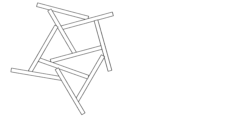
本発明のBN凝集粒子の形態は、特に制限はないが、好ましくは図1に示すような球状の形態が特徴であり、また、BN凝集粒子の形態はSEMにより確認することができる。
ここで「球状」とは、アスペクト比(長径と短径の比)が1以上2以下、好ましくは1以上1.5以下であることをさす。本発明のBN凝集粒子のアスペクト比は、SEMで撮
影された画像から200個以上の粒子を任意に選択し、それぞれの長径と短径の比を求めて平均値を算出することにより決定する。
The morphology of the BN agglomerated particles of the present invention is not particularly limited, but is preferably characterized by a spherical morphology as shown in FIG. 1, and the morphology of the BN agglomerated particles can be confirmed by SEM.
Here, "spherical" means that the aspect ratio (ratio of major axis to minor axis) is from 1 to 2, preferably from 1 to 1.5. The aspect ratio of the BN agglomerated particles of the present invention is determined by arbitrarily selecting 200 or more particles from an image taken with an SEM, determining the ratio of the major axis to the minor axis of each particle, and calculating the average value.
また、BN凝集粒子は、BN凝集粒子表面においてh-BN一次粒子の結晶がBN凝集粒子の中心側から表面側へ向けて放射状に成長しているウニ様の形態、h-BN一次粒子が小板でありそれらが焼結凝集しているウニ様の球状の形態であることが好ましい。また、BN凝集粒子は、カードハウス構造を有することが好ましい。カードハウス構造とは、例えばセラミックス 43 No.2(2008年 日本セラミックス協会発行)に記載されており、板状粒子が配向せずに複雑に積層したような構造である。より具体的には、カードハウス構造を有するBN凝集粒子とは、h-BN一次粒子の集合体であって、h-BN一次粒子の平面部と端面部が接触している構造(図3参照)を有するBN凝集粒子であり、好ましくは球状である。また、カードハウス構造は粒子の内部においても同様の構造であることが好ましい。これらのBN凝集粒子の凝集形態及び内部構造は走査型電子顕微鏡(SEM)により確認することができる。 The BN agglomerated particles preferably have a sea urchin-like shape in which the crystals of the h-BN primary particles grow radially from the center side to the surface side of the BN agglomerated particles on the surface of the BN agglomerated particles, or a sea urchin-like spherical shape in which the h-BN primary particles are small platelets that are sintered and agglomerated. The BN agglomerated particles preferably have a house-of-cards structure. The house-of-cards structure is described, for example, in Ceramics 43 No. 2 (published by the Ceramic Society of Japan in 2008), and is a structure in which plate-like particles are layered in a complex manner without being oriented. More specifically, the BN agglomerated particles having a house-of-cards structure are BN agglomerated particles that are an aggregate of h-BN primary particles and have a structure in which the flat surface and end surface of the h-BN primary particles are in contact with each other (see FIG. 3), and are preferably spherical. The house-of-cards structure is preferably the same inside the particles. The agglomerated form and internal structure of these BN agglomerated particles can be confirmed by a scanning electron microscope (SEM).
また、本発明に係るBN凝集粒子を物性で表すと、10mmφの粉末錠剤成形機で0.85ton/cm2以上2.54ton/cm2以下の成形圧力で成形して得られたペレット状の試料の粉末X線回折測定して得られるh-BN一次粒子の(100)面と(004)面のピーク面積強度比((100)/(004))が0.25以上であり、かつh-BN一次粒子の(002)面ピークから求めたh-BN一次粒子の平均結晶子径が375Å以上であることを特徴とすることもできる。 Furthermore, in terms of physical properties, the BN agglomerated particles according to the present invention can also be characterized in that a peak area intensity ratio ((100)/(004)) of the ( 100 ) plane to the ( 004 ) plane of the h-BN primary particles, which is obtained by powder X-ray diffraction measurement of a pellet-shaped sample obtained by molding at a molding pressure of 0.85 tons/cm2 or more and 2.54 tons/cm2 or less using a powder tablet molding machine having a diameter of 10 mm, is 0.25 or more, and the average crystallite diameter of the h-BN primary particles, which is obtained from the (002) plane peak of the h-BN primary particles, is 375 Å or more.
本発明のBN凝集粒子において、これを構成するh-BN一次粒子の平均結晶子径は、高熱伝導性フィラーとしての用途において重要な要件の一つである。本発明のBN凝集粒子は、BN凝集粒子を構成するh-BN一次粒子の平均結晶子径を大きくすること、すなわち375Å以上とすることにより、h-BN一次粒子中の結晶粒界を減少しており、熱伝導性に優れる。さらに、特定の圧力以上で成形した場合でもh-BN一次粒子の(100)面と(004)面の面積強度比((100)/(004))が0.25以上であることにより、樹脂と本発明のBN凝集粒子を含む組成物を特定の圧力下で成形して成形体を作製した場合でも、h-BN一次粒子の特定の結晶面の配向が保持され、成形圧力に対して垂直方向(成形体厚み方向)に高熱伝導性を示すという効果を奏する。 In the BN agglomerated particles of the present invention, the average crystallite size of the h-BN primary particles constituting the BN agglomerated particles is one of the important requirements for use as a highly thermally conductive filler. The BN agglomerated particles of the present invention have excellent thermal conductivity because the grain boundaries in the h-BN primary particles are reduced by increasing the average crystallite size of the h-BN primary particles constituting the BN agglomerated particles, i.e., by making the average crystallite size 375 Å or more. Furthermore, even when molded at a specific pressure or higher, the area intensity ratio ((100)/(004)) of the (100) plane to the (004) plane of the h-BN primary particles is 0.25 or more, so that even when a composition containing a resin and the BN agglomerated particles of the present invention is molded under a specific pressure to produce a molded body, the orientation of the specific crystal plane of the h-BN primary particles is maintained, and high thermal conductivity is exhibited in the direction perpendicular to the molding pressure (thickness direction of the molded body).
(BN凝集粒子の特性)
・h-BN一次粒子の大きさ
BN凝集粒子を構成するh-BN一次粒子の長軸は通常0.5μm以上、好ましくは0.6μm以上、より好ましくは0.8μm以上、更に好ましくは1.0μm以上、特に好ましくは1.1μm以上である。また、通常10μm以下、好ましくは5μm以下、より好ましくは3μm以下である。
尚、上記長軸とはSEM測定により得られたBN凝集粒子1粒を拡大し、1粒のBN凝集粒子を構成しているh-BN一次粒子について、画像上で観察できるh-BN一次粒子の最大長を平均した値である。
(Characteristics of BN Agglomerated Particles)
The major axis of the h-BN primary particles constituting the BN agglomerated particles is usually 0.5 μm or more, preferably 0.6 μm or more, more preferably 0.8 μm or more, even more preferably 1.0 μm or more, and particularly preferably 1.1 μm or more. Also, it is usually 10 μm or less, preferably 5 μm or less, and more preferably 3 μm or less.
The above-mentioned long axis is an average value of the maximum length of h-BN primary particles that can be observed on an image of an enlarged single BN agglomerate particle obtained by SEM measurement, for the h-BN primary particles constituting one BN agglomerate particle.
・BN凝集粒子を構成するh-BN一次粒子の結晶構造
h-BN一次粒子の結晶構造は、特に限定されないが、合成の容易さと熱伝導性の点で六方晶系のh-BNを主成分として含むものが好ましい。また、バインダーとしてBN以外の無機成分が含まれる場合、熱処理の過程でそれらが結晶化するが、BNが主成分として含まれていればよい。なお、上記h-BN一次粒子の結晶構造は、粉末X線回折測定により確認することができる。
- Crystal structure of h-BN primary particles constituting BN aggregate particles The crystal structure of the h-BN primary particles is not particularly limited, but in terms of ease of synthesis and thermal conductivity, it is preferable to use a structure containing hexagonal h-BN as the main component. In addition, when inorganic components other than BN are contained as a binder, they will crystallize during the heat treatment process, but it is sufficient that BN is contained as the main component. The crystal structure of the h-BN primary particles can be confirmed by powder X-ray diffraction measurement.
・h-BN一次粒子の平均結晶子径 BN凝集粒子を粉末X線回折測定して得られるh
-BN一次粒子の(002)面ピークから求めたh-BN一次粒子の平均結晶子径は、特に制限はされないが、平均結晶子径は大きいことが熱伝導率の点から好ましい。例えば、通常300Å以上、好ましくは320Å以上、より好ましくは375Å以上であり、更に好ましくは380Å以上、より更に好ましくは390Å以上、特に好ましくは400Å以上であり、通常5000Å以下、好ましくは2000Å以下、更に好ましくは1000Å以下である。上記平均結晶子径が大きすぎると、h-BN一次粒子が成長しすぎるため、BN凝集粒子内の間隙が多くなり、成形体とする際の成形性が悪化するとともに、間隙が多くなることにより熱伝導性が向上しなくなる傾向がある。上記平均結晶子径が小さすぎると、h-BN一次粒子内の粒界が増えるため、フォノン散乱が結晶粒界で発生し、低熱伝導になる傾向がある。
Average crystallite size of h-BN primary particles h obtained by powder X-ray diffraction measurement of BN agglomerated particles
The average crystallite diameter of the h-BN primary particles determined from the (002) plane peak of the -BN primary particles is not particularly limited, but it is preferable from the viewpoint of thermal conductivity that the average crystallite diameter is large. For example, it is usually 300 Å or more, preferably 320 Å or more, more preferably 375 Å or more, even more preferably 380 Å or more, even more preferably 390 Å or more, and particularly preferably 400 Å or more, and is usually 5000 Å or less, preferably 2000 Å or less, and even more preferably 1000 Å or less. If the average crystallite diameter is too large, the h-BN primary particles grow too much, so that the gaps in the BN aggregate particles increase, and the moldability when forming a molded body deteriorates, and the increase in the gaps tends to prevent the thermal conductivity from improving. If the average crystallite diameter is too small, the grain boundaries in the h-BN primary particles increase, so that phonon scattering occurs at the crystal grain boundaries, and the thermal conductivity tends to be low.
尚、粉末X線回折測定は、0.2mm深さのガラス試料板に表面が平滑になるようにBN凝集粒子を充填し、測定される。
なお、ここで、「平均結晶子径」とは、粉末X線回折測定によって得られるh-BN一次粒子の(002)面ピークから、後述の実施例において記載の通り、Scherrer式にて求められる結晶子径である。
The powder X-ray diffraction measurement is carried out by filling a glass sample plate 0.2 mm deep with BN agglomerated particles so as to provide a smooth surface.
Here, the "average crystallite size" refers to the crystallite size calculated by the Scherrer formula from the (002) plane peak of the h-BN primary particles obtained by powder X-ray diffraction measurement, as described in the Examples below.
・h-BN一次粒子のピーク面積強度比
BN凝集粒子を10mmφの粉末錠剤成形機で0.85ton/cm2以上2.54ton/cm2以下の成形圧力で成形して得られたペレット状の試料中のBN凝集粒子を構成するh-BN一次粒子の(100)面と(004)面のピーク面積強度比(100)/(004))は、通常0.25以上、好ましくは0.30以上、より好ましくは0.35以上、更に好ましくは0.40以上であり、通常2.0以下、好ましくは1.5以下、更に好ましくは1.2以下である。大きすぎると、成形体とした際にBN凝集粒子間の接触抵抗が大きくなる傾向があり、小さすぎると、BN凝集粒子が崩壊し、厚み方向の熱伝導性が向上しない傾向がある。
Peak area intensity ratio of h-BN primary particles The peak area intensity ratio (100)/( 004) of the (100) plane and the (004) plane of the h-BN primary particles constituting the BN agglomerated particles in the pellet-shaped sample obtained by molding the BN agglomerated particles with a powder tablet molding machine of 10 mmφ at a molding pressure of 0.85 ton/cm 2 or more and 2.54 ton/cm 2 or less is usually 0.25 or more, preferably 0.30 or more, more preferably 0.35 or more, and even more preferably 0.40 or more, and is usually 2.0 or less, preferably 1.5 or less, and even more preferably 1.2 or less. If it is too large, the contact resistance between the BN agglomerated particles tends to increase when the molded body is formed, and if it is too small, the BN agglomerated particles tend to collapse and the thermal conductivity in the thickness direction tends not to improve.
通常、放熱シートなどにおいて最適なプレス圧力条件は、放熱シートの種類によって異なる。樹脂マトリックス中に分散したBN凝集粒子は、用途に応じた圧力条件にさらされるが、通常、BN粒子は圧力方向に対して直行する方向にab面が配向する傾向にある。BN凝集粒子を用いた場合でも成形圧力に対して粒子変形が生じ、結果としてab面が圧力方向に直行する方向に配向する傾向にある。
例えば、樹脂製の高放熱基板は、樹脂製基板内部の空隙低減や分散させたBN凝集粒子同士の完全な接触のために、0.85ton/cm2以上2.54ton/cm2以下のような比較的高い圧力で成形されると考えられる。このため、上記圧力範囲でもh-BN一次粒子の配向変化が少ないBN凝集粒子が熱伝導性向上には必要である。
Usually, the optimum press pressure conditions for heat dissipation sheets and the like differ depending on the type of heat dissipation sheet. BN agglomerated particles dispersed in a resin matrix are exposed to pressure conditions according to the application, but usually, the ab plane of the BN particles tends to be oriented in a direction perpendicular to the pressure direction. Even when BN agglomerated particles are used, particle deformation occurs due to molding pressure, and as a result, the ab plane tends to be oriented in a direction perpendicular to the pressure direction.
For example, a resin high heat dissipation substrate is considered to be molded at a relatively high pressure of 0.85 tons/ cm2 or more and 2.54 tons/cm2 or less in order to reduce voids inside the resin substrate and to ensure complete contact between the dispersed BN agglomerated particles. For this reason, BN agglomerated particles that cause little change in the orientation of the h-BN primary particles even within the above pressure range are necessary to improve thermal conductivity.
本発明では、本明細書で規定する物性を満たすBN凝集粒子、好ましくはBN凝集粒子を構成するh-BN一次粒子がカードハウス構造、すなわち、h-BN一次粒子同士が一次粒子平面部と端面部で接触することによる相互補強構造を有することから、広い成形圧力範囲でBN凝集粒子の変形を抑制することが可能である。用途に応じて最適な圧力範囲は異なるが、成形体の厚み方向に高熱伝導化するためには、0.85ton/cm2以上2.54ton/cm2の範囲において、少なくとも一定以上のh-BN一次粒子の配向が保持される状態が達成することが好ましい。 In the present invention, the BN agglomerated particles satisfying the physical properties specified in this specification, preferably the h-BN primary particles constituting the BN agglomerated particles, have a house-of-cards structure, i.e., a mutually reinforcing structure in which the h-BN primary particles contact each other at the planar and end surfaces of the primary particles, and therefore it is possible to suppress deformation of the BN agglomerated particles over a wide range of molding pressures. Although the optimal pressure range differs depending on the application, in order to achieve high thermal conductivity in the thickness direction of the compact, it is preferable to achieve a state in which at least a certain level of orientation of the h-BN primary particles is maintained in the range of 0.85 ton/ cm2 to 2.54 ton/ cm2 .
一定以上のh-BN一次粒子の配向とは、例えばh-BN一次粒子の(100)面と(004)面のピーク面積強度比(100)/(004))によって表現されるが、これは(004)面、すなわち、圧力方向に対して直行する方向にab面が配向する割合がどれだけ少ないかを表現するものである。従って、上述のピーク面積強度比が大きいほど、成形圧力によるBN凝集粒子の変形が少ない。高熱伝導性を達成するには、少なくともピー
ク面積強度比は0.25以上であることが必要と考えている。ピーク面積強度比の下限、上限については前述のとおりである。
尚、0.85ton/cm2以上2.54ton/cm2の範囲におけるピーク面積強度比は、上記圧力範囲において一点でも所定の数値を満たせば問題なく、本発明の圧力範囲全てにおいて達成する必要はない。また、好ましくは、0.85ton/cm2、1.69ton/cm2、2.54ton/cm2の3点にて所定の数値を満たすことである。
The orientation of the h-BN primary particles at a certain level is expressed, for example, by the peak area intensity ratio (100)/(004) of the (100) plane and the (004) plane of the h-BN primary particles, which expresses how little the ratio of the (004) plane, i.e., the ab plane, oriented in the direction perpendicular to the pressure direction, is. Therefore, the larger the peak area intensity ratio, the less the deformation of the BN aggregate particles due to the molding pressure. In order to achieve high thermal conductivity, it is considered necessary that the peak area intensity ratio is at least 0.25 or more. The lower and upper limits of the peak area intensity ratio are as described above.
In addition, the peak area intensity ratio in the range of 0.85 to 2.54 ton/ cm2 does not have to be achieved over the entire pressure range of the present invention as long as it satisfies the specified value at just one point in the pressure range of 0.85 tons/cm2 or more and 2.54 tons/cm2. It is preferable that the specified values are satisfied at three points, 0.85 ton/ cm2 , 1.69 ton/ cm2 , and 2.54 ton/ cm2 .
なお、上記ピーク面積強度比は、錠剤成形機(10mmφ)に約0.2gの粉末を充填し、手動油圧式ポンプ(理研精機社製P-1B-041)を用いて、種々のプレス圧で錠剤成形した試料を測定に供する(例えば、0.85ton/cm2、1.69ton/cm2、2.54ton/cm2等)。測定は、オランダPANalytical社製X‘PertPro MPD粉末X線回折装置を用いて行うことで、該当するピーク面積の強度比を計算することができる。 The peak area intensity ratio is measured by filling a tablet molding machine (10 mmφ) with about 0.2 g of powder, and using a manual hydraulic pump (P-1B-041 manufactured by Riken Seiki Co., Ltd.) to form tablets at various press pressures (e.g., 0.85 ton/cm 2 , 1.69 ton/cm 2 , 2.54 ton/cm 2 , etc.). The measurement is performed using an X'PertPro MPD powder X-ray diffractometer manufactured by PANalytical Co., Ltd. of the Netherlands, and the intensity ratio of the corresponding peak area can be calculated.
・BN凝集粒子の平均粒子径(D50)
BN凝集粒子の平均粒子径(D50)は、通常5μm以上であり、好ましくは10μm以上、より好ましくは25μm以上、更に好ましくは26μm以上であり、特に好ましくは30μm以上、最も好ましくは40μm以上であり、45μm以上であっても好ましく、50μm以上であっても好ましい。また、通常200μm以下、好ましくは150μm以下、更に好ましくは100μm以下である。大きすぎると成形体とした際に表面の平滑性が悪くなる、BN凝集粒子間の間隙が多くなる等により、熱伝導性が向上しない傾向があり、小さすぎると成形体とした際にBN凝集粒子間の接触抵抗が大きくなる、BN凝集粒子自体の熱伝導性が低くなる等の傾向がある。
Average particle size of BN agglomerated particles ( D50 )
The average particle size ( D50 ) of the BN agglomerated particles is usually 5 μm or more, preferably 10 μm or more, more preferably 25 μm or more, even more preferably 26 μm or more, particularly preferably 30 μm or more, most preferably 40 μm or more, even preferably 45 μm or more, even preferably 50 μm or more. Also, it is usually 200 μm or less, preferably 150 μm or less, and even more preferably 100 μm or less. If it is too large, the surface smoothness of the molded body becomes poor, the gaps between the BN agglomerated particles become large, and the thermal conductivity of the BN agglomerated particles themselves tends not to improve, while if it is too small, the contact resistance between the BN agglomerated particles becomes large, and the thermal conductivity of the BN agglomerated particles themselves tends to decrease, when the molded body is formed.
なお、D50は測定に供した粉体の体積を100%として累積曲線を描かせた際に丁度累積体積が50%となる時の粒子径を意味し、その測定方法は、湿式測定法としては、分散安定剤としてヘキサメタリン酸ナトリウムを含有する純水媒体中にBN凝集粒子を分散させた試料に対して、レーザ回折/散乱式粒度分布測定装置などを用いて測定することができ、乾式測定法としては、Malvern社製「Morphologi」を用いて測定することができる。 Here, D50 means the particle diameter at which the cumulative volume is exactly 50% when a cumulative curve is drawn assuming the volume of the powder used for measurement to be 100%. As a method for measuring D50, a sample in which BN aggregated particles are dispersed in a pure water medium containing sodium hexametaphosphate as a dispersion stabilizer can be measured using a laser diffraction/scattering type particle size distribution measuring device as a wet measurement method, and a "Morphologi" manufactured by Malvern can be used as a dry measurement method.
・破壊強度
BN凝集粒子の破壊強度は、通常2.5MPa以上、好ましくは3.0MPa以上、より好ましくは3.5MPa以上、更に好ましくは4.0MPa以上であり、通常20MPa以下、好ましくは15MPa以下、更に好ましくは10MPa以下である。大きすぎると、粒子の強度が強すぎるため、成形体とした際に表面平滑性が悪くなり、熱伝導性が低下する傾向があり、小さすぎると、成形体を作製する際の圧力で粒子が変形しやすくなり、熱伝導性が向上しない傾向がある。
Breaking strength The breaking strength of the BN agglomerated particles is usually 2.5 MPa or more, preferably 3.0 MPa or more, more preferably 3.5 MPa or more, and even more preferably 4.0 MPa or more, and is usually 20 MPa or less, preferably 15 MPa or less, and even more preferably 10 MPa or less. If it is too large, the strength of the particles is too strong, so that the surface smoothness tends to deteriorate when the molded body is formed, and the thermal conductivity tends to decrease, and if it is too small, the particles tend to be easily deformed by the pressure when the molded body is produced, and the thermal conductivity tends not to improve.
なお、破壊強度は、粒子1粒をJIS R 1639-5に従って圧縮試験し、下記式により算出できる。通常、粒子は5点以上測定し、その平均値を採用する。
式:Cs=2.48P/πd2
Cs:破壊強度(MPa)
P:破壊試験力(N)
d:粒子径(mm)
The breaking strength can be calculated from the following formula by subjecting one particle to a compression test in accordance with JIS R 1639-5. Usually, the particle is measured at five or more points, and the average value is used.
Formula: Cs=2.48P/πd 2
Cs: breaking strength (MPa)
P: Destructive test force (N)
d: particle diameter (mm)
・全細孔容積
BN凝集粒子の全細孔容積は、通常2.2cm3/g以下である。全細孔容積が小さいものは、BN凝集粒子内が密になっているために、熱伝導を阻害する境界面を少なくする
ことが可能となり、より熱伝導性の高いBN凝集粒子となる。BN凝集粒子の全細孔容積が大きすぎると、組成物中のフィラーとして用いた場合に、細孔に樹脂が取り込まれ、見かけの粘度が上昇する場合があり、組成物の成形加工或いは塗布液の塗工が困難となる可能性がある。
Total pore volume The total pore volume of the BN agglomerated particles is usually 2.2 cm3 /g or less. Since the inside of the BN agglomerated particles is dense, the total pore volume is small, making it possible to reduce the boundary surface that inhibits heat conduction, resulting in a BN agglomerated particle with higher thermal conductivity. If the total pore volume of the BN agglomerated particles is too large, when used as a filler in a composition, resin may be taken into the pores, increasing the apparent viscosity, which may make it difficult to mold the composition or apply the coating liquid.
BN凝集粒子の全細孔容積の下限値は特に制限はないが、通常0.01cm3/gである。本発明の全細孔容積は、好ましくは0.01cm3/g以上、より好ましくは0.02cm3/gであり、好ましくは2cm3/g以下、より好ましくは1.5cm3/g以下である。
凝集BN粉末中のBN凝集粒子の全細孔容積は、窒素吸着法および水銀圧入法で測定することができる。
The lower limit of the total pore volume of the BN agglomerated particles is not particularly limited, but is usually 0.01 cm3 /g. The total pore volume of the present invention is preferably 0.01 cm3 /g or more, more preferably 0.02 cm3 /g, and is preferably 2 cm3 /g or less, more preferably 1.5 cm3 /g or less.
The total pore volume of the BN agglomerated particles in the agglomerated BN powder can be measured by nitrogen adsorption and mercury intrusion methods.
・比表面積
BN凝集粒子の比表面積は通常1m2/g以上であるが、好ましくは3m2/g以上50m2/g以下、より好ましくは5m2/g以上40m2/g以下である。また、8m2/g以下であることも好ましく、7.25m2/g以下であることも好ましい。BN凝集粒子の比表面積が、この範囲であると、樹脂と複合化した際に、BN凝集粒子同士の接触抵抗が低減される傾向にあり、BN凝集粒子含有樹脂組成物の粘度上昇も抑制できるため好ましい。比表面積は、BET1点法(吸着ガス:窒素)で測定することができる。
Specific surface area The specific surface area of the BN agglomerated particles is usually 1 m2 /g or more, preferably 3 m2 /g or more and 50 m2 /g or less, more preferably 5 m2 /g or more and 40 m2 /g or less. It is also preferably 8 m2 /g or less, and also preferably 7.25 m2 /g or less. If the specific surface area of the BN agglomerated particles is in this range, the contact resistance between the BN agglomerated particles tends to be reduced when the particles are composited with a resin, and an increase in the viscosity of the resin composition containing the BN agglomerated particles can also be suppressed, which is preferable. The specific surface area can be measured by the BET one-point method (adsorption gas: nitrogen).
・バルク密度
BN凝集粒子をフィラーとして用いる場合には、樹脂の取り込みを最小限とするためにBN凝集粒子のバルク密度は大きい方が良く、通常0.3g/cm3以上であることが好ましく、より好ましくは0.35g/cm3以上、更に好ましくは0.4g/cm3以上である。BN凝集粒子のバルク密度が小さすぎる場合、見かけの体積が大きくなり、BN凝集粒子含有樹脂組成物中の樹脂に対して、添加するBN凝集粒子の体積が多くなるとともに、樹脂の取り込みが大きくなり、また、BN凝集粒子の取り扱い性が著しく悪化する傾向がある。BN凝集粒子のバルク密度の上限については特に制限はないが、通常0.95g/cm3以下、好ましくは0.9g/cm3以下、より好ましくは0.85g/cm3以下である。BN凝集粒子のバルク密度が大きすぎるとBN凝集粒子含有樹脂組成物中で凝集BNの分散に偏りが生じ、沈降しやすくなる傾向がある。
なお、BN凝集粒子のバルク密度は、粉体のバルク密度を測定する通常の装置や方法を用いて求めることができる。
Bulk density When the BN agglomerated particles are used as a filler, the bulk density of the BN agglomerated particles is preferably large in order to minimize the incorporation of resin, and is usually 0.3 g/cm 3 or more, more preferably 0.35 g/cm 3 or more, and even more preferably 0.4 g/cm 3 or more. If the bulk density of the BN agglomerated particles is too small, the apparent volume becomes large, the volume of the BN agglomerated particles added to the resin in the BN agglomerated particle-containing resin composition becomes large, the incorporation of the resin becomes large, and the handling of the BN agglomerated particles tends to deteriorate significantly. There is no particular limit to the upper limit of the bulk density of the BN agglomerated particles, but it is usually 0.95 g/cm 3 or less, preferably 0.9 g/cm 3 or less, and more preferably 0.85 g/cm 3 or less. If the bulk density of the BN agglomerated particles is too large, the dispersion of the agglomerated BN in the BN agglomerated particle-containing resin composition becomes uneven, and the particles tend to settle easily.
The bulk density of the BN agglomerated particles can be determined using a standard device and method for measuring the bulk density of a powder.
[BN凝集粒子の製造方法]
本発明のBN凝集粒子は、好ましくは、粘度が200~5000mPa・sである原料BN粉末を含むスラリー(以下「BNスラリー」と称す場合がある。)を用いて粒子を造粒し、造粒粒子を加熱処理することによって、該造粒粒子の大きさを保持したままBN凝集粒子を構成するh-BN一次粒子の結晶子を成長させて、製造することができる。BNスラリーの粘度は、好ましくは300mPa・s以上、より好ましくは500mPa・s以上、更に好ましくは700mPa・s以上、特に好ましくは1000mPa・s以上であり、好ましくは4000mPa・s以下、より好ましくは3000mPa・s以下である。
[Method of producing BN agglomerated particles]
The BN agglomerated particles of the present invention can be produced by granulating particles using a slurry containing raw BN powder having a viscosity of 200 to 5000 mPa·s (hereinafter sometimes referred to as "BN slurry"), and then heat-treating the granulated particles to grow crystallites of the h-BN primary particles constituting the BN agglomerated particles while maintaining the size of the granulated particles. The viscosity of the BN slurry is preferably 300 mPa·s or more, more preferably 500 mPa·s or more, even more preferably 700 mPa·s or more, and particularly preferably 1000 mPa·s or more, and is preferably 4000 mPa·s or less, more preferably 3000 mPa·s or less.
上記BNスラリーの粘度は、生成するBN凝集粒子の体積基準の平均粒子径D50および、BN凝集粒子を構成するh-BN一次粒子の平均結晶子径に大きく影響し、該粘度を200mPa・s以上とすることにより、h-BN一次粒子の平均結晶子径及びBN凝集粒子の体積基準の平均粒子径D50を大きくすることができる。
一方BNスラリーの粘度を5000mPa・s以下とすることにより、造粒を容易にすることができる。BNスラリーの粘度の調製方法は、後述する。
The viscosity of the BN slurry significantly affects the volume-based average particle size D50 of the generated BN agglomerated particles and the average crystallite size of the h-BN primary particles constituting the BN agglomerated particles. By setting the viscosity to 200 mPa·s or more, the average crystallite size of the h-BN primary particles and the volume-based average particle size D50 of the BN agglomerated particles can be increased.
On the other hand, by adjusting the viscosity of the BN slurry to 5000 mPa·s or less, granulation can be facilitated. The method for adjusting the viscosity of the BN slurry will be described later.
なお、本発明におけるBNスラリーの粘度とは、FUNGILAB社の回転粘度計「VISCO BASIC Plus R」を用い、ブレード回転数100rpmにて測定した粘度のことである。
さらに、本発明のBN凝集粒子をフィラーとしてBN凝集粒子含有樹脂組成物を作製する場合、同一の充填量においても、他のBN粒子と比較して得られる成形体の熱伝導率が劇的に改善できる。これは、本発明のBN凝集粒子では、BN凝集粒子を構成するh-BN一次粒子の平均結晶粒子径の増大により、h-BN一次粒子中の結晶粒界が減少すること、BN凝集粒子を構成するh-BN一次粒子の特定面が配向していることによると推察され、好ましくは、凝集粒子の体積基準の平均粒子径D50が大きいことにより、BN凝集粒子間の接触抵抗が低減することも影響すると考えられる。
The viscosity of the BN slurry in the present invention is a viscosity measured using a rotational viscometer "VISCO BASIC Plus R" manufactured by FUNGILAB Corporation at a blade rotation speed of 100 rpm.
Furthermore, when a resin composition containing the BN agglomerated particles of the present invention is prepared using the BN agglomerated particles as a filler, the thermal conductivity of the resulting molded article can be dramatically improved compared to other BN particles, even at the same filling amount. This is presumably because, in the BN agglomerated particles of the present invention, the average crystal particle size of the h-BN primary particles constituting the BN agglomerated particles is increased, thereby reducing the crystal grain boundaries in the h-BN primary particles, and because specific faces of the h-BN primary particles constituting the BN agglomerated particles are oriented. It is also believed that the large volume-based average particle size D 50 of the agglomerated particles also has an effect on reducing the contact resistance between the BN agglomerated particles.
本発明のBN凝集粒子はBN凝集粒子自体の熱伝導性が高いだけでなく、樹脂と複合化して作製した成形体の熱伝導性も高くなる。
すなわち、本願発明によれば、当業者では通常制御することを想定していなかったスラリー粘度を特定の範囲に制御することにより、BN凝集粒子を構成するh-BN一次粒子の平均結晶子径を大きくすることが可能である製造方法を見出したものである。
The BN agglomerated particles of the present invention not only have high thermal conductivity themselves, but also have high thermal conductivity in a molded article produced by combining the BN agglomerated particles with a resin.
That is, according to the present invention, a production method has been discovered that makes it possible to increase the average crystallite size of the h-BN primary particles that constitute the BN agglomerated particles by controlling the slurry viscosity within a specific range, which is not usually assumed to be controlled by those skilled in the art.
更に、本発明によれば、上記スラリー粘度を特定の範囲に制御することにより、本発明で規定するBN凝集粒子を製造する方法を見出したものである。
なお、上記ピーク面積強度比およびh-BN一次粒子の平均結晶子径は、BNスラリーから製造する造粒粒子を加熱処理する際の焼成温度、原料BN粉末中に存在する酸素濃度によっても制御できる。具体的には、後程述べる通り、BNスラリーから製造する造粒粒子を加熱処理する際の焼成温度範囲を1800℃以上2300℃以下とすることでピーク面積強度比を0.25以上とすることができ、原料BN粉末中に存在する酸素濃度が1.0重量%以上の原料を用いることで、h-BN一次粒子の平均結晶子径を所望の範囲に制御できる。即ち、適切な焼成温度範囲と適切な酸素濃度の原料BN粉末を用いることで上記ピーク面積強度比と上記平均結晶子径を同時に制御できる。
Furthermore, according to the present invention, a method for producing the BN agglomerated particles defined in the present invention has been found by controlling the above-mentioned slurry viscosity within a specific range.
The peak area intensity ratio and the average crystallite size of the h-BN primary particles can also be controlled by the calcination temperature when the granulated particles produced from the BN slurry are heat-treated and the oxygen concentration present in the raw BN powder. Specifically, as described later, the peak area intensity ratio can be made 0.25 or more by setting the calcination temperature range when the granulated particles produced from the BN slurry are heat-treated to 1800°C or more and 2300°C or less, and the average crystallite size of the h-BN primary particles can be controlled to a desired range by using a raw material having an oxygen concentration of 1.0 wt% or more in the raw BN powder. That is, the peak area intensity ratio and the average crystallite size can be controlled simultaneously by using a raw material BN powder with an appropriate calcination temperature range and an appropriate oxygen concentration.
これによりBN凝集粒子をBN凝集粒子含有樹脂組成物とした際のBN凝集粒子間の接触抵抗の低減並びにBN凝集粒子を構成するh-BN一次粒子中の結晶粒界が減少し、該BN凝集粒子を構成するh-BN一次粒子の特定の結晶面が配向した、熱伝導性の高いBN凝集粒子を作製できる。
本発明によって得られるBN凝集粒子は、高熱伝導性を維持しながら様々な大きさに設計することが可能なため、成形体として幅広い用途に適用可能である。
This reduces the contact resistance between the BN agglomerated particles when the BN agglomerated particles are made into a BN agglomerated particle-containing resin composition, and reduces the crystal grain boundaries in the h-BN primary particles that make up the BN agglomerated particles, making it possible to produce BN agglomerated particles with high thermal conductivity in which specific crystal planes of the h-BN primary particles that make up the BN agglomerated particles are oriented.
The BN agglomerated particles obtained by the present invention can be designed to have a variety of sizes while maintaining high thermal conductivity, and therefore can be used in a wide range of applications as molded articles.
{スラリーの調製}
<原料BN粉末>
・原料BN粉末の種類
本発明で用いる原料BN粉末としては、市販のh-BN、市販のαおよびβ-BN、ホウ素化合物とアンモニアの還元窒化法により作製されたBN、ホウ素化合物とメラミンなどの含窒素化合物から合成されたBNなど何れも制限なく使用できるが、特にh-BNが本発明の効果をより発揮する点で好ましく用いられる。
{Preparation of Slurry}
<Raw material BN powder>
- Types of Raw BN Powder The raw BN powder used in the present invention can be any of commercially available h-BN, commercially available α- and β-BN, BN produced by the reduction-nitridation method of a boron compound and ammonia, and BN synthesized from a boron compound and a nitrogen-containing compound such as melamine, without any restrictions. In particular, h-BN is preferably used since it exerts the effects of the present invention more effectively.
・原料BN粉末の結晶性
本発明で用いる原料BN粉末の形態としては、粉末X線回折測定により得られるピークの半値幅が広く、結晶性が低い粉末状のBN粒子が好適である。即ち、板状のh-BNを原料として使用することも可能であるが、板状でないナノ粒子も好適に用いられる。結晶性の目安として、粉末X線回折測定から得られる(002)面のピーク半値幅が、2θの角度で、通常0.4°以上、好ましくは0.45°以上、より好ましくは0.5°以上で
ある。また、通常2.0°以下、好ましくは1.5°以下、更に好ましくは1°以下である。上記上限より大きいと、結晶子が十分大きくならず、大きくするためには長時間を要するため、生産性が悪くなる傾向がある。上記下限未満だと、結晶性が高すぎて、十分な結晶成長が見込めず、また、スラリー作製時の分散安定性が悪くなる傾向がある。なお、粉末X線回折測定方法は後述の実施例の項に記載する。
-Crystallization of raw BN powder As the form of the raw BN powder used in the present invention, powdered BN particles having a wide half-width of the peak obtained by powder X-ray diffraction measurement and low crystallinity are suitable. That is, it is possible to use plate-shaped h-BN as a raw material, but non-plate-shaped nanoparticles are also preferably used. As a guideline for crystallinity, the peak half-width of the (002) plane obtained by powder X-ray diffraction measurement is usually 0.4° or more, preferably 0.45° or more, more preferably 0.5° or more, at an angle of 2θ. Also, it is usually 2.0° or less, preferably 1.5° or less, and even more preferably 1° or less. If it is greater than the above upper limit, the crystallites do not become sufficiently large, and it takes a long time to make them larger, so productivity tends to deteriorate. If it is less than the above lower limit, the crystallinity is too high, sufficient crystal growth cannot be expected, and the dispersion stability during slurry preparation tends to deteriorate. The powder X-ray diffraction measurement method will be described in the Examples section below.
・原料BN粉末中の酸素原子濃度
BN結晶成長の観点からは、原料BN粉末中に酸素原子がある程度存在することが好ましく、本発明では、原料BN粉末中の全酸素濃度は、通常1質量%以上、好ましくは2質量%以上、より好ましくは3質量%以上、更に好ましくは4質量%以上である。また、通常、10質量%以下、更に好ましくは9質量%以下である。上記上限より大きいと、熱処理後も酸素が残存しやすくなるため、熱伝導性の改善効果が小さくなる傾向がある。上記下限未満だと、結晶性が高すぎて、結晶成長が見込めず、粉末X線回折測定から確認できるピーク強度比が所望の範囲から外れる傾向がある。
- Oxygen atom concentration in raw BN powder From the viewpoint of BN crystal growth, it is preferable that oxygen atoms are present to a certain extent in the raw BN powder, and in the present invention, the total oxygen concentration in the raw BN powder is usually 1 mass% or more, preferably 2 mass% or more, more preferably 3 mass% or more, and even more preferably 4 mass% or more. Also, it is usually 10 mass% or less, and even more preferably 9 mass% or less. If it is greater than the above upper limit, oxygen tends to remain even after heat treatment, so the effect of improving thermal conductivity tends to be small. If it is less than the above lower limit, the crystallinity is too high, crystal growth cannot be expected, and the peak intensity ratio confirmed by powder X-ray diffraction measurement tends to be outside the desired range.
本発明においては、原料BN粉末中に存在する酸素濃度が1.0重量%以上の原料を用いることでも、BN凝集粒子を構成するh-BN一次粒子の平均結晶子径を所望の範囲に制御できる。
なお、原料BN粉末の全酸素濃度を上記範囲に調製する方法としては、例えばBN合成時の合成温度を1500℃以下の低温で行う方法、500℃~900℃の低温の酸化雰囲気中で原料BN粉末を熱処理する方法などが挙げられる。
なお、原料BN粉末の全酸素濃度は、不活性ガス融解-赤外線吸収法により、株式会社堀場製作所製の酸素・窒素分析計を用いて測定することができる。
In the present invention, the average crystallite size of the h-BN primary particles constituting the BN agglomerated particles can be controlled within a desired range even by using a raw material BN powder having an oxygen concentration of 1.0% by weight or more.
In addition, examples of methods for adjusting the total oxygen concentration of the raw material BN powder to fall within the above range include a method in which the synthesis temperature during BN synthesis is low, 1500°C or lower, and a method in which the raw material BN powder is heat-treated in an oxidizing atmosphere at a low temperature of 500°C to 900°C.
The total oxygen concentration of the raw material BN powder can be measured by an inert gas fusion-infrared absorption method using an oxygen/nitrogen analyzer manufactured by Horiba, Ltd.
・原料BN粉末の全細孔容積および比表面積
原料BN粉末の全細孔容積は通常1.0cm3/g以下であるが、好ましくは0.3cm3/g以上1.0cm3/g以下、より好ましくは0.5cm3/g以上1.0cm3/g以下である。全細孔容積が1.0cm3/g以下であることにより、原料BN粉末が密になっているために、球形度の高い造粒が可能となる。
Total pore volume and specific surface area of raw BN powder The total pore volume of the raw BN powder is usually 1.0 cm3 /g or less, preferably 0.3 cm3 /g or more and 1.0 cm3 /g or less, more preferably 0.5 cm3 /g or more and 1.0 cm3 /g or less. When the total pore volume is 1.0 cm3 /g or less, the raw BN powder is dense, making it possible to produce granules with high sphericity.
原料BN粉末の比表面積は通常50m2/g以上であるが、60m2/g以上が好ましく、70m2/g以上がより好ましい。通常、1000m2/g以下であるが、500m2/g以下が好ましく、300m2/g以下がより好ましい。原料BN粉末の比表面積が50m2/g以上であることにより、造粒による球形化の際に用いるBNスラリー中の分散粒子径を小さくすることができるため好ましい。また、1000m2/g以下とすることによりスラリー粘度の増加を抑制することができるため好ましい。
なお、原料BN粉末の全細孔容積は、窒素吸着法および水銀圧入法で測定することができ、比表面積は、BET1点法(吸着ガス:窒素)で測定することができる。原料BN粉末の全細孔容積及び比表面積の具体的測定方法は、後述の実施例の項に記載する。
The specific surface area of the raw BN powder is usually 50 m 2 /g or more, preferably 60 m 2 /g or more, and more preferably 70 m 2 /g or more. It is usually 1000 m 2 /g or less, but preferably 500 m 2 /g or less, and more preferably 300 m 2 /g or less. The specific surface area of the raw BN powder is preferably 50 m 2 /g or more, since it is possible to reduce the dispersed particle size in the BN slurry used in spheroidization by granulation. In addition, it is preferable to set the specific surface area to 1000 m 2 /g or less, since it is possible to suppress an increase in the slurry viscosity.
The total pore volume of the raw BN powder can be measured by nitrogen adsorption and mercury intrusion porosimetry, and the specific surface area can be measured by the BET single-point method (adsorption gas: nitrogen). Specific methods for measuring the total pore volume and specific surface area of the raw BN powder will be described in the Examples section below.
<媒体>
BNスラリーの調製に用いる媒体としては特に制限はなく、水及び/又は各種の有機溶媒を用いることができるが、噴霧乾燥の容易さ、装置の簡素化などの観点から、水を用いることが好ましく、純水がより好ましい。
<Medium>
The medium used in preparing the BN slurry is not particularly limited, and water and/or various organic solvents can be used. From the viewpoints of ease of spray drying and simplification of the apparatus, it is preferable to use water, and pure water is more preferable.
BNスラリーの調製に用いる媒体の使用量は、BNスラリーの粘度が200~5000mPa・sとなる量を加えることが好ましい。
具体的にはBNスラリーの調製に用いる媒体の使用量は、通常10質量%以上、好ましくは20質量%以上、より好ましくは30質量%以上であり、通常、70質量%以下、好ましくは65質量%以下、より好ましくは60質量%以下である。媒体の使用量が上記上
限より大きいと、スラリー粘度が低くなりすぎるため、沈降などによるBNスラリーの均一性が損なわれ、得られるBN凝集粒子を構成するh-BN一次粒子の結晶子径が所望の範囲から外れる傾向がある。下限未満であるとスラリー粘度が高すぎるため、造粒が困難になる傾向がある。すなわち、上記媒体の使用量が上記範囲外であると、BN凝集粒子の大きさとBN凝集粒子を構成するh-BN一次粒子の結晶性とh-BN一次粒子中の結晶粒界の低減を同時に満足することが困難になる。
The amount of medium used in preparing the BN slurry is preferably such that the viscosity of the BN slurry becomes 200 to 5000 mPa·s.
Specifically, the amount of the medium used in preparing the BN slurry is usually 10% by mass or more, preferably 20% by mass or more, more preferably 30% by mass or more, and usually 70% by mass or less, preferably 65% by mass or less, more preferably 60% by mass or less. If the amount of the medium used is greater than the upper limit, the viscosity of the slurry becomes too low, which impairs the uniformity of the BN slurry due to settling or the like, and the crystallite size of the h-BN primary particles constituting the obtained BN agglomerated particles tends to fall outside the desired range. If it is less than the lower limit, the viscosity of the slurry becomes too high, which tends to make granulation difficult. In other words, if the amount of the medium used is outside the above range, it becomes difficult to simultaneously satisfy the size of the BN agglomerated particles, the crystallinity of the h-BN primary particles constituting the BN agglomerated particles, and the reduction of the grain boundaries in the h-BN primary particles.
<界面活性剤>
BNスラリーには、スラリーの粘度を調節すると共に、スラリー中の原料BN粉末の分散安定性(凝集抑制)の観点から、種々の界面活性剤を添加するのが好ましい。
界面活性剤としては、アニオン系界面活性剤、カチオン系界面活性剤、非イオン性界面活性剤等を用いることができ、これらは、1種を単独で用いてもよく、2種以上を混合して用いてもよい。
<Surfactant>
It is preferable to add various surfactants to the BN slurry in order to adjust the viscosity of the slurry and to improve the dispersion stability (suppression of aggregation) of the raw BN powder in the slurry.
As the surfactant, anionic surfactants, cationic surfactants, nonionic surfactants, etc. can be used. These may be used alone or in combination of two or more.
一般に、界面活性剤はスラリーの粘度を変化させることが可能である。従って、BNスラリーに界面活性剤を添加する場合、その量は、BNスラリーの粘度が200~5000mPa・sとなるような量に調整する。例えば、原料BNとして、粉末X線回折測定により得られる(002)面ピークの半値幅2θが0.67°、酸素濃度が7.5質量%であるBNを用いて固形分50質量%のスラリーを調整する場合、通常、陰イオン性界面活性剤の有効成分として、スラリー全量に対し、通常0.01質量%以上、好ましくは0.05質量%以上、より好ましくは0.1質量%以上添加し、通常10質量%以下、好ましくは7質量%以下、より好ましくは5質量%以下、更に好ましくは3質量%以下添加する。上記上限より大きいと、スラリー粘度が下がりすぎるとともに、生成したBN凝集粒子中に界面活性剤由来の炭素成分が残りやすくなる傾向がある。上記下限未満だと、スラリー粘度が高くなりすぎ、造粒自体が困難になる傾向がある。 In general, a surfactant can change the viscosity of a slurry. Therefore, when a surfactant is added to a BN slurry, the amount is adjusted so that the viscosity of the BN slurry is 200 to 5000 mPa·s. For example, when preparing a slurry with a solid content of 50 mass% using BN having a (002) plane peak half-width 2θ of 0.67° obtained by powder X-ray diffraction measurement and an oxygen concentration of 7.5 mass% as the raw material BN, the active ingredient of the anionic surfactant is usually added in an amount of usually 0.01 mass% or more, preferably 0.05 mass% or more, more preferably 0.1 mass% or more, and usually 10 mass% or less, preferably 7 mass% or less, more preferably 5 mass% or less, and even more preferably 3 mass% or less, relative to the total amount of the slurry. If the amount is greater than the upper limit, the slurry viscosity will be too low and carbon components derived from the surfactant will tend to remain in the generated BN agglomerated particles. If the amount is less than the lower limit, the slurry viscosity will be too high, and granulation itself will tend to be difficult.
<バインダー>
BNスラリーは、原料BN粉末を効果的に粒子状に造粒するために、バインダーを含んでもよい。バインダーは、h-BN一次粒子を強固に結びつけ、造粒粒子を安定化するために作用する。
BNスラリーに用いるバインダーとしては、BN粒子同士の接着性を高めることができるものであればよいが、本発明においては、造粒粒子は粒子化後に加熱処理されるため、この加熱処理工程における高温条件に対する耐熱性を有するものが好ましい。
<Binder>
The BN slurry may contain a binder to effectively granulate the raw BN powder into particles. The binder acts to firmly bind the h-BN primary particles and stabilize the granulated particles.
The binder used in the BN slurry may be any material capable of increasing the adhesiveness between BN particles. In the present invention, however, since the granulated particles are heat-treated after granulation, it is preferable that the binder has heat resistance to the high temperature conditions in this heat treatment step.
このようなバインダーとしては、酸化アルミニウム、酸化マグネシウム、酸化イットリウム、酸化カルシウム、酸化珪素、酸化ホウ素、酸化セリウム、酸化ジルコニウム、酸化チタンなどの金属の酸化物などが好ましく用いられる。これらの中でも、酸化物としての熱伝導性と耐熱性、BN粒子同士を結合する結合力などの観点から、酸化アルミニウム、酸化イットリウムが好適である。なお、バインダーはアルミナゾルのような液状バインダーを用いてもよく、加熱処理中に反応して、他の無機成分に変換されるものであってもよい。これらのバインダーは、1種を単独で用いてもよく、2種以上を混合して用いてもよい。 As such binders, metal oxides such as aluminum oxide, magnesium oxide, yttrium oxide, calcium oxide, silicon oxide, boron oxide, cerium oxide, zirconium oxide, and titanium oxide are preferably used. Among these, aluminum oxide and yttrium oxide are preferred from the viewpoints of thermal conductivity and heat resistance as oxides, and the bonding strength for bonding BN particles together. The binder may be a liquid binder such as alumina sol, or may be one that reacts during heat treatment and is converted into other inorganic components. These binders may be used alone or in combination of two or more.
バインダーの使用量(液状バインダーの場合は、固形分としての使用量)は、BNスラリー中の原料BN粉末に対して、通常0質量%以上30質量%以下であり、好ましくは0質量%以上20質量%以下、より好ましくは0質量%以上15質量%以下である。上記上限を超えると造粒粒子中の原料BN粉末の含有量が少なくなり、結晶成長に影響するばかりか熱伝導性のフィラーとして用いた場合に熱伝導性改善効果が小さくなる。 The amount of binder used (in the case of a liquid binder, the amount used as solids) is usually 0% by mass or more and 30% by mass or less, preferably 0% by mass or more and 20% by mass or less, and more preferably 0% by mass or more and 15% by mass or less, relative to the raw BN powder in the BN slurry. If the amount exceeds the upper limit, the content of raw BN powder in the granulated particles will be reduced, which will not only affect crystal growth but also reduce the effect of improving thermal conductivity when used as a thermally conductive filler.
<スラリー調製方法>
スラリー調製方法は、原料BN粉末及び媒体、更に必要により、バインダー、界面活性剤が均一に分散し、所望の粘度範囲に調製されていれば特に限定されないが、原料BN粉末及び媒体、更に必要により、バインダー、界面活性剤を用いる場合、好ましくは以下のように調製する。
<Method of preparing slurry>
The method for preparing the slurry is not particularly limited as long as the raw material BN powder, a medium, and, if necessary, a binder and a surfactant are uniformly dispersed and the slurry is prepared to have a desired viscosity range. However, when the raw material BN powder, a medium, and, if necessary, a binder and a surfactant are used, the slurry is preferably prepared as follows.
原料BN粉末を樹脂製のボトルに所定量計量し、次いで、バインダーを所定量添加する。さらに、界面活性剤を所定量添加した後、ジルコニア性のセラミックボールを加えて、ポットミル回転台で所望の粘度になるまで0.5~5h程度撹拌する。
添加の順番は特に制限はないが、大量の原料BN粉末をスラリー化する場合、だまなどの凝集物ができやすくなるため、水に界面活性剤とバインダーを加えた水溶液を作製した後、所定量の原料BN粉末を少量ずつ添加し、ここにジルコニア性のセラミックボールを加えて、ポットミル回転台で分散、スラリー化しても良い。
A prescribed amount of raw BN powder is weighed into a resin bottle, then a prescribed amount of binder is added, followed by a prescribed amount of surfactant, followed by addition of zirconia ceramic balls, and stirring on a pot mill rotating platform for approximately 0.5 to 5 hours until the desired viscosity is reached.
The order of addition is not particularly limited, but when a large amount of raw BN powder is made into a slurry, agglomerates such as lumps are likely to form. Therefore, after preparing an aqueous solution by adding a surfactant and a binder to water, a predetermined amount of raw BN powder is added little by little, and zirconia ceramic balls are added thereto, followed by dispersing and forming a slurry on a pot mill rotating table.
また、分散に際しては、ポットミルのほかに、ビーズミル、プラネタリーミキサーなどの分散装置を使用しても良い。
スラリー化に際して、スラリーの温度は、10℃以上60℃以下で行う。下限よりも低いと、スラリー粘度が上昇し、所望の粘度範囲から外れる傾向にあり、上限よりも高いと原料BN粉末が水溶液中でアンモニアに分解しやすくなる。通常、10℃以上60℃以下であるが、好ましくは15℃以上50℃以下、より好ましくは15℃以上40℃以下、更に好ましくは15℃以上35℃以下である。
For dispersion, a dispersing device such as a bead mill or a planetary mixer may be used in addition to a pot mill.
When forming the slurry, the temperature of the slurry is 10° C. or more and 60° C. or less. If the temperature is lower than the lower limit, the slurry viscosity increases and tends to deviate from the desired viscosity range, and if the temperature is higher than the upper limit, the raw material BN powder is likely to decompose into ammonia in the aqueous solution. The temperature is usually 10° C. or more and 60° C. or less, preferably 15° C. or more and 50° C. or less, more preferably 15° C. or more and 40° C. or less, and even more preferably 15° C. or more and 35° C. or less.
{造粒}
BNスラリーから造粒粒子を得るには、スプレードライ法、転動法、流動層法、そして撹拌法などの一般的な造粒方法を用いることができ、この中でもスプレードライ法が好ましい。
スプレードライ法では、原料となるスラリーの濃度、装置に導入する単位時間当たりの送液量と送液したスラリーを噴霧する際の圧空圧力及び圧空量により、所望の大きさの造粒粒子を製造することが可能であって、球状の造粒粒子を得ることも可能である。使用するスプレードライ装置に制限はないが、より大きな球状の造粒粒子とするためには、回転式ディスクによるものが最適である。このような装置としては、大川原化工機社製スプレードライヤーFシリーズ、藤崎電機社製スプレードライヤー「MDL-050M」などが挙げられる。
{Granulation}
To obtain granulated particles from the BN slurry, a general granulation method such as a spray-drying method, a rolling method, a fluidized bed method, or a stirring method can be used, and among these, the spray-drying method is preferred.
In the spray drying method, it is possible to produce granulated particles of a desired size by adjusting the concentration of the raw material slurry, the amount of liquid fed per unit time into the device, and the compressed air pressure and amount of compressed air when spraying the fed slurry, and it is also possible to obtain spherical granulated particles. There is no limitation on the spray drying device used, but in order to obtain larger spherical granulated particles, a device using a rotating disk is optimal. Examples of such devices include the spray dryer F series manufactured by Okawara Kakoki Co., Ltd. and the spray dryer "MDL-050M" manufactured by Fujisaki Electric Co., Ltd.
造粒により得られた造粒粒子の平均粒子径は、本発明のBN凝集粒子の体積基準の平均粒子径の範囲を25μm以上200μm以下とする場合には、体積基準の平均粒子径D50で通常15μm以上150μm以下、好ましくは、20μm以上100μm以下であることが好ましい。ここで、造粒粒子の体積基準の平均粒子径D50は、例えば、湿式では堀場製作所製「LA920」、乾式ではMalvern社製「Morphorogi」などで測定することができる。 When the volume-based average particle size of the BN agglomerated particles of the present invention is in the range of 25 μm to 200 μm, the average particle size D 50 of the granulated particles is usually 15 μm to 150 μm, preferably 20 μm to 100 μm. Here, the volume-based average particle size D 50 of the granulated particles can be measured, for example, by a wet method using "LA920" manufactured by Horiba Ltd. or a dry method using "Morphorogi" manufactured by Malvern.
{加熱処理}
上記のBN造粒粒子は、更に非酸化性ガス雰囲気下に加熱処理することでBN凝集粒子を製造することができる。
ここで、非酸化性ガス雰囲気とは、窒素ガス、ヘリウムガス、アルゴンガス、アンモニアガス、水素ガス、メタンガス、プロパンガス、一酸化炭素ガスなどの雰囲気のことである。ここで用いる雰囲気ガスの種類によりBN凝集粒子の結晶化速度が異なるものとなり、結晶化を短時間で行うためには特に窒素ガス、もしくは窒素ガスと他のガスを併用した混合ガスが好適に用いられる。
加熱処理温度は通常1800℃以上2300℃以下であるが、好ましくは1900℃以上であり、また好ましくは2200℃以下である。加熱処理温度が低すぎると、h-BN
一次粒子の平均結晶子の成長が不十分となり、BN凝集粒子および成形体の熱伝導率が小さくなる場合がある。加熱処理温度が高すぎると、BNの分解などが生じてしまうおそれがある。
{Heat treatment}
The above-mentioned BN granulated particles can be further heat-treated in a non-oxidizing gas atmosphere to produce BN agglomerated particles.
Here, the non-oxidizing gas atmosphere refers to an atmosphere of nitrogen gas, helium gas, argon gas, ammonia gas, hydrogen gas, methane gas, propane gas, carbon monoxide gas, etc. The crystallization speed of the BN agglomerated particles varies depending on the type of atmospheric gas used, and in order to perform crystallization in a short period of time, nitrogen gas or a mixed gas containing nitrogen gas and another gas is preferably used.
The heat treatment temperature is usually 1800° C. or higher and 2300° C. or lower, preferably 1900° C. or higher and preferably 2200° C. or lower. If the heat treatment temperature is too low, the h-BN
The growth of the average crystallites of the primary particles may become insufficient, resulting in a decrease in the thermal conductivity of the BN agglomerated particles and the compact. If the heat treatment temperature is too high, there is a risk of decomposition of BN, etc.
上記加熱処理温度を1800℃以上2300℃以下とすることにより、h-BN一次粒子の(100)面と(004)面のピーク面積強度比((100)/(004))を所望の値とすることができる。
加熱処理時間は、通常5時間以上20時間以下であり、好ましくは5時間以上15時間以下である。加熱処理時間が上記下限未満の場合、結晶成長が不十分となり、上記上限を超えるとBNが一部分解するおそれがある。
By setting the heat treatment temperature to 1800° C. or higher and 2300° C. or lower, the peak area intensity ratio ((100)/(004)) of the (100) plane to the (004) plane of the h-BN primary particles can be set to a desired value.
The heat treatment time is usually 5 to 20 hours, preferably 5 to 15 hours. If the heat treatment time is less than the lower limit, the crystal growth becomes insufficient, whereas if it exceeds the upper limit, the BN may partially decompose.
加熱処理は、非酸化性ガス雰囲気下で行うために、好ましくは、通常、焼成炉内を真空ポンプを用いて排気した後、非酸化性ガスを導入しながら、所望の温度まで加熱して昇温するが、焼成炉内が十分に非酸化性ガスで置換できる場合は、常圧下で非酸化性ガスを導入しながら加熱昇温しても良い。焼成炉としては、マッフル炉、管状炉、雰囲気炉などのバッチ式炉やロータリーキルン、スクリューコンベヤ炉、トンネル炉、ベルト炉、プッシャー炉、竪型連続炉などの連続炉が挙げられ、目的に応じて使い分けられる。 To carry out the heat treatment in a non-oxidizing gas atmosphere, the inside of the calcination furnace is preferably evacuated using a vacuum pump, and then heated to the desired temperature while introducing a non-oxidizing gas. However, if the inside of the calcination furnace can be sufficiently replaced with a non-oxidizing gas, heating may be carried out while introducing a non-oxidizing gas under normal pressure. Examples of calcination furnaces include batch furnaces such as muffle furnaces, tubular furnaces, and atmospheric furnaces, and continuous furnaces such as rotary kilns, screw conveyor furnaces, tunnel furnaces, belt furnaces, pusher furnaces, and vertical continuous furnaces, and these are used according to the purpose.
通常、加熱処理する造粒粒子は、焼成時の組成の不均一性を低減するために、円形の黒鉛製蓋つきルツボに入れて加熱焼成される。この際、組成の不均一性の低減に加えて、焼成によるBN凝集粒子同士の焼結を抑制する目的で、黒鉛製の仕切りを入れても良い。仕切りによる分割数は、焼結が抑制できれば特に制限はないが、通常2分割以上16分割以
下である。上記上限より分割数が多いと焼結は抑制できるものの、h-BN一次粒子の結晶が十分に成長しなくなる傾向にあり、上記下限より分割数が少ないと、焼結が進む場合がある。
Usually, the granulated particles to be heat-treated are placed in a circular graphite crucible with a lid and heated and sintered in order to reduce the non-uniformity of the composition during sintering. In addition to reducing the non-uniformity of the composition, graphite partitions may be inserted to suppress sintering of the BN aggregate particles during sintering. The number of partitions is not particularly limited as long as sintering can be suppressed, but is usually 2 to 16. If the number of partitions is more than the upper limit, sintering can be suppressed, but the crystals of the h-BN primary particles tend not to grow sufficiently, and if the number of partitions is less than the lower limit, sintering may proceed.
{分級}
上記加熱処理後のBN凝集粒子は、粒子径分布を小さくし、BN凝集粒子含有樹脂組成物に配合したときの粘度上昇を抑制するために、好ましくは分級処理する。この分級は、通常、造粒粒子の加熱処理後に行われるが、加熱処理前の造粒粒子について行い、その後加熱処理に供してもよい。
{Classification}
The BN agglomerated particles after the heat treatment are preferably classified in order to narrow the particle size distribution and suppress an increase in viscosity when blended into a resin composition containing BN agglomerated particles. This classification is usually performed after the heat treatment of the granulated particles, but it may also be performed on the granulated particles before the heat treatment and then subjected to the heat treatment.
分級は湿式、乾式のいずれでも良いが、BNの分解を抑制するという観点からは、乾式の分級が好ましい。特に、バインダーが水溶性を有する場合には、特に乾式分級が好ましく用いられる。
乾式の分級には、篩による分級のほか、遠心力と流体抗力の差によって分級する風力分級などがあるが、旋回気流式分級機、強制渦遠心式分級機、半自由渦遠心式分級機などの分級機を用いて行うこともできる。これらの中で、サブミクロンからシングルミクロン領域の小さな微粒子を分級するには旋回気流式分級機を、それ以上の比較的大きな粒子を分級するには半自由渦遠心式分級機など、分級する粒子の粒子径に応じて適宜使い分ければよい。
The classification may be either wet or dry, but dry classification is preferred from the viewpoint of suppressing the decomposition of BN. In particular, when the binder is water-soluble, dry classification is preferably used.
Dry classification includes classification using a sieve, as well as air classification, which classifies based on the difference between centrifugal force and fluid drag, but it can also be performed using a classifier such as a swirling air classifier, a forced vortex centrifugal classifier, or a semi-free vortex centrifugal classifier. Of these, a swirling air classifier is used to classify small particles in the submicron to single micron range, and a semi-free vortex centrifugal classifier is used to classify relatively larger particles, depending on the particle size of the particles to be classified.
[BN凝集粒子含有樹脂組成物]
本発明のBN凝集粒子含有樹脂組成物は、少なくとも本発明のBN凝集粒子と樹脂とを含有するものである。なお本発明のBN凝集粒子は、その形状的な特徴から、BN凝集粒子含有樹脂組成物のフィラーとして好適に用いられる。
BN凝集粒子含有樹脂組成物中におけるBN凝集粒子の含有割合(以下「フィラー充填量」と称する場合がある。)は、BN凝集粒子と樹脂の合計を100質量%として、通常5質量%以上、好ましくは30質量%以上、より好ましくは50質量%以上であり、通常95質量%以下、好ましくは90質量%以下である。上記上限より大きいと、粘度が高く
なりすぎて成形加工性が確保できなくなるとともに、BN凝集粒子の密な充填が阻害されるために熱伝導性が低下する傾向があり、上記下限未満だと、成形加工性は確保できるものの、BN凝集粒子が少なすぎて熱伝導性が向上しない傾向がある。
[BN agglomerated particle-containing resin composition]
The BN agglomerated particle-containing resin composition of the present invention contains at least the BN agglomerated particles of the present invention and a resin. The BN agglomerated particles of the present invention are preferably used as a filler for the BN agglomerated particle-containing resin composition due to their shape characteristics.
The content of the BN agglomerated particles in the BN agglomerated particle-containing resin composition (hereinafter sometimes referred to as "filler loading") is usually 5% by mass or more, preferably 30% by mass or more, more preferably 50% by mass or more, and usually 95% by mass or less, preferably 90% by mass or less, based on 100% by mass of the total of the BN agglomerated particles and the resin. If it is more than the upper limit, the viscosity becomes too high to ensure moldability and the dense packing of the BN agglomerated particles is inhibited, so that the thermal conductivity tends to decrease. If it is less than the lower limit, the moldability can be ensured, but the amount of the BN agglomerated particles tends to be too small to improve the thermal conductivity.
<樹脂>
BN凝集粒子含有樹脂組成物に用いる樹脂としては、特に制限はないが、好ましくは硬化性樹脂および/または熱可塑性樹脂である。例えば、硬化性樹脂としては、熱硬化性、光硬化性、電子線硬化性などが挙げられ、耐熱性、吸水性、寸法安定性などの点で、熱硬化性樹脂および/または熱可塑性樹脂が好ましく、これらの中でもエポキシ樹脂がより好ましい。これらの樹脂は2種以上組わせて用いてもよい。
<Resin>
The resin used in the BN aggregate particle-containing resin composition is not particularly limited, but is preferably a curable resin and/or a thermoplastic resin. For example, the curable resin may be a thermosetting resin, a photocurable resin, or an electron beam curable resin. In terms of heat resistance, water absorption, dimensional stability, etc., a thermosetting resin and/or a thermoplastic resin is preferred, and among these, an epoxy resin is more preferred. Two or more of these resins may be used in combination.
エポキシ樹脂は1種類の構造単位を有するエポキシ樹脂のみであってもよいが、構造単位の異なる複数のエポキシ樹脂を組み合わせてもよい。また、エポキシ樹脂は、必要に応じて、エポキシ樹脂用硬化剤、硬化促進剤と共に用いられる。
エポキシ樹脂を用いる場合、そのTgは特段限定されないが通常0℃以上、好ましくは10℃以上、より好ましくは25℃以上であり、また通常350℃以下、好ましくは300℃以下、より好ましくは250℃以下である。
The epoxy resin may be an epoxy resin having only one type of structural unit, or a combination of a plurality of epoxy resins having different structural units. The epoxy resin may be used together with an epoxy resin curing agent and a curing accelerator, if necessary.
When an epoxy resin is used, its Tg is not particularly limited, but is usually 0° C. or higher, preferably 10° C. or higher, more preferably 25° C. or higher, and is usually 350° C. or lower, preferably 300° C. or lower, more preferably 250° C. or lower.
ここで、塗膜性ないしは成膜性や接着性と併せて、硬化物中のボイドを低減して高熱伝導の硬化物を得るために、エポキシ樹脂として少なくとも後述するフェノキシ樹脂(以下、「エポキシ樹脂(A)」と称す場合がある。)を含むことが好ましい。エポキシ樹脂全量に対するエポキシ樹脂(A)の質量比率は、好ましくは5質量%以上、より好ましくは10質量%以上、さらに好ましくは15質量%以上、特に好ましくは16質量%以上、とりわけ好ましくは18質量%以上であり、また好ましくは95質量%以下、より好ましくは90質量%以下、さらに好ましくは80質量%以下の範囲である。 Here, in order to reduce voids in the cured product and obtain a cured product with high thermal conductivity in addition to the film-forming or film-forming properties and adhesive properties, it is preferable to include at least a phenoxy resin (hereinafter sometimes referred to as "epoxy resin (A)") as described below as the epoxy resin. The mass ratio of epoxy resin (A) to the total amount of epoxy resin is preferably 5 mass% or more, more preferably 10 mass% or more, even more preferably 15 mass% or more, particularly preferably 16 mass% or more, and especially preferably 18 mass% or more, and is preferably 95 mass% or less, more preferably 90 mass% or less, and even more preferably 80 mass% or less.
フェノキシ樹脂とは、通常、エピハロヒドリンと2価フェノール化合物とを反応させて得られる樹脂、または2価のエポキシ化合物と2価のフェノール化合物とを反応させて得られる樹脂を指すが、本発明においてはこれらのうち、重量平均分子量10000以上の高分子量であるフェノキシ樹脂をエポキシ樹脂(A)とする。
ここで、重量平均分子量とは、ゲルパーミエイションクロマトグラフィーで測定したポリスチレン換算の値である。
The phenoxy resin usually refers to a resin obtained by reacting an epihalohydrin with a dihydric phenol compound, or a resin obtained by reacting a difunctional epoxy compound with a difunctional phenol compound. In the present invention, among these, a high molecular weight phenoxy resin having a weight average molecular weight of 10,000 or more is defined as the epoxy resin (A).
The weight average molecular weight herein is a value calculated as polystyrene equivalent and measured by gel permeation chromatography.
エポキシ樹脂(A)としては、ナフタレン骨格、フルオレン骨格、ビフェニル骨格、アントラセン骨格、ピレン骨格、キサンテン骨格、アダマンタン骨格およびジシクロペンタジエン骨格からなる群から選択された少なくとも1つの骨格を有するフェノキシ樹脂、ビスフェノールA型フェノキシ樹脂、ビスフェノールF型フェノキシ樹脂、ナフタレン型フェノキシ樹脂、フェノールノボラック型フェノキシ樹脂、クレゾールノボラック型フェノキシ樹脂、フェノールアラルキル型フェノキシ樹脂、ビフェニル型フェノキシ樹脂、トリフェニルメタン型フェノキシ樹脂、ジシクロペンタジエン型フェノキシ樹脂、グリシジルエステル型フェノキシ樹脂、グリシジルアミン型フェノキシ樹脂が好ましい。中でも、耐熱性や密着性がより一層高められるので、フルオレン骨格および/またはビフェニル骨格を有するフェノキシ樹脂、ビスフェノールA型フェノキシ樹脂、ビスフェノールF型フェノキシ樹脂が特に好ましい。
これらは1種を単独で用いてもよく、2種以上を混合して用いてもよい。
As the epoxy resin (A), phenoxy resin having at least one skeleton selected from the group consisting of naphthalene skeleton, fluorene skeleton, biphenyl skeleton, anthracene skeleton, pyrene skeleton, xanthene skeleton, adamantane skeleton and dicyclopentadiene skeleton, bisphenol A type phenoxy resin, bisphenol F type phenoxy resin, naphthalene type phenoxy resin, phenol novolac type phenoxy resin, cresol novolac type phenoxy resin, phenol aralkyl type phenoxy resin, biphenyl type phenoxy resin, triphenylmethane type phenoxy resin, dicyclopentadiene type phenoxy resin, glycidyl ester type phenoxy resin, glycidyl amine type phenoxy resin are preferred. Among them, phenoxy resin having fluorene skeleton and/or biphenyl skeleton, bisphenol A type phenoxy resin, bisphenol F type phenoxy resin are particularly preferred because they further improve heat resistance and adhesion.
These may be used alone or in combination of two or more.
本発明に係るエポキシ樹脂は、上記エポキシ樹脂(A)以外に、分子内に2個以上のエポキシ基を有するエポキシ樹脂(以下「エポキシ樹脂(B)」と称す場合がある。)を含有することが好ましい。上記エポキシ樹脂(B)としては、例えば、ビスフェノールA型エポキシ樹脂、ビスフェノールF型エポキシ樹脂、ナフタレン型エポキシ樹脂、フェノー
ルノボラック型エポキシ樹脂、クレゾールノボラック型エポキシ樹脂、フェノールアラルキル型エポキシ樹脂、ビフェニル型エポキシ樹脂、トリフェニルメタン型エポキシ樹脂、ジシクロペンタジエン型エポキシ樹脂、グリシジルエステル型エポキシ樹脂、グリシジルアミン型エポキシ樹脂、多官能フェノール型エポキシ樹脂等の、各種エポキシ樹脂が挙げられる。この中でもビスフェノールA型エポキシ樹脂、ビスフェノールF型エポキシ樹脂、グリシジルアミン型エポキシ樹脂、多官能フェノール型エポキシ樹脂が耐熱性や密着性の向上の点で好ましい。
これらは1種を単独で用いてもよく、2種以上を混合して用いてもよい。
In addition to the epoxy resin (A), the epoxy resin according to the present invention preferably contains an epoxy resin having two or more epoxy groups in the molecule (hereinafter, sometimes referred to as "epoxy resin (B)"). Examples of the epoxy resin (B) include various epoxy resins such as bisphenol A type epoxy resin, bisphenol F type epoxy resin, naphthalene type epoxy resin, phenol novolac type epoxy resin, cresol novolac type epoxy resin, phenol aralkyl type epoxy resin, biphenyl type epoxy resin, triphenylmethane type epoxy resin, dicyclopentadiene type epoxy resin, glycidyl ester type epoxy resin, glycidyl amine type epoxy resin, and polyfunctional phenol type epoxy resin. Among these, bisphenol A type epoxy resin, bisphenol F type epoxy resin, glycidyl amine type epoxy resin, and polyfunctional phenol type epoxy resin are preferred in terms of improving heat resistance and adhesion.
These may be used alone or in combination of two or more.
上記エポキシ樹脂(B)は、溶融粘度制御の観点から、その重量平均分子量が、好ましくは100~5000であり、より好ましくは200~2000である。重量平均分子量が100より低いものでは、耐熱性が劣る傾向にあり、5000より高いと、エポキシ樹脂の融点が高くなり、作業性が低下する傾向がある。 From the viewpoint of controlling the melt viscosity, the weight average molecular weight of the epoxy resin (B) is preferably 100 to 5000, and more preferably 200 to 2000. If the weight average molecular weight is less than 100, the heat resistance tends to be poor, and if it is more than 5000, the melting point of the epoxy resin tends to be high, and the workability tends to be reduced.
また、本発明に係るエポキシ樹脂は、その目的を損なわない範囲において、エポキシ樹脂(A)とエポキシ樹脂(B)以外のエポキシ樹脂(以下、「他のエポキシ樹脂」と称す場合がある。)を含んでいてもよい。他のエポキシ樹脂の含有量は、エポキシ樹脂(A)とエポキシ樹脂(B)の合計に対して、通常50質量%以下、好ましくは30質量%以下である。 The epoxy resin according to the present invention may also contain epoxy resins other than epoxy resin (A) and epoxy resin (B) (hereinafter, sometimes referred to as "other epoxy resins"), provided that the purpose of the epoxy resin is not impaired. The content of the other epoxy resin is usually 50% by mass or less, preferably 30% by mass or less, based on the total of epoxy resin (A) and epoxy resin (B).
本発明のBN凝集粒子含有樹脂組成物において、エポキシ樹脂(A)とエポキシ樹脂(B)を含む全エポキシ樹脂中のエポキシ樹脂(A)の割合は、その全エポキシ樹脂の合計を100質量%として、前述の如く、好ましくは5~95質量%、好ましくは10~90質量%、更に好ましくは20~80質量%である。なお、「エポキシ樹脂(A)とエポキシ樹脂(B)を含む全エポキシ樹脂」とは、本発明のBN凝集粒子含有樹脂組成物に含まれるエポキシ樹脂が、エポキシ樹脂(A)及びエポキシ樹脂(B)のみの場合には、エポキシ樹脂(A)とエポキシ樹脂(B)の合計を意味し、さらに他のエポキシ樹脂を含む場合には、エポキシ樹脂(A)、エポキシ樹脂(B)及び他のエポキシ樹脂の合計を意味する。 In the BN agglomerated particle-containing resin composition of the present invention, the proportion of epoxy resin (A) in the total epoxy resins including epoxy resin (A) and epoxy resin (B) is, as described above, preferably 5 to 95% by mass, preferably 10 to 90% by mass, and more preferably 20 to 80% by mass, with the total of all epoxy resins being 100% by mass. Note that "total epoxy resins including epoxy resin (A) and epoxy resin (B)" means the total of epoxy resin (A) and epoxy resin (B) when the epoxy resins contained in the BN agglomerated particle-containing resin composition of the present invention are only epoxy resin (A) and epoxy resin (B), and means the total of epoxy resin (A), epoxy resin (B), and other epoxy resins when other epoxy resins are further contained.
エポキシ樹脂(A)の割合が上記下限以上であることにより、エポキシ樹脂(A)を配合することによる熱伝導性の向上効果を十分に得ることができ、所望の高熱伝導性を得ることができる。エポキシ樹脂(A)の割合が上記上限以下で、特にエポキシ樹脂(B)が全エポキシ樹脂の10質量%以上であることにより、エポキシ樹脂(B)の配合効果が発揮され、硬化性、硬化物の物性が十分なものとなる。 By having the proportion of epoxy resin (A) equal to or greater than the above lower limit, the effect of improving thermal conductivity by blending epoxy resin (A) can be fully obtained, and the desired high thermal conductivity can be obtained. By having the proportion of epoxy resin (A) equal to or less than the above upper limit, and in particular by having epoxy resin (B) account for 10 mass% or more of the total epoxy resins, the blending effect of epoxy resin (B) is exerted, and the curing property and physical properties of the cured product are sufficient.
エポキシ樹脂用硬化剤は、用いられる樹脂の種類に応じて適宜に選ばれる。例えば、酸無水物系硬化剤やアミン系硬化剤が挙げられる。酸無水物系硬化剤としては、例えば、テトラヒドロフタル酸無水物、メチルテトラヒドロフタル酸無水物、ヘキサヒドロフタル酸無水物、及びベンゾフェノンテトラカルボン酸無水物が挙げられる。アミン系硬化剤としては、例えば、エチレンジアミン、ジエチレントリアミン、トリエチレンテトラミン等の脂肪族ポリアミン、ジアミノジフェニルスルホン、ジアミノジフェニルメタン、ジアミノジフェニルエーテル、m-フェニレンジアミン等の芳香族ポリアミン及びジシアンジアミド等が挙げられる。これらは1種を単独で用いてもよく、2種以上を混合して用いてもよい。これらのエポキシ樹脂用硬化剤は、通常、エポキシ樹脂に対して当量比で、0.3以上1.5以下の範囲で配合される。 The epoxy resin curing agent is appropriately selected according to the type of resin used. For example, an acid anhydride curing agent or an amine curing agent can be used. Examples of the acid anhydride curing agent include tetrahydrophthalic anhydride, methyltetrahydrophthalic anhydride, hexahydrophthalic anhydride, and benzophenonetetracarboxylic anhydride. Examples of the amine curing agent include aliphatic polyamines such as ethylenediamine, diethylenetriamine, and triethylenetetramine, aromatic polyamines such as diaminodiphenylsulfone, diaminodiphenylmethane, diaminodiphenylether, and m-phenylenediamine, and dicyandiamide. These may be used alone or in combination of two or more. These epoxy resin curing agents are usually mixed with the epoxy resin in an equivalent ratio of 0.3 to 1.5.
硬化促進剤は、用いられる樹脂や硬化剤の種類に応じて適宜に選ばれる。例えば前記酸無水系硬化剤用の硬化促進剤としては、例えば三フッ化ホウ素モノエチルアミン、2-エチル-4-メチルイミダゾール、1-イソブチル-2-メチルイミダゾール、2-フェニ
ル-4-メチルイミダゾールが挙げられる。これらは1種を単独で用いてもよく、2種以上を混合して用いてもよい。これらの硬化促進剤は、通常、エポキシ樹脂100質量部に対して0.1質量部以上5質量部以下の範囲で用いられる。
The curing accelerator is appropriately selected depending on the type of resin and curing agent used. For example, curing accelerators for the acid anhydride curing agent include boron trifluoride monoethylamine, 2-ethyl-4-methylimidazole, 1-isobutyl-2-methylimidazole, and 2-phenyl-4-methylimidazole. These may be used alone or in combination of two or more. These curing accelerators are usually used in the range of 0.1 parts by mass to 5 parts by mass per 100 parts by mass of the epoxy resin.
また、本発明のBN凝集粒子含有樹脂組成物の樹脂は、熱可塑性樹脂であってもよい。熱可塑性樹脂としては、例えば、ポリエチレン樹脂、ポリプロピレン樹脂、エチレン-酢酸ビニル共重合体樹脂等のポリオレフィン樹脂、ポリエチレンテレフタレート樹脂、ポリブチレンテレフタレート樹脂、液晶ポリエステル樹脂等のポリエステル樹脂、ポリ塩化ビニル樹脂、フェノキシ樹脂、アクリル樹脂、ポリカーボネート樹脂、ポリフェニレンサルファイド樹脂、ポリフェニレンエーテル樹脂、ポリアミド樹脂、ポリアミドイミド樹脂、ポリイミド樹脂、ポリエーテルアミドイミド樹脂、ポリエーテルアミド樹脂及びポリエーテルイミド樹脂などが挙げられる。また、それらのブロック共重合体、グラフト共重合体等の共重合体も含まれる。これらは、1種を単独で用いてもよく、2種以上を混合して用いてもよい。 The resin of the BN aggregate particle-containing resin composition of the present invention may be a thermoplastic resin. Examples of thermoplastic resins include polyolefin resins such as polyethylene resin, polypropylene resin, and ethylene-vinyl acetate copolymer resin, polyester resins such as polyethylene terephthalate resin, polybutylene terephthalate resin, and liquid crystal polyester resin, polyvinyl chloride resin, phenoxy resin, acrylic resin, polycarbonate resin, polyphenylene sulfide resin, polyphenylene ether resin, polyamide resin, polyamideimide resin, polyimide resin, polyetheramideimide resin, polyetheramide resin, and polyetherimide resin. Also included are copolymers such as block copolymers and graft copolymers thereof. These may be used alone or in combination of two or more.
また、本発明のBN凝集粒子含有樹脂組成物の樹脂は、ゴム成分を含有してもよく、ゴム成分としては、例えば、天然ゴム、ポリイソプレンゴム、スチレン-ブタジエン共重合体ゴム、ポリブタジエンゴム、エチレン-プロピレン共重合体ゴム、エチレン-プロピレン-ジエン共重合体ゴム、ブタジエン-アクリロニトリル共重合体ゴム、イソブチレン-イソプレン共重合体ゴム、クロロプレンゴム、シリコンゴム、フッソゴム、クロロ・スルホン化ポリエチレン、ポリウレタンゴムなどが挙げられる。これらは1種を単独で用いてもよく、2種以上を混合して用いてもよい。 The resin of the BN aggregate particle-containing resin composition of the present invention may also contain a rubber component. Examples of the rubber component include natural rubber, polyisoprene rubber, styrene-butadiene copolymer rubber, polybutadiene rubber, ethylene-propylene copolymer rubber, ethylene-propylene-diene copolymer rubber, butadiene-acrylonitrile copolymer rubber, isobutylene-isoprene copolymer rubber, chloroprene rubber, silicone rubber, fluororubber, chlorosulfonated polyethylene, and polyurethane rubber. These may be used alone or in combination of two or more.
<その他の成分>
本発明のBN凝集粒子含有樹脂組成物は、本発明の効果が得られる範囲において、さらなる成分を含有していてもよい。このようなさらなる成分としては、例えば、上述した樹脂の他、無機フィラーである窒化アルミニウム、窒化ケイ素、繊維状、板状、粒子状凝集BN等の窒化物粒子、アルミナ、繊維状アルミナ、酸化亜鉛、酸化マグネシウム、酸化ベリリウム、酸化チタン等の絶縁性金属酸化物、ダイヤモンド、フラーレン、水酸化アルミニウム、水酸化マグネシウムなどの無機フィラー、無機フィラーとマトリックス樹脂の界面接着強度を改善するシランカップリング剤などの表面処理剤、還元剤等の絶縁性炭素成分、樹脂硬化剤、樹脂硬化促進剤、粘度調整剤、分散安定剤が挙げられる。
この中でも、熱伝導度の向上、耐電圧の向上から、窒化物粒子が好ましく、粒子状凝集BNがより好ましい。
<Other ingredients>
The resin composition containing BN aggregate particles of the present invention may contain further components within the range in which the effects of the present invention can be obtained.Such further components include, for example, inorganic fillers such as aluminum nitride, silicon nitride, fibrous, plate-like, and particulate aggregated BN, alumina, fibrous alumina, zinc oxide, magnesium oxide, beryllium oxide, and titanium oxide, insulating metal oxides, diamond, fullerene, aluminum hydroxide, and magnesium hydroxide, inorganic fillers such as surface treatment agents such as silane coupling agents that improve the interfacial adhesive strength between inorganic fillers and matrix resins, insulating carbon components such as reducing agents, resin curing agents, resin curing accelerators, viscosity modifiers, and dispersion stabilizers.
Among these, nitride particles are preferred from the viewpoint of improving thermal conductivity and voltage resistance, and particulate agglomerated BN is more preferred.
また、BN凝集粒子含有樹脂組成物の粘度を下げる観点から、本発明のBN凝集粒子含有樹脂組成物には溶剤を用いることができる。溶剤には、公知の溶剤の中から樹脂を溶解する溶剤が用いられる。このような溶剤としては、例えば、メチルエチルケトン、アセトン、シクロヘキサノン、トルエン、キシレン、モノクロルベンゼン、ジクロルベンゼン、トリクロルベンゼン、フェノール、及びヘキサフルオロイソプロパノールが挙げられる。
これらは、1種を単独で用いてもよく、2種以上を混合して用いてもよい。
In addition, from the viewpoint of reducing the viscosity of the BN aggregate particle-containing resin composition, a solvent can be used in the BN aggregate particle-containing resin composition of the present invention. As the solvent, a solvent capable of dissolving the resin can be used from among known solvents. Examples of such solvents include methyl ethyl ketone, acetone, cyclohexanone, toluene, xylene, monochlorobenzene, dichlorobenzene, trichlorobenzene, phenol, and hexafluoroisopropanol.
These may be used alone or in combination of two or more.
溶剤は、エポキシ樹脂等の樹脂100質量部に対して、通常0~10,000質量部の範囲で用いられる。 The solvent is usually used in the range of 0 to 10,000 parts by weight per 100 parts by weight of resin such as epoxy resin.
[BN凝集粒子含有樹脂組成物の製造方法]
本発明のBN凝集粒子含有樹脂組成物は、本発明のBN凝集粒子、樹脂、及び必要に応じて添加されるその他の成分を撹拌や混練によって均一に混合することによって得ることができる。その混合には、例えば、ミキサー、ニーダー、単軸又は二軸混練機等の一般的な混練装置を用いることができ、混合に際しては、必要に応じて加熱してもよい。
[Method of producing resin composition containing BN aggregate particles]
The BN agglomerated particle-containing resin composition of the present invention can be obtained by uniformly mixing the BN agglomerated particles of the present invention, a resin, and other components added as necessary by stirring or kneading. For the mixing, a general kneading device such as a mixer, a kneader, or a single-screw or twin-screw kneader can be used, and heating may be performed as necessary during mixing.
なお、溶媒を含む系や樹脂が液体状態で、本発明のBN凝集粒子含有組成物が流動性を有するスラリー状態(本明細書では塗布用スラリーともいう)の場合、スラリーにする際の調製方法は、特に限定されず、従来公知の方法を用いることができる。なお、その際、塗布液の均一性の向上、脱泡等を目的として、ペイントシェーカーやビーズミル、プラネタリミキサ、攪拌型分散機、自公転攪拌混合機、三本ロール、ニーダー、単軸又は二軸混練機等の一般的な混練装置などを用いて混合・撹拌することが好ましい。
各配合成分の混合順序も、反応や沈殿物が発生するなど特段の問題がない限り任意であるが、例えば樹脂を有機溶媒(例えば、メチルエチルケトン)に混合・溶解させて樹脂液を作成し、得られた樹脂液に、BN凝集粒子及び後述するその他の成分とを十分混合したものを加えて混合し、その後、粘度調製用として更に有機溶媒を加えて混合した後に、更に、樹脂硬化剤や硬化促進剤、或いは、分散剤等の添加剤を加えて混合する方法が挙げられる。
In addition, when the system containing the solvent or the resin is in a liquid state and the BN agglomerate particle-containing composition of the present invention is in a slurry state having fluidity (also referred to as a coating slurry in this specification), the preparation method for making the slurry is not particularly limited, and a conventionally known method can be used. In this case, it is preferable to mix and stir using a general kneading device such as a paint shaker, a bead mill, a planetary mixer, an agitation type disperser, a self-revolving agitation mixer, a three-roll mill, a kneader, or a single-shaft or twin-shaft kneader, for the purpose of improving the uniformity of the coating liquid, degassing, etc.
The order of mixing the various blending components is also arbitrary as long as there are no particular problems, such as the generation of reactions or precipitation. For example, a method can be used in which a resin is mixed and dissolved in an organic solvent (e.g., methyl ethyl ketone) to prepare a resin liquid, a sufficiently mixed mixture of BN agglomerated particles and other components described below is added to the obtained resin liquid and mixed, and then an organic solvent is further added for viscosity adjustment and mixed, and additives such as a resin hardener, a hardening accelerator, or a dispersant are further added and mixed.
[BN凝集粒子の成形体]
本発明の成形体は、本発明のBN凝集粒子を使用した成形体、好ましくはBN凝集粒子含有樹脂組成物を成形してなるものである。成形体の成形方法は一般に用いられる方法を用いることができる。
例えば、本発明のBN凝集粒子含有樹脂組成物が可塑性や流動性を有する場合、該BN凝集粒子含有樹脂組成物を所望の形状で、例えば型へ収容した状態で硬化させることによって成形することができる。
[BN agglomerated particle compact]
The molded article of the present invention is a molded article using the BN agglomerated particles of the present invention, preferably a molded article obtained by molding a resin composition containing the BN agglomerated particles. The molding method for the molded article can be a commonly used method.
For example, when the BN agglomerated particle-containing resin composition of the present invention has plasticity and flowability, the BN agglomerated particle-containing resin composition can be molded into a desired shape, for example, by curing the composition while placed in a mold.
このような成形体の製造では、射出成形、射出圧縮成形、押出成形、圧縮成形および真空圧縮成形を利用することができる。
上述スラリーが溶媒を含む場合は、ホットプレート、熱風炉、IR加熱炉、真空乾燥機、高周波加熱機など公知の加熱方法で溶媒を除去することができる。
また、本発明のBN凝集粒子含有樹脂組成物がエポキシ樹脂やシリコーン樹脂等の熱硬化性樹脂組成物である場合、成形体の成形、すなわち硬化は、それぞれの硬化温度条件で行うことができる。
In the manufacture of such molded articles, injection molding, injection compression molding, extrusion molding, compression molding and vacuum compression molding can be utilized.
When the above-mentioned slurry contains a solvent, the solvent can be removed by a known heating method such as a hot plate, a hot air oven, an IR heating oven, a vacuum dryer, or a high-frequency heater.
Furthermore, when the BN agglomerated particle-containing resin composition of the present invention is a thermosetting resin composition such as an epoxy resin or a silicone resin, molding of the molded product, i.e., curing, can be carried out under the respective curing temperature conditions.
また、本発明のBN凝集粒子含有樹脂組成物が熱可塑性樹脂組成物である場合、成形体の成形は、熱可塑性樹脂の溶融温度以上の温度及び所定の成形速度や圧力の条件で行うことができる。
また、本発明の成形体は、本発明のBN凝集粒子含有樹脂組成物の硬化物を所望の形状に削り出すことによっても得ることができる。
When the BN agglomerate particle-containing resin composition of the present invention is a thermoplastic resin composition, the molding can be carried out at a temperature equal to or higher than the melting temperature of the thermoplastic resin and at a prescribed molding speed and pressure.
The molded article of the present invention can also be obtained by cutting the cured product of the BN agglomerated particle-containing resin composition of the present invention into a desired shape.
本発明のBN凝集粒子の用途としては、成形体の中でも放熱シートが好ましい。放熱シートの製造方法は、特に制限はなく従来技術の放熱シートの製造方法により製造が可能である。 The BN agglomerated particles of the present invention are preferably used in molded products such as heat dissipation sheets. There are no particular limitations on the method for producing the heat dissipation sheets, and they can be produced using conventional methods for producing heat dissipation sheets.
また、BN凝集粒子を用いて成形された本発明の放熱シート又は銅貼り合せ放熱シートを有した回路基板(本明細書ではこれらを纏めてシートともいう)は、高い熱伝導性による放熱効果で、高い信頼性のもとに、デバイスの高出力、高密度化が可能であるため、パワー半導体デバイス装置の放熱基板や放熱シートとして適している。パワー半導体デバイス装置において、本発明の放熱シート以外のアルミ配線、封止材、パッケージ材、ヒートシンク、サーマルペースト、はんだ等の部材は従来公知の部材を適宜採用できる。 In addition, the heat dissipation sheet of the present invention formed using BN agglomerated particles or a circuit board having a copper-laminated heat dissipation sheet (collectively referred to as a sheet in this specification) is suitable as a heat dissipation substrate or heat dissipation sheet for a power semiconductor device device, since the heat dissipation effect due to high thermal conductivity enables high output and high density of the device with high reliability. In a power semiconductor device device, conventionally known materials can be appropriately used for the aluminum wiring, sealing material, packaging material, heat sink, thermal paste, solder, and other components other than the heat dissipation sheet of the present invention.
また、本発明のシートは、窒化ホウ素凝集粒子(A)を少なくとも含有するシートであって、該シートは、X線回折測定して得られる、該シート中のh-BN一次粒子の(100)面と(004)面のピーク強度比((100)/(004))が1.0以上である。
このピーク強度比((100)/(004))は、好ましくは1.5以上、より好ましくは2.0以上、更に好ましくは2.5以上、特に好ましくは3.0以上である。上限は特に制限はないが、通常10.0以下、好ましくは7.0以下、より好ましくは5.0以下である。
The sheet of the present invention is a sheet containing at least boron nitride agglomerated particles (A), and the peak intensity ratio ((100)/(004)) of the (100) plane to the (004) plane of the h-BN primary particles in the sheet, as determined by X-ray diffraction measurement, is 1.0 or more.
This peak intensity ratio ((100)/(004)) is preferably 1.5 or more, more preferably 2.0 or more, even more preferably 2.5 or more, and particularly preferably 3.0 or more. There is no particular upper limit, but it is usually 10.0 or less, preferably 7.0 or less, and more preferably 5.0 or less.
更に、該シートをX線回折測定して得られる、該シート中のh-BN一次粒子の(002)面ピークから求めたh-BN一次粒子平均結晶子径は、特に制限はされないが、通常300Å以上、好ましくは320Å以上、より好ましくは375Å以上であり、更に好ましくは380Å以上、より更に好ましくは390Å以上、特に好ましくは400Å以上であり、通常5000Å以下、好ましくは2000Å以下、更に好ましくは1000Å以下であるシートであることが好ましい。 Furthermore, the average crystallite size of the h-BN primary particles in the sheet, obtained by subjecting the sheet to X-ray diffraction measurement and calculated from the (002) plane peak of the h-BN primary particles in the sheet, is not particularly limited, but is usually 300 Å or more, preferably 320 Å or more, more preferably 375 Å or more, even more preferably 380 Å or more, even more preferably 390 Å or more, and particularly preferably 400 Å or more, and is usually 5000 Å or less, preferably 2000 Å or less, and even more preferably 1000 Å or less.
本発明のシートは、窒化ホウ素凝集粒子(A)を少なくとも含有するシートであって、該シートは、X線回折測定して得られる、該シート中のh-BN一次粒子の(100)面と(004)面のピーク面積強度比((100)/(004))は、特に制限されないが、通常0.6以上、好ましくは0.65以上、好ましくは0.7以上、より好ましくは0.75以上、更に好ましくは0.8以上、特に好ましくは0.85以上、である。また、上限は特に制限はないが、通常10.0以下、好ましくは5.0以下、より好ましくは4.0以下である。 The sheet of the present invention is a sheet containing at least boron nitride agglomerated particles (A), and the peak area intensity ratio ((100)/(004)) of the (100) plane and the (004) plane of the h-BN primary particles in the sheet, obtained by X-ray diffraction measurement, is not particularly limited, but is usually 0.6 or more, preferably 0.65 or more, preferably 0.7 or more, more preferably 0.75 or more, even more preferably 0.8 or more, and particularly preferably 0.85 or more. There is also no particular upper limit, but it is usually 10.0 or less, preferably 5.0 or less, and more preferably 4.0 or less.
また、放熱シートの熱伝導率(W/mK)は、特に制限はないが通常、5W/mK以上、好ましくは10W/mK以上、更に好ましくは13W/mK、特に好ましくは15W/mK以上、とりわけ好ましくは17W/mK以上である。
耐電圧性能は、通常、10kV/mm以上、好ましくは15kV/mm以上、特に好ましくは20kV/mm以上である。また、本発明のシートのガラス転移温度は、通常100℃以上、好ましくは130℃以上、特に好ましくは175℃以上である。
In addition, the thermal conductivity (W/mK) of the heat dissipation sheet is not particularly limited, but is usually 5 W/mK or more, preferably 10 W/mK or more, more preferably 13 W/mK or more, particularly preferably 15 W/mK or more, and especially preferably 17 W/mK or more.
The voltage resistance is usually 10 kV/mm or more, preferably 15 kV/mm or more, and particularly preferably 20 kV/mm or more. The glass transition temperature of the sheet of the present invention is usually 100° C. or more, preferably 130° C. or more, and particularly preferably 175° C. or more.
以下、実施例により本発明を更に詳細に説明するが、本発明はその要旨を超えない限り以下の実施例に限定されるものではない。なお、下記の実施例における各種の条件や評価結果の値は、本発明の実施態様における好ましい範囲同様に、本発明の好ましい範囲を示すものであり、本発明の好ましい範囲は前記した実施態様における好ましい範囲と下記実施例の値または実施例同士の値の組合せにより示される範囲を勘案して決めることができる。 The present invention will be described in more detail below with reference to examples, but the present invention is not limited to the following examples as long as it does not deviate from the gist of the invention. Note that the various conditions and evaluation result values in the following examples indicate the preferred ranges of the present invention, just as the preferred ranges in the embodiments of the present invention, and the preferred ranges of the present invention can be determined by taking into consideration the preferred ranges in the above-mentioned embodiments and the ranges indicated by the values in the following examples or a combination of the values of the examples.
{測定条件}
本発明における特性は以下に記載の方法にて測定した。
・スラリー粘度:
FUNGILAB社の回転粘度計「VISCO BASIC Plus R」を用い、ブレード回転数100rpmにて測定した。
{Measurement conditions}
The characteristics in the present invention were measured by the methods described below.
・Slurry viscosity:
The measurement was performed using a rotational viscometer "VISCO BASIC Plus R" manufactured by FUNGILAB Co., Ltd., at a blade rotation speed of 100 rpm.
・BN凝集粒子の平均粒子径(D50):
BN凝集粒子をMalvern社製「Morphologi」を用いてD50(μm)を測定した。
Average particle size of BN agglomerated particles ( D50 ):
The D 50 (μm) of the BN agglomerated particles was measured using "Morphologi" manufactured by Malvern.
・h-BN一次粒子の平均結晶子径:
粉末X線回折測定によって得られたh-BN一次粒子の(002)面由来のピークから、Scherrer式を用いて平均結晶子径を求めた。粉末X線回折測定は、PANalytical社製X線回折装置「X‘Pert Pro MPD」を用いた。Scherrer式とは次の式である。
D=(K・λ)/(β・cosθ)
ここで、D:結晶子径、K:Scherrer定数、λ:X線(CuKα1)波長、β
:ピーク半値幅、θ:CuKα1由来のブラッグ角、である。またβは、次の補正式を用
いて求めた。
β=(βo
2-βi
2)0.5
ここで、βiは、標準Siにより求めておいた装置由来の半価幅であり、βoは、h-BNの(002)面由来のピーク半値幅である。各定数の値は、以下を用いた。
K=0.9、λ=1.54059Å
Average crystallite size of h-BN primary particles:
The average crystallite size was determined using the Scherrer formula from the peak derived from the (002) plane of the h-BN primary particles obtained by powder X-ray diffraction measurement. The powder X-ray diffraction measurement was performed using an X-ray diffractometer "X'Pert Pro MPD" manufactured by PANalytical. The Scherrer formula is the following formula.
D=(K・λ)/(β・cosθ)
where D is the crystallite size, K is the Scherrer constant, λ is the wavelength of X-ray (CuKα 1 ), and β is the wavelength of X-ray (CuKα 1 ).
θ is the Bragg angle derived from CuKα 1. β was calculated using the following correction formula.
β=(β o 2 - β i 2 ) 0.5
Here, β i is the half-width of the peak derived from the device obtained by standard Si, and β o is the half-width of the peak derived from the (002) plane of h-BN. The values of each constant are as follows:
K=0.9, λ=1.54059Å
・h-BN一次粒子の(100)/(004)ピーク面積強度比:
錠剤成形機(10mmφ)に約0.2gのBN凝集粒子を充填し、手動油圧式ポンプ(理研精機社製P-1B-041)を用いて、0.85ton/cm2のプレス圧で錠剤成形した。得られた試料について、粉末X線回折測定と同様の装置を用いて、h-BN一次粒子の(100)面および(004)面のピーク面積強度比((100)/(004))を求めた。結果を表1に示した。
h-BN primary particle (100)/(004) peak area intensity ratio:
About 0.2 g of BN agglomerated particles were filled into a tablet forming machine (10 mmφ) and tableted at a press pressure of 0.85 ton/ cm2 using a manual hydraulic pump (P-1B-041 manufactured by Riken Seiki Co., Ltd.). The peak area intensity ratio ((100)/(004)) of the (100) plane and the (004) plane of the h-BN primary particles was determined for the obtained sample using the same device as that used for powder X-ray diffraction measurement. The results are shown in Table 1.
・成形体の厚み方向熱伝導率
成形体の厚み方向の熱拡散率を株式会社アイフェイズ製の熱拡散率測定装置「ai―Phase Mobile 1u」を用いて測定し、以下により求めた。
成形体の厚み方向熱伝導率=成形体の厚み方向の熱拡散率×成形体の比重×成形体の比熱
Thermal Conductivity in the Thickness Direction of Molded Article The thermal diffusivity in the thickness direction of the molded article was measured using a thermal diffusivity measuring device "ai-Phase Mobile 1u" manufactured by Ai-Phase Corporation, and was determined as follows.
Thermal conductivity of molded body in thickness direction = Thermal diffusivity of molded body in thickness direction × Specific gravity of molded body × Specific heat of molded body
BN凝集粒子、BN凝集粒子含有樹脂組成物および成形体の製造
(実施例1)
<BNスラリーからのBN凝集粒子の作製>
[BNスラリー(スラリーA)の調製]
(原料)
原料h-BN粉末(粉末X線回折測定により得られる(002)面ピークの半値幅が2θ=0.67°、酸素濃度が7.5質量%):10000g バインダー(多木化学(株)製「タキセラムM160L」、固形分濃度21質量%):11496g 界面活性剤(花王(株)製界面活性剤「アンモニウムラウリルサルフェート」:固形分濃度14質量%):250g
(スラリーの調製)
原料h-BN粉末を樹脂製のボトルに所定量計量し、次いでバインダーを所定量添加した。さらに、界面活性剤を所定量添加した後、ジルコニア性のセラミックボールを添加して、ポットミル回転台で1時間撹拌した。
スラリーの粘度は、810mPa・sであった。
Production of BN agglomerated particles, BN agglomerated particle-containing resin composition, and molded article (Example 1)
<Preparation of BN agglomerated particles from BN slurry>
[Preparation of BN slurry (slurry A)]
(raw materials)
Raw material h-BN powder (half width of (002) plane peak obtained by powder X-ray diffraction measurement is 2θ = 0.67 °, oxygen concentration is 7.5 mass%): 10,000 g Binder ("Taxiceram M160L" manufactured by Taki Chemical Industry Co., Ltd., solid content concentration 21 mass%): 11,496 g Surfactant (surfactant "Ammonium lauryl sulfate" manufactured by Kao Corporation: solid content concentration 14 mass%): 250 g
(Preparation of Slurry)
A predetermined amount of raw material h-BN powder was weighed into a resin bottle, and then a predetermined amount of binder was added.Furthermore, a predetermined amount of surfactant was added, and then zirconia ceramic balls were added, and the mixture was stirred for 1 hour on a pot mill rotating table.
The viscosity of the slurry was 810 mPa·s.
[造粒]
BNスラリーからの造粒は、大河原化工機株式会社製FOC-20を用いて、ディスク回転数20000~23000rpm、乾燥温度80℃で実施し、球状のBN凝集粒子を得た。
[Granulation]
Granulation from the BN slurry was carried out using an FOC-20 manufactured by Okawara Kakoki Co., Ltd. at a disk rotation speed of 20,000 to 23,000 rpm and a drying temperature of 80° C. to obtain spherical BN agglomerated particles.
[BN凝集粒子(BN-A凝集粒子)の作製]
上記BN造粒粒子を、室温で真空引きをした後、窒素ガスを導入して復圧し、そのまま窒素ガスを導入しながら2000℃まで83℃/時で昇温し、2000℃到達後、そのまま窒素ガスを導入しながら5時間保持した。その後、室温まで冷却し、カードハウス構造を有する球状のBN-A凝集粒子を得た。
[Preparation of BN agglomerated particles (BN-A agglomerated particles)]
The BN granulated particles were evacuated at room temperature, and then nitrogen gas was introduced to restore the pressure, and the temperature was raised to 2000° C. at a rate of 83° C./hour while continuing to introduce nitrogen gas. After reaching 2000° C., the temperature was maintained for 5 hours while continuing to introduce nitrogen gas. Thereafter, the particles were cooled to room temperature to obtain spherical BN-A aggregated particles having a card house structure.
[分級]
更に、上記加熱処理後のBN-A凝集粒子を、乳鉢および乳棒を用いて軽粉砕した後、
目開き90μmの篩を用いて分級した。分級後、BN-A凝集粒子を構成するh-BN一次粒子の平均結晶子径、該h-BN一次粒子の(100)面と(004)面のピーク強度比(100)/(004))、BN-A凝集粒子のD50を測定した。測定結果は表1に示す。
[Classification]
Furthermore, the BN-A agglomerated particles after the heat treatment are lightly crushed using a mortar and pestle, and then
The particles were classified using a sieve with a mesh size of 90 μm. After classification, the average crystallite size of the h-BN primary particles constituting the BN-A agglomerated particles, the peak intensity ratio (100)/(004) of the (100) plane and the (004) plane of the h-BN primary particles, and D50 of the BN-A agglomerated particles were measured. The measurement results are shown in Table 1.
<成形体シートの製造>
上記で得られたBN-A凝集粒子をフィラーとして用い、フィラーと樹脂組成物とからなるBN凝集粒子含有樹脂組成物を調製した。
[樹脂組成物]
三菱化学(株)製エポキシ樹脂である「157S70」、「828US」、「4275」および四国化成工業(株)製の硬化剤である「C11Z-CN」を、「157S70」:「828US」:「4275」:「C11Z-CN」=1:0.25:0.25:0.11(質量比)の割合で混合して樹脂組成物を得た。
<Production of Molded Sheet>
The BN-A agglomerated particles obtained above were used as a filler to prepare a BN agglomerated particle-containing resin composition comprising a filler and a resin composition.
[Resin composition]
Epoxy resins "157S70", "828US", and "4275" manufactured by Mitsubishi Chemical Corporation and a curing agent "C11Z-CN" manufactured by Shikoku Chemical Industry Co., Ltd. were mixed in a ratio of "157S70": "828US": "4275": "C11Z-CN" = 1:0.25:0.25:0.11 (mass ratio) to obtain a resin composition.
[BN凝集粒子含有樹脂組成物の調製]
BN-A(BN凝集粒子)と上記樹脂組成物をBN-A凝集粒子の充填量(樹脂組成物とBN―A凝集粒子の合計に対するBN-凝集粒子の含有割合)が80質量%になるように配合した。
調製された樹脂組成物/BN-A凝集粒子混合物100質量部と、メチルエチルケトン50質量部をポリプロピレン製の蓋付きカップに入れ、さらに、樹脂組成物成分100質量部に対して6質量部の1-シアノエチル-2-ウンデシルイミダゾール(硬化剤)を加え、自公転攪拌機(シンキー社製「泡取り錬太郎 AR-250」))を用いて混合して、BN凝集粒子含有樹脂組成物塗布液を調製した。
[Preparation of BN aggregate particle-containing resin composition]
BN-A (BN agglomerated particles) and the above resin composition were mixed so that the loading of the BN-A agglomerated particles (the content of the BN-agglomerated particles relative to the total of the resin composition and the BN-A agglomerated particles) was 80 mass %.
100 parts by mass of the prepared resin composition/BN-A agglomerated particle mixture and 50 parts by mass of methyl ethyl ketone were placed in a polypropylene cup with a lid, and 6 parts by mass of 1-cyanoethyl-2-undecylimidazole (curing agent) was further added relative to 100 parts by mass of the resin composition components, and mixed using a planetary stirrer (Thinky Corporation's "Awatori Rentaro AR-250") to prepare a BN agglomerated particle-containing resin composition coating liquid.
[塗布]
得られたBN凝集粒子含有樹脂組成物塗布液を、ギャップ間隔400μmのバーコーター(テスター産業株式会社製「オートフィルムアプリケーター」)で、厚さ100μm、10cm×20cmの銅基板上に塗布した。その後、50℃で、30分間真空乾燥を行って、銅基板に塗布膜を形成した。
[Coating]
The obtained BN aggregate particle-containing resin composition coating liquid was applied onto a copper substrate having a thickness of 100 μm and a size of 10 cm×20 cm using a bar coater having a gap of 400 μm ("Auto Film Applicator" manufactured by Tester Sangyo Co., Ltd.) After that, the substrate was vacuum-dried at 50° C. for 30 minutes to form a coating film on the copper substrate.
[成形体の製造]
得られた塗布膜が形成された銅版を4cm角に切断した。金型に入れて、130℃、500kg/cm2で3分間ホットプレスを行い、さらにオーブン中で160℃、2時間硬化させることにより、熱伝導率評価用の成形体(4cm×4cm)を得た。測定結果は表1に示す。
[Production of Molded Products]
The copper plate on which the coating film was formed was cut into a 4 cm square. The copper plate was placed in a mold and hot pressed at 130°C and 500 kg/ cm2 for 3 minutes, and then cured in an oven at 160°C for 2 hours to obtain a molded body (4 cm x 4 cm) for evaluating thermal conductivity. The measurement results are shown in Table 1.
(実施例2)
実施例1において、スラリーAを原料の配合比を以下に変更したBNスラリー(スラリーB)とした以外は、実施例1と同様に行い、カードハウス構造を有する球状のBN凝集粒子(凝集BN-B)及びBN凝集粒子含有樹脂組成物、成形体を作製した。測定結果を表1に示す。
Example 2
The same procedure as in Example 1 was carried out to produce spherical BN agglomerated particles having a house-of-cards structure (agglomerated BN-B), a resin composition containing BN agglomerated particles, and a molded body, except that slurry A in Example 1 was replaced with a BN slurry (slurry B) in which the blending ratio of raw materials was changed as follows. The measurement results are shown in Table 1.
[BNスラリー(スラリーB)]
(原料)
原料h-BN粉末:10000g
純水:7500g
バインダー:5750g
界面活性剤:250g
(スラリー調製)
原料h-BN粉末を樹脂製のボトルに所定量計量し、次いで純水、バインダーの順に所
定量添加した。さらに、界面活性剤を所定量添加した後、ジルコニア性のセラミックボールを添加して、ポットミル回転台で1時間撹拌した。スラリーの粘度は、2200mPa・sであった。
[BN slurry (slurry B)]
(raw materials)
Raw material h-BN powder: 10000g
Pure water: 7500g
Binder: 5750g
Surfactant: 250g
(Slurry Preparation)
A predetermined amount of raw material h-BN powder was weighed into a resin bottle, and then pure water and binder were added in that order. A predetermined amount of surfactant was added, and then zirconia ceramic balls were added, and the mixture was stirred for 1 hour on a pot mill rotating table. The viscosity of the slurry was 2200 mPa·s.
(実施例3)
実施例1において、スラリーAを原料の配合比を以下に変更したBNスラリー(スラリーC)とした以外は、実施例1と同様に行い、カードハウス構造を有する球状のBN凝集粒子(凝集BN-C)及びBN凝集粒子含有樹脂組成物、成形体を作製した。測定結果を表1に示す。
Example 3
The same procedure as in Example 1 was carried out to produce spherical BN agglomerated particles having a house-of-cards structure (agglomerated BN-C), a resin composition containing BN agglomerated particles, and a molded body, except that slurry A in Example 1 was replaced with a BN slurry (slurry C) in which the blending ratio of raw materials was changed as follows. The measurement results are shown in Table 1.
[BNスラリー(スラリーC)]
(原料)
原料h-BN粉末:10000g
バインダー:11496g
界面活性剤:250g
(スラリー調製)
原料h-BN粉末を樹脂製のボトルに所定量計量し、次いでバインダーを所定量添加した。さらに、界面活性剤を所定量添加した後、ジルコニア性のセラミックボールを添加して、ポットミル回転台で1時間撹拌した。スラリーの粘度は、1600mPa・sであった。
[BN slurry (slurry C)]
(raw materials)
Raw material h-BN powder: 10000g
Binder: 11,496g
Surfactant: 250g
(Slurry Preparation)
A predetermined amount of raw material h-BN powder was weighed into a resin bottle, and then a predetermined amount of binder was added. A predetermined amount of surfactant was added, and then zirconia ceramic balls were added, and the mixture was stirred for 1 hour on a pot mill rotating table. The viscosity of the slurry was 1600 mPa·s.
(比較例1)
実施例2におけるスラリーBを、原料の配合比を変更した以下に示すスラリーDとした以外は、実施例2と同様に行い、BN凝集粒子(BN-D凝集粒子)及びBN凝集粒子含有樹脂組成物、成形体を作製した。スラリーの粘度は155mPa・sであった。測定結果を表1に示す。
(Comparative Example 1)
The same procedure as in Example 2 was carried out except that slurry D, which had a different blending ratio of raw materials, was used instead of slurry B in Example 2, as shown below, to produce BN agglomerated particles (BN-D agglomerated particles), a resin composition containing BN agglomerated particles, and a molded body. The viscosity of the slurry was 155 mPa·s. The measurement results are shown in Table 1.
[BNスラリー(スラリーD)]
スラリーD配合
(原料)
原料h-BN粉末:2400g
純水:2199g
バインダー:1380g
界面活性剤:60g
[BN slurry (slurry D)]
Slurry D blend (raw material)
Raw material h-BN powder: 2400g
Pure water: 2199g
Binder: 1,380g
Surfactant: 60g
(比較例2)
実施例1と同様にスラリーの調製および造粒を行い、BN凝集粒子作製時の焼成温度を1300℃、保持時間を24hとした以外は実施例1と同様にBN凝集粒子を作製した(凝集BN-E)。このBN凝集粒子を用いて、実施例1と同様の方法でBN凝集粒子含有樹脂組成物の作製、成形体の製造を行った。表1に結果を示す。
(Comparative Example 2)
A slurry was prepared and granulated in the same manner as in Example 1, and BN agglomerated particles were produced in the same manner as in Example 1, except that the firing temperature during production of the BN agglomerated particles was 1,300° C. and the holding time was 24 hours (agglomerated BN-E). Using these BN agglomerated particles, a resin composition containing BN agglomerated particles was produced and a molded body was manufactured in the same manner as in Example 1. The results are shown in Table 1.
(比較例3)
実施例1のBN-A凝集粒子に変えてモメンティブ社製PTX60を用いた以外は実施例1と同様にBN凝集粒子含有樹脂組成物及び成形体の製造を行った。表1に結果を示す。
(Comparative Example 3)
A resin composition containing BN agglomerated particles and a molded article were produced in the same manner as in Example 1, except that PTX60 manufactured by Momentive Corp. was used instead of the BN-A agglomerated particles in Example 1. The results are shown in Table 1.
(比較例4)
実施例1のBN-A凝集粒子に変えてモメンティブ社製PTX25を用いた以外は実施例1と同様に行った。表1に結果を示す。
(Comparative Example 4)
The same procedure as in Example 1 was carried out except that PTX25 manufactured by Momentive Corp. was used instead of the BN-A agglomerated particles in Example 1. The results are shown in Table 1.
(比較例5)
実施例1のBN-A凝集粒子に変えて電気化学工業社製SGPSを用いた以外は実施例1と同様にBN凝集粒子含有樹脂組成物及び成形体の製造を行った。表1に結果を示す。
(Comparative Example 5)
A resin composition containing BN agglomerated particles and a molded article were produced in the same manner as in Example 1, except that SGPS manufactured by Denki Kagaku Kogyo Co., Ltd. was used instead of the BN-A agglomerated particles in Example 1. The results are shown in Table 1.
(比較例6)
実施例1のBN-A凝集粒子に変えてサンゴバン社製CTS7Mを用いた以外は実施例1と同様にBN凝集粒子含有樹脂組成物及び成形体の製造を行った。表1に結果を示す。
(Comparative Example 6)
A resin composition containing BN agglomerated particles and a molded article were produced in the same manner as in Example 1, except that CTS7M manufactured by Saint-Gobain was used instead of the BN-A agglomerated particles in Example 1. The results are shown in Table 1.
(比較例7)
実施例1と同様にスラリーの調製および造粒を行い、BN凝集粒子作製時の焼成温度を1600℃、保持時間を24hとした以外は実施例1と同様にBN凝集粒子を作製した(凝集BN-F)。このBN凝集粒子を用いて、実施例1と同様の方法でBN凝集粒子含有樹脂組成物の作製、成形体の製造を行った。表1に結果を示す。
(Comparative Example 7)
A slurry was prepared and granulated in the same manner as in Example 1, and BN agglomerated particles were produced in the same manner as in Example 1, except that the firing temperature during production of the BN agglomerated particles was 1600° C. and the holding time was 24 h (agglomerated BN-F). Using these BN agglomerated particles, a BN agglomerated particle-containing resin composition was produced and a molded body was manufactured in the same manner as in Example 1. The results are shown in Table 1.
(比較例8)
実施例2において、スラリーBの原料の配合比を以下に変更したBNスラリー(スラリーE)とした以外は、実施例1と同様に行った。
(Comparative Example 8)
Example 2 was carried out in the same manner as in Example 1, except that a BN slurry (slurry E) was prepared by changing the blending ratio of the raw materials of slurry B as follows:
[BNスラリー(スラリーE)]
(原料)
原料h-BN粉末:10000g
純水:7750g
バインダー:5750g
(スラリー調製)
原料h-BN粉末を樹脂製のボトルに所定量計量し、次いで純水、バインダーの順に所定量添加した。さらに、ジルコニア性のセラミックボールを添加して、ポットミル回転台で1時間撹拌した。スラリーの粘度は、8000mPa・sであった。
[BN Slurry (Slurry E)]
(raw materials)
Raw material h-BN powder: 10000g
Pure water: 7750g
Binder: 5750g
(Slurry Preparation)
A predetermined amount of raw material h-BN powder was weighed into a resin bottle, and then pure water and a binder were added in that order. Zirconia ceramic balls were then added, and the mixture was stirred on a pot mill rotating platform for 1 hour. The viscosity of the slurry was 8000 mPa·s.

BN凝集粒子成形圧縮成形体におけるh-BN一次粒子の(100)/(004)面のピーク面積強度比の評価
実施例4
錠剤成形機(10mmφ)に約0.2gの実施例1で作製したBN-A凝集粒子を充填し、手動油圧式ポンプ(理研精機社製P-1B-041)を用いて、表2に記載の種々のプレス圧で錠剤成形した。得られた試料について、粉末X線回折測定と同様の装置を用いて、h-BN一次粒子の(100)面および(004)面のピーク面積強度比((100)/(004))を求めた。結果を表2に示した。
Evaluation of the peak area intensity ratio of (100)/(004) planes of h-BN primary particles in BN agglomerated particle compacts
Example 4
About 0.2 g of the BN-A agglomerated particles prepared in Example 1 was filled into a tablet forming machine (10 mmφ) and formed into tablets using a manual hydraulic pump (P-1B-041 manufactured by Riken Seiki Co., Ltd.) at various press pressures listed in Table 2. For the obtained samples, the peak area intensity ratio ((100)/(004)) of the (100) plane and the (004) plane of the h-BN primary particles was determined using the same device as that used for powder X-ray diffraction measurement. The results are shown in Table 2.
実施例5
錠剤成形機(10mmφ)に約0.2gのBN凝集粒子として実施例2で作製したBN-B凝集粒子を用いた以外は、実施例3と同様にしてh-BN一次粒子の(100)面および(004)面のピーク面積強度比((100)/(004))を求めた。結果を表2に示した。
Example 5
The peak area intensity ratio ((100)/(004)) of the (100) plane and the (004) plane of the h-BN primary particles was determined in the same manner as in Example 3, except that about 0.2 g of the BN agglomerated particles prepared in Example 2 was used in a tablet molding machine (10 mmφ). The results are shown in Table 2.
比較例9
BN凝集粒子としてBN-E凝集粒子を用いた以外は、実施例3と同様にしてh-BN一次粒子の(100)面と(004)面のピーク面積強度比((100)/(004))を求めた。結果を表2に示した。
Comparative Example 9
Except for using BN-E agglomerated particles as the BN agglomerated particles, the peak area intensity ratio ((100)/(004)) of the (100) plane and the (004) plane of the h-BN primary particles was determined in the same manner as in Example 3. The results are shown in Table 2.
比較例10
BN凝集粒子としてモメンティブ社製PTX60凝集粒子を用いた以外は、実施例3と同様にしてh-BN一次粒子の(100)面と(004)面のピーク面積強度比((100)/(004))を求めた。結果を表2に示した。
Comparative Example 10
Except for using PTX60 agglomerated particles manufactured by Momentive Corp. as the BN agglomerated particles, the peak area intensity ratio ((100)/(004)) of the (100) plane and the (004) plane of the h-BN primary particles was determined in the same manner as in Example 3. The results are shown in Table 2.
比較例11
BN凝集粒子としてモメンティブ社製PTX25を用いた以外は、実施例3と同様にしてh-BN一次粒子の(100)面と(004)面のピーク面積強度比((100)/(004))を求めた。結果を表2に示した。
Comparative Example 11
Except for using PTX25 manufactured by Momentive Corp. as the BN agglomerated particles, the peak area intensity ratio ((100)/(004)) of the (100) plane and the (004) plane of the h-BN primary particles was determined in the same manner as in Example 3. The results are shown in Table 2.
比較例12
BN凝集粒子として電気化学工業社製SGPSを用いた以外は、実施例3と同様にしてh-BN一次粒子の(100)面と(004)面のピーク面積強度比((100)/(004))を求めた。結果を表2に示した。
Comparative Example 12
Except for using SGPS manufactured by Denki Kagaku Kogyo Co., Ltd. as the BN agglomerated particles, the peak area intensity ratio ((100)/(004)) of the (100) plane and the (004) plane of the h-BN primary particles was determined in the same manner as in Example 3. The results are shown in Table 2.
比較例13
BN凝集粒子としてサンゴバン社製CTS7Mを用いた以外は、実施例3と同様にしてh-BN一次粒子の(100)面と(004)面のピーク面積強度比((100)/(004))を求めた。結果を表2に示した。
Comparative Example 13
Except for using CTS7M manufactured by Saint-Gobain as the BN agglomerated particles, the peak area intensity ratio ((100)/(004)) of the (100) plane and the (004) plane of the h-BN primary particles was determined in the same manner as in Example 3. The results are shown in Table 2.
比較例14
BN凝集粒子としてBN-F凝集粒子を用いた以外は、実施例3と同様にしてh-BN一次粒子の(100)面と(004)面のピーク面積強度比((100)/(004))を求めた。結果を表2に示した。
Comparative Example 14
Except for using BN-F agglomerated particles as the BN agglomerated particles, the peak area intensity ratio ((100)/(004)) of the (100) plane and the (004) plane of the h-BN primary particles was determined in the same manner as in Example 3. The results are shown in Table 2.
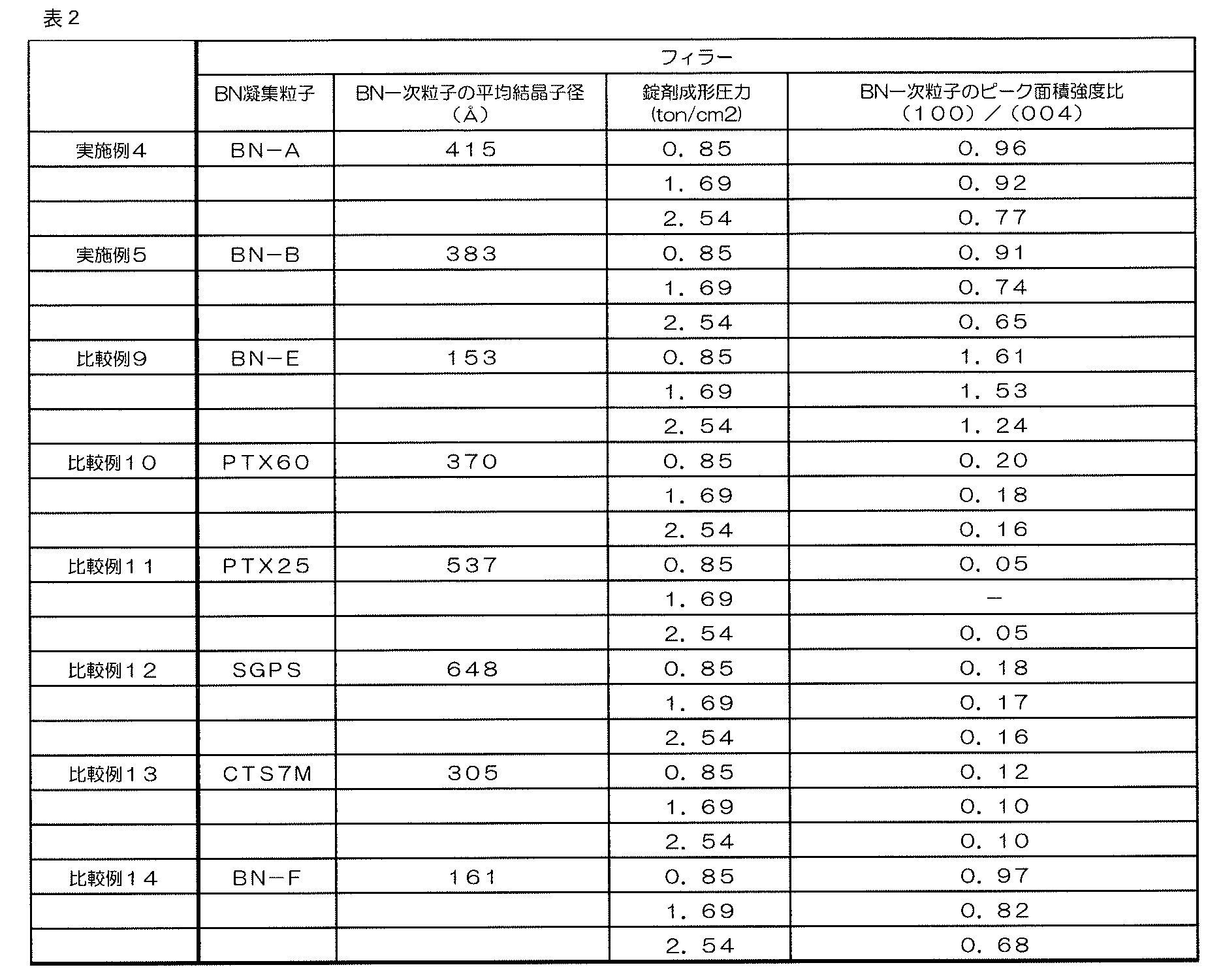
表1から、本発明のBN凝集粒子を用いることにより、成形体として高い熱伝導性を示すことがわかる。h-BN一次粒子の平均結晶子径が375Å未満の比較例では、熱伝導性が低く、平均結晶子径が375Åを超えるものの、BN凝集粒子の粉末X線回折測定によるh-BN一次粒子の(100)面と(004)面のピーク面積強度比((100)/(004))が0.25以下である比較例も高い熱伝導率を達成することができない。従って、BN凝集粒子を構成するh-BN一次粒子の平均結晶子径が375Å以上であり、かつ粉末X線回折測定によるh-BN一次粒子の(100)面と(004)面のピーク面積強度比((100)/(004))が0.25以上である本発明のBN凝集粒子は、熱伝導性フィラーとして従来にはない性能を発揮し、熱の課題が多い電気電子分野など様々な用途に幅広く適用可能である。 From Table 1, it can be seen that the use of the BN agglomerated particles of the present invention results in a molded body with high thermal conductivity. Comparative examples in which the average crystallite diameter of the h-BN primary particles is less than 375 Å have low thermal conductivity, and comparative examples in which the average crystallite diameter exceeds 375 Å but the peak area intensity ratio ((100)/(004)) of the (100) plane to the (004) plane of the h-BN primary particles in powder X-ray diffraction measurement is 0.25 or less cannot achieve high thermal conductivity. Therefore, the BN agglomerated particles of the present invention, in which the average crystallite diameter of the h-BN primary particles constituting the BN agglomerated particles is 375 Å or more and the peak area intensity ratio ((100)/(004)) of the (100) plane to the (004) plane of the h-BN primary particles in powder X-ray diffraction measurement is 0.25 or more, exhibit unprecedented performance as a thermally conductive filler and are widely applicable to various uses such as the electrical and electronics field, which has many heat issues.
さらに、表1の結果と表2から、特定の圧力以上でもh-BN一次粒子の(100)面と(004)面のピーク面積強度比((100)/(004))が0.25以上であり、h-BN一次粒子の平均結晶子径が375Åより大きい凝集粒子を用いることで、厚み方向に高い熱伝導性を発現するシートを得ることができる。 Furthermore, from the results in Tables 1 and 2, it can be seen that even at or above a certain pressure, the peak area intensity ratio ((100)/(004)) of the (100) and (004) faces of the h-BN primary particles is 0.25 or more, and by using agglomerated particles with an average crystallite diameter of the h-BN primary particles of more than 375 Å, a sheet that exhibits high thermal conductivity in the thickness direction can be obtained.
本発明のBN凝集粒子を用いることにより、例えばパワー半導体デバイスで必要とされる熱伝導性の高い、高品質の放熱シートを形成することができる。該放熱シートを有するパワー半導体デバイスは、次世代のSiC、GaNなど、高温動作が可能な高効率基板を用いたパワー半導体デバイスの作製に有用である。 By using the BN agglomerated particles of the present invention, it is possible to form a high-quality heat dissipation sheet with high thermal conductivity, which is required, for example, for power semiconductor devices. A power semiconductor device having such a heat dissipation sheet is useful for producing power semiconductor devices using next-generation SiC, GaN, and other highly efficient substrates capable of high-temperature operation.
Claims (9)
比表面積が1m2/g以上8m2/g以下であり、
平均粒子径(D50)が26μm以上であり、
該BN一次粒子がh-BN一次粒子であり、
該BN一次粒子の長軸が3μm以下であり、
10mmφの粉末錠剤成形機で0.85ton/cm2の成形圧力で成形して得られたペレット状の試料を粉末X線回折測定して得られる、BN一次粒子の(100)面と(004)面のピーク面積強度比((100)/(004))が0.40以上1.2以下であり、かつ該BN凝集粒子を0.2mm深さのガラス試料板に表面が平滑になるように充填し、粉末X線回折測定して得られる、BN一次粒子の(002)面ピークから求めたBN一次粒子の平均結晶子径が375Å以上415Å以下であることを特徴とするBN凝集粒子。 A boron nitride agglomerated particle (hereinafter referred to as "BN agglomerated particle") formed by agglomeration of boron nitride primary particles (hereinafter referred to as "BN primary particles"),
The specific surface area is 1 m 2 /g or more and 8 m 2 /g or less,
The average particle size ( D50 ) is 26 μm or more,
the BN primary particles are h-BN primary particles,
The major axis of the BN primary particle is 3 μm or less,
BN agglomerated particles, characterized in that a peak area intensity ratio ( ( 100)/(004)) of the (100) plane and the (004) plane of the BN primary particles, obtained by powder X-ray diffraction measurement of a pellet-shaped sample obtained by molding at a molding pressure of 0.85 ton/cm2 using a powder tablet molding machine of 10 mmφ, is 0.40 or more and 1.2 or less, and the BN agglomerated particles are filled into a glass sample plate of 0.2 mm depth so that the surface is smooth, and the average crystallite diameter of the BN primary particles, obtained by powder X-ray diffraction measurement of the BN primary particles from the (002) plane peak of the BN primary particles, is 375 Å or more and 415 Å or less.
Applications Claiming Priority (13)
| Application Number | Priority Date | Filing Date | Title |
|---|---|---|---|
| JP2014020423 | 2014-02-05 | ||
| JP2014020424 | 2014-02-05 | ||
| JP2014020424 | 2014-02-05 | ||
| JP2014020423 | 2014-02-05 | ||
| JP2014207522 | 2014-10-08 | ||
| JP2014207522 | 2014-10-08 | ||
| JP2014259221 | 2014-12-22 | ||
| JP2014259221 | 2014-12-22 | ||
| JP2015005428 | 2015-01-14 | ||
| JP2015005424 | 2015-01-14 | ||
| JP2015005428 | 2015-01-14 | ||
| JP2015005424 | 2015-01-14 | ||
| JP2020187065A JP7455047B2 (en) | 2014-02-05 | 2020-11-10 | Boron nitride aggregated particles, method for producing boron nitride aggregated particles, resin composition containing boron nitride aggregated particles, and molded article |
Related Parent Applications (1)
| Application Number | Title | Priority Date | Filing Date |
|---|---|---|---|
| JP2020187065A Division JP7455047B2 (en) | 2014-02-05 | 2020-11-10 | Boron nitride aggregated particles, method for producing boron nitride aggregated particles, resin composition containing boron nitride aggregated particles, and molded article |
Publications (3)
| Publication Number | Publication Date |
|---|---|
| JP2024003261A JP2024003261A (en) | 2024-01-11 |
| JP2024003261A5 JP2024003261A5 (en) | 2024-06-03 |
| JP7694635B2 true JP7694635B2 (en) | 2025-06-18 |
Family
ID=53777999
Family Applications (9)
| Application Number | Title | Priority Date | Filing Date |
|---|---|---|---|
| JP2015021224A Pending JP2016135729A (en) | 2014-02-05 | 2015-02-05 | Boron nitride aggregated particle, and method for producing the same, composition containing the same, and molding containing the same |
| JP2015021255A Active JP6447202B2 (en) | 2014-02-05 | 2015-02-05 | Boron nitride aggregated particle-containing composition and molded body using the boron nitride aggregated particle-containing resin composition |
| JP2015021246A Active JP6794613B2 (en) | 2014-02-05 | 2015-02-05 | Boron Nitride Agglomerated Particles, Method for Producing Boron Nitride Aggregated Particles, Boron Nitride Agglomerated Particle-Containing Resin Composition, and Mold |
| JP2015021240A Pending JP2016135730A (en) | 2014-02-05 | 2015-02-05 | Boron nitride agglomerated particles, method for producing the particles, a composition containing the particles, and a molded body containing the particles |
| JP2015561028A Active JP6493226B2 (en) | 2014-02-05 | 2015-02-05 | Boron nitride aggregated particles, method for producing boron nitride aggregated particles, resin composition containing boron nitride aggregated particles, molded product, and sheet |
| JP2019039094A Active JP6773153B2 (en) | 2014-02-05 | 2019-03-05 | Boron Nitride Agglomerated Particles, Method for Producing Boron Nitride Aggregated Particles, The Boron Nitride Agglomerated Particle-Containing Resin Composition, Mold, and Sheet |
| JP2020165695A Active JP7207384B2 (en) | 2014-02-05 | 2020-09-30 | Aggregated boron nitride particles, method for producing aggregated boron nitride particles, resin composition containing the aggregated boron nitride particles, molded article, and sheet |
| JP2020187065A Active JP7455047B2 (en) | 2014-02-05 | 2020-11-10 | Boron nitride aggregated particles, method for producing boron nitride aggregated particles, resin composition containing boron nitride aggregated particles, and molded article |
| JP2023196054A Active JP7694635B2 (en) | 2014-02-05 | 2023-11-17 | Boron nitride agglomerated particles, method for producing the boron nitride agglomerated particles, resin composition containing the boron nitride agglomerated particles, and molded body |
Family Applications Before (8)
| Application Number | Title | Priority Date | Filing Date |
|---|---|---|---|
| JP2015021224A Pending JP2016135729A (en) | 2014-02-05 | 2015-02-05 | Boron nitride aggregated particle, and method for producing the same, composition containing the same, and molding containing the same |
| JP2015021255A Active JP6447202B2 (en) | 2014-02-05 | 2015-02-05 | Boron nitride aggregated particle-containing composition and molded body using the boron nitride aggregated particle-containing resin composition |
| JP2015021246A Active JP6794613B2 (en) | 2014-02-05 | 2015-02-05 | Boron Nitride Agglomerated Particles, Method for Producing Boron Nitride Aggregated Particles, Boron Nitride Agglomerated Particle-Containing Resin Composition, and Mold |
| JP2015021240A Pending JP2016135730A (en) | 2014-02-05 | 2015-02-05 | Boron nitride agglomerated particles, method for producing the particles, a composition containing the particles, and a molded body containing the particles |
| JP2015561028A Active JP6493226B2 (en) | 2014-02-05 | 2015-02-05 | Boron nitride aggregated particles, method for producing boron nitride aggregated particles, resin composition containing boron nitride aggregated particles, molded product, and sheet |
| JP2019039094A Active JP6773153B2 (en) | 2014-02-05 | 2019-03-05 | Boron Nitride Agglomerated Particles, Method for Producing Boron Nitride Aggregated Particles, The Boron Nitride Agglomerated Particle-Containing Resin Composition, Mold, and Sheet |
| JP2020165695A Active JP7207384B2 (en) | 2014-02-05 | 2020-09-30 | Aggregated boron nitride particles, method for producing aggregated boron nitride particles, resin composition containing the aggregated boron nitride particles, molded article, and sheet |
| JP2020187065A Active JP7455047B2 (en) | 2014-02-05 | 2020-11-10 | Boron nitride aggregated particles, method for producing boron nitride aggregated particles, resin composition containing boron nitride aggregated particles, and molded article |
Country Status (8)
| Country | Link |
|---|---|
| US (2) | US10106413B2 (en) |
| EP (1) | EP3103766A4 (en) |
| JP (9) | JP2016135729A (en) |
| KR (1) | KR102400206B1 (en) |
| CN (2) | CN106029561B (en) |
| MY (2) | MY195160A (en) |
| TW (2) | TWI757686B (en) |
| WO (1) | WO2015119198A1 (en) |
Families Citing this family (72)
| Publication number | Priority date | Publication date | Assignee | Title |
|---|---|---|---|---|
| CN106029561B (en) * | 2014-02-05 | 2021-11-02 | 三菱化学株式会社 | Agglomerated particles of boron nitride, method for producing agglomerated particles of boron nitride, resin composition containing agglomerated particles of boron nitride, molded body, and sheet |
| US10605709B2 (en) * | 2015-03-31 | 2020-03-31 | Struers ApS | Mounting medium for embedding a sample material and a method of mounting a sample material in a mounting medium |
| KR102560615B1 (en) * | 2015-08-26 | 2023-07-27 | 덴카 주식회사 | Thermally conductive resin composition |
| WO2017038512A1 (en) * | 2015-09-03 | 2017-03-09 | 昭和電工株式会社 | Powder of hexagonal boron nitride, process for producing same, resin composition, and resin sheet |
| JP6497291B2 (en) * | 2015-10-14 | 2019-04-10 | 信越化学工業株式会社 | Insulating heat dissipation sheet |
| US20190160785A1 (en) * | 2016-07-05 | 2019-05-30 | Namics Corporation | Resin composition for film, film, film with base material, metal/resin laminate body, resin cured product, semiconductor device, and method for producing film |
| US11268004B2 (en) | 2016-10-07 | 2022-03-08 | Denka Company Limited | Boron nitride aggregated grain |
| WO2018074077A1 (en) * | 2016-10-21 | 2018-04-26 | デンカ株式会社 | Spherical boron nitride fine powder, method for manufacturing same and thermally conductive resin composition using same |
| JP6822836B2 (en) | 2016-12-28 | 2021-01-27 | 昭和電工株式会社 | Hexagonal boron nitride powder, its manufacturing method, resin composition and resin sheet |
| JP6795409B2 (en) * | 2017-01-19 | 2020-12-02 | 積水化学工業株式会社 | Curable material, manufacturing method of curable material and laminate |
| JP6828503B2 (en) * | 2017-02-22 | 2021-02-10 | 大日本印刷株式会社 | Inorganic layered material laminate, heat dissipation member, and power device device |
| JP6414260B2 (en) * | 2017-03-23 | 2018-10-31 | 三菱マテリアル株式会社 | Heat dissipation circuit board |
| JP7510241B2 (en) * | 2017-04-28 | 2024-07-03 | 積水化学工業株式会社 | Manufacturing method of hardened sheet |
| KR102476070B1 (en) * | 2017-06-23 | 2022-12-12 | 세키스이가가쿠 고교가부시키가이샤 | Heat radiation sheet, manufacturing method of heat radiation sheet, and laminate |
| KR102252723B1 (en) | 2017-07-14 | 2021-05-17 | 후지필름 가부시키가이샤 | Surface-modified inorganic nitride, composition, thermally conductive material, device with thermally conductive layer |
| CN111212811B (en) * | 2017-10-13 | 2023-03-21 | 电化株式会社 | Boron nitride powder, method for producing same, and heat-dissipating member using same |
| JP7104503B2 (en) * | 2017-10-13 | 2022-07-21 | デンカ株式会社 | Manufacturing method of massive boron nitride powder and heat dissipation member using it |
| JP7069485B2 (en) | 2017-12-27 | 2022-05-18 | 昭和電工株式会社 | Hexagonal boron nitride powder and its manufacturing method, as well as compositions and radiating materials using it. |
| CN109988409B (en) | 2017-12-29 | 2021-10-19 | 广东生益科技股份有限公司 | Boron nitride aggregate, thermosetting resin composition containing boron nitride aggregate and application of thermosetting resin composition |
| JP7188070B2 (en) * | 2018-01-05 | 2022-12-13 | 三菱ケミカル株式会社 | LAMINATED STRUCTURE WITH RADIATION INSULATING SHEET AND CURED SHEET AS INSULATING LAYER |
| JP7196905B2 (en) | 2018-03-30 | 2022-12-27 | 三菱ケミカル株式会社 | Heat-dissipating sheet, heat-dissipating member, and semiconductor device |
| CN109054302A (en) * | 2018-08-02 | 2018-12-21 | 中国科学院深圳先进技术研究院 | Thermal interfacial material and preparation method thereof |
| JPWO2020049817A1 (en) | 2018-09-07 | 2020-09-10 | 昭和電工株式会社 | Hexagonal boron nitride powder and its manufacturing method, as well as compositions and heat radiating materials using it. |
| JP7172319B2 (en) * | 2018-09-12 | 2022-11-16 | 富士通株式会社 | Heat dissipation structure, electronic device, and method for manufacturing heat dissipation structure |
| DE112019004695B4 (en) * | 2018-11-16 | 2026-04-30 | Fuji Polymer Industries Co., Ltd. | Method for the production of a thermally conductive film |
| JP6692512B1 (en) * | 2018-12-25 | 2020-05-13 | 富士高分子工業株式会社 | Thermally conductive composition and thermally conductive sheet using the same |
| EP3932857A4 (en) * | 2019-02-27 | 2022-04-20 | Mitsubishi Chemical Corporation | BORON NITRIDE AGGREGATE POWDER, HEAT DISSIPATION SHEET AND SEMICONDUCTOR DEVICE |
| US20220186102A1 (en) * | 2019-03-22 | 2022-06-16 | Fujimi Incorporated | Filler, molded body, and heat dissipating material |
| JP7726065B2 (en) * | 2019-03-26 | 2025-08-20 | 三菱ケミカル株式会社 | Thermally conductive resin sheet, laminated heat dissipation sheet, heat dissipation circuit board, and power semiconductor device |
| WO2020194867A1 (en) * | 2019-03-27 | 2020-10-01 | 富士フイルム株式会社 | Heat dissipation sheet precursor and method for producing heat dissipation sheet |
| KR20210142639A (en) * | 2019-03-27 | 2021-11-25 | 덴카 주식회사 | A bulk boron nitride particle, a heat conductive resin composition, and a heat dissipation member |
| US20220204830A1 (en) * | 2019-03-28 | 2022-06-30 | Denka Company Limited | Boron nitride powder, method for producing same, composite material, and heat dissipation member |
| JP7376764B2 (en) * | 2019-03-28 | 2023-11-09 | 日亜化学工業株式会社 | Hexagonal boron nitride fiber and its manufacturing method |
| WO2021035383A1 (en) * | 2019-08-23 | 2021-03-04 | Evonik Specialty Chemicals (Shanghai) Co., Ltd. | Thermal conductive filler and preparation method thereof |
| JP7152616B2 (en) * | 2019-09-25 | 2022-10-12 | 富士フイルム株式会社 | Heat dissipation sheet |
| WO2021059648A1 (en) * | 2019-09-25 | 2021-04-01 | 富士フイルム株式会社 | Heat dissipation sheet |
| CN114430860A (en) * | 2019-09-26 | 2022-05-03 | 电化株式会社 | Heat sink |
| EP4036174B1 (en) * | 2019-09-27 | 2025-05-21 | FUJIFILM Corporation | Composition for forming heat-conducting material, heat-conducting material, heat-conducting sheet, and device with heat-conducting layer |
| EP4053213B1 (en) | 2019-10-30 | 2024-04-10 | Mitsubishi Chemical Corporation | Resin composition, cured product, composite molded body and semiconductor device |
| US12630740B2 (en) | 2019-12-11 | 2026-05-19 | Ppg Industries Ohio, Inc. | Compositions containing thermally conductive fillers |
| JP7378284B2 (en) * | 2019-12-11 | 2023-11-13 | デンカ株式会社 | Powder containing composite particles, method for producing the same, and resin composition containing the powder |
| JP7372140B2 (en) * | 2019-12-25 | 2023-10-31 | デンカ株式会社 | Hexagonal boron nitride powder and its manufacturing method, and cosmetics and its manufacturing method |
| KR102724547B1 (en) | 2020-02-13 | 2024-10-30 | 삼성전자주식회사 | Semiconductor package |
| JP7643129B2 (en) * | 2020-03-27 | 2025-03-11 | 三菱ケミカル株式会社 | Resin composition, thermally conductive resin sheet, laminated heat dissipation sheet, heat dissipation circuit board, and power semiconductor device |
| JP2021166239A (en) * | 2020-04-07 | 2021-10-14 | デンカ株式会社 | Method for manufacturing thermally conductive sheet |
| CN112225186B (en) * | 2020-10-21 | 2023-07-21 | 江西联锴科技有限公司 | Preparation method of spherical boron nitride |
| JP7692267B2 (en) * | 2021-01-06 | 2025-06-13 | デンカ株式会社 | Heat dissipation sheet and method for manufacturing the same |
| US20240174908A1 (en) * | 2021-03-25 | 2024-05-30 | Denka Company Limited | Boron nitride powder and resin composition |
| WO2022210686A1 (en) | 2021-03-29 | 2022-10-06 | 三菱ケミカル株式会社 | Resin composition, cured product sheet, composite molded body and semiconductor device |
| US20240270576A1 (en) * | 2021-06-16 | 2024-08-15 | Denka Company Limited | Hexagonal boron nitride powder and method for producing same, and cosmetic and method for producing same |
| JP2023006582A (en) * | 2021-06-30 | 2023-01-18 | 三菱ケミカル株式会社 | Resin sheet and circuit board material |
| CN113336203B (en) * | 2021-07-09 | 2024-06-25 | 丹东市化工研究所有限责任公司 | Boron nitride agglomerate particle with small particle size and preparation method thereof |
| CN118201994A (en) * | 2021-10-14 | 2024-06-14 | 圣戈本陶瓷及塑料股份有限公司 | Composite body with high thermal conductivity and method for preparing the same |
| WO2023089452A1 (en) * | 2021-11-22 | 2023-05-25 | 3M Innovative Properties Company | Spherical boron nitride particles having low surface roughness |
| KR102735752B1 (en) * | 2022-10-20 | 2024-12-02 | 한국세라믹기술원 | Heat dissipation material, composition comprising the same, and manufacturing method of the same |
| JP7783644B2 (en) * | 2021-12-22 | 2025-12-10 | コリア インスティテュート オブ セラミック エンジニアリング アンド テクノロジー | Heat dissipating material, composition containing same, and method for producing same |
| KR102721879B1 (en) * | 2021-12-22 | 2024-10-25 | 한국세라믹기술원 | Heat dissipation material, composition comprising the same, and manufacturing method of the same |
| WO2023162598A1 (en) | 2022-02-22 | 2023-08-31 | デンカ株式会社 | Method for producing boron nitride powder, boron nitride powder, and resin sealing material |
| WO2023182470A1 (en) | 2022-03-24 | 2023-09-28 | 三菱ケミカル株式会社 | Thermosetting resin composition, thermally conductive resin sheet, heat-dissipating layered product, heat-dissipating circuit board, semiconductor device and power module |
| EP4502000A4 (en) | 2022-03-28 | 2025-06-25 | Mitsubishi Chemical Corporation | Thermosetting resin composition, resin cured product and composite molded body |
| JP7769784B2 (en) | 2022-03-30 | 2025-11-13 | デンカ株式会社 | Boron nitride powder, resin composition, and method for producing boron nitride powder |
| WO2023218372A1 (en) * | 2022-05-11 | 2023-11-16 | Church & Dwight Co., Inc. | Elastomeric articles with improved properties |
| KR20240003087A (en) | 2022-06-30 | 2024-01-08 | 이예진 | Self-driving quarantine robot equipped with boron nitride sheet |
| CN115974011A (en) * | 2022-12-23 | 2023-04-18 | 雅安百图高新材料股份有限公司 | Spherical hexagonal boron nitride and preparation method thereof |
| KR20240152986A (en) | 2023-04-14 | 2024-10-22 | 한양대학교 에리카산학협력단 | Method for producing spherical boron nitride aggregated particles-based morphostable phase transformation materials |
| CN116693299A (en) * | 2023-06-26 | 2023-09-05 | 江苏联瑞新材料股份有限公司 | Preparation and strength characterization method of spherical boron nitride with controllable high density granularity |
| JP7438442B1 (en) | 2023-10-12 | 2024-02-26 | 古河電子株式会社 | Boron nitride aggregated particles, sheet member, and method for producing boron nitride aggregated particles |
| JP7438443B1 (en) | 2023-10-12 | 2024-02-26 | 古河電子株式会社 | Boron nitride aggregated particles, sheet member, and method for producing boron nitride aggregated particles |
| KR102897532B1 (en) | 2023-11-21 | 2025-12-12 | ㈜메지전기 | Manufacturing method of boron nitride agglomerates produced thereby, and heat dissipating grease composite containing the same |
| CN121942348A (en) | 2023-12-08 | 2026-04-28 | 三菱化学株式会社 | Resin sheet and method for producing same |
| JP2025178688A (en) * | 2024-05-27 | 2025-12-09 | 株式会社トクヤマ | resin composition |
| CN121537214B (en) * | 2026-01-20 | 2026-03-24 | 郑州大学洛阳产业技术研究院 | Boron nitride burning-supporting plate based on nano boron nitride introduction and preparation method thereof |
Citations (7)
| Publication number | Priority date | Publication date | Assignee | Title |
|---|---|---|---|---|
| WO2009041300A1 (en) | 2007-09-26 | 2009-04-02 | Mitsubishi Electric Corporation | Heat conductive sheet and power module |
| JP2010505729A (en) | 2006-10-07 | 2010-02-25 | モーメンティブ・パフォーマンス・マテリアルズ・インク | Mixed boron nitride composition and method for producing the same |
| JP2010138097A (en) | 2008-12-10 | 2010-06-24 | Kao Corp | Liquid cosmetic |
| JP2011157271A (en) | 2011-04-29 | 2011-08-18 | National Institute Of Advanced Industrial Science & Technology | Aggregate and method for producing the same |
| WO2012026012A1 (en) | 2010-08-26 | 2012-03-01 | 電気化学工業株式会社 | Resin composition, molded object and substrate material both obtained from the resin composition, and circuit board including the substrate material |
| JP2012255055A (en) | 2011-06-07 | 2012-12-27 | National Institute Of Advanced Industrial Science & Technology | Composite material comprising inorganic-organic composite composition, and method of producing the same |
| JP2013241321A (en) | 2011-11-29 | 2013-12-05 | Mitsubishi Chemicals Corp | Aggregated boron nitride particle, composition containing aggregated boron nitride particle, and three-dimensional integrated circuit having layer comprising composition |
Family Cites Families (25)
| Publication number | Priority date | Publication date | Assignee | Title |
|---|---|---|---|---|
| JPS4817785B1 (en) | 1967-03-29 | 1973-05-31 | ||
| JP3461651B2 (en) * | 1996-01-24 | 2003-10-27 | 電気化学工業株式会社 | Hexagonal boron nitride powder and its use |
| JP3839539B2 (en) * | 1997-01-20 | 2006-11-01 | 修 山本 | Crystalline disordered layered boron nitride powder and method for producing the same |
| JPH1160216A (en) * | 1997-08-04 | 1999-03-02 | Shin Etsu Chem Co Ltd | Thermal conductive boron nitride filler and insulating heat dissipation sheet |
| US20060121068A1 (en) * | 1999-08-31 | 2006-06-08 | General Electric Company | Boron nitride particles of spherical geometry and process for making thereof |
| US20070241303A1 (en) | 1999-08-31 | 2007-10-18 | General Electric Company | Thermally conductive composition and method for preparing the same |
| US7976941B2 (en) * | 1999-08-31 | 2011-07-12 | Momentive Performance Materials Inc. | Boron nitride particles of spherical geometry and process for making thereof |
| US7445797B2 (en) | 2005-03-14 | 2008-11-04 | Momentive Performance Materials Inc. | Enhanced boron nitride composition and polymer-based compositions made therewith |
| US6645612B2 (en) | 2001-08-07 | 2003-11-11 | Saint-Gobain Ceramics & Plastics, Inc. | High solids hBN slurry, hBN paste, spherical hBN powder, and methods of making and using them |
| JP4089636B2 (en) | 2004-02-19 | 2008-05-28 | 三菱電機株式会社 | Method for manufacturing thermally conductive resin sheet and method for manufacturing power module |
| WO2006023860A2 (en) | 2004-08-23 | 2006-03-02 | General Electric Company | Thermally conductive composition and method for preparing the same |
| JP4817785B2 (en) | 2005-09-30 | 2011-11-16 | 三菱エンジニアリングプラスチックス株式会社 | Highly heat conductive insulating polycarbonate resin composition and molded body |
| JP5081488B2 (en) * | 2006-04-20 | 2012-11-28 | Jfeスチール株式会社 | Hexagonal boron nitride powder |
| JP5036696B2 (en) * | 2008-12-26 | 2012-09-26 | 三菱電機株式会社 | Thermally conductive sheet and power module |
| JP5208060B2 (en) | 2009-06-26 | 2013-06-12 | 三菱電機株式会社 | Thermosetting resin composition, thermally conductive resin sheet, method for producing the same, and power module |
| JP5673539B2 (en) * | 2009-08-20 | 2015-02-18 | 株式会社カネカ | Method for producing spheroidized boron nitride |
| JP5497458B2 (en) * | 2010-01-13 | 2014-05-21 | 電気化学工業株式会社 | Thermally conductive resin composition |
| DE102010050900A1 (en) * | 2010-11-10 | 2012-05-10 | Esk Ceramics Gmbh & Co. Kg | Boron nitride agglomerates, process for their preparation and their use |
| JP5653280B2 (en) * | 2011-04-15 | 2015-01-14 | 三菱電機株式会社 | Resin composition for heat conductive sheet, heat conductive sheet and power module |
| JP2013040062A (en) | 2011-08-12 | 2013-02-28 | Mitsubishi Chemicals Corp | Hexagonal boron nitride powder, thermally conductive resin composition containing the same, and molded product obtained by the resin composition |
| JP2013147403A (en) | 2012-01-23 | 2013-08-01 | Mitsubishi Chemicals Corp | Metal compound-containing boron nitride and composite material composition containing the same |
| DE102012104049A1 (en) | 2012-05-09 | 2013-11-28 | Esk Ceramics Gmbh & Co. Kg | Boron nitride agglomerates, process for their preparation and their use |
| JP5689985B2 (en) | 2012-06-27 | 2015-03-25 | 水島合金鉄株式会社 | BN Sintered Particles with Recesses, Method for Producing the Same, and Polymer Material |
| JP5969314B2 (en) * | 2012-08-22 | 2016-08-17 | デンカ株式会社 | Boron nitride powder and its use |
| CN106029561B (en) * | 2014-02-05 | 2021-11-02 | 三菱化学株式会社 | Agglomerated particles of boron nitride, method for producing agglomerated particles of boron nitride, resin composition containing agglomerated particles of boron nitride, molded body, and sheet |
-
2015
- 2015-02-05 CN CN201580007267.6A patent/CN106029561B/en active Active
- 2015-02-05 JP JP2015021224A patent/JP2016135729A/en active Pending
- 2015-02-05 JP JP2015021255A patent/JP6447202B2/en active Active
- 2015-02-05 TW TW109103913A patent/TWI757686B/en active
- 2015-02-05 TW TW104103996A patent/TWI687393B/en active
- 2015-02-05 EP EP15746358.9A patent/EP3103766A4/en not_active Ceased
- 2015-02-05 MY MYPI2020002424A patent/MY195160A/en unknown
- 2015-02-05 MY MYPI2016702851A patent/MY179291A/en unknown
- 2015-02-05 JP JP2015021246A patent/JP6794613B2/en active Active
- 2015-02-05 KR KR1020167021577A patent/KR102400206B1/en active Active
- 2015-02-05 CN CN202111095896.2A patent/CN113788465B/en active Active
- 2015-02-05 JP JP2015021240A patent/JP2016135730A/en active Pending
- 2015-02-05 WO PCT/JP2015/053250 patent/WO2015119198A1/en not_active Ceased
- 2015-02-05 JP JP2015561028A patent/JP6493226B2/en active Active
-
2016
- 2016-08-05 US US15/229,619 patent/US10106413B2/en active Active
-
2018
- 2018-08-21 US US16/106,120 patent/US10414653B2/en active Active
-
2019
- 2019-03-05 JP JP2019039094A patent/JP6773153B2/en active Active
-
2020
- 2020-09-30 JP JP2020165695A patent/JP7207384B2/en active Active
- 2020-11-10 JP JP2020187065A patent/JP7455047B2/en active Active
-
2023
- 2023-11-17 JP JP2023196054A patent/JP7694635B2/en active Active
Patent Citations (7)
| Publication number | Priority date | Publication date | Assignee | Title |
|---|---|---|---|---|
| JP2010505729A (en) | 2006-10-07 | 2010-02-25 | モーメンティブ・パフォーマンス・マテリアルズ・インク | Mixed boron nitride composition and method for producing the same |
| WO2009041300A1 (en) | 2007-09-26 | 2009-04-02 | Mitsubishi Electric Corporation | Heat conductive sheet and power module |
| JP2010138097A (en) | 2008-12-10 | 2010-06-24 | Kao Corp | Liquid cosmetic |
| WO2012026012A1 (en) | 2010-08-26 | 2012-03-01 | 電気化学工業株式会社 | Resin composition, molded object and substrate material both obtained from the resin composition, and circuit board including the substrate material |
| JP2011157271A (en) | 2011-04-29 | 2011-08-18 | National Institute Of Advanced Industrial Science & Technology | Aggregate and method for producing the same |
| JP2012255055A (en) | 2011-06-07 | 2012-12-27 | National Institute Of Advanced Industrial Science & Technology | Composite material comprising inorganic-organic composite composition, and method of producing the same |
| JP2013241321A (en) | 2011-11-29 | 2013-12-05 | Mitsubishi Chemicals Corp | Aggregated boron nitride particle, composition containing aggregated boron nitride particle, and three-dimensional integrated circuit having layer comprising composition |
Also Published As
Similar Documents
| Publication | Publication Date | Title |
|---|---|---|
| JP7455047B2 (en) | Boron nitride aggregated particles, method for producing boron nitride aggregated particles, resin composition containing boron nitride aggregated particles, and molded article | |
| JP6786778B2 (en) | Heat-dissipating resin sheet and devices containing the heat-dissipating resin sheet | |
| JP7786500B2 (en) | Boron nitride agglomerated powder, heat dissipation sheet and semiconductor device | |
| JP6500339B2 (en) | Heat dissipation sheet, coating liquid for heat dissipation sheet, and power device | |
| JP6950148B2 (en) | Aluminum Nitride-Boron Nitride Composite Agglomerated Particles and Their Manufacturing Methods | |
| TWI838500B (en) | Blocky boron nitride particles, heat conductive resin composition, and heat dissipation member | |
| JP7467980B2 (en) | Boron nitride agglomerated powder, heat dissipation sheet, and method for manufacturing semiconductor device | |
| JP7554473B2 (en) | Method for producing granular boron nitride and granular boron nitride | |
| JP2017036190A (en) | Boron nitride aggregated particle composition, BN aggregated particle-containing resin composition and molded article thereof, and method for producing boron nitride aggregated particles, | |
| JP6379579B2 (en) | Boron nitride sheet | |
| JP2015189609A (en) | Method for producing boron nitride sheet | |
| JP2025142716A (en) | Boron nitride agglomerated powder, composite composition, heat dissipation component, semiconductor device | |
| JP2025112957A (en) | Boron nitride agglomerated powder, resin composition, heat dissipation sheet and semiconductor device | |
| JP2025142817A (en) | Boron nitride agglomerated particles, boron nitride agglomerated powder, composite material composition, heat dissipation component, semiconductor device | |
| JP2024152598A (en) | Boron nitride agglomerated powder, heat dissipation sheet and semiconductor device module |
Legal Events
| Date | Code | Title | Description |
|---|---|---|---|
| A621 | Written request for application examination |
Free format text: JAPANESE INTERMEDIATE CODE: A621 Effective date: 20231117 |
|
| A521 | Request for written amendment filed |
Free format text: JAPANESE INTERMEDIATE CODE: A523 Effective date: 20240524 |
|
| TRDD | Decision of grant or rejection written | ||
| A01 | Written decision to grant a patent or to grant a registration (utility model) |
Free format text: JAPANESE INTERMEDIATE CODE: A01 Effective date: 20250507 |
|
| A61 | First payment of annual fees (during grant procedure) |
Free format text: JAPANESE INTERMEDIATE CODE: A61 Effective date: 20250520 |
|
| R150 | Certificate of patent or registration of utility model |
Ref document number: 7694635 Country of ref document: JP Free format text: JAPANESE INTERMEDIATE CODE: R150 |