JP4874792B2 - New materials for electroluminescence - Google Patents
New materials for electroluminescence Download PDFInfo
- Publication number
- JP4874792B2 JP4874792B2 JP2006516042A JP2006516042A JP4874792B2 JP 4874792 B2 JP4874792 B2 JP 4874792B2 JP 2006516042 A JP2006516042 A JP 2006516042A JP 2006516042 A JP2006516042 A JP 2006516042A JP 4874792 B2 JP4874792 B2 JP 4874792B2
- Authority
- JP
- Japan
- Prior art keywords
- carbon atoms
- substituted
- polymer
- unit
- formula
- Prior art date
- Legal status (The legal status is an assumption and is not a legal conclusion. Google has not performed a legal analysis and makes no representation as to the accuracy of the status listed.)
- Expired - Fee Related
Links
- 0 CC(*)(C=C1)C=Cc2c1c(C=CC(C)(CC(*)=N)C=C1)c1[n]2*[n]1c(C=CC(C)(*=C)C=C2)c2c2c1C=C*(*)C=C2 Chemical compound CC(*)(C=C1)C=Cc2c1c(C=CC(C)(CC(*)=N)C=C1)c1[n]2*[n]1c(C=CC(C)(*=C)C=C2)c2c2c1C=C*(*)C=C2 0.000 description 2
- ZVQPLPSCABMKLZ-UHFFFAOYSA-N Cc(cc1c2c3cccc2)ccc1[n]3-c(cc1)ccc1-c(cc1)ccc1-[n]1c(ccc(C)c2)c2c2ccccc12 Chemical compound Cc(cc1c2c3cccc2)ccc1[n]3-c(cc1)ccc1-c(cc1)ccc1-[n]1c(ccc(C)c2)c2c2ccccc12 ZVQPLPSCABMKLZ-UHFFFAOYSA-N 0.000 description 1
- PHKYYUQQYARDIU-UHFFFAOYSA-N Cc1ccc2[nH]c(cccc3)c3c2c1 Chemical compound Cc1ccc2[nH]c(cccc3)c3c2c1 PHKYYUQQYARDIU-UHFFFAOYSA-N 0.000 description 1
Classifications
-
- C—CHEMISTRY; METALLURGY
- C08—ORGANIC MACROMOLECULAR COMPOUNDS; THEIR PREPARATION OR CHEMICAL WORKING-UP; COMPOSITIONS BASED THEREON
- C08L—COMPOSITIONS OF MACROMOLECULAR COMPOUNDS
- C08L23/00—Compositions of homopolymers or copolymers of unsaturated aliphatic hydrocarbons having only one carbon-to-carbon double bond; Compositions of derivatives of such polymers
- C08L23/02—Compositions of homopolymers or copolymers of unsaturated aliphatic hydrocarbons having only one carbon-to-carbon double bond; Compositions of derivatives of such polymers not modified by chemical after-treatment
-
- C—CHEMISTRY; METALLURGY
- C08—ORGANIC MACROMOLECULAR COMPOUNDS; THEIR PREPARATION OR CHEMICAL WORKING-UP; COMPOSITIONS BASED THEREON
- C08G—MACROMOLECULAR COMPOUNDS OBTAINED OTHERWISE THAN BY REACTIONS ONLY INVOLVING UNSATURATED CARBON-TO-CARBON BONDS
- C08G61/00—Macromolecular compounds obtained by reactions forming a carbon-to-carbon link in the main chain of the macromolecule
-
- C—CHEMISTRY; METALLURGY
- C08—ORGANIC MACROMOLECULAR COMPOUNDS; THEIR PREPARATION OR CHEMICAL WORKING-UP; COMPOSITIONS BASED THEREON
- C08G—MACROMOLECULAR COMPOUNDS OBTAINED OTHERWISE THAN BY REACTIONS ONLY INVOLVING UNSATURATED CARBON-TO-CARBON BONDS
- C08G61/00—Macromolecular compounds obtained by reactions forming a carbon-to-carbon link in the main chain of the macromolecule
- C08G61/12—Macromolecular compounds containing atoms other than carbon in the main chain of the macromolecule
- C08G61/122—Macromolecular compounds containing atoms other than carbon in the main chain of the macromolecule derived from five- or six-membered heterocyclic compounds, other than imides
- C08G61/123—Macromolecular compounds containing atoms other than carbon in the main chain of the macromolecule derived from five- or six-membered heterocyclic compounds, other than imides derived from five-membered heterocyclic compounds
- C08G61/124—Macromolecular compounds containing atoms other than carbon in the main chain of the macromolecule derived from five- or six-membered heterocyclic compounds, other than imides derived from five-membered heterocyclic compounds with a five-membered ring containing one nitrogen atom in the ring
-
- C—CHEMISTRY; METALLURGY
- C08—ORGANIC MACROMOLECULAR COMPOUNDS; THEIR PREPARATION OR CHEMICAL WORKING-UP; COMPOSITIONS BASED THEREON
- C08L—COMPOSITIONS OF MACROMOLECULAR COMPOUNDS
- C08L65/00—Compositions of macromolecular compounds obtained by reactions forming a carbon-to-carbon link in the main chain; Compositions of derivatives of such polymers
-
- C—CHEMISTRY; METALLURGY
- C09—DYES; PAINTS; POLISHES; NATURAL RESINS; ADHESIVES; COMPOSITIONS NOT OTHERWISE PROVIDED FOR; APPLICATIONS OF MATERIALS NOT OTHERWISE PROVIDED FOR
- C09B—ORGANIC DYES OR CLOSELY-RELATED COMPOUNDS FOR PRODUCING DYES, e.g. PIGMENTS; MORDANTS; LAKES
- C09B23/00—Methine or polymethine dyes, e.g. cyanine dyes
- C09B23/14—Styryl dyes
- C09B23/145—Styryl dyes the ethylene chain carrying an heterocyclic residue, e.g. heterocycle-CH=CH-C6H5
-
- C—CHEMISTRY; METALLURGY
- C09—DYES; PAINTS; POLISHES; NATURAL RESINS; ADHESIVES; COMPOSITIONS NOT OTHERWISE PROVIDED FOR; APPLICATIONS OF MATERIALS NOT OTHERWISE PROVIDED FOR
- C09B—ORGANIC DYES OR CLOSELY-RELATED COMPOUNDS FOR PRODUCING DYES, e.g. PIGMENTS; MORDANTS; LAKES
- C09B57/00—Other synthetic dyes of known constitution
-
- C—CHEMISTRY; METALLURGY
- C09—DYES; PAINTS; POLISHES; NATURAL RESINS; ADHESIVES; COMPOSITIONS NOT OTHERWISE PROVIDED FOR; APPLICATIONS OF MATERIALS NOT OTHERWISE PROVIDED FOR
- C09B—ORGANIC DYES OR CLOSELY-RELATED COMPOUNDS FOR PRODUCING DYES, e.g. PIGMENTS; MORDANTS; LAKES
- C09B69/00—Dyes not provided for by a single group of this subclass
- C09B69/10—Polymeric dyes; Reaction products of dyes with monomers or with macromolecular compounds
- C09B69/101—Polymeric dyes; Reaction products of dyes with monomers or with macromolecular compounds containing an anthracene dye
-
- C—CHEMISTRY; METALLURGY
- C09—DYES; PAINTS; POLISHES; NATURAL RESINS; ADHESIVES; COMPOSITIONS NOT OTHERWISE PROVIDED FOR; APPLICATIONS OF MATERIALS NOT OTHERWISE PROVIDED FOR
- C09B—ORGANIC DYES OR CLOSELY-RELATED COMPOUNDS FOR PRODUCING DYES, e.g. PIGMENTS; MORDANTS; LAKES
- C09B69/00—Dyes not provided for by a single group of this subclass
- C09B69/10—Polymeric dyes; Reaction products of dyes with monomers or with macromolecular compounds
- C09B69/105—Polymeric dyes; Reaction products of dyes with monomers or with macromolecular compounds containing a methine or polymethine dye
-
- C—CHEMISTRY; METALLURGY
- C09—DYES; PAINTS; POLISHES; NATURAL RESINS; ADHESIVES; COMPOSITIONS NOT OTHERWISE PROVIDED FOR; APPLICATIONS OF MATERIALS NOT OTHERWISE PROVIDED FOR
- C09B—ORGANIC DYES OR CLOSELY-RELATED COMPOUNDS FOR PRODUCING DYES, e.g. PIGMENTS; MORDANTS; LAKES
- C09B69/00—Dyes not provided for by a single group of this subclass
- C09B69/10—Polymeric dyes; Reaction products of dyes with monomers or with macromolecular compounds
- C09B69/109—Polymeric dyes; Reaction products of dyes with monomers or with macromolecular compounds containing other specific dyes
-
- C—CHEMISTRY; METALLURGY
- C09—DYES; PAINTS; POLISHES; NATURAL RESINS; ADHESIVES; COMPOSITIONS NOT OTHERWISE PROVIDED FOR; APPLICATIONS OF MATERIALS NOT OTHERWISE PROVIDED FOR
- C09K—MATERIALS FOR MISCELLANEOUS APPLICATIONS, NOT PROVIDED FOR ELSEWHERE
- C09K11/00—Luminescent materials, e.g. electroluminescent or chemiluminescent
- C09K11/06—Luminescent materials, e.g. electroluminescent or chemiluminescent containing organic luminescent materials
-
- H—ELECTRICITY
- H05—ELECTRIC TECHNIQUES NOT OTHERWISE PROVIDED FOR
- H05B—ELECTRIC HEATING; ELECTRIC LIGHT SOURCES NOT OTHERWISE PROVIDED FOR; CIRCUIT ARRANGEMENTS FOR ELECTRIC LIGHT SOURCES, IN GENERAL
- H05B33/00—Electroluminescent light sources
- H05B33/12—Light sources with substantially two-dimensional [2D] radiating surfaces
- H05B33/14—Light sources with substantially two-dimensional [2D] radiating surfaces characterised by the chemical or physical composition or the arrangement of the electroluminescent material, or by the simultaneous addition of the electroluminescent material in or onto the light source
-
- H—ELECTRICITY
- H10—SEMICONDUCTOR DEVICES; ELECTRIC SOLID-STATE DEVICES NOT OTHERWISE PROVIDED FOR
- H10K—ORGANIC ELECTRIC SOLID-STATE DEVICES
- H10K85/00—Organic materials used in the body or electrodes of devices covered by this subclass
- H10K85/10—Organic polymers or oligomers
- H10K85/111—Organic polymers or oligomers comprising aromatic, heteroaromatic, or aryl chains, e.g. polyaniline, polyphenylene or polyphenylene vinylene
-
- H—ELECTRICITY
- H10—SEMICONDUCTOR DEVICES; ELECTRIC SOLID-STATE DEVICES NOT OTHERWISE PROVIDED FOR
- H10K—ORGANIC ELECTRIC SOLID-STATE DEVICES
- H10K85/00—Organic materials used in the body or electrodes of devices covered by this subclass
- H10K85/10—Organic polymers or oligomers
- H10K85/111—Organic polymers or oligomers comprising aromatic, heteroaromatic, or aryl chains, e.g. polyaniline, polyphenylene or polyphenylene vinylene
- H10K85/113—Heteroaromatic compounds comprising sulfur or selene, e.g. polythiophene
-
- H—ELECTRICITY
- H10—SEMICONDUCTOR DEVICES; ELECTRIC SOLID-STATE DEVICES NOT OTHERWISE PROVIDED FOR
- H10K—ORGANIC ELECTRIC SOLID-STATE DEVICES
- H10K85/00—Organic materials used in the body or electrodes of devices covered by this subclass
- H10K85/10—Organic polymers or oligomers
- H10K85/151—Copolymers
-
- C—CHEMISTRY; METALLURGY
- C08—ORGANIC MACROMOLECULAR COMPOUNDS; THEIR PREPARATION OR CHEMICAL WORKING-UP; COMPOSITIONS BASED THEREON
- C08G—MACROMOLECULAR COMPOUNDS OBTAINED OTHERWISE THAN BY REACTIONS ONLY INVOLVING UNSATURATED CARBON-TO-CARBON BONDS
- C08G2261/00—Macromolecular compounds obtained by reactions forming a carbon-to-carbon link in the main chain of the macromolecule
- C08G2261/10—Definition of the polymer structure
- C08G2261/14—Side-groups
- C08G2261/152—Side-groups comprising metal complexes
- C08G2261/1526—Side-groups comprising metal complexes of Os, Ir, Pt, Ru, Rh or Pd
-
- C—CHEMISTRY; METALLURGY
- C08—ORGANIC MACROMOLECULAR COMPOUNDS; THEIR PREPARATION OR CHEMICAL WORKING-UP; COMPOSITIONS BASED THEREON
- C08G—MACROMOLECULAR COMPOUNDS OBTAINED OTHERWISE THAN BY REACTIONS ONLY INVOLVING UNSATURATED CARBON-TO-CARBON BONDS
- C08G2261/00—Macromolecular compounds obtained by reactions forming a carbon-to-carbon link in the main chain of the macromolecule
- C08G2261/30—Monomer units or repeat units incorporating structural elements in the main chain
- C08G2261/31—Monomer units or repeat units incorporating structural elements in the main chain incorporating aromatic structural elements in the main chain
- C08G2261/312—Non-condensed aromatic systems, e.g. benzene
-
- C—CHEMISTRY; METALLURGY
- C08—ORGANIC MACROMOLECULAR COMPOUNDS; THEIR PREPARATION OR CHEMICAL WORKING-UP; COMPOSITIONS BASED THEREON
- C08G—MACROMOLECULAR COMPOUNDS OBTAINED OTHERWISE THAN BY REACTIONS ONLY INVOLVING UNSATURATED CARBON-TO-CARBON BONDS
- C08G2261/00—Macromolecular compounds obtained by reactions forming a carbon-to-carbon link in the main chain of the macromolecule
- C08G2261/30—Monomer units or repeat units incorporating structural elements in the main chain
- C08G2261/31—Monomer units or repeat units incorporating structural elements in the main chain incorporating aromatic structural elements in the main chain
- C08G2261/314—Condensed aromatic systems, e.g. perylene, anthracene or pyrene
- C08G2261/3142—Condensed aromatic systems, e.g. perylene, anthracene or pyrene fluorene-based, e.g. fluorene, indenofluorene, or spirobifluorene
-
- C—CHEMISTRY; METALLURGY
- C08—ORGANIC MACROMOLECULAR COMPOUNDS; THEIR PREPARATION OR CHEMICAL WORKING-UP; COMPOSITIONS BASED THEREON
- C08G—MACROMOLECULAR COMPOUNDS OBTAINED OTHERWISE THAN BY REACTIONS ONLY INVOLVING UNSATURATED CARBON-TO-CARBON BONDS
- C08G2261/00—Macromolecular compounds obtained by reactions forming a carbon-to-carbon link in the main chain of the macromolecule
- C08G2261/30—Monomer units or repeat units incorporating structural elements in the main chain
- C08G2261/37—Metal complexes
- C08G2261/374—Metal complexes of Os, Ir, Pt, Ru, Rh, Pd
-
- C—CHEMISTRY; METALLURGY
- C09—DYES; PAINTS; POLISHES; NATURAL RESINS; ADHESIVES; COMPOSITIONS NOT OTHERWISE PROVIDED FOR; APPLICATIONS OF MATERIALS NOT OTHERWISE PROVIDED FOR
- C09K—MATERIALS FOR MISCELLANEOUS APPLICATIONS, NOT PROVIDED FOR ELSEWHERE
- C09K2211/00—Chemical nature of organic luminescent or tenebrescent compounds
- C09K2211/10—Non-macromolecular compounds
- C09K2211/1018—Heterocyclic compounds
- C09K2211/1025—Heterocyclic compounds characterised by ligands
- C09K2211/1029—Heterocyclic compounds characterised by ligands containing one nitrogen atom as the heteroatom
-
- C—CHEMISTRY; METALLURGY
- C09—DYES; PAINTS; POLISHES; NATURAL RESINS; ADHESIVES; COMPOSITIONS NOT OTHERWISE PROVIDED FOR; APPLICATIONS OF MATERIALS NOT OTHERWISE PROVIDED FOR
- C09K—MATERIALS FOR MISCELLANEOUS APPLICATIONS, NOT PROVIDED FOR ELSEWHERE
- C09K2211/00—Chemical nature of organic luminescent or tenebrescent compounds
- C09K2211/14—Macromolecular compounds
- C09K2211/1441—Heterocyclic
- C09K2211/1466—Heterocyclic containing nitrogen as the only heteroatom
-
- H—ELECTRICITY
- H10—SEMICONDUCTOR DEVICES; ELECTRIC SOLID-STATE DEVICES NOT OTHERWISE PROVIDED FOR
- H10K—ORGANIC ELECTRIC SOLID-STATE DEVICES
- H10K2101/00—Properties of the organic materials covered by group H10K85/00
- H10K2101/10—Triplet emission
-
- H—ELECTRICITY
- H10—SEMICONDUCTOR DEVICES; ELECTRIC SOLID-STATE DEVICES NOT OTHERWISE PROVIDED FOR
- H10K—ORGANIC ELECTRIC SOLID-STATE DEVICES
- H10K50/00—Organic light-emitting devices
- H10K50/10—OLEDs or polymer light-emitting diodes [PLED]
- H10K50/11—OLEDs or polymer light-emitting diodes [PLED] characterised by the electroluminescent [EL] layers
-
- H—ELECTRICITY
- H10—SEMICONDUCTOR DEVICES; ELECTRIC SOLID-STATE DEVICES NOT OTHERWISE PROVIDED FOR
- H10K—ORGANIC ELECTRIC SOLID-STATE DEVICES
- H10K85/00—Organic materials used in the body or electrodes of devices covered by this subclass
- H10K85/60—Organic compounds having low molecular weight
- H10K85/615—Polycyclic condensed aromatic hydrocarbons, e.g. anthracene
-
- H—ELECTRICITY
- H10—SEMICONDUCTOR DEVICES; ELECTRIC SOLID-STATE DEVICES NOT OTHERWISE PROVIDED FOR
- H10K—ORGANIC ELECTRIC SOLID-STATE DEVICES
- H10K85/00—Organic materials used in the body or electrodes of devices covered by this subclass
- H10K85/60—Organic compounds having low molecular weight
- H10K85/631—Amine compounds having at least two aryl rest on at least one amine-nitrogen atom, e.g. triphenylamine
-
- H—ELECTRICITY
- H10—SEMICONDUCTOR DEVICES; ELECTRIC SOLID-STATE DEVICES NOT OTHERWISE PROVIDED FOR
- H10K—ORGANIC ELECTRIC SOLID-STATE DEVICES
- H10K85/00—Organic materials used in the body or electrodes of devices covered by this subclass
- H10K85/60—Organic compounds having low molecular weight
- H10K85/649—Aromatic compounds comprising a hetero atom
-
- Y—GENERAL TAGGING OF NEW TECHNOLOGICAL DEVELOPMENTS; GENERAL TAGGING OF CROSS-SECTIONAL TECHNOLOGIES SPANNING OVER SEVERAL SECTIONS OF THE IPC; TECHNICAL SUBJECTS COVERED BY FORMER USPC CROSS-REFERENCE ART COLLECTIONS [XRACs] AND DIGESTS
- Y02—TECHNOLOGIES OR APPLICATIONS FOR MITIGATION OR ADAPTATION AGAINST CLIMATE CHANGE
- Y02E—REDUCTION OF GREENHOUSE GAS [GHG] EMISSIONS, RELATED TO ENERGY GENERATION, TRANSMISSION OR DISTRIBUTION
- Y02E10/00—Energy generation through renewable energy sources
- Y02E10/50—Photovoltaic [PV] energy
- Y02E10/549—Organic PV cells
-
- Y—GENERAL TAGGING OF NEW TECHNOLOGICAL DEVELOPMENTS; GENERAL TAGGING OF CROSS-SECTIONAL TECHNOLOGIES SPANNING OVER SEVERAL SECTIONS OF THE IPC; TECHNICAL SUBJECTS COVERED BY FORMER USPC CROSS-REFERENCE ART COLLECTIONS [XRACs] AND DIGESTS
- Y02—TECHNOLOGIES OR APPLICATIONS FOR MITIGATION OR ADAPTATION AGAINST CLIMATE CHANGE
- Y02P—CLIMATE CHANGE MITIGATION TECHNOLOGIES IN THE PRODUCTION OR PROCESSING OF GOODS
- Y02P70/00—Climate change mitigation technologies in the production process for final industrial or consumer products
- Y02P70/50—Manufacturing or production processes characterised by the final manufactured product
Landscapes
- Chemical & Material Sciences (AREA)
- Organic Chemistry (AREA)
- Engineering & Computer Science (AREA)
- Materials Engineering (AREA)
- Health & Medical Sciences (AREA)
- Chemical Kinetics & Catalysis (AREA)
- Medicinal Chemistry (AREA)
- Polymers & Plastics (AREA)
- Electroluminescent Light Sources (AREA)
- Polyoxymethylene Polymers And Polymers With Carbon-To-Carbon Bonds (AREA)
- Indole Compounds (AREA)
- Compositions Of Macromolecular Compounds (AREA)
Description
過去約12年に亘り、高分子(有機)発光ダイオード(PLED)に基づくディスプレイおよび照明素子の商業化に向けて、幅広い基礎研究が進められている。この開発はEP 423 283に開示されている基礎的な開発から端を発せられた。最近、比較的小型のディスプレイ(PHILIPS N. V. からの電気剃刀での)の形で最初の商品が市場から入手可能となってきている。しかし、現在の市場を牽引する液晶ディスプレイ(LCD)に対する真の競争力を与えるためには、著しい改良がこれらのディスプレイには依然として必要である。特に、これに関連させて、市場の要求(最も重要なものを挙げると、効率、動作寿命、動作電圧)を満たす全ての発光色(赤、緑、青)用のポリマーを提供する必要がある。 Over the past approximately 12 years, extensive basic research has been underway for commercialization of displays and lighting elements based on polymer (organic) light emitting diodes (PLEDs). This development stems from the basic development disclosed in EP 423 283. Recently, the first product has become available on the market in the form of a relatively small display (with an electric razor from PHILIPS N. V.). However, significant improvements are still needed for these displays to give them a real competitive edge over the liquid crystal displays (LCDs) that are driving the current market. In particular, in this context, there is a need to provide polymers for all emission colors (red, green, blue) that meet market demands (most importantly efficiency, operating life, operating voltage). .
様々な種類の材料がフルカラーディスプレイ素子用のポリマーとして提案または開発されている。1種のこのような材料は、例えばEP 0842208、WO 99/54385、WO 00/22027、WO 00/22026およびWO 00/46321に開示されている、ポリフルオレン誘導体である。さらに、EP 0707020、EP 0894107およびWO 03/020790に開示されているポリスピロビフルオレン誘導体も考えられる。WO 02/077060に開示されているように、記載した最初の2つの構造要素の組み合わせを含むポリマーも既に提案されている。一般的に、ポリパラフェニレン(PPP)を構造要素として含むポリマーもこのような使用が可能である。既に上記した種類に加えて、ここでも有用である他の種類の例はラダーPPP(LPPP、例えばWO 92/18552に記載)として知られているもの、ポリテトラヒドロピレン(例えばEP 699699に記載)、さらにアンサ(ansa)構造を含むPPP(例えば、EP 690086に記載)である。 Various types of materials have been proposed or developed as polymers for full color display elements. One such material is a polyfluorene derivative as disclosed, for example, in EP 0842208, WO 99/54385, WO 00/22027, WO 00/22026 and WO 00/46321. Furthermore, the polyspirobifluorene derivatives disclosed in EP 0707020, EP 0894107 and WO 03/020790 are also conceivable. As disclosed in WO 02/077060, polymers comprising a combination of the first two structural elements described have already been proposed. In general, a polymer containing polyparaphenylene (PPP) as a structural element can also be used. In addition to the types already mentioned above, other types of examples that are also useful here are those known as ladder PPP (LPPP, eg described in WO 92/18552), polytetrahydropyrene (eg described in EP 699699), Further, PPP (for example, described in EP 690086) containing an ansa structure.
さらに、ある種のアリールアミノ成分の導入が特性の改善をもたらすということが報告されている:WO 99/54385およびDE 19846767はポリフルオレンを記載しており、その効率および使用電圧はトリフェニルアミン単位、テトラフェニル-p-ジアミノベンゼン単位、テトラフェニル-4,4’-ジアミノビフェニル単位または置換されたジアリールアミノ単位の誘導体を、対応するポリマーの主鎖に共重合させることで改良できる。WO 01/66618は、アリール単位の他に、さらにある特定のトリアリールアミノ-またはテトラアリール-p-ジアミノアリーレン単位を主鎖に含むコポリマーを記載している。 In addition, it has been reported that the introduction of certain arylamino components results in improved properties: WO 99/54385 and DE 19846767 describe polyfluorenes, whose efficiency and working voltage are triphenylamine units. This can be improved by copolymerizing a derivative of a tetraphenyl-p-diaminobenzene unit, a tetraphenyl-4,4′-diaminobiphenyl unit or a substituted diarylamino unit into the main chain of the corresponding polymer. WO 01/66618 describes copolymers containing in addition to aryl units, certain specific triarylamino- or tetraaryl-p-diaminoarylene units in the main chain.
特に「小分子」ディスプレイの分野において、過去数年で明らかになってきた進展は、三重項状態から発光でき、それにより蛍光ではなく燐光を示す材料の使用である(M. A. Baldo et al., Appl. Phys. Lett. 1999, 75, 4-6)。これらの化合物を以下「三重項発光体」と称する。スピン確率に関する理論的理由により、三重項発光体を使用して、4倍に至るエネルギー効率および電力効率が可能である。 An advance that has emerged in the last few years, particularly in the field of “small molecule” displays, is the use of materials that can emit light from the triplet state and thereby exhibit phosphorescence rather than fluorescence (MA Baldo et al., Appl. Phys. Lett. 1999, 75, 4-6). These compounds are hereinafter referred to as “triplet emitters”. For theoretical reasons on spin probability, triplet emitters can be used, and up to four times energy efficiency and power efficiency is possible.
この新しい進展が確立するか否かは、これらの利点(一重項発光=蛍光と比較しての三重項発光=燐光)をOLEDでも利用できる、対応するデバイス構成を見つけることができるか否かに強く依存する。ここで実際に使用する際に必須となる条件は、特に三重項発光体への効率的なエネルギー移動(およびそれに関連する効率的な発光)、長い動作寿命、ならびにモバイル応用を可能にするための、低い使用電圧および動作電圧である。 Whether this new development will be established is whether these advantages (singlet emission = triplet emission compared to fluorescence = phosphorescence) can also be used in OLEDs to find a corresponding device configuration. Strongly dependent. The conditions essential for actual use here are in particular to enable efficient energy transfer (and associated efficient light emission) to triplet emitters, long operating lifetimes, and mobile applications. Low working voltage and operating voltage.
最近、ポリマー塗布のためにも、蒸着によって塗布できる三重項発光体の利点を利用する試みが増加してきている。例えば、ハイブリッドデバイス構造が考えられる。これは「小分子」OLEDの利点をポリマーOLED(=PLED)の利点と組み合わせるものであり、三重項発光体をポリマーに加えることで作られる。他方で、三重項発光体はポリマーと共有結合することもできる。両方の方法とも、化合物を溶液から加工することができ、低分子量の化合物系のデバイスに対してのような、高価で複雑な蒸着方法を必要としないという利点を有する。溶液からの塗布(例えば高解像度印刷方法)は長期的に見ると現在の通例の真空蒸着方法を上まわる、特にスケーラビリティ(scalability)、ストラクチャラビリティ(structurability)、被覆効率および経済面に関して著しい利点を有する。可溶性三重項発光体が、例えばWO 04/026886に開示されている。しかし、これらに対しても、三重項発光体への効率的なエネルギー移動を可能にする適切なマトリックス材料が必要となる。 Recently, attempts have also been made to take advantage of triplet emitters that can be applied by vapor deposition for polymer application. For example, a hybrid device structure can be considered. This combines the advantages of a “small molecule” OLED with the advantages of a polymer OLED (= PLED) and is made by adding a triplet emitter to the polymer. On the other hand, triplet emitters can also be covalently bonded to the polymer. Both methods have the advantage that compounds can be processed from solution and do not require expensive and complex deposition methods, as for low molecular weight compound-based devices. Application from solution (eg high-resolution printing methods) has significant advantages over the conventional vacuum deposition methods in the long run, especially in terms of scalability, structureability, coating efficiency and economics . Soluble triplet emitters are disclosed, for example, in WO 04/026886. However, for these as well, an appropriate matrix material that enables efficient energy transfer to the triplet emitter is required.
非共役ポリマー、例えばPVK(ポリビニルカルバゾール)の有機金属三重項発光体とのブレンド(混合物)は金属錯体の効率的な電界発光をもたらすことも知られている(例えば、Chenら., Appl. Phys. Lett. 2002, 80, 2308)。しかし、これらの系の動作電圧は非常に高く、非常に低い電力効率をもたらし、それによりこれらの系の商業的な応用は全くできない。 It is also known that blends of non-conjugated polymers such as PVK (polyvinylcarbazole) with organometallic triplet emitters result in efficient electroluminescence of metal complexes (eg Chen et al., Appl. Phys Lett. 2002, 80, 2308). However, the operating voltage of these systems is very high, resulting in very low power efficiency, thereby making commercial application of these systems completely impossible.
このような金属錯体の共役ポリマーとのブレンドも同様に文献に記載されている。Guoら(Organic Electronics 2000, 1, 15)およびO’Brienら(Synth. Met. 2001, 116, 379)は、白金−ポルフィリン錯体のポリフルオレンとのブレンドによる良好な量子収率を記載しているが、どちらの場合でも収率は蒸着によって塗布された低分子量化合物から構成されている類似のデバイスよりも明らかに低い。Zhuら(Appl. Phys. Lett. 2002, 80, 2045)は、可溶なイリジウム-フェニルピリジン錯体のポリ-パラ-フェニレンとのブレンドを記載している。ここでは、より良好であるが依然として比較的低い量子収率が測定された。特に、非常に高い電圧がここでは必要となり、産業使用の障害となる。 Blends of such metal complexes with conjugated polymers are likewise described in the literature. Guo et al. (Organic Electronics 2000, 1, 15) and O'Brien et al. (Synth. Met. 2001, 116, 379) describe good quantum yields with blends of platinum-porphyrin complexes with polyfluorenes. However, in either case, the yield is clearly lower than similar devices composed of low molecular weight compounds applied by vapor deposition. Zhu et al. (Appl. Phys. Lett. 2002, 80, 2045) describe a blend of a soluble iridium-phenylpyridine complex with poly-para-phenylene. Here, better but still relatively low quantum yields were measured. In particular, very high voltages are required here, which hinders industrial use.
上記記載の文献および出願書類に挙げられた進歩にも関わらず、このような材料を改良するための重要な必要性が、とりわけ以下の分野で依然として存在する:
(1)発光の効率はより一層増加しなくてはならない。この目的のために、三重項発光体へのより効率的なエネルギー移動が必要であり、そのためにより適切なマトリックス材料が必要である。より高い効率が原理的に可能であることが蒸着によって塗布された低分子量の三重項発光体を用いた結果により示されている。
Despite the advances listed in the above-mentioned literature and application documents, there is still an important need to improve such materials, especially in the following areas:
(1) The efficiency of light emission must be further increased. For this purpose, more efficient energy transfer to the triplet emitter is necessary, and therefore a more appropriate matrix material is needed. The results using low molecular weight triplet emitters applied by vapor deposition indicate that higher efficiencies are possible in principle.
(2)電流−電圧特性直線は、高輝度を低電圧で達成させ、それによって電力効率を向上させるように、さらに急勾配になる必要がある。第1に、低いエネルギー消費量でも同じ輝度が達成できるため、これは非常に意義深い。これは特にモバイル用途(携帯電話、ページャー、PDAなどのディスプレイ)において非常に重要である。第2に、高輝度を同じエネルギー消費量で得ることができ、これは例えば照明用途にとって興味深いものであり得る。従来技術に相当する化合物においては、動作電圧は依然として非常に高すぎ、これは相対的に低い電力効率をもたらす。 (2) The current-voltage characteristic line needs to be steeper to achieve high brightness at low voltage and thereby improve power efficiency. First, this is very significant because the same brightness can be achieved with low energy consumption. This is particularly important in mobile applications (displays such as mobile phones, pagers, PDAs). Secondly, high brightness can be obtained with the same energy consumption, which can be interesting for lighting applications, for example. In the compounds corresponding to the prior art, the operating voltage is still too high, which results in a relatively low power efficiency.
驚くべきことに、我々は、今まで知られていない共役ポリマーと、ある種の架橋したカルバゾール単位を含む混合物が、特に上述の2つの分野、すなわち発光効率と動作電圧において、従来技術によるポリマーのブレンドと比べて著しい進歩をもたらすことに見出した。そこでこれらの材料を本出願によって提供する。 Surprisingly, we have found that mixtures of conjugated polymers that have not been known to date and certain cross-linked carbazole units, in particular in the two above-mentioned areas, namely luminous efficiency and operating voltage, of polymers according to the prior art. It has been found that it offers significant progress compared to blends. Thus, these materials are provided by this application.
本発明は
(A)少なくとも1種の共役ポリマー、
(B)少なくとも1種の架橋カルバゾール単位、および
(C)少なくとも1種の三重項発光体
を含む混合物を提供する。
The present invention provides (A) at least one conjugated polymer,
Provided is a mixture comprising (B) at least one bridged carbazole unit, and (C) at least one triplet emitter.
本発明の文脈においては、三重項発光体は電界発光において三重項状態から光を放出する、すなわち蛍光ではなく燐光を示す化合物であり、好ましくは、有機または有機金属の三重項発光体(低分子量、オリゴマー、デンドリマーもしくはポリマーでもよい)であることを意味すると理解される。特定の理論に拘束されることを望まないが、遷移金属またはランタノイドを含む全ての発光金属錯体は本発明の文脈において三重項発光体と称される。 In the context of the present invention, a triplet emitter is a compound that emits light from a triplet state in electroluminescence, ie exhibits phosphorescence rather than fluorescence, preferably an organic or organometallic triplet emitter (low molecular weight , Oligomers, dendrimers or polymers). Without wishing to be bound by any particular theory, all luminescent metal complexes containing transition metals or lanthanoids are referred to as triplet emitters in the context of the present invention.
本発明の混合物は好ましくは、少なくとも0.5重量%の少なくとも1種の共役ポリマー、少なくとも1重量%の少なくとも1種の架橋カルバゾール単位、および少なくとも0.5重量%の少なくとも1種の三重項発光体を含む。 The mixtures according to the invention preferably comprise at least 0.5% by weight of at least one conjugated polymer, at least 1% by weight of at least one crosslinked carbazole unit, and at least 0.5% by weight of at least one triplet emission. Including the body.
本発明による混合物の好ましい実施形態は、架橋カルバゾール単位として、化学式(I)および/または化学式(II)の化合物を少なくとも1種含む。
ここで記号および添字は以下のように定義される:
Rは、各例で同一または異なり、1個から40個の炭素原子を有しR1-置換でも非置換でもよい、直鎖、分枝鎖もしくは環式のアルキレン鎖(1個またはそれ以上の非隣接炭素原子が-NR2-、-O-、-S-、-CO-、-CO-O-、-CO-NR2-、-O-CO-O-で置き換わっていてもよい)、または2個から40個の炭素原子を有しR1-置換でも非置換でもよい、2価の芳香環構造もしくは複素芳香環構造、R1-置換もしくは非置換のビニレン単位、アセチレン単位、またはこれらの系の2種から5種の組み合わせであり;考えられる前記置換基R1は状況に応じて任意の自由な位置にあってもよい;
R1は、各例で同一または異なり、1個から22個の炭素原子を有する直鎖、分枝鎖もしくは環式の、アルキル鎖もしくはアルコキシ鎖(1個またはそれ以上の非隣接炭素原子が-NR2-、-O-、-S-、-CO-O-、-O-CO-O-で置き換わっていてもよく、1個またはそれ以上の水素原子がフッ素で置き換わっていてもよい)、または5個から40個の炭素原子を有するアリール基もしくはアリールオキシ基(1個またはそれ以上の炭素原子がO、S、またはNで置き換わっていてもよく、1つまたはそれ以上の非芳香族のR1基によって置換されていてもよい)、ビニル基もしくはアセチレン基、またはF、Cl、Br、I、NO2、CN、N(R2)2、B(R2)2、Si(R2)3であり、2つまたはそれ以上のR1基が合わさって、脂肪族もしくは芳香族の、単環式もしくは多環式の環構造を形成していてもよい;
R2は、各例で同一または異なり、H、または1個から22個の炭素原子を有する直鎖、分枝鎖もしくは環式のアルキル鎖(1個またはそれ以上の非隣接炭素原子がO、S、-CO-O-、O-CO-Oと置き換わっていてもよく、1個またはそれ以上の水素原子がフッ素と置き換わっていてもよい)、または5個から40個の炭素原子を有するアリール基(1個またはそれ以上の炭素原子がO、SまたはNで置き換わっていてもよく、1つまたはそれ以上の非芳香族のR2基で置換されていてもよい)であり;2つまたはそれ以上のR2基が合わさって環構造を形成していてもよい;
nは、各例で同一または異なり、0,1、2、3、または4であるが、ただし、このフェニル単位にポリマー鎖への1つの結合(すなわちX)がある場合にはnは4であってはならず、このフェニル単位にポリマー鎖への両方の結合(すなわちX)がある場合にはnは3または4であってはならない;
Xは前記共役ポリマーへの前記単位の結合を示す。
R is the same or different in each example, and is a straight, branched or cyclic alkylene chain having 1 to 40 carbon atoms and may be R 1 -substituted or unsubstituted (one or more A non-adjacent carbon atom may be replaced by —NR 2 —, —O—, —S—, —CO—, —CO—O—, —CO—NR 2 —, —O—CO—O—), or of two has 40 carbon atoms R 1 - may be substituted or unsubstituted, divalent aromatic ring structure or heteroaromatic ring system, R 1 - substituted or unsubstituted vinylene units, acetylene unit or these, There from two systems in five combinations; considered Erareru the substituents R 1 may be at any free position according to the situation;
R 1 is the same or different in each instance, and is a straight, branched or cyclic alkyl or alkoxy chain having 1 to 22 carbon atoms (where one or more non-adjacent carbon atoms are — NR 2- , -O-, -S-, -CO-O-, -O-CO-O-, and one or more hydrogen atoms may be replaced by fluorine). Or an aryl or aryloxy group having 5 to 40 carbon atoms (one or more carbon atoms may be replaced by O, S, or N, and one or more non-aromatic Optionally substituted by R 1 groups), vinyl or acetylene groups, or F, Cl, Br, I, NO 2 , CN, N (R 2 ) 2 , B (R 2 ) 2 , Si (R 2 3 ) and two or more R 1 groups are combined It may form an aliphatic or aromatic monocyclic or polycyclic ring structure;
R 2 is the same or different in each instance, H, or a straight, branched or cyclic alkyl chain having 1 to 22 carbon atoms (one or more non-adjacent carbon atoms are O, S, —CO—O—, O—CO—O may be substituted, and one or more hydrogen atoms may be replaced with fluorine), or aryl having 5 to 40 carbon atoms A group (one or more carbon atoms may be replaced by O, S or N and optionally substituted by one or more non-aromatic R 2 groups); More R 2 groups may be combined to form a ring structure;
n is the same or different in each example and is 0, 1, 2, 3, or 4, except that if this phenyl unit has one bond to the polymer chain (ie X), then n is 4 . it is a Narazu, n represents must not be 3 or 4 if there is binding of both to the phenyl units into the polymer chain (i.e. X);
X represents the bond of the unit to the conjugated polymer.
ここで記号R、R1、R2および添字nは、各々、化学式(I)のもとで定義したとおりである。 Here, the symbols R, R 1 , R 2 and the subscript n are as defined under the chemical formula (I).
本発明の1つの実施形態は混合物BLEND1であり、
(A)5−99.5重量%の少なくとも1種の共役ポリマーPOLY1(1−100mol%、好ましくは10−100mol%、より好ましくは20−100mol%の、1つまたはそれ以上の化学式(I)の単位を含む);
および
(B)0.1−95重量%、好ましくは0.5−80重量%、より好ましくは1−50重量%、特に2−25重量%の、1種またはそれ以上の三重項発光体(COMP1)
を含む。
(A) 5-99.5% by weight of at least one conjugated polymer POLY1 (1-100 mol%, preferably 10-100 mol%, more preferably 20-100 mol% of one or more chemical formulas (I) Unit));
And (B) 0.1-95 wt%, preferably 0.5-80 wt%, more preferably 1-50 wt%, especially 2-25 wt% of one or more triplet emitters ( COMP1)
including.
ここで記号および添字は、各々、上述したように定義される
実施形態BLEND1では、三重項発光体(COMP1)が非共有結合的にポリマーPOLY1と混合している。
Here, the symbols and subscripts are each defined as described above. In the embodiment BLEND1, the triplet light emitter (COMP1) is non-covalently mixed with the polymer POLY1.
好ましい実施形態は、化学式(I)の単位をカルバゾール単位の3,6-位もしくは2,7-位を介してポリマーに組み込むことであり(X=結合)、その結果、2つのカルバゾール単位の一方がポリマーの側鎖に組み込まれ、他方がポリマーの側鎖を構成する。 A preferred embodiment is to incorporate the unit of formula (I) into the polymer via the 3,6- or 2,7-position of the carbazole unit (X = linkage), so that one of the two carbazole units Are incorporated into the side chain of the polymer and the other constitutes the side chain of the polymer.
さらに好ましい実施形態は、Rが芳香族単位もしくは芳香族複素単位、ビニレン単位もしくはアセチレン単位またはこれら単位の組み合わせを表す場合に、化学式(I)の単位を2つのカルバゾール単位の2,2’-位、3,3’-位または2,3’-位を介してポリマーに組み込むことである(X=結合)。この場合、両方のカルバゾール単位がポリマーの主鎖に組み込まれる。 A further preferred embodiment is that when R represents an aromatic unit or an aromatic complex unit, a vinylene unit or an acetylene unit or a combination of these units, the unit of formula (I) is replaced with the 2,2′-position of two carbazole units. Incorporation into the polymer via the 3,3′-position or the 2,3′-position (X = bond). In this case, both carbazole units are incorporated into the main chain of the polymer.
さらに好ましい実施形態は、芳香族単位もしくは芳香複素単位を含む場合に、共役ポリマーを形成するように、化学式(I)の単位を、R自身を介して、またはR1を介して、ポリマーに組み込むことである(X=結合)。この場合、両方のカルバゾールがポリマーの側鎖を形成する。結合はカルバゾール単位のフェニル環を介して、例えば1位と4位、または1位と2位を介していてもよい。明確にするために、カルバゾールの番号付けを以下の構造に示す;本文においてプライム記号で示される位置は、各ケースにおいて他のカルバゾール単位上のそれぞれ対応する原子を表す。
本発明の他の実施形態は混合物BLEND2であり、
(A)0.5−99重量%の少なくとも1種の共役ポリマーPOLY2(共有結合した形で、0.1−100mol%、好ましくは0.5から80mol%の1種またはそれ以上の三重項発光体(COMP2)を含む)、
および
(B)1−99.5重量%の化学式(II)の構造単位の化合物
を含む。
(A) 0.5-99% by weight of at least one conjugated polymer POLY2 (covalently linked, 0.1-100 mol%, preferably 0.5-80 mol% of one or more triplet emission) Body (including COMP2)),
And (B) 1-99.5% by weight of the compound of the structural unit of formula (II).
ここで記号および添字は、各々、上述したように定義される。 Here, the symbols and subscripts are defined as described above.
好ましい実施形態BLEND2は、ポリマーPOLY2の主鎖および/または側鎖に組み込まれている三重項発光体にある。 A preferred embodiment BLEND2 is a triplet emitter that is incorporated into the main chain and / or side chain of the polymer POLY2.
本発明の別の態様は混合物BLEND3であり、
(A)0.5−98.5重量%の任意の共役ポリマーPOLY3;
および
(B)1−99重量%、好ましくは10−90重量%の、化学式(II)の少なくとも1つの構造単位
および
(C)0.1−95重量%、好ましくは0.5−80重量%、より好ましくは1−50重量%、特に2−25重量%の、1種またはそれ以上の三重項発光体(COMP1)
を含む。
(A) 0.5-98.5% by weight of any conjugated polymer POLY3;
And (B) 1-99 wt%, preferably 10-90 wt% of at least one structural unit of formula (II) and (C) 0.1-95 wt%, preferably 0.5-80 wt% More preferably 1-50% by weight, in particular 2-25% by weight, of one or more triplet emitters (COMP1)
including.
ここで記号および添字は、各々、上で定義したとおりである;
本発明の他の態様は混合物BLEND4であり、
(A)0.5−98.5重量%の任意の共役ポリマーPOLY3またはその複数
および
(B)1.5−99.5重量%の化合物COMP3(化学式(II)の少なくとも1つの構造単位と共有結合した1種またはそれ以上の三重項発光体を含む)
を含む。
Another aspect of the invention is the mixture BLEND4,
(A) 0.5-98.5 wt% of any conjugated polymer POLY3 or a plurality thereof and (B) 1.5-99.5 wt% of compound COMP3 (shared with at least one structural unit of formula (II) Including one or more coupled triplet emitters)
including.
ここで記号および添字は、各々、上で定義したとおりであり、三重項発光体および化学式(II)の構造単位との間の結合は三重項発光体および化学式(II)の構造単位の任意の位置にあってもよい。 Here, the symbols and subscripts are respectively as defined above, and the bond between the triplet emitter and the structural unit of formula (II) is any bond of the triplet emitter and the structural unit of formula (II). May be in position.
有用な三重項発光体(COMP1またはCOMP3)は、上述したように、デンドリマーでもある。この文脈において、デンドリマーは、分枝モノマーが規則的な構造で結合して樹木のような構造を形成する多官能の中心(コア)で構成される、高度の枝分かれした化合物を意味すると理解すべきである。その中心とそのモノマーとの両方が、純粋な有機単位、有機金属化合物または配位化合物からなる分枝構造を呈し得る。デンドリマーとはここでは、例えばM. Fischer, F. Voegtle, Angew. Chem. Int. Ed. 1999, 38, 885-905に記載されるような一般的な意味であると理解されるべきである。 Useful triplet emitters (COMP1 or COMP3) are also dendrimers, as described above. In this context, dendrimers should be understood to mean highly branched compounds composed of polyfunctional centers (cores) in which branching monomers are joined in a regular structure to form a tree-like structure. It is. Both its center and its monomer can exhibit a branched structure consisting of pure organic units, organometallic compounds or coordination compounds. Dendrimers are to be understood here as having a general meaning as described, for example, in M. Fischer, F. Voegtle, Angew. Chem. Int. Ed. 1999, 38, 885-905.
本発明の文脈では、共役ポリマーは主にsp2-混成(または部分的にsp-混成)の炭素原子(対応するヘテロ原子で置換されていてもよい)を含むポリマーである。最も単純な場合には、これは主鎖に二重結合と単結合が交互に存在することを意味する。「主に」は、自然に(それ以上処置を施すことなく)生じて共役の中断をもたらす欠陥が、「共役ポリマー」という用語を無効にすることはない、ということを意味する。さらに、アリールアミン単位、例えば化学式(I)のカルバゾールダイマーまたは他のこのような単位、および/またはある種の複素環(すなわちN、OまたはS原子を介しての共役)、および/または有機金属錯体、例えばCOMP2の単位(すなわち金属原子を介しての共役)が主鎖に存在する場合、同様にこの出願の本文では、ポリマーが共役していると言う。対照的に、例えば、単純な(チオ)エーテル架橋、アルキレン鎖、エステル結合、アミド結合またはイミド結合のような単位は、明らかに非共役セグメントと定義されるであろう。 In the context of the present invention, a conjugated polymer is a polymer containing mainly sp 2 -hybridized (or partially sp-hybridized) carbon atoms (which may be substituted with corresponding heteroatoms). In the simplest case, this means that there are alternating double and single bonds in the main chain. “Mainly” means that defects that occur naturally (without further treatment) resulting in conjugation interruption do not invalidate the term “conjugated polymer”. In addition, arylamine units, such as carbazole dimers of formula (I) or other such units, and / or certain heterocycles (ie, conjugation via N, O or S atoms), and / or organometallics If a complex, for example a unit of COMP2 (ie conjugation via a metal atom) is present in the main chain, it is likewise referred to in this application text that the polymer is conjugated. In contrast, units such as, for example, simple (thio) ether bridges, alkylene chains, ester bonds, amide bonds or imide bonds will clearly be defined as non-conjugated segments.
化学式(I)の構造単位(POLY1中の)および三重項発光体COMP2(POLY2中の)以外に、ポリマーPOLY1、POLY2およびPOLY3は様々な他の構造要素を含んでいてもよい。これらは上述の特許出願で既に開示されているものを含む。特にWO 02/077060での関連する比較的に包括的なリストもここで参照すべきである。これは参照により本発明の構成であるとみなされる。これらの構造単位は、例えば以下に記載する種類から由来していてもよい:
1. ポリマー骨格を形成できる構造単位:
まずここで、フェニレンおよびそれから得られる構造について述べる。これらは、例えば、(各々のケースで置換または非置換の)オルト-、メタ-もしくはパラ-フェニレン、1,4-ナフチレン、9,10-アントラセニレン、2,7-フェナントレニレン(phenanthrenylene)、1,6-もしくは2,7-もしくは4,9-ピレン、または2,7-テトラヒドロピレンである。対応する複素環式のポリアリーレン形成構造、例えば2,5-チオフェニレン、2,5-ピロリレン、2,5-フラニレン、2,5-ピリジレン、2,5-ピリミジニレンまたは5,8-キノリニレンも有用である。
In addition to the structural unit of formula (I) (in POLY1) and the triplet emitter COMP2 (in POLY2), the polymers POLY1, POLY2 and POLY3 may contain various other structural elements. These include those already disclosed in the above-mentioned patent applications. Reference should also be made here to the relevant relatively comprehensive list, in particular in WO 02/077060. This is considered to be a configuration of the present invention by reference. These structural units may be derived, for example, from the types described below:
1. Structural units that can form a polymer backbone:
First, here, phenylene and the structure obtained therefrom will be described. These include, for example, ortho-, meta- or para-phenylene, 1,4-naphthylene, 9,10-anthracenylene, 2,7-phenanthrenylene (substituted or unsubstituted in each case), 1,6- or 2,7- or 4,9-pyrene, or 2,7-tetrahydropyrene. Corresponding heterocyclic polyarylene-forming structures such as 2,5-thiophenylene, 2,5-pyrrolylene, 2,5-furanylene, 2,5-pyridylene, 2,5-pyrimidinylene or 5,8-quinolinylene are also useful. It is.
さらに、より複雑な単位、例えば上述したフルオレン、スピロ-9,9’-ビフルオレン、複合架橋単位(例えば上述したL−PPPポリマーのサブセグメント)、さらに“ダブルフルオレン”単位(インデノフルオレン)もある。これらも置換されていても非置換でもよい。例えば、個々の環の炭素原子がヘテロ原子、例えば硫黄または窒素で置換されている、対応する複素環式構造もここでは有用である。 In addition, there are more complex units such as the above-mentioned fluorenes, spiro-9,9'-bifluorenes, complex cross-linking units (eg sub-segments of the above-mentioned L-PPP polymer), and also “double fluorene” units (indenofluorene). . These may be substituted or unsubstituted. For example, corresponding heterocyclic structures in which individual ring carbon atoms are substituted with heteroatoms such as sulfur or nitrogen are also useful herein.
2. 電荷注入および電荷輸送の特性に影響する構造単位:
これは電子の注入または輸送の特性(例えば、オキサジアゾール単位)、およびホールの注入または輸送の特性(例えば、トリアリールアミン単位)の両方に関わり得る。上記した出願書類WO 02/077060におけるこのような構造単位の包括的リストを再度ここで参照する。この出願の優先日の時点ではまだ公開されていない出願書類DE 10249723.0に記載されているナフチルアリールアミン、またはこの出願の優先日の時点ではまだ公開されていない出願書類DE 10304819.7に記載されているカルバゾールはこの目的に対して同様に有用である。
2. Structural units that affect charge injection and charge transport properties:
This can involve both electron injection or transport properties (eg, oxadiazole units) and hole injection or transport properties (eg, triarylamine units). Reference is again made here to the comprehensive list of such structural units in the above-mentioned application document WO 02/077060. Naphthylarylamines described in application document DE 10249723.0 not yet published as of the priority date of this application, or carbazoles described in application document DE 10304819.7 not yet published as of the priority date of this application Are equally useful for this purpose.
ポリマーPOLY1、POLY2およびPOLY3はホモポリマーまたはコポリマーである。コポリマーはランダムな構造または部分的にランダムな構造、交互構造(alternating structure)またはブロック類似構造を有していてもよいし、または複数のこれらの構造を交互に有していてもよい。同様に、これは線状構造、枝分かれ構造またはデンドリマー構造を有していてもよい。複数の様々な構造要素を使用することで溶解性、固相形態などの特性を調節することができる。 The polymers POLY1, POLY2 and POLY3 are homopolymers or copolymers. The copolymer may have a random structure or a partially random structure, an alternating structure or a block-like structure, or it may have a plurality of these structures alternately. Similarly, it may have a linear structure, a branched structure or a dendrimer structure. By using a plurality of various structural elements, properties such as solubility and solid phase form can be adjusted.
ポリマーPOLY1、POLY2およびPOLY3は通常10から10000、好ましくは50から5000、より好ましくは50から2000の繰り返し単位を有する。多分散性PDは好ましくは10以下、より好ましくは5以下である。 The polymers POLY1, POLY2 and POLY3 usually have 10 to 10,000, preferably 50 to 5000, more preferably 50 to 2000 repeating units. The polydispersity PD is preferably 10 or less, more preferably 5 or less.
ポリマーの必要な溶解性は、特に、対応するポリマー中の様々なモノマー単位上の置換基R1によって達成される。 The required solubility of the polymer is achieved in particular by the substituent R 1 on the various monomer units in the corresponding polymer.
ポリマーPOLY1、POLY2およびPOLY3は1種またはそれ以上のモノマーの重合によって一般的に調製される。 The polymers POLY1, POLY2 and POLY3 are generally prepared by polymerization of one or more monomers.
原理的に多くの適切な重合反応が存在する。しかし、特にいくつかのタイプが有用であるということがわかっている。これらはC−C結合形成(SUZUKIカップリング、YAMAMOTOカップリング、STILLEカップリング)またはC−N結合形成(HARTWIG−BUCHWALDカップリング)をもたらす。これらの方法により重合をどのように実行できるか、およびそれからどのようにしてポリマーを反応媒質から取り出し精製できるかが、例えばDE 10249723.0に詳細に記載されている。 In principle there are many suitable polymerization reactions. However, it has been found that several types are particularly useful. These result in CC bond formation (SUZUKI coupling, YAMAMOTO coupling, STILLE coupling) or CN bond formation (HARTWIG-BUCHWALD coupling). It is described in detail, for example, in DE 10249723.0, how the polymerization can be carried out by these methods and how the polymer can then be removed from the reaction medium and purified.
対応するポリマーPOLY1、POLY2およびPOLY3の調製ができるためには、説明したように、対応するモノマーが必要となる。 In order to be able to prepare the corresponding polymers POLY1, POLY2 and POLY3, as explained, the corresponding monomers are required.
考えられるコモノマーの合成は既に上で言及した出願書類および特許に詳細に記載されている。その適切な概要は出願書類WO 02/077060により示されている。 The possible comonomer synthesis is described in detail in the application documents and patents already mentioned above. A suitable overview is given in the application document WO 02/077060.
化学式(I)の構造単位はPOLY1の一部である。化学式(I)の構造単位の含有量が10−99mol%の範囲にあることがここで良好な結果を達成させるということがわかっている。従って、POLY1およびBLEND1にとって、化学式(I)の構造単位の含有量が10−99mol%にあることが好ましい。化学式(I)の構造単位の含有量が20−99mol%にあることが特に好ましい。 The structural unit of chemical formula (I) is part of POLY1. It has been found that good results are achieved here when the content of structural units of the formula (I) is in the range of 10-99 mol%. Therefore, for POLY1 and BLEND1, the content of the structural unit of the formula (I) is preferably 10-99 mol%. The content of the structural unit of the chemical formula (I) is particularly preferably 20 to 99 mol%.
化学式(II)の構造単位はBLEND2およびBLEND3の一部である。化学式(II)の構造単位の含有量が5−99重量%の範囲にあることがここで良好な結果を達成させることがわかっている。従って、BLEND2およびBLEND3にとって、化学式(II)の構造単位の含有量が5−99重量%にあることが好ましい。化学式(II)の構造単位の含有量が10−99重量%にあることが特に好ましく、含有量が20−99重量%にあることが極めて特に好ましい。 The structural unit of formula (II) is part of BLEND2 and BLEND3. It has been found that good results are achieved here when the content of the structural unit of formula (II) is in the range of 5-99% by weight. Therefore, for BLEND2 and BLEND3, the content of the structural unit of the chemical formula (II) is preferably 5 to 99% by weight. The content of the structural unit of the formula (II) is particularly preferably 10 to 99% by weight, and the content is particularly preferably 20 to 99% by weight.
さらに好ましい実施形態は、化学式(II)の構造単位をBLEND1に混合することであり、その結果、架橋カルバゾール単位が共有結合した形態および混合した状態の両方の状態でここに存在する。化学式(I)または化学式(II)の構造単位の合計含有量が10−99mol%にあることが、これらの単位が共役ポリマーに共有結合しているかまたは混合しているかに関わらず、良好な結果をもたらすということがわかっている。従って、ここで化学式(I)および化学式(II)の構造単位の合計含有量が10−99mol%にあることが好ましい。化学式(I)および化学式(II)の構造単位の合計含有量が20−99mol%にあることが特に好ましい。 A further preferred embodiment is to mix the structural unit of formula (II) with BLEND1, so that the bridged carbazole unit is present here both in covalently bonded form and in a mixed state. The total content of structural units of formula (I) or formula (II) is 10-99 mol%, regardless of whether these units are covalently bonded or mixed in the conjugated polymer Is known to bring Therefore, the total content of the structural units of the chemical formula (I) and the chemical formula (II) is preferably 10-99 mol%. It is particularly preferred that the total content of structural units of the chemical formula (I) and the chemical formula (II) is 20-99 mol%.
さらに好ましい実施形態は、化学式(II)の構造単位をBLEND4に混合することであり、その結果、カルバゾールダイマー単位が共有結合した形態およびそれと混合した状態の両方の状態でここに存在する。ここでも、化学式(II)の構造単位の合計含有量が10−99mol%にあることが、これらの単位が三重項発光体と共有結合しているか混合しているかに関わらず、良好な結果をもたらすことがわかっている。従って、化学式(II)の構造単位の合計含有量が10−99mol%にあることがここでは好ましい。化学式(II)の構造単位の合計含有量が20−99mol%にあることが特に好ましい。 A further preferred embodiment is to mix the structural unit of formula (II) with BLEND4 so that the carbazole dimer unit is present here both in covalently bonded form and in admixture with it. Again, the total content of structural units of formula (II) is in the range of 10-99 mol%, regardless of whether these units are covalently bonded or mixed with the triplet emitter. I know it will bring. Therefore, it is preferable here that the total content of structural units of the formula (II) is 10-99 mol%. It is particularly preferred that the total content of structural units of the chemical formula (II) is 20-99 mol%.
化学式(I)の好ましい構造について:
Rは、各例で同一または異なり、2から20個の炭素原子を有しR1置換でも非置換でもよい、直鎖、分枝鎖もしくは環式のアルキレン鎖(1個またはそれ以上の非隣接炭素原子が-NR2-、-O-、-S-、-CO-、-CO-O-、-CO-NR2-、-O-CO-O-で置き換わっていてもよい)、チオフェン、ベンゾチオフェン、ベンゼン、ビフェニル、ピリジン、キノキサリン、フルオレン、スピロビフルオレン、ナフタレン、アントラセン、ピレン、フェナントレン、ジヒドロフェナントレンから選択され、0から4種の置換基R1を自由な位置に有する、2価の芳香環構造もしくは複素芳香環構造、0から4種の置換基R1を自由な位置に有するスチルベニレンまたはトラニレン(tolanylene)系、または2種から5種のこれらの系の組み合わせである;
R1、R2、nは上の記載に類似したものである;
POLY1における結合は、Rがアリール単位もしくはヘテロアリール単位、またはスチルベニル単位もしくはトラニル(tolanyl)単位である場合には3,6-位もしくは2,7-位、2,2’-位もしくは3,3’-位を介してなされることが好ましく、またはRもしくはR1が芳香族単位もしくは複素芳香族単位、またはスチルベニル単位もしくはトラニル単位である場合にはRもしくはR1基を介してなされることが好ましく、その結果、結合点の間に偶数の芳香族原子が存在する。
For preferred structures of formula (I):
R may be the same or different in each instance, and may be a linear, branched or cyclic alkylene chain (one or more non-adjacent) having 2 to 20 carbon atoms and may be R 1 substituted or unsubstituted. A carbon atom may be replaced by —NR 2 —, —O—, —S—, —CO—, —CO—O—, —CO—NR 2 —, —O—CO—O—), thiophene, Selected from benzothiophene, benzene, biphenyl, pyridine, quinoxaline, fluorene, spirobifluorene, naphthalene, anthracene, pyrene, phenanthrene, dihydrophenanthrene and having 0 to 4 substituents R 1 in a free position aromatic ring structure or a heterocyclic aromatic ring structure, Suchirubeniren or Toraniren having from 0 to four substituents R 1 to a free position (tolanylene) system, or two or a combination of these systems of five That;
R 1 , R 2 , n are similar to those described above;
The bond in POLY1 is a 3,6-position or 2,7-position, 2,2′-position or 3,3 when R is an aryl or heteroaryl unit, or a stilbenyl or tolanyl unit. Preferably via the '-position, or via R or R 1 groups when R or R 1 is an aromatic or heteroaromatic unit, or a stilbenyl or tranyl unit. Preferably, as a result, there are an even number of aromatic atoms between the points of attachment.
化学式(I)の特に好ましい構造について:
Rは、各例で同一または異なり、2から15個の炭素原子を有しR1置換でも非置換でもよい、直鎖、分枝鎖、または環式のアルキレン鎖(1個またはそれ以上の非隣接炭素原子が-NR2-、-O-または-S-で置き換わっていてもよい)、チオフェン、ベンゾチオフェン、ベンゼン、ビフェニル、ナフタレン、アントラセン、ピレンまたはフェナントレンから選択され、非置換でも1つまたは2つの置換基R1で置換されていてもよい2価の芳香環構造もしくは複素芳香環構造、非置換でも、4つまでの置換基R1によって置換されていてもよい9,9’-置換フルオレン、スピロビフルオレン、9,10-置換もしくは9,9,10,10-置換ジヒドロフェナントレン、0から2つの置換基R1を自由な位置に有するスチルベニル系もしくはトラニル系、または2種から4種のこれらの系の組み合わせである;
R1、R2は上の記載に類似したものである;
nは各例で同一または異なり、0、1または2である;
POLY1との結合は、Rがアリール系、ヘテロアリール系、スチルベニル系またはトラニル系である場合には、3,6-位または2,7-位、3,3’-位を介して、またはRもしくはR1が芳香族単位もしくは複素芳香族単位、またはスチルベニル単位もしくはトラニル単位である場合には、RもしくはR1基を介してなされることが好ましく、その結果、結合点の間の芳香族炭素原子の数が4の倍数となる。
For a particularly preferred structure of formula (I):
R may be the same or different in each example, and may be a straight, branched, or cyclic alkylene chain (one or more non-substituted) having 2 to 15 carbon atoms and may be R 1 substituted or unsubstituted. Adjacent carbon atoms may be replaced by —NR 2 —, —O— or —S—), thiophene, benzothiophene, benzene, biphenyl, naphthalene, anthracene, pyrene or phenanthrene, one or even unsubstituted two substituents R 1 are divalent may be an aromatic ring structure or heteroaromatic ring substituted with, be unsubstituted, are optionally may 9,9' substituted substituted by substituents R 1 up to 4 fluorene, spirobifluorene, 9,10 substituted or 9,9,10,10- substituted dihydrophenanthrene, stilbenyl system or Trani having 0 to 2 substituents R 1 in the free positions System, or two or is a combination of these systems of four;
R 1 and R 2 are similar to those described above;
n is the same or different in each example and is 0, 1 or 2;
The bond to POLY1 is via the 3,6-position or the 2,7-position, the 3,3′-position when R is aryl, heteroaryl, stilbenyl or tranyl, or R Or when R 1 is an aromatic or heteroaromatic unit, or a stilbenyl or tranyl unit, preferably via the R or R 1 group, so that the aromatic carbon between the points of attachment The number of atoms is a multiple of 4.
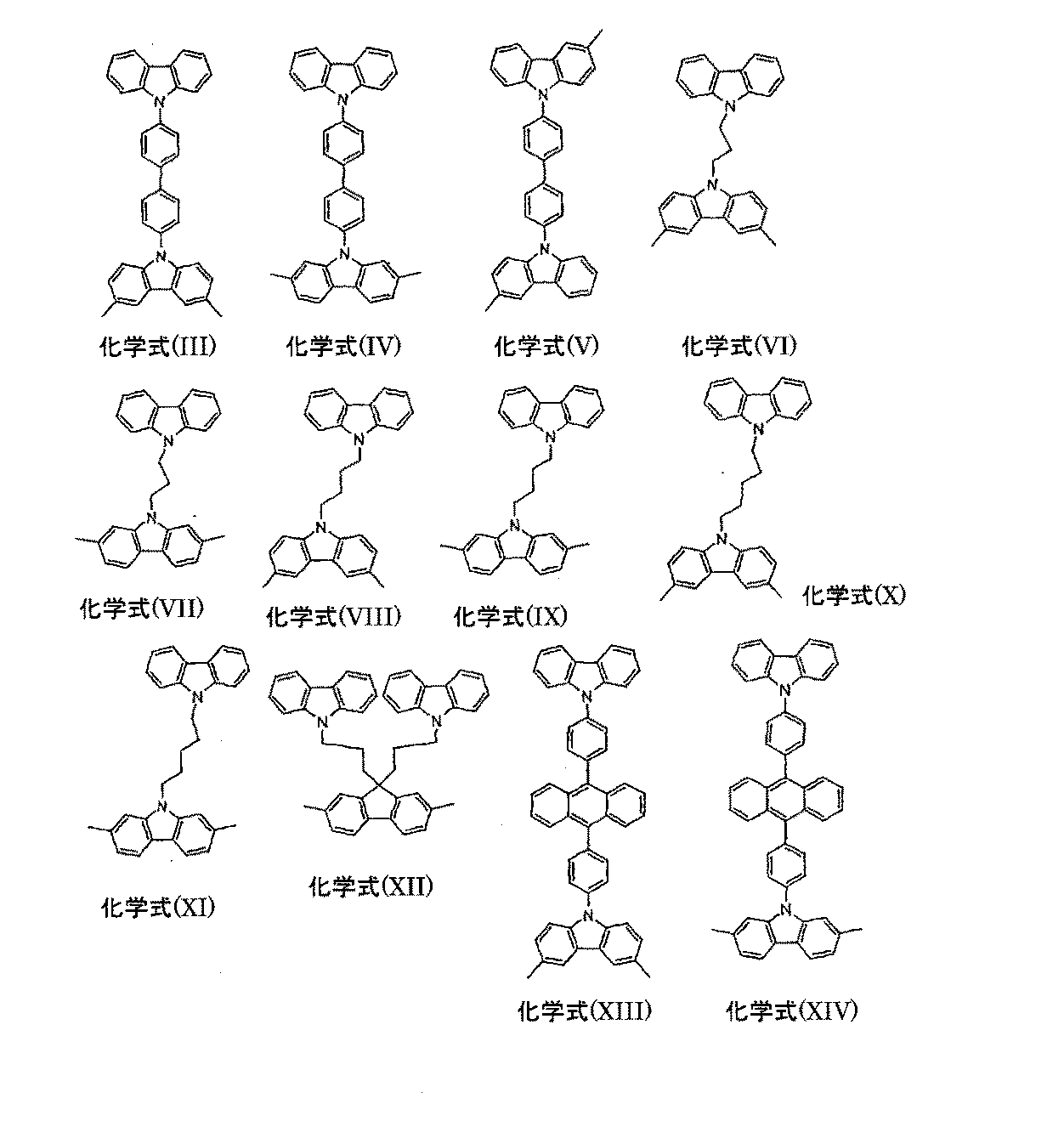
化学式(I)の特に好ましい構造単位は、表示した化学式(III)から化学式(XXXVIII)の置換構造または非置換構造であり、単結合はポリマーへの結合を示す。ここではメチル基を表すことは意図されない。より良い比較のために、潜在的な置換基は示していない。
化学式(I)の極めて特に好ましい構造について:
Rは、各例で同一または異なり、3個から10個の炭素原子を有し非置換でもR1置換でもよい、直鎖もしくは分枝鎖のアルキレン鎖(1個またはそれ以上の非隣接炭素原子が-NR2-、-O-または-S-で置き換わっていてもよい)、チオフェン、ベンゼン、ビフェニル、ナフタレン、アントラセンまたはフェナントレンから選択される2価の芳香環構造もしくは複素芳香環構造(その各々は非置換であるか、1つまたは2つの置換基R1で置換されている)、9,9’-置換フルオレン、0から4つまでの置換基R1によって置換されているスピロビフルオレン、9,10-置換もしくは9,9,10,10-置換ジヒドロフェナントレン、0から2つの置換基R1を自由な位置に有するスチルベニル系もしくはトラニル系、または2種または3種のこれらの系の組み合わせである;
R1、R2、nは上の記載に類似したものである;
POLY1における結合は上の記述に類似したものである。
For very particularly preferred structures of formula (I):
R is the same or different in each instance, and is a straight or branched alkylene chain (one or more non-adjacent carbon atoms) having 3 to 10 carbon atoms, which may be unsubstituted or R 1 substituted. May be replaced by —NR 2 —, —O— or —S—), divalent aromatic ring structure or heteroaromatic ring structure selected from thiophene, benzene, biphenyl, naphthalene, anthracene, or phenanthrene (each of which Is unsubstituted or substituted by one or two substituents R 1 ), 9,9′-substituted fluorenes, spirobifluorenes substituted by 0 to 4 substituents R 1 , 9,10 substituted or 9,9,10,10- substituted dihydrophenanthrene, 0 stilbenyl system or tolanyl system having two substituents R 1 in the free positions, or two or three Is a combination of these systems;
R 1 , R 2 , n are similar to those described above;
The bond in POLY1 is similar to the above description.
化学式(II)の好ましい構造について:
Rは、各例で同一または異なり、2から20個の炭素原子を有しR1置換でも非置換でもよい、直鎖、分枝鎖、もしくは環式のアルキレン鎖(1個またはそれ以上の非隣接炭素原子が-NR2-、-O-、-S-、-CO-、-CO-O-、-CO-NR2-、または-O-CO-O-で置き換わっていてもよい)、チオフェン、ベンゾチオフェン、ベンゼン、ビフェニル、ピリジン、キノキサリン、フルオレン、スピロビフルオレン、ナフタレン、アントラセン、ピレン、フェナントレン、ジヒドロフェナントレンから選択され、自由な位置に0から4つの置換基R1を有する2価の芳香環構造もしくは複素芳香環構造、0から4つの置換基R1を自由な位置に有するスチルベニル系もしくはトラニル系、または2種から5種のこれらの系の組み合わせである;
R1、R2、nは上の記載に類似したものである。
For the preferred structure of formula (II):
R may be the same or different in each example, and may be a straight, branched, or cyclic alkylene chain (one or more non-substituted) having 2 to 20 carbon atoms and may be R 1 substituted or unsubstituted. -NR 2 is adjacent carbon atoms -, - O -, - S -, - CO -, - CO-O -, - CO-NR 2 -, or may be replaced -O-CO-O- in) Selected from thiophene, benzothiophene, benzene, biphenyl, pyridine, quinoxaline, fluorene, spirobifluorene, naphthalene, anthracene, pyrene, phenanthrene, dihydrophenanthrene, divalent having 0 to 4 substituents R 1 in free positions An aromatic or heteroaromatic ring structure, a stilbenyl or tranyl system having 0 to 4 substituents R 1 in free positions, or a combination of 2 to 5 of these systems;
R 1 , R 2 , n are similar to those described above.
化学式(II)の特に好ましい構造について:
Rは、各例で同一または異なり、2から15個の炭素原子を有しR1置換でも非置換でもよい、直鎖もしくは分枝鎖のアルキレン鎖(1個またはそれ以上の非隣接炭素原子が-NR2-、-O-または-S-で置き換わっていてもよい)、チオフェン、ベンゾチオフェン、ベンゼン、ビフェニル、ピリジン、ナフタレン、アントラセン、ピレンまたはフェナントレンから選択され、非置換でも、1つまたは2つの置換基R1で置換されていてもよい2価の芳香環構造もしくは複素芳香環構造、9,9’-置換フルオレン、4つまでの置換基R1で置換されているスピロビフルオレン、9,10-置換もしくは9,9,10,10-置換ジヒドロフェナントレン、0から2つの置換基R1を自由な位置に有するスチルベニル系もしくはトラニル系、または2種から4種のこれらの系の組み合わせである;
R1、R2は上の記載に類似したものである;
nは各例で同一または異なり、0、1または2である。
For a particularly preferred structure of formula (II):
R may be the same or different in each instance, and may be a straight or branched alkylene chain having 2 to 15 carbon atoms and R 1 substituted or unsubstituted (one or more non-adjacent carbon atoms are Selected from —NR 2 —, —O— or —S—, optionally substituted with thiophene, benzothiophene, benzene, biphenyl, pyridine, naphthalene, anthracene, pyrene or phenanthrene; one of the substituents R 1 substituted by divalent may be an aromatic ring structure or a heterocyclic aromatic ring structure, 9,9'-substituted fluorene, spirobifluorene which is substituted by substituents R 1 up to 4, 9 , 10-substituted or 9,9,10,10- substituted dihydrophenanthrene, 0 stilbenyl system or tolanyl system having two substituents R 1 in the free positions, or two Four is the combination of these systems;
R 1 and R 2 are similar to those described above;
n is the same or different in each example, and is 0, 1 or 2.
化学式(II)の特に好ましい構造要素は表示した化学式(XXXIX)から化学式(LVIII)の非置換構造または置換構造である。より良い比較のために、潜在的な置換基は一般的に示していない。
化学式(II)の極めて特に好ましい構造について:
Rは、各例で同一または異なり、3個から10個の炭素原子を有し非置換でもR1置換でもよい、直鎖もしくは分枝鎖のアルキレン鎖(1個またはそれ以上の非隣接炭素原子が-NR2-、-O-または-S-で置き換わっていてもよい)、チオフェン、ベンゼン、ビフェニル、ナフタレン、アントラセンまたはフェナントレンから選択される2価の芳香環構造もしくは複素芳香環構造(その各々は非置換であるか、1つまたは2つの置換基R1で置換されている、9,9’-置換フルオレン、0から4つの置換基R1によって置換されているスピロビフルオレン、9,10-置換もしくは9,9,10,10-置換ジヒドロフェナントレン、0から2つの置換基R1を自由な位置に有するスチルベニル系もしくはトラニル系、または2種または3種のこれらの系の組み合わせである;
R1、R2、nは上の記載に類似したものである。
For a very particularly preferred structure of formula (II):
R is the same or different in each instance, and is a straight or branched alkylene chain (one or more non-adjacent carbon atoms) having 3 to 10 carbon atoms, which may be unsubstituted or R 1 substituted. May be replaced by —NR 2 —, —O— or —S—), divalent aromatic ring structure or heteroaromatic ring structure selected from thiophene, benzene, biphenyl, naphthalene, anthracene, or phenanthrene (each of which Is unsubstituted or substituted with one or two substituents R 1 , 9,9′-substituted fluorenes, spirobifluorenes substituted with 0 to 4 substituents R 1 , 9,10 - substituted or 9,9,10,10- substituted dihydrophenanthrene, 0 stilbenyl based or tolanyl system having two substituents R 1 in the free positions, or two or three of these Is a combination of the system;
R 1 , R 2 , n are similar to those described above.
これは記載から明確ではあるが、化学式(I)および化学式(II)の両方の構造単位および化学式(III)から化学式(LVIII)までの構造単位は非対称置換型でもよい、すなわち異なる置換基が1つの単位に存在していてもよいし、それらが異なる位置に結合していてもよい、ということをここで再度明白に示す。 Although this is clear from the description, the structural units of both chemical formula (I) and chemical formula (II) and the structural units of chemical formula (III) to chemical formula (LVIII) may be asymmetrically substituted, i.e. 1 different substituent. It is again explicitly shown here that they may be present in one unit or they may be attached at different positions.
BLEND2およびBLEND4で使用する化学式(II)の構造単位を例えば以下に示すように得てもよい:
カルバゾールのN-アルキル化またはN-ベンジル化は文献で知られている。この方法で、2つのカルバゾール単位を置換されたもしくは非置換のアルキレン鎖、ベンジル鎖、アルキルアリーレン鎖もしくはシクロアルキレン鎖によって架橋できる。合成は、例えばM.E. Wrightら., J. Org. Chem. 1989, 54, 965に記載されているように、塩基性条件下でカルバゾールをアルキル化試薬と反応させることでなされる。
The structural unit of formula (II) used in BLEND2 and BLEND4 may be obtained, for example, as shown below:
N-alkylation or N-benzylation of carbazole is known in the literature. In this way, two carbazole units can be bridged by a substituted or unsubstituted alkylene chain, benzyl chain, alkylarylene chain or cycloalkylene chain. The synthesis is done by reacting carbazole with an alkylating reagent under basic conditions, for example as described in ME Wright et al., J. Org. Chem. 1989, 54, 965.
カルバゾールをHARTWIG-BUCHWALDに従ってN-アリール化することができ、カルバゾールについてのその方法はM. Watanabe et al., Tetrahedron Lett. 2000, 41, 481に記載されている。この方法により2つのカルバゾール単位を適切なアリーレン基、ヘテロアリーレン基、スチルベニレン基またはトラニル基によって同様に架橋できる。 Carbazole can be N-arylated according to HARTWIG-BUCHWALD, and the method for carbazole is described in M. Watanabe et al., Tetrahedron Lett. 2000, 41, 481. In this way, two carbazole units can be similarly cross-linked by a suitable arylene group, heteroarylene group, stilbenylene group or tranyl group.
カルバゾールの親構造にアルキル置換基を有するカルバゾールの合成は文献によって知られている:P. Bhattacharyyaら., J. Chem. Soc., Chem. Commun. 1984, 1668。 The synthesis of carbazoles having an alkyl substituent in the parent structure of carbazole is known from the literature: P. Bhattacharyya et al., J. Chem. Soc., Chem. Commun. 1984, 1668.
カルバゾールの親構造上の別の置換基を、以下に記載するハロゲン化合物から得ることができる。このことは、例えばパラジウム触媒クロスカップリング反応により、他の有機基を導入することを可能にする。BLEND4に必要とされるような、カルバゾールダイマーおよび三重項発光体(COMP3)からなる化合物を、適切な置換三重項発光体を用いる同様の反応で得ることができる。 Other substituents on the carbazole parent structure can be obtained from the halogen compounds described below. This makes it possible to introduce other organic groups, for example by palladium catalyzed cross-coupling reactions. A compound consisting of a carbazole dimer and a triplet emitter (COMP3) as required for BLEND4 can be obtained in a similar reaction using an appropriate substituted triplet emitter.
POLY1の合成のために、ポリマー中の化学式(I)の構造単位を導く適切なモノマーを、例えば以下に記載したように得てもよい:
3,6-ジブロモカルバゾールは、文献:Smithら., Tetrahedron 1992, 48, 7479に記載されているように、カルバゾールを臭素化することで合成する。
For the synthesis of POLY1, suitable monomers leading to structural units of formula (I) in the polymer may be obtained, for example as described below:
3,6-Dibromocarbazole is synthesized by bromination of carbazole as described in the literature: Smith et al., Tetrahedron 1992, 48, 7479.
2,7-ジブロモカルバゾールは、文献:Tidwellら., Eur. J. Med. Chem. 1997, 32, 781に記載されているように、カルバゾールの親構造を構成することで合成する。 2,7-Dibromocarbazole is synthesized by constituting the parent structure of carbazole as described in the literature: Tidwell et al., Eur. J. Med. Chem. 1997, 32, 781.
モノマーとしての使用を可能にする官能性付与(すなわち、例えばハロゲン末端基の導入)は、原理的に、前駆体に実施するか、または既に完全に構成された親構造に最後の段階として実施することができる。 Functionalization (ie introduction of, for example, halogen end groups) enabling use as a monomer is in principle carried out on the precursor or as a last step on the already fully constructed parent structure be able to.
官能基は、非常に損傷を受ける方法でしか反応しない場合には事前にすでに存在するであろうが、仮にそうであるとしても次の反応工程に存在するであろう。これは、例えば、単純な置換反応の場合、または異なる反応性(例えば臭素に対してヨウ素、または塩素に対して臭素)を利用できる場合であろう。 The functional group will already be present in advance if it only reacts in a very damaging manner, but if so, it will be present in the next reaction step. This may be the case, for example, in the case of a simple substitution reaction, or where a different reactivity (eg iodine to bromine or bromine to chlorine) can be utilized.
第2に、(例えば置換が起きる、または置換基を導く場合)最初に架橋カルバゾールの親構造を構成し、最後の段階でハロゲン官能基を導入することも有利であろう。したがって、例えば、第2のカルバゾール単位が置換基によってブロックされている場合、臭素をカルバゾール単位の3-位または6-位に臭素を導入すること(例えば、穏やかなNBS臭素化(例えばCreasonら., J. Org. Chem. 1972, 37, 4440)によって)ができる。上で概要を述べたように、(i)対応するブロックされた置換基、(ii)適切な導電性置換基または(iii)活性もしくは不活性の複素環の存在下で、この方法を化学式(I)の他の構造に対して使用してもよい。3,3’-位がすでに他の置換基でブロックされている場合には、6,6’-位での官能性付与も同様に可能である。 Second, it may also be advantageous to first construct the parent structure of the bridged carbazole (for example when substitution occurs or leads to substituents) and introduce the halogen functionality in the last step. Thus, for example, if the second carbazole unit is blocked by a substituent, introducing bromine into the 3- or 6-position of the carbazole unit (eg, mild NBS bromination (see, eg, Creason et al. , J. Org. Chem. 1972, 37, 4440). As outlined above, the process is carried out in the presence of (i) the corresponding blocked substituent, (ii) a suitable conductive substituent, or (iii) an active or inactive heterocycle. I) It may be used for other structures. If the 3,3'-position is already blocked with other substituents, functionalization at the 6,6'-position is possible as well.
ハロゲン誘導体から、標準的な方法によって対応するビスホウ酸(bisboronic acid)誘導体またはビススタナン(bisstannane)誘導体を調製することができる(タイプAおよびCの上述の重合処理用)。これらの方法は一般的に、存在するハロゲンを金属(例えばMg、Li)と交換し、それをホウ酸エステルまたはトリアルキル錫ハロゲン化合物と反応させることにある。ホウ酸誘導体の調製のために、例えばハロゲン化物をボランまたはジボランとパラジウム触媒下で直接反応させる触媒処理も知られている。 From the halogen derivative, the corresponding bisboronic acid derivative or bisstannane derivative can be prepared by standard methods (for the above-mentioned polymerization treatments of type A and C). These methods generally consist in replacing the halogen present with a metal (eg Mg, Li) and reacting it with a borate ester or a trialkyltin halogen compound. Catalytic treatment is also known for the preparation of boric acid derivatives, for example by reacting a halide directly with borane or diborane under a palladium catalyst.
本発明はさらに、化学式(LIX)の2官能性のモノマー化合物を提供する。
これは、2つの官能基Yが同一または異なり、C-C結合またはC-N結合の形成の条件下で共重合し;他の記号および添字は、各々、化学式(I)で定義したとおりであり;Yの結合は化学式(I)のXと同一の位置であることを特徴とする。 This is because the two functional groups Y are the same or different and copolymerize under the conditions of formation of a C—C bond or a C—N bond; the other symbols and subscripts are as defined in Formula (I), respectively. Yes; the bond of Y is at the same position as X in formula (I).
Yは好ましくはCl、Br、I、O-トシレート、O-トリフレート、OSO2R2、B(OH)2、B(OR2)2、Sn(R2)3およびNHR2からなる群より選択され、ここでR2は上で記載したように定義される。 Y is preferably from the group consisting of Cl, Br, I, O-tosylate, O-triflate, OSO 2 R 2 , B (OH) 2 , B (OR 2 ) 2 , Sn (R 2 ) 3 and NHR 2 Where R 2 is defined as described above.
C-CおよびC-N結合生成は好ましくはSUZUKIカップリング、YAMAMOTOカップリング、STILLEカップリングおよびHARTWIG-BUCHWALDカップリングからなる群より選択される。 C—C and C—N bond formation is preferably selected from the group consisting of SUZUKI coupling, YAMAMOTO coupling, STILLE coupling and HARTWIG-BUCHWALD coupling.
ここで特に好ましいのは、ポリマー中で化学式(III)から化学式(XXXVIII)の構造単位をもたらす化学式(LIX)のモノマー化合物である。 Particular preference is given here to monomer compounds of the formula (LIX) which lead to structural units of the formula (XXXVIII) to (XXXVIII) in the polymer.
BLEND1およびBLEND3へ混合される構造単位COMP1、POLY2(=BLEND2)へ重合される構造単位COMP2、およびBLEND4混合されるCOMP3を、一重項励起子から三重項励起子への遷移を可能にし、さらに室温で三重項状態から発光できる、任意の有機または有機金属材料種から選択してもよい;まず、これらは特に、重原子、すなわち周期表で36以上の原子番号を有する元素の原子を含む化合物である。この目的に対して特に適切なものは、上述の条件を満たすdおよびf遷移金属を含む化合物である。ここで、極めて特に好ましいものは、8族から10族(Ru、Os、Rh、Ir、Pd、Pt)の元素を含む対応する構造単位である。このような化合物は全ての発光色(青、緑、赤)に対して知られている。 The structural unit COMP1, which is mixed into BLEND1 and BLEND3, the structural unit COMP2 which is polymerized into POLY2 (= BLEND2), and the COMP3 which is mixed with BLEND4 are allowed to transition from singlet excitons to triplet excitons, and at room temperature. May be selected from any organic or organometallic species that can emit light from the triplet state; first, these are particularly heavy atoms, ie compounds containing atoms of elements having an atomic number of 36 or more in the periodic table is there. Particularly suitable for this purpose are compounds containing d and f transition metals that satisfy the above-mentioned conditions. Very particularly preferred here are the corresponding structural units comprising elements of groups 8 to 10 (Ru, Os, Rh, Ir, Pd, Pt). Such compounds are known for all emission colors (blue, green, red).
COMP1またはCOMP3は低分子量、オリゴマー、デンドリマー、もしくはポリマーの化合物でもよい。COMP1またはCOMP3をブレンド(BLEND1、BLEND3、BLEND4)として処理しなくてはいけないので、適切な溶媒(例えば、トルエン、キシレン、アニソール、THF、メチルアニソール、メチルナフタレンまたはこれら溶媒の混合物)に対して十分な溶解性を有し、これらの溶媒中で溶液からの処理が可能なことが必要である。ここで、有用な低分子量の構造単位は、例えばWO 02/068435、WO 02/081488、EP 1239526およびWO 04/026886に記載されているような、例えば様々な錯体である。この目的のために有用なデンドリマー構造は、例えばWO 99/21935、WO 01/059030およびWO 02/066552に記載されているような錯体である。 COMP1 or COMP3 may be a low molecular weight, oligomer, dendrimer, or polymer compound. Since COMP1 or COMP3 must be processed as a blend (BLEND1, BLEND3, BLEND4), enough for a suitable solvent (eg toluene, xylene, anisole, THF, methylanisole, methylnaphthalene or a mixture of these solvents) Must be soluble in these solvents and be processed from solution in these solvents. Here, useful low molecular weight structural units are, for example, various complexes, as described, for example, in WO 02/068435, WO 02/081488, EP 1239526 and WO 04/026886. Useful dendrimer structures for this purpose are complexes as described, for example, in WO 99/21935, WO 01/059030 and WO 02/066552.
COMP2はPOLY2(=BLEND2)のポリマー鎖に共有結合的に組み込まれる。ポリマーの主鎖もしくは側鎖のどちらかに組み込まれることが好ましい。POLY2へのCOMP2の組み込みを可能とするために、官能性の重合可能な基がCOMP2に存在しなくてはならない。重合反応でモノマーとして使用できる対応する臭素化錯体の例は、WO 02/068435に記載されている。 COMP2 is covalently incorporated into the polymer chain of POLY2 (= BLEND2). It is preferably incorporated into either the main chain or the side chain of the polymer. In order to be able to incorporate COMP2 into POLY2, a functional polymerizable group must be present in COMP2. Examples of corresponding brominated complexes that can be used as monomers in the polymerization reaction are described in WO 02/068435.
本発明の混合物BLEND1はCOMP1単位をポリマーPOLY1に加えることで得られる。本発明の混合物BLEND2は化学式(II)の構造単位をポリマーPOLY2に加えることで得られる。本発明の混合物BLEND3は化学式(II)の構造単位とCOMP1単位をポリマーPOLY3に加えることで得られる。本発明の混合物BLEND4はCOMP3単位をポリマーPOLY3に加えることで得られる。 The mixture BLEND1 according to the invention is obtained by adding COMP1 units to the polymer POLY1. The mixture BLEND2 of the present invention is obtained by adding structural units of formula (II) to the polymer POLY2. The mixture BLEND3 of the present invention is obtained by adding the structural unit of formula (II) and the COMP1 unit to the polymer POLY3. The mixture BLEND4 of the present invention is obtained by adding COMP3 units to the polymer POLY3.
また、他の共役、部分共役もしくは非共役の、ポリマー、オリゴマー、デンドリマー、もしくは低分子量の化合物をBLEND1からBLEND4にさらに混合することも好ましい場合がある。例えば、電子的に活性な材料の添加は、対応するブレンドでの、ホールもしくは電子の注入、ホールもしくは電子の輸送、または電荷平衡を調節することを可能にする。また、添加成分は一重項−三重項遷移を改善することがある。しかし、電子的に不活性な化合物の添加も、例えば溶液の粘度またはフィルムの形態を制御する上で有用な場合がある。 It may also be preferable to further mix BLEND1 to BLEND4 with other conjugated, partially conjugated or non-conjugated polymers, oligomers, dendrimers, or low molecular weight compounds. For example, the addition of an electronically active material makes it possible to adjust the hole or electron injection, hole or electron transport, or charge balance in the corresponding blend. In addition, the additive component may improve the singlet-triplet transition. However, the addition of electronically inert compounds may also be useful, for example, in controlling solution viscosity or film morphology.
従って、このようにして得られたブレンドも発明の主題の一部を形成する。 Thus, the blends thus obtained also form part of the inventive subject matter.
本発明はさらに共役ポリマーPOLY4を提供する。これは
(A)1−99.9mol%、好ましくは10−99mol%、より好ましくは20−99mol%の1つまたはそれ以上の化学式(I)の単位
および
(B)0.1−95mol%、好ましくは0.5−80mol%、より好ましくは1−50mol%、特に2−25mol%の、好ましくは1種またはそれ以上の有機金属構造単位COMP2の形態にある、1種またはそれ以上の三重項発光体
を含む。
ここで記号X、R、R1、R2および添字nは、各々、上で記載したように定義される。 Here, the symbols X, R, R 1 , R 2 and the subscript n are each defined as described above.
これらのポリマーにおいて、化学式(I)の構造単位はポリマーPOLY1について記載したように組み込まれる。構造単位COMP2は、既にPOLY2について記載したように、POLY4の主鎖および/または側鎖に組み込まれる。 In these polymers, the structural unit of formula (I) is incorporated as described for the polymer POLY1. The structural unit COMP2 is incorporated into the main chain and / or side chain of POLY4 as already described for POLY2.
POLY4は、POLY1からPOLY3までについて記載したように、別の構造要素(例えばポリマー骨格単位、電荷注入単位または電荷輸送単位)を含んでいてもよい。同様にランダムな構造、部分的にランダムな構造、交互構造またはブロックのような構造を有していてもよいし、直線状、分枝鎖状もしくはデンドリマー状でもよい。POLY4においても、ポリマーの溶解性は、特にポリマー単位上の置換基RおよびR1によって決定される。POLY4はPOLY1およびPOLY3について記載したように合成される。化学式(I)の特に好ましい構造単位は上で表示した化学式(III)から化学式(XXXVIII)の構造である。 POLY4 may include other structural elements (eg, polymer backbone units, charge injection units or charge transport units) as described for POLY1 through POLY3. Similarly, it may have a random structure, a partially random structure, an alternating structure or a block-like structure, or may be linear, branched or dendrimeric. Also in POLY4, solubility of the polymer is determined especially by the substituents R and R 1 on the polymer units. POLY4 is synthesized as described for POLY1 and POLY3. Particularly preferred structural units of formula (I) are those of formula (III) to formula (XXXVIII) shown above.
さらに、他の共役、部分共役、もしくは非共役の、ポリマー、オリゴマー、デンドリマーもしくは低分子量の化合物をPOLY4に混合して、ブレンドをここで形成することも好ましい。化学式(II)の構造単位をここで混合させ、化学式(I)と化学式(II)の構造の合計の含有量を増加させることも好ましい。構造単位COMP1を混合することも同様に好ましい。しかし、その他の成分の添加もいくつかの用途に対して実行できることが分かるであろう。例えば、電子的に活性な材料の添加により、このようにして形成したブレンドの、ホールもしくは電子の注入、ホールもしくは電子の輸送、または電荷平衡を調節することが可能になる。添加成分はさらに一重項−三重項遷移を改善できる場合もある。しかし、電子的に不活性な成分の添加も、例えば溶液の粘度またはフィルムの形態を制御する上で有用である場合がある。従って、このようにしてPOLY4から得られたブレンドも発明の主題の一部を形成する。 In addition, it is also preferred that other conjugated, partially conjugated or non-conjugated polymers, oligomers, dendrimers or low molecular weight compounds are mixed with POLY4 to form a blend here. It is also preferred that the structural units of formula (II) are mixed here to increase the total content of the structures of formula (I) and formula (II). It is likewise preferred to mix the structural unit COMP1. However, it will be appreciated that the addition of other components can be carried out for some applications. For example, the addition of an electronically active material makes it possible to adjust the hole or electron injection, hole or electron transport, or charge balance of the blend thus formed. The additive component may further improve the singlet-triplet transition. However, the addition of electronically inert components may also be useful, for example, in controlling solution viscosity or film morphology. Thus, blends thus obtained from POLY4 also form part of the inventive subject matter.
BLEND1からBLEND4(または任意にPOLY4と他の成分とのブレンド)を以下のように調製する:ブレンドの各成分を適切な混合比で混ぜ合わせ、適切な溶媒に溶解させる。適切な溶媒としては、例えばトルエン、アニソール、キシレン、メチルアニソール、メチルナフタレン、クロロベンゼン、環式エーテル(例えばジオキサン、THF、メチルジオキサン)、アミド(例えばNMP、DMF)およびこれらの溶媒の混合物である。あるいは、ブレンドの成分を別々に溶解してもよい。この場合、ブレンドの溶液は各溶液を適切な混合比で混ぜ合わせることで得られる。溶解操作は好ましくは不活性雰囲気で行う。ブレンドを典型的には、(再び析出することによって)固体として分離するのではなく、むしろ溶液からさらに直接処理する。 BLEND1 to BLEND4 (or optionally a blend of POLY4 and other components) are prepared as follows: The components of the blend are combined at an appropriate mixing ratio and dissolved in an appropriate solvent. Suitable solvents are, for example, toluene, anisole, xylene, methylanisole, methylnaphthalene, chlorobenzene, cyclic ethers (eg dioxane, THF, methyldioxane), amides (eg NMP, DMF) and mixtures of these solvents. Alternatively, the components of the blend may be dissolved separately. In this case, the solution of the blend is obtained by mixing each solution at an appropriate mixing ratio. The dissolution operation is preferably performed in an inert atmosphere. The blend is typically not separated as a solid (by re-precipitation), but rather processed directly from the solution.
個々の成分の適切な比率は、成分がポリマーと共有結合しているか、または混合しているかに関わらず、合計で1−99.5mol%、好ましくは10−99mol%、より好ましくは20−99mol%の化学式(I)および化学式(II)の単位、および0.1−95mol%、好ましくは0.5−80mol%、より好ましくは1−50mol%、特に2−25mol%のCOMP1、COMP2およびCOMP3を含む混合物である。 The appropriate ratio of the individual components is 1-99.5 mol% in total, preferably 10-99 mol%, more preferably 20-99 mol, regardless of whether the components are covalently bonded or mixed with the polymer. % Units of formula (I) and formula (II), and 0.1-95 mol%, preferably 0.5-80 mol%, more preferably 1-50 mol%, especially 2-25 mol% of COMP1, COMP2 and COMP3 It is a mixture containing.
本発明の混合物BLEND1からBLEND4およびポリマーPOLY4は、とりわけ上述の従来技術を上まわる、以下の驚くべき長所を有する:
化学式(I)または化学式(II)の単位を全く含まない比較例のポリマーおよびブレンドでのものと比べ、本発明のポリマーPOLY1またはブレンドBLEND1からBLEND4での三重項発光体の発光は驚くほど著しくより効率的である(表1のデータを参照のこと)。
The blends BLEND1 to BLEND4 and the polymer POLY4 of the present invention have the following surprising advantages, especially over the prior art described above:
Compared to those of comparative polymers and blends that do not contain any units of formula (I) or formula (II), the emission of triplet emitters with the polymer POLY1 or blends BLEND1 to BLEND4 of the present invention is surprisingly significantly greater Is efficient (see data in Table 1).
比較例のポリマーまたは類似のブレンドをPLEDにおいて使用する場合の所定の電圧における電流、すなわち電流−電圧特性曲線は、共役ポリマーと化学式(I)または化学式(II)の構造単位の両方が存在する場合(純粋な共役ポリマーであるか混合物であるかに関わらず)に、より急勾配である。上で既に詳細に説明したように、これは応用にとっての著しい長所をもたらす。というのは、それゆえ低いエネルギー消費で効率的なフルカラーディスプレイを得るという目的が可能になるためである。 When a comparative polymer or similar blend is used in a PLED, the current at a given voltage, ie the current-voltage characteristic curve, is when both the conjugated polymer and the structural unit of formula (I) or formula (II) are present It is steeper (whether it is a pure conjugated polymer or a mixture). As already explained in detail above, this provides significant advantages for the application. This is because the goal of obtaining an efficient full color display with low energy consumption is therefore possible.
有機溶媒に対する溶解性は良好である。すなわち、トルエン、キシレン、アニソール、メチルアニソールまたはメチルナフタレンのような溶媒に、例えば混合物BLEND1からBLEND4およびポリマーPOLY4は少なくとも1から30g/lの範囲(使用する三重項発光体とポリマーの分子量に依存する)の濃度で可溶である。 Solubility in organic solvents is good. That is, in solvents such as toluene, xylene, anisole, methylanisole or methylnaphthalene, for example the mixture BLEND1 to BLEND4 and the polymer POLY4 are in the range of at least 1 to 30 g / l (depending on the molecular weight of the triplet emitter and polymer used) ) At a concentration of
混合物BLEND1からBLEND4およびポリマーPOLY4をPLEDで使用してもよい。PLEDを構成するために、一般的な方法を普通に使用するが、個々のケースに適切に適応させなくてはならない。このような方法は例えばDE 10249723.0に詳細に説明されている。 Mixtures BLEND1 to BLEND4 and polymer POLY4 may be used in PLEDs. Common methods are commonly used to construct PLEDs, but must be appropriately adapted to the individual case. Such a method is described in detail, for example, in DE 10249723.0.
上で説明したように、本発明の混合物BLEND1からBLEND4および本発明のポリマーPOLY4は電界発光物質としてOLEDまたはこの方法で製造するディスプレイにおいて極めて特に適している。本発明の文脈では、電場発光物質はOLED中の活性層において電場を印加することで発光する材料であるとみなされる(発光層)。 As explained above, the mixtures BLEND1 to BLEND4 according to the invention and the polymer POLY4 according to the invention are very particularly suitable as electroluminescent materials in OLEDs or displays produced in this way. In the context of the present invention, an electroluminescent material is considered to be a material that emits light by applying an electric field in an active layer in an OLED (light emitting layer).
本発明はそれゆえに、OLEDで本発明の混合物BLEND1からBLEND4および本発明のポリマーPOLY4を電界発光物質として使用することも提供する。 The invention therefore also provides the use of the inventive mixtures BLEND1 to BLEND4 and the inventive polymer POLY4 as electroluminescent materials in OLEDs.
本発明は同様に1層またはそれ以上の活性層を有するOLEDを提供する。これらの層の少なくとも1層は1種またはそれ以上の本発明の混合物BLEND1からBLEND4または本発明のポリマーPOLY4を含む。 The present invention also provides OLEDs having one or more active layers. At least one of these layers comprises one or more of the inventive mixtures BLEND1 to BLEND4 or the inventive polymer POLY4.
本出願の本文において、およびさらに以下の例においても、目的は、OLEDとそれに対応するディスプレイに関連する、本発明の混合物BLEND1からBLEND4および本発明のポリマーPOLY4の使用である。記載の制限に関わらず、当業者は別段の発明力なしに、本発明のポリマーもしくはブレンドを他の電子デバイス、少数の用途のみを言及すると、例えば、有機太陽電池(O−SC)、非線形光学、有機光学検出器または他の有機レーザーダイオード(O−レーザー)での他の使用に利用できる。これらも同様に本発明の主題の一部を形成する。 In the text of this application, and also in the examples below, the aim is the use of the inventive mixtures BLEND1 to BLEND4 and the inventive polymer POLY4 in connection with OLEDs and corresponding displays. Despite the limitations of the description, those skilled in the art will refer to the polymers or blends of the present invention in other electronic devices, only a few applications, for example, organic solar cells (O-SC), non-linear optics, without further inventive power. Available for other uses in organic optical detectors or other organic laser diodes (O-lasers). These likewise form part of the subject matter of the present invention.
本発明を以下の例によって詳細に説明するが、それらに限定することをなんら意図していない。 The invention is illustrated in detail by the following examples, which are not intended to be limiting in any way.
(例)
パートA:モノマーおよびブレンド成分の合成
例A1:POLY1用のモノマーの合成
モノマーM1からモノマーM23の合成はWO 02/077060およびそこで引用されている文献に既に詳細に説明されている。よりよい理解のために、モノマーを再度以下に示す。
Part A: Synthesis of monomers and blend components Example A1: Synthesis of monomers for POLY1 The synthesis of monomer M23 from monomer M1 has already been described in detail in WO 02/077060 and the literature cited therein. For better understanding, the monomers are again shown below.
例A2:化学式(I)の本発明のモノマー
化学式(I)のモノマーを以下、“IM”(=本発明のモノマー)と呼ぶ。
Example A2: Monomer of the Invention of Formula (I) The monomer of formula (I) is hereinafter referred to as “IM” (= monomer of the invention).
3,6-ジブロモカルバゾールを、Smithら, Tetrahedron 1992, 48, 7479.に従って合成した。3-メチルカルバゾールをP. Bhattacharyyaら., J. Chem. Soc., Chem. Commun. 1984, 1668に従って合成した。全ての生成物の構造的完全性を1H NMR分光法を用いて明らかにした;生成物の純度はHPLCを用いて測定した。 3,6-Dibromocarbazole was synthesized according to Smith et al., Tetrahedron 1992, 48, 7479. 3-Methylcarbazole was synthesized according to P. Bhattacharyya et al., J. Chem. Soc., Chem. Commun. 1984, 1668. The structural integrity of all products was revealed using 1 H NMR spectroscopy; product purity was determined using HPLC.
N-(ω-ブロモアルキル)カルバゾール:概要
保護ガス下で、44mmolの水素化ナトリウムを100mlの乾燥THFに溶解した40mmolのカルバゾールの懸濁液に添加する。水素の発生が完了した後、400mmolの適切なα,ω-ジブロモアルカンを隔膜を通して添加し、その混合物を水分を除去しながら室温で終夜攪拌した。形成した臭化ナトリウムを濾過して取除き、減圧下でTHFを除去し、過剰なブロモアルカンをオイルポンプ吸引で回収する。生成物をカラムクロマトグラフィー(シリカゲル/CHCl3)で分離する。 Under protective gas, 44 mmol sodium hydride is added to a suspension of 40 mmol carbazole dissolved in 100 ml dry THF. After hydrogen evolution was complete, 400 mmol of the appropriate α, ω-dibromoalkane was added through the septum and the mixture was stirred overnight at room temperature while removing moisture. The formed sodium bromide is removed by filtration, the THF is removed under reduced pressure, and the excess bromoalkane is recovered by oil pump suction. The product is separated by column chromatography (silica gel / CHCl 3 ).
N-(3-ブロモプロピル)カルバゾール(n=3):6.68g(40mmol)のカルバゾール、80.8g(40.6ml、400mmol)の1,3-ジブロモプロパン、1.06g(44mmol)のNaH、100mlのTHF。 N- (3-bromopropyl) carbazole (n = 3): 6.68 g (40 mmol) carbazole, 80.8 g (40.6 ml, 400 mmol) 1,3-dibromopropane, 1.06 g (44 mmol) NaH , 100 ml THF.
収量:9.2g(56%)、HPLC純度99.4%。 Yield: 9.2 g (56%), HPLC purity 99.4%.
1H NMR (CDCl3, 500 MHz): 8.11 (d, J=8.7 Hz, 2H), 7.48 (m, 4H), 7.24 (m, 2H), 4.51 (t, J=6.35 Hz, 2H), 3.39 (t, J=6.35 Hz, 2H), 2.43 (m, 2H)。 1 H NMR (CDCl 3 , 500 MHz): 8.11 (d, J = 8.7 Hz, 2H), 7.48 (m, 4H), 7.24 (m, 2H), 4.51 (t, J = 6.35 Hz, 2H), 3.39 (t, J = 6.35 Hz, 2H), 2.43 (m, 2H).
N-(4-ブロモブチル)カルバゾール(n=4):6.68g(40mmol)のカルバゾール、86.36g(47.2ml、400mmol)の1,4-ジブロモブタン、1.06g(44mmol)のNaH、100mlのTHF。 N- (4-bromobutyl) carbazole (n = 4): 6.68 g (40 mmol) carbazole, 86.36 g (47.2 ml, 400 mmol) 1,4-dibromobutane, 1.06 g (44 mmol) NaH, 100 ml THF.
収量:8.58g(71%)、HPLC純度99.5%。 Yield: 8.58 g (71%), HPLC purity 99.5%.
1H NMR (CDCl3, 500 MHz): 8.11 (d, J=8.7 Hz, 2H), 7.48 (m, 4H), 7.24 (m, 2H), 4.35 (t, J=6.35 Hz, 2H), 3.37 (t, J=6.35 Hz, 2H), 2.43-1.81 (m, 4H)。 1 H NMR (CDCl 3 , 500 MHz): 8.11 (d, J = 8.7 Hz, 2H), 7.48 (m, 4H), 7.24 (m, 2H), 4.35 (t, J = 6.35 Hz, 2H), 3.37 (t, J = 6.35 Hz, 2H), 2.43-1.81 (m, 4H).
アルキルカルバゾールダイマーからのモノマー:概要
還流冷却器を備える500mlのフラスコの中で、990mg(41.2mmol)の水素化ナトリウムを保護ガス下で80mlの乾燥DMFに懸濁させる。80mlのDMFに溶解した30.8mmolの3,6-もしくは2,7-ジハロカルバゾール(X=Cl、Br、I)を室温で20分以内にこの反応混合物に滴下して添加する。続いて、50mlの乾燥DMFに溶解した30.8mmolのN-(ω-ブロモアルキル)カルバゾールの溶液を滴下して添加し、その混合物を60℃で8時間加熱する。室温まで冷却した後、300mlの水と200mlの酢酸エチルを注意深く添加する。相分離をし、有機相を50mlのH2Oで4回洗浄し、MgSO4で乾燥し、溶媒を減圧下で除去する。n-ヘキサンからの再結晶を繰り返すことで純粋な生成物を得る。 In a 500 ml flask equipped with a reflux condenser, 990 mg (41.2 mmol) of sodium hydride is suspended in 80 ml of dry DMF under protective gas. 30.8 mmol of 3,6- or 2,7-dihalocarbazole (X = Cl, Br, I) dissolved in 80 ml of DMF is added dropwise to the reaction mixture within 20 minutes at room temperature. Subsequently, a solution of 30.8 mmol N- (ω-bromoalkyl) carbazole dissolved in 50 ml dry DMF is added dropwise and the mixture is heated at 60 ° C. for 8 hours. After cooling to room temperature, 300 ml of water and 200 ml of ethyl acetate are carefully added. The phases are separated, the organic phase is washed 4 times with 50 ml H 2 O, dried over MgSO 4 and the solvent is removed under reduced pressure. The pure product is obtained by repeated recrystallization from n-hexane.
IM1:3,6-ジブロモ-N-(N-カルバゾリル)プロピルカルバゾール(X=Br、n=3):10.0g(30.8mmol)の3,6-ジブロモカルバゾール、8.9g(30.8mmol)のN-(3-ブロモプロピル)カルバゾール、0.99g(41.2mmol)のNaH、160mlのDMF。 IM1: 3,6-Dibromo-N- (N-carbazolyl) propylcarbazole (X = Br, n = 3): 10.0 g (30.8 mmol) of 3,6-dibromocarbazole, 8.9 g (30.8 mmol) ) N- (3-bromopropyl) carbazole, 0.99 g (41.2 mmol) NaH, 160 ml DMF.
収量:13.8g(85%)、HPLC純度99.9%。 Yield: 13.8 g (85%), HPLC purity 99.9%.
1H NMR (CDCl3, 500 MHz): 8.12 (m, 4H), 7.45 (d, J = 8.7 Hz, 2H), 7.44-7.39 (m, 2H), 7.28-7.20 (d, J = 8.7 Hz, 4H), 6.77 (d, J = 8.7 Hz, 2H), 4.38 (t, J = 7.0 Hz, 2H), 3.23 (t, J = 7.36 Hz, 2H), 2.43 (m, 2H)。 1 H NMR (CDCl 3 , 500 MHz): 8.12 (m, 4H), 7.45 (d, J = 8.7 Hz, 2H), 7.44-7.39 (m, 2H), 7.28-7.20 (d, J = 8.7 Hz, 4H), 6.77 (d, J = 8.7 Hz, 2H), 4.38 (t, J = 7.0 Hz, 2H), 3.23 (t, J = 7.36 Hz, 2H), 2.43 (m, 2H).
IM2:3,6-ジブロモ-N-(N-カルバゾリル)ブチルカルバゾール(X=Br、n=4):10g(30.8mmol)の3,6-ジブロモカルバゾール、9.3g(30.8mmol)のN-(3-ブロモブチル)カルバゾール、0.99g(41.2mmol)のNaH、160mlのDMF。 IM2: 3,6-dibromo-N- (N-carbazolyl) butylcarbazole (X = Br, n = 4): 10 g (30.8 mmol) of 3,6-dibromocarbazole, 9.3 g (30.8 mmol) N- (3-bromobutyl) carbazole, 0.99 g (41.2 mmol) NaH, 160 ml DMF.
収量:14.6g(87%)、HPLC純度99.9%。 Yield: 14.6 g (87%), HPLC purity 99.9%.
1H NMR (CDCl3, 500 MHz): 8.11 (m, 4H), 7.44 (d, J = 8.7 Hz, 2H), 7.43-7.39 (m, 2H), 7.28-7.20 (d, J = 8.7 Hz, 4H), 6.77 (d, J = 8.7 Hz, 2H), 4.34 (t, J = 6.35 Hz, 2H), 3.36 (t, J = 6.35 Hz, 2H), 2.42-1.80 (m, 4H)。 1 H NMR (CDCl 3 , 500 MHz): 8.11 (m, 4H), 7.44 (d, J = 8.7 Hz, 2H), 7.43-7.39 (m, 2H), 7.28-7.20 (d, J = 8.7 Hz, 4H), 6.77 (d, J = 8.7 Hz, 2H), 4.34 (t, J = 6.35 Hz, 2H), 3.36 (t, J = 6.35 Hz, 2H), 2.42-1.80 (m, 4H).
フルオレンカルバゾールダイマー
IM3:2,7-ジブロモ-9,9-ビス(3-(N-カルバゾリル)プロピル)フルオレン(X=Br、n=3):
保護ガス下で、9.0g(28mmol)の2,7-ジブロモフルオレン、16.4g(57mmol)のN-(3-ブロモプロピル)カルバゾールおよび0.5g(3mmol)のKIを、56mlのDMSO中で、室温で透明な溶液が形成されるまで攪拌した。続けて、6.6g(119mmol)のKOHを少しずつ添加した。一時間後、その混合物を200mlの水と混合し、CHCl3で抽出した。混合した有機層を水で洗浄し、MgSO4で乾燥した。続けて、溶媒を減圧下で除去し、生成した油分をカラムクロマトグラフィーで精製した(シリカゲル、ヘキサン/EA 40:1)。
IM3: 2,7-dibromo-9,9-bis (3- (N-carbazolyl) propyl) fluorene (X = Br, n = 3):
Under protective gas, 9.0 g (28 mmol) 2,7-dibromofluorene, 16.4 g (57 mmol) N- (3-bromopropyl) carbazole and 0.5 g (3 mmol) KI in 56 ml DMSO. At room temperature until a clear solution was formed. Subsequently, 6.6 g (119 mmol) of KOH was added in small portions. After 1 hour, the mixture was mixed with 200 ml of water and extracted with CHCl 3 . The combined organic layer was washed with water and dried over MgSO 4 . Subsequently, the solvent was removed under reduced pressure, and the resulting oil was purified by column chromatography (silica gel, hexane / EA 40: 1).
収量:15.5g(76%)、HPLC純度:99.5%。 Yield: 15.5 g (76%), HPLC purity: 99.5%.
1H NMR (CDCl3, 500 MHz): 8.10 (m, 4H), 7.88 (s, 2H), 7.61 (d, J = 7.9 Hz, 2H), 7.55 (d, J = 7.9 Hz, 2H), 7.44-7.38 (m, 4H), 7.28-7.17 (m, 8H), 4.30 (t, J = 7.02 Hz, 4H), 2.21 (t, J = 7.36 Hz, 4H), 1.91 (m, 4H)。 1 H NMR (CDCl 3 , 500 MHz): 8.10 (m, 4H), 7.88 (s, 2H), 7.61 (d, J = 7.9 Hz, 2H), 7.55 (d, J = 7.9 Hz, 2H), 7.44 -7.38 (m, 4H), 7.28-7.17 (m, 8H), 4.30 (t, J = 7.02 Hz, 4H), 2.21 (t, J = 7.36 Hz, 4H), 1.91 (m, 4H).
IM4:2,7-ジブロモ-9,9-ビス(4-(N-カルバゾリル)ブチル)フルオレン(X=Br、n=4):
合成をEM3の合成と同様に行った。9.0g(28mmol)の2,7-ジブロモフルオレン、17.2g(57mmol)のN-(4-ブロモブチル)カルバゾールおよび0.5g(3mmol)のKI、6.6g(119mmol)のKOH、56mlのDMSO。
IM4: 2,7-dibromo-9,9-bis (4- (N-carbazolyl) butyl) fluorene (X = Br, n = 4):
The synthesis was performed in the same way as the synthesis of EM3. 9.0 g (28 mmol) 2,7-dibromofluorene, 17.2 g (57 mmol) N- (4-bromobutyl) carbazole and 0.5 g (3 mmol) KI, 6.6 g (119 mmol) KOH, 56 ml DMSO.
収量:15.4g(73%)、HPLC純度99.5%。 Yield: 15.4 g (73%), HPLC purity 99.5%.
1H NMR (CDCl3, 500 MHz): 8.11 (m, 4H), 7.68 (s, 2H), 7.60 (d, J = 7.9 Hz, 2H), 7.43 (d, J = 7.9 Hz, 2H), 7.43-7.36 (m, 4H), 7.27-7.15 (m, 8H), 4.35 (t, J = 6.35 Hz, 4H), 2.23 (t, J = 6.35 Hz, 4H), 1.90-1.31 (m, 8H)。 1 H NMR (CDCl 3 , 500 MHz): 8.11 (m, 4H), 7.68 (s, 2H), 7.60 (d, J = 7.9 Hz, 2H), 7.43 (d, J = 7.9 Hz, 2H), 7.43 -7.36 (m, 4H), 7.27-7.15 (m, 8H), 4.35 (t, J = 6.35 Hz, 4H), 2.23 (t, J = 6.35 Hz, 4H), 1.90-1.31 (m, 8H).
ビフェニルカルバゾール
4,4’-ビス(3-メチルカルバゾール-9-イル)ビフェニル
最初に、7.5g(25mmol)の4,4’-ジブロモビフェニルを95mlのp-キシレンに加えて、その溶液をアルゴンで30分間脱気する。それから、まず20.1g(150mmol)のリン酸カリウム、続けて0.27g(1.5mmol)のクロロジtertブチルホスフィン/0.29g(3mmol)のNaOtertBu/5mlのp-キシレンの溶液を添加し、10分後に0.11g(0.5mmol)の酢酸Pd(II)を添加した。18.1g(100mmol)の3-メチルカルバゾールを添加した後、その混合物を還流させながら125℃で3日間加熱した。その混合物を水120mlと混合し、数時間攪拌した。固体を吸引濾過により取り出し、キシレンと水で洗浄し、EtOHから再結晶した。 First, 7.5 g (25 mmol) of 4,4′-dibromobiphenyl is added to 95 ml of p-xylene and the solution is degassed with argon for 30 minutes. Then, first, potassium phosphate 20.1 g (150 mmol), added NaO tert Bu / 5 ml of p- xylene solution of Kuroroji tert-butylphosphine /0.29G(3mmol) of 0.27 g (1.5 mmol) followed by 10 minutes later, 0.11 g (0.5 mmol) of Pd (II) acetate was added. After addition of 18.1 g (100 mmol) of 3-methylcarbazole, the mixture was heated at 125 ° C. for 3 days at reflux. The mixture was mixed with 120 ml of water and stirred for several hours. The solid was removed by suction filtration, washed with xylene and water and recrystallized from EtOH.
収量:21g(95%)、HPLC純度99.3%。 Yield: 21 g (95%), HPLC purity 99.3%.
1H NMR (CDCl3, 500 MHz): 8.97 (d, J4 = 2.0 Hz, 2H), 8.35 (dd, J3 = 9.2 Hz, J4 = 2.0 Hz, 2H), 8.12 (d J3 = 7.8 Hz, 2H), 7.55 (t, J3 = 8.2 Hz, 2H), 7.49 (d, J3 = 8.2 Hz, 2H), 7.46 (d, J3 = 9.2 Hz, 2H), 7.40 (d, J3 = 8.3 Hz, 4H), 7.35 (d, J3 = 8.3 Hz, 4H), 7.34 (t, J3 = 7.8 Hz, 2H), 2.35 (s, 3H)。 1 H NMR (CDCl 3 , 500 MHz): 8.97 (d, J 4 = 2.0 Hz, 2H), 8.35 (dd, J 3 = 9.2 Hz, J 4 = 2.0 Hz, 2H), 8.12 (d J 3 = 7.8 Hz, 2H), 7.55 (t, J 3 = 8.2 Hz, 2H), 7.49 (d, J 3 = 8.2 Hz, 2H), 7.46 (d, J 3 = 9.2 Hz, 2H), 7.40 (d, J 3 = 8.3 Hz, 4H), 7.35 (d, J 3 = 8.3 Hz, 4H), 7.34 (t, J 3 = 7.8 Hz, 2H), 2.35 (s, 3H).
IM5:4,4’-ビス(3-ブロモ-6-メチルカルバゾール-9-イル)ビフェニル
10.25g(20mmol)の4,4’-ビス(3-メチルカルバゾール-9-イル)ビフェニルを30mlの乾燥アセトニトリルに溶解させた。保護ガス下で、N-ブロモスクシンイミドをゆっくりと添加し、その混合物を室温で21時間攪拌した。残渣を濾過し、少量のアセトニトリル、引き続いて温水にて洗浄した。生成物をジオキサンから再結晶することで精製した。 10.25 g (20 mmol) of 4,4'-bis (3-methylcarbazol-9-yl) biphenyl was dissolved in 30 ml of dry acetonitrile. Under protective gas, N-bromosuccinimide was added slowly and the mixture was stirred at room temperature for 21 hours. The residue was filtered and washed with a small amount of acetonitrile followed by warm water. The product was purified by recrystallization from dioxane.
収量:12g(90%)、HPLC純度99.3%。 Yield: 12 g (90%), HPLC purity 99.3%.
1H NMR (CDCl3, 500 MHz): 8.99 (d, J4 = 2.0 Hz, 2H), 8.40 (dd, J3 = 9.2 Hz, J4 = 2.0 Hz, 2H), 8.22 (d J3 = 7.8 Hz, 2H), 7.56 (t, J3 = 8.2 Hz, 2H), 7.52 (d, J3 = 8.2 Hz, 2H), 7.47 (d, J3 = 9.2 Hz, 2H), 7.43 (d, J3 = 8.3 Hz, 4H), 7.35 (t, J3 = 7.8 Hz, 2H), 2.36 (s, 6H)。 1 H NMR (CDCl 3 , 500 MHz): 8.99 (d, J 4 = 2.0 Hz, 2H), 8.40 (dd, J 3 = 9.2 Hz, J 4 = 2.0 Hz, 2H), 8.22 (d J 3 = 7.8 Hz, 2H), 7.56 (t, J 3 = 8.2 Hz, 2H), 7.52 (d, J 3 = 8.2 Hz, 2H), 7.47 (d, J 3 = 9.2 Hz, 2H), 7.43 (d, J 3 = 8.3 Hz, 4H), 7.35 (t, J 3 = 7.8 Hz, 2H), 2.36 (s, 6H).
例A3:化学式(II)のブレンド成分
化学式(II)のブレンド成分を以下、CARBと呼ぶ。
Example A3: Blend component of formula (II) The blend component of formula (II) is hereinafter referred to as CARB.
CARB1:N-(N-カルバゾリル)プロピルカルバゾ−ル(n=3)
保護ガス下で、0.99g(41.2mmol)の水素化ナトリウムを160mlの乾燥THFに溶解した5.15g(30.8mmol)のカルバゾールの懸濁液に添加した。水素の発生が終了した後、3.11g(15.4mmol)の1,3-ジブロモプロパンを隔膜を通して添加し、その混合物を室温で、水分を除去しながら、終夜攪拌した。形成された臭化ナトリウムを濾過して取除き、THFを減圧下で除去し、かつ過剰なジブロモプロパンをオイルポンプ吸引で回収した。生成物をカラムクロマトグラフィーで精製した(シリカゲル/CHCl3)。 Under protective gas, 0.99 g (41.2 mmol) of sodium hydride was added to a suspension of 5.15 g (30.8 mmol) of carbazole dissolved in 160 ml of dry THF. After hydrogen evolution ceased, 3.11 g (15.4 mmol) of 1,3-dibromopropane was added through the septum and the mixture was stirred overnight at room temperature while removing moisture. The sodium bromide formed was removed by filtration, the THF was removed under reduced pressure, and excess dibromopropane was collected by oil pump suction. The product was purified by column chromatography (silica gel / CHCl 3 ).
収量:5.4g(94%)、HPLC純度99.9%。 Yield: 5.4 g (94%), HPLC purity 99.9%.
1H NMR (CDCl3, 500 MHz): 8.11 (m, 4H), 7.44-7.38 (m, 4H), 7.28-7.17 (m, 8H), 4.49 (t, J = 7.02 Hz, 4H), 2.22 (m, 2H)。 1 H NMR (CDCl 3 , 500 MHz): 8.11 (m, 4H), 7.44-7.38 (m, 4H), 7.28-7.17 (m, 8H), 4.49 (t, J = 7.02 Hz, 4H), 2.22 ( m, 2H).
例A4:ブレンドで使用するための構造単位COMP1
例としてここで使用する化合物COMP1はトリス(フェニルピリジル)イリジウム(III)の誘導体である。これらの化合物の合成は既に出願書類WO 02/081488およびWO 04/026886で説明されている。明確にするために、ここで使用するイリジウム錯体を再度以下に示す:
As an example, the compound COMP1 used here is a derivative of tris (phenylpyridyl) iridium (III). The synthesis of these compounds has already been described in the application documents WO 02/081488 and WO 04/026886. For clarity, the iridium complex used here is again shown below:
例A5:三重項コモノマーCOMP2
ここで使用するコモノマーCOMP2はトリス(フェニルピリジル)イリジウム(III)の誘導体である。これらの化合物の合成は、例えば、本願の優先日にはまだ公開されていない出願DE 10350606.3で説明されている。ここで使用するイリジウムコモノマーIr4およびIr5を、明確にするために、再度以下に示す:
The comonomer COMP2 used here is a derivative of tris (phenylpyridyl) iridium (III). The synthesis of these compounds is described, for example, in application DE 10350606.3, which has not yet been published on the priority date of the present application. The iridium comonomers Ir4 and Ir5 used here are again shown below for clarity:
パートB:ポリマーの調製
化学式(I)の単位も化合物COMP2も全く含まない、共役ポリマーPOLY3は既に出願書類WO 02/077060およびWO 03/020790で説明されている。これらは、参照により、本出願の一部である。
Part B: Preparation of the polymer The conjugated polymer POLY3, which contains no units of the formula (I) nor the compound COMP2, has already been described in the application documents WO 02/077060 and WO 03/020790. These are part of the present application by reference.
化学式(I)のモノマーを含むPOLY1タイプの2つのポリマーの合成を以下の例を用いて説明する。 The synthesis of two POLY1 type polymers containing monomers of formula (I) is illustrated using the following example.
例B1:ポリマーP1の合成
3.1706g(4mmol)のモノマーM2、1.9650g(2.4mmol)のモノマーM1、0.6069g(0.8mmol)のモノマーM9、0.4258g(0.8mmol)のIM1、および4.05gの水和したリン酸カリウムを、25mlのジオキサン、25mlのトルエン、7mlのH2O(全て酸素を含まない溶媒である)に溶解させた。反応溶液をアルゴンを用いて40℃で30分脱気した。それから、0.45mgのPd(OAc)2、3.65mgのP(o-トリル)3を触媒として添加し、その溶液をアルゴン雰囲気下で還流しながら4時間加熱した。エンドキャッピングを、24mgの3,4-ビスペントキシベンゼンホウ酸を用い20mlのトルエン中で行い、その混合物を還流しながら一時間加熱した。それから、10mlのトルエンに溶解した40mgの臭化3,4-ビスペントキシベンジルを添加し、その混合物を還流しながら3時間加熱した。さらに50mlのトルエンを添加した後、ポリマー溶液を100mlの0.01%NaCN水溶液と共に60℃で3時間攪拌した。相を分離し、有機相を100mlのH2Oで4回洗浄した。ポリマーを300mlのメタノールに滴下添加することで析出させて、濾過した。300mlのTHFに60℃でアルゴン雰囲気下で溶解させ、セライトを通して濾過し、600mlのメタノールを添加することで再析出させることによって、さらに精製を行った。ポリマーを濾過し、減圧下で乾燥させた。4.73g(理論値の93%)のポリマーを分離した;Mw=352000g/mol、Mn=93000g/mol、多分散性=3.8(THF中のGPC、PS基準で)。
Example B1: Synthesis of polymer P1 3.1706 g (4 mmol) of monomer M2, 1.9650 g (2.4 mmol) of monomer M1, 0.6069 g (0.8 mmol) of monomer M9, 0.4258 g (0.8 mmol) of IM1 and 4.05 g of hydrated potassium phosphate were dissolved in 25 ml dioxane, 25 ml toluene, 7 ml H 2 O (all being oxygen free solvent). The reaction solution was degassed with argon at 40 ° C. for 30 minutes. Then 0.45 mg Pd (OAc) 2 , 3.65 mg P (o-tolyl) 3 was added as catalyst and the solution was heated at reflux for 4 hours under argon atmosphere. End capping was performed in 20 ml of toluene using 24 mg of 3,4-bispentoxybenzene boric acid and the mixture was heated at reflux for 1 hour. Then 40 mg of 3,4-bispentoxybenzyl bromide dissolved in 10 ml of toluene was added and the mixture was heated at reflux for 3 hours. After adding an additional 50 ml of toluene, the polymer solution was stirred with 100 ml of 0.01% NaCN aqueous solution at 60 ° C. for 3 hours. The phases were separated and the organic phase was washed 4 times with 100 ml H 2 O. The polymer was precipitated by dropwise addition to 300 ml of methanol and filtered. Further purification was performed by dissolving in 300 ml THF at 60 ° C. under an argon atmosphere, filtering through celite, and reprecipitating by adding 600 ml methanol. The polymer was filtered and dried under reduced pressure. 4.73 g (93% of theory) of polymer were isolated; M w = 352000 g / mol, M n = 93000 g / mol, polydispersity = 3.8 (GPC in THF, based on PS).
例B2:ポリマーP2の合成
3.1760g(4mmol)のモノマーM2、1.0825g(1.6mmol)のモノマーM7、1.7726g(2.4mmol)のIM3、および4.05gの水和したリン酸カリウムを、37.5mlのジオキサン、12.5mlのトルエン、7mlのH2O(全て酸素を含まない溶媒である)に溶解させた。その反応溶液をアルゴンを用いて40℃で30分間脱気した。それから、0.45mgのPd(OAc)2、3.65mgのP(o-トリル)3を触媒として添加し、その溶液をアルゴン雰囲気下で還流しながら3時間加熱した。高粘性ポリマー溶液を50mlのトルエンで希釈した。それからエンドキャッピングを20mlのトルエンに溶解した24mgの3,4-ビスペントキシベンゼンホウ酸を用いて行い、その混合物を還流しながら一時間加熱し、それから、30mlのトルエンに溶解した40mgの臭化3,4-ビスペントキシベンジルを添加し、その混合物を還流しながら1時間加熱した。ポリマー溶液を再度50mlのトルエンで希釈し、100mlの0.01%NaCN水溶液と共に60℃で3時間攪拌した。相を分離し、有機相を100mlのH2Oで4回洗浄した。ポリマーを400mlのメタノールに滴下添加することで析出させて、濾過した。350mlのTHFに60℃でアルゴン雰囲気下で溶解させ、セライトを通して濾過し、700mlのメタノールを添加することで再析出させることによって、さらに精製を行った。ポリマーを濾過し、減圧下で乾燥させた。4.69g(理論値の90%)のポリマーを分離した;Mw=681000g/mol、Mn=202000g/mol、多分散性=3.4(THF中のGPC、PS基準で)。
Example B2: Synthesis of Polymer P2 3.1760 g (4 mmol) of monomer M2, 1.0825 g (1.6 mmol) of monomer M7, 1.7726 g (2.4 mmol) of IM3, and 4.05 g of hydrated phosphoric acid Potassium was dissolved in 37.5 ml dioxane, 12.5 ml toluene, 7 ml H 2 O (all are oxygen free solvents). The reaction solution was degassed with argon at 40 ° C. for 30 minutes. Then 0.45 mg of Pd (OAc) 2 , 3.65 mg of P (o-tolyl) 3 was added as a catalyst and the solution was heated at reflux for 3 hours under an argon atmosphere. The highly viscous polymer solution was diluted with 50 ml of toluene. End capping is then performed using 24 mg of 3,4-bispentoxybenzene boric acid dissolved in 20 ml of toluene, the mixture is heated at reflux for 1 hour, and then 40 mg of bromide dissolved in 30 ml of toluene. 3,4-bispentoxybenzyl was added and the mixture was heated at reflux for 1 hour. The polymer solution was diluted again with 50 ml of toluene and stirred with 100 ml of 0.01% NaCN aqueous solution at 60 ° C. for 3 hours. The phases were separated and the organic phase was washed 4 times with 100 ml H 2 O. The polymer was precipitated by dropwise addition to 400 ml of methanol and filtered. Further purification was performed by dissolving in 350 ml THF at 60 ° C. under an argon atmosphere, filtering through celite, and reprecipitating by adding 700 ml methanol. The polymer was filtered and dried under reduced pressure. 4.69 g (90% of theory) of polymer were isolated; M w = 681000 g / mol, M n = 202000 g / mol, polydispersity = 3.4 (GPC in THF, based on PS).
他のポリマーをP1およびP2についての記載と同様に調製した。 Other polymers were prepared as described for P1 and P2.
パートC:ブレンドの調製
ブレンドを、所望の比率および所望の濃度でブレンド成分を適切な溶媒に溶解させることで、調製した。ここで使用した溶媒はトルエンであった。溶解操作は60℃で不活性雰囲気下で行った。溶液を、ブレンドの分離(固体部分の繰り返し析出)なしに、直接処理した。
Part C: Blend Preparation A blend was prepared by dissolving the blend components in the appropriate solvent in the desired ratio and desired concentration. The solvent used here was toluene. The dissolution operation was performed at 60 ° C. in an inert atmosphere. The solution was processed directly without separation of the blend (repetitive precipitation of the solid part).
パートD:LEDの製造と特性評価
こうして得られた全てのブレンドBLEND1からBLEND4までおよびポリマー4をさらにOLEDの使用について検討した。これらのブレンドを用いて得られた結果(色、効率、動作電圧)を表1にまとめる(例D1からD6)。比較用のポリマーおよびブレンドであって、化学式(I)および化学式(II)の単位を全く含まないものを用いて得られた結果も同様にまとめる(例V1からV4)。ポリマーPOLY4を用いて得られた結果を表2にまとめる(例D7からD8)。PLEDの製造はDE 10249723.0およびそこで引用されている文献に詳細に説明されている。
a ポリマー中の様々なモノマーの含有量、単位 mol%
b 混合物の全体の組成物中のブレンド成分CARBおよびCOMP1および他のブレンド成分のタイプおよび含有量、単位 重量%
c CPB=2,2’,7,7’-テトラ(N-カルバゾリル)-9,9’-スピロビフルオレン、PVK=ポリ(ビニルカルバゾール)。
a Content of various monomers in polymer, mol%
b Type and content of blending components CARB and COMP1 and other blending components in the overall composition of the mixture, unit weight%
c CPB = 2,2 ′, 7,7′-tetra (N-carbazolyl) -9,9′-spirobifluorene, PVK = poly (vinylcarbazole).
d CIE座標:Commission Internationale de l’Eclairageの色度座標
a ポリマー中の様々なモノマーの含有量、単位 mol%
b CIE座標:Commission Internationale de l’Eclairageの色度座標
a Content of various monomers in polymer, mol%
b CIE coordinates: Commission Internationale de l'Eclairage chromaticity coordinates
Claims (19)
(B)0.1−95重量%の1種またはそれ以上の三重項発光体(COMP1) (B) 0.1-95% by weight of one or more triplet emitters (COMP1)
を含む混合物BLEND1。Mixture BLEND1 containing
Rは、各例で同一または異なり、1個から40個の炭素原子を有しR R is the same or different in each example and has 1 to 40 carbon atoms and R 11 -置換でも非置換でもよい、直鎖、分枝鎖もしくは環式のアルキレン鎖(1個またはそれ以上の非隣接炭素原子が-NRA linear, branched or cyclic alkylene chain which may be substituted or unsubstituted (one or more non-adjacent carbon atoms being —NR 22 -、-O-、-S-、-CO-、-CO-O-、-CO-NR-, -O-, -S-, -CO-, -CO-O-, -CO-NR 22 -、-O-CO-O-で置き換わっていてもよい)、または2個から40個の炭素原子を有しR-, May be replaced by -O-CO-O-), or have 2 to 40 carbon atoms and R 11 -置換でも非置換でもよい、2価の芳香環構造もしくは複素芳香環構造、RA divalent aromatic or heteroaromatic ring structure, which may be substituted or unsubstituted, R 11 -置換もしくは非置換のビニレン単位、アセチレン単位、またはこれらの系の2種から5種の組み合わせであり;考えられる前記置換基R-Substituted or unsubstituted vinylene units, acetylene units, or combinations of 2 to 5 of these systems; possible substituents R 11 は状況に応じて任意の自由な位置にあってもよい;May be in any free position depending on the situation;
R R 11 は、各例で同一または異なり、1個から22個の炭素原子を有する直鎖、分枝鎖もしくは環式の、アルキル鎖もしくはアルコキシ鎖(1個またはそれ以上の非隣接炭素原子が-NRAre the same or different in each instance, a straight, branched or cyclic, alkyl or alkoxy chain having 1 to 22 carbon atoms, wherein one or more non-adjacent carbon atoms are —NR 22 -、-O-、-S-、-CO-O-、-O-CO-O-で置き換わっていてもよく、1個またはそれ以上の水素原子がフッ素で置き換わっていてもよい)、または5個から40個の炭素原子を有するアリール基もしくはアリールオキシ基(1個またはそれ以上の炭素原子がO、S、またはNで置き換わっていてもよく、1つまたはそれ以上の非芳香族のR-, -O-, -S-, -CO-O-, -O-CO-O-, or one or more hydrogen atoms may be replaced by fluorine), or 5 Aryl groups or aryloxy groups having from 1 to 40 carbon atoms (one or more carbon atoms may be replaced by O, S, or N, one or more non-aromatic R 11 基によって置換されていてもよい)、ビニル基もしくはアセチレン基、またはF、Cl、Br、I、NOOptionally substituted by groups), vinyl or acetylene groups, or F, Cl, Br, I, NO 22 、CN、N(R, CN, N (R 22 )) 22 、B(R, B (R 22 )) 22 、Si(R, Si (R 22 )) 33 であり、2つまたはそれ以上のRAnd two or more R 11 基が合わさって、脂肪族もしくは芳香族の、単環式もしくは多環式の環構造を形成していてもよい;The groups may be combined to form an aliphatic or aromatic monocyclic or polycyclic ring structure;
R R 22 は、各例で同一または異なり、H、または1個から22個の炭素原子を有する直鎖、分枝鎖もしくは環式のアルキル鎖(1個またはそれ以上の非隣接炭素原子がO、S、-CO-O-、O-CO-Oと置き換わっていてもよく、1個またはそれ以上の水素原子がフッ素と置き換わっていてもよい)、または5個から40個の炭素原子を有するアリール基(1個またはそれ以上の炭素原子がO、SまたはNで置き換わっていてもよく、1つまたはそれ以上の非芳香族のRAre the same or different in each instance, H, or a straight, branched or cyclic alkyl chain having 1 to 22 carbon atoms (one or more non-adjacent carbon atoms are O, S, -CO-O-, O-CO-O, or one or more hydrogen atoms may be replaced by fluorine), or aryl groups having 5 to 40 carbon atoms ( One or more carbon atoms may be replaced by O, S or N, and one or more non-aromatic R 22 基で置換されていてもよい)であり;2つまたはそれ以上のROptionally substituted with two or more R 22 基が合わさって環構造を形成していてもよい;The groups may combine to form a ring structure;
nは、各例で同一または異なり、0,1、2、3、または4であるが、ただし、このフェニル単位にポリマー鎖への1つの結合(すなわちX)がある場合にはnは4であってはならず、このフェニル単位にポリマー鎖への両方の結合(すなわちX)がある場合にはnは3または4であってはならない; n is the same or different in each example and is 0, 1, 2, 3, or 4, except that if this phenyl unit has one bond to the polymer chain (ie X), then n is 4. N must not be 3 or 4 if this phenyl unit has both bonds to the polymer chain (ie X);
Xは前記共役ポリマーへの前記単位の結合を示す。 X represents the bond of the unit to the conjugated polymer.
Rは、各例で同一または異なり、3から10個の炭素原子を有し非置換でもR R is the same or different in each example and has 3 to 10 carbon atoms and is unsubstituted or R 11 置換でもよい、直鎖もしくは分枝鎖のアルキル鎖(1個またはそれ以上の非隣接炭素原子がN-RA linear or branched alkyl chain which may be substituted (one or more non-adjacent carbon atoms being N—R 22 、OまたはSで置き換わっていてもよい)、チオフェン、ベンゼン、ビフェニル、ナフタレン、アントラセンまたはフェナントレンから選択される2価の芳香環構造もしくは複素芳香環構造(その各々は非置換であるか、1つまたは2つの置換基R, O or S may be substituted), divalent aromatic or heteroaromatic ring structures selected from thiophene, benzene, biphenyl, naphthalene, anthracene or phenanthrene, each of which is unsubstituted or Or two substituents R 11 で置換されている)、9,9’-置換フルオレン、0から4つまでの置換基R, 9,9'-substituted fluorenes, 0 to 4 substituents R 11 によって置換されているスピロビフルオレン、9,10-置換もしくは9,9,10,10-置換ジヒドロフェナントレン、0から2つの置換基RSpirobifluorene, 9,10-substituted or 9,9,10,10-substituted dihydrophenanthrene, substituted by 0 to 2 substituents R 11 を自由な位置に有するスチルベニル系もしくはトラニル系、または2種または3種のこれらの系の組み合わせである;A stilbenyl or tranyl group in a free position, or a combination of two or three of these systems;
R R 11 、R, R 22 は、各々、請求項1で説明したとおりである;Are each as described in claim 1;
nは各例で同一または異なり、0、1または2である; n is the same or different in each example and is 0, 1 or 2;
前記ポリマー鎖への結合は、Rがアリール系、ヘテロアリール系、スチルベニル系またはトラニル系である場合には3,6-位もしくは2,7-位を介してまたは3,3’-位を介して、またはRもしくはR The bond to the polymer chain is via the 3,6-position or the 2,7-position or via the 3,3′-position when R is aryl, heteroaryl, stilbenyl or tranyl. Or R or R 11 がアリール系またはヘテロアリール系またはスチルベニル系またはトラニル系である場合にはR自身またはRWhen R is aryl, heteroaryl, stilbenyl or tranyl, R itself or R 11 上の2つの位置を介し、その結果、結合点の間の芳香族炭素原子の数が4の倍数となるVia the top two positions, the result is that the number of aromatic carbon atoms between the attachment points is a multiple of four
ことを特徴とする請求項1乃至6の何れか1項に記載の混合物。The mixture according to any one of claims 1 to 6, characterized in that
(B)0.1−95mol%の1種またはそれ以上の構造単位としての三重項発光体 (B) 0.1-95 mol% triplet emitter as one or more structural units
を含む共役ポリマー(POLY4)。Conjugated polymer (POLY4).
Rは、各例で同一または異なり、1個から40個の炭素原子を有しR R is the same or different in each example and has 1 to 40 carbon atoms and R 11 -置換でも非置換でもよい、直鎖、分枝鎖もしくは環式のアルキレン鎖(1個またはそれ以上の非隣接炭素原子が-NRA linear, branched or cyclic alkylene chain which may be substituted or unsubstituted (one or more non-adjacent carbon atoms being —NR 22 -、-O-、-S-、-CO-、-CO-O-、-CO-NR-, -O-, -S-, -CO-, -CO-O-, -CO-NR 22 -、-O-CO-O-で置き換わっていてもよい)、または2個から40個の炭素原子を有しR-, May be replaced by -O-CO-O-), or have 2 to 40 carbon atoms and R 11 -置換でも非置換でもよい、2価の芳香環構造もしくは複素芳香環構造、RA divalent aromatic or heteroaromatic ring structure, which may be substituted or unsubstituted, R 11 -置換もしくは非置換のビニレン単位、アセチレン単位、またはこれらの系の2種から5種の組み合わせであり;考えられる前記置換基R-Substituted or unsubstituted vinylene units, acetylene units, or combinations of 2 to 5 of these systems; possible substituents R 11 は状況に応じて任意の自由な位置にあってもよい;May be in any free position depending on the situation;
R R 11 は、各例で同一または異なり、1個から22個の炭素原子を有する直鎖、分枝鎖もしくは環式の、アルキル鎖もしくはアルコキシ鎖(1個またはそれ以上の非隣接炭素原子が-NRAre the same or different in each instance, a straight, branched or cyclic, alkyl or alkoxy chain having 1 to 22 carbon atoms, wherein one or more non-adjacent carbon atoms are —NR 22 -、-O-、-S-、-CO-O-、-O-CO-O-で置き換わっていてもよく、1個またはそれ以上の水素原子がフッ素で置き換わっていてもよい)、または5個から40個の炭素原子を有するアリール基もしくはアリールオキシ基(1個またはそれ以上の炭素原子がO、S、またはNで置き換わっていてもよく、1つまたはそれ以上の非芳香族のR-, -O-, -S-, -CO-O-, -O-CO-O-, or one or more hydrogen atoms may be replaced by fluorine), or 5 Aryl groups or aryloxy groups having from 1 to 40 carbon atoms (one or more carbon atoms may be replaced by O, S, or N, one or more non-aromatic R 11 基によって置換されていてもよい)、ビニル基もしくはアセチレン基、またはF、Cl、Br、I、NOOptionally substituted by groups), vinyl or acetylene groups, or F, Cl, Br, I, NO 22 、CN、N(R, CN, N (R 22 )) 22 、B(R, B (R 22 )) 22 、Si(R, Si (R 22 )) 33 であり、2つまたはそれ以上のRAnd two or more R 11 基が合わさって、脂肪族もしくは芳香族の、単環式もしくは多環式の環構造を形成していてもよい;The groups may be combined to form an aliphatic or aromatic monocyclic or polycyclic ring structure;
R R 22 は、各例で同一または異なり、H、または1個から22個の炭素原子を有する直鎖、分枝鎖もしくは環式のアルキル鎖(1個またはそれ以上の非隣接炭素原子がO、S、-CO-O-、O-CO-Oと置き換わっていてもよく、1個またはそれ以上の水素原子がフッ素と置き換わっていてもよい)、または5個から40個の炭素原子を有するアリール基(1個またはそれ以上の炭素原子がO、SまたはNで置き換わっていてもよく、1つまたはそれ以上の非芳香族のRAre the same or different in each instance, H, or a straight, branched or cyclic alkyl chain having 1 to 22 carbon atoms (one or more non-adjacent carbon atoms are O, S, -CO-O-, O-CO-O, or one or more hydrogen atoms may be replaced by fluorine), or aryl groups having 5 to 40 carbon atoms ( One or more carbon atoms may be replaced by O, S or N, and one or more non-aromatic R 22 基で置換されていてもよい)であり;2つまたはそれ以上のROptionally substituted with two or more R 22 基が合わさって環構造を形成していてもよい;The groups may combine to form a ring structure;
nは、各例で同一または異なり、0,1、2、3、または4であるが、ただし、このフェニル単位にポリマー鎖への1つの結合(すなわちX)がある場合にはnは4であってはならず、このフェニル単位にポリマー鎖への両方の結合(すなわちX)がある場合にはnは3または4であってはならない; n is the same or different in each example and is 0, 1, 2, 3, or 4, except that if this phenyl unit has one bond to the polymer chain (ie X), then n is 4. N must not be 3 or 4 if this phenyl unit has both bonds to the polymer chain (ie X);
Xは前記共役ポリマーへの前記単位の結合を示す。 X represents the bond of the unit to the conjugated polymer.
Applications Claiming Priority (3)
| Application Number | Priority Date | Filing Date | Title |
|---|---|---|---|
| DE10328627.6 | 2003-06-26 | ||
| DE10328627A DE10328627A1 (en) | 2003-06-26 | 2003-06-26 | New materials for electroluminescence |
| PCT/EP2004/006832 WO2004113468A1 (en) | 2003-06-26 | 2004-06-24 | Novel materials for electroluminescence |
Publications (2)
| Publication Number | Publication Date |
|---|---|
| JP2009513723A JP2009513723A (en) | 2009-04-02 |
| JP4874792B2 true JP4874792B2 (en) | 2012-02-15 |
Family
ID=33520977
Family Applications (1)
| Application Number | Title | Priority Date | Filing Date |
|---|---|---|---|
| JP2006516042A Expired - Fee Related JP4874792B2 (en) | 2003-06-26 | 2004-06-24 | New materials for electroluminescence |
Country Status (7)
| Country | Link |
|---|---|
| US (1) | US20060284140A1 (en) |
| EP (1) | EP1641894B1 (en) |
| JP (1) | JP4874792B2 (en) |
| KR (1) | KR20060073541A (en) |
| CN (1) | CN1780897B (en) |
| DE (2) | DE10328627A1 (en) |
| WO (1) | WO2004113468A1 (en) |
Families Citing this family (328)
| Publication number | Priority date | Publication date | Assignee | Title |
|---|---|---|---|---|
| DE10310887A1 (en) | 2003-03-11 | 2004-09-30 | Covion Organic Semiconductors Gmbh | Matallkomplexe |
| DE10337346A1 (en) | 2003-08-12 | 2005-03-31 | Covion Organic Semiconductors Gmbh | Conjugated polymers containing dihydrophenanthrene units and their use |
| DE10337077A1 (en) | 2003-08-12 | 2005-03-10 | Covion Organic Semiconductors | Conjugated copolymers, their preparation and use |
| EP1659129A4 (en) * | 2003-08-26 | 2007-10-31 | Idemitsu Kosan Co | COORDINATION METAL COMPOUND, MATERIAL FOR ORGANIC ELECTROLUMINESCENCE DEVICE, MATERIAL FOR LIGHT-EMITTING COATING, AND ORGANIC ELECTROLUMINESCENCE DEVICE |
| EP2366752B1 (en) | 2003-10-22 | 2016-07-20 | Merck Patent GmbH | New materials for electroluminescence and use of same |
| DE10350722A1 (en) | 2003-10-30 | 2005-05-25 | Covion Organic Semiconductors Gmbh | metal complexes |
| DE102004020298A1 (en) | 2004-04-26 | 2005-11-10 | Covion Organic Semiconductors Gmbh | Electroluminescent polymers and their use |
| EP1749014B1 (en) | 2004-05-19 | 2010-07-07 | Merck Patent GmbH | Metal complexes |
| DE102004032527A1 (en) | 2004-07-06 | 2006-02-02 | Covion Organic Semiconductors Gmbh | Electroluminescent polymers |
| DE102004034517A1 (en) | 2004-07-16 | 2006-02-16 | Covion Organic Semiconductors Gmbh | metal complexes |
| TW200619300A (en) * | 2004-08-31 | 2006-06-16 | Sumitomo Chemical Co | Luminescent-polymer composition and luminescent -polymer device |
| JP4982984B2 (en) * | 2004-08-31 | 2012-07-25 | 住友化学株式会社 | Polymer light emitter composition and polymer light emitting device |
| US8324403B2 (en) | 2004-12-24 | 2012-12-04 | Pioneer Corporation | Organic compound, charge-transporting material, and organic electroluminescent element |
| GB2436996B8 (en) * | 2004-12-29 | 2013-12-11 | Cambridge Display Tech Ltd | Rigid amines |
| JP5361193B2 (en) * | 2005-03-04 | 2013-12-04 | 住友化学株式会社 | Dicarbazole aromatic amine polymer and electronic device |
| JP5723083B2 (en) | 2005-03-15 | 2015-05-27 | イシス イノベイション リミテッド | Multi-branch dendrimer |
| DE102005022903A1 (en) * | 2005-05-18 | 2006-11-23 | Merck Patent Gmbh | Solutions of organic semiconductors |
| DE102005037734B4 (en) * | 2005-08-10 | 2018-02-08 | Merck Patent Gmbh | Electroluminescent polymers, their use and bifunctional monomeric compounds |
| DE102005040411A1 (en) | 2005-08-26 | 2007-03-01 | Merck Patent Gmbh | New materials for organic electroluminescent devices |
| DE102006003710A1 (en) * | 2006-01-26 | 2007-08-02 | Merck Patent Gmbh | New polymer containing an unit exhibiting electron injection and -conducting characteristics, useful for the preparation of a solution and formulation, and in an organic electronic devices, preferably organic optoelectronic device |
| JP4952037B2 (en) * | 2006-04-24 | 2012-06-13 | 住友化学株式会社 | Polymer light-emitting device, organic transistor and composition useful for them |
| DE102006031991A1 (en) | 2006-07-11 | 2008-01-17 | Merck Patent Gmbh | Electroluminescent polymers and their use |
| DE102006061909A1 (en) * | 2006-12-21 | 2008-06-26 | Samsung SDI Co., Ltd., Suwon | Emitter layer for organic light emitting diode, has metal-organic triplet emitter, which is transferred from base condition in triplet exiton by energy absorption |
| DE102007024850A1 (en) | 2007-05-29 | 2008-12-04 | Merck Patent Gmbh | New materials for organic electroluminescent devices |
| EP2150524B1 (en) * | 2007-06-01 | 2016-02-10 | E. I. du Pont de Nemours and Company | Chrysenes for deep blue luminescent applications |
| CN101679208B (en) * | 2007-06-01 | 2014-05-14 | E.I.内穆尔杜邦公司 | Blue luminescent materials |
| JP5466150B2 (en) | 2007-06-01 | 2014-04-09 | イー・アイ・デュポン・ドウ・ヌムール・アンド・カンパニー | Green light emitting material |
| WO2008150940A1 (en) * | 2007-06-01 | 2008-12-11 | E. I. Du Pont De Nemours And Company | Chrysenes for green luminescent applications |
| JP5233185B2 (en) * | 2007-07-04 | 2013-07-10 | 富士ゼロックス株式会社 | Carbazole-containing compounds |
| DE102008045662A1 (en) | 2008-09-03 | 2010-03-04 | Merck Patent Gmbh | Optoelectronic device useful as white light emitting organic light-emitting diode in display, comprises first layer comprising electrode material, second layer comprising polymer material on substrate, and polymer layers having emitter |
| JP5254347B2 (en) | 2007-10-24 | 2013-08-07 | メルク パテント ゲーエムベーハー | Optoelectronic device |
| DE102008045664A1 (en) | 2008-09-03 | 2010-03-04 | Merck Patent Gmbh | Optoelectronic device, useful e.g. as organic or polymer light-emitting diode, organic field-effect-transistor, organic constituent, organic field-quench element, comprises a layer comprising a polymer with fluorine-containing group |
| DE102008015526B4 (en) | 2008-03-25 | 2021-11-11 | Merck Patent Gmbh | Metal complexes |
| DE102008017591A1 (en) | 2008-04-07 | 2009-10-08 | Merck Patent Gmbh | New materials for organic electroluminescent devices |
| DE102008018670A1 (en) | 2008-04-14 | 2009-10-15 | Merck Patent Gmbh | New materials for organic electroluminescent devices |
| DE102008027005A1 (en) * | 2008-06-05 | 2009-12-10 | Merck Patent Gmbh | Organic electronic device containing metal complexes |
| WO2009155595A2 (en) * | 2008-06-20 | 2009-12-23 | Tempur-Pedic Management, Inc. | Inflatable mattress and method of operating same |
| DE102008033943A1 (en) | 2008-07-18 | 2010-01-21 | Merck Patent Gmbh | New materials for organic electroluminescent devices |
| DE102008044868A1 (en) | 2008-08-29 | 2010-03-04 | Merck Patent Gmbh | Electroluminescent polymers, process for their preparation and their use |
| DE102008045663A1 (en) | 2008-09-03 | 2010-03-04 | Merck Patent Gmbh | Fluorine-bridged associates for opto-electronic applications |
| DE102008049037A1 (en) | 2008-09-25 | 2010-04-22 | Merck Patent Gmbh | New polymers with low polydispersity |
| DE102008050841B4 (en) * | 2008-10-08 | 2019-08-01 | Merck Patent Gmbh | New materials for organic electroluminescent devices |
| DE102008054141A1 (en) | 2008-10-31 | 2010-05-06 | Merck Patent Gmbh | New materials for organic electroluminescent devices |
| EP2344607B1 (en) | 2008-11-11 | 2013-04-10 | Merck Patent GmbH | Organic electroluminescent devices |
| DE102009022858A1 (en) | 2009-05-27 | 2011-12-15 | Merck Patent Gmbh | Organic electroluminescent devices |
| DE102008056688A1 (en) | 2008-11-11 | 2010-05-12 | Merck Patent Gmbh | Materials for organic electroluminescent devices |
| DE102008057051B4 (en) | 2008-11-13 | 2021-06-17 | Merck Patent Gmbh | Materials for organic electroluminescent devices |
| DE102008057050B4 (en) | 2008-11-13 | 2021-06-02 | Merck Patent Gmbh | Materials for organic electroluminescent devices |
| TW201038532A (en) * | 2008-12-19 | 2010-11-01 | Du Pont | Anthracene compounds for luminescent applications |
| US8531100B2 (en) | 2008-12-22 | 2013-09-10 | E I Du Pont De Nemours And Company | Deuterated compounds for luminescent applications |
| DE102009005288A1 (en) | 2009-01-20 | 2010-07-22 | Merck Patent Gmbh | Materials for organic electroluminescent devices |
| DE102009005289B4 (en) | 2009-01-20 | 2023-06-22 | Merck Patent Gmbh | Materials for organic electroluminescent devices, methods for their production and electronic devices containing them |
| DE102009005746A1 (en) | 2009-01-23 | 2010-07-29 | Merck Patent Gmbh | Materials for organic electroluminescent devices |
| DE102009007038A1 (en) | 2009-02-02 | 2010-08-05 | Merck Patent Gmbh | metal complexes |
| DE102009009277B4 (en) | 2009-02-17 | 2023-12-07 | Merck Patent Gmbh | Organic electronic device, process for its production and use of compounds |
| DE102009010714A1 (en) | 2009-02-27 | 2010-09-02 | Merck Patent Gmbh | Crosslinkable and crosslinked polymers, process for their preparation and their use |
| DE102009010713A1 (en) | 2009-02-27 | 2010-09-02 | Merck Patent Gmbh | New polymer comprising structural unit which comprises the aldehyde groups, useful in preparing crosslinkable and crosslinked polymers which are useful in electronic devices, preferably organic electronic device |
| DE102009059985A1 (en) | 2009-12-22 | 2011-07-07 | Merck Patent GmbH, 64293 | New polymer comprising structural unit which comprises the aldehyde groups, useful in preparing crosslinkable and crosslinked polymers which are useful in electronic devices, preferably organic electronic device |
| JP5670353B2 (en) | 2009-02-27 | 2015-02-18 | メルク パテント ゲーエムベーハー | Polymer containing aldehyde groups, reaction and crosslinking of the polymer, crosslinked polymer, electroluminescent device containing the polymer |
| US8759818B2 (en) | 2009-02-27 | 2014-06-24 | E I Du Pont De Nemours And Company | Deuterated compounds for electronic applications |
| DE102009011223A1 (en) | 2009-03-02 | 2010-09-23 | Merck Patent Gmbh | metal complexes |
| DE102009013041A1 (en) | 2009-03-13 | 2010-09-16 | Merck Patent Gmbh | Materials for organic electroluminescent devices |
| US8497495B2 (en) | 2009-04-03 | 2013-07-30 | E I Du Pont De Nemours And Company | Electroactive materials |
| DE102009023156A1 (en) | 2009-05-29 | 2010-12-02 | Merck Patent Gmbh | Polymers containing substituted indenofluorene derivatives as a structural unit, process for their preparation and their use |
| DE102009023154A1 (en) | 2009-05-29 | 2011-06-16 | Merck Patent Gmbh | A composition comprising at least one emitter compound and at least one polymer having conjugation-interrupting units |
| DE102009030848A1 (en) | 2009-06-26 | 2011-02-03 | Merck Patent Gmbh | Polymers comprising structural units which have alkylalkoxy groups, blends containing these polymers and optoelectronic devices containing these polymers and blends |
| DE102009030847A1 (en) | 2009-06-26 | 2010-12-30 | Merck Patent Gmbh | Polymers containing substituted Anthracenyleinheiten, blends containing these polymers and devices containing these polymers or blends |
| DE102009031021A1 (en) | 2009-06-30 | 2011-01-05 | Merck Patent Gmbh | Materials for organic electroluminescent devices |
| DE102009033371A1 (en) | 2009-07-16 | 2011-05-12 | Merck Patent Gmbh | Materials for electronic devices |
| DE102009034194A1 (en) | 2009-07-22 | 2011-01-27 | Merck Patent Gmbh | Materials for electronic devices |
| DE102009034625A1 (en) | 2009-07-27 | 2011-02-03 | Merck Patent Gmbh | New materials for organic electroluminescent devices |
| EP2462203B1 (en) | 2009-08-04 | 2016-03-02 | Merck Patent GmbH | Electronic devices comprising multi cyclic hydrocarbons |
| TW201105615A (en) * | 2009-08-13 | 2011-02-16 | Du Pont | Chrysene derivative materials |
| CN106058048B (en) | 2009-09-16 | 2018-11-30 | 默克专利有限公司 | For manufacturing the compound and electronic device and its manufacturing method of electronic device |
| DE102009053644B4 (en) | 2009-11-17 | 2019-07-04 | Merck Patent Gmbh | Materials for organic electroluminescent devices |
| DE102009042693A1 (en) | 2009-09-23 | 2011-03-24 | Merck Patent Gmbh | Materials for electronic devices |
| KR20120091144A (en) | 2009-09-29 | 2012-08-17 | 이 아이 듀폰 디 네모아 앤드 캄파니 | Deuterated Compounds for Luminescent Applications |
| DE102009048791A1 (en) | 2009-10-08 | 2011-04-14 | Merck Patent Gmbh | Materials for organic electroluminescent devices |
| DE102009049587A1 (en) | 2009-10-16 | 2011-04-21 | Merck Patent Gmbh | metal complexes |
| JP5784621B2 (en) | 2009-10-29 | 2015-09-24 | イー・アイ・デュポン・ドウ・ヌムール・アンド・カンパニーE.I.Du Pont De Nemours And Company | Deuterium compounds for electronic applications |
| DE102009053191A1 (en) | 2009-11-06 | 2011-05-12 | Merck Patent Gmbh | Materials for electronic devices |
| DE102009052428A1 (en) | 2009-11-10 | 2011-05-12 | Merck Patent Gmbh | Connection for electronic devices |
| DE102009053382A1 (en) | 2009-11-14 | 2011-05-19 | Merck Patent Gmbh | Materials for electronic devices |
| DE102009053836A1 (en) | 2009-11-18 | 2011-05-26 | Merck Patent Gmbh | Materials for organic electroluminescent devices |
| US8617720B2 (en) | 2009-12-21 | 2013-12-31 | E I Du Pont De Nemours And Company | Electroactive composition and electronic device made with the composition |
| WO2011076323A1 (en) | 2009-12-22 | 2011-06-30 | Merck Patent Gmbh | Formulations comprising phase-separated functional materials |
| WO2011076326A1 (en) | 2009-12-22 | 2011-06-30 | Merck Patent Gmbh | Electroluminescent functional surfactants |
| JP5968786B2 (en) | 2009-12-22 | 2016-08-10 | メルク パテント ゲーエムベーハー | Electroluminescence formulation |
| KR101736973B1 (en) * | 2010-01-15 | 2017-05-17 | 삼성전자주식회사 | Polymer and organic light emitting diode comprising the same |
| DE102010004803A1 (en) | 2010-01-16 | 2011-07-21 | Merck Patent GmbH, 64293 | Materials for organic electroluminescent devices |
| DE102010005697A1 (en) | 2010-01-25 | 2011-07-28 | Merck Patent GmbH, 64293 | Connections for electronic devices |
| DE102010006377A1 (en) | 2010-01-29 | 2011-08-04 | Merck Patent GmbH, 64293 | Styrene-based copolymers, in particular for use in optoelectronic components |
| DE102010007938A1 (en) | 2010-02-12 | 2011-10-06 | Merck Patent Gmbh | Electroluminescent polymers, process for their preparation and their use |
| DE102010009903A1 (en) | 2010-03-02 | 2011-09-08 | Merck Patent Gmbh | Connections for electronic devices |
| KR101757016B1 (en) | 2010-03-11 | 2017-07-11 | 메르크 파텐트 게엠베하 | Radiative fibers |
| WO2011110277A1 (en) | 2010-03-11 | 2011-09-15 | Merck Patent Gmbh | Fibers in therapy and cosmetics |
| WO2011116857A1 (en) | 2010-03-23 | 2011-09-29 | Merck Patent Gmbh | Materials for organic electroluminescent devices |
| DE102010012738A1 (en) | 2010-03-25 | 2011-09-29 | Merck Patent Gmbh | Materials for organic electroluminescent devices |
| DE102010014933A1 (en) | 2010-04-14 | 2011-10-20 | Merck Patent Gmbh | Materials for electronic devices |
| KR101007516B1 (en) * | 2010-04-23 | 2011-01-14 | 주식회사 이엘엠 | Organic electroluminescent composition and organic electroluminescent device comprising same |
| WO2011137922A1 (en) | 2010-05-03 | 2011-11-10 | Merck Patent Gmbh | Formulations and electronic devices |
| DE102010019306B4 (en) | 2010-05-04 | 2021-05-20 | Merck Patent Gmbh | Organic electroluminescent devices |
| WO2011138889A1 (en) * | 2010-05-07 | 2011-11-10 | 住友化学株式会社 | Organic photoelectric conversion element |
| JP5944380B2 (en) | 2010-05-27 | 2016-07-05 | メルク パテント ゲーエムベーハー | Composition comprising quantum dots |
| EP2577734B1 (en) | 2010-05-27 | 2019-11-13 | Merck Patent GmbH | Down conversion |
| DE102010024335A1 (en) | 2010-06-18 | 2011-12-22 | Merck Patent Gmbh | Connections for electronic devices |
| DE102010024542A1 (en) | 2010-06-22 | 2011-12-22 | Merck Patent Gmbh | Materials for electronic devices |
| DE102010024897A1 (en) | 2010-06-24 | 2011-12-29 | Merck Patent Gmbh | Materials for organic electroluminescent devices |
| DE102010027316A1 (en) | 2010-07-16 | 2012-01-19 | Merck Patent Gmbh | metal complexes |
| DE102010027320A1 (en) | 2010-07-16 | 2012-01-19 | Merck Patent Gmbh | Polymeric materials for organic electroluminescent devices |
| DE102010032737A1 (en) | 2010-07-29 | 2012-02-02 | Merck Patent Gmbh | Polymers containing substituted benzodithiophene units, blends containing these polymers and devices containing these polymers or blends |
| DE102010033080A1 (en) | 2010-08-02 | 2012-02-02 | Merck Patent Gmbh | Polymers with structural units that have electron transport properties |
| DE102010033548A1 (en) | 2010-08-05 | 2012-02-09 | Merck Patent Gmbh | Materials for electronic devices |
| JP2011038103A (en) * | 2010-08-26 | 2011-02-24 | Sumitomo Chemical Co Ltd | Polymer compound and polymer light-emitting element using the same |
| DE102010045369A1 (en) | 2010-09-14 | 2012-03-15 | Merck Patent Gmbh | Materials for organic electroluminescent devices |
| DE102010048498A1 (en) | 2010-10-14 | 2012-04-19 | Merck Patent Gmbh | Materials for organic electroluminescent devices |
| DE102010048608A1 (en) | 2010-10-15 | 2012-04-19 | Merck Patent Gmbh | Materials for organic electroluminescent devices |
| DE102010048607A1 (en) | 2010-10-15 | 2012-04-19 | Merck Patent Gmbh | Connections for electronic devices |
| WO2012087955A1 (en) | 2010-12-20 | 2012-06-28 | E. I. Du Pont De Nemours And Company | Compositions for electronic applications |
| DE102010055901A1 (en) | 2010-12-23 | 2012-06-28 | Merck Patent Gmbh | Organic electroluminescent device |
| DE102010056151A1 (en) | 2010-12-28 | 2012-06-28 | Merck Patent Gmbh | Materials for organic electroluminescent devices |
| EP2663567B1 (en) | 2011-01-13 | 2016-06-01 | Merck Patent GmbH | Compounds for organic electroluminescent devices |
| DE102012000064B4 (en) | 2011-01-21 | 2026-01-22 | Merck Patent Gmbh | Materials for organic electroluminescence devices |
| US8751777B2 (en) | 2011-01-28 | 2014-06-10 | Honeywell International Inc. | Methods and reconfigurable systems to optimize the performance of a condition based health maintenance system |
| CN103339167B (en) * | 2011-01-31 | 2018-01-12 | 剑桥显示技术有限公司 | Polymer |
| DE102011010841A1 (en) | 2011-02-10 | 2012-08-16 | Merck Patent Gmbh | (1,3) -dioxane-5-one compounds |
| DE102011011539A1 (en) | 2011-02-17 | 2012-08-23 | Merck Patent Gmbh | Connections for electronic devices |
| KR102013465B1 (en) | 2011-04-13 | 2019-08-22 | 메르크 파텐트 게엠베하 | Compounds for electronic devices |
| JP6271417B2 (en) | 2011-04-13 | 2018-01-31 | メルク パテント ゲーエムベーハー | Materials for electronic devices |
| CN103502388B (en) | 2011-04-18 | 2016-06-01 | 默克专利有限公司 | Compounds for Electronic Devices |
| US8940411B2 (en) * | 2011-04-25 | 2015-01-27 | General Electric Company | Materials for optoelectronic devices |
| WO2012149992A1 (en) | 2011-05-04 | 2012-11-08 | Merck Patent Gmbh | Device for preserving fresh goods |
| EP2705550B1 (en) | 2011-05-05 | 2017-07-05 | Merck Patent GmbH | Compounds for electronic devices |
| EP2705552B1 (en) | 2011-05-05 | 2015-03-04 | Merck Patent GmbH | Compounds for electronic devices |
| DE102011104745A1 (en) | 2011-06-17 | 2012-12-20 | Merck Patent Gmbh | Materials for organic electroluminescent devices |
| JP2014527550A (en) | 2011-07-25 | 2014-10-16 | メルク パテント ゲーエムベーハー | Polymers and oligomers with functional side groups |
| JP6100258B2 (en) | 2011-07-29 | 2017-03-22 | メルク パテント ゲーエムベーハー | Compounds for electronic devices |
| KR101739629B1 (en) | 2011-08-03 | 2017-05-24 | 메르크 파텐트 게엠베하 | Materials for electronic devices |
| DE102011116165A1 (en) | 2011-10-14 | 2013-04-18 | Merck Patent Gmbh | Benzodioxepin-3-one compounds |
| US9923141B2 (en) * | 2011-10-19 | 2018-03-20 | Idemitsu Kosan Co., Ltd. | Carbazole-based polymer and organic electroluminescence element using same |
| EP2782975B1 (en) | 2011-10-27 | 2018-01-10 | Merck Patent GmbH | Materials for electronic devices |
| DE102011117422A1 (en) | 2011-10-28 | 2013-05-02 | Merck Patent Gmbh | Hyperbranched polymers, process for their preparation and their use in electronic devices |
| KR102310368B1 (en) | 2011-11-17 | 2021-10-07 | 메르크 파텐트 게엠베하 | Spirodihydroacridine derivatives and the use thereof as materials for organic electroluminescent devices |
| JP6570834B2 (en) | 2011-12-12 | 2019-09-04 | メルク パテント ゲーエムベーハー | Compounds for electronic devices |
| DE102012022880B4 (en) | 2011-12-22 | 2024-12-24 | Merck Patent Gmbh | Electronic devices containing organic layers |
| KR101497133B1 (en) * | 2011-12-23 | 2015-02-27 | 제일모직 주식회사 | Compound for organic OPTOELECTRONIC device, ORGANIC LIGHT EMITTING DIODE INCLUDING THE SAME and DISPLAY INCLUDING THE organic LIGHT EMITTING DIODE |
| KR101376874B1 (en) * | 2011-12-28 | 2014-03-26 | 주식회사 두산 | Novel compounds and organic electro luminescence device using the same |
| EP3235892B1 (en) | 2012-02-14 | 2019-02-27 | Merck Patent GmbH | Materials for organic electroluminescent devices |
| US9487618B2 (en) | 2012-02-22 | 2016-11-08 | Merck Patent Gmbh | Polymers containing dibenzocycloheptane structural units |
| CN103304779B (en) * | 2012-03-15 | 2016-01-20 | 国家纳米科学中心 | A kind of polycarbazole polymkeric substance and its preparation method and application |
| WO2013139431A1 (en) | 2012-03-23 | 2013-09-26 | Merck Patent Gmbh | 9,9'-spirobixanthene derivatives for electroluminescent devices |
| CN104245785B (en) | 2012-04-17 | 2018-05-25 | 默克专利有限公司 | Crosslinkable and crosslinked polymer, Its Preparation Method And Use |
| DE102012011335B4 (en) | 2012-06-06 | 2026-08-20 | Merck Patent Gmbh | Compounds for Organic Electronic Devices |
| JP6422861B2 (en) | 2012-06-29 | 2018-11-14 | メルク パテント ゲーエムベーハー | Polymer containing 2,7-pyrene structural unit |
| CN104428392B (en) | 2012-07-13 | 2017-05-31 | 默克专利有限公司 | metal complex |
| KR102006621B1 (en) | 2012-07-23 | 2019-08-02 | 메르크 파텐트 게엠베하 | Compounds and organic electroluminescent devices |
| WO2014015938A1 (en) | 2012-07-23 | 2014-01-30 | Merck Patent Gmbh | Derivatives of 2-diarylaminofluorene and organic electronic compounds containing them |
| KR102696532B1 (en) | 2012-07-23 | 2024-08-19 | 메르크 파텐트 게엠베하 | Fluorenes and electronic devices containing them |
| WO2014023377A2 (en) | 2012-08-07 | 2014-02-13 | Merck Patent Gmbh | Metal complexes |
| WO2014044347A1 (en) | 2012-09-20 | 2014-03-27 | Merck Patent Gmbh | Metal complexes |
| JP6306033B2 (en) | 2012-11-12 | 2018-04-04 | メルク パテント ゲーエムベーハー | Materials for electronic devices |
| KR102173856B1 (en) | 2012-11-30 | 2020-11-04 | 메르크 파텐트 게엠베하 | Electronic device |
| CN104871330B (en) | 2012-12-28 | 2018-09-21 | 默克专利有限公司 | Compositions comprising polymeric organic semiconducting compounds |
| EP2941472B1 (en) | 2013-01-03 | 2018-07-25 | Merck Patent GmbH | Materials for electronic devices |
| WO2014106524A2 (en) | 2013-01-03 | 2014-07-10 | Merck Patent Gmbh | Materials for electronic devices |
| FR3001730B1 (en) | 2013-02-07 | 2016-01-08 | Commissariat Energie Atomique | NOVEL METALLOPOLYMERS AND THEIR USE |
| KR102310370B1 (en) | 2013-10-02 | 2021-10-07 | 메르크 파텐트 게엠베하 | Boron-containing compounds for use in oleds |
| CN105980518B (en) | 2013-12-06 | 2019-07-12 | 默克专利有限公司 | Compound and organic electronic device |
| US10158083B2 (en) | 2013-12-12 | 2018-12-18 | Merck Patent Gmbh | Materials for electronic devices |
| KR20250006321A (en) | 2013-12-19 | 2025-01-10 | 메르크 파텐트 게엠베하 | Heterocyclic spiro compounds |
| US10615343B2 (en) | 2014-09-05 | 2020-04-07 | Merck Patent Gmbh | Formulations and electronic devices |
| US10577342B2 (en) | 2014-11-11 | 2020-03-03 | Merck Patent Gmbh | Materials for organic electroluminescent devices |
| WO2016107663A1 (en) | 2014-12-30 | 2016-07-07 | Merck Patent Gmbh | Formulations and electronic devices |
| US10862038B2 (en) | 2014-12-30 | 2020-12-08 | Merck Patent Gmbh | Compositions comprising at least one polymer and at least one salt, and electroluminescent devices containing said compositions |
| EP3048156A1 (en) * | 2015-01-20 | 2016-07-27 | cynora GmbH | Organic molecules, in particular for use in optoelectronic components |
| EP3250658B1 (en) | 2015-01-30 | 2019-06-19 | Merck Patent GmbH | Materials for electronic devices |
| CN107532013A (en) | 2015-01-30 | 2018-01-02 | 默克专利有限公司 | Formulations with low particle content |
| KR102554987B1 (en) | 2015-02-03 | 2023-07-12 | 메르크 파텐트 게엠베하 | Metal complexes |
| EP3278377B1 (en) | 2015-03-30 | 2020-08-05 | Merck Patent GmbH | Formulation of an organic functional material comprising a siloxane solvent |
| KR102543777B1 (en) | 2015-06-10 | 2023-06-14 | 메르크 파텐트 게엠베하 | Materials for organic electroluminescent devices |
| CN107690720B (en) | 2015-06-12 | 2020-04-03 | 默克专利有限公司 | Esters containing non-aromatic rings as solvents for OLED formulations |
| KR102643183B1 (en) | 2015-07-15 | 2024-03-04 | 메르크 파텐트 게엠베하 | Compositions Comprising Organic Semiconducting Compounds |
| US20180219156A1 (en) | 2015-07-22 | 2018-08-02 | Merck Patent Gmbh | Materials for organic electroluminescent devices |
| GB201513037D0 (en) | 2015-07-23 | 2015-09-09 | Merck Patent Gmbh | Phenyl-derived compound for use in organic electronic devices |
| EP4236652A3 (en) | 2015-07-29 | 2023-09-13 | Merck Patent GmbH | Materials for organic electroluminescent devices |
| EP3328841B1 (en) | 2015-07-30 | 2023-10-11 | Merck Patent GmbH | Materials for organic electroluminescent devices |
| US10696664B2 (en) | 2015-08-14 | 2020-06-30 | Merck Patent Gmbh | Phenoxazine derivatives for organic electroluminescent devices |
| JP6833821B2 (en) | 2015-08-28 | 2021-02-24 | メルク、パテント、ゲゼルシャフト、ミット、ベシュレンクテル、ハフツングMerck Patent GmbH | Materials for electronic devices |
| WO2017036572A1 (en) | 2015-08-28 | 2017-03-09 | Merck Patent Gmbh | Formulation of an organic functional material comprising an epoxy group containing solvent |
| KR102721890B1 (en) | 2015-12-10 | 2024-10-24 | 메르크 파텐트 게엠베하 | Formulations comprising a ketone containing a non-aromatic cycle |
| JP7051684B2 (en) | 2015-12-15 | 2022-04-11 | メルク パテント ゲーエムベーハー | Esters containing aromatic groups as solvents for organic electronic formulations |
| KR20180095028A (en) | 2015-12-16 | 2018-08-24 | 메르크 파텐트 게엠베하 | A formulation containing a mixture of two or more different solvents |
| JP7438661B2 (en) | 2015-12-16 | 2024-02-27 | メルク パテント ゲーエムベーハー | Formulations containing solid solvents |
| GB2545497A (en) | 2015-12-18 | 2017-06-21 | Cambridge Display Tech Ltd | Polymer |
| JP7051691B2 (en) | 2016-02-05 | 2022-04-11 | メルク パテント ゲーエムベーハー | Materials for electronic devices |
| KR102776731B1 (en) | 2016-02-17 | 2025-03-05 | 메르크 파텐트 게엠베하 | Formulation of organic functional materials |
| DE102016003104A1 (en) | 2016-03-15 | 2017-09-21 | Merck Patent Gmbh | Container comprising a formulation containing at least one organic semiconductor |
| TWI745361B (en) | 2016-03-17 | 2021-11-11 | 德商麥克專利有限公司 | Compounds having spirobifluorene structures |
| KR102740104B1 (en) | 2016-04-11 | 2024-12-06 | 메르크 파텐트 게엠베하 | Heterocyclic compounds comprising dibenzofuran and/or dibenzothiopene structures |
| CN116283864A (en) | 2016-06-03 | 2023-06-23 | 默克专利有限公司 | Material for organic electroluminescent device |
| JP2019523997A (en) | 2016-06-16 | 2019-08-29 | メルク パテント ゲーエムベーハー | Formulation of organic functional materials |
| WO2017216128A1 (en) | 2016-06-17 | 2017-12-21 | Merck Patent Gmbh | Formulation of an organic functional material |
| TW201815998A (en) | 2016-06-28 | 2018-05-01 | 德商麥克專利有限公司 | Organic functional material formulation |
| EP3478698B1 (en) | 2016-06-30 | 2021-01-13 | Merck Patent GmbH | Method for the separation of enantiomeric mixtures from metal complexes |
| CN109311784B (en) | 2016-07-08 | 2022-03-25 | 默克专利有限公司 | Material for organic electroluminescent device |
| US11713332B2 (en) | 2016-07-14 | 2023-08-01 | Merck Patent Gmbh | Metal complexes |
| WO2018024719A1 (en) | 2016-08-04 | 2018-02-08 | Merck Patent Gmbh | Formulation of an organic functional material |
| JP2019530676A (en) | 2016-09-14 | 2019-10-24 | メルク パテント ゲーエムベーハー | Compound having carbazole structure |
| KR102468446B1 (en) | 2016-09-14 | 2022-11-18 | 메르크 파텐트 게엠베하 | A compound having a spirobifluorene-structure |
| KR20190053948A (en) | 2016-09-30 | 2019-05-20 | 메르크 파텐트 게엠베하 | Carbazoles having a diazadibenzofuran or diazadibenzothiophene structure |
| TWI766884B (en) | 2016-09-30 | 2022-06-11 | 德商麥克專利有限公司 | Compounds having diazadibenzofuran or diazadibenzothiophene structures, process for preparing the same and use thereof |
| TWI764942B (en) | 2016-10-10 | 2022-05-21 | 德商麥克專利有限公司 | Electronic device |
| EP3532566B1 (en) | 2016-10-31 | 2021-04-21 | Merck Patent GmbH | Formulation of an organic functional material |
| KR102451842B1 (en) | 2016-10-31 | 2022-10-07 | 메르크 파텐트 게엠베하 | Formulation of organic functional materials |
| JP2020512273A (en) | 2016-11-02 | 2020-04-23 | メルク パテント ゲーエムベーハー | Materials for electronic devices |
| US11440925B2 (en) | 2016-11-08 | 2022-09-13 | Merck Patent Gmbh | Compounds for electronic devices |
| TWI756292B (en) | 2016-11-14 | 2022-03-01 | 德商麥克專利有限公司 | Compounds having an acceptor group and a donor group |
| TW201833118A (en) | 2016-11-22 | 2018-09-16 | 德商麥克專利有限公司 | Materials for electronic devices |
| JP7101670B2 (en) | 2016-11-25 | 2022-07-15 | メルク パテント ゲゼルシャフト ミット ベシュレンクテル ハフツング | Bisbenzofuran Condensation 2,8-diaminoindeno [1,2-B] Fluorene Derivatives and Related Compounds as Materials for Organic Electroluminescence Devices (OLEDs) |
| EP3544985B1 (en) | 2016-11-25 | 2021-05-12 | Merck Patent GmbH | Bisbenzofuran-fused indeno[1,2-b]fluorene derivatives and related compounds as materials for organic electroluminescent devices (oled) |
| EP3548535B1 (en) | 2016-11-30 | 2022-11-16 | Merck Patent GmbH | Polymers with asymmetric repeating units |
| EP3548467B1 (en) | 2016-11-30 | 2023-06-21 | Merck Patent GmbH | Compounds having valerolactam structures |
| TW201831468A (en) | 2016-12-05 | 2018-09-01 | 德商麥克專利有限公司 | Nitrogen-containing heterocyclic compound |
| US10892414B2 (en) | 2016-12-06 | 2021-01-12 | Merck Patent Gmbh | Process for making electronic device |
| KR102486614B1 (en) | 2016-12-13 | 2023-01-09 | 메르크 파텐트 게엠베하 | Formulation of organic functional materials |
| EP3560003A1 (en) | 2016-12-22 | 2019-10-30 | Merck Patent GmbH | Mixtures comprising at least two organofunctional compounds |
| CN110177855A (en) | 2017-01-23 | 2019-08-27 | 默克专利有限公司 | Material for organic electroluminescence device |
| US10964894B2 (en) | 2017-01-25 | 2021-03-30 | Merck Patent Gmbh | Carbazole derivatives |
| TWI791481B (en) | 2017-01-30 | 2023-02-11 | 德商麥克專利有限公司 | Method for forming an organic electroluminescence (el) element |
| TWI763772B (en) | 2017-01-30 | 2022-05-11 | 德商麥克專利有限公司 | Method for forming an organic element of an electronic device |
| JP7069184B2 (en) | 2017-02-02 | 2022-05-17 | メルク パテント ゲーエムベーハー | Materials for electronic devices |
| KR102557516B1 (en) | 2017-03-02 | 2023-07-20 | 메르크 파텐트 게엠베하 | Materials for Organic Electronic Devices |
| TW201843143A (en) | 2017-03-13 | 2018-12-16 | 德商麥克專利有限公司 | Compound containing an arylamine structure |
| US10862046B2 (en) | 2017-03-30 | 2020-12-08 | Universal Display Corporation | Organic electroluminescent materials and devices |
| WO2018178136A1 (en) | 2017-03-31 | 2018-10-04 | Merck Patent Gmbh | Printing method for an organic light emitting diode (oled) |
| KR20180113659A (en) * | 2017-04-06 | 2018-10-17 | 삼성디스플레이 주식회사 | Light emission material and organic electroluminescence device including the same |
| WO2018189050A1 (en) | 2017-04-10 | 2018-10-18 | Merck Patent Gmbh | Formulation of an organic functional material |
| WO2018197447A1 (en) | 2017-04-25 | 2018-11-01 | Merck Patent Gmbh | Compounds for electronic devices |
| JP7330898B2 (en) | 2017-05-03 | 2023-08-22 | メルク パテント ゲーエムベーハー | Formulation of organic functional material |
| KR102596593B1 (en) | 2017-05-22 | 2023-11-01 | 메르크 파텐트 게엠베하 | Hexacyclic heteroaromatic compounds for electronic devices |
| TW201920343A (en) | 2017-06-21 | 2019-06-01 | 德商麥克專利有限公司 | Materials for electronic devices |
| US11767299B2 (en) | 2017-06-23 | 2023-09-26 | Merck Patent Gmbh | Materials for organic electroluminescent devices |
| WO2019002190A1 (en) | 2017-06-28 | 2019-01-03 | Merck Patent Gmbh | Materials for electronic devices |
| TWI813576B (en) | 2017-07-03 | 2023-09-01 | 德商麥克專利有限公司 | Formulations with a low content of phenol type impurities |
| CN110892543B (en) | 2017-07-18 | 2023-07-28 | 默克专利有限公司 | Preparation of organic functional material |
| EP4603562A3 (en) | 2017-07-28 | 2025-11-26 | Merck Patent GmbH | Spirobifluorene derivatives for use in electronic devices |
| EP3679024B1 (en) | 2017-09-08 | 2022-11-02 | Merck Patent GmbH | Materials for electronic devices |
| JP7847943B2 (en) | 2017-11-23 | 2026-04-20 | メルク パテント ゲーエムベーハー | Materials for electronic devices |
| CN111465599A (en) | 2017-12-15 | 2020-07-28 | 默克专利有限公司 | Substituted aromatic amines for use in organic electroluminescent devices |
| JP7293229B2 (en) | 2017-12-15 | 2023-06-19 | メルク パテント ゲーエムベーハー | Formulation of organic functional material |
| TW201938562A (en) | 2017-12-19 | 2019-10-01 | 德商麥克專利有限公司 | Heterocyclic compounds |
| US20210036245A1 (en) | 2017-12-20 | 2021-02-04 | Merck Patent Gmbh | Heteroaromatic compounds |
| CN108559484B (en) * | 2018-01-15 | 2019-08-02 | 太原理工大学 | A kind of alkyl bromide is for carbazole derivates room temperature phosphorimetry material and its preparation and application |
| KR102710151B1 (en) | 2018-02-26 | 2024-09-25 | 메르크 파텐트 게엠베하 | Formulation of organic functional materials |
| WO2019175149A1 (en) | 2018-03-16 | 2019-09-19 | Merck Patent Gmbh | Materials for organic electroluminescent devices |
| WO2019238782A1 (en) | 2018-06-15 | 2019-12-19 | Merck Patent Gmbh | Formulation of an organic functional material |
| EP3857621B1 (en) | 2018-09-24 | 2025-10-29 | Merck Patent GmbH | Method for the production of a granular material |
| CN120025253A (en) | 2018-09-27 | 2025-05-23 | 默克专利有限公司 | Compounds useful as active compounds in organic electronic devices |
| EP3856717A2 (en) | 2018-09-27 | 2021-08-04 | Merck Patent GmbH | Method for producing sterically hindered, nitrogen-containing heteroaromatic compounds |
| KR102761065B1 (en) | 2018-11-05 | 2025-02-03 | 메르크 파텐트 게엠베하 | Compounds that can be used in organic electronic devices |
| JP2022506510A (en) | 2018-11-06 | 2022-01-17 | メルク パテント ゲーエムベーハー | How to Form Organic Devices for Electronic Devices |
| EP3877443A1 (en) | 2018-11-07 | 2021-09-15 | Merck Patent GmbH | Polymers with amine-group-containing repeating units |
| JP2022509064A (en) | 2018-11-14 | 2022-01-20 | メルク パテント ゲーエムベーハー | Compounds that can be used in the manufacture of organic electronic devices |
| KR102471152B1 (en) | 2019-01-10 | 2022-11-24 | 삼성에스디아이 주식회사 | Compound for organic optoelectronic device, composition for organic optoelectronic device and organic optoelectronic device and display device |
| TW202110935A (en) | 2019-04-16 | 2021-03-16 | 德商麥克專利有限公司 | Formulation containing a crosslinkable polymer |
| CN114514628A (en) | 2019-10-22 | 2022-05-17 | 默克专利有限公司 | Material for organic electroluminescent device |
| CN114630831A (en) | 2019-10-25 | 2022-06-14 | 默克专利有限公司 | Compounds useful in organic electronic devices |
| CN110981889A (en) * | 2019-12-11 | 2020-04-10 | 北京大学深圳研究生院 | A kind of hole transport material and its preparation method and application |
| EP4077335A1 (en) | 2019-12-18 | 2022-10-26 | Merck Patent GmbH | Aromatic compounds for organic electroluminescent devices |
| CN114867729A (en) | 2019-12-19 | 2022-08-05 | 默克专利有限公司 | Polycyclic compound for organic electroluminescent device |
| CN115052865A (en) | 2020-01-29 | 2022-09-13 | 默克专利有限公司 | Benzimidazole Derivatives |
| CN115135741A (en) | 2020-02-25 | 2022-09-30 | 默克专利有限公司 | Use of heterocyclic compounds in organic electronic devices |
| EP4115457A1 (en) | 2020-03-02 | 2023-01-11 | Merck Patent GmbH | Use of sulfone compounds in an organic electronic device |
| EP4122028B1 (en) | 2020-03-17 | 2024-10-16 | Merck Patent GmbH | Heterocyclic compounds for organic electroluminescent devices |
| CN115298187A (en) | 2020-03-17 | 2022-11-04 | 默克专利有限公司 | Heteroaromatic compounds for organic electroluminescent devices |
| EP4126880A1 (en) | 2020-03-26 | 2023-02-08 | Merck Patent GmbH | Cyclic compounds for organic electroluminescent devices |
| JP7723680B2 (en) | 2020-04-06 | 2025-08-14 | メルク パテント ゲゼルシャフト ミット ベシュレンクテル ハフツング | Polycyclic compounds for organic electroluminescent devices |
| US20230159457A1 (en) * | 2020-04-17 | 2023-05-25 | Irpc Public Company Limited | Fluorene derivatives, polymers obtained from said fluorene derivatives and method for preparing the same |
| EP4139971A1 (en) | 2020-04-21 | 2023-03-01 | Merck Patent GmbH | Emulsions comprising organic functional materials |
| JP2023522243A (en) | 2020-04-21 | 2023-05-29 | メルク パテント ゲーエムベーハー | Formulation of organic functional material |
| CN115916767B (en) | 2020-06-18 | 2026-07-03 | 默克专利有限公司 | Indenoazanaphthalenes |
| CN115867426A (en) | 2020-06-23 | 2023-03-28 | 默克专利有限公司 | method of producing the mixture |
| CN115916794A (en) | 2020-06-29 | 2023-04-04 | 默克专利有限公司 | Heterocyclic Compounds for Organic Electroluminescent Devices |
| WO2022002772A1 (en) | 2020-06-29 | 2022-01-06 | Merck Patent Gmbh | Heteroaromatic compounds for organic electroluminescent devices |
| TW202229215A (en) | 2020-09-30 | 2022-08-01 | 德商麥克專利有限公司 | Compounds for structuring of functional layers of organic electroluminescent devices |
| TW202222748A (en) | 2020-09-30 | 2022-06-16 | 德商麥克專利有限公司 | Compounds usable for structuring of functional layers of organic electroluminescent devices |
| US20230380285A1 (en) | 2020-10-16 | 2023-11-23 | Merck Patent Gmbh | Compounds comprising heteroatoms for organic electroluminescent devices |
| EP4229064A1 (en) | 2020-10-16 | 2023-08-23 | Merck Patent GmbH | Heterocyclic compounds for organic electroluminescent devices |
| KR20230114756A (en) | 2020-12-08 | 2023-08-01 | 메르크 파텐트 게엠베하 | Ink Systems and Methods for Inkjet Printing |
| KR20230122094A (en) | 2020-12-18 | 2023-08-22 | 메르크 파텐트 게엠베하 | Indolo[3.2.1-JK]carbazole-6-carbonitrile derivatives as blue fluorescent emitters for use in OLEDs |
| TW202241905A (en) | 2020-12-18 | 2022-11-01 | 德商麥克專利有限公司 | Nitrogen compounds for organic electroluminescent devices |
| TW202241900A (en) | 2020-12-18 | 2022-11-01 | 德商麥克專利有限公司 | Nitrogen-containing heteroaromatics for organic electroluminescent devices |
| US20240244957A1 (en) | 2021-04-23 | 2024-07-18 | Merck Patent KGaA | Formulation of an organic functional material |
| WO2022229234A1 (en) | 2021-04-30 | 2022-11-03 | Merck Patent Gmbh | Nitrogenous heterocyclic compounds for organic electroluminescent devices |
| WO2022243403A1 (en) | 2021-05-21 | 2022-11-24 | Merck Patent Gmbh | Method for the continuous purification of at least one functional material and device for the continuous purification of at least one functional material |
| JP2024528219A (en) | 2021-08-02 | 2024-07-26 | メルク パテント ゲーエムベーハー | Printing method by combining inks |
| US20240400892A1 (en) | 2021-09-14 | 2024-12-05 | Merck Patent Gmbh | Boronic heterocyclic compounds for organic electroluminescent devices |
| TW202349760A (en) | 2021-10-05 | 2023-12-16 | 德商麥克專利有限公司 | Method for forming an organic element of an electronic device |
| WO2023072799A1 (en) | 2021-10-27 | 2023-05-04 | Merck Patent Gmbh | Boronic and nitrogenous heterocyclic compounds for organic electroluminescent devices |
| CN118303151A (en) | 2021-11-30 | 2024-07-05 | 默克专利有限公司 | Compounds with fluorene structure |
| JP2025507608A (en) | 2022-02-23 | 2025-03-21 | メルク パテント ゲゼルシャフト ミット ベシュレンクテル ハフツング | Aromatic heterocycles for organic electroluminescent devices. |
| CN118696106A (en) | 2022-02-23 | 2024-09-24 | 默克专利有限公司 | Nitrogen-containing heterocyclic compounds for organic electroluminescent devices |
| KR20250004913A (en) | 2022-05-04 | 2025-01-08 | 메르크 파텐트 게엠베하 | Polymers containing specially substituted triarylamine units and electroluminescent devices containing said polymers |
| US20250295028A1 (en) | 2022-05-06 | 2025-09-18 | Merck Patent Gmbh | Cyclic compounds for organic electroluminescent devices |
| TW202411366A (en) | 2022-06-07 | 2024-03-16 | 德商麥克專利有限公司 | Method of printing a functional layer of an electronic device by combining inks |
| EP4541157B1 (en) | 2022-06-20 | 2026-07-29 | Merck Patent GmbH | Heterocycles for photoelectric devices |
| KR20250025717A (en) | 2022-06-20 | 2025-02-24 | 메르크 파텐트 게엠베하 | Organic heterocycles for photovoltaic devices |
| KR20250075627A (en) | 2022-09-22 | 2025-05-28 | 메르크 파텐트 게엠베하 | Nitrogen-containing compounds for organic electroluminescent devices |
| EP4590653A1 (en) | 2022-09-22 | 2025-07-30 | Merck Patent GmbH | Nitrogen-containing heterocycles for organic electroluminescent devices |
| CN120152954A (en) | 2022-11-01 | 2025-06-13 | 默克专利有限公司 | Nitrogen-containing heterocyclic compounds for organic electroluminescent devices |
| WO2024115426A1 (en) | 2022-12-01 | 2024-06-06 | Merck Patent Gmbh | Polymers containing spirotruxene derivatives as the repeating units, and electroluminescent devices containing said polymers |
| TW202440819A (en) | 2022-12-16 | 2024-10-16 | 德商麥克專利有限公司 | Formulation of an organic functional material |
| EP4649084A1 (en) | 2023-01-10 | 2025-11-19 | Merck Patent GmbH | Nitrogenous heterocycles for organic electroluminescent devices |
| KR20250131832A (en) | 2023-01-17 | 2025-09-03 | 메르크 파텐트 게엠베하 | Heterocycles for organic electroluminescent devices |
| EP4676924A1 (en) | 2023-03-07 | 2026-01-14 | Merck Patent GmbH | Cyclic nitrogen compounds for organic electroluminescent devices |
| WO2025003084A1 (en) | 2023-06-28 | 2025-01-02 | Merck Patent Gmbh | Dicyanoaryl compounds for organic electroluminescent devices |
| WO2025032039A1 (en) | 2023-08-07 | 2025-02-13 | Merck Patent Gmbh | Process for the preparation of an electronic device |
| WO2025045935A1 (en) | 2023-08-31 | 2025-03-06 | Merck Patent Gmbh | Cyano group-containing aromatic compounds for organic electroluminescent devices |
| CN122249429A (en) | 2023-11-24 | 2026-06-19 | 默克专利有限公司 | Oxygen-containing heterocyclic compounds for organic electroluminescent devices |
| WO2025181044A1 (en) | 2024-02-29 | 2025-09-04 | Merck Patent Gmbh | Nitrogen-containing compounds for organic electroluminescent devices |
| WO2025181097A1 (en) | 2024-02-29 | 2025-09-04 | Merck Patent Gmbh | Nitrogen-containing hetreocycles for organic electroluminescent devices |
| WO2025181124A1 (en) | 2024-03-01 | 2025-09-04 | Merck Patent Gmbh | Materials for organic electroluminescent devices |
| WO2026008710A1 (en) | 2024-07-05 | 2026-01-08 | Merck Patent Gmbh | Cyclic silicon compounds for organic electroluminescent devices |
| WO2026041632A1 (en) | 2024-08-21 | 2026-02-26 | Merck Patent Gmbh | Heterocyclic materials for organic light-emitting devices |
| WO2026073855A1 (en) | 2024-10-01 | 2026-04-09 | Merck Patent Gmbh | Silicon compounds for organic electroluminescent devices |
| WO2026087666A1 (en) | 2024-10-24 | 2026-04-30 | Merck Patent Gmbh | 9,9'-bis(4,6-diphenyl-triazin-2-yl)fluorene, 9,9'-bis(4,6-diphenyl-triazin-2-yl)acridine and 9,9'-bis(4,6- diphenyl-triazin-2-yl)-9,10-dihydroanthracene derivatives as materials for organic light emitting devices (oleds) |
| WO2026131904A1 (en) | 2024-12-18 | 2026-06-25 | Merck Patent Gmbh | Novel materials for organic light emitting devices |
| WO2026139453A1 (en) | 2024-12-27 | 2026-07-02 | Merck Patent Gmbh | New materials for organic electroluminescent devices |
Citations (11)
| Publication number | Priority date | Publication date | Assignee | Title |
|---|---|---|---|---|
| US4111850A (en) * | 1977-02-16 | 1978-09-05 | Amp Incorporated | Organic photoconductors and methods |
| US4125534A (en) * | 1977-02-25 | 1978-11-14 | Allied Chemical Corporation | Carbazolyl diacetylenic compounds |
| JPS5686927A (en) * | 1979-12-18 | 1981-07-15 | Asahi Glass Co Ltd | Polymer containing carbazole skeleton and its preparation |
| JPH0753682A (en) * | 1993-06-08 | 1995-02-28 | Toray Ind Inc | Carbazole polymer and method for producing the same |
| JPH10316658A (en) * | 1997-05-21 | 1998-12-02 | Mitsubishi Chem Corp | 4,4'-bis (N-carbazolyl) diphenylamine derivative and organic electroluminescent device using the same |
| JP2002117978A (en) * | 2000-07-17 | 2002-04-19 | Fuji Photo Film Co Ltd | Light emitting device and iridium complex |
| JP2002203680A (en) * | 2000-12-27 | 2002-07-19 | Fuji Photo Film Co Ltd | Light emitting element |
| WO2002081488A1 (en) * | 2001-04-05 | 2002-10-17 | Covion Organic Semiconductors Gmbh | Rhodium and iridium complexes |
| JP2003045666A (en) * | 2001-05-23 | 2003-02-14 | Honda Motor Co Ltd | Organic electroluminescence device |
| JP2005071909A (en) * | 2003-08-27 | 2005-03-17 | Dainippon Printing Co Ltd | Charge transporting material, organic electroluminescence device, and display panel |
| JP2008525608A (en) * | 2004-12-29 | 2008-07-17 | ケンブリッジ ディスプレイ テクノロジー リミテッド | Hard amine |
Family Cites Families (7)
| Publication number | Priority date | Publication date | Assignee | Title |
|---|---|---|---|---|
| SU474533A1 (en) * | 1973-01-03 | 1975-06-25 | Томский политехнический институт им.С.М.Кирова | Method for producing 1,3-di- (9-carbazolyl) propanol-2 |
| US6830828B2 (en) * | 1998-09-14 | 2004-12-14 | The Trustees Of Princeton University | Organometallic complexes as phosphorescent emitters in organic LEDs |
| KR100379810B1 (en) * | 2000-11-07 | 2003-04-11 | 삼성에스디아이 주식회사 | Electroluminescent polymer having good carrier transport balance and electroluminescent device using thereof |
| JP4259875B2 (en) * | 2001-03-24 | 2009-04-30 | メルク パテント ゲーエムベーハー | Conjugated polymers containing spirobifluorene units and fluorene units and uses thereof |
| US6670054B1 (en) * | 2002-07-25 | 2003-12-30 | Xerox Corporation | Electroluminescent devices |
| US7094902B2 (en) * | 2002-09-25 | 2006-08-22 | 3M Innovative Properties Company | Electroactive polymers |
| US7374828B2 (en) * | 2003-12-05 | 2008-05-20 | Eastman Kodak Company | Organic electroluminescent devices with additive |
-
2003
- 2003-06-26 DE DE10328627A patent/DE10328627A1/en not_active Withdrawn
-
2004
- 2004-06-24 US US10/561,739 patent/US20060284140A1/en not_active Abandoned
- 2004-06-24 WO PCT/EP2004/006832 patent/WO2004113468A1/en not_active Ceased
- 2004-06-24 EP EP04740246A patent/EP1641894B1/en not_active Expired - Lifetime
- 2004-06-24 JP JP2006516042A patent/JP4874792B2/en not_active Expired - Fee Related
- 2004-06-24 DE DE502004008921T patent/DE502004008921D1/en not_active Expired - Lifetime
- 2004-06-24 KR KR1020057025029A patent/KR20060073541A/en not_active Ceased
- 2004-06-24 CN CN2004800115160A patent/CN1780897B/en not_active Expired - Lifetime
Patent Citations (12)
| Publication number | Priority date | Publication date | Assignee | Title |
|---|---|---|---|---|
| US4111850A (en) * | 1977-02-16 | 1978-09-05 | Amp Incorporated | Organic photoconductors and methods |
| US4125534A (en) * | 1977-02-25 | 1978-11-14 | Allied Chemical Corporation | Carbazolyl diacetylenic compounds |
| JPS5686927A (en) * | 1979-12-18 | 1981-07-15 | Asahi Glass Co Ltd | Polymer containing carbazole skeleton and its preparation |
| JPH0753682A (en) * | 1993-06-08 | 1995-02-28 | Toray Ind Inc | Carbazole polymer and method for producing the same |
| JPH10316658A (en) * | 1997-05-21 | 1998-12-02 | Mitsubishi Chem Corp | 4,4'-bis (N-carbazolyl) diphenylamine derivative and organic electroluminescent device using the same |
| JP2002117978A (en) * | 2000-07-17 | 2002-04-19 | Fuji Photo Film Co Ltd | Light emitting device and iridium complex |
| JP2002203680A (en) * | 2000-12-27 | 2002-07-19 | Fuji Photo Film Co Ltd | Light emitting element |
| WO2002081488A1 (en) * | 2001-04-05 | 2002-10-17 | Covion Organic Semiconductors Gmbh | Rhodium and iridium complexes |
| JP2004533430A (en) * | 2001-04-05 | 2004-11-04 | コビオン・オーガニック・セミコンダクターズ・ゲーエムベーハー | Rhodium and iridium complexes |
| JP2003045666A (en) * | 2001-05-23 | 2003-02-14 | Honda Motor Co Ltd | Organic electroluminescence device |
| JP2005071909A (en) * | 2003-08-27 | 2005-03-17 | Dainippon Printing Co Ltd | Charge transporting material, organic electroluminescence device, and display panel |
| JP2008525608A (en) * | 2004-12-29 | 2008-07-17 | ケンブリッジ ディスプレイ テクノロジー リミテッド | Hard amine |
Also Published As
| Publication number | Publication date |
|---|---|
| DE502004008921D1 (en) | 2009-03-12 |
| JP2009513723A (en) | 2009-04-02 |
| CN1780897A (en) | 2006-05-31 |
| US20060284140A1 (en) | 2006-12-21 |
| DE10328627A1 (en) | 2005-02-17 |
| WO2004113468A1 (en) | 2004-12-29 |
| EP1641894A1 (en) | 2006-04-05 |
| KR20060073541A (en) | 2006-06-28 |
| EP1641894B1 (en) | 2009-01-21 |
| CN1780897B (en) | 2013-07-24 |
Similar Documents
| Publication | Publication Date | Title |
|---|---|---|
| CN1780897B (en) | New Electroluminescent Materials | |
| KR101041766B1 (en) | Conjugated polymers and combinations containing carbazole, methods of making and uses thereof | |
| KR101318070B1 (en) | Electroluminescent polymers and use thereof | |
| JP5398989B2 (en) | Electroluminescent polymers and uses thereof | |
| CN1947275B (en) | Electroluminescent polymers and use therof | |
| CN1835986B (en) | Conjugated polymers containing dihydrophenanthrene units and uses thereof | |
| KR100997069B1 (en) | Conjugated polymer containing arylamine units, preparation method and use thereof | |
| JP5657250B2 (en) | Electroluminescent polymer and use thereof | |
| KR100895236B1 (en) | Conjugated polymers containing spirobifluorene units and the use thereof | |
| KR101964475B1 (en) | Materials for organic electroluminescence devices | |
| KR100903247B1 (en) | Electroluminescent devices having diarylanthracene polymers | |
| US20060229427A1 (en) | Conjugated copolymers, representation and use thereof | |
| Wang et al. | Tunable charge transfer effect in poly (spirobifluorene) s with different electron-rich side chains | |
| JP2005509068A (en) | Process for preparing aromatic polymers | |
| WO2024177081A1 (en) | Polymer, composition for organic electroluminescent element, organic electroluminescent element, organic el display device, and organic el illumination |
Legal Events
| Date | Code | Title | Description |
|---|---|---|---|
| A977 | Report on retrieval |
Free format text: JAPANESE INTERMEDIATE CODE: A971007 Effective date: 20100121 |
|
| A131 | Notification of reasons for refusal |
Free format text: JAPANESE INTERMEDIATE CODE: A131 Effective date: 20100817 |
|
| A601 | Written request for extension of time |
Free format text: JAPANESE INTERMEDIATE CODE: A601 Effective date: 20101115 |
|
| A602 | Written permission of extension of time |
Free format text: JAPANESE INTERMEDIATE CODE: A602 Effective date: 20101122 |
|
| A521 | Request for written amendment filed |
Free format text: JAPANESE INTERMEDIATE CODE: A523 Effective date: 20101202 |
|
| TRDD | Decision of grant or rejection written | ||
| A01 | Written decision to grant a patent or to grant a registration (utility model) |
Free format text: JAPANESE INTERMEDIATE CODE: A01 Effective date: 20111025 |
|
| A01 | Written decision to grant a patent or to grant a registration (utility model) |
Free format text: JAPANESE INTERMEDIATE CODE: A01 |
|
| A61 | First payment of annual fees (during grant procedure) |
Free format text: JAPANESE INTERMEDIATE CODE: A61 Effective date: 20111124 |
|
| FPAY | Renewal fee payment (event date is renewal date of database) |
Free format text: PAYMENT UNTIL: 20141202 Year of fee payment: 3 |
|
| R150 | Certificate of patent or registration of utility model |
Ref document number: 4874792 Country of ref document: JP Free format text: JAPANESE INTERMEDIATE CODE: R150 Free format text: JAPANESE INTERMEDIATE CODE: R150 |
|
| R250 | Receipt of annual fees |
Free format text: JAPANESE INTERMEDIATE CODE: R250 |
|
| R250 | Receipt of annual fees |
Free format text: JAPANESE INTERMEDIATE CODE: R250 |
|
| R250 | Receipt of annual fees |
Free format text: JAPANESE INTERMEDIATE CODE: R250 |
|
| R250 | Receipt of annual fees |
Free format text: JAPANESE INTERMEDIATE CODE: R250 |
|
| LAPS | Cancellation because of no payment of annual fees |