JP4265766B2 - Resist protective film forming material for immersion exposure process, resist protective film comprising the protective film forming material, and resist pattern forming method using the resist protective film - Google Patents
Resist protective film forming material for immersion exposure process, resist protective film comprising the protective film forming material, and resist pattern forming method using the resist protective film Download PDFInfo
- Publication number
- JP4265766B2 JP4265766B2 JP2003356963A JP2003356963A JP4265766B2 JP 4265766 B2 JP4265766 B2 JP 4265766B2 JP 2003356963 A JP2003356963 A JP 2003356963A JP 2003356963 A JP2003356963 A JP 2003356963A JP 4265766 B2 JP4265766 B2 JP 4265766B2
- Authority
- JP
- Japan
- Prior art keywords
- resist
- group
- protective film
- film
- acid
- Prior art date
- Legal status (The legal status is an assumption and is not a legal conclusion. Google has not performed a legal analysis and makes no representation as to the accuracy of the status listed.)
- Expired - Fee Related
Links
Classifications
-
- G—PHYSICS
- G03—PHOTOGRAPHY; CINEMATOGRAPHY; ANALOGOUS TECHNIQUES USING WAVES OTHER THAN OPTICAL WAVES; ELECTROGRAPHY; HOLOGRAPHY
- G03F—PHOTOMECHANICAL PRODUCTION OF TEXTURED OR PATTERNED SURFACES, e.g. FOR PRINTING, FOR PROCESSING OF SEMICONDUCTOR DEVICES; MATERIALS THEREFOR; ORIGINALS THEREFOR; APPARATUS SPECIALLY ADAPTED THEREFOR
- G03F7/00—Photomechanical, e.g. photolithographic, production of textured or patterned surfaces, e.g. printing surfaces; Materials therefor, e.g. comprising photoresists; Apparatus specially adapted therefor
- G03F7/004—Photosensitive materials
- G03F7/09—Photosensitive materials characterised by structural details, e.g. supports, auxiliary layers
- G03F7/11—Photosensitive materials characterised by structural details, e.g. supports, auxiliary layers having cover layers or intermediate layers, e.g. subbing layers
-
- G—PHYSICS
- G03—PHOTOGRAPHY; CINEMATOGRAPHY; ANALOGOUS TECHNIQUES USING WAVES OTHER THAN OPTICAL WAVES; ELECTROGRAPHY; HOLOGRAPHY
- G03F—PHOTOMECHANICAL PRODUCTION OF TEXTURED OR PATTERNED SURFACES, e.g. FOR PRINTING, FOR PROCESSING OF SEMICONDUCTOR DEVICES; MATERIALS THEREFOR; ORIGINALS THEREFOR; APPARATUS SPECIALLY ADAPTED THEREFOR
- G03F7/00—Photomechanical, e.g. photolithographic, production of textured or patterned surfaces, e.g. printing surfaces; Materials therefor, e.g. comprising photoresists; Apparatus specially adapted therefor
- G03F7/20—Exposure; Apparatus therefor
- G03F7/2041—Exposure; Apparatus therefor in the presence of a fluid, e.g. immersion; using fluid cooling means
-
- G—PHYSICS
- G03—PHOTOGRAPHY; CINEMATOGRAPHY; ANALOGOUS TECHNIQUES USING WAVES OTHER THAN OPTICAL WAVES; ELECTROGRAPHY; HOLOGRAPHY
- G03F—PHOTOMECHANICAL PRODUCTION OF TEXTURED OR PATTERNED SURFACES, e.g. FOR PRINTING, FOR PROCESSING OF SEMICONDUCTOR DEVICES; MATERIALS THEREFOR; ORIGINALS THEREFOR; APPARATUS SPECIALLY ADAPTED THEREFOR
- G03F7/00—Photomechanical, e.g. photolithographic, production of textured or patterned surfaces, e.g. printing surfaces; Materials therefor, e.g. comprising photoresists; Apparatus specially adapted therefor
- G03F7/70—Microphotolithographic exposure; Apparatus therefor
- G03F7/70216—Mask projection systems
- G03F7/70341—Details of immersion lithography aspects, e.g. exposure media or control of immersion liquid supply
-
- H—ELECTRICITY
- H10—SEMICONDUCTOR DEVICES; ELECTRIC SOLID-STATE DEVICES NOT OTHERWISE PROVIDED FOR
- H10P—GENERIC PROCESSES OR APPARATUS FOR THE MANUFACTURE OR TREATMENT OF DEVICES COVERED BY CLASS H10
- H10P76/00—Manufacture or treatment of masks on semiconductor bodies, e.g. by lithography or photolithography
- H10P76/20—Manufacture or treatment of masks on semiconductor bodies, e.g. by lithography or photolithography of masks comprising organic materials
- H10P76/204—Manufacture or treatment of masks on semiconductor bodies, e.g. by lithography or photolithography of masks comprising organic materials of organic photoresist masks
Landscapes
- Physics & Mathematics (AREA)
- General Physics & Mathematics (AREA)
- Engineering & Computer Science (AREA)
- Architecture (AREA)
- Structural Engineering (AREA)
- Exposure Of Semiconductors, Excluding Electron Or Ion Beam Exposure (AREA)
- Materials For Photolithography (AREA)
- Exposure And Positioning Against Photoresist Photosensitive Materials (AREA)
- Photosensitive Polymer And Photoresist Processing (AREA)
Description
本発明は、液浸露光(Liquid Immersion Lithography)プロセスに、中でも、リソグラフィー露光光がレジスト膜に到達する経路の少なくとも前記レジスト膜上に空気より屈折率が大きい所定厚さの非水性液体を介在させた状態で前記レジスト膜を露光することによってレジストパターンの解像度を向上させる構成の液浸露光プロセスに用いて好適なレジスト保護膜形成用材料、該保護膜形成材料によって形成されたレジスト保護膜、および前記保護膜を用いたレジストパターン形成方法に関するものである。 The present invention provides a liquid immersion lithography process, in particular, interposing a non-aqueous liquid having a predetermined refractive index larger than that of air on at least the resist film in a path through which lithography exposure light reaches the resist film. A resist protective film forming material suitable for use in an immersion exposure process configured to improve the resolution of the resist pattern by exposing the resist film in a wet state, a resist protective film formed by the protective film forming material, and The present invention relates to a resist pattern forming method using the protective film.
半導体デバイス、液晶デバイス等の各種電子デバイスにおける微細構造の製造には、リソグラフィー法が多用されているが、デバイス構造の微細化に伴って、リソグラフィー工程におけるレジストパターンの微細化が要求されている。 Lithography is often used to manufacture fine structures in various electronic devices such as semiconductor devices and liquid crystal devices. However, with the miniaturization of device structures, it is required to make finer resist patterns in the lithography process.
現在では、リソグラフィー法により、例えば、最先端の領域では、線幅が90nm(90nmノード)程度の微細なレジストパターンを形成することが可能となっているが、今後はさらに微細なパターン形成が要求される。 At present, it is possible to form a fine resist pattern having a line width of about 90 nm (90 nm node) by the lithography method, for example, but in the future, further fine pattern formation will be required. Is done.
このような90nmより微細なパターン形成を達成させるためには、露光装置とそれに対応するレジストの開発が第1のポイントとなる。露光装置においては、F2エキシマレ
ーザー、EUV(極端紫外光)、電子線、X線、軟X線等の光源波長の短波長化やレンズの開口数(NA)の増大等が開発ポイントとしては一般的である。
In order to achieve such fine pattern formation of less than 90 nm, the development of an exposure apparatus and a corresponding resist is the first point. Development points for exposure equipment include shortening the wavelength of light sources such as F 2 excimer laser, EUV (extreme ultraviolet light), electron beam, X-ray, soft X-ray, and increasing the numerical aperture (NA) of the lens. It is common.
しかしながら、光源波長の短波長化は高額な新たな露光装置が必要となるし、また、高NA化では、解像度と焦点深度幅がトレードオフの関係にあるため、解像度を上げても焦点深度幅が低下するという問題がある。 However, shortening the wavelength of the light source requires a new expensive exposure apparatus, and in increasing the NA, there is a trade-off between the resolution and the depth of focus. There is a problem that decreases.
最近、このような問題を解決可能とするリソグラフィー技術として、液浸露光(リキッドイマージョンリソグラフィー)法という方法が報告されている(例えば、非特許文献1、非特許文献2、非特許文献3)。この方法は、露光時に、レンズと基板上のレジスト膜との間の少なくとも前記レジスト膜上に所定厚さの純水またはフッ素系不活性液体等の液状屈折率媒体(屈折率液体、液浸液)を介在させるというものである。この方法では、従来は空気や窒素等の不活性ガスであった露光光路空間を屈折率(n)のより大きい液体、例えば純水等で置換することにより、同じ露光波長の光源を用いてもより短波長の光源を用いた場合や高NAレンズを用いた場合と同様に、高解像性が達成されると同時に焦点深度幅の低下もない。 Recently, as a lithography technique capable of solving such a problem, a method called an immersion exposure (liquid immersion lithography) method has been reported (for example, Non-Patent Document 1, Non-Patent Document 2, and Non-Patent Document 3). In this method, a liquid refractive index medium (refractive index liquid, immersion liquid) such as pure water or fluorine-based inert liquid having a predetermined thickness is formed on at least the resist film between the lens and the resist film on the substrate during exposure. ). In this method, a light source having the same exposure wavelength can be used by replacing the exposure optical path space, which has conventionally been an inert gas such as air or nitrogen, with a liquid having a higher refractive index (n), such as pure water. Similar to the case of using a light source having a shorter wavelength or the case of using a high NA lens, high resolution is achieved and at the same time, there is no reduction in the depth of focus.
このような液浸露光を用いれば、現存の装置に実装されているレンズを用いて、低コストで、より高解像性に優れ、かつ焦点深度にも優れるレジストパターンの形成を実現できるため、大変注目されている。 By using such immersion exposure, it is possible to realize the formation of a resist pattern that is low in cost, excellent in high resolution, and excellent in depth of focus, using a lens mounted on an existing apparatus. It is attracting a lot of attention.
しかしながら、上述のような液浸露光プロセスにおいては、露光時にレジスト膜が直接に屈折率液体(液浸液)に接触するので、レジスト膜は液体による侵襲を受けることになる。 However, in the above-described immersion exposure process, the resist film is directly in contact with the refractive index liquid (immersion liquid) at the time of exposure, so that the resist film is subjected to invasion by the liquid.
そこで、本発明者らは従来のレジスト膜の表面に特定の保護膜を一時的に形成することによって、液浸露光中のレジスト膜の変質および使用液体の変質を同時に防止し、液浸露
光を用いた高解像性レジストパターンの形成を可能とすることに成功している。この特定の保護膜は、詳しくは、フッ素置換ポリマーを少なくとも含有する液浸露光プロセス用レジスト保護膜形成用材料の開発により得られたものである。
Therefore, the present inventors have temporarily formed a specific protective film on the surface of the conventional resist film, thereby simultaneously preventing the resist film from being altered and the liquid used during the immersion exposure. It has succeeded in enabling the formation of the used high-resolution resist pattern. Specifically, this specific protective film is obtained by developing a resist protective film forming material for an immersion exposure process containing at least a fluorine-substituted polymer.
しかしながら、半導体業界では、45nmノード以下の更なる微細かつ高解像度なパターン形成が求められており、そのような要求に答えるためには、193nm以下の波長、特に157nm以下の波長に適した液浸露光法の開発が必要となっている。そこで、液浸用液体、保護膜、レジストのそれぞれの観点から研究開発がなされている。 However, in the semiconductor industry, further fine and high-resolution pattern formation of 45 nm node or less is required, and in order to meet such a requirement, immersion suitable for wavelengths of 193 nm or less, particularly 157 nm or less. Development of an exposure method is necessary. Therefore, research and development have been conducted from the viewpoints of immersion liquid, protective film, and resist.
液浸用液体の観点から言うと、F2エキシマレーザー光(157nm)を使用した場合
に、液浸用液体に求められる性質としては、高透明性であることと高屈折率であることが挙げられる。このような性質を備える液体としては、フッ素系液体に代表される非水性液体が好適であることが知られている。
From the viewpoint of the immersion liquid, when F 2 excimer laser light (157 nm) is used, the properties required for the immersion liquid are high transparency and high refractive index. It is done. It is known that a non-aqueous liquid typified by a fluorinated liquid is suitable as the liquid having such properties.
このフッ素系液体を液浸用液体として用い、波長157nmで液浸露光を行なった場合、理論的には露光波長は120nmまで低波長化できる。しかしながら、現在行なわれている、水(屈折率1.46程度)を液浸用液体として波長193nmで液浸露光を行う場合、露光波長は130nmとなり、上述のフッ素系液体を液浸用液体として用い、波長157nmで液浸露光を行なう場合と比較して、わずか10nm程度の露光光源のシュリンク(低波長化)が達成されるに過ぎない。 When this fluorine-based liquid is used as an immersion liquid and immersion exposure is performed at a wavelength of 157 nm, the exposure wavelength can theoretically be reduced to 120 nm. However, when immersion exposure is performed at a wavelength of 193 nm using water (refractive index of about 1.46) as an immersion liquid, the exposure wavelength is 130 nm, and the above-described fluorinated liquid is used as an immersion liquid. In comparison with the case where immersion exposure is performed at a wavelength of 157 nm, only a shrink of the exposure light source of about 10 nm (reduction in wavelength) is achieved.
このわずか10nm程度の露光光源のシュリンクのために、フッ素系液体を液浸用液体として用いた波長157nmでの液浸露光の様々な条件設定等を行なうことは、労力対効果を考えた際、実用的でない。 For the purpose of shrinking the exposure light source of only about 10 nm, setting various conditions for immersion exposure at a wavelength of 157 nm using a fluorinated liquid as the immersion liquid is considered in consideration of the labor-to-effect. Not practical.
上述の点を考慮すると、水を液浸用液体として用い、波長193nmで液浸露光を行なう場合に比較して、波長157nmで液浸露光を行なうことによる実用レベルでのメリットを出すためには、屈折率が、最低1.5、好ましくは1.7の液浸用液体を用い、露光波長を90nm程度にまでシュリンクする必要がある。 In consideration of the above points, in order to obtain a merit at a practical level by performing immersion exposure at a wavelength of 157 nm as compared with the case of performing immersion exposure at a wavelength of 193 nm using water as the immersion liquid. It is necessary to use an immersion liquid having a refractive index of at least 1.5, preferably 1.7, and shrink the exposure wavelength to about 90 nm.
このような屈折率が最低でも1.5というような高屈折率を有する液浸用液体は、現時点では未だ実用に供されていないが、最近の技術動向から考えて、フッ素系液体代表される非水性液体において、高屈折率を有する液浸用液体が開発され、提供されるのは、時間の問題であると考えられる。そこで、近々に提供されるであろう高屈折率の非水性液体に適する保護膜を予め提供しておくことは、前述の45nmノード以下の微細かつ高解像度なパターン形成を可能とするためには非常に重要である。 An immersion liquid having such a high refractive index as low as 1.5 is not yet in practical use at present, but in view of recent technological trends, it is typically a fluorinated liquid. It is believed that it is a matter of time that an immersion liquid having a high refractive index is developed and provided in a non-aqueous liquid. Therefore, providing a protective film suitable for a non-aqueous liquid having a high refractive index, which will be provided in the near future, in order to enable the formation of a fine and high-resolution pattern below the 45 nm node described above. Very important.
本発明者らは、上述したようにフッ素置換ポリマーを少なくとも含有する液浸露光プロセス用レジスト保護膜形成用材料の開発に成功しているが、これは主に水性液浸用液体を念頭に置いた保護膜を形成するためのものであり、フッ素系液体に代表される非水性液体を液浸用液体として選択した場合、上述のフッ素置換ポリマーを少なくとも含有する液浸露光プロセス用レジスト保護膜は侵食されてしまう。その結果、露光時にレジスト膜が直接に屈折率液体(液浸液)に接触し、レジスト膜は液体による侵襲を受け、液浸露光中のレジスト膜の変質および使用液体の変質を引きおこしてしまう。よって、本発明者らが先に開発した保護膜は使用に適さないこととなる。 As described above, the present inventors have succeeded in developing a resist protective film forming material for an immersion exposure process containing at least a fluorine-substituted polymer. This is mainly based on an aqueous immersion liquid. When a non-aqueous liquid typified by a fluorinated liquid is selected as the immersion liquid, the resist protective film for immersion exposure process containing at least the above-mentioned fluorine-substituted polymer is It will be eroded. As a result, the resist film comes into direct contact with the refractive index liquid (immersion liquid) during exposure, and the resist film is invaded by the liquid, causing alteration of the resist film and immersion liquid during immersion exposure. . Therefore, the protective film previously developed by the present inventors is not suitable for use.
本発明者らは、上記課題を解決するために高透明性および高屈折率を有するフッ素系液体に代表される非水性液体を用いた場合に好適な液浸露光プロセス用レジスト保護膜形成用材料について鋭意研究を進めたところ、水溶性及びアルカリ可溶性膜形成成分から選ばれる少なくとも1種を含有させて液浸露光プロセス用レジスト保護膜を形成すればフッ素系液体に侵食されないことを見いだし、この知見に基づいて本発明を完成させるに至った。 In order to solve the above problems, the present inventors have proposed a material for forming a resist protective film for an immersion exposure process that is suitable when a non-aqueous liquid typified by a fluorine-based liquid having high transparency and high refractive index is used. As a result of diligent research on this, it was found that if a resist protective film for an immersion exposure process is formed by containing at least one selected from water-soluble and alkali-soluble film-forming components, it will not be eroded by a fluorinated liquid. Based on this, the present invention has been completed.
本発明はかかる知見に基づいてなされたもので、本発明の液浸露光プロセス用レジスト保護膜形成用材料は、非水性液体を介してレジスト膜へ選択的に光を照射する液浸露光プロセスに用いて好適なレジスト保護膜を形成するための液浸露光プロセス用レジスト保護膜形成用材料であって、水溶性及びアルカリ可溶性膜形成成分から選ばれる少なくとも1種を含有することを特徴とする。 The present invention has been made based on such knowledge, and the resist protective film forming material for an immersion exposure process of the present invention is applied to an immersion exposure process in which light is selectively irradiated to a resist film through a non-aqueous liquid. A material for forming a resist protective film for an immersion exposure process for use in forming a suitable resist protective film, characterized by containing at least one selected from water-soluble and alkali-soluble film forming components.
前記構成において、液浸露光プロセスは、中でも、リソグラフィー露光光がレジスト膜に到達するまでの経路の少なくとも前記レジスト膜上に、空気より屈折率が大きい所定厚さの前記非水性液体を介在させた状態で、前記レジスト膜を露光することによってレジストパターンの解像度を向上させる構成のものが好適である。 In the above-described configuration, in the immersion exposure process, the non-aqueous liquid having a predetermined refractive index larger than that of air is interposed on at least the resist film in the path until the lithography exposure light reaches the resist film. In the state, it is preferable that the resist film is exposed to light to improve the resolution of the resist pattern.
また、本発明の液浸露光プロセス用レジスト保護膜は、非水性液体を介してレジスト膜へ選択的に光を照射する液浸露光プロセスに用いて好適な液浸露光プロセス用レジスト保護膜であって、前記保護膜形成用材料が前記レジスト膜上に形成されていることを特徴とする。 The resist protective film for immersion exposure process of the present invention is a resist protective film for immersion exposure process suitable for use in an immersion exposure process in which light is selectively irradiated onto a resist film through a non-aqueous liquid. The protective film forming material is formed on the resist film.
また、本発明のレジストパターン形成方法は、基板上にレジスト膜を形成し、前記レジスト膜の上に、前記保護膜形成材料からなる保護膜を形成し、前記レジスト膜と前記保護膜とが積層された前記基板の少なくとも前記保護膜上に直接所定厚みの液浸露光用非水性液体を配置し、前記液浸露光用非水性液体および前記保護膜を介して前記レジスト膜に選択的に光を照射し、必要に応じて加熱処理を行い、前記照射後のレジスト膜を現像処理すると同時に前記保護膜を除去し、レジストパターンを得ることを含む。 In the resist pattern forming method of the present invention, a resist film is formed on a substrate, a protective film made of the protective film forming material is formed on the resist film, and the resist film and the protective film are laminated. A non-aqueous liquid for immersion exposure having a predetermined thickness is directly disposed on at least the protective film of the substrate, and the resist film is selectively irradiated with light through the non-aqueous liquid for immersion exposure and the protective film. Irradiation, heat treatment as necessary, development processing of the resist film after irradiation, and removal of the protective film at the same time to obtain a resist pattern.
また、本発明は液浸露光プロセスに用いて好適なレジスト保護膜を提供するものであるが、レジスト膜上に保護膜を形成した場合、液浸露光前に大気中のアミンに触れることによりレジスト膜表面の酸が失活されるのを防ぐことができるという副次的効果も有する。すなわち、大気中のアミン濃度が5ppb程度の環境においては、レジスト露光時に発生する酸の失活に起因し、レジストパターンの形状が劣化することが知られており、本発明保護膜を用いることにより、前記大気中のアミン等の環境要因に対するレジスト膜の耐性を向上することができる。 Further, the present invention provides a resist protective film suitable for use in an immersion exposure process. When a protective film is formed on the resist film, the resist is exposed by touching an amine in the atmosphere before immersion exposure. There is also a secondary effect that the acid on the film surface can be prevented from being deactivated. That is, in an environment where the amine concentration in the atmosphere is about 5 ppb, it is known that the resist pattern shape deteriorates due to the deactivation of the acid generated during resist exposure. By using the protective film of the present invention, The resistance of the resist film to environmental factors such as amines in the atmosphere can be improved.
なお、また、本出願人が出願した特開平8−15859号公報には、水溶性膜形成成分
と酸性化合物および酸発生剤の中から選ばれる少なくとも1種とを含有してなるレジスト用塗布液およびこれを用いたレジスト材料(以下、「公開レジスト材料」という)が公開されているが、この公開レジスト材料は、「近年の半導体素子製造分野における加工寸法の微細化に十分対応できる反射防止膜の効果を保持しつつ、併せて塗布装置等の機器類の腐食も防止し得るレジスト用塗布液を提供すること、あるいはまた干渉防止膜の均一性を図り、塗布むらのない干渉防止膜が形成でき、マスクパターンどおりのレジストパターンが得られるレジスト用塗布液を提供すること、およびこれらレジスト用塗布液を用いたレジスト材料を提供する」ことを目的としており、液浸露光に適したレジスト保護膜を提供するという本発明の目的とは相違しており、その作用、効果も明らかに異なっている。
JP-A-8-15859 filed by the present applicant discloses a resist coating solution containing a water-soluble film-forming component, at least one selected from an acidic compound and an acid generator. And a resist material using the same (hereinafter referred to as “public resist material”) is disclosed. This public resist material is “an anti-reflection film that can sufficiently cope with the miniaturization of processing dimensions in the recent semiconductor element manufacturing field. It is possible to provide a resist coating solution that can also prevent corrosion of equipment such as a coating apparatus while maintaining the effect of the above, or to make the interference prevention film uniform and to form an interference prevention film without uneven coating. It is possible to provide a resist coating solution capable of obtaining a resist pattern according to the mask pattern, and to provide a resist material using these resist coating solutions. Target and to which, the object of the present invention that provides a resist protective film suitable for liquid immersion exposure is different, the functions and effects are also clearly different.
また、本発明の液浸露光プロセス用レジスト保護膜形成用材料は、液浸露光プロセスという特殊なリソグラフィー技術のために、一から予断を混じさせること無く、非水性液体に対して最適な耐性を発揮する組成を追求した結果得られたものであり、前記公報に開示の発明と独立に成されたものである。ちなみに、前記公報にはそもそも液浸露光という技術思想は示唆されておらず、その公開レジスト材料が、液浸露光プロセスに用い得るか否かは全く不明である。 In addition, the resist protective film forming material for the immersion exposure process of the present invention has an optimum resistance to non-aqueous liquids without any prejudice because of a special lithography technique called immersion exposure process. It was obtained as a result of pursuing the composition to be exhibited, and was made independently of the invention disclosed in the publication. Incidentally, the above publication does not suggest the technical idea of immersion exposure in the first place, and it is completely unknown whether or not the published resist material can be used in the immersion exposure process.
なお、本発明者らは、本発明をなすに当たって、液浸露光工程を含むレジストパターン形成方法に用いるレジスト膜の適性性を評価する方法について、以下のように分析し、その分析結果に基づいて、レジスト組成物およびこの組成物を用いたレジストパターン形成方法を評価した。 In making the present invention, the inventors analyzed the method for evaluating the suitability of a resist film used in a resist pattern forming method including an immersion exposure step as follows, and based on the analysis results Then, a resist composition and a resist pattern forming method using the composition were evaluated.
すなわち、液浸露光によるレジストパターン形成性能を評価するには、(i)液浸露光法による光学系の性能、(ii)液浸用液体に対するレジスト膜からの影響、(iii)液浸
用液体によるレジスト膜の変質、の3点が確認できれば、必要十分であると判断される。
That is, to evaluate the resist pattern formation performance by immersion exposure, (i) the performance of the optical system by the immersion exposure method, (ii) the influence of the resist film on the immersion liquid, (iii) the immersion liquid If the three points of resist film alteration due to the above can be confirmed, it is judged that it is necessary and sufficient.
(i)の光学系の性能については、例えば、表面耐水性の写真用の感光板を水中に沈めて、その表面にパターン光を照射する場合を想定すれば明らかなように、水面と、水と感光板表面との界面とにおいて反射等の光伝搬損失がなければ、後は問題が生じないことは、原理上、疑いがない。この場合の光伝搬損失は、露光光の入射角度の適正化により容易に解決できる。したがって、露光対象であるものがレジスト膜であろうと、写真用の感光版であろうと、あるいは結像スクリーンであろうと、それらが液浸用液体に対して不活性であるならば、すなわち、液浸用液体から影響も受けず、液浸用液体に影響も与えないものであるならば、光学系の性能には、なんら変化は生じないと考え得る。したがって、この点については、新たに確認実験するには及ばない。 As for the performance of the optical system (i), for example, it is clear that the surface water-resistant photographic photosensitive plate is submerged in water and the surface is irradiated with pattern light. In principle, there is no doubt that there will be no problem if there is no light propagation loss such as reflection at the interface between the substrate and the photosensitive plate surface. The light propagation loss in this case can be easily solved by optimizing the incident angle of the exposure light. Therefore, whether the object to be exposed is a resist film, a photographic photosensitive plate, or an imaging screen, if they are inert to the immersion liquid, ie, the liquid If the liquid is not affected by the immersion liquid and does not affect the liquid for immersion, it can be considered that there is no change in the performance of the optical system. Therefore, this point is not necessary for a new confirmation experiment.
(ii)の液浸用液体に対するレジスト膜からの影響は、具体的には、レジスト膜の成分が液中に溶け出し、液浸用液体の屈折率を変化させることである。液浸用液体の屈折率が変化すれば、パターン露光の光学的解像性は、変化を受けるのは、実験するまでもなく、理論から確実である。この点については、単に、レジスト膜を液浸用液体に液浸した場合、ある成分が溶け出して、液浸用液体の組成が変化していること、もしくは屈折率が変化していることを確認できれば、十分であり、実際にパターン光を照射し、現像して解像度を確認するまでもない。 Specifically, the influence of the resist film on the immersion liquid (ii) is that the components of the resist film are dissolved in the liquid and the refractive index of the immersion liquid is changed. If the refractive index of the immersion liquid is changed, the optical resolution of the pattern exposure is surely changed from the theory without undergoing an experiment. Regarding this point, simply immersing the resist film in the immersion liquid may cause certain components to dissolve and the composition of the immersion liquid to change, or the refractive index to change. If it can be confirmed, it is sufficient, and it is not necessary to actually irradiate pattern light, develop it, and confirm the resolution.
これと逆に、液浸用液体中のレジスト膜にパターン光を照射し、現像して解像性を確認した場合には、解像性の良否は確認可能でも、液浸用液体の変質による解像性への影響なのか、レジスト膜の変質による解像性の影響なのか、あるいは両方なのかが、区別できなくなる。 On the contrary, when the resist film in the immersion liquid is irradiated with pattern light and developed to confirm the resolution, whether the resolution is good or not can be confirmed, but it depends on the alteration of the immersion liquid. It is not possible to distinguish between the influence on the resolution, the influence of the resolution due to the alteration of the resist film, or both.
(iii)の液浸用液体によるレジスト膜の変質によって解像性が劣化する点については
、「選択的露光と露光後加熱(PEB)の間に液浸用液体を、例えば、シャワーのようにレジスト膜にかけて接触させる処理を行い、その後、現像し、得られたレジストパターンの解像性を検査する」という評価試験で十分である。しかも、この評価方法では、レジスト膜に液浸用液体を直に振りかけることになり、液浸条件としては、より過酷となる。かかる点についても、完全液浸状態で露光を行う試験の場合には、液浸用液体の変質による影響なのか、レジスト組成物の液浸用液体による変質が原因なのか、あるいは双方の影響により、解像性が変化したのかが判然としない。
Regarding the point that the resolution deteriorates due to the alteration of the resist film by the immersion liquid in (iii), “the immersion liquid is used between the selective exposure and the post-exposure heating (PEB), for example, as a shower. An evaluation test that “a process of contacting the resist film and then developing and inspecting the resolution of the obtained resist pattern” is sufficient. In addition, in this evaluation method, the immersion liquid is sprinkled directly on the resist film, and the immersion condition becomes more severe. Regarding this point as well, in the case of a test in which exposure is performed in a completely immersed state, it may be caused by the alteration of the immersion liquid, the alteration of the resist composition by the immersion liquid, or both. It is not clear whether the resolution has changed.
前記現象(ii)と(iii)とは、表裏一体の現象であり、レジスト膜の液浸用液体によ
るパターン形状の悪化や感度劣化などの変質程度を確認することによって、把握できる。従って、(iii)の点についてのみ検証行なえば(ii)の点に係る検証も含まれる。
The above phenomena (ii) and (iii) are front and back integrated phenomena and can be grasped by confirming the degree of alteration such as deterioration of pattern shape and sensitivity deterioration due to the immersion liquid of the resist film. Therefore, if only the point (iii) is verified, the verification related to the point (ii) is also included.
このような分析に基づき、液浸露光プロセスに好適な新たな膜形成材料から形成されるレジスト保護膜の液浸露光適性を、「選択的露光と露光後加熱(PEB)の間に液浸液体を、例えば、シャワーのようにレジスト保護膜にかけて接触させる処理を行い、その後、現像し、得られたレジストパターンの解像性を検査する」という評価試験(以下、「評価試験1」という)により、確認した。 Based on such analysis, the immersion exposure suitability of the resist protective film formed from a new film forming material suitable for the immersion exposure process is determined as “immersion liquid between selective exposure and post-exposure heating (PEB)”. By an evaluation test (hereinafter referred to as “evaluation test 1”), for example, a process of contacting the resist over the resist protective film like a shower and then developing and inspecting the resolution of the obtained resist pattern. ,confirmed.
さらに、実際の製造工程をシミュレートした「露光のパターン光をプリズムによる干渉光をもって代用させて、試料(保護膜付きのレジスト膜)を実際液浸状態に置き、露光させる構成の(2光束干渉露光法)」という評価試験(以下、「評価試験2」という)も行なって確認した。 Furthermore, a simulation of the actual manufacturing process (a configuration in which the exposure pattern light is substituted with interference light from the prism and the sample (resist film with a protective film) is placed in an actual immersion state and exposed (two-beam interference). The evaluation test (hereinafter referred to as “evaluation test 2”) was also confirmed.
さらに、液浸用液体に対するレジスト保護膜の耐性について、極微量な膜厚変化を膜の重量変化に基づいて検出する方法として、水晶振動子法(水晶天秤:Quarts Crystal Microbalanceを用いた膜厚測定法)による評価試験(以下、「評価試験3」という)によっても、確認した。 Furthermore, as a method for detecting a very small change in film thickness based on a change in the film weight, the thickness of the resist protective film against immersion liquid is measured using a quartz crystal method (Quartz Crystal Microbalance). This was also confirmed by an evaluation test (hereinafter referred to as “evaluation test 3”).
本発明により、高透明性および高屈折率を有するフッ素系液体に代表される非水性液体を用いた、液浸露光プロセスに用いて好適な液浸露光プロセス用レジスト保護膜形成用材料および該レジスト保護膜形成用材料からなるレジスト保護膜を提供することができる。また、該レジスト保護膜形成用材料からなるレジスト保護膜を設ける工程を含む、液浸露光プロセスを用いたレジストパターン形成方法を提供することができる。 According to the present invention, a resist protective film forming material for an immersion exposure process suitable for an immersion exposure process using a non-aqueous liquid typified by a fluorine-based liquid having high transparency and a high refractive index, and the resist A resist protective film made of a protective film forming material can be provided. Moreover, the resist pattern formation method using the immersion exposure process including the process of providing the resist protective film which consists of this resist protective film formation material can be provided.
以下に、本発明の実施形態について説明する。
(I)液浸露光プロセス用レジスト保護膜形成用材料
本発明の液浸露光プロセス用レジスト保護膜形成用材料は、非水性液体を介してレジスト膜へ選択的に光を照射する液浸露光プロセスに用いて好適なレジスト保護膜を形成するための液浸露光プロセス用レジスト保護膜形成用材料であって、水溶性及びアルカリ可溶性膜形成成分から選ばれる少なくとも1種を含有することを特徴とする。
Hereinafter, embodiments of the present invention will be described.
(I) Material for forming resist protective film for immersion exposure process The material for forming resist protective film for immersion exposure process according to the present invention is an immersion exposure process in which light is selectively irradiated onto a resist film via a non-aqueous liquid. A resist protective film forming material for an immersion exposure process for forming a resist protective film suitable for use in the invention, comprising at least one selected from water-soluble and alkali-soluble film forming components .
本発明の液浸露光プロセス用レジスト保護膜形成用材料に用いられる水溶性膜形成成分については、水溶性又はアルカリ可溶性を有し、かつ照射光に対して透過性を有するものであれば、どのようなものを用いてもよく、特に限定されないが、例えば、i)スピン塗布法など慣用的な塗布手段により均一な塗膜を形成することができること、ii)ホトレジス
ト膜上に塗膜しても、ホトレジスト膜との間に変質層を形成しないこと、iii)活性光線を十分に透過することができること、iv)吸収係数の小さい透明性の高い被膜を形成できる
こと等の特性を有するものを用いるのが好ましい。
As for the water-soluble film forming component used in the resist protective film forming material for the immersion exposure process of the present invention, any water-soluble or alkali-soluble component can be used as long as it is transparent to irradiation light. Although it is not particularly limited, for example, i) a uniform coating film can be formed by a conventional coating means such as a spin coating method, ii) a coating film can be formed on the photoresist film. Use a material having characteristics such as not forming a deteriorated layer between the photoresist film, iii) being able to sufficiently transmit actinic rays, and iv) being able to form a highly transparent film having a small absorption coefficient. Is preferred.
このような水溶性膜形成成分としては、例えばヒドロキシプロピルメチルセルロースフタレート、ヒドロキシプロピルメチルセルロースアセテートフタレート、ヒドロキシプロピルメチルセルロースアセテートサクシネート、ヒドロキシプロピルメチルセルロースヘキサヒドロフタレート、ヒドロキシプロピルメチルセルロース、ヒドロキシプロピルセルロース、ヒドロキシエチルセルロース、セルロースアセテートヘキサヒドロフタレート、カルボキシメチルセルロース、エチルセルロース、メチルセルロース等のセルロース系重合体;N,N−ジメチルアクリルアミド、N,N−ジメチルアミノプロピルメタクリルアミド、N,N−ジメチルアミノプロピルアクリルアミド、N−メチルアクリルアミド、ジアセトンアクリルアミド、N,N−ジメチルアミノエチルメタクリレート、N,N−ジエチルアミノエチルメタクリレート、N,N−ジメチルアミノエチルアクリレート、アクリロイルモルホリン、アクリル酸等を単量体とするアクリル酸系重合体;ポリビニルアルコール、ポリビニルピロリドン等のビニル系重合体;等を挙げることができる。これらの中でも、分子中に水酸基を有しない水溶性ポリマーであるアクリル酸系重合体やポリビニルピロリドン等が好適である。これら水溶性膜形成成分は単独で用いてもよく、あるいは2種以上を組み合わせて用いてもよい。 Examples of such water-soluble film-forming components include hydroxypropyl methylcellulose phthalate, hydroxypropyl methylcellulose acetate phthalate, hydroxypropyl methylcellulose acetate succinate, hydroxypropylmethylcellulose hexahydrophthalate, hydroxypropylmethylcellulose, hydroxypropylcellulose, hydroxyethylcellulose, and cellulose acetate. Cellulose polymers such as hexahydrophthalate, carboxymethylcellulose, ethylcellulose, methylcellulose; N, N-dimethylacrylamide, N, N-dimethylaminopropylmethacrylamide, N, N-dimethylaminopropylacrylamide, N-methylacrylamide, diacetone Acrylamide, N, -Acrylic acid polymers using monomers such as dimethylaminoethyl methacrylate, N, N-diethylaminoethyl methacrylate, N, N-dimethylaminoethyl acrylate, acryloylmorpholine, and acrylic acid; vinyl systems such as polyvinyl alcohol and polyvinylpyrrolidone Polymer; and the like. Among these, acrylic acid polymers and polyvinyl pyrrolidone which are water-soluble polymers having no hydroxyl group in the molecule are preferable. These water-soluble film forming components may be used alone or in combination of two or more.
本発明の液浸露光プロセス用レジスト保護膜形成用材料に用いられるアルカリ可溶性膜形成成分としては、例えば、フェノール類(フェノール、m−クレゾール、キシレノール、トリメチルフェノールなど)と、アルデヒド類(ホルムアルデヒド、ホルムアルデヒド前駆体、プロピオンアルデヒド、2−ヒドロキシベンズアルデヒド、3−ヒドロキシベンズアルデヒド、4−ヒドロキシベンズアルデヒドなど)及び/又はケトン類(メチルエチルケトン、アセトンなど)とを、酸性触媒存在下に縮合して得られるノボラック樹脂;ヒドロキシスチレンの単独重合体や、ヒドロキシスチレンと他のスチレン系単量体との共重合体、ヒドロキシスチレンとアクリル酸又はメタクリル酸あるいはその誘導体との共重合体などのヒドロキシスチレン系樹脂が挙げられる。これらアルカリ可溶性膜形成成分は単独で用いてもよく、あるいは2種以上を組み合わせて用いてもよい。 Examples of the alkali-soluble film forming component used in the resist protective film forming material for the immersion exposure process of the present invention include phenols (phenol, m-cresol, xylenol, trimethylphenol, etc.) and aldehydes (formaldehyde, formaldehyde). A novolak resin obtained by condensing a precursor, propionaldehyde, 2-hydroxybenzaldehyde, 3-hydroxybenzaldehyde, 4-hydroxybenzaldehyde, etc.) and / or ketones (methyl ethyl ketone, acetone, etc.) in the presence of an acidic catalyst; Hydroxystyrenes such as homopolymers of styrene, copolymers of hydroxystyrene and other styrene monomers, copolymers of hydroxystyrene and acrylic acid or methacrylic acid or derivatives thereof Butter, and the like. These alkali-soluble film forming components may be used alone or in combination of two or more.
上記水溶性膜形成成分とアルカリ可溶性膜形成成分のうち、本発明の液浸露光プロセス用レジスト保護膜形成用材料に用いられる膜形成成分として好ましくは、水溶性膜形成成分である。 Of the water-soluble film-forming component and the alkali-soluble film-forming component, a water-soluble film-forming component is preferably used as the film-forming component used in the resist protective film-forming material for the immersion exposure process of the present invention.
本発明の液浸露光プロセス用レジスト保護膜形成用材料は、さらに、酸発生剤および酸性化合物の中から選ばれる少なくとも1種を含有してもよい。本発明の液浸露光プロセス用レジスト保護膜形成用材料に用いられる酸発生剤は増幅型レジストに用いられる公知の化合物を用いることができる。その具体例としては、ジフェニルヨードニウムトリフルオロメタンスルホネート、(4−メトキシフェニル)フェニルヨードニウムトリフルオロメタンスルホネート、ビス(p−tert−ブチルフェニル)ヨードニウムトリフルオロメタンスルホネート、トリフェニルスルホニウムトリフルオロメタンスルホネート、(4−メトキシフェニル)ジフェニルスルホニウムトリフルオロメタンスルホネート、(4−メチルフェニル)ジフェニルスルホニウムトリフルオロメタンスルホネート、(4−メチルフェニル)ジフェニルスルホニウムノナフルオロブタンスルホネート、(p−tert−ブチルフェニル)ジフェニルスルホニウムトリフルオロメタンスルホネート、ジフェニルヨードニウムノナフルオロブタンスルホネート、ビス(p−tert−ブチルフェニル)ヨードニウムノナフルオロブタンスルホネート、トリフェニルスルホニウムノナフルオロブタンスルホネート、(4−トリフルオロメチルフェニル)ジフェニルスルホニウムトリフルオロメタンスルホネート、(4−トリフルオロメチルフェニル)ジフェニルスルホニウムノナフルオロブタンスルホネート、トリ(p−tert−ブチルフェニル)スルホニウムトリフルオロメタンスルホネートなどのオニウム塩などが挙げられる。 The resist protective film forming material for an immersion exposure process of the present invention may further contain at least one selected from an acid generator and an acidic compound. As the acid generator used for the resist protective film forming material for the immersion exposure process of the present invention, a known compound used for an amplification resist can be used. Specific examples thereof include diphenyliodonium trifluoromethanesulfonate, (4-methoxyphenyl) phenyliodonium trifluoromethanesulfonate, bis (p-tert-butylphenyl) iodonium trifluoromethanesulfonate, triphenylsulfonium trifluoromethanesulfonate, and (4-methoxyphenyl). ) Diphenylsulfonium trifluoromethanesulfonate, (4-methylphenyl) diphenylsulfonium trifluoromethanesulfonate, (4-methylphenyl) diphenylsulfonium nonafluorobutanesulfonate, (p-tert-butylphenyl) diphenylsulfonium trifluoromethanesulfonate, diphenyliodonium nonafluoro Butanesulfonate, bis (p- ert-butylphenyl) iodonium nonafluorobutanesulfonate, triphenylsulfonium nonafluorobutanesulfonate, (4-trifluoromethylphenyl) diphenylsulfonium trifluoromethanesulfonate, (4-trifluoromethylphenyl) diphenylsulfonium nonafluorobutanesulfonate, tri ( onium salts such as p-tert-butylphenyl) sulfonium trifluoromethanesulfonate.
本発明の液浸露光プロセス用レジスト保護膜形成用材料に用いられる酸性化合物としては、例えば塩酸、硫酸、硝酸、リン酸などの無機酸、ギ酸、酢酸、プロピオン酸、ベンゼンスルホン酸、トルエンスルホン酸などの有機酸を挙げることができる。これら有機酸は単独で用いてもよく、あるいは2種以上を組み合わせて用いてもよい。 Examples of the acidic compound used in the resist protective film forming material for the immersion exposure process of the present invention include inorganic acids such as hydrochloric acid, sulfuric acid, nitric acid, phosphoric acid, formic acid, acetic acid, propionic acid, benzenesulfonic acid, and toluenesulfonic acid. And organic acids such as These organic acids may be used alone or in combination of two or more.
上記酸性化合物の中でも好ましい酸として、下記一般式(1)
R1fCOOH・・・・・(1)
(一般式(1)中、R1fは、炭素原子数1〜20の飽和または不飽和の炭化水素基の水
素原子の一部または全部をフッ素原子で置き換えたフッ素化炭化水素基である)で表される化合物、下記一般式(2)
R1fSO3H・・・・・(2)
(一般式(2)中、R1fの定義は同上である)で表される化合物、および、下記一般式
(3)
R2f(SO2R1f)n・・・・・(3)
(一般式(3)中、R1fの定義は同上であり、R2fは、炭素原子数1〜20の飽和または不飽和、フッ素原子置換または非置換の炭化水素基あるいはアミノ基であり、nは1〜4の整数である)で表される化合物が挙げられる。
As a preferable acid among the above acidic compounds, the following general formula (1)
R 1 fCOOH (1)
(In General Formula (1), R 1 f is a fluorinated hydrocarbon group in which part or all of the hydrogen atoms of a saturated or unsaturated hydrocarbon group having 1 to 20 carbon atoms are replaced with fluorine atoms) A compound represented by the following general formula (2)
R 1 fSO 3 H (2)
(In general formula (2), the definition of R 1 f is the same as above), and the following general formula (3)
R 2 f (SO 2 R 1 f) n (3)
(In general formula (3), the definition of R 1 f is the same as above, and R 2 f is a saturated or unsaturated, fluorine atom-substituted or unsubstituted hydrocarbon group or amino group having 1 to 20 carbon atoms. , N is an integer of 1 to 4).
ここで、上記一般式(1)で表されるフッ素置換カルボン酸としては、パーフルオロヘプタン酸、パーフルオロオクタン酸等が挙げられ、また上記一般式(2)で表されるフッ素置換スルホン酸としては、パーフルオロプロピルスルホン酸、パーフルオロオクチルスルホン酸、パーフルオロデシルスルホン酸等が挙げられる。具体的には、例えばパーフルオロヘプタン酸はEF−201等として、パーフルオロオクチルスルホン酸はEF−101等として(いずれもトーケムプロダクツ(株)製)市販されており、これらを好適に用いることができる。 Here, examples of the fluorine-substituted carboxylic acid represented by the general formula (1) include perfluoroheptanoic acid and perfluorooctanoic acid, and the fluorine-substituted sulfonic acid represented by the general formula (2). Perfluoropropylsulfonic acid, perfluorooctylsulfonic acid, perfluorodecylsulfonic acid and the like. Specifically, for example, perfluoroheptanoic acid is commercially available as EF-201 and the like, and perfluorooctylsulfonic acid is commercially available as EF-101 and the like (both manufactured by Tochem Products Co., Ltd.), and these are preferably used. Can do.
上記一般式(3)で表されるフッ素置換スルホニル化合物としては、トリス(トリフルオロメチルスルホニル)メタン、ビス(トリフルオロメチルスルホニル)アンモニウム、ビス(ヘプタフルオロエチルスルホニル)アンモニウムなどが挙げられる。 Examples of the fluorine-substituted sulfonyl compound represented by the general formula (3) include tris (trifluoromethylsulfonyl) methane, bis (trifluoromethylsulfonyl) ammonium, and bis (heptafluoroethylsulfonyl) ammonium.
また、保護膜として酸性度をあげる必要がある場合、炭素数1〜4のフッ素置換スルホン酸及び/又はスルホニル化合物と、炭素数5以上のフッ素置換スルホン酸及び/又はスルホニル化合物で表される化合物とを組み合わせて用いればよい。
このような酸性化合物及び/又は酸発生剤を添加することにより、レジストパターンの形状改善の効果、さらには保護膜形成用材料の経時安定化効果を得ることができる。
Moreover, when it is necessary to raise acidity as a protective film, the compound represented by C1-C4 fluorine-substituted sulfonic acid and / or a sulfonyl compound, and C5- or more fluorine-substituted sulfonic acid and / or a sulfonyl compound. May be used in combination.
By adding such an acidic compound and / or an acid generator, it is possible to obtain the effect of improving the shape of the resist pattern and the effect of stabilizing the material for forming a protective film over time.
本発明の上記液浸露光プロセス用レジスト保護膜形成用材料は、通常水溶液の形で用いられ、水溶性およびアルカリ可溶性膜形成成分の含有量は0.5〜10.0重量%であるのが好ましく、前記酸発生剤および酸性化合物の中から選ばれる少なくとも1種の含有量は、1.0〜15.0重量%であるのが好ましい。
最終的に得られる液浸露光プロセス用レジスト保護膜形成用材料のpHは、特に限定されないが、好ましくは酸性である。パターン膜べりが改善し、パターンの矩形性が上昇する点から、pHは2.4〜2.8がさらに好ましい。
The resist protective film forming material for the immersion exposure process of the present invention is usually used in the form of an aqueous solution, and the content of the water-soluble and alkali-soluble film forming components is 0.5 to 10.0% by weight. Preferably, the content of at least one selected from the acid generator and the acidic compound is 1.0 to 15.0% by weight.
The pH of the material for forming a resist protective film for an immersion exposure process finally obtained is not particularly limited, but is preferably acidic. The pH is more preferably 2.4 to 2.8 from the viewpoint of improved pattern film sliding and increased pattern rectangularity.
本発明の上記液浸露光プロセス用レジスト保護膜形成用材料は、さらに含窒素化合物を含有してもよい。好適な含窒素化合物として、例えば第4級アンモニウム水酸化物、アルカノールアミン化合物、アミノ酸誘導体などが挙げられる。 The material for forming a resist protective film for an immersion exposure process of the present invention may further contain a nitrogen-containing compound. Examples of suitable nitrogen-containing compounds include quaternary ammonium hydroxides, alkanolamine compounds, and amino acid derivatives.
第4級アンモニウム水酸化物としては、テトラメチルアンモニウム水酸化物、テトラエチルアンモニウム水酸化物、テトラプロピルアンモニウム水酸化物、テトラブチルアンモニウム水酸化物、メチルトリプロピルアンモニウム水酸化物、メチルトリブチルアンモニウム水酸化物等が挙げられる。 The quaternary ammonium hydroxide includes tetramethylammonium hydroxide, tetraethylammonium hydroxide, tetrapropylammonium hydroxide, tetrabutylammonium hydroxide, methyltripropylammonium hydroxide, methyltributylammonium hydroxide. Thing etc. are mentioned.
アルカノールアミン系化合物としては、例えば、モノエタノールアミン、ジエタノールアミン、トリエタノールアミン、2−(2−アミノエトキシ)エタノール、N,N−ジメチルエタノールアミン、N,N−ジエチルエタノールアミン、N,N−ジブチルエタノールアミン、N−メチルエタノールアミン、N−エチルエタノールアミン、N−ブチルエタノールアミン、N−メチルジエタノールアミン、モノイソプロパノールアミン、ジイソプロパノールアミン、トリイソプロパノールアミン等が挙げられる。 Examples of the alkanolamine compounds include monoethanolamine, diethanolamine, triethanolamine, 2- (2-aminoethoxy) ethanol, N, N-dimethylethanolamine, N, N-diethylethanolamine, N, N-dibutyl. Examples include ethanolamine, N-methylethanolamine, N-ethylethanolamine, N-butylethanolamine, N-methyldiethanolamine, monoisopropanolamine, diisopropanolamine, and triisopropanolamine.
アミノ酸誘導体としては、例えばグリシン、アラニン、バリン、ロイシン、イソロイシン、プロリン、フェニルアラニン、トリプトファン、メチオニン、セリン、トレオニン、システイン、チロシン、アスパラギン、グルタミン、アスパラギン酸、グルタミン酸、リシン、アルギニン、ヒスチジン、4−ヒドロキシプロリン、デスモシン、γ−アミノブチル酸、β−シアノアラニンなどが挙げられる。 Examples of amino acid derivatives include glycine, alanine, valine, leucine, isoleucine, proline, phenylalanine, tryptophan, methionine, serine, threonine, cysteine, tyrosine, asparagine, glutamine, aspartic acid, glutamic acid, lysine, arginine, histidine, 4-hydroxy Examples include proline, desmosine, γ-aminobutyric acid, β-cyanoalanine and the like.
含窒素化合物を添加することにより保護膜形成材料のpHを微調整することができ、ひいてはレジストパターンの形状改善の効果を得ることができる。 By adding the nitrogen-containing compound, the pH of the protective film forming material can be finely adjusted, and as a result, the effect of improving the shape of the resist pattern can be obtained.
また、本発明の液浸露光プロセス用レジスト保護膜形成用材料は、上述のように通常、水溶液の形で使用されるが、イソプロピルアルコール等のアルコール系有機溶剤を含有させると酸性化合物および酸発生剤の中から選ばれる少なくとも1種の溶解性が向上し、塗膜の均一性が改善されるので、必要に応じアルコール系有機溶剤を添加してもよい。このアルコール系有機溶剤の添加量は、塗布液全量に対し20重量%までの範囲で選ぶのがよい。さらに本発明の上記液浸露光プロセス用レジスト保護膜形成用材料には、本発明の目的が損われない範囲で、塗布膜特性を向上させるための各種添加剤を所望に応じ添加することができる。 Further, as described above, the material for forming a resist protective film for an immersion exposure process of the present invention is usually used in the form of an aqueous solution. However, when an alcoholic organic solvent such as isopropyl alcohol is contained, an acidic compound and an acid generator are generated. Since the solubility of at least one selected from the agents is improved and the uniformity of the coating film is improved, an alcohol-based organic solvent may be added as necessary. The addition amount of the alcohol-based organic solvent is preferably selected within a range of up to 20% by weight with respect to the total amount of the coating solution. Furthermore, various additives for improving the coating film properties can be added to the resist protective film forming material for the immersion exposure process of the present invention as desired, as long as the object of the present invention is not impaired. .
本発明の液浸露光プロセス用レジスト保護膜形成用材料においては、上記成分の他に、必要に応じて下記一般式(4)で表される陰イオン性界面活性剤の中から選ばれる少なくとも1種を含有させてもよい。 In the resist protective film forming material for an immersion exposure process of the present invention, in addition to the above components, at least one selected from anionic surfactants represented by the following general formula (4) as necessary. Seeds may be included.
一般式(4)中、R1、R2は少なくとも1つが炭素数5〜18のアルキル基またはアルコキシ基で、残りが水素原子、炭素数5〜18のアルキル基またはアルコキシ基であり;R3、R4およびR5は少なくとも1つがスルホン酸アンモニウム基またはスルホン酸置換
アンモニウム基で、残りが水素原子、スルホン酸アンモニウム基またはスルホン酸置換アンモニウム基である。
In general formula (4), at least one of R 1 and R 2 is an alkyl group or alkoxy group having 5 to 18 carbon atoms, and the remainder is a hydrogen atom, an alkyl group or alkoxy group having 5 to 18 carbon atoms; R 3 , R 4 and R 5 are at least one of a sulfonic acid ammonium group or a sulfonic acid substituted ammonium group, and the rest are a hydrogen atom, a sulfonic acid ammonium group or a sulfonic acid substituted ammonium group.
この一般式(4)におけるR3、R4およびR5は、その中の少なくとも1つがスルホン
酸アンモニウム基またはスルホン酸置換アンモニウム基であるが、該スルホン酸置換アンモニウム基はモノ置換、ジ置換、トリ置換およびテトラ置換アンモニウム基のいずれであってもよく、置換基としては、例えば−CH3 、−C2 H5 、−CH2 OH、−C2 H4 OH等が挙げられる。また、多置換アンモニウム基の場合は、置換基は同じものでもよくまた異なるものであってもよい。
In the general formula (4), at least one of R 3 , R 4 and R 5 is an ammonium sulfonate group or a sulfonate-substituted ammonium group, and the sulfonate-substituted ammonium group is mono-substituted, di-substituted, Either a tri-substituted or tetra-substituted ammonium group may be used, and examples of the substituent include —CH 3 , —C 2 H 5 , —CH 2 OH, —C 2 H 4 OH and the like. In the case of a polysubstituted ammonium group, the substituents may be the same or different.
ここで上記一般式(4)において、R1が炭素原子数5〜18のアルキル基またはアル
コキシ基であり;R2が水素原子または炭素原子数5〜18のアルキル基またはアルコキ
シ基であり;R3が一般式−SO3NZ4(式中、Zはそれぞれ独立に、水素原子、炭素原
子数1〜2のアルキル基または炭素原子数1〜2のヒドロキシアルキル基である)で表されるN−置換または非置換のスルホン酸アンモニウム基であり;R4およびR5がそれぞれ水素原子または一般式−SO3NZ4(ここで、Zは上記で定義したとおり)で表されるN−置換または非置換のスルホン酸アンモニウム基である場合が好適である。
Here, in the above general formula (4), R 1 is an alkyl group or alkoxy group having 5 to 18 carbon atoms; R 2 is a hydrogen atom or an alkyl group or alkoxy group having 5 to 18 carbon atoms; R 3 (wherein, Z is independently a hydrogen atom, an alkyl group or hydroxyalkyl group having a carbon number of 1 to 2 carbon atoms 1-2) general formula -SO 3 NZ 4 N represented by A substituted or unsubstituted ammonium sulfonate group; R 4 and R 5 are each a hydrogen atom or N-substituted or represented by the general formula —SO 3 NZ 4, where Z is as defined above; The case of an unsubstituted ammonium sulfonate group is preferred.
上記一般式(4)で表される陰イオン界面活性剤の具体例としては、アルキルジフェニルエーテルスルホン酸アンモニウム、アルキルジフェニルエーテルスルホン酸テトラメチルアンモニウム、アルキルジフェニルエーテルスルホン酸トリメチルエタノールアンモニウム、アルキルジフェニルエーテルスルホン酸トリエチルアンモニウム、アルキルジフェニルエーテルジスルホン酸アンモニウム、アルキルジフェニルエーテルジスルホン酸ジエタノールアンモニウム、アルキルジフェニルエーテルジスルホン酸テトラメチルアンモニウム等が挙げられるが、これらに限定されるものではない。なお上記化合物におけるアルキル基は炭素数が5〜18のものであり、また炭素数5〜18のアルコキシ基と置き換えられてもよい。前記一般式(4)で表される陰イオン性界面活性剤の中でも、R1がC5〜C18のアルキル基であり、R2が水素原子であり、R3とR4がそれぞれ−SO3NH4であ
り、R5が水素原子であるアンモニウムアルキルジフェニルエーテルジスルフォネートが
好ましい。これら陰イオン界面活性剤は単独で用いてもよく、あるいは2種以上を組み合わせて用いてもよい。
Specific examples of the anionic surfactant represented by the general formula (4) include ammonium alkyldiphenyl ether sulfonate, tetramethyl ammonium alkyl diphenyl ether sulfonate, trimethyl ethanol ammonium alkyl diphenyl ether sulfonate, triethyl ammonium alkyl diphenyl ether sulfonate, Examples thereof include, but are not limited to, ammonium alkyldiphenyl ether disulfonate, diethanolammonium alkyldiphenyl ether disulfonate, and tetramethylammonium alkyldiphenyl ether disulfonate. In addition, the alkyl group in the said compound is a C5-C18 thing, and may be substituted with a C5-C18 alkoxy group. Among the anionic surfactants represented by the general formula (4), R 1 is a C 5 to C 18 alkyl group, R 2 is a hydrogen atom, and R 3 and R 4 are each —SO 4. Preference is given to ammonium alkyldiphenyl ether disulfonates which are 3 NH 4 and R 5 is a hydrogen atom. These anionic surfactants may be used alone or in combination of two or more.
このように上記水溶性膜形成成分と酸性化合物および酸発生剤の中から選ばれる少なくとも1種を含み、ここにさらに上記一般式(4)で表される陰イオン界面活性剤を添加してレジスト用塗布液とすることにより、より効果的に干渉防止膜の塗膜均一性を図って塗布むらをなくすことができ、マスクパターンどおりのレジストパターンを得ることができる。 As described above, the resist contains a water-soluble film-forming component, at least one selected from an acidic compound and an acid generator, and further added with an anionic surfactant represented by the general formula (4). By using the coating liquid for coating, the coating uniformity of the interference prevention film can be more effectively achieved and coating unevenness can be eliminated, and a resist pattern according to the mask pattern can be obtained.
上記一般式(4)で表される陰イオン界面活性剤の添加量は、水溶性膜形成成分と酸性化合物および酸発生剤の中から選ばれる少なくとも1種を溶解したレジスト用塗布液に対して500〜10000ppm、好ましくは1000〜5000ppmの範囲である。 The addition amount of the anionic surfactant represented by the general formula (4) is based on a resist coating solution in which at least one selected from a water-soluble film forming component, an acidic compound, and an acid generator is dissolved. It is in the range of 500 to 10000 ppm, preferably 1000 to 5000 ppm.
さらに、上記一般式(4)に表される化合物と下記一般式(5)で表されるN−アルキル−2−ピロリドンを組み合わせて使用してもよい。これにより一段と塗布性に優れ、基板端部まで均一な塗膜が少ない塗布量で得られるため好ましい。 Further, a compound represented by the general formula (4) and an N-alkyl-2-pyrrolidone represented by the following general formula (5) may be used in combination. This is preferable because the coating property is further excellent and a uniform coating film can be obtained with a small coating amount up to the edge of the substrate.
一般式(5)中、Rは炭素数6〜20のアルキル基を表す。 In general formula (5), R represents a C6-C20 alkyl group.
上記一般式(5)で表される化合物の具体例としては、N−ヘキシル−2−ピロリドン、N−ヘプチル−2−ピロリドン、N−オクチル−2−ピロリドン、N−ノニル−2−ピロリドン、N−デシル−2−ピロリドン、N−ウンデシル−2−ピロリドン、N−ドデシル−2−ピロリドン、N−トリデシル−2−ピロリドン、N−テトラデシル−2−ピロリドン、N−ペンタデシル−2−ピロリドン、N−ヘキサデシル−2−ピロリドン、N−ヘプタデシル−2−ピロリドン、N−オクタデシル−2−ピロリドン等が挙げられる。これらの中でN−オクチル−2−ピロリドン、N−ドデシル−2−ピロリドンがそれぞれ「SURFADONE LP100」、「SURFADONE LP300」としてアイエスピー・ジャパン(株)より市販されており、容易に入手することができ好ましい。 Specific examples of the compound represented by the general formula (5) include N-hexyl-2-pyrrolidone, N-heptyl-2-pyrrolidone, N-octyl-2-pyrrolidone, N-nonyl-2-pyrrolidone, N -Decyl-2-pyrrolidone, N-undecyl-2-pyrrolidone, N-dodecyl-2-pyrrolidone, N-tridecyl-2-pyrrolidone, N-tetradecyl-2-pyrrolidone, N-pentadecyl-2-pyrrolidone, N-hexadecyl -2-pyrrolidone, N-heptadecyl-2-pyrrolidone, N-octadecyl-2-pyrrolidone and the like. Among these, N-octyl-2-pyrrolidone and N-dodecyl-2-pyrrolidone are commercially available as “SURFADONE LP100” and “SURFADONE LP300”, respectively, and can be easily obtained. This is preferable.
これら化合物の添加量は、水溶性膜形成成分と酸性化合物および酸発生剤の中から選ばれる少なくとも1種を溶解した塗布液に対して100〜10000ppm、好ましくは150〜5000ppmの範囲である。 The amount of these compounds added is in the range of 100 to 10,000 ppm, preferably 150 to 5000 ppm, with respect to the coating solution in which at least one selected from the water-soluble film-forming component, acidic compound and acid generator is dissolved.
また、本発明の液浸露光プロセス用レジスト保護膜形成用材料は、上述したように水溶液の形で通常使用されるが、イソプロピルアルコール等のアルコール系有機溶剤を含有すると酸性化合物および酸発生剤の中から選ばれる少なくとも1種の溶解性が向上し、塗膜の均一性が改善されるので、必要に応じアルコール系有機溶剤を添加してもよい。この場合、アルコール系有機溶剤の添加量は塗布液全量に対し20重量%までの範囲で選ぶのがよい。さらに本発明のレジスト保護膜形成用材料には、膜特性を向上させるための各種添加剤を、本発明の目的が損われない範囲で所望に応じ添加してもよい。 Further, the resist protective film forming material for the immersion exposure process of the present invention is usually used in the form of an aqueous solution as described above. However, when an alcoholic organic solvent such as isopropyl alcohol is contained, an acidic compound and an acid generator are contained. Since the solubility of at least one selected from the above is improved and the uniformity of the coating film is improved, an alcohol-based organic solvent may be added as necessary. In this case, the addition amount of the alcoholic organic solvent is preferably selected in the range of up to 20% by weight with respect to the total amount of the coating solution. Furthermore, various additives for improving the film characteristics may be added to the resist protective film forming material of the present invention as desired as long as the object of the present invention is not impaired.
(II)非水性液体
本発明にかかる非水性液体は、前述のように、液浸露光プロセスに用いる露光光に対して透明で、高屈折率のものが好ましい。中でも沸点が70〜260℃であるフッ素系液体が好ましい。
(II) Non-aqueous liquid As described above, the non-aqueous liquid according to the present invention is preferably transparent to exposure light used in the immersion exposure process and has a high refractive index. Among them, a fluorinated liquid having a boiling point of 70 to 260 ° C. is preferable.
このような特性のフッ素系液体の液浸液は、(i)沸点が70℃以上であるので、室温近辺で行う露光工程において、液の揮発による液浸液自身の成分比の変動や、液面レベルの変動を防止することができ、安定した良好な露光光路を維持することを可能にし、(ii)沸点が260℃以下であるので、液浸露光を終了した後のレジスト膜からの液浸液の除去を簡便な方法、例えば、室温乾燥、スピンドライ、加熱乾燥、窒素ブロー等の手段により容易かつ十分に行うことができる、という優れた効果を提供できる。また、上記非水性液体は、酸素、窒素等の気体に対する溶解性が高いことから、リソグラフィーに悪影響を及ぼすマイクロバブル、あるいはナノバブルなどの発生を、効果的に抑制し得る。 The fluorinated liquid immersion liquid having such characteristics has (i) a boiling point of 70 ° C. or higher. Therefore, in the exposure process performed near room temperature, fluctuations in the component ratio of the immersion liquid itself due to the volatilization of the liquid, It is possible to prevent fluctuations in the surface level, and to maintain a stable and good exposure optical path. (Ii) Since the boiling point is 260 ° C. or less, the liquid from the resist film after the immersion exposure is completed. It is possible to provide an excellent effect that the immersion liquid can be easily and sufficiently removed by a simple method such as room temperature drying, spin drying, heat drying, nitrogen blowing and the like. Moreover, since the non-aqueous liquid has high solubility in gases such as oxygen and nitrogen, the generation of microbubbles or nanobubbles that adversely affect lithography can be effectively suppressed.
本発明にかかる非水性液体に好適なフッ素系液体は、前述のように、沸点が70〜260℃であり、より好ましくは、沸点が80〜160℃である。このようなフッ素系液体としては、具体的には、パーフロオロアルキル化合物を挙げることができ、このパーフロオロアルキル化合物としては、パーフルオロアルキルエーテル化合物やパーフルオロアルキルアミン化合物を挙げることができる。 As described above, the fluorinated liquid suitable for the non-aqueous liquid according to the present invention has a boiling point of 70 to 260 ° C, more preferably a boiling point of 80 to 160 ° C. Specific examples of such a fluorinated liquid include a perfluoroalkyl compound, and examples of the perfluoroalkyl compound include a perfluoroalkyl ether compound and a perfluoroalkylamine compound.
さらに、具体的には、前記パーフルオロアルキルエーテル化合物としては、パーフルオロ(2−ブチル−テトラヒドロフラン)(沸点102℃)を挙げることができ、前記パーフルオロアルキルアミン化合物としては、パーフルオロトリヘキシルアミン(沸点255℃)、パーフルオロペンチルアミン(沸点215℃)、パーフルオロトリブチルアミン(沸点174℃)、パーフルオロトリプロピルアミン(沸点130℃)を挙げることができる。 More specifically, examples of the perfluoroalkyl ether compound include perfluoro (2-butyl-tetrahydrofuran) (boiling point: 102 ° C.). Examples of the perfluoroalkylamine compound include perfluorotrihexylamine. (Boiling point 255 ° C), perfluoropentylamine (boiling point 215 ° C), perfluorotributylamine (boiling point 174 ° C), perfluorotripropylamine (boiling point 130 ° C).
なお、前述のように、液浸露光に関する先行技術文献である非特許文献において、液浸液としてパーフルオロポリエーテルが提案されているが、本発明者等は、本発明をなすに当たって、前述の開発上の観点から、このパーフルオロポリエーテルの各種市販品について、液浸液としての実用性を検討した。その結果、本発明者等が、液浸液の特性として必須と判断した因子の一つである沸点が180℃以下であるものがなく、そのために、露光終了後に行う液浸液の除去が少なくとも前記した簡便な方法では、十分に行うことができず、その液浸液の残留物のためにレジストパターンの形成が不可能になることを確認した。 As described above, in the non-patent literature that is a prior art document related to immersion exposure, perfluoropolyether has been proposed as an immersion liquid. From the viewpoint of development, we examined the practicality of this perfluoropolyether commercial product as an immersion liquid. As a result, the inventors have no boiling point of 180 ° C. or less, which is one of the factors that are determined to be essential as the characteristics of the immersion liquid. It was confirmed that the above-described simple method could not be carried out sufficiently and it was impossible to form a resist pattern due to the residue of the immersion liquid.
また、これらのパーフルオロアルキルポリエーテルは、その分子量の分散度が大きく、このような特性は露光光の屈折率の安定化を阻害する要因となり、ひいては、露光条件の光学的安定性を阻害する原因となり得る。本発明にかかる液浸液は、分子量の分散度は比較的小さいものと考えられ、かかる光学的安定性をも阻害しない点から好適な液体であると推測される。 In addition, these perfluoroalkyl polyethers have a large degree of molecular weight dispersion, and such characteristics are factors that hinder the stabilization of the refractive index of exposure light, and thus the optical stability of exposure conditions. It can be a cause. The immersion liquid according to the present invention is considered to be a suitable liquid from the viewpoint that the degree of dispersion of the molecular weight is considered to be relatively small and does not hinder the optical stability.
本発明において露光に用いる波長は、特に限定されず、ArFエキシマレーザー、KrFエキシマレーザー、F2エキシマレーザー、EUV(極紫外線)、VUV(真空紫外線
)、電子線、X線、軟X線などの放射線を用いて行うことができる。選択波長は、主に、レジスト膜の特性によって決定されるが、フッ素系液体に代表される非水性液体は、高透明性を有しており、F2エキシマレーザー光のような短波長において本発明は最も効果を
発揮する。
The wavelength used for exposure in the present invention is not particularly limited, and includes ArF excimer laser, KrF excimer laser, F 2 excimer laser, EUV (extreme ultraviolet), VUV (vacuum ultraviolet), electron beam, X-ray, soft X-ray, etc. Can be done using radiation. The selection wavelength is mainly determined by the characteristics of the resist film. However, non-aqueous liquids typified by fluorine-based liquids have high transparency, and are used at short wavelengths such as F 2 excimer laser light. The invention is most effective.
(III)レジスト膜
前述のように、本発明の液浸露光プロセスに用いられるレジスト膜を形成する樹脂成分としては、(A)(i)フッ素原子またはフッ素化アルキル基および(ii)アルコール性水酸
基を共に有する脂肪族環式基を含むアルカリ可溶性の構成単位(a0−1)有し、酸の作用によりアルカリ可溶性が変化する重合体が好ましい。
(III) Resist film As described above, the resin component that forms the resist film used in the immersion exposure process of the present invention includes (A) (i) a fluorine atom or a fluorinated alkyl group and (ii) an alcoholic hydroxyl group. A polymer having an alkali-soluble constitutional unit (a0-1) containing an aliphatic cyclic group having both and having an alkali solubility changed by the action of an acid is preferred.
前述の「酸の作用によりアルカリ可溶性が変化する」とは、露光部における該重合体の変化であり、露光部にてアルカリ可溶性が増大すれば、露光部はアルカリ可溶性となるため、ポジ型レジストとして用いられ、他方、露光部にてアルカリ可溶性が減少すれば、露光部はアルカリ不溶性となるため、ネガ型レジストとして用いることができる。 The above-mentioned “alkaline solubility changes by the action of an acid” means a change in the polymer in the exposed area. If the alkali solubility increases in the exposed area, the exposed area becomes alkali-soluble. On the other hand, if the alkali solubility in the exposed area decreases, the exposed area becomes insoluble in alkali, and can be used as a negative resist.
前記(i)フッ素原子またはフッ素化アルキル基および(ii)アルコール性水酸基を共に有
する脂肪族環式基を含むアルカリ可溶性の構成単位(a0−1)とは、前記(i)と(ii)を
ともに有する有機基が脂肪族環式基に結合しており、該環式基を構成単位中に有するものであればよい。
The (i) alkali-soluble structural unit (a0-1) containing an aliphatic cyclic group having both a fluorine atom or a fluorinated alkyl group and (ii) an alcoholic hydroxyl group includes the above (i) and (ii). Any organic group may be used as long as the organic group is bonded to an aliphatic cyclic group and the cyclic group is contained in the structural unit.
該脂肪族環式基とは、シクロペンタン、シクロヘキサン、ビシクロアルカン、トリシクロアルカン、テロラシクロアルカンなどの単環または多環式炭化水素から1個または複数個の水素原子を除いた基などを例示できる。多環式炭化水素は、より具体的には、アダマンタン、ノルボルナン、イソボルナン、トリシクロデカン、テトラシクロドデカンなどのポリシクロアルカンから1個または複数個の水素原子を除いた基などが挙げられる。これらの中でもシクロペンタン、シクロヘキサン、ノルボルナンから水素原子を除き誘導される基が工業上好ましい。 Examples of the aliphatic cyclic group include groups in which one or more hydrogen atoms have been removed from a monocyclic or polycyclic hydrocarbon such as cyclopentane, cyclohexane, bicycloalkane, tricycloalkane, and teracycloalkane. it can. More specifically, examples of the polycyclic hydrocarbon include groups in which one or more hydrogen atoms have been removed from a polycycloalkane such as adamantane, norbornane, isobornane, tricyclodecane, and tetracyclododecane. Of these, groups derived from cyclopentane, cyclohexane and norbornane by removing a hydrogen atom are preferred industrially.
前記(i)フッ素原子またはフッ素化アルキル基としては、フッ素原子または低級アルキ
ル基の水素原子の一部または全部がフッ素原子で置換されたものが挙げられる。具体的には、トリフルオロメチル基、ペンタフルオロエチル基、ヘプタフルオロプロピル基、ノナフルオロブチル基などが挙げられるが、工業的には、フッ素原子やトリフルオロメチル基が好ましい。
Examples of the (i) fluorine atom or fluorinated alkyl group include those in which part or all of the hydrogen atoms of the fluorine atom or lower alkyl group are substituted with fluorine atoms. Specific examples include a trifluoromethyl group, a pentafluoroethyl group, a heptafluoropropyl group, and a nonafluorobutyl group, and industrially preferred are a fluorine atom and a trifluoromethyl group.
前記(ii)アルコール性水酸基とは、単にヒドロキシル基であってもよいし、ヒドロキシ基を有するアルキルオキシ基、アルキルオキシアルキル基またはアルキル基のようなアルコール性水酸基含有アルキルオキシ基、アルコール性水酸基含有アルキルオキシアルキル基またはアルコール性水酸基含有アルキル基等が挙げられる。該アルキルオキシ基、該アルキルオキシアルキル基または該アルキル基としては、低級アルキルオキシ基、低級アルキルオキシ低級アルキル基、低級アルキル基が挙げられる。 The (ii) alcoholic hydroxyl group may be simply a hydroxyl group, an alkyloxy group having a hydroxy group, an alkyloxy group containing an alcoholic hydroxyl group such as an alkyloxyalkyl group or an alkyl group, and containing an alcoholic hydroxyl group. Examples include an alkyloxyalkyl group or an alcoholic hydroxyl group-containing alkyl group. Examples of the alkyloxy group, the alkyloxyalkyl group or the alkyl group include a lower alkyloxy group, a lower alkyloxy lower alkyl group and a lower alkyl group.
前記低級アルキルオキシ基としては、具体的には、メチルオキシ基、エチルオキシ基、プロピルオキシ基、ブチルオキシ基等が挙げられ、低級アルキルオキシ低級アルキル基としては、具体的には、メチルオキシメチル基、エチルオキシメチル基、プロピルオキシメチル基、ブチルオキシメチル基等が挙げられ、低級アルキル基としては、具体的には、メチル基、エチル基、プロピル基、ブチル基等が挙げられる。 Specific examples of the lower alkyloxy group include a methyloxy group, an ethyloxy group, a propyloxy group, a butyloxy group, and the like. Specific examples of the lower alkyloxy lower alkyl group include a methyloxymethyl group, Examples thereof include an ethyloxymethyl group, a propyloxymethyl group, and a butyloxymethyl group. Specific examples of the lower alkyl group include a methyl group, an ethyl group, a propyl group, and a butyl group.
また、前記(ii)のアルコール性水酸基含有アルキルオキシ基、アルコール性水酸基含有アルキルオキシアルキル基またはアルコール性水酸基含有アルキル基における該アルキルオキシ基、該アルキルオキシアルキル基または該アルキル基の水素原子の一部または全部がフッ素原子で置換されたものでもよい。好ましくは、前記アルコール性水酸基含有アルキルオキシ基又はアルコール性水酸基含有アルキルオキシアルキル基におけるそれらのアルキルオキシ部の水素原子の一部がフッ素原子で置換されたもの、前記アルコール性水酸基含有アルキル基では、そのアルキル基の水素原子の一部がフッ素原子で置換されたもの、すなわち、アルコール性水酸基含有フルオロアルキルオキシ基、アルコール性水酸基含有フルオロアルキルオキシアルキル基又はアルコール性水酸基含有フルオロアルキル基が挙げられる。 Further, in the alcoholic hydroxyl group-containing alkyloxy group, alcoholic hydroxyl group-containing alkyloxyalkyl group or alcoholic hydroxyl group-containing alkyl group of (ii), one of hydrogen atoms of the alkyloxy group, the alkyloxyalkyl group, or the alkyl group. Some or all of them may be substituted with fluorine atoms. Preferably, in the alcoholic hydroxyl group-containing alkyloxy group or the alcoholic hydroxyl group-containing alkyloxyalkyl group, a part of the hydrogen atoms in the alkyloxy part thereof is substituted with a fluorine atom, in the alcoholic hydroxyl group-containing alkyl group, Examples thereof include those in which part of the hydrogen atoms of the alkyl group is substituted with fluorine atoms, that is, alcoholic hydroxyl group-containing fluoroalkyloxy groups, alcoholic hydroxyl group-containing fluoroalkyloxyalkyl groups, or alcoholic hydroxyl group-containing fluoroalkyl groups.
前記アルコール性水酸基含有フルオロアルキルオキシ基としては、(HO)C(CF3
)2CH2O−基(2−ビス(ヘキサフルオロメチル)−2−ヒドロキシ−エチルオキシ基、(HO)C(CF3)2CH2CH2O−基(3−ビス(ヘキサフルオロメチル)−3−ヒドロキシ−プロピルオキシ基等が挙げられ、アルコール性水酸基含有フルオロアルキルオキシアルキル基としては、(HO)C(CF3)2CH2O−CH2−基、(HO)C(CF3)2CH2CH2O−CH2−基等が挙げられ、アルコール性水酸基含有フルオロアルキル
基としては、(HO)C(CF3)2CH2−基(2−ビス(ヘキサフルオロメチル)−2
−ヒドロキシ−エチル基、(HO)C(CF3)2CH2CH2−基(3−ビス(ヘキサフルオロメチル)−3−ヒドロキシ−プロピル基、等が挙げられる。
Examples of the alcoholic hydroxyl group-containing fluoroalkyloxy group include (HO) C (CF 3
) 2 CH 2 O— group (2-bis (hexafluoromethyl) -2-hydroxy-ethyloxy group, (HO) C (CF 3 ) 2 CH 2 CH 2 O— group (3-bis (hexafluoromethyl)- 3-hydroxy-propyloxy group and the like. Examples of the alcoholic hydroxyl group-containing fluoroalkyloxyalkyl group include (HO) C (CF 3 ) 2 CH 2 O—CH 2 — group, (HO) C (CF 3 ). 2 CH 2 CH 2 O—CH 2 — group and the like. Examples of the alcoholic hydroxyl group-containing fluoroalkyl group include (HO) C (CF 3 ) 2 CH 2 — group (2-bis (hexafluoromethyl) -2
- hydroxy - ethyl, (HO) C (CF 3 ) 2 CH 2 CH 2 - group (3-bis (hexafluoro-methyl) -3-hydroxy - propyl group, and the like.
これらの(i)や(ii)の基は、前記脂肪族環式基に直接結合していればよい。特には、(
a0−1)構成単位がアルコール性水酸基含有フルオロアルキルオキシ基、アルコール性水酸基含有フルオロアルキルオキシアルキル基またはアルコール性水酸基含有フルオロアルキル基がノルボルネン環に結合し、該ノルボルネン環の2重結合が開裂して形成される下記一般式(6)で表される単位が、透明性とアルカリ可溶性および耐ドライエッチング性に優れ、また工業的に入手しやすいので、好ましい。
These groups (i) and (ii) may be bonded directly to the aliphatic cyclic group. in particular,(
a0-1) The structural unit is an alcoholic hydroxyl group-containing fluoroalkyloxy group, an alcoholic hydroxyl group-containing fluoroalkyloxyalkyl group or an alcoholic hydroxyl group-containing fluoroalkyl group is bonded to the norbornene ring, and the double bond of the norbornene ring is cleaved. The unit represented by the following general formula (6) formed is preferable because it is excellent in transparency, alkali solubility and dry etching resistance, and is easily available industrially.
一般式(6)中、Zは、酸素原子、オキシメチレン基(−O(CH2)−)、または単
結合であり、n’とm’はそれぞれ独立して1〜5の整数である。
In General Formula (6), Z is an oxygen atom, an oxymethylene group (—O (CH 2 ) —), or a single bond, and n ′ and m ′ are each independently an integer of 1 to 5.
そして、そのような(a0−1)単位と組み合わせて用いられる重合体単位は、これまで公知のものであれば、限定されない。ポジ型の酸の作用によりアルカリ可溶性が増大する重合体(A−1)として用いる場合、公知の酸解離性溶解抑制基を有する(メタ)アクリルエステルから誘導される構成単位(a0−2)が解像性に優れるので好ましい。 And the polymer unit used in combination with such (a0-1) unit will not be limited if it is a conventionally well-known thing. When used as the polymer (A-1) whose alkali solubility is increased by the action of a positive acid, the structural unit (a0-2) derived from a (meth) acrylic ester having a known acid dissociable, dissolution inhibiting group Since it is excellent in resolution, it is preferable.
このような構成単位(a0−2)としては、tert−ブチル(メタ)アクリレート、tert−アミル(メタ)アクリレートなどの(メタ)アクリル酸の第3級アルキルエステルから誘導される構成単位が挙げられる。 Examples of the structural unit (a0-2) include structural units derived from tertiary alkyl esters of (meth) acrylic acid such as tert-butyl (meth) acrylate and tert-amyl (meth) acrylate. .
そして、重合体(A)は、さらに重合体の透明性を向上させるフッ素化アルキレン構成単位(a0−3)を含んでなる、酸の作用によりアルカリ可溶性が増大する重合体(A−2)であってもよい。このような構成単位(a0−3)を含むことにより、透明性がさらに向上する。該構成単位(a0−3)としては、テトラフルオロエチレンから誘導される単位が好ましい。 And a polymer (A) is a polymer (A-2) which further comprises alkalinity solubility by the effect | action of an acid which comprises the fluorinated alkylene structural unit (a0-3) which improves the transparency of a polymer. There may be. By including such a structural unit (a0-3), the transparency is further improved. The structural unit (a0-3) is preferably a unit derived from tetrafluoroethylene.
以下に、重合体(A−1)と重合体(A−2)を表す一般式(7)(8)を示す。 The general formulas (7) and (8) representing the polymer (A-1) and the polymer (A-2) are shown below.
一般式(7)中、Z,n’,m’は前記一般式(6)の場合と同じであり、R3は水素
原子またはメチル基であり、R4は酸解離性溶解抑制基である。
In the general formula (7), Z, n ′, and m ′ are the same as those in the general formula (6), R 3 is a hydrogen atom or a methyl group, and R 4 is an acid dissociable, dissolution inhibiting group. .
一般式(8)中、Z,n’,m’,R3およびR4は前記一般式(7)の場合と同じである。 In the general formula (8), Z, n ′, m ′, R 3 and R 4 are the same as those in the general formula (7).
また、前記した一般式(6)を含む重合体(A−1)と重合体(A−2)とは、異なる構造式であるが、(i)フッ素原子またはフッ素化アルキル基および(ii)アルコール性水酸基
を共に有する脂肪族環式基を含むアルカリ可溶性の構成単位(a0−1)を含んでなる、酸の作用によりアルカリ可溶性が変化する重合体の概念の中に含まれる以下のような構成単位を有するものでもよい。
Further, the polymer (A-1) containing the general formula (6) and the polymer (A-2) have different structural formulas, but (i) a fluorine atom or a fluorinated alkyl group and (ii) The following are included in the concept of a polymer comprising an alkali-soluble structural unit (a0-1) containing an aliphatic cyclic group having both alcoholic hydroxyl groups and whose alkali solubility is changed by the action of an acid: It may have a structural unit.
すなわち、構成単位(a0−1)において、(i)フッ素原子またはフッ素化アルキル基
および(ii)アルコール性水酸基は脂肪族環式上にそれぞれ結合し、該環式基が主鎖を構成しているものである。該、(i)フッ素原子またはフッ素化アルキル基としては、前記したものと同様なものが挙げられる。また、(ii)アルコール性水酸基とは、単にヒドロキシル基である。
That is, in the structural unit (a0-1), (i) a fluorine atom or a fluorinated alkyl group and (ii) an alcoholic hydroxyl group are bonded to each other on an aliphatic cyclic group, and the cyclic group constitutes the main chain. It is what. Examples of the (i) fluorine atom or fluorinated alkyl group include the same ones as described above. The (ii) alcoholic hydroxyl group is simply a hydroxyl group.
このような単位を有する重合体(A)は、水酸基とフッ素原子を有するジエン化合物の環化重合により形成される。該ジエン化合物としては、透明性、耐ドライエッチング性に優れる5員環や6員環を有する重合体を形成しやすいヘプタジエンが好ましく、さらには、1,1,2,3,3−ペンタフルオロ−4−トリフルオロメチル−4−ヒドロキシ−1,6−ヘプタジエン(CF2=CFCF2C(CF3)(OH)CH2CH=CH2)の環化重合により形成される重合体が工業上最も好ましい。 The polymer (A) having such a unit is formed by cyclopolymerization of a diene compound having a hydroxyl group and a fluorine atom. As the diene compound, heptadiene that easily forms a polymer having a 5-membered ring or a 6-membered ring excellent in transparency and dry etching resistance is preferable. Further, 1,1,2,3,3-pentafluoro- A polymer formed by cyclopolymerization of 4-trifluoromethyl-4-hydroxy-1,6-heptadiene (CF 2 ═CFCF 2 C (CF 3 ) (OH) CH 2 CH═CH 2 ) is the most industrially available. preferable.
ポジ型の酸の作用によりアルカリ可溶性が増大する重合体(A−3)として用いる場合、そのアルコール性水酸基の水素原子が酸解離性溶解抑制基で置換された構成単位(a0−4)を含んでなる重合体が好ましい。その酸解離性溶解抑制基としては、鎖状、分岐状または環状の炭素数1〜15のアルキルオキシメチル基が、酸の解離性から好ましく、特にはメトキシメチル基のような低級アルコキシメチル基が解像性とパターン形状に優れ好ましい。なお、該酸解離性溶解抑制基は全体の水酸基に対して、10〜40%、好ましくは15〜30%の範囲であると、パターン形成能に優れ好ましい。 When used as a polymer (A-3) whose alkali solubility is increased by the action of a positive acid, it contains a structural unit (a0-4) in which the hydrogen atom of the alcoholic hydroxyl group is substituted with an acid dissociable, dissolution inhibiting group. A polymer consisting of As the acid dissociable, dissolution inhibiting group, a chain, branched or cyclic alkyloxymethyl group having 1 to 15 carbon atoms is preferred from the viewpoint of acid dissociation, and in particular, a lower alkoxymethyl group such as a methoxymethyl group. It is excellent in resolution and pattern shape. The acid dissociable, dissolution inhibiting group is preferably in the range of 10 to 40%, preferably 15 to 30%, with respect to the total hydroxyl groups, and is excellent in pattern forming ability.
以下に、重合体(A−3)を表す一般式(9)を示す。
一般式(9)中、R5は水素原子またはC1〜C15のアルキルオキシメチル基であり
、x、yはそれぞれ10〜50モル%である。
In the general formula (9), R 5 is alkyloxy methyl group hydrogen atom or a C1 to C15, x, y is from 10 to 50 mol%, respectively.
このような重合体(A)は、公知の方法によって、合成できる。また、該(A)成分の樹脂のGPCによるポリスチレン換算質量平均分子量は、特に限定するものではないが5000〜80000、さらに好ましくは8000〜50000とされる。 Such a polymer (A) can be synthesized by a known method. Moreover, the polystyrene conversion mass average molecular weight by GPC of resin of this (A) component is although it does not specifically limit, It is 5000-80000, More preferably, it is 8000-50000.
また、重合体(A)は、1種または2種以上の樹脂から構成することができ、例えば、上述の(A−1)、(A−2)、および(A−3)から選ばれる幾つかを2種以上混合して用いてもよいし、さらに、他に従来公知のホトレジスト組成物用樹脂を混合して用いることもできる。 In addition, the polymer (A) can be composed of one or more kinds of resins, for example, some selected from the above (A-1), (A-2), and (A-3). Two or more kinds of these may be mixed and used, and other well-known resins for photoresist compositions may be mixed and used.
また、本発明液浸露光プロセスには、上記樹脂成分を用いたレジスト組成物以外にも慣用のポジ型レジスト、ネガ型ホトレジストを使用することができる。これらの具体例を以下に例示する。 In addition to the resist composition using the resin component, a conventional positive resist or negative photoresist can be used in the immersion exposure process of the present invention. Specific examples of these are exemplified below.
まず、ポジ型ホトレジストに用いられる樹脂成分としては、アクリル系樹脂、シクロオレフィン系樹脂、シルセスキオキサン系樹脂等が用いられる。 First, acrylic resins, cycloolefin resins, silsesquioxane resins, and the like are used as resin components used for positive photoresists.
前記アクリル系樹脂としては、例えば、酸解離性溶解抑制基を有する(メタ)アクリル酸エステルから誘導される構成単位(a1)を有し、この構成単位(a1)以外の他の(メタ)アクリル酸エステルから誘導される構成単位をも含めて、(メタ)アクリル酸エステルから誘導される構成単位80モル%以上、好ましくは90モル%(100モル%が最も好ましい)含む樹脂が好ましい。 Examples of the acrylic resin include a structural unit (a1) derived from a (meth) acrylic acid ester having an acid dissociable, dissolution inhibiting group, and other (meth) acrylic other than the structural unit (a1). A resin containing 80 mol% or more, preferably 90 mol% (100 mol% is most preferable) of a structural unit derived from a (meth) acrylic acid ester including a structural unit derived from an acid ester is preferable.
また、前記樹脂成分は、解像性、耐ドライエッチング性、そして、微細なパターンの形状を満足するために、前記(a1)単位以外の複数の異なる機能を有するモノマー単位、例えば、以下の構成単位の組み合わせにより構成される。 The resin component is a monomer unit having a plurality of different functions other than the unit (a1) in order to satisfy resolution, dry etching resistance, and a fine pattern shape. Consists of a combination of units.
すなわち、ラクトン単位を有する(メタ)アクリル酸エステルから誘導される構成単位(以下、(a2)または(a2)単位という。)、アルコール性水酸基含有多環式基を有する(メタ)アクリル酸エステルから誘導される構成単位(以下、(a3)または(a3)単位という。)、前記(a1)単位の酸解離性溶解抑制基、前記(a2)単位のラクトン単位、および前記(a3)単位のアルコール性水酸基含有多環式基のいずれとも異なる多環式基を含む構成単位(以下、(a4)または(a4)単位という)などである。 That is, from a structural unit derived from a (meth) acrylic acid ester having a lactone unit (hereinafter referred to as (a2) or (a2) unit), a (meth) acrylic acid ester having an alcoholic hydroxyl group-containing polycyclic group. A derived structural unit (hereinafter referred to as (a3) or (a3) unit), an acid dissociable, dissolution inhibiting group of the (a1) unit, a lactone unit of the (a2) unit, and an alcohol of the (a3) unit A structural unit (hereinafter referred to as (a4) or (a4) unit) containing a polycyclic group different from any of the functional hydroxyl group-containing polycyclic groups.
これら(a2)、(a3)および/または(a4)は、要求される特性等によって適宜組み合わせ可能である。好ましくは、(a1)と(a2)、(a3)および(a4)から選択される少なくとも一つの単位を含有していることにより、解像性およびレジストパターン形状が良好となる。なお、(a1)〜(a4)単位の内、それぞれについて、異なる単位を複数種併用してもよい。 These (a2), (a3) and / or (a4) can be appropriately combined depending on required characteristics and the like. Preferably, by containing at least one unit selected from (a1) and (a2), (a3) and (a4), the resolution and the resist pattern shape are improved. Of the units (a1) to (a4), a plurality of different units may be used in combination.
そして、メタアクリル酸エステルから誘導される構成単位とアクリル酸エステルから誘導される構成単位は、メタアクリル酸エステルから誘導される構成単位とアクリル酸エステルから誘導される構成単位のモル数の合計に対して、メタアクリル酸エステルから誘導される構成単位を10〜85モル%、好ましくは20〜80モル%、アクリル酸エステルから誘導される構成単位を15〜90モル%、好ましくは20〜80モル%となるように用いると好ましい。 And the structural unit derived from the methacrylic acid ester and the structural unit derived from the acrylate ester are the total number of moles of the structural unit derived from the methacrylic acid ester and the structural unit derived from the acrylate ester. On the other hand, the structural unit derived from the methacrylic acid ester is 10 to 85 mol%, preferably 20 to 80 mol%, and the structural unit derived from the acrylate ester is 15 to 90 mol%, preferably 20 to 80 mol%. % Is preferably used.
ついで、上記(a1)〜(a4)単位について詳細に説明する。
(a1)単位は、酸解離性溶解抑制基を有する(メタ)アクリル酸エステルから誘導される構成単位である。この(a1)における酸解離性溶解抑制基は、露光前は樹脂成分全体をアルカリ不溶とするアルカリ溶解抑制性を有するとともに、露光後は発生した酸の作用により解離し、この樹脂成分全体をアルカリ可溶性へ変化させるものであれば特に限定せずに用いることができる。一般的には、(メタ)アクリル酸のカルボキシル基と、環状または鎖状の第3級アルキルエステルを形成する基、第3級アルコキシカルボニル基、または鎖状アルコキシアルキル基などが広く知られている。
Next, the units (a1) to (a4) will be described in detail.
The unit (a1) is a structural unit derived from a (meth) acrylic acid ester having an acid dissociable, dissolution inhibiting group. The acid dissociable, dissolution inhibiting group in (a1) has an alkali dissolution inhibiting property that renders the entire resin component insoluble in alkali before exposure, and is dissociated by the action of the generated acid after exposure. It can be used without particular limitation as long as it is changed to be soluble. In general, a group that forms a cyclic or chain tertiary alkyl ester, a tertiary alkoxycarbonyl group, or a chain alkoxyalkyl group is widely known with a carboxyl group of (meth) acrylic acid. .
前記(a1)における酸解離性溶解抑制基として、例えば、脂肪族多環式基を含有する酸解離性溶解抑制基を好適に用いることができる。前記多環式基としては、フッ素原子またはフッ素化アルキル基で置換されていてもよいし、されていなくてもよいビシクロアルカン、トリシクロアルカン、テトラシクロアルカンなどから1個の水素原子を除いた基な
どを例示できる。具体的には、アダマンタン、ノルボルナン、イソボルナン、トリシクロデカン、テトラシクロドデカンなどのポリシクロアルカンから1個の水素原子を除いた基
などが挙げられる。この様な多環式基は、ArFレジストにおいて、多数提案されているものの中から適宜選択して用いることができる。これらの中でもアダマンチル基、ノルボルニル基、テトラシクロドデカニル基が工業上好ましい。
As the acid dissociable, dissolution inhibiting group in (a1), for example, an acid dissociable, dissolution inhibiting group containing an aliphatic polycyclic group can be suitably used. As the polycyclic group, one hydrogen atom is removed from a bicycloalkane, tricycloalkane, tetracycloalkane, etc., which may or may not be substituted with a fluorine atom or a fluorinated alkyl group. Examples include groups. Specific examples include groups in which one hydrogen atom has been removed from a polycycloalkane such as adamantane, norbornane, isobornane, tricyclodecane, and tetracyclododecane. Such a polycyclic group can be appropriately selected and used from among many proposed ArF resists. Of these, an adamantyl group, a norbornyl group, and a tetracyclododecanyl group are industrially preferable.
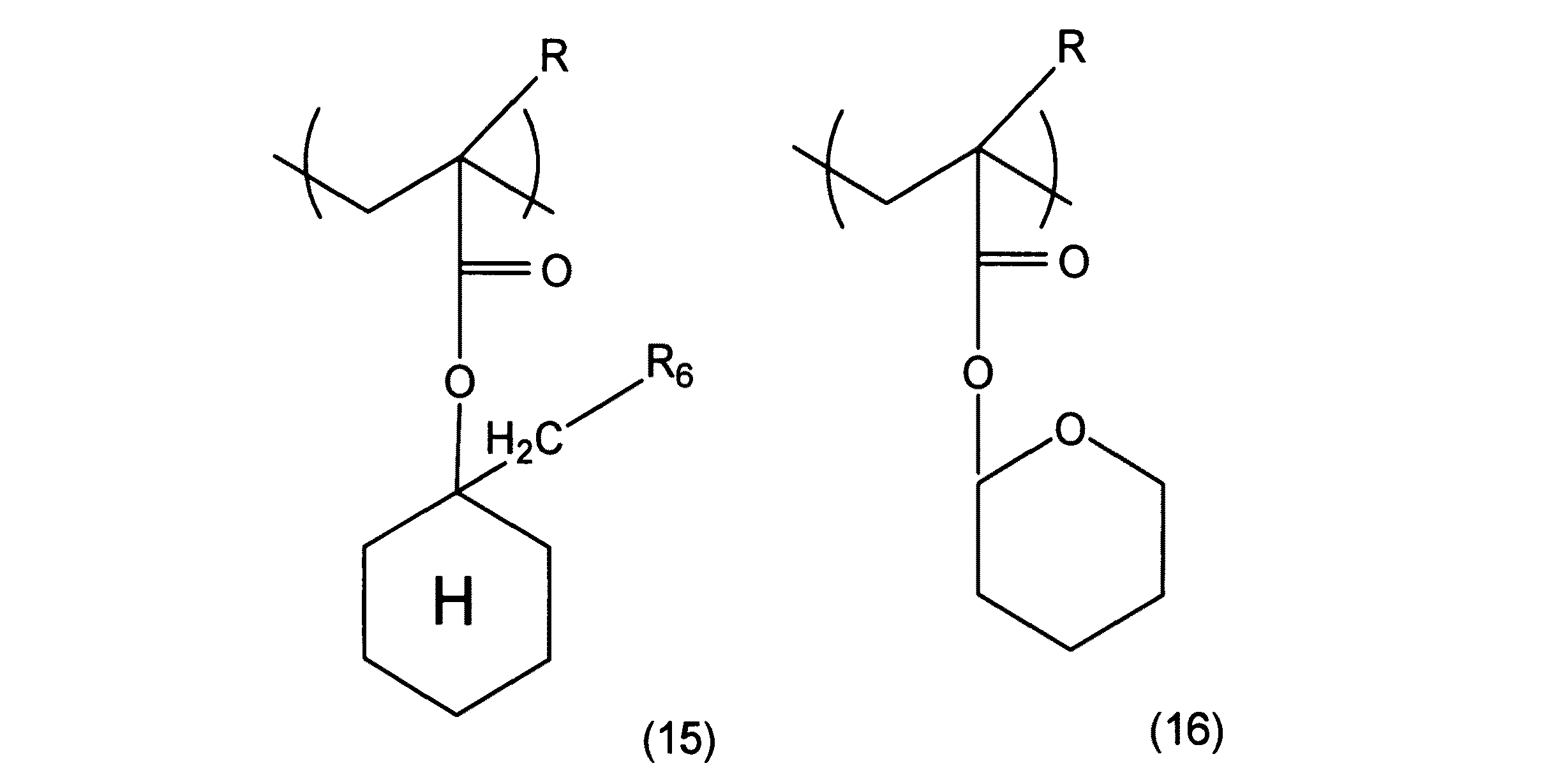
前記(a1)として好適なモノマー単位を下記一般式(10)〜(16)に示す。なお、これら一般式(10)〜(16)において、Rは水素原子またはメチル基、R1は低級アルキル基、R2およびR3はそれぞれ独立して低級アルキル基、R4は第3級アルキル基、R5はメチル基、R6は低級アルキル基である。)上記R1〜R3およびR6はそれぞれ、
炭素数1〜5の低級の直鎖または分岐状アルキル基が好ましく、メチル基、エチル基、プロピル基、イソプロピル基、n−ブチル基、イソブチル基、tert−ブチル基、ペンチル基、イソペンチル基、ネオペンチル基などが挙げられる。工業的にはメチル基またはエチル基が好ましい。また、R4は、tert−ブチル基やtert−アミル基のような第
3級アルキル基であり、tert−ブチル基である場合が工業的に好ましい。
Monomer units suitable as (a1) are shown in the following general formulas (10) to (16). In these general formulas (10) to (16), R is a hydrogen atom or a methyl group, R 1 is a lower alkyl group, R 2 and R 3 are each independently a lower alkyl group, and R 4 is a tertiary alkyl group. Group, R 5 is a methyl group, and R 6 is a lower alkyl group. ) Each of R 1 to R 3 and R 6 is
A lower linear or branched alkyl group having 1 to 5 carbon atoms is preferred, and is a methyl group, an ethyl group, a propyl group, an isopropyl group, an n-butyl group, an isobutyl group, a tert-butyl group, a pentyl group, an isopentyl group, or neopentyl. Groups and the like. Industrially, a methyl group or an ethyl group is preferable. R 4 is a tertiary alkyl group such as a tert-butyl group or a tert-amyl group, and the case where it is a tert-butyl group is industrially preferred.
(a1)単位として、上記に挙げた中でも、特に、一般式(10)、(11)、(12)で表される構成単位は、透明性が高く高解像性で対ドライエッチング性に優れるパターンが形成できるため、より好ましい。 Among the units listed above as the (a1) unit, in particular, the structural units represented by the general formulas (10), (11), and (12) have high transparency, high resolution, and excellent dry etching properties. Since a pattern can be formed, it is more preferable.
前記(a2)単位は、ラクトン単位を有するので、現像液との親水性を高めるために有効である。このような(a2)単位は、ラクトン単位を有し、樹脂成分の他の構成単位と共重合可能なものであればよい。例えば、単環式のラクトン単位としては、γ-ブチロラ
クトンから水素原子1つを除いた基などが挙げられる。また、多環式のラクトン単位としては、ラクトン含有ポリシクロアルカンから水素原子を1つを除いた基などが挙げられる。
Since the unit (a2) has a lactone unit, it is effective for enhancing hydrophilicity with the developer. Such a unit (a2) has only to have a lactone unit and can be copolymerized with other structural units of the resin component. For example, examples of the monocyclic lactone unit include a group in which one hydrogen atom has been removed from γ-butyrolactone. Examples of the polycyclic lactone unit include a group obtained by removing one hydrogen atom from a lactone-containing polycycloalkane.
前記(a2)として好適なモノマー単位を下記一般式(17)〜(19)に示す。これら一般式において、Rは水素原子またはメチル基である。 Monomer units suitable as the above (a2) are shown in the following general formulas (17) to (19). In these general formulas, R is a hydrogen atom or a methyl group.
前記一般式(19)に示したようなα炭素にエステル結合を有する(メタ)アクリル酸のγ-ブチロラクトンエステル、そして、一般式(17)や(18)のようなノルボルナ
ンラクトンエステルが、特に工業上入手しやすく好ましい。
The γ-butyrolactone ester of (meth) acrylic acid having an ester bond at the α carbon as shown in the general formula (19) and the norbornane lactone ester as shown in the general formulas (17) and (18) are particularly industrial. It is easy to obtain and preferable.
前記(a3)単位は、アルコール性水酸基含有多環式基を有する(メタ)アクリル酸エステルから誘導される構成単位である。前記アルコール性水酸基含有多環式基における水酸基は極性基であるため、これを用いることにより樹脂成分全体の現像液との親水性が高まり、露光部におけるアルカリ溶解性が向上する。従って、樹脂成分が(a3)を有すると、解像性が向上するため好ましい。そして、(a3)における多環式基としては、前記(a1)の説明において例示したものと同様の脂肪族多環式基から適宜選択して用いることができる。 The unit (a3) is a structural unit derived from a (meth) acrylic acid ester having an alcoholic hydroxyl group-containing polycyclic group. Since the hydroxyl group in the alcoholic hydroxyl group-containing polycyclic group is a polar group, the use of this increases the hydrophilicity of the entire resin component with the developer and improves the alkali solubility in the exposed area. Therefore, it is preferable that the resin component has (a3) because the resolution is improved. And as a polycyclic group in (a3), it can select from the aliphatic polycyclic group similar to what was illustrated in description of the said (a1) suitably, and can be used.
前記(a3)におけるアルコール性水酸基含有多環式基は特に限定されないが、例えば、水酸基含有アダマンチル基などが好ましく用いられる。さらに、この水酸基含有アダマンチル基が、下記一般式(20)で表されるものであると、耐ドライエッチング性を上昇させ、パターン断面形状の垂直性を高める効果を有するため、好ましい。なお、一般式中、lは1〜3の整数である。 The alcoholic hydroxyl group-containing polycyclic group in (a3) is not particularly limited, and for example, a hydroxyl group-containing adamantyl group is preferably used. Furthermore, it is preferable that this hydroxyl group-containing adamantyl group is represented by the following general formula (20) because it has the effect of increasing the dry etching resistance and improving the perpendicularity of the pattern cross-sectional shape. In the general formula, l is an integer of 1 to 3.
前記(a3)単位は、上記したようなアルコール性水酸基含有多環式基を有し、かつ樹脂成分の他の構成単位と共重合可能なものであればよい。具体的には、下記一般式(21)で表される構成単位が好ましい。なお、一般式(21)中、Rは水素原子またはメチル基である。 The unit (a3) may be any unit as long as it has an alcoholic hydroxyl group-containing polycyclic group as described above and can be copolymerized with other structural units of the resin component. Specifically, a structural unit represented by the following general formula (21) is preferable. In general formula (21), R represents a hydrogen atom or a methyl group.
前記(a4)単位において、「前記酸解離性溶解抑制基、前記ラクトン単位、および前記アルコール性水酸基含有多環式基のいずれとも異なる」多環式基とは、樹脂成分において、(a4)単位の多環式基が、(a1)単位の酸解離性溶解抑制基、(a2)単位のラクトン単位、および(a3)単位のアルコール性水酸基含有多環式基のいずれとも重複しない多環式基、という意味であり、(a4)が、樹脂成分を構成している(a1)単位の酸解離性溶解抑制基、(a2)単位のラクトン単位、および(a3)単位のアルコール性水酸基含有多環式基をいずれも保持していないことを意味している。 In the unit (a4), the polycyclic group “different from any of the acid dissociable, dissolution inhibiting group, the lactone unit, and the alcoholic hydroxyl group-containing polycyclic group” means that in the resin component, the unit (a4) A polycyclic group in which the (a1) unit acid dissociable, dissolution inhibiting group, the (a2) unit lactone unit, and the (a3) unit alcoholic hydroxyl group-containing polycyclic group do not overlap with each other. (A4) is an acid dissociable, dissolution inhibiting group of unit (a1), a lactone unit of unit (a2), and an alcoholic hydroxyl group-containing polycycle of unit (a3) constituting the resin component This means that none of the formula groups are retained.
前記(a4)単位における多環式基は、ひとつの樹脂成分において、前記(a1)〜(a3)単位として用いられた構成単位と重複しないように選択されていればよく、特に限定されるものではない。例えば、(a4)単位における多環式基として、前記(a1)単位として例示したものと同様の脂肪族多環式基を用いることができ、ArFポジレジスト材料として従来から知られている多数のものが使用可能である。特にトリシクロデカニル基、アダマンチル基、テトラシクロドデカニル基から選ばれる少なくとも1種以上であると、工業上入手し易いなどの点で好ましい。(a4)単位としては、上記のような多環式基を有し、かつ樹脂成分の他の構成単位と共重合可能なものであればよい。 The polycyclic group in the unit (a4) is not particularly limited as long as it is selected so as not to overlap with the structural units used as the units (a1) to (a3) in one resin component. is not. For example, as the polycyclic group in the (a4) unit, the same aliphatic polycyclic groups as those exemplified as the (a1) unit can be used, and a number of hitherto known ArF positive resist materials are available. Things can be used. In particular, at least one selected from a tricyclodecanyl group, an adamantyl group, and a tetracyclododecanyl group is preferable in terms of industrial availability. As the unit (a4), any unit may be used as long as it has a polycyclic group as described above and can be copolymerized with other structural units of the resin component.
前記(a4)の好ましい例を下記一般式(22)〜(24)に示す。これらの一般式中、Rは水素原子またはメチル基である。 Preferred examples of (a4) are shown in the following general formulas (22) to (24). In these general formulas, R is a hydrogen atom or a methyl group.
上記アクリル系樹脂成分の組成は、該樹脂成分を構成する構成単位の合計に対して、(a1)単位が20〜60モル%、好ましくは30〜50モル%であると、解像性に優れ、好ましい。また、樹脂成分を構成する構成単位の合計に対して、(a2)単位が20〜60モル%、好ましくは30〜50モル%であると、解像度に優れ、好ましい。また、(a3)単位を用いる場合、樹脂成分を構成する構成単位の合計に対して、5〜50モル%、好ましくは10〜40モル%であると、レジストパターン形状に優れ、好ましい。(a4)単位を用いる場合、樹脂成分を構成する構成単位の合計に対して、1〜30モル%、好ましくは5〜20モル%であると、孤立パターンからセミデンスパターンの解像性に優れ、好ましい。 The composition of the acrylic resin component is excellent in resolution when the (a1) unit is 20 to 60 mol%, preferably 30 to 50 mol%, with respect to the total of structural units constituting the resin component. ,preferable. Moreover, it is excellent in the resolution and it is preferable that (a2) unit is 20-60 mol% with respect to the sum total of the structural unit which comprises a resin component, Preferably it is 30-50 mol%. Further, when the unit (a3) is used, the resist pattern shape is excellent and preferably 5 to 50 mol%, preferably 10 to 40 mol%, based on the total of the constituent units constituting the resin component. When the unit (a4) is used, the resolution from the isolated pattern to the semi-dense pattern is excellent when it is 1 to 30 mol%, preferably 5 to 20 mol%, based on the total of the structural units constituting the resin component. ,preferable.
(a1)単位と(a2)、(a3)および(a4)単位から選ばれる少なくとも一つの単位は、目的に応じ適宜組み合わせることができるが、(a1)単位と(a2)および(a3)単位の3元ポリマーがレジストパターン形状、露光余裕度、耐熱性、解像性に優れ、好ましい。その際の各構成単位(a1)〜(a3)のそれぞれの含有量としては、(a1)が20〜60モル%、(a2)が20〜60モル%、および(a3)が5〜50モル%が好ましい。 The unit (a1) and at least one unit selected from the units (a2), (a3) and (a4) can be appropriately combined depending on the purpose, but the units (a1) and (a2) and (a3) A ternary polymer is preferable because it is excellent in resist pattern shape, exposure margin, heat resistance, and resolution. The contents of the structural units (a1) to (a3) at that time are as follows: (a1) is 20 to 60 mol%, (a2) is 20 to 60 mol%, and (a3) is 5 to 50 mol% % Is preferred.
また、樹脂成分樹脂の質量平均分子量(ポリスチレン換算、以下同様)は特に限定するものではないが5000〜30000、さらに好ましくは8000〜20000とされる。この範囲よりも大きいとレジスト溶剤への溶解性が悪くなり、小さいと耐ドライエッチング性やレジストパターン断面形状が悪くなるおそれがある。 The mass average molecular weight of the resin component resin (in terms of polystyrene, the same applies hereinafter) is not particularly limited, but is preferably 5000 to 30000, more preferably 8000 to 20000. If it is larger than this range, the solubility in a resist solvent is deteriorated, and if it is smaller, the dry etching resistance and the resist pattern cross-sectional shape may be deteriorated.
また、前記シクロオレフィン系樹脂としては、下記一般式(25)に示す構成単位(a5)と、必要に応じて前記(a1)から得られる構成単位を共重合させた樹脂が好ましい。 Moreover, as said cycloolefin type resin, resin which copolymerized the structural unit (a5) shown to following General formula (25), and the structural unit obtained from said (a1) as needed is preferable.
一般式(25)中、R8は前記(a1)単位において酸解離性溶解抑制基として例示し
た置換基であり、mは0〜3の整数である。なお、前記(a5)単位においてmが0の場合は、(a1)単位を有する共重合体として用いることが好ましい。
In the general formula (25), R 8 is a substituent exemplified as the acid dissociable, dissolution inhibiting group in the unit (a1), and m is an integer of 0 to 3. In addition, when m is 0 in the (a5) unit, it is preferably used as a copolymer having the (a1) unit.
さらに、前記シルセスキオキサン系樹脂としては、下記一般式(26)で表される構成単位(a6)、および下記一般式(27)で表される構成単位(a7)を有するものが挙げられる。 Further, examples of the silsesquioxane-based resin include those having a structural unit (a6) represented by the following general formula (26) and a structural unit (a7) represented by the following general formula (27). .
一般式(26)中、R9は脂肪族の単環または多環式基を含有する炭化水素基からなる
酸解離性溶解抑制基であり、R10は直鎖状、分岐状または環状の飽和脂肪族炭化水素基であり、Xは少なくとも1つの水素原子がフッ素原子で置換された炭素原子数1〜8のアル
キル基であり、mは1〜3の整数である。
In general formula (26), R 9 is an acid dissociable, dissolution inhibiting group composed of a hydrocarbon group containing an aliphatic monocyclic or polycyclic group, and R 10 is a linear, branched or cyclic saturated group. An aliphatic hydrocarbon group, X is an alkyl group having 1 to 8 carbon atoms in which at least one hydrogen atom is substituted with a fluorine atom, and m is an integer of 1 to 3;
一般式(27)中、R11は水素原子もしくは直鎖状、分岐状または環状のアルキル基であり、R12は直鎖状、分岐状または環状の飽和脂肪族炭化水素基であり、Xは少なくとも1つの水素原子がフッ素原子で置換された炭素原子数1〜8のアルキル基である。 In the general formula (27), R 11 is a hydrogen atom or a linear, branched or cyclic alkyl group, R 12 is a linear, branched or cyclic saturated aliphatic hydrocarbon group, and X is It is an alkyl group having 1 to 8 carbon atoms in which at least one hydrogen atom is substituted with a fluorine atom.
上記(a6)および(a7)において、R9の酸解離性溶解抑制基は、露光前のシルセ
スキオキサン樹脂全体をアルカリ不溶とするアルカリ溶解抑制性を有すると同時に、露光後に酸発生剤から発生した酸の作用により解離し、このシルセスキオキサン樹脂全体をアルカリ可溶性へ変化させる基である。
In the above (a6) and (a7), the acid dissociable, dissolution inhibiting group of R 9 has an alkali dissolution inhibiting property that renders the entire silsesquioxane resin before exposure to alkali insolubility, and at the same time from an acid generator after exposure. It is a group that dissociates by the action of the generated acid and changes the entire silsesquioxane resin to alkali-soluble.
このようなものとして、例えば、下記一般式(28)〜(32)のような、嵩高い、脂肪族の単環または多環式基を含有する炭化水素基からなる酸解離性溶解抑制基が挙げられる。このような酸解離性溶解抑制基を用いることにより、解離後の溶解抑制基がガス化しにくく、脱ガス現象が防止される。 As such, for example, an acid dissociable, dissolution inhibiting group composed of a hydrocarbon group containing an aliphatic monocyclic or polycyclic group, such as the following general formulas (28) to (32): Can be mentioned. By using such an acid dissociable, dissolution inhibiting group, the dissolution inhibiting group after dissociation is hardly gasified, and the degassing phenomenon is prevented.
一般式(26)中、R9の炭素数は、解離したときにガス化しにくいと同時に適度なレ
ジスト溶媒への溶解性や現像液への溶解性から好ましくは7〜15、より好ましくは9〜13である。
In general formula (26), the carbon number of R 9 is preferably 7 to 15 and more preferably 9 to 9 because it is difficult to gasify when dissociated, and at the same time, is soluble in an appropriate resist solvent and soluble in a developer. 13.
前記酸解離性溶解抑制基としては、脂肪族の単環または多環式基を含有する炭化水素基からなる酸解離性溶解抑制基であるかぎり、使用する光源に応じて、例えばArFエキシマレーザーのレジスト組成物用の樹脂において、多数提案されているものの中から適宜選択して用いることができる。一般的には、(メタ)アクリル酸のカルボキシル基と環状の第3級アルキルエステルを形成するものが広く知られている。 As the acid dissociable, dissolution inhibiting group, as long as it is an acid dissociable, dissolution inhibiting group composed of a hydrocarbon group containing an aliphatic monocyclic or polycyclic group, depending on the light source used, for example, ArF excimer laser In the resin for resist compositions, it can be used by appropriately selecting from many proposed ones. In general, those forming a cyclic tertiary alkyl ester with a carboxyl group of (meth) acrylic acid are widely known.
特に、脂肪族多環式基を含有する酸解離性溶解抑制基であることが好ましい。脂肪族多環式基としては、ArFレジストにおいて、多数提案されているものの中から適宜選択して用いることができる。例えば、脂肪族多環式基としては、ビシクロアルカン、トリシクロアルカン、テロラシクロアルカン等から1個の水素原子を除いた基を挙げることができ、より具体的には、アダマンタン、ノルボルナン、イソボルナン、トリシクロデカン、テトラシクロドデカンなどのポリシクロアルカンから1個の水素原子を除いた基などが挙げられる。 In particular, an acid dissociable, dissolution inhibiting group containing an aliphatic polycyclic group is preferable. As the aliphatic polycyclic group, an ArF resist can be appropriately selected from those proposed in the ArF resist. For example, examples of the aliphatic polycyclic group include groups in which one hydrogen atom has been removed from a bicycloalkane, tricycloalkane, teracycloalkane, etc., and more specifically, adamantane, norbornane, isobornane, And a group obtained by removing one hydrogen atom from a polycycloalkane such as tricyclodecane or tetracyclododecane.
上記一般式の中でも一般式(30)で表される2−メチル−2−アダマンチル基、および/または一般式(31)で表される2−エチル−2−アダマンチル基を有するシルセス
キオキサン樹脂は、脱ガスが生じにくく、さらに、解像性や耐熱性等のレジスト特性に優れているので好ましい。
Silsesquioxane resin having 2-methyl-2-adamantyl group represented by general formula (30) and / or 2-ethyl-2-adamantyl group represented by general formula (31) among the above general formulas Is preferable because it is less likely to degas and is excellent in resist characteristics such as resolution and heat resistance.
また、前記R10およびR12における炭素数は、レジスト溶媒に対する溶解性と分子サイズの制御の点から好ましくは1〜20、より好ましくは5〜12である。特に、環状の飽和脂肪族炭化水素基は、得られるシルセスキオキサン樹脂の高エネルギー光に対する透明性が高いこと、ガラス転移点(Tg)が高くなり、PEB(露光後加熱)時の酸発生剤か
らの酸の発生をコントロールしやすくなること等の利点を有するので好ましい。
The number of carbon atoms in R 10 and R 12 is preferably 1-20, more preferably 5-12, from the viewpoints of solubility in a resist solvent and control of molecular size. In particular, the cyclic saturated aliphatic hydrocarbon group has high transparency to the high-energy light of the resulting silsesquioxane resin, increases the glass transition point (Tg), and generates acid during PEB (post-exposure heating). It is preferable because it has advantages such as easy control of acid generation from the agent.
前記環状の飽和脂肪族炭化水素基としては、単環式基であっても、多環式基であってもよい。多環式基としては、ビシクロアルカン、トリシクロアルカン、テトラシクロアルカン等から2個の水素原子を除いた基を挙げることができ、より具体的には、アダマンタン、ノルボルナン、イソボルナン、トリシクロデカン、テトラシクロドデカンなどのポリシクロアルカンから2個の水素原子を除いた基などが挙げられる。 The cyclic saturated aliphatic hydrocarbon group may be a monocyclic group or a polycyclic group. Examples of the polycyclic group include groups in which two hydrogen atoms are removed from bicycloalkane, tricycloalkane, tetracycloalkane and the like, and more specifically, adamantane, norbornane, isobornane, tricyclodecane, And a group obtained by removing two hydrogen atoms from a polycycloalkane such as tetracyclododecane.
これらR10およびR12として、より具体的には、下記一般式(33)〜(38)で表される脂環式化合物あるいはそれらの誘導体から水素原子を2つ除いた基を挙げることができる。 More specific examples of R 10 and R 12 include groups obtained by removing two hydrogen atoms from the alicyclic compounds represented by the following general formulas (33) to (38) or derivatives thereof. .
前記誘導体とは、前記化学式(33)〜(38)の脂環式化合物において、少なくとも1つの水素原子が、メチル基、エチル基等の低級アルキル基、酸素原子、フッ素、塩素、臭素等のハロゲン原子等の基で置換されたものを意味する。中でも化学式(33)〜(38)なる群から選択される脂環式化合物から水素原子を2つ除いた基が、透明性が高く、また工業的に入手しやすい点で好ましい。 The derivative means that in the alicyclic compounds of the chemical formulas (33) to (38), at least one hydrogen atom is a lower alkyl group such as a methyl group or an ethyl group, an oxygen atom, a halogen such as fluorine, chlorine or bromine. It means one substituted with a group such as an atom. Among them, a group obtained by removing two hydrogen atoms from an alicyclic compound selected from the group consisting of chemical formulas (33) to (38) is preferable because of high transparency and industrial availability.
さらに、前記R11は、レジスト溶媒への溶解性から、好ましくは1〜10、より好ましくは1〜4の低級アルキル基である。このアルキル基としては、より具体的には、メチル基、エチル基、プロピル基、イソプロピル基、n−ブチル基、sec−ブチル基、tert−ブチル基、シクロペンチル基、シクロヘキシル基、2−エチルヘキシル基、n−オクチル基等を例示することができる。 Further, R 11 is preferably a lower alkyl group of 1 to 10, more preferably 1 to 4, in view of solubility in a resist solvent. More specifically, as this alkyl group, methyl group, ethyl group, propyl group, isopropyl group, n-butyl group, sec-butyl group, tert-butyl group, cyclopentyl group, cyclohexyl group, 2-ethylhexyl group, An n-octyl group etc. can be illustrated.
R11は、前記候補からシルセスキオキサン樹脂の所望のアルカリ溶解性に応じて適宜選択される。R11が水素原子の場合に最もアルカリ溶解性が高くなる。アルカリ溶解性が高くなると、高感度化できるという利点がある。 R 11 is appropriately selected from the above candidates according to the desired alkali solubility of the silsesquioxane resin. Alkali solubility is highest when R 11 is a hydrogen atom. When the alkali solubility is increased, there is an advantage that the sensitivity can be increased.
一方、前記アルキル基の炭素数が大きくなるほど、また、嵩高くなるほど、シルセスキオキサン樹脂のアルカリ溶解性が低くなる。アルカリ溶解性が低くなると、アルカリ現像液に対する耐性が向上するので、該シルセスキオキサン樹脂を用いてレジストパターンを形成する際の露光マージンが良くなり、露光に伴う寸法変動が小さくなる。また、現像むらがなくなるので、形成されるレジストパターンのエッジ部分のラフネスも改善される。 On the other hand, the larger the number of carbon atoms in the alkyl group and the higher the bulk, the lower the alkali solubility of the silsesquioxane resin. When the alkali solubility is lowered, resistance to an alkali developer is improved, so that an exposure margin when a resist pattern is formed using the silsesquioxane resin is improved, and a dimensional variation accompanying exposure is reduced. Further, since uneven development is eliminated, the roughness of the edge portion of the formed resist pattern is also improved.
前記一般式(26)、(27)中のXについては、特に直鎖状のアルキル基が好ましい。アルキル基の炭素数は、シルセスキオキサン樹脂のガラス転移(Tg)点やレジスト溶媒への溶解性から、1〜8、好ましくは1〜4の低級アルキル基である。また、フッ素原子で置換されている水素原子の数が多いほど、200nm以下の高エネルギー光や電子線に対する透明性が向上するので好ましく、最も好ましくは、全ての水素原子がフッ素原子で置換されたパーフルオロアルキル基である。各Xは、それぞれ同一であっても異なっていても良い。なお、一般式(26)中のmは、酸解離性溶解抑制基を解離しやすくするという理由で、1〜3の整数であり、好ましくは1である。 As for X in the general formulas (26) and (27), a linear alkyl group is particularly preferable. The carbon number of the alkyl group is a lower alkyl group of 1 to 8, preferably 1 to 4, from the glass transition (Tg) point of the silsesquioxane resin and the solubility in a resist solvent. Further, the greater the number of hydrogen atoms substituted with fluorine atoms, the better the transparency to high energy light of 200 nm or less and the electron beam, and most preferably, all the hydrogen atoms are substituted with fluorine atoms. Perfluoroalkyl group. Each X may be the same or different. In addition, m in General formula (26) is an integer of 1-3, Preferably it is 1 because it makes it easy to dissociate an acid dissociable dissolution inhibiting group.
シルセスキオキサン系樹脂として、より具体的には、下記一般式(39)、(40)で表されるものが挙げられる。 More specifically, examples of the silsesquioxane resin include those represented by the following general formulas (39) and (40).
一般式(39)、(40)中、R5,R10,R12,およびnは前出と同様である。 In the general formulas (39) and (40), R 5 , R 10 , R 12 , and n are the same as described above.
シルセスキオキサン樹脂を構成する全構成単位中、(a6)および(a7)で表される構成単位の割合は、30〜100モル%、好ましくは70〜100%、より好ましくは100モル%である。 The proportion of the structural units represented by (a6) and (a7) in all the structural units constituting the silsesquioxane resin is 30 to 100 mol%, preferably 70 to 100%, more preferably 100 mol%. is there.
また、(a6)および(a7)で表される構成単位の合計に対し、(a6)で表される構成単位の割合は、好ましくは5〜70モル%、より好ましくは10〜40モル%である。(a7)で表される構成単位の割合は、好ましくは30〜95モル%、より好ましくは60〜90モル%である。 The ratio of the structural unit represented by (a6) to the total of the structural units represented by (a6) and (a7) is preferably 5 to 70 mol%, more preferably 10 to 40 mol%. is there. The proportion of the structural unit represented by (a7) is preferably 30 to 95 mol%, more preferably 60 to 90 mol%.
(a6)で表される構成単位の割合を上記範囲内とすることにより、酸解離性溶解抑制基の割合が自ずと決まり、シルセスキオキサン樹脂の露光前後のアルカリ溶解性の変化が、ポジ型レジスト組成物のベース樹脂として好適なものとなる。 By setting the proportion of the structural unit represented by (a6) within the above range, the proportion of the acid dissociable, dissolution inhibiting group is naturally determined, and the change in alkali solubility before and after the exposure of the silsesquioxane resin is positive. This is suitable as a base resin for the resist composition.
シルセスキオキサン系樹脂は、本発明の効果を損なわない範囲で、(a6)および(a7)で表される構成単位以外の構成単位を有していても良い。例えばArFエキシマレーザーのレジスト組成物用のシルセスキオキサン樹脂において用いられているもの、例えば、下記一般式(41)で表される、メチル基、エチル基、プロピル基、ブチル基等のアルキル基(R’)を有するアルキルシルセスキオキサン単位等を例示することができる。 The silsesquioxane resin may have structural units other than the structural units represented by (a6) and (a7) as long as the effects of the present invention are not impaired. For example, those used in silsesquioxane resins for ArF excimer laser resist compositions, for example, alkyl groups such as methyl, ethyl, propyl, and butyl groups represented by the following general formula (41) Examples thereof include alkylsilsesquioxane units having (R ′).
シルセスキオキサン系樹脂の質量平均分子量(Mw)(ゲルパーミエーションクロマトグラフィーによるポリスチレン換算)は、特に限定するものではないが、好ましくは2000〜15000、さらに好ましくは3000〜8000とされる。この範囲よりも大きいとレジスト溶剤への溶解性が悪くなり、小さいとレジストパターン断面形状が悪くなるおそれがある。 The mass average molecular weight (Mw) of the silsesquioxane resin (polystyrene conversion by gel permeation chromatography) is not particularly limited, but is preferably 2000 to 15000, and more preferably 3000 to 8000. If it is larger than this range, the solubility in the resist solvent is deteriorated, and if it is smaller, the resist pattern cross-sectional shape may be deteriorated.
また、質量平均分子量(Mw)/数平均分子量(Mn)、すなわちポリマー分散度は、特に限定するものではないが、好ましくは1.0〜6.0、さらに好ましくは1.5〜2.5である。この範囲よりも大きいと解像度、パターン形状が劣化するおそれがある。 The mass average molecular weight (Mw) / number average molecular weight (Mn), that is, the degree of polymer dispersion is not particularly limited, but is preferably 1.0 to 6.0, more preferably 1.5 to 2.5. It is. If it is larger than this range, the resolution and pattern shape may deteriorate.
また、シルセスキオキサン系樹脂は、(a6)および(a7)で表される構成単位によって構成されるシルセスキオキサンを基本骨格に有するポリマーであるので、200nm以下の高エネルギー光や電子線に対する透明性が高い。そのため、シルセスキオキサン樹脂を含むポジ型レジスト組成物は、例えば、ArFエキシマレーザーより短波長の光源を用いたリソグラフィーにおいて有用であり、特に、単層プロセスでも、線幅150nm以下、さらには120nm以下といった微細なレジストパターンを形成することができる。また、2層レジスト積層体の上層と用いることで、120nm以下、さらには100nm以下の微細なレジストパターンを形成するプロセスにも有用である。 Moreover, since the silsesquioxane-based resin is a polymer having silsesquioxane as a basic skeleton composed of the structural units represented by (a6) and (a7), high-energy light or electron beam of 200 nm or less Is highly transparent. Therefore, a positive resist composition containing a silsesquioxane resin is useful, for example, in lithography using a light source having a shorter wavelength than an ArF excimer laser. In particular, even in a single layer process, a line width of 150 nm or less, and further 120 nm A fine resist pattern such as the following can be formed. Moreover, it is useful also for the process of forming a fine resist pattern of 120 nm or less, further 100 nm or less by using with the upper layer of a two-layer resist laminated body.
さらに、前記ネガ型レジスト組成物に用いられる樹脂成分としては、慣用されるものであれば限定されないが、具体的には以下のようなものが好ましい。 Furthermore, the resin component used in the negative resist composition is not limited as long as it is commonly used, but specifically, the following are preferable.
このような樹脂成分としては、酸によりアルカリ不溶性となる樹脂成分であって、分子内に、たがいに反応してエステルを形成しうる2種の官能基を有し、これがレジスト材料に同時添加する酸発生剤より発生した酸の作用により、脱水してエステルを形成することによりアルカリ不溶性となる樹脂(a8)が、好ましく用いられる。ここでいう、たがいに反応してエステルを形成しうる2種の官能基とは、例えば、カルボン酸エステルを形成するための、水酸基とカルボキシル基またはカルボン酸エステルのようなものを意味する。換言すれば、エステルを形成するための2種の官能基である。このような樹脂としては、例えば、樹脂主骨格の側鎖に、ヒドロキシアルキル基と、カルボキシル基およびカルボン酸エステル基の少なくとも一方とを有するものが好ましい。
さらには、前記樹脂成分としては、ジカルボン酸モノエステル単位を有する重合体からなる樹脂成分(a9)も好ましい。
Such a resin component is a resin component that becomes alkali-insoluble with an acid, and has two functional groups in the molecule that can react with each other to form an ester, which is added simultaneously to the resist material. A resin (a8) that becomes alkali-insoluble by dehydration to form an ester by the action of an acid generated from the acid generator is preferably used. The two kinds of functional groups capable of reacting with each other to form an ester here mean, for example, a hydroxyl group and a carboxyl group or a carboxylate ester for forming a carboxylate ester. In other words, two functional groups for forming an ester. As such a resin, for example, a resin having a hydroxyalkyl group and at least one of a carboxyl group and a carboxylate group in the side chain of the resin main skeleton is preferable.
Furthermore, as the resin component, a resin component (a9) composed of a polymer having a dicarboxylic acid monoester unit is also preferable.
前記(a8)は、換言すれば、下記一般式(42)で表される構成単位を少なくとも有する樹脂成分である。
一般式(42)中、R13は水素原子、C1〜C6のアルキル基、もしくはボルニル基、アダマンチル基、テトラシクロドデシル基、トリシクロデシル基等の多環式環骨格を有するアルキル基である。 In General Formula (42), R 13 is a hydrogen atom, a C1-C6 alkyl group, or an alkyl group having a polycyclic ring skeleton such as a bornyl group, an adamantyl group, a tetracyclododecyl group, or a tricyclodecyl group.
このような樹脂の例としては、α−(ヒドロキシアルキル)アクリル酸およびα−(ヒドロキシアルキル)アクリル酸アルキルエステルの中から選ばれる少なくとも1種のモノマーの重合体(単独重合体または共重合体)(a8−1)、およびα−(ヒドロキシアルキル)アクリル酸およびα−(ヒドロキシアルキル)アクリル酸アルキルエステルの中から選ばれる少なくとも1種のモノマーと、他のエチレン性不飽和カルボン酸およびエチレン性不飽和カルボン酸エステルの中から選ばれる少なくとも1種のモノマーとの共重合体(a8−2)などが好ましく挙げられる。 Examples of such resins include polymers (homopolymers or copolymers) of at least one monomer selected from α- (hydroxyalkyl) acrylic acid and α- (hydroxyalkyl) acrylic acid alkyl ester. (A8-1), and at least one monomer selected from α- (hydroxyalkyl) acrylic acid and α- (hydroxyalkyl) acrylic acid alkyl ester, and other ethylenically unsaturated carboxylic acid and ethylenically unsaturated monomer. Preferred examples include a copolymer (a8-2) with at least one monomer selected from saturated carboxylic acid esters.
上記重合体(a8−1)としては、α−(ヒドロキシアルキル)アクリル酸とα−(ヒドロキシアルキル)アクリル酸アルキルエステルとの共重合体が好ましく、また、共重合体(a8−2)としては、前記他のエチレン性不飽和カルボン酸やエチレン性不飽和カルボン酸エステルとして、アクリル酸、メタクリル酸、アクリル酸アルキルエステルおよびメタクリル酸アルキルエステルの中から選ばれる少なくとも1種を用いたものが好ましい。 As the polymer (a8-1), a copolymer of α- (hydroxyalkyl) acrylic acid and α- (hydroxyalkyl) acrylic acid alkyl ester is preferable, and as the copolymer (a8-2), As the other ethylenically unsaturated carboxylic acid and ethylenically unsaturated carboxylic acid ester, those using at least one selected from acrylic acid, methacrylic acid, acrylic acid alkyl ester and methacrylic acid alkyl ester are preferable.
前記α−(ヒドロキシアルキル)アクリル酸やα−(ヒドロキシアルキル)アクリル酸アルキルエステルにおけるヒドロキシアルキル基の例としては、ヒドロキシメチル基、ヒドロキシエチル基、ヒドロキシプロピル基、ヒドロキシブチル基などの低級ヒドロキシアルキル基が挙げられる。これらの中でもエステルの形成しやすさからヒドロキシエチル基やヒドロキシメチル基が好ましい。 Examples of the hydroxyalkyl group in the α- (hydroxyalkyl) acrylic acid and the α- (hydroxyalkyl) acrylic acid alkyl ester include lower hydroxyalkyl groups such as a hydroxymethyl group, a hydroxyethyl group, a hydroxypropyl group, and a hydroxybutyl group. Is mentioned. Among these, a hydroxyethyl group or a hydroxymethyl group is preferable because of the ease of forming an ester.
また、α−(ヒドロキシアルキル)アクリル酸アルキルエステルのアルキルエステル部分のアルキル基の例としては、メチル基、エチル基、プロピル基、イソプロピル基、n−ブチル基、sec−ブチル基、tert−ブチル基、アミル基などの低級アルキル基、ビシクロ[2.2.1]ヘプチル基、ボルニル基、アダマンチル基、テトラシクロ[4.4.0.12.5.17.10]ドデシル基、トリシクロ[5.2.1.02.6]デシル基などの橋かけ型多環式環状炭化水素基などが挙げられる。エステル部分のアルキル基が多環式環状炭化水素基のものは、耐ドライエッチング性を高めるのに有効である。これらのアルキル基の中で、特にメチル基、エチル基、プロピル基、ブチル基などの低級アルキル基の場合、エステルを形成するアルコール成分として、安価で容易に入手しうるものが用いられるので好ましい。 Examples of the alkyl group in the alkyl ester portion of the α- (hydroxyalkyl) acrylic acid alkyl ester include a methyl group, an ethyl group, a propyl group, an isopropyl group, an n-butyl group, a sec-butyl group, and a tert-butyl group. Lower alkyl group such as amyl group, bicyclo [2.2.1] heptyl group, bornyl group, adamantyl group, tetracyclo [4.4.0.1 2.5 . And a bridged polycyclic hydrocarbon group such as 1 7.10 ] dodecyl group and tricyclo [5.2.1.0 2.6 ] decyl group. Those in which the alkyl group of the ester moiety is a polycyclic hydrocarbon group is effective for improving the dry etching resistance. Among these alkyl groups, lower alkyl groups such as a methyl group, an ethyl group, a propyl group, and a butyl group are preferred because alcohol components that form esters can be easily obtained at low cost.
低級アルキルエステルの場合は、カルボキシル基と同様にヒドロキシアルキル基とのエステル化が起こるが、橋かけ型多環式環状炭化水素とのエステルの場合は、そのようなエステル化が起こりにくい。そのため、橋かけ型多環式環状炭化水素とのエステルを樹脂中に導入する場合、同時に樹脂側鎖にカルボキシル基があると好ましい。 In the case of a lower alkyl ester, esterification with a hydroxyalkyl group occurs like a carboxyl group, but in the case of an ester with a bridged polycyclic hydrocarbon, such esterification hardly occurs. Therefore, when an ester with a bridged polycyclic hydrocarbon is introduced into the resin, it is preferable that a carboxyl group is present in the resin side chain.
一方、前記(a8−2)における他のエチレン性不飽和カルボン酸やエチレン性不飽和カルボン酸エステルの例としては、アクリル酸、メタクリル酸、マレイン酸、フマル酸などの不飽和カルボン酸、これらの不飽和カルボン酸のメチル、エチル、プロピル、イソプロピル、n−ブチル、イソブチル、n−ヘキシル、オクチルエステルなどのアルキルエステルなどが挙げられる。また、エステル部分のアルキル基として、ビシクロ[2.2.1]ヘプチル基、ボルニル基、アダマンチル基、テトラシクロ[4.4.0.12.5.17.10]ドデシル基、トリシクロ[5.2.1.02.6]デシル基などの橋かけ型多環式環状炭化水素基を有するアクリル酸またはメタクリル酸のエステルも用いることができる。これらの中で、安価で容易に入手できることから、アクリル酸およびメタクリル酸、あるいは、これらのメチル、エチル、プロピル、n−ブチルエステルなどの低級アルキルエステルが好ましい。 On the other hand, examples of other ethylenically unsaturated carboxylic acid and ethylenically unsaturated carboxylic acid ester in (a8-2) include unsaturated carboxylic acids such as acrylic acid, methacrylic acid, maleic acid, fumaric acid, and the like. Examples thereof include alkyl esters such as methyl, ethyl, propyl, isopropyl, n-butyl, isobutyl, n-hexyl and octyl esters of unsaturated carboxylic acids. In addition, as an alkyl group of the ester moiety, a bicyclo [2.2.1] heptyl group, a bornyl group, an adamantyl group, tetracyclo [4.4.0.1 2.5 . 1 7.10] dodecyl group, a tricyclo [5.2.1.0 2.6] can also be used esters of acrylic acid or methacrylic acid having a bridged polycyclic cyclic hydrocarbon group such as a decyl group. Among these, acrylic acid and methacrylic acid, or lower alkyl esters such as methyl, ethyl, propyl, and n-butyl esters are preferable because they are inexpensive and easily available.
前記樹脂成分(a8−2)の樹脂においては、α−(ヒドロキシアルキル)アクリル酸およびα−(ヒドロキシアルキル)アクリル酸アルキルエステルの中から選ばれる少なくとも1種のモノマー単位と他のエチレン性不飽和カルボン酸およびエチレン性不飽和カル
ボン酸エステルの中から選ばれる少なくとも1種のモノマー単位との割合は、モル比で20:80ないし95:5の範囲、特に50:50ないし90:10の範囲が好ましい。両単位の割合が上記範囲にあれば、分子内または分子間でエステルを形成しやすく、良好なレジストパターンが得られる。
In the resin of the resin component (a8-2), at least one monomer unit selected from α- (hydroxyalkyl) acrylic acid and α- (hydroxyalkyl) acrylic acid alkyl ester and other ethylenic unsaturation The ratio of the carboxylic acid and the at least one monomer unit selected from the ethylenically unsaturated carboxylic acid ester is in the range of 20:80 to 95: 5, particularly in the range of 50:50 to 90:10. preferable. If the ratio of both units is in the above range, an ester can be easily formed within a molecule or between molecules, and a good resist pattern can be obtained.
また、前記樹脂成分(a9)は、下記一般式(43)または(44)で表される構成単位を少なくとも有する樹脂成分である。 The resin component (a9) is a resin component having at least a structural unit represented by the following general formula (43) or (44).
一般式(43)、(44)中、R14およびR15は炭素数0〜8のアルキル鎖を表し、R16は少なくとも2以上の脂環式構造を有する置換基を表し、R17およびR18は水素原子、または炭素数1〜8のアルキル基を表す。 In the general formulas (43) and (44), R 14 and R 15 represent an alkyl chain having 0 to 8 carbon atoms, R 16 represents a substituent having at least two alicyclic structures, R 17 and R 18 represents a hydrogen atom or an alkyl group having 1 to 8 carbon atoms.
このようなジカルボン酸モノエステルモノマー単位を有する樹脂成分を用いたネガ型レジスト組成物は、解像性が高く、ラインエッジラフネスが低減される点で好ましい。また、膨潤耐性が高く、液浸露光プロセスにおいてはより好ましい。このようなジカルボン酸モノエステル化合物としては、フマル酸、イタコン酸、メサコン酸、グルタコン酸、トラウマチン酸等が挙げられる。 A negative resist composition using such a resin component having a dicarboxylic acid monoester monomer unit is preferable in that the resolution is high and the line edge roughness is reduced. Further, the swelling resistance is high, which is more preferable in the immersion exposure process. Examples of such dicarboxylic acid monoester compounds include fumaric acid, itaconic acid, mesaconic acid, glutaconic acid, and traumatic acid.
さらに、上記ジカルボン酸モノエステル単位を有する樹脂としては、ジカルボン酸モノエステルモノマーの重合体または共重合体(a9−1)、およびジカルボン酸モノエステルモノマーと、前述したα−(ヒドロキシアルキル)アクリル酸、α−(ヒドロキシアルキル)アクリル酸アルキルエステル、他のエチレン性不飽和カルボン酸およびエチレン性不飽和カルボン酸エステルの中から選ばれる少なくとも1種のモノマーとの共重合体(a9−2)などが好ましく挙げられる。上記ネガ型レジストに用いられる樹脂成分は、単独で用いてもよいし、2種以上を組み合わせて用いてもよい。また樹脂成分の重量平均分子量は1000〜50000、好ましくは2000〜30000である。 Further, as the resin having a dicarboxylic acid monoester unit, a polymer or copolymer (a9-1) of a dicarboxylic acid monoester monomer, a dicarboxylic acid monoester monomer, and the α- (hydroxyalkyl) acrylic acid described above are used. , A copolymer (a9-2) with at least one monomer selected from α- (hydroxyalkyl) acrylic acid alkyl esters, other ethylenically unsaturated carboxylic acids and ethylenically unsaturated carboxylic acid esters, and the like. Preferably mentioned. The resin component used for the negative resist may be used alone or in combination of two or more. The weight average molecular weight of the resin component is 1000 to 50000, preferably 2000 to 30000.
上記樹脂の中で、アクリル系樹脂((a1)〜(a4))を用いたポジ型レジストについては、比較的水液浸耐性のある樹脂を含むポジ型レジストであるが、液浸露光における限界解像の寸法に近づくほど、パターンの解像性が劣化しやすくなる。この解像性劣化を促す要因は一つではなく、そのような要因を除去するために、本発明の保護膜を形成して浸漬液とレジスト膜を完全に分離することは極めて有効である。 Among the resins described above, positive resists using acrylic resins ((a1) to (a4)) are positive resists containing resins that are relatively resistant to water immersion, but are limited in immersion exposure. The closer to the resolution dimension, the more easily the resolution of the pattern deteriorates. There is no single factor that promotes the resolution degradation, and in order to remove such a factor, it is extremely effective to completely separate the immersion liquid from the resist film by forming the protective film of the present invention.
また、シルセスキオキサン系樹脂((a6)および(a7))を用いたポジ型レジスト、あるいは特定の樹脂(a8)および/または(a9)を用いたネガ型レジストについては、上記アクリル系樹脂を用いたポジ型レジストに比べ、液浸耐性が低いものと考えられ、本発明の保護膜を用いることにより液浸露光への適正を向上せしめることが可能となる。 For the positive resist using the silsesquioxane resin ((a6) and (a7)) or the negative resist using the specific resin (a8) and / or (a9), the acrylic resin is used. It is considered that the immersion resistance is lower than that of a positive resist using, and the suitability for immersion exposure can be improved by using the protective film of the present invention.
さらには、シクロオレフィン系樹脂を用いた場合、液浸露光耐性が非常に低いことが知られており、パターン形成自体が不可能となる。このような樹脂を含むポジ型レジストを用いた場合であっても、本発明の保護膜を用いることにより液浸露光への適用を可能とすることができる。 Furthermore, when a cycloolefin resin is used, it is known that immersion exposure resistance is very low, and pattern formation itself becomes impossible. Even when a positive resist containing such a resin is used, it can be applied to immersion exposure by using the protective film of the present invention.
また、上記ポジ型あるいはネガ型レジスト用の樹脂成分と組み合わせて用いる酸発生剤としては、従来化学増幅型レジストにおける酸発生剤として公知のものの中から任意のものを適宜選択して用いることができる。 Further, as the acid generator used in combination with the resin component for the positive or negative resist, any one of known acid generators in conventional chemically amplified resists can be appropriately selected and used. .
前記酸発生剤の具体例としては、ジフェニルヨードニウムトリフルオロメタンスルホネート、(4−メトキシフェニル)フェニルヨードニウムトリフルオロメタンスルホネート、ビス(p−tert−ブチルフェニル)ヨードニウムトリフルオロメタンスルホネート、トリフェニルスルホニウムトリフルオロメタンスルホネート、(4−メトキシフェニル)ジフェニルスルホニウムトリフルオロメタンスルホネート、(4−メチルフェニル)ジフェニルスルホニウムトリフルオロメタンスルホネート、(4−メチルフェニル)ジフェニルスルホニウムノナフルオロブタンスルホネート、(p−tert−ブチルフェニル)ジフェニルスルホニウムトリフルオロメタンスルホネート、ジフェニルヨードニウムノナフルオロブタンスルホネート、ビス(p−tert−ブチルフェニル)ヨードニウムノナフルオロブタンスルホネート、トリフェニルスルホニウムノナフルオロブタンスルホネート、(4−トリフルオロメチルフェニル)ジフェニルスルホニウムトリフルオロメタンスルホネート、(4−トリフルオロメチルフェニル)ジフェニルスルホニウムノナフルオロブタンスルホネート、トリ(p−tert−ブチルフェニル)スルホニウムトリフルオロメタンスルホネートなどのオニウム塩などが挙げられる。 Specific examples of the acid generator include diphenyliodonium trifluoromethanesulfonate, (4-methoxyphenyl) phenyliodonium trifluoromethanesulfonate, bis (p-tert-butylphenyl) iodonium trifluoromethanesulfonate, triphenylsulfonium trifluoromethanesulfonate, ( 4-methoxyphenyl) diphenylsulfonium trifluoromethanesulfonate, (4-methylphenyl) diphenylsulfonium trifluoromethanesulfonate, (4-methylphenyl) diphenylsulfonium nonafluorobutanesulfonate, (p-tert-butylphenyl) diphenylsulfonium trifluoromethanesulfonate, Diphenyliodonium nonafluorobutanesulfonate, (P-tert-butylphenyl) iodonium nonafluorobutanesulfonate, triphenylsulfonium nonafluorobutanesulfonate, (4-trifluoromethylphenyl) diphenylsulfonium trifluoromethanesulfonate, (4-trifluoromethylphenyl) diphenylsulfonium nonafluorobutane Examples thereof include sulfonates and onium salts such as tri (p-tert-butylphenyl) sulfonium trifluoromethanesulfonate.
オニウム塩のなかでも、トリフェニルスルホニウム塩は、分解しにくく有機ガスを発生しにくいので、好ましく用いられる。トリフェニルスルホニウム塩の配合量は、酸発生剤の合計に対し、好ましくは50〜100モル%、より好ましくは70〜100モル%、最も好ましくは100モル%とすることが好ましい。 Among onium salts, triphenylsulfonium salt is preferably used because it is difficult to decompose and hardly generates organic gas. The blending amount of the triphenylsulfonium salt is preferably 50 to 100 mol%, more preferably 70 to 100 mol%, and most preferably 100 mol%, based on the total amount of the acid generator.
また、トリフェニルスルホニウム塩のうち、特に、下記一般式(45)で表される、パーフルオロアルキルスルホン酸イオンをアニオンとするトリフェニルスルホニウム塩は、高感度化できるので、好ましく用いられる。 Of the triphenylsulfonium salts, a triphenylsulfonium salt represented by the following general formula (45) and having a perfluoroalkylsulfonic acid ion as an anion can be preferably used because it can increase the sensitivity.
一般式(45)中、R19、R20、R21は、それぞれ独立に、水素原子、炭素数1〜8、好ましくは1〜4の低級アルキル基、または塩素、フッ素、臭素等のハロゲン原子であり;pは1〜12、好ましくは1〜8、より好ましくは1〜4の整数である。 In the general formula (45), R 19 , R 20 and R 21 are each independently a hydrogen atom, a lower alkyl group having 1 to 8 carbon atoms, preferably 1 to 4 carbon atoms, or a halogen atom such as chlorine, fluorine or bromine. P is an integer of 1-12, preferably 1-8, more preferably 1-4.
上記酸発生剤は単独で用いてもよいし、2種以上を組み合わせて用いてもよい。
その配合量は、前述の樹脂成分100質量部に対し、0.5質量部、好ましくは1〜10質量部とされる。0.5質量部未満ではパターン形成が十分に行われないし、30質量部を超えると、均一な溶液が得られにくく、保存安定性が低下する原因となるおそれがある。
The above acid generators may be used alone or in combination of two or more.
The compounding quantity is 0.5 mass part with respect to 100 mass parts of above-mentioned resin components, Preferably it is 1-10 mass parts. If the amount is less than 0.5 parts by mass, pattern formation is not sufficiently performed. If the amount exceeds 30 parts by mass, a uniform solution is difficult to obtain, which may cause a decrease in storage stability.
また、前記ポジ型あるいはネガ型レジスト組成物は、前記樹脂成分と酸発生剤と、後述する任意の成分を、好ましくは有機溶剤に溶解させて製造される。 The positive or negative resist composition is produced by dissolving the resin component, the acid generator, and any components described later, preferably in an organic solvent.
有機溶剤としては、前記樹脂成分と酸発生剤を溶解し、均一な溶液とすることができるものであればよく、従来化学増幅型レジストの溶剤として公知のものの中から任意のものを1種または2種以上適宜選択して用いることができる。 Any organic solvent may be used as long as it can dissolve the resin component and the acid generator to form a uniform solution, and any one of known solvents for conventional chemically amplified resists may be used. Two or more types can be appropriately selected and used.
例えば、アセトン、メチルエチルケトン、シクロヘキサノン、メチルイソアミルケトン、2−ヘプタノンなどのケトン類や、エチレングリコール、エチレングリコールモノアセテート、ジエチレングリコール、ジエチレングリコールモノアセテート、プロピレングリコール、プロピレングリコールモノアセテート、ジプロピレングリコール、またはジプロピレングリコールモノアセテートのモノメチルエーテル、モノエチルエーテル、モノプロピルエーテル、モノブチルエーテルまたはモノフェニルエーテルなどの多価アルコール類およびその誘導体や、ジオキサンのような環式エーテル類や、乳酸メチル、乳酸エチル、酢酸メチル、酢酸エチル、酢酸ブチル、ピルピン酸メチル、ピルピン酸エチル、メトキシプロピオン酸メチル、エトキシプロピオン酸エチルなどのエステル類などを挙げることができる。これらの有機溶剤は単独で用いてもよく、2種以上の混合溶剤として用いてもよい。 For example, ketones such as acetone, methyl ethyl ketone, cyclohexanone, methyl isoamyl ketone, 2-heptanone, ethylene glycol, ethylene glycol monoacetate, diethylene glycol, diethylene glycol monoacetate, propylene glycol, propylene glycol monoacetate, dipropylene glycol, or dipropylene Polyols and their derivatives such as monomethyl ether, monoethyl ether, monopropyl ether, monobutyl ether or monophenyl ether of glycol monoacetate, cyclic ethers such as dioxane, methyl lactate, ethyl lactate, methyl acetate , Ethyl acetate, butyl acetate, methyl pyruvate, ethyl pyruvate, methyl methoxypropionate, ethoxy Esters such as propionic acid ethyl and the like. These organic solvents may be used independently and may be used as 2 or more types of mixed solvents.
また、このようなポジ型あるいはネガ型レジストにおいては、レジストパターン形状、経時安定性などを向上させるために、さらに、クエンチャーとして、公知のアミン好ましくは、第2級低級脂肪族アミンや第3級低級脂肪族アミン等や、有機カルボン酸やリンのオキソ酸などの有機酸を含有させることができる。 Further, in such a positive type or negative type resist, in order to improve the resist pattern shape, stability with time, etc., a known amine is preferably used as a quencher, preferably a secondary lower aliphatic amine or a third type. An organic acid such as a class lower aliphatic amine, an organic carboxylic acid or a phosphorus oxo acid can be contained.
前記低級脂肪族アミンとは、炭素数5以下のアルキルまたはアルキルアルコールのアミンを言い、この第2級や第3級アミンの例としては、トリメチルアミン、ジエチルアミン、トリエチルアミン、ジ−n−プロピルアミン、トリ−n−プロピルアミン、トリベンチルアミン、ジエタノールアミン、トリエタノールアミンなどが挙げられるが、特にトリエタノールアミンのようなアルカノールアミンが好ましい。これらは単独で用いてもよいし、2種以上を組み合わせて用いてもよい。これらのアミンは、前記樹脂成分に対して、通常0.01〜2.0質量%の範囲で用いられる。 The lower aliphatic amine refers to an alkyl or alkyl alcohol amine having 5 or less carbon atoms. Examples of the secondary and tertiary amines include trimethylamine, diethylamine, triethylamine, di-n-propylamine, triamine. Examples include -n-propylamine, triventylamine, diethanolamine, triethanolamine and the like, and alkanolamines such as triethanolamine are particularly preferable. These may be used alone or in combination of two or more. These amines are usually used in the range of 0.01 to 2.0% by mass with respect to the resin component.
前記有機カルボン酸としては、例えば、マロン酸、クエン酸、リンゴ酸、コハク酸、安息香酸、サリチル酸などが好適である。 Suitable examples of the organic carboxylic acid include malonic acid, citric acid, malic acid, succinic acid, benzoic acid, and salicylic acid.
前記リンのオキソ酸若しくはその誘導体としては、リン酸、リン酸ジ−n−ブチルエステル、リン酸ジフェニルエステルなどのリン酸またはそれらのエステルのような誘導体、ホスホン酸、ホスホン酸ジメチルエステル、ホスホン酸‐ジ−n−ブチルエステル、フェニルホスホン酸、ホスホン酸ジフェニルエステル、ホスホン酸ジベンジルエステルなどのホスホン酸およびそれらのエステルのような誘導体、ホスフィン酸、フェニルホスフィン酸などのホスフィン酸およびそれらのエステルのような誘導体が挙げられ、これらの中で特にホスホン酸が好ましい。 Examples of phosphorous oxo acids or derivatives thereof include phosphoric acid, phosphoric acid di-n-butyl ester, phosphoric acid diphenyl ester, and other phosphoric acid or derivatives thereof such as phosphonic acid, phosphonic acid dimethyl ester, and phosphonic acid. Of phosphonic acids such as di-n-butyl ester, phenylphosphonic acid, phosphonic acid diphenyl ester, phosphonic acid dibenzyl ester and their esters, phosphinic acids such as phosphinic acid, phenylphosphinic acid and their esters Among these, phosphonic acid is particularly preferable.
前記有機酸は、樹脂成分100質量部当り0.01〜5.0質量部の割合で用いられる。これらは単独で用いてもよいし、2種以上を組み合わせて用いてもよい。これらの有機酸は、好ましくは前記アミンと等モル以下の範囲で用いられる。 The organic acid is used in a proportion of 0.01 to 5.0 parts by mass per 100 parts by mass of the resin component. These may be used alone or in combination of two or more. These organic acids are preferably used in an equimolar range or less with the amine.
本発明の液浸露光プロセスに用いられるレジスト膜を形成するポジ型レジスト組成物には、さらに所望により混和性のある添加剤、例えばレジスト膜の性能を改良するための付加的樹脂、塗布性を向上させるための界面活性剤、溶解抑制剤、可塑剤、安定剤、着色剤、ハレーション防止剤などを添加含有させることができる。 The positive resist composition for forming a resist film used in the immersion exposure process of the present invention further has miscible additives, for example, an additional resin for improving the performance of the resist film and a coating property. A surfactant, a dissolution inhibitor, a plasticizer, a stabilizer, a colorant, an antihalation agent and the like for improvement can be added.
さらには、本発明の液浸露光プロセスに用いられるレジスト膜を形成するネガ型レジスト組成物においては、いっそう架橋密度を向上させ、レジストパターンの形状や解像性や耐ドライエッチング性を向上させる目的で、必要に応じて架橋剤を配合しても良い。 Furthermore, in the negative resist composition for forming a resist film used in the immersion exposure process of the present invention, the purpose is to further improve the crosslink density and improve the resist pattern shape, resolution and dry etching resistance. Thus, a crosslinking agent may be blended as necessary.
この架橋剤としては、特に制限はなく、従来化学増幅型のネガ型レジストにおいて使用されている公知の架橋剤の中から、任意のものを適宜選択して用いることができる。この架橋剤の例としては、2,3−ジヒドロキシ−5−ヒドロキシメチルノルボルナン、2−ヒドロキシ−5,6−ビス(ヒドロキシメチル)ノルボルナン、シクロヘキサンジメタノール、3,4,8(または9)−トリヒドロキシトリシクロデカン、2−メチル−2−アダマンタノール、1,4−ジオキサン−2,3−ジオール、1,3,5−トリヒドロキシシクロヘキサンなどのヒドロキシル基またはヒドロキシアルキル基あるいはその両方を有する脂肪族環状炭化水素またはその含酸素誘導体、およびメラミン、アセトグアナミン、ベンゾグアナミン、尿素、エチレン尿素、グリコールウリルなどのアミノ基含有化合物にホルムアルデヒドまたはホルムアルデヒドと低級アルコールを反応させ、該アミノ基の水素原子をヒドロキシメチル基または低級アルコキシメチル基で置換した化合物、具体的にはヘキサメトキシメチルメラミン、ビスメトキシメチル尿素、ビスメトキシメチルビスメトキシエチレン尿素、テトラメトキシメチルグリコールウリル、テトラブトキシメチルグリコールウリルなどを挙げることができるが、特に好ましいのはテトラブトキシメチルグリコールウリルである。これら架橋剤は単独で用いてもよいし、2種以上を組み合わせて用いてもよい。 The crosslinking agent is not particularly limited, and any known crosslinking agent conventionally used in chemically amplified negative resists can be appropriately selected and used. Examples of this cross-linking agent include 2,3-dihydroxy-5-hydroxymethylnorbornane, 2-hydroxy-5,6-bis (hydroxymethyl) norbornane, cyclohexanedimethanol, 3,4,8 (or 9) -trimethyl. Aliphatic having hydroxyl group or hydroxyalkyl group or both such as hydroxytricyclodecane, 2-methyl-2-adamantanol, 1,4-dioxane-2,3-diol, 1,3,5-trihydroxycyclohexane A cyclic hydrocarbon or its oxygen-containing derivative and an amino group-containing compound such as melamine, acetoguanamine, benzoguanamine, urea, ethylene urea, glycoluril, etc. are reacted with formaldehyde or formaldehyde and a lower alcohol, and the hydrogen atom of the amino group is converted to hydroxymethyl. Or a compound substituted with a lower alkoxymethyl group, specifically hexamethoxymethylmelamine, bismethoxymethylurea, bismethoxymethylbismethoxyethyleneurea, tetramethoxymethylglycoluril, tetrabutoxymethylglycoluril, etc. Particularly preferred is tetrabutoxymethylglycoluril. These crosslinking agents may be used alone or in combination of two or more.
さらに、酸の存在下で分解(例えば、加水分解される)されることにより、アルカリ可溶性が増大する低分子量化合物である溶解抑止剤を添加してもよい。溶解抑止剤は、露光後の不溶部分の現像液による溶解作用を抑止することができる。現像が幾分過度になった場合は、まずパターントップの角部分の溶解が進みやすいが、溶解抑止剤を添加しておけば、前記パターントップ角部の溶解を防止することができ、パターンのコントラストを良好に確保することができる。 Furthermore, a dissolution inhibitor that is a low molecular weight compound that increases alkali solubility by being decomposed (for example, hydrolyzed) in the presence of an acid may be added. The dissolution inhibitor can suppress the dissolution effect of the developer on the insoluble part after exposure. When the development becomes somewhat excessive, first, the dissolution of the corner portion of the pattern top tends to proceed, but if a dissolution inhibitor is added, the dissolution of the pattern top corner portion can be prevented. Good contrast can be secured.
レジスト膜の材料に用いる溶解抑止剤は、例えば、分子量200〜500の少なくともひとつの芳香族環または脂肪族環を有するフェノール性水酸基、アルコール性水酸基、カルボキシル基の官能基に酸の存在下で解離し得、アルカリに対する溶解抑制能を有する一種以上の置換基を導入した化合物を挙げることができる。このような酸解離性置換基としては、例えば、第3級アルキル基、第3級アルコキシカルボニル基、第3級アルコキシカルボニルアルキル基、鎖状または環状のアルコキシアルキル基等を挙げることができる。 The dissolution inhibitor used for the resist film material is, for example, dissociated in the presence of an acid on a functional group of phenolic hydroxyl group, alcoholic hydroxyl group, or carboxyl group having at least one aromatic ring or aliphatic ring having a molecular weight of 200 to 500. Examples thereof include compounds into which one or more substituents having an ability to inhibit dissolution in alkali are introduced. Examples of such an acid dissociable substituent include a tertiary alkyl group, a tertiary alkoxycarbonyl group, a tertiary alkoxycarbonylalkyl group, a chain or cyclic alkoxyalkyl group, and the like.
具体的には、tert−ブチル基のような第3級アルキル基、tert−ブトキシカルボニル基のような第3級アルコキシカルボニル基、tert−ブトキシカルボニルメチル基のような第3級アルコキシカルボニルアルキル基、メトキシメチル基、1−エトキシエチル基、1−プロポキシエチル基のような鎖状アルコキシアルキル基、テトラヒドロピラニル基、テトラヒドロフラニル基のような環状アルコキシアルキル基等が挙げられる。 Specifically, a tertiary alkyl group such as a tert-butyl group, a tertiary alkoxycarbonyl group such as a tert-butoxycarbonyl group, a tertiary alkoxycarbonylalkyl group such as a tert-butoxycarbonylmethyl group, Examples thereof include a chain alkoxyalkyl group such as a methoxymethyl group, 1-ethoxyethyl group and 1-propoxyethyl group, a cyclic alkoxyalkyl group such as a tetrahydropyranyl group and a tetrahydrofuranyl group.
そのような溶解抑制剤としては、リトコール酸のような胆汁酸のカルボキシル基の水素原子を第3級アルキル基で置換した化合物や次のようなフッ素原子を有する化合物(溶解抑止剤)を挙げることができる。特には、後者のフッ素原子を有する化合物がパターン形状に優れ好ましい。該溶解抑止剤は、フッ素原子を含有するため、F2エキシマレーザー
光に対するレジスト膜の透明性をより高めることが、レジストパターン形状に優れるので、好ましい。
Examples of such a dissolution inhibitor include compounds in which a hydrogen atom of a carboxyl group of a bile acid such as lithocholic acid is substituted with a tertiary alkyl group and the following compounds having a fluorine atom (dissolution inhibitor). Can do. In particular, the latter compound having a fluorine atom is preferable because of its excellent pattern shape. Since the dissolution inhibitor contains fluorine atoms, it is preferable to further increase the transparency of the resist film with respect to F 2 excimer laser light because the resist pattern shape is excellent.
このような溶解抑止剤における酸解離性置換基としては、例えば、第3級アルキル基、第3級アルコキシカルボニル基、第3級アルコキシカルボニルアルキル基、鎖状または環状のアルコキシアルキル基等を挙げることができる。具体的にはtert−ブチル基のような第3級アルキル基、tert−ブトキシカルボニル基のような第3級アルコキシカルボニル基、tert−ブトキシカルボニルメチル基第3級アルコキシカルボニルアルキル基、メトキシメチル基、tert−アミルオキシメチル基、4-tertブチル−シクロヘキシルオキシメチル基のような鎖状、分岐状または環状の炭素数1〜15のアルキルオキシメチル基が挙げられる。 Examples of the acid dissociable substituent in such a dissolution inhibitor include a tertiary alkyl group, a tertiary alkoxycarbonyl group, a tertiary alkoxycarbonylalkyl group, a chain or cyclic alkoxyalkyl group, and the like. Can do. Specifically, a tertiary alkyl group such as a tert-butyl group, a tertiary alkoxycarbonyl group such as a tert-butoxycarbonyl group, a tert-butoxycarbonylmethyl group, a tertiary alkoxycarbonylalkyl group, a methoxymethyl group, Examples thereof include a chain, branched or cyclic alkyloxymethyl group having 1 to 15 carbon atoms such as a tert-amyloxymethyl group and a 4-tertbutyl-cyclohexyloxymethyl group.
レジスト組成物における溶解抑止剤の添加量は、主成分ポリマー100重量部に対して、2〜30重量部、好ましくは3〜10重量部が適当である。 The addition amount of the dissolution inhibitor in the resist composition is 2 to 30 parts by weight, preferably 3 to 10 parts by weight with respect to 100 parts by weight of the main component polymer.
(IV)レジストパターン形成方法
次に、本発明の保護膜を用いた液浸露光法によるレジストパターン形成方法について、説明する。
まず、シリコンウェーハ等の基板上に、慣用のレジスト組成物をスピンナーなどで塗布した後、プレベーク(PAB処理)を行う。
なお、基板とレジスト組成物の塗布層との間には、有機系または無機系の反射防止膜を設けた2層積層体とすることもできる。
(IV) Resist pattern formation method Next, the resist pattern formation method by the immersion exposure method using the protective film of this invention is demonstrated.
First, a conventional resist composition is applied onto a substrate such as a silicon wafer with a spinner or the like, and then pre-baked (PAB treatment).
In addition, it can also be set as the 2 layer laminated body which provided the organic type or the inorganic type antireflection film between the board | substrate and the application layer of the resist composition.
ここまでの工程は、周知の手法を用いて行うことができる。操作条件等は、使用するレジスト組成物の組成や特性に応じて適宜設定することが好ましい。 The steps so far can be performed using a known method. The operating conditions and the like are preferably set as appropriate according to the composition and characteristics of the resist composition to be used.
次に、上記のようにして硬化されたレジスト膜(単層、複数層)の表面に、本発明の保護膜形成材料を均一に塗布した後、硬化させることによって、レジスト保護膜を形成する。 Next, the protective film forming material of the present invention is uniformly applied to the surface of the resist film (single layer, multiple layers) cured as described above, and then cured to form a resist protective film.
このようにして保護膜により覆われたレジスト膜が形成された基板を、非水性の屈折率液体(空気の屈折率よりも大きい屈折率を有する液体)中に、液浸する。 In this way, the substrate on which the resist film covered with the protective film is formed is immersed in a non-aqueous refractive index liquid (a liquid having a refractive index larger than that of air).
この液浸状態の基板のレジスト膜に対して、所望のマスクパターンを介して選択的に露光を行う。したがって、このとき、露光光は、屈折率液体と保護膜とを通過してレジスト膜に到達することになる。 The resist film on the immersion substrate is selectively exposed through a desired mask pattern. Accordingly, at this time, the exposure light passes through the refractive index liquid and the protective film and reaches the resist film.
このとき、レジスト膜は保護膜によって、屈折率液体から完全に遮断されており、屈折率液体の侵襲を受けて膨潤等の変質を被ることも、逆に屈折率液体中に成分を溶出させて屈折率液体の屈折率等の光学的特性を変質させることもない。 At this time, the resist film is completely shielded from the refractive index liquid by the protective film, and may suffer from alteration such as swelling due to the invasion of the refractive index liquid. Conversely, the components are eluted in the refractive index liquid. Optical characteristics such as the refractive index of the refractive index liquid are not altered.
この場合の露光に用いる波長は、特に限定されず、ArFエキシマレーザー、KrFエキシマレーザー、F2エキシマレーザー、EUV(極紫外線)、VUV(真空紫外線)、
電子線、X線、軟X線などの放射線を用いて行うことができる。それは、主に、レジスト膜の特性によって決定される。
The wavelength used for exposure in this case is not particularly limited, and ArF excimer laser, KrF excimer laser, F 2 excimer laser, EUV (extreme ultraviolet), VUV (vacuum ultraviolet),
It can be performed using radiation such as electron beam, X-ray, soft X-ray. This is mainly determined by the characteristics of the resist film.
上記のように、本発明のレジストパターン形成方法においては、露光時に、レジスト膜上に、空気の屈折率よりも大きい屈折率を有する非水性液体(屈折率液体)を介在させる。このような非水性液体(屈折率液体)としては、例えば、フッ素系液体が挙げられる。 As described above, in the resist pattern forming method of the present invention, a non-aqueous liquid (refractive index liquid) having a refractive index larger than the refractive index of air is interposed on the resist film during exposure. Examples of such a non-aqueous liquid (refractive index liquid) include a fluorinated liquid.
また、使用する非水性液体(屈折率液体)の屈折率としては、「空気の屈折率よりもい」範囲内であれば、特に制限されない。なお、将来、屈折率が、最低1.5、好ましくは1.7以上の非水性液体が実用化されれば、その非水性液体との組み合わせにおいて露光波長の大幅なシュリンクが予想されるため、本発明は最も効果を発揮しうる。 In addition, the refractive index of the non-aqueous liquid (refractive index liquid) to be used is not particularly limited as long as it is within the range of “more than the refractive index of air”. In the future, if a non-aqueous liquid having a refractive index of at least 1.5, preferably 1.7 or more is put to practical use, a significant shrinkage of the exposure wavelength is expected in combination with the non-aqueous liquid. The present invention is most effective.
前記液浸状態での露光工程が完了したら、次いで、露光したレジスト膜に対してPEB(露光後加熱)を行い、続いて、アルカリ性水溶液からなるアルカリ現像液を用いて現像処理し、現像処理と同時に保護膜を除去する。ただし、ここでいうPEBは、保護膜の剥離工程前に行っても良い。また、現像処理に続いてポストベークを行っても良い。そして、好ましくは純水を用いてリンスを行う。この水リンスは、例えば、基板を回転させながら基板表面に水を滴下または噴霧して、基板上の現像液および該現像液によって溶解したレジスト組成物を洗い流す。そして、乾燥を行うことにより、レジスト膜がマスクパターンに応じた形状にパターニングされた、レジストパターンが得られる。 When the exposure process in the liquid immersion state is completed, the exposed resist film is then subjected to PEB (post-exposure heating), and subsequently developed using an alkaline developer composed of an alkaline aqueous solution. At the same time, the protective film is removed. However, PEB here may be performed before the protective film peeling step. Further, post-baking may be performed following the development processing. And it rinses preferably using a pure water. In this water rinsing, for example, water is dropped or sprayed on the surface of the substrate while rotating the substrate to wash away the developer on the substrate and the resist composition dissolved by the developer. And by drying, the resist pattern by which the resist film was patterned in the shape according to the mask pattern is obtained.
このようにしてレジストパターンを形成することにより、微細な線幅のレジストパターン、特にピッチが小さいラインアンドスペースパターンを良好な解像度により製造することができる。なお、ここで、ラインアンドスペースパターンにおけるピッチとは、パターンの線幅方向における、レジストパターン幅とスペース幅の合計の距離をいう。 By forming a resist pattern in this manner, a resist pattern with a fine line width, particularly a line and space pattern with a small pitch can be manufactured with good resolution. Here, the pitch in the line and space pattern refers to the total distance of the resist pattern width and the space width in the line width direction of the pattern.
以下、実施例に基づき、本発明についてさらに詳細に説明する。なお、本発明は下記実施例に限定されるものではない。 Hereinafter, the present invention will be described in more detail based on examples. In addition, this invention is not limited to the following Example.
評価試験1
(実施例1)
下記の樹脂成分、酸発生剤、および含窒素有機化合物を有機溶剤に均一に溶解し、ポジ型レジスト組成物1を調整した。樹脂成分としては、下記化学式に(46)、(47)示した2種の構成単位からなる共重合体100質量部を用いた。樹脂成分の調製に用いた各構成単位m、nの比は、m=50モル%、n=50モル%とした。調製した樹脂成分の質量平均分子量は10000であった。
Evaluation test 1
Example 1
The following resin component, acid generator, and nitrogen-containing organic compound were uniformly dissolved in an organic solvent to prepare a positive resist composition 1. As the resin component, 100 parts by mass of a copolymer composed of two structural units represented by the following chemical formulas (46) and (47) was used. The ratio of each of the structural units m and n used for preparing the resin component was m = 50 mol% and n = 50 mol%. The prepared resin component had a mass average molecular weight of 10,000.
一般式(46)および(47)中、Rは、−CH2OCH3、あるいは、−Hであり、そのうち、−CH2OCH3基が20%、−Hが80%である。 In the general formulas (46) and (47), R is —CH 2 OCH 3 or —H, of which the —CH 2 OCH 3 group is 20% and —H is 80%.
前記酸発生剤としては、下記化学式(48)で表すものを5.0質量部を用いた。 As the acid generator, 5.0 parts by mass of the one represented by the following chemical formula (48) was used.
また、前記有機溶媒としては、プロピレングリコールモノメチルエーテルアセテート(PGMEA)を用いた。
さらに、前記含窒素有機化合物としては、トリイソプロパノールアミン0.4質量部、およびサリチル酸0.1質量部を用いた。
また、溶解抑制剤としては、次の化学式(49)で表されるフッ素化合物5質量部用いた。
As the organic solvent, propylene glycol monomethyl ether acetate (PGMEA) was used.
Further, as the nitrogen-containing organic compound, 0.4 parts by mass of triisopropanolamine and 0.1 parts by mass of salicylic acid were used.
As the dissolution inhibitor, 5 parts by mass of a fluorine compound represented by the following chemical formula (49) was used.
上記のようにして製造したポジ型レジスト組成物1を用いて、レジストパターンの形成を行った。まず、有機系反射防止膜組成物「AR−19」(商品名、Shipley社製)をスピナーを用いてシリコンウェハー上に塗布し、ホットプレート上で215℃、60秒間焼成して乾燥させることにより、膜厚82nmの有機系反射防止膜を形成した。そして、この反射防止膜上に、前記ポジ型レジスト組成物1をスピナーを用いて塗布し、ホットプレート上で90℃、90秒間プレベークして、乾燥させることにより、反射防止膜上に膜厚250nmのレジスト膜を形成した。 A resist pattern was formed using the positive resist composition 1 produced as described above. First, an organic antireflection film composition “AR-19” (trade name, manufactured by Shipley) was applied onto a silicon wafer using a spinner, and baked on a hot plate at 215 ° C. for 60 seconds to dry. An organic antireflection film having a thickness of 82 nm was formed. Then, the positive resist composition 1 is applied onto the antireflection film using a spinner, pre-baked on a hot plate at 90 ° C. for 90 seconds, and dried to have a film thickness of 250 nm on the antireflection film. The resist film was formed.
一方、パーフルオロオクチルスルホン酸(C8F17SO3H)であるEF−101(トーケムプロダクツ(株)製)の20重量%水溶液500gとモノエタノールアミンの20重量%水溶液80gを混合した。その混合溶液25gを10重量%ポリビニルピロリドン水溶液20gに添加し、得られた水溶液に純水を加えて全体を200gとして液浸露光プロセス用レジスト保護膜形成用材料を調製した。なお、このレジスト保護膜形成用材料のpHは2.7であった。 On the other hand, 500 g of a 20 wt% aqueous solution of EF-101 (manufactured by Tochem Products), which is perfluorooctyl sulfonic acid (C 8 F 17 SO 3 H), and 80 g of a 20 wt% aqueous solution of monoethanolamine were mixed. 25 g of the mixed solution was added to 20 g of a 10% by weight aqueous polyvinylpyrrolidone solution, and pure water was added to the resulting aqueous solution to make a total of 200 g to prepare a resist protective film forming material for an immersion exposure process. The resist protective film forming material had a pH of 2.7.
前記レジスト膜上に、前記レジスト保護膜形成用材料を塗布し、90℃にて90秒間加熱乾燥し、膜厚65nmのレジスト保護膜を形成した。 On the resist film, the resist protective film-forming material was applied and dried by heating at 90 ° C. for 90 seconds to form a resist protective film having a film thickness of 65 nm.
次に、マスクパターンを介して、露光装置NSR−S302B(ニコン社製、NA(開口数)=0.60、σ=0.75)により、ArFエキシマレーザー(波長193nm)を用いて、パターン光を照射(露光)した。その後、さらに23℃にて2.38質量%テトラメチルアンモニウム水溶液からなるアルカリ現像液で60秒間現像した。 Next, using an ArF excimer laser (wavelength: 193 nm) with an exposure apparatus NSR-S302B (manufactured by Nikon Corporation, NA (numerical aperture) = 0.60, σ = 0.75) through the mask pattern, Was irradiated (exposure). Thereafter, development was further performed at 23 ° C. for 60 seconds with an alkaline developer composed of an aqueous 2.38 mass% tetramethylammonium solution.
このようにして得た130nmのラインアンドスペースが1:1となるレジストパターンを走査型電子顕微鏡(SEM)により観察したところ、このパターンプロファイルは良好なものであり、ゆらぎ等は全く観察されなかった。また、露光感度(Esize)は18.55mJ/cm2であった。 When the thus obtained resist pattern with a 130 nm line and space of 1: 1 was observed with a scanning electron microscope (SEM), this pattern profile was good and no fluctuations were observed. . The exposure sensitivity (Esize) was 18.55 mJ / cm 2 .
(実施例2)
実施例1で用いた液浸露光プロセス用レジスト保護膜形成用材料において、モノエタノールアミンを減量して、pHが2.49の同材料を調製した。
(Example 2)
The same material having a pH of 2.49 was prepared by reducing the amount of monoethanolamine in the resist protective film forming material for immersion exposure process used in Example 1.
このpH2.49のレジスト保護膜形成用材料を用いた以外は後述の実施例4と同様にして得た130nmのラインアンドスペースが1:1となるレジストパターンを走査型電子顕微鏡(SEM)により観察したところ、このパターンプロファイルはパターン膜減りの小さい良好なものであり、ゆらぎ等は全く観察されなかった。また、露光感度(Esize)は13.21mJ/cm2であり、通常のドライプロセスにおける感度に対する変化量は2.6%でフッ素系液体を滴下しない場合との差は小さいものであった。 A resist pattern with a 130 nm line-and-space ratio of 1: 1 obtained in the same manner as in Example 4 described later, except that this pH 2.49 resist protective film forming material was used, was observed with a scanning electron microscope (SEM). As a result, this pattern profile was a good one with little reduction in pattern film, and no fluctuations were observed. The exposure sensitivity (Esize) was 13.21 mJ / cm 2 , and the amount of change with respect to sensitivity in a normal dry process was 2.6%, which was a small difference from the case where no fluorinated liquid was dropped.
(実施例3)
実施例1と同様にレジスト保護膜を形成し、パターン光を照射(露光)した。次に、液浸露光処理として、該露光後のレジスト膜を設けたシリコンウェハーを回転させながら、レジスト膜上に23℃にてフッ素系液体であるパーフルオロ(2−ブチルテトラヒドロフラン)を1分間滴下し続けた。この部分の工程は、実際の製造プロセスでは、完全液浸状態にて露光する工程であるが、先の液浸露光法に対する分析に基づいて、光学系における露光自体は完全に行われることは理論的にも保証されるので、先にレジスト膜を露光しておき、液浸液のレジスト膜への影響のみを評価できるように、露光後に屈折率液体(液浸液)であるフッ素系液体をレジスト膜に負荷させるという簡略的な構成としている。以後の操作は、実施例1と同様に行なった。
(Example 3)
A resist protective film was formed in the same manner as in Example 1, and pattern light was irradiated (exposed). Next, as an immersion exposure process, perfluoro (2-butyltetrahydrofuran), which is a fluorinated liquid, is dropped onto the resist film for 1 minute while rotating the silicon wafer provided with the resist film after the exposure. I kept doing it. The process of this part is a process of exposing in a completely immersed state in an actual manufacturing process, but it is theoretically that the exposure itself in the optical system is completely performed based on the analysis with respect to the previous immersion exposure method. In order to guarantee only the resist film first, and to evaluate only the effect of the immersion liquid on the resist film, a fluorine-based liquid that is a refractive index liquid (immersion liquid) is used after the exposure. A simple structure is adopted in which the resist film is loaded. Subsequent operations were performed in the same manner as in Example 1.
得られた130nmのラインアンドスペースが1:1となるレジストパターンを走査型電子顕微鏡(SEM)により観察したところ、このパターンプロファイルは良好なものであり、ゆらぎ等は全く観察されなかった。また、露光感度(Esize)は18.54mJ/cm2であり、通常のドライプロセスにおける感度に対する変化量は0.05%でフ
ッ素系液体を滴下しない場合と殆ど差がなかった。
When the obtained resist pattern with a 130 nm line and space of 1: 1 was observed with a scanning electron microscope (SEM), this pattern profile was good and no fluctuations were observed. Further, the exposure sensitivity (Esize) was 18.54 mJ / cm 2 , and the change amount with respect to the sensitivity in a normal dry process was 0.05%, which was almost the same as the case where no fluorinated liquid was dropped.
(実施例4)
液浸露光処理として、フッ素系液体であるパーフルオロトリプロピルアミンを1分間滴下した以外は、実施例3と同様に行なった。
(Example 4)
The immersion exposure process was performed in the same manner as in Example 3 except that perfluorotripropylamine, which is a fluorinated liquid, was dropped for 1 minute.
得られた130nmのラインアンドスペースが1:1となるレジストパターンを走査型電子顕微鏡(SEM)により観察したところ、このパターンプロファイルは良好なものであり、ゆらぎ等は全く観察されなかった。また、露光感度(Esize)は19.03mJ/cm2であり、通常のドライプロセスにおける感度に対する変化量は2.6%でフッ
素系液体を滴下しない場合との差は小さいものであった。
When the obtained resist pattern with a 130 nm line and space of 1: 1 was observed with a scanning electron microscope (SEM), this pattern profile was good and no fluctuations were observed. Further, the exposure sensitivity (Esize) was 19.03 mJ / cm 2 , and the change amount with respect to the sensitivity in a normal dry process was 2.6%, which was a small difference from the case where no fluorinated liquid was dropped.
評価試験2
(実施例5)
実施例1のポジ型レジスト組成物において用いた一般式(46)および(47)で表される樹脂成分100重量部、酸発生剤としてトリフェニルスルホニウムノナフルオロブタンスルホネートを2.0重量部、アミン類であるトリドデシルアミンを0.6重量部、固形分濃度が8.5重量%のプロピレングリコールモノメチルエーテルアセテート溶液となるよう溶解させて、均一な溶液として、ポジ型レジスト組成物を得た。
Evaluation test 2
(Example 5)
100 parts by weight of the resin component represented by the general formulas (46) and (47) used in the positive resist composition of Example 1, 2.0 parts by weight of triphenylsulfonium nonafluorobutane sulfonate as an acid generator, amine A positive resist composition was obtained as a uniform solution by dissolving 0.6 parts by weight of tridodecylamine, which is a kind, in a propylene glycol monomethyl ether acetate solution having a solid content concentration of 8.5% by weight.
上記のようにして製造したポジ型レジスト組成物を用いて、レジストパターンの形成を行った。まず、有機系反射防止膜組成物「AR−19」(商品名、シプレー社製)を、スピンナーを用いてシリコンウェーハ上に塗布し、ホットプレート上で215℃、60秒間焼成して乾燥させることにより、膜厚82nmの有機系反射防止膜を形成した。そして、上記で得られたポジ型レジスト組成物をスピンナーを用いて反射防止膜上に塗布し、ホットプレート上で95℃、90秒間プレベークして、乾燥させることにより、反射防止膜上に膜厚102nmのレジスト層を形成した。次いで、レジスト膜とフッ素系溶媒の間に実施例2で用いた保護膜形成用材料を塗布し、95℃にて60秒間加熱乾燥し、膜厚35nmの保護膜を形成した。 A resist pattern was formed using the positive resist composition produced as described above. First, an organic antireflection film composition “AR-19” (trade name, manufactured by Shipley Co., Ltd.) is applied onto a silicon wafer using a spinner, and baked on a hot plate at 215 ° C. for 60 seconds to dry. Thus, an organic antireflection film having a film thickness of 82 nm was formed. Then, the positive resist composition obtained above is applied onto the antireflection film using a spinner, prebaked on a hot plate at 95 ° C. for 90 seconds, and dried to obtain a film thickness on the antireflection film. A 102 nm resist layer was formed. Next, the protective film-forming material used in Example 2 was applied between the resist film and the fluorinated solvent, and was heated and dried at 95 ° C. for 60 seconds to form a protective film having a thickness of 35 nm.
そして、浸漬露光は、ニコン社作成の実験装置を用いて、プリズムとパーフルオロトリプロピルアミンからなるフッ素系溶媒と193nmの2本の光束干渉による実験(二光束干渉実験)を行った。同様の方法は、前記非特許文献2にも開示されており、実験室レベルで簡易にL&Sパターンが得られる方法として公知である。 For immersion exposure, an experiment (two-beam interference experiment) using a fluorine-based solvent composed of a prism and perfluorotripropylamine and two beam interferences of 193 nm was performed using an experimental apparatus manufactured by Nikon. A similar method is also disclosed in Non-Patent Document 2, and is known as a method for easily obtaining an L & S pattern at a laboratory level.
本実施例5における浸漬露光においては、保護膜上面とプリズム下面との間に浸漬溶媒として、上記フッ素系溶媒層を形成した。
なお、露光量は、L&Sパターンが安定して得られる露光量を選択し、マスクを介して露光した後、上記フッ素系溶媒を拭き取り、次に115℃で90秒間の条件でPEB処理した。その後、さらに23℃にて2.38質量%テトラメチルアンモニウムヒドロキシド水溶液で60秒間現像処理を行った。
In immersion exposure in Example 5, the fluorine-based solvent layer was formed as an immersion solvent between the upper surface of the protective film and the lower surface of the prism.
In addition, the exposure amount selected the exposure amount by which the L & S pattern was stably obtained, and after exposing through a mask, the said fluorine-type solvent was wiped off and it PEB-processed on the conditions for 90 second at 115 degreeC. Thereafter, development was further performed at 23 ° C. with a 2.38 mass% tetramethylammonium hydroxide aqueous solution for 60 seconds.
その結果、90nmのライアンドスペース(1:1)が得られていることがわかった。また、その際の感度は10.4mJ/cm2そのパターン形状は、矩形状の良好なもので
あった。
As a result, it was found that 90 nm line and space (1: 1) was obtained. The sensitivity at that time was 10.4 mJ / cm 2. The pattern shape was a good rectangular shape.
(実施例6)
実施例5において、レジスト膜厚を102nmから125nmに変えた以外は、実施例4と同様にして、二光束干渉実験によるパターン形成を行った。
(Example 6)
In Example 5, a pattern was formed by a two-beam interference experiment in the same manner as in Example 4 except that the resist film thickness was changed from 102 nm to 125 nm.
その結果、65nmのライアンドスペース(1:1)が得られていることがわかった。また、その際の感度は7.3mJ/cm2そのパターン形状は矩形状の非常に良好なもの
であった。
As a result, it was found that 65 nm line and space (1: 1) was obtained. In addition, the sensitivity at that time was 7.3 mJ / cm 2. The pattern shape was a very good rectangular shape.
(実施例7)
実施例6において使用したポジ型レジスト組成物を、下記の樹脂成分、酸発生剤、および含窒素有機化合物を有機溶剤に均一に溶解したポジ型レジスト組成物に変更した。また、プレベーク温度を125℃とし、レジスト膜厚を95nmに変えた以外は、実施例6と同様にして、二光束干渉実験によるパターン形成を行った。
(Example 7)
The positive resist composition used in Example 6 was changed to a positive resist composition in which the following resin component, acid generator, and nitrogen-containing organic compound were uniformly dissolved in an organic solvent. Further, a pattern was formed by a two-beam interference experiment in the same manner as in Example 6 except that the prebake temperature was 125 ° C. and the resist film thickness was changed to 95 nm.
前記ポジ型レジスト組成物の樹脂成分としては、以下、一般式(50)、(51)、(52)に示した3種の構成単位からなるメタクリル酸エステル・アクリル酸エステルの共重合体100質量部を用いた。樹脂成分の調製に用いた各構成単位のp、q、rの比は、p=50モル%、q=30モル%、r=20モル%とした。調製した樹脂成分の質量平均分子量は10000であった。 As a resin component of the positive resist composition, a copolymer of methacrylic acid ester / acrylic acid ester composed of three kinds of structural units represented by the general formulas (50), (51), and (52) will be described below. Parts were used. The ratio of p, q, and r of each structural unit used for preparing the resin component was p = 50 mol%, q = 30 mol%, and r = 20 mol%. The prepared resin component had a mass average molecular weight of 10,000.
酸発生剤としては、トリフェニルスルホニウムノナフルオロブタンスルホネート3.5質量部と、(4−メチルフェニル)ジフェニルスルホニウムトリフルオロメタンスルホネート1.0質量部を用いた。また、有機溶媒としては、プロピレングリコールモノメチルエーテルアセテートと乳酸エチルの混合溶媒1900質量部との混合溶媒(質量比6:4)を用いた。さらに、前記含窒素有機化合物としては、トリエタノールアミン0.3質量部を用いた。 As the acid generator, 3.5 parts by mass of triphenylsulfonium nonafluorobutanesulfonate and 1.0 part by mass of (4-methylphenyl) diphenylsulfonium trifluoromethanesulfonate were used. As the organic solvent, a mixed solvent (mass ratio 6: 4) of 1900 parts by mass of a mixed solvent of propylene glycol monomethyl ether acetate and ethyl lactate was used. Further, 0.3 parts by mass of triethanolamine was used as the nitrogen-containing organic compound.
その結果、90nmのライアンドスペース(1:1)が得られていることがわかった。また、その際の感度は14.8mJ/cm2そのパターン形状は、矩形状の良好なもので
あった。
(比較例1)
実施例1のポジ型レジスト組成物において用いた一般式(46)および(47)で表される樹脂成分100重量部、酸発生剤としてトリフェニルスルホニウムノナフルオロブタンスルホネートを2.0重量部、アミン類であるトリドデシルアミンを0.6重量部、固形分濃度が8.5重量%のプロピレングリコールモノメチルエーテルアセテート溶液となるよう溶解させて、均一な溶液として、ポジ型レジスト組成物を得た。
As a result, it was found that 90 nm line and space (1: 1) was obtained. The sensitivity at that time was 14.8 mJ / cm 2. The pattern shape was a good rectangular shape.
(Comparative Example 1)
100 parts by weight of the resin component represented by the general formulas (46) and (47) used in the positive resist composition of Example 1, 2.0 parts by weight of triphenylsulfonium nonafluorobutane sulfonate as an acid generator, amine A positive resist composition was obtained as a uniform solution by dissolving 0.6 parts by weight of tridodecylamine, which is a kind, in a propylene glycol monomethyl ether acetate solution having a solid content concentration of 8.5% by weight.
上記のようにして製造したポジ型レジスト組成物を用いて、レジストパターンの形成を行った。まず、有機系反射防止膜組成物「AR−19」(商品名、シプレー社製)を、スピンナーを用いてシリコンウェーハ上に塗布し、ホットプレート上で215℃、60秒間焼成して乾燥させることにより、膜厚82nmの有機系反射防止膜を形成した。そして、上記で得られたポジ型レジスト組成物をスピンナーを用いて反射防止膜上に塗布し、ホットプレート上で95℃、90秒間プレベークして、乾燥させることにより、反射防止膜上に膜厚102nmのレジスト層を形成した。 A resist pattern was formed using the positive resist composition produced as described above. First, an organic antireflection film composition “AR-19” (trade name, manufactured by Shipley Co., Ltd.) is applied onto a silicon wafer using a spinner, and baked on a hot plate at 215 ° C. for 60 seconds to dry. Thus, an organic antireflection film having a film thickness of 82 nm was formed. Then, the positive resist composition obtained above is applied onto the antireflection film using a spinner, prebaked on a hot plate at 95 ° C. for 90 seconds, and dried to obtain a film thickness on the antireflection film. A 102 nm resist layer was formed.
そして、浸漬露光は、ニコン社作成の実験装置を用いて、プリズムとパーフルオロトリプロピルアミンからなるフッ素系溶媒と193nmの2本の光束干渉による実験(二光束干渉実験)を行った。同様の方法は、前記非特許文献2にも開示されており、実験室レベルで簡易にL&Sパターンが得られる方法として公知である。 For immersion exposure, an experiment (two-beam interference experiment) using a fluorine-based solvent composed of a prism and perfluorotripropylamine and two beam interferences of 193 nm was performed using an experimental apparatus manufactured by Nikon. A similar method is also disclosed in Non-Patent Document 2, and is known as a method for easily obtaining an L & S pattern at a laboratory level.
本比較例1における浸漬露光においては、保護膜上面とプリズム下面との間に浸漬溶媒として、上記フッ素系溶媒層を形成した。
なお、露光量は、L&Sパターンが安定して得られる露光量を選択し、マスクを介して露光した後、上記フッ素系溶媒を拭き取り、次に115℃で90秒間の条件でPEB処理した。その後、さらに23℃にて2.38質量%テトラメチルアンモニウムヒドロキシド水溶液で60秒間現像処理を行った。
In immersion exposure in Comparative Example 1, the fluorine-based solvent layer was formed as an immersion solvent between the upper surface of the protective film and the lower surface of the prism.
In addition, the exposure amount selected the exposure amount by which the L & S pattern was stably obtained, and after exposing through a mask, the said fluorine-type solvent was wiped off and it PEB-processed on the conditions for 90 second at 115 degreeC. Thereafter, development was further performed at 23 ° C. with a 2.38 mass% tetramethylammonium hydroxide aqueous solution for 60 seconds.
その結果、65nmのライアンドスペース(1:1)が得られていることがわかった。また、その際の感度は11.3mJ/cm2であり、そのパターン形状は、良好なもので
あったが、ややT−トップ形状であった。
As a result, it was found that 65 nm line and space (1: 1) was obtained. Further, the sensitivity at that time was 11.3 mJ / cm 2 , and the pattern shape was good, but it was slightly T-top shape.
評価試験3
(実施例8)
実施例1における液浸露光プロセス用レジスト保護膜形成用材料を用いて、クォーツ基板上に回転塗布し、60℃で60秒間加熱し膜厚40nmのレジスト保護膜を設けた。これを未露光保護膜という。他方、上記レジスト保護膜に対して露光装置NSR−S302B(ニコン社製、NA(開口数)=0.60,σ=0.75)により、ArFエキシマレーザー(193nm)を用いて目視で確認できる大面積(約10mm2)領域を露光した
。なお露光量は40mJ/cm2であった。これを露光保護膜という。
Evaluation test 3
(Example 8)
Using the resist protective film forming material for the immersion exposure process in Example 1, it was spin-coated on a quartz substrate and heated at 60 ° C. for 60 seconds to provide a resist protective film having a thickness of 40 nm. This is called an unexposed protective film. On the other hand, the resist protective film can be visually confirmed using an ArF excimer laser (193 nm) with an exposure apparatus NSR-S302B (Nikon Corporation, NA (numerical aperture) = 0.60, σ = 0.75). A large area (about 10 mm 2 ) region was exposed. The exposure amount was 40 mJ / cm 2 . This is called an exposure protective film.
次いで、上記未露光塗膜と露光塗膜をパーフルオロ(2−ブチル−テトラヒドロフラン)に液浸し、液浸した状態で水晶天秤(Quarts Crystal Microbalance)を用いた膜厚測定器であるRDA−QZ3(リソテックジャパン社製)により、測定時間を60秒間とし、両塗膜の膜厚の変化を測定した。 Next, the unexposed coating film and the exposed coating film are immersed in perfluoro (2-butyl-tetrahydrofuran), and RDA-QZ3 which is a film thickness measuring instrument using a quartz balance (Quarts Crystal Microbalance) in the immersed state. The change of the film thickness of both coating films was measured with a measurement time of 60 seconds.
クォーツ基板の周波数変動を測定し、得られたデータは、付属の解析ソフトにて処理を行った。試料における、露光・未露光での膜厚変動の違いを明らかにするため、液浸時間0秒を基準とし、初期膜厚より薄くなれば負の値を、厚くなれば正の値を示すこととした。現在シミュレーションされているイマージョンスキャナ実機における、1ショット露光するために必要な時間が10秒程度であるため、この10秒間の膜厚変動値を数値化した。 The frequency fluctuation of the quartz substrate was measured, and the obtained data was processed with the attached analysis software. In order to clarify the difference in film thickness variation between exposed and unexposed in the sample, a negative value is shown when the film thickness is thinner than the initial film thickness, and a positive value is shown when the film thickness is thicker. It was. Since the time required for one-shot exposure in an actual immersion scanner currently being simulated is about 10 seconds, the film thickness fluctuation value for 10 seconds was quantified.
その結果、未露光保護膜の最大変動値(10s)は、−2.75nm、一方、露光保護膜の最大変動値(10s)は、2.09であり、双方とも良好な結果が得られた。なお、本実験法において、保護膜の増減が±5nm以内であれば良好な結果とされている。 As a result, the maximum variation value (10 s) of the unexposed protective film was −2.75 nm, while the maximum variation value (10 s) of the exposed protective film was 2.09, and good results were obtained in both cases. . In this experimental method, good results are obtained if the increase / decrease of the protective film is within ± 5 nm.
(実験例9)
液浸液を、パーフルオロトリプロピルアミンを用いたこと以外は、実験例8と同様にして行なった。その結果、未露光保護膜の最大変動値(10s)は、2.22nm、一方、露光保護膜の最大変動値(10s)は、0.51であり、双方とも良好な結果が得られた。
(Experimental example 9)
The immersion liquid was the same as in Experimental Example 8 except that perfluorotripropylamine was used. As a result, the maximum variation value (10 s) of the unexposed protective film was 2.22 nm, while the maximum variation value (10 s) of the exposed protective film was 0.51, and both showed good results.
(実施例10)
実施例1で用いた液浸露光プロセス用レジスト保護膜形成用材料において、モノエタノールアミンを減量して、pHが2.77の同材料を調製した。次いで、このpH2.77のレジスト保護膜形成用材料を用いた以外は上述の実施例4と同様にして得た130nmのラインアンドスペースが1:1となるレジストパターンを走査型電子顕微鏡(SEM)により観察したところ、このパターンプロファイルはパターン膜減りの小さい良好なものであり、ゆらぎ等は全く観察されなかった。また、露光感度(Esize)は、13.16mJ/cm2であり、通常のドライプロセスにおける感度に対する変化量は1.0%でフッ素系液体を滴下していない場合との差は小さいものであった。
(Example 10)
The same material having a pH of 2.77 was prepared by reducing the amount of monoethanolamine in the resist protective film forming material for immersion exposure process used in Example 1. Subsequently, a resist pattern having a 130 nm line and space of 1: 1 obtained in the same manner as in Example 4 except that this resist protective film-forming material having a pH of 2.77 was used was scanned with an electron microscope (SEM). As a result, the pattern profile was a good one with little reduction in pattern film, and no fluctuations were observed. Further, the exposure sensitivity (Esize) is 13.16 mJ / cm 2 , and the change amount with respect to the sensitivity in a normal dry process is 1.0%, and the difference from the case where no fluorinated liquid is dropped is small. It was.
以上のように、本発明の液浸露光プロセス用レジスト保護膜形成用材料は、液浸露光プロセスに有用であり、特に、非水性液体を介してレジスト膜へ選択的に光を照射する液浸露光プロセスに適している。 As described above, the resist protective film forming material for an immersion exposure process of the present invention is useful for an immersion exposure process. In particular, an immersion liquid that selectively irradiates light to a resist film through a non-aqueous liquid. Suitable for exposure process.
Claims (11)
前記レジスト膜の上に、液浸露光プロセス用レジスト保護膜形成用材料からなる保護膜を形成し、
前記レジスト膜と前記保護膜とが積層された前記基板の少なくとも前記保護膜上に直接所定厚みの液浸露光用非水性液体を配置し、
前記液浸露光用非水性液体および前記保護膜を介して前記レジスト膜に選択的に光を照射し、必要に応じて加熱処理を行い、
前記照射後のレジスト膜を現像処理すると同時に前記保護膜を除去し、レジストパターンを得ることを含む、液浸露光プロセスを用いたレジストパターン形成方法であって、
前記液浸露光プロセス用レジスト保護膜形成用材料が
非水性液体を介してレジスト膜へ選択的に光を照射する液浸露光プロセスに用いて好適なレジスト保護膜を形成するための液浸露光プロセス用レジスト保護膜形成用材料であって、水溶性およびアルカリ可溶性膜形成成分から選ばれる少なくとも1種を含有し、
前記液浸露光用非水性液体の沸点が160℃以下であることを特徴とするレジストパターン形成方法。 A resist film is formed on the substrate,
On the resist film, a protective film made of a resist protective film forming material for immersion exposure process is formed,
A non-aqueous liquid for immersion exposure having a predetermined thickness is directly disposed on at least the protective film of the substrate on which the resist film and the protective film are laminated,
The resist film is selectively irradiated with light through the non-aqueous liquid for immersion exposure and the protective film, and heat treatment is performed as necessary.
A resist pattern forming method using an immersion exposure process, comprising developing the resist film after the irradiation and removing the protective film at the same time to obtain a resist pattern,
Immersion exposure process for forming a resist protective film suitable for use in an immersion exposure process in which the resist protective film forming material for the immersion exposure process selectively irradiates light to the resist film through a non-aqueous liquid A resist protective film forming material for use, comprising at least one selected from water-soluble and alkali-soluble film-forming components ,
A resist pattern forming method of the boiling point of the non-aqueous liquid for the liquid immersion exposure is characterized der Rukoto 160 ° C. or less.
R1fCOOH・・・・・(1)
(一般式(1)中、R1fは、炭素原子数1〜20の飽和または不飽和の炭化水素基の水素原子の一部または全部をフッ素原子で置き換えたフッ素化炭化水素基である)で表される化合物、下記一般式(2)
R1fSO3H・・・・・(2)
(一般式(2)中、R1fの定義は同上である)で表される化合物、および、下記一般式(3)
R2f(SO2R1f)n・・・・・(3)
(一般式(3)中、R1fの定義は同上であり、R2fは、炭素原子数1〜20の飽和または不飽和の炭化水素基の水素原子の一部または全部をフッ素原子で置き換えたフッ素化炭化水素基、またはアミノ基であり、nは1〜4の整数である)で表される化合物から選ばれる少なくとも1種であることを特徴とする請求項3または4に記載のレジストパターン形成方法。 The acidic compound is represented by the following general formula (1)
R 1 fCOOH (1)
(In the general formula (1), R 1 f is a fluorinated hydrocarbon group in which part or all of the hydrogen atoms of a saturated or unsaturated hydrocarbon group having 1 to 20 carbon atoms are replaced with fluorine atoms) A compound represented by the following general formula (2)
R 1 fSO 3 H (2)
(In general formula (2), the definition of R 1 f is the same as above), and the following general formula (3)
R 2 f (SO 2 R 1 f) n (3)
(In General Formula (3), the definition of R 1 f is the same as above, and R 2 f is a fluorine atom in which some or all of the hydrogen atoms of a saturated or unsaturated hydrocarbon group having 1 to 20 carbon atoms are substituted. The substituted fluorinated hydrocarbon group or amino group, and n is an integer of 1 to 4). Resist pattern forming method.
Priority Applications (6)
| Application Number | Priority Date | Filing Date | Title |
|---|---|---|---|
| JP2003356963A JP4265766B2 (en) | 2003-08-25 | 2003-10-16 | Resist protective film forming material for immersion exposure process, resist protective film comprising the protective film forming material, and resist pattern forming method using the resist protective film |
| EP04772165A EP1662323A4 (en) | 2003-08-25 | 2004-08-25 | RESERVE PROTECTIVE FILM FORMING MATERIAL FOR IMMERSION EXPOSURE PROCESS, RESERVE PROTECTIVE FILM COMPRISING SUCH MATERIAL, AND METHOD OF FORMING RESERVE MODEL USING THE SAME |
| KR1020067003668A KR100803717B1 (en) | 2003-08-25 | 2004-08-25 | A resist pattern forming method using a resist protective film forming material for a liquid immersion exposure process, a resist protective film made of the protective film forming material, and the resist protective film |
| PCT/JP2004/012204 WO2005019937A1 (en) | 2003-08-25 | 2004-08-25 | Material for forming resist-protecting film for immersion exposure process, resist-protecting film made of such material, and method for forming resist pattern using such resist-protecting film |
| US10/568,951 US20070031755A1 (en) | 2003-08-25 | 2004-08-25 | Material for forming resist-protecting film for immersion exposure process, resist-protecting film made of such material, and method for forming resist pattern using such resist-protec- ting film |
| TW093125572A TW200510495A (en) | 2003-08-25 | 2004-08-26 | Material for forming resist-protecting film for immersion exposure process, resist-protecting film made of such material and method for forming resist pattern using such resist-protection film |
Applications Claiming Priority (2)
| Application Number | Priority Date | Filing Date | Title |
|---|---|---|---|
| JP2003300666 | 2003-08-25 | ||
| JP2003356963A JP4265766B2 (en) | 2003-08-25 | 2003-10-16 | Resist protective film forming material for immersion exposure process, resist protective film comprising the protective film forming material, and resist pattern forming method using the resist protective film |
Publications (2)
| Publication Number | Publication Date |
|---|---|
| JP2005099648A JP2005099648A (en) | 2005-04-14 |
| JP4265766B2 true JP4265766B2 (en) | 2009-05-20 |
Family
ID=34220726
Family Applications (1)
| Application Number | Title | Priority Date | Filing Date |
|---|---|---|---|
| JP2003356963A Expired - Fee Related JP4265766B2 (en) | 2003-08-25 | 2003-10-16 | Resist protective film forming material for immersion exposure process, resist protective film comprising the protective film forming material, and resist pattern forming method using the resist protective film |
Country Status (6)
| Country | Link |
|---|---|
| US (1) | US20070031755A1 (en) |
| EP (1) | EP1662323A4 (en) |
| JP (1) | JP4265766B2 (en) |
| KR (1) | KR100803717B1 (en) |
| TW (1) | TW200510495A (en) |
| WO (1) | WO2005019937A1 (en) |
Cited By (1)
| Publication number | Priority date | Publication date | Assignee | Title |
|---|---|---|---|---|
| JP2005157259A (en) * | 2003-10-28 | 2005-06-16 | Tokyo Ohka Kogyo Co Ltd | Resist upper layer film forming material and resist pattern forming method using the same |
Families Citing this family (83)
| Publication number | Priority date | Publication date | Assignee | Title |
|---|---|---|---|---|
| US7175968B2 (en) * | 2003-07-28 | 2007-02-13 | Asml Netherlands B.V. | Lithographic apparatus, device manufacturing method and a substrate |
| JP4579927B2 (en) * | 2003-12-23 | 2010-11-10 | コーニンクレッカ フィリップス エレクトロニクス エヌ ヴィ | Removable pellicle for immersion lithography |
| US20070166639A1 (en) * | 2004-02-20 | 2007-07-19 | Takayuki Araki | Laminated resist used for immersion lithography |
| JP3954066B2 (en) * | 2004-02-25 | 2007-08-08 | 松下電器産業株式会社 | Barrier film forming material and pattern forming method using the same |
| JP2006024692A (en) * | 2004-07-07 | 2006-01-26 | Toshiba Corp | Resist pattern forming method |
| JP4368267B2 (en) | 2004-07-30 | 2009-11-18 | 東京応化工業株式会社 | Resist protective film forming material and resist pattern forming method using the same |
| JP5008280B2 (en) | 2004-11-10 | 2012-08-22 | 株式会社Sokudo | Substrate processing apparatus and substrate processing method |
| JP4926433B2 (en) * | 2004-12-06 | 2012-05-09 | 株式会社Sokudo | Substrate processing apparatus and substrate processing method |
| JP2006160859A (en) * | 2004-12-06 | 2006-06-22 | Tokyo Ohka Kogyo Co Ltd | Cleaning solvent for semiconductor production apparatus |
| JP4794232B2 (en) * | 2004-12-06 | 2011-10-19 | 株式会社Sokudo | Substrate processing equipment |
| JP5154007B2 (en) | 2004-12-06 | 2013-02-27 | 株式会社Sokudo | Substrate processing equipment |
| JP4084798B2 (en) | 2004-12-10 | 2008-04-30 | 松下電器産業株式会社 | Barrier film forming material and pattern forming method using the same |
| JP2006301524A (en) * | 2005-04-25 | 2006-11-02 | Tokyo Ohka Kogyo Co Ltd | Protective film forming material and resist pattern forming method using the same |
| JP4525454B2 (en) * | 2005-04-27 | 2010-08-18 | Jsr株式会社 | Upper layer film forming composition and photoresist pattern forming method |
| JP4718893B2 (en) | 2005-05-13 | 2011-07-06 | 株式会社東芝 | Pattern formation method |
| JP4740653B2 (en) * | 2005-06-03 | 2011-08-03 | パナソニック株式会社 | Pattern formation method |
| JP4589809B2 (en) * | 2005-06-06 | 2010-12-01 | パナソニック株式会社 | Barrier film forming material and pattern forming method using the same |
| US7435528B2 (en) * | 2005-06-09 | 2008-10-14 | E.I. Du Pont De Nemours And Company | Processes and devices using polycyclic fluoroalkanes in vacuum and deep ultraviolet applications |
| JP4594174B2 (en) * | 2005-06-14 | 2010-12-08 | パナソニック株式会社 | Barrier film forming material and pattern forming method using the same |
| JP2007005731A (en) * | 2005-06-27 | 2007-01-11 | Jsr Corp | Liquid for immersion exposure and purification method thereof |
| US7927779B2 (en) | 2005-06-30 | 2011-04-19 | Taiwan Semiconductor Manufacturing Companym, Ltd. | Water mark defect prevention for immersion lithography |
| JP4611137B2 (en) * | 2005-07-12 | 2011-01-12 | 東京応化工業株式会社 | Protective film forming material and photoresist pattern forming method using the same |
| WO2007007780A1 (en) * | 2005-07-12 | 2007-01-18 | Tokyo Ohka Kogyo Co., Ltd. | Material for forming protective film and method of forming photoresist pattern with the same |
| US8383322B2 (en) | 2005-08-05 | 2013-02-26 | Taiwan Semiconductor Manufacturing Company, Ltd. | Immersion lithography watermark reduction |
| DE102005039517A1 (en) * | 2005-08-20 | 2007-02-22 | Carl Zeiss Smt Ag | Phase delay element and method for producing a phase delay element |
| KR100760110B1 (en) | 2005-08-23 | 2007-09-18 | 후지쯔 가부시끼가이샤 | A resist composition, the method of forming a resist pattern, a semiconductor device, and its manufacturing method |
| KR100618909B1 (en) | 2005-08-26 | 2006-09-01 | 삼성전자주식회사 | Top coating composition containing silicon and photoresist pattern forming method using the same |
| KR100688569B1 (en) | 2005-08-30 | 2007-03-02 | 삼성전자주식회사 | Top Coating Composition Containing Fluorine and Method of Forming Photoresist Pattern Using the Same |
| JP2007078744A (en) * | 2005-09-09 | 2007-03-29 | Tokyo Ohka Kogyo Co Ltd | Protective film forming material and photoresist pattern forming method using the same |
| JP2007072336A (en) * | 2005-09-09 | 2007-03-22 | Tokyo Ohka Kogyo Co Ltd | Protective film forming material and photoresist pattern forming method using the same |
| JP4761907B2 (en) * | 2005-09-28 | 2011-08-31 | 株式会社Sokudo | Substrate processing equipment |
| JP5224667B2 (en) | 2005-09-29 | 2013-07-03 | ルネサスエレクトロニクス株式会社 | Manufacturing method of semiconductor device |
| US7993808B2 (en) | 2005-09-30 | 2011-08-09 | Taiwan Semiconductor Manufacturing Company, Ltd. | TARC material for immersion watermark reduction |
| KR100740611B1 (en) | 2005-10-12 | 2007-07-18 | 삼성전자주식회사 | Polymer for top coating membrane, top coating solution composition and immersion lithography process using the same |
| US8076053B2 (en) | 2005-10-27 | 2011-12-13 | Jsr Corporation | Upper layer-forming composition and photoresist patterning method |
| US7642034B2 (en) * | 2006-01-31 | 2010-01-05 | Shin-Etsu Chemical Co., Ltd. | Polymer, resist protective coating material, and patterning process |
| TWI358613B (en) * | 2006-03-10 | 2012-02-21 | Rohm & Haas Elect Mat | Compositions and processes for photolithography |
| JP4832142B2 (en) * | 2006-03-31 | 2011-12-07 | 株式会社Sokudo | Substrate processing equipment |
| JP2008037857A (en) * | 2006-07-14 | 2008-02-21 | Tokyo Ohka Kogyo Co Ltd | Compound, acid-generating agent, resist composition and resist pattern-forming method |
| US8518628B2 (en) | 2006-09-22 | 2013-08-27 | Taiwan Semiconductor Manufacturing Company, Ltd. | Surface switchable photoresist |
| WO2008038590A1 (en) * | 2006-09-27 | 2008-04-03 | Jsr Corporation | Superstratum film forming composition and method of forming photoresist pattern |
| KR100939157B1 (en) * | 2006-12-01 | 2010-01-28 | 주식회사 하이닉스반도체 | Method for manufacturing semiconductor device using immersion lithography |
| US8637229B2 (en) | 2006-12-25 | 2014-01-28 | Fujifilm Corporation | Pattern forming method, resist composition for multiple development used in the pattern forming method, developer for negative development used in the pattern forming method, and rinsing solution for negative development used in the pattern forming method |
| JP4554665B2 (en) | 2006-12-25 | 2010-09-29 | 富士フイルム株式会社 | PATTERN FORMATION METHOD, POSITIVE RESIST COMPOSITION FOR MULTIPLE DEVELOPMENT USED FOR THE PATTERN FORMATION METHOD, NEGATIVE DEVELOPMENT SOLUTION USED FOR THE PATTERN FORMATION METHOD, AND NEGATIVE DEVELOPMENT RINSE SOLUTION USED FOR THE PATTERN FORMATION METHOD |
| US8530148B2 (en) | 2006-12-25 | 2013-09-10 | Fujifilm Corporation | Pattern forming method, resist composition for multiple development used in the pattern forming method, developer for negative development used in the pattern forming method, and rinsing solution for negative development used in the pattern forming method |
| US8603733B2 (en) | 2007-04-13 | 2013-12-10 | Fujifilm Corporation | Pattern forming method, and resist composition, developer and rinsing solution used in the pattern forming method |
| JP4562784B2 (en) | 2007-04-13 | 2010-10-13 | 富士フイルム株式会社 | PATTERN FORMING METHOD, RESIST COMPOSITION, DEVELOPER AND RINSE SOLUTION USED FOR THE PATTERN FORMING METHOD |
| US8034547B2 (en) | 2007-04-13 | 2011-10-11 | Fujifilm Corporation | Pattern forming method, resist composition to be used in the pattern forming method, negative developing solution to be used in the pattern forming method and rinsing solution for negative development to be used in the pattern forming method |
| US8476001B2 (en) | 2007-05-15 | 2013-07-02 | Fujifilm Corporation | Pattern forming method |
| JP4558064B2 (en) | 2007-05-15 | 2010-10-06 | 富士フイルム株式会社 | Pattern formation method |
| JP4617337B2 (en) | 2007-06-12 | 2011-01-26 | 富士フイルム株式会社 | Pattern formation method |
| JP4590431B2 (en) | 2007-06-12 | 2010-12-01 | 富士フイルム株式会社 | Pattern formation method |
| US8617794B2 (en) | 2007-06-12 | 2013-12-31 | Fujifilm Corporation | Method of forming patterns |
| KR20130114280A (en) | 2007-06-12 | 2013-10-16 | 후지필름 가부시키가이샤 | Resist composition for negative tone development and pattern forming method using the same |
| US8632942B2 (en) | 2007-06-12 | 2014-01-21 | Fujifilm Corporation | Method of forming patterns |
| US20090042148A1 (en) * | 2007-08-06 | 2009-02-12 | Munirathna Padmanaban | Photoresist Composition for Deep UV and Process Thereof |
| KR20100068083A (en) * | 2008-12-12 | 2010-06-22 | 제일모직주식회사 | (meth)acrylate compound, photosensitive polymer, and resist composition |
| KR101247830B1 (en) * | 2009-09-15 | 2013-03-26 | 도오꾜오까고오교 가부시끼가이샤 | Protective film forming material and photoresist pattern forming method |
| KR102195151B1 (en) * | 2012-09-07 | 2020-12-24 | 닛산 가가쿠 가부시키가이샤 | Composition for forming resist upper layer film for lithography and method for manufacturing semiconductor device using same |
| US9017934B2 (en) | 2013-03-08 | 2015-04-28 | Taiwan Semiconductor Manufacturing Company, Ltd. | Photoresist defect reduction system and method |
| US9175173B2 (en) | 2013-03-12 | 2015-11-03 | Taiwan Semiconductor Manufacturing Company, Ltd. | Unlocking layer and method |
| US9110376B2 (en) | 2013-03-12 | 2015-08-18 | Taiwan Semiconductor Manufacturing Company, Ltd. | Photoresist system and method |
| US9354521B2 (en) | 2013-03-12 | 2016-05-31 | Taiwan Semiconductor Manufacturing Company, Ltd. | Photoresist system and method |
| US9256128B2 (en) | 2013-03-12 | 2016-02-09 | Taiwan Semiconductor Manufacturing Company, Ltd. | Method for manufacturing semiconductor device |
| US9502231B2 (en) | 2013-03-12 | 2016-11-22 | Taiwan Semiconductor Manufacturing Company, Ltd. | Photoresist layer and method |
| US9245751B2 (en) | 2013-03-12 | 2016-01-26 | Taiwan Semiconductor Manufacturing Company, Ltd. | Anti-reflective layer and method |
| US8932799B2 (en) | 2013-03-12 | 2015-01-13 | Taiwan Semiconductor Manufacturing Company, Ltd. | Photoresist system and method |
| US9543147B2 (en) | 2013-03-12 | 2017-01-10 | Taiwan Semiconductor Manufacturing Company, Ltd. | Photoresist and method of manufacture |
| US9117881B2 (en) | 2013-03-15 | 2015-08-25 | Taiwan Semiconductor Manufacturing Company, Ltd. | Conductive line system and process |
| US9341945B2 (en) | 2013-08-22 | 2016-05-17 | Taiwan Semiconductor Manufacturing Company, Ltd. | Photoresist and method of formation and use |
| US10036953B2 (en) | 2013-11-08 | 2018-07-31 | Taiwan Semiconductor Manufacturing Company | Photoresist system and method |
| US10095113B2 (en) | 2013-12-06 | 2018-10-09 | Taiwan Semiconductor Manufacturing Company | Photoresist and method |
| US9761449B2 (en) | 2013-12-30 | 2017-09-12 | Taiwan Semiconductor Manufacturing Company, Ltd. | Gap filling materials and methods |
| US9599896B2 (en) | 2014-03-14 | 2017-03-21 | Taiwan Semiconductor Manufacturing Company, Ltd. | Photoresist system and method |
| US9581908B2 (en) | 2014-05-16 | 2017-02-28 | Taiwan Semiconductor Manufacturing Company, Ltd. | Photoresist and method |
| CN106605174B (en) | 2014-09-30 | 2020-05-19 | 富士胶片株式会社 | Method for forming negative pattern, composition for forming protective film, and method for producing electronic component |
| JP6319059B2 (en) * | 2014-11-25 | 2018-05-09 | 信越化学工業株式会社 | Photomask blank, resist pattern forming method, and photomask manufacturing method |
| KR101994797B1 (en) | 2014-12-17 | 2019-09-24 | 후지필름 가부시키가이샤 | Pattern formation method, composition for protective film formation, and method for producing electronic device |
| CN115843387A (en) * | 2020-07-02 | 2023-03-24 | 朗姆研究公司 | Removable CAD polymer films for surface protection and extended queuing periods |
| KR102745950B1 (en) | 2021-07-01 | 2024-12-20 | 삼성에스디아이 주식회사 | Method for forming photoresist patterns |
| KR102795102B1 (en) | 2021-07-01 | 2025-04-11 | 삼성에스디아이 주식회사 | Resist topcoat composition, and method of forming patterns using the composition |
| KR102795109B1 (en) * | 2021-07-01 | 2025-04-10 | 삼성에스디아이 주식회사 | Resist topcoat composition, and method of forming patterns using the composition |
| KR102795110B1 (en) * | 2021-07-01 | 2025-04-10 | 삼성에스디아이 주식회사 | Resist topcoat composition, and method of forming patterns using the composition |
Family Cites Families (25)
| Publication number | Priority date | Publication date | Assignee | Title |
|---|---|---|---|---|
| JPS6265326A (en) * | 1985-09-18 | 1987-03-24 | Hitachi Ltd | Exposure device |
| JP3416196B2 (en) * | 1992-06-02 | 2003-06-16 | シップレーカンパニー エル エル シー | Resist surface anti-reflective coating forming composition and pattern forming method |
| JP3344063B2 (en) * | 1994-02-24 | 2002-11-11 | ジェイエスアール株式会社 | Base blocking antireflection film and method for forming resist pattern |
| US5631314A (en) * | 1994-04-27 | 1997-05-20 | Tokyo Ohka Kogyo Co., Ltd. | Liquid coating composition for use in forming photoresist coating films and photoresist material using said composition |
| JP2878150B2 (en) * | 1994-04-27 | 1999-04-05 | 東京応化工業株式会社 | Coating solution for resist and resist material using the same |
| JP2985688B2 (en) * | 1994-09-21 | 1999-12-06 | 信越化学工業株式会社 | Water-soluble film material and pattern forming method |
| JP3384534B2 (en) * | 1996-04-15 | 2003-03-10 | 信越化学工業株式会社 | Anti-reflective coating material |
| JPH10120968A (en) * | 1996-08-28 | 1998-05-12 | Hitachi Chem Co Ltd | Resin composition for resist protective film, resist protective film, and pattern manufacturing method using the same |
| AU2747999A (en) * | 1998-03-26 | 1999-10-18 | Nikon Corporation | Projection exposure method and system |
| JP2000275835A (en) * | 1999-03-25 | 2000-10-06 | Mitsubishi Chemicals Corp | Pattern formation method |
| US6984482B2 (en) * | 1999-06-03 | 2006-01-10 | Hynix Semiconductor Inc. | Top-coating composition for photoresist and process for forming fine pattern using the same |
| JP3801398B2 (en) * | 1999-11-01 | 2006-07-26 | 信越化学工業株式会社 | Antireflection film material and pattern forming method |
| JP2001281874A (en) * | 2000-03-31 | 2001-10-10 | Tokyo Ohka Kogyo Co Ltd | Composition for forming anti-reflection film for lithography and resist laminate using the same |
| JP3734015B2 (en) * | 2000-11-16 | 2006-01-11 | 信越化学工業株式会社 | Polymer compound, resist material, and pattern forming method |
| EP1365290B1 (en) * | 2001-02-09 | 2007-11-21 | Asahi Glass Company Ltd. | Resist composition |
| JP3962893B2 (en) * | 2001-02-09 | 2007-08-22 | 信越化学工業株式会社 | Polymer compound, resist material, and pattern forming method |
| KR100416595B1 (en) * | 2001-05-02 | 2004-02-05 | 삼성전자주식회사 | Polymer containing fluorine and chemically amplified resist composition comprising the same |
| JP3666807B2 (en) * | 2001-12-03 | 2005-06-29 | 東京応化工業株式会社 | Photoresist pattern forming method and photoresist laminate |
| JP2003345026A (en) * | 2002-05-24 | 2003-12-03 | Tokyo Ohka Kogyo Co Ltd | Coating solution composition for forming anti-reflection film, photoresist laminate using the same, and method of forming photoresist pattern |
| JP4434762B2 (en) * | 2003-01-31 | 2010-03-17 | 東京応化工業株式会社 | Resist composition |
| TW200424767A (en) * | 2003-02-20 | 2004-11-16 | Tokyo Ohka Kogyo Co Ltd | Immersion exposure process-use resist protection film forming material, composite film, and resist pattern forming method |
| JP2005101498A (en) * | 2003-03-04 | 2005-04-14 | Tokyo Ohka Kogyo Co Ltd | Immersion liquid for immersion exposure process and resist pattern forming method using the immersion liquid |
| JP2005099646A (en) * | 2003-03-28 | 2005-04-14 | Tokyo Ohka Kogyo Co Ltd | Resist composition for liquid immersion lithography process, and resist pattern forming method using it |
| JP4054285B2 (en) * | 2003-06-12 | 2008-02-27 | 松下電器産業株式会社 | Pattern formation method |
| US20050202351A1 (en) * | 2004-03-09 | 2005-09-15 | Houlihan Francis M. | Process of imaging a deep ultraviolet photoresist with a top coating and materials thereof |
-
2003
- 2003-10-16 JP JP2003356963A patent/JP4265766B2/en not_active Expired - Fee Related
-
2004
- 2004-08-25 US US10/568,951 patent/US20070031755A1/en not_active Abandoned
- 2004-08-25 WO PCT/JP2004/012204 patent/WO2005019937A1/en not_active Ceased
- 2004-08-25 KR KR1020067003668A patent/KR100803717B1/en not_active Expired - Fee Related
- 2004-08-25 EP EP04772165A patent/EP1662323A4/en not_active Withdrawn
- 2004-08-26 TW TW093125572A patent/TW200510495A/en not_active IP Right Cessation
Cited By (1)
| Publication number | Priority date | Publication date | Assignee | Title |
|---|---|---|---|---|
| JP2005157259A (en) * | 2003-10-28 | 2005-06-16 | Tokyo Ohka Kogyo Co Ltd | Resist upper layer film forming material and resist pattern forming method using the same |
Also Published As
| Publication number | Publication date |
|---|---|
| JP2005099648A (en) | 2005-04-14 |
| EP1662323A4 (en) | 2010-01-20 |
| TWI359176B (en) | 2012-03-01 |
| TW200510495A (en) | 2005-03-16 |
| WO2005019937A1 (en) | 2005-03-03 |
| US20070031755A1 (en) | 2007-02-08 |
| KR100803717B1 (en) | 2008-02-15 |
| EP1662323A1 (en) | 2006-05-31 |
| KR20060064054A (en) | 2006-06-12 |
Similar Documents
| Publication | Publication Date | Title |
|---|---|---|
| KR100803717B1 (en) | A resist pattern forming method using a resist protective film forming material for a liquid immersion exposure process, a resist protective film made of the protective film forming material, and the resist protective film | |
| JP4437473B2 (en) | Resist pattern forming method | |
| JP5301070B2 (en) | Resist protective film forming material for immersion exposure process, and resist pattern forming method using the protective film | |
| CN101019076B (en) | Material for formation of resist protection film and method of forming resist pattern therewith | |
| CN1946751B (en) | Material for forming photoresist protective film for liquid immersion exposure process, and photoresist pattern forming method using the same | |
| JP2005101498A (en) | Immersion liquid for immersion exposure process and resist pattern forming method using the immersion liquid | |
| JP2005099646A (en) | Resist composition for liquid immersion lithography process, and resist pattern forming method using it | |
| JP2006227632A (en) | Resist protective film forming material for immersion exposure process, composite film, and resist pattern forming method | |
| JP4368267B2 (en) | Resist protective film forming material and resist pattern forming method using the same | |
| JP2005173474A (en) | Resist composition for liquid immersion exposure process and method for forming resist pattern by using the resist material | |
| JP2005250511A (en) | Resist protective film forming material for immersion exposure process, resist film having a protective film made of the protective film forming material, and resist pattern forming method using the protective film | |
| JP2005340397A (en) | Immersion liquid for liquid immersion lithography process, and resist-pattern forming method using immersion liquid | |
| JP4184209B2 (en) | Positive resist composition and resist pattern forming method | |
| CN101019075A (en) | Material for formation of resist protection film and method of forming resist pattern therewith | |
| CN100440431C (en) | Immersion liquid for liquid immersion exposure process and resist pattern forming method using the same | |
| JP2008159874A (en) | Method for forming resist pattern | |
| WO2005026842A1 (en) | Positive photoresist composition and method of forming resist pattern | |
| JP5507601B2 (en) | Resist pattern forming method | |
| JP4242317B2 (en) | Positive resist composition and resist pattern forming method | |
| JP2006048075A (en) | Solvent for removing resist protective film for immersion exposure process and resist pattern forming method using the same | |
| JP2006309257A (en) | Solvent for removing resist protective film for immersion exposure process and resist pattern forming method using the same |
Legal Events
| Date | Code | Title | Description |
|---|---|---|---|
| A621 | Written request for application examination |
Free format text: JAPANESE INTERMEDIATE CODE: A621 Effective date: 20050209 |
|
| RD02 | Notification of acceptance of power of attorney |
Free format text: JAPANESE INTERMEDIATE CODE: A7422 Effective date: 20060130 |
|
| RD04 | Notification of resignation of power of attorney |
Free format text: JAPANESE INTERMEDIATE CODE: A7424 Effective date: 20060210 |
|
| A131 | Notification of reasons for refusal |
Free format text: JAPANESE INTERMEDIATE CODE: A131 Effective date: 20070807 |
|
| A521 | Request for written amendment filed |
Free format text: JAPANESE INTERMEDIATE CODE: A523 Effective date: 20071009 |
|
| A131 | Notification of reasons for refusal |
Free format text: JAPANESE INTERMEDIATE CODE: A131 Effective date: 20080507 |
|
| A521 | Request for written amendment filed |
Free format text: JAPANESE INTERMEDIATE CODE: A523 Effective date: 20080626 |
|
| TRDD | Decision of grant or rejection written | ||
| A01 | Written decision to grant a patent or to grant a registration (utility model) |
Free format text: JAPANESE INTERMEDIATE CODE: A01 Effective date: 20090210 |
|
| A01 | Written decision to grant a patent or to grant a registration (utility model) |
Free format text: JAPANESE INTERMEDIATE CODE: A01 |
|
| A61 | First payment of annual fees (during grant procedure) |
Free format text: JAPANESE INTERMEDIATE CODE: A61 Effective date: 20090210 |
|
| R150 | Certificate of patent or registration of utility model |
Ref document number: 4265766 Country of ref document: JP Free format text: JAPANESE INTERMEDIATE CODE: R150 Free format text: JAPANESE INTERMEDIATE CODE: R150 |
|
| FPAY | Renewal fee payment (event date is renewal date of database) |
Free format text: PAYMENT UNTIL: 20120227 Year of fee payment: 3 |
|
| FPAY | Renewal fee payment (event date is renewal date of database) |
Free format text: PAYMENT UNTIL: 20130227 Year of fee payment: 4 |
|
| FPAY | Renewal fee payment (event date is renewal date of database) |
Free format text: PAYMENT UNTIL: 20140227 Year of fee payment: 5 |
|
| LAPS | Cancellation because of no payment of annual fees |