EP4582569A2 - Batteriezerkleinerungsverfahren und batteriezerkleinerungssystem - Google Patents
Batteriezerkleinerungsverfahren und batteriezerkleinerungssystem Download PDFInfo
- Publication number
- EP4582569A2 EP4582569A2 EP24212128.3A EP24212128A EP4582569A2 EP 4582569 A2 EP4582569 A2 EP 4582569A2 EP 24212128 A EP24212128 A EP 24212128A EP 4582569 A2 EP4582569 A2 EP 4582569A2
- Authority
- EP
- European Patent Office
- Prior art keywords
- battery
- crushing
- cooling
- temperature
- unit
- Prior art date
- Legal status (The legal status is an assumption and is not a legal conclusion. Google has not performed a legal analysis and makes no representation as to the accuracy of the status listed.)
- Pending
Links
Images

Classifications
-
- B—PERFORMING OPERATIONS; TRANSPORTING
- B02—CRUSHING, PULVERISING, OR DISINTEGRATING; PREPARATORY TREATMENT OF GRAIN FOR MILLING
- B02C—CRUSHING, PULVERISING, OR DISINTEGRATING IN GENERAL; MILLING GRAIN
- B02C23/00—Auxiliary methods or auxiliary devices or accessories specially adapted for crushing or disintegrating not provided for in preceding groups or not specially adapted to apparatus covered by a single preceding group
- B02C23/04—Safety devices
-
- C—CHEMISTRY; METALLURGY
- C22—METALLURGY; FERROUS OR NON-FERROUS ALLOYS; TREATMENT OF ALLOYS OR NON-FERROUS METALS
- C22B—PRODUCTION AND REFINING OF METALS; PRETREATMENT OF RAW MATERIALS
- C22B7/00—Working up raw materials other than ores, e.g. scrap, to produce non-ferrous metals and compounds thereof; Methods of a general interest or applied to the winning of more than two metals
- C22B7/005—Separation by a physical processing technique only, e.g. by mechanical breaking
-
- B—PERFORMING OPERATIONS; TRANSPORTING
- B03—SEPARATION OF SOLID MATERIALS USING LIQUIDS OR USING PNEUMATIC TABLES OR JIGS; MAGNETIC OR ELECTROSTATIC SEPARATION OF SOLID MATERIALS FROM SOLID MATERIALS OR FLUIDS; SEPARATION BY HIGH-VOLTAGE ELECTRIC FIELDS
- B03B—SEPARATING SOLID MATERIALS USING LIQUIDS OR USING PNEUMATIC TABLES OR JIGS
- B03B9/00—General arrangement of separating plant, e.g. flow sheets
- B03B9/06—General arrangement of separating plant, e.g. flow sheets specially adapted for refuse
-
- B—PERFORMING OPERATIONS; TRANSPORTING
- B09—DISPOSAL OF SOLID WASTE; RECLAMATION OF CONTAMINATED SOIL
- B09B—DISPOSAL OF SOLID WASTE NOT OTHERWISE PROVIDED FOR
- B09B3/00—Destroying solid waste or transforming solid waste into something useful or harmless
- B09B3/30—Destroying solid waste or transforming solid waste into something useful or harmless involving mechanical treatment
- B09B3/35—Shredding, crushing or cutting
-
- C—CHEMISTRY; METALLURGY
- C22—METALLURGY; FERROUS OR NON-FERROUS ALLOYS; TREATMENT OF ALLOYS OR NON-FERROUS METALS
- C22B—PRODUCTION AND REFINING OF METALS; PRETREATMENT OF RAW MATERIALS
- C22B1/00—Preliminary treatment of ores or scrap
- C22B1/005—Preliminary treatment of scrap
-
- H—ELECTRICITY
- H01—ELECTRIC ELEMENTS
- H01M—PROCESSES OR MEANS, e.g. BATTERIES, FOR THE DIRECT CONVERSION OF CHEMICAL ENERGY INTO ELECTRICAL ENERGY
- H01M10/00—Secondary cells; Manufacture thereof
- H01M10/42—Methods or arrangements for servicing or maintenance of secondary cells or secondary half-cells
- H01M10/44—Methods for charging or discharging
-
- H—ELECTRICITY
- H01—ELECTRIC ELEMENTS
- H01M—PROCESSES OR MEANS, e.g. BATTERIES, FOR THE DIRECT CONVERSION OF CHEMICAL ENERGY INTO ELECTRICAL ENERGY
- H01M10/00—Secondary cells; Manufacture thereof
- H01M10/54—Reclaiming serviceable parts of waste accumulators
-
- H—ELECTRICITY
- H01—ELECTRIC ELEMENTS
- H01M—PROCESSES OR MEANS, e.g. BATTERIES, FOR THE DIRECT CONVERSION OF CHEMICAL ENERGY INTO ELECTRICAL ENERGY
- H01M6/00—Primary cells; Manufacture thereof
- H01M6/52—Reclaiming serviceable parts of waste cells or batteries, e.g. recycling
-
- B—PERFORMING OPERATIONS; TRANSPORTING
- B02—CRUSHING, PULVERISING, OR DISINTEGRATING; PREPARATORY TREATMENT OF GRAIN FOR MILLING
- B02C—CRUSHING, PULVERISING, OR DISINTEGRATING IN GENERAL; MILLING GRAIN
- B02C19/00—Other disintegrating devices or methods
- B02C19/18—Use of auxiliary physical effects, e.g. ultrasonic waves or irradiation, for disintegrating
- B02C19/186—Use of cold or heat for disintegrating
-
- B—PERFORMING OPERATIONS; TRANSPORTING
- B02—CRUSHING, PULVERISING, OR DISINTEGRATING; PREPARATORY TREATMENT OF GRAIN FOR MILLING
- B02C—CRUSHING, PULVERISING, OR DISINTEGRATING IN GENERAL; MILLING GRAIN
- B02C2201/00—Codes relating to disintegrating devices adapted for specific materials
- B02C2201/06—Codes relating to disintegrating devices adapted for specific materials for garbage, waste or sewage
-
- B—PERFORMING OPERATIONS; TRANSPORTING
- B03—SEPARATION OF SOLID MATERIALS USING LIQUIDS OR USING PNEUMATIC TABLES OR JIGS; MAGNETIC OR ELECTROSTATIC SEPARATION OF SOLID MATERIALS FROM SOLID MATERIALS OR FLUIDS; SEPARATION BY HIGH-VOLTAGE ELECTRIC FIELDS
- B03B—SEPARATING SOLID MATERIALS USING LIQUIDS OR USING PNEUMATIC TABLES OR JIGS
- B03B9/00—General arrangement of separating plant, e.g. flow sheets
- B03B9/06—General arrangement of separating plant, e.g. flow sheets specially adapted for refuse
- B03B2009/066—General arrangement of separating plant, e.g. flow sheets specially adapted for refuse the refuse being batteries
-
- B—PERFORMING OPERATIONS; TRANSPORTING
- B09—DISPOSAL OF SOLID WASTE; RECLAMATION OF CONTAMINATED SOIL
- B09B—DISPOSAL OF SOLID WASTE NOT OTHERWISE PROVIDED FOR
- B09B2101/00—Type of solid waste
- B09B2101/15—Electronic waste
- B09B2101/16—Batteries
-
- Y—GENERAL TAGGING OF NEW TECHNOLOGICAL DEVELOPMENTS; GENERAL TAGGING OF CROSS-SECTIONAL TECHNOLOGIES SPANNING OVER SEVERAL SECTIONS OF THE IPC; TECHNICAL SUBJECTS COVERED BY FORMER USPC CROSS-REFERENCE ART COLLECTIONS [XRACs] AND DIGESTS
- Y02—TECHNOLOGIES OR APPLICATIONS FOR MITIGATION OR ADAPTATION AGAINST CLIMATE CHANGE
- Y02W—CLIMATE CHANGE MITIGATION TECHNOLOGIES RELATED TO WASTEWATER TREATMENT OR WASTE MANAGEMENT
- Y02W30/00—Technologies for solid waste management
- Y02W30/50—Reuse, recycling or recovery technologies
- Y02W30/84—Recycling of batteries or fuel cells
Definitions
- the disclosure relates to a processing method and a processing system for a battery, and more particularly to a battery crushing method and a battery crushing system.
- discarded batteries are usually crushed at the beginning of recycling method. However, if the discarded batteries are crushed without the residual electrical energy therein being discharged, the discarded batteries are prone to producing heat due to short circuit, which may lead to hazards such as combustion and explosion. Therefore, for safety reasons, the discarded batteries are usually discharged before being crushed.
- Taiwanese Invention Patent Application Publication No. 202107764A discloses a method for recovering lithium from discarded lithium ion batteries or parts thereof, which includes a step of discharging lithium ion batteries through immersing the same in a conductive liquid (which may include a metal salt aqueous solution such as a sodium sulfate aqueous solution) before crushing or cutting the lithium ion batteries in a mechanical manner.
- the crushing or cutting the lithium ion batteries may be performed in water, so as to prevent combustion or explosion.
- the abovementioned methods for discharging batteries have drawbacks.
- the method for discharging batteries through immersing the same in a salt-containing liquid bath may generate a large amount of waste water and waste gas, and may also damage valuable components of the batteries that are to be recycled, which is neither environmentally friendly nor economical.
- the method for discharging batteries through immersing the same in a liquid nitrogen bath may improve efficiency of discharge, but a large storage space for equipment is required, and installation of safety facilities around the equipment storing liquid nitrogen is also required, which increases processing cost.
- an object of the disclosure is to provide a battery crushing method that can alleviate at least one of the drawbacks of the prior art.
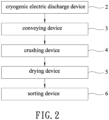
- the cooling unit 21 has a chamber body 211, a cooling chamber 212 defined by the chamber body 211 and for accommodation of the battery, and a temperature controller 213 for controlling a chamber temperature in the cooling chamber 212.
- the battery in the cooling chamber 212 is kept in a gaseous environment and is cooled by the temperature controller 213. In certain embodiment, the battery is cooled by the temperature controller 213 through a liquid-assisted air cooling technique.
- the sensing unit 22 is in signal connection with the temperature controller 213 of the cooling unit 21, and is configured to sense the chamber temperature in the cooling chamber 212 to thereby generate a temperature sensing signal. In this embodiment, the sensing unit 22 is exemplified as an infrared sensor.
- the temperature controller 213 is configured to adjust the chamber temperature in the cooling chamber 212 according to the temperature sensing signal that is received from the sensing unit 22 through signal connection therebetween.
- the puncturing unit 23 is disposed in the cooling chamber 212.
- a predetermined battery temperature i.e., an electric discharge temperature
- the puncturing unit 23 is allowed to puncture the battery to thereby discharge the battery.
- the conveying device 3 is disposed downstream of the cooling unit 21 and the puncturing unit 23 for conveying the battery therefrom.
- the crushing device 4 is disposed downstream of the conveying device 3, and includes a crushing unit 41 and a temperature control unit 42.
- the crushing unit 41 has a container 411 for receiving the battery that is conveyed from the puncturing unit 23 (in some embodiments, from the cooling unit 21) by the conveying device 3, and a crushing member 412 for crushing the battery into a plurality of crushed particles.
- the temperature control unit 42 is disposed in proximity to the container 411 for adjusting an internal temperature of the container 411.
- the temperature control unit 42 has a temperature sensor (not shown) for measuring the internal temperature of the container 411, and a nitrogen supply member (not shown) signally connected to the temperature sensor of the temperature control unit 42.
- the temperature sensor of the temperature control unit 42 is exemplified as an infrared sensor.
- the nitrogen supply member adjusts an amount of nitrogen flowing into the container 411 according to a sensing result that is transmitted from the temperature sensor through signal connection therebetween, so as to control the internal temperature of the container 411, such that the battery in the container 411 may be crushed in a low temperature environment.
- the internal temperature of the container 411 may range from -10 °C to 10 °C and the battery in the container 411 is crushed at such low temperature.
- the sorting device 6 is disposed downstream of the drying device 5, has at least one sorting unit 61, and is configured to, according to at least one of a particle size or a material property, sort the crushed particles from the drying device 5.
- the at least one sorting unit 61 may be a size selector, a magnetic separator, an eddy current sorting machine (which is used to separate non-ferrous metals), or a gravity separator.
- the sorting device 6 has two sorting units 61.
- One of the sorting units 61 adjacent to the drying device 5 is a magnetic separator for sorting the crushed particles according to magnetism property
- the other one of the sorting units 61 disposed downstream of the one of the sorting units 61 is a size selector for sorting the crushed particles according to the particle size; however, the disclosure is not limited thereto.
- the sorting device 6 has one or more different types of sorting units 61, in order to sort the crushed particles according to at least one of a particle size or a material property.
- the battery crushing system further includes a conveyor belt 81 disposed downstream of the drying device 5, and a crushing machine 82 disposed between the conveyor belt 81 and the sorting device 6.
- the conveyor belt 81 is used to convey the crushed particles from the drying device 5 to the crushing machine 82.
- the crushing machine 82 is used to further crush the crushed particles, so as to ensure that particle sizes thereof meet the requirement.
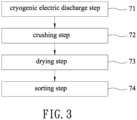
- the battery In the cryogenic electric discharge step 71, the battery is kept in the gaseous environment, and is cooled to the electric discharge temperature using the cooling unit 21, and then, the battery is discharged using the puncturing unit 23.
- the electric discharge temperature refers to a surface temperature of the battery, and ranges from -60 °C to 0 °C; in some embodiments, the electric discharge temperature ranges from -40 °C to -20 °C.
- cooling the battery is conducted using the liquid-assisted air cooling technique.
- the liquid coolant is supplied to the cooling tubes of the temperature controller 213 that are disposed on the sidewall of the chamber body 211 through the supply member, such that heat in the chamber body 211 (i.e., the cooling chamber 212) may be dissipated through the liquid coolant in the cooling tubes, and the battery kept in the gaseous environment in the cooling chamber 212 is thereby cooled to the electric discharge temperature.
- the battery When the battery is cooled to the electric discharge temperature, the battery is prevented from burning due to a large amount of heat generated during the subsequent crushing step 72, thereby enhancing the safety of the battery in the crushing step 72.
- the conveying device 3 is used to convey the battery from the cryogenic electric discharge device 2 to the crushing device 4; specifically, the battery is guided to the container 411 of the crushing device 4.
- the container 411 is controlled at a crushing temperature using the temperature control unit 42, such that the battery is to be crushed at such low temperature.
- the crushing temperature is not greater than a temperature ranging from -10 °C to 10 °C.
- the battery is crushed using the crushing member 412 to form a plurality of crushed particles.
- a particle size of each of the crushed particles may range from 1 cm to 2 cm. Since the battery from the cryogenic electric discharge device 2 is crushed at such low temperature environment, the battery is prevented from burning due to a large amount of heat generated in the crushing step 72.
- the crushing temperature ranges from -10 °C to 10 °C.
- the drying device 5 is used to perform the drying step 73.
- the crushed particles are dried through a heat treatment, so as to remove an electrolyte solution left on the crushed particles.
- the sorting device 6 is used to perform the sorting step 74.
- the crushed particles which are dried in the drying step 73, are sorted according to at least one of a particle size or a material property.
- the one of the sorting units 61 of the sorting device 6 adjacent to the drying device 5 may be the magnetic separator, and is used to sort the crushed particles from the drying device 5 according to magnetism property
- the other one of the sorting units 61 disposed downstream of the one of the sorting units 61 may be the size selector, and is used to sort the crushed particles according to the particle size.
- the sorting units 61 used in the sorting step 74 may come in various types, depending on different requirements.
- each of the sorting units 61 may be an eddy current sorting machine or a gravity separator.
- seven lithium ion batteries are subjected to the cryogenic electric discharge step 71 and the crushing step 72 using the battery crushing system.
- An infrared sensor is used to sense an initial surface temperature T11 (i.e., the electric discharge temperature) and an initial internal temperature T12 of each of the lithium ion batteries before the crushing step 72, a maximum surface temperature T21 and a maximum internal temperature T22 of each of the lithium ion batteries during the crushing step 72, and a particle temperature T3 of the crushed particles of each of the lithium ion batteries after the crushing step 72.
- the initial internal temperature T12 and the maximum internal temperature T22 respectively refer to temperatures within each of the lithium ion batteries before and during the crushing step 72.
- the cryogenic electric discharge step 71 six lithium ion batteries were disposed in the cooling unit 21 and were kept in a gaseous environment, followed by cooling the six lithium ion batteries to the electric discharge temperatures (i.e., 0 °C, -10 °C, -20 °C, -30 °C, -40 °C and -60 °C), respectively. Then, the lithium ion batteries were further discharged by puncturing using the puncturing unit 23. Next, in the crushing step 72, the six lithium ion batteries were crushed into crushed particles using the crushing unit 41 under a crushing temperature ranging from -10 °C to 0 °C.
- a lithium ion battery was similarly subjected to the cryogenic electric discharge step 71 and the crushing step 72, except that in the cryogenic electric discharge step 71, the lithium ion battery was cooled to an initial surface temperature T11 of 10 °C.
- An initial surface temperature T11 and an initial internal temperature T12 before the crushing step 72, a maximum surface temperature T21 and a maximum internal temperature T22 during the crushing step 72, and a particle temperature T3 of the crushed particles after the crushing step 72 were also measured and listed in Table 1.
- Example 1 Table 1 T11(°C) T12(°C) T21(°C) T22(°C) T3(°C) Example 1 0 10 40-45 80-85 38 Example 2 -10 6 50-55 70-75 38.5 Example 3 -20 0 40-45 60-65 38 Example 4 -30 -1 30-35 60-65 38.2 Example 5 -40 -25 20-25 50-55 39 Example 6 -60 -20 10-15 40-45 38 Comparative Example 10 - Burning
- the initial surface temperature T11 of the lithium ion battery was 10 °C before the lithium ion battery was punctured and crushed, and a great amount of heat was generated during the crushing step 72, which led to ignition.
- surfaces of the lithium ion batteries were cooled to the initial surface temperatures T11 ranging from -60 °C to 0 °C, before the lithium ion batteries were punctured and crushed; in the crushing step 72, the maximum internal temperatures T22 of the lithium ion batteries were not greater than 90 °C, the maximum surface temperatures T21 of the lithium ion batteries were not greater than 60 °C, and no burning occurred.
- the initial surface temperature T11 i.e., the electric discharge temperature
- the crushing step 72 combustion of the lithium ion battery in the crushing step 72 can be prevented, which is advantageous for improving the safety of the entire process.
- the battery is cooled to the electric discharge temperature (ranging from -60 °C to 0 °C) in the gaseous environment using the cooling unit 21, such that the battery is prevented from burning due to a large amount of heat generated during the crushing step 72, which ensures safety during the entire process.
- the chemicals such as a salt-containing liquid or liquid nitrogen is omitted in this disclosure; hence, waste water may be greatly reduced and environmental pollution may be prevented.
Landscapes
- Engineering & Computer Science (AREA)
- Chemical & Material Sciences (AREA)
- Manufacturing & Machinery (AREA)
- General Chemical & Material Sciences (AREA)
- Electrochemistry (AREA)
- Chemical Kinetics & Catalysis (AREA)
- Life Sciences & Earth Sciences (AREA)
- Environmental & Geological Engineering (AREA)
- Metallurgy (AREA)
- General Life Sciences & Earth Sciences (AREA)
- Materials Engineering (AREA)
- Organic Chemistry (AREA)
- Geology (AREA)
- Mechanical Engineering (AREA)
- Sustainable Development (AREA)
- Geochemistry & Mineralogy (AREA)
- Food Science & Technology (AREA)
- Secondary Cells (AREA)
- Battery Electrode And Active Subsutance (AREA)
- Primary Cells (AREA)
- Processing Of Solid Wastes (AREA)
- Disintegrating Or Milling (AREA)
Applications Claiming Priority (1)
| Application Number | Priority Date | Filing Date | Title |
|---|---|---|---|
| TW112144082A TWI877901B (zh) | 2023-11-15 | 2023-11-15 | 電池的破碎處理方法及破碎處理系統 |
Publications (2)
| Publication Number | Publication Date |
|---|---|
| EP4582569A2 true EP4582569A2 (de) | 2025-07-09 |
| EP4582569A3 EP4582569A3 (de) | 2025-11-19 |
Family
ID=93463025
Family Applications (1)
| Application Number | Title | Priority Date | Filing Date |
|---|---|---|---|
| EP24212128.3A Pending EP4582569A3 (de) | 2023-11-15 | 2024-11-11 | Batteriezerkleinerungsverfahren und batteriezerkleinerungssystem |
Country Status (4)
| Country | Link |
|---|---|
| US (1) | US20250158148A1 (de) |
| EP (1) | EP4582569A3 (de) |
| CN (1) | CN120015987A (de) |
| TW (1) | TWI877901B (de) |
Citations (1)
| Publication number | Priority date | Publication date | Assignee | Title |
|---|---|---|---|---|
| TW202107764A (zh) | 2019-07-26 | 2021-02-16 | 德商巴斯夫歐洲公司 | 自廢鋰離子電池中回收鋰之方法 |
Family Cites Families (10)
| Publication number | Priority date | Publication date | Assignee | Title |
|---|---|---|---|---|
| DE4424825A1 (de) * | 1994-07-14 | 1996-01-18 | Gabler Ing Kontor Luebeck | Verfahren zum Entsorgen von entladenen und geladenen elektrischen Feststoff-Batterien |
| JP3935594B2 (ja) * | 1997-03-14 | 2007-06-27 | 三菱重工業株式会社 | 非水溶媒系電池の処理方法 |
| US11955613B2 (en) * | 2012-04-04 | 2024-04-09 | Worcester Polytechnic Institute | Charge material for recycled lithium-ion batteries |
| CN111135939A (zh) * | 2019-12-27 | 2020-05-12 | 合肥恒力装备有限公司 | 一种废旧磷酸铁锂电池的回收工艺 |
| TW202139511A (zh) * | 2020-04-06 | 2021-10-16 | 李駿恒 | 電池回收方法及電池回收設備 |
| KR102554465B1 (ko) * | 2021-12-21 | 2023-07-12 | 포스코홀딩스 주식회사 | 유가 금속 회수 합금, 유가 금속 회수 조성물, 및 유가 금속 회수 방법 |
| CN114602622A (zh) * | 2022-03-01 | 2022-06-10 | 江西睿达新能源科技有限公司 | 废弃锂电池破碎的低温破碎设备 |
| CN116247321A (zh) * | 2023-01-09 | 2023-06-09 | 赣州赛可韦尔科技有限公司 | 一种全组分回收废旧锂离子电池的方法 |
| CN116742170B (zh) * | 2023-08-16 | 2023-12-15 | 深圳市杰成镍钴新能源科技有限公司 | 基于放电粒子的退役电池快速放电控制方法及相关设备 |
| TWM655352U (zh) * | 2023-11-15 | 2024-05-11 | 盛特材料股份有限公司 | 電池的破碎處理系統 |
-
2023
- 2023-11-15 TW TW112144082A patent/TWI877901B/zh active
-
2024
- 2024-11-06 US US18/938,591 patent/US20250158148A1/en active Pending
- 2024-11-11 EP EP24212128.3A patent/EP4582569A3/de active Pending
- 2024-11-13 CN CN202411614015.7A patent/CN120015987A/zh active Pending
Patent Citations (1)
| Publication number | Priority date | Publication date | Assignee | Title |
|---|---|---|---|---|
| TW202107764A (zh) | 2019-07-26 | 2021-02-16 | 德商巴斯夫歐洲公司 | 自廢鋰離子電池中回收鋰之方法 |
Also Published As
| Publication number | Publication date |
|---|---|
| CN120015987A (zh) | 2025-05-16 |
| TW202521243A (zh) | 2025-06-01 |
| TWI877901B (zh) | 2025-03-21 |
| US20250158148A1 (en) | 2025-05-15 |
| EP4582569A3 (de) | 2025-11-19 |
Similar Documents
| Publication | Publication Date | Title |
|---|---|---|
| JP3247780U (ja) | リチウムイオン電池破砕処理システム | |
| US20230352758A1 (en) | Safe discharge method for waste lithium ion batteries | |
| KR102729469B1 (ko) | 폐전지 재사용을 위한 처리 방법 | |
| KR102607752B1 (ko) | 배터리 자동 해체 시스템 | |
| KR102119551B1 (ko) | 랙 타입 충방전 장치 | |
| US12266770B2 (en) | System for and method of processing waste lithium-ion battery | |
| EP4582569A2 (de) | Batteriezerkleinerungsverfahren und batteriezerkleinerungssystem | |
| CN110690520A (zh) | 锂电池模组的切割拆解设备及其切割拆解工艺 | |
| CN110492024A (zh) | 一种电池顶盖加工方法 | |
| US4214204A (en) | High rate, battery testing apparatus and method | |
| KR20250021702A (ko) | 페배터리 재생을 위한 친환경 해체 방법 및 장치 | |
| CN211045649U (zh) | 集成式单元块电阻放电托盘及具有其的放电装置 | |
| JP2019108585A (ja) | 金属の分別回収装置 | |
| JP2002265657A (ja) | ポリオレフィン多孔質シートおよびその製造方法 | |
| CN214951038U (zh) | 一种圆柱形锂电池直径全检治具 | |
| CN117497897A (zh) | 一种废旧锂离子电池安全放电装置及方法 | |
| CN216261250U (zh) | 一种炭黑生产中的不合格品处理系统 | |
| KR102958440B1 (ko) | 폐배터리 펀칭 및 수방전시스템 | |
| CN211376875U (zh) | 一种锂电池前处理装置 | |
| CN218690247U (zh) | 一种物料一体化处理生产线 | |
| CN113145276A (zh) | 一种多级降温带电破碎设备 | |
| CN113501261A (zh) | 一种电动汽车电池回收系统 | |
| CN222778433U (zh) | 一种电极材料中金属异物的去除系统 | |
| WO2023050130A1 (zh) | 一种锂电池正极材料的加工方法及生产线 | |
| WO2021239901A1 (en) | Atmospheric-pressure plasma cleaning apparatus |
Legal Events
| Date | Code | Title | Description |
|---|---|---|---|
| PUAI | Public reference made under article 153(3) epc to a published international application that has entered the european phase |
Free format text: ORIGINAL CODE: 0009012 |
|
| STAA | Information on the status of an ep patent application or granted ep patent |
Free format text: STATUS: REQUEST FOR EXAMINATION WAS MADE |
|
| 17P | Request for examination filed |
Effective date: 20241111 |
|
| AK | Designated contracting states |
Kind code of ref document: A2 Designated state(s): AL AT BE BG CH CY CZ DE DK EE ES FI FR GB GR HR HU IE IS IT LI LT LU LV MC ME MK MT NL NO PL PT RO RS SE SI SK SM TR |
|
| PUAL | Search report despatched |
Free format text: ORIGINAL CODE: 0009013 |
|
| AK | Designated contracting states |
Kind code of ref document: A3 Designated state(s): AL AT BE BG CH CY CZ DE DK EE ES FI FR GB GR HR HU IE IS IT LI LT LU LV MC ME MK MT NL NO PL PT RO RS SE SI SK SM TR |
|
| RIC1 | Information provided on ipc code assigned before grant |
Ipc: C22B 1/00 20060101AFI20251014BHEP Ipc: B02C 19/18 20060101ALI20251014BHEP Ipc: C22B 7/00 20060101ALI20251014BHEP Ipc: H01M 10/54 20060101ALI20251014BHEP Ipc: B03B 9/06 20060101ALI20251014BHEP |