EP4582255A2 - Verbundstruktur und verfahren zur herstellung davon - Google Patents
Verbundstruktur und verfahren zur herstellung davon Download PDFInfo
- Publication number
- EP4582255A2 EP4582255A2 EP25177743.9A EP25177743A EP4582255A2 EP 4582255 A2 EP4582255 A2 EP 4582255A2 EP 25177743 A EP25177743 A EP 25177743A EP 4582255 A2 EP4582255 A2 EP 4582255A2
- Authority
- EP
- European Patent Office
- Prior art keywords
- absorbent
- particulate material
- layer
- carrier layer
- particulate
- Prior art date
- Legal status (The legal status is an assumption and is not a legal conclusion. Google has not performed a legal analysis and makes no representation as to the accuracy of the status listed.)
- Pending
Links
Images




Classifications
-
- A—HUMAN NECESSITIES
- A61—MEDICAL OR VETERINARY SCIENCE; HYGIENE
- A61F—FILTERS IMPLANTABLE INTO BLOOD VESSELS; PROSTHESES; DEVICES PROVIDING PATENCY TO, OR PREVENTING COLLAPSING OF, TUBULAR STRUCTURES OF THE BODY, e.g. STENTS; ORTHOPAEDIC, NURSING OR CONTRACEPTIVE DEVICES; FOMENTATION; TREATMENT OR PROTECTION OF EYES OR EARS; BANDAGES, DRESSINGS OR ABSORBENT PADS; FIRST-AID KITS
- A61F13/00—Bandages or dressings; Absorbent pads
- A61F13/15—Absorbent pads, e.g. sanitary towels, swabs or tampons for external or internal application to the body; Supporting or fastening means therefor; Tampon applicators
- A61F13/15577—Apparatus or processes for manufacturing
- A61F13/15585—Apparatus or processes for manufacturing of babies' napkins, e.g. diapers
-
- A—HUMAN NECESSITIES
- A61—MEDICAL OR VETERINARY SCIENCE; HYGIENE
- A61F—FILTERS IMPLANTABLE INTO BLOOD VESSELS; PROSTHESES; DEVICES PROVIDING PATENCY TO, OR PREVENTING COLLAPSING OF, TUBULAR STRUCTURES OF THE BODY, e.g. STENTS; ORTHOPAEDIC, NURSING OR CONTRACEPTIVE DEVICES; FOMENTATION; TREATMENT OR PROTECTION OF EYES OR EARS; BANDAGES, DRESSINGS OR ABSORBENT PADS; FIRST-AID KITS
- A61F13/00—Bandages or dressings; Absorbent pads
- A61F13/15—Absorbent pads, e.g. sanitary towels, swabs or tampons for external or internal application to the body; Supporting or fastening means therefor; Tampon applicators
- A61F13/15577—Apparatus or processes for manufacturing
- A61F13/15617—Making absorbent pads from fibres or pulverulent material with or without treatment of the fibres
- A61F13/15658—Forming continuous, e.g. composite, fibrous webs, e.g. involving the application of pulverulent material on parts thereof
-
- A—HUMAN NECESSITIES
- A61—MEDICAL OR VETERINARY SCIENCE; HYGIENE
- A61F—FILTERS IMPLANTABLE INTO BLOOD VESSELS; PROSTHESES; DEVICES PROVIDING PATENCY TO, OR PREVENTING COLLAPSING OF, TUBULAR STRUCTURES OF THE BODY, e.g. STENTS; ORTHOPAEDIC, NURSING OR CONTRACEPTIVE DEVICES; FOMENTATION; TREATMENT OR PROTECTION OF EYES OR EARS; BANDAGES, DRESSINGS OR ABSORBENT PADS; FIRST-AID KITS
- A61F13/00—Bandages or dressings; Absorbent pads
- A61F13/15—Absorbent pads, e.g. sanitary towels, swabs or tampons for external or internal application to the body; Supporting or fastening means therefor; Tampon applicators
- A61F13/53—Absorbent pads, e.g. sanitary towels, swabs or tampons for external or internal application to the body; Supporting or fastening means therefor; Tampon applicators characterised by the absorbing medium
- A61F13/531—Absorbent pads, e.g. sanitary towels, swabs or tampons for external or internal application to the body; Supporting or fastening means therefor; Tampon applicators characterised by the absorbing medium having a homogeneous composition through the thickness of the pad
- A61F13/532—Absorbent pads, e.g. sanitary towels, swabs or tampons for external or internal application to the body; Supporting or fastening means therefor; Tampon applicators characterised by the absorbing medium having a homogeneous composition through the thickness of the pad inhomogeneous in the plane of the pad
- A61F13/5323—Absorbent pads, e.g. sanitary towels, swabs or tampons for external or internal application to the body; Supporting or fastening means therefor; Tampon applicators characterised by the absorbing medium having a homogeneous composition through the thickness of the pad inhomogeneous in the plane of the pad having absorbent material located in discrete regions, e.g. pockets
-
- A—HUMAN NECESSITIES
- A61—MEDICAL OR VETERINARY SCIENCE; HYGIENE
- A61F—FILTERS IMPLANTABLE INTO BLOOD VESSELS; PROSTHESES; DEVICES PROVIDING PATENCY TO, OR PREVENTING COLLAPSING OF, TUBULAR STRUCTURES OF THE BODY, e.g. STENTS; ORTHOPAEDIC, NURSING OR CONTRACEPTIVE DEVICES; FOMENTATION; TREATMENT OR PROTECTION OF EYES OR EARS; BANDAGES, DRESSINGS OR ABSORBENT PADS; FIRST-AID KITS
- A61F13/00—Bandages or dressings; Absorbent pads
- A61F13/15—Absorbent pads, e.g. sanitary towels, swabs or tampons for external or internal application to the body; Supporting or fastening means therefor; Tampon applicators
- A61F13/53—Absorbent pads, e.g. sanitary towels, swabs or tampons for external or internal application to the body; Supporting or fastening means therefor; Tampon applicators characterised by the absorbing medium
- A61F13/539—Absorbent pads, e.g. sanitary towels, swabs or tampons for external or internal application to the body; Supporting or fastening means therefor; Tampon applicators characterised by the absorbing medium characterised by the connection of the absorbent layers with each other or with the outer layers
-
- B—PERFORMING OPERATIONS; TRANSPORTING
- B05—SPRAYING OR ATOMISING IN GENERAL; APPLYING FLUENT MATERIALS TO SURFACES, IN GENERAL
- B05C—APPARATUS FOR APPLYING FLUENT MATERIALS TO SURFACES, IN GENERAL
- B05C1/00—Apparatus in which liquid or other fluent material is applied to the surface of the work by contact with a member carrying the liquid or other fluent material, e.g. a porous member loaded with a liquid to be applied as a coating
- B05C1/04—Apparatus in which liquid or other fluent material is applied to the surface of the work by contact with a member carrying the liquid or other fluent material, e.g. a porous member loaded with a liquid to be applied as a coating for applying liquid or other fluent material to work of indefinite length
- B05C1/08—Apparatus in which liquid or other fluent material is applied to the surface of the work by contact with a member carrying the liquid or other fluent material, e.g. a porous member loaded with a liquid to be applied as a coating for applying liquid or other fluent material to work of indefinite length using a roller or other rotating member which contacts the work along a generating line
- B05C1/10—Apparatus in which liquid or other fluent material is applied to the surface of the work by contact with a member carrying the liquid or other fluent material, e.g. a porous member loaded with a liquid to be applied as a coating for applying liquid or other fluent material to work of indefinite length using a roller or other rotating member which contacts the work along a generating line the liquid or other fluent material being supplied from inside the roller
-
- B—PERFORMING OPERATIONS; TRANSPORTING
- B05—SPRAYING OR ATOMISING IN GENERAL; APPLYING FLUENT MATERIALS TO SURFACES, IN GENERAL
- B05C—APPARATUS FOR APPLYING FLUENT MATERIALS TO SURFACES, IN GENERAL
- B05C19/00—Apparatus specially adapted for applying particulate materials to surfaces
- B05C19/04—Apparatus specially adapted for applying particulate materials to surfaces the particulate material being projected, poured or allowed to flow onto the surface of the work
-
- B—PERFORMING OPERATIONS; TRANSPORTING
- B05—SPRAYING OR ATOMISING IN GENERAL; APPLYING FLUENT MATERIALS TO SURFACES, IN GENERAL
- B05D—PROCESSES FOR APPLYING FLUENT MATERIALS TO SURFACES, IN GENERAL
- B05D1/00—Processes for applying liquids or other fluent materials
- B05D1/32—Processes for applying liquids or other fluent materials using means for protecting parts of a surface not to be coated, e.g. using stencils, resists
-
- B—PERFORMING OPERATIONS; TRANSPORTING
- B32—LAYERED PRODUCTS
- B32B—LAYERED PRODUCTS, i.e. PRODUCTS BUILT-UP OF STRATA OF FLAT OR NON-FLAT, e.g. CELLULAR OR HONEYCOMB, FORM
- B32B27/00—Layered products comprising a layer of synthetic resin
- B32B27/06—Layered products comprising a layer of synthetic resin as the main or only constituent of a layer, which is next to another layer of the same or of a different material
- B32B27/065—Layered products comprising a layer of synthetic resin as the main or only constituent of a layer, which is next to another layer of the same or of a different material of foam
-
- B—PERFORMING OPERATIONS; TRANSPORTING
- B32—LAYERED PRODUCTS
- B32B—LAYERED PRODUCTS, i.e. PRODUCTS BUILT-UP OF STRATA OF FLAT OR NON-FLAT, e.g. CELLULAR OR HONEYCOMB, FORM
- B32B27/00—Layered products comprising a layer of synthetic resin
- B32B27/06—Layered products comprising a layer of synthetic resin as the main or only constituent of a layer, which is next to another layer of the same or of a different material
- B32B27/08—Layered products comprising a layer of synthetic resin as the main or only constituent of a layer, which is next to another layer of the same or of a different material of synthetic resin
-
- B—PERFORMING OPERATIONS; TRANSPORTING
- B32—LAYERED PRODUCTS
- B32B—LAYERED PRODUCTS, i.e. PRODUCTS BUILT-UP OF STRATA OF FLAT OR NON-FLAT, e.g. CELLULAR OR HONEYCOMB, FORM
- B32B27/00—Layered products comprising a layer of synthetic resin
- B32B27/06—Layered products comprising a layer of synthetic resin as the main or only constituent of a layer, which is next to another layer of the same or of a different material
- B32B27/10—Layered products comprising a layer of synthetic resin as the main or only constituent of a layer, which is next to another layer of the same or of a different material of paper or cardboard
-
- B—PERFORMING OPERATIONS; TRANSPORTING
- B32—LAYERED PRODUCTS
- B32B—LAYERED PRODUCTS, i.e. PRODUCTS BUILT-UP OF STRATA OF FLAT OR NON-FLAT, e.g. CELLULAR OR HONEYCOMB, FORM
- B32B27/00—Layered products comprising a layer of synthetic resin
- B32B27/12—Layered products comprising a layer of synthetic resin next to a fibrous or filamentary layer
-
- B—PERFORMING OPERATIONS; TRANSPORTING
- B32—LAYERED PRODUCTS
- B32B—LAYERED PRODUCTS, i.e. PRODUCTS BUILT-UP OF STRATA OF FLAT OR NON-FLAT, e.g. CELLULAR OR HONEYCOMB, FORM
- B32B27/00—Layered products comprising a layer of synthetic resin
- B32B27/32—Layered products comprising a layer of synthetic resin comprising polyolefins
-
- B—PERFORMING OPERATIONS; TRANSPORTING
- B32—LAYERED PRODUCTS
- B32B—LAYERED PRODUCTS, i.e. PRODUCTS BUILT-UP OF STRATA OF FLAT OR NON-FLAT, e.g. CELLULAR OR HONEYCOMB, FORM
- B32B29/00—Layered products comprising a layer of paper or cardboard
- B32B29/002—Layered products comprising a layer of paper or cardboard as the main or only constituent of a layer, which is next to another layer of the same or of a different material
- B32B29/005—Layered products comprising a layer of paper or cardboard as the main or only constituent of a layer, which is next to another layer of the same or of a different material next to another layer of paper or cardboard layer
-
- B—PERFORMING OPERATIONS; TRANSPORTING
- B32—LAYERED PRODUCTS
- B32B—LAYERED PRODUCTS, i.e. PRODUCTS BUILT-UP OF STRATA OF FLAT OR NON-FLAT, e.g. CELLULAR OR HONEYCOMB, FORM
- B32B29/00—Layered products comprising a layer of paper or cardboard
- B32B29/02—Layered products comprising a layer of paper or cardboard next to a fibrous or filamentary layer
-
- B—PERFORMING OPERATIONS; TRANSPORTING
- B32—LAYERED PRODUCTS
- B32B—LAYERED PRODUCTS, i.e. PRODUCTS BUILT-UP OF STRATA OF FLAT OR NON-FLAT, e.g. CELLULAR OR HONEYCOMB, FORM
- B32B3/00—Layered products comprising a layer with external or internal discontinuities or unevennesses, or a layer of non-planar shape; Layered products comprising a layer having particular features of form
- B32B3/02—Layered products comprising a layer with external or internal discontinuities or unevennesses, or a layer of non-planar shape; Layered products comprising a layer having particular features of form characterised by features of form at particular places, e.g. in edge regions
- B32B3/08—Layered products comprising a layer with external or internal discontinuities or unevennesses, or a layer of non-planar shape; Layered products comprising a layer having particular features of form characterised by features of form at particular places, e.g. in edge regions characterised by added members at particular parts
-
- B—PERFORMING OPERATIONS; TRANSPORTING
- B32—LAYERED PRODUCTS
- B32B—LAYERED PRODUCTS, i.e. PRODUCTS BUILT-UP OF STRATA OF FLAT OR NON-FLAT, e.g. CELLULAR OR HONEYCOMB, FORM
- B32B3/00—Layered products comprising a layer with external or internal discontinuities or unevennesses, or a layer of non-planar shape; Layered products comprising a layer having particular features of form
- B32B3/10—Layered products comprising a layer with external or internal discontinuities or unevennesses, or a layer of non-planar shape; Layered products comprising a layer having particular features of form characterised by a discontinuous layer, i.e. formed of separate pieces of material
- B32B3/18—Layered products comprising a layer with external or internal discontinuities or unevennesses, or a layer of non-planar shape; Layered products comprising a layer having particular features of form characterised by a discontinuous layer, i.e. formed of separate pieces of material characterised by an internal layer formed of separate pieces of material which are juxtaposed side-by-side
- B32B3/20—Layered products comprising a layer with external or internal discontinuities or unevennesses, or a layer of non-planar shape; Layered products comprising a layer having particular features of form characterised by a discontinuous layer, i.e. formed of separate pieces of material characterised by an internal layer formed of separate pieces of material which are juxtaposed side-by-side of hollow pieces, e.g. tubes; of pieces with channels or cavities
-
- B—PERFORMING OPERATIONS; TRANSPORTING
- B32—LAYERED PRODUCTS
- B32B—LAYERED PRODUCTS, i.e. PRODUCTS BUILT-UP OF STRATA OF FLAT OR NON-FLAT, e.g. CELLULAR OR HONEYCOMB, FORM
- B32B3/00—Layered products comprising a layer with external or internal discontinuities or unevennesses, or a layer of non-planar shape; Layered products comprising a layer having particular features of form
- B32B3/26—Layered products comprising a layer with external or internal discontinuities or unevennesses, or a layer of non-planar shape; Layered products comprising a layer having particular features of form characterised by a particular shape of the outline of the cross-section of a continuous layer; characterised by a layer with cavities or internal voids ; characterised by an apertured layer
- B32B3/266—Layered products comprising a layer with external or internal discontinuities or unevennesses, or a layer of non-planar shape; Layered products comprising a layer having particular features of form characterised by a particular shape of the outline of the cross-section of a continuous layer; characterised by a layer with cavities or internal voids ; characterised by an apertured layer characterised by an apertured layer, the apertures going through the whole thickness of the layer, e.g. expanded metal, perforated layer, slit layer regular cells B32B3/12
-
- B—PERFORMING OPERATIONS; TRANSPORTING
- B32—LAYERED PRODUCTS
- B32B—LAYERED PRODUCTS, i.e. PRODUCTS BUILT-UP OF STRATA OF FLAT OR NON-FLAT, e.g. CELLULAR OR HONEYCOMB, FORM
- B32B3/00—Layered products comprising a layer with external or internal discontinuities or unevennesses, or a layer of non-planar shape; Layered products comprising a layer having particular features of form
- B32B3/26—Layered products comprising a layer with external or internal discontinuities or unevennesses, or a layer of non-planar shape; Layered products comprising a layer having particular features of form characterised by a particular shape of the outline of the cross-section of a continuous layer; characterised by a layer with cavities or internal voids ; characterised by an apertured layer
- B32B3/28—Layered products comprising a layer with external or internal discontinuities or unevennesses, or a layer of non-planar shape; Layered products comprising a layer having particular features of form characterised by a particular shape of the outline of the cross-section of a continuous layer; characterised by a layer with cavities or internal voids ; characterised by an apertured layer characterised by a layer comprising a deformed thin sheet, i.e. the layer having its entire thickness deformed out of the plane, e.g. corrugated, crumpled
-
- B—PERFORMING OPERATIONS; TRANSPORTING
- B32—LAYERED PRODUCTS
- B32B—LAYERED PRODUCTS, i.e. PRODUCTS BUILT-UP OF STRATA OF FLAT OR NON-FLAT, e.g. CELLULAR OR HONEYCOMB, FORM
- B32B37/00—Methods or apparatus for laminating, e.g. by curing or by ultrasonic bonding
- B32B37/0076—Methods or apparatus for laminating, e.g. by curing or by ultrasonic bonding characterised in that the layers are not bonded on the totality of their surfaces
-
- B—PERFORMING OPERATIONS; TRANSPORTING
- B32—LAYERED PRODUCTS
- B32B—LAYERED PRODUCTS, i.e. PRODUCTS BUILT-UP OF STRATA OF FLAT OR NON-FLAT, e.g. CELLULAR OR HONEYCOMB, FORM
- B32B37/00—Methods or apparatus for laminating, e.g. by curing or by ultrasonic bonding
- B32B37/14—Methods or apparatus for laminating, e.g. by curing or by ultrasonic bonding characterised by the properties of the layers
- B32B37/24—Methods or apparatus for laminating, e.g. by curing or by ultrasonic bonding characterised by the properties of the layers with at least one layer not being coherent before laminating, e.g. made up from granular material sprinkled onto a substrate
-
- B—PERFORMING OPERATIONS; TRANSPORTING
- B32—LAYERED PRODUCTS
- B32B—LAYERED PRODUCTS, i.e. PRODUCTS BUILT-UP OF STRATA OF FLAT OR NON-FLAT, e.g. CELLULAR OR HONEYCOMB, FORM
- B32B5/00—Layered products characterised by the non- homogeneity or physical structure, i.e. comprising a fibrous, filamentary, particulate or foam layer; Layered products characterised by having a layer differing constitutionally or physically in different parts
- B32B5/02—Layered products characterised by the non- homogeneity or physical structure, i.e. comprising a fibrous, filamentary, particulate or foam layer; Layered products characterised by having a layer differing constitutionally or physically in different parts characterised by structural features of a fibrous or filamentary layer
- B32B5/022—Non-woven fabric
-
- B—PERFORMING OPERATIONS; TRANSPORTING
- B32—LAYERED PRODUCTS
- B32B—LAYERED PRODUCTS, i.e. PRODUCTS BUILT-UP OF STRATA OF FLAT OR NON-FLAT, e.g. CELLULAR OR HONEYCOMB, FORM
- B32B5/00—Layered products characterised by the non- homogeneity or physical structure, i.e. comprising a fibrous, filamentary, particulate or foam layer; Layered products characterised by having a layer differing constitutionally or physically in different parts
- B32B5/02—Layered products characterised by the non- homogeneity or physical structure, i.e. comprising a fibrous, filamentary, particulate or foam layer; Layered products characterised by having a layer differing constitutionally or physically in different parts characterised by structural features of a fibrous or filamentary layer
- B32B5/024—Woven fabric
-
- B—PERFORMING OPERATIONS; TRANSPORTING
- B32—LAYERED PRODUCTS
- B32B—LAYERED PRODUCTS, i.e. PRODUCTS BUILT-UP OF STRATA OF FLAT OR NON-FLAT, e.g. CELLULAR OR HONEYCOMB, FORM
- B32B5/00—Layered products characterised by the non- homogeneity or physical structure, i.e. comprising a fibrous, filamentary, particulate or foam layer; Layered products characterised by having a layer differing constitutionally or physically in different parts
- B32B5/16—Layered products characterised by the non- homogeneity or physical structure, i.e. comprising a fibrous, filamentary, particulate or foam layer; Layered products characterised by having a layer differing constitutionally or physically in different parts characterised by features of a layer formed of particles, e.g. chips, powder or granules
-
- B—PERFORMING OPERATIONS; TRANSPORTING
- B32—LAYERED PRODUCTS
- B32B—LAYERED PRODUCTS, i.e. PRODUCTS BUILT-UP OF STRATA OF FLAT OR NON-FLAT, e.g. CELLULAR OR HONEYCOMB, FORM
- B32B5/00—Layered products characterised by the non- homogeneity or physical structure, i.e. comprising a fibrous, filamentary, particulate or foam layer; Layered products characterised by having a layer differing constitutionally or physically in different parts
- B32B5/18—Layered products characterised by the non- homogeneity or physical structure, i.e. comprising a fibrous, filamentary, particulate or foam layer; Layered products characterised by having a layer differing constitutionally or physically in different parts characterised by features of a layer of foamed material
-
- B—PERFORMING OPERATIONS; TRANSPORTING
- B32—LAYERED PRODUCTS
- B32B—LAYERED PRODUCTS, i.e. PRODUCTS BUILT-UP OF STRATA OF FLAT OR NON-FLAT, e.g. CELLULAR OR HONEYCOMB, FORM
- B32B5/00—Layered products characterised by the non- homogeneity or physical structure, i.e. comprising a fibrous, filamentary, particulate or foam layer; Layered products characterised by having a layer differing constitutionally or physically in different parts
- B32B5/22—Layered products characterised by the non- homogeneity or physical structure, i.e. comprising a fibrous, filamentary, particulate or foam layer; Layered products characterised by having a layer differing constitutionally or physically in different parts characterised by the presence of two or more layers which are next to each other and are fibrous, filamentary, formed of particles or foamed
- B32B5/24—Layered products characterised by the non- homogeneity or physical structure, i.e. comprising a fibrous, filamentary, particulate or foam layer; Layered products characterised by having a layer differing constitutionally or physically in different parts characterised by the presence of two or more layers which are next to each other and are fibrous, filamentary, formed of particles or foamed one layer being a fibrous or filamentary layer
- B32B5/245—Layered products characterised by the non- homogeneity or physical structure, i.e. comprising a fibrous, filamentary, particulate or foam layer; Layered products characterised by having a layer differing constitutionally or physically in different parts characterised by the presence of two or more layers which are next to each other and are fibrous, filamentary, formed of particles or foamed one layer being a fibrous or filamentary layer another layer next to it being a foam layer
-
- B—PERFORMING OPERATIONS; TRANSPORTING
- B32—LAYERED PRODUCTS
- B32B—LAYERED PRODUCTS, i.e. PRODUCTS BUILT-UP OF STRATA OF FLAT OR NON-FLAT, e.g. CELLULAR OR HONEYCOMB, FORM
- B32B5/00—Layered products characterised by the non- homogeneity or physical structure, i.e. comprising a fibrous, filamentary, particulate or foam layer; Layered products characterised by having a layer differing constitutionally or physically in different parts
- B32B5/22—Layered products characterised by the non- homogeneity or physical structure, i.e. comprising a fibrous, filamentary, particulate or foam layer; Layered products characterised by having a layer differing constitutionally or physically in different parts characterised by the presence of two or more layers which are next to each other and are fibrous, filamentary, formed of particles or foamed
- B32B5/24—Layered products characterised by the non- homogeneity or physical structure, i.e. comprising a fibrous, filamentary, particulate or foam layer; Layered products characterised by having a layer differing constitutionally or physically in different parts characterised by the presence of two or more layers which are next to each other and are fibrous, filamentary, formed of particles or foamed one layer being a fibrous or filamentary layer
- B32B5/26—Layered products characterised by the non- homogeneity or physical structure, i.e. comprising a fibrous, filamentary, particulate or foam layer; Layered products characterised by having a layer differing constitutionally or physically in different parts characterised by the presence of two or more layers which are next to each other and are fibrous, filamentary, formed of particles or foamed one layer being a fibrous or filamentary layer another layer next to it also being fibrous or filamentary
-
- B—PERFORMING OPERATIONS; TRANSPORTING
- B32—LAYERED PRODUCTS
- B32B—LAYERED PRODUCTS, i.e. PRODUCTS BUILT-UP OF STRATA OF FLAT OR NON-FLAT, e.g. CELLULAR OR HONEYCOMB, FORM
- B32B5/00—Layered products characterised by the non- homogeneity or physical structure, i.e. comprising a fibrous, filamentary, particulate or foam layer; Layered products characterised by having a layer differing constitutionally or physically in different parts
- B32B5/22—Layered products characterised by the non- homogeneity or physical structure, i.e. comprising a fibrous, filamentary, particulate or foam layer; Layered products characterised by having a layer differing constitutionally or physically in different parts characterised by the presence of two or more layers which are next to each other and are fibrous, filamentary, formed of particles or foamed
- B32B5/30—Layered products characterised by the non- homogeneity or physical structure, i.e. comprising a fibrous, filamentary, particulate or foam layer; Layered products characterised by having a layer differing constitutionally or physically in different parts characterised by the presence of two or more layers which are next to each other and are fibrous, filamentary, formed of particles or foamed one layer being formed of particles, e.g. chips, granules, powder
-
- B—PERFORMING OPERATIONS; TRANSPORTING
- B32—LAYERED PRODUCTS
- B32B—LAYERED PRODUCTS, i.e. PRODUCTS BUILT-UP OF STRATA OF FLAT OR NON-FLAT, e.g. CELLULAR OR HONEYCOMB, FORM
- B32B7/00—Layered products characterised by the relation between layers; Layered products characterised by the relative orientation of features between layers, or by the relative values of a measurable parameter between layers, i.e. products comprising layers having different physical, chemical or physicochemical properties; Layered products characterised by the interconnection of layers
- B32B7/02—Physical, chemical or physicochemical properties
-
- B—PERFORMING OPERATIONS; TRANSPORTING
- B32—LAYERED PRODUCTS
- B32B—LAYERED PRODUCTS, i.e. PRODUCTS BUILT-UP OF STRATA OF FLAT OR NON-FLAT, e.g. CELLULAR OR HONEYCOMB, FORM
- B32B7/00—Layered products characterised by the relation between layers; Layered products characterised by the relative orientation of features between layers, or by the relative values of a measurable parameter between layers, i.e. products comprising layers having different physical, chemical or physicochemical properties; Layered products characterised by the interconnection of layers
- B32B7/04—Interconnection of layers
-
- B—PERFORMING OPERATIONS; TRANSPORTING
- B32—LAYERED PRODUCTS
- B32B—LAYERED PRODUCTS, i.e. PRODUCTS BUILT-UP OF STRATA OF FLAT OR NON-FLAT, e.g. CELLULAR OR HONEYCOMB, FORM
- B32B7/00—Layered products characterised by the relation between layers; Layered products characterised by the relative orientation of features between layers, or by the relative values of a measurable parameter between layers, i.e. products comprising layers having different physical, chemical or physicochemical properties; Layered products characterised by the interconnection of layers
- B32B7/04—Interconnection of layers
- B32B7/08—Interconnection of layers by mechanical means
-
- B—PERFORMING OPERATIONS; TRANSPORTING
- B32—LAYERED PRODUCTS
- B32B—LAYERED PRODUCTS, i.e. PRODUCTS BUILT-UP OF STRATA OF FLAT OR NON-FLAT, e.g. CELLULAR OR HONEYCOMB, FORM
- B32B7/00—Layered products characterised by the relation between layers; Layered products characterised by the relative orientation of features between layers, or by the relative values of a measurable parameter between layers, i.e. products comprising layers having different physical, chemical or physicochemical properties; Layered products characterised by the interconnection of layers
- B32B7/04—Interconnection of layers
- B32B7/12—Interconnection of layers using interposed adhesives or interposed materials with bonding properties
-
- B—PERFORMING OPERATIONS; TRANSPORTING
- B32—LAYERED PRODUCTS
- B32B—LAYERED PRODUCTS, i.e. PRODUCTS BUILT-UP OF STRATA OF FLAT OR NON-FLAT, e.g. CELLULAR OR HONEYCOMB, FORM
- B32B9/00—Layered products comprising a layer of a particular substance not covered by groups B32B11/00 - B32B29/00
- B32B9/02—Layered products comprising a layer of a particular substance not covered by groups B32B11/00 - B32B29/00 comprising animal or vegetable substances, e.g. cork, bamboo, starch
-
- B—PERFORMING OPERATIONS; TRANSPORTING
- B32—LAYERED PRODUCTS
- B32B—LAYERED PRODUCTS, i.e. PRODUCTS BUILT-UP OF STRATA OF FLAT OR NON-FLAT, e.g. CELLULAR OR HONEYCOMB, FORM
- B32B9/00—Layered products comprising a layer of a particular substance not covered by groups B32B11/00 - B32B29/00
- B32B9/04—Layered products comprising a layer of a particular substance not covered by groups B32B11/00 - B32B29/00 comprising such particular substance as the main or only constituent of a layer, which is next to another layer of the same or of a different material
-
- B—PERFORMING OPERATIONS; TRANSPORTING
- B32—LAYERED PRODUCTS
- B32B—LAYERED PRODUCTS, i.e. PRODUCTS BUILT-UP OF STRATA OF FLAT OR NON-FLAT, e.g. CELLULAR OR HONEYCOMB, FORM
- B32B9/00—Layered products comprising a layer of a particular substance not covered by groups B32B11/00 - B32B29/00
- B32B9/04—Layered products comprising a layer of a particular substance not covered by groups B32B11/00 - B32B29/00 comprising such particular substance as the main or only constituent of a layer, which is next to another layer of the same or of a different material
- B32B9/045—Layered products comprising a layer of a particular substance not covered by groups B32B11/00 - B32B29/00 comprising such particular substance as the main or only constituent of a layer, which is next to another layer of the same or of a different material of synthetic resin
-
- B—PERFORMING OPERATIONS; TRANSPORTING
- B32—LAYERED PRODUCTS
- B32B—LAYERED PRODUCTS, i.e. PRODUCTS BUILT-UP OF STRATA OF FLAT OR NON-FLAT, e.g. CELLULAR OR HONEYCOMB, FORM
- B32B9/00—Layered products comprising a layer of a particular substance not covered by groups B32B11/00 - B32B29/00
- B32B9/04—Layered products comprising a layer of a particular substance not covered by groups B32B11/00 - B32B29/00 comprising such particular substance as the main or only constituent of a layer, which is next to another layer of the same or of a different material
- B32B9/047—Layered products comprising a layer of a particular substance not covered by groups B32B11/00 - B32B29/00 comprising such particular substance as the main or only constituent of a layer, which is next to another layer of the same or of a different material made of fibres or filaments
-
- D—TEXTILES; PAPER
- D04—BRAIDING; LACE-MAKING; KNITTING; TRIMMINGS; NON-WOVEN FABRICS
- D04H—MAKING TEXTILE FABRICS, e.g. FROM FIBRES OR FILAMENTARY MATERIAL; FABRICS MADE BY SUCH PROCESSES OR APPARATUS, e.g. FELTS, NON-WOVEN FABRICS; COTTON-WOOL; WADDING ; NON-WOVEN FABRICS FROM STAPLE FIBRES, FILAMENTS OR YARNS, BONDED WITH AT LEAST ONE WEB-LIKE MATERIAL DURING THEIR CONSOLIDATION
- D04H1/00—Non-woven fabrics formed wholly or mainly of staple fibres or like relatively short fibres
- D04H1/40—Non-woven fabrics formed wholly or mainly of staple fibres or like relatively short fibres from fleeces or layers composed of fibres without existing or potential cohesive properties
- D04H1/44—Non-woven fabrics formed wholly or mainly of staple fibres or like relatively short fibres from fleeces or layers composed of fibres without existing or potential cohesive properties the fleeces or layers being consolidated by mechanical means, e.g. by rolling
- D04H1/46—Non-woven fabrics formed wholly or mainly of staple fibres or like relatively short fibres from fleeces or layers composed of fibres without existing or potential cohesive properties the fleeces or layers being consolidated by mechanical means, e.g. by rolling by needling or like operations to cause entanglement of fibres
- D04H1/465—Hydraulic needling
-
- A—HUMAN NECESSITIES
- A61—MEDICAL OR VETERINARY SCIENCE; HYGIENE
- A61F—FILTERS IMPLANTABLE INTO BLOOD VESSELS; PROSTHESES; DEVICES PROVIDING PATENCY TO, OR PREVENTING COLLAPSING OF, TUBULAR STRUCTURES OF THE BODY, e.g. STENTS; ORTHOPAEDIC, NURSING OR CONTRACEPTIVE DEVICES; FOMENTATION; TREATMENT OR PROTECTION OF EYES OR EARS; BANDAGES, DRESSINGS OR ABSORBENT PADS; FIRST-AID KITS
- A61F13/00—Bandages or dressings; Absorbent pads
- A61F13/15—Absorbent pads, e.g. sanitary towels, swabs or tampons for external or internal application to the body; Supporting or fastening means therefor; Tampon applicators
- A61F13/53—Absorbent pads, e.g. sanitary towels, swabs or tampons for external or internal application to the body; Supporting or fastening means therefor; Tampon applicators characterised by the absorbing medium
- A61F2013/530481—Absorbent pads, e.g. sanitary towels, swabs or tampons for external or internal application to the body; Supporting or fastening means therefor; Tampon applicators characterised by the absorbing medium having superabsorbent materials, i.e. highly absorbent polymer gel materials
- A61F2013/53051—Absorbent pads, e.g. sanitary towels, swabs or tampons for external or internal application to the body; Supporting or fastening means therefor; Tampon applicators characterised by the absorbing medium having superabsorbent materials, i.e. highly absorbent polymer gel materials being only in particular parts or specially arranged
- A61F2013/530547—Absorbent pads, e.g. sanitary towels, swabs or tampons for external or internal application to the body; Supporting or fastening means therefor; Tampon applicators characterised by the absorbing medium having superabsorbent materials, i.e. highly absorbent polymer gel materials being only in particular parts or specially arranged positioned in a separate layer or layers
- A61F2013/530562—Absorbent pads, e.g. sanitary towels, swabs or tampons for external or internal application to the body; Supporting or fastening means therefor; Tampon applicators characterised by the absorbing medium having superabsorbent materials, i.e. highly absorbent polymer gel materials being only in particular parts or specially arranged positioned in a separate layer or layers being arranged in discontinuous pattern
-
- A—HUMAN NECESSITIES
- A61—MEDICAL OR VETERINARY SCIENCE; HYGIENE
- A61F—FILTERS IMPLANTABLE INTO BLOOD VESSELS; PROSTHESES; DEVICES PROVIDING PATENCY TO, OR PREVENTING COLLAPSING OF, TUBULAR STRUCTURES OF THE BODY, e.g. STENTS; ORTHOPAEDIC, NURSING OR CONTRACEPTIVE DEVICES; FOMENTATION; TREATMENT OR PROTECTION OF EYES OR EARS; BANDAGES, DRESSINGS OR ABSORBENT PADS; FIRST-AID KITS
- A61F13/00—Bandages or dressings; Absorbent pads
- A61F13/15—Absorbent pads, e.g. sanitary towels, swabs or tampons for external or internal application to the body; Supporting or fastening means therefor; Tampon applicators
- A61F13/53—Absorbent pads, e.g. sanitary towels, swabs or tampons for external or internal application to the body; Supporting or fastening means therefor; Tampon applicators characterised by the absorbing medium
- A61F2013/530481—Absorbent pads, e.g. sanitary towels, swabs or tampons for external or internal application to the body; Supporting or fastening means therefor; Tampon applicators characterised by the absorbing medium having superabsorbent materials, i.e. highly absorbent polymer gel materials
- A61F2013/530583—Absorbent pads, e.g. sanitary towels, swabs or tampons for external or internal application to the body; Supporting or fastening means therefor; Tampon applicators characterised by the absorbing medium having superabsorbent materials, i.e. highly absorbent polymer gel materials characterized by the form
- A61F2013/530591—Absorbent pads, e.g. sanitary towels, swabs or tampons for external or internal application to the body; Supporting or fastening means therefor; Tampon applicators characterised by the absorbing medium having superabsorbent materials, i.e. highly absorbent polymer gel materials characterized by the form in granules or particles
-
- B—PERFORMING OPERATIONS; TRANSPORTING
- B05—SPRAYING OR ATOMISING IN GENERAL; APPLYING FLUENT MATERIALS TO SURFACES, IN GENERAL
- B05D—PROCESSES FOR APPLYING FLUENT MATERIALS TO SURFACES, IN GENERAL
- B05D2401/00—Form of the coating product, e.g. solution, water dispersion, powders or the like
- B05D2401/30—Form of the coating product, e.g. solution, water dispersion, powders or the like the coating being applied in other forms than involving eliminable solvent, diluent or dispersant
- B05D2401/32—Form of the coating product, e.g. solution, water dispersion, powders or the like the coating being applied in other forms than involving eliminable solvent, diluent or dispersant applied as powders
-
- B—PERFORMING OPERATIONS; TRANSPORTING
- B32—LAYERED PRODUCTS
- B32B—LAYERED PRODUCTS, i.e. PRODUCTS BUILT-UP OF STRATA OF FLAT OR NON-FLAT, e.g. CELLULAR OR HONEYCOMB, FORM
- B32B2255/00—Coating on the layer surface
- B32B2255/02—Coating on the layer surface on fibrous or filamentary layer
-
- B—PERFORMING OPERATIONS; TRANSPORTING
- B32—LAYERED PRODUCTS
- B32B—LAYERED PRODUCTS, i.e. PRODUCTS BUILT-UP OF STRATA OF FLAT OR NON-FLAT, e.g. CELLULAR OR HONEYCOMB, FORM
- B32B2255/00—Coating on the layer surface
- B32B2255/10—Coating on the layer surface on synthetic resin layer or on natural or synthetic rubber layer
-
- B—PERFORMING OPERATIONS; TRANSPORTING
- B32—LAYERED PRODUCTS
- B32B—LAYERED PRODUCTS, i.e. PRODUCTS BUILT-UP OF STRATA OF FLAT OR NON-FLAT, e.g. CELLULAR OR HONEYCOMB, FORM
- B32B2255/00—Coating on the layer surface
- B32B2255/12—Coating on the layer surface on paper layer
-
- B—PERFORMING OPERATIONS; TRANSPORTING
- B32—LAYERED PRODUCTS
- B32B—LAYERED PRODUCTS, i.e. PRODUCTS BUILT-UP OF STRATA OF FLAT OR NON-FLAT, e.g. CELLULAR OR HONEYCOMB, FORM
- B32B2262/00—Composition or structural features of fibres which form a fibrous or filamentary layer or are present as additives
- B32B2262/02—Synthetic macromolecular fibres
- B32B2262/0253—Polyolefin fibres
-
- B—PERFORMING OPERATIONS; TRANSPORTING
- B32—LAYERED PRODUCTS
- B32B—LAYERED PRODUCTS, i.e. PRODUCTS BUILT-UP OF STRATA OF FLAT OR NON-FLAT, e.g. CELLULAR OR HONEYCOMB, FORM
- B32B2262/00—Composition or structural features of fibres which form a fibrous or filamentary layer or are present as additives
- B32B2262/06—Vegetal fibres
- B32B2262/062—Cellulose fibres, e.g. cotton
-
- B—PERFORMING OPERATIONS; TRANSPORTING
- B32—LAYERED PRODUCTS
- B32B—LAYERED PRODUCTS, i.e. PRODUCTS BUILT-UP OF STRATA OF FLAT OR NON-FLAT, e.g. CELLULAR OR HONEYCOMB, FORM
- B32B2307/00—Properties of the layers or laminate
- B32B2307/50—Properties of the layers or laminate having particular mechanical properties
- B32B2307/51—Elastic
-
- B—PERFORMING OPERATIONS; TRANSPORTING
- B32—LAYERED PRODUCTS
- B32B—LAYERED PRODUCTS, i.e. PRODUCTS BUILT-UP OF STRATA OF FLAT OR NON-FLAT, e.g. CELLULAR OR HONEYCOMB, FORM
- B32B2307/00—Properties of the layers or laminate
- B32B2307/50—Properties of the layers or laminate having particular mechanical properties
- B32B2307/546—Flexural strength; Flexion stiffness
-
- B—PERFORMING OPERATIONS; TRANSPORTING
- B32—LAYERED PRODUCTS
- B32B—LAYERED PRODUCTS, i.e. PRODUCTS BUILT-UP OF STRATA OF FLAT OR NON-FLAT, e.g. CELLULAR OR HONEYCOMB, FORM
- B32B2307/00—Properties of the layers or laminate
- B32B2307/70—Other properties
- B32B2307/714—Inert, i.e. inert to chemical degradation, corrosion
-
- B—PERFORMING OPERATIONS; TRANSPORTING
- B32—LAYERED PRODUCTS
- B32B—LAYERED PRODUCTS, i.e. PRODUCTS BUILT-UP OF STRATA OF FLAT OR NON-FLAT, e.g. CELLULAR OR HONEYCOMB, FORM
- B32B2307/00—Properties of the layers or laminate
- B32B2307/70—Other properties
- B32B2307/718—Weight, e.g. weight per square meter
-
- B—PERFORMING OPERATIONS; TRANSPORTING
- B32—LAYERED PRODUCTS
- B32B—LAYERED PRODUCTS, i.e. PRODUCTS BUILT-UP OF STRATA OF FLAT OR NON-FLAT, e.g. CELLULAR OR HONEYCOMB, FORM
- B32B2307/00—Properties of the layers or laminate
- B32B2307/70—Other properties
- B32B2307/726—Permeability to liquids, absorption
-
- B—PERFORMING OPERATIONS; TRANSPORTING
- B32—LAYERED PRODUCTS
- B32B—LAYERED PRODUCTS, i.e. PRODUCTS BUILT-UP OF STRATA OF FLAT OR NON-FLAT, e.g. CELLULAR OR HONEYCOMB, FORM
- B32B2307/00—Properties of the layers or laminate
- B32B2307/70—Other properties
- B32B2307/726—Permeability to liquids, absorption
- B32B2307/7265—Non-permeable
-
- B—PERFORMING OPERATIONS; TRANSPORTING
- B32—LAYERED PRODUCTS
- B32B—LAYERED PRODUCTS, i.e. PRODUCTS BUILT-UP OF STRATA OF FLAT OR NON-FLAT, e.g. CELLULAR OR HONEYCOMB, FORM
- B32B2307/00—Properties of the layers or laminate
- B32B2307/70—Other properties
- B32B2307/728—Hydrophilic
-
- B—PERFORMING OPERATIONS; TRANSPORTING
- B32—LAYERED PRODUCTS
- B32B—LAYERED PRODUCTS, i.e. PRODUCTS BUILT-UP OF STRATA OF FLAT OR NON-FLAT, e.g. CELLULAR OR HONEYCOMB, FORM
- B32B2307/00—Properties of the layers or laminate
- B32B2307/70—Other properties
- B32B2307/73—Hydrophobic
-
- B—PERFORMING OPERATIONS; TRANSPORTING
- B32—LAYERED PRODUCTS
- B32B—LAYERED PRODUCTS, i.e. PRODUCTS BUILT-UP OF STRATA OF FLAT OR NON-FLAT, e.g. CELLULAR OR HONEYCOMB, FORM
- B32B2307/00—Properties of the layers or laminate
- B32B2307/70—Other properties
- B32B2307/732—Dimensional properties
-
- B—PERFORMING OPERATIONS; TRANSPORTING
- B32—LAYERED PRODUCTS
- B32B—LAYERED PRODUCTS, i.e. PRODUCTS BUILT-UP OF STRATA OF FLAT OR NON-FLAT, e.g. CELLULAR OR HONEYCOMB, FORM
- B32B2419/00—Buildings or parts thereof
-
- B—PERFORMING OPERATIONS; TRANSPORTING
- B32—LAYERED PRODUCTS
- B32B—LAYERED PRODUCTS, i.e. PRODUCTS BUILT-UP OF STRATA OF FLAT OR NON-FLAT, e.g. CELLULAR OR HONEYCOMB, FORM
- B32B2509/00—Household appliances
-
- B—PERFORMING OPERATIONS; TRANSPORTING
- B32—LAYERED PRODUCTS
- B32B—LAYERED PRODUCTS, i.e. PRODUCTS BUILT-UP OF STRATA OF FLAT OR NON-FLAT, e.g. CELLULAR OR HONEYCOMB, FORM
- B32B2555/00—Personal care
- B32B2555/02—Diapers or napkins
-
- Y—GENERAL TAGGING OF NEW TECHNOLOGICAL DEVELOPMENTS; GENERAL TAGGING OF CROSS-SECTIONAL TECHNOLOGIES SPANNING OVER SEVERAL SECTIONS OF THE IPC; TECHNICAL SUBJECTS COVERED BY FORMER USPC CROSS-REFERENCE ART COLLECTIONS [XRACs] AND DIGESTS
- Y10—TECHNICAL SUBJECTS COVERED BY FORMER USPC
- Y10T—TECHNICAL SUBJECTS COVERED BY FORMER US CLASSIFICATION
- Y10T428/00—Stock material or miscellaneous articles
- Y10T428/23—Sheet including cover or casing
- Y10T428/239—Complete cover or casing
-
- Y—GENERAL TAGGING OF NEW TECHNOLOGICAL DEVELOPMENTS; GENERAL TAGGING OF CROSS-SECTIONAL TECHNOLOGIES SPANNING OVER SEVERAL SECTIONS OF THE IPC; TECHNICAL SUBJECTS COVERED BY FORMER USPC CROSS-REFERENCE ART COLLECTIONS [XRACs] AND DIGESTS
- Y10—TECHNICAL SUBJECTS COVERED BY FORMER USPC
- Y10T—TECHNICAL SUBJECTS COVERED BY FORMER US CLASSIFICATION
- Y10T428/00—Stock material or miscellaneous articles
- Y10T428/24—Structurally defined web or sheet [e.g., overall dimension, etc.]
- Y10T428/24802—Discontinuous or differential coating, impregnation or bond [e.g., artwork, printing, retouched photograph, etc.]
- Y10T428/24893—Discontinuous or differential coating, impregnation or bond [e.g., artwork, printing, retouched photograph, etc.] including particulate material
Definitions
- the present invention relates to a method and apparatus for depositing particulate material in a desired pattern onto a moving carrier layer.
- the method allows accurate forming of a predetermined pattern of particulate material clusters at high production speed and relative low cost.
- Such method is particularly useful in the manufacture of absorbent composites for use in absorbent structure of absorbent article, preferably a disposable article, such as a feminine hygiene garment, baby diaper, baby pants and adult incontinence garment.
- Disposable absorbent articles have an absorbent structure for absorbing bodily exudates, a soft liquid-permeable top sheet on the wearer side and a liquid-impermeable back sheet on the garment side.
- the absorbent structure in between is normally made from a mixture of cellulose fibers or other fibrous substance and an absorbent polymer material. These fibrous substances make these absorbent articles typically quite fluffy and bulky.
- an absorbent polymer material to absorb, distribute and retain liquid is dependent upon the form, position and/or manner in which the absorbent polymer material is incorporated into the absorbent structure. Since many absorbent structures have a relatively homogeneous and continuous distribution of absorbent polymer material, and thus exhibit a substantial homogeneous swelling, for second, third and next liquid insults such absorbent layers may actually act as a liquid barrier. This gel-blocking occurs when the absorbent polymer material located in regions of first contact starts to increase in volume as a consequence of imbibing the fluid, thereby forming a hydro-gel.
- Gel blocking in and adjacent a zone of the absorbent layer of initial liquid contact prevents liquid from rapidly dispersing or wicking past the "blocking" material into the rest of the absorbent layer and further liquid uptake by the absorbent layer must then take place via for instance a diffusion process that is much slower than the rate at which liquid is applied to the absorbent layer.
- the hydro-gel can block the initial and/or additional fluid from reaching other still more absorbent regions of the absorbent core, thus leading to unappreciated, underused or unused absorbent capacity. The diminished capacity results in leakages, well before the absorbent core is fully saturated.
- EP1621166 describes a process and apparatus for forming a substantially cellulose free sandwich-like structure having pre-metered clusters of absorbent particulate material held in prearranged patterns before being discretely deposited onto the carrier layer so as to have the same pre-measured clusters located in predefined patterns before being immobilised and enveloped between the carrier and cover material. Whilst the prior art attempts describe approaches to manufacture sandwich structures and mechanism to obtain discrete particulate material pockets, it is believed that the above methods suffer from multiple drawbacks. The prior art methods lack accuracy and repeatability of the absorbent particulate material patterns and have unbalanced pre-metering, metering, forming and transport means.
- the large and expensive pre-metering, forming and suction means required for the particulate material transport and clustering require very specific customization for each product concept/size/absorbency and are very expensive to design, build, install and replace. These apparatus are furthermore consuming a relative high amount of energy and take significant resources to operate during normal production.
- the web materials require operating within very narrow tolerances in relation to particle material clustering and depositing and can only operate under relatively limited production speeds, demanding large and complex machinery and installations which are subject to excessive tear, wear, maintenance, cleaning, adjustment, etc.
- the prior art methods require the carrier layer to be at least sufficiently gas permeable, whilst it would be desired for many applications in fluid handling and storing products such as e.g. baby diapers that the carrier layer would be composed of a liquid and substantially gas impervious barrier layer. Such inefficient and ineffective methods and the complex manufacturing processes makes neither of the prior art methods economically, technically and/or environmentally advantageous.
- the present invention relates in essence to a method for manufacturing a composite structure having a particulate material deposited in a depositing or printing pattern onto a carrier layer and preferably positioned in a pocketing pattern before being immobilised via an auxiliary layer.
- the method comprises the steps of providing clustering means essentially corresponding with the desired depositing pattern on the moving carrier layer, driving the clustering means in the same direction as and in close proximity to the moving carrier layer, feeding a particle material stream from a particulate material supply means and directing the particle material stream onto the carrier layer.
- an additional positioning step is provided by way of a positioning means to stabilise, position and/or reposition the absorbent material in their pocketing pattern before immobilising it in the composite structure.
- a method for producing a composite structure comprising a pattern of particulate material, said method comprising the steps of:
- the clustering means with desired perforation pattern is incorporated into an essentially endless rotating drum, the clustering means can be mounted replaceably onto the rotating drum or can be unitary therewith.
- the carrier layer is positioned over a substantially endless support means at a carrier speed relative to a fixed frame, whereby the carrier layer is in contact with the support means and whereby the relative speed between carrier layer, the support means and the clustering means and/or drum is preferably essentially zero.
- the endless support means can have positioning means mounted thereon or can be unitary therewith.
- a particulate material is provided by a particulate material supply means and the particulate material stream is essentially directed towards the clustering means.
- the directed particulate material is collected by the inlet regions of the perforations of the clustering means and at least partially held in the outlet region (and/or inlet regions) of the perforations of the clustering means until evacuated.
- the carrier layer is preferably supported over at least part of the major support means surface area while the particulate material caught and held in the perforations is deposited onto the carrier material.
- a particulate material is provided via a stationary clustering means located in close proximity of the moving carrier layer.
- the carrier layer is positioned over a substantially endless support means at a carrier speed relative to the fixed frame, whereby the relative speed between carrier layer and the clustering means is substantially different from zero.
- the particulate material stream is homogenously directed towards the positioning means, while in another embodiment the particulate material stream is heterogeneously directed via clustering.
- the homogenous or heterogeneous particulate material will during or after deposit by the depositing means preferably be stabilized, positioned and/or repositioned by positioning means.
- the carrier layer is preferably supported over at least part of the major support means surface area while the particulate material is directed towards the carrier material.
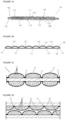
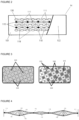
- the resulting composite structure of a carrier layer with discretely deposited (and preferably positioned) particulate material clusters thereon is complemented with an auxiliary layer, such as for instance non-woven, tissue, paper, thermoplastic material and the like and/or affixed by attachment means, such as for instance glue, bonds, joints and the like, with the particulate material clusters pocketed there between so as to obtain an immobilized sandwich structure usable in the form of an absorbent structure.
- an auxiliary layer such as for instance non-woven, tissue, paper, thermoplastic material and the like and/or affixed by attachment means, such as for instance glue, bonds, joints and the like
- the absorbent structure immobilizes, retains and/or restrains the particulate material and the attachments seal, bond and/or join at least part of the outer layers of the composite structure together via ultrasonic bonding, thermo-bonding, pressure-bonding and/or glue-bonding means.
- These attachments preferably form and/or define pockets which contain particulate material, whereby the attachment regions comprise essentially and preferably no particulate material.
- synthetic immobilisation admixtures e.g. adhesive and binders, such as thermoplastic glues and webs
- the composite structure is covered with such thermoplastic materials, glues, binders and/or adhesives to fixate, pocket, encapsulate, bind and/or join these particulate material clusters to and/or in between one or more layers. Additional materials and/or layers to provide extra functional and/or structural advantages such as strength, acquisition, absorption, distribution, transport, retention, etc. may also be incorporated.
- a process for providing a structure comprising of a carrier layer, a particulate material and an auxiliary layer, whereby the particulate material is at least partially enclosed by a carrier and auxiliary layer so as to form an composite structure, comprising the steps of prior to joining the carrier layer to the auxiliary layer positioning the deposited particulate material through a positioning means, preferably being airflows.
- the particulate material is deposited substantially homogeneously on the carrier layer prior to subsequently positioning it via the positioning means to discretely and heterogeneously positioned particulate material clusters.
- the particulate material comprises absorbent polymer material for body exudates and/or skin care material such as ion exchange resins, deodorant, anti-microbial agents, binder particles or other beneficial particles.
- An absorbent structure manufactured according to this preferred embodiment of the invention has attachments characterized by improved attachment properties. This is advantageous as it provides increased efficiency and effectiveness of the used attachment means, thereby increasing attachment quality, quantity and/or utilisation of attachment energy or materials which is crucial in the high speed and low cost manufacturing of absorbent articles containing such absorbent structures in light specified absorption, distribution, retention performance while minimizing rewet, leakages and structural failures.
- particulate material is non-homogeneously deposited prior to attaching the carrier layer to the auxiliary layer, such that the probability P inv of a smaller piece of particulate material is deposited in an attachment area is smaller than P normal :P inv ⁇ P normal , preferably P inv ⁇ 0.5*P normal , more preferably P inv ⁇ 0.1*P normal , even more preferably P inv ⁇ 0.05* normal , still even more preferably P inv ⁇ 0.01*P normal , most preferably P inv ⁇ 0.001*P normal .
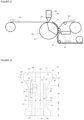
- an apparatus for producing a composite structure comprising particulate material clusters there between comprises a clustering means having a desired depositing pattern, a particulate material supplying means positioned to provide particulate materials into the inlet regions of the perforations of said clustering means, a carrier layer supplying means for providing a carrier layer, support means for moving said carrier layer in close proximity to the outlet regions of the clustering means and transport means for moving said carrier layer with particulate material clusters away from the clustering means.
- Preferably further positioning means are foreseen to position the absorbent material in their optimal pocket position before immobilising them in the composite structure.
- the positioning means can be mounted on or can be unitary with the support means and/or transport means.
- the clustering means are preferably arranged to catch, collect, hold and deposit the particulate materials from the particulate material stream as provided by the particulate supply means.
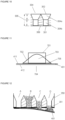
- the perforations within the clustering means are designed so as to catch and collect the particulate material stream by way of the inlet regions, and preferably converge the particulate materials towards the outlet regions so as to accumulate and build up particulate material clusters within the perforations ready for deposit onto the carrier layer, preferably in discrete printing patterns of particulate material clusters. It will be apparent that the perforations of the clustering means can be made up from all available alternatives known from the art such as hollow rectangles, cones, tubes and any other suitable format to direct the particulate material to the carrier layer.
- the support means brings the carrier layer into a depositing position of, preferably in close proximity to, most preferably in contact with, the outlet regions of the perforations of the clustering means.
- a selected level of pressure contact in between the deposit surface of the carrier layer and the outer contact surface of the clustering means is provided, so as to lock the discrete particulate material clusters until deposited onto the deposit surface of the carrier layer.
- no substantial pressure contact in between the deposit surface of the carrier layer and the outer contact surface of the clustering means is provided, and the particulate material provided via the particulate material stream is immediately caught, collected and deposited upon the carrier layer.
- additional positioning means are foreseen to stabilise, position and/or reposition the deposited particulate material clusters in their final pocketing position and pattern before being immobilized.
- a transport means moves the carrier layer and the particulate materials away.
- the particulate material clusters deposited, and preferably positioned, onto the carrier layer are covered by an auxiliary layer via a covering means so as to form for instance an absorbent polymer material area.
- the particulate material clusters from the composite structure are relatively immobilised, bound, joined and/or otherwise restrained in between a carrier layer and any suitable auxiliary layer.
- attachment means leading to a composite sandwich structure of a carrier layer and auxiliary layer with particulate material clusters enclosed and/or immobilised, bound, join and/or restrained there between in the form of pockets or compartment are provided.
- the particulate material supply means comprises a vibrating, coiling and/or turning means so as to accurately, continuously and controllably provide the required particulate material amounts, sizes and/or speeds towards the clustering means.
- the particulate material is being transported in between such vibrating, coiling and/or turning means and the clustering means by way of a feeding tube means, which can alternatively be arranged with gas pressure means to guide and direct the particulate material stream to the inlet regions of the clustering means.
- the feeding tube is substantially longitudinal, vertically and/or converging and the particulate material has substantial weight so that one can use gravity to transport the particles through the feeding tube into the clustering means.
- additional conveyer means such as mechanical (such as airflows), electro-magnetic (such as magnets in case the particles interact with a magnetic field), electro-static (such as particulate material and/or conveyer charging) and/or other means can be used to help convey particulate material stream towards the clustering means.
- mechanical such as airflows
- electro-magnetic such as magnets in case the particles interact with a magnetic field
- electro-static such as particulate material and/or conveyer charging
- other means can be used to help convey particulate material stream towards the clustering means.
- a dosing means of a volumetric, gravimetric or other type is used so as to control the quantity, size and/or speed of particles entering the feeding tube means is provided. It is further preferred that the particulate material stream can be redirected via control means into removing means so as to be moved again towards the particulate supply means via recovery tubing means for re-use and/or less preferably guided out of the production system via collection means to be moved towards separate storage facilities for later usage and/or disposal in case irreparably damaged, contaminated, spoiled and/or rendered unusable.
- the clustering means are unitary with a substantially endless rotating drum, preferably having a cylinder-like outer shell.
- an endless rotating drum with replaceable, customisable and/or adjustable clustering means is provided.
- the clustering means are stationary clustering means. The clustering means are in line with the opening of the feeding tube means thereby directing the particulate materials to fall, be guided, directed, pushed and/or vacuumed through the respective inlet regions and/or outlet regions of the perforation pattern of the clustering means to obtain the desired depositing or printing pattern.
- the clustering means can have any sort and number of perforations and patterns, whereby the amount of perforations goes from at least one perforation to any suitable numbers of perforations in light of the envisaged composite structure.
- one perforation its dimension may be similar to feeding tube.
- the inlet regions are of a funnel-like shape with steep slopes separated from one another by sharp ridges so no substantial amounts of particulate materials remain caught in between the inlet regions and/or on the slopes of the inlet regions, but are readily transported towards the outlet regions for scheduled deposit on the carrier material.
- a combination of larger and smaller inlet regions and outer regions are provided leading to more homogenous, heterogeneous or complex perforation patterns.
- the void volume of the perforations is larger than the volumes of particulate material one wants to print, to prevent overfilling of the clustering means during the production process.
- the void volume of the perforations is larger than the volumes of particulate material one wants to print, to prevent overfilling of the clustering means during the production process.
- any Overfill', migration and/or misplacement of particulate material can be guided and/or redirected via sweeping means, such as scrapers, brushes, air blow, vacuum suction, etc, into one or more available inlet regions of the cluster means and/or be guided into recovery means or collection means so as to be moved away from the clustering means for re-use, collection and/or disposal.
- sweeping means such as scrapers, brushes, air blow, vacuum suction, etc
- the absorbent structure provides in particular an increased fluid communication structure including better adsorption and dispersion in and between the absorbent polymer material pockets, due to the additional wicking and mass flow of liquids caused by the distribution layer, limiting gel blocking, reducing rewet and minimizing leakages. It further provides for a method and apparatus to produce such absorbent structures at high production speed with low energy and raw material consumption.
- the substantially liquid-impermeable wicking layer allows unbound liquids such as water, urine and/or other bodily exudates to more easily spread out, which allows better distribution and transport so as to wet the side and lower sides of the absorbent polymer materials within the pockets. It ensure lower rewet values, less leakage risk and less surface wetness and thus increased reliability of the overall structure. It further provides for a method and apparatus to produce such absorbent structures at high production speed with low energy and raw material consumption.
- an absorbent sandwich-like structure which comprises a carrier layer, an auxiliary layer and an intermediate absorbent particulate material there between wherein substantially primary attachments and substantially secondary attachments join the carrier layer and auxiliary layer together, whereby the secondary attachments are loosened as a result of exposing the absorbent structure to liquid whereas the primary attachments remain substantially intact. It further provides for a method and apparatus to produce such absorbent structures at high production speed with low energy and raw material consumption.
- an absorbent sandwich-like structure which comprises a carrier layer, an auxiliary layer and an intermediate absorbent material there between wherein substantially permanent primary attachments and substantially temporary secondary attachments join the carrier layer and auxiliary layer together, whereby the absorbent structure is made to in-homogeneously swell as a result of exposing the absorbent structure to liquid to form a liquid-managing surface structure. It further provides for a method and apparatus to produce such absorbent structures at high production speed with low energy and raw material consumption.
- the method and apparatus according to preferred embodiments of the invention leads to highly appreciated thin, flexible and/or light-weight absorbent structures which are economically, environmentally, technically and/or commercially advantageous, not in the least since they are obtained without the need for substantial and bulky amounts of fibrous absorbent materials such as fluff and wood pulp (allowing "fluffless” advertisement claims) and are not using substantial and expensive amounts of glue, binder, adhesive and/or other thermoplastic materials (allowing "glueless” advertisement claims). This is unprecedented within the prior art.
- Absorbent article refers to devices that absorb and contain bodily exudates, and more specifically, refers to devices that are placed against or in proximity to the body of the wearer to absorb and contain the various liquids discharged from the body.
- Absorbent articles include but are not limited to feminine hygiene garments, baby diapers and pants, adult incontinence garments, various diaper and pants holders, liners, towels, absorbent inserts and the like.
- Absorbent component refers to a structural constituent of an absorbent structure, e.g., a piece of an absorbent core, such as one of multiple pieces in a multi-piece absorbent core.
- Absorbent element refers to a part of a functional constituent of an absorbent structure, e.g., a liquid acquisition layer, a liquid distribution layer, or a liquid storage layer formed of a material or materials having particular liquid handling characteristics suitable for the specific function.
- Absorbent insert refers to a device adapted for insertion into an absorbent article and to serve as an absorbent structure when so inserted.
- Absorbent layer refers to a term referring to a discrete, identifiable sheet-like or web-like element of an absorbent structure which may remain detached and relatively movable with respect to another such element or may be attached or joined so as to remain permanently associated with another such element.
- Each absorbent layer may itself include a laminate or combination of several layers, sheets and/or webs of similar or diverse compositions.
- ABSAP Ultrasorbent polymer material
- AGM absorbent gelling material
- AGM absorbent gelling material
- SAP super absorbent polymer
- any suitable particulate e.g., flaked, particulate, granular, or powdered
- fibrous cross linked polymeric materials that can absorb at least 5 times and preferably at least about 10 times or more its weight of an aqueous 0.9% saline solution as measured using the Centrifuge Retention Capacity test (EDANA 441.2-01 ).
- Absorbent polymer material area refers to the area of the absorbent structure wherein adjacent layers are separated by a multiplicity of absorbent polymer material. Incidental contact areas between these adjacent layers within the absorbent particulate polymer material area may be intentional (e.g. bond area's) or unintentional (e.g. manufacturing artefacts).
- Absorbent structure refers to those elements of an absorbent article comprising material or a combination of materials suitable to absorb, distribute and retain bodily exudates.
- Acquisition layer refers to a layer having a faster liquid uptake capability.
- Absorbency is the ability of a material to take up fluids by various means including capillary, osmotic, solvent, chemical or other action.
- Adult incontinence garment refers to absorbent articles intended to be worn by incontinent adults, for absorbing and containing bodily exudates.
- Adhesion refers to the force that holds different materials together at their interface.
- Adhesive refers to a material, which may or may not be flowable in solution or when heated, that is used to bond materials together.
- Adsorption refers to the process by which a liquid is taken up by the surface of a material.
- Airlaying refers to forming a web by dispersing fibres or particles in an air stream and condensing them from the air stream onto a moving screen by means of a pressure or vacuum; a web of fibres produced by air laying is herein referred to an "airlaid”; an airlaid web bonded by one or more techniques to provide fabric integrity is herein referred to an "airlaid non-woven”.
- Apparent density refers to the basis weight of the sample divided by the calliper with appropriate unit conversions incorporated therein.
- Apparent density used herein has the unit g/cm 3 .
- Body diaper refers to absorbent articles intended to be worn by children, for absorbing and containing bodily exudates which the user draws up between the legs and fastens about the waist of the wearer.
- Backing refers to a web or other material that supports and reinforces the back of a product.
- Disposable is used herein to describe articles that are generally not intended to be laundered or otherwise restored or reused (i.e., they are intended to be discarded after a single use and, preferably, to be recycled, composted or otherwise disposed of in an environmentally compatible manner).
- “Dry laying” as used herein refers to a process for making a non-woven web from dry fibre; these terms apply to the formation of carded webs, as well as to the air laying formation of random webs; a web of fibres produced by dry laying is herein referred to as a "drylaid”; a drylaid web bonded by one or more techniques to provide fabric integrity is herein referred to a “drylaid non-woven”.
- Fibre refers to the basic threadlike structure from which non-woven, yarns and textiles are made. It differs from a particle by having a length at least 4 times its width; "Natural fibres” are either of animal (wool, silk), vegetable (cotton, flax, jute) or mineral (asbestos) origin, while “Man-made fibres” may be either polymers synthesised from chemical compounds (polyester, polypropylene, nylon, acrylic etc.) or modified natural polymers (rayon, acetate) or mineral (glass). “Fibre” and “filament” are used interchangeably.
- Frm Frm
- froil and the like as used herein are used interchangeably and refer to a thin sheet of essentially non-absorbent material such as plastic or closed foams. In this invention it particularly refers to materials that do not correspond to non-woven.
- Fiber pulp as used herein refers to wood pulp specially prepared to be dry laid.
- Front region refers to the portion of an absorbent article or part thereof that is intended to be positioned proximate the front of a wearer.
- Garment facing layer refers to elements of the chassis that form the outer surface of the absorbent article, such as the back sheet, the side panels, the waist fasteners, and the like, when such elements are present.
- Heat activated adhesive refers to a dry adhesive that is rendered tacky or fluid by application of heat or heat and pressure to the assembly.
- Heat sealing adhesive refers to a thermoplastic adhesive which is melted between the adherent surfaces by heat application to one or both of the adjacent adherent surfaces.
- Highloft refers to general term of low density, thick or bulky fabrics.
- Hot-melt adhesive refers to a solid material that melts quickly upon heating, then sets to a firm bond upon cooling; used for almost instantaneous bonding.
- Hydrophilic refers to having an affinity for being wetted by water or for absorbing water.
- Immobilisation layer refers to a layer able to be applied to the particulate material with the intent to immobilize, bond, join and/or restrain particulate material.
- Join, “joined” and “joining” as used herein refers to encompassing configurations wherein an element is directly secured to another element by affixing the element directly to the other element, as well as configurations wherein the element is indirectly secured to the other element by affixing the element to an intermediate member or members which in turn is or are affixed to the other element.
- Layer refers to identifiable components of the absorbent article, and any part referred to as a “layer” may actually comprise a laminate or combination of several sheets or webs of the requisite type of materials.
- layer includes the terms “layers” and “layered.” “Upper” refers to the layer of the absorbent article which is nearest to and faces the wearer facing layer; conversely, the term “lower” refers to the layer of the absorbent article which is nearest to and faces the garment facing layer.
- Machine direction (MD) "longitudinal” and the like as used herein are used interchangeably and refer to a direction running parallel to the maximum linear dimension of the structure and includes directions within ⁇ 45° of the longitudinal direction.
- Mass flow refers to the flow of a liquid from one absorbent element or component to another absorbent element or component by channel flow action.
- Non-woven refers to manufactured sheet, web or batt of directionally or randomly orientated fibres, bonded by friction, and/or cohesion and/or adhesion, excluding paper and products which are woven, knitted, tufted, stitch-bonded incorporating binding yarns or filaments, or felted by wet-milling, whether or not additionally needled.
- the fibres may be of natural or man-made origin and may be staple or continuous filaments or be formed in situ. Commercially available fibres have diameters ranging from less than about 0.001 mm to more than about 0.2 mm
- Non-woven fabrics can be formed by many processes such as melt blowing, spun bonding, solvent spinning, electro spinning, and carding.
- the basis weight of non-woven fabrics is usually expressed in grams per square meter (gsm).
- Pant "training pant”, “closed diapers”, “prefastened diapers”, “pull-on diapers” and “diaperpants” and the like as used herein are used interchangeably and refer to absorbent articles which are typically applied to the wearer by first leading the feet into the respective leg openings and subsequently pulling the pants from the feet to waist area over the hips and buttocks of the wearer and which are capable of being pulled up or down over the hips of the wearer.
- Such articles may include a front waist portion and a back waist portion which may be connected about the hips of the wearer by integral or releasable members.
- a pant may be preformed by any suitable technique including, but not limited to, joining together portions of the article using refastenable and/or non-refastenable bonds (e.g., seam, weld, adhesive, cohesive bond, fastener, etc.).
- a pant may be preformed anywhere along the circumference of the article (e.g., side fastened, front waist fastened).
- Rear refers to the portion of an absorbent article or part thereof that is intended to be positioned proximate the back of the wearer.
- Resin refers to a solid or semisolid polymeric material.
- substantially cellulose free refers to an absorbent article, structure or core, that contains less than 40% by weight cellulosic fibres, less than 20% cellulosic fibres, less than 5% cellulosic fibres, no cellulosic fibres, or no more than an immaterial amount of cellulosic fibres which do not materially affect the thinness, flexibility or absorbency thereof. This definition also encompasses fully cellulose free whereby the percentage is 0%.
- Thermobonding refers to a method of bonding fibres by the use of heat and/or high-pressure.
- Thermoplastic refers to polymeric materials that have a melting temperature and can flow or be formed into desired shapes on the application of heat at or below the melting point.
- Ultrasonic refers to the use of high frequency sound to generate localised heat through vibration thereby causing fibres to bond to one another.
- Water-absorbing “liquid-absorbing”, “absorbent”, “absorbing” and the like as used herein are used interchangeably and refer to compounds, materials, products that absorb at least water, but typically also other aqueous fluids and typically other parts of bodily exudates such as at least urine or blood.
- Weight facing layer refers to elements of the chassis that form the inner surface of the absorbent article, such as the topsheet, the leg cuffs, and the side panels, etc., when such elements are present.
- Some absorbent articles like diapers, contain a particulate material, such as an absorbent polymer material, more preferably an absorbent particulate polymer material. Although such absorbent particulate material absorbs liquid and swells, it is more effective when disposed in an absorbent structure in a certain pattern or arrangement when intending optimal absorbency, fit and/or comfort. Since it is desirable for absorbent particulate material to remain in its intended location in an absorbent article, such particulate materials are to be clustered and are desirably relatively immobilized in the absorbent article such that the absorbent particulate material remains immobilized, bonded, joined and/or restrained on their intended location when the absorbent article is dry, partially wetted and/or fully wetted.
- a particulate material such as an absorbent polymer material, more preferably an absorbent particulate polymer material.
- an absorbent structure 14 is illustrated made by a method and apparatus according to the invention includes at least one carrier layer 101 and at least one auxiliary layer 102 and absorbent material 1 10.
- the carrier layer 101 and auxiliary layer 102 are joined via secondary attachments 115 and preferably also via primary attachments 111. Apart from the primary attachments 111 and secondary attachments 115, there are also unattached regions 119, where there is substantially no attachment, bond and/or joint between the carrier layer 101 and auxiliary layer 102, thereby providing pockets 130 in which the absorbent material 110 can be located to form well-designed clusters.
- the primary attachments 111 correspond with a primary attachment grid
- the secondary attachments 115 correspond with a secondary attachment pattern. As the secondary attachment pattern will release under the swelling force of the absorbent materials and/or under the influence of water, the secondary attachment 115 should have a relative low separation force is use.
- the primary attachment grids will preferably be kept substantially intact.
- first carrier layer 101 of the first storage layer faces the auxiliary layer 102 of the second storage layer, while the auxiliary layer 102 from upper storage layer is situated on the wearer facing surface and the carrier layer 102 from lower storage layer is situated on the garment facing surface of the sandwiched composite.
- the basis weight of the absorbent material 110 may change depending on its position in the absorbent structure 14, for instance very desirable for use in diaper and pants cores where one would like to concentrate absolute and/or relative more absorbent material 110 near the point of liquid insult.
- Suitable materials such as for instance highly permeable SAP are offered by Evonik, BASF and Nippon Shokubai.
- the absorbent polymer material form up to 100% of the absorbent material 110 it can also be used in combination with other materials such as for instance cellulose fibres or fluff pulp, however preferably the amount of fibrous materials would not make up more than about zero to 40 weight percent. Fully cellulose free structures benefit maximally from this invention.
- Typical examples of methods used to join material and layers to each other are by way of example, but are not limited to, the use of an adhesive such as for instance pressure sensitive adhesive, curing, chemical links such as for instance hydrogen and covalent bonds or via the use of ultrasonic and/or other thermal, mechanical or thermo-mechanical attachment techniques such as for instance heat sealing, needling, air, entanglement, resistance and water jet pressure, and the like.
- an adhesive such as for instance pressure sensitive adhesive, curing, chemical links such as for instance hydrogen and covalent bonds
- ultrasonic and/or other thermal, mechanical or thermo-mechanical attachment techniques such as for instance heat sealing, needling, air, entanglement, resistance and water jet pressure, and the like.
- the attachments are also preferred to design the attachments so that they have an average surface size of at least about 0.5 mm 2 , preferably at least about 1.0 mm 2 , 2 mm 2 or 3 mm 2 , more preferably at least about 16 mm 2 .
- the density of the attachments can vary, depending on the surface size of the individual attachments and desired separation forces. For attachments with a surface area smaller than 1 cm 2 for instance, it is recommended to use a density of at least about 100 per m 2 .
- the primary attachments 111 are arranged in a primary attachment grid composed of continuous lines so as to allow for additional liquid distribution and transport, for a high separation force and high resistance against the propagation of an eventual cracks or fissures in the pockets 130.
- the primary attachment pattern is carefully designed so that in a wetted state, the swollen material remains stabilized around the locations where it was restrained and/or immobilized in dry state. Failure to do so would result in breaking-up and/or displacement of the wet absorbent material, resulting in defective fluid management and to loss of performance, reduced fit and comfort, even full failure.
- the primary attachment pattern also accommodates the liquid management surface structures.
- the breaking of the secondary attachments 115 allows the carrier layer 101 and/or auxiliary layer 102 to deform, stretch and change shape. As a result, the minimal volume pockets are able to expand to an intermediate volumes and finally to maximum volume compartments so as to accommodate the extra volume resulting from the highly expandable absorbent material 110.
- an absorbent structure 14 with expandable pockets with additional activated free swell volume is created, allowing the absorbent material 110 to be more effectively and efficiently used and reducing the risk of bursting of one or more sandwiching layers.
- the extra volume created by the expanding pockets can for instance be about 1% to 5% of the original volume. Preferably it is higher than about 5% to 25%, more preferably higher than about 25% to 50%, most preferably higher than about 50% or 100% of the original volume.
- the absorbent structure 14 consists of multilayered sandwich structures where on the first sandwich structures, whereby the additional layers of absorbent material and/or complementary layers provide further liquid absorption performance whilst retaining good product integrity, both in a dry and wet state.
- secondary attachment 115 consist of weaker secondary attachments and stronger secondary attachments where weaker secondary attachments loosen faster than the stronger secondary attachments.
- the different functionalities in between the primary attachments 111 and secondary attachments 115 in combination with the bonding strength differentiation in between weaker secondary attachments and stronger secondary attachments allows the design of an absorbent structure 14 with a predetermined, controlled and/or phased volume-expansion of the absorbent structure for ultimate fluid management.
- the clustering means 250 includes a pattern of perforations 304, preferably in the form inlet regions 304a joined to outlet regions 304b, and are arranged to form and provide a desired printing pattern 320 of particulate material clusters 703 onto the carrier layer 401.
- the support means 600 is preferably in substantial contact with the support surface 412 of the carrier material 401.
- the support means 600 preferably ensures a close enough connection in between the deposit surface 411 of the carrier material 401 and the outlets regions 304b to prevent unwanted migration of the particulate materials 201 from the carrier deposit zones 415 to the carrier inter-deposit zones 416.
- the resultant printing pattern 320 forms desired and substantially spaced-apart particulate material clusters 703, preferable without any substantial amounts of particulate materials 201 in between the particulate material clusters 703.
- an additional positioning step is foreseen by way of a providing position means, to stabilize, position and/or reposition the particulate material clusters 703 in their exact positioning or pocketing pattern 420 before immobilising it in the composite structure.
- the depositing or printing pattern 320 provided by the clustering means 250 can but does not necessarily have to correspond with the positioning or pocketing pattern 420 formed by the positioning means.
- relative homogenous, wide or blurry depositing patterns 320 will preferably not correspond with the discretely clustered positioning patterns 420 required in case particulate material such as absorbent particulate polymer material is to pocketed and immobilised by means of primary and/or secondary attachments made by means of ultrasonic bonding to make substantially cellulose free absorbent structure for use in an absorbent article such as a baby diaper or pants.
- the clustering means 250 is suitably constructed and arranged to direct a selected flow of particulate material 201 onto the carrier deposit zones 415 of the carrier layer 401. It should be appreciated that other particulate material 201 may also be introduced via the clustering means 250 as desired.
- a particulate supplying means 200 such as for instance a K-Tron weight and loss feeder, Model N° K10s, type of particulate delivery system can be configured to deliver required amounts of particulate material 201 through a feeding tube 205 into the clustering means 250.
- the particulate material 201 reach the perforations 304 by means of gravity and/or other physical forces.
- a conventional air-conveying system may be employed to move and guide the particulate material 201 and resultant particulate material stream to the desired locations in the clustering means 250.
- forces may for instance be electromagnetic or electro-static forces in case the particulate material 201 is responsive to a magnetic field or electro-charges, and magnets or charging devices are placed to guide the particles towards the perforations 304.
- the particulate material 201 can, for instance, be gravimetric or volumetric assessed, guided and fed indirectly via the feeding tube 205 and/or directly into the clustering means 250 under the influence of gravity without the use of additional conveying air.
- Such vacuum suction system would generate suitable levels of vacuum within an appointed vacuum section, and would provide a desired level of vacuum within the clustering means 250. It should be readily appreciated that such particular levels of vacuum generated within clustering means 250 and/or drum 100 would depend upon the individual circumstances of the manufacturing line. For example, at higher rates of rotation of the drum 100, relatively higher levels of vacuum may be required within clustering means 250.
- the use of conveying means to transport the particulate material 201 into the clustering means 250 may necessitate the use of even higher levels of vacuum.
- the levels of vacuum shall also depend upon the porosity of the carrier material 401 , and the usage of possible carrier material 401 would for instance be limited to fibrous web materials and/or perforated films and foils.
- this vacuum suction usage is an alternative embodiment according to the invention, however not one of the most preferred one.
- the positioning means can be mounted on such vacuum suctions systems in light of the preferred pocketing pattern 420 or can alternatively be unitary. More economically and environmentally beneficial production processes with lower energy usage and more freedom on the choice of carrier material 401 are preferred. Further to extensive testing it was however demonstrated that using gravity will be sufficient for a wide range of particulate material 201 usages at various production speeds.
- the particulate material 201 supplied via the particulate material supplying means 200 is preferably provided in uniform particulate material stream, reaching a width equal to or slightly greater than the width 310 of the perforation pattern 300 on the side of the inlet regions 304a.
- a vibrating supply means 200 might be used.
- a feeding tube 205, with a proximal opening 206 and distal opening 207 can be used to concentrate the particle material stream onto a certain area.
- Such feeding tube 205 may have various suitable longitudinal and transversal shapes and is preferably designed in light of the dimension and shape of the clustering means 250, its perforation pattern 300, its perforations 304 and the desired printing pattern 320.
- the feeding tube 205 may also converge towards the clustering means 250 to effectively and efficiently guide the particulate material stream to the inlet regions 304a.
- the particle supply means 200 preferably contains a continuous supply and a dosing system 204 of a gravimetric, volumetric or other type so as to control the quantity and quality of particles fed into the perforations 304. Such particle supply means are being offered by Acrison, Inc., having offices in New Jersey, New York.
- the particle material 201 such as absorbent polymer material, more preferably absorbent particulate polymer material may be provided and used in various shapes or forms, such as granular, spherical, flakes, fibrous, and will often consist of irregularly shaped particles, having a mean particle size from about 10 ⁇ ⁇ to 1000 ⁇ ⁇ , preferably with less than about 5% by weight having a particle size of 5 pm, and preferably with less than about 5% by weight having a particle size of more than about 1200 pm.
- an absorbent material will be selected which can swell upon contact with liquids, such as bodily exudates.
- Such materials can be supplied in a granular form by Evonik from Essen, Germany, BASF from Antwerp, Belgium, Nippon Shokubai from Osaka, Japan and San-Dia from Tokyo, Japan. These are cross-linked polymeric materials that can absorb at least about 5 times their weight of an aqueous 0.9% saline solution as measured using the Centrifuge Retention Capacity test (Edana 441.2-01 ).
- the web supplying means 400 can include any conventional spindle and supply roll controlling mechanism of the type that is know in the art.
- suitable spindle and control mechanisms are available from Martin Automatic, company with offices in Rockford, Illinois.
- the carrier material 401 may preferably be brought in their desired position via guiding systems 402 and the auxiliary material 501 may preferably be brought in their desired position via the guiding systems 502, and the support means 600 is preferably controllably strained via tensioning means 603 and operated via guiding means 601 and 602.
- the composite material 700 is preferably guided via guiding means 603 and the desired material 702 is preferably guided by guiding means 604.
- the carrier material 401 can be any suitable material web which has sufficient strength to process through the apparatus, and preferably economically, environmentally and usage sensible.
- the carrier material 401 may comprise a paper or fibrous tissue, woven or non-woven fabric, a cellulose web or batt, airlaid or wet laid structure or the like.
- the carrier material 401 is a porous, gas permeable web material such as a porous film or fibrous web.
- the auxiliary material 501 can be any suitable material web which has sufficient strength to process through the apparatus, and preferably economically, environmentally and usage sensible.
- the carrier material 401 may comprise a paper or fibrous tissue, woven or non-woven fabric, a cellulose web or batt, airlaid or wet laid structure or the like.
- the carrier material 401 is a porous, gas permeable web material such as a porous film or fibrous web.
- the auxiliary material 501 can also represent for instance a spray, film and/or layer of glue, adhesive, binders, resins, thermoplastic material and the like together with the carrier material 401 capable of sandwiching the particulate material clusters 703.
- the carrier material 401 and/or auxiliary material 501 may also be an essentially endless web material in the longitudinal direction.
- One preferred web material is a so called SMS material, comprising a spunbonded, a melt-blown and a further spunbonded layer. Highly preferred are permanently hydrophilic non-wovens, and in particular nonwovens with durably hydrophilic coatings.
- An alternative preferred material comprises a SMMS-structure.
- Another preferred web material is a nonwoven containing cellulosic fibers, paper or tissue sheet or other airlaid, drylaid or wetlaid material, as these products greatly improve the wicking capacity of the product.
- the carrier and auxiliary materials 401 and 501 may be provided from two or more separate sheets of materials or they may be alternatively provided from a unitary sheet of material.
- Preferred nonwoven materials are provided from synthetic fibers, such as PE, PET and most preferably PP. As the polymers used for non-woven production are inherently hydrophobic, they are preferably coated with hydrophilic coatings.
- the clustering means 250 can preferably be mounted onto a or unitary with a drum 100 having perforations 304 arranged in a perforation pattern 300 along its circumferential- and/or width- wise direction and thus directly or indirectly piercing or perforating the drum 100 in the radial direction, from its inner surface 101 to its outer surface 102.
- the clustering means 250 are replaceably mounted and/or unitary incorporated on a substantially endless belt carried on a system of transporting rollers. Suitable forming belt systems are available from Paper Converting Machine Company, a business having offices located in Green Bay, Wisconsin.
- the printing pattern 320 is treated via positioning means so as to reposition the particulate materials 201 into the pocketing pattern 420.
- the particulate material clusters 703 are immobilised, bond, joined and/or otherwise secured restrained in relation to the carrier layer via any suitable means, such as for instance glue, binder, sprays, films, network, webs, etc.
- a first adhesive applicator 900 spraying adhesive onto the carrier material 401 prior to the deposit of the particulate material 201 may be provided.
- the auxiliary material 501 may also be provided with a second adhesive applicator 901 and the resulting sandwich structure is additionally preferably secured via an ultrasonic attachment means 800.
- the advantage is that one can thus choose not to print certain segments of the drum 100, i.e. leave certain areas of the perforation pattern 300 void of particle material.
- the unprinted segments of the drum 100 can vary from one rotation of the drum to another, thereby saving enormously on the investment cost of providing different drums 100 with different perforation pattern 300, and on the maintenance and production cost of changing such different drums 100.
- Figure 19 shows another preferred embodiment of this invention.
- An auxiliary material 402 and a carrier material 401 will be attached in an attachment area 2, in the presence of an intermediate absorbent material 110.
- the top material (not shown) will be added to the structure after at least part of the intermediate absorbent material 110 has been evacuated from the attachment area 2.
- a suction hole 30 provides a suction flow 31.
- An additional material or mask 71 having some openings which are not in line with the suction hole orifice 32 is provided. The combination of the suction force and the openings creates resulting flows 60 which help to evacuate the intermediate absorbent material 110 from the attachment area 2 by gathering it in an intermediate material landing zone 33.
- FIG 20 shows a carrier material 401 is covered with an intermediate absorbent material 110. Underneath the carrier material 401 are suction holes with square suction hole orifices. By transporting the carrier material 401 and intermediate absorbent material 10 underneath a perforated mask 71 , secondary airflows are created. These secondary airflows are somewhat turbulent in nature and guide the intermediate absorbent material 110 away from the attachment areas 2 where the intermediate absorbent material 110 finds few support towards the intermediate material landing zones 33 where there is a suction keeping it fixed.
- Figure 21 shows a process equipment for manufacturing an absorbent structure 14 with an intermediate absorbent material 110.
- a carrier material 410 is being provided and guided onto a rotating drum 200.
- Intermediate absorbent material 110 of a granular nature is provided out of a particulate material supplying means 200 via a dosing system 204.
- an underpressure or vacuum is created via perforations with orifices 32.
- Above the drum there is a mask 71 with openings, creating airflows which will guide the intermediate absorbent material 110 onto the positioning pattern 420 and away from the inter- positioning zones.
- An auxiliary layer 402 is added and it is attached to the carrier material 401 20 by means of an ultrasonic equipment 81 with a hammer 80.
- the drum 100 acts as anvil for the ultrasonic sealing.
- the resulting absorbent structure 14 is guided away from the equipment.
- the process for producing preferred absorbent structures in accordance with the present invention comprises the following steps: A carrier layer 10 is provided onto which absorbent intermediate material 50 is disposed by methods known in the art. To deposit the absorbent material 50, vacuum, gravity, airflow or other forces can be used. Then an auxiliary layer 20 is provided, covering the absorbent material 50, and primary bonding regions 2 and secondary bonding regions 4 are being provided. In case one would like to use adhesives or chemical binders, then it might be useful to attach these to the carrier layer 10 and/or auxiliary layer 20 prior to bringing the sandwich structure together. In case one opts for thermo-sealed bonding areas, then the thermo-sealing can be applied after the sandwich structure components have been brought together. It is of course also possible to combine both techniques in the same absorbent structure.
- the absorbent structure 14 can be manufactured according to settings as described above in relation to Figures 20 and 21 .
- the perforations in the mask can be manufactured having a diameter between 0.5 mm and 10 mm, more preferably between 2 and 7 mm, and most preferably between 3 and 5 mm.
- the distance to the rotating drum is preferably smaller than 25 mm, more preferably smaller than 15 mm and most preferably around 5 mm.
- the vacuum or under pressure in the suction segment 651 should preferably be larger in magnitude than -1.0 kPa, more preferably larger in magnitude than - 7.5 kPa and most preferably larger in magnitude than - 15 kPa.
- the auxiliary and carrier materials can be chosen from a wide range of materials. It has been found that using polypropylene spunbonded nonwoven materials with a weight between 8 and 20 grams per sqm give excellent results.
- Figure 22 is a top plan view of a diaper 10 as a preferred embodiment of an absorbent article including an absorbent structure made according to the present invention. It should be understood, however, that the present invention is also applicable to other absorbent articles such as feminine hygiene garments, baby pants, adult incontinent garments and the like.
- the absorbent article is shown in its flat out, un-contracted state with the wearer side facing the viewer. Portions of the absorbent article are cut away to more clearly show the underlying structure of the diaper 10 including the absorbent elements and absorbent components.
- the chassis 12 of the diaper 10 in Figure22 comprises the main body of the diaper 10.
- the chassis 12 comprises an outer covering including a liquid pervious top sheet 18 and/or a liquid impervious back sheet 20.
- the chassis 12 may include a portion of an absorbent structure 14 encased between the top sheet 18 and the back sheet 20.
- the chassis 12 may also include most or all of the absorbent structure 14 encased between the top sheet 18 and the back sheet 20.
- the chassis 12 preferably further includes side panels or ears 22, elasticized leg cuffs 24 and elastic waist features 26, the leg cuffs 24 and the elastic waist feature 26 each typically comprise elastic members 28.
- One end portion of the diaper 10 is configured as a front waist region 30 of the diaper 10.
- the opposite end portion is configured as a back waist region 32 of the diaper 10.
- An intermediate portion of the diaper 10 is configured as a crotch region 34, which extends longitudinally between the first and second waist regions 30 and 32.
- the waist regions 30 and 32 may include elastic elements such that they gather about the waist of the wearer to provide improved fit and containment (e.g. elastic waist feature 26).
- the crotch region 34 is that portion of the diaper 10 which, when the diaper 10 is worn, is generally positioned between the wearer's legs.
- the diaper 10 is depicted with its longitudinal axis 36 and its transverse axis 38.
- the periphery of the diaper 10 is defined by the outer edges of the diaper 10 in which the longitudinal edges 42 run generally parallel to the longitudinal axis 36 of the diaper 10 and the end edges 44 run between the longitudinal edges 42 generally parallel to the transverse axis 38 of the diaper.
- the chassis 12 also comprises a fastening system, which may include at least one fastening or securing member 46 and at least one landing zone 48.
- the various components within the diaper 10 may be bound, joined or secured by any method know in the art, for example by adhesives in uniform continuous layers, patterned layers or arrays of separate lines, spirals or spots.
- the top sheet 18, the back sheet 20, the absorbent structure 14 and other components may be assembled in a variety of well-known configurations and are well known in the art.
- the back sheet 20 covers the absorbent structure 14 and preferably extends beyond the absorbent structure 14 toward the longitudinal edges 42 and end edges 44 of the diaper 10 and may be joined with the top sheet 18.
- the back sheet 20 prevents the bodily exudates absorbed by the absorbent structure 14 and contained within the diaper 10 from soiling other external articles that may contact the wearer, such as bed sheets and undergarments.
- the back sheet 20 is substantially impervious to bodily exudates and comprises a laminate of a non-woven and a thin plastic film such as a thermoplastic film.
- the back sheet 20 may comprise breathable materials that permit vapour to escape from the diaper 10 while still preventing bodily exudates from passing through the back sheet 20. It may be semi-rigid, non-elastic and can be made fully or partially elasticized and include backing.
- the back sheets 20 may be assembled in a variety of well-known configurations and are well known in the art.
- the diaper 10 comprises a top sheet 18 that is preferably soft, compliant, exhibits good strikethroughs and has a reduced tendency to rewet from the liquid absorbent material.
- the top sheet 18 is placed in close proximity to the skin of the wearer when the diaper 10 is worn. In this way, such top sheet 18 permits bodily exudates to rapidly penetrate it so as to flow toward the absorbent structure 14 more quickly, but preferably not allowing such bodily exudates to flow back through the top sheet 18.
- the top sheet 18 may be constructed from any one of a wide range of liquid and vapour permeable, preferably hydrophilic, materials.
- the upper and lower surface of the top sheet 18 may be treated differently and may for instance include a surfactant on the upper surface so as to facilitate liquid transfer there through, especially at a central zone or area of the top sheet 18 located over the absorbent structure 10, and for instance include a hydrophobic agent on the lower surface to minimize the liquid contained within the absorbent core from contact wetting the top sheet 18 thereby reducing rewet values.
- the top sheet 18 may also be coated with a substance having rash preventing or rash reducing properties (e.g. aloe vera).
- the top sheet 18 covers substantially the entire wearer facing area of the diaper 10, including substantially all of the front waist region 30, back waist region 32, and crotch region 34.
- the side panels 22 and/or waist feature layers of the inner region may be formed from the same single top sheet material and, thus, may be referred to as being unitary with the top sheet 18 in forming longitudinal and lateral extensions of the top sheet 18 material.
- the top sheet 18 may be formed from multiple different materials which vary across the width of the top sheet 18. Such a multiple piece design allows for creation of preferred properties and different zones of the top sheet 18.
- the top sheet 18 be semi-rigid, non-elastic and can be made fully or partially elasticized.
- the top sheet 18 may be assembled in a variety of well-known configurations and are well known in the art.
- the absorbent structure 14 in Figure 22 generally is disposed between the top sheet 18 and the back sheet 20.
- the absorbent structure 14 may comprise any absorbent material 110 that is generally compressible, conformable, non-irritating to the wearer's skin, and capable of absorbing and retaining bodily exudates.
- the absorbent structure 14 may comprise a wide variety of liquid absorbent materials 110 commonly used in absorbent articles such as fluff pulp, which is generally referred to as airlaid.
- absorbent structure 14 may further comprise minor amounts (typically less than 10 %) of non-liquid absorbent materials, such as adhesives, binders, plastics, waxes, oils and the like.
- the absorbent structure 14 according to various embodiments of the invention may be configured to extend substantially the full length and/or width of the diaper 10.
- the absorbent structure 14 is not coextensive with the entire diaper 10 and is limited to certain regions of the diaper 10 such as for instance the crotch region 34.
- the absorbent structure 14 extends to the edges of the diaper 10 and the absorbent material 110 is concentrated in the crotch region 34 or another target zone of the diaper 10.
- the particles can be a combination of absorbent material 10, preferably comprising absorbent polymer material, and skin care particles such as ion exchange resins, deodorant, anti-microbial agents, binder particles, or other beneficial particles.
- the diaper 10 may also utilize a pair of containment walls or cuffs 24.
- Each cuff 24 is a longitudinally extending wall structure preferably positioned on each side of the absorbent structure 14 and spaced laterally from the longitudinal axis 36.
- the longitudinal ends of the cuffs 24 may be attached or joined, for example, to the top sheet 18 in the front and rear waist regions 30 and 32.
- the ends of the cuffs 24 are tacked down inwardly and attached, for example, by adhesive or sonic bonding to the lower structure.
- Such a construction effectively biases the cuffs 24 inwardly and is generally considered to cause the cuffs 24 to exhibit improved leakage prevention properties.
- the cuffs 24 are equipped with elastic members 28, which extend along a substantial length of the cuffs 24.
- the elastic members 28 are placed within the cuffs 24, preferably at the top of the cuff 24 while in a stretched condition and then glued or sonic bonded to the cuff 24 at least at their ends. When released or otherwise allowed relaxing, the elastic members 28 retract inwardly.
- the elastic members 28 function to contract the cuffs 24 about the buttocks and the thighs of the wearer in a manner, which forms a seals between the diaper 10, the buttocks and the thighs.
- the cuffs 24 may be assembled in a variety of well- known configurations and are well known in the art.
- the diaper 10 may also employ additional layers known in the art including an acquisition layer or surge layer, preferably situated between the top sheet and the absorbent core and highloft and/or coverstock layers. This serves to slow down the flow so that the liquid has adequate time to be absorbed by the absorbent core.
- acquisition layer or surge layer preferably situated between the top sheet and the absorbent core and highloft and/or coverstock layers. This serves to slow down the flow so that the liquid has adequate time to be absorbed by the absorbent core.
- fastening or securing members 46 are attached to at least a portion of the front waist region 30, preferably to form leg openings and an absorbent article waist.
- Fastening or securing members 46 carry the tensile load around the absorbent article waist and compliment the elastic members 28 by providing a quasi-seal between the wearer, the elastic waist feature 26 and cuffs 24, so that bodily exudates are contained within the diaper 10 which are then absorbed. In other words, so that it does not leak through gaps between the wearer and the edge of the diaper 10.
- the fastening or securing members 46 may for instance be adhesive, mechanical fasteners, hook and loop features, conceivable strings and/or combinations thereof, i.e., anything that will secure one end of the diaper 10 to the longitudinally opposite end of the diaper 10.
- the fastening or securing members 46 may also be co-adhesive such that they adhere to each other but not other materials.
- the fastening or securing members 46 and any component thereof may include any material suitable for such a use, including but not limited to plastics, films, foams, non-woven webs, woven webs, paper, laminates, fibre reinforced plastics and the like, or combinations thereof.
- the materials making up the fastening or securing members 46 are flexible, extensible and/or elastic, allowing them to better conform to the shape and movements of the body and thus, reduces the likelihood that the fastening system will irritate or injure the wearer's skin.
- the diaper 10 is affixed to the wearer by tape fasteners which are permanently affixed to the back sheet 20. Tape fasteners are contacted with the transversely opposite side panel or ears 22 attached or joined and extending from the back sheet 20, where they remain affixed due to the binding compound applied to the fasteners.
- the absorbent article may be pants and the like. In this configuration, the absorbent article may or may not have tape fasteners. Specific disposability tapes may however also be provided on such absorbent articles. All fastening and securing elements 46 may be assembled in a variety of well-known configurations and are well known in the art.
- the waist regions 30 and 32 each comprise a central region and a pair of side panels or ears 22 which typically comprise the outer lateral portions of the waist regions.
- These side panels 22 may be unitary with the chassis 12 and/or back sheet 20 or may be attached or joined thereto by any means know in the art.
- the side panels 22 positioned in the back waist region 32 are flexible, extensible and/or elastic in at least the lateral direction (i.e., elasticized side panels), in another embodiment the side panels 22 are non-elastic, semi-rigid, rigid and/or stiff. This variety of side panels 22 are well known.
- waistbands 26 employing elastic members can be positioned along the transverse portion of the diaper 10 so that when worn, the waistbands 26 are positioned along the waist of the wearer.
- the waistband 26 preferably creates a seal against the waist so that bodily exudates do not leak from the regions between the elastic waistband 26 and the waist of the wearer.
- the seal is important considering the assault of liquid by the wearer may overwhelm the absorption rate capacity of the absorbent structure 14.
- the waistbands 26 contain the liquid while it is being absorbed, they are well known in the art.
Landscapes
- Health & Medical Sciences (AREA)
- Engineering & Computer Science (AREA)
- Life Sciences & Earth Sciences (AREA)
- Animal Behavior & Ethology (AREA)
- Public Health (AREA)
- Heart & Thoracic Surgery (AREA)
- Vascular Medicine (AREA)
- Epidemiology (AREA)
- Veterinary Medicine (AREA)
- General Health & Medical Sciences (AREA)
- Biomedical Technology (AREA)
- Ceramic Engineering (AREA)
- Textile Engineering (AREA)
- Manufacturing & Machinery (AREA)
- Mechanical Engineering (AREA)
- Wood Science & Technology (AREA)
- Absorbent Articles And Supports Therefor (AREA)
- Orthopedics, Nursing, And Contraception (AREA)
Applications Claiming Priority (10)
| Application Number | Priority Date | Filing Date | Title |
|---|---|---|---|
| EP10447021A EP2444043A1 (de) | 2010-10-13 | 2010-10-13 | Verbesserte absorbierende Struktur |
| EP10447022A EP2441417A1 (de) | 2010-10-13 | 2010-10-13 | Absorbierende Struktur |
| EP10447024A EP2444044A1 (de) | 2010-10-13 | 2010-10-13 | Verfahren und Vorrichtung zur Herstellung absorbierender Strukturen |
| EP10447020A EP2450012A1 (de) | 2010-10-13 | 2010-10-13 | Verbesserte absorbierende Struktur |
| EP10447023A EP2441418A1 (de) | 2010-10-13 | 2010-10-13 | Absorbierende Struktur |
| EP11153268 | 2011-02-03 | ||
| EP11770376.9A EP2627294B1 (de) | 2010-10-13 | 2011-10-13 | Verfahren und vorrichtung zur herstellung von verbundstofffüllern |
| PCT/EP2011/005138 WO2012048878A1 (en) | 2010-10-13 | 2011-10-13 | Method and apparatus for producing composite structure |
| EP17198067.5A EP3292850B1 (de) | 2010-10-13 | 2011-10-13 | Verfahren zur herstellung einer verbundstofffstruktur |
| EP20199909.1A EP3797746B1 (de) | 2010-10-13 | 2011-10-13 | Verbundstoffstruktur und verfahren zu seiner herstellung |
Related Parent Applications (3)
| Application Number | Title | Priority Date | Filing Date |
|---|---|---|---|
| EP11770376.9A Division EP2627294B1 (de) | 2010-10-13 | 2011-10-13 | Verfahren und vorrichtung zur herstellung von verbundstofffüllern |
| EP17198067.5A Division EP3292850B1 (de) | 2010-10-13 | 2011-10-13 | Verfahren zur herstellung einer verbundstofffstruktur |
| EP20199909.1A Division EP3797746B1 (de) | 2010-10-13 | 2011-10-13 | Verbundstoffstruktur und verfahren zu seiner herstellung |
Publications (2)
| Publication Number | Publication Date |
|---|---|
| EP4582255A2 true EP4582255A2 (de) | 2025-07-09 |
| EP4582255A3 EP4582255A3 (de) | 2025-08-13 |
Family
ID=45937916
Family Applications (10)
| Application Number | Title | Priority Date | Filing Date |
|---|---|---|---|
| EP25177743.9A Pending EP4582255A3 (de) | 2010-10-13 | 2011-10-13 | Verbundstruktur und verfahren zur herstellung davon |
| EP17198061.8A Revoked EP3292847B1 (de) | 2010-10-13 | 2011-10-13 | Absorbierender artikel |
| EP20199909.1A Active EP3797746B1 (de) | 2010-10-13 | 2011-10-13 | Verbundstoffstruktur und verfahren zu seiner herstellung |
| EP11773682.7A Active EP2627295B1 (de) | 2010-10-13 | 2011-10-13 | Absorbierende struktur |
| EP18157590.3A Active EP3338745B1 (de) | 2010-10-13 | 2011-10-13 | Absorbierende struktur |
| EP17198067.5A Revoked EP3292850B1 (de) | 2010-10-13 | 2011-10-13 | Verfahren zur herstellung einer verbundstofffstruktur |
| EP17198065.9A Revoked EP3292849B1 (de) | 2010-10-13 | 2011-10-13 | Verfahren und vorrichtung zur herstellung einer verbundstofffstruktur |
| EP14183749.2A Active EP2810630B1 (de) | 2010-10-13 | 2011-10-13 | Absorbierende Struktur |
| EP17198063.4A Pending EP3292848A1 (de) | 2010-10-13 | 2011-10-13 | Absorbierende struktur |
| EP11770376.9A Active EP2627294B1 (de) | 2010-10-13 | 2011-10-13 | Verfahren und vorrichtung zur herstellung von verbundstofffüllern |
Family Applications After (9)
| Application Number | Title | Priority Date | Filing Date |
|---|---|---|---|
| EP17198061.8A Revoked EP3292847B1 (de) | 2010-10-13 | 2011-10-13 | Absorbierender artikel |
| EP20199909.1A Active EP3797746B1 (de) | 2010-10-13 | 2011-10-13 | Verbundstoffstruktur und verfahren zu seiner herstellung |
| EP11773682.7A Active EP2627295B1 (de) | 2010-10-13 | 2011-10-13 | Absorbierende struktur |
| EP18157590.3A Active EP3338745B1 (de) | 2010-10-13 | 2011-10-13 | Absorbierende struktur |
| EP17198067.5A Revoked EP3292850B1 (de) | 2010-10-13 | 2011-10-13 | Verfahren zur herstellung einer verbundstofffstruktur |
| EP17198065.9A Revoked EP3292849B1 (de) | 2010-10-13 | 2011-10-13 | Verfahren und vorrichtung zur herstellung einer verbundstofffstruktur |
| EP14183749.2A Active EP2810630B1 (de) | 2010-10-13 | 2011-10-13 | Absorbierende Struktur |
| EP17198063.4A Pending EP3292848A1 (de) | 2010-10-13 | 2011-10-13 | Absorbierende struktur |
| EP11770376.9A Active EP2627294B1 (de) | 2010-10-13 | 2011-10-13 | Verfahren und vorrichtung zur herstellung von verbundstofffüllern |
Country Status (13)
| Country | Link |
|---|---|
| US (3) | US20130226120A1 (de) |
| EP (10) | EP4582255A3 (de) |
| CN (2) | CN107095746B (de) |
| AU (6) | AU2011316136A1 (de) |
| DE (6) | DE202011111008U1 (de) |
| DK (1) | DK2810630T3 (de) |
| ES (5) | ES3035863T3 (de) |
| HU (2) | HUE037093T2 (de) |
| NO (1) | NO2810630T3 (de) |
| PL (5) | PL3292850T3 (de) |
| PT (1) | PT2810630T (de) |
| TR (1) | TR201806789T4 (de) |
| WO (2) | WO2012048879A1 (de) |
Families Citing this family (140)
| Publication number | Priority date | Publication date | Assignee | Title |
|---|---|---|---|---|
| ES2394008T3 (es) | 2003-02-12 | 2013-01-04 | The Procter & Gamble Company | Núcleo absorbente para un artículo absorbente |
| ATE455528T1 (de) | 2003-02-12 | 2010-02-15 | Procter & Gamble | Saugfähiger kern für einen saugfähigen artikel |
| WO2008155699A1 (en) | 2007-06-18 | 2008-12-24 | The Procter & Gamble Company | Disposable absorbent article with substantially continuously distributed absorbent particulate polymer material and method |
| CN101677892B (zh) | 2007-06-18 | 2014-03-12 | 宝洁公司 | 具有包括大体上连续分配的吸收性粒状聚合物材料的密封吸收芯的一次性吸收制品 |
| US8505540B2 (en) | 2007-11-13 | 2013-08-13 | Apnicure, Inc. | Methods and systems for improving airway patency |
| WO2009134780A1 (en) | 2008-04-29 | 2009-11-05 | The Procter & Gamble Company | Process for making an absorbent core with strain resistant core cover |
| CN102438665B (zh) | 2009-05-20 | 2016-04-27 | 巴斯夫欧洲公司 | 吸水性储存层 |
| EP2329803B1 (de) | 2009-12-02 | 2019-06-19 | The Procter & Gamble Company | Vorrichtungen und verfahren zum transportieren von teilchenförmigem material |
| DE202011111008U1 (de) | 2010-10-13 | 2018-03-21 | Drylock Technologies Nv | Absorbierende Struktur |
| US11020280B2 (en) * | 2010-10-13 | 2021-06-01 | Romanova Bvba Starter | Method and Apparatus for Producing Composite Structure |
| EP2444045A1 (de) * | 2010-10-20 | 2012-04-25 | Vynka Bvba | Verfahren und Vorrichtung zur Herstellung einer umweltfreundlichen absorbierenden Struktur |
| EP2444046A1 (de) | 2010-10-20 | 2012-04-25 | Vynka Bvba | Umweltfreundliche absorbierende Struktur |
| JP5769432B2 (ja) * | 2011-01-27 | 2015-08-26 | ユニ・チャーム株式会社 | パッド形態を有する吸水性物品 |
| JP2012152471A (ja) * | 2011-01-27 | 2012-08-16 | Unicharm Corp | パッド形態を有する吸水性物品 |
| DE202012013564U1 (de) | 2011-06-10 | 2017-11-13 | The Procter & Gamble Company | Absorptionsstruktur für Absorptionsartikel |
| JP6339010B2 (ja) | 2011-06-10 | 2018-06-06 | ザ プロクター アンド ギャンブル カンパニー | 吸収性物品の吸収性構造体 |
| JP5940655B2 (ja) | 2011-06-10 | 2016-06-29 | ザ プロクター アンド ギャンブル カンパニー | 使い捨て吸収性物品のための吸収性コア |
| RU2630211C1 (ru) | 2011-06-10 | 2017-09-05 | Дзе Проктер Энд Гэмбл Компани | Одноразовые подгузники |
| ES2484695T5 (es) | 2011-06-10 | 2018-02-13 | The Procter & Gamble Company | Pañal desechable que tiene una unión reducida entre el núcleo absorbente y la lámina de respaldo |
| EP2532329B1 (de) | 2011-06-10 | 2018-09-19 | The Procter and Gamble Company | Verfahren und vorrichtung zum herstellen von absorptionsstrukturen mit absorptionsmaterial |
| PL2532328T3 (pl) | 2011-06-10 | 2014-07-31 | Procter & Gamble | Sposób i urządzenie do wytworzenia struktur chłonnych z materiałem chłonnym |
| CN106137551B (zh) | 2012-05-15 | 2020-07-17 | 宝洁公司 | 具有形成背景图案和宏观图案的纹理区的吸收制品 |
| GB201211577D0 (en) | 2012-06-29 | 2012-08-15 | Concepts For Success C4S | Method and apparatus for the manufacturing of sandwich structures with free flowing materials and such structures |
| WO2014010365A1 (ja) * | 2012-07-13 | 2014-01-16 | 株式会社瑞光 | 吸収性物品の製造装置 |
| GB2503924A (en) | 2012-07-13 | 2014-01-15 | Glatfelter Switzerland Sarl | Super-absorbent sandwich web |
| GB2510665C (en) | 2012-11-13 | 2017-01-25 | Procter & Gamble | Absorbent articles with channels and signals |
| US10208170B2 (en) | 2012-11-21 | 2019-02-19 | Basf Se | Process for producing surface-postcrosslinked water-absorbent polymer particles |
| EP2740450B1 (de) * | 2012-12-10 | 2025-12-31 | The Procter & Gamble Company | Saugfähiger Artikel mit hohem Anteil an Superabsorptionsmaterial |
| US9216118B2 (en) | 2012-12-10 | 2015-12-22 | The Procter & Gamble Company | Absorbent articles with channels and/or pockets |
| US10639215B2 (en) | 2012-12-10 | 2020-05-05 | The Procter & Gamble Company | Absorbent articles with channels and/or pockets |
| EP2740449B1 (de) | 2012-12-10 | 2019-01-23 | The Procter & Gamble Company | Saugfähiger artikel mit hohem anteil an absorptionsmaterial |
| US8979815B2 (en) | 2012-12-10 | 2015-03-17 | The Procter & Gamble Company | Absorbent articles with channels |
| US9216116B2 (en) | 2012-12-10 | 2015-12-22 | The Procter & Gamble Company | Absorbent articles with channels |
| PL2740452T3 (pl) * | 2012-12-10 | 2022-01-31 | The Procter & Gamble Company | Wyrób chłonny o wysokiej zawartości materiału chłonnego |
| EP2934413B1 (de) * | 2012-12-21 | 2017-07-05 | Bostik, Inc. | Fluid-absorbierenden artikel |
| US9566198B2 (en) | 2013-03-15 | 2017-02-14 | Dsg Technology Holdings Ltd. | Method of making an absorbent composite and absorbent articles employing the same |
| US9789014B2 (en) | 2013-03-15 | 2017-10-17 | Dsg Technology Holdings Ltd. | Method of making an absorbent composite and absorbent articles employing the same |
| DE102013205974A1 (de) * | 2013-04-04 | 2014-10-09 | Brav-O-Tech Gmbh | Flüssigkeitsauftragsanlage |
| ITBO20130176A1 (it) * | 2013-04-18 | 2014-10-19 | Gdm Spa | Articolo igienico assorbente e macchina per realizzare tale articolo. |
| ITBO20130177A1 (it) * | 2013-04-18 | 2014-10-19 | Gdm Spa | Articolo igienico assorbente e macchina per realizzare tale articolo. |
| EP2813200A1 (de) * | 2013-06-14 | 2014-12-17 | Rkw Se | Absorbierende Komposite |
| EP3254656B1 (de) | 2013-06-14 | 2021-11-10 | The Procter & Gamble Company | Saugfähiger artikel und saugfähiger kern mit kanalformung bei nässe |
| JP2016535646A (ja) | 2013-08-26 | 2016-11-17 | ビーエーエスエフ ソシエタス・ヨーロピアBasf Se | 流体吸収性製品 |
| US9987176B2 (en) | 2013-08-27 | 2018-06-05 | The Procter & Gamble Company | Absorbent articles with channels |
| RU2649546C2 (ru) | 2013-08-27 | 2018-04-03 | Дзе Проктер Энд Гэмбл Компани | Абсорбирующие изделия, содержащие каналы |
| US11207220B2 (en) | 2013-09-16 | 2021-12-28 | The Procter & Gamble Company | Absorbent articles with channels and signals |
| FR3010631A1 (fr) | 2013-09-16 | 2015-03-20 | Procter & Gamble | Articles absorbants avec canaux et signaux |
| EP3351225B1 (de) | 2013-09-19 | 2021-12-29 | The Procter & Gamble Company | Absorbierende kerne mit materialfreien bereichen |
| US9789009B2 (en) | 2013-12-19 | 2017-10-17 | The Procter & Gamble Company | Absorbent articles having channel-forming areas and wetness indicator |
| EP2905001B1 (de) | 2014-02-11 | 2017-01-04 | The Procter and Gamble Company | Verfahren und Vorrichtung zum Herstellen von absorbierenden Strukturen mit Kanälen |
| EP2949302B1 (de) * | 2014-05-27 | 2018-04-18 | The Procter and Gamble Company | Saugfähiger Kern mit gebogenen, kanalbildenden Bereichen |
| EP2949299B1 (de) * | 2014-05-27 | 2017-08-02 | The Procter and Gamble Company | Saugfähiger Kern mit saugfähiger Materialstruktur |
| EP2949301B1 (de) * | 2014-05-27 | 2018-04-18 | The Procter and Gamble Company | Saugfähiger Kern mit gebogenen und geraden Absorptionsmaterialbereichen |
| EP2949300B1 (de) * | 2014-05-27 | 2017-08-02 | The Procter and Gamble Company | Saugfähiger Kern mit saugfähiger Materialstruktur |
| GB201410720D0 (en) | 2014-06-16 | 2014-07-30 | Fmcg Consulting Pte Ltd | High speed SAP applicator |
| US10500826B2 (en) | 2014-09-12 | 2019-12-10 | The Procter & Gamble Company | Method of making nonwoven material having discrete three-dimensional deformations with wide base openings |
| EP3191051A1 (de) * | 2014-09-12 | 2017-07-19 | The Procter and Gamble Company | Saugfähige artikel mit kanalkonfigurationen |
| WO2016040100A1 (en) * | 2014-09-12 | 2016-03-17 | The Procter & Gamble Company | Absorbent article comprising a topsheet/acquisition layer laminate |
| EP3209260A1 (de) * | 2014-10-24 | 2017-08-30 | Basf Se | Flüssigkeitsaufnehmender artikel |
| EP3023084B1 (de) * | 2014-11-18 | 2020-06-17 | The Procter and Gamble Company | Absorbierender Artikel und Verteilungsmaterial |
| US10517775B2 (en) * | 2014-11-18 | 2019-12-31 | The Procter & Gamble Company | Absorbent articles having distribution materials |
| US10765570B2 (en) * | 2014-11-18 | 2020-09-08 | The Procter & Gamble Company | Absorbent articles having distribution materials |
| US20160136013A1 (en) * | 2014-11-18 | 2016-05-19 | The Procter & Gamble Company | Absorbent articles having distribution materials |
| US10376428B2 (en) * | 2015-01-16 | 2019-08-13 | The Procter & Gamble Company | Absorbent pant with advantageously channeled absorbent core structure and bulge-reducing features |
| CN107405223B (zh) | 2015-03-16 | 2021-03-02 | 宝洁公司 | 具有改善的强度的吸收制品 |
| WO2016149251A1 (en) | 2015-03-16 | 2016-09-22 | The Procter & Gamble Company | Absorbent articles with improved cores |
| JP5957566B1 (ja) * | 2015-03-27 | 2016-07-27 | 大王製紙株式会社 | 吸収性物品 |
| MX2017014428A (es) | 2015-05-12 | 2018-04-10 | Procter & Gamble | Articulo absorbente con adhesivo mejorado del nucleo al lienzo inferior. |
| EP3299161B1 (de) | 2015-05-19 | 2021-06-23 | Zuiko Corporation | Dehnbare verbundfolie und einwegbekleidungsartikel |
| CN107683126A (zh) | 2015-05-29 | 2018-02-09 | 宝洁公司 | 具有槽和润湿指示标记的吸收制品 |
| US10166140B2 (en) * | 2015-06-25 | 2019-01-01 | Somnics, Inc. | Liquid container and absorbent insert for oral negative-pressure therapy system |
| US20170065460A1 (en) * | 2015-09-03 | 2017-03-09 | The Procter & Gamble Company | Absorbent article comprising a three-dimensional substrate |
| RU2670400C1 (ru) | 2015-10-30 | 2018-10-22 | Кимберли-Кларк Ворлдвайд, Инк. | Впитывающее изделие с каналами и придающими форму эластичными элементами |
| EP3167859B1 (de) | 2015-11-16 | 2020-05-06 | The Procter and Gamble Company | Absorbierende kerne mit materialfreien bereichen |
| US11000428B2 (en) | 2016-03-11 | 2021-05-11 | The Procter & Gamble Company | Three-dimensional substrate comprising a tissue layer |
| US10806640B2 (en) | 2016-03-30 | 2020-10-20 | Basf Se | Ultrathin fluid-absorbent article |
| US20170281425A1 (en) | 2016-03-30 | 2017-10-05 | Basf Se | Fluid-absorbent article |
| US10881555B2 (en) | 2016-03-30 | 2021-01-05 | Basf Se | Fluid-absorbent article |
| EP3238678B1 (de) | 2016-04-29 | 2019-02-27 | The Procter and Gamble Company | Saugfähiger kern mit transversalen faltlinien |
| EP3238676B1 (de) | 2016-04-29 | 2019-01-02 | The Procter and Gamble Company | Saugkern mit profilierter verteilung von absorbierendem material |
| EP3238679B1 (de) | 2016-04-29 | 2019-08-07 | The Procter and Gamble Company | Absorbierender artikel mit verteilungsschicht mit kanälen |
| CN106109093A (zh) * | 2016-06-23 | 2016-11-16 | 上海护理佳实业有限公司 | 一种防溢乳垫 |
| US10828208B2 (en) * | 2016-11-21 | 2020-11-10 | The Procte & Gamble Company | Low-bulk, close-fitting, high-capacity disposable absorbent pant |
| DE102016015445A1 (de) * | 2016-12-23 | 2018-06-28 | Sandler Ag | Vliesstofflaminat |
| PL3542766T3 (pl) | 2016-12-27 | 2020-11-02 | Ontex Bvba | Rdzeń chłonny, wyroby zawierające wspomniany rdzeń, i sposoby wytwarzania |
| WO2018144120A1 (en) | 2017-02-03 | 2018-08-09 | Nike Innovate C.V. | Fiber-bound engineered materials formed using foundation scrims |
| WO2018144121A1 (en) | 2017-02-03 | 2018-08-09 | Nike Innovate C.V. | Fiber-bound engineered materials formed using zonal scrims |
| US11832681B2 (en) | 2017-02-03 | 2023-12-05 | Nike, Inc. | Fiber-bound engineered materials formed using engineered scrims |
| US11325345B2 (en) * | 2017-02-03 | 2022-05-10 | Nike, Inc. | Fiber-bound engineered materials formed utilizing carrier screens |
| WO2018144118A1 (en) | 2017-02-03 | 2018-08-09 | Nike Innovate C.V. | Fiber-bound engineered materials formed as a synthetic leather |
| PL3576701T3 (pl) | 2017-02-06 | 2023-03-20 | Basf Se | Wyrób absorbujący płyn |
| CN110312497B (zh) | 2017-02-17 | 2021-12-10 | 巴斯夫欧洲公司 | 流体吸收制品 |
| JP6416961B2 (ja) * | 2017-03-21 | 2018-10-31 | 大王製紙株式会社 | 吸収体 |
| IT201700031317A1 (it) * | 2017-03-22 | 2018-09-22 | Gdm Spa | Apparato e metodo di formatura di una imbottitura assorbente. |
| NL2020903B1 (en) | 2017-05-15 | 2019-07-25 | Drylock Tech Nv | Absorbent article with connected channels |
| PL3403627T3 (pl) | 2017-05-15 | 2019-11-29 | Drylock Tech Nv | Wyrób chłonny z kanałami i sposób jego wytwarzania |
| PL3403632T3 (pl) | 2017-05-15 | 2020-02-28 | Drylock Technologies Nv | Wyrób chłonny z kanałami i sposób jego wytwarzania |
| RU2769155C2 (ru) | 2017-05-15 | 2022-03-28 | Драйлок Текнолоджиз НВ | Впитывающее изделие с каналами и способ его изготовления |
| CN107398174B (zh) * | 2017-09-08 | 2020-05-01 | 北京光华纺织集团有限公司 | 一种可吸附异味的织物 |
| EP3473223B1 (de) * | 2017-10-23 | 2021-08-11 | The Procter & Gamble Company | Absorbierende artikel mit verschiedenartigen kanälen |
| EP3473224B1 (de) | 2017-10-23 | 2020-12-30 | The Procter & Gamble Company | Absorbierende artikel mit verschiedenartigen kanälen |
| EP3473222B1 (de) | 2017-10-23 | 2021-08-04 | The Procter & Gamble Company | Absorbierende artikel mit verschiedenartigen kanälen |
| IT201800002181A1 (it) * | 2018-01-30 | 2019-07-30 | Gdm Spa | Apparato e metodo di formatura di una imbottitura assorbente |
| MX2020008306A (es) | 2018-02-28 | 2020-12-07 | Kimberly Clark Co | Nucleos absorbentes multicapa y metodos de fabricacion. |
| US11839533B2 (en) | 2018-03-22 | 2023-12-12 | Dsg Technology Holdings Ltd. | Disposable absorbent article and absorbent core composite or construction for incorporation therewith, components therefor or thereof, and systems, apparatus and methods of making the same |
| EP3549566B1 (de) | 2018-04-05 | 2021-06-16 | Drylock Technologies NV | Saugfähiger artikel mit reduziertem saugfähigem kern |
| US12336895B2 (en) | 2018-04-20 | 2025-06-24 | Basf Se | Thin fluid absorbent core-absorbent paper |
| EP3560469B1 (de) | 2018-04-24 | 2021-06-16 | Drylock Technologies NV | Saugfähiger artikel |
| ES3021234T3 (en) | 2018-05-14 | 2025-05-26 | Drylock Tech Nv | Absorbent article with spacer element |
| WO2019231444A1 (en) * | 2018-05-31 | 2019-12-05 | Kimberly-Clark Worldwide, Inc. | Feminine hygiene article with improved liquid handling |
| JP2021532868A (ja) | 2018-08-01 | 2021-12-02 | ビーエイエスエフ・ソシエタス・エウロパエアBasf Se | 生理用吸収性物品 |
| EP3829511B1 (de) | 2018-08-01 | 2024-02-14 | Basf Se | Flüssigkeitsabsorbierender kern |
| CA3108334C (en) * | 2018-08-05 | 2024-03-12 | David Paul Goodrich | Protective products, such as envelopes, having a unique combination of interior padding of expanded slit sheet paper |
| US20210353475A1 (en) * | 2018-08-10 | 2021-11-18 | Essity Hygiene And Health Aktiebolag | Multiple access in a wireless communication system |
| US11148901B2 (en) | 2018-09-20 | 2021-10-19 | Curt G. Joa, Inc. | Apparatus and method for application of discrete material segments to running web material |
| CN109223323A (zh) * | 2018-11-13 | 2019-01-18 | 泉州市泰迪新材料科技有限公司 | 一种凹凸吸收芯体及其制备方法 |
| USD907932S1 (en) * | 2018-12-14 | 2021-01-19 | Berry Global, Inc. | Nonwoven fabric |
| CN109771141A (zh) * | 2019-01-16 | 2019-05-21 | 泉州市泰迪新材料科技有限公司 | 一种干爽吸收物品的制备方法 |
| CN110051475A (zh) * | 2019-04-19 | 2019-07-26 | 泉州市泰迪新材料科技有限公司 | 一种具有凹凸型面层的纸尿裤的制备方法 |
| USD899102S1 (en) * | 2019-04-26 | 2020-10-20 | Berry Global, Inc. | Nonwoven fabric |
| EP3999009B1 (de) * | 2019-07-19 | 2025-11-12 | Essity Hygiene and Health Aktiebolag | Saugfähiger artikel mit einer anpassungszone, die absorbierende cluster umfasst |
| WO2021015650A1 (en) * | 2019-07-19 | 2021-01-28 | Essity Hygiene And Health Aktiebolag | An absorbent article comprising a conformance zone with a plurality of absorbent clusters. |
| JP7153002B2 (ja) * | 2019-09-27 | 2022-10-13 | 大王製紙株式会社 | 吸収性物品 |
| CN110804803B (zh) * | 2019-09-29 | 2020-11-03 | 江苏索富达无纺布有限公司 | 水刺复合无纺布及其制备方法 |
| US12121431B2 (en) | 2019-10-07 | 2024-10-22 | The Procter & Gamble Company | Durable underwear adapted for use with absorbent component |
| CN115038417A (zh) * | 2020-01-27 | 2022-09-09 | 宝洁公司 | 耐用吸收裤 |
| EP3881814A1 (de) * | 2020-03-17 | 2021-09-22 | The Procter & Gamble Company | Absorbierender kern mit einer zentralen schicht mit hohem volumen und superabsorbierenden teilchen |
| IT202000019429A1 (it) * | 2020-08-06 | 2022-02-06 | Gdm Spa | Metodo per realizzare un nastro composito |
| CN111957535B (zh) * | 2020-09-04 | 2024-11-01 | 希尔达汽车零部件(辽宁)股份有限公司 | 一种线材植绒装置 |
| TR202022210A2 (tr) * | 2020-12-29 | 2022-07-21 | Hayat Kimya Sanayi Anonim Sirketi | Üst tabaka koruyucusu |
| CN112690952A (zh) * | 2021-01-27 | 2021-04-23 | 李伟伟 | 一种散热良好的婴幼儿尿不湿 |
| CN113102193B (zh) * | 2021-03-04 | 2022-04-26 | 南昌大学 | 一种基于表面亲疏水微结构的涂布机刮刀 |
| CN117295594A (zh) * | 2021-05-12 | 2023-12-26 | 阳机有限公司 | 用于干法制造硬质纤维素产品的方法和装置 |
| WO2022238017A1 (en) * | 2021-05-12 | 2022-11-17 | Yangi Ab | Method and apparatus for dry manufacturing rigid celloluse products |
| JP2023097913A (ja) * | 2021-12-28 | 2023-07-10 | 株式会社リブドゥコーポレーション | 吸収性物品 |
| EP4541235A3 (de) * | 2022-01-17 | 2025-07-30 | Yangi AB | Verfahren und vorrichtung zur trockenherstellung von steifen zelluloseprodukten |
| NL2031545B1 (en) | 2022-04-08 | 2023-10-30 | Drylock Tech N V | Absorbent insert |
| CN115400902B (zh) * | 2022-09-01 | 2023-10-31 | 唐山市鼎辉科技有限公司 | 一种岩棉条成型方法 |
| WO2024107104A1 (en) * | 2022-11-18 | 2024-05-23 | Mas Innovation (Private) Limited | An absorbent pad for a garment and a garment comprising the absorbent pad |
| CN116236346B (zh) * | 2023-02-27 | 2024-11-12 | 泉州天娇妇幼卫生用品有限公司 | 一种瓦楞型吸收芯体 |
Citations (2)
| Publication number | Priority date | Publication date | Assignee | Title |
|---|---|---|---|---|
| US5494622A (en) | 1994-07-12 | 1996-02-27 | Kimberly-Clark Corporation | Apparatus and method for the zoned placement of superabsorbent material |
| EP1621166A1 (de) | 2004-07-28 | 2006-02-01 | The Procter and Gamble Company | Verfahren um Saugkerne zu herstellen |
Family Cites Families (47)
| Publication number | Priority date | Publication date | Assignee | Title |
|---|---|---|---|---|
| US4124116A (en) * | 1977-02-15 | 1978-11-07 | Mccabe Jr Edward G | Liquid absorbing sectional pack |
| US4209553A (en) * | 1977-08-23 | 1980-06-24 | Robert Greenberg | Method and apparatus for making material with a fusible backing |
| FR2583674B1 (fr) * | 1985-06-24 | 1987-08-28 | Beghin Say Sa | Procede d'incorporation de produits pulverulents a l'interieur d'un matelas de fibres et dispositif pour sa mise en oeuvre |
| US4715918A (en) * | 1985-06-26 | 1987-12-29 | Kimberly-Clark Corporation | Method for forming discrete particulate areas in a composite article |
| US5030314A (en) * | 1985-06-26 | 1991-07-09 | Kimberly-Clark Corporation | Apparatus for forming discrete particulate areas in a composite article |
| US4761258A (en) * | 1985-12-10 | 1988-08-02 | Kimberly-Clark Corporation | Controlled formation of light and heavy fluff zones |
| US4892535A (en) * | 1987-08-07 | 1990-01-09 | Landstingens Inkopscentral, Lic, Ekonomisk Forening | Absorbent pad and method and apparatus for making the same |
| US4950264A (en) | 1988-03-31 | 1990-08-21 | The Procter & Gamble Company | Thin, flexible sanitary napkin |
| US5081819A (en) | 1989-12-04 | 1992-01-21 | Cloud Corporation | Method and apparatus for manufacture and packaging of filter packs for use in a brew basket |
| US5411497A (en) * | 1993-10-29 | 1995-05-02 | Kimberly-Clark Corporation | Absorbent article which includes superabsorbent material located in discrete pockets having an improved containment structure |
| US5433715A (en) * | 1993-10-29 | 1995-07-18 | Kimberly-Clark Corporation | Absorbent article which includes superabsorbent material located in discrete pockets having water-sensitive and water-insensitive containment structures |
| US5425725A (en) | 1993-10-29 | 1995-06-20 | Kimberly-Clark Corporation | Absorbent article which includes superabsorbent material and hydrophilic fibers located in discrete pockets |
| CA2116953C (en) * | 1993-10-29 | 2003-08-19 | Kimberly-Clark Worldwide, Inc. | Absorbent article which includes superabsorbent material located in discrete elongate pockets placed in selected patterns |
| IT1261155B (it) | 1993-12-31 | 1996-05-09 | P & G Spa | Struttura assorbente stratificata, articolo assorbente comprendente tale struttura e metodo per la sua realizzazione. |
| GB9402706D0 (en) * | 1994-02-11 | 1994-04-06 | Minnesota Mining & Mfg | Absorbent materials and preparation thereof |
| US5599335A (en) | 1994-03-29 | 1997-02-04 | The Procter & Gamble Company | Absorbent members for body fluids having good wet integrity and relatively high concentrations of hydrogel-forming absorbent polymer |
| CA2153125A1 (en) | 1994-08-31 | 1996-03-01 | Frank Paul Abuto | Liquid-absorbing article |
| US5938650A (en) * | 1995-08-09 | 1999-08-17 | Fibertech Group, Inc. | Absorbent core for absorbing body liquids and method |
| US5643238A (en) * | 1995-09-29 | 1997-07-01 | Paragon Trade Brands, Inc. | Absorbent core structure comprised of storage and acquisition cells |
| US6015608A (en) * | 1998-06-03 | 2000-01-18 | Koslow Technologies Corporation | Liquid absorbent pad with anti-gel-block laminate |
| WO2000038989A1 (en) * | 1998-12-28 | 2000-07-06 | Kao Corporation | Method of producing fluid packages |
| US20030208177A1 (en) * | 2000-03-15 | 2003-11-06 | D'alessio Nicola | Flexible sanitary napkin |
| US20020095127A1 (en) * | 2000-12-28 | 2002-07-18 | Kimberly-Clark Worldwide, Inc. | Controlled delamination of laminate structures having enclosed discrete regions of a material |
| US6833014B2 (en) * | 2002-07-26 | 2004-12-21 | 3M Innovative Properties Company | Abrasive product, method of making and using the same, and apparatus for making the same |
| ES2394008T3 (es) | 2003-02-12 | 2013-01-04 | The Procter & Gamble Company | Núcleo absorbente para un artículo absorbente |
| JP4416431B2 (ja) * | 2003-05-09 | 2010-02-17 | 株式会社リブドゥコーポレーション | 使い捨て吸収性物品 |
| JP4209719B2 (ja) * | 2003-05-28 | 2009-01-14 | 株式会社リブドゥコーポレーション | 使い捨て着用物品 |
| JP4325994B2 (ja) * | 2003-07-31 | 2009-09-02 | 株式会社リブドゥコーポレーション | シート状体の製造方法および装置並びにシート状体を用いた使い捨て吸収性物品の製造方法 |
| US20060004334A1 (en) * | 2004-06-30 | 2006-01-05 | Kimberly-Clark Worldwide, Inc. | Stabilized absorbent structures |
| US7938813B2 (en) | 2004-06-30 | 2011-05-10 | Kimberly-Clark Worldwide, Inc. | Absorbent article having shaped absorbent core formed on a substrate |
| DE602004026566D1 (de) * | 2004-07-28 | 2010-05-27 | Procter & Gamble | Indirekter Druck von AMG |
| JP4537237B2 (ja) | 2005-03-23 | 2010-09-01 | 大王製紙株式会社 | 吸収性物品の吸収体の製造方法 |
| EP1862155A1 (de) * | 2006-05-29 | 2007-12-05 | Paper-Pak Sweden Ab | Absorbierende Unterlage |
| US7524449B2 (en) * | 2005-08-17 | 2009-04-28 | The Procter & Gamble Company | Method and apparatus for forming a batt of particulate material for use as a component in an absorbent core assembly |
| US8114059B2 (en) * | 2005-10-14 | 2012-02-14 | The Procter & Gamble Company | Absorbent article including barrier leg cuff structure and absorbent core with superabsorbent material |
| US8148598B2 (en) | 2006-02-22 | 2012-04-03 | Dsg Technology Holdings Limited | Method of making an absorbent composite and absorbent articles employing the same |
| JP5123511B2 (ja) | 2006-06-23 | 2013-01-23 | ユニ・チャーム株式会社 | 不織布 |
| PL1974705T3 (pl) * | 2007-03-26 | 2014-06-30 | Fameccanica Data Spa | Element absorpcyjny dla produktów higienicznych, posiadający rozszerzalne kieszenie zawierające materiał superabsorpcyjny oraz proces produkcji |
| CN101677892B (zh) * | 2007-06-18 | 2014-03-12 | 宝洁公司 | 具有包括大体上连续分配的吸收性粒状聚合物材料的密封吸收芯的一次性吸收制品 |
| MX2009013907A (es) * | 2007-06-18 | 2010-04-09 | Procter & Gamble | Articulo absorbente desechable con un sistema de captacion mejorado con material polimerico particulado absorbente practicamente distribuido en forma continua. |
| JP5001099B2 (ja) * | 2007-09-10 | 2012-08-15 | 花王株式会社 | 吸収性物品 |
| US20090112175A1 (en) * | 2007-10-30 | 2009-04-30 | Kofi Ayensu Bissah | Absorbent article including an absorbent layer having a plurality of spaced beam elements |
| EP2386277B1 (de) * | 2010-04-20 | 2013-11-13 | The Procter and Gamble Company | Verfahren und Vorrichtung zum Empfangen und Übertragen von Massivmaterial |
| DE202011111008U1 (de) | 2010-10-13 | 2018-03-21 | Drylock Technologies Nv | Absorbierende Struktur |
| EP2444046A1 (de) * | 2010-10-20 | 2012-04-25 | Vynka Bvba | Umweltfreundliche absorbierende Struktur |
| EP2444045A1 (de) * | 2010-10-20 | 2012-04-25 | Vynka Bvba | Verfahren und Vorrichtung zur Herstellung einer umweltfreundlichen absorbierenden Struktur |
| JP6212489B2 (ja) * | 2012-07-04 | 2017-10-11 | 株式会社瑞光 | 吸収性物品における超音波接合方法、吸収性物品の超音波接合装置および吸収性物品 |
-
2011
- 2011-10-13 DE DE202011111008.0U patent/DE202011111008U1/de not_active Expired - Lifetime
- 2011-10-13 CN CN201710000747.0A patent/CN107095746B/zh not_active Expired - Fee Related
- 2011-10-13 EP EP25177743.9A patent/EP4582255A3/de active Pending
- 2011-10-13 US US13/879,454 patent/US20130226120A1/en not_active Abandoned
- 2011-10-13 EP EP17198061.8A patent/EP3292847B1/de not_active Revoked
- 2011-10-13 HU HUE14183749A patent/HUE037093T2/hu unknown
- 2011-10-13 EP EP20199909.1A patent/EP3797746B1/de active Active
- 2011-10-13 EP EP11773682.7A patent/EP2627295B1/de active Active
- 2011-10-13 NO NO14183749A patent/NO2810630T3/no unknown
- 2011-10-13 DE DE202011111147.8U patent/DE202011111147U1/de not_active Expired - Lifetime
- 2011-10-13 PL PL17198067T patent/PL3292850T3/pl unknown
- 2011-10-13 ES ES20199909T patent/ES3035863T3/es active Active
- 2011-10-13 PT PT141837492T patent/PT2810630T/pt unknown
- 2011-10-13 PL PL20199909.1T patent/PL3797746T3/pl unknown
- 2011-10-13 EP EP18157590.3A patent/EP3338745B1/de active Active
- 2011-10-13 US US13/879,498 patent/US9603750B2/en active Active
- 2011-10-13 PL PL17198065T patent/PL3292849T3/pl unknown
- 2011-10-13 EP EP17198067.5A patent/EP3292850B1/de not_active Revoked
- 2011-10-13 DE DE202011111011.0U patent/DE202011111011U1/de not_active Expired - Lifetime
- 2011-10-13 DK DK14183749.2T patent/DK2810630T3/en active
- 2011-10-13 PL PL11773682T patent/PL2627295T3/pl unknown
- 2011-10-13 EP EP17198065.9A patent/EP3292849B1/de not_active Revoked
- 2011-10-13 WO PCT/EP2011/005139 patent/WO2012048879A1/en not_active Ceased
- 2011-10-13 TR TR2018/06789T patent/TR201806789T4/tr unknown
- 2011-10-13 DE DE202011111006.4U patent/DE202011111006U1/de not_active Expired - Lifetime
- 2011-10-13 DE DE202011111007.2U patent/DE202011111007U1/de not_active Expired - Lifetime
- 2011-10-13 CN CN201180060002.4A patent/CN103313683B/zh not_active Expired - Fee Related
- 2011-10-13 EP EP14183749.2A patent/EP2810630B1/de active Active
- 2011-10-13 DE DE202011111009.9U patent/DE202011111009U1/de not_active Expired - Lifetime
- 2011-10-13 ES ES17198067T patent/ES2842441T3/es active Active
- 2011-10-13 PL PL14183749T patent/PL2810630T3/pl unknown
- 2011-10-13 ES ES17198065T patent/ES2794702T3/es active Active
- 2011-10-13 ES ES14183749.2T patent/ES2670510T3/es active Active
- 2011-10-13 AU AU2011316136A patent/AU2011316136A1/en not_active Abandoned
- 2011-10-13 WO PCT/EP2011/005138 patent/WO2012048878A1/en not_active Ceased
- 2011-10-13 EP EP17198063.4A patent/EP3292848A1/de active Pending
- 2011-10-13 HU HUE11773682A patent/HUE037355T2/hu unknown
- 2011-10-13 ES ES11773682.7T patent/ES2668649T3/es active Active
- 2011-10-13 EP EP11770376.9A patent/EP2627294B1/de active Active
-
2016
- 2016-06-04 AU AU2016203745A patent/AU2016203745B2/en not_active Ceased
-
2017
- 2017-11-03 US US15/802,769 patent/US11759372B2/en active Active
-
2018
- 2018-01-12 AU AU2018200300A patent/AU2018200300B2/en not_active Ceased
- 2018-01-12 AU AU2018200301A patent/AU2018200301B2/en not_active Ceased
- 2018-01-12 AU AU2018200299A patent/AU2018200299B2/en not_active Ceased
-
2020
- 2020-02-24 AU AU2020201340A patent/AU2020201340A1/en not_active Abandoned
Patent Citations (2)
| Publication number | Priority date | Publication date | Assignee | Title |
|---|---|---|---|---|
| US5494622A (en) | 1994-07-12 | 1996-02-27 | Kimberly-Clark Corporation | Apparatus and method for the zoned placement of superabsorbent material |
| EP1621166A1 (de) | 2004-07-28 | 2006-02-01 | The Procter and Gamble Company | Verfahren um Saugkerne zu herstellen |
Also Published As
Similar Documents
| Publication | Publication Date | Title |
|---|---|---|
| EP3797746B1 (de) | Verbundstoffstruktur und verfahren zu seiner herstellung | |
| US10772769B2 (en) | Method and apparatus for producing composite structure | |
| EP2444045A1 (de) | Verfahren und Vorrichtung zur Herstellung einer umweltfreundlichen absorbierenden Struktur | |
| EP3403626B1 (de) | Saugfähiger artikel mit kanälen und herstellungsverfahren dafür | |
| EP2444044A1 (de) | Verfahren und Vorrichtung zur Herstellung absorbierender Strukturen | |
| EP3694461B1 (de) | Verfahren und vorrichtung zur herstellung einer absorptionsstruktur | |
| US20210015686A1 (en) | Absorbent article with reduced absorbent core | |
| EP4262662B1 (de) | Absorbierender artikel mit verbesserter kapillarbeschleunigungsfolie | |
| EP2450012A1 (de) | Verbesserte absorbierende Struktur | |
| EP2444043A1 (de) | Verbesserte absorbierende Struktur |
Legal Events
| Date | Code | Title | Description |
|---|---|---|---|
| PUAI | Public reference made under article 153(3) epc to a published international application that has entered the european phase |
Free format text: ORIGINAL CODE: 0009012 |
|
| STAA | Information on the status of an ep patent application or granted ep patent |
Free format text: STATUS: THE APPLICATION HAS BEEN PUBLISHED |
|
| AC | Divisional application: reference to earlier application |
Ref document number: 2627294 Country of ref document: EP Kind code of ref document: P Ref document number: 3292850 Country of ref document: EP Kind code of ref document: P Ref document number: 3797746 Country of ref document: EP Kind code of ref document: P |
|
| AK | Designated contracting states |
Kind code of ref document: A2 Designated state(s): AL AT BE BG CH CY CZ DE DK EE ES FI FR GB GR HR HU IE IS IT LI LT LU LV MC MK MT NL NO PL PT RO RS SE SI SK SM TR |
|
| REG | Reference to a national code |
Ref country code: DE Ref legal event code: R079 Free format text: PREVIOUS MAIN CLASS: B32B0037000000 Ipc: A61F0013150000 |
|
| PUAL | Search report despatched |
Free format text: ORIGINAL CODE: 0009013 |
|
| AK | Designated contracting states |
Kind code of ref document: A3 Designated state(s): AL AT BE BG CH CY CZ DE DK EE ES FI FR GB GR HR HU IE IS IT LI LT LU LV MC MK MT NL NO PL PT RO RS SE SI SK SM TR |
|
| RIC1 | Information provided on ipc code assigned before grant |
Ipc: A61F 13/15 20060101AFI20250710BHEP Ipc: A61F 13/532 20060101ALI20250710BHEP Ipc: A61F 13/539 20060101ALI20250710BHEP Ipc: B05C 19/04 20060101ALI20250710BHEP Ipc: B32B 3/08 20060101ALI20250710BHEP Ipc: B32B 3/20 20060101ALI20250710BHEP Ipc: B32B 3/26 20060101ALI20250710BHEP Ipc: B32B 5/02 20060101ALI20250710BHEP Ipc: B32B 5/18 20060101ALI20250710BHEP Ipc: B32B 5/24 20060101ALI20250710BHEP Ipc: B32B 5/26 20060101ALI20250710BHEP Ipc: B32B 5/30 20060101ALI20250710BHEP Ipc: B32B 7/02 20190101ALI20250710BHEP Ipc: B32B 7/04 20190101ALI20250710BHEP Ipc: B32B 7/08 20190101ALI20250710BHEP Ipc: B32B 7/12 20060101ALI20250710BHEP Ipc: B32B 9/02 20060101ALI20250710BHEP Ipc: B32B 9/04 20060101ALI20250710BHEP Ipc: B32B 27/06 20060101ALI20250710BHEP Ipc: B32B 27/08 20060101ALI20250710BHEP |
|
| STAA | Information on the status of an ep patent application or granted ep patent |
Free format text: STATUS: REQUEST FOR EXAMINATION WAS MADE |