EP4579865A1 - Jelly-roll-elektrodenanordnung, herstellungsverfahren für jelly-roll-elektrodenanordnung und sekundärbatterie damit - Google Patents
Jelly-roll-elektrodenanordnung, herstellungsverfahren für jelly-roll-elektrodenanordnung und sekundärbatterie damit Download PDFInfo
- Publication number
- EP4579865A1 EP4579865A1 EP24856827.1A EP24856827A EP4579865A1 EP 4579865 A1 EP4579865 A1 EP 4579865A1 EP 24856827 A EP24856827 A EP 24856827A EP 4579865 A1 EP4579865 A1 EP 4579865A1
- Authority
- EP
- European Patent Office
- Prior art keywords
- jelly
- electrode assembly
- rigid film
- separator
- roll
- Prior art date
- Legal status (The legal status is an assumption and is not a legal conclusion. Google has not performed a legal analysis and makes no representation as to the accuracy of the status listed.)
- Pending
Links
Images


Classifications
-
- H—ELECTRICITY
- H01—ELECTRIC ELEMENTS
- H01M—PROCESSES OR MEANS, e.g. BATTERIES, FOR THE DIRECT CONVERSION OF CHEMICAL ENERGY INTO ELECTRICAL ENERGY
- H01M10/00—Secondary cells; Manufacture thereof
- H01M10/05—Accumulators with non-aqueous electrolyte
- H01M10/058—Construction or manufacture
- H01M10/0587—Construction or manufacture of accumulators having only wound construction elements, i.e. wound positive electrodes, wound negative electrodes and wound separators
-
- H—ELECTRICITY
- H01—ELECTRIC ELEMENTS
- H01M—PROCESSES OR MEANS, e.g. BATTERIES, FOR THE DIRECT CONVERSION OF CHEMICAL ENERGY INTO ELECTRICAL ENERGY
- H01M10/00—Secondary cells; Manufacture thereof
- H01M10/05—Accumulators with non-aqueous electrolyte
- H01M10/052—Li-accumulators
-
- H—ELECTRICITY
- H01—ELECTRIC ELEMENTS
- H01M—PROCESSES OR MEANS, e.g. BATTERIES, FOR THE DIRECT CONVERSION OF CHEMICAL ENERGY INTO ELECTRICAL ENERGY
- H01M50/00—Constructional details or processes of manufacture of the non-active parts of electrochemical cells other than fuel cells, e.g. hybrid cells
- H01M50/10—Primary casings; Jackets or wrappings
- H01M50/102—Primary casings; Jackets or wrappings characterised by their shape or physical structure
- H01M50/107—Primary casings; Jackets or wrappings characterised by their shape or physical structure having curved cross-section, e.g. round or elliptic
-
- Y—GENERAL TAGGING OF NEW TECHNOLOGICAL DEVELOPMENTS; GENERAL TAGGING OF CROSS-SECTIONAL TECHNOLOGIES SPANNING OVER SEVERAL SECTIONS OF THE IPC; TECHNICAL SUBJECTS COVERED BY FORMER USPC CROSS-REFERENCE ART COLLECTIONS [XRACs] AND DIGESTS
- Y02—TECHNOLOGIES OR APPLICATIONS FOR MITIGATION OR ADAPTATION AGAINST CLIMATE CHANGE
- Y02E—REDUCTION OF GREENHOUSE GAS [GHG] EMISSIONS, RELATED TO ENERGY GENERATION, TRANSMISSION OR DISTRIBUTION
- Y02E60/00—Enabling technologies; Technologies with a potential or indirect contribution to GHG emissions mitigation
- Y02E60/10—Energy storage using batteries
-
- Y—GENERAL TAGGING OF NEW TECHNOLOGICAL DEVELOPMENTS; GENERAL TAGGING OF CROSS-SECTIONAL TECHNOLOGIES SPANNING OVER SEVERAL SECTIONS OF THE IPC; TECHNICAL SUBJECTS COVERED BY FORMER USPC CROSS-REFERENCE ART COLLECTIONS [XRACs] AND DIGESTS
- Y02—TECHNOLOGIES OR APPLICATIONS FOR MITIGATION OR ADAPTATION AGAINST CLIMATE CHANGE
- Y02P—CLIMATE CHANGE MITIGATION TECHNOLOGIES IN THE PRODUCTION OR PROCESSING OF GOODS
- Y02P70/00—Climate change mitigation technologies in the production process for final industrial or consumer products
- Y02P70/50—Manufacturing or production processes characterised by the final manufactured product
Definitions
- a method for manufacturing a jelly-roll type electrode assembly including a first separator, a negative electrode, a second separator, and a positive electrode, which are sequentially laminated and wound, the method including: (a) winding a first separator and a second separator; (b) introducing a rigid film between the first separator and the second separator; (c) introducing a negative electrode; and (d) introducing a positive electrode, wherein: the length in the longitudinal direction of the rigid film is 100% to 150% based on 100% of the inner circumference of the jelly-roll type electrode assembly; and the tensile strength of the rigid film is 18 kgf/mm 2 to 25 kgf/mm 2 .
- a secondary battery including: the jelly-roll type electrode assembly; and a battery case for accommodating the electrode assembly.
- the jelly-roll type electrode assembly includes a rigid film with a predetermined degree of rigidity in the core portion, so that the hollow section of the core portion is supported to maintain its circular shape against the deformation of the electrode assembly due to the contraction/expansion of the electrode during battery charging/discharging, thereby preventing damage to the positive electrode and the separator and suppressing internal short circuits between the positive electrode and the negative electrode, leading to improvements in battery stability and service life characteristics.
- the method for manufacturing a jelly-roll type electrode assembly can produce a jelly-roll type electrode assembly including a rigid film with a predetermined degree of rigidity through a continuous process using existing roll-to-roll processing equipment, thereby ensuring productivity and economic efficiency.
- the hollow section of the core portion is supported to maintain its circular shape even in the deformation of the electrode assembly due to the contraction/expansion of the electrode during battery charging/discharging, thereby preventing damage to the positive electrode and the separator and suppressing internal short circuits between the positive electrode and the negative electrode, leading to improvements in battery stability and service life characteristics.
- the term "rigid film” refers to a film that has a predetermined degree of rigidity required for supporting a core portion of a jelly-roll type electrode assembly, that is, a rigidity of a specific value or more, and may refer to a film having a tensile strength of 18 kgf/mm 2 or more.
- a jelly-roll type electrode assembly including a first separator, a negative electrode, a second separator, and a positive electrode, which are sequentially laminated and wound, wherein: a core portion of the jelly-roll type electrode assembly includes a rigid film disposed between the first separator and the second separator; the length in the longitudinal direction of the rigid film is 100% to 150% based on 100% of the inner circumference of the jelly-roll type electrode assembly; and the tensile strength of the rigid film is 18 kgf/mm 2 to 25 kgf/mm 2 .
- the jelly-roll type electrode assembly includes a rigid film with a predetermined degree of rigidity in the core portion, so that the hollow section of the core portion is supported to maintain its circular shape against the deformation of the electrode assembly due to the contraction/expansion of the electrode during battery charging/discharging, thereby preventing damage to the positive electrode and the separator and suppressing internal short circuits between the positive electrode and the negative electrode, leading to improvements in battery stability and service life characteristics.
- the core portion of the jelly-roll type electrode assembly may include a rigid film disposed between the first separator and the second separator.
- the term "core portion" refers to a region including: a hollow section located at the winding axis of the electrode assembly; and a part of the lamination structure of the wound electrode assembly, and may refer to an area from one end portion in the longitudinal direction of the negative electrode, which is located at the innermost part of the electrode assembly, to end portions of the first separator and the second separator.
- the core portion may refer to an area within 3 turns from one end portion in the longitudinal direction of the negative electrode.
- the core portion of the jelly-roll type electrode assembly may not include the positive electrode and the negative electrode.
- the core portion of the jelly-roll type electrode assembly may be composed of the first separator, the rigid film, and the second separator.
- one surface and the other surface of the rigid film may not be in direct contact with the negative electrode nor the positive electrode.
- one surface and the other surface of the rigid film may be in direct contact with a separator, wherein the separator may include a first separator and a second separator.
- Such a configuration can minimize the reduced charge/discharge capacity due to a decreased negative electrode area receiving lithium ions, hindered electrolyte impregnation, or other problems, even when the rigid film is included in the core portion of the jelly-roll type electrode assembly.
- the core portion of the jelly-roll type electrode assembly may include a rigid film disposed between the first separator and the second separator, and may include: a first area having a lamination structure of a first separator and a second separator; and a second area having a lamination structure of a first separator, a rigid film, and a second separator.
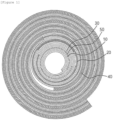
- FIG. 1 shows a jelly-roll type electrode assembly including a rigid film according to an aspect of the present disclosure
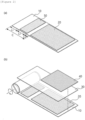
- FIG. 2 schematically shows a method for manufacturing a jelly-roll type electrode assembly including a rigid film according to an aspect of the present disclosure.
- a core portion of the jelly-roll type electrode assembly may include: a first area having a lamination structure of a first separator and a second separator; and a second area having a lamination structure of a first separator, a rigid film, and a second separator.
- the core portion (C) of the jelly-roll type electrode assembly may include a rigid film disposed between the first separator and the second separator, and thus may include: a first area having a lamination structure of a first separator and a second separator; and a second area having a lamination structure of a first separator, a rigid film, and a second separator.
- the length in the longitudinal direction of the first area may be L1
- the length in the longitudinal direction of the second area may be L2.
- one end portion in the longitudinal direction of the rigid film and one end portion in the longitudinal direction of the negative electrode may be in contact with each other, and as described below, the step difference can be minimized by adjusting the thickness range of the rigid film.
- local problems can be minimized, such as, the formation of step difference due to the thickness difference between the rigid film and the negative electrode and the precipitation of lithium in the step difference formation area.
- the length in the longitudinal direction of the first area may be 1 turn to 1.7 turns.
- the length L1 in the longitudinal direction of the first area may be 1.1 turns or more, 1.2 turns or more, or 1.3 turns or more, and may be 1.6 turns or less, 1.5 turns or less, or 1.4 turns or less.
- the winding of the electrode assembly can be attained more easily by adjusting the distance between one end portion in the longitudinal direction of the separator and one end portion in the longitudinal direction of the rigid film. If the length in the longitudinal direction of the first area is less than 1 turn, the tension for continuous winding may not be sufficient in the winding using a mandrel.
- the core portion of the jelly-roll type electrode assembly may further include a third area having a lamination structure of a first separator and a second separator.
- the core portion of the jelly-roll type electrode assembly may include: a first area having a lamination structure of a first separator and a second separator; a second area having a lamination structure of a first separator, a rigid film, and a second separator; and a third area having a lamination structure of a first separator and a second separator.
- the length in the longitudinal direction of the first area may be L1
- the length in the longitudinal direction of the second area may be L2
- the length in the longitudinal direction of the third area may be L3.
- the term “inner circumference” may refer to the circumference of an imaginary circle, of which the radius has the largest value among the distances from the winding axis of the electrode assembly to the innermost layer in contact with the hollow portion of the electrode assembly, and the length may be determined according to the outer diameter of the mandrel used for winding of the electrode assembly.
- the inner circumference may have a value of about 10 mm.
- the length in the longitudinal direction of the rigid film may be 0.9 to 1.4 turns.
- the distance between one end portion in the longitudinal direction of the rigid film and one end portion in the longitudinal direction of the negative electrode may be 1 turn or more or 1.1 turns or more, and 1.3 turns or less or 1.2 turns or less.
- the length in the longitudinal direction of the rigid film may be the same as the length L2 in the longitudinal direction of the second area.
- the core support effect by the rigid film can be further enhanced, and the reductions in battery capacity and energy density can be minimized, thereby preventing the deterioration of electrochemical characteristics.
- the tensile strength of the rigid film may be 18 kgf/mm 2 to 25 kgf/mm 2 .
- the tensile strength of the rigid film may be 19 kgf/mm 2 or more, 20 kgf/mm 2 or more, or 21 kgf/mm 2 or more, and 24 kgf/mm 2 or less, 23 kgf/mm 2 or less, or 22 kgf/mm 2 or less.
- the tensile strength of the rigid film may be measured by preparing a sample with 20 mm X 100 mm in size and 10 ⁇ m in thickness from a film specimen and testing the rigid film sample at room temperature under a speed condition of 2 cm/min using a universal testing machine (UTM).
- UPM universal testing machine
- the core support effect by the rigid film can be further enhanced, and the continuous production of electrode assemblies can be achieved using existing roll-to-roll processing equipment, thereby ensuring productivity and economic efficiency.
- the core portion of the jelly-roll type electrode assembly may have a length in the longitudinal direction of 2 to 3 turns.
- the core portion of the jelly-roll type electrode assembly may have a length in the longitudinal direction of 2.1 turns or more, 2.2 turns or more, 2.3 turns or more, 2.4 or turns or more, or 2.5 turns or more, and a length in the longitudinal direction of 2.9 turns or less, 2.8 turns or less, 2.7 turns or less, 2.6 turns or less, or 2.5 turns or less.
- the length in the longitudinal direction of the core portion may be the same as the sum of L1, the length in the longitudinal length of the first area and L2, the length in the longitudinal direction of the second area, or the sum of L1, the length in the longitudinal length of the first area, L2, the length in the longitudinal direction of the second area, and L3, the length in the longitudinal direction of the third area.
- the length in the longitudinal direction of the core portion satisfies the foregoing range, a space sufficient for the arrangement of the rigid film can be ensured, and the core support effect by the rigid film can be further enhanced.
- the distance between one end portion in the longitudinal direction of the rigid film and one end portion in the longitudinal direction of the negative electrode may be 0.5 turns or less. Specifically, the distance between one end portion in the longitudinal direction of the rigid film and one end portion in the longitudinal direction of the negative electrode may be 0.4 turns or less or 0.3 turns or less. Referring to FIG. 2 , the distance between one end portion in the longitudinal direction of the rigid film and one end portion in the longitudinal direction of the negative electrode may be the same as the length L3 in the longitudinal direction of the third area.
- the distance between one end portion in the longitudinal direction of the rigid film and one end portion in the longitudinal direction of the negative electrode may be 0.3 to 0.7 turns.
- the distance between one end portion in the longitudinal direction of the rigid film and one end portion in the longitudinal direction of the negative electrode may be 0.4 turn or more or 0.5 turns or more, and 0.6 turns or less or 0.5 turns or less.
- the distance between one end portion in the longitudinal direction of the rigid film and one end portion in the longitudinal direction of the negative electrode may be the same as the length L3 in the longitudinal direction of the third area.
- the rigid film may further include a fixing member on at least one surface thereof.
- the fixing member is used for minimizing the sliding of the rigid film, and an adhesive or adhesive tape may be used therefor.
- the further inclusion of the fixing member can minimize the damage to the separator due to the end portion of the electrode or the rigid film even during the contraction/expansion of the electrode assembly or the sliding of the rigid film.
- the length in the widthwise direction of the rigid film may be 95% to 105% based on 100% of the length in the widthwise direction of the jelly-roll type electrode assembly.
- the length in the widthwise direction of the rigid film may be 96% or more, 97% or more, 98% or more, 99% or more, or 100% or more, and 104% or less, 103% or less, 102% or less, 101% or less, or 100% or less, based on 100% of the length in the widthwise direction of the jelly-roll type electrode assembly.
- the length in the widthwise direction of the rigid film is too short, it may reduce the core deformation preventing effect. If the rigid film is excessively exposed in the widthwise direction of the jelly-roll type electrode assembly, it may cause increased defects during the insertion process into the battery case and local problems, such as lithium precipitation due to step difference formation.
- the rigidity of the rigid film can be sufficient to support the core portion of the jelly-roll type electrode assembly, and the rigidity of the rigid film can be more suitable for roll-to-roll processing, thereby improving the productivity and economic efficiency of the jelly-roll type electrode assembly.
- the positive electrode may include: a positive electrode current collector; and a positive electrode active material layer provided on at least one surface of the positive electrode current collector, wherein the positive electrode current collector and the positive electrode active material layer may have ends in the longitudinal direction at the same position. In other words, one end in the longitudinal direction of the positive electrode may have a free-edge form.
- the area of unnecessary non-coating portions of the positive electrode current collector can be reduced to ensure economic efficiency, and a slitting process can be performed after the formation of the active material layer on the electrode, thereby performing roll-to-roll processing including a slitting process and a winding process more efficiently.
- seam position means that the lengths of end portions in the longitudinal direction are the same as each other, and may include the substantial formation of end portions at the same positon due to a process error that may occur in the slitting process or the like.
- the positive electrode current collector may include a positive electrode coating portion where a positive electrode active material is coated, and a positive electrode non-coating portion where a positive electrode active material is not coated.
- a tab may be included on the positive electrode non-coating portion.
- the positive electrode current collector may include a positive electrode non-coating portion, and may include a positive electrode tab formed on the positive electrode non-coating portion.
- the positive electrode current collector is not particularly limited as long as the positive electrode collector does not cause chemical changes in a battery while having conductivity, and, specifically, stainless steel, aluminum, nickel, titanium, fired carbon, or aluminum or stainless steel that is surface-treated with carbon, nickel, titanium, silver, or the like may be used as the positive electrode current collector. That is, the positive electrode current collector may be provided in the form of surface-treated stainless steel, aluminum foil, or the like.
- the positive electrode current collector may typically have a thickness of 5 to 30 ⁇ m, and fine irregularities may be formed on the surface of the collector to enhance the adhesive strength of the positive electrode active material.
- the positive electrode current collector may be used in various forms, such as a film, a sheet, a foil, a net, a porous body, a foam body, and a non-woven fabric body.
- the positive electrode active material may be a commonly used positive electrode active material.
- the positive electrode active material may include: layered compounds, such as lithium cobalt oxide (LiCoO 2 ) or lithium nickel oxide (LiNiO 2 ), or compounds substituted with one or more transition metals; lithium iron oxides such as LiFe 3 O 4 ; lithium manganese oxides, such as compounds of Formula Li 1+x Mn 2-x O 4 (0 ⁇ x ⁇ 0.33), LiMnO 3 , LiMn 2 O 3 or LiMnO 2 ; lithium copper oxide (Li 2 CuO 2 ); vanadium oxides, such as LiV 3 O 8 , V 2 O 5 or Cu 2 V 2 O 7 ; Ni-site type lithiated nickel oxides represented by a chemical formula of LiNi 1-y M y O 2 (M is at least one selected from the group consisting of Co, Mn, Al, Cu, Fe, Mg, B and Ga, and 0.01 ⁇ y ⁇ 0.3); lithium manganese oxides, such as Li 1+x
- the positive electrode active material may further include a positive electrode conductive material and a positive electrode binder.
- the positive electrode conductive material is used to impart conductivity to the positive electrode, and any conductive material that does not cause chemical changes in the configured battery while having electron conductivity may be used without particular limitation.
- the negative electrode may include a negative electrode current collector and a negative electrode active material layer provided on the negative electrode current collector.
- the negative electrode may include a negative electrode current collector and a negative electrode active material layer formed on one or both surfaces of the negative electrode current collector and containing a negative electrode active material.
- the negative electrode active material layer may be formed on a negative electrode coating portion of the negative electrode current collector, and the surface where the negative electrode active material layer is not provided may be expressed as a negative electrode non-coating portion.
- the negative electrode current collector may include a negative electrode coating portion where a negative electrode active material layer is formed, and a negative electrode non-coating portion where a negative electrode active material layer is not formed, and may include a tab on the negative electrode non-coating portion.
- the negative electrode current collector may include a negative electrode non-coating portion, and may include a negative electrode tab formed on the negative electrode non-coating portion. Therefore, the manufactured electrode assembly may include at least one negative electrode tab.
- the negative electrode active material layer may contain a negative electrode active material including at least one selected from the group consisting of a silicon-based material and a carbon-based material.
- the negative electrode active material layer may further include a negative electrode conductive material and a negative electrode binder, and the negative electrode active material, the negative electrode conductive material, and the negative electrode binder may be formed of materials that are used in the art, without limitation.
- the negative electrode current collector is not particularly limited as long as the negative electrode current collector does not cause a chemical change in the battery while having conductivity.
- copper, stainless steel, aluminum, nickel, titanium, fired carbon, or aluminum or stainless steel that is surface-treated with carbon, nickel, titanium, silver, or the like may be used as the negative electrode current collector.
- transition metals that adsorb carbon well, such as copper and nickel may be used as the negative electrode current collector.
- the thickness of the negative electrode current collector may be 5 ⁇ m to 30 ⁇ m, but the thickness of the negative electrode current collector is not limited thereto.
- the negative electrode binder may include at least one selected from the group consisting of polyvinylidenefluoride-hexafluoropropylene copolymer (PVDF-co-HFP), polyvinylidenefluoride, polyacrylonitrile, polymethylmethacrylate, polyvinyl alcohol, carboxymethylcellulose (CMC), starch, hydroxypropylcellulose, regenerated cellulose, polyvinylpyrrolidone, tetrafluoroethylene, polyethylene, polypropylene, polyacrylic acid, an ethylene-propylene-diene monomer (EPDM), sulfonated EPDM, styrene butadiene rubber (SBR), fluororubber, polyacrylic acid, and polymers in which hydrogen of the above-mentioned materials is substituted with Li, Na, Ca, or the like, and may also include various copolymers of theses.
- PVDF-co-HFP polyvinylidenefluoride-hexafluoroprop
- the negative electrode conductive material is not particularly limited so long as it does not cause chemical changes in corresponding batteries while having conductivity.
- Examples thereof may include: graphite, such as natural graphite or artificial graphite; carbon black, such as acetylene black, Ketjen black, channel black, furnace black, lamp black, or thermal black; conductive fibers, such as carbon fibers or metallic fibers; conductive tubes, such as carbon nanotubes; metallic powders, such as carbon fluoride powder, aluminum powder, or nickel powder; conductive whiskers, such as zinc oxide or potassium titanate; conductive metal oxides, such as titanium oxide; or conductive materials, such as polyphenylene derivatives.
- the jelly-roll type electrode assembly may include a plurality of separators.
- the jelly-roll type electrode assembly may have a structure in which a separator/negative electrode/separator/positive electrode are sequentially laminated.
- the separator serves to separate the negative electrode and the positive electrode and provides a passage for the migration of lithium ions.
- a material for the separator is not particularly limited as long as it is a material commonly used as a separator for a secondary battery.
- a material that has a low resistance to the migration of electrolyte ions and is well impregnated in an electrolyte may be used.
- a porous polymer film for example, a porous polymer film formed of a polyolefin-based polymer, such as an ethylene homopolymer, a propylene homopolymer, an ethylene/butene copolymer, an ethylene/hexene copolymer, or an ethylene/methacrylate copolymer; or a laminated structure having two or more layers formed of these polymers may be used.
- a typical porous non-woven fabric for example, a non-woven fabric composed of high-melting-point glass fiber, polyethylene terephthalate fiber, or the like may be used.
- the separator may include a coating layer formed by coating a slurry containing a ceramic component or polymeric component on a base layer formed of the foregoing separator material, and may selectively have either a single-layer structure or a multi-layer structure.
- the thickness of the separator may be 10 ⁇ m to 20 ⁇ m, but is not limited thereto.
- a method for manufacturing a jelly-roll type electrode assembly including a first separator, a negative electrode, a second separator, and a positive electrode, which are sequentially laminated and wound, the method including: (a) winding a first separator and a second separator; (b) introducing a rigid film between the first separator and the second separator; (c) introducing a negative electrode; and (d) introducing a positive electrode, wherein: the length in the longitudinal direction of the rigid film is 100% to 150% based on 100% of the inner circumference of the jelly-roll type electrode assembly; and the tensile strength of the rigid film is 18 kgf/mm 2 to 25 kgf/mm 2 .
- the method for manufacturing a jelly-roll type electrode assembly can produce a jelly-roll type electrode assembly including a rigid film through a continuous process using existing roll-to-roll processing equipment, thereby ensuring productivity and economic efficiency.
- the jelly-roll type electrode assembly obtained by the manufacturing method includes a rigid film, which has a predetermined degree of rigidity, so that the hollow section of the core portion is supported to maintain its circular shape against the deformation of the electrode assembly due to the contraction/expansion of the electrode during battery charging/discharging, thereby preventing damage to the positive electrode and the separator and suppressing internal short circuits between the positive electrode and the negative electrode, leading to improvements in battery stability and service life characteristics.
- the core support effect by the rigid film can be further enhanced, and the reductions in battery capacity and energy density can be minimized, thereby preventing the deterioration of electrochemical characteristics.
- the tensile strength of the rigid film may be 18 kgf/mm 2 to 25 kgf/mm 2 .
- the tensile strength of the rigid film may be 19 kgf/mm 2 or more, 20 kgf/mm 2 or more, or 21 kgf/mm 2 or more, and 24 kgf/mm 2 or less, 23 kgf/mm 2 or less, or 22 kgf/mm 2 or less.
- the core support effect by the rigid film can be further enhanced, and the continuous production of electrode assemblies can be achieved using existing roll-to-roll processing equipment, thereby ensuring productivity and economic efficiency.
- the meanings of the core portion and the inner circumference and the method for measuring the tensile strength of the rigid film may be as described with respect to the jelly-roll type electrode assembly.
- the meanings of the first area to the third area included in the core portion, the length of the first area (L1), the length of the second area (L2), the length of the third area (L3), and the length in the longitudinal direction of the core portion (L1+L2+L3) are as described with respect to the jelly-roll type electrode assembly.
- the method for manufacturing the jelly-roll type electrode assembly may be performed by roll-to-roll processing.
- steps (a) to (d) may be performed by roll-to-roll processing, in which multiple flexible metal foils or the like are processed while traveling between rollers.
- the roll-to-roll processing may mean a manner in which a flexible and thin metal sheet-like electrode current collector wound around a roll is unwound to supply the electrode current collector, an electrode slurry containing an electrode active material is coated and dried on at least one surface of the electrode current collector to form an electrode mixture layer, and then the processed electrode current collector is again wound around another roll and recycled.
- introducing may refer to a series of introduction and winding steps performed during the manufacturing of an electrode assembly by roll-to-roll processing, that is, the term may mean a part of the winding process.
- the term may mean a process of introducing a film or electrode, which is to be additionally wound, between a plurality of separators, each of which is wound around a mandrel by starting from one end portion in the longitudinal direction to a part of the length in the longitudinal direction, or on one surface of each of a plurality of separators partially wound around a mandrel.
- the term may mean a process of manufacturing an electrode assembly by continuously winding the introduced film or electrode along with the plurality of separators partially wound, and may involve a slitting process of cutting a part of the length in the longitudinal direction as needed.
- the method for manufacturing a jelly-roll type electrode assembly according to an aspect of the present disclosure can continuously produce jelly-roll type electrode assemblies including a rigid film having a predetermined degree of rigidity, by using existing roll-to-roll processing equipment, thereby ensuring productivity and economic efficiency.
Landscapes
- Chemical & Material Sciences (AREA)
- Chemical Kinetics & Catalysis (AREA)
- Electrochemistry (AREA)
- General Chemical & Material Sciences (AREA)
- Engineering & Computer Science (AREA)
- Manufacturing & Machinery (AREA)
- Secondary Cells (AREA)
- Battery Electrode And Active Subsutance (AREA)
- Sealing Battery Cases Or Jackets (AREA)
- Cell Separators (AREA)
Applications Claiming Priority (2)
| Application Number | Priority Date | Filing Date | Title |
|---|---|---|---|
| KR1020230110013A KR20250028848A (ko) | 2023-08-22 | 2023-08-22 | 젤리-롤형 전극조립체, 젤리-롤형 전극조립체 제조방법 및 이를 포함하는 이차전지 |
| PCT/KR2024/012512 WO2025042216A1 (ko) | 2023-08-22 | 2024-08-22 | 젤리-롤형 전극조립체, 젤리-롤형 전극조립체 제조방법 및 이를 포함하는 이차전지 |
Publications (2)
| Publication Number | Publication Date |
|---|---|
| EP4579865A1 true EP4579865A1 (de) | 2025-07-02 |
| EP4579865A4 EP4579865A4 (de) | 2026-03-25 |
Family
ID=94732465
Family Applications (1)
| Application Number | Title | Priority Date | Filing Date |
|---|---|---|---|
| EP24856827.1A Pending EP4579865A4 (de) | 2023-08-22 | 2024-08-22 | Jelly-roll-elektrodenanordnung, herstellungsverfahren für jelly-roll-elektrodenanordnung und sekundärbatterie damit |
Country Status (5)
| Country | Link |
|---|---|
| EP (1) | EP4579865A4 (de) |
| JP (1) | JP2025531520A (de) |
| KR (1) | KR20250028848A (de) |
| CN (1) | CN119998979A (de) |
| WO (1) | WO2025042216A1 (de) |
Family Cites Families (13)
| Publication number | Priority date | Publication date | Assignee | Title |
|---|---|---|---|---|
| JPS6174267A (ja) * | 1984-09-18 | 1986-04-16 | Shin Kobe Electric Mach Co Ltd | 電池用渦巻状極板群及びその製造方法 |
| JPH11111331A (ja) * | 1997-10-07 | 1999-04-23 | Hitachi Maxell Ltd | 水素化物二次電池 |
| JP2005174793A (ja) * | 2003-12-12 | 2005-06-30 | Matsushita Electric Ind Co Ltd | 非水系二次電池 |
| KR101152651B1 (ko) * | 2007-09-12 | 2012-06-04 | 주식회사 엘지화학 | 양면 접착 테이프에 의해 안전성이 향상된 리튬 이차전지 |
| CN102341937B (zh) * | 2010-03-04 | 2015-02-11 | 松下电器产业株式会社 | 电池用隔膜、使用了该隔膜的电池及电池的制造方法 |
| JP5687443B2 (ja) * | 2010-06-24 | 2015-03-18 | トヨタ自動車株式会社 | 電池 |
| JP5842011B2 (ja) * | 2011-01-25 | 2016-01-13 | エルジー・ケム・リミテッド | 円筒型二次電池 |
| JP2013245428A (ja) * | 2012-05-29 | 2013-12-09 | Shinshu Univ | セパレーター、セパレーター製造方法及びセパレーター製造装置 |
| KR102838322B1 (ko) * | 2020-07-31 | 2025-07-24 | 주식회사 엘지에너지솔루션 | 버튼형 이차전지 |
| WO2022216092A1 (ko) * | 2021-04-08 | 2022-10-13 | 주식회사 엘지에너지솔루션 | 전극 조립체, 배터리 셀, 배터리 팩 및 자동차 |
| KR20230060116A (ko) * | 2021-10-27 | 2023-05-04 | 주식회사 엘지에너지솔루션 | 전극 조립체 및 이를 포함하는 이차 전지 |
| WO2023121402A1 (ko) * | 2021-12-24 | 2023-06-29 | 주식회사 엘지에너지솔루션 | 파우치 필름 적층체 및 이를 이용하여 제조된 전지 케이스 |
| JP2023112590A (ja) * | 2022-02-01 | 2023-08-14 | 旭化成株式会社 | 蓄電池用セパレータ捲回体 |
-
2023
- 2023-08-22 KR KR1020230110013A patent/KR20250028848A/ko active Pending
-
2024
- 2024-08-22 WO PCT/KR2024/012512 patent/WO2025042216A1/ko active Pending
- 2024-08-22 CN CN202480004190.6A patent/CN119998979A/zh active Pending
- 2024-08-22 JP JP2025518546A patent/JP2025531520A/ja active Pending
- 2024-08-22 EP EP24856827.1A patent/EP4579865A4/de active Pending
Also Published As
| Publication number | Publication date |
|---|---|
| KR20250028848A (ko) | 2025-03-04 |
| WO2025042216A1 (ko) | 2025-02-27 |
| EP4579865A4 (de) | 2026-03-25 |
| JP2025531520A (ja) | 2025-09-19 |
| CN119998979A (zh) | 2025-05-13 |
Similar Documents
| Publication | Publication Date | Title |
|---|---|---|
| US20250210722A1 (en) | Jelly-Roll Electrode Assembly and Cylindrical Lithium Secondary Battery Comprising Same | |
| KR102553116B1 (ko) | 음극 및 상기 음극을 포함하는 이차 전지 | |
| CN1949580A (zh) | 一种高功率锂离子电池 | |
| KR102886269B1 (ko) | 음극의 전리튬화 장치 및 음극의 전리튬화 방법 | |
| US20210218029A1 (en) | Negative electrode and lithium secondary battery including negative electrode | |
| EP4579865A1 (de) | Jelly-roll-elektrodenanordnung, herstellungsverfahren für jelly-roll-elektrodenanordnung und sekundärbatterie damit | |
| EP4629394A1 (de) | Jelly-roll-elektrodenanordnung, verfahren zur herstellung einer jelly-roll-elektrodenanordnung und sekundärbatterie damit | |
| EP4625595A1 (de) | Jelly-roll-elektrodenanordnung, herstellungsverfahren dafür und sekundärbatterie damit | |
| US20260018678A1 (en) | Jelly Roll Type Electrode Assembly and Secondary Battery Comprising Same | |
| EP4611107A1 (de) | Elektrodenanordnung und sekundärbatterie damit | |
| EP4611084A1 (de) | Elektrodenanordnung und sekundärbatterie damit | |
| EP4428984A1 (de) | Jelly-roll-elektrodenanordnung, verfahren zur herstellung einer jelly-roll-elektrodenanordnung und sekundärbatterie damit | |
| US11888156B2 (en) | Negative electrode active material, negative electrode including negative electrode active material, and lithium secondary battery including negative electrode | |
| KR20250008493A (ko) | 전극조립체 및 이를 포함하는 이차전지 | |
| KR20250040196A (ko) | 젤리-롤형 전극조립체 및 이를 포함하는 이차전지 | |
| CN118901160A (zh) | 卷绕型电极组件和包括该卷绕型电极组件的二次电池 | |
| CN121039862A (zh) | 电极组件和包括该电极组件的二次电池 | |
| KR20240166675A (ko) | 이차전지, 이를 포함하는 전지시스템 및 배터리팩 | |
| KR20240074668A (ko) | 젤리-롤형 전극조립체 및 이를 포함하는 이차전지 | |
| CN121039863A (zh) | 电极组件、用于制造电极组件的方法以及包括电极组件的二次电池 |
Legal Events
| Date | Code | Title | Description |
|---|---|---|---|
| STAA | Information on the status of an ep patent application or granted ep patent |
Free format text: STATUS: THE INTERNATIONAL PUBLICATION HAS BEEN MADE |
|
| PUAI | Public reference made under article 153(3) epc to a published international application that has entered the european phase |
Free format text: ORIGINAL CODE: 0009012 |
|
| STAA | Information on the status of an ep patent application or granted ep patent |
Free format text: STATUS: REQUEST FOR EXAMINATION WAS MADE |
|
| 17P | Request for examination filed |
Effective date: 20250324 |
|
| AK | Designated contracting states |
Kind code of ref document: A1 Designated state(s): AL AT BE BG CH CY CZ DE DK EE ES FI FR GB GR HR HU IE IS IT LI LT LU LV MC ME MK MT NL NO PL PT RO RS SE SI SK SM TR |
|
| A4 | Supplementary search report drawn up and despatched |
Effective date: 20260224 |
|
| RIC1 | Information provided on ipc code assigned before grant |
Ipc: H01M 10/0587 20100101AFI20260218BHEP Ipc: H01M 50/107 20210101ALI20260218BHEP Ipc: H01M 10/052 20100101ALI20260218BHEP |