EP4579795A1 - Zusammengesetztes positivelektrodenmaterial und herstellungsverfahren dafür, positivelektrodenplatte, batterie und elektrische vorrichtung - Google Patents
Zusammengesetztes positivelektrodenmaterial und herstellungsverfahren dafür, positivelektrodenplatte, batterie und elektrische vorrichtung Download PDFInfo
- Publication number
- EP4579795A1 EP4579795A1 EP24850372.4A EP24850372A EP4579795A1 EP 4579795 A1 EP4579795 A1 EP 4579795A1 EP 24850372 A EP24850372 A EP 24850372A EP 4579795 A1 EP4579795 A1 EP 4579795A1
- Authority
- EP
- European Patent Office
- Prior art keywords
- positive electrode
- electrode material
- composite
- composite positive
- carbon
- Prior art date
- Legal status (The legal status is an assumption and is not a legal conclusion. Google has not performed a legal analysis and makes no representation as to the accuracy of the status listed.)
- Pending
Links
Images

Classifications
-
- C—CHEMISTRY; METALLURGY
- C01—INORGANIC CHEMISTRY
- C01B—NON-METALLIC ELEMENTS; COMPOUNDS THEREOF; METALLOIDS OR COMPOUNDS THEREOF NOT COVERED BY SUBCLASS C01C
- C01B25/00—Phosphorus; Compounds thereof
- C01B25/16—Oxyacids of phosphorus; Salts thereof
- C01B25/26—Phosphates
- C01B25/45—Phosphates containing plural metal, or metal and ammonium
-
- C—CHEMISTRY; METALLURGY
- C01—INORGANIC CHEMISTRY
- C01B—NON-METALLIC ELEMENTS; COMPOUNDS THEREOF; METALLOIDS OR COMPOUNDS THEREOF NOT COVERED BY SUBCLASS C01C
- C01B32/00—Carbon; Compounds thereof
- C01B32/05—Preparation or purification of carbon not covered by groups C01B32/15, C01B32/20, C01B32/25, C01B32/30
-
- H—ELECTRICITY
- H01—ELECTRIC ELEMENTS
- H01M—PROCESSES OR MEANS, e.g. BATTERIES, FOR THE DIRECT CONVERSION OF CHEMICAL ENERGY INTO ELECTRICAL ENERGY
- H01M4/00—Electrodes
- H01M4/02—Electrodes composed of, or comprising, active material
- H01M4/04—Processes of manufacture in general
- H01M4/0471—Processes of manufacture in general involving thermal treatment, e.g. firing, sintering, backing particulate active material, thermal decomposition, pyrolysis
-
- H—ELECTRICITY
- H01—ELECTRIC ELEMENTS
- H01M—PROCESSES OR MEANS, e.g. BATTERIES, FOR THE DIRECT CONVERSION OF CHEMICAL ENERGY INTO ELECTRICAL ENERGY
- H01M4/00—Electrodes
- H01M4/02—Electrodes composed of, or comprising, active material
- H01M4/13—Electrodes for accumulators with non-aqueous electrolyte, e.g. for lithium-accumulators; Processes of manufacture thereof
-
- H—ELECTRICITY
- H01—ELECTRIC ELEMENTS
- H01M—PROCESSES OR MEANS, e.g. BATTERIES, FOR THE DIRECT CONVERSION OF CHEMICAL ENERGY INTO ELECTRICAL ENERGY
- H01M4/00—Electrodes
- H01M4/02—Electrodes composed of, or comprising, active material
- H01M4/13—Electrodes for accumulators with non-aqueous electrolyte, e.g. for lithium-accumulators; Processes of manufacture thereof
- H01M4/139—Processes of manufacture
-
- H—ELECTRICITY
- H01—ELECTRIC ELEMENTS
- H01M—PROCESSES OR MEANS, e.g. BATTERIES, FOR THE DIRECT CONVERSION OF CHEMICAL ENERGY INTO ELECTRICAL ENERGY
- H01M4/00—Electrodes
- H01M4/02—Electrodes composed of, or comprising, active material
- H01M4/36—Selection of substances as active materials, active masses, active liquids
- H01M4/362—Composites
- H01M4/364—Composites as mixtures
-
- H—ELECTRICITY
- H01—ELECTRIC ELEMENTS
- H01M—PROCESSES OR MEANS, e.g. BATTERIES, FOR THE DIRECT CONVERSION OF CHEMICAL ENERGY INTO ELECTRICAL ENERGY
- H01M4/00—Electrodes
- H01M4/02—Electrodes composed of, or comprising, active material
- H01M4/36—Selection of substances as active materials, active masses, active liquids
- H01M4/362—Composites
- H01M4/366—Composites as layered products
-
- H—ELECTRICITY
- H01—ELECTRIC ELEMENTS
- H01M—PROCESSES OR MEANS, e.g. BATTERIES, FOR THE DIRECT CONVERSION OF CHEMICAL ENERGY INTO ELECTRICAL ENERGY
- H01M4/00—Electrodes
- H01M4/02—Electrodes composed of, or comprising, active material
- H01M4/36—Selection of substances as active materials, active masses, active liquids
- H01M4/48—Selection of substances as active materials, active masses, active liquids of inorganic oxides or hydroxides
- H01M4/52—Selection of substances as active materials, active masses, active liquids of inorganic oxides or hydroxides of nickel, cobalt or iron
-
- H—ELECTRICITY
- H01—ELECTRIC ELEMENTS
- H01M—PROCESSES OR MEANS, e.g. BATTERIES, FOR THE DIRECT CONVERSION OF CHEMICAL ENERGY INTO ELECTRICAL ENERGY
- H01M4/00—Electrodes
- H01M4/02—Electrodes composed of, or comprising, active material
- H01M4/36—Selection of substances as active materials, active masses, active liquids
- H01M4/58—Selection of substances as active materials, active masses, active liquids of inorganic compounds other than oxides or hydroxides, e.g. sulfides, selenides, tellurides, halogenides or LiCoFy; of polyanionic structures, e.g. phosphates, silicates or borates
- H01M4/5825—Oxygenated metallic salts or polyanionic structures, e.g. borates, phosphates, silicates, olivines
-
- H—ELECTRICITY
- H01—ELECTRIC ELEMENTS
- H01M—PROCESSES OR MEANS, e.g. BATTERIES, FOR THE DIRECT CONVERSION OF CHEMICAL ENERGY INTO ELECTRICAL ENERGY
- H01M4/00—Electrodes
- H01M4/02—Electrodes composed of, or comprising, active material
- H01M4/62—Selection of inactive substances as ingredients for active masses, e.g. binders, fillers
- H01M4/624—Electric conductive fillers
- H01M4/625—Carbon or graphite
-
- C—CHEMISTRY; METALLURGY
- C01—INORGANIC CHEMISTRY
- C01P—INDEXING SCHEME RELATING TO STRUCTURAL AND PHYSICAL ASPECTS OF SOLID INORGANIC COMPOUNDS
- C01P2004/00—Particle morphology
- C01P2004/60—Particles characterised by their size
-
- H—ELECTRICITY
- H01—ELECTRIC ELEMENTS
- H01M—PROCESSES OR MEANS, e.g. BATTERIES, FOR THE DIRECT CONVERSION OF CHEMICAL ENERGY INTO ELECTRICAL ENERGY
- H01M4/00—Electrodes
- H01M4/02—Electrodes composed of, or comprising, active material
- H01M2004/021—Physical characteristics, e.g. porosity, surface area
-
- H—ELECTRICITY
- H01—ELECTRIC ELEMENTS
- H01M—PROCESSES OR MEANS, e.g. BATTERIES, FOR THE DIRECT CONVERSION OF CHEMICAL ENERGY INTO ELECTRICAL ENERGY
- H01M4/00—Electrodes
- H01M4/02—Electrodes composed of, or comprising, active material
- H01M2004/026—Electrodes composed of, or comprising, active material characterised by the polarity
- H01M2004/028—Positive electrodes
-
- Y—GENERAL TAGGING OF NEW TECHNOLOGICAL DEVELOPMENTS; GENERAL TAGGING OF CROSS-SECTIONAL TECHNOLOGIES SPANNING OVER SEVERAL SECTIONS OF THE IPC; TECHNICAL SUBJECTS COVERED BY FORMER USPC CROSS-REFERENCE ART COLLECTIONS [XRACs] AND DIGESTS
- Y02—TECHNOLOGIES OR APPLICATIONS FOR MITIGATION OR ADAPTATION AGAINST CLIMATE CHANGE
- Y02E—REDUCTION OF GREENHOUSE GAS [GHG] EMISSIONS, RELATED TO ENERGY GENERATION, TRANSMISSION OR DISTRIBUTION
- Y02E60/00—Enabling technologies; Technologies with a potential or indirect contribution to GHG emissions mitigation
- Y02E60/10—Energy storage using batteries
Definitions
- This application relates to the field of battery technology, and in particular, to a composite positive electrode material and a preparation method thereof, a positive electrode plate, a battery, and an electrical device.
- a positive electrode material is one of key factors that affect performance of a battery.
- Some of currently commercialized positive electrode materials of batteries, such as LiFePO4 of an olivine structure, are widely used by virtue of characteristics such as a high capacity, cost-effectiveness, good safety performance, excellent cycle performance, and environmental friendliness.
- some positive electrode materials incur the problem of a low electronic conductivity, thereby limiting the improvement of battery performance.
- this application provides a composite positive electrode material and a preparation method thereof, a positive electrode plate, a battery, and an electrical device to solve the problem that an electronic conductivity of a positive electrode material is low.
- this application provides a composite positive electrode material.
- the composite positive electrode material includes a composite formed by a positive active material and carbon.
- a mass ratio of a carbon content inside to a carbon content on a surface is (0.8 to 2): 1.
- the conductivity distribution of the composite positive electrode material is improved, and an excellent conductivity is exhibited inside the particle and on the surface of the particle, thereby effectively improving the overall electronic conductivity of the composite positive electrode material.
- the improved electronic conductivity can reduce the impedance of the composite positive electrode material and improve the C-rate performance of the composite positive electrode material.
- a mass ratio of a carbon content inside to a carbon content on a surface is optionally (1 to 1.8): 1.
- the ratio of the carbon content inside to the carbon content on the surface affects the overall conductivity of the composite positive electrode material.
- An appropriate ratio of the carbon content improves the overall conductivity of the composite positive electrode material.
- the inside is a region within 60% of a radius of a particle from a center of the particle.
- the surface is a region beyond 60% of the radius from the center of the particle.
- particles of the composite include secondary particles.
- the secondary particles exhibit a higher conductivity.
- the structure of the secondary particles is characterized by agglomeration resistance and high dispersibility. After being made into a slurry, the secondary particles exhibit high processability. Therefore, the composite positive electrode material containing the structure of secondary particles can improve the processing performance of the composite positive electrode material. Specifically, when the composite positive electrode material is used to make a slurry, the viscosity of the resulting slurry rebounds scarcely, and the fluidity of the slurry is high.
- the D v50 of the secondary particles of the composite is 2 ⁇ m to 9 ⁇ m, and optionally 5 ⁇ m to 9 ⁇ m.
- the composite positive electrode material mainly exists in the form of secondary particles, and the D v50 of the secondary particles is appropriate, thereby improving the conductivity and processing performance of the composite positive electrode material.
- the secondary particles of the composite are formed by agglomerating primary nanoparticles.
- a secondary particle is formed by the aggregating primary particles.
- the primary particle is nano-sized, thereby shortening the ion diffusion path of the positive active material, and in turn, improving the ionic conductivity of the composite positive electrode material.
- this application provides a method for preparing a composite positive electrode material, including:
- the positive active material feedstock is dissolved in the precursor solution, and the insoluble metal-organic framework material is dispersed in the precursor solution.
- the soluble positive active material feedstock can form a precursor grain with the metal-organic framework material as a crystal nucleus by using the insoluble metal-organic framework material as a growth center.
- the metal-organic framework material as a crystal nucleus is carbonized. Specifically, an organic ligand in the material is carbonized.
- the generated carbon retains the three-dimensional skeleton structure of the metal-organic framework material, thereby forming a carbon skeleton.
- the carbon skeletons is of low volatility, and can increase residual carbon inside the composite positive electrode material particles instead of, like other carbon sources, forming loose and highly volatile carbon materials after carbonization and leaving most of the carbon volatilizes and deposits on the surface of the composite positive electrode material particles. Therefore, this technical solution increases the carbon content inside the composite positive electrode material particles and improves the uniformity of carbon distribution.
- the positive active material feedstock reacts at high temperature to form a positive active material.
- the metal in the metal-organic framework material can also participate in the formation of the positive active material.
- a composite containing a positive active material and carbon is produced.
- the carbon is distributed uniformly in the particles of the composite, thereby effectively improving the overall electronic conductivity of the material.
- a mass of the metal-organic framework material is 0.2% to 4%, and optionally 1.5% to 4% of a total mass of the positive active material feedstock.
- the precursor assumes a secondary particle structure.
- an embodiment of this application provides a positive electrode plate.
- the positive electrode plate includes the composite positive electrode material according to the first aspect of this application or a composite positive electrode material prepared by the preparation method according to the second aspect of this application.
- an embodiment of this application further provides a method for preparing a composite positive electrode material.
- a positive active material feedstock is crystallized by using a metal-organic framework material as a core, and then sintered.
- An organic ligand in the metal-organic framework material can form a carbon skeleton after the sintering.
- carbon skeleton is not prone to volatilize, carbon is retained inside the particles of the composite positive electrode material as much as practicable, thereby increasing the carbon content inside the particles of the composite positive electrode material, and improving the uniformity of carbon distribution of the material.
- the improved uniformity of carbon distribution can effectively improve the electronic conductivity of the composite positive electrode material, thereby reducing the impedance of the material and improving the C-rate performance.
- the composite positive electrode material according to this embodiment of this application is applicable to preparing a positive electrode plate.
- the positive electrode plate is applicable to making a battery.
- the battery is applicable to various electrical devices, including but not limited to, a mobile phone, a tablet, a laptop computer, an electric toy, an electric tool, an electric power cart, an electric vehicle, a ship, a spacecraft, or the like.
- an embodiment of this application provides a composite positive electrode material.
- the composite positive electrode material includes a composite formed by a positive active material and carbon.
- a mass ratio of a carbon content inside to a carbon content on a surface is (0.8 to 2): 1.
- the composite means a combination of two or more different substances.
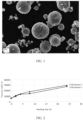
- the morphology of a composite particle of the composite positive electrode material may be observed by using a scanning electron microscope. With the scanning electron microscope, it can be observed that the composite positive electrode material contains a particle structure.
- the term "inside" of the composite particle means a region within 60% of a radius of a particle from a center of the particle, and the term “surface” means a region beyond 60% of the radius from the center of the particle.
- the chemical constituents of the composite may be determined by X-ray diffractometry (XRD) in combination with energy dispersive X-ray spectroscopy (EDS). Based on the characteristic peak of the XRD and characteristic peak of the EDS, it is determined that the composite contains a specified positive active material and carbon. Carbon content means a mass percent of carbon. The carbon content inside the particle and the carbon content on the surface of the composite particle may be measured by EDS.
- the composite positive electrode material is buried into resin, and the composite positive electrode material cut off from the resin through argon sputtering by using a cross-section polisher, so as to expose the cross-section of particles of the composite positive electrode material.
- the EDS instrument is operated in a spot scan mode. Several points (for example, 5 points) are evenly selected in an inner region on the cross-section of the particle, and the instrument automatically analyzes the carbon content at each point. The carbon content values at the selected points are averaged out to obtain the carbon content inside the particle. Similarly, several points (for example, 5 points) are evenly selected in a surface region on the cross-section of the particle, and the instrument automatically analyzes the carbon content at each point. The carbon content values at the selected points are averaged out to obtain the carbon content on the surface of the particle.
- the mass ratio of the carbon content inside the particle to the carbon content on the surface of the particle is (0.8 to 2): 1.
- the carbon content inside the particle is close to the carbon content on the surface of the particle, or the carbon content inside the particle is greater than or equal to the carbon content on the surface of the particle.
- a good conductivity can also be achieved inside the particle by using a high carbon content, and the conductivity inside the particle is close to the conductivity on the surface of the particle, or the conductivity inside the particle is greater than or equal to the conductivity on the surface of the particle.
- the conductivity distribution of the composite positive electrode material is improved, and an excellent conductivity is exhibited inside the particle and on the surface of the particle, thereby effectively improving the overall electronic conductivity of the composite positive electrode material.
- the improved electronic conductivity can reduce the impedance of the composite positive electrode material and improve the C-rate performance of the composite positive electrode material.
- the mass ratio of the carbon content inside to the carbon content on the surface is (0.8 to 2): 1, optionally (1 to 1.8): 1, and further optionally (1.5 to 1.8): 1.
- the mass ratio of the carbon content inside to the carbon content on the surface may be any one of 0.8: 1, 1: 1, 1.2: 1, 1.4: 1, 1.5: 1, 1.6: 1, 1.8: 1, 2: 1, or a range formed by any two thereof.
- the ratio of the carbon content inside to the carbon content on the surface affects the overall conductivity of the composite positive electrode material.
- An appropriate ratio of the carbon content improves the overall conductivity of the composite positive electrode material.
- the total carbon mass percent of the composite positive electrode material is 0.8% to 5%, optionally 1% to 2%, and further optionally 1.4% to 1.7%, for example, may be any one of 0.8%, 1%, 1.4%, 1.5%, 1.7%, 2%, 2.5%, 3%, 3.5%, 4%, 4.5%, 5%, or a range formed by any two thereof.
- the total carbon content or total carbon mass percent of the composite positive electrode material means an aggregate carbon mass percent in the composite positive electrode material, and may be obtained by analysis with a sulfur-carbon analyzer.
- An appropriate carbon content improves the conductivity of the material while maintaining a relatively high content of positive active material in the composite positive electrode material and making full use of the characteristics such as a high capacity of the positive active material.
- particles of the composite include secondary particles.
- the secondary particles assumes a spherical morphology.
- a secondary particle is a particle structure larger than a primary particle in diameter and formed by agglomerating primary particles.
- the morphology of the particle structure of the composite may be observed by using a scanning electron microscope. With the scanning electron microscope, it can be seen that the composite particles include secondary particles, each secondary particle is formed by aggregating a plurality of primary particles, and the secondary particle assumes a spherical morphology.
- the secondary particles exhibit a high conductivity.
- the structure of the secondary particles is characterized by agglomeration resistance and high dispersibility. After being made into a slurry, the secondary particles exhibit high processability. Therefore, the composite positive electrode material containing the structure of secondary particles can improve the processing performance of the composite positive electrode material. Specifically, when the composite positive electrode material is used to make a slurry, the viscosity of the resulting slurry rebounds scarcely, and the fluidity of the slurry is high.
- the secondary particles assume a spherical morphology. Therefore, the active metal in the positive active material is diffused along a uniform diffusion path in all directions, thereby improving the ionic conductivity of the composite positive electrode material.
- the spherical particles are more fluidic and dispersive than other morphologies, thereby improving the processing performance of the composite positive electrode material.
- the D v50 of the secondary particles of the composite is 2 ⁇ m to 9 ⁇ m, optionally 5 ⁇ m to 9 ⁇ m, for example, may be any one of 2 ⁇ m, 3 ⁇ m, 4 ⁇ m, 5 ⁇ m, 6 ⁇ m, 7 ⁇ m, 8 ⁇ m, 9 ⁇ m, or a range formed by any two thereof.
- the porosity of the secondary particles is 10% to 35%, optionally 20% to 35%, for example, may be any one of 10%, 15%, 20%, 25%, 30%, 35%, or a range formed by any two thereof.
- the porosity of the secondary particles means a percentage of the volume of pores in the secondary particles in relation to the total volume of the secondary particles in a natural state.
- the porosity of the secondary particles may be determined by observing and analyzing the percentage of the volume of pores in a cross-section of the secondary particles by use of a scanning electron microscope SEM after the cross-section is obtained by sectioning the secondary particles.
- the secondary particles is of a relatively high porosity, thereby making it convenient for the electrolyte solution to sufficiently infiltrate the secondary particles, and improving the ion conductivity. Moreover, with this porosity, the secondary particles assume a stable and firm structure, and are not prone to break.
- the secondary particles of the composite positive electrode material are formed by agglomerating primary nanoparticles.
- the average particle diameter of the primary nanoparticles is 50 nm to 400 nm, and optionally 50 nm to 250 nm, for example, may be any one of 50 nm, 100 nm, 150 nm, 200 nm, 250 nm, 300 nm, 350 nm, 400 nm, or a range formed by any two thereof.
- the average particle diameter of the primary nanoparticles means an average particle diameter of several primary nanoparticles, and may be determined by observing the material structure by use of a SEM and counting the particle diameters of all or part of the observed primary nanoparticles.
- the composite positive electrode material may be observed by use of a SEM to obtain a SEM image.
- Several (for example, 50 to 100) primary nanoparticles may be selected from the image, the particle diameter of each primary nanoparticle is determined, and all the particle diameter values of the selected primary nanoparticles are averaged out to obtain an average particle diameter.
- a secondary particle is formed by the aggregating primary particles.
- the primary particle is nano-sized, thereby shortening the ion diffusion path of the olivine-structured positive active material, and in turn, improving the ionic conductivity of the material.
- a may be any one of 0.98, 0.99, 1, 1.1, or a range formed by any two thereof; b may be any one of 0, 0.0001, 0.0005, 0.001, 0.002, 0.003, 0.004, 0.005, or a range formed by any two thereof; x may be any one of 0.8, 0.85, 0.9, 0.95, 0.99, or a range formed by any two thereof; y may be any one of 0.01, 0.05, 0.1, 0.15, 0.19, or a range formed by any two thereof; and z may be any one of 0.01, 0.05, 0.1, 0.15, 0.19, or a range formed by any two thereof.
- a b PO 4 is an olivine-structured composite positive active material, such as LiFePO 4 , LiMnPO 4 , LiNiPO 4 , or LiNiPO 4 , or is one of various doped or composite olivine-structured positive active materials.
- Such positive active materials are of a low conductivity because the active metal M 1 in the materials is deintercalated through a one-dimensional structure channel that gives rise to low deintercalation efficiency.
- LiNi x Co y M 3 z O 2 is a ternary positive active material, and is prone to form residual lithium and expand in volume during charge and discharge, thereby resulting in a low conductivity.
- the technical solution of this embodiment of this application is suitable for various positive active materials of deficient conductivity.
- the carbon content inside the particle is made close to the carbon content on the surface of the particle, or the carbon content inside the particle is made greater than or equal to the carbon content on the surface of the particle.
- a good conductivity can also be achieved inside the particle by using a high carbon content, and the conductivity inside the particle is close to the conductivity on the surface of the particle, or the conductivity inside the particle is greater than or equal to the conductivity on the surface of the particle.
- the conductivity distribution of the composite positive electrode material is improved, and an excellent conductivity is exhibited inside the particle and on the surface of the particle, thereby improving the electronic conductivity of the positive active materials.
- a tap density of the composite positive electrode material is 1 g/cm 3 to 2 g/cm 3 , optionally 1.3 g/cm 3 to 1.8 g/cm 3 , for example, may be any one of 1 g/cm 3 , 1.2 g/cm 3 , 1.3 g/cm 3 , 1.4 g/cm 3 , 1.5 g/cm 3 , 1.6 g/cm 3 , 1.7 g/cm 3 , 1.8 g/cm 3 , 1.9 g/cm 3 , or 2 g/cm 3 , or a range formed by any two thereof.
- the tap density means a density of powder in a container after the powder is tapped under specified conditions.
- the tap density reflects the properties such as fluidity and porosity of powder.
- the tap density may be determined by use of a tap densitometer with reference to GB/T 5162-2021 Metallic Powders Determination of Tap Density.
- the composite positive electrode material with a higher mass can lead to a higher energy density of the electrode plate in a case of the same volume in a process of applying the composite positive electrode material to preparing the electrode plate.
- the tap density affects the energy density of the electrode plate.
- the tap density also reflects the porosity of the powder. With an appropriate porosity, the electrode plate achieves high performance of being infiltrated by the electrolyte solution, thereby facilitating transmission of ions.
- the composite positive electrode material according to this embodiment of this application possesses an appropriate tap density, thereby not only increasing the energy density, but also improving the electrolyte solution infiltration performance and accelerating ion transmission.
- the positive active material feedstock is dissolved in the precursor solution, and the insoluble metal-organic framework material is dispersed in the precursor solution.
- the soluble positive active material feedstock can form a precursor grain with the metal-organic framework material as a crystal nucleus by using the insoluble metal-organic framework material as a growth center.
- the solvent contained in the precursor solution includes water.
- Water as a solvent can well dissolve or disperse the constituents, and can be easily removed by drying, without being prone to side reactions.
- the metal-organic framework material and the soluble carbon source in the precursor can be decomposed to form carbon while the positive active material feedstock reacts to generate a positive active material.
- Each material reacts at an appropriate reaction rate during the sintering, thereby improving the structural uniformity of the composite positive electrode material.
- the positive electrode plate typically includes a positive current collector and a positive active layer disposed on at least one side of the positive current collector.
- the positive active layer includes the composite positive electrode material, a conductive agent, a binder, and may also include other positive active materials such as lithium cobalt oxide and lithium manganese oxide, and optionally may also include a lithium supplement such as lithium nickel oxide or lithium ferrite.
- the mass percent of the composite positive electrode material in the active layer may be 90% to 98%, optionally 95% to 98%, for example, any one of 90%, 91%, 92%, 93%, 94%, 95%, 96%, 97%, 98%, or a range formed by any two thereof.
- the conductive agent may include one or more of acetylene black (SP), carbon nanotubes, conductive carbon black (super-P), Ketjen black, carbon fibers, or graphene.
- the mass percent of the conductive agent in the active layer may be, but is not limited to, 0.5% to 10%, optionally 1% to 5%, for example, any one of 0.5%, 1%, 1.5%, 2%, 2.5%, 3%, 3.5%, 4%, 4.5%, 5%, 5.5%, 6%, 6.5%, 7%, 7.5%, 8%, 8.5%, 9%, 9.5%, 10%, or a range formed by any two thereof.
- the binder includes, but is not limited to, one or more of polyvinylidene fluoride (PVDF), polyimide (PI), polytetrafluoroethylene (PTFE), polybutyl acrylate (PBA), polyacrylonitrile (PAN), polyacrylic acid (PAA), polyacrylate salt, polyvinyl alcohol (PVA), sodium alginate (SA), or cyclodextrin (CD).
- PVDF polyvinylidene fluoride
- PI polyimide
- PTFE polytetrafluoroethylene
- PBA polybutyl acrylate
- PAA polyacrylonitrile
- PAA polyacrylic acid
- PVA polyacrylate salt
- SA sodium alginate
- CD cyclodextrin
- the mass percent of the binder in the positive active layer may be, but is not limited to, 0.5% to 10%, for example, any one of 0.5%, 1%, 1.5%, 2%, 2.5%, 3%, 3.5%, 4%, 4.5%, 5%, 5.5%, 6%, 6.5%, 7%, 7.5%, 8%, 8.5%, 9%, 9.5%, 10%, or a range formed by any two thereof.
- the positive current collector may be, but is not limited to, a metal current collector, a carbon current collector, a conductive resin current collector, a composite current collector of metal and resin, and more specifically, may be aluminum, nickel, titanium, iron or an alloy thereof, stainless steel, carbon fibers, carbon nanotubes, graphite, or the like.
- an embodiment of this application provides a battery.
- the battery includes the positive electrode plate according to the third aspect of this application.
- the negative electrode plate may include a negative current collector and a negative active layer disposed on at least one side of the negative current collector and containing a negative active material, a binder, and a conductive agent.
- the negative current collector may be, but is not limited to, a metal current collector, a carbon current collector, a conductive resin current collector, a composite current collector of metal and resin, and more specifically, may be copper, nickel, titanium, iron or an alloy thereof, stainless steel, carbon fibers, carbon nanotubes (CNT), graphite, or the like.
- the negative active material may include one or more of graphite, hard carbon, soft carbon, mesocarbon microbeads, graphene, silicon, or silicon dioxide.
- the mass percent of the negative active material in the negative active layer may be, but is not limited to, 90% to 98%, optionally 95% to 98%, for example, any one of 90%, 91%, 92%, 93%, 94%, 95%, 96%, 97%, 98%, or a range formed by any two thereof.
- the conductive agent in the negative electrode plate may include, but is not limited to, acetylene black (SP), carbon nanotubes, conductive carbon black (super-P), Ketjen black, carbon fibers, or graphene.
- the mass percent of the conductive agent in the negative active layer in the negative electrode plate may be, but is not limited to, 0.5% to 10%, optionally 1% to 5%, for example, any one of 0.5%, 1%, 1.5%, 2%, 2.5%, 3%, 3.5%, 4%, 4.5%, 5%, 5.5%, 6%, 6.5%, 7%, 7.5%, 8%, 8.5%, 9%, 9.5%, 10%, or a range formed by any two thereof.
- the negative active layer further optionally includes a dispersant such as carboxymethyl cellulose (CMC).
- CMC carboxymethyl cellulose
- the mass percent of the dispersant in the negative active layer may be, but is not limited to, 0.5% to 5%, optionally 1% to 5%, as an example but not limited to, any one of 0.5%, 1%, 1.5%, 2%, 2.5%, 3%, 3.5%, 4%, 4.5%, 5%, or a range formed by any two thereof.
- the electrolyte may serve as a carrier for ion transmission in a battery.
- the electrolyte used in the battery in this embodiment of this application may be a solid electrolyte, as an example but not limited to, a polymer electrolyte, an inorganic solid electrolyte, or the like; or, the electrolyte may be an electrolyte solution.
- the electrolyte solution includes a solvent and a lithium salt dissolved in the solvent.
- the solvent may be a nonaqueous organic solvent.
- the solvent may include one or more of, and preferably two or more of: ethylene carbonate (EC), propylene carbonate (PC), ethyl methyl carbonate (EMC), diethyl carbonate (DEC), dimethyl carbonate (DMC), dipropyl carbonate (DPC), methyl propyl carbonate (MPC), ethylene propyl carbonate (EPC), methyl formate (MF), methyl acetate (MA), ethyl acetate (EA), propyl acetate (PA), methyl propionate (MP), ethyl propionate (EP), propyl propionate (PP), methyl butyrate (MB), or ethyl butyrate (EB).
- EC ethylene carbonate
- PC propylene carbonate
- EMC diethyl carbonate
- DMC diethyl carbonate
- DPC dipropyl carbonate
- MPC methyl propyl carbonate
- the lithium salt may include one or more of LiPF 6 (lithium hexafluorophosphate), LiBF 4 (lithium tetrafluoroborate), LiClO 4 (lithium perchlorate), LiAsF 6 (lithium hexafluoroarsenate), LiFSI (lithium bis(fluorosulfonyl)imide), LiTFSI (lithium bis(trifluoromethanesulfonyl)imide), LiTFS (lithium trifluoromethanesulfonate), LiDFOB (lithium difluoro(oxalato) borate), LiBOB (lithium bis(oxalato) borate), LiPO2F 2 (lithium difluorophosphate), LiDFOP (lithium difluoro(oxalato) phosphate), or LiTFOP (lithium tetrafluoro(oxalato) phosphate).
- LiPF 6 lithium hexafluorophosphate
- LiBF 4 lithium
- the lithium salt may be one or more of LiPF 6 (lithium hexafluorophosphate), LiBF 4 (lithium tetrafluoroborate), LiBOB (lithium bis(oxalato)borate), LiDFOB (lithium difluoro(oxalato)borate), LiTFSI (lithium bis(trifluoromethanesulfonyl)imide), or LiFSI (lithium bis(fluorosulfonyl)imide).
- LiPF 6 lithium hexafluorophosphate
- LiBF 4 lithium tetrafluoroborate
- LiBOB lithium bis(oxalato)borate
- LiDFOB lithium difluoro(oxalato)borate
- LiTFSI lithium bis(trifluoromethanesulfonyl)imide
- LiFSI lithium bis(fluorosulfonyl)imide
- the electrolyte solution further optionally includes other additives, as an example but not limited to, one or more of vinylene carbonate (VC), vinyl ethylene carbonate (VEC), fluoroethylene carbonate (FEC), difluoroethylene carbonate (DFEC), trifluoromethylethylene carbonate (TFPC), succinonitrile (SN), adiponitrile (ADN), glutaronitrile (GLN), hexanetrinitrile (HTN), 1,3-propane sultone (1,3-PS), ethylene sulfate (DTD), methylene methyl disulfonate (MMDS), 1-propylene-1,3-sultone (PST), 4-methylethylene sulfate (PCS), 4-ethylethylene sulfate (PES), 4-propylethylene sulfate (PEGLST), propylene sulfate (TS), 1,4-butane sultone (1,4-BS), ethylene sulfite (DTO), dimethyl
- the battery further includes a separator stacked between the positive electrode plate and the negative electrode plate.
- the separator is configured to separate the positive electrode plate from the negative electrode plate, so as to obstruct free passage of electrons in the battery, prevent contact shorting between the two electrodes, and allow ions in the electrolyte to pass freely between the positive electrode and the negative electrode.
- the separator may be any porous separator that is electrochemically stable and mechanically stable, for example, a single-layer or multi-layer film that includes one or more of glass fiber, non-woven fabric, polyethylene (PE), polypropylene (PP), or polyvinylidene difluoride (PVDF).
- a single-layer or multi-layer film that includes one or more of glass fiber, non-woven fabric, polyethylene (PE), polypropylene (PP), or polyvinylidene difluoride (PVDF).
- the battery may include an outer package.
- the outer package may be configured to package an electrode assembly and an electrolyte, and the electrode assembly includes a positive electrode plate, a negative electrode plate, and a separator.
- the outer package of the battery may be a hard shell such as a hard plastic shell, an aluminum shell, a steel shell, or the like; or, may be a soft package such as a pouch-type package.
- the soft package may be made of plastic such as polypropylene, polybutylene terephthalate, or polybutylene succinate.
- the shape of the outer package may be cylindrical, prismatic, or any other shape.
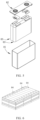
- FIG. 4 shows a battery cell as an example in which the shape of the outer package is prismatic.
- the battery pack may contain a battery box and a plurality of battery modules 05 disposed in the battery box.
- the battery box includes an upper box 06 and a lower box 07.
- the upper box 06 fits the lower box 07 to form a closed space for accommodating the battery modules 05.
- the plurality of battery modules 05 may be arranged in the battery box in any manner.
- This embodiment provides a composite positive electrode material.
- a method for preparing the composite positive electrode material includes the following steps:
- step (2-2) Granulating the resulting solution in step (2-1) through two-fluid atomization at a feed frequency of 4 Hz and an air intake rate of 6.0 m 3 /h to form a precursor powder of a secondary particle structure with D v50 being 8.9 ⁇ m.
- the material assumes a spherical secondary particle structure formed by agglomerating primary nanoparticles.
- the average particle diameter of the primary nanoparticles is 125 nm, and the D v50 of the secondary particles is 7.3 ⁇ m.
- the composite positive electrode material is a composite of LiMn 1.23 Fe 0.75 Ti 0.005 PO 4 and carbon, in which the total carbon content is 1.43% and the ratio of the carbon content inside the secondary particle to the carbon content on the surface of the secondary particle is 1.4: 1.
- This comparative embodiment is identical to Embodiment 1 except that, in the preparation method, no MIL-88B (Fe) is added in step (2-1).
- the average particle diameter of the primary particles of the resulting composite positive electrode material is 225 nm, and the D v50 of the secondary particles is 7.3 ⁇ m; the total carbon content is 1.24%, and the ratio of the carbon content inside the secondary particle to the carbon content on the surface of the secondary particle is 0.6: 1.
- This comparative embodiment is identical to Embodiment 1 except that, in the preparation method, no MIL-88B (Fe) is added in step (2-1), and the mass of the glucose is increased to 0.25 kg.
- the average particle diameter of the primary particles of the resulting composite positive electrode material is 225 nm, and the D v50 of the secondary particles is 7.5 ⁇ m; the total carbon content is 1.48%, and the ratio of the carbon content inside the secondary particle to the carbon content on the surface of the secondary particle is 0.6: 1.
- This comparative embodiment is identical to Embodiment 4 except that, in the preparation method, no MIL-88B (Fe) is added in step (2-1).
- the average particle diameter of the primary particles of the resulting composite positive electrode material is 200 nm, and the D v50 of the secondary particles is 7.1 ⁇ m; the total carbon content is 1.24%, and the ratio of the carbon content inside the secondary particle to the carbon content on the surface of the secondary particle is 0.7: 1.
- the composite positive electrode material assumes a secondary particle structure.
- the carbon distribution of the secondary particles is relatively uniform. Specifically, the carbon content inside the secondary particle is close to the carbon content on the surface, or the carbon content inside the secondary particle is greater than the carbon content on the surface. This is mainly attributed to the MIL-88B (Fe) added during the preparation. During the two-fluid granulation, the MIL-88B (Fe) can serve as a growth center of other types of feedstock to form precursor grains that use the MIL-88B (Fe) as a core.
- the organic ligand contained in the MIL-88B (Fe) in the core of the precursor grain can be decomposed to form a carbon skeleton.
- the carbon skeleton can remain as much as practicable inside the particle instead of just depositing on the surface of the particle, thereby improving the carbon distribution in the composite positive electrode material.
- the secondary particles of the composite positive electrode material further possess a high porosity. This is mainly attributed to the gas generated during the decomposition of the MIL-88B (Fe) and glucose. The gas is volatilized to endow the secondary particles of the composite positive electrode material with an appropriate porosity. The appropriate porosity favorably endows the composite positive electrode material with a sufficient tap density.
- Comparative Embodiments 1 to 3 no MIL-88B (Fe) is added during the preparation, and the carbon content inside the secondary particle is significantly lower than the carbon content on the surface of the secondary particle.
- the ratio of the carbon content inside to the carbon content on the surface of the secondary particle is 0.7: 1 or less, and the porosity of the secondary particle is reduced.
- the composite positive electrode material in each embodiment and each comparative embodiment is applied to preparing a positive electrode plate.
- the positive electrode plate includes an aluminum foil and a positive active layer disposed on both surfaces of the aluminum foil.
- the positive active layer includes the composite positive electrode material in each embodiment or comparative embodiment, and also includes conductive carbon black as a conductive agent and PVDF as a binder when necessary.
- a method for preparing the positive electrode plate includes: mixing 96.0 wt% composite positive electrode material, 1.5 wt% conductive carbon black, and 2.5 wt% PVDF, and then adding N-methyl-pyrrolidone, stirring well to disperse the constituents and obtain a positive electrode slurry; coating an aluminum foil with the positive electrode slurry, oven-drying the slurry, and cold-pressing the foil to obtain a positive electrode plate coated with the active material at a concentration of 25.0 g/mm 2 and endowed with a compaction density of 2.40 g/cm 2 .
- a lithium-ion battery includes a bare cell formed by the positive electrode plate, a negative electrode plate made of graphite, and a separator, and includes an electrolyte solution and an outer package.
- the bare cell is put into the outer package, and the electrolyte solution infiltrates the bare cell.
- a method for preparing the negative electrode plate includes: mixing 95.5 wt% negative active material (artificial graphite), 1.0 wt% conductive agent (conductive carbon black), 2.0 wt% binder (styrene-butadiene rubber SBR), and 1.5 wt% thickener (sodium carboxymethyl cellulose CMC), adding deionized water, and dispersing the constituents to form a negative electrode slurry. Coating both surfaces of the copper foil with the negative electrode slurry, and oven-drying, cold-pressing, cutting, and slitting the foil to obtain a negative electrode plate. The coating areal density of the negative electrode plate is 11.0 g/cm 2 , and the compaction density of the negative electrode plate is 1.65 g/cm 3 .
- the electrolyte solution is a 1.0 mol/L lithium hexafluorophosphate (LiPF 6 ) solution, in which the solvent is ethylene carbonate (EC) and dimethyl carbonate (DMC) mixed at a volume ratio of 1: 1.
- LiPF 6 lithium hexafluorophosphate
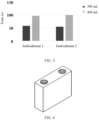
- Embodiment 1 and Embodiment 2 The viscosity and fluidity of the positive electrode slurries corresponding to Embodiment 1 and Embodiment 2 are shown in FIG. 2 and FIG. 3 .
- FIG. 2 the viscosity of the positive electrode slurry in Embodiment 1 and Embodiment 2 changes scarcely during the static standing, and still remains low after 24 hours of static standing.
- the low viscosity is conducive to improving fluidity.
- FIG. 3 also shows that the positive electrode slurries corresponding to Embodiment 1 and Embodiment 2 are of high fluidity during static standing.
- the positive electrode plate containing the composite positive electrode materials of Embodiments 1 to 3 possesses a lower film resistance.
- the film resistance in Embodiment 4 is lower than that in Comparative Embodiment 3.
- the lithium-ion batteries corresponding to Embodiments 1 to 4 exhibit a high 5C capacity retention rate and excellent C-rate performance; in contrast, the C-rate performance in Comparative Embodiments 1 and 2 is significantly lower than that in Embodiments 1 to 3, and the C-rate performance in Comparative Embodiment 3 is deteriorated compared to Embodiment 4.
- the DCRs in Embodiments 1 to 3 at different temperatures and different SOC levels are significantly lower than the DCRs in Comparative Embodiments 1 and 2.
- the DCRs in Embodiment 4 at different temperatures and different SOC levels are even lower than the DCR in Comparative Embodiment 3.
- the test results show that, by adjusting the ratio of the carbon content inside the secondary particle to the carbon content on the surface of the secondary particle of the composite positive electrode material, the carbon content inside the secondary particle is made close to the carbon content on the surface, or the carbon content inside the secondary particle is made greater than the carbon content on the surface, thereby improving the carbon distribution of the composite positive electrode material, effectively improving the electronic conductivity and ionic conductivity of the composite positive electrode material, and improving the low-temperature performance of the composite positive electrode material.
- the improvement of the carbon content distribution of the secondary particles of the composite positive electrode material is attributed to the insoluble MIL-88B (Fe) added as a carbon source during the preparation of the composite positive electrode material.
- the MIL-88B (Fe) may be used as a precursor core.
- the carbon skeleton produced during the sintering can increase the carbon content inside the secondary particles of the composite positive electrode material.
- Running the Nano Measurer 1.2 software opening the SEM image (at a magnification of 5K) to be evaluated, setting a scale bar, and then measuring the long sides of the primary particles. Selecting at least 80 primary particles from each image. The software automatically calculates the average particle size of the primary particles.
- the total carbon content of the composite positive electrode material is measured by using a carbon-sulfur analyzer.
- a method for determining the ratio of the carbon content inside to the carbon content on the surface of the secondary particle in the composite positive electrode material is: measuring the carbon content on the cross-sectional surface of the secondary particle and the carbon content inside the particle by using an EDS, and calculating the ratio.
- the EDS instrument is operated in a spot scan mode. 5 points are evenly selected in an inner region on the cross-section of the secondary particle, and the instrument automatically analyzes the carbon content at each point. The carbon content values at the selected points are averaged out to obtain the carbon content inside the particle.
- 5 points are evenly selected in a surface region on the cross-section of the secondary particle, and the instrument automatically analyzes the carbon content at each point.
Landscapes
- Chemical & Material Sciences (AREA)
- Chemical Kinetics & Catalysis (AREA)
- Electrochemistry (AREA)
- General Chemical & Material Sciences (AREA)
- Engineering & Computer Science (AREA)
- Inorganic Chemistry (AREA)
- Composite Materials (AREA)
- Organic Chemistry (AREA)
- Manufacturing & Machinery (AREA)
- Materials Engineering (AREA)
- Crystallography & Structural Chemistry (AREA)
- Battery Electrode And Active Subsutance (AREA)
Applications Claiming Priority (2)
| Application Number | Priority Date | Filing Date | Title |
|---|---|---|---|
| CN202311470437.7A CN117199257B (zh) | 2023-11-07 | 2023-11-07 | 复合正极材料及其制备方法、正极片、电池、用电装置 |
| PCT/CN2024/079040 WO2025097613A1 (zh) | 2023-11-07 | 2024-02-28 | 复合正极材料及其制备方法、正极片、电池、用电装置 |
Publications (2)
| Publication Number | Publication Date |
|---|---|
| EP4579795A1 true EP4579795A1 (de) | 2025-07-02 |
| EP4579795A4 EP4579795A4 (de) | 2026-03-18 |
Family
ID=88985463
Family Applications (1)
| Application Number | Title | Priority Date | Filing Date |
|---|---|---|---|
| EP24850372.4A Pending EP4579795A4 (de) | 2023-11-07 | 2024-02-28 | Zusammengesetztes positivelektrodenmaterial und herstellungsverfahren dafür, positivelektrodenplatte, batterie und elektrische vorrichtung |
Country Status (4)
| Country | Link |
|---|---|
| US (1) | US20250233153A1 (de) |
| EP (1) | EP4579795A4 (de) |
| CN (1) | CN117199257B (de) |
| WO (1) | WO2025097613A1 (de) |
Families Citing this family (1)
| Publication number | Priority date | Publication date | Assignee | Title |
|---|---|---|---|---|
| CN117199257B (zh) * | 2023-11-07 | 2024-03-22 | 宁德时代新能源科技股份有限公司 | 复合正极材料及其制备方法、正极片、电池、用电装置 |
Family Cites Families (20)
| Publication number | Priority date | Publication date | Assignee | Title |
|---|---|---|---|---|
| KR101983099B1 (ko) * | 2015-11-30 | 2019-05-29 | 주식회사 엘지화학 | 이차전지용 양극활물질, 이를 포함하는 이차전지용 양극 및 이차전지 |
| CN108199041B (zh) * | 2017-12-29 | 2020-09-08 | 桑德新能源技术开发有限公司 | 一种改性磷酸铁锂材料、制备方法及应用 |
| CN108390022B (zh) * | 2017-12-29 | 2020-12-25 | 桑德新能源技术开发有限公司 | 碳-金属氧化物复合包覆的锂电池三元正极材料、其制备方法及锂电池 |
| CN110299515B (zh) * | 2018-03-23 | 2023-08-08 | 比亚迪股份有限公司 | 一种正极活性材料及其制备方法、正极和电池 |
| CN109524658A (zh) * | 2018-12-06 | 2019-03-26 | 深圳市德方纳米科技股份有限公司 | 锂离子电池正极材料及其制备方法和锂离子电池 |
| CN109616653A (zh) * | 2018-12-12 | 2019-04-12 | 上海航天电源技术有限责任公司 | 一种金属有机框架衍生的磷酸盐复合正极材料及制备方法 |
| CN112786881A (zh) * | 2019-11-07 | 2021-05-11 | 北京新能源汽车股份有限公司 | 一种固态锂电池及其制备方法 |
| CN111430687B (zh) * | 2020-03-10 | 2021-09-14 | 东莞市创明电池技术有限公司 | 碳包覆磷酸铁锂复合材料及其制备方法,锂离子电池 |
| CN112331848B (zh) * | 2020-11-10 | 2021-10-26 | 厦门永力鑫新能源科技有限公司 | 一种核壳结构的氟化碳材料及其制备方法和锂电池 |
| CN113346075A (zh) * | 2021-04-29 | 2021-09-03 | 华中科技大学 | 耐低温框架复合物前驱体基磷酸铁锂及其制备方法和应用 |
| CN114122333B (zh) * | 2021-11-25 | 2023-11-28 | 东南大学 | 一种纳米洋葱碳复合磷酸铁锂的正极材料及其制备方法和应用 |
| WO2023191200A1 (ko) * | 2022-04-01 | 2023-10-05 | 삼성에스디아이 주식회사 | 리튬 이차 전지용 양극 및 이를 포함하는 리튬 이차 전지 |
| CN115172704B (zh) * | 2022-07-20 | 2025-02-18 | 江苏科技大学 | 一种利用金属有机框架制备多孔碳磷酸铁锂正极材料的制备方法 |
| CN115084488B (zh) * | 2022-08-02 | 2025-07-22 | 洛阳月星新能源科技有限公司 | 一种硫化铜掺杂碳基复合材料及其制备方法、钠离子电池 |
| CN115275148B (zh) * | 2022-08-11 | 2025-01-03 | 江苏容汇通用锂业股份有限公司 | 一种纺锤状结构的碳包覆磷酸铁锂正极材料的制备方法 |
| CN116022762B (zh) * | 2022-12-21 | 2024-10-22 | 蜂巢能源科技股份有限公司 | 磷酸铁锂正极材料及其制备方法和应用 |
| CN116002654B (zh) * | 2023-02-20 | 2025-08-29 | 湖北亿纬动力有限公司 | 一种磷酸铁锂正极材料及其制备方法和应用 |
| CN116344762A (zh) * | 2023-03-22 | 2023-06-27 | 宜都兴发化工有限公司 | 一种mof衍生多孔碳薄层包覆磷酸锰铁锂材料的制备方法 |
| CN116259736B (zh) * | 2023-05-15 | 2023-11-07 | 宁德时代新能源科技股份有限公司 | 正极活性材料及其制备方法、正极极片、二次电池和用电装置 |
| CN117199257B (zh) * | 2023-11-07 | 2024-03-22 | 宁德时代新能源科技股份有限公司 | 复合正极材料及其制备方法、正极片、电池、用电装置 |
-
2023
- 2023-11-07 CN CN202311470437.7A patent/CN117199257B/zh active Active
-
2024
- 2024-02-28 WO PCT/CN2024/079040 patent/WO2025097613A1/zh active Pending
- 2024-02-28 EP EP24850372.4A patent/EP4579795A4/de active Pending
-
2025
- 2025-04-04 US US19/170,846 patent/US20250233153A1/en active Pending
Also Published As
| Publication number | Publication date |
|---|---|
| WO2025097613A1 (zh) | 2025-05-15 |
| CN117199257B (zh) | 2024-03-22 |
| CN117199257A (zh) | 2023-12-08 |
| US20250233153A1 (en) | 2025-07-17 |
| EP4579795A4 (de) | 2026-03-18 |
Similar Documents
| Publication | Publication Date | Title |
|---|---|---|
| US11646417B2 (en) | Negative electrode sheet and method for preparing the same, secondary battery, battery module, battery pack, and device | |
| EP3879599B1 (de) | Negatives polstück, batteriezelle, lithium-ionen-batterie und herstellungsverfahren dafür sowie vorrichtung mit lithium-ionen-batterie | |
| EP4148830A2 (de) | Positivelektrodenaktivmaterial, positivelektrodenplatte, lithium-ionen-sekundärbatterie und vorrichtung | |
| EP3379615B1 (de) | Elektrodenmaterial für eine lithium-ionen-sekundärbatterie sowie lithium-ionen-sekundärbatterie | |
| Liu et al. | Multi-dimensional, multi-scale analysis of interphase chemistry for enhanced fast-charging of lithium-ion batteries with ion mass spectrometry | |
| EP4333117A1 (de) | Positivelektrodenaktivmaterial und herstellungsverfahren dafür, lithium-ionen-batterie damit, batteriemodul, batteriepack und elektrische vorrichtung | |
| US9356287B2 (en) | Negative active material, negative electrode and lithium battery including the negative active material, and method of preparing the negative active material | |
| Yang et al. | Stabilizing lithium manganese oxide/organic carbonate electrolyte interface with a simple boron-containing additive | |
| CN118867136B (zh) | 一种正极极片及包含其的电化学装置、用电装置 | |
| EP4084133A1 (de) | Negativelektrodenmaterial und elektrochemische vorrichtung sowie elektronische vorrichtung damit | |
| US20250233153A1 (en) | Composite positive electrode material and preparation method thereof, positive electrode plate, battery, and electrical device | |
| US20180277846A1 (en) | Cathode material for lithium-ion secondary battery and manufacturing method thereof, cathode for lithium-ion secondary battery, and lithium-ion secondary battery | |
| CN119905665A (zh) | 锂离子二次电池、制备方法及用电装置 | |
| CN120073044A (zh) | 锂离子二次电池、其制备方法和用电装置 | |
| EP4207415A1 (de) | Sekundärbatterie und lithiumergänzungsverfahren dafür, batteriemodul, batteriepack und elektrische vorrichtung | |
| EP4672357A1 (de) | Negativelektrodenfolie, sekundärbatterie und elektrische vorrichtung | |
| EP4593139A1 (de) | Lithiumsekundärbatterie und elektrische vorrichtung | |
| Liu et al. | Effect of pre-lithiation amounts on the performance of LiNi0. 8Co0. 1Mn0. 1O2|| SiOx/Graphite pouch cell | |
| EP4682990A1 (de) | Verfahren zur herstellung eines positivelektrodenmaterials, positivelektrodenmaterial, positivelektrodenfolie, batterie und elektrische vorrichtung | |
| EP4601040A1 (de) | Positivelektrodenaktivmaterial, positivelektrodenfolie, sekundärbatterie, elektrische vorrichtung und herstellungsverfahren | |
| EP4564457A1 (de) | Negativelektrodenplatte, sekundärbatterie, elektrische vorrichtung, verfahren und verwendung | |
| US12580191B2 (en) | Non-aqueous electrolyte secondary battery | |
| EP3582302B1 (de) | Elektrodenmaterial und verfahren zur herstellung davon | |
| CN120319768B (zh) | 正极片、锂离子电池和用电装置 | |
| EP4273987A1 (de) | Sekundärbatterie, batteriemodul, batteriepack und elektrische vorrichtung |
Legal Events
| Date | Code | Title | Description |
|---|---|---|---|
| STAA | Information on the status of an ep patent application or granted ep patent |
Free format text: STATUS: UNKNOWN |
|
| STAA | Information on the status of an ep patent application or granted ep patent |
Free format text: STATUS: THE INTERNATIONAL PUBLICATION HAS BEEN MADE |
|
| PUAI | Public reference made under article 153(3) epc to a published international application that has entered the european phase |
Free format text: ORIGINAL CODE: 0009012 |
|
| STAA | Information on the status of an ep patent application or granted ep patent |
Free format text: STATUS: REQUEST FOR EXAMINATION WAS MADE |
|
| 17P | Request for examination filed |
Effective date: 20250214 |
|
| AK | Designated contracting states |
Kind code of ref document: A1 Designated state(s): AL AT BE BG CH CY CZ DE DK EE ES FI FR GB GR HR HU IE IS IT LI LT LU LV MC ME MK MT NL NO PL PT RO RS SE SI SK SM TR |
|
| A4 | Supplementary search report drawn up and despatched |
Effective date: 20260212 |
|
| RIC1 | Information provided on ipc code assigned before grant |
Ipc: H01M 4/136 20100101AFI20260206BHEP Ipc: H01M 4/58 20100101ALI20260206BHEP Ipc: H01M 4/62 20060101ALI20260206BHEP Ipc: H01M 4/36 20060101ALI20260206BHEP Ipc: C01B 32/05 20170101ALI20260206BHEP Ipc: C01B 25/45 20060101ALI20260206BHEP Ipc: H01M 10/0525 20100101ALI20260206BHEP Ipc: H01M 4/52 20100101ALI20260206BHEP Ipc: H01M 4/04 20060101ALI20260206BHEP Ipc: H01M 4/13 20100101ALI20260206BHEP Ipc: H01M 4/139 20100101ALI20260206BHEP |