EP4574906A2 - Pharmazeutische zusammensetzung - Google Patents
Pharmazeutische zusammensetzung Download PDFInfo
- Publication number
- EP4574906A2 EP4574906A2 EP25152894.9A EP25152894A EP4574906A2 EP 4574906 A2 EP4574906 A2 EP 4574906A2 EP 25152894 A EP25152894 A EP 25152894A EP 4574906 A2 EP4574906 A2 EP 4574906A2
- Authority
- EP
- European Patent Office
- Prior art keywords
- biodegradable
- optionally
- drug delivery
- diblock
- copolymer
- Prior art date
- Legal status (The legal status is an assumption and is not a legal conclusion. Google has not performed a legal analysis and makes no representation as to the accuracy of the status listed.)
- Pending
Links
Images





Classifications
-
- A—HUMAN NECESSITIES
- A61—MEDICAL OR VETERINARY SCIENCE; HYGIENE
- A61K—PREPARATIONS FOR MEDICAL, DENTAL OR TOILETRY PURPOSES
- A61K31/00—Medicinal preparations containing organic active ingredients
- A61K31/16—Amides, e.g. hydroxamic acids
- A61K31/165—Amides, e.g. hydroxamic acids having aromatic rings, e.g. colchicine, atenolol, progabide
- A61K31/167—Amides, e.g. hydroxamic acids having aromatic rings, e.g. colchicine, atenolol, progabide having the nitrogen of a carboxamide group directly attached to the aromatic ring, e.g. lidocaine, paracetamol
-
- A—HUMAN NECESSITIES
- A61—MEDICAL OR VETERINARY SCIENCE; HYGIENE
- A61K—PREPARATIONS FOR MEDICAL, DENTAL OR TOILETRY PURPOSES
- A61K31/00—Medicinal preparations containing organic active ingredients
- A61K31/33—Heterocyclic compounds
- A61K31/395—Heterocyclic compounds having nitrogen as a ring hetero atom, e.g. guanethidine or rifamycins
- A61K31/435—Heterocyclic compounds having nitrogen as a ring hetero atom, e.g. guanethidine or rifamycins having six-membered rings with one nitrogen as the only ring hetero atom
- A61K31/44—Non condensed pyridines; Hydrogenated derivatives thereof
- A61K31/445—Non condensed piperidines, e.g. piperocaine
-
- A—HUMAN NECESSITIES
- A61—MEDICAL OR VETERINARY SCIENCE; HYGIENE
- A61K—PREPARATIONS FOR MEDICAL, DENTAL OR TOILETRY PURPOSES
- A61K31/00—Medicinal preparations containing organic active ingredients
- A61K31/33—Heterocyclic compounds
- A61K31/395—Heterocyclic compounds having nitrogen as a ring hetero atom, e.g. guanethidine or rifamycins
- A61K31/495—Heterocyclic compounds having nitrogen as a ring hetero atom, e.g. guanethidine or rifamycins having six-membered rings with two or more nitrogen atoms as the only ring heteroatoms, e.g. piperazine or tetrazines
- A61K31/505—Pyrimidines; Hydrogenated pyrimidines, e.g. trimethoprim
- A61K31/519—Pyrimidines; Hydrogenated pyrimidines, e.g. trimethoprim ortho- or peri-condensed with heterocyclic rings
-
- A—HUMAN NECESSITIES
- A61—MEDICAL OR VETERINARY SCIENCE; HYGIENE
- A61K—PREPARATIONS FOR MEDICAL, DENTAL OR TOILETRY PURPOSES
- A61K31/00—Medicinal preparations containing organic active ingredients
- A61K31/33—Heterocyclic compounds
- A61K31/395—Heterocyclic compounds having nitrogen as a ring hetero atom, e.g. guanethidine or rifamycins
- A61K31/54—Heterocyclic compounds having nitrogen as a ring hetero atom, e.g. guanethidine or rifamycins having six-membered rings with at least one nitrogen and one sulfur as the ring hetero atoms, e.g. sulthiame
- A61K31/5415—Heterocyclic compounds having nitrogen as a ring hetero atom, e.g. guanethidine or rifamycins having six-membered rings with at least one nitrogen and one sulfur as the ring hetero atoms, e.g. sulthiame ortho- or peri-condensed with carbocyclic ring systems, e.g. phenothiazine, chlorpromazine, piroxicam
-
- A—HUMAN NECESSITIES
- A61—MEDICAL OR VETERINARY SCIENCE; HYGIENE
- A61K—PREPARATIONS FOR MEDICAL, DENTAL OR TOILETRY PURPOSES
- A61K31/00—Medicinal preparations containing organic active ingredients
- A61K31/70—Carbohydrates; Sugars; Derivatives thereof
- A61K31/7042—Compounds having saccharide radicals and heterocyclic rings
- A61K31/7048—Compounds having saccharide radicals and heterocyclic rings having oxygen as a ring hetero atom, e.g. leucoglucosan, hesperidin, erythromycin, nystatin, digitoxin or digoxin
-
- A—HUMAN NECESSITIES
- A61—MEDICAL OR VETERINARY SCIENCE; HYGIENE
- A61K—PREPARATIONS FOR MEDICAL, DENTAL OR TOILETRY PURPOSES
- A61K38/00—Medicinal preparations containing peptides
- A61K38/04—Peptides having up to 20 amino acids in a fully defined sequence; Derivatives thereof
- A61K38/08—Peptides having 5 to 11 amino acids
-
- A—HUMAN NECESSITIES
- A61—MEDICAL OR VETERINARY SCIENCE; HYGIENE
- A61K—PREPARATIONS FOR MEDICAL, DENTAL OR TOILETRY PURPOSES
- A61K38/00—Medicinal preparations containing peptides
- A61K38/04—Peptides having up to 20 amino acids in a fully defined sequence; Derivatives thereof
- A61K38/12—Cyclic peptides, e.g. bacitracins; Polymyxins; Gramicidins S, C; Tyrocidins A, B or C
-
- A—HUMAN NECESSITIES
- A61—MEDICAL OR VETERINARY SCIENCE; HYGIENE
- A61K—PREPARATIONS FOR MEDICAL, DENTAL OR TOILETRY PURPOSES
- A61K47/00—Medicinal preparations characterised by the non-active ingredients used, e.g. carriers or inert additives; Targeting or modifying agents chemically bound to the active ingredient
- A61K47/30—Macromolecular organic or inorganic compounds, e.g. inorganic polyphosphates
- A61K47/34—Macromolecular compounds obtained otherwise than by reactions only involving carbon-to-carbon unsaturated bonds, e.g. polyesters, polyamino acids, polysiloxanes, polyphosphazines, copolymers of polyalkylene glycol or poloxamers
-
- A—HUMAN NECESSITIES
- A61—MEDICAL OR VETERINARY SCIENCE; HYGIENE
- A61K—PREPARATIONS FOR MEDICAL, DENTAL OR TOILETRY PURPOSES
- A61K9/00—Medicinal preparations characterised by special physical form
- A61K9/0012—Galenical forms characterised by the site of application
- A61K9/0019—Injectable compositions; Intramuscular, intravenous, arterial, subcutaneous administration; Compositions to be administered through the skin in an invasive manner
-
- A—HUMAN NECESSITIES
- A61—MEDICAL OR VETERINARY SCIENCE; HYGIENE
- A61K—PREPARATIONS FOR MEDICAL, DENTAL OR TOILETRY PURPOSES
- A61K9/00—Medicinal preparations characterised by special physical form
- A61K9/0012—Galenical forms characterised by the site of application
- A61K9/0019—Injectable compositions; Intramuscular, intravenous, arterial, subcutaneous administration; Compositions to be administered through the skin in an invasive manner
- A61K9/0024—Solid, semi-solid or solidifying implants, which are implanted or injected in body tissue
-
- A—HUMAN NECESSITIES
- A61—MEDICAL OR VETERINARY SCIENCE; HYGIENE
- A61K—PREPARATIONS FOR MEDICAL, DENTAL OR TOILETRY PURPOSES
- A61K9/00—Medicinal preparations characterised by special physical form
- A61K9/0012—Galenical forms characterised by the site of application
- A61K9/0019—Injectable compositions; Intramuscular, intravenous, arterial, subcutaneous administration; Compositions to be administered through the skin in an invasive manner
- A61K9/0029—Parenteral nutrition; Parenteral nutrition compositions as drug carriers
-
- A—HUMAN NECESSITIES
- A61—MEDICAL OR VETERINARY SCIENCE; HYGIENE
- A61K—PREPARATIONS FOR MEDICAL, DENTAL OR TOILETRY PURPOSES
- A61K9/00—Medicinal preparations characterised by special physical form
- A61K9/06—Ointments; Bases therefor; Other semi-solid forms, e.g. creams, sticks, gels
-
- A—HUMAN NECESSITIES
- A61—MEDICAL OR VETERINARY SCIENCE; HYGIENE
- A61K—PREPARATIONS FOR MEDICAL, DENTAL OR TOILETRY PURPOSES
- A61K9/00—Medicinal preparations characterised by special physical form
- A61K9/20—Pills, tablets, discs, rods
- A61K9/2004—Excipients; Inactive ingredients
- A61K9/2022—Organic macromolecular compounds
- A61K9/2031—Organic macromolecular compounds obtained otherwise than by reactions only involving carbon-to-carbon unsaturated bonds, e.g. polyethylene glycol, polyethylene oxide, poloxamers
-
- A—HUMAN NECESSITIES
- A61—MEDICAL OR VETERINARY SCIENCE; HYGIENE
- A61K—PREPARATIONS FOR MEDICAL, DENTAL OR TOILETRY PURPOSES
- A61K9/00—Medicinal preparations characterised by special physical form
- A61K9/20—Pills, tablets, discs, rods
- A61K9/2004—Excipients; Inactive ingredients
- A61K9/2022—Organic macromolecular compounds
- A61K9/2031—Organic macromolecular compounds obtained otherwise than by reactions only involving carbon-to-carbon unsaturated bonds, e.g. polyethylene glycol, polyethylene oxide, poloxamers
- A61K9/204—Polyesters, e.g. poly(lactide-co-glycolide)
-
- C—CHEMISTRY; METALLURGY
- C08—ORGANIC MACROMOLECULAR COMPOUNDS; THEIR PREPARATION OR CHEMICAL WORKING-UP; COMPOSITIONS BASED THEREON
- C08G—MACROMOLECULAR COMPOUNDS OBTAINED OTHERWISE THAN BY REACTIONS ONLY INVOLVING UNSATURATED CARBON-TO-CARBON BONDS
- C08G63/00—Macromolecular compounds obtained by reactions forming a carboxylic ester link in the main chain of the macromolecule
- C08G63/66—Polyesters containing oxygen in the form of ether groups
- C08G63/664—Polyesters containing oxygen in the form of ether groups derived from hydroxy carboxylic acids
-
- C—CHEMISTRY; METALLURGY
- C08—ORGANIC MACROMOLECULAR COMPOUNDS; THEIR PREPARATION OR CHEMICAL WORKING-UP; COMPOSITIONS BASED THEREON
- C08L—COMPOSITIONS OF MACROMOLECULAR COMPOUNDS
- C08L67/00—Compositions of polyesters obtained by reactions forming a carboxylic ester link in the main chain; Compositions of derivatives of such polymers
- C08L67/04—Polyesters derived from hydroxycarboxylic acids, e.g. lactones
-
- C—CHEMISTRY; METALLURGY
- C08—ORGANIC MACROMOLECULAR COMPOUNDS; THEIR PREPARATION OR CHEMICAL WORKING-UP; COMPOSITIONS BASED THEREON
- C08L—COMPOSITIONS OF MACROMOLECULAR COMPOUNDS
- C08L71/00—Compositions of polyethers obtained by reactions forming an ether link in the main chain; Compositions of derivatives of such polymers
- C08L71/02—Polyalkylene oxides
-
- C—CHEMISTRY; METALLURGY
- C08—ORGANIC MACROMOLECULAR COMPOUNDS; THEIR PREPARATION OR CHEMICAL WORKING-UP; COMPOSITIONS BASED THEREON
- C08L—COMPOSITIONS OF MACROMOLECULAR COMPOUNDS
- C08L2203/00—Applications
- C08L2203/02—Applications for biomedical use
-
- C—CHEMISTRY; METALLURGY
- C08—ORGANIC MACROMOLECULAR COMPOUNDS; THEIR PREPARATION OR CHEMICAL WORKING-UP; COMPOSITIONS BASED THEREON
- C08L—COMPOSITIONS OF MACROMOLECULAR COMPOUNDS
- C08L2205/00—Polymer mixtures characterised by other features
- C08L2205/02—Polymer mixtures characterised by other features containing two or more polymers of the same C08L -group
- C08L2205/025—Polymer mixtures characterised by other features containing two or more polymers of the same C08L -group containing two or more polymers of the same hierarchy C08L, and differing only in parameters such as density, comonomer content, molecular weight, structure
-
- C—CHEMISTRY; METALLURGY
- C08—ORGANIC MACROMOLECULAR COMPOUNDS; THEIR PREPARATION OR CHEMICAL WORKING-UP; COMPOSITIONS BASED THEREON
- C08L—COMPOSITIONS OF MACROMOLECULAR COMPOUNDS
- C08L2205/00—Polymer mixtures characterised by other features
- C08L2205/03—Polymer mixtures characterised by other features containing three or more polymers in a blend
Definitions
- the present invention relates to biodegradable drug delivery compositions comprising a mixture of at least three block copolymers taken among triblock and diblock copolymers composed of polyester and poly(ethylene oxide) blocks, a triblock copolymer comprising one poly(ethylene oxide) block between two polyester blocks and a diblock copolymer comprising a polyester block and an one end-capped poly(ethylene glycol), as well as at least one pharmaceutically active ingredient.
- the weight ratio of triblock copolymers to diblock copolymers in this formulation is 1:19 to 5:1 for modulating drug release kinetics of at least one active ingredient.
- poly(ethylene oxide) or polyoxyethylene (PEO) is also frequently referred to as poly(ethylene glycol) (PEG) and the terms can be used interchangeably for the purposes of this invention.
- U.S. Patent No. 6,592,899 describes a PLA/PLGA oligomer combined with a block copolymer for enhancing the solubility of a hydrophobic drug into a hydrophilic environment.
- U.S. Patent 9,023,897 B2 describes biodegradable drug compositions comprising a triblock copolymer and a diblock copolymer and a pharmaceutically active ingredient.
- biodegradable drug delivery compositions comprising diblock and triblock copolymers with improved properties regarding the modulation of the rate of release of the at least one active ingredient.
- the composition should enable the release of the at least one active ingredient to be controlled over a time period without adversely affecting the physical parameters of the formulation.
- biodegradable drug delivery composition can be modulated without adversely impacting the injectability of this composition.
- the pharmaceutically active ingredient is hydrophobic.
- the copolymers are present in an amount of 2% to 60% (w/w%) of the total composition, optionally 10% to 50%, optionally 20% to 40%, optionally 20% to 35%, optionally 30% to 50%.
- the one or more diblock copolymers are present in an amount of 1% to 57% (w/w%), 2.5% to 45% of the total composition.
- the weight ratio of the sum of the biodegradable triblock copolymers of (a) over the sum of the biodegradable diblock copolymers of (b) in said biodegradable drug delivery composition is 1:5 to 3:1.
- the composition may comprise one biodegradable triblock copolymer as defined above, or two different biodegradable triblock copolymers as defined above, or three different biodegradable triblock copolymers as defined above, or four different biodegradable triblock copolymers as defined above.
- the composition may comprise one biodegradable diblock copolymer as defined above, or two different biodegradable diblock copolymers as defined above, or three different biodegradable diblock copolymers as defined above, or four different biodegradable diblock copolymers as defined above.
- biodegradable drug delivery composition is a composition as defined in any of Tables 1 to 6.
- the one or more physical parameters are injectability and viscosity before injection of the biodegradable drug delivery composition and depot robustness after injection of the biodegradable drug delivery composition.
- F292 shows a modulated release profile compared to F289.
- the increasing of the total polymer content has an impact on the injectability of the formulation as indicated in Table 7. Consequently, F289 and F292 have injectability values of 4.8 N and 14.5 N respectively.
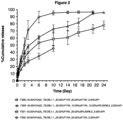
- FIG. 3 is a graph showing the percentage total in vitro cumulative release of bupivacaine over time from four different formulations.
- Formulation F289 (O) has a weight ratio of the sum of triblock to diblock of 1 containing 20.00% of P1R4 triblock copolymer and 20.00% of dP1R4 diblock copolymer with 2.00% active ingredient (API) and 58.00% of DMSO.
- Formulation F290 (A) has a weight ratio of the sum of triblock to diblock of 1 containing 20.00% of P1R4 triblock copolymer, 10.00% of dP1R4 diblock copolymer and 10.00% of dP0.35R8.5 diblock copolymer with 2.00% active ingredient (API) and 58.00% of DMSO.
- Formulation F293 ( ⁇ ) has a weight ratio of the sum of triblock to diblock of 1 containing 20.00% of P1R4 triblock copolymer and 20.00% of dP1R4 diblock copolymer with 4.00% active ingredient (API) and 56.00% of DMSO.
- Formulation F294 (X) has a weight ratio of the sum of triblock to diblock of 1 containing 20.00% of P1R4 triblock copolymer and 20.00% of dP1R4 diblock copolymer with 6.00% active ingredient (API) and 54.00% of DMSO.
- the specific block copolymer formulations are set forth in Table 2 below.
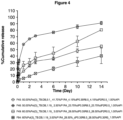
- Figure 4 is a graph showing the percentage total in vitro cumulative release of bupivacaine over time from four different formulations.
- Formulation F45 (O) has a weight ratio of the sum of triblock to diblock of 5 containing 41.70% of P1R4 triblock copolymer, 4.15% of dP2R0.5 diblock copolymer and 4.15% of dP0.35R8.5 diblock copolymer with 1.00% active ingredient (API) and 49.00% of DMSO.
- Formulation F46 ( ⁇ ) has a weight ratio of the sum of triblock to diblock of 0.05 containing 2.50% of P1R4 triblock copolymer, 23.75% of dP2R0.5 diblock copolymer and 23.75% of dP0.35R8.5 diblock copolymer with 1.00% active ingredient (API) and 49.00% of DMSO.
- Formulation F49 ( ⁇ ) has a weight ratio of the sum of triblock to diblock of 0.05 containing 3.00% of P1R4 triblock copolymer, 28.50% of dP2R0.5 diblock copolymer and 28.50% of dP0.35R8.5 diblock copolymer with 1.00% active ingredient (API) and 39.00% of DMSO.
- Formulation F64 has a weight ratio of the sum of triblock to diblock of 0.05 containing 3.00% of P1R4 triblock copolymer, 28.50% of dP0.35R5 diblock copolymer and 28.50% of dP0.35R8.5 diblock copolymer with 1.00% active ingredient (API) and 39.00% of DMSO.
- the specific block copolymer formulations are set forth in Table 3 below.
- the weight ratio of the sum of triblock to diblock has an impact on the release modulation. Indeed, F45 and F46 curves show two distinct and modulated release profiles.
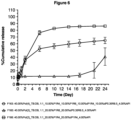
- Formulation F119 ( ⁇ ) has a weight ratio of the sum of triblock to diblock of 0.67 containing 10.00% of P12R0.7 triblock copolymer, 10.00% of P0.19R18 triblock copolymer and 30.00% of dP0.35R8.5 diblock copolymer with 1.00% active ingredient (API) and 49.00% of DMSO.
- Formulation F115 ( ⁇ ) has a weight ratio of the sum of triblock to diblock of 0.5 containing 8.30% of P2R3.5 triblock copolymer, 8.30% of dP0.16R1 diblock copolymer and 8.30% of dP2R10 diblock copolymer with 1.00% active ingredient (API) and 74.10% of DMSO.
- Formulation F110 ( ) has a weight ratio of the sum of triblock to diblock of 0.5 containing 8.30% of P2R3.5 triblock copolymer, and 16.70% of dP2R3 diblock copolymer with 1.00% active ingredient (API) and 74.10% of DMSO.
- the specific block copolymer formulations are set forth in Table 4 below.
- P2R3.5 triblock copolymer as an additional biodegradable block copolymer in F199 leads to an increase of the total duration of release. Additionally, the initial burst is significantly decreased and there is no reacceleration of the kinetics after 100 days of release in F199 release profile.
- plant encompasses all members of the Plant Kingdom.
- Active ingredient means a drug or medicine for treating or preventing various medical illnesses.
- active principle has the same meaning as “active ingredient”
- active ingredient, active principle, drug or medicine are used interchangeably.
- Active Pharmaceutical Ingredient, or “API” is also used.
- drug or active ingredient as used herein includes without limitation physiologically or pharmacologically active substances that act locally or systemically in the body of an animal or plant. At least one active ingredient is present in the biodegradable drug composition of the invention.
- disease means any disorder in a human, animal or plant caused by infection, diet, or by faulty functioning of a process.
- implant means any solid object, which is formed outside the body and is placed into the body by a surgical procedure. Implants can be placed permanently or they can be removed, if necessary and depending on the circumstances. These procedures include, but are not limited to making a small cut in the body of an animal and inserting a solid or a trochar.
- a trochar is medical device that is made up of an obturator (which may be a metal or plastic sharpened or nonbladed tip), a cannula and a seal. The trocar functions as a portal for the subsequent placement of the implant into the body of the animal.
- spot injection is an injection of a flowing pharmaceutical composition, usually subcutaneous, intradermal or intramuscular that deposits a drug in a localized mass, such as a solid mass, called a "depot”.
- the depots as defined herein are in situ forming upon injection.
- the formulations can be prepared as liquids or micro particles and can be injected into the body.
- injection or infusion used in humans, including intradermal, subcutaneous, intramuscular, intravenous, intraosseous, intraperitoneal, intrathecal, epidural, intracardiac, intraarticular, intracavernous, and intravitreal.
- spatial formulation encompasses any formulation that can be applied on or into the animal or plant body and do not necessarily have to be administered through a syringe.
- peel units are the fundamental recurring units of a polymer.
- end-capped polyethylene glycol refers to PEG's in which one terminal hydroxyl group is reacted and includes alkoxy-capped PEG's, urethane-capped PEG's ester-capped PEG's and like compounds.
- the capping group is a chemical group which does not contain a chemical function susceptible to react with cyclic esters like lactide, glycolactide, caprolactone and the like or other esters and mixtures thereof.
- the reaction of an end-capped PEG polymer with lactide generates a diblock cPEG-PLA copolymer.
- polyethylene glycol as abbreviated PEG throughout the application, is sometimes referred to as poly(ethylene oxide) or poly(oxyethylene) and the terms are used interchangeably in the present invention.
- PDA poly(lactic acid).
- PLGA poly(lactic-co-glycolic acid).
- PCLA poly( ⁇ -caprolactone- co -lactide).
- PE polyester
- T or "TB” refers to a triblock copolymer(s)
- D or "DB” refers to a diblock copolymer(s).
- diblock refers, for example, to an end-capped PEG-polyester coplymer.
- mPEG refers to methoxy polyethylene glycol.
- trimer refers, for example, to a polyester-PEG-polyester copolymer.
- the R molar ratio refers to the number of polyester (PE) units to a number of ethylene oxide units (EO) that is present in the biodegradable drug delivery composition.
- the number of polyester units can refer to the number of lactoyl units (LA) or the number of glycolide units (G) or the number of caprolactone units (CL) or mixtures thereof.
- the R molar ratio of the triblock copolymer can range from, 0.5 to 22.3, optionally 0.5 to 10, optionally 0.5 to 3.5. In another aspect the R molar ratio in the triblock can range from 0.5 to 2.5 in the biodegradable drug delivery composition described herein.
- the R molar ratio in the diblock can range from 0.8 to 15, optionally 1 to 10, optionally 2 to 6, optionally from 3 to 5 in the biodegradable drug delivery composition.
- the degree of polymerization or DP is the number of repeat units in an average polymer chain at time t in a polymerization reaction.
- the degree of polymerization for PEG for the triblock is between 3 to 300 and for the diblock the degree of polymerization of PEG is between 2 to 250.
- the degree of polymerization for the triblock is between 1 to 3,000 and has the same value of between 1 to 3,000 for the diblock.
- At least three block copolymers may mean a mixture of 3, 4, 5, 6, 7, 8, 9 or 10 different block copolymers in the biodegradable drug delivery composition.
- any combination of 3 to 10 triblock and diblock copolymers can be formulated, provided that at least one triblock copolymer and at least one diblock copolymer are present in the mixture.
- Other examples include 3 to 5 or 4 to 8 or 4 to 6, 3 to 7, 4 to 9 and the like mixtures of triblock and diblock copolymers can be used in the biodegradable drug compositions as described herein.
- Modulating the kinetics of the release of the at least one active ingredient means regulating the release rate of the at least one active ingredient from the depot after it is administered in vivo.
- the kinetics may be first order kinetics or pseudo-zero order kinetics depending on the formulations fabricated.
- Release modulation is defined as the variation of the at least one active ingredient quantity discharged over time from the depot. This required variation can be an increase or a decrease of the release from an initial kinetics, immediately or sustained long-term over the time period. Modification of the release profile may affect several periods; in the very first hours of release, for example, inducing an increase or a decrease of the initial "burst", or in more advanced periods to avoid a re-acceleration or a steep decrease of the release or for the duration of the release.
- Formulation modulation is a process in which particular release profiles and an optimized total release duration for a certain therapeutic application can be obtained.
- first order kinetics means that the process of release of the drug is directly proportional to the drug concentration involved in the process.
- Pulseudo-zero order kinetics means that the process of the release of the drug takes place at a constant rate.
- physical parameters is intended to refer to physical properties of the composition which are important for clinical utilization of the formulations. Among them, viscosity, more specifically dynamic viscosity of the formulation, swelling and robustness of the depot after injection of the formulation are important parameters to be controlled during the optimization of the formulations.
- a key physical parameter of the formulations is their injectability, i.e. their suitability for administration by injection.
- a depot has a "lack of robustness" if it undergoes early fragmentation into a plurality of pieces. This fragmentation can lead to unexpected and uncontrolled change of release such as burst and variability. This fragmentation may be determined in the depot visually in vitro.
- a lack of robustness due to early physical fragmentation of the depot is distinguished from normal degradation of the polymers in the depot, for example hydrolysis of the polymers which is a key mechanism to allow release of the active ingredient, along with diffusion of the active ingredient through the pores of the polymer matrix.
- complete hydrolysis of the polymers forming the depot does not occur until all, or substantially all, for example 90 wt%, or 99 wt% of the active ingredient has been released from the depot.
- swelling is an increase in volume of the formed depot related to the water uptake.
- the volume of the initial depot can be increased 3 times to 5 times or 1.1 times to 3 times when injected into the body of an animal. This swelling is determined visually in vitro.
- the "injectability" of a formulation is defined by the force needed in Newtons (N) to inject a formulation using pre-determined parameters. These parameters include: injection speed, injection volume, injection duration, syringe type or needle type and the like. These parameters may vary based on the at least one pharmaceutically active ingredient used, or the desired method of administration such as sub cutaneous, intra ocular, intra articular and the like. They will be adjusted based on the at least one pharmaceutically active ingredient present within the formulations, to be able to observe the differences and fluctuations between the formulations.
- the injectability must be kept low such that the formulation can be easily administered by a qualified healthcare professional in an acceptable timeframe.
- An ideal injectability value may be from 0.1 N to 10N with the measurement method described below.
- An acceptable injectability value may be from 10 N to 20 N.
- a non-optimal injectability may be from 20 N to 30 N.
- Formulations are hardly injectable from 30 to 40 N and non-injectable above 40 N.
- Injectability may be measured using a texturometer, preferably a Lloyd Instruments FT plus texturometer, using the following analytical conditions: 500 ⁇ L of formulation are injected through a 1 mL syringe, a 23G 1" Terumo needle with a 1 mL/min flow rate.
- Viscosity by definition and as used herein, is a measure of a fluid's resistance to flow and gradual deformation by shear stress or tensile strength. It describes the internal friction of a moving fluid. For liquids, it corresponds to the informal concept of "thickness;" By 'dynamic viscosity” is meant a measure of the resistance to flow of a fluid under an applied force. The dynamic velocity can range from 1 mPa.s. to 3000 mPa.s or 5 mPa.s to 2500 mPa.s or 10 mPa.s to 2000 mPa.s or 20 mPa.s to 1000 mPa.s.
- Dynamic viscosity is determined using an Anton Paar Rheometer equipped with cone plate measuring system. Typically, 250 ⁇ L of studied formulation are placed on the measuring plate. The temperature is controlled at +25°C.
- the measuring system used is a cone plate with a diameter of 25 mm and a cone angle of 2 degrees (CP25-2/S). The working range is from 10 to 1000 s -1 .
- formulations are placed at the center of the thermo-regulated measuring plate using a spatula. The measuring system is lowered down and a 0.051 mm gap is left between the measuring system and the measuring plate. Eleven viscosity measurement points are determined across the 10 to 1000 s -1 shear rate range. Given values are the ones obtained at 100 s -1 .
- the present invention relates to the modulation of the release kinetics of at least one active ingredient from a triblock /diblock biodegradable pharmaceutical composition without adversely impacting critical formulation characteristics such as the physical parameters.
- the addition of at least one additional biodegradable block copolymer to the initial TB/DB mixture allows tuning the release kinetics without impacting the injectability, which if not, may result in preventing the compositions to be injectable through standard devices.
- the combination of at least three block copolymers substantially amplifies the range of attainable release of the at least one active ingredient and does so in a more efficient modulating manner.
- w can be 273
- v + x can be 682 or w can be 136
- v + x can be 273 or w can be 45.5 and v + x can be 546 or w can be 273 and v +x can be 136.
- the molecular weight of the PEG in the triblock can range from 180 g/mol to 12,000 g/mol.
- the polyester in the triblock can be polylactic acid (PLA), polycaprolactone (PCL), polyethylene adipate (PEA), polyglycolic acid (PGA), polyhydroxyalkanoate (PHA) and mixtures thereof.
- PHA polylactic acid
- PCL polycaprolactone
- PEA polyethylene adipate
- PGA polyglycolic acid
- PHA polyhydroxyalkanoate
- the polyester that is used is polylactic acid.
- the polyester is poly(lactic-co-glycolic acid).
- biodegradable triblock copolymers are then combined with the biodegradable diblock copolymers having the formula: C y -A z , wherein A is a polyester and C is an end-capped polyethylene glycol and y and z are the number of repeat units with y ranging from 1 to 3,000 and z ranging from 1 to 300.
- This combination has a weight ratio of the sum of triblock copolymer to diblock copolymer ranging from 1:19 to 5:1.
- end-capped polyethylene glycols examples include alkoxy capped PEG's such as methoxyPEG or ethoxyPEG, urethane-capped PEG's, ester-capped PEG's, amine-capped PEG's and amide-capped PEG's. This list of end-capped PEG's is not exhaustive and a person skilled in the art would recognize additional end-capped PEG's, which are not listed.
- the number of repeat units (degree of polymerization (DP)) of y and z in the diblock composition may also vary.
- y can, for example, range from 8 to 500 or 150 to 850 or 200 to 500 or 30 to 1,200 and z can range from 32 to 123 or 7 to 250.
- y be 32.
- the degree of polymerization for DP-PEG is calculated by dividing the PEG molecular weight of the capped PEG by the EO unit molecular weight (44 Da).
- the DP-PLA is calculated by multiplying DP-PEG by the R ratio.
- the polyester in the diblock can be polylactic acid (PLA), polycaprolactone (PCL), polyethylene adipate (PEA), polyglycolic acid (PGA), or polyhydroxyalkanoate (PHA) and mixtures thereof.
- the polyester that is used is polylactic acid.
- the polyester is poly(lactic-co-glycolic acid).
- the at least three block copolymer(s) are combined by dissolving them together at room temperature in a pharmaceutically acceptable solvent. They are combined such that these at least three block copolymers are in a final concentration of 2% to 60% (w/w%) of the total composition or optionally 10% to 50%, optionally 20% to 40%, optionally 20% to 35%, optionally 30% to 50% of the total composition.
- the pharmaceutically acceptable solvent is an organic solvent. This organic solvent can be retained in the composition or evaporated off prior to administration.
- a "small quantity,” as used herein, is defined as an amount of copolymer lower than the combined amount of the other two block copolymers in the biodegradable drug composition.
- This small quantity of the at least one additional biodegradable block copolymer is not an addition to the total polymer content but added as an addition of a substitute block copolymer from the existing classical two block copolymer composition.
- This addition of an at least one additional biodegradable block copolymer to the formulation composition, without changing either the total amount of block copolymers within the formulation or the TB/DB ratio, is an appropriate way to modify the release profile without affecting relevant physical parameters.
- the at least one additional biodegradable block copolymer can be less than 25% of the total block copolymer content or can be, for example, less than 5%.
- a 'small quantity' can range from 1% to 25% of the total block copolymer content or 2.5% to 15% of the total block copolymer content or 3.5% to 12% of the total block copolymer content.
- the present invention relates to the modulation of the release kinetics of at least one active ingredient from a triblock / diblock biodegradable pharmaceutical composition without adversely impacting critical formulation characteristics, including physical parameters such as robustness of the depot, or injectability or viscosity of the formulation.
- the presence of an additional biodegradable block copolymer to the initial TB / DB mixture allows tuning of the release kinetics without impacting the injectability, which if not, may prevent the compositions from being injectable through standard devices.
- the combination of at least three block copolymers substantially amplifies the range of attainable release of the at least one active ingredient and does so in a more efficient modulating manner.
- This formulation allows modulation of the release profile of the at least one active ingredient inducing an increase or a decrease of the release kinetic over time without significantly impacting the physical parameters of the initial formulation.
- the total polymer content as well as the total of at least one active ingredient content of the formulation is still unchanged and gives to the formulation the same relevant parameters such as injectability or depot robustness.
- the goal of this approach is to modify the release kinetics keeping the benefits provided by the initial triblock and diblock PEG-PLA copolymer (injectability, depot robustness etc.)
- the release modulation by keeping a two block copolymers formulation differs from the addition of at least one additional block copolymer since the physical parameters can significantly differ from the two block copolymer formulation. In this respect, there may be an impact on the physical parameters.
- the mixtures of at least three triblock copolymers and diblock copolymers can contain any polyester such as polylactic acid (PLA), polycaprolactone (PCL), polyethylene adipate (PEA), polyglycolic acid (PGA), polyhydroxyalkanoate (PHA) and mixtures thereof.
- the triblock can contain, for example, PCL-PEG-PCL or PEA-PEG-PEA or PGA-PEG-PGA or PHA-PEG-PHA or PLA-PEG-PLA or PLA-PEG-PCL, PCL y -PEG w -PCLA x or PHA-PEG-PEA.
- the diblock can contain, for example, end-capped PEG-PLA or end-capped PEG-PCL or end-capped PEG-PEA or end-capped PEG-PGA or end-capped PEG-PLGA or end-capped PEG-PHA or end-capped PEG-PCLA.
- the biodegradable drug delivery composition comprising the mixtures of at least three triblock copolymer and diblock copolymers may comprise a triblock copolymer of PLA-PEG-PLA and a diblock copolymer of mPEG-PLGA mixed with a triblock copolymer of PCL-PEG-PCL and a diblock copolymer of mPEG-PLA.
- Yet another example is a triblock copolymer of PLA-PEG-PCL and diblock copolymer having end-capped PEG-PCL and a triblock copolymer of PLA-PEG-PLA or a triblock copolymer of PLA-PEG-PLA and a diblock copolymer of end-capped PEG-PLA and a diblock copolymer of an end-capped PEG-PLGA or a triblock copolymer of PCLA-PEG-PCLA and a diblock copolymer of end-capped PEG-PLA and a diblock copolymer of an end-capped PEG-PCLA.
- the weight ratio of the sum of the biodegradable triblock copolymer and the biodegradable diblock copolymer in the biodegradable drug delivery composition is from 1:19 to 5:1, optionally from 1:5 to 3:1, optionally from 1:2 to 3:1. Therefore this ratio can be, for example, 1:5, 1:10, 1:19, 4:1, 3:1 or 2:1.
- the length of the polyester chain is defined by its polyester to ethylene oxide molar ratio, which is between 0.5 to 22.3, optionally 0.5 to 10, optionally 0.5 to 3.5, optionally 0.5 to 2.5 or for the triblock copolymer and 0.8 to 15, optionally 0.8 to 13, optionally 1 to 10, optionally 3 to 5, optionally 2 to 6 for the diblock copolymer.
- polyester to ethylene oxide molar ratio which is between 0.5 to 22.3, optionally 0.5 to 10, optionally 0.5 to 3.5, optionally 0.5 to 2.5 or for the triblock copolymer and 0.8 to 15, optionally 0.8 to 13, optionally 1 to 10, optionally 3 to 5, optionally 2 to 6 for the diblock copolymer.
- polylactic acid is used the chain length is defined by the lactic acid/ethylene oxide molar ratio.
- polyglycolic acid the chain length is defined by the polyglycolic acid/ethylene oxide molar ratio or the polycaprolactone/ ethylene oxide molar ratio or the polyhydroxyalkanoate/
- the weight of the end-capped polyethylene glycol can range from 120 g/mol to 10,000 g/mol or 164 g/mol to 2,000 g/mol or from 100 g/mol to 2 kg/mol or from 200 g/mol to 8,000 g/mol or from 194 g/mol to 7,500 g/mol or from 100 g/mol to 6,500 g/mol or from 164 g/mol to 9,500 g/mol. It can range in the lower 130 to 300 g/mol range or in the 125 g/mol to 800 g/mol range.
- the molecular weight of the polyethylene glycol chain ranges from 180 g/mol to 12 kg/mol in the biodegradable drug delivery composition or it can range from 400 g/mol to 12 kg/mol or 194 g/mol to 12 kg/mol.
- the polymer total amount is in a range from 2% to 60% (w/w%), optionally 1% to 50% (w/w%), optionally 10% to 50%, optionally 20% to 40%, optionally 20% to 35%, optionally 30% to 50% of the total weight of the composition.
- the total weight of the polymers present in the biodegradable drug composition is 30% to 50% (w/w%) or 10% to 35% (w/w%) of the total weight of the composition.
- the polymers are present in the biodegradable drug composition at 40% to 50% (w/w%) or 20% to 45% (w/wt%) of the total weight of the composition.
- the triblock copolymer is present in an amount of 1% to 50% (w/w%) or 3% to 45% (w/w%) of the total weight of the composition. In another aspect the triblock copolymer is present in an amount of 6% to 10% (w/w%) of the total weight of the composition. In yet another aspect the triblock copolymer is present in an amount of 20% to 40 % (w/w%) of the total weight of the composition. In yet another aspect the triblock is present in an amount of 5% to 40% (w/w%) of the total composition.
- the diblock copolymer can be present in the biodegradable drug composition in an amount of 1% to 57% (w/w%) of the total weight of the composition. In another aspect the diblock copolymer is present in an amount of 2.5% to 45% (w/w%) of the total weight of the composition. In yet another aspect the diblock copolymer is present in an amount of 5% to 40% (w/w%) of the total weight of the composition. In yet another aspect the diblock is present in an amount of 8% to 20% (w/w%) of the total composition.
- the third or further biodegradable block copolymer may be present in the biodegradable drug composition in an amount of at least 0.5 to 20, optionally 0.2 to 20 (w/w%) of the total composition. In another example, it can be present in a range of 1 to 10 (w/wt%); in yet another it can be in the range of 2 to 8 (w/w%) of the total composition. In yet another aspect, the at least one additional biodegradable block copolymer can be present in an amount of 3 to 5 (w/w%) of the total composition.
- the at least one pharmaceutically active ingredient is entrapped in the mixture of the at least three triblock and diblock biodegradable drug delivery compositions.
- Representative drugs and biologically active agents to be used in the invention include, without limitation, peptide drugs, protein drugs, desensitizing agents, antigens, vaccines, vaccine antigens, anti-infectives, antidepressants, stimulants, opiates, antipsychotics, atypical antipsychotics, glaucoma medications, antianxiety drugs, antiarrhythmics, antibacterials, anticoagulents, anticonvulsants, antidepressants, antimetics, antifungals, antineoplastics, antivirals, antibiotics, antimicrobials, antiallergenics, anti-diabetics, steroidal anti-inflammatory agents, decongestants, miotics, anticholinergics, sympathomimetics, sedatives, hypnotics, psychic energizers, tranquilizers, androgenic steroids, estrogens, progestational
- Combinations of drugs can be used in the biodegradable drug delivery composition of this invention. For instance, if one needs to treat Lupus erythematosis, non-steroidal anti-inflammatory agents and corticosteroids can be administered together in the present invention.
- Veterinary medicaments such as medicines for the treatment of worms or vaccines for animals are also part of the present invention.
- Viral medicaments for plants such as those viruses from Potyviridae, Geminiviridae, the Tospovirus genus of Bunyaviridiae and Banana streak virus are also encompassed by the present invention.
- medicaments for tobacco mosaic virus, turnip crinkle, barley yellow dwarf, ring spot watermelon and cucumber mosaic virus can be used in the biodegradable drug delivery composition of the invention.
- drugs or biologically active agents that can be released in an aqueous environment can be utilized in the described delivery system.
- various forms of the drugs or biologically active agents may be used. These include without limitation forms such as uncharged molecules, molecular complexes, salts, ethers, esters, amides, etc., which are biologically activated when injected into the animal or plant or used as a spatial formulation such that it can be applied on or inside the body of an animal or plant or as a rod implant.
- the pharmaceutically effective amount of an active ingredient may vary depending on the active ingredient, the extent of the animal's or plants medical condition and the time required to deliver the active ingredient. There is no critical upper limit on the amount of active ingredient incorporated into the polymer solution except for that of an acceptable solution or dispersion viscosity for injection through a syringe needle and that it can effectively treat the medical condition without subjecting the animal or plant to an overdose.
- the lower limit of the active ingredient incorporated into the delivery system is dependent simply upon the activity of the active ingredient and the length of time needed for treatment.
- the pharmaceutically active ingredient is present in an amount of 0.05% to 60% (w/w%) of the total weight of the composition. In another embodiment the active ingredient is present in 1% to 40% (w/w%) of the total weight of the composition. In another embodiment the active ingredient is present in 2% to 4% (w/w%) of the total weight of the composition. In yet another embodiment the active ingredient, which is a small molecule, is present in an amount of 1% to 20% (w/w%) of the total weight of the composition.
- the pharmaceutically effective amount can be released gradually over an extended period of time.
- This slow release can be continuous or discontinuous, linear or nonlinear and can vary due to the composition of the triblock copolymer and diblock copolymer.
- the active ingredient can be released for a duration of between 1 day to 1 year or longer depending upon the type of treatment needed and the biodegradable drug delivery composition used.
- the biodegradable drug delivery composition can deliver the active ingredient for at least 1 day, optionally at least 3 days, optionally at least 7 days.
- the biodegradable drug delivery composition can deliver the active ingredient for at least 30 days.
- the biodegradable drug delivery composition can deliver the active ingredient for at least 90 days.
- the biodegradable drug delivery composition can deliver an active ingredient for 1 year or longer.
- the biodegradable drug delivery composition can be an injectable liquid, preferably at room temperature, and can be injected through a syringe without excessive force. These biodegradable drug delivery compositions are also in situ forming and biodegradable and turn into solid depots when injected into the animal or plant. It can also be prepared as microparticles that can be injected via a syringe.
- the biodegradable drug composition is produced as a solid, prepared as small particles (that are not injectable due to their size) and prepared as a powder which is sprinkled on the injured site.
- the solid implants can be formulated in any shape that I desirable for its application into the body.
- the drug delivery composition is a rod implant, which can be implanted under the skin or in another compartment in the body.
- the drug delivery composition can be prepared and applied as a film.
- the biodegradable drug delivery composition can be used as a spatial formulation such that it can be applied onto or inside the body of an animal or plant. It can be applied anywhere on the body, including in the eye.
- the biodegradable drug delivery composition can further comprise a pharmaceutically acceptable carrier, adjuvant or vehicle.
- An acceptable carrier can be saline, buffered saline and the like. It can be added to the biodegradable drug delivery composition after its formulation with the drug and a mixture of at least three copolymers taken among triblock copolymers and diblock copolymers.
- the adjuvant can be formulated simultaneously when mixing the drug.
- the adjuvants that can be used are alum, aluminum phosphate, calcium phosphate, MPL TM , CpG motifs, modified toxins, saponins, endogenous stimulatory adjuvants such as cytokines, Freunds complete and incomplete adjuvants, ISCOM type adjuvants, muramyl peptides and the like.
- the vehicle can be any diluent, additional solvent, filler or binder that may alter the delivery of the active ingredient when needed in the biodegradable drug delivery composition.
- examples include small amounts of triglycerides such as triacetin or tripropionin.
- the amount that can be used in the present biodegradable drug delivery compositions of the present invention can vary from 12% to 20% (w/w%).
- a triacetin can be added in the formulation at 17% (w/w%).
- tripropionin (abbreviated herein as Tripro) can be added at 16% (w/w%).
- the composition may comprise an organic solvent.
- the organic solvent may be selected from the group of: benzyl alcohol, benzyl benzoate, dimethyl isosorbide (DMI), dimethyl sulfoxide (DMSO), ethyl acetate, ethyl benzoate, ethyl lactate, glycerol formal, methyl ethyl ketone, methyl isobutyl ketone, N-ethyl-2-pyrrolidone, N-methyl-2-pyrrolidinone(NMP), pyrrolidone-2, tetraglycol, triacetin, tributyrin, tripropionin (tripro), and mixtures thereof.
- DMSO, NMP, tripro or mixtures thereof can be used as solvents.
- a method for preparing the biodegradable drug delivery composition comprising a mixture of at least three block copolymers taken among triblock copolymers and diblock copolymers is also encompassed by the invention. This method comprises:
- combinations of at least three block copolymers comprising at least one diblock and at least one triblock for example 3 to 10 block copolymers can be formulated.
- two triblock copolymers can be combined with one diblock or one triblock copolymer can be combined with two diblocks.
- Five triblock copolymers can be combined with five diblocks or three triblock copolymers can be combined with seven diblock copolymers.
- Four triblocks can be combined with three diblocks and the like.
- the polyester in the triblock can be polylactic acid (PLA), polycaprolactone (PCL), polyethylene adipate (PEA), polyglycolic acid (PGA), polyhydroxyalkanoate (PHA) and mixtures thereof.
- the polyester that is used is polylactic acid.
- the polyester in the diblock can be polylactic acid (PLA), polycaprolactone (PCL), polyethylene adipate (PEA), polyglycolic acid (PGA), or polyhydroxyalkanoate (PHA) and mixtures thereof.
- the polyester that is used is polylactic acid.
- the polyester is poly(lactic-co-glycolic acid).
- the organic solvent that can be used in the method described herein may be selected from the group of: benzyl alcohol, benzyl benzoate, dimethyl isosorbide (DMI), dimethyl sulfoxide (DMSO), ethyl acetate, ethyl benzoate, ethyl lactate, glycerol formal, methyl ethyl ketone, methyl isobutyl ketone, N-ethyl-2-pyrrolidone, N-methyl-2-pyrrolidinone(NMP), pyrrolidone-2, tetraglycol, triacetin, tributyrin, tripropionin (tripro), and mixtures thereof.
- DMSO, NMP, tripro or mixtures thereof can be used as solvents.
- the organic solvent is typically present in an amount of 35% to 75% (w/w%) of the total composition. In another embodiment the organic solvent used in the preparation of the biodegradable drug delivery composition is present in an amount of 50% to 60% (w/w%) of the total composition. In yet another embodiment the solvent used in the preparation of the biodegradable drug delivery composition is present in an amount of 25% to 90% (w/w%) of the total composition.
- the amount of organic solvent in another embodiment can be 0% if it is evaporated.
- This organic solvent can be retained in the composition or evaporated off prior to administration.
- Some mPEG-OH may be contaminated with a small amount of OH-PEG-OH.
- the final product may be mPEG-PLA contaminated with a small amount of PLA-PEG-PLA, which is encompassed by the present invention.
- the present invention provides a method of modulating the kinetics of release of at least one active ingredient said method comprising administering a biodegradable drug delivery composition comprising a mixture of at least three different block copolymers taken among triblock and diblock copolymers comprising:
- the polyester in the triblock and diblock can be selected from the group of a polylactic acid, polyglycolic acid, polycaprolactone, poly( ⁇ -caprolactone- co -lactide), polyethylene adipate, poly(lactide-co-glycolide) acid, polyhydroxyalkanoate and mixtures thereof and the end-capped polyethylene glycol can be methoxy polyethylene glycol.
- the triblock is PLA-PEG-PLA and the diblock is mPEG-PLA, as described herein, for the biodegradable drug compositions.
- the molecular weight of the polyethylene glycol chain can range from 180 g/mol to 12 kg/mol or 194 g/mol to 12 kg/mol and the molecular weight of the end-capped polyethylene glycol chain ranges from 100 g/mol to 4 kg/mol or 164 g/mol to 10 kg/mol.
- the at least one pharmaceutically active ingredient used in the method is present in an amount of from 0.05 % to 60% (w/w%), optionally 0.05% to 40%, optionally 0.05% to 30%, optionally 0.05% to 10%, optionally 0.05% to 7%, optionally 0.05% to 2% of the total composition.
- the biodegradable drug delivery composition is an injectable liquid and the at least one pharmaceutically active ingredient is present in an amount of 0.05% to 60% (w/w%).
- a drug delivery composition comprising:
- biodegradable drug delivery composition comprising a mixture of at least three triblock copolymers and diblock copolymers comprising:
- biodegradable drug delivery composition comprising a mixture of at least three triblock copolymers and diblock copolymers comprising:
- biodegradable drug delivery composition comprising a mixture of at least three triblock copolymers and diblock copolymers comprising:
- biodegradable drug delivery composition comprising a mixture of at least three triblock copolymers and diblock copolymers comprising:
- Block copolymers were synthesized according to the method described in U.S. Patent No. 6,350,812 , incorporated herein by reference, with minor modifications. Typically the necessary amount of PEG (in the triblock copolymer) or methoxy-PEG (in the diblock copolymer) was heated at 80°C. and dried under vacuum for 30 minutes in a reactor vessel. DL-lactide (corresponding to the targeted LA/EO molar ratio) and zinc lactate (1/1000 of amount of lactide) were added. The reaction mixture was first dehydrated by two short vacuum/N 2 cycles. The reaction was heated at 140°C under constant nitrogen flow (0.2 bar). After the reaction stopped, the block copolymer was discharged from the vessel and left to stand at room temperature until solidification. The product obtained was characterized by 1 H NMR for its lactate content. 1H NMR spectroscopy was performed using a Brucker advance 300 MHz spectrometer.
- the integration values need to be homogenous and representative of the same number of protons (e.g. all signal values are determined for 1H).
- a characteristic peak of PLA and one of PEG are then used to determine the LA/EO ratio. This method is valid for molecular weight of PEGs above 1000 g/mol where the signal obtained for the polymer end-functions can be neglected.
- the triblock polymers described herein were labelled PxRy where x represents the molecular weight of the PEG chain in kDa and y is the polyester monomer/ethylene oxide molar ratio, for example the lactic acid/ethylene oxide (LA/EO) molar ratio.
- the formulation F197 was based on an organic solution of block copolymers containing m eloxicam as API. 1800 milligrams of the block copolymers corresponding to a mix of diblock and triblock copolymers in defined weight ratio of the sum of triblock to the sum of diblock as indicated in Table 6 were dissolved in 1140 milligrams of DMSO at room temperature over-night and under constant magnetic stirring. The next day 60 milligrams of drug were added to this block copolymer solution and stirred until complete homogenization of the solution obtained. The formulation was loaded in a syringe before use.
- Injectability measurements are performed using the Lloyd Instruments FT plus texturometer, using the following analytical conditions:
- 500 ⁇ L of studied formulation are injected through a 1 mL Codan syringe, a 23G 1" Terumo needle with a 1 mL/min flow rate. Samples are analyzed in six replicates.
- 500 ⁇ L of studied formulation are injected through a 1 mL Codan syringe, a 23G 5/8" BD needle with a 1 mL/min flow rate. Samples are analyzed in six replicates.
- N Newtons
- F289, F290 and F291 are mixtures of triblock (TB) P1R4 and diblock (DB) dP1R4 or mixtures of triblock (TB) P1R4, diblock (DB) dP1R4 and dP0.35R8.5 or mixtures of triblock (TB) P1R4 and diblock (DB) dP0.35R8.5 respectively for a total polymer content of 40% as indicated in Table 3.
- Injectability average values for F289, F290 and F291 are 4.8N and 4.4N and 4.3N respectively as indicated in Table 7. Injectability measurement has been performed following the set up 1.
- F292 is a mixture of triblock (TB) P1R4 and diblock (DB) dP1R4 for a total polymer content of 50% as indicated in Table 2. Injectability average value for F292 is 14.5N as indicated in Table 7.
- F293, and F294 are mixture of triblock (TB) P1R4 and diblock (DB) dP1R4 for a total polymer content of 40% containing respectively 4% and 6% of API loading as indicated in Table 2.
- Injectability average values for F293 and F294 are 4.8N and 5.3N as indicated in Table 7.
- Data show that an increase of the total API loading from 4% to 6% induces a release modulation, as shown in Figure 3 . However this modulation is sub-optimal due to a high initial burst.
- Injectability average values for F197, F199 and F325 are 2.5N, 8.6N and 53.6N respectively, as detailed in Table 8. Data show that the addition of an additional biodegradable block copolymer induces a release modulation, as shown in Figure 7 , while keeping a formulation injectable. Injectability measurement has been performed following the set up 2. TABLE 8 Meloxicam N° %(w/w) Total copolymer content (%) Number of copolymers Number of replicates Injectability (N) Standard deviation 197 2.00 60.00 2 6 2.5 0.2 199 2.00 60.00 3 6 8.6 0.7 365 2.00 60.00 2 3 53.6 2.8
- compositions according to the invention may be tested in a pharmacokinetic study in a relevant animal species (rat, dog, minipig).
- Compositions containing x mg of drug per animal of the formulations herein may be subcutaneously administered to animals. Blood samples are collected into tubes (with or without anticoagulant) at different time points, optionally centrifuged and the matrix (plasma, serum, whole blood) from each time point retained. The samples are analyzed by LC/MS/MS and quantified for drug content. Results are presented as ng/ml or pg/mL of matrix measured over time. A result with a sustained matrix level of a drug within its therapeutic window means that the compositions according to the invention are effective in sustaining a slow release over a time up to X months.
Landscapes
- Health & Medical Sciences (AREA)
- Chemical & Material Sciences (AREA)
- Life Sciences & Earth Sciences (AREA)
- Medicinal Chemistry (AREA)
- Pharmacology & Pharmacy (AREA)
- Epidemiology (AREA)
- Animal Behavior & Ethology (AREA)
- General Health & Medical Sciences (AREA)
- Public Health (AREA)
- Veterinary Medicine (AREA)
- Dermatology (AREA)
- Engineering & Computer Science (AREA)
- Polymers & Plastics (AREA)
- Organic Chemistry (AREA)
- Chemical Kinetics & Catalysis (AREA)
- Proteomics, Peptides & Aminoacids (AREA)
- Bioinformatics & Cheminformatics (AREA)
- Inorganic Chemistry (AREA)
- Molecular Biology (AREA)
- Neurosurgery (AREA)
- Biomedical Technology (AREA)
- Gastroenterology & Hepatology (AREA)
- Immunology (AREA)
- Pain & Pain Management (AREA)
- Nutrition Science (AREA)
- Medicinal Preparation (AREA)
- Pharmaceuticals Containing Other Organic And Inorganic Compounds (AREA)
- Medicines That Contain Protein Lipid Enzymes And Other Medicines (AREA)
- Acyclic And Carbocyclic Compounds In Medicinal Compositions (AREA)
Applications Claiming Priority (3)
| Application Number | Priority Date | Filing Date | Title |
|---|---|---|---|
| US201762533370P | 2017-07-17 | 2017-07-17 | |
| EP18759254.8A EP3655017B1 (de) | 2017-07-17 | 2018-07-17 | Pharmazeutische zusammensetzung |
| PCT/EP2018/069439 WO2019016233A1 (en) | 2017-07-17 | 2018-07-17 | Pharmaceutical composition |
Related Parent Applications (1)
| Application Number | Title | Priority Date | Filing Date |
|---|---|---|---|
| EP18759254.8A Division EP3655017B1 (de) | 2017-07-17 | 2018-07-17 | Pharmazeutische zusammensetzung |
Publications (2)
| Publication Number | Publication Date |
|---|---|
| EP4574906A2 true EP4574906A2 (de) | 2025-06-25 |
| EP4574906A3 EP4574906A3 (de) | 2025-09-10 |
Family
ID=63047314
Family Applications (4)
| Application Number | Title | Priority Date | Filing Date |
|---|---|---|---|
| EP18746859.0A Active EP3655038B1 (de) | 2017-07-17 | 2018-07-17 | Pharmazeutische zusammensetzung |
| EP18759254.8A Active EP3655017B1 (de) | 2017-07-17 | 2018-07-17 | Pharmazeutische zusammensetzung |
| EP25152894.9A Pending EP4574906A3 (de) | 2017-07-17 | 2018-07-17 | Pharmazeutische zusammensetzung |
| EP18746857.4A Active EP3655037B1 (de) | 2017-07-17 | 2018-07-17 | Pharmazeutische zusammensetzung |
Family Applications Before (2)
| Application Number | Title | Priority Date | Filing Date |
|---|---|---|---|
| EP18746859.0A Active EP3655038B1 (de) | 2017-07-17 | 2018-07-17 | Pharmazeutische zusammensetzung |
| EP18759254.8A Active EP3655017B1 (de) | 2017-07-17 | 2018-07-17 | Pharmazeutische zusammensetzung |
Family Applications After (1)
| Application Number | Title | Priority Date | Filing Date |
|---|---|---|---|
| EP18746857.4A Active EP3655037B1 (de) | 2017-07-17 | 2018-07-17 | Pharmazeutische zusammensetzung |
Country Status (25)
| Country | Link |
|---|---|
| US (3) | US11612563B2 (de) |
| EP (4) | EP3655038B1 (de) |
| JP (3) | JP7205019B6 (de) |
| KR (1) | KR102745079B1 (de) |
| CN (1) | CN111107840A (de) |
| AR (3) | AR113097A1 (de) |
| AU (1) | AU2018304881B2 (de) |
| BR (1) | BR112020001031A2 (de) |
| CA (1) | CA3069787A1 (de) |
| DK (2) | DK3655017T3 (de) |
| EA (1) | EA202090161A1 (de) |
| ES (2) | ES3015765T3 (de) |
| FI (2) | FI3655038T3 (de) |
| HR (2) | HRP20250339T1 (de) |
| HU (2) | HUE070940T2 (de) |
| IL (1) | IL271986B2 (de) |
| LT (2) | LT3655038T (de) |
| MX (1) | MX2020000618A (de) |
| PL (2) | PL3655017T3 (de) |
| PT (2) | PT3655017T (de) |
| RS (1) | RS66643B1 (de) |
| SI (2) | SI3655038T1 (de) |
| SM (1) | SMT202500130T1 (de) |
| TW (3) | TWI795422B (de) |
| WO (3) | WO2019016233A1 (de) |
Families Citing this family (14)
| Publication number | Priority date | Publication date | Assignee | Title |
|---|---|---|---|---|
| FI3655038T3 (fi) * | 2017-07-17 | 2025-02-11 | Medincell S A | Farmaseuttinen koostumus |
| GB201900258D0 (en) | 2019-01-08 | 2019-02-27 | Medincell | Pharmaceutical composition |
| US11680107B2 (en) | 2019-03-22 | 2023-06-20 | Taipei Medical University | Hydrogel composition for drug delivery and uses thereof |
| MX2022003051A (es) * | 2019-09-13 | 2022-06-14 | Medincell S A | Formulaciones para la administracion de farmacos. |
| EP4100002A4 (de) * | 2020-01-10 | 2024-09-25 | Equilibre Biopharmaceuticals BV | Behandlung von neurologischen erkrankungen mit avermectinen |
| GB202010340D0 (en) * | 2020-07-06 | 2020-08-19 | Medincell | Pharmaceutical composition |
| EP4014963A1 (de) * | 2020-12-16 | 2022-06-22 | Medincell | Pharmazeutische zusammensetzung |
| CN116847827A (zh) * | 2020-12-16 | 2023-10-03 | 美蒂森股份公司 | 用于预防性治疗SARS-CoV-2病毒(COVID-19)的方法和组合物 |
| GB202104224D0 (en) * | 2021-03-25 | 2021-05-12 | Medincell | Pharmaceutical composition |
| WO2022229402A1 (en) * | 2021-04-30 | 2022-11-03 | Medincell Sa | New formulation |
| US20250009647A1 (en) | 2021-08-05 | 2025-01-09 | Medincell S.A. | Pharmaceutical composition |
| CN120569188A (zh) * | 2023-01-10 | 2025-08-29 | 美蒂森股份公司 | 奥氮平组合物和使用方法 |
| WO2025104289A1 (en) | 2023-11-17 | 2025-05-22 | Medincell S.A. | Antineoplastic combinations |
| WO2025224317A1 (en) * | 2024-04-25 | 2025-10-30 | Medincell S.A. | A method for targeting pharmaceutically active principle in total knee replacement |
Citations (4)
| Publication number | Priority date | Publication date | Assignee | Title |
|---|---|---|---|---|
| US6350812B1 (en) | 1995-11-29 | 2002-02-26 | Centre National De La Recherche Scientifique (Cnrs) | Hydrogels containing triblock copolymers, and preparation and use thereof |
| US6541033B1 (en) | 1998-06-30 | 2003-04-01 | Amgen Inc. | Thermosensitive biodegradable hydrogels for sustained delivery of leptin |
| US6592899B2 (en) | 2001-10-03 | 2003-07-15 | Macromed Incorporated | PLA/PLGA oligomers combined with block copolymers for enhancing solubility of a drug in water |
| US9023897B2 (en) | 2010-12-29 | 2015-05-05 | Medincell | Biodegradable drug delivery compositions |
Family Cites Families (46)
| Publication number | Priority date | Publication date | Assignee | Title |
|---|---|---|---|---|
| IL113359A (en) | 1995-04-13 | 1999-06-20 | Univ Ben Gurion | Polysaccharide drug delivery matrix and slow release pharmaceutical preparation containing it |
| CA2299393A1 (en) | 1997-08-08 | 1999-02-18 | Sung Wan Kim | Injectable biodegradable block copolymer gels for use in drug delivery |
| US20020164374A1 (en) * | 1997-10-29 | 2002-11-07 | John Jackson | Polymeric systems for drug delivery and uses thereof |
| KR100416242B1 (ko) | 1999-12-22 | 2004-01-31 | 주식회사 삼양사 | 약물전달체용 생분해성 블록 공중합체의 액체 조성물 및이의 제조방법 |
| US7018645B1 (en) * | 2000-04-27 | 2006-03-28 | Macromed, Inc. | Mixtures of various triblock polyester polyethylene glycol copolymers having improved gel properties |
| US20020192286A1 (en) * | 2001-03-27 | 2002-12-19 | Macromed, Incorporated | Biodegradable triblock copolymers as solubilizing agents for drugs and method of use thereof |
| IL151288A0 (en) | 2001-08-27 | 2003-04-10 | Yissum Res Dev Co | Multi-component reverse thermo-sensitive polymeric systems |
| US20030228366A1 (en) | 2002-06-11 | 2003-12-11 | Chung Shih | Reconstitutable compositions of biodegradable block copolymers |
| US7649023B2 (en) | 2002-06-11 | 2010-01-19 | Novartis Ag | Biodegradable block copolymeric compositions for drug delivery |
| US20060034889A1 (en) * | 2004-08-16 | 2006-02-16 | Macromed, Inc. | Biodegradable diblock copolymers having reverse thermal gelation properties and methods of use thereof |
| US20060046961A1 (en) | 2004-09-02 | 2006-03-02 | Mckay William F | Controlled and directed local delivery of anti-inflammatory compositions |
| WO2007019439A2 (en) | 2005-08-04 | 2007-02-15 | Angiotech International Ag | Block copolymer compositions and uses thereof |
| WO2007101443A1 (en) * | 2006-03-09 | 2007-09-13 | Coloplast A/S | Degradable hydrophilic block copolymers with improved biocompatibility for soft tissue regeneration |
| DK2644192T3 (en) | 2007-09-28 | 2017-06-26 | Pfizer | Cancer cell targeting using nanoparticles |
| ES2324009B1 (es) | 2007-11-23 | 2010-05-21 | Gp Pharm S.A. | Composicion farmaceutica de liberacion sostenida de somatostatina o un analogo suyo. |
| TWI388591B (zh) * | 2008-03-28 | 2013-03-11 | Ind Tech Res Inst | 溫度敏感性材料 |
| WO2010005721A2 (en) | 2008-06-16 | 2010-01-14 | Bind Biosciences, Inc. | Drug loaded polymeric nanoparticles and methods of making and using same |
| US7993666B2 (en) | 2008-04-18 | 2011-08-09 | Warsaw Orthopedic, Inc. | Methods and compositions for treating pain comprising a statin |
| US8956636B2 (en) | 2008-04-18 | 2015-02-17 | Warsaw Orthopedic, Inc. | Methods and compositions for treating postoperative pain comprosing ketorolac |
| US20100015049A1 (en) | 2008-07-16 | 2010-01-21 | Warsaw Orthopedic, Inc. | Methods and compositions for treating postoperative pain comprising nonsteroidal anti-inflammatory agents |
| US20110097375A1 (en) | 2009-10-26 | 2011-04-28 | Warsaw Orthopedic, Inc. | Formulation for preventing or reducing bleeding at a surgical site |
| EA201290497A1 (ru) | 2009-12-15 | 2013-01-30 | Байнд Байосайенсиз, Инк. | Терапевтические полимерные наночастицы, включающие кортикостероиды, и способы получения таковых |
| US9295651B2 (en) | 2009-12-23 | 2016-03-29 | The Board Of Trustees Of The University Of Illinois | Nanoconjugates and nanoconjugate formulations |
| US20110319473A1 (en) | 2010-06-29 | 2011-12-29 | Surmodics, Inc. | Compositions and methods for enhancement of nucleic acid delivery |
| CN102058909A (zh) | 2011-01-18 | 2011-05-18 | 复旦大学 | 聚乙二醇-共聚酯嵌段共聚物防粘连材料及其制备方法与应用 |
| AU2012237260A1 (en) * | 2011-03-31 | 2013-11-14 | Ingell Technologies Holding B.V. | Biodegradable compositions suitable for controlled release |
| WO2012131106A1 (en) | 2011-03-31 | 2012-10-04 | Ingell Technologies Holding B.V. | Biodegradable compositions suitable for controlled release |
| EP2674167A1 (de) | 2012-06-14 | 2013-12-18 | PLS-Design GmbH | Kontrollierte Aktivierung von Komplement-Komponenten zur Verwendung als endogener Hilfsstoff |
| IN2014DN11063A (de) | 2012-06-27 | 2015-09-25 | Medincell | |
| US8954932B2 (en) * | 2012-12-11 | 2015-02-10 | International Business Machines Corporation | Crash notification between debuggers |
| AU2014252689A1 (en) | 2013-04-11 | 2015-10-15 | Commonwealth Scientific And Industrial Research Organisation | Composition for controlled delivery of bioactive agents |
| KR101512759B1 (ko) * | 2013-08-30 | 2015-04-16 | 아주대학교산학협력단 | 이온성 작용기가 곁사슬 또는 말단에 도입된 온도감응성 폴리에틸렌글리콜/폴리에스터 블록 공중합체 및 이의 제조방법 |
| CN103601878B (zh) | 2013-11-25 | 2015-05-13 | 沈阳药科大学 | 高稳定性聚乙二醇-聚酯聚合物及其应用 |
| EP2918262B1 (de) | 2014-03-10 | 2023-08-09 | PLS-Design GmbH | Induktion einer antigenspezifischen Toleranz durch periphere Phagozytose |
| US20170042855A1 (en) | 2014-04-18 | 2017-02-16 | Bind Therapeutics, Inc. | Nanoparticles comprising docetaxel for treating cancers having a k-ras mutation |
| WO2016172042A1 (en) | 2015-04-18 | 2016-10-27 | The Texas A&M University System | Polymer systems and their applications in diagnostics and drug delivery |
| EP3095440B1 (de) | 2015-05-19 | 2020-01-15 | PLS-Design GmbH | Antigen-spezifische immuntherapie mit toleranzinduzierenden liposomen |
| US20170209374A1 (en) | 2015-09-11 | 2017-07-27 | Pfizer Inc. | Methods of controlling the morphology of polymeric nanoparticles |
| CN108778245B (zh) * | 2015-11-16 | 2022-05-13 | 美蒂森 | 一种用于使药物活性成分微粒化和/或靶向滑膜组织的方法 |
| US20170266187A1 (en) | 2016-03-15 | 2017-09-21 | Pfizer Inc. | Pemetrexed Polymeric Nanoparticles And Methods Of Making And Using Same |
| CN105878174B (zh) | 2016-04-26 | 2021-06-29 | 广州帝奇医药技术有限公司 | 一种固体分散体及其制备方法与应用 |
| CN105878191B (zh) | 2016-04-26 | 2021-01-22 | 广州帝奇医药技术有限公司 | 缓释微粒的制备方法、制得的缓释微粒及其应用 |
| CN105963257B (zh) | 2016-04-26 | 2021-01-22 | 广州帝奇医药技术有限公司 | 一种缓释微粒的制备方法 |
| CN105963258B (zh) | 2016-04-26 | 2021-01-22 | 广州帝奇医药技术有限公司 | 一种缓释微粒的制备方法 |
| US10925837B2 (en) | 2016-08-26 | 2021-02-23 | Akina, Inc. | Biodegradable polymer formulations for extended efficacy of botulinum toxin |
| FI3655038T3 (fi) * | 2017-07-17 | 2025-02-11 | Medincell S A | Farmaseuttinen koostumus |
-
2018
- 2018-07-17 FI FIEP18746859.0T patent/FI3655038T3/fi active
- 2018-07-17 MX MX2020000618A patent/MX2020000618A/es unknown
- 2018-07-17 EP EP18746859.0A patent/EP3655038B1/de active Active
- 2018-07-17 TW TW107124707A patent/TWI795422B/zh active
- 2018-07-17 PL PL18759254.8T patent/PL3655017T3/pl unknown
- 2018-07-17 EP EP18759254.8A patent/EP3655017B1/de active Active
- 2018-07-17 EP EP25152894.9A patent/EP4574906A3/de active Pending
- 2018-07-17 JP JP2020502982A patent/JP7205019B6/ja active Active
- 2018-07-17 LT LTEPPCT/EP2018/069442T patent/LT3655038T/lt unknown
- 2018-07-17 TW TW107124706A patent/TWI795421B/zh active
- 2018-07-17 AR ARP180101988A patent/AR113097A1/es unknown
- 2018-07-17 CN CN201880058018.3A patent/CN111107840A/zh active Pending
- 2018-07-17 HR HRP20250339TT patent/HRP20250339T1/hr unknown
- 2018-07-17 AR ARP180101987A patent/AR113096A1/es unknown
- 2018-07-17 RS RS20250277A patent/RS66643B1/sr unknown
- 2018-07-17 US US16/631,604 patent/US11612563B2/en active Active
- 2018-07-17 KR KR1020207004586A patent/KR102745079B1/ko active Active
- 2018-07-17 SI SI201831207T patent/SI3655038T1/sl unknown
- 2018-07-17 BR BR112020001031-6A patent/BR112020001031A2/pt unknown
- 2018-07-17 AU AU2018304881A patent/AU2018304881B2/en active Active
- 2018-07-17 PT PT187592548T patent/PT3655017T/pt unknown
- 2018-07-17 US US16/631,586 patent/US11666527B2/en active Active
- 2018-07-17 EA EA202090161A patent/EA202090161A1/ru unknown
- 2018-07-17 SI SI201831223T patent/SI3655017T1/sl unknown
- 2018-07-17 SM SM20250130T patent/SMT202500130T1/it unknown
- 2018-07-17 PL PL18746859.0T patent/PL3655038T3/pl unknown
- 2018-07-17 TW TW107124708A patent/TWI795423B/zh active
- 2018-07-17 FI FIEP18759254.8T patent/FI3655017T3/fi active
- 2018-07-17 WO PCT/EP2018/069439 patent/WO2019016233A1/en not_active Ceased
- 2018-07-17 PT PT187468590T patent/PT3655038T/pt unknown
- 2018-07-17 ES ES18759254T patent/ES3015765T3/es active Active
- 2018-07-17 JP JP2020502983A patent/JP7210816B6/ja active Active
- 2018-07-17 JP JP2020503001A patent/JP7187738B2/ja active Active
- 2018-07-17 US US16/631,716 patent/US11801217B2/en active Active
- 2018-07-17 ES ES18746859T patent/ES3010399T3/es active Active
- 2018-07-17 WO PCT/EP2018/069440 patent/WO2019016234A1/en not_active Ceased
- 2018-07-17 CA CA3069787A patent/CA3069787A1/en active Pending
- 2018-07-17 HU HUE18759254A patent/HUE070940T2/hu unknown
- 2018-07-17 DK DK18759254.8T patent/DK3655017T3/da active
- 2018-07-17 LT LTEPPCT/EP2018/069439T patent/LT3655017T/lt unknown
- 2018-07-17 HU HUE18746859A patent/HUE070046T2/hu unknown
- 2018-07-17 AR ARP180101986A patent/AR113248A1/es unknown
- 2018-07-17 EP EP18746857.4A patent/EP3655037B1/de active Active
- 2018-07-17 HR HRP20250087TT patent/HRP20250087T1/hr unknown
- 2018-07-17 WO PCT/EP2018/069442 patent/WO2019016236A1/en not_active Ceased
- 2018-07-17 DK DK18746859.0T patent/DK3655038T3/da active
-
2020
- 2020-01-12 IL IL271986A patent/IL271986B2/en unknown
Patent Citations (4)
| Publication number | Priority date | Publication date | Assignee | Title |
|---|---|---|---|---|
| US6350812B1 (en) | 1995-11-29 | 2002-02-26 | Centre National De La Recherche Scientifique (Cnrs) | Hydrogels containing triblock copolymers, and preparation and use thereof |
| US6541033B1 (en) | 1998-06-30 | 2003-04-01 | Amgen Inc. | Thermosensitive biodegradable hydrogels for sustained delivery of leptin |
| US6592899B2 (en) | 2001-10-03 | 2003-07-15 | Macromed Incorporated | PLA/PLGA oligomers combined with block copolymers for enhancing solubility of a drug in water |
| US9023897B2 (en) | 2010-12-29 | 2015-05-05 | Medincell | Biodegradable drug delivery compositions |
Non-Patent Citations (1)
| Title |
|---|
| K. AL-TAHAMIJ. SINGH: "Recent Patents on Drug Delivery & Formulation", vol. 1, 2007, BENTHAM SCIENCE PUBLISHERS, LTD, article "Smart Polymer Based Delivery Systems for Peptide and Proteins", pages: 65 - 71 |
Also Published As
Similar Documents
| Publication | Publication Date | Title |
|---|---|---|
| US11801217B2 (en) | Biodegradable block copolymer drug delivery composition | |
| US20220354956A1 (en) | Biodegradable drug delivery for hydrophobic compositions | |
| US20220202942A1 (en) | Biodegradable drug delivery compositions | |
| EA045044B1 (ru) | Смеси биоразлагаемых композиций для доставки лекарственных средств для модулирования кинетики высвобождения из лекарственного средства по меньшей мере одного активного ингредиента |
Legal Events
| Date | Code | Title | Description |
|---|---|---|---|
| PUAI | Public reference made under article 153(3) epc to a published international application that has entered the european phase |
Free format text: ORIGINAL CODE: 0009012 |
|
| STAA | Information on the status of an ep patent application or granted ep patent |
Free format text: STATUS: THE APPLICATION HAS BEEN PUBLISHED |
|
| AC | Divisional application: reference to earlier application |
Ref document number: 3655017 Country of ref document: EP Kind code of ref document: P |
|
| AK | Designated contracting states |
Kind code of ref document: A2 Designated state(s): AL AT BE BG CH CY CZ DE DK EE ES FI FR GB GR HR HU IE IS IT LI LT LU LV MC MK MT NL NO PL PT RO RS SE SI SK SM TR |
|
| REG | Reference to a national code |
Ref country code: DE Ref legal event code: R079 Free format text: PREVIOUS MAIN CLASS: C08L0067040000 Ipc: A61K0009060000 |
|
| PUAL | Search report despatched |
Free format text: ORIGINAL CODE: 0009013 |
|
| AK | Designated contracting states |
Kind code of ref document: A3 Designated state(s): AL AT BE BG CH CY CZ DE DK EE ES FI FR GB GR HR HU IE IS IT LI LT LU LV MC MK MT NL NO PL PT RO RS SE SI SK SM TR |
|
| RIC1 | Information provided on ipc code assigned before grant |
Ipc: A61K 9/06 20060101AFI20250807BHEP Ipc: A61K 38/08 20190101ALI20250807BHEP Ipc: A61K 9/00 20060101ALI20250807BHEP Ipc: A61K 47/34 20170101ALI20250807BHEP Ipc: A61K 31/445 20060101ALI20250807BHEP Ipc: A61K 31/519 20060101ALI20250807BHEP Ipc: A61K 31/5415 20060101ALI20250807BHEP Ipc: A61K 31/7048 20060101ALI20250807BHEP Ipc: C08G 63/664 20060101ALI20250807BHEP Ipc: C08L 67/04 20060101ALI20250807BHEP |