EP4563673A1 - X-ray fluorescent plate, x-ray detector, and x-ray inspection device using same - Google Patents
X-ray fluorescent plate, x-ray detector, and x-ray inspection device using same Download PDFInfo
- Publication number
- EP4563673A1 EP4563673A1 EP23846501.7A EP23846501A EP4563673A1 EP 4563673 A1 EP4563673 A1 EP 4563673A1 EP 23846501 A EP23846501 A EP 23846501A EP 4563673 A1 EP4563673 A1 EP 4563673A1
- Authority
- EP
- European Patent Office
- Prior art keywords
- layer
- ray
- phosphor
- equal
- fluorescent screen
- Prior art date
- Legal status (The legal status is an assumption and is not a legal conclusion. Google has not performed a legal analysis and makes no representation as to the accuracy of the status listed.)
- Pending
Links
Images


Classifications
-
- G—PHYSICS
- G01—MEASURING; TESTING
- G01T—MEASUREMENT OF NUCLEAR OR X-RADIATION
- G01T1/00—Measuring X-radiation, gamma radiation, corpuscular radiation, or cosmic radiation
- G01T1/16—Measuring radiation intensity
- G01T1/20—Measuring radiation intensity with scintillation detectors
- G01T1/2018—Scintillation-photodiode combinations
-
- G—PHYSICS
- G01—MEASURING; TESTING
- G01T—MEASUREMENT OF NUCLEAR OR X-RADIATION
- G01T1/00—Measuring X-radiation, gamma radiation, corpuscular radiation, or cosmic radiation
- G01T1/16—Measuring radiation intensity
- G01T1/20—Measuring radiation intensity with scintillation detectors
- G01T1/202—Measuring radiation intensity with scintillation detectors the detector being a crystal
- G01T1/2023—Selection of materials
-
- C—CHEMISTRY; METALLURGY
- C09—DYES; PAINTS; POLISHES; NATURAL RESINS; ADHESIVES; COMPOSITIONS NOT OTHERWISE PROVIDED FOR; APPLICATIONS OF MATERIALS NOT OTHERWISE PROVIDED FOR
- C09K—MATERIALS FOR MISCELLANEOUS APPLICATIONS, NOT PROVIDED FOR ELSEWHERE
- C09K11/00—Luminescent materials, e.g. electroluminescent or chemiluminescent
- C09K11/08—Luminescent materials, e.g. electroluminescent or chemiluminescent containing inorganic luminescent materials
- C09K11/77—Luminescent materials, e.g. electroluminescent or chemiluminescent containing inorganic luminescent materials containing rare earth metals
- C09K11/7728—Luminescent materials, e.g. electroluminescent or chemiluminescent containing inorganic luminescent materials containing rare earth metals containing europium
- C09K11/7732—Halogenides
- C09K11/7733—Halogenides with alkali or alkaline earth metals
-
- G—PHYSICS
- G01—MEASURING; TESTING
- G01N—INVESTIGATING OR ANALYSING MATERIALS BY DETERMINING THEIR CHEMICAL OR PHYSICAL PROPERTIES
- G01N23/00—Investigating or analysing materials by the use of wave or particle radiation, e.g. X-rays or neutrons, not covered by groups G01N3/00 – G01N17/00, G01N21/00 or G01N22/00
- G01N23/02—Investigating or analysing materials by the use of wave or particle radiation, e.g. X-rays or neutrons, not covered by groups G01N3/00 – G01N17/00, G01N21/00 or G01N22/00 by transmitting the radiation through the material
- G01N23/06—Investigating or analysing materials by the use of wave or particle radiation, e.g. X-rays or neutrons, not covered by groups G01N3/00 – G01N17/00, G01N21/00 or G01N22/00 by transmitting the radiation through the material and measuring the absorption
- G01N23/083—Investigating or analysing materials by the use of wave or particle radiation, e.g. X-rays or neutrons, not covered by groups G01N3/00 – G01N17/00, G01N21/00 or G01N22/00 by transmitting the radiation through the material and measuring the absorption the radiation being X-rays
-
- G—PHYSICS
- G01—MEASURING; TESTING
- G01N—INVESTIGATING OR ANALYSING MATERIALS BY DETERMINING THEIR CHEMICAL OR PHYSICAL PROPERTIES
- G01N23/00—Investigating or analysing materials by the use of wave or particle radiation, e.g. X-rays or neutrons, not covered by groups G01N3/00 – G01N17/00, G01N21/00 or G01N22/00
- G01N23/02—Investigating or analysing materials by the use of wave or particle radiation, e.g. X-rays or neutrons, not covered by groups G01N3/00 – G01N17/00, G01N21/00 or G01N22/00 by transmitting the radiation through the material
- G01N23/06—Investigating or analysing materials by the use of wave or particle radiation, e.g. X-rays or neutrons, not covered by groups G01N3/00 – G01N17/00, G01N21/00 or G01N22/00 by transmitting the radiation through the material and measuring the absorption
- G01N23/10—Investigating or analysing materials by the use of wave or particle radiation, e.g. X-rays or neutrons, not covered by groups G01N3/00 – G01N17/00, G01N21/00 or G01N22/00 by transmitting the radiation through the material and measuring the absorption the material being confined in a container, e.g. in a luggage X-ray scanners
-
- G—PHYSICS
- G01—MEASURING; TESTING
- G01N—INVESTIGATING OR ANALYSING MATERIALS BY DETERMINING THEIR CHEMICAL OR PHYSICAL PROPERTIES
- G01N23/00—Investigating or analysing materials by the use of wave or particle radiation, e.g. X-rays or neutrons, not covered by groups G01N3/00 – G01N17/00, G01N21/00 or G01N22/00
- G01N23/20—Investigating or analysing materials by the use of wave or particle radiation, e.g. X-rays or neutrons, not covered by groups G01N3/00 – G01N17/00, G01N21/00 or G01N22/00 by using diffraction of the radiation by the materials, e.g. for investigating crystal structure; by using scattering of the radiation by the materials, e.g. for investigating non-crystalline materials; by using reflection of the radiation by the materials
- G01N23/20066—Measuring inelastic scatter of gamma rays, e.g. Compton effect
-
- G—PHYSICS
- G01—MEASURING; TESTING
- G01N—INVESTIGATING OR ANALYSING MATERIALS BY DETERMINING THEIR CHEMICAL OR PHYSICAL PROPERTIES
- G01N2223/00—Investigating materials by wave or particle radiation
- G01N2223/50—Detectors
- G01N2223/505—Detectors scintillation
-
- G—PHYSICS
- G01—MEASURING; TESTING
- G01N—INVESTIGATING OR ANALYSING MATERIALS BY DETERMINING THEIR CHEMICAL OR PHYSICAL PROPERTIES
- G01N2223/00—Investigating materials by wave or particle radiation
- G01N2223/60—Specific applications or type of materials
- G01N2223/643—Specific applications or type of materials object on conveyor
-
- G—PHYSICS
- G01—MEASURING; TESTING
- G01N—INVESTIGATING OR ANALYSING MATERIALS BY DETERMINING THEIR CHEMICAL OR PHYSICAL PROPERTIES
- G01N23/00—Investigating or analysing materials by the use of wave or particle radiation, e.g. X-rays or neutrons, not covered by groups G01N3/00 – G01N17/00, G01N21/00 or G01N22/00
- G01N23/02—Investigating or analysing materials by the use of wave or particle radiation, e.g. X-rays or neutrons, not covered by groups G01N3/00 – G01N17/00, G01N21/00 or G01N22/00 by transmitting the radiation through the material
- G01N23/04—Investigating or analysing materials by the use of wave or particle radiation, e.g. X-rays or neutrons, not covered by groups G01N3/00 – G01N17/00, G01N21/00 or G01N22/00 by transmitting the radiation through the material and forming images of the material
Definitions
- Embodiments described herein relate to an X-ray fluorescent screen, an X-ray detector and an X-ray inspection device using the same.
- Transmissive X-ray inspection devices using the transmission of X-rays and Compton scattering X-ray inspection devices using the Compton scattering of X-rays are widely used at airports etc., for counterterrorism.
- these X-ray inspection devices are configured to perform an inspection by guiding X-rays which passed through the target object or Compton scattering X-rays to an X-ray detector, converting the detection X-rays to visible light by a phosphor, subsequently detecting the intensity of visible light by a photoelectron doubling tube, what is called a photomultiplier, and creating an image of the inside of the baggage in accordance with the intensity.
- the acquisition of clearer images is necessary. Therefore, the input of visible light having a sufficient intensity to the photomultiplier is required.
- Embodiments described herein aim to provide a fluorescent screen which maintains afterglow characteristics and has a high light output.
- An embodiment provides a fluorescent screen configured to convert X-rays to visible light and comprising a first layer, a second layer and a third layer provided between the first layer and the second layer and containing a phosphor.
- the phosphor is formed of europium-activated barium fluorochloride.
- a weight of the phosphor is greater than or equal to 300 mg/cm 2 and less than or equal to 600 mg/cm 2 .
- a total light transmittance of each of the first layer and the second layer for an emission wavelength 380 nm of the phosphor is greater than or equal to 70%.
- FIG. 1 is a perspective view schematically showing an X-ray inspection device according to the present embodiment.
- the X-ray inspection device comprises an X-ray tube 1 as an X-ray irradiation portion.
- the X-ray tube 1 emits X-rays in a range where the X-ray tube voltage is greater than or equal to 140 kV and less than or equal to 180 kV. More desirably, the X-ray tube voltage is 160 kV. Conventionally, the X-ray tube voltage is 120 kV. However, clearer images can be obtained by applying a value greater than the conventional X-ray tube voltage by using the fluorescent screen of the present embodiment described later.
- the emitted X-ray A is collimated by a slit having a predetermined width in a linear collimator 2.
- the collimated X-ray B is shaped into a pencil beam form which repeatedly performs a linear motion by a rotary collimator 3 in which a plurality of slits are provided in a radial direction.
- the X-ray C having a pencil beam shape is applied to, for example, the target object which moves on a conveyor 4, for example, baggage 5, while scanning it.
- the baggage 5 moves at a speed based on the detection sensitivity of the X-ray.
- X-rays reflected on the baggage 5, in other words, Compton scattering X-rays D, are detected by a scattering X-ray detector 6.
- X-rays E which passed through the baggage 5 are detected by a transmissive X-ray detector 7.
- the Compton scattering X-rays D detected by the scattering X-ray detector 6 and the transmissive X-rays E detected by the transmissive X-ray detector 7 are measured as successive intensity values.
- an image of the state of the inside of the baggage 5 is created and displayed on a display portion (not shown) such as a liquid crystal display.
- the inside of the baggage 5 is inspected by the displayed image.
- FIG. 2 is a schematic cross-sectional view showing the configuration of the scattering X-ray detectors 6 according to the present embodiment. As shown in FIG. 2 , two scattering X-ray detectors 6 are provided so as to have a space for the passage of X-rays C having a pencil beam shape between them.
- the provision or number of scattering X-ray detectors 6 is not limited to this example, and should be set for allowing the passage of X-rays C and the incidence of the scattering X-rays from the baggage 5.
- Each of the scattering X-ray detectors 6 comprises a detector body 8 having a housing shape.
- the detector body 8 comprises an X-ray incident portion 8a which Compton scattering X-rays D enter on a surface facing the baggage 5.
- the X-ray incident portion 8a is formed of a material which transmits X-rays, for example, resin.
- the other portion 8b of the detector body 8 excluding the X-ray incident portion 8a is formed of, for example, aluminum, to maintain the strength of the detector body 8.
- the other portion 8b has a surface which inclines with respect to the surface of the X-ray incident portion 8a.
- These surfaces of the two scattering X-ray detectors 6 are provided so as to face each other and form a space for the passage of X-rays C.
- the outer surface of the other portion 8b of each detector body 8 is covered with an X-ray shield member 9 formed of lead etc., to eliminate the effect of X-rays from the outside.
- a transmissive fluorescent screen 10 whose light emission direction faces the inside of the detector body 8 is provided.
- a reflective fluorescent screen 11 is provided on the inner side of the other portion 8b of the detector body 8.
- a photomultiplier 12 is provided as a photoelectric conversion portion.
- the photomultiplier 12 has the peak of light receiving sensitivity around 400 nm.
- R-1307 product name manufactured by Hamamatsu Photonics K.K.
- the configuration or shape of the detector body 8, the type of the photomultiplier 12 or the like is not limited to this example.
- Compton X-rays D1 which entered the X-ray incident portion 8a of each detector body 8 are applied to the transmissive fluorescent screen 10.
- the transmissive fluorescent screen 10 emits visible light a based on the selected phosphor. Visible light a is emitted to the inside of the detector body 8.
- the reflective fluorescent screen 11 emits visible light b based on the selected phosphor. Visible light b is emitted to the inside of the detector body 8.
- the photomultiplier 12 detects visible light a and visible light b, and the total intensity of visible light a and visible light b is measured. In this manner, the intensity of the Compton scattering X-rays which entered the scattering X-ray detector 6 is obtained.
- an object which mainly consists of an element having a small atomic number, for example, a plastic good, can be distinguished.
- FIG. 3 is a schematic diagram showing the configuration of the transmissive X-ray detector 7 according to the present embodiment.
- the transmissive X-ray detector 7 is provided such that X-rays E which passed through the target object enter a slit-like window 15 provided in the transmissive X-ray detector 7.
- the transmissive X-ray detector 7 comprises the window 15 which is a long and thin slit such that X-rays E which passed through the target object effectively enter the inside of the transmissive X-ray detector 7.
- the window 15 is covered with a material 16 in which the X-ray absorption is less, for example, a plastic film or a carbon plate.
- a fluorescent screen 17 is provided on a provision plate 18 provided inside the transmissive X-ray detector 7.
- the provision plate 18 should be preferably transparent such that the light emitted from the fluorescent screen 17 to the provision plate 18 side by the irradiation of X-rays E is effectively extracted.
- the fluorescent screen 17 is provided so as to incline with respect to the irradiation direction of X-rays E and increase the area to be irradiated.
- the other portion of the transmissive X-ray detector 7 excluding the window 15 is formed of, for example, aluminum, to maintain the strength.
- the inner surface of the transmissive X-ray detector 7 is white to reflect light and condense light onto a photomultiplier 19, and is formed of, for example, a white paint or white film.
- the outer surface of the other portion of a detector body 8-1 excluding the window 15 is covered with an X-ray shield member 9-1 formed of lead etc., to eliminate the effect of X-rays from the outside.
- the photomultiplier 19 is provided in the transmissive X-ray detector as a photoelectric conversion means.
- the photomultiplier 19 has the peak of light receiving sensitivity around 400 nm.
- R-1307 product name manufactured by Hamamatsu Photonics K.K.
- the configuration or shape of the transmissive X-ray detector 7, the type of the photomultiplier 19 or the like is not limited to this example.
- the fluorescent screens 10 and 17 which convert X-rays to visible light are provided in the scattering X-ray detector 6 and the transmissive X-ray detector 7.
- the fluorescent screens 10 and 17 are explained below.
- FIG. 4 is a schematic cross-sectional view showing the fluorescent screen 10 according to the present embodiment.
- the transmissive fluorescent screen 10 used for each scattering X-ray detector 6 is explained.
- the fluorescent screen 17 of the transmissive X-ray detector 7 may have a similar structure and shape.
- the fluorescent screen 10 includes, for example, a support body (first layer) 21, a protective layer (second layer) 22 and a phosphor layer (third layer) 23.
- the phosphor layer 23 contains, for example, phosphor particles and a binder.
- the binder is a resinous binder in general, and various types of organic resins are used.
- the phosphor layer 23 is formed by applying slurry in which phosphor particles, a binder and an organic solvent are mixed together onto the support body 21.
- the phosphor layer 23 contains phosphor particles formed of an europium-activated barium fluorochloride phosphor BaFCl:Eu. Part of europium may be replaced by Ce, Yb, etc. Part of fluorine and chlorine may be replaced by Br, I, etc.
- the photomultiplier 12 having spectral sensitivity characteristics around 400 nm is used. For this reason, as a phosphor which converts X-rays to visible light, a phosphor having the peak of emission wavelength around 400 nm is preferable for the combination with the photomultiplier 12.
- the emission spectrum of the europium-activated barium fluorochloride phosphor has the peak of the emission wavelength around 380 nm, and further has a broad waveform. Thus, the affinity for the photomultiplier 12 is good.
- an X fluorescent screen having a high efficiency for the conversion from X-rays to visible light and a high output can be provided.
- the weight of the phosphor contained in the phosphor layer 23 per unit area should be preferably greater than or equal to 300 mg/cm 2 and less than or equal to 600 mg/cm 2 . If the weight of the phosphor is less than 300 mg/cm 2 , the element ability of the fluorescent screen 10 is inferior with respect to the irradiation X-rays applied at an X-ray tube voltage of 160 kV. Therefore, part of irradiation X-rays whose wavelengths were not converted to visible light in the phosphor layer 23 gets into the photomultiplier 19 and generates noise. As a result, the S/N ratio of the X-ray detector is degraded. If the weight exceeds 600 mg/cm 2 , the light output is decreased.
- the reason for this is considered as follows.
- the passage of X-rays becomes difficult as the thickness of the phosphor layer 23 is increased.
- visible light generated by the irradiation of X-rays does not easily reach the photomultiplier 19 because of the self-absorption of the phosphor layer 23.
- the light output is increased.
- a relative light output greater than or equal to 150% can be obtained by emitting irradiation X having an X-ray tube voltage of 160 kV with the use of the fluorescent screen 10 having the phosphor weight of the present embodiment.
- a light output greater than or equal to 1.5 times can be obtained. This is because the fluorescent screen 10 of the present embodiment can efficiently and effectively perform a wavelength conversion to visible light with respect to irradiation X-rays having a greater intensity than the conventional art.
- a relative light output equivalent to a case where the X-ray tube voltage is 160 kV can be obtained in a range where the X-ray tube voltage is 140 kV to 180 kV as well by using the fluorescent screen 10 having the phosphor weight of the present embodiment. Details are explained in the examples described later.
- the manufacturing method of this fluorescent screen 10 especially, the manufacturing method of the phosphor layer 23, various experiments and examinations, such as the development of phosphor solvents and the enhancement of application conditions, were conducted.
- the solvent of the phosphor solution such that the boiling point is less than or equal to 100°C, and further, the amount of the solvent is 2/3 of the conventional art, and decreasing the line rate to 1/3 as an application condition, the phosphor layer 23 which is sufficiently dried can be formed on the support body 21 in a case where the phosphor weight is greater than or equal to 300 mg/cm 2 as well.
- the average particle diameter of the particles of the europium-activated barium fluorochloride phosphor of the phosphor layer 23 should be preferably greater than or equal to 3 ⁇ m and less than or equal to 6 ⁇ m. Since transparency is imparted to the phosphor layer 23 by increasing the average particle diameter of the phosphor particles, visible light obtained by conversion from X-rays can be extracted to the outside of the fluorescent screen 10 without being absorbed inside the phosphor layer 23. For this reason, the light output of the fluorescent screen 10 can be increased. To the contrary, when the average particle diameter is great, a demerit in which the yield in the phosphor manufacturing is decreased occurs. In consideration of the above matters, the average particle diameter should be preferably less than or equal to 6 ⁇ m.
- the average particle diameter is less, visible light attenuates in the phosphor layer 23 by the self-absorption of the phosphor layer 23. Thus, the light output of the fluorescent screen 10 is decreased. Therefore, the average particle diameter should be preferably greater than or equal to 3 ⁇ m.
- the concentration of the europium of the europium-activated barium fluorochloride phosphor should be preferably greater than or equal to 0.3% by weight and less than or equal to 1.5% by weight.
- concentration range When X-rays having an X-ray tube voltage of 140 kV to 180 kV are applied in this concentration range, a relative light output exceeding 140% can be obtained. It should be noted that the relative light output is calculated on the assumption that the light output measured at an X-ray tube voltage of 160 kV by using a conventional fluorescent screen is 100%. Details are explained in the examples described later.
- the afterglow characteristics of the phosphor used for the X-ray inspection device it is preferable that the light output of the fluorescent screen 10 after a lapse of 20 ms from the irradiation of X-rays should be less than or equal to 0.06% of the time of irradiation. With this value, a clear image which does not have an image lag can be obtained in the X-ray inspection device.
- the concentration of europium in which the light output shows 0.06% or less is greater than or equal to 0.3% by weight, and desirable afterglow characteristics are shown in this range.
- the europium concentration range of the phosphor should be preferably greater than or equal to 0.3% by weight and less than or equal to 1.5% by weight.
- the support body 21 and the protective layer 22 should preferably have light transmitting property.
- the total light transmittances of the support body 21 and the protective layer 22 should be desirably greater than or equal to 70%, and should be more desirably greater than or equal to 85% to obtain a greater light output. When the total light transmittance is less than 70%, the light output of the fluorescent screen 10 is decreased.
- a support body having light reflectivity is provided. The light emitted in the phosphor layer is guided to the protective layer side provided on a side opposite to the support body by using the reflection of the support body, and the amount of light which reaches the photomultiplier is increased.
- a white film in which the light reflectance is greater than or equal to 70% is used for the material of the support body.
- the emitted light is reflected on the support body and guided to the protective layer side, self-absorption occurs in the phosphor layer. Thus, a certain amount of light is lost.
- the support body 21 and the protective layer 22 have light transmitting property, the light emitted in the phosphor layer 23 can be extracted to the outside of the fluorescent screen 10 through the support body 21 and the protective layer 22.
- the fluorescent screen 10 can obtain a high light output.
- materials having light transmitting property such as a transparent plastic film, can be used for example, transparent polyethylene terephthalate should be preferably used.
- the thicknesses of the support body 21 and the protective layer 22 should be preferably greater than or equal to 188 ⁇ m and less than or equal to 350 ⁇ m. When the thicknesses of the support body 21 and the protective layer 22 are less than 188 ⁇ m, the strength of the fluorescent screen 10 cannot be maintained, and thus, the fluorescent screen 10 is easily broken. It should be noted that the thicknesses of the support body 21 and the protective layer 22 are sufficient with 350 ⁇ m in terms of the strength. An unnecessary increase in the thicknesses is undesirable as it may increase the volume of the X-ray detector.
- the fluorescent screen 10 was prepared by applying slurry in which a phosphor is mixed with a binder and an organic solvent onto a support body 13 formed of transparent polyethylene terephthalate having light transmitting property by a knife coater etc., drying the slurry, forming the phosphor layer 23 and laminating the protective layer 22 formed of transparent polyethylene terephthalate having light transmitting property on the phosphor layer 23 through a pressing machine etc.
- europium-activated barium fluorochloride was used for the phosphor.
- the average particle diameter was set so as to be 4 ⁇ m, and the concentration of europium was set so as to be 0.75% by weight.
- the phosphor weight of the phosphor layer 23 was set so as to be 300 mg/cm 2 , and the total light transmittances of the support body 21 and the protective layer 22 were set so as to be 70%.
- FIG. 5 shows the relationship between the concentration of the europium of the europium-activated barium fluorochloride phosphor of the phosphor layer 23 and the relative light output of the fluorescent screen 10.
- X-rays having an X-ray tube voltage of 160 kV were applied to the fluorescent screen 10.
- the total light transmittance shows the light transmittance for 380 nm which is the dominant emission wavelength of the europium-activated barium fluorochloride phosphor.
- Line 101 indicates the measurement result. As shown in FIG.
- FIG. 6 shows the relationship between the concentration of the europium of the europium-activated barium fluorochloride phosphor of the phosphor layer 23 and the afterglow characteristics of the fluorescent screen 10.
- the concentration of europium in which the light output is less than or equal to 0.06% is greater than or equal to 0.3% by weight.
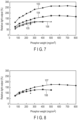
- FIG. 7 shows the relationship between the phosphor weight of the phosphor layer 23 and the relative light output of the fluorescent screen 10 by comparing it with that of comparative examples.
- Chart 1 shows part of data plotted in FIG. 7 separately for the examples of the present embodiment and the comparative examples.
- irradiation X-rays having an X-ray tube voltage of 120 kV were used by using a conventional fluorescent screen in which the average particle diameter of the europium-activated barium fluorochloride phosphor is approximately 4 ⁇ m, and the concentration of europium is 0.75% by weight, and the phosphor weight is 250 mg/cm 2 , and the light reflectance of the support body 21 is 70%.
- the relative values of the light output of the X-ray detectors of the examples and the comparative examples were measured.
- the average particle diameter of the europium-activated barium fluorochloride phosphor was set to as to be approximately 4 ⁇ m, and the concentration of europium was set so as to be 0.75% by weight, and the total light transmittances of the support body 21 and the protective layer 22 were set so as to be 70% (example 1 to example 4) or 85% (example 5 to example 8).
- Line 103 indicates the measurement result when the total light transmittance is 85%.
- Line 104 indicates the measurement result when the total light transmittance is 60%.
- the measurement was performed by using irradiation X-rays having an X-ray tube voltage of 160 kV.
- transparent polyethylene terephthalate was used, and the respective thicknesses were set so as to be 250 ⁇ m.
- measurement was performed by using a fluorescent screen in which the total light transmittances of the support body 21 and the protective layer 22 are 60%, and the other conditions are the same as the examples, and further, measurement was performed by using a fluorescent screen in which the light reflectance of the support body 21 is 70%, and the other conditions are the same as the examples.
- Line 105 indicates the measurement result when the light reflectance is 70%.
- Line 106 indicates the measurement result when the total light transmittances are 60%.
- Table 1 Phosphor X-ray tube voltage (kV) Total light transmittances of protective film and support body (%) Phosphor weight (mg/cm 2 ) Relative light output (%)
- Example 3 500 178
- Example 5 85 300 234
- Example 8 600 266 Comparative example 1 BaFCl:Eu 120 Reflectance of support body 70% 250 100 Comparative example 2 160 Reflectance of support body 70% 250 117
- each fluorescent screen in which the total light transmittances of the support body 21 and the protective layer 22 are 85% shows higher values in the relative light output than each fluorescent screen in which the total light transmittances are 70%.
- the relative light output increases as the phosphor weight of the phosphor layer 23 increases. When the phosphor weight is greater than or equal to 300 mg/cm 2 , the relative light output is greater than or equal to 150%. When the weight of the phosphor is 500 to 600 mg/cm 2 , the relative light output is maximum. When the weight of the phosphor exceeds 600 mg/cm 2 , the relative light output is decreased.
- both the fluorescent screen in which the total light transmittances of the support body 21 and the protective layer 22 are 60% and the other conditions are the same as the examples and the fluorescent screen in which the light reflectance of the support body 21 is 70% and the other conditions are the same as the examples show the maximum relative light output when the weight of the phosphor is approximately 300 mg/cm 2 .
- the relative light output shows a certain value or is decreased.
- the maximum values of the relative light output are approximately 130% and show lower values than example 1 to example 8.
- the boiling point of the solvent of the phosphor solution was set so as to be less than or equal to 100°C, and further, the amount of the solvent was set so as to be 2/3 of the conventional art. Moreover, as an application condition, the line rate was decreased to 1/3. In this manner, the phosphor layer 23 which has a phosphor weight of 300 mg/cm 2 or greater and has been sufficiently dried could be obtained.
- example 1 to example 8 measurement was carried out regarding a case where the X-ray tube voltage is 160 kV. Regarding a case where the X-ray tube voltage is greater than or equal to 140 kV and less than or equal to 180 kV, a similar experiment was conducted. As a result, the relative light output of the fluorescent screen 10 showed a value equivalent to a case where the X-ray tube voltage is 160 kV (not shown).
- FIG. 8 shows the relationship between the phosphor weight of the phosphor layer 23 and the relative light output of the fluorescent screen 10 when the X-ray tube voltage is 120 kV and 160 kV.
- the average particle diameter of the europium-activated barium fluorochloride phosphor was set so as to be approximately 4 ⁇ m, and the concentration of europium was set so as to be 0.75% by weight, and the total light transmittances of the support body 21 and the protective layer 22 were set so as to be 70%.
- the measurement was performed by using irradiation X-rays having an X-ray tube voltage of 120 kV or 160 kV.
- Line 107 indicates the measurement result when the X-ray tube voltage is 160 kV.
- Line 108 indicates the measurement result when the X-ray tube voltage is 120 kV.
- the relative light output is maximum when the phosphor weight is 300 mg/cm 2 to 400 mg/cm 2 , and further, this value is approximately 130%, and the relative light output is decreased when the phosphor weight exceeds 400 mg/cm 2 .
- the relative light output is greater than or equal to 150% in the fluorescent screen 10 in which the phosphor weight is greater than or equal to 300 mg/cm 2 and less than or equal to 600 mg/cm 2 .
- the phosphor layer 23 of the fluorescent screen 10 should preferably contain europium-activated barium fluorochloride.
- the phosphor weight should be preferably greater than or equal to 300 mg/cm 2 and less than or equal to 600 mg/cm 2 .
- the total light transmittance should be preferably greater than or equal to 70% relative to the dominant emission wavelength 380 nm of the phosphor.
- the relative light output of the fluorescent screen 10 is 1.5 times a conventional fluorescent screen as the reference value.
Landscapes
- Chemical & Material Sciences (AREA)
- Health & Medical Sciences (AREA)
- Physics & Mathematics (AREA)
- Life Sciences & Earth Sciences (AREA)
- General Physics & Mathematics (AREA)
- Analytical Chemistry (AREA)
- Pathology (AREA)
- Immunology (AREA)
- General Health & Medical Sciences (AREA)
- Biochemistry (AREA)
- Crystallography & Structural Chemistry (AREA)
- Molecular Biology (AREA)
- Spectroscopy & Molecular Physics (AREA)
- High Energy & Nuclear Physics (AREA)
- Toxicology (AREA)
- Organic Chemistry (AREA)
- Materials Engineering (AREA)
- Engineering & Computer Science (AREA)
- Inorganic Chemistry (AREA)
- Luminescent Compositions (AREA)
- Conversion Of X-Rays Into Visible Images (AREA)
Applications Claiming Priority (2)
| Application Number | Priority Date | Filing Date | Title |
|---|---|---|---|
| JP2022118349 | 2022-07-26 | ||
| PCT/JP2023/027148 WO2024024771A1 (ja) | 2022-07-26 | 2023-07-25 | X線蛍光板、x線検出器およびそれを用いたx線検査装置 |
Publications (1)
| Publication Number | Publication Date |
|---|---|
| EP4563673A1 true EP4563673A1 (en) | 2025-06-04 |
Family
ID=89706404
Family Applications (1)
| Application Number | Title | Priority Date | Filing Date |
|---|---|---|---|
| EP23846501.7A Pending EP4563673A1 (en) | 2022-07-26 | 2023-07-25 | X-ray fluorescent plate, x-ray detector, and x-ray inspection device using same |
Country Status (5)
| Country | Link |
|---|---|
| US (1) | US20250164651A1 (https=) |
| EP (1) | EP4563673A1 (https=) |
| JP (1) | JPWO2024024771A1 (https=) |
| CN (1) | CN119631145A (https=) |
| WO (1) | WO2024024771A1 (https=) |
Family Cites Families (5)
| Publication number | Priority date | Publication date | Assignee | Title |
|---|---|---|---|---|
| JPH0516559Y2 (https=) | 1986-04-21 | 1993-04-30 | ||
| JP2006105597A (ja) * | 2004-09-30 | 2006-04-20 | Fuji Photo Film Co Ltd | 放射線像変換パネル |
| JP2007314709A (ja) * | 2006-05-29 | 2007-12-06 | Konica Minolta Medical & Graphic Inc | 金属酸化物蛍光体、その製造方法、及びそれを用いた放射線用シンチレータプレート |
| JP6430097B2 (ja) * | 2011-10-03 | 2018-11-28 | 株式会社東芝 | コンプトン散乱x線検出器用増感紙、x線検出器、およびx線検査装置 |
| FR3065813B1 (fr) * | 2017-04-28 | 2020-09-04 | Areva Np | Detecteur pour radiographie a haute energie et ensemble d'imagerie associe |
-
2023
- 2023-07-25 JP JP2024537736A patent/JPWO2024024771A1/ja active Pending
- 2023-07-25 CN CN202380056569.7A patent/CN119631145A/zh active Pending
- 2023-07-25 WO PCT/JP2023/027148 patent/WO2024024771A1/ja not_active Ceased
- 2023-07-25 EP EP23846501.7A patent/EP4563673A1/en active Pending
-
2025
- 2025-01-23 US US19/034,831 patent/US20250164651A1/en active Pending
Also Published As
| Publication number | Publication date |
|---|---|
| JPWO2024024771A1 (https=) | 2024-02-01 |
| CN119631145A (zh) | 2025-03-14 |
| WO2024024771A1 (ja) | 2024-02-01 |
| US20250164651A1 (en) | 2025-05-22 |
Similar Documents
| Publication | Publication Date | Title |
|---|---|---|
| KR950007525B1 (ko) | X선검출기 및 x선 검사장치 | |
| CN103140898B (zh) | X射线检测器用增光纸、x射线检测器、以及x射线检查装置 | |
| US5378894A (en) | X-ray detector including scintillator channel separator capable of improving sensitivity of X-ray detector | |
| JP3332200B2 (ja) | X線ct用放射線検出器 | |
| EP1550885B1 (en) | Phosphor sheet for radiation detector, radiation detector employing it and equipment for detecting radiation | |
| CN102239425A (zh) | 闪烁分离器 | |
| US4317037A (en) | Radiation detection apparatus | |
| JP2928677B2 (ja) | X線検出器およびx線検査装置 | |
| JP2018036197A (ja) | 放射線画像検出器 | |
| EP4563673A1 (en) | X-ray fluorescent plate, x-ray detector, and x-ray inspection device using same | |
| US20170016997A1 (en) | Radiation detector and radiation imaging system | |
| JP6105833B2 (ja) | X線検出器及びx線検査装置 | |
| JPWO2016167334A1 (ja) | 放射線像変換スクリーン、フラットパネルディテクタ、放射線検出装置、及びシンチレータ | |
| JP4451112B2 (ja) | 放射線検出器及びそれを用いた放射線画像診断装置 | |
| WO2007106333A2 (en) | Scintillator with improved light collection | |
| WO2012104798A2 (en) | Radiation sensitive imaging detector including a radiation hard wavelength shifter | |
| US11181649B2 (en) | Fluorescent screen, x-ray detector, and x-ray inspection apparatus | |
| JP6957422B2 (ja) | 蛍光板及びx線検査装置 | |
| JP2018189425A (ja) | X線像変換スクリーン、x線撮影装置、及びx線検査装置 | |
| JP4724007B2 (ja) | 放射線検出器 | |
| Koch et al. | Powder-phosphor screens combined with interference filters for X-ray imaging with increased brightness | |
| JP7645742B2 (ja) | シンチレータパネル、および、放射線撮像装置 | |
| CN110727017A (zh) | 一种镀有增反膜和特殊出光面的掺铊碘化铯闪烁晶体辐射探测器 | |
| JP2004109118A (ja) | 放射線像変換パネルおよび放射線画像情報読取方法 | |
| JPS6130221B2 (https=) |
Legal Events
| Date | Code | Title | Description |
|---|---|---|---|
| STAA | Information on the status of an ep patent application or granted ep patent |
Free format text: STATUS: THE INTERNATIONAL PUBLICATION HAS BEEN MADE |
|
| PUAI | Public reference made under article 153(3) epc to a published international application that has entered the european phase |
Free format text: ORIGINAL CODE: 0009012 |
|
| STAA | Information on the status of an ep patent application or granted ep patent |
Free format text: STATUS: REQUEST FOR EXAMINATION WAS MADE |
|
| 17P | Request for examination filed |
Effective date: 20250122 |
|
| AK | Designated contracting states |
Kind code of ref document: A1 Designated state(s): AL AT BE BG CH CY CZ DE DK EE ES FI FR GB GR HR HU IE IS IT LI LT LU LV MC ME MK MT NL NO PL PT RO RS SE SI SK SM TR |
|
| DAV | Request for validation of the european patent (deleted) | ||
| DAX | Request for extension of the european patent (deleted) | ||
| RAP1 | Party data changed (applicant data changed or rights of an application transferred) |
Owner name: NITERRA MATERIALS CO., LTD. |