EP4560720A1 - Elektrodenfolie - Google Patents
Elektrodenfolie Download PDFInfo
- Publication number
- EP4560720A1 EP4560720A1 EP23842664.7A EP23842664A EP4560720A1 EP 4560720 A1 EP4560720 A1 EP 4560720A1 EP 23842664 A EP23842664 A EP 23842664A EP 4560720 A1 EP4560720 A1 EP 4560720A1
- Authority
- EP
- European Patent Office
- Prior art keywords
- sheet
- compound
- current collector
- electrode
- compound sheet
- Prior art date
- Legal status (The legal status is an assumption and is not a legal conclusion. Google has not performed a legal analysis and makes no representation as to the accuracy of the status listed.)
- Pending
Links
Images



Classifications
-
- H—ELECTRICITY
- H01—ELECTRIC ELEMENTS
- H01M—PROCESSES OR MEANS, e.g. BATTERIES, FOR THE DIRECT CONVERSION OF CHEMICAL ENERGY INTO ELECTRICAL ENERGY
- H01M4/00—Electrodes
- H01M4/02—Electrodes composed of, or comprising, active material
- H01M4/04—Processes of manufacture in general
-
- H—ELECTRICITY
- H01—ELECTRIC ELEMENTS
- H01M—PROCESSES OR MEANS, e.g. BATTERIES, FOR THE DIRECT CONVERSION OF CHEMICAL ENERGY INTO ELECTRICAL ENERGY
- H01M4/00—Electrodes
- H01M4/02—Electrodes composed of, or comprising, active material
- H01M4/64—Carriers or collectors
- H01M4/70—Carriers or collectors characterised by shape or form
-
- H—ELECTRICITY
- H01—ELECTRIC ELEMENTS
- H01G—CAPACITORS; CAPACITORS, RECTIFIERS, DETECTORS, SWITCHING DEVICES, LIGHT-SENSITIVE OR TEMPERATURE-SENSITIVE DEVICES OF THE ELECTROLYTIC TYPE
- H01G11/00—Hybrid capacitors, i.e. capacitors having different positive and negative electrodes; Electric double-layer [EDL] capacitors; Processes for the manufacture thereof or of parts thereof
- H01G11/22—Electrodes
- H01G11/26—Electrodes characterised by their structure, e.g. multi-layered, porosity or surface features
-
- H—ELECTRICITY
- H01—ELECTRIC ELEMENTS
- H01G—CAPACITORS; CAPACITORS, RECTIFIERS, DETECTORS, SWITCHING DEVICES, LIGHT-SENSITIVE OR TEMPERATURE-SENSITIVE DEVICES OF THE ELECTROLYTIC TYPE
- H01G11/00—Hybrid capacitors, i.e. capacitors having different positive and negative electrodes; Electric double-layer [EDL] capacitors; Processes for the manufacture thereof or of parts thereof
- H01G11/22—Electrodes
- H01G11/26—Electrodes characterised by their structure, e.g. multi-layered, porosity or surface features
- H01G11/28—Electrodes characterised by their structure, e.g. multi-layered, porosity or surface features arranged or disposed on a current collector; Layers or phases between electrodes and current collectors, e.g. adhesives
-
- H—ELECTRICITY
- H01—ELECTRIC ELEMENTS
- H01G—CAPACITORS; CAPACITORS, RECTIFIERS, DETECTORS, SWITCHING DEVICES, LIGHT-SENSITIVE OR TEMPERATURE-SENSITIVE DEVICES OF THE ELECTROLYTIC TYPE
- H01G11/00—Hybrid capacitors, i.e. capacitors having different positive and negative electrodes; Electric double-layer [EDL] capacitors; Processes for the manufacture thereof or of parts thereof
- H01G11/66—Current collectors
- H01G11/70—Current collectors characterised by their structure
-
- H—ELECTRICITY
- H01—ELECTRIC ELEMENTS
- H01M—PROCESSES OR MEANS, e.g. BATTERIES, FOR THE DIRECT CONVERSION OF CHEMICAL ENERGY INTO ELECTRICAL ENERGY
- H01M4/00—Electrodes
- H01M4/02—Electrodes composed of, or comprising, active material
- H01M4/13—Electrodes for accumulators with non-aqueous electrolyte, e.g. for lithium-accumulators; Processes of manufacture thereof
-
- H—ELECTRICITY
- H01—ELECTRIC ELEMENTS
- H01M—PROCESSES OR MEANS, e.g. BATTERIES, FOR THE DIRECT CONVERSION OF CHEMICAL ENERGY INTO ELECTRICAL ENERGY
- H01M4/00—Electrodes
- H01M4/02—Electrodes composed of, or comprising, active material
- H01M4/13—Electrodes for accumulators with non-aqueous electrolyte, e.g. for lithium-accumulators; Processes of manufacture thereof
- H01M4/139—Processes of manufacture
-
- H—ELECTRICITY
- H01—ELECTRIC ELEMENTS
- H01M—PROCESSES OR MEANS, e.g. BATTERIES, FOR THE DIRECT CONVERSION OF CHEMICAL ENERGY INTO ELECTRICAL ENERGY
- H01M50/00—Constructional details or processes of manufacture of the non-active parts of electrochemical cells other than fuel cells, e.g. hybrid cells
- H01M50/50—Current conducting connections for cells or batteries
- H01M50/531—Electrode connections inside a battery casing
- H01M50/536—Electrode connections inside a battery casing characterised by the method of fixing the leads to the electrodes, e.g. by welding
-
- H—ELECTRICITY
- H01—ELECTRIC ELEMENTS
- H01G—CAPACITORS; CAPACITORS, RECTIFIERS, DETECTORS, SWITCHING DEVICES, LIGHT-SENSITIVE OR TEMPERATURE-SENSITIVE DEVICES OF THE ELECTROLYTIC TYPE
- H01G11/00—Hybrid capacitors, i.e. capacitors having different positive and negative electrodes; Electric double-layer [EDL] capacitors; Processes for the manufacture thereof or of parts thereof
- H01G11/84—Processes for the manufacture of hybrid or EDL capacitors, or components thereof
- H01G11/86—Processes for the manufacture of hybrid or EDL capacitors, or components thereof specially adapted for electrodes
-
- H—ELECTRICITY
- H01—ELECTRIC ELEMENTS
- H01M—PROCESSES OR MEANS, e.g. BATTERIES, FOR THE DIRECT CONVERSION OF CHEMICAL ENERGY INTO ELECTRICAL ENERGY
- H01M4/00—Electrodes
- H01M4/02—Electrodes composed of, or comprising, active material
- H01M4/04—Processes of manufacture in general
- H01M4/043—Processes of manufacture in general involving compressing or compaction
- H01M4/0433—Molding
-
- Y—GENERAL TAGGING OF NEW TECHNOLOGICAL DEVELOPMENTS; GENERAL TAGGING OF CROSS-SECTIONAL TECHNOLOGIES SPANNING OVER SEVERAL SECTIONS OF THE IPC; TECHNICAL SUBJECTS COVERED BY FORMER USPC CROSS-REFERENCE ART COLLECTIONS [XRACs] AND DIGESTS
- Y02—TECHNOLOGIES OR APPLICATIONS FOR MITIGATION OR ADAPTATION AGAINST CLIMATE CHANGE
- Y02E—REDUCTION OF GREENHOUSE GAS [GHG] EMISSIONS, RELATED TO ENERGY GENERATION, TRANSMISSION OR DISTRIBUTION
- Y02E60/00—Enabling technologies; Technologies with a potential or indirect contribution to GHG emissions mitigation
- Y02E60/10—Energy storage using batteries
Definitions
- the present disclosure relates to an electrode sheet.
- Patent Literature 1 describes an apparatus that supplies granules to a gap between a pair of compression rolls, compresses them into a sheet to form a coating film, and layers the coating film on a substrate.
- This apparatus is equipped with a stepped roll with a blade provided on the circumferential surface, and a portion of the coating film is removed by the stepped roll.
- Patent Literature 1 also describes using this apparatus to manufacture a functional sheet used in a power storage apparatus such as a secondary battery and a capacitor. Further, a current collector plate is given as an example of the substrate, and an electrode compound is given as an example of the paint.
- Patent Literature 1 JP2013-017962
- an exposed portion of the current collector plate can be formed by removing a portion of the electrode compound sheet.
- the exposed portion can be used as, for example, a portion of connection to a current collection lead.
- the present disclosure addresses the issue described above, and a purpose thereof is to provide a technology of improving the quality of a power storage apparatus.
- the electrode sheet includes a current collector plate and a compound sheet comprised of a dry electrode compound and layered on a surface of the current collector plate.
- the compound sheet includes a window portion surrounded by the dry electrode compound over an entire circumference, and the current collector plate is exposed in the window portion.
- An angle formed by a side wall of the compound sheet in the window portion and a surface of the current collector plate is 75° or more and 105° or less in a cross-section perpendicular to a direction of extension of the current collector plate and the compound sheet.
- the quality of a power storage apparatus can be improved.
- Fig. 1 is a schematic diagram showing a molding apparatus 1 for a compound sheet 6 according to an embodiment.
- the molding apparatus 1 for the compound sheet 6 includes a support roll 2 and a molding roll 4.
- the support roll 2 supports the compound sheet 6 on a circumferential surface 2a.
- the compound sheet 6 according to one example is a strip elongated in the conveying direction and is layered on a current collector plate and then turned into individual pieces of electrode plates, which are used in a power storage apparatus such as a secondary battery and a capacitor.
- the compound sheet 6 is, for example, formed as follows. That is, granules of a dry electrode compound that serve as a raw material of the compound sheet 6 are supplied from a known reservoir such as a hopper to a gap between a pair of compression rolls. The pair of compression rolls rotate in mutually opposite directions to compress the dry electrode compound supplied to the gap into a sheet. Thereby, the compound sheet 6 is formed.
- the compound sheet 6 is continuously fed from the gap between the pair of compressed rolls.
- the support roll 2 is located on the downstream side of the pair of compression rolls and conveys the compound sheet 6 to the downstream side by its own rotation while supporting the compound sheet 6 on the circumferential surface 2a.
- the compound sheet 6 may be stretched until it reaches a target thickness in the process of conveyance.
- the dry electrode compound includes an electrode active material and, if necessary, a conductive agent and a binder.
- the electrode active material is lithium cobalt oxide, lithium iron phosphate, etc. when it is a positive electrode and is graphite etc. when it is a negative electrode.
- the conductive agent is graphite, carbon black, acetylene black, etc.
- the binder is polytetrafluoroethylene (PTFE), polyvinylidene fluoride (PVdF), etc.
- the dry electrode compound has a solvent content of 5% by mass or less, 3% by mass or less, or even 0% by mass with respect to the total mass of the dry electrode compound. Therefore, a drying furnace for drying the compound sheet 6 can be omitted.
- the dry electrode compound may contain a very small amount of solvent to the extent that a drying furnace can be omitted.
- the posture of the molding roll 4 is defined so that the rotation axis thereof is parallel to the rotation axis of the support roll 2.
- a circumferential surface 4a faces the circumferential surface 2a of the support roll 2 at a predetermined interval. Further, the molding roll 4 rotates together with the support roll 2.
- the support roll 2 and the molding rolls 4 rotate in mutually opposite directions. By way of one example, the support roll 2 and the molding roll 4 rotate at the same rotation speed.
- the molding roll 4 includes a molding unit 7 comprised of a cutting jig 8, a removal pad 10, and an elastic body 12 on the circumferential surface 4a.
- the molding roll 4 rotates together with the support roll 2 and presses the cutting jig 8 against the compound sheet 6 supported by the support roll 2. Thereby, the compound sheet 6 is cut partially.
- the molding roll 4 attaches a cut portion 6a of the compound sheet 6 to the surface of the removal pad 10 to remove the cut portion 6a away from the compound sheet 6.
- a through hole that extends through the compound sheet 6 in the thickness direction is formed in the compound sheet 6.
- the through hole constitutes a window portion 6b.
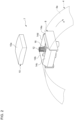
- Fig. 2 is an exploded perspective view of the molding unit 7.
- Fig. 3 is a cross-sectional view of the molding unit 7.
- illustration of the compound sheet 6 is omitted.
- the cutting jig 8 has a frame shape.
- the cutting jig 8 of this embodiment is shaped in a rectangular frame and has a first cutting blade 14a-a fourth cutting blade 14d combined in a rectangular form.
- the first cutting blade 14a and the second cutting blade 14b are arranged at a predetermined interval in the circumferential direction of the molding roll 4 and extend in the axial direction of the molding roll 4.
- the first cutting blade 14a is located on the side of the front end, and the second cutting blade 14b is located on the side of the back end.
- the third cutting blade 14c and the fourth cutting blade 14d are arranged at a predetermined interval in the axial direction of the molding roll 4 and extend in the circumferential direction of the molding roll 4.
- the cutting edges of the first cutting blade 14a and the second cutting blade 14b extend in a straight line.
- the cutting edges of the third cutting blade 14c and the fourth cutting blade 14d extend in a curved shape parallel to the circumferential surface 4a.
- Each blade faces outward in the radial direction of the molding roll 4.
- the cutting jig 8 may have a frame shape such as a rectangle with rounded corners, a perfect circle, and an ellipse.
- the removal pad 10 is disposed in the frame of the cutting jig 8. Therefore, the removal pad 10 is surrounded by the first cutting blade 14a-the fourth cutting blade 14d as viewed in the radial direction of the molding roll 4.
- a surface 10a facing the support roll 2 of the removal pad 10 has a greater surface roughness than the circumferential surface 2a of the support roll 2.
- the arithmetic average roughness Ra of the surface 10a is greater than the arithmetic average roughness Ra of the circumferential surface 2a.
- the surface roughness of the surface 10a can be increased by a known roughening process such as sandblasting.
- the elastic body 12 supports the removal pad 10.
- the elastic body 12 can be comprised of a known spring, sponge, etc.
- the elastic body 12 of this embodiment is comprised of a coil spring by way of one example and is disposed between the cutting jig 8 and the removal pad 10.
- the cutting jig 8 has a pedestal 16 in the frame. The end of the elastic body 12 toward the cutting jig 8 is fixed to the pedestal 16. The end of the elastic body 12 toward the removal pad 10 is fixed to the back surface of the removal pad 10. In a state where the removal pad 10 is facing the support roll 2, the elastic body 12 biases the removal pad 10 toward the cut portion 6a by its own elastic force.
- the elastic body 12 pulls the removal pad 10 toward the molding roll 4 by its own elastic force.
- the elastic body 12 functions in the same way as the die spring of a punching die.
- the removal pad 10 itself may have elasticity. In this case, the removal pad 10 also serves as the elastic body 12.
- the front end of the cutting jig 8 in the rotation direction A of the molding roll 4 protrudes more toward the support roll 2 than the front end of the removal pad 10.
- the back end of the cutting jig 8 in the rotation direction A protrudes more toward the support roll 2 than the back end of the removal pad 10. That is, the cutting edges of the first cutting blade 14a and the second cutting blade 14b protrude more toward the support roll 2 than the surface 10a of the removal pad 10.
- the middle portion of the removal pad 10 in the rotation direction A protrudes more toward the support roll 2 than the middle portion of the cutting jig 8.
- the molding unit 7 approaches the circumferential surface 2a of the support roll 2 in association with the rotation of the molding roll 4.
- the first cutting blade 14a is pressed against the compound sheet 6. Since the cutting jig 8 protrudes more than the removal pad 10 at the front end in the rotation direction A, the first cutting blade 14a can be applied to the compound sheet 6 more reliably than otherwise. As the first cutting blade 14a cuts the compound sheet 6, a starting point of the cut portion 6a is formed.
- the surface 10a of the removal pad 10 comes into contact with the compound sheet 6, and the surface 10a is pressed against the compound sheet 6 by a biasing force applied by the elastic body 12. Further, the removal pad 10 receives the reaction force of the compound sheet 6 and sinks into the frame of the cutting jig 8. Thereby, the third cutting blade 14c and the fourth cutting blade 14d are pressed against the compound sheet 6. As the third cutting blade 14c and the fourth cutting blade 14d cut the compound sheet 6, the cut portion 6a extends backward in the rotation direction A.
- the cut portion 6a is transferred to the surface 10a of the removal pad 10, starting on the side of the front end in the rotation direction A.
- the surface roughness of the surface 10a of the removal pad 10 is greater than the surface roughness of the circumferential surface 2a of the support roll 2, it is possible to facilitate transfer of the cut portion 6a to the removal pad 10.
- Pressing the surface 10a against the cut portion 6a using the elastic body 12 also facilitates transfer of the cut portion 6a to the removal pad 10.
- the second cutting blade 14b is pressed against the compound sheet 6. Since the cutting jig 8 protrudes more than the removal pad 10 at the back end in the rotation direction A, the second cutting blade 14b can be applied to the compound sheet 6 more reliably than otherwise. As the second cutting blade 14b cuts the compound sheet 6, an end point of the cut portion 6a is formed. As a result, the cut portion 6a has a rectangular shape.
- the removal pad 10 is isolated from the circumferential surface 2a of the support roll 2. This causes the cut portion 6a transferred to the removal pad 10 to be removed from the compound sheet 6. As the removal pad 10 is isolated from the circumferential surface 2a, the removal pad 10 is pulled toward the support roll 2 via the cut portion 6a. However, the removal pad 10 is pulled toward the molding roll 4 with a force stronger than the force exerted by the elastic body 12 to pull the removal pad 10 toward the support roll 2. This causes the cut portion 6a to be separated from the compound sheet 6 more reliably than otherwise.
- the cutting jig 8 is fixed to the molding roll 4. Therefore, the structure of the molding unit 7 can be simplified compared with a structure in which the cutting jig 8 is displaced in the radial direction of the molding roll 4. It also makes maintenance of the molding roll 4 easy.
- the window portion 6b is formed before the compound sheet 6 is layered on the current collector plate. This makes it possible to avoid that the current collector plate from being cut out by the cutting jig 8. Therefore, the quality of the power storage apparatus can be improved.
- the cut portion 6a isolated from the compound sheet 6 is peeled off and removed from the removal pad 10 at a predetermined location by a peeling mechanism (not shown).
- the molding unit 7 from which the cut portion 6a has been removed advances again to a position facing the support roll 2 by the rotation of the molding roll 4 and is used to cut the compound sheet 6.
- a plurality of window portions 6b arranged at predetermined intervals in the conveying direction are formed in the compound sheet 6.
- each window portion 6b is disposed at the center of the compound sheet 6 in the width direction (the direction perpendicular to the conveying direction).
- Fig. 4A is a plan view of an electrode sheet 20.
- Fig. 4B is a cross-sectional view along A-A line of Fig. 4A .
- the compound sheet 6 having the window portion 6b is conveyed to the downstream side by the support roll 2.
- the compound sheet 6 is layered on the surface of a current collector plate 18, and the electrode sheet 20 is obtained.
- the electrode sheet 20 is a continuous body of a plurality of dry electrode plates.
- the compound sheet 6 is layered on both surfaces of the current collector plate 18.
- the current collector plate 18 is comprised of an aluminum foil, etc. when it is a positive electrode and is comprised of a copper foil, etc. when it is a negative electrode.
- the current collector plate 18 is exposed in the window portion 6b.
- Each window portion 6b is surrounded by the dry electrode compound over the entire circumference. Therefore, the current collector plate 18 is exposed in a spot shape.
- the exposed portion of the current collector plate 18, i.e. the portion not coated with the electrode compound extends over the entirety of the electrode sheet in the width direction.
- the exposed portion of the current collector plate 18 extends only in a portion of the electrode sheet 20 in the width direction. This can increase the amount of dry electrode compound in each electrode plate. Accordingly, it is possible to increase the capacity of the power storage apparatus. Further, the exposed portion of the current collector plate 18 can be reduced so that the safety of the power storage apparatus can be enhanced.
- Fig. 5A is a plan view of the electrode sheet 20 to which a current collection lead 22 is bonded.
- Fig. 5B is an enlarged cross-sectional view of the window portion 6b.
- the cross-section shown in Fig. 5B is a cross-section perpendicular to the direction of extension of the current collector plate 18 and the compound sheet 6 in the electrode sheet 20 and, in other words, a cross-section parallel to the normal of the current collector plate 18 and the compound sheet 6. Further, illustration of one of the compound sheet 6 is omitted in Fig. 5B .
- the electrode sheet 20 is cut in the middle in the width direction and divided into two as shown in Fig. 5A . This also divides each window unit 6b into two. As a result, each rectangular window portion 6b will be surrounded on three sides by the dry electrode compound. Then, the current collection lead 22 (the current collector tab) is bonded by welding, etc. to the portion in the current collector plate 18 exposed from each divided window portion 6b. The exposed portion of the current collector plate 18 to which the current collection lead 22 is bonded is covered with an insulating protective tape (not shown). Thereafter, the electrode sheet 20 is cut between adjacent current collection leads 22 and turned into a plurality of individual pieces of dry electrode plates.
- an angle ⁇ 1 formed by a side wall 6c (the side surface connecting the two main surfaces) of the compound sheet 6 in the window portion 6b and a surface 18a of the current collector plate 18 is 75° or more and 105° or less in a cross-section perpendicular to the direction of extension of the current collector plate 18 and the compound sheet 6.
- the angle ⁇ 1 is 75°-105° over the entire circumference of the window portion 6b.
- the angle ⁇ 1 is 85° or more and 95° or less.
- the boundary between the portion not coated with the wet electrode compound and the coated portion may be distorted due to dripping of the wet electrode compound.
- the edge of the coated portion may become jagged.
- the separator may be damaged when the electrode plate repeatedly expands and contracts due to charging and discharging of the power storage apparatus. A damage to the separator can cause an internal short circuit.
- the compound sheet 6 comprised of the dry electrode compound is cut with the cutting jig 8 to form the window portion 6b.
- the boundary between the portion not coated with the dry electrode compound and the coated portion is difficult to distort, and the angle ⁇ 1 described above can be maintained at an almost right angle.
- the edge of the coated portion will be straight, conforming to the shape of the cutting blade. For this reason, a damage to the separator can also be suppressed.
- the window portion 6b is formed by cutting with the cutting jig 8, it is possible to suppress bulging of the edge of the coated portion in the direction of thickness of the compound sheet 6. This can also suppress a damage to the separator as the electrode plate repeatedly expands and contracts due to charging and discharging of the power storage apparatus.
- the embodiment may be defined by the following items.
- a molding apparatus (1) for a compound sheet (6) including: a support roll (2) that supports a compound sheet (6) comprised of a dry electrode compound on a circumferential surface (2a) of the support roll (2); and
- the molding apparatus (1) according to any one of Item 1 to Item 3,
- a method of molding a compound sheet (6) including:
- the present disclosure can be used in an electrode sheet.
- 1 molding apparatus 2 support roll, 4 molding roll, 6 compound sheet, 6a cut portion, 6b window portion, 6c side wall, 8 cutting jig, 10 removal pad, 12 elastic body, 18 current collector plate, 20 electrode sheet
Landscapes
- Engineering & Computer Science (AREA)
- Power Engineering (AREA)
- Chemical & Material Sciences (AREA)
- Chemical Kinetics & Catalysis (AREA)
- Electrochemistry (AREA)
- General Chemical & Material Sciences (AREA)
- Microelectronics & Electronic Packaging (AREA)
- Manufacturing & Machinery (AREA)
- Materials Engineering (AREA)
- Battery Electrode And Active Subsutance (AREA)
- Electric Double-Layer Capacitors Or The Like (AREA)
Applications Claiming Priority (2)
| Application Number | Priority Date | Filing Date | Title |
|---|---|---|---|
| JP2022114707 | 2022-07-19 | ||
| PCT/JP2023/017781 WO2024018732A1 (ja) | 2022-07-19 | 2023-05-11 | 電極シート |
Publications (2)
| Publication Number | Publication Date |
|---|---|
| EP4560720A1 true EP4560720A1 (de) | 2025-05-28 |
| EP4560720A4 EP4560720A4 (de) | 2025-10-29 |
Family
ID=89617428
Family Applications (1)
| Application Number | Title | Priority Date | Filing Date |
|---|---|---|---|
| EP23842664.7A Pending EP4560720A4 (de) | 2022-07-19 | 2023-05-11 | Elektrodenfolie |
Country Status (5)
| Country | Link |
|---|---|
| US (1) | US20260018623A1 (de) |
| EP (1) | EP4560720A4 (de) |
| JP (1) | JPWO2024018732A1 (de) |
| CN (1) | CN119487638A (de) |
| WO (1) | WO2024018732A1 (de) |
Cited By (1)
| Publication number | Priority date | Publication date | Assignee | Title |
|---|---|---|---|---|
| EP4629304A3 (de) * | 2024-04-05 | 2025-12-31 | Samsung Sdi Co., Ltd. | Vorrichtung zur herstellung einer trockenelektrode, verfahren zur herstellung einer trockenelektrode und damit hergestellte trockenelektrode |
Family Cites Families (7)
| Publication number | Priority date | Publication date | Assignee | Title |
|---|---|---|---|---|
| JPH11167916A (ja) * | 1997-12-04 | 1999-06-22 | Asahi Chem Ind Co Ltd | 電池用電極板の製造方法 |
| US6423446B1 (en) * | 1998-11-12 | 2002-07-23 | Dai Nippon Printing Co., Ltd. | Electrode plate for secondary battery with nonaqueous electrolyte and process for producing same |
| EP1596459A4 (de) * | 2002-12-27 | 2008-09-03 | Matsushita Electric Industrial Co Ltd | Elektrochemische vorrichtung und verfahren zu ihrer herstellung |
| WO2005081336A1 (ja) * | 2004-02-20 | 2005-09-01 | Matsushita Electric Industrial Co., Ltd. | リチウムイオン二次電池の製造法 |
| DE102010062143B4 (de) * | 2010-11-29 | 2016-08-04 | Zentrum für Sonnenenergie- und Wasserstoff-Forschung Baden-Württemberg Gemeinnützige Stiftung | Batterieelektrode und Verfahren zum Herstellen derselben |
| JP2013017962A (ja) | 2011-07-12 | 2013-01-31 | Panasonic Corp | 塗布装置 |
| JP2020196080A (ja) * | 2019-05-31 | 2020-12-10 | 株式会社豊田自動織機 | ロータリーダイカット装置 |
-
2023
- 2023-05-11 US US18/996,317 patent/US20260018623A1/en active Pending
- 2023-05-11 WO PCT/JP2023/017781 patent/WO2024018732A1/ja not_active Ceased
- 2023-05-11 CN CN202380049574.5A patent/CN119487638A/zh active Pending
- 2023-05-11 JP JP2024534943A patent/JPWO2024018732A1/ja active Pending
- 2023-05-11 EP EP23842664.7A patent/EP4560720A4/de active Pending
Cited By (1)
| Publication number | Priority date | Publication date | Assignee | Title |
|---|---|---|---|---|
| EP4629304A3 (de) * | 2024-04-05 | 2025-12-31 | Samsung Sdi Co., Ltd. | Vorrichtung zur herstellung einer trockenelektrode, verfahren zur herstellung einer trockenelektrode und damit hergestellte trockenelektrode |
Also Published As
| Publication number | Publication date |
|---|---|
| JPWO2024018732A1 (de) | 2024-01-25 |
| CN119487638A (zh) | 2025-02-18 |
| EP4560720A4 (de) | 2025-10-29 |
| US20260018623A1 (en) | 2026-01-15 |
| WO2024018732A1 (ja) | 2024-01-25 |
Similar Documents
| Publication | Publication Date | Title |
|---|---|---|
| US7307831B2 (en) | Method of manufacturing electrode and electrode | |
| JP5293045B2 (ja) | 電極製造方法及び電極製造装置 | |
| JP2005183181A (ja) | 非水電解質二次電池用電極板およびその製造方法 | |
| JP2005190787A (ja) | 非水電解質二次電池用電極板およびその製造方法 | |
| JP2018026334A (ja) | 蓄電装置の電極、電極の製造装置及び電極の製造方法 | |
| EP4560720A1 (de) | Elektrodenfolie | |
| CN100396410C (zh) | 剪切装置和电极的制造方法 | |
| JPH10214616A (ja) | 積層型電池用電極の製造方法 | |
| JP2017196669A (ja) | 電極製造設備 | |
| JP2017132019A (ja) | 電極製造装置 | |
| JPWO2013031889A1 (ja) | 電池用電極の製造方法 | |
| JP5550091B2 (ja) | 非水電解質二次電池用電極の製造方法およびそれを用いた非水電解質二次電池 | |
| EP4559645A1 (de) | Formvorrichtung und formverfahren für eine mischungsfolie | |
| JP6809139B2 (ja) | 電極製造装置 | |
| JP2000012002A (ja) | 帯状電極の製造装置 | |
| CN212287904U (zh) | 组合刀具及具有其的分切机 | |
| JP2020196080A (ja) | ロータリーダイカット装置 | |
| CN221407354U (zh) | 负极极片补锂装置 | |
| JP2003311680A (ja) | リチウムイオン電池用電極の集電タブ加工装置 | |
| JP2020202153A (ja) | 電極切断装置 | |
| EP4316757B1 (de) | Schneidvorrichtung und schneidverfahren | |
| US20240181664A1 (en) | Cutting device and cutting method | |
| JP2021009759A (ja) | 電極製造装置 | |
| JP2012069279A (ja) | 電極切断装置及び電極製造方法 | |
| JPH11167916A (ja) | 電池用電極板の製造方法 |
Legal Events
| Date | Code | Title | Description |
|---|---|---|---|
| STAA | Information on the status of an ep patent application or granted ep patent |
Free format text: STATUS: THE INTERNATIONAL PUBLICATION HAS BEEN MADE |
|
| PUAI | Public reference made under article 153(3) epc to a published international application that has entered the european phase |
Free format text: ORIGINAL CODE: 0009012 |
|
| STAA | Information on the status of an ep patent application or granted ep patent |
Free format text: STATUS: REQUEST FOR EXAMINATION WAS MADE |
|
| 17P | Request for examination filed |
Effective date: 20250113 |
|
| AK | Designated contracting states |
Kind code of ref document: A1 Designated state(s): AL AT BE BG CH CY CZ DE DK EE ES FI FR GB GR HR HU IE IS IT LI LT LU LV MC ME MK MT NL NO PL PT RO RS SE SI SK SM TR |
|
| REG | Reference to a national code |
Ref country code: DE Ref legal event code: R079 Free format text: PREVIOUS MAIN CLASS: H01M0004130000 Ipc: H01G0011280000 |
|
| DAV | Request for validation of the european patent (deleted) | ||
| DAX | Request for extension of the european patent (deleted) | ||
| A4 | Supplementary search report drawn up and despatched |
Effective date: 20250930 |
|
| RIC1 | Information provided on ipc code assigned before grant |
Ipc: H01G 11/28 20130101AFI20250924BHEP Ipc: H01G 11/26 20130101ALI20250924BHEP Ipc: H01G 11/70 20130101ALI20250924BHEP Ipc: H01M 4/04 20060101ALI20250924BHEP Ipc: H01M 4/13 20100101ALI20250924BHEP Ipc: H01M 4/139 20100101ALI20250924BHEP Ipc: H01M 50/536 20210101ALI20250924BHEP Ipc: H01G 11/86 20130101ALN20250924BHEP |