EP4556969A1 - Optical film, optical effect film, easily adhesive film, optical laminate, surface plate, image display device, and polarizing plate - Google Patents
Optical film, optical effect film, easily adhesive film, optical laminate, surface plate, image display device, and polarizing plate Download PDFInfo
- Publication number
- EP4556969A1 EP4556969A1 EP23839630.3A EP23839630A EP4556969A1 EP 4556969 A1 EP4556969 A1 EP 4556969A1 EP 23839630 A EP23839630 A EP 23839630A EP 4556969 A1 EP4556969 A1 EP 4556969A1
- Authority
- EP
- European Patent Office
- Prior art keywords
- film
- optical
- less
- polyester
- easily adhesive
- Prior art date
- Legal status (The legal status is an assumption and is not a legal conclusion. Google has not performed a legal analysis and makes no representation as to the accuracy of the status listed.)
- Pending
Links
Images


Classifications
-
- C—CHEMISTRY; METALLURGY
- C08—ORGANIC MACROMOLECULAR COMPOUNDS; THEIR PREPARATION OR CHEMICAL WORKING-UP; COMPOSITIONS BASED THEREON
- C08G—MACROMOLECULAR COMPOUNDS OBTAINED OTHERWISE THAN BY REACTIONS ONLY INVOLVING UNSATURATED CARBON-TO-CARBON BONDS
- C08G63/00—Macromolecular compounds obtained by reactions forming a carboxylic ester link in the main chain of the macromolecule
- C08G63/02—Polyesters derived from hydroxycarboxylic acids or from polycarboxylic acids and polyhydroxy compounds
- C08G63/12—Polyesters derived from hydroxycarboxylic acids or from polycarboxylic acids and polyhydroxy compounds derived from polycarboxylic acids and polyhydroxy compounds
- C08G63/16—Dicarboxylic acids and dihydroxy compounds
- C08G63/18—Dicarboxylic acids and dihydroxy compounds the acids or hydroxy compounds containing carbocyclic rings
- C08G63/181—Acids containing aromatic rings
- C08G63/183—Terephthalic acids
-
- B—PERFORMING OPERATIONS; TRANSPORTING
- B29—WORKING OF PLASTICS; WORKING OF SUBSTANCES IN A PLASTIC STATE IN GENERAL
- B29D—PRODUCING PARTICULAR ARTICLES FROM PLASTICS OR FROM SUBSTANCES IN A PLASTIC STATE
- B29D11/00—Producing optical elements, e.g. lenses or prisms
- B29D11/0073—Optical laminates
-
- B—PERFORMING OPERATIONS; TRANSPORTING
- B29—WORKING OF PLASTICS; WORKING OF SUBSTANCES IN A PLASTIC STATE IN GENERAL
- B29D—PRODUCING PARTICULAR ARTICLES FROM PLASTICS OR FROM SUBSTANCES IN A PLASTIC STATE
- B29D11/00—Producing optical elements, e.g. lenses or prisms
- B29D11/0074—Production of other optical elements not provided for in B29D11/00009- B29D11/0073
- B29D11/00788—Producing optical films
-
- B—PERFORMING OPERATIONS; TRANSPORTING
- B32—LAYERED PRODUCTS
- B32B—LAYERED PRODUCTS, i.e. PRODUCTS BUILT-UP OF STRATA OF FLAT OR NON-FLAT, e.g. CELLULAR OR HONEYCOMB, FORM
- B32B27/00—Layered products comprising a layer of synthetic resin
- B32B27/06—Layered products comprising a layer of synthetic resin as the main or only constituent of a layer, which is next to another layer of the same or of a different material
- B32B27/08—Layered products comprising a layer of synthetic resin as the main or only constituent of a layer, which is next to another layer of the same or of a different material of synthetic resin
-
- B—PERFORMING OPERATIONS; TRANSPORTING
- B32—LAYERED PRODUCTS
- B32B—LAYERED PRODUCTS, i.e. PRODUCTS BUILT-UP OF STRATA OF FLAT OR NON-FLAT, e.g. CELLULAR OR HONEYCOMB, FORM
- B32B27/00—Layered products comprising a layer of synthetic resin
- B32B27/18—Layered products comprising a layer of synthetic resin characterised by the use of special additives
-
- B—PERFORMING OPERATIONS; TRANSPORTING
- B32—LAYERED PRODUCTS
- B32B—LAYERED PRODUCTS, i.e. PRODUCTS BUILT-UP OF STRATA OF FLAT OR NON-FLAT, e.g. CELLULAR OR HONEYCOMB, FORM
- B32B27/00—Layered products comprising a layer of synthetic resin
- B32B27/36—Layered products comprising a layer of synthetic resin comprising polyesters
-
- B—PERFORMING OPERATIONS; TRANSPORTING
- B32—LAYERED PRODUCTS
- B32B—LAYERED PRODUCTS, i.e. PRODUCTS BUILT-UP OF STRATA OF FLAT OR NON-FLAT, e.g. CELLULAR OR HONEYCOMB, FORM
- B32B7/00—Layered products characterised by the relation between layers; Layered products characterised by the relative orientation of features between layers, or by the relative values of a measurable parameter between layers, i.e. products comprising layers having different physical, chemical or physicochemical properties; Layered products characterised by the interconnection of layers
- B32B7/02—Physical, chemical or physicochemical properties
- B32B7/022—Mechanical properties
-
- B—PERFORMING OPERATIONS; TRANSPORTING
- B32—LAYERED PRODUCTS
- B32B—LAYERED PRODUCTS, i.e. PRODUCTS BUILT-UP OF STRATA OF FLAT OR NON-FLAT, e.g. CELLULAR OR HONEYCOMB, FORM
- B32B7/00—Layered products characterised by the relation between layers; Layered products characterised by the relative orientation of features between layers, or by the relative values of a measurable parameter between layers, i.e. products comprising layers having different physical, chemical or physicochemical properties; Layered products characterised by the interconnection of layers
- B32B7/02—Physical, chemical or physicochemical properties
- B32B7/023—Optical properties
-
- C—CHEMISTRY; METALLURGY
- C08—ORGANIC MACROMOLECULAR COMPOUNDS; THEIR PREPARATION OR CHEMICAL WORKING-UP; COMPOSITIONS BASED THEREON
- C08F—MACROMOLECULAR COMPOUNDS OBTAINED BY REACTIONS ONLY INVOLVING CARBON-TO-CARBON UNSATURATED BONDS
- C08F290/00—Macromolecular compounds obtained by polymerising monomers on to polymers modified by introduction of aliphatic unsaturated end or side groups
- C08F290/08—Macromolecular compounds obtained by polymerising monomers on to polymers modified by introduction of aliphatic unsaturated end or side groups on to polymers modified by introduction of unsaturated side groups
- C08F290/14—Polymers provided for in subclass C08G
-
- C—CHEMISTRY; METALLURGY
- C08—ORGANIC MACROMOLECULAR COMPOUNDS; THEIR PREPARATION OR CHEMICAL WORKING-UP; COMPOSITIONS BASED THEREON
- C08G—MACROMOLECULAR COMPOUNDS OBTAINED OTHERWISE THAN BY REACTIONS ONLY INVOLVING UNSATURATED CARBON-TO-CARBON BONDS
- C08G18/00—Polymeric products of isocyanates or isothiocyanates
- C08G18/06—Polymeric products of isocyanates or isothiocyanates with compounds having active hydrogen
- C08G18/28—Polymeric products of isocyanates or isothiocyanates with compounds having active hydrogen characterised by the compounds used containing active hydrogen
- C08G18/40—High-molecular-weight compounds
- C08G18/42—Polycondensates having carboxylic or carbonic ester groups in the main chain
- C08G18/4205—Polycondensates having carboxylic or carbonic ester groups in the main chain containing cyclic groups
- C08G18/4208—Polycondensates having carboxylic or carbonic ester groups in the main chain containing cyclic groups containing aromatic groups
- C08G18/4211—Polycondensates having carboxylic or carbonic ester groups in the main chain containing cyclic groups containing aromatic groups derived from aromatic dicarboxylic acids and dialcohols
- C08G18/4213—Polycondensates having carboxylic or carbonic ester groups in the main chain containing cyclic groups containing aromatic groups derived from aromatic dicarboxylic acids and dialcohols from terephthalic acid and dialcohols
-
- C—CHEMISTRY; METALLURGY
- C08—ORGANIC MACROMOLECULAR COMPOUNDS; THEIR PREPARATION OR CHEMICAL WORKING-UP; COMPOSITIONS BASED THEREON
- C08G—MACROMOLECULAR COMPOUNDS OBTAINED OTHERWISE THAN BY REACTIONS ONLY INVOLVING UNSATURATED CARBON-TO-CARBON BONDS
- C08G18/00—Polymeric products of isocyanates or isothiocyanates
- C08G18/06—Polymeric products of isocyanates or isothiocyanates with compounds having active hydrogen
- C08G18/70—Polymeric products of isocyanates or isothiocyanates with compounds having active hydrogen characterised by the isocyanates or isothiocyanates used
- C08G18/72—Polyisocyanates or polyisothiocyanates
- C08G18/74—Polyisocyanates or polyisothiocyanates cyclic
- C08G18/76—Polyisocyanates or polyisothiocyanates cyclic aromatic
- C08G18/7614—Polyisocyanates or polyisothiocyanates cyclic aromatic containing only one aromatic ring
- C08G18/7628—Polyisocyanates or polyisothiocyanates cyclic aromatic containing only one aromatic ring containing at least one isocyanate or isothiocyanate group linked to the aromatic ring by means of an aliphatic group
- C08G18/7642—Polyisocyanates or polyisothiocyanates cyclic aromatic containing only one aromatic ring containing at least one isocyanate or isothiocyanate group linked to the aromatic ring by means of an aliphatic group containing at least two isocyanate or isothiocyanate groups linked to the aromatic ring by means of an aliphatic group having a primary carbon atom next to the isocyanate or isothiocyanate groups, e.g. xylylene diisocyanate or homologues substituted on the aromatic ring
-
- C—CHEMISTRY; METALLURGY
- C08—ORGANIC MACROMOLECULAR COMPOUNDS; THEIR PREPARATION OR CHEMICAL WORKING-UP; COMPOSITIONS BASED THEREON
- C08G—MACROMOLECULAR COMPOUNDS OBTAINED OTHERWISE THAN BY REACTIONS ONLY INVOLVING UNSATURATED CARBON-TO-CARBON BONDS
- C08G63/00—Macromolecular compounds obtained by reactions forming a carboxylic ester link in the main chain of the macromolecule
- C08G63/02—Polyesters derived from hydroxycarboxylic acids or from polycarboxylic acids and polyhydroxy compounds
- C08G63/12—Polyesters derived from hydroxycarboxylic acids or from polycarboxylic acids and polyhydroxy compounds derived from polycarboxylic acids and polyhydroxy compounds
- C08G63/16—Dicarboxylic acids and dihydroxy compounds
- C08G63/18—Dicarboxylic acids and dihydroxy compounds the acids or hydroxy compounds containing carbocyclic rings
- C08G63/181—Acids containing aromatic rings
-
- C—CHEMISTRY; METALLURGY
- C08—ORGANIC MACROMOLECULAR COMPOUNDS; THEIR PREPARATION OR CHEMICAL WORKING-UP; COMPOSITIONS BASED THEREON
- C08G—MACROMOLECULAR COMPOUNDS OBTAINED OTHERWISE THAN BY REACTIONS ONLY INVOLVING UNSATURATED CARBON-TO-CARBON BONDS
- C08G63/00—Macromolecular compounds obtained by reactions forming a carboxylic ester link in the main chain of the macromolecule
- C08G63/02—Polyesters derived from hydroxycarboxylic acids or from polycarboxylic acids and polyhydroxy compounds
- C08G63/12—Polyesters derived from hydroxycarboxylic acids or from polycarboxylic acids and polyhydroxy compounds derived from polycarboxylic acids and polyhydroxy compounds
- C08G63/16—Dicarboxylic acids and dihydroxy compounds
- C08G63/18—Dicarboxylic acids and dihydroxy compounds the acids or hydroxy compounds containing carbocyclic rings
- C08G63/181—Acids containing aromatic rings
- C08G63/185—Acids containing aromatic rings containing two or more aromatic rings
- C08G63/187—Acids containing aromatic rings containing two or more aromatic rings containing condensed aromatic rings
- C08G63/189—Acids containing aromatic rings containing two or more aromatic rings containing condensed aromatic rings containing a naphthalene ring
-
- C—CHEMISTRY; METALLURGY
- C08—ORGANIC MACROMOLECULAR COMPOUNDS; THEIR PREPARATION OR CHEMICAL WORKING-UP; COMPOSITIONS BASED THEREON
- C08J—WORKING-UP; GENERAL PROCESSES OF COMPOUNDING; AFTER-TREATMENT NOT COVERED BY SUBCLASSES C08B, C08C, C08F, C08G or C08H
- C08J5/00—Manufacture of articles or shaped materials containing macromolecular substances
- C08J5/18—Manufacture of films or sheets
-
- C—CHEMISTRY; METALLURGY
- C08—ORGANIC MACROMOLECULAR COMPOUNDS; THEIR PREPARATION OR CHEMICAL WORKING-UP; COMPOSITIONS BASED THEREON
- C08J—WORKING-UP; GENERAL PROCESSES OF COMPOUNDING; AFTER-TREATMENT NOT COVERED BY SUBCLASSES C08B, C08C, C08F, C08G or C08H
- C08J7/00—Chemical treatment or coating of shaped articles made of macromolecular substances
- C08J7/04—Coating
- C08J7/043—Improving the adhesiveness of the coatings per se, e.g. forming primers
-
- C—CHEMISTRY; METALLURGY
- C08—ORGANIC MACROMOLECULAR COMPOUNDS; THEIR PREPARATION OR CHEMICAL WORKING-UP; COMPOSITIONS BASED THEREON
- C08J—WORKING-UP; GENERAL PROCESSES OF COMPOUNDING; AFTER-TREATMENT NOT COVERED BY SUBCLASSES C08B, C08C, C08F, C08G or C08H
- C08J7/00—Chemical treatment or coating of shaped articles made of macromolecular substances
- C08J7/04—Coating
- C08J7/046—Forming abrasion-resistant coatings; Forming surface-hardening coatings
-
- C—CHEMISTRY; METALLURGY
- C09—DYES; PAINTS; POLISHES; NATURAL RESINS; ADHESIVES; COMPOSITIONS NOT OTHERWISE PROVIDED FOR; APPLICATIONS OF MATERIALS NOT OTHERWISE PROVIDED FOR
- C09D—COATING COMPOSITIONS, e.g. PAINTS, VARNISHES OR LACQUERS; FILLING PASTES; CHEMICAL PAINT OR INK REMOVERS; INKS; CORRECTING FLUIDS; WOODSTAINS; PASTES OR SOLIDS FOR COLOURING OR PRINTING; USE OF MATERIALS THEREFOR
- C09D167/00—Coating compositions based on polyesters obtained by reactions forming a carboxylic ester link in the main chain; Coating compositions based on derivatives of such polymers
- C09D167/02—Polyesters derived from dicarboxylic acids and dihydroxy compounds
-
- C—CHEMISTRY; METALLURGY
- C09—DYES; PAINTS; POLISHES; NATURAL RESINS; ADHESIVES; COMPOSITIONS NOT OTHERWISE PROVIDED FOR; APPLICATIONS OF MATERIALS NOT OTHERWISE PROVIDED FOR
- C09D—COATING COMPOSITIONS, e.g. PAINTS, VARNISHES OR LACQUERS; FILLING PASTES; CHEMICAL PAINT OR INK REMOVERS; INKS; CORRECTING FLUIDS; WOODSTAINS; PASTES OR SOLIDS FOR COLOURING OR PRINTING; USE OF MATERIALS THEREFOR
- C09D175/00—Coating compositions based on polyureas or polyurethanes; Coating compositions based on derivatives of such polymers
- C09D175/04—Polyurethanes
- C09D175/14—Polyurethanes having carbon-to-carbon unsaturated bonds
- C09D175/16—Polyurethanes having carbon-to-carbon unsaturated bonds having terminal carbon-to-carbon unsaturated bonds
-
- C—CHEMISTRY; METALLURGY
- C09—DYES; PAINTS; POLISHES; NATURAL RESINS; ADHESIVES; COMPOSITIONS NOT OTHERWISE PROVIDED FOR; APPLICATIONS OF MATERIALS NOT OTHERWISE PROVIDED FOR
- C09D—COATING COMPOSITIONS, e.g. PAINTS, VARNISHES OR LACQUERS; FILLING PASTES; CHEMICAL PAINT OR INK REMOVERS; INKS; CORRECTING FLUIDS; WOODSTAINS; PASTES OR SOLIDS FOR COLOURING OR PRINTING; USE OF MATERIALS THEREFOR
- C09D7/00—Features of coating compositions, not provided for in group C09D5/00; Processes for incorporating ingredients in coating compositions
- C09D7/40—Additives
- C09D7/66—Additives characterised by particle size
-
- C—CHEMISTRY; METALLURGY
- C09—DYES; PAINTS; POLISHES; NATURAL RESINS; ADHESIVES; COMPOSITIONS NOT OTHERWISE PROVIDED FOR; APPLICATIONS OF MATERIALS NOT OTHERWISE PROVIDED FOR
- C09J—ADHESIVES; NON-MECHANICAL ASPECTS OF ADHESIVE PROCESSES IN GENERAL; ADHESIVE PROCESSES NOT PROVIDED FOR ELSEWHERE; USE OF MATERIALS AS ADHESIVES
- C09J167/00—Adhesives based on polyesters obtained by reactions forming a carboxylic ester link in the main chain; Adhesives based on derivatives of such polymers
- C09J167/02—Polyesters derived from dicarboxylic acids and dihydroxy compounds
-
- C—CHEMISTRY; METALLURGY
- C09—DYES; PAINTS; POLISHES; NATURAL RESINS; ADHESIVES; COMPOSITIONS NOT OTHERWISE PROVIDED FOR; APPLICATIONS OF MATERIALS NOT OTHERWISE PROVIDED FOR
- C09J—ADHESIVES; NON-MECHANICAL ASPECTS OF ADHESIVE PROCESSES IN GENERAL; ADHESIVE PROCESSES NOT PROVIDED FOR ELSEWHERE; USE OF MATERIALS AS ADHESIVES
- C09J175/00—Adhesives based on polyureas or polyurethanes; Adhesives based on derivatives of such polymers
- C09J175/04—Polyurethanes
- C09J175/06—Polyurethanes from polyesters
-
- G—PHYSICS
- G02—OPTICS
- G02B—OPTICAL ELEMENTS, SYSTEMS OR APPARATUS
- G02B1/00—Optical elements characterised by the material of which they are made; Optical coatings for optical elements
- G02B1/10—Optical coatings produced by application to, or surface treatment of, optical elements
- G02B1/11—Anti-reflection coatings
-
- G—PHYSICS
- G02—OPTICS
- G02B—OPTICAL ELEMENTS, SYSTEMS OR APPARATUS
- G02B1/00—Optical elements characterised by the material of which they are made; Optical coatings for optical elements
- G02B1/10—Optical coatings produced by application to, or surface treatment of, optical elements
- G02B1/16—Optical coatings produced by application to, or surface treatment of, optical elements having an anti-static effect, e.g. electrically conducting coatings
-
- G—PHYSICS
- G02—OPTICS
- G02B—OPTICAL ELEMENTS, SYSTEMS OR APPARATUS
- G02B1/00—Optical elements characterised by the material of which they are made; Optical coatings for optical elements
- G02B1/10—Optical coatings produced by application to, or surface treatment of, optical elements
- G02B1/18—Coatings for keeping optical surfaces clean, e.g. hydrophobic or photo-catalytic films
-
- G—PHYSICS
- G02—OPTICS
- G02B—OPTICAL ELEMENTS, SYSTEMS OR APPARATUS
- G02B5/00—Optical elements other than lenses
- G02B5/02—Diffusing elements; Afocal elements
-
- G—PHYSICS
- G02—OPTICS
- G02B—OPTICAL ELEMENTS, SYSTEMS OR APPARATUS
- G02B5/00—Optical elements other than lenses
- G02B5/20—Filters
- G02B5/22—Absorbing filters
-
- G—PHYSICS
- G02—OPTICS
- G02B—OPTICAL ELEMENTS, SYSTEMS OR APPARATUS
- G02B5/00—Optical elements other than lenses
- G02B5/30—Polarising elements
-
- G—PHYSICS
- G02—OPTICS
- G02F—OPTICAL DEVICES OR ARRANGEMENTS FOR THE CONTROL OF LIGHT BY MODIFICATION OF THE OPTICAL PROPERTIES OF THE MEDIA OF THE ELEMENTS INVOLVED THEREIN; NON-LINEAR OPTICS; FREQUENCY-CHANGING OF LIGHT; OPTICAL LOGIC ELEMENTS; OPTICAL ANALOGUE/DIGITAL CONVERTERS
- G02F1/00—Devices or arrangements for the control of the intensity, colour, phase, polarisation or direction of light arriving from an independent light source, e.g. switching, gating or modulating; Non-linear optics
- G02F1/01—Devices or arrangements for the control of the intensity, colour, phase, polarisation or direction of light arriving from an independent light source, e.g. switching, gating or modulating; Non-linear optics for the control of the intensity, phase, polarisation or colour
- G02F1/13—Devices or arrangements for the control of the intensity, colour, phase, polarisation or direction of light arriving from an independent light source, e.g. switching, gating or modulating; Non-linear optics for the control of the intensity, phase, polarisation or colour based on liquid crystals, e.g. single liquid crystal display cells
- G02F1/133—Constructional arrangements; Operation of liquid crystal cells; Circuit arrangements
- G02F1/1333—Constructional arrangements; Manufacturing methods
- G02F1/1335—Structural association of cells with optical devices, e.g. polarisers or reflectors
- G02F1/13363—Birefringent elements, e.g. for optical compensation
-
- B—PERFORMING OPERATIONS; TRANSPORTING
- B32—LAYERED PRODUCTS
- B32B—LAYERED PRODUCTS, i.e. PRODUCTS BUILT-UP OF STRATA OF FLAT OR NON-FLAT, e.g. CELLULAR OR HONEYCOMB, FORM
- B32B2457/00—Electrical equipment
- B32B2457/20—Displays, e.g. liquid crystal displays, plasma displays
-
- C—CHEMISTRY; METALLURGY
- C08—ORGANIC MACROMOLECULAR COMPOUNDS; THEIR PREPARATION OR CHEMICAL WORKING-UP; COMPOSITIONS BASED THEREON
- C08G—MACROMOLECULAR COMPOUNDS OBTAINED OTHERWISE THAN BY REACTIONS ONLY INVOLVING UNSATURATED CARBON-TO-CARBON BONDS
- C08G2170/00—Compositions for adhesives
- C08G2170/80—Compositions for aqueous adhesives
-
- C—CHEMISTRY; METALLURGY
- C08—ORGANIC MACROMOLECULAR COMPOUNDS; THEIR PREPARATION OR CHEMICAL WORKING-UP; COMPOSITIONS BASED THEREON
- C08J—WORKING-UP; GENERAL PROCESSES OF COMPOUNDING; AFTER-TREATMENT NOT COVERED BY SUBCLASSES C08B, C08C, C08F, C08G or C08H
- C08J2367/00—Characterised by the use of polyesters obtained by reactions forming a carboxylic ester link in the main chain; Derivatives of such polymers
-
- G—PHYSICS
- G02—OPTICS
- G02B—OPTICAL ELEMENTS, SYSTEMS OR APPARATUS
- G02B1/00—Optical elements characterised by the material of which they are made; Optical coatings for optical elements
- G02B1/10—Optical coatings produced by application to, or surface treatment of, optical elements
- G02B1/14—Protective coatings, e.g. hard coatings
-
- G—PHYSICS
- G02—OPTICS
- G02F—OPTICAL DEVICES OR ARRANGEMENTS FOR THE CONTROL OF LIGHT BY MODIFICATION OF THE OPTICAL PROPERTIES OF THE MEDIA OF THE ELEMENTS INVOLVED THEREIN; NON-LINEAR OPTICS; FREQUENCY-CHANGING OF LIGHT; OPTICAL LOGIC ELEMENTS; OPTICAL ANALOGUE/DIGITAL CONVERTERS
- G02F1/00—Devices or arrangements for the control of the intensity, colour, phase, polarisation or direction of light arriving from an independent light source, e.g. switching, gating or modulating; Non-linear optics
- G02F1/01—Devices or arrangements for the control of the intensity, colour, phase, polarisation or direction of light arriving from an independent light source, e.g. switching, gating or modulating; Non-linear optics for the control of the intensity, phase, polarisation or colour
- G02F1/13—Devices or arrangements for the control of the intensity, colour, phase, polarisation or direction of light arriving from an independent light source, e.g. switching, gating or modulating; Non-linear optics for the control of the intensity, phase, polarisation or colour based on liquid crystals, e.g. single liquid crystal display cells
- G02F1/133—Constructional arrangements; Operation of liquid crystal cells; Circuit arrangements
- G02F1/1333—Constructional arrangements; Manufacturing methods
- G02F1/1335—Structural association of cells with optical devices, e.g. polarisers or reflectors
-
- G—PHYSICS
- G02—OPTICS
- G02F—OPTICAL DEVICES OR ARRANGEMENTS FOR THE CONTROL OF LIGHT BY MODIFICATION OF THE OPTICAL PROPERTIES OF THE MEDIA OF THE ELEMENTS INVOLVED THEREIN; NON-LINEAR OPTICS; FREQUENCY-CHANGING OF LIGHT; OPTICAL LOGIC ELEMENTS; OPTICAL ANALOGUE/DIGITAL CONVERTERS
- G02F2203/00—Function characteristic
- G02F2203/68—Green display, e.g. recycling, reduction of harmful substances
-
- Y—GENERAL TAGGING OF NEW TECHNOLOGICAL DEVELOPMENTS; GENERAL TAGGING OF CROSS-SECTIONAL TECHNOLOGIES SPANNING OVER SEVERAL SECTIONS OF THE IPC; TECHNICAL SUBJECTS COVERED BY FORMER USPC CROSS-REFERENCE ART COLLECTIONS [XRACs] AND DIGESTS
- Y02—TECHNOLOGIES OR APPLICATIONS FOR MITIGATION OR ADAPTATION AGAINST CLIMATE CHANGE
- Y02P—CLIMATE CHANGE MITIGATION TECHNOLOGIES IN THE PRODUCTION OR PROCESSING OF GOODS
- Y02P20/00—Technologies relating to chemical industry
- Y02P20/141—Feedstock
- Y02P20/143—Feedstock the feedstock being recycled material, e.g. plastics
-
- Y—GENERAL TAGGING OF NEW TECHNOLOGICAL DEVELOPMENTS; GENERAL TAGGING OF CROSS-SECTIONAL TECHNOLOGIES SPANNING OVER SEVERAL SECTIONS OF THE IPC; TECHNICAL SUBJECTS COVERED BY FORMER USPC CROSS-REFERENCE ART COLLECTIONS [XRACs] AND DIGESTS
- Y02—TECHNOLOGIES OR APPLICATIONS FOR MITIGATION OR ADAPTATION AGAINST CLIMATE CHANGE
- Y02W—CLIMATE CHANGE MITIGATION TECHNOLOGIES RELATED TO WASTEWATER TREATMENT OR WASTE MANAGEMENT
- Y02W30/00—Technologies for solid waste management
- Y02W30/50—Reuse, recycling or recovery technologies
- Y02W30/62—Plastics recycling; Rubber recycling
Definitions
- An image display device includes various optical multilayer bodies for purposes such as improving the visibility of images and reducing scratches on device surfaces.
- Such an optical multilayer body generally includes a plastic film as an optical film and at least one functional layer provided on this film (see, for example, PTL 1 and 2).
- An object of the present disclosure is to provide an optical film with which environmental impacts can be reduced.
- An optical film according to a first embodiment of the present disclosure is an optical film for placing at least one functional layer thereon, the optical film containing at least one polyester, wherein a biomass content of the optical film is 10% or more, a total transmittance of the optical film is 70% or more, and an in-plane phase difference of the optical film is 3,000 nm or more and 30,000 nm or less.
- An optical film according to a second embodiment of the present disclosure is an optical film for placing at least one functional layer thereon, the optical film containing at least one polyester, wherein a biomass content of the optical film is 10% or more, a total transmittance of the optical film is 70% or more, and an in-plane phase difference of the optical film is 1,500 nm or less.
- An optical effect film according to a third embodiment of the present disclosure contains at least one polyester, wherein the optical effect film has a biomass content of 10% or more, a total transmittance of 70% or more, and a yellowness index (YI) of -1.0 or greater and 2.5 or less.
- YI yellowness index
- An easily adhesive film includes a polyester film and at least one easily adhesive layer, wherein the polyester film contains at least one polyester, a biomass content of the easily adhesive film is 10% or more, a total transmittance of the easily adhesive film is 70% or more, an average ⁇ q/ ⁇ a of a surface of the easily adhesive layer is 3.10 or less, and the easily adhesive film is for providing at least one functional layer on the easily adhesive layer.
- An optical multilayer body includes a resin substrate and at least one functional layer provided on the resin substrate, wherein when a reduced elastic modulus of the functional layer is defined as E r B, and a reduced elastic modulus of the resin substrate is defined as E r A, E r B is 1.0 GPa or more and 10.0 GPa or less, and E r B/E r A is 0.50 or greater and 2.00 or less, a biomass content of the optical multilayer body is 10% or more, and a total transmittance of the optical multilayer body is 70% or more.
- an optical film with which environmental impacts can be reduced According to the present disclosure, there is provided an optical film with which environmental impacts can be reduced.
- the numerical range of that parameter may be constituted by pairing any one candidate upper limit with any one candidate lower limit.
- the following statement is described: "Parameter B may be A1 or more, may be A2 or more, or may be A3 or more.
- Parameter B may be A4 or less, may be A5 or less, or may be A6 or less.”
- the numerical range of parameter B may be from A1 to A4, both inclusive, may be from A1 to A5, both inclusive, may be from A1 to A6, both inclusive, may be from A2 to A4, both inclusive, may be from A2 to A5, both inclusive, may be from A2 to A6, both inclusive, may be from A3 to A4, both inclusive, may be from A3 to A5, both inclusive, or may be from A3 to A6, both inclusive.
- film As used herein, terms such as “film,” “sheet,” and “plate” are not differentiated from each other solely based on the difference in name. This means that a “film,” for example, encompasses an element that may also be referred to as a sheet or a plate. As one specific example, an "optical film” and an “optical effect film” encompass an element that may also be referred to as an “optical sheet” or an “optical plate.”
- the atmosphere during the measurement of parameters is at a temperature of 23°C ⁇ 5°C and a relative humidity of 40% or more and 65% or less unless otherwise specified. Unless otherwise stated, furthermore, the sample is exposed to this atmosphere for 30 minutes or more and 60 minutes or less before each measurement.
- parameters include nx - ny, Re, total transmittance, and haze.
- a first embodiment of the present disclosure relates to an optical film.
- An image display device includes various optical multilayer bodies for purposes such as improving the visibility of images and reducing scratches on device surfaces.
- Such an optical multilayer body generally includes a plastic film as an optical film and at least one functional layer provided on this film (see, for example, Japanese Unexamined Patent Application Publication No. 2007-046031 and Japanese Unexamined Patent Application Publication No. 2012-256014 ).
- polyester films such as a polyethylene terephthalate film
- an image display device that emits polarized light such as a liquid crystal display device or OLED display device
- rainbow-like interference patterns referred to as rainbow effects, can occur, potentially reducing visibility.
- An object of the first embodiment of the present disclosure is to provide an optical film that is superior in visibility and with which environmental impacts can be reduced.
- an optical film that is superior in visibility and with which environmental impacts can be reduced. Even when a biomass material-derived polyester is used, furthermore, an optical film having optical properties and mechanical properties comparable to those achieved with a fossil fuel-derived polyester can be provided.
- an optical film is a film through which light can be transmitted.
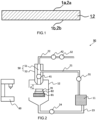
- the optical film 1 according to the first embodiment of the present disclosure has, as illustrated in Fig. 1 , a first surface 1a and a second surface 1b opposite the first surface 1a.
- the polyester film described later also has a first surface and a second surface opposite the first surface.
- surface may simply be used.
- the optical film has, within its plane, a first direction and a second direction perpendicular to the first direction.
- the first direction is, in the first embodiment, the longitudinal direction, flow direction, or machine direction (MD) of the optical film.
- the second direction is, in the first embodiment, the transverse direction or width direction (TD) of the optical film.
- mentioning an "optical film” is intended to refer to the optical film according to the first embodiment of the present disclosure, unless specifically distinguished.
- a polyester film is a film containing at least one polyester.
- the optical film consists of, in the first embodiment, a polyester film.
- the optical film includes, in the first embodiment, a polyester film and at least one easily adhesive layer provided on the polyester film.
- an optical film that includes a polyester film and at least one easily adhesive layer may be specifically referred to as an "easily adhesive film.”
- the optical film and the polyester film each contain at least one polyester.
- Polyester refers to a copolymer of at least a diol component and a dicarboxylic acid component.
- the optical film contains, as the polyester, at least a biomass material-derived polyester (hereinafter also referred to as "a biomass polyester").
- the polyester film contains, in the first embodiment, at least a biomass polyester as the polyester.
- Biomass polyester refers to a polyester in which at least a subset of the starting monomers is monomer(s) derived from a biomass material, such as a plant. Examples of plants include sugarcane and corn.
- Fossil fuel-derived polyester refers to a polyester in which all of the starting monomers are monomers derived from fossil fuels, such as petroleum.
- An example of a biomass polyester is a polyester that has diol units derived from diol components and dicarboxylic acid units derived from dicarboxylic acid components and in which at least a subset of the diol components and/or at least a subset of the dicarboxylic acid components is derived from a biomass material.
- biomass polyester it is preferred that its biomass content, which will be described later herein, be high because in that case it can contribute to reducing environmental impacts. It is, however, not necessarily required for the biomass content to be 100%; the biomass polyester may have a fossil fuel-derived monomer unit.
- biomass polyesters include polyesters having a diol unit derived from biomass material-derived ethylene glycol and a dicarboxylic acid unit derived from a fossil fuel-derived dicarboxylic acid component, polyesters having a diol unit derived from fossil fuel-derived ethylene glycol and a dicarboxylic acid unit derived from a biomass material-derived dicarboxylic acid component, and polyesters having a diol unit derived from biomass material-derived ethylene glycol and a dicarboxylic acid unit derived from a biomass material-derived dicarboxylic acid component.
- Polyesters having a diol unit derived from biomass material-derived ethylene glycol and a dicarboxylic acid unit derived from a fossil fuel-derived dicarboxylic acid component are preferred because they are readily available or easy to manufacture. Polyesters having a diol unit derived from biomass material-derived ethylene glycol, a dicarboxylic acid unit derived from a fossil fuel-derived dicarboxylic acid component, and a dicarboxylic acid unit derived from a biomass material-derived dicarboxylic acid component, furthermore, are also preferred.
- the biomass content of the films can be specified, and the quality of the films can also be controlled, in advance.
- Biomass material-derived ethylene glycol is obtained from ethanol produced using a biomass material as a raw material (hereinafter also referred to as "biomass ethanol").
- biomass material-derived ethylene glycol can be obtained using methods such as the method of producing ethylene glycol from biomass ethanol via ethylene oxide.
- Commercially available biomass material-derived ethylene glycol may also be used.
- diol components also include, in addition to ethylene glycol, diethylene glycol, triethylene glycol, propanediol, butanediol, 2-methyl-1,3-propanediol, pentanediol, hexanediol, neopentyl glycol, cyclohexanedimethanol, cyclohexanediethanol, decahydronaphthalenedimethanol, decahydronaphthalenediethanol, norbornanedimethanol, norbornanediethanol, tricyclodecanedimethanol, tricyclodecanediethanol, tetracyclododecanedimethanol, tetracyclododecanediethanol, decalin dimethanol, decalin diethanol, 5-methylol-5-ethyl-2-(1,1-dimethyl-2-hydroxyethyl)-1,3-dioxane, cyclopentanediol, 3-methyl
- One or two or more diol components can be used.
- dicarboxylic acid components include dicarboxylic acids and derivatives thereof.
- dicarboxylic acids include aromatic dicarboxylic acids and aliphatic dicarboxylic acids.
- derivatives of dicarboxylic acids include alkyl esters (monoalkyl esters or dialkyl esters) and acid anhydrides of dicarboxylic acids.
- aromatic dicarboxylic acids include terephthalic acid, isophthalic acid, orthophthalic acid, naphthalene dicarboxylic acids (e.g., 1,4-naphthalenedicarboxylic acid, 1,5-naphthalenedicarboxylic acid, 2,5-naphthalenedicarboxylic acid, and 2,6-naphthalenedicarboxylic acid and 1,8-naphthalenedicarboxylic acid), 4,4'-diphenyldicarboxylic acid, 4,4'-diphenyletherdicarboxylic acid, diphenoxyethanedicarboxylic acid, diphenylsulfondicarboxylic acid, anthracenedicarboxylic acid, phenanthrenedicarboxylic acid, 9,9'-bis(4-carboxyphenyl)fluorene acid, and furandicarboxylic acid.
- 1,4-naphthalenedicarboxylic acid 1,5-naphthalenedicarboxylic acid,
- derivatives of aromatic dicarboxylic acids include alkyl esters of aromatic dicarboxylic acids, specifically methyl esters, ethyl esters, propyl esters, and butyl esters. Of these, terephthalic acid, naphthalenedicarboxylic acids, and furandicarboxylic acid and alkyl esters thereof are particularly preferred.
- Examples of aliphatic dicarboxylic acids include chain dicarboxylic acids and alicyclic dicarboxylic acids.
- Examples of chain dicarboxylic acids include oxalic acid, malonic acid, methylmalonic acid, dimethylmalonic acid, ethylmalonic acid, succinic acid, 3,3-diethylsuccinic acid, glutaric acid, 2,2-dimethylglutaric acid, adipic acid, 2-methyladipic acid, trimethyladipic acid, pimelic acid, suberic acid, sebacic acid, azelaic acid, dodecanedioic acid, eicosadienoic acid, and dimer acid.
- alicyclic dicarboxylic acids examples include adamantanedicarboxylic acid, norbornenedicarboxylic acid, cyclopentanedicarboxylic acid, cyclohexanedicarboxylic acid, decalin dicarboxylic acid, hexahydroterephthalic acid, and hexahydroisophthalic acid.
- derivatives of aliphatic dicarboxylic acids include alkyl esters of aliphatic dicarboxylic acids, such as methyl esters, ethyl esters, propyl esters, and butyl esters, and cyclic acid anhydrides of aliphatic dicarboxylic acids, such as succinic anhydride.
- biomass material-derived dicarboxylic acids examples include aliphatic dicarboxylic acids obtained from vegetable raw materials, such as vegetable oils, e.g., soybean oil, linseed oil, paulownia oil, coconut oil, palm oil, and castor oil, and recycled oils made from sources such as waste cooking oils that are primarily such vegetable oils as listed above.
- vegetable oils e.g., soybean oil, linseed oil, paulownia oil, coconut oil, palm oil, and castor oil
- recycled oils made from sources such as waste cooking oils that are primarily such vegetable oils as listed above.
- biomass material-derived aliphatic dicarboxylic acids include succinic acid, glutaric acid, adipic acid, sebacic acid, and dimer acid.
- One or two or more dicarboxylic acid components can be used.
- the polyester may be a copolymeric polyester having a copolymerization unit derived from a copolymerization component as a third component in addition to a diol unit and a dicarboxylic acid unit.
- copolymerization components include bifunctional oxycarboxylic acids, as well as trifunctional or higher-functionality polyhydric alcohols, trifunctional or higher-functionality polycarboxylic acids, anhydrides of such polycarboxylic acids, and trifunctional and higher-functionality oxycarboxylic acids, which are for forming a crosslink structure.
- polyesters include polyethylene terephthalate (PET), polybutylene terephthalate (PBT), polytrimethylene terephthalate (PTT), polyethylene naphthalate (PEN), polybutylene naphthalate (PBN), and polyethylene furanoate (PEF).
- PET is particularly preferred because it results in an optical film superior in mechanical strength.
- biomass polyesters specific examples include such types of polyesters produced using biomass material-derived monomer(s) as a subset or all of the starting monomers (the diol component and the dicarboxylic acid component).
- the percentage of each unit can be quantified using 1H-NMR and 13C-NMR after dissolving the polyester in hexafluoroisopropanol (HFIP).
- the polyester can be obtained using methods known in the related art in which at least a diol component and a dicarboxylic acid component are polycondensed. Specifically, the polyester can be produced using the standard method for melt polymerization, which involves directly initiating the polycondensation reaction between the diol component and the dicarboxylic acid component or causing esterification reaction and/or transesterification reaction between the diol component and the dicarboxylic acid component and then initiating polycondensation reaction under reduced pressure, or a known solution-heating dehydrative condensation method using an organic solvent.
- the amount of the diol component used in producing the polyester may be substantially equimolar to 100 moles of the dicarboxylic acid component, but the amount may be more than 100 moles and 120 moles or less because distillation during the reaction generally occurs.
- the optical film can contain one or two or more polyesters.
- the polyester film can contain one or two or more polyesters.
- the optical film may further contain a fossil fuel-derived polyester in addition to the biomass polyester.
- the polyester film may further contain a fossil fuel-derived polyester in addition to the biomass polyester.
- the optical film may contain a recycled material-derived polyester.
- the polyester contained in the optical film may be a recycled material-derived polyester that is also a biomass polyester.
- a subset of polyesters contained in the optical film may be recycled material-derived polyester(s). In that case, another subset of the polyesters contained in the optical film, which is not the recycled material-derived polyester(s), may be biomass polyester(s).
- the recycled material-derived polyester may be recycled PET.
- the recycled material-derived polyester may be a polyester derived from a raw material produced through recycling. More specifically, at least either one of recycled material-derived ethylene glycol or a recycled material-derived dicarboxylic acid component may be used as a raw material for the recycled material-derived polyester.
- the percentage of the polyester in the optical film may be more than 50% by mass, may be 60% by mass or more, may be 70% by mass or more, may be 80% by mass or more, may be 90% by mass or more, or may be 95% by mass or more.
- the percentage of the polyester in the polyester film may be more than 50% by mass, may be 60% by mass or more, may be 70% by mass or more, may be 80% by mass or more, may be 90% by mass or more, or may be 95% by mass or more.
- the optical film and the polyester film may each contain additives.
- additives include ultraviolet absorbers, photostabilizers, antioxidants, heat stabilizers, antistatic agents, slippery particles, heat-resistant polymer particles, alkali metal compounds, alkaline earth metal compounds, phosphorus compounds, flame retardants, gel inhibitors, and surfactants.
- the optical film and the polyester film can each contain one or two or more additives.
- the polyester film may have a single-layer structure or may have a multilayer structure.
- a film having a single-layer structure allows for easier control of stretching.
- a film having a multilayer structure allows effects to be easily obtained by changing the composition of each layer.
- a polyester film having a multilayer structure the biomass polyester only needs to be contained in at least one layer.
- a multilayer film including a layer containing a biomass polyester as its base ingredient with a layer containing a fossil fuel-derived polyester as its base ingredient is superior in stretchability.
- a layer containing a certain polymer as its base ingredient refers to a layer in which the percentage of the polymer is more than 50% by mass. The percentage of the polymer may be 60% by mass or more, may be 70% by mass or more, may be 80% by mass or more, or may be 90% by mass or more.
- polyester films having a multilayer structure include:
- the multilayer films of (1A) and (1B) above make great environmental contributions.
- the multilayer films of (2A) to (4A) and (2B) to (4B) above make great environmental contributions and are superior in stretchability.
- the multilayer films of (5A) and (5B) above can result in reduced impact of impurities that can separate out of the biomass polyester, for example on the functional layer placed on the optical film, as well as making great environmental contributions and being superior in stretchability.
- a polyester film having a multilayer structure may be a coextruded resin film.
- a polyester film having a multilayer structure can be obtained.
- the thickness of the optical film may be 10 ⁇ m or more, may be 15 ⁇ m or more, may be 20 ⁇ m or more, may be 25 ⁇ m or more, or may be 30 ⁇ m or more. Such an optical film is superior in mechanical strength. The same applies to the thickness of the polyester film.
- the thickness of the optical film may be 200 ⁇ m or less, may be 180 ⁇ m or less, may be 160 ⁇ m or less, may be 140 ⁇ m or less, may be 120 ⁇ m or less, or may be 100 ⁇ m or less.
- Such an optical film is superior in bending resistance. The same applies to the thickness of the polyester film.
- the thickness of an optical film and each layer of it is determined by selecting any 20 locations on a cross-sectional image of the optical film obtained using a scanning electron microscope (SEM) and calculating the average of the 20 locations.
- the 20 locations are selected to ensure that they are not unevenly distributed.
- the acceleration voltage and magnification of the SEM the acceleration voltage is preferably set to 1 kV or more and 10 kV or less, and the magnification is preferably set to 20 times or more and 7,000 times or less, both being selected according to the layer of interest.
- the optical film Before the formation of the functional layer on it, the optical film may be subjected to physical treatments, such as corona discharge treatment and oxidation treatment, or may undergo prior coating with a paint referred to as an anchoring agent or primer, for improved adhesion.
- physical treatments such as corona discharge treatment and oxidation treatment
- a paint referred to as an anchoring agent or primer for improved adhesion.
- the optical film, and the optical multilayer body described later may be in sheet-shaped form, obtained by cutting into a predetermined size, or may be in roll-shaped form, which is a long sheet wound into a roll.
- the size of the sheet is, for example, approximately 2 inches or more and 500 inches or less in terms of maximum size.
- the maximum size refers to the maximum length between any two points in the plane of the optical film or optical multilayer body. For example, when the optical film or optical multilayer body is rectangular, the diagonal length of the rectangle serves as the maximum size. When the optical film or optical multilayer body is round, the diameter of the circle serves as the maximum size.
- the width of the roll-shaped form may be, for example, 500 mm or more and 8,000 mm or less.
- the length of the roll-shaped form may be, for example, 100 m or more and 10,000 m or less.
- An optical film and an optical multilayer body in roll-shaped form can be used after being cut into a sheet to the size of, for example, an image display device. When cutting them, it is preferred to exclude the ends of the roll, where physical characteristics are variable.
- the biomass content of the optical film is 10% or more, may be 12% or more, may be 15% or more, or may be 18% or more. With such an optical film, the reduction of environmental impacts can be sought.
- biomass content is a value obtained by correcting pMC (percent Modern Carbon) with ⁇ 13C, where pMC is measured according to Method B of ASTM D6866-22. Specifically, a sample is combusted to produce carbon dioxide (CO2), and the carbon dioxide is purified in a vacuum line. The purified carbon dioxide is reduced with hydrogen using iron as a catalyst, causing the formation of graphite. Then the 14C count and carbon isotopic ratios (14C/12C and 13C/12C) of the resulting graphite are measured by accelerator mass spectrometry (AMS).
- AMS accelerator mass spectrometry
- the measuring instrument can be a dedicated system for 14C-AMS (manufactured by NEC Corporation).
- the standard sample is oxalic acid provided by the National Institute of Standards and Technology (NIST) (HOxII).
- NIST National Institute of Standards and Technology
- HOxII National Institute of Standards and Technology
- the measurement of a background sample is simultaneously performed. From the carbon isotopic ratios obtained, the relative proportion of the 14C/12C of the sample to that of the standard sample (pMC) is calculated.
- ⁇ 13C is a value obtained by measuring the 13C/12C of the sample carbon and expressing the difference from that of the reference sample as a permillage.
- the biobased carbon content is a value obtained by multiplying pMC by a correction factor. Since the amount of surplus 14C in the atmosphere is continuously decreasing, the correction factor is that according to ASTM D6866-22.
- fossil fuel-derived materials are free of radioactive carbon with a mass number of 14 (14C)
- vegetable-derived materials contain 14C. Owing to this, they can be distinguished using a biomass content based on the amount of 14C.
- fossil fuel-derived materials are known to have a biomass content of substantially 0%.
- the biomass content is a measure representing the proportion of mixing between fossil fuel-derived materials and vegetable-derived materials.
- the sample can be prepared from the optical film.
- the sample can be prepared after separating the layer of interest from the optical film.
- the in-plane phase difference (Re) of the optical film is 3,000 nm or more and 30,000 nm or less.
- An "in-plane phase difference” is also referred to as retardation, and its unit is a unit for length.
- the T in the above equation represents the thickness [nm] of the optical film.
- nx is the refractive index in the slow axis direction, the direction with the highest refractive index in the plane of the optical film.
- “ny” is the refractive index in the fast axis direction, which is the direction perpendicular to the slow axis direction in the plane of the optical film.
- the refractive indices and the in-plane phase difference represent the refractive indices and in-plane phase difference for a wavelength of 550 nm.
- the direction of the slow axis and the in-plane phase difference are measured at a measurement angle of 0° using trade name "RETS-100,” manufactured by Otsuka Electronics Co., Ltd.
- nx - ny can be calculated from thickness information of the optical film, in addition to the in-plane phase difference measured with "RETS-100.”
- nx - ny and Re represent the averages of measurements at 16 locations excluding the minimum and maximum from measurements at 18 locations.
- measurement locations are selected from any locations free of defects, such as scratches or stains.
- the difference in refractive index "nx - ny" may be 0.040 or greater or may be 0.050 or greater.
- ⁇ n may be 0.250 or less or may be 0.200 or less.
- ⁇ n is 0.250 or less, the tear and breakage of the optical film can be reduced because there is no need to excessively draw the optical film.
- the refractive index in the slow axis direction (nx) may be 1.660 or greater or may be 1.680 or greater.
- the refractive index in the slow axis direction (nx) may be 1.780 or less or may be 1.730 or less.
- the refractive index in the fast axis direction (ny) may be 1.550 or greater or may be 1.570 or greater.
- the refractive index in the fast axis direction (ny) may be 1.650 or less or may be 1.620 or less.
- the optical film or polyester film is preferably an oriented film.
- the oriented film may be a uniaxially oriented film or may be a biaxially oriented film.
- the biaxial orientation may be sequential biaxial orientation or may be simultaneous biaxial orientation.
- An optical film having an in-plane phase difference of 3,000 nm or more and 30,000 nm or less is obtained as follows by sequential biaxial orientation, as an example.
- a resin composition containing a polyester is melted and shaped into a sheet by extrusion to give a cast film.
- the cast film is drawn in the flow direction and then drawn in the width direction of the film.
- the drawing in the flow direction may be performed using, for example, differences in circumferential speed between rollers.
- the drawing factor in the flow direction may be 1.1 or greater or may be 1.2 or greater.
- the drawing factor in the flow direction may be 2.0 or less or may be 1.8 or less.
- the drawing temperature during drawing in the flow direction may be the glass transition temperature of the polyester or above and the glass transition temperature plus 100°C or below for reduced variations in in-plane phase difference and other optical properties.
- this drawing temperature may be 70°C or above, may be 80°C or above, may be 140°C or below, or may be 130°C or below.
- the drawing in the width direction may be performed using, for example, the tenter method.
- the drawing factor in the width direction may be 2.5 or greater or may be 3.0 or greater.
- the drawing factor in the width direction may be 6.0 or less or may be 5.5 or less.
- the drawing factor in the width direction is 6.0 or less, the transparency of the film is excellent.
- the drawing factor in the width direction is 2.5 or greater, a required level of stretching tension is achieved, and a large birefringence facilitates the attainment of the desired in-plane phase difference. It is preferred to set the drawing factor in the width direction higher than the drawing factor in the flow direction.
- the drawing temperature during drawing in the width direction may be the glass transition temperature of the polyester or above and the glass transition temperature plus 120°C or below.
- this drawing temperature may be 80°C or above, may be 90°C or above, may be 160°C or below, or may be 150°C or below.
- the drawing temperature during drawing in the width direction preferably increases from upstream to downstream. Specifically, when the section for drawing in the width direction is divided into two, the difference between the upstream temperature and the downstream temperature may be 5°C or more, may be 20°C or more, or may be 30°C or more.
- the drawing temperature at the first stage may be 80°C or above, may be 90°C or above, may be 120°C or below, or may be 110°C or below.
- the sequentially biaxially oriented film is preferably subjected to a heat treatment within the tenter at a temperature equal to or higher than the drawing temperature and equal to or lower than the melting point of the polyester to impart dimensional stability.
- the temperature during the heat treatment may be 120°C or above, may be 180°C or above, may be 260°C or below, or may be 250°C or below.
- the film After the heat treatment of the sequentially biaxially oriented film, the film is cooled to room temperature and then is wound.
- relaxation treatment may be performed during the heat treatment and/or cooling.
- the percentage relaxation during the heat treatment may be 0.5% or more, may be 0.8% or more, may be 5% or less, or may be 3% or less for reduced variations in optical properties.
- the percentage relaxation during cooling may be 0.5% or more, may be 0.8% or more, may be 3% or less, or may be 2% or less for reduced variations in optical properties.
- the temperature for relaxation treatment during cooling may be 80°C or above, may be 90°C or above, may be 150°C or below, or may be 130°C or below for the dimensional stability of the film.
- Polyesters are superior in transparency, heat resistance, and mechanical properties and allow the in-plane phase difference to be controlled over a wide range through drawing work.
- An optical film containing a polyester has a large intrinsic birefringence, allowing it to retain a large in-plane phase difference even with a small thickness.
- a method for controlling the in-plane phase difference of the optical film to be 3,000 nm or more and 30,000 nm or less is the method of selecting the drawing factors, the drawing temperatures, and the thickness of the produced optical film as appropriate. Specifically, the higher the drawing factor ratios, the larger the in-plane phase difference. The lower the drawing temperatures, the larger the in-plane phase difference. The larger the thickness, the larger the in-plane phase difference. The closer the drawing factor ratios are to 1, the smaller the in-plane phase difference. The higher the drawing temperatures, the smaller the in-plane phase difference. The smaller the thickness, the smaller the in-plane phase difference.
- rainbow effects are rainbow-colored fringes and reduce the visibility of the film.
- the polarized light is, for example, image light emitted from a liquid crystal display element or an OLED display element including a functional layer that reduces reflection through polarization control.
- Rainbow effects can be observed with the naked eye, but they can be more clearly observed through a polarizing plate, such as polarized sunglasses.
- polarizing plate such as polarized sunglasses.
- the larger the in-plane phase difference furthermore, the more easily light with multiple wavelengths is transmitted, and the more likely the transmitted light is to be visually perceived as a mixed color. Even when variations in in-plane phase difference exist, therefore, a decrease in transmittance for a certain wavelength is accompanied by an increase in transmittance for another wavelength because visible light transmittance values for different wavelengths greatly change. As a result of this, changes in the mixed color of the transmitted light are difficult to notice, as long as they are visually observed.
- the in-plane phase difference of the optical film is 3,000 nm or more, the changes in visible light transmittance for different wavelengths according to the in-plane phase difference are large, and even if visible light transmittance values change due to variations in in-plane phase difference, the colors are visually perceived as a mixture, making changes in color difficult to notice.
- Rainbow effects therefore, can be effectively obscured.
- the in-plane phase difference of the optical film is 3,000 nm or more, may be 4,000 nm or more, or may be 5,000 nm or more.
- rainbow effects can be effectively obscured.
- the in-plane phase difference of the optical film is 30,000 nm or less, may be 25,000 nm or less, may be 20,000 nm or less, or may be 15,000 nm or less.
- the in-plane phase difference (Re) of an optical film divided by the phase difference in the thickness direction (Rth) of the optical film is expressed as “Re/Rth.”
- ) and ⁇ Nyz (
- Rth ( ⁇ Nxz ⁇ T + ⁇ Nyz ⁇ T)/2.”
- the definitions of "nx” and “ny” are as described above, and "nz” is the refractive index of the optical film in the thickness direction.
- the refractive indices and Rth represent the refractive indices and Rth at a wavelength of 550 nm.
- Rth is measured at a measurement angle of 0° using trade name "RETS-100,” manufactured by Otsuka Electronics Co., Ltd.
- the Re/Rth of the optical film may be 0.2 or greater or may be 0.5 or greater for reduced occurrence of rainbow effects associated with the observation angle.
- the Re/Rth of the optical film may be 1.2 or less or may be 1.0 or less for mechanical strength reasons. Rth can be adjusted by controlling the drawing factor ratios of the optical film.
- Rth represents the average of measurements at 16 locations excluding the minimum and maximum from measurements at 18 locations.
- measurement locations are selected from any locations free of defects, such as scratches or stains.
- the maximum strain in its primary orientation axis as measured using a microwave-transmission molecular orientation analyzer may be 7° or less, may be 6° or less, may be 5° or less, or may be 4° or less.
- a surface plate for image display devices including such an optical film decreases in the visibility of the product, for example caused by light leakage during black display and changes in displayed color due to phase differences, can be reduced.
- the maximum strain in the primary orientation axis is 0° or more, with lower strain being more preferred; however, the maximum strain is not particularly limited.
- the maximum strain in the primary orientation axis can be adjusted to the above upper limits or lower by, for example, adjusting the temperature and drawing factor during drawing in the flow direction, the temperature and drawing factor during drawing in the width direction, and the temperature for heat treatment, during the manufacture of the film.
- the maximum strain in the primary orientation axis can be measured as follows.
- a rectangular film measuring 1000 mm in the machine direction and the full length in the width direction is cut out from the roll-shaped optical film.
- the shape of the film is sheet-shaped, a rectangle with the largest area that fits within the shape of the sample is drawn, and 100-mm square films sharing two sides with the four corners of the rectangle are cut out from the corners.
- the direction of molecular orientation (primary orientation axis) of each is measured using a microwave-transmission molecular orientation analyzer.
- the width direction of the film With the width direction of the film as 0°, the difference from 0° is determined if the molecular orientation angle with respect to the width direction is smaller than 45°, or the difference from 90° is determined if the molecular orientation angle is greater than 45°.
- the molecular orientation angle with the largest absolute value is defined as the maximum angle, and it is reported as the maximum strain in the primary orientation axis.
- the microwave-transmission molecular orientation analyzer a molecular orientation analyzer manufactured by Kanzaki Paper Manufacturing Co., Ltd. (MOA-2001A) is used.
- the total transmittance of the optical film may be 70% or more, may be 75% or more, may be 80% or more, may be 85% or more, or may be 90% or more.
- the total transmittance is measured according to JIS K7361-1: 1997.
- the haze of the optical film may be 3.0% or less, may be 2.5% or less, may be 2.0% or less, may be 1.5% or less, or may be 1.0% or less.
- the haze is measured according to JIS K7136: 2000.
- the Martens hardness on at least one surface of the optical film may be 110 N/mm2 or more and 170 N/mm2 or less.
- An optical film having a Martens hardness of 110 N/mm2 or more has high hardness and is superior in abrasion resistance and wear resistance.
- An optical film having a Martens hardness of 170 N/mm2 or less is superior in foldability.
- the Martens hardness can be adjusted by aligning the molecular orientation through a drawing treatment of the film.
- the Martens hardness on at least one surface of the optical film may be 115 N/mm2 or more, may be 120 N/mm2 or more, may be 125 N/mm2 or more, may be 130 N/mm2 or more, may be 135 N/mm2 or more, or may be 140 N/mm2 or more.
- the Martens hardness on at least one surface of the optical film may be 165 N/mm2 or less or may be 160 N/mm2 or less.
- the first surface or second surface of the optical film have a Martens hardness as specified above, and it is more preferred that both of the first surface and the second surface have a Martens hardness as specified above.
- the Martens hardness represents the average of measurements at 20 locations excluding the minimum and maximum from measurements at 22 locations.
- measurement locations are selected from any locations free of defects, such as scratches or stains.
- the standard deviation 3 ⁇ of the Martens hardness on at least one surface of the optical film is preferably 45 N/mm2 or less.
- An optical film for which the standard deviation of the Martens hardness is 45 N/mm2 or less is superior in foldability.
- This standard deviation may be 40 N/mm2 or less, may be 35 N/mm2 or less, may be 30 N/mm2 or less, may be 25 N/mm2 or less, or may be 20 N/mm2 or less for foldability reasons.
- the smaller this standard deviation the more preferred; however, this standard deviation may be 1 N/mm2 or more or may be 5 N/mm2 or more.
- the standard deviation can be adjusted by the temperature during the formation of the optical film.
- the standard deviation of the Martens hardness represents the standard deviation across measurements at 20 locations.
- Martens hardness is measured by nanoindentation.
- indentation depths h (nm) corresponding to indentation loads F (N) are continuously measured, and the loading-unloading curve is created.
- the "loading-unloading curve” may also be referred to as the "load-displacement curve.”
- the "maximum indentation depth hmax” is determined through analysis from the loading curve, and the projected area AC (mm2) at hmax is also determined through analysis.
- the projected area AC represents the area over which the indenter and the optical film are in contact.
- AC is the projected contact area corrected for the indenter tip curvature using the standard method for the analyzer.
- the Martens hardness can be measured using an analyzer capable of nanoindentation.
- an analyzer capable of nanoindentation.
- Such an analyzer can be Fischer Instruments K.K.'s product number "PICODENTOR HM500.”
- the Martens hardness is measured under the following conditions.
- the percentage of elastic deformation work on at least one surface of the optical film may be 60% or more and 70% or less.
- An optical film having a percentage of elastic deformation work of 60% or more is superior in foldability.
- An optical film having a percentage of elastic deformation work of 70% or less is superior in hardness.
- the percentage of elastic deformation work represents the average of measurements at 20 locations excluding the minimum and maximum from measurements at 22 locations.
- measurement locations are selected from any locations free of defects, such as scratches or stains.
- the standard deviation 3 ⁇ of the percentage of elastic deformation work is preferably 10% or less.
- An optical film for which the standard deviation of the percentage of elastic deformation work is 10% or less is superior in hardness.
- the standard deviation can be adjusted by the temperature during the formation of the optical film.
- At least one of the first surface or second surface of the optical film have a percentage of elastic deformation work as specified above, and it is more preferred that both of the first surface and the second surface have a percentage of elastic deformation work as specified above.
- at least one of the first surface or second surface of the optical film have a standard deviation of the percentage of elastic deformation work as specified above, and it is more preferred that both of the first surface and the second surface have a standard deviation of the percentage of elastic deformation work as specified above.
- Percentage thermal shrinkage 1 of the optical film, which is in the fast axis direction may be 5.0% or less, may be 3.0% or less, or may be 2.5% or less. Percentage thermal shrinkage 1 may be 0% or more, may be 0.5% or more, or may be 1.0% or more.
- Percentage thermal shrinkage 2 of the optical film, which is in the slow axis direction may be 1.0% or less, may be 0.5% or less, or may be 0.3% or less. Percentage thermal shrinkage 2 may be 0% or more, may be 0.1% or more, or may be 0.2% or more.
- the fast axis direction of an optical film typically corresponds to the machine direction (MD) of the optical film.
- the slow axis direction of an optical film typically corresponds to the width direction (TD) of the optical film.
- the slow axis direction and the fast axis direction can be, as mentioned above, measured at a measurement angle of 0° using trade name "RETS-100,” manufactured by Otsuka Electronics Co., Ltd.
- the ratio (percentage thermal shrinkage 1/percentage thermal shrinkage 2) may be 6.0 or greater, may be 6.1 or greater, or may be 6.2 or greater. Such an optical film exhibits good interlayer adhesion when the functional layer is placed on it.
- the ratio (percentage thermal shrinkage 1/percentage thermal shrinkage 2) may be 15.0 or less, may be 13.0 or less, may be 11.0 or less, or may be 9.0 or less.
- the percentage thermal shrinkage ratio, as well as the tensile strength ratio and the percentage elongation ratio, which will be described later, of the optical film can be controlled by, for example, the ratio between the drawing factors in the respective directions. Specifically, the larger the drawing factor in one direction is compared to the drawing factor in the other direction, the larger these ratios.
- the percentage thermal shrinkage is measured under the conditions of 150°C and 30 minutes, and specifically is measured as follows.
- a film with a length of 250 mm, which is along the axis direction of interest (the fast axis direction or slow axis direction) of the film, and a width of 10 mm, which is in the direction perpendicular to the axial direction, is accurately cut out into a strip shape.
- the positions 25 mm away from both longitudinal ends of the strip are each marked (distance: 200 mm), and the distance A (mm) between the marks is read under a constant tension of 5 gf/10 mm.
- the distance B (mm) between the marks is read under a constant tension of 5 gf/10 mm. These distances between marks are read in 0.5 mm increments using a stainless steel ruler, and the average of three measurements is determined and rounded to one decimal place.
- Tensile strength 1 of the optical film, which is in the fast axis direction may be 95 MPa or less, may be 90 MPa or less, or may be 85 MPa or less.
- Tensile strength 1 may be 55 MPa or more, may be 60 MPa or more, or may be 65 MPa or more.
- Tensile strength 2 of the optical film which is in the slow axis direction, may be 450 MPa or less, may be 400 MPa or less, or may be 350 MPa or less.
- Tensile strength 2 may be 200 MPa or more, may be 250 MPa or more, or may be 300 MPa or more.
- the ratio (tensile strength 2/tensile strength 1) may be 2.0 or greater, may be 2.2 or greater, or may be 2.4 or more. Such an optical film exhibits good interlayer adhesion when the functional layer is placed on it.
- the ratio (tensile strength 2/tensile strength 1) may be 5.0 or less or may be 4.5 or less.
- Percentage elongation 1 of the optical film, which is in the fast axis direction may be 10.0% or less, may be 7.0% or less, or may be 5.0% or less. Percentage elongation 1 may be 3.0% or more, may be 3.5% or more, or may be 4.0% or more.
- Percentage elongation 2 of the optical film, which is in the slow axis direction may be 95.0% or less, may be 85.0% or less, or may be 80.0% or less. Percentage elongation 2 may be 55.0% or more, may be 60.0% or more, or may be 65.0% or more.
- the ratio (percentage elongation 2/percentage elongation 1) may be 6.5 or greater, may be 6.8 or greater, or may be 7.0 or greater. Such an optical film exhibits good interlayer adhesion when the functional layer is placed on it.
- the ratio (percentage elongation 2/percentage elongation 1) may be 20.0 or less, may be 15.0 or less, or may be 10.0 or less.
- the tensile strength and percentage elongation are measured according to JIS K7127: 1999 under the following conditions: test speed, 25 mm/minute; temperature, 23°C.
- percentage thermal shrinkage, tensile strength, and percentage elongation each represent the average of measurements from ten different samples of the optical film.
- the optical film When the average erosion rate from the surface of the optical film to a depth of 20 ⁇ m is defined as E0-20, the optical film may have an E0-20 of 0.80 ⁇ m/g or more. Such an optical film exhibits good pencil hardness.
- E0-20 is measured under the following measurement conditions.
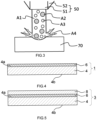
- a test solution obtained by mixing purified water, a dispersant, and a spherical silica whose average particle diameter is within ⁇ 8% of a standard of 4.2 ⁇ m in a ratio by mass (purified water:dispersant:spherical silica) 968:2:30 is placed into a container.
- "Whose average particle diameter is within ⁇ 8% of a standard of 4.2 ⁇ m” means, in other words, that the average particle diameter is 3.864 ⁇ m or more and 4.536 ⁇ m or less.
- the ejection of the test solution is temporarily stopped. After the ejection of the test solution is temporarily stopped, the cross-sectional profile is measured for the area of the optical film at which the spherical silica in the test solution has collided.
- An operation in which the three steps of a step of ejecting a predetermined amount of the test solution from the ejection hole, a step of temporarily stopping the ejection of the test solution after ejecting the predetermined amount of the test solution, and a step of measuring the cross-sectional profile after temporarily stopping the ejection of the test solution constitute one cycle is carried out until the depth of the cross-sectional profile exceeds 20 ⁇ m. Then, for each cycle until a depth of the cross-sectional profile of 20 ⁇ m, the erosion rate ( ⁇ m/g) of the optical film is calculated. The erosion rates of the optical film in the respective cycles until a depth of the cross-sectional profile of 20 ⁇ m are averaged, and thereby E0-20 is calculated.
- the test solution is placed into the container.
- the test solution in the container is delivered to a nozzle.
- Compressed air is delivered into the nozzle to accelerate the test solution within the nozzle, and any selected amount of the test solution is ejected from the ejection hole at the tip of the nozzle vertically onto an acrylic plate having a thickness of 2 mm, causing the spherical silica in the test solution to collide with the acrylic plate.
- the cross-sectional shape of the nozzle is a 1 mm ⁇ 1 mm square, and the distance between the ejection hole and the acrylic plate is set to 4 mm.
- the ejection of the test solution is temporarily stopped.
- the cross-sectional profile is measured for the area of the acrylic plate at which the spherical silica in the test solution has collided.
- the erosion rate ( ⁇ m/g) of the acrylic plate which is the depth ( ⁇ m) of the cross-sectional profile divided by the selected amount (g), is calculated.
- the erosion rate of the acrylic plate is within a range of ⁇ 5% of a standard of 1.88 ( ⁇ m/g)
- calibration is performed by adjusting the flow rates of the test solution and compressed air, the pressure of the compressed air, and the pressure of the test solution within the nozzle to bring the erosion rate of the acrylic plate within this range.
- the erosion rate is within ⁇ 5% of a standard of 1.88 ( ⁇ m/g)” means, in other words, that the erosion rate is 1.786 ( ⁇ m/g) or more and 1.974 ( ⁇ m/g) or less.
- the test solution used in the calibration is the same as the test solution used under the subsequent measurement conditions.
- the measuring instrument used in the calibration is the same as the measuring instrument used under the subsequent measurement conditions.
- An example of a difference between the calibration and the subsequent measurement conditions is that whereas the sample used in the calibration is an acrylic plate having a thickness of 2 mm, which is the standard sample, the sample used under the measurement conditions is an optical film.
- the acrylic plate having a thickness of 2 mm, which is the standard sample, is preferably a polymethyl methacrylate plate (PMMA plate).
- PMMA plate polymethyl methacrylate plate
- the acrylic plate is preferably one having an AcE of 1.786 ⁇ m/g or more and 1.974 ⁇ m/g or less.
- An example of the spherical silica in measurement conditions A below is model number "MSE-BS-5-3,” which is specified by Palmeso Co., Ltd.
- the test solution in the container is delivered to a nozzle.
- Compressed air is delivered into the nozzle to accelerate the test solution within the nozzle, and a predetermined amount of the test solution is ejected from the ejection hole at the tip of the nozzle vertically onto the acrylic plate, causing the spherical silica in the test solution to collide with the acrylic plate.
- the cross-sectional shape of the nozzle is a 1 mm ⁇ 1 mm square, and the distance between the ejection hole and the acrylic plate is set to 4 mm.
- the flow rate of the test solution is set to 100 ml/minute or more and 150 ml/minute or less
- the flow rate of the compressed air is set to 4.96 L/minute or more and 7.44 L/minute or less
- the pressure of the compressed air is set to 0.184 MPa or more and 0.277 MPa or less
- the pressure of the test solution within the nozzle is set to 0.169 MPa or more and 0.254 MPa or less.
- the ejection of the test solution is temporarily stopped.
- the cross-sectional profile is measured for the area of the acrylic plate at which the spherical silica in the test solution has collided.
- AcE (with the unit " ⁇ m/g"), which is the erosion rate of the acrylic plate, given by dividing the depth ( ⁇ m) of the cross-sectional profile by the amount of the test solution ejected (4 g), is calculated.
- FIG. 2 An example of a measuring instrument for the erosion rate like that in Fig. 2 is model number "MSE-A203" of Palmeso Co., Ltd.'s MSE testing apparatus.
- the dispersant is not particularly restricted, provided that the spherical silica can be dispersed with it.
- An example of a dispersant is Wako Pure Chemical Industries, Ltd.'s trade name "Demol N.”
- the "average particle diameter of the spherical silica” is that measured as a volume average d50 in a particle size distribution measurement by laser light diffraction (It is the so-called “median diameter.”).
- the range of the particle diameters indicating a frequency of 50 be within ⁇ 10% of a standard of 4.2 ⁇ m when the frequency of the particle diameter with the highest frequency is normalized to 100 in the results of the particle size distribution measurement.
- the “range of the particle diameters indicating a frequency of 50” is the range represented by "X - Y ( ⁇ m)" when "the particle diameter that indicates a frequency of 50 and is positioned in the positive direction relative to the particle diameter that indicates a frequency of 100" is defined as "X,” and "the particle diameter that indicates a frequency of 50 and is positioned in the negative direction relative to the particle diameter that indicates a frequency of 100” is defined as "Y.” It should be noted that the “range of the particle diameters indicating a frequency of 50” may be herein referred to as the "full width at half maximum of the particle size distribution.”
- MSE-BS-5-3 An example of a spherical silica whose average particle diameter is within ⁇ 8% of a standard of 4.2 ⁇ m is model number "MSE-BS-5-3," which is specified by Palmeso Co., Ltd.
- the test solution within the container is delivered into a nozzle (51).
- the test solution can be delivered to the nozzle through test solution piping (21). It is preferred that a flow meter (31) for measuring the flow rate of the test solution be placed between the container (11) and the nozzle (51).
- the flow rate of the test solution is set to the value adjusted through the calibration described above.
- the nozzle (51) is disposed within a housing (52) that constitutes an ejecting section (50).
- compressed air is delivered into the nozzle (51).
- the compressed air is delivered to the nozzle through compressed air piping (22). It is preferred that within the nozzle, the point to which the compressed air is delivered be upstream of the point to which the test solution is delivered. Upstream refers to the side farther from the ejection hole of the nozzle.
- the compressed air can be supplied using, for example, an air compressor, not illustrated.
- the flow rate and the pressure of the compressed air are set to the values adjusted through the calibration described above.
- the test solution When the compressed air is delivered into the nozzle (51), the test solution is accelerated by the compressed air while being mixed. The accelerated test solution is then ejected from an ejection hole at the tip of the nozzle (51) and vertically collides with the optical film (70). The optical film is worn primarily by spherical silica particles in the test solution.
- a pressure gauge (41) that measures the pressure of the test solution within the nozzle be disposed within the nozzle (51).
- the pressure gauge (41) is preferably located downstream of the point to which the compressed air is delivered and the point to which the test solution is delivered.
- the pressure of the test solution within the nozzle (51) is set to the value adjusted through the calibration described above.
- the test solution ejected from the ejection hole at the tip of the nozzle (51) is mixed with air and ejected in a mist-like form.
- the collision pressure of the spherical silica particles on the optical film can be reduced.
- the amount of wear on the optical film caused by a single spherical silica particle, therefore, can be reduced to an extremely small level.
- test solution contains water, which is superior in cooling effects, the deformation and alteration of the optical film caused by heat during collision can be virtually eliminated. That is, abnormal wear on the optical film can be virtually eliminated.
- the water also plays the role of washing the surface of the worn optical film to achieve stable wear.
- the water has roles such as accelerating the spherical silica particles and controlling the fluid of the test solution.
- the measurement conditions according to the present disclosure furthermore, specify the factors that affect the amount of wear on the optical film by setting the flow rate of the test solution supplied to the nozzle, the flow rate of the compressed air supplied to the nozzle, the pressure of the compressed air supplied to the nozzle, and the pressure of the test solution within the nozzle to the values adjusted through the calibration described above and by specifying the cross-sectional shape of the nozzle as a 1 mm ⁇ 1 mm square and specifying the distance between the ejection hole and the optical film as 4 mm.
- the distance is the distance denoted by "d" in Fig. 2 and represents the vertical distance between the ejection hole, which is the tip of the nozzle, and the optical film.
- the optical film (70) can be simply attached to a sample mounting platform (81) of the measuring instrument (90).
- the optical film (70) is preferably attached to the sample mounting platform (81) with a support (82), such as a stainless steel plate, interposed therebetween.
- the test solution ejected onto the optical film (70) is preferably collected at a receiving container (12) and returned to the container (11) via return piping (23). It is preferred that a return pump (24) be disposed between the receiving container (12) and the return piping (23).
- the ejection of the test solution be temporarily stopped after a predetermined amount of the test solution is ejected, and that the cross-sectional profile of the area of the optical film at which the spherical silica in the test solution has collided be measured after the ejection of the test solution is temporarily stopped.
- the cross-sectional profile refers to the cross-sectional shape of the optical film worn by the test solution.
- the optical film is worn primarily by spherical silica particles in the test solution.
- the cross-sectional profile can be measured using a cross-sectional profile acquisition section (60), for example of a surface shape measurement apparatus of stylus type or a surface shape measurement apparatus of laser interference type.
- the cross-sectional profile acquisition section (60) is typically positioned at a point apart from the optical film (70). It is, therefore, preferred that at least one of the optical film (70) or the cross-sectional profile acquisition section (60) be movable.
- the means for measuring the cross-sectional profile is the stylus type.
- an operation in which the three steps of a step of ejecting a predetermined amount of the test solution from the ejection hole, a step of temporarily stopping the ejection of the test solution after ejecting the predetermined amount of the test solution, and a step of measuring the cross-sectional profile after temporarily stopping the ejection of the test solution constitute one cycle is carried out until the depth of the cross-sectional profile exceeds 20 ⁇ m.
- the erosion rate of the optical film in each cycle can be measured, and variations in the erosion rate of the optical film can be calculated.
- the cycles described above may be continued even after the depth of the cross-sectional profile exceeds 20 ⁇ m, but preferably, the cycles are ended when the depth of the cross-sectional profile exceeds 20 ⁇ m.
- the reason for measurement until "a depth of 20 ⁇ m from the surface of the optical film,” furthermore, is that the tendency for the physical characteristics of an optical film to be readily variable in the vicinity of the surface but become more consistent toward the interior is considered.
- an erosion rate in a cycle can be calculated by dividing the increase in the depth ( ⁇ m) of the cross-sectional profile during that cycle by the amount (g) of the test solution ejected in that cycle.
- the depth ( ⁇ m) of the cross-sectional profile in a cycle is defined as the depth of the deepest point of the cross-sectional profile during that cycle.
- the amount of the test solution ejected in each cycle is "constant" in principle, but there may be slight variations between cycles.
- the amount of the test solution ejected in each cycle is preferably 0.5 g or more, more preferably 1.0 g or more, preferably 3.0 g or less, more preferably 2.0 g or less.
- the erosion rate ( ⁇ m/g) is calculated in each cycle until a depth of 20 ⁇ m of the cross-sectional profile. Then the erosion rates in the respective cycles until a depth of the cross-sectional profile of 20 ⁇ m are averaged, and thereby E0-20 (the average erosion rate until a depth of 20 ⁇ m from the surface of the optical film) is calculated.
- the cycles are conducted until the depth of the cross-sectional profile exceeds 20 ⁇ m; however, data from cycles after the depth of the cross-sectional profile exceeds 20 ⁇ m are excluded from the calculation of E0-20.
- optical films are more susceptible to damage when softer and less susceptible to damage when harder.
- Optical films furthermore, tend to have increased strength when stretched.
- uniaxially oriented optical films tend to exhibit better pencil hardness than cast optical films
- biaxially oriented optical films tend to exhibit better pencil hardness than uniaxially oriented optical films.
- Even biaxially oriented optical films have lacked sufficient pencil hardness in some cases.
- the inventors have studied the erosion rate as a measure of the pencil hardness of optical films. As mentioned above, optical films are more susceptible to damage when softer and less susceptible to damage when harder; therefore, it is expected that lower erosion rates can result in better pencil hardness. The inventors, however, have found that making the erosion rate (E0-20) as high as 0.80 ⁇ m/g or more can result in good pencil hardness of the optical film, contrary to the expectation. The inventors also discovered that regarding the erosion rate of optical films, biaxially oriented optical films are more likely to exhibit a high value than uniaxially oriented optical films, and that how good the pencil hardness of a biaxially oriented optical film is can be determined based on the erosion rate.
- a possible reason for the correlation between the erosion rate and the pencil hardness of an optical film is as follows.
- the test solution containing water and spherical silica
- the collision pressure of the spherical silica particles on the optical film is limited to a low level.
- the optical film is soft, therefore, it is likely that the stress from the collision of the spherical silica with the optical film is dispersed. As a result, the optical film is unlikely to be worn, leading to a low erosion rate.
- the optical film is hard, by contrast, it is unlikely that the stress from the collision of the spherical silica with the optical film is dispersed. As a result, the optical film is likely to be worn, leading to a high erosion rate.
- the differences in erosion rate among biaxially oriented optical films appear to stem from differences in the degree of molecular chain stretching and differences in the degree of molecular orientation.
- molecules are stretched in the plane in principle, but there can also be molecules that are locally insufficiently stretched in the plane.
- the inventors believe that when the proportion of such molecules that are locally insufficiently stretched in the plane increases, the biaxially oriented optical film becomes locally soft, leading to a reduced erosion rate.
- Even biaxially oriented optical films with similar in-plane phase differences furthermore, exhibit different erosion rates due to differences in local molecular orientation.
- E0-20 may be 0.80 ⁇ m/g or more, may be 0.85 ⁇ m/g or more, may be 0.90 ⁇ m/g or more, may be 0.95 ⁇ m/g or more, or may be 1.00 ⁇ m/g or more.
- E0-20 may be 3.00 ⁇ m/g or less, may be 2.50 ⁇ m/g or less, or may be 2.00 ⁇ m/g or less so that the optical film does not easily break.
- the peak-top temperature for the loss tangent (tan ⁇ ) of the optical film may be 90°C or above and 160°C or below. Such an optical film is superior in workability during heating.
- the peak-top temperature for tan ⁇ may be 92°C or above, may be 94°C or above, may be 96°C or above, or may be 100°C or above.
- the peak-top temperature for tan ⁇ may be 160°C or below, may be 155°C or below, or may be 150°C or below.
- the peak-top temperature for tan ⁇ typically corresponds to the glass transition temperature of the polyester contained in the optical film. By adjusting the glass transition temperature of the polyester, therefore, the peak-top temperature for tan ⁇ can be adjusted to fall within the above ranges.
- tan ⁇ is measured using a dynamic mechanical analyzer (DMA).
- DMA dynamic mechanical analyzer
- the temperature at which tan ⁇ reaches its maximum is defined as the peak-top temperature for tan ⁇ of the optical film. When two or more maxima of tan ⁇ are observed, the value at the lowest temperature is used.
- the measurement conditions are as follows. Measuring instrument, Rheogel-E4000 (manufactured by K.K. UBM), sample for measurement, 5 mm wide ⁇ 25 mm long; frequency, 10 Hz; chuck distance, 10 mm; measurement temperature range, 25°C to 250°C; temperature elevation rate, 2°C/min.
- the degree of crystallinity of the optical film may be 85% or less. Such an optical film exhibits good interlayer adhesion when the functional layer is placed on it.
- the degree of crystallinity of the optical film may be 60% or more, may be 65% or more, or may be 70% or more for the mechanical strength of the optical film.
- the degree of crystallinity of the optical film is a value measured by X-ray diffraction.
- the measurement conditions and calculation method for the degree of crystallinity are as follows.
- the degree of crystallinity of the optical film can be controlled by, for example, the drawing factors and the drawing temperatures. Specifically, the larger the drawing factors, the higher the degree of crystallinity. The smaller the drawing factors, the lower the degree of crystallinity.
- the optical film is, in the first embodiment, superior in gas barrier properties.
- the water vapor transmission rate of the optical film in an environment at a temperature of 40°C and a humidity of 90% RH as measured according to JIS K7129-2: 2019 may be 20 g/(m2 ⁇ 24 hr) or less, may be 15 g/(m2 ⁇ 24 hr) or less, or may be 10 g/(m2 ⁇ 24 hr) or less.
- the water vapor transmission rate can be measured using a water vapor permeation analyzer ("PERMATRAN," manufactured by Modern Controls, Inc.).
- the oxygen transmission rate of the optical film in an environment at a temperature of 25°C and a humidity of 50% RH as measured according to JIS K7126-2: 2006 may be 100 cc/(m2 ⁇ 24 hr ⁇ atm) or less, may be 80 cc/(m2 ⁇ 24 hr ⁇ atm) or less, or may be 50 cc/(m2 ⁇ 24 hr ⁇ atm) or less.
- the oxygen transmission rate can be measured using an oxygen permeation analyzer ("OX-TRAN I0/50A"), manufactured by Modern Controls, Inc.).
- the optical film according to the present disclosure is suitable as a film for use in image display devices.
- the optical film is suitable as a substrate for various functional films, such as a hard-coat film, an antiglare film, an antireflection film, an antifouling film, an antistatic film, and a polarizer-protecting film.
- the optical film according to the present disclosure may be an easily adhesive film including a polyester film and at least one easily adhesive layer provided on the polyester film.
- the easily adhesive layer may be provided solely on either one of the first surface or the second surface of the polyester film, or may be provided on both of the first surface and the second surface.
- Fig. 4 is a cross-sectional view illustrating an embodiment of an easily adhesive film 1 according to the present disclosure.
- the easily adhesive film 1 in Fig. 4 includes a polyester film 4 and an easily adhesive layer 6 in this order.
- the easily adhesive layer 6 is provided on the first surface 4a of the polyester film 4.
- thermoplastic resins such as polyester, polyurethane, and (meth)acrylic resins, and thermosetting resins, with thermoplastic resins being preferred.
- thermoplastic resins polyester and polyurethane are particularly preferred, and resins containing both of a polyester component and a polyurethane component are more preferred. With such resins, it is easier to reduce the difference in refractive index between the polyester film and the easily adhesive layer.
- the resin constituting the easily adhesive layer therefore, preferably contains both of a polyester component and a polyurethane component.
- the ratio by mass may be from 95:5 to 60:40 or may be from 90:10 to 60:40.
- the resin constituting the easily adhesive layer may be a biomass material-derived resin, may be a fossil fuel-derived resin, or may be a mixed resin including a biomass material-derived resin and a fossil fuel-derived resin.
- each of the aforementioned thermoplastic resins, such as polyester, polyurethane, and (meth)acrylic resins, and thermosetting resins may be a biomass material-derived resin, may be a fossil fuel-derived resin, or may be a mixed resin including a biomass material-derived resin and a fossil fuel-derived resin.
- An easily adhesive layer containing a biomass material-derived resin makes a great environmental contribution and exhibits high compatibility with a polyester film containing a biomass polyester and high conformity to the shape of that film.
- An optical film including such an easily adhesive layer therefore, is superior in workability.
- An optical film including an easily adhesive layer containing a fossil fuel-derived resin is superior in adhesion durability in a high-temperature and high-humidity environment.
- the biomass content of the easily adhesive layer may be, in the first embodiment, 10% or more, may be 12% or more, may be 15% or more, or may be 18% or more.
- the biomass content of the easily adhesive layer may be, in the first embodiment, 98% or less, may be 90% or less, may be 80% or less, may be 70% or less, may be 60% or less, or may be 50% or less.
- the easily adhesive layer can contain one such resin or two or more.
- the number-average molecular weight of the resin constituting the easily adhesive layer may be 10,000 or greater or may be 15,000 or greater.
- the number-average molecular weight of this resin may be 100,000 or less or may be 60,000 or less. With such resins, it can be made easier to reduce cohesive failures of the easily adhesive layer.
- a number-average molecular weight refers to a polystyrene-equivalent value measured by gel permeation chromatography according to JIS K7252-1: 2016.
- the glass transition temperature of the resin constituting the easily adhesive layer may be 30°C or above, may be 50°C or above, or may be 70°C or above.
- the glass transition temperature of this resin may be 120°C or below, may be 110°C or below, or may be 90°C or below.
- the glass transition temperature is the midpoint glass transition temperature as obtained by differential scanning calorimetry (DSC) according to JIS K7121: 2012.
- the glass transition temperature of the resin constituting the easily adhesive layer is 30°C or above, it can be made easier to reduce the occurrence of internal stress caused by the flow of the easily adhesive layer due to in-process heat.
- in-process heat include heat during a drying step for a functional layer coating solution and heat generated by warming during the attachment of an optical multilayer body, for example to a polarizer.
- the glass transition temperature of the resin constituting the easily adhesive layer is 120°C or below, it can be made easier to reduce the occurrence of stress caused by a difference in thermal behavior between the easily adhesive layer and the polyester film, and thus the formation of cracks, for example, in the easily adhesive layer induced by stress can be reduced.
- the easily adhesive layer may contain additives, such as refractive index modifiers, dyes, pigments, leveling agents, ultraviolet absorbers, antioxidants, and photostabilizers, and crosslinking agents for adjusting hardness or viscosity.
- additives such as refractive index modifiers, dyes, pigments, leveling agents, ultraviolet absorbers, antioxidants, and photostabilizers, and crosslinking agents for adjusting hardness or viscosity.
- the easily adhesive layer can contain one or two or more of such ingredients.
- crosslinking agents include xylylene diisocyanate crosslinking agents, isophorone diisocyanate crosslinking agents, and hexamethylene diisocyanate crosslinking agents and ionizing radiation-curable polyfunctional monomers.
- the easily adhesive layer may be formed by inline coating, in which the formation of the easily adhesive layer is performed during the formation of the polyester film, or may be formed by offline coating, in which the formation of the easily adhesive layer is performed after the formation of the polyester film.
- inline coating and offline coating it is preferred to use an easily adhesive layer coating solution, which contains the constituents of the easily adhesive layer. For example, by applying an easily adhesive layer coating solution to the polyester film using a common application method and drying it, the easily adhesive layer can be formed.
- the direction of the drying air during the formation of the easily adhesive layer is preferably opposite the direction of transport of the polyester film.
- the drying time of the easily adhesive layer coating solution can be shortened without excessively increasing the drying temperature.
- the drying time of the easily adhesive layer coating solution may be 120 seconds or less or may be 90 seconds or less. This drying time may be 15 seconds or more or may be 20 seconds or more.
- the drying time can be adjusted by the drying temperature and the velocity of the drying air. When the drying time is 120 seconds or less, the phase separation of the constituents of the easily adhesive layer can be reduced. Setting the drying time too short may cause the coating surface to become roughened and optical properties to degrade.
- the drying temperature for the easily adhesive layer coating solution may be 50°C or above or may be 60°C or above. This drying temperature may be 200°C or below or may be 150°C or below.
- the drying temperature for the easily adhesive layer coating solution may be 50°C or above or may be 60°C or above. This drying temperature may be 200°C or below or may be 150°C or below.
- the easily adhesive layer coating solution preferably contains at least one organic solvent to allow the constituents of the easily adhesive layer to dissolve or disperse and/or to adjust viscosity.
- organic solvents include ketones, such as acetone, methyl ethyl ketone, methyl isobutyl ketone, and cyclohexanone, ethers, such as dioxane and tetrahydrofuran, aliphatic hydrocarbons, such as hexane and heptane, alicyclic hydrocarbons, such as cyclohexane, aromatic hydrocarbons, such as toluene and xylene, halogenated hydrocarbons, such as dichloromethane and dichloroethane, esters, such as methyl acetate, ethyl acetate, propyl acetate, and butyl acetate, alcohols, such as isopropyl alcohol, butanol, and cyclohexanol, cellosolve
- the organic solvent in the easily adhesive layer coating solution preferably includes a solvent with a high evaporation rate.
- the drying time of the organic solvent in the easily adhesive layer coating solution is too short, the coating surface is likely to become roughened.
- an organic solvent with an extremely high evaporation rate refers to an organic solvent whose evaporation rate is 280 or greater when it is assumed that the evaporation rate of butyl acetate is 100.
- an organic solvent with a moderately high evaporation rate refers to an organic solvent whose evaporation rate is 150 or greater and less than 280 when it is assumed that the evaporation rate of butyl acetate is 100.
- the evaporation rate may be 320 or greater or may be 340 or greater.
- the evaporation rate may be 430 or less or may be 400 or less.
- Examples of organic solvents with extremely high evaporation rates include methyl ethyl ketone, whose evaporation rate is 370, and normal heptane, whose evaporation rate is 362.
- the evaporation rate may be 170 or greater or may be 180 or greater.
- the evaporation rate may be 250 or less or may be 220 or less.
- organic solvents with moderately high evaporation rates include toluene, whose evaporation rate is 200, and propyl acetate, whose evaporation rate is 214.
- the ratio by mass (organic solvents with extremely high evaporation rates:organic solvents with moderately high evaporation rates) may be from 50:50 to 90:10 or may be from 70:30 to 85:15.
- the solids concentration of this coating solution may be 2% by mass or more or may be 4% by mass or more.
- the solids concentration of this coating solution may be 30% by mass or less or may be 15% by mass or less.
- the thickness of the easily adhesive layer may be 10 nm or more, may be 20 nm or more, or may be 50 nm or more.
- the thickness of the easily adhesive layer may be 600 nm or less, may be 300 nm or less, or may be 200 nm or less. If the reduction of interference fringes is intended, a smaller thickness of the easily adhesive layer is more preferred.
- Examples of applications of the optical film according to the present disclosure include an optical multilayer body that includes the optical film according to the present disclosure and at least one functional layer provided on the film, and an optical multilayer body that includes the easily adhesive film according to the present disclosure and at least one functional layer provided on the easily adhesive layer of the film.
- the functional layer may be provided on one surface of the optical film or may be provided on both surfaces.
- an optical multilayer body is a multilayer body through which light can be transmitted.
- Fig. 5 is a cross-sectional view illustrating an embodiment of an optical multilayer body 3 according to the present disclosure.
- the optical multilayer body 3 in Fig. 3 includes a polyester film 4, an easily adhesive layer 6, and a functional layer 8 in this order.
- the easily adhesive layer 6 and the functional layer 8 are provided on the first surface 4a of the polyester film 4.
- the easily adhesive layer 6 does not need to be provided.
- the total transmittance of the optical multilayer body may be 50% or more, may be 60% or more, may be 70% or more, may be 80% or more, may be 85% or more, or may be 90% or more.
- the total transmittance is measured according to JIS K7361-1: 1997.
- the haze of the optical multilayer body may be 10.0% or less, may be 7.0% or less, may be 5.0% or less, may be 4.0% or less, or may be 3.0% or less.
- the haze of the optical multilayer body may be 0.1% or more, may be 0.2% or more, or may be 0.3% or more. The haze is measured according to JIS K7136: 2000.
- the total transmittance and haze are, in the case of an optical multilayer body including a polyester film, optionally an easily adhesive layer, and a functional layer in this order, measured with the light incident surface being the polyester film surface.
- the optical multilayer body according to the present disclosure may include one functional layer or may include two or more. That is, two or more functional layers may be stacked on the optical film or, in the first embodiment, may be stacked on the easily adhesive layer of the easily adhesive film.
- a functional layer is a layer that imparts functions such as scratch resistance, antiglare properties, antireflection properties, retardation properties, antifouling properties, antistatic properties, and electrical conductivity to an optical multilayer body.
- Examples of functional layers include a hard-coat layer, an antiglare layer, antireflection layers (e.g., a low-refractive-index layer, a high-refractive-index layer, and a structure in which they are stacked), a retardation layer, an antifouling layer, an antistatic layer, and an electrically conductive layer.
- a functional layer may have multiple functions within a single layer.
- a hard-coat layer may additionally have at least one function selected from antiglare properties, antireflection properties, retardation properties, antifouling properties, antistatic properties, and electrical conductivity.
- Examples of functional layers include the following (1) to (12).
- the left side indicates the layer positioned on the optical film side.
- the functional layer in contact with the optical film preferably contains a cured form of at least one ionizing radiation-curable ingredient.
- the functional layer in contact with the optical film is preferably a hard-coat layer. With the inclusion of a cured form of an ionizing radiation-curable ingredient in the functional layer in contact with the optical film, it can be made easier to achieve high pencil hardness of the optical multilayer body.
- the functional layer contains, for example, at least one binder resin and optionally at least one additive.
- the functional layer can contain one or two or more binder resins.
- the functional layer can contain one or two or more additives.
- the functional layer preferably contains a cured form of at least one curable ingredient as a binder resin.
- the functional layer can be formed using, for example, a curable composition that contains at least one curable ingredient and optionally additives.
- the curable composition may further contain an organic solvent. Specific examples of organic solvents are as mentioned above as examples for the easily adhesive layer coating solution.
- Examples of cured forms of curable ingredients include a cured form of a thermosetting ingredient and a cured form of an ionizing radiation-curable ingredient, with a cured form of an ionizing radiation-curable ingredient being preferred.
- the percentage of the cured form of the curable ingredient to all binder resins in the functional layer may be 60% by mass or more, may be 70% by mass or more, may be 80% by mass or more, may be 90% by mass or more, or may be 95% by mass or more.
- thermosetting ingredients include thermosetting resins.
- thermosetting resins include phenolic resins, urea resins, melamine resins, melamine-urea co-condensed resins, diallyl phthalate resins, aminoalkyd resins, epoxy resins, unsaturated (meth)acrylic resins, unsaturated polyurethane resins, unsaturated polyester resins, and silicone resins.
- a curing agent may be used.
- An example of an ionizing radiation-curable ingredient is a compound having an ionizing radiation-curable functional group.
- a compound having an ionizing radiation-curable functional group may be herein referred to as an ionizing radiation-curable compound.
- Ionizing radiation refers to electromagnetic waves or charged particle beams that have an energy quantum capable of polymerizing or crosslinking molecules.
- ionizing radiation is typically ultraviolet radiation or an electron beam, electromagnetic waves such as X-rays and y-rays and charged particle beams such as ⁇ -rays and ion beams can also be used.
- ionizing radiation-curable functional groups include ethylenically unsaturated groups, such as a (meth)acryloyl group, a vinyl group, and an allyl group, and an epoxy group and an oxetanyl group.
- ethylenically unsaturated groups such as a (meth)acryloyl group, a vinyl group, and an allyl group, and an epoxy group and an oxetanyl group.
- compounds having an ethylenically unsaturated group are preferred, compounds having two or more ethylenically unsaturated groups are more preferred, and polyfunctional (meth)acrylates having two or more ethylenically unsaturated groups are even more preferred.
- a (meth)acrylate refers to an acrylate or methacrylate
- (meth)acrylic acid refers to acrylic acid or methacrylic acid
- a (meth)acryloyl group refers to an acryloyl group or methacryloyl group.
- polyfunctional (meth)acrylates both monomers and oligomers can be used.
- the ionizing radiation-curable ingredient it is preferred to use at least a polyfunctional (meth)acrylate oligomer. That is, the functional layer preferably contains a cured form of a polyfunctional (meth)acrylate oligomer as a binder resin. With a cured form of a polyfunctional (meth)acrylate oligomer, excessive curing shrinkage of the functional layer can be reduced while achieving good surface hardness of the optical multilayer body.
- the functional layer preferably contains cured forms of a polyfunctional (meth)acrylate oligomer and a polyfunctional (meth)acrylate monomer as binder resins.
- the ratio by mass between the oligomer and the monomer may be from 5:95 to 95:5, may be from 50:50 to 85:15, or may be from 60:40 to 80:20.
- polyfunctional (meth)acrylate oligomers examples include urethane (meth)acrylate, epoxy (meth)acrylate, polyester (meth)acrylate, and polyether (meth)acrylate.
- Urethane (meth)acrylate is obtained through, for example, the reaction of a polyol and a polyisocyanate with a hydroxy-containing (meth)acrylate.
- the polyfunctional (meth)acrylate oligomer may be a (meth)acrylate oligomer having two or more and twelve or fewer functional groups.
- the weight-average molecular weight of the polyfunctional (meth)acrylate oligomer may be 250 or more, may be 300 or more, or may be 1,000 or more. This weight-average molecular weight may be 5,000 or less or may be 3,000 or less. When the weight-average molecular weight of the oligomer is 250 or more, it is easier to reduce excessive curing shrinkage of the functional layer. When the weight-average molecular weight of the oligomer is 5,000 or less, it is easier to limit a decrease in surface hardness.
- a weight-average molecular weight refers to a polystyrene-equivalent value measured by gel permeation chromatography according to JIS K7252-1: 2016.
- polyfunctional (meth)acrylate monomers examples include bifunctional (meth)acrylate monomers and trifunctional and higher-functionality (meth)acrylate monomers.
- bifunctional (meth)acrylate monomers include ethylene glycol di(meth)acrylate, polyethylene glycol di(meth)acrylate, polybutylene glycol di(meth)acrylate, isocyanuric acid di(meth)acrylate, bisphenol A tetraethoxydi(meth)acrylate, bisphenol A tetrapropoxydi(meth)acrylate, and 1,6-hexanediol di(meth)acrylate.
- trifunctional and higher-functionality (meth)acrylate monomers include trimethylolpropane tri(meth)acrylate, pentaerythritol tri(meth)acrylate, pentaerythritol tetra(meth)acrylate, dipentaerythritol hexa(meth)acrylate, dipentaerythritol tetra(meth)acrylate, and isocyanuric acid-modified tri(meth)acrylate.
- the polyfunctional (meth)acrylate monomer may have part of its molecular backbone modified.
- a (meth)acrylate monomer modified with a structure such as ethylene oxide, propylene oxide, caprolactone, isocyanuric acid, an alkyl, a cyclic alkyl, an aromatic, or bisphenol may be used.
- a monofunctional (meth)acrylate may additionally be used. Through this, the viscosity of the ingredient, for example, can be adjusted.
- monofunctional (meth)acrylates include methyl (meth)acrylate, ethyl (meth)acrylate, propyl (meth)acrylate, butyl (meth)acrylate, pentyl (meth)acrylate, hexyl (meth)acrylate, cyclohexyl (meth)acrylate, 2-ethylhexyl (meth)acrylate, lauryl (meth)acrylate, stearyl (meth)acrylate, and isobornyl (meth)acrylate.
- the functional layer may contain a biomass material-derived ingredient or may be free of biomass material-derived ingredients.
- the biomass content of the functional layer is, in the first embodiment, 10% or more, may be 15% or more, may be 20% or more, may be 25% or more, or may be 30% or more. With an optical multilayer body including such a functional layer, the reduction of environmental impacts can be sought.
- a functional layer having such a biomass content can be formed using, for example, at least a (meth)acrylate having a biomass material-derived group (hereinafter also referred to as "a biomass (meth)acrylate").
- a biomass (meth)acrylate For example, an ionizing radiation-curable ingredient that contains at least a biomass (meth)acrylate as an ionizing radiation-curable compound as mentioned above is used.
- An example of a biomass (meth)acrylate is a (meth)acrylate having a biomass material-derived alkyl group, which is an ester of a biomass material-derived alcohol and biomass material-derived (meth)acrylic acid or (meth)acrylic acid not derived from a biomass material.
- biomass material-derived alcohols include alcohols containing 1 or more and 36 or fewer carbons.
- biomass material-derived alcohols include biomass ethanol and alcohols derived from vegetable raw materials, such as palm oil, palm kernel oil, and coconut oil. When the number of carbons in a biomass material-derived alcohol is three or more, this alcohol may be linear-chain or may have branching.
- the biomass material-derived alcohol may be a saturated aliphatic alcohol containing 6 or more and 36 or fewer carbons, may be a saturated aliphatic alcohol containing 12 or more and 20 or fewer carbons, or may be a saturated aliphatic alcohol containing 16 or more and 18 or fewer carbons.
- saturated aliphatic alcohols include linear-chain aliphatic alcohols, such as lauryl alcohol, cetyl alcohol, stearyl alcohol, cetearyl alcohol, and behenyl alcohol.
- alicyclic alcohols containing ten carbons are also known, with an example being isobornyl alcohol, which is extracted from trees. Glycerol is also an example of a natural alcohol.
- biomass (meth)acrylates include lauryl (meth)acrylate, cetyl (meth)acrylate, stearyl (meth)acrylate, cetearyl (meth)acrylate, behenyl (meth)acrylate, isobornyl (meth)acrylate, and (poly)glycerol (meth)acrylates.
- Soybean oil-modified epoxy (meth)acrylate and rosin-modified epoxy (meth)acrylate are also included.
- Examples of (poly)glycerol (meth)acrylates include glycerol (meth)acrylate, glycerol di(meth)acrylate, glycerol tri(meth)acrylate, diglycerol tri(meth)acrylate, and diglycerol tetra(meth)acrylate and (poly)alkylene oxide-modified forms thereof, such as (poly)ethylene oxide-modified forms and (poly)propylene oxide-modified forms.
- biomass (meth)acrylates also include a urethane (meth)acrylate that is the product of the reaction of a polyol and a polyisocyanate with a hydroxy-containing (meth)acrylate and in which at least one of the polyol, polyisocyanate, or hydroxy-containing (meth)acrylate contains a biomass material-derived component.
- polyols examples include polyester polyols, polyether polyols, and polycarbonate polyols.
- biomass material-derived polyols examples include such types of polyols obtained using biomass material-derived ingredient(s) as at least a subset of their raw materials.
- polyisocyanates include aromatic diisocyanates, aliphatic diisocyanates, and alicyclic diisocyanates.
- aromatic diisocyanates include aromatic diisocyanates such as toluene-2,4-diisocyanate, 4-methoxy-1,3-phenylene diisocyanate, 4-isopropyl-1,3-phenylene diisocyanate, 4-chloro-1,3-phenylene diisocyanate, 4-butoxy-1,3-phenylene diisocyanate, 2,4-diisocyanate diphenyl ether, 4,4'-methylenebis(phenylene isocyanate) (MDI), durylene diisocyanate, tolidine diisocyanate, diphenylmethane diisocyanate, xylylene diisocyanate (XDI), 1,5-naphthalene diisocyanate, benzidine diisocyanate, o-nitrobenzidine diisocyanate, and
- aliphatic diisocyanates include methylene diisocyanate, 1,4-tetramethylene diisocyanate, 1,6-hexamethylene diisocyanate, and 1,10-decamethylene diisocyanate.
- alicyclic diisocyanates include 1,4-cyclohexylene diisocyanate, 4,4-methylenebis(cyclohexyl isocyanate), 1,5-tetrahydronaphthalene diisocyanate, isophorone diisocyanate, hydrogenated MDI, and hydrogenated XDI.
- biomass material-derived polyisocyanates include those obtained by turning a vegetable-derived dicarboxylic acid into an acid amide, converting it into terminal amino groups by reducing it, and then allowing the amino groups to react with phosgene to convert them into isocyanate groups.
- biomass material-derived diisocyanates include dimer acid diisocyanate (DDI), octamethylene diisocyanate, and decamethylene diisocyanate.
- lysine diisocyanate is obtained by turning the carboxy group in lysine into the methyl ester and then converting the amino groups into isocyanate groups.
- 1,5-Pentamethylene diisocyanate is obtained by decarboxylating the carboxy group in lysine and then converting the amino groups into isocyanate groups.
- hydroxy-containing (meth)acrylates include compounds having one (meth)acryloyl group, such as hydroxyethyl (meth)acrylate, hydroxypropyl (meth)acrylate, hydroxybutyl (meth)acrylate, and 2-hydroxy-3-phenoxypropyl (meth)acrylate, and compounds having two or more (meth)acryloyl groups, such as glycerol di(meth)acrylate, pentaerythritol tri(meth)acrylate, ditrimethylolpropane tri(meth)acrylate, dipentaerythritol penta(meth)acrylate, and sorbitol penta(meth)acrylate.
- one (meth)acryloyl group such as hydroxyethyl (meth)acrylate, hydroxypropyl (meth)acrylate, hydroxybutyl (meth)acrylate, and 2-hydroxy-3-phenoxypropyl (meth)acrylate
- the biomass content of the biomass (meth)acrylate is, in the first embodiment, 10% or more, may be 15% or more, may be 20% or more, may be 25% or more, or may be 30% or more.
- the curable composition may contain a polymer to adjust viscosity, in addition to the curable ingredient.
- a polymer is one having a weight-average molecular weight of more than 5,000 and 200,000 or less.
- the curable composition may further contain a vegetable-derived resin. Examples of such resins include rosin-modified alkyd resins, rosin-modified maleic acid resins, rosin ester resins, rosin-modified phenolic resins, terpene resins, fatty acid-modified rosin resins, and vegetable oil-modified alkyd resins.
- the curable composition preferably further contains a photoinitiator and/or a photoaccelerator.
- photoinitiators include acetophenones, benzophenones, ⁇ -hydroxyalkylphenones, Michler's ketones, benzoins, benzyl dimethyl ketals, benzoyl benzoates, ⁇ -acyl oxime esters, anthraquinones, halogenoketones, and thioxanthones.
- the curing rate can be increased by mitigating the inhibition of polymerization by air during curing.
- photoaccelerators include isoamyl p-dimethylaminobenzoate and ethyl p-dimethylaminobenzoate.
- the functional layer may optionally contain additives.
- the additives can be selected as appropriate from commonly used materials according to the functions to be imparted to the functional layer.
- additives include particles, refractive index adjusting-materials, antifouling agents, antistatic agents, electrically conductive fibers, leveling agents, ultraviolet absorbers, antioxidants, and photostabilizers.
- the functional layer preferably contains particles as an additive.
- the functional layer preferably contains refractive index-adjusting materials, such as high-refractive-index materials and low-refractive-index materials, as additives.
- the functional layer preferably contains an antifouling agent as an additive.
- antistatic properties are imparted to the functional layer
- the functional layer preferably contains an antistatic agent as an additive.
- electrical conductivity is imparted to the functional layer, the functional layer preferably contains electrically conductive fiber as an additive.
- the functional layer may contain nanoparticles as an additive.
- a functional layer containing nanoparticles is, for example, of low refractive index and superior in hardness.
- nanoparticles refers to particles whose average primary particle diameter is less than 1000 nm.
- the average primary particle diameter is determined by selecting 20 particles in a cross-sectional image of the functional layer taken using a scanning electron microscope (SEM) and measuring their primary particle diameters; the arithmetic mean of the primary particle diameters of the 20 particles is defined as the average primary particle diameter.
- the primary particle diameter is obtained by measuring the maximum distance between two points on the outer periphery of the particle (major axis) and the minimum distance (minor axis) and averaging the major axis and the minor axis.
- the nanoparticles may be inorganic particles, may be organic particles, or may be mixed particles including both.
- silica particles An example of inorganic particles is silica particles.
- the silica particles may be reactive silica particles.
- Reactive silica particles are silica particles capable of constituting a crosslink structure with ionizing radiation-curable ingredients, and functional layers such as a hard-coat layer can achieve sufficiently high hardness by containing reactive silica particles.
- the reactive silica particles preferably have a reactive functional group on the surface of the particles. Examples of reactive functional groups include the ionizing radiation-curable functional groups named earlier.
- organic particles examples include polymethyl methacrylate particles, polyacrylic-styrene copolymer particles, polystyrene particles, crosslinked polystyrene particles, polycarbonate particles, polyester resin particles, polyvinyl chloride particles, melamine resin particles, benzoguanamine-melamine formaldehyde particles, silicone particles, and fluoropolymer particles.
- an inorganic ingredient may be mixed.
- silica particles are particularly preferred.
- the particles may be in any of, for example, a perfectly spherical shape, an ellipsoidal shape, or an indefinite shape.
- the particles furthermore, may be hollow particles or nonhollow particles.
- the average primary particle diameter of the nanoparticles can be selected according to the physical characteristics of the functional layer intended to be improved. Types of nanoparticles with different average primary particle diameters or types of nanoparticles in different shapes may be used as a mixture.
- the average primary particle diameter of the nanoparticles may be, in the first embodiment, 5 nm or more and 100 nm or less. As long as the average primary particle diameter is 100 nm or less, the hardness of functional layers such as a hard-coat layer can be improved without forming large irregularities on the surface of the functional layers.
- the average primary particle diameter of the nanoparticles may be, in the first embodiment, more than 100 nm, may be more than 100 nm and 600 nm or less, or may be more than 100 nm and 350 nm or less.
- a functional layer containing nanoparticles having an average primary particle diameter of more than 100 nm is superior in anti-blocking properties.
- the amount of nanoparticles in functional layers such as a hard-coat may be 10 parts by mass or more, may be 15 parts by mass or more, may be 20 parts by mass or more, may be 60 parts by mass or less, may be 50 parts by mass or less, or may be 40 parts by mass or less, per 100 parts by mass of the binder resin.
- An antiglare layer contains, in the first embodiment, at least one binder resin as described above and particles.
- the particles may be either organic particles or inorganic particles.
- organic particles include particles made of organic materials such as polymethyl methacrylate, polyacrylic-styrene copolymers, melamine resins, polycarbonate, polystyrene, polyvinyl chloride, benzoguanamine-melamine-formaldehyde condensates, silicone, fluoropolymers, and polyester resins.
- examples of inorganic particles include particles made of inorganic materials such as silica, alumina, antimony, zirconia, and titania.
- the amount of particles in the antiglare layer is, for example, 1 part by mass or more and 100 parts by mass or less per 100 parts by mass of the binder resin.
- an antireflection layer may have a single-layer structure or may have a multilayer structure.
- An example of an antireflection layer having a single layer is a low-refractive-index layer.
- Examples of antireflection layers having a multilayer structure include a two-layer configuration of a high-refractive-index layer and a low-refractive-index layer, and also include configurations with three or more layers.
- the refractive index of the low-refractive-index layer is, for example, 1.10 or greater and 1.48 or less.
- the thickness of the low-refractive-index layer is, for example, 80 nm or more and 120 nm or less.
- the low-refractive-index layer may contain, in the first embodiment, at least one binder resin as described above and hollow particles, and may further contain nonhollow particles.
- the materials for the hollow particles and the nonhollow particles may be, for example, either inorganic compounds, such as silica and magnesium fluoride, or organic compounds, with silica being preferred.
- silica for use as the hollow particles, therefore, hollow silica particles are preferred, and for use as the nonhollow particles, nonhollow silica particles are preferred.
- the amount of hollow silica particles in the low-refractive-index layer is, for example, 100 parts by mass or more and 400 parts by mass or less per 100 parts by mass of the binder resin.
- the amount of nonhollow silica particles in the low-refractive-index layer is, for example, 90 parts by mass or more and 200 parts by mass or less per 100 parts by mass of the binder resin.
- the refractive index of the high-refractive-index layer is, for example, 1.53 or greater and 1.85 or less.
- the thickness of the high-refractive-index layer is, for example, 50 nm or more and 200 nm or less.
- the high-refractive-index layer contains, in the first embodiment, at least one binder resin as described above and high-refractive-index particles.
- high-refractive-index particles include antimony pentoxide, zinc oxide, titanium oxide, cerium oxide, tin-doped indium oxide, antimony-doped tin oxide, yttrium oxide, and zirconium oxide.
- the amount of high-refractive-index particles in the high-refractive-index layer is, for example, 10 parts by mass or more and 500 parts by mass or less per 100 parts by mass of the binder resin.
- An antifouling layer contains, in the first embodiment, at least one binder resin as described above and an antifouling agent.
- antifouling agent include fluoropolymers, silicone resins, and fluoro-silicone copolymeric resins.
- the amount of the antifouling agent in the antifouling layer is, for example, 5% by mass or more and 30% by mass or less of the total solids content of the antifouling layer.
- An electrically conductive layer contains, in the first embodiment, at least one optically transparent resin as a binder resin as described above and multiple filaments of electrically conductive fiber placed in the optically transparent resin.
- Electrically conductive fiber is a substance having electrical conductivity and also having a shape in which the length is sufficiently large compared to the thickness (e.g., the diameter). For example, substances that have electrical conductivity and whose length is equal to or greater than approximately fivefold the thickness are included as electrically conductive fibers.
- An electrically conductive layer refers to a layer that contains an optically transparent resin and multiple filaments of electrically conductive fiber placed in the optically transparent resin and is capable of conducting electricity from its surface.
- the filament diameter of the electrically conductive fiber is, for example, 10 nm or more and 200 nm or less.
- the filament length of the electrically conductive fiber is, for example, 30 ⁇ m or more, and its upper limit is not particularly limited.
- Examples of electrically conductive fibers include electrically conductive carbon fiber, metal fibers, such as metal nanowires, metal-coated organic fibers, metal-coated inorganic fibers, and carbon nanotubes.
- a large part of the electrically conductive fiber may be present on the side closer to the optical film than the position at half the thickness of the electrically conductive layer.
- the electrically conductive fiber is also present on the side closer to the surface than the position at half the thickness of the electrically conductive layer and on the surface of the electrically conductive layer as a result of the rest of the electrically conductive fiber accumulating on the large part of the electrically conductive fiber.
- the electrically conductive layer is electrically capable of conducting electricity from its surface, and, furthermore, filaments of the electrically conductive fiber are in contact with each other in the thickness direction of the electrically conductive layer.
- the functional layer may include, for example, a retardation layer or may include an alignment layer and a retardation layer provided on the alignment layer.
- the alignment layer has the role of facilitating the alignment of a liquid crystal compound within the retardation layer when the retardation layer is formed by applying, drying, and curing a composition for forming the retardation layer.
- the retardation layer contains a liquid crystal compound or has a constituent unit derived from the liquid crystal compound.
- liquid crystal compounds examples include rod-like liquid crystal compounds, such as nematic liquid crystal compounds and smectic liquid crystal compounds, cholesteric liquid crystal compounds, and discotic liquid crystal compounds.
- the liquid crystal compound is preferably a polymerizable liquid crystal compound because this enables immobilization through polymerization.
- the retardation layer is preferably a cured form of a composition for forming the retardation layer that contains a polymerizable liquid crystal compound.
- Polymerizable liquid crystal compounds are liquid crystal compounds having at least one polymerizable group, and examples include monofunctional liquid crystal compounds, which have one polymerizable group, and polyfunctional liquid crystal compounds, which have two or more polymerizable groups. Of these, polyfunctional liquid crystal compounds are particularly preferred, polyfunctional liquid crystal compounds in which the number of polymerizable groups is two or three are more preferred, and polyfunctional liquid crystal compounds in which the number of polymerizable groups is two is even more preferred.
- Polymerizable groups are groups that can polymerize in response to irradiation with active energy radiation, such as ultraviolet radiation or electron beams, and examples include groups containing an ethylenically unsaturated double bond, such as a vinyl group, an acryloyl group, and a methacryloyl group.
- the liquid crystal compound is preferably immobilized in any alignment state of vertical alignment or homeotropic alignment, horizontal alignment or homogeneous alignment, hybrid alignment, and tilted alignment.
- the major axis of a rod-like liquid crystal compound be substantially horizontal with respect to the surface of the retardation layer.
- the discotic plane of a discotic liquid crystal compound be substantially perpendicular to the surface of the retardation layer.
- rod-like liquid crystal compounds examples include azomethines, azoxys, cyanobiphenyls, cyanophenyl esters, benzoates, phenyl cyclohexanecarboxylates, cyanophenylcyclohexanes, cyano-substituted phenylpyrimidines, alkoxy-substituted phenylpyrimidines, phenyldioxanes, tolans, and alkenyl cyclohexyl benzonitriles.
- Rod-like liquid crystal compounds that can be used include not only such small-molecule liquid crystal compounds but also polymeric liquid crystal compounds.
- the percentage of the liquid crystal compound in the composition for forming the retardation layer may be 60% by mass or more, may be 65% by mass or more, may be 99.9% by mass or less, or may be 98% by mass or less in all solids in the composition for forming the retardation layer.
- the percentage of constituent units derived from the liquid crystal compound in the retardation layer may be 60% by mass or more, may be 65% by mass or more, may be 99.9% by mass or less, or may be 98% by mass or less.
- the aligned liquid crystal compound is preferably immobilized through a polymerization reaction while maintaining its alignment state.
- the composition for forming the retardation layer therefore, preferably contains a photoinitiator.
- photoinitiators include acetophenone, benzophenone, ⁇ -hydroxyalkylphenones, Michler's ketone, benzoin, benzyl dimethyl ketal, benzoyl benzoate, ⁇ -acyl oxime esters, and thioxanthones.
- the amount of the photoinitiator may be 0.01% by mass or more, may be 0.5% by mass or more, may be 20% by mass or less, or may be 5% by mass or less of the total solids content of the composition for forming the retardation layer.
- the composition for forming the retardation layer typically contains an organic solvent.
- the amount of the solvent in the composition for forming the retardation layer may be 50% by mass or more, may be 70% by mass or more, may be 90% by mass or less, or may be 80% by mass or less in the composition for forming the retardation layer.
- the retardation layer is preferably a ⁇ /2 retardation layer or a ⁇ /4 retardation layer.
- the retardation layer may be, for example, a positive A layer or may be a positive C layer.
- a positive A layer is a layer that satisfies the relationship Nx > N ⁇ ⁇ Nz when the refractive index in the X-axis direction, which is the axial direction with the highest refractive index within the plane of the retardation layer, is defined as Nx, the refractive index in the Y-axis direction, which is the direction that is perpendicular to the X-axis within the plane of the retardation layer, is defined as Ny, and the refractive index in the thickness direction of the retardation layer is defined as Nz.
- a positive C layer is a layer that satisfies the relationship Nx ⁇ Ny ⁇ Nz.
- the liquid crystal compound that forms a positive A layer can be a liquid crystal compound capable of homogeneous alignment.
- Homogeneous alignment refers to a state in which the major axis of the molecules of the liquid crystal compound (the axis extending in the direction in which the backbone of the liquid crystal compound extends) is aligned in the horizontal direction with respect to the layer.
- Examples of liquid crystal compounds that can form a positive A layer include a rod-like liquid crystal material and a discotic liquid crystal material, with a rod-like liquid crystal material being preferred.
- the rod-like liquid crystal compound furthermore, may have a side-chain structure to ensure that the retardation layer is one exhibiting reverse dispersion, which will be described later.
- the liquid crystal compound that forms a positive C layer can be a liquid crystal compound capable of homeotropic alignment.
- Homeotropic alignment refers to a state in which the major axis of the molecules of the liquid crystal compound (the axis extending in the direction in which the backbone of the liquid crystal compound extends) is aligned in the vertical alignment with respect to the layer.
- a rod-like liquid crystal compound is preferred.
- the rod-like liquid crystal compound furthermore, may have a side-chain structure to ensure that the retardation layer is one exhibiting reverse dispersion.
- the retardation layer may exhibit normal dispersion or may exhibit reverse dispersion.
- Reverse dispersion refers to properties in which the phase difference given to the transmitted light increases with increasing wavelength of the transmitted light, specifically referring to properties in which the relationship between the retardation at a wavelength of 450 nm (Re450) and the retardation at a wavelength of 550 nm (Re550) is Re450 ⁇ Re550.
- Normal dispersion refers to properties in which Re450 > Re550.
- the thickness of the retardation layer can be adjusted as appropriate considering the phase difference to be imparted.
- the thickness of the retardation layer may be 0.01 ⁇ m or more, may be 0.1 ⁇ m or more, may be 0.5 ⁇ m or more, may be 10 ⁇ m or less, may be 5 ⁇ m or less, or may be 3 ⁇ m or less.
- the retardation layer can be formed by, for example, applying, drying, and curing a composition for forming the retardation layer.
- the composition for forming the retardation layer is preferably applied to an alignment film.
- the alignment layer can be formed by, for example, applying a composition for forming the alignment layer to a transparent substrate and imparting anchoring strength.
- the composition for forming the alignment layer can be selected as appropriate from those known in the related art, such as photodimerizable materials, and used. Examples of means for imparting anchoring strength to the alignment layer include photoalignment, rubbing, and shaping.
- the thickness of the alignment layer may be 1 nm or more, may be 60 nm or more, may be 100 nm or more, may be 1000 nm or less, or may be 300 nm or less.
- the retardation layer may be a transfer body detachable from the alignment layer or transparent substrate.
- an optical multilayer body having a retardation layer is in the aforementioned sheet-shaped form or the roll-shaped form, which is a long sheet wound into a roll, the presence of a substrate in the optical multilayer body is more advantageous because in that case manufacturing problems can be reduced.
- the retardation layer may be disposed at a selected position of a surface plate, a polarizing plate, and an image display device, each of which will be described later, and may be used simultaneously with other functional layers or optical multilayer bodies.
- the functional layer is formed as follows, for example.
- a curable composition is applied to the optical film to the desired thickness, through which a coating (uncured resin layer) is formed.
- the organic solvent is removed through drying.
- the drying conditions are, for example, 10 seconds or more and 10 minutes or less at 40°C or above and 120°C or below.
- curing is initiated by heating the coating at a temperature required for curing.
- the curable composition contains an ionizing radiation-curable ingredient, curing is initiated by irradiating the coating with ionizing radiation. In such a manner, the functional layer can be formed.
- ultraviolet radiation When ultraviolet radiation is used as the ionizing radiation, it is preferred to, for example, irradiate at least the coating with ultraviolet radiation having a wavelength of 190 nm or more and 380 nm or less.
- ultraviolet radiation sources include a xenon lamp, a low-pressure mercury-vapor lamp, a high-pressure mercury-vapor lamp, an ultrahigh-pressure mercury-vapor lamp, a metal halide lamp, a carbon arc lamp, and a tungsten lamp.
- the amount of irradiation light is, for example, 10 mJ/cm2 or more and 350 mJ/cm2 or less.
- the thickness of the functional layer can be selected as appropriate according to the functions to be imparted.
- the thickness of the functional layer may be 0.05 ⁇ m or more, may be 0.1 ⁇ m or more, may be 0.5 ⁇ m or more, may be 1 ⁇ m or more, or may be 2 ⁇ m or more.
- the thickness of the functional layer may be 100 ⁇ m or less, may be 50 ⁇ m or less, may be 30 ⁇ m or less, may be 20 ⁇ m or less, or may be 10 ⁇ m or less.
- the above thickness of the functional layer represents the total thickness of the functional layers.
- the optical film (including the easily adhesive film described above) and the optical multilayer body according to the first embodiment of the present disclosure are also collectively referred to as "the optical components according to the first embodiment of the present disclosure.”
- An example of an application of the optical components according to the first embodiment of the present disclosure is a surface plate for image display devices that includes a resin plate or glass plate and an optical component according to the first embodiment of the present disclosure disposed on the plate.
- the optical multilayer body is preferably positioned such that the surface on the functional layer side of the optical multilayer body faces opposite the resin plate or glass plate.
- This surface plate is preferably positioned within the image display device such that its surface to which the optical component according to the first embodiment of the present disclosure has been attached faces the surface side. In other words, this surface plate is preferably positioned such that its surface to which the optical component according to the first embodiment of the present disclosure has been attached faces opposite the display element.
- a resin plate and a glass plate commonly used as surface plates for image display devices can be employed.
- the optical component according to the first embodiment of the present disclosure can be attached to the resin plate or glass plate using, for example, an adhesive agent.
- the thickness of the resin plate and the glass plate may be 10 ⁇ m or more for strength reasons.
- the thickness of the resin plate and the glass plate may be 5,000 ⁇ m or less, or, for thinning purposes, may be 1,000 ⁇ m or less, may be 500 ⁇ m or less, or may be 100 ⁇ m or less.
- An example of an application of the optical components according to the first embodiment of the present disclosure is an image display device that includes a display element and an optical component according to the first embodiment of the present disclosure.
- the optical component according to the first embodiment of the present disclosure is disposed on the display element, for example.
- the optical component according to the first embodiment of the present disclosure may be disposed on the light-emitting surface side of the display element or may be disposed on the side opposite the light-emitting surface.
- the optical multilayer body is preferably positioned such that its surface on the functional layer side faces opposite the display element.
- the optical component according to the first embodiment of the present disclosure may be disposed on the outermost surface of the image display device.
- Examples of display elements include liquid crystal display elements, EL display elements, such as OLED display elements and inorganic LED display elements, and plasma display elements, and also include LED display elements, such as mini-LED display elements and micro-LED display elements, and liquid crystal display elements and LED display elements that use quantum dots.
- examples include a liquid crystal display device, an EL display device, a plasma display device, an LED display device, and a display device that uses quantum dots.
- Examples of display modes for liquid crystals in a liquid crystal display element include the IPS mode, the VA mode, the multidomain mode, the OCB mode, the STN mode, and the TSTN mode.
- a backlight is required.
- backlights include backlights having quantum dots and backlights having white light-emitting diodes.
- the image display device may be an image display device of foldable type or may be an image display device of rollable type.
- the image display device may feature touchscreen capability. Examples of touchscreens include types such as resistive type, capacitive type, electromagnetic induction type, infrared type, and acoustic type.
- the touchscreen capability may be an add-on capability within the display element, as in in-cell touchscreen liquid crystal display elements, or may be one in which a touchscreen is mounted on the display element.
- the image display device is an image display device for use in, for example, a tablet computer, a smartphone, a smartwatch or other timepiece, a car navigation system, a public information display (PID), a fish finder, or a drone control screen.
- a tablet computer for use in, for example, a tablet computer, a smartphone, a smartwatch or other timepiece, a car navigation system, a public information display (PID), a fish finder, or a drone control screen.
- PID public information display
- fish finder or a drone control screen.
- An example of an application of the optical components according to the first embodiment of the present disclosure is a polarizing plate that includes a polarizer, a first transparent protective plate disposed on one surface of the polarizer, and a second transparent protective plate disposed on the other surface of the polarizer, wherein at least one of the first transparent protective plate or the second transparent protective plate is an optical component according to the first embodiment of the present disclosure as described above.
- the optical multilayer body is preferably positioned such that its surface on the functional layer side faces opposite the polarizer.
- polarizers include sheet-shaped polarizers, which are obtained by drawing films stained with, for example, iodine (e.g., a polyvinyl alcohol film, a polyvinyl formal film, a polyvinyl acetal film, and an ethylene-vinyl acetate copolymer saponified film), wire-grid polarizers, which are composed of numerous metal wires arranged parallel to each other, coating polarizers, which are obtained by applying lyotropic liquid crystals and a dichroic guest-host material, and multilayer thin-film polarizers.
- the polarizer may be a reflective polarizer, which has the function of reflecting polarized light components that do not pass through it.
- a first transparent protective plate On one surface of the polarizer, a first transparent protective plate is disposed, and on the other surface, a second transparent protective plate is disposed. At least one of the first transparent protective plate or the second transparent protective plate is an optical component according to the first embodiment of the present disclosure as described above.
- Examples of the first transparent protective plate and the second transparent protective plate excluding the optical components according to the first embodiment of the present disclosure include a plastic film and a glass plate.
- plastic films include a polyester film, a polycarbonate film, a triacetylcellulose film, a cycloolefin polymer film, and an acrylic film, with oriented forms of such films being preferred for achieving good mechanical strength.
- glass plates include ones made of types of glass such as alkaline glass, nitride glass, soda-lime glass, borosilicate glass, and lead glass.
- the polarizer and the transparent protective plates are preferably joined together using an adhesive agent.
- the adhesive agent can be a commonly used adhesive agent, with polyvinyl alcohol (PVA) adhesive agents, for example, being preferred.
- PVA polyvinyl alcohol
- the first embodiment of the present disclosure relates to, for example, the following [1] to [14].
- a second embodiment of the present disclosure relates to an optical film.
- a second embodiment of the present disclosure will now be described.
- a second embodiment of the present disclosure will be described focusing on differences from the first embodiment described above.
- An image display device includes various optical multilayer bodies for purposes such as improving the visibility of images and reducing scratches on device surfaces.
- Such an optical multilayer body generally includes a plastic film as an optical film and at least one functional layer provided on this film (see, for example, Japanese Unexamined Patent Application Publication No. 2007-046031 , Japanese Unexamined Patent Application Publication No. 2012-256014 , and Japanese Unexamined Patent Application Publication No. 2016- 141058 ).
- polyester films such as a polyethylene terephthalate film
- an image display device that emits polarized light such as a liquid crystal display device or OLED display device
- rainbow-like interference patterns referred to as rainbow effects, can occur, potentially reducing visibility.
- An object of the second embodiment of the present disclosure is to provide an optical film that is superior in visibility and with which environmental impacts can be reduced.
- an optical film that is superior in visibility and with which environmental impacts can be reduced. Even when a biomass material-derived polyester is used, furthermore, an optical film having optical properties and mechanical properties comparable to those achieved with a fossil fuel-derived polyester can be provided.
- portions that can be configured in the same manner as in the optical film described in the first embodiment and the optical multilayer body, the surface plate, the image display device, and the polarizing plate including this optical film may be referenced using the same numerals as the numerals used in the first embodiment, and redundant descriptions may be omitted.
- an advantage attainable in the first embodiment is also attainable in the second embodiment, its description may be omitted.
- the description of the optical film, the optical multilayer body, the surface plate, the image display device, and the polarizing plate according to the second embodiment of the present disclosure the description of the optical film, the optical multilayer body, the surface plate, the image display device, and the polarizing plate according to the first embodiment of the present disclosure can be applied unless contradictory.
- optical film is intended to refer to the optical film according to the second embodiment of the present disclosure, unless specifically distinguished.
- the in-plane phase difference (Re) of the optical film is 1,500 nm or less.
- An "in-plane phase difference” is also referred to as retardation, and its unit is a unit for length.
- the T in the above equation represents the thickness [nm] of the optical film.
- nx is the refractive index in the slow axis direction, the direction with the highest refractive index in the plane of the optical film.
- “ny” is the refractive index in the fast axis direction, which is the direction perpendicular to the slow axis direction in the plane of the optical film.
- the refractive indices and the in-plane phase difference represent the refractive indices and in-plane phase difference for a wavelength of 550 nm.
- the direction of the slow axis and the in-plane phase difference are measured at a measurement angle of 0° using trade name "RETS-100,” manufactured by Otsuka Electronics Co., Ltd.
- nx - ny can be calculated from thickness information of the optical film, in addition to the in-plane phase difference measured with "RETS-100.”
- nx - ny and Re represent the averages of measurements at 16 locations excluding the minimum and maximum from measurements at 18 locations.
- measurement locations are selected from any locations free of defects, such as scratches or stains.
- the difference in refractive index "nx - ny" may be 0.050 or less or may be 0.040 or less. When ⁇ n is 0.050 or less, it can be made easier to reduce rainbow effects caused by the in-plane phase difference. ⁇ n may be 0.005 or greater, may be 0.008 or greater, or may be 0.010 or greater. When ⁇ n is 0.005 or greater, it can be made easier to reduce so-called blackouts.
- a blackout refers to a phenomenon in which the display screen of, for example, a liquid crystal display device becomes dark depending on the angle when the display device is viewed with polarized sunglasses.
- the refractive index in the slow axis direction (nx) may be 1.580 or greater or may be 1.630 or greater.
- the refractive index in the slow axis direction (nx) may be 1.780 or less or may be 1.730 or less.
- the refractive index in the fast axis direction (ny) may be 1.560 or greater or may be 1.610 or greater.
- the refractive index in the fast axis direction (ny) may be 1.760 or less or may be 1.710 or less.
- the optical film or polyester film is preferably an oriented film.
- the oriented film may be a biaxially oriented film.
- the biaxial orientation may be sequential biaxial orientation or may be simultaneous biaxial orientation.
- An optical film having an in-plane phase difference of 1,500 nm or less is obtained as follows by sequential biaxial orientation, as an example.
- a resin composition containing a polyester is melted and shaped into a sheet by extrusion to give cast polyester.
- the cast film is drawn in the flow direction and then drawn in the width direction of the film.
- the drawing in the flow direction may be performed using, for example, differences in circumferential speed between rollers.
- the drawing factor in the flow direction may be 2.5 or greater or may be 3.0 or greater.
- the drawing factor in the flow direction may be 6.0 or less or may be 5.5 or less.
- the drawing in the width direction may be performed using, for example, the tenter method.
- the drawing factor in the width direction may be 80% or more and 120% or less in relation to the drawing factor in the flow direction, or may be 90% or more and 110% or less, for the adjustment of the in-plane phase difference to 1,500 nm or less.
- An optical film with a high in-plane phase difference manufactured by uniaxial orientation exhibits large differences in physical characteristics between the direction of orientation and the direction perpendicular to it.
- An optical film having a high in-plane phase difference therefore, easily deforms in response to external factors, such as heat.
- the optical film can deform in response to heat during a step of crystallizing a transparent electrically conductive layer or a step of forming an extraction electrode, for example made of silver paste, on the transparent electrically conductive layer and firing it.
- an optical film with a low in-plane phase difference made by biaxial orientation is superior in thermal stability.
- the substrate may include a polyester-containing resin layer as a matrix and birefringent particles that counteract the birefringence of the resin layer when the substrate is stretched. That is, the birefringent particles may have the birefringence that is opposite in sign, positive or negative, to the birefringence of the processed polymer forming the resin layer.
- a resin layer made of polyester has positive birefringence. The birefringent particles, therefore, may have negative birefringence.
- Polyesters are superior in transparency, heat resistance, and mechanical properties and allow the in-plane phase difference to be controlled within the desired range through drawing work.
- a method for controlling the in-plane phase difference of the optical film to be 1,500 nm or less is the method of selecting the drawing factor ratios and the drawing temperatures during biaxial orientation and the thickness of the produced optical film as appropriate. Specifically, the closer the drawing factor ratios are to 1, the smaller the in-plane phase difference. The higher the drawing temperatures, the smaller the in-plane phase difference. The smaller the thickness, the smaller the in-plane phase difference. The higher the drawing factor ratios, the larger the in-plane phase difference. The lower the drawing temperatures, the larger the in-plane phase difference. The larger the thickness, the larger the in-plane phase difference.
- the visible light transmittance values for different wavelengths therefore, remain almost unchanged even when variations in in-plane phase difference exist. Consequently, when variations in in-plane phase difference are sufficiently small, visually observable rainbow effects no longer occur. For this reason, when the in-plane phase difference of the optical film is 1,500 nm or less, the changes in visible light transmittance for different wavelengths according to the in-plane phase difference are sufficiently small, and rainbow effects caused by variations in in-plane phase difference can be effectively obscured.
- the in-plane phase difference of the optical film is 1,500 nm or less, may be 1,450 nm or less, or may be 1,200 nm or less.
- the in-plane phase difference of the optical film may be 50 nm or more, may be 100 nm or more, may be 150 nm or more, may be 200 nm or more, may be 250 nm or more, or may be 300 nm or more.
- the total transmittance of the optical film may be 70% or more, may be 75% or more, or may be 80% or more.
- the total transmittance is measured according to JIS K7361-1: 1997.
- the standard deviation 3 ⁇ of the Martens hardness on at least one surface of the optical film is preferably 45 N/mm2 or less.
- An optical film for which the standard deviation of the Martens hardness is 45 N/mm2 or less is superior in foldability.
- This standard deviation may be 40 N/mm2 or less, may be 35 N/mm2 or less, may be 30 N/mm2 or less, may be 25 N/mm2 or less, may be 20 N/mm2 or less, may be 15 N/mm2 or less, or may be 10 N/mm2 or less for foldability reasons.
- the smaller this standard deviation the more preferred; however, this standard deviation may be 1 N/mm2 or more or may be 3 N/mm2 or more.
- the standard deviation can be adjusted by the temperature during the formation of the optical film.
- the standard deviation 3 ⁇ of the percentage of elastic deformation work on at least one surface of the optical film is preferably 10% or less.
- An optical film for which the standard deviation of the percentage of elastic deformation work is 10% or less is superior in hardness.
- the standard deviation can be adjusted by the temperature during the formation of the optical film.
- the optical film may have an E0-20 of 1.40 ⁇ m/g or more when the average erosion rate from the surface of the optical film to a depth of 20 ⁇ m is defined as E0-20.
- E0-20 average erosion rate from the surface of the optical film to a depth of 20 ⁇ m.
- the inventors have studied the erosion rate as a measure of the pencil hardness of optical films. As mentioned above, optical films are more susceptible to damage when softer and less susceptible to damage when harder; therefore, it is expected that lower erosion rates can result in better pencil hardness. The inventors, however, have found that making the erosion rate (E0-20) as high as 1.40 ⁇ m/g or more can result in good pencil hardness of the optical film, contrary to the expectation. The inventors also discovered that regarding the erosion rate of optical films, biaxially oriented optical films are more likely to exhibit a high value than uniaxially oriented optical films, and that how good the pencil hardness of a biaxially oriented optical film is can be determined based on the erosion rate.
- E0-20 may be 1.40 ⁇ m/g or more, may be 1.45 ⁇ m/g or more, may be 1.50 ⁇ m/g or more, may be 1.60 ⁇ m/g or more, or may be 1.80 ⁇ m/g or more.
- E0-20 may be 3.00 ⁇ m/g or less, may be 2.80 ⁇ m/g or less, or may be 2.50 ⁇ m/g or less so that the optical film does not easily break.
- the degree of crystallinity of the optical film may be more than 85%. Such an optical film exhibits good pencil hardness.
- the degree of crystallinity of the optical film may be 88% or more or may be 90% or more for the pencil hardness of the optical film.
- the degree of crystallinity of the optical film may be 100% or less, may be 99% or less, or may be 98% or less.
- the degree of crystallinity of the optical film can be controlled by, for example, the drawing factors and the drawing temperatures. Specifically, the larger the drawing factors, the higher the degree of crystallinity. The smaller the drawing factors, the lower the degree of crystallinity.
- the second embodiment of the present disclosure relates to, for example, the following [1] to [14].
- a third embodiment of the present disclosure relates to an optical effect film.
- a third embodiment of the present disclosure will now be described.
- a third embodiment of the present disclosure will be described focusing on differences from the first embodiment described above.
- An image display device includes various optical effect films for purposes such as improving the visibility of images and reducing scratches on device surfaces.
- Such an optical effect film generally includes a plastic film as an optical film and at least one functional layer provided on this film (see, for example, Japanese Unexamined Patent Application Publication No. 2007-046031 and Japanese Unexamined Patent Application Publication No. 2012-256014 ).
- polyester films such as a polyethylene terephthalate film
- polyester films have been proposed.
- the inventors have studied the production of an optical effect film using a biomass material-derived polyester from the perspective of carbon neutrality. The inventors, however, have found that optical effect films containing a biomass material-derived polyester tend to exhibit a yellow color.
- An object of the third embodiment of the present disclosure is to provide an optical effect film that has little yellowish tint and with which environmental impacts can be reduced.
- an optical effect film that has little yellowish tint and with which environmental impacts can be reduced. Even when a biomass material-derived polyester is used, furthermore, an optical effect film having optical properties and mechanical properties comparable to those achieved with a fossil fuel-derived polyester can be provided.
- portions that can be configured in the same manner as in the optical film described in the first embodiment and the optical multilayer body, the surface plate, the image display device, and the polarizing plate including this optical film may be referenced using the same numerals as the numerals used in the first embodiment, and redundant descriptions may be omitted.
- an advantage attainable in the first embodiment is also attainable in the third embodiment, its description may be omitted.
- an optical effect film is a film through which light can be transmitted.
- the cross-section of the optical effect film according to the third embodiment of the present disclosure is the same as the cross-section of the optical film 1 illustrated in Fig. 1 . That is, Fig. 1 also corresponds to a cross-sectional view illustrating the optical effect film 2 according to the third embodiment of the present disclosure.
- the optical effect film 2 according to the third embodiment of the present disclosure has, as illustrated in Fig. 1 , a first surface 2a and a second surface 2b opposite the first surface 2a.
- the polyester film described later also has a first surface and a second surface opposite the first surface. When the first surface and the second surface are not specifically distinguished, "surface” may simply be used.
- the optical effect film has, within its plane, a first direction and a second direction perpendicular to the first direction.
- the first direction is, in the third embodiment, the longitudinal direction, flow direction, or machine direction (MD) of the optical effect film.
- the second direction is, in the third embodiment, the transverse direction or width direction (TD) of the optical effect film.
- TD transverse direction or width direction
- the optical effect film includes, in the third embodiment, at least a polyester film.
- a polyester film is a film containing at least one polyester.
- the optical effect film consists of, in the third embodiment, a polyester film.
- the optical effect film includes, in the third embodiment, a polyester film and at least one easily adhesive layer provided on the polyester film.
- an optical effect film that includes a polyester film and at least one easily adhesive layer can be specifically referred to as an "easily adhesive film.”
- optical effect films A an optical effect film that is a polyester film, an optical effect film that is an easily adhesive film, and an optical effect film that includes a polyester film and a hue adjustment layer, which will be described later, may be collectively described as "optical effect films A.”
- the optical effect film includes, in the third embodiment, a polyester film and at least one functional layer provided on the polyester film.
- an optical effect film that includes a polyester film and a functional layer may be specifically referred to as an "optical multilayer body.”
- An optical multilayer body may include an easily adhesive layer between the polyester film and the functional layer.
- the optical effect film and the polyester film contain at least one polyester.
- the description of the polyester that the optical effect film contains in the third embodiment of the present disclosure the description of the polyester that the optical film contains in the first embodiment of the present disclosure can be applied unless contradictory.
- the description of the polyester that the polyester film contains in the third embodiment of the present disclosure the description of the polyester that the polyester film contains in the first embodiment of the present disclosure can be applied unless contradictory.
- the optical effect film preferably contains at least one bluing agent as a toning agent.
- a bluing agent is an ingredient that adjusts the hue by absorbing light in the visible light region, for example in the wavelength range from orange to yellow.
- the visible light region refers to the region from 380 nm to 780 nm, both inclusive.
- the bluing agent is, for example, a dye or a pigment.
- Biomass polyesters may contain components with a low molecular weight (low-molecular-weight components).
- low-molecular-weight components The inventors presume that optical effect films exhibit an yellow color, or the yellowing of optical effect films occurs, due to the low-molecular-weight components. With the inclusion of a bluing agent in an optical effect film, the yellowish tint of the optical effect film can be reduced well.
- the polyester film may contain a bluing agent.
- At least one selected from the polyester film and the easily adhesive layer may contain a bluing agent.
- At least one selected from the polyester film and the functional layer may contain a bluing agent.
- at least one selected from the polyester film, the easily adhesive layer, and the functional layer may contain a bluing agent.
- the bluing agent may have a maximum absorption peak within the wavelength region from 500 nm to 650 nm, both inclusive, or may have a maximum absorption peak within the wavelength region from 550 nm to 600 nm, both inclusive. With a bluing agent having a maximum absorption peak in such a wavelength region, the yellowish tint of the optical effect film can be reduced well.
- the above maximum absorption peak can be measured using an ultraviolet-visible spectrophotometer (V-670 spectrophotometer, manufactured by JASCO Corporation).
- the solvent used to dissolve the bluing agent can be acetonitrile.
- bluing agents include organic dyes or pigments and inorganic dyes or pigments.
- organic dyes or pigments include fused polycyclic bluing agents and phthalocyanine bluing agents.
- inorganic dyes or pigments include ultramarine blue, Prussian blue, and cobalt blue.
- the bluing agent may be a fused polycyclic bluing agent for heat resistance, lightfastness, and solubility reasons.
- fused polycyclic bluing agents include anthraquinone bluing agents, indigo bluing agents, and phthalocyanine bluing agents. Of these, anthraquinone bluing agents are particularly preferred for heat resistance, lightfastness, and solubility reasons.
- Anthraquinone bluing agents are bluing agents having an anthraquinone ring system, represented by formula (1).
- Examples of anthraquinone bluing agents include compounds represented by formula (2), specifically the compounds represented by formula (3) to formula (5).
- X1 represents -OH, -NHR1, or -NR1R2, and X2 represents -NHR3 or -NR3R4, where R1, R2, R3, and R4 each independently represent a linear-chain or branched alkyl group containing one or more and six or fewer carbons or a phenyl group in which at least one hydrogen atom has been replaced with a linear-chain or branched alkyl group containing one or more and six or fewer carbons.
- X1 and X2 in formula (2) may be identical to each other or may be different.
- At least one of X1 or X2 have a phenyl group in which at least one hydrogen atom has been replaced with a linear-chain or branched alkyl group containing one or more and six or fewer carbons, and it is more preferred that one of X1 or X2 have a phenyl group in which at least one hydrogen atom has been replaced with a linear-chain or branched alkyl group containing one or more and six or fewer carbons.
- Indigo bluing agents are bluing agents having indoxyl or thioindoxyl.
- Phthalocyanine bluing agents are bluing agents having a cyclic structure in which four phthalic acid imides are crosslinked by nitrogen atoms.
- the optical effect film can contain one or two or more bluing agents.
- the optical effect film contains bluing agent(s)
- the amount of the bluing agent may be 5 wtppm or more, may be 8 wtppm or more, or may be 10 wtppm or more based on the total mass of the optical effect film.
- An optical effect film in which the amount of bluing agents is equal to or greater than the lower limits exhibits little yellowish tint.
- the amount of the bluing agent may be 100 wtppm or less, may be 80 wtppm or less, may be 60 wtppm or less, may be 50 wtppm or less, may be 40 wtppm or less, or may be 30 wtppm or less based on the total mass of the optical effect film.
- An optical effect film in which the amount of bluing agents is equal to or smaller than the upper limits has a good hue and exhibits a high total transmittance and a low haze.
- the amount of the bluing agent can be measured using known methods.
- the optical effect film may contain additives.
- additives include ultraviolet absorbers, photostabilizers, antioxidants, heat stabilizers, antistatic agents, slippery particles, heat-resistant polymer particles, alkali metal compounds, alkaline earth metal compounds, phosphorus compounds, flame retardants, gel inhibitors, and surfactants.
- the optical effect film can contain one or two or more additives.
- the optical effect film may be a polyester film containing at least one polyester and at least one bluing agent.
- the optical effect film may include a polyester film and a hue adjustment layer provided on the polyester film and containing at least one bluing agent, and the polyester film may further contain at least one bluing agent.
- a hue adjustment layer is also referred to as a "toning layer.”
- the toning layer may be an easily adhesive layer as described later.
- the toning layer may be a coating layer formed by applying a coating solution containing at least one bluing agent to the polyester film.
- Preferred thicknesses of the polyester film will be specified later.
- the thickness of the toning layer may be 10 nm or more, may be 30 nm or more, or may be 50 nm or more.
- the thickness of the toning layer may be 1,000 nm or less, may be 800 nm or less, may be 600 nm or less, may be 400 nm or less, or may be 200 nm or less.
- the amount of the bluing agent in the polyester film may be 5 wtppm or more, may be 8 wtppm or more, may be 10 wtppm or more based on the total mass of the polyester film.
- Such a polyester film exhibits little yellowish tint.
- the amount of the bluing agent in the polyester film may be 100 wtppm or less, may be 80 wtppm or less, may be 60 wtppm or less, may be 50 wtppm or less, may be 40 wtppm or less, may be 30 wtppm or less based on the total mass of the polyester film.
- Such a polyester film has a good hue and exhibits a high total transmittance and a low haze.
- the amount of the bluing agent in the toning layer may be 10 wtppm or more, may be 50 wtppm or more, may be 100 wtppm or more, may be 200 wtppm or more, may be 300 wtppm or more, may be 400 wtppm or more, may be 500 wtppm or more, may be 1,000 wtppm or more, may be 2,000 wtppm or more, may be 3,000 wtppm or more, or may be 4,000 wtppm or more based on the mass of the toning layer.
- An optical effect film including such a toning layer exhibits little yellowish tint.
- the amount of the bluing agent in the toning layer may be 20,000 wtppm or less, may be 18,000 wtppm or less, may be 15,000 wtppm or less, may be 13,000 wtppm or less, may be 10,000 wtppm or less, or may be 8,000 wtppm or less based on the mass of the toning layer.
- An optical effect film including such a toning layer has a good hue and exhibits a high total transmittance and a low haze.
- the polyester film may have a single-layer structure or may have a multilayer structure.
- a film having a single-layer structure allows for easier control of stretching.
- a film having a multilayer structure allows effects to be easily obtained by changing the composition of each layer.
- at least one layer may contain a bluing agent.
- a polyester film having a multilayer structure the biomass polyester only needs to be contained in at least one layer.
- a multilayer film including a layer containing a biomass polyester as its base ingredient with a layer containing a fossil fuel-derived polyester as its base ingredient is superior in stretchability.
- a layer containing a certain polymer as its base ingredient refers to a layer in which the percentage of the polymer is more than 50% by mass. The percentage of the polymer may be 60% by mass or more, may be 70% by mass or more, may be 80% by mass or more, or may be 90% by mass or more.
- polyester films having a multilayer structure examples include:
- polyester films having a multilayer structure include:
- the multilayer films of (1A) and (1B) above make great environmental contributions.
- the multilayer films of (2A) to (4A) and (2B) to (4B) above make great environmental contributions and are superior in stretchability.
- the multilayer films of (5A) and (5B) above can result in reduced impact of impurities that can separate out of the biomass polyester, for example on the functional layer placed on the polyester film, as well as making great environmental contributions and being superior in stretchability.
- a polyester film having a multilayer structure may be a coextruded resin film.
- a polyester film having a multilayer structure can be obtained.
- the thickness of the polyester film may be 10 ⁇ m or more, may be 15 ⁇ m or more, may be 20 ⁇ m or more, may be 25 ⁇ m or more, or may be 30 ⁇ m or more. Such a polyester film is superior in mechanical strength.
- the thickness of the polyester film may be 200 ⁇ m or less, may be 180 ⁇ m or less, may be 160 ⁇ m or less, may be 140 ⁇ m or less, may be 120 ⁇ m or less, or may be 100 ⁇ m or less. Such a polyester film is superior in bending resistance.
- the thickness of an optical effect film, a polyester film, and each layer of them is determined by selecting any 20 locations on a cross-sectional image of the optical effect film and the polyester film obtained using a scanning electron microscope (SEM) and calculating the average of the 20 locations.
- the 20 locations are selected to ensure that they are not unevenly distributed.
- the acceleration voltage and magnification of the SEM the acceleration voltage is preferably set to 1 kV or more and 10 kV or less, and the magnification is preferably set to 20 times or more and 7,000 times or less, both being selected according to the layer of interest.
- the polyester film Before the formation of the functional layer on it, the polyester film may be subjected to physical treatments, such as corona discharge treatment and oxidation treatment, or may undergo prior coating with a paint referred to as an anchoring agent or primer, for improved adhesion.
- physical treatments such as corona discharge treatment and oxidation treatment
- a paint referred to as an anchoring agent or primer for improved adhesion.
- the polyester film and the optical effect film may be in sheet-shaped form, obtained by cutting into a predetermined size, or may be in roll-shaped form, which is a long sheet wound into a roll.
- the size of the sheet is, for example, approximately 2 inches or more and 500 inches or less in terms of maximum size.
- the maximum size refers to the maximum length between any two points in the plane of the polyester film and the optical effect film. For example, when the polyester film and the optical effect film are rectangular, the diagonal length of the rectangle serves as the maximum size. When the polyester film and the optical effect film are round, the diameter of the circle serves as the maximum size.
- the width of the roll-shaped form may be, for example, 500 mm or more and 8,000 mm or less.
- the length of the roll-shaped form may be, for example, 100 m or more and 10,000 m or less.
- a polyester film and an optical effect film in roll-shaped form can be used after being cut into a sheet to the size of, for example, an image display device. When cutting them, it is preferred to exclude the ends of the roll, where physical characteristics are variable.
- the biomass content of the optical effect film is 10% or more, may be 12% or more, may be 15% or more, or may be 18% or more. With such an optical effect film, the reduction of environmental impacts can be sought.
- the biomass content of the polyester film may be 10% or more, may be 12% or more, may be 15% or more, or may be 18% or more. With such a polyester film, the reduction of environmental impacts can be sought.
- the sample can be prepared from the optical effect film.
- the sample can be prepared after separating the layer of interest from the optical effect film.
- the yellowness index (YI) of the optical effect film is -1.0 or greater and 2.5 or less.
- the yellowness index (YI) of the polyester film may be -1.0 or greater and 2.5 or less.
- the yellowness index (Yl) indicates the degree of deviation of a hue from colorless in the direction of yellow. Positive YI values indicate that the hue is yellow. Negative YI values indicate that the hue is blue.
- X, Y, and Z each denote a tristimulus value of the optical effect film in the XYZ colorimetric system when supplementary illuminant C is used.
- the tristimulus values are presented in the XYZ colorimetric system (2-degree field of view) using supplementary illuminant C as defined in JIS Z8720: 2012.
- An optical effect film having a YI of greater than 2.5 exhibits a yellow color, which is undesirable for the appearance of the optical effect film.
- An optical effect film having a YI of less than -1.0 exhibits a blue color, which may be undesirable for the appearance of the optical effect film.
- the YI may be 2.4 or less, may be 2.0 or less, may be 1.8 or less, may be 1.5 or less, or may be 1.3 or less.
- An optical effect film and a polyester film having such a YI have further reduced yellowish tint.
- the YI may be -0.8 or greater, may be -0.5 or greater, may be -0.3 or greater, may be 0.0 or greater, may be 0.3 or greater, or may be 0.5 or greater.
- the in-plane phase difference (Re) of the optical effect film A may be 30,000 nm or less, although it is not particularly limited.
- An "in-plane phase difference” is also referred to as retardation, and its unit is a unit for length.
- the T in the above equation within the description of the third embodiment represents the thickness [nm] of the optical effect film A.
- nx is the refractive index in the slow axis direction, the direction with the highest refractive index in the plane of the optical effect film A.
- “ny” is the refractive index in the fast axis direction, which is the direction perpendicular to the slow axis direction in the plane of the optical effect film A.
- the refractive indices and the in-plane phase difference represent the refractive indices and in-plane phase difference for a wavelength of 550 nm.
- the direction of the slow axis and the in-plane phase difference are measured at a measurement angle of 0° using trade name "RETS-100," manufactured by Otsuka Electronics Co., Ltd.
- nx - ny can be calculated from thickness information of the optical effect film A, in addition to the in-plane phase difference measured with "RETS-100.”
- nx - ny and Re represent the averages of measurements at 16 locations excluding the minimum and maximum from measurements at 18 locations.
- measurement locations are selected from any locations free of defects, such as scratches or stains.
- the polarized light is, for example, image light emitted from a liquid crystal display element or an OLED display element including a functional layer that reduces reflection through polarization control.
- the in-plane phase difference of the optical effect film A may be 3,000 nm or more, may be 4,000 nm or more, or may be 5,000 nm or more or may be 1,500 nm or less, may be 1,450 nm or less, or may be 1,200 nm or less.
- the in-plane phase difference of the optical effect film A is 3,000 nm or more, rainbow effects can be effectively obscured.
- rainbow effects are presumably caused by light in a polarized state passing through a film with varying in-plane phase differences and experiencing a change in its polarized state.
- the larger the in-plane phase difference of the optical effect film A the greater the changes in visible light transmittance for different wavelengths in response to a given change in in-plane phase difference.
- the larger the in-plane phase difference furthermore, the more easily light with multiple wavelengths is transmitted, and the more likely the transmitted light is to be visually perceived as a mixed color.
- the in-plane phase difference of the optical effect film A may be 30,000 nm or less, may be 25,000 nm or less, may be 20,000 nm or less, or may be 15,000 nm or less.
- in-plane phase difference of the optical effect film A is 1,500 nm or less, rainbow effects can be effectively obscured.
- the inventors presume that this is for the following reason.
- the smaller the in-plane phase difference of the optical effect film A the smaller the changes in visible light transmittance for different wavelengths in response to a given change in in-plane phase difference.
- the visible light transmittance values for different wavelengths therefore, remain almost unchanged even when variations in in-plane phase difference exist. Accordingly, when variations in in-plane phase difference are sufficiently small, visually observable rainbow effects no longer occur.
- the in-plane phase difference of the optical effect film A when the in-plane phase difference of the optical effect film A is 1,500 nm or less, the changes in visible light transmittance for different wavelengths according to the in-plane phase difference are sufficiently small, and rainbow effects caused by variations in in-plane phase difference can be effectively obscured.
- the in-plane phase difference of the optical effect film A may be 50 nm or more, may be 100 nm or more, may be 150 nm or more, may be 200 nm or more, may be 250 nm or more, or may be 300 nm or more.
- a blackout refers to a phenomenon in which the display screen of, for example, a liquid crystal display device becomes dark depending on the angle when the display device is viewed with polarized sunglasses.
- the difference in refractive index "nx - ny" may be, in the third embodiment, 0.040 or greater or may be 0.050 or greater.
- ⁇ n may be 0.250 or less or may be 0.200 or less.
- ⁇ n is 0.250 or less, the tear and breakage of the film can be reduced because there is no need to excessively draw the film.
- ⁇ n may be, in the third embodiment, less than 0.040. When ⁇ n is less than 0.040, it can be made easier to reduce rainbow effects caused by the in-plane phase difference. ⁇ n may be 0.005 or greater, may be 0.008 or greater, or may be 0.010 or greater. When ⁇ n is 0.005 or greater, it can be made easier to reduce blackouts.
- the optical effect film A is preferably an oriented film.
- the oriented film may be a uniaxially oriented film or may be a biaxially oriented film.
- the biaxial orientation may be sequential biaxial orientation or may be simultaneous biaxial orientation.
- An optical effect film A having an in-plane phase difference of 3,000 nm or more and 30,000 nm or less is obtained as follows by sequential biaxial orientation, as an example.
- a resin composition containing a polyester is melted and shaped into a sheet by extrusion to give a cast film.
- the cast film is drawn in the flow direction and then drawn in the width direction of the film.
- the drawing in the flow direction may be performed using, for example, differences in circumferential speed between rollers.
- the drawing factor in the flow direction may be 1.1 or greater or may be 1.2 or greater.
- the drawing factor in the flow direction may be 2.5 or less, may be 2.0 or less, or may be 1.8 or less.
- the drawing temperature during drawing in the flow direction may be the glass transition temperature of the polyester or above and the glass transition temperature plus 100°C or below for reduced variations in in-plane phase difference and other optical properties.
- this drawing temperature may be 70°C or above, may be 80°C or above, may be 140°C or below, or may be 130°C or below.
- the drawing in the width direction may be performed using, for example, the tenter method.
- the drawing factor in the width direction may be 2.5 or greater or may be 3.0 or greater.
- the drawing factor in the width direction may be 6.0 or less or may be 5.5 or less.
- the drawing factor in the width direction is 6.0 or less, the transparency of the film is excellent.
- the drawing factor in the width direction is 2.5 or greater, a required level of stretching tension is achieved, and a large birefringence facilitates the attainment of the desired in-plane phase difference. It is preferred to set the drawing factor in the width direction higher than the drawing factor in the flow direction.
- the drawing temperature during drawing in the width direction may be the glass transition temperature of the polyester or above and the glass transition temperature plus 120°C or below.
- this drawing temperature may be 80°C or above, may be 90°C or above, may be 160°C or below, or may be 150°C or below.
- the drawing temperature during drawing in the width direction preferably increases from upstream to downstream. Specifically, when the section for drawing in the width direction is divided into two, the difference between the upstream temperature and the downstream temperature may be 5°C or more, may be 20°C or more, or may be 30°C or more.
- the drawing temperature at the first stage may be 80°C or above, may be 90°C or above, may be 120°C or below, or may be 110°C or below.
- the sequentially biaxially oriented film is preferably subjected to a heat treatment within the tenter at a temperature equal to or higher than the drawing temperature and equal to or lower than the melting point of the polyester to impart dimensional stability.
- the temperature during the heat treatment may be 120°C or above, may be 180°C or above, may be 260°C or below, or may be 250°C or below.
- the film After the heat treatment of the sequentially biaxially oriented film, the film is cooled to room temperature and then is wound.
- relaxation treatment may be performed during the heat treatment and/or cooling.
- the percentage relaxation during the heat treatment may be 0.5% or more, may be 0.8% or more, may be 5% or less, or may be 3% or less for reduced variations in optical properties.
- the percentage relaxation during cooling may be 0.5% or more, may be 0.8% or more, may be 3% or less, or may be 2% or less for reduced variations in optical properties.
- the temperature for relaxation treatment during cooling may be 80°C or above, may be 90°C or above, may be 150°C or below, or may be 130°C or below for the dimensional stability of the film.
- An optical effect film A having an in-plane phase difference of 1,500 nm or less is obtained by changing the drawing factors as follows in the sequential biaxial orientation described above, as an example.
- the drawing factor in the flow direction may be 2.5 or greater or may be 3.0 or greater.
- the drawing factor in the flow direction may be 6.0 or less or may be 5.5 or less.
- the drawing factor in the width direction may be 80% or more and 120% or less in relation to the drawing factor in the flow direction, or may be 90% or more and 110% or less, for the adjustment of the in-plane phase difference to 1,500 nm or less.
- Polyesters are superior in transparency, heat resistance, and mechanical properties and allow the in-plane phase difference to be controlled within the desired range through drawing work.
- a method for controlling the in-plane phase difference of the optical effect film A to be 3,000 nm or more and 30,000 nm or less is the method of selecting the drawing factors, the drawing temperatures, and the thickness of the produced optical effect film A as appropriate. Specifically, the higher the drawing factor ratios, the larger the in-plane phase difference. The lower the drawing temperatures, the larger the in-plane phase difference. The larger the thickness, the larger the in-plane phase difference. The closer the drawing factor ratios are to 1, the smaller the in-plane phase difference. The higher the drawing temperatures, the smaller the in-plane phase difference. The smaller the thickness, the smaller the in-plane phase difference.
- a method for controlling the in-plane phase difference of the optical effect film A to be 1,500 nm or less is the method of selecting the drawing factor ratios and the drawing temperatures during biaxial orientation and the thickness of the produced optical effect film A as appropriate. Specifically, the closer the drawing factor ratios are to 1, the smaller the in-plane phase difference. The higher the drawing temperatures, the smaller the in-plane phase difference. The smaller the thickness, the smaller the in-plane phase difference. The higher the drawing factor ratios, the larger the in-plane phase difference. The lower the drawing temperatures, the larger the in-plane phase difference. The larger the thickness, the larger the in-plane phase difference.
- the maximum strain in its primary orientation axis as measured using a microwave-transmission molecular orientation analyzer may be 7° or less, may be 6° or less, may be 5° or less, or may be 4° or less.
- a surface plate for image display devices including such a film decreases in the visibility of the product, for example caused by light leakage during black display and changes in displayed color due to phase differences, can be reduced.
- the maximum strain in the primary orientation axis is 0° or more, with lower strain being more preferred; however, the maximum strain is not particularly limited.
- the maximum strain in the primary orientation axis can be adjusted to the above upper limits or lower by, for example, adjusting the temperature and drawing factor during drawing in the flow direction, the temperature and drawing factor during drawing in the width direction, and the temperature for heat treatment, during the manufacture of the film.
- the maximum strain in the primary orientation axis can be measured as follows.
- a rectangular film measuring 1000 mm in the machine direction and the full length in the width direction is cut out from the roll-shaped optical effect film A.
- the shape of the film is sheet-shaped, a rectangle with the largest area that fits within the shape of the sample is drawn, and 100-mm square films sharing two sides with the four corners of the rectangle are cut out from the corners.
- the direction of molecular orientation (primary orientation axis) of each is measured using a microwave-transmission molecular orientation analyzer.
- the width direction of the film With the width direction of the film as 0°, the difference from 0° is determined if the molecular orientation angle with respect to the width direction is smaller than 45°, or the difference from 90° is determined if the molecular orientation angle is greater than 45°.
- the molecular orientation angle with the largest absolute value is defined as the maximum angle, and it is reported as the maximum strain in the primary orientation axis.
- the microwave-transmission molecular orientation analyzer a molecular orientation analyzer manufactured by Kanzaki Paper Manufacturing Co., Ltd. (MOA-2001A) is used.
- the total transmittance of the optical effect film A may be 70% or more, may be 75% or more, may be 80% or more, may be 85% or more, or may be 88% or more.
- the total transmittance is measured according to JIS K7361-1: 1997.
- the haze of the optical effect film A may be 3.0% or less, may be 2.5% or less, may be 2.0% or less, may be 1.5% or less, or may be 1.0% or less.
- the haze is measured according to JIS K7136: 2000.
- the Martens hardness on at least one surface of the optical effect film A may be 110 N/mm2 or more and 170 N/mm2 or less.
- a film having a Martens hardness of 110 N/mm2 or more has high hardness and is superior in abrasion resistance and wear resistance.
- a film having a Martens hardness of 170 N/mm2 or less is superior in foldability.
- the Martens hardness can be adjusted by aligning the molecular orientation through a drawing treatment of the film.
- the Martens hardness on at least one surface of the optical effect film A may be 115 N/mm2 or more, may be 120 N/mm2 or more, may be 125 N/mm2 or more, may be 130 N/mm2 or more, may be 135 N/mm2 or more, or may be 140 N/mm2 or more.
- the Martens hardness on at least one surface of the optical effect film A may be 165 N/mm2 or less or may be 160 N/mm2 or less.
- At least one of the first surface or second surface of the optical effect film A have a Martens hardness as specified above, and it is more preferred that both of the first surface and the second surface have a Martens hardness as specified above.
- Martens hardness represents the average of measurements at 20 locations excluding the minimum and maximum from measurements at 22 locations.
- measurement locations are selected from any locations free of defects, such as scratches or stains.
- the standard deviation 3 ⁇ of the Martens hardness on at least one surface of the optical effect film A is preferably 45 N/mm2 or less.
- a film for which the standard deviation of the Martens hardness is 45 N/mm2 or less is superior in foldability.
- This standard deviation may be 40 N/mm2 or less, may be 35 N/mm2 or less, may be 30 N/mm2 or less, may be 25 N/mm2 or less, or may be 20 N/mm2 or less for foldability reasons.
- the smaller this standard deviation the more preferred; however, this standard deviation may be 1 N/mm2 or more or may be 5 N/mm2 or more.
- the standard deviation can be adjusted by the temperature during the formation of the film.
- the standard deviation of Martens hardness represents the standard deviation across measurements at 20 locations.
- Martens hardness is measured by nanoindentation.
- indentation depths h (nm) corresponding to indentation loads F (N) are continuously measured, and the loading-unloading curve is created.
- the "loading-unloading curve” may also be referred to as the "load-displacement curve.”
- the "maximum indentation depth hmax” is determined through analysis from the loading curve, and the projected area AC (mm2) at hmax is also determined through analysis.
- the projected area AC represents the area over which the indenter and the optical effect film A are in contact.
- AC is the projected contact area corrected for the indenter tip curvature using the standard method for the analyzer.
- the Martens hardness can be measured using an analyzer capable of nanoindentation.
- an analyzer capable of nanoindentation.
- Such an analyzer can be Fischer Instruments K.K.'s product number "PICODENTOR HM500.”
- the Martens hardness is measured under the following conditions.
- the percentage of elastic deformation work on at least one surface of the optical effect film A may be 60% or more and 70% or less.
- a film having a percentage of elastic deformation work of 60% or more is superior in foldability.
- a film having a percentage of elastic deformation work of 70% or less is superior in hardness.
- the percentage of elastic deformation work represents the average of measurements at 20 locations excluding the minimum and maximum from measurements at 22 locations.
- measurement locations are selected from any locations free of defects, such as scratches or stains.
- At least one of the first surface or second surface of the optical effect film A have a percentage of elastic deformation work as specified above, and it is more preferred that both of the first surface and the second surface have a percentage of elastic deformation work as specified above.
- at least one of the first surface or second surface of the optical effect film A have a standard deviation of the percentage of elastic deformation work as specified above, and it is more preferred that both of the first surface and the second surface have a standard deviation of the percentage of elastic deformation work as specified above.
- the peak-top temperature for the loss tangent (tan ⁇ ) of the optical effect film A may be 90°C or above and 160°C or below. Such a film is superior in workability during heating.
- the peak-top temperature for tan ⁇ may be 92°C or above, may be 94°C or above, may be 96°C or above, or may be 100°C or above.
- the peak-top temperature for tan ⁇ may be 160°C or below, may be 155°C or below, or may be 150°C or below.
- the peak-top temperature for tan ⁇ typically corresponds to the glass transition temperature of the polyester contained in the optical effect film A. By adjusting the glass transition temperature of the polyester, therefore, the peak-top temperature for tan ⁇ can be adjusted to fall within the above ranges.
- tan ⁇ is measured using a dynamic mechanical analyzer (DMA).
- DMA dynamic mechanical analyzer
- the temperature at which tan ⁇ reaches its maximum is defined as the peak-top temperature for tan ⁇ of the optical effect film A. When two or more maxima of tan ⁇ are observed, the value at the lowest temperature is used.
- the measurement conditions are as follows. Measuring instrument, Rheogel-E4000 (manufactured by K.K. UBM), sample for measurement, 5 mm wide ⁇ 25 mm long; frequency, 10 Hz; chuck distance, 10 mm; measurement temperature range, 25°C to 250°C; temperature elevation rate, 2°C/min.
- the degree of crystallinity of the optical effect film A may be 85% or less. Such a film exhibits good interlayer adhesion when the functional layer is placed on it.
- the degree of crystallinity of the optical effect film A may be 60% or more, may be 65% or more, or may be 70% or more for the mechanical strength of the film.
- the degree of crystallinity of the optical effect film A may be more than 85%. Such a film exhibits good pencil hardness.
- the degree of crystallinity of the optical effect film A may be 88% or more or may be 90% or more for the pencil hardness of the film.
- the degree of crystallinity of the optical effect film A may be 100% or less, may be 99% or less, or may be 98% or less.
- the degree of crystallinity of the optical effect film A is a value measured by X-ray diffraction.
- the measurement conditions and calculation method for the degree of crystallinity are as follows.
- the degree of crystallinity of the optical effect film A can be controlled by, for example, the drawing factors and the drawing temperatures. Specifically, the larger the drawing factors, the higher the degree of crystallinity. The smaller the drawing factors, the lower the degree of crystallinity.
- the optical effect film is, in the third embodiment, superior in gas barrier properties.
- the water vapor transmission rate of the optical effect film in an environment at a temperature of 40°C and a humidity of 90% RH as measured according to JIS K7129-2: 2019 may be 20 g/(m2 ⁇ 24 hr) or less, may be 15 g/(m2 ⁇ 24 hr) or less, or may be 10 g/(m2 ⁇ 24 hr) or less.
- the water vapor transmission rate can be measured using a water vapor permeation analyzer ("PERMATRAN," manufactured by Modern Controls, Inc.).
- the oxygen transmission rate of the optical effect film in an environment at a temperature of 25°C and a humidity of 50% RH as measured according to JIS K7126-2: 2006 may be 100 cc/(m2 ⁇ 24 hr ⁇ atm) or less, may be 80 cc/(m2 ⁇ 24 hr ⁇ atm) or less, or may be 50 cc/(m2 ⁇ 24 hr ⁇ atm) or less.
- the oxygen transmission rate can be measured using an oxygen permeation analyzer ("OX-TRAN I0/50A"), manufactured by Modern Controls, Inc.).
- the optical effect film according to the third embodiment of the present disclosure may be an easily adhesive film including a polyester film and at least one easily adhesive layer provided on the polyester film.
- the easily adhesive layer may be provided solely on either one of the first surface or the second surface of the polyester film, or may be provided on both of the first surface and the second surface.
- the cross-section of the easily adhesive film according to the third embodiment of the present disclosure is the same as the cross-section of the easily adhesive film 1 illustrated in Fig. 4 . That is, Fig. 4 also corresponds to a cross-sectional view illustrating the easily adhesive film 1 according to the third embodiment of the present disclosure.
- the easily adhesive film 1 in Fig. 4 includes a polyester film 4 and an easily adhesive layer 6 in this order.
- the easily adhesive layer 6 is provided on the first surface 4a of the polyester film 4.
- the description of the easily adhesive layer in the third embodiment of the present disclosure the description of the easily adhesive layer in the first embodiment of the present disclosure can be applied unless contradictory.
- An easily adhesive layer containing a biomass material-derived resin makes a great environmental contribution and exhibits high compatibility with a polyester film containing a biomass polyester and high conformity to the shape of that film.
- An optical effect film including such an easily adhesive layer therefore, is superior in workability.
- An optical effect film including an easily adhesive layer containing a fossil fuel-derived resin is superior in adhesion durability in a high-temperature and high-humidity environment.
- the biomass content of the easily adhesive layer may be, in the third embodiment, 10% or more, may be 12% or more, may be 15% or more, or may be 18% or more.
- the biomass content of the easily adhesive layer may be, in the third embodiment, 98% or less, may be 90% or less, may be 80% or less, may be 70% or less, may be 60% or less, or may be 50% or less.
- the easily adhesive layer may further contain at least one bluing agent as described above.
- the amount of the bluing agent in the easily adhesive layer may be 10 wtppm or more, may be 50 wtppm or more, may be 100 wtppm or more, may be 200 wtppm or more, may be 300 wtppm or more, may be 400 wtppm or more, may be 500 wtppm or more, may be 1,000 wtppm or more, may be 2,000 wtppm or more, may be 3,000 wtppm or more, or may be 4,000 wtppm or more based on the mass of the easily adhesive layer.
- An easily adhesive film including such an easily adhesive layer exhibits little yellowish tint.
- the amount of the bluing agent in the easily adhesive layer may be 20,000 wtppm or less, may be 18,000 wtppm or less, may be 15,000 wtppm or less, may be 13,000 wtppm or less, may be 10,000 wtppm or less, or may be 8,000 wtppm or less based on the mass of the easily adhesive layer.
- An easily adhesive film including such an easily adhesive layer has a good hue and exhibits a high total transmittance and a low haze.
- the optical effect film according to the third embodiment of the present disclosure may be an optical multilayer body including a polyester film and at least one functional layer provided on the polyester film.
- the optical multilayer body may include an easily adhesive layer between the polyester film and the functional layer.
- the functional layer may be provided on one surface of the polyester film or may be provided on both surfaces.
- the cross-section of the optical multilayer body according to the third embodiment of the present disclosure is the same as the cross-section of the optical multilayer body 3 illustrated in Fig. 5 . That is, Fig. 5 also corresponds to a cross-sectional view illustrating the optical multilayer body 3 according to the third embodiment of the present disclosure.
- the optical multilayer body 3 in Fig. 5 includes a polyester film 4, an easily adhesive layer 6, and a functional layer 8 in this order.
- the easily adhesive layer 6 and the functional layer 8 are provided on the first surface 4a of the polyester film 4.
- the total transmittance of the optical multilayer body may be 50% or more, may be 60% or more, may be 70% or more, may be 80% or more, may be 85% or more, or may be 90% or more.
- the total transmittance is measured according to JIS K7361-1: 1997.
- the haze of the optical multilayer body may be 10.0% or less, may be 7.0% or less, may be 5.0% or less, may be 4.0% or less, or may be 3.0% or less.
- the haze of the optical multilayer body may be 0.1% or more, may be 0.2% or more, or may be 0.3% or more. The haze is measured according to JIS K7136: 2000.
- the total transmittance and haze are, in the case of an optical multilayer body including a polyester film, optionally an easily adhesive layer, and a functional layer in this order, measured with the light incident surface being the polyester film surface.
- the optical multilayer body according to the third embodiment of the present disclosure may include one functional layer or may include two or more. That is, two or more functional layers may be stacked on the polyester film, with an easily adhesive layer interposed therebetween as needed.
- Examples of functional layers include the following (1) to (12).
- the left side indicates the layer positioned on the polyester film side.
- the functional layer in contact with the polyester film or the easily adhesive layer preferably contains a cured form of at least one ionizing radiation-curable ingredient.
- the functional layer in contact with the polyester film or the easily adhesive layer is preferably a hard-coat layer. With the inclusion of a cured form of an ionizing radiation-curable ingredient in the functional layer in contact with the polyester film or the easily adhesive layer, it can be made easier to achieve high pencil hardness of the optical multilayer body.
- the functional layer may further contain at least one bluing agent as described above.
- the amount of the bluing agent in the functional layer may be 50 wtppm or more, may be 80 wtppm or more, or may be 100 wtppm or more based on the mass of the functional layer.
- An optical multilayer body including such a functional layer exhibits little yellowish tint.
- the amount of the bluing agent in the functional layer may be 600 wtppm or less, may be 550 wtppm or less, or may be 500 wtppm or less based on the mass of the functional layer.
- An optical multilayer body including such a functional layer exhibits a high total transmittance and a low haze.
- An electrically conductive layer contains, in the third embodiment, at least one optically transparent resin as a binder resin as described earlier and multiple filaments of electrically conductive fiber placed in the optically transparent resin.
- Electrically conductive fiber is a substance having electrical conductivity and also having a shape in which the length is sufficiently large compared to the thickness (e.g., the diameter). For example, substances that have electrical conductivity and whose length is equal to or greater than approximately fivefold the thickness are included as electrically conductive fibers.
- An electrically conductive layer refers to a layer that contains an optically transparent resin and multiple filaments of electrically conductive fiber placed in the optically transparent resin and is capable of conducting electricity from its surface.
- the filament diameter of the electrically conductive fiber is, for example, 10 nm or more and 200 nm or less.
- the filament length of the electrically conductive fiber is, for example, 30 ⁇ m or more, and its upper limit is not particularly limited.
- Examples of electrically conductive fibers include electrically conductive carbon fiber, metal fibers, such as metal nanowires, metal-coated organic fibers, metal-coated inorganic fibers, and carbon nanotubes.
- a large part of the electrically conductive fiber may be present on the side closer to the optical effect film than the position at half the thickness of the electrically conductive layer.
- the electrically conductive fiber is also present on the side closer to the surface than the position at half the thickness of the electrically conductive layer and on the surface of the electrically conductive layer as a result of the rest of the electrically conductive fiber accumulating on the large part of the electrically conductive fiber.
- the electrically conductive layer is electrically capable of conducting electricity from its surface, and, furthermore, filaments of the electrically conductive fiber are in contact with each other in the thickness direction of the electrically conductive layer.
- the functional layer is formed as follows, for example.
- a curable composition is applied to the polyester film or the easily adhesive layer to the desired thickness, through which a coating (uncured resin layer) is formed.
- an organic solvent is used, the organic solvent is removed through drying.
- the drying conditions are, for example, 10 seconds or more and 10 minutes or less at 40°C or above and 120°C or below.
- curing is initiated by heating the coating at a temperature required for curing.
- the curable composition contains an ionizing radiation-curable ingredient
- curing is initiated by irradiating the coating with ionizing radiation. In such a manner, the functional layer can be formed.
- the optical effect film according to the third embodiment of the present disclosure is suitable as a film for use in image display devices.
- the optical effect film is suitable as various functional films, such as a hard-coat film, an antiglare film, an antireflection film, an antifouling film, an antistatic film, and a polarizer-protecting film.
- the third embodiment of the present disclosure relates to, in an embodiment, a polyester film containing at least one polyester and at least one bluing agent.
- the biomass content of the polyester film is 10% or more
- the total transmittance of the polyester film is 70% or more
- the yellowness index (YI) of the polyester film is -1.0 or greater and 2.5 or less. The details of the individual components, physical characteristics, etc., are as described above.
- the third embodiment of the present disclosure relates to, in an embodiment, an easily adhesive film including a polyester film and at least one easily adhesive layer provided on the polyester film and containing at least one bluing agent.
- the biomass content of the easily adhesive film is 10% or more
- the total transmittance of the easily adhesive film is 70% or more
- the yellowness index (YI) of the easily adhesive film is -1.0 or greater and 2.5 or less. The details of the individual components, physical characteristics, etc., are as described above.
- the optical effect films (including the easily adhesive film and the optical multilayer body described above) according to the third embodiment of the present disclosure are also referred to as "the optical components according to the third embodiment of the present disclosure.”
- An example of an application of the optical components according to the third embodiment of the present disclosure is a surface plate for image display devices that includes a resin plate or glass plate and an optical component according to the third embodiment of the present disclosure disposed on the plate.
- the optical multilayer body is preferably positioned such that the surface on the functional layer side of the optical multilayer body faces opposite the resin plate or glass plate.
- An example of an application of the optical components according to the third embodiment of the present disclosure is a polarizing plate that includes a polarizer, a first transparent protective plate disposed on one surface of the polarizer, and a second transparent protective plate disposed on the other surface of the polarizer, wherein at least one of the first transparent protective plate or the second transparent protective plate is an optical component according to the third embodiment of the present disclosure as described above.
- the optical multilayer body is preferably positioned such that its surface on the functional layer side faces opposite the polarizer.
- the description of the polarizing plate in the third embodiment of the present disclosure can be applied unless contradictory.
- a first transparent protective plate On one surface of the polarizer, a first transparent protective plate is disposed, and on the other surface, a second transparent protective plate is disposed. At least one of the first transparent protective plate or the second transparent protective plate is an optical component according to the third embodiment of the present disclosure as described above.
- Examples of the first transparent protective plate and the second transparent protective plate excluding the optical components according to the third embodiment of the present disclosure include a plastic film and a glass plate.
- plastic films include a polyester film, a polycarbonate film, a triacetylcellulose film, a cycloolefin polymer film, and an acrylic film, with oriented forms of such films being preferred for achieving good mechanical strength.
- glass plates include ones made of types of glass such as alkaline glass, nitride glass, soda-lime glass, borosilicate glass, and lead glass.
- the third embodiment of the present disclosure relates to, for example, the following [1] to [18].
- a fourth embodiment of the present disclosure relates to an easily adhesive film.
- a fourth embodiment of the present disclosure will now be described.
- a fourth embodiment of the present disclosure will be described focusing on differences from the first embodiment described above.
- An image display device includes various optical multilayer bodies for purposes such as improving the visibility of images and reducing scratches on device surfaces.
- Such an optical multilayer body generally includes a plastic film as an optical film and at least one functional layer provided on this film (see, for example, Japanese Unexamined Patent Application Publication No. 2007-046031 and Japanese Unexamined Patent Application Publication No. 2012-256014 ).
- polyester films such as a polyethylene terephthalate film
- an easily adhesive layer may be provided between the polyester film and the functional layer to ensure good adhesion between the film and the functional layer.
- the inventors have found that the adhesion between the film and the functional layer remains insufficient.
- An object of the fourth embodiment of the present disclosure is to provide an easily adhesive film with which good adhesion can be achieved in an optical multilayer body including a polyester film, an easily adhesive layer, and a functional layer in this order, and with which environmental impacts can also be reduced.
- an easily adhesive film with which good adhesion can be achieved in an optical multilayer body including a polyester film, an easily adhesive layer, and a functional layer in this order, and with which environmental impacts can also be reduced. Even when a biomass material-derived polyester is used, furthermore, an easily adhesive film having optical properties and mechanical properties comparable to those achieved with a fossil fuel-derived polyester can be provided.
- An easily adhesive film according to the fourth embodiment of the present disclosure includes a polyester film and at least one easily adhesive layer.
- the easily adhesive layer is provided on the polyester film.
- the easily adhesive film is an optical film.
- an optical film is a film through which light can be transmitted.
- the optical multilayer body, the surface plate, the image display device, and the polarizing plate according to the fourth embodiment of the present disclosure below each including an easily adhesive film that is an optical film
- portions that can be configured in the same manner as in the optical multilayer body, the surface plate, the image display device, and the polarizing plate described in the first embodiment, each including an optical film may be described using the same numerals as the numerals used in the first embodiment, and redundant descriptions may be omitted.
- an advantage attainable in the first embodiment is also attainable in the fourth embodiment, its description may be omitted.
- the description of the optical film, the optical multilayer body, the surface plate, the image display device, and the polarizing plate according to the fourth embodiment of the present disclosure can be applied unless contradictory.
- the polyester film 4 has, as illustrated in Fig. 4 , a first surface 4a and a second surface 4b opposite the first surface 4a. When the first surface and the second surface are not specifically distinguished, "surface” may simply be used.
- the polyester film has, within its plane, a first direction and a second direction perpendicular to the first direction.
- the first direction is, in the fourth embodiment, the longitudinal direction, flow direction, or machine direction (MD) of the polyester film.
- the second direction is, in the fourth embodiment, the transverse direction or width direction (TD) of the polyester film.
- the cross-section of the easily adhesive film according to the fourth embodiment of the present disclosure is the same as the cross-section of the optical film 1 (easily adhesive film 1) illustrated in Fig. 4 . That is, Fig. 4 also corresponds to a cross-sectional view illustrating the easily adhesive film 1 according to the fourth embodiment of the present disclosure.
- the easily adhesive film 1 in Fig. 4 includes a polyester film 4 and an easily adhesive layer 6 in this order.
- the easily adhesive layer 6 is provided on the first surface 4a of the polyester film 4.
- the easily adhesive layer 6 may be provided solely on either one of the first surface 4a or the second surface 4b of the polyester film, or may be provided on both of the first surface 4a and the second surface 4b.
- the polyester film contains at least one polyester.
- Polyester refers to a copolymer of at least a diol component and a dicarboxylic acid component.
- the polyester film preferably contains, as the polyester, at least a biomass material-derived polyester (hereinafter also referred to as "a biomass polyester").
- a biomass polyester By weighing a biomass polyester as a raw material for the film and designating it as a raw material for the film, the biomass content of the film can be specified, and the quality of the film can also be controlled, in advance.
- polyesters include polyethylene terephthalate (PET), polybutylene terephthalate (PBT), polytrimethylene terephthalate (PTT), polyethylene naphthalate (PEN), polybutylene naphthalate (PBN), and polyethylene furanoate (PEF).
- PET is particularly preferred because it results in a polyester film superior in mechanical strength.
- biomass polyesters specific examples include such types of polyesters produced using biomass material-derived monomer(s) as a subset or all of the starting monomers (the diol component and the dicarboxylic acid component).
- the polyester film can contain one or two or more polyesters.
- the polyester film may further contain a fossil fuel-derived polyester in addition to the biomass polyester.
- a biomass polyester in the polyester film at least as part of it, the amount of fossil fuel-derived polyesters can be decreased, and thus environmental impacts can be reduced, compared to known films.
- the easily adhesive film may contain a recycled material-derived polyester.
- the polyester contained in the easily adhesive film may be a recycled material-derived polyester that is also a biomass polyester.
- a subset of polyesters contained in the easily adhesive film may be recycled material-derived polyester(s).
- another subset of the polyesters contained in the easily adhesive film, which is not the recycled material-derived polyester(s) may be biomass polyester(s).
- the recycled material-derived polyester may be recycled PET.
- the recycled material-derived polyester may be a polyester derived from a raw material produced through recycling. More specifically, at least either one of recycled material-derived ethylene glycol or a recycled material-derived dicarboxylic acid component may be used as a raw material for the recycled material-derived polyester.
- the percentage of the polyester in the polyester film may be more than 50% by mass, may be 60% by mass or more, may be 70% by mass or more, may be 80% by mass or more, may be 90% by mass or more, or may be 95% by mass or more.
- the polyester film may contain additives.
- additives include ultraviolet absorbers, photostabilizers, antioxidants, heat stabilizers, antistatic agents, slippery particles, heat-resistant polymer particles, alkali metal compounds, alkaline earth metal compounds, phosphorus compounds, flame retardants, gel inhibitors, and surfactants.
- the polyester film can each contain one or two or more additives.
- the polyester film may have a single-layer structure or may have a multilayer structure.
- a film having a single-layer structure allows for easier control of stretching.
- a film having a multilayer structure allows effects to be easily obtained by changing the composition of each layer.
- polyester films having a multilayer structure examples include:
- polyester films having a multilayer structure include:
- the multilayer films of (1A) and (1B) above make great environmental contributions.
- the multilayer films of (2A) to (4A) and (2B) to (4B) above make great environmental contributions and are superior in stretchability.
- the multilayer films of (5A) and (5B) above can result in reduced impact of impurities that can separate out of the biomass polyester, for example on the functional layer placed on the easily adhesive film, as well as making great environmental contributions and being superior in stretchability.
- the thickness of the easily adhesive film may be 10 ⁇ m or more, may be 15 ⁇ m or more, may be 20 ⁇ m or more, may be 25 ⁇ m or more, or may be 30 ⁇ m or more. Such an easily adhesive film is superior in mechanical strength. The same applies to the thickness of the polyester film.
- the thickness of the easily adhesive film may be 200 ⁇ m or less, may be 180 ⁇ m or less, may be 160 ⁇ m or less, may be 140 ⁇ m or less, may be 120 ⁇ m or less, or may be 100 ⁇ m or less.
- Such an easily adhesive film is superior in bending resistance. The same applies to the thickness of the polyester film.
- the thickness of an easily adhesive film and each layer of it is determined by selecting any 20 locations on a cross-sectional image of the easily adhesive film obtained using a scanning electron microscope (SEM) and calculating the average of the 20 locations.
- the 20 locations are selected to ensure that they are not unevenly distributed.
- the acceleration voltage and magnification of the SEM the acceleration voltage is preferably set to 1 kV or more and 10 kV or less, and the magnification is preferably set to 20 times or more and 7,000 times or less, both being selected according to the layer of interest.
- the easily adhesive film Before the formation of the functional layer on it, the easily adhesive film may be subjected to physical treatments, such as corona discharge treatment and oxidation treatment, or may undergo prior coating with a paint referred to as an anchoring agent or primer, for improved adhesion.
- physical treatments such as corona discharge treatment and oxidation treatment
- a paint referred to as an anchoring agent or primer for improved adhesion.
- the easily adhesive film, and the optical multilayer body described later may be in sheet-shaped form, obtained by cutting into a predetermined size, or may be in roll-shaped form, which is a long sheet wound into a roll.
- the size of the sheet is, for example, approximately 2 inches or more and 500 inches or less in terms of maximum size.
- the maximum size refers to the maximum length between any two points in the plane of the easily adhesive film or optical multilayer body. For example, when the easily adhesive film or optical multilayer body is rectangular, the diagonal length of the rectangle serves as the maximum size. When the easily adhesive film or optical multilayer body is round, the diameter of the circle serves as the maximum size.
- the width of the roll-shaped form may be, for example, 500 mm or more and 8,000 mm or less.
- the length of the roll-shaped form may be, for example, 100 m or more and 10,000 m or less.
- An easily adhesive film and an optical multilayer body in roll-shaped form can be used after being cut into a sheet to the size of, for example, an image display device. When cutting them, it is preferred to exclude the ends of the roll, where physical characteristics are variable.
- the biomass content of the easily adhesive film is 10% or more, may be 15% or more, may be 20% or more, or may be 25% or more. With such an easily adhesive film, the reduction of environmental impacts can be sought.
- the sample When the overall biomass content of the easily adhesive film is measured, the sample can be prepared from the easily adhesive film. When the biomass content of each layer in the easily adhesive film is measured, the sample can be prepared after separating the layer of interest from the easily adhesive film. ⁇ q / ⁇ a The average ⁇ q/ ⁇ a of the surface of the easily adhesive layer is 3.10 or less.
- a 10 ⁇ m ⁇ 10 ⁇ m region on the surface of the easily adhesive layer is measured using the phase mode of an atomic force microscope (AFM). Through this measurement, the distribution of phase signals on the surface of the easily adhesive layer is obtained.
- the unit for the phase signals is [deg].
- equation 1 below and equation 2 below the surface for the phase signals is represented by f(x,y), where the X and Y Cartesian coordinate axes are placed in the reference surface, which indicates the average phase signal, and the axis perpendicular to the reference surface is defined as the Z axis.
- the size of the segment in which ⁇ a and ⁇ q are calculated is represented by Lx and Ly.
- Ar Lx ⁇ Ly.
- the above seven segments for measurement may partially overlap.
- the percentage of overlap between a given segment for measurement and the six other segments for measurement is preferably 25% or less, more preferably 12% or less, even more preferably 5% or less on an area basis.
- the average ⁇ q/ ⁇ a of the surface of the easily adhesive layer is 3.10 or less, the adhesion in the optical multilayer body including a polyester film, an easily adhesive layer, and a functional layer in this order is particularly good.
- the technical significance of the average ⁇ q/ ⁇ a of the surface of the easily adhesive layer will be described.
- ⁇ a and ⁇ q are parameters related to the phase signals when a predetermined region on the surface of the easily adhesive layer is measured using the phase mode of an atomic force microscope.
- the unit for the phase signals is [deg].
- the phase signals indicate the viscoelasticity of the surface of the easily adhesive layer.
- ⁇ a is the arithmetic mean of the phase signals in the predetermined region.
- ⁇ q is the root mean square of the phase signals in the predetermined region. In the root mean square, compared to the arithmetic mean, values greater than the average are given more weight.
- An easily adhesive layer with a small average ⁇ q/ ⁇ a therefore, indicates that the phase signals are concentrated near the average within the predetermined region. Since the phase signals indicate the viscoelasticity of the surface of the easily adhesive layer, an easily adhesive layer with a small average ⁇ q/ ⁇ a indicates that changes in viscoelasticity are small in the predetermined region.
- an easily adhesive layer with a small average ⁇ q/ ⁇ a indicates that changes in viscoelasticity are small in a predetermined region.
- a film including an easily adhesive layer with a small average ⁇ q/ ⁇ a furthermore, good adhesion can be achieved in an optical multilayer body in which a functional layer has been formed on the easily adhesive layer. The inventors believe that the adhesion in the optical multilayer body is good for the following reason.
- the average ⁇ q/ ⁇ a is 3.10 or less, may be 3.00 or less, may be 2.80 or less, may be 2.60 or less, may be 2.40 or less, may be 2.20 or less, or may be 2.00 or less.
- a smaller average ⁇ q/ ⁇ a indicates that the viscoelasticity of the surface of the easily adhesive layer is closer to homogeneity.
- the average ⁇ q/ ⁇ a may be 1.20 or greater, may be 1.25 or greater, may be 1.30 or greater, may be 1.40 or greater, or may be 1.50 or greater.
- the average ⁇ q/ ⁇ a of the surface of the easily adhesive layer described above is a value within a predetermined 10 ⁇ m ⁇ 10 ⁇ m region.
- the percentage of the area over which the ⁇ q/ ⁇ a is 3.10 or less may be 80% or more, may be 90% or more, may be 95% or more, may be 98% or more, or may be 100%.
- Equation 1 is based on the equation for arithmetic mean height in ISO 25178-2: 2012. In other words, whereas the equation for arithmetic mean height in ISO 25178-2: 2012 uses elevation as Z-axis data, equation 1 uses phase signals [deg], rather than elevation, as Z-axis data.
- Equation 2 is based on the equation for root mean square height in ISO 25178-2: 2012. In other words, whereas the equation for root mean square height in ISO 25178-2: 2012 uses elevation as Z-axis data, equation 2 uses phase signals [deg], rather than elevation, as Z-axis data.
- the average ⁇ q/ ⁇ a can be calculated according to the procedure in A1 to A4 below.
- a 10 ⁇ m ⁇ 10 ⁇ m region on the surface of the easily adhesive layer is measured using the phase mode of an atomic force microscope.
- the atomic force microscope can be trade name "SPM-9600,” manufactured by Shimadzu Corporation.
- the 2 ⁇ m ⁇ 2 ⁇ m segments to be selected are selected from segments in which the maximum height of amplitude as measured using the atomic force microscope is 90 nm or less.
- the maximum height is the maximum height Sz in ISO 25178-2: 2012.
- the percentage of overlap between a given segment for measurement and the six other segments for measurement is preferably 25% or less, more preferably 12% or less, even more preferably 5% or less on an area basis.
- the 2 ⁇ m ⁇ 2 ⁇ m segments to be selected are preferably selected from segments in which the arithmetic mean height of amplitude as measured using the atomic force microscope is 10 nm or less to make it even easier to eliminate the influence of contaminants and defects.
- the arithmetic mean height is the arithmetic mean height Sa in ISO 25178-2: 2012.
- the coefficient of variation for ⁇ q/ ⁇ a calculated based on the ⁇ q/ ⁇ a in the above five segments may be 0.040 or less. Setting the coefficient of variation for ⁇ q/ ⁇ a to 0.040 or less makes it more likely that the stress is dispersed within the plane. By doing this, therefore, it can be made even easier to achieve good adhesion.
- the coefficient of variation for ⁇ q/ ⁇ a may be 0.037 or less or may be 0.035 or less.
- the coefficient of variation for ⁇ q/ ⁇ a may be 0.010 or greater or may be 0.015 or greater.
- the percentage of the area over which the coefficient of variation for ⁇ q/ ⁇ a is 0.040 or less may be 80% or more, may be 90% or more, may be 95% or more, may be 98% or more, or may be 100%.
- the total transmittance of the easily adhesive film may be 70% or more, may be 75% or more, may be 80% or more, may be 85% or more, or may be 90% or more.
- the total transmittance is measured according to JIS K7361-1: 1997.
- the haze of the easily adhesive film may be 3.0% or less, may be 2.5% or less, may be 2.0% or less, may be 1.5% or less, or may be 1.0% or less.
- the haze is measured according to JIS K7136: 2000.
- the in-plane phase difference (Re) of the optical film may be 30,000 nm or less, although it is not particularly limited.
- An "in-plane phase difference” is also referred to as retardation, and its unit is a unit for length.
- the T in the above equation represents the thickness [nm] of the optical film.
- the polarized light is, for example, image light emitted from a liquid crystal display element or an OLED display element including a functional layer that reduces reflection through polarization control.
- the in-plane phase difference of the optical film may be 3,000 nm or more, may be 4,000 nm or more, or may be 5,000 nm or more or may be 1,500 nm or less, may be 1,450 nm or less, or may be 1,200 nm or less.
- the in-plane phase difference of the optical film is 3,000 nm or more, rainbow effects can be effectively obscured.
- rainbow effects are presumably caused by light in a polarized state passing through a film with varying in-plane phase differences and experiencing a change in its polarized state.
- the larger the in-plane phase difference of the optical film the greater the changes in visible light transmittance for different wavelengths in response to a given change in in-plane phase difference.
- the larger the in-plane phase difference furthermore, the more easily light with multiple wavelengths is transmitted, and the more likely the transmitted light is to be visually perceived as a mixed color.
- the in-plane phase difference of the optical film may be 30,000 nm or less, may be 25,000 nm or less, may be 20,000 nm or less, or may be 15,000 nm or less.
- in-plane phase difference of the optical film is 1,500 nm or less, rainbow effects can be effectively obscured.
- the inventors presume that this is for the following reason.
- the smaller the in-plane phase difference of the optical film the smaller the changes in visible light transmittance for different wavelengths in response to a given change in in-plane phase difference.
- the visible light transmittance values for different wavelengths therefore, remain almost unchanged even when variations in in-plane phase difference exist. Accordingly, when variations in in-plane phase difference are sufficiently small, visually observable rainbow effects no longer occur.
- the in-plane phase difference of the optical film when the in-plane phase difference of the optical film is 1,500 nm or less, the changes in visible light transmittance for different wavelengths according to the in-plane phase difference are sufficiently small, and rainbow effects caused by variations in in-plane phase difference can be effectively obscured.
- the in-plane phase difference of the optical film may be 50 nm or more, may be 100 nm or more, may be 150 nm or more, may be 200 nm or more, may be 250 nm or more, or may be 300 nm or more.
- a blackout refers to a phenomenon in which the display screen of, for example, a liquid crystal display device becomes dark depending on the angle when the display device is viewed with polarized sunglasses.
- the difference in refractive index "nx - ny" may be, in the fourth embodiment, 0.040 or greater or may be 0.050 or greater.
- ⁇ n may be 0.250 or less or may be 0.200 or less.
- ⁇ n is 0.250 or less, the tear and breakage of the optical film can be reduced because there is no need to excessively draw the optical film.
- ⁇ n may be, in the fourth embodiment, less than 0.040. When ⁇ n is less than 0.040, it can be made easier to reduce rainbow effects caused by the in-plane phase difference. ⁇ n may be 0.005 or greater, may be 0.008 or greater, or may be 0.010 or greater. When ⁇ n is 0.005 or greater, it can be made easier to reduce blackouts.
- the refractive index in the slow axis direction (nx) may be 1.580 or greater or may be 1.630 or greater.
- the refractive index in the slow axis direction (nx) may be 1.780 or less or may be 1.730 or less.
- the refractive index in the fast axis direction (ny) may be 1.550 or greater or may be 1.580 or greater.
- the refractive index in the fast axis direction (ny) may be 1.760 or less or may be 1.710 or less.
- the optical film or polyester film is preferably an oriented film.
- the oriented film may be a uniaxially oriented film or may be a biaxially oriented film.
- the biaxial orientation may be sequential biaxial orientation or may be simultaneous biaxial orientation.
- An optical film having an in-plane phase difference of 3,000 nm or more and 30,000 nm or less is obtained as follows by sequential biaxial orientation, as an example.
- a resin composition containing a polyester is melted and shaped into a sheet by extrusion to give a cast film.
- the cast film is drawn in the flow direction and then drawn in the width direction of the film.
- the drawing in the flow direction may be performed using, for example, differences in circumferential speed between rollers.
- the drawing factor in the flow direction may be 1.1 or greater or may be 1.2 or greater.
- the drawing factor in the flow direction may be 2.5 or less, may be 2.0 or less, or may be 1.8 or less.
- An optical film having an in-plane phase difference of 1,500 nm or less is obtained by changing the drawing factors as follows in the sequential biaxial orientation described above, as an example.
- the drawing factor in the flow direction may be 2.5 or greater or may be 3.0 or greater.
- the drawing factor in the flow direction may be 6.0 or less or may be 5.5 or less.
- the drawing factor in the width direction may be 80% or more and 120% or less in relation to the drawing factor in the flow direction, or may be 90% or more and 110% or less, for the adjustment of the in-plane phase difference to 1,500 nm or less.
- Polyesters are superior in transparency, heat resistance, and mechanical properties and allow the in-plane phase difference to be controlled within the desired range through drawing work.
- a method for controlling the in-plane phase difference of the optical film to be 1,500 nm or less is the method of selecting the drawing factor ratios and the drawing temperatures during biaxial orientation and the thickness of the produced optical film as appropriate. Specifically, the closer the drawing factor ratios are to 1, the smaller the in-plane phase difference. The higher the drawing temperatures, the smaller the in-plane phase difference. The smaller the thickness, the smaller the in-plane phase difference. The higher the drawing factor ratios, the larger the in-plane phase difference. The lower the drawing temperatures, the larger the in-plane phase difference. The larger the thickness, the larger the in-plane phase difference.
- the degree of crystallinity of the optical film may be 90% or less, may be 88% or less, may be 86% or less, or may be 85% or less. Such an optical film exhibits good interlayer adhesion when the functional layer is placed on it.
- the degree of crystallinity of the optical film may be 60% or more, may be 65% or more, or may be 70% or more for the mechanical strength of the optical film.
- the degree of crystallinity of the optical film is a value measured by X-ray diffraction.
- the measurement conditions and calculation method for the degree of crystallinity are as follows.
- the easily adhesive film is, in the fourth embodiment, superior in gas barrier properties.
- the water vapor transmission rate of the easily adhesive film in an environment at a temperature of 40°C and a humidity of 90% RH as measured according to JIS K7129-2: 2019 may be 20 g/(m2 ⁇ 24 hr) or less, may be 15 g/(m2 ⁇ 24 hr) or less, or may be 10 g/(m2 ⁇ 24 hr) or less.
- the water vapor transmission rate can be measured using a water vapor permeation analyzer ("PERMATRAN," manufactured by Modern Controls, Inc.).
- the oxygen transmission rate of the easily adhesive film in an environment at a temperature of 25°C and a humidity of 50% RH as measured according to JIS K7126-2: 2006 may be 100 cc/(m2 ⁇ 24 hr ⁇ atm) or less, may be 80 cc/(m2 ⁇ 24 hr ⁇ atm) or less, or may be 50 cc/(m2 ⁇ 24 hr ⁇ atm) or less.
- the oxygen transmission rate can be measured using an oxygen permeation analyzer ("OX-TRAN I0/50A"), manufactured by Modern Controls, Inc.).
- thermoplastic resins such as polyester, polyurethane, and (meth)acrylic resins, and thermosetting resins, with thermoplastic resins being preferred.
- thermoplastic resins polyester and polyurethane are particularly preferred, and resins containing both of a polyester component and a polyurethane component are more preferred. With such resins, it is easier to reduce the difference in refractive index between the polyester film and the easily adhesive layer.
- the resin constituting the easily adhesive layer therefore, preferably contains both of a polyester component and a polyurethane component.
- the amount of the polyurethane component is too large in relation to the polyester component, however, phase separation easily occurs, and thus the average ⁇ q/ ⁇ a and the coefficient of variation for ⁇ q/ ⁇ a are likely to be large.
- the polyurethane component is soft, furthermore, too large an amount of the polyurethane component is likely to result in a large average ⁇ q/ ⁇ a and a large coefficient of variation for ⁇ q/ ⁇ a due to differences in crosslink density within the plane.
- the ratio by mass may be from 95:5 to 60:40 or may be from 90:10 to 60:40.
- An easily adhesive layer containing a biomass material-derived resin makes a great environmental contribution and exhibits high compatibility with a polyester film containing a biomass polyester and high conformity to the shape of that film.
- An easily adhesive film including such an easily adhesive layer therefore, is superior in workability.
- An easily adhesive film including an easily adhesive layer containing a fossil fuel-derived resin is superior in adhesion durability in a high-temperature and high-humidity environment.
- the biomass content of the easily adhesive layer may be, in the fourth embodiment, 10% or more, may be 12% or more, may be 15% or more, or may be 18% or more.
- the biomass content of the easily adhesive layer may be, in the fourth embodiment, 98% or less, may be 90% or less, may be 80% or less, may be 70% or less, may be 60% or less, or may be 50% or less.
- the glass transition temperature of the resin constituting the easily adhesive layer may be 30°C or above, may be 50°C or above, or may be 70°C or above.
- the glass transition temperature of this resin may be 120°C or below, may be 110°C or below, or may be 90°C or below.
- the glass transition temperature is the midpoint glass transition temperature as obtained by differential scanning calorimetry (DSC) according to JIS K7121: 2012.
- the glass transition temperature of the resin constituting the easily adhesive layer is 30°C or above, it can be made easier to reduce the occurrence of internal stress caused by the flow of the easily adhesive layer due to in-process heat, and thus it can be made easier to bring the average ⁇ q/ ⁇ a and the coefficient of variation for ⁇ q/ ⁇ a within the ranges specified above.
- in-process heat include heat during a drying step for a functional layer coating solution and heat generated by warming during the attachment of an optical multilayer body, for example to a polarizer.
- the glass transition temperature of the resin constituting the easily adhesive layer is 120°C or below, it can be made easier to reduce the occurrence of stress caused by a difference in thermal behavior between the easily adhesive layer and the polyester film, and thus the formation of cracks, for example, in the easily adhesive layer induced by stress can be reduced.
- the glass transition temperature of the resin constituting the easily adhesive layer is 120°C or below, therefore, it can be made easier to bring the average ⁇ q/ ⁇ a and the coefficient of variation for ⁇ q/ ⁇ a within the ranges specified above.
- the drying time of the easily adhesive layer coating solution may be 120 seconds or less or may be 90 seconds or less. This drying time may be 15 seconds or more or may be 20 seconds or more.
- the drying time can be adjusted by the drying temperature and the velocity of the drying air. When the drying time is 120 seconds or less, the phase separation of the constituents of the easily adhesive layer can be reduced, and it can be made easier to bring the average ⁇ q/ ⁇ a and the coefficient of variation for ⁇ q/ ⁇ a within the ranges specified above. Setting the drying time too short may cause the coating surface to become roughened and optical properties to degrade.
- the easily adhesive film according to the fourth embodiment of the present disclosure is suitable as a film for use in image display devices.
- the easily adhesive film is suitable as a substrate for various functional films, such as a hard-coat film, an antiglare film, an antireflection film, an antifouling film, an antistatic film, and a polarizer-protecting film.
- An example of an application of the easily adhesive film according to the fourth embodiment of the present disclosure is an optical multilayer body that includes the easily adhesive film according to the fourth embodiment of the present disclosure and at least one functional layer provided on the easily adhesive layer of the film.
- the functional layer may be provided on one surface of the easily adhesive film or may be provided on both surfaces.
- the cross-section of the optical multilayer body according to the fourth embodiment of the present disclosure is the same as the cross-section of the optical multilayer body 3 illustrated in Fig. 5 . That is, Fig. 5 also corresponds to a cross-sectional view illustrating the optical multilayer body 3 according to the fourth embodiment of the present disclosure.
- the optical multilayer body 3 in Fig. 5 includes a polyester film 4, an easily adhesive layer 6, and a functional layer 8 in this order.
- the easily adhesive layer 6 and the functional layer 8 are provided on the first surface 4a of the polyester film 4.
- the total transmittance and haze of the optical multilayer body are, in the case of an optical multilayer body including a polyester film, an easily adhesive layer, and a functional layer in this order, measured with the light incident surface being the polyester film surface.
- the optical multilayer body according to the fourth embodiment of the present disclosure may include one functional layer or may include two or more. That is, two or more functional layers may be stacked on the polyester film with the easily adhesive layer interposed therebetween.
- Examples of functional layers include the following (1) to (12).
- the left side indicates the layer positioned on the easily adhesive film side.
- the functional layer in contact with the easily adhesive layer preferably contains a cured form of at least one ionizing radiation-curable ingredient.
- the functional layer in contact with the easily adhesive layer is preferably a hard-coat layer. With the inclusion of a cured form of an ionizing radiation-curable ingredient in the functional layer in contact with the easily adhesive layer, it can be made easier to achieve high pencil hardness of the optical multilayer body.
- An electrically conductive layer contains, in the fourth embodiment, at least one optically transparent resin as a binder resin as described earlier and multiple filaments of electrically conductive fiber placed in the optically transparent resin.
- Electrically conductive fiber is a substance having electrical conductivity and also having a shape in which the length is sufficiently large compared to the thickness (e.g., the diameter). For example, substances that have electrical conductivity and whose length is equal to or greater than approximately fivefold the thickness are included as electrically conductive fibers.
- An electrically conductive layer refers to a layer that contains an optically transparent resin and multiple filaments of electrically conductive fiber placed in the optically transparent resin and is capable of conducting electricity from its surface.
- the filament diameter of the electrically conductive fiber is, for example, 10 nm or more and 200 nm or less.
- the filament length of the electrically conductive fiber is, for example, 30 ⁇ m or more, and its upper limit is not particularly limited.
- Examples of electrically conductive fibers include electrically conductive carbon fiber, metal fibers, such as metal nanowires, metal-coated organic fibers, metal-coated inorganic fibers, and carbon nanotubes.
- a large part of the electrically conductive fiber may be present on the side closer to the easily adhesive film than the position at half the thickness of the electrically conductive layer.
- the electrically conductive fiber is also present on the side closer to the surface than the position at half the thickness of the electrically conductive layer and on the surface of the electrically conductive layer as a result of the rest of the electrically conductive fiber accumulating on the large part of the electrically conductive fiber.
- the electrically conductive layer is electrically capable of conducting electricity from its surface, and, furthermore, filaments of the electrically conductive fiber are in contact with each other in the thickness direction of the electrically conductive layer.
- the functional layer is formed as follows, for example.
- a curable composition is applied to the easily adhesive layer to the desired thickness, through which a coating (uncured resin layer) is formed.
- the organic solvent is removed through drying.
- the drying conditions are, for example, 10 seconds or more and 10 minutes or less at 40°C or above and 120°C or below.
- curing is initiated by heating the coating at a temperature required for curing.
- the curable composition contains an ionizing radiation-curable ingredient, curing is initiated by irradiating the coating with ionizing radiation. In such a manner, the functional layer can be formed.
- the fourth embodiment of the present disclosure relates to, for example, the following [1] to [13].
- a 10 ⁇ m ⁇ 10 ⁇ m region on the surface of the easily adhesive layer is measured using the phase mode of an atomic force microscope. Through this measurement, the distribution of phase signals on the surface of the easily adhesive layer is obtained.
- the unit for the phase signals is [deg].
- Equation 1 below and equation 2 below the surface for the phase signals is represented by f(x,y), where the X and Y Cartesian coordinate axes are placed in the reference surface, which indicates the average phase signal, and the axis perpendicular to the reference surface is defined as the Z axis.
- the size of the segment in which ⁇ a and ⁇ q are calculated is represented by Lx and Ly.
- Ar Lx ⁇ Ly.
- ⁇ a 1 Ar ⁇ 0 Lx ⁇ 0 Ly f x y dxdy . . . Equation 1
- ⁇ q 1 Ar ⁇ 0 Lx ⁇ 0 Ly f 2 x y dxdy . . . Equation 2
- An optical multilayer body including the easily adhesive film according to any one of [1] to [9] above and at least one functional layer provided on the easily adhesive layer of the easily adhesive film.
- a surface plate for an image display device including a resin plate or glass plate and the easily adhesive film according to any one of [1] to [9] above or the optical multilayer body according to [10] above disposed on the plate.
- An image display device including a display element and the easily adhesive film according to any one of [1] to [9] above or the optical multilayer body according to [10] above disposed on the display element.
- a polarizing plate including a polarizer, a first transparent protective plate disposed on one surface of the polarizer, and a second transparent protective plate disposed on the other surface of the polarizer, wherein at least one of the first transparent protective plate or the second transparent protective plate is the easily adhesive film according to any one of [1] to [9] above or the optical multilayer body according to [10] above.
- a fifth embodiment of the present disclosure relates to an optical multilayer body.
- a fifth embodiment of the present disclosure will now be described.
- a fifth embodiment of the present disclosure will be described focusing on differences from the first embodiment described above.
- the inventors have found that the pencil hardness of the optical multilayer body or the adhesion between the resin substrate and the functional layer in the optical multilayer body after exposure to a photoenvironment (lightfast adhesion) is insufficient in some cases.
- An object of the fifth embodiment of the present disclosure is to provide an optical multilayer body that is superior in pencil hardness and in lightfast adhesion between the resin substrate and the functional layer and with which environmental impacts can also be reduced.
- an optical multilayer body that is superior in pencil hardness and in lightfast adhesion between the resin substrate and the functional layer and with which environmental impacts can also be reduced. Even when a biomass material-derived polyester is used, furthermore, an optical multilayer body having optical properties and mechanical properties comparable to those achieved with a fossil fuel-derived polyester can be provided.
- portions that can be configured in the same manner as in the optical multilayer body described in the first embodiment may be referenced using the same numerals as the numerals used in the first embodiment, and redundant descriptions may be omitted.
- portions that can be configured in the same manner as in the surface plate, the image display device, and the polarizing plate described in the first embodiment, each including an optical multilayer body may be described using the same numerals as the numerals used in the first embodiment, and redundant descriptions may be omitted.
- the description of the optical film according to the first embodiment of the present disclosure can be applied unless contradictory.
- portions that can be configured in the same manner as in the optical film described in the first embodiment may be described using the same numerals as the numerals used in the first embodiment, and redundant descriptions may be omitted.
- the description of the polyester film included in the optical multilayer body according to the fifth embodiment of the present disclosure the description of the polyester film according to the first embodiment of the present disclosure can be applied unless contradictory.
- portions that can be configured in the same manner as in the polyester film described in the first embodiment may be described using the same numerals as the numerals used in the first embodiment, and redundant descriptions may be omitted.
- An optical multilayer body according to the fifth embodiment of the present disclosure includes a resin substrate and at least one functional layer provided on the resin substrate.
- an optical multilayer body is a multilayer body through which light can be transmitted.
- the resin substrate 5 has, as illustrated in Fig. 7 , a first surface 5a and a second surface 5b opposite the first surface 5a.
- the resin film described later also has a first surface and a second surface opposite the first surface. When the first surface and the second surface are not specifically distinguished, "surface” may simply be used.
- the resin substrate has, within its plane, a first direction and a second direction perpendicular to the first direction.
- the first direction is, in the fifth embodiment, the longitudinal direction, flow direction, or machine direction (MD) of the resin substrate.
- the second direction is, in the fifth embodiment, the transverse direction or width direction (TD) of the resin substrate.
- Fig. 7 is a cross-sectional view illustrating an optical multilayer body 3 according to the fifth embodiment of the present disclosure.
- the optical multilayer body 3 in Fig. 7 includes a resin substrate 5 and a functional layer 8 in this order.
- the functional layer 8 is provided on the first surface 5a of the resin substrate 5.
- Fig. 8 is a cross-sectional view illustrating an optical multilayer body 3 according to the fifth embodiment of the present disclosure.
- the optical multilayer body 3 in Fig. 8 includes a resin film 7, an easily adhesive layer 6, and a functional layer 8 in this order.
- the easily adhesive layer 6 and the functional layer 8 are provided on the first surface 7a of the resin film 7.
- the resin substrate 5 consists of the resin film 7 and the easily adhesive layer 6.
- the resin film 7 has a first surface 7a and a second surface 7b opposite the first surface 7a.
- the total transmittance of the optical multilayer body is 70% or more, may be 80% or more, may be 85% or more, may be 88% or more, or may be 90% or more.
- the total transmittance is measured according to JIS K7361-1: 1997.
- the haze of the optical multilayer body may be 10.0% or less, may be 7.0% or less, may be 5.0% or less, may be 4.0% or less, or may be 3.0% or less.
- the haze of the optical multilayer body may be 0.1% or more, may be 0.2% or more, or may be 0.3% or more. The haze is measured according to JIS K7136: 2000.
- the total transmittance and haze are, in the case of an optical multilayer body including a resin film, optionally an easily adhesive layer, and a functional layer in this order, measured with the light incident surface being the resin film surface.
- the biomass content of the optical multilayer body is 10% or more, may be 11% or more, may be 12% or more, may be 15% or more, or may be 20% or more. With such an optical multilayer body, the reduction of environmental impacts can be sought.
- the sample can be prepared from the optical multilayer body.
- the sample can be prepared after separating the layer of interest from the optical multilayer body.
- the resin substrate includes, in the fifth embodiment, at least a resin film.
- the resin substrate consists of, in the fifth embodiment, a resin film.
- the resin substrate includes, in the fifth embodiment, a resin film and at least one easily adhesive layer provided on the resin film.
- the resin film is preferably a film having transparency, smoothness, and heat resistance and superior in mechanical strength.
- resins that can form the resin film include thermoplastic resins, such as polyester, triacetylcellulose, diacetylcellulose, cellulose acetate butyrate, polyamide, polyimide, polyethersulfone, polysulfone, polyolefins (e.g., polyethylene, polypropylene, and polymethylpentene), polyvinyl chloride, polyvinyl acetal, polyether ketone, polymethyl methacrylate, polycarbonate, and polyurethane.
- polyester and triacetylcellulose are particularly preferred, and polyester is more preferred.
- the resin substrate may contain a recycled material-derived resin.
- the resin film in the resin substrate may contain a recycled material-derived resin. With the inclusion of a recycled material-derived resin in the resin substrate, environmental impacts can be further reduced.
- the resin substrate may contain a biomass material-derived resin.
- the resin film may contain a biomass material-derived resin.
- biomass material-derived resins include biomass material-derived polyester and biomass material-derived polyolefins, triacetylcellulose, diacetylcellulose, and cellulose acetate butyrate.
- resin films examples include polyester films, such as a polyethylene terephthalate film and polybutylene terephthalate, a triacetylcellulose film, polyolefin films, such as a polyethylene film and a polypropylene film, polyamide films, such as a nylon film and a nylon 6/meta-xylylenediamine nylon 6 coextruded cooriented film, a coextruded cooriented film of a polypropylene/ethylene-vinyl alcohol copolymer, and composite films obtained by stacking two or more of such films.
- polyester films and a triacetylcellulose film are particularly preferred, and a polyethylene terephthalate film is more preferred.
- Polyester refers to a copolymer of at least a diol component and a dicarboxylic acid component.
- the resin substrate may contain, as a polyester, a biomass material-derived polyester (hereinafter also referred to as "a biomass polyester").
- the resin film may contain, as a polyester, a biomass polyester.
- polyesters include polyethylene terephthalate (PET), polybutylene terephthalate (PBT), polytrimethylene terephthalate (PTT), polyethylene naphthalate (PEN), polybutylene naphthalate (PBN), and polyethylene furanoate (PEF).
- PET is particularly preferred because it results in a resin film superior in mechanical strength.
- biomass polyesters specific examples include such types of polyesters produced using biomass material-derived monomer(s) as a subset or all of the starting monomers (the diol component and the dicarboxylic acid component).
- the resin substrate can contain one or two or more polyesters.
- the resin film can contain one or two or more polyesters.
- the resin substrate and the resin film may each contain a fossil fuel-derived polyester, may each contain a biomass polyester, or may each contain a fossil fuel-derived polyester and a biomass polyester.
- a biomass polyester in the resin substrate or resin film at least as part of it, the amount of fossil fuel-derived polyesters can be decreased, and thus environmental impacts can be reduced, compared to known substrates or films.
- the resin substrate and the resin film may contain a recycled material-derived polyester.
- the polyester contained in the resin substrate and the resin film may be a recycled material-derived polyester that is also a biomass polyester.
- a subset of polyesters contained in the resin substrate and the resin film may be recycled material-derived polyester(s).
- another subset of the polyesters contained in the resin substrate and the resin film, which is not the recycled material-derived polyester(s) may be biomass polyester(s).
- the recycled material-derived polyester may be recycled PET.
- the recycled material-derived polyester may be a polyester derived from a raw material produced through recycling. More specifically, at least either one of recycled material-derived ethylene glycol or a recycled material-derived dicarboxylic acid component may be used as a raw material for the recycled material-derived polyester.
- the percentage of such resins in the resin substrate may be more than 50% by mass, may be 60% by mass or more, may be 70% by mass or more, may be 80% by mass or more, may be 90% by mass or more, or may be 95% by mass or more.
- the percentage of such resins in the resin film may be more than 50% by mass, may be 60% by mass or more, may be 70% by mass or more, may be 80% by mass or more, may be 90% by mass or more, or may be 95% by mass or more.
- the resin substrate and the resin film may each contain additives.
- additives include ultraviolet absorbers, photostabilizers, antioxidants, heat stabilizers, antistatic agents, slippery particles, heat-resistant polymer particles, alkali metal compounds, alkaline earth metal compounds, phosphorus compounds, flame retardants, gel inhibitors, and surfactants.
- the resin substrate and the resin film can each contain one or two or more additives.
- the resin film may have a single-layer structure or may have a multilayer structure.
- a resin film having a single-layer structure allows for easier control of stretching.
- a resin film having a multilayer structure allows effects to be easily obtained by changing the composition of each layer.
- a polyester film having a multilayer structure may contain a biomass polyester in at least one layer.
- a multilayer film including a layer containing a biomass polyester as its base ingredient with a layer containing a fossil fuel-derived polyester as its base ingredient is superior in stretchability.
- a layer containing a certain polymer as its base ingredient refers to a layer in which the percentage of the polymer is more than 50% by mass. The percentage of the polymer may be 60% by mass or more, may be 70% by mass or more, may be 80% by mass or more, or may be 90% by mass or more.
- polyester films having a multilayer structure examples include:
- Examples of resin films having a multilayer structure include:
- the multilayer films of (1A) and (1B) above make great environmental contributions.
- the multilayer films of (2A) to (4A) and (2B) to (4B) above make great environmental contributions and are superior in stretchability.
- the multilayer films of (5A) and (5B) above can result in reduced impact of impurities that can separate out of the biomass polyester, for example on the functional layer placed on the resin substrate, as well as making great environmental contributions and being superior in stretchability.
- a resin film having a multilayer structure may be a coextruded resin film.
- a resin film having a multilayer structure can be obtained.
- the thickness of the resin substrate may be 10 ⁇ m or more, may be 15 ⁇ m or more, may be 20 ⁇ m or more, may be 25 ⁇ m or more, or may be 30 ⁇ m or more. Such a resin substrate is superior in mechanical strength. The same applies to the thickness of the resin film.
- the thickness of the resin substrate may be 200 ⁇ m or less, may be 180 ⁇ m or less, may be 160 ⁇ m or less, may be 140 ⁇ m or less, may be 120 ⁇ m or less, or may be 100 ⁇ m or less.
- Such a resin substrate is superior in bending resistance. The same applies to the thickness of the resin film.
- the thickness of a resin substrate, an optical multilayer body, and each layer of them is determined by selecting any 20 locations on a cross-sectional image of the resin substrate and the optical multilayer body obtained using a scanning electron microscope (SEM) and calculating the average of the 20 locations.
- the 20 locations are selected to ensure that they are not unevenly distributed.
- the acceleration voltage and magnification of the SEM the acceleration voltage is preferably set to 1 kV or more and 10 kV or less, and the magnification is preferably set to 20 times or more and 7,000 times or less, both being selected according to the layer of interest.
- the resin substrate Before the formation of the functional layer on it, the resin substrate may be subjected to physical treatments, such as corona discharge treatment and oxidation treatment, or may undergo prior coating with a paint referred to as an anchoring agent or primer, for improved adhesion.
- physical treatments such as corona discharge treatment and oxidation treatment
- a paint referred to as an anchoring agent or primer
- the resin substrate and the optical multilayer body may be in sheet-shaped form, obtained by cutting into a predetermined size, or may be in roll-shaped form, which is a long sheet wound into a roll.
- the size of the sheet is, for example, approximately 2 inches or more and 500 inches or less in terms of maximum size.
- the maximum size refers to the maximum length between any two points in the plane of the resin substrate or optical multilayer body. For example, when the resin substrate or optical multilayer body is rectangular, the diagonal length of the rectangle serves as the maximum size. When the resin substrate or optical multilayer body is round, the diameter of the circle serves as the maximum size.
- the width of the roll-shaped form may be, for example, 500 mm or more and 8,000 mm or less.
- the length of the roll-shaped form may be, for example, 100 m or more and 10,000 m or less.
- a resin substrate and an optical multilayer body in roll-shaped form can be used after being cut into a sheet to the size of, for example, an image display device. When cutting them, it is preferred to exclude the ends of the roll, where physical characteristics are variable.
- the reduced elastic modulus (E r A) of the resin substrate may be 1.0 GPa or more, may be 1.5 GPa or more, may be 2.0 GPa or more, may be 2.5 GPa or more, or may be 3.0 GPa or more.
- E r A may be 10.0 GPa or less, may be 9.0 GPa or less, may be 8.0 GPa or less, may be 7.0 GPa or less, or may be 6.0 GPa or less.
- a resin substrate with an E r A of 1.0 GPa or more exhibits good hardness.
- a resin substrate with an E r A of 10.0 GPa or less exhibits good bending resistance.
- E r A can be adjusted by, for example, appropriately selecting the ingredients contained in the resin substrate.
- the reduced elastic moduli of a resin substrate and a functional layer are measured by nanoindentation. Specifically, using a nanoindenter and with cross-sections of the functional layer and the resin substrate in an optical multilayer body as surfaces for measurement, the reduced elastic modulus of each is measured. The cross-sections are obtained by cutting in the thickness direction, which is perpendicular to the primary surfaces of the optical multilayer body. The points where the indenter is pressed are the portions of the resin substrate and the functional layer in which the cross-section is exposed, near the middle of the resin substrate and the functional layer in the thickness direction. For a resin substrate including a resin film and an easily adhesive layer, the point where the indenter is pressed is typically the cross-section of the resin film.
- the measurement conditions are as follows.
- the tip of the nanoindenter is a Berkovich tip (three-sided pyramidal tip). Over 20 seconds (rate: 10 nm/sec), the indenter is pressed into each of the resin substrate and the functional layer from the cross-section of each of the resin substrate and the functional layer to a maximum indentation depth of 200 nm. The indenter is held in that state for 5 seconds and then released over 20 seconds (rate: 10 nm/sec), and the maximum load P max , the projected contact area at the maximum depth A p , and the load-displacement curve are obtained. From the load-displacement curve obtained, the reduced elastic modulus is calculated according to equation (1) below.
- a p is the projected contact area
- S is contact stiffness
- E r is the reduced elastic modulus of the resin substrate or functional layer.
- the measurement is conducted in a room-temperature (23°C) environment.
- a reduced elastic modulus represents the average of measurements at 10 locations excluding the minimum and maximum from measurements at 12 locations within the same cross-section.
- measurement locations are selected from any locations free of defects, such as scratches or stains. The details of the measurement conditions will be provided in the Examples section.
- the biomass content of the resin substrate is not particularly limited.
- the biomass content of the resin substrate may be less than 10%.
- the biomass content of the resin substrate may be 10% or more, may be 15% or more, may be 20% or more, or may be 25% or more. With such a resin substrate, the reduction of environmental impacts can be sought.
- the in-plane phase difference (Re) of the resin substrate may be 30,000 nm or less, although it is not particularly limited.
- An "in-plane phase difference” is also referred to as retardation, and its unit is a unit for length.
- the T in the above equation represents the thickness [nm] of the resin substrate.
- nx is the refractive index in the slow axis direction, the direction with the highest refractive index in the plane of the resin substrate.
- “ny” is the refractive index in the fast axis direction, which is the direction perpendicular to the slow axis direction in the plane of the resin substrate.
- the refractive indices and the in-plane phase difference represent the refractive indices and in-plane phase difference for a wavelength of 550 nm.
- the direction of the slow axis and the in-plane phase difference are measured at a measurement angle of 0° using trade name "RETS-100,” manufactured by Otsuka Electronics Co., Ltd.
- nx - ny can be calculated from thickness information of the resin substrate, in addition to the in-plane phase difference measured with "RETS-100.”
- the polarized light is, for example, image light emitted from a liquid crystal display element or an OLED display element including a functional layer that reduces reflection through polarization control.
- the in-plane phase difference of the resin substrate may be 3,000 nm or more, may be 4,000 nm or more, or may be 5,000 nm or more or may be 1,500 nm or less, may be 1,450 nm or less, or may be 1,200 nm or less.
- the in-plane phase difference of the resin substrate is 3,000 nm or more, rainbow effects can be effectively obscured.
- rainbow effects are presumably caused by light in a polarized state passing through a film with varying in-plane phase differences and experiencing a change in its polarized state.
- the larger the in-plane phase difference of the resin substrate the greater the changes in visible light transmittance for different wavelengths in response to a given change in in-plane phase difference.
- the larger the in-plane phase difference furthermore, the more easily light with multiple wavelengths is transmitted, and the more likely the transmitted light is to be visually perceived as a mixed color.
- the in-plane phase difference of the resin substrate may be 30,000 nm or less, may be 25,000 nm or less, may be 20,000 nm or less, or may be 15,000 nm or less.
- in-plane phase difference of the resin substrate is 1,500 nm or less, rainbow effects can be effectively obscured.
- the inventors presume that this is for the following reason.
- the smaller the in-plane phase difference of the resin substrate the smaller the changes in visible light transmittance for different wavelengths in response to a given change in in-plane phase difference.
- the visible light transmittance values for different wavelengths therefore, remain almost unchanged even when variations in in-plane phase difference exist. Accordingly, when variations in in-plane phase difference are sufficiently small, visually observable rainbow effects no longer occur.
- the in-plane phase difference of the resin substrate when the in-plane phase difference of the resin substrate is 1,500 nm or less, the changes in visible light transmittance for different wavelengths according to the in-plane phase difference are sufficiently small, and rainbow effects caused by variations in in-plane phase difference can be effectively obscured.
- the in-plane phase difference of the resin substrate may be 50 nm or more, may be 100 nm or more, may be 150 nm or more, may be 200 nm or more, may be 250 nm or more, or may be 300 nm or more.
- a blackout refers to a phenomenon in which the display screen of, for example, a liquid crystal display device becomes dark depending on the angle when the display device is viewed with polarized sunglasses.
- the difference in refractive index "nx - ny" may be, in the fifth embodiment, 0.040 or greater or may be 0.050 or greater.
- ⁇ n may be 0.250 or less or may be 0.200 or less.
- ⁇ n is 0.250 or less, the tear and breakage of the resin substrate can be reduced because there is no need to excessively draw the resin substrate.
- ⁇ n may be, in the fifth embodiment, less than 0.040. When ⁇ n is less than 0.040, it can be made easier to reduce rainbow effects caused by the in-plane phase difference. ⁇ n may be 0.005 or greater, may be 0.008 or greater, or may be 0.010 or greater. When ⁇ n is 0.005 or greater, it can be made easier to reduce blackouts.
- the resin substrate or resin film is preferably an oriented film.
- the oriented film may be a uniaxially oriented film or may be a biaxially oriented film.
- the biaxial orientation may be sequential biaxial orientation or may be simultaneous biaxial orientation.
- the resin substrate may have the desired in-plane phase difference imparted through biaxial orientation.
- the resin substrate may be, after the transverse drawing of the sheet-shaped cast substrate under the conditions specified above, subjected to drawing in the flow direction with respect to the transverse drawing (hereinafter also referred to as "longitudinal drawing") using a biaxial orientation tester.
- the longitudinal drawing factor may be 2.0 or less.
- the treatment temperature during the heat treatment may be 80°C or above or may be 100°C or above.
- the treatment temperature during the heat treatment may be 250°C or below or may be 220°C or below.
- a resin substrate having an in-plane phase difference of 1,500 nm or less is obtained as follows, as an example.
- a resin composition is melted and shaped into a sheet by extrusion to give a cast substrate.
- the sheet-shaped cast substrate is subjected to sequential biaxial orientation at a temperature equal to or higher than the glass transition temperature of the resin and to heat treatment.
- Transverse drawing, in the width direction (TD) may be performed as drawing in the first stage of sequential biaxial orientation, and drawing in the machine direction (MD) may be performed as drawing in the second stage.
- the drawing temperature may be 80°C or above or may be 90°C or above.
- the drawing temperature may be 160°C or below or may be 150°C or below.
- the transverse drawing factor may be 2.5 or greater or may be 3.0 or greater.
- the transverse drawing factor may be 6.0 or less or may be 5.5 or less.
- the longitudinal drawing factor may be 80% or more and 120% or less in relation to the transverse drawing factor, or may be 90% or more and 110% or less, for the adjustment of the in-plane phase difference to 1,500 nm or less.
- the treatment temperature during the heat treatment may be 80°C or above or may be 100°C or above.
- the treatment temperature during the heat treatment may be 250°C or below or may be 220°C or below.
- Polyesters are superior in transparency, heat resistance, and mechanical properties and allow the in-plane phase difference to be controlled within the desired range through drawing work.
- a method for controlling the in-plane phase difference of the resin substrate to be 3,000 nm or more and 30,000 nm or less is the method of selecting the drawing factors, the drawing temperatures, and the thickness of the produced resin substrate as appropriate. Specifically, the higher the drawing factor ratios, the larger the in-plane phase difference. The lower the drawing temperatures, the larger the in-plane phase difference. The larger the thickness, the larger the in-plane phase difference. The closer the drawing factor ratios are to 1, the smaller the in-plane phase difference. The higher the drawing temperatures, the smaller the in-plane phase difference. The smaller the thickness, the smaller the in-plane phase difference.
- a method for controlling the in-plane phase difference of the resin substrate to be 1,500 nm or less is the method of selecting the drawing factor ratios and the drawing temperatures during biaxial orientation and the thickness of the produced resin substrate as appropriate. Specifically, the closer the drawing factor ratios are to 1, the smaller the in-plane phase difference. The higher the drawing temperatures, the smaller the in-plane phase difference. The smaller the thickness, the smaller the in-plane phase difference. The higher the drawing factor ratios, the larger the in-plane phase difference. The lower the drawing temperatures, the larger the in-plane phase difference. The larger the thickness, the larger the in-plane phase difference.
- the total transmittance of the resin substrate may be 70% or more, may be 75% or more, may be 80% or more, may be 85% or more, or may be 90% or more.
- the total transmittance is measured according to JIS K7361-1: 1997.
- the haze of the resin substrate may be 3.0% or less, may be 2.5% or less, may be 2.0% or less, may be 1.5% or less, or may be 1.0% or less.
- the haze is measured according to JIS K7136: 2000.
- the optical multilayer body according to the fifth embodiment of the present disclosure may include an easily adhesive layer between the resin film and the functional layer.
- the easily adhesive layer may be provided solely on either one of the first surface or the second surface of the resin film, or may be provided on both of the first surface and the second surface.
- thermoplastic resins such as polyester, polyurethane, and (meth)acrylic resins, and thermosetting resins, with thermoplastic resins being preferred.
- thermoplastic resins polyester and polyurethane are particularly preferred, and resins containing both of a polyester component and a polyurethane component are more preferred. With such resins, it is easier to reduce the difference in refractive index between the resin film and the easily adhesive layer.
- the glass transition temperature of the resin constituting the easily adhesive layer may be 30°C or above, may be 50°C or above, or may be 70°C or above.
- the glass transition temperature of this resin may be 120°C or below, may be 110°C or below, or may be 90°C or below.
- the glass transition temperature is the midpoint glass transition temperature as obtained by differential scanning calorimetry (DSC) according to JIS K7121: 2012.
- the glass transition temperature of the resin constituting the easily adhesive layer is 30°C or above, it can be made easier to reduce the occurrence of internal stress caused by the flow of the easily adhesive layer due to in-process heat.
- in-process heat include heat during a drying step for a functional layer coating solution and heat generated by warming during the attachment of the optical multilayer body, for example to a polarizer.
- the glass transition temperature of the resin constituting the easily adhesive layer is 120°C or below, it can be made easier to reduce the occurrence of stress caused by a difference in thermal behavior between the easily adhesive layer and the resin film, and thus the formation of cracks, for example, in the easily adhesive layer induced by stress can be reduced.
- the easily adhesive layer may be formed by inline coating, in which the formation of the easily adhesive layer is performed during the formation of the resin film, or may be formed by offline coating, in which the formation of the easily adhesive layer is performed after the formation of the resin film.
- inline coating and offline coating it is preferred to use an easily adhesive layer coating solution, which contains the constituents of the easily adhesive layer. For example, by applying an easily adhesive layer coating solution to the resin film using a common application method and drying it, the easily adhesive layer can be formed.
- the direction of the drying air during the formation of the easily adhesive layer is preferably opposite the direction of transport of the resin film.
- the drying time of the easily adhesive layer coating solution can be shortened without excessively increasing the drying temperature.
- the optical multilayer body according to the fifth embodiment of the present disclosure may include one functional layer or may include two or more. That is, two or more functional layers may be stacked on the resin film, with an easily adhesive layer interposed therebetween as needed.
- the functional layer may be provided solely on either one of the first surface or the second surface of the resin substrate, or may be provided on both of the first surface and the second surface.
- the reduced elastic modulus of the functional layer (E r B) is 1.0 GPa or more and 10.0 GPa or less.
- E r B may be 1.5 GPa or more, may be 2.0 GPa or more, may be 2.5 GPa or more, or may be 3.0 GPa or more.
- E r B may be 9.0 GPa or less, may be 8.0 GPa or less, may be 7.0 GPa or less, or may be 6.0 GPa or less.
- a functional layer with an E r B of 1.0 GPa or more exhibits good hardness.
- a functional layer with an E r B of 10.0 GPa or less exhibits good bending resistance, lightfast adhesion, and curling resistance.
- E r B can be adjusted by, for example, appropriately selecting the ingredients contained in the functional layer.
- E r B can be adjusted by, as an example, appropriately selecting the number of functional groups and the average molecular weight of a polyfunctional (meth)acrylate oligomer forming the functional layer.
- the ratio between the reduced elastic moduli (E r B/E r A) is 0.50 or greater and 2.00 or less.
- the ratio (E r B/E r A) may be 0.60 or greater, may be 0.70 or greater, may be 0.80 or greater, may be 0.90 or greater, or may be 1.00 or greater.
- the ratio (E r B/E r A) may be 1.90 or less, may be 1.80 or less, may be 1.70 or less, may be 1.60 or less, or may be 1.50 or less.
- this ratio is 0.50 or greater, the pencil hardness of the optical multilayer body is good, and when this ratio is 1.00 or greater, the pencil hardness of the optical multilayer body is better.
- this ratio is 2.00 or less, the lightfast adhesion and curling resistance of the optical multilayer body are good, and when this ratio is 1.50 or less, the lightfast adhesion and curling resistance of the optical multilayer body are better.
- the reduced elastic modulus (E r B) of at least one functional layer falls within the above ranges; a functional layer with a reduced elastic modulus (E r B) outside the above ranges may be included. It is preferred that the reduced elastic moduli (E r B) of all functional layers fall within the above ranges.
- the optical multilayer body includes two or more functional layers, it is sufficient if the reduced elastic modulus of at least one functional layer meets the above requirement for the ratio (E r B/E r A), and it is preferred that the reduced elastic moduli of all functional layers meet the above requirement for the ratio (E r B/E r A).
- Examples of functional layers include the following (1) to (12).
- the left side indicates the layer positioned on the resin substrate side.
- the functional layer in contact with the resin substrate preferably contains a cured form of at least one ionizing radiation-curable ingredient.
- the functional layer in contact with the resin substrate is preferably a hard-coat layer. With the inclusion of a cured form of an ionizing radiation-curable ingredient in the functional layer in contact with the resin substrate, it can be made easier to achieve high pencil hardness of the optical multilayer body.
- the functional layer preferably contains a biomass material-derived resin.
- biomass material-derived resins include cured forms of biomass material-derived curable ingredients, with cured forms of biomass material-derived ionizing radiation-curable ingredients being preferred.
- An electrically conductive layer contains, in the fifth embodiment, at least one optically transparent resin as a binder resin as described earlier and multiple filaments of electrically conductive fiber placed in the optically transparent resin.
- Electrically conductive fiber is a substance having electrical conductivity and also having a shape in which the length is sufficiently large compared to the thickness (e.g., the diameter). For example, substances that have electrical conductivity and whose length is equal to or greater than approximately fivefold the thickness are included as electrically conductive fibers.
- An electrically conductive layer refers to a layer that contains an optically transparent resin and multiple filaments of electrically conductive fiber placed in the optically transparent resin and is capable of conducting electricity from its surface.
- the filament diameter of the electrically conductive fiber is, for example, 10 nm or more and 200 nm or less.
- the filament length of the electrically conductive fiber is, for example, 30 ⁇ m or more, and its upper limit is not particularly limited.
- Examples of electrically conductive fibers include electrically conductive carbon fiber, metal fibers, such as metal nanowires, metal-coated organic fibers, metal-coated inorganic fibers, and carbon nanotubes.
- a large part of the electrically conductive fiber may be present on the side closer to the resin substrate than the position at half the thickness of the electrically conductive layer.
- the electrically conductive fiber is also present on the side closer to the surface than the position at half the thickness of the electrically conductive layer and on the surface of the electrically conductive layer as a result of the rest of the electrically conductive fiber accumulating on the large part of the electrically conductive fiber.
- the electrically conductive layer is electrically capable of conducting electricity from its surface, and, furthermore, filaments of the electrically conductive fiber are in contact with each other in the thickness direction of the electrically conductive layer.
- the functional layer is formed as follows, for example.
- a curable composition is applied to the resin substrate to the desired thickness, through which a coating (uncured resin layer) is formed.
- the organic solvent is removed through drying.
- the drying conditions are, for example, 10 seconds or more and 10 minutes or less at 40°C or above and 120°C or below.
- curing is initiated by heating the coating at a temperature required for curing.
- the curable composition contains an ionizing radiation-curable ingredient, curing is initiated by irradiating the coating with ionizing radiation. In such a manner, the functional layer can be formed.
- the thickness of the functional layer can be selected as appropriate according to the functions to be imparted.
- the thickness of the functional layer may be 0.05 ⁇ m or more, may be 0.1 ⁇ m or more, may be 0.5 ⁇ m or more, may be 1 ⁇ m or more, or may be 2 ⁇ m or more.
- the thickness of the functional layer may be 100 ⁇ m or less, may be 50 ⁇ m or less, may be 30 ⁇ m or less, or may be 20 ⁇ m or less.
- the above thickness of the functional layer represents the total thickness of the functional layers.
- the ratio between the thickness of the functional layer and the thickness of the resin substrate may be 0.05 or greater, may be 0.10 or greater, or may be 0.30 or greater. This ratio (the thickness of the functional layer/the thickness of the resin substrate) may be 0.75 or less, may be 0.65 or less, or may be 0.50 or less.
- the yellowness index (YI) of the optical multilayer body may be 2.0 or less.
- the yellowness index (Yl) indicates the degree of deviation of a hue from colorless in the direction of yellow. Positive YI values indicate that the hue is yellow. Negative YI values indicate that the hue is blue.
- X, Y, and Z each denote a tristimulus value of the optical multilayer body in the XYZ colorimetric system when supplementary illuminant C is used.
- the tristimulus values are presented in the XYZ colorimetric system (2-degree field of view) using supplementary illuminant C as defined in JIS Z8720: 2012.
- the YI may be 1.8 or less, may be 1.5 or less, or may be 1.3 or less.
- An optical multilayer body having such a YI has further reduced yellowish tint.
- the YI may be -1.0 or greater, may be -0.5 or greater, may be -0.3 or greater, or may be 0.0 or greater.
- the b* of the optical multilayer body as measured based on transmitted light may be -1.5 or greater, may be -1.0 or greater, or may be 0.1 or greater.
- the b* of the optical multilayer body as measured based on transmitted light may be 3.0 or less, may be 2.5 or less, or may be 2.3 or less for reduced yellowish tint.
- b* represents b* in the L*a*b* colorimetric system.
- the "L*a*b* colorimetric system” refers to the colorimetric system defined by the CIE (the International Commission on Illumination) and adopted in JIS Z8781-4: 2013. In the L*a*b* colorimetric system, lightness is represented by L*, and chromaticity is represented by a* and b*.
- the surface of an optical multilayer body including a resin substrate and a functional layer that is the surface of the functional layer or the surface closer to the functional layer than the resin substrate is referred to as the first surface.
- the surface of this optical multilayer body that is the surface of the resin substrate or the surface closer to the resin substrate than the functional layer is referred to as the second surface.
- the "b* as measured based on transmitted light" in relation to the optical multilayer body is measured based on total transmitted light when the first surface of the optical multilayer body is irradiated with light (illuminant D65) at an incident angle of 0 degrees (the direction normal to the first surface of the optical multilayer body is defined as 0 degrees) using a spectrophotometer (UV-3600plus spectrophotometer, manufactured by Shimadzu Corporation).
- the b* of an optical multilayer body including an antireflection layer as a functional layer as measured based on reflected light may be -7.0 or greater, may be -6.5 or greater, or may be -6.0 or greater.
- the b* of this optical multilayer body as measured based on reflected light may be 2.0 or less, may be 1.5 or less, or may be 1.2 or less.
- the "b* as measured based on reflected light" in relation to the optical multilayer body is measured based on total reflected light (specular reflected light + diffuse reflected light) when the first surface of the optical multilayer body is irradiated with light (illuminant D65) at an incident angle of 5 degrees (the direction normal to the first surface of the optical multilayer body is defined as 0 degrees) using a spectrophotometer (UV-3600plus spectrophotometer, manufactured by Shimadzu Corporation).
- the optical multilayer body according to the fifth embodiment of the present disclosure is suitable for applications in image display devices.
- the optical multilayer body is suitable as various functional films, such as a hard-coat film, an antiglare film, an antireflection film, an antifouling film, an antistatic film, and a polarizer-protecting film.
- An example of an application of the optical multilayer body according to the fifth embodiment of the present disclosure is a surface plate for image display devices that includes a resin plate or glass plate and the optical multilayer body according to the fifth embodiment of the present disclosure disposed on the plate.
- the optical multilayer body is preferably positioned such that the surface on the functional layer side of the optical multilayer body faces opposite the resin plate or glass plate.
- This surface plate is preferably positioned within the image display device such that its surface to which the optical multilayer body according to the fifth embodiment of the present disclosure has been attached faces the surface side. In other words, this surface plate is preferably positioned such that its surface to which the optical multilayer body according to the fifth embodiment of the present disclosure has been attached faces opposite the display element.
- a resin plate and a glass plate commonly used as surface plates for image display devices can be employed.
- the optical multilayer body according to the fifth embodiment of the present disclosure can be attached to the resin plate or glass plate using, for example, an adhesive agent.
- An example of an application of the optical multilayer body according to the fifth embodiment of the present disclosure is an image display device that includes a display element and the optical multilayer body according to the fifth embodiment of the present disclosure.
- the optical multilayer body according to the fifth embodiment of the present disclosure is disposed on the display element, for example.
- the optical multilayer body according to the fifth embodiment of the present disclosure may be disposed on the light-emitting surface side of the display element or may be disposed on the side opposite the light-emitting surface.
- the optical multilayer body is preferably positioned such that its surface on the functional layer side faces opposite the display element.
- the optical multilayer body according to the fifth embodiment of the present disclosure may be disposed on the outermost surface of the image display device.
- An example of an application of the optical multilayer body according to the fifth embodiment of the present disclosure is a polarizing plate that includes a polarizer, a first transparent protective plate disposed on one surface of the polarizer, and a second transparent protective plate disposed on the other surface of the polarizer, wherein at least one of the first transparent protective plate or the second transparent protective plate is the optical multilayer body according to the fifth embodiment of the present disclosure described above.
- the optical multilayer body is preferably positioned such that its surface on the functional layer side faces opposite the polarizer.
- a first transparent protective plate On one surface of the polarizer, a first transparent protective plate is disposed, and on the other surface, a second transparent protective plate is disposed. At least one of the first transparent protective plate or the second transparent protective plate is the optical multilayer body according to the fifth embodiment of the present disclosure described above.
- Examples of the first transparent protective plate and the second transparent protective plate excluding the optical multilayer body according to the fifth embodiment of the present disclosure include a plastic film and a glass plate.
- plastic films include a polyester film, a polycarbonate film, a triacetylcellulose film, a cycloolefin polymer film, and an acrylic film, with oriented forms of such films being preferred for achieving good mechanical strength.
- glass plates include ones made of types of glass such as alkaline glass, nitride glass, soda-lime glass, borosilicate glass, and lead glass.
- the fifth embodiment of the present disclosure relates to, for example, the following [1] to [10].
- optical film and other optical components according to the first embodiment of the present disclosure will now be specifically described by providing examples and comparative examples.
- the optical film and other optical components according to the first embodiment of the present disclosure are not limited to the forms described in the Examples.
- the optical films and optical multilayer bodies of Example 1-1 to Example 1-5 and Comparative Example 1-1 to Comparative Example 1-3 were obtained.
- the following measurements and evaluations were performed. The results are presented in Table 1 and Table 2.
- the atmosphere during each measurement or evaluation was a temperature of 23°C ⁇ 5°C and a relative humidity of 40% or more and 65% or less.
- the sample of interest was exposed to this atmosphere for 30 minutes or more and 60 minutes or less.
- the easily adhesive film When the subject of measurement is referred to as the optical film in the following description of measurements and evaluations, it means that the easily adhesive film was selected as the subject of measurement as the optical film. It should be noted that when the easily adhesive layer in the easily adhesive film is a thin film, physical characteristics, such as optical properties, measured for the easily adhesive film can be considered physical characteristics of the polyester film. This is because since the easily adhesive layer is a thin film, the influence of the easily adhesive layer is small in the measurement of physical characteristics.
- the biomass content was obtained by correcting pMC (percent Modern Carbon) with ⁇ 13C, where pMC is measured according to Method B of ASTM D6866-22.
- Optical films with a biomass content of 10% or more were given an environmental contribution rating of A.
- the thickness of the optical film was determined by selecting any 20 locations on a cross-sectional image of the optical film obtained using a scanning electron microscope (SEM; manufactured by Hitachi High-Technologies Corporation) and calculating the average of the 20 locations.
- SEM scanning electron microscope
- the acceleration voltage of the SEM was set to 3 kV, and the magnification was set to 100 times.
- the in-plane phase difference (Re) of the optical films obtained in the Examples and Comparative Examples was measured. In-plane phase differences at 18 locations were measured, and the average of 16 locations excluding the maximum and minimum was calculated. By dividing the average in-plane phase difference of the optical film by the thickness of the optical film, the ⁇ n (nx - ny) of the optical film was calculated.
- the percentage thermal shrinkage in the machine direction and that in the width direction were each measured based on the measurement conditions specified earlier, and the percentage thermal shrinkage ratio (percentage thermal shrinkage 1, in the MD (the fast axis direction)/percentage thermal shrinkage 2, in the TD (the slow axis direction)) was calculated.
- Samples for measurement were prepared by cutting a middle portion of the optical films obtained in the Examples and Comparative Examples to a size of longitudinally 20 mm ⁇ transversely 150 mm.
- a sample whose transverse, 150-mm sides are parallel to the TD of the film is referred to as measurement sample A (TD, the slow axis direction).
- a sample whose transverse, 150-mm sides are parallel to the MD of the film is referred to as measurement sample B (MD, the fast axis direction).
- the tensile strength and the percentage elongation of measurement sample A (TD, the slow axis direction) in a 23°C and 50% RH environment and the tensile strength and the percentage elongation of measurement sample B (MD, the fast axis direction) in a 23°C and 50% RH environment were measured under the following conditions: chuck distance, 50 mm; test speed, 25 mm/minute. From the values obtained, the tensile strength ratio (tensile strength 2, in the TD/tensile strength 1, in the MD) and the percentage elongation ratio (percentage elongation 2, in the TD/percentage elongation 1, in the MD) were each calculated.
- the erosion rate of the optical film was measured, and E0-20 was calculated.
- the region for the measurement of the erosion rate is 1 mm ⁇ 1 mm.
- the measurement of the erosion rate was conducted before the formation of the easily adhesive layer.
- the measurement of the erosion rate of each sample was performed after the calibration described below, in which a standard acrylic plate was used.
- the test solution was prepared before the calibration, and a dispersion operation was preliminarily performed before the calibration.
- the standard acrylic plate was one whose AcE as defined in the main part hereof (the average erosion rate of the acrylic plate as measured under measurement conditions A) fell within the range of 1.786 ⁇ m/g to 1.974 ⁇ m/g, both inclusive.
- a container pot
- the pot was closed with a lid, and a clamp was attached. Then the pot was placed in the measuring instrument.
- Potters-Ballotini Co., Ltd.'s product number "BS5-3” was used as model number "MSE-BS-5-3," which is specified by Palmeso Co., Ltd.
- buttons "Erosion force setting” and “Perform” on the control panel located on the measuring instrument's main unit were pressed in sequence.
- predetermined values were entered as the flow rates of the test solution and the compressed air, the pressure of the compressed air, and the pressure of the test solution within the nozzle, and the test solution was projected onto the dummy sample. After the projection was stopped, the buttons "Back,” “Complete,” and “Confirm” on the control panel were pressed in sequence.
- the acrylic plate is a PMMA plate.
- the sample mounting platform with the fixed acrylic plate was set in the measuring instrument.
- the microgauges were unlocked, and the height adjustment of the sample mounting platform was performed using the height gauge.
- the distance between the ejection hole of the measuring instrument and the acrylic plate was adjusted to 4 mm. Thereafter, the button "To treatment conditions input screen" on the control panel located on the measuring instrument's main unit was pressed, and then the conditions were set to "No.
- the microgauges were checked to ensure that they were unlocked, and the microgauges were turned for upward movement. During this, the gauges were adjusted such that the red arrow on the monitor would be centered. Through this adjustment, the stylus of the stylus profiler and the surface of the calibration sample come into contact, allowing the point zero along the Z axis, which represents the height direction, to be adjusted. Then the microgauges were switched from the unlocked (off) to the on state. Subsequently, "Up” was clicked to lift the stylus of the stylus profiler in the cross-sectional profile acquisition section. After that, "Offline” on the control screen of the data-processing PC was clicked to discontinue the offline state and switch to the online state.
- Multilayer bodies were prepared by attaching the samples (the optical films of the Examples and Comparative Examples) to stainless steel plates, and each multilayer body was fixed onto the sample mounting platform using double-sided adhesive tape (Nitto Denko America, Inc.'s "Kapton double-stick tape”; product number, P-223 1-6299-01).
- the sample was made to a size of 1 cm ⁇ 1 cm.
- the sample mounting platform was set in the measuring instrument.
- the microgauges were unlocked, and the height of the sample mounting platform was adjusted using the height gauge. The distance between the ejection hole of the measuring instrument and the sample was adjusted to 4 mm.
- the button "To treatment conditions input screen" on the control panel located on the measuring instrument's main unit was pressed, then the number of steps was entered, and the amount of the test solution to be ejected (g/step) was entered for each step.
- the amount of solution to be ejected in each step was set within the range of 0.5 g to 3.0 g, both inclusive.
- the flow rates of the test solution and the compressed air, the pressure of the compressed air, and the pressure of the test solution within the nozzle were maintained at the conditions that qualified in "(1) Calibration.”
- the buttons "Setting Complete,” “Start Operation,” and “Yes” on the control panel were pressed in sequence.
- the cover of the measuring instrument's main unit was closed, and the button "Confirm" on the control panel located on the measuring instrument's main unit was pressed to conduct measurement, in which the ejection of the test solution and the measurement of the cross-sectional profile constituted one cycle, until the depth of the cross-sectional profile exceeded 20 ⁇ m. Specifically, the measurement was carried out until the depth of the cross-sectional profile reached a depth of 25 ⁇ m or more and 30 ⁇ m or less. After the measurement, the accompanying software "MseCalc" was launched, and “Analysis method” was clicked. Then "Average analysis” was clicked.
- the peak-top temperature for tan ⁇ was measured by performing dynamic viscoelasticity measurement based on the measurement conditions specified earlier.
- Liquid crystal display devices were prepared by placing the optical films obtained in the Examples and Comparative Examples on the polarizing element on the observer side of an LED backlight liquid crystal monitor (FLATORON IPS226V (manufactured by LG Electronics Japan Inc.)).
- the optical film was positioned such that the angle between the slow axis of the optical film and the absorption axis of the polarizing element on the observer side of the liquid crystal monitor was 45°.
- a dark place and a light place luminance around the liquid crystal monitor, 400 lux
- the observation of a displayed image was performed from the front and in a diagonal direction (approximately 50 degrees) visually and with polarized sunglasses, and the presence or absence of rainbow effects was evaluated according to the criteria given below.
- Observation with polarized sunglasses is a much more stringent evaluation method than visual observation.
- the visual acuity of the observers was from 0.7 to 1.0 in both eyes for all of them, and the observation was performed by a total of 10 observers. The grade assigned by the majority of observers has been taken as the observation result.
- C Rainbow effects were observed with polarized sunglasses, and, in visual observation, rainbow effects were observed extremely faintly.
- D Rainbow effects were clearly observed with polarized sunglasses, and, in visual observation, too, rainbow effects were observed.
- the pencil hardness of the optical films obtained in the Examples and Comparative Examples was measured and graded according to the procedure in (1) to (6) below.
- the evaluation criteria are as follows. A: Pencil hardness with hardness equal to or higher than a pencil hardness grade of 2B B: A pencil hardness grade of 3B C: A pencil hardness grade of 4B D: Pencil hardness with hardness equal to or lower than a pencil hardness grade of 5B
- a strip-shaped sample measuring 30 mm along the short sides (TD) ⁇ 100 mm along the long sides (MD) was cut out.
- a repeated folding test was performed 200,000 times, in which the sample was folded to 180 degrees with both ends along the short sides (30 mm) fixed on a durability tester (product name "DLDMLH-FS,” Yuasa System Co., Ltd.) (the 10-mm regions from the ends were fixed).
- the folding speed was 120 cycles per minute.
- a side 100C of the optical film 100 and the side 100D opposite the side 100C are each fixed using fixing sections 600 positioned parallel to each other.
- the fixing sections 600 are configured to be slidable in the horizontal direction.
- the fixing sections 600 of the optical film 100 are moved to approach each other to deform the optical film 100 to fold it.
- the fixing sections 600 are moved to a point at which the distance ⁇ between the two opposite sides fixed with the fixing sections 600 is 2 mm or 3 mm, and then the fixing sections 600 are moved in the opposite direction to discontinue the deformation of the optical film 100.
- the optical film 100 can be folded to 180 degrees.
- the distance ⁇ between the fixing sections 600 at their closest approach to 2 mm or 3 mm at the same time furthermore, the distance ⁇ between the two opposite sides of the optical film can be set to 2 mm or 3 mm.
- a 100-cell grid-shaped incision pattern was created on the optical multilayer bodies obtained in the Examples and Comparative Examples by putting the blade of a utility knife into their surface on the hard-coat layer side (the number of cuts, 11 incisions each in the longitudinal and transverse directions; the distance between cuts, 1 mm).
- the blade of the utility knife used was NT Inc.'s product number "BA-52P.”
- a detachment test according to the cross-cut test specified in JIS K5600-5-6: 1999 was performed by attaching adhesive tape (Nichiban Co., Ltd., product name "Cellulose Tape ® ”) to the gridded surface of the optical multilayer bodies and then removing the adhesive tape.
- adhesive tape Niban Co., Ltd., product name "Cellulose Tape ®
- Fossil fuel-derived terephthalic acid and biomass material-derived ethylene glycol were allowed to react in a reaction chamber heated to 200°C to give polyethylene terephthalate (PET).
- PET polyethylene terephthalate
- the resulting PET was introduced into a single-shaft extruder and melted at 290°C, extruded through a T die, and cast onto a casting drum with surface temperature control to give a cast film. After the resulting cast film was heated at 120°C, the film was drawn 1.5 times in the flow direction (MD) while being heated using radiation heaters from both the front and back sides of the film, and then temporarily cooled.
- MD flow direction
- the film was guided to a tenter, preheated using a group of rollers set to 119°C, and then drawn 4.5 times in the width direction (TD) of the film with heat treatment using hot air at 105°C at the first stage and hot air at 140°C at the second stage.
- TD width direction
- the film was drawn in two stages such that when the section for drawing in the width direction was divided into two, the amount of stretch of the film at the midpoint of the section for drawing in the width direction (the film width at the measurement point - the film width before drawing) was 80% of the amount of stretch at the end of the section for drawing in the width direction.
- the film drawn in the width direction was directly subjected to stepwise heat treatment using hot air ranging from 180°C to a heat treatment temperature of 245°C within the tenter. Following this, the film underwent a 1% relaxation treatment in the width direction under the same temperature conditions and a 1% relaxation treatment in the width direction after rapid cooling to 100°C, and then was wound. In such a manner, a polyester film was obtained.
- Easy adhesion resin 4 was dissolved in a mixed solvent in which methyl ethyl ketone and toluene had been mixed in a ratio by mass of 8:2, yielding easily adhesive layer coating solution A, a solution having a solids concentration of 5% by mass.
- the ratio by mass between resins in easily adhesive layer coating solution A is 8:2.
- Easily adhesive layer coating solution A was applied to the polyester film described above and dried at 90°C for 60 seconds to form an easily adhesive layer with a thickness of 100 nm, giving an easily adhesive film. Then a hard-coat layer coating solution having the formula below was applied to the easily adhesive layer using a bar coater and dried at 80°C for 60 seconds to form a coating. The coating was cured by irradiating it with ultraviolet radiation at 200 mJ/cm2 using a UV irradiation device (manufactured by Fusion UV Systems Japan, K.K.; light source, an H bulb) to form a hard-coat layer with a dry thickness of 8 ⁇ m, yielding an optical multilayer body.
- a UV irradiation device manufactured by Fusion UV Systems Japan, K.K.; light source, an H bulb
- Fossil fuel-derived terephthalic acid, biomass material-derived terephthalic acid, and biomass material-derived ethylene glycol were allowed to react in a reaction chamber heated to 200°C to give polyethylene terephthalate (PET).
- PET polyethylene terephthalate
- the resulting PET was introduced into a single-shaft extruder and melted at 290°C, extruded through a T die, and cast onto a casting drum with surface temperature control to give a cast film.
- a polyester film was obtained in the same manner as in Example 1-1, except that the resulting cast film was drawn 1.5 times in the flow direction (MD) and drawn 4.2 times in the width direction (TD). The subsequent steps were performed in the same manner as in Example 1-1, yielding an easily adhesive film and an optical multilayer body.
- Biomass material-derived furandicarboxylic acid and biomass material-derived ethylene glycol were allowed to react in a reaction chamber heated to 200°C to give polyethylene furanoate (PEF).
- the resulting PEF was introduced into a single-shaft extruder and melted at 290°C, extruded through a T die, and cast onto a casting drum with surface temperature control to give a cast film.
- a polyester film was obtained in the same manner as in Example 1-1, except that the resulting cast film was drawn 1.4 times in the flow direction (MD) and drawn 4.1 times in the width direction (TD). The subsequent steps were performed in the same manner as in Example 1-1, yielding an easily adhesive film and an optical multilayer body.
- Fossil fuel-derived naphthalenedicarboxylic acid and biomass material-derived ethylene glycol were allowed to react in a reaction chamber heated to 200°C to give polyethylene naphthalate (PEN).
- PEN polyethylene naphthalate
- the resulting PEN was introduced into a single-shaft extruder and melted at 300°C, extruded through a T die, and cast onto a casting drum with surface temperature control to give a cast film. After the resulting cast film was heated at 130°C, the film was drawn 1.5 times in the flow direction (MD) while being heated using radiation heaters from both the front and back sides of the film, and then temporarily cooled.
- MD flow direction
- the film was guided to a tenter, preheated using a group of rollers set to 119°C, and then drawn 4.5 times in the width direction (TD) of the film with heat treatment using hot air at 105°C at the first stage and hot air at 140°C at the second stage.
- TD width direction
- the film was drawn in two stages such that when the section for drawing in the width direction was divided into two, the amount of stretch of the film at the midpoint of the section for drawing in the width direction (the film width at the measurement point - the film width before drawing) was 80% of the amount of stretch at the end of the section for drawing in the width direction.
- the film drawn in the width direction was directly subjected to stepwise heat treatment using hot air ranging from 180°C to a heat treatment temperature of 245°C within the tenter. Following this, the film underwent a 1% relaxation treatment in the width direction under the same temperature conditions and a 1% relaxation treatment in the width direction after rapid cooling to 100°C, and then was wound. In such a manner, a polyester film was obtained. The subsequent steps were performed in the same manner as in Example 1-1, yielding an easily adhesive film and an optical multilayer body.
- PET obtained using the same method as in Example 1-2 was introduced into a single-shaft extruder and melted at 290°C, extruded through a T die, and cast onto a casting drum with surface temperature control to give a cast film.
- the film was drawn 2.0 times in the flow direction (MD) while being heated using radiation heaters from both the front and back sides of the film, and then temporarily cooled.
- the film was guided to a tenter, preheated using a group of rollers set to 119°C, and then drawn 4.4 times in the width direction (TD) of the film with heat treatment using hot air at 105°C at the first stage and hot air at 110°C at the second stage.
- the film was drawn in two stages such that when the section for drawing in the width direction was divided into two, the amount of stretch of the film at the midpoint of the section for drawing in the width direction (the film width at the measurement point - the film width before drawing) was 80% of the amount of stretch at the end of the section for drawing in the width direction.
- the film drawn in the width direction was directly subjected to stepwise heat treatment using hot air ranging from 180°C to a heat treatment temperature of 215°C within the tenter.
- the film underwent a 1% relaxation treatment in the width direction under the same temperature conditions and a 1% relaxation treatment in the width direction after rapid cooling to 100°C, and then was wound. In such a manner, a polyester film was obtained.
- the subsequent steps were performed in the same manner as in Example 1-1, yielding an easily adhesive film and an optical multilayer body.
- a polyester film was obtained in the same manner as in Example 1-1, except that polyethylene terephthalate containing no biomass-derived material was used. The subsequent steps were performed in the same manner as in Example 1-1, yielding an easily adhesive film and an optical multilayer body.
- PET obtained using the same method as in Example 1-2 was introduced into a single-shaft extruder and melted at 290°C, extruded through a T die, and cast onto a casting drum with surface temperature control to give a cast film.
- a polyester film was obtained in the same manner as in Example 1-1, except that the resulting cast film was drawn 4.9 times in the flow direction (MD) and drawn 5.1 times in the width direction (TD). The subsequent steps were performed in the same manner as in Example 1-1, yielding an easily adhesive film and an optical multilayer body.
- PET obtained using the same method as in Example 1-2 was introduced into a single-shaft extruder and melted at 290°C, extruded through a T die, and cast onto a casting drum with surface temperature control to give a cast film.
- a polyester film was obtained in the same manner as in Example 1-1, except that the resulting cast film was drawn 1.6 times in the flow direction (MD) and drawn 2.4 times in the width direction (TD). The subsequent steps were performed in the same manner as in Example 1-1, yielding an easily adhesive film and an optical multilayer body.
- a polyester film was obtained in the same manner as in Example 1-1.
- Easy adhesion resin 8 was dissolved in a mixed solvent in which methyl ethyl ketone and toluene had been mixed in a ratio by mass of 8:2, yielding easily adhesive layer coating solution D, a solution having a solids concentration of 5% by mass.
- the ratio by mass between resins in easily adhesive layer coating solution D (the polyester component:the polyurethane component) is 8:2.
- easily adhesive layer coating solution D rather than easily adhesive layer coating solution A, was applied to form an easily adhesive layer, giving an easily adhesive film. Except for this, an easily adhesive film and an optical multilayer body were obtained in the same manner as in Example 1-1.
- optical film and other optical components according to the second embodiment of the present disclosure will now be specifically described by providing examples and comparative examples.
- the optical film and other optical components according to the second embodiment of the present disclosure are not limited to the forms described in the Examples.
- the optical films and optical multilayer bodies of Example 2-1 to Example 2-6 and Comparative Example 2-1 to Comparative Example 2-3 were obtained.
- the following measurements and evaluations were performed. The results are presented in Table 3.
- the atmosphere during each measurement or evaluation was a temperature of 23°C ⁇ 5°C and a relative humidity of 40% or more and 65% or less.
- the sample of interest was exposed to this atmosphere for 30 minutes or more and 60 minutes or less.
- the easily adhesive film When the subject of measurement is referred to as the optical film in the following description of measurements and evaluations, it means that the easily adhesive film was selected as the subject of measurement as the optical film. It should be noted that when the easily adhesive layer in the easily adhesive film is a thin film, physical characteristics, such as optical properties, measured for the easily adhesive film can be considered physical characteristics of the polyester film. This is because since the easily adhesive layer is a thin film, the influence of the easily adhesive layer is small in the measurement of physical characteristics.
- the biomass content was measured using the same method as the method for measuring the biomass content in the examples and comparative examples of the first embodiment of the present disclosure.
- the environmental contribution was evaluated using the same method as the method for evaluating the environmental contribution in the examples and comparative examples of the first embodiment of the present disclosure.
- the thickness of the optical film was measured using the same method as the method for measuring the thickness of the optical film in the examples and comparative examples of the first embodiment of the present disclosure.
- the in-plane phase difference (Re) of the optical films obtained in the Examples and Comparative Examples was measured. In-plane phase differences at 18 locations were measured, and the average of 16 locations excluding the maximum and minimum was calculated. By dividing the average in-plane phase difference of the optical film by the thickness of the optical film, the ⁇ n (nx - ny) of the optical film was calculated.
- Total transmittance (%) was measured using the same method as the method for measuring total transmittance (%) in the examples and comparative examples of the first embodiment of the present disclosure.
- Martens hardness and the percentage of elastic deformation work were measured using the same methods as the methods for measuring Martens hardness and the percentage of elastic deformation work in the examples and comparative examples of the first embodiment of the present disclosure.
- the erosion rate was measured using the same method as the method for measuring the erosion rate in the examples and comparative examples of the first embodiment of the present disclosure.
- the degree of crystallinity was measured using the same method as the method for measuring the degree of crystallinity in the examples and comparative examples of the first embodiment of the present disclosure.
- Liquid crystal display devices were prepared by placing the optical films obtained in the Examples and Comparative Examples on the polarizing element on the observer side of an LED backlight liquid crystal monitor (FLATORON IPS226V (manufactured by LG Electronics Japan Inc.)).
- the optical film was positioned such that the angle between the slow axis of the optical film and the absorption axis of the polarizing element on the observer side of the liquid crystal monitor was 45°.
- Pencil hardness was measured using the same method as the method for measuring pencil hardness in the examples and comparative examples of the first embodiment of the present disclosure.
- Fossil fuel-derived terephthalic acid and biomass material-derived ethylene glycol were allowed to react in a reaction chamber heated to 200°C to give polyethylene terephthalate (PET).
- PET polyethylene terephthalate
- the resulting PET was introduced into a single-shaft extruder and melted at 290°C, extruded through a T die, and cast onto a casting drum with surface temperature control to give a cast film. After the resulting cast film was heated at 120°C, the film was drawn 4.7 times in the flow direction (MD) while being heated using radiation heaters from both the front and back sides of the film, and then temporarily cooled.
- MD flow direction
- the film was guided to a tenter, preheated using a group of rollers set to 119°C, and then drawn 5.0 times in the width direction (TD) of the film with heat treatment using hot air at 105°C at the first stage and hot air at 140°C at the second stage.
- TD width direction
- the film was drawn in two stages such that when the section for drawing in the width direction was divided into two, the amount of stretch of the film at the midpoint of the section for drawing in the width direction (the film width at the measurement point - the film width before drawing) was 80% of the amount of stretch at the end of the section for drawing in the width direction.
- the film drawn in the width direction was directly subjected to stepwise heat treatment using hot air ranging from 180°C to a heat treatment temperature of 245°C within the tenter. Following this, the film underwent a 1% relaxation treatment in the width direction under the same temperature conditions and a 1% relaxation treatment in the width direction after rapid cooling to 100°C, and then was wound. In such a manner, a polyester film was obtained.
- Easy adhesion resin 4 was dissolved in a mixed solvent in which methyl ethyl ketone and toluene had been mixed in a ratio by mass of 8:2, yielding easily adhesive layer coating solution A, a solution having a solids concentration of 5% by mass.
- the ratio by mass between resins in easily adhesive layer coating solution A is 8:2.
- Easily adhesive layer coating solution A was applied to the polyester film described above and dried at 90°C for 60 seconds to form an easily adhesive layer with a thickness of 100 nm, giving an easily adhesive film. Then a hard-coat layer coating solution having the formula below was applied to the easily adhesive layer using a bar coater and dried at 80°C for 60 seconds to form a coating. The coating was cured by irradiating it with ultraviolet radiation at 200 mJ/cm2 using a UV irradiation device (manufactured by Fusion UV Systems Japan, K.K.; light source, an H bulb) to form a hard-coat layer with a dry thickness of 8 ⁇ m, yielding an optical multilayer body.
- a UV irradiation device manufactured by Fusion UV Systems Japan, K.K.; light source, an H bulb
Landscapes
- Chemical & Material Sciences (AREA)
- Physics & Mathematics (AREA)
- Organic Chemistry (AREA)
- Chemical Kinetics & Catalysis (AREA)
- Health & Medical Sciences (AREA)
- Engineering & Computer Science (AREA)
- Polymers & Plastics (AREA)
- Medicinal Chemistry (AREA)
- Optics & Photonics (AREA)
- General Physics & Mathematics (AREA)
- Manufacturing & Machinery (AREA)
- Materials Engineering (AREA)
- Nonlinear Science (AREA)
- Mechanical Engineering (AREA)
- Wood Science & Technology (AREA)
- Life Sciences & Earth Sciences (AREA)
- Mathematical Physics (AREA)
- Crystallography & Structural Chemistry (AREA)
- Ophthalmology & Optometry (AREA)
- Laminated Bodies (AREA)
- Polarising Elements (AREA)
Applications Claiming Priority (11)
| Application Number | Priority Date | Filing Date | Title |
|---|---|---|---|
| JP2022112703 | 2022-07-13 | ||
| JP2022112730 | 2022-07-13 | ||
| JP2022112732 | 2022-07-13 | ||
| JP2022112740 | 2022-07-13 | ||
| JP2022112707 | 2022-07-13 | ||
| JP2022138617 | 2022-08-31 | ||
| JP2022138612 | 2022-08-31 | ||
| JP2022138598 | 2022-08-31 | ||
| JP2022138623 | 2022-08-31 | ||
| JP2022138624 | 2022-08-31 | ||
| PCT/JP2023/025582 WO2024014458A1 (ja) | 2022-07-13 | 2023-07-11 | 光学フィルム、光学作用フィルム、易接着性フィルム、光学積層体、表面板、画像表示装置および偏光板 |
Publications (1)
| Publication Number | Publication Date |
|---|---|
| EP4556969A1 true EP4556969A1 (en) | 2025-05-21 |
Family
ID=89536735
Family Applications (1)
| Application Number | Title | Priority Date | Filing Date |
|---|---|---|---|
| EP23839630.3A Pending EP4556969A1 (en) | 2022-07-13 | 2023-07-11 | Optical film, optical effect film, easily adhesive film, optical laminate, surface plate, image display device, and polarizing plate |
Country Status (6)
| Country | Link |
|---|---|
| EP (1) | EP4556969A1 (https=) |
| JP (1) | JPWO2024014458A1 (https=) |
| KR (1) | KR20250037771A (https=) |
| CN (1) | CN119497832A (https=) |
| TW (1) | TW202411078A (https=) |
| WO (1) | WO2024014458A1 (https=) |
Families Citing this family (3)
| Publication number | Priority date | Publication date | Assignee | Title |
|---|---|---|---|---|
| WO2025187555A1 (ja) * | 2024-03-04 | 2025-09-12 | 大日本印刷株式会社 | 光学積層体 |
| TWI878135B (zh) * | 2024-05-31 | 2025-03-21 | 瀚宇彩晶股份有限公司 | 反射式顯示面板 |
| TWI892850B (zh) * | 2024-08-06 | 2025-08-01 | 明基材料股份有限公司 | 防眩膜 |
Family Cites Families (13)
| Publication number | Priority date | Publication date | Assignee | Title |
|---|---|---|---|---|
| JP4526126B2 (ja) | 2004-12-17 | 2010-08-18 | 日東電工株式会社 | ハードコートフィルム及びその製造方法 |
| EP2587304B1 (en) | 2010-06-22 | 2019-12-18 | Toyobo Co., Ltd. | Liquid crystal display device, polarizer and protective film |
| JP2015108098A (ja) * | 2013-12-05 | 2015-06-11 | 東洋インキScホールディングス株式会社 | 活性エネルギー線重合性樹脂組成物及び積層体 |
| JP2016141058A (ja) | 2015-02-03 | 2016-08-08 | 東レ株式会社 | 二軸配向ポリエステルフィルムおよびその製造方法 |
| KR20180089860A (ko) * | 2017-02-01 | 2018-08-09 | 스미또모 가가꾸 가부시키가이샤 | 폴리이미드 필름 |
| CN111629901B (zh) * | 2018-01-19 | 2022-05-06 | 东洋纺株式会社 | 易粘接性聚酯薄膜 |
| KR20250042190A (ko) * | 2019-02-08 | 2025-03-26 | 도요보 가부시키가이샤 | 폴리에스테르 필름과 그 용도 |
| TWI779211B (zh) * | 2019-02-12 | 2022-10-01 | 日商日東電工股份有限公司 | 補強膜、裝置之製造方法與補強方法 |
| EP3951452A4 (en) * | 2019-03-28 | 2022-12-28 | Toyobo Co., Ltd. | ANTI-REFLECTIVE CIRCULAR POLARIZER AND IMAGE DISPLAY USING IT |
| KR102711409B1 (ko) * | 2020-03-31 | 2024-09-27 | 도요보 가부시키가이샤 | 편광자 보호용 폴리에스테르 필름, 편광판 및 액정 표시 장치 |
| JP7567322B2 (ja) * | 2020-09-28 | 2024-10-16 | 東レ株式会社 | 二軸配向ポリエステルフィルム |
| KR20230098223A (ko) * | 2020-10-30 | 2023-07-03 | 다이니폰 인사츠 가부시키가이샤 | 적층체 및 표시 장치 |
| JP7835163B2 (ja) * | 2020-12-02 | 2026-03-25 | 大日本印刷株式会社 | ポリエステルフィルム、偏光板及び画像表示装置 |
-
2023
- 2023-07-11 JP JP2024533726A patent/JPWO2024014458A1/ja active Pending
- 2023-07-11 WO PCT/JP2023/025582 patent/WO2024014458A1/ja not_active Ceased
- 2023-07-11 EP EP23839630.3A patent/EP4556969A1/en active Pending
- 2023-07-11 KR KR1020257004240A patent/KR20250037771A/ko active Pending
- 2023-07-11 CN CN202380052174.XA patent/CN119497832A/zh active Pending
- 2023-07-12 TW TW112126001A patent/TW202411078A/zh unknown
Also Published As
| Publication number | Publication date |
|---|---|
| KR20250037771A (ko) | 2025-03-18 |
| CN119497832A (zh) | 2025-02-21 |
| JPWO2024014458A1 (https=) | 2024-01-18 |
| WO2024014458A1 (ja) | 2024-01-18 |
| TW202411078A (zh) | 2024-03-16 |
Similar Documents
| Publication | Publication Date | Title |
|---|---|---|
| EP4556969A1 (en) | Optical film, optical effect film, easily adhesive film, optical laminate, surface plate, image display device, and polarizing plate | |
| US20250306404A1 (en) | Optical film, polarizer protective film, transfer body for polarizer protective film, polarization plate, image display device, and method for manufacturing polarizer protective film | |
| US11934226B2 (en) | Foldable display and portable terminal device | |
| TWI317028B (https=) | ||
| CN116529638B (zh) | 光学膜、偏光板、图像显示装置以及光学膜的选定方法 | |
| TW201919907A (zh) | 易接著性聚酯薄膜 | |
| JP6232702B2 (ja) | 液晶表示装置、偏光板および偏光子保護フィルム | |
| JP2024114709A (ja) | 易接着層付きポリエステルフィルム、前記ポリエステルフィルムを備えた光学積層体、並びに、前記光学積層体を備えた偏光板、表面板、画像表示パネル及び画像表示装置 | |
| KR20230086743A (ko) | 이접착성 폴리에스테르 필름 | |
| JP5387624B2 (ja) | 硬化性樹脂積層体 | |
| CN110073248B (zh) | 光学层叠体 | |
| WO2010119751A1 (ja) | 硬化性樹脂積層用二軸延伸ポリエステルフィルム | |
| JP5640417B2 (ja) | 硬化性樹脂積層用二軸延伸ポリエステルフィルム | |
| JP2021009349A (ja) | ポリエステルフィルムとその用途 | |
| WO2025047978A1 (ja) | 易接着層付きポリエステルフィルム、フィルム物品、光学積層体、積層体物品、偏光板、パネル、表面板、画像表示パネル、及び画像表示装置 | |
| JP6859958B2 (ja) | 偏光板保護フィルム、その製造方法及び偏光板 | |
| JP2017026970A (ja) | 光学積層体 |
Legal Events
| Date | Code | Title | Description |
|---|---|---|---|
| STAA | Information on the status of an ep patent application or granted ep patent |
Free format text: STATUS: THE INTERNATIONAL PUBLICATION HAS BEEN MADE |
|
| PUAI | Public reference made under article 153(3) epc to a published international application that has entered the european phase |
Free format text: ORIGINAL CODE: 0009012 |
|
| STAA | Information on the status of an ep patent application or granted ep patent |
Free format text: STATUS: REQUEST FOR EXAMINATION WAS MADE |
|
| 17P | Request for examination filed |
Effective date: 20250206 |
|
| AK | Designated contracting states |
Kind code of ref document: A1 Designated state(s): AL AT BE BG CH CY CZ DE DK EE ES FI FR GB GR HR HU IE IS IT LI LT LU LV MC ME MK MT NL NO PL PT RO RS SE SI SK SM TR |
|
| DAV | Request for validation of the european patent (deleted) | ||
| DAX | Request for extension of the european patent (deleted) |