EP4553941A1 - Solid-state battery - Google Patents
Solid-state battery Download PDFInfo
- Publication number
- EP4553941A1 EP4553941A1 EP23871528.8A EP23871528A EP4553941A1 EP 4553941 A1 EP4553941 A1 EP 4553941A1 EP 23871528 A EP23871528 A EP 23871528A EP 4553941 A1 EP4553941 A1 EP 4553941A1
- Authority
- EP
- European Patent Office
- Prior art keywords
- solid
- solid electrolyte
- state battery
- oxide ceramic
- crystal structure
- Prior art date
- Legal status (The legal status is an assumption and is not a legal conclusion. Google has not performed a legal analysis and makes no representation as to the accuracy of the status listed.)
- Pending
Links
Images


Classifications
-
- H—ELECTRICITY
- H01—ELECTRIC ELEMENTS
- H01M—PROCESSES OR MEANS, e.g. BATTERIES, FOR THE DIRECT CONVERSION OF CHEMICAL ENERGY INTO ELECTRICAL ENERGY
- H01M10/00—Secondary cells; Manufacture thereof
- H01M10/42—Methods or arrangements for servicing or maintenance of secondary cells or secondary half-cells
- H01M10/4235—Safety or regulating additives or arrangements in electrodes, separators or electrolyte
-
- H—ELECTRICITY
- H01—ELECTRIC ELEMENTS
- H01M—PROCESSES OR MEANS, e.g. BATTERIES, FOR THE DIRECT CONVERSION OF CHEMICAL ENERGY INTO ELECTRICAL ENERGY
- H01M10/00—Secondary cells; Manufacture thereof
- H01M10/05—Accumulators with non-aqueous electrolyte
- H01M10/056—Accumulators with non-aqueous electrolyte characterised by the materials used as electrolytes, e.g. mixed inorganic/organic electrolytes
- H01M10/0561—Accumulators with non-aqueous electrolyte characterised by the materials used as electrolytes, e.g. mixed inorganic/organic electrolytes the electrolyte being constituted of inorganic materials only
- H01M10/0562—Solid materials
-
- H—ELECTRICITY
- H01—ELECTRIC ELEMENTS
- H01M—PROCESSES OR MEANS, e.g. BATTERIES, FOR THE DIRECT CONVERSION OF CHEMICAL ENERGY INTO ELECTRICAL ENERGY
- H01M10/00—Secondary cells; Manufacture thereof
- H01M10/05—Accumulators with non-aqueous electrolyte
- H01M10/052—Li-accumulators
-
- H—ELECTRICITY
- H01—ELECTRIC ELEMENTS
- H01M—PROCESSES OR MEANS, e.g. BATTERIES, FOR THE DIRECT CONVERSION OF CHEMICAL ENERGY INTO ELECTRICAL ENERGY
- H01M10/00—Secondary cells; Manufacture thereof
- H01M10/05—Accumulators with non-aqueous electrolyte
- H01M10/052—Li-accumulators
- H01M10/0525—Rocking-chair batteries, i.e. batteries with lithium insertion or intercalation in both electrodes; Lithium-ion batteries
-
- H—ELECTRICITY
- H01—ELECTRIC ELEMENTS
- H01M—PROCESSES OR MEANS, e.g. BATTERIES, FOR THE DIRECT CONVERSION OF CHEMICAL ENERGY INTO ELECTRICAL ENERGY
- H01M4/00—Electrodes
- H01M4/02—Electrodes composed of, or comprising, active material
- H01M4/13—Electrodes for accumulators with non-aqueous electrolyte, e.g. for lithium-accumulators; Processes of manufacture thereof
- H01M4/131—Electrodes based on mixed oxides or hydroxides, or on mixtures of oxides or hydroxides, e.g. LiCoOx
-
- H—ELECTRICITY
- H01—ELECTRIC ELEMENTS
- H01M—PROCESSES OR MEANS, e.g. BATTERIES, FOR THE DIRECT CONVERSION OF CHEMICAL ENERGY INTO ELECTRICAL ENERGY
- H01M4/00—Electrodes
- H01M4/02—Electrodes composed of, or comprising, active material
- H01M4/36—Selection of substances as active materials, active masses, active liquids
- H01M4/48—Selection of substances as active materials, active masses, active liquids of inorganic oxides or hydroxides
- H01M4/485—Selection of substances as active materials, active masses, active liquids of inorganic oxides or hydroxides of mixed oxides or hydroxides for inserting or intercalating light metals, e.g. LiTi2O4 or LiTi2OxFy
-
- H—ELECTRICITY
- H01—ELECTRIC ELEMENTS
- H01M—PROCESSES OR MEANS, e.g. BATTERIES, FOR THE DIRECT CONVERSION OF CHEMICAL ENERGY INTO ELECTRICAL ENERGY
- H01M2300/00—Electrolytes
- H01M2300/0017—Non-aqueous electrolytes
- H01M2300/0065—Solid electrolytes
- H01M2300/0068—Solid electrolytes inorganic
-
- H—ELECTRICITY
- H01—ELECTRIC ELEMENTS
- H01M—PROCESSES OR MEANS, e.g. BATTERIES, FOR THE DIRECT CONVERSION OF CHEMICAL ENERGY INTO ELECTRICAL ENERGY
- H01M2300/00—Electrolytes
- H01M2300/0017—Non-aqueous electrolytes
- H01M2300/0065—Solid electrolytes
- H01M2300/0068—Solid electrolytes inorganic
- H01M2300/0071—Oxides
-
- H—ELECTRICITY
- H01—ELECTRIC ELEMENTS
- H01M—PROCESSES OR MEANS, e.g. BATTERIES, FOR THE DIRECT CONVERSION OF CHEMICAL ENERGY INTO ELECTRICAL ENERGY
- H01M2300/00—Electrolytes
- H01M2300/0088—Composites
- H01M2300/0094—Composites in the form of layered products, e.g. coatings
-
- Y—GENERAL TAGGING OF NEW TECHNOLOGICAL DEVELOPMENTS; GENERAL TAGGING OF CROSS-SECTIONAL TECHNOLOGIES SPANNING OVER SEVERAL SECTIONS OF THE IPC; TECHNICAL SUBJECTS COVERED BY FORMER USPC CROSS-REFERENCE ART COLLECTIONS [XRACs] AND DIGESTS
- Y02—TECHNOLOGIES OR APPLICATIONS FOR MITIGATION OR ADAPTATION AGAINST CLIMATE CHANGE
- Y02E—REDUCTION OF GREENHOUSE GAS [GHG] EMISSIONS, RELATED TO ENERGY GENERATION, TRANSMISSION OR DISTRIBUTION
- Y02E60/00—Enabling technologies; Technologies with a potential or indirect contribution to GHG emissions mitigation
- Y02E60/10—Energy storage using batteries
-
- Y—GENERAL TAGGING OF NEW TECHNOLOGICAL DEVELOPMENTS; GENERAL TAGGING OF CROSS-SECTIONAL TECHNOLOGIES SPANNING OVER SEVERAL SECTIONS OF THE IPC; TECHNICAL SUBJECTS COVERED BY FORMER USPC CROSS-REFERENCE ART COLLECTIONS [XRACs] AND DIGESTS
- Y02—TECHNOLOGIES OR APPLICATIONS FOR MITIGATION OR ADAPTATION AGAINST CLIMATE CHANGE
- Y02P—CLIMATE CHANGE MITIGATION TECHNOLOGIES IN THE PRODUCTION OR PROCESSING OF GOODS
- Y02P70/00—Climate change mitigation technologies in the production process for final industrial or consumer products
- Y02P70/50—Manufacturing or production processes characterised by the final manufactured product
Definitions
- the present invention relates to a solid-state battery.
- Patent Documents 1 to 4 propose a solid-state battery having an exterior portion containing an oxide ceramic on an outer surface of a battery element including a positive electrode layer, a negative electrode layer, and a solid electrolyte layer therebetween.
- the solid electrolyte contained in the battery element reacts with the oxide ceramic, the solid electrolyte is decomposed, and a byproduct is generated.
- the solid electrolyte is easily decomposed.
- Li ions are contained in the oxide ceramic, and as a result, it has been found that this side reaction can be suppressed.
- the formation of the exterior portion including the oxide ceramic containing Li ions deteriorated the moisture resistance of the exterior portion itself.
- An object of the present invention is to provide a solid-state battery having an exterior portion including an oxide ceramic that can form an exterior portion being sufficiently excellent in moisture resistance and being more sufficiently excellent in reaction resistance to a solid electrolyte.
- the present invention relates to a solid-state battery having an exterior portion including an oxide ceramic containing:
- the present invention can provide a solid-state battery having an exterior portion including an oxide ceramic that can form an exterior portion being sufficiently excellent in moisture resistance and being more sufficiently excellent in reaction resistance to a solid electrolyte.
- the present invention provides a solid-state battery.
- solid-state battery refers in a broad sense to a battery in which its components (particularly an electrolyte layer) are constituted of solids, and refers in a narrow sense to an "all-solid-state battery” in which its components (particularly all the components) are constituted of solids.
- the solid-state battery according to the present invention is a stacked solid-state battery in which the respective layers forming the battery constituent unit are stacked on each other, and preferably each of such layers is made of a sintered body.
- the “solid-state battery” as used herein includes what is called a “secondary battery” capable of repeating charging and discharging, and a “primary battery” capable of discharging only.
- the “solid-state battery” is a "secondary battery”.
- the “secondary battery” is not excessively limited by its name, and can encompass, for example, an electrochemical device such as a "power storage device”.
- the term “solid electrolyte” as used herein refers to one that includes no gel-like or liquid electrolyte (liquid).
- plan view in the present specification refers to a state (a top view or a bottom view) when an object is viewed from the upper side or the lower side along a thickness direction based on a stacking direction of layers described later and constituting the solid-state battery.
- sectional view refers to a sectional state (sectional view) when viewed from a direction substantially perpendicular to the thickness direction based on the stacking direction L of the layers to be described later that constitute the solid-state battery.
- side view is a state when the solid-state battery is mounted and viewed from the side of a thickness (height) direction thereof, and means the same as lateral view.
- the mounting is a mounting with a surface (planar surface) of the maximum area constituting the appearance of the solid-state battery being a bottom surface.
- the "vertical direction” and “horizontal direction” as used directly or indirectly herein correspond to a vertical direction and a horizontal direction in the drawings, respectively. Unless otherwise specified, the same reference signs or symbols shall denote the same members or sites or the same meanings. In a preferred embodiment, it can be grasped that a vertical downward direction (that is, a direction in which gravity acts) corresponds to a “downward direction”, and the opposite direction corresponds to an "upward direction”.
- the solid-state battery of the present invention may have any shape in a plan view, and typically has a rectangular shape.
- the rectangular shape encompasses squares and rectangles.
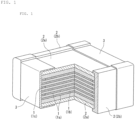
- the solid-state battery of the present invention has, for example, a layered structure (particularly, a stacked structure) as shown in FIG. 1 .
- the solid-state battery of the present invention has a battery element 1 and an exterior portion 2 covering a surface of the battery element 1, and typically further has an external electrode 3 for drawing electric power (particularly current) generated in the battery element to the outside.
- FIG. 1 is a schematic sectional view showing an example of a solid-state battery of the present invention.
- the exterior portion 2 is a member covering the outside of the battery element 1, and has a function of covering the battery element 1 to prevent entry of moisture into the battery element 1.
- the exterior portion 2 typically has not only such a function but also a function of electrically, physically, and chemically protecting a battery element, and thus may also be referred to as a protective layer or a protective film.
- the exterior portion 2 includes a main surface exterior portion 2a (for example, a set of main surface exterior portions 2a) that covers the main surface of the battery element 1 and a side surface exterior portion 2b (for example, a set of side surface exterior portions 2b) that covers the side surface of the battery element 1.
- the exterior portion 2 typically has a layer form or a film form.
- the exterior portion 2 may be in direct contact with the surface (in particular, the main surface and/or the side surface) of the battery element 1, or may be in indirect contact with the surface with another layer (or film) interposed therebetween. From the viewpoint of more sufficiently exhibiting the effect of the present invention, it is preferable that the exterior portion 2 is in direct contact with the surface (particularly, the main surface and/or the side surface) of the battery element 1.
- the exterior portion 2 includes a specific oxide ceramic.
- at least one of the main surface exterior portion and the side surface exterior portion may include a specific oxide ceramic. From the viewpoint of further improving the moisture resistance and the reaction resistance, it is preferable that both the main surface exterior portion and the side surface exterior portion include a specific oxide ceramic.
- the moisture resistance is a property of preventing entry of moisture, and may be a property of being hardly affected by moisture particularly under high temperature and high humidity (for example, resistance to moisture absorption).
- the reaction resistance is a property that the exterior portion (particularly, the oxide ceramic included in the exterior portion) hardly reacts (for example, side reaction) when fired (for example, at 800°C for 5 hours) with the solid electrolyte included in the battery element.
- the reaction resistance may be a property that the oxide ceramic and the solid electrolyte hardly react each other particularly when fired together.
- the oxide ceramic included in the exterior portion contains: Li (lithium); Mg (magnesium); and one or more elements (M) selected from the group consisting of Group 4 and Group 5 elements.
- the element M is one or more elements selected from the group consisting of Ti (titanium), Zr (zirconium), Hf (hafnium), Ta (tantalum), and Nb (niobium).
- the element M preferably includes Ti from the viewpoint of further improving the moisture resistance, and more preferably includes only Ti or includes Ti and Zr or Ta.
- the oxide ceramic contains Li, Mg, and the element M in combination, thereby allowing to provide an exterior portion excellent in moisture resistance and reaction resistance. When the oxide ceramic does not include Li, does not include Mg, and does not include the element M, at least one of the properties of moisture resistance and reaction resistance is deteriorated.
- the molar ratios Li/M and Mg/M are not particularly limited, and are preferably within the following ranges from the viewpoint of further improving the moisture resistance and the reaction resistance.
- Li/M and Mg/M in the oxide ceramic there are used values obtained by calculating from the contents (or molar ratio) of Li, Mg, and M measured by the same method as the method for analyzing the chemical composition of the oxide ceramic described later.
- the oxide ceramic may have any chemical composition as long as it has the above molar ratio. From the viewpoint of further improving the moisture resistance and the reaction resistance, the oxide ceramic preferably has a chemical composition represented by the following general formula (1). [Chemical Formula 1] Li ⁇ 1 A ⁇ 2 Mg ⁇ M ⁇ O ⁇ (1)
- A is one or more elements selected from the group consisting of Na, K, Rb, Ca, Sr, Ba, Sc, Y, Mo, W, Zn, Al, Ga, Ge, Sn, Sb, and Bi.
- M is one or more elements selected from the same group as the element M described above, and from the viewpoint of further improving the moisture resistance, and preferably includes one or more elements selected from the group consisting of Ti, Zr, Hf, Nb, and Ta, more preferably includes Ti, and still more preferably includes only Ti, or includes Ti and Zr or Ta.
- ⁇ 1/ ⁇ and ⁇ / ⁇ correspond to the above-described molar ratios Li/M and Mg/M, respectively. Therefore, ⁇ 1/ ⁇ satisfies the same range as the molar ratio Li/M described above, and from the viewpoint of further improving the moisture resistance and the reaction resistance, preferably satisfies the preferable range of Li/M, more preferably satisfies the more preferable range of Li/M, and still more preferably satisfies the further preferable range of Li/M.
- ⁇ / ⁇ satisfies the same range as the molar ratio Mg/M described above, and from the viewpoint of further improving the moisture resistance and the reaction resistance, preferably satisfies the preferable range of Mg/M, more preferably satisfies the more preferable range of Mg/M, and still more preferably satisfies the further preferable range of Mg/M.
- ⁇ ⁇ 1 + a ⁇ 2 + 2 ⁇ + n ⁇ / 2 (n is the average valence of M and M', and a is the average valence of A)
- a is an average valence of A.
- the average valence of A is, for example, a value represented by (n1 ⁇ a + n2 ⁇ b + n3 ⁇ c)/(n1 + n2 + n3) when the number of elements X having a valence of a+ is n1, the number of elements Y having a valence of b+ is n2, and the number of elements Z having a valence of c+ is n3 in the elements represented by A.
- the oxygen number ⁇ may be deviated from the above value by about ⁇ 10%. That is, oxygen deficiency or interstitial oxygen may be included in part.
- ⁇ 1 typically satisfies 0 ⁇ ⁇ 1 ⁇ 1.0, and from the viewpoint of further improving the moisture resistance and the reaction resistance, preferably satisfies 0.15 ⁇ ⁇ 1 ⁇ 0.70, and more preferably satisfies 0.29 ⁇ ⁇ 1 ⁇ 0.50.
- ⁇ typically satisfies 0 ⁇ ⁇ ⁇ 1.0, and from the viewpoint of further improving the moisture resistance and the reaction resistance, preferably satisfies 0.03 ⁇ ⁇ ⁇ 0.85, and more preferably satisfies 0.25 ⁇ ⁇ ⁇ 0.60.
- ⁇ typically satisfies 0 ⁇ y ⁇ 1.0, and from the viewpoint of further improving the moisture resistance and the reaction resistance, preferably satisfies 0.05 ⁇ ⁇ ⁇ 0.35, and more preferably satisfies 0.14 ⁇ ⁇ ⁇ 0.26.
- the chemical composition of the oxide ceramic can be determined by ICP analysis (inductively coupled plasma method), LA-ICP-MS (laser ablation ICP mass spectrometry) analysis, or the like.
- EDX energy dispersive X-ray spectroscopy
- WDX wavelength dispersive X-ray spectroscopy
- the chemical composition may be obtained by performing quantitative analysis (composition analysis) at arbitrary 100 points of each of arbitrary 100 sintered grains and calculating the average of the resulting values.
- the crystal structure of the oxide ceramic is not particularly limited, and may have, for example, a rock salt type crystal structure, a spinel type crystal structure, a layered rock salt type crystal structure, or a mixed phase structure thereof.
- the oxide ceramic preferably has a rock salt type crystal structure and/or a spinel type crystal structure (particularly a rock salt type crystal structure or a mixed phase structure of a rock salt type crystal structure and a spinel type crystal structure), and more preferably has a rock salt type crystal structure.
- the oxide ceramic has a crystal structure that can be recognized as a crystal structure of a rock salt type or resembling a rock salt type by those skilled in the art of solid-state batteries in X-ray diffraction. More specifically, the oxide ceramic may show, in X-ray diffraction, one or more main peaks corresponding to a Miller index unique to a so-called crystal structure of a rock salt type, diffraction pattern: ICDD Card No.
- one or more main peaks corresponding to a Miller index unique to a so-called crystal structure resembling a rock salt type may show one or more main peaks having different incident angles (that is, peak positions or diffraction angles) and intensity ratios (that is, peak intensities or diffraction intensity ratios) due to a difference in composition.
- incident angles that is, peak positions or diffraction angles
- intensity ratios that is, peak intensities or diffraction intensity ratios
- Examples of a typical diffraction pattern of a crystal structure resembling a rock salt type include ICDD Card No. 00-036-0308.
- the oxide ceramic has a crystal structure that can be identified as a crystal structure of a spinel type or resembling a spinel type by those skilled in the field of solid-state batteries in X-ray diffraction. More specifically, the oxide ceramic may show, in X-ray diffraction, one or more main peaks corresponding to a Miller index unique to a so-called crystal structure of a spinel type (diffraction pattern: ICDD Card No.
- one or more main peaks corresponding to a Miller index unique to a so-called crystal structure of a spinel type may show one or more main peaks having different incident angles (that is, peak positions or diffraction angles) and intensity ratios (that is, peak intensities or diffraction intensity ratios) due to a difference in composition.
- the mixed phase structure in which the oxide ceramic has a rock salt type crystal structure and a spinel type crystal structure means that the oxide ceramic contains an oxide ceramic having both crystal structures of the rock salt type crystal structure and the spinel type crystal structure described above.
- the oxide ceramic has a layered crystal structure that can be recognized as a crystal structure of a layered rock salt type or resembling a layered rock salt type by those skilled in the art of solid-state batteries in X-ray diffraction. More specifically, the oxide ceramic may show, in X-ray diffraction, one or more main peaks corresponding to a Miller index unique to a so-called crystal structure pf a layered rock salt type, diffraction pattern: ICDD Card No.
- one or more main peaks corresponding to a Miller index unique to a so-called crystal structure of a layered rock salt type may show one or more main peaks having different incident angles (that is, peak positions or diffraction angles) and intensity ratios (that is, peak intensities or diffraction intensity ratios) due to a difference in composition.
- incident angles that is, peak positions or diffraction angles
- intensity ratios that is, peak intensities or diffraction intensity ratios
- the oxide ceramic may be produced by any method as long as the method can produce an oxide ceramic of the desired composition.
- the oxide ceramic can be obtained by weighing out raw materials including a Li source, a Mg source, and an element M source so as to provide a desired composition, thoroughly mixing with water, and then firing.
- the firing temperature is not particularly limited, and may be, for example, 800°C or more and 1200°C or less (particularly, 850°C or less and 1100°C or less).
- the firing time is not particularly limited, and may be, for example, 1 hour or more and 10 hours or less (particularly 3 hours or more and 7 hours or less).
- a Li source for example, lithium carbonate (Li 2 CO 3 ) can be used.
- Mg source for example, magnesium oxide (MgO) can be used.
- element M source for example, titanium oxide (TiO 2 ), niobium oxide (Nb 2 O 5 ), zirconium oxide (ZrO 2 ), tantalum oxide (Ta 2 O 5 ), and hafnium oxide (HfO 2 ) can be used.
- TiO 2 titanium oxide
- Niobium oxide Nb 2 O 5
- ZrO 2 zirconium oxide
- Ta 2 O 5 zirconium oxide
- hafnium oxide (HfO 2 ) hafnium oxide
- the final composition of the obtained oxide ceramic is determined by the ratio of the Li source, Mg source, and element M source during charging. Therefore, adjusting the charging ratio of the Li source, the Mg source, and the element M source can control the above-described molar ratios Li/M and Mg/M.
- the present invention does not preclude the exterior portion 2 from including another oxide ceramic in addition to the specific oxide ceramic described above.
- Another oxide ceramic includes an oxide including Bi. Examples thereof include a Li-Bi-O based oxide, a Li-Mg-Bi-O based oxide, Bi 2 O 3 , and a Mg-Bi-O based oxide.
- the content of the specific oxide ceramic in the exterior portion 2 may typically be an area percentage of 60% or more and 100% or less, and particularly an area percentage of 90% or more and 100% or less. The area percentage can be measured as follows. First, a solid-state battery is broken such that the broken surface of the ceramic exterior portion is exposed. This broken surface is polished using a crosssection polisher or the like to provide a polished surface.
- EDX analysis is performed on any surface in the region of the exterior portion of the polished surface, and the region in which not only Mg, element M, and element A are detected but also Li is detected by TOF-SIMS is regarded as the region of the specific oxide ceramic described above. As described above, the measurement can be possible by calculating the percentage of the area of the oxide ceramic to the area of the exterior portion.
- the thickness of the exterior portion 2 is typically preferably 1 ⁇ m or more and 500 ⁇ m or less, more preferably 5 ⁇ m or more and 100 ⁇ m or less, and still more preferably 5 ⁇ m or more and 50 ⁇ m or less.
- an average thickness for the thickness at arbitrary 100 positions is used.
- the relative density of the exterior portion 2 is typically 90% or more and 100% or less, and preferably 95% or more and 100% or less.
- the relative density of the exterior portion may be measured using the Archimedes method.
- the exterior portion 2 typically has an insulating property.
- the insulating property is a property having neither ion conductivity nor electron conductivity.
- the ion conductivity of the exterior portion 2 is typically 1 ⁇ 10 -7 S/cm or less, and particularly the ion conductivity is 1 ⁇ 10 -10 S/cm or less.
- the ion conductivity of the exterior portion 2 is typically 1 ⁇ 10 -18 S/cm or more.
- the electron conductivity of the exterior portion 2 is typically 1 ⁇ 10 -7 S/cm or less, particularly 1 ⁇ 10 -10 S/cm or less.
- the electron conductivity of the exterior portion 2 is typically 1 ⁇ 10 -18 S/cm or more.
- the oxygen permeability of the exterior portion 2 in the thickness direction may be, for example, 10 -1 cc/m 2 /day/atmospheric pressure or less, particularly 10 -3 cc/m 2 /day/atmospheric pressure or less.
- H 2 O permeability in the thickness direction of the exterior portion 2 may be, for example, 10 -2 g/m 2 /day or less, particularly 10 -4 g/m 2 /day or less.
- H 2 O permeability a value measured at 25°C by a cup method, a carrier gas method, a pressure deposition method, or a Ca corrosion method is used.
- FIG. 2 is a schematic perspective view showing another example of a solid-state battery of the present invention.
- the solid-state battery of FIG. 2 is the same as the solid-state battery of FIG. 1 except that the main surface exterior portion 2a and the side surface exterior portion 2b are integrated. In the solid-state battery of FIG.
- the main surface exterior portion 2a not only the main surface exterior portion 2a but also the side surface exterior portion 2b can be produced by using a later-described method of sticking a sheet (green sheet method).
- the solid-state battery in particular, the exterior portion 2
- the oxide ceramic included in the main surface exterior portion 2a typically has the same chemical composition as the oxide ceramic included in the side surface exterior portion 2b.
- the exterior portion 2 When being direct contact with the surface (particularly the main surface and/or the side surface) of the battery element 1, the exterior portion 2 is preferably integrally sintered as sintered bodies together with the surface. That is, it is preferable that the exterior portion 2 is an integrally sintered body as sintered bodies together with the surface (particularly, the main surface and/or the side surface) of the battery element 1.
- the statement that the exterior portion 2 is integrally sintered as sintered bodies together with the surface of the battery element 1 means that the exterior portion 2 and the battery element 1 are joined by sintering. Specifically, the exterior portion 2 and the battery element 1 are sintered integrally while both being a sintered body. Not the whole of the exterior portion 2 and the battery element 1 need to be strictly integrated, and a part thereof does not have to be integrated. It is sufficient that the exterior portion 2 and the battery element 1 are integrated as a whole.
- the battery element 1 is a body portion of a solid-state battery covered with the exterior portion 2, and includes one or more battery constituent units.
- the battery constituent unit means a minimum constituent unit capable of exhibiting a battery function, and includes a set of electrode layers 1a (specifically, one positive electrode layer and one negative electrode layer facing each other) and one solid electrolyte layer 1b disposed between the set of electrode layers 1a (that is, between the positive electrode layer and the negative electrode layer).
- the battery element 1 may have a single battery structure having only one battery constituent unit, or may have a multi-battery structure in which two or more battery constituent units are stacked along a stacking direction of each layer constituting each battery constituent unit.
- the electrode layer includes the positive electrode layer and the negative electrode layer.
- the battery element 1 typically has an insulating portion 1c for ensuring electrical non-contact between one electrode layer and an external electrode for drawing current from the other electrode layer to the outside.
- the battery element 1 has an insulating portion 1c for ensuring electrical non-contact between the positive electrode layer and an external electrode (that is, an external negative electrode) for drawing current from the negative electrode layer to the outside.
- the battery element 1 has an insulating portion 1c for ensuring electrical non-contact between the negative electrode layer and an external electrode (that is, an external negative electrode) for drawing current from the positive electrode layer to the outside.
- the battery element typically has a solid electrolyte layer 1b on the top layer and bottom layer of the battery element.
- the battery element typically includes a solid electrolyte (hereinafter, may be referred to as a first solid electrolyte).
- the first solid electrolyte included in the battery element may have any crystal structure, for example, a garnet type crystal structure, a LISICON type crystal structure, a perovskite type crystal structure, or a mixed phase structure thereof.
- the first solid electrolyte included in the battery element preferably has a garnet type crystal structure, a LISICON type crystal structure, or a mixed phase structure thereof, and more preferably has a garnet type crystal structure.
- the reactivity with the oxide ceramic of the exterior portion increases in the order of the solid electrolyte having a perovskite type crystal structure, the solid electrolyte having a LISICON type crystal structure, and the solid electrolyte having a garnet type crystal structure, and if the battery element contains such solid electrolytes, the oxide ceramic of the exterior portion can more sufficiently suppress the reaction with the solid electrolyte.
- the first solid electrolyte may be included in one or more layers selected from a positive electrode layer, a negative electrode layer, and a solid electrolyte layer. From the viewpoint of further improving moisture resistance and reaction resistance, it is preferable that such a first solid electrolyte is included at least in the solid electrolyte layer.
- the solid electrolyte may show, in X-ray diffraction, one or more main peaks corresponding to a Miller index unique to a so-called crystal structure of a garnet type, diffraction pattern: ICDD Card No. 422259, at a predetermined incident angle, or as a crystal structure resembling a garnet type, one or more main peaks corresponding to a Miller index unique to a so-called crystal structure of a garnet type may show one or more main peaks having different incident angles (that is, peak positions or diffraction angles) and intensity ratios (that is, peak intensities or diffraction intensity ratios) due to a difference in composition.
- a typical diffraction pattern of a crystal structure resembling a garnet type include ICDD Card No. 00-045-0109.
- the solid electrolyte having a garnet type crystal structure may have any chemical composition.
- the garnet type solid electrolyte has, for example, a chemical composition represented by the following general formula (2). [Chemical Formula 2] (Li p A 1 y ) (La ⁇ -z B 1 z ) (D 1 ⁇ -x Bi x )O 12- ⁇ (2)
- a 1 represents a metal element occupying a Li site in a garnet type crystal structure.
- a 1 typically represents one or more elements selected from the group consisting of gallium (Ga), aluminum (Al), magnesium (Mg), zinc (Zn), and scandium (Sc).
- a 1 is preferably one or more elements selected from the group consisting of gallium (Ga) and aluminum (Al), and more preferably two elements of Ga and Al from the viewpoint of further improving the moisture resistance and reaction resistance.
- B 1 represents a metal element occupying a La site in the garnet type crystal structure.
- B 1 typically represents one or more elements selected from the group consisting of calcium (Ca), strontium (Sr), barium (Ba), and lanthanoid elements.
- lanthanoid elements examples include cerium (Ce), praseodymium (Pr), neodymium (Nd), promethium (Pm), samarium (Sm), europium (Eu), gadolinium (Gd), terbium (Tb), dysprosium (Dy), holmium (Ho), erbium (Er), thulium (Tm), ytterbium (Yb), and lutetium (Lu).
- Ce cerium
- Pr praseodymium
- Nd neodymium
- promethium Pm
- Sm samarium
- Eu europium
- Gd gadolinium
- Tb terbium
- Dy dysprosium
- Ho holmium
- Er erbium
- Tm thulium
- Yb ytterbium
- Lu lutetium
- D 1 refers to a metal element occupying the six-coordination site in the garnet type crystal structure.
- the six-coordination site in the garnet type crystal structure is, for example, a site occupied by Nb in Li 5 La 3 Nb 2 O 12 (ICDD Card No. 00-045-0109) having a garnet type crystal structure, and a site occupied by Zr in Li 7 La 3 Zr 2 O 12 (ICDD Card. No 01-078-6708) having a garnet type crystal structure.
- D 1 represents one or more elements selected from the group consisting of transition elements capable of being six-coordinate with oxygen and typical elements belonging to Groups 12 to 15.
- transition elements capable of being six-coordinate with oxygen include scandium (Sc), zirconium (Zr), titanium (Ti), tantalum (Ta), niobium (Nb), hafnium (Hf), molybdenum (Mo), tungsten (W), and tellurium (Te).
- transition elements capable of being six-coordinate with oxygen include scandium (Sc), zirconium (Zr), titanium (Ti), tantalum (Ta), niobium (Nb), hafnium (Hf), molybdenum (Mo), tungsten (W), and tellurium (Te).
- Examples of the typical elements belonging to Groups 12 to 15 include indium (In), germanium (Ge), tin (Sn), lead (Pb), antimony (Sb), and bismuth (Bi).
- D 1 is typically one or more elements selected from the group consisting of Zr (zirconium), Sn (tin), Sb (antimony), Ti (titanium), Ta (tantalum), Nb (niobium), Hf (hafnium), Mo (molybdenum), W (tungsten), and Te (tellurium), and from the viewpoint of further improving the moisture resistance and the reaction resistance, preferably includes one or more elements selected from the group consisting of Zr (zirconium), Ta (tantalum), and Nb (niobium), and more preferably includes Zr (zirconium).
- x satisfies 0 ⁇ x ⁇ 1.00, and from the viewpoint of further improving the moisture resistance and the reaction resistance, preferably satisfies 0 ⁇ x ⁇ 0.70, more preferably 0 ⁇ x ⁇ 0.40, still more preferably 0 ⁇ x ⁇ 0.40, and particularly preferably 0 ⁇ x ⁇ 0.20.
- y satisfies 0 ⁇ y ⁇ 0.50, and from the viewpoint of further improving the moisture resistance and the reaction resistance, y preferably satisfies 0 ⁇ y ⁇ 0.40, more preferably 0 ⁇ y ⁇ 0.30, and still more preferably 0 ⁇ y ⁇ 0.20.
- ⁇ satisfies 2.5 ⁇ ⁇ ⁇ 3.5, and from the viewpoint of further improving the moisture resistance and the reaction resistance, preferably 2.7 ⁇ ⁇ ⁇ 3.3, more preferably 2.8 ⁇ ⁇ ⁇ 3.2, and still more preferably 2.9 ⁇ ⁇ ⁇ 3.1.
- z satisfies 0 ⁇ z ⁇ 2.00, and from the viewpoint of further improving the moisture resistance and the reaction resistance, preferably satisfies 0 ⁇ z ⁇ 1.00, more preferably 0 ⁇ z ⁇ 0.50, and still more preferably 0.
- y satisfies 1.5 ⁇ ⁇ ⁇ 2.5, and from the viewpoint of further improving the moisture resistance and the reaction resistance, preferably 1.7 ⁇ ⁇ ⁇ 2.3, more preferably 1.8 ⁇ ⁇ ⁇ 2.2, and still more preferably 1.9 ⁇ ⁇ ⁇ 2.0.
- p typically satisfies 6.0 ⁇ p ⁇ 7.0, and from the viewpoint of further improving the moisture resistance and the reaction resistance, preferably satisfies 6.0 ⁇ p ⁇ 6.6, more preferably 6.25 ⁇ p ⁇ 6.55.
- a is the average valence of A 1 .
- the average valence of A 1 is, for example, a value represented by (n1 ⁇ a + n2 ⁇ b + n3 ⁇ c)/(n1 + n2 + n3) in a case where the number of elements X having a valence of a+ is n1, the number of elements Y having a valence of b+ is n2, and the number of elements Z having a valence of c+ is n3 in the elements represented by A 1 .
- b is the average valence of B 1 .
- the average valence of B 1 is, for example, the same value as the above-described average valence of A 1 in a case where the number of elements X having a valence of a+ is n1, the number of elements Y having a valence of b+ is n2, and the number of elements Z having a valence of c+ is n3 in the elements represented by B 1 .
- c is the average valence of D 1 .
- the average valence of D 1 is, for example, the same value as the average valence of A 1 mentioned above when D 1 is recognized as n1 elements X with a valence a+, n2 elements Y with a valence b+, and n3 elements Z with a valence c+.
- ⁇ represents an oxygen deficiency amount, and may be 0.
- ⁇ is usually to satisfy 0 ⁇ ⁇ ⁇ 1.
- the oxygen deficiency amount ⁇ cannot be quantitatively analyzed using the latest device, and therefore may be regarded as 0.
- the molar ratio of each element in the chemical composition of the solid electrolyte ceramic of the present invention does not necessarily coincide with, for example, the molar ratio of each element in the general formula (2), and tends to deviate from this molar ratio according to the analysis method, but an effect of the present invention is exhibited as long as the compositional deviation does not change the properties.
- the chemical composition of the solid electrolyte ceramic may be the composition of the whole ceramic material determined using an inductively coupled plasma method (ICP).
- ICP inductively coupled plasma method
- the chemical composition may be measured and calculated using inductively coupled plasma atomic emission spectrometry (ICP-AES) or laser ablation inductively coupled plasma mass spectrometry (LA-ICP-MS).
- the chemical composition may be measured and calculated using XPS analysis, or may be determined using energy dispersive X-ray spectroscopy (TEM-EDX) and/or wavelength dispersive X-ray spectroscopy (WDX).
- the chemical composition may be obtained by performing quantitative analysis (composition analysis) at arbitrary 100 points of each of arbitrary 100 sintered grains and calculating the average of the resulting values.
- garnet type solid electrolyte represented by the general formula (2) include Li 6. 6 La 3 Zr 1.6 Ta 0.4 O 12 , Li 6.4 Ga 0.05 Al 0.15 La 3 Zr 2 O 12 , Li 6.75 La 3 Zr 1.75 Nb 0.2 O 12 , and Li 6.53 La 3 Zr 1.53 Ta 0.4 Bi 0.07 O 12 .
- the LISICON type crystal structure of the solid electrolyte encloses a ⁇ I structure, a ⁇ II type structure, a ⁇ II ' type structure, a T I type structure, a T II type structure, a ⁇ II type structure, and a ⁇ 0 type structure. That is, the LISICON type solid electrolyte may include one or more solid electrolytes having a ⁇ I structure, a ⁇ II type structure, a ⁇ II ' type structure, a T I type structure, a T II type structure, a ⁇ II type structure, a ⁇ 0 type structure, or a composite structure thereof.
- the LISICON type structure of the solid electrolyte is preferably a ⁇ II type structure from the viewpoint of further improving the moisture resistance and the reaction resistance.
- the solid electrolyte has a ⁇ II type structure means that the solid electrolyte has a ⁇ II type crystal structure, and in a broad sense, means having a crystal structure that can be recognized as a ⁇ II type crystal structure by those skilled in the field of solid-state batteries.
- the fact that the solid electrolyte has a ⁇ II type structure means that the solid electrolyte shows one or more main peaks corresponding to a Miller index unique to a so-called ⁇ II Li 3 VO 4 type crystal structure at a predetermined incident angle in X-ray diffraction.
- the compound that has a ⁇ II type structure (that is, solid electrolyte) is described, for example, in the document "J. solid state chem" ( A.R.West et.al, J. solid state chem., 4, 20-28 (1972 )), and example thereof include ICDD Card No. 01-073-2850.
- the solid electrolyte has a ⁇ I type structure means that the solid electrolyte has a ⁇ I type crystal structure, and in a broad sense, means having a crystal structure that can be recognized as a ⁇ I type crystal structure by those skilled in the field of solid-state batteries.
- the fact that the solid electrolyte has a ⁇ I type structure means that the solid electrolyte shows one or more main peaks corresponding to a Miller index unique to a so-called ⁇ 1 -Li 3 VO 4 type crystal structure at a predetermined incident angle in X-ray diffraction.
- the compound that has a ⁇ I type structure that is, solid electrolyte
- J The compound that has a ⁇ I type structure
- the solid electrolyte has a ⁇ II type structure means that the solid electrolyte has a ⁇ II type crystal structure, and in a broad sense, means having a crystal structure that can be recognized as a ⁇ II type crystal structure by those skilled in the field of solid-state batteries.
- the fact that the solid electrolyte has a ⁇ II type structure means that the solid electrolyte shows one or more main peaks corresponding to a Miller index unique to a so-called ⁇ II -Li 3 VO 4 type crystal structure at a predetermined incident angle in X-ray diffraction.
- the compound that has a ⁇ II type structure (that is, solid electrolyte) is described, for example, in the document "J. solid state chem" ( A.R.West et.al, J. solid state chem., 4, 20-28 (1972 )), and example thereof include ICDD Card No. 00-024-0675.
- the solid electrolyte has a ⁇ II ' type structure means that the solid electrolyte has a ⁇ II ' type crystal structure, and in a broad sense, means having a crystal structure that can be recognized as a ⁇ II ' type crystal structure by those skilled in the field of solid-state batteries.
- the fact that the solid electrolyte has a ⁇ II ' type structure means that the solid electrolyte shows one or more main peaks corresponding to a Miller index unique to a so-called ⁇ II '-Li 3 VO 4 type crystal structure at a predetermined incident angle in X-ray diffraction.
- the compound that has a ⁇ II ' type structure (that is, solid electrolyte) is described, for example, in the document "J. solid state chem” ( A.R.West et.al, J. solid state chem., 4, 20-28 (1972 )), and as an example thereof, the following table shows, for example, the XRD data (the d-value of plane spacing and the corresponding Miller indices) listed therein.
- the solid electrolyte has a T I type structure means that the solid electrolyte has a T I type crystal structure, and in a broad sense, means having a crystal structure that can be recognized as a T I type crystal structure by those skilled in the field of solid-state batteries.
- the fact that the solid electrolyte has a T I type structure means that the solid electrolyte shows one or more main peaks corresponding to a Miller index unique to a so-called T I -Li 3 VO 4 type crystal structure at a predetermined incident angle in X-ray diffraction.
- the compound that has a T I type structure (that is, solid electrolyte) is described, for example, in the document "J. solid state chem" ( A.R.West et.al, J. solid state chem., 4, 20-28 (1972 )), and example thereof include ICDD Card No. 00-024-0668.
- the solid electrolyte has a T II type structure means that the solid electrolyte has a T II type crystal structure, and in a broad sense, means having a crystal structure that can be recognized as a T II type crystal structure by those skilled in the field of solid-state batteries.
- the fact that the solid electrolyte has a T II type structure means that the solid electrolyte shows one or more main peaks corresponding to a Miller index unique to a so-called T II -Li 3 VO 4 type crystal structure at a predetermined incident angle in X-ray diffraction.
- the compound that has a T II type structure (that is, solid electrolyte) is described, for example, in the document "J. solid state chem" ( A.R.West et.al, J. solid state chem., 4, 20-28 (1972 )), and example thereof include ICDD Card No. 00-024-0669.
- the solid electrolyte has a ⁇ 0 type structure means that the solid electrolyte has a ⁇ 0 type crystal structure, and in a broad sense, means having a crystal structure that can be recognized as a ⁇ 0 type crystal structure by those skilled in the field of solid-state batteries.
- the fact that the solid electrolyte has a ⁇ 0 type structure means that the solid electrolyte shows one or more main peaks corresponding to a Miller index unique to a so-called ⁇ 0 -Li 3 VO 4 type crystal structure at a predetermined incident angle in X-ray diffraction.
- the compound that has a ⁇ 0 type structure (that is, solid electrolyte) is described, for example, in the document "J. solid state chem” ( A.R.West et.al, J. solid state chem., 4, 20-28 (1972 )), and as an example thereof, the following table shows, for example, the XRD data (the d-value of plane spacing and the corresponding Miller indices) listed therein.
- the solid electrolyte having a LISICON type crystal structure may have any chemical composition.
- the LISICON type solid electrolyte has, for example, a chemical composition represented by the following general formula (3). [Chemical Formula 3] (Li [3-ax+(5-b)(1-y)] A x ) (V y B 1-y )O 4 (3)
- A is one or more elements selected from the group consisting of Na (sodium), K (potassium), Mg (magnesium), Ca (calcium), Al (aluminum), Ga (gallium), Zn (zinc), Fe (iron), Cr (chromium), and Co (cobalt).
- B is one or more elements selected from the group consisting of Zn (zinc), Al (aluminum), Ga (gallium), Si (silicon), Ge (germanium), Sn (tin), P (phosphorus), As (arsenic), Ti (titanium), Mo (molybdenum), W (tungsten), Fe (iron), Cr (chromium), and Co (cobalt), and from the viewpoint of further improving the moisture resistance and the reaction resistance, preferably one or more elements selected from the group consisting of Si (silicon) and P (phosphorus), and more preferably Si (silicon) or P (phosphorus).
- x has a relationship of 0 ⁇ x ⁇ 1.0, particularly 0 ⁇ x ⁇ 0.2, and from the viewpoint of further improving the moisture resistance and the reaction resistance, preferably a relationship of 0 ⁇ x ⁇ 0.1, and more preferably 0.
- y has a relationship of 0 ⁇ y ⁇ 1.0, and from the viewpoint of further improving the moisture resistance and the reaction resistance, preferably a relationship of 0 ⁇ y ⁇ 0.85.
- a is an average valence of A.
- the average valence of A is, for example, a value represented by (n1 ⁇ a + n2 ⁇ b + n3 ⁇ c)/(n1 + n2 + n3) when A is recognized as n1 of elements X having a valence a+, n2 of elements Y having a valence b+, and n3 of elements Z having a valence c+.
- b is an average valence of B.
- the average valence of B is, for example, the same value as the average valence of A described above when B is recognized as n1 of elements X having a valence a+, n2 of elements Y having a valence b+, and n3 of elements Z having a valence c+.
- LISICON type solid electrolyte represented by the general formula (3) include Li 3.2 V 0.8 Si 0.2 O 4 and Li 3.5 P 0.5 Si 0.5 O 4 .
- the solid electrolyte has a crystal structure that can be identified as a crystal structure of a perovskite type or resembling a perovskite type by those skilled in the field of solid-state batteries in X-ray diffraction.
- the solid electrolyte may show, in X-ray diffraction, one or more main peaks corresponding to a Miller index unique to a so-called crystal structure of a perovskite type (diffraction pattern: ICDD Card No. 00-046-0465) at a predetermined incident angle, or as a crystal structure resembling a perovskite type, one or more main peaks corresponding to a Miller index unique to a so-called crystal structure of a perovskite type may show one or more main peaks having different incident angles (that is, peak positions or diffraction angles) and intensity ratios (that is, peak intensities or diffraction intensity ratios) due to a difference in composition. Examples of a typical diffraction pattern of a crystal structure resembling a perovskite type include ICDD Card No. 00-046-0466.
- the solid electrolyte having a perovskite type crystal structure may have any chemical composition.
- the perovskite type solid electrolyte has, for example, a chemical composition represented by the following general formula (3). [Chemical Formula 4] Li 3x La 2/3-x TiO 3 (4)
- x preferably satisfies 0.09 ⁇ x ⁇ 0.167. Further, it is more preferable that 0.10 ⁇ x ⁇ 0.12.
- perovskite type solid electrolyte represented by the general formula (4) include Li 0.35 La 0.55 TiO 3 and Li 0.5 La 0.5 TiO 3 .
- the chemical composition of the solid electrolyte means the average value of the chemical composition of the solid electrolyte in the thickness direction of the layer containing the solid electrolyte (for example, the solid electrolyte layer).
- the average chemical composition of the solid electrolyte can be analyzed and measured by breaking the solid-state battery and performing composition analysis by energy-dispersive X-ray spectroscopy (EDX) using SEM-EDX in a field of view in which the entire layer fits in the thickness direction.
- EDX energy-dispersive X-ray spectroscopy
- the solid electrolyte may be obtained by the same method as in the case of the oxide ceramic except that a raw material compound containing a predetermined metal atom is used, or may be obtained as a commercially available product.
- all the layers constituting the battery element 1 may be integrally sintered as sintered bodies together between two adjacent layers.
- the statement that all the layers are integrally sintered as sintered bodies together between two adjacent layers means that the two adjacent layers are joined by sintering. Specifically, both the two adjacent layers are sintered bodies and further integrally sintered. Not the whole of the two adjacent layers need to be strictly integrated, and a portion thereof does not have to be integrated. Two adjacent layers may be integrated as a whole.
- the positive electrode layer 1a, the solid electrolyte layer 1b, and the negative electrode layer 1a may be integrally sintered in a predetermined stacking order.
- the positive electrode layer is a so-called positive electrode active material layer and may additionally include the positive electrode current collecting layer.
- the positive electrode layer may be provided on one side or on both sides of the positive electrode current collecting layer.
- the positive electrode layer is formed of a sintered body containing positive electrode active material grains and may be typically formed of a sintered body including positive electrode active material grains, electron conductive material grains, and solid electrolyte grains contained in the solid electrolyte layer.
- the positive electrode layer (particularly the positive electrode active material layer) may include the first solid electrolyte described above.
- the negative electrode layer is a so-called negative electrode active material layer and may additionally include the negative electrode current collecting layer.
- the negative electrode layer may be provided on one side or on both sides of the negative electrode current collecting layer.
- the negative electrode layer is formed of a sintered body including negative electrode active material grains and may be formed of a sintered body including negative electrode active material grains, electron conductive material grains, and solid electrolyte grains contained in the solid electrolyte layer.
- the negative electrode layer (particularly the negative electrode active material layer) may include the first solid electrolyte described above.
- the positive electrode active material contained in the positive electrode layer and the negative electrode active material contained in the negative electrode layer are substances involved in the transfer of electrons in the solid-state battery, and ions contained in the solid electrolyte material constituting the solid electrolyte layer move (conduct) between the positive electrode and the negative electrode to transfer electrons, whereby charging and discharging are performed.
- Mediating ions are not particularly limited as long as charge and discharge can be performed, and examples thereof include lithium ions and sodium ions (particularly, lithium ions).
- the positive electrode layer and the negative electrode layer may be layers particularly capable of occluding and releasing lithium ions. That is, the solid-state battery according to the present invention may be a solid-state secondary battery in which lithium ions move between the positive electrode and the negative electrode with the solid electrolyte layer interposed therebetween to charge and discharge the battery.
- the positive electrode active material included in the positive electrode layer is not particularly limited, and examples thereof include at least one selected from the group consisting of a lithium-containing phosphoric acid compound having a NASICON type structure, a lithium-containing phosphoric acid compound having an olivine type structure, a lithium-containing layered oxide, a lithium-containing oxide having a spinel type structure, and the like.
- a lithium-containing phosphate compound having a NASICON type structure includes Li 3 V 2 (PO 4 ) 3 .
- Examples of the lithium-containing phosphate compound having an olivine type structure include Li 3 Fe 2 (PO 4 ) 3 and LiMnPO 4 .
- Examples of the lithium-containing layered oxide include LiCoO 2 and LiCo 1/3 Ni 1/3 Mn 1/3 O 2 .
- Examples of the lithium-containing oxide having a spinel type structure include LiMn 2 O 4 and LiNi 0.5 Mn 1.5 O 4 .
- the negative electrode active material included in the negative electrode layer is not particularly limited, and examples thereof include at least one selected from the group consisting of an oxide containing at least one element selected from the group consisting of Ti, Si, Sn, Cr, Fe, Nb, and Mo, a graphite-lithium compound, a lithium alloy, a lithium-containing phosphoric acid compound having a NASICON type structure, a lithium-containing phosphoric acid compound having an olivine type structure, a lithium-containing oxide having a spinel type structure, and an oxide having a ⁇ -Li 3 VO 4 type structure or a ⁇ -Li 3 VO 4 type structure.
- the lithium alloys include Li-Al.
- lithium-containing phosphate compound having a NASICON type structure includes Li 3 V 2 (PO 4 ) 3 .
- Li 3 Fe 2 (PO 4 ) 3 examples of the lithium-containing oxides that have a spinel type structure.
- the lithium-containing oxides that have a spinel type structure include Li 4 Ti 5 O 12 .
- the negative electrode active material having a ⁇ -Li 3 VO 4 type structure examples include Li 3 VO 4 .
- oxide having a ⁇ -Li 3 VO 4 type structure include Li 3.2 V 0.8 Si 0.2 O 4 .
- the electron conductive material included in the positive electrode layer and the negative electrode layer is not particularly limited, and examples thereof include a metal material such as silver, palladium, gold, platinum, aluminum, copper, or nickel, and a carbon material.
- a metal material such as silver, palladium, gold, platinum, aluminum, copper, or nickel
- carbon is preferable because carbon hardly reacts with the positive electrode active material, the negative electrode active material, and the solid electrolyte material, and has an effect of reducing the internal resistance of the solid-state battery.
- the solid electrolyte material included in the positive electrode layer and the negative electrode layer may be selected from, for example, the same materials as the solid electrolyte material that can be included in the solid electrolyte layer described later.
- the positive electrode layer and the negative electrode layer may each independently included a sintering agent.
- the sintering agent is not particularly limited, and may be, for example, at least one selected from the group consisting of lithium oxide, sodium oxide, potassium oxide, boron oxide, silicon oxide, bismuth oxide, and phosphorus oxide.
- Thicknesses of the positive electrode layer and the negative electrode layer are not particularly limited, and may be each independently, for example, 2 ⁇ m or more and 50 ⁇ m or less, particularly 5 ⁇ m or more and 30 ⁇ m or less.
- the solid electrolyte layer may include a sintering agent.
- the sintering agent included in the solid electrolyte layer may be selected from, for example, the same materials as the sintering agent that can be included in the positive electrode layer and the negative electrode layer.
- a thickness of the solid electrolyte layer is not particularly limited, and may be, for example, 1 ⁇ m or more and 15 ⁇ m or less, particularly 1 ⁇ m or more and 5 ⁇ m or less.
- the external electrode 3 is a member for drawing electric power (in particular, current) generated in the battery element 1 to the outside.
- the external electrode 3 encompasses a positive electrode side external electrode and a negative electrode side external electrode.
- the external electrode 3 may have a form of a sintered body from the viewpoints of reducing the production cost of the solid-state battery by integral firing and reducing the internal resistance of the solid-state battery.
- the external electrode 3 When having the form of a sintered body, the external electrode 3 may be formed of, for example, a sintered body including electron conductive material particles and a sintering agent.
- the electron conductive material included in the external electrode 3 may be selected from, for example, the same materials as the electron conductive material that can be included in the positive electrode layer and the negative electrode layer.
- the sintering aid included in the external electrode 3 may be selected from, for example, the same materials as the sintering agent that can be included in the positive electrode layer and the negative electrode layer.
- a method for producing the solid-state battery of the present invention includes:
- the unfired stacked body can be produced by a printing method such as a screen printing method, a green sheet method using a green sheet, an immersion method, or a composite method thereof, but is obviously not limited to these methods.
- the solid electrolyte layer and the main surface exterior portion are produced by a green sheet method.
- An electrode layer (positive electrode layer and/or negative electrode layer) and an insulating portion are formed on the obtained solid electrolyte layer sheet by a printing method.
- the side surface exterior portion is formed by an immersion method.
- the external electrode is formed by an immersion method. As a result, the unfired stacked body is formed.
- the unfired stacked body is subjected to firing.
- the firing is performed by removing an organic material at, for example, 500°C in a nitrogen gas atmosphere including oxygen gas, and then heating was performed at, for example, 550°C or more and 1300°C or less.
- Raw materials including lithium carbonate (Li 2 CO 3 ), magnesium oxide (MgO), titanium oxide (TiO 2 ), niobium oxide (Nb 2 O 5 ), zirconium oxide (ZrO 2 ), tantalum oxide (Ta 2 O 5 ), and hafnium oxide (HfO 2 ) were weighed such that the composition of the main phase was as shown in the following table. Then, water was added, the resulting mixture was enclosed in a polyethylene polypot, and the polypot was rotated on a pot rack at 150 rpm for 16 hours to mix the raw materials. Incidentally, lithium carbonate as a Li source was charged in an excess amount of 5% by mass with respect to the target composition in consideration of Li deficiency during sintering.
- the obtained oxide ceramic was kneaded with a butyral resin, an alcohol, and a binder to produce a slurry.
- the slurry was sheet-molded on a PET film using a doctor blade method to obtain a sheet.
- the prepared sheet was stacked until the thickness of the sheet reached 1.5 mm, and then cut into a square having a side of 10 mm in plan view.
- the stacked body was sufficiently covered with a mother powder, and then fired at a temperature of 400°C to remove the butyral resin, and then fired at 1150 to 1300°C for 2 hours, and then cooled to provide an exterior ceramic single plate. It was confirmed that all the sintered bodies had a relative density of 95% or more by using the Archimedes method.
- the weight of the exterior ceramic single plate (sintered body) was measured.
- the sintered body was held at 125°C and 85% relative humidity for 96 hours in a pressure cooker test (PCT), and then the weight of the sintered body was measured again.
- the weight change before and after PCT was calculated and determined according to the following criteria.
- the weight change is represented by the ratio of the weight increase amount to the pre-PCT weight.
- the oxide ceramic was mixed with a solid electrolyte, molded into a tablet shape, and then fired at 800°C for 5 hours. After firing, the crystal phase was analyzed by XRD measurement and determined according to the following criteria.
- the tablet prepared in each of Comparative Examples and Examples was pulverized using a mortar and formed into a powder. The resulting powder was packed in a folder, and XRD measurement was performed using a CuK ⁇ ray under the conditions of a scan speed of 4.0°/min and an angle measurement range of 10° to 60° to evaluate the crystal phase included in the tablet.
- the solid electrolyte used in Comparative Examples 1 to 6 and Examples 1 to 19 was a garnet type solid electrolyte having a chemical composition of Li 6.6 La 3 Zr 1.6 Ta 0.4 O 12 .
- the solid electrolyte used in Examples 20 to 26 was the garnet type solid electrolyte, the LISICON type solid electrolyte, or the perovskite type solid electrolyte shown in Table 7.
- No decomposition means that, as shown in FIG. 3 , in the XRD measurement after firing, all peaks derived from the oxide ceramic and the solid electrolyte before firing are clearly observed, and no side reaction proceeds between them.
- FIG. 3 shows XRD measurement result data when reaction resistance is determined in Example 4.
- partial decomposition means that, in XRD measurement after firing, all peaks derived from the oxide ceramic and the solid electrolyte before firing are observed, but a heterogeneous phase of the third phase is generated in part.
- the "complete decomposition” means that, in XRD measurement after firing, a peak of at least one compound of peaks derived from an oxide ceramic and a solid electrolyte before firing is not observed.
- Raw materials including lithium hydroxide monohydrate (LiOH ⁇ H 2 O), gallium oxide (Ga 2 O 3 ), aluminum oxide (Al 2 O 3 ), lanthanum hydroxide (La (OH) 3 ), zirconium oxide (ZrO 2 ), niobium oxide (Nb 2 O 5 ), tantalum oxide (Ta 2 O 5 ), and bismuth oxide (Bi 2 O 3 ) were weighed such that the solid electrolyte had a predetermined composition. Then, water was added, the resulting mixture was enclosed in a polyethylene polypot, and the polypot was rotated on a pot rack at 150 rpm for 16 hours to mix the raw materials. 3% by mass of excess lithium hydroxide monohydrate (LiOH ⁇ H 2 O) as a Li source was put based on the target composition in consideration of Li deficiency during sintering.
- the obtained slurry was dried and then pre-fired at 1000°C for 5 hours to provide a solid electrolyte powder having a predetermined composition.
- Raw materials including lithium hydroxide monohydrate (LiOH ⁇ H 2 O), lithium phosphate (Li 3 PO 4 ), vanadium oxide (V 2 O 5 ), and silicon oxide (SiO 2 ) were weighed such that the solid electrolyte had a predetermined composition. Then, water was added, the resulting mixture was enclosed in a polyethylene polypot, and the polypot was rotated on a pot rack at 150 rpm for 16 hours to mix the raw materials. 3% by mass of excess lithium hydroxide monohydrate (LiOH ⁇ H 2 O) as a Li source was put based on the target composition in consideration of Li deficiency during sintering.
- the obtained slurry was dried and then pre-fired at 900°C for 5 hours to provide a solid electrolyte powder having a predetermined composition.
- the glass material, Al 2 O 3 , TiO 2 , and the like have moisture resistance, but have low reaction resistance to a solid electrolyte, and cannot be used as an exterior material.
- the oxide ceramic including one or two elements selected from Li, Mg, and M (for example, Ti) used in the present invention has a problem in either moisture resistance or reaction resistance to a solid electrolyte.
- the oxide ceramic includes Li, Mg, and M (for example, Ti), thereby allowing to achieve both reaction resistance and moisture resistance to the solid electrolyte.
- Oxide ceramic Moisture resistance Reaction resistance (1) Chemical composition Li ( ⁇ 1) Mg ( ⁇ ) M ( ⁇ ) ⁇ Li/M ratio Mg/M ratio Crystal structure Weight change rate Determination
- Example 7 Li0.52Mg0.24Ti0.240 0.52 0.24 0.24 1.0 2.2 1.0 Rock salt 2% ⁇ ⁇
- Example 8 Li0.47Mg0.26Ti0.260 0.47 0.26 0.26 1.0 1.8 1.0 Spinel + rock salt ⁇ 1% ⁇ ⁇
- Example 9 Li0.09Mg0.83Ti0.090 0.09 0.83 0.09 1.0 1.0 9.5 Rock salt 3% ⁇ ⁇
- Example 10 Li0.16Mg0.76Ti0.08O 0.16 0.76 0.08 1.0 2.0 9.5 Rock salt 2% ⁇ ⁇
- Example 11 Li0.28Mg0.66Ti0.07O0.9 0.28 0.66 0.
- the oxide ceramic preferably has a rock salt structure or a layered rock salt structure.
- the oxide ceramic preferably has a rock-salt type structure and/or a spinel type structure, and more preferably has a rock salt type structure.
- the solid-state battery of the present invention can be used in various fields where use of a battery or storage of electricity is assumed.
- the solid-state battery of the present invention can be used in the field of electronics mounting.
- the solid-state battery according to an embodiment of the present invention can also be used in the fields of electricity, information, and communication in which mobile devices and the like are used (for example, electric and electronic equipment fields or mobile equipment fields including mobile phones, smartphones, smartwatches, notebook computers, and small electronic machines such as digital cameras, activity meters, arm computers, electronic papers, wearable devices, RFID tags, card-type electronic money, and smartwatches), home and small industrial applications (for example, the fields of electric tools, golf carts, and home, nursing, and industrial robots), large industrial applications (for example, the fields of forklift, elevator, and harbor crane), transportation system fields (for example, the fields of hybrid vehicles, electric vehicles, buses, trains, power-assisted bicycles, electric two-wheeled vehicles, and the like), power system applications (for example, fields such as various types of
Landscapes
- Chemical & Material Sciences (AREA)
- Chemical Kinetics & Catalysis (AREA)
- Electrochemistry (AREA)
- General Chemical & Material Sciences (AREA)
- Engineering & Computer Science (AREA)
- Manufacturing & Machinery (AREA)
- Inorganic Chemistry (AREA)
- Physics & Mathematics (AREA)
- Condensed Matter Physics & Semiconductors (AREA)
- General Physics & Mathematics (AREA)
- Materials Engineering (AREA)
- Secondary Cells (AREA)
Applications Claiming Priority (2)
| Application Number | Priority Date | Filing Date | Title |
|---|---|---|---|
| JP2022155351 | 2022-09-28 | ||
| PCT/JP2023/029432 WO2024070286A1 (ja) | 2022-09-28 | 2023-08-14 | 固体電池 |
Publications (1)
| Publication Number | Publication Date |
|---|---|
| EP4553941A1 true EP4553941A1 (en) | 2025-05-14 |
Family
ID=90477233
Family Applications (1)
| Application Number | Title | Priority Date | Filing Date |
|---|---|---|---|
| EP23871528.8A Pending EP4553941A1 (en) | 2022-09-28 | 2023-08-14 | Solid-state battery |
Country Status (5)
| Country | Link |
|---|---|
| US (1) | US20250226459A1 (https=) |
| EP (1) | EP4553941A1 (https=) |
| JP (2) | JP7786608B2 (https=) |
| CN (1) | CN119923734A (https=) |
| WO (1) | WO2024070286A1 (https=) |
Family Cites Families (8)
| Publication number | Priority date | Publication date | Assignee | Title |
|---|---|---|---|---|
| JP2003092092A (ja) | 2001-09-18 | 2003-03-28 | Matsushita Electric Ind Co Ltd | 二次電池とその製法 |
| JP5453709B2 (ja) | 2005-11-25 | 2014-03-26 | 日産自動車株式会社 | 電気化学デバイス用の外装材およびこれを用いた電気化学デバイス |
| WO2007135790A1 (ja) * | 2006-05-23 | 2007-11-29 | Incorporated National University Iwate University | 全固体二次電池 |
| JP6663685B2 (ja) | 2015-11-04 | 2020-03-13 | 日本特殊陶業株式会社 | リチウムイオン伝導性セラミックス焼結体、及びリチウム電池 |
| JP7188380B2 (ja) | 2017-03-29 | 2022-12-13 | Tdk株式会社 | 全固体リチウムイオン二次電池 |
| JP6895100B2 (ja) | 2018-03-02 | 2021-06-30 | 株式会社村田製作所 | 全固体電池 |
| JP7276316B2 (ja) | 2018-03-19 | 2023-05-18 | Tdk株式会社 | 全固体電池 |
| WO2021070600A1 (ja) | 2019-10-11 | 2021-04-15 | 株式会社村田製作所 | 固体電池 |
-
2023
- 2023-08-14 CN CN202380068764.1A patent/CN119923734A/zh active Pending
- 2023-08-14 JP JP2024549844A patent/JP7786608B2/ja active Active
- 2023-08-14 WO PCT/JP2023/029432 patent/WO2024070286A1/ja not_active Ceased
- 2023-08-14 EP EP23871528.8A patent/EP4553941A1/en active Pending
-
2025
- 2025-03-25 US US19/089,289 patent/US20250226459A1/en active Pending
- 2025-12-01 JP JP2025210054A patent/JP2026035744A/ja active Pending
Also Published As
| Publication number | Publication date |
|---|---|
| WO2024070286A1 (ja) | 2024-04-04 |
| JPWO2024070286A1 (https=) | 2024-04-04 |
| CN119923734A (zh) | 2025-05-02 |
| JP7786608B2 (ja) | 2025-12-16 |
| JP2026035744A (ja) | 2026-03-04 |
| US20250226459A1 (en) | 2025-07-10 |
Similar Documents
| Publication | Publication Date | Title |
|---|---|---|
| US20230060930A1 (en) | Solid-state battery | |
| EP4303952A1 (en) | Solid-state battery | |
| US20230307705A1 (en) | Solid electrolyte ceramic and solid-state battery | |
| EP3951981B1 (en) | All-solid-state secondary battery | |
| JP7632476B2 (ja) | 固体電池 | |
| EP4553941A1 (en) | Solid-state battery | |
| JP7666517B2 (ja) | 固体電解質セラミックスおよび固体電池 | |
| EP4715972A1 (en) | Solid-state battery | |
| EP4738550A1 (en) | Solid state battery | |
| US20250336980A1 (en) | Solid-state battery | |
| WO2025069739A1 (ja) | 固体電池 | |
| JP7556402B2 (ja) | 固体電解質セラミックスおよび固体電池 | |
| JP7768366B2 (ja) | 固体電解質セラミックスおよび固体電池 | |
| JP7666518B2 (ja) | 固体電解質セラミックスおよび固体電池 | |
| US20250070236A1 (en) | Solid electrolyte ceramic and solid-state battery |
Legal Events
| Date | Code | Title | Description |
|---|---|---|---|
| STAA | Information on the status of an ep patent application or granted ep patent |
Free format text: STATUS: THE INTERNATIONAL PUBLICATION HAS BEEN MADE |
|
| PUAI | Public reference made under article 153(3) epc to a published international application that has entered the european phase |
Free format text: ORIGINAL CODE: 0009012 |
|
| STAA | Information on the status of an ep patent application or granted ep patent |
Free format text: STATUS: REQUEST FOR EXAMINATION WAS MADE |
|
| 17P | Request for examination filed |
Effective date: 20250131 |
|
| AK | Designated contracting states |
Kind code of ref document: A1 Designated state(s): AL AT BE BG CH CY CZ DE DK EE ES FI FR GB GR HR HU IE IS IT LI LT LU LV MC ME MK MT NL NO PL PT RO RS SE SI SK SM TR |
|
| DAV | Request for validation of the european patent (deleted) | ||
| DAX | Request for extension of the european patent (deleted) |