EP4538428A2 - Elektrolytisches medium und elektropolierverfahren mit einem solchen elektrolytischen medium - Google Patents
Elektrolytisches medium und elektropolierverfahren mit einem solchen elektrolytischen medium Download PDFInfo
- Publication number
- EP4538428A2 EP4538428A2 EP25160023.5A EP25160023A EP4538428A2 EP 4538428 A2 EP4538428 A2 EP 4538428A2 EP 25160023 A EP25160023 A EP 25160023A EP 4538428 A2 EP4538428 A2 EP 4538428A2
- Authority
- EP
- European Patent Office
- Prior art keywords
- electrolytic medium
- piece
- conductive
- particles
- polished
- Prior art date
- Legal status (The legal status is an assumption and is not a legal conclusion. Google has not performed a legal analysis and makes no representation as to the accuracy of the status listed.)
- Pending
Links
Images


Classifications
-
- C—CHEMISTRY; METALLURGY
- C25—ELECTROLYTIC OR ELECTROPHORETIC PROCESSES; APPARATUS THEREFOR
- C25F—PROCESSES FOR THE ELECTROLYTIC REMOVAL OF MATERIALS FROM OBJECTS; APPARATUS THEREFOR
- C25F3/00—Electrolytic etching or polishing
- C25F3/16—Polishing
-
- C—CHEMISTRY; METALLURGY
- C25—ELECTROLYTIC OR ELECTROPHORETIC PROCESSES; APPARATUS THEREFOR
- C25F—PROCESSES FOR THE ELECTROLYTIC REMOVAL OF MATERIALS FROM OBJECTS; APPARATUS THEREFOR
- C25F7/00—Constructional parts, or assemblies thereof, of cells for electrolytic removal of material from objects; Servicing or operating
Definitions
- the solid electrolyte for this electropolishing process is composed of an ion exchange resin that retains a liquid electrolyte.
- Document ES2721170 describes a solid electrolyte in which the retained electrolyte is a sulfuric acid solution. This electrolyte is described as especially useful for stainless steels and cobalt chromium alloys.
- This invention discloses a new electrolytic medium, an electropolishing process that uses it, as well as devices to carry out this process.
- the term "set of solid electrolyte particles" refers to the set formed by the solid particles and the conductive solution.
- Another aspect of the invention refers to an electropolishing process comprising the steps of:
- a metal piece to be polished connected to one electrode is introduced into a medium of solid electrolyte particles that also contain a second electrode.
- the difference in potential applied between the electrodes causes redox reactions at the particle-metal contact points (metal roughness peaks). These metal oxides are eliminated by the particles in the form of cations, producing a polishing effect.
- Solid electrolyte particles conduct electricity through the contact areas between them. When the particles contact the metal surface, due to pressure, they leave acid exudates on the surface.
- the solid electrolyte described in this invention includes a non-conductive fluid immiscible in the electrolyte liquid that the particles contain. This fluid has surprising effects on the connectivity between the particles, as well as on the particle-metal surface interaction.
- the metal surface is covered with non-conductive fluid, except at the particle-metal contact points. This has several positive effects on the final finishes:
- Solid electrolyte particles by themselves behave like a granular material.
- the fact that the solid electrolyte can be formulated with a non-conductive fluid allows the assembly to be treated as a fluid in certain formulations, which allows the polishing process to be carried out by immersion, but also by blasting the set on the piece to be polished.
- a fundamental aspect of the invention refers to an electrolytic medium formed by a "set of solid electrolyte particles with non-conductive fluid" for electropolishing that comprises:
- These particles can be of any material that is capable of retaining liquid, such as, for example, mineral, ceramic, polymeric materials, organic compounds, inorganic compounds, of plant origin.
- These particles are preferably made of polymeric material.
- the particles have a liquid retention capacity of between 1% and 80% by mass of water with respect to the total mass, which is the mass of particles plus the mass of water.
- the initial roughness R a to be reduced is usually between 1 and 10 micrometers, so that the spheres can roll over the roughness, without polishing it, preferably the particle sizes have a very high sphere-roughness ratio (large spheres in relation to the roughness). Therefore, the optimum mean diameter of the particles is preferably between 100 microns and 1 millimeter.
- the preferred polymeric materials are ion exchange resins selected from: strong and weakly acidic cationic resins, strong and weakly basic anion exchange resins and chelating resins. More preferably, cationic exchange resins, since in this way they have the capacity to capture the metal ions extracted in the electropolishing processes.
- the particles may have a gel-like structure.
- the fluid exchange is more restricted, which results in a slower process, however, the particle-surface contact is more defined, resulting in a lower final roughness.
- These functional groups can be of the acidic type, such as sulfonic or carboxylic groups. These acidic functional groups are especially useful in this application as they have good chemical resistance and are capable of retaining a wide variety of metal ions.
- the conductive liquid solution that is retained in the particles is a conductive liquid.
- the function of the conductive liquid solution in an electropolishing process is twofold: on the one hand, it conducts electricity, and on the other, it must be able to dissolve the oxides that are formed on the surface to be treated. For this reason, the composition of this liquid is key and depends on the process to which it is to be applied, on the type of surface to be treated.
- the conductive liquid solution can be an ionic liquid, a liquid acid, a conductive solution, a conductive liquid polymer.
- the conductive solution can include a polar solvent such as, for example, without limitation, water, ethanol, isopropanol, DMSO, DMF, ionic liquids, among others.
- a polar solvent such as, for example, without limitation, water, ethanol, isopropanol, DMSO, DMF, ionic liquids, among others.
- the conductive solution includes water, as it is a solvent that is capable of effectively dissolving salts and metal oxides.
- the conductive solution can include a complexing agent such as ETDA, citrate/citric acid, polyethylene glycols, polyethers, polyamines, among others.
- a complexing agent such as ETDA, citrate/citric acid, polyethylene glycols, polyethers, polyamines, among others.
- the conductive solution ratio between the set of solid electrolyte particles is preferably between 25% and 60% by mass/total mass, the total mass being the mass of the conductive solution and the electrolyte particles, since in this range there is enough conductive liquid to observe measurable conductivity of the solid electrolyte particles, without observing conductive liquid free of solid electrolyte particles. More preferably, it is between 35% and 50% by mass electrolyte particles/total mass, the total mass being the mass of the conductive solution and the electrolyte particles.
- Non-conductive fluid is a defining element of this invention. It is a fluid that when being at rest at room temperature does not significantly conduct electrical current. To fulfill its function it must be immiscible in the liquid electrolyte contained in the solid electrolyte particles. In this way, by affinity the liquid electrolyte is kept inside the particles and the non-conductive fluid outside. As it must withstand the presence of an electrolyte liquid that can be an acid solution, in addition to considerable voltages, the non-conductive fluid must be a compound being stable or kinetically stable under working conditions.
- the non-conductive fluid occupies interstitial space between the particles, either in part, totally or in excess.
- the conductive liquid is concentrated at the points of contact with the other spheres, generating stronger menisci that produce higher connectivity between the particles.
- a main effect of the non-conductive fluid on the solid electrolyte particles is to cover the metal surface of the piece to be polished with non-conductive liquid. This has several technical effects that result in a better finish of the solid electrolyte electropolishing process:
- Aliphatic hydrocarbons are preferably used since, in general, they have less toxicity than aromatic hydrocarbons, and greater electrochemical stability.
- aliphatic hydrocarbons are used with a molecular weight and structure that allows them to be in a fluid or semi-fluid state at the working temperature, which places the potential candidates in the C 5 -C 30 range.
- Low volatility water immiscible solvents and organic compounds can also be used in this process, for example aliphatic alcohols like 1-octanol, organic carbonates like propylene carbonate, ethylene carbonate, among others.
- Silicone oils that include dimethylsiloxane units -OSi(Me 2 )-. Those with a linear structure are especially useful due to their low viscosities, as well as cyclic ones such as hexamethylcyclotrisiloxane. In general, polydimethylsiloxanes are good candidates for the process and have a good variety, allowing the non-conductive fluid to be tailored to the application.
- fluorinated solvent is understood as one that incorporates at least one fluorine atom in its chemical structure.
- Non-conductive fluids based on emulsified systems deserve a special mention. These systems have a high erosion speed, high fluidity that facilitates pumping, and also provide high quality finishes. An additional advantage is the possibility to more easily adapt the formula to different needs.
- emulsions are expressly a non-conductive non-polar continuous phase containing conductive polar solution micelles.
- conductive polar solution micelles According to the terminology commonly used in emulsions, we are talking about water-in-oil type emulsions (w/o).
- the conductive polar solution of micelles has the same composition as the conductive solution that is retained by the solid electrolyte particles.
- the non-polar continuous phase is non-conductive
- the emulsion at rest without solid electrolyte particles is non-conductive.
- the micelles absorb the remains of the polar solution (which may contain acid depending on the formulation), which reduces preferential attack points, which would turn into pitting.
- An emulsion-based non-conductive fluid comprises:
- the mass percentages of the non-conducting fluid are relative to the total mass of the non-conducting fluid: the sum of the non-polar continuous phase, dispersed polar phase and surfactants.
- the continuous non-polar phase is in a range between 50% and 99%, the dispersed polar phase in a range between 1% and 50% and the surfactants in a range between 0.01% and 30%. More preferably the non-polar phase continues between 70% and 80%, the dispersed polar phase between 20% and 30%, and the surfactant between 1.5% and 3%.
- the surfactant is a mixture of nonionic surfactant and anionic surfactant so that the nonionic surfactant is in a range between 0% and 20% more preferably between 1% and 2%, the anionic surfactant between 0% and 10% more preferably between 0.5% and 1% and always the sum of the surfactants is at least 0.01%.
- the conductivity of the liquid emulsion is lower than the conductivity of the solid electrolyte particles.
- the micelles of the dispersed polar phase interact with the conductive bridges that are established between the particles, contributing to the overall conductivity.
- the continuous non-polar phase is selected from a hydrocarbon, silicone and their mixture
- the mixture comprises a hydrocarbon and a silicone with a mass percentage between 80% and 99% of hydrocarbon with respect to the total mass represented by mass of hydrocarbon plus silicone mass.
- the dispersed polar phase is made up of colloids, micelles, microdroplets, etc. scattered in the continuous non-polar phase.
- the dispersed polar phase is miscible with the conductive liquid solution retained in the particles. For this reason, the dispersed polar phase interacts with the conductive liquid bridges between the solid electrolyte particles, regulating the conductivity of the medium.
- the dispersed polar phase is a mixture of water and an acid where water represents a percentage by mass between 30% and 99.9% with respect to the total mass water and acid, more preferably a percentage by mass between 90% and 98%.
- Formulations that allow the dispersed polar phase to interact with conductive liquid bridges have a higher conductivity.
- These formulations preferably include a high hydrophilic or HLB (Lipophilic hydrophilic balance) surfactant, i.e., preferably with ionic or strongly polar groups, with a relatively small non-polar chain.
- HLB Hydrophilic hydrophilic balance
- One effect of the surfactant in this invention is to control the interaction of the dispersed polar phase with the conductive liquid bridges between particles, indirectly controlling the conductivity.
- the surfactant controls the stability of the dispersed polar phase in the continuous non-polar phase, the lower the stability, the greater the interaction with the conductive liquid bridges.
- an additional effect is that the surfactant can form a layer on the surface of the metal piece in electropolishing processes. This acts as a protector and leveler of the surface, since in the roughness valleys the layer is more stable, favoring a greater exposure of the roughness peaks, which results in smoother finishes when using this invention.
- Surfactants comprise at least one polar head and one non-polar tail.
- polar head we can refer to cationic, anionic, zwitterionic, or neutral surfactants. All of them can be used in this process.
- the non-polar tail can also include aromatic groups. Furthermore, it can also include a combination of both in which the aliphatic chain is linked to an aromatic ring and this in turn is linked to the polar group.
- Anionic surfactants have the advantage of not interacting with sulfonic or carboxylic functional groups, for which reason they are preferably used when the polymeric material includes these functional groups.
- Anionic surfactants comprise at least one polar head consisting of a negatively charged functional group, a non-polar chain, and a cation.
- the negatively charged polar group comprises a sulfate, sulfonate, phosphate or carboxylate group.
- anionic surfactants include, but are not limited to, alkylbenzene sulfonates, lignin sulfonates, alkyl sulfates, alkyl ether sulfates, docusate, perfluoroactonosulfonate, perfluorobutanesulfonate, alkyl aryl ether phosphate, alkyl ether phosphate, alkyl carboxylates, among many others.
- the cationic surfactants being preferably used are based on nitrogen-containing groups, such as amino, ammonium, alkanolamine, or pyridinium. These surfactants include primary, secondary, or tertiary amines with alkyl or aryl groups.
- the neutral surfactants being preferably used are those that include polyether chains as their polar part, since these chains are more voluminous than the ionic groups and favor a good stability of the water-in-oil emulsion.
- the amount of non-conductive fluid must be sufficient to coat the surface of the set of sphere particles and the pieces to be polished. If the ratio of non-conductive fluid is too low, the desired effects are not achieved in the process.
- the minimum value of non-conductive fluid to carry out the process is 0.05% of non-conductive fluid with respect to the total electrolytic medium.
- a conceptually interesting point is the quantity that fills the interstitial spaces of the set of solid electrolyte particles.
- the formulation can have more or less quantity than this value. A higher quantity facilitates pumping and fluidity of the medium.
- This first type includes those embodiments in which the amount of non-conductive fluid is not sufficient for the electrolyte of this invention to have free liquid.
- the non-conductive liquid is distributed on the surface of the spheres.
- This formulation has the advantage of being able to handle the set as a fluid, which allows it to be blasted towards the areas to be polished that require it most or are difficult to access. This is a great advantage as it allows the process to attack areas and recesses that would not otherwise be well processed.
- Non-conductive fluids based on emulsions are especially useful for these applications, since they have greater fluidity and conductivity. In this case, it is possible to work under conditions in which the moving liquid behaves like an organic phase with aqueous micelles, but in a state of rest there is a separation of the organic phase and the aqueous phase.
- a partial liquid separation process can be incorporated to ensure particle contact. For example, it can be pumped using excess non-conductive liquid and remove excess non-conductive liquid before projecting the medium onto the piece.
- an electric current is applied between the piece and a cathode through the electrolytic medium described.
- This generates redox processes on the metal surface, which generate oxides and salts at the roughness peaks. Solid electrolyte particles dissolve or remove these oxides and salts, removing material from roughness peaks, producing a smoothing effect on the surface.
- the electropolishing process comprises the steps of:
- a final aspect of the invention refers to a electropolishing device comprising:
- the power supply (1) is connected to the piece (2) to be polished and to the electrode (3).
- a mechanism produces a relative movement between the piece (2) to be polished and the electrolytic medium.
- the power supply provides a potential difference between the piece (2) to be polished and the electrode (3).
- the current that circulates between the piece (2) and the electrode (3) produces oxidation effects in the piece that transform the surface metal into oxides or salts.
- Solid electrolyte particles when in contact with oxidized metal dissolve or remove it from the surface. When the particles are spherical they can only contact the roughness peaks, only at these points oxidation occurs and only at these peaks metal is removed. In this way, the roughness is reduced by the removal of metal from the roughness peaks.
- the power supply (1) provides a potential difference between the piece (2) to be polished and the electrode (3).
- the piece is connected to the positive pole or anode, and the negative pole is connected to the electrode.
- the applied voltage depends on experimental parameters that vary in each case: metal to be polished, exposed metal surface, conductivity of the electrolytic medium, among others.
- an electric current divided into four sections is applied: Direct - Pause 1 - Reverse - Pause 2.
- Each section with a time that can be regulated independently, so that it can be adapted to each case.
- the duration of each section can be in the order of seconds, milliseconds, or microseconds.
- the pauses of electric current is useful to give the electrolytic medium time to dissolve the oxides formed during the direct current step.
- a key aspect of the process is the relative movement of the solid electrolyte particles and the piece to be polished. This can be achieved in different ways, which will affect the formulation of the electrolytes used, as well as the machinery necessary to carry out this process.
- the relative movement between the pieces and the solid electrolyte particles is a characteristic need or limitation of this invention that is not found in conventional electropolishing in liquid.
- the piece moves in an electrolytic medium that behaves like a fluid due to a movement of the solid electrolyte particles in the non-conductive fluid.
- the amount of non-conductive fluid is around the volume necessary to cover the interstitial spaces of the particles, but it can be higher or lower.
- the volume of the non-conductive fluid is greater than that necessary to cover the interstitial spaces.
- a pumping system such as a peristaltic pump, pushes the medium back towards the piece.
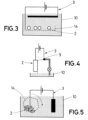
- Figure 4 shows a schematic representation of this device for an electropolishing process using an electrolytic medium with a non-conductive fluid that causes the relative movement of the solid electrolyte particles with respect to the piece to be polished through blasting a jet of the electrolytic medium, by means of a nozzle (9).
- the device comprises a power supply, a system for providing electrical connectivity to the piece to be polished, a system for driving the electrolytic medium and an electrode with polarity opposite to the piece to be polished at the outlet of the jet of electrolytic medium.
- the movement is generated by a global movement of the system.
- the electrolytic medium, the electrode and the piece to be polished are located in a closed container.
- the piece to be polished is firmly attached, as well as the electrode.
- An external mechanism causes a movement sufficient to produce a global movement of all the medium contained within.
- this movement can be a "shaker" type, a sudden shaking.
- this movement can be a repeated lying down in one or more axes, such as a gyroscopic mixer type movement.
- Table 1 shows a preferred composition of the electrolytic medium of the invention Element Composition % by mass Non-conductive fluid Hydroseal G 232 H 0.3 Polymeric particle Mitsubishi Relite CFS 59.8 Conductive solution 10% Methanesulfonic acid 39.9
- Table 2 shows a preferred composition of the electrolytic medium of the invention with ranges: Element Composition % by mass Minimum Maximum Non-conductive fluid Hydroseal G 232 H 0.05 15 Polymeric particle Mitsubishi Relite CFS 35 70 Conductive solution Methanesulfonic acid * 20 50 * The concentration of methanesulfonic acid is preferably in a range of 1 to 45% by mass.
- Table 5 shows a preferred composition of the electrolytic medium of the invention Element Composition % by mass Non-conductive fluid Polydimethylsiloxane 3.0 Polymeric particle Mitsubishi Relite CFH 52.0 Conductive solution 5% Sulfuric acid 45.0
- Table 6 shows a preferred composition of the electrolytic medium of the invention Element Composition % by mass Minimum Maximum Non-conductive fluid Polydimethylsiloxane 1 15 Polymeric particle Mitsubishi Relite CFH 35 70 Conductive solution Sulfuric acid * 20 50
- Another preferred embodiment of this invention consists of an ion exchange resin with acrylic acid units having spherical form with a gel-like structure, which reduces exudates in combination with an electrolytic aqueous solution containing 5% citric acid that provides the necessary conductivity.
- Tables 12 to 14 of the- Detergent A cited in the previous tables are shown.
- Table 12 Exemplary formula of detergent A, A1 Element Composition % by mass Detergent A Dodecylbenzenesulfonic acid 2.275 C10.9M Ethoxylated Alcohol 1.250 Triethanolamine 0.900 Coconut diethanolamide 0.500 50% KOH solution 0.275 H 2 O 94.800
- Table 13 Exemplary formula of detergent A, A2 Element Composition % by mass Detergent A Dodecylbenzenesulfonic acid 2.250 C10.9M Ethoxylated Alcohol 1.250 Coconut diethanolamide 0.500 H 2 O 96.000 Table 14.
- This prototype device is designed to treat gears and pinions of different sizes.
- the suitable electrolytic medium is the "emulsified formula for carbon steels”.
- It has a power supply (1) that connects the positive pole with the piece to be polished (2) and the negative pole with the cathode (3).
- the power supply (1) is capable of supplying a pulsed and polarity reversal current, with or without pauses between the different polarities.
- the pulses can be of high frequency, being able to have a duration in the order of microseconds to seconds. It is capable of applying asymmetric voltages, that is, applying a different voltage value to each polarity.
- the piece to be polished (2) is held by a holder (4).
- This holder has the function of holding the piece during the process and providing it with the electrical connection with the power supply. Likewise, it can incorporate a vibrator system to improve the relative movement of the piece - electrolytic medium..
- the holder (4) is connected to a system that provides a movement of the piece or pieces that it holds with the medium.
- This movement system in this embodiment consists of a guide-shaft (5) actuated by a pneumatic piston (6) that provides a vertical oscillatory movement in rhythm with a rotation so that the movement produced coincides with the inclination of the teeth of the pinion o gear to be polished. In this way there is a fluid movement of the particles through the interstitial space.
- This device is designed for a process in which a fluid-type electrolytic medium of the invention is blasted onto the surface to be polished. Any electrolytic medium of the invention can be used, but the best results are obtained with an electrolytic medium with an emulsified formulation.
- a power supply (1) connects the positive pole to the piece to be polished (2) and the negative pole to a cathode-nozzle (9).
- This device produces a jet of the electrolytic medium that comes out through the cathode-nozzle (9), which has the functions of directing the jet towards the piece and operating as electrical contact with the electrolytic medium.
- the electrolytic medium is collected in a tank (10).
- this tank there is a medium stirrer (11) that keeps the solid electrolyte particles in suspension in the electrolytic medium.
- the medium can be kept in suspension by bubbling a gas such as air.
- a peristaltic pump (12) drives the electrolytic medium with sufficient pressure from the tank (10) to the cathode-nozzle (9).
- the impulse of the electrolytic medium from the tank (10) to (9) can be produced by other means such as suction, an endless screw, pistons, etc.
- the device preferably includes a system for analyzing the electric current that is actually passing through the system, such as an oscilloscope (13).
- a system for analyzing the electric current that is actually passing through the system such as an oscilloscope (13).
- the piece to be polished is a 25 cm 2 flat stainless steel surface.
- the movement is achieved by projecting the electrolytic medium on the surface to be polished.
- the electrolytic medium has the following composition: Table 15. Composition of the electrolytic medium Element Composition % by mass Non-conductive fluid Hydroseal G 232 H 24.5 Detergent A1 5.5 Polymeric particle Mitsubishi Relite CFH 52.5 Conductive solution H 2 O 12.5 70% MSA 5.0
- the distance between the jet outlet nozzle and the piece is 3 cm.
- the jet covers the entire surface of the piece.
- Direct phase is the one that applies the positive voltage to the piece, reverse phase applies the negative, and pauses do not apply electrical voltage.
- a symmetrical 35 V potential difference is applied, with a duration of each section of 2 - 0.1 - 3 - 0.1 in milliseconds.
Landscapes
- Chemical & Material Sciences (AREA)
- Engineering & Computer Science (AREA)
- Chemical Kinetics & Catalysis (AREA)
- Electrochemistry (AREA)
- Materials Engineering (AREA)
- Metallurgy (AREA)
- Organic Chemistry (AREA)
- Electrical Discharge Machining, Electrochemical Machining, And Combined Machining (AREA)
- Electrolytic Production Of Metals (AREA)
- Electrolytic Production Of Non-Metals, Compounds, Apparatuses Therefor (AREA)
- Primary Cells (AREA)
Applications Claiming Priority (3)
| Application Number | Priority Date | Filing Date | Title |
|---|---|---|---|
| EP20383069 | 2020-12-09 | ||
| EP21854809.7A EP4249647B1 (de) | 2020-12-09 | 2021-11-30 | Elektrolytisches medium und elektropolierverfahren mit einem solchen elektrolytischen medium |
| PCT/ES2021/070864 WO2022123096A1 (es) | 2020-12-09 | 2021-11-30 | Medio electrolítico, proceso de electropulido usando dicho medio electrolítico y dispositivo para llevarlo a cabo |
Related Parent Applications (1)
| Application Number | Title | Priority Date | Filing Date |
|---|---|---|---|
| EP21854809.7A Division EP4249647B1 (de) | 2020-12-09 | 2021-11-30 | Elektrolytisches medium und elektropolierverfahren mit einem solchen elektrolytischen medium |
Publications (2)
| Publication Number | Publication Date |
|---|---|
| EP4538428A2 true EP4538428A2 (de) | 2025-04-16 |
| EP4538428A3 EP4538428A3 (de) | 2025-07-09 |
Family
ID=80222611
Family Applications (2)
| Application Number | Title | Priority Date | Filing Date |
|---|---|---|---|
| EP25160023.5A Pending EP4538428A3 (de) | 2020-12-09 | 2021-11-30 | Elektrolytisches medium und elektropolierverfahren mit einem solchen elektrolytischen medium |
| EP21854809.7A Active EP4249647B1 (de) | 2020-12-09 | 2021-11-30 | Elektrolytisches medium und elektropolierverfahren mit einem solchen elektrolytischen medium |
Family Applications After (1)
| Application Number | Title | Priority Date | Filing Date |
|---|---|---|---|
| EP21854809.7A Active EP4249647B1 (de) | 2020-12-09 | 2021-11-30 | Elektrolytisches medium und elektropolierverfahren mit einem solchen elektrolytischen medium |
Country Status (12)
| Country | Link |
|---|---|
| US (1) | US20240102197A1 (de) |
| EP (2) | EP4538428A3 (de) |
| JP (1) | JP2023553052A (de) |
| KR (1) | KR20230118929A (de) |
| CN (1) | CN116829769A (de) |
| AU (1) | AU2021397840A1 (de) |
| CA (1) | CA3201056A1 (de) |
| ES (1) | ES3026510T3 (de) |
| IL (1) | IL303496A (de) |
| MX (1) | MX2023006788A (de) |
| PL (1) | PL4249647T3 (de) |
| WO (1) | WO2022123096A1 (de) |
Families Citing this family (19)
| Publication number | Priority date | Publication date | Assignee | Title |
|---|---|---|---|---|
| ES2904576B2 (es) * | 2021-10-20 | 2023-02-20 | Drylyte Sl | Medio electrolitico para electropulido y metodo de electropulido con dicho medio |
| CN114481286A (zh) * | 2021-12-28 | 2022-05-13 | 广东省科学院化工研究所 | 一种用于电解抛光的固体颗粒物 |
| DE102022123211A1 (de) * | 2022-09-12 | 2024-03-14 | Otec Präzisionsfinish GmbH | Elektrolytmedium und Verfahren zum elektrochemischen Polieren von metallischen Werkstücken unter Verwendung eines solchen Elektrolytmediums |
| ES2942541A1 (es) * | 2022-11-15 | 2023-06-02 | Steros Gpa Innovative S L | Dispositivo para pulir superficies de piezas metalicas mediante proyeccion de particulas solidas electricamente activas |
| ES2963027B2 (es) * | 2023-06-02 | 2024-08-29 | Steros Gpa Innovative S L | Metodo y equipo para control de la temperatura de las particulas en procesos de pulido mediante particulas solidas |
| WO2025088407A1 (en) * | 2023-10-27 | 2025-05-01 | Medtronic, Inc. | System and method for electropolishing using solid electolyte particles |
| WO2025114631A1 (es) * | 2023-11-28 | 2025-06-05 | Drylyte, S.L. | Procedimiento de electropulido de piezas metálicas en contacto eléctrico flotante y dispositivo de electropulido para llevar a cabo dicho procedimiento |
| WO2025141067A1 (en) | 2023-12-29 | 2025-07-03 | Steros Gpa Innovative, S.L. | Surface finishing of objects |
| WO2025141065A1 (en) | 2023-12-29 | 2025-07-03 | Steros Gpa Innovative, S.L. | Method for regenerating ion exchange resins containing metal ions and products and uses of the regenerated resins |
| WO2025163093A1 (en) * | 2024-01-31 | 2025-08-07 | Drylyte, S.L. | Organic compounds comprising hydrophilic groups, such as fatty acids and alcohols for the surface finishing of objects |
| CN118028963B (zh) * | 2024-02-23 | 2024-12-10 | 广东倍亮科技有限公司 | 高价可溶性金属盐在金属固体电解抛光中的应用 |
| CN118028962B (zh) * | 2024-02-23 | 2024-12-10 | 广东倍亮科技有限公司 | 离子液体在金属固体电解抛光中的应用 |
| CN118186555A (zh) * | 2024-02-28 | 2024-06-14 | 广东倍亮科技有限公司 | 镁、铝或其合金固体电解抛光的固体颗粒物及其应用 |
| CN118186557A (zh) * | 2024-03-01 | 2024-06-14 | 广东倍亮科技有限公司 | 一种金属固体电解抛光的电解质及其应用 |
| CN118186562A (zh) * | 2024-03-01 | 2024-06-14 | 广东倍亮科技有限公司 | 一种金属固体电解抛光用的固体颗粒物 |
| WO2025191127A1 (en) | 2024-03-15 | 2025-09-18 | Steros Gpa Innovative, S.L. | Surface finishing of containers |
| DE102024112828A1 (de) | 2024-05-07 | 2025-11-13 | Otec Präzisionsfinish GmbH | Verfahren und Vorrichtung zum elektrochemischen Polieren von metallischen Werkstücken |
| WO2026003372A1 (en) | 2024-06-28 | 2026-01-02 | Drylyte, S.L. | Compositions, methods and equipments to surface finish metals by magnetic dry electrolytes |
| CN119685910B (zh) * | 2025-02-25 | 2025-05-20 | 江苏欧跃环保科技有限公司 | 去除合金表面镀层的电解装置及其工作方法 |
Citations (4)
| Publication number | Priority date | Publication date | Assignee | Title |
|---|---|---|---|---|
| ES2604830A1 (es) | 2016-04-28 | 2017-03-09 | Drylyte, S.L. | Proceso para alisado y pulido de metales por transporte iónico mediante cuerpos sólidos libres, y cuerpos sólidos para llevar a cabo dicho proceso. |
| ES2721170A1 (es) | 2018-01-26 | 2019-07-29 | Drylyte Sl | Uso de so4h2 como electrolito para procesos de alisado y pulido de metales por transporte ionico mediante cuerpos solidos libres. |
| ES2734415A1 (es) | 2018-11-12 | 2019-12-05 | Drylyte Sl | Uso de acidos sulfonicos en electrolitos secos para pulir superficies metalicas a traves del transporte de iones |
| ES2734500A1 (es) | 2018-11-12 | 2019-12-10 | Drylyte Sl | Uso de un HCl en electrolitos secos para pulir Ti y otras superficies de metales y aleaciones a través de transporte iónico |
Family Cites Families (8)
| Publication number | Priority date | Publication date | Assignee | Title |
|---|---|---|---|---|
| JP4710167B2 (ja) * | 2001-05-18 | 2011-06-29 | Tdk株式会社 | 色素増感型太陽電池 |
| DE102010052778B4 (de) | 2010-11-30 | 2013-01-17 | Otec Präzisionsfinish GmbH | Verfahren zum elektrochemischen Polieren von metallenen Gegenständen und hierfür geeignete Elektrolytlösung |
| JP5889732B2 (ja) * | 2012-06-29 | 2016-03-22 | 株式会社フジクラ | 非水溶液の脱水方法及び脱水非水溶液の製造方法 |
| US10821521B2 (en) * | 2017-04-11 | 2020-11-03 | Hamilton Sunstrand Corporation | Article surface finishing method |
| CN114514341A (zh) * | 2019-08-01 | 2022-05-17 | 德里莱特公司 | 用于借助于电活性固体颗粒对金属表面进行干式处理的方法和设备 |
| ES2754876B2 (es) * | 2019-08-01 | 2021-10-20 | Steros Gpa Innovative S L | Dispositivo para el tratamiento en seco de superficies metalicas mediante particulas solidas electricamente activas |
| ES2756948B2 (es) * | 2020-02-04 | 2022-12-19 | Drylyte Sl | Electrolito solido para el electropulido en seco de metales con moderador de actividad |
| CN111876820B (zh) * | 2020-08-05 | 2021-12-10 | 浙江安胜科技股份有限公司 | 一种不锈钢容器内胆高亮度镜面电解抛光方法 |
-
2021
- 2021-11-30 CN CN202180093323.8A patent/CN116829769A/zh active Pending
- 2021-11-30 JP JP2023534379A patent/JP2023553052A/ja active Pending
- 2021-11-30 EP EP25160023.5A patent/EP4538428A3/de active Pending
- 2021-11-30 ES ES21854809T patent/ES3026510T3/es active Active
- 2021-11-30 PL PL21854809.7T patent/PL4249647T3/pl unknown
- 2021-11-30 IL IL303496A patent/IL303496A/en unknown
- 2021-11-30 AU AU2021397840A patent/AU2021397840A1/en active Pending
- 2021-11-30 MX MX2023006788A patent/MX2023006788A/es unknown
- 2021-11-30 KR KR1020237023428A patent/KR20230118929A/ko active Pending
- 2021-11-30 WO PCT/ES2021/070864 patent/WO2022123096A1/es not_active Ceased
- 2021-11-30 CA CA3201056A patent/CA3201056A1/en active Pending
- 2021-11-30 US US18/266,376 patent/US20240102197A1/en active Pending
- 2021-11-30 EP EP21854809.7A patent/EP4249647B1/de active Active
Patent Citations (4)
| Publication number | Priority date | Publication date | Assignee | Title |
|---|---|---|---|---|
| ES2604830A1 (es) | 2016-04-28 | 2017-03-09 | Drylyte, S.L. | Proceso para alisado y pulido de metales por transporte iónico mediante cuerpos sólidos libres, y cuerpos sólidos para llevar a cabo dicho proceso. |
| ES2721170A1 (es) | 2018-01-26 | 2019-07-29 | Drylyte Sl | Uso de so4h2 como electrolito para procesos de alisado y pulido de metales por transporte ionico mediante cuerpos solidos libres. |
| ES2734415A1 (es) | 2018-11-12 | 2019-12-05 | Drylyte Sl | Uso de acidos sulfonicos en electrolitos secos para pulir superficies metalicas a traves del transporte de iones |
| ES2734500A1 (es) | 2018-11-12 | 2019-12-10 | Drylyte Sl | Uso de un HCl en electrolitos secos para pulir Ti y otras superficies de metales y aleaciones a través de transporte iónico |
Also Published As
| Publication number | Publication date |
|---|---|
| IL303496A (en) | 2023-08-01 |
| ES3026510T3 (en) | 2025-06-11 |
| KR20230118929A (ko) | 2023-08-14 |
| EP4249647A1 (de) | 2023-09-27 |
| CA3201056A1 (en) | 2022-06-16 |
| AU2021397840A1 (en) | 2023-07-06 |
| WO2022123096A1 (es) | 2022-06-16 |
| MX2023006788A (es) | 2023-06-20 |
| CN116829769A (zh) | 2023-09-29 |
| PL4249647T3 (pl) | 2025-06-16 |
| US20240102197A1 (en) | 2024-03-28 |
| EP4249647C0 (de) | 2025-02-26 |
| JP2023553052A (ja) | 2023-12-20 |
| EP4249647B1 (de) | 2025-02-26 |
| EP4538428A3 (de) | 2025-07-09 |
Similar Documents
| Publication | Publication Date | Title |
|---|---|---|
| EP4249647B1 (de) | Elektrolytisches medium und elektropolierverfahren mit einem solchen elektrolytischen medium | |
| CN101473068B (zh) | 用于破乳化清洗金属表面的方法 | |
| JP7289351B2 (ja) | イオン輸送を介して金属表面を研磨するための乾式電解質におけるスルホン酸の使用 | |
| US20070051639A1 (en) | Membrane-mediated electropolishing | |
| US20250207293A1 (en) | Electrolyte medium and method for electrochemical polishing of metal workpieces using such an electrolyte medium | |
| KR20000005370A (ko) | 전기분해 및 캐비테이션 작용을 이용하여 금속 표면으로부터 피막을 제거하는 방법g | |
| WO2025088203A1 (en) | Surface finishing using electrically conducive particles and abrasive particles | |
| CN104039946A (zh) | 清洗液组合物 | |
| CN118382730A (zh) | 用于电解抛光的电解质介质以及利用该介质进行电解抛光的方法 | |
| JP5787265B1 (ja) | 塗料残渣の捕集システムおよび塗料残渣の捕集方法 | |
| WO2025233221A1 (de) | Verfahren und vorrichtung zum elektrochemischen polieren von metallischen werkstücken | |
| JP2004315675A (ja) | 二酸化炭素溶媒用界面活性剤 | |
| US6495617B1 (en) | Methods to control phase inversions and enhance mass transfer in liquid-liquid dispersions | |
| EP1722013A1 (de) | Galvanisierung in gegenwart von co sb 2 /sb | |
| US4642444A (en) | Electrical machining fluid and method utilizing the same | |
| Graciaa et al. | Measurement of the zeta potential of oil drops with the spinning tube zetameter | |
| WO2025163093A1 (en) | Organic compounds comprising hydrophilic groups, such as fatty acids and alcohols for the surface finishing of objects | |
| JP2017144355A (ja) | Pcb汚染物の洗浄方法及び洗浄装置 | |
| JP6864530B2 (ja) | 洗浄剤組成物 | |
| WO2025191127A1 (en) | Surface finishing of containers | |
| CN106404501A (zh) | 一种工业纯钛ta2的电解腐蚀剂及电解抛光腐蚀方法 | |
| JP4150935B2 (ja) | 有機溶媒存在下での表面処理 | |
| JP2006291008A (ja) | フッ素系洗浄溶媒 | |
| JP2005052812A (ja) | 消泡方法 | |
| WO2001094076A1 (en) | Chemical-hydrodynamic etch planarization |
Legal Events
| Date | Code | Title | Description |
|---|---|---|---|
| PUAI | Public reference made under article 153(3) epc to a published international application that has entered the european phase |
Free format text: ORIGINAL CODE: 0009012 |
|
| STAA | Information on the status of an ep patent application or granted ep patent |
Free format text: STATUS: REQUEST FOR EXAMINATION WAS MADE |
|
| 17P | Request for examination filed |
Effective date: 20250225 |
|
| AC | Divisional application: reference to earlier application |
Ref document number: 4249647 Country of ref document: EP Kind code of ref document: P |
|
| AK | Designated contracting states |
Kind code of ref document: A2 Designated state(s): AL AT BE BG CH CY CZ DE DK EE ES FI FR GB GR HR HU IE IS IT LI LT LU LV MC MK MT NL NO PL PT RO RS SE SI SK SM TR |
|
| REG | Reference to a national code |
Ref country code: DE Ref legal event code: R079 Free format text: PREVIOUS MAIN CLASS: C25F0007000000 Ipc: C25F0003160000 |
|
| PUAL | Search report despatched |
Free format text: ORIGINAL CODE: 0009013 |
|
| AK | Designated contracting states |
Kind code of ref document: A3 Designated state(s): AL AT BE BG CH CY CZ DE DK EE ES FI FR GB GR HR HU IE IS IT LI LT LU LV MC MK MT NL NO PL PT RO RS SE SI SK SM TR |
|
| RIC1 | Information provided on ipc code assigned before grant |
Ipc: C25F 7/00 20060101ALI20250605BHEP Ipc: C25F 3/16 20060101AFI20250605BHEP |