EP4249647B1 - Elektrolytisches medium und elektropolierverfahren mit einem solchen elektrolytischen medium - Google Patents
Elektrolytisches medium und elektropolierverfahren mit einem solchen elektrolytischen medium Download PDFInfo
- Publication number
- EP4249647B1 EP4249647B1 EP21854809.7A EP21854809A EP4249647B1 EP 4249647 B1 EP4249647 B1 EP 4249647B1 EP 21854809 A EP21854809 A EP 21854809A EP 4249647 B1 EP4249647 B1 EP 4249647B1
- Authority
- EP
- European Patent Office
- Prior art keywords
- conductive
- electrolytic medium
- particles
- piece
- acid
- Prior art date
- Legal status (The legal status is an assumption and is not a legal conclusion. Google has not performed a legal analysis and makes no representation as to the accuracy of the status listed.)
- Active
Links
Images
Classifications
-
- C—CHEMISTRY; METALLURGY
- C25—ELECTROLYTIC OR ELECTROPHORETIC PROCESSES; APPARATUS THEREFOR
- C25F—PROCESSES FOR THE ELECTROLYTIC REMOVAL OF MATERIALS FROM OBJECTS; APPARATUS THEREFOR
- C25F3/00—Electrolytic etching or polishing
- C25F3/16—Polishing
-
- C—CHEMISTRY; METALLURGY
- C25—ELECTROLYTIC OR ELECTROPHORETIC PROCESSES; APPARATUS THEREFOR
- C25F—PROCESSES FOR THE ELECTROLYTIC REMOVAL OF MATERIALS FROM OBJECTS; APPARATUS THEREFOR
- C25F7/00—Constructional parts, or assemblies thereof, of cells for electrolytic removal of material from objects; Servicing or operating
Definitions
- This invention is part of the industry sector dedicated to the treatment of metal surfaces. Especially in the area of metal smoothing, burnishing and polishing.
- the solid electrolyte for this electropolishing process is composed of an ion exchange resin that retains a liquid electrolyte.
- Document ES2604830 describes an electropolishing process with solid electrolyte by ion transport, and a solid electrolyte in which the retained liquid electrolyte includes hydrofluoric acid.
- Document ES2721170 describes a solid electrolyte in which the retained electrolyte is a sulfuric acid solution. This electrolyte is described as especially useful for stainless steels and cobalt chromium alloys.
- Document ES2734500 describes a solid electrolyte in which the retained electrolyte is a hydrochloric acid solution as a solution to the specific problem posed by polishing titanium.
- Document ES2734415 describes a solid electrolyte containing a solution of sulfonic acid, preferably methanesulfonic acid. This composition is useful for a wide range of alloys and metals.
- these are formulations that are based on two elements: on the one hand, a set of non-conductive inert support particles, and on the other hand, an aqueous solution of strong acid.
- compositions have a number of limitations:
- Document ES2756948A1 discloses a solid electrolyte for dry electropolishing of metals comprising; At least one type of active ion exchange resin particles charged with an acidic solution that generate chemical activity and electrical activity, at least one type of particles that moderate the chemical action and/or particles that moderate the electrical conductivity of the particles active, in such a way that the moderating particles reduce the localized attacks to the surface of the polished piece caused by the exudates of the active particles by means of electrically active solid particles (9), comprising an electrical source (2) with an electrode (3) that transmits electric charge to the electrically active solid particles (9) and means for projecting electrically active solid particles onto the surface to be treated (1).
- This invention discloses a new electrolytic medium and an electropolishing process that uses it.
- claim 1 describes one aspect of the invention refering to an electrolytic medium.
- the term "set of solid electrolyte particles” refers to the set formed by the solid particles and the conductive solution.
- electrolytic medium of this aspect of the invention will be referred to as the electrolytic medium of the invention.
- fluid in this text fluid is understood in a broad sense, materials with very high viscosities are considered fluids, such as petroleum jelly, with a viscosity at room temperature close to 0.05 m 2 /s. Both Newtonian and non-Newtonian fluids are considered within the scope of this invention.
- a second aspect of the invention relates to the use of the electrolytic medium of the invention in an electropolishing process.
- Another aspect of the invention defined in claim 11 refers to an electropolishing process.
- Relative movement is understood as that movement that changes the relative position of two points. This includes oscillating or vibrating movement between two points, such as movement that occurs between a vibrating surface and a particle.
- an electropolishing device comprising
- a metal piece to be polished connected to one electrode is introduced into a medium of solid electrolyte particles that also contain a second electrode.
- the difference in potential applied between the electrodes causes redox reactions at the particle-metal contact points (metal roughness peaks). These metal oxides are eliminated by the particles in the form of cations, producing a polishing effect.
- Solid electrolyte particles conduct electricity through the contact areas between them. When the particles contact the metal surface, due to pressure, they leave acid exudates on the surface.
- the solid electrolyte described in this invention includes a non-conductive fluid immiscible in the electrolyte liquid that the particles contain. This fluid has surprising effects on the connectivity between the particles, as well as on the particle-metal surface interaction.
- each particle has a part of its surface that contacts other particles and another part that contacts the gaseous medium (usually air).
- the non-conductive fluid contacts the surface of the spherical particles, without significantly penetrating the interior, avoiding the areas where the particle contacts another particle.
- the liquid electrolyte in the particles is concentrated.
- the immiscibility between the two fluids (conductive and non-conductive) makes the particle-particle conductive liquid menisci more concentrated in space, and therefore stronger. All of this translates into greater particle connectivity.
- the metal surface is covered with non-conductive fluid, except at the particle-metal contact points. This has several positive effects on the final finishes:
- Solid electrolyte particles by themselves behave like a granular material.
- the fact that the solid electrolyte can be formulated with a non-conductive fluid allows the assembly to be treated as a fluid in certain formulations, which allows the polishing process to be carried out by immersion, but also by blasting the set on the piece to be polished.
- this invention describes: an electrolytic medium that comprises a non-conductive fluid and a set of solid electrolyte particles, comprised of particles that retain a conductive solution, wherein the non-conductive fluid and the conductive solution are not miscible.
- a fundamental aspect of the invention refers to an electrolytic medium as defined in claim 1 formed by a "set of solid electrolyte particles with non-conductive fluid" for electropolishing that comprises:
- Solid electrolyte particles are composed of solid particles that have the ability to retain a conductive liquid solution so that this gives them conductivity.
- the set of electrolyte solid particle, conductive liquid solution presents an electrical conductivity greater than 10 micronS/cm.
- Liquid retention can occur due to porosity of the material or due to molecular structure such as a gel-like structure.
- the particles are porous, this porosity is selected from: microporosity, mesoporosity, macroporosity and fractal porosity.
- the retention mechanisms can be: permeation, absorption, adsorption, retention in the interlaminar space.
- These particles can be of any material that is capable of retaining liquid, such as, for example, mineral, ceramic, polymeric materials, organic compounds, inorganic compounds, of plant origin.
- These particles are preferably made of polymeric material.
- the particles are spheres or spheroids.
- the particles have a liquid retention capacity of between 1% and 80% by mass of water with respect to the total mass, which is the mass of particles plus the mass of water.
- These solid particles capable of retaining liquid are preferably made of polymeric material, since it is a material with a lower hardness than that of metals, so the process does not have an abrasive component. As they must flow through the metal surface, they have a shape that favors their movement over the surface to be polished. Because of that, the preferred shape of the polymeric material particles is a spherical or spheroid shape.
- the initial roughness Ra to be reduced is usually between 1 and 10 micrometers, so that the spheres can roll over the roughness, without polishing it, preferably the particle sizes have a very high sphere-roughness ratio (large spheres in relation to the roughness). Therefore, the optimum mean diameter of the particles is preferably between 100 microns and 1 millimeter.
- the preferred polymeric materials are ion exchange resins selected from: strong and weakly acidic cationic resins, strong and weakly basic anion exchange resins and chelating resins. More preferably, cationic exchange resins, since in this way they have the capacity to capture the metal ions extracted in the electropolishing processes.
- the particles of polymeric material are made of a sulfonated divinylbenzene S-DVB and styrene copolymer, since it is a material resistant to acid and the oxidative action of the process. It has the ability to act as an ion exchanger, which favors the extraction of metal from the surface to be polished by storing the ions.
- the polymeric material particles are of a copolymer containing units derived from acrylic acid or methacrylic acid. This includes derivatives with different functional groups such as acrylic acid, acrylamide, cyanoacrylate, alkyl acrylates, among others, and the corresponding methacrylate analogs.
- the particles based on these materials have a high elasticity which is suitable for processing parts having open geometries without cavities.
- the particles can have a porous structure, which facilitates the exchange of fluids resulting in a faster process.
- the particles may have a gel-like structure.
- the fluid exchange is more restricted, which results in a slower process, however, the particle-surface contact is more defined, resulting in a lower final roughness.
- the polymeric material particles include functional groups that are capable of capturing or retaining the metal ions generated during the process, such as acid, amino, or chelating groups.
- These functional groups can be of the acidic type, such as sulfonic or carboxylic groups. These acidic functional groups are especially useful in this application as they have good chemical resistance and are capable of retaining a wide variety of metal ions.
- the conductive liquid solution that is retained in the particles is a conductive liquid.
- the function of the conductive liquid solution in an electropolishing process is twofold: on the one hand, it conducts electricity, and on the other, it must be able to dissolve the oxides that are formed on the surface to be treated. For this reason, the composition of this liquid is key and depends on the process to which it is to be applied, on the type of surface to be treated.
- the conductive liquid solution can be an ionic liquid, a liquid acid, a conductive solution, a conductive liquid polymer.
- the conductive solution can include a polar solvent such as, for example, without limitation, water, ethanol, isopropanol, DMSO, DMF, ionic liquids, among others.
- a polar solvent such as, for example, without limitation, water, ethanol, isopropanol, DMSO, DMF, ionic liquids, among others.
- the conductive solution includes water, as it is a solvent that is capable of effectively dissolving salts and metal oxides.
- the conductive solution contains at least one acid, for example an aqueous solution comprising an acid.
- This has the technical effect of increasing conductivity by increasing the number of protons (which are highly conductive) in the medium, and simultaneously increasing the solubility of metal oxides, which are mostly acidic.
- the acids that can be used are sulfuric acid, sulfonic acids, phosphoric acid, carboxylic acids, citric acid, hydrochloric acid, hydrofluoric acid.
- a preferred acid to use is sulfuric acid, as it is a strong non-volatile acid.
- a family of acids being preferably used are the sulfonic acids, due to their high acidity and the solubility of their salts.
- the sulfonic acid used is methanesulfonic acid, since it is the one with the highest solubility of its salts.
- Phosphoric acid is also preferred in cases of metals highly sensitive to corrosion, since it facilitates the formation of passive layers of protective metal phosphate.
- a highly active acid being preferably used and with a high attack rate is hydrochloric acid.
- Acids can be used alone or in combination of several of them.
- a preferred combination is the combination of strong acids with phosphoric acid.
- Acids can be combined with complexing agents, salts, etc. to improve the conductivity of the particles and the solubility of oxides and salts.
- an acid concentration between 1% and 10% by mass relative to the mass of more acidic water is used, since this provides high conductivity and a dissolution of enough oxides.
- an acid concentration by mass between 20% and 35% with respect to the total mass of water plus acid is used, since the titanium oxides formed require a higher concentration to be dissolved.
- the conductive solution can include a complexing agent such as ETDA, citrate/citric acid, polyethylene glycols, polyethers, polyamines, among others.
- a complexing agent such as ETDA, citrate/citric acid, polyethylene glycols, polyethers, polyamines, among others.
- Citric acid or citrate is useful in the process due to its chelating effect, which is effective in removing oxides and salts from the surface to be polished.
- the conductive liquid solution can also be neutral. In this case it must include dissolved ions to increase conductivity.
- the conductive liquid solution can also be basic.
- the use of amines as a base favors the solution of metals due to their ability to coordinate with metal cations.
- These basic conductive solution formulations are especially suitable for metals that form anionic complexes.
- the conductive solution ratio between the set of solid electrolyte particles is preferably between 25% and 60% by mass/total mass, the total mass being the mass of the conductive solution and the electrolyte particles, since in this range there is enough conductive liquid to observe measurable conductivity of the solid electrolyte particles, without observing conductive liquid free of solid electrolyte particles. More preferably, it is between 35% and 50% by mass electrolyte particles/total mass, the total mass being the mass of the conductive solution and the electrolyte particles.
- free liquid or free fluid is understood as that which separates itself from the solid part under normal conditions of pressure and temperature. Normal conditions imply that the pressure is 1 atm and the temperature is 0°C. It can be determined, for example, by the "Method 9095 (Paint Filter Liquids Test)" described by the U.S. Environmental Protection Agency in publication SW- 846.
- the material of the particles is ion exchange resin based on a copolymer of styrene and sulfonated divinylbenzene
- a ratio between the conductive solution and the set of solid electrolyte particles of between 34% and 52% by mass/mass total provides an optimal electropolishing process.
- Non-conductive fluid is a defining element of this invention. It is a fluid that when being at rest at room temperature does not significantly conduct electrical current. To fulfill its function it must be immiscible in the liquid electrolyte contained in the solid electrolyte particles. In this way, by affinity the liquid electrolyte is kept inside the particles and the non-conductive fluid outside. As it must withstand the presence of an electrolyte liquid that can be an acid solution, in addition to considerable voltages, the non-conductive fluid must be a compound being stable or kinetically stable under working conditions.
- the non-conductive fluid occupies interstitial space between the particles, either in part, totally or in excess.
- the non-conductive fluid is at a concentration between 1 % and 80% based on mass relative to the total mass represented by the mass of the solid electrolyte particles plus non-conductive fluid.
- An advantage of this electrolytic medium is that as the surface area of electrolyte liquid exposed to air is reduced, the evaporation of electrolyte liquid is also reduced, which increases the stability of the process, achieving more reproducible results between new electrolytes and with several hours of use.
- the conductive liquid is concentrated at the points of contact with the other spheres, generating stronger menisci that produce higher connectivity between the particles.
- a main effect of the non-conductive fluid on the solid electrolyte particles is to cover the metal surface of the piece to be polished with non-conductive liquid. This has several technical effects that result in a better finish of the solid electrolyte electropolishing process:
- the process can be carried out with very high viscosity fluids, such as petroleum jelly, which has a viscosity close to 0.05 m 2 /s. In these cases, a system with high interparticle cohesiveness is generated. In addition, a high-viscosity coating of the piece is also produced that efficiently protects the surface from atmospheric oxidation and acid residues, making it suitable for very sensitive metals, such as carbon steels.
- very high viscosity fluids such as petroleum jelly
- very high interparticle cohesiveness is generated.
- a high-viscosity coating of the piece is also produced that efficiently protects the surface from atmospheric oxidation and acid residues, making it suitable for very sensitive metals, such as carbon steels.
- the non-conductive fluid preferably has a viscosity in the range between 1 ⁇ 10- 7 and 1 ⁇ 10- 4 m 2 /s, such as, for example, hydrocarbons without CrC16 functional groups, low viscosity silicone oils, among others.
- the viscosity range of the non-conductive fluid is very wide, from 1-10- 7 to 0.05 m 2 /s, preferably centered in the range 1-10- 7 and 1-10- 4 m 2 /s.
- the non-conductive fluid may have a certain volatility, in this case it must be replaced periodically to maintain its properties. To avoid this process, it is preferable that the non-conductive fluid is not very volatile.
- the fluid has a boiling temperature greater than 100°C, for example in the range of 100 to 1000°C.
- non-conductive fluids There is a limited number of types of non-conductive fluids that meet the characteristics of volatility, viscosity, toxicity, etc. that make them viable for use in this application: hydrocarbons, organic solvents, essential oils, silicone and silicone oils, fluorinated solvents, among others. They can be used pure or in combination with each other.
- Hydrocarbon-based fluids are used in a wide variety of applications, such as lubricants, fuels, solvents, etc.
- hydrocarbons are understood as those compounds that include only carbon and hydrogen in their structure. Due to this great variety of existing hydrocarbons, those that present the properties that best suit the needs can be selected.
- Aliphatic hydrocarbons are preferably used since, in general, they have less toxicity than aromatic hydrocarbons, and greater electrochemical stability.
- aliphatic hydrocarbons are used with a molecular weight and structure that allows them to be in a fluid or semi-fluid state at the working temperature, which places the potential candidates in the Cs-C30 range.
- hydrocarbons are used in the Cs-C16 range with a linear structure, since they have very low viscosities, even below 5 10- 5 m 2 /s while they have high volatility, above 80°C.
- Low volatility water immiscible solvents and organic compounds can also be used in this process, for example aliphatic alcohols like 1-octanol, organic carbonates like propylene carbonate, ethylene carbonate, among others.
- Silicones and silicone oils have various applications in relation to protection and lubrication of metal parts, so they have been optimized for their interaction with different metal surfaces as lubricants and other uses.
- silicones or silicone oils are understood to be those oligomers, polymers, cycles or other structures that include O - Si bonds in their main chain.
- Silicone oils that include dimethylsiloxane units -OSi(Me2)-. Those with a linear structure are especially useful due to their low viscosities, as well as cyclic ones such as hexamethylcyclotrisiloxane. In general, polydimethylsiloxanes are good candidates for the process and have a good variety, allowing the non-conductive fluid to be tailored to the application.
- fluorinated solvent is understood as one that incorporates at least one fluorine atom in its chemical structure.
- Fluorinated solvents have a much lower surface tension than other liquids. This is due to fluorine's high electronegativity together with its poor polarizability.
- Non-conductive fluids based on emulsified systems deserve a special mention. These systems have a high erosion speed, high fluidity that facilitates pumping, and also provide high quality finishes. An additional advantage is the possibility to more easily adapt the formula to different needs.
- emulsions are expressly a non-conductive non-polar continuous phase containing conductive polar solution micelles.
- conductive polar solution micelles According to the terminology commonly used in emulsions, we are talking about water-in-oil type emulsions (w/o).
- the conductive polar solution of micelles has the same composition as the conductive solution that is retained by the solid electrolyte particles.
- the non-polar continuous phase is non-conductive
- the emulsion at rest without solid electrolyte particles is non-conductive.
- the emulsion is not conductive, the conductivity of the total mixture of the electrolytic medium, emulsion plus solid electrolyte particles, is clearly superior to formulations with non-emulsified fluids. This is due to the fact that the micelles of the emulsion are structured around the particles, which retain polar conductive solution, locally destabilizing the micelles, thus increasing the hydrophilic bridges between particles.
- the micelles absorb the remains of the polar solution (which may contain acid depending on the formulation), which reduces preferential attack points, which would turn into pitting.
- An emulsion-based non-conductive fluid comprises:
- the mass percentages of the non-conducting fluid are relative to the total mass of the non-conducting fluid: the sum of the non-polar continuous phase, dispersed polar phase and surfactants.
- the continuous non-polar phase is in a range between 50% and 99%, the dispersed polar phase in a range between 1% and 50% and the surfactants in a range between 0.01% and 30%. More preferably the non-polar phase continues between 70% and 80%, the dispersed polar phase between 20% and 30%, and the surfactant between 1.5% and 3%.
- the surfactant is a mixture of nonionic surfactant and anionic surfactant so that the nonionic surfactant is in a range between 0% and 20% more preferably between 1% and 2%, the anionic surfactant between 0% and 10% more preferably between 0.5% and 1% and always the sum of the surfactants is at least 0.01%.
- the conductivity of the liquid emulsion is lower than the conductivity of the solid electrolyte particles.
- the micelles of the dispersed polar phase interact with the conductive bridges that are established between the particles, contributing to the overall conductivity.
- the continuous non-polar phase can be composed of non-polar liquids such as, for example, without limitation, hydrocarbons, organic solvents, liquid polymers, fluorinated solvents, silicones, mineral oils, vegetable oils, etc.
- the continuous non-polar phase comprises hydrocarbons within the Cs-C2 fraction since they meet the required technical characteristics of viscosity and volatility.
- the continuous non-polar phase is selected from a hydrocarbon, silicone and their mixture
- the mixture comprises a hydrocarbon and a silicone with a mass percentage between 80% and 99% of hydrocarbon with respect to the total mass represented by mass of hydrocarbon plus silicone mass.
- the dispersed polar phase is made up of colloids, micelles, microdroplets, etc. scattered in the continuous non-polar phase.
- the dispersed polar phase is miscible with the conductive liquid solution retained in the particles. For this reason, the dispersed polar phase interacts with the conductive liquid bridges between the solid electrolyte particles, regulating the conductivity of the medium.
- the dispersed polar phase is a mixture of water and an acid where water represents a percentage by mass between 30% and 99.9% with respect to the total mass water and acid, more preferably a percentage by mass between 90% and 98%.
- Formulations that allow the dispersed polar phase to interact with conductive liquid bridges have a higher conductivity.
- These formulations preferably include a high hydrophilic or HLB (Lipophilic hydrophilic balance) surfactant, i.e., preferably with ionic or strongly polar groups, with a relatively small non-polar chain.
- HLB Hydrophilic hydrophilic balance
- Formulations that stabilize the dispersed polar phase within the continuous non-polar phase have a lower conductivity.
- These formulations preferably include surfactants that stabilize the dispersed polar phase in the continuous non-polar phase. These surfactants preferably have a relatively low HLB, with non-ionized polar groups and one or more large non-polar chains. Although the conductivity is lower, conductive liquid bridges are more stabilized than without emulsion, which keeps the conductivity more constant when there is movement.
- surfactant is used in the broad sense to encompass all those surfactants, detergents, emulsifiers, emulsifying agent, humectants, soaps, solubilizers, softeners, surfactants, antifoams, among others, that reduce the surface tension between two phases, and that mostly have a chemical structure with polar part and non-polar part.
- a parameter that defines a surfactant is its hydrophilic-lipophilic balance or HLB (Hydrophilic-Lipophilic Balance). High HLB corresponds to surfactants more soluble in polar phases, while low HLB corresponds to more soluble surfactants in non-polar phases.
- the surfactant or mixture of surfactants used are key to defining the structure of the emulsion, which dictates its behavior and affects the interaction between the liquid emulsion and the particles, and the interaction between the liquid emulsion and the surface to be treated in polishing processes.
- One effect of the surfactant in this invention is to control the interaction of the dispersed polar phase with the conductive liquid bridges between particles, indirectly controlling the conductivity.
- the surfactant controls the stability of the dispersed polar phase in the continuous non-polar phase, the lower the stability, the greater the interaction with the conductive liquid bridges.
- an additional effect is that the surfactant can form a layer on the surface of the metal piece in electropolishing processes. This acts as a protector and leveler of the surface, since in the roughness valleys the layer is more stable, favoring a greater exposure of the roughness peaks, which results in smoother finishes when using this invention.
- the surfactant controls the availability of the dispersed polar phase to intervene in the conductive liquid bridges.
- Electrolytic media with less restriction of the discontinuous polar phase favor higher conductivity. This conductivity makes the system more aggressive and also faster, favoring the removal of material. This type of system is especially focused on metals that are self-passivating, such as stainless steels, titanium, aluminum, among others. Surfactants that do not stabilize especially polar emulsions in non-polar phases are indicated in this case, that is, with high HLB, making the emulsion less stable and facilitating a greater amount of aqueous bridges.
- This combination can be, for example, without limiting purpose, a nonionic surfactant with an ethoxylated chain attached and an anionic surfactant with a sulfonic or carboxyl group (s).
- Surfactants comprise at least one polar head and one non-polar tail.
- polar head we can refer to cationic, anionic, zwitterionic, or neutral surfactants. All of them can be used in this process.
- the non-polar tail can include an aliphatic chain of formula CnH2n+1 that is straight or branched. Preferably it includes a linear aliphatic chain. Even more preferably this chain is in the C5-C1 range.
- the non-polar tail can also include aromatic groups. Furthermore, it can also include a combination of both in which the aliphatic chain is linked to an aromatic ring and this in turn is linked to the polar group.
- Anionic surfactants have the advantage of not interacting with sulfonic or carboxylic functional groups, for which reason they are preferably used when the polymeric material includes these functional groups.
- Anionic surfactants comprise at least one polar head consisting of a negatively charged functional group, a non-polar chain, and a cation.
- the negatively charged polar group comprises a sulfate, sulfonate, phosphate or carboxylate group.
- anionic surfactants include, but are not limited to, alkylbenzene sulfonates, lignin sulfonates, alkyl sulfates, alkyl ether sulfates, docusate, perfluoroactonosulfonate, perfluorobutanesulfonate, alkyl aryl ether phosphate, alkyl ether phosphate, alkyl carboxylates, among many others.
- the cationic surfactants being preferably used are based on nitrogen-containing groups, such as amino, ammonium, alkanolamine, or pyridinium. These surfactants include primary, secondary, or tertiary amines with alkyl or aryl groups.
- the neutral surfactants being preferably used are those that include polyether chains as their polar part, since these chains are more voluminous than the ionic groups and favor a good stability of the water-in-oil emulsion.
- Zwitterionic surfactants also called amphoteric surfactants, simultaneously have a cation and an anion in the same molecule, as well as a hydrophobic tail.
- groups present in zwitterionic surfactants that can be used in this process include alkyl amine oxides, betaines, sultaine, phosphocholine group, among others.
- the amount of non-conductive fluid must be sufficient to coat the surface of the set of sphere particles and the pieces to be polished. If the ratio of non-conductive fluid is too low, the desired effects are not achieved in the process.
- the minimum value of non-conductive fluid to carry out the process is 0.05% of non-conductive fluid with respect to the total electrolytic medium.
- the mass percentage of solid electrolyte particles is between 20% and 99% with respect to the total mass which is represented by solid electrolyte particles plus non-conductive fluid, more preferably between 50% and 80%.
- a conceptually interesting point is the quantity that fills the interstitial spaces of the set of solid electrolyte particles.
- the formulation can have more or less quantity than this value. A higher quantity facilitates pumping and fluidity of the medium.
- This first type includes those embodiments in which the amount of non-conductive fluid is not sufficient for the electrolyte of this invention to have free liquid.
- the non-conductive liquid is distributed on the surface of the spheres.
- This ratio of conductive fluid is usually below 10% by weight of the non-conductive liquid with respect to the total electrolytic medium so that there is no free liquid, and above 0.05% so that there is an appreciable effect.
- the electrolytic medium behaves like a granular material. Its mobility can be promoted and controlled by vibrating systems or fluidization by injection of a gas, such as air.
- the non-conductive fluid is distributed over the surface of the solid electrolyte particles without any free liquid being observed. It is especially located in the less polar areas, which are those that are in contact with the air. In the areas of the surface of each particle that contact other particles, here mainly there is less non-conductive fluid and more electrolyte liquid. In this way, hydrophilic bridges are established between the particles that act as cohesive forces between the particles. To achieve this distribution it is necessary that the electrolyte liquid and the non-conductive fluid be immiscible.
- the electrolytic medium When the electrolytic medium is moving, it becomes homogenized, keeping the particles in suspension, and the whole behaves like a fluid as long as the movement is maintained.
- This formulation has the advantage of being able to handle the set as a fluid, which allows it to be blasted towards the areas to be polished that require it most or are difficult to access. This is a great advantage as it allows the process to attack areas and recesses that would not otherwise be well processed.
- Non-conductive fluids based on emulsions are especially useful for these applications, since they have greater fluidity and conductivity. In this case, it is possible to work under conditions in which the moving liquid behaves like an organic phase with aqueous micelles, but in a state of rest there is a separation of the organic phase and the aqueous phase.
- a partial liquid separation process can be incorporated to ensure particle contact. For example, it can be pumped using excess non-conductive liquid and remove excess non-conductive liquid before projecting the medium onto the piece.
- the electrolytic medium described is specially designed to be used in an electropolishing process for metal pieces.
- the electropolishing process comprises the steps of:
- an electropolishing device comprising:
- the power supply (1) is connected to the piece (2) to be polished and to the electrode (3).
- a mechanism produces a relative movement between the piece (2) to be polished and the electrolytic medium.
- the power supply provides a potential difference between the piece (2) to be polished and the electrode (3).
- the current that circulates between the piece (2) and the electrode (3) produces oxidation effects in the piece that transform the surface metal into oxides or salts.
- Solid electrolyte particles when in contact with oxidized metal dissolve or remove it from the surface. When the particles are spherical they can only contact the roughness peaks, only at these points oxidation occurs and only at these peaks metal is removed. In this way, the roughness is reduced by the removal of metal from the roughness peaks.
- the power supply (1) provides a potential difference between the piece (2) to be polished and the electrode (3).
- the piece is connected to the positive pole or anode, and the negative pole is connected to the electrode.
- the applied voltage depends on experimental parameters that vary in each case: metal to be polished, exposed metal surface, conductivity of the electrolytic medium, among others.
- polarity reversal intervals In metals and geometries in which there is an accumulation of metal oxides and salts, in these cases, it is advisable to apply polarity reversal intervals. These polarity reversals can occur in the order of seconds, milliseconds, or microseconds. Each metal, depending on its characteristics and those of the salts and oxides it produces, requires optimized polarity reversal times. For example, for electropolishing titanium, polarity reversal ranges on the order of tens of microseconds will preferably be applied. The reversal of polarity can be in a symmetric way, that is, using the same voltage, or in an asymmetric way, that is, the positive voltage different from the negative one, which allows better adaptation to each phase.
- an electric current divided into four sections is applied: Direct - Pause 1 - Reverse - Pause 2.
- Each section with a time that can be regulated independently, so that it can be adapted to each case.
- the duration of each section can be in the order of seconds, milliseconds, or microseconds.
- the pauses of electric current is useful to give the electrolytic medium time to dissolve the oxides formed during the direct current step.
- a key aspect of the process is the relative movement of the solid electrolyte particles and the piece to be polished. This can be achieved in different ways, which will affect the formulation of the electrolytes used, as well as the machinery necessary to carry out this process.
- the relative movement between the pieces and the solid electrolyte particles is a characteristic need or limitation of this invention that is not found in conventional electropolishing in liquid.
- the exemplary modes of relative movement are:
- Both modes can occur with both granular material and fluid medium.
- this relative movement consists of moving the piece in a container that contains the particles. In this way, there is a contact of the piece with the particles that causes a friction force.
- This movement can be macroscopic, that is, a translational movement, or it can be a millimeter or sub-millimeter vibration movement. Vibration is preferably applied in all cases, since it improves local movement without negative effects being observed.
- the optimal macroscopic movement to apply depends on the geometry of the piece. For example, for pieces with cylindrical geometry, such as drills, punches, bars, etc. preferably a horizontal circular translational movement is applied, which may additionally be accompanied by a vertical oscillatory movement.
- solid electrolyte particles When used with granular material, solid electrolyte particles are used with a relatively low amount of non-conductive fluid, less than 10% by weight of the whole electrolyte medium. This results in a formulation in which, for the most part, no free liquid is observed.
- non-conductive fluid acts as a lubricant, improving the mobility of the particles and preventing them from getting caught on the surface to be polished due to hydrophilic effects. This extra mobility is an advantage over systems without non-conductive fluid, since it allows polishing delicate pieces without the resistance of the medium damaging them.
- the piece moves in an electrolytic medium that behaves like a fluid due to a movement of the solid electrolyte particles in the non-conductive fluid.
- the amount of non-conductive fluid is around the volume necessary to cover the interstitial spaces of the particles, but it can be higher or lower.
- the volume of the non-conductive fluid is greater than that necessary to cover the interstitial spaces.
- the movement to keep the particles in suspension can be achieved by stirring, by insuffiating a gas, by means of a drum, etc.
- the relative piece-medium movement is achieved by blasting the electrolytic medium in the form of a jet against the surface of the metal piece to be polished.
- this system is much more viable taking advantage of the properties of fluid type formulations.
- it is possible to pump it and blast it against the surface of the piece to be polished, as if it were a hose.
- the end of a blasting nozzle acts as a cathode.
- the electrolytic medium is blasted on the piece to be polished, a potential difference is applied between the piece and the nozzle, which causes a current between the piece and the cathode-nozzle through the solid electrolyte particles of the jet.
- the electrolytic medium falls into a container and can be pumped out again.
- This system requires constant agitation to maintain fluidity.
- This agitation can be achieved by different means, such as stirring the medium, applying a bubbling gas injection, etc.
- the electropolishing process that uses the electrolytic medium composed of solid electrolyte particles with a non-conductive fluid requires devices that are adapted to the specificities of this new medium.
- the power supply provides enough voltage to produce electrolytic effects on the piece.
- the applied voltage can be direct, alternating, rectified alternating, pulsed, square wave, etc.
- the power supply is capable of providing a current that includes polarity reversals. Reversals of polarity can occur at frequencies with a period in the order of seconds, milliseconds, or microseconds. In an empirical way and not predictable a priori, it has been observed that electropolishing processes that include polarity reversals of the order of microseconds, from 1 to 1000 microseconds, provide final finishes with a lower roughness and a higher gloss
- a fundamental part of the process is the relative movement between the piece to be polished and the electrolytic medium.
- Different systems are envisaged for this purpose, each one adapted to different needs, either by size, shape, type of piece, number of pieces to be polished at the same time, among other parameters.
- the means for generating relative movement consist of a system capable of moving the piece to be polished immersed in the electrolytic medium.
- This system has the advantage that the entire piece to be polished is in contact with the electrolytic medium, so the entire piece is processed at the same time.
- a preferred movement of the piece in the medium is that of circular translation. This movement is optimal since it causes a pressure zone in all orientations, so that there are no orientations that receive more pressure than others.
- an alternately up-down vertical movement can be used that generates a relative movement in that direction. The choice of movement to apply will depend on the geometry of the part to be processed.
- the pieces to be polished can have a firm clamping that ensures permanent electrical contact and proper orientation.
- This clamping is suitable for pieces with high added value, complicated geometries or delicate details.
- the pieces are not firmly held but are placed in a compartment that allows the electrolytic medium with its particles to pass through, but does not allow the pieces to be polished to come out.
- This compartment has a network or a perforated metal plate that is connected to the power supply, the pieces when contacting this network are provided with electrical connectivity through the power supply.
- This device is called a cage device.
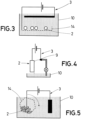
- Figure 3 shows a schematic view of a cage device for electropolishing in which the pieces to be polished are not firmly held, but are instead in a container that provides them with electrical connectivity.
- the pieces to be polished are located in a container whose limits allow the passage of solid electrolyte particles, but do not let the pieces to be polished escape.
- Part of the container that contacts the pieces to be polished is made of a conductive material, and connects the electrical source with the pieces, so that they receive electrical connectivity without being permanently fixed.
- the pieces may be resting on a conductive grid that is connected to the power supply.
- This device causes a relative movement of the pieces to be polished with respect to the solid electrolyte particles.
- this effect can be achieved by moving the container of the pieces to be polished in the electrolytic medium, which produces a relative movement between the particles and the pieces to be polished.
- the means for generating relative movement between the piece to be polished and the electrolytic medium comprise a system that drives the electrolytic medium over the piece in the form of a jet.
- the solid electrolyte particles must maintain connectivity between them.
- This system has the advantage of being able to process the pieces in sections and reach internal areas that are difficult to access.
- this system can be applied for polishing in the cabin.
- a jet of electrolytic medium comes out of a nozzle that is connected to the power supply and acts as an electrode. The jet contacts the piece to be polished and falls into a collection container. This container keeps the solid electrolyte particles in suspension by stirring, sparging or other system.
- a pumping system such as a peristaltic pump, pushes the medium back towards the piece.
- Figure 4 shows a schematic representation of this device for an electropolishing process using an electrolytic medium with a non-conductive fluid that causes the relative movement of the solid electrolyte particles with respect to the piece to be polished through blasting a jet of the electrolytic medium, by means of a nozzle (9).
- the device comprises a power supply, a system for providing electrical connectivity to the piece to be polished, a system for driving the electrolytic medium and an electrode with polarity opposite to the piece to be polished at the outlet of the jet of electrolytic medium.
- the device comprises a nozzle (9) as a blasting means attached to the cathode (3). More preferably it further comprises a pump for pumping the electrolytic medium that falls into the container (10) towards the nozzle (9).
- the projected particles tend to lose contact with each other, which limits the electrical conductivity.
- this limitation is especially overcome with the formulations of electrolytic medium with solid electrolyte particles with emulsion since, in this case, the dispersed polar phase reinforces the conductive liquid bridges that are established between particles, improving the electrical conductivity of the system, making it a novel solution to how to maintain electrical connectivity between blasted conductive particles.
- the means for generating a relative movement between the piece to be polished and the electrolytic medium comprise a system formed by a drum that has openings of a size such that it is capable of letting the solid electrolyte particles of the electrolytic medium pass, but retains the pieces to be polished.
- the drum can rotate fully or partially, causing parts to flip so that they are processed in all orientations.
- the drum can be cylindrical or be a prism with a triangular, square, hexagonal section, among others.
- This drum has an element connected to the power supply that contacts the pieces to be polished.
- This element can be part of the walls of the drum, or it can be a flexible element directed towards the interior of the drum that contacts the pieces. This embodiment is especially useful for processing pieces in large quantities.
- FIG 5 shows a diagram of the device for electropolishing by means of a solid electrolyte with non-conductive fluid in which the multiple pieces (2) to be polished are located in a cage (14) with the ability to rotate.
- This device comprises a power supply (1), an electrode (in black), a cage (14) with walls that allow the passage of the electrolytic medium (hexagon).
- This system allows the treatment of multiple pieces (2) at the same time, which is indicated for industrial series.
- a key point of this device is the container cage (14).
- the walls of the cage (14) must keep the pieces inside, but allow the free circulation of the solid electrolyte particles through them.
- the solid electrolyte particles are spheres of a size between 0.1 and 1 mm, there should be openings in the walls of preferably more than 4 mm. For this reason, this device is not suitable for pieces that are smaller than that size.
- the movement is generated by a global movement of the system.
- the electrolytic medium, the electrode and the piece to be polished are located in a closed container.
- the piece to be polished is firmly attached, as well as the electrode.
- An external mechanism causes a movement sufficient to produce a global movement of all the medium contained within.
- this movement can be a "shaker" type, a sudden shaking.
- this movement can be a repeated lying down in one or more axes, such as a gyroscopic mixer type movement.
- the polymer particles are ion exchange resin based on a macroporous sulfonated divinylbenzene S-DVB and styrene copolymer with a tending to spherical shape with a size distribution centered around 0.7 mm, under the trade name Mitsubishi Relite CFS.
- These particles contain 40% by weight of a conductive solution consisting of a 10% methanesulfonic acid solution in distilled water.
- Table 1 shows a preferred composition of the electrolytic medium of the invention Element Composition % by mass Non-conductive fluid Hydroseal G 232 H 0.3 Polymeric particle Mitsubishi Relite CFS 59.8 Conductive solution 10% Methanesulfonic acid 39.9
- Table 2 shows a preferred composition of the electrolytic medium of the invention with ranges: Element Composition % by mass Minimum Maximum Non-conductive fluid Hydroseal G 232 H 0.05 15 Polymeric particle Mitsubishi Relite CFS 35 70 Conductive solution Methanesulfonic acid * 20 50 * The concentration of methanesulfonic acid is preferably in a range of 1 to 45% by mass.
- the solid electrolyte with non-conductive fluid is composed of a set of solid electrolyte particles based on spherical polymer particles of sulfonated divinylbenzene-styrene ion exchange resin with a gel-like structure, without defined porosity, with a mean diameter about 0.7mm, Mitsubishi Relite CFH.
- the polymer particles contain 45% of a 5% sulfuric acid conductive solution in water.
- Hydroseal G 232 H or a polydimethylsiloxane-based silicone oil with a viscosity of 3 ⁇ 10- 5 m 2 /s (3 cSt) at 3% is used.
- Table 3 shows a preferred composition of the electrolytic medium of the invention Element Composition % by mass Non-conductive fluid Hydroseal G 232 H 3.0 Polymeric particle Mitsubishi Relite CFH 52.0 Conductive solution 5% Sulfuric acid 45.0
- Table 4 shows a preferred composition of the electrolytic medium of the invention Element Composition % by mass Minimum Maximum Non-conductive fluid Hydroseal G 232 H 1 15 Polymeric particle Mitsubishi Relite CFH 35 70 Conductive solution Sulfuric acid * 20 50 *
- the conductive solution is a sulfuric acid solution with a concentration of 0.5 to 30% by mass.
- Table 5 shows a preferred composition of the electrolytic medium of the invention Element Composition % by mass Non-conductive fluid Polydimethylsiloxane 3.0 Polymeric particle Mitsubishi Relite CFH 52.0 Conductive solution 5% Sulfuric acid 45.0
- Table 6 shows a preferred composition of the electrolytic medium of the invention Element Composition % by mass Minimum Maximum Non-conductive fluid Polydimethylsiloxane 1 15 Polymeric particle Mitsubishi Relite CFH 35 70 Conductive solution Sulfuric acid * 20 50
- Another preferred embodiment of this invention consists of an ion exchange resin with acrylic acid units having spherical form with a gel-like structure, which reduces exudates in combination with an electrolytic aqueous solution containing 5% citric acid that provides the necessary conductivity.
- a fluorinated solvent of low viscosity and high boiling point is used, in this case the fluorinated solvent is FC96500. This low viscosity solvent improves movement between the particles.
- non-conductive fluid there is an amount of non-conductive fluid to fill the interstitial spaces of the particles at rest and an additional amount.
- the particles are at rest, there is a non-conductive fluid part supernatant.
- the set is moving, a homogeneous suspension of the solid electrolyte particles is obtained in the non-conductive fluid that as a whole conducts electricity.
- the solid electrolyte is formed by a Mitsubishi Relite CFH ion exchange resin that contains as liquid electrolyte 45% by weight of a 10% methanesulfonic acid solution.
- a Ce-C16 hydrocarbon-based non-conductive fluid is added, such as the commercial one called Hydroseal G 232 H to cover the entire volume of electrolyte particles (fill the interstitial spaces), and then a 10% more of the added volume.
- Table 7 shows a preferred composition of the electrolytic medium of the invention Element Composition % by mass Non-conductive fluid Hydroseal G 232 H 50 Polymeric particle Mitsubishi Relite CFS 59.8 Conductive solution 10% Methanesulfonic acid 39.9
- Table 8 shows a preferred composition of the electrolytic medium of the invention Element Composition % by mass Minimum Maximum Non-conductive fluid Hydroseal G 232 H 15 60 Polymeric particle Mitsubishi Relite CFS 30 65 Conductive solution Methanesulfonic acid * 1 25 * The concentration of methanesulfonic acid is preferably in a range of 1 to 45% by mass.
- Tables 12 to 14 of the- Detergent A cited in the previous tables are shown.
- Table 12 Exemplary formula of detergent A, A1 Element Composition % by mass Detergent A Dodecylbenzenesulfonic acid 2.275 C10.9M Ethoxylated Alcohol 1.250 Triethanolamine 0.900 Coconut diethanolamide 0.500 50% KOH solution 0.275 H2O 94.800
- Table 13 Exemplary formula of detergent A, A2 Element Composition % by mass Detergent A Dodecylbenzenesulfonic acid 2.250 C10.9M Ethoxylated Alcohol 1.250 Coconut diethanolamide 0.500 H2O 96.000 Table 14.
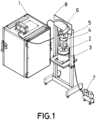
- This prototype device is designed to treat gears and pinions of different sizes.
- the suitable electrolytic medium is the "emulsified formula for carbon steels”.
- It has a power supply (1) that connects the positive pole with the piece to be polished (2) and the negative pole with the cathode (3).
- the power supply (1) is capable of supplying a pulsed and polarity reversal current, with or without pauses between the different polarities.
- the pulses can be of high frequency, being able to have a duration in the order of microseconds to seconds. It is capable of applying asymmetric voltages, that is, applying a different voltage value to each polarity.
- the piece to be polished (2) is held by a holder (4).
- This holder has the function of holding the piece during the process and providing it with the electrical connection with the power supply. Likewise, it can incorporate a vibrator system to improve the relative movement of the piece- electrolytic medium..
- the holder (4) is connected to a system that provides a movement of the piece or pieces that it holds with the medium.
- This movement system in this embodiment consists of a guide-shaft (5) actuated by a pneumatic piston (6) that provides a vertical oscillatory movement in rhythm with a rotation so that the movement produced coincides with the inclination of the teeth of the pinion o gear to be polished. In this way there is a fluid movement of the particles through the interstitial space.
- the fluid movement of the particles in the interstitial space is achieved by means of the vibrator of the holder (4), the movement provided by the guide (5) and the pneumatic piston (6) and the injection of air into the bottom of the electrolytic medium by means of a compressor (7).
- All the machinery of the process is integrated into a structure (8) that stiffens the entire system to avoid unwanted movements between the electrolytic medium and the piece to be polished.
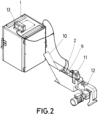
- This device is designed for a process in which a fluid-type electrolytic medium of the invention is blasted onto the surface to be polished. Any electrolytic medium of the invention can be used, but the best results are obtained with an electrolytic medium with an emulsified formulation.
- FIG. 2 A schematic example of this type of device can be seen in figure 2 .
- a power supply (1) connects the positive pole to the piece to be polished (2) and the negative pole to a cathode-nozzle (9).
- the power supply (1) is capable of supplying a pulsed and polarity reversal current, with or without pauses between the different polarities.
- the pulses can be of high frequency, being able to have a duration in the order of microseconds to seconds. It is capable of applying asymmetric voltages, that is, applying a different voltage value to each polarity.
- This device produces a jet of the electrolytic medium that comes out through the cathode-nozzle (9), which has the functions of directing the jet towards the piece and operating as electrical contact with the electrolytic medium.
- the electrolytic medium is collected in a tank (10).
- this tank there is a medium stirrer (11) that keeps the solid electrolyte particles in suspension in the electrolytic medium.
- the medium can be kept in suspension by bubbling a gas such as air.
- a peristaltic pump (12) drives the electrolytic medium with sufficient pressure from the tank (10) to the cathode-nozzle (9).
- the impulse of the electrolytic medium from the tank (10) to (9) can be produced by other means such as suction, an endless screw, pistons, etc.
- the device preferably includes a system for analyzing the electric current that is actually passing through the system, such as an oscilloscope (13).
- a system for analyzing the electric current that is actually passing through the system such as an oscilloscope (13).
- the piece to be polished is a 25 cm 2 flat stainless steel surface.
- the movement is achieved by projecting the electrolytic medium on the surface to be polished.
- the electrolytic medium has the following composition: Table 15. Composition of the electrolytic medium Element Composition % by mass Non-conductive fluid Hydroseal G 232 H 24.5 Detergent A1 5.5 Polymeric particle Mitsubishi Relite CFH 52.5 Conductive solution H2O 12.5 70% MSA 5.0
- the distance between the jet outlet nozzle and the piece is 3 cm.
- the jet covers the entire surface of the piece.
- Direct phase is the one that applies the positive voltage to the piece, reverse phase applies the negative, and pauses do not apply electrical voltage.
- a symmetrical 35 V potential difference is applied, with a duration of each section of 2 - 0.1 - 3 - 0.1 in milliseconds.
Landscapes
- Chemical & Material Sciences (AREA)
- Engineering & Computer Science (AREA)
- Chemical Kinetics & Catalysis (AREA)
- Electrochemistry (AREA)
- Materials Engineering (AREA)
- Metallurgy (AREA)
- Organic Chemistry (AREA)
- Electrical Discharge Machining, Electrochemical Machining, And Combined Machining (AREA)
- Electrolytic Production Of Metals (AREA)
- Electrolytic Production Of Non-Metals, Compounds, Apparatuses Therefor (AREA)
- Primary Cells (AREA)
Claims (15)
- Elektrolytisches Medium, geeignet für ein Elektropolierverfahren, das die folgenden Schritte aufweist:a) mindestens ein zu polierendes Teil an eine Stromversorgung anschließen;b) Anschluss mindestens einer Elektrode an den Gegenpol der Stromversorgung;c) das mindestens eine zu polierende Teil und die festen Elektrolytteilchen des elektrolytischen Mediums mit einer Relativbewegung zwischen dem Teil und den Teilchen in Kontakt bringen;d) Anlegen einer Potentialdifferenz zwischen dem zu polierenden Teil und der Elektrode, die einen Stromfluss zwischen ihnen durch das elektrolytische Medium erzeugt,dadurch gekennzeichnet, dass das elektrolytische Medium aufweist:• einen Satz von festen Elektrolytteilchen, der feste Teilchen umfasst, die eine leitfähige Lösung zurückhalten, wobei der Satz eine elektrische Leitfähigkeit von mehr als 10 MikronS/cm aufweist, und• eine nichtleitende Flüssigkeit, die mit der leitfähigen Lösung nicht mischbar ist, wobei unter nicht mischbar zu verstehen ist, dass sie in keinem Verhältnis von 0 bis 100°C eine einzige Phase bildet, wobei die nichtleitende Flüssigkeit, wenn sie bei Raumtemperatur in Ruhe ist, den elektrischen Strom nicht wesentlich leitet.
- Elektrolytisches Medium nach Anspruch 1, wobei die Teilchen, die eine leitfähige Lösung zurückhalten, eine poröse Struktur oder eine gelartige Struktur aufweisen.
- Elektrolytisches Medium nach Anspruch 2, wobei die Teilchen, die eine leitfähige Lösung zurückhalten, aus polymerem Material bestehen, es mit mindestens einem der folgenden Monomere formuliert ist: Styrol, Divinylbenzol, Acrylsäure, von Acrylsäure abgeleitetes Monomer, Methacrylsäure, von Methacrylsäure abgeleitetes Monomer und/oder funktionelle Gruppen enthält, die aus den folgenden ausgewählt sind: Sulfonsäure, Carboxylat, Iminodiessigsäure, Aminophosphonsäure, Polyamin, 2-Picolylamin, Thioharnstoff, Amidoxim, Isothiouronium oder Bispicolilamin, wobei es sich bei den von Acrylsäure und Methacrylsäure abgeleiteten Monomeren um Acrylamid, Cyanoacrylat und Alkylacrylate sowie entsprechende Methacrylat-Analoga handelt.
- Elektrolytisches Medium nach einem der Ansprüche 1 bis 3, wobei die leitfähige Lösung eine wässrige Lösung ist.
- Elektrolytisches Medium nach Anspruch 4, wobei die wässrige Lösung eine Säure enthält, die aus den folgenden ausgewählt ist: Schwefelsäure, Sulfonsäuren, Methansulfonsäure, Salzsäure oder Phosphorsäure.
- Elektrolytisches Medium nach einem der Ansprüche 1 bis 5, wobei die nichtleitende Flüssigkeit eine Flüssigkeit umfasst, die ausgewählt ist aus: Kohlenwasserstoffen mit fünf bis sechzehn Kohlenstoffen, flüssigen Silikonen und fluorierten Lösungsmitteln.
- Elektrolytisches Medium nach Anspruch 6, wobei das flüssige Silikon ein Silikonöl ist.
- Elektrolytisches Medium nach einem der Ansprüche 1 bis 7, wobei die nichtleitende Flüssigkeit eine Emulsion ist, die aufweist:• eine nichtleitende Flüssigkeit als unpolare kontinuierliche Phase, ausgewählt aus Kohlenwasserstoffen mit fünf bis sechzehn Kohlenstoffen, flüssigen Silikonen oder fluorierten Lösungsmitteln;• eine leitfähige Lösung als dispergierte polare Phase, wobei die leitfähige Lösung die gleiche Zusammensetzung hat wie die leitfähige Lösung, die von den festen Teilchen zurückgehalten wird; und• ein Tensid.
- Elektrolytisches Medium nach Anspruch 8, wobei das Tensid ein nichtionisches Tensid und ein anionisches Tensid umfasst und die leitfähige Lösung eine wässrige Lösung mit saurem pH-Wert ist.
- Verwendung des elektrolytischen Mediums nach einem der Ansprüche 1 bis 9 in einem Elektropolierverfahren.
- Elektropolierverfahren, dadurch gekennzeichnet, dass es die folgenden Schritte umfasst:a) mindestens ein zu polierendes Teil an eine Stromversorgung anschließen;b) Anschluss mindestens einer Elektrode an den Gegenpol der Stromversorgung;c) Inkontaktbringen des zu polierenden Teils und die festen Elektrolytteilchen des elektrolytischen Mediums aufweisend• Ein Satz von festen Elektrolytteilchen, aufweisend feste Teilchen, die eine leitfähige Lösung zurückhalten, wobei der Satz eine elektrische Leitfähigkeit von mehr als 10 MikronS/cm aufweist und• Eine nichtleitende Flüssigkeit, die mit der leitfähigen Lösung nicht mischbar ist, wobei unter "nicht mischbar" zu verstehen ist, dass es keine einzige Phase in irgendeinem Verhältnis von 0 bis 100°C bildet, wobei die nichtleitende Flüssigkeit, wenn sie bei Raumtemperatur in Ruhe ist, den elektrischen Strom nicht wesentlich leitetmit einer relativen Bewegung zwischen dem Teil und den Partikeln;d) Anlegen einer Potentialdifferenz zwischen dem zu polierenden Teil und der Elektrode, die einen Stromfluss zwischen ihnen durch das elektrolytische Medium erzeugt.
- Elektropolierverfahren nach Anspruch 11, wobei die Relativbewegung zwischen dem zu polierenden Teil und dem elektrolytischen Medium das Strahlen des elektrolytischen Mediums auf das zu polierende Teil oder die Bewegung des Teils innerhalb des elektrolytischen Mediums umfasst.
- Elektropolierverfahren nach einem der Ansprüche 11-12, wobei die leitfähige Lösung eine wässrige Lösung ist, die eine Säure enthält, die aus den folgenden ausgewählt ist: Schwefelsäure, Sulfonsäuren, Methansulfonsäure, Salzsäure oder Phosphorsäure.
- Elektropolierverfahren nach einem der Ansprüche 11 - 13, wobei die nichtleitende Flüssigkeit eine Flüssigkeit umfasst, das ausgewählt ist aus: Kohlenwasserstoffen mit fünf bis sechzehn Kohlenstoffen, flüssigen Silikonen und fluorierten Lösungsmitteln.
- Elektropolierverfahren nach Anspruch 14, wobei die nichtleitende Flüssigkeit eine Emulsion ist, die Folgendes aufweist:• eine nichtleitende Flüssigkeit als unpolare kontinuierliche Phase, ausgewählt aus Kohlenwasserstoffen mit fünf bis sechzehn Kohlenstoffen, flüssigen Silikonen oder fluorierten Lösungsmitteln;• eine leitfähige Lösung als dispergierte polare Phase, wobei die leitfähige Lösung die gleiche Zusammensetzung hat wie die leitfähige Lösung, die von den festen Teilchen zurückgehalten wird; und• ein Tensid, das ein nichtionisches Tensid und ein anionisches Tensid umfasst, und die leitfähige Lösung eine wässrige Lösung mit einem sauren pH-Wert ist.
Priority Applications (1)
| Application Number | Priority Date | Filing Date | Title |
|---|---|---|---|
| EP25160023.5A EP4538428A3 (de) | 2020-12-09 | 2021-11-30 | Elektrolytisches medium und elektropolierverfahren mit einem solchen elektrolytischen medium |
Applications Claiming Priority (2)
| Application Number | Priority Date | Filing Date | Title |
|---|---|---|---|
| EP20383069 | 2020-12-09 | ||
| PCT/ES2021/070864 WO2022123096A1 (es) | 2020-12-09 | 2021-11-30 | Medio electrolítico, proceso de electropulido usando dicho medio electrolítico y dispositivo para llevarlo a cabo |
Related Child Applications (1)
| Application Number | Title | Priority Date | Filing Date |
|---|---|---|---|
| EP25160023.5A Division EP4538428A3 (de) | 2020-12-09 | 2021-11-30 | Elektrolytisches medium und elektropolierverfahren mit einem solchen elektrolytischen medium |
Publications (3)
| Publication Number | Publication Date |
|---|---|
| EP4249647A1 EP4249647A1 (de) | 2023-09-27 |
| EP4249647C0 EP4249647C0 (de) | 2025-02-26 |
| EP4249647B1 true EP4249647B1 (de) | 2025-02-26 |
Family
ID=80222611
Family Applications (2)
| Application Number | Title | Priority Date | Filing Date |
|---|---|---|---|
| EP25160023.5A Pending EP4538428A3 (de) | 2020-12-09 | 2021-11-30 | Elektrolytisches medium und elektropolierverfahren mit einem solchen elektrolytischen medium |
| EP21854809.7A Active EP4249647B1 (de) | 2020-12-09 | 2021-11-30 | Elektrolytisches medium und elektropolierverfahren mit einem solchen elektrolytischen medium |
Family Applications Before (1)
| Application Number | Title | Priority Date | Filing Date |
|---|---|---|---|
| EP25160023.5A Pending EP4538428A3 (de) | 2020-12-09 | 2021-11-30 | Elektrolytisches medium und elektropolierverfahren mit einem solchen elektrolytischen medium |
Country Status (12)
| Country | Link |
|---|---|
| US (1) | US20240102197A1 (de) |
| EP (2) | EP4538428A3 (de) |
| JP (1) | JP2023553052A (de) |
| KR (1) | KR20230118929A (de) |
| CN (1) | CN116829769A (de) |
| AU (1) | AU2021397840A1 (de) |
| CA (1) | CA3201056A1 (de) |
| ES (1) | ES3026510T3 (de) |
| IL (1) | IL303496A (de) |
| MX (1) | MX2023006788A (de) |
| PL (1) | PL4249647T3 (de) |
| WO (1) | WO2022123096A1 (de) |
Families Citing this family (19)
| Publication number | Priority date | Publication date | Assignee | Title |
|---|---|---|---|---|
| ES2904576B2 (es) * | 2021-10-20 | 2023-02-20 | Drylyte Sl | Medio electrolitico para electropulido y metodo de electropulido con dicho medio |
| CN114481286A (zh) * | 2021-12-28 | 2022-05-13 | 广东省科学院化工研究所 | 一种用于电解抛光的固体颗粒物 |
| DE102022123211A1 (de) * | 2022-09-12 | 2024-03-14 | Otec Präzisionsfinish GmbH | Elektrolytmedium und Verfahren zum elektrochemischen Polieren von metallischen Werkstücken unter Verwendung eines solchen Elektrolytmediums |
| ES2942541A1 (es) * | 2022-11-15 | 2023-06-02 | Steros Gpa Innovative S L | Dispositivo para pulir superficies de piezas metalicas mediante proyeccion de particulas solidas electricamente activas |
| ES2963027B2 (es) * | 2023-06-02 | 2024-08-29 | Steros Gpa Innovative S L | Metodo y equipo para control de la temperatura de las particulas en procesos de pulido mediante particulas solidas |
| WO2025088407A1 (en) * | 2023-10-27 | 2025-05-01 | Medtronic, Inc. | System and method for electropolishing using solid electolyte particles |
| WO2025114631A1 (es) * | 2023-11-28 | 2025-06-05 | Drylyte, S.L. | Procedimiento de electropulido de piezas metálicas en contacto eléctrico flotante y dispositivo de electropulido para llevar a cabo dicho procedimiento |
| WO2025141067A1 (en) | 2023-12-29 | 2025-07-03 | Steros Gpa Innovative, S.L. | Surface finishing of objects |
| WO2025141065A1 (en) | 2023-12-29 | 2025-07-03 | Steros Gpa Innovative, S.L. | Method for regenerating ion exchange resins containing metal ions and products and uses of the regenerated resins |
| WO2025163093A1 (en) * | 2024-01-31 | 2025-08-07 | Drylyte, S.L. | Organic compounds comprising hydrophilic groups, such as fatty acids and alcohols for the surface finishing of objects |
| CN118028963B (zh) * | 2024-02-23 | 2024-12-10 | 广东倍亮科技有限公司 | 高价可溶性金属盐在金属固体电解抛光中的应用 |
| CN118028962B (zh) * | 2024-02-23 | 2024-12-10 | 广东倍亮科技有限公司 | 离子液体在金属固体电解抛光中的应用 |
| CN118186555A (zh) * | 2024-02-28 | 2024-06-14 | 广东倍亮科技有限公司 | 镁、铝或其合金固体电解抛光的固体颗粒物及其应用 |
| CN118186557A (zh) * | 2024-03-01 | 2024-06-14 | 广东倍亮科技有限公司 | 一种金属固体电解抛光的电解质及其应用 |
| CN118186562A (zh) * | 2024-03-01 | 2024-06-14 | 广东倍亮科技有限公司 | 一种金属固体电解抛光用的固体颗粒物 |
| WO2025191127A1 (en) | 2024-03-15 | 2025-09-18 | Steros Gpa Innovative, S.L. | Surface finishing of containers |
| DE102024112828A1 (de) | 2024-05-07 | 2025-11-13 | Otec Präzisionsfinish GmbH | Verfahren und Vorrichtung zum elektrochemischen Polieren von metallischen Werkstücken |
| WO2026003372A1 (en) | 2024-06-28 | 2026-01-02 | Drylyte, S.L. | Compositions, methods and equipments to surface finish metals by magnetic dry electrolytes |
| CN119685910B (zh) * | 2025-02-25 | 2025-05-20 | 江苏欧跃环保科技有限公司 | 去除合金表面镀层的电解装置及其工作方法 |
Citations (3)
| Publication number | Priority date | Publication date | Assignee | Title |
|---|---|---|---|---|
| EP2646603B1 (de) | 2010-11-30 | 2016-03-02 | Otec Präzisionsfinish GmbH | Verfahren zum elektrochemischen polieren von metallenen gegenständen und hierfür geeignete elektrolytlösung |
| EP3372711A1 (de) | 2016-04-28 | 2018-09-12 | Drylyte, S.L. | Verfahren zum glätten und polieren von metallen mittels ionentransport über freie festkörper und festkörper zur durchführung des besagten verfahrens |
| EP3640373A1 (de) | 2018-01-26 | 2020-04-22 | Drylyte, S.L. | Verwendung von h2so4 als elektrolyt in verfahren zum glätten und polieren von metallen durch ionentransport über freie feststoffe |
Family Cites Families (9)
| Publication number | Priority date | Publication date | Assignee | Title |
|---|---|---|---|---|
| JP4710167B2 (ja) * | 2001-05-18 | 2011-06-29 | Tdk株式会社 | 色素増感型太陽電池 |
| JP5889732B2 (ja) * | 2012-06-29 | 2016-03-22 | 株式会社フジクラ | 非水溶液の脱水方法及び脱水非水溶液の製造方法 |
| US10821521B2 (en) * | 2017-04-11 | 2020-11-03 | Hamilton Sunstrand Corporation | Article surface finishing method |
| ES2734500B2 (es) | 2018-11-12 | 2020-06-03 | Drylyte Sl | Uso de un HCl en electrolitos secos para pulir Ti y otras superficies de metales y aleaciones a través de transporte iónico |
| ES2734499B2 (es) * | 2018-11-12 | 2020-06-03 | Drylyte Sl | Uso de ácidos sulfónicos en electrolitos secos para pulir superficies metálicas a través del transporte de iones |
| CN114514341A (zh) * | 2019-08-01 | 2022-05-17 | 德里莱特公司 | 用于借助于电活性固体颗粒对金属表面进行干式处理的方法和设备 |
| ES2754876B2 (es) * | 2019-08-01 | 2021-10-20 | Steros Gpa Innovative S L | Dispositivo para el tratamiento en seco de superficies metalicas mediante particulas solidas electricamente activas |
| ES2756948B2 (es) * | 2020-02-04 | 2022-12-19 | Drylyte Sl | Electrolito solido para el electropulido en seco de metales con moderador de actividad |
| CN111876820B (zh) * | 2020-08-05 | 2021-12-10 | 浙江安胜科技股份有限公司 | 一种不锈钢容器内胆高亮度镜面电解抛光方法 |
-
2021
- 2021-11-30 CN CN202180093323.8A patent/CN116829769A/zh active Pending
- 2021-11-30 JP JP2023534379A patent/JP2023553052A/ja active Pending
- 2021-11-30 EP EP25160023.5A patent/EP4538428A3/de active Pending
- 2021-11-30 ES ES21854809T patent/ES3026510T3/es active Active
- 2021-11-30 PL PL21854809.7T patent/PL4249647T3/pl unknown
- 2021-11-30 IL IL303496A patent/IL303496A/en unknown
- 2021-11-30 AU AU2021397840A patent/AU2021397840A1/en active Pending
- 2021-11-30 MX MX2023006788A patent/MX2023006788A/es unknown
- 2021-11-30 KR KR1020237023428A patent/KR20230118929A/ko active Pending
- 2021-11-30 WO PCT/ES2021/070864 patent/WO2022123096A1/es not_active Ceased
- 2021-11-30 CA CA3201056A patent/CA3201056A1/en active Pending
- 2021-11-30 US US18/266,376 patent/US20240102197A1/en active Pending
- 2021-11-30 EP EP21854809.7A patent/EP4249647B1/de active Active
Patent Citations (3)
| Publication number | Priority date | Publication date | Assignee | Title |
|---|---|---|---|---|
| EP2646603B1 (de) | 2010-11-30 | 2016-03-02 | Otec Präzisionsfinish GmbH | Verfahren zum elektrochemischen polieren von metallenen gegenständen und hierfür geeignete elektrolytlösung |
| EP3372711A1 (de) | 2016-04-28 | 2018-09-12 | Drylyte, S.L. | Verfahren zum glätten und polieren von metallen mittels ionentransport über freie festkörper und festkörper zur durchführung des besagten verfahrens |
| EP3640373A1 (de) | 2018-01-26 | 2020-04-22 | Drylyte, S.L. | Verwendung von h2so4 als elektrolyt in verfahren zum glätten und polieren von metallen durch ionentransport über freie feststoffe |
Non-Patent Citations (30)
| Title |
|---|
| ANONYMOUS: "Electrical resistance and conductance", WIKIPEDIA, 29 November 2020 (2020-11-29), pages 1 - 11, XP093334813, Retrieved from the Internet <URL:https://en.wikipedia.org/w/index.php?title=Electrical_resistance_and_conductance&oldid=991357067> |
| ANONYMOUS: "Electrical resistivity and conductivity", WIKIPEDIA, 4 December 2020 (2020-12-04), pages 1 - 19, XP093334805, Retrieved from the Internet <URL:https://en.wikipedia.org/w/index.php?title=Electrical_resistivity_and_conductivity&oldid=992367495> |
| ANONYMOUS: "Elektrische Leitfähigkeit", WIKIPEDIA, 20 November 2020 (2020-11-20), pages 1 - 10, XP093334807, Retrieved from the Internet <URL:https://de.wikipedia.org/w/index.php?title=Elektrische_Leitfähigkeit&oldid=205744681> |
| ANONYMOUS: "Kerosin", WIKIPEDIA, 28 June 2020 (2020-06-28), pages 1 - 12, XP093334802, Retrieved from the Internet <URL:https://de.wikipedia.org/w/index.php?title=Kerosin&oldid=201390973> |
| ANONYMOUS: "Micrometre", WIKIPEDIA, 3 December 2020 (2020-12-03), pages 1 - 4, XP093334810, Retrieved from the Internet <URL:https://en.wikipedia.org/w/index.php?title=Micrometre&oldid=992016666> |
| ANONYMOUS: "Newtonian fluid", WIKIPEDIA, 7 December 2020 (2020-12-07), pages 1 - 4, XP093334799, Retrieved from the Internet <URL:https://en.wikipedia.org/w/index.php?title=Newtonian_fluid&oldid=992929445> |
| ANONYMOUS: "Room temperature", WIKIPEDIA, 3 December 2020 (2020-12-03), pages 1 - 4, XP093334809, Retrieved from the Internet <URL:https://en.wikipedia.org/w/index.php?title=Room_temperature&oldid=992052433> |
| D1 - Offer OTEX to Heimerle + Meule dated 16 August 2018 |
| D1a - Order confirmation OTEC to Heimerle + Meule dated 6 Sept 2018 |
| D1b - Delivery note OTEC to Heimerle + Meule dated 12. September 2018 |
| D1c - Invoice OTEX to Heimerle + Meule dadted 12 September 2018 |
| D1d - Manual ("Betriebsanleitung") of the EPAG electropolisching machine Baujahr 2016 |
| D1f - E-Mail OTEC to Heimerle + Meule dated 13 September 2018 |
| D1g - Safety data sheet conductive solution "PL 1" dated 15 August 2016 |
| D1h - Safety datasheet for solid electrolyte particles "MFB 05 micro finishing balls" dated 13 August 2018 |
| D1i - E-Mail OTEC to Heimerle + Meule dated 20 November 2018 |
| D1j - Safety data sheet for conductive solution "PL 1" dated 15 August 2016 |
| D1k - E-Mail OTEC to Heimerle + Meule dated 20 November 2018 |
| D1l - Safety datasheet for solid electrolyte particles "MFB 0.5 Micro finishing balls dated 24 September 2018 |
| D2 - E-Mail exchange between the representative of Bruno mayer 8 Februar 2019 |
| D2a - Invoice from OTEC to Bruno Mayer dated 16 November 2018 |
| D2b - Invoice from OTEC to Bruno Mayer dated 12 February 2019 |
| D2c - Instructions for Processing with EPAG dated February 2019 |
| D2d - Order confirmation OTEC to Balantek Lda. Dated 30 July 2018 |
| D2e - E.Mails between Mr. Soran Jota of Otec and Mr. Rocha dated 28 and 30 July 2018 |
| D2f - Invoice OTEC to Juwelier Kampe GmbH dated 5 September 2018 |
| D2g - Delivery note OTEC to Juwelier Kampe GmbH dated 5 September 2018 |
| D2h - List of attendees of webinar of 2 July 2020 |
| D2i - Video recording of webinar of 28 May 2020 |
| D2j - Video recording of webinar of 2 July 2020 |
Also Published As
| Publication number | Publication date |
|---|---|
| IL303496A (en) | 2023-08-01 |
| ES3026510T3 (en) | 2025-06-11 |
| KR20230118929A (ko) | 2023-08-14 |
| EP4249647A1 (de) | 2023-09-27 |
| CA3201056A1 (en) | 2022-06-16 |
| AU2021397840A1 (en) | 2023-07-06 |
| WO2022123096A1 (es) | 2022-06-16 |
| MX2023006788A (es) | 2023-06-20 |
| CN116829769A (zh) | 2023-09-29 |
| PL4249647T3 (pl) | 2025-06-16 |
| US20240102197A1 (en) | 2024-03-28 |
| EP4249647C0 (de) | 2025-02-26 |
| JP2023553052A (ja) | 2023-12-20 |
| EP4538428A2 (de) | 2025-04-16 |
| EP4538428A3 (de) | 2025-07-09 |
Similar Documents
| Publication | Publication Date | Title |
|---|---|---|
| EP4249647B1 (de) | Elektrolytisches medium und elektropolierverfahren mit einem solchen elektrolytischen medium | |
| JP6931661B2 (ja) | 遊離固形物によるイオン輸送を介して金属を平滑化し、研磨する方法、および前記方法を実施するための固形物 | |
| US7422677B2 (en) | Membrane-mediated electropolishing | |
| CN101473068B (zh) | 用于破乳化清洗金属表面的方法 | |
| JP7289351B2 (ja) | イオン輸送を介して金属表面を研磨するための乾式電解質におけるスルホン酸の使用 | |
| US20070051619A1 (en) | Apparatus adapted for membrane-mediated electropolishing | |
| US20250207293A1 (en) | Electrolyte medium and method for electrochemical polishing of metal workpieces using such an electrolyte medium | |
| KR20000005370A (ko) | 전기분해 및 캐비테이션 작용을 이용하여 금속 표면으로부터 피막을 제거하는 방법g | |
| WO2025088203A1 (en) | Surface finishing using electrically conducive particles and abrasive particles | |
| CN118382730A (zh) | 用于电解抛光的电解质介质以及利用该介质进行电解抛光的方法 | |
| JP5787265B1 (ja) | 塗料残渣の捕集システムおよび塗料残渣の捕集方法 | |
| WO2025233221A1 (de) | Verfahren und vorrichtung zum elektrochemischen polieren von metallischen werkstücken | |
| JP2004315675A (ja) | 二酸化炭素溶媒用界面活性剤 | |
| US6495617B1 (en) | Methods to control phase inversions and enhance mass transfer in liquid-liquid dispersions | |
| WO2025163093A1 (en) | Organic compounds comprising hydrophilic groups, such as fatty acids and alcohols for the surface finishing of objects | |
| EP1722013A1 (de) | Galvanisierung in gegenwart von co sb 2 /sb | |
| Graciaa et al. | Measurement of the zeta potential of oil drops with the spinning tube zetameter | |
| CN106404501A (zh) | 一种工业纯钛ta2的电解腐蚀剂及电解抛光腐蚀方法 | |
| WO2025191127A1 (en) | Surface finishing of containers | |
| JP4150935B2 (ja) | 有機溶媒存在下での表面処理 | |
| WO2001094076A1 (en) | Chemical-hydrodynamic etch planarization | |
| TW201031771A (en) | Supercritical fluid polishing method for stainless steel golf club head and stainless steel golf club head | |
| BRPI0818035B1 (pt) | Composição limpadora alcalina aquosa para superfícies metálicas, banho contaminado e concentrado aquoso |
Legal Events
| Date | Code | Title | Description |
|---|---|---|---|
| STAA | Information on the status of an ep patent application or granted ep patent |
Free format text: STATUS: UNKNOWN |
|
| STAA | Information on the status of an ep patent application or granted ep patent |
Free format text: STATUS: THE INTERNATIONAL PUBLICATION HAS BEEN MADE |
|
| PUAI | Public reference made under article 153(3) epc to a published international application that has entered the european phase |
Free format text: ORIGINAL CODE: 0009012 |
|
| STAA | Information on the status of an ep patent application or granted ep patent |
Free format text: STATUS: REQUEST FOR EXAMINATION WAS MADE |
|
| 17P | Request for examination filed |
Effective date: 20230620 |
|
| AK | Designated contracting states |
Kind code of ref document: A1 Designated state(s): AL AT BE BG CH CY CZ DE DK EE ES FI FR GB GR HR HU IE IS IT LI LT LU LV MC MK MT NL NO PL PT RO RS SE SI SK SM TR |
|
| DAV | Request for validation of the european patent (deleted) | ||
| DAX | Request for extension of the european patent (deleted) | ||
| STAA | Information on the status of an ep patent application or granted ep patent |
Free format text: STATUS: EXAMINATION IS IN PROGRESS |
|
| 17Q | First examination report despatched |
Effective date: 20240409 |
|
| GRAP | Despatch of communication of intention to grant a patent |
Free format text: ORIGINAL CODE: EPIDOSNIGR1 |
|
| STAA | Information on the status of an ep patent application or granted ep patent |
Free format text: STATUS: GRANT OF PATENT IS INTENDED |
|
| GRAJ | Information related to disapproval of communication of intention to grant by the applicant or resumption of examination proceedings by the epo deleted |
Free format text: ORIGINAL CODE: EPIDOSDIGR1 |
|
| STAA | Information on the status of an ep patent application or granted ep patent |
Free format text: STATUS: EXAMINATION IS IN PROGRESS |
|
| GRAP | Despatch of communication of intention to grant a patent |
Free format text: ORIGINAL CODE: EPIDOSNIGR1 |
|
| STAA | Information on the status of an ep patent application or granted ep patent |
Free format text: STATUS: GRANT OF PATENT IS INTENDED |
|
| GRAS | Grant fee paid |
Free format text: ORIGINAL CODE: EPIDOSNIGR3 |
|
| INTG | Intention to grant announced |
Effective date: 20241218 |
|
| RIN1 | Information on inventor provided before grant (corrected) |
Inventor name: SOTO HERNANDEZ, MARC Inventor name: GUTIERREZ CASTILLO, JOAN, DAVID Inventor name: PEREZ PLANAS, MIGUEL, FRANCISCO Inventor name: ROMAGOSA CALATAYUD, PAU Inventor name: SARSANEDAS GIMPERA, MARC |
|
| GRAA | (expected) grant |
Free format text: ORIGINAL CODE: 0009210 |
|
| STAA | Information on the status of an ep patent application or granted ep patent |
Free format text: STATUS: THE PATENT HAS BEEN GRANTED |
|
| INTC | Intention to grant announced (deleted) | ||
| INTG | Intention to grant announced |
Effective date: 20250115 |
|
| AK | Designated contracting states |
Kind code of ref document: B1 Designated state(s): AL AT BE BG CH CY CZ DE DK EE ES FI FR GB GR HR HU IE IS IT LI LT LU LV MC MK MT NL NO PL PT RO RS SE SI SK SM TR |
|
| REG | Reference to a national code |
Ref country code: GB Ref legal event code: FG4D |
|
| REG | Reference to a national code |
Ref country code: CH Ref legal event code: EP |
|
| REG | Reference to a national code |
Ref country code: DE Ref legal event code: R096 Ref document number: 602021026916 Country of ref document: DE |
|
| REG | Reference to a national code |
Ref country code: IE Ref legal event code: FG4D |
|
| U01 | Request for unitary effect filed |
Effective date: 20250314 |
|
| U07 | Unitary effect registered |
Designated state(s): AT BE BG DE DK EE FI FR IT LT LU LV MT NL PT RO SE SI Effective date: 20250321 |
|
| REG | Reference to a national code |
Ref country code: ES Ref legal event code: FG2A Ref document number: 3026510 Country of ref document: ES Kind code of ref document: T3 Effective date: 20250611 |
|
| PG25 | Lapsed in a contracting state [announced via postgrant information from national office to epo] |
Ref country code: RS Free format text: LAPSE BECAUSE OF FAILURE TO SUBMIT A TRANSLATION OF THE DESCRIPTION OR TO PAY THE FEE WITHIN THE PRESCRIBED TIME-LIMIT Effective date: 20250526 |
|
| PG25 | Lapsed in a contracting state [announced via postgrant information from national office to epo] |
Ref country code: IS Free format text: LAPSE BECAUSE OF FAILURE TO SUBMIT A TRANSLATION OF THE DESCRIPTION OR TO PAY THE FEE WITHIN THE PRESCRIBED TIME-LIMIT Effective date: 20250626 Ref country code: NO Free format text: LAPSE BECAUSE OF FAILURE TO SUBMIT A TRANSLATION OF THE DESCRIPTION OR TO PAY THE FEE WITHIN THE PRESCRIBED TIME-LIMIT Effective date: 20250526 |
|
| PG25 | Lapsed in a contracting state [announced via postgrant information from national office to epo] |
Ref country code: HR Free format text: LAPSE BECAUSE OF FAILURE TO SUBMIT A TRANSLATION OF THE DESCRIPTION OR TO PAY THE FEE WITHIN THE PRESCRIBED TIME-LIMIT Effective date: 20250226 |
|
| PG25 | Lapsed in a contracting state [announced via postgrant information from national office to epo] |
Ref country code: GR Free format text: LAPSE BECAUSE OF FAILURE TO SUBMIT A TRANSLATION OF THE DESCRIPTION OR TO PAY THE FEE WITHIN THE PRESCRIBED TIME-LIMIT Effective date: 20250527 |
|
| U30 | Action lodged before the upc [information provided by the upc] |
Free format text: ACTION-TYPE: INFRINGEMENT ACTION; CASE-NUMBER: ACT_33083/2025 Effective date: 20250717 |
|
| PG25 | Lapsed in a contracting state [announced via postgrant information from national office to epo] |
Ref country code: SM Free format text: LAPSE BECAUSE OF FAILURE TO SUBMIT A TRANSLATION OF THE DESCRIPTION OR TO PAY THE FEE WITHIN THE PRESCRIBED TIME-LIMIT Effective date: 20250226 |
|
| PG25 | Lapsed in a contracting state [announced via postgrant information from national office to epo] |
Ref country code: SK Free format text: LAPSE BECAUSE OF FAILURE TO SUBMIT A TRANSLATION OF THE DESCRIPTION OR TO PAY THE FEE WITHIN THE PRESCRIBED TIME-LIMIT Effective date: 20250226 |
|
| PLBI | Opposition filed |
Free format text: ORIGINAL CODE: 0009260 |
|
| REG | Reference to a national code |
Ref country code: CH Ref legal event code: L10 Free format text: ST27 STATUS EVENT CODE: U-0-0-L10-L00 (AS PROVIDED BY THE NATIONAL OFFICE) Effective date: 20251105 |
|
| REG | Reference to a national code |
Ref country code: CH Ref legal event code: U11 Free format text: ST27 STATUS EVENT CODE: U-0-0-U10-U11 (AS PROVIDED BY THE NATIONAL OFFICE) Effective date: 20251201 |
|
| 26 | Opposition filed |
Opponent name: OTEC PRAEZISIONSFINISH GMBH Effective date: 20251028 |
|
| PLAX | Notice of opposition and request to file observation + time limit sent |
Free format text: ORIGINAL CODE: EPIDOSNOBS2 |
|
| U20 | Renewal fee for the european patent with unitary effect paid |
Year of fee payment: 5 Effective date: 20251128 |
|
| PGFP | Annual fee paid to national office [announced via postgrant information from national office to epo] |
Ref country code: GB Payment date: 20251125 Year of fee payment: 5 |
|
| PGFP | Annual fee paid to national office [announced via postgrant information from national office to epo] |
Ref country code: TR Payment date: 20251112 Year of fee payment: 5 |
|
| PGFP | Annual fee paid to national office [announced via postgrant information from national office to epo] |
Ref country code: CH Payment date: 20251201 Year of fee payment: 5 |
|
| PGFP | Annual fee paid to national office [announced via postgrant information from national office to epo] |
Ref country code: CZ Payment date: 20251119 Year of fee payment: 5 |
|
| PGFP | Annual fee paid to national office [announced via postgrant information from national office to epo] |
Ref country code: PL Payment date: 20251113 Year of fee payment: 5 |
|
| PGFP | Annual fee paid to national office [announced via postgrant information from national office to epo] |
Ref country code: ES Payment date: 20251209 Year of fee payment: 5 |