EP4535544A1 - Separator für energiespeichervorrichtungen und energiespeichervorrichtung damit - Google Patents
Separator für energiespeichervorrichtungen und energiespeichervorrichtung damit Download PDFInfo
- Publication number
- EP4535544A1 EP4535544A1 EP23811909.3A EP23811909A EP4535544A1 EP 4535544 A1 EP4535544 A1 EP 4535544A1 EP 23811909 A EP23811909 A EP 23811909A EP 4535544 A1 EP4535544 A1 EP 4535544A1
- Authority
- EP
- European Patent Office
- Prior art keywords
- separator
- weight
- covering layer
- less
- storage device
- Prior art date
- Legal status (The legal status is an assumption and is not a legal conclusion. Google has not performed a legal analysis and makes no representation as to the accuracy of the status listed.)
- Pending
Links
Images





Classifications
-
- H—ELECTRICITY
- H01—ELECTRIC ELEMENTS
- H01G—CAPACITORS; CAPACITORS, RECTIFIERS, DETECTORS, SWITCHING DEVICES, LIGHT-SENSITIVE OR TEMPERATURE-SENSITIVE DEVICES OF THE ELECTROLYTIC TYPE
- H01G9/00—Electrolytic capacitors, rectifiers, detectors, switching devices, light-sensitive or temperature-sensitive devices; Processes of their manufacture
- H01G9/004—Details
- H01G9/02—Diaphragms; Separators
-
- H—ELECTRICITY
- H01—ELECTRIC ELEMENTS
- H01M—PROCESSES OR MEANS, e.g. BATTERIES, FOR THE DIRECT CONVERSION OF CHEMICAL ENERGY INTO ELECTRICAL ENERGY
- H01M50/00—Constructional details or processes of manufacture of the non-active parts of electrochemical cells other than fuel cells, e.g. hybrid cells
- H01M50/40—Separators; Membranes; Diaphragms; Spacing elements inside cells
- H01M50/409—Separators, membranes or diaphragms characterised by the material
- H01M50/446—Composite material consisting of a mixture of organic and inorganic materials
-
- H—ELECTRICITY
- H01—ELECTRIC ELEMENTS
- H01G—CAPACITORS; CAPACITORS, RECTIFIERS, DETECTORS, SWITCHING DEVICES, LIGHT-SENSITIVE OR TEMPERATURE-SENSITIVE DEVICES OF THE ELECTROLYTIC TYPE
- H01G11/00—Hybrid capacitors, i.e. capacitors having different positive and negative electrodes; Electric double-layer [EDL] capacitors; Processes for the manufacture thereof or of parts thereof
- H01G11/52—Separators
-
- H—ELECTRICITY
- H01—ELECTRIC ELEMENTS
- H01M—PROCESSES OR MEANS, e.g. BATTERIES, FOR THE DIRECT CONVERSION OF CHEMICAL ENERGY INTO ELECTRICAL ENERGY
- H01M10/00—Secondary cells; Manufacture thereof
- H01M10/05—Accumulators with non-aqueous electrolyte
- H01M10/052—Li-accumulators
- H01M10/0525—Rocking-chair batteries, i.e. batteries with lithium insertion or intercalation in both electrodes; Lithium-ion batteries
-
- H—ELECTRICITY
- H01—ELECTRIC ELEMENTS
- H01M—PROCESSES OR MEANS, e.g. BATTERIES, FOR THE DIRECT CONVERSION OF CHEMICAL ENERGY INTO ELECTRICAL ENERGY
- H01M50/00—Constructional details or processes of manufacture of the non-active parts of electrochemical cells other than fuel cells, e.g. hybrid cells
- H01M50/40—Separators; Membranes; Diaphragms; Spacing elements inside cells
- H01M50/409—Separators, membranes or diaphragms characterised by the material
- H01M50/411—Organic material
- H01M50/414—Synthetic resins, e.g. thermoplastics or thermosetting resins
-
- H—ELECTRICITY
- H01—ELECTRIC ELEMENTS
- H01M—PROCESSES OR MEANS, e.g. BATTERIES, FOR THE DIRECT CONVERSION OF CHEMICAL ENERGY INTO ELECTRICAL ENERGY
- H01M50/00—Constructional details or processes of manufacture of the non-active parts of electrochemical cells other than fuel cells, e.g. hybrid cells
- H01M50/40—Separators; Membranes; Diaphragms; Spacing elements inside cells
- H01M50/409—Separators, membranes or diaphragms characterised by the material
- H01M50/411—Organic material
- H01M50/414—Synthetic resins, e.g. thermoplastics or thermosetting resins
- H01M50/417—Polyolefins
-
- H—ELECTRICITY
- H01—ELECTRIC ELEMENTS
- H01M—PROCESSES OR MEANS, e.g. BATTERIES, FOR THE DIRECT CONVERSION OF CHEMICAL ENERGY INTO ELECTRICAL ENERGY
- H01M50/00—Constructional details or processes of manufacture of the non-active parts of electrochemical cells other than fuel cells, e.g. hybrid cells
- H01M50/40—Separators; Membranes; Diaphragms; Spacing elements inside cells
- H01M50/409—Separators, membranes or diaphragms characterised by the material
- H01M50/411—Organic material
- H01M50/414—Synthetic resins, e.g. thermoplastics or thermosetting resins
- H01M50/42—Acrylic resins
-
- H—ELECTRICITY
- H01—ELECTRIC ELEMENTS
- H01M—PROCESSES OR MEANS, e.g. BATTERIES, FOR THE DIRECT CONVERSION OF CHEMICAL ENERGY INTO ELECTRICAL ENERGY
- H01M50/00—Constructional details or processes of manufacture of the non-active parts of electrochemical cells other than fuel cells, e.g. hybrid cells
- H01M50/40—Separators; Membranes; Diaphragms; Spacing elements inside cells
- H01M50/409—Separators, membranes or diaphragms characterised by the material
- H01M50/431—Inorganic material
- H01M50/434—Ceramics
-
- H—ELECTRICITY
- H01—ELECTRIC ELEMENTS
- H01M—PROCESSES OR MEANS, e.g. BATTERIES, FOR THE DIRECT CONVERSION OF CHEMICAL ENERGY INTO ELECTRICAL ENERGY
- H01M50/00—Constructional details or processes of manufacture of the non-active parts of electrochemical cells other than fuel cells, e.g. hybrid cells
- H01M50/40—Separators; Membranes; Diaphragms; Spacing elements inside cells
- H01M50/409—Separators, membranes or diaphragms characterised by the material
- H01M50/431—Inorganic material
- H01M50/434—Ceramics
- H01M50/437—Glass
-
- H—ELECTRICITY
- H01—ELECTRIC ELEMENTS
- H01M—PROCESSES OR MEANS, e.g. BATTERIES, FOR THE DIRECT CONVERSION OF CHEMICAL ENERGY INTO ELECTRICAL ENERGY
- H01M50/00—Constructional details or processes of manufacture of the non-active parts of electrochemical cells other than fuel cells, e.g. hybrid cells
- H01M50/40—Separators; Membranes; Diaphragms; Spacing elements inside cells
- H01M50/409—Separators, membranes or diaphragms characterised by the material
- H01M50/44—Fibrous material
-
- H—ELECTRICITY
- H01—ELECTRIC ELEMENTS
- H01M—PROCESSES OR MEANS, e.g. BATTERIES, FOR THE DIRECT CONVERSION OF CHEMICAL ENERGY INTO ELECTRICAL ENERGY
- H01M50/00—Constructional details or processes of manufacture of the non-active parts of electrochemical cells other than fuel cells, e.g. hybrid cells
- H01M50/40—Separators; Membranes; Diaphragms; Spacing elements inside cells
- H01M50/409—Separators, membranes or diaphragms characterised by the material
- H01M50/443—Particulate material
-
- H—ELECTRICITY
- H01—ELECTRIC ELEMENTS
- H01M—PROCESSES OR MEANS, e.g. BATTERIES, FOR THE DIRECT CONVERSION OF CHEMICAL ENERGY INTO ELECTRICAL ENERGY
- H01M50/00—Constructional details or processes of manufacture of the non-active parts of electrochemical cells other than fuel cells, e.g. hybrid cells
- H01M50/40—Separators; Membranes; Diaphragms; Spacing elements inside cells
- H01M50/409—Separators, membranes or diaphragms characterised by the material
- H01M50/449—Separators, membranes or diaphragms characterised by the material having a layered structure
-
- H—ELECTRICITY
- H01—ELECTRIC ELEMENTS
- H01M—PROCESSES OR MEANS, e.g. BATTERIES, FOR THE DIRECT CONVERSION OF CHEMICAL ENERGY INTO ELECTRICAL ENERGY
- H01M50/00—Constructional details or processes of manufacture of the non-active parts of electrochemical cells other than fuel cells, e.g. hybrid cells
- H01M50/40—Separators; Membranes; Diaphragms; Spacing elements inside cells
- H01M50/409—Separators, membranes or diaphragms characterised by the material
- H01M50/449—Separators, membranes or diaphragms characterised by the material having a layered structure
- H01M50/451—Separators, membranes or diaphragms characterised by the material having a layered structure comprising layers of only organic material and layers containing inorganic material
-
- H—ELECTRICITY
- H01—ELECTRIC ELEMENTS
- H01M—PROCESSES OR MEANS, e.g. BATTERIES, FOR THE DIRECT CONVERSION OF CHEMICAL ENERGY INTO ELECTRICAL ENERGY
- H01M50/00—Constructional details or processes of manufacture of the non-active parts of electrochemical cells other than fuel cells, e.g. hybrid cells
- H01M50/40—Separators; Membranes; Diaphragms; Spacing elements inside cells
- H01M50/463—Separators, membranes or diaphragms characterised by their shape
-
- H—ELECTRICITY
- H01—ELECTRIC ELEMENTS
- H01M—PROCESSES OR MEANS, e.g. BATTERIES, FOR THE DIRECT CONVERSION OF CHEMICAL ENERGY INTO ELECTRICAL ENERGY
- H01M50/00—Constructional details or processes of manufacture of the non-active parts of electrochemical cells other than fuel cells, e.g. hybrid cells
- H01M50/40—Separators; Membranes; Diaphragms; Spacing elements inside cells
- H01M50/489—Separators, membranes, diaphragms or spacing elements inside the cells, characterised by their physical properties, e.g. swelling degree, hydrophilicity or shut down properties
-
- Y—GENERAL TAGGING OF NEW TECHNOLOGICAL DEVELOPMENTS; GENERAL TAGGING OF CROSS-SECTIONAL TECHNOLOGIES SPANNING OVER SEVERAL SECTIONS OF THE IPC; TECHNICAL SUBJECTS COVERED BY FORMER USPC CROSS-REFERENCE ART COLLECTIONS [XRACs] AND DIGESTS
- Y02—TECHNOLOGIES OR APPLICATIONS FOR MITIGATION OR ADAPTATION AGAINST CLIMATE CHANGE
- Y02E—REDUCTION OF GREENHOUSE GAS [GHG] EMISSIONS, RELATED TO ENERGY GENERATION, TRANSMISSION OR DISTRIBUTION
- Y02E60/00—Enabling technologies; Technologies with a potential or indirect contribution to GHG emissions mitigation
- Y02E60/10—Energy storage using batteries
-
- Y—GENERAL TAGGING OF NEW TECHNOLOGICAL DEVELOPMENTS; GENERAL TAGGING OF CROSS-SECTIONAL TECHNOLOGIES SPANNING OVER SEVERAL SECTIONS OF THE IPC; TECHNICAL SUBJECTS COVERED BY FORMER USPC CROSS-REFERENCE ART COLLECTIONS [XRACs] AND DIGESTS
- Y02—TECHNOLOGIES OR APPLICATIONS FOR MITIGATION OR ADAPTATION AGAINST CLIMATE CHANGE
- Y02P—CLIMATE CHANGE MITIGATION TECHNOLOGIES IN THE PRODUCTION OR PROCESSING OF GOODS
- Y02P70/00—Climate change mitigation technologies in the production process for final industrial or consumer products
- Y02P70/50—Manufacturing or production processes characterised by the final manufactured product
Definitions
- an electricity storage device includes a positive electrode, a negative electrode, and a microporous membrane separator between them.
- the separator has the function of preventing direct contact between the positive electrode and the negative electrode and allowing ions to permeate through the electrolyte solution held in the micropores thereof.
- the separator is required to have safety performance such as a characteristic to quickly stop the battery reaction at the time of abnormal heating (fuse characteristics), and performance to maintain its shape even at high temperatures and prevent dangerous situations in which the positive electrode and the negative electrode directly react (short-circuit resistance characteristics).
- Patent Literature 3 describes a separator having a functional layer containing inorganic particles and a particulate polymer, for the purpose of providing a functional layer for an electrochemical element that has excellent process adhesion and can cause the electrochemical element to exhibit excellent cycle characteristics.
- This functional layer has a particle-shedding portion, and when the surface of the functional layer for an electrochemical element is viewed in a plan view, the ratio of the area of the particle-shedding portion to the total area of the particulate polymer and the particle-shedding portion is 0.1% or more and 40.0% or less, and the volume average particle size of the particulate polymer is greater than the thickness of the inorganic particle layer containing the inorganic particles.
- winding misalignment of the separator for an electricity storage device can be prevented, winding misalignment of a wound body of the separator for an electricity storage device and the electrodes can be prevented, and/or, for example, in the production of a separator for an electricity storage device or an electricity storage device, the gripping performance between the membrane of the separator for an electricity storage device and the roller can be improved, whereby the membrane can be transported with low tension during slitting and curling in the longitudinal direction (MD) of the separator can be reduced or eliminated, the productivity of the separator for an electricity storage device can be improved.
- MD longitudinal direction
- the amount of particulate polymer is 1 part by weight or more and 50 parts by weight or less, preferably 3 parts by weight or more and 30 parts by weight or less, more preferably 5 parts by weight or more and 20 parts by weight or less, and further preferably 5 parts by weight or more and 15 parts by weight or less, relative to 100 parts by weight of the inorganic filler.
- the amount of particulate polymer is 1 part by weight or more and 50 parts by weight or less, it is possible to increase the adhesive strength with the electrodes while maintaining ion permeability. From the viewpoint of improving heat shrinkage resistance, the amount is preferably 10 parts by weight or less.
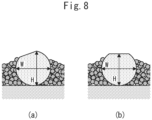
- the "state in which the particulate polymer protrudes by 0.1-fold or more the thickness of the inorganic filler portion” means that when the thickness of the inorganic filler portion measured from an SEM image of the cross section of the covering layer is L1 and the maximum distance from the boundary between the substrate and covering layer to the contour of the protruding particulate polymer is L3, the average value of the ratio (L3-L1)/L1 is 0.1 or more.
- the maximum distance from the boundary between the substrate and covering layer to the contour of the protruding particulate polymer means the distance to the point on the contour of the protruding particulate polymer that is farthest from the boundary between the substrate and covering layer.
- the "state in which the particulate polymer protrudes from the covering layer by 0.1-fold or more the thickness of the inorganic filler portion of the covering layer” means, in other words, that the maximum distance (L3) from the boundary line between the substrate and covering layer to the contour of the protruding particulate polymer, as measured from an SEM image of the cross section of the covering layer, is 1.1-fold or more the thickness (L1) of the inorganic filler portion of the covering layer.
- the number of protruding particulate polymers is preferably 50% or more of the total number of particulate polymers contained in the covering layer. According to this, the mode of operation and effect of the protruding particulate polymer can suitably be obtained.
- the ratio of the number of protruding particulate polymers to the total number of particulate polymers contained in the covering layer is also expressed as the protrusion ratio, and is positioned as one of the indicators of the degree of protrusion of the particulate polymer in the covering layer.
- the protrusion ratio is more preferably 60% or more, 70% or more, or 80% or more, and the theoretical upper limit thereof is 100%.
- the separator for an electricity storage device has a 180° peel strength of preferably 200 gf/cm or more, more preferably 230 gf/cm or more, and further preferably 250 gf/cm or more.
- the "180° peel strength" is the strength when the covering layer is peeled off so that the surface of the covering layer facing the substrate forms an angle of 180° with the substrate.
- the upper limit of the 180° peel strength may be 500 gf/cm or less.
- the area (s i ) of a Voronoi polygon can be measured by image analysis if necessary, and the mean (m) of the areas (s i ) can be obtained by dividing the sum of the areas (s i ) of the Voronoi polygons by the total number (n) of Voronoi polygons to be considered.
- the standard deviation (sd) of the areas (s i ) of the Voronoi polygons can be obtained by a conventional method from the areas (s i ) of the Voronoi polygons, the total number (n) of Voronoi polygons to be considered, and the mean (m).
- An average observation field of the covering layer should be ensured within the observation field.
- the projected area in the observation field should be appropriately adjusted so that the average distribution state of the protruding particulate polymers can be understood.
- the protruding particulate polymers to be considered is preferably about 80 to 200 polymers/field of view.
- This observation field can be obtained by observing the covering layer with a preset observation means and magnification.
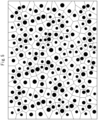
- FIG. 3 is a schematic view of an example of observation of the surface of the covering layer with a scanning electron microscope as the observation means and a magnification of 1000-fold. The dispersion state of such thermoplastic polymer particles can be analyzed by Voronoi division.
- the protruding particulate polymers included in the observation field obtained by the observation method described above are identified.
- the protruding particulate polymers are identified from the observation field by the naked eye or using image processing software.
- FIG. 4 shows an example of the result of identifying the protruding particulate polymer included in the observation field of FIG. 3 using image processing software.
- the protruding particulate polymers identified by observing the surface of the covering layer can be subjected to Voronoi division as defined above. Specifically, the surface of the coating film after the substrate is coated with a coating liquid containing a thermoplastic polymer is photographed to obtain an image.
- the protruding portions of the protruding particulate polymers identified in the obtained image can be regarded as a circle having an average diameter (1 (L) and subjected to Voronoi division to draw Voronoi polygons.
- the Voronoi polygons may be drawn manually or using image processing software. The areas (s i ) of the drawn Voronoi polygons are calculated.
- the coefficient of static friction of the covering layer is preferably 0.41 or more and 0.59 or less, more preferably 0.41 or more and 0.57 or less, and further preferably 0.41 or more and 0.55 or less.
- the particulate polymer protruded from the surface of the inorganic filler portion included in the covering layer be composed of a thermoplastic polymer, and it is preferable that at least a part of the surface of the protruding particulate polymer be missing.
- a sufficient exposed area of the thermoplastic polymer can be secured to prevent winding misalignment during winding of the separator or during production of the electricity storage device and to improve gripping performance with the roller and gripping performance with the electrodes.
- a part of the surface of the protruding particulate polymer being missing means that the exposed surface of at least one of the protruding polymer particles is not spherical or that a part of the exposed surface thereof has a discontinuous surface.
- a part of the surface of the particulate polymer protruded from the surface of the inorganic filler portion included in the covering layer being missing makes it possible to increase the contact area between a wound body and the protruding particulate polymer when the separator for an electricity storage device is wound into the wound body, thereby preventing the separator from becoming misaligned during winding, improving productivity.
- the missing ratio in the spherical surface of the protruding particulate polymer is preferably within the range of 0.74 to 0.93, and in observation of the surface of the covering layer, the ratio of the area of the particulate polymer-shedding portion to the total area of the particulate polymer is preferably 10 % or less, more preferably less than 0.1%, for example, 0%.
- the method of calculating the missing ratio, the method of observing the surface of the covering layer, and the method of calculating the ratio of the area of the particulate polymer-shedding portion to the total area of the particulate polymer will be described in detail in the Examples.
- Means for adjusting the coefficient of static friction of the covering layer within the range described above and/or causing a part of the surface of the protruding particulate polymer to be missing include, for example, controlling the conditions of the coating and drying steps, in which a coating liquid is applied to a substrate in the production process for the separator for an electricity storage device, such as the particle size and content of the thermoplastic polymer in the coating liquid applied to the substrate, the viscosity and application amount of the coating liquid, as well as the coating method and coating conditions, or the conditions after the coating and drying steps, such as the pressure applied to the coated surface, the speed of the transport roller with which the coated surface comes into contact, the shape of the inorganic filler in the covering layer, and the peel strength of the covering layer.
- a coating liquid is applied to a substrate in the production process for the separator for an electricity storage device, such as the particle size and content of the thermoplastic polymer in the coating liquid applied to the substrate, the viscosity and application amount of the coating liquid, as well as the coating
- the thermal shrinkage rate of the separator for an electricity storage device of the present embodiment can be adjusted by appropriately combining a stretching operation and heat treatment of the substrate described above.
- the MD thermal shrinkage rate is also preferably 5% or less, more preferably 0% or more and 3% or less, and further preferably 0% or more and 1% or less.
- the polyolefin microporous membrane has an air permeability of 500 sec/100 cm 3 or less and a post-compression porosity of 30% or more within a membrane thickness range of 1 ⁇ m to 30 ⁇ m, for example, in the production of a nonaqueous secondary battery using a polyolefin microporous membrane as a separator, the electrical resistance of the polyolefin microporous membrane can be reduced or an increase in electrical resistance can be suppressed after a pressing step, whereby high output and high cycle characteristics of the nonaqueous secondary battery can be achieved.
- the separator for an electricity storage device of the present embodiment comprises a substrate which is a polyolefin microporous membrane comprising a polyolefin as a primary component.
- “Comprising...as a primary component” means that the weight of the target component (polyolefin) constitutes the largest weight in the entire substrate.
- the content of polyolefin in the polyolefin microporous membrane is, for example, more than 50 parts by weight, preferably 75 parts by weight or more, more preferably 85 parts by weight or more, further preferably 90 parts by weight or more, even further preferably 95 parts by weight or more, particularly preferably 98 parts by weight or more, and may be 100 parts by weight, based on the total weight of the substrate.
- polyolefins have excellent applicability of their coating liquid when applying the coating liquid on the membrane, they are advantageous for making the separator thinner, increasing the active material ratio in the electricity storage device, and increasing the capacity per volume.
- the polyolefin microporous membrane can be one that has been used as a substrate for conventional separators, and is preferably a porous membrane with fine pores that has no electronic conductivity, has ionic conductivity, and is highly resistant to organic solvents.
- the polyolefin may be a polyolefin that can be used in convention extrusion, injection, inflation, blow molding, etc.
- polyolefins include homopolymers containing ethylene, propylene, 1-butene, 4-methyl-1-pentene, 1-hexene, or 1-octene as a monomer, as well as copolymers and multi-stage polymers of two or more of these monomers. These homopolymers, copolymers, and multi-stage polymers may be used alone or in combination of two or more thereof.
- examples of the polyolefin include polyethylene, polypropylene, and polybutene, and more specifically, low-density polyethylene, linear low-density polyethylene, medium-density polyethylene, high-density polyethylene, ultra-high molecular weight polyethylene, isotactic polypropylene, atactic polypropylene, ethylene-propylene random copolymers, polybutene, and ethylene propylene rubber.
- the polyolefin is preferably at least one selected from the group consisting of low-density polyethylene, linear low-density polyethylene, medium-density polyethylene, high-density polyethylene, and ultra-high molecular weight polyethylene, from the viewpoint of the shutdown property in which the pores are occluded by thermal melting.
- high-density polyethylene is preferable because of the low melting point and high strength thereof, and polyethylene having a density of 0.93 g/cm 3 or more as measured in accordance with JIS K7112 is more preferable.
- the amount of the polypropylene relative to the total weight of polyolefin in the substrate may be 0% and is not particularly limited, and from the viewpoints of heat resistance and suitable shutdown function, it is preferably 1 part by weight or more and 35 parts by weight or less, more preferably 3 parts by weight or more and 20 parts by weight or less, and further preferably 4 parts by weight or more and 10 parts by weight or less.
- the content ratio of olefin resin other than polypropylene, for example, polyethylene, relative to the total weight of polyolefin in the polyolefin microporous membrane (olefin resin other than polypropylene / polyolefin) is preferably 65 parts by weight or more and 99 parts by weight or less, more preferably 80 parts by weight or more and 97 parts by weight or less, and further preferably 90 parts by weight or more and 96 parts by weight or less.
- the viscosity average molecular weight (Mv) of the polyolefin is preferably 30,000 or more and 6,000,000 or less, more preferably 80,000 or more and 3,000,000 or less, and further preferably 150,000 or more and 2,000,000 or less. It is preferable that the viscosity average molecular weight be 30,000 or more because the polymers tend to be entangled to achieve high strength. Conversely, it is preferable that the viscosity average molecular weight be 6,000,000 or less from the viewpoint of making it easy to achieve uniform melt-kneading thereby improving the moldability in the extrusion and stretching steps. It is preferable that the viscosity average molecular weight be less than 1,000,000 because the pores tend to easily become blocked when the temperature rises, whereby a better shutdown function tends to be obtained.
- the proportion of the polyethylene having an Mv of 600,000 or more in the polyolefin resin constituting the polyolefin microporous membrane is preferably 30% by weight or more, more preferably 50% by weight or more, further preferably 60% by weight or more, and even further preferably 70% by weight or more, and may be 100% by weight.
- the thickness of the substrate (hereinafter referred to as the substrate membrane thickness) is preferably 2 ⁇ m or more, more preferably 5 ⁇ m or more, further preferably 6 ⁇ m or more, and particularly preferably 7 ⁇ m or more, and is preferably 100 ⁇ m or less, more preferably 60 ⁇ m or less, further preferably 50 ⁇ m or less, and particularly preferably 16 ⁇ m or less.
- a substrate membrane thickness of 2 ⁇ m or more is preferable from the viewpoint of improving mechanical strength.
- a substrate membrane thickness of 100 ⁇ m or less is preferable since it reduces the volume occupied by the separator in the electricity storage device, which tends to be advantageous in terms of increasing the capacity of the electricity storage device.
- the average particle size of the inorganic filler is preferably 50 nm or more, from the viewpoint of maintaining the gap for ion permeation through the covering layer and improving the rate characteristics.
- the average particle size of the inorganic filler is preferably 2000 nm or less, from the viewpoint of increasing the filling rate of the inorganic filler in the covering layer and improving the heat shrinkage resistance.
- the average particle size of the inorganic filler is preferably, for example, 180 nm or more and 300 nm or less. The reason is that, in particular when the thickness of the covering layer is small, a uniform covering layer thickness is formed and the heat shrinkage resistance is improved.
- the average particle size of the inorganic filler be, for example, 150 nm or more and 500 nm or less, or 200 nm or more and 450 nm or less. This is because it is possible to achieve a high degree of compatibility between rate characteristics and heat shrinkage resistance.
- the "average particle size" of the inorganic filler is measured by the method described in the Examples. Examples of methods for adjusting the particle size and the distribution thereof include a method of pulverizing the inorganic filler using an appropriate pulverization device such as a ball mill, a bead mill, or a jet mill to reduce the particle size.
- the particle size distribution of the inorganic filler can have one peak in a graph of frequency against particle size.
- the coefficient of variation of the particle size distribution of the inorganic filler is preferably 0.55 or less, more preferably 0.50 or less, and further preferably 0.45 or less. It is preferable that the coefficient of variation of the particle size distribution be 0.55 or less from the viewpoint of suppressing deformation at temperatures exceeding the melting point of the substrate, and from the viewpoint of improving the gradient ratio of the covering layer and increasing the adhesive strength with the electrode.
- Examples of the shape of the inorganic filler include plate-like, scale-like, needle-like, columnar, spherical, polyhedral, and block-like. A combination of inorganic fillers having these shapes may be used. Block-like is preferable from the viewpoint of improving the gradient ratio of the covering layer to increase the adhesive strength with the electrodes.
- the Tg of the particulate polymer is 10°C or higher from the viewpoint of preventing adjacent separators from sticking together (blocking) through the covering layer during storage and transportation of the separator for an electricity storage device and during the production process of the electricity storage device.
- the Tg of the particulate polymer is preferably 110°C or lower from the viewpoint of obtaining suitable adhesive strength with the electrodes.
- the Tg of the particulate polymer can be appropriately adjusted by, for example, changing the type of the monomer used in the production of the particulate polymer and the blending ratio of each monomer when the particulate polymer is a copolymer.
- the glass transition temperature can be roughly estimated from the generally-stated Tg of the homopolymer (for example, as described in the " Polymer Handbook" (A Wiley-Interscience Publication )) and the blending ratio of the monomers.
- the particulate polymer is likely to form a structure protruding from the surface of the covering layer, which increases the adhesive strength with the electrodes and suppresses thermal shrinkage.
- thermoplastic polymer examples include (meth)acrylic polymers, conjugated diene polymers, polyvinyl alcohol resins, and fluorine-containing resins.
- the thermoplastic polymer preferably contains a (meth)acrylic polymer.
- (meth)acrylic polymer refers to a polymer or copolymer containing a (meth)acrylic compound as a monomer.
- Examples of the monovalent hydrocarbon group include linear or branched chain alkyl groups, cycloalkyl groups, and aryl groups.
- Examples of the substituent include a hydroxyl group and a phenyl group, and examples of the heteroatom include a halogen atom and an oxygen atom.
- the (meth)acrylic compound is used alone or in combination of two or more thereof.
- Examples of the (meth)acrylic compound include (meth)acrylic acid, linear alkyl (meth)acrylates, cycloalkyl (meth)acrylates, (meth)acrylates having a hydroxyl group, and (meth)acrylic acid aryl esters.
- chain alkyl (meth)acrylates include (meth)acrylates having chain alkyl groups having 1 or more and 3 or fewer carbon atoms, such as methyl, ethyl, n-propyl, and isopropyl groups; n-butyl, isobutyl, t-butyl, n-hexyl, and 2-ethylhexyl groups; and chain alkyl groups having 4 or more carbon atoms, such as lauryl groups.
- An example of the (meth)acrylic acid aryl ester is phenyl (meth)acrylate.
- Examples of such monomers include styrene-butadiene copolymers and hydrogenated products thereof, acrylonitrile-butadiene copolymers and hydrogenated products thereof, and acrylonitrile-butadiene-styrene copolymers and hydrogenated products thereof.
- Fluorine-containing resins are preferable from the viewpoint of voltage resistance, and examples thereof include polyvinylidene fluoride, polytetrafluoroethylene, and copolymers containing fluorine atoms, such as vinylidene fluoride-hexafluoropropylene copolymers, vinylidene fluoride-hexafluoropropylene-tetrafluoroethylene copolymers, and ethylene-tetrafluoroethylene copolymers.
- the fluorine-containing resin is preferably a copolymer containing fluorine atoms.
- the particulate polymer preferably contains at least one selected from the group consisting of copolymers containing (meth)acrylate as a monomer, styrene-butadiene copolymers, and copolymers containing fluorine atoms.
- Copolymers containing (meth)acrylate as a monomer more preferably contain copolymers containing (meth)acrylic acid, butyl (meth)acrylate, and ethylhexyl (meth)acrylate as monomers.
- the particulate polymer preferably contains a crosslinkable monomer.
- the crosslinkable monomer is not particularly limited, and examples thereof include monomers having two or more radically polymerizable double bonds, and monomers having a functional group that gives a selfcrosslinking structure during or after polymerization. These are used alone or in combination of two or more thereof.
- polyoxyethylene diacrylate polyoxyethylene dimethacrylate, polyoxypropylene diacrylate, polyoxypropylene dimethacrylate, neopentyl glycol diacrylate, neopentyl glycol dimethacrylate, butanediol diacrylate, butanediol dimethacrylate, trimethylolpropane triacrylate, trimethylolpropane trimethacrylate, pentaerythritol tetraacrylate, and pentaerythritol tetramethacrylate. These may be used alone or in combination of two or more thereof. Among these, from the same viewpoint as above, at least one of trimethylolpropane triacrylate or trimethylolpropane trimethacrylate is preferable.
- the resin binder may comprise, for example, a resin latex binder.
- a resin latex binder for example, a copolymer of an unsaturated carboxylic acid monomer and another monomer copolymerizable therewith may be used.
- examples of aliphatic conjugated diene monomers include butadiene and isoprene
- examples of unsaturated carboxylic acid monomers include (meth)acrylic acid
- examples of other monomers include styrene.
- the polymerization method of such a copolymer is not particularly limited, and emulsion polymerization is preferable.
- the emulsion polymerization method is not particularly limited, and known methods can be used.
- resin binder examples include the following (1) to (7):
- the volume average particle size (D50) thereof may be, for example, 50 nm or more and 500 nm or less, 60 nm or more and 460 nm or less, or 80 nm or more and 250 nm or less.
- the volume average particle size of the resin binder can be controlled by, for example, adjusting the polymerization time, polymerization temperature, raw material composition ratio, raw material charging order, pH, etc.
- the glass transition temperature of the resin binder is preferably 25°C or lower, more preferably 10°C or lower, and further preferably -15°C or lower. From the viewpoint of transparency, the glass transition temperature of the resin binder is preferably -60°C or higher.
- the volume average particle size (D50) of the resin binder is preferably 1-fold or more, more preferably 2-fold or more, and further preferably 2.5-fold or more the average pore size of the polyolefin microporous membrane from the viewpoint of improving the 180° peel strength.
- the volume average particle size (D50) of the resin binder is preferably 10-fold or less the average pore size of the polyolefin microporous membrane.
- the content ratio of the resin binder in the covering layer may be, for example, more than 0 parts by weight and 50 parts by weight or less, 1 part by weight or more and 20 parts by weight or less, 2 parts by weight or more and 10 parts by weight or less, or 3 parts by weight or more and 5 parts by weight or less, relative to the total amount of the covering layer.
- the covering layer may further contain a water-soluble polymer in addition to the inorganic filler and the particulate polymer of the thermoplastic polymer.
- the water-soluble polymer may be incompatible with the thermoplastic polymer constituting the particulate polymer.
- the water-soluble polymer functions as a dispersant in the coating liquid for forming the covering layer containing the inorganic filler and the particulate polymer of the thermoplastic polymer, and functions as a dispersant and/or a water retention agent when the coating liquid is a water-based coating material.
- the water-soluble polymer may be a polymer derived from a natural product, a synthetic product, or a semi-synthetic product, and from the viewpoint of forming a coating material from the inorganic components and organic components, and in particular, a water-based coating material, it is preferable that the water-soluble polymer be an anionic, cationic, amphoteric, or nonionic polymer, and more preferably be an anionic, cationic, or amphoteric polymer.
- the ammonium salt or alkali metal salt of polyacrylic acid refers to a polymer in which at least one of the -COO- moieties derived from multiple carboxylic acid groups forms a salt with an ammonium ion or an alkali metal ion, such as a sodium ion (Na + ) or a potassium ion (K + ).
- ammonium or alkali metal salt of polyacrylic acid may be at least one of the following (I) to (III):
- Examples of the monomer (C i ) having one ammonium salt or alkali metal salt of a carboxylic acid include sodium (meth)acrylate and ammonium (meth)acrylate.
- Examples of the monomer (C ii ) having a plurality of ammonium salts or alkali metal salts of a carboxylic acid include ammonium salts or sodium salts of 11-(methacryloyloxy)undecane-1,1-dicarboxylic acid; ammonium salts, monosodium salts or disodium salts of ethylenically unsaturated dicarboxylic acids such as fumaric acid, maleic acid, itaconic acid, and citraconic acid; and alicyclic polycarboxylic acids having a (meth)acryloyl group.
- cationic polymers include cationic starch; chitosan; gelatin; homopolymers or copolymers of quaternary salts of dimethylaminoethyl (meth)acrylate; homopolymers or copolymers of dimethylallylammonium chloride; polyamidines and copolymers thereof; polyvinylimidazoline; dicyandiamide-based condensates; epichlorohydrin-dimethylamine condensates; and polyethyleneimine.
- alkyl group having 1 or more and 10 or fewer carbon atoms may be linear, branched, or cyclic, and include a methyl group, an ethyl group, an n-propyl group, an isopropyl group, an n-butyl group, a sec-butyl group, a tert-butyl group, an n-pentyl group, an n-hexyl group, an n-heptyl group, an n-octyl group, an n-nonyl group, and an n-decyl group.
- Acetylenic surfactants are also available as commercial products, and examples of such commercial products include Olfine SPC (manufactured by Nissin Chemical Industry Co., Ltd., active ingredient 80 parts by weight, pale yellow liquid), Olfine AF-103 (manufactured by Nissin Chemical Industry Co., Ltd., pale brown liquid), Olfine AF-104 (manufactured by Nissin Chemical Industry Co., Ltd., pale brown liquid), Olfine SK-14 (manufactured by Nissin Chemical Industry Co., Ltd., pale yellow viscous liquid), Olfine AK-02 (manufactured by Nissin Chemical Industry Co., Ltd., pale yellow viscous liquid), Olfine AF-201F (manufactured by Nissin Chemical Industry Co., Ltd., pale yellow viscous liquid), Olfine D-10PG (manufactured by Nissin Chemical Industry Co., Ltd., active ingredient 50 parts by weight, pale yellow liquid), Olfine E-1004 (manufact
- Polyether surfactants are also available as commercially available products, and examples of such commercially available products include E-D052, E-D054, and E-F010 (manufactured by San Nopco Ltd.).
- the silicone surfactant may be linear, branched, or cyclic, as long as it contains at least a silicone chain, and may contain either a hydrophobic group or a hydrophilic group.
- the hydrophobic group include alkyl groups such as methyl, ethyl, n-propyl, isopropyl, n-butyl, sec-butyl, tert-butyl, n-pentyl, n-hexyl, n-heptyl, n-octyl, n-nonyl, and n-decyl; cyclic alkyl groups such as cyclohexyl; and aromatic hydrocarbon groups such as phenyl.
- the amount of the covering layer relative to the substrate i.e., the amount of the covering layer per unit area of one surface of the substrate, is preferably 0.5 g/m 2 or more, more preferably 1.0 g/m 2 or more, by weight, and preferably 0.15 cm 3 /m 2 or more, more preferably 0.30 cm 3 /m 2 or more, by volume.
- the upper limit of the amount of the covering layer is preferably 10.0 g/m 2 or less, more preferably 7.0 g/m 2 or less, by weight, and preferably 3.50 cm 3 /m 2 or less, more preferably 2.50 cm 3 /m 2 or less, by volume.
- the thickness can be adjusted by, for example, changing the type or concentration of the particulate polymer in the coating liquid applied to the substrate, the coating amount of the coating liquid, the coating method, and the coating conditions.
- the method for adjusting the thickness of the covering layer is not limited to these.
- FIG. 1 is a schematic diagram of the surface of the covering layer of the separator for an electricity storage device of the present embodiment.
- the surface of the covering layer (10) comprises an inorganic filler (1) and a particulate polymer (2) that is a thermoplastic polymer protruding from the organic filler portion.
- the particulate polymer is present in the form of primary particles without agglomerating with other particulate polymers.
- the polyolefin resin composition and the plasticizer are melt-kneaded.
- the melt-kneading method include a method in which the polyolefin resin and, if necessary, other additives are put into a resin kneading device such as an extruder, a kneader, a lab plastomill, a kneading roll, and a Banbury mixer, and the plasticizer is introduced at an arbitrary ratio while the resin component is heated and melted, and kneading.
- a covering layer is arranged on at least one surface of the substrate produced as described above. Examples of the arrangement method of the covering layer including applying a coating liquid containing the inorganic filler and the particulate polymer of the thermoplastic polymer to the substrate and then removing the medium, as will be described later.
- the medium of the coating liquid is preferably water, or a mixed medium composed of water and a water-soluble organic medium.
- the volume average particle size (D50) is equal to or less than the upper limit described above, the particle diameter difference with the inorganic filler can be maintained within a predetermined range, whereby it is easy to suitably control sedimentation of the particulate polymer in the coating liquid.
- the volume average particle size of the particulate polymer can be controlled by adjusting, for example, the polymerization time, polymerization temperature, raw material composition ratio, raw material charging order, pH, etc., for obtaining the particulate polymer.
- the viscosity of the coating liquid is preferably 10 mPa ⁇ s or more, or 20 mPa ⁇ s or more, and preferably 100 mPa ⁇ s or less, 80 mPa ⁇ s or less, 60 mPa ⁇ s or less, or 40 mPa ⁇ s or less.
- Examples of surface treatment methods include corona discharge treatment, plasma treatment, mechanical roughening, solvent treatment, acid treatment, and ultraviolet oxidation.
- Examples of surface treatment include corona discharge treatment.
- the method of coating the substrate with the coating liquid is not particularly limited as long as it can achieve the desired coating pattern, coating film thickness, and coating area.
- the coating method is preferably, for example, a gravure coater method in which the coating is performed at a high shear rate, and the shear rate is preferably 40,000 sec -1 or more and 120,000 sec -1 or less.
- the shear rate is within this range, the particulate polymer is well dispersed as primary particles, and it is easier to control the 180° peel strength to 200 gf/cm or more.
- the obtained separator for an electricity storage device is preferably wound into a wound body.
- the separator By forming the separator into a wound body, it can be easily fed at high speed, whereby productivity in the production steps of the electricity storage device can be increased.
- the lithium-ion secondary battery comprises a positive electrode, a negative electrode, the separator for an electricity storage device of the present embodiment arranged between the positive electrode and the negative electrode, and a non-aqueous electrolyte solution.
- the electricity storage device of the present embodiment comprises the separator for an electricity storage device, and thus, has excellent characteristics such as power storage performance, and in the case of a lithium-ion secondary battery, has excellent battery characteristics.
- a negative electrode having a negative electrode active material layer containing a negative electrode active material on a negative electrode current collector can be suitably used.
- the negative electrode current collector for example, copper foil can be used.
- the negative electrode active material include carbon materials such as graphite, nongraphitizable carbonaceous, graphitizable carbonaceous, and composite carbon bodies; silicon, tin, metallic lithium, and various alloy materials.
- the pressing temperature is preferably T 1.00 or higher, which is a temperature at which adhesiveness can be effectively exhibited.
- T 1.00 is the temperature at which the minimum value of DDSC, defined as the temperature derivative of heat flow difference per unit time measured by DSC (differential scanning calorimetry), is observed between 0°C and 150°C.
- the covering layer is sufficiently deformed and suitable adhesive strength can be obtained.
- a temperature of 35°C or higher is preferable.
- the pressing temperature is preferably lower than the melting point of the material contained in the substrate, and is more preferably 130°C or lower.
- the pressing pressure is preferably 20 MPa or less.
- the pressing time may be 1 second or shorter when a roller press is used, or several hours when a flat press is used, and is preferably 2 hours or shorter from the viewpoint of productivity.
- the air permeability resistance of the substrate and the separator for an electricity storage device was measured in accordance with JIS P-8117 using a Gurley air permeability meter G-B2 (model name) manufactured by Toyo Seiki Co., Ltd.
- the covering layer is present on only one surface of the substrate, the needle can be inserted from the surface where the covering layer is present.
- the substrate was fixed with a sample holder having an opening diameter of 11.3 mm.
- a puncture test was performed on the center of the fixed substrate using a needle with a tip curvature radius of 0.5 mm at a puncture speed of 2 mm/sec, and an atmosphere of 25°C, to measure the maximum puncture load as the puncture strength (gf).
- the needle can be inserted from the surface where the covering layer is present.
- R liq water permeability / 100
- a thermoplastic polymer containing a thermoplastic polymer
- Approximately 17 mg of the dry film was filled into an aluminum container for measurement, and a DSC curve under a nitrogen atmosphere and a DSC curve were obtained using a DSC measurement device (manufactured by Shimadzu Corporation, model name "DSC6220").
- the measurement conditions were as follows.
- the surface of the separator for an electricity storage device on which osmium was vapor-deposited was subjected to elemental mapping using a scanning electron microscope (SEM) (model “SU-8220", manufactured by Hitachi, Ltd.) and energy dispersive X-ray spectroscopy (EDX) (model "ULTIM EXTREME”, manufactured by Oxford Instruments).
- SEM scanning electron microscope
- EDX energy dispersive X-ray spectroscopy
- the average value thereof in these 10 fields of view was used as the projected area (Sr) of the particulate polymer when the covering layer surface was viewed in a plan view.
- Sr projected area
- This slurry was applied to one surface of a copper foil having a thickness of 12 ⁇ m, which serves as the negative electrode current collector, with a die coater, dried at 120°C for 3 minutes, and then compression molded with a roller press to prepare a negative electrode.
- the amount of negative electrode active material applied at this time was 5.2 g/m 2 .
- the separator or substrate was cut to a circle of 24 mm ⁇ , and the positive and negative electrodes were each cut into a circle of 16 mm ⁇ .
- the negative electrode, separator or substrate, and positive electrode were stacked in this order so that the active material surfaces of the positive and negative electrodes faced each other, and then placed in a stainless-steel metal container with a lid.
- the container and the lid were insulated, the container was in contact with the copper foil of the negative electrode, and the lid was in contact with the aluminum foil of the positive electrode.
- 0.4 ml of the nonaqueous electrolyte solution was poured into this container and the container was sealed to assemble a battery.
- This sheet was stretched at a stretching ratio of 7 ⁇ 6.4-fold at a temperature of 20°C using a simultaneous biaxial stretching machine, then immersed in methylene chloride to extract and remove the liquid paraffin, dried, and stretched in the transverse direction by 1.8-fold at a temperature of 130°C using a tenter stretching machine. Thereafter, this stretched sheet was relaxed by approximately 10% in the width direction and heat-treated to obtain polyolefin microporous membrane B1 as a substrate.
- the obtained polyolefin microporous membrane was evaluated according to the methods described above. The evaluation results are shown in the table below.
- Polyolefin microporous membrane B2 was produced in the same manner as polyolefin microporous membrane B1, except that the thickness of the sheet-like molded product was changed to 0.5 mm. The results of measurement and evaluation of the polyolefin microporous membrane B2 are likewise shown in Table 1. [Table 1] Table 1. Substrate Polyolefin microporous membrane No. B1 B2 Basis weight (g/m 2 ) 6.4 3.5 Thickness ( ⁇ m) 12 6 Porosity (%) 44 37 Air permeability (sec/100 cm 3 ) 150 140 Puncture strength (gf) 500 255 Average pore size (nm) 50 50 Methylene chloride solubles (weight%) 0.7 0.5
- the resulting emulsion was dripped from the dropping tank into the reaction vessel.
- the dripping started 5 minutes after the aqueous ammonium persulfate solution was added to the reaction vessel, and the entire amount of the emulsion was dripped over 150 minutes.
- the temperature inside the vessel was maintained at 80°C.
- the stirrer inserted in the reaction vessel was constantly stirred with a magnetic stirrer.
- Aqueous dispersions A2 to 5 were obtained and their physical properties were evaluated in the same manner as aqueous dispersion A1, except that the composition of the emulsion was changed as shown in the table below. The obtained results are shown in table below.
- a part of the aqueous dispersion A1 was taken and used as a seed polymer to carry out multistage polymerization to synthesize aqueous dispersion A1-1. Specifically, a mixture of 20 parts by weight of aqueous dispersion A1 converted into solid content and 70.4 parts by weight of ion-exchanged water was first charged into a reaction vessel equipped with a stirrer, a reflux condenser, a dropping tank, and a thermometer, and the temperature inside the reaction vessel was raised to 80°C. Thereafter, while maintaining the temperature inside the vessel at 80°C, 7.5 parts by weight of ammonium persulfate (2% aqueous solution) was added. This was the initial charge.
- MMA methyl methacrylate
- BA 2-ethylhexyl acrylate
- MAA methacrylic acid
- AA acrylic acid
- HEMA 2-hydroxyethyl methacrylate
- AM acrylamide
- GMA glycidyl methacrylate
- A-TMPT trimethylolpropane triacrylate
- AcSi ⁇ -methacryloxypropyltrimethoxysilane
- Copolymer latexes (aqueous dispersions A2-1, A3-1 to A3-8, A4-1, and A5-1) were obtained in the same manner as aqueous dispersion A1-1, except that the compositions of the seed polymer, monomers, and other raw materials were changed as shown in Table 2.
- the obtained aqueous dispersions were each evaluated by the methods described above. The obtained results are shown in Table 2.
- CMC carboxymethylcellulose
- acrylic latex suspension 50% solid concentration, volume average particle size 150 nm, Tg -10°C
- aqueous dispersion A3-5 10 parts by weight of aqueous dispersion A3-5 was mixed and uniformly dispersed to prepare a coating liquid (solid content 40 parts by weight) containing a thermoplastic polymer.
- the particulate polymer was dispersed in the form of primary particles, while in the separator of Comparative Example 4, the particulate polymer was dispersed in the form of secondary particles.
- winding misalignment was evaluated based on the number of the wound bodies that were determined to have winding misalignment.
- the evaluation criteria for winding misalignment are as follows.
- a wound body of the microporous membrane was set on the inspection jig shown in FIG. 9 and dropped from a height of 300 mm onto an impact table to apply an impact to the wound body.
- the wound body that was subjected to the impact was placed horizontally, the distance from the bottom surface of the wound body to the top surface of the wound body was measured, and the misalignment width was calculated using the following formula. The longer this distance, the greater the step misalignment.
- Misalignment width (distance between top and bottom surfaces of wound body after step misalignment) - (wound body slit width)
- the separator for an electricity storage device of the present disclosure can be suitably used for various electricity storage devices, and preferably lithium-ion secondary batteries.
Landscapes
- Chemical & Material Sciences (AREA)
- Electrochemistry (AREA)
- General Chemical & Material Sciences (AREA)
- Chemical Kinetics & Catalysis (AREA)
- Engineering & Computer Science (AREA)
- Inorganic Chemistry (AREA)
- Power Engineering (AREA)
- Ceramic Engineering (AREA)
- Microelectronics & Electronic Packaging (AREA)
- Materials Engineering (AREA)
- Composite Materials (AREA)
- Manufacturing & Machinery (AREA)
- Cell Separators (AREA)
- Electric Double-Layer Capacitors Or The Like (AREA)
Applications Claiming Priority (2)
| Application Number | Priority Date | Filing Date | Title |
|---|---|---|---|
| JP2022087222 | 2022-05-27 | ||
| PCT/JP2023/019773 WO2023229037A1 (ja) | 2022-05-27 | 2023-05-26 | 蓄電デバイス用セパレータ及びこれを含む蓄電デバイス |
Publications (2)
| Publication Number | Publication Date |
|---|---|
| EP4535544A1 true EP4535544A1 (de) | 2025-04-09 |
| EP4535544A4 EP4535544A4 (de) | 2025-12-24 |
Family
ID=88919531
Family Applications (1)
| Application Number | Title | Priority Date | Filing Date |
|---|---|---|---|
| EP23811909.3A Pending EP4535544A4 (de) | 2022-05-27 | 2023-05-26 | Separator für energiespeichervorrichtungen und energiespeichervorrichtung damit |
Country Status (6)
| Country | Link |
|---|---|
| US (1) | US20250300316A1 (de) |
| EP (1) | EP4535544A4 (de) |
| JP (1) | JP7811264B2 (de) |
| KR (1) | KR20250004818A (de) |
| CN (1) | CN119278539A (de) |
| WO (1) | WO2023229037A1 (de) |
Families Citing this family (3)
| Publication number | Priority date | Publication date | Assignee | Title |
|---|---|---|---|---|
| CN117458084B (zh) * | 2023-12-19 | 2024-03-19 | 宁德新能源科技有限公司 | 一种二次电池和电子装置 |
| KR20250146296A (ko) * | 2024-03-29 | 2025-10-13 | 주식회사 엘지화학 | 전기화학소자용 분리막 및 이를 제조하는 방법 |
| WO2025221115A1 (ko) * | 2024-04-16 | 2025-10-23 | 주식회사 엘지화학 | 전기화학소자용 분리막 및 이를 제조하는 방법 |
Family Cites Families (11)
| Publication number | Priority date | Publication date | Assignee | Title |
|---|---|---|---|---|
| KR100971109B1 (ko) * | 2006-11-20 | 2010-07-20 | 데이진 가부시키가이샤 | 비수계 이차 전지용 세퍼레이터, 및 비수계 이차 전지 |
| JP5502707B2 (ja) * | 2009-11-20 | 2014-05-28 | 三菱樹脂株式会社 | 積層多孔フィルム、電池用セパレータおよび電池 |
| KR101689494B1 (ko) | 2014-08-29 | 2016-12-23 | 스미또모 가가꾸 가부시키가이샤 | 적층체, 세퍼레이터 및 비수 이차 전지 |
| KR102181313B1 (ko) | 2015-04-02 | 2020-11-26 | 주식회사 엘지화학 | 리튬 이차전지용 세퍼레이터 및 그의 제조방법 |
| CN112956072B (zh) * | 2019-02-28 | 2023-03-14 | 日本瑞翁株式会社 | 电化学元件用功能层、带电化学元件用功能层的间隔件及电化学元件 |
| EP3979354A4 (de) | 2019-06-03 | 2023-01-18 | Zeon Corporation | Separator mit funktionsschicht für elektrochemisches element und elektrochemisches element |
| KR102787675B1 (ko) * | 2019-10-31 | 2025-03-26 | 니폰 제온 가부시키가이샤 | 전기 화학 소자용 기능층 및 그 제조 방법, 전기 화학 소자용 기능층 형성 세퍼레이터 및 그 제조 방법, 그리고 전기 화학 소자 및 그 제조 방법 |
| JPWO2021200049A1 (de) | 2020-03-31 | 2021-10-07 | ||
| CN112002865A (zh) | 2020-08-25 | 2020-11-27 | 苏州捷力新能源材料有限公司 | 一种有机/无机复合多孔隔膜 |
| TWI795101B (zh) * | 2020-11-30 | 2023-03-01 | 日商旭化成股份有限公司 | 蓄電裝置用分隔件及包含其之蓄電裝置 |
| JP7749817B2 (ja) * | 2022-04-26 | 2025-10-06 | 旭化成バッテリーセパレータ株式会社 | 蓄電デバイス用セパレータ及びこれを含む蓄電デバイス |
-
2023
- 2023-05-26 US US18/869,662 patent/US20250300316A1/en active Pending
- 2023-05-26 KR KR1020247038238A patent/KR20250004818A/ko active Pending
- 2023-05-26 JP JP2024523368A patent/JP7811264B2/ja active Active
- 2023-05-26 EP EP23811909.3A patent/EP4535544A4/de active Pending
- 2023-05-26 CN CN202380042862.8A patent/CN119278539A/zh active Pending
- 2023-05-26 WO PCT/JP2023/019773 patent/WO2023229037A1/ja not_active Ceased
Also Published As
| Publication number | Publication date |
|---|---|
| US20250300316A1 (en) | 2025-09-25 |
| JP7811264B2 (ja) | 2026-02-04 |
| EP4535544A4 (de) | 2025-12-24 |
| WO2023229037A1 (ja) | 2023-11-30 |
| KR20250004818A (ko) | 2025-01-08 |
| JPWO2023229037A1 (de) | 2023-11-30 |
| CN119278539A (zh) | 2025-01-07 |
Similar Documents
| Publication | Publication Date | Title |
|---|---|---|
| JP7625008B2 (ja) | 蓄電デバイス用セパレータ及びこれを含む蓄電デバイス | |
| EP3054502B1 (de) | Separator für elektrizitätsspeicherungsvorrichtung und elektrizitätsspeicherungsvorrichtung | |
| EP4535544A1 (de) | Separator für energiespeichervorrichtungen und energiespeichervorrichtung damit | |
| EP4535543A1 (de) | Separator für eine stromspeichervorrichtung und stromspeichervorrichtung damit | |
| JP6378998B2 (ja) | 蓄電デバイス用セパレータの製造方法 | |
| JP6412760B2 (ja) | 蓄電デバイス用セパレータ | |
| JP2016107642A (ja) | 多層多孔膜及び蓄電デバイス用セパレータ | |
| JP6903090B2 (ja) | 蓄電デバイス用セパレータ、及びそれを用いた捲回体、リチウムイオン二次電池、並びに蓄電デバイス | |
| JP2025183401A (ja) | 蓄電デバイス用セパレータ及びこれを含む蓄電デバイス | |
| EP4535542A1 (de) | Separator für energiespeichervorrichtungen und energiespeichervorrichtung damit | |
| EP4553986A1 (de) | Separator für energiespeichervorrichtung | |
| WO2024034648A1 (ja) | 蓄電デバイス用セパレータ、その製造方法及び蓄電デバイス | |
| CA3254810A1 (en) | Separator for power storage devices and power storage device comprising same | |
| JP6580234B1 (ja) | 蓄電デバイス用セパレータ、及びそれを用いた捲回体、リチウムイオン二次電池、並びに蓄電デバイス | |
| JP2023174383A (ja) | 蓄電デバイス用セパレータ及びこれを含む蓄電デバイス |
Legal Events
| Date | Code | Title | Description |
|---|---|---|---|
| STAA | Information on the status of an ep patent application or granted ep patent |
Free format text: STATUS: THE INTERNATIONAL PUBLICATION HAS BEEN MADE |
|
| PUAI | Public reference made under article 153(3) epc to a published international application that has entered the european phase |
Free format text: ORIGINAL CODE: 0009012 |
|
| STAA | Information on the status of an ep patent application or granted ep patent |
Free format text: STATUS: REQUEST FOR EXAMINATION WAS MADE |
|
| 17P | Request for examination filed |
Effective date: 20241114 |
|
| AK | Designated contracting states |
Kind code of ref document: A1 Designated state(s): AL AT BE BG CH CY CZ DE DK EE ES FI FR GB GR HR HU IE IS IT LI LT LU LV MC ME MK MT NL NO PL PT RO RS SE SI SK SM TR |
|
| DAV | Request for validation of the european patent (deleted) | ||
| DAX | Request for extension of the european patent (deleted) | ||
| STAA | Information on the status of an ep patent application or granted ep patent |
Free format text: STATUS: EXAMINATION IS IN PROGRESS |
|
| A4 | Supplementary search report drawn up and despatched |
Effective date: 20251124 |
|
| RIC1 | Information provided on ipc code assigned before grant |
Ipc: H01M 50/451 20210101AFI20251118BHEP Ipc: H01G 9/02 20060101ALI20251118BHEP Ipc: H01G 11/52 20130101ALI20251118BHEP Ipc: H01M 50/414 20210101ALI20251118BHEP Ipc: H01M 50/417 20210101ALI20251118BHEP Ipc: H01M 50/434 20210101ALI20251118BHEP Ipc: H01M 50/437 20210101ALI20251118BHEP Ipc: H01M 50/44 20210101ALI20251118BHEP Ipc: H01M 50/443 20210101ALI20251118BHEP Ipc: H01M 50/463 20210101ALI20251118BHEP Ipc: H01M 50/489 20210101ALI20251118BHEP |
|
| 17Q | First examination report despatched |
Effective date: 20251205 |