EP4529363A1 - Wiring board, electronic component mounting package using wiring board, and electronic module - Google Patents
Wiring board, electronic component mounting package using wiring board, and electronic module Download PDFInfo
- Publication number
- EP4529363A1 EP4529363A1 EP23807453.8A EP23807453A EP4529363A1 EP 4529363 A1 EP4529363 A1 EP 4529363A1 EP 23807453 A EP23807453 A EP 23807453A EP 4529363 A1 EP4529363 A1 EP 4529363A1
- Authority
- EP
- European Patent Office
- Prior art keywords
- pair
- conductor
- signal lines
- openings
- wiring board
- Prior art date
- Legal status (The legal status is an assumption and is not a legal conclusion. Google has not performed a legal analysis and makes no representation as to the accuracy of the status listed.)
- Withdrawn
Links
Images



Classifications
-
- H—ELECTRICITY
- H05—ELECTRIC TECHNIQUES NOT OTHERWISE PROVIDED FOR
- H05K—PRINTED CIRCUITS; CASINGS OR CONSTRUCTIONAL DETAILS OF ELECTRIC APPARATUS; MANUFACTURE OF ASSEMBLAGES OF ELECTRICAL COMPONENTS
- H05K1/00—Printed circuits
- H05K1/02—Details
- H05K1/0296—Conductive pattern lay-out details not covered by sub groups H05K1/02 - H05K1/0295
- H05K1/0298—Multilayer circuits
-
- H—ELECTRICITY
- H10—SEMICONDUCTOR DEVICES; ELECTRIC SOLID-STATE DEVICES NOT OTHERWISE PROVIDED FOR
- H10W—GENERIC PACKAGES, INTERCONNECTIONS, CONNECTORS OR OTHER CONSTRUCTIONAL DETAILS OF DEVICES COVERED BY CLASS H10
- H10W76/00—Containers; Fillings or auxiliary members therefor; Seals
- H10W76/10—Containers or parts thereof
- H10W76/12—Containers or parts thereof characterised by their shape
- H10W76/15—Containers comprising an insulating or insulated base
- H10W76/157—Containers comprising an insulating or insulated base having interconnections parallel to the insulating or insulated base
-
- H—ELECTRICITY
- H05—ELECTRIC TECHNIQUES NOT OTHERWISE PROVIDED FOR
- H05K—PRINTED CIRCUITS; CASINGS OR CONSTRUCTIONAL DETAILS OF ELECTRIC APPARATUS; MANUFACTURE OF ASSEMBLAGES OF ELECTRICAL COMPONENTS
- H05K1/00—Printed circuits
- H05K1/02—Details
- H05K1/0213—Electrical arrangements not otherwise provided for
- H05K1/0237—High frequency adaptations
- H05K1/025—Impedance arrangements, e.g. impedance matching, reduction of parasitic impedance
- H05K1/0251—Impedance arrangements, e.g. impedance matching, reduction of parasitic impedance related to vias or transitions between vias and transmission lines
-
- H—ELECTRICITY
- H05—ELECTRIC TECHNIQUES NOT OTHERWISE PROVIDED FOR
- H05K—PRINTED CIRCUITS; CASINGS OR CONSTRUCTIONAL DETAILS OF ELECTRIC APPARATUS; MANUFACTURE OF ASSEMBLAGES OF ELECTRICAL COMPONENTS
- H05K1/00—Printed circuits
- H05K1/18—Printed circuits structurally associated with non-printed electric components
- H05K1/181—Printed circuits structurally associated with non-printed electric components associated with surface mounted components
-
- H—ELECTRICITY
- H05—ELECTRIC TECHNIQUES NOT OTHERWISE PROVIDED FOR
- H05K—PRINTED CIRCUITS; CASINGS OR CONSTRUCTIONAL DETAILS OF ELECTRIC APPARATUS; MANUFACTURE OF ASSEMBLAGES OF ELECTRICAL COMPONENTS
- H05K1/00—Printed circuits
- H05K1/02—Details
- H05K1/0213—Electrical arrangements not otherwise provided for
- H05K1/0216—Reduction of cross-talk, noise or electromagnetic interference
- H05K1/0218—Reduction of cross-talk, noise or electromagnetic interference by printed shielding conductors, ground planes or power plane
- H05K1/0219—Printed shielding conductors for shielding around or between signal conductors, e.g. coplanar or coaxial printed shielding conductors
- H05K1/0222—Printed shielding conductors for shielding around or between signal conductors, e.g. coplanar or coaxial printed shielding conductors for shielding around a single via or around a group of vias, e.g. coaxial vias or vias surrounded by a grounded via fence
-
- H—ELECTRICITY
- H05—ELECTRIC TECHNIQUES NOT OTHERWISE PROVIDED FOR
- H05K—PRINTED CIRCUITS; CASINGS OR CONSTRUCTIONAL DETAILS OF ELECTRIC APPARATUS; MANUFACTURE OF ASSEMBLAGES OF ELECTRICAL COMPONENTS
- H05K1/00—Printed circuits
- H05K1/02—Details
- H05K1/0213—Electrical arrangements not otherwise provided for
- H05K1/0216—Reduction of cross-talk, noise or electromagnetic interference
- H05K1/0218—Reduction of cross-talk, noise or electromagnetic interference by printed shielding conductors, ground planes or power plane
- H05K1/0224—Patterned shielding planes, ground planes or power planes
- H05K1/0225—Single or multiple openings in a shielding, ground or power plane
-
- H—ELECTRICITY
- H05—ELECTRIC TECHNIQUES NOT OTHERWISE PROVIDED FOR
- H05K—PRINTED CIRCUITS; CASINGS OR CONSTRUCTIONAL DETAILS OF ELECTRIC APPARATUS; MANUFACTURE OF ASSEMBLAGES OF ELECTRICAL COMPONENTS
- H05K1/00—Printed circuits
- H05K1/02—Details
- H05K1/0213—Electrical arrangements not otherwise provided for
- H05K1/0237—High frequency adaptations
- H05K1/024—Dielectric details, e.g. changing the dielectric material around a transmission line
-
- H—ELECTRICITY
- H05—ELECTRIC TECHNIQUES NOT OTHERWISE PROVIDED FOR
- H05K—PRINTED CIRCUITS; CASINGS OR CONSTRUCTIONAL DETAILS OF ELECTRIC APPARATUS; MANUFACTURE OF ASSEMBLAGES OF ELECTRICAL COMPONENTS
- H05K1/00—Printed circuits
- H05K1/02—Details
- H05K1/0213—Electrical arrangements not otherwise provided for
- H05K1/0237—High frequency adaptations
- H05K1/0245—Lay-out of balanced signal pairs, e.g. differential lines or twisted lines
-
- H—ELECTRICITY
- H05—ELECTRIC TECHNIQUES NOT OTHERWISE PROVIDED FOR
- H05K—PRINTED CIRCUITS; CASINGS OR CONSTRUCTIONAL DETAILS OF ELECTRIC APPARATUS; MANUFACTURE OF ASSEMBLAGES OF ELECTRICAL COMPONENTS
- H05K1/00—Printed circuits
- H05K1/02—Details
- H05K1/11—Printed elements for providing electric connections to or between printed circuits
- H05K1/117—Pads along the edge of rigid circuit boards, e.g. for pluggable connectors
-
- H—ELECTRICITY
- H05—ELECTRIC TECHNIQUES NOT OTHERWISE PROVIDED FOR
- H05K—PRINTED CIRCUITS; CASINGS OR CONSTRUCTIONAL DETAILS OF ELECTRIC APPARATUS; MANUFACTURE OF ASSEMBLAGES OF ELECTRICAL COMPONENTS
- H05K2201/00—Indexing scheme relating to printed circuits covered by H05K1/00
- H05K2201/09—Shape and layout
- H05K2201/09009—Substrate related
- H05K2201/09027—Non-rectangular flat PCB, e.g. circular
-
- H—ELECTRICITY
- H05—ELECTRIC TECHNIQUES NOT OTHERWISE PROVIDED FOR
- H05K—PRINTED CIRCUITS; CASINGS OR CONSTRUCTIONAL DETAILS OF ELECTRIC APPARATUS; MANUFACTURE OF ASSEMBLAGES OF ELECTRICAL COMPONENTS
- H05K2201/00—Indexing scheme relating to printed circuits covered by H05K1/00
- H05K2201/09—Shape and layout
- H05K2201/09009—Substrate related
- H05K2201/09063—Holes or slots in insulating substrate not used for electrical connections
-
- H—ELECTRICITY
- H05—ELECTRIC TECHNIQUES NOT OTHERWISE PROVIDED FOR
- H05K—PRINTED CIRCUITS; CASINGS OR CONSTRUCTIONAL DETAILS OF ELECTRIC APPARATUS; MANUFACTURE OF ASSEMBLAGES OF ELECTRICAL COMPONENTS
- H05K2201/00—Indexing scheme relating to printed circuits covered by H05K1/00
- H05K2201/09—Shape and layout
- H05K2201/09209—Shape and layout details of conductors
- H05K2201/095—Conductive through-holes or vias
- H05K2201/09618—Via fence, i.e. one-dimensional array of vias
-
- H—ELECTRICITY
- H05—ELECTRIC TECHNIQUES NOT OTHERWISE PROVIDED FOR
- H05K—PRINTED CIRCUITS; CASINGS OR CONSTRUCTIONAL DETAILS OF ELECTRIC APPARATUS; MANUFACTURE OF ASSEMBLAGES OF ELECTRICAL COMPONENTS
- H05K3/00—Apparatus or processes for manufacturing printed circuits
- H05K3/46—Manufacturing multilayer circuits
- H05K3/4611—Manufacturing multilayer circuits by laminating two or more circuit boards
- H05K3/4626—Manufacturing multilayer circuits by laminating two or more circuit boards characterised by the insulating layers or materials
- H05K3/4629—Manufacturing multilayer circuits by laminating two or more circuit boards characterised by the insulating layers or materials laminating inorganic sheets comprising printed circuits, e.g. green ceramic sheets
Definitions
- the present disclosure relates to a wiring board, an electronic component mounting package using a wiring board, and an electronic module.
- a known circuit board includes ground via holes arranged around a central conductor that is at a center.
- the central conductor includes a through-hole at a center thereof and is coupled to a strip line.
- the ground via hole includes a through-hole at a center thereof (for example, see FIG. 10A of Patent Literature 1).
- Patent Literature 1 International Publication No. 2004/107830
- a wiring board includes a first insulating layer, a second insulating layer, a conductor layer, a first ground conductor, and a second ground conductor.
- the first insulating layer includes a first upper surface and a first side surface connected to the first upper surface.
- the second insulating layer is positioned on the first insulating layer and includes a second upper surface, a second lower surface on an opposite side to the second upper surface, and a second side surface coupling the second upper surface to the second lower surface.
- the conductor layer is positioned on the first upper surface and includes a pair of first signal lines and a pair of second signal lines. The pair of first signal lines transmits differential signals and extends in a first direction.
- the pair of second signal lines transmits differential signals and extends in a first direction.
- the first ground conductor is positioned on the first upper surface and between the pair of first signal lines and the pair of second signal lines with a gap between the first ground conductor and the pair of first signal lines and a gap between the first ground conductor and the pair of second signal lines.
- the second ground conductor is positioned on the second upper surface and includes a pair of first openings and a pair of second openings positioned side by side with the pair of first openings.
- the pair of second signal lines is positioned side by side with the pair of first signal lines.
- the second insulating layer includes a pair of first through-conductors, a pair of second through-conductors, and one or more middle through-conductors each penetrating from the second upper surface to the second lower surface.
- Each first through-conductor of the pair of first through-conductors is positioned in a corresponding one of the pair of first openings and electrically coupled to a corresponding one of the pair of first signal lines.
- Each second through-conductor of the pair of second through-conductors is positioned in a corresponding one of the pair of second openings and electrically coupled to a corresponding one of the pair of second signal lines.
- the middle through-conductor is positioned between the pair of first openings and the pair of second openings and electrically coupled to the first ground conductor and the second ground conductor, and the middle through-conductor is a ground through-conductor close to one first through-conductor of the pair of first through-conductors as well as a ground through-conductor close to one second through-conductor of the pair of second through-conductors in a second direction intersecting with the first direction.
- any direction may be defined as an upper direction or a lower direction regarding a wiring board.
- an orthogonal coordinate system xyz is defined, and a positive side in a z-direction is assumed as the upper direction.
- a first direction indicates, for example, an x-direction in the drawings.
- a second direction intersecting with the first direction indicates, for example, a y-direction in the drawings.
- plan view is a concept including planar transparent view.
- a wiring board 101 is described with reference to FIGs. 1 to 9 .
- the wiring board 101 at least includes a first insulating layer 1, a second insulating layer 2, a conductor layer S, a first ground conductor layer G1, and a second ground conductor G2.
- the wiring board 101 may further include a third insulating layer 3.
- a wire, a flexible substrate (FPC: flexible printed circuit), and/or a lead terminal may be coupled to the wiring board 101.
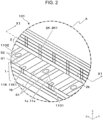
- FIG. 2 is an enlarged view of a part A of interest when the wiring board 101, an electronic component mounting package 100, and an electronic module 10, that are illustrated in FIG. 1 , are seen from the positive direction of the z-axis.
- the first insulating layer 1 includes a first upper surface 1a and a first side surface 1b connected to the first upper surface 1a.
- a dielectric material such as a ceramic material, for example, an aluminum oxide-based sintered body, a mullite-based sintered body, a silicon carbide-based sintered body, an aluminum nitride-based sintered body, or a silicon nitride-based sintered body, or a glass-ceramic material can be used.
- the first insulating layer 1 may include a configuration in which multiple insulating layers are laminated on one another.
- the first insulating layer 1 has a U-shape in plan view, a size of 4 mm ⁇ 4 mm to 50 mm ⁇ 50 mm, and a thickness of 0.5 mm to 10 mm.
- the second insulating layer 2 is positioned on the first insulating layer 1 and includes a second upper surface 2a, a second lower surface 2c on the opposite side to the second upper surface 2a, and a second side surface 2b coupling the second upper surface 2a to the second lower surface 2c.
- the second lower surface 2c can be defined as a surface facing the first upper surface 1a.
- a material for the second insulating layer 2 may be the same as or different from the material for the first insulating layer 1, and for example, a material the same as and/or similar to the material for the first insulating layer 1 described above can be used.
- the second insulating layer 2 may include a configuration in which multiple insulating layers are laminated on one another.
- the second insulating layer 2 has a U-shape in plan view, a size of 4 mm ⁇ 4 mm to 50 mm ⁇ 50 mm, and a thickness of 0.5 mm to 10 mm.
- the conductor layer S is positioned on the first upper surface 1a and includes a pair of first signal lines S1 and a pair of second signal lines S2. Each signal line of the pair of first signal lines S1 and the pair of second signal lines S2 transmits a differential signal and extends in the first direction (in an embodiment, the x-direction).
- Examples of a material for the conductor layer S include a metal material, such as gold, silver, copper, nickel, tungsten, molybdenum, or manganese.
- the conductor layer S may be formed by sintering of metal paste on the first upper surface 1a, or formed by using a thin-film formation technology, such as a vapor deposition method or a sputtering method.
- An insulating film such as a ceramic (for example, alumina coating) or a resin may be positioned on a portion of the conductor layer S.
- the insulating film can be provided onto each of the signal lines (the pair of first signal lines S1 and the pair of second signal lines S2) by screen printing.
- the insulating film may be positioned only on a portion of each signal line. Such a configuration can lower possibility of short-circuiting in each signal line.
- the pair of second signal lines S2 is positioned side by side with the pair of first signal lines S1.
- Metal plating such as nickel plating or gold plating may be formed on a surface of the pair of first signal lines S1 and the pair of second signal lines S2.
- each signal line of the pair of first signal lines S1 and the pair of second signal lines S2 has a width of 0.05 mm to 2 mm, and a length of 1.5 mm to 25 mm.
- each signal line of the pair of first signal lines S1 and the pair of second signal lines S2 has a thickness of 0.01 to 0.1 mm.
- the width, the length, and the thickness of each signal line of the pair of first signal lines S1 and the pair of second signal lines S2 as used herein can respectively indicate a y-direction dimension, an x-direction dimension, and a z-direction dimension of each signal line of the pair of first signal lines S1 and the pair of second signal lines S2.
- a width/length/thickness of each ground conductor of the first ground conductor G1 and the second ground conductor G2 described later can also be defined in the same and/or similar manner.
- the width/length/thickness of each signal line of the pair of first signal lines S1 may respectively be the same as or similar to the width/length/thickness of the pair of first signal lines S1.
- the first ground conductor G1 is positioned on the first upper surface 1a.
- the first ground conductor G1 is positioned between the pair of first signal lines S1 and the pair of second signal lines S2 with a gap between the first ground conductor G1 and the pair of first signal lines S1 and a gap between the first ground conductor G1 and the pair of second signal lines S2.
- the first ground conductor G1 may extend in the first direction (x-direction).
- a material for the first ground conductor G1 may be the same as or different from the material for the conductor layer S, and be, for example, a material the same as and/or similar to the material for the conductor layer S described above.
- the first ground conductor G1 may be formed in a method the same as and/or similar to that for the conductor layer S described above.
- the first ground conductor G1 has a width of 0.05 mm to 2 mm, and a length of 1.5 mm to 25 mm.
- the first ground conductor G1 has a thickness of 0.01 mm to 0.1 mm.
- the second ground conductor G2 is positioned on the second upper surface 2a.
- the second ground conductor G2 includes a pair of first openings O1 (a first opening O1a, a first opening O1b) and a pair of second openings O2 (a second opening O2a, a second opening O2b) positioned side by side with the pair of first openings O1.
- the pair of first openings O1 and the pair of second openings O2 are a region at which the second ground conductor G2 is not formed in plan view.
- the first ground conductor G1 may extend in the first direction (x-direction).
- a material for the second ground conductor G2 may be the same as or different from the material for the conductor layer S, and may be, for example, a material the same as and/or similar to the material for the conductor layer S described above.
- the second ground conductor G2 may be formed in a method the same as and/or similar to that for the conductor layer S described above.
- the second ground conductor G2 has a thickness of 0.01 mm to 0.1 mm.
- each opening of the pair of first openings O1 and the pair of second openings O2 may have a circular shape in plan view.
- the circular shape as used herein is not limited to a perfect circle, but may be an ellipse-like shape or a circle with partial cutout.
- each opening of the pair of first openings O1 and the pair of second openings O2 may be a circle with partial cutout at a portion adjacent to a middle through-conductor 2G1 described later.
- each opening of the first opening O1a and the second opening O2a includes a portion along the middle through-conductor 2G1 and in a shape along an outer periphery of the middle through-conductor 2G1.
- the second ground conductor G2 can be positioned between the middle through-conductor 2G1 and the first opening O1a and between the middle through-conductor 2G1 and the second opening O2a, thus reinforcing ground potential.
- the wiring board 101 includes multiple second ground conductors G2, and each second ground conductor G2 may be positioned between the respective insulating layers that constitute the second insulating layer 2.
- all of the second ground conductors G2 do not need to have the same shape in plan view.
- the pair of first openings O1 may be a single coupled opening in plan view
- the pair of second openings O2 may be a single coupled opening in plan view.
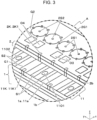
- the second insulating layer 2 includes a pair of first through-conductors 2S1, a pair of second through-conductors 2S2, and one or more middle through-conductors 2G1.
- Each through-conductor of the first through-conductor 2S1, the second through-conductor 2S2, and the middle through-conductor 2G1 penetrates from the second upper surface 2a to the second lower surface 2c.
- the pair of first through-conductors 2S1 can be formed by through-holes provided to the second insulating layer 2 being filled with metal paste including a metal material, such as gold, silver, copper, nickel, tungsten, molybdenum, or manganese.
- the pair of second through-conductors 2S2 and the middle through-conductor 2G1 can also be formed in a method the same as and/or similar to that for the pair of first through-conductors 2S1.
- the pair of first through-conductors 2S1, the pair of second through-conductors 2S2, and the middle through-conductor 2G1 may be vias formed by through-holes being filled with metal paste.
- the pair of first through-conductors 2S1, the pair of second through-conductors 2S2, and the middle through-conductor 2G1 may be through-holes formed by metal paste being applied to inner wall surfaces of the through-holes.
- the pair of first through-conductors 2S1, the pair of second through-conductors 2S2, and the middle through-conductor 2G1 are vias formed in the method described above.
- the wiring board 101 can have less possibility of reduction in its strength when the wiring board 101 has a reduced size. That is, in the case in which the wiring board 101 has a reduced size, the pair of first through-conductors 2S1, the pair of second through-conductors 2S2, and the middle through-conductor 2G1 are provided close to one another.
- the wiring board 101 can have less possibility of reduction in its strength as compared with the case of these conductors being through-holes.
- each first through-conductor of the pair of first through-conductors 2S1 is positioned in the corresponding one of the pair of first openings O1 and electrically coupled to the corresponding one of the pair of first signal lines S1.
- Each second through-conductor of the pair of second through-conductors 2S2 is positioned in the corresponding one of the pair of second openings O2 and electrically coupled to the corresponding one of the pair of second signal lines.
- each first through-conductor of the pair of first through-conductors 2S1 (a first through-conductor 2S1a and a first through-conductor 2S1b) is positioned in the corresponding one of the pair of first openings O1 (the first opening O1a, the first opening O1b).
- each second through-conductor of the pair of second through-conductors 2S2 (a second through-conductor 2S2a and a second through-conductor 2S2b) is positioned in the corresponding one of the pair of second openings O2 (the second opening O2a, the second opening O2b).
- Such a configuration allows current in opposite phases to flow in the respective ones of the first through-conductor 2S1a and the first through-conductor 2S1b to cancel out external noise, thus reducing influence of EMI noise. Therefore, transmission of radio-frequency signals can be smoother. In the same and/or similar manner, also in the second through-conductor 2S2a and the second through-conductor 2S2b, transmission of radio-frequency signals can be smooth.
- Each through-conductor of the pair of first through-conductors 2S1 is not necessarily directly joined to the corresponding one of the pair of first signal lines S1 as long as each one of the pair of first through-conductors 2S1 is electrically coupled to the corresponding one of the pair of first signal lines S1.
- the wiring board 101 may include a first interlayer signal conductor S3 and a second interlayer signal conductor S4.
- first interlayer signal conductor S3 and the second interlayer signal conductor S4 described later are indicated by dotted lines.
- Each first through-conductor of the pair of first through-conductors 2S1 is coupled to the corresponding one of the pair of first signal lines S1 via the first interlayer signal conductor S3.
- Each second through-conductor of the pair of second through-conductors 2S2 is coupled to the corresponding one of the pair of second signal lines S2 via the second interlayer signal conductor S4.
- first interlayer signal conductor S3 and the second interlayer signal conductor S4 may be the same as or different from the material for the conductor layer S, and may be, for example, a material the same as and/or similar to the material for the conductor layer S described above.
- the first interlayer signal conductor S3 and the second interlayer signal conductor S4 may be formed in a method the same as and/or similar to that for the conductor layer S described above.
- each of the first interlayer signal conductor S3 and the second interlayer signal conductor S4 has a width of 0.05 mm to 2 mm, and a length of 1.5 mm to 25 mm.
- each of the first interlayer signal conductor S3 and the second interlayer signal conductor S4 has a thickness of 0.01 mm to 0.1 mm.
- the middle through-conductor 2G1 is positioned between the pair of first openings O1 and the pair of second openings O2.
- the middle through-conductor 2G1 is electrically coupled to the first ground conductor G1 and the second ground conductor G2.
- the middle through-conductor 2G1 is a ground through-conductor close to the first through-conductor 2S1a as well as a ground through-conductor close to the second through-conductor 2S2a in the second direction (in an embodiment, the y-direction) intersecting with the first direction.
- the wiring board 101 can have a reduced size with less possibility of occurrence of crosstalk.
- the wiring board 101 can have a reduced size while maintaining preferable radio frequency transmission.
- the number of middle through-conductor 2G1 may be one. With such a configuration, the wiring board 101 may further be reduced in size with less occurrence of crosstalk. Note that the number of middle through-conductor 2G1 may be more than one, and the number of middle through-conductor 2G1 is appropriately adjustable in accordance with a frequency of transmitted signals. That is, for example, two middle through-conductors 2G1 aligned in the first direction may be positioned between the pair of first openings O1 and the pair of second openings O2.
- the wiring board 101 may include the third insulating layer 3 positioned on the second upper surface 2a.
- the third insulating layer 3 includes a third through-conductor 3G3 and a fourth through-conductor 3G4.
- Each of the third through-conductor 3G3 and the fourth through-conductor 3G4 penetrates the third insulating layer 3 and is electrically coupled to the second ground conductor G2.
- a material for the third insulating layer 3 may be the same as or different from the material for the first insulating layer 1, and for example, a material the same as and/or similar to the material for the first insulating layer 1 described above can be used.
- the third insulating layer 3 may include a configuration in which multiple insulating layers are laminated on one another.
- the third insulating layer 3 has a U-shape in plan view, a size of 4 mm ⁇ 4 mm to 50 mm ⁇ 50 mm, and a thickness of 0.5 mm to 10 mm.
- the wiring board 101 may include a third ground conductor G3 positioned on the third insulating layer 3.
- the third ground conductor G3 is made of a material and formed in a method the same as and/or similar to those for the conductor layer S described above. As illustrated in FIG. 7 , in the case in which the third insulating layer 3 includes the configuration in which multiple insulating layers are laminated on one another, the third ground conductor G3 may be positioned between the insulating layers that constitute the third insulating layer 3. In this case, the third ground conductor G3 may electrically be coupled to the third through-conductor 3G3 and the fourth through-conductor 3G4.
- the third through-conductor 3G3 is positioned between the respective first openings of the pair of first openings O1.
- the fourth through-conductor 3G4 is positioned between the respective second openings of the pair of second openings O2.
- the third through-conductor 3G3 is a ground through-conductor close to each first through-conductor of the pair of first through-conductors 2S1
- the fourth through-conductor 3G4 is a ground through-conductor close to each second through-conductor of the pair of second through-conductors 2S2.
- a distance from the third through-conductor 3G3 to the first through-conductor 2S1a is the same as a distance from the third through-conductor 3G3 to the first through-conductor 2S1b.
- the third through-conductor 3G3 and the fourth through-conductor 3G4 can be formed by through-holes provided to the third insulating layer 3 being filled with metal paste including a metal material, such as gold, silver, copper, nickel, tungsten, molybdenum, or manganese.
- the third through-conductor 3G3 may be positioned with a gap between the third through-conductor 3G3 and the first opening O1a and a gap between the third through-conductor 3G3 and the first opening O1b.
- the fourth through-conductor 3G4 is positioned with a gap between the fourth through-conductor 3G4 and the second opening O2a and a gap between the fourth through-conductor 3G4 and the second opening O2b.
- the second ground conductor G2 is positioned between the third through-conductor 3G3 and each first opening of the pair of first openings O1, and between the fourth through-conductor 3G4 and each second opening of the pair of second openings O2.
- the wiring board 101 includes the third ground conductor G3, and the third ground conductor G3 is electrically coupled to the third through-conductor 3G3 and the fourth through-conductor 3G4, electrical coupling between the multi-layered ground conductors (in an embodiment, the second ground conductor G2 and the third ground conductor G3) via the third through-conductor 3G3 and the fourth through-conductor 3G4 can reinforce ground potential.
- the third through-conductor 3G3, the fourth through-conductor 3G4, and the middle through-conductor 2G1 may be positioned in a straight line in the second direction (in an embodiment, the y-direction).
- This arrangement can reinforce ground potential while disposing the respective first openings of the pair of first openings O1 with a shortest distance therebetween, and can reinforce ground potential while disposing the respective second openings of the pair of second openings O2 with a shortest distance therebetween.
- Ground potential can be reinforced also while the pair of first openings O1 and the pair of second openings O2 are disposed with a shortest distance therebetween. Therefore, the wiring board 101 can have a reduced size with reinforced ground potential.
- the pair of first through-conductors 2S1, the pair of second through-conductors 2S2, the third through-conductor 3G3, the fourth through-conductor 3G4, and the middle through-conductor 2G1 may be positioned in a straight line in the second direction. This arrangement enables the wiring board 101 to have a reduced size with reinforced ground potential as a result of an effect the same as and/or similar to that described above.
- L3 L4 may be satisfied.
- impedance adjustment of the first signal line S1 and the second signal line S2 becomes easier, and thus the wiring board 101 can have improved radio-frequency characteristics.
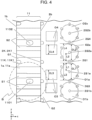
- the second ground conductor G2 may include a pair of third openings O3 and a pair of fourth openings O4.
- Each third opening of the pair of third openings O3 overlaps the corresponding one of the pair of first signal lines S1 in plan view.
- Each fourth opening of the pair of fourth openings O4 overlaps the corresponding one of the pair of second signal lines S2 in plan view.
- Such a configuration can provide less possibility of a reduction in an impedance value at the pair of first signal lines S1 and the pair of second signal lines S2 each signal line of which transmits a differential signal, and impedance adjustment to a desired value.
- Such a wiring board 101 excels in transmission characteristics of radio-frequency signals.
- the pair of fourth openings O4 may also have a configuration the same as and/or similar to that for the pair of third openings O3 or may have a configuration different therefrom.
- each third opening of the pair of third openings O3 may have a substantially rectangular shape or may have a circular shape including an ellipse-like shape.
- the substantially rectangular shape may include a shape in which a part of the rectangular shape is along a contour of a via connected to the second ground conductor G2 in plan view.
- the pair of third openings O3 may overlap the first interlayer signal conductor S3, and the pair of fourth openings O4 may overlap the second interlayer signal conductor S4.
- each third opening of the pair of third openings O3 may overlap the corresponding one of the pair of first signal lines S1 and the first interlayer signal conductor S3, and each fourth opening of the pair of fourth openings O4 may overlap the corresponding one of the pair of second signal lines S2 and the second interlayer signal conductor S4.
- one first signal line S1 and one first interlayer signal conductor S3 may be positioned at a portion of one third opening O3. The portion is closer the other third opening O3 from a middle point of the one third opening O3 in the second direction.
- differential signals can have improved coupling.
- the pair of first signal lines S1 and the pair of second signal lines S2 extend on the first surface 11a of the projecting part 11.
- the first opening part 11O1 is positioned between the respective first signal lines of the pair of first signal lines S1
- the second opening part 1102 is positioned between the respective second signal lines of the pair of second signal lines S2.
- the first insulating layer 1 positioned between the respective ones of the pair of first signal lines S1 and between the respective ones of the pair of second signal lines S2 can have a reduced dielectric constant, and the pair of first signal lines S1 and the pair of second signal lines S2 can have less reduction in impedance. Therefore, using of the wiring board 101 can provide the electronic component mounting package 100 and the electronic module 10 capable of reducing loss in transmission of a radio-frequency signal.
- each of the first opening part 11O1 and the second opening part 1102 may be a recess part positioned at the projecting part 11, and may have a substantially ellipse-like shape in plan view. Such a shape can reduce stress that occurs at a corner part and lower possibility of the wiring board 101 getting damaged as compared with the case in which each of the first opening part 11O1 and the second opening part 1102 has a rectangular shape.
- each of the first opening part 11O1 and the second opening part 1102 may have an ellipse-like shape, a square-like shape, or a rectangular shape with rounded corner parts in plan view.
- the first opening part 11O1 and the second opening part 1102 may extend to the first side surface 1b. That is, each of the first opening part 11O1 and the second opening part 1102 may have a shape cutout from the first surface 11a to the first side surface 1b.
- the first opening part 11O1 and the second opening part 1102 may extend to a position overlapping the second side surface 2b in plan view.
- the first opening part 11O1 and the second opening part 1102 may be positioned in a symmetrical manner while sandwiching the first ground conductor G1 therebetween and may have the same shape as one another.
- the first opening part 11O1 and the second opening part 1102 can be formed by punching processing to form the same shape, and therefore manufacturing of the wiring board 101 becomes easier.
- adjustment and matching of impedance of signals transmitted through the pair of first signal lines S1 and the pair of second signal lines S2 can be easier.
- first opening part 11O1 and the second opening part 1102 are not limited to those described above. That is, the first opening part 11O1 and the second opening part 1102 may have different sizes from one another, and the first opening part 11O1 and the second opening part 1102 may be provided to appropriate positions where reduction in a decrease in impedance is necessary.
- the respective first signal lines of the pair of first signal lines S1 include first connection parts S12 and first line parts S11 extending inward in the first direction from the corresponding first connection parts S12.
- the respective second signal lines of the pair of second signal lines S2 may include second connection parts S22 and second line parts S21 extending inward (in the positive direction of the x-axis) in the first direction (x-direction) from the corresponding second connection parts S22.
- the first opening part 1101 is positioned between the first line parts S11 constituting a pair
- the second opening part 1102 is positioned between the second line parts S21 constituting a pair.
- a dimension WS11 of each first line part of the first line parts S11 is shorter than a dimension WS12 of each first connection part of the first connection parts S12, and a dimension WS21 of each second line part of the second line parts S21 is shorter than a dimension WS22 of each second connection part of the second connection parts S22. That is, WS11 ⁇ WS12, and WS21 ⁇ WS22 are satisfied.
- connection part the first connection part S12, the second connection part S22
- the lead terminal is coupled through a conductive bonding material (for example, solder or a silver brazing material). Therefore, the bonding material can easily form a fillet from each connection part to the lead terminal, and thus bonding strength between the lead terminal and the wiring board 101 can improve.
- a conductive bonding material for example, solder or a silver brazing material
- the pair of second signal lines S2 (the second line part S21, the second connection part S22) has a shape and a dimension the same as and/or similar to those of the pair of first signal lines S1 (the first line part S11, the first connection part S12). Therefore, in FIG. 5 , illustration of the pair of second signal lines S2 (the second line part S21, the second connection part S22), the dimension WS21 of the second line part S21, and the dimension WS22 of the second connection part S22 is omitted.
- the projecting part 11 may include a first middle cutout part 11K cutout from the first surface 11a to the first side surface 1b.
- the first middle cutout part 11K includes a first inner wall surface 11K1 connected to the first surface 11a and the first side surface 1b.
- the first middle cutout part 11K overlaps the middle through-conductor 2G1.
- the first ground conductor G1 may extend from on the first surface 1a to on the first inner wall surface 11K1.
- the second insulating layer 2 may include a second middle cutout part 2K cutout from the second upper surface 2a to the second side surface 2b.
- the second middle cutout part 2K includes a second inner wall surface 2K1 connected to the second upper surface 2a and the second side surface 2b.
- the second middle cutout part 2K overlaps the middle through-conductor 2G1.
- the second ground conductor G2 may extend from the second upper surface 2a to on the second inner wall surface 2K1.
- the first ground conductor G1 positioned on the first inner wall surface 11K1 may be so-called castellation formed by application onto the first inner wall surface 11K1, or may have a shape formed by dividing of a so-called via that is formed by the first middle cutout part 11K being filled with metal paste.
- the second ground conductor G2 positioned on the second inner wall surface 2K1 may have the same and/or similar configuration as or to that of the first ground conductor G1.
- the first middle cutout part 11K, the second middle cutout part 2K, and the middle through-conductor 2G1 are positioned in any identical straight line in plan view.
- the pair of first signal lines S1 and the pair of second signal lines S2 can easily have the same grounding state, and impedance adjustment can be easier.
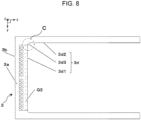
- the third insulating layer 3 may include a third upper surface 3a, a third side surface 3b, a third lower surface 3c, an inner side-surface 3d, and an inner cutout part 3K1.
- the third lower surface 3c is positioned on an opposite side to the third upper surface 3a.
- the third side surface 3b couples the third upper surface 3a to the third lower surface 3c and is positioned on the same plane as the second side surface 2b.
- the inner side-surface 3d couples the third upper surface 3a to the third lower surface 3c and includes a fourth side surface 3d1 on an opposite side to the third side surface 3b.
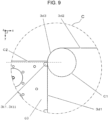
- the inner side-surface 3d includes a lateral side-surface 3d2 in the first direction, and a corner part 3d3 between the lateral side-surface 3d2 and the fourth side surface 3d1. As illustrated in FIG. 9 , the corner part 3d3 has an arc shape in plan view.
- the inner cutout part 3K1 may be cutout from the third upper surface 3a to the fourth side surface 3d1.
- the inner cutout part 3K1 includes a third inner wall surface 3K11 continuing to the corner part 3d3 and the fourth side surface 3d1.
- the third ground conductor G3 may be positioned on the third upper surface 3a and extend from the third upper surface 3a to on the third inner wall surface 3K11.
- Such a configuration can reinforce ground potential with less stress that occurs at the corner part 3d3 of the third insulating layer 3 when the wiring board 101 has a reduced size. More specifically, assuming that an imaginary circle along the corner part 3d3 is an imaginary circle C1, and a center line passing through a center point of the imaginary circle C1 and extending in the first direction (x-direction) is a center line C2, in plan view, in the third inner wall surface 3K11, at least a portion close to the lateral side-surface 3d2 matches the center line C2.
- the inner cutout part 3K1 may further be cutout from the fourth side surface 3d1 to the third lower surface 3c.
- the inner cutout part 3K1 can be formed by application of the same and/or similar punching processing to each insulating layer. Therefore, manufacturing of the wiring board 101 can be easier.
- the third ground conductor G3 positioned on the third inner wall surface 3K11 may be so-called castellation formed by application of metal paste onto the third inner wall surface 3K11, or may have a shape formed by dividing of a via that is formed by the third cutout part 3K1 being filled with metal paste.
- a method for manufacturing the wiring board 101 is described. Note that the present disclosure is not limited to the following embodiment, but for example, a 3D printer may be used for manufacture.
- the electronic component mounting package 100 includes the wiring board 101, a substrate 102, and a frame body 103.
- the frame body 103 is bonded to an upper surface of the substrate 102, and the wiring board 101 is secured to the frame body 103.
- the wiring board 101 may be bonded to the upper surface of the substrate 102.
- the substrate 102 includes the upper surface.
- the substrate 102 has a quadrilateral shape in plan view, a size of 10 mm ⁇ 10 mm to 50 mm ⁇ 50 mm, and a thickness of 0.5 mm to 20 mm.
- a material for the substrate 102 include a metal material, such as copper, iron, tungsten, molybdenum, nickel, or cobalt, or an alloy containing these metal materials.
- the substrate 102 may be a single metal plate or a multilayer body including a plurality of laminated metal plates.
- a surface of the substrate 102 may be formed with a plating layer of nickel, gold, or the like, by using an electroplating method or an electroless plating method.
- a material for the substrate 102 may be an insulating material, for example, a ceramic material, such as an aluminum oxide-based sintered body, a mullite-based sintered body, a silicon carbide-based sintered body, an aluminum nitride-based sintered body, a silicon nitride-based sintered body, or glass ceramics.
- the frame body 103 is positioned on the upper surface of the substrate 102 and protects an electronic component 104 positioned inside in plan view. That is, the frame body 103 surrounds the electronic component 104 when seen in plan view. As illustrated in FIG. 1 , in an embodiment, the frame body 103 is not positioned at one side of an outer edge of the upper surface of the substrate 102. That is, the frame body 103 and the wiring board 101 surround the outer edge of the upper surface of the substrate 102. In other words, the frame body 103 and the wiring board 101 surround the electronic component 104. In this manner, the frame body 103 does not necessarily surround the entirety of the outer edge of the upper surface of the substrate 102. Although in an embodiment the frame body 103 is positioned along the outer edge of the upper surface of the substrate 102, it may be positioned at an inner side of the outer edge of the upper surface of the substrate 102.
- a material for the frame body 103 may be, for example, a metal material, such as copper, iron, tungsten, molybdenum, nickel, or cobalt, or an alloy containing these metal materials.
- the material for the frame body 103 may be an insulating material, for example, a ceramic material, such as an aluminum oxide-based sintered body, a mullite-based sintered body, a silicon carbide-based sintered body, an aluminum nitride-based sintered body, a silicon nitride-based sintered body, or glass ceramics.
- the frame body 103 may be bonded to the substrate 102 with a brazing material or the like interposed therebetween.
- a material of the brazing material is, for example, silver, copper, gold, aluminum, or magnesium, and may contain an additive such as nickel, cadmium, or phosphorus.
- the electronic module 10 includes the electronic component mounting package 100, the electronic component 104, and a lid body 106.
- the electronic module 10 may include a seal ring 105.
- the electronic component 104 may be, for example, a component which performs signal processing, such as conversion of an optical signal into an electrical signal, or conversion of an electrical signal into an optical signal.
- the electronic component 104 is positioned on the upper surface of the substrate 102 and is accommodated in the electronic component mounting package 100.
- Examples of the electronic component 104 include an optical semiconductor element, such as a semiconductor laser (LD: laser diode) or a photo diode (PD), a semiconductor integrated circuit element, and a sensor element such as an optical sensor.
- an optical semiconductor element such as a semiconductor laser (LD: laser diode) or a photo diode (PD), a semiconductor integrated circuit element, and a sensor element such as an optical sensor.
- the electronic component 104 can be formed by using a semiconductor material, such as gallium arsenide or gallium nitride.
- the lid body 106 is positioned on the frame body 103 to cover an internal portion of the electronic component mounting package 100, and protects, together with the frame body 103, the electronic component 104.
- the lid body 106 has a quadrilateral shape in plan view, a size of 10 mm ⁇ 10 mm to 50 mm ⁇ 50 mm, and a thickness of 0.5 mm to 2 mm.
- a material for the lid body 106 include a metal material, such as iron, copper, nickel, chromium, cobalt, molybdenum, or tungsten, or an alloy combining multiple materials among these metal materials. By application of metalworking such as rolling processing or punching processing to an ingot of such a metal material, the metal member which configures the lid body 106 can be fabricated.
- the seal ring 105 has a function to bond the lid body 106 and the frame body 103.
- the seal ring 105 is positioned on the frame body 103 to surround the electronic component 104 in plan view.
- Examples of a material for the seal ring 105 include a metal material, such as iron, copper, silver, nickel, chromium, cobalt, molybdenum, or tungsten, or an alloy combining multiple materials among these metal materials. Note that in a case of not providing the seal ring 105 on the frame body 103, the lid body 106 may be bonded through a bonding material, such as solder, a brazing material, glass, or a resin adhesive material.
- the present disclosure is applicable to a wiring board, an electronic component mounting package using a wiring board, and an electronic module.
Landscapes
- Engineering & Computer Science (AREA)
- Microelectronics & Electronic Packaging (AREA)
- Structure Of Printed Boards (AREA)
Applications Claiming Priority (2)
| Application Number | Priority Date | Filing Date | Title |
|---|---|---|---|
| JP2022082404 | 2022-05-19 | ||
| PCT/JP2023/017168 WO2023223846A1 (ja) | 2022-05-19 | 2023-05-02 | 配線基板、配線基板を用いた電子部品実装用パッケージ、および電子モジュール |
Publications (1)
| Publication Number | Publication Date |
|---|---|
| EP4529363A1 true EP4529363A1 (en) | 2025-03-26 |
Family
ID=88835141
Family Applications (1)
| Application Number | Title | Priority Date | Filing Date |
|---|---|---|---|
| EP23807453.8A Withdrawn EP4529363A1 (en) | 2022-05-19 | 2023-05-02 | Wiring board, electronic component mounting package using wiring board, and electronic module |
Country Status (5)
| Country | Link |
|---|---|
| US (1) | US20250351264A1 (https=) |
| EP (1) | EP4529363A1 (https=) |
| JP (1) | JPWO2023223846A1 (https=) |
| CN (1) | CN119174286A (https=) |
| WO (1) | WO2023223846A1 (https=) |
Families Citing this family (1)
| Publication number | Priority date | Publication date | Assignee | Title |
|---|---|---|---|---|
| WO2026048792A1 (ja) * | 2024-08-29 | 2026-03-05 | 京セラ株式会社 | 配線基板、電子部品収納用パッケージ及び電子モジュール |
Family Cites Families (5)
| Publication number | Priority date | Publication date | Assignee | Title |
|---|---|---|---|---|
| US6624729B2 (en) * | 2000-12-29 | 2003-09-23 | Hewlett-Packard Development Company, L.P. | Slotted ground plane for controlling the impedance of high speed signals on a printed circuit board |
| CN1799290A (zh) | 2003-06-02 | 2006-07-05 | 日本电气株式会社 | 印刷电路板用小型转接传输线路及其设计方法 |
| WO2016186128A1 (ja) * | 2015-05-20 | 2016-11-24 | 京セラ株式会社 | 半導体素子パッケージ、半導体装置および実装構造体 |
| JP6825986B2 (ja) * | 2017-05-26 | 2021-02-03 | 京セラ株式会社 | 配線基板、電子部品収納用パッケージおよび電子装置 |
| JP7129499B2 (ja) * | 2020-01-16 | 2022-09-01 | 株式会社フジクラ | 基板及びアンテナモジュール |
-
2023
- 2023-05-02 JP JP2024521666A patent/JPWO2023223846A1/ja active Pending
- 2023-05-02 US US18/867,309 patent/US20250351264A1/en active Pending
- 2023-05-02 CN CN202380039033.4A patent/CN119174286A/zh active Pending
- 2023-05-02 WO PCT/JP2023/017168 patent/WO2023223846A1/ja not_active Ceased
- 2023-05-02 EP EP23807453.8A patent/EP4529363A1/en not_active Withdrawn
Also Published As
| Publication number | Publication date |
|---|---|
| WO2023223846A1 (ja) | 2023-11-23 |
| US20250351264A1 (en) | 2025-11-13 |
| CN119174286A (zh) | 2024-12-20 |
| JPWO2023223846A1 (https=) | 2023-11-23 |
Similar Documents
| Publication | Publication Date | Title |
|---|---|---|
| US20250151200A1 (en) | Wiring board, electronic component mounting package using wiring board, and electronic module | |
| EP2237316B1 (en) | Connection terminal, package using the same and electronic device | |
| US20250056726A1 (en) | Wiring board, electronic component mounting package using wiring board, and electronic module | |
| EP2221867B1 (en) | Connection terminal, package using the same, and electronic device | |
| JP7197647B2 (ja) | 高周波基体、高周波パッケージおよび高周波モジュール | |
| US20240405130A1 (en) | Wiring board, electronic component package, and electronic apparatus | |
| EP4529363A1 (en) | Wiring board, electronic component mounting package using wiring board, and electronic module | |
| JP2020053533A (ja) | 配線基板、電子部品パッケージおよび電子装置 | |
| US20240243055A1 (en) | Electronic-component mounting package and electronic device | |
| JP7230251B2 (ja) | 配線基板、電子部品パッケージおよび電子装置 | |
| JP7432703B2 (ja) | 配線基体および電子装置 | |
| EP4550567A1 (en) | Waveguide converter, package for mounting electronic component, and waveguide conversion device | |
| JP7817435B2 (ja) | 配線基板、配線基板を用いた電子部品実装用パッケージ、および電子モジュール | |
| JP7784549B2 (ja) | 配線構造体および電子モジュール | |
| WO2024029628A1 (ja) | 配線基板、配線基板を用いた電子部品実装用パッケージおよび電子モジュール | |
| US20240105600A1 (en) | Wiring substrate, wiring structure using wiring substrate, electronic component mounting package, and electronic module | |
| JP7242911B2 (ja) | 配線基体および電子装置 | |
| JP7244630B2 (ja) | 配線基板、電子部品用パッケージおよび電子装置 | |
| JP4953684B2 (ja) | 配線基板およびそれを用いた電子装置 | |
| JP2021120985A (ja) | 配線基体および電子装置 |
Legal Events
| Date | Code | Title | Description |
|---|---|---|---|
| STAA | Information on the status of an ep patent application or granted ep patent |
Free format text: STATUS: THE INTERNATIONAL PUBLICATION HAS BEEN MADE |
|
| PUAI | Public reference made under article 153(3) epc to a published international application that has entered the european phase |
Free format text: ORIGINAL CODE: 0009012 |
|
| STAA | Information on the status of an ep patent application or granted ep patent |
Free format text: STATUS: REQUEST FOR EXAMINATION WAS MADE |
|
| 17P | Request for examination filed |
Effective date: 20241118 |
|
| AK | Designated contracting states |
Kind code of ref document: A1 Designated state(s): AL AT BE BG CH CY CZ DE DK EE ES FI FR GB GR HR HU IE IS IT LI LT LU LV MC ME MK MT NL NO PL PT RO RS SE SI SK SM TR |
|
| DAV | Request for validation of the european patent (deleted) | ||
| DAX | Request for extension of the european patent (deleted) | ||
| STAA | Information on the status of an ep patent application or granted ep patent |
Free format text: STATUS: THE APPLICATION HAS BEEN WITHDRAWN |
|
| 18W | Application withdrawn |
Effective date: 20260218 |