EP4527294A1 - Cognitive impairment diagnostic device and cognitive impairment diagnostic program - Google Patents
Cognitive impairment diagnostic device and cognitive impairment diagnostic program Download PDFInfo
- Publication number
- EP4527294A1 EP4527294A1 EP25150857.8A EP25150857A EP4527294A1 EP 4527294 A1 EP4527294 A1 EP 4527294A1 EP 25150857 A EP25150857 A EP 25150857A EP 4527294 A1 EP4527294 A1 EP 4527294A1
- Authority
- EP
- European Patent Office
- Prior art keywords
- movie
- cognitive
- region
- cognitive impairment
- image
- Prior art date
- Legal status (The legal status is an assumption and is not a legal conclusion. Google has not performed a legal analysis and makes no representation as to the accuracy of the status listed.)
- Pending
Links
Images








Classifications
-
- A—HUMAN NECESSITIES
- A61—MEDICAL OR VETERINARY SCIENCE; HYGIENE
- A61B—DIAGNOSIS; SURGERY; IDENTIFICATION
- A61B3/00—Apparatus for testing the eyes; Instruments for examining the eyes
- A61B3/10—Objective types, i.e. instruments for examining the eyes independent of the patients' perceptions or reactions
- A61B3/113—Objective types, i.e. instruments for examining the eyes independent of the patients' perceptions or reactions for determining or recording eye movement
-
- A—HUMAN NECESSITIES
- A61—MEDICAL OR VETERINARY SCIENCE; HYGIENE
- A61B—DIAGNOSIS; SURGERY; IDENTIFICATION
- A61B5/00—Measuring for diagnostic purposes; Identification of persons
- A61B5/16—Devices for psychotechnics; Testing reaction times ; Devices for evaluating the psychological state
- A61B5/163—Devices for psychotechnics; Testing reaction times ; Devices for evaluating the psychological state by tracking eye movement, gaze, or pupil change
-
- A—HUMAN NECESSITIES
- A61—MEDICAL OR VETERINARY SCIENCE; HYGIENE
- A61B—DIAGNOSIS; SURGERY; IDENTIFICATION
- A61B5/00—Measuring for diagnostic purposes; Identification of persons
- A61B5/40—Detecting, measuring or recording for evaluating the nervous system
- A61B5/4076—Diagnosing or monitoring particular conditions of the nervous system
- A61B5/4088—Diagnosing of monitoring cognitive diseases, e.g. Alzheimer, prion diseases or dementia
-
- A—HUMAN NECESSITIES
- A61—MEDICAL OR VETERINARY SCIENCE; HYGIENE
- A61B—DIAGNOSIS; SURGERY; IDENTIFICATION
- A61B5/00—Measuring for diagnostic purposes; Identification of persons
- A61B5/72—Signal processing specially adapted for physiological signals or for diagnostic purposes
- A61B5/7271—Specific aspects of physiological measurement analysis
- A61B5/7275—Determining trends in physiological measurement data; Predicting development of a medical condition based on physiological measurements, e.g. determining a risk factor
-
- A—HUMAN NECESSITIES
- A61—MEDICAL OR VETERINARY SCIENCE; HYGIENE
- A61B—DIAGNOSIS; SURGERY; IDENTIFICATION
- A61B5/00—Measuring for diagnostic purposes; Identification of persons
- A61B5/74—Details of notification to user or communication with user or patient; User input means
- A61B5/742—Details of notification to user or communication with user or patient; User input means using visual displays
- A61B5/7425—Displaying combinations of multiple images regardless of image source, e.g. displaying a reference anatomical image with a live image
-
- A—HUMAN NECESSITIES
- A61—MEDICAL OR VETERINARY SCIENCE; HYGIENE
- A61B—DIAGNOSIS; SURGERY; IDENTIFICATION
- A61B5/00—Measuring for diagnostic purposes; Identification of persons
- A61B5/74—Details of notification to user or communication with user or patient; User input means
- A61B5/742—Details of notification to user or communication with user or patient; User input means using visual displays
- A61B5/7445—Display arrangements, e.g. multiple display units
-
- G—PHYSICS
- G16—INFORMATION AND COMMUNICATION TECHNOLOGY [ICT] SPECIALLY ADAPTED FOR SPECIFIC APPLICATION FIELDS
- G16H—HEALTHCARE INFORMATICS, i.e. INFORMATION AND COMMUNICATION TECHNOLOGY [ICT] SPECIALLY ADAPTED FOR THE HANDLING OR PROCESSING OF MEDICAL OR HEALTHCARE DATA
- G16H10/00—ICT specially adapted for the handling or processing of patient-related medical or healthcare data
- G16H10/20—ICT specially adapted for the handling or processing of patient-related medical or healthcare data for electronic clinical trials or questionnaires
-
- G—PHYSICS
- G16—INFORMATION AND COMMUNICATION TECHNOLOGY [ICT] SPECIALLY ADAPTED FOR SPECIFIC APPLICATION FIELDS
- G16H—HEALTHCARE INFORMATICS, i.e. INFORMATION AND COMMUNICATION TECHNOLOGY [ICT] SPECIALLY ADAPTED FOR THE HANDLING OR PROCESSING OF MEDICAL OR HEALTHCARE DATA
- G16H30/00—ICT specially adapted for the handling or processing of medical images
- G16H30/40—ICT specially adapted for the handling or processing of medical images for processing medical images, e.g. editing
-
- G—PHYSICS
- G16—INFORMATION AND COMMUNICATION TECHNOLOGY [ICT] SPECIALLY ADAPTED FOR SPECIFIC APPLICATION FIELDS
- G16H—HEALTHCARE INFORMATICS, i.e. INFORMATION AND COMMUNICATION TECHNOLOGY [ICT] SPECIALLY ADAPTED FOR THE HANDLING OR PROCESSING OF MEDICAL OR HEALTHCARE DATA
- G16H50/00—ICT specially adapted for medical diagnosis, medical simulation or medical data mining; ICT specially adapted for detecting, monitoring or modelling epidemics or pandemics
- G16H50/20—ICT specially adapted for medical diagnosis, medical simulation or medical data mining; ICT specially adapted for detecting, monitoring or modelling epidemics or pandemics for computer-aided diagnosis, e.g. based on medical expert systems
-
- G—PHYSICS
- G16—INFORMATION AND COMMUNICATION TECHNOLOGY [ICT] SPECIALLY ADAPTED FOR SPECIFIC APPLICATION FIELDS
- G16H—HEALTHCARE INFORMATICS, i.e. INFORMATION AND COMMUNICATION TECHNOLOGY [ICT] SPECIALLY ADAPTED FOR THE HANDLING OR PROCESSING OF MEDICAL OR HEALTHCARE DATA
- G16H50/00—ICT specially adapted for medical diagnosis, medical simulation or medical data mining; ICT specially adapted for detecting, monitoring or modelling epidemics or pandemics
- G16H50/30—ICT specially adapted for medical diagnosis, medical simulation or medical data mining; ICT specially adapted for detecting, monitoring or modelling epidemics or pandemics for calculating health indices; for individual health risk assessment
-
- G—PHYSICS
- G16—INFORMATION AND COMMUNICATION TECHNOLOGY [ICT] SPECIALLY ADAPTED FOR SPECIFIC APPLICATION FIELDS
- G16H—HEALTHCARE INFORMATICS, i.e. INFORMATION AND COMMUNICATION TECHNOLOGY [ICT] SPECIALLY ADAPTED FOR THE HANDLING OR PROCESSING OF MEDICAL OR HEALTHCARE DATA
- G16H50/00—ICT specially adapted for medical diagnosis, medical simulation or medical data mining; ICT specially adapted for detecting, monitoring or modelling epidemics or pandemics
- G16H50/50—ICT specially adapted for medical diagnosis, medical simulation or medical data mining; ICT specially adapted for detecting, monitoring or modelling epidemics or pandemics for simulation or modelling of medical disorders
Definitions
- the present invention relates to a cognitive impairment diagnostic device and a cognitive impairment diagnostic program for diagnosis of cognitive impairment.
- the conventional technologies relating to devices for diagnosis of cognitive impairment include the technologies as described below.
- PTL 3 proposes a system for detecting eye movements of a subject for diagnosis of neurological disease.
- PTL 4 and PTL 5 propose eye test charts for examining an eye disease such as retinal and optic nerve diseases or examining an optical nerve disorder caused by, for example, an intracranial disease.
- PTL 6 through PTL 9 propose autism diagnosis support systems for diagnosis of autism of a subject, using an eye-gaze detection unit that includes at least an imaging camera.
- PTL 10 proposes a cerebral disorder diagnosis support device that detects line of sight and the pupils of a subject to determine the possibility of the subject having a cerebral disorder.
- PTL 11 proposes a diagnosis support device capable of effectively supporting diagnosis of a visual perception disorder.
- PTL 12 proposes an eyeball movement measuring device and measuring method capable of detecting an initial motion time of eye movement even from a rough image.
- PTL 13 proposes a cognitive impairment diagnostic device that enables a simple, low-cost, objective, quantitative, and versatile diagnosis.
- a cognitive functioning test in the form of face-to-face interview has been used for diagnosis of cognitive impairment and dementia.
- the cognitive functioning test is a method in which an examiner asks a subject some questions for assessing the cognitive function, scores the answers to the questions that are given orally or in the form of writing of characters and drawing of graphics, and calculates a cognitive function score.
- This method has a problem, however, that the test is time consuming. For example, even the simplest mini-mental state exam (MMSE) takes about 15 to 30 minutes.
- MMSE mini-mental state exam
- the method also has a problem that a subject experiences a significant psychological stress due to the nature of the test that is conducted in the form of face-to-face interview.
- scores largely vary depending on the difference in the skills of interviewing examiners and their interpretation of the answers to the questions.
- the present inventors propose the cognitive impairment diagnostic device of PTL 13. A new cognitive impairment diagnostic device is further awaited.
- the present invention aims to provide a cognitive impairment diagnostic device and a cognitive impairment diagnostic program that achieve a simple, low-cost, objective, quantitative, and versatile diagnosis of cognitive impairment, using a new diagnostic method.
- the cognitive impairment diagnostic device includes: an obtainer that obtains a distribution map representing a distribution of gaze points of a subject on a movie for cognitive assessment; and a diagnoser that makes diagnosis of cognitive impairment, based on the distribution map.
- the movie for cognitive assessment includes, in time order: a first movie including (i) a first region that includes an image for encoding that is displayed in a visually enhanced manner, and (ii) a plurality of second regions that include normal images that are displayed without being enhanced; and an assessment movie including (iii) a third region that includes an assessment image that is similar to the image for encoding and displayed at a same position as the image for encoding without being visually enhanced, and (iv) the plurality of second regions.
- the diagnoser calculates, in a distribution map on the assessment movie, a percentage of fixation duration for which the third region is focused on; and makes diagnosis of suspected memory impairment when the percentage of fixation duration is lower than a threshold.
- the cognitive impairment diagnostic program is a cognitive impairment diagnostic program executed by a computer that obtains a distribution map representing a distribution of gaze points of a subject on a movie for cognitive assessment, and makes diagnosis of cognitive impairment, based on the distribution map.
- the movie for cognitive assessment includes, in time order: a first movie including (i) a first region that includes an image for encoding that is displayed in a visually enhanced manner, and (ii) a plurality of second regions that include normal images that are displayed without being enhanced; and an assessment movie including (iii) a third region that includes an assessment image that is similar to the image for encoding and displayed at a same position as the image for encoding without being visually enhanced, and (iv) the plurality of second regions.
- the cognitive impairment diagnostic program causes the computer to execute: calculating, in a distribution map on the assessment movie, a percentage of fixation duration for which the third region is focused on; and making diagnosis of suspected memory impairment when the percentage of fixation duration is lower than a threshold.
- the cognitive impairment diagnostic device and the cognitive impairment diagnostic program according to an aspect of the present invention achieve a simple, low-cost, objective, quantitative, and versatile diagnosis of cognitive impairment.
- cognitive impairment diagnostic device 1 includes display 10, imaging device 20, and personal computer (PC) 30.
- PC personal computer
- An example configuration of cognitive impairment diagnostic device 1 is shown here in which a commercially available general PC 30 serves as a primary control device to which display 10 and imaging device 20 are further added.
- Imager 21 is a stereo camera including camera 22 and camera 23.
- Camera 22 and camera 23 may each be, for example, an infrared camera.
- Another example of camera 22 and 23 may each be a visible camera.
- imager 21 may not be a stereo camera, and thus may be a single camera, or three or more cameras.
- Outputter 34 an example of which is a speaker, outputs sound.
- Detector 37 detects the gaze points of a subject on display surface 11 on the time series, on the basis of images captured by imager 21. For example, detector 37 detects the eye gaze of the subject from an image captured by imager 21 and detects, as the position of a gaze point, the coordinates of the point at which the eye gaze intersects with display surface 11. The positions of gaze points are detected at regular time intervals. The regular time intervals may be set between several 10 mS and several 100 mS, and thus may be, for example, 100 mS. Detector 37 generates, in real time, a group of coordinate data items (x, y, t) that include time as gaze point data representing the position of a time-series gaze point.
- x and "y” are coordinates on a plane (e.g., display surface 11 or movie for cognitive assessment) and "t" is time.
- the Distribution map is, for example, a map on which marks (e.g., colored dots) corresponding to the foregoing coordinate data (x, y, t) are plotted on a two-dimensional plane.
- the distribution map is superimposed, in real time, on the movie for cognitive assessment that is displayed on display 35 of PC 30. Such marks may be displayed in a manner, for example, that a newer gaze point is brighter.
- Diagnoser 39 makes diagnosis of the cognitive function of the subject by determining whether the distribution map has the characteristics of those indicated by the case characteristics data.
- cognitive impairment diagnostic device 1 includes: display 10 that displays, on display surface 11, a movie for assessing cognitive impairment; imager 21 that captures an image of the eyes of a subject; detector 37 that detects, on the time series, gaze points of the subject on display surface 11, on the basis of the image captured by imager 21; generator 38 that generates a distribution map representing a distribution of the gaze points detected by detector 37; storage 32 that stores case characteristic data 310 indicating the characteristics of the gaze point distribution that are typical of cognitive impairment; and diagnoser 39 that makes diagnosis of cognitive impairment of the subject by determining whether the distribution map has the characteristics indicated by case characteristics data 310.
- FIG. 1B is a block diagram showing another example configuration of cognitive impairment diagnostic device 1 according to the embodiment.
- FIG. 1B is different from FIG. 1A in that display 10, imager 20, detector 37, and generator 38 are deleted, and that obtainer 41 is added. The following avoids overlapping description of the common points and mainly describes the differences.
- Display 10, imager 20, detector 37, and generator 38 in FIG. 1A correspond to the elements for eye tracking for generating distribution map data that represents the distribution of gaze points of a subject on the movie for cognitive assessment.
- FIG. 1B In an example configuration shown in FIG. 1B , major elements for diagnosis of cognitive impairment are shown, with the elements for generating the distribution map data separated from FIG. 1A .
- Obtainer 41 obtains the distribution map data generated by an external device, and stores it in storage 32. Such distribution map data is subjected to diagnosis of cognitive impairment.
- obtainer 41 is simply required to be capable of obtaining, from an external device, distribution map data, movie data for cognitive assessment, case characteristics data, and gaze point data.
- obtainer 41 may obtain only the distribution map data.
- obtainer 41 may obtain, for the first subject, distribution map data, movie data for cognitive assessment, case characteristics data, and gaze point data corresponding to such subject, and obtain only distribution map data for the second and subsequent subjects.
- cognitive impairment diagnostic device 1 shown in FIG. 1A may further include obtainer 41 shown in FIG. 1B .
- the external device is simply required to be capable of generating a distribution map that represents the distribution of time-series gaze points of a subject by eye tracking, and thus an eye tracking method and a configuration for generating a distribution map are not limited to specific ones.
- the external device may be connected to cognitive impairment diagnostic device 1 via the Internet, a phone line, or a dedicated line.
- cognitive impairment diagnostic device 1 is not required to be a device having oversize display 10 as shown in an example external view in FIG. 2A , and thus may be configured as a smart device.
- FIG. 2B is a diagram showing another example external view of cognitive impairment diagnostic device 1.
- Cognitive impairment diagnostic device 1 in this diagram is a tablet smart device having the same functional structural elements as those shown in FIG. 1A , such as display 10 and imager 22.
- Display 10 shown in FIG. 2B doubles as display 10 and display 35 of PC 30 shown in FIG. 2A .
- a touch panel is provided on a surface of display surface 11.
- Imager 22 is a front camera of the smart device.
- Imager 22 is used, for example, for eye tracking by detecting eye positions and movements by a face recognition technology.
- light source unit 24 may not be included.
- Movie display for a subject is performed on display 10.
- the cognitive impairment diagnostic program is executed by the processor inside of the tablet device. The smart device makes diagnosis of cognitive impairment by being alternately used by the subject and the examiner or by the examiner showing display 10 to the subject.
- Cognitive impairment diagnostic device 1 as the foregoing smart device may be implemented, for example, by a tablet terminal, a smartphone, or a notebook PC. Also, the cognitive impairment diagnostic program is prepared as an app of these devices. Also note that cognitive impairment diagnostic device 1 shown in FIG. 2B may have the same functional structural elements as those shown in FIG. 1B .
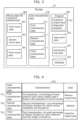
- FIG. 3 is a diagram showing an example of the storage content in storage 32 according to the embodiment.
- storage 32 stores movie data for cognitive assessment 300, case characteristics data 310, program 320, gaze point data 322, and distribution map data 323.
- Program 320 includes cognitive impairment diagnostic program 321.
- Storage 32 further includes database 324.
- Movie data for cognitive assessment 300 is a set of movie data items including first movie data 301 through third movie data 303.
- Each of the movie data items is a movie generated for diagnosis of the presence or absence of cognitive impairment or the level of cognitive impairment, or a movie generated for distinguishing cases of cognitive impairment.
- Case characteristics data 310 is data that represents the characteristics of gaze point distributions that are typical of cognitive impairment.
- Case characteristics data 310 is a set of characteristic data items including first characteristics data 311 through third characteristics data 313.
- First characteristics data 311 through third characteristics data 313 correspond to first movie data 301 through third movie data 304, respectively.
- Program 320 includes software products, such as various firmware, an operating system (OS), and driver software, and cognitive impairment diagnostic program 321.
- Cognitive impairment diagnostic program 321 is a program executed by a computer, i.e., PC 30.
- Cognitive impairment diagnostic program 321 causes the computer to execute: displaying, on display surface 11, a movie for cognitive assessment for cognitive impairment; capturing, by imager 32, an image of the eyes of a subject; detecting, on the time series, gaze points of the subject on display surface 11, on the basis of the image captured by imager 21; generating a distribution map representing a distribution of the detected gaze points; and making diagnosis of cognitive impairment of the subject by determining whether the distribution map has the characteristics indicated by case characteristics data.
- the detecting, performed by PC 30, of the gaze points of the subject on display surface 11 on the time series, on the basis of the image captured by imager 21 is a function of detector 37.
- the generating, performed by PC 30, of the distribution map that represents the distribution of the detected gaze points is a function of generator 38.
- the making of diagnosis, performed by PC 30, of cognitive impairment of the subject by determining whether the distribution map has the characteristics indicated by the case characteristics data is a function of diagnoser 39.
- Gaze point data 322 is time-series data representing the positions and times of the gaze points detected by detector 37. Gaze point data 322 is, for example, a set of coordinate data (x, y, t) that includes time as described earlier.
- Distribution map data 323 is data that represents the distribution map as described earlier.
- FIG. 5 is a flowchart of example diagnostic processes performed by cognitive impairment diagnostic device 1 according to the embodiment.
- the first diagnostic process is a diagnostic process that uses first movie data 301 and first characteristics data 311.
- the second diagnostic process is a diagnostic process that uses second movie data 302 and second characteristics data 312.
- the third diagnostic process is a diagnostic process that uses third movie data 303 and third characteristics data 313.
- the order of the first diagnostic process through the third diagnostic process may be different from the one shown in FIG. 5 .
- At least one of the first diagnostic process through the third diagnostic process may be selected and performed.
- FIG. 6 is a flowchart of an example of the first diagnostic process (S10) according to the embodiment.
- FIG. 7 is a diagram showing an example movie for cognitive assessment and so forth used in the first diagnostic process shown in FIG. 6 .
- Display times Td, Te, and Tf in the second iteration in FIG. 7 may be the same as or different from times Ta, Tb, and Tc in the first iteration.
- PC 30 displays assessment movie b3 for recalling the memory for Tg seconds (S66).
- Time Tg may be, for example, on the order of five seconds.
- Assessment movie b3 shown in FIG. 7 includes clock image M3 instead of clock image M1. Stated differently, assessment movie b3, in which all of the 20 clock images stay still, is originally configured not to attract the attention only to a specific graphic.
- a subject without memory impairment remembers the contents of the movie for encoding (movie for encoding b11 and movie for encoding b12) that such subject has viewed, and thus unconsciously focuses the eye gaze at the specific graphic or region on which his/her attention was focused in the movie for encoding.
- the specific graphic or region which is a graphic or region that the subject has memorized from the movie for encoding, is still clock image M3 located at the same position as clock image M1 in FIG. 7 .
- PC 30 further determines whether % fixation duration Vb calculated is lower than threshold th1 and greater than threshold th2 (S70). When determining that % fixation duration Vb is lower than threshold th1 and greater than threshold th2, the subject is diagnosed as having suspected memory impairment (S71).
- Threshold th1 and threshold th2 can be appropriately set by calculating % fixation duration Vb of a plurality of subjects who are known beforehand whether having or not having memory impairment.
- FIG. 6 shows an example of outputting three diagnostic results of "having no memory impairment”, “having suspected memory impairment”, and “having memory impairment”, but the diagnostic results are not limited to these.
- the diagnostic results thus may come in two types indicating the presence or absence of memory impairment, or may be four or more types indicating the presence or absence of memory impairment and the level of memory impairment.
- the flowchart of FIG. 6 may include, instead of steps S61 through S66, a step of obtaining a distribution map that represents the distribution of gaze points of a subject on the movie for cognitive assessment.
- the flowchart in which such steps are replaced by the step of obtaining the distribution map is easily implemented by PC 30 shown in FIG. 1B or may be implemented by PC 30 shown in FIG. 1A .
- PC 30 shown in FIG. 1B or may be implemented by PC 30 shown in FIG. 1A .
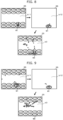
- FIG. 8 is a diagram showing an example distribution map obtained in the first diagnostic process performed on a subject without memory impairment and having an MMSE score of 30.
- FIG. 9 is a diagram showing an example distribution map obtained in the first diagnostic process performed on a subject with memory impairment and having an MMSE score of 14. Note that a perfect MMSE score is 30. The score 30 indicates that a person is cognitively unimpaired. The lower the score, the more severe cognitive impairment.
- FIG. 8 and FIG. 9 each show an example in which a distribution map is superimposed on each of movie for encoding b11, movie for encoding b12, and assessment movie b3 to be displayed on display 35 of PC 30.
- movie for encoding b11 and movie for encoding b12 are movies for cognitive assessment each including: a first region including clock image M1 that is an image for encoding and displayed in a visually enhanced manner; and a plurality of second regions including still clock images that are normal images displayed without being enhanced.
- the gaze points, on the movies for encoding, of the subjects with and without memory impairment are almost the same; their gaze points concentrate on clock image M1 in the first region.
- the gaze point distribution, on assessment movie b3 shown in FIG. 8 of the subject without memory impairment exhibits a high % fixation duration of 81% for clock image M3 of the region of interest, as a result of the effect of the memorization.
- the gaze point distribution, on assessment movie b3 shown in FIG. 9 exhibits a % fixation duration of 0% for clock image M3 of the region of interest, without any effects of the memorization.
- memory impairment is diagnosed by quantitatively assessing the memory level of a subject to obtain, as a score of the memory power, a % fixation duration for which the region of interest on the assessment movie for recalling the memory is focused on.
- the cognitive impairment diagnostic device that performs the first diagnostic process includes: obtainer 41 that obtains a distribution map representing a distribution of gaze points of a subject on a movie for cognitive assessment; and diagnoser 39 that makes diagnosis of cognitive impairment, based on the distribution map.
- the movie for cognitive assessment includes, in time order: a first movie including (i) a first region that includes an image for encoding that is displayed in a visually enhanced manner, and (ii) a plurality of second regions that include normal images that are displayed without being enhanced; and an assessment movie including (iii) a third region that includes an assessment image that is similar to the image for encoding and displayed at a same position as the image for encoding without being visually enhanced, and (iv) the plurality of second regions.
- Diagnoser 39 calculates, in a distribution map on the assessment movie, a percentage of fixation duration for which the third region is focused on, and makes diagnosis of suspected memory impairment when the percentage of fixation duration is lower than a threshold.
- the cognitive impairment diagnostic device that performs the first diagnostic process includes: display 10 including a display surface; imager 21 that captures an image of the eyes of a subject; detector 37 that detects, on the time series, gaze points of the subject on the display surface, on the basis of the image captured by imager 21; generator 38 that generates a distribution map representing a distribution of the gaze points detected by detector 37; and diagnoser 39 that makes diagnosis of cognitive impairment, on the basis of the distribution map.
- diagnoser 39 causes display 10 to display a first movie that includes a first region including an image for encoding that is displayed in a visually enhanced manner, and a plurality of second regions including normal images that are displayed without being enhanced.
- Diagnoser 39 further causes display 10 to display an assessment movie that includes a third region including an assessment image that is similar to the image for encoding and displayed at a same position as the image for encoding without being visually enhanced, and the plurality of second regions. Then, diagnoser 30 calculates, in the distribution map on the assessment movie, the percentage of fixation duration for which the third region is focused on, and makes diagnosis of suspected memory impairment when the percentage of fixation duration is lower than a threshold.
- a cognitive impairment diagnostic device capable of making a simple, low-cost, objective, quantitative, and versatile diagnosis of memory impairment among cognitive impairments. What is more, it is possible to make the diagnosis without using an instruction by text and instruction by voice. This enables the diagnosis to be made on a plurality of subjects having different mother languages. Further, memory impairment is diagnosed within a mere few minutes.
- the first movie may include a first movie for encoding and a second movie for encoding in time order, the first movie for encoding including the first region and the plurality of second regions, the second movie for encoding including the first region and not including the plurality of second regions.
- the movie for cognitive assessment may include an other movie that is displayed between the first movie and the assessment movie.
- the movie for cognitive assessment may include a movie in which the first movie and the other movie are repeated two or more times.
- the cognitive impairment diagnostic program that performs the first diagnostic process is a cognitive impairment diagnostic program executed by a computer that obtains a distribution map representing a distribution of gaze points of a subject on a movie for cognitive assessment, and makes diagnosis of cognitive impairment, based on the distribution map.
- the movie for cognitive assessment includes, in time order: a first movie including (i) a first region that includes an image for encoding that is displayed in a visually enhanced manner, and (ii) a plurality of second regions that include normal images that are displayed without being enhanced; and an assessment movie including (iii) a third region that includes an assessment image that is similar to the image for encoding and displayed at a same position as the image for encoding without being visually enhanced, and (iv) the plurality of second regions.
- Such cognitive impairment diagnostic program causes the computer to execute: calculating, in a distribution map on the assessment movie, a percentage of fixation duration for which the third region is focused on; and making diagnosis of suspected memory impairment when the percentage of fixation duration is lower than a threshold.
- the cognitive impairment diagnostic program that performs the first diagnostic process is a cognitive impairment diagnostic program executed by a computer that includes: display 10 including a display surface; imager 21 that captures an image of the eyes of a subject; detector 37 that detects, on the time series, gaze points of the subject on the display surface, on the basis of the image captured by imager 21; a generator that generates a distribution map representing a distribution of the gaze points detected by detector 37; and diagnoser 39 that makes diagnosis of cognitive impairment, on the basis of the distribution map.
- Such cognitive impairment diagnostic program causes the computer to execute: causing display 10 to display a movie for cognitive assessment that includes a first region including an image for encoding that is displayed in a visually enhanced manner, and a plurality of second regions including normal images that are displayed without being enhanced; further causing display 10 to display an assessment movie that includes a third region including an assessment image that is similar to the image for encoding and displayed at a same position as the image for encoding without being visually enhanced, and the plurality of second regions; calculating, in the distribution map on the assessment movie, the percentage of fixation duration for which the third region is focused on, and making diagnosis of suspected memory impairment when the percentage of fixation duration is lower than a threshold.
- step S20 the second diagnostic process in step S20 shown in FIG. 5 in which a linguistic instruction is used will be described.
- the second diagnostic process uses the foregoing second characteristics to make diagnosis of aphasia.
- FIG. 10 is a flowchart of an example of the second diagnostic process according to the embodiment.
- FIG. 11 is a diagram showing an example movie for cognitive assessment in the second diagnostic process in FIG. 10 in which a linguistic instruction is used.
- PC 30 starts the detection of gaze points by detector 37 (S101), displays the movie for cognitive assessment on display surface 11 (S102), and calculates % fixation duration Vc for which the correct region is focused on in the movie for cognitive assessment (S103).
- the movie for cognitive assessment here is a movie that includes a first region including a correct character image and a plurality of second regions including incorrect character images.
- movie for cognitive assessment c11 is displayed for Ta seconds, after which movie for cognitive assessment c12 is displayed for Tb seconds.
- Time Ta and time Tb may each be, for example, on the order of 5 seconds to 10 seconds.
- Movie for cognitive assessment c11 includes a clock image at a central portion, around which four regions serving as alternatives are included.
- Movie for cognitive assessment c12 is different from movie for cognitive assessment c11 in that an instruction sentence is laid over the clock image at the central portion.
- the instruction sentence reads "What is the name of this?".
- the four regions around the instruction sentence include the first region including the correct character image " " (a Japanese word for "clock") a and the plurality of second regions including incorrect character images " " " (Japanese word for "tomato”), " " (Japanese word for "shrimp"), and " “ (Japanese word for "wool yarn”).
- the movie for cognitive assessment includes, for example, a plurality of regions serving as alternatives that include an image of a known object, and correct and incorrect names of such object.
- the number of alternatives is not limited to a specific number.
- the movie for cognitive assessment also shows an instruction sentence that reads "What is the name of this?". The subject is prompted to gaze at the correct alternative by the instruction sentence.
- one movie for cognitive assessment c13 as shown in FIG. 12 may be displayed instead of two movie for cognitive assessments c11 and c12 shown in FIG. 11 .
- % fixation duration Vc for which the first region that includes the correct character image is focused on, after displaying the movie for cognitive assessment (S103).
- % fixation duration Vc may be the percentage (%) of the presence of gaze points in the first region in the distribution pattern of gaze points on the movie for cognitive assessment.
- PC 30 determines whether % fixation duration Vc calculated is greater than threshold th3 (S104). When determining that % fixation duration Vc is greater than threshold th3, the subject is diagnosed as having no aphasia (S105).
- PC 30 further determines whether % fixation duration Vc calculated is lower than threshold th3 and greater than threshold th4 (S106). When determining that % fixation duration Vc is lower than threshold th3 and greater than threshold th4, the subject is diagnosed as having suspected aphasia (S107).
- PC 30 further determines whether % fixation duration Vc calculated is lower than threshold th4 (S108). When determining that % fixation duration Vc is lower than threshold th4, the subject is diagnosed as having aphasia (S109).
- Threshold th3 and threshold th4 can be appropriately set by calculating % fixation duration Vc of a plurality of subjects who are known beforehand whether having or not having aphasia.
- the flowchart of FIG. 10 may include, instead of steps S101 and S102, a step of obtaining a distribution map that represents the distribution of gaze points of a subject on the movie for cognitive assessment.
- the flowchart in which such steps are replaced by the step of obtaining the distribution map is easily implemented by PC 30 shown in FIG. 1B or may be implemented by PC 30 shown in FIG. 1A .
- FIG. 13 is a diagram showing an example distribution map obtained in the second diagnostic process performed on a subject without aphasia and having an MMSE score of 30.
- FIG. 14 is a diagram showing an example distribution map obtained in the second diagnostic process performed on a subject with aphasia and having an MMSE score of 14.
- the gaze point distribution, on movie for cognitive assessment c12 shown in FIG. 13 , of a subject without aphasia exhibits a high % fixation duration for which first region c111 that includes the correct character image is focused on.
- the gaze point distribution, on movie for cognitive assessment c12 shown in FIG. 14 exhibits a low % fixation duration for which the first region that includes the correct character image is focused on.
- % fixation duration Vc for which the first region serving as the correct answer is focused on exceeds threshold th3, it can be determined that the answer to the instruction sentence is correct, that is, object naming ability is normal. Stated differently, a subject without aphasia is capable of focusing on the correct alternative " " at a rate of the threshold or greater. In contrast, a subject with aphasia has a relatively high rate of focusing on an alternative other than the correct answer. It is thus possible in the second diagnostic process to make diagnosis of whether a subject has aphasia and the level of aphasia, using as a measure, the % fixation duration for which the correct alternative is focused on.
- FIG. 15 is a diagram showing the first example of a movie for cognitive assessment in the second diagnostic process shown in FIG. 10 in which no linguistic instruction is used.
- Movie for cognitive assessment c21 in FIG. 15 which shows an example display on display surface 11 for a subject, includes a correct region including characters having a meaning and incorrect regions including characters having no meaning. More specifically, movie for cognitive assessment c21 includes a plurality of characters arranged in matrix. The correct region corresponds to a row or column that includes characters having a meaning. Incorrect regions correspond to rows or columns that include characters having no meaning. The row that includes characters " " (the name of a Japanese sweet) is the correct region. The other rows and columns are incorrect regions including no characters having a meaning.
- FIG. 16 is a diagram showing an example assessment movie that corresponds to FIG. 15.
- FIG. 16 shows an example display on display 35 for the operator.
- correct region c211 serving as an assessment region is specified by a broken line frame compared to movie for cognitive assessment c21 shown in FIG. 15 .
- FIG. 17 is a diagram showing an example distribution map obtained in the second diagnostic process that is performed, using FIG. 15 , on a subject without aphasia and having an MMSE score of 30.
- FIG. 18 is a diagram showing an example distribution map obtained in the second diagnostic process that is performed, using FIG. 15 , on a subject with aphasia and having an MMSE score of 14.
- the gaze point distribution, on movie for cognitive assessment c21 shown in FIG. 17 , of the subject without aphasia exhibits a high % fixation duration for which correct region c211 is focused on.
- the gaze point distribution, on movie for cognitive assessment c21 shown in FIG. 18 tends to be random irrelevantly to correct region c211.
- characters are arranged in matrix or in a grid pattern, in which "characters as a sequence of characters having a meaning" is present only in a specific portion.
- the other portions include no characters as a sequence of characters having a meaning when read from any directions.
- a subject without aphasia is capable of finding characters having a meaning therefrom.
- a % fixation duration of such subject focusing on the corresponding portion becomes automatically high.
- a subject with aphasia is incapable of finding characters as a sequence of characters having a meaning, and thus tends to view the entire screen randomly.
- a % fixation duration of such subject focusing on the specific portion thus does not become high relatively.
- Characters including 3 ⁇ 3 hiragana characters are displayed on movie for cognitive assessment c21 shown in FIG. 15 , in which characters having a meaning " " is recognizable when the three characters in the bottom line are read from left to right.
- the other sequences of characters are characters basically having no meaning. While no text or voice is provided as an instruction sentence to prompt a subject to find " " the % fixation duration of a cognitively unimpaired person without aphasia focusing on the characters as a sequence of characters having a meaning " " automatically rises relatively.
- a subject with aphasia is incapable of recognizing such characters as a sequence of characters having a meaning and tends to view another region or view the entire screen randomly, with no rise in the % fixation duration for which " " is focused on.
- FIG. 19 is a diagram showing the second example of a movie for cognitive assessment in the second diagnostic process shown in FIG. 10 in which no linguistic instruction is used.
- FIG. 20 is a diagram showing an example assessment movie that corresponds to FIG. 19 .
- Movie for cognitive assessment c31 shown in FIG. 19 which shows an example display on display surface 11 for a subject, includes a correct region including characters having a meaning and incorrect regions including characters having no meaning. More specifically, in movie for cognitive assessment c31, the row that includes characters " " (Japanese festival known as the Star Festival) is the correct region and the other rows and columns are incorrect regions including no characters having a meaning.
- FIG. 20 shows an example display on display 35 for the operator.
- correct region c311 serving as an assessment region is specified by a broken line frame compared to movie for cognitive assessment c31 shown in FIG. 19 .
- FIG. 21 is a diagram showing an example distribution map obtained in the second diagnostic process that is performed, using FIG. 20 , on a subject without aphasia and having an MMSE score of 30.
- FIG. 22 is a diagram showing an example distribution map obtained in the second diagnostic process that is performed, using FIG. 20 , on a subject with aphasia and having an MMSE score of 14.
- the gaze point distribution on movie for cognitive assessment c31 shown in FIG. 21 of the subject without aphasia exhibits a high % fixation duration for which correct region c311 is focused on.
- the gaze point distribution on movie for cognitive assessment c31 shown in FIG. 22 of the subject with aphasia tends to be random irrelevantly to correct region c311.
- Characters including 4 ⁇ 4 hiragana characters are displayed in movie for cognitive assessment c31 shown in FIG. 19 , in which characters having a meaning " " is recognizable when the four characters in the second right column are read from top to bottom.
- the other sequences of characters are characters basically having no meaning. While no text or voice is provided as an instruction sentence to prompt a subject to find " ", the % fixation duration of a cognitively unimpaired person without aphasia focusing on the characters " " having a meaning automatically rises relatively. In contrast, a subject with aphasia is incapable of recognizing such characters as a sequence of characters having a meaning and tends to view another region or view the entire screen randomly with no rise in the % fixation duration for which such portion is focused on.
- cognitive impairment diagnostic device 1 that performs the second diagnostic process includes: obtainer 41 that obtains a distribution map representing a distribution of gaze points of a subject on a movie for cognitive assessment; and diagnoser 39 that makes diagnosis of cognitive impairment, based on the distribution map.
- the movie for cognitive assessment includes: a first region including a correct image for cognitive assessment or an image for encoding; and a plurality of second regions including other images.
- Diagnoser 39 calculates, in the distribution map on the movie for cognitive assessment, a percentage of fixation duration for which the first region is focused on or a percentage of fixation duration for which at least one of the plurality of second regions is focused on, and makes diagnosis of whether cognitive impairment is present by comparing the percentage of fixation duration with a threshold.
- cognitive impairment diagnostic device 1 that performs the second diagnostic process includes: display 10 including a display surface; imager 21 that captures an image of the eyes of a subject; detector 37 that detects, on the time series, gaze points of the subject on the display surface, on the basis of the image captured by imager 21; a generator that generates a distribution map representing a distribution of the gaze points detected by detector 37; and diagnoser 39 that makes diagnosis of cognitive impairment, on the basis of the distribution map.
- diagnoser 39 causes display 10 to display a movie for cognitive assessment that includes a first region including a correct image for cognitive assessment or an image for encoding, and a plurality of second regions including other images.
- diagnoser 39 calculates, in the distribution map on the movie for cognitive assessment, the percentage of fixation duration for which the first region is focused on or the percentage of fixation duration for which at least one of the second regions is focused on, and makes diagnosis of the presence or absence of cognitive impairment by comparing the percentage of fixation duration with a threshold.
- a cognitive impairment diagnostic device capable of making a simple, low-cost, objective, quantitative, and versatile diagnosis of cognitive impairment. It is further possible to diagnose cognitive impairment within a mere few seconds to a few tens of second.
- cognitive impairment diagnostic device 1 that performs the second diagnostic process includes: obtainer 41 that obtains a distribution map representing a distribution of gaze points of a subject on a movie for cognitive assessment; and diagnoser 39 that makes diagnosis of cognitive impairment, based on the distribution map.
- the movie for cognitive assessment includes: the first region including a correct character image; and the plurality of second regions including incorrect character images.
- Diagnoser 39 calculates, in the distribution map on the movie for cognitive assessment, the percentage of fixation duration for which the first region is focused on, and makes diagnosis of suspected aphasia when the percentage of fixation duration is lower than the threshold.
- cognitive impairment diagnostic device 1 that performs the second diagnostic process includes: display 10 including a display surface; imager 21 that captures an image of the eyes of a subject; detector 37 that detects, on the time series, gaze points of the subject on the display surface, on the basis of the image captured by imager 21; a generator that generates a distribution map representing a distribution of the gaze points detected by detector 37; and diagnoser 39 that makes diagnosis of cognitive impairment, on the basis of the distribution map.
- diagnoser 39 causes display 10 to display a movie for cognitive assessment that includes a first region including correct characters and a plurality of second regions including incorrect characters. Then, diagnoser 39 calculates, in the distribution map on the movie for cognitive assessment, the percentage of fixation duration for which the first region is focused on, and makes diagnosis of suspected aphasia when the percentage of fixation duration is lower than a threshold.
- a cognitive impairment diagnostic device capable of making a simple, low-cost, objective, quantitative, and versatile diagnosis of aphasia among cognitive impairments. It is further possible to diagnose cognitive impairment within a mere few seconds to a few tens of second.
- the movie for cognitive assessment may include: an image region including an image representing an object that is known; a question region including a question sentence asking a name of the object; the first region that is a correct region including character image indicating the name of the object; and the plurality of second regions that are incorrect regions including character images other than the name of the object.
- the movie for cognitive assessment may include: the correct region including characters having a meaning; and incorrect regions including characters having no meaning. With this, it is possible to make diagnosis of aphasia without using an instruction sentence and a voice instruction.
- the movie for cognitive assessment may include a plurality of characters arranged in matrix, the correct region may correspond to a row or a column that is formed of the characters having the meaning, and the incorrect regions may correspond to rows or columns formed of the characters having no meaning.
- Such cognitive impairment diagnostic program causes the computer to execute: causing display 10 to display a movie for cognitive assessment that includes a first region including a correct image for cognitive assessment or an image for encoding, and a plurality of second regions including other images; calculating, in the distribution map on the movie for cognitive assessment, the percentage of fixation duration for which the first region is focused on or the percentage of fixation duration for which at least one of the second regions is focused on; and making diagnosis of the presence or absence of cognitive impairment by comparing the percentage of fixation duration with a threshold.
- the cognitive impairment diagnostic program that performs the second diagnostic process is a cognitive impairment diagnostic program executed by a computer that obtains a distribution map representing a distribution of gaze points of a subject on a movie for cognitive assessment and makes diagnosis of cognitive impairment on the basis of the distribution map.
- the movie for cognitive assessment includes a first region including correct characters and a plurality of second regions including incorrect characters.
- Such cognitive impairment diagnostic program causes the computer to execute: calculating, in the distribution map on the movie for cognitive assessment, the percentage of fixation duration for which the first region is focused on, and making diagnosis of suspected aphasia when the percentage of fixation duration is lower than a threshold.
- the cognitive impairment diagnostic program that performs the second diagnostic process is a cognitive impairment diagnostic program executed by a computer that includes: display 10 including a display surface; imager 21 that captures an image of the eyes of a subject; detector 37 that detects, on the time series, gaze points of the subject on the display surface, on the basis of the image captured by imager 21; a generator that generates a distribution map representing a distribution of the gaze points detected by detector 37; and diagnoser 39 that makes diagnosis of cognitive impairment, on the basis of the distribution map.
- the movie for cognitive assessment here is a movie that includes a first region including a correct image and a plurality of second regions including incorrect images.
- the movie for cognitive assessment is, for example, a movie that includes: a first region including a correct image that represents a first graphic; an instruction sentence region that includes an instruction sentence for inducing a subject to directly focus on the first graphic; second regions including incorrect images that represent graphics similar to the first graphic; and another second region including an incorrect image that represents a graphic not similar to the first graphic.
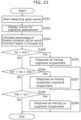
- PC 30 determines whether % fixation duration Va calculated is greater than threshold th5 (S204). When determining that % fixation duration Va is greater than threshold th5, the subject is diagnosed as having cognitive impairment (S205).
- PC 30 further determines whether % fixation duration Va calculated is lower than threshold th5 and greater than threshold th6 (S206). When determining that % fixation duration Va is lower than threshold th5 and greater than threshold th6, the subject is diagnosed as having suspected cognitive impairment (S207).
- PC 30 further determines whether % fixation duration Va calculated is lower than threshold th6 (S208). When determining that % fixation duration Va is lower than threshold th6, the subject is diagnosed as having no cognitive impairment (S209).
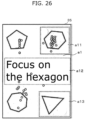
- the movie for cognitive assessment in FIG. 24 shows four images (pentagon, hexagon, heptagon, and triangle) as the alternatives as well as the instruction sentence that reads "Focus on the hexagon".
- the hexagon is "correct image”
- the triangle is "irrelevant incorrect image” in this case.
- the pentagon and the heptagon are similar to the hexagon serving as the correct answer, and thus cause confusion in selecting the correct answer, but the triangle cannot be confusing for a cognitively unimpaired person.
- cognitive impairment diagnostic device 1 that performs the third diagnostic process includes: obtainer 41 that obtains a distribution map representing a distribution of gaze points of a subject on a movie for cognitive assessment; and diagnoser 39 that makes diagnosis of cognitive impairment, based on the distribution map.
- the movie for cognitive assessment includes a first region including a correct image and a plurality of second regions including incorrect images.
- Diagnoser 39 calculates, in the distribution map on the movie for cognitive assessment, a percentage of fixation duration for which a region other than the first region is focused on, and makes diagnosis of suspected cognitive impairment when the percentage of fixation duration is higher than the threshold.
- the movie for cognitive assessment may include: an instruction sentence region including an instruction sentence inducing a direct focus on a first graphic; the first region including the correct image representing the first graphic; a second region including an incorrect image representing a graphic similar to the first graphic, the second region being included in the plurality of second regions; and an other second region including an incorrect image representing a graphic not similar to the first graphic, the other second region being included in the plurality of second regions.
- diagnoser 39 calculates a percentage of fixation duration for which the instruction sentence region or the other second region is focused on.
- the cognitive impairment diagnostic program that performs the third diagnostic process is a cognitive impairment diagnostic program executed by a computer that obtains a distribution map representing a distribution of gaze points of a subject on a movie for cognitive assessment and makes diagnosis of cognitive impairment on the basis of the distribution map.
- the movie for cognitive assessment includes a first region including a correct image and a plurality of second regions including incorrect images.
- Such cognitive impairment diagnostic program causes the computer to execute: calculating, in the distribution map on the movie for cognitive assessment, the percentage of fixation duration for which a region other than the first region is focused on; and making diagnosis of suspected cognitive impairment when the percentage of fixation duration is higher than a threshold.
- the cognitive impairment diagnostic program that performs the third diagnostic process is a cognitive impairment diagnostic program executed by a computer that includes: display 10 including a display surface; imager 21 that captures an image of the eyes of a subject; detector 37 that detects, on the time series, gaze points of the subject on the display surface, on the basis of the image captured by imager 21; a generator that generates a distribution map representing a distribution of the gaze points detected by detector 37; and diagnoser 39 that makes diagnosis of cognitive impairment, on the basis of the distribution map.
- Such cognitive impairment diagnostic program causes the computer to execute: causing display 10 to display a movie for cognitive assessment that includes a first region including a correct image, and a plurality of second regions including incorrect images; calculating, in the distribution map on the movie for cognitive assessment, the percentage of fixation duration for which a region other than the first region is focused on; and making diagnosis of suspected cognitive impairment when the percentage of fixation duration is higher than a threshold.
- the present invention is applicable for use as a cognitive impairment diagnostic device and a cognitive impairment diagnostic program for diagnosis of cognitive impairment.
Landscapes
- Health & Medical Sciences (AREA)
- Life Sciences & Earth Sciences (AREA)
- Engineering & Computer Science (AREA)
- Medical Informatics (AREA)
- Public Health (AREA)
- General Health & Medical Sciences (AREA)
- Biomedical Technology (AREA)
- Pathology (AREA)
- Surgery (AREA)
- Molecular Biology (AREA)
- Veterinary Medicine (AREA)
- Animal Behavior & Ethology (AREA)
- Heart & Thoracic Surgery (AREA)
- Physics & Mathematics (AREA)
- Biophysics (AREA)
- Neurology (AREA)
- Psychiatry (AREA)
- Epidemiology (AREA)
- Primary Health Care (AREA)
- Physiology (AREA)
- Child & Adolescent Psychology (AREA)
- Developmental Disabilities (AREA)
- Hospice & Palliative Care (AREA)
- Psychology (AREA)
- Data Mining & Analysis (AREA)
- Databases & Information Systems (AREA)
- Neurosurgery (AREA)
- Signal Processing (AREA)
- Human Computer Interaction (AREA)
- Ophthalmology & Optometry (AREA)
- Artificial Intelligence (AREA)
- Computer Vision & Pattern Recognition (AREA)
- Educational Technology (AREA)
- Social Psychology (AREA)
- Radiology & Medical Imaging (AREA)
- Nuclear Medicine, Radiotherapy & Molecular Imaging (AREA)
- Testing, Inspecting, Measuring Of Stereoscopic Televisions And Televisions (AREA)
- Medical Treatment And Welfare Office Work (AREA)
- Eye Examination Apparatus (AREA)
- Measuring And Recording Apparatus For Diagnosis (AREA)
Applications Claiming Priority (3)
| Application Number | Priority Date | Filing Date | Title |
|---|---|---|---|
| JP2020059001 | 2020-03-27 | ||
| EP21774074.5A EP4129200A4 (en) | 2020-03-27 | 2021-02-12 | DEVICE FOR DIAGNOSIS OF COGNITIVE IMPAIRMENT AND PROGRAM FOR DIAGNOSIS OF COGNITIVE IMPAIRMENT |
| PCT/JP2021/005216 WO2021192704A1 (ja) | 2020-03-27 | 2021-02-12 | 認知機能障害診断装置および認知機能障害診断プログラム |
Related Parent Applications (1)
| Application Number | Title | Priority Date | Filing Date |
|---|---|---|---|
| EP21774074.5A Division EP4129200A4 (en) | 2020-03-27 | 2021-02-12 | DEVICE FOR DIAGNOSIS OF COGNITIVE IMPAIRMENT AND PROGRAM FOR DIAGNOSIS OF COGNITIVE IMPAIRMENT |
Publications (1)
| Publication Number | Publication Date |
|---|---|
| EP4527294A1 true EP4527294A1 (en) | 2025-03-26 |
Family
ID=77890120
Family Applications (2)
| Application Number | Title | Priority Date | Filing Date |
|---|---|---|---|
| EP25150857.8A Pending EP4527294A1 (en) | 2020-03-27 | 2021-02-12 | Cognitive impairment diagnostic device and cognitive impairment diagnostic program |
| EP21774074.5A Pending EP4129200A4 (en) | 2020-03-27 | 2021-02-12 | DEVICE FOR DIAGNOSIS OF COGNITIVE IMPAIRMENT AND PROGRAM FOR DIAGNOSIS OF COGNITIVE IMPAIRMENT |
Family Applications After (1)
| Application Number | Title | Priority Date | Filing Date |
|---|---|---|---|
| EP21774074.5A Pending EP4129200A4 (en) | 2020-03-27 | 2021-02-12 | DEVICE FOR DIAGNOSIS OF COGNITIVE IMPAIRMENT AND PROGRAM FOR DIAGNOSIS OF COGNITIVE IMPAIRMENT |
Country Status (11)
| Country | Link |
|---|---|
| US (1) | US20230141614A1 (https=) |
| EP (2) | EP4527294A1 (https=) |
| JP (1) | JP7602811B2 (https=) |
| KR (1) | KR20220158707A (https=) |
| CN (1) | CN115315217B (https=) |
| AU (1) | AU2021243430A1 (https=) |
| BR (1) | BR112022019268A2 (https=) |
| CA (1) | CA3176116A1 (https=) |
| PH (1) | PH12022552503A1 (https=) |
| TW (1) | TWI801813B (https=) |
| WO (1) | WO2021192704A1 (https=) |
Families Citing this family (2)
| Publication number | Priority date | Publication date | Assignee | Title |
|---|---|---|---|---|
| TWI822562B (zh) * | 2023-01-17 | 2023-11-11 | 國立臺灣大學 | 自閉症光譜量表的問題篩選方法及篩檢患有自閉症的兒童的方法和系統 |
| KR102921639B1 (ko) * | 2023-09-08 | 2026-02-03 | 주식회사 스프링소프트 | 인지능력 테스트 방법 및 시스템 |
Citations (14)
| Publication number | Priority date | Publication date | Assignee | Title |
|---|---|---|---|---|
| JPH0670885A (ja) | 1992-07-09 | 1994-03-15 | A T R Shichokaku Kiko Kenkyusho:Kk | 視線検出を用いた医療診断装置 |
| JPH0670884A (ja) | 1992-07-09 | 1994-03-15 | A T R Shichokaku Kiko Kenkyusho:Kk | 視線検出を用いた医療診断装置 |
| KR100511385B1 (ko) * | 2003-11-05 | 2005-08-30 | 학교법인고려중앙학원 | 명칭성 실어증 검사장치 |
| JP4116354B2 (ja) | 2001-08-27 | 2008-07-09 | 武敏 鈴木 | 視覚検査用チャート |
| US20100092929A1 (en) * | 2008-10-14 | 2010-04-15 | Ohio University | Cognitive and Linguistic Assessment Using Eye Tracking |
| JP4560801B2 (ja) | 2007-01-19 | 2010-10-13 | 武敏 鈴木 | 視覚検査用チャート |
| JP5761048B2 (ja) | 2012-01-24 | 2015-08-12 | 株式会社Jvcケンウッド | 自閉症診断支援装置、および自閉症診断支援方法 |
| JP5761049B2 (ja) | 2012-01-24 | 2015-08-12 | 株式会社Jvcケンウッド | 自閉症診断支援装置、および自閉症診断支援方法 |
| JP5817582B2 (ja) | 2012-02-22 | 2015-11-18 | 株式会社Jvcケンウッド | 脳機能疾患診断支援装置および脳機能疾患診断支援方法 |
| JP5912351B2 (ja) | 2011-09-05 | 2016-04-27 | 国立大学法人浜松医科大学 | 自閉症診断支援システム及び自閉症診断支援装置 |
| JP5926210B2 (ja) | 2012-03-21 | 2016-05-25 | 国立大学法人浜松医科大学 | 自閉症診断支援システム及び自閉症診断支援装置 |
| JP2017158866A (ja) | 2016-03-10 | 2017-09-14 | 株式会社Jvcケンウッド | 診断支援装置、診断支援方法、トレーニング支援装置、及びトレーニング支援方法 |
| JP2017176302A (ja) | 2016-03-29 | 2017-10-05 | ヤンマー株式会社 | 眼球運動計測装置、眼球運動計測方法および眼球運動計測プログラム |
| WO2019098173A1 (ja) * | 2017-11-14 | 2019-05-23 | 国立大学法人大阪大学 | 認知機能障害診断装置および認知機能障害診断プログラム |
Family Cites Families (19)
| Publication number | Priority date | Publication date | Assignee | Title |
|---|---|---|---|---|
| US3994828A (en) | 1973-06-07 | 1976-11-30 | Dynapol Corporation | Nonabsorbable antioxidant |
| US3852244A (en) | 1973-11-23 | 1974-12-03 | Gen Electric | Polyetherquinoxalines |
| JPS5155346A (ja) | 1974-11-11 | 1976-05-15 | Nippon Zeon Co | Sukoochiboshiseihorikuroropurengomusoseibutsu |
| JPS5912351B2 (ja) | 1976-06-21 | 1984-03-22 | 野田合板株式会社 | 外装用化粧合板 |
| JPS5926210B2 (ja) | 1977-04-12 | 1984-06-25 | 株式会社日立ホームテック | 高周波加熱装置 |
| JP2005192637A (ja) * | 2003-12-26 | 2005-07-21 | Advanced Inst Of Wearable Environmental Information Networks | 脳機能計測方法及び脳機能計測システム |
| US20050228785A1 (en) * | 2004-04-02 | 2005-10-13 | Eastman Kodak Company | Method of diagnosing and managing memory impairment using images |
| WO2013023056A1 (en) * | 2011-08-09 | 2013-02-14 | Ohio University | Pupillometric assessment of language comprehension |
| CA2754835C (en) * | 2011-10-07 | 2021-06-15 | Baycrest Centre For Geriatric Care | Methods and systems for assessing cognitive function |
| WO2013120075A1 (en) * | 2012-02-09 | 2013-08-15 | Anthrotronix, Inc. | Performance assessment tool |
| US20130345593A1 (en) * | 2012-06-21 | 2013-12-26 | Adam Burns | System and Method for Assessing an Individual's Impairment |
| EP3003125B1 (en) | 2013-05-31 | 2021-08-11 | Dignity Health | System for detecting neurological disease |
| JP6245093B2 (ja) * | 2013-07-31 | 2017-12-13 | 株式会社Jvcケンウッド | 診断支援装置および診断支援方法 |
| AU2014334870B2 (en) * | 2013-10-17 | 2019-06-13 | Children's Healthcare Of Atlanta, Inc. | Methods for assessing infant and child development via eye tracking |
| CN106256312B (zh) * | 2015-06-16 | 2021-07-23 | 日立数字映像(中国)有限公司 | 认知功能障碍评价装置 |
| MY197393A (en) * | 2016-10-07 | 2023-06-15 | Panasonic Ip Man Co Ltd | Cognitive function evaluation device, cognitive function evaluation system, cognitive function evaluation method, and program |
| JP7167737B2 (ja) | 2018-03-26 | 2022-11-09 | 株式会社Jvcケンウッド | 評価装置、評価方法、及び評価プログラム |
| JP7067502B2 (ja) * | 2018-08-08 | 2022-05-16 | 株式会社Jvcケンウッド | 評価装置、評価方法、及び評価プログラム |
| JP7268307B2 (ja) * | 2018-08-31 | 2023-05-08 | 株式会社Jvcケンウッド | 評価装置、評価装置の作動方法、及び評価プログラム |
-
2021
- 2021-02-12 CN CN202180023356.5A patent/CN115315217B/zh active Active
- 2021-02-12 PH PH1/2022/552503A patent/PH12022552503A1/en unknown
- 2021-02-12 EP EP25150857.8A patent/EP4527294A1/en active Pending
- 2021-02-12 US US17/913,066 patent/US20230141614A1/en active Pending
- 2021-02-12 EP EP21774074.5A patent/EP4129200A4/en active Pending
- 2021-02-12 BR BR112022019268A patent/BR112022019268A2/pt unknown
- 2021-02-12 AU AU2021243430A patent/AU2021243430A1/en active Pending
- 2021-02-12 KR KR1020227032171A patent/KR20220158707A/ko active Pending
- 2021-02-12 WO PCT/JP2021/005216 patent/WO2021192704A1/ja not_active Ceased
- 2021-02-12 JP JP2022509387A patent/JP7602811B2/ja active Active
- 2021-02-12 CA CA3176116A patent/CA3176116A1/en active Pending
- 2021-02-23 TW TW110106340A patent/TWI801813B/zh active
Patent Citations (14)
| Publication number | Priority date | Publication date | Assignee | Title |
|---|---|---|---|---|
| JPH0670885A (ja) | 1992-07-09 | 1994-03-15 | A T R Shichokaku Kiko Kenkyusho:Kk | 視線検出を用いた医療診断装置 |
| JPH0670884A (ja) | 1992-07-09 | 1994-03-15 | A T R Shichokaku Kiko Kenkyusho:Kk | 視線検出を用いた医療診断装置 |
| JP4116354B2 (ja) | 2001-08-27 | 2008-07-09 | 武敏 鈴木 | 視覚検査用チャート |
| KR100511385B1 (ko) * | 2003-11-05 | 2005-08-30 | 학교법인고려중앙학원 | 명칭성 실어증 검사장치 |
| JP4560801B2 (ja) | 2007-01-19 | 2010-10-13 | 武敏 鈴木 | 視覚検査用チャート |
| US20100092929A1 (en) * | 2008-10-14 | 2010-04-15 | Ohio University | Cognitive and Linguistic Assessment Using Eye Tracking |
| JP5912351B2 (ja) | 2011-09-05 | 2016-04-27 | 国立大学法人浜松医科大学 | 自閉症診断支援システム及び自閉症診断支援装置 |
| JP5761049B2 (ja) | 2012-01-24 | 2015-08-12 | 株式会社Jvcケンウッド | 自閉症診断支援装置、および自閉症診断支援方法 |
| JP5761048B2 (ja) | 2012-01-24 | 2015-08-12 | 株式会社Jvcケンウッド | 自閉症診断支援装置、および自閉症診断支援方法 |
| JP5817582B2 (ja) | 2012-02-22 | 2015-11-18 | 株式会社Jvcケンウッド | 脳機能疾患診断支援装置および脳機能疾患診断支援方法 |
| JP5926210B2 (ja) | 2012-03-21 | 2016-05-25 | 国立大学法人浜松医科大学 | 自閉症診断支援システム及び自閉症診断支援装置 |
| JP2017158866A (ja) | 2016-03-10 | 2017-09-14 | 株式会社Jvcケンウッド | 診断支援装置、診断支援方法、トレーニング支援装置、及びトレーニング支援方法 |
| JP2017176302A (ja) | 2016-03-29 | 2017-10-05 | ヤンマー株式会社 | 眼球運動計測装置、眼球運動計測方法および眼球運動計測プログラム |
| WO2019098173A1 (ja) * | 2017-11-14 | 2019-05-23 | 国立大学法人大阪大学 | 認知機能障害診断装置および認知機能障害診断プログラム |
Non-Patent Citations (1)
| Title |
|---|
| OYAMA AKANE ET AL: "Novel Method for Rapid Assessment of Cognitive Impairment Using High-Performance Eye-Tracking Technology", vol. 9, no. 1, 10 September 2019 (2019-09-10), pages 12932, XP055821562, Retrieved from the Internet <URL:http://www.nature.com/articles/s41598-019-49275-x> DOI: 10.1038/s41598-019-49275-x * |
Also Published As
| Publication number | Publication date |
|---|---|
| PH12022552503A1 (en) | 2024-03-25 |
| CA3176116A1 (en) | 2021-09-30 |
| AU2021243430A1 (en) | 2022-10-06 |
| KR20220158707A (ko) | 2022-12-01 |
| BR112022019268A2 (pt) | 2022-11-16 |
| JPWO2021192704A1 (https=) | 2021-09-30 |
| EP4129200A4 (en) | 2024-07-31 |
| CN115315217A (zh) | 2022-11-08 |
| EP4129200A1 (en) | 2023-02-08 |
| TWI801813B (zh) | 2023-05-11 |
| US20230141614A1 (en) | 2023-05-11 |
| JP7602811B2 (ja) | 2024-12-19 |
| TW202213380A (zh) | 2022-04-01 |
| CN115315217B (zh) | 2026-01-02 |
| WO2021192704A1 (ja) | 2021-09-30 |
Similar Documents
| Publication | Publication Date | Title |
|---|---|---|
| EP3711680B1 (en) | Cognitive dysfunction diagnostic apparatus and cognitive dysfunction diagnostic program | |
| US10359842B2 (en) | Information processing system and information processing method | |
| CN112535479B (zh) | 一种情绪加工倾向的确定方法及相关产品 | |
| Shen et al. | Mental fatigue of long-term office tasks in virtual environment | |
| Salvaggio et al. | Eye position reflects the spatial coding of numbers during magnitude comparison. | |
| White et al. | Attention set for number: Expectation and perceptual load in inattentional blindness. | |
| EP4527294A1 (en) | Cognitive impairment diagnostic device and cognitive impairment diagnostic program | |
| Alfaro et al. | Joint engagement in infants and its relationship to their visual impairment measurements | |
| Almourad et al. | Analyzing the behavior of autistic and normal developing children using eye tracking data | |
| Burra et al. | Gaze-cueing requires intact face processing–Insights from acquired prosopagnosia | |
| US8042946B1 (en) | Contrast sensitivity test | |
| El Haddioui et al. | Learner behavior analysis through eye tracking | |
| Chi et al. | Measurement of information processing load and visual load on a dynamic information processing task | |
| Rondón et al. | Measuring cognitive load using eye tracking technology in learning Content | |
| HK40082503A (en) | Cognitive impairment diagnostic device and cognitive impairment diagnostic program | |
| Takahashi et al. | Novel scotoma detection method using time required for fixation to the random targets | |
| HK40038090B (en) | Cognitive dysfunction diagnostic apparatus and cognitive dysfunction diagnostic program | |
| EP4559407A1 (en) | Stroop test method, stroop test program, stroop test system, stroop test image generation method, stroop test image generation program, and test method | |
| HK40038090A (en) | Cognitive dysfunction diagnostic apparatus and cognitive dysfunction diagnostic program | |
| Ho et al. | Measuring Glance Legibility of Wearable Heads-Up Display Interfaces Using an Adaptive Staircase Procedure: A Study with Google Glass | |
| HK40119472A (zh) | 斯特鲁普测试方法、程序、系统、及其图像生成方法、程序、测试方法 | |
| EP4626314A2 (en) | System for and method of eye tracking | |
| Ishibashi et al. | Short-term social attention triggered by gaze cueing: Evidence from change detection | |
| 伊藤悠大 | A method for correcting gaze coordinate errors measured and setting a fixation threshold to detect difficult-to-read words during silent reading of Japanese text |
Legal Events
| Date | Code | Title | Description |
|---|---|---|---|
| PUAI | Public reference made under article 153(3) epc to a published international application that has entered the european phase |
Free format text: ORIGINAL CODE: 0009012 |
|
| STAA | Information on the status of an ep patent application or granted ep patent |
Free format text: STATUS: REQUEST FOR EXAMINATION WAS MADE |
|
| 17P | Request for examination filed |
Effective date: 20250109 |
|
| AC | Divisional application: reference to earlier application |
Ref document number: 4129200 Country of ref document: EP Kind code of ref document: P |
|
| AK | Designated contracting states |
Kind code of ref document: A1 Designated state(s): AL AT BE BG CH CY CZ DE DK EE ES FI FR GB GR HR HU IE IS IT LI LT LU LV MC MK MT NL NO PL PT RO RS SE SI SK SM TR |
|
| STAA | Information on the status of an ep patent application or granted ep patent |
Free format text: STATUS: EXAMINATION IS IN PROGRESS |
|
| 17Q | First examination report despatched |
Effective date: 20251020 |