EP3003125B1 - System for detecting neurological disease - Google Patents
System for detecting neurological disease Download PDFInfo
- Publication number
- EP3003125B1 EP3003125B1 EP14803496.0A EP14803496A EP3003125B1 EP 3003125 B1 EP3003125 B1 EP 3003125B1 EP 14803496 A EP14803496 A EP 14803496A EP 3003125 B1 EP3003125 B1 EP 3003125B1
- Authority
- EP
- European Patent Office
- Prior art keywords
- microsaccade
- dynamics
- subject
- eye
- disease
- Prior art date
- Legal status (The legal status is an assumption and is not a legal conclusion. Google has not performed a legal analysis and makes no representation as to the accuracy of the status listed.)
- Active
Links
Images

Classifications
-
- A—HUMAN NECESSITIES
- A61—MEDICAL OR VETERINARY SCIENCE; HYGIENE
- A61B—DIAGNOSIS; SURGERY; IDENTIFICATION
- A61B5/00—Measuring for diagnostic purposes; Identification of persons
- A61B5/16—Devices for psychotechnics; Testing reaction times ; Devices for evaluating the psychological state
- A61B5/163—Devices for psychotechnics; Testing reaction times ; Devices for evaluating the psychological state by tracking eye movement, gaze, or pupil change
-
- A—HUMAN NECESSITIES
- A61—MEDICAL OR VETERINARY SCIENCE; HYGIENE
- A61B—DIAGNOSIS; SURGERY; IDENTIFICATION
- A61B3/00—Apparatus for testing the eyes; Instruments for examining the eyes
- A61B3/0016—Operational features thereof
- A61B3/0025—Operational features thereof characterised by electronic signal processing, e.g. eye models
-
- A—HUMAN NECESSITIES
- A61—MEDICAL OR VETERINARY SCIENCE; HYGIENE
- A61B—DIAGNOSIS; SURGERY; IDENTIFICATION
- A61B3/00—Apparatus for testing the eyes; Instruments for examining the eyes
- A61B3/0091—Fixation targets for viewing direction
-
- A—HUMAN NECESSITIES
- A61—MEDICAL OR VETERINARY SCIENCE; HYGIENE
- A61B—DIAGNOSIS; SURGERY; IDENTIFICATION
- A61B3/00—Apparatus for testing the eyes; Instruments for examining the eyes
- A61B3/10—Objective types, i.e. instruments for examining the eyes independent of the patients' perceptions or reactions
- A61B3/113—Objective types, i.e. instruments for examining the eyes independent of the patients' perceptions or reactions for determining or recording eye movement
-
- A—HUMAN NECESSITIES
- A61—MEDICAL OR VETERINARY SCIENCE; HYGIENE
- A61B—DIAGNOSIS; SURGERY; IDENTIFICATION
- A61B5/00—Measuring for diagnostic purposes; Identification of persons
- A61B5/40—Detecting, measuring or recording for evaluating the nervous system
- A61B5/4076—Diagnosing or monitoring particular conditions of the nervous system
- A61B5/4088—Diagnosing of monitoring cognitive diseases, e.g. Alzheimer, prion diseases or dementia
-
- A—HUMAN NECESSITIES
- A61—MEDICAL OR VETERINARY SCIENCE; HYGIENE
- A61B—DIAGNOSIS; SURGERY; IDENTIFICATION
- A61B5/00—Measuring for diagnostic purposes; Identification of persons
- A61B5/48—Other medical applications
- A61B5/4842—Monitoring progression or stage of a disease
-
- A—HUMAN NECESSITIES
- A61—MEDICAL OR VETERINARY SCIENCE; HYGIENE
- A61B—DIAGNOSIS; SURGERY; IDENTIFICATION
- A61B5/00—Measuring for diagnostic purposes; Identification of persons
- A61B5/48—Other medical applications
- A61B5/4848—Monitoring or testing the effects of treatment, e.g. of medication
Definitions
- the present application is directed to monitoring eye movements to detect neurological disease.
- the present application is directed to analyzing microsaccades for detecting neurological disorder or neurodegenerative diseases, such as Alzheimer's Disease and mild cognitive impairment.
- AD Alzheimer's Disease
- MCI mild cognitive impairment
- a method includes tracking eye movements of the subject, identifying microsaccades from the tracked eye movements, and characterizing microsaccade dynamics of the identified microsaccades to determine one or more parameters. These parameters include microsaccade direction, microsaccade velocity, microsaccade magnitude, microsaccadic peak velocity-magnitude relationship, microsaccade duration, and intersaccadic intervals.
- the method also includes comparing the one or more determined parameters with a corresponding healthy parameter of a healthy subject, assessing the comparison to determine statistical differences between the one or more determined parameters and the corresponding healthy parameters indicative of the presence of AD, and generating a report including the diagnosis of AD based on the assessment.
- the present disclosure also provides a method of diagnosing Alzheimer's Disease (AD) in a subject.
- the method includes tracking eye movements of the subject and identifying microsaccades from the tracked eye movements.
- the method further includes characterizing one or more dynamics of each of the microsaccades, wherein the dynamics include a direction of the microsaccade.
- the method further includes comparing the one or more characterized dynamics to corresponding healthy microsaccade dynamics of a healthy subject and, from this comparison, assessing differences between the one or more determined dynamics and the corresponding healthy microsaccade dynamics to determine a presence of AD.
- the method further includes generating a report including one or more diagnoses related to AD of the patient, the diagnoses being based on the differences between the one or more determined dynamics and the corresponding healthy microsaccade dynamics.
- One of the differences indicating the presence of AD may be an average microsaccade direction that is significantly less horizontal than a corresponding average healthy microsaccade direction.
- the differences indicating the presence of AD may include one or more of a microsaccade velocity, microsaccade magnitude, microsaccadic peak velocity-magnitude relationship, microsaccade duration, and intersaccatic intervals that is not significantly different than the corresponding healthy microsaccade dynamics.
- the diagnoses may include one or both of progression of AD and response to treatment for AD, the progression of AD and the response to treatment being based on the differences as compared to previous statistical differences obtained using the method.
- Another disclosure provides a method of detecting a neurological disease in a subject.
- the method includes obtaining eye movement traces from tracked eye movements of the subject, and identifying a plurality of microsaccades in the eye movement traces.
- the method further includes characterizing one more dynamics of the microsaccades, the dynamics including a distribution of microsaccade directions.
- the method further includes assessing one or more differences between the dynamics of the microsaccades as compared to corresponding control microsaccade dynamics, and generating a report comprising one or more diagnoses related to the neurological disease based on the differences.
- Identifying the plurality of microsaccades may include identifying one or more square-wave jerks.
- the dynamics may include an index of each square-wave jerk.
- the distribution of microsaccade directions includes a direction for each identified microsaccade, the direction being measured as an angular deviation from horizontal.
- One of the differences may be an average deviation of the distribution of microsaccade directions
- the control microsaccade dynamics may be obtained from a healthy subject, and may include a control distribution of microsaccade directions.
- One of the differences may be a deviation of the distribution of microsaccade directions from the control distribution.
- One or more of the differences may include a numerical difference representing a magnitude by which one or more of the dynamics differs from the corresponding control microsaccade dynamic.
- the diagnoses may include one or both of progression of Alzheimer's disease and response to treatment for Alzheimer's disease, the progression of Alzheimer's disease and the response to treatment being based on the differences as compared to previous differences for the subject.
- the method may further include presenting a visual stimulus to provoke measurable microsaccades in the subject's eyes, wherein obtaining the eye movement traces is accomplished by tracking the eye movements of the subject during the visual stimulus.
- the present disclosure provides a system that includes a host operably connected to an eye tracking device capable of recording eye movement traces from eye movements of a subject
- the host may have at least one processor configured to receive the eye movement traces from the eye tracking device, identify a plurality of microsaccades from the eye movement traces, and measure one or more dynamics of each microsaccade, the dynamics including a direction measured as an angular deviation from horizontal.
- the processor may be further configured to compare each of the one or more dynamics to a corresponding healthy microsaccade dynamic of a healthy subject, and to assess one or more statistical differences between the one or more determined dynamics and the corresponding healthy microsaccade dynamics, the statistical differences being indicative of the presence of a neurological disease.
- the processor may be configured to generate a report including one or more diagnoses relating to the neurological disease based on the assessment.
- the processor may be further configured to assess the one or more statistical differences by determining whether the statistical difference is within a normal limit, and the diagnoses may include an indication that the neurological disease may be present if the statistical difference is outside of the normal limit.
- the processor may be further configured to assess the statistical differences by comparing the statistical differences to corresponding previous statistical differences to characterize one or both of progression of the neurological disease and response to treatment for the neurological disease.
- the one or more diagnoses may include one or both of the progression and the response.
- the neurological disease may be Alzheimer's disease.
- a system in accordance with the present invention includes an eye tracking device and a host operably connected to the eye tracking device.
- the eye tracking device is capable of detecting eye movement traces and the host is configured to receive the eye movement traces from the eye tracking device.
- the host is further configured to identify microsaccades from the detected eye movement traces, and characterize microsaccade dynamics of the identified microsaccades to determine one or more parameters including microsaccade direction, microsaccade velocity, microsaccade magnitude, microsaccadic peak velocity-magnitude relationship, microsaccade duration, and intersaccadic intervals.
- the host is also configured to compare the one or more determined parameters with a corresponding healthy parameter of a healthy subject, assess the comparison to determine statistical differences between the one or more determined parameters and the corresponding healthy parameters indicative of the presence of AD, and generate a report including the diagnosis of AD based on the assessment.
- a method and apparatus for characterizing square wave jerks in the eye movements of a person for the differential diagnosis of neurological diseases such as progressive supranuclear palsy (PSP) are provided by US 2010/0277693 A1 .
- US 2010/020 8205 A1 provides an eye-tracking method and system for assessing and/or diagnosing a neurobehavioral disorder in a subject.
- the invention is defined in appended claim 1. Preferred embodiments are defined in the dependent claims.
- the eyes do not stay perfectly still during visual fixation. Rather, when a human fixates their gaze, the eyes are only actually fixated 80% of the time while saccades (quick, simultaneous movements of both eyes in the same direction) and microsaccades (rapid involuntary saccades that occur several times each second during fixation, usually less than 1 degree in magnitude) occur the other 20% of the time.
- Fixational eye movements as a whole that is, both saccades and microsaccades
- these rapid, small-magnitude involuntary eye movements counteract visual fading and generate strong neural transients in the early visual system.
- Microsaccades may also drive perceptual flips in binocular rivalry. Microsaccade rates and directions are moreover modulated by attention, and thus generate rich spatio-temporal dynamics. In certain neurological disorders, attempted fixation results in abnormal fixational eye movements with distinctive characteristics. Thus, determining how normal fixation differs from pathological fixation has the potential to aid early and differential non-invasive diagnosis of neurological disease as well as the quantification of its progression and response to treatment.
- SWJs The most common type of saccadic intrusion is referred to as a square wave jerk (SWJ).
- SWJs are characterized by one small horizontal saccadic movement that moves the eye away from the fixation target, followed by a corrective saccade towards the target shortly thereafter.
- SWJs are prevalent in some neurological diseases such as progressive supranuclear palsy (PSP).
- PSP progressive supranuclear palsy
- SWJs are also common in normal subjects.
- PSP progressive supranuclear palsy
- SWJ parameters such as SWJ rates, magnitudes, percentage of small saccades that are part of SWJs, average inter-saccadic intervals for the SWJs, saccadic rates, saccadic peak velocities within SWJs, standard deviation of the direction difference between pairs of saccades in the SWJs, standard deviation of the difference between the horizontal and the direction of the saccades in the SWJs
- SWJ rates such as SWJ rates, magnitudes, percentage of small saccades that are part of SWJs, average inter-saccadic intervals for the SWJs, saccadic rates, saccadic peak velocities within SWJs, standard deviation of the direction difference between pairs of saccades in the SWJs, standard deviation of the difference between the horizontal and the direction of the saccades in the SWJs
- the objective characterization of SWJs may provide a powerful tool in the differential diagnosis of various oculomotor diseases.
- the present disclosure provides a method and system for monitoring eye movements and, in particular, microsaccades of a subject to detect AD and/or MCI.
- the method includes determining abnormal fixational eye movements, such as microsaccades, as an indication of neurological disease (for example, AD or MCI) and/or quantifying the abnormality to determine disease progression and/or response to treatment.
- the system and method include measuring microsaccades of a subject and analyzing microsaccade parameters and dynamics, such as microsaccade direction, microsaccade velocity, microsaccade magnitude, microsaccadic peak velocity-magnitude relationship, microsaccade duration, and/or intersaccatic intervals, for the differential diagnosis of AD and/or MCI as well as disease progression and/or response to treatment.
- microsaccade parameters and dynamics such as microsaccade direction, microsaccade velocity, microsaccade magnitude, microsaccadic peak velocity-magnitude relationship, microsaccade duration, and/or intersaccatic intervals
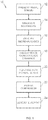
- Fig. 1 illustrates a method 10 for non-invasively monitoring eye movements for the differential diagnosis of AD and/or MCI.
- the method 10 may be carried out using a system 26, as shown in Fig. 4 and described below.
- the method 10 can include presenting visual stimuli to a patient (process block 12).
- visual stimuli can be presented on a display screen about 40 centimeters away from a subject's eyes. Presentation of visual stimuli may begin with a five-point calibration sequence followed by the presentation of a small fixation cross (for example, 1 degree) at the center of the screen.
- the fixation cross can remain displayed for about 20 seconds, and the subject can be instructed to look at the fixation cross as accurately as possible.
- microsaccades can be identified from the tracked eye movements (process block 16), for example through an objective detection algorithm (e.g., Engbert and Kliegl, 2003; Martinez-Conde, Macknik, Hubel, 2000). Based on the identified microsaccades, microsaccade dynamics can be characterized and/or measured (process block 18). Such microsaccade dynamics can include, but are not limited to, microsaccade direction, microsaccade velocity, microsaccade magnitude, microsaccadic peak velocity-magnitude relationship, microsaccade duration, and/or intersaccadic intervals.
- process blocks 16 and 18 can also or alternatively include identifying and characterizing (respectively) SWJs.
- a SWJ may be defined as the combination of one small saccade that moves the eye away from the fixation target, followed after a short period by a second corrective saccade directed back towards the target More specifically, a SWJ is known in the art to be a pair of saccades with three defining characteristics: (1) the two saccades have opposite or nearly opposite directions; (2) both saccades have equal or nearly equal magnitudes; and (3) the two saccades are separated by a short interval.
- An example process for identifying and characterizing SWJs is described in United States Patent No. 8,345,428 .
- This process measures how similar a given saccade pair (that is, a pair of consecutive saccades) is to an "ideal SWJ", based on the three defining characteristics of SWJs described above, and gives the saccade pair an score, or "index,” for its measurements relative to the ideal SWJ. If a saccade pair's SWJ index is larger than a given threshold, it may be characterized as a potential SWJ.
- one or more of the above-described microsaccade dynamics can be compared with dynamics of healthy subjects, considered "normal levels," (process block 20) and such comparisons are then assessed (process block 22).
- Assessment of the comparisons can include, but is not limited to, assessing a statistical difference (for example, within or not within normal limits, as determined by a significant or non-significant difference), quantifying the magnitude of a difference (that is, a numerical difference), etc.
- Comparison (process block 20) and assessment (process block 22) are further described in general and with respect to a particular example study below.
- a report may be generated (for example, recorded, stored, and/or displayed) providing a diagnosis and/or other information based on the assessment (process block 24).
- the report may designate the presence or absence of oculomotor disease (that is, AD or MCI), a quantification of abnormality signifying disease susceptibility, progression, severity, and/or response to treatment or therapy, etc.
- microsaccade direction is significantly different in subjects with AD or aMCI versus healthy subjects.
- the average microsaccade direction may be significantly deviated from horizontal, or from that of healthy subjects, by 20 degrees or more, although a smaller deviation may still be significant when considered with other factors.
- An example study was performed to demonstrate this relationship. The example study included three subject populations: patients with aMCI, patients with AD, and age-matched normal subjects.
- Microsaccades were identified (process block 16) automatically with an objective detection algorithm (see (Engbert and Kliegl, 2003), for details). In subjects in whom eye position was recorded binocularly, the amount of potential noise in the recorded movements was reduced (Engbert, 2006) by considering only binocular microsaccades (i.e., microsaccades with a minimum overlap of one data sample in both eyes). Some microsaccades are followed by a fast, small, oppositely directed, saccadic eye movement called dynamic overshoot, which is often more prominent for the eye that moves in the abducting direction. Dynamic overshoots that occurred less than 20ms after a preceding microsaccade were interpreted as part of the preceding microsaccade. That is, the previous microsaccade was modified to include the dynamic overshoot, which was not itself counted as a discrete microsaccade.
- Microsaccade identification was improved in the study by removing, prior to microsaccade identificaiton, any data epochs where partial pupil occlusion may have led to increased levels of noise.
- Such epochs were automatically identified by identifying high-velocity spikes in the eye movement data (specifically, over 1,000 deg/s, although epochs of as little as 25 deg/s could be removed).
- two epochs were separated by less than 25 samples, they could be merged into a single epoch, which included the interval separating the two original epochs.
- SWJs were identified by first identifying all individual saccades up to 5 degrees (Otero-Millan, Serra, et al., 2011).
- the 5-degree upper magnitude threshold was chosen to include the range of SWJ magnitudes reported previously in healthy subjects (0.1-4.1 deg; (Abadi and Gowen, 2004)), and to allow for potentially larger SWJs magnitudes in patients (Otero-Millan, Serra, et al., 2011).
- saccade pairs were indexed based on the three defining characteristics of SWJs described above: a) the direction dissimilarity of first and second saccade, b) the magnitude similarity of first and second saccade, and c) the temporal proximity of first and second saccade, in a single, continuous variable for each saccade pair. If a saccade pair's SWJ index was larger than a given threshold (Otero-Millan, Serra, et al., 2011) the pair was classified as a potential SWJ.
- a saccade pair's SWJ index was larger than a given threshold (Otero-Millan, Serra, et al., 2011) the pair was classified as a potential SWJ.
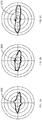
- Figs. 2A-C are polar histograms showing microsaccadic direction (shown in bold lines 200, 205, 210) in the AD population ( Fig. 2A ), the aMCI population ( Fig. 2B ), and the healthy population ( Fig. 2C ).
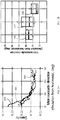
- Fig. 3A is a line graph of the distribution of microsaccades at increasing deviation from horizontal for the three populations, where the AD population is represented by line 300, the aMCI population by line 305, and the healthy population by line 310.
- Fig. 2A-C are polar histograms showing microsaccadic direction (shown in bold lines 200, 205, 210) in the AD population ( Fig. 2A ), the aMCI population ( Fig. 2B ), and the healthy population ( Fig. 2C ).
- Fig. 3A is a line graph of the distribution of microsaccades at increasing deviation from horizontal for the three populations, where the AD population is represented by line 300, the aMC
- 3B is a deviation graph also showing the average microsaccade direction as a deviation from horizontal, with the AD population represented by group 320, the aMCI population by group 325, and the healthy population by group 330.
- the results show that, despite predominantly horizontal microsaccade directions across all subject populations, oblique microsaccades (that is, less horizontal microsaccades) are more prevalent in AD and aMCl subjects than in age-matched healthy subjects. Furthermore, the differences in microsaccade directions between AD or aMCI subjects and healthy subjects extended to those microsaccades forming SWJs.
- microsaccade magnitudes and velocities, and the peak velocity-magnitude relationship are comparable in the three subject groups (that is, AD, aMCI, healthy).
- Microsaccadic durations, intersaccadic intervals and other microsaccade dynamics are also equivalent (and have comparable variability) in the three groups, as are the rate, magnitude, and percent of fixational saccades that are part of SWJs. This finding is consistent with the lack of brainstem oculomotor function impairment in MCI or AD patients with mild to moderate severity of disease (Garbutt et al., 2008; Yang et al., In Press; Yang et al., 2011; but see Simic et al., 2009).
- all the above dynamics may be collectively assessed to determine presence or absence of oculomotor disease (that is, AD or MCI), disease susceptibility, progression, severity, and/or response to treatment, etc. Accordingly, an assessment of significantly less horizontal microsaccade direction, but normal (that is, not significantly different) microsaccade magnitudes, velocities, peak velocity-magnitude relationship, microsaccadic durations, and intersaccadic intervals results in a diagnosis of AD or MCI.
- oculomotor disease that is, AD or MCI
- This assessment can further quantify the obliqueness of the microsaccades in comparison to healthy levels to determine a progression of AD or MCI, response to treatment (for example, if the subject's previously tracked microsaccade dynamics are available for comparison), etc.
- the generated report can therefore detail the diagnosis as well as the assessment of progression and/or response to treatment.
- the above method may include receiving additional input regarding the subject, including demographics such as age, gender, education, results of a mini mental state examination (MMSE) and/or activities of daily living (AOL) to assist in the above-described assessment.
- demographics such as age, gender, education
- AOL activities of daily living
- Table 1 illustrates a comparison of demographics and microsaccade dynamics of healthy subjects ("controls"), MCI subjects, and AD subjects according to a study carrying out the methods of the present disclosure. Any or all of the demographics, characteristics, and/or statistical comparisons detailed in the table below may be presented in the generated report.
- Fig. 4 illustrates a system 26, according to the present invention, for detecting and analyzing eye movements of a subject 28 to diagnose neurological disease.
- the system 26 may be used in accordance with the methods 10 described above.
- the system 26 can include a host 30 operably connected to an eye tracking device 32, a display 34, and a user interface 36.
- the host 30 can include one or more processors 38 operating under control of one or more computer programs 40 loaded from a non-transitory computer readable medium (memory) 42.
- reference to a step performed by a computer program 40 is also a reference to the processor 38 that performed that step, for example in accordance with process blocks of above-described methods 10 of the present disclosure.
- Example tracking devices 32 for use with the present invention can include the EyeLink II by SR Research or other equivalent eye tracking systems such as the IVIEW XTM HI-SPEED 1250 tracking system by SensoMotoric Instruments.
- the system 26 can operate by presenting visual stimuli to the subject 28 through the display 34.
- one of the processors 38 such as a display processor 38A, can retrieve one or more stored image or video files 44 from memory 42 and present the images/videos to the subject 28 via the display 34.
- the eye tracking device 32 can detect the position and movement of the subject's eyes 46, for example, in accordance with process block 14 described above. Identification of microsaccades, for example with respect to process block 16 described above, can be executed by one or more processors 38.
- An example process where eye movements are objectively and non-invasively monitored is described in United States Patent No. 7,857,452 .
- this process includes tracking a subject's eye position, for example, using a tracking processor 38B, and detecting microsaccades from eye position traces, for example, using a microsaccade processor 38C.
- Example algorithms that is, part of computer programs 40 for detecting microsaccades objectively from eye position traces (such as from video, eye coil, optical, or other suitable tracking methods) include the Martinez-Conde and Macknik algorithm ( Martinez-Conde S. Macknik S. L., Hubel D. H. (2000) Nature Neuroscience ) and the Engbert algorithm (Engbert R., Kliegl R. (2003) Vision Res 4:1035-1045 ).
- characterization and analysis of microsaccade dynamics can be executed by one or more processors 38, such as the microsaccade processor 38C, a statistics processor 38D, and/or a comparator 38E.
- additional processors 38 may be included to execute identification and analysis of SWJs.
- report generation for example with respect to process block 24 described above, can be executed by one or more processors 38, such as a reporting processor 38F, wherein the report may be stored in a file 44 in memory 42, displayed on the display 34 or a separate display, or output in another suitable manner to a user, for example as instructed by the user via the user interface 36.
Landscapes
- Health & Medical Sciences (AREA)
- Life Sciences & Earth Sciences (AREA)
- Engineering & Computer Science (AREA)
- Veterinary Medicine (AREA)
- Surgery (AREA)
- Biophysics (AREA)
- Biomedical Technology (AREA)
- Heart & Thoracic Surgery (AREA)
- Medical Informatics (AREA)
- Molecular Biology (AREA)
- Physics & Mathematics (AREA)
- Animal Behavior & Ethology (AREA)
- General Health & Medical Sciences (AREA)
- Public Health (AREA)
- Neurology (AREA)
- Pathology (AREA)
- Ophthalmology & Optometry (AREA)
- Developmental Disabilities (AREA)
- Hospice & Palliative Care (AREA)
- Psychiatry (AREA)
- Psychology (AREA)
- Child & Adolescent Psychology (AREA)
- Neurosurgery (AREA)
- Physiology (AREA)
- Human Computer Interaction (AREA)
- Signal Processing (AREA)
- Educational Technology (AREA)
- Social Psychology (AREA)
- Eye Examination Apparatus (AREA)
- Investigating Or Analysing Biological Materials (AREA)
Description
- The present application is directed to monitoring eye movements to detect neurological disease. In particular, the present application is directed to analyzing microsaccades for detecting neurological disorder or neurodegenerative diseases, such as Alzheimer's Disease and mild cognitive impairment.
- Alzheimer's Disease (AD) is the most common form of dementia, accounting for 50 to 70 percent of dementia cases. Memory loss and cognitive impairment are mild in the early stages of AD, but as the disease progresses patients lose fundamental cognitive capacities, including the ability to carry out a conversation and respond to their environment Thus, there is a strong need for simple non-invasive measures of disease progression and therapeutic response. Early diagnostic tools are especially needed, as people with mild cognitive impairment (MCI) are at higher risk for developing AD than normal elderly individuals.
- The present disclosure provides systems and methods of detecting eye movements of a subject for the diagnosis of a neurological disease, such as Alzheimer's Disease (AD). In a disclosure, a method includes tracking eye movements of the subject, identifying microsaccades from the tracked eye movements, and characterizing microsaccade dynamics of the identified microsaccades to determine one or more parameters. These parameters include microsaccade direction, microsaccade velocity, microsaccade magnitude, microsaccadic peak velocity-magnitude relationship, microsaccade duration, and intersaccadic intervals. The method also includes comparing the one or more determined parameters with a corresponding healthy parameter of a healthy subject, assessing the comparison to determine statistical differences between the one or more determined parameters and the corresponding healthy parameters indicative of the presence of AD, and generating a report including the diagnosis of AD based on the assessment.
- The present disclosure also provides a method of diagnosing Alzheimer's Disease (AD) in a subject. The method includes tracking eye movements of the subject and identifying microsaccades from the tracked eye movements. The method further includes characterizing one or more dynamics of each of the microsaccades, wherein the dynamics include a direction of the microsaccade. The method further includes comparing the one or more characterized dynamics to corresponding healthy microsaccade dynamics of a healthy subject and, from this comparison, assessing differences between the one or more determined dynamics and the corresponding healthy microsaccade dynamics to determine a presence of AD. The method further includes generating a report including one or more diagnoses related to AD of the patient, the diagnoses being based on the differences between the one or more determined dynamics and the corresponding healthy microsaccade dynamics. One of the differences indicating the presence of AD may be an average microsaccade direction that is significantly less horizontal than a corresponding average healthy microsaccade direction. The differences indicating the presence of AD may include one or more of a microsaccade velocity, microsaccade magnitude, microsaccadic peak velocity-magnitude relationship, microsaccade duration, and intersaccatic intervals that is not significantly different than the corresponding healthy microsaccade dynamics. The diagnoses may include one or both of progression of AD and response to treatment for AD, the progression of AD and the response to treatment being based on the differences as compared to previous statistical differences obtained using the method.
- Another disclosure provides a method of detecting a neurological disease in a subject. The method includes obtaining eye movement traces from tracked eye movements of the subject, and identifying a plurality of microsaccades in the eye movement traces. The method further includes characterizing one more dynamics of the microsaccades, the dynamics including a distribution of microsaccade directions. The method further includes assessing one or more differences between the dynamics of the microsaccades as compared to corresponding control microsaccade dynamics, and generating a report comprising one or more diagnoses related to the neurological disease based on the differences. Identifying the plurality of microsaccades may include identifying one or more square-wave jerks. The dynamics may include an index of each square-wave jerk. The distribution of microsaccade directions includes a direction for each identified microsaccade, the direction being measured as an angular deviation from horizontal. One of the differences may be an average deviation of the distribution of microsaccade directions from horizontal.
- The control microsaccade dynamics may be obtained from a healthy subject, and may include a control distribution of microsaccade directions. One of the differences may be a deviation of the distribution of microsaccade directions from the control distribution. One or more of the differences may include a numerical difference representing a magnitude by which one or more of the dynamics differs from the corresponding control microsaccade dynamic. The diagnoses may include one or both of progression of Alzheimer's disease and response to treatment for Alzheimer's disease, the progression of Alzheimer's disease and the response to treatment being based on the differences as compared to previous differences for the subject. The method may further include presenting a visual stimulus to provoke measurable microsaccades in the subject's eyes, wherein obtaining the eye movement traces is accomplished by tracking the eye movements of the subject during the visual stimulus.
- In an embodiment, the present disclosure provides a system that includes a host operably connected to an eye tracking device capable of recording eye movement traces from eye movements of a subject The host may have at least one processor configured to receive the eye movement traces from the eye tracking device, identify a plurality of microsaccades from the eye movement traces, and measure one or more dynamics of each microsaccade, the dynamics including a direction measured as an angular deviation from horizontal. The processor may be further configured to compare each of the one or more dynamics to a corresponding healthy microsaccade dynamic of a healthy subject, and to assess one or more statistical differences between the one or more determined dynamics and the corresponding healthy microsaccade dynamics, the statistical differences being indicative of the presence of a neurological disease. The processor may be configured to generate a report including one or more diagnoses relating to the neurological disease based on the assessment. The processor may be further configured to assess the one or more statistical differences by determining whether the statistical difference is within a normal limit, and the diagnoses may include an indication that the neurological disease may be present if the statistical difference is outside of the normal limit. The processor may be further configured to assess the statistical differences by comparing the statistical differences to corresponding previous statistical differences to characterize one or both of progression of the neurological disease and response to treatment for the neurological disease. The one or more diagnoses may include one or both of the progression and the response. The neurological disease may be Alzheimer's disease.
- A system in accordance with the present invention includes an eye tracking device and a host operably connected to the eye tracking device. The eye tracking device is capable of detecting eye movement traces and the host is configured to receive the eye movement traces from the eye tracking device. The host is further configured to identify microsaccades from the detected eye movement traces, and characterize microsaccade dynamics of the identified microsaccades to determine one or more parameters including microsaccade direction, microsaccade velocity, microsaccade magnitude, microsaccadic peak velocity-magnitude relationship, microsaccade duration, and intersaccadic intervals. The host is also configured to compare the one or more determined parameters with a corresponding healthy parameter of a healthy subject, assess the comparison to determine statistical differences between the one or more determined parameters and the corresponding healthy parameters indicative of the presence of AD, and generate a report including the diagnosis of AD based on the assessment.
- The foregoing and other aspects and advantages of the invention will appear from the following description. In the description, reference is made to the accompanying drawings which form a part hereof, and in which there is shown by way of illustration a preferred embodiment of the invention. Such embodiment does not necessarily represent the full scope of the invention, however, and reference is made therefore to the claims and herein for interpreting the scope of the invention.
- A method and apparatus for characterizing square wave jerks in the eye movements of a person for the differential diagnosis of neurological diseases such as progressive supranuclear palsy (PSP) are provided by
US 2010/0277693 A1 . -
US 2010/020 8205 A1 provides an eye-tracking method and system for assessing and/or diagnosing a neurobehavioral disorder in a subject. - Methods for diagnosing declarative memory loss using mouse tracking to follow the visual gaze of a subject are disclosed in
WO 2010/107568 A1 . - In
US Patent No. 5,382,989 , an apparatus for examining gaze shift in depth direction is provided. -
-
Fig. 1 is a flow chart setting forth the steps of a method for non-invasively detecting a neurological disease. -
Figs. 2A-C are graphical representations of microsaccade directions in an eye movement trace for Alzheimer's disease, mild cognitive impairment, and control subject populations, respectively. -
Figs. 3A-8 are charts relating microsaccade direction among the subject populations represented in the graphical representations ofFigs. 2A-C . -
Fig. 4 is a schematic view of a system according to the present invention. - The invention is defined in appended claim 1. Preferred embodiments are defined in the dependent claims. The eyes do not stay perfectly still during visual fixation. Rather, when a human fixates their gaze, the eyes are only actually fixated 80% of the time while saccades (quick, simultaneous movements of both eyes in the same direction) and microsaccades (rapid involuntary saccades that occur several times each second during fixation, usually less than 1 degree in magnitude) occur the other 20% of the time. Fixational eye movements as a whole (that is, both saccades and microsaccades) enhance fine spatial acuity. With further reference to microsaccades, these rapid, small-magnitude involuntary eye movements counteract visual fading and generate strong neural transients in the early visual system. Microsaccades may also drive perceptual flips in binocular rivalry. Microsaccade rates and directions are moreover modulated by attention, and thus generate rich spatio-temporal dynamics. In certain neurological disorders, attempted fixation results in abnormal fixational eye movements with distinctive characteristics. Thus, determining how normal fixation differs from pathological fixation has the potential to aid early and differential non-invasive diagnosis of neurological disease as well as the quantification of its progression and response to treatment.
- The most common type of saccadic intrusion is referred to as a square wave jerk (SWJ). SWJs are characterized by one small horizontal saccadic movement that moves the eye away from the fixation target, followed by a corrective saccade towards the target shortly thereafter. SWJs are prevalent in some neurological diseases such as progressive supranuclear palsy (PSP). However, they are also common in normal subjects. For example, in
United States Patent No. 8,348,428 , a process is described that automatically identifies SWJs in the eye movements of a subject during visual fixation of a small target. The results show that SWJs are common in both PSP patients and healthy subjects. However, several SWJ parameters (such as SWJ rates, magnitudes, percentage of small saccades that are part of SWJs, average inter-saccadic intervals for the SWJs, saccadic rates, saccadic peak velocities within SWJs, standard deviation of the direction difference between pairs of saccades in the SWJs, standard deviation of the difference between the horizontal and the direction of the saccades in the SWJs) are found to be different in the PSP group. As a result, the objective characterization of SWJs may provide a powerful tool in the differential diagnosis of various oculomotor diseases. - While past research has examined saccadic eye movements and SWJs in relation to oculomotor disease, little research has been done to examine the characteristics of microsaccades in various oculomotor diseases, such as Alzheimer's Disease (AD) and mild cognitive impairment (MCI, which may include amnesic mild cognitive impairment (aMCI)). The present disclosure provides a method and system for monitoring eye movements and, in particular, microsaccades of a subject to detect AD and/or MCI. Generally, the method includes determining abnormal fixational eye movements, such as microsaccades, as an indication of neurological disease (for example, AD or MCI) and/or quantifying the abnormality to determine disease progression and/or response to treatment. More specifically, the system and method include measuring microsaccades of a subject and analyzing microsaccade parameters and dynamics, such as microsaccade direction, microsaccade velocity, microsaccade magnitude, microsaccadic peak velocity-magnitude relationship, microsaccade duration, and/or intersaccatic intervals, for the differential diagnosis of AD and/or MCI as well as disease progression and/or response to treatment.
-
Fig. 1 illustrates amethod 10 for non-invasively monitoring eye movements for the differential diagnosis of AD and/or MCI. Themethod 10 may be carried out using asystem 26, as shown inFig. 4 and described below. As shown inFig. 1 , themethod 10 can include presenting visual stimuli to a patient (process block 12). For example, visual stimuli can be presented on a display screen about 40 centimeters away from a subject's eyes. Presentation of visual stimuli may begin with a five-point calibration sequence followed by the presentation of a small fixation cross (for example, 1 degree) at the center of the screen. The fixation cross can remain displayed for about 20 seconds, and the subject can be instructed to look at the fixation cross as accurately as possible. During this time, the subject's eye movements can be tracked (process block 14), such as with an eye tracking device as described below. Microsaccades can be identified from the tracked eye movements (process block 16), for example through an objective detection algorithm (e.g., Engbert and Kliegl, 2003; Martinez-Conde, Macknik, Hubel, 2000). Based on the identified microsaccades, microsaccade dynamics can be characterized and/or measured (process block 18). Such microsaccade dynamics can include, but are not limited to, microsaccade direction, microsaccade velocity, microsaccade magnitude, microsaccadic peak velocity-magnitude relationship, microsaccade duration, and/or intersaccadic intervals. - In some implementations, process blocks 16 and 18 can also or alternatively include identifying and characterizing (respectively) SWJs. Generally, as described above, a SWJ may be defined as the combination of one small saccade that moves the eye away from the fixation target, followed after a short period by a second corrective saccade directed back towards the target More specifically, a SWJ is known in the art to be a pair of saccades with three defining characteristics: (1) the two saccades have opposite or nearly opposite directions; (2) both saccades have equal or nearly equal magnitudes; and (3) the two saccades are separated by a short interval. An example process for identifying and characterizing SWJs is described in
United States Patent No. 8,345,428 . This process measures how similar a given saccade pair (that is, a pair of consecutive saccades) is to an "ideal SWJ", based on the three defining characteristics of SWJs described above, and gives the saccade pair an score, or "index," for its measurements relative to the ideal SWJ. If a saccade pair's SWJ index is larger than a given threshold, it may be characterized as a potential SWJ. - Referring back to
Fig. 1 , one or more of the above-described microsaccade dynamics (and/or SWJ dynamics) can be compared with dynamics of healthy subjects, considered "normal levels," (process block 20) and such comparisons are then assessed (process block 22). Assessment of the comparisons can include, but is not limited to, assessing a statistical difference (for example, within or not within normal limits, as determined by a significant or non-significant difference), quantifying the magnitude of a difference (that is, a numerical difference), etc. Comparison (process block 20) and assessment (process block 22) are further described in general and with respect to a particular example study below. Following the assessment, a report may be generated (for example, recorded, stored, and/or displayed) providing a diagnosis and/or other information based on the assessment (process block 24). For example, the report may designate the presence or absence of oculomotor disease (that is, AD or MCI), a quantification of abnormality signifying disease susceptibility, progression, severity, and/or response to treatment or therapy, etc. - For example, microsaccade direction is significantly different in subjects with AD or aMCI versus healthy subjects. In particular, the average microsaccade direction may be significantly deviated from horizontal, or from that of healthy subjects, by 20 degrees or more, although a smaller deviation may still be significant when considered with other factors. An example study was performed to demonstrate this relationship. The example study included three subject populations: patients with aMCI, patients with AD, and age-matched normal subjects. The AD patients suffered from AD of mild to moderate severity, without ophthalmological or other neuropsychiatric disorders. All subjects had normal or corrected-to-normal visual acuity without group difference by age or gender, and each subject produced a minimum of 50 microsaccades during the experiment. Most of the patients were not taking anti-dementia medication, though a few cases were enrolled in a clinical trial (blind and placebo controlled) for AD medication. The participants consisted of 18 subjects (4 men) with AD (60 to 83 years old; mean 72±9years), 15 subjects (5 men) with aMCI (59 to 91 years old; mean 76±11 years), and 21 age- and education-matched healthy controls (9 men; 60 to 93 years old; mean 73±9 years). All clinical characteristics of subjects, including the estimated duration of disease and the degree of autonomy measured by the Activities of Daily Living (ADL) scale are summarized in Table 1 .
TABLE 1: SUBJECT DEMOGRAPHICS, MICROSACCADE CHARACTERISTICS, AND STATISTICAL COMPARISONS Controls MCI AD p-value (ANOVA) Subject demographics (mean ± SD) N 21 15 18 NA Age (years) 73±9 76±11 72±9 0,4 Gender (m/f) 9/12 5/10 4/14 NA Education (years) 11±3 12±4 10±4 0.2 MMSE 29±1 26±2 16±4 2x10-16 ADL (Max.56) 15±4 17±4 29±9 5x10⁻⁹ Estimated duration of disease (years) NA 3.3±2.7 4.5±3.0 NA Microsaccade characteristics (mean ± SD) Rate (N/s) 1.78±0.13 1.69±0.14 1.45±0.14 0.2 Magnitude (deg) 0.98±0.39 1.04±0.46 1.12±0.57 0.6 Peak velocity (deg/s) 50.9±16.3 57.3±24.6 61.2±28.6 0.4 Duration (ms) 35.7±7.2 32.9±5.9 32.2±8 0.3 Intersaccadic interval (ms) 391±114 357±72 405±165 0.5 Direction (deviation from horizontal, deg) 27.6±9.2 36.2±11.7 37.1±10.7 0.011 SWJ rate 0.74±0.07 0.74±0.09 0.68±0.1 0.8 Percent of saccades in SWJs (%) 43±4 42±3 44±3 0.9 SWJ magnitude (deg) 1.06±0.09 1.04±0.13 1.16±0.16 0.8 SWJ direction (deviation from horizontal, deg) 21.4±2.7 32.8±3.8 31.3±3.5 0.03 - Visual stimuli were presented (process block 12) on a
PC screen 40 cm away from the subjects. Experiments started with a 5-point calibration sequence, followed by the presentation of a small fixation cross (1 deg) on the center of the screen. The fixation cross remained onscreen for 20 seconds, and subjects were required to look at it as accurately as possible; this was repeated four times. Eye movements were recorded (process block 14) binocularly with the Eye See Cam at a sampling rate of 220Hz (resolution 0.01° RMS). - Microsaccades were identified (process block 16) automatically with an objective detection algorithm (see (Engbert and Kliegl, 2003), for details). In subjects in whom eye position was recorded binocularly, the amount of potential noise in the recorded movements was reduced (Engbert, 2006) by considering only binocular microsaccades (i.e., microsaccades with a minimum overlap of one data sample in both eyes). Some microsaccades are followed by a fast, small, oppositely directed, saccadic eye movement called dynamic overshoot, which is often more prominent for the eye that moves in the abducting direction. Dynamic overshoots that occurred less than 20ms after a preceding microsaccade were interpreted as part of the preceding microsaccade. That is, the previous microsaccade was modified to include the dynamic overshoot, which was not itself counted as a discrete microsaccade.
- Microsaccade identification was improved in the study by removing, prior to microsaccade identificaiton, any data epochs where partial pupil occlusion may have led to increased levels of noise. Such epochs were automatically identified by identifying high-velocity spikes in the eye movement data (specifically, over 1,000 deg/s, although epochs of as little as 25 deg/s could be removed). When two epochs were separated by less than 25 samples, they could be merged into a single epoch, which included the interval separating the two original epochs.
- Characterization of eye movement dynamics was improved as described above by including SWJs in the analysis. SWJs were identified by first identifying all individual saccades up to 5 degrees (Otero-Millan, Serra, et al., 2011). The 5-degree upper magnitude threshold was chosen to include the range of SWJ magnitudes reported previously in healthy subjects (0.1-4.1 deg; (Abadi and Gowen, 2004)), and to allow for potentially larger SWJs magnitudes in patients (Otero-Millan, Serra, et al., 2011). Subsequently saccade pairs were indexed based on the three defining characteristics of SWJs described above: a) the direction dissimilarity of first and second saccade, b) the magnitude similarity of first and second saccade, and c) the temporal proximity of first and second saccade, in a single, continuous variable for each saccade pair. If a saccade pair's SWJ index was larger than a given threshold (Otero-Millan, Serra, et al., 2011) the pair was classified as a potential SWJ.
- The identified microsaccades were then characterized (process block 18).
Figs. 2A-C are polar histograms showing microsaccadic direction (shown inbold lines Fig. 2A ), the aMCI population (Fig. 2B ), and the healthy population (Fig. 2C ).Fig. 3A is a line graph of the distribution of microsaccades at increasing deviation from horizontal for the three populations, where the AD population is represented byline 300, the aMCI population byline 305, and the healthy population byline 310.Fig. 3B is a deviation graph also showing the average microsaccade direction as a deviation from horizontal, with the AD population represented bygroup 320, the aMCI population bygroup 325, and the healthy population bygroup 330. The results show that, despite predominantly horizontal microsaccade directions across all subject populations, oblique microsaccades (that is, less horizontal microsaccades) are more prevalent in AD and aMCl subjects than in age-matched healthy subjects. Furthermore, the differences in microsaccade directions between AD or aMCI subjects and healthy subjects extended to those microsaccades forming SWJs. Previous research has suggested a continuum from microsaccades to SWJs, in which larger microsaccades away from the center of gaze trigger a corrective return microsaccade (Otero-Millan, Macknik, et al., 2011; Otero-Millan, Serra, et al., 2011). The present results are consistent with this hypothesis, and suggest that microsaccades and square-wave jerks share a common generator, both in the healthy brain and in neurological disease. - In contrast, microsaccade magnitudes and velocities, and the peak velocity-magnitude relationship, are comparable in the three subject groups (that is, AD, aMCI, healthy). Microsaccadic durations, intersaccadic intervals and other microsaccade dynamics are also equivalent (and have comparable variability) in the three groups, as are the rate, magnitude, and percent of fixational saccades that are part of SWJs. This finding is consistent with the lack of brainstem oculomotor function impairment in MCI or AD patients with mild to moderate severity of disease (Garbutt et al., 2008; Yang et al., In Press; Yang et al., 2011; but see Simic et al., 2009).
- In some implementations, all the above dynamics (that is, significant statistical differences as well as non-significant statistical differences) may be collectively assessed to determine presence or absence of oculomotor disease (that is, AD or MCI), disease susceptibility, progression, severity, and/or response to treatment, etc. Accordingly, an assessment of significantly less horizontal microsaccade direction, but normal (that is, not significantly different) microsaccade magnitudes, velocities, peak velocity-magnitude relationship, microsaccadic durations, and intersaccadic intervals results in a diagnosis of AD or MCI. This assessment can further quantify the obliqueness of the microsaccades in comparison to healthy levels to determine a progression of AD or MCI, response to treatment (for example, if the subject's previously tracked microsaccade dynamics are available for comparison), etc. The generated report can therefore detail the diagnosis as well as the assessment of progression and/or response to treatment.
- In addition, the above method may include receiving additional input regarding the subject, including demographics such as age, gender, education, results of a mini mental state examination (MMSE) and/or activities of daily living (AOL) to assist in the above-described assessment. For example, Table 1 illustrates a comparison of demographics and microsaccade dynamics of healthy subjects ("controls"), MCI subjects, and AD subjects according to a study carrying out the methods of the present disclosure. Any or all of the demographics, characteristics, and/or statistical comparisons detailed in the table below may be presented in the generated report.
-
Fig. 4 illustrates asystem 26, according to the present invention, for detecting and analyzing eye movements of a subject 28 to diagnose neurological disease. Thesystem 26 may be used in accordance with themethods 10 described above. As shown inFig. 4 , thesystem 26 can include ahost 30 operably connected to aneye tracking device 32, adisplay 34, and auser interface 36. Thehost 30 can include one ormore processors 38 operating under control of one ormore computer programs 40 loaded from a non-transitory computer readable medium (memory) 42. As used herein, reference to a step performed by acomputer program 40 is also a reference to theprocessor 38 that performed that step, for example in accordance with process blocks of above-describedmethods 10 of the present disclosure.Example tracking devices 32 for use with the present invention can include the EyeLink II by SR Research or other equivalent eye tracking systems such as the IVIEW X™ HI-SPEED 1250 tracking system by SensoMotoric Instruments. - The
system 26 can operate by presenting visual stimuli to the subject 28 through thedisplay 34. For example, one of theprocessors 38, such as adisplay processor 38A, can retrieve one or more stored image orvideo files 44 from memory 42 and present the images/videos to the subject 28 via thedisplay 34. As the images/videos are presented to the subject 28, theeye tracking device 32 can detect the position and movement of the subject'seyes 46, for example, in accordance with process block 14 described above. Identification of microsaccades, for example with respect to process block 16 described above, can be executed by one ormore processors 38. An example process where eye movements are objectively and non-invasively monitored is described inUnited States Patent No. 7,857,452 . Generally, this process includes tracking a subject's eye position, for example, using atracking processor 38B, and detecting microsaccades from eye position traces, for example, using amicrosaccade processor 38C. Example algorithms (that is, part of computer programs 40) for detecting microsaccades objectively from eye position traces (such as from video, eye coil, optical, or other suitable tracking methods) include the Martinez-Conde and Macknik algorithm (Martinez-Conde S. Macknik S. L., Hubel D. H. (2000) Nature Neuroscience) and the Engbert algorithm (Engbert R., Kliegl R. (2003) Vision Res 4:1035-1045). - In addition, characterization and analysis of microsaccade dynamics, for example with respect to process blocks 18-22 described above, can be executed by one or
more processors 38, such as themicrosaccade processor 38C, astatistics processor 38D, and/or acomparator 38E. In some implementations,additional processors 38 may be included to execute identification and analysis of SWJs. Furthermore report generation, for example with respect to process block 24 described above, can be executed by one ormore processors 38, such as areporting processor 38F, wherein the report may be stored in afile 44 in memory 42, displayed on thedisplay 34 or a separate display, or output in another suitable manner to a user, for example as instructed by the user via theuser interface 36.
Claims (9)
- A system comprising a host (30) operably connected to an eye tracking device (32) capable of recording eye movement traces from eye movements of a subject (28), the host (30) having at least one processor (38) configured to:receive the eye movement traces from the eye tracking device (32);identify (16) a plurality of microsaccades from the eye movement traces, the plurality of microsaccades being rapid involuntary eye movements occurring several times each second during gaze fixation by the subject (28);measure one or more dynamics of each microsaccade, the dynamics including a distribution of microsaccade directions, wherein the distribution of microsaccade directions includes a direction for each identified microsaccade, the direction being measured as an angular deviation from horizontal;compare (20) each of the one or more dynamics to a corresponding control microsaccade dynamic of a healthy subject (28);assess one or more statistical differences between the one or more determined dynamics and the corresponding control microsaccade dynamics, the statistical differences being indicative of the presence of Alzheimer's disease, the statistical differences comprising an average microsaccade direction that is significantly less horizontal than a corresponding average healthy microsaccade direction; andgenerate a report (24) including information relating to Alzheimer's disease based on the assessment.
- The system of claim 1, wherein the processor (38) is configured to assess the one or more statistical differences by determining whether the statistical difference is within a normal limit, and wherein the information includes an indication that the neurological disease may be present if the statistical difference is outside of the normal limit.
- The system of claim 1, wherein the processor (38) is configured to assess the one or more statistical differences by comparing (22) the one or more statistical differences to corresponding previous statistical differences to characterize one or both of progression of the neurological disease and response to treatment for Alzheimer's disease.
- The system of claim 3, wherein the information includes one or both of the progression and the response.
- The system of claim 1 and further comprising a display (34) operably connected to the host (30).
- The system of claim 5, wherein the processor (38) is configured to present visual stimuli to the subject (28) through the display (34), and to receive the eye movement traces recorded when the visual stimuli is presented.
- The system of claim 5, wherein the processor (38) is configured to display (34) the report through the display (34).
- The system of claim 1 and further comprising a user interface (36), wherein the processor (38) is configured to output the report to a user based on input received via the user interface (36).
- The system of claim 1, wherein the dynamics further include one or more of velocity, magnitude, peak velocity-magnitude relationship, duration, and intersaccadic intervals.
Priority Applications (1)
| Application Number | Priority Date | Filing Date | Title |
|---|---|---|---|
| EP21190322.4A EP3932294B1 (en) | 2013-05-31 | 2014-04-23 | System for detecting neurological disease |
Applications Claiming Priority (2)
| Application Number | Priority Date | Filing Date | Title |
|---|---|---|---|
| US201361829898P | 2013-05-31 | 2013-05-31 | |
| PCT/US2014/035082 WO2014193564A1 (en) | 2013-05-31 | 2014-04-23 | System and method for detecting neurological disease |
Related Child Applications (1)
| Application Number | Title | Priority Date | Filing Date |
|---|---|---|---|
| EP21190322.4A Division EP3932294B1 (en) | 2013-05-31 | 2014-04-23 | System for detecting neurological disease |
Publications (3)
| Publication Number | Publication Date |
|---|---|
| EP3003125A1 EP3003125A1 (en) | 2016-04-13 |
| EP3003125A4 EP3003125A4 (en) | 2017-02-22 |
| EP3003125B1 true EP3003125B1 (en) | 2021-08-11 |
Family
ID=51989302
Family Applications (2)
| Application Number | Title | Priority Date | Filing Date |
|---|---|---|---|
| EP21190322.4A Active EP3932294B1 (en) | 2013-05-31 | 2014-04-23 | System for detecting neurological disease |
| EP14803496.0A Active EP3003125B1 (en) | 2013-05-31 | 2014-04-23 | System for detecting neurological disease |
Family Applications Before (1)
| Application Number | Title | Priority Date | Filing Date |
|---|---|---|---|
| EP21190322.4A Active EP3932294B1 (en) | 2013-05-31 | 2014-04-23 | System for detecting neurological disease |
Country Status (5)
| Country | Link |
|---|---|
| US (4) | US9962119B2 (en) |
| EP (2) | EP3932294B1 (en) |
| JP (2) | JP6507151B2 (en) |
| CA (1) | CA2912426C (en) |
| WO (1) | WO2014193564A1 (en) |
Families Citing this family (22)
| Publication number | Priority date | Publication date | Assignee | Title |
|---|---|---|---|---|
| EP3932294B1 (en) * | 2013-05-31 | 2025-07-16 | Dignity Health | System for detecting neurological disease |
| US10376183B2 (en) | 2014-04-29 | 2019-08-13 | Dignity Health | Systems and methods for non-intrusive drug impairment detection |
| AU2015274601B2 (en) | 2014-06-11 | 2020-02-27 | Arizona Board Of Regents On Behalf Of Arizona State University | Systems and methods for non-intrusive deception detection |
| WO2019075485A1 (en) * | 2017-10-15 | 2019-04-18 | Hogan Joshua Noel | Method and system for monitoring motion control capability |
| IL255607A0 (en) * | 2017-11-12 | 2017-12-31 | Bioeye Ltd | A method for early detection of neurodegeneration using long-term passive tracking of eye-markers |
| EP3711680B1 (en) | 2017-11-14 | 2025-01-01 | Osaka University | Cognitive dysfunction diagnostic apparatus and cognitive dysfunction diagnostic program |
| US11694803B2 (en) * | 2017-11-30 | 2023-07-04 | Viewmind, Inc. | System and method for detecting neurological disorders and for measuring general cognitive performance |
| WO2019157053A1 (en) * | 2018-02-07 | 2019-08-15 | RightEye, LLC | Systems and methods for assessing user physiology based on eye tracking data |
| US12290373B2 (en) | 2018-04-27 | 2025-05-06 | C. Light Technologies, Inc. | Method of detection, prognostication, and monitoring of neurological disorders |
| US11471042B2 (en) | 2019-07-18 | 2022-10-18 | Welch Allyn, Inc. | Vision screening apparatus with a visual acuity protocol compliance feature and an associated method of vision screening |
| US12080104B2 (en) | 2019-09-12 | 2024-09-03 | Semiconductor Energy Laboratory Co., Ltd. | Classification method |
| JP7298508B2 (en) * | 2020-02-26 | 2023-06-27 | マツダ株式会社 | state estimator |
| JP7298510B2 (en) * | 2020-02-26 | 2023-06-27 | マツダ株式会社 | state estimator |
| JP7298509B2 (en) * | 2020-02-26 | 2023-06-27 | マツダ株式会社 | state estimator |
| WO2021192704A1 (en) | 2020-03-27 | 2021-09-30 | 国立大学法人大阪大学 | Cognitive impairment diagnostic device and cognitive impairment diagnostic program |
| EP4266976A4 (en) * | 2020-12-23 | 2024-10-23 | Viewmind, Inc. | SYSTEM AND METHOD FOR DETECTING NEUROLOGICAL DISEASES AND MEASURING GENERAL COGNITIVE PERFORMANCE |
| US11503998B1 (en) | 2021-05-05 | 2022-11-22 | Innodem Neurosciences | Method and a system for detection of eye gaze-pattern abnormalities and related neurological diseases |
| EP4340724A4 (en) * | 2021-05-18 | 2025-03-26 | Queen's University At Kingston | Methods and apparatus for detecting brain disorders |
| JP7711753B2 (en) * | 2021-07-06 | 2025-07-23 | 日本電気株式会社 | RECOVERY DEGREE ESTIMATION DEVICE, RECOVERY DEGREE ESTIMATION METHOD, AND PROGRAM |
| JP7711754B2 (en) * | 2021-07-06 | 2025-07-23 | 日本電気株式会社 | RECOVERY DEGREE ESTIMATION DEVICE, RECOVERY DEGREE ESTIMATION METHOD, AND PROGRAM |
| US11903711B2 (en) | 2022-06-09 | 2024-02-20 | EarliTec Diagnostics, Inc. | Assessing developmental disorders via eye tracking |
| WO2024253722A1 (en) | 2023-06-05 | 2024-12-12 | EarliTec Diagnostics, Inc. | Systems and methods for using portable computer devices having eye-tracking capability |
Family Cites Families (25)
| Publication number | Priority date | Publication date | Assignee | Title |
|---|---|---|---|---|
| US4815839A (en) | 1987-08-03 | 1989-03-28 | Waldorf Ronald A | Infrared/video electronystagmographic apparatus |
| US5137345A (en) | 1991-05-15 | 1992-08-11 | Oculokinetics, Inc. | Apparatus for monitoring physiolgical data to detect drug impairment |
| JPH074345B2 (en) * | 1992-08-12 | 1995-01-25 | 株式会社エイ・ティ・アール視聴覚機構研究所 | Medical diagnostic device by masking the gazing point |
| JPH08104B2 (en) * | 1992-09-17 | 1996-01-10 | 株式会社エイ・ティ・アール視聴覚機構研究所 | Depth eye movement inspection device |
| JPH08105B2 (en) * | 1992-11-27 | 1996-01-10 | 株式会社エイ・ティ・アール視聴覚機構研究所 | Fixation and microtremor inspection device |
| JP2001309890A (en) * | 2000-02-24 | 2001-11-06 | Matsushita Electric Works Ltd | Method of examining function of brain and its equipment |
| US6652458B2 (en) | 2000-06-20 | 2003-11-25 | The Mclean Hospital Corporation | ADHD detection by eye saccades |
| JP4336854B2 (en) * | 2003-11-11 | 2009-09-30 | 学校法人東海大学 | Gaze display device and dementia diagnosis device |
| US7309125B2 (en) | 2005-06-09 | 2007-12-18 | Vladimir Pugach | Method and apparatus for detecting abnormalities in spatial perception |
| US8790280B2 (en) | 2007-06-27 | 2014-07-29 | Panasonic Corporation | Human state estimating device and method |
| US7857452B2 (en) | 2007-08-27 | 2010-12-28 | Catholic Healthcare West | Eye movements as a way to determine foci of covert attention |
| US8721081B2 (en) | 2007-11-01 | 2014-05-13 | Dignity Health | Method of detecting neurological disease |
| US9301679B2 (en) | 2007-11-01 | 2016-04-05 | Dignity Health | Method of detecting neurological disease |
| CA2704777C (en) * | 2007-11-01 | 2017-09-12 | Catholic Healthcare West | Method of detecting neurological disease |
| WO2009097430A1 (en) | 2008-02-01 | 2009-08-06 | Lonky Martin L | Methods and techniques to measure, map and correlate ocular micro-tremor (omt) signals |
| JP5363043B2 (en) * | 2008-07-11 | 2013-12-11 | 浜松ホトニクス株式会社 | Eye movement measurement device |
| AU2009281683B2 (en) | 2008-07-21 | 2014-07-24 | Erber Aktiengesellschaft | Method for treating food silage for ruminants and food silage additive |
| WO2010042557A2 (en) | 2008-10-06 | 2010-04-15 | Neuro Kinetics, Inc. | Method and apparatus for corrective secondary saccades analysis with video oculography system |
| US8808195B2 (en) | 2009-01-15 | 2014-08-19 | Po-He Tseng | Eye-tracking method and system for screening human diseases |
| WO2010107568A1 (en) | 2009-03-17 | 2010-09-23 | Emory University | Internet-based cognitive diagnostics using visual paired comparison task |
| US9101312B2 (en) | 2012-04-18 | 2015-08-11 | TBI Diagnostics LLC | System for the physiological evaluation of brain function |
| US8668337B2 (en) | 2012-04-18 | 2014-03-11 | TBI Diagnostics LLC | System for the physiological evaluation of brain function |
| US10575726B2 (en) | 2013-03-14 | 2020-03-03 | Virginia Commonwealth University | Automated analysis system for the detection and screening of neurological disorders and defects |
| EP3932294B1 (en) * | 2013-05-31 | 2025-07-16 | Dignity Health | System for detecting neurological disease |
| CN117084624A (en) | 2014-08-04 | 2023-11-21 | 纽约大学 | Methods and kits for diagnosing, evaluating or quantifying drug use, drug abuse and anesthesia |
-
2014
- 2014-04-23 EP EP21190322.4A patent/EP3932294B1/en active Active
- 2014-04-23 JP JP2016516654A patent/JP6507151B2/en active Active
- 2014-04-23 US US14/893,552 patent/US9962119B2/en active Active
- 2014-04-23 WO PCT/US2014/035082 patent/WO2014193564A1/en not_active Ceased
- 2014-04-23 EP EP14803496.0A patent/EP3003125B1/en active Active
- 2014-04-23 CA CA2912426A patent/CA2912426C/en active Active
-
2018
- 2018-04-20 US US15/958,403 patent/US10537276B2/en active Active
-
2019
- 2019-03-29 JP JP2019065170A patent/JP2019122816A/en active Pending
-
2020
- 2020-01-13 US US16/741,549 patent/US11903720B2/en active Active
-
2024
- 2024-02-19 US US18/581,101 patent/US20240188879A1/en active Pending
Non-Patent Citations (1)
| Title |
|---|
| None * |
Also Published As
| Publication number | Publication date |
|---|---|
| EP3003125A1 (en) | 2016-04-13 |
| EP3932294B1 (en) | 2025-07-16 |
| JP6507151B2 (en) | 2019-04-24 |
| US11903720B2 (en) | 2024-02-20 |
| EP3932294A1 (en) | 2022-01-05 |
| US20200146611A1 (en) | 2020-05-14 |
| WO2014193564A1 (en) | 2014-12-04 |
| EP3003125A4 (en) | 2017-02-22 |
| US20240188879A1 (en) | 2024-06-13 |
| CA2912426C (en) | 2023-09-26 |
| US20160106358A1 (en) | 2016-04-21 |
| JP2016523112A (en) | 2016-08-08 |
| US9962119B2 (en) | 2018-05-08 |
| JP2019122816A (en) | 2019-07-25 |
| CA2912426A1 (en) | 2014-12-04 |
| US20180235531A1 (en) | 2018-08-23 |
| US10537276B2 (en) | 2020-01-21 |
Similar Documents
| Publication | Publication Date | Title |
|---|---|---|
| US20240188879A1 (en) | System and method for detecting neurological disease | |
| US20210052182A1 (en) | Portable brain activity sensing platform for assessment of visual field deficits | |
| EP3716837B1 (en) | System and method for detecting neurological disorders and for measuring general cognitive performance | |
| JP6975853B2 (en) | Brain function testing system and its devices | |
| CA3103781C (en) | Method and system for assessing cognitive function of an individual | |
| WO2013102768A1 (en) | An apparatus and a method for psychiatric evaluation | |
| US20180368699A1 (en) | System of predicting dementia and operating method thereof | |
| US11642068B2 (en) | Device and method to determine objectively visual memory of images | |
| CN107296586A (en) | Collimation error detection device/method and writing system/method based on the equipment | |
| Hassan et al. | Approach to quantify eye movements to augment stroke diagnosis with a non-calibrated eye-tracker | |
| Komogortsev et al. | The application of eye movement biometrics in the automated detection of mild traumatic brain injury | |
| US10070812B2 (en) | Method for improved seizure detection | |
| Smith | Assessing mild cognitive impairment using portable electroencephalography: the P300 component | |
| Florea et al. | Computer vision for cognition: An eye focused perspective | |
| US20230284974A1 (en) | Systems and methods for diagnosing, assessing, and quantifying sedative effects | |
| Xu et al. | Evaluation of Steady-State Visual Evoked Potentials (SSVEP) Stimuli Design for Visual Field Assessment | |
| US20200390577A1 (en) | Method and system for detecting voluntary binary responses by analyzing the pupil diameter of a subject |
Legal Events
| Date | Code | Title | Description |
|---|---|---|---|
| PUAI | Public reference made under article 153(3) epc to a published international application that has entered the european phase |
Free format text: ORIGINAL CODE: 0009012 |
|
| 17P | Request for examination filed |
Effective date: 20151216 |
|
| AK | Designated contracting states |
Kind code of ref document: A1 Designated state(s): AL AT BE BG CH CY CZ DE DK EE ES FI FR GB GR HR HU IE IS IT LI LT LU LV MC MK MT NL NO PL PT RO RS SE SI SK SM TR |
|
| AX | Request for extension of the european patent |
Extension state: BA ME |
|
| RIN1 | Information on inventor provided before grant (corrected) |
Inventor name: LANG, ALEXANDRE Inventor name: KAPOULA, ZOI Inventor name: MARTINEZ-CONDE, SUSANA Inventor name: MACKNIK, M., STEPHEN L. Inventor name: VERNY, MARC |
|
| RIN1 | Information on inventor provided before grant (corrected) |
Inventor name: KAPOULA, ZOI Inventor name: VERNY, MARC Inventor name: MARTINEZ-CONDE, SUSANA Inventor name: MACKNIK, M., STEPHEN L. Inventor name: LANG, ALEXANDRE |
|
| DAX | Request for extension of the european patent (deleted) | ||
| REG | Reference to a national code |
Ref country code: DE Ref legal event code: R079 Ref document number: 602014079397 Country of ref document: DE Free format text: PREVIOUS MAIN CLASS: A61B0003140000 Ipc: A61B0003113000 |
|
| A4 | Supplementary search report drawn up and despatched |
Effective date: 20170124 |
|
| RIC1 | Information provided on ipc code assigned before grant |
Ipc: A61B 3/113 20060101AFI20170118BHEP Ipc: A61B 3/00 20060101ALI20170118BHEP |
|
| RIN1 | Information on inventor provided before grant (corrected) |
Inventor name: KAPOULA, ZOI Inventor name: OTERO-MILLAN, JORGE Inventor name: VERNY, MARC Inventor name: MARTINEZ-CONDE, SUSANA Inventor name: MACKNIK, M., STEPHEN L. Inventor name: LANG, ALEXANDRE |
|
| STAA | Information on the status of an ep patent application or granted ep patent |
Free format text: STATUS: EXAMINATION IS IN PROGRESS |
|
| 17Q | First examination report despatched |
Effective date: 20180111 |
|
| RAP1 | Party data changed (applicant data changed or rights of an application transferred) |
Owner name: DIGNITY HEALTH Owner name: LE CENTRE NATIONAL DE LA RECHERCHE SCIENTIFIQUE |
|
| RIN1 | Information on inventor provided before grant (corrected) |
Inventor name: OTERO-MILLAN, JORGE Inventor name: MACKNIK, M., STEPHEN L. Inventor name: MARTINEZ-CONDE, SUSANA Inventor name: KAPOULA, ZOI |
|
| RIN1 | Information on inventor provided before grant (corrected) |
Inventor name: MACKNIK, M., STEPHEN L. Inventor name: KAPOULA, ZOI Inventor name: OTERO-MILLAN, JORGE Inventor name: MARTINEZ-CONDE, SUSANA |
|
| GRAP | Despatch of communication of intention to grant a patent |
Free format text: ORIGINAL CODE: EPIDOSNIGR1 |
|
| STAA | Information on the status of an ep patent application or granted ep patent |
Free format text: STATUS: GRANT OF PATENT IS INTENDED |
|
| INTG | Intention to grant announced |
Effective date: 20210224 |
|
| GRAS | Grant fee paid |
Free format text: ORIGINAL CODE: EPIDOSNIGR3 |
|
| GRAA | (expected) grant |
Free format text: ORIGINAL CODE: 0009210 |
|
| STAA | Information on the status of an ep patent application or granted ep patent |
Free format text: STATUS: THE PATENT HAS BEEN GRANTED |
|
| AK | Designated contracting states |
Kind code of ref document: B1 Designated state(s): AL AT BE BG CH CY CZ DE DK EE ES FI FR GB GR HR HU IE IS IT LI LT LU LV MC MK MT NL NO PL PT RO RS SE SI SK SM TR |
|
| REG | Reference to a national code |
Ref country code: GB Ref legal event code: FG4D |
|
| REG | Reference to a national code |
Ref country code: CH Ref legal event code: EP |
|
| REG | Reference to a national code |
Ref country code: DE Ref legal event code: R096 Ref document number: 602014079397 Country of ref document: DE |
|
| REG | Reference to a national code |
Ref country code: IE Ref legal event code: FG4D Ref country code: AT Ref legal event code: REF Ref document number: 1418519 Country of ref document: AT Kind code of ref document: T Effective date: 20210915 |
|
| REG | Reference to a national code |
Ref country code: LT Ref legal event code: MG9D |
|
| REG | Reference to a national code |
Ref country code: NL Ref legal event code: MP Effective date: 20210811 |
|
| REG | Reference to a national code |
Ref country code: AT Ref legal event code: MK05 Ref document number: 1418519 Country of ref document: AT Kind code of ref document: T Effective date: 20210811 |
|
| PG25 | Lapsed in a contracting state [announced via postgrant information from national office to epo] |
Ref country code: HR Free format text: LAPSE BECAUSE OF FAILURE TO SUBMIT A TRANSLATION OF THE DESCRIPTION OR TO PAY THE FEE WITHIN THE PRESCRIBED TIME-LIMIT Effective date: 20210811 Ref country code: RS Free format text: LAPSE BECAUSE OF FAILURE TO SUBMIT A TRANSLATION OF THE DESCRIPTION OR TO PAY THE FEE WITHIN THE PRESCRIBED TIME-LIMIT Effective date: 20210811 Ref country code: SE Free format text: LAPSE BECAUSE OF FAILURE TO SUBMIT A TRANSLATION OF THE DESCRIPTION OR TO PAY THE FEE WITHIN THE PRESCRIBED TIME-LIMIT Effective date: 20210811 Ref country code: ES Free format text: LAPSE BECAUSE OF FAILURE TO SUBMIT A TRANSLATION OF THE DESCRIPTION OR TO PAY THE FEE WITHIN THE PRESCRIBED TIME-LIMIT Effective date: 20210811 Ref country code: FI Free format text: LAPSE BECAUSE OF FAILURE TO SUBMIT A TRANSLATION OF THE DESCRIPTION OR TO PAY THE FEE WITHIN THE PRESCRIBED TIME-LIMIT Effective date: 20210811 Ref country code: NO Free format text: LAPSE BECAUSE OF FAILURE TO SUBMIT A TRANSLATION OF THE DESCRIPTION OR TO PAY THE FEE WITHIN THE PRESCRIBED TIME-LIMIT Effective date: 20211111 Ref country code: PT Free format text: LAPSE BECAUSE OF FAILURE TO SUBMIT A TRANSLATION OF THE DESCRIPTION OR TO PAY THE FEE WITHIN THE PRESCRIBED TIME-LIMIT Effective date: 20211213 Ref country code: BG Free format text: LAPSE BECAUSE OF FAILURE TO SUBMIT A TRANSLATION OF THE DESCRIPTION OR TO PAY THE FEE WITHIN THE PRESCRIBED TIME-LIMIT Effective date: 20211111 Ref country code: AT Free format text: LAPSE BECAUSE OF FAILURE TO SUBMIT A TRANSLATION OF THE DESCRIPTION OR TO PAY THE FEE WITHIN THE PRESCRIBED TIME-LIMIT Effective date: 20210811 Ref country code: LT Free format text: LAPSE BECAUSE OF FAILURE TO SUBMIT A TRANSLATION OF THE DESCRIPTION OR TO PAY THE FEE WITHIN THE PRESCRIBED TIME-LIMIT Effective date: 20210811 |
|
| PG25 | Lapsed in a contracting state [announced via postgrant information from national office to epo] |
Ref country code: PL Free format text: LAPSE BECAUSE OF FAILURE TO SUBMIT A TRANSLATION OF THE DESCRIPTION OR TO PAY THE FEE WITHIN THE PRESCRIBED TIME-LIMIT Effective date: 20210811 Ref country code: LV Free format text: LAPSE BECAUSE OF FAILURE TO SUBMIT A TRANSLATION OF THE DESCRIPTION OR TO PAY THE FEE WITHIN THE PRESCRIBED TIME-LIMIT Effective date: 20210811 Ref country code: GR Free format text: LAPSE BECAUSE OF FAILURE TO SUBMIT A TRANSLATION OF THE DESCRIPTION OR TO PAY THE FEE WITHIN THE PRESCRIBED TIME-LIMIT Effective date: 20211112 |
|
| PG25 | Lapsed in a contracting state [announced via postgrant information from national office to epo] |
Ref country code: NL Free format text: LAPSE BECAUSE OF FAILURE TO SUBMIT A TRANSLATION OF THE DESCRIPTION OR TO PAY THE FEE WITHIN THE PRESCRIBED TIME-LIMIT Effective date: 20210811 |
|
| PG25 | Lapsed in a contracting state [announced via postgrant information from national office to epo] |
Ref country code: DK Free format text: LAPSE BECAUSE OF FAILURE TO SUBMIT A TRANSLATION OF THE DESCRIPTION OR TO PAY THE FEE WITHIN THE PRESCRIBED TIME-LIMIT Effective date: 20210811 |
|
| REG | Reference to a national code |
Ref country code: DE Ref legal event code: R097 Ref document number: 602014079397 Country of ref document: DE |
|
| PG25 | Lapsed in a contracting state [announced via postgrant information from national office to epo] |
Ref country code: SM Free format text: LAPSE BECAUSE OF FAILURE TO SUBMIT A TRANSLATION OF THE DESCRIPTION OR TO PAY THE FEE WITHIN THE PRESCRIBED TIME-LIMIT Effective date: 20210811 Ref country code: SK Free format text: LAPSE BECAUSE OF FAILURE TO SUBMIT A TRANSLATION OF THE DESCRIPTION OR TO PAY THE FEE WITHIN THE PRESCRIBED TIME-LIMIT Effective date: 20210811 Ref country code: RO Free format text: LAPSE BECAUSE OF FAILURE TO SUBMIT A TRANSLATION OF THE DESCRIPTION OR TO PAY THE FEE WITHIN THE PRESCRIBED TIME-LIMIT Effective date: 20210811 Ref country code: EE Free format text: LAPSE BECAUSE OF FAILURE TO SUBMIT A TRANSLATION OF THE DESCRIPTION OR TO PAY THE FEE WITHIN THE PRESCRIBED TIME-LIMIT Effective date: 20210811 Ref country code: CZ Free format text: LAPSE BECAUSE OF FAILURE TO SUBMIT A TRANSLATION OF THE DESCRIPTION OR TO PAY THE FEE WITHIN THE PRESCRIBED TIME-LIMIT Effective date: 20210811 Ref country code: AL Free format text: LAPSE BECAUSE OF FAILURE TO SUBMIT A TRANSLATION OF THE DESCRIPTION OR TO PAY THE FEE WITHIN THE PRESCRIBED TIME-LIMIT Effective date: 20210811 |
|
| PLBE | No opposition filed within time limit |
Free format text: ORIGINAL CODE: 0009261 |
|
| STAA | Information on the status of an ep patent application or granted ep patent |
Free format text: STATUS: NO OPPOSITION FILED WITHIN TIME LIMIT |
|
| 26N | No opposition filed |
Effective date: 20220512 |
|
| PG25 | Lapsed in a contracting state [announced via postgrant information from national office to epo] |
Ref country code: IT Free format text: LAPSE BECAUSE OF FAILURE TO SUBMIT A TRANSLATION OF THE DESCRIPTION OR TO PAY THE FEE WITHIN THE PRESCRIBED TIME-LIMIT Effective date: 20210811 |
|
| PG25 | Lapsed in a contracting state [announced via postgrant information from national office to epo] |
Ref country code: SI Free format text: LAPSE BECAUSE OF FAILURE TO SUBMIT A TRANSLATION OF THE DESCRIPTION OR TO PAY THE FEE WITHIN THE PRESCRIBED TIME-LIMIT Effective date: 20210811 |
|
| REG | Reference to a national code |
Ref country code: BE Ref legal event code: MM Effective date: 20220430 |
|
| PG25 | Lapsed in a contracting state [announced via postgrant information from national office to epo] |
Ref country code: MC Free format text: LAPSE BECAUSE OF FAILURE TO SUBMIT A TRANSLATION OF THE DESCRIPTION OR TO PAY THE FEE WITHIN THE PRESCRIBED TIME-LIMIT Effective date: 20210811 Ref country code: LU Free format text: LAPSE BECAUSE OF NON-PAYMENT OF DUE FEES Effective date: 20220423 |
|
| PG25 | Lapsed in a contracting state [announced via postgrant information from national office to epo] |
Ref country code: BE Free format text: LAPSE BECAUSE OF NON-PAYMENT OF DUE FEES Effective date: 20220430 |
|
| PG25 | Lapsed in a contracting state [announced via postgrant information from national office to epo] |
Ref country code: IE Free format text: LAPSE BECAUSE OF NON-PAYMENT OF DUE FEES Effective date: 20220423 |
|
| PG25 | Lapsed in a contracting state [announced via postgrant information from national office to epo] |
Ref country code: HU Free format text: LAPSE BECAUSE OF FAILURE TO SUBMIT A TRANSLATION OF THE DESCRIPTION OR TO PAY THE FEE WITHIN THE PRESCRIBED TIME-LIMIT; INVALID AB INITIO Effective date: 20140423 |
|
| PG25 | Lapsed in a contracting state [announced via postgrant information from national office to epo] |
Ref country code: MK Free format text: LAPSE BECAUSE OF FAILURE TO SUBMIT A TRANSLATION OF THE DESCRIPTION OR TO PAY THE FEE WITHIN THE PRESCRIBED TIME-LIMIT Effective date: 20210811 Ref country code: CY Free format text: LAPSE BECAUSE OF FAILURE TO SUBMIT A TRANSLATION OF THE DESCRIPTION OR TO PAY THE FEE WITHIN THE PRESCRIBED TIME-LIMIT Effective date: 20210811 |
|
| PG25 | Lapsed in a contracting state [announced via postgrant information from national office to epo] |
Ref country code: MT Free format text: LAPSE BECAUSE OF FAILURE TO SUBMIT A TRANSLATION OF THE DESCRIPTION OR TO PAY THE FEE WITHIN THE PRESCRIBED TIME-LIMIT Effective date: 20210811 |
|
| PGFP | Annual fee paid to national office [announced via postgrant information from national office to epo] |
Ref country code: DE Payment date: 20250429 Year of fee payment: 12 |
|
| PGFP | Annual fee paid to national office [announced via postgrant information from national office to epo] |
Ref country code: GB Payment date: 20250428 Year of fee payment: 12 |
|
| PGFP | Annual fee paid to national office [announced via postgrant information from national office to epo] |
Ref country code: FR Payment date: 20250425 Year of fee payment: 12 |
|
| PGFP | Annual fee paid to national office [announced via postgrant information from national office to epo] |
Ref country code: CH Payment date: 20250501 Year of fee payment: 12 |
|
| PG25 | Lapsed in a contracting state [announced via postgrant information from national office to epo] |
Ref country code: TR Free format text: LAPSE BECAUSE OF FAILURE TO SUBMIT A TRANSLATION OF THE DESCRIPTION OR TO PAY THE FEE WITHIN THE PRESCRIBED TIME-LIMIT Effective date: 20210811 |