EP4524293A1 - Verfahren zur steuerung der eigenschaften einer elektrolytischen kupferfolie und herstellung davon - Google Patents
Verfahren zur steuerung der eigenschaften einer elektrolytischen kupferfolie und herstellung davon Download PDFInfo
- Publication number
- EP4524293A1 EP4524293A1 EP23755319.3A EP23755319A EP4524293A1 EP 4524293 A1 EP4524293 A1 EP 4524293A1 EP 23755319 A EP23755319 A EP 23755319A EP 4524293 A1 EP4524293 A1 EP 4524293A1
- Authority
- EP
- European Patent Office
- Prior art keywords
- surface glossiness
- copper foil
- electrolytic copper
- agent
- elongation
- Prior art date
- Legal status (The legal status is an assumption and is not a legal conclusion. Google has not performed a legal analysis and makes no representation as to the accuracy of the status listed.)
- Pending
Links
Images

Classifications
-
- C—CHEMISTRY; METALLURGY
- C25—ELECTROLYTIC OR ELECTROPHORETIC PROCESSES; APPARATUS THEREFOR
- C25D—PROCESSES FOR THE ELECTROLYTIC OR ELECTROPHORETIC PRODUCTION OF COATINGS; ELECTROFORMING; APPARATUS THEREFOR
- C25D1/00—Electroforming
- C25D1/04—Wires; Strips; Foils
-
- C—CHEMISTRY; METALLURGY
- C25—ELECTROLYTIC OR ELECTROPHORETIC PROCESSES; APPARATUS THEREFOR
- C25D—PROCESSES FOR THE ELECTROLYTIC OR ELECTROPHORETIC PRODUCTION OF COATINGS; ELECTROFORMING; APPARATUS THEREFOR
- C25D3/00—Electroplating: Baths therefor
- C25D3/02—Electroplating: Baths therefor from solutions
- C25D3/38—Electroplating: Baths therefor from solutions of copper
-
- C—CHEMISTRY; METALLURGY
- C25—ELECTROLYTIC OR ELECTROPHORETIC PROCESSES; APPARATUS THEREFOR
- C25D—PROCESSES FOR THE ELECTROLYTIC OR ELECTROPHORETIC PRODUCTION OF COATINGS; ELECTROFORMING; APPARATUS THEREFOR
- C25D5/00—Electroplating characterised by the process; Pretreatment or after-treatment of workpieces
-
- H—ELECTRICITY
- H01—ELECTRIC ELEMENTS
- H01M—PROCESSES OR MEANS, e.g. BATTERIES, FOR THE DIRECT CONVERSION OF CHEMICAL ENERGY INTO ELECTRICAL ENERGY
- H01M4/00—Electrodes
- H01M4/02—Electrodes composed of, or comprising, active material
- H01M4/64—Carriers or collectors
- H01M4/66—Selection of materials
- H01M4/661—Metal or alloys, e.g. alloy coatings
-
- Y—GENERAL TAGGING OF NEW TECHNOLOGICAL DEVELOPMENTS; GENERAL TAGGING OF CROSS-SECTIONAL TECHNOLOGIES SPANNING OVER SEVERAL SECTIONS OF THE IPC; TECHNICAL SUBJECTS COVERED BY FORMER USPC CROSS-REFERENCE ART COLLECTIONS [XRACs] AND DIGESTS
- Y02—TECHNOLOGIES OR APPLICATIONS FOR MITIGATION OR ADAPTATION AGAINST CLIMATE CHANGE
- Y02E—REDUCTION OF GREENHOUSE GAS [GHG] EMISSIONS, RELATED TO ENERGY GENERATION, TRANSMISSION OR DISTRIBUTION
- Y02E60/00—Enabling technologies; Technologies with a potential or indirect contribution to GHG emissions mitigation
- Y02E60/10—Energy storage using batteries
Definitions
- the present invention relates to a method of controlling physical properties of an electrolytic copper foil, and a method for manufacturing an electrolytic copper foil, which are capable of easily controlling major physical properties such as tensile strength, elongation, roughness, and the like by regulating only the surface glossiness of the electrolytic copper foil.
- a copper foil which is a very thin copper film used as a negative electrode current collector of a secondary battery, is attracting attention as one of the most important materials in the electronic device industry.
- Copper foils are usually divided into an electrolytic copper foil and a rolled copper foil depending on the manufacturing method thereof.
- the electrolytic copper foil and the rolled copper foil have their own advantages and disadvantages, and differs in the preferred usage thereof.
- the electrolytic copper foil is continuously manufactured mainly in a roll-to-roll manner, which provides an advantage that it is possible to mass-produce electrolytic copper foils having a large width and thin thickness. Therefore, the electrolytic copper foil is mainly used in the case of a lithium secondary battery. In recent years, a copper foil having a thickness of 10 ⁇ m or less is required, and in particular, a copper foil having a thickness of 8 ⁇ m and a copper foil having a thickness of 6 ⁇ m are mainly used.
- the physical properties of an electrolytic copper foil such as tensile strength, elongation, and roughness are importantly managed.
- the thinner the thickness of the electrolytic copper foil the larger the influence on the physical properties of the copper foil such as tensile strength, elongation, and roughness. Therefore, the relationship between the respective physical properties is considered important.
- Korean Patent Publication No. 1571064 discloses, as a method of manufacturing an electrolytic copper foil by regulating the physical properties thereof, a technique in which a thiourea-based compound additive is used to improve the manufacturing stability and the strength of an electrolytic copper foil, and sulfonic acid, which is a compound containing sulfur atoms, or a metal salt thereof is used to improve the surface glossiness of an electrolytic copper foil.
- Korean Patent Publication No. 1571064 discloses, as a method of manufacturing an electrolytic copper foil by regulating the physical properties thereof, a technique in which a thiourea-based compound additive is used to improve the manufacturing stability and the strength of an electrolytic copper foil, and sulfonic acid, which is a compound containing sulfur atoms, or a metal salt thereof is used to improve the surface glossiness of an electrolytic copper foil.
- 1126831 discloses a technique of manufacturing an electrolytic copper foil having a minimized relative thickness of a discontinuous layer with respect to a continuous layer by appropriately regulating the composition of an electrolyte, the current density, or the type and content of additives added to the electrolyte.
- a method of controlling physical properties of an electrolytic copper foil includes controlling the physical properties of the electrolytic copper foil including elongation, tensile strength, and roughness by regulating the surface glossiness of the electrolytic copper foil through addition of a surface glossiness agent, wherein the surface glossiness is within a range of 35 to 400 GU (60°).
- the surface glossiness agent includes at least one of thiophosphoric acid-tris-( ⁇ -sulfopropyl)ester trisodium salt, 3-mercapto-1-propanesulfonic acid (MPS), bis-(3-sulfopropyl)-disulfide disodium salt (SPS), and thioglycolic acid, which are sulfonic acids (compounds containing sulfur atoms), or metal salts thereof.
- MPS 3-mercapto-1-propanesulfonic acid
- SPS bis-(3-sulfopropyl)-disulfide disodium salt
- thioglycolic acid which are sulfonic acids (compounds containing sulfur atoms), or metal salts thereof.
- the concentration of the surface glossiness agent is 12 to 40 ppm, preferably 18 to 28 ppm.
- a method for manufacturing an electrolytic copper foil according to the present invention includes: dissolving copper ions in sulfate ions to prepare an electrolyte and adding at least one of an elongation agent for maintaining and improving elongation and a tensile strength agent for maintaining and improving tensile strength to the electrolyte; controlling the physical properties of the electrolytic copper foil according to the method of controlling physical properties of an electrolytic copper foil by adding a surface glossiness agent for improving surface glossiness; and forming the electrolytic copper foil by supplying an electric current while supplying the electrolyte containing additives to a foil manufacturing machine in which a positive plate and a negative electrode rotating drum are spaced apart from each other.
- the concentration of copper ions in the electrolyte is 70 g/L to 100 g/L, and the concentration of sulfate ions is 80 g/L to 150 g/L.
- the elongation agent includes at least one of carboxymethylcellulose, polyethylene glycol, hydroxyethyl cellulose (HEC), octane diol-bis-polyalkylene glycol ether, and polyglycerin, which are nonionic water-soluble polymers.
- the tensile strength agent includes at least one of diethylthiourea, ethylenethiourea, acetylenethiourea, 2-thiouracil, which are thiourea-based compounds or compounds in which a thiol group is linked to a nitrogen-containing hetero ring, 2-mercapto-5-benzoimidazole sulfonic acid sodium salt, sodium 3-(5-mercapto-1-tetrazolyl)benzene sulfonate, and 2-mercapto benzothiazole.
- the surface glossiness agent includes at least one of thiophosphoric acid-tris-( ⁇ -sulfopropyl)ester trisodium salt, 3-mercapto-1-propanesulfonic acid (MPS), bis-(3-sulfopropyl)-disulfide disodium salt (SPS), and thioglycolic acid, which are sulfonic acids (compounds containing sulfur atoms), or metal salts thereof.
- MPS 3-mercapto-1-propanesulfonic acid
- SPS bis-(3-sulfopropyl)-disulfide disodium salt
- thioglycolic acid which are sulfonic acids (compounds containing sulfur atoms), or metal salts thereof.
- the concentration of the surface glossiness agent is 12 to 40 ppm, preferably 18 to 28 ppm.
- the present invention it is possible to easily regulate physical properties such as tensile strength, elongation, roughness, and the like by regulating only the surface glossiness of an electrolytic copper foil.
- the present invention by regulating only one physical property, e.g., surface glossiness, of the electrolytic copper foil, it is possible to regulate other physical properties of the electrolytic copper foil to desired values. Therefore, there is no need to complexly regulate the addition amounts of various types of additives to regulate the physical properties of the electrolytic copper foil. Accordingly, it is possible to simplify the process of controlling the physical properties of the electrolytic copper foil, and reduce the process cost and additive cost.
- one physical property e.g., surface glossiness
- the electrolytic copper foil according to the present invention can be manufactured by using an electrolyte described below.
- an electrolyte is prepared by regulating the concentrations of copper ions and sulfate ions. Additives are contained in the electrolyte to regulate the basic physical properties of the electrolytic copper foil.
- the concentration of copper ions in the electrolyte is 70 to 100 g/L, the concentration of sulfate ions is 80 to 150 g/L, and the concentrations of copper ions and sulfate ions vary depending on the manufacturing conditions of the electrolytic copper foil.
- the raw material of copper ions is a copper-containing raw material such as Cu powder, Cu scrap (waste electric wire, chopping Cu, etc.), copper sulfate, copper oxide, copper carbonate, or the like. All copper raw materials that can be dissolved in sulfuric acid may be used.
- the electrolyte contains additives necessary for regulating the physical properties of an electrolytic copper foil.
- the additives typically include additives for regulating one or more physical properties of elongation, tensile strength, and surface glossiness.
- An elongation agent for regulating the elongation of an electrolytic copper foil and a tensile strength agent for regulating the tensile strength of an electrolytic copper foil are added to the electrolyte.
- the elongation agent for maintaining and improving elongation includes at least one of carboxymethylcellulose, polyethylene glycol, hydroxyethyl cellulose (HEC), octane diol-bis-polyalkylene glycol ether, and polyglycerin, which are nonionic water-soluble polymers.
- the tensile strength agent for maintaining and improving tensile strength includes at least one of diethylthiourea, ethylenethiourea, acetylenethiourea, 2-thiouracil, which are thiourea-based compounds or compounds in which a thiol group is linked to a nitrogen-containing hetero ring, 2-mercapto-5-benzoimidazole sulfonic acid sodium salt, sodium 3-(5-mercapto-1-tetrazolyl)benzene sulfonate, and 2-mercapto benzothiazole.
- the electrolytic copper foil is manufactured by adding a surface glossiness agent for regulating the surface glossiness of an electrolytic copper foil to the electrolyte.
- the surface glossiness agent for improving surface glossiness includes at least one of thiophosphoric acid-tris-( ⁇ -sulfopropyl)ester trisodium salt, 3-mercapto-1-propanesulfonic acid (MPS), bis-(3-sulfopropyl)-disulfide disodium salt (SPS), and thioglycolic acid, which are sulfonic acids (compounds containing sulfur atoms), or metal salts thereof.
- the surface glossiness agent is added to the electrolyte while regulating the concentration thereof to 12 to 40 ppm, or preferably 18 to 28 ppm. If the concentration of the surface glossiness agent is higher than 40ppm, the tensile strength and elongation of an electrolytic copper foil may be lowered, resulting in a problem in that the electrolytic copper foil is easily broken. If the concentration of the surface glossiness agent is less than 12 ppm, the curling of an electrolytic copper foil becomes severe, which makes it difficult to handle an electrolytic copper foil.
- an electrolyte prepared under the following conditions is supplied to a foil manufacturing machine in which a negative electrode rotating drum whose surface is made of Ti and a positive plate formed of a Dimensional Stable Electrode (DSE) electrode plate containing a platinum group element in Ti are spaced apart from each other.
- DSE Dimensional Stable Electrode
- the surface glossiness is regulated within the range of 35 to 400 GU (60 °), or preferably 120 to 250 GU (60 °) by adding a surface glossiness agent, controlling the physical properties of an electrolytic copper foil such as tensile strength, elongation, and roughness.
- the physical properties of the electrolytic copper foil are regulated according to Equations 1 to 3 below. Desired values of tensile strength, elongation, and roughness can be obtained by regulating only the surface glossiness, which makes it possible to easily control the physical properties of the electrolytic copper foil.
- E ⁇ 3.15 ⁇ 10 ⁇ 5 ⁇ G 2 + 0.006 ⁇ G + 7.19
- T 1.25 ⁇ 10 ⁇ 4 ⁇ G 2 ⁇ 0.104 ⁇ G + 49.8
- R 7.59 ⁇ 10 ⁇ 6 ⁇ G 2 ⁇ 0.005 ⁇ G + 1.80
- G represents the surface glossiness (GU (60 °)) of the electrolytic copper foil
- E, T, and R represent values of elongation (%), tensile strength (kgf/mm 2 ), and roughness ( ⁇ m) of the electrolytic copper foil, respectively.
- the elongation of the electrolytic copper foil controlled by regulating the surface glossiness of the electrolytic copper foil to 120 to 250 GU (60 °) is 6.5 to 9%, the tensile strength is 30 to 40 kgf/mm 2 , and the roughness is 0.8 to 1.5 ⁇ m.
- an electrolytic copper foil for a negative electrode current collector of a secondary battery can be manufactured.
- An electrolyte which has a composition containing 80 g/L of copper, 100 g/L of sulfuric acid, 10 ppm of an elongation agent (HEC), and 25 ppm of a tensile strength agent (DTE).
- the electrolyte was supplied to an electrolytic bath equipped with a negative electrode rotating drum (530 ⁇ 280w) at a flow rate of 3,000 L/hr while maintaining the temperature of the electrolyte at 54 degrees C.
- SPS bis-(3-sulfopropyl)-disulfide disodium salt
- an electric current was supplied by a constant current method at a current density of 5,769 A/m 2 , and an electrolytic copper foil having a thickness of 8 ⁇ m was continuously manufactured while rotating a negative electrode rotating drum at a speed of 1.47 m/min.
- Experimental Example 2 the experiment was conducted under the same conditions as in Experimental Example 1, except that the concentration of the elongation agent is changed within the range of 5 to 15 ppm and the concentration of the tensile strength agent is changed within the range of 20 to 30 ppm.
- Experimental Example 3 the experiment was conducted under the same conditions as in Experimental Example 1, except that the concentration of copper ions in the electrolyte is changed within the range of 70 g/L to 100 g/L and the concentration of sulfate ions is changed within the range of 80 g/L to 150 g/L.
- Experimental Example 4 the experiment was conducted under the same conditions as in Experimental Example 1, except that the current density is changed within the range of 4,500 to 6,500 A/m 2 and the rotational speed of the negative electrode rotating drum is changed within the range of 1.3 to 1.6 m/min.
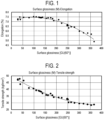
- the measurement values of the elongation according to the change in the surface glossiness of the electrolytic copper foil is shown in FIG. 1
- the measurement values of the tensile strength according to the change in the surface glossiness of the electrolytic copper foil is shown in FIG. 2
- the measurement values of the roughness according to the change in the surface glossiness of the electrolytic copper foil is shown in FIG. 3 .
- FIG. 1 is a graph showing the relationship between elongation (y-axis) and surface glossiness (x-axis) indicated by measuring the elongation of the electrolytic copper foils obtained in Experimental Examples 1 to 4.
- FIG. 2 is a graph showing the relationship between tensile strength (y-axis) and surface glossiness (x-axis) indicated by measuring the tensile strength of the electrolytic copper foils obtained in Experimental Examples 1 to 4.
- y-axis tensile strength
- x-axis surface glossiness
- FIG. 2 is a graph showing the relationship between tensile strength (y-axis) and surface glossiness (x-axis) indicated by measuring the tensile strength of the electrolytic copper foils obtained in Experimental Examples 1 to 4.
- T 1.25 ⁇ 10 ⁇ 4 ⁇ G 2 ⁇ 0.104 ⁇ G + 49.8 (where G represents the surface glossiness (GU (60 °)) of the electrolytic copper foil, and T represents the tensile strength (kgf/mm 2 ) of the electrolytic copper foil.)
- FIG. 3 is a graph showing the relationship between roughness (y-axis) and surface glossiness (x-axis) indicated by measuring the roughness of the electrolytic copper foils obtained in Experimental Examples 1 to 4.
- An electrolyte which has a composition containing 80 g/L of copper, 100 g/L of sulfuric acid, 10 ppm of an elongation agent (HEC), and 25 ppm of a tensile strength agent (DTE).
- a surface glossiness agent (SPS) was added to the electrolyte while regulating the concentration thereof to 12 to 40 ppm.
- the electrolyte was supplied to an electrolytic bath equipped a negative electrode rotating drum (530 ⁇ 280w) at a flow rate of 3,000 L/hr while maintaining the temperature of the electrolyte at 54 degrees C.
- an electric current was supplied by a constant current method at a current density of 5,769 A/m 2 , and electrolytic copper foils having a thickness of 8 ⁇ m were continuously manufactured while rotating the negative electrode rotating drum at a speed of 1.47 m/min.
- Electrolytic copper foils having a thickness of 8 ⁇ m were manufactured under the same conditions as in Example 1, except that the concentration of the elongation agent (HEC) and the concentration of the tensile strength agent (DTE) are changed as in Table 1 below.
- HEC elongation agent
- DTE tensile strength agent
- Electrolytic copper foils having a thickness of 8 ⁇ m were manufactured under the same conditions as in Example 1, except that the concentration of the copper and the concentration of the sulfuric acid are changed as in Table 1 below.
- Electrolytic copper foils having a thickness of 8 ⁇ m were manufactured under the same conditions as in Example 1, except that the current density and the rotational speed of the negative electrode rotating drum are changed as in Table 1 below.
- Table 1 Cu (g/L) H 2 SO 4 (g/L) HEC (ppm) DTE (ppm) SPS (ppm) Current density (A/m 2 ) Speed (m/min) Ex 1 80 100 10 25 12 5,769 1.47 Ex 2 80 100 10 25 16 5,769 1.47 Ex 3 80 100 10 25 22 5,769 1.47 Ex 4 80 100 10 25 23 5,769 1.47 Ex 5 80 100 10 25 24 5,769 1.47 Ex 6 80 100 10 25 25 25,769 1.47 Ex 7 80 100 10 25 25.5 5,769 1.47 Ex 8 80 100 10 25 26 5,769 1.47 Ex 9 80 100 10 25 34 5,769 1.47 Ex 10 80 100 12 28 18 5,769 1.47 Ex 11 80 100 12 28 28 5,769 1.47 Ex 12 80 100 8 23 20 5,769 1.47 Ex 13 80 100 8 23 27 5,7
- the surface glossiness was measured in accordance with JIS B 0601, which is a surface glossiness measurement method, by cutting the electrolytic copper foil into a size of 10 cm ⁇ 10 cm, irradiating the surface of the electrolytic copper foil with measurement light at an incident angle of 60 ° along the flow direction (MD direction) of the electrolytic copper foil, and measuring the intensity of the light reflected at a reflection angle of 60 °.
- the tensile strength and elongation were measured in accordance with JIS C 6511 by using an electrolytic copper foil tensile tester (MINOS-005: MTDI). The measurements were conducted at room temperature (25 degrees C ⁇ 10 degrees C), a distance between chucks of 50 mm, and a displacement speed of 50 mm/min.
- MINOS-005 electrolytic copper foil tensile tester
- the roughness was measured in accordance with JIS B 0601 (JIS 1994), which is a roughness measurement method. The measurement was conducted in the direction perpendicular to the flow direction (MD direction) of the electrolytic copper foil by using a roughness meter (SJ-411: MITUTOYO).
- Equations 1 to 3 can be used even if the concentration of the tensile strength agent or the elongation agent, the concentration of copper ions and sulfate ions in the electrolyte, or the current density and the rotational speed of the negative electrode rotating drum in the electrolysis process are changed. The errors are within ⁇ 5% of the actual measured values. Therefore, the method can be used for actual operations.
Landscapes
- Chemical & Material Sciences (AREA)
- Engineering & Computer Science (AREA)
- Chemical Kinetics & Catalysis (AREA)
- Electrochemistry (AREA)
- Materials Engineering (AREA)
- Metallurgy (AREA)
- Organic Chemistry (AREA)
- General Chemical & Material Sciences (AREA)
- Electrolytic Production Of Metals (AREA)
- Electroplating And Plating Baths Therefor (AREA)
- Parts Printed On Printed Circuit Boards (AREA)
- Laminated Bodies (AREA)
Applications Claiming Priority (2)
| Application Number | Priority Date | Filing Date | Title |
|---|---|---|---|
| KR1020220057727A KR102440711B1 (ko) | 2022-05-11 | 2022-05-11 | 전해 동박의 물성 제어 방법 및 그 제조 방법 |
| PCT/KR2023/004288 WO2023219269A1 (ko) | 2022-05-11 | 2023-03-30 | 전해 동박의 물성 제어 방법 및 그 제조 방법 |
Publications (2)
| Publication Number | Publication Date |
|---|---|
| EP4524293A1 true EP4524293A1 (de) | 2025-03-19 |
| EP4524293A4 EP4524293A4 (de) | 2026-04-08 |
Family
ID=83278566
Family Applications (1)
| Application Number | Title | Priority Date | Filing Date |
|---|---|---|---|
| EP23755319.3A Pending EP4524293A4 (de) | 2022-05-11 | 2023-03-30 | Verfahren zur steuerung der eigenschaften einer elektrolytischen kupferfolie und herstellung davon |
Country Status (8)
| Country | Link |
|---|---|
| US (1) | US20250019852A1 (de) |
| EP (1) | EP4524293A4 (de) |
| JP (1) | JP7633416B2 (de) |
| KR (1) | KR102440711B1 (de) |
| CN (1) | CN117813421A (de) |
| MX (1) | MX2024001167A (de) |
| TW (1) | TWI860671B (de) |
| WO (1) | WO2023219269A1 (de) |
Families Citing this family (2)
| Publication number | Priority date | Publication date | Assignee | Title |
|---|---|---|---|---|
| KR102440711B1 (ko) * | 2022-05-11 | 2022-09-07 | 고려아연 주식회사 | 전해 동박의 물성 제어 방법 및 그 제조 방법 |
| WO2025178226A1 (ko) * | 2024-02-22 | 2025-08-28 | 숙명여자대학교산학협력단 | 편극이 가능한 무극성 분자를 이용한 리튬 금속 전지용 음극 표면 안정화 전해질 첨가제 |
Family Cites Families (16)
| Publication number | Priority date | Publication date | Assignee | Title |
|---|---|---|---|---|
| KR100454270B1 (ko) * | 2002-11-29 | 2004-10-26 | 엘지전선 주식회사 | 저조도 전해동박의 제조방법 및 전해동박 |
| JP5255229B2 (ja) * | 2006-04-28 | 2013-08-07 | 三井金属鉱業株式会社 | 電解銅箔、その電解銅箔を用いた表面処理銅箔及びその表面処理銅箔を用いた銅張積層板並びにその電解銅箔の製造方法 |
| US9307639B2 (en) * | 2006-04-28 | 2016-04-05 | Mitsui Mining & Smelting Co., Ltd. | Electro-deposited copper foil, surface-treated copper foil using the electro-deposited copper foil and copper clad laminate using the surface-treated copper foil, and a method for manufacturing the electro-deposited copper foil |
| JP5752301B2 (ja) * | 2007-10-31 | 2015-07-22 | 三井金属鉱業株式会社 | 電解銅箔及びその電解銅箔の製造方法 |
| KR101086693B1 (ko) * | 2007-12-24 | 2011-11-29 | 주식회사 삼양홀딩스 | 내굴곡성이 우수한 연성 동박 적층판의 제조 방법 |
| KR101126831B1 (ko) | 2009-09-02 | 2012-03-23 | 엘에스엠트론 주식회사 | 전해 동박 및 그 제조 방법 |
| KR20140050541A (ko) * | 2012-10-18 | 2014-04-29 | 일진머티리얼즈 주식회사 | 전해동박, 이를 포함하는 전기부품 및 전지, 및 전해동박 제조방법 |
| TWI539033B (zh) * | 2013-01-07 | 2016-06-21 | Chang Chun Petrochemical Co | Electrolytic copper foil and its preparation method |
| KR101571064B1 (ko) | 2013-11-28 | 2015-11-24 | 일진머티리얼즈 주식회사 | 전해동박, 이를 포함하는 전기부품 및 전지, 및 전해동박 제조방법 |
| JP5810249B1 (ja) * | 2014-01-07 | 2015-11-11 | 古河電気工業株式会社 | 電解銅箔、リチウムイオン二次電池用負極電極及びリチウムイオン二次電池、プリント配線板並びに電磁波シールド材 |
| JP2017014608A (ja) * | 2015-07-06 | 2017-01-19 | 古河電気工業株式会社 | 電解銅箔、リチウムイオン二次電池用負極電極及びリチウムイオン二次電池、プリント配線板並びに電磁波シールド材 |
| KR102433032B1 (ko) * | 2017-07-31 | 2022-08-16 | 에스케이넥실리스 주식회사 | 주름 발생이 방지된 동박, 그것을 포함하는 전극, 그것을 포함하는 이차전지, 및 그것의 제조방법 |
| KR102103765B1 (ko) * | 2018-05-16 | 2020-04-28 | 일진머티리얼즈 주식회사 | 전해동박 및 이를 이용한 이차전지 |
| KR20180104269A (ko) * | 2018-05-30 | 2018-09-20 | 유진인스텍코어 주식회사 | 광택도를 이용한 금속박 품질관리방법 |
| JP6667840B1 (ja) * | 2019-07-22 | 2020-03-18 | テックス・テクノロジー株式会社 | 電解銅箔の製造方法 |
| KR102440711B1 (ko) * | 2022-05-11 | 2022-09-07 | 고려아연 주식회사 | 전해 동박의 물성 제어 방법 및 그 제조 방법 |
-
2022
- 2022-05-11 KR KR1020220057727A patent/KR102440711B1/ko active Active
-
2023
- 2023-03-30 WO PCT/KR2023/004288 patent/WO2023219269A1/ko not_active Ceased
- 2023-03-30 US US18/548,195 patent/US20250019852A1/en active Pending
- 2023-03-30 CN CN202380013182.3A patent/CN117813421A/zh active Pending
- 2023-03-30 MX MX2024001167A patent/MX2024001167A/es unknown
- 2023-03-30 EP EP23755319.3A patent/EP4524293A4/de active Pending
- 2023-03-30 JP JP2023544706A patent/JP7633416B2/ja active Active
- 2023-03-31 TW TW112112600A patent/TWI860671B/zh active
Also Published As
| Publication number | Publication date |
|---|---|
| US20250019852A1 (en) | 2025-01-16 |
| CN117813421A (zh) | 2024-04-02 |
| TW202346660A (zh) | 2023-12-01 |
| WO2023219269A1 (ko) | 2023-11-16 |
| KR102440711B1 (ko) | 2022-09-07 |
| TWI860671B (zh) | 2024-11-01 |
| CA3211775A1 (en) | 2023-11-11 |
| EP4524293A4 (de) | 2026-04-08 |
| JP7633416B2 (ja) | 2025-02-19 |
| MX2024001167A (es) | 2024-02-27 |
| JP2024523079A (ja) | 2024-06-28 |
Similar Documents
| Publication | Publication Date | Title |
|---|---|---|
| EP4524293A1 (de) | Verfahren zur steuerung der eigenschaften einer elektrolytischen kupferfolie und herstellung davon | |
| KR101449342B1 (ko) | 전해동박, 이를 포함하는 전기부품 및 전지 | |
| KR100389061B1 (ko) | 전해 동박 제조용 전해액 및 이를 이용한 전해 동박 제조방법 | |
| US9287566B1 (en) | Anti-curl copper foil | |
| EP3376574A1 (de) | Elektrolytische kupferfolie, elektrode damit, sekundärbatterie damit und verfahren zur herstellung davon | |
| US20030205474A1 (en) | Electro deposition chemistry | |
| KR102028353B1 (ko) | 낮은 내부 응력 구리 전기도금 방법 | |
| KR102727322B1 (ko) | 전해동박, 이 전해동박을 포함하는 이차전지용 집전체 및 이차전지 | |
| EP3748044A1 (de) | Elektrolytische kupferfolie mit dimensionsstabilität und strukturstabilität bei hoher temperatur und herstellungsverfahren dafür | |
| KR20140050541A (ko) | 전해동박, 이를 포함하는 전기부품 및 전지, 및 전해동박 제조방법 | |
| EP3327838A1 (de) | Elektrolytische kupferfolie für lithiumsekundärbatterie und lithiumsekundärbatterie damit | |
| EP3067442A1 (de) | Elektrolytische kupferfolie, elektrische komponente und batterie damit | |
| EP4335948A1 (de) | Elektrolytische kupferfolie und sekundärbatterie damit | |
| CA3211775C (en) | Method of controlling properties of electrolytic copper foil and manufacturing the same | |
| KR101502373B1 (ko) | 전해동박, 이를 포함하는 전기부품 및 전지 | |
| EP4202084A2 (de) | Doppellagige elektrolytische kupferfolie und verfahren zu ihrer herstellung | |
| KR101478464B1 (ko) | 전해동박, 이를 포함하는 전기부품 및 전지 | |
| EP4202086A2 (de) | Elektrolytische kupferfolie und sekundärbatterie damit | |
| EP4424883A1 (de) | Elektrolytische kupferfolie für sekundärbatteriestromkollektor | |
| US20230207830A1 (en) | Electrolytic copper foil having high tensile strength and secondary battery comprising the same | |
| RU2379381C1 (ru) | Электролит железнения | |
| Zhang et al. | Effect of Y3+ on microstructure optimization and performance enhancement of ultra-thin electrodeposited copper foil | |
| SG2012066940A (en) | Low internal stress copper electroplating method |
Legal Events
| Date | Code | Title | Description |
|---|---|---|---|
| STAA | Information on the status of an ep patent application or granted ep patent |
Free format text: STATUS: UNKNOWN |
|
| STAA | Information on the status of an ep patent application or granted ep patent |
Free format text: STATUS: THE INTERNATIONAL PUBLICATION HAS BEEN MADE |
|
| PUAI | Public reference made under article 153(3) epc to a published international application that has entered the european phase |
Free format text: ORIGINAL CODE: 0009012 |
|
| STAA | Information on the status of an ep patent application or granted ep patent |
Free format text: STATUS: REQUEST FOR EXAMINATION WAS MADE |
|
| 17P | Request for examination filed |
Effective date: 20230825 |
|
| AK | Designated contracting states |
Kind code of ref document: A1 Designated state(s): AL AT BE BG CH CY CZ DE DK EE ES FI FR GB GR HR HU IE IS IT LI LT LU LV MC ME MK MT NL NO PL PT RO RS SE SI SK SM TR |
|
| DAV | Request for validation of the european patent (deleted) | ||
| DAX | Request for extension of the european patent (deleted) | ||
| A4 | Supplementary search report drawn up and despatched |
Effective date: 20260309 |
|
| RIC1 | Information provided on ipc code assigned before grant |
Ipc: C25D 5/00 20060101AFI20260303BHEP Ipc: C25D 3/38 20060101ALI20260303BHEP Ipc: C25D 1/04 20060101ALI20260303BHEP Ipc: H01M 4/66 20060101ALI20260303BHEP |