EP4524054A1 - Coffee-preserving bag body and method for manufacturing same - Google Patents
Coffee-preserving bag body and method for manufacturing same Download PDFInfo
- Publication number
- EP4524054A1 EP4524054A1 EP23803251.0A EP23803251A EP4524054A1 EP 4524054 A1 EP4524054 A1 EP 4524054A1 EP 23803251 A EP23803251 A EP 23803251A EP 4524054 A1 EP4524054 A1 EP 4524054A1
- Authority
- EP
- European Patent Office
- Prior art keywords
- bag body
- coffee
- gas chamber
- flow passage
- gas flow
- Prior art date
- Legal status (The legal status is an assumption and is not a legal conclusion. Google has not performed a legal analysis and makes no representation as to the accuracy of the status listed.)
- Pending
Links
Images


Classifications
-
- B—PERFORMING OPERATIONS; TRANSPORTING
- B65—CONVEYING; PACKING; STORING; HANDLING THIN OR FILAMENTARY MATERIAL
- B65D—CONTAINERS FOR STORAGE OR TRANSPORT OF ARTICLES OR MATERIALS, e.g. BAGS, BARRELS, BOTTLES, BOXES, CANS, CARTONS, CRATES, DRUMS, JARS, TANKS, HOPPERS, FORWARDING CONTAINERS; ACCESSORIES, CLOSURES, OR FITTINGS THEREFOR; PACKAGING ELEMENTS; PACKAGES
- B65D81/00—Containers, packaging elements, or packages, for contents presenting particular transport or storage problems, or adapted to be used for non-packaging purposes after removal of contents
- B65D81/24—Adaptations for preventing deterioration or decay of contents; Applications to the container or packaging material of food preservatives, fungicides, pesticides or animal repellants
- B65D81/26—Adaptations for preventing deterioration or decay of contents; Applications to the container or packaging material of food preservatives, fungicides, pesticides or animal repellants with provision for draining away, or absorbing, or removing by ventilation, fluids, e.g. exuded by contents; Applications of corrosion inhibitors or desiccators
-
- B—PERFORMING OPERATIONS; TRANSPORTING
- B65—CONVEYING; PACKING; STORING; HANDLING THIN OR FILAMENTARY MATERIAL
- B65D—CONTAINERS FOR STORAGE OR TRANSPORT OF ARTICLES OR MATERIALS, e.g. BAGS, BARRELS, BOTTLES, BOXES, CANS, CARTONS, CRATES, DRUMS, JARS, TANKS, HOPPERS, FORWARDING CONTAINERS; ACCESSORIES, CLOSURES, OR FITTINGS THEREFOR; PACKAGING ELEMENTS; PACKAGES
- B65D33/00—Details of, or accessories for, sacks or bags
- B65D33/01—Ventilation or drainage of bags
Definitions
- the present invention relates to a coffee-preserving bag body and a manufacturing method therefor, and more specifically to a coffee-preserving bag body capable of discharging carbon dioxide generated inside the bag body to the outside of the bag body, and preserving coffee in the bag body in a stable quality over a long period of time, while preventing the degradation of the coffee, and a manufacturing method for the bag body.
- a preserving bag body for storing coffee requires a capability to prevent intrusion of oxygen from the outside, because the quality of coffee is degraded due to contact with oxygen during preservation.
- a technique of attaching a check valve to a bag for preserving coffee is also implemented.
- a check valve is costly, and the bag body with a check valve attached thereto involves a problem that a manufacturing process becomes complicated.
- Patent Documents 1 and 2 As a configuration for improving this shortcoming, there has been proposed a bag body having a long ventilation passage connecting the inside and outside of the bag body (Patent Documents 1 and 2). Using this configuration, it is possible to preserve coffee while suppressing the degradation of the coffee due to intrusion of oxygen, without causing the bag body to expand.
- Patent Documents 1 and 2 are very effective in terms of satisfying both the discharge of carbon dioxide and the prevention of oxygen inflow, but are not exactly sufficient in terms of the strength of the bag body, and prevention of the inflow of outside air due to a rapid volume change.
- the present invention is intended to provide a coffee-preserving bag body capable of, in addition to discharging carbon dioxide and suppressing intrusion of oxygen, having sufficient strength, and preventing inflow of outside air due to a rapid volume change.
- the present invention is intended to provide a manufacturing method for such a coffee-preservation bag body, and a coffee preservation method using the coffee-preserving bag body.
- a coffee-preserving bag body for preserving 60 g to 2000 g of coffee, the bag body being formed by a barrier film, wherein the bag body has a longitudinal length of 10 cm to 60 cm, and a lateral length of 6 cm to 40 cm, and comprises a band-shaped joining region in which two ends of the film are mutually overlapped and joined together, wherein the band-shaped joining region is internally provided with: a gas chamber which is a space shaped as approximately rectangular waves, the gas chamber being formed by leaving the film unjoined to extend along the joined ends of the film, and sealed at both ends thereof; an inner gas flow passage communicating between the gas chamber and an internal space of the bag body; and an outer gas flow passage communicating between the gas chamber and an external space of the bag body, whereby a ventilation channel communicating between an inside and an outside of the bag body is composed of the inner gas flow passage, a subsection of the gas chamber communicating with the inner gas flow passage, and the outer gas flow passage being adjacent to the inner gas flow passage and
- a coffee-preserving bag body for preserving 60 g to 2000 g of coffee, the bag body being formed by a barrier film, wherein the bag body has a longitudinal length of 10 cm to 60 cm, and a lateral length of 6 cm to 40 cm, and comprises a band-shaped joining region in which two ends of the film are mutually overlapped and joined together, wherein the band-shaped joining region is internally provided with: a gas chamber which is a space shaped as approximately rectangular waves, the gas chamber being formed by leaving the film unjoined to extend along the joined ends of the film, and sealed at both ends thereof; an inner gas flow passage communicating between the gas chamber and an internal space of the bag body; and an outer gas flow passage communicating between the gas chamber and an external space of the bag body, whereby a ventilation channel communicating between an inside and an outside of the bag body is composed of the inner gas flow passage, a subsection of the gas chamber communicating with the inner gas flow passage, and the outer gas flow passage being adjacent to the inner gas flow passage and
- the ventilation channel is provided in a number of one to twelve.
- the gas chamber has a length of 200 mm to 2400 mm.
- the ventilation channel has a widest portion and a narrowest portion, wherein a ratio of a width of the widest portion to a width of the narrowest portion is 1.2 to 3.
- the bent part is formed in a number of 15 to 90 per said ventilation channel.
- each of the inner gas flow passage and the outer gas flow passage has a width of 0.5 mm to 3 mm.
- a ratio of a width of the gas chamber to a width of the outer gas flow passage is 0.4 to less than 1.0.
- the gas chamber is arranged such that the heightwise part extends to cross an imaginary straight line Lc extending along a widthwise center of the band-shaped joining region, wherein when a length of a given portion of the imaginary straight line extending to pass through the heightwise part of the gas chamber is denoted by At, and a total length of joined portions of the film on the given portion of the imaginary straight line having the length At is denoted by Ad, (Ad/At) is 0.10 to 0.75.
- a total area of the gas chamber in plan view is 75 mm 2 to 2000 mm 2 ,
- the band-shaped joining region is an ultrasonically joined portion.
- a coffee-preserving bag body manufacturing method characterized by comprising manufacturing the coffee-preserving bag body as mentioned above, using an ultrasonic joining machine which comprises a disk-shaped anvil having, on an outer peripheral surface thereof, a concavity-convexity pattern corresponding to the band-shaped joining region, and a disk-shaped horn having a flat and smooth circumferential surface.
- a coffee preservation method wherein 60 g to 2000 g of coffee is filled into and preserved in the coffee-preserving bag body as claimed in claim 1 or 2.
- a coffee-preserving bag body for preserving 60 g to 1200 g of coffee, the bag body being formed by a barrier film, wherein the bag body has a longitudinal length of 10 cm to 60 cm, and a lateral length of 10 cm to 40 cm, and comprises a band-shaped joining region in which two ends of the film are mutually overlapped and joined together,
- the present invention provides a coffee-preserving bag body capable of, in addition to discharging carbon dioxide and preventing oxygen inflow, having sufficient strength, and preventing oxygen inflow due to a rapid volume change.
- the present invention provides a manufacturing method for such a coffee-preservation bag body, and a coffee preservation method using the coffee-preserving bag body.
- the coffee-preserving bag body according to the present invention provides the above advantageous effect for the following reasons. Firstly, in the coffee-preserving bag body according to the present invention, carbon dioxide generated thereinside is discharged by the ventilation channel, and intrusion of oxygen from the outside through the ventilation channel can be suppressed by carbon dioxide filled in the ventilation channel.
- the gas chamber of the ventilation channel provided in the band-shaped joining region has a bent part which bends at an angle of 40 degrees to 120 degrees with respect to an edge of the after-mentioned one end of the bag body.
- a necessary and sufficient strength is maintained in both a direction perpendicular to and a direction parallel to the edge of the joined ends of the film. This makes it possible to prevent breakage of the bag body when an external force acts on the band-shaped joining region, particularly, when a perpendicular tensile stress acts on the edge of the joined ends of the film.
- the bent part comprised in the gas chamber of the ventilation channel does not become resistance against the flow of gas having a very low flow velocity, such as carbon dioxide generated by coffee.
- the ventilation channel has such a bent part, it is possible to quickly discharge carbon dioxide.
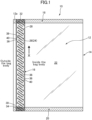
- FIG. 1 is a plan view of a coffee-preserving bag body 10 according to a preferred embodiment of the present invention.
- the term "coffee” includes coffee beans, roasted coffee beans, and roasted and powdered coffee.
- a bag body in an embodiment of the present invention is suited to preserve 60 g to 2000 g of coffee.
- the amount of coffee to be preserved is less than 60 g, the amount of carbon dioxide generated by the coffee is excessively small, so that the after-mentioned internal space and ventilation channel of the bag body are likely to fail to be filled with the carbon dioxide, leading to deterioration in quality due to oxygen remaining in the bag body.
- the amount of coffee exceeds 2000 g, the amount of carbon dioxide generated by the coffee is excessively large, so that it becomes difficult to sufficiently discharge the carbon dioxide, leading to expansion of the bag body, and risk of rupture of of the bag body in some situations.
- the bag body 10 has a rectangular shape obtained by folding one rectangular film 12 into two along a folding part 14 which is a lateral center line, such that two lateral ends 12a of the film are overlapped together.
- the bag body 10 has a rectangular-shaped internal space 22 in plan view, whose four sides are surrounded by the folding part 14, the band-shaped joining region 16, the top seal section 18, and the bottom seal section 20, wherein the internal space 22 is formed as a space for accommodating coffee.
- each of the top seal section 18 and the bottom seal section 20 is preferably set to fall within the range of, e.g., 3 mm to 20 mm, more preferably 5 mm to 15 mm.
- the bag body 10 has a longitudinal length of 10 cm to 60 cm, and a lateral length of 6 cm to 40 cm.
- the advantageous effects of this embodiment can be effectively obtained by combining the above size of the bag body and the amount of coffee to be preserved. Further, by setting the size of the bag body to fall within this range, handleability of the bag body is improved.
- the length may be 10 cm to 60 cm
- the lateral length may be 10 cm to 40 cm.
- the size of the bag body and the amount of coffee satisfy the condition that a value of [(the longitudinal length (cm) of the bag body) ⁇ (the lateral length (cm) of the bag body) ⁇ (the amount of coffee (g))] is 0.5 cm 2 /g to 2.2 cm 2 /g.
- a heretofore-known film such as: a film made of a polymer comprising vinyl alcohol or vinylidene chloride as a constituent; a polymer film deposited with one of silica, alumina, and aluminum; or a metal foil layer, is used.
- a film in which a substrate film and an oxygen barrier film are laminated together, and a laminate film in which an oxygen barrier coat is provided on a substrate film may also be used.
- the substrate film it is possible to use a film (including paper) in which a sealant layer is provided on paper or a polymer film made of polypropylene, polyethylene, or the like.
- the barrier film used in this embodiment has a thickness of 15 ⁇ m to 150 ⁇ m, preferably 20 ⁇ m to 100 ⁇ m. If the thickness of the film is less than 15 ⁇ m, the strength of the bag body is likely to become insufficient, and if the thickness exceeds 150 ⁇ m, it is disadvantageous in terms of cost.
- the barrier film used in this embodiment may be transparent or may be opaque. However, it is preferable to use an opaque packaging film in order to prevent a content of the bag body from degrading by sunlight. Further, in order to enhance aesthetic quality, the film may have a surface subjected to printing.
- the printing method is not particularly limited, an inkjet method is preferable from a viewpoint of being easy to cope with low-volume production.
- the coffee-preserving bag body 10 comprises the band-shaped joining region 16 in which the two ends 12a of the film are overlapped and joined together by ultrasonic welding.
- This band-shaped joining region 16 has approximately the same width and a rectangular shape.
- the band-shaped joining region 16 extends over the entire length of the joined ends 12a of the film 12, in a direction indicated by the arrowed line X in FIG. 2 , i.e., a direction approximately parallel to the joined ends 12a of the film 12, along an end of the bag body 10 formed by the joined ends 12a of the film 12.
- the band-shaped joining region 16 is provided in a side seal section of the bag body 10, but may be provided in another portion of the bag body, e.g., in another seal section such as a center seal section.
- the width of the band-shaped joining region 16 is preferably 5 mm to 20 mm, more preferably 6 mm to 15 mm. If the width of the band-shaped joining region 16 is less than 5 mm, the strength of the bag body can be insufficient, and if the width exceeds 20 mm, it can be undesirable in terms of aesthetic quality.
- the band-shaped joining region 16 is formed by ultrasonic welding, but other forming methods may be used.
- it may be formed by an adhesive or heat sealing.
- the use of an ultrasonic joining method is preferably from a viewpoint of capability to form a ventilation channel with an accurate shape, and joining speed.
- the ventilation channel 24 is an elongate portion formed by leaving the overlapped halves of the film 12 unjoined in the band-shaped joining region 16, and is a portion taking a form of an elongate flow channel when gas is accommodated thereinside. Thus, the gas can pass through the inside thereof.
- the ventilation channel 24 is composed of: a gas chamber 26 which is a space shaped as approximately rectangular waves, the gas chamber 26 being formed to extend along the joined ends of the film, and sealed at both ends thereof; an inner gas flow passage 28 communicating between the gas chamber 26 and the internal space 22 of the bag body 10; and an outer gas flow passage 30 communicating between the gas chamber 26 and the external space of the bag body 10.
- the ventilation channel 24 is composed of: the inner gas flow passage 28; a subsection (subregion or subzone) of the gas chamber 24 whose one end communicates with the inner gas flow passage 28; and the outer gas flow passage 30 being adjacent to the inner gas flow passage 28 and communicating with the other end of the subsection (subzone) of the gas chamber.
- each of the inner ventilation channel 28 and the outer gas flow passage 30 is provided in a number of one. This means that the bag body 10 is provided with one ventilation channel 24 extending from the internal passage 28 to the outer gas flow passage 30 through the gas chamber 26.
- the internal space 22 of the bag body 10 is placed in fluid communication with the outside via the ventilation channel 24.
- one ventilation channel is provided per said bag body 10.
- the number of ventilation channels per said bag body 10 is not limited thereto.
- the band-shaped joining region is preferably provided in an area parallel to the longitudinal direction of the bag body.
- the band-shaped joining region is preferably provided in a side seal section or a center seal section (rear bonded section) which is parallel to the longitudinal direction of the bag body.
- examples include a configuration in which the longitudinal length and the lateral length of the bag body are set to fall within the range of 15 cm to less than 24 cm, and the range of 6 cm to less than 11 cm, respectively, and the ventilation channel is provided in a number of one to four.
- examples include a configuration in which the longitudinal length and the lateral length of the bag body are set to fall within the range of 20 cm to less than 30 cm, and the range of 8.5 cm to less than 12 cm, respectively, and the ventilation channel is provided in a number of one to six.
- examples include a configuration in which the longitudinal length and the lateral length of the bag body are set to fall within the range of 24 cm to less than 34 cm, and the range of 8.5 cm to less than 13 cm, respectively, and the ventilation channel is provided in a number of two to eight.
- examples include a configuration in which the longitudinal length and the lateral length of the bag body are set to fall within the range of 30 cm to less than 40 cm, and the range of 10 cm to less than 20 cm, respectively, and the ventilation channel is provided in a number of three to nine.
- examples include a configuration in which the longitudinal length and the lateral length of the bag body are set to fall within the range of 35 cm to less than 45 cm, and the range of 15 cm to less than 40 cm, respectively, and the ventilation channel is provided in a number of six to twelve.
- examples include a configuration in which the longitudinal length and the lateral length of the bag body are set to fall within the range of 40 cm to less than 60 cm, and the range of 20 cm to less than 40 cm, respectively, and the ventilation channel is provided in a number of ten to twelve.
- the gas chamber 26 has an approximately rectangular wave-like planar shape, and is arranged to extend within the band-shaped joining region 16 in a longitudinal direction of the band-shaped joining region 16.
- approximately rectangular waves is not limited to a series of strict rectangular-shaped waves, but also includes a series of waves in which a transverse part and a heightwise part of each wave are joined at an angle other than 90 degrees, or through a rounded bent (curved) part. Further, each part constituting each of the approximately rectangular waves needs not be a complete straight line, i.e., a rectangular wave having a slight bentness is also included in the "approximately rectangular wave". However, since a wave shape formed entirely by a smooth curve, such as a corrugated shape, a sine curve, and a U shape, fails to obtain the advantageous effects of the present invention, it is not included in an approximately rectangular wave shape.
- approximately rectangular waves means a series of “rectangular-shaped” portions each having the same size and shape, and also has a heightwisely (bilaterally on the bag body) symmetrical shape.
- the gas chamber 26 is formed to extend in a direction approximately parallel to the joined ends 12a of the film 12 (in the direction indicated by the arrowed line X in FIG. 2 ), and the two halves of the film 12 are joined in the area surrounding the gas chamber 26. Further, one end 32 and the other end 34 of the gas chamber 26 are sealed by joining the two halves of the film 12 in the areas surrounding the two ends.
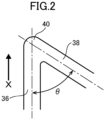
- FIG. 2 is a schematic diagram enlargedly showing a part of the gas chamber 26.
- the gas chamber 26 of the bag body 10 is provided with plural sets of: an approximately linear-shaped transverse parts 36 extending in a direction along which the approximately rectangular waves extend approximately in parallel with the joined ends 12a of the film 12; a heightwise part 38 extending from each of both ends of the transverse part 36 in a direction connecting the internal space 22 and the external space of the bag body 10 at an interior angle ⁇ with respect to the transverse part 36; and a bent part 40 which is a joining part between the transverse part 36 and the heightwise part 38, thereby having an approximately rectangular wave shape.
- the angle ⁇ which is an interior angle of the bent part 40, is set to fall within the range of 40 degrees to 120 degrees.
- the angle of the bent part By setting the angle of the bent part to fall within the range of 40 degrees to 120 degrees, it becomes possible to increase the strength of the bag body. Further, by setting this angle to fall within the range of 45 degrees to 85 degrees, more preferably 50 degrees to 80 degrees, it becomes possible to, in addition to increasing the strength of the bag body, suppress the inflow of oxygen into the bag body when the volume of the bag body is instantaneously changed. In particular, by combining the technique of varying the width of the above-mentioned gas chamber 26 described above, it becomes possible to further effectively prevent the inflow of oxygen.
- the bent part is provided in a number of about 60 to about 90 per 10 cm length along the direction along which the approximately rectangular waves extend (longitudinal direction of the bag body).
- one ventilation channel 24 is configured to have 15 to 90 bent parts.
- the number of bent parts 40 to be provided per said ventilation channel 24 is more preferably 20 to 80.
- the length of the gas chamber 26 is preferably 200 mm to 2400 mm, more preferably 300 mm to 2000 mm, further preferably 400 mm to 1600 mm.
- the length of the ventilation channel 24 is preferably 40 mm to 320 mm, more preferably 60 mm to 300 mm, further preferably 80 mm to 280 mm.
- the length of the ventilation channel 24 is preferably 40 mm to 320 mm, more preferably 60 mm to 300 mm, further preferably 80 mm to 280 mm.
- the width of the gas chamber 26 is approximately constant over the entire length of the gas chamber 26, and is set to fall within the range of 0.5 mm to 5 mm.
- the width of the gas chamber 26 is preferably 0.6 mm to 4 mm, more preferably 0.7 mm to 3.5 mm.
- the area of the gas chamber 26 in plan view is set to fall within the range of 75 mm 2 to 2000 mm 2 . It is preferably 100 mm 2 to 1750 mm 2 , more preferably 200 mm 2 to 1500 mm 2 .
- the area of the gas chamber 26 is set to 75 mm 2 or more, it becomes possible to effectively suppress the inflow of oxygen. Further, by setting the area of the gas chamber 26 to 2000 mm 2 or less, it becomes possible to allow the bag body to have sufficient strength.
- the width of the inner gas flow passage 42 is set to fall within the range of 0.5 mm to 3 mm.
- the width of the inner gas flow passage 42 is more preferably 0.7 mm to 2.5 mm.
- the length of the inner gas flow passage 42 is set to fall within the range of 0.5 mm to 5 mm.
- the length of the inner gas flow passage 42 is more preferably 0.6 mm to 4 mm, further preferably 0.7 mm to 3 mm.
- the length of the outer gas flow passage 44 is set to fall within the range of 0.5 mm to 5 mm.
- the length of the inner gas flow passage 42 is more preferably 0.6 mm to 4 mm, further preferably 0.7 mm to 3 mm.
- the width of the outer gas flow passage 44 is set to fall within the range of 0.5 mm to 3 mm.
- the width of the outer gas flow passage 42 is more preferably 0.7 mm to 2.5 mm.
- the ratio of the width of the gas chamber 26 and the width of the outer gas flow passage 44 is set to fall within the range of 0.7 to less than 1.0.
- the ratio of the width of the gas chamber 26 to the width of the outer gas flow passage 44 is more preferably 0.75 to 0.97.
- each of the inner gas flow passage 28 and the outer gas flow passage 30 is provided plurally (in a number of three in this embodiment), the inner gas flow passage 28 and the outer gas flow passage 30 are alternately provided along the longitudinal direction of the gas chamber 26 extending in an approximately rectangular wave pattern,
- the bag body illustrated in FIG. 3 is provided with five ventilation channels each composed of: the inner gas flow passage 28; a subsection of the gas chamber 26 communicating with the inner gas flow passage 28; and the outer gas flow passage 30 being adjacent to the inner gas flow passage 28 and communicating with the subsection of the gas chamber 28.
- a first ventilation channel 24 1 is composed of: an upper, or first, inner gas flow passage 28 1 ; a first subsection 26 1 of the gas chamber 26 communicating with the first inner gas flow passage 28 1 (on its upper side); and a first outer gas flow passage 30 1 adjacent to the first inner gas flow passage 28 1 in the longitudinal direction (in a propagation direction) of the approximately rectangular waves drawn by the gas chamber.
- a second ventilation channel 24 2 is composed of: the upper, or first, inner gas flow passage 28 1 ; a second subsection 26 2 of the gas chamber 26 communicating with the first inner gas flow passage 28 1 (on its lower side); and a second outer gas flow passage 30 2 adjacent to the first inner gas flow passage 28 1 in the longitudinal direction (in a direction opposite to the propagation direction) of the approximately rectangular waves drawn by the gas chamber.
- a third ventilation channel 24 3 is composed of: an intermediate, or second, inner gas flow passage 28 2 ; a third subsection 26 3 of the gas chamber 26 communicating with the second inner gas flow passage 28 2 (on its upper side); and a second outer gas flow passage 30 2 adjacent to the second inner gas flow passage 28 2 in the longitudinal direction (in the propagation direction) of the approximately rectangular waves drawn by the gas chamber.
- a fourth ventilation channel 24 4 is composed of: the intermediate, or second, inner gas flow passage 28 2 ; a fourth subsection 26 4 of the gas chamber 26 communicating with the second inner gas flow passage 28 2 (on its lower side); and a third outer gas flow passage 30 3 adjacent to the second inner gas flow passage 28 2 in the longitudinal direction (in the direction opposite to the propagation direction) of the approximately rectangular waves drawn by the gas chamber.
- a fifth ventilation channel 24 5 is composed of: a lower, or third, inner gas flow passage 28 3 ; a fifth subsection 26 5 of the gas chamber 26 communicating with the third inner gas flow passage 28 3 (on its upper side); and the third outer gas flow passage 30 3 adjacent to the third inner gas flow passage 28 3 in the longitudinal direction (in the propagation direction) of the approximately rectangular waves drawn by the gas chamber.
- Carbon dioxide generated by coffee inside the bag body 10 is discharged to the outside via the ventilation channels 24 1-5 having the above configurations. Further, during preservation of the coffee, such carbon dioxide is filled in the ventilation channels 24, thereby suppressing the intrusion of oxygen into the internal space 22 of the bag body 10 via the ventilation channels 24.
- one gas chamber 26 is provided in the band-shaped joining region 16 of the bag body 10, and one or five ventilation channels 24 are formed by the one gas chamber 26.
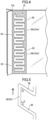
- the present invention may have a configuration in which plural (e.g., two to six; two in FIG. 4 ) independent gas chambers 26a, 26b are formed in the band-shaped joining region 16, and each of the inner gas flow passage 28 and the outer gas flow passage 30 is provided in each of the gas chambers 26a, 26b by a number of at least one, thereby forming two or more ventilation channels 24a, 24b in the one band-shaped joining region 16, as schematically illustrated in FIG. 4 .
- plural e.g., two to six; two in FIG. 4
- each of the inner gas flow passage 28 and the outer gas flow passage 30 is provided in each of the gas chambers 26a, 26b by a number of at least one, thereby forming two or more ventilation channels 24a, 24b in the one band-shaped joining region 16, as schematically illustrated in FIG. 4 .
- the gas chamber 26 is configured such that the sum of two interior angles ⁇ , ⁇ ( FIG. 5 ) of one rectangular wave is set to fall within the range of 150 degrees to 240 degrees.
- the sum of the interior angles ⁇ , ⁇ is set to fall within the range of 150 degrees to 240 degrees.
- the value of the angle ⁇ is 40 degrees to 90 degrees, preferably 45 degrees to 70 degrees, more preferably 50 degrees to 60 degrees, and the value of the angle ⁇ is 90 degrees to 140 degrees, more preferably 110 degrees to 135 degrees, further preferably 120 degrees to 130 degrees.
- the sum of the interior angles ⁇ , ⁇ is more preferably 160 degrees to 200 degrees. For example, it may be 180 degrees.
- the ⁇ and ⁇ preferably satisfy the following conditions. 40 degrees ⁇ ⁇ ⁇ 90 degrees , 90 degrees ⁇ ⁇ ⁇ 140 degrees 160 degrees ⁇ ⁇ + ⁇ ⁇ 200 degrees
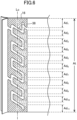
- each heightwise part 38 of the gas chamber 26 is arranged to cross a widthwise center line (virtual straight line) Lc of the band-shaped joining region 16, as schematically illustrated in FIG. 6 .
- the heightwise part 38 of the gas chamber 26 is arranged in a zone having a width of 50% to 98% of the entire width of the band-shaped joining region 16.
- Each heightwise part 38 of the gas chamber 26 is preferably arranged in a zone having a width of 55% to 95% of the entire width of the band-shaped joining region 16, and more preferably arranged in a zone having a width of 60% to 90% thereof.
- the bag body 10 is configured such that when the length of the imaginary straight line Lc is denoted by Ad, and the sum of the lengths (Ad 1 , Ad 2 Ad 3 Ad 4 , ---, Ad 11 ) of joined portions of the halves of the film on the imaginary straight line Lc is denoted by Ad, a value of Ad/At is 0.10 to 0.75. If the value of Ad/At is less than 0.10, the strength of the bag body 10 becomes insufficient, possibly leading to a situation where the bag body can be broken when it falls from a high place, etc.
- Ad/At exceeds 0.75, the width of the gas chamber becomes excessively small, possibly leading to a situation where the discharge of carbon dioxide becomes insufficient, or the length of the gas chamber becomes excessively short, possibly leading to a situation where it becomes impossible to sufficiently prevent the inflow of oxygen from the outside.
- FIG. 6 is a schematic diagram of the band-shaped joining region and the ventilation channel 24 of the bag body 10 according to this embodiment.
- the gas chamber 26 in the ventilation channel 24 is significantly schematically depicted.
- Ad the length of the imaginary straight line Lc
- Ad 1 , Ad 2 Ad 3 Ad 4 , ---, Ad 11 in FIG. 6 the total length of the joined portions (Ad 1 , Ad 2 Ad 3 Ad 4 , ---, Ad 11 in FIG. 6 ) of the film on the imaginary straight line Lc, i.e., the total length of portions of the imaginary straight line Lc which do not cross the gas chamber 26 (specifically, the heightwise parts of the gas chambers)
- Ad the value of Ad/At is set to fall within the range of 0.10 to 0.75.
- the gas chamber 26 has a configuration in which it has a constant width over the entire length thereof, i.e., the width of the transverse part 36 is equal to the width of the heightwise part 38.
- the gas chamber 26 may be configured to be partially different in terms of width.
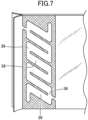
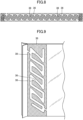
- the gas chamber may be configured such that the width of the transverse part 36 is narrower than the width of the heightwise part 38, as in a bag body illustrated in FIG. 7 , or such that the width of the heightwise part 38 is narrower than the width of the transverse part 36, as in a bag body illustrated in FIG. 8 . Further, the gas chamber may be configured such that the width of the heightwise part 38 varies therewithin, as in a bag body illustrated in FIG. 9 .
- the ratio of the width of a widest portion to the width of a narrowest portion is preferably 1.2 to 3, more preferably 1.5 to 2.5.
- the ultrasonic joining machine is a theretofore-known ultrasonic joining machine which comprises: an ultrasonic oscillator to convert commercial electricity of 50 Hz or 60 Hz into a high-frequency signal of about 15 to 70 KHz; a converter to convert the converted signal into mechanical vibration; a booster to amplify this mechanical vibration; a disk-shaped horn to transmit the amplified vibration to a target object to be fusion-bonded; and a disk-shaped anvil to clamp two ends of the film in cooperation with the horn.
- Each of the horn and the anvil is disk-shaped, and they are configured to rotate while clamping two ends of the film, and continuously form the band-shaped joining region in two ends of overlapped halves of the film.
- the horn and the anvil are rotationally driven by a non-illustrated drive device.
- FIG. 10 is a schematic perspective view showing the configuration of the anvil 50 used in the ultrasonic joining machine.
- the anvil 50 has a disk-like shape whose outer peripheral surface 52 is formed with a raised portion 54 for shaping the band-shaped joint region of the bag body.
- the raise portion 54 is formed with a groove 56 corresponding to the planar shape of the ventilation channel(s) 24 of the bag body.
- Each of the height of the raised portion 54 and the depth of the groove 56 is preferably 0.2 mm to 1.0 mm, more preferably 0.25 mm to 0.8 mm, further preferably 0.3 mm to 0.5 mm.
- each of the height of the raised portion 54 and the depth of the groove 56 is less than 0.2 mm, the joining strength of the band-shaped joining region can become insufficient, and on the other hand, if each of the height of the raised portion 54 or the depth of the groove 56 exceeds 1.0 mm, the film can be cut off by an edge of the raised portion or the groove, leading to difficulty in joining.
- the height of the raised portion 54 and the depth of the groove 56 may be the same or may be different from each other.
- each of the raised portion 54 and the groove 56 is preferably a rectangular shape, a semicylindrical shape, or a trapezoidal shape, and from a viewpoint of preventing the film from being cut off by the edge, it is preferable to employ a semicylindrical shape or a trapezoidal shape.
- the horn used in the ultrasonic joining machine according to this embodiment is disk-shaped, and has a smooth outer peripheral surface.
- each of the horn and the anvil is about 50 to 150 mm, and the width of the outer peripheral surface of each of the horn and the anvil is about 7 to 25 mm, correspondingly to the width of the band-shaped joining region.
- a material of the horn and the anvil any heretofore-known material may be used. In particular, it is preferable to employ stainless steel or titanium alloy.
- the edge of the outer peripheral surface of each of the horn and the anvil may be chamfered. By chamfering the edge, it becomes possible to prevent the film from being cut off by the edge. Further, holes (lightening holes) for weight reduction may be formed in side surfaces of each of the horn and the anvil.
- a joining speed is preferably about 5 to 50 m/min, more preferably 150 m/min to 45 m/min, and more preferably 20 m/min to 40 m/min.
- driving speed is preferably about 5 to 50 m/min, more preferably 150 m/min to 45 m/min, and more preferably 20 m/min to 40 m/min.
- a pressure of about 20 to 500 N is applied between the horn and the anvil by a pressing device.
- an ultrasonic joining machine comprising an anvil having a raised portion on an outer peripheral surface thereof, and a horn having a smooth outer peripheral surface
- an ultrasonic joining machine comprising an anvil having a smooth outer peripheral surface, and a horn having a raised portion on an outer peripheral surface thereof.
- a coffee-preserving bag body manufacturing method according to the present invention is not limited thereto.
- an upper sealed portion of the gas chamber can be simultaneously formed.
- plural bag bodies may be formed by using a single film to form therein a continuous series of bag body segments each comprising a band-shaped joining region, and then cutting the film into the bag body segments. This method is preferable because it makes it possible to significantly efficiently manufacture the bag bodies.
- a method of filling coffee in the coffee-preserving bag body according to the above embodiment is not particularly limited.
- a method which comprises: forming a bag body by the aforementioned method; filling coffee before forming the top seal section; and then forming the top seal section.
- an ultrasonic joining machine As the ultrasonic joining machine, an ultrasonic joining machine was used in which each of a horn and an anvil is disk-shaped, and a raised portion corresponding to a band-shaped joining region having a gas chamber with the shape illustrated in FIG. 8 was formed on an outer peripheral surface of the anvil. On the other hand, an outer peripheral surface of the horn was smooth.
- a barrier film having a width of 30 cm, a length of 100 cm, and a thickness of 85 ⁇ m was folded into two, and two ends of the film were overlapped and ultrasonically joined together to form a band-shaped joining region.
- the band-shaped joining region was formed over 100 cm along a longitudinal direction of the film to have a width of 10 mm.
- the horn of the ultrasonic joining machine was set to have an oscillation frequency of 20 KHz, an oscillation amplitude of 15 ⁇ m, a pressing pressure of 250 N, and a joining speed of 25 m/min.
- an intermediate bag body comprising four bag bodies each having a length of 25 cm and a width of 15 cm and connected in a longitudinal direction thereof was produced.
- An area of the intermediate bag body apart from an upper edge of the intermediate bag body by 25 cm was heat-sealed in a widthwise direction to form a bottom seal section having a width of 3 mm, and simultaneously seal a lower end of a gas chamber.
- the intermediate bag body was cut along a lower edge of the bottom seal section in the width direction to form a bag body having a length 25 cm and a width of 15 cm.
- Each of the bag bodies has the band-shaped joining region according to the present invention, in the side seal section, and a ventilation channel is formed in this region.
- the number of ventilation channels is three, and the length of each ventilation channel is 265 mm. Further, twenty bent parts are provided in each ventilation channel, and a bending angle of the ten bent parts among them is 80 degrees, and a bending angle of the remaining vent parts is 100 degrees.
- the width of each ventilation channel is 2 mm, the width in the bent part is set to 4 mm.
- Example 2 was performed in the same manner as that in Example 1, except that the size of the bag body was set to a length of 27 cm and a width of 15 cm, and the shape of the ventilation channel was changed as follows.
- Example 1 The shape of the gas chamber was set to that illustrated in FIG. 3 .
- Other shapes are as follows.
- Example 3 was performed as described below, except that the shape of the ventilation channel was changed as follows.
- Example 1 The shape of the gas chamber was set to that illustrated in FIG. 7 .
- Other shapes are as follows.
- Example 4 was performed as described below, except that the shape of the ventilation channel was changed as follows. Consequently, the same result as that in Example 1 was obtained.
- the shape of the gas chamber was set to that illustrated in FIG. 3 .
- Other shapes are as follows.
Landscapes
- Engineering & Computer Science (AREA)
- Mechanical Engineering (AREA)
- Food Science & Technology (AREA)
- Packages (AREA)
- Bag Frames (AREA)
Applications Claiming Priority (3)
| Application Number | Priority Date | Filing Date | Title |
|---|---|---|---|
| JP2022077883 | 2022-05-11 | ||
| JP2022120811A JP7249703B1 (ja) | 2022-05-11 | 2022-07-28 | コーヒー保存用袋体およびその製造方法 |
| PCT/JP2023/011524 WO2023218768A1 (ja) | 2022-05-11 | 2023-03-23 | コーヒー保存用袋体およびその製造方法 |
Publications (1)
| Publication Number | Publication Date |
|---|---|
| EP4524054A1 true EP4524054A1 (en) | 2025-03-19 |
Family
ID=85772973
Family Applications (1)
| Application Number | Title | Priority Date | Filing Date |
|---|---|---|---|
| EP23803251.0A Pending EP4524054A1 (en) | 2022-05-11 | 2023-03-23 | Coffee-preserving bag body and method for manufacturing same |
Country Status (5)
| Country | Link |
|---|---|
| EP (1) | EP4524054A1 (enExample) |
| JP (2) | JP7249703B1 (enExample) |
| KR (1) | KR20250008105A (enExample) |
| CN (1) | CN119156329A (enExample) |
| WO (1) | WO2023218768A1 (enExample) |
Family Cites Families (2)
| Publication number | Priority date | Publication date | Assignee | Title |
|---|---|---|---|---|
| JP2021075303A (ja) * | 2019-11-08 | 2021-05-20 | 株式会社W | 鮮度保持用袋体及びその製造方法 |
| JP7004359B1 (ja) * | 2021-04-28 | 2022-01-21 | 株式会社W | コーヒー保存用袋体およびコーヒー保存方法 |
-
2022
- 2022-07-28 JP JP2022120811A patent/JP7249703B1/ja active Active
-
2023
- 2023-03-13 JP JP2023038275A patent/JP2023168226A/ja active Pending
- 2023-03-23 WO PCT/JP2023/011524 patent/WO2023218768A1/ja not_active Ceased
- 2023-03-23 KR KR1020247040578A patent/KR20250008105A/ko active Pending
- 2023-03-23 EP EP23803251.0A patent/EP4524054A1/en active Pending
- 2023-03-23 CN CN202380038961.9A patent/CN119156329A/zh active Pending
Also Published As
| Publication number | Publication date |
|---|---|
| JP7249703B1 (ja) | 2023-03-31 |
| WO2023218768A1 (ja) | 2023-11-16 |
| JP2023168226A (ja) | 2023-11-24 |
| JP2023168182A (ja) | 2023-11-24 |
| CN119156329A (zh) | 2024-12-17 |
| KR20250008105A (ko) | 2025-01-14 |
Similar Documents
| Publication | Publication Date | Title |
|---|---|---|
| EP1795454B1 (en) | Pillow packaging bag, pillow type packaging body, heat seal bar for pillow packaging machine, and pillow packaging machine | |
| CN1091728C (zh) | 分配包装袋及其制造方法 | |
| TWI616380B (zh) | 包裝袋 | |
| EP0648688A2 (en) | Tubular element for the formation of bags for the vacuum-packing of products | |
| JPH09129212A (ja) | バッテリ極板セパレータ袋体とそれを含むバッテリ極板アセンブリを製造する方法 | |
| EP4524054A1 (en) | Coffee-preserving bag body and method for manufacturing same | |
| EP2948391B1 (en) | Rupturable container having directional burst seal | |
| US5234705A (en) | Method of making pita bread with reinforced surfaces | |
| US11951691B2 (en) | Method for producing freshness-keeping bag | |
| JP7004359B1 (ja) | コーヒー保存用袋体およびコーヒー保存方法 | |
| EP3002223B1 (en) | Method for filling gas and liquid into package | |
| CN103003064B (zh) | 复合膜、用于制造复合膜和由至少一个复合膜制成的膜复合部件的方法以及用于制造复合膜的设备 | |
| EP0251757A2 (en) | Flexible containers for liquids | |
| JP7618243B2 (ja) | 充填包装機およびこれに用いられる横シール装置 | |
| US6023917A (en) | Method of producing finned packages, and a separating device for carrying out the method | |
| JP4208181B2 (ja) | 易開封性包装袋及びその製造方法 | |
| EP1688123B1 (en) | Packaging bag for pasting medicine | |
| US6627276B1 (en) | Cushioning material | |
| EP0459754A2 (en) | Cook-in package method and apparatus | |
| EP0690013A1 (en) | Plate made of a plastic foam | |
| JP4566341B2 (ja) | 穀類の包装用袋 | |
| JP3448806B2 (ja) | 脱酸素シート、その製造方法、脱酸素シートを用いた脱酸素包装材および湿気防止包装材 | |
| KR20250164258A (ko) | 패키징용 기포 폐쇄 형성 시스템 및 방법 | |
| JP2024025610A (ja) | 冷凍食品保存用袋体およびその製造方法 | |
| JPH09280570A (ja) | 加熱補助具およびそれを用いた加熱方法 |
Legal Events
| Date | Code | Title | Description |
|---|---|---|---|
| STAA | Information on the status of an ep patent application or granted ep patent |
Free format text: STATUS: THE INTERNATIONAL PUBLICATION HAS BEEN MADE |
|
| PUAI | Public reference made under article 153(3) epc to a published international application that has entered the european phase |
Free format text: ORIGINAL CODE: 0009012 |
|
| STAA | Information on the status of an ep patent application or granted ep patent |
Free format text: STATUS: REQUEST FOR EXAMINATION WAS MADE |
|
| 17P | Request for examination filed |
Effective date: 20241120 |
|
| AK | Designated contracting states |
Kind code of ref document: A1 Designated state(s): AL AT BE BG CH CY CZ DE DK EE ES FI FR GB GR HR HU IE IS IT LI LT LU LV MC ME MK MT NL NO PL PT RO RS SE SI SK SM TR |
|
| DAV | Request for validation of the european patent (deleted) | ||
| DAX | Request for extension of the european patent (deleted) |