EP4523840A1 - Schweisshilfsvorrichtung, schweisshilfsverfahren und programm - Google Patents
Schweisshilfsvorrichtung, schweisshilfsverfahren und programm Download PDFInfo
- Publication number
- EP4523840A1 EP4523840A1 EP23839196.5A EP23839196A EP4523840A1 EP 4523840 A1 EP4523840 A1 EP 4523840A1 EP 23839196 A EP23839196 A EP 23839196A EP 4523840 A1 EP4523840 A1 EP 4523840A1
- Authority
- EP
- European Patent Office
- Prior art keywords
- welding
- defect
- data
- value
- welding defect
- Prior art date
- Legal status (The legal status is an assumption and is not a legal conclusion. Google has not performed a legal analysis and makes no representation as to the accuracy of the status listed.)
- Pending
Links
Images


Classifications
-
- B—PERFORMING OPERATIONS; TRANSPORTING
- B23—MACHINE TOOLS; METAL-WORKING NOT OTHERWISE PROVIDED FOR
- B23K—SOLDERING OR UNSOLDERING; WELDING; CLADDING OR PLATING BY SOLDERING OR WELDING; CUTTING BY APPLYING HEAT LOCALLY, e.g. FLAME CUTTING; WORKING BY LASER BEAM
- B23K31/00—Processes relevant to this subclass, specially adapted for particular articles or purposes, but not covered by any single one of main groups B23K1/00 - B23K28/00
-
- B—PERFORMING OPERATIONS; TRANSPORTING
- B23—MACHINE TOOLS; METAL-WORKING NOT OTHERWISE PROVIDED FOR
- B23K—SOLDERING OR UNSOLDERING; WELDING; CLADDING OR PLATING BY SOLDERING OR WELDING; CUTTING BY APPLYING HEAT LOCALLY, e.g. FLAME CUTTING; WORKING BY LASER BEAM
- B23K31/00—Processes relevant to this subclass, specially adapted for particular articles or purposes, but not covered by any single one of main groups B23K1/00 - B23K28/00
- B23K31/006—Processes relevant to this subclass, specially adapted for particular articles or purposes, but not covered by any single one of main groups B23K1/00 - B23K28/00 relating to using of neural networks
-
- B—PERFORMING OPERATIONS; TRANSPORTING
- B23—MACHINE TOOLS; METAL-WORKING NOT OTHERWISE PROVIDED FOR
- B23K—SOLDERING OR UNSOLDERING; WELDING; CLADDING OR PLATING BY SOLDERING OR WELDING; CUTTING BY APPLYING HEAT LOCALLY, e.g. FLAME CUTTING; WORKING BY LASER BEAM
- B23K31/00—Processes relevant to this subclass, specially adapted for particular articles or purposes, but not covered by any single one of main groups B23K1/00 - B23K28/00
- B23K31/12—Processes relevant to this subclass, specially adapted for particular articles or purposes, but not covered by any single one of main groups B23K1/00 - B23K28/00 relating to investigating the properties, e.g. the weldability, of materials
- B23K31/125—Weld quality monitoring
-
- B—PERFORMING OPERATIONS; TRANSPORTING
- B23—MACHINE TOOLS; METAL-WORKING NOT OTHERWISE PROVIDED FOR
- B23K—SOLDERING OR UNSOLDERING; WELDING; CLADDING OR PLATING BY SOLDERING OR WELDING; CUTTING BY APPLYING HEAT LOCALLY, e.g. FLAME CUTTING; WORKING BY LASER BEAM
- B23K9/00—Arc welding or cutting
- B23K9/095—Monitoring or automatic control of welding parameters
-
- B—PERFORMING OPERATIONS; TRANSPORTING
- B23—MACHINE TOOLS; METAL-WORKING NOT OTHERWISE PROVIDED FOR
- B23K—SOLDERING OR UNSOLDERING; WELDING; CLADDING OR PLATING BY SOLDERING OR WELDING; CUTTING BY APPLYING HEAT LOCALLY, e.g. FLAME CUTTING; WORKING BY LASER BEAM
- B23K9/00—Arc welding or cutting
- B23K9/095—Monitoring or automatic control of welding parameters
- B23K9/0953—Monitoring or automatic control of welding parameters using computing means
Definitions
- the present disclosure relates to a welding assistance device, a welding assistance method, and a program.
- Patent Document 1 Japanese Patent No. 6126174
- Patent Document 1 targets an automatic welding robot, it is difficult to apply the technology to welding work by a welder. Therefore, there is a demand for a method of suppressing an occurrence of a welding defect by assisting welding work performed by a welder.
- the present disclosure has been made in view of such problems and provides a welding assistance device, a welding assistance method, and a program capable of suppressing an occurrence of a welding defect in welding work performed by a welder.
- a welding assistance device includes an acquisition unit configured to acquire welding data including a plurality of parameters indicating a welding state, an estimation unit configured to estimate a type of a welding defect occurring at a welding portion based on a defect estimation model using the welding data as an explanatory variable and using the type of the welding defect as an objective variable, and an analysis unit configured to specify a factor parameter contributing to the occurrence of the welding defect based on the welding data and the estimated type of the welding defect and to generate analysis data indicating a correlation between a magnitude of a value of the specified factor parameter and a magnitude of a contribution degree to the welding defect.
- a welding assistance method includes a step of acquiring welding data including a plurality of parameters indicating a welding state, a step of estimating a type of a welding defect occurring at a welding portion based on a defect estimation model using the welding data as an explanatory variable and using the type of the welding defect as an objective variable, and a step of specifying a factor parameter contributing to the occurrence of the welding defect based on the welding data and the estimated type of the welding defect and generating analysis data indicating a correlation between a magnitude of a value of the specified factor parameter and a magnitude of a contribution degree to the welding defect.
- a program causing a welding assistance device to perform: a step of acquiring welding data including a plurality of parameters indicating a welding state; a step of estimating a type of a welding defect occurring at a welding portion based on a defect estimation model using the welding data as an explanatory variable and using the type of the welding defect as an objective variable; and a step of specifying a factor parameter contributing to the occurrence of the welding defect based on the welding data and the estimated type of the welding defect and generating analysis data indicating a correlation between a magnitude of a value of the specified factor parameter and a magnitude of a contribution degree to the welding defect.
- the welding assistance device With the welding assistance device, the welding assistance method, and the program according to the present disclosure, it is possible to suppress the occurrence of a welding defect in welding work performed by a welder.
- FIGS. 1 to 9 a welding assistance system 1 and a welding assistance device 10 according to an embodiment of the present disclosure will be described with reference to FIGS. 1 to 9 .
- FIG. 1 is a block diagram representing a functional configuration of a welding assistance device according to an embodiment of the present disclosure.
- the welding assistance system 1 includes the welding assistance device 10, a welding device 20, a data logger 30, and a display device 40.
- the welding device 20 includes an operation panel on which devices such as switches and levers for adjusting various parameters having an influence on a welding state, and instruments are provided.
- a welder performs welding work while adjusting each parameter on the operation panel of the welding device. These parameters are, for example, a welding current, a welding voltage, a protrusion length of an electrode, and the like.
- a range of the value of each parameter is defined in advance as a welding condition, and a welder adjusts each parameter to satisfy the welding condition to perform the welding work.
- the welding state is, for example, an abnormality degree or a type of a welding defect, which is estimated based on welding data including a plurality of parameters measured by sensors (not represented) provided in each location of the welding device 20 and the vicinity of a welding part.
- the data logger 30 acquires the above-described welding data.
- the welding assistance device 10 estimates the type of a welding defect or the factor of the welding defect generated in the welding part based on the welding data acquired by the data logger 30. In addition, the welding assistance device 10 sets (changes) a recommendation range of a value of a parameter (factor parameter) that is a factor of the welding defect among welding conditions defined in advance, based on the estimation result. Further, the welding assistance device 10 displays the recommendation range of the value of each parameter defined by the welding condition during welding work, on the display device 40 to assist the welding work of the welder.
- the welding assistance device 10 includes a processor 11, a memory 12, a storage 13, and a communication interface 14.
- the processor 11 operates in accordance with a predetermined program to exhibit functions as an acquisition unit 110, an estimation unit 111, an analysis unit 112, a setting unit 113, an output unit 114, and a learning unit 115.
- the acquisition unit 110 acquires welding data from the data logger 30.
- the estimation unit 111 estimates the type of a welding defect occurring at a welding portion based on a defect estimation model M using the welding data as an explanatory variable and using the type of the welding defect as an objective variable.
- the type of the welding defect is, for example, a surface defect, a volume defect, porosity, slag inclusion, and the like.
- the analysis unit 112 specifies a factor parameter that contributes to the occurrence of a welding defect based on the welding data and the type of the welding defect estimated by the estimation unit 111 and generates analysis data indicating a correlation between a magnitude of a value of the specified factor parameter and a magnitude of a contribution degree to the welding defect.
- the setting unit 113 sets a recommendation range of the value of the factor parameter in welding work such that the contribution degree does not exceed a predetermined allowable range, based on the analysis data.
- a user may specify the factor parameter and designate the recommendation range based on the analysis data.
- the setting unit 113 sets the recommendation range of the value of the factor parameter based on information designated by the user.
- Welding condition data T in which the recommendation range of the value of each parameter is defined in advance is recorded in the storage 13.
- the setting unit 113 overwrites and records the recommendation range of the set value of the factor parameter in the welding condition data T.
- the output unit 114 outputs the analysis data generated by the analysis unit 112 to the display device 40 and displays the analysis data. In addition, during the welding work, the output unit 114 outputs assistance information including the recommendation range of the value of each parameter based on the welding condition data T recorded in the storage 13 and displays the assistance information on the display device 40.
- the learning unit 115 performs supervised learning based on the welding data collected in a period from the start to the end of welding at the welding portion and the position and the type of the welding defect generated at the welding portion to construct the defect estimation model M.
- the memory 12 has a memory area necessary for the operation of the processor 11.
- the storage 13 is a so-called auxiliary storage device and is, for example, a hard disk drive (HDD) or a solid-state drive (SSD).
- the storage 13 records the welding data collected from the data logger 30 by the acquisition unit 110, the defect estimation model M constructed by the learning unit 115, the welding condition data T recorded by the setting unit 113, and the like.
- the communication interface 14 is an interface for transmitting and receiving various types of information (signals) to and from an external device (data logger 30, display device 40, and the like).
- FIG. 2 is a flowchart representing an example of a learning process in the welding assistance device according to the embodiment of the present disclosure.
- the acquisition unit 110 acquires welding data collected by the data logger 30 in a period from the start of welding to the end of welding at the welding portion (Step S10).
- the user when welding work is completed, the user performs non-destructive inspection (radiographic inspection, ultrasonic inspection, or the like) on the welding portion to specify the position and the type of a welding defect.
- the acquisition unit 110 acquires the position and the type of the welding defect detected from the welding portion by the user (Step S11).
- the learning unit 115 performs supervised learning based on the welding data acquired by the acquisition unit 110 and the position and the type of the welding defect to construct the defect estimation model M (Step S12).
- the defect estimation model M is a model that outputs the position and the type of the welding defect as an objective variable when the welding data is input as an explanatory variable.
- the supervised learning for example, the random forest algorithm may be used.
- the defect estimation model M constructed by the learning unit 115 is recorded in the storage 13.
- the welding assistance device 10 may collect the learning data each time the welding work is performed and may relearn (update) the defect estimation model M.
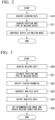
- FIG. 3 is a flowchart representing an example of an analysis process of the welding defect in the welding assistance device according to the embodiment of the present disclosure.
- the acquisition unit 110 acquires welding data collected by the data logger 30 in a period from the start of welding to the end of welding at the welding portion (Step S20).
- the estimation unit 111 estimates the position and the type of the welding defect occurring at the welding portion based on the defect estimation model M recorded in the storage 13 and the acquired welding data (Step S21).
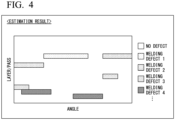
- FIG. 4 is a diagram representing an example of an estimation result of the welding defect according to the embodiment of the present disclosure.
- FIG. 4 represents an example of an estimation result of the position and the type of the welding defect by the estimation unit 111.
- the estimation unit 111 may output the estimation result of the position and the type of the welding defect as a heat map.
- Welding defects 1, 2, 3, 4, ... etc. represent different types of welding defects (for example, surface defects, volume defects, porosity, slag inclusion, and the like).
- the vertical axis of the heat map indicates a layer and pass of welding, and the horizontal axis indicates a position in a welding direction. For example, in a case where a structure having a ring shape such as a pipe is welded while being rotated, the position in the welding direction may be indicated by an angle of the structure.
- the analysis unit 112 analyzes, for each type of welding defect, a parameter having an influence on the estimation result, that is, a parameter that is a factor of the welding defect, based on the welding data and the estimation result of the estimation unit 111.
- the model learned by the supervised learning it is not possible to know an explanatory variable (parameter) and the value thereof which are factors for the occurrence of the welding defect.
- the user can recognize the position and the type of the welding defect occurring by the defect estimation model M, but it is difficult to determine how to change the welding condition (the value of each parameter) in order to suppress the occurrence of the welding defect.
- the analysis unit 112 performs a process of generating analysis data in which the explanatory variable causing the welding defect and the physical quantity thereof are visualized by using a Shapley additive explanations (SHAP) technology.
- SHAP Shapley additive explanations
- the analysis unit 112 specifies a factor parameter that contributes to the occurrence of the welding defect estimated by the estimation unit 111 (Step S22). For example, as represented in FIG. 4 , it is assumed that the occurrence of four types of welding defects 1 to 4 is estimated. In this case, the analysis unit 112 specifies the factor parameter of each of the four types of welding defects 1 to 4.
- FIG. 5 is a first diagram representing an example of the analysis data according to the embodiment of the present disclosure.
- the analysis unit 112 specifies the factor parameter of the welding defect 1
- the analysis unit 112 calculates a SHAP value (contribution degree) representing the degree to which each parameter contributes to the occurrence of the welding defect 1, by using SHAP, and generates analysis data D1 in which each parameter is sorted in descending order of the contribution degree.
- the analysis unit 112 specifies a predetermined number (for example, three) of parameters from parameters having a larger SHAP value as the factor parameters that are the factors that cause the welding defect 1.
- the analysis unit 112 specifies the three parameters 1, 5, and 2 having the three largest SHAP values as the factor parameters of the welding defect 1.
- the analysis unit 112 also specifies the factor parameters of the welding defects 2 to 4 in the similar manner.
- the analysis unit 112 generates analysis data indicating a correlation between the magnitude of the value of the factor parameter and the magnitude of the SHAP value for each of the specified factor parameters (Step S23).
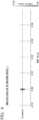
- FIG. 6 is a second diagram representing the example of the analysis data according to the embodiment of the present disclosure.
- the analysis unit 112 generates the analysis data D2 in which each piece of sampling data (measured value at each time) of the parameter 1 measured during welding is plotted according to the magnitude of the SHAP value.
- the horizontal axis indicates the magnitude of the SHAP value.
- each plot is indicated by a different color according to the magnitude of the value of the sampling data. In the example of FIG. 6 , it can be read from the analysis data D2 that the SHAP value tends to increase as the value of the parameter 1 increases.
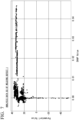
- FIG. 7 is a third diagram representing the example of the analysis data according to the embodiment of the present disclosure.
- the analysis unit 112 generates analysis data D3 plotted according to the magnitude of the value of each piece of sampling data and the magnitude of the SHAP value.
- the vertical axis indicates the magnitude of the value of the parameter 1
- the horizontal axis indicates the magnitude of the SHAP value.
- the analysis data D3 is a scatter diagram representing a correlation between the magnitude of the value of the parameter 1 and the magnitude of the SHAP value.
- the analysis unit 112 generates the analysis data D2 and D3 for the other factor parameters of the welding defect 1 and the factor parameters of the other welding defects 2 to 4 in the similar manner.
- the output unit 114 outputs the analysis data D1 to D3 generated by the analysis unit 112 to the display device 40 and displays the analysis data D1 to D3 (Step S24).
- the user adjusts the recommendation range of the value of the factor parameter of the welding defect among the parameters defined in the welding condition data T with reference to the analysis data D1 to D3 of the welding defects 1 to 4.
- the user changes the recommendation range of the value of the parameter 1 such that the welding defect 1 is less likely to occur.
- the user performs an operation of designating the recommendation range of the value of the parameter 1 to be a range other than 33 to 35.
- the setting unit 113 sets the recommendation range of the parameter 1 according to the designation operation of the user (Step S25), and overwrites and records the recommendation range in the welding condition data T. As a result, the welding condition data T is updated such that the welding defect 1 is less likely to occur.
- the setting unit 113 may automatically set the recommendation range of the parameter 1 to exclude the value of the parameter 1 that causes the SHAP value to be equal to or greater than a predetermined threshold value, based on the analysis data D1 to D3 for each welding defect.
- the threshold value is, for example, a value designated by the user.
- the setting unit 113 excludes 33 to 35 in which the SHAP value is equal to or greater than the threshold value and sets a range of 27 to 32 close to the initial setting as the recommendation range of the value of the parameter 1.
- the setting unit 113 may display the recommendation range temporarily set in the analysis data D3 in the superimposed manner and may officially adopt the recommendation range in a case where the user approves the recommendation range. In a case where the user performs an operation of changing the recommendation range, the setting unit 113 adopts the recommendation range after the change by the user.
- the same parameter may be specified as the factor parameter for a plurality of types of welding defects.
- the parameter 1 is one of the factor parameters for both the welding defect 1 and the welding defect 2.
- the welding defect 1 is likely to occur when the value of the parameter 1 is 33 to 35, and the welding defect 2 is likely to occur when the value of the parameter 1 is 35 to 37.
- the user or the setting unit 113 sets the recommendation range of the value of the parameter 1 to avoid both the range (33 to 35) in which the welding defect 1 is likely to occur and the range (35 to 37) in which the welding defect 2.
- the analysis data D1 to D3 for each welding defect it is possible to appropriately adjust the welding conditions so that it is possible to suppress a plurality of types of welding defects.
- the user may adjust the recommendation range of the value of each factor parameter in consideration of the influence of a plurality of factor parameters of the welding defect 1 on each other, based on the analysis data D1 to D3, metallurgical knowledge, and the like.
- the user may adjust the recommendation range of the value of the other parameter having an influence on the factor parameter.
- the welding assistance device 10 provides the user with the analysis data D1 to D3 in which the user easily understands the contribution degree of each parameter to the welding defect, thereby enabling the user to delve deeper into the cause of the welding defect together with the knowledge of the user. As a result, it is possible to appropriately improve the welding conditions so that the welding defects are less likely to occur.
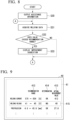
- FIG. 8 is a flowchart representing an example of a presentation process of assistance information in the welding assistance device according to the embodiment of the present disclosure.
- FIG. 9 is a diagram representing an example of the assistance information according to the embodiment of the present disclosure.
- the welding assistance device 10 displays the welding conditions set by the setting unit 113 on the display device 40 as assistance information 41.
- the welder performs the welding work while checking the assistance information 41.
- a flow of a process in which the welding assistance device 10 presents the assistance information 41 will be described with reference to FIGS. 8 and 9 .
- the output unit 114 reads the welding condition data T from the storage 13 and outputs and displays the assistance information 41 including the recommendation range of the value of each parameter on the display device 40 (Step S30).
- the welding condition data T is data in which the recommendation range of the value of the factor parameter of the welding defect is updated in the above-described analysis process.
- the acquisition unit 110 acquires the welding data from the data logger 30 in real time (Step S31).
- the welding data includes a measured value of each parameter.
- a recommendation range 412 of the value of each parameter read from the welding condition data T and an actual measurement value 413 of each parameter acquired by the acquisition unit 110 are displayed.
- the output unit 114 may determine whether the actual measurement value 413 of each parameter exceeds the recommendation range 412, based on the welding condition data T and the welding data acquired by the acquisition unit 110 (Step S32).
- the output unit 114 sets a determination result 414 of the parameter to "OK (no problem)".
- the output unit 114 sets the determination result 414 of the parameter to "NG (with problem)".
- the output unit 114 additionally displays an improvement suggestion display 415 for urging improvement by emphasizing this parameter with a frame, a background color, a text color, or the like (Step S33).
- the welding assistance device 10 repeatedly executes the processes of Steps S31 to S33 during the welding work.
- the welder refers to the assistance information 41 displayed on the display device 40 and operates the welding device 20 to, for example, change or maintain the welding conditions such that the actual measurement value 413 of each parameter falls within the recommendation range 412.
- the welder changes the welding conditions so that the actual measurement value 413 is quickly within the recommendation range 412. Since the recommendation range 412 is a range of values in which the welding defect is less likely to occur, the welder performs the welding work according to the recommendation range 412, thereby making it possible to suppress the occurrence of the welding defect.
- the welding assistance device 10 includes the acquisition unit 110 that acquires the welding data, the estimation unit 111 that estimates the type of the welding defect occurring at the welding portion based on the defect estimation model M, and the analysis unit 112 that specifies the factor parameter of the welding defect based on the welding data and the estimation result of the estimation unit 111 and generates the analysis data indicating the correlation between the magnitude of the value of the factor parameter and the magnitude of the contribution degree (SHAP value) to the welding defect.
- the acquisition unit 110 that acquires the welding data
- the estimation unit 111 that estimates the type of the welding defect occurring at the welding portion based on the defect estimation model M
- the analysis unit 112 that specifies the factor parameter of the welding defect based on the welding data and the estimation result of the estimation unit 111 and generates the analysis data indicating the correlation between the magnitude of the value of the factor parameter and the magnitude of the contribution degree (SHAP value) to the welding defect.
- the welding assistance device 10 can provide the user with analysis data that makes it possible to easily know the parameter and the value which easily cause the welding defect, for each welding defect.
- the user can appropriately set the recommendation range of the value of the parameter that enables suppression of the welding defect, based on the analysis data.
- the welding assistance device 10 further includes the setting unit 113 that sets the recommendation range of the value of the factor parameter not to include the value of the factor parameter that causes the contribution degree to be equal to or greater than a predetermined threshold value.
- the welding assistance device 10 can automatically set the recommendation range of the value of the parameter that enables suppression of the welding defect, based on the analysis data.
- the analysis unit 112 generates analysis data for each type of welding defect.
- the setting unit 113 sets the recommendation range of the values of the factor parameters not to include the values of the factor parameters that cause the contribution degree to the welding defects to be equal to or greater than the threshold value.
- the welding assistance device 10 can appropriately adjust the welding conditions to enable suppression of a plurality of types of welding defects.
- the welding assistance device 10 further includes the output unit 114 that outputs the assistance information 41 including the recommendation range set by the setting unit 113.
- the welding assistance device 10 can provide the welder during the welding work with the range of the value of the parameter in which the welding defect is less likely to occur. As a result, it is possible to suppress the occurrence of the welding defect by allowing the welder to easily and appropriately adjust the value of the parameter regardless of the degree of proficiency.
- the process of various types of processes of the welding assistance device 10 is stored in a computer-readable recording medium in a form of a program, and the various types of processes are executed by reading and executing the program by the computer.
- the computer-readable recording media include magnetic disks, magneto-optical disks, CD-ROMs, DVD-ROMs, semiconductor memories, and the like.
- this computer program may be distributed to a computer via a communication line, and the computer receiving the distribution may execute the program.
- the above program may be for implementing part of the above-described functions. Further, the program may be a so-called difference file (difference program) capable of realizing the functions described above in combination with a program recorded in advance in the computer system.
- difference file difference program
- the welding assistance device, the welding assistance method, and the program described in the above-described embodiment are ascertained as follows, for example.
- the welding assistance device With the welding assistance device, the welding assistance method, and the program according to the present disclosure, it is possible to suppress the occurrence of a welding defect in welding work performed by a welder.
Landscapes
- Engineering & Computer Science (AREA)
- Mechanical Engineering (AREA)
- Physics & Mathematics (AREA)
- Plasma & Fusion (AREA)
- Quality & Reliability (AREA)
- Artificial Intelligence (AREA)
- Evolutionary Computation (AREA)
- Theoretical Computer Science (AREA)
- Arc Welding Control (AREA)
- General Factory Administration (AREA)
Applications Claiming Priority (2)
| Application Number | Priority Date | Filing Date | Title |
|---|---|---|---|
| JP2022111538A JP2024010290A (ja) | 2022-07-12 | 2022-07-12 | 溶接支援装置、溶接支援方法、およびプログラム |
| PCT/JP2023/002602 WO2024014016A1 (ja) | 2022-07-12 | 2023-01-27 | 溶接支援装置、溶接支援方法、およびプログラム |
Publications (2)
| Publication Number | Publication Date |
|---|---|
| EP4523840A1 true EP4523840A1 (de) | 2025-03-19 |
| EP4523840A4 EP4523840A4 (de) | 2025-10-08 |
Family
ID=89536370
Family Applications (1)
| Application Number | Title | Priority Date | Filing Date |
|---|---|---|---|
| EP23839196.5A Pending EP4523840A4 (de) | 2022-07-12 | 2023-01-27 | Schweisshilfsvorrichtung, schweisshilfsverfahren und programm |
Country Status (4)
| Country | Link |
|---|---|
| EP (1) | EP4523840A4 (de) |
| JP (1) | JP2024010290A (de) |
| KR (1) | KR20250002736A (de) |
| WO (1) | WO2024014016A1 (de) |
Cited By (1)
| Publication number | Priority date | Publication date | Assignee | Title |
|---|---|---|---|---|
| CN121339606A (zh) * | 2025-12-18 | 2026-01-16 | 纽托克流体控制有限公司 | 一种蝶阀加工过程中的自适应控制方法、系统及存储介质 |
Family Cites Families (10)
| Publication number | Priority date | Publication date | Assignee | Title |
|---|---|---|---|---|
| JPS6126174U (ja) | 1984-07-24 | 1986-02-17 | 三菱電機株式会社 | 高周波加熱装置の高周波出力検出装置 |
| JP3893738B2 (ja) * | 1998-04-28 | 2007-03-14 | 石川島播磨重工業株式会社 | Tig溶接の欠陥判定方法 |
| IT1397985B1 (it) * | 2010-02-08 | 2013-02-04 | Prima Ind Spa | Procedimento di monitoraggio della qualità di processi di lavorazione laser e relativo sistema |
| JP6126174B2 (ja) | 2015-07-31 | 2017-05-10 | ファナック株式会社 | 機械学習装置、アーク溶接制御装置、アーク溶接ロボットシステムおよび溶接システム |
| CN109472358B (zh) * | 2018-10-17 | 2021-10-19 | 深圳市微埃智能科技有限公司 | 基于神经网络的焊接工艺参数推荐方法、装置及机器人 |
| CN110116254B (zh) * | 2019-05-05 | 2021-07-02 | 中国石油天然气集团有限公司 | 油气集输用双金属复合管环焊接头缺陷预测与控制方法 |
| JP6854984B1 (ja) * | 2020-05-29 | 2021-04-07 | 三菱電機株式会社 | レーザ加工システム |
| JP7303163B2 (ja) * | 2020-07-20 | 2023-07-04 | 株式会社神戸製鋼所 | 欠陥発生予測方法、及び欠陥発生予測装置 |
| JP7491821B2 (ja) * | 2020-11-30 | 2024-05-28 | 三菱重工業株式会社 | 要因推定方法、予測方法、属性値推定方法、要因推定装置、予測装置、属性値推定装置およびプログラム |
| JP7574657B2 (ja) | 2021-01-20 | 2024-10-29 | トヨタ自動車株式会社 | 交流電動機の制御装置 |
-
2022
- 2022-07-12 JP JP2022111538A patent/JP2024010290A/ja active Pending
-
2023
- 2023-01-27 EP EP23839196.5A patent/EP4523840A4/de active Pending
- 2023-01-27 KR KR1020247040150A patent/KR20250002736A/ko active Pending
- 2023-01-27 WO PCT/JP2023/002602 patent/WO2024014016A1/ja not_active Ceased
Cited By (2)
| Publication number | Priority date | Publication date | Assignee | Title |
|---|---|---|---|---|
| CN121339606A (zh) * | 2025-12-18 | 2026-01-16 | 纽托克流体控制有限公司 | 一种蝶阀加工过程中的自适应控制方法、系统及存储介质 |
| CN121339606B (zh) * | 2025-12-18 | 2026-03-17 | 纽托克流体控制有限公司 | 一种蝶阀加工过程中的自适应控制方法、系统及存储介质 |
Also Published As
| Publication number | Publication date |
|---|---|
| KR20250002736A (ko) | 2025-01-07 |
| EP4523840A4 (de) | 2025-10-08 |
| JP2024010290A (ja) | 2024-01-24 |
| WO2024014016A1 (ja) | 2024-01-18 |
Similar Documents
| Publication | Publication Date | Title |
|---|---|---|
| EP4523840A1 (de) | Schweisshilfsvorrichtung, schweisshilfsverfahren und programm | |
| US11327292B2 (en) | Method of operating observation device, observation device, and recording medium | |
| EP3991911A1 (de) | Reparaturschweissungsuntersuchungsvorrichtung und reparaturschweissungsuntersuchungsverfahren | |
| JP2009282804A (ja) | 比較判定装置及び比較判定方法 | |
| JP6874864B2 (ja) | 画像処理装置、画像処理方法及びプログラム | |
| CN108571997A (zh) | 一种检测探头稳定接触被测点的方法和装置 | |
| JP2020086698A (ja) | 画像処理装置、画像処理システム、および画像処理プログラム | |
| JP2015175770A (ja) | 音識別条件設定支援装置および音識別条件設定支援方法 | |
| JPWO2007148380A1 (ja) | 押込型材料試験機、試験方法、および試験用プログラム製品 | |
| CN115100141A (zh) | 焊接偏移异常判定方法、装置、设备及存储介质 | |
| JP2009187288A (ja) | プロジェクト変調検出方法およびプロジェクト変調検出装置 | |
| JP7599389B2 (ja) | 溶接支援方法、溶接支援システム及びプログラム | |
| EP3690743A1 (de) | Trainingsvorrichtung, trainingsverfahren und trainingsprogramm | |
| EP4174603B1 (de) | Datenverarbeitungsvorrichtung, -verfahren und -programm | |
| CN114252810B (zh) | 变压器声振故障监测方法、系统、设备及可读存储介质 | |
| TWI576677B (zh) | 自動化監測方法、系統與電腦程式產品 | |
| US20250378762A1 (en) | Welding assistance device, welding assistance method, and program | |
| CN117733848A (zh) | 一种手术机器人控制系统和方法 | |
| JP4402613B2 (ja) | プラント異常監視システム及びプラント異常監視方法 | |
| KR101312526B1 (ko) | 전기로 아크 안정도 측정 방법 및 이를 이용한 전기로 조업 방법 | |
| KR102940323B1 (ko) | Ess 데이터 보간 시스템 및 방법 | |
| CN114535768B (zh) | 电阻点焊飞溅识别方法、装置、设备及存储介质 | |
| JP2002100547A (ja) | 半導体製造装置の信号データ解析装置及び解析方法 | |
| JPWO2021074945A5 (de) | ||
| EP4534235A1 (de) | Schweissdatensammelverfahren |
Legal Events
| Date | Code | Title | Description |
|---|---|---|---|
| STAA | Information on the status of an ep patent application or granted ep patent |
Free format text: STATUS: THE INTERNATIONAL PUBLICATION HAS BEEN MADE |
|
| PUAI | Public reference made under article 153(3) epc to a published international application that has entered the european phase |
Free format text: ORIGINAL CODE: 0009012 |
|
| STAA | Information on the status of an ep patent application or granted ep patent |
Free format text: STATUS: REQUEST FOR EXAMINATION WAS MADE |
|
| 17P | Request for examination filed |
Effective date: 20241212 |
|
| AK | Designated contracting states |
Kind code of ref document: A1 Designated state(s): AL AT BE BG CH CY CZ DE DK EE ES FI FR GB GR HR HU IE IS IT LI LT LU LV MC ME MK MT NL NO PL PT RO RS SE SI SK SM TR |
|
| A4 | Supplementary search report drawn up and despatched |
Effective date: 20250909 |
|
| RIC1 | Information provided on ipc code assigned before grant |
Ipc: B23K 31/00 20060101AFI20250903BHEP |
|
| DAV | Request for validation of the european patent (deleted) | ||
| DAX | Request for extension of the european patent (deleted) |