EP4521491A2 - Solid-state battery layer structure and method for producing the same - Google Patents
Solid-state battery layer structure and method for producing the same Download PDFInfo
- Publication number
- EP4521491A2 EP4521491A2 EP25150035.1A EP25150035A EP4521491A2 EP 4521491 A2 EP4521491 A2 EP 4521491A2 EP 25150035 A EP25150035 A EP 25150035A EP 4521491 A2 EP4521491 A2 EP 4521491A2
- Authority
- EP
- European Patent Office
- Prior art keywords
- anode
- layer
- nanowire structures
- nanowire
- current collector
- Prior art date
- Legal status (The legal status is an assumption and is not a legal conclusion. Google has not performed a legal analysis and makes no representation as to the accuracy of the status listed.)
- Withdrawn
Links
Images




Classifications
-
- H—ELECTRICITY
- H01—ELECTRIC ELEMENTS
- H01M—PROCESSES OR MEANS, e.g. BATTERIES, FOR THE DIRECT CONVERSION OF CHEMICAL ENERGY INTO ELECTRICAL ENERGY
- H01M4/00—Electrodes
- H01M4/02—Electrodes composed of, or comprising, active material
- H01M4/62—Selection of inactive substances as ingredients for active masses, e.g. binders, fillers
- H01M4/624—Electric conductive fillers
-
- H—ELECTRICITY
- H01—ELECTRIC ELEMENTS
- H01M—PROCESSES OR MEANS, e.g. BATTERIES, FOR THE DIRECT CONVERSION OF CHEMICAL ENERGY INTO ELECTRICAL ENERGY
- H01M4/00—Electrodes
- H01M4/02—Electrodes composed of, or comprising, active material
- H01M4/13—Electrodes for accumulators with non-aqueous electrolyte, e.g. for lithium-accumulators; Processes of manufacture thereof
- H01M4/134—Electrodes based on metals, Si or alloys
-
- H—ELECTRICITY
- H01—ELECTRIC ELEMENTS
- H01M—PROCESSES OR MEANS, e.g. BATTERIES, FOR THE DIRECT CONVERSION OF CHEMICAL ENERGY INTO ELECTRICAL ENERGY
- H01M10/00—Secondary cells; Manufacture thereof
- H01M10/05—Accumulators with non-aqueous electrolyte
- H01M10/052—Li-accumulators
-
- H—ELECTRICITY
- H01—ELECTRIC ELEMENTS
- H01M—PROCESSES OR MEANS, e.g. BATTERIES, FOR THE DIRECT CONVERSION OF CHEMICAL ENERGY INTO ELECTRICAL ENERGY
- H01M10/00—Secondary cells; Manufacture thereof
- H01M10/05—Accumulators with non-aqueous electrolyte
- H01M10/052—Li-accumulators
- H01M10/0525—Rocking-chair batteries, i.e. batteries with lithium insertion or intercalation in both electrodes; Lithium-ion batteries
-
- H—ELECTRICITY
- H01—ELECTRIC ELEMENTS
- H01M—PROCESSES OR MEANS, e.g. BATTERIES, FOR THE DIRECT CONVERSION OF CHEMICAL ENERGY INTO ELECTRICAL ENERGY
- H01M10/00—Secondary cells; Manufacture thereof
- H01M10/05—Accumulators with non-aqueous electrolyte
- H01M10/056—Accumulators with non-aqueous electrolyte characterised by the materials used as electrolytes, e.g. mixed inorganic/organic electrolytes
- H01M10/0561—Accumulators with non-aqueous electrolyte characterised by the materials used as electrolytes, e.g. mixed inorganic/organic electrolytes the electrolyte being constituted of inorganic materials only
- H01M10/0562—Solid materials
-
- H—ELECTRICITY
- H01—ELECTRIC ELEMENTS
- H01M—PROCESSES OR MEANS, e.g. BATTERIES, FOR THE DIRECT CONVERSION OF CHEMICAL ENERGY INTO ELECTRICAL ENERGY
- H01M10/00—Secondary cells; Manufacture thereof
- H01M10/05—Accumulators with non-aqueous electrolyte
- H01M10/058—Construction or manufacture
-
- H—ELECTRICITY
- H01—ELECTRIC ELEMENTS
- H01M—PROCESSES OR MEANS, e.g. BATTERIES, FOR THE DIRECT CONVERSION OF CHEMICAL ENERGY INTO ELECTRICAL ENERGY
- H01M10/00—Secondary cells; Manufacture thereof
- H01M10/05—Accumulators with non-aqueous electrolyte
- H01M10/058—Construction or manufacture
- H01M10/0585—Construction or manufacture of accumulators having only flat construction elements, i.e. flat positive electrodes, flat negative electrodes and flat separators
-
- H—ELECTRICITY
- H01—ELECTRIC ELEMENTS
- H01M—PROCESSES OR MEANS, e.g. BATTERIES, FOR THE DIRECT CONVERSION OF CHEMICAL ENERGY INTO ELECTRICAL ENERGY
- H01M4/00—Electrodes
- H01M4/02—Electrodes composed of, or comprising, active material
- H01M4/04—Processes of manufacture in general
- H01M4/0402—Methods of deposition of the material
- H01M4/0421—Methods of deposition of the material involving vapour deposition
- H01M4/0423—Physical vapour deposition
- H01M4/0426—Sputtering
-
- H—ELECTRICITY
- H01—ELECTRIC ELEMENTS
- H01M—PROCESSES OR MEANS, e.g. BATTERIES, FOR THE DIRECT CONVERSION OF CHEMICAL ENERGY INTO ELECTRICAL ENERGY
- H01M4/00—Electrodes
- H01M4/02—Electrodes composed of, or comprising, active material
- H01M4/04—Processes of manufacture in general
- H01M4/0402—Methods of deposition of the material
- H01M4/0421—Methods of deposition of the material involving vapour deposition
- H01M4/0428—Chemical vapour deposition
-
- H—ELECTRICITY
- H01—ELECTRIC ELEMENTS
- H01M—PROCESSES OR MEANS, e.g. BATTERIES, FOR THE DIRECT CONVERSION OF CHEMICAL ENERGY INTO ELECTRICAL ENERGY
- H01M4/00—Electrodes
- H01M4/02—Electrodes composed of, or comprising, active material
- H01M4/13—Electrodes for accumulators with non-aqueous electrolyte, e.g. for lithium-accumulators; Processes of manufacture thereof
- H01M4/139—Processes of manufacture
- H01M4/1395—Processes of manufacture of electrodes based on metals, Si or alloys
-
- H—ELECTRICITY
- H01—ELECTRIC ELEMENTS
- H01M—PROCESSES OR MEANS, e.g. BATTERIES, FOR THE DIRECT CONVERSION OF CHEMICAL ENERGY INTO ELECTRICAL ENERGY
- H01M4/00—Electrodes
- H01M4/02—Electrodes composed of, or comprising, active material
- H01M4/36—Selection of substances as active materials, active masses, active liquids
- H01M4/38—Selection of substances as active materials, active masses, active liquids of elements or alloys
- H01M4/386—Silicon or alloys based on silicon
-
- H—ELECTRICITY
- H01—ELECTRIC ELEMENTS
- H01M—PROCESSES OR MEANS, e.g. BATTERIES, FOR THE DIRECT CONVERSION OF CHEMICAL ENERGY INTO ELECTRICAL ENERGY
- H01M4/00—Electrodes
- H01M4/02—Electrodes composed of, or comprising, active material
- H01M4/36—Selection of substances as active materials, active masses, active liquids
- H01M4/48—Selection of substances as active materials, active masses, active liquids of inorganic oxides or hydroxides
- H01M4/52—Selection of substances as active materials, active masses, active liquids of inorganic oxides or hydroxides of nickel, cobalt or iron
- H01M4/525—Selection of substances as active materials, active masses, active liquids of inorganic oxides or hydroxides of nickel, cobalt or iron of mixed oxides or hydroxides containing iron, cobalt or nickel for inserting or intercalating light metals, e.g. LiNiO2, LiCoO2 or LiCoOxFy
-
- H—ELECTRICITY
- H01—ELECTRIC ELEMENTS
- H01M—PROCESSES OR MEANS, e.g. BATTERIES, FOR THE DIRECT CONVERSION OF CHEMICAL ENERGY INTO ELECTRICAL ENERGY
- H01M4/00—Electrodes
- H01M4/02—Electrodes composed of, or comprising, active material
- H01M4/62—Selection of inactive substances as ingredients for active masses, e.g. binders, fillers
-
- H—ELECTRICITY
- H01—ELECTRIC ELEMENTS
- H01M—PROCESSES OR MEANS, e.g. BATTERIES, FOR THE DIRECT CONVERSION OF CHEMICAL ENERGY INTO ELECTRICAL ENERGY
- H01M4/00—Electrodes
- H01M4/02—Electrodes composed of, or comprising, active material
- H01M4/64—Carriers or collectors
- H01M4/66—Selection of materials
- H01M4/661—Metal or alloys, e.g. alloy coatings
-
- H—ELECTRICITY
- H01—ELECTRIC ELEMENTS
- H01M—PROCESSES OR MEANS, e.g. BATTERIES, FOR THE DIRECT CONVERSION OF CHEMICAL ENERGY INTO ELECTRICAL ENERGY
- H01M4/00—Electrodes
- H01M4/02—Electrodes composed of, or comprising, active material
- H01M4/64—Carriers or collectors
- H01M4/70—Carriers or collectors characterised by shape or form
-
- H—ELECTRICITY
- H01—ELECTRIC ELEMENTS
- H01M—PROCESSES OR MEANS, e.g. BATTERIES, FOR THE DIRECT CONVERSION OF CHEMICAL ENERGY INTO ELECTRICAL ENERGY
- H01M4/00—Electrodes
- H01M4/02—Electrodes composed of, or comprising, active material
- H01M2004/026—Electrodes composed of, or comprising, active material characterised by the polarity
- H01M2004/027—Negative electrodes
-
- H—ELECTRICITY
- H01—ELECTRIC ELEMENTS
- H01M—PROCESSES OR MEANS, e.g. BATTERIES, FOR THE DIRECT CONVERSION OF CHEMICAL ENERGY INTO ELECTRICAL ENERGY
- H01M4/00—Electrodes
- H01M4/02—Electrodes composed of, or comprising, active material
- H01M2004/026—Electrodes composed of, or comprising, active material characterised by the polarity
- H01M2004/028—Positive electrodes
-
- H—ELECTRICITY
- H01—ELECTRIC ELEMENTS
- H01M—PROCESSES OR MEANS, e.g. BATTERIES, FOR THE DIRECT CONVERSION OF CHEMICAL ENERGY INTO ELECTRICAL ENERGY
- H01M2300/00—Electrolytes
- H01M2300/0017—Non-aqueous electrolytes
- H01M2300/0065—Solid electrolytes
- H01M2300/0068—Solid electrolytes inorganic
-
- H—ELECTRICITY
- H01—ELECTRIC ELEMENTS
- H01M—PROCESSES OR MEANS, e.g. BATTERIES, FOR THE DIRECT CONVERSION OF CHEMICAL ENERGY INTO ELECTRICAL ENERGY
- H01M4/00—Electrodes
- H01M4/02—Electrodes composed of, or comprising, active material
- H01M4/64—Carriers or collectors
- H01M4/70—Carriers or collectors characterised by shape or form
- H01M4/75—Wires, rods or strips
-
- Y—GENERAL TAGGING OF NEW TECHNOLOGICAL DEVELOPMENTS; GENERAL TAGGING OF CROSS-SECTIONAL TECHNOLOGIES SPANNING OVER SEVERAL SECTIONS OF THE IPC; TECHNICAL SUBJECTS COVERED BY FORMER USPC CROSS-REFERENCE ART COLLECTIONS [XRACs] AND DIGESTS
- Y02—TECHNOLOGIES OR APPLICATIONS FOR MITIGATION OR ADAPTATION AGAINST CLIMATE CHANGE
- Y02E—REDUCTION OF GREENHOUSE GAS [GHG] EMISSIONS, RELATED TO ENERGY GENERATION, TRANSMISSION OR DISTRIBUTION
- Y02E60/00—Enabling technologies; Technologies with a potential or indirect contribution to GHG emissions mitigation
- Y02E60/10—Energy storage using batteries
-
- Y—GENERAL TAGGING OF NEW TECHNOLOGICAL DEVELOPMENTS; GENERAL TAGGING OF CROSS-SECTIONAL TECHNOLOGIES SPANNING OVER SEVERAL SECTIONS OF THE IPC; TECHNICAL SUBJECTS COVERED BY FORMER USPC CROSS-REFERENCE ART COLLECTIONS [XRACs] AND DIGESTS
- Y02—TECHNOLOGIES OR APPLICATIONS FOR MITIGATION OR ADAPTATION AGAINST CLIMATE CHANGE
- Y02P—CLIMATE CHANGE MITIGATION TECHNOLOGIES IN THE PRODUCTION OR PROCESSING OF GOODS
- Y02P70/00—Climate change mitigation technologies in the production process for final industrial or consumer products
- Y02P70/50—Manufacturing or production processes characterised by the final manufactured product
Definitions
- the present invention relates to solid-state battery layer structures and methods of fabricating the same.
- Lithium-ion battery technologies with their high charge capacity levels and rechargeability, have evolved storage of electrical energy and played a significant part in enabling mobile electronic devices such as portable computers and telephones. Lithium-ion batteries have also been of importance for the resurgence of electric vehicles. However, the by now conventional lithium-ion battery technology comes with its own range of issues. In order to achieve battery improvements, essentially across the entire board, battery device designs featuring solid electrolytes, as opposed to traditional liquid electrolytes, are gaining popularity. Batteries comprising a solid electrolyte are generally referred to as solid-state batteries. While solid electrolytes may be very favorable for e.g.
- An object of the present invention is to at least mitigate some of the aforementioned issues and to provide solid-state battery layer structures that enable improved battery charge capacity as well as methods of fabricating the same structures.
- a solid-state battery layer structure comprising:
- the term “arranged on” may refer to having the layers or structures arranged above each other in a vertical direction of the layer structure or stack.
- the vertical direction may be substantially perpendicular and normal to the surfaces of the layers or structures in the layer structures.
- the word “comprises” may throughout this disclosure refer to layers and structures at least partially comprising a certain material. The word does not exclude the layer or structure from containing impurities of other materials nor does it exclude the layer or structure substantially consisting of the comprised material.
- Silicon anodes may be advantageous for increasing the charge capacity for e.g. lithium-ion based batteries. This is due to silicon atoms, often alloyed to form compound anode materials, are better than carbon atoms, in conventional graphite anodes, at binding to and thus holding a larger number of lithium atoms. Battery charge capacity may be recorded in the units ampere hours or coulombs. Additionally, the use of silicon anodes, may simplify production of the battery layer structure and improve yield as sophisticated techniques and methods commonly used in microelectronic fabrication may be utilized. As such, solid-state batteries may be effectively minaturized. Silicon anodes may be based on monocrystalline substrates. As such, solid-state battery layer structures may be formed more integrally with silicon-based microelectronics. Thus, electronic circuits and devices with integrated solid-state batteries may be both enabled and miniaturized.
- the anode layer may comprise gallium nitride.
- gallium nitride in the anode layer may mitigate issues in the prior art.
- the charge capacity of a solid-state battery with a gallium nitride anode material may be ⁇ 2.5 times larger than that of a solid-state battery with conventional graphite anodes.
- the diffusion barrier for lithium-ion diffusion may also be lower with a gallium nitride anode compared to the same barrier for a graphite anode. This may be advantageous for rapid battery charging.
- the solid-state battery layer structure may further comprise a plurality of nanowire structures, wherein said nanowire structures are arranged on the anode layer and, wherein said nanowire structures are laterally and vertically enclosed by the solid electrolyte layer.
- nanowire structure also referred to as just nanostructures, may refer to elongated structures with a dimension such as a diameter or a length on the nanometer scale, i.e. 1-100nm. Nanowire structures may be simple and substantially one-dimensional or contain, along its length, at least one node from which at least two separate branches extend. Such a nanowire structure may be referred to as a nanotree or a nanowire tree structure.
- laterally and vertically enclosed may refer to enclosing the nanowire structures both laterally or radially and vertically or longitudinally.
- the whole nanowire structures, including all eventual branches, faces, and surfaces, may be covered by solid electrolyte material forming the solid electrolyte layer.
- Nanowire structures may advantageously increase the effective interface area between the anode and the solid electrolyte and hence also the battery charge capacity and potentially also increase the rate at which charge carrying ions, e.g. lithium ions, may alloy with the anode material. Additionally, the use of nanowire structures may mitigate the volume expansion of some materials during battery operation. E.g. bulk silicon anodes may expand 300-400% during lithiation, i.e. the process of charging a battery when the charge carriers are lithium ions. Nanostructures, such as e.g. nanowires are advantageous as their volume expansion may be much less severe than that of bulk materials. This advantage of nanostructures may be attributed to their volume expansion being more local and distributed as compared to when a bulk layer expands as one piece.
- volume expansion issue may be even more relevant for solid electrolyte batteries as solids generally allow for less mechanical movement than liquids.
- nanostructures such as these may be produced in a structured and well-defined manner and the effective interface area may still be increased even if irregularities would somehow occur.
- Each nanowire structure of said plurality of nanowire structures may comprise a vertical stem and a plurality of branches extending from said vertical stem, wherein the vertical stems of said plurality of nanowire structures are arranged perpendicularly to a top surface of the anode layer.
- arranged perpendicularly may refer to arranging the whole nanowire structures, and in particular vertical stems, such that they extend in a substantially perpendicular and normal direction to the top surface of the anode layer. This direction may alternatively be understood as corresponding to the vertical direction of the layer structure.
- Including tree shaped nanowire structures, comprising both stems and branches, may further increase the effective interface area between the anode and the solid electrolyte and the battery charge capacity. Additionally, the tree shaped nanowire structures may further mitigate the volume expansion issue described in the above.
- the plurality of tree shaped nanowire structures, or nanotrees may be visually compared or likened to a nanoforest.
- Said plurality of nanowire structures may comprise silicon.
- Such nanowire structures may be advantageous for being relatively easy to form due to the numerous silicon formation and processing methods that are available. As the silicon nanowire structures would effectively extend the anode, the same advantages as those of using silicon as an anode material apply, i.e. the charge capacity may be increased.
- Said plurality of nanowire structures may comprise gallium nitride.
- gallium nitride nanowire structures extending the anode may also improve the charge capacity of the solid-state battery.
- the anode layer may comprise a plurality of metal vias connecting the plurality of nanowire structures with the anode current collector metal layer.
- a lower resistance or more ohmic conduction path may be provided to the base of the nanowire structures.
- the solid electrolyte layer may comprise lithium phosphate.
- Lithium phosphate or compounds comprising lithium phosphate, may be considered advantageous materials for the solid electrolyte layer in a solid-state battery layer structure.
- Lithium phosphate may allow transport of lithium ions between the anode and cathode of the solid-state battery by solid state diffusion via atomic vacancies in the solid electrolyte material lattice.
- the cathode layer may comprise lithium cobalt oxide or another metal oxide.
- Lithium cobalt oxide may be be considered an advantageous material for the cathode layer.
- the cathode current collector metal layer may comprise aluminium.
- Aluminium may provide a low resistance or adequately ohmic conduction path to the cathode layer.
- the anode current collector metal layer may comprise copper.
- Copper may provide a low resistance or adequately ohmic conduction path to the anode layer and if present also to the nanowire structures.
- a method for producing a solid-state battery layer structure comprising:
- the word “forming” may refer to any method or technique for forming a layer or structure.
- the word “depositing” may refer to any method or the use of a technique for forming a layer or structure by addition of material. Examples of deposition techniques may include chemical vapor deposition (CVD), physical vapor deposition (PVD), metalorganic vapor-phase epitaxty (MOVPE), sputtering, evaporation, etc.
- CVD chemical vapor deposition
- PVD physical vapor deposition
- MOVPE metalorganic vapor-phase epitaxty
- a step of forming may refer to depositing.
- the anode current collector metal layer should be understood as beeing deposited on the bottom surface of the anode layer, i.e. not on or above the anode layer when considering the vertical direction of the layer structure or stack.
- Such a method may be used to produce solid-state battery layer structures according to the first aspect. Therefore, advantages may closely correspond to those described for the first aspect.
- the method may provide a relatively low complexity way to produce a solid-state battery layer structure by using existing, microelectronic, fabrication methods and techniques. Close integration with electronic devices and miniaturization may be enabled by the method.
- the method may further comprise etching, from the bottom surface of the anode layer, holes through the anode layer, wherein the step of depositing the anode current collector metal layer on the bottom surface of the anode layer further comprises filling the holes with a same material as a material of the anode current collector metal layer.
- etching and filling may be understood as corresponding to forming the vias to the bases of the nanowire structures as described in the first aspect.
- backside wafer vias may be provided by plasma etching of silicon oxide or silicon nitride as a hard mask for deep reactive-ion etching (DRIE) of silicon.
- DRIE deep reactive-ion etching
- the method may further comprise aligning the holes through the anode layer with said plurality of nanowire structures.
- the step of forming said plurality of nanowire structures may comprise:
- Forming nanowire structures by particle formation, e.g. deposition, and subsequent particle mediated epitaxy may be an effective way to form tree shaped nanowire structures comprising first order nanowire structures, i.e. vertical stems, and second order nanowire structures, i.e. branches wherein the first order nanowire structures act as bases for second order nanowire structures.
- the branches may be understood as being grown substantially radially out from the vertical stems.
- the branch seed particles may be understood as being deposited on radial or lateral surface faces, and along the entire length, of the vertical stems.
- Fig. 1 shows a cross sectional view of a solid-state battery layer structure 100.
- the solid-state battery layer structure comprises:
- the anode current collector metal layer 110 may comprise or substantially consist of copper.
- the anode current collector metal layer 110 may alternatively or additionally comprise one of the other metal materials: gold, silver, platina, nickel, titanium, zinc, chromium, tin, lead, manganese, cobalt, and iron.
- the anode current collector metal layer 110 may comprise an alloy material.
- the anode layer 120 may comprise ⁇ 111> silicon.
- the anode layer 120 may be a crystaline silicon substrate or wafer.
- the anode layer 120 may comprise or substantially consist of gallium nitride.
- the anode layer 120 may comprise a thin upper sublayer of gallium nitride arranged on a lower sublayer of silicon.
- the anode layer comprising 120 GaN may be passivated with hydrogen. Lithium may be incorporated or alloyed into the anode layer 120.
- the solid electrolyte layer 140 may comprise or substantially consist of lithium phosphate (Li 3 PO 4 ).
- the solid electrlyte layer 140 may additionally or alternatively comprise or substantially consist of other materials such as lithium iron phosphate (Li 3 FePO 4 ) or lithium phosphorus oxynitride (LiPON).
- the solid electrolyte layer 140 may have a thickness in the range 500-5000nm.
- the cathode current collector metal layer 160 may comprise or substantially consist of aluminium.
- the cathode current collector metal layer 160 may alternatively or additionally comprise one of the other metal materials: gold, silver, platina, nickel, titanium, zinc, chromium, tin, lead, manganese, cobalt, and iron.
- the cathode current collector metal layer 160 may comprise an alloy material.
- Fig. 2 shows the solid-state battery 100 layer structure further comprising a plurality of nanowire structures 130.
- Said nanowire structures 130 may be arranged on the anode layer 120.
- Said nanowire structures 130 may be laterally and vertically enclosed by the solid electrolyte layer 140.
- Each nanowire structure 130 of said plurality of nanowire structures may comprise a vertical stem 132 and a plurality of branches 134 extending from said vertical stem 132.
- the vertical stems of said plurality of nanowire structures may be arranged perpendicularly to a top surface 122 of the anode layer 120.
- the nanowire structures 130 may be arranged in a hexagonal pattern on the top surface 122 of the anode layer 120.
- the vertical stems 132 of the nanowire structures 130 may be arranged with a spacing to the nearest other vertical stem 132 in the range 100-1000nm. More preferably, the spacing is in the range 250-750nm. Most preferably, the spacing is in the range 400-600nm.
- the nanowire structures 130 may alternatively be arranged on the anode layer 120 with arbitrary orientations of each individual nanowire structure 130. Such formation may be less complex while still increasing the effective anode-electrolyte interface area.
- the vertical stems 132 may have a length in the range 500-5000nm. More preferably, the the length is in the range 1000-3000nm. Most preferably, the length is in the range 1500nm-2500nm.
- the branches 134 may have a length in the range 50-500nm. More preferably, the lenth is in the range 50-250n. Most preferably, the length is in the range 50-150nm.
- Said plurality of nanowire structures may comprise or substantially consist of silicon.
- Said nanowire structures 130 may comprise crystaline silicon with a crystal lattice direction ⁇ 111 > corresponding to the vertical direction of the nanowire structures.
- Said plurality of nanowire structures may comprise or substantially consist of gallium nitride.
- Said nanowire structures 130 may comprise crystaline gallium nitide with a crystal lattice direction ⁇ 0001 > corresponding to the vertical direction of the nanowire structures.
- Gallium nitride nanowire structures 130 may feature a hydrogen passivation layer on the surfaces and faces of the nanowire structures 130 to saturate unsaturaed dangling bonds at the gallium nitride surface.
- the nanowire structures 130 may incorporate or alloy Li into their surface or bulk lattice.
- Fig. 3 shows the anode layer 120 comprising a plurality of metal vias 224 connecting the plurality of nanowire structures 130 with the anode current collector metal layer 110.
- the metal vias 224 may comprise or substantially consist of a same material existing in the anode current collector metal layer 110.
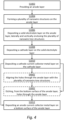
- Fig. 4 shows a flowchart of a method for producing a solid-state battery layer structure 100. The method is shown to comprise steps of:
- the plurality of nanowires structures 130 may be formed by a MOVPE, or a CVD process.
- the process may be seed particle mediated.
- the pattern in which the nanowire structures 130 are arranged may be formed using lithography techniques such as ultra-violet lithography (UVL), electron beam lithography (EBL), and nanoimprint lithography (NIL). Pattern transfer may be achieved through etching methods.
- UVL ultra-violet lithography
- EBL electron beam lithography
- NIL nanoimprint lithography
- the cathode layer 150 may be deposited S1008 by a CVD process.
- the cathode current collector metal layer 160 may be deposited S1010 by a PVD process.
- the anode current collector metal layer 110 may be deposited S1012 by a PVD process.
- Fig. 4 also shows how the method may further comprise etching S3002, from the bottom surface 326 of the anode layer 120, holes 328 through the anode layer 120.
- the step of depositing S1012 the anode current collector metal layer 110 on the bottom surface 326 of the anode layer 120 further comprises filling the holes 328 with a same material as a material of the anode current collector metal layer 110.
- the filled in holes 328 may correspond to the vias 224 in Fig. 3 .
- the method may further comprise aligning S4002 the holes 328 through the anode layer 120 with said plurality of nanowire structures 130 i.e. so that each hole 328 corresponds to the position of a nanowire structure 130.
- the holes 328 may be etched S3002 by a reactive ion etching (RIE) process.
- RIE reactive ion etching
- the RIE process may be a dry RIE process.
- Figs. 5a-5h show cross sectional views of layers and structures of the solid-state battery layer structure 100 during various stages of its production.
- Fig. 5a shows the anode layer 120 having been provided S1002, the anode layer 120 being the base for subsequent processing steps.
- Fig. 5b shows the plurality of nanowire structures 130, each comprising vertical stems 132 and branches 134, having been formed S1004 wherein the vertical stems 132 of the nanowire structures 130 are formed perpendicularly to the top surface 122 of the anode layer 120.
- Fig. 5c shows the solid electrolyte layer 140 having been deposited S1006 on the anode layer 120 such that it laterally and vertically encloses the plurality of nanowire structures 130.
- Fig. 5d shows the cathode layer 150 having been deposited S1008 on the solid electrolyte layer 140.
- Fig. 5e shows the cathode current collector metal layer 160 having been deposited S1010 on the cathode layer 150.
- the battery layer structure may be flipped after step S1010 in order to accommodate subsequent processing steps.
- Fig. 5f shows the anode current collector metal layer 110 having been deposited S1012 on the bottom surface 326 of the anode layer 120, thus completing the solid-state battery layer structure 100.
- Figs. 5g-h show an alternative route to complete the layer structure 100 compared to the route shown in Fig. 5f .
- Fig. 5g shows the holes 328 having been etched S3002 from the bottom through the anode layer 120, from its bottom surface 326.
- the holes 328 are also shown to have been aligned S4002 with the nanowire structures 130.
- Fig. 5h shows the anode current collector metal layer 110 having been deposited S1012 on the bottom surface 326 of the anode layer 120 and into the holes 328 through the anode layer 120, thus completing the solid-state battery layer structure 100.
- Fig. 6 shows a flowchart of the step of forming S1004 said plurality of nanowire structures 130.
- the step S1004 may comprise:
- the stem seed and branch seed particles 436, 438 may be e.g. gold seed particles.
- the stem seed and branch seed particles 436, 438 may comprise other materials than gold such as e.g. silver, palladium, cobalt, bismuth, and platina.
- the stem seed and branch seed particles 436, 438 may be deposited using aerosol deposition. Deposition or formation of the plurality of seed particles 436, 438 may be formed with or without preferred co-alignment onto their respective surfaces or structures.
- the stem seed particle 436 may be formed using lithography-based patterning techniques.
- Such a technique may include forming a gold layer onto the anode layer 120 through electroplating, evaporation, or sputtering followed by lithography-based patterning, e.g. with resist coating, exposure, and etching steps to achieve a well-defined pattern of remaining stem seed particles 436 on the top surface 122 of the anode layer 120.
- the nanowire structures 130 may be grown using seed particle mediated epitaxy. Essentially, this may mean that crystalline nanowire structures 130 are epitaxially grown from the seed particles 436, 438.
- the seed particles 436, 438 may first absorb precursor gases.
- Figs. 7a-d show a cross sectional, or side views, of nanowire structures 130 during different stages of their formation.
- Fig. 7a shows a plurality of stem seed particles 436 having been formed S2002 on the top surface 122 of the anode layer 120.
- Fig. 7b shows the vertical stems 132 having been epitaxially grown S2004.
- Fig. 7c shows branch seed particles 438 having been deposited S2006 on the vertical stems 132.
- Fig. 7d shows the branches 134 having been epitaxially grown S2008.
Landscapes
- Chemical & Material Sciences (AREA)
- Chemical Kinetics & Catalysis (AREA)
- Electrochemistry (AREA)
- General Chemical & Material Sciences (AREA)
- Engineering & Computer Science (AREA)
- Manufacturing & Machinery (AREA)
- Materials Engineering (AREA)
- Inorganic Chemistry (AREA)
- Physics & Mathematics (AREA)
- Condensed Matter Physics & Semiconductors (AREA)
- General Physics & Mathematics (AREA)
- Secondary Cells (AREA)
- Battery Electrode And Active Subsutance (AREA)
- Cell Electrode Carriers And Collectors (AREA)
- Primary Cells (AREA)
Abstract
Description
- The present invention relates to solid-state battery layer structures and methods of fabricating the same.
- Lithium-ion battery technologies, with their high charge capacity levels and rechargeability, have evolved storage of electrical energy and played a significant part in enabling mobile electronic devices such as portable computers and telephones. Lithium-ion batteries have also been of importance for the resurgence of electric vehicles. However, the by now conventional lithium-ion battery technology comes with its own range of issues. In order to achieve battery improvements, essentially across the entire board, battery device designs featuring solid electrolytes, as opposed to traditional liquid electrolytes, are gaining popularity. Batteries comprising a solid electrolyte are generally referred to as solid-state batteries. While solid electrolytes may be very favorable for e.g. reducing the fire risk of batteries, they also come with a need for novel battery designs in regard to morphology and materials in order to realize their full potential of improved performance compared to liquid electrolyte batteries. In particular, improving solid-state battery charge capacity, defined as a ratio of storable charges to a weight of the battery, has not yet been adequately addressed in the prior art. Additionally, material dependent volume expansion is another issue facing prior art solid-state batteries. There is thus need for improvements within the technical field.
- An object of the present invention is to at least mitigate some of the aforementioned issues and to provide solid-state battery layer structures that enable improved battery charge capacity as well as methods of fabricating the same structures.
- The present invention is defined in the appended set of claims.
- Further, according to a first aspect there is provided a solid-state battery layer structure comprising:
- an anode current collector metal layer;
- an anode layer arranged on the anode current collector metal layer;
- a solid electrolyte layer arranged on the anode layer laterally;
- a cathode layer arranged on the solid electrolyte layer; and
- a cathode current collector metal layer,
- The term "arranged on" may refer to having the layers or structures arranged above each other in a vertical direction of the layer structure or stack. The vertical direction may be substantially perpendicular and normal to the surfaces of the layers or structures in the layer structures. The word "comprises" may throughout this disclosure refer to layers and structures at least partially comprising a certain material. The word does not exclude the layer or structure from containing impurities of other materials nor does it exclude the layer or structure substantially consisting of the comprised material.
- Such a structure may mitigate some of the issues in the prior art. Silicon anodes may be advantageous for increasing the charge capacity for e.g. lithium-ion based batteries. This is due to silicon atoms, often alloyed to form compound anode materials, are better than carbon atoms, in conventional graphite anodes, at binding to and thus holding a larger number of lithium atoms. Battery charge capacity may be recorded in the units ampere hours or coulombs. Additionally, the use of silicon anodes, may simplify production of the battery layer structure and improve yield as sophisticated techniques and methods commonly used in microelectronic fabrication may be utilized. As such, solid-state batteries may be effectively minaturized. Silicon anodes may be based on monocrystalline substrates. As such, solid-state battery layer structures may be formed more integrally with silicon-based microelectronics. Thus, electronic circuits and devices with integrated solid-state batteries may be both enabled and miniaturized.
- The anode layer may comprise gallium nitride.
- The use of gallium nitride in the anode layer, e.g. as a thin upper layer of the anode layer otherwise mainly comprising silicon, may mitigate issues in the prior art. The charge capacity of a solid-state battery with a gallium nitride anode material may be ~2.5 times larger than that of a solid-state battery with conventional graphite anodes. The diffusion barrier for lithium-ion diffusion may also be lower with a gallium nitride anode compared to the same barrier for a graphite anode. This may be advantageous for rapid battery charging.
- The solid-state battery layer structure may further comprise a plurality of nanowire structures, wherein said nanowire structures are arranged on the anode layer and, wherein said nanowire structures are laterally and vertically enclosed by the solid electrolyte layer.
- The term "nanowire structure", also referred to as just nanostructures, may refer to elongated structures with a dimension such as a diameter or a length on the nanometer scale, i.e. 1-100nm. Nanowire structures may be simple and substantially one-dimensional or contain, along its length, at least one node from which at least two separate branches extend. Such a nanowire structure may be referred to as a nanotree or a nanowire tree structure.
- The term "laterally and vertically enclosed" may refer to enclosing the nanowire structures both laterally or radially and vertically or longitudinally. The whole nanowire structures, including all eventual branches, faces, and surfaces, may be covered by solid electrolyte material forming the solid electrolyte layer.
- Such an addition of nanowire structures may advantageously increase the effective interface area between the anode and the solid electrolyte and hence also the battery charge capacity and potentially also increase the rate at which charge carrying ions, e.g. lithium ions, may alloy with the anode material. Additionally, the use of nanowire structures may mitigate the volume expansion of some materials during battery operation. E.g. bulk silicon anodes may expand 300-400% during lithiation, i.e. the process of charging a battery when the charge carriers are lithium ions. Nanostructures, such as e.g. nanowires are advantageous as their volume expansion may be much less severe than that of bulk materials. This advantage of nanostructures may be attributed to their volume expansion being more local and distributed as compared to when a bulk layer expands as one piece. This mitigation of the volume expansion issue may be even more relevant for solid electrolyte batteries as solids generally allow for less mechanical movement than liquids. Furthermore, nanostructures such as these may be produced in a structured and well-defined manner and the effective interface area may still be increased even if irregularities would somehow occur.
- Each nanowire structure of said plurality of nanowire structures may comprise a vertical stem and a plurality of branches extending from said vertical stem, wherein the vertical stems of said plurality of nanowire structures are arranged perpendicularly to a top surface of the anode layer.
- The term "arranged perpendicularly" may refer to arranging the whole nanowire structures, and in particular vertical stems, such that they extend in a substantially perpendicular and normal direction to the top surface of the anode layer. This direction may alternatively be understood as corresponding to the vertical direction of the layer structure. Including tree shaped nanowire structures, comprising both stems and branches, may further increase the effective interface area between the anode and the solid electrolyte and the battery charge capacity. Additionally, the tree shaped nanowire structures may further mitigate the volume expansion issue described in the above.
- The plurality of tree shaped nanowire structures, or nanotrees, may be visually compared or likened to a nanoforest.
- Said plurality of nanowire structures may comprise silicon.
- Such nanowire structures may be advantageous for being relatively easy to form due to the numerous silicon formation and processing methods that are available. As the silicon nanowire structures would effectively extend the anode, the same advantages as those of using silicon as an anode material apply, i.e. the charge capacity may be increased.
- Said plurality of nanowire structures may comprise gallium nitride.
- Similarly to the above, gallium nitride nanowire structures extending the anode may also improve the charge capacity of the solid-state battery.
- The anode layer may comprise a plurality of metal vias connecting the plurality of nanowire structures with the anode current collector metal layer.
- As such, a lower resistance or more ohmic conduction path may be provided to the base of the nanowire structures.
- The solid electrolyte layer may comprise lithium phosphate.
- Lithium phosphate, or compounds comprising lithium phosphate, may be considered advantageous materials for the solid electrolyte layer in a solid-state battery layer structure. Lithium phosphate may allow transport of lithium ions between the anode and cathode of the solid-state battery by solid state diffusion via atomic vacancies in the solid electrolyte material lattice.
- The cathode layer may comprise lithium cobalt oxide or another metal oxide.
- Lithium cobalt oxide may be be considered an advantageous material for the cathode layer.
- The cathode current collector metal layer may comprise aluminium.
- Aluminium may provide a low resistance or adequately ohmic conduction path to the cathode layer.
- The anode current collector metal layer may comprise copper.
- Copper may provide a low resistance or adequately ohmic conduction path to the anode layer and if present also to the nanowire structures.
- According to a second aspect there is provided a method for producing a solid-state battery layer structure, the method comprising:
- providing an anode layer;
- forming a plurality of nanowire structures on the anode layer, each nanowire structure comprising a vertical stem and a plurality of branches extending from the vertical stem, wherein the vertical stems of the nanowire structures are formed perpendicularly to a top surface of the anode layer;
- depositing a solid electrolyte layer on the anode layer, the solid electrolyte layer laterally and vertically enclosing said plurality of nanowire structures;
- depositing a cathode layer on the solid electrolyte layer;
- depositing a cathode current collector metal layer on the cathode layer; and
- depositing an anode current collector metal layer on a bottom surface of the anode layer.
- The word "forming" may refer to any method or technique for forming a layer or structure. The word "depositing" may refer to any method or the use of a technique for forming a layer or structure by addition of material. Examples of deposition techniques may include chemical vapor deposition (CVD), physical vapor deposition (PVD), metalorganic vapor-phase epitaxty (MOVPE), sputtering, evaporation, etc. Thus, a step of forming may refer to depositing. The anode current collector metal layer should be understood as beeing deposited on the bottom surface of the anode layer, i.e. not on or above the anode layer when considering the vertical direction of the layer structure or stack.
- Such a method may be used to produce solid-state battery layer structures according to the first aspect. Therefore, advantages may closely correspond to those described for the first aspect. In summary, the method may provide a relatively low complexity way to produce a solid-state battery layer structure by using existing, microelectronic, fabrication methods and techniques. Close integration with electronic devices and miniaturization may be enabled by the method.
- The method may further comprise etching, from the bottom surface of the anode layer, holes through the anode layer, wherein the step of depositing the anode current collector metal layer on the bottom surface of the anode layer further comprises filling the holes with a same material as a material of the anode current collector metal layer.
- This addition of etching and filling may be understood as corresponding to forming the vias to the bases of the nanowire structures as described in the first aspect. Thus, similar advantages and beneficial effect apply. Such backside wafer vias may be provided by plasma etching of silicon oxide or silicon nitride as a hard mask for deep reactive-ion etching (DRIE) of silicon.
- The method may further comprise aligning the holes through the anode layer with said plurality of nanowire structures.
- As such, a more ideal conduction path between anode contacts and nanowire strucutres may be obtained.
- The step of forming said plurality of nanowire structures may comprise:
- forming a plurality of stem seed particles on the top surface of the anode layer;
- epitaxially growing the vertical stems of said plurality of nanowire structures from said plurality of stem seed particles;
- depositing branch seed particles on the vertical stems; and
- epitaxially growing the branches of said plurality of nanowire structures from said branch seed particles.
- Forming nanowire structures by particle formation, e.g. deposition, and subsequent particle mediated epitaxy may be an effective way to form tree shaped nanowire structures comprising first order nanowire structures, i.e. vertical stems, and second order nanowire structures, i.e. branches wherein the first order nanowire structures act as bases for second order nanowire structures.
- The branches may be understood as being grown substantially radially out from the vertical stems. The branch seed particles may be understood as being deposited on radial or lateral surface faces, and along the entire length, of the vertical stems.
- A further scope of applicability of the present invention will become apparent from the detailed description given below. However, it should be understood that the detailed description and specific examples, while indicating preferred embodiments of the invention, are given by way of illustration only, since various changes and modifications within the scope of the invention will become apparent to those skilled in the art from this detailed description.
- Hence, it is to be understood that this invention is not limited to the particular component parts of the device described or acts of the methods described as such device and method may vary. It is also to be understood that the terminology used herein is for purpose of describing particular embodiments only and is not intended to be limiting.
- It must be noted that, as used in the specification and the appended claims, the articles "a," "an," "the," and "said" are intended to mean that there are one or more of the elements unless the context clearly dictates otherwise. Thus, for example, reference to "a unit" or "the unit" may include several devices, and the like. Furthermore, the words "comprising", "including", "containing" and similar wordings does not exclude other elements or steps.
- The above and other aspects of the present invention will, in the following, be described in more detail with reference to appended figures. The figures should not be considered limiting; instead they should be considered for explaining and understanding purposes.
- As illustrated in the figures, the sizes of layers and regions may be exaggerated for illustrative purposes and, thus, are provided to illustrate the general structures. Like reference numerals refer to like elements throughout.
-
Fig. 1 shows a cross section of a solid-state battery layer structure. -
Fig. 2 shows a cross section of a solid-state battery layer structure comprising nanowire structures. -
Fig. 3 shows a cross section of a solid-state battery layer structure comprising nanowire structures and vias. -
Fig. 4 shows a flowchart with steps for forming solid-state battery layer structures. -
Fig. 5a-h show cross sections of a solid-state battery layer structure during various stages of its production. -
Fig. 6 shows a flowchart with steps for forming nanowire structures. -
Fig. 7a-d show cross sections of nanowire structures during different stages of their formation. - The present invention will now be described more fully hereinafter with reference to the accompanying drawings, in which currently preferred embodiments of the invention are shown. This invention may, however, be embodied in many different forms and should not be construed as limited to the embodiments set forth herein; rather, these embodiments are provided for thoroughness and completeness, and to fully convey the scope of the invention to the skilled person.
-
Fig. 1 shows a cross sectional view of a solid-statebattery layer structure 100. The solid-state battery layer structure comprises: - an anode current
collector metal layer 110; - an
anode layer 120 arranged on the anode current collector metal layer; - a
solid electrolyte layer 140 arranged on the anode layer laterally; - a
cathode layer 150 arranged on the solid electrolyte layer; and - a cathode current
collector metal layer 160, - The anode current
collector metal layer 110 may comprise or substantially consist of copper. The anode currentcollector metal layer 110 may alternatively or additionally comprise one of the other metal materials: gold, silver, platina, nickel, titanium, zinc, chromium, tin, lead, manganese, cobalt, and iron. The anode currentcollector metal layer 110 may comprise an alloy material. - The
anode layer 120 may comprise <111> silicon. Theanode layer 120 may be a crystaline silicon substrate or wafer. Theanode layer 120 may comprise or substantially consist of gallium nitride. Theanode layer 120 may comprise a thin upper sublayer of gallium nitride arranged on a lower sublayer of silicon. The anode layer comprising 120 GaN may be passivated with hydrogen. Lithium may be incorporated or alloyed into theanode layer 120. - The
solid electrolyte layer 140 may comprise or substantially consist of lithium phosphate (Li3PO4). Thesolid electrlyte layer 140 may additionally or alternatively comprise or substantially consist of other materials such as lithium iron phosphate (Li3FePO4) or lithium phosphorus oxynitride (LiPON). - Other lithium compounds may also be availble for the
solid electrolyte layer 140. - The
solid electrolyte layer 140 may feature atomic vacancies at lithium atom lattice locations to allow for conduction by diffusion of lithium ions through thesolid electrolyte layer 140. Thesolid electrolyte layer 140 may comprise magnesium replacment or impurity atoms to restore the equlibrium of charges in the lattice that may be lost by introducing the lattice lithium vacancies. - The
solid electrolyte layer 140 may have a thickness in the range 500-5000nm. - The
cathode layer 150 may comprise or substantially consist of lithium cobalt oxide (LiCoO2). Thecathode layer 150 may alternatively or additionally comprise other metal oxide based materials. - The cathode current
collector metal layer 160 may comprise or substantially consist of aluminium. The cathode currentcollector metal layer 160 may alternatively or additionally comprise one of the other metal materials: gold, silver, platina, nickel, titanium, zinc, chromium, tin, lead, manganese, cobalt, and iron. The cathode currentcollector metal layer 160 may comprise an alloy material. -
Fig. 2 shows the solid-state battery 100 layer structure further comprising a plurality ofnanowire structures 130. Saidnanowire structures 130 may be arranged on theanode layer 120. Saidnanowire structures 130 may be laterally and vertically enclosed by thesolid electrolyte layer 140. - Each
nanowire structure 130 of said plurality of nanowire structures may comprise avertical stem 132 and a plurality ofbranches 134 extending from saidvertical stem 132. The vertical stems of said plurality of nanowire structures may be arranged perpendicularly to atop surface 122 of theanode layer 120. - The
nanowire structures 130 may be arranged in a hexagonal pattern on thetop surface 122 of theanode layer 120. The vertical stems 132 of thenanowire structures 130 may be arranged with a spacing to the nearest othervertical stem 132 in the range 100-1000nm. More preferably, the spacing is in the range 250-750nm. Most preferably, the spacing is in the range 400-600nm. - The
nanowire structures 130 may alternatively be arranged on theanode layer 120 with arbitrary orientations of eachindividual nanowire structure 130. Such formation may be less complex while still increasing the effective anode-electrolyte interface area. - The vertical stems 132 may have a length in the range 500-5000nm. More preferably, the the length is in the range 1000-3000nm. Most preferably, the length is in the range 1500nm-2500nm.
- The
branches 134 may have a length in the range 50-500nm. More preferably, the lenth is in the range 50-250n. Most preferably, the length is in the range 50-150nm. - Said plurality of nanowire structures may comprise or substantially consist of silicon. Said
nanowire structures 130 may comprise crystaline silicon with a crystal lattice direction <111 > corresponding to the vertical direction of the nanowire structures. - Said plurality of nanowire structures may comprise or substantially consist of gallium nitride. Said
nanowire structures 130 may comprise crystaline gallium nitide with a crystal lattice direction <0001 > corresponding to the vertical direction of the nanowire structures. Galliumnitride nanowire structures 130 may feature a hydrogen passivation layer on the surfaces and faces of thenanowire structures 130 to saturate unsaturaed dangling bonds at the gallium nitride surface. - The
nanowire structures 130 may incorporate or alloy Li into their surface or bulk lattice. -
Fig. 3 shows theanode layer 120 comprising a plurality ofmetal vias 224 connecting the plurality ofnanowire structures 130 with the anode currentcollector metal layer 110. Themetal vias 224 may comprise or substantially consist of a same material existing in the anode currentcollector metal layer 110. -
Fig. 4 shows a flowchart of a method for producing a solid-statebattery layer structure 100. The method is shown to comprise steps of: - providing S1002 an
anode layer 120; - forming S1004 a plurality of
nanowire structures 130 on theanode layer 120, eachnanowire structure 130 comprising avertical stem 132 and a plurality ofbranches 134 extending from thevertical stem 132, wherein the vertical stems 132 of thenanowire structures 130 are formed perpendicularly to atop surface 122 of theanode layer 120; - depositing S1006 a
solid electrolyte layer 140 on theanode layer 120, thesolid electrolyte layer 140 laterally and vertically enclosing said plurality ofnanowire structures 130; - depositing S1008 a
cathode layer 150 on thesolid electrolyte layer 140; - depositing S1010 a cathode current
collector metal layer 160 on thecathode layer 140; and - depositing S1012 an anode current
collector metal layer 110 on abottom surface 326 of theanode layer 120. - The plurality of
nanowires structures 130 may be formed by a MOVPE, or a CVD process. The process may be seed particle mediated. The pattern in which thenanowire structures 130 are arranged may be formed using lithography techniques such as ultra-violet lithography (UVL), electron beam lithography (EBL), and nanoimprint lithography (NIL). Pattern transfer may be achieved through etching methods. - Nanosphere lithography (NSL) may be used together with chlorine-based plasma etching to etch out entire vertical stems 132. As such, the need for MOVPE may be circumvented, at least for the formation of the vertical stems 132.The
nanowire structures 130 may be passivated in-situ before, during, or after MOVPE processing. Thenanowire structure 130 may be passivated with hydrogen. - The method may further comprise incorporating or alloying lithium into the surface or bulk lattice of the
nanowire structures 130. This may be achieved through electrochemical processing. Lithium may be deposited onto thenanowire structures 130 beforesolid electrolyte layer 140 deposition S1006. Lithium may be deposited by thermal evaporation. - The
solid electrolyte layer 140 may be deposited S1006 by a CVD process. Thesolid electrolyte layer 140 may be deposited by PVD or sputtering process. The sputtering process may be a pulsed DC (direct current) or RF (radio frequency) based sputtering process. Thesolid electrolyte layer 140 may encapsulate any lithium deposited onto thenanowire structures 130. - The
cathode layer 150 may be deposited S1008 by a CVD process. The cathode currentcollector metal layer 160 may be deposited S1010 by a PVD process. The anode currentcollector metal layer 110 may be deposited S1012 by a PVD process. -
Fig. 4 also shows how the method may further comprise etching S3002, from thebottom surface 326 of theanode layer 120, holes 328 through theanode layer 120. In this eventuallity, the step of depositing S1012 the anode currentcollector metal layer 110 on thebottom surface 326 of theanode layer 120 further comprises filling the holes 328 with a same material as a material of the anode currentcollector metal layer 110. The filled in holes 328 may correspond to thevias 224 inFig. 3 . - Also shown in
Fig. 4 , the method may further comprise aligning S4002 the holes 328 through theanode layer 120 with said plurality ofnanowire structures 130 i.e. so that each hole 328 corresponds to the position of ananowire structure 130. - The holes 328 may be etched S3002 by a reactive ion etching (RIE) process. The RIE process may be a dry RIE process.
-
Figs. 5a-5h show cross sectional views of layers and structures of the solid-statebattery layer structure 100 during various stages of its production. -
Fig. 5a shows theanode layer 120 having been provided S1002, theanode layer 120 being the base for subsequent processing steps. -
Fig. 5b shows the plurality ofnanowire structures 130, each comprising vertical stems 132 andbranches 134, having been formed S1004 wherein the vertical stems 132 of thenanowire structures 130 are formed perpendicularly to thetop surface 122 of theanode layer 120. -
Fig. 5c shows thesolid electrolyte layer 140 having been deposited S1006 on theanode layer 120 such that it laterally and vertically encloses the plurality ofnanowire structures 130. -
Fig. 5d shows thecathode layer 150 having been deposited S1008 on thesolid electrolyte layer 140. -
Fig. 5e shows the cathode currentcollector metal layer 160 having been deposited S1010 on thecathode layer 150. The battery layer structure may be flipped after step S1010 in order to accommodate subsequent processing steps. -
Fig. 5f shows the anode currentcollector metal layer 110 having been deposited S1012 on thebottom surface 326 of theanode layer 120, thus completing the solid-statebattery layer structure 100. -
Figs. 5g-h show an alternative route to complete thelayer structure 100 compared to the route shown inFig. 5f . -
Fig. 5g shows the holes 328 having been etched S3002 from the bottom through theanode layer 120, from itsbottom surface 326. The holes 328 are also shown to have been aligned S4002 with thenanowire structures 130. -
Fig. 5h shows the anode currentcollector metal layer 110 having been deposited S1012 on thebottom surface 326 of theanode layer 120 and into the holes 328 through theanode layer 120, thus completing the solid-statebattery layer structure 100. -
Fig. 6 shows a flowchart of the step of forming S1004 said plurality ofnanowire structures 130. The step S1004 may comprise: - forming S2002 a plurality of
stem seed particles 436 on thetop surface 122 of theanode layer 120; - epitaxially growing S2004 the vertical stems 132 of said plurality of
nanowire structures 130 from said plurality ofstem seed particles 436; - depositing S2006
branch seed particles 438 on the vertical stems 132; and - epitaxially growing S2008 the
branches 134 of said plurality ofnanowire structures 130 from saidbranch seed particles 438. - The stem seed and
branch seed particles branch seed particles branch seed particles seed particles stem seed particle 436 may be formed using lithography-based patterning techniques. Such a technique may include forming a gold layer onto theanode layer 120 through electroplating, evaporation, or sputtering followed by lithography-based patterning, e.g. with resist coating, exposure, and etching steps to achieve a well-defined pattern of remainingstem seed particles 436 on thetop surface 122 of theanode layer 120. - The
nanowire structures 130 may be grown using seed particle mediated epitaxy. Essentially, this may mean thatcrystalline nanowire structures 130 are epitaxially grown from theseed particles seed particles -
Figs. 7a-d show a cross sectional, or side views, ofnanowire structures 130 during different stages of their formation. -
Fig. 7a shows a plurality ofstem seed particles 436 having been formed S2002 on thetop surface 122 of theanode layer 120. -
Fig. 7b shows the vertical stems 132 having been epitaxially grown S2004. -
Fig. 7c showsbranch seed particles 438 having been deposited S2006 on the vertical stems 132. -
Fig. 7d shows thebranches 134 having been epitaxially grown S2008. - Additionally, variations to the disclosed embodiments can be understood and effected by the skilled person in practicing the claimed invention, from a study of the drawings, the disclosure, and the appended claims.
Below an itemized list of embodiments will follow: - A. A solid-state battery layer structure (100) comprising:
- an anode current collector metal layer (110);
- an anode layer (120) arranged on the anode current collector metal layer;
- a solid electrolyte layer (140) arranged on the anode layer laterally;
- a cathode layer (150) arranged on the solid electrolyte layer; and
- a cathode current collector metal layer (160); and
- a plurality of nanowire structures (130) comprising silicon and/or gallium nitride, wherein said nanowire structures (130) are arranged on the anode layer (120) and, wherein said nanowire structures (130) are laterally and vertically enclosed by the solid electrolyte layer (140),
- wherein the anode layer comprises silicon and a plurality of metal vias (224) connecting the plurality of nanowire structures with the anode current collector metal layer (110).
- B. The solid-state battery layer structure according to item A, wherein the anode layer comprises gallium nitride.
- C. The solid-state battery layer structure according to item A or B, wherein each nanowire structure of said plurality of nanowire structures comprises a vertical stem (132) and a plurality of branches (134) extending from said vertical stem, wherein the vertical stems of said plurality of nanowire structures are arranged perpendicularly to a top surface (122) of the anode layer.
- D. The solid-state battery layer structure according to any one of items A-C, wherein the solid electrolyte layer comprises lithium phosphate.
- E. The solid-state battery layer structure according to any one of items A-D, wherein the cathode layer comprises lithium cobalt oxide or another metal oxide.
- F. The solid-state battery layer structure according to any one of items A-E, wherein the cathode current collector metal layer comprises aluminium.
- G. The solid-state battery layer structure according to any one of items A-F, wherein the anode current collector metal layer comprises copper.
- H. A method for producing a solid-state battery layer structure (100), the method comprising:
- providing (S1002) an anode layer (120) comprising silicon;
- forming (S1004) a plurality of nanowire structures (130) comprising silicon and/or gallium nitride on the anode layer, wherein the nanowire structures (130) are formed perpendicularly to a top surface (122) of the anode layer;
- depositing (S1006) a solid electrolyte layer (140) on the anode layer, the solid electrolyte layer laterally and vertically enclosing said plurality of nanowire structures;
- depositing (S1008) a cathode layer (150) on the solid electrolyte layer;
- depositing (S1010) a cathode current collector metal layer (160) on the cathode layer;
etching (S3002), from a bottom surface (326) of the anode layer, holes (328) through the anode layer (120); and - depositing (S1012) an anode current collector metal layer (110) on a bottom surface (326) of the anode layer and filling the holes with a same material as a material of the anode current collector metal layer.
- I. The method according to item H, further comprising aligning (S4002) the holes through the anode layer with said plurality of nanowire structures.
- J. The method according to item H or I, wherein the step of forming said plurality of nanowire structures comprises:
- forming (S2002) a plurality of stem seed particles(436) on the top surface of the anode layer;
- epitaxially growing (S2004) the vertical stems of said plurality of nanowire structures from said plurality of stem seed particles;
- depositing (S2006) branch seed particles (438) on the vertical stems; and
- epitaxially growing (S2008) branches of said plurality of nanowire structures from said branch seed particles.
Claims (15)
- An anode for a battery, the anode comprising:an anode current collector layer (110);an anode layer (120); anda plurality of nanowire structures (130) arranged on the anode layer (120), the plurality of nanowire structures (130) comprises silicon, wherein the plurality of nanowire structures (130) are configured to be laterally and vertically enclosed by an electrolyte of the battery.
- The anode according to claim 1, wherein the anode layer (120) comprises silicon.
- The anode according to claim 2, wherein the anode layer (120) comprises crystalline silicon.
- The anode according to claim 2 or 3, wherein the anode layer (120) comprises a lower sublayer of silicon and an upper sublayer of gallium nitride.
- The anode according to claim 4, wherein the anode layer is passivated with hydrogen.
- The anode according to any one of claims 1-5, wherein Lithium is incorporated or alloyed into the anode layer (120).
- The anode according to any one of claims 1-6, wherein the anode layer (120) comprises a plurality of vias (224), wherein each via (224) is directly connected to a respective nanowire structure among the plurality of nanowire structures (130), the plurality of vias (224) connecting the plurality of nanowire structures (130) with the anode current collector layer (110).
- The anode according to any one of claims 1-7, wherein each nanowire structure of the plurality of nanowire structures (130) comprises a vertical stem (132) and a plurality of branches (134) extending from the vertical stem (132), wherein the vertical stems (132) of the plurality of nanowire structures (130) are arranged perpendicularly to a top surface of the anode layer (120).
- The anode according to any one of claims 1-8, wherein the plurality of nanowire structures (130) are arranged in a hexagonal pattern on a top surface (122) of the anode layer (120).
- The anode according to claim 9, wherein vertical stems (132) of the plurality of nanowire structures (130) are arranged with a spacing to the nearest other vertical stem (132) in the range of 100-1000 nm, preferably in the range of 250-750nm, more preferably in the range of 400-600nm.
- The anode according to any one of claims 1-8, wherein, the plurality of nanowire structures (130) are arranged on the anode layer (120) with arbitrary orientations of each individual nanowire structure (130).
- A battery comprising:an anode according to any one of claims 1-11;an electrolyte (140) laterally and vertically enclosing the plurality of nanowire structures (130) of the anode; anda cathode.
- The battery accoroding to claim 12, wherein the cathode comprises:a cathode layer (150) comprising lithium cobalt oxide or another metal oxide, anda cathode current collector layer (160).
- The battery accoroding to claim 12 or 13, wherein the electrolyte (140) is a solid electrolyte layer and comprises lithium phosphate.
- The battery accoroding to any one of claims 12-14,wherein the cathode current collector layer (160) comprises one or more of aluminium, gold, silver, platina, nickel, titanium, zinc, chromium, tin, lead, manganese, cobalt, and iron, or an alloy thereof; and/orwherein the anode current collector layer (110) comprises one or more of copper, gold, silver, platina, nickel, titanium, zinc, chromium, tin, lead, manganese, cobalt, and iron, or an alloy thereof.
Priority Applications (1)
| Application Number | Priority Date | Filing Date | Title |
|---|---|---|---|
| EP25150035.1A EP4521491A3 (en) | 2020-01-24 | 2020-01-24 | Solid-state battery layer structure and method for producing the same |
Applications Claiming Priority (2)
| Application Number | Priority Date | Filing Date | Title |
|---|---|---|---|
| EP25150035.1A EP4521491A3 (en) | 2020-01-24 | 2020-01-24 | Solid-state battery layer structure and method for producing the same |
| EP20153593.7A EP3855530B1 (en) | 2020-01-24 | 2020-01-24 | Solid-state battery |
Related Parent Applications (2)
| Application Number | Title | Priority Date | Filing Date |
|---|---|---|---|
| EP20153593.7A Division-Into EP3855530B1 (en) | 2020-01-24 | 2020-01-24 | Solid-state battery |
| EP20153593.7A Division EP3855530B1 (en) | 2020-01-24 | 2020-01-24 | Solid-state battery |
Publications (2)
| Publication Number | Publication Date |
|---|---|
| EP4521491A2 true EP4521491A2 (en) | 2025-03-12 |
| EP4521491A3 EP4521491A3 (en) | 2025-03-26 |
Family
ID=69191963
Family Applications (2)
| Application Number | Title | Priority Date | Filing Date |
|---|---|---|---|
| EP20153593.7A Active EP3855530B1 (en) | 2020-01-24 | 2020-01-24 | Solid-state battery |
| EP25150035.1A Withdrawn EP4521491A3 (en) | 2020-01-24 | 2020-01-24 | Solid-state battery layer structure and method for producing the same |
Family Applications Before (1)
| Application Number | Title | Priority Date | Filing Date |
|---|---|---|---|
| EP20153593.7A Active EP3855530B1 (en) | 2020-01-24 | 2020-01-24 | Solid-state battery |
Country Status (7)
| Country | Link |
|---|---|
| US (3) | US11316165B2 (en) |
| EP (2) | EP3855530B1 (en) |
| JP (2) | JP7725479B2 (en) |
| KR (2) | KR20250020695A (en) |
| CN (3) | CN115066763B (en) |
| TW (1) | TW202529310A (en) |
| WO (1) | WO2021148587A1 (en) |
Families Citing this family (11)
| Publication number | Priority date | Publication date | Assignee | Title |
|---|---|---|---|---|
| WO2019206844A1 (en) | 2018-04-22 | 2019-10-31 | Epinovatech Ab | Reinforced thin-film device |
| EP3813240A1 (en) | 2019-10-25 | 2021-04-28 | Epinovatech AB | Ac-dc converter circuit |
| EP3836227A1 (en) | 2019-12-11 | 2021-06-16 | Epinovatech AB | Semiconductor layer structure |
| EP3855530B1 (en) | 2020-01-24 | 2025-04-16 | Epinovatech AB | Solid-state battery |
| EP3866189B1 (en) | 2020-02-14 | 2022-09-28 | Epinovatech AB | A mmic front-end module |
| EP3879706A1 (en) | 2020-03-13 | 2021-09-15 | Epinovatech AB | Field-programmable gate array device |
| EP3907877A1 (en) | 2020-05-07 | 2021-11-10 | Epinovatech AB | Induction machine |
| EP3916804A1 (en) | 2020-05-29 | 2021-12-01 | Epinovatech AB | A vertical hemt and a method to produce a vertical hemt |
| EP4090139B1 (en) | 2021-05-10 | 2023-10-25 | Epinovatech AB | Power converter device |
| EP4101945B1 (en) | 2021-06-09 | 2024-05-15 | Epinovatech AB | A device for performing electrolysis of water, and a system thereof |
| TWI901975B (en) * | 2023-07-06 | 2025-10-21 | 台灣中油股份有限公司 | Preparation method of all-solid-state lithium battery |
Family Cites Families (204)
| Publication number | Priority date | Publication date | Assignee | Title |
|---|---|---|---|---|
| US2463073A (en) | 1945-01-26 | 1949-03-01 | Rca Corp | Oscillator |
| US4103325A (en) | 1977-03-18 | 1978-07-25 | Sperry Rand Corporation | Aircraft power and phase converter |
| EP0284700A1 (en) | 1987-03-31 | 1988-10-05 | Marthaler, Willy | Holder for watch or ornament to be carried by a person |
| US4873497A (en) | 1988-10-03 | 1989-10-10 | Motorola, Inc. | Wide band voltage controlled R-C oscillator for use with MMIC technology |
| CA2024133C (en) | 1989-09-01 | 1994-08-23 | Richard Alan Gottscho | Photoluminescence spectroscopy control of plasma processing of iii-v semiconductors |
| US5362972A (en) | 1990-04-20 | 1994-11-08 | Hitachi, Ltd. | Semiconductor device using whiskers |
| WO1995008452A1 (en) | 1993-09-23 | 1995-03-30 | Stichting Voor De Technische Wetenschappen | Control method and circuit for an induction motor |
| US6734451B2 (en) | 1993-11-02 | 2004-05-11 | Matsushita Electric Industrial Co., Ltd. | Aggregate of semiconductor micro-needles and method of manufacturing the same, and semiconductor apparatus and method of manufacturing the same |
| JP3423082B2 (en) * | 1994-08-31 | 2003-07-07 | 三洋電機株式会社 | Lithium secondary battery |
| KR0158281B1 (en) | 1995-12-21 | 1998-11-16 | 김성두 | Method for producing lithium cobalt oxide powder, electrode and lithium secondary battery manufactured using the same |
| JP2996169B2 (en) | 1996-03-07 | 1999-12-27 | 松下電器産業株式会社 | High frequency semiconductor device and high frequency communication equipment |
| RU2099808C1 (en) | 1996-04-01 | 1997-12-20 | Евгений Инвиевич Гиваргизов | Process of growing of oriented systems of whiskers and gear for its implementation ( versions ) |
| US5976957A (en) | 1996-10-28 | 1999-11-02 | Sony Corporation | Method of making silicon quantum wires on a substrate |
| KR100225674B1 (en) | 1997-04-08 | 1999-10-15 | 박찬구 | An improved cathode using copper-organic disulfide compound and secondary battery thereof |
| DE69827824T3 (en) | 1997-06-24 | 2009-09-03 | Massachusetts Institute Of Technology, Cambridge | CONTROL OF SEVENING DENSITY THROUGH THE USE OF GRADIENT LAYERS AND BY PLANARIZATION |
| JP2000101152A (en) | 1998-09-24 | 2000-04-07 | Citizen Watch Co Ltd | Thermoelectric element |
| JP2001267242A (en) | 2000-03-14 | 2001-09-28 | Toyoda Gosei Co Ltd | Group III nitride compound semiconductor and method of manufacturing the same |
| US20030022395A1 (en) | 2001-07-17 | 2003-01-30 | Thoughtbeam, Inc. | Structure and method for fabricating an integrated phased array circuit |
| JP2003101069A (en) | 2001-09-25 | 2003-04-04 | Nagoya Industrial Science Research Inst | Group III nitride quantum dot and method for producing the same |
| US6645885B2 (en) | 2001-09-27 | 2003-11-11 | The National University Of Singapore | Forming indium nitride (InN) and indium gallium nitride (InGaN) quantum dots grown by metal-organic-vapor-phase-epitaxy (MOCVD) |
| CA2475790A1 (en) | 2002-02-11 | 2003-08-21 | Rensselaer Polytechnic Institute | Directed assembly of highly-organized carbon nanotube architectures |
| JP2004222486A (en) | 2002-12-27 | 2004-08-05 | Murata Mfg Co Ltd | Switching power supply module |
| WO2004088755A1 (en) | 2003-04-04 | 2004-10-14 | Startskottet 22286 Ab | Nanowhiskers with pn junctions and methods of fabricating thereof |
| KR100593264B1 (en) | 2003-06-26 | 2006-06-26 | 학교법인 포항공과대학교 | Heterojunction structure of X-type semiconductor thin film and n-type zinc oxide-based nanorod, its preparation and device using the same |
| JP4438049B2 (en) | 2003-08-11 | 2010-03-24 | キヤノン株式会社 | Field effect transistor, sensor using the same, and manufacturing method thereof |
| US20050064291A1 (en) * | 2003-09-18 | 2005-03-24 | Matsushita Electric Industrial Co., Ltd. | Battery and non-aqueous electrolyte secondary battery using the same |
| CN1638055A (en) | 2003-12-24 | 2005-07-13 | 松下电器产业株式会社 | Method for fabricating nitride-based compound semiconductor element |
| JP4523306B2 (en) | 2004-03-19 | 2010-08-11 | シチズンホールディングス株式会社 | Method for manufacturing thermoelectric element |
| US7745376B2 (en) | 2004-08-10 | 2010-06-29 | Nove Technologies, Inc. | Superconducting composite |
| KR100664986B1 (en) | 2004-10-29 | 2007-01-09 | 삼성전기주식회사 | Nitride-based semiconductor device using nanorods and manufacturing method thereof |
| US7202173B2 (en) | 2004-12-20 | 2007-04-10 | Palo Alto Research Corporation Incorporated | Systems and methods for electrical contacts to arrays of vertically aligned nanorods |
| FR2880198B1 (en) | 2004-12-23 | 2007-07-06 | Commissariat Energie Atomique | NANOSTRUCTURED ELECTRODE FOR MICROBATTERY |
| US20070108435A1 (en) | 2005-02-07 | 2007-05-17 | Harmon Eric S | Method of making nanowires |
| TWI252920B (en) | 2005-03-25 | 2006-04-11 | Ind Tech Res Inst | Method of fabricating an integral device of a biochip integrated with micro thermo-electric elements and the apparatus thereof |
| US8324660B2 (en) | 2005-05-17 | 2012-12-04 | Taiwan Semiconductor Manufacturing Company, Ltd. | Lattice-mismatched semiconductor structures with reduced dislocation defect densities and related methods for device fabrication |
| US8044432B2 (en) | 2005-11-29 | 2011-10-25 | The Hong Kong University Of Science And Technology | Low density drain HEMTs |
| JP5113330B2 (en) | 2005-11-30 | 2013-01-09 | ローム株式会社 | Gallium nitride semiconductor light emitting device |
| US7968359B2 (en) | 2006-03-10 | 2011-06-28 | Stc.Unm | Thin-walled structures |
| KR101019941B1 (en) | 2006-03-10 | 2011-03-09 | 에스티씨. 유엔엠 | Pulse Growth of JAN Nanowires and Applications in Group III-nitride Semiconductor Substrate Materials and Devices |
| DE112007000667T5 (en) | 2006-03-20 | 2009-01-29 | International Rectifier Corp., El Segundo | Unified gate cascode transistor |
| US7777250B2 (en) | 2006-03-24 | 2010-08-17 | Taiwan Semiconductor Manufacturing Company, Ltd. | Lattice-mismatched semiconductor structures and related methods for device fabrication |
| US20070277866A1 (en) | 2006-05-31 | 2007-12-06 | General Electric Company | Thermoelectric nanotube arrays |
| JP4807186B2 (en) | 2006-08-30 | 2011-11-02 | マツダ株式会社 | Control system for free piston engine |
| EP2064744A2 (en) | 2006-09-19 | 2009-06-03 | QuNano AB | Assembly of nanoscaled field effect transistors |
| US7902809B2 (en) | 2006-11-28 | 2011-03-08 | International Rectifier Corporation | DC/DC converter including a depletion mode power switch |
| JP5151343B2 (en) | 2006-12-13 | 2013-02-27 | パナソニック株式会社 | Negative electrode for non-aqueous electrolyte secondary battery, method for producing the same, and non-aqueous electrolyte secondary battery using the same |
| FR2910721B1 (en) | 2006-12-21 | 2009-03-27 | Commissariat Energie Atomique | CURRENT-ELECTRODE COLLECTOR ASSEMBLY WITH EXPANSION CAVITIES FOR LITHIUM ACCUMULATOR IN THE FORM OF THIN FILMS. |
| JP5453105B2 (en) | 2006-12-22 | 2014-03-26 | クナノ アーベー | Nanostructured LEDs and devices |
| CN101681813B (en) | 2007-01-12 | 2012-07-11 | 昆南诺股份有限公司 | Nitride nanowires and method of producing the same |
| US20080171424A1 (en) | 2007-01-16 | 2008-07-17 | Sharp Laboratories Of America, Inc. | Epitaxial growth of GaN and SiC on silicon using nanowires and nanosize nucleus methodologies |
| GB0702560D0 (en) | 2007-02-09 | 2007-03-21 | Univ Bath | Production of Semiconductor devices |
| US8094223B1 (en) | 2007-05-30 | 2012-01-10 | On Semiconductor Trading Ltd. | Bus driving in an image sensor |
| JP5341325B2 (en) * | 2007-07-25 | 2013-11-13 | 日本化学工業株式会社 | Positive electrode active material for lithium secondary battery, method for producing the same, and lithium secondary battery |
| GB2451884A (en) | 2007-08-16 | 2009-02-18 | Sharp Kk | A Semiconductor Device and a Method of Manufacture Thereof |
| DE112008002387B4 (en) | 2007-09-07 | 2022-04-07 | Taiwan Semiconductor Manufacturing Co., Ltd. | Structure of a multijunction solar cell, method of forming a photonic device, photovoltaic multijunction cell and photovoltaic multijunction cell device, |
| JP2009152189A (en) | 2007-11-29 | 2009-07-09 | Panasonic Corp | Method for producing negative electrode for nonaqueous electrolyte secondary battery, negative electrode for nonaqueous electrolyte secondary battery, and nonaqueous electrolyte secondary battery |
| EP2075745A1 (en) | 2007-12-28 | 2009-07-01 | Hitachi Ltd. | Quantum information processing device |
| JP2009266492A (en) | 2008-04-23 | 2009-11-12 | Toyota Motor Corp | Power collector, its manufacturing method, negative electrode body, its manufacturing method, and lithium ion secondary battery |
| US20110036396A1 (en) | 2008-04-30 | 2011-02-17 | The Regents Of The University Of California | Method and apparatus for fabricating optoelectromechanical devices by structural transfer using re-usable substrate |
| US8957642B2 (en) | 2008-05-06 | 2015-02-17 | International Rectifier Corporation | Enhancement mode III-nitride switch with increased efficiency and operating frequency |
| WO2010001412A2 (en) | 2008-07-01 | 2010-01-07 | Nandy S K | A method and system on chip (soc) for adapting a reconfigurable hardware for an application at runtime |
| US7985986B2 (en) | 2008-07-31 | 2011-07-26 | Cree, Inc. | Normally-off semiconductor devices |
| US20110140072A1 (en) | 2008-08-21 | 2011-06-16 | Nanocrystal Corporation | Defect-free group iii - nitride nanostructures and devices using pulsed and non-pulsed growth techniques |
| US9000353B2 (en) | 2010-06-22 | 2015-04-07 | President And Fellows Of Harvard College | Light absorption and filtering properties of vertically oriented semiconductor nano wires |
| US8835831B2 (en) | 2010-06-22 | 2014-09-16 | Zena Technologies, Inc. | Polarized light detecting device and fabrication methods of the same |
| US9406709B2 (en) | 2010-06-22 | 2016-08-02 | President And Fellows Of Harvard College | Methods for fabricating and using nanowires |
| US20100072515A1 (en) | 2008-09-19 | 2010-03-25 | Amberwave Systems Corporation | Fabrication and structures of crystalline material |
| US8305025B2 (en) | 2008-10-07 | 2012-11-06 | Siemens Industry, Inc. | Methods and apparatus for controlling multiple A.C. induction machines from a single inverter |
| US9275857B1 (en) | 2008-12-19 | 2016-03-01 | Stc.Unm | Nanowires, nanowire networks and methods for their formation and use |
| WO2010100599A1 (en) * | 2009-03-04 | 2010-09-10 | Koninklijke Philips Electronics, N.V. | Large capacity thin film battery and method for making same |
| TW201036347A (en) | 2009-03-23 | 2010-10-01 | Ralink Technology Corp | Radio frequency transceiver and related wireless communication device |
| JP5182189B2 (en) | 2009-03-27 | 2013-04-10 | 富士通株式会社 | Manufacturing method of semiconductor device |
| US9502973B2 (en) | 2009-04-08 | 2016-11-22 | Infineon Technologies Americas Corp. | Buck converter with III-nitride switch for substantially increased input-to-output voltage ratio |
| CN101621292B (en) | 2009-04-10 | 2012-05-09 | 浙江大学 | Switch-capacitor integrator |
| JP2010262752A (en) * | 2009-04-30 | 2010-11-18 | Furukawa Electric Co Ltd:The | Negative electrode for lithium ion secondary battery, lithium ion secondary battery using the same, and method for producing negative electrode for lithium ion secondary battery |
| US20100285358A1 (en) * | 2009-05-07 | 2010-11-11 | Amprius, Inc. | Electrode Including Nanostructures for Rechargeable Cells |
| JP5299105B2 (en) | 2009-06-16 | 2013-09-25 | ソニー株式会社 | Vanadium dioxide nanowire and method for producing the same, and nanowire device using vanadium dioxide nanowire |
| WO2011043026A1 (en) * | 2009-10-07 | 2011-04-14 | パナソニック株式会社 | Lithium ion secondary battery negative electrode and lithium ion secondary battery |
| JP4700125B2 (en) | 2009-07-30 | 2011-06-15 | 住友電気工業株式会社 | Semiconductor device and manufacturing method thereof |
| EP2509119B1 (en) | 2009-12-01 | 2017-03-08 | National University Corporation Hokkaido University | Light emitting element and method for manufacturing same |
| US8604498B2 (en) | 2010-03-26 | 2013-12-10 | Tsmc Solid State Lighting Ltd. | Single phosphor layer photonic device for generating white light or color lights |
| US8692105B2 (en) | 2010-04-16 | 2014-04-08 | The Regents Of The University Of California | III-V nitride-based thermoelectric device |
| WO2011155397A1 (en) | 2010-06-11 | 2011-12-15 | Semiconductor Energy Laboratory Co., Ltd. | Power storage device |
| US9114399B2 (en) | 2010-08-31 | 2015-08-25 | Canon U.S. Life Sciences, Inc. | System and method for serial processing of multiple nucleic acid assays |
| JP5932664B2 (en) | 2010-12-08 | 2016-06-08 | エルシード株式会社 | Group III nitride semiconductor device and manufacturing method thereof |
| GB201021112D0 (en) | 2010-12-13 | 2011-01-26 | Ntnu Technology Transfer As | Nanowires |
| WO2012105901A1 (en) * | 2011-02-01 | 2012-08-09 | Qunano Ab | Lithium-ion battery comprising nanowires |
| JP5123414B2 (en) | 2011-05-16 | 2013-01-23 | 株式会社東芝 | Semiconductor light emitting device, nitride semiconductor wafer, and method of manufacturing nitride semiconductor layer |
| US10312361B2 (en) | 2011-06-20 | 2019-06-04 | The Regents Of The University Of California | Trenched vertical power field-effect transistors with improved on-resistance and breakdown voltage |
| US8758480B2 (en) | 2011-09-09 | 2014-06-24 | Torosoleil, Llc | Dynamic and continuous control for pressure swing adsorption |
| JP5857573B2 (en) | 2011-09-16 | 2016-02-10 | 富士通株式会社 | Method for manufacturing compound semiconductor device |
| WO2013049817A1 (en) | 2011-09-30 | 2013-04-04 | The Regents Of The University Of California | Opto-electrical devices with reduced efficiency droop and forward voltage |
| US9397260B2 (en) | 2011-10-10 | 2016-07-19 | Sensor Electronic Technology, Inc. | Patterned layer design for group III nitride layer growth |
| GB201200355D0 (en) | 2012-01-10 | 2012-02-22 | Norwegian Univ Sci & Tech Ntnu | Nanowires |
| JP2013153027A (en) | 2012-01-24 | 2013-08-08 | Fujitsu Ltd | Semiconductor device and power supply device |
| US9653286B2 (en) | 2012-02-14 | 2017-05-16 | Hexagem Ab | Gallium nitride nanowire based electronics |
| US9166068B2 (en) | 2012-05-03 | 2015-10-20 | The United States Of America As Represented By The Secretary Of The Army | Semiconductor heterobarrier electron device and method of making |
| CN103531474B (en) | 2012-07-02 | 2016-04-20 | 中国科学院微电子研究所 | Semiconductor device manufacturing method |
| TWI617045B (en) | 2012-07-06 | 2018-03-01 | Epistar Corporation | Light-emitting element with nano column and manufacturing method thereof |
| JP6048026B2 (en) | 2012-09-20 | 2016-12-21 | 富士通株式会社 | Power supply circuit and power supply device |
| FR3000294B1 (en) | 2012-12-21 | 2016-03-04 | Aledia | FUNCTIONAL SUPPORT COMPRISING NANOWIRES AND NANO-FINGERPRINTS AND METHOD OF MANUFACTURING THE SAME |
| JP2014127708A (en) | 2012-12-27 | 2014-07-07 | Toshiba Corp | Semiconductor light-emitting element and method of manufacturing semiconductor light-emitting element |
| US9251934B2 (en) | 2013-01-11 | 2016-02-02 | Infineon Technologies Ag | Method for manufacturing a plurality of nanowires |
| JP6161910B2 (en) | 2013-01-30 | 2017-07-12 | ルネサスエレクトロニクス株式会社 | Semiconductor device |
| US20160005919A1 (en) | 2013-02-05 | 2016-01-07 | Tokuyama Corporation | Nitride semiconductor light emitting device |
| US8823146B1 (en) | 2013-02-19 | 2014-09-02 | Raytheon Company | Semiconductor structure having silicon devices, column III-nitride devices, and column III-non-nitride or column II-VI devices |
| US8946779B2 (en) | 2013-02-26 | 2015-02-03 | Freescale Semiconductor, Inc. | MISHFET and Schottky device integration |
| CN103236477B (en) | 2013-04-19 | 2015-08-12 | 安徽三安光电有限公司 | A kind of LED epitaxial structure and preparation method thereof |
| JP2014217252A (en) | 2013-04-30 | 2014-11-17 | 三菱電機株式会社 | Cascode connection power device |
| JP6175931B2 (en) | 2013-06-21 | 2017-08-09 | 富士通株式会社 | Conductive structure and manufacturing method thereof, electronic device and manufacturing method thereof |
| US9349715B2 (en) | 2013-06-21 | 2016-05-24 | Infineon Technologies Americas Corp. | Depletion mode group III-V transistor with high voltage group IV enable switch |
| US9419194B2 (en) | 2013-08-13 | 2016-08-16 | Palo Alto Research Center Incorporated | Transparent electron blocking hole transporting layer |
| US9764950B2 (en) | 2013-08-16 | 2017-09-19 | Taiwan Semiconductor Manufacturing Company Limited | Semiconductor arrangement with one or more semiconductor columns |
| US9640645B2 (en) | 2013-09-05 | 2017-05-02 | Taiwan Semiconductor Manufacturing Company Limited | Semiconductor device with silicide |
| JP6237038B2 (en) | 2013-09-20 | 2017-11-29 | 富士通株式会社 | Cascode transistor and control method of cascode transistor |
| WO2015061325A1 (en) | 2013-10-21 | 2015-04-30 | Sensor Electronic Technology, Inc. | Heterostructure including a composite semiconductor layer |
| US20150118572A1 (en) * | 2013-10-29 | 2015-04-30 | Battery Energy Storage Systems-Technologies | Solid-state battery and methods of fabrication |
| GB2520687A (en) | 2013-11-27 | 2015-06-03 | Seren Photonics Ltd | Semiconductor devices and fabrication methods |
| US9379657B2 (en) | 2013-12-16 | 2016-06-28 | Wisconsin Alumni Research Foundation | Unity power factor induction machine |
| US9472625B2 (en) | 2014-03-17 | 2016-10-18 | Infineon Technologies Austria Ag | Operational Gallium Nitride devices |
| JP2015198549A (en) | 2014-04-03 | 2015-11-09 | ダイキン工業株式会社 | Inverter driving device |
| CN106133198B (en) | 2014-04-14 | 2018-09-21 | 富士通株式会社 | Photosynthesis device |
| GB201407297D0 (en) | 2014-04-25 | 2014-06-11 | Gasp Solar Aps | A method of preparing a substrate for nanowire growth, And a method of fabricating an array of semiconductor nanostructures |
| US9893174B2 (en) | 2014-05-21 | 2018-02-13 | Arizona Board Of Regents On Behalf Of Arizona State University | III-nitride based N polar vertical tunnel transistor |
| US9773669B2 (en) | 2014-09-11 | 2017-09-26 | Ramot At Tel-Aviv University Ltd. | Method of fabricating a nanoribbon and applications thereof |
| US9406506B2 (en) | 2014-11-05 | 2016-08-02 | International Business Machines Corporation | Lattice matched aspect ratio trapping to reduce defects in III-V layer directly grown on silicon |
| DE102015200742A1 (en) | 2015-01-20 | 2016-07-21 | Zf Friedrichshafen Ag | Control of a rotating field machine |
| JP6391069B2 (en) | 2015-01-20 | 2018-09-19 | ジャパンスーパーコンダクタテクノロジー株式会社 | Induction superconducting motor control circuit |
| US9520466B2 (en) | 2015-03-16 | 2016-12-13 | Taiwan Semiconductor Manufacturing Company, Ltd. | Vertical gate-all-around field effect transistors and methods of forming same |
| US11978731B2 (en) | 2015-09-21 | 2024-05-07 | Monolithic 3D Inc. | Method to produce a multi-level semiconductor memory device and structure |
| US9887637B1 (en) | 2015-06-16 | 2018-02-06 | Tagore Technology, Inc. | High speed programmable threshold gallium nitride power limiter |
| KR102653044B1 (en) | 2015-09-01 | 2024-04-01 | 소니그룹주식회사 | laminate |
| JP2017059322A (en) * | 2015-09-14 | 2017-03-23 | 株式会社アルバック | Method for forming positive electrode for thin film lithium secondary battery, positive electrode for thin film lithium secondary battery and thin film lithium secondary battery |
| CN106549050A (en) | 2015-09-17 | 2017-03-29 | 中国科学院苏州纳米技术与纳米仿生研究所 | Cascade enhancement mode HEMT device |
| US9916985B2 (en) | 2015-10-14 | 2018-03-13 | International Business Machines Corporation | Indium phosphide smoothing and chemical mechanical planarization processes |
| WO2017111920A1 (en) | 2015-12-21 | 2017-06-29 | Intel Corporation | Microelectronic devices designed with high frequency communication modules having steerable beamforming capability |
| US9947591B2 (en) | 2015-12-22 | 2018-04-17 | Imec Vzw | Method for manufacturing a Si-based high-mobility CMOS device with stacked channel layers, and resulting devices |
| WO2017111844A1 (en) | 2015-12-24 | 2017-06-29 | Intel Corporation | Memory devices including integrated tunnel diode in contact and techniques for forming same |
| US11018253B2 (en) | 2016-01-07 | 2021-05-25 | Lawrence Livermore National Security, Llc | Three dimensional vertically structured electronic devices |
| KR102085789B1 (en) | 2016-02-29 | 2020-03-06 | 스몰텍 에이비 | Interposer Device and Interposer Device Manufacturing Method |
| US10128750B2 (en) | 2016-03-04 | 2018-11-13 | Infineon Technologies Ag | Switched-mode power converter with an inductive storage element and a cascode circuit |
| CN109417082B (en) | 2016-03-18 | 2023-08-01 | Lg伊诺特有限公司 | Semiconductor device and display device including semiconductor device |
| CN105895526B (en) | 2016-04-26 | 2019-02-01 | 中国科学院微电子研究所 | A kind of GaN-based power electronic device and preparation method thereof |
| US10192976B2 (en) | 2016-04-28 | 2019-01-29 | The Trustees Of Princeton University | Semiconductor quantum dot device and method for forming a scalable linear array of quantum dots |
| CN105914232B (en) | 2016-05-06 | 2020-02-21 | 西安电子科技大学 | T-gate N-face GaN/AlGaN fin-type high electron mobility transistor |
| US10312082B2 (en) | 2016-05-09 | 2019-06-04 | The Regents Of The University Of Michigan | Metal based nanowire tunnel junctions |
| US9941330B2 (en) | 2016-05-18 | 2018-04-10 | Globalfoundries Inc. | LEDs with three color RGB pixels for displays |
| WO2017213644A1 (en) | 2016-06-08 | 2017-12-14 | Intel Corporation | Monolithic integration of back-end p-channel transistor with iii-n n-channel transistor |
| US10516050B2 (en) | 2016-07-29 | 2019-12-24 | Taiwan Semiconductor Manufacturing Co., Ltd. | Method for forming stressor, semiconductor device having stressor, and method for forming the same |
| JP2018050419A (en) | 2016-09-23 | 2018-03-29 | 第一精工株式会社 | Failure detection device and unmanned airplane |
| WO2018063391A1 (en) | 2016-09-30 | 2018-04-05 | Intel Corporation | High performance light emitting diode and monolithic multi-color pixel |
| US11063040B2 (en) | 2016-11-03 | 2021-07-13 | Intel Corporation | Quantum dot devices |
| BR102016026339B1 (en) | 2016-11-10 | 2022-08-02 | Embraco Indústria De Compressores E Soluções E Refrigeração Ltda | STARTING SYSTEM AND METHOD FOR A SINGLE-PHASE INDUCTION MOTOR |
| WO2018102439A1 (en) | 2016-11-29 | 2018-06-07 | Stc. Unm | Atomic force microscopy based on nanowire tips for high aspect ratio nanoscale metrology/confocal microscopy |
| US10479218B2 (en) | 2017-02-14 | 2019-11-19 | Toyota Motor Engineering & Manufacturing North America, Inc. | Electric vehicle power system with shared converter |
| KR102656439B1 (en) * | 2017-05-15 | 2024-04-11 | 주식회사 엘지에너지솔루션 | An all solid type battery and a method for manufacturing the same |
| JP7235410B2 (en) | 2017-06-27 | 2023-03-08 | 株式会社半導体エネルギー研究所 | semiconductor equipment |
| US10387792B1 (en) | 2017-06-29 | 2019-08-20 | Hrl Laboratories, Llc | Etched spin-qubit for high temperature operation |
| US10446681B2 (en) | 2017-07-10 | 2019-10-15 | Micron Technology, Inc. | NAND memory arrays, and devices comprising semiconductor channel material and nitrogen |
| US10553712B2 (en) | 2017-07-12 | 2020-02-04 | Indian Institute Of Technology | High-electron-mobility transistor (HEMT) |
| KR102682126B1 (en) | 2017-08-04 | 2024-07-08 | 삼성전자주식회사 | Solid electrolyte, preparing method thereof, and lithium battery comprising the solid electrolyte |
| US10707374B2 (en) | 2017-09-15 | 2020-07-07 | Glo Ab | Etendue enhancement for light emitting diode subpixels |
| JP2019092292A (en) | 2017-11-14 | 2019-06-13 | 株式会社ジェイテクト | Power conversion device |
| US10475929B2 (en) | 2017-11-30 | 2019-11-12 | Taiwan Semiconductor Manufacturing Co., Ltd. | Semiconductor device and manufacturing method thereof |
| JP6905197B2 (en) | 2017-12-20 | 2021-07-21 | 富士通株式会社 | Compound semiconductor device and its manufacturing method |
| WO2019147738A1 (en) | 2018-01-23 | 2019-08-01 | Light Share, LLC | Full-color monolithic micro-led pixels |
| GB201801337D0 (en) | 2018-01-26 | 2018-03-14 | Cambridge Entpr Ltd | Method for etching a semiconductor structure |
| WO2019144966A1 (en) | 2018-01-29 | 2019-08-01 | Coyote Bioscience Co., Ltd. | Systems and methods for analyzing nucleic acids |
| JP6816735B2 (en) | 2018-03-13 | 2021-01-20 | 株式会社豊田中央研究所 | Electrodes for chemical reactions, cells for chemical reactions using them, and chemical reaction equipment |
| CN110324568B (en) | 2018-03-29 | 2021-07-09 | 赛灵思电子科技(北京)有限公司 | Network video monitoring device |
| US10742208B1 (en) | 2018-04-13 | 2020-08-11 | Hrl Laboratories, Llc | Circuit for driving switched transistor and filter, circulator and correlator including the same |
| FR3080487B1 (en) | 2018-04-20 | 2020-06-12 | Commissariat A L'energie Atomique Et Aux Energies Alternatives | METHOD FOR MANUFACTURING AN OPTOELECTRONIC DEVICE WITH A DIODES ARRAY |
| WO2019206844A1 (en) | 2018-04-22 | 2019-10-31 | Epinovatech Ab | Reinforced thin-film device |
| US10594268B2 (en) | 2018-05-18 | 2020-03-17 | Cree, Inc. | Switch circuits having integrated overdrive protection and related transmit/receive circuits and MMIC amplifiers |
| US11637093B2 (en) | 2018-05-24 | 2023-04-25 | Intel Corporation | Micro light-emitting diode display fabrication and assembly |
| US10535570B1 (en) | 2018-06-22 | 2020-01-14 | International Business Machines Corporation | Cointegration of III-V channels and germanium channels for vertical field effect transistors |
| US10811588B2 (en) | 2018-08-06 | 2020-10-20 | International Business Machines Corporation | Vertical dispersive readout of qubits of a lattice surface code architecture |
| JP2020061510A (en) | 2018-10-12 | 2020-04-16 | 株式会社小糸製作所 | Substrate for semiconductor growth, semiconductor device, semiconductor light emitting device, and method for manufacturing semiconductor device |
| FR3091022B1 (en) | 2018-12-20 | 2020-12-11 | Commissariat Energie Atomique | MANUFACTURING PROCESS OF OPTOELECTRONIC STRUCTURES PROVIDED WITH COPLANAR LIGHT-LUMINESCENT DIODES |
| US11243098B2 (en) | 2019-02-08 | 2022-02-08 | Simmonds Precision Products, Inc. | Configurable nodes for sensing systems |
| CN110336028B (en) * | 2019-04-30 | 2021-03-30 | 中国科学院半导体研究所 | Battery negative electrode material, preparation method thereof and lithium battery |
| WO2020222149A1 (en) | 2019-05-02 | 2020-11-05 | Epitronic Holdings Pte. Ltd. | Microelectronic sensor with bolometric or pyroelectric detector for sensing electrical signals in sub-terahertz and terahertz frequency ranges |
| US11411099B2 (en) | 2019-05-28 | 2022-08-09 | Glc Semiconductor Group (Cq) Co., Ltd. | Semiconductor device |
| US20200388723A1 (en) | 2019-06-07 | 2020-12-10 | Intel Corporation | Micro light-emitting diode display having truncated nanopyramid structures |
| WO2021021415A1 (en) | 2019-07-28 | 2021-02-04 | Applied Materials, Inc. | Micro-led and micro-led manufacturing method |
| CN112490243B (en) | 2019-09-12 | 2023-09-12 | 联华电子股份有限公司 | Three-dimensional semiconductor structure and manufacturing method thereof |
| EP3813240A1 (en) | 2019-10-25 | 2021-04-28 | Epinovatech AB | Ac-dc converter circuit |
| EP3836227A1 (en) | 2019-12-11 | 2021-06-16 | Epinovatech AB | Semiconductor layer structure |
| FR3105748B1 (en) | 2019-12-26 | 2022-09-02 | Aledia | Device for laser treatment and laser treatment method |
| EP3855530B1 (en) | 2020-01-24 | 2025-04-16 | Epinovatech AB | Solid-state battery |
| EP3866189B1 (en) | 2020-02-14 | 2022-09-28 | Epinovatech AB | A mmic front-end module |
| US11621598B2 (en) | 2020-03-10 | 2023-04-04 | Qatar University | Torque density pseudo six-phase induction machine |
| EP3879706A1 (en) | 2020-03-13 | 2021-09-15 | Epinovatech AB | Field-programmable gate array device |
| EP3907877A1 (en) | 2020-05-07 | 2021-11-10 | Epinovatech AB | Induction machine |
| EP3916804A1 (en) | 2020-05-29 | 2021-12-01 | Epinovatech AB | A vertical hemt and a method to produce a vertical hemt |
| WO2021258293A1 (en) | 2020-06-23 | 2021-12-30 | Innoscience (Zhuhai) Technology Co., Ltd. | Semiconductor device structures and methods of manufacturing the same |
| EP4080575A1 (en) | 2021-04-22 | 2022-10-26 | Epinovatech AB | Method for forming a matrix of led elements of different colours |
| EP4090139B1 (en) | 2021-05-10 | 2023-10-25 | Epinovatech AB | Power converter device |
| EP4101945B1 (en) | 2021-06-09 | 2024-05-15 | Epinovatech AB | A device for performing electrolysis of water, and a system thereof |
| EP4125135A1 (en) | 2021-07-28 | 2023-02-01 | Epinovatech AB | A transistor, an electrical device, and a method for producing a transistor |
| EP4187616A1 (en) | 2021-11-26 | 2023-05-31 | Epinovatech AB | A vertical hemt, an electrical circuit, and a method for producing a vertical hemt |
| EP4199091A1 (en) | 2021-12-17 | 2023-06-21 | Epinovatech AB | A memory device |
| EP4231365A1 (en) | 2022-02-18 | 2023-08-23 | Epinovatech AB | A device for emitting light and a method for producing a light-emitting device |
| EP4235794A1 (en) | 2022-02-28 | 2023-08-30 | Epinovatech AB | Electron hole spin qubit transistor, and methods for forming a electron hole spin qubit transistor |
-
2020
- 2020-01-24 EP EP20153593.7A patent/EP3855530B1/en active Active
- 2020-01-24 EP EP25150035.1A patent/EP4521491A3/en not_active Withdrawn
-
2021
- 2021-01-21 TW TW114112424A patent/TW202529310A/en unknown
- 2021-01-22 CN CN202180010054.4A patent/CN115066763B/en active Active
- 2021-01-22 CN CN202411946409.2A patent/CN119852488A/en active Pending
- 2021-01-22 KR KR1020257002078A patent/KR20250020695A/en active Pending
- 2021-01-22 KR KR1020227027684A patent/KR20220132554A/en active Pending
- 2021-01-22 CN CN202411948860.8A patent/CN119890230A/en active Pending
- 2021-01-22 JP JP2022543786A patent/JP7725479B2/en active Active
- 2021-01-22 WO PCT/EP2021/051422 patent/WO2021148587A1/en not_active Ceased
- 2021-05-14 US US17/302,907 patent/US11316165B2/en active Active
-
2022
- 2022-04-08 US US17/658,603 patent/US12456734B2/en active Active
-
2025
- 2025-01-16 US US19/024,671 patent/US20250158070A1/en active Pending
- 2025-01-20 JP JP2025007748A patent/JP2025063234A/en active Pending
Also Published As
| Publication number | Publication date |
|---|---|
| EP3855530C0 (en) | 2025-04-16 |
| JP2023510949A (en) | 2023-03-15 |
| CN119852488A (en) | 2025-04-18 |
| KR20220132554A (en) | 2022-09-30 |
| EP3855530B1 (en) | 2025-04-16 |
| CN119890230A (en) | 2025-04-25 |
| TW202529310A (en) | 2025-07-16 |
| US20210265632A1 (en) | 2021-08-26 |
| US12456734B2 (en) | 2025-10-28 |
| WO2021148587A1 (en) | 2021-07-29 |
| JP7725479B2 (en) | 2025-08-19 |
| US20220231298A1 (en) | 2022-07-21 |
| JP2025063234A (en) | 2025-04-15 |
| KR20250020695A (en) | 2025-02-11 |
| CN115066763A (en) | 2022-09-16 |
| US11316165B2 (en) | 2022-04-26 |
| TW202130031A (en) | 2021-08-01 |
| EP4521491A3 (en) | 2025-03-26 |
| US20250158070A1 (en) | 2025-05-15 |
| CN115066763B (en) | 2025-01-21 |
| EP3855530A1 (en) | 2021-07-28 |
Similar Documents
| Publication | Publication Date | Title |
|---|---|---|
| US12456734B2 (en) | Solid-state battery layer structure and method for producing the same | |
| US20170309919A1 (en) | High Capacity Energy Storage | |
| US8475957B2 (en) | Negative electrode structure for non-aqueous lithium secondary battery | |
| US10483535B2 (en) | Apparatus comprising a plurality of nanowires | |
| US10629957B2 (en) | High charge rate, large capacity, solid-state battery | |
| US12300811B2 (en) | Lithium-ion battery with thin crystalline anode and methods of making same | |
| WO2010100599A1 (en) | Large capacity thin film battery and method for making same | |
| JP2020512663A (en) | Solid-state lithium-based battery and method of forming solid-state lithium-based battery | |
| JP7128260B2 (en) | Solid state lithium-based battery and method of forming solid state lithium-based battery | |
| HK40117508A (en) | Solid-state battery layer structure and method for producing the same | |
| TWI915336B (en) | Solid-state battery layer structure and method for producing the same | |
| US12249719B2 (en) | Electrode structure comprising potential sheath for secondary battery and fabrication method therefor | |
| US20230420664A1 (en) | Doped silicon anode for lithium-ion batteries | |
| CN111279531A (en) | Solid state rechargeable battery with fast charging speed |
Legal Events
| Date | Code | Title | Description |
|---|---|---|---|
| PUAI | Public reference made under article 153(3) epc to a published international application that has entered the european phase |
Free format text: ORIGINAL CODE: 0009012 |
|
| STAA | Information on the status of an ep patent application or granted ep patent |
Free format text: STATUS: THE APPLICATION HAS BEEN PUBLISHED |
|
| REG | Reference to a national code |
Ref country code: DE Ref legal event code: R079 Free format text: PREVIOUS MAIN CLASS: H01M0004525000 Ipc: H01M0004040000 |
|
| PUAL | Search report despatched |
Free format text: ORIGINAL CODE: 0009013 |
|
| AC | Divisional application: reference to earlier application |
Ref document number: 3855530 Country of ref document: EP Kind code of ref document: P |
|
| AK | Designated contracting states |
Kind code of ref document: A2 Designated state(s): AL AT BE BG CH CY CZ DE DK EE ES FI FR GB GR HR HU IE IS IT LI LT LU LV MC MK MT NL NO PL PT RO RS SE SI SK SM TR |
|
| AK | Designated contracting states |
Kind code of ref document: A3 Designated state(s): AL AT BE BG CH CY CZ DE DK EE ES FI FR GB GR HR HU IE IS IT LI LT LU LV MC MK MT NL NO PL PT RO RS SE SI SK SM TR |
|
| RIC1 | Information provided on ipc code assigned before grant |
Ipc: H01M 10/0585 20100101ALN20250218BHEP Ipc: H01M 4/75 20060101ALN20250218BHEP Ipc: H01M 4/525 20100101ALI20250218BHEP Ipc: H01M 10/058 20100101ALI20250218BHEP Ipc: H01M 10/0562 20100101ALI20250218BHEP Ipc: H01M 10/0525 20100101ALI20250218BHEP Ipc: H01M 4/70 20060101ALI20250218BHEP Ipc: H01M 4/66 20060101ALI20250218BHEP Ipc: H01M 4/62 20060101ALI20250218BHEP Ipc: H01M 4/38 20060101ALI20250218BHEP Ipc: H01M 4/1395 20100101ALI20250218BHEP Ipc: H01M 4/134 20100101ALI20250218BHEP Ipc: H01M 4/04 20060101AFI20250218BHEP |
|
| REG | Reference to a national code |
Ref country code: HK Ref legal event code: DE Ref document number: 40117508 Country of ref document: HK |
|
| STAA | Information on the status of an ep patent application or granted ep patent |
Free format text: STATUS: THE APPLICATION IS DEEMED TO BE WITHDRAWN |
|
| 18D | Application deemed to be withdrawn |
Effective date: 20250927 |